
Jasper County Unincorporated
City Zoning Code
City Zoning Code
ARTICLE 15
- SIGN STANDARDS4
Editor's note— Ord. No. 09-33, §§ 3, 6, adopted December 14, 2009, repealed and reenacted article 15 in its entirety to read as herein set out. Formerly, article 15, sections 15:1—15:6, pertained to similar subject matter, and derived from an ordinance adopted November 13, 2007.
15:1.- Purpose and effect.
15:1.1. Purpose. The purpose of this article is to allow signs to be erected, placed, established, painted, created, or maintained in the unincorporated areas of the county only in conformance with the standards, procedures, exemptions, and other requirements of this article so the county may:
1.
Encourage the effective use of signs as a means of communication in the unincorporated areas of the county;
2.
Maintain and enhance the aesthetic environment and the county's ability to attract sources of economic development and growth;
3.
Ensure pedestrian and traffic safety;
4.
Minimize the possible adverse effect of signs, such as distraction or nuisance, on nearby public and private property; and
5.
Enable the fair and consistent enforcement of these sign restrictions.
15:1.2. Effect. The effect of this article as more specifically set forth herein, is to:
1.
Establish a permit system to allow a variety of types of signs in commercial and industrial zones, and a limited variety of signs in other zones, subject to the standards and the permit procedures of this article;
2.
Allow certain signs that are small, unobtrusive, and incidental to the principal use of the respective lots on which they are located, subject to the substantive requirements of this article, but without a requirement for permits;
3.
Provide for temporary signs without commercial messages in limited circumstances;
4.
Prohibit all signs not expressly permitted in this article; and
5.
Provide for the enforcement of the provisions of this article.
15:1.3. Jurisdiction. This article regulates signs, as defined in article 4 and described more thoroughly in this article, which are located on private property or on public property owned or controlled by public entities over which the county has land use regulatory authority.
The regulations in this article are supplemented by the requirements administered by the state department of transportation which regulates billboard signs on interstate and federal aid road systems. A permit from the state may contain some restrictions which are in addition to the requirements of this article.
The regulations in this article are minimum requirements. Whenever the requirements of these regulations differ from the requirements of any other lawfully adopted rules, regulations, or ordinances, the more restrictive, or that imposing the higher standards shall govern.
15:1.4. Administration authority. The DSR is authorized and assigned the duty of enforcing all provisions of this article.
15:1.5. Compliance and permits.
1.
No person shall construct, erect, place, display or maintain any sign in violation of this article. To ensure compliance with this article, a sign permit shall be required for all signs, except as provided herein. A sign permit application must be filled out at the time of application for a new structure, subdivision, or PDD. All billboard sign permits must be renewed yearly. All sign permit fees, including billboard sign permit renewal fees will be included in the county's fee schedule ordinance.
2.
A sign permit shall expire after six months from the date of its issuance unless the sign, and all items required by the permit, have been completed in compliance with the permit.
3.
Any permitted sign, which complies with the provisions of this section, and any subsequent amendment hereto, is hereby deemed to be a legal sign. Any proposed alteration to or relocation of such sign shall require a new permit pursuant to this section, unless the proposed alteration is specifically exempt in section 15:3.
4.
Any legal sign which does not comply with the provisions of this Section solely due to the enactment of an amendment shall, upon the effective date of such amendment, become a non-conforming sign and subject to the provisions of section 15:9.
5.
Fees and tags for billboards are required annually:
a.
All billboard fees are due by January 1 of each year. Any fees not paid by February 1 will be subject to a late fee of one and one-half percent per month. Any sign fees not paid within 90 days will result in all permits being revoked and the owner will be given 60 days to remove the sign or the county will remove the sign at the owners' expense.
b.
All billboard will be considered business property and will be subject to property taxes of the sign company.
c.
All signs must have an approved county sign number tag applied in such manner as to be readily viewable from the adjacent roadway.
15:1.6. Submission requirements. The following information shall be submitted with an application for a sign permit:
1.
An application form as published by the DSR and appropriate fee.
2.
Scaled drawings of the proposed sign showing front and side elevations, materials and colors to be used;
3.
For freestanding, billboard, monument and director signs, site plan sketch with dimensions (non-professionally drafted plan is acceptable) showing the location of the sign with respect to the property and right-of-way lines, building and setback lines, and buildings, parking areas, existing freestanding signs, and buffer areas.
4.
Landscaping and lighting plan, or a written statement stating there will be none, and any existing site improvements;
5.
For wall signs, a scaled drawing showing the entire wall or tenant space facade, the proposed sign location, and any existing wall signs;
6.
Written certification from a registered South Carolina engineer or architect that the sign is structurally sound and safe, does not constitute a hazard to persons or property on the premises, on adjoining property, or in the vicinity, and that the sign is in compliance with all building or other construction codes and the requirements of this ordinance, for all freestanding, monument and directory signs exceeding 36 square feet;
7.
Twelve copies of the complete application form and all attachments when the sign permit goes before the planning commission (billboards allowed through cap and replace provisions);
8.
Identification of landowner and/or leaseholder of property on which the sign is to be erected, including street address (billboards allowed through cap and replace provisions).
15:1.7 Action by DSR. The DSR will approve, or approve with conditions, a permit if a sign application other than billboards (See Section 15:8.1) conforms to the standards of this Article. The DSR will deny a permit if a sign application does not conform to the standards of this Article.
(Ord. No. 09-33, § 6, 12-14-09; Ord. No. 2017-15, §§ 2, 3, 6-19-17)
15:2. - General provisions—All signs.
15:2.1. Construction standards. All signs shall comply with the appropriate provisions of the county's building code, and shall maintain clearances from all overhead electrical conductors in accordance with the National Electric Code. In addition:
1.
Signs shall be installed at least ten feet horizontally or vertically from any conductor;
2.
All electric wiring associated with a freestanding or directory sign shall be installed underground;
3.
Signs must be constructed of non-combustible materials;
4.
Signs shall be designed and constructed in such a manner and of such materials do that they are able to withstand wind pressure of at least 20 pounds per square foot or 75 miles per hour;
5.
Signs, including any cables, guy wires or supports shall be located at least four feet from any electric fixture, street light, or other utility pole or standard.
15:2.2. Sign maintenance. To insure that all signs are maintained in a safe and aesthetic manner, the following maintenance requirements shall apply:
1.
No sign shall be allowed to have more than 20 percent of its sign face, reverse side, or structure covered with disfigured, chipped, cracked, ripped, or peeling paint or poster paper for a period of more than 30 successive days;
2.
No sign shall be allowed to remain with a bent or broken sign face, broken supports, loose appendages or struts, or stand more than 15 degrees away from the perpendicular for a period or more than 30 successive days;
3.
No sign shall be allowed to have weeds, trees, vines, or other wild vegetation growing upon it for a period of more than 30 successive days;
4.
No indirect or internally illuminated sign shall be allowed to have only partial illumination for a period of more than 30 successive days; and
5.
Reverse sides of signs shall be properly finished with no exposed electrical wires or protrusions and shall be of one color.
6.
No sign may remain vacant for 180 days. Should such occur, all permits will be revoked and the sign owner will have 60 days to remove the sign, or the county will remove the sign at the owner's expense.
7.
If the DSR determines that a sign does not meet the previous maintenance requirements or the sign was constructed or erected in violation of the regulations in the article, notice shall be given to the property owner and the business proprietor. If the violation is not corrected within 15 days after such written notice, such sign may be removed by the county at the expense of the owner.
8.
The DSR may cause any sign which is an immediate peril to persons or property to be removed summarily and without any advance notice thereof to said application and at the expense said owner.
15:2.3. Public right-of-way. Only public entities with right-of-way may have signage on or over the right-of-way. Otherwise, no portion of any sign shall overhang or encroach upon any public right-of-way.
15:2.4. Setbacks from right-of-way. All freestanding signs shall be set back at least ten feet from the public right-of-way. Signs shall not be located within the vision clearance triangle at street intersections. The vision clearance triangle shall be determined by measuring back 15 feet from the intersecting rights-of-way and connecting the two points.
15:2.5. Sexually oriented business signs. Each sexually oriented business must display at least one sign, easily discernible prior to the entering of the establishment, which identifies it as such by using the word "Adult" (for example, adult bookstore, adult cabaret, adult entertainment, etc.). All signs must be in compliance with this article.
(Ord. No. 09-33, § 6, 12-14-09)
15:3. - Signs not requiring a permit.
The following are allowed without permits under the following conditions:
1.
Signs not exceeding one square foot in area and bearing only property numbers, post office box numbers, or names of occupants on premises not having commercial connotations;
2.
Flags. Five feet by eight feet or smaller with a maximum height of 25 feet. A maximum of three flags per lot allowed.
3.
Legal notices or identification, informational, and directional signs erected as required by governmental bodies;
4.
Integral decorations or architectural features of buildings or grounds, except letters, trademarks, moving parts, or moving lights;
5.
Signs not exceeding four square feet in area directing and guiding traffic on private property;
6.
Wall identification signs and commemorative plaques not more than four square feet in area, memorial cornerstones or tablets providing information on building erection or commemorating a person or event;
7.
Trademarks or product names which are displayed as part of vending machines, dispensing machines, automatic teller machines, and gasoline pumps;
8.
Sandwich board signs. One sandwich board sign may be placed per lot for conforming or legal nonconforming business. The sign must be placed outdoors at the time of opening and removed prior to close of business. Sandwich board signs may not be placed in public right-of-way or obstruct sidewalks, pathways or walkways.
9.
Non-commercial message sign. A political sign shall not exceed eight square feet per side and a total of 16 square feet in a residential district. A political sign shall not exceed 16 square feet per side and a total of 32 square feet in a non-residential district. The maximum height of a political sign is six feet. The sign shall not be placed within a side yard setback area, as required under the zoning ordinance in the district in which the property is situated.
There shall be only one non-commercial message sign not pertaining to a specific event or election allowed per lot or parcel. If related to a specific event or election, the sign cannot be placed earlier than 60 days prior the event and must be removed within seven days of the event. The owner of the property or the person in charge thereof shall be responsible for the removal of the signs. Signs must be confined wholly to placement on private property, with permission of the property owner and non-illuminated.
Notwithstanding anything to the contrary in the foregoing, non-commercial message signs not exceeding four square feet in total area are permitted as window signs (i.e. as signs placed on the inside of windows of a structure so as to be visible from outside the structure).
Anything in this article to the contrary notwithstanding, a sign permitted in this article as an on-premises advertising sign may contain a lawful non-commercial message, except for traffic signs, railroad crossing signs, danger or other emergency signs, and directional signs.
10.
Real estate and project signs shall be allowed without a permit provided the following restrictions for the type of sign used are met:
a.
For single-family residential lots or units, one real estate sign, not exceeding five square feet in sign area per face and ten square feet in total sign area, and if freestanding, not exceeding four feet in height, shall be permitted. Property with two or more street frontages shall be permitted one additional sign per frontage.
b.
For single-family subdivisions, multi-family, commercial, and industrial developments, one real estate or project sign not exceeding 48 square feet in sign area per face and 96 square feet in total sign area, and if freestanding, not exceeding eight feet in height, shall be permitted. Property with two or more street frontages shall be permitted one additional sign per frontage;
c.
Project signs shall not be erected prior to the issuance of a development permit and shall be removed prior to issuance of the final certificate of occupancy; and
d.
Real estate signs shall be removed within 15 days of the rent, sale, or lease of a property.
e.
Signs shall not be illuminated.
(Ord. No. 09-33, § 6, 12-14-09; Ord. No. 16-29, § 3, 10-3-16)
15:4. - Prohibited signs.
The following signs are prohibited in unincorporated Jasper County:
1.
Signs imitating traffic or emergency signals. No sign shall be permitted which imitates an official traffic sign or signal, or contains words or symbols displayed in a manner which might mislead or confuse drivers of vehicles, or which displays intermittent lights resembling the color, size, shape, or order of lights customarily used in traffic signal, on emergency vehicles, or on law enforcement vehicles, except as part of a permitted private or public traffic control sign;
2.
Audible signs;
3.
Flashing signs;
4.
Searchlight display signs;
5.
Moving signs;
6.
Signs attached to or painted on selected features. No sign shall be permitted which is attached to a utility pole or street sign, or is attached to or painted on tree trunks, rocks, or other natural objects;
7.
Discontinued use signs. Signs which advertise a discontinued product, place person, institution, or business shall be removed within 30 days form the date of termination;
8.
Signs containing banners, pennants, spinners or other moveable parts, streamers, balloons or beacons; except if allowed as a temporary sign by the DSR in accordance with subsection 15:5.2;
9.
Signs emitting odors, or visible matter such as smoke or vapor;
10.
Bench signs;
11.
Inflatable signs;
12.
Snipe signs. Signs erected, painted, posted, or affixed in any manner on benches, bus shelters, waste receptacles, unregistered/abandoned vehicles, utility poles, fences, or natural features such as trees;
13.
Any sign which exhibits statements, words, or pictures of an obscene or pornographic nature including but not limited to photographs, silhouettes, drawings, titles, graphic or pictorial representations in any manner of "nudity or state of nudity," "semi-nudity or state of semi-nudity," "specified sexual activities," or "specified anatomical areas";
14.
Signs which obstructs free ingress/egress from a required door, window, fire escape, or other required exit way;
15.
Signs and or sign structure which obstructs the view of, may be confused with, or purports to be a governmental or traffic direction/safety sign;
16.
Except as otherwise provided, temporary or permanent signs within any street right-of-way, except when erected or constructed by a public agency or with the approval of the county and upon issuance of an encroachment permit;
17.
Signs of any kind shall be erected or displayed in any salt marsh areas or on any land subject to periodic inundation by tidal salt water;
18.
Billboards, non-digital and digital, except those allowed by Section 15:8 and approved by the Planning Commission in accordance with Section 15:8.1;
19.
Any sign not expressly permitted;
20.
Any sign unlawfully installed, erected or maintained;
21.
Signs mount on vehicles and parked to attract attention to the business or use;
22.
String lights except when used for holiday decorations;
23.
Roof signs;
24.
Off-premise and off-site signs, except for billboards that are erected or constructed in accordance with subsection 15:7.2.
(Ord. No. 09-33, § 6, 12-14-09; Ord. No. 2017-15, § 4, 6-19-17)
15:5. - Temporary signs.
The following signs shall require the issuance of a temporary sign permit by the DSR prior to their erection. The permit shall cite the length of time any such sign may be displayed.
15:5.1. Location. All temporary signs must maintain at least a ten-foot setback from all property or right-of-way lines and the existing road right-of-way, unless otherwise specifically stated in this ordinance. However, no sign shall be allowed to violate any of the requirements of sight triangle clearance and sight visibility at intersections as provided in this ordinance and the land development regulations.
15:5.2. Types of temporary signs.
1.
Special event signs. One portable sign or windblown sign shall be permitted in conjunction with special events in accordance with the following provisions: For the opening or closing of a business, special event or sale, promotional event, change of ownership or management events, such signs are permitted for a period not to exceed the timeframe and size limitation approved by the DSR. Unless otherwise approved by the DSR, such signs shall not be erected more than 14 days prior to the event and shall be removed within five days after the event.
2.
Temporary signs announcing a civic, philanthropic, educational, or religious event. Such signs are permitted for a period not to exceed the timeframe and size limitation approved by the DSR. Unless otherwise approved by the DSR, such signs shall not be erected more than 14 days prior to the event and shall be removed within five days after the event.
3.
Portable signs. One portable sign may be placed per non-residential lot. Portable signs must be secured properly and such signs are permitted for a period not to exceed the timeframe and size limitation approved by the DSR.
4.
Banner signs. Temporary banner signs of cloth or similar material that celebrates an event, season, community, neighborhood, or district and is sponsored by a recognized community agency or organization may be permitted for a period not to exceed the timeframe and size limitation approved by the DSR.
(Ord. No. 09-33, § 6, 12-14-09)
15:6. - Standards.
15:6.1. [Computation of sign and height area.] The following principles shall control the computation of sign area and height area:
1.
Measuring of sign area. The area of a sign face (which is also the sign area of a wall sign or other sign with only one face) shall be computed by means of the smallest square, circle, rectangle, triangle, or combination thereof that will encompass the extreme limits of the writing, representation, emblem, or other display, together with any material or color forming an integral part of the background of the display or used to differentiate the sign from the backdrop or structure against which it is placed, but not including any supporting framework, bracing, or decorative fence or wall when such fence or wall other wise meets the county zoning ordinance regulations and is clearly incidental to the display itself;
2.
Measuring area of multi-faced signs. The sign area for a sign with more than one face shall be computed by adding together the area of all sign faces visible from any one point. When any two sign faces are placed back to back, so that both faces cannot be viewed from any point at the same time, and when such sign faces are part of the same sign structure and are not more than 42 inches apart, the sign area for Zoning purposes (but not for business licensing or other fee purposes) shall be computed by the measurement of one of the faces; and
3.
Measuring sign height.
a.
The permitted height of all signs supported by the ground shall be measured from the level of the ground, finished surface, adjacent to the sign.
b.
The permitted height of signs shall not be measured from an area of the ground that has been built-up or constructed in a manner that would have the effect of allowing a higher sign height than permitted by these regulations (e.g. the height of signs erected on a berm shall be measured from the finished grade adjacent to the berm).
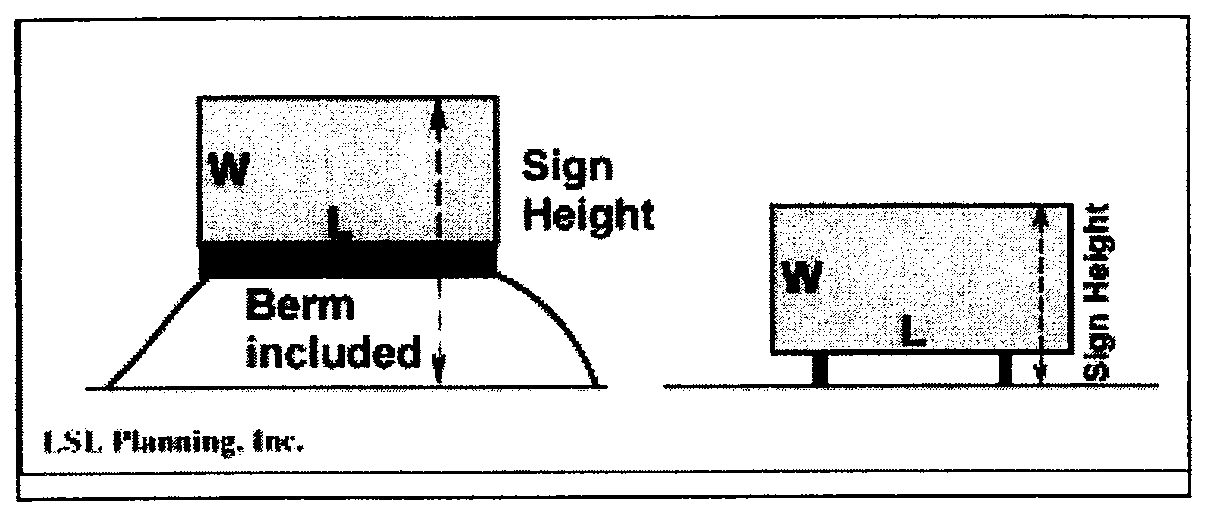
15:6.2. Location. Signs must be located at least ten feet from all property lines and the existing road right-of-way, unless otherwise specifically stated in this ordinance. Signs shall not be located within the vision clearance triangle at street intersections. The vision clearance triangle shall be determined by measuring back 15 feet from the intersecting rights-of-way and connecting the two points.
15:6.3. Regulation for signs.
Sign Regulation
Additional Requirements from Table:
A.
Freestanding signs. Freestanding signs shall be separated by a distance of no less than 500-foot intervals along each street frontage of the premises.
a.
Each lot of record shall be allowed one sign except a corner lot where a total of two signs may be permitted, one on each road frontage, provided that the total linear frontage is a minimum of 300 feet per side.
b.
Masonry bases must that match the associated building(s). Landscaping shall be planted to minimize the appearance of the poles or braces.
B.
In lieu of a freestanding sign, a development may use signs on entrance structures such as fences or walls. The number of sign faces is limited to two per entrance, on either side of the entrance, and confined to the entrance area. The distance between sign faces shall not exceed 100 feet. Such signs are subject to the size limitations of this section.
15:6.4. Automotive service station/convenience market signs. The following sign standards apply to automotive service station and convenience markets:
1.
Freestanding and wall signs. One freestanding sign and one wall sign shall be permitted. Such signs shall meet total height and area requirements as set forth in subsection 15:6.3, Freestanding signs, and subsection 15:6.4, Wall signs;
2.
Gasoline pump signs. Signs on gasoline pumps must be an integral part of the pump structure;
3.
Product or service advertising.
a.
No more than four product/service advertisements shall be allowed;
b.
Signs must be grouped on one sign structure per street frontage;
c.
Individual product/service advertisements shall not exceed four square feet in size;
d.
None of the allowable signs on the same structure shall be duplicates.
e.
Fuel price signs. One double-face sign per street frontage, not to exceed 12 square feet total area;
f.
Rack or cabinet signs. Includes those signs, which are an integral part of a rack or cabinet, such as display of oil, wiper blades, etc;
g.
Attention-getting advertising media. Banners, streamers, whirligigs, flashing, intermittent electrical or iridescent devices, and similar attention-getting advertising media are prohibited;
h.
Signs located on buffer wall. No sign for an automotive service station shall be placed, painted, or otherwise erected on any buffer wall; and
i.
Signs interfering with site distance. No sign or sign structure shall be positioned in such a manner that it interferes with any recognized vehicular sign, distance needs, or requirements.
(Ord. No. 09-33, § 6, 12-14-09; Ord. No. 16-07, § 2, 5-2-16; Ord. No. 16-29, § 4, 10-3-16; Ord. No. 2017-15, § 5, 6-19-17)
15:7. - Illumination.
15:7.1. General lighting.
1.
Sign lighting shall be of low intensity with effective provisions made to minimize spillover of light beyond the actual sign face. Examples of permissible illumination methods would include, but not limited to, the use of appropriate cut-off style light fixtures, the use of down-light fixtures adjusted so as to avoid spillover and interference with the vision of motorists, and the use of muted internal illumination.
2.
Use of glaring undiffused lights or bulbs shall be prohibited.
3.
Use of exposed neon lighting, including neon banding, or exposed light bulbs is prohibited.
4.
Lights shall be shaded so as not to project onto adjoining properties or thoroughfares.
5.
Underground wiring shall be required for all illuminated signs not attached to a building.
6.
All lighting fixtures or light sources for lighted signs shall be positioned and/or shaded so that the light source is not visible from normal pedestrian perspectives.
7.
Lighting intensities for illuminated signs shall not exceed ten foot-candles, measured at four feet perpendicular to any surface.
8.
External light sources used to illuminate a sign are not included in the measurement of a sign's area and/or height.
9.
Colored lamps are not permitted except for electronic changeable copy signs as allowed in accordance with Section 15:7.2
10.
Internal illumination. Internal illuminated signs are permitted within the community commercial, general commercial and industrial development zoning districts. Where permitted, internally illuminated signs shall be subject to the following regulations:
a.
Display area. Internally illuminated area of signs must be limited to 50 percent of the total allowed sign area.
b.
Muted lighting. Lamps within internally illuminated signs shall be muted so that individual lamps cannot be distinguished behind the sign face.
15:7.2. Digital billboards. Digital billboards are only permitted within the general commercial zoning district north of US 278 on SC 170. Digital billboards are subject to the cap and replace regulation, subsection 15:8.2, and can only be established through that section. Where permitted, digital signs shall be subject to the following regulations:
1.
Distance. The digital structure may be located no closer than 1,000 feet to the residential, resource conservation or rural preservation zoning districts. Measurement shall be from the residential zoning district to the outermost portion of each sign.
2.
Spacing. No digital sign may be closer than two miles to an existing digital billboard/off-premise advertising sign. Measurement shall be to the outermost portion of each sign.
3.
Message display intervals. Each message appearing on a digital billboard face shall remain fixed for a minimum of eight seconds, and message changes shall be instantaneous and shall not contain such visual effects as fading or dissolving.
a.
Dissolve. A mode of message transition on an electronic message display accomplished by varying the light intensity or pattern, where the first message gradually appears to dissipate and lose legibility simultaneously with the gradual appearance and legibility of the second message.
b.
Fade. A mode of message transition on an electronic message display accomplished by varying the light intensity, where the first message gradually reduces intensity to the point of not being legible and the subsequent message gradually increases intensity to the point of legibility.
In no event shall revolving, flashing or intermittent illumination be allowed. Where allowed, a message shall be displayed a minimum of eight seconds. Transition from one message to the next shall be instantaneous and shall not contain such visual effects as fading dissolves, flashing, etc.
4.
Illumination. Display brightness shall be adjusted as ambient light levels change and shall be subject to review and regulation as determined by the DSR.
5.
Malfunction display lock. Digital billboards shall contain a default design that will freeze the sign in one position if a malfunction occurs or in the alternative shut down.
6.
Emergency information. The operator of a digital billboard shall at the request of the county government make every effort to display emergency messages, such as Amber Alerts, road closures and evacuation information, as a public service and at no cost to requesting authority. Such messages shall be displayed in appropriate locations and with appropriate frequency until the emergency no longer exists or the authority requests termination.
15:7.3. Electronic changeable copy sign. Electronic changeable copy signs are permitted within the general commercial and industrial development zoning district. Where permitted, signs shall be subject to the following regulations:
1.
Display area. Changeable copy signs area must be limited to 20 percent of the total allowed sign area.
2.
Display. No "scrolling displays," or the vertical movement of a static message or display on an electronic changeable message sign. No "traveling displays" or the horizontal movement of a static message or display on an electronic changeable message sign.
3.
Content. Signs shall only provide public information such as gas price signs, time and temperature signs, and "open or closed" status.
4.
Message display interval. These signs are only allowed to change when the content information changes; meaning the sign must be set in a non-flashing and non-animated mode. The electronic message shall not change of more than once every eight hours and shall not use flashing or blinking characters. Information pertaining to gas prices, time and temperature, and "open or closed" status may change more frequently, but not more than once per eight seconds.
5.
Color. Text is limited to one color.
(Ord. No. 09-33, § 6, 12-14-09; Ord. No. 2017-15, § 6, 6-19-17)
15:8. - Billboards.
15:8.1 Approval by the planning commission. The planning commission must approve, approve with conditions or deny all applications for new billboards, digital billboards or alterations to an existing non-digital billboard and digital billboards. A permit will be issued after the planning commission has approved the application. Section 15:8:3 includes the criteria planning commission will use for new billboards and Section 15:8.4 for digital billboards through the cap and replace provision, Section 15:8.2. The planning commission may require adjustments to the design and site location of proposed signs and reasonable conditions may be attached to an approval.
15:8.2 Cap and replace. In order to place a new non-digital billboard, the owner and advertising company must remove and abandon three active billboards. An active billboard is a billboard that has not been abandoned or which has changed the copy face or received income on the copy face within six months of the date of this ordinance. In order to place a new digital billboard or convert a non-digital billboard to a digital billboard, the owner and advertising company must remove and abandon four active billboards. Any new billboard or existing billboard which is converted to a digital billboard must adhere to all the requirements of article 15. All new billboards including the conversion of non-digital billboards to digital billboards allowed through this regulation must be approved by the planning commission.
15:8.3 Billboards. New non-digital billboards are only permitted through the cap and replace regulations, Section 15:8.2 and must be approved by the planning commission. Non-digital billboards shall be subject to the following regulations:
1.
Location. New non-digital billboards are only permitted within the General Commercial and Industrial Development Zoning Districts along the interstate highways and frontage roads where their right-of-way is contiguous to an interstate highway provided these signs are located within 100 feet of the right-of-way of the interstate or frontage road.
2.
Minimum spacing. Non-digital billboards located along an interstate may not be erected within 500 feet of an interchange or rest area. The interchange or rest area is considered to begin or end at the point where the pavement widens for an entrance or exit ramp. Non-digital billboards located along an interstate shall not be permitted to locate within 500 feet of another sign on the same side of the roadway. For frontage roads, no billboard shall be permitted to locate within a 1,000 foot radius of another off premise sign.
3.
Maximum sign face. The maximum sign face for any non-digital billboard located along an interstate shall be 672 square feet plus a 10% allowance for copy extensions. A copy extension is the part of the copy which extends beyond the edge or border of the sign, sometimes called a "cut-out" or "drop-out."
The sign face of a non-digital billboard on any other highway shall be 378 square feet plus 10% allowance for copy extensions.
4.
Maximum height. Non-digital billboards located along interstate highways shall not exceed a height of 100 feet above the elevation of the highest travel lane at the location of the sign. The maximum height of non-digital billboards along other roadways shall not exceed 35 feet above the elevation of the roadway.
5.
Minimum height. The minimum height of the display surface for non-digital billboards located along interstate highways shall be 15 feet above the elevation of the highest travel lane at the location of the sign. The minimum height of the display surface of non-digital billboards along other roadways shall be 15 feet above the elevation of the roadway, unless the Sign Face does not exceed 200 square feet and placement of the sign does not block visibility of an existing Identification Sign.
6.
Other standards. If any other governmental body (federal or state) also regulates billboards, to the extent allowed by law, the more restrictive or that imposing higher standards, shall govern.
15:8.4 Digital billboards. Digital billboards constitute a separate and distinct land use due to their size and prominence upon the landscape, and are therefore subject to the following separate regulatory provisions. It is the purpose of this ordinance to allow for the establishment of digital billboards under specific, limited circumstances. Existing non-digital billboards may be converted to a digital billboard, or a new digital billboard may be erected, through the cap and replace regulations, Section 15:8.2, and must be approved by the planning commission. Digital billboards shall be subject to the following regulations:
1.
Location. Digital billboards are only permitted within 2,000 feet of the county border along Highway 17 north (Point South area) and south (state line area) and I-95 north (Point South area) and south (state line area) in the General Commercial Zoning District. Highway 17 south shall be measured from the highland of the S.C. side of the boundary 2,000 feet, not the river or marsh. Notwithstanding the foregoing reference to 2,000 feet, the Highway 17 north area shall only extend from 100 feet north of the intersection at Hamilton Place back to I-95.
2.
Distance. The digital structure may not be located within 1,000 feet of the residential zoning district. Measurement shall be from the residential zoning district to the outermost portion of each sign.
3.
Spacing. Digital Billboards may not be located within two miles of another existing digital billboard on the same side of the right-of-way. Measurement shall be to the outermost portion of each sign.
4.
Maximum sign face. The maximum sign face for any digital billboard is limited to 560 square feet per face.
5.
Maximum height. Digital billboards located along interstate highways shall not exceed a height of 100 feet above the elevation of the highest travel lane at the location of the sign. The maximum height of digital billboards along other roadways shall not exceed 45 feet above the elevation of the roadway.
6.
Minimum height. The minimum height of the display surface for digital billboards located along interstate highways shall be 15 feet above the elevation of the highest travel lane at the location of the sign. The minimum height of the display surface of digital billboards along other roadways shall be 15 feet above the elevation of the roadway, unless the Sign Face does not exceed 150 square feet and placement of the sign does not block visibility of an existing identification sign.
7.
Message display intervals. Each message appearing on a digital billboard face shall remain fixed for a minimum of eight seconds, and message changes shall be instantaneous and shall not contain such visual effects as fading or dissolving.
a.
Dissolve. A mode of message transition on an electronic message display accomplished by varying the light intensity or pattern, where the first message gradually appears to dissipate and lose legibility simultaneously with the gradual appearance and legibility of the second message.
b.
Fade. A mode of message transition on an electronic message display accomplished by varying the light intensity, where the first message gradually reduces intensity to the point of not being legible and the subsequent message gradually increases intensity to the point of legibility.
In no event shall revolving, flashing or intermittent illumination be allowed. Where allowed, a message shall be displayed a minimum of eight seconds. Transition from one message to the next shall be instantaneous and shall not contain such visual effects as fading dissolves, flashing, etc.
8.
Illumination. Display brightness shall be adjusted as ambient light levels change and shall be subject to review and regulation as determined by the DSR.
9.
Malfunction display lock. Digital billboards shall contain a default design that will freeze the sign in one position if a malfunction occurs or in the alternative shut down.
10.
Emergency and public service information. The operator of a digital billboard shall, at the request of Jasper County Government, display emergency messages, such as Amber Alerts, road closures and evacuation information, as a public service and at no cost to Jasper County Government. Such messages shall be displayed in appropriate locations and with appropriate frequency on such digital billboard(s) until the emergency no longer exists or Jasper County Government requests termination. In addition, the operator of a digital billboard shall on a space available basis, and at the request of Jasper County Government, display one public service announcement (that promotes or benefits Jasper County) per advertising cycle on such digital billboard(s) faces(s).
11.
Other standards. If any other governmental body (federal or state) also regulates billboards, to the extent allowed by law, the more restrictive or that imposing higher standards, shall govern.
15:8.5 South Carolina Code of Laws. The sign regulations contained in this ordinance are supplemented by the requirements of the State of South Carolina Department of Transportation which regulates off-premise signs on interstate and federal aid road systems. See Section 15:1.3. Issuance of a Jasper County Zoning Permit does not imply approval of, or constitute a privilege to violate, any other applicable, federal, state or local statues, ordinances, codes, regulations, or private restricted covenants. Applicants are specifically reminded of the Jasper County Code of Ordinances as it relates to initial and recurring annual fee for off-premise signs.
(Ord. No. 09-33, § 6, 12-14-09; Ord. No. 16-07, § 3, 5-2-16; Ord. No. 2017-15, §§ 7, 8, 6-19-17)
15:9. - Non-conforming signs and billboards.
15.9.1 Non-conforming signs and billboards. Non-conforming signs may continue in operation and maintenance, provided that non-conforming signs shall not be:
1.
Changed to or replaced with another non-conforming sign. However, this provision shall not prohibit a change in copy or graphics on the sign face of the sign;
2.
Replaced with a digital, LED, or similar electronic sign, except as allowed by Article 15:8.1 and consistent with 15:8.2 and 15:8.4;
3.
Structurally altered so as to extend their useful life;
4.
Expanded;
5.
Relocated, except in compliance with this section; and
6.
Reestablished after damage or destruction of more than 50 percent of the replacement value of the same type sign at the time of such damage or destruction unless by vandalism or a criminal act conducted by a party not associated with the advertising company, sign owner or property owner.
This section shall not prevent repairing or restoring to a safe condition any part of a sign or sign structure, or normal maintenance operations performed on a sign or sign structure. The sign structure, or any of its members, may be replaced with only like or similar materials. Replacement may be made only on a pole for pole or member for member basis, and the original structure design may not be altered in any form. Lighting cannot be added to a non-illuminated sign.
When a sign is located on property which is condemned for right-of-way acquisition, one of the following standards shall apply:
1.
A sign which is not located in, and does not overhang the new right-of-way, may remain in place.
2.
When a sign located on a state or federal aid highway must be relocated off the new right-of-way, it shall, at a minimum, comply with state standards for such relocation; and
3.
When a sign located on a county road must be relocated off the new right-of-way, it shall comply, as near as possible, with the setbacks established in this article.
15:9.2 Amortization.
A.
Non-conforming off premises signs shall be amortized and the non-conforming use discontinued as provided in Table 1.1, of this section, except, if the use of such off premises sign cannot be amortized due to its proximity to a federal aid primary road, interstate highway or national highway system road then the non-conforming off premises sign shall be discontinued if abandoned as defined Article 4, Definitions or if damaged more than fifty percent as defined in Section 15:9.1 (6) in which case such non-conforming use shall be permanently ended and discontinued and the remaining portions of the off premises sign removed.
B.
Amortization of non-conforming signs and billboards not subject to protection by reason of its proximity to federal aid primary road, interstate, highway or national highway system or otherwise protected under state or federal law or regulation, shall be subject to the following:
1.
Non-conforming signs and billboards shall be removed or otherwise made to conform to the provisions of this Article within the number of years set forth in the Amortization Schedule below, which shall begin to run on the date of enactment of this Ordinance.
2.
The amortization period set forth in the Amortization Schedule shall be conclusively presumed to have provided just compensation to the owner of the non-conforming sign or billboard and the owner of the real property on which the non-conforming sign or billboard is located for any property interest impacted by this Ordinance.
a.
Provided, however, that if any amortization period is declared invalid and it is ordered or determined that the County is required to pay funds as compensation, that the County shall have the option to allow the non-conforming sign or billboard to continue in existence as a non-conforming use without payment of such funds until, in its sole discretion, the County determines that adequate funds exist to remove the non-conforming sign or billboard.
b.
The failure of the County to remove any non-conforming sign shall not be construed as a waiver by the County to exercise any such rights in the future or demand strict compliance with the provisions of this Ordinance.
c.
In the event a sign is protected as set forth in Section 15:9.2 above, the Amortization Schedule herein shall be deemed to incorporate such corresponding amortization period as may be provided in the protective statues or regulations.
3.
Nothing herein shall be construed to make a sign in existence on the effective date of this ordinance which is currently an unlawful non-conforming sign already deemed to be abandon and/or subject to removal, subject to the extended amortization period of Section 15:9.2.
(Ord. No. 09-33, § 6, 12-14-09; Ord. No. 2017-15, §§ 9, 10, 6-19-17)
15:10. - Sign variances.
Any party who has been refused a sign permit for a proposed sign may file an appeal with in accordance with the zoning ordinance. In determining whether a variance is appropriate, the BZA shall study the sign proposal, giving consideration to any extraordinary circumstances, such as those listed below, that would cause practical difficulty in complying with the sign standards. The presence of any of the circumstances listed may be sufficient to justify granting a variance; however, the zoning BZA may decline to grant a variance even if certain of the circumstances are present.
In granting a variance, the BZA may attach such conditions regarding the location, character, and other features of the proposed sign as it may deem reasonable. In granting a variance, the BZA shall state the grounds and findings upon which it justifies granting the variance.
1.
Permitted signage could not be easily seen by passing motorists due to the configuration of existing buildings, trees, or other obstructions.
2.
Permitted signage could not be seen by passing motorists in sufficient time to permit safe deceleration and exit. In determining whether such circumstances exist, the zoning board of appeals shall consider the width of the road, the number of moving lanes, the volume of traffic, and speed limits.
3.
Existing signs on nearby parcels would substantially reduce the visibility or advertising impact of a conforming sign on the subject parcel.
4.
Construction of a conforming sign would require removal or severe alteration to natural features on the parcel, such as but not limited to: removal of trees, alteration of the natural topography, filling of wetlands, or obstruction of a natural drainage course.
5.
Construction of a conforming sign would obstruct the vision of motorists or otherwise endanger the health or safety of passers-by.
6.
Variance from certain sign regulations would be offset by increased building setback, increased landscaping, or other such enhancements, so that the net effect is an improvement in appearance of the parcel, compared to the result that would be otherwise achieved with construction of a conforming sign.
7.
A sign which exceeds the permitted height or area standards of this article would be more appropriate in scale because of the large size or frontage of the parcel or building.
Adjustment in size, location. The BZA may, upon application by the property owner, make reasonable adjustment in the size and location requirements for any sign, where such action meets the following standards:
1.
A variance is deemed in the public interest;
2.
The variance would not adversely affect properties in the immediate vicinity of the proposed sign;
3.
The alleged practical difficulty supporting the variance request results from conditions that do not generally exist throughout the county, and denial of a variance would preclude all reasonable use of the property;
4.
Granting a variance would result in substantial justice being done, considering the public interests protected by the standards of this article, the individual hardships that would be suffered by denial of the variance and the rights of others throughout the county whose property may be affected by granting the variance;
5.
The type of sign has been designed to make it compatible with the surrounding area.
(Ord. No. 09-33, § 6, 12-14-09)
15:11. - Severability.
If any section, clause, paragraph, sentence or phrase of this sign ordinance (Article 15 of Appendix A of the Jasper County Code of Ordinances) shall, for any reason, be held to be invalid or unconstitutional, such invalid section, clause, paragraph, sentence or phrase is hereby declared to be severable; and any such invalid or unconstitutional section, clause, paragraph, sentence or phrase shall in no way affect the remainder of this ordinance; and it is hereby declared to be the intention of the county council that the remainder of this ordinance would have been passed notwithstanding the invalidity or unconstitutionality of any section, clause, paragraph, sentence or phrase thereof.
(Ord. No. 16-29, § 4, 10-3-16)

