
Jonesboro City Zoning Code
ARTICLE III
INTERPRETATIONS AND DEFINITIONS
Sec. 86-61.- Interpretations.
For the purpose of this chapter, certain words and terms are hereby defined. All other words used in this chapter shall indicate their customary dictionary definitions. Words used in the present tense shall include the future tense; the singular number shall include the plural and the plural, the singular. The word "building" shall include the word "structure;" the word "lot" includes the words "plot," "parcel," "tract" and "site." The word "person" includes "persons, firm, association, authority, organization, partnership, trust, company, corporation, owner or authorized agent as well as individual." The word "shall" is always mandatory and not directory. The words "used" or "occupied" shall be construed to include the words "intended, arranged or designed" to be used or occupied. The masculine gender includes the feminine gender.
(Ord. No. 05-08, § 2(3.01), 8-15-2005)
Sec. 86-62. - Definitions.
For the purpose of this chapter, the terms and words of this section shall be assigned the meanings indicated.
Abutting, also adjoining. Sharing a common property boundary.
Access. A way or means of approach to provide physical entry to a property.
Accessory building. A subordinate structure customarily incidental to and located on the same lot occupied by the principal building, such as a detached garage.
Accessory use. A use subordinate to the primary use on a lot and reasonably necessary and incidental to the primary use.
Accessory building setback. The minimum distance between a property line or right-of-way of an abutting street and an accessory building.
Adult day-care facility. Any dwelling or facility, whether operated for profit or not, in which three or more persons 18 years of age or older, who have difficulty in functioning independently, receive care for fewer than 24 hours per day without transfer of legal custody.
Alley. A vehicular service way providing a secondary means of access to abutting properties and not designed for general traffic circulation.
Alteration. Any change, addition or modification in construction, occupancy or use or rearrangement in the supporting members of an existing building, or any enlargement to or reduction of a building, whether horizontally or vertically, or the moving of a building from one location to another.
Annexation. The incorporation of new land areas into the city limits of a municipality.
Animal hospital. A facility at which animals are given medical treatment and any boarding of animals is limited to short-term care incidental to such treatment.
Antenna. Any device or combination of devices, whether rods, panels or dishes, designed to receive or transmit radio frequency signals including, but not limited to, broadcast radio and television, satellite television, wireless cable, amateur radio, Citizen's Band radio, land mobile communications, personal wireless services and fixed wireless signals.
Apartment. A dwelling unit physically attached to two or more other dwelling units, either directly or through an intervening unit, and that constitutes neither a condominium nor a townhouse.
Approved plan. A plan that has been given final approval by the appropriate authority.
Applicant. A property owner or their authorized representative who has petitioned the city for approval of a zoning petition, conditional use, subdivision plat, site plan, development permit, building permit, variance, appeal, or any other authorization for the use or development of their property under the requirements of this zoning ordinance.
Application. A petition for approval of a zoning map amendment, conditional use, project approval, development permit, building permit, variance, appeal or any other authorization for use or development of property under the requirements of this zoning ordinance.
Assisted living facility. A facility licensed by the State of Georgia for the transitional residency of elderly or disabled persons, progressing from independent living to congregate housing, within which are provided living and sleeping facilities, meal preparation, laundry services, transportation services and routine social and medical appointments and counseling.
Automobile broker. An establishment engaged solely in the business of bargaining or negotiating, for a commission or fee, between potential purchasers or lessees of vehicles and other automobile sales establishments for the lease or purchase of vehicles.
Automobile maintenance. The routine replacement and maintenance of non-engine related parts including brake repair, tire replacement, minor tune-ups and oil changes. This term does not include engine or body dismantling.
Automobile repair. General repair, rebuilding or reconditioning of engines, motor vehicles or trailers such as collision service, body repair and frame straightening; painting and upholstering; vehicle steam cleaning and undercoating.
Automobile sales. The use of any building, land area or other premise for the display and sale of new or used vehicles, and including any warranty repair work or other repair service.
Automobile storage yard. A facility used for the short-term storage of damaged or confiscated vehicles.
Automobile wrecking yard. Any land or building used for wrecking or storing of inoperable vehicles or farm machinery, or parts thereof, stored in the open and not being restored to operating condition.
Awning. A roof-like structure, such as canvas on a frame, attached to a building over a window, walkway or doorway and used as shelter from the elements.
Basement. A space within a structure having one-half or more of its floor-to-ceiling height above the average adjacent grade and having a floor-to-ceiling height of not less than 6½ feet. A basement shall be termed a cellar when more than one-half its height is below the average adjacent grade. A basement or cellar shall be counted as a story when the vertical distance from the average adjacent grade to the ceiling exceeds five feet.
Bedroom. Any room in a dwelling designed and intended for sleeping, separable from other rooms by a door.
Berm. A mound of earth used to improve the appearance of a landscaped area or enhance the screening effect.
Best management practices. A collection of structural measures and vegetative practices which, when properly designed, installed and maintained, provide effective erosion and sedimentation control for all rainfall events up to and including a 25-year, 24-hour rainfall event.
Block. An area of land bounded by streets or by a combination of streets and public land, railroad right-of-way, waterway or any other barrier to the continuity of development.
Boarding house. A building containing a single dwelling unit having not more than ten guestrooms or suites of rooms, where lodging is provided with or without meals, for compensation for more than one week.
Buffer. An area of natural or planted vegetation intended to visually separate one land use from a more intense or otherwise incompatible use throughout the year.
Buildable area. The area of a lot outside the limits of the front, side and rear yards and which is not subject to the open space requirements or other environmental restrictions of this chapter or other laws, codes or ordinances.
Building. A structure with a roof, intended for shelter or enclosure.
Building addition. A walled and roofed expansion to the square footage of a building in which the addition is connected by a common load-bearing wall other than a firewall.
Building code. The technical codes approved for enforcement or otherwise adopted or adopted as amended by the city under the Georgia Uniform Codes Act, which regulate the construction of buildings and structures.
Building facade. The elevation of a building extended from grade to the top of the parapet wall or eaves and the entire width of the building elevation fronting a public street, excluding alleys and lanes; may also be referred to as the building face.
Building footprint. The horizontal area of a lot occupied by a building as measured from the outside of the exterior walls of the ground floor of the building.
Building frontage. The linear footage of the exterior building wall fronting a public right-of-way or private street or alley.
Building height. The average of two measurements of vertical distance from adjacent grade to the lowest and highest points of the roof of the highest story of a building.
Building line. The position of the front wall of principal building on the lot; also defined by the front yard setback.
Building permit. Written permission issued by the City of Jonesboro for construction, repair, alteration of, or addition to a structure.
Building, principal. The building in which the primary use on the lot is conducted.
Building setback line. A line beyond which a building or any projection thereof, excluding uncovered steps, may not encroach.
Caliper. The diameter of a tree (usually nursery stock) measured at a point six inches above
the ground or top of root ball for up to and including four-inch caliper trees, and
at a point 12 inches above the ground or top of root ball for larger trees.
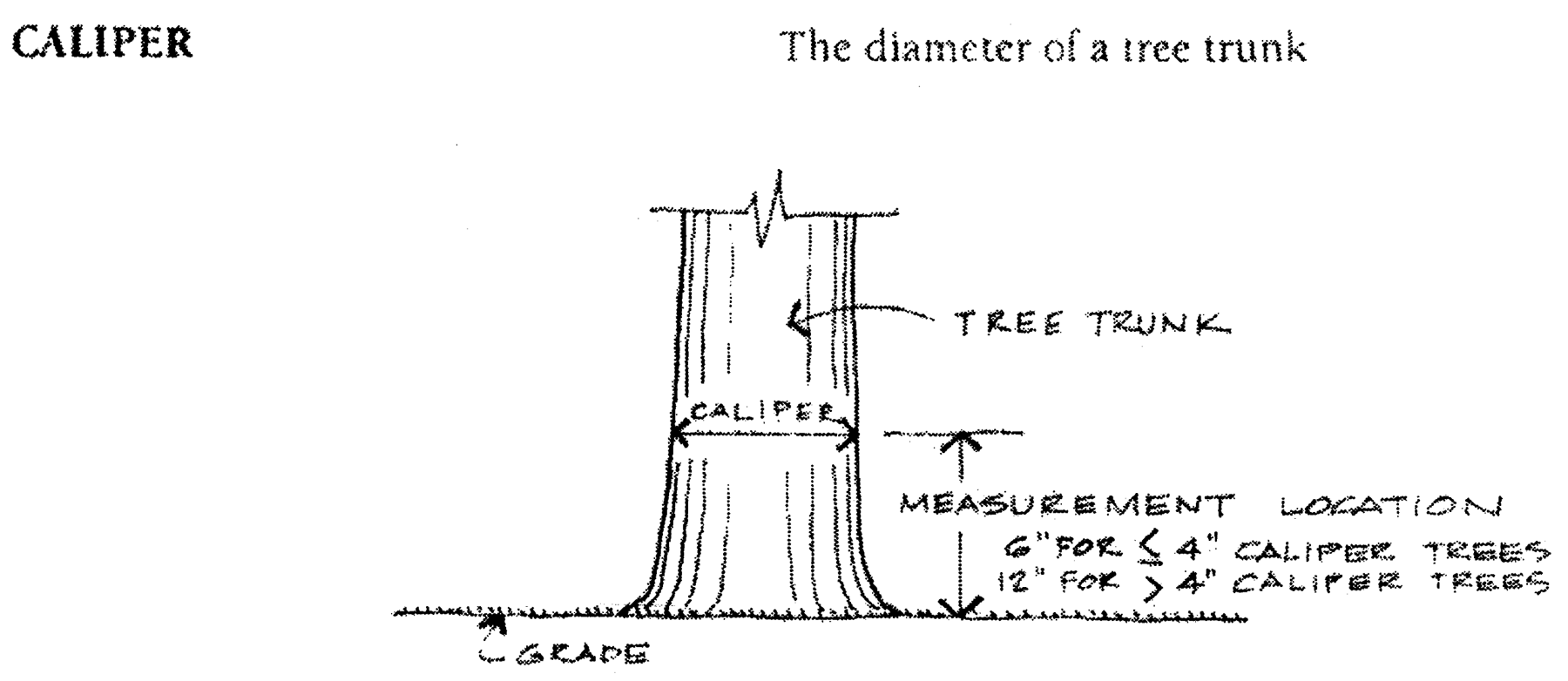
CALIPER
Car wash. A building, or portion thereof, in which automobiles are cleaned for a fee.
Carport. A structure attached or made a part of a principal dwelling and open to the elements on two or more sides, intended to shelter vehicles.
Cemetery. Property used for the interring of the deceased.
Central business district. The core commercial area of a city usually containing retail, service, office, public, cultural, recreational and entertainment uses; also the downtown or town center.
Certificate of occupancy (CO). A document issued by the code enforcement indicating that a building has been constructed in accordance with all codes and provisions of this chapter, or that a legal variance to the codes and provisions of this chapter has been granted.
Certificate of zoning compliance. A document issued by the zoning administrator or his designee stating that a use of a building or land conforms to all provisions of this chapter or that a legal variance to the provisions of this chapter has been granted.
Child care center. A private establishment enrolling five or more children under 18 years of age and where tuition, fees or other forms of compensation for the care of the children is charged. The term includes day nurseries and kindergartens.
City. The City of Jonesboro, Georgia.
City clerk. The City Clerk of the City of Jonesboro, Georgia.
City council, mayor and council. The Mayor and Council of the City of Jonesboro.
Clinic. A building or part of a building used for medical, dental, chiropractic, surgical, therapeutic or other examination or treatment of patients who are not lodged overnight, and excluding hospitals or professional offices of a doctor occupying a portion of a dwelling.
Club or lodge. Buildings or facilities owned or operated by a corporation, association, person or persons for social, educational or recreational purposes, but not primarily for profit or to render a service customarily carried on as a business.
Code enforcement officer. The individual designated by the zoning administrator or his designee whose duty it shall be to enforce the provisions of this chapter, or his designee.
Comprehensive plan. The Comprehensive Plan for the City of Jonesboro prepared, adopted and as amended in accordance with the Georgia Comprehensive Planning Act.
Conditional use. A use not automatically permitted by right, but may be permitted within a zoning district, subject to requirements specified in this chapter or imposed by the mayor and council.
Conditional zoning. The granting of zoning for a property subject to compliance with restrictions as to use, size, project design or timing of development stipulated by the Jonesboro City Council to mitigate adverse impacts that could be expected in the absence of such restrictions.
Condominium. A building, or group of buildings, in which each unit is independently owned and financed by the occupant, but in which all lands are owned in common on a proportional, undivided basis.
Condominium, commercial. A building or buildings used for offices, businesses, professional services or other commercial enterprise are organized, owned and maintained as a condominium.
Construction trailer. A manufactured unit designed and used for on-site office space associated with a development project, including new construction and renovation.
Construction vehicle. Any vehicle used commercially for the purpose of land development and construction such as loaders, backhoes and dump trucks.
Convenience store. Any retail establishment offering for sale prepackaged food products, household items and other goods that may or may not sell gasoline.
Covenant. A private, legal restriction on the use of land or structures contained in the property deed or otherwise formally recorded.
Cul-de-sac. A local street with only one outlet terminating in a vehicular turnaround.
Curb cut. An opening along the curb line of a public right-of-way through which vehicles may enter or exit the roadway.
Day care center. Any place operated by a person, society, agency, corporation, institution or group, wherein are received for pay, for group care for fewer than 24 hours per day, without transfer of legal custody, 19 or more children under 18 years of age.
Day care, family. A private residence operated by any person who receives therein for pay for supervision and care fewer than 24 hours per day, without transfer of legal custody, at least three, but not more than six children under 18 years of age who are not related to such person and whose parents or guardians are not residents in the same private residence.
Day care, group. Any place operated by any person or group wherein are received for pay not less than seven nor more than 18 children under 18 years of age for care and supervision for less than 24 hours per day.
Decision date. The date upon which an officer of the city renders a final determination on an application.
Dedication. The legal transfer of property and/or public improvements from private to public ownership.
Deed restrictions or covenants. Private stipulations or legal restrictions assigned to the use of land, contained in the deed to the property or otherwise formally recorded.
Density. The number of dwelling units per acre. The standard for calculating gross density shall be the number of dwelling units divided by the entire acreage of the lot. Net density shall be based on the lot acreage minus the area comprising the network of streets and sidewalks, together with any required reservation of open space.
Development. Any project involving construction of streets, utilities, buildings or other improvements made to property to accommodate specific uses such as dwellings, office buildings, warehouses, an apartment complex, a store or shopping center; also any alteration to improved or unimproved property, including, but not limited to, construction, reconstruction, conversion, structural alteration, relocation or enlargement of any structure; any mining, dredging, excavation, filling, grading, paving, excavating, drilling operations, permanent storage of materials or other land disturbance; and any use or extension of a use of land; also the act of constructing or implementing a land development project, including the alteration of land or vegetation in preparation for construction activity.
Development permit. The authorization necessary to initiate and conduct a land-disturbing activity and to conduct the planned development of land and structures.
Display case. A case, cabinet or other device having a window of glass or other transparent material, or other opening, access to which is made from other than within the structure or building of which it is a part or attached.
District. A geographic section of the city within which the zoning regulations are uniform.
Domestic animals. Small animals, including fish or fowl, permitted in a private residence or yard and kept as pets such as dogs, cats, rabbits, rodents, birds and fish, but excluding swine, livestock and exotic animals.
Drive-in establishment. A commercial operation designed to provide, either wholly or in part, service to customers while in their automobile parked on the premises.
Drive-in theater. An open lot with its appurtenant facilities devoted primarily to the showing of motion pictures or other prerecorded productions to patrons seated in automobiles.
Driveway. A private roadway providing access for vehicles to a parking space, garage, dwelling or other structure.
Dwelling. A building or portion of a building designed, arranged and used exclusively for residential occupancy, including single family, two-family (duplex) and multifamily dwellings, but not hotels, motels, boarding houses, and rooming houses or like facilities.
Dwelling, multifamily. A building or portion thereof used exclusively for residential occupancy by three or more families in separate dwelling units living independently of each other and containing three or more dwelling units.
Dwelling, quadraplex. Four attached dwellings in one structure in which each unit has two outdoor exposures and shares one or two walls with an adjoining unit or units.
Dwelling, single-family attached. A residential building in which the dwelling units are held in fee simple title and adjoin one another only at the vertical walls and no dwelling unit may be located above another. The term excludes duplexes, triplexes and quadraplexes.
Dwelling, single-family detached. A dwelling, whether site-built or a manufactured home or an industrialized building, designed for occupancy by not more than one family and surrounded by open space or yards and which is not attached to any other dwelling by any means.
Single-family detached dwelling units must conform to the following minimum standards:
(1)
Minimum width of the unit shall be 24 feet.
(2)
Minimum floor area shall be as indicated in the zoning district in which the lot is located.
(3)
The roof pitch shall be equal to or greater than the average pitch on the roofs of all single-family dwellings located on lots within four lots adjoining the lot in question, including lots across public streets. In no event shall roof pitch be less than three inches in rise to 12 feet in run. The roof shall have a surface of wood, shakes, asphalt composition, wood shingles, concrete, fiberglass or metal tiles, slate, built up gravel materials or other materials approved by the zoning administrator or his designee.
(4)
The unit must be attached to a permanent foundation as approved by the zoning administrator or his designee.
(5)
The unit must be constructed according to the standards established by the state minimum standard codes, as amended from time to time, the Standard Building Code, the National Manufactured Housing Construction and Safety Standards Act, or the State of Georgia Industrialized Buildings Act.
(6)
The unit must have a roof overhang for soffit equal to or greater than the average overhang for soffit on the single-family dwellings located on lots within four lots adjoining the lot in question, including lots across public streets. In no event shall the overhang for soffit be less than 16 inches to insure adequate ventilation.
(7)
All towing devices, wheels, axles and hitches must be removed.
(8)
A landing having a minimum of dimension of 36 inches by 36 inches shall be provided at all access doors.
Dwelling, triplex. A building divided into only three dwelling units each of which has an independent entrance either directly or through a common vestibule and used by not more than three families.
Dwelling, two family or duplex. A building that is divided horizontally into two dwelling units each of which has an independent entrance either directly or through a common vestibule and used by not more than two families.
Easement. That portion of land or property reserved for present or future use by a person or agency other than the legal fee simple owner(s) of the property. The easement shall be permitted to be for use under, on or above said lot or lots.
Eave. The projecting lower edges of a roof overhanging the wall of a building.
Erosion. The detachment and movement of soil or rock fragments, or the wearing away of the land surface by water, wind, ice or gravity.
Facade. The face of a building fronting along a street.
Family. A person, or group of persons, immediately related by blood, marriage, or adoption living and cooking together as a single housekeeping unit, exclusive of household servants; also, a group of not more than three persons, or a group of not more than eight disabled persons not necessarily related by blood, marriage, or adoption, living and cooking together as a single housekeeping unit.
Fence. Any structure used to restrict access or obstruct vision.
Fireworks shops. Any building or structure that meets the following criteria:
(1)
Consumer fireworks retail sales facility. A permanent or temporary building or structure, consumer fireworks retail sales stand, tent, canopy, or membrane structure that is used primarily for the retail display and sale of consumer fireworks to the public. The definition of consumer fireworks retail sales facility shall have the same meaning as set forth in O.C.G.A. § 25-10-1 and National Fire Protection Association Standard 1124 should that definition differ from the definition in this subsection.
(2)
Consumer fireworks retail sales stand. A permanent or temporary building or structure that has a floor area of not greater than 800 feet 2 (74m 2 ), other than tents, canopies, or membrane structures, that is used primarily for the retail display and sale of consumer fireworks to the public. The definition of consumer fireworks retail sales stand shall have the same meaning as set forth in O.C.G.A. § 25-10-1 and National Fire Protection Association Standard 1124 should that definition differ from the definition in this subsection.
Floodplain. An area identified by the U.S. Army Corps of Engineers or other surveying agencies as subject to inundation by surface waters once every 100 years and deemed necessary for the unrestricted flow of floodwaters.
Floor. The top surface of an enclosed area in a building, including basement, for example, the top of slab in concrete slab construction or top of wood flooring in wood frame construction. The term does not include the floor of a garage used solely for parking vehicles or storage, or the floor area of an attic used exclusively for storage.
Floor area. For residential uses, the total of all floors of a building as measured to the outside surfaces of exterior walls, or from the centerline of walls or partitions separating dwelling units, including halls, stairwells, elevator shafts, and excluding unfinished basements, cellars, storage areas, garages, uncovered porches, terraces, decks and balconies. For non-residential uses, floor area shall include all floors, lofts, balconies, mezzanines, cellars, basements, halls, stairwells, elevator shafts and all other interior spaces.
Floor area, gross. The sum of the horizontal areas of floors of a building measured from the exterior face of exterior walls or, if appropriate, from the centerline of dividing walls.
Floor area ratio. A mathematical expression determined by dividing the total floor area of a building by the area of the lot on which it is located.
Fraternity or sorority house. A dwelling maintained exclusively for members affiliated with an academic college or university or other recognized professional institutions of higher learning.
Funeral home. A building used for the preparation of the deceased for burial and the display of the deceased and ceremonies connected therewith before burial or cremation.
Future land use map. A map contained in the comprehensive plan depicting the desired pattern of development by activity. This map is referenced in zoning decisions.
Garage commercial. A commercial structure or any portion thereof, in which one or more automobiles are housed, stored or repaired, not including exhibition, showing or storage of cars for sale.
Garage, parking. A building or portion thereof designed or used for storage of motor-driven vehicles.
Garage, private. An accessory building or a portion of the principal dwelling designed or used for storage of motor-driven vehicles owned and used by the occupants of the building.
Grade. The average elevation of the finished surface of the ground adjacent to the exterior walls of a building.
Greenspace. Any parcel or area of land or water essentially unimproved and set aside, dedicated, designated or reserved for public or private use or enjoyment.
Gross acreage. The total acreage of a lot prior to making site improvements.
Ground elevation. The original elevation of the ground surface prior to cutting or filling.
Guest house. An accessory use to a dwelling designed and intended for the temporary housing of visitors to a property at the behest of the property residents for no fee or other consideration.
Halfway house. A temporary residential living arrangement for persons leaving an institutional setting and in need of a supportive living arrangement in order to readjust to living outside the institution. Such persons may be receiving therapy and counseling from support staff present when residents are present, for the following purposes: (1) recuperation from the effects of drug or alcohol addiction; (2) re-entry to society while housed under supervision as an alternative to imprisonment including, but not limited to, pre-release, work release, or probationary programs; or (3) adjustment to family or school problems that require specialized attention and care in order to achieve personal independence.
Health department. The Clayton County Health Department.
Health practitioner. A doctor, dentist or chiropractor, but excluding veterinarians.
Height. The vertical distance measured from the mean elevation of the proposed finished grade to the highest point of a structure, sign or its supporting structure, whichever is higher.
Historic district. A district consisting of various zones that have substantial historic, architectural or cultural significance.
Historic structure. Any structure (1) listed individually in the National Register of Historic Places (a listing maintained by the U.S. Department of Interior) or preliminarily determined by the secretary of the interior as meeting requirements for individual listing on the National Register; (2) certified or preliminarily determined by the secretary of the interior as contributing to the historical significance of a registered historic district or a district preliminarily determined by the secretary to qualify as a registered historic district; (3) individually listed on a state inventory of historic places and determined as eligible by states with historic preservation programs which have been approved by the secretary of the interior; or (4) individually listed on a local inventory of historic places and determined as eligible by communities with historic preservation programs that have been certified.
Hobby. A pursuit outside ones regular occupation engaged in for relaxation and not as a commercial venture.
Home occupation. An activity conducted for profit as an accessory use within a dwelling or accessory building.
Homeless shelter. Any building in which meals and/or lodging is provided at nominal or no cost to no more than 40 persons who are homeless or indigent.
Hospital. A building or portion thereof designed or used for therapeutic treatment of bed patients who are physically or mentally ill.
Hotel. A building in which lodging or board and lodging are provided for transient guests, and offered to the public for compensation and which ingress and egress to and from all rooms are made through an inside lobby or office supervised by a person in charge at all hours.
Household. An individual living alone or a group of individuals living together in a single dwelling unit, sharing common use of and access to all living and eating areas, bathrooms, and food preparation areas, who combine their mutual efforts and share responsibilities for domestic chores such as child rearing, cleaning and cooking in a permanent and long-term relationship, as contrasted to individuals in a transient relationship who pay for lodging such as a boarder.
Improvement. Any man-made object that becomes part of, is placed upon, or is affixed to real estate.
Industrialized home. A home manufactured in accordance with the Georgia Industrialized Building Act and the Rules of the Commissioner of the Georgia Department of Community Affairs issued pursuant thereto. State approved buildings meet the state building and construction codes and bear an insignia of approval issued by the DCA Commissioner.
Industrial park. A tract of land that has been planned, developed and operated as an integrated facility for a number of individual industrial uses, including warehousing and distribution, with special attention to circulation, parking, utility needs, aesthetics and compatibility.
Impervious surface. A surface that has been compacted or covered with a layer of material so as to render the surface highly resistant to infiltration by water including streets, roofs, sidewalks, parking lots and other similar structures.
Junk. Any scrap, waste, reclaimable material or debris, whether or not stored or used in conjunction with dismantling, processing, salvage, storage, baling, disposal or other use or disposition.
Junk vehicles. Any wrecked or inoperable automobile, truck or other vehicle that does not bear a current license plate, has not been capable of operating under its own power for a period exceeding 30 days, or from which parts have been or are to be removed for reuse or sale.
Junk yard. A parcel of land or building on which junk, waste, or used materials or junked vehicles or other machinery, or parts thereof, are bought, sold, exchanged, stored, collected, processed, dismantled or otherwise handled for the purpose of salvage for sale or conversion to economic use.
Kennel. Any location where boarding, caring for and keeping of more than a total of four dogs or cats or other animals or combination thereof, with the exception of a litter of animals less than six months old, is conducted; also raising of show or hunting dogs.
Kitchen. Any room or portion of a room within a building designed and intended to be used for cooking or preparation of food.
Laboratory. A facility dedicated to experimental study such as testing and analyzing. Excluding product manufacturing.
Landscaping. Actual plant materials or installation such materials consisting of trees, shrubs, vines, turf, ground cover and other natural landscape materials utilized to enhance the aesthetic and functional qualities of a site.
Laundromat. A business that provides washing, drying and ironing machines for hire to be used by customers on the premises.
Livestock. Poultry, cattle, swine, horses, mink, rabbits, sheep, goats or similar classes of animals excluding domestic animal kept as pets.
Loading space. A space within the main building or on the same lot, providing for the standing, loading or unloading of trucks.
Lot. A parcel of land occupied or intended for occupancy by a single, principal building
or use, or group of buildings devoted to a common use, and any accessory building
and use, containing the minimum area required by the zoning district in which it is
located, and accessed by a public or private street; also an area of land having one
continuous boundary held by one owner and recorded with the Clerk of the Superior
Court of Clayton County.
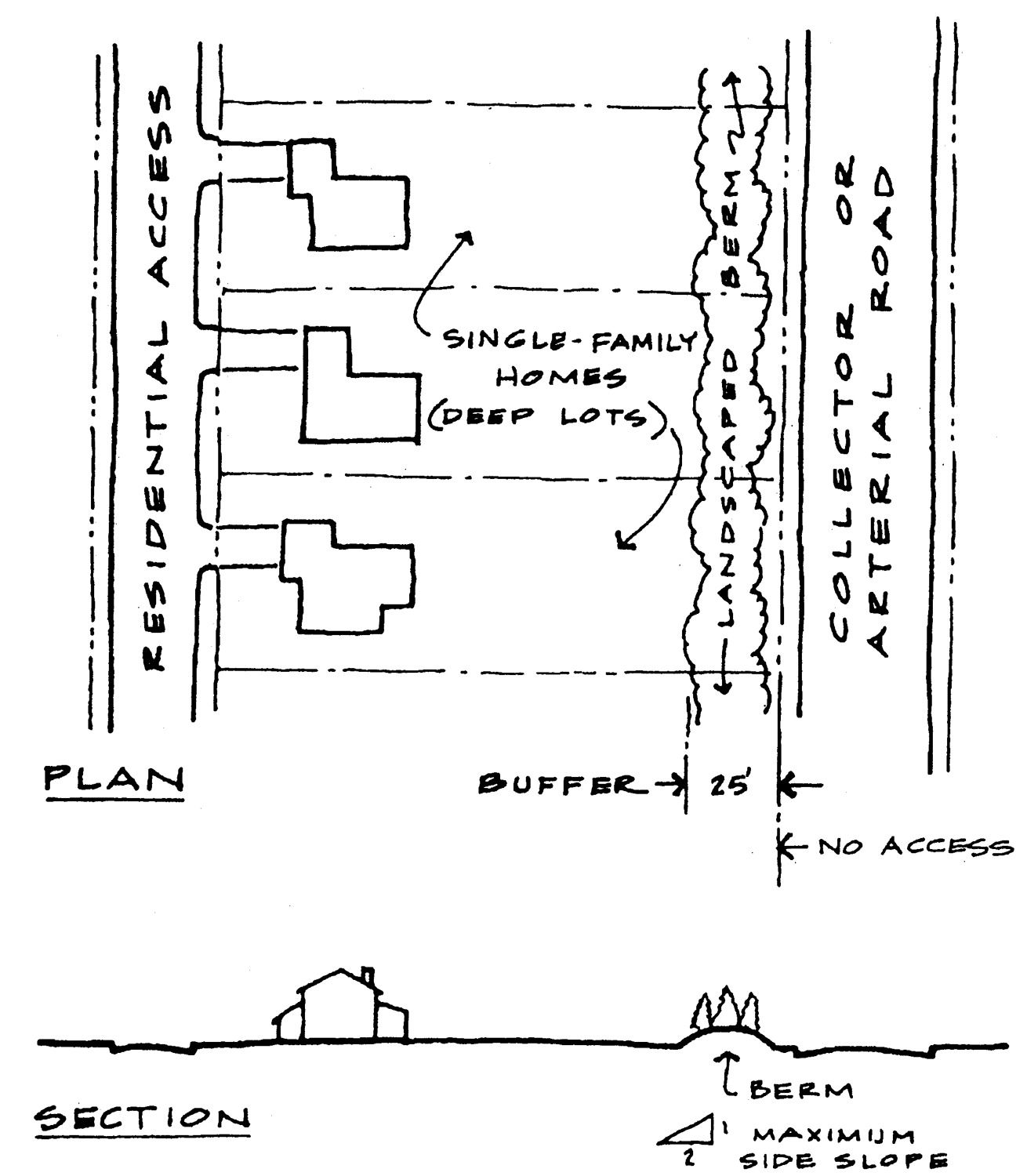
LOT
Lot area. The total horizontal area included within lot lines.
Lot, corner. A parcel of land bounded on two or more adjacent sides by street right-of-way lines at their intersection.
Lot, double frontage, also through lot. A lot having a frontage of two non-intersecting streets as distinguished from a corner lot.
Lot depth. The average horizontal distance between the front and rear lot lines measured in the direction of the side lot lines; also the distance between the midpoint of the front lot line and midpoint of the rear lot line.
Lot, flag. A lot having less frontage on a public street than normally required. The lot panhandle servers as an access corridor to the bulk of the lot, which is located behind lots with normally required street frontages.
Lot, front. The front of a lot shall be that boundary of the lot along a public street having
the least dimension.
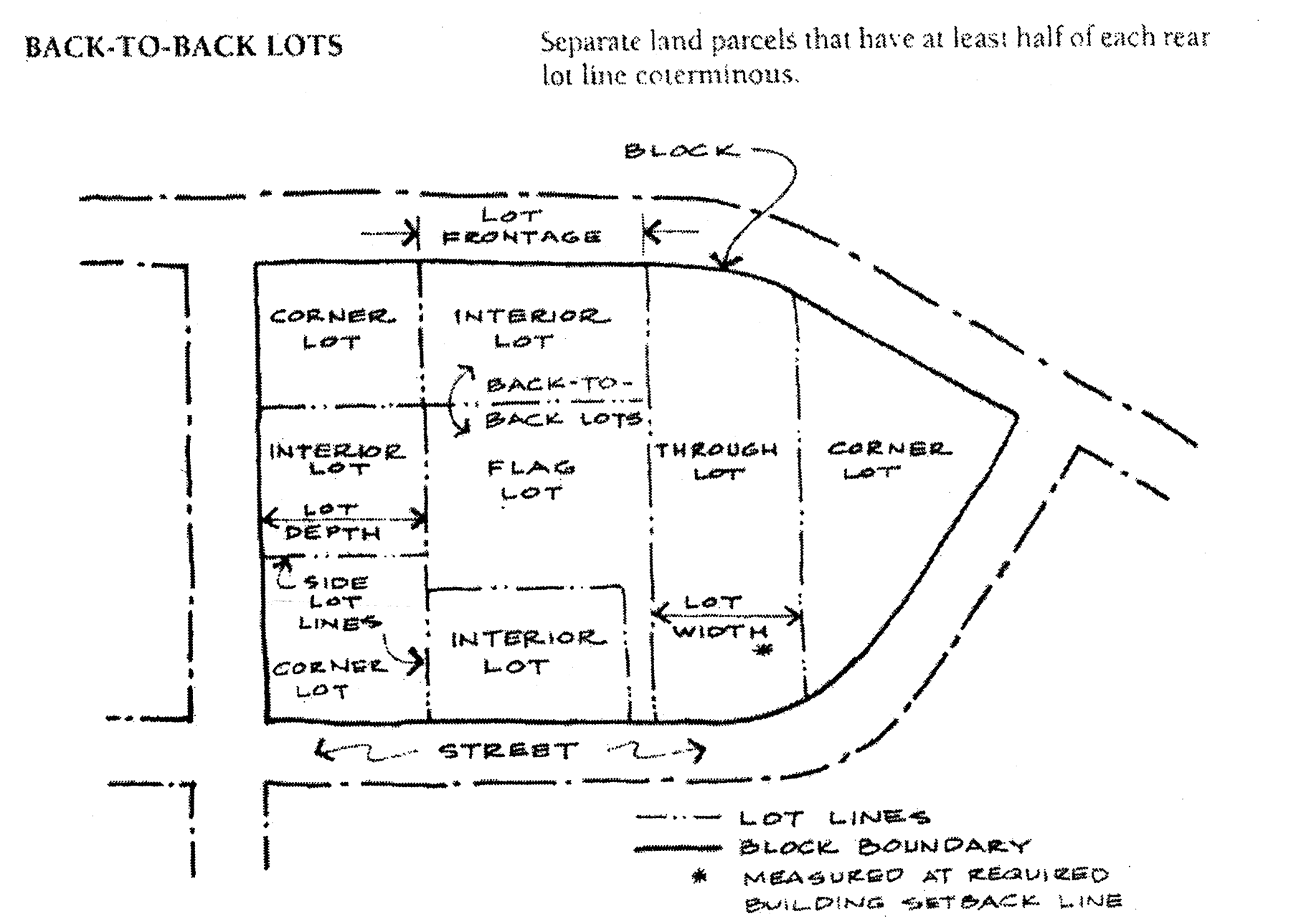
BACK TO BACK LOTS
Lot frontage. The length of any property line of a lot that abuts a public street right-of-way.
Lot, interior. A lot having frontage on only one street.
Lot line. The boundary dividing a given lot from the street or adjacent lots; the boundary defining the limit of ownership of a property.
Lot of record. A lot for which a plat has been recorded in the office of the Clerk of the Superior Court of Clayton County.
Lot, substandard. A lot that does not comply with the minimum standards of the district in which the lot is located, such as minimum lot size or lot width.
Lot width. The distance measured along the front building setback line between the side lot lines.
Manufactured home. A building or dwelling unit fabricated in an off-site facility for installation or assembly at the building site, bearing a label certifying it is constructed in compliance with the Federal Manufactured Home and Standards Act, 42 U.S.C. 5401-5445, as amended.
Manufactured home park. A lot under single ownership on which two or more manufactured homes are to be located or intended to be located for purposes of residential occupancy.
Manufactured home sales lot. A premises on which manufactured homes are displayed for sale.
Materials recovery facility. A solid waste handling facility that provides for extraction from solid waste of recoverable materials, materials suitable for use as a fuel or soil amendment, or any combination of such materials.
Maximum lot coverage. The percentage of the gross acreage of a lot that may be occupied by a structure or structures. In calculating maximum lot coverage, gross acreage shall not include floodplains or slopes in excess of 30 percent.
Median. A paved or landscaped strip dividing any public or private right of way, road or highway into lanes and running parallel to the direction of travel.
Minimum building separation. A required open space between any two buildings on the same lot that are used for attached single family or multifamily purposes.
Mini-warehouse. A building containing separate spaces for the storage or wares, goods or personal property of varying sizes leased or rented on a individual basis.
Mobile home. A structure transportable in one or more sections and built on a permanent chassis and designed to be used as a dwelling with or without a permanent foundation when connected to the required utilities, and contains the necessary plumbing, heating, air conditioning and electrical systems. Such unit must bear a HUD certificate.
Modular building. A building or dwelling unit fabricated in an off-site facility for installation or assembly at the building site, which complies with the definition of the term "industrialized home."
Modular home. A factory built, transportable building consisting of units designed to be incorporated at a building site on a permanent foundation into a permanent structure to be used for residential purposes having been built to state construction codes.
Motel. A building in which lodging or board and lodging is provided for transient guests and offered to the public for compensation with access to each unit directly from the outside.
Natural ground surface. The ground surface in its original state before any grading, excavation or filling.
Non-combustible material. Any material that will not ignite at or below a temperature of 1,200 degrees Fahrenheit and will not continue to burn or glow at that temperature.
Non-conforming use, building or lot. A legal use, building or lot established prior to adoption of this chapter that fails to comply with one or more provisions of this chapter, either at the effective date of the ordinance, or as a result of subsequent amendments.
Nursing home. A home for aged or ill persons licensed by the State of Georgia as such in which persons three or more persons not related to the operator are provided food, shelter and medical care for compensation for 24 hours per day, but not including hospitals, clinics or similar institutions devoted primarily to diagnosis and treatment.
Occupant. The individual or individuals in actual possession of a premises.
Official thoroughfare map. The Thoroughfare Map of the City of Jonesboro as adopted and amended.
Official zoning map. A legally adopted map that conclusively shows the location and boundaries of zoned districts.
Off-street parking space. A temporary storage area for a motor vehicle that is directly accessible to an access aisle, and which is not located within a dedicated street right-of-way.
Open space. An area free of buildings, parking, paved areas and other uses, the purpose of which is to provide a balanced relationship between buildable area and lot size, to provide areas for public or private use and to preserve permeable areas essential to surface water drainage and aquifer recharge.
Outdoor storage. The keeping, in an unroofed or otherwise unenclosed area, of any goods, junk, material, merchandise or vehicles on the same lot for more than 24 hours.
Outparcel. A lot deeded separately from a larger tract intended for individual development, but generally sharing access with the larger tract. Outparcels are most generally associated with shopping centers.
Owner. An individual, firm, association, syndicate, partnership or corporation having sufficient vested legal property rights for which they seek an action under this chapter.
Parcel. An area of land having one continuous boundary held by one owner and recorded with the Clerk of the Superior Court of Clayton County; also a parcel of land occupied or intended for occupancy by a single, principal building or use, or group of buildings devoted to a common use, and any accessory building and use, containing the minimum area required by the zoning district in which it is located, and accessed by a public or private street.
Parking area, private. An open area for the parking of privately owned automobiles and not for public use.
Parking lot. Any public or private area used for the express purpose of temporary, storage of motor vehicles at grade otherwise in operation for personal or business use.
Parking space. Any area for the exclusive and temporary storage of a single vehicle.
Pavement. An area of brick, stone, concrete or asphalt placed on the surface of land sufficient for vehicular use; also that portion of a street right-of-way having an improved surface.
Permitted use. An activity conducted on a lot that is among those activities allowed as a matter of right under the zoning district of this chapter in which the lot is located, subject to applicable regulations of the district.
Permit. Written governmental permission issued by an authorized official, empowering the holder thereof to conduct such activity not forbidden by law, but not allowed without such authorization.
Person. Any person, firm, partnership, association, corporation, company, or organization of any kind.
Personal care home. A facility, whether operated for profit or not, licensed by the State of Georgia for the transitional residency of two or more adults who are not related to the owner or administrator by blood or marriage who are incapable of independent living, within which are provided living and sleeping facilities, meal preparation, laundry services, personal services, transportation services and routine social and medical appointments and counseling.
Personal care services. Individual assistance with or supervision of self-administered medication and essential activities of daily living such as eating, bathing, grooming, dressing and toileting.
Place of assembly. A structure, portion of a structure, or area, either indoor or outdoor, including, but not limited to, movie theaters, concert halls, stadiums, amusement parks, carnivals, places of worship, funeral homes, elementary, middle, high, secondary and post graduate schools, day care centers, private commercial schools, such as material arts or dance studios, clubs, lodges and arenas, designed primarily for the public to gather to observe or participate in a single event or series of events, including but not limited to the presentation of a motion picture, a concert, an educational presentation, a sermon, an inspirational presentation, a rally, a lecture, a dramatic dance, musical, or other live performance, or a sporting event.
Place of worship. A building in which individuals assemble for the purpose of religious worship or ceremony.
Planned center. A single office, commercial, or industrial property that is designed or intended for occupancy by two or more principal businesses that are separately owned and have no corporate relationship.
Planned development. A tract of land developed based on a plan, which allows for flexibility of design not available under normal zoning district requirements.
Plat. A drawing representing a tract of land, showing the boundaries and location of individual properties and streets.
Plat, preliminary. An initial plan for the subdivision of land as defined in the land development regulations, indicating the proposed layout of the subdivision.
Plat, final. The permanent plan documenting the approved subdivision of land as defined in the land development regulations, indicating the proposed layout of the subdivision, together with all site improvements.
P.O.D.S. A metal container designed for temporary, on-site storage of goods or long term storage of goods in an off-site facility; also portable on-demand storage.
Primary facade. The exterior wall of a building fronting the street on which primary access to the building is gained.
Principal building. A building on a lot in which is conducted the primary use.
Principal use. The specific, primary purpose for which land or a building on a lot is used, as distinguished from a secondary or accessory use.
Public improvement. The construction, enlargement, extension or other construction of a facility intended for dedication to the public, including, but not limited to, a street, curb and gutter, sidewalk, cross drain, catch basin, traffic control and street name sign, or other roadway appurtenance other than a driveway apron connection; domestic water supply system main, fire hydrant, valve or other appurtenance other than a supply line to a building; or sanitary sewerage main or outfall, lift station, force main, manhole or other appurtenance other than a drain line from a building.
Public notice. Information conveyed to the general public concerning any provision of this chapter or its application to real property in the city posted on affected property or in a newspaper of general circulation. Such notices are used primarily to announce the time, place and purpose of a public hearing during which city officials will decide such matters.
Quasi-judicial officers, boards, or agencies. An officer, board, or agency appointed by a local government to exercise delegated, quasi-judicial zoning powers including hearing appeals of administrative decisions by such officers, boards, or agencies and hearing and rendering decisions on applications for variances, special administrative permits, special exceptions, or other similar permits not enumerated herein as a zoning decision, pursuant to standards for the exercise of such quasi-judicial authority adopted by the city.
Recovery materials processing facility. A facility engaged solely in the storage, processing, and resale or reuse of recovered materials. Such term shall not include a solid waste handling facility; provided, however, any solid waste generated by such facility shall be subject to all applicable laws and regulations relating to such solid waste.
Recreational vehicle. A motorized camper, converted bus, tent trailer, motor home or other similar vehicular or portable structure used or designed for temporary portable housing or occupancy while on vacation or other recreational trip and provided with sleeping accommodations.
Recreational vehicle dealer. The use of any building or premises for the display and sale of new or used recreational vehicles, and which may include any repair service conducted as an accessory use.
Restaurant. Any facility or establishment merchandising or dispensing food or drink, which is located on a permanent foundation and contains a minimum floor area of 400 square feet at which the customer is served.
Restaurant, drive-thru or drive-in. An establishment that serves food and beverages directly to customers in motor vehicles, regardless of whether it also serves food and beverages to customers who are not in motor vehicles, for consumption on or off the premises.
Right-of-way. An area of land acquired by reservation, dedication, prescription or condemnation specifically designated for use as a public street or sidewalk; utility, railroad, interstate or transmission corridor; landscaping and street furnishings; or other public purpose.
Roof line. The highest continuous horizontal line of a roof. On a sloping roof, the roofline is the principal ridgeline, or the highest line common to one or more principal slopes of roof. On a flat roof, the roofline is the highest continuous line of the roof or parapet, whichever is the higher.
Satellite dish. A round, parabolic antenna designed to receive signals from orbiting satellites. Noncommercial dish antennas are defined as being less than four meters in diameter.
School. State, county, city church or other schools, public or private, as teach the subjects commonly taught in the common schools of this state, and vocational schools, colleges and post-high school learning centers.
Secondary facade. Any exterior wall of a building that is not the primary facade.
Service station. Any building or land used for the dispensing, sale or offering for sale at retail of any automotive fuels, oils or accessories and in connection with which is performed general automotive servicing such as dispensing gas, changing oil, lubrication, checking tire pressure, fixing flats, replacing plugs, and adjusting or regulating parts, as distinguished from repairing or replacing mechanical parts, or major engine or transmission overhaul, major body work or automobile painting.
Setback. The required horizontal distance between property line and a building.
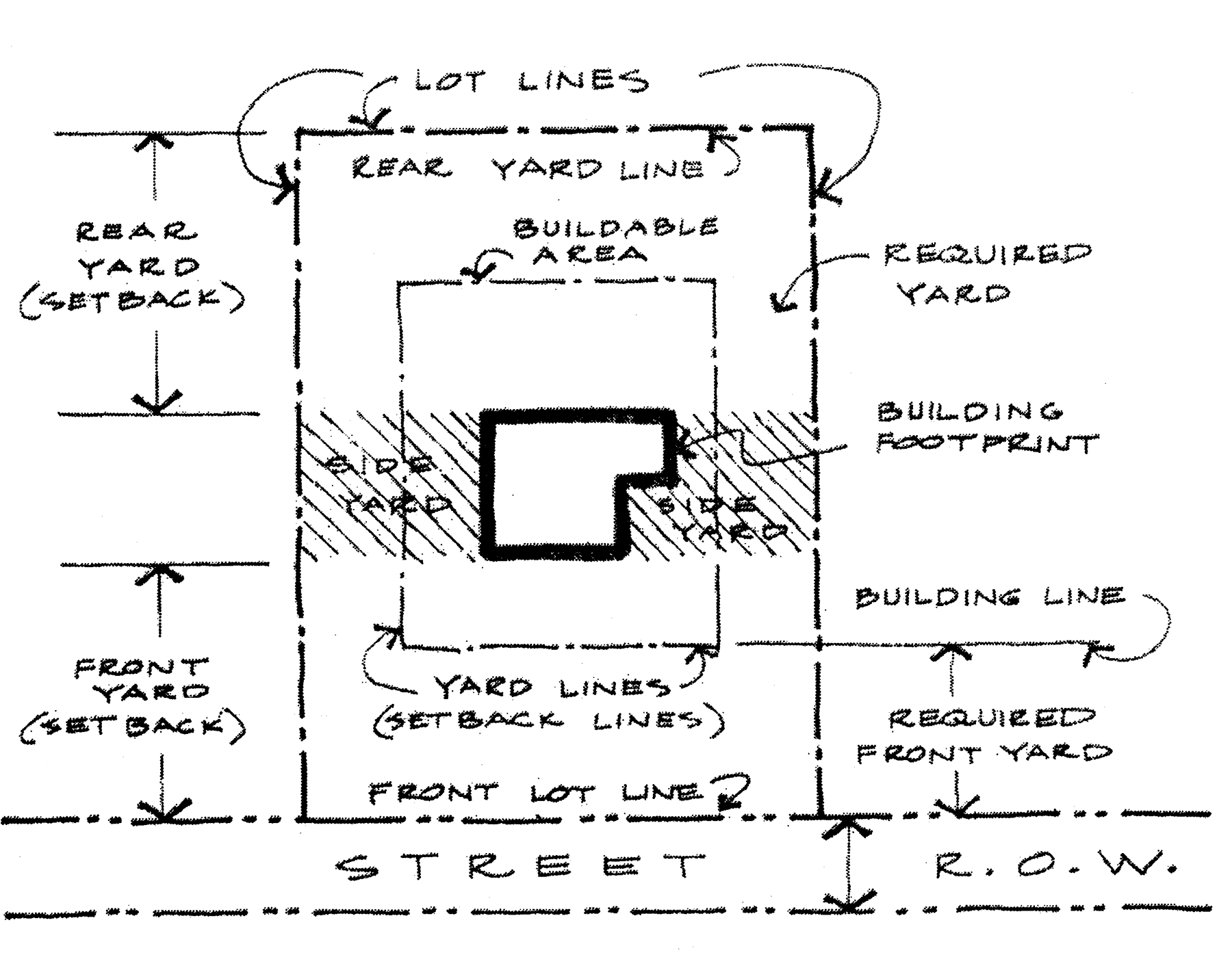
SETBACK
Shopping center. A group of commercial establishments planned, developed and managed as a unit with individual vendors housed in one building that provides customer access, amenities and protection from the elements and features common, on-site parking.
Sign. A structure or device designed to attract attention or convey information to the public in written or graphic form.
Site plan. A development plan for one or more lots depicting the existing and proposed conditions, including topography, structures, building setback lines, vegetation, drainage, utilities, access, flood plains, wetlands, open space, walkways, landscaping, signs, lighting, buffers, fences, and any other information that may be reasonable to enable the approving authority to render an informed decision.
Story. For buildings with more than one story, the space between the surface of two successive floors; for one-story buildings, the space between the floor and the ceiling or underside of the roof framing.
Street. A public way for vehicle traffic that provides the primary means of access to abutting properties.
Structural alteration. Any change in the supporting member of a structure, such as foundations, bearing walls or bearing partitions, columns, beams, girders, or any substantial change in the roof or exterior walls.
Structure. Any object constructed or erected with a fixed location on or in the ground, or attached to something having a fixed location on or in the ground. For the purpose of enforcing building setbacks, pavement, fences and walkways are not considered structures.
Subdivider. A person, firm or corporation having such a proprietary interest in the land to be subdivided as will authorize the maintenance or proceedings to subdivide such land under this article, or the authorized agent of such person, firm or corporation for the purpose of proceeding under these regulations.
Subdivision. The division of a property or tract of land into two or more tracts or lots; a land development project in which two or more lots are created, along with the streets and utilities needed to support construction of buildings on the lots.
Submission date. The date stamped on an application indicating the date the application was actually received in the office of the city clerk.
Swale. A depression in the ground that channels runoff.
Tenant. One who possesses or occupies land or buildings by title, under a lease, or through payment of rent; a resident, occupant or inhabitant of a place.
Thoroughfare plan. The official document that classifies the streets within the city limits of the City of Jonesboro, Georgia according to such characteristics as capacity, design speed and function.
Tract. An area, parcel, piece of land, or property, that is the subject of a development application.
Trailer. Any vehicle or structure constructed so as to permit occupancy thereof as sleeping or living quarters, or the conduct of any business, trade or occupation, or use as selling or advertising device, or use of storage or conveyance for tools, equipment or machinery, and so designed that it is or may be mounted on wheels and used as a conveyance on highways and streets propelled on its own or drawn by a vehicle.
Trailer, camping. Shall mean any portable structure or vehicle designed for highway travel at legal speed limits without special permit, which is intended for temporary living.
Use. The purpose for which land or a building is designed or arranged, or for which it is occupied.
Variance. A mechanism use to grant a property owner relief from specific provisions of the zoning ordinance when strict compliance would result in a particular hardship.
Vehicle. Any automobile or other vehicle propelled by its own motor and operating on public roadways; the term includes passenger cars, trucks, motorcycles and motor scooters.
Warehouse. A building in which materials, goods or equipment are stored, as before distribution to retailers, or kept in reserve.
Yard. An open space on the same lot with a building or group of buildings located to the front, rear, or side of a building extending to the nearest lot line.
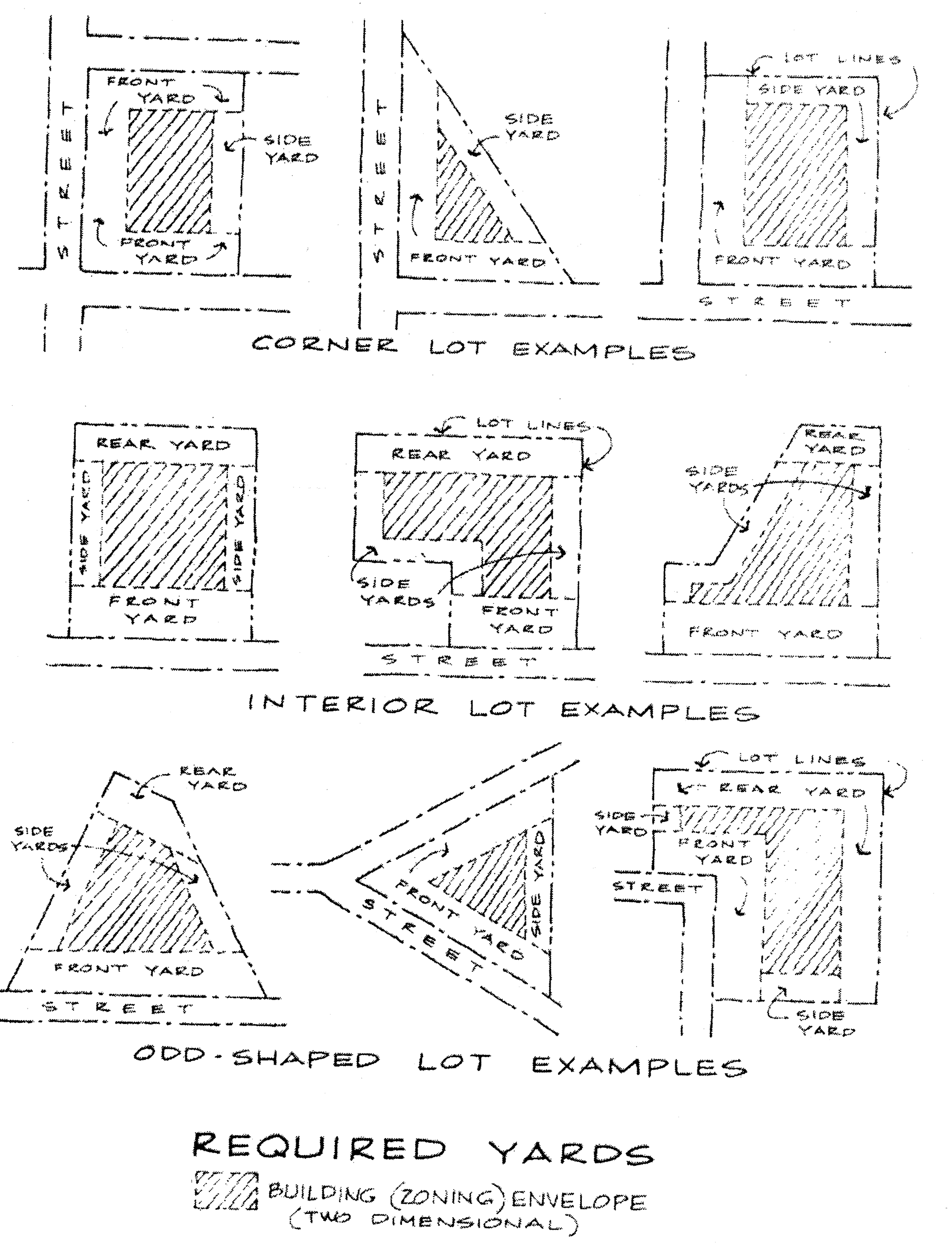
REQUIRED YARDS
Yard, front. An open, unoccupied space on the same lot with the building extending across the full width of the lot between the front lot line and the front building setback. The front yard of a corner lot shall be the yard parallel to the street upon which the lot has its least dimension.
Yard rear. An open, unoccupied space on the same lot with the building extending across the full width of the lot between the rear lot line and the rear building setback.
Yard side. An open, unoccupied space on the same lot with the building between the side building line and the side lot line.
Zero lot line. A form of development that locates a building on a lot in such a manner that one or more building walls and foundations are coincident with a lot line.
Zoning. Partitioning of land by map designations into districts reserved for specific purposes, the use of which is governed by the zoning ordinance.
Zoning administrator. The zoning administrator of the City of Jonesboro, or his designee.
Zoning decision. Final legislative action by the City of Jonesboro involving the adoption, denial, grant, or repeal of amendment to a zoning ordinance; permit relating to a special use of property; or variance as described in O.C.G.A. § 36-66-3(4).
Zoning district. A geographic area within the city within which specific regulations and requirements uniformly govern the use, placement, spacing and size of land and buildings as defined in the zoning ordinance.
Zoning change. An amendment to the official zoning map (re-zoning), approval of a conditional use, or approval of a change in the conditions of approval assigned with a re-zoning.
Zoning ordinance. The Zoning Ordinance of the City of Jonesboro, Georgia as adopted and amended.
(Ord. No. 05-08, § 2(3.02), 8-15-2005; Ord. No. 2015-10, § 1, 8-10-2015; Ord. No. 2016-03, § 1, 2-8-2016; Ord. No. 2023-006, § 1(Exh. A), 7-10-2023)

