


Jonesboro City Zoning Code
ARTICLE XIII
PARKING, LOADING AND INTERIOR CIRCULATION
Sec. 86-391.- Purpose.
The purpose of this article is to provide for accommodation of passenger vehicles, light trucks and delivery vehicles in the conduct of permitted uses established on private property. Such accommodation pertains to adequate physical space for the storage of individual vehicles, including vehicles used by motorists with a disability, and spaces adequate in number and location to serve individual uses. This article also provides for adequate access to parking and storage facilities as well as circulation within the property. As the parking and storage of vehicles can have adverse impacts on surrounding properties and the traveling public associated with glare, vibration, dust, noise and visual impacts, this article is established to mitigate such impacts through introduction of setbacks, buffering and landscape standards.
(Ord. No. 05-08, § 2(13.01), 8-15-2005)
Sec. 86-392. - Applicability.
The regulations established by this article shall apply to all property in the city limits of Jonesboro.
(Ord. No. 05-08, § 2(13.02), 8-15-2005)
Sec. 86-393. - Continuing obligation to provide off-street parking and loading.
No existing off-street parking or loading space, or part thereof, and no part of an off-street parking or loading space hereafter provided which meets all or part of the requirement for off-street parking or loading set forth in this article, shall be reduced or eliminated unless no longer required by this article or unless alternate parking or loading space fulfilling this article is otherwise provided.
Except as specifically hereinafter provided, no part of a parking or loading space required for any one building or use shall be included as part of the off-street parking or loading space of another building or use in meeting the requirements of this article. No building shall hereafter be erected or altered which reduces off-street parking or loading space below minimums set forth in this article, or which provides more parking or loading space where parking limitations apply.
This article also prohibits the use of any property unless vehicle parking and loading space in conformance to this article is provided.
(Ord. No. 05-08, § 2(13.03), 8-15-2005)
Sec. 86-394. - Expansion of parking.
Any expansion of an existing parking area must be approved by the zoning administrator or his designee.
(Ord. No. 05-08, § 2(13.04), 8-15-2005; Ord. No. 2023-006, § 1(Exh. A), 7-10-2023)
Sec. 86-395. - Location of off-street parking.
Off-street parking for single-family and two-family dwellings shall not be located between the principal dwelling and the public right-of-way, except on a hard surface driveway using asphalt or concrete pavement, or other hard surface as may be approved by the zoning administrator or his designee, or in an enclosed garage.
Off-street parking or vehicle storage in an R-A or RM zoning district shall be located in either the rear or side yard. No more than 25 percent of the parking required in the O&I district may be located between the building and a public right-of-way. No off-street parking shall be located within 20 feet of any residentially zoned property, nor within 20 feet of the street right-of-way as measured along a driveway. A landscaped buffer having a minimum width of 20 feet shall be established and maintained when parking surfaces abut any residentially zoned property. (See article XV, Landscaping and buffers.)
Off-street parking in an R-A, RM, O-I, MX, HD-1, HD-2, C-1, C-2 or M-1 district shall be set back from the front property line a minimum distance of ten feet, and this setback shall be maintained as a buffer.
Unless otherwise provided in this article, off-street parking and loading spaces as well as all drives and maneuvering areas shall be located a minimum of five feet from all property lines, and such areas shall be maintained as a landscaped buffer. Where those spaces and areas abut off-street parking and loading spaces or drives and maneuvering areas on adjacent property, no such setback shall be required.
(Ord. No. 05-08, § 2(13.05), 8-15-2005; Ord. No. 2023-006, § 1(Exh. A), 7-10-2023)
Sec. 86-396. - Off-street vehicle parking may be provided off premises.
Off-street vehicle parking or storage space shall be provided on every lot sufficient to accommodate the use thereon or hereafter established. However, in instances in which on-site parking is impractical, the zoning administrator or his designee may approve parking provided within 500 feet of the property on which such uses are established upon a finding that such parking may be safely and conveniently accessed by pedestrians. Relief from the off-street vehicle parking requirements of this article shall not be granted for parking for the disabled. Such off-premises shall be associated with the permitted use, and shall not be hereafter be reduced or encroached upon in any manner. Such off-premises parking may be located within 1,000 feet for uses in the HD-1 or HD-2 district.
Off-premises parking used to comply with this section must be located on property having the same or less restrictive zoning as the property the off-premise parking serves. In addition, an easement or other recordable instrument satisfactory to the city attorney dedicating the off-premises parking to the property the spaces serve shall be recorded with the clerk of the superior court and a copy provided to the zoning administrator or his designee. The document must survive changes in ownership in perpetuity, unless dissolved with approval of mayor and council.
The maximum distances of this section shall be measured from the property on which the use is established along the public right-of-way or public sidewalk to the property supplying such off-premises parking.
(Ord. No. 05-08, § 2(13.06), 8-15-2005; Ord. No. 2023-006, § 1(Exh. A), 7-10-2023)
Sec. 86-397. - Design requirements for parking lots and driveways.
The provisions of this section shall apply to all off-street parking whether the parking serves a particular use or development, or the parking is a principal use on a property and not dedicated to serving a particular development.
(1)
Curbs required. Concrete curbs shall be provided for all paved areas, and shall be used to separate landscaped areas from pavement.
(2)
Striping required. Every parking space shall be clearly marked by lines painted on or otherwise applied to the parking lot surface.
(3)
Paved surface. No vehicle parking of any kind shall be permitted on any lot unless all driveways and parking spaces are comprised of an impervious surface consisting of concrete, asphalt, brick or decorative stone pavers. No gravel shall be used except as subgrade material.
Except for parcels devoted to single-family detached dwellings, all off-street parking shall be designed to accommodate a turn around area so that motorists are not required to back into a public street to exit the property.
(Ord. No. 05-08, § 2(13.7), 8-15-2005)
Sec. 86-398. - Access to parking facilities.
All off-street parking facilities shall provide adequate interior passageways, drives and maneuvering areas, as determined by the code enforcement officer, to permit access to each parking space and to connect each space to a public or private street.
(Ord. No. 05-08, § 2(13.08), 8-15-2005)
Sec. 86-399. - Maximum driveway width.
The maximum width for driveways serving properties occupied or intended to be occupied by a single family detached dwelling shall not exceed nine feet as measured at the right-of-way line. The maximum width for any other property shall not exceed 35 feet as measured at the right-of-way line. For the purpose of this section, driveway width shall be measured to the curb face.
Access aisles in parking lots serving spaces perpendicular to the access aisle shall have a minimum width of 24 feet, and provide for two-way traffic. Access aisles serving angled parking spaces shall be one-way and shall have a minimum width of 18 feet for 60 degree angle parking and 13 feet for 45 degree angle parking to the aisle. Angle parking of less than 45 degree to the access aisle is prohibited, except for parallel parking. Interior drives on commercial property shall not exceed 30 feet.
Driveway separations. The minimum distance between a private driveway serving one single-family dwelling and a street intersection shall be 20 feet; this minimum distance shall be 50 feet for all other uses. Minimum distance between private driveways serving single-family dwellings along a street right-of-way shall be ten feet; this minimum distance shall be 40 feet for all other uses.
The minimum distance between a private driveway serving one single family dwelling and a property line shall be five feet; this minimum distance shall be 20 feet for all other residential uses and 50 feet for all other uses.
All distances shall be measured from the back of the driveway curb at the right-of-way line.
(Ord. No. 05-08, § 2(13.09), 8-15-2005; Ord. No. 2015-008b, § 2, 8-10-2015)
Sec. 86-400. - Proximity of driveways.
Vehicular ingress and egress to any property shall be limited to a maximum of one driveway for any property having a frontage of less than 200 feet on any one street. Additional driveways for properties having a frontage in excess of 200 feet may be permitted upon a finding by the zoning administrator or his designee that public safety and convenience will not be substantially impaired.
(Ord. No. 05-08, § 2(13.10), 8-15-2005; Ord. No. 2023-006, § 1(Exh. A), 7-10-2023)
Sec. 86-401. - Location of driveways.
No driveway serving a residentially-zoned property may be constructed within two feet of any property line. No driveway serving any other property may be constructed within five feet of any property line.
(Ord. No. 05-08, § 2(13.11), 8-15-2005)
Sec. 86-402. - Inter-parcel access required.
The owner of property on which any office, retail sales or services use is established shall grant an access easement as described in this section to each adjoining property that is zoned or used for office, retail sales or services uses. The purpose of the easement is to facilitate movement of motorists from business to business without generating additional turning movements on the public street, thus increasing public safety and convenience.
The easement shall permit vehicle access from the adjoining property to driveways and parking areas intended for customer or tenant use; however, parking spaces may be restricted to use by the property owner's customers and tenants, only.
The granting of such easement shall be effective only upon the granting of a reciprocal easement by the adjoining property owner. Upon the availability of access to driveways and parking areas of the adjoining property, the pavement or other surfacing of each driveway and parking area shall be extended by each owner to the point of access on the property line.
Where the proposed land use is such that any adverse impact of the easement on the use of the property would outweigh the reduced impact on the public street realized by the easement, mayor and city council may waive the requirement for inter-parcel access easements, in whole or in part.
(Ord. No. 05-08, § 2(13.12), 8-15-2005)
Sec. 86-403. - Vision clearance.
With the exception of signposts and other structures less than eight inches in diameter, structures and landscaping shall not exceed three feet in height within a triangle measuring 15 feet along the edge of a private driveway and 20 feet along the street right-of-way line.
(Ord. No. 05-08, § 2(13.13), 8-15-2005)
Sec. 86-404. - Lighting of parking areas.
Lighting used to illuminate parking areas shall be designed and located to direct light away from residential uses and to prevent glare on any abutting property or create a hazard for motorists. Parking areas shall not be illuminated between the hours of 12:00 midnight and 6:00 a.m.; unless the uses on the property are open for business, although temporary activation by motion detectors may be allowed to provide security lighting for periods not to exceed 15 minutes.
All commercial, institutional or industrial properties shall achieve a minimum lighting standard of 2.0 foot-candles measured at grade across the entire parking facility.
(Ord. No. 05-08, § 2(13.14), 8-15-2005)
Sec. 86-405. - Joint use of required off-street parking spaces.
No portion of an off-street parking facility required for any building or use for the purpose of complying with the provisions of this section shall be considered as part of an off-street parking facility similarly required for another building or use. In instances in which the hours of operation of uses for which a sharing, or joint use, of parking facilities is proposed indicate that the respective parking demands occur at alternating times of the day, city council may grant approval for such joint use of parking facilities. Granting of such approvals shall be based on a finding by the council that the proposed joint use of parking will not generate excessive demand for on-street parking or otherwise adversely impact traffic movement or public safety.
(Ord. No. 05-08, § 2(13.15), 8-15-2005)
Sec. 86-406. - Size of parking spaces.
For the purpose of this article, the minimum area for a vehicle parking or storage space shall comply with specification noted in the table below.
Minimum Parking Space Dimensions
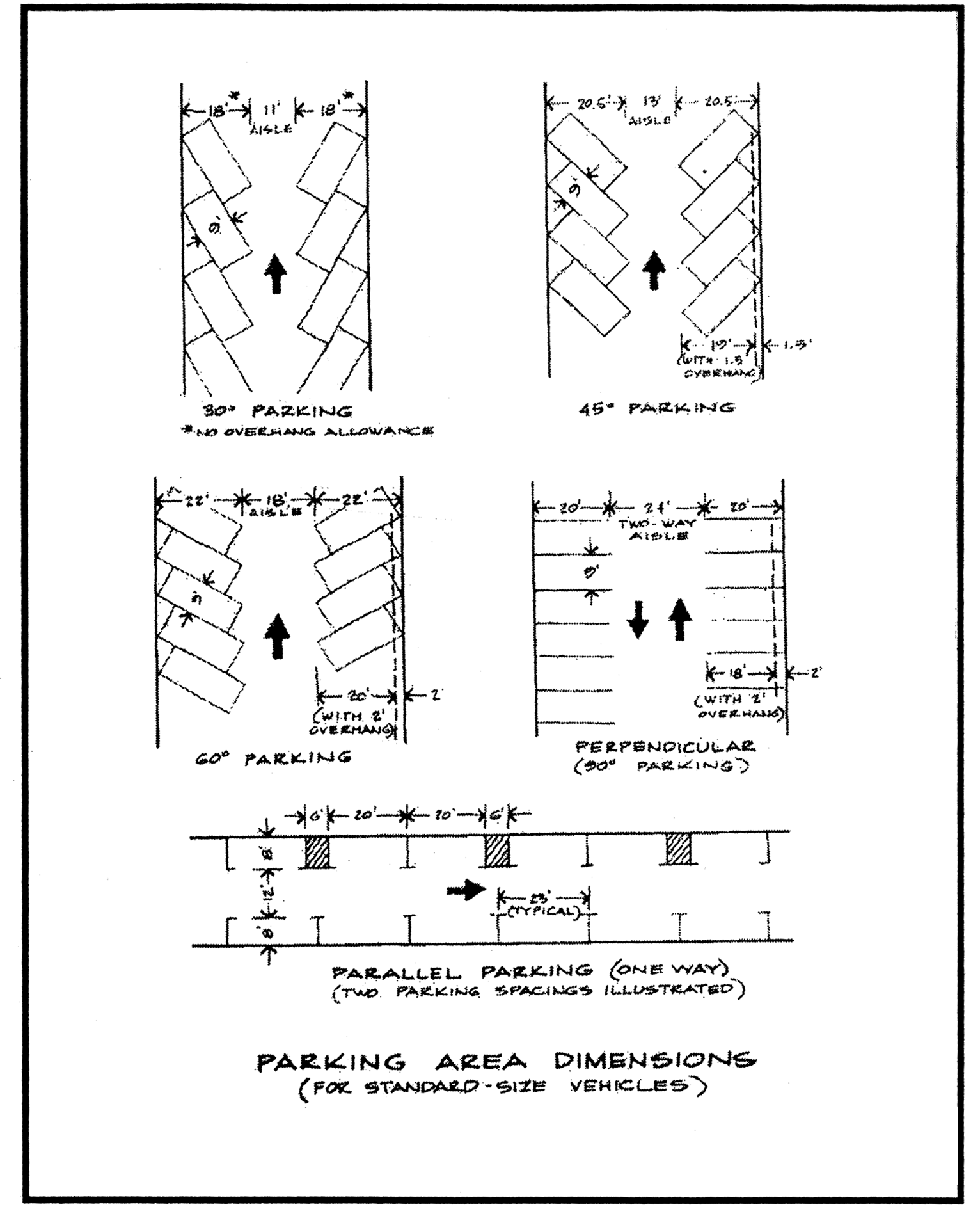
PARKING AREA DIMENSIONS
Wheel stops or other effective means shall be used to prevent encroachment of vehicles into any landscaped area, that is, vehicle overhang into landscaping shall be prohibited. Accordingly, no credit toward the depth of the parking space shall be granted for vehicle overhang.
(Ord. No. 05-08, § 2(13.16), 8-15-2005)
Sec. 86-407. - Accessible parking.
Parking and pedestrian facilities on any development site shall conform to all design standards published in the Code of Federal regulations/28 CFR Part 36 revised as of July 1, 1994/Nondiscrimination on the Basis of Disability by Public Accommodations and in Commercial Facilities/ADA Standards for Accessible Design. All applicable guidelines of these regulations shall be used in the construction or renovation of buildings and parking and loading zones.
Access to buildings shall be provided from rights-of-way in parking areas by means of a paved pathway leading to a minimum of one entrance generally used by the public. Such pathway shall have been cleared of all obstructions relating to construction activity, prior to occupancy of the building. Where curbs exist along such pathway, as between a driveway surface and a sidewalk surface, inclined curb approaches or curb cuts having a gradient of not more than one foot in 12 feet and a width of not less than four feet shall be provided for wheelchair access.
The parking area serving such pathway shall have a number of level parking spaces as set forth in the table below, identified by above-grade signs as being reserved for physically handicapped individuals. Each parking space so reserved shall have a minimum width of 12 feet.
Schedule of Off-street Parking Accessible to Individuals with a Disability
Accessible parking spaces shall be counted as part of the total number of parking
spaces required under this article. Accessible spaces shall have an adjacent aisle
four feet wide, with one aisle in every eight serving handicapped spaces being eight
feet wide and the space shall be signed "van accessible." Such aisles shall be clearly
marked by lines painted on or otherwise applied to the parking lot surface.
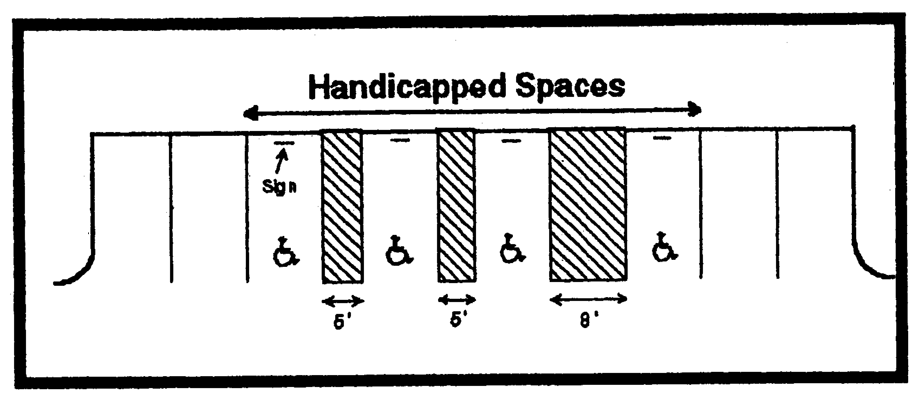
HANDICAPPED SPACES
Accessible parking spaces shall be located on a paved surface with a slope not exceeding one vertical foot in 50 horizontal feet (1:50).
In addition to the requirements of this section, all accessible parking shall comply with the requirements of the Americans with Disabilities Act and the Georgia Accessibility Code.
(Ord. No. 05-08, § 2(13.17), 8-15-2005)
Sec. 86-408. - Off-street parking for drive-in establishments.
Any property containing a use having a drive-in or drive-through window shall provide adequate on premises queuing space designed to accommodate all anticipated vehicle traffic. Drive-in establishments which serve customers who are occupying vehicles parked on the premises shall provide adequate off-street parking.
(Ord. No. 05-08, § 2(13.18), 8-15-2005)
Sec. 86-409. - Use of off-street parking areas.
No off-street parking shall be used for the sale, repair, dismantling, servicing or long term storage of any vehicle or equipment unless permitted in the zoning district in which the parking is located.
(Ord. No. 05-08, § 2(13.19), 8-15-2005)
Sec. 86-410. - Off-street parking requirements.
Unless otherwise provided herein, areas suitable for parking vehicles in off-street locations shall be required in all zoning districts for any permitted use. Such off-street parking shall be provided and maintained in accordance with the requirements of this section. These requirements are intended to meet minimum needs. Every property owner must determine his actual needs and provide whatever spaces may be necessary beyond these minimums to remain in full compliance with the provisions of this chapter. In all instances where no specific parking requirement is applicable, the minimum off-street parking spaces available must be equal to the number required to accommodate all normally anticipated customers, employees and other needs of the establishment.
Worker shift change peaking and projected growth must be considered when determining parking requirements. Off-street parking and loading space shall be provided according to the following schedule:
(1)
Single-family uses shall provide two parking spaces for each dwelling unit.
(2)
Single family attached and RM district uses shall provide 1.5 spaces for each dwelling unit.
(3)
Mixed-use developments shall provide 1.25 spaces for each attached dwelling unit.
(4)
Homes for the aged, rest homes, convalescent homes, nursing homes and similar institutions shall provide one space for every three residents or patients, plus one space for every two employees.
(5)
Rooming houses and boardinghouses shall provide one space for every two bedrooms.
(6)
Fraternities or sororities shall provide one parking space for every three beds contained in the residence.
(7)
Tourist homes and motels shall provide one space for each guest room.
(8)
Hotels and motels of three stories or less in height shall provide one parking space on the same lot for each guest room, plus one space for every two employees on the shift of greatest employment in addition to that parking required by this subsection for each 300 square feet of floor area in a building used for any other commercial purpose permitted in this district.
(9)
Hotels and motels over three stories in height shall provide one parking space on the same lot for each guest room located on the bottom three floors, and three parking spaces on the same lot for every four guest rooms located above the third floor, plus one space for every two employees on the shift of greatest employment, and in addition shall provide one parking space on the same lot for each 300 square feet of floor area in a building used for any other commercial purpose permitted in this district.
(10)
Retail and commercial uses shall provide one space for every 200 square feet of enclosed commercial space available to the public.
(11)
Office uses, including financial and banking institutions, shall provide one space for every 250 square feet of floor area, excluding storage areas.
(12)
Hospitals, outpatient clinics, and other health care facilities shall provide one space for every one beds, plus one space for every staff or visiting doctor (based on the average number), plus one space for every two other employees on the shift of greatest employment.
(13)
Dental offices, doctor's offices, veterinary offices, clinics and similar operations shall provide four spaces for each doctor, plus one space for one for every two employees.
(14)
Research laboratories shall provide one space for every 500 square feet of office area, plus one space for every 1,000 square feet of laboratory area.
(15)
Restaurants, cafeterias, night clubs, taverns and similar establishments shall provide the larger of one space per 100 square feet of gross floor area or one space for every three seats for customers, plus one space for every two employees on the shift of greatest employment.
(16)
Personal service establishments such as barber shops and hair salons shall provide two spaces per customer station.
(17)
Convenience stores shall provide one space for each fuel dispenser and one space for every 200 square feet of retail space.
(18)
Automobile repair shops shall provide three spaces for each lift or bay.
(19)
Automobile dealers shall provide one space for each 250 square feet of gross floor area.
(20)
Automobile service stations shall provide three spaces for each service bay, with a minimum of five spaces required, and those selling fuels shall provide two spaces for each fuel dispenser.
(21)
One space shall be provided for the larger of every two employees of the largest shift of any industrial use or similar establishment or one space for every 1,000 square feet of gross floor area devoted to factory production, plus one space for every 2,000 square feet of gross storage area and one space for each vehicle used directly in the conduct of the business. One space shall also be provided for every 250 square feet of floor space used for incidental accessory uses, e.g., administrative offices. The day shift during peak season shall be used as the computing criterion.
(22)
One space shall be provided for every 1,500 square feet of floor space used for warehousing or storage.
(23)
Salvage, storage or junkyards shall provide one space per employee, plus four spaces for each acre of yard.
(24)
Wholesale establishments shall provide one space per employee, plus adequate spaces to accommodate vehicles used in the conduct of the business.
(25)
Mini-warehouses shall provide one space per 5,000 square feet of gross storage area, plus one space for every employee.
(26)
Recycling centers shall provide one space for each 200 square feet of floor area, plus one space for every 500 square feet of lot area.
(27)
One space shall be provided for the larger of every four seats or for each 25 square feet of floor area available for chairs in the largest assembly room in the auditoriums or stadiums of schools and public buildings, places of worship or other locations of public assembly. Lodges and fraternal or social organizations shall provide one space for each 100 square feet of gross floor area.
(28)
Theaters, auditoriums, places of worship, libraries, museums, art galleries, funeral homes, gymnasiums, stadiums and other places of assembly shall provide the larger of one space for each four fixed seats or one space for each 25 square feet of floor area available for the accommodation of moveable seats in the largest assembly room, whichever is greater, plus one space for each 150 square feet of ground area used for assembly.
(29)
Dance schools shall provide one space for each employee, plus one space for every 150 square feet of gross floor area.
(30)
Colleges, universities, trade and vocational schools shall provide the larger of eight spaces for each classroom or one space for every 200 square foot of classroom, plus one space for every two employees or administrative personnel.
(31)
Public and private secondary schools shall provide the larger of ten spaces for each classroom or one space for every 35 square feet in largest assembly room, plus one space for every two employees or administrative personnel.
(32)
Public and private elementary schools shall provide the larger of two spaces for each classroom or one space for every 35 square feet in largest assembly room, plus one space for every two employees or administrative personnel.
(33)
Kindergarten, day care centers and nursery schools shall provide one space for each employee and one space for every ten students, plus an area sufficient for the safe and convenient loading and unloading of students.
(34)
Indoor recreation facilities, such as billiard halls, game rooms, video arcade, skating rinks, fitness centers and private clubhouses shall provide one space for every four seats or for each 150 square feet of floor area in a building used for recreation or amusement.
(35)
Golf courses, neighborhood recreation centers or similar uses shall provide one space for every 200 square feet of gross floor area, plus one space for every ten seats in an assembly area with fixed seats. All such uses shall provide a minimum of 20 spaces. Eighteen-hole golf courses shall provide a minimum of 40 spaces. Other outdoor recreational facilities shall provide parking according to the following schedule:
a.
Tennis courts: Three spaces per court
b.
Basketball courts: Four spaces per court
c.
Playing fields: One space for every 2,000 square feet of playing field
d.
Driving ranges: Two spaces per tee
e.
Miniature golf: Ten spaces per 18 holes
f.
Swimming pools: One for every 100 square feet of water surface area.
(36)
Outdoor festivals shall provide two spaces for each 1,000 square feet of ground area available to the public.
(37)
Riding stables shall provide one space for each employee and one space for every three animals that can be accommodated in the stable.
(38)
One parking space on the lot for each 200 square feet of floor area in a building used for any other purpose permitted in the zoning district.
(Ord. No. 05-08, § 2(13.20), 8-15-2005)
Sec. 86-411. - General requirements.
In all instances, the minimum number of off-street parking spaces provided shall be equal to the number required to accommodate all normally anticipated customers, employees and other needs of the establishment. Off-street parking requirements for properties containing more than one use shall calculate the requirement for each use separately as provided in this section. The total of these calculated requirements shall constitute the parking requirement for that property.
(Ord. No. 05-08, § 2(13.21), 8-15-2005)
Sec. 86-412. - Pedestrian travel in off-street parking lots.
The design of large off-street parking lots in which parking bays containing more
than 20 parking spaces are provided shall incorporate raised sidewalks to assure pedestrian
safety. Such sidewalks shall be a minimum of six feet wide extending across the entire
parking bay for the length of the parking spaces and also extend across the vehicle
travel lane as a "speed table" to the sidewalk along the building they serve. The
sidewalks be constructed on a raised surface with handicapped accessible approaches,
as appropriate, and provide safe pedestrian access to accommodate motorists and their
passengers from the four adjacent bays. Landscaped islands shall adjoin the sidewalk
on either side for the purpose of complying with landscape requirements and separating
parked vehicles from the sidewalk.
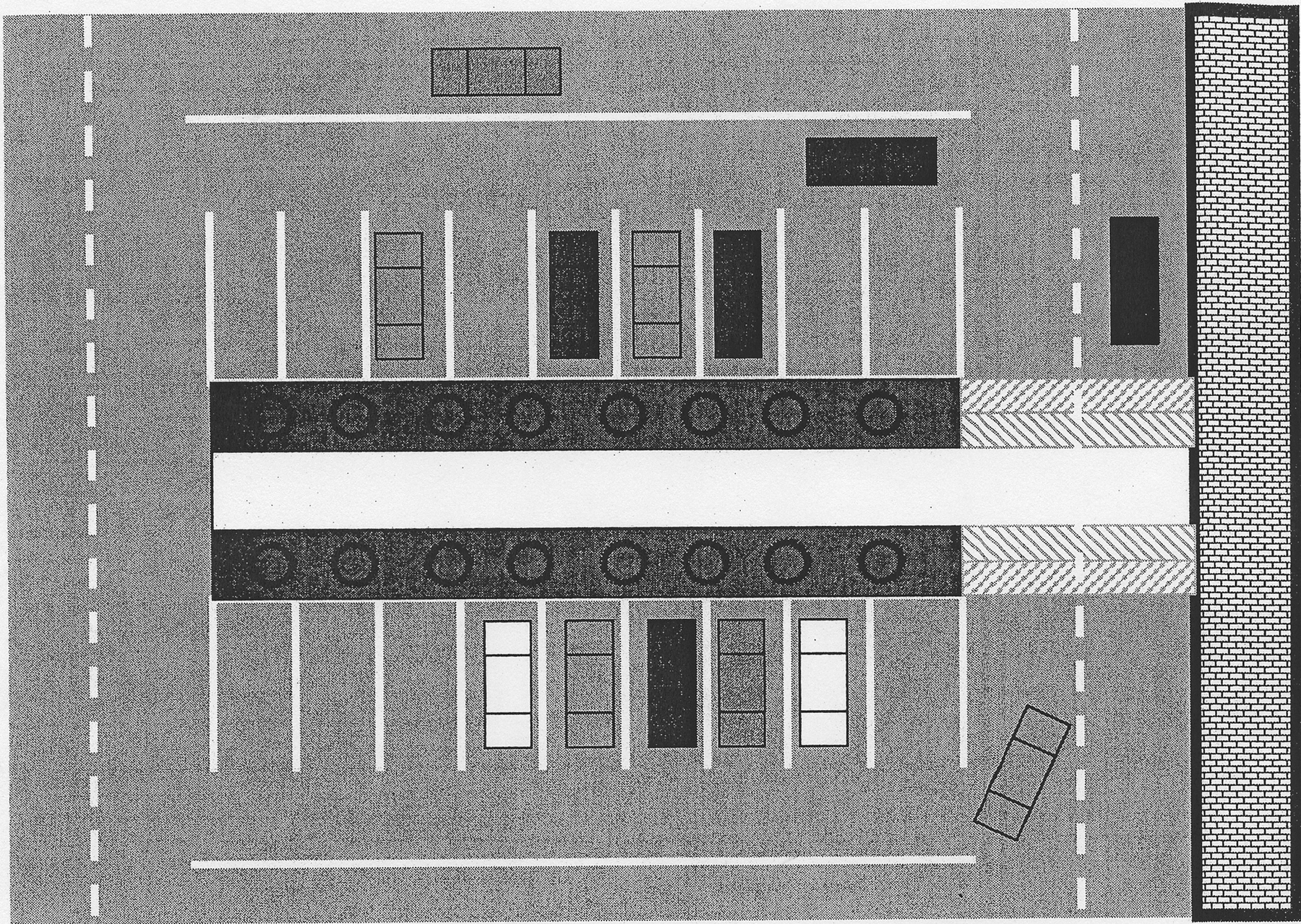
OFF-STREET PARKING LOTS
(Ord. No. 05-08, § 2(13.22), 8-15-2005)
Sec. 86-413. - Conditional use permit required for nonresidential parking in a residential district.
(a)
[Required; application; fee.] Land located in any residential zoned district shall not be used for parking or storage of vehicles other than vehicles customarily associated with a residential use unless such non-resident parking or storage is permitted by city council through the granting of a conditional use permit. Applications for such a conditional use permit shall be filed with the city clerk, together with a filing fee in an amount established by the city. Such applications must be signed by the owner of the property for which the use is requested and shall contain the following information:
(1)
Name, address and phone number of the property owner.
(2)
Legal description of the property, together with a property survey indicating the metes and bounds of the property and location in relation to any public right-of-way or alley.
(3)
Characteristics of the proposed parking.
(4)
Applications for parking involving grading and/or paving shall be accompanied by grading plans and pavement specifications certified by a licensed engineer. Such plans and specifications shall include soil erosion and sedimentation control and hydrology studies as appropriate.
(b)
Hearing for conditional use permit. Upon the filing of the application for a conditional use permit in accordance with the requirements specified in subsection (a) of this section, a public hearing before mayor and council shall be scheduled for the purpose of considering the application and rendering a decision thereon. A notice of the date, time and location of the hearing shall be published in a newspaper of general circulation in the city a minimum of 15 calendar days prior to the public hearing. One or more signs, as appropriate to the size and frontage of the property, shall be posted in a conspicuous place on the property by the code enforcement officer. Each such sign shall have a minimum area of six square feet and shall contain information identifying the intended use of the property as non-residential parking and the date, time and location set for the public hearing before city council for consideration of the conditional use permit. No public hearing shall be held until such sign or signs have been posted for a minimum of 15 calendar days prior to the public hearing.
(1)
No such application for a conditional use permit for non-residential parking on a residential property shall be filed more often than once every 12 months.
(2)
Penalty for violation of this section. Any violation of this section shall be considered a violation of this chapter subject to the penalties herein provided.
(Ord. No. 05-08, § 2(13.23), 8-15-2005)
Sec. 86-414. - Off-street parking in the historic district.
(a)
[H-1 district. ] Off-street parking requirements in the H-1 district shall be controlled by the following standards:
(1)
Off-street parking, generally. At the time of establishment of any use or erection of any building, or at the time the floor area of any principal building is enlarged or increased by adding dwelling units or guest rooms, permanent off-street parking spaces improved with a brick, decorative stone pavers, asphalt or concrete surface shall be provided in accordance with the following standards:
a.
Non-residential uses. Off-street parking may be provided within public parking facilities provided such facilities are located within 500 feet of the non-residential use. When public parking does not meet this proximity requirement, off-street parking shall be provided in accordance with the standards in section 86-395.
b.
Residential uses. Off-street parking shall be provided for the property at the rate of one space per dwelling unit. This requirement may be met by designating off-street residential parking or by leasing space in the municipal parking deck. Off-street parking shall be within a minimum walking distance of 1,000 feet of the main entrance of the building such off-premises parking is intended to serve.
c.
Proximity of off-street parking spaces for use. All required parking for all uses shall be either on the same lot or within a walking distance of 500 feet of the main entrance to the building or use such off-premises parking is intended to serve.
d.
Combination of required parking spaces. The required parking spaces for any number of separate uses may be combined in one lot; however, the required spaces assigned to each use may not be assigned to another use, except as follows:
1.
Parking spaces may be shared by more than one use provided the zoning administrator or his designee finds that the total number of spaces will be adequate at the peak hours of the uses such parking serves. Such a finding shall be based on data submitted by the applicant.
2.
Half of the parking spaces required for a place of worship, theater or assembly hall whose peak attendance will be at particular times or days of the week may be assigned to a use that is closed at those times or dates.
(b)
[H-2 district.] Off-street parking requirements in the H-2 district shall be controlled by the following standards:
a.
Off-street parking, location. Parking shall be located to the rear of any non-residential use and shall be screened from public view with a landscaped buffer of trees and shrubbery having a minimum height of eight feet and occupying one-half the landscaped buffer or a landscaped buffer having a minimum height of four feet and comprised of a continuous hedge.
b.
Minimum parking requirement. For non-residential uses, one parking space for every 1,200 gross square feet of floor area shall be required.
c.
Maximum parking limit. For nonresidential uses, one space for every 625 gross square feet of floor area may be permitted; provided, however, the zoning administrator or his designee may, at his discretion, determine the use requires additional spaces.
d.
Residential uses. No off-street parking shall be required on properties occupied by three or fewer dwelling units. Properties occupied by more than three dwelling units shall provided of-street parking at a ratio of 1.25 spaces per dwelling unit, rounded up to the nearest whole number.
e.
Proximity of off-street parking spaces. Off-street parking for all uses shall be either on the same lot or within a walking distance of 500 feet of the main entrance to the building or use such off-premises parking is intended to serve provided; however, that no required parking spaces may be located across any state or U.S. highway or arterial street from the use they are intended to serve.
f.
Combination of required parking spaces. The required parking spaces for any number of separate uses may be combined in one lot; however, the required spaces assigned to each use may not be assigned to another use, except as follows:
1.
Parking spaces may be shared by more than one use provided the zoning administrator or his designee finds that the total number of spaces will be adequate at the peak hours of the uses such parking serves. Such a finding shall be based on data submitted by the applicant.
2.
Half of the parking spaces required for a place of worship, theater or assembly hall whose peak attendance will be at particular times or days of the week may be assigned to a use that is closed at those times or dates.
(Ord. No. 05-08, § 2(13.24), 8-15-2005; Ord. No. 2023-006, § 1(Exh. A), 7-10-2023)
Sec. 86-415. - Off-street loading required.
Every building used for business, trade or industry shall provide space as indicated in this article for the loading and unloading of vehicles off the street or public alley. Such space shall have access to an alley, or, if there is no alley, to a street. Off-street loading spaces shall be provided on all non-residential property appropriate to the function and scope of operation of the property and uses such spaces serve. Off-street loading spaces shall be designed and constructed so that all maneuvering of delivery vehicles may be accommodated entirely within the boundaries of the property. Loading spaces shall be located so as not to interfere with the free, normal movement of vehicles and pedestrians on the public right-of-way.
(Ord. No. 05-08, § 2(13.25), 8-15-2005)
Sec. 86-416. - Size and location of off-street loading spaces.
Each off-street loading space shall be a minimum of 15 feet in width, 60 feet in length and provide a vertical height clearance of 14 feet. The zoning administrator or his designee may reduce these requirements upon demonstration in specific instances that a particular loading space will be used exclusively by vehicles that may be accommodated by a loading space of smaller dimensions. In no case shall a loading space having dimensions of less than ten feet in width and 30 feet in length be approved. All required off-street loading spaces shall be located on the same lot as the building or use they are intended to serve, or on an adjacent lot in those instances where joint use of a loading space with the use occupying that lot has been approved by city council.
Off-street truck loading; where required. Any business or industrial building, hospital, institution, or hotel, in any zoning district, shall provide adequate off-street facilities for the loading and unloading of business merchandise, supplies, goods or freight within or adjacent to the building as deemed appropriate by the owner or occupants of the property.
No off-street loading space shall be located within 25 feet of any residentially zoned property, nor within 30 feet of the street right-of-way along a driveway. Where such space is located in a manner that a truck must back directly from a major thoroughfare into the loading space, a maneuvering space of 49 feet shall be provided.
(Ord. No. 05-08, § 2(13.26), 8-15-2005; Ord. No. 2023-006, § 1(Exh. A), 7-10-2023)
Sec. 86-417. - Number of off-street loading spaces.
The following loading spaces shall be provided to serve the uses indicated:
(1)
One loading space on the lot shall be provided for each 15,000 square feet of floor area, or fraction thereof in excess of 8,000 square feet, devoted to commercial use.
(2)
Bus and truck terminals shall provide sufficient space to accommodate the maximum number of buses or trucks to be stored or to be loaded or unloaded at the terminal at any one time.
(3)
Industrial uses shall provide loading spaces according to the following schedule:
a.
One space for buildings up to 25,000 square feet
b.
Two spaces for buildings of 25,001—99,999 square feet
c.
Three spaces for buildings of 100,000—159,999 square feet
d.
Four spaces for buildings of 160,000—239,999 square feet
e.
Five spaces for buildings of 240,000—349,999 square feet
f.
For each additional 100,000 square feet or fraction thereof, one additional space
(Ord. No. 05-08, § 2(13.27), 8-15-2005)