
Justin City Zoning Code
ARTICLE III
- ZONING DISTRICTS
Sec. 52-301. - Purpose.
To promote public health, safety, morals, or general welfare and protecting and preserving places and areas of historical, cultural, or architectural importance and significance.
(Ord. No. 793-25, § 2(Exh. A), 1-23-25)
Sec. 52-302. - Establishment of official zoning map.
(a)
Incorporated by reference; identification. The city is divided into zones or districts as shown on the official zoning map which, together with all explanatory matter thereon, is adopted by reference and declared to be part of this chapter. The official zoning map shall be identified by the signature of the mayor, attested by the city secretary, and bearing the seal of the city under the following words: "This is to certify that this is the official zoning map referred to in section 52-302 of the Code of Ordinances of Justin, Texas" together with the date of the adoption of the ordinance from which this chapter is derived.
(b)
Certification of amendments. When the city council approves changes to district boundaries or any other details shown on the official zoning map, these updates must be added to the map right away. The map will include a note stating: "On [date], the city council officially decided to make the following change(s) to the zoning map: [a short explanation of what was altered]." This note must be signed by the mayor and confirmed by the city clerk or zoning administrator. The ordinance that introduces these changes will also state that they won't take effect until they've been properly recorded on the zoning map. Any changes to this chapter that affect the zoning map won't start until the map has been updated to reflect the changes.
(c)
Unauthorized changes prohibited. The official zoning map can only be altered following the specific processes outlined in this chapter and as allowed by state law. If anyone makes changes to the map without permission, it's against the rules of this chapter. Such actions are subject to penalties described in the general provisions (chapter 1, section 1-10) of the Justin Code of Ordinances.
(d)
Zoning administrator's copy declared controlling. Regardless of the existence of purported copies of the official zoning map which may from time to time be made or published, the official zoning which shall be located in the city secretary's office, shall be the final authority as the current zoning status of land and water areas, buildings, and other structures in the city.
(e)
Replacement of official copy. In the event the official zoning map becomes damaged, destroyed, lost or difficult to interpret because of the nature or number of changes, and additions, the city council may by resolution adopt a new official zoning map, which shall supersede the prior official zoning map. The new official zoning map may correct drafting or other errors or omissions in the prior official zoning map, but no such correction shall have the effect of amending the original city zoning regulations or any subsequent amendment thereof. The new official zoning map shall be identified by the signature of the mayor attested by the city clerk and bearing the seal of the city under the following words: "This is to certify that this official zoning map supersedes and replaces the official zoning map adopted (date of adoption of map being replaced)."
(Ord. No. 793-25, § 2(Exh. A), 1-23-25)
Sec. 52-303. - Establishment of zoning districts and boundaries.
(a)
Districts. The city is divided into 12 districts as follows:
Zoning Districts
(b)
Zoning district conversions. Transition of previous zoning districts to the new districts according to the following table:
Zoning District Conversions
(Ord. No. 793-25, § 2(Exh. A), 1-23-25)
Sec. 52-304. - Rules for the interpretation of district boundaries.
Where uncertainty exists with respect to the boundaries of any of the districts shown on the zoning map, the following rules shall apply:
Rules for Zoning District Boundary Interpretations
(1)
Where district boundaries are indicated as approximately following the center lines of streets or highways, street lines or highway right-of-way lines, such center lines, street lines, or highway right-of-way lines shall be construed to be the boundaries.
(2)
Where district boundaries are so indicated that they approximately follow the lot lines, such lot lines shall be construed to be the boundaries.
(3)
Where district boundaries are indicated as approximately following a parallel to a drainage course or other prominent physical feature or parallel line shall be construed to be the boundaries.
(4)
Where district boundaries are so indicated that they are approximately parallel to the center lines or street lines of streets, or the center lines of right-of-way lines of highways, such district boundaries shall be construed as being parallel thereto and at such distance therefrom as indicated on the zoning map. If no distance is given, such dimension shall be determined by the use of the scale of the zoning map.
(5)
Where district boundaries are so indicated that they are approximately perpendicular to the center line or right-of-way lines of streets, highways, or drainage courses, such boundary line shall be interpreted as being perpendicular (form a right angle) to those features.
(6)
If unsubdivided property, the district boundary lines of the zoning map shall be determined by use of the scale appearing on the zoning map.
(7)
In the case of a district boundary line dividing a lot into two parts the district boundary line shall be construed to be the lot line nearest the district boundary line as shown.
(8)
Whenever any street, alley, or other public way is vacated by official action of the city council, the zoning district adjoining each side of such street, alley, or public way shall be automatically extended to the center of such vacation and all area included in the vacation shall then and henceforth be subject to all regulations of the extended districts.
(9)
Where the streets or alleys on the ground differ from the streets or alleys as shown on the zoning map, the streets or alleys on the ground shall control.
(Ord. No. 793-25, § 2(Exh. A), 1-23-25)
Sec. 52-305. - Residential Estate Single-Family (SF-RE).
(a)
Intent.
(1)
Provide appropriate locations for residential development that are consistent with the City of Justin Experience District (Future Land Use) Plan, as amended over time;
(2)
Ensure adequate light, air, and privacy for all dwelling units;
(3)
Appropriately address multi-modal transportation access and ensure adequate availability of public services and utilities;
(4)
Allow for a variety of housing types that meet the diverse needs of residents; and
(5)
Protect residential development from the encroachment of uses that are incompatible with residential uses.
In all residential zoning districts, complementary uses such as parks, open space, public schools, religious assemblies, minor public or private utilities, accessory buildings, and certain temporary uses are also allowed.
(b)
Purpose. Residential properties with larger acreage tracts. These properties may also be used for smaller homestead farms for agricultural uses in Justin.
Graphic Representation
Figure i: Lot Dimension Measurement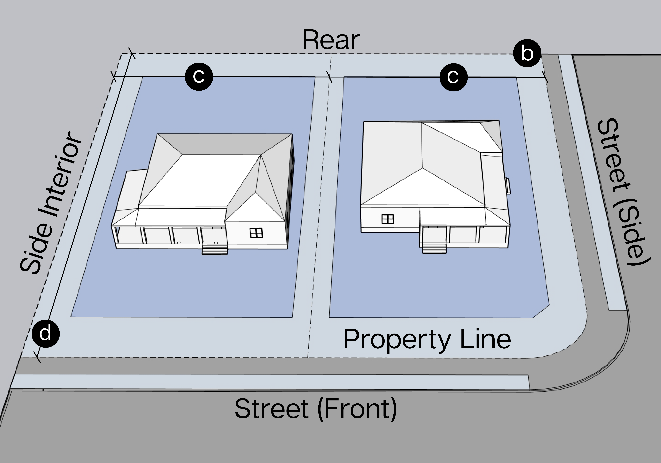
Density
(1)
Dwelling Units/Acre (maximum) 1.0
Lot dimensions
(1)
Lot Area (minimum) acres 1.0
(2)
Lot Width (minimum) feet 100
(3)
Lot Depth (minimum) feet 100
Figure ii: Setback Measurement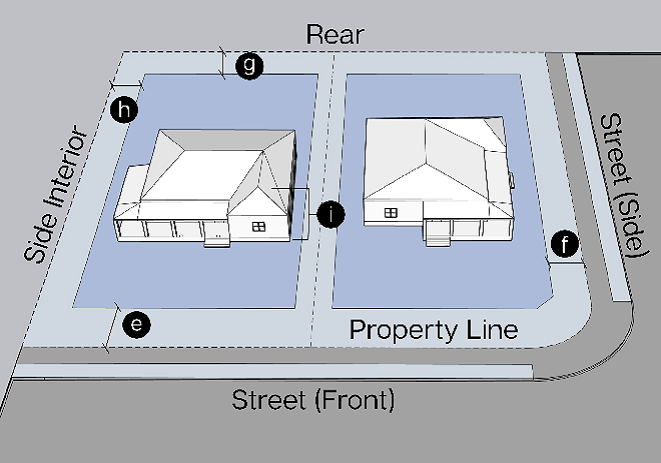
Setbacks
(1)
Street, Front (minimum) feet
Primary or Secondary Street
35
Local or Private Street
35
(2)
Street, Side (minimum) feet
All roadways
15
Alleys/private easements
10
(3)
Rear (minimum) feet
20
Alley/private easements
10
(4)
Side, Interior (minimum) feet 5
Height
(1)
Building Height (maximum) feet 35
Lot Coverage (maximum) Percentage
(1)
Total of all buildings on the lot 35%
Off-Street Parking and Loading
(1)
Number of off-street parking spaces, per dwelling unit 2.0
Notes
Flag pole structures are allowed to encroach on front setback ten feet outside of any easements, parking, or visibility triangles and are allowed to be up to 25 feet for residential uses. For non-residential uses up to 40 feet. A permit is not required until the flag pole is 30 feet or larger.
(Ord. No. 793-25, § 2(Exh. A), 1-23-25)
Sec. 52-306. - Single-Family Residential—Low (SF-1).
(a)
Intent.
(1)
Provide appropriate locations for residential development that are consistent with the City of Justin Experience District (Future Land Use) Plan, as amended over time;
(2)
Ensure adequate light, air, and privacy for all dwelling units;
(3)
Appropriately address multi-modal transportation access and ensure adequate availability of public services and utilities;
(4)
Allow for a variety of housing types that meet the diverse needs of residents; and
(5)
Protect residential development from the encroachment of uses that are incompatible with residential uses.
In all residential zoning districts, complementary uses such as parks, open space, public schools, religious assemblies, minor public or private utilities, accessory buildings, and certain temporary uses are also allowed.
(b)
Purpose. Residential properties with traditional lot size minimums. These single-family residences are the minimum standards for new single-family neighborhoods.
Graphic Representation
Figure i: Lot Dimension Measurement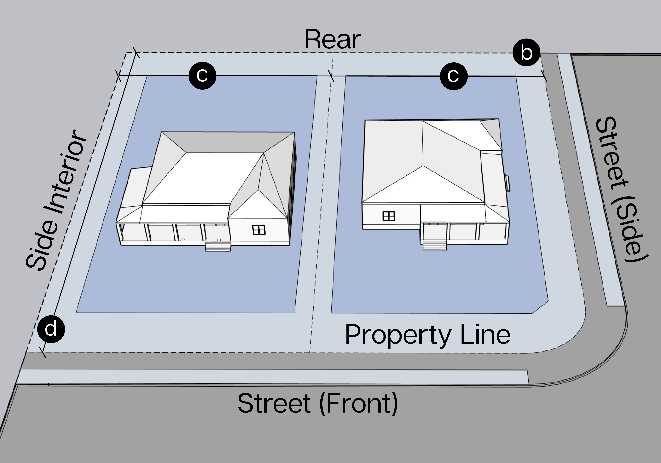
Density
(1)
Dwelling Units/Acre (maximum) 4.0
Lot dimensions
(1)
Lot Area (minimum) square feet 10,000
(2)
Lot Width (minimum) feet 80
(3)
Lot Depth (minimum) feet 100
Figure ii: Setback Measurement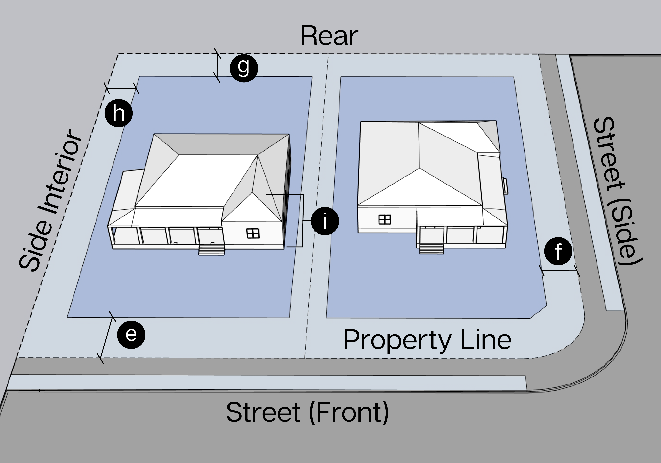
Setbacks
(1)
Street, Front (minimum) feet
Primary or Secondary Street
25
Local or Private Street
25
(2)
Street, Side (minimum) feet
All roadways
8
Alleys/private easements
8
(3)
Rear (minimum) feet
15
Alley/private easements
8
(4)
Side, Interior (minimum) feet 5
Height
(1)
Building height (maximum) feet 35
Lot Coverage (maximum) Percentage
(1)
Total of all buildings on the lot 65%
Off-Street Parking and Loading
(1)
Number of off-street parking spaces, per dwelling unit 2.0
Notes
Flag pole structures are allowed to encroach on front setback ten feet outside of any easements, parking, or visibility triangles and are allowed to be up to 25 feet for residential uses. For non-residential uses up to 40 feet. A permit is not required until the flag pole is 30 feet or larger.
(Ord. No. 793-25, § 2(Exh. A), 1-23-25)
Sec. 52-307. - Single-Family Residential—Medium (SF-2).
(a)
Intent.
(1)
Provide appropriate locations for residential development that are consistent with the City of Justin experience district (future land use) plan, as amended over time;
(2)
Ensure adequate light, air, and privacy for all dwelling units;
(3)
Appropriately address multi-modal transportation access and ensure adequate availability of public services and utilities;
(4)
Allow for a variety of housing types that meet the diverse needs of residents; and
(5)
Protect residential development from the encroachment of uses that are incompatible with residential uses.
In all residential zoning districts, complementary uses such as parks, open space, public schools, religious assemblies, minor public or private utilities, accessory buildings, and certain temporary uses are also allowed.
(b)
Purpose. Residential properties with traditional lot size minimums. These single-family residences are the minimum standards for new single-family neighborhoods.
Graphic Representation
Figure i: Lot Dimension Measurement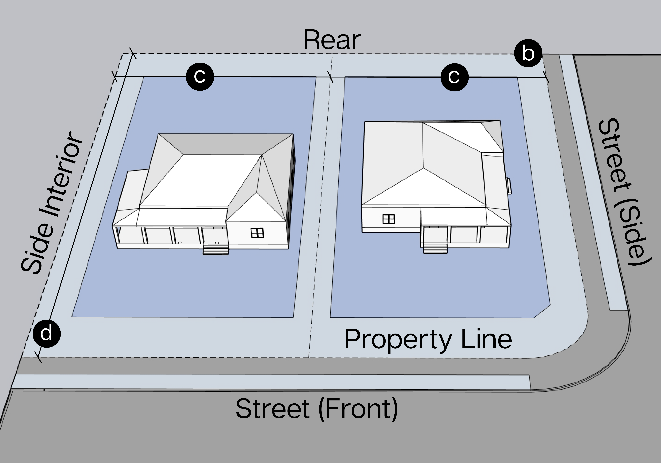
Density
(1)
Dwelling Units/Acre (maximum) 6.0
Lot dimensions
(1)
Lot Area (minimum) square feet 7,500
(2)
Lot Width (minimum) feet 70
(3)
Lot Depth (minimum) 100
Figure ii: Setback Measurement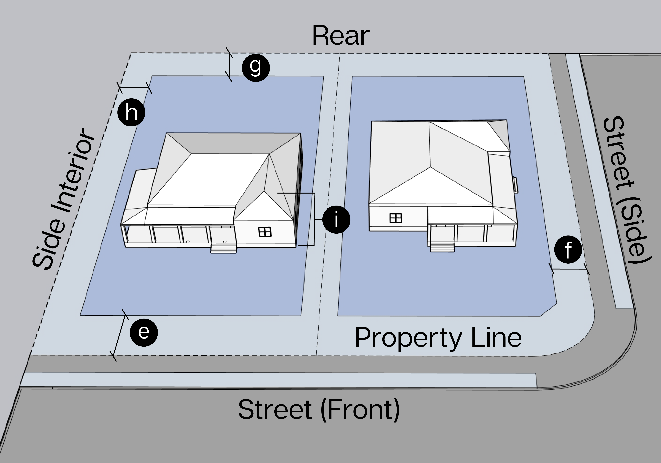
Setbacks
(1)
Street, Front (minimum) feet
Primary or Secondary Street
25
Local or Private Street
25
(2)
Street, Side (minimum) feet
All roadways
7
Alleys/private easements
7
(3)
Rear (minimum) feet
10
Alley/private easements
7
(4)
Side, Interior (minimum) feet 5
Height
(1)
Building Height (maximum) feet 35
Lot Coverage (maximum) Percentage
(1)
Total of all buildings on the lot 65%
Off-Street Parking and Loading
(1)
Number of off-street parking spaces, per dwelling unit 2.0
Notes
Flag pole structures are allowed to encroach on front setback ten feet outside of any easements, parking, or visibility triangles and are allowed to be up to 25 feet for residential uses. For non-residential uses up to 40 feet. A permit is not required until the flag pole is 30 feet or larger.
(Ord. No. 793-25, § 2(Exh. A), 1-23-25)
Sec. 52-308. - Old Town Residential (SF-OT).
(a)
Intent.
(1)
Provide appropriate locations for residential development that are consistent with the City of Justin experience district (future land use) plan, as amended over time;
(2)
Ensure adequate light, air, and privacy for all dwelling units;
(3)
Appropriately address multi-modal transportation access and ensure adequate availability of public services and utilities;
(4)
Allow for a variety of housing types that meet the diverse needs of residents; and
(5)
Protect residential development from the encroachment of uses that are incompatible with residential uses.
In all residential zoning districts, complementary uses such as parks, open space, public schools, religious assemblies, minor public or private utilities, accessory buildings, and certain temporary uses are also allowed.
(b)
Purpose. Residential properties with traditional lot size minimums. These single-family residences are the minimum standards for new single-family neighborhoods.
Graphic Representation
Figure i: Lot Dimension Measurement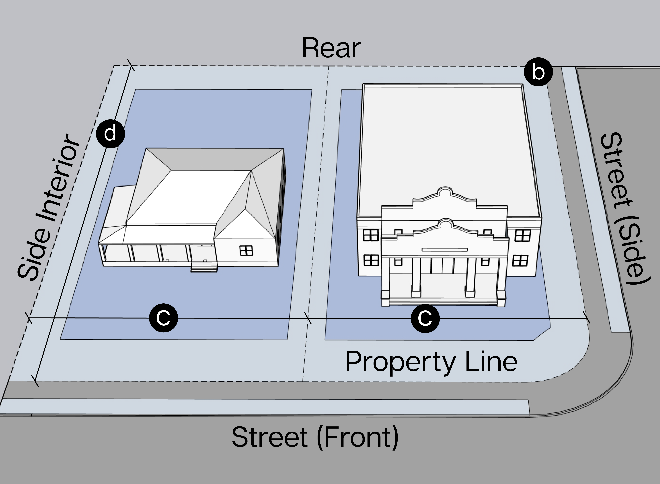
Density
(1)
Dwelling Units/Acre (maximum) 6.0
Lot Dimensions
(1)
Lot Area (minimum) square feet N/A
(2)
Lot Width (minimum) feet N/A
(3)
Lot Depth (minimum) feet N/A
Figure ii: Setback Measurement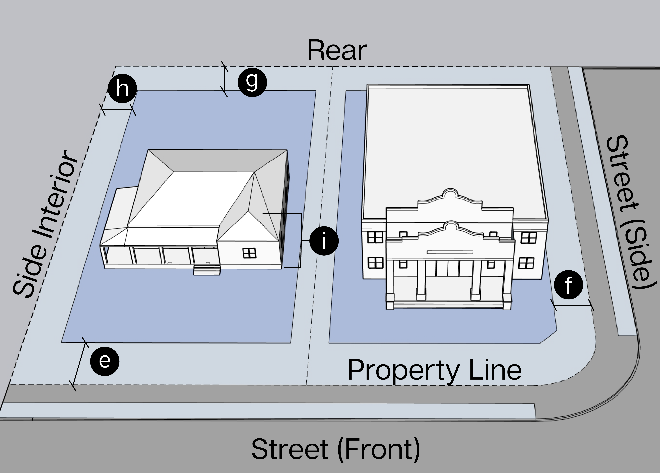
Setbacks
(1)
Street, Front (minimum) feet
Primary or Secondary Street
1
20
Local or Private Street
1
20
(2)
Street, Side (minimum) feet
All roadways
15
Alleys/private easements
10
(3)
Rear (minimum) feet
10
Alley/private easements
10
(4)
Side, Interior (minimum) feet 5
Height
(1)
Building Height (maximum) feet 35
Lot Coverage (maximum) Percentage
(1)
Total of all buildings on the lot N/A
Off-Street Parking and Loading
(1)
Number of off-street parking spaces, per dwelling unit 2 2.0
Notes
1 Front setback as listed or within four feet of the average setback on the same block face.
2 1.0 parking space per unit may be accommodated with on-street parking.
Flag pole structures are allowed to encroach on front setback ten feet outside of any easements, parking, or visibility triangles and are allowed to be up to 25 feet for residential uses. For non-residential uses up to 40 feet. A permit is not required until the flag pole is 30 feet or larger.
(Ord. No. 793-25, § 2(Exh. A), 1-23-25)
Sec. 52-309. - Missing Middle Residential (MM).
(a)
Intent.
(1)
Provide appropriate locations for residential development that are consistent with the City of Justin experience district (future land use) plan, as amended over time;
(2)
Ensure adequate light, air, and privacy for all dwelling units;
(3)
Appropriately address multi-modal transportation access and ensure adequate availability of public services and utilities;
(4)
Allow for a variety of housing types that meet the diverse needs of residents; and
(5)
Protect residential development from the encroachment of uses that are incompatible with residential uses.
In all residential zoning districts, complementary uses such as parks, open space, public schools, religious assemblies, minor public or private utilities, accessory buildings, and certain temporary uses are also allowed.
(b)
Purpose. Residential properties with medium densities, lots less than 6,000 square feet and including duplex, townhomes, and other missing middle housing types, up to ten dwelling units in a building.
Graphic Representation
Figure i: Lot Dimension Measurement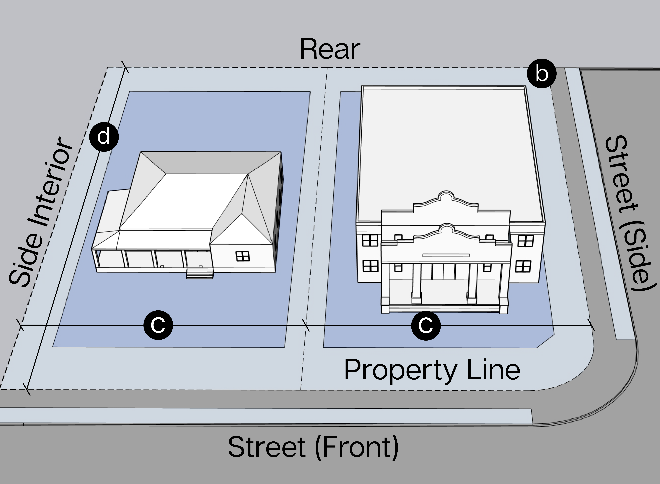
Density
(1)
Lot Area/Dwelling Unit
(maximum) per acre
18.0
Lot Dimensions
(1)
Lot Area (minimum)
per unit square feet
2,500
(2)
Lot Width (minimum) feet 25
(3)
Lot Depth (minimum) feet 50
Figure ii: Setback Measurement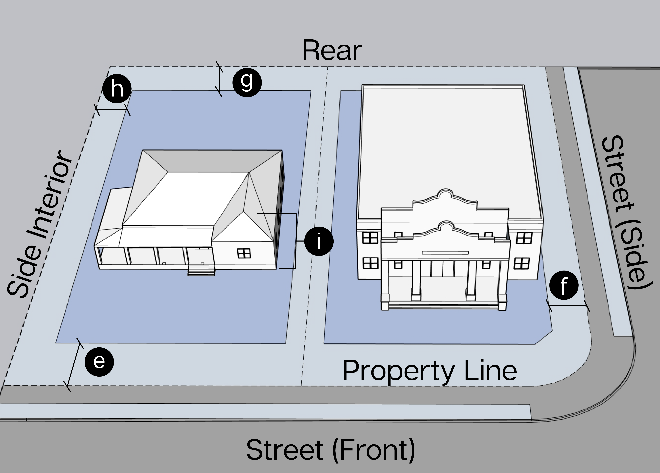
Setbacks
(1)
Street, Front (minimum) feet
Primary or Secondary Street
15
Local or Private Street
10
(2)
Street, Side (minimum) feet
All roadways
10
Alleys/private easements
5
(3)
Rear (minimum) feet
10
Alley/private easements
5
(4)
Side, Interior (minimum) feet 0
Height
(1)
Building Height (maximum) feet 35
Lot Coverage (maximum) Percentage
(1)
Total of all buildings on the lot 75%
Off-Street Parking and Loading
(1)
Number of off-street parking spaces, per dwelling unit 1 1.25
Notes
1 0.25 parking space per unit may be accommodated with on-street parking.
Flag pole structures are allowed to encroach on front setback ten feet outside of any easements, parking, or visibility triangles and are allowed to be up to 25 feet for residential uses. For non-residential uses up to 40 feet. A permit is not required until the flag pole is 30 feet or larger.
(Ord. No. 793-25, § 2(Exh. A), 1-23-25)
Sec. 52-310. - Multi-Family Residential (MF).
(a)
Intent.
(1)
Provide appropriate locations for residential development that are consistent with the City of Justin experience district (future land use) plan, as amended over time;
(2)
Ensure adequate light, air, and privacy for all dwelling units;
(3)
Appropriately address multi-modal transportation access and ensure adequate availability of public services and utilities;
(4)
Allow for a variety of housing types that meet the diverse needs of residents; and
(5)
Protect residential development from the encroachment of uses that are incompatible with residential uses.
In all residential zoning districts, complementary uses such as parks, open space, public schools, religious assemblies, minor public or private utilities, accessory buildings, and certain temporary uses are also allowed.
(b)
Purpose. Residential properties with high intensity, greater than ten units in a building. Can be used for higher intensity missing middle to apartment complexes.
Graphic Representation
Figure i: Lot Dimension Measurement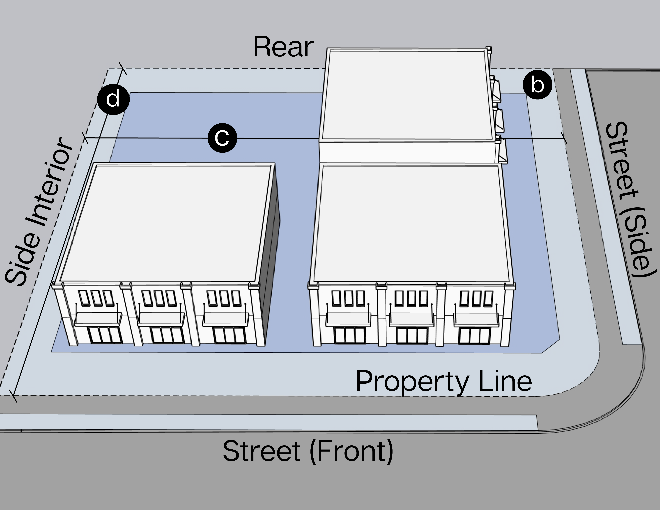
Density
(1)
Dwelling Units/Acre (maximum) 50
Lot Dimensions
(1)
Lot Area (minimum) square feet 10,000
(2)
Lot Width (minimum) feet 100
(3)
Lot Depth (minimum) feet 100
Figure ii: Setback Measurement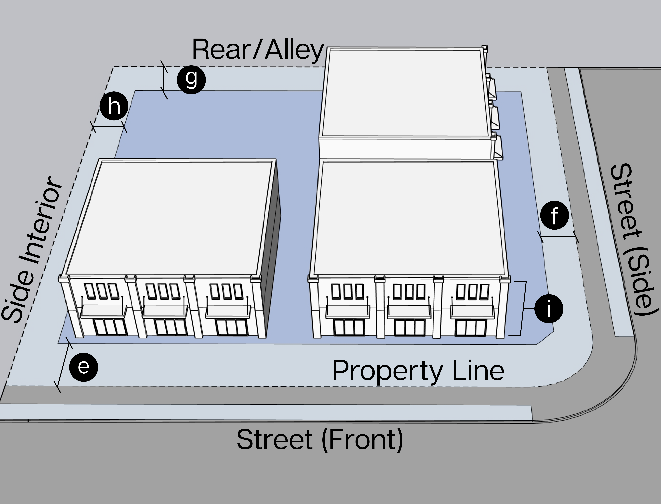
Setbacks
(1)
Street, Front (minimum) feet
Primary or Secondary Street
35
Local or Private Street
25
(2)
Street, Side (minimum) feet
All roadways
10
Alleys/private easements
5
(3)
Rear (minimum) feet
10
Alley/private easements
5
(4)
Side, Interior (minimum) feet 5
Height
(1)
Building Height (maximum) feet 45
(2)
Setback, above 35 feet 10
Lot Coverage (maximum) Percentage
(1)
Total of all buildings on the lot 75%
Off-Street Parking and Loading
(1)
Number of off-street parking spaces, per dwelling unit See Table 52-401B
Notes
Flag pole structures are allowed to encroach on front setback ten feet outside of any easements, parking, or visibility triangles and are allowed to be up to 25 feet for residential uses. For non-residential uses up to 40 feet. A permit is not required until the flag pole is 30 feet or larger.
(Ord. No. 793-25, § 2(Exh. A), 1-23-25)
Sec. 52-311. - Neighborhood Commercial (NC).
(a)
Intent.
(1)
Accommodate a range and different scales of non-residential uses, including office, retail, commercial, and service uses needed in Justin;
(2)
Encourage site planning, land use planning, and architectural design that create interesting and attractive environments;
(3)
Maintain and enhance the city's economic base and provide a range of shopping, entertainment, housing, lodging, and employment opportunities for the residents and visitors of Justin;
(4)
Minimize potential negative impacts of commercial and mixed-use development on adjacent residential neighborhoods; and
(5)
Help ensure that the appearance and operational impacts of commercial and mixed-use developments do not adversely affect the character of the areas in which they are located.
In all residential zoning districts, complementary uses such as parks, open space, public schools, religious assemblies, minor public or private utilities, accessory buildings, and certain temporary uses are also allowed.
(b)
Purpose. Non-residential uses operating as office, commercial, or neighborhood services.
Graphic Representation
Figure i: Lot Dimension Measurement
Density
(1)
Dwelling Units/Acre (maximum) N/A
Lot Dimensions
(1)
Lot Area (minimum) square feet 5,000
(2)
Lot Width (minimum) feet 50
(3)
Lot Depth (minimum) feet N/A
Figure ii: Setback Measurement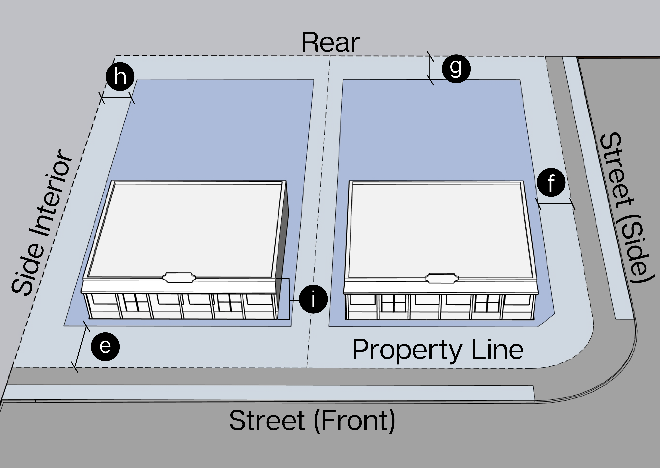
Setbacks
(1)
Street, Front (minimum) feet (see note 1)
Primary or Secondary Street
20
Local or Private Street
15
(2)
Street, Side (minimum) feet
All roadways
15
Alleys/private easements
5
(3)
Rear (minimum) feet
20
Alley/private easements
10
(4)
Side, Interior (minimum) feet
Abutting Res lot
20
Abutting any other lot
0
Height (maximum) feet
(1)
Building Height (maximum) feet 35
Lot Coverage (maximum) Percentage
(1)
Total of all structures on the lot 50%
Off-Street Parking and Loading
(1)
Number of off-street parking spaces See Table 52-401B
(2)
Access and driveway spacing to property from State Highways
TxDOT
Design Criteria
Notes
Flag pole structures are allowed to encroach on front setback ten feet outside of any easements, parking, or visibility triangles and are allowed to be up to 25 feet for residential uses. For non-residential uses up to 40 feet. A permit is not required until the flag pole is 30 feet or larger.
(Ord. No. 793-25, § 2(Exh. A), 1-23-25)
Sec. 52-312. - Regional Commercial (RC).
(a)
Intent.
(1)
Accommodate a range and different scales of non-residential uses, including office, retail, commercial, and service uses needed in Justin;
(2)
Encourage site planning, land use planning, and architectural design that create interesting and attractive environments;
(3)
Maintain and enhance the City's economic base and provide a range of shopping, entertainment, housing, lodging, and employment opportunities for the residents and visitors of Justin;
(4)
Minimize potential negative impacts of commercial and mixed-use development on adjacent residential neighborhoods; and
(5)
Help ensure that the appearance and operational impacts of commercial and mixed-use developments do not adversely affect the character of the areas in which they are located.
In all residential zoning districts, complementary uses such as parks, open space, public schools, religious assemblies, minor public or private utilities, accessory buildings, and certain temporary uses are also allowed.
(b)
Purpose. Non-residential uses operating as office, commercial, or neighborhood services
Graphic Representation
Figure i: Lot Dimension Measurement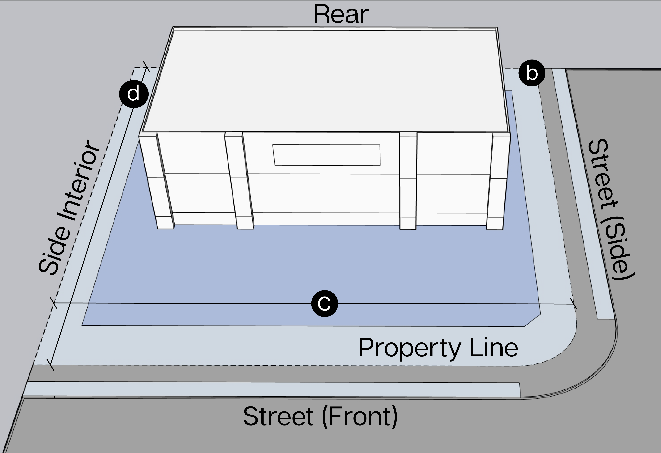
Density
(1)
Dwelling Units/Acre (maximum) N/A
Lot Dimensions
(1)
Lot Area (minimum) square feet 7,500
(2)
Lot Width (minimum) feet 50
(3)
Lot Depth (minimum) feet N/A
Figure ii: Setback Measurement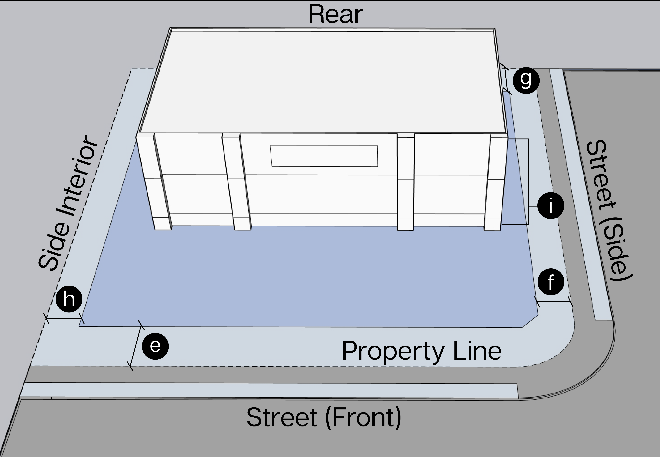
Setbacks
(1)
Street, Front (minimum) square feet
Primary or Secondary Street
20
Local or Private Street
20
(2)
Street, Side (minimum) feet
All roadways
15
Alley/private easements
5
(3)
Rear (minimum) feet
10
Alley/private easements
10
(4)
Side, Interior (minimum) feet
Abutting Res lot
20
Abutting any other lot
0
Height (maximum) feet
(1)
Building Height (maximum) feet 35
Lot Coverage (maximum) Percentage
(1)
Total of all structures on the lot 50%
Off-Street Parking and Loading
(1)
Number of off-street parking spaces See Table 52-401B
(2)
Access and driveway spacing to property from State Highways
TxDOT
Design Criteria
Notes
Flag pole structures are allowed to encroach on front setback ten feet outside of any easements, parking, or visibility triangles and are allowed to be up to 25 feet for residential uses. For non-residential uses up to 40 feet. A permit is not required until the flag pole is 30 feet or larger.
(Ord. No. 793-25, § 2(Exh. A), 1-23-25)
Sec. 52-313. - Mixed-Use (MU).
(a)
Purpose and intent.
(1)
The MU District is intended to encourage the creation of walkable development patterns in the area and connecting it to adjacent neighborhoods. The MU District is intended to be a live, work, and play area in the city. It is intended to be a mixed-use district with the higher density allowances compatible with a city center.
(2)
Development should facilitate pedestrian connections and soft transitions between residential and non-residential uses. Residential uses are encouraged on the upper floors of nonresidential establishments.
Graphic Representation
Figure i: Lot Dimension Measurement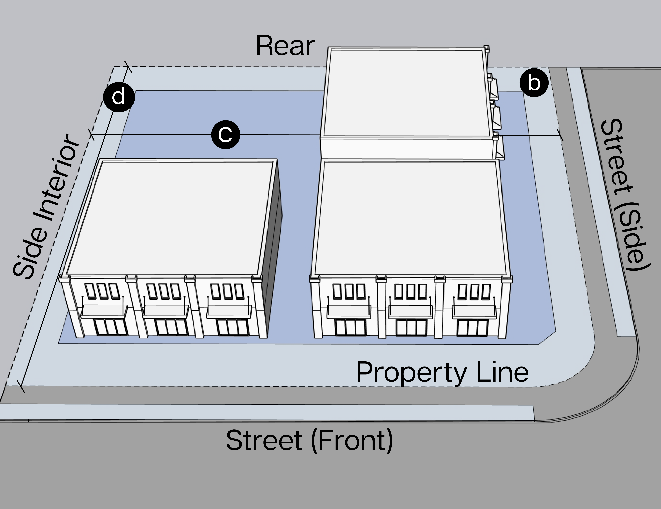
Density
(1)
Dwelling Units/Acre (maximum) 60
Lot Dimensions
(1)
Lot Area (minimum) square feet N/A
(2)
Lot Width (minimum) feet 20
(3)
Lot Depth (minimum) feet 50
Figure ii: Setback Measurement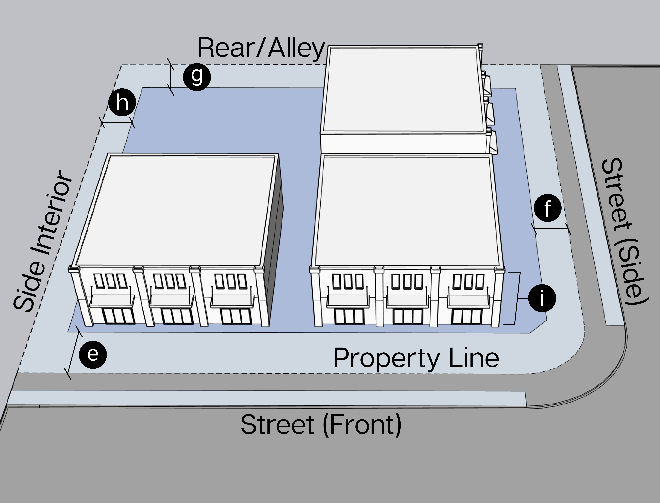
Setback Ranges (See Definitions)
(1)
Front, min./max. (feet)
Pedestrian-Priority Frontage
0 min
(see note 1)
10 max
Public Open Space, Trail
10 min
30 max
Public street or private
5 min
access easement
20 max
(2)
Side, min./max. (feet)
Pedestrian-Priority Frontage
0 min
15 max
Public street
10 min
No max
Interior Lot line
No min
No max
Private access easement or alley
5 min
No max
(3)
Rear min./max. (feet)
Alley (see note 2)
3 min
No max
All other conditions
10 min
No max
Building Standards (See Definitions)
(1)
Building height, max. (Stories/feet)
3 stories
or 45 feet
(2)
Lot coverage, max. (%) N/A
Notes
Flag pole structures are allowed to encroach on front setback ten feet outside of any easements, parking, or visibility triangles and are allowed to be up to 25 feet for residential uses. For non-residential uses up to 40 feet. A permit is not required until the flag pole is 30 feet or larger.
(Ord. No. 793-25, § 2(Exh. A), 1-23-25)
Sec. 52-314. - Light Industrial (LI).
(a)
Intent.
(1)
Accommodate a range of industrial uses, including storage, logistics, assembly, and manufacturing uses in Justin;
(2)
Encourage site planning, land use planning, and architectural design that create attractive but functional and safe environments;
(3)
Maintain and enhance the city's economic base and provide employment and manufacturing opportunities for Justin residents;
(4)
Minimize potential negative impacts of industrial uses on other adjacent uses; and
(5)
Help ensure that the appearance and operational impacts of industrial developments do not adversely affect the character of the areas in which they are located.
(b)
Purpose. Large scale manufacturing, warehouse, office, commercial, and regional shopping attractions.
Graphic Representation
Figure i: Lot Dimension Measurement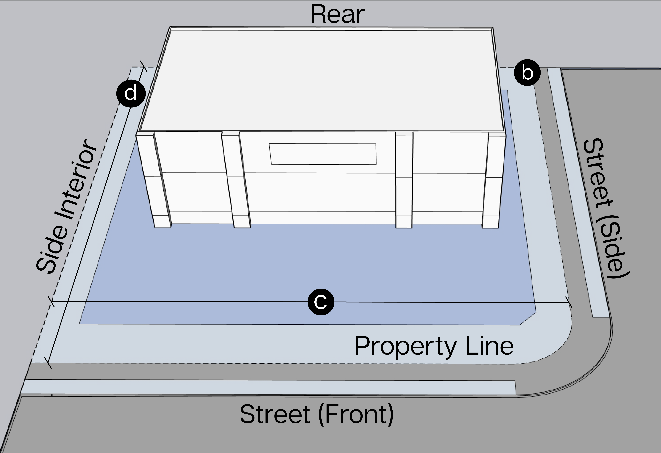
Density
(1)
Dwelling Units/Acre (maximum) N/A
Lot Dimensions
(1)
Lot Area (minimum) square feet N/A
(2)
Lot Width (minimum) feet 150
(3)
Lot Depth (minimum) feet N/A
Figure ii: Setback Measurement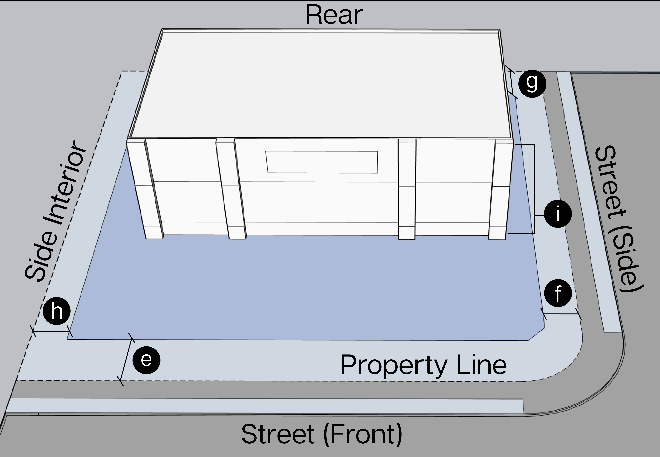
Setbacks
(1)
Street, Front (minimum) feet (see note 1)
Primary or Secondary Street
50
Local or Private Street
25
(2)
Street, Side (minimum) feet
All roadways
25
Alley/private easements
20
(3)
Rear (minimum) feet
Abutting Agriculture or Residential Lot
75
Abutting any other lot
0
(4)
Side, Interior (minimum) feet
Abutting Residential Lot
75
Abutting any other lot
0
Height
(1)
Building Height (maximum) feet 35
Lot Coverage (maximum) Percentage
(1)
All structures on the lot 50%
Off-Street Parking and Loading
(1)
Number of off-street parking spaces See Table 52-401B
(2)
Access and driveway spacing to property from State Highways
TxDOT
Design Criteria
Notes
Flag pole structures are allowed to encroach on front setback ten feet outside of any easements, parking, or visibility triangles and are allowed to be up to 25 feet for residential uses. For non-residential uses up to 40 feet. A permit is not required until the flag pole is 30 feet or larger.
(Ord. No. 793-25, § 2(Exh. A), 1-23-25)
Sec. 52-315. - Old Town (OT).
(a)
Purpose. The purpose of this district is to provide guidance on infill development standards within the historic old town area. The following standards shall apply only to those properties within the Old Town Overlay.
(b)
All development standards are set per the base zoning district according to article III, zoning districts and article IV, development standards.
(c)
Land uses permitted within the OT Overlay are regulated according to the schedule of uses.
(d)
Old Town Justin, Texas Form-Based Code.
(1)
Introduction and purpose.
a.
Statement of purpose. Old Town Justin is historic and iconic, having served as the city's economic hub since its establishment in the 1800s. The original town center was platted in a traditional grid, oriented towards the railroad, a critical mode of transportation at the time. Due to the area's historical and cultural significance, new development or redevelopment within this area is very different from that in other areas that were not part of a historical settlement.
The Old Town Justin Form-Based Code ("OTJ FBC") is crafted to preserve and reinforce the unique historic character, pedestrian orientation, and architectural heritage of Old Town Justin. Public input has clarified that residents want to keep the authenticity of the Old Town area of Justin while understanding that significant growth pressures will continue. The OTJ FBC aims to foster walkability, promote a mix of uses, and maintain architectural cohesion appropriate to Justin's small-town Texas legacy. The code establishes predictable, place-based standards that will revitalize Old Town Justin as a vibrant, resilient community center, balancing effective historic preservation with the evolving needs of businesses, residents, and civic life.
b.
Intent. The Old Town Justin Form-Based Code provides a comprehensive, locally tailored zoning and urban design framework that safeguards the area's rich history while enabling a thriving, walkable, and economically resilient future. By integrating clear standards for building form, frontages, public spaces, uses, and architectural character, Justin will retain its unique small-town Texas charm while fostering mixed-use infill, enhanced walkability, and architectural harmony.
Modeled using specific elements of downtown codes within the region but scaled to Justin's context, this code offers prescriptive yet flexible regulations, a path for engaged community stewardship, and a strategic blueprint for the future growth of Old Town as the heart of the Justin community. The consistent use of clear standards, proactive engagement, and a focus on preservation ensures Old Town Justin remains both a living museum and a modern, connected place to live, work, and gather for generations.
c.
Vision for Old Town. The vision for Old Town is derived from the community-led engagement process that establishes three guiding principles for development in Old Town:
•
Preserve historic character while adding complementary development and a walkable shopping, dining, and entertainment district.
•
Establish an Old Town Vision to guide development, redevelopment, and rehabilitation toward connected and flexible outcomes.
•
Maintain traditional neighborhoods and a rural feel through clear transitions between commercial and residential areas.
d.
Relationship with the Imagine Justin Comprehensive Plan and the Old Town Small Area Plan. The application of these regulations seeks to encourage community development in accordance with the Imagine Justin Comprehensive Plan and the Old Town Small Area Plan.
e.
Implementation. This effort represents a step toward implementing an element of the comprehensive plan. The plan states, "Initiate an Old Town Master Plan in coordination with the business community and adjacent neighborhoods to improve pedestrian connectivity to Old Town and link it to the new Town Square."
f.
Legal framework & authority (reference UDC). The code applies to all parcels designated within the Old Town Justin Regulating Plan. The standards govern new construction, exterior renovation, additions, and site development. Where conflicts arise with other sections of the Justin Code of Ordinances, the provisions of the OTJ FBC shall prevail within the Old Town area.
What the FBC regulates:
Where buildings sit on the lot (setbacks/built-to-line).
How tall buildings can be and when upper floors must step back.
How building fronts meet the sidewalk (shopfronts, porches, stoops).
Materials and basic architectural features to keep a historic look.
Signs, murals, alleys, and public-realm elements like sidewalks and street trees.
(2)
Applicability and administration (if needed).
a.
Applicability to other sections of the UDC.
•
Development and design standards within the UDC do not apply to this Old Town District except where referenced explicitly within this article.
•
The OTJ FBC replaces conflicting rules in the city's unified development code (UDC) only for parcels inside the Old Town boundary. All other city rules (building code, health, fire, utilities) still apply.
b.
Who administers the code: The city enforces this code. Some permits and approvals are handled by staff (administrative); others require planning and zoning commission and city council review. The table below shows typical authorities.
Most routine permits are approved by staff quickly. Bigger changes or exceptions go to the planning and zoning commission/city council and take longer.
c.
How to apply:
1.
Confirm location: Verify your parcel on the regulating plan map.
2.
Pre-application (recommended): Meet with planning staff to review the project and required materials.
3.
Submit application: Provide the checklist items. Pay fees.
4.
Completeness check: Staff confirm the application is complete.
5.
Staff review or public review: Staff issues a decision or schedules the item for Commission review if required.
6.
Decision & permit issuance: If approved, obtain building permits and begin work. If denied, follow the appeal steps.
d.
Application checklist. Applicants must bring a clear site plan and simple drawings so staff can check compliance. Below is a checklist of common items needed:
•
Regulating plan parcel ID and map excerpt.
•
Scaled site plan showing property lines, building footprint, setbacks, parking, alleys, and sidewalk.
•
Elevations showing materials, windows, doors, and signage.
•
Ground-floor plan showing entries and transparency.
•
Materials list and color samples.
•
Lighting cut sheets and landscape plan (if applicable).
•
Owner authorization and contact information.
•
Application fee.
e.
Administrative approvals and minor exceptions. The administrator may approve minor adjustments (up to clearly defined limits) when strict compliance would cause undue hardship and the change still meets the intent of the code. Examples: small setback adjustments, minor material substitutions, or slight modulation changes.
What this means: Small, reasonable changes can be handled quickly by staff. Larger changes need commission review.
f.
Limits and process:
•
Minor adjustment limit: e.g., up to 15 percent of a numeric standard (setbacks, modulation) — exact limits published in the administrative rules.
•
Application: Submit a short justification and drawings. Staff posts a notice and issues a decision within 20 business days.
•
Appeal: Decisions may be appealed to the zoning board of adjustment within 14 days.
g.
Variances and conditional uses. Requests that exceed administrative limits or involve policy choices (conditional uses, variances) require a public hearing before the planning and zoning commission. The commission may approve, approve with conditions, or deny.
What this means: If your project needs a bigger change, expect a public hearing, notice to neighbors, and a longer review timeline.
What to expect:
•
Public notice mailed to nearby property owners.
•
Staff report and recommendation.
•
Commission hearing and decision.
•
Appeal to city council if needed.
h.
Nonconforming properties and grandfathering. Buildings, signs, or uses that existed before this code and do not meet new rules are "nonconforming." Nonconforming items may remain but cannot be enlarged or made more nonconforming. Major repairs or replacements over a set threshold must comply with the OTJ FBC.
i.
Amendments to the OTJ FBC. The OTJ FBC may be amended by ordinance. Amendments follow the city's public hearing and adoption process and require an updated regulating plan map if boundaries change. What this means: The code can be changed, but changes require public notice and Council approval.
j.
Fees, bonds, and sureties. Permit fees follow the city's fee schedule. For certain public realm work or phased projects, the city may require performance bonds or maintenance agreements.
What this means: Expect to pay standard permit fees and, in some cases, provide a bond to guarantee public improvements.
(3)
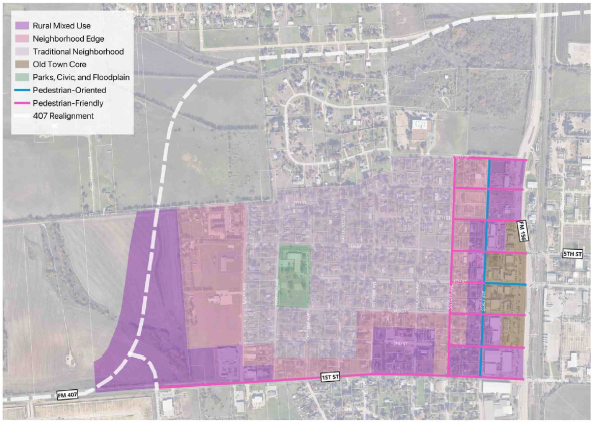
Regulating plan and subdistricts.
a.
Context. The regulating plan divides Old Town Justin into place-based subdistricts that reflect its unique history, land use patterns, development context, and scale.
Quick steps to use the map:
1.
Find your parcel by address or parcel ID.
2.
Note the subdistrict and frontage type shown on the parcel.
Apply the rules for that subdistrict and frontage type in the code.
b.
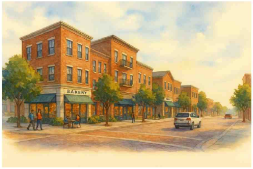
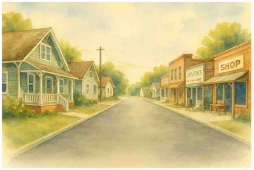
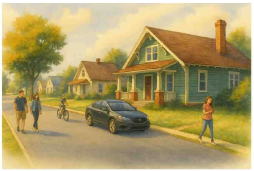
Subdistricts: Old Town is divided into four subdistricts. Each subdistrict has specific rules for building height, setbacks, uses, and frontage types. The subdistricts are: Old Town Core, Rural Mixed Use, Neighborhood Edge, and Traditional Neighborhood.
What this means: The subdistrict tells you what building forms and uses are appropriate for your site.
Subdistricts: The following subdistricts are established as the zoning districts within the Old Town District.
OLD TOWN SUBDISTRICTS
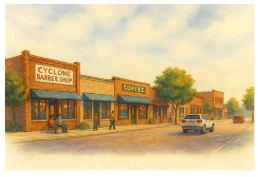 | Old Town Core: The commercial and mixed-use core within the historic context of Old Town that also incorporates historic scale and design standards for community design context in the area. |
 | Rural Mixed-Use: Areas for mixed use that will retain a rural feel but be more flexible on uses appropriate within a new development context, versus Old Town Core's focus on scale and design-specific regulations. |
 | Neighborhood Edge: Density, scale, and use transition zone between Old Town Core and Traditional Residential Subdistricts. |
 | Traditional Neighborhood: The traditional neighborhood homes and homesteads within the Old Town district. This area is intended to allow infill of residential homes without substantially changing the rural characteristic of the subdistrict. |
c.
Street frontage types and how they work. Frontage types describe how buildings meet the street. The regulating plan assigns a frontage type to each street segment. Common frontage types are pedestrian-oriented, pedestrian-friendly, and general street. Each frontage type has required sidewalk widths, building placement, and permitted features.
What this means: The frontage type tells you whether to use a shopfront, porch, stoop, or forecourt and how the sidewalk building should relate.
OLD TOWN STREET FRONTAGE TYPES
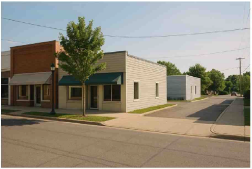
 | Pedestrian-Oriented Street: A street type that includes maximum accommodation of pedestrian movement, and limits conflicts with vehicular driveways, parking lot edges, or blank walls on buildings. |
 | Pedestrian-Friendly Street: A street type that prioritizes pedestrian movement and limits conflicts with vehicular driveways, parking lot edges, or blank walls on buildings. Allows for some vehicular interruptions when no other option is available. |
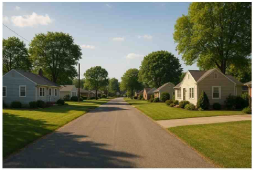 | General Street: A street type that accommodates necessary services and vehicular access, while still accommodating pedestrian movement. |
d.
Boundaries, transitions, and edge conditions.
Rule: Where subdistricts meet, the more restrictive standard applies at the shared property line unless the regulating plan or a specific rule states otherwise. Transition rules require step downs in height and softer materials at edges adjacent to traditional neighborhood.
What this means: If your lot borders a residential area, expect lower heights and design features that ease the change from commercial to residential.
Special boundary notes
•
Through lots: Follow frontage rules on both street frontages.
•
Corner lots: Must meet frontage rules for both street faces.
•
Zero lot line and party walls: Allowed where historic attached forms exist or where the subdistrict permits.
e.
Special places, overlays, and exceptions.
Rule: The regulating plan identify special places such as squares, parks, civic sites, and historic landmarks. Special rules for these places are shown on the map and take precedence within their boundaries.
What this means: If your parcel is in a special place or overlay, follow the additional rules shown on the map and in the overlay section.
Examples of special place rules:
Historic landmark: Additional preservation standards and review steps apply.
f.
Lot splits, new parcels, and map updates.
Rule: New lot splits or replatting inside Old Town must follow the regulating plan's lot size, frontage, and block length standards. Any change to subdistrict boundaries or frontage assignments requires a formal amendment to the OTJ FBC and an update to the official GIS map.
What this means: You cannot create a new lot that avoids the code's rules. If the map needs to change, the city must approve an amendment.
Process highlights:
Lot split review: Submit proposed plat and show compliance with subdistrict standards.
Map amendment: Requires public notice, planning and zoning commission recommendation, and city council approval.
g.
Applicant checklist for map and subdistrict questions:
•
Confirm parcel on the official GIS regulating plan map.
•
Identify subdistrict and frontage type for each street face.
•
Check for overlays or special places affecting the parcel.
•
If proposing a lot split, include a compliance table showing how the new lots meet subdistrict standards.
•
If a map amendment is needed, prepare a justification and follow the amendment process.
What this means: Use the checklist before preparing full plans to avoid rework and delays
REGULATING PLAN
(4)
Building form standards.
a.
Overview. Form standards establish the shape, size, and placement of buildings to protect Justin's historic streetscape, encourage compatible infill, and ensure a walkable, human-scaled environment.
What this means: New buildings should feel like Main Street — human scaled, with active ground floors, clear entries, and materials that match the historic neighborhood.
b.
Definitions (short).
•
Built to line: The line where the front of the building must sit (usually at the sidewalk).
•
Blank wall: A wall longer than allowed that has no windows, doors, or architectural breaks.
•
Step back: A required setback of upper floors from the principal façade.
•
Transparency: Percent of ground floor wall that must be glass between two feet and ten feet above grade. What this means: See the definitions section for full terms and small diagrams.
c.
Building frontage intent. The "built-to-line" requirement for the Historic Core maintains the traditional Main Street character with storefronts flush to the sidewalk, while the Neighborhood Edge provides for additional relief and landscaping. Maximum height and length controls prevent out-of-scale new development and retain legibility of Justin's historic urban form.
Historic forms such as cottages, two-part block commercial buildings, and modest Victorian elements are strongly encouraged; monolithic "big box" buildings and non-historic façade modulation are discouraged.
Key Building Types Permitted:
| Representative Imagery | Building Types | Permitted Subdistricts |
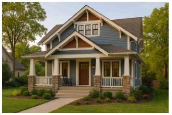 | DETACHED SINGLE-FAMILY HOMES: A residential building designed to accommodate one household or family, providing private living spaces without shared walls or common areas with other units. | Traditional Neighborhood, Neighborhood Edge |
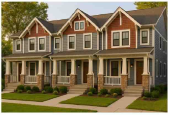 | ATTACHED TOWNHOMES: • Structure: A multi-story home that shares one or more walls with adjacent units but has its own separate entrance. • Ownership: Typically, the homeowner owns both the interior and exterior of the unit, including the land beneath it (unlike condos). • Layout: Often 2-3 stories, with living spaces on the ground floor and bedrooms above. • Density: Higher than detached single-family homes but lower than apartment complexes. | Neighborhood Edge, Rural Mixed-Use |
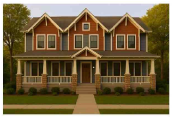 | MISSING MIDDLE RESIDENTIAL: A range of multi-unit or clustered housing types that fit between single-family homes
and large apartment buildings in terms of scale, density, and form. These housing
types are designed to provide more affordable, walkable, and community-oriented living
options while maintaining compatibility with traditional neighborhoods.
• Scale: Human-scaled, typically 1-3 stories, similar in size to single-family homes. • Density: Higher than detached houses but lower than mid-rise apartments. • Types Include: • Duplexes; • Triplexes; and • Fourplexes | Neighborhood Edge, Rural Mixed-Use |
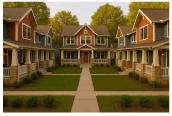 | COTTAGE COURT: A cluster of small, detached homes arranged around a shared central courtyard or
green space. It is designed to promote community interaction while maintaining privacy
for individual units.
• Configuration: Multiple small homes (often 4-12 units) oriented toward a common courtyard rather than the street. • Scale: Typically single-story or one-and-a-half-story homes, smaller than standard single-family houses. • Shared Space: A landscaped courtyard serves as a communal area for residents, enhancing social interaction. • Access: Homes often have front doors facing the courtyard, with parking located at the rear or along the perimeter. | Neighborhood Edge |
 | MAIN STREET (SHOPFRONT) MIXED-USE BUILDINGS: • Street-facing façade: Large display windows for retail visibility. • Entrances: Direct access from the sidewalk to encourage walkability. • Scale: Usually 1-3 stories, maintaining a human-scale streetscape. • Architectural Style: Varies by era and region (e.g., Art Deco, Victorian, Craftsman, Modern). Mixed-Use Potential: Often includes residential units on upper floors in traditional downtowns. | Rural Mixed-Use, Old Town Core |
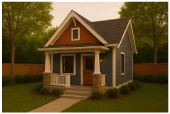 | ACCESSORY BUILDING: A secondary structure located on the same lot as a primary dwelling, designed to support or complement the main residence. It is not intended to serve as the primary living space but provides additional functionality. | Traditional Neighborhood, Neighborhood Edge, Rural Mixed-Use, Old Town Core |
Table 1: Building Form Standards
*Zero-lot-line permitted for party-wall/row buildings or attached historic forms.
**Third story must be set back at least 15 feet from principal facade in Historic Core.
Frontage types
d.
Overview. Frontage regulations ensure that buildings meet the public realm and shape the walkable character of streets. They determine both allowable architectural expressions and the relationship between private space and the sidewalk.
Table 2: Frontage Type Summary
e.
Design standards and regulations.
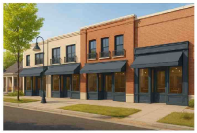
Shopfronts: Building frontages must align with the pedestrian zone. Ground-floor glazing must comprise at least 60 percent of the width between two and ten feet above grade; doors must open directly to the sidewalk. Recessed entries no greater than five feet are permitted to provide weather protection.
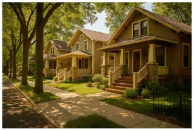
Porches and stoops: Porches must be usable outdoor spaces, not merely decorative; a minimum clear area of six feet wide by eight feet deep. Stoops should be set back a minimum of five feet (can encroach five feet in setback) from the property line and oriented to the sidewalk.
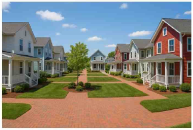
Forecourts and galleries: Allowed at corner or prominent sites, these frontage types encourage flexible placemaking for public activities, farmers markets, and community events.
(5)
Public realm standards and guidelines.
a.
Intent. Strong public realm standards are critical in reinforcing walkability, preserving Old Town's character, and supporting a safe, comfortable, and convivial pedestrian environment. These guidelines regulate sidewalks, crosswalks, civic spaces, on-street parking, lighting, landscaping, and furnishings, modeled on comparable Texas towns.
b.
Streetscape and sidewalk standards.
Table 3: Public Realm Requirements
•
Crosswalks: Are required for Historic Core, Rural Mixed-Use, and Neighborhood Edge intersections. These crosswalks shall comply with ADA requirements, enhance pedestrian visibility, and provide appropriate signage to support driver awareness.
•
Alleys: Alleys may be used for services to homes, parking access, and as public access trails, as determined by the administrator or designee.
c.
Parking.
•
Shared parking is encouraged within the Old Town District based on on-street, public, and offset hours of use management.
•
On-street parking permitted and encouraged along pedestrian streets.
•
Off-street parking minimum requirements for residential uses only at one space per dwelling unit.
•
Off-street parking maximum is one space per 300 square feet within the Old Town District.
d.
Landscaping, lighting, and street furnishings.
•
Street trees must be planted in tree wells or continuous planters and spaced approximately 40 feet apart. Use species approved by the city for durability and low maintenance.
What this means: Trees should form a regular canopy to shade sidewalks and calm traffic.
•
Lighting must be pedestrian-scale (12 foot fixtures), shielded to prevent glare, and aimed to light sidewalks and entries without spilling into homes.
What this means: Lights should make people feel safe without creating bright glare or light pollution.
•
Benches, bike racks, trash receptacles, and wayfinding signs should be placed in the furnishing zone and not block the clear path. Bike parking requirements follow CH52-401 standards.
e.
Maintenance, Responsibilities, and Enforcement.
•
Property owners are responsible for maintaining sidewalks, street trees, and any public-realm improvements they install. If the city accepts a public improvement, the city will maintain it per the acceptance agreement.
What this means: If you add a tree or bench, you must keep it in good condition unless the city agrees to take it over.
•
Neglected public-realm elements that become hazards or nuisances may be repaired by the city at the owner's expense after notice.
What this means: The city will step in if something becomes unsafe and will bill the owner for costs.
(6)
Architectural cohesion and style guidelines.
a.
Intent. Design standards in Old Town Justin assure architectural cohesion, supporting both preservation and compatible new construction that respects the area's Victorian, early 20th-century, and vernacular Texas Main Street heritage. The standards encourage repair and adaptive reuse of historic structures, and ensure that infill and new buildings "fit" within the established context.
b.
General design principles.
•
New work must respect the scale, rhythm, and materials of nearby historic buildings. What this means: Match building height, window proportions, and façade divisions so new buildings feel like they belong.
•
Prioritize human scale at the street with active ground floors, clear entries, and pedestrian oriented details. What this means: Ground floors should invite walking and interaction rather than present blank walls or large parking areas.
•
Guidance: Use simple, durable materials and avoid overly ornate or generic corporate "franchise" styles. What this means: Traditional brick, wood, and metal details age well and support the historic character.
c.
Materials and finishes.
•
Guideline: Preferred materials are brick, stone, painted wood, fiber cement in traditional profiles, and metal accents. Use masonry or quality siding on primary façades. What this means: Choose materials that look and weather like historic Main Street buildings.
•
Standard: Prohibited materials include mirrored glass, large expanses of plastic or vinyl cladding, and thin metal panels that read as industrial. What this means: Avoid modern materials that clash with the historic context.
•
Guideline: Use a limited color palette that complements neighboring buildings and historic examples. What this means: Muted, traditional colors help buildings read as part of the same place.
d.
Standards and guidelines.
•
Windows and doors: Vertically proportioned, multi-paned (except original storefront windows, which may be horizontal).
•
Roofs: Gabled or hipped, with allowable flat roofs for commercial buildings screened by historic-style parapets or cornices.
•
Facade articulation: Buildings must be divided into visually identifiable "modules" (max 30 to 40 feet each) via pilasters, in-sets, or other architectural massing.
•
Storefronts: Maintain or replicate recessed entries, transom windows, and traditional signage bands. Modern cladding, mirrored glass, or illuminated/cabinet signage is not permitted.
•
Porches, stoops, and awnings: Encouraged on most residential and commercial building types; construction must be consistent with historic examples.
•
Attachments (balconies, galleries, overhangs) are allowed where historically documented.
e.
Inappropriate treatments:
•
Franchise "look" architecture (generic corporate prototypes).
•
Large, blank facades or "false front" massing.
•
Faux historicism with inaccurate or overly ornate features.
f.
Commercial recommended styles.
| Art Deco | Bold geometric shapes, strong vertical lines, and a sense of lavish, modern luxury. Key features include the use of rich and modern materials like stucco, chrome, and glass, ornamental motifs such as chevrons, sunbursts, and zigzags, and streamlined, symmetrical designs often with setbacks and flat roofs. | 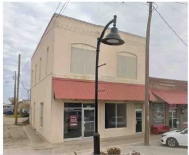 |
| Western | False front style for commercial buildings (a decorative facade hiding a simple structure), the use of natural materials like timber and stone in styles like the Craftsman style, and the integration of landscape in styles like the Prairie School. |  |
| Small Main Street | Common designs for small businesses are one or two-story buildings, sometimes with living quarters above the storefront. Often a rectangular, three-bay-wide, three-story building with a gable roof. |  |
g.
Residential historic styles.
| Cottage | Steep, pitched roofs with multiple gables, charming small windows, mixed natural materials, prominent chimneys, and front porches. | 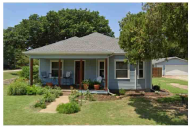 |
| Craftsman | Low-pitched roof with wide, overhanging eaves, visible rafters, a large porch with tapered columns, and built-in features. | 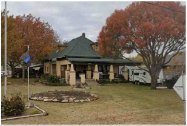 |
| Farmhouse | A simple, practical design with elements like pitched gable roofs, an asymmetrical facade, and large, covered porches. | 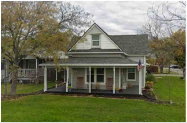 |
| Mission | Curvilinear parapets, overhanging eaves with exposed rafter tails, and deep, simple shapes, reflecting a blend of simplicity and grandeur. | 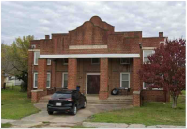 |
| Tudor | Steeply pitched roofs, decorative half-timbering on stucco, or stone exteriors, prominent gables, tall, narrow windows, and ornate, elaborately decorated chimneys. | 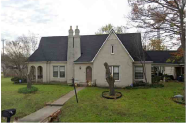 |
| Victorian | Heavy ornamentation, asymmetrical designs, towers or turrets, and vibrant colors. | 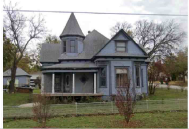 |
(7)
Signage.
Rule: Signs in Old Town Justin must support a pedestrian Main Street character, be easy to read, and respect historic building fronts.
What this means: Signs should help people find businesses and places without creating visual clutter or using modern shopping center styles.
a.
Definitions (short, plain).
•
Monument sign: Low, ground level sign on a masonry or landscaped base.
•
Wall sign (flush): Letters or logos mounted flat against a building façade.
•
Projecting/blade sign: A sign that sticks out perpendicular to the building for pedestrians.
•
Awning/canopy sign: Graphics on the face or valance of an awning.
•
Window sign: Painted or applied graphics on glass.
•
Directional/wayfinding: Small signs that point to entries, parking, or public places.
•
Illumination types: Indirect = light shines onto the sign; internal = light comes from inside the sign.
Table 4: Permitted Sign Types in Old Town Justin District Core
b.
Prohibited or restricted sign types:
•
Rotating/animated/flashing signs
•
Internally illuminated cabinets
•
Pole signs (unless historical precedent is documented)
•
Billboards, off-premises advertising
Table 5: Sign Type Standards in Old Town Justin District Core
Table 6: Approved Materials and Illumination by Sign Type
(8)
Murals.
a.
Purpose. Murals are allowed in Old Town Justin to support public art, celebrate local history, and enliven building walls while protecting community standards. What this means: Property owners and artists can create murals, but they must follow simple rules so murals are appropriate, safe, and well maintained.
b.
Definitions.
•
Mural — A permanent or semi permanent artwork painted or applied directly to a building wall.
•
Temporary mural — A short term painted or applied artwork intended to be removed after an event or season.
•
Content review — A staff check to ensure mural content complies with the rules below.
Table 7: Permitted Mural Standards in Old Town Justin District Core
c.
Maintenance and ownership.
Rule: Property owners are responsible for mural upkeep. If a mural becomes damaged, faded, or a nuisance, the owner must repair or remove it within a reasonable time after notice from the city. Neglected murals may be removed by the city at the owner's expense.
d.
Permit and review process.
Rule: Most murals require a simple administrative permit. The permit application must include:
•
Site photo.
•
Wall elevation with mural area marked.
•
Artist statement.
•
Materials list.
•
Maintenance plan.
•
Staff will review for compliance with size, location, and content rules.
e.
Typical steps:
1.
Confirm parcel is in Old Town and the wall is eligible.
2.
Submit mural permit with required materials.
3.
Staff reviews and issues permit or refers to commission.
4.
Install mural and keep maintenance records.
f.
Typical review time: Ten to 20 business days for administrative approvals; longer if commission review is required.
g.
Temporary murals and community projects. Temporary murals and community paint events are allowed with a simplified permit and a removal plan. Temporary murals must be removed or renewed within the agreed timeframe.
What this means: Short term projects for festivals or community art are supported but must have a plan for removal or renewal.
h.
Historic buildings and special review. Murals on designated historic landmarks or on buildings with protected historic façades require review by the staff administrator or a designated review body to ensure the mural does not harm historic fabric or obscure important architectural features.
i.
Enforcement and appeals. If a mural violates the code, the city will notify the owner and set a timeline to correct the issue. Owners may appeal administrative decisions to the zoning board of adjustment within 14 days. Continued noncompliance may result in removal and cost recovery.
What this means: There is a clear process to fix problems and a short window to appeal decisions.
j.
Design guidance and best practices.
•
Favor designs that reflect local history, culture, or community themes.
•
Avoid full coverage of primary storefront façades that reduce transparency and pedestrian visibility.
•
Use a simple color palette and durable finishes to reduce maintenance needs.
•
Coordinate with neighboring property owners for murals that cross property lines.
k.
Permit checklist for murals.
•
Parcel ID and regulating plan map excerpt.
•
Photo of the wall and surrounding context.
•
Scaled elevation showing mural area and percent of façade.
•
Artist statement describing content and community relevance.
•
Materials list and paint/sealant specifications.
•
Maintenance plan and owner contact information.
•
Fee payment.
(Ord. No. 793-25, § 2(Exh. A), 1-23-25; Ord. No. 837-26, § 1(Exh. A), 2-12-2026)
Sec. 52-316. - Planned Development (PD)
(a)
Purpose. The purpose of this district is to accommodate planned associations of uses developed as integral land use units such as industrial parks or industrial districts; office, commercial or service centers; shopping centers; residential developments of multiple or mixed housing; or any appropriate combination of uses which may be planned, developed, and operated as integral land use units either by a single owner or combination of owners.
(b)
Application.
(1)
An application for a planned development district may be made to the city planning and zoning commission in the same manner that an application for any amendment to the city zoning regulations is made. Applications for approval of a planned development district shall be processed according to the procedure specified in section 52-316(e), and a site plan and related data shall be submitted for approval in accordance with the requirements in sections 52-316(g) and (h).
(2)
The city council, after public hearing and proper notice to all parties affected and after recommendation by the city planning and zoning commission, may authorize the creation of a planned development district on sites of three acres or more to accommodate various types of developments and combinations of developments.
(c)
Uses permitted.
(1)
The uses permitted in any specific planned development district shall be enumerated in the ordinance establishing such district, or by designated base zoning district in the planned development.
(2)
A mix of land uses is required for any PD, and the amount of land dedicated to a land use shall include at least three different uses and no more than 75 percent for any one use.
a.
Single-family residential.
b.
Missing middle residential.
c.
Multi-family residential.
d.
Non-residential or mixed-use.
e.
Open space, parks—No less than 10 percent of total acreage.
f.
Light industrial.
(d)
Height, floor area ratio, density, and parking and loading standards. The maximum height, lot width, lot depth, floor area ratio, and lot area, and the minimum off-street parking and loading requirements for uses proposed shall be established for each planned development district, and such standards and requirements shall comply with or be more restrictive than the standards established in the following districts for the specified type uses:
(e)
Procedure for establishing standards. In approving the development plan and the ordinance establishing the planned development district, the city council shall, after recommendation by the planning and zoning commission, specify such maximum height, floor area ratio, density and minimum off street parking and loading standards within limits of those specified in the districts listed for the specific uses involved as is appropriate for the development. The city council shall, after receiving the recommendation of the planning and zoning commission, establish the standards for yards, signs, building spacing, site coverage, access, screening walls or landscaping, building area, open space, pedestrian ways, public or private streets and alleys to be observed in a planned development district and such standards shall be specified in the ordinance establishing the district.
(f)
Development schedule.
(1)
An application for a planned development district shall, if the applicant desires or the planning and zoning commission or city council requires, be accompanied by a development schedule indicating the appropriate date on which construction is expected to begin and the rate of anticipated development to completion. The development schedule, if adopted and approved by the city council, shall become part of the development plan and shall be adhered to by the owner, developer, and his successors in interest.
(2)
Upon request of the planning and zoning commission, the developer shall report to the planning and zoning commission the actual development accomplished in the various planned development districts as compared with the development schedule.
(3)
The planning and zoning commission may, if in its opinion the owner or owners of property are failing or have failed to meet the approved schedule, initiate proceedings as provided in this section to amend the zoning district zoning map or the planned development district from the zoning district zoning map and placing the area involved in another zoning district. Upon the recommendation of the planning and zoning commission and for good cause shown by the owner and developer, the city council may also extend the development schedule or adopt such a new development schedule as may be indicated by the facts and conditions of the case.
(g)
Development plan required. An application for a planned development district shall include and be accompanied by a development plan that shall become a part of the amending ordinance and shall be referenced on the zoning district zoning map. Changes in the development plan shall be considered the same as changes in the zoning district zoning map and shall be processed as required in section 52-4, except that, changes of detail which do not alter the basic relationship of the proposed development to adjacent property and which do not alter the uses permitted or increase the density, floor area ratio, height or coverage of the site, or which do not decrease the off-street parking ratio, or reduce the yards provided at the boundary of the site as indicated on the approved development plan may be authorized by the zoning administrator. Any applicant may appeal the decision of the zoning administrator to the planning and zoning commission for review and decision as to whether an amendment to the planned development district ordinance shall be required.
(h)
Development plan contents.
(1)
The development plan shall include:
a.
A scale drawing showing any proposed public or private streets and alleys; building sites or building lots; any areas proposed for dedication or reserved as parks, parkways, playgrounds, utility and garbage easements, school sites, street widening, street changes; the points of ingress and egress from existing public streets on an accurate survey of the boundary of tract and topography with a contour interval of not less than five feet, or spot grades where relief is limited.
b.
Where multiple types of land use are proposed a land use plan delineating the specific areas to be devoted to various uses shall be required.
c.
Where building complexes are proposed, a site plan showing the location of each building and the minimum distance between buildings, and between buildings and the property line, street line or alley line shall be submitted. For buildings more than one story in height, except single-family and two-family residences, elevations or perspective drawings may be required in order that the relationship of the buildings to the adjacent property, open spaces, and to other features of the development plan may be determined. Such drawings need only indicate the height, number of floors, and exposures for access, light, and air.
d.
A plan indicating the arrangement and provision of off-street parking and off-street loading where required. Such a plan may be presented as a ratio of off-street parking and off-street loading area to building area when accompanied by a typical example indicating the feasibility of the arrangement proposed and when the areas where the example would be applied are dimensioned on a drawing of the entire site. Any special traffic regulation facilities proposed or required to ensure the safe function of the circulation plan shall also be shown.
e.
A designation of the maximum building coverage of the site shall be indicated upon the site plan.
f.
A screening and landscaping plan shall be required where such treatment is essential to the proper arrangement of the development in relation to adjacent property. Such plan shall, when required, include screening walls, ornamental plantings, playgrounds, wooded areas to be retained, lawns and gardens if such are determined to be necessary by the city council. An exception to the side yard requirements may be approved by the city council such that one side may be reduced to zero provided the other side is increased to a minimum of 18 feet. Where such use is adjacent to a residential district or is on a corner lot, a side yard shall be provided adjacent to the residential district or street.
g.
Any or all of the required features may be incorporated on a single drawing if such drawing is clear and capable of evaluation and interpretation.
(i)
Considered an amendment. Every planned development district approved under the provisions of the ordinance shall be considered an amendment to the city zoning regulations as applicable to the property involved. In carrying out the development of a planned development district, the development conditions and the development schedule, if required, shall be complied with and such conditions as specified for the development of a planned development district shall not be construed as conditions precedent to the approval of the zoning amendment, but shall be construed as conditions precedent to the granting of a certificate of occupancy and compliance as required by sections 52-405 and 52-2.
(Ord. No. 793-25, § 2(Exh. A), 1-23-25)
Sec. 52-317. - Schedule of uses.
The schedule of use regulations given below sets forth the allowable use of land and buildings in each of the classified districts. No land shall hereafter be used, and no building or structure shall hereafter be erected, altered, or converted which is arranged or designed or used for other than those uses specified for the district in which it is located.
Schedule of Uses
1 Must be permanently affixed to an approved foundation & be connected to all municipal utilities.
2 In conformance with City of Justin Gas Drilling Ordinance.
3 In conformance with City of Justin outdoor screening requirements section 52-403.
4 In conformance with conditions listed in section 52-318.
(Ord. No. 793-25, § 2(Exh. A), 1-23-25)
Sec. 52-318. - Permitted with criteria.
(a)
Applicability. Design criteria for all uses allowed under schedule of uses shall be regulated by article III, zoning districts and additional standard within article IV, development standards.
(b)
Additional criteria for considerations of a permitted use, denoted by 'PC' in the Schedule of Uses shall apply as follows:
(c)
Accessory dwelling units (ADU).
(1)
Any 10,000 square feet lot with, or zoned for, a principal single-family dwelling unit may have up to one ADU.
(2)
The zoning administrator may authorize an additional ADU if the property is in an SF-RE District and will be used for agricultural use employee housing.
(3)
An ADU may be any size, provided the proposed unit's total square footage is less than 50 percent of the primary dwellings and other setback and lot coverage requirements are satisfied.
(4)
An ADU shall not be taller than the primary structure.
(5)
An ADU shall not be set in the front yard of a primary structure.
(d)
Retail sales and services.
(1)
Gross building size limited to 10,000 square feet maximum.
(2)
Drive-throughs not permitted only permitted to the rear of the building, or to a side not facing a public right-of-way.
(e)
Temporary batch plant, concrete or asphalt.
(1)
Upon application, including a site plan, the city may authorize the issuance of a temporary batching plant permit, for a location on or adjacent to a major construction site in the city, for a period not to exceed six months with the following conditions:
a.
An 18-inch mound around the perimeter of the batch plant.
b.
A two-foot silt wall placed around the site.
c.
A water truck mitigating dust as requested by the city.
d.
Construction zone signage on any collector or thoroughfare road. Placement shall be determined by the public works director.
e.
A 500-foot minimum setback for a concrete batching plant from any existing residential uses.
f.
A 700-foot minimum setback for an asphalt batching plant from any existing residential uses.
(2)
City council shall have the sole authority to approve the permit. The permit may be issued with appropriate, reasonable conditions determined by the city council, including conditions for control of traffic, view from public or adjacent property, dust, light, noise, ingress and egress, and hours of operation.
(Ord. No. 793-25, § 2(Exh. A), 1-23-25)
Sec. 52-319. - Classification of new and unlisted uses.
The city acknowledges that new and unforeseen types of land use may emerge or seek establishment within its boundaries. To manage these situations, the process for classifying any new or unlisted land use is as follows:
(1)
The director of planning or designee appointed by the city manager, will present any new or unlisted land use issue to the city's planning and zoning commission. This request for clarification on how the land use should be zoned will include detailed information about the nature of the use, whether it involves residential areas, sales, manufacturing, the type of products involved, storage details, potential employment, and the expected levels of noise, smell, emissions, dust, hazardous materials, and vibrations.
(2)
The planning and zoning commission will review the characteristics and operational details of the proposed land use, assessing how well it fits with the permitted uses in different zones. The commission will decide on the most suitable zoning area for the use, guided by the intensity levels outlined in the Imagine Justin Comprehensive Plan.
(3)
After their evaluation, the planning and zoning commission will forward their conclusions and suggestions regarding the zoning of any new or unlisted land use to the city council. The city council will then either endorse the commission's recommendations or decide on an appropriate classification for the land use.
(Ord. No. 793-25, § 2(Exh. A), 1-23-25)
Sec. 52-320. - Unclassified areas.
(a)
After the city expands to include new areas, these areas will initially be classified under the SF-RE zoning category. This classification is temporary. The planning and zoning commission will review the new areas and suggest to the city council whether they should remain in the SF-LL RE zone or be reclassified. The areas will stay in the SF-RE zone until the city council amends this section to reflect any changes recommended by the commission.
(b)
If a street or alley is no longer in use and officially closed, the zoning district that applies to the properties next to that street or alley will be extended to the middle of the former street or alley.
(Ord. No. 793-25, § 2(Exh. A), 1-23-25)
Sec. 52-321. - Specific uses.
(a)
The city council can approve certain specific uses in designated areas, as identified in the schedule of uses, if three-fourths of its members agree. This decision comes after a public meeting, notifying all impacted parties, and getting advice from the planning and zoning commission that the use fits the city's overall plan. This process also includes making sure that the use won't negatively affect nearby properties. To apply, you need to submit a detailed site plan that shows the layout, including parking, building sizes, materials, locations, signage, how the site connects to public roads, any barriers like walls or fences, and how the proposed use relates to surrounding properties within 200 feet.
(b)
When the planning and zoning commission considers giving a permit for a specific use, they check that it will be in harmony with nearby buildings and land uses. They look at whether it meets city standards for street paving, sidewalks, access to public roads, drainage, parking, screening like walls or fences, open spaces, building heights, and construction quality. Additionally, the commission reviews:
(1)
If the proposed land use matches the Imagine Justin Comprehensive Plan; and
(2)
Any potential issues with lighting, noise, smells, etc., that might affect neighbors.
(c)
When a specific use permit is approved, it temporarily changes the zoning rules for the property in question. However, this change is not permanent. If the property is not used for six months or more, or if it is damaged and over half is destroyed, then the property must follow the original zoning rules unless a new permit is issued.
(d)
The city council may set certain requirements that must be met before the property can be used under the specific use permit. These requirements must be fulfilled to receive a certificate of occupancy from the building inspector.
(e)
A specific use permit will only be granted if the person applying for the permit, the property owner, and the permit holder agree to follow the rules and conditions outlined in the permit, which are detailed in the site plan.
(f)
After receiving a specific use permit, a building permit must be obtained within one year. The city council has the power to extend this period if the planning and zoning commission agrees.
(g)
If a building, premises, or land is currently operating under a specific use permit, it cannot be expanded, changed, structurally modified, or significantly altered without obtaining a new specific use permit for these changes.
(h)
The board of adjustment does not have the power to hear, review, overturn, or alter any decisions or actions related to the issuance, renewal, cancellation, or modification of a specific use permit.
(i)
Once the city council approves a specific use permit, the zoning map will be updated to show that the area is subject to certain conditions and restrictions. This update will include the appropriate zoning category for the approved use, marked with an 'S' for 'specific use.'
(j)
When the city council decides to issue a specific use permit, it may also impose additional conditions beyond those listed in subsection (a) if it believes these are in the public's best interest.
(k)
A specific use permit will remain valid until the business moves or has been closed for more than six months. If a new business wants to use the same location, it must apply for its own specific use permit.
(Ord. No. 793-25, § 2(Exh. A), 1-23-25)

