
Justin City Zoning Code
ARTICLE IV
- DEVELOPMENT STANDARDS
Sec. 52-401. - Access and parking.
(a)
Pedestrian access.
(1)
Intent. This section is intended to provide safe, direct, and convenient pedestrian facilities between all buildings or structures, public streets, sidewalks, and parking. Pedestrian access is important for the overall function, activity level, and comfort of all users.
(2)
Applicability. All new development, additions to any structure, or conversions of use for which a building permit is required by City of Justin Code of Ordinances, shall provide pedestrian facilities in accordance with the regulations of this section and the development standards of the applicable district of this Code.
(3)
Sidewalks and walkways.
a.
Shall be installed along any street frontage per the latest standards adopted by the City of Justin. The zoning administrator may waive this requirement when sidewalks are not warranted or feasible.
b.
Walkways shall be provided to connect all main entrances and all publicly accessible uses to parking and adjacent public rights-of-way. Such pedestrian connections should be placed to avoid passing through parking areas and interior access drives to the greatest extent possible. Routing of walkways through parking lot landscape islands is encouraged.
c.
Walkways providing cross-access between abutting lots are encouraged.
d.
Sidewalks and walkways shall consist of accessible, easily discernable, and ADA-compliant routes, per City of Justin Technical Construction Standards and Specifications (TCSS).
(b)
Bicycle access and parking.
(1)
Purpose. To ensure that any new building provides enough bicycle parking for its users. The parking must be safe, easy to get to, and encourage people to cycle more.
(2)
Who must follow this. If you're building something new, adding to a building, or changing a building's use and need a permit, you must include bicycle parking as described here. This does not apply to single family home detached subdivisions.
(3)
Bicycle parking location requirements.
a.
Place bicycle parking within 100 feet of the main entrance it serves, ensuring it is easily seen.
b.
You can put bicycle parking on the property or in public right-of-way areas if the city engineer agrees.
c.
Indoor bicycle parking is allowed if it's publicly accessible and near the main entrance.
d.
The zoning administrator can approve different parking spots if they fit the purpose of these rules.
(4)
Bicycle parking design standards.
a.
Bicycle parking must have a solid surface like asphalt, concrete, or similar materials to keep it stable and clean.
b.
Bicycle racks need to be:
1.
Firmly fixed to the ground,
2.
Designed to hold the bike in two places to keep it upright, and
3.
Made so you can lock the bike's frame and a wheel with a U-lock.
c.
Each bicycle parking spot should be at least six feet by two feet.
d.
Follow the latest Association of Pedestrian and Bicycle Professionals guidelines when building bicycle parking.
(5)
Required bicycle parking spaces.
a.
Every property must have a certain number of bicycle parking spaces, as detailed in Table 52-401A. If the calculation for needed bicycle parking spaces is less than half a space, then you don't need to provide any bicycle parking.
b.
It is important to note that staff count the actual spaces available for bicycles, not the number of racks. So, if a rack can hold two bicycles, it counts as two spaces.
c.
For properties with multiple main uses, you must add up the parking needed for each use to get the total number of bicycle parking spaces required.
d.
If providing 25 percent more bicycle parking than the requirement, director of planning can consider modifying the vehicular parking amount by ten percent.
e.
However, no matter the use, you will not need to provide more than 16 spaces for bicycles.
Table 52-401A: Required Bicycle Parking
(c)
Vehicle Access & Parking.
(1)
Intent. This section is intended to assure that the design and construction of any motor vehicle parking areas meet minimum design standards necessary to promote efficient circulation.
(2)
Applicability. Any new off-street vehicle parking area provided shall be developed in accordance with the regulations of this section and the development standards of the applicable district of this Code.
Table 52-401B: Zoning District Parking Schedule
(3)
Location of vehicle parking areas. Off-street parking areas shall be located as specified in the applicable district.
(4)
Off-street vehicle parking area access.
a.
All off-street parking shall have direct access to a public right-of-way through an alley, driveway, or permanent access easement.
b.
Whenever practical, if an alley is present and open to traffic, all vehicular access should take place from the alley. When an alley is not present, access to corner lots from a secondary street is preferable to access from a primary street.
c.
The number and width of curb cuts shall be the minimum needed to provide reasonable access to the site. Curb cuts shall meet the standards of the City of Justin.
d.
Where applicable, curb cuts should be placed to maximize the number of on-street parking spaces.
e.
Shared driveways between abutting properties are encouraged provided that an access easement exists between all property owners.
f.
A lot that may be accessed by way of a recorded cross-access agreement through an abutting lot shall not receive a separate curb cut from the same street frontage.
(5)
Design and construction of off-street vehicle parking areas.
a.
The design and construction of all off-street parking areas shall be in compliance with the stricter of the regulations contained in this section or the minimum specifications prescribed by the Engineering Criteria Manual and in conformity with the Americans with Disabilities Act (ADA).
b.
Parking area layout. The layout of all off-street parking areas shall be in compliance with Table 52-401B or the most recent version in the Architectural Graphic Standards for a Level of Service "A" or "B." An alley adjacent to the lot may be used to meet the requirement for drive aisle width.
c.
Landscape of off-street parking areas. The landscape of all off-street parking areas with four or more spaces shall comply with the regulations contained in section 52-403(a).
d.
Delineation of Off-Street Parking Areas. All off-street parking areas with four or more spaces, excluding driveways, shall be:
1.
Identified by painted lines (minimum four inches in width), raised curbs, or other means to indicated individual spaces; and,
2.
Provided with a raised curb, wheel stops, or other devices to ensure that motor vehicles do not encroach beyond the off-street parking area or into a required setback.
e.
Surface of off-street parking areas. Off-street parking areas and any driveway, interior access driveway, or interior access drive to and from such off-street parking areas shall be hard surfaced with asphalt, concrete, pervious pavement, pavers, or other material to provide a durable, dust-free surface, which meets or exceeds the minimum specifications prescribed by the Engineering Criteria Manual, provided, however, a temporary or seasonal use permitted by the district in which such temporary or seasonal use is located may use an unimproved or gravel surface for the duration of the temporary or seasonal use. If a temporary gravel surface is provided, such gravel shall be removed and the off-street parking area shall be returned to its prior condition immediately upon cessation of the temporary or seasonal use.
Table 52-401B: Parking Lot Design
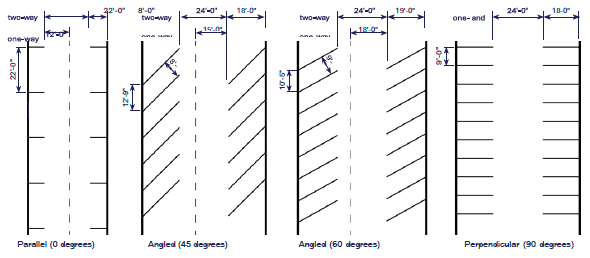
f.
Required parking for the disabled. Every off-street vehicle parking area and parking garage available to the public shall have parking spaces reserved for the use of physically disabled persons as specified in Table 52-401C or as required by the latest federal ADA Accessibility Guidelines.
1.
Facilities which provide medical care and other services to persons with mobility impairments shall provide ADA Parking Spaces as follows:
(i)
Outpatient units and facilities. Ten percent of the total number of off-street vehicle parking spaces provided; and,
(ii)
Units and facilities that specialize in treatment services for persons with mobility impairments. 20 percent of the total number of off-street vehicle parking spaces provided.
g.
Parking structures.
1.
Parking structures shall be considered buildings, not parking, for the purpose of determining setbacks.
2.
See section 52-401 for additional regulations related to parking structures.
h.
Parking of vehicles—General.
1.
Unless otherwise provided for in this chapter, the parking of vehicles on a lot without a primary building is prohibited.
2.
Vehicles parked on a lot shall be related to the principal use of the lot or a use allowed in that district.
3.
Except as otherwise provided in the applicable district, vehicles shall not be parked in an established front or corner yard. Parking areas serving a one- or two-unit dwelling shall be exempt from this requirement, provided that vehicles can be parked without blocking the sidewalk or any public way.
i.
Commercial and recreational vehicles.
1.
Large vehicles. No tractor, trailer, tractor-trailer combination, or vehicle (including but not limited to a tow truck, dump truck, flatbed truck, semi-trailer, and the like) equal to or in excess of one and one-half tons capacity, or which has a bed more than eight feet long, may not be parked on any land or premises except in an RC or LI district. However, the foregoing shall not apply to school buses used for the transportation of school children to and from school or to and from a school sponsored activity.
2.
Parking, storing, maintaining, or keeping of any recreational vehicle or recreational trailer. Parked or stored recreational vehicles shall not be occupied or used for living, sleeping, or human habitation. Notwithstanding any provision in this chapter to the contrary, no recreational vehicle or recreational trailer shall be parked, stored, maintained or kept on any lot in a residential district unless in compliance with the following:
(i)
Recreational vehicles or recreational trailers may be parked or stored:
i.
Inside an accessory building or garage; or
ii.
Outside in such a manner that no part of the recreational vehicle shall project into any minimum required front, corner, or side setback for a primary building or any minimum required rear setback for an accessory building.
(ii)
Not more than a total of two recreational vehicles or recreational trailers shall be permitted to be parked or stored in the open on the same lot at any one time.
(d)
Off-street loading.
(1)
Intent. This section is intended to provide for off-street loading areas which are adequate to support the needs of proposed and future uses of a site while assuring that the design and construction of such off-street loading areas meet minimum design standards necessary to provide efficient circulation and prevent undue traffic congestion.
(2)
Applicability. Off-street loading areas are not required but any such area provided shall be developed in compliance with the standards set forth in this section.
(3)
Location of off-street loading spaces.
a.
All off-street loading spaces shall be located on the same lot as the use served.
b.
No off-street loading spaces shall be located in established front or corner yards, provided,
c.
However, in the case of a double frontage lot, off-street loading spaces may be located between a front lot line of a perimeter street and the rear of the building served if no access is provided across such front lot line; and, the yard between the
d.
No off-street loading spaces shall be located in a minimum required side or rear setback.
e.
Office, professional services, retail, or other non-industrial uses may provide one loading space per building in a "pull-off" loading area located adjacent to an interior access drive. A "pull-off" loading area shall not be subject to the prohibition against being located between the front lot line and front façade of any portion of the building served.
(4)
Design and construction of loading areas. The design and construction of loading spaces shall be in compliance with the stricter of the regulations contained in this section, or the minimum specifications prescribed by the TCSS Manual. The following standards shall apply to the design of off-street loading areas:
a.
Loading and unloading activity. Loading and unloading activity may not encroach upon or interfere with any public right-of-way, except where specifically designated by the Engineering Criteria Manual.
b.
Maneuvering. Each maneuvering area, aisle, and interior access drive utilized to access a loading space shall be designed and located to provide safe and efficient ingress/egress to each loading space. Trucks shall not need to back from or into a public street, or onto an adjoining lot (unless the subject lot and the adjoining lot are located within the same integrated center or industrial park and such maneuvering area is subject to a recorded easement allowing such maneuvering).
c.
Surface of loading areas. All off-street loading areas and the ingress/egress to and from such off-street loading areas located on such lot shall be hard surfaced with asphalt, concrete, or other material to provide a durable dust-free surface.
d.
Landscaping. Where any loading area is located within 50 feet of, and visible from, a side or rear lot line that abuts any lot in a S1, S2, U1, U2, U3, or UF district, the loading area shall be screened by a Type 3 buffer, designed per section 21-09.01(n).
e.
The design of loading areas shall be subject to the approval of the Department of Public Works.
(5)
Use of loading area. Space allocated for off-street loading spaces and associated maneuverability shall not be used to satisfy off-street parking space requirements.
(Ord. No. 793-25, § 2(Exh. A), 1-23-25)
Sec. 52-402. - Building standards.
(a)
Non-residential and mixed-use building standards.
(1)
Intent. This section includes regulations that reinforce the scale and design of buildings that are unique to Justin and are intended to improve the physical quality of buildings that contribute to the overall character of the city, emphasizing the importance of how buildings relate to the public street.
(2)
Individual buildings.
a.
Development composed of one or two buildings shall be oriented so that the front façade faces the primary street or public access easements. On corner lots, the building(s) shall face the higher street designation unless adjoining and connected development provides a context for street frontage along the lower designation street as determined by the zoning administrator.
b.
In cases where the longer side of a building is perpendicular to the primary street, the portion of the building facing the primary street shall be designed as a building front with entrances, signage, and transparent windows.
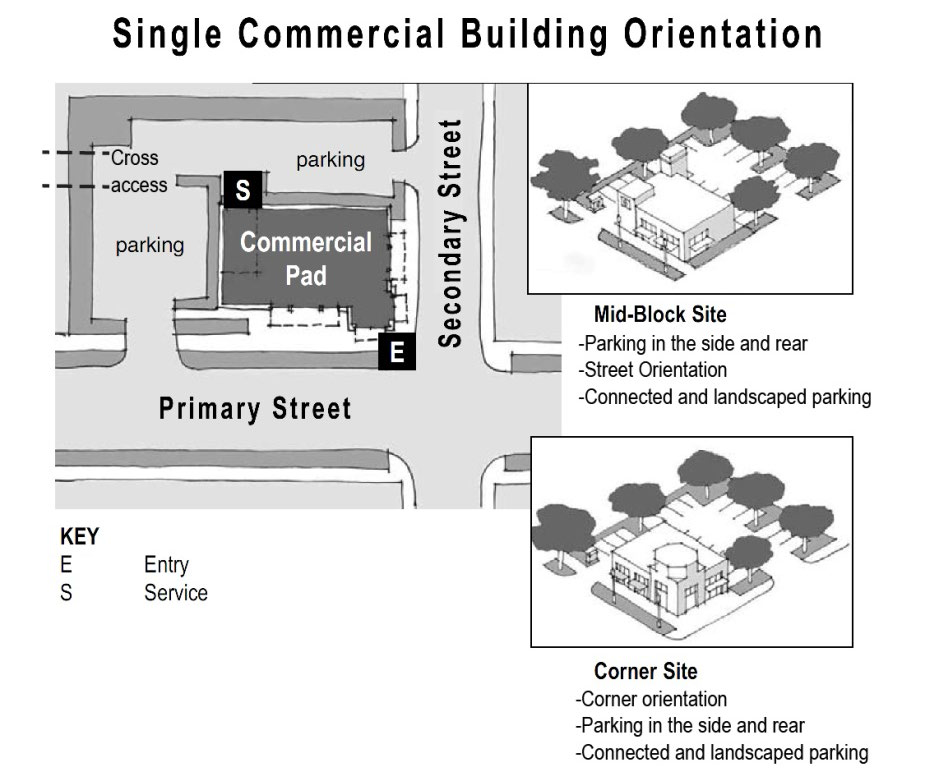
Figure 52-402A Illustration of a Single Building Orientation and Size Organization
(3)
Multiple buildings. Development composed of three or more buildings shall be configured to (see Figure 52-402B):
a.
Break up the site into a series of smaller internal "blocks" defined by on-site driveways, private streets, vehicle access ways, pedestrian walkways, or other circulation routes;
b.
Buildings should frame internal streets and parking should be located in the middle of the block;
c.
Large parking areas should be broken up into smaller parking areas defined by internal landscaped drives designed as "quasi" streets (public access easements, driveways, etc.) that have pedestrian frontages and streetscapes;
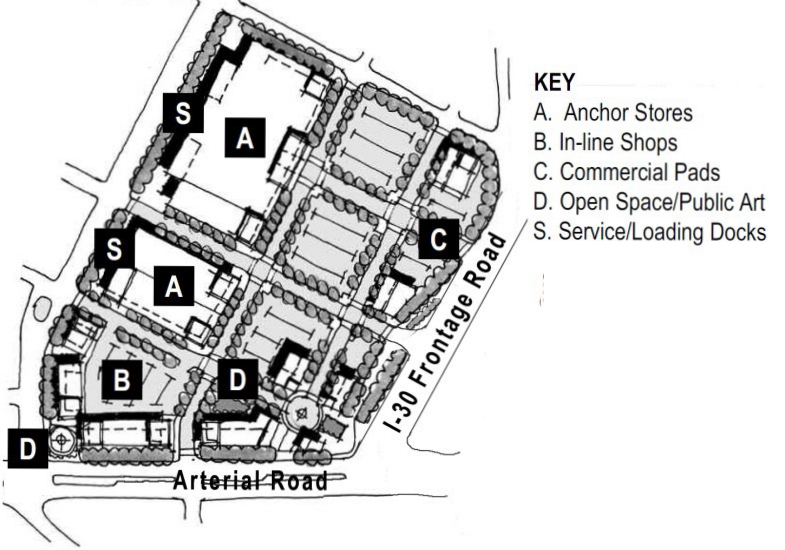
Figure 52-402B Illustration of Site Organization of Multiple Building Development
(4)
Building entry design.
a.
Every building must have its main entrance facing the street, or it should open into an area like a recessed section, courtyard, or plaza that's next to the public sidewalk or a public pathway.
b.
It should be obvious that the main entrance of a building is a key architectural feature when viewed from the street, serving as a central point of interest. In the case of non-residential buildings that have several businesses on the first floor or more than one main entrance, each entrance should have distinctive architectural treatment. Some examples of architectural treatments are listed in c.
c.
The main entrances of buildings should be clearly defined and highlighted by using architectural features such as triangular gables, pillars, covered front areas, porches, or roof overhangs, depending on the building's design style.
(5)
Height transitions. Transitions between non-residential buildings and adjoining residential neighborhoods shall be provided by using a combination of the following techniques:
a.
Concentrating the tallest buildings at the center of the site or along primary street frontages; or
b.
Stepping down the height of buildings along any shared residential lot line or street frontage to the zoned maximum height of the adjacent residential structures. See Figure 52-402C.
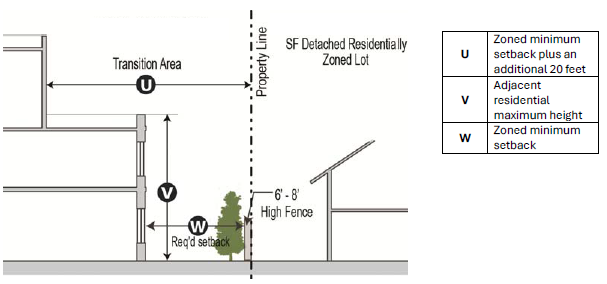
Figure 52-402C Illustration of Height Transition to Single-Family Detached zoned lot
(6)
Building design.
a.
Purpose. Building design directly influences the character and function of non-residential or mixed-use development. The standards of this section are intended to:
1.
Ensure that multiple building or phased commercial developments use compatible schemes of materials, colors, and architectural styles to ensure consistency. This includes accessory structures such as freestanding canopies, accessory and maintenance buildings, and dumpster enclosures;
2.
Ensuring that individual buildings have a single definitive, consistent style. Mixing of various architectural styles on the same building is discouraged;
3.
Ensure that buildings are designed to a human scale; and
4.
Encourage adaptable development by designing buildings to be adaptable for multiple uses over time based on changing market demand.
b.
Street side architecture. All building elevations facing a public or private street shall be architecturally finished with comparable levels of detailing (e.g., tiles, moldings, cornices, wainscoting, etc.). Blank walls void of architectural details or other variations are prohibited.
c.
Building form and mass. A single, large, dominant building mass shall be avoided in new commercial buildings and redevelopment projects under this chapter. Changes in mass shall be related to entrances, tenant spaces, the integral structure, and/or the interior space organization and activities, and not just for cosmetic effect.
d.
Exterior walls. All exterior walls (with the exception of rear or service façades) shall be designed with a base and top.
1.
Base. Façades and walls shall have a recognizable base with (but not limited to):
(i)
Thicker walls, ledges, or sills;
(ii)
Storefront windows and displays.
2.
Top. Façades and walls shall also have a recognizable top with (but not limited to):
(i)
Cornice treatments, other than colored stripes or bands alone, or differently colored materials;
(ii)
Sloping roof with overhangs and brackets; or
(iii)
Parapets that step up to emphasize entries.
3.
Building design details.
(i)
Base requirements. Every new building must meet the following design standards:
i.
To prevent large, unbroken walls facing a street, buildings must have design features that vary the front wall's height and depth. A wall's height cannot be more than twice its width unless it has significant design changes, such as different heights or parts that stick out or are set back, specifically:
A.
The top edge of at least 25 percent of the front wall facing a street must be at least four feet higher or lower than the rest, and it should look like it belongs on a house.
B.
For buildings in Neighborhood Commercial (NC), Regional Commercial (RC), and Old Town (OT) districts, at least 25 percent of the front wall facing a street must extend at least four feet forward or backward from the rest of the wall. In the Light Industrial (LI) district, this applies to buildings near F.M. 407, F.M. 156, or the railroad.
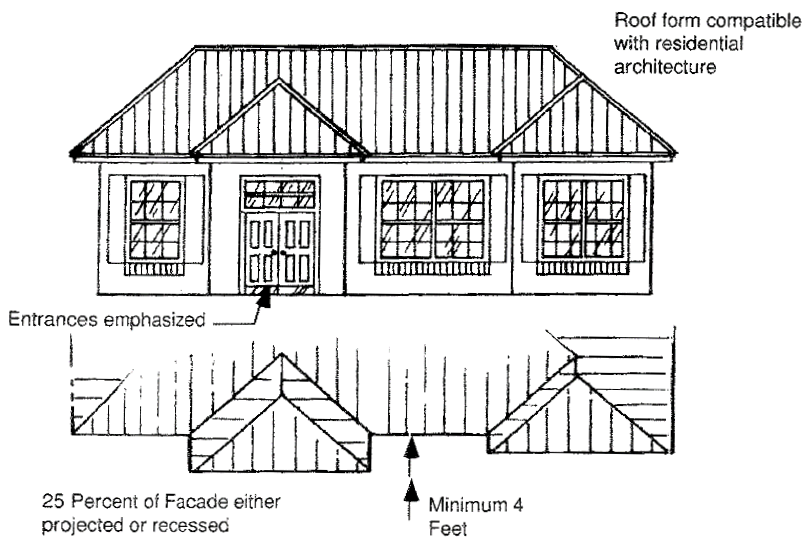
(ii)
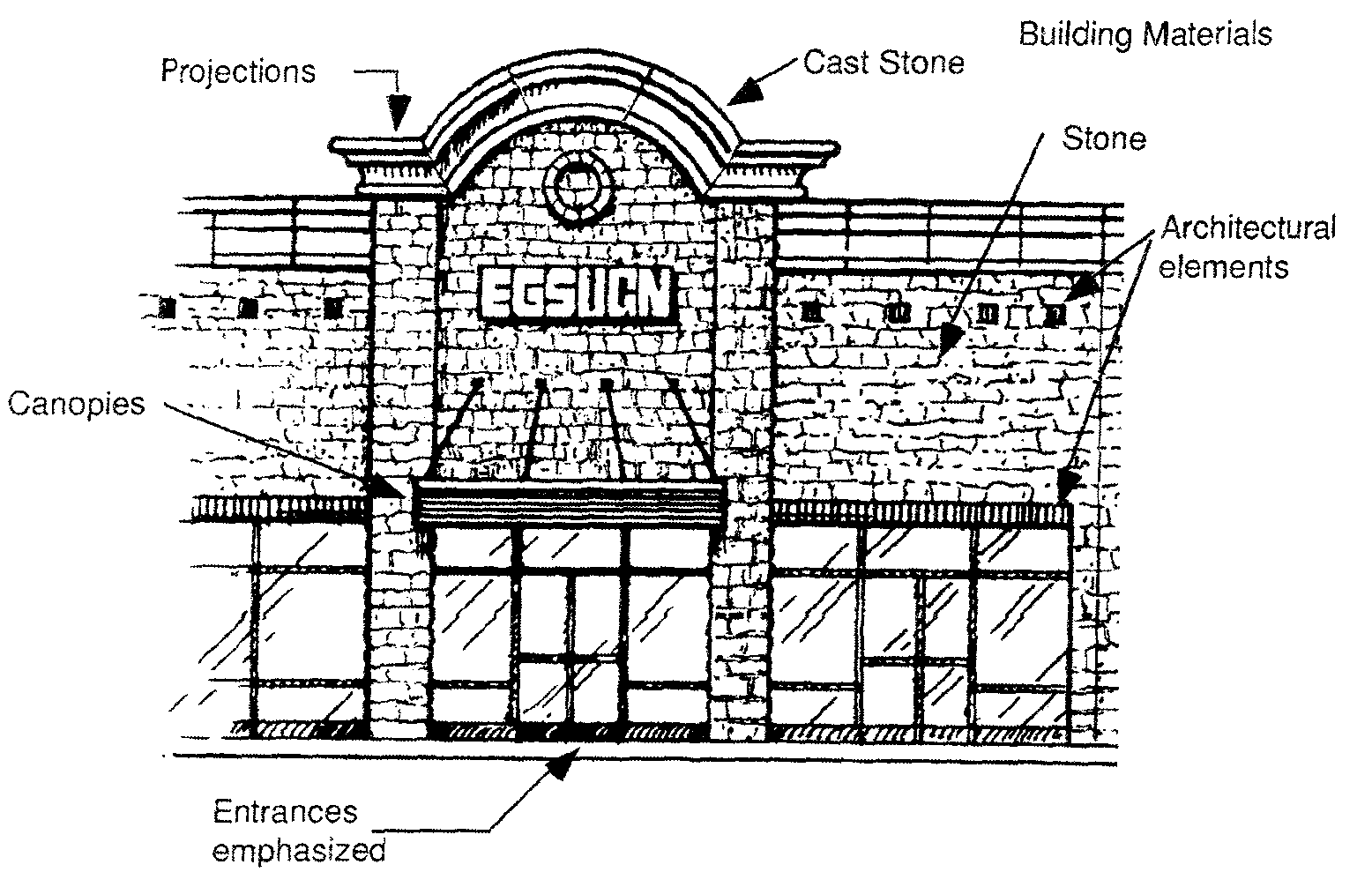
Entrances to buildings shall be emphasized through providing projections, recessed areas, canopies, projections in height, or other architectural elements.
(iii)
Ground floor façades adjacent to a public street in a NC, RC and OT district shall have arcades, display windows, entry areas, awnings, or other such features along at least 75 percent of their horizontal length.
4.
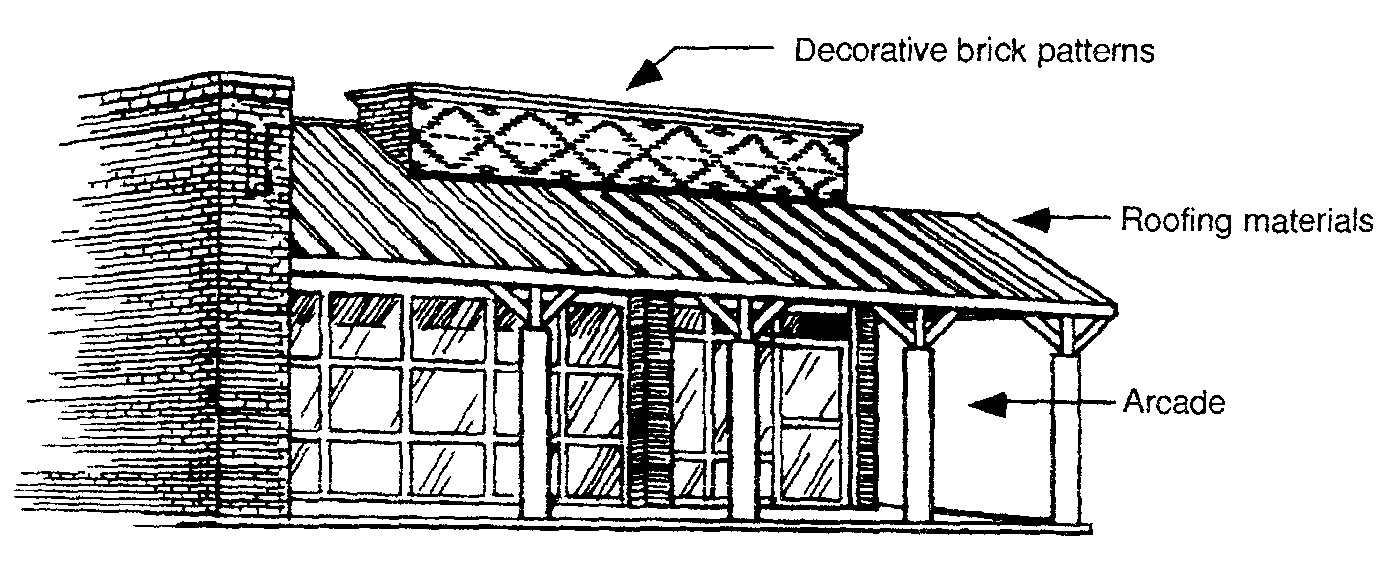
Enhancing elements. Each development must select one of the two elements listed below:
(i)
Application of the base standard to façades not adjacent to a public street, but visible from a public street.
(ii)
Use of architectural detailing to provide variety in the visual appearance of the façade of the building. Architectural detailing may be achieved by the harmonious use of materials, colors, or textures.
5.
Windows and transparency.
(i)
At ground level, buildings shall have a high level of transparency. Façades and walls that face the street, pedestrian walkways, plazas, and parking areas (excluding the building rear or side) must have transparent windows (visual transmittance of 0.6 or above) for at least 40 percent of the façade between two feet and 12 feet above the grade.
(ii)
Side façades (non-street fronting) must have transparent windows (visual transmittance of 0.6 or above) for at least 20 percent of the façade between two feet and 12 feet above the grade.
(iii)
Where the internal arrangement of a building makes it impossible to provide transparency along a portion of a wall as determined by the zoning administrator, a combination of changing color or texture to imitate the rhythm of windows or storefront displays may substitute for 50 percent of required transparent areas, except when fronting plaza or sidewalk café areas.
(iv)
Buildings in the LI zoning district are exempt.
6.
Shade requirements.
(i)
All development shall provide shaded pedestrian walkways along at least 50 percent of all building façades along streets, outdoor gathering spaces, and internal drives along parking areas.
(ii)
Buildings should be oriented to minimize direct solar exposure on the primary building façade and areas of high pedestrian activity.
(iii)
Shade may be provided through any or a combination of the following:
i.
Arcades, canopies, or galleries;
ii.
Canopy trees;
iii.
Trellises or pergolas; or
iv.
Any other shading device as approved by the zoning administrator.
(7)
Design of automobile related site elements (drive throughs, service bays, etc.).
a.
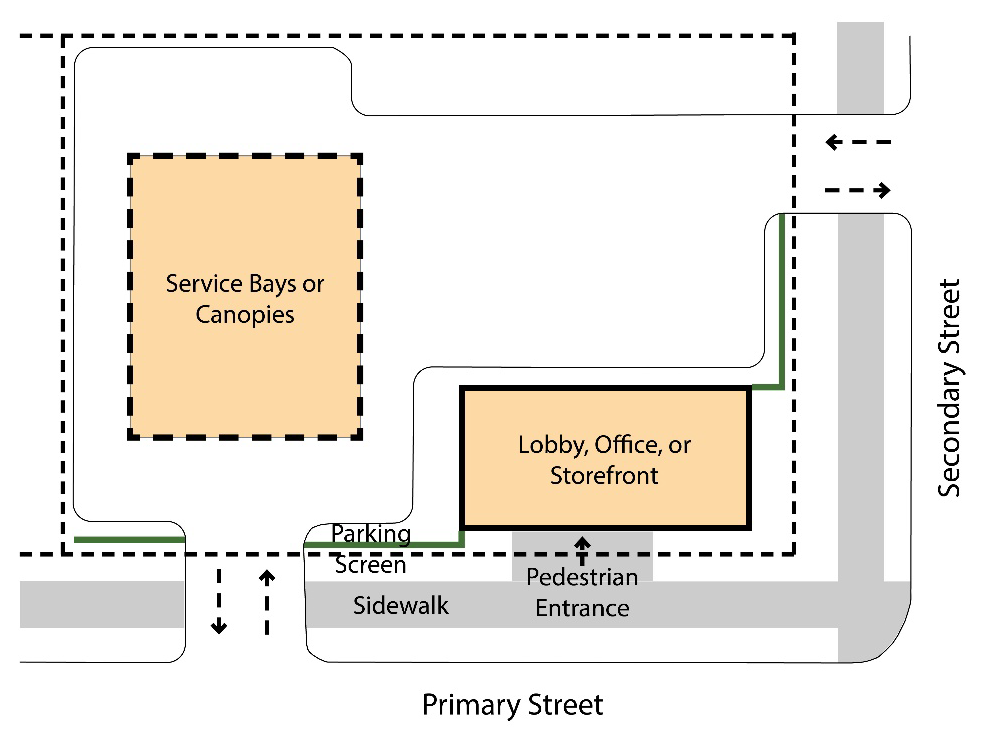
Drive-through lanes, service windows, and similar car-focused areas must not be placed where the main focus is on pedestrian traffic.
b.
For all other building sides, these car-related areas should take up no more than 60 percent of the building's side length.
c.
Drive-through lanes should be concealed by a barrier at least three feet tall along any street they're next to. However, there is no restriction on the number of drive-through lanes if they are on the side facing an alley.
d.
Driveways shall be located along alleys whenever present. Driveway widths shall be a maximum of 24 feet unless providing service access in which case they shall be no wider than 30 feet. Driveways shall maintain a continuous and level sidewalk across the curb cut. Driveway spacing shall be per the City Engineering Design Criteria or as approved by the City Engineer. Driveways along State Highways are under the purview of the Texas Department of Transportation (TXDOT) and shall meet TXDOT standards.
(8)
Design of parking structures.
a.
All frontages of parking structures located on streets intended for pedestrian walkable design shall be lined by active edges or commercial ready frontages on the ground floor to a minimum depth of 25 feet.
b.
The exterior design of parking structures facing public streets should feature a pattern of elements that repeat every 20 to 30 feet and align with the design features of nearby buildings.
c.
Parking structures at the edge of a building must have covers or barriers so that cars are not visible from the street or neighboring buildings. The entrance and exit ramps of the parking garage should also be hidden from view of public streets, and not be placed along the outer edges of the structure that face the street. Decorative panels or designs should be used on the exterior to conceal cars and prevent headlights or bumpers from being seen.
d.
All lighting must be full cutoff to reduce light pollution.
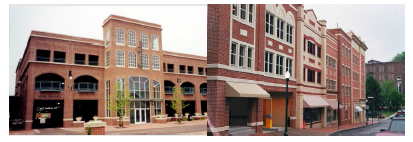
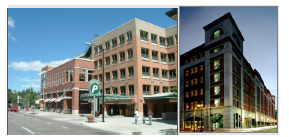
Images showing appropriate design of parking structures
(b)
Residential design standards.
(1)
Purpose and intent. The standards of this section are intended to:
a.
Promote high-quality residential developments that are distinctive, have character, and relate and connect to established neighborhoods;
b.
Provide variety and visual interest in the exterior design of residential buildings;
c.
Create new neighborhoods that age gracefully and add long term value to the city;
d.
Enhance the residential streetscape and diminish the prominence of garages and parking areas;
e.
Protect property values; and
f.
Ensure the compatibility of infill residential development with the existing character of surrounding neighborhoods.
(2)
Single-family and two- to four-family residential building design standards.
a.
Applicability. This section shall apply to all new and redeveloped singlefamily and two- to four-family residential developments in all zoning districts with the following exceptions:
1.
Planned development districts that have specific residential design standards and are approved after the adoption date of this chapter, and
2.
Any building permit issued prior to the adoption of this chapter.
b.
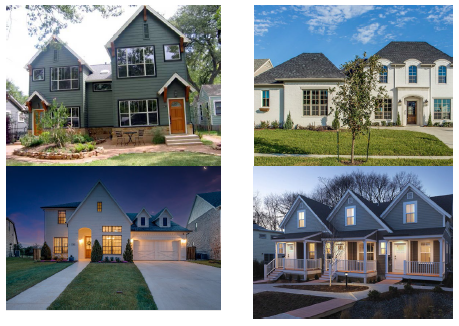
Façade design. Façades must be articulated by using color, arrangement, or change in materials to emphasize the façade elements. Exterior wall planes may be varied in height, depth, or direction. Design elements and detailing, including the presence of windows and window treatments (for walls that face the public right-of-way), trim detailing, and exterior wall materials, must be continued completely around the structure. Doors and windows must be detailed to add visual interest to the façade.
c.
Building entrances.
1.
All buildings shall have at least one primary entry door oriented towards the primary street. The main entry to the home shall be visible from the street. Two- to four-family buildings may have side entrances for other units as long as at least one unit has an entrance door oriented towards the primary street.
2.
Provide a prominent entry feature (either projected or recessed) that reflects the home's architectural style. Common projected entries are porches and stoops. Two- and one-story recessed entry features that do not incorporate roof overhangs or stoops shall not be permitted.
d.
Roof design.
1.
The minimum roof pitch shall be four inches of rise for every 12 inches of run, unless utilizing a flat roof. Other roof types and proportions shall be appropriate to the home's architectural style.
2.
Roof elements such as dormers, chimneys, skylights, and varying heights and ridgelines may be utilized to ensure good design and neighborhood continuity. However, these shall be appropriately scaled for the home's architectural style.
(3)
Multi-family residential building design.
a.
Applicability. This section shall apply to all new and redeveloped multifamily residential buildings (greater than four units) in all zoning districts with the following exceptions:
1.
MU or OT districts where the multi-family is above non-residential uses on the primary façade. In this case, non-residential and mixed-use building standards shall apply.
2.
Any building permit issued prior to the adoption of this chapter.
b.
Site design and building orientation.
1.
Site access.
(i)
New multi-family developments with 100 or more units shall have primary access from an arterial street and shall comply with the following standards:
i.
A minimum of one secondary point of ingress/egress into a multi-family development may be required for public safety access.
ii.
No primary vehicular access from a multi-family development shall be provided on a local street serving existing single-family detached development; however, secondary vehicle access may be provided onto local streets.
(ii)
A new multi-family development with fewer than 100 units may take primary access from a collector street, if approved by the administrator.
2.
Entry feature design. The following landscaping standards shall apply to the primary entrance:
(i)
The main site entry for multi-family developments shall be treated with special landscape elements that will provide an individual identity to the project.
(ii)
Site entry and access drives for multi-family development shall include at least three of the following:
i.
A minimum five foot-wide landscaped median;
ii.
Textured paving, interlocking pavers, or other decorative pavement (stamped concrete or stamped asphalt);
iii.
Gateway elements such as lighting, bollards, entry fences, or monuments;
iv.
An entry containing landscaping, water feature, or artwork; or
v.
Other improvements as approved by the administrator.
3.
Building orientation and common open space.
(i)
Building orientation.
i.
Buildings must be oriented towards perimeter streets, for internal buildings, they may face an internal drive (i.e., private street) or open space amenity (excludes required yards) that maintains or creates a traditional grid, rather than orientation only to internal parking lots.
ii.
Garage entries, carports, parking areas, and parking structures shall be internalized in building groupings or oriented away from street frontages.
(ii)
Common open space.
i.
Shall be a minimum of ten percent of the net site area and may be located on upper floors or roofs.
ii.
Larger open spaces should be the fundamental organizing element of the site. Common open spaces should be well-defined by buildings and streets.
iii.
These common open spaces shall not count landscape buffers and setbacks unless such buffers and setbacks are programmed as open spaces with functional features (trails, seating, special paving, etc.)
iv.
Buildings should be oriented in such a way as to create courtyards and open space areas.
v.
Large existing trees and other natural features should be integrated into the site.
vi.
Common open space should be centralized and directly accessible to most of the surrounding units. Where possible, it shall be linked by a minimum of five foot sidewalks to adjacent parks, paths, and open space areas.
vii.
The open space shall be useable areas, and no more than 25 percent of the open space shall be riparian areas, floodplains, or slopes exceeding 3:1.
4.
Site amenities required. In conjunction with the common open space requirements, all multifamily projects shall provide the residents with two or more site amenities listed below. Amenities shall be centrally located for most of the residents and may be located within the common open space areas.
(i)
Swimming pool.
(ii)
Sports courts, such as tennis, pickle ball, basketball, or volleyball.
(iii)
Natural open space area with accessible and connected trails and benches.
(iv)
Jogging trails.
(v)
Fountains, art, or sculpture.
(vi)
Playgrounds
(vii)
Other comparable amenities as approved by the administrator.
5.
Building design.
(i)
360-degree architecture. All sides of a multi-family building shall display a comparable level of quality and architectural detailing as on the front elevation.
(ii)
Articulation.
i.
Maximum length of any multi-family residential building shall be 200 feet.
ii.
No more than six townhomes may be attached in any single block.
iii.
Each elevation greater than 30 feet in length, measured horizontally, shall incorporate wall plane projections or recesses having a depth of at least two feet and extending at least 20 percent of the length of the façade.
iv.
The elevations of all multi-family buildings shall be articulated through the incorporation of at least five or more of the following:
A.
Balconies, a minimum of 25 square feet in area;
B.
Bay or box windows;
C.
Porches or covered entries that are compatible to the architectural design and size of the building;
D.
Dormers;
E.
Awnings or canopies;
F.
Structural offsets a minimum of four feet from the principal plane of the façade;
G.
Ornamental or decorative window grills and/or shutters;
H.
Vertical elements such as towers or building endcaps that demarcate building modules; or
I.
Other comparable features as approved by the administrator.
(iii)
Height transition adjacent to single-family. Any part of a multi-family building shall not exceed 40 feet or three stories if the building is located within 50 feet of a property zoned, used, or intended to be used for detached single-family residential.
(iv)
Buildings and parts of buildings located more than 50 feet away from property zoned for detached single-family residential are subject to height restrictions of the underlying zoning district.
(v)
Building entrances. Building entries next to a public street, private drive or parking area must be pedestrian-scaled, providing an expression of human activity or use in relation to build size. Doors, windows, entranceways, and other features such as corners, setbacks, and offsets can be used to create pedestrian scale.
(vi)
Windows.
i.
All walls and elevations on all floors of multiple household buildings must have windows, except when necessary to assure privacy for adjacent property owners as determined by the administrator.
ii.
Windows should be located to maximize the possibility of occupant surveillance of streets, entryways, and common areas.
(vii)
Roof design.
i.
On buildings with pitched roofs, the minimum roof pitch is 4:12.
ii.
On buildings where flat roofs are the predominant roof type, parapet walls must vary by a minimum of ten percent in height and/or vary by shape once every 50 feet along a wall.
iii.
Changing roof forms or towers must be designed to correspond and denote building elements and functions such as entrances and stairwells.
(c)
Historic district design standards. Reserved.
(Ord. No. 793-25, § 2(Exh. A), 1-23-25)
Sec. 52-403. - Site development.
(a)
Landscape.
(1)
Purpose and intent. This section sets basic landscaping and upkeep standards for new and updated properties, aligning with the city's comprehensive plan goals. These standards are designed to:
a.
Enhance property values and the city's image, and improve the overall wellbeing and look of the community;
b.
Encourage the growth and care of local and suitable plant species to support environmental health, such as cleaning the air, regulating temperature, renewing oxygen, replenishing underground water sources, managing rainwater, and preventing soil erosion;
c.
Ensure that landscaping elements blend seamlessly with both public and private spaces, creating a cohesive look for streets, parking lots, buildings, and open areas;
d.
Shield properties from nearby roads, especially where homes are next to business areas, or near major roads or busy boundary streets;
e.
Separate, screen, or shield different land uses and activity levels that don't match, especially between homes and businesses, or along roads and busy boundary streets;
f.
Lessen the impact of noise, dust, and light reflection from hard surfaces; and
g.
Diminish light pollution and overflow onto neighboring lands, public paths, and the night sky.
(2)
Applicability. The requirements of this section shall apply to all new construction and all redevelopment that results in the replacement or expansion of more than 30 percent of the principal permitted use or structure. Buildings in existence on the effective date of the ordinance from which this division is derived shall be considered legally nonconforming. Pad-site developments or ground-lease developments shall meet the landscape and buffer requirements of subsections d. and e.
Additionally, any use requiring a PD zoning designation must comply with these landscape standards unless special provisions are included in the ordinance establishing the PD district.
The City Code enforcement office or its designee shall administer and enforce the provisions of this section.
(3)
Preservation of existing trees and native landscape. Preserving Justin's native and natural landscapes is a priority set within the Imagine Justin Comprehensive Plan.
a.
Priority shall be given to preserving existing canopy trees, listed in Table 52403J, and understory trees, listed in Table 52-403K, and large areas of native landscapes.
b.
Any setback may be adjusted up to 25 percent to preserve individual canopy trees with a caliper of six inches or greater or a stand of understory trees with an average caliper of three inches or greater.
c.
Native landscape preserves, including areas within a flood plain or floodway, shall be consolidated within a master-planned area to conserve the native landscapes and provide for recreation areas through and in the development.
(4)
Existing tree credit. An existing, mature canopy tree located within 20 feet of the property line, with a minimum of 25 percent of its radial drip line falling within a required landscaping area, shall be granted credit toward reducing the required tree plantings as shown in Table 52-403A. Tree diameter shall be measured as DBH ("diameter at breast-height") at approximately four and one-half feet above the natural ground level. Existing tree credit candidates shall be healthy and listed on the Recommended Canopy Tree List in Table 52-403J.
Table 52-403A: Existing Tree Credits
(5)
Landscape buffers. A landscape buffer yard shall provide visual separation of differing land uses, or between a land use and a public road, to reduce or eliminate the potential nuisance effects of noise, glare, signs, dust, litter, and unsightly areas or functions. Buffer yards without established grass or ground cover shall be seeded with grass or planted with ground cover, to ensure coverage within three years. The standards of this section provide for increases in the width and the opacity of the landscape buffer required per subsection (b).
a.
Activities exempt from buffer yard requirements.
1.
Residential uses adjoining residential uses within any residential zoning district;
2.
Non-residential uses adjoining non-residential uses of the same zoning classification;
3.
Agricultural uses;
4.
Any use, building, or structure for which only a change of use is requested, and which does not increase the existing building area.
b.
Buffer yard location.
1.
A buffer yard shall be located within and along the outer perimeter of a lot or boundary line.
2.
Buffer yard canopy trees shall not be planted within a water or sanitary sewer easement.
3.
A buffer yard may overlap a drainage easement if plantings do not impede the flow of water within the easement.
4.
A buffer yard shall not be located within any portion of an existing or dedicated public street or right-of-way.
c.
Buffer yard requirements.
1.
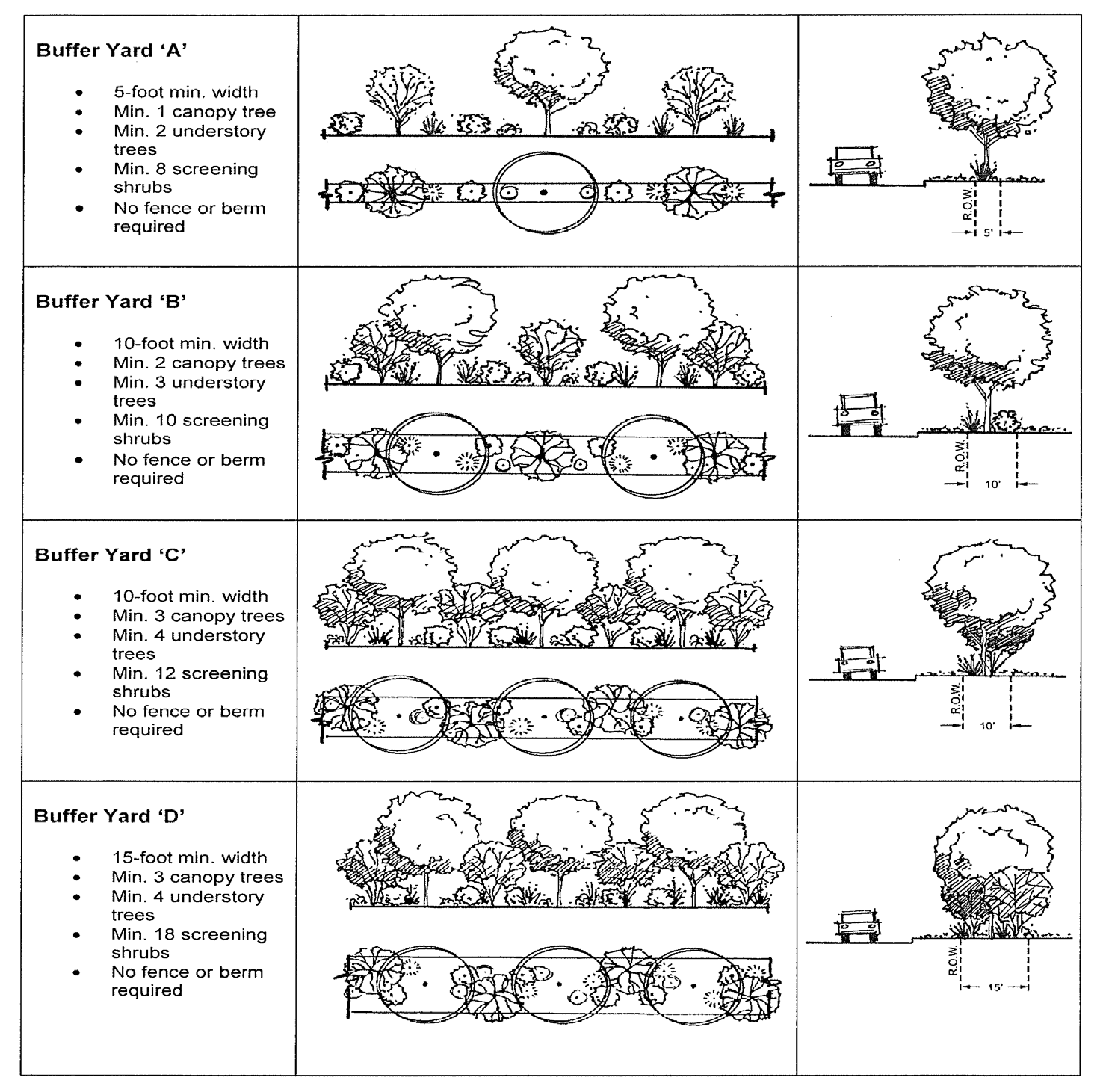
Table 52-403B defines the buffer yard requirements. Required plant materials shall apply to a single buffer yard (i.e. corner lots shall provide two buffer yards, and may not apply plantings for one buffer yard toward the requirements for the second yard).
2.
Tables 52-403C and 52-403D determine the type of buffer yard required between two adjacent parcels, or between a parcel and a roadway. Proposed buffer yard may require city council approval.
d.
Use of buffer yards. A buffer yard may be used for passive recreation, such as pedestrian, bike or equestrian trails, provided that (a) no plant material is eliminated, (b) the total width of the buffer yard is maintained, and all other requirements of this section are met. Buffer yards may not be used for play fields, stables, swimming pools, tennis courts, accessory buildings, parking facilities or trash dumpster locations.
Table 52-403B: Buffer Yard Requirements (Per 100 Linear Feet)
e.
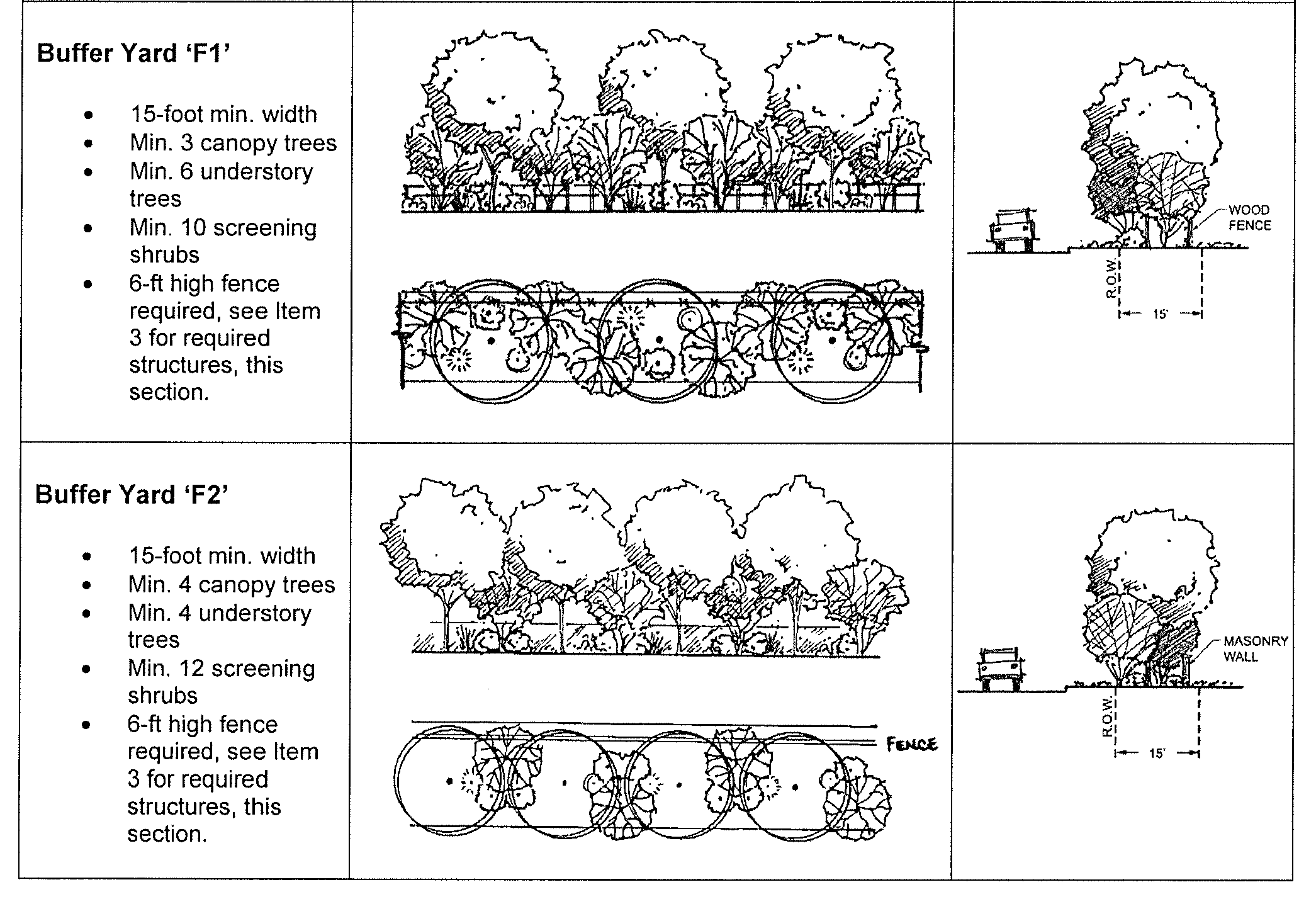
Buffer Yard 'G'. A pedestrian oriented buffer yard intended for mixed-use areas with retail storefronts along the sidewalk. The buffer yard is derived from buffer yard 'A' but replaces the understory and screening shrubs with groundcover, allows for planter around trees to be a minimum of five feet square and the remainder of the buffer to have paved walkways from the curb to the storefront.
Table 52-403C: Buffer Yard Requirement Matrix
* No buffer yard required.
Table 52-403D: Buffer Yard Roadway Frontage Matrix
* No buffer yard required.
f.
Optional buffer yards. The applicant may seek city council approval of an optional buffer yard than is otherwise required, as shown in Table 52-403E.
Table 52-403E: Optional Buffer Yards
(6)
Non-residential interior landscaping requirements.
a.
Screening elements, either plantings or structures, shall be provided with the intent to promote safety, to enhance or protect the visual character of residential, commercial, and industrial areas; and to help maintain the value of land, buildings, and neighborhoods.
b.
Construction and maintenance of screening elements shall be conducted in compliance with all relevant sections of the zoning and subdivision ordinances.
c.
Subdivision screening designs must be approved by the city before construction or installation begins.
d.
Interior landscaping requirements. The landscape area required on the interior of all lots (excluding buffer yards) for NC, RC and LI zoning districts shall be ten percent of the lot area.
e.
Planting requirements. The following plants shall be required within the interior landscape area:
1.
One canopy tree per 600 square feet, planted a minimum of 12 feet on-center.
2.
One understory tree per 300 square feet, planted a minimum of eight feet on-center.
3.
One shrub per 60 square feet of landscape area, spacing per Table 52-11.
4.
Ground cover. To provide continuous cover for a maximum of 25 percent of total required landscape area.
f.
Location requirements. A minimum of 75 percent of all required plant materials within the interior landscape area shall be in the front or along either side of the building between the building and the interior edge of the buffer yards.
g.
Enhanced pavement credits. For every one square foot of enhanced pavement area, the required interior landscape area may be reduced by one-half square foot. The maximum credit given for enhanced pavement area shall be ten percent of the required interior landscape area.
h.
Right-of-way landscaping credits. The required interior landscape area may be reduced by a maximum of ten percent when the applicant chooses to establish, irrigate, and maintain turf grass within the parkway along the front of their property. The percent credit given will be prorated based on the portion of the parkway irrigated (i.e. 50 percent parkway irrigated provides five percent credit).
(7)
Residential landscaping requirements.
a.
Minimum landscaping requirements within new single-family and missing middle (MM), developments.
1.
Planting requirements. Trees and shrubs shall be planted to meet the total quantities in Table 52-403F below. Required canopy (shade) trees shall be a minimum three caliper inches in diameter. Required understory (ornamental) trees shall be a minimum two caliper inches in diameter. A minimum of one canopy and one ornamental tree shall be located in the front yard of all residential lots. The remaining required trees may be placed in the front or rear of the residential lot.
Table 52-403F: Residential Plant Quantities
b.
Location of trees.
1.
No trees are to be planted within the parkway, the area between the back of curb and the right-of-way/property line.
2.
No tree shall be placed in a location that interferes with, or will grow to interfere with, overhead and/or underground utility easements.
3.
Trees shall be spaced so that at mature growth the canopies do not substantially overlap.
c.
Measurement.
1.
Tree diameter shall be measured as DBH ("diameter at breast height") at approximately four and one-half feet above the natural ground level.
2.
If the trunk splits into multiple trunks below the six-inch level, then the multiple trunk trees are measured by the following formula.
3.
Measure largest trunk circumference at 12 inches above the natural ground level.
4.
Remaining trunks, measure circumference at 12 inches above the natural ground level and divided by two.
5.
Add subsections 1. and 2. for total circumference, divide total by 3.14 to get caliper.
d.
Additional vegetation requirements.
1.
Required shrubs shall be a minimum of three gallons in size when planted and shall be planted in the front yard of all residential lots. Shrubs may be substituted with small trees when planted in the front yard.
2.
Solid vegetative ground cover or lawn for the entirety of the lot that is not otherwise covered by mulched planter beds, building(s) and/or driveway area(s).
3.
All landscaping required above shall be planted prior to issuance of the certificate of occupancy on the dwelling(s).
(8)
Parking lot landscaping requirements.
a.
Planter islands shall be provided in parking areas based on 20 square feet of landscape area for each parking stall provided (approximately one island per eight stalls). Each row of parking stalls shall provide the required landscape area, with no more than ten spaces between each landscape island. The Director of Planning or designee may modify the island requirement for each row in situations where it would be beneficial to combine islands into a larger island. Planter islands shall have a minimum width of eight feet back-to-back, if curbed, or nine feet edge to edge, if no curb is provided. A minimum of one canopy or understory tree shall be planted in each island. Parking lot landscaping does not count toward the total required interior landscape area.
1.
Existing trees. The director of planning or designee may approve variations to the planter island requirements to preserve existing trees in interior parking areas. For existing trees, the minimum width of the planter island shall be as shown in Table 52-403G:
Table 52-403G: Planter Island Sizing
2.
Planting requirements. A minimum of 50 percent of all planter islands in parking areas shall contain a minimum of one canopy tree with the remaining area in shrubs, ground cover, grasses, or seasonal color. Planter islands that have light poles may substitute two understory/accent trees for the required canopy tree.
b.
Plant materials.
1.
The city reserves the right to approve proposed planting plans through an appointed horticulturist, landscape architect, or other persons so qualified. Table 52-403N indicates plant species that are prohibited, due to their invasive or noxious characteristics.
2.
All non-paved surfaces shall be completely covered with living plant material. Landscape materials such as wood chips and gravel may be approved for use under trees, shrubs and other plants, but shall not comprise a significant portion of the total landscaped area. This requirement shall not apply to public or private playgrounds built in association with any non-residential or park use.
3.
All plant material shall be of No. 1 grade, free from plant disease, of typical growth for the species, have a healthy, normal root system, rounded branching pattern, and shall conform to the code of standards set forth in the current edition of the American Standard for Nursery Stock. Grass seed, sod and other material shall be clean and reasonably free of weeds and noxious pests and insects.
4.
Recommended plants. Approved recommended and prohibited plants are listed separately in the City of Justin Approved Plant List. Any non-prohibited plants proposed other than those on the approved lists will require city council approval. Plant materials shall be appropriate for the region and local site climatic and soil conditions, including drought-tolerance and reduced water usage. Plant materials shall be installed in accordance with established horticultural standards of practice.
5.
Size requirements when planted. All plants shall equal or exceed the following measurements when planted. Plants larger than specified may be used, but use of such plants shall not decrease the size requirements of other proposed plants.
6.
Tree measurement. Canopy and understory trees with single trunks shall be measured by caliper size one foot above the ground line. Multi-trunk trees shall be measured by the height of the tree.
7.
Minimum sizes. The minimum plant size when planted shall be as stated in Table 52-403H.
Table 52-403H: Plant Material Minimum Size
(9)
Median landscaping.
a.
Landscaping improvements shall be installed within the medians of all proposed, planned, or divided roadways within the city limits as shown on the city master thoroughfare plan. Frontage is wherever a property abuts the right-of-way of the divided thoroughfare, and separate frontages exist on each side of the thoroughfare.
b.
Applicability. Only developments or subdivisions abutting or adjacent to a divided roadway, as defined in the master thoroughfare plan, shall be subject to this section.
c.
Developer obligation. The subdivider or developer shall be fully responsible for the construction and installation of the required landscaping and maintenance of the improvements for a period of one year. During the first year following installation, the subdivider or developer shall replace any tree, shrub, sod, groundcover or hardscape in substandard condition. Following the first year, the director of engineering and public works shall inspect the installation and determine what, if any, plant materials and/or hardscape must be replaced prior to the city taking over maintenance.
d.
Installation or deferment. In the event that the director of engineering and public works, in his sole discretion, determines that the installation of improvements at any given time period is impractical due to further road construction or other factors, the subdivider or developer shall pay a fee-in-lieu into an escrow account for future median landscaping and/or maintenance. This fee-in-lieu of installation is collected once from each frontage and described more fully in subsection (a)(9)i.
e.
City participation. At the discretion of the director of engineering and public works, the subdivider may install landscaping across the full width of the median, and be reimbursed by the city for the landscaping provided for the second frontage at the per linear foot of frontage rate or the actual cost of the improvements, whichever is less, if funds are available.
f.
Plan design burden/escrowed cost. In the case where undeveloped land exists on both sides of a divided public street, the first to develop shall carry the burden of submitting plans for landscaping, hardscape and irrigation of the median, along with escrowing the fee-in-lieu, as described in subsection (a)(9)i. At the discretion of the director of engineering and public works, the city or county may contribute to this escrow account in order to facilitate the implementation of the landscape plan.
g.
Installation burden. Should the city decline to assume responsibility of planting the median in question, the second to develop will utilize the approved plans (or modify the approved plans with city council approval) and shall be responsible for the purchase and installation of the median improvements, using the escrowed account from the first developer and shall contribute an equal amount to the overall cost of the median landscaping. In the event that the original escrow amount has fallen short of current material and/or installation costs, the city will make up the difference in cost or the plans shall be modified to be installed within the cost allotted. Any surplus funds shall be placed in the city's landscape maintenance account.
h.
Minimum requirements for median landscaping.
1.
All trees and plant materials shall be chosen from the city's approved plant list.
2.
One ornamental tree per 30 linear feet of median. Ornamental trees shall be a minimum two-inch caliper and eight feet in height at time of planting and shall be used primarily as accent trees near the median nose and dispersed within the canopy trees.
3.
One canopy tree per 30 linear feet of median, with a minimum of four-inch caliper trunk, and a well-formed canopy that is typical of the species. Canopy trees shall be planted no closer than 30 feet from streetlights located in the median, no closer than 20 feet to an intersection, and no closer than 15 feet from any overhead electrical line.
4.
Ornamental and canopy trees need not be evenly spaced and may be clustered for a more pleasing aesthetic effect.
5.
When the nose of a median is tapered to five feet or less, that portion of the median shall be paved with bricks placed to align with the top of curb.
6.
A minimum of 20 percent of the landscaped area shall be planted in evergreen shrubs, ground cover and/or native grasses.
7.
Planting beds shall be separated from turf grass using 14-gauge steel edging to define ground cover beds and reduce weed incursion.
8.
Irrigation installation shall include bubblers or drip irrigation for all canopy and ornamental trees and irrigation to uniformly water the planting beds and shall be equipped with rain-freeze sensors.
9.
Landscape and installation plans shall be subject to review and approval by the director of planning and development services and the director of engineering/public works. The location and placement of landscaping shall conform to the city street design standards and shall be placed to accommodate the ultimate number of traffic lanes, although shrubs, native grasses and ornamental trees may be placed in future traffic lanes if it is determined that these lanes will likely not be constructed in less than ten years.
i.
Fee-in-lieu. Should the director of engineering and public works, at his sole discretion, determine that the immediate installation of median landscaping is impractical, a fee-in-lieu of construction shall be collected and placed in escrow at a rate of $25.00 per linear foot of median length for one-side frontage and $50.00 per linear foot of median length if the development is adjacent to both sides of the roadway. The fee-in-lieu shall be collected prior to plat filing. Said fees-in-lieu of installation shall be applied to construction, reconstruction, upgrading, and installation of median landscaping of divided roadways within the adjacent median landscape areas. Any fees not expended within ten years of collection shall be returned to the developer or subdivider who deposited the fees with the city.
1.
Notwithstanding the provisions of subsection (a)(9)i., hereinabove, the city shall not be required to return fees that have not been expended if roadway medians have not been constructed on divided roadways within the adjacent roadway benefit area thus preventing the purchasing, planting, growing and/or irrigation of the required standard median landscaping. The time period for the expenditure of fees escrowed with the city for the construction of median landscaping shall not begin to run until such time as the roadway medians have been constructed on such divided roadways, the roadway medians have been accepted by the city, and the roadway medians are ready for standard median landscaping.
j.
Landscape/irrigation plan requirements.
1.
Qualification to prepare plans. Landscape plans shall be prepared by a registered landscape architect, a landscape designer, or landscape contractor, knowledgeable in plant materials and landscape design. Irrigation plans shall be prepared by a licensed irrigator or landscape architect.
2.
Landscape plan requirements. The following items shall be provided on the required landscape plan:
(i)
Sheet size 24 inches by 36 inches, or as approved;
(ii)
Acceptable scale: One inch equals ten feet, one inch equals 20 feet, one inch equals 40 feet, or as approved;
(iii)
North arrow, graphic and written scale;
(iv)
Appropriate title (i.e. "Landscape Plan");
(v)
Title block, including street address, legal description, and date of preparation;
(vi)
Name and address of owner;
(vii)
Name, address, and telephone number of person preparing plan;
(viii)
Property line shown with dimensions;
(ix)
Existing utilities (water, sewer, storm drain, gas, electric, cable TV, etc.);
(x)
Width and type of buffer yards labeled on all sides;
(xi)
Location, caliper size and species of all existing trees six-inch caliper or greater which are to be preserved;
(xii)
Location, quantity, size and species of all proposed plant materials;
(xiii)
Maintenance note;
(xiv)
Label type of any enhanced pavement proposed;
(xv)
Visibility triangles shown;
(xvi)
Seal and dated signature of landscape architect (if applicable);
(xvii)
Plant list; and
(xviii)
Any berms delineated with one-foot contours.
3.
Irrigation plan requirements. The following items shall be provided on the required irrigation plan:
(i)
Sheet size 24 inches by 36 inches, or as approved;
(ii)
Acceptable scale: One inch equals ten feet, one inch equals 20 feet, one inch equals 40 feet, or as approved (must be at same scale as landscape plan);
(iii)
North arrow, graphic and written scale;
(iv)
Appropriate title (i.e. "Irrigation plan");
(v)
Title block including street address, legal description, and date of preparation;
(vi)
Name and address of owner;
(vii)
Name, address, and telephone number of person preparing plan;
(viii)
Property line with dimensions;
(ix)
Location of all existing trees six-inch caliper or larger which are to be saved;
(x)
All pipes labeled as to size;
(xi)
All sprinkler heads labeled as to type (key is acceptable);
(xii)
Backflow prevention device labeled with type and size;
(xiii)
Location of water meter and connection to water service;
(xiv)
Any existing utilities (water, sewer, storm drain, gas, electric, cable TV, etc.);
(xv)
Note indicating that installation must be inspected by the city;
(xvi)
Maintenance note indicated;
(xvii)
Seal and dated signature of professional who prepared plan.
k.
Maintenance.
1.
General. The owner, tenant, and the agent, if any, shall be jointly and severally responsible for the maintenance of all landscaping and irrigation. All required landscaping shall be maintained in a neat and orderly manner at all times. This shall include mowing, edging, pruning, fertilizing, watering, weeding, and other such activities common to the maintenance of landscaping. Landscaped areas shall be kept free of trash, litter, weeds and other such material or plants not a part of the approved landscape plan, and all plant materials shall be maintained in a healthy and growing condition as is appropriate for the season of the year.
2.
Any broken or non-performing irrigation components shall be replaced or repaired to functioning condition by a licensed irrigator.
3.
Plant replacement. For one year after the date of issuance of the certificate of occupancy, the owner shall be responsible for replacing all plant materials that have died after installation, or that do not exhibit healthy foliage during the growing season of at one-third percent of the normal branching extent or pattern. Plant materials that die shall be replaced with plant material of similar variety and similar initial size. The owner shall make such necessary replacements within 30 days of notification by the city.
(b)
Fences and walls.
(1)
Unless otherwise noted or approved, whenever a fence or wall is required within a buffer yard, it shall be constructed in accordance with specifications set forth in the city's design standards and summarized in Table 52-403J. An "F1" fence shall be a wooden fence, and may be of a split-rail, picket, board-on-board, shadow-box, or stockade style. An "F2" wall shall be of masonry construction, of either stone, cast stone, or painted and form-cured poured concrete. Both F1 and F2 structures may incorporate decorative capped columns. If there is a difference in finish level between the two sides of the fence or wall, the less finished side shall face the more intensive land use.
(2)
A screening wall and a buffer yard is required when the rear or side yards of a residential subdivision abut a thoroughfare, collector, or local street. The screening wall and landscaping shall be located in an easement equal to the buffer yard prescribed in Table 52-403B with the wall located between the landscaping and the residential lots.
(3)
Swimming pools.
a.
Fences required. From and after the effective date of the ordinance from which this section is derived, it shall be unlawful to build, rebuild, or maintain a swimming pool that is not completely enclosed with one or a combination of the following barriers:
1.
Fence;
2.
Building wall;
3.
Natural topographic barrier.
b.
Minimum requirements. The barrier or barriers used to enclose a swimming pool shall meet the following requirements:
1.
Height. The barrier enclosing a swimming pool shall be at least four feet in height from the nearest level of earth and constructed to prohibit young children from crawling underneath or through the barrier, or climbing over the barrier.
2.
Construction.
(i)
The barrier shall be constructed to have no opening, other than doors or gates, larger than four inches in width.
(ii)
Where a picket-type fence is provided horizontal openings between pickets shall not exist except for manufacturing tolerances in assembly.
(iii)
All new stockade fences shall have the horizontal support members located on the swimming pool side of the fence.
(iv)
Where access gates are used, they shall be at least four feet in height and conform to subsections (a) and (b) of this section.
3.
All gates or doors that allow entrance into the enclosed swimming pool area, excluding those doors or gates that allow entrance into the pool area from inside the home or buildings, shall be equipped with self-closing and self latching devices which shall be maintained in good working condition.
c.
Building permit requirement. A building permit shall be required prior to the erection, building or rebuilding of a swimming pool. An application for a building permit shall be accompanied by two sets of drawings which clearly show the placement of the swimming pool on the lot in relationship to the lot boundaries and other structures on the lot. Detained drawings are also to be submitted to show the type of barrier to be used which will demonstrate the full compliance with the requirement of this chapter. Written approval of plans by all utility companies serving a property with a swimming pool must also be submitted.
d.
Existing swimming pools to comply. Owners of property with existing swimming pools that are not in total conformance with the requirements of this section shall have 180 days from the date this section becomes effective to comply herewith.
e.
Permitting requirements.
1.
Permit required. It is unlawful for any person or persons to construct or replace, or cause to be constructed or replaced, a fence or any part of a fence without first obtaining a fence permit from the city. No permit is required for repairs as defined by this section. In residential zoning districts on tracts or lots that are five acres or greater in area, a permit is not required except for fences located in the front yard, along the side or rear property lines, or fences required to enclose swimming pools as required by City Code, state or federal law.
2.
Permit fees. The fee for a permit shall be in the amount established in Appendix A to this Code. When a person or persons begin any work for which a permit is required by this section without first obtaining a permit, the permit application fee shall be doubled. Payment of the fee shall not exempt any person or persons from compliance with all provisions of this section.
3.
Application for permit. Any person or persons making application for a fence permit shall complete a permit application on a form prescribed by the city, showing the following information:
(i)
The applicant's name, address, telephone number and if the applicant represents a corporation, the name, address and telephone number of the registered agent of the corporation, or if the applicant represents an association, the name, address and telephone number of a managerial agent of the association;
(ii)
The names of the property owners;
(iii)
A local address where the fence is proposed to be erected;
(iv)
The type of fence construction (material);
(v)
The proposed height of the fence;
(vi)
A diagram showing proposed location of the fence and listing relevant dimensions between the fence and other structures on the lot and the location of property lines and easements;
(vii)
The fence contractor's registration number if a contractor is used;
(viii)
The authorized applicant's signature; and
(ix)
Any other documentation as required by the city manager or his/her designee.
4.
Construction documents. Construction documents shall not be required of wood, chain link, and pipe and cable fences to be constructed on residential lots. Construction documents, special inspections and structural observation programs, and other data shall be submitted in one or more sets, as required by the city manager or his/her designee, with each application for a permit for any other type fence. The applicant shall also provide additional information as required by the building code. The construction documents shall be prepared by a registered design professional. Where special conditions exist, the city manager or his/her designee is authorized to require additional construction documents to be prepared by a registered design professional. Exception: The city manager or his/her designee is authorized to waive the submission of construction documents and other data not required to be prepared by a design professional if it is found that the nature of the work applied for is such that reviewing of construction documents is not necessary to obtain compliance with this Code.
5.
Availability of plan. One set of approved plans, specifications and a copy of the permit shall be made available, by the applicant, for inspection of the work authorized by the permit. The said set of approved plans, specifications, and permit shall be kept on the work site by the applicant during the construction process.
6.
Contractor's registration. It is unlawful for any person or persons, to engage in the business of fence contracting without a valid contractor's registration with the city. The owner of a property on which a fence is being constructed is not required to register as a contractor.
(i)
There is no charge to register as a fence contractor provided the applicant completes the required forms furnished for that purpose and files them with the city manager or his/her designee.
(ii)
Any person making an application for a fence contractor's registration shall sign an application for the same containing the following information:
i.
Applicant's name, business address, phone number, and if the applicant represents a corporation, the name and address of the registered agent of the corporation, or if the applicant represents an association, the name and address of a managerial agent of the association.
ii.
The fence contractor's signature.
(iii)
Every contractor registration provided for in this section shall expire on the first day of January and may be renewed by the city manager or his/her designee upon application.
(iv)
The city manager or his/her designee may revoke or suspend a fence contractor's registration for a 12-month period for either of the following reasons:
i.
The registrant violates the requirements of this section twice within a 12-month period; or
ii.
The registrant fails to obtain permits and/or inspections twice within a 12-month period.
f.
General requirements.
1.
Encroachment on city or public right-of-way. No person shall construct a fence, guy wire, brace or any fence post upon or protruding over any city or public right-of-way.
2.
Fence not to create a traffic hazard. It is unlawful to erect, maintain, suffer, or permit any fence on any corner lot in such a manner as to create a traffic hazard or restrict visibility. Failure of the owner, agent or occupant to remove such obstruction within the specified time limit required on the receipt of notice to do so is a violation of this section.
3.
Fence orientation. Fence sections essentially parallel with a public street or public park space shall have their backside (the side with the exposed posts and rails) oriented to the interior of the residential lot to minimize their exposure to the public.
4.
Gate required. Each fence constructed under the provisions of this section shall include in its perimeter at least one gate with a minimum width of three feet.
5.
Fence not to be in right-of-way or easement. No fence shall be erected within, on, or across any right-of-way, public or private easement, or visibility triangle. Property owners that allow a fence to be constructed in a utility or other easement on their property do so at their own risk. Unless the terms of a specific easement state otherwise, fences constructed within utility easements may be removed by a franchise utility company or its contractor with rights to the easement and such utility company shall not be responsible for replacement of the fence or liable for damage to the fence that occurred during its removal.
6.
Fence materials. Fences on residential and commercial property (to exclude any areas zoned for industrial or light industrial use) shall be constructed of materials expressly designed for fencing. This shall include products such as chain link, wood planks and boards, commercial or livestock grade vinyl (supported by the manufacturer's specifications), masonry as defined by the building code, pipe and cable, wrought iron, or ornamental iron. Materials or products such as rope, string, barbed wire, razor ribbon wire, corrugated metal, plywood, or a fence that has in it or on it barbs, projections, broken glass, or anything reasonably capable of causing harm to persons or animals are prohibited. Wood, metal, or plastic products that are designed specifically for use other than fence construction are also prohibited.
7.
For properties located in industrial or light industrial zoning districts, all fence materials allowed for residential and commercial zoning shall also be allowed. In addition, screening with chain link fencing shall also be allowed, and reasonably necessary barbed wire or other security fencing shall be allowed.
8.
Landscape in lieu of fence. Except where otherwise required in this Code, regulations governing the height, location and opacity of fences also applies to walls, hedges or landscaping used in lieu of a fence or in combination with a fence.
9.
Temporary fences. Temporary fences are prohibited, except where required by City Code or state or federal law for construction, excavation, or life safety issues. Temporary fence materials may include, but are not limited to, rope; string; wire products such as chicken wire, hog wire, wire fabric, and similar welded or woven wire fabrics; chain; live bamboo; netting; cut or broken glass; paper; unapproved corrugated metal panels; galvanized sheet metal; plywood; or fiberglass panels in any fence or any other material that are not manufactured specifically as fencing materials. The city manager or his/her designee may require the applicant to provide the manufacturer's standard to establish the intended use of a proposed fencing material. Exceptions shall include:
(i)
A dog window may be installed in a fence no larger than 288 square inches with corrosion resistant material capable of restraining the dog.
(ii)
Temporary fences made of wire, with heights not over 36 inches, in residential districts are permitted for residential garden uses only.
(iii)
Temporary fences or panels used for corrals, pens, or chutes are permitted for the purpose of corralling or confining livestock.
(iv)
Temporary fences erected following storm damage to an existing fence shall be allowed for a period up to 60 days.
(v)
Temporary fences erected to protect lawn seeding shall be allowed for a period up to 60 days.
10.
Perimeter walls. Where a fence intersects a screening wall and the height of the fence exceeds the height of a screening wall, the height of the fence shall transition to the height of the screening wall over a lateral distance of 20 feet or greater.
11.
Pool or spa enclosures. A person constructing or maintaining a fence or wall enclosure around a swimming pool, hot tub, or spa shall comply with the minimum requirements of the City Code, as it exists or may be amended.
12.
Retaining walls. Retaining walls greater in height than 36 inches shall follow a design submitted by a registered engineer.
13.
Determining fence height and opacity.
g.
Height. Fence height is measured to include the body of the fence, plus allowing a maximum of six inches (on average between posts) above the natural grade (i.e., for drainage purposes). When a fence or wall is placed atop a retaining wall, the height of the fence shall be determined exclusive of the height of the retaining wall such that the top of the retaining wall is considered the finish grade. Fence posts are permitted to extend a maximum of four inches above the body of the fence. Columns are permitted to extend a maximum of 12 inches above the body of the fence. The creation of a berm or other method for the primary purpose of increasing the elevation of the fence is not allowed.
(4)
Fences in residential areas.
a.
Fences and gates in front yards. All fences, walls, gates, or other enclosures constructed in the front yard of a residential property shall:
1.
Not exceed 48 inches in height.
2.
Allow a minimum of 50 percent opacity.
3.
Not encroach into a vision or visibility triangle.
b.
Fences and gates in side yard. It is unlawful for any person to construct, erect, maintain, suffer, or permit a fence or gate in any side yard or along any side yard lot line which fence exceeds eight feet in height. On key lots, where side yards are required adjacent to the street to conform to minimum front yard setback of lots fronting upon such street, within the same block and upon the same side, no fence shall be constructed or maintained within such required side yard.
c.
Fences and gates in rear yards. It is unlawful for any person to construct, erect, maintain, suffer, or permit a fence or gate in any rear yard or along any rear lot line which fence exceeds eight feet in height.
d.
Decorative gate embellishments. Ornate gates may exceed the maximum height of a fence by up to two feet.
e.
Electrically charged fences in residential districts. It is unlawful for any person to erect, maintain, or permit a fence that is electrically charged in any manner, except single strand wires designed to conduct electricity through a low-voltage regulator shall be allowed along the fence's interior for the purposes of securing pets within a fenced yard.
Figure 52-403J: Required Structures
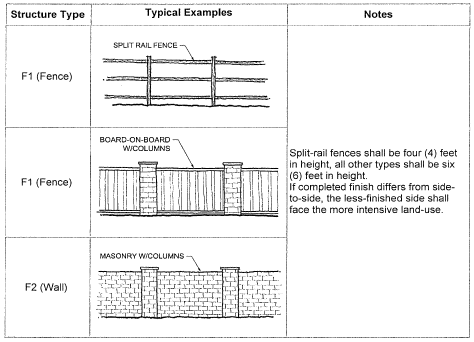
(c)
Utility, mechanical and trash screening.
(1)
All service areas in commercial zoning classifications shall be placed at the rear or side of the buildings and screened from:
a.
All public streets; and
b.
Any residential district that abuts or is directly across a public street or alley from the service area.
c.
All service areas in industrial zoning classifications shall be placed at the rear or side of the buildings and screened from:
d.
Arterial streets, as indicated on the city's thoroughfare plan; and
e.
Any residential district that abuts or is directly across a public street or alley from the service area.
(2)
Service areas and waste containers (including fryer grease recycling bin or vessel when applicable) and trash compactors shall be located at the rear of the property and shall not face a street. The waste containers and trash compactors shall be screened with masonry (precast, tilt wall and concrete block are prohibited) wall compatible in material and color with the primary building. Door frames made of tubular steel shall be utilized for waste containers and trash compactor screening wall gates. Door frames and door covering shall be able to support and function for the intended use; however, no wood is permitted. A pedestrian access point shall be provided for access to a waste container and trash compactor enclosure to facilitate access without opening the gate.
(3)
Screening shall be a minimum height of eight feet to screen truck berths and at least one foot higher than waste container; loading docks; and areas designated for permanent parking or storage of heavy vehicles, equipment, or materials shall have screening height no less than the height of the materials being stored.
(4)
Screening shall be long enough to screen the maximum size trailer that can be accommodated on site.
(d)
Screening from residential uses.
(1)
Any commercial or industrial use or parking lot that has a side or rear property line contiguous to any residential use or parking lot that has a side or rear property line contiguous to any residential use, shall be screened with a masonry fence (precast, tilt wall and concrete block are prohibited) eight feet in height. As an alternative, berms in conjunction with a minimum of a six foot wrought iron fence and a combination of trees and shrubs can be utilized to meet the screening requirements if the administrator determines that the proposed alternative will provide sufficient screening. The screen shall be located no closer to the street than the property line. Any ordinances concerning sight obstructions of intersections shall be applicable to the screen where it is intersected by a street or driveway.
(2)
Prior to construction of any required screens, complete construction plans showing type of material, depth of beam, and structural support shall be analyzed by the building official to determine whether or not:
a.
The screen will withstand the pressures of time and nature;
b.
The screen adequately accomplishes the purpose for which it is intended.
(3)
Construction plans shall be designed and sealed by a licensed professional engineer and approved by the city.
(4)
Such screen shall be constructed prior to the issuance of a certificate of occupancy for any building or portion thereof unless approved by the administrator.
(5)
The areas adjacent to the required screening wall, or areas adjacent to a public street or right-of-way, shall be maintained by the property owner in a clean and orderly condition, free of debris and trash in accordance with the applicable codes of the city.
(e)
Outdoor lighting and dark skies.
(1)
Lighting.
a.
Purpose. This section is intended to establish procedures and standards that which will minimize light pollution glare, light trespass, and conserve energy and maintain the quality of the city's physical and aesthetic character while promoting the best practices as established by the Illuminating Engineering Society of North America (IESNA) and the International Dark Sky Association (IDA). The use of outdoor lighting is often necessary for adequate nighttime safety and utility, but common lighting practices can also interfere with other legitimate public concerns. Principles among these are:
1.
Degradation of the nighttime visual environment by production of unsightly and dangerous glare; and
2.
Lighting practices that interfere with the health and safety of Justin's citizens and visitors; and
3.
Unnecessary waste of energy and resources in the production of too much light or wasted light; and
4.
Interference in the use or enjoyment of property that is not intended to be illuminated at night by light trespass, and the loss of the scenic view of the night sky due to increased urban sky-glow; and
5.
The impact of inappropriately designed outdoor lighting disrupts nocturnal animal behavior, particularly migrating birds and other species.
b.
Applicability. All outdoor electrically powered illuminating devices shall be installed in conformance with the provisions of this division, the building code and the electrical code of the city as applicable and under appropriate permit and inspection. Except as approved otherwise by the city council, these performance standards shall apply to all zoning districts in the city. This division shall apply to all outdoor lighting including, but not limited to, search, spot, or floodlights for:
1.
Buildings and structures;
2.
Recreational use lighting;
3.
Parking lot lighting;
4.
Landscape lighting;
5.
Street and/or right-of-way lighting;
6.
Other outdoor lighting.
c.
Outdoor lighting plan.
1.
Plan submittal. An outdoor lighting plan must be submitted separately from any required site plan or landscape plan on all public or private properties, including rights-of-way, public easements, franchises and utility easements. The outdoor lighting plan shall be submitted prior to issuing a building permit. An outdoor lighting plan may be approved administratively by the administrator.
2.
Applications. Plans shall include the following:
(i)
A site plan of the proposed fixture locations;
(ii)
The luminous area for each proposed light source with photometrics in foot-candle measurement;
(iii)
The average lighting level of the development;
(iv)
The lamp type and height of the light fixture or of the light source above grade;
(v)
The type of illumination;
(vi)
The cut-off angles of each fixture;
(vii)
The number of lumens and wattage of each fixture;
(viii)
Color correlated temperature of each fixture measured in Kelvins as shown in Figure 1;
(ix)
A plan to manage glow and glare on the outside of the structure by lighting produced by interior lights. The plan shall include descriptions of window shading, window tinting, structural screening, and operational arrangement of interior lights.
(x)
Such other information that the administrator may determine is necessary to ensure compliance with this division.
3.
Plan approval. If the administrator determines that any proposed lighting does not comply with this division, the permit shall not be issued, nor the plan approved. Appeals may be made to the city council by following the provisions of article I, general provisions.
4.
Lamp or fixture substitution. Should any outdoor light fixture or the type of light source therein be changed after the permit has been issued, a change request must be submitted to the administrator for approval, together with adequate information to assure compliance with this division, which must be received prior to substitution.
5.
Record drawings. In addition to the certificate of installation, a record drawing of the outdoor lighting plan, as-built, shall be provided upon completion of a development or project where any outdoor lighting was used by the architect or engineer of record.
6.
Preferred source. Due to their high energy, long life, and spectral characteristics, low-pressure sodium (LPS) lamps and narrow-band amber LEDs (NBALED) are the preferred illumination source throughout the city. Their use is to be encouraged, when not required, for outdoor illumination whenever their use would not be detrimental to the use of the property. In all applications where LPS lighting is required or preferred, an acceptable alternative is narrowband amber LEDs.
7.
Height of fixtures. Lighting fixtures shall be a maximum of 16 feet in height for street lighting, rights-of-way, parking areas, and nonresidential zoning districts. Lighting fixtures shall be a maximum of eight feet in height within non-vehicular pedestrian areas. Lighting fixtures within residential districts shall be no more than 12 feet in height and no light fixtures located within 50 feet of any residential district shall exceed 12 feet in height. Lighting fixtures affixed to signalized intersection shall be no more than 20 feet in height.
8.
Light emitting diodes (LEDs). All LED lighting shall be dimmable and comport to all provisions of this division, unless specified otherwise. The following are preferred options for LED types in use with outdoor lighting:
(i)
Narrow-band amber LED (NBALED)
(ii)
Phosphor-converted amber (PCALED)
(iii)
Filter warm-white LED (FLED)
9.
Lighting temperature. All lighting must be less than 3,000 Kelvins (K) per the correlated color temperature in Figure 52-403K.
Figure 52-403K: Kelvin Temperature Chart
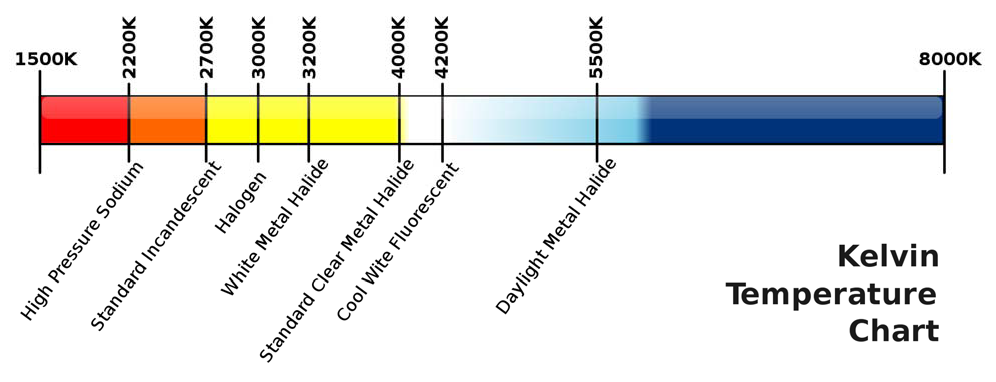
d.
Lighting control requirements.
1.
Automatic switching requirements. Controls shall be provided that automatically extinguish all outdoor lighting when sufficient daylight is available using a control device or system such as a photoelectric switch, astronomic time switch or equivalent functions from a programmable lighting controller, building automation system or lighting energy management system, all with battery or similar backup power or device.
2.
Motion sensing. Motion sensing light fixtures shall be fully shielded and properly adjusted, according to the manufacturer's instruction, to turn off when detected motion ceases.
3.
Dimmable lighting. Where possible, all outdoor lighting shall contain a dimmable option that comports with the standards of this division.
4.
Lamp and shielding. All light fixtures are required to be fully shielded and shall be installed in such a manner that the shielding complies with the definition of fully shielded light fixtures for all uses, including single-family, except as provided in Table 52-403L.
Table 52-403L: Lamping and Shielding
Figure 52-403M: Acceptable/Unacceptable Lighting Fixtures
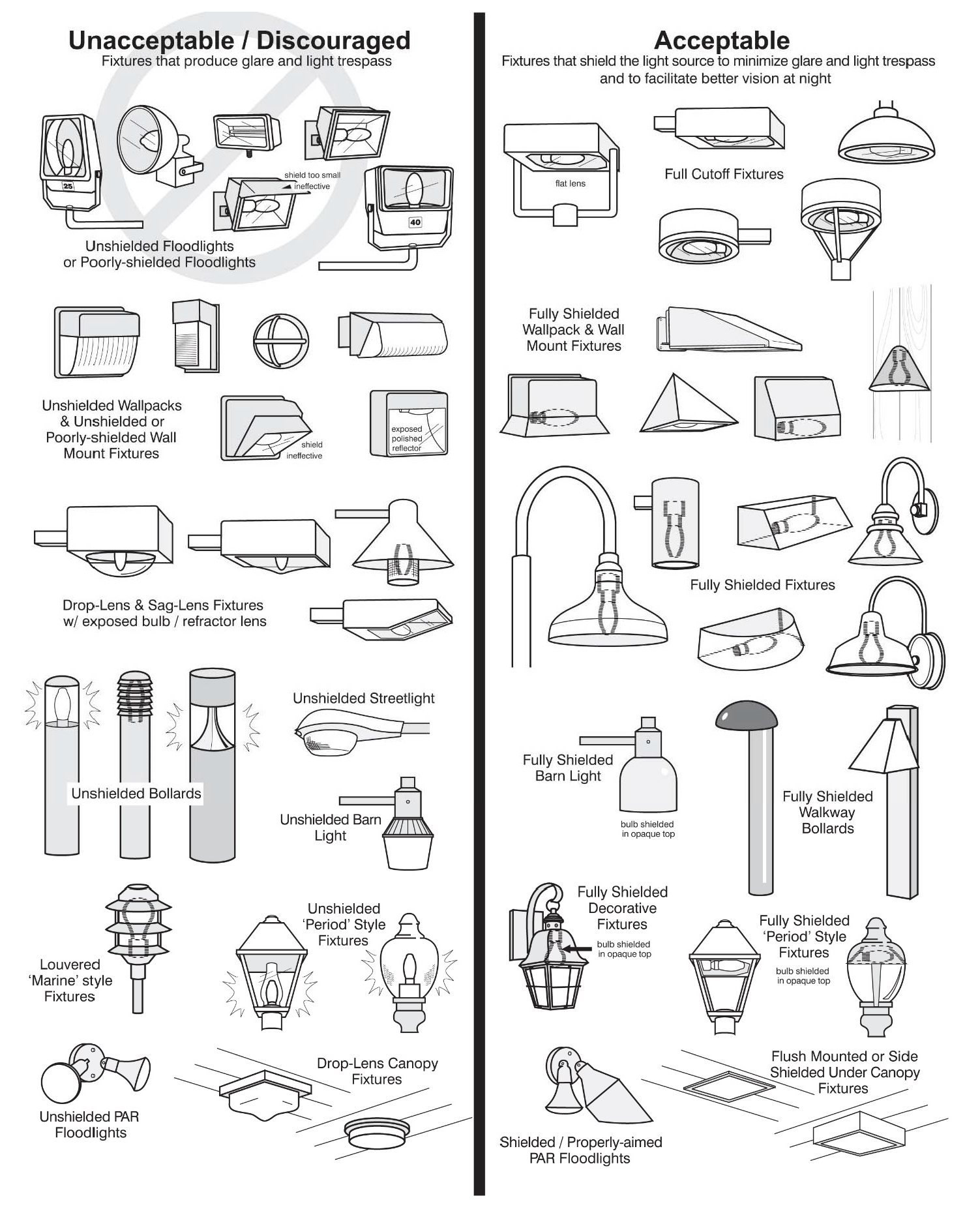
Figure 52-403N: Shielding Configuration
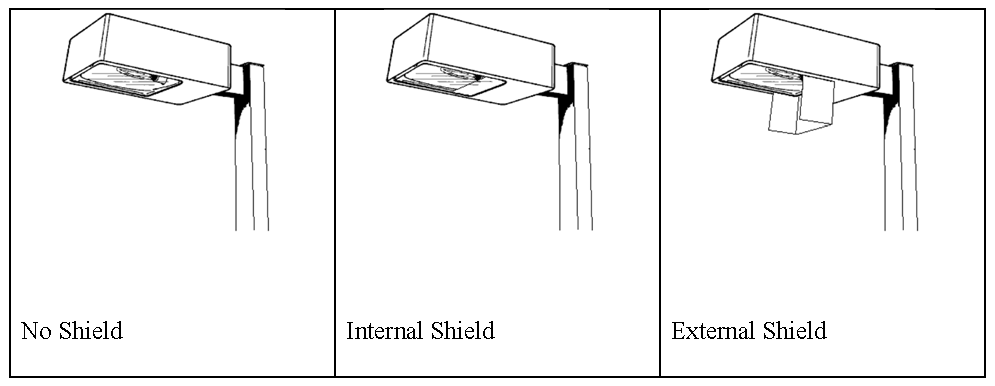
Figure 52-403O: Fixture Cutoff Angles
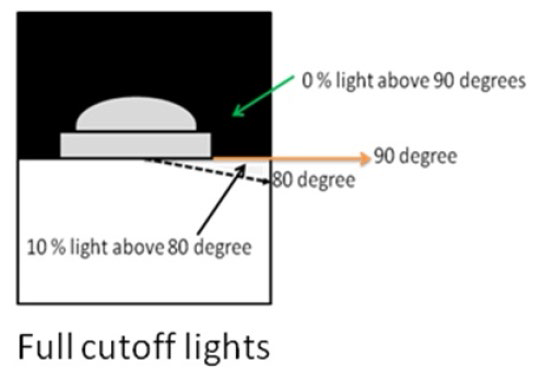
5.
Total outdoor light output. Light emitted from outdoor lighting is to be included in the total outdoor light output. Total outdoor light output shall not exceed 100,000 lumens per net acre for all nonresidential uses. Residential uses are evaluated on a per lot basis. Total outdoor light output shall be calculated as follows:
(i)
Light fixtures installed as described below shall be included in the total outdoor light output by adding 100 percent of the initial lumen outputs of the lamps used:
i.
All unshielded or partially shielded fixtures, regardless of location;
ii.
Light fixtures installed on poles (such as parking lot light fixtures);
iii.
Light fixtures installed on the side of buildings or other structures but not located as described in paragraphs (ii) or (iii) below; and
iv.
Light fixtures installed within open parking garages, or under canopies, building overhangs, or roof eaves that are not fully shielded or are fully shielded but not located as described in paragraphs (ii) or (iii) below.
(ii)
Fully shielded light fixtures installed as described below shall be included in the total outdoor light output by adding only 25 percent of the initial lumen outputs of the lamps used:
i.
Fully shielded light fixtures located within open parking garages, or located under canopies, building overhangs, or roof eaves, where all parts of the light fixture are located at least five feet but less than ten feet from the nearest outdoor opening, canopy, or overhang edge.
(iii)
Fully shielded light fixtures installed as described below shall be included in the total outdoor light output by adding only ten percent of the initial lumen outputs of the lamps used:
i.
Fully shielded light fixtures located within open parking garages, or located under canopies, building overhangs, or roof eaves, where all parts of the light fixture are located ten feet or more from the nearest outdoor opening, canopy, or overhang edge.
Figure 52-403P: Free Standing and Attached Canopy Section
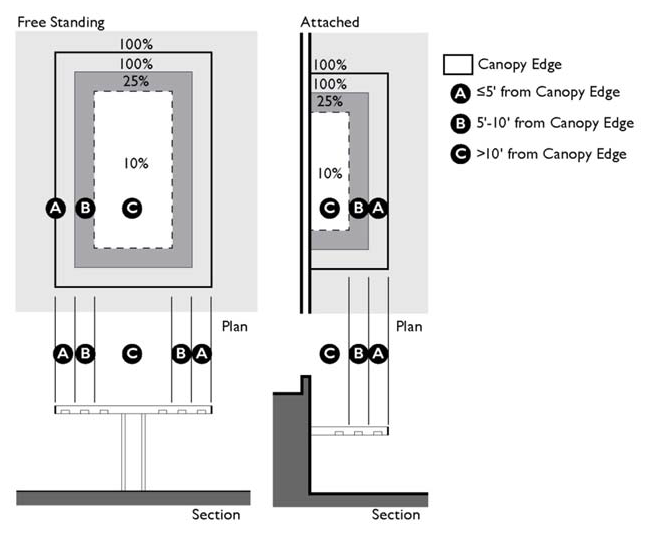
(iv)
The total outdoor light output shall not exceed the limits in Table 52-403Q averaged over the entire development. All site lighting shall not exceed the intensities and uniformity ratios in Table 52-403Q below, unless otherwise specified in this division.
Table 52-403Q: Average Lighting Levels
;adv=6;6.
Time limits for outdoor lighting. All outdoor lighting shall be turned off at the times listed below. Decorative holiday lights are exempt in accordance with the regulations outlined in this division.
(i)
Nonresidential. All nonessential lighting shall be turned off no later than 30 minutes after the business closes or after 11:00 p.m., whichever is later, and remain off for the remainder of the night or until the business reopens, leaving only necessary lighting for site security.
(ii)
Residential. All nonessential lights exceeding 625 lumens shall be turned off after 11:00 p.m., leaving only necessary lighting for site security.
(iii)
Recreational facilities. All events shall be scheduled so as to complete all activity before or as near to 10:30 p.m. as practical, but under no circumstances shall any illumination of the playing field, court, or track be permitted after 11:00 p.m. except to conclude a scheduled event that was in progress before 11:00 p.m. and circumstances prevented concluding before 11:00 p.m.
7.
Sign illumination. Standards for external and internal sign illumination are subject to the provisions in article IV, signage. Light used for illumination of signs is included toward the total outdoor light output standards of this division.
e.
Illumination.
1.
Illumination. Unless otherwise provided in this division, illumination, where required by this division, shall have intensities and uniformity ratios in accordance with the current recommended practices of the Illuminating Engineering Society of North America (IESNA) as from time to time amended and the International Dark-Sky Association (IDA).
2.
Measurement. Illumination levels of outdoor lighting shall be measured by a qualified professional according to generally accepted Illuminating Engineering Society of North America methods.
(i)
Meter required. Lighting levels of outdoor lighting shall be measured in foot-candles with a direct reading portable light meter with a color and cosine corrected sensor with multiple scales. The meter shall read within an accuracy of plus or minus five percent.
(ii)
Horizontal method of measurement. The meter sensor shall be mounted not more than six inches above ground level in a horizontal position. Readings shall be taken only after the cell has been exposed to provide a constant reading.
3.
Computation of illumination. Illumination at a point may be computed in lieu of measurement. Computation methods shall consist of a generally accepted Illuminating Engineering Society of North America method, using certified photometric data furnished by the fixture manufacturer, lamp manufacturer, photometric laboratory, or other reliable authority satisfactory to the city. Computations shall be based on new, properly seasoned lamps, diffusers and other appurtenances in place, and with proper regard taken for mounting height, relative elevation, natural and manmade objects.
4.
Light trespass standard. No use or operation in any district shall be located or conducted so as to produce glare, or either direct or indirect illumination across the bounding property line from a source of illumination into a residentially zoned property, nor shall any such light be of such intensity as to create a nuisance or detract from the use and enjoyment of adjacent property. For the purposes of this section, a nuisance shall be defined as more than one-tenth of one footcandles of light measured at the residential property line and 25 hundredths of one footcandles at any adjoining nonresidential property line:
Table 52-403R: Lighting at Property Lines
5.
Lumens. Brightness of a light fixture shall be measured in lumens. Where applicants may need to measure equivalency of lumens and watts, Table 52-403S below shall be used. When a ratio is not listed in the table, the best practices as prescribed by the IESNA shall apply:
Table 52-403S: Lumen-Watt Equivalents
f.
Special uses.
1.
Security lighting.
(i)
Unless otherwise provided in this division, all building lighting for security will be fully shielded type, not allowing any upward distribution of light. Wallpack type fixtures are acceptable only if they are fully shielded with 80-degree cutoff and shall not project above the fascia or roof line of the building.
(ii)
Security fixtures shall not face residential uses.
(iii)
Security fixtures shall not be substituted for parking area or walkway lighting and shall be restricted to loading, storage, service and similar locations.
2.
Canopy area lighting.
(i)
Shielding. All development that incorporates a canopy type area including, but not limited to, service stations, automated teller machines, awnings, arcades, porte-cochere or similar installations shall use a recessed lens cover flush with the bottom surface of the canopy that provides a cutoff or shielded light distribution. Such shielding must be provided by the fixture itself and shielding by surrounding structures such as canopy edges is not permitted. Lighting along the canopy edge, side or roof is not permitted.
(ii)
Total under-canopy output. The total light output used under service station canopies, defined as the sum of all undercanopy initial lamp outputs in lumens, shall not exceed 40 lumens per square foot of canopy and comply with the average lighting levels of Table 52-403Q.

(iii)
All lighting mounted under the canopy, including but not limited to light fixtures mounted on or recessed into the lower surface of the canopy and any lighting within signage (but not including any lamps mounted within the pumps and used to illuminate information indicating the total cost of such items as fuel pumped and price per gallon), shall be included in the total outdoor light output for the site and is subject to the standards of this division.
3.
Entrances and exits. All entrances and exits to buildings used for nonresidential purposes and open to the general public, along with all entrances and exits in multifamily residential buildings, shall be lighted to ensure the safety of persons and the security of the building. All lighting shall conform to average lighting levels of Table 52-403Q.
4.
Parking lots, garages and loading area lighting.
(i)
All lighting facilities shall be arranged as to reflect the illumination away from any adjacent property. Such lighting facilities shall provide illumination within parking areas and shall distribute not more than one-fifth of a foot-candle of light upon any adjacent residential property.
(ii)
Parking lots and vehicle movement areas shall not exceed a maximum illumination value of five foot-candles or a minimum illumination value of one-fourth foot-candle. Lamps in decorative lantern type fixtures shall not exceed a maximum of 1,600 lumens. Total pole and fixture height shall not exceed a maximum of 16 feet, measured from grade at the base.
(iii)
All lighting facilities shall be placed, masked or otherwise arranged such that illumination or glare shall not intrude on residential property or create a hazard to motorists on any street, alley or other public or private right-of-way.
(iv)
All light fixtures used on open parking garages, including those mounted to the ceilings over the parking decks, shall be fully shielded.
(v)
The lumen output of lamps mounted on or within open parking garages shall be included toward the total outdoor light output standards of this division.
5.
Outdoor recreational facilities. Any light source permitted by this division may be used for lighting of outdoor recreational facilities (public or private), such as, but not limited to, football fields, soccer fields, baseball fields, softball fields, tennis courts, driving ranges, outdoor arenas and amphitheaters, show areas, or other field recreation facilities and are subject to the following conditions:
(i)
Illumination. Any illumination level exceeding a maximum of ten foot-candles must receive prior approval by the council.
(ii)
Shielding. All fixtures used for event lighting shall be fully shielded, or be designed or provided with sharp cut-off capability, so as to minimize up light, spill-light, and glare.
(iii)
Time limits. No illuminated sports facility shall be illuminated after the time limits outlined in this division, except to conclude a scheduled recreational or sporting event in progress prior to the time limitation.
6.
Street lighting.
(i)
Standards for street lighting installed on public rights-of-way must conform to the city engineering standards and the city's comprehensive plan and the standards of this this division.
(ii)
Street lighting installed on private rights-of-way shall be included within the total outdoor light output for the development.
(iii)
Streetlights for both public and private rights-of-way are not exempt from the provisions of this division.
7.
Internally illuminated architectural elements. Any architectural element including walls or portions of buildings that are internally illuminated and that is not a sign or fenestration (e.g. windows or doors) shall have 100 percent of the initial lamp output of all lamps used to provide such illumination counted toward unshielded lighting for the purposes of calculating total outdoor light output for the site and is subject to the standards of this division.
8.
Architectural, aesthetic and landscape lighting. Architectural lighting used to illuminate the wall of a building or landscape lighting used to illuminate trees or other landscape elements is permitted. All building lighting for aesthetics shall be fully shielded type, not allowing any upward distribution of light and must be externally lit from the top and shine downward, except as provided below:
(i)
Architectural and landscape lighting that is directed downward onto a wall, tree or other landscape feature shall be included in the total outdoor light output standards provided in Table 52-403Q, based on whether a fully shielded or partially shielded light fixture is used; and
(ii)
Architectural and landscape lighting that is directed upward onto a wall, tree or other landscape feature shall be included in the total outdoor light output standards provided in Table 52-403Q. Fixtures shall be located, aimed or shielded to minimize light spill into the night sky.
9.
Emergency lighting. Emergency lighting that is only turned on in the event of a power failure or when an alarm is activated is permitted in all zoning districts and is excluded from the total lumen calculations for the site.
10.
Neon building lighting. Neon building lighting is included in the total outdoor light output calculations for the site. Any unshielded neon lighting is limited by the unshielded lighting limits of this division.
g.
Prohibited lighting.
1.
Laser source light. The use of laser source light or any similar high intensity light for outdoor advertising or entertainment, when projected above the horizontal is prohibited.
2.
Cobra-head fixtures. Cobra-head-type fixtures having dished or drop lenses are prohibited.
3.
Searchlights. The operation of searchlights for advertising purposes is prohibited.
4.
Floodlights. The use of floodlights is prohibited.
5.
Up lighting. Up lighting of display, building and aesthetic lighting is prohibited, except where provided otherwise in this division.
6.
Halogen lights. Halogen lights are prohibited.
7.
Mercury vapor lights. Mercury vapor lights are prohibited.
8.
Flashing lights. Any lighting device located on the exterior of a building or on the inside of a window which is visible beyond the boundaries of the lot or parcel with intermittent fading, flashing, blinking, rotating or strobe light illumination.
h.
Exemptions.
1.
The following are exempt from the provisions of this division:
(i)
Emergency lighting by emergency services. All temporary emergency lighting needed by the department of public safety or other emergency services, as well as all vehicular luminaries.
(ii)
Holiday decorations. Seasonal decorative lighting is exempt from the provisions of this division provided that individual lamps are less than ten watts incandescent or equivalent lumens.
(iii)
Solar powered lighting. Solar powered lights less than five watts incandescent or equivalent lumens per fixture used in residential landscaping application and to illuminate walkways are exempt from applicable lamp type and shielding standards, but must conform the average lighting levels of Table 52-403Q.
(iv)
Public art. Lighting for public monuments and statuary as approved by the city council are exempt from the standards of this division.
(v)
Construction. All outdoor lighting used for construction or major renovation structures and facilities are exempt from the provisions of this division unless specified elsewhere in this division or Code.
(vi)
Swimming pool and decorative water fountain lighting. Underwater lighting in swimming pools and other water features are exempt from the lamp type and shielding standards.
2.
Temporary exemptions.
(i)
Upon approval by the administrator, temporary exemptions from the requirements of this division shall be for a period not to exceed ten days.
(ii)
Any person may submit a written request, on a form prepared by the City for a temporary exemption request. The request shall fulfill the same requirements as defined in in the outdoor lighting plan standards of this division.
(iii)
Requests for renewal or exemptions shall be processed in the same way as the original request. Each renewal shall be valid for not more than ten days or a time period designated by the administrator.
(iv)
Approval for temporary exemptions will be based on the effect of location and use of outdoor lighting fixtures.
(v)
Roadway and/or street lighting, whether public or private, is not eligible for exemption.
(2)
Clear sight area (visual obstructions prohibited).
a.
In a residentially zoned district, no structure shall be erected so that it does obstruct the vision of motorists traveling upon the public street adjacent thereto. Structures such as fences, planters or plantings, and no tree with foliage extending below ten feet above the established street grades shall be maintained in any front, side or rear yard within ten feet of any public street.
1.
Street trees shall be sited a minimum of five feet from the intersection to prevent obstruction of visibility of larger vehicles.
2.
Parking shall be restricted within 20 feet of intersection to prevent obstruction of visibility to oncoming traffic.
b.
In other than residentially zoned districts fences may be constructed to a maximum height of eight feet above grade. In residential zoned districts fences shall not be erected to exceed eight feet in height above grade when located behind the front building line nor four and a half feet in height above grade when located within the required front yard or side yard on a corner lot adjacent to a side street, but in no case shall any fence be permitted closer than ten feet from the curb or roadway area. No fence shall be located within any easement except by prior written approval of those agencies having interest in such easement.
c.
No fence erected under the above provisions, and no wall, screen hedge, tree, brush, shrub, billboard or structure shall be erected, planted or maintained in such position or place so as to be dangerous or detrimental to the health or safety of persons living in any house or adjoining premises or in any way obstruct the view so as to constitute a traffic hazard. On any corner lot or parkway adjacent thereto, no fence, wall, structure, hedge, tree or growth of any nature may be erected, planted or maintained so as to interfere with sight lines at elevation between two and a half feet and eight feet above the top of the adjacent roadway curb. If there is no curb then from the center of the street (the crown) shall be constructed to be the same height of a curb. Such an obstruction shall be prima facie evidence that such fence, wall, structure, hedge, tree or growth of any nature constitutes an obstruction to vision as regards public traffic on the streets, except post, poles and tree trunks of less than 12-inch diameter within the triangular line of sight easement. The triangular visibility area is defined as the intersecting point from a property former extending back 25 feet and connecting the area and as depicted below.
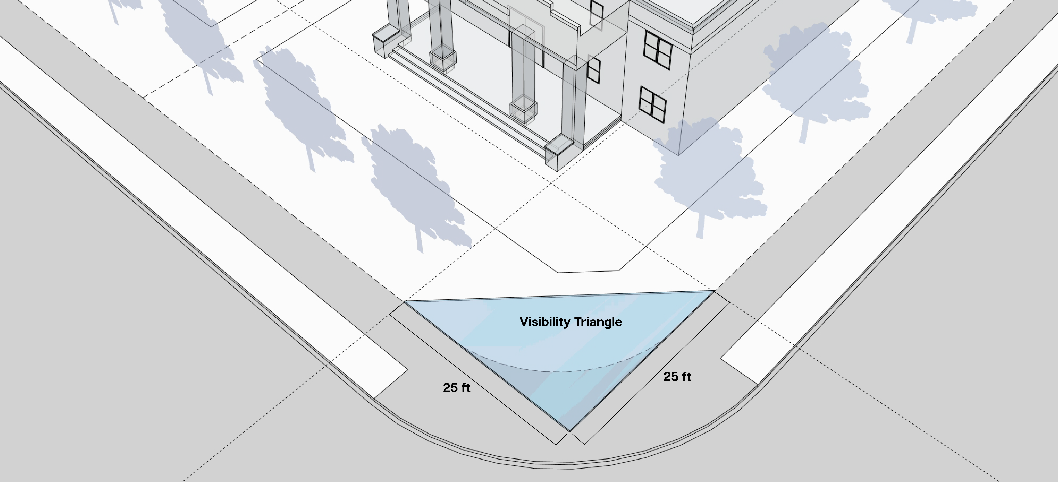
Figure 1—Visibility Triangle
Any such fence, wall, structure, hedge, tree or growth of any nature erected, planted or maintained in violation of this subsection, shall be removed upon written notice from the zoning official, served upon the owner, agent or occupant of the premises where such obstruction has been erected, planted or maintained.
(Ord. No. 793-25, § 2(Exh. A), 1-23-25)

