
Kansas City City Zoning Code
300 SERIES
USE REGULATIONS
88-317-01 - ARTBOARDS
88-317-01-A. INTENT
The purpose of this section is to allow and encourage the reuse of outdoor advertising signs within the Greater Downtown Area as artboards under certain terms and conditions.
88-317-01-B. STANDARDS
The reuse of an existing or former outdoor advertising sign as an artboard may be allowed as either an accessory or principal use by special use permit subject to the following provisions:
A.
No part of the artboard may exceed 20 feet in height as measured from grade.
B.
An artboard shall be a freestanding structure, and may not be attached to a building.
C.
The structure of the artboard must be sound, and must not contain major indicia of disrepair, including rust, holes, or bending of the pole.
D.
The content shall not contain any obscene images or language.
E.
No more than 3% of the content shall comprise text.
F.
An artboard may not contain a commercial message or logo.
G.
An artboard may not use any moving images, electrical or mechanical components, or changing images.
H.
The content may not extend past the established boundary of the artboard.
I.
An artboard may include a plaque displaying the ownership or sponsorship of the artboard with an area no larger than one square foot.
J.
Issuance of a special use permit for an artboard will remove any nonconforming right to use the sign structure as an Outdoor Advertising Sign.
K.
Other than the above restrictions, the content of the artboard will not be a factor in the determination of whether it should be allowed.
L.
An artboard may only be allowed on a site within the Greater Downtown area.
M.
An artboard may only be allowed on a lot containing no other structures or uses.
N.
The Board of Zoning Adjustment may impose conditions of approval, including requiring landscaping or other improvement of the property on which the artboard will be located.
88-317-01-C. REVOCATION OF SPECIAL USE PERMIT
In addition to provisions in 88-525-13 Revocation, the special use permit is subject to revocation and the artboard will be ordered to be removed by the Director for any of the following conditions:
A.
If an artboard remains blank for a continuous period of 90 days, that artboard is deemed abandoned and the special use permit is revoked and the entire structure must be removed. For purposes of this section, an artboard is "blank" if:
i.
There is no content on the face of the artboard; or
ii.
The content has become faded or otherwise deteriorated from its original condition in whole or substantial part.
B.
If lighting and/or electronic or digital displays are added to the artboard.
C.
If more than 50 percent of the structure's area be damaged or destroyed by any means.
D.
If an artboard is enlarged or extended, or its height increased.
E.
If the faces, poles, supports, and braces of the artboard are not kept in good repair and free from tears, rust, and other indicia of deterioration.
(Ord. No. 150407, § 1, 7-9-2015)
88-318 - ARTISAN MANUFACTURING[1]
Editor's note— Ord. No. 160341, § 1, adopted May 12, 2016, amended the title of 88-318. Subsequently, Ord. No. 220398, § 1, adopted May 19, 2022, amended the title of 88-318.
88-321 - SHORT TERM RENTALS[2]
Editor's note— Ord. No. 230267, § 3, adopted May 4, 2023, amended the Code by repealing former 88-231, §§ 88-231-01—88-231-04, and adding a new 88-231. Former 88-231 pertained to similar subject matter, and derived from Ord. No. 170771, § 1, adopted Feb. 22, 2018; and Ord. No. 220398, § 1, adopted May 19, 2022.
88-325 - SHORT-TERM LOAN ESTABLISHMENTS
88-325-01 Short-term loan establishments are subject to the following conditions and restrictions, with separation measured in accordance with 88-820-15 (unless as specified in this section):
88-325-01-A. No such establishment shall be located within one mile of another short-term loan establishment or pawn shop. When measuring separation distances between establishments on the same lot, the distance shall be measured from the front door of each of the establishments.
88-325-01-B. No such establishment shall be located within or within 1,000 feet of a property or district which has been designated as a landmark or historic district.
88-325-01-C. No such establishment shall be located adjacent to and within 150 feet of a park, boulevard, or parkway.
88-325-01-D. Such establishment may be operated only as a principal use of a property and may not be accessory to any other use. A short-term loan establishment may not operate any accessory uses.
(Ord. No. 100773, § 1, 1-13-2011; Ord. No. 150544, § 1, 7-23-2015; Ord. No. 160341, § 1, 5-12-2016; Ord. No. 170360, § 1, 6-15-2017)
88-340 - DRIVE-THROUGH FACILITIES[3]
Editor's note— Ord. No. 170118, § A, adopted April 13, 2017, amended the Code by repealing former 88-340, and adding a new 88-340. Former 88-340 pertained to similar subject matter, and derived from Ord. No. 120697, adopted August 23, 2012; Ord. No. 120783, adopted October 4, 2012; Ord. No. 140919, adopted November 13, 2014; and Ord. No. 150544, adopted July 23, 2015.
88-367 - REUSE OF OFFICIALLY DESIGNATED HISTORIC STRUCTURE
To encourage the reuse of designated historic structures, the board of zoning adjustment is authorized to approve a use of a structure not otherwise allowed, and the continuation of any historic signage, if the structure is on the National Register of Historic Places or has been locally designated as a historic landmark or has received the federal rehabilitation tax credit for buildings other than certified historic structures built before 1936 in accordance with Public Law 101-508; 26 U.S.C. 47 of the Federal Code as adopted on November 5, 1990. In approving such re-use, the board of zoning adjustment must follow the special use standards and procedures of 88-525.
(Ord. No. 151013, § A, 12-10-2015)
88-370 - TEMPORARY USES[4]
Editor's note— Ord. No. 230552, § 3, adopted June 28, 2023, amended the Code by repealing former 88-370, §§ 88-370-01—88-370-07, and adding a new 88-370. Former 88-370 pertained to similar subject matter, and derived from Ord. No. 081033, adopted May 21, 2009, and Ord. No. 160759, adopted October 20, 2016.
88-375 - VEHICLE STORAGE AND TOWING[5]
Editor's note— Ord. No. 170061, § A, adopted March 23, 2017, amended the Code by repealing former 88-375, and adding a new 88-375. Former 88-375 pertained to similar subject matter, and derived from Ord. No. 150544, adopted July 23, 2015; and Ord. No. 160341, adopted May 12, 2016.
88-378 - WAREHOUSING, WHOLESALING, STORAGE, AND FREIGHT MOVEMENT[6]
Editor's note— Ord. No. 170061, § A, adopted March 23, 2017, amended the Code by repealing former 88-378, and adding a new 88-378. Former 88-378 pertained to similar subject matter, and derived from Ord. No. 160341, adopted May 12, 2016.
88-305-01 - GENERAL
88-305-01-A. ACCESSORY USES ALLOWED
Accessory uses and structures are permitted in connection with any lawfully established principal use unless otherwise expressly provided in this zoning and development code. Also, unless otherwise expressly stated, accessory uses and structures are subject to the same regulations as the principal use or structure on the subject lot.
88-305-01-B. INCIDENTAL AND SUBORDINATE NATURE
The city planning and development director is authorized to determine when a use, building, or structure meets the definition of an accessory use or accessory structure. In order to classify a use or structure as "accessory," the city planning and development director must determine that the use or structure:
1.
is subordinate to the principal building or principal use in terms of area, extent, and purpose;
2.
contributes to the comfort, convenience, or necessity of occupants of the principal building or principal use served; and
3.
is customarily found in association with the subject principal use or building.
88-305-01-C. TIME OF CONSTRUCTION
Accessory structures must be constructed in conjunction with or after the principal building. They may not be built prior to the construction of the principal building.
88-305-01-D. LOCATION
Accessory uses and structures must be located on the same lot as the principal use to which they are accessory, except as otherwise expressly stated.
88-305-01-E. ACCESSWAYS
Driveway providing access to uses in nonresidential districts may not traverse land in R districts.
88-305-02 - LOT AND BUILDING STANDARDS IN RESIDENTIAL DISTRICTS
88-305-02-A. GENERAL
The lot and building standards of the base zoning district apply to accessory structures in residential districts unless otherwise expressly stated.
88-305-02-B. SETBACKS AND SEPARATION
1.
Accessory buildings and structures are prohibited in front and street side yards (i.e., they may not be closer to the street than the principal building), except for structures that are customarily found in front or street yards, such as flag poles and minor landscape structures.
2.
Accessory buildings and structures must be set back at least 1.5 feet from rear property lines, except that garages accessed from an alley and carriage houses are not required to be set back from a rear property line abutting an alley. Structures designed to contain animals must be set back at least 30 feet from rear property lines.
3.
Accessory buildings and structures must be set back at least 1.5 feet from interior side property lines, except that buildings and structures designed to contain animals must be set back at least 30 feet from interior property lines.
4.
On corner lots, accessory buildings and structures may not be closer to the street than the principal building line in the rear yard or must be set back at least 15 feet, whichever is less, except that accessory buildings and structures are not required to be set back from an interior side property line that abuts an alley.
5.
If serving two lots, an accessory building and structure may be built across the side or rear line. Where an alley abuts a side or rear lot line, the garage may be built on the alley line.
6.
Accessory buildings must be located no closer than 10 feet to all other accessory and principal buildings on the same lot.
88-305-02-C. HEIGHT
Accessory buildings and structures may not exceed 10 feet in height, except that detached garages may be up to 16 feet in height and allowed carriage houses may be up to 28 feet or 2 stories in height. In Districts AG-R and R-80, an accessory building may be up to 35 feet in height.
88-305-02-D. FOOTPRINT AREA
The building footprint (ground level building coverage) of an individual, detached accessory building may not exceed 200 square feet, except that:
1.
the building footprint of a detached accessory garage may be up to 800 square feet or one square foot of building footprint area for each 10 square feet of lot area, whichever is greater; and
2.
the building footprint of a carriage house may be up to 1,500 square feet.
3.
in Districts AG-R and R-80, an accessory building may be up to 8,000 square feet.
88-305-02-E. BUILDING COVERAGE
The total combined footprint area of all detached accessory buildings and structures may not exceed 40% of the actual rear yard area.
(Ord. No. 120697, § 1, 8-23-2012; Ord. No. 120783, § 1, 10-4-2012; Ord. No. 130441, § 1, 7-11-2013; Ord. No. 150600, § A, 7-23-2015; Ord. No. 160341, § 1, 5-12-2016)
88-305-03 - LOT AND BUILDING STANDARDS IN NONRESIDENTIAL DISTRICTS
88-305-03-A. GENERAL
The lot and building standards of the base zoning district apply to accessory structures in nonresidential districts unless otherwise expressly stated.
88-305-03-B. SETBACKS
The setback standards of the underlying zoning district apply to accessory structures in nonresidential districts except as follows:
1.
Accessory buildings and structures are prohibited in front and street side yards (i.e., they may not be closer to the street than the principal building), except for structures that are customarily found in front yards, such as flag poles and minor landscape structures.
2.
Accessory buildings and structures on lots abutting R districts must be set back in accordance with the accessory structure setback standards that apply in residential districts (See 88-305-02).
88-305-03-C. SEPARATION
Accessory buildings must be separated by a minimum distance of 10 feet from all other accessory and principal buildings.
88-305-03-D. HEIGHT
Accessory buildings may not exceed 25 feet in height, or the height of the principal building on the same lot, whichever is less.
88-305-04 - HOME OCCUPATION
88-305-04-A. GENERAL
Home occupations are accessory uses to uses in the household living category. The regulations of this section are primarily intended to ensure that home occupations in R zoning districts will not be a detriment to the character and livability of the surrounding residential neighborhood. The regulations are also intended to ensure that the home occupation remains subordinate to the residential use, and that the residential viability of the dwelling is maintained. The regulations also recognize that many types of work can be done in a home with little or no effect on the surrounding neighborhood.
88-305-04-B. APPLICABILITY
Home occupations are allowed in R districts only if they comply with all of the standards of this section.
88-305-04-C. EXEMPTIONS
1.
HOME-BASED DAY CARE
Home-based day care facilities are not regulated as home occupations and are exempt from the regulations of this section.
2.
BED AND BREAKFAST
Bed and breakfast uses are not regulated as home occupations and are exempt from the regulations of this section.
88-305-04-D. STANDARDS
A dwelling unit may be used for one or more home occupations subject to compliance with all of the following minimum standards:
1.
The home occupation must be accessory and secondary to the use of a dwelling unit for residential purposes, and the home occupation must not change the residential character of the residential building or adversely affect the character of the surrounding neighborhood.
2.
All employees must reside in the dwelling unit in which the home occupation is located.
3.
No more than two clients shall be present at any time and must be present by appointment only.
4.
No separate entrance from the outside of the building may be added to the residential building for the sole use of the home occupation.
5.
There may be no internal or external structural alterations or construction, nor the installation of any equipment that would change the residential character of the property upon which the home occupation is located. Examples of such prohibited alterations include construction of parking lots, paving of required setbacks, and the addition of commercial-like exterior lighting.
6.
The home occupation and all related activities, including storage, must be conducted completely within the dwelling unit.
7.
No home occupation may produce or emit any noise, vibration, smoke, dust, or other particulate matter, odorous matter, heat, humidity, glare, or any other effect that unreasonably interferes with any person's enjoyment of their residence.
8.
Hazardous substances are prohibited, except that consumer quantities are allowed. Consumer quantities of hazardous substances are packaged and distributed in a form intended or suitable for sale through retail sales outlets for consumption by individuals for purposes of personal care and household use.
9.
One non-illuminated wall sign, not exceeding 80 square inches in area may be displayed.
10.
The following uses are expressly prohibited as or in conjunction with home occupations:
(a)
any type of repair or assembly of vehicles or equipment with internal combustion engines (such as autos, motorcycles, scooters, snowmobiles, outboard marine engines, lawn mowers, chain saws, and other small engines), large appliances (such as washing machines, dryers, and refrigerators), or any other work related to automobiles and their parts;
(b)
dispatch centers or other businesses where employees come to the site and are dispatched to other locations;
(c)
animal grooming, care, or boarding;
(d)
retail sales.
(Ord. No. 130441, § 1, 7-11-2013)
88-305-05 - CARRIAGE HOUSES
88-305-05-A. WHERE PERMITTED
Carriage houses are allowed only when:
1.
they were constructed before March 1, 2005;
2.
they are located on property designated as an historic landmark or located in an historic district; and
3.
they are located in an R-10, R-7.5, R-6, R-5, or R-2.5 district.
88-305-05-B. MINIMUM LOT AREA
1.
In R-10, R-7.5, R-6 and R-5 districts, a carriage house may be maintained or altered only on a lot that contains a minimum area of 12,000 square feet and that contains a principal building used exclusively for the purposes of no more than one dwelling unit.
2.
In the R-2.5 district, a carriage house may be maintained or altered only on a lot that contains a minimum area of 22,000 square feet and that contains a principal building used exclusively for the purposes of no more than:
(a)
one dwelling unit; or
(b)
two dwelling units provided that one of the units is owner-occupied and further provided that the non-owner-occupied unit is either occupied only by children and/or parents of the owner-occupant, and any spouses of a child or parent.
(Ord. No. 170771, § 1, 2-22-2018)
88-305-06 - SATELLITE DISH ANTENNAS
88-305-06-A. Satellite dish antennas less than one meter (39.4 inches) in diameter are permitted as accessory uses in all districts, subject to accessory structure setback requirements.
88-305-06-B. Satellite dish antennas larger than one meter and less than 3 meters (118.2 inches) in diameter, are permitted as accessory uses in all nonresidential districts, subject to accessory structure setback requirements.
88-305-06-C. Satellite dish antennas may be erected on the roof or attached to a principal building, provided the maximum height of the installation does not exceed the maximum allowable height of the subject district or more than 15 feet above the top of the building on which it is to be located, whichever is less. Satellite dish antennas that are mounted on the roof or attached to the building must be located in a manner so as to minimally detract from the architectural character of the building.
88-305-06-D. Satellite dish antennas not allowed under the provisions of this section require special use permit approval.
(Ord. No. 151013, § A, 12-10-2015; Ord. No. 160341, § 1, 5-12-2016)
88-305-07 - SWIMMING POOLS
Swimming pools are permitted in the side or rear yard only, and must be set back at least 10 feet from side and rear property lines. Swimming pools with a depth of more than 2 feet must be enclosed by a protective fence at least 4 feet in height. The fence must include self-closing, lockable gates or entrances when the pool is not tended by a responsible person.
(Ord. No. 120783, § 1, 10-4-2012; Ord. No. 130441, § 1, 7-11-2013)
88-305-08 - RESIDENTIAL SUPPORT SERVICES
88-305-08-A. Residential support services are allowed in R zoning districts as accessory uses to independent living homes, assisted living homes, retirement homes, convalescent homes, nursing homes, or multi-unit buildings containing more than 50 dwelling units.
88-305-08-B. STANDARDS
Residential support services must:
1.
be located in the same structure as the principal residential use;
2.
occupy, in aggregate, no more than 5,000 square feet or 10% of the floor area of the principal residential use, whichever is less, with no single individual residential support service use occupying more than 2,500 square feet;
3.
serve only the occupants, residents, or employees of the principal residential use or their guests;
4.
have no exterior signage (interior signage is permitted) on the building;
5.
and have no separate external public entrances.
(Ord. No. 120783, § 1, 10-4-2012)
88-305-09 - ACCESSORY SOLAR AND WIND ENERGY SYSTEMS
88-305-09-A. GENERAL
1.
Accessory solar and wind energy systems must comply with all applicable building and electrical codes.
2.
Owners of accessory solar energy systems are solely responsible for negotiating with other property owners for any desired solar easements to protect access to sunlight. Any such easements must be recorded in the office of the appropriate county recorder of deeds.
88-305-09-B. BUILDING-MOUNTED SOLAR AND WIND ENERGY SYSTEMS
1.
Building-mounted solar and wind energy systems are allowed on principal and accessory structures.
2.
All applicable setback regulations apply to building-mounted solar and wind energy systems. Systems mounted on principal structures may encroach into interior side and rear setbacks in accordance with 88-820-12.
3.
Only building-integrated and/or flush-mounted solar energy systems may be installed on street-facing building elevations.
4.
Solar and wind energy systems may not extend more than 3 feet above the applicable maximum height limit for the subject building type or more than 5 feet above the highest point of the roof line, whichever is less.
88-305-09-C. GROUND-MOUNTED SOLAR AND WIND ENERGY SYSTEMS
1.
In R zoning districts, ground-mounted solar and wind energy systems may not be located in the front yard or street side yard.
2.
Ground-mounted solar and wind energy systems are subject to applicable accessory structure setback, separation and coverage regulations.
3.
Ground-mounted solar and wind energy systems are subject to applicable accessory structure height regulations.
(Ord. No. 120697, § 1, 8-23-2012; Ord. No. 160341, § 1, 5-12-2016)
88-305-10 - ELECTRIC VEHICLE CHARGING STATIONS
88-305-10-A. GENERAL
1.
Private (restricted-access) EV charging stations are permitted as accessory uses in all zoning districts.
2.
Public EV charging stations are permitted as accessory uses to allowed nonresidential uses in all zoning districts.
88-305-10-B. PARKING
1.
Electric vehicle charging stations may be counted toward satisfying minimum off-street parking space requirements.
2.
Public electric vehicle charging stations must be reserved for parking and charging electric vehicles only. Electric vehicles may be parked in any space designated for public parking, subject to the restrictions that apply to any other vehicle.
88-305-10-C. EQUIPMENT
Vehicle charging equipment must be designed and located so as to not impede pedestrian, bicycle or wheelchair movement or create safety hazards on sidewalks.
88-305-10-D. USAGE FEES
Property owners are not restricted from collecting a service fee for the use of an electric vehicle charging station.
88-305-10-E. SIGNAGE
1.
Information must be posted identifying voltage and amperage levels and any type of use, fees, or safety information related to the electric vehicle charging station.
2.
Public electric vehicle charging stations must be posted with signage indicating that the space is reserved for electric vehicle charging purposes only. For purposes of this provision, "charging" means that an electric vehicle is parked at an electric vehicle charging station and is connected to the battery charging station equipment.
88-305-10-F. MAINTENANCE
Electric vehicle charging stations must be maintained in all respects, including the functioning of the equipment. A phone number or other contact information must be provided on the equipment for reporting when it is not functioning or other problems are encountered.
(Ord. No. 120697, § 1, 8-23-2012)
88-305-11 - GEOTHERMAL HEAT EXCHANGE SYSTEMS
88-305-11-A. GENERAL
Geothermal heat exchange systems are permitted as an accessory use in all zoning districts.
88-305-11-B. LOCATION
1.
Geothermal heat exchange systems must be located entirely within the lot lines of the subject property or within appropriate easements.
2.
No portion of a geothermal heat exchange system may be located within a stream or stream buffer.
88-305-11-C. INSTALLATION
Installation of geothermal heat exchange systems must comply with all applicable building code requirements as well as state laws and codes.
(Ord. No. 120697, § 1, 8-23-2012)
88-305-12 - LODGING AND BOARD
The furnishing of lodging or board for not more than one individual or two individuals who are related to each other by blood or marriage. No display or sign shall be used to advertise such use. The lodger or boarder must live in common with the household, sharing a common entrance, kitchen facilities, and living areas. However, in no case shall more than five unrelated individuals reside within the dwelling.
(Ord. No. 120783, § 1, 10-4-2012; Ord. No. 130441, § 1, 7-11-2013; Ord. No. 220398, § 1, 5-19-2022)
88-305-13 - OUTDOOR STORAGE
88-305-13-A. WHERE PERMITTED
Outdoor storage is allowed as an accessory use in districts, B4 and all M districts.
88-305-13-B. STANDARDS
The following provides regulations to locate and operate outdoor storage areas in order to limit the visual and operational impacts on surrounding properties and public right-of-way:
1.
IN ALL PERMITTED DISTRICTS
a.
Outdoor storage areas must be located outside of drive aisles, fire lanes, required parking spaces, and any required setback.
b.
Outdoor storage must be screened in accordance with the standards of 88-425-09-B.
c.
Accessory outdoor storage shall not be closer to the right-of-way (excluding alleys) than the principal building.
d.
The principal use shall be operated from an occupiable building as defined by Chapter 18.
e.
Accessory outdoor storage areas may not be located adjacent to and within 150 feet of any public parks, boulevards, or parkways. Accessory outdoor storage areas may not be located adjacent to an R or DR district.
2.
IN DISTRICT B4
a.
Outdoor storage is prohibited in any required setback or within 20 feet of any property line, whichever is greater.
b.
Areas used for accessory outdoor storage shall be paved with a permanent asphaltic or concrete pavement or pavers.
c.
Outdoor storage may not cover an area exceeding 50% of the lot area.
3.
IN M DISTRICTS
a.
In M1 outdoor storage may not cover an area exceeding 50% of the lot area.
b.
Outdoor storage is prohibited in any required setback or within 10 feet of any property line, whichever is greater.
c.
Gravel is a permitted surface for accessory outdoor storage. Gravel is prohibited within any required setback or within 10 feet of any property or right-of-way line, whichever is greater. Vehicular use areas shall be paved in accordance with 88-420. The following standards shall apply to gravel outdoor storage areas:
i.
Gravel is not permitted on lot adjacent to an R, B, O or D district, unless such lot is in the floodplain.
ii.
Gravel is not permitted on any lot or portion of a lot with a slope greater than 4 to 1.
iii.
The surface of the storage area shall consist of a uniform layer of gravel evenly distributed from edge to edge, and shall be free of bare spots and vegetation.
iv.
The depth of the gravel layer shall be at least 2 inches.
v.
The material used for gravel outdoor storage areas shall be rock or crushed stone not more than 2 inches in diameter and shall not contain dirt, sticks, construction debris, or other foreign materials. Sand, rock dust or other similar material less than one-eight inch in diameter is not prohibited, but shall not be included in the measurement of minimum gravel depth.
(Ord. No. 170061, § A, 3-23-2017)
88-305-14 - OUTDOOR WORK AREAS
88-305-14-A. WHERE PERMITTED
Outdoor works areas are allowed as an accessory use in districts B4, DC, DX and all M Districts.
88-305-14-B. STANDARDS
1.
Outdoor work areas must be located outside of drive aisles, fire lanes, and required parking spaces.
2.
Outdoor work areas must be screened in accordance with the standards of 88-425-09-B.
3.
Outdoor work areas are prohibited in any required setback or within 20 feet of any property or right-of-way line.
4.
Outdoor work areas shall only serve the principal use.
(Ord. No. 170061, § A, 3-23-2017)
88-305-15 - ACCESSORY DWELLING UNITS
88-305-15-A. PURPOSE
Accessory dwelling units (ADUs) are a household living use that is accessory to and located on the same lot as the permitted principal use. The purpose of this section is to:
1.
Meet the changing needs of the community;
2.
Provide housing choice while preserving the character of the neighborhood in which it is located;
3.
Respond to the changing economy and the necessity for many households to secure additional income; and
4.
Reduce the cost of housing by increasing housing density and doing so in a manner:
a.
That may be more compatible with neighborhoods where detached dwellings predominate; and
b.
Where the benefits of additional income are distributed throughout the community to the individual landowners and renters.
88-305-15-B. WHERE PERMITTED
Accessory dwelling units are permitted on any lot with a detached dwelling where the dwelling is the principal building, subject to certain standards.
88-305-15-C. GENERAL STANDARDS
1.
Accessory dwelling units may be attached or detached from the principal dwelling unit. If attached they shall be located in the rear or side yard. If detached they shall be located in the rear yard.
2.
The owner of the lot shall reside in either the principal dwelling or accessory dwelling. The owner shall record against the property a deed restriction limiting occupancy of either the principal dwelling unit or the accessory dwelling unit to the owner of the property. Proof that such a restriction has been recorded shall be provided to the Director of City Planning and Development prior to issuance of the Certificate of Occupancy for the accessory dwelling unit.
3.
No additional off-street parking is required. Any proposed parking shall conform to 88-420.
4.
Detached accessory dwelling units may be located in or attached to the same building as a garage. In such cases, the floor area limitations of each shall be applied cumulatively.
5.
When attached, the accessory dwelling unit may have its own exterior entrance or shared entrance with a common vestibule.
6.
If attached to the principal dwelling, the lot and building standards for the principal building shall apply.
7.
If detached from the principal dwelling, it shall be located in the rear yard, and the lot and building standards shall be as follows:
a.
Maximum height shall not exceed the height of the principal building or 25 feet, whichever is less.
b.
Setbacks shall be five feet from all property lines including projections; except on street side yards where it shall be five feet including projections or the same as the principal building, whichever is greater.
c.
Maximum footprint of the ADU: 60% of the footprint of the principal dwelling or 25% of the rear yard, whichever is smaller. In no case shall the footprint exceed 800 square feet.
d.
Maximum floor area: 800 square feet or 90% of the floor area of the principal dwelling, whichever is smaller.
e.
All other setbacks shall be those that apply to all accessory structures.
f.
The total footprint area of all detached accessory buildings and structures shall not exceed the provisions 88-305-02-E.
8.
Exterior stairs to provide access to an upper level accessory dwelling unit are allowed only on sides of the building facing the interior of the lot.
9.
If an accessory dwelling unit was legally permitted prior to the passage date of this ordinance and the owner can provide documentary evidence to the satisfaction of the director of city planning and development of such use, the use may continue upon obtaining a new certificate of occupancy.
(Ord. No. 220698, § 1, 9-15-2022; Ord. No. 230552, § 1, 6-28-2023)
88-310-01 - SEPARATION OF ADULT BUSINESSES FROM OTHER ADULT BUSINESSES
Not more than 2 adult businesses may be located within 1,500 feet of each other (regardless of whether such uses are located in the same facility, separate facilities, or different zoning districts) as measured in a straight line along street rights-of-way between the property lines of the 2 properties.
88-310-02 - ADULT MOTION PICTURE THEATERS, SEX SHOPS, AND ADULT MEDIA STORES
88-310-02-A. PROTECTED USES AND ZONING DISTRICTS
Adult motion picture theaters, sex shops, and adult media stores must be separated from the following protected uses and zoning districts:
1.
property containing a house of worship;
2.
property containing a public or licensed educational institution that serves persons younger than 18 years of age;
3.
property containing a day-care facility;
4.
public park, boulevard, or parkway;
5.
property containing a community center;
6.
property containing a children's amusement park;
7.
library;
8.
museum;
9.
cultural exhibit;
10.
recreation area;
11.
playground; or
12.
R (residential) zoning district.
88-310-02-B. GENERAL LOCATION REQUIREMENT
No adult motion picture theater, sex shop, or adult media store may be located on the same block with any of the protected uses or zoning districts identified in 88-310-02-A.
88-310-02-C. DISTANCE REQUIREMENTS
1.
Adult motion picture theaters may not be located within 1,000 feet of any of the protected uses or zoning districts identified in 88-310-02-A.
2.
Sex shops may not be located within 800 feet of any of the protected uses or zoning districts identified in 88-310-02-A.
3.
Adult media stores may not be located within 600 feet of any of the protected uses or zoning districts identified in 88-310-02-A.
88-310-02-D. MEASUREMENT
Separation requirements must be measured from property-line to property-line, following the route of property lines along public rights-of-way (to approximate pedestrian distances). For leased spaces in multi-tenant properties, the measurements must be from the outer boundaries of the leased space (projected to ground level, if applicable); for leased space in single-tenant properties, the measurements must be from the property lines.
(Ord. No. 150544, § 1, 7-23-2015)
88-310-03 - BUSINESSES CARRYING ADULT MEDIA
88-310-03-A. APPLICABILITY
This section applies to any book store, media store, or video store, in which adult media constitutes more than 10% but not more than 40% of the stock in-trade, or where adult media occupies more than 10% but not more than 40% of the gross public floor area.
88-310-03-B. PROHIBITION OF PUBLIC DISPLAY
The owner or operator of a store to which this section is applicable has the affirmative duty to prevent the public display of adult media at or within the portions of the business open to the general public.
88-310-03-C. DISPLAY OF ADULT MEDIA
Adult media in a store to which this section is applicable must be kept in a separate room or section of the store, which room or section must:
1.
not be open to any person under the age of 18;
2.
be physically and visually separated from the rest of the store by an opaque wall of durable material, reaching at least 8 feet high or to the ceiling, whichever is less;
3.
be located so that the entrance to it is as far as reasonably practicable from media or other inventory in the store likely to be of particular interest to children; and
4.
have access controlled by electronic or other means to provide assurance that persons under age 18 will not gain admission and that the general public will not accidentally enter such room or section.
88-310-04 - MOTION PICTURE ARCADE BOOTHS
Motion picture arcade booths and motion picture arcade booth establishments are expressly prohibited in the CXO district and in all other zoning districts, regardless of whether such uses are determined to be principal or accessory uses.
(Ord. No. 160759, § 1, 10-20-2016)
88-312-01 - CROP AGRICULTURE
88-312-01-A. GENERAL
An area of land managed and maintained by an individual or group of individuals to grow and harvest food crops and horticultural products (including flowers, trees, and bees and apiary products) for off-site sale in locations where retail sales are an allowed use. Crop agriculture may be a principal or accessory use.
1.
Crop Agriculture Standards
(a)
Garden and farm-related buildings and structures must comply with the accessory structure setback requirements that apply in the subject zoning district (See 88-305). Crop areas must be set back at least 3 feet from all property lines. The required setback must be covered with ground cover plants, which may include grasses.
(b)
The site must be designed and maintained so that chemicals will not drain onto adjacent property.
(c)
On-site sales of whole, uncut, fresh food and/or horticultural products grown on the crop agriculture property are allowed on property zoned R-80.
2.
Special Use Permit Required for On-Site Sales
In residential zoning districts, except R-80, on-site sales of whole, uncut, fresh food and/or horticultural products grown on the crop agriculture property may be allowed if reviewed and approved in accordance with the special use permit procedures of 88-525. A special use permit shall not be issued unless all of the approval criteria in 88-525-09 are satisfied.
88-312-02 - URBAN AGRICULTURE
88-312-02-A. HOME GARDEN
A garden maintained by one or more individuals who reside in a dwelling unit located on the subject property. Food and/or horticultural products grown in the home garden may be used for personal consumption, and only whole, uncut, fresh food and/or horticultural products grown in a home garden may be donated or sold on-site. Row crops are not permitted in the front yard of a residentially zoned and occupied property, except property zoned R-80, if whole, uncut fresh food and/or horticultural products grown in the home garden are donated or sold onsite. "Row crops" shall be defined as grain, fruit or vegetable plants, grown in rows, which are 24 inches or more in height. "Row crops" shall not mean cultivated or attended trees or shrubbery and shall not include grain, fruit or vegetable plants that are part of the front yard's borders, that extend no more than 8 feet from the side property lines or from the front of the principal building. A home garden is an accessory use to a principal residential use, and must comply with the lot and building standards for its zoning district per 88-305-02. On-site sales made in accordance with this section shall not be considered to be commercial activity under this code and shall not be subject to the restrictions for home occupations in 88-305-04. Section 88-10-08-C shall govern any conflict between the provisions of this section and any private homeowner covenants or restrictions. Any area of land that is managed and maintained in a manner that fits within the description of Community Supported Agriculture in 88-312-02-C cannot be considered to be a Home Garden.
88-312-02-B. COMMUNITY GARDEN
An area of land managed and maintained by a group of individuals to grow and harvest food and/or horticultural products for personal or group consumption or for sale or donation. A community garden area may be divided into separate garden plots for cultivation by one or more individuals or may be farmed collectively by members of the group. A community garden may include common areas (e.g., hand tool storage sheds) maintained and used by the group. The Community Garden must comply with the lot and building standards for its zoning district. All chemicals and fuels shall be stored in an enclosed, locked structure when the site is unattended. Community garden group members may or may not reside on the subject property. Sales and donation of only whole, uncut, fresh food and/or horticultural products grown in the community garden may occur on-site on otherwise vacant property, but may not occur on residentially zoned and occupied property, except property zoned R-80. Row crops are not permitted in the front yard of a residentially zoned and occupied property, except property zoned R-80, if whole, uncut fresh food and/or horticultural products grown in the community garden are donated or sold onsite. "Row crops" shall be defined as grain, fruit or vegetable plants, grown in rows, which are 24 inches or more in height. "Row crops" shall not mean cultivated or attended trees or shrubbery and shall not include grain, fruit or vegetable plants that are part of the front yard's borders, that extend no more than 8 feet from the side property lines or from the front of the principal building. A community garden may be a principal or accessory use. Any area of land that is managed and maintained in a manner that fits within the description of Community Supported Agriculture in 88-312-02-C cannot be considered to be a Community Garden.
88-312-02-C. COMMUNITY SUPPORTED AGRICULTURE (CSA)
An area of land managed and maintained by an individual or group of individuals to grow and harvest food and/or horticultural products for shareholder consumption or for sale or donation. Under the CSA model, shareholders arrange to work on the farm in exchange for a share of the food and/or horticultural products grown on the CSA property and/or pay for a portion of the food and/or horticultural products in advance. A CSA may be a principal or accessory use. A CSA located in a residential zoning district, except R-80, requires a special use permit issued in accordance with the special use permit procedures of 88-525. A special use permit shall not be issued unless all of the approval criteria in 88-525-09 are satisfied. The permit is also subject to the following additional standards.
1.
Community Supported Agriculture (CSA) Standards
(a)
Garden and farm-related buildings and structures must comply with the accessory structure requirements that apply in the subject zoning district (See 88-305). Farmed areas must be set back at least 3 feet from all property lines. The required setback must be covered with ground cover plants, which may include grasses.
(b)
Row crops are not permitted in the front yard of a residentially zoned and occupied property, except property zoned R-80, if whole, uncut fresh food and/or horticultural products grown on the CSA property are donated or sold onsite. "Row crops" shall be defined as grain, fruit or vegetable plants, grown in rows, which are 24 inches or more in height. "Row crops" shall not mean cultivated or attended trees or shrubbery and shall not include grain, fruit or vegetable plants that are part of the front yard's borders, that extend no more than 8 feet from the side property lines or from the front of the principal building.
(c)
Shareholders may pick up food and/or horticultural products grown on the CSA property at the site and may work at the site.
(d)
The site must be designed and maintained so that chemicals will not drain onto adjacent property.
(e)
Tractors, lawnmowers, and other farm-related machinery in R-10 through R-0.3 residential districts must be stored in an enclosed structure.
(f)
Interns and apprentices may be allowed to work on the CSA property.
(g)
All chemicals and fuels shall be stored in an enclosed, locked structure when the site is unattended.
(h)
Synthetic pesticides or herbicides may be applied only in accordance with state and federal regulations.
(i)
Sales and donation of only whole, uncut, fresh food and/or horticultural products grown on the CSA property may be allowed.
(j)
Reasonable conditions for the operation of the CSA may be imposed.
(k)
The permit may be granted for an initial period of one year. Subsequent renewals may be allowed for up to 5 years if the CSA has complied with all of the requirements of the permit for the previous permit period.
(l)
Section 88-10-08-C shall govern any conflict between the provisions of this section and any private homeowner covenants or restrictions.
88-312-02-D. PRIVATE NUISANCE ACTIONS
Nothing herein is intended to preclude any person from filing a private nuisance action against an offensive agricultural use.
(Ord. No. 150603, § 1, 7-23-2015)
88-315-01 - STANDARDS
The use standards of this section apply to animal service uses:
88-315-01-A. All animal shelter or boarding must be within a completely enclosed soundproofed and air-conditioned building.
88-315-01-B. In District R-80, shelter and boarding kennels and stables shall be located not less than 200 feet from any property line except when the property line is a right-of-way line and the right-of-way is at least 100 feet wide.
88-315-01-C. Domestic animals may be exercised in a designated and fenced area outside the building with an attendant present.
88-315-01-D. All outdoor runs or exercise areas must be hard surfaced or grass.
88-315-01-E. A landscaping, screening, and fencing plan to shield the use from adjoining properties and/or public right-of-way must be submitted for approval.
(Ord. No. 120783, § 1, 10-4-2012; Ord. No. 230552, § 2, 6-28-2023)
88-315-02 - NOISE LIMITS
There may be no noise disturbance across property lines into any residential district exceeding 60 dB(A) between the hours of 7 a.m. and 10 p.m. and 55 dB(A) between the hours of 10 p.m. and 7 a.m.
(Ord. No. 230552, § 2, 6-28-2023)
88-318-01 - USE STANDARDS
The use standards of this section apply to all artisan manufacturing uses to ensure that the use and its impacts are compatible with surrounding uses and contribute to the comfort and convenience of the public.
88-318-01-A. The production process shall not produce odors, dust, vibration, noise, or other external impacts that are detectable beyond the property lines of the subject property.
88-318-01-B. All equipment used in the production and all products produced must be located within the principal building.
88-318-01-C. In districts B1 and DR, the total floor area of the establishment, including production and retail areas, shall not exceed 5,000 square feet, unless otherwise authorized by the issuance of a special use permit in accordance with 88-525, but in no event shall the total floor area exceed 20,000 square feet. In all other districts, the total floor area of the establishment, including production and retail areas, shall not exceed 20,000 square feet, and no special use permit shall be required.
88-318-01-D. In Districts B1, B2, DC, DX and DR, at least 10 percent of the total revenue generated at the business shall be attributed to onsite retails sales to the public. In such cases, no more than 90% of the total revenue generated at the business shall be attributed to online sales for offsite consumption or use, or as wholesale.
88-318-01-E. When artisan manufacturing is located in the Crossroads Area, Downtown Loop, Downtown Streetcar Area, or Westport Area, all as defined in this zoning and development code, at least 10 percent of the total revenue generated at the business shall be attributed to onsite retail sales to the public, regardless of the zoning district. In such cases no more than 90% of the total revenue generated at the business shall be attributed to online sales for offsite consumption or use, or as wholesale.
(Ord. No. 150233, § 1, 5-28-2015; Ord. No. 160341, § 1, 5-12-2016; Ord. No. 220398, § 1, 5-19-2022)
88-320-01 - APPLICABILITY
Bed and breakfast establishments in R-80, R-6, R-5, R-2.5, R-1.5, R-0.75, R-0.5, and R-0.3 districts are subject to the following standards in addition to any standards imposed as part of the special use approval process.
(Ord. No. 170365, § A, 5-25-2017; Ord. No. 170771, § 1, 2-22-2018)
88-320-02 - STANDARDS AND CONDITIONS
88-320-02-A. The establishment must be operated by the owner or manager of the dwelling unit, who must live on the property;
88-320-02-B. At least one off-street parking space must be provided per 2 guest rooms;
88-320-02-C. The building in which the bed and breakfast is located must have a minimum floor area of 3,000 square feet;
88-320-02-D. The bed and breakfast may not contain more than 8 guest rooms;
88-320-02-E. Food service may be provided for resident guests only;
88-320-02-F. Bed and breakfast establishments may not be leased or offered for use as reception space, party space, meeting space, or for other similar events open to non-resident guests; and
88-320-02-G. One non-illuminated wall sign, not exceeding 80 square inches in area, may be displayed. No window or other display or sign may be used to advertise such use.
(Ord. No. 110137, § 1, 3-31-2011)
88-321-01 - WHERE PERMITTED
88-321-01-A NON-RESIDENT SHORT-TERM RENTAL
A non-resident short-term rental as defined in Chapter 56 of this code of ordinances is permitted in accordance with Chapter 56 in the following zoning districts: AG-R, B, D, and M1. A non-resident short-term rental is also permitted in districts MPD and UR when a previously approved MPD or UR preliminary development plan approves a development that is not exclusively comprised of uses in the residential use group as defined by Section 88-805-02 of this zoning and development code, or in the case of a proposed MPD or UR preliminary development plan when such plan is not exclusively comprised of uses in the residential use group as defined by Section 88-805-02 of this zoning and development code and when the Council expressly authorizes non-resident short term rentals when approving the MPD or UR preliminary development plan. In the event that a MPD or UR preliminary development plan is later amended to remove the non-residential use component of the plan, or in the event a final MPD or UR plan proposes removing the non-residential use component of the plan, non-resident short term rentals shall not be allowed. A non-resident short-term rental is expressly prohibited in all R zoning districts.
88-321-01-B RESIDENT SHORT-TERM RENTALS
A resident short-term rental as defined in Chapter 56 of this code of ordinances is permitted in accordance with Chapter 56 in the following zoning districts: AG-R, R, B, D, UR, MPD and M1.
(Ord. No. 230267, § 3, 5-4-2023)
88-322-01 - APPLICABILITY
Bicycle-Sharing facilities are allowed in any zoning district on both public and private property subject to the following standards.
88-322-02 - STANDARDS AND CONDITIONS
88-322-02-A. The bicycle-sharing facility must be open for bicycle rental by the public.
88-322-02-B. The bicycle-sharing facility must be operated under an agreement with the City.
88-322-02-C. Any bicycle-sharing facility located on City right-of-way must be located so that it does not interfere with the movement of vehicles or pedestrians, and must allow at least five feet of open sidewalk width.
88-322-02-D. Any bicycle-sharing facility on private property must not eliminate any parking or landscaping required by this Code.
88-322-02-E. Notwithstanding any other provision of the Code of Ordinances, signs on bicycle-sharing facilities are allowed and must comply with the following requirements:
1.
One sign may be permanently attached to the bicycle-sharing facility equipment, with not more than 2 sign faces of not more than 5 square feet in area per sign face. This sign shall not be illuminated, shall not include any flashing, moving, digital or electronic changeable copy features, and shall be oriented toward users of the facility and not toward the roadway, street frontage or motor vehicle traffic. At least 1 side of this sign shall include a map showing the bicycle-sharing system, other directional information, instructions for using the bicycle-sharing facility, and may also include the logo and/or business name only of the owner, managing agent, or manufacturer of the bicycle-sharing facility of not more than one-half of a square foot in area. One side of the sign may identify a sponsor of the facility and may contain only the name and logo of the sponsor.
2.
Four additional signs may be mounted on a piece of equipment necessary for the facility. These signs shall not be larger than 12 inches by 9 inches in area each and may only contain the name and logo of owner or manufacturer of the facility or of a sponsor of the facility. These signs may not be illuminated, and shall not include any flashing, moving, digital or electronic changeable copy features.
(Ord. No. 120403, § 1, 5-17-2012)
88-323-01 - PURPOSE
Considerable public and private investment exists and is expected to occur adjacent to boulevards and parkways within the city. The following standards are intended to promote quality development reflective of the character of the city's boulevard and parkway system, whether on an established, historic boulevard or on a parkway traversing undeveloped areas of the city.
Historically, the city has been built along both parkways and boulevards that, while similar in the concept of extending green pathways through the city and connecting residents to parks, vary somewhat in purpose and design. Both complement a grid system of arterials and local streets in enabling transportation. In older, established areas though, formal boulevards predominate, with intersections at all cross streets. Parkways, with wider medians and rights-of-way, accommodate changes of alignment and grade and follow the natural terrain predominant in many undeveloped areas of the city. In these areas, it is not feasible to construct a grid transportation system. The standards support established boulevard and parkway design criteria and are intended to acknowledge variations of development patterns adjacent to parkways and boulevards by accounting for an area's built or rural environment, topography, drainage pattern, or natural features to be preserved while balancing the need to move traffic with the mission of building "a city within a park."
88-323-01-A APPLICABILITY
1.
Generally. Boulevard and Parkway standards apply to all development adjacent to and within 150 feet of a boulevard or parkway classified as part of the Kansas City, Missouri Boulevard and Parkway system and identified on the Major Street Plan. The 150-foot distance is measured from the nearest edge of the right-of-way of the boulevard or parkway to the nearest property line of the lot occupied by or proposed to be occupied by the regulated use or development. The standards apply, however, only to that portion of the adjacent property (parcel or lot) located within 150 feet of the boulevard or parkway.

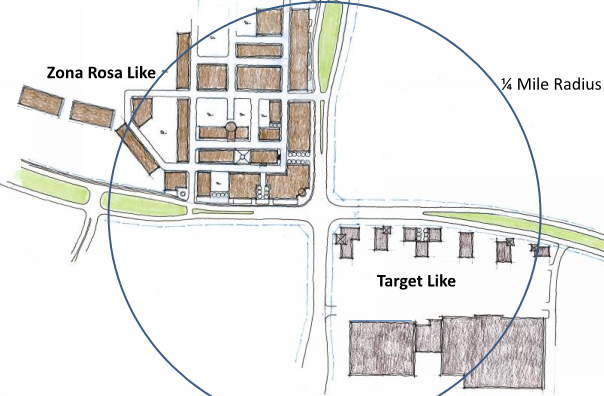
In addition, there are situations where design standards set out for boulevards will be applied to sections of parkways. This occurs where two parkways meet and within a ¼ mile radius (as measured from the centerline) of these intersections — termed development nodes. Where the median width of the parkway is minimized at these intersections (although right-of-way remains a minimum of 150 feet), application of boulevard standards to these development nodes calls for a reduced building setback, and placement of a customer entrance on the front or side façade. This provides a development pattern upon a complete street system, supporting multi-modal transportation, providing safe access for pedestrians, and offering active commercial street frontages.
2.
New Development. Full compliance with the Boulevard and Parkway Standards (as defined in 88-110-03-G, 88-120-03-G, 88-130-04-G, 88-140-03-G, 88-310-02, 88-323, 88-325, 88-331, 88-335, 88-340, 88-375, 88-425, 88-450, 88-810-192, 88-810-512, 88-810-1108 and 88-810-2165, and Tables 110-1, 120-1, 130-1 and 140-1 ("Boulevard and Parkway Standards")) is required for all new buildings/structures constructed within the area defined in the Boulevard and Parkway Standards.
3.
Enlargements and Expansions of Existing Buildings/Structures and Vehicular Use Areas. Full compliance with the Boulevard and Parkway Standards is required if the enlargement or expansion exceeds thirty percent (30%) of the gross square feet of the existing building/structure and for the development of any new or expanded vehicular use area. If the enlargement or expansion is thirty percent (30%) or under, then the Boulevard and Parkway Standards will not apply. All other provisions of the Zoning and Development Code as are applicable will continue to apply.
4.
Façade Changes. Changes to the façades of existing buildings/structures will not require compliance with the Boulevard and Parkway Standards; provided, however, that no façade changes may be made that will increase the building/structure's nonconformity.
5.
Accidental Damage or Destruction. Notwithstanding the provisions of Section 88-610-04-D, nonconforming buildings, structures or uses that are destroyed or damaged in any amount may be restored without coming into compliance with the Boulevard and Parkway Standards. A building permit to reconstruct a destroyed or damaged structure must be submitted or use re-established within 6 months of the date of occurrence of such damage, and once issued, construction must be diligently pursued or the nonconformity will be considered to be discontinued.
6.
Previously Approved Preliminary Plans, Development Plans and Preliminary Plats. Permits may be issued for previously approved site-specific preliminary plans, development plans or preliminary plats that were approved prior to the effective date of the Boulevard and Parkway Standards in accordance with the previously approved plat/plan without compliance with the Boulevard and Parkway Standards.
(Ord. No. 150544, § 1, 7-23-2015; Ord. No. 160341, § 1, 5-12-2016; Ord. No. 160759, § 1, 10-20-2016)
88-323-02 - NON-RESIDENTIAL DEVELOPMENT
88-323-02-A. SITE AND BUILDING ORIENTATION AND SETBACK
1.
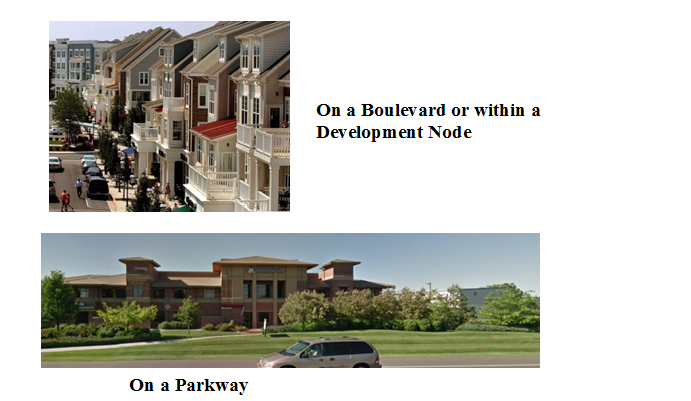
If adjacent to and within 150 feet of a boulevard or within a development node, the principal building shall be set back a maximum of 20 feet from the right-of-way line.
2.
If adjacent to and within 150 feet of a parkway, the principal building shall be set back a minimum of 20 feet from the right-of-way line.
3.
If located on a boulevard or within a development node, a customer entrance of the principal building shall either face the boulevard or parkway or be located on a side façade.
4.
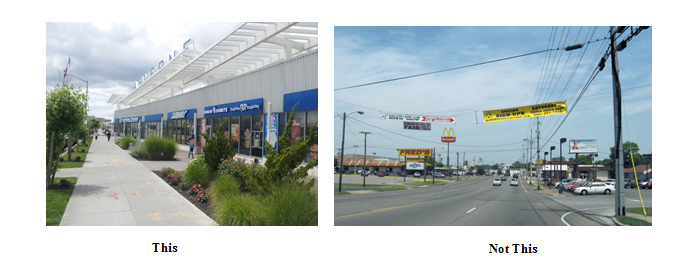
Pedestrian access to a customer entrance shall be via direct access from the public sidewalk or the on-site pedestrian circulation system as shown on the approved development or site plan and in compliance with 88-450.
5.
Any delivery and service access shall be located on the sides or rear of the principal building (façade not facing the boulevard or parkway) and not visible from the boulevard or parkway.
88-323-02-B. SURFACE PARKING
Non-accessory surface parking is prohibited. Accessory surface parking shall be designed and constructed as follows, except as may be otherwise allowed in this section (for lodging uses):
1.
If adjacent to and within 150 feet of a boulevard or within a development node, a vehicular use area must be located on the side or rear of the building. Parking located on the side of the building shall be set back a minimum of 10 feet behind the front building line or 30 feet from the right-of-way, whichever is greater.
2.
If adjacent to and within 150 feet of a parkway, parking located on the side of a building shall be set back a minimum of 10 feet behind the front building line or 30 feet from the right-of-way, whichever is greater.
3.
No more than 30% of a site's frontage adjacent to the boulevard or parkway may be used for vehicular use areas.
4.
If adjacent to and within 150 feet of a parkway, a vehicular use area may be located in front of the building (between the building and the parkway right-of-way line) if the building's main entrance is on the façade facing the parkway and further subject to the following:
a.
The vehicular use area is limited to one row of parking and a two-way aisle;
b.
The vehicular use area must be set back a minimum of 50 feet from the parkway right-of-way line
c.
No more than 30% of the site's frontage (excluding that of parking in front of the building) may be used for vehicular use area.
5.
If adjacent to and within 150 feet of a parkway, and if there is no vehicular use area (except for a circulation drive) in front of the building, more than 30% of the site's frontage may be used for vehicular use area, with provision of setback (determined by the largest resulting dimension for the parcel) as follows:
a.
For one additional bay of 65 foot maximum width (two rows of parking and a two-way aisle), a setback of 50 feet shall be provided;
b.
For an additional two bays of 125 foot maximum width (four rows of parking and two, two-way aisles), a setback of 75 feet shall be provided;
c.
For an additional three bays of 185 foot maximum width (six rows of parking and three, two-way aisles), a setback of 100 feet shall be provided.
Note: Maximum width of bays includes 25 foot wide, two-way, 90 degree aisles and 18 foot deep parking stalls. It does not include required landscaping area per 88-425.
6.
If adjacent to and within 150 feet of a parkway, a circulation drive of maximum 12 feet in width, set back 30 feet from the right-of-way, may be utilized.
88-323-02-C. STRUCTURED PARKING
A structured parking facility shall be designed and constructed in accordance with 88-425-07 Screening of Parking Garages, with additional provisions:
1.
The ground-level street frontage, with the exception of any pedestrian ingress/egress, shall be improved with retail, office, residential, or other uses in accordance with an approved development plan.
2.
No ground level parking spaces shall be located immediately adjacent to the boulevard or parkway. Any spaces located on the ground level shall be behind and concealed by improved space.
3.
Primary vehicular access to the structure shall not be provided via the parkway or boulevard. Any secondary access located on the boulevard or parkway shall be limited to a single, two-way drive. Openings to the parking facility for vehicular or pedestrian use shall be designed so as to obscure parked vehicles. Ramps shall be fully located within the structure.
88-323-02-D. LANDSCAPING AND SCREENING
1.
Landscaping and screening shall be in accordance with 88-425.
2.
Any fencing that is visible from the boulevard or parkway shall be 80% transparent and constructed of high quality, permanent materials. Maximum height shall be 6 feet in the rear and 4 feet in the side. No fencing shall extend beyond the front building line. Fencing must be of steel, iron, concrete, stucco, stone, brick or other acceptable material. Wood picket or stockade fencing is not permitted. Chain link fencing is not permitted, except for the enclosure of a public playfield or a school playfield.
3.
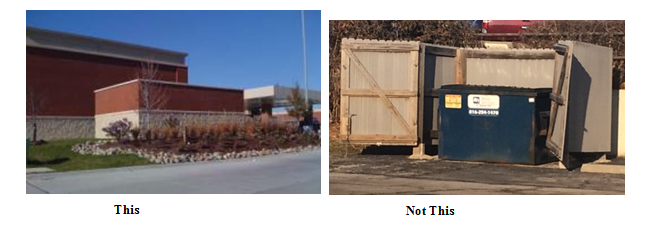
Dumpsters, mechanical equipment and utility cabinets shall be screened in accordance with 88-425-08 and subject to further regulation as follows. Above ground utility cabinets shall be located a minimum of 50 feet from the right-of-way line of the boulevard or parkway. Building mounted equipment shall not be located on the building façade facing the boulevard or parkway.
4.
Outdoor storage is permitted as an accessory use in the B4 and M districts, allowed on a façade not facing the boulevard or parkway and further subject to 88-425-09.
88-323-02-E. ARCHITECTURAL DESIGN
As proposed, the standards for development adjacent to and within 150 feet of boulevard and parkways represent best management practices as found in codes of other cities nationally and internationally. The standards are commonly known and understood by any licensed architect and are deemed to be quantifiable and acceptable. The standards are intended to allow for creativity in design of sites and buildings, while ensuring that the public investment in the asset - the boulevard and parkway system - is protected.
1.
The architectural design and materials of a structure shall be of high quality. When the structure is that of a "national chain," the high quality standard typical of that "national chain" shall be constructed.
2.
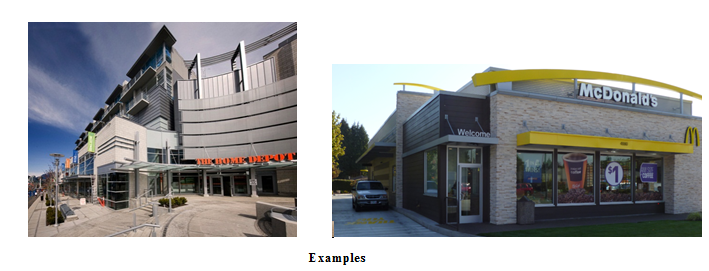
Design, material, and color shall be applied consistently to all façades and reflect the character of the neighborhood, as existing or proposed. The neighborhood is considered the area immediately adjacent to and along that corridor and within the view shed of the corridor. A neighborhood would also be considered the residential component of an approved development plan.
3.
Building exteriors shall be constructed of durable and maintainable materials such as stone, wood, brick, artistic steel, or as otherwise approved. Materials shall not include aluminum or vinyl siding. Materials that have texture, pattern, or lend themselves to a high quality of detailing are encouraged.
4,
Façades shall vary in massing and articulation, including accents, protrusions/recesses, horizontal/vertical elements, variable rooflines, or other design features.
5.
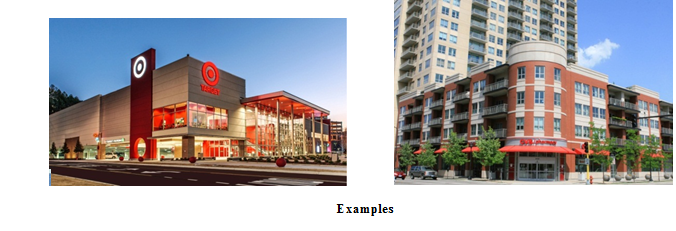
Extensive use of bright or fluorescent colors shall not be permitted.
6.
If adjacent to and within 150 feet of a parkway, structures shall provide a minimum of 33% transparency on the ground level façade facing the parkway.
7.
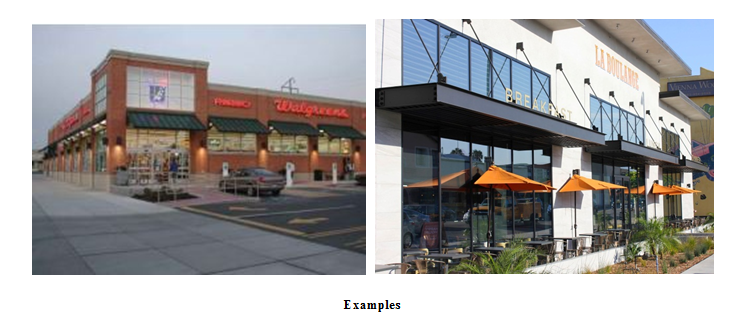
If adjacent to and within 150 feet of a boulevard or within a development node, structures shall provide a minimum of 60% transparency on the ground level façade facing the boulevard or parkway within the development node.
88-323-02-F. ADDITIONAL PROVISIONS FOR SITES WITH LODGING
1.
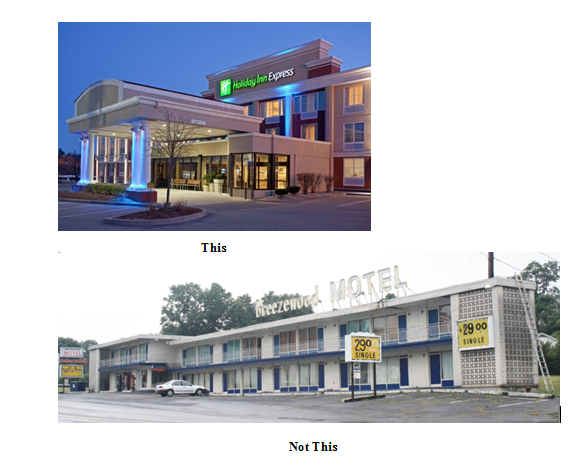
A lodging establishment must contain rooms that open to the interior of the building. Buildings with direct exterior access to guest rooms are not permitted.
2.
To accommodate short-term parking and guest services at the front entry to the lodging establishment, a vehicular use drive may be placed between the front building line and the boulevard or parkway. To integrate this vehicular use area into the building, the area must be covered by a permanent porte-cochere structure which shall be constructed as follows:
a.
the porte-cochere shall extend the width of the drive and be a minimum of 20 feet in length; and
b.
the porte-cochere shall be structurally and architecturally integrated into the building design and considered to be part of the principal building; and
c.
if adjacent to and within 150 feet of a boulevard, the main entrance of the principal building shall be set back a maximum of 20 feet from the right-of-way line; or
d.
if adjacent to and within 150 feet of a parkway, the main entrance of the principal building shall be set back a minimum of 20 feet from the right-of-way line.
88-323-02-G. ADDITIONAL PROVISIONS FOR SITES WITH GASOLINE AND FUEL SALES
1.
A gasoline and fuel sales establishment shall not be permitted on a boulevard or within a development node.
2.
A gasoline and fuel sales establishment may be permitted with special use permit on a tract of minimum two acres located at the intersection of a parkway and an arterial (not a boulevard or parkway as shown on the major street plan), subject to the following:
a.
The canopy, pumps, and any functions associated with gasoline or fuel sales or other vehicular service shall be oriented toward the arterial and not toward the parkway.
b.
Gasoline or fuel sales areas shall be covered by a canopy set back a minimum of 50 feet from the parkway, or 30 feet from the parkway if the 30 foot setback area includes construction of a stone or brick wall or a decorative steel fence along the parkway no greater than 3 feet in height, unless the elevation of the adjacent property is such that a higher or lower wall/fence is appropriate as determined by the Director of City Planning and Development, and landscaping as approved by the Director of City Planning and Development.
c.
Canopy design shall be integrated with that of the principal building in respect to pattern, scale, material, and form.
d.
Vehicular use areas shall be set back a minimum of 50 feet from the parkway, or 30 feet from the parkway if the 30 foot setback area includes construction of a stone or brick wall or a decorative steel fence along the parkway no greater than 3 feet in height, unless the elevation of the adjacent property is such that a higher or lower wall/fence is appropriate as determined by the Director of City Planning and Development, and landscaping as approved by the Director of City Planning and Development.
e.
The site shall contain a retail building that is at least 5,500 square feet in size.
88-323-02-H. ADDITIONAL PROVISIONS FOR SITES WITH VEHICLE SALES AND SERVICE
Any vehicle sales and service establishment permitted by this ordinance (refer to use tables) shall comply with the following provisions:
1.
Any vehicle or light equipment for sale, rental, or service or must be located inside the building.
2.
Any delivery and service access must be located on the sides or rear of the building (façade not facing the boulevard or parkway).
3.
Any function or device (including but not limited to queuing to enter the facility, air pump station, etc.) associated with vehicle or light equipment for sale, rental, or service shall be located on the sides or rear (façade not facing the boulevard or parkway) of the building.
88-323-02-I. ADDITIONAL PROVISIONS FOR INDUSTRIAL USES
Any industrial use permitted by this ordinance (refer to use tables) shall comply with the following provisions:
1.
Any structure or vehicular use area must be set back a minimum of 75 feet from the boulevard or parkway, and the setback area shall be landscaped per 88-425.
2.
Any loading and service doors must be located on the sides or rear (façade not facing the boulevard or parkway) of the building.
(Ord. No. 150544, § 1, 7-23-2015; Ord. No. 160759, § 1, 10-20-2016; Ord. No. 190911, § A, 12-5-2019)
88-323-03 - RESIDENTIAL DEVELOPMENT
88-323-03-A. ONE AND TWO UNIT RESIDENTIAL
1.
One and two unit residential structures located on a boulevard or within a development node shall front onto the boulevard. Front yard setback shall not exceed that required by Table 110-2: Lot and Building Standards.
2.
One and two unit residential structures shall front onto the parkway if located on lots platted to front onto the parkway or within a block where the majority of existing structures front onto the parkway.
3.
One and two unit residential structures fronting onto a parkway shall be set back a minimum of 30 feet from the parkway right-of-way line, or as otherwise determined by provisions of 88-820-09.
4.
One and two unit residential structures siding onto a parkway must be set back a minimum of 45 feet from the parkway right-of-way line, or as otherwise determined by provisions of 88-820-09.
5.
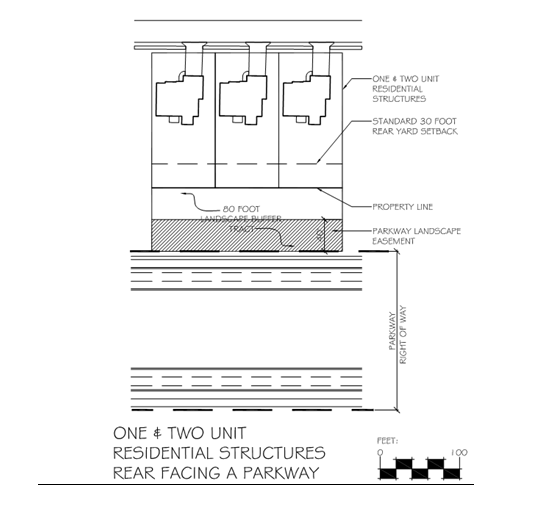
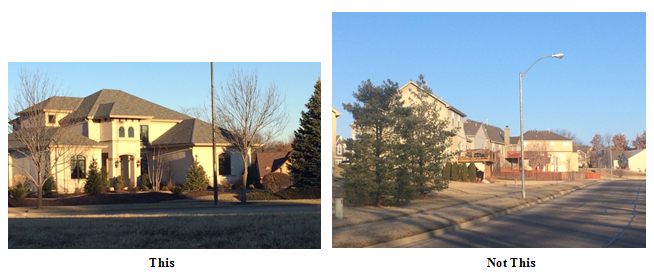
One and two unit residential structures may back onto a parkway, with the following requirements:
a.
a 30 feet rear yard setback per 88-110; and
b.
a 60 feet "no build" landscape buffer to be platted as a tract, of which:
i.
the first 30 feet of the landscape buffer tract, adjacent to the parkway right-of-way, shall be a parkway landscape easement. In general, the city shall be responsible for the maintenance of the 30 foot parkway landscape easement. Landscaping of this portion of the tract shall be done by the developer and occur within one year of platting of this tract or prior to issuance of any building permits for structures on lots within the subdivision, whichever occurs first.
ii.
the next 30 feet adjacent to the residential lots shall be the maintained by a property owner's association. Certain stormwater BMP's may be located within this portion of the tract. A landscape plan must be submitted in accordance with 88-425 and Parks and Recreation Department requirements. Landscaping of this portion of the tract shall be done by the developer prior to issuance of any building permits for structures on lots within the subdivision.
iii.
A covenant to maintain the "no build" landscape buffer tract, describing maintenance responsibilities, shall be recorded with the plat. No buildings, structures, or fences may be erected within this landscaped buffer tract. Any fencing shall be located at the rear of the platted residential lot; shall be of consistent type, material, and height along the rear of the subdivision; and shall be shown on the landscape plan,
6.
For one and two unit residential structures fronting onto a boulevard or parkway, driveway access off the boulevard or parkway is permitted. Where possible, shared driveways or eyebrow streets are encouraged.
7.
Detached garages or carports shall not be located between the boulevard or parkway and the residential structure. If attached, garages or carports facing the boulevard or parkway shall be no closer to the right-of-way line than the longest facing wall of the residential structure.
88-323-03-B. MULTI-UNIT RESIDENTIAL (INCLUDING MULTI- UNIT HOUSE, MULTIPLEX AND MULTI-UNIT BUILDING)
1.
A main entrance to a multi-unit residential structure or to each unit, in the case of a structure with units having individual entrances, shall face the boulevard or parkway. The side may face the boulevard or parkway; however, an additional setback is required.
2.
Driveway access to serve multi-unit residential lots is permitted along boulevards and parkways. Where possible, shared driveways or eyebrow streets are encouraged.
3.
Pedestrian access to a main entrance shall be via direct access from the public sidewalk or the on-site pedestrian circulation system as shown on the approved development or site plan and in compliance with 88-450.
4.
Setback for a multi-unit residential structure located on a boulevard shall not exceed the maximum required front yard setback as stated by Table 110-2: Lot and Building Standards.
5.
A multi-unit residential structure located on a parkway must be set back a minimum of 30 feet from the parkway right-of-way line. A multi-unit structure siding onto a parkway must be set back a minimum of 80 feet from the parkway right-of-way line.
6.
No vehicular use areas may be located between the structure and the boulevard or parkway. Parking shall be located on the side or rear of the structure and set back a minimum of 10 feet from the front building line. When the structure sides upon a parkway (not permitted on a boulevard), parking must be set back a minimum of 80 feet from the parkway right-of-way line.
7.
Detached garages or carports shall not be located between the boulevard or parkway and the residential structure. If attached, garages or carports facing the boulevard or parkway shall be no closer to the right-of-way line than the longest facing wall of the residential structure.
8.
Architectural design and materials of a multi-unit structure shall be of high quality and reflect the character of the neighborhood, as existing or proposed in accordance with an approved development plan, and applied consistently to all façades.
9.
Façades shall vary in massing and articulation by providing accents, protrusions/recesses, horizontal/vertical elements, variable rooflines, and other design.
10.
Roof-mounted mechanical equipment must be screened per 88-425-08.
11.
Landscaping and screening shall be in accordance with 88-425.
88-323-03-C. INFILL OR PREVIOUSLY APPROVED HOUSING
Notwithstanding any of the requirements in 88-323-03, any principal residential structure may be designed and constructed to face the street that any existing, immediately adjoining principal residential structure faces and may be set back the same distance from the street as the existing, immediately adjoining principal residential structure. A principal residential structure may be designed and constructed to face the street and be set back from the street in accordance with any city council approved plat or development plan.
(Ord. No. 150544, § 1, 7-23-2015)
88-327-01 - PURPOSE AND APPLICABILITY
The purpose of these standards is to permit communications service establishments in more districts due to their limited impact on adjacent properties while also acknowledging that such uses may negatively impact pedestrian-oriented areas of the city due to the relative lack of pedestrian traffic they generate. These standards allow the uses in more districts when the impact is minimized.
(Ord. No. 231047, § 2, 3-7-2024)
88-327-02 - IN DISTRICT R-80
88-327-02-A. Communications service establishments with a gross floor area of more than 8,000 square feet but less than 40,000 square feet shall require approval of a special use permit.
88-327-02-B. Communications service establishment with a gross floor area of 40,000 square feet or more shall require review and approval of a development plan.
(Ord. No. 231047, § 2, 3-7-2024)
88-327-03 - IN B & D DISTRICTS
88-327-03-A. Communications service establishments shall not occupy the ground floor of any building with street frontage. For the purposes of this section, a building with street frontage is any building located within 50 feet of a street right-of-way line.
88-327-03-B. Communications service establishments with a gross floor area of more than 8,000 square feet but less than 40,000 square feet shall require review and approval of a special use permit.
88-327-03-C. Communications service establishments with a gross floor area of 40,000 square feet or more shall require review and approval of a development plan.
(Ord. No. 231047, § 2, 3-7-2024)
88-328-01 - APPLICABILITY
Composting facilities are subject to the following standards in addition to any standards imposed as part of the special use approval process.
88-328-02 - STANDARDS AND CONDITIONS
88-328-02-A. The lot must have a minimum area of at least 40,000 square feet per 1,000 cubic yards of compost material;
88-328-02-B. Windrows of compost material must be set back at least 250 feet from all property lines and at least 500 feet from any residential dwelling unit;
88-328-02-C. No portion of the facility may be located within any portion of a required stream buffer;
88-328-02-D. As part of the special use permit approval process, the owner must submit a plan of operation, detailing such information as how often the windrows will be turned, the type of machinery that will be used, hours of operation, methods to control litter and odors, and the intended use of the end product.
(Ord. No. 120783, § 1, 10-4-2012)
88-330-01 - FAMILY DAY CARE
Family day care homes in AG-R, R-80, R-10, R-7.5, R-6, R-5, and R-2.5 districts are subject to the following standards:
88-330-01-A. The predominant use of the premises must be residential.
88-330-01-B. The use must be carried on or conducted by members of a family residing in the dwelling.
88-330-01-C. All open play areas must be completely enclosed with a tight fence at least 4 feet in height.
(Ord. No. 120783, § 1, 10-4-2012; Ord. No. 140919, § A, 11-13-2014)
88-330-02 - GROUP DAY CARE
Group day care facilities may be allowed in R-80, R-10, R-7.5, R-6, R-5, and R-2.5 districts subject to the following standards:
88-330-02-A. The property must have a minimum lot area of 20,000 square feet and must have a minimum lot width of 100 feet.
88-330-02-B. At least 500 square feet of lot area must be provided per each enrollee.
88-330-02-C. Side setbacks must be at least 100% greater than the minimum side setback required in the district.
88-330-02-D. At least 100 square feet of open play space must be provided on the lot for each enrollee.
88-330-02-E. All open play areas must be completely enclosed with a tight fence at least 4 feet in height.
88-330-02-F. The property must front on a collector or higher classification street.
88-331-01 - Standards
88-331-01-A. At the time of original approval, no such establishment shall be located within 1,000 feet of another day labor establishment, or within 500 feet of a children's nursery or boarding home, a group day care home, a daycare facility, a school, or a package liquor store; or a park, boulevard, or parkway, with separation measured in accordance with 88-820-15.
88-331-01-B. At the time of original approval, no such establishment shall be located on a lot contiguous with or directly across the street or an alley from any property zoned residential.
88-331-01-C. Parking with paving and screening shall be as required by 88-420 and 88-425. Adequate off-street paved surfaces shall be provided for the loading and unloading of workers in conformance with Chapter 52 and 88-420.
88-331-01-D. The applicant shall demonstrate that there shall be no negative impact on properties within 500 feet of the proposed establishment.
88-331-01-E. The permit shall be limited to a two-year period but may be renewed by the board after a public hearing; provided, however, at the time of renewal, the applicant shall demonstrate that the establishment has not had a negative impact on properties within 500 feet and that the establishment has complied with the provisions of Chapter 56, the property maintenance code.
(Ord. No. 150544, § 1, 7-23-2015; Ord. No. 160341, § 1, 5-12-2016)
88-332-01 - DEFINITION
Dedicated pickup areas are vehicular use areas permanently designed and arranged for drive-up services including but not limited to the delivery of a product sold onsite to an individual in their vehicle, whether that individual is the end consumer or a delivery service employee, or ride services offered to patrons who will or have obtained a product or service available onsite.
(Ord. No. 220398, § 1, 5-19-2022)
88-332-02 - PURPOSE
The purpose of these standards is to acknowledge the rapid changes in shopping and transportation technologies and their impacts including the safety of persons involved, signage and lighting.
(Ord. No. 220398, § 1, 5-19-2022)
88-332-03 - APPLICABILITY
These standards apply to all principal uses with dedicated pickup areas as defined by 88-332-01.
(Ord. No. 220398, § 1, 5-19-2022)
88-332-04 - STANDARDS
88-332-04-A. LOCATION
After accessible parking spaces are established, dedicated pickup spaces shall be located on the shortest path to the entrance used by employee or patron. Facilities with multiple such entrances may disperse dedicated pickup spaces.
88-332-04-B. SIGNS
1.
Non-illuminated permanent wayfinding signs for the purpose of directing drivers and pedestrians to the dedicated pickup area are permitted so long as such signage does not exceed four feet in height, is located onsite, is necessary to direct traffic and for pedestrian safety, and does not impede the safe and efficient flow of pedestrian and vehicular traffic; and
2.
Permanent pickup area signs are permitted at a rate of one sign per parking space within the dedicated pickup area when such signs do not exceed 6 feet in height and 10 square feet in area. Permanent pickup area signs are permitted at a rate of one sign per two parking spaces within the dedicated pickup area when such signs exceed 6 feet in height and 10 square feet in area. In no case shall these signs exceed 12 feet in height or 20 square feet in area. If illuminated such signs shall be internally illuminated.
88-332-04-C. STRIPING
1.
In cases where two or more spaces are located within a dedicated pickup area the area between and around the spaces shall be striped in a manner which clearly delineates pedestrian zones from the parking space to ensure pedestrian safety.
2.
In cases where pedestrians must cross a drive-aisle to access the dedicated pickup area a striped crosswalk shall be provided to alert drivers for pedestrian safety.
88-332-04-D. NO IDLING
1.
Pavement marking or signage shall be located at each spot directed toward drivers that idling is not permitted.
88-332-04-E. EFFECT ON MINIMUM PARKING REQUIREMENTS
1.
For every 1 space provided in the designated pickup area a total of 5 spaces may be subtracted from the minimum number of parking spaces required by Section 88-420-06 and Table 420-1 of this zoning and development code, except that in the case of eating and drinking establishments, 10 spaces may be subtracted from the minimum number of required parking spaces for each individual space provided in the designated pickup area. Notwithstanding the foregoing, in no case shall the total number of parking spaces provided fall below 50 percent of the minimum required by Section 88-420-06 and Table 420-1 of this zoning and development code.
(Ord. No. 220398, § 1, 5-19-2022)
88-335-01 - STANDARDS
Detention and correctional facilities are subject to the following standards:
88-335-01-A. The property must have a minimum lot area of 2 acres.
88-335-01-B. No such facility may be on property located within 1,000 feet of a R zoning district or within 1,000 feet of any residential dwelling unit; school; library, museum, or cultural exhibit; community center; park, boulevard, or parkway; religious assembly use; or day care use; with separation measured in accordance with 88-820-15. Notwithstanding the foregoing, when such facility is located or proposed to be located on property that abuts the Missouri River, Kansas River, or Blue River, the separation distance required by this subsection shall be 400 feet only for that portion of the property abutting such rivers.
88-335-01-C. All outdoor recreation areas and all structures to be occupied by inmates must be set back a minimum of 200 feet in the R-80 district and 25 feet in M districts.
88-335-01-D. The property on which the facility is to be located must provide a minimum lot area of 350 square feet per occupant.
(Ord. No. 150544, § 1, 7-23-2015; Ord. No. 160341, § 1, 5-12-2016; Ord. No. 250008, § 1, 1-16-2025)
88-338-01 - BUILDING AND SITE DESIGN STANDARDS
The regulations of this article are intended to preserve and enhance the character of pedestrian-oriented streets within the downtown loop and, in turn, to activate building facades, promote street-level activity, economic vitality, and pedestrian safety and comfort. The standards of this article apply to all development within the area defined as the downtown loop, unless otherwise expressly stated.
88-338-01-A. BUILDING PLACEMENT
1.
Buildings must abut or be located within 5 ft. of the public sidewalk adjacent to the front property line.
2.
Buildings placement standards do not apply to arcades, public plazas, or recessed entries, in accordance with an approved development or site plan.
88-338-01-B. GROUND-FLOOR TRANSPARENCY
1.
At least 60% of the street-facing building facade between 4 feet and 10 feet above the sidewalk must be comprised of windows that allow views of indoor commercial space, or product display areas, or display of art, murals, or interactive lighting. On corner lots, this 60% transparency requirement applies only along one street. The minimum transparency standard abutting secondary streets is 40%.
2.
Display windows that do not provide views into the interior of the building may be counted towards satisfying up to 50% of the minimum transparency requirements, provided that they are internally illuminated and are at least 2 feet in depth.
3.
The bottom of any window or product display window used to satisfy these transparency requirements may not be more than 4.5 feet above the adjacent sidewalk.
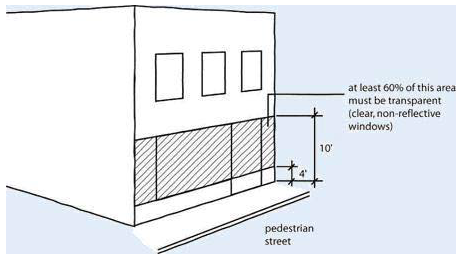
88-338-01-C. DOORS AND ENTRANCES
1.
Buildings must have a working public entrance door facing the street. Entrances at building corners may be used to satisfy this requirement.
2.
Building entrances may include doors to individual shops or businesses, lobby entrances, entrances to pedestrian-oriented plazas, or courtyard entrances to a cluster of shops or businesses.
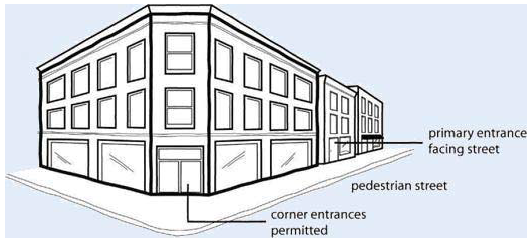
88-338-01-D. PARKING
1.
Parking and loading shall be provided in accordance with 88-420 and as further exempted by 88-420-09.
2.
Any off-street parking that is provided must be located behind the building or within or under the building.
3.
When the depth of the lot is insufficient to permit required parking to the rear of the building, parking may be located to the side of the building, provided that it does not occupy more than 50% of the street frontage and that it is screened from view of the street in accordance with 88-425 Landscaping and Screening.
88-338-01-E. DRIVEWAYS AND VEHICLE ACCESS
1.
Driveways and vehicle access, when provided, must come from an alley or side street if either is present.
88-338-01-F. GROUND FLOOR COMMERCIAL SPACE
1.
Minimum floor-to-ceiling height of all ground floor space within the building shall be 13 feet.
(Ord. No. 150378, § A, 5-21-2015; Ord. No. 151013, § A, 12-10-2015)
88-338-02 - DRIVE-THROUGH FACILITIES
88-338-02-A. A drive-through facility shall not be a principal use of the parcel, but rather shall be accessory to a principal building on the parcel.
88-338-02-B. The principal building shall be located on the front property line, so as to form a street edge.
88-338-02-C. All functions associated with the drive-through use shall be located on the sides or rear (not facing the street) of the principal building, but may be underneath a portion of the principal structure.
88-338-02-D. A permanent porte-cochere structure shall be constructed, extending from the public right-of-way line to over the drive-through service windows. The porte-cochere(s) shall extend the width of the drive and be a minimum of 20 feet in length. The porte-cochere shall be structurally integrated with the principal building and its design shall be consistent in respect to pattern, scale, material, and form.
88-338-02-E. Building materials used on the drive-through establishment shall be applied to all four elevations and be consistent with those of the principal building so as to form a cohesive vision.
88-338-02-F. The nearest point of the drive-through operation of any establishment, including the drive-through lane, menu board, and service windows, must be at least 50 feet from the boundary of a residentially zoned district.
88-338-02-G. Each drive-through facility must provide a minimum of 80 feet of vehicle stacking area (queue space) between the right-of-way and the first point of service to accommodate waiting vehicles and to ensure that no motor vehicles will block pedestrian traffic on public sidewalks or vehicular traffic on public streets. The stacking area must be designed to accommodate safe and efficient on-site circulation and parking space access.
88-338-02-H. Service windows shall be a minimum of 25 feet behind the front façade (nearest the public right-of-way) of the principal building.
88-338-02-I. Ingress and egress lanes to the drive-through facility shall be from a side street or alley, unless as otherwise permitted in conjunction with a development plan or site plan.
88-338-02-J. Ingress and egress lanes should be separated, with the ingress lane no wider than 12 ft. and the egress lane no wider than 24 ft.
88-338-02-K. Traffic flow through the site shall be one-way.
88-338-02-L. Direct pedestrian access from public streets and sidewalks to the building entrances shall be provided.
88-338-02-M. Pedestrian walkways and crossings upon the site shall be clearly marked or distinguished to avoid conflict between pedestrians and traffic through the use of raised pedestrian crossings, change in paving material or embossed striping, bollards, landscaping, or other approved method. Painted striping does not meet this requirement.
88-338-02-N. A drive-through use adjacent to and within 150 ft. of a boulevard or parkway must comply with standards of 88-323.
88-338-02-O. "No Idling" or "Idle-Free Zone" signs must be posted in all off-street loading areas.
(Ord. No. 150378, § A, 5-21-2015)
88-338-03 - VEHICULAR USE AREA LANDSCAPING AND SCREENING
Landscaping and screening of vehicular use areas within the downtown loop shall be in accordance with pertinent provisions of 88-425 Landscaping and Screening.
(Ord. No. 150378, § A, 5-21-2015)
88-339-01 - PURPOSE
The purpose of these standards is to limit the negative impact of data centers on surrounding land uses and ensure that adequate public utilities are .available. These standards allow data centers in more districts when the impact is minimized to improve active uses that support the vitality of the public realm adjacent to a building and encourage walk-in traffic.
(Ord. No. 251031, § 6, 1-15-2026)
88-339-02 - REVIEW CRITERIA
88-339-02-A. In addition to any other applicable review criteria when evaluating applications for special use permit or development plan, review bodies shall also consider the commitment by local utility providers to provide adequate service to the proposed data center.
(Ord. No. 251031, § 6, 1-15-2026)
88-339-03 - IN ALL PERMITTED DISTRICTS
88-339-03-A. All data centers are required to submit a Service Availability (Will Serve) Letter from local utility providers that confirms the capacity and commitment to serve the utility demand for the proposed data center. The letter shall be submitted the time of the filing of application for special use permit or development plan.
88-339-03-B. Data centers with a continuous gross floor area of more than 500,000 square feet shall be considered a large format use and subject to the requirements of Section 88-353.
(Ord. No. 251031, § 6, 1-15-2026)
88-339-04 - IN B & D DISTRICTS
88-339-04-A. Data centers shall require review and approval of a special use permit.
88-339-04-B. Data centers may not exceed more than 50% of the ground floor gross floor area of any building with street frontage. For the purposes of this section, a building with street frontage is any building located within 50 feet of a street right-of-way line.
88-339-04-C. Data centers shall maintain all transparency requirements of the underlying zone or overlay district.
(Ord. No. 251031, § 6, 1-15-2026)
88-340-01 - PURPOSE
The regulations of this article are intended to reduce impacts that may be created by drive-through facilities. The following regulations aim to reduce visual impacts of drive-through activities on abutting uses, promote safer and more efficient on-site vehicular and pedestrian circulation, and reduce conflicts between queued vehicles, pedestrians, and traffic on adjacent streets.
(Ord. No. 170118, § A, 4-13-2017)
88-340-02 - STANDARDS
88-340-02-A. IN ALL PERMITTED LOCATIONS
1.
Drive-through functions shall not be located in the front and/or street side yard unless screened in accordance with 88-340-03.
2.
Each drive-through facility must provide 80 feet of vehicle stacking area (queue space) between the right-of-way and the first point of service to accommodate waiting vehicles. "No Idling" or "Idle-Free Zone" signs must be posted in all stacking areas. Stacking areas adjacent to streets shall be screened in accordance with 88-425-05-B.
3.
The nearest point of the drive-through operation of any establishment, including the drive-through lane, menu board, and service windows, must be at least 50 feet from the boundary of an R or DR district.
88-340-02-B. ADJACENT TO AND WITHIN 150 FEET OF A PARKWAY AND/OR BOULEVARD
In addition to 88-340-02-A, the following applies for any drive-through facility that is located adjacent to and within 150 feet of a parkway and/or boulevard:
1.
A permanent porte-cochere structure shall be constructed over the drive- through service windows. The porte-cochere(s) shall extend the width of the drive and be a minimum of 20 feet in length. The porte-cochere shall be structurally integrated with the principal building and design shall be consistent in respect to pattern, scale, material, and form.
2.
For any drive-through restaurant facility adjacent to and within 150 feet of a boulevard or parkway, there shall be a maximum of one lane on each side of the principal structure.
3.
Drive-through functions and required vehicle stacking areas shall not be located in the front and/or street side yard.
4.
Service windows shall be a minimum of 25 feet behind the front facade (nearest the public right-of-way) of the principal building.
5.
Drive-through facilities shall comply with all other applicable requirements of 88-323.
(Ord. No. 170118, § A, 4-13-2017)
88-340-03 - SCREENING OF DRIVE-THROUGH FUNCTIONS
One of the following screening options may be used to screen views of drive-through functions from streets.
88-340-03-A. GRADE CHANGES
Grade changes may serve as screening of drive-through functions when the site is located below grade and not visible from the adjacent street. A section drawing of the street and subject site shall be provided to show that all views of the drive-through functions will be obscured from the street.
88-340-03-B. LANDSCAPE AREA
A landscape area adjacent to the street right of way in the front and/or street side yard shall be installed and located in the area of the setback from the street right-of-way. The landscape area shall be planted with enough evergreen shrubs and/or native grasses to form a low continuous visual screen at least 3 feet in height after the first growing season, and the landscaping installed in this landscape area shall be in addition to the landscaping required by 88-425.
88-340-3-C. LANDSCAPE ISLAND
A landscape island may be provided next to the drive-through lane which shall be a minimum of five feet in width and shall be planted with enough evergreen shrubs and/or native grasses to form a low continuous visual screen of the drive-through functions at least 3 feet in height after the first growing season.
88-340-03-D. WALLS
A solid masonry wall 3 feet in height, with evergreen shrubs and/or native grasses planted on the street side of the wall to form a low continuous visual screen at least 3 feet in height after the first growing season. Masonry walls shall have openings as necessary to provide pedestrian access to the site.
88-340-03-E. BERMS
A series of berms planted with offset rows of evergreen shrubs and/or native grasses to form a low continuous visual screen at least 3 feet in height after the first growing season.
88-340-03-F. PORTE-COCHERE
A permanent porte-cochere may be used to screen drive-through service windows. The porte-cochere shall extend the width of the drive and be a minimum of 20 feet in length. The porte-cochere shall be structurally integrated with the principal building and design shall be consistent in respect to pattern, scale, material, and form.
(Ord. No. 170118, § A, 4-13-2017)
88-345-01 - CEMETERIES
The following standards apply to cemeteries in R-0.5, R-0.3, DC, CX, and B1 districts:
88-345-01-A. The property must consist of not less than 5 acres of land in a single tract or parcel not intersected or divided by any street, alley or property belonging to any other owners; provided that this 5-acre requirement does not apply if the funeral home is located within a cemetery that consists of at least 50 acres of land.
88-345-01-B. The property must have at least a 500-foot frontage on a major thoroughfare.
88-345-01-C. The entrance and exit must be directly to and from a major thoroughfare or parkway.
88-345-01-D. No principal building or accessory building must be within 100 feet of the boundary of an adjoining property which is located in an R-10 through R-0.3, inclusive, O, and B1 district. No driveway or parking area must be within 25 feet of the boundary of an adjoining property which is located in an R-10 through R-0.5 district, inclusive. For any funeral home located within a cemetery consisting of at least 50 acres of land, no setbacks are required from the cemetery property.
88-345-02 - CREMATION
88-345-02-A. In addition, the following use standard applies for cremation establishments in R-10 through R-0.3, inclusive, B1 through B4 district, inclusive, as part of the special use approval process:
88-345-02-B. Cremation must be in conjunction with a cemetery, columbarium, or mausoleum.
88-347-01 - APPLICABILITY; EXEMPTIONS
88-347-01-A. APPLICABILITY
The following standards apply to gasoline and fuel sales uses in all districts. Unless expressly stated otherwise, existing gasoline and fuel sales uses shall demonstrate compliance with these standards at such time that modifications to the use, property, or building are made as set forth below.
1.
New Development. Full compliance with this section is required for all new structures.
2.
Enlargements and Expansions. Full compliance with this section is required for any improvements or modifications that constitute a major amendment pursuant to Section 88-525-14-A, regardless of whether the gasoline and fuel sales use holds a special use permit. Full compliance with this section is required only for the enlargement or expansion area.
3.
Façade Changes. Compliance with building design and operations standards of this ordinance is required for façade changes to existing buildings.
4.
Change of Use or Occupancy. Compliance with parking and loading, screening and fencing, and signage standards is required whenever the use or occupancy of a property changes.
5.
Previously Approved Preliminary Plans and Development Plans. Permits may be issued for previously approved site-specific preliminary plans and development plans, including UR and MPD plans that were approved prior to the effective date of this section in accordance with the previously approved plan and shall be in compliance with 88-347-02-B through 88-347-02-D.
88-347-01-B. EXEMPTIONS
New gasoline and fuel sales uses may be approved through an approved development plan pursuant to 88-517-09-D without a special use permit. The new gasoline and fuel sales establishment shall comply with the standards of this section.
(Ord. No. 240861, § 1, 9-26-2024)
88-347-02 - DESIGN STANDARDS
88-347-02-A. LOCATION
1.
No such establishment shall be located within 2,000 feet of any existing gasoline or fuel sales establishment, measured pursuant to Section 88-820-15.
2.
No such establishment shall be located within 200 feet of a residential (R) zoning district, measured per Section 88-820-15.
88-347-02-B. SITE AND BUILDING LAYOUT
1.
All public entrances and exits shall be visible from a street.
2.
Any exterior seating areas shall be located adjacent to the front or side of a building.
3.
Areas intended for public access shall be clearly delineated from private areas through design elements including but not limited to landscaping, decorative fencing, and lighting.
4.
The primary public entrance shall be a minimum of 35% transparency, lying between 3 feet and 10 feet above adjacent outside grade.
5.
Glass in ground floor windows, doors, and display windows shall be transparent or lightly tinted, maintain a visible light transmittance from both inside and outside with a minimum visible light transmission (VLT) of 35%. Mirrored or darkly tinted glass is not permitted.
88-347-02-C. LANDSCAPING AND SCREENING
1.
Garbage receptacles, dumpsters, open storage areas and/or mechanical equipment must be a minimum twenty-five (25) feet from any property zoned for detached residential uses, screened in accordance with 88-425-08, and remain in compliance with Chapter 48.
2.
Dumpster enclosures shall have securable or lockable gates. Failure to secure the gate when not in use shall constitute a violation of this provision.
3.
The dumpster enclosure gate/entrance shall be either;
a.
Raised 6 inches to 1 foot from the ground, or
b.
Constructed of slats with 2 inch spacing.
All sides and elevations of buildings or walls visible from public right-of-way or an adjacent parcel must be architecturally finished and maintained.
88-347-02-D. LIGHTING
1.
Building-mounted downlighting is required on all sides of the building accessible to pedestrians.
2.
Pedestrian-scaled lighting is required along all pedestrian routes.
3.
All lighting shall be controlled by photoelectric means.
4.
Light levels shall be in accordance with the following standards:
a.
Minimum lighting levels of 5.0 foot-candles shall be maintained all building entrances.
b.
Canopy structures shall include a minimum lighting level of 10.0 foot-candles and a maximum lighting level of 45.0 foot-candles. Fuel pumps not covered by a canopy shall be lit with a minimum lighting level of 5.0 foot-candles.
c.
Lighting under any canopy area shall use recessed fixtures.
d.
Photometric levels adjacent to a dumpster shall be a minimum of 5.0 foot-candles.
5.
Unshielded decorative lighting that causes glare, including but not limited to luminous tube (neon), string, rope, tape LED, fluorescent, or other similar lighting is prohibited unless explicitly identified on building elevations and approved through a special use permit.
6.
No light pole shall exceed 22 feet in height.
(Ord. No. 240861, § 1, 9-26-2024)
88-347-03 - OPERATIONS
1.
Operations shall be in full compliance with all City Code, including the Zoning Ordinance, Nuisance Code, and Building Code.
2.
Property Maintenance
a.
Views of windows, building address numbers, walkways and the line of vision to the establishment from the public right-of-way, except for street trees. Street trees are permitted to be located within the line of vision.
b.
Reasonable pruning, trimming, or other suitable and acceptable methods shall be used to control vegetation. Vegetation and landscape areas shall be maintained substantially debris-free, neat and orderly in appearance, and in healthy growing condition. Dead vegetation shall be removed or replaced.
c.
Vegetation shall not interfere or obstruct any lighting required by this Chapter.
d.
The passage or movement of pedestrians or vehicles on any sidewalk, driveway, parking lot, or any other area intended for the use of pedestrians or vehicles shall not be obstructed or interfered with by vegetative overgrowth.
3.
Outdoor display areas (i.e. ice coolers, propane exchange lockers, display of firewood, windshield wiper fluid) shall not be located in front of windows.
(Ord. No. 240861, § 1, 9-26-2024)
88-350-01 - APPLICABILITY AND STANDARDS
Group living uses in R districts are subject to the following standards:
88-350-01-A. Group living uses are allowed only in the types of residential buildings allowed in the subject zoning district, as identified in 88-110-0400.
88-350-01-B. Lots to be occupied by group living uses must have at least 500 square feet of lot area per resident or patient, based on the maximum resident/patient capacity.
88-350-02 - NURSING HOMES
In addition, the following use standards apply for nursing homes in R-80, R-10, R-7.5, R-6, R-5, R-2.5 as part of the special use approval process:
88-350-02-A. The property must have a minimum lot area of 20,000 square feet and must have a minimum lot width of 100 feet.
88-350-02-B. Side yards must be at least 100 percent greater than the side yard required in the district.
88-350-02-C. Off-street parking must be provided for on the basis of one space for each living unit or, in the case of dormitory design, one space for each four beds and one space for each four employees.
88-350-02-D. The number of beds, if dormitory design, may not exceed 6 times the number of dwelling units per square foot of lot area in the district in which the use is located; or the number of living units may not exceed twice the number of dwelling units per square foot of lot area in the district in which the use is located.
88-352-01 - STANDARDS
Halfway houses are subject to the following standards:
88-352-01-A. There shall be a minimum floor area of 100 square feet per resident and resident staff.
88-352-01-B. At the time of original approval, no facility shall be located within 1,500 feet of another such facility, group living, day care; and no facility shall be located within 500 feet of a school, with separation measured in accordance with 88-820-15. The board of zoning adjustment may waive this requirement if the facilities are separated by a major thoroughfare, railroad track, major waterway, or other comparable manmade or natural barrier.
88-352-01-C. The permit shall be limited to a two-year period but may be renewed by the board of zoning adjustment after public hearing; provided, however, that at the time of renewal the applicant shall demonstrate that the facility has not had a negative impact on properties within 500 feet and that the facility has complied with the provisions of Chapter 56, the Property Maintenance Code.
(Ord. No. 160341, § 1, 5-12-2016)
88-353-01 - PURPOSE; APPLICABILITY
88-353-01-A. PURPOSE
These regulations support the economic viability of large format uses; promote employment growth; prevent encroachment into planned or existing residential neighborhoods; minimize the impacts of construction vehicles and heavy truck traffic on the transportation network; and consider adequate infrastructure capacity, including electricity, water, and other essential utilities.
88-353-01-B. APPLICABILITY
Unless expressly stated otherwise, large format uses shall demonstrate compliance with these standards at such time that modifications to the property or building are made as set forth below.
1.
New Development. Full compliance is required for all new structures.
2.
Enlargements and Expansions. Full compliance is required for any improvements or modifications that constitute a major amendment pursuant to Section 88-516-06. Full compliance with this section is required only for the enlargement or expansion area.
3.
Previously Approved Preliminary Plans and Development Plans. Permits may be issued for previously approved site-specific preliminary plans and development plans, including UR and MPD plans that were approved prior to the effective date of this section in accordance with the previously approved plan pursuant to Section 88-516-07.
(Ord. No. 251031, § 5, 1-15-2026)
88-353-02 - STANDARDS
88-353-02-A. IN ALL PERMITTED DISTRICTS
1.
Large format uses shall require review and approval of a traffic impact study.
2.
Large format uses shall not produce odors, dust, vibration, noise; spillover light, or other external impacts that are detectable beyond the property lines of the subject property.
3.
All large format uses are required to submit a Service Availability (Will Serve) Letter from local utility providers that confirms the capacity and commitment to serve the utility demand for the proposed large format use. The letter shall be submitted at the time of the filing of application for development plan.
4.
Large format uses shall be subject to any adopted zoning overlay or special character area design guidelines.
5.
Any fence in the front or street-side yard shall be wrought iron or other similar transparent decorative metal fencing and may exceed the height limitations in Section 88-425. Chain-link fencing is not permitted on front or street-side frontages. Fences directly abutting an R or DR district shall be masonry, wrought iron or other similar decorative metal fencing. Required landscape buffers shall be on the exterior of the fence. The fence may run between buildings to reduce the amount of fencing required. Fencing shall not include any barbed wire or razor wire.
88-353-02-B. WITHIN 100 FEET OF R OR D DISTRICTS OR RESIDENTIAL USES
In addition to 88-353-02-A, the following facade, articulation, and composition requirements shall apply to any building facade located within 100 feet of an R or D district or within 100 feet of a residential building zoned UR or MPD. In the case of a residential building zoned UR or MPD, the distance shall be measured from the external wall of the large format use closest in proximity to the residential building to the closest point of the property line of the property containing the residential building.
1.
Architectural Materials. A minimum of 40% of front and street-side facades and a minimum of 20% of side and rear facades shall be comprised of at least two of the following elements. Percentages are calculated as the total building facade area and can be comprised of any combination of the following architectural materials.
a.
Exterior colors, finishes and materials other than the primary color or smooth cast-concrete. Acceptable materials may include metal composite panels, stone, wood, brick, glass block, tile, cast metal, cast, split-face CMU, cultured stone, textured or patterned concrete panels, other forms of masonry panels, or similar as determined by the city planning and development director. Concrete block, cinderblock, corrugated metal, and similar materials are permitted building materials, but do not count towards the Architectural Materials requirement.
b.
Windows or glazing (windows may be transparent, opaque, mirrored or spandrel glass)
c.
Architectural grilles and/or decorative screens
2.
Building Design Elements. Front and street-side facades shall include at least four of the following elements for every 500 linear feet of building facade. Side and rear facades shall include at least two of the following elements for every 500 linear feet of building facade.
a.
Louvered or vertical sunshades
b.
Awnings or canopies
c.
Pilasters or columns distributed evenly across the facade
d.
Water table consisting of masonry that extends at least 3 feet above the ground
e.
Articulated columns
f.
Embedded linear glow or accent lighting
g.
Building projections of greater than 5 feet in depth; evenly distributed across the facade
h.
Change in roofline height or angle such as a butterfly roof, curved roofline, parapet, or shed roof
i.
Modulated building heights 5 feet or greater
j.
Accentuated building entrance including multistory windows, and entrance canopies or trellises, and clerestory windows
k.
Horizontal roofline banding
3.
Site Design Elements. The required Architectural Materials or Building Design Elements may be satisfied through the provision of Site Design Elements, as specified in Table 353-1. Each Site Design Element reduction shall be applied to both the Architectural Materials requirement and the Building Design Elements requirement.
a.
Applicants shall identify the Site Design Elements utilized and the specific requirement being offset at the time of development plan review.
b.
If the development fails to maintain the site design elements approved through the development plan the development shall be required to comply with the Architectural Materials and Building Design Elements outlined above.
4.
Alternative compliance plans that differ from the requirements of 88-353-02-B are subject to approval by the city planning and development director. Alternative compliance plans shall render equal or greater design benefits than those outlined in this section.
(Ord. No. 251031, § 5, 1-15-2026)
88-353-03 - SCREENING OF LARGE FORMAT USE FEATURES
88-353-03-A. BUFFER TYPES
1.
All large format uses shall provide screening, in addition to any other screening requirements outline.cl in 88-425, from the following features in accordance with Table 353-2. If a feature requires multiple buffer types, the stricter requirement shall apply.
2.
Alternative compliance plans that differ from the requirements of 88-353-03-A are subject to approval by the city planning and development director. Alternative compliance plans shall render equal or greater screening benefits than those outlined in this section.
(Ord. No. 251031, § 5, 1-15-2026)
88-354-01 - APPLICABILITY
Marijuana facilities authorized by article XIV, sections 1 and 2 of the Missouri Constitution must be licensed by the Missouri Department of Health and Senior Services, or its successor entity.
(Ord. 190430, § A, 7-11-2019; Ord. No. 230124, § 1, 2-9-2023; Ord. No. 240411, § 1, 9-12-2024)
88-354-02 - STANDARDS AND CONDITIONS FOR ALL MARIJUANA FACILITIES
All marijuana facilities licensed by the Missouri Department of Health and Senior Services, and authorized to operate under article XIV, sections 1 and 2 of the Missouri Constitution, shall operate according to the local regulations applicable to all properties in zoning districts which allow the use of marijuana facilities.
88-354-02-A. DISTANCE REQUIREMENT FROM SCHOOLS
All comprehensive or medical marijuana cultivation facilities, comprehensive or medical marijuana-infused products manufacturing facilities, and marijuana testing facilities licensed by the Missouri Department of Health and Senior Services, and authorized to operate under article XIV, sections 1 and 2 of the Missouri Constitution, shall not be initially sited, at the time of application for license or for zoning approval, whichever is earlier, within 1,000 feet of any then-existing elementary or secondary school, as elementary and secondary schools are defined by state laws and regulations governing comprehensive and medical marijuana facilities.
All comprehensive or medical marijuana dispensary facilities licensed by the Missouri Department of Health and Senior Services, and authorized to operate under article XIV, sections 1 and 2 of the Missouri Constitution, shall not be initially sited, at the time of application for license or for zoning approval, whichever is earlier, within 1,000 feet of any then-existing elementary or secondary school, as elementary and secondary schools are defined by state laws and regulations governing comprehensive and medical marijuana facilities.
88-354-02-B. DISTANCE REQUIREMENT FROM CHURCHES AND DAY CARE CENTERS
All marijuana facilities licensed by the Missouri Department of Health and Senior Services, and authorized to operate under article XIV, sections 1 and 2 of the Missouri Constitution, shall not be initially sited, at the time of application for license or for zoning approval, whichever is earlier, within 300 feet of any then-existing church or daycare, as church and daycare are defined by state laws and regulations governing marijuana facilities.
88-354-02-C. DISTANCE REQUIREMENT FROM OTHER MARIJUANA DISPENSARY FACILITIES
All comprehensive dispensary facilities, marijuana microbusiness dispensary facilities, or medical marijuana dispensary facilities licensed by the Missouri Department of Health and Senior Services, and authorized to operate under article XIV, sections 1 and 2 of the Missouri Constitution, shall not be initially sited, at the time of application for license or for zoning approval, whichever is earlier, within 2,000 feet of any then-existing comprehensive dispensary facilities, marijuana micro dispensary facilities, or medical marijuana dispensary facilities.
(Ord. 190430, § A, 7-11-2019; Ord. No. 230124, § 1, 2-9-2023; Ord. No. 240411, § 1, 9-12-2024)
88-354-03 - MEASUREMENTS
Measurements shall be made along the shortest path between the demarcation points that can be lawfully traveled by foot.
88-354-03-A. MEASUREMENT REQUIREMENT FOR FREESTANDING FACILITIES
In the case of a freestanding facility, the distance between the facility and the school, daycare, dispensary, or church shall be measured from the external wall of the facility structure closest in proximity to the school, daycare, dispensary, or church to the closest point of the property line of the school, daycare, dispensary, or church. If the school, daycare, dispensary, or church is part of a larger structure, such as an office building or strip mall, the distance shall be measured to the entrance or exit of the school, daycare, dispensary, or church closest in proximity to the facility.
88-354-03-B. MEASUREMENT REQUIREMENT FOR FACILITIES THAT ARE PART OF A LARGER STRUCTURE
In the case of a facility that is part of a larger structure, such as an office building or strip mall, the distance between the facility and the school, daycare, or church shall be measured from the property line of the school, daycare, or church to the facility's entrance or exit closest in proximity to the school, daycare, or church. If the school, daycare, or church is part of a larger structure, such as an office building or strip mall, the distance shall be measured to the entrance or exit of the school, daycare, or church closest in proximity to the facility.
(Ord. 190430, § A, 7-11-2019; Ord. No. 230124, § 1, 2-9-2023; Ord. No. 240411, § 1, 9-12-2024)
88-354-04 - HOURS OF OPERATION
Comprehensive and Medical Marijuana dispensary facilities shall have limited hours of operation from 8:00 a.m. to 10:00 p.m.
(Ord. 190430, § A, 7-11-2019; Ord. No. 230124, § 1, 2-9-2023; Ord. No. 240411, § 1, 9-12-2024)
88-354-05 - STORAGE
All operations and any storage of materials, products, or equipment shall be within a fully enclosed building. No outdoor operations or storage shall be permitted.
(Ord. 190430, § A, 7-11-2019; Ord. No. 230124, § 1, 2-9-2023; Ord. No. 240411, § 1, 9-12-2024)
88-354-06 - EXTERNAL IMPACTS
No marijuana facility shall produce dust, vibration, noise, or other external impacts that are detectable beyond the property lines of the subject property.
(Ord. 190430, § A, 7-11-2019; Ord. No. 230124, § 1, 2-9-2023; Ord. No. 240411, § 1, 9-12-2024)
88-355-01 - DISTANCE FROM PROPERTY LINES
No mining or quarrying operation may be carried on or any stock pile placed closer than 50 feet to any property line.
88-355-02 - FENCING
Fencing must be erected and maintained around the entire site or portions of the site where fencing is necessary for the protection of the public safety, as determined by the city planning and development director.
88-355-03 - EQUIPMENT
All equipment and machinery must be operated and maintained in such manner as to minimize dust, noise, and vibration. Access roads must be maintained in dust-free condition by surfacing or other treatment as may be specified by the city planning and development director.
88-355-04 - PROCESSING
The crushing, washing, and refining or other similar processing may be allowed as an accessory use, provided that such accessory processing complies with all applicable local, state, and federal standards.
88-355-05 - REHABILITATION
To guarantee the restoration, rehabilitation, and reclamation of mined areas, every applicant granted a mining permit must furnish a performance bond or other city-approved financial guarantee running to the city, in an amount established by the city plan commission at the time of special use approval. The amount of the performance bond or other approved financial guarantee must be adequate to ensure that the applicant, in restoring, reclaiming, and rehabilitating such land, will within a reasonable time meet the following minimum requirements:
88-355-05-A. SURFACE REHABILITATION
All excavation must be made either to a water-producing depth, such depth to be not less than 5 feet below the low water mark, or must be graded or backfilled with non-noxious, non-flammable, and non-combustible solids to ensure:
1.
That the excavated area will not collect and retain stagnant water; or
2.
That the surface of such area that is not permanently submerged is graded or backfilled as necessary to minimize erosion due to rainfall and that it will be in substantial conformity with the topography of the adjoining land area.
88-355-05-B. VEGETATION
Vegetation must be restored by appropriate seeding of grass or planting of shrubs or trees in all parts of the mining area.
88-355-05-C. BANKS OF EXCAVATION
The banks of all excavations not backfilled must be sloped to the water line at a slope that will not be less than 3 feet horizontal to one foot vertical, and the bank must be seeded and stabilized.
88-358-01 - APPLICABILITY
Mobile Vendor Parks are allowed on private property in B3, B4, M1, DC and DX districts subject to the following, in addition to any conditions imposed as a part of the approval process.
(Ord. No. 160759, § 1, 10-20-2016)
88-358-02 - TEMPORARY MOBILE VENDOR PARKS
The following are considered temporary mobile vendor parks and shall be approved in accordance with 88-370:
88-358-02-A. Mobile vendor parks operating for a period of 45 consecutive days or less. No more than two temporary use permits for a mobile vendor park shall be approved per year.
88-358-02-B. One mobile food vendor operating on a lot for a period of 46 days or more. Temporary use permits for one mobile food vendor on a lot may be approved for up to one year and may be renewed annually.
(Ord. No. 160759, § 1, 10-20-2016)
88-358-03 - LONG-TERM MOBILE VENDOR PARKS
Mobile vendor parks with two or more vendors operating for a period of 46 days or more require project plan approval in accordance with 88-516 and are subject to the following standards:
88-358-03-A. Each mobile vendor shall have 900 square feet of dedicated space.
88-358-03-B. Vehicular use areas shall be paved in accordance with 88-420 and shall be screened in accordance with 88-425.
88-358-03-C. All signs advertising individual mobile vendors shall be physically attached to the commercial vehicle from which they operate.
88-358-03-D. All food and drinks shall be served from a mobile vendor. All sales and services shall take place within the mobile vendor. No goods or services may be sold or provided from freestanding tents or tables.
88-358-03-E. Mobile vendors are allowed on a lot with a permanent principal building. No required parking area may be used for the parking and operations of a mobile vendor.
(Ord. No. 160759, § 1, 10-20-2016)
88-360-01 - STANDARDS
88-360-01-A. Neighborhood-serving retail and restaurant uses must be located in an existing structure, originally constructed for occupancy by a business use; and
88-360-01-B. The gross floor area of the business may not exceed the floor area of the existing structure or 2,500 square feet, whichever is less.
(Ord. No. 151013, § A, 12-10-2015)
88-365-01 - APPLICABILITY
Public and civic uses in R zoning districts (except for day care uses referenced in 88-330) are subject to the standards of this article.
88-365-02 - USES OF LAND PERMITTED SUBJECT TO SPECIFIC CONDITIONS
In R-10, R-7.5, R-6, R-5, and R-2.5 districts, public and civic uses must be located in accordance with at least one of the following situations:
88-365-02-A. On a corner lot immediately adjacent to or across from a public park, public playground, or a parkway which has a right-of-way width of 120 feet;
88-365-02-B. On a parcel or tract of land entirely surrounded by any combination of highways, streets, alleys, or railway rights-of-way;
88-365-02-C. On a lot immediately adjacent to any R-1.5 to M3.5 district, inclusive or on a corner lot immediately opposite on the other side of a street from and R-1.5 to M3.5 district, inclusive; or
88-365-02-D. On any other adjoining lot or group of adjoining lots approved through the special use approval process, where it shall be found that the use meets the following provisions:
1.
The use does not materially damage or curtail the appropriate use of neighboring property;
2.
The use conforms to the applicable district regulations;
3.
The use is compatible with the general character of the district;
4.
The use does not jeopardize public health, safety, or welfare; and
5.
The use does not violate the general spirit and intent of this chapter and this section.
88-365-03 - LARGE-SCALE PUBLIC ASSEMBLY USES IN R ZONING DISTRICTS
88-365-03-A. The potential impact of large-scale public assembly uses (on residential areas) can best be evaluated through the special use approval process. Therefore, public and civic use types that typically involve assembly are generally regulated according to their size. These uses are identified in the residential use table (88-110-03-A) as permitted/special ("P/S") uses. Uses identified as "P/S" uses are allowed subject to certain requirements unless they meet the definition of a large-scale use. For purposes of this section, a large-scale use is a use located on a lot that is 5 or more acres in area or the use of a lot of any size for any of the following: (1) buildings with an occupant capacity of more than 500 persons; or buildings with a combined gross floor area of more than 50,000 square feet.
88-365-03-B. All accessory parking for large-scale public and civic uses in R districts (whether required to meet ordinance minimums or elective [extra] parking) must be located on the same lot as the principal use unless otherwise expressly approved through the special use permit process.
88-365-04 - SETBACKS
All principal buildings are subject to the setback and building height standards of the underlying zoning district, except that principal buildings on lots with a lot width of 100 feet or more must provide side setbacks of at least 25 feet in depth.
88-365-05 - PARKING
Parking may be located in side or rear yards only, and must be set back at least 15 feet from any side or rear lot line.
88-366-01 - OUTDOOR RETAIL SALES - CLASS A
88-366-01-A. STANDARDS
Retail sales - class A areas are allowed in association with any retail or similar business establishment, provided they comply with the following standards:
1.
Outdoor retail sales areas must be located outside of drive aisles, fire lanes, and required parking spaces.
2.
Outdoor retail sales areas are prohibited in any required setback or within the first 50% of the yard area as measured between the right-of-way and the building line.
3.
Outdoor retail sales shall not obstruct any means of ingress and/or egress to the building.
4.
Items for sale may not be stacked taller than the required screening.
5.
Outdoor retail sales areas may not exceed 15% of the gross floor area of the principal building on the lot.
6.
Outdoor retail sales areas must be screened in accordance with the standards of 88-425-09.
88-366-02 - OUTDOOR RETAIL SALES - CLASS B
88-366-02-A. STANDARDS
Retail sales - class B areas are allowed in B3, B4, and M zoning districts provided they comply with the following standards:
1.
Outdoor retail sales must be located outside of drive aisles, fire lanes, and required parking spaces;
2.
Outdoor retail sales is prohibited in any required setback or within 20 feet of any property or right-of-way line, whichever is greater; and
3.
Outdoor retail sales must be fully screened in accordance with 88-425-09-A.
(Ord. No. 170061, § A, 3-23-2017)
88-369-01 - PURPOSE
Self-storage warehouse facilities have characteristics in common with both commercial and industrial uses. The regulations of this article are intended to ensure self-storage warehouse developments are of a high quality design and appropriate to the desired character of the surrounding area. The character of their development is often more similar to industrial buildings and their low activity level does not add to the vitality of a commercial area.
(Ord. No. 170061, § A, 3-23-2017; Ord. No. 180942, § 1, 12-13-2018)
88-369-02 - STANDARDS
Self-storage warehouse facilities must be developed and operated in compliance with the standards of this section:
88-369-02-A. IN ALL PERMITTED DISTRICTS
1.
All storage units shall gain access from the interior of the building or site. Unit doors may not face the street or be visible from public right-of-way, except that unit doors may face state highway right-of-way if the doors are 100 feet or greater from the edge-of-pavement of said highway and screened with berms, landscaping and/or fencing.
2.
Any building within the facility directly abutting an R or DR District may not face any unit doors toward said district, unless the doors are 100 feet or greater from said district and screened with berms, landscaping, and/or fencing.
3.
Any fencing shall be no taller than 8 feet in height. Fences abutting public right-of-way shall be wrought iron or other similar decorative metal fencing. Fences directly abutting an R or DR district shall be of wood, masonry, or wrought iron or other similar decorative metal fencing. Required landscape buffers shall be on the exterior of the fence. The fence may run between buildings to reduce the amount of fencing required.
4.
Any facade directly abutting public right-of-way or an R or DR district shall be comprised of at least 50 percent brick, stone, or other comparable masonry materials on the ground level.
5.
Metal utilized on any facade shall be limited to architectural metal panels, as approved in conjunction with a development plan or project plan.
6.
Any wall abutting public right-of-way and over 75 feet in length shall include a combination of at least two of the following features: facade setbacks, change of building materials, varied roof line, a water table, or pilasters.
7.
Incidental uses may include the repair and maintenance of stored materials by the tenant; but in no case may storage spaces function as an independent retail, wholesale, business, or service use. Spaces may not be used for workshops, hobby shops, manufacturing, or similar uses. Human occupancy is limited to that required to transport, arrange, and maintain stored materials. The facility may contain one residential unit for an employee residence.
88-369-02-B. IN DISTRICT B4
1.
Fencing shall not include any barbed wire and razor wire.
2.
Up to 25 percent of the site may be used for the outdoor storage of operational recreational vehicles, commercial vehicles, and watercraft Such storage areas shall not be located directly adjacent to any public right-of-way or any R or DR district Such storage areas shall be screened in accordance with 88-425-09.
88-369-02-C. IN M DISTRICTS
1.
Fencing shall not include barbed wire and razor wire along property lines abutting a public right-of-way or any R or DR District.
2.
Up to 50 percent of the site may be used for the storage of operational recreational vehicles, commercial vehicles, and watercraft. Such storage areas shall not be located directly adjacent to any public right-of-way or R or DR zoned district. Such storage areas shall be screened in accordance with 88-425-09.
(Ord. No. 170061, § A, 3-23-2017; Ord. No. 180942, § 1, 12-13-2018; Ord. No. 190566, § A, 7-18-2019)
88-370-01 - DESCRIPTION AND PURPOSE
88-370-01-A. A temporary use is the use of property conducted from an area or structure (e.g., parking lots, lawns, trucks, tents, or other temporary structures) that does not require a building permit and that may not comply with the use or lot and building standards of the zoning district in which the temporary use is located.
88-370-01-B. The temporary use regulations of this article are intended to permit such occasional, temporary uses and activities when consistent with the purposes of this zoning and development code and when the operation of the temporary use will not be detrimental to other nearby uses.
(Ord. No. 230552, § 3, 6-28-2023)
88-370-02 - AUTHORITY TO APPLY
Applications may be filed by the subject landowner or the subject landowner's authorized agent. The application shall identify the name of the tenant or other entity that will be using the permit.
(Ord. No. 230552, § 3, 6-28-2023)
88-370-03 - AUTHORITY TO APPROVE
88-370-03-A. The city planning and development director is authorized to approve a maximum of two temporary use permits per calendar year per property.
88-370-03-B. The city planning and development director is authorized to approve temporary uses that comply with the provisions of this article and to impose conditions on the operation of temporary uses that will help to ensure their general compatibility with surrounding uses.
88-370-03-C. The city planning and development director is also authorized to require that temporary use requests be processed as special use permits in accordance with 88-525.
(Ord. No. 230552, § 3, 6-28-2023)
88-370-04 - EXEMPTIONS
The following are permitted as temporary uses without complying with the permit requirements of this section:
88-370-04-A. Garage sales conducted in R districts or on lots occupied by residential dwelling units for no more than 6 days total in any calendar year; and
88-370-04-B. Temporary uses conducted on public property or on property owned by any taxing jurisdiction provided such uses have been approved by the parks board or other duly authorized city official in the case of city parkland or other city property, and provided the duration of such uses does not exceed 90 consecutive days or 15 nonconsecutive days in a calendar year.
88-370-04-C. Outdoor storage of materials or temporary offices associated with a properly permitted construction project not exceeding the duration of the construction activity.
88-370-04-D. Temporary uses not exceeding 90 consecutive days or 15 nonconsecutive days in a calendar year in nonresidential districts on the same property as one of the following principal uses:
1.
Any of the use classifications under the public/civic use group in Tables 120-1, 130-1, and 140-1; or
2.
Hotel/motel; or
3.
Eating and drinking establishments.
88-370-04-E. Temporary uses on any property with an approved plan with an outdoor space designed and intended and expressly allowing temporary uses when said uses do not exceed 90 consecutive days or 15 nonconsecutive days in a calendar year, unless otherwise expressly noted on the approved development plan.
(Ord. No. 230552, § 3, 6-28-2023)
88-370-05 - AUTHORIZED USES
The following may be approved as temporary uses when the city planning and development director or other authorized decision-making body determines that the operation of such use will be generally compatible with surrounding uses and will not be detrimental to public safety:
(Ord. No. 230552, § 3, 6-28-2023; Ord. No. 260134, § 1, 2-5-2026)
88-370-06 - STANDARDS
88-370-06-A. Standards applying to all temporary uses:
1.
All temporary uses shall comply with all applicable regulations regarding noise and outdoor lighting.
2.
All temporary uses shall not be left unattended unless properly secured.
3.
All temporary uses shall not block or impede access into or out of a building.
4.
The arrangement of all temporary uses shall not result in conditions unsafe for pedestrians.
5.
The property upon which the temporary use occurs shall be restored to its original condition upon cessation of the temporary use.
6.
All structures installed, if any, (such as a tent or temporary building) shall meet applicable building and fire codes.
7.
All temporary uses, not to include special event building signage, are limited to a total of two temporary signs. Such signs shall not be located in public right-of-way or in a manner that would impede pedestrian or vehicular movement. Such signs shall not require a sign permit in addition to the temporary use permit.
8.
All temporary uses located within a vehicular use area shall ensure that enough parking spaces are left available to meet the minimum parking requirement for the permanent use served.
9.
All temporary uses located within a vehicular use area shall be located such that they do not impede traffic flow or pedestrian safety. In particular, they shall not obstruct access to or be located over:
a.
Fire lanes, or
b.
Accessible parking spaces or loading zones, or
c.
Parking spaces dedicated for electric vehicles or with electric vehicle charging stations, or
d.
Pedestrian paths such as sidewalks or crosswalks, or
e.
Driveways or entrances to vehicular use areas from the public right-of-way, or
f.
Drive-aisles which connect directly to right-of-way or any other drive-aisle where a detour is not available, or
g.
Landscaped areas or areas designed for stormwater management.
(Ord. No. 230552, § 3, 6-28-2023; Ord. No. 260134, § 2, 2-5-2026)
88-370-07 - PERMITS
Each use requires its own permit. All temporary uses meeting the standards set forth in this article are allowed subject to a permit issued by the city planning and development director. The city planning and development director must review the proposed use for its likely effects on surrounding properties and its compliance with the general provisions of this article, and is authorized to disapprove a temporary use on a property if it is found that prior temporary uses on the property operated in violation of this article. In issuing a permit, the director is authorized to impose conditions of approval when necessary to ensure compliance with this article and to minimize effects on surrounding properties.
Any temporary use of property operating without a permit shall constitute a violation of this article. The city planning and development director is authorized to revoke a permit if it is found that the temporary use is in violation of the standards set forth in this article or any conditions imposed at the time of permit issuance.
(Ord. No. 230552, § 3, 6-28-2023)
88-370-08 - TEMPORARY PORTABLE STORAGE CONTAINERS
Temporary portable storage containers are an allowed temporary, accessory use on lots containing a dwelling, subject to all of the following.
88-370-08-A. On lots developed with detached houses:
1.
Temporary portable storage containers are permitted for a period not to exceed a total of 30 days within any consecutive 6-month period. However, in cases where a dwelling has been damaged by natural disaster or casualty, the city planning and development director is authorized to allow a temporary portable storage container for a longer period.
2.
Temporary portable storage containers may not exceed a cumulative gross floor area of 260 square feet.
3.
Temporary portable storage containers may not be located in a setback abutting a street unless located on a driveway or other paved surface.
88-370-08-B. On lots developed with residential buildings other than detached houses:
1.
Temporary portable storage containers are permitted for a period not to exceed 72 hours within any consecutive 6-month period. However, in cases where a dwelling has been damaged by natural disaster or casualty, the city planning and development director is authorized to allow a temporary portable storage container for a longer period.
2.
Temporary portable storage containers may not exceed a cumulative gross floor area of 130 square feet for each dwelling unit.
3.
Temporary portable storage containers may not be located in a setback abutting a street unless located on a driveway or other paved surface.
88-370-08-C. Temporary portable storage containers may not exceed 8.5 feet in height.
88-370-08-D. Temporary portable storage containers may not be located in any required open space, landscaped area, on any sidewalk or trail, or in any location that blocks or interferes with any vehicular and/or pedestrian circulation.
88-370-08-E. Signs on temporary portable storage containers must comply with all applicable sign regulations of this zoning and development code.
88-370-08-F. Rail cars, semi-trailers, and similar structures may not be used for temporary or permanent storage on lots containing a dwelling.
(Ord. No. 230552, § 3, 6-28-2023)
88-370-09 - SPECIAL EVENT BUILDING SIGNAGE
During the period of a Major Event, as defined by Section 56-802 of the Municipal Code, the city planning and development director may approve temporary special event building signage subject to the following conditions.
88-370-09-A. Standards for all Special Event Building Signage
1.
Temporary special event building signage may be either a wall sign or a projected image sign. No other sign type shall be permitted as a temporary special event building sign.
2.
Temporary special event building signage shall not be permitted in R zoning districts.
3.
Temporary special event building signage may be permitted up to 80,000 square feet in sign area or the maximum area of the building facade to which it is affixed or on which it is projected, whichever is less.
4.
Any illumination must comply with the standards of Section 88-445-08-K, Illumination of Signs.
5.
Temporary special event building signs shall not be included in calculating the maximum number of wall signs permitted per Section 88-445-07.
6.
Temporary special event building signage shall be assessed a sign permit fee in accordance with the wall sign permit fee of Section 18-20.
88-370-09-B. Standards for Special Event Wall Signage
1.
Temporary special event building wall signs shall meet all the requirements of Section 88-445-08-C, Wall Signs.
2.
Temporary special event building wall signage must be securely affixed to a building. When affixed to a building with a valid certificate of occupancy, signage shall not impede required means of egress or the function of mechanical or utility equipment.
3.
Loading shall be structurally insignificant to the existing building and not cause structural stability issues.
4.
Temporary special event wall signage over 500 square feet in size shall be installed by a licensed sign contractor per Chapter 18, Article XII.
88-370-09-C. Standards for Special Event Projected Image Signage
1.
Temporary special event projected image signs shall be permitted only in the area bounded by the Missouri River, 31st Street, State Line Road, and Troost Avenue.
2.
Images shall not be projected on any location other than a building facade. Projected images shall not be projected onto buildings containing residential dwelling units.
3.
Projected image signs shall not include effects of movement, flashing, scintillation, or similar effects. Changes of image must be instantaneous as seen by the human eye and may not use fading, rolling, window shading, dissolving, or similar effects as part of the change.
4.
Projected images may not be of such intensity or brilliance as to cause glare or impair vision or interfere with the residential use of property or the safe operation of motor vehicles. No projected image may have any revolving, moving, flashing, blinking, or animated characteristics.
5.
Projectors must be securely located in a manner that does not obstruct pedestrian or vehicular movement. Projectors may not be located in the public right-of-way.
(Ord. No. 260134, § 3, 2-5-2026; Ord. No. 260281, § 1, 3-26-2026)
88-372-01 - PURPOSE
These standards are designed to ensure that used vehicle sales establishments operate as responsible commercial neighbors while maintaining their economic viability and minimizing potential conflicts with surrounding uses while preserving community character. The following provides regulations to reduce visual and operational impacts and nuisances.
(Ord. No. 250530, § 4, 9-11-2025)
88-372-02 - STANDARDS
The following standards shall apply to all Used Vehicle Sales establishments:
1.
The property must be developed with at least one permanent structure greater than 200 square feet.
2.
Vehicles and equipment displayed for sale may not be parked, displayed, or stored within 10 feet of the public right-of-way or within 10 feet of any R zoned district.
3.
Any on-site vehicle or equipment repair or service must be conducted in a completely enclosed building. Any inoperable, wrecked, junk, or salvage vehicles must be kept within a completely enclosed building and may not be stored outdoors.
4.
All vehicle sales establishments must be screened from the public right-of-way with a landscape buffer meeting the standards of Section 88-425-05.
5.
The total number of vehicles displayed or stored on-site shall not exceed one vehicle per 200 square feet of lot area, excluding required parking, landscaping, and building areas. Vehicles must be displayed or stored in marked parking or display spaces.
6.
Lighting shall be provided at a minimum of 1 footcandle and a maximum of 25 footcandles to ensure proper security lighting for the property. A lighting plan meeting the standards of 88-430 shall be provided.
(Ord. No. 250530, § 4, 9-11-2025)
88-375-01 - PURPOSE
The following provides regulations to reduce the visual and operational impacts and nuisances resulting from vehicle storage and towing uses.
(Ord. No. 170061, § A, 3-23-2017)
88-375-02 - STANDARDS
Vehicle storage and towing uses must be developed and operated in compliance with the standards of this article:
1.
All vehicle storage areas on the property must be located at least 500 feet from any R district and may not be located adjacent to and within 150 feet of public parks, boulevards, or parkways.
2.
Vehicular Storage and Towing uses must be screened in accordance with the standards of 88-425-09-B.
(Ord. No. 170061, § A, 3-23-2017)
88-378-01 - PURPOSE
The following provides regulations to reduce the visual and operational impacts and nuisances resulting from warehousing, wholesaling, storage, and freight movement uses.
(Ord. No. 170061, § A, 3-23-2017)
88-378-02 - STANDARDS
Warehousing, wholesaling, storage, and freight movement uses must be developed and operated in compliance with the standards of this article:
1.
Outdoor uses are prohibited in any required setback or within 10 feet of any property or right-of-way line, whichever is greater.
2.
Outdoor uses shall be screened in accordance with 88-425-09-B.
3.
Gravel is a permitted surface for outdoor warehousing, wholesaling, storage and freight movement areas in M districts. Gravel is prohibited within any required setback or within 10 feet of any property or right-of-way line, whichever is greater. Vehicular use areas shall be paved in accordance with 88-420. The following standards shall apply to gravel outdoor storage areas:
a.
Gravel is not permitted on lot adjacent to an R, B, O or D district, unless such lot is in the floodplain.
b.
Gravel is not permitted on any lot or portion of a lot with a slope greater than 4 to 1.
c.
The surface shall consist of a uniform layer of gravel evenly distributed from edge to edge, and shall be free of bare spots and vegetation.
d.
The depth of the gravel layer shall be at least 2 inches.
e.
The material used for gravel areas shall be rock or crushed stone not more than 2 inches in diameter and shall not contain dirt, sticks, construction debris, or other foreign materials. Sand, rock dust or other similar material less than one-eight inch in diameter is not prohibited, but shall not be included in the measurement of minimum gravel depth.
(Ord. No. 170061, § A, 3-23-2017)
88-380-01 - DEMOLITION DEBRIS LANDFILLS
88-380-01-A. PROHIBITIONS
Demolition debris landfills may not be used for the disposal of hazardous materials, refuse, trash, garbage, or any other material specifically designated in other ordinances of the city to be disposed of in any other type landfill or facility.
88-380-01-B. APPLICATIONS
In addition to all information generally required to be submitted with a special use application, an applicant for a demolition debris landfill must submit at least the following supplemental information:
1.
ownership of the property; and
2.
a plat of the property drawn to scale, showing legal description, the boundary of the property, the boundary of proposed fill, existing topography, finish topography, existing easements, access, and any watercourses or drainage systems.
88-380-01-C. REVIEW BY OTHER AGENCIES
Upon the filing of an application, the city planning and development director must forward the application to the fire and public works departments. The city planning and development director is also authorized to forward the application to any other agencies with jurisdiction or expertise in evaluating such facilities. Each of the reviewing agencies may make the necessary investigations to determine the feasibility of the site and its proposed use, and may make written recommendations prior to the public hearing on the special use application.
88-380-01-D. STANDARDS AND CONDITIONS
All approved demotion debris landfills are subject to the following standards and conditions:
1.
Demolition debris landfills must be properly protected from use by anyone other than the applicant.
2.
Applicants for approval have sole responsibility for maintenance and care of the demolition debris landfill area.
3.
All demolition debris landfills must be compacted by the use of machines for this purpose as the fill is introduced into the landfill area.
4.
All demolition debris landfills must be operated so that they do not violate any city ordinances, state statutes, or federal laws relating to the health, safety, or general welfare of the inhabitants of the city, and may not have an adverse impact on water supplies or waterways, air or the visual environment.
5.
At such time as the landfill reaches the finished topography as approved, the final 12 inches must be earth cover and must be properly graded and seeded by the applicant or otherwise landscaped and improved in accordance with plans approved at the time of special use approval.
88-380-01-E. TIME LIMIT
No special use permit for a demolition debris landfills may be approved for a period longer than 5 years duration. Extensions of the approved time period may be approved through a new special use application and hearing.
88-380-01-F. SUPPLEMENTAL REGULATIONS
The director of public works may promulgate rules and regulations pertaining to the operation of the demolition debris landfill so as to accomplish the purpose and intent of this zoning and development code and the city code.
88-380-01-G. INSPECTIONS
Employees of the city have the right to enter upon the site to make all reasonable inspections.
88-380-02 - SOLID WASTE SEPARATION FACILITIES AND TRANSFER STATIONS
Solid waste separation facilities and transfer stations must comply with all of the following standards:
88-380-02-A. Any such use must be conducted entirely within a building completely enclosed with walls and a roof.
88-380-02-B. The building that contains the solid waste separation facility or transfer station must be located at least 600 feet from any residential zoning district.
88-380-02-C. In addition to the use of the property for a solid waste separation facility or a transfer station, other uses may be approved through the special use approval process, provided that such uses are depicted on the development plan and approved at the time of special use permit approval.
88-380-02-D. A development plan for a solid waste separation facility or a transfer station must be submitted to and approved as part of the special use permit application and must include the following information:
1.
A drawing, to scale, of the proposed uses, both principal and accessory, and the location of such uses on the site. The development plan must also provide a time schedule by phases for implementation.
2.
Metes and bounds perimeter description and ownerships of individual parcels, with legal descriptions, if applicable.
3.
Plan of the property drawn to a scale of one inch equals 200 feet or larger showing legal description, boundary of property, boundary of proposed solid waste separation facility or transfer station, existing topography with contours of five-foot intervals or less to NGVD of 1929 or city datum, existing easements and utilities, access, 100 year floodplain, and watercourses or drainage systems. For horizontal control, the plans of the property and engineering drawings and grading plans must be based on the Missouri State Plane Coordinate System (West Zone) 1983 North American Datum (NAD-1983).
4.
Phasing plan for location and description of the solid waste separation facility or the transfer station and other related uses and parking on the site.
5.
Traffic study identifying truck traffic and other vehicular traffic to and from the site, streets to be used for such traffic, peak hour trips, and total trips per day based on hours of operations. Access must be provided from a street improved to a width and thickness sufficient to withstand truck traffic, require a minimum of turning maneuvers, may not adversely impact current and future traffic volume, may not negatively affect future development along the access street and has appropriate signalization.
6.
Method of operation of the solid waste separation facility or the transfer station including types of waste processed or separated; hours of operation; control of dust, odor, noise, rodents, and birds; and control and pickup of litter and debris from both on-site and off-site areas and roadways; routes of collection trucks directly to the site.
7.
Landscape planting plan of the area.
8.
Any other information necessary for a determination as to the suitability of the area for the use.
88-380-02-E. A permit must be issued for a specified period. The board of zoning adjustment may renew the permit upon expiration.
88-380-02-F. The board of zoning adjustment may impose such conditions related to the operation, site development, signs, times of operation or any other matter that the board deems necessary in order to ensure that such use does not materially injure or curtail the appropriate use of neighboring property; does not jeopardize the public health, safety and welfare; and does not violate the general spirit or intent of this zoning and development code.
(Ord. No. 120783, § 1, 10-4-2012)
88-385-01 - PURPOSE
This article provides regulations applicable to wireless communication systems. Because the city, along with federal and Missouri regulators have a responsibility to properly implement the regulations developing around new technology, the terms used in this chapter shall have the meanings used in Federal and state law.
88-385-01-A. CO-LOCATION AS CITY POLICY
Wireless communication providers are encouraged to co-locate at single sites unless technically and economically impossible. This goal recognizes that the reduction in the number of facilities may result in an increase in the height of facilities that are permitted.
88-385-01-B. INDUSTRY COOPERATION
Wireless communications providers should work together to develop a network of wireless communications facilities and sites that all providers can share to minimize the number of facilities.
88.385-01-C. NOT SECOND PRINCIPAL USE
The construction of a wireless communications facility will not be considered a second principal use of property.
88-385-01-D. RADIO FREQUENCY EMISSIONS
Any wireless communications facility that produces radio frequency emissions which fails to comply with regulations of the Federal Communications Commission may not be operated.
(Ord. No. 120783, § 1, 10-4-2012)
88-385-02 - BUILDING PERMIT REQUIRED
The construction of a wireless communications facility requires a building permit where required by Chapter 18, "Building & Rehabilitation Code," Code of Ordinances. In addition to the requirements of the building code, an applicant for a building permit must meet the requirements of this article. In this article, the term "applicant" means the entity wishing to place a wireless communications facility in the city.
(Ord. No. 120783, § 1, 10-4-2012)
88-385-03 - SITE PLAN
When seeking a building permit, an applicant must submit a site plan showing the conditions required by this article, and other applicable regulations, including Chapter 18, "Building and Rehabilitation Code," Code of Ordinances, and Chapter 2, Article VI, Division 8, "Historical Preservation Commission," Code of Ordinances.
(Ord. No. 120783, § 1, 10-4-2012; Ord. No. 150313, § A, 4-30-2015; Ord. No. 151013, § A, 12-10-2015)
88-385-04 - CO-LOCATED FACILITIES
The standards of this section apply to co-located antennas (attached to existing towers or other structures).
88-385-04-A. CO-LOCATION ON EXISTING WIRELESS COMMUNICATION FACILITY
Installation of a wireless antenna and associated equipment on an existing wireless communication facility is a permitted use in all zoning districts.
88-385-04-B. CO-LOCATION BY ATTACHMENT TO EXISTING STRUCTURE
This subsection addresses the installation of a tower or antenna on an existing structure, other than a wireless communication facility tower, including but not limited to buildings, light poles, water towers, commercial signs, church steeples, and any other freestanding structures. Such co-located facilities, including associated equipment and accessory structures, are subject to the following standards:
1.
HEIGHT
a.
In zoning districts with maximum height limits, co-located facilities, including antennae, may not extend above the highest point of the structure to which it is attached by more than:
1.
10 feet, if the structure is 40 feet in height or less;
2.
15 feet, if the structure is more than 40 feet in height or less than 60 feet in height; or
3.
35 feet, if the structure is 60 feet in height or higher.
b.
In zoning district with no maximum height limits, there is no limit on the height of the co-located facility.
2.
EQUIPMENT BUILDINGS AND CABINETS
a.
All equipment buildings must maintain the appearance of a permanent structure.
b.
All equipment buildings and cabinets must be screened in accordance with 88-425-08-B. Rooftop equipment must be screened in accordance with 88-425-08-C.
c.
Ground mounted equipment buildings and cabinets must comply with applicable setback regulations of the subject zoning district for accessory structures.
3.
ANTENNA DIMENSIONS
Antennas on co-located facilities may not be more than 8 feet high or wide.
4.
ANTENNA PROJECTION
The antenna of such a co-located facility may not project more than 3 feet from the side of the structure, nor may any equipment shelter or platform or other supporting electrical or mechanical equipment that is mounted on the structure be located within 5 feet of the outer edge of the structure.
5.
ANTENNA DESIGN
The antenna and associated equipment of such a co-located facility must be of a neutral color that is identical to, or closely compatible with, the color of the supporting structure or building so as to make the antenna and associated equipment as visually unobtrusive as possible.
(Ord. No. 120783, § 1, 10-4-2012; Ord. No. 180850, § A, 11-15-2018)
88-385-05 - FREESTANDING FACILITIES
The standards of this section apply to freestanding facilities constructed for the primary purpose of supporting wireless communication equipment.
88-385-05-A. LOCATION
1.
TECHNICAL DATA
An applicant for a freestanding facility must provide engineering or other appropriate technical data establishing the need for a facility at the requested location.
2.
CO-LOCATION
An applicant must describe efforts made to co-locate the required equipment on existing wireless communications facilities and on other existing structures. An applicant must describe why co-location is not possible, thus requiring the construction of a new freestanding facility. All new facilities must be constructed to permit the co-location of no less than two additional wireless communication providers.
3.
PUBLIC SAFETY FACILITIES
As a condition precedent to obtaining a building permit to construct a freestanding facility, the owner must agree to permit the co-location of public safety communications facilities owned or operated by the city or the city police department on terms and conditions mutually agreeable to each party.
4.
CONSIDERATION OF PUBLIC PROPERTY
An applicant must indicate whether public property, particularly property of the city, is appropriate for placement of a freestanding facility. Efforts to locate the required equipment on public property must be described. If the use of public property is not possible, the applicant must explain why a freestanding facility cannot be placed on public property.
5.
SEPARATION OF FACILITIES
a.
ONE MILE SEPARATION
Monopoles or other towers constructed as part of a freestanding facility may not be located closer than within a one mile radius of the center of the base of another monopole or other tower constructed as part of a freestanding facility.
b.
EXCEPTION
A freestanding facility may be located within the one-mile radius of another freestanding facility if an engineering or other appropriate technical study establishes that there are not suitable sites available that meet the one mile separation requirement. A lack of suitable sites means that freestanding facilities available for co-location, no existing buildings or other structures available for placement of equipment or, for engineering or other appropriate technical reasons, equipment must be located closer than one mile to the freestanding systems.
88-385-05-B. SETBACKS
1.
PROPERTY LINES
a.
FRONT PROPERTY LINES
A setback of at least 50 feet must be provided from the front property line to the edge of the freestanding facility and/or all associated equipment, measured at the ground, unless a larger setback applies.
b.
ALL OTHER PROPERTY LINES
Freestanding facilities and/or all associated equipment must comply with the setback requirements from all property lines, applicable to all primary structures located in the subject zoning district as measured from the edge of the freestanding facility and/or all other associated equipment.
2.
RESIDENTIAL DISTRICTS
Monopoles or other towers may not be located within 200 feet of any residential structure located within a residential zoning district. If a wireless communications facility is taller than 200 feet, the separation from the edge of the monopole or tower to a residential structure located within a residential district must equal at least the height of the monopole or tower.
88-385-05-C. TYPE OF FACILITY
In zoning districts in which freestanding facilities are permitted, such towers must be of a monopole or disguised antenna support structure design, with buildings and equipment no larger than necessary to house and protect the required equipment. Alternative tower designs (i.e., guyed towers and self-support towers) may be approved in zoning districts in which freestanding facilities are permitted, but only in accordance with the special use approval procedures of 88-525. Guyed towers may only be approved in industrial and agricultural zoning districts.
88-385-05-D. SCREENING
Visual screening must be provided around all equipment buildings and cabinets and ground-level portion of the wireless communication facility. Screening may be accomplished by visual barrier fence or landscaping, or both. Landscaping must provide screening throughout all seasons.
88-385-05-E. LIGHTING
Only basic security lighting is permitted. Lighting may not result in glare on the adjacent properties. A lighting ring chart may be provided as part of the plan submitted for approval of any facility. This requirement does not preclude the use of light poles, athletic field light structures or other sources of light from being used to disguise or to support wireless communications facilities. Lighting required by federal authorities including the Federal Communications Commission of the Federal Aviation Administration are recognized as superseding local requirements for lighting when the requirements are inconsistent.
88-385-05-F. SIGNS
A wireless communications facility may not have signage for business identification or advertising attached or incorporated into the facility except for a sign no larger than 12 inches by 18 inches that contains the name of the operator, an emergency telephone number and the site name/number. This prohibition does not preclude the use of existing signs or billboards from being used to disguise or to support wireless communications facilities. This prohibition is not intended to supersede any requirement by the Federal Communications Commission or other appropriate agency for identification signs.
(Ord. No. 120783, § 1, 10-4-2012)
88-385-06 - GENERAL REQUIREMENTS
88-385-06-A. SCREENING
Visual screening must be provided around all equipment buildings and cabinets and ground-level portion of the wireless communication facility. Screening may be accomplished by visual barrier fence or landscaping, or both. Landscaping must provide screening throughout all seasons.
88-385-06-B. LIGHTING
Only basic security lighting is permitted. Lighting may not result in glare on the adjacent properties. A lighting ring chart may be provided as part of the plan submitted for approval of any facility. This requirement does not preclude the use of light poles, athletic field light structures or other sources of light from being used to disguise or to support wireless communications facilities. Lighting required by federal authorities including the Federal Communications Commission of the Federal Aviation Administration are recognized as superseding local requirements for lighting when the requirements are inconsistent.
88-385-06-C. SIGNS
A wireless communications facility may not have signage for business identification or advertising attached or incorporated into the facility except for a sign no larger than 12 inches by 18 inches that contains the name of the operator, an emergency telephone number and the site name/number. This prohibition does not preclude the use of existing signs or billboards from being used to disguise or to support wireless communications facilities. This prohibition is not intended to supersede any requirement by the Federal Communications Commission or other appropriate agency for identification signs.
88-385-06-D. COLOR AND MATERIALS
The color of a wireless communications facility should be a neutral shade. However, a wireless communications facility shall be painted to match structures to which the facility is attached or to which it is made a part in an effort to disguise the facility. Color schemes required by federal authorities, including the Federal Communications Commission or the Federal Aviation Administration are recognized as superseding local requirements for color when the requirements are inconsistent. The design of the facility shall use building materials, textures, screening and/or landscaping to effectively blend the facility into the surrounding setting and built environment.
88-385-06-E. EQUIPMENT BUILDINGS OR CABINETS
Buildings or cabinets shall be properly maintained, and provide the appearance of a permanent structure. Buildings or cabinets shall be consistent with the built environment around the facility to maximize the blending of the facility into the environment.
88-385-06-F. ACCESS ROADS
Access roads shall meet requirements of 88-420-15-C. Interior limited access drives on sites zoned M, AG-R, or R-80 with a minimum of 3 acres may be constructed of gravel or other non-asphalt or non-concrete approved surface if the following provisions are met:
a.
Any access road must be paved for the first 25 feet from the right-of-way.
b.
The surface of the access road must meet the requirements of 88-420-15-M.
88-385-06-G. REMOVAL OF FACILITIES
1.
REMOVAL OF UNUSED FACILITIES
Any wireless communications facility no longer used for its original communications purpose shall be removed at the owner's or permit holder's expense. The owner or permit holder shall provide a copy to the city of any federally required notice of intent to cease operations. This notification shall be provided to the city planning and development director. The owner or permit holder shall have 90 days in which to remove the facility from the date operations cease. In the case of multiple operators sharing a single facility, this provision shall not become effective until all users cease operations.
2.
PUBLIC NUISANCE DECLARED
Any wireless communications facility unused for more than 90 days as part of an operating wireless communications system but not removed in accordance with the requirements of this section is declared a public nuisance. The director of neighborhood and community services will enforce this declaration of nuisance pursuant to the terms of chapter 48 "Nuisances," Code of Ordinances.
(Ord. No. 120783, § 1, 10-4-2012; Ord. No. 170360, §§ 1, 2, 6-15-2017)

