
Kansas City City Zoning Code
800 SERIES
TERMINOLOGY AND MEASUREMENTS
88-805-01 - GENERAL
88-805-01-A. USE GROUPS
This zoning and development code classifies land uses into 5 major groupings: "residential," "public and civic," "commercial," "industrial" and "other." These are referred to as "use groups."
88-805-01-B. USE CATEGORIES
Each use group is further divided into more specific "use categories." Use categories classify land uses and activities based on common functional, product, or physical characteristics. Characteristics include the type and amount of activity, the type of customers or residents, how goods or services are sold or delivered and site conditions.
88-805-01-C. TYPICAL USES
Typical uses cited in the description of use categories are not intended to be exclusive or restrictive.
88-805-01-D. DETERMINATION OF MOST SIMILAR USE CATEGORY
When a specific use type cannot be readily classified into a use category or appears to fit into two or more use categories, the city planning and development director is authorized to determine the most similar, thus most appropriate, use category based on the following considerations:
1.
the actual or projected characteristics of the activity in relationship to the stated characteristics of each use type;
2.
the relative amount of site area or floor space and equipment devoted to the activity;
3.
relative amounts of sales from each activity;
4.
the customer type for each activity;
5.
the relative number of employees in each activity;
6.
hours of operation;
7.
building and site arrangement;
8.
vehicles used with the activity;
9.
the relative number of vehicle trips generated by the use;
10.
signs;
11.
how the use advertises itself; and
12.
whether the activity is likely to be found independent of the other activities on the site.
13.
information provided by the North American Industry Classification System (NAICS).
88-805-02 - RESIDENTIAL USE GROUP
The residential use group includes uses that provide living accommodations to one or more persons. The group includes two use categories: household living and group living.
88-805-02-A. HOUSEHOLD LIVING
Residential occupancy of a dwelling unit by a household with tenancy arranged on a basis of 30 consecutive days or more.
88-805-02-B. GROUP LIVING
Residential occupancy of a structure by other than a "household," typically providing communal kitchen/dining facilities. Examples of group living uses include but are not limited to fraternities, sororities, convents, monasteries, nursing homes and the following specific use types:
1.
GROUP HOME
A single dwelling occupied on a permanent basis by a group of unrelated persons with disabilities, including those recovering from alcoholism or addiction to drugs. Group homes may also be occupied by paid staff and caregivers. It expressly excludes halfway houses for alcoholics, drug addicts, prisoners or juvenile delinquents. Group homes for eight or fewer unrelated persons with disabilities, with up to two additional persons acting as houseparents or guardians, are considered "households" and are allowed as-of-right in all districts that allow household living uses.
2.
DOMESTIC VIOLENCE RESIDENCE
A residential building in which temporary housing is provided for up to 8 persons who are victims of domestic violence. Any children or support staff using sleeping accommodations at a domestic violence residence will be counted in determining maximum occupancy.
3.
DOMESTIC VIOLENCE SHELTER
A building in which temporary housing is provided for more than 8 persons who are victims of domestic violence.
4.
NURSING HOME
As defined in Chapter 198, RSMO.
5.
CONVENT/MONASTERY
A residential building housing persons (such as nuns or monks) under religious vows.
(Ord. No. 120783, § 1, 10-4-2012; Ord. No. 170771, § 1, 2-22-2018; Ord. No. 230936, § B, 12-14-2023)
88-805-03 - PUBLIC AND CIVIC USE GROUP
The public and civic use group includes uses that provide public or quasi-public services. The public and civic use group includes the following use categories:
88-805-03-A. CLUB, LODGE, OR FRATERNAL ORGANIZATION
A building and necessary grounds used for and operated by a nonprofit organization, membership to which is by invitation and election according to qualifications in the club's charter and bylaws.
88-805-03-B. COLLEGE/UNIVERSITY
Colleges and other institutions of higher learning that offer courses of general or specialized study leading to a degree. They are certified by the state or by a recognized accrediting agency. Colleges tend to be in campus-like settings or on multiple blocks. Examples include universities, liberal arts colleges, community colleges, nursing and medical schools not accessory to a hospital, conservatories and seminaries.
88-805-03-C. DAY CARE
Uses providing care, protection and supervision for children or adults on a regular basis away from their primary residence for less than 24 hours per day. There are 4 types of day care:
1.
HOME-BASED DAY CARE
Day care provided within a dwelling unit for up to 5 children or adults, in addition to members of the day care provider's household.
2.
FAMILY DAY CARE
Day care provided within a dwelling unit for up to 10 children or adults, in addition to members of the day care provider's household.
3.
GROUP DAY CARE
Day care for up to 20 children or adults, as the primary use of the land or within the day care provider's household.
4.
DAY CARE CENTER
Day care for 21 or more children or adults.
88-805-03-D. DETENTION AND CORRECTIONAL FACILITIES
Facilities for the judicially required detention or incarceration of people. Inmates and detainees are under 24-hour supervision by peace officers, except when on an approved leave. Examples include prisons, jails, probation centers, and juvenile detention homes.
88-805-03-E. HALFWAY HOUSE
A facility for rehabilitation of drug addicts; rehabilitation of alcoholics; and rehabilitation of prisoners or juvenile delinquents who are considered to be substance abusers; or for the rehabilitation of ex-offenders in a controlled environment with supervision and treatment or counseling provided on-site on an interim basis after referral from a public agency or institutional facility.
88-805-03-F. HOSPITAL
Uses providing medical or surgical care to patients and offering inpatient (overnight) care.
88-805-03-G. LIBRARY, MUSEUM, OR CULTURAL EXHIBIT
The exhibition, procurement, study, care, storage, conservation, or use of objects of lasting interest or value or literary, musical, artistic, or reference materials (such as books, manuscripts, recordings, or films); or administrative and/or educational functions supporting the foregoing.
88-805-03-H. PARK/RECREATION
Recreational, social, or multi-purpose uses associated with public parks, public open spaces, public community centers, public play fields, public or private golf courses, or other public recreation areas or buildings.
1.
COMMUNITY CENTER
A facility for meetings, recreation, or social activities.
2.
HOMES ASSOCIATION CLUBHOUSE
88-805-03-I. RELIGIOUS ASSEMBLY
Religious services involving public assembly such as customarily occur in synagogues, temples, mosques, and churches.
88-805-03-J. SAFETY SERVICES
Public safety services that provide fire, police, or life protection, together with the incidental storage and maintenance of necessary vehicles. Typical uses include fire stations, police stations, and ambulance services.
88-805-03-K. SCHOOL
Public and private schools at the primary, elementary, junior high, or high school level that provide state-mandated basic education.
88-805-03-L. UTILITIES AND SERVICES
1.
MINOR, BASIC
a.
Infrastructure services that need to be located in or close to the area where the service is provided. Minor utilities and services generally do not have regular employees at the site and typically have few if any impacts on surrounding areas. Typical uses include water and sewer pump stations; underground electric distribution substations; electric transformers; water conveyance systems; stormwater facilities and conveyance systems; telephone switching equipment; and emergency communication broadcast facilities.
b.
The production, collection, or distribution of renewable energy, water, organic waste, or other similar resources at a neighborhood, district, or campus-scale are classified as minor, basic utilities and services. This includes renewable, distributed energy facilities; neighborhood composting areas; and neighborhood stormwater facilities.
c.
District, neighborhood, or campus-scale systems that produce or distribute energy from the biological breakdown of organic matter produced within that neighborhood or campus are considered minor, basic utilities and services.
d.
Energy production systems that generate energy from the byproducts of the principal use are considered accessory uses, including net metered installations and installations that generate power to sell at wholesale to the power grid.
e.
Infrastructure required for the operation of fixed-rail transportation including but not limited to OCS poles, rails, vehicle maintenance facilities, and traction power substation.
2.
MAJOR
Infrastructure services that typically have substantial land-use or operational impacts on surrounding areas. Typical uses include but are not limited to utility-scale power generation facilities, water and wastewater treatment facilities, high-voltage electric substations, water treatment plants, and major water storage facilities, such as water towers and reservoirs.
(Ord. No. 120697, § 1, 8-23-2012; Ord. No. 120783, § 1, 10-4-2012; Ord. No. 130441, § 1, 7-11-2013; Ord. No. 140919, § A, 11-13-2014; Ord. No. 170806, § A, 10-12-2017)
88-805-04 - COMMERCIAL USE GROUP
The commercial use group includes uses that provide a business service or involve the selling, leasing or renting of merchandise to the general public. The commercial use group includes the following use categories.
88-805-04-A. ADULT BUSINESS
"Adult business" is an inclusive term used to describe collectively: adult cabaret; adult motion picture theatre; adult media store; bathhouse; massage shop; modeling studio; and/or sex shop. This collective term does not describe a specific land use and will not be considered a single use category.
1.
ADULT CABARET
An adult live entertainment facility, or that part of an adult live entertainment facility, that regularly features or otherwise offers to the public, customers or members in a viewing area, any live exhibition, performance or dance by persons whose exhibition, performance or dance is characterized by the exposure of any specified anatomical area, or by specified sexual activities, or who otherwise appear unclothed or in such attire, costume or clothing so as to expose to view specified anatomical areas.
2.
ADULT MEDIA STORE
An establishment that rents and/or sells adult media and that meets any of the following tests:
(a)
More than 40% of the gross public floor area is devoted to adult media;
(b)
More than 40% of the stock in trade consists of adult media; or
(c)
A media store that advertises or holds itself out in any forum as "XXX," "adult," "sex" or otherwise as an adult business.
3.
ADULT MOTION PICTURE THEATER
A building or portion of a building (including any portion of a building that contains more than 150 square feet) used for presenting motion pictures, movies, videos or other projected images if such building or portion of a building as a prevailing practice excludes minors by virtue of age, or if, as a prevailing practice, the movies, videos or other material presented are distinguished or characterized by an emphasis on the depiction or description of "specified sexual activities" or "specified anatomical areas" for observation by patrons therein.
4.
BATHHOUSE
An establishment or business that provides the services of baths of all kinds, including all forms and methods of hydrotherapy, unless operated by a medical practitioner or professional physical therapist, licensed by the state.
5.
MASSAGE SHOP
An establishment that has a fixed place of business having a source of income or compensation derived from the practice of any method of pressure on or friction against, or stroking, kneading, rubbing, tapping, pounding, vibrating or stimulation of, external parts of the human body with the hands or with the aid of any mechanical, electric apparatus or appliances with or without such supplementary aids as rubbing alcohol, liniments, antiseptics, oils, powders, creams, lotion, ointment or other similar preparations commonly used in the practice of massage, under such circumstances that it is reasonably expected that the person to whom the treatment is provided or some third person on his or her behalf will pay money or give any other consideration or gratuity provided that this term does not include any establishment operated by a medical practitioner, professional physical therapist, or massage therapist licensed by the state.
6.
MODELING STUDIO
Modeling studio means an establishment or business that provides the services of modeling for the purposes of reproducing the human body, wholly or partially in the nude, by means of photography, painting, sketching, drawing, or otherwise.
7.
SEX SHOP
A business offering goods for sale or rent and that meets any of the following tests:
(a)
It offers for sale items from any two of the following categories: adult media; sexually-oriented toys or novelties; lingerie; leather goods marketed or presented in a context to suggest their use for sadomasochistic practices; and the combination of such items constitutes more than 10% of the stock in trade of the business or occupies more than 10% of the gross public floor area of the business;
(b)
More than 5% of the stock in trade of the business consists of sexually-oriented toys or novelties; or
(c)
More than 5% of the gross public floor area of the business is devoted to the display of sexually oriented adult toys or novelties.
88-805-04-B. ANIMAL SERVICES
The following are animal services use types:
1.
SALES AND GROOMING
Sales and grooming of dogs, cats, and similar small animals. Typical uses include pet stores, dog bathing and clipping salons, and pet grooming shops.
2.
SHELTER OR BOARDING KENNEL
Animal shelters and kennel services for dogs, cats, and small animals. Typical uses include boarding kennels, pet resorts/hotels, dog training centers, and animal rescue shelters.
3.
VETERINARY
Typical uses include pet clinics, dog and cat hospitals, and animal hospitals.
4.
STABLE
Stables and boarding facilities for horses and similar large animals.
88-805-04-C. ARTIST WORK OR SALES SPACE
Floor space devoted to the production, showing, or sale of art. Typical uses include art galleries and artist studios, but not including art museums. Art museums are classified in the "Libraries and Cultural Exhibits" use category.
88-805-04-D. BUILDING MAINTENANCE SERVICE
Provision of maintenance and custodial services to commercial and industrial establishments. Typical uses include janitorial, landscape maintenance, and window cleaning services. Also includes exterminator services for residential, commercial, or industrial applications.
88-805-04-E. BUSINESS EQUIPMENT SALES AND SERVICE
Sales, rental, or repair of office, professional and service equipment and supplies to companies rather than to individuals. Excludes automotive and heavy equipment sales or service. Typical uses include office equipment and supply firms, small business machine repair shops and hotel equipment and supply firms.
88-805-04-F. BUSINESS SUPPORT SERVICE
Provision of clerical, employment, protective, or minor processing services to firms rather than individuals. Typical uses include employment agencies and telephone answering services and business or trade schools. Business or trades schools that involve outdoor storage and work areas or manufacturing processes are not considered business support services but rather are to be classified in an Industrial use group category.
1.
DAY LABOR EMPLOYMENT AGENCY
Any enterprise, other than a labor union or a not-for-profit organization, engaged in procuring or providing persons to perform temporary unskilled work at a site other than the day labor business premises in which (1) the day laborers are paid, by the day labor business or a third party employer, each work day or on the business day following the work day, and (2) persons arrive at the day labor business premises to make application for work as a day laborer, to obtain assignment for day labor, to obtain transportation to a day labor site or to obtain payment of wages or benefits for day labor. For purposes of this definition, "unskilled work" means work involving physical tasks for which the (1) the worker is not required by law to hold a professional or occupational license, or (2) the employer or contractor controlling the site of the work does not require the worker to have (a) a high school diploma or its equivalent, or (b) education beyond high school, or (c) relevant vocational education or (d ) demonstrated proficiency with a specified type of machinery to be used in the work, but does not include white collar, secretarial, clerical or professional work.
88-805-04-G. COMMUNICATIONS SERVICE ESTABLISHMENTS
Broadcasting and other information relay services accomplished through use of electronic and telephonic mechanisms. Excludes services classified as "major utilities and services" and "minor utilities." Typical uses include recording studios, television and radio studios, telecommunication service centers, and telegraph service offices.
88-805-04-H. DRIVE-THROUGH FACILITY
Any service window, automated device or other facility that provides goods or services to individuals in a motor vehicle. Also includes "drive-in" businesses and facilities, such as drive-in restaurants and car washes.
88-805-04-I. EATING AND DRINKING ESTABLISHMENTS
Provision of prepared food and/or beverages for on- or off-premises consumption. Typical uses include restaurants, taverns, and nightclubs.
1.
RESTAURANT
An establishment primarily engaged in serving prepared food to the public and in which sales of such prepared foods and meals constitutes at least 50% of the establishment's gross income, pursuant to Chapter 10 of the municipal code.
2.
TAVERN OR NIGHTCLUB
An establishment that is not a restaurant and that is primarily engaged in the serving of alcohol for consumption on the premises or engaged in allowing the smoking of tobacco or other substances.
88-805-04-J. ENTERTAINMENT VENUES AND SPECTATOR SPORTS
Provision of cultural, entertainment, athletic and other events to spectators, such as occurs in theaters, cinemas, auditoriums, fairgrounds, sports stadiums and racetracks. The following are spectator sports and entertainment use types:
1.
SMALL VENUE
Entertainment and spectator sports establishments with a capacity of no more than 149 persons. Typical uses include small theaters and meeting or banquet halls.
2.
MEDIUM VENUE
Entertainment and spectator sports establishments with a capacity of more than 149 and fewer than 500 persons. Typical uses include theaters and meeting or banquet halls.
3.
LARGE VENUE
Entertainment and spectator sports establishments with a capacity of 500 persons or more. Typical uses include large theaters, cinemas and meeting or banquet halls.
4.
OUTDOOR VENUE
Entertainment and spectator sports functions held outdoors. Typical uses include theaters, fairgrounds, sports stadiums, and racetracks.
88-805-04-K. FINANCIAL SERVICES
Financial or securities brokerage services. Typical uses include banks, savings and loans, credit unions, mortgage companies, pawnshops, and short-term loan establishments.
1.
BANK
An establishment that is engaged in the business as a bank or trust company, and is federally chartered or state chartered. "Bank" also includes credit unions that are federally or state chartered, and mortgage companies that provide mortgage loans as a principal part of their operation, with the loans secured by an interest in real property as collateral for the loan.
2.
PAWN SHOP
Businesses that lend money on the security of pledged goods or that is engaged in the business of purchasing tangible personal property on condition that it may be redeemed or repurchased by the seller for a fixed price within a fixed period of time. Pawnshops and pawnbrokers are further governed by Chapter 367, RSMo.
3.
SAVINGS AND LOAN ASSOCIATION
An establishment that is engaged in the business as a savings and loan association and is federally chartered or state chartered.
4.
SHORT-TERM LOAN ESTABLISHMENT
An establishment which (a) engages in the business of providing money to customers on a temporary basis, wherein such loans are secured by post-dated check, paycheck or car title, or (b) is registered as a lender under state or federal law. The classification does not include a state or federally chartered bank, savings and loan association, credit union, or mortgage broker or originator. Further, this classification does not include establishments selling consumer goods, including consumables, where the loans or the cashing of checks or money orders are incidental to the main purpose of the business. This classification does include, but is not limited to, check cashing stores, payday loan stores, and car title loan stores.
88-805-04-L. FOOD AND BEVERAGE RETAIL SALES
Retail sale of food and beverages for home consumption. Typical uses include groceries and liquor stores.
88-805-04-M. FUNERAL AND INTERMENT SERVICES
Provision of services involving the care, preparation, or disposition of human dead. The following are funeral and interment services use types:
1.
CEMETERY/COLUMBARIUM/MAUSOLEUM
Land or facilities used for burial of the dead, including pet cemeteries.
2.
CREMATING
Crematory services involving the purification and reduction of the human body by fire. Typical uses include crematories and crematoriums.
3.
UNDERTAKING
Undertaking services such as preparing the dead for burial and arranging and managing funerals. Typical uses include funeral homes and mortuaries.
88-805-04-N. GASOLINE AND FUEL SALES
Uses primarily engaged in retail sales of personal automobile and vehicle fuels, including principal and accessory structures associated with fuel sales, including DC fast charging, rapid, or level 3 battery charging stations, battery exchange stations and retail electric charging of vehicles.
88-805-04-O. LODGING
Provision of lodging services on a temporary basis of not more than 30 days, with incidental food, drink and other sales and services intended for the convenience of guests. The following are lodging use types:
1.
BED AND BREAKFAST
A detached house in which the owner offers overnight accommodations and meal service to guests for compensation.
2.
HOTEL/MOTEL
An establishment, other than a detached house, in which short-term lodging is offered for compensation and that may or may not include the service of one or more meals to guests. Typical uses include hotels, motels, and boarding houses.
3.
RECREATIONAL VEHICLE PARK
A development site, parcel, or tract of land designed, maintained or intended to be used for the purpose of providing short-term accommodation of not more than 30 days for placement of two or more recreational vehicles, including all buildings used or maintained for the use of the occupants in the recreational vehicle park.
88-805-04-P. OFFICE
1.
ADMINISTRATIVE, PROFESSIONAL OR GENERAL OFFICE
Professional, governmental, executive, management, or administrative offices of private organizations or government agencies. Typical uses include administrative offices, law offices, architectural firms, insurance companies, and government offices.
2.
MEDICAL OFFICE
Personal health services including prevention, diagnosis and treatment; rehabilitation services provided by physicians, dentists, nurses, and other health personnel; and medical testing and analysis services, including marijuana testing facilities. Typical uses include medical and dental offices, health maintenance organizations, blood banks, plasma centers, and government-operated health centers. Excludes use types more specifically classified, such as hospitals.
88-805-04-Q. PARKING, NON-ACCESSORY
Parking that is not provided to comply with minimum off-street parking requirements and that is not provided exclusively to serve occupants of or visitors to a particular use, but rather is available to the public at-large. A facility that provides both accessory parking and non-accessory parking is classified as non-accessory parking.
88-805-04-R. PERSONAL IMPROVEMENT SERVICE
Informational, instructional, personal improvement and similar services of a nonprofessional nature. Typical uses include hair salons, barber shops, beauty shops, nail salons, health clubs, yoga or dance studios, driving schools and martial arts studios.
88-805-04-S. REPAIR OR LAUNDRY SERVICE, CONSUMER
Provision of repair, dry cleaning, or laundry services to individuals and households, but not to firms. Excludes vehicle and equipment repair. Typical uses include laundry/dry cleaning drop-off stations (with no dry cleaning on the premises), hand laundries, appliance repair shops, locksmiths, shoe and apparel repair and musical instrument repair.
88-805-04-T. RESEARCH SERVICE
An establishment that conducts educational, scientific, high-technology or medical research not involving the mass production, distribution, or sale of products. Includes marijuana testing facilities. Research services do not produce odors, dust, vibration, noise, or other external impacts that are detectable beyond the property lines of the subject property. Research-related establishments that do produce such external impacts are classified as "manufacturing, production, and industrial services."
88-805-04-U. RESIDENTIAL SUPPORT SERVICES
Commercial uses provided primarily to serve the needs of residents in large, multi-unit residential buildings. The following are considered residential support services:
1.
Restaurants;
2.
Financial services, except pawnshops, consumer loan agencies, and payday loan stores;
3.
Food and beverage retail sales;
4.
Medical office (other than blood/plasma center);
5.
Administrative, Professional, or General Offices;
6.
Personal improvement service; and
7.
Retail sales establishments.
88-805-04-V. RETAIL SALES
Businesses involved in the sale, lease, or rent of new or used products or merchandise to consumers. Typical uses include drug stores, grocery stores, department stores, and apparel stores. Also includes comprehensive marijuana dispensary facilities and medical marijuana dispensary facilities.
1.
OUTDOOR RETAIL SALES - CLASS A
Outdoor retail sales - class A are permanent uses outside of a completely enclosed building or structure used to display goods for sale to the general public as part of and subordinate to retail sales or similar business establishment. This includes but is not limited to garden supplies, building supplies, and plant materials.
2.
OUTDOOR RETAIL SALES - CLASS B
Outdoor retail sales - class B are permanent uses where the majority of the retail space is outdoors and items are for sale to the general public. This includes but is not limited to garden nurseries, manufactured home sales, and recreational and play equipment sales.
88-805-04-W. SPORTS AND RECREATION, PARTICIPANT
Provision of sports or recreation primarily by and for participants. (Spectators would be incidental and on a nonrecurring basis). Examples include bowling alleys, skating rinks, billiard parlors, driving ranges and miniature golf courses, shooting and archery ranges, batting cages, and go-cart tracks.
88-805-04-X. VEHICLE SALES AND SERVICE
Sales of motor vehicles or services related to motor vehicles. The following are vehicle sales and service use types:
1.
CAR WASH/CLEANING SERVICE
A building or site containing facilities for washing automobiles. It may use automatic production line methods—a chain conveyor, blower, steam cleaning device, or other mechanical device—or it may provide space, water and equipment for hand washing, cleaning or detailing of automobiles, whether by the customer or the operator.
2.
HEAVY EQUIPMENT SALES/RENTALS
Sale, retail or wholesale and/or rental from the premises of heavy construction equipment, trucks and aircraft, together with incidental maintenance. Typical uses include heavy construction equipment dealers and tractor trailer sales.
3.
LIGHT EQUIPMENT SALES/RENTALS
Sale, retail, wholesale, or rental from the premises of new autos, new noncommercial trucks, motorcycles, trailers with less than 10,000 lbs. gross cargo weight, recreational vehicles and boat dealers, together with incidental maintenance. Typical uses include new automobile franchise dealers, boat dealers, car rental agencies and recreational vehicle sales and rental agencies.
4.
MOTOR VEHICLE REPAIR, LIMITED
a.
A vehicle repair establishment that provides lubrication and/or checking, changing, or additions of those fluids and filters necessary to the maintenance of a vehicle. Customers generally wait in the car or at the establishment while the service is performed. Examples include quick lube services.
b.
Also included vehicle repair establishments that provide replacement of passenger vehicle parts or repairs that do not involve body work or painting or require removal of the engine head or pan, engine transmission or differential. Examples include tire, muffler and transmission shops.
5.
MOTOR VEHICLE REPAIR, GENERAL
Any vehicle repair activity other than "minor vehicle repair." Examples include repair or servicing of commercial vehicles or heavy equipment or body work, painting, or major repairs to passenger vehicles.
6.
VEHICLE STORAGE AND TOWING
Storage of operating motor vehicles or vehicle towing services. Typical uses include towing services; private tow lots; impound yards; parking station for buses; and fleet storage yards. Includes the use of a site for temporary storage of motor vehicles to be sold, rented, salvaged, dismantled, or repaired for a period of not more than 15 days.
7.
VEHICLE SALES, USED
A parcel or lot of land operated by a used motor vehicle dealer, being any motor vehicle dealer who is not a new motor vehicle franchise dealer, for the purpose of selling, bartering, or exchanging used motor vehicles.
(Ord. No. 100773, § 1, 1-13-2011; Ord. No. 120697, § 1, 8-23-2012; Ord. No. 120783, § 1, 10-4-2012; Ord. No. 140919, § A, 11-13-2014; Ord. No. 150313, § A, 4-30-2015; Ord. No. 150600, § A, 7-23-2015; Ord. No. 160341, § 1, 5-12-2016; Ord. No. 524, 7-17-2015; Ord. No. 160759, § 1, 10-20-2016; Ord. No. 170061, § A, 3-23-2017; Ord. 190430, § A, 7-11-2019; Ord. No. 190566, § A, 7-18-2019; Ord. No. 220398, § 1, 5-19-2022; Ord. No. 230124, § 2, 2-9-2023; Ord. No. 240411, § 2, 9-12-2024; Ord. No. 240861, § 3, 9-26-2024; Ord. No. 250530, § 5, 9-11-2025; Ord. No. 251031, § 4, 1-15-2026)
88-805-05 - INDUSTRIAL USE GROUP
The industrial use group includes uses that produce goods from extracted materials or from recyclable or previously prepared materials, including the design, storage, and handling of these products and the materials from which they are produced. It also includes uses that store or distribute materials or goods in large quantities. The industrial use group includes the following use categories:
88-805-05-A. JUNK/SALVAGE YARD
An open area where waste or scrap materials are bought, sold, exchanged, stored, baled, packed, disassembled, or handled, including but not limited to scrap iron and other metals, paper, rags, rubber tires and bottles. A junk or salvage yard includes an auto wrecking yard, but does not include waste-related uses or recycling facilities.
1.
AUTO WRECKING
The collecting and dismantling or wrecking of used motor vehicles or trailers, or the storage, sale or dumping of dismantled, partially dismantled, obsolete or wrecked motor vehicles or their parts.
88-805-05-B. MANUFACTURING, PRODUCTION AND INDUSTRIAL SERVICES
1.
ARTISAN
On-site production of goods by hand manufacturing, involving the use of hand tools and small-scale, light mechanical equipment. Typical uses include food and beverage production such as distilleries, breweries, and caterers; small scale personal and household product manufacturing such as woodworking and cabinet shops, ceramic studios, jewelry manufacturing, and similar types of arts and crafts; or very small-scale manufacturing uses that have no negative external impacts on surrounding properties.
2.
LIMITED
Manufacturing of finished parts or products, primarily from previously prepared materials. Typical uses include: comprehensive medical marijuana-infused products manufacturing facilities and medical marijuana-infused products manufacturing facilities, printing and related support activities; machinery manufacturing; food manufacturing; computer and electronic product manufacturing/assembly; electrical equipment, appliance, component manufacturing/assembly; furniture and related product manufacturing/assembly; a contractor's establishment if the principal use is fabrication and manufacturing; and other manufacturing and production establishments that typically have very few, if any, negative external impacts on surrounding properties.
3.
GENERAL
a.
Manufacturing of finished or unfinished products, primarily from extracted or raw materials, or recycled or secondary materials, or bulk storage and handling of such products and materials. Typical uses include; asphalt plants, concrete plants, textile mills; textile product mills; apparel manufacturing; leather and allied product manufacturing; wood product manufacturing; paper manufacturing; chemical manufacturing; plastics and rubber products manufacturing; nonmetallic mineral product manufacturing; transportation equipment manufacturing; primary metal manufacturing; and fabricated metal product manufacturing. Also includes medical, scientific, or technology-related research establishments that produce odors, dust, vibration, noise, or other external impacts that are detectable beyond the property lines of the subject property.
b.
Industrial service firms engaged in the repair or servicing of industrial or commercial machinery, equipment, products, or by-products. Typical uses include: welding shops; machine shops; industrial tool repair; fuel oil distributors; solid fuel yards; laundry, dry-cleaning, and carpet cleaning plants; and photofinishing laboratories. Excludes uses classified as "repair or laundry services."
4.
INTENSIVE
Manufacturing of acetylene, cement, lime, gypsum or plaster-of-Paris, chlorine, corrosive acid or fertilizer, insecticides, disinfectants, poisons, explosives, paint, lacquer, varnish, petroleum products, coal products, plastic and synthetic resins, and radioactive materials. Also includes smelting, animal slaughtering, and oil refining.
88-805-05-C. MINING/QUARRYING
The extraction of mineral or aggregate resources from the ground for off-site use. Examples include quarrying or dredging for sand, gravel, or other aggregate materials; mining; and oil and gas drilling.
88-805-05-D. RECYCLING SERVICE
Any building, portion of building or area in which recyclable material is collected, stored, or processed for the purpose of marketing the material for use as raw material in the manufacturing process of new, reused or reconstituted products.
1.
LIMITED
A recycling facility in which recyclable materials are temporarily stored or collected, or processed by manual separation. (Note: consumer-oriented collection boxes for newspapers, cans, and glass items are considered an accessory use and may be allowed in any zoning district.)
2.
GENERAL
A recycling facility that, in addition to any activity permitted as part of a limited recycling service, engages in processing of recyclable materials such as cleaning, bundling, compacting, or packing of recyclable materials.
88-805-05-E. SELF-STORAGE WAREHOUSES
Storage or warehousing service for individuals to store personal effects and for businesses to store materials for operation of an industrial or commercial enterprise elsewhere.
88-805-05-F. WAREHOUSING, WHOLESALING, STORAGE, AND FREIGHT MOVEMENT
Storage, wholesale sales, and distribution of materials and equipment. Typical uses include storage warehouses; moving and storage firms; trucking or cartage operation; truck staging or storage areas; outdoor storage areas; and wholesale sales of materials and equipment to parties other than the general public.
88-805-05-G. WASTE-RELATED USE
Waste-related uses are characterized by the receiving of solid or liquid wastes from other users and sites for transfer to another location; by the collection of sanitary wastes, or other approved waste materials for on-site disposal in landfills; or by the manufacture or production of goods from the composting of organic material. Biomass energy systems that produce energy from the biological breakdown of organic matter produced on-site are considered accessory to the principal waste-related use of the site, except that small, neighborhood or campus-scale waste-to-energy systems are minor, basic utilities and services. The following are specific examples of waste-related uses:
1.
DEMOLITION DEBRIS LANDFILL
A facility or site used for the disposal of demolition waste, construction materials, used building materials, brush, wood waste, soil, rock, concrete and inert solids soluble in water.
2.
SOLID WASTE SEPARATION FACILITY
A facility where mixed municipal solid waste is separated into recovered materials and other components either manually or mechanically and further processed for transporting to other facilities, including a solid waste disposal area.
3.
TRANSFER STATION
A facility for the transfer and packing of solid waste from smaller collecting vehicles to larger transport vehicles.
88-805-05-H. DATA CENTER
A building dedicated to the storage, management, processing, and/or transmission of digital data, including supporting equipment related to digital data operations.
88-805-05-I. LARGE FORMAT USES
Large format uses are any large-scale industrial use facility with a continuous building footprint of 500,000 square feet or larger. Uses primarily include data centers, manufacturing, warehousing, wholesale trade, and other industrial activities.
(Ord. No. 120697, § 1, 8-23-2012; Ord. No. 130441, § 1, 7-11-2013; Ord. No. 140919, § A, 11-13-2014; Ord. No. 150233, § 1, 5-28-2015; Ord. No. 150600, § A, 7-23-2015; Ord. No. 170061, § A, 3-23-2017; Ord. No. 170806, § A, 10-12-2017; Ord. 190430, § A, 7-11-2019; Ord. No. 220398, § 1, 5-19-2022; Ord. No. 230124, § 2, 2-9-2023; Ord. No. 251031, §§ 7, 8, 1-15-2026)
88-805-06 - AGRICULTURAL USE GROUP
The agricultural use group includes the following:
88-805-06-A. AGRICULTURE, CROP
The use of land for the production of row crops, field crops, tree crops; timber, bees, apiary products, or fur-bearing animals. Also includes comprehensive marijuana cultivation facilities and medical marijuana cultivation facilities.
88-805-06-B. AGRICULTURE, ANIMAL
The feeding, breeding, raising or holding of cattle, swine, poultry or other livestock, whether held in a confinement area or open pasture. Also includes the killing, butchering or dressing of livestock, fowl, fish or other animals raised on the premises. Such killing, butchering or dressing shall be done within an accessory building (or principal building if animal agriculture is the principal use on the lot), which building shall be located not less than 200 feet from any property line.
(Ord. No. 160341, § 1, 5-12-2016; Ord. 190430, § A, 7-11-2019; Ord. No. 230124, § 2, 2-9-2023)
88-805-07 - ACCESSORY SERVICES
The accessory services use group includes the following:
88-805-07-A. WIRELESS COMMUNICATION FACILITY
Facilities related to the use of the radio frequency spectrum for the purposes of transmitting or receiving radio signals, and may include, but is not limited to radio towers, television towers, telephone exchanges, micro-wave relay towers, telephone transmission equipment buildings, commercial mobile radio service facilities or other personal wireless services (such as cellular, personal communication service [PCS], paging, specialized mobile radio [SMR], and other similar services). This use category includes all associated equipment unless the written context clearly indicates that another meaning is intended. The term "associated equipment" is to be read broadly and in context. Associated equipment may include, but is not limited to: antenna, equipment shelter or platform, lighting, monopole tower, mounting hardware, supporting electrical or mechanical equipment, and guy system.
1.
CO-LOCATED FACILITY
A wireless telecommunication facility that is attached to an existing pole, tower, or other structure including, but not limited to, a structure that can accommodate the future installation of 2 or more antenna systems.
2.
FREESTANDING FACILITY
A new tower, monopole, or other unattached structure erected to support wireless communication antennas and connecting appurtenances.
(Ord. No. 120783, § 1, 10-4-2012)
88-810-005 - ACCESSORY DWELLING UNIT
A secondary dwelling unit on the same lot as a principal dwelling unit. The accessory dwelling unit may be occupied by an independent household from that occupying the principal dwelling unit.
(Ord. No. 220698, § 1, 9-15-2022)
88-810-010 - ACCESSORY PARKING
Parking provided to comply with minimum off-street parking requirements and non-required parking that is provided exclusively to serve occupants of or visitors to a particular use, rather than the public at-large.
(Ord. No. 120783, § 1, 10-4-2012)
88-810-020 - ACCESSORY STRUCTURE
A structure that is subordinate in area, extent, and purpose to the principal use and building on the zoning lot and that is customarily used in conjunction with a permitted accessory use.
(Ord. No. 120783, § 1, 10-4-2012)
88-810-030 - ACCESSORY USE
A use that is subordinate in area, extent, and purpose to the principal use on the zoning lot and that is customarily found in conjunction with a permitted principal use.
(Ord. No. 120783, § 1, 10-4-2012)
88-810-040 - ADMINISTRATIVE ADJUSTMENT
Modification of an otherwise applicable standard, approved in accordance with Article 88-570.
(Ord. No. 120783, § 1, 10-4-2012)
88-810-045 - ADMINISTRATIVE OFFICIAL
The city planning and development director.
(Ord. No. 130814, § B, 5-1-2014)
88-810-050 - ADULT MEDIA
Magazines, books, videotapes, movies, slides, CD-ROMs, digital video discs, other devices used to record computer images, or other media that are distinguished or characterized by their emphasis on matter depicting, describing or relating to "specified sexual activities" or "specified anatomical areas."
(Ord. No. 120783, § 1, 10-4-2012)
88-810-058 - AFFORDABLE HOUSING
A household having income equal to or below seventy percent (70%) of the median income for all households within Kansas City, Missouri, as estimated and reported by the American Community Survey 5-Year Estimates, as updated from time-to-time, would be able to afford it if it were to expend not more than thirty percent (30%) of such income for the mortgage or rent, including other housing expenses such as property taxes, insurance, and utilities.
(Ord. No. 180723, § A, 4-18-19)
88-810-060 - AGENT
A person duly authorized to act on behalf of a property owner.
(Ord. No. 120783, § 1, 10-4-2012)
88-810-070 - ALLEY
A public right-of-way that affords a secondary means of access to abutting property.
(Ord. No. 120783, § 1, 10-4-2012)
88-810-080 - ALLOWED USE
A permitted use or special use in the subject zoning district.
(Ord. No. 120783, § 1, 10-4-2012)
88-810-090 - APPEAL
Request for review of a final order, interpretation, or decision.
(Ord. No. 120783, § 1, 10-4-2012)
88-810-100 - ARCHITECTURAL ATTRIBUTES
Physical features of buildings.
(Ord. No. 120783, § 1, 10-4-2012)
88-810-105 - ARTBOARD
An artboard is an outdoor advertising sign used for the display of original paintings, illustrations and photographs.
(Ord. No. 150407, § 1, 7-9-2015)
88-810-110 - AUTOMATED TELLER MACHINE
An electronically powered machine activated by a means of a coded celluloid card or other similar device that permits banking transactions.
(Ord. No. 120783, § 1, 10-4-2012)
88-810-120 - AWNING
An architectural projection that provides weather protection, identity, or decoration and is wholly supported by the building to which it is attached. An awning is comprised of a lightweight, rigid skeleton structure over which a covering is attached.
(Ord. No. 120783, § 1, 10-4-2012)
B Terms
88-810-130 - BANK
An establishment that is engaged in the business as a bank or trust company, and is federally chartered or state chartered. "Bank" also includes credit unions that are federally or state chartered, and mortgage companies that provide mortgage loans as a principal part of their operation. with the loans secured by an interest in real property as collateral for the loan.
(Ord. No. 120783, § 1, 10-4-2012)
88-810-140 - BASE (ZONING) DISTRICT
Any zoning district that is not an overlay district.
(Ord. No. 120783, § 1, 10-4-2012)
88-810-141 - BATTERY CHARGING STATION
An electrical component assembly or cluster of component assemblies designed specifically to charge batteries within electric vehicles.
(Ord. No. 120697, § 1, 8-23-2012; Ord. No. 120783, § 1, 10-4-2012)
88-810-142 - BATTERY CHARGING STATION, LEVEL 1
A battery charging station capable only of slow charging, with a voltage no greater than 120.
(Ord. No. 120697, § 1, 8-23-2012; Ord. No. 120783, § 1, 10-4-2012)
88-810-143 - BATTERY CHARGING STATION, LEVEL 2
A battery charging station capable only of slow to medium charging, with a voltage no greater than 240.
(Ord. No. 120697, § 1, 8-23-2012; Ord. No. 120783, § 1, 10-4-2012)
88-810-144 - BATTERY CHARGING STATION, LEVEL 3
A battery charging station capable of fast or rapid charging, with a voltage greater than 240.
(Ord. No. 120697, § 1, 8-23-2012; Ord. No. 120783, § 1, 10-4-2012)
88-810-145 - BATTERY EXCHANGE STATION
A facility designed to enable an electric vehicle with a swappable battery to enter a drive lane and exchange the depleted battery for a more fully charged battery through an automated process.
(Ord. No. 120697, § 1, 8-23-2012; Ord. No. 120783, § 1, 10-4-2012)
88-810-150 - BEST MANAGEMENT PRACTICES (BMPs)
Products, techniques, or methods that have been shown to be the most reliable and effective way to minimize adverse impacts on natural resources, particularly stormwater quality.
(Ord. No. 120783, § 1, 10-4-2012)
88-810-151 - BICYCLE-SHARE SERVICE
A system in which a fleet of bicycles is made available for short-term rental or use by the general public.
(Ord. No. 120697, § 1, 8-23-2012; Ord. No. 120783, § 1, 10-4-2012)
88-810-152 - BICYCLE-SHARE STATION, PUBLIC
A designated area where bicycle-share program bicycles are stored and from which the general public may obtain or return bicycles as part of a bicycle-share service.
(Ord. No. 120697, § 1, 8-23-2012; Ord. No. 120783, § 1, 10-4-2012)
88-810-153 - BIOMASS ENERGY
Energy produced from the biological breakdown of organic matter.
(Ord. No. 120697, § 1, 8-23-2012; Ord. No. 120783, § 1, 10-4-2012)
88-810-160 - BLOCK
A piece or parcel of land entirely surrounded by public highways, streets, streams, railway rights-of-way or parks, or a combination. The city planning and development director may decide any question regarding the limits or extent of a block.
(Ord. No. 120783, § 1, 10-4-2012)
88-810-170 - BLOCK FACE
All lots abutting one side of a street between the two nearest intersecting streets.
(Ord. No. 120783, § 1, 10-4-2012)
88-810-180 - BOND
A form of surety or guaranty agreement which contains the promise of a third party, usually a bonding company, to complete or pay for the cost of completion of public improvements if the developer defaults.
(Ord. No. 120783, § 1, 10-4-2012)
88-810-190 - BOOK STORE
An exclusive term, identifying a category of business that may include adult media but that is not regulated as an adult media store. In this context, book store means a retail store offering for sale or rent books, magazines or other printed material for consumption or enjoyment off the premises, provided that any store in which material falling within the definition of "adult media" constitutes more than 40% of the stock in trade and/or occupies more than 40% of the gross public floor area is deemed an "adult media store." See special conditions in applicable zoning districts for book stores in which adult media constitutes more than 10% but not more than 40% of the stock in trade or occupies more than 10% but not more than 40% of the gross public floor area.
(Ord. No. 120783, § 1, 10-4-2012)
88-810-192 - BOULEVARD
Any street designated on the Major Street Plan as a boulevard.
(Ord. No. 150544, § 1, 7-23-2015)
88-810-200 - BROOKSIDE BUSINESS DISTRICT AREA
Generally bounded by Wornall Road, Brookside Boulevard and KCATA right-of-way on the west; Main Street on the east; a line approximately 140 feet north of 63rd Street, 62nd Terrace and a line approximately 120 feet north of 62nd Terrace on the north; and lines approximately 150 feet, 110 feet and 250 feet north of Meyer Boulevard and a line approximately 130 feet south of 63rd Street on the south.
(Ord. No. 120783, § 1, 10-4-2012)
88-810-210 - BUILDING
Any structure that is permanently affixed to the land and built for the support, shelter, or enclosure of persons, animals, chattels, or movable property of any kind.
(Ord. No. 120783, § 1, 10-4-2012)
88-810-220 - BUILDING, COMPLETELY ENCLOSED
See "completely enclosed building."
(Ord. No. 120783, § 1, 10-4-2012)
88-810-230 - BUILDING COVERAGE
The amount of a lot covered by buildings.
(Ord. No. 120783, § 1, 10-4-2012)
88-810-240 - BUILDING HEIGHT
The vertical distance from grade to a fixed point on the building. (See 88-820-13 for rules governing measurement of building height)
(Ord. No. 120783, § 1, 10-4-2012)
88-810-250 - BUILDING LINE
An imaginary line representing the actual location of an exterior building wall.
(Ord. No. 120783, § 1, 10-4-2012)
88-810-255 - BUILDING VOLUME
The volume of a building (in cubic yards or feet or in cubic meters) measured from the average roof level, and from outside to outside of exterior walls, but not including breezeways, porches, or terraces.
(Ord. No. 180600, § 1, 8-23-2018
88-810-260 - BUILDING, PRINCIPAL
See "principal building."
(Ord. No. 120783, § 1, 10-4-2012)
88-810-270 - BUILDING, RESIDENTIAL
See "residential building."
(Ord. No. 120783, § 1, 10-4-2012)
C Terms
88-810-275 - CANOPY
The combined crowns of all trees on a tract of land.
(Ord. No. 220961, § 2, 3-16-2023)
88-810-280 - CARRIAGE HOUSE
An accessory building containing a private garage and one dwelling unit. See also 88-305-05.
(Ord. No. 120783, § 1, 10-4-2012)
88-810-281 - CAR-SHARE PROGRAM
A system in which a fleet of cars (or other motor vehicles) is made available for use by members of the car-share program and that exhibit all of the following characteristics:
•
members are permitted to use vehicles from the car-share program fleet on an hourly basis;
•
car-share vehicles are generally available 24 hours a day and 7 days a week to members in parking spaces at dispersed locations or facilities; and
•
no separate written agreement is required each time a member reserves and uses a car-share vehicle.
(Ord. No. 120697, § 1, 8-23-2012; Ord. No. 120783, § 1, 10-4-2012)
88-810-282 - CAR-SHARE VEHICLE
A motor vehicle from a car-share program fleet.
(Ord. No. 120697, § 1, 8-23-2012; Ord. No. 120783, § 1, 10-4-2012)
88-810-290 - CERTIFICATE OF APPROPRIATENESS
A certificate issued by the landmarks commission, historic preservation commission or other city design review board to indicate its approval of an application for an exterior alteration for which the board or commission has review authority.
(Ord. No. 120783, § 1, 10-4-2012)
88-810-300 - CERTIFICATE OF LEGAL NONCONFORMANCE
A determination that a legal nonconformance has been established. A certificate of occupancy for a legal nonconforming use, as previously required, will be deemed to be a certificate of legal nonconformance.
(Ord. No. 120783, § 1, 10-4-2012)
88-810-310 - CIVIC ORGANIZATION
An association of neighborhoods, businesses, cultural institutions, or individuals, who work together formally to promote business development and collaborate to develop healthy neighborhoods.
(Ord. No. 120783, § 1, 10-4-2012)
88-810-320 - CLEARING
Any act that removes vegetative cover, structures or surface material, including, but not limited to, topsoil, root mat, or surface layer removal.
(Ord. No. 120783, § 1, 10-4-2012)
88-810-327 - COLD FRAME
An unheated structure no more than 4 feet in height used for protecting seedlings and plants from the cold.
(Ord. No. 120697, § 1, 8-23-2012; Ord. No. 120783, § 1, 10-4-2012)
88-810-330 - COMMERCIAL ESTABLISHMENT
A business classified in the commercial use group (See 88-805-04), the ownership, management and physical location of which are separate and distinct from those of any other place of business located on the same zoning lot, as partly evidenced by maintaining separate and distinct doors and access points.
(Ord. No. 120783, § 1, 10-4-2012)
88-810-340 - COMMERCIAL MESSAGE
A message which directs attention to a business operated for profit, or to a product, commodity, or service for sale or lease, or to any other commercial interest or activity.
(Ord. No. 120783, § 1, 10-4-2012)
88-810-341 - COMMERCIAL VEHICLES
Any motor vehicle having at least one of the following attributes:
1.
Having a gross weight, whether loaded or unloaded, in excess of 18,000 pounds or exceeding 22 feet in length and designed to carry passengers for hire, or to haul or tow vehicles, freight, or merchandise; or
2.
Any tractor, backhoe, blade, bucket, bulldozer, compactor, crane scraper, excavator, front-end loader, or other contractor's equipment or attachment; or
3.
Any tow truck, dump truck, step van, refuse or garbage truck, bus, semi-tractor cab or trailer, or other similar vehicle; or
4.
Any agricultural tractor, farm implement or attachment, moving equipment or attachment, brush hog, trimmer, spreader and other lawn, landscape and turf maintenance equipment or attachments, or other similar equipment.
(Ord. No. 160454, § B, 6-23-2016)
88-810-350 - COMMON OPEN SPACE
An outdoor area designated and intended for the common use and enjoyment of residents or occupants of the development or other members of the controlling association.
(Ord. No. 120783, § 1, 10-4-2012)
88-810-351 - COMPACTION
The densification of a fill by mechanical means.
(Ord. No. 220961, § 2, 3-16-2023)
88-810-360 - COMPLETELY ENCLOSED BUILDING
A building separated on all sides from the adjacent open space, or from other buildings or other structures, by a permanent roof and by exterior walls or party walls, pierced only by windows and normal entrance or exit doors.
(Ord. No. 120783, § 1, 10-4-2012)
88-810-365 - COMPOSTING FACILITY
A facility specializing in the composting of more than 40 cubic yards of one or more organics of a known and consistent composition, other than mixed municipal waste, to produce a marketable product for reuse or as a soil conditioner. Feedstocks may include, but are not limited to, yard/landscape waste, biosolids, or foodwaste.
(Ord. No. 120783, § 1, 10-4-2012)
88-810-366 - COMPREHENSIVE FACILITY
A comprehensive marijuana cultivation facility, comprehensive marijuana dispensary facility, or a comprehensive marijuana-infused products manufacturing facility.
(Ord. No. 230124, § 3, 2-9-2023)
88-810-367 - COMPREHENSIVE MARIJUANA CULTIVATION FACILITY
A facility licensed by the department to acquire, cultivate, process, package, store on site or off site, transport to or from, and sell marijuana, marijuana seeds, marijuana vegetative cuttings (also known as clones) to a medical facility, comprehensive facility, or marijuana testing facility. A comprehensive marijuana cultivation facility need not segregate or account for its marijuana products as either non-medical marijuana or medical marijuana. A comprehensive marijuana cultivation facility's authority to process marijuana shall include the creation of prerolls, but shall not include the manufacture of marijuana-infused products.
(Ord. No. 230124, § 3, 2-9-2023)
88-810-368 - COMPREHENSIVE MARIJUANA DISPENSARY FACILITY
A facility licensed by the department to acquire, process, package store on site or off site, sell, transport to or from, and deliver marijuana, marijuana seeds, marijuana vegetative cuttings (also known as clones), marijuana-infused products, and drug paraphernalia used to administer marijuana as provided for in this section to a qualifying patient or primary caregiver, as those terms are defined in section I of this Article, or to a consumer, anywhere on the licensed property or to any address as directed by the patient, primary caregiver, or consumer and consistent with the limitations of this Article and as otherwise allowed by law, to a comprehensive facility, a marijuana testing facility, or a medical facility. Comprehensive dispensary facilities may receive transaction orders at the dispensary directly from the consumer in person, by phone, or via the internet including from a third party. A comprehensive marijuana dispensary facility need not segregate or account for its marijuana products as either non-medical marijuana or medical marijuana, but shall collect all appropriate tangible personal property sales tax for each sale, as set forth in this Article and provided for by general local law. A comprehensive marijuana dispensary facility's authority to process marijuana shall include the creation of prerolls.
(Ord. No. 230124, § 3, 2-9-2023)
88-810-369 - COMPREHENSIVE MARIJUANA-INFUSED PRODUCTS MANUFACTURING FACILITY
A facility licensed by the department to acquire, process, package, store, manufacture, transport to or from a medical facility comprehensive facility, or marijuana testing facility, and sell marijuana-infused products, prerolls, and infused prerolls to a marijuana dispensary facility, a marijuana testing facility, or another marijuana-infused products manufacturing facility. A comprehensive marijuana-infused product manufacturing facility need not segregate or account for its marijuana products as either non-medical marijuana or medical marijuana.
(Ord. No. 230124, § 3, 2-9-2023)
88-810-370 - CONDOMINIUM
A system of separate ownership of individual units with each unit owner entitled to a percentage ownership in the common elements evidenced by the recording of a plat and declaration of condominium pursuant to RSMo ch. 448.
(Ord. No. 120783, § 1, 10-4-2012)
88-810-380 - CONSTRUCTION PLAN
The maps or drawings prepared by a registered professional engineer accompanying a subdivision plat and showing the specific location and design of improvements to be installed in the subdivision, as a condition of the approval of the plat.
(Ord. No. 120783, § 1, 10-4-2012)
88-810-385 - CONTIGUOUS CANOPY COVER
Trees having crowns that touch or having trunks within 50 feet of another. Shall be a minimum of 35 feet wide.
(Ord. No. 220961, § 2, 3-16-2023)
88-810-390 - CORNER LOT
A lot situated at the intersection of 2 streets, the interior angle of such intersection not exceeding 135 degrees.
(Ord. No. 120783, § 1, 10-4-2012)
88-810-395 - COUNTRY CLUB PLAZA
The area of the city included within the following general boundaries: Summit Street, Jefferson Street and Pennsylvania Avenue on the west; W. 47th Street, W. 46th Street, and W. 46th Terrace on the north; Broadway, Wyandotte Street, and Mill Creek Parkway on the east; and Ward Parkway on the south and more specifically portrayed by the Country Club Plaza Boundary Map set forth below.
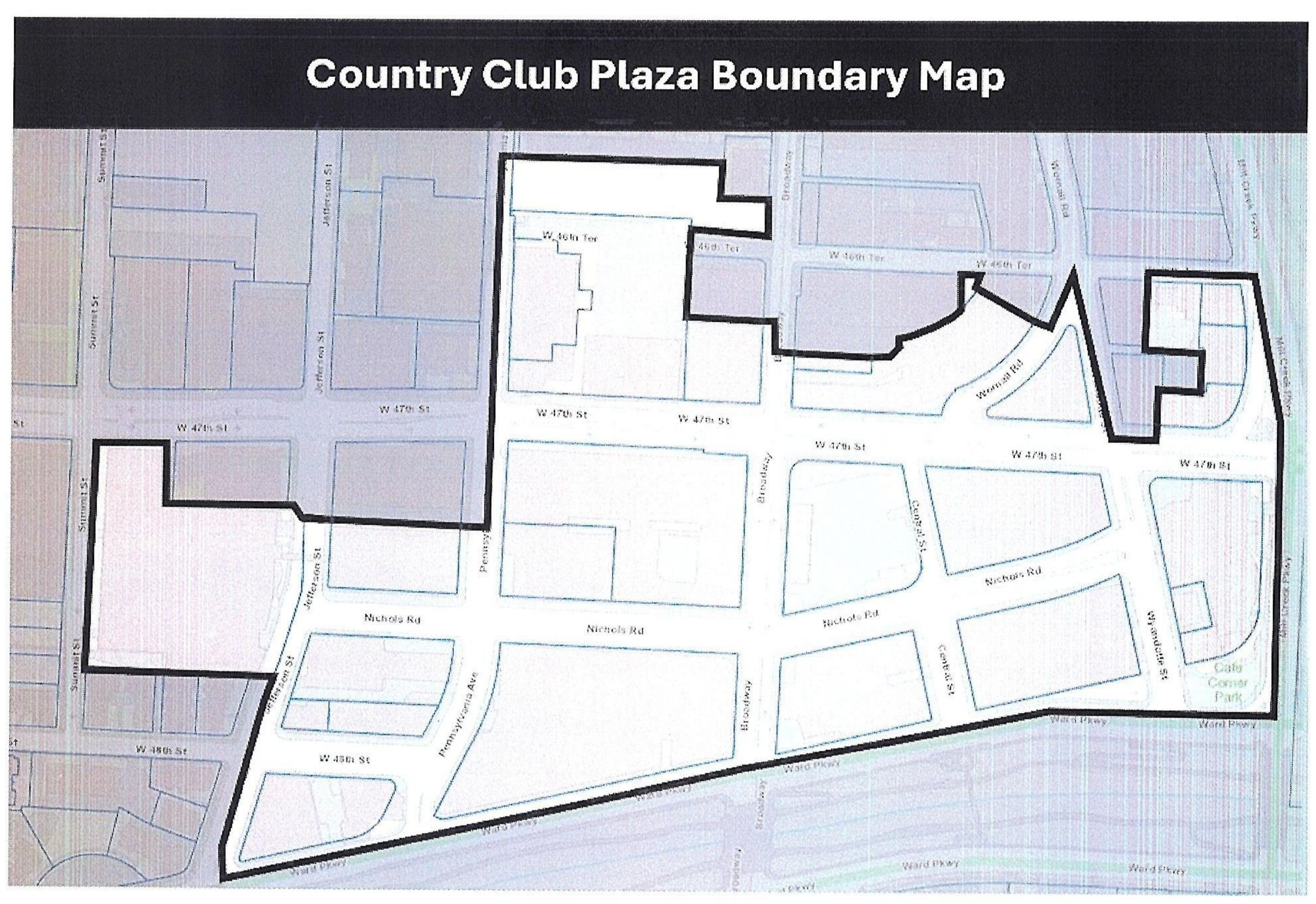
(Ord. No. 151036, § 1, 1-7-2016; Ord. No. 250639, § 3, 9-11-2025
88-810-400 - CROSSROADS AREA
The area of the city included within the following boundaries: Truman Road on the north, Troost Avenue on the east, the Kansas City Terminal Railway tracks on the south, and by Broadway Avenue between Truman Road and Southwest Boulevard and by Interstate 35 between Southwest Boulevard and the Kansas City Terminal Railway tracks on the west.
(Ord. No. 120783, § 1, 10-4-2012)
88-810-410 - CUL-DE-SAC
A local street with only one outlet and having a terminal for the safe and convenient reversal of traffic movement.
(Ord. No. 120783, § 1, 10-4-2012)
88-810-420 - CULTURAL ATTRIBUTES
All of those physical features of an area that either independently or by virtue of their interrelationship are generally identified and described as being important products of human thought and action characteristic of a population or community. The term "cultural attributes" includes "architectural attributes." The term "cultural attributes" does not refer to the characteristics or beliefs of people who may reside in or frequent a particular area.
(Ord. No. 120783, § 1, 10-4-2012)
88-810-430 - CURB LEVEL
The mean level of the curb in front of the lot, or, in case of a corner lot, along the abutting street where the mean curb is the highest.
(Ord. No. 120783, § 1, 10-4-2012)
88-810-431 - CUTTING
Chopping, shearing, or shredding a tree, beyond removal of the crown, often performed with the intent of destroying the tree to remove roosting habitat of certain species in advance of development Does not include trimming or pruning.
(Ord. No. 220961, § 2, 3-16-2023)
D Terms
88-810-440 - DATE OF APPROVAL/DECISION
The date the authorized decision-maker or decision-making body took final action.
(Ord. No. 120783, § 1, 10-4-2012)
88-810-450 - DECK
An uncovered and unenclosed exterior floor system elevated more than 30 inches from the ground and supported on at least 2 opposing sides by an adjoining building and/or posts, piers, or other independent supports.
(Ord. No. 120783, § 1, 10-4-2012)
88-810-460 - DENSITY
The general term used to refer to the number of dwelling units allowed per unit of land area. It is expressed in this zoning and development code in terms of a minimum amount of lot area required per dwelling unit (minimum lot area per dwelling unit).
(Ord. No. 120783, § 1, 10-4-2012)
88-810-470 - DETACHED HOUSE
A dwelling unit that is located on its own lot and that is not attached to any other dwelling unit.
(Ord. No. 120783, § 1, 10-4-2012)
88-810-480 - DEVELOPER
The person or entity undertaking the act of development. In the case of subdivisions, "developer" means the same as "subdivider."
(Ord. No. 120783, § 1, 10-4-2012)
88-810-500 - DEVELOPMENT APPLICATION
Any application or petition for approval in accordance with the review and approval procedures of this zoning and development code.
(Ord. No. 120783, § 1, 10-4-2012)
88-810-510 - DEVELOPMENT DISTRICT
A district that is established through approval of a development plan, preliminary development plan, master planned district, or urban redevelopment district, or a plan approved by the city council prior to the effective date of this ordinance.
(Ord. No. 120783, § 1, 10-4-2012; Ord. No. 120939, § 2, 12-20-2012)
88-810-512 - DEVELOPMENT NODE
Node where two parkways meet and within a ¼ mile radius, as measured from the centerline of the intersection.
(Ord. No. 150544, § 1, 7-23-2015)
88-810-513 - DIAMETER BREAST HEIGHT (DBH)
The diameter of a tree measured at a point 4.5 feet above the ground. If a tree splits into multi-trunks, the trunk is measured at its narrowest point below the split.
(Ord. No. 220961, § 2, 3-16-2023)
88-810-515 - DISTRIBUTED ENERGY
Systems that produce and distribute energy at a small area scale, such as a neighborhood or campus.
(Ord. No. 120697, § 1, 8-23-2012; Ord. No. 120783, § 1, 10-4-2012)
88-810-520 - DOWNTOWN LOOP
The area of the city bounded by Interstate 35/70 on the north, Interstate 70 on the east; Interstate 670 on the south, and Interstate 35 on the west.
(Ord. No. 120783, § 1, 10-4-2012)
88-810-522.- DOWNTOWN STREETCAR AREA
The area of the city zoned DC (Downtown Core) or DX (Downtown Mixed-Use) and included within the following boundaries: Wyandotte Street on the west, KC Terminal RR tracks on the south, Grand Boulevard on the east, East Missouri Avenue on the south, Locust Lane and Locust Street on the east, and East 2nd Street and West 2nd Street (extended) on the north.
(Ord. No. 120138, § A, 3-8-2012)
88-810-523 - DRIP LINE
The area encircling the base of a tree, the minimum extent of which is delineated by a vertical line extending from the outermost tips of the tree branches down to the ground.
(Ord. No. 220961, § 2, 3-16-2023)
88-810-530 - DRIVE-THROUGH FACILITY
See 88-805-04-H
(Ord. No. 120783, § 1, 10-4-2012)
88-810-531 - DRIVE-THROUGH FUNCTIONS
Aspects of a drive-through facility that provide services to customers within a vehicle including the ordering areas including speaker boxes and menu boards, pneumatic tubes, and drive-thru service windows. Drive-through functions do not include walk-up or drive-in services.
(Ord. No. 170118, § A, 4-13-2017)
88-810-540 - DWELLING UNIT
One or more rooms arranged, designed or used as independent living quarters for a single household. Buildings with more than one kitchen or more than one set of cooking facilities are deemed to contain multiple dwelling units unless the additional cooking facilities are clearly accessory and not intended to serve additional households.
(Ord. No. 120783, § 1, 10-4-2012)
E Terms
88-810-550 - EASEMENT
Authorization by a property owner for the use by another, and for a specified purpose, of any designated part of his property.
(Ord. No. 120783, § 1, 10-4-2012)
88-810-560 - EDGE OF STREAM
The limits of the stream when the discharge is equal to the 50% storm flow based on rural conditions land use. Rural conditions land use flows can be estimated from U.S. Geological Survey regression equations.
(Ord. No. 120783, § 1, 10-4-2012)
88-810-570 - ELDERLY HOUSING
Dwelling units specially designed and marketed for persons who are 62 years of age or older, but not including buildings containing equipment for surgical care or for the treatment of disease or injury, other than emergency first-aid-care.
(Ord. No. 120783, § 1, 10-4-2012)
88-810-571 - ELECTRIC VEHICLE (EV)
Any vehicle that is licensed and registered for operation on public and private highways, roads, and streets; either partially or exclusively, on electrical energy from the grid or an off-board source, that is stored on-board via a battery "Electric vehicle" includes: (1) battery electric vehicles; and (2) plug-in hybrid electric vehicles.
(Ord. No. 120697, § 1, 8-23-2012; Ord. No. 120783, § 1, 10-4-2012)
88-810-572 - ELECTRIC VEHICLE, BATTERY
Any electric vehicle that operates exclusively on electrical energy from an off-board source that is stored in the vehicle's batteries and that produces zero tailpipe emissions or pollution when stationary or operating.
(Ord. No. 120697, § 1, 8-23-2012; Ord. No. 120783, § 1, 10-4-2012)
88-810-573 - ELECTRIC VEHICLE, PLUG-IN HYBRID
An electric vehicle that (1) contains an internal combustion engine and also allows power to be delivered to drive wheels by an electric motor; (2) charges its battery primarily by connecting to the grid or other off-board electrical source; (3) may additionally be able to sustain battery charge using an on-board internal-combustion-driven generator; and (4) has the ability to travel powered by electricity
(Ord. No. 120697, § 1, 8-23-2012; Ord. No. 120783, § 1, 10-4-2012)
88-810-574 - ELECTRIC VEHICLE (EV) CHARGING STATION
A public or private parking space that is served by battery charging station equipment.
88-810-574-A. ELECTRIC VEHICLE CHARGING STATION, LEVEL 1
An EV charging station served only by level 1 battery charging equipment.
88-810-574-B. ELECTRIC VEHICLE CHARGING STATION, LEVEL 2
An EV charging station served by level 2 battery charging equipment.
88-810-574-C. ELECTRIC VEHICLE CHARGING STATION, LEVEL 3
An EV charging station served by level 3 (rapid) battery charging equipment.
88-810-574-D. ELECTRIC VEHICLE CHARGING STATION, ACCESSIBLE
An EV charging station where the battery charging station is located within reach of an accessible parking space and an electric vehicle that is parked in such space.
88-810-574-E. ELECTRIC VEHICLE CHARGING STATION, PRIVATE (RESTRICTED-ACCESS)
An EV charging station that is not available for use by the general public. Examples include electric vehicle charging stations that serve residential homeowners or renters, executive parking areas, designated employee parking areas and fleet parking areas.
88-810-574-F. ELECTRIC VEHICLE CHARGING STATION, PUBLIC
An EV charging station that is accessible to and available for use by the general public.
(Ord. No. 120697, § 1, 8-23-2012; Ord. No. 120783, § 1, 10-4-2012)
88-810-575 - ELECTRIC VEHICLE INFRASTRUCTURE (EVI)
Conduit/wiring, structures, machinery, and equipment necessary and integral to support an electric vehicle, including battery charging stations and rapid charging stations.
(Ord. No. 120697, § 1, 8-23-2012; Ord. No. 120783, § 1, 10-4-2012)
88-810-576 - ELECTRIC VEHICLE PARKING SPACE
Any parking space that is clearly identified to be used exclusively for the parking of an electric vehicle.
(Ord. No. 120697, § 1, 8-23-2012; Ord. No. 120783, § 1, 10-4-2012)
88-810-580 - ENCROACHMENT
For the purposes of interpreting 88-415, "encroachment" is a temporary or permanent activity (such as clearing vegetation or constructing a permanent improvement) that occurs within a stream setback zone that is expressly prohibited within that zone in accordance with 88-415-04. Mitigation activities are not considered encroachment.
(Ord. No. 120783, § 1, 10-4-2012; Ord. No. 130441, § 1, 7-11-2013)
88-810-590 - EROSION
Process by which the ground surface is worn away be the action of wind, water, ice, gravity, or artificial means, and/or land disturbance.
(Ord. No. 120783, § 1, 10-4-2012; Ord. No. 130441, § 1, 7-11-2013)
F and G Terms
88-810-600 - FAÇADE
The exterior plane or "face" of a building.
(Ord. No. 120783, § 1, 10-4-2012)
88-810-610 - FLOODPLAIN
The floodway or floodway fringe as identified by the Federal Emergency Management Agency or otherwise designated by the City of Kansas City, Missouri.
(Ord. No. 120783, § 1, 10-4-2012)
88-810-618 - FLOOR AREA
Floor area means the sum of the areas of the several floors of a building or structure, including areas used for human occupancy or required for the conduct of the business or use, and basements, attics, and penthouses, as measured from the exterior faces of the wall. It does not include an area for the parking of motor vehicles.
(Ord. No. 120783, § 1, 10-4-2012)
88-810-620 - FLOOR AREA RATIO (FAR)
The ratio of the floor area of all principal buildings to the total area of the lot upon which such buildings are located. (See Chapter 18 for rules governing measurement of floor area ratio)
(Ord. No. 120783, § 1, 10-4-2012)
88-810-630 - FOOTPRINT AREA
The floor area at grade or the first floor if elevated above grade of an accessory building or structure and includes any enclosed area therein for the parking of motor vehicles, areas of the building not provided with surrounding walls must be included in the building area if such areas are included within the horizontal projection of the roof or floor above.
(Ord. No. 120783, § 1, 10-4-2012)
88-810-640 - FRONT PROPERTY LINE
That property line is along the right-of-way line of an existing or dedicated public street, or when no public street exists, is along a public way.
(Ord. No. 120783, § 1, 10-4-2012)
88-810-650 - FRONT SETBACK
The setback required between a building and the front property line of the lot on which the building is located, extending along the full length of the front property line between the side property lines.
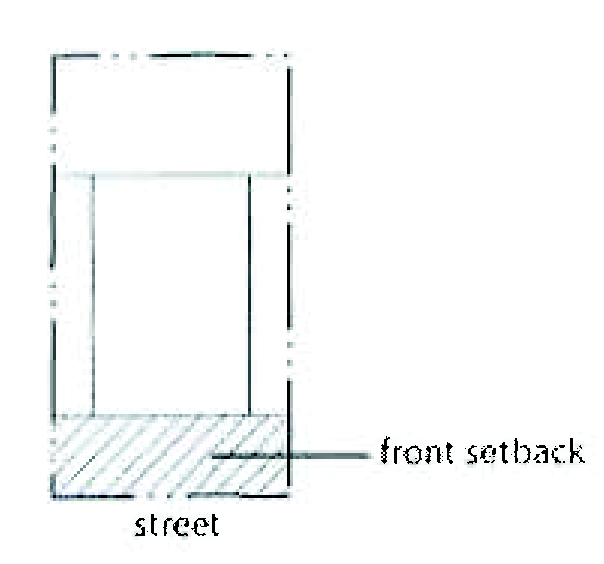
(Ord. No. 120783, § 1, 10-4-2012)
88-810-660 - FRONT WALL
In buildings that contain more than one dwelling unit on a single floor, front walls and rear walls are those walls that are generally perpendicular to the party walls between dwelling units. In buildings that do not contain more than one dwelling unit on a single floor, the front wall is the wall that is generally parallel and closest to the front property line and the rear wall is the exterior building wall opposite the front wall.
(Ord. No. 120783, § 1, 10-4-2012)
88-810-670 - FRONT YARD
The actual area that exists between a building and the front property line of the lot on which the building is located, extending along the full length of the front property line between the side property lines. See also "Front Setback."
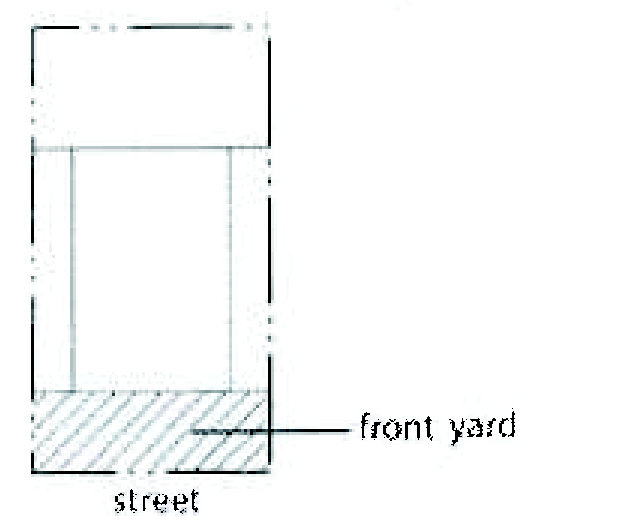
(Ord. No. 120783, § 1, 10-4-2012; Ord. No. 140919, § A, 11-13-2014)
88-810-680 - FRONTAGE
That side of a lot abutting a street
(Ord. No. 120783, § 1, 10-4-2012)
88-810-682 - GEOTHERMAL HEAT EXCHANGE SYSTEM
Equipment that exchanges thermal energy between the ground (or a water source) and a building. This includes vertical closed loop, horizontal closed loop, water body closed loop system and open loop systems. Also known as ground source heat pumps and geothermal heat pumps.
(Ord. No. 120697, § 1, 8-23-2012; Ord. No. 120783, § 1, 10-4-2012)
88-810-682.1 - GRADING
Any excavating or filling of earth materials or any combination thereof.
(Ord. No. 220961, § 2, 3-16-2023)
88-810-683 - GREATER DOWNTOWN AREA
The area generally bounded by the city limits of North Kansas City on the north, the state line on the west, 31st Street on the south and Woodland Avenue on the east.
(Ord. No. 150407, § 1, 7-9-2015)
88-810-685 - GREENHOUSE
A temporary or permanent structure that is primarily used for the cultivation of plants.
(Ord. No. 120697, § 1, 8-23-2012; Ord. No. 120783, § 1, 10-4-2012)
88-810-686 - GREEN ROOF
A green roof, also known as a vegetated or living roof, is a roofing system with a layer of vegetation planted over a waterproofing system, containing a drainage system, and designed to be structurally sound and capable of supporting the weight' of the growing medium and vegetation. Green roofs include cool roofs that reflect more sunlight than traditional roofs through light-colored coatings or materials with high thermal emittance, and blue roofs that collect rainwater and slowly release it back into the atmosphere, helping to manage stormwater runoff and reduce strain on sewage systems may be used in place of a green roof.
(Ord. No. 251031, § 9, 1-15-2026)
H, I, J and K Terms
88-810-690 - HOME OCCUPATION
An accessory use of a dwelling unit for business or commercial purposes. Home occupations are subject to the standards of 88-305-04.
(Ord. No. 120783, § 1, 10-4-2012)
88-810-692 - HOOP HOUSE
A temporary or permanent structure typically made of flexible pipe or other material covered with translucent plastic, constructed in a "half-round" or "hoop" shape, for the purposes of protecting and cultivating plants. A hoop house is considered more temporary than a greenhouse.
(Ord. No. 120697, § 1, 8-23-2012; Ord. No. 120783, § 1, 10-4-2012)
88-810-698 - HOST
The owner, operator, corporation, agent, or other authorized representative facilitating the rental of a short term rental property or unit.
(Ord. No. 170771, § 1, 2-22-2018)
88-810-700 - HOUSEHOLD
A household is any of the following:
a.
An individual; or
b.
Two or more persons related by blood, marriage, or adoption; or
c.
A group of not more than five persons, excluding servants, who need not be related by blood or marriage, living together and subsisting in common as a separate nonprofit housekeeping unit which provides one kitchen; or
d.
A group of eight or fewer unrelated disabled persons, including those recovering from alcoholism or addiction to drugs, which may include two additional persons acting as houseparents or guardians who need not be related to each other or to any of the disabled persons residing in the home.
(Ord. No. 120783, § 1, 10-4-2012; Ord. No. 230936, § B, 12-14-2023)
88-810-705 - IMPERVIOUS COVER
The total amount of a lot's impervious surface.
(Ord. No. 220997, § 1, 1-5-2023)
88-810-706 - IMPERVIOUS SURFACE
Any area covered by a roof, concrete, or asphalt surface.
(Ord. No. 220997, § 1, 1-5-2023)
88-810-708 - ISA
International Society of Arboriculture.
(Ord. No. 220961, § 2, 3-16-2023)
88-810-710 - INDUSTRIAL ESTABLISHMENT
A business classified in the industrial use group (See 88-805-05), the ownership, management and physical location of which are separate and distinct from those of any other place of business located on the same zoning lot, as partly evidenced by maintaining separate and distinct doors and access points.
(Ord. No. 120783, § 1, 10-4-2012)
88-810-712 - INFILL RESIDENTIAL DEVELOPMENT
Infill residential development shall mean any residential development (whether existing, new construction, or modification to an existing residential structure) on an infill residential lot.
(Ord. No. 220997, § 1, 1-5-2023)
88-810-713 - INFILL RESIDENTIAL CONTEXT AREA
Any lot lying in whole or in part within 200 ft of an infill residential lot and located on the same block face as an infill residential lot.
(Ord. No. 220997, § 1, 1-5-2023)
L Terms
88-810-715 - LAND DISTURBANCE.
Any activity that changes the physical conditions of landform, vegetation, and hydrology. Such activities include, but not limited to clearing, removal of vegetation, stripping, grading, grubbing, excavating, filling, logging, and storing of materials.
(Ord. No. 220961, § 2, 3-16-2023)
88-810-720 - LANDSCAPED
Substantially covered with grass, ground cover, shrubs, trees or other living plant material.
(Ord. No. 120783, § 1, 10-4-2012)
88-810-728 - LODGER
One who, by agreement with the owner of a property, acquires no interest or possession therein but only the right to occupy a room or rooms that remain in the owner's legal possession and who dwells in common with the household.
(Ord. No. 170771, § 1, 2-22-2018; Ord. No. 220398, § 1, 5-19-2022)
88-810-730 - LOT
A tract, plot, or portion of a subdivision or other parcel of land intended as a unit for the purpose, whether immediate or future, of transfer of ownership or for building development.
(Ord. No. 120783, § 1, 10-4-2012)
88-810-740 - LOT, CORNER
See "corner lot."
(Ord. No. 120783, § 1, 10-4-2012)
88-810-748 - LOT, INFILL RESIDENTIAL
Any lawfully created lot that is zoned residential and meets one or more of the following criteria:
1)
Described by deed or plat recorded prior to March 1, 1954, or
2)
Annexed into the corporate limits of Kansas City prior to March 1, 1954.
Infill residential lots are not subject to the lot consolidation provisions contained in Section 88-610-03-C of this zoning and development code.
(Ord. No. 220997, § 1, 1-5-2023)
88-810-750 - LOT, INTERIOR
A lot whose side lines do not abut a street.
(Ord. No. 120783, § 1, 10-4-2012)
88-810-760 - LOT, REVERSED CORNER
See "reversed corner lot."
(Ord. No. 120783, § 1, 10-4-2012)
88-810-770 - LOT SPLIT
A subdivision of land for the purpose of transfer of ownership as approved in accordance with the requirements of 88-535-01-A.
(Ord. No. 120783, § 1, 10-4-2012)
88-810-780 - LOT, THROUGH
See "through lot."
(Ord. No. 120783, § 1, 10-4-2012)
88-810-790 - LOT, ZONING
See "zoning lot."
(Ord. No. 120783, § 1, 10-4-2012)
88-810-800 - LUMINOUS TUBE (LIGHTING)
A glass tube filled with a gas or gas mixture (including neo, argon, mercury, or other gases), usually of small diameter (10-15 mm), caused to emit light by the passage of an electronic current and commonly bent into various forms for use as decoration or signs. Does not include common fluorescent lights.
(Ord. No. 120783, § 1, 10-4-2012)
M Terms
88-810-810 - MAJOR STREET PLAN
The plan established by the city, pursuant to RSMo 89.480, showing the general alignment and functional classification of streets, highways and parkways of an ultimate urban arterial network. The purpose of this plan is to guide development of the arterial street network and to identify appropriate street rights-of-way to be secured at the time of subdivision platting. The plan may be amended, added thereto, or otherwise refined by the subdivision platting process or by the plan commission and city council.
(Ord. No. 120783, § 1, 10-4-2012)
88-810-820 - MAJOR THOROUGHFARE (STREET)
Streets having, as their primary purpose, to provide for through traffic movement between areas and across the city, and having, as their secondary purpose, direct access to abutting property, subject to necessary control of entrances, exits and curb use and as further defined in the major street plan as primary or secondary arterials.
(Ord. No. 120783, § 1, 10-4-2012)
88-810-830 - MANUAL OF BEST MANAGEMENT PRACTICES FOR STORMWATER QUALITY
Stormwater BMP planning and design reference approved by the American Public Works Association and the Mid-America Regional Council in September 2003, or the most current version adopted by the city.
(Ord. No. 120783, § 1, 10-4-2012)
88-810-835 - MARIJUANA/MARIHUANA
Cannabis indica, Cannabis sativa, and Cannabis ruderalis, hybrids of such species, and any other strains commonly understood within the scientific community to constitute marijuana, as well as seed thereof and resin extracted from the plan and marijuana-infused products. Marijuana does not include industrial hemp as defined by Missouri statute, or commodities or products manufactured from industrial hemp.
(Ord. 190430, § A, 7-11-2019; Ord. No. 230124, § 3, 2-9-2023)
88-810-835.2 - MARIJUANA FACILITY
Any comprehensive facility, medical facility, or marijuana testing facility.
(Ord. No. 230124, § 3, 2-9-2023)
88-810-835.2.2 - MARIJUANA MICROBUSINESS DISPENSARY FACILITY
A microbusiness facility licensed by the state where marijuana is dispensed for medical or adult use.
(Ord. No. 240411, § 3, 9-12-2024)
88-810-835.2.3 - MARIJUANA MICROBUSINESS FACILITY
A facility licensed by the state as a microbusiness dispensary facility or microbusiness wholesale facility.
(Ord. No. 240411, § 3, 9-12-2024)
88-810-835.2.4 - MARIJUANA RESEARCH FACILITY
A facility licensed by the state where activities intended to facilitate scientific research or education related to marijuana product occur.
(Ord. No. 240411, § 3, 9-12-2024)
88-810-835.3 - MARIJUANA TESTING FACILITY
A facility certified by the state to acquire, test, certify, and transport marijuana, including those originally licensed as a medical marijuana testing facility.
(Ord. No. 230124, § 3, 2-9-2023)
88-810-835.4 - MARIJUANA MICROBUSINESS WHOLESALE FACILITY
A microbusiness facility licensed by the state where marijuana cultivation operations for medical or adult use occur and/or where marijuana-infused projects and prerolls are manufactured for medical or adult use.
(Ord. No. 240411, § 3, 9-12-2024)
88-810-836 - MARIJUANA-INFUSED PRODUCTS
Products that are infused with marijuana or an extract thereof and are intended for use or consumption other than by smoking, including, but not limited to, edible products, ointments, tinctures and concentrates.
(Ord. 190430, § A, 7-11-2019)
88-810-840 - MARQUEE
Any hood of noncombustible construction projecting more than 12 inches from the wall of a building above an entranceway and having a roof area greater than 12 square feet.
(Ord. No. 120783, § 1, 10-4-2012)
88-810-850 - MATURE RIPARIAN VEGETATION
Vegetation adjacent to a stream consisting predominantly of mature trees (10-inch diameter breast height or greater), where at least 50% of the mature trees are of riparian or bottomland species as defined by The Terrestrial Natural Communities of Missouri (Nelson 2006).
(Ord. No. 120783, § 1, 10-4-2012)
88-810-860 - MATURE VEGETATION
For the purposes of interpreting 88-415, vegetation consisting predominantly of mature trees (10-inch diameter breast height or greater).
(Ord. No. 120783, § 1, 10-4-2012)
88-810-870 - MEDIA
Anything printed or written, or any picture, drawing, photograph, motion picture, film, videotape, or videotape production, or pictorial representation, or any electrical or electronic reproduction of anything that is or may be used as a means of communication. Media includes but is not necessarily limited to books, newspapers, magazines, movies, videos, sound recordings, CD-ROMs, digital video discs, other magnetic media, and undeveloped pictures.
(Ord. No. 120783, § 1, 10-4-2012)
88-810-880 - MEDIA STORE
An exclusive term, identifying a category of business that may include adult media but that is not regulated as an adult media store. In that context, media store means a retail store offering media for sale or rent for consumption or enjoyment off the premises; provided that any store in which adult media constitutes more than 40% of the stock in trade and/or occupies more than 40% of the gross public floor area is deemed an "adult media store." See special conditions in applicable zoning districts for media stores in which adult media constitutes more than 10% but not more than 40% of the stock in trade or occupies more than 10% but not more than 40% of the gross public floor area. This definition intentionally includes and is intentionally broader than the definition of "book store" and "video store."
(Ord. No. 120783, § 1, 10-4-2012)
88-810-881 - MEDICAL FACILITY
Any medical marijuana cultivation facility, medical marijuana dispensary facility, or medical marijuana infused products manufacturing facility.
(Ord. No. 230124, § 3, 2-9-2023)
88-810-882 - MEDICAL MARIJUANA CULTIVATION FACILITY
A facility licensed by the state to acquire, cultivate, process, package, store on or off site, transport to or from, and sell marijuana, marijuana seeds, and marijuana vegetative cutting (also known as clones), to a medical dispensary facility, marijuana testing facility, medical marijuana cultivation facility, or to a medical marijuana-infused products manufacturing facility. A medical marijuana cultivation facility's authority to process marijuana shall include the production and sale of prerolls, but shall not include the manufacture of marijuana-infused products.
(Ord. 190430, § A, 7-11-2019; Ord. No. 230124, § 3, 2-9-2023)
88-810-883 - MEDICAL MARIJUANA DISPENSARY FACILITY
A facility licensed by the state to acquire, process, package, store on site or off site, sell, transport to or from, and deliver marijuana, marijuana seeds, marijuana vegetative cuttings (also known as clones) marijuana-infused products and drug paraphernalia used to administer marijuana as provided for in this section to a qualifying patient, a primary caregiver, anywhere on the licensed property or to any address as directed by the patient or primary caregiver, so long as the address is a location allowing for the legal possession of marijuana, another medical marijuana dispensary facility, a marijuana testing facility, a medical marijuana cultivation facility, or a medical marijuana-infused projects manufacturing facility. Dispensary facilities may receive transaction orders at the dispensary in person, by phone, or via the internet, including from a third party. A medical marijuana dispensary facility's authority to process marijuana shall include the production and sale of prerolls, but shall not include the manufacture of marijuana-infused products.
(Ord. 190430, § A, 7-11-2019; Ord. No. 230124, § 3, 2-9-2023)
88-810-884 - MEDICAL MARIJUANA-INFUSED PRODUCTS MANUFACTURING FACILITY
A facility licensed by the state to acquire, process, package, store on site or off site, manufacture, transport to or from, and sell marijuana-infused products to a medical marijuana dispensary facility, a marijuana testing facility, a medical marijuana cultivation facility, or to another medical marijuana-infused projects manufacturing facility.
(Ord. 190430, § A, 7-11-2019; Ord. No. 230124, § 3, 2-9-2023)
88-810-885 - MEDICAL MARIJUANA TESTING FACILITY
A facility certified by the state to acquire, test, certify, and transport marijuana.
(Ord. 190430, § A, 7-11-2019)
88-810-885.1 - MITIGATION
The replacement of trees removed during development to lessen the loss of tree canopy cover. Mitigation may be met by planting of trees on-site or by payment to the Capital Improvement Sales Tax Fund-Tree Planting, or a combination thereof.
(Ord. No. 220961, § 2, 3-16-2023)
88-810-886 - MOBILE VENDOR
An eating and drinking establishment or retail use operating out of a commercial vehicle.
(Ord. No. 160759, § 1, 10-20-2016)
88-810-890 - MOTION PICTURE ARCADE BOOTH
Any booth, cubicle, stall or compartment that is designed, constructed or used to hold or seat patrons and is used for presenting or viewing motion pictures or viewing publications that are distinguished or characterized by an emphasis on the depiction or description of "specified sexual activities" or "specified anatomical areas" by any photographic, electronic, magnetic tape, digital or other medium (including, but not limited to, film, video, magnetic tape, laser disc, digital video disc, CD-rom, books, magazines or periodicals) for observation by patrons therein. The terms "booth," "arcade booth," "preview booth," "video arcade booth," and "media room" are synonymous with the term "motion picture arcade booth." A motion picture arcade booth does not mean a theater, moviehouse, playhouse or a room or enclosure or portion thereof that contains more than 150 square feet. No part of this definition may be construed to permit more than one person to occupy a motion picture arcade booth at any time.
(Ord. No. 120783, § 1, 10-4-2012)
88-810-900 - MOTION PICTURE ARCADE BOOTH ESTABLISHMENT
Any business wherein one or more motion picture arcade booths are located. The terms "establishment" and "video arcade" are synonymous with "motion picture arcade booth establishment."
(Ord. No. 120783, § 1, 10-4-2012)
88-810-910 - MOTOR VEHICLE
Any passenger vehicle, truck, truck-trailer, trailer, or semi-trailer propelled or drawn by mechanical power.
(Ord. No. 120783, § 1, 10-4-2012)
88-810-911 - MOTOR VEHICLE FRANCHISE DEALER, NEW
Any motor vehicle dealer who has been franchised to deal in a certain make of motor vehicle by the manufacturer or distributor of that make and motor vehicle and who may, in line with conducting business as a franchise dealer, sell, barter, or exchange used motor vehicles.
(Ord. No. 250530, § 6, 9-11-2025)
88-810-912 - MOTOR VEHICLE DEALER, USED
Any motor vehicle dealer who is not a new motor vehicle franchise dealer.
(Ord. No. 250530, § 6, 9-11-2025)
88-810-920 - MULTI-UNIT RESIDENTIAL
A residential building that contains 3 or more dwelling units that share common walls or common floors/ceilings with one or more dwelling units. The land upon which the building sits is not divided into separate lots.
(Ord. No. 120783, § 1, 10-4-2012)
88-810-930 - MUNICIPALITY
The city and any other body politic, whether it is a city, town, village or political subdivision of this state, organized under the constitution of the state or under the laws of this state and by law for decision of the highest court of this state determined to be a municipal corporation.
(Ord. No. 120783, § 1, 10-4-2012)
N Terms
88-810-935 - NATIVE SPECIES
Any plant occurring naturally within the region and not introduced by man; indigenous.
(Ord. No. 220961, § 2, 3-16-2023)
88-810-940 - NEIGHBORHOOD ASSOCIATION
A group of homeowners, renters, apartment dwellers, and representatives from neighborhood businesses, churches, and schools who organize to improve conditions in the neighborhood. Neighborhood association membership is voluntary or informal. Most neighborhood associations have regularly scheduled meetings, elect board of directors, and have by-laws. A neighborhood association is a recognized non-profit organization formed by residents in a designated neighborhood or community.
(Ord. No. 120783, § 1, 10-4-2012)
88-810-950 - NEIGHBORHOOD ORGANIZATION
A group of individual residents and owners of real property (including businesses), within a certain defined geographic area of the city or a coalition of such groups, voluntarily formed for the purpose of collectively addressing issues and interests common to property owners within the defined area.
(Ord. No. 120783, § 1, 10-4-2012)
88-810-960 - NEW DEVELOPMENT
New buildings constructed and new land uses established in all zoning districts.
(Ord. No. 120783, § 1, 10-4-2012)
88-810-970 - NONCOMMERCIAL MESSAGE
A message which does not direct attention to a business operated for profit, or to a product, commodity, or service for sale or lease, or to any other commercial interest or activity.
(Ord. No. 120783, § 1, 10-4-2012)
88-810-980 - NONCONFORMING LOT
For lots that are not infill residential lots, a nonconforming lot is a lawfully created lot, shown on a plat or survey map recorded in the appropriate recorder of deeds office that does not comply with the most restrictive minimum lot area or lot width standards of the zoning district in which the lot is now located. An infill residential lot that either exceeds or does not meet the minimum lot area or lot width range of the relevant infill residential context area is a nonconforming lot.
(Ord. No. 220997, § 1, 1-5-2023)
88-810-990 - NONCONFORMING SIGN
A sign that was lawfully established, in accordance with zoning and other sign regulations in effect at the time of its establishment but that is no longer allowed by the regulations of this zoning and development code.
(Ord. No. 120783, § 1, 10-4-2012)
88-810-992 - NONCONFORMING SIGN, ROUTINE MAINTENANCE
Maintenance associated with the general upkeep of a nonconforming sign which includes minor repair of rusted or damaged components, including nailing, cleaning and replacement of nuts and bolts, replacement of catwalks or handrails when required to resolve safety concerns, addition of catwalks when required by OSHA regulations, repainting, replacing of malfunctioning parts, and re-facing of existing signs when the re-facing does not result in any structural alterations, additional signs or additional sign appendages. Lighting fixtures may be repaired or replaced with fixtures of a similar size, including but not limited to repairs or replacements that increase energy efficiency. Existing digital sign faces (boxes) may be replaced with digital sign faces (boxes) of the same size. Existing tri-vision sign faces (boxes) may be replaced with tri-vision sign faces (boxes) of the same size. Routine maintenance of a nonconforming sign shall not include any addition of or increase in illumination, structural alterations, enlargements or expansions unless the alteration, enlargement or expansion will result in the elimination of the nonconforming aspects of the signs. Repairs that may be made include the relocation of electrical service lines, repairs due to theft or the replacement of component parts.
(Ord. No. 120783, § 1, 10-4-2012; Ord. No. 120915, § A, 12-20-2012)
88-810-1000 - NONCONFORMING STRUCTURE
Any building or structure, other than a sign, that was lawfully established but no longer complies with this zoning and development code.
(Ord. No. 120783, § 1, 10-4-2012)
88-810-1010 - NONCONFORMING USE
A land use that was lawfully established in accordance with all zoning regulations in effect at the time of its establishment but that is no longer allowed by the use regulations of the zoning district in which the use is now located. Lawfully established uses that do not comply with separation distance requirements are also deemed nonconforming uses.
(Ord. No. 120783, § 1, 10-4-2012)
88-810-1020 - NONCONFORMITY
Any nonconforming building, nonconforming lot, nonconforming sign, or nonconforming use.
(Ord. No. 120783, § 1, 10-4-2012)
88-810-1022 - NON-ELECTRIC VEHICLE
Any motor vehicle that does not meet the definition of an "electric vehicle."
(Ord. No. 120697, § 1, 8-23-2012; Ord. No. 120783, § 1, 10-4-2012)
88-810-1030 - NONRESIDENTIAL DISTRICT
Any zoning district other than a residential (R) district.
(Ord. No. 120783, § 1, 10-4-2012)
88-810-1035 - NURSING HOME
Shall refer to any facility regulated by Chapter 198 RSMo.
(Ord. No. 160759, § 1, 10-20-2016)
O Terms
88-810-1040 - OFF-SITE
Any premises not located within the area of the property to be subdivided, whether or not in the same ownership of the applicant for subdivision approval.
(Ord. No. 120783, § 1, 10-4-2012)
88-810-1050 - OPERATOR
Any person operating, conducting, or maintaining an adult business.
(Ord. No. 120783, § 1, 10-4-2012)
88-810-1060 - ORIENTATION
The directional placement of a structure in relation to its surroundings, the street, and other structures.
(Ord. No. 120783, § 1, 10-4-2012)
88-810-1065 - OUTDOOR STORAGE
Outdoor storage is the storage of any item outside of an enclosed building or structure and that is not accessible to the general public. This includes but is not limited to garden supplies, building supplies, plants, materials stored in crates, boxes, or shipping containers; lumber yards; pipe; contractor's equipment; and other similar uses.
(Ord. No. 120783, § 1, 10-4-2012)
88-810-1070 - OUTDOOR WORK AREA
Outdoor areas used for processing, assembly, or fabrication of goods and other similar activities that generally have an industrial orientation. Outdoor work areas do not include areas used for normal pick-up and deliveries to a site, parking, excavation and fills, outdoor eating areas, outdoor recreation, or outdoor markets.
(Ord. No. 120783, § 1, 10-4-2012; Ord. No. 170061, § A, 3-23-2017)
88-810-1080 - OVERLAY DISTRICT
A zoning district that over-lays one or more base zoning districts and imposes requirements in addition to those of the base district or modifies the standards otherwise applicable in the base district.
(Ord. No. 120783, § 1, 10-4-2012)
88-810-1090 - OWNER
See "property owner."
(Ord. No. 120783, § 1, 10-4-2012)
88-810-1100 - OWNER-OCCUPIED
A dwelling unit occupied as a principal residence by a person who either:
•
owns a 50% or greater fee interest in the dwelling; or
•
owns and/or controls a trust, corporation, limited liability company, partnership, or other legal entity that owns the fee interest in the dwelling.
(Ord. No. 120783, § 1, 10-4-2012)
P and Q Terms
88-810-1106 - PARAPET WALL
A low wall used to protect the edges of a platform or roof or to screen roof-mounted mechanical equipment.
(Ord. No. 160759, § 1, 10-20-2016)
88-810-1107 - PARKING FACILITY
A structure, place, parcel of ground, yard or enclosure used in whole or in part for providing parking space for or storing of motor vehicles regardless of whether a fee is charged for the parking of motor vehicles. The term "parking facility" includes what are commonly known as parking garages (including multilevel parking station facilities), parking lots or parking spaces, and does not include on-street parking spaces or residential spaces as defined herein.
(Ord. No. 160454, § B, 6-23-2016)
88-810-1108 - PARKWAY
Any street designated on the Major Street Plan as a parkway.
(Ord. No. 150544, § 1, 7-23-2015)
88-810-1110 - PAWN SHOP
A business that lends money on the security of pledged goods or that is engaged in the business of purchasing tangible personal property on condition that it may be redeemed or repurchased by the seller for a fixed price within a fixed period of time. Pawnshops and pawnbrokers are further governed by chapter 367 RSMo.
(Ord. No. 120783, § 1, 10-4-2012)
88-810-1120 - PERMITTED USE
A use permitted as-of-right in the subject zoning district in accordance with the applicable use regulations of this zoning and development code.
(Ord. No. 120783, § 1, 10-4-2012)
88-810-1125 - PHOTOVOLTAIC CELL
A semiconductor device that converts solar energy into electricity.
(Ord. No. 120697, § 1, 8-23-2012; Ord. No. 120783, § 1, 10-4-2012)
88-810-1130 - PLAN, AREA
A plan for a specific area or corridor located within the city that complies with and further implements the city's comprehensive plan through standards and guidelines adopted by the City Council.
(Ord. No. 120783, § 1, 10-4-2012)
88-810-1140 - PLAN, COMPREHENSIVE
A master plan for development of the city, including area plans for any of its geographical parts, prepared and adopted by the plan commission, pursuant to RSMo 89.340, and including any part of such plan separately adopted and any amendment to such plan or parts of the plan. The KC Spirit Playbook is considered the city's comprehensive plan.
(Ord. No. 120783, § 1, 10-4-2012; Ord. No. 230250, § 1, 4-20-2023)
88-810-1150 - PLAN, DEVELOPMENT
A document that illustrates the intended design, arrangement, and uses of the land to be improved and portrays information as required. A development plan is required for various applications, as specified in 88-517. A preliminary development plan approved under Chapter 80 (the equivalent of this Chapter) shall be considered a development plan under Chapter 88.
(Ord. No. 120783, § 1, 10-4-2012; Ord. No. 151050, § 1, 2-25-2016)
88-810-1180 - PLAN, PRELIMINARY AND PLAN, FINAL
Preliminary and final plans were approved in conjunction with planned and limited districts of the previous zoning ordinance, as referenced in 88-415-02-D.
(Ord. No. 120783, § 1, 10-4-2012; Ord. No. 151050, § 1, 2-25-2016)
88-810-1190 - PLAN, PRELIMINARY DEVELOPMENT AND PLAN, FINAL DEVELOPMENT
A preliminary development plan is required in conjunction with rezoning to Districts UR and MPD. A final development plan is required prior to issuance of a building permit in Districts UR and MPD.
(Ord. No. 120783, § 1, 10-4-2012)
88-810-1195 - PLAN, PROJECT
A document that illustrates the intended design, arrangement, and uses of the land to be improved and portrays information as required. A project plan is required for various applications, as specified in 88-518. A final plan approved under Chapter 80 (the equivalent of this Chapter) shall be considered a project plan under Chapter 88.
(Ord. No. 151050, § 1, 2-25-2016)
88-810-1200 - PLAN, SITE
A site plan portrays land uses, arrangement of buildings, off-street parking, lighting, landscaping, stormwater facilities, vehicle and pedestrian access routes, and other site features as required.
(Ord. No. 120783, § 1, 10-4-2012; Ord. No. 130441, § 1, 7-11-2013)
88-810-1210 - PLAN, SITE-SPECIFIC DEVELOPMENT
Site-specific development plans are plans or plats submitted by a landowner or an authorized representative describing with reasonable certainty the type and intensity of development for a specific parcel of property and that have been approved by the city plan commission, board of zoning adjustment, and/or city council. Such plans may be in the form of a preliminary subdivision plats or plans, final subdivision plats or development plans, or other similar plans.
(Ord. No. 120783, § 1, 10-4-2012)
88-810-1220 - PLAN, UNIFIED DEVELOPMENT
A unified development plan portrays development of property included within one or more zoning or subdivision applications that were approved by the city council on or about the same date on contiguous property through the same applicant. The plan may include commercial and residential plans approved collectively, although through separate ordinances and plans.
(Ord. No. 120783, § 1, 10-4-2012)
88-810-1230 - PLAT
A scale drawing showing the location and boundaries of individual parcels of land subdivided into lots, with streets, alleys, easements, street grades, etc. The drawing represents the lines surveyed, established, retraced, or resurveyed; the direction and length of each such line, and the relationship to adjoining official surveys; and the boundaries and area of the land subdivided.
(Ord. No. 120783, § 1, 10-4-2012)
88-810-1235 - PLATTED BUILDING LINE
The line established by plat beyond which a building shall not extend, except as otherwise provided.
(Ord. No. 120783, § 1, 10-4-2012)
88-810-1238 - PLAYFIELD
An area devoted to outdoor athletics.
(Ord. No. 160759, § 1, 10-20-2016)
88-810-1240 - PRELIMINARY PLAT
A preliminary plat, map, or drawing on which the layout, design and other pertinent facts about the proposed subdivision are shown. The preliminary plat illustrates the applicant's ideas and intentions in the proposed subdivision and outlines graphically, and to the extent necessary, describes in writing the existing conditions of the site. The preliminary plat consists of two basic parts:
•
The general location map of the vicinity; and
•
A detailed plan drawn to scale showing the proposed layout for all features in the subdivision.
(Ord. No. 120783, § 1, 10-4-2012)
88-810-1250 - PRINCIPAL BUILDING
A building or combination of buildings of chief importance or function on a lot. In general, the principal use is carried out in a principal building. The difference between a principal building and an accessory building or structure is determined by comparing the size, placement, similarity of design, use of common building materials, and the orientation of the structures on the lot.
(Ord. No. 120783, § 1, 10-4-2012)
88-810-1260 - PRINCIPAL USE
An activity or combination of activities of chief importance on the lot. One of the main purposes for which the land, buildings, or structures are intended, designed, or ordinarily used.
(Ord. No. 120783, § 1, 10-4-2012)
88-810-1270 - PRIVATE SEWAGE DISPOSAL SYSTEM
A septic tank, seepage tile sewage disposal system or any other sewage treatment device approved by the appropriate city departments or state agency.
(Ord. No. 120783, § 1, 10-4-2012)
88-810-1280 - PRODUCT DISPLAY WINDOW
An illuminated window display area in which products and goods are displayed to pedestrians but that do not generally allow visibility into the interior of the building.
(Ord. No. 120783, § 1, 10-4-2012)
88-810-1290 - PROPERTY LINE
The boundary of a lot, as shown on a plat of subdivision recorded or registered pursuant to statute or as designated by the lot's owner or developer as the boundary of a parcel of land to be used, developed, or built upon as a unit, under single ownership or control.
(Ord. No. 120783, § 1, 10-4-2012)
88-810-1300 - PROPERTY LINE, FRONT
See "front property line."
(Ord. No. 120783, § 1, 10-4-2012)
88-810-1310 - PROPERTY LINE, REAR
See "rear property line."
(Ord. No. 120783, § 1, 10-4-2012)
88-810-1320 - PROPERTY LINE, SIDE
See "side property line."
(Ord. No. 120783, § 1, 10-4-2012)
88-810-1330 - PROPERTY OWNER
The legal or beneficial owner of an improved or unimproved parcel of real estate.
(Ord. No. 120783, § 1, 10-4-2012)
88-810-1335 - PROTECTED TREE
A tree intended for preservation, as identified on the approved tree preservation and protection plan.
(Ord. No. 220961, § 2, 3-16-2023)
88-810-1336 - PRUNING
Removal of tree limbs to standards set forth by ANSI A300. At no time shall topping, tipping or flush cutting of trees be deemed a form of "pruning."
(Ord. No. 220961, § 2, 3-16-2023)
88-810-1340 - PUBLIC DISPLAY
The act of exposing, placing, posting, exhibiting, or in any fashion displaying in any location, whether public or private, an item in such a manner that it may be readily seen and its content or character distinguished by normal unaided vision viewing it from a street, highway or public sidewalk, or from the property of others, or from any portion of the person's store or property where items and material other than adult media are offered for sale or rent to the public.
(Ord. No. 120783, § 1, 10-4-2012)
88-810-1350 - PUBLIC IMPROVEMENT
Any drainage ditch, roadway, parkway, storm sewer, sanitary sewer, water main, sidewalk, pedestrian way, tree, lawn, off-street parking area, lot improvement or other facility for which the city may ultimately assume the responsibility for maintenance and operation or that may affect an improvement for which city responsibility is established; provided, however, that the director of water services shall have the sole responsibility for approval of the location and design of extensions of the water distribution system.
(Ord. No. 120783, § 1, 10-4-2012)
88-810-1360 - PUBLIC PARK
Any park or parkland owned and operated by the city, county, state or federal government.
(Ord. No. 120783, § 1, 10-4-2012)
R Terms
88-810-1370 - RAPID TRANSIT STOP
A designated area for loading and unloading passengers from fixed-rail or bus rapid transit vehicles, including MAX (Metro Area Express) buses.
(Ord. No. 120783, § 1, 10-4-2012; Ord. No. 160454, § B, 6-23-2016)
88-810-1380 - REAR PROPERTY LINE
That property line that is most distant from and is most parallel to the front property line.
(Ord. No. 120783, § 1, 10-4-2012)
88-810-1390 - REAR SETBACK
The setback required between a building and the rear property line of the lot on which the building is located, extending along the full length of the rear property line between the side property lines.
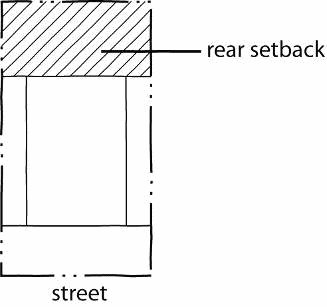
(Ord. No. 120783, § 1, 10-4-2012)
88-810-1400 - REAR YARD
The actual area that exists between a building and the rear property line of the lot on which the building is located, extending along the full length of the rear property line between the side property lines. See also "Setback, Rear."
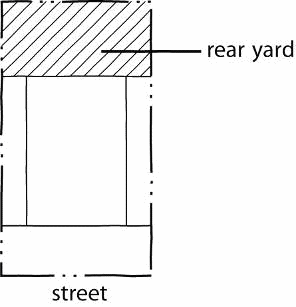
(Ord. No. 120783, § 1, 10-4-2012)
88-810-1405 - RECREATIONAL VEHICLE
A portable unit mounted on wheels or attached to a vehicle, but not mounted on a permanent foundation. The unit is designed to provide temporary living quarters for recreational, camping, or travel use and is of such size or weight as not to require special highway movement permits when drawn by a motorized vehicle. Such units are commonly described as RVs, travel trailers, campers, motor homes, converted buses, or other similar units, whether they are self-propelled or pulled, or can be hauled without a special permit.
(Ord. No. 120783, § 1, 10-4-2012; Ord. No. 180600, § 1, 8-23-2018)
88-810-1408 - RECREATIONAL VEHICLE PARK
Any development, site, parcel or tract of land designed, maintained or intended to be used for the purpose of providing short-term accommodation for a period of less than 30 consecutive days for placement of two or more recreational vehicles and shall include all buildings used or maintained for use of the occupants in the recreational vehicle park.
(Ord. No. 180600, § 1, 8-23-2018)
88-810-1410 - REGISTERED LAND SURVEYOR
A land surveyor properly licensed and registered in the state.
(Ord. No. 120783, § 1, 10-4-2012)
88-810-1420 - REGISTERED PROFESSIONAL ENGINEER
An engineer properly licensed and registered in the state.
(Ord. No. 120783, § 1, 10-4-2012)
88-810-1425. RENEWABLE ENERGY
Energy from resources that are quickly replenished, such as sunlight, wind, water, biomass, geothermal resources.
(Ord. No. 120697, § 1, 8-23-2012; Ord. No. 120783, § 1, 10-4-2012)
88-810-1430 - RESIDENTIAL BUILDING
A building that is arranged, designed, used, or intended to be used:
•
exclusively for residential occupancy by one or more households; or
•
for a mixture of nonresidential and residential occupancy and in which the floor area devoted to residential dwelling units makes up 50% or more of the building's total gross floor area.
(Ord. No. 120783, § 1, 10-4-2012; Ord. No. 220398, § 1, 5-19-2022)
88-810-1440 - RESIDENTIAL DISTRICT
Any R or DR zoning district.
(Ord. No. 120783, § 1, 10-4-2012)
88-810-1442 - RESIDENTIAL PARKING SPACE
An off-street space provided for the parking of motor vehicles in conjunction with a detached house, zero lot line house, attached house, two-unit house, and multi-unit house.
(Ord. No. 160454, § B, 6-23-2016)
88-810-1445 - REVOCATION
The repeal of a permit or designation through the procedures outlined within this chapter.
(Ord. No. 170771, § 1, 2-22-2018)
88-810-1450 - RIGHT-OF-WAY
A strip of land occupied or intended to be occupied by a street, crosswalk, railroad, or road or for another special use. The usage of the term "right-of-way" for land platting purposes means that every right-of-way hereafter established and shown on a final plat is to be separate and distinct from the lots or parcels adjoining such right-of-way, and not included within the dimensions or areas of such lots or parcels. Right-of-way intended for streets, crosswalks, or any other special use involving maintenance by a public agency must be dedicated to public use by the maker of the plat on which such right-of-way is established.
(Ord. No. 120783, § 1, 10-4-2012)
88-810-1460 - RIPARIAN VEGETATION
Vegetation that exists within and is adapted to land adjacent to a water body (stream, river, lake), as defined by The Terrestrial Natural Communities of Missouri (Nelson 2006).
(Ord. No. 120783, § 1, 10-4-2012)
88-810-1470 - ROADWAY
The paved portion of street right-of-way, between the curbs.
(Ord. No. 120783, § 1, 10-4-2012)
S Terms
88-810-1478 - SAF
Society of American Foresters.
(Ord. No. 220961, § 2, 3-16-2023)
88-810-1480 - SALE OR LEASE
Any immediate or future transfer of ownership, including a contract of sale or transfer of an interest in a subdivision or part of a subdivision, whether by metes and bounds, deed, contract, plat, map or other written instrument.
(Ord. No. 120783, § 1, 10-4-2012)
88-810-1490 - SAME OWNERSHIP
Ownership by the same person, corporation, firm, entity, partnership or unincorporated association; or ownership by different corporations, firms, partnerships, entities or unincorporated associations, in which a stockholder, partner or associate or a member of his family owns as interest in each corporation, firm, partnership, entity, or unincorporated association.
(Ord. No. 120783, § 1, 10-4-2012)
88-810-1500 - SATELLITE DISH ANTENNA
A device designed or used for the reception or the transmission of television or other electric communication signal broadcast or, relayed from a satellite. It may be a solid, open mesh, or bar configured structure, in the shape of a shallow dish or parabola.
(Ord. No. 120783, § 1, 10-4-2012)
88-810-1510 - SAVINGS AND LOAN ASSOCIATION
An establishment that is engaged in the business as a savings and loan association and is federally chartered or state chartered.
(Ord. No. 120783, § 1, 10-4-2012)
88-810-1520 - SCALE
The relationship of the mass and size of a building to other buildings and humans.
(Ord. No. 120783, § 1, 10-4-2012)
88-810-1530 - SETBACK
An open, unobstructed area that is required by this zoning and development code to be provided from the furthermost projection of a structure to the property line of the lot on which the building is located.
(Ord. No. 120783, § 1, 10-4-2012)
88-810-1540 - SETBACK, FRONT
See "front setback."
(Ord. No. 120783, § 1, 10-4-2012)
88-810-1550 - SETBACK, REAR
See "rear setback."
(Ord. No. 120783, § 1, 10-4-2012)
88-810-1560 - SETBACK, SIDE
See "side setback."
(Ord. No. 120783, § 1, 10-4-2012)
88-810-1570 - SEXUALLY-ORIENTED TOYS OR NOVELTIES
Instruments, devices or paraphernalia either designed as representations of human genital organs or female breasts, or designed or marketed primarily for use to stimulate human genital organs.
(Ord. No. 120783, § 1, 10-4-2012)
88-810-1580 - SHORT-TERM LOAN ESTABLISHMENT
An establishment which (a) engages in the business of providing money to customers on a temporary basis, wherein such loans are secured by post-dated check, paycheck, or car title, or (b) is registered as a lender under state or federal law. The classification does not include a state or federally chartered bank, savings and loan association, credit union, or mortgage broker or originator. Further, this classification does not include establishments selling consumer goods, including consumables, where the loans or the cashing of checks or money orders are incidental to the main purpose of the business. This classification does include, but is not limited to, check cashing stores, payday loan stores, and car title loan stores.
(Ord. No. 120783, § 1, 10-4-2012)
88-810-1581 - RESERVED
Editor's note— Ord. No. 230267, § 4, adopted May 4, 2023, amended the Code by repealing former § 88-810-1581, which pertained to the definition of "short term rental," and derived from Ord. No. 170771, adopted February 22, 2018.
88-810-1582 - SHORT TERM RENTAL INTERMEDIARY
A marketplace or network that facilitates the listing, marketing, or rental of a short term rental on a site, also referred to as a platform.
(Ord. No. 170771, § 1, 2-22-2018)
88-810-1600 - SIDE PROPERTY LINE, INTERIOR
A side property line that does not abut a street or alley.
(Ord. No. 120783, § 1, 10-4-2012)
88-810-1605 - SIDE PROPERTY LINE, STREET
A side property line that abuts a street.
(Ord. No. 120783, § 1, 10-4-2012)
88-810-1610 - SIDE SETBACK
The setback required between a building and the side property line of the lot on which the building is located, extending along a side property line from the point of the minimum front setback to the point of the minimum rear setback.
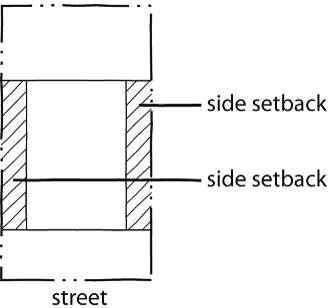
(Ord. No. 120783, § 1, 10-4-2012)
88-810-1620 - SIDE YARD
The actual area that exists between a building and the side property line of the lot on which the building is located, extending along a side property line from the point of the minimum front setback to the point of the minimum rear setback. See also "Setback, Side."
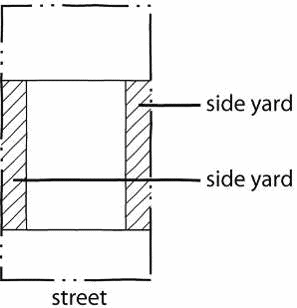
(Ord. No. 120783, § 1, 10-4-2012)
88-810-1622 - SIDE YARD, INTERIOR
The actual area that exists between a building and the interior side property line of the lot on which the building is located, extending along the interior side property line from the front building line to the rear building line.
(Ord. No. 120783, § 1, 10-4-2012)
88-810-1624 - SIDE YARD, STREET
The actual area that exists between a building and the street side property line of the lot on which the building is located, extending along the street side property line the entire depth of the lot.
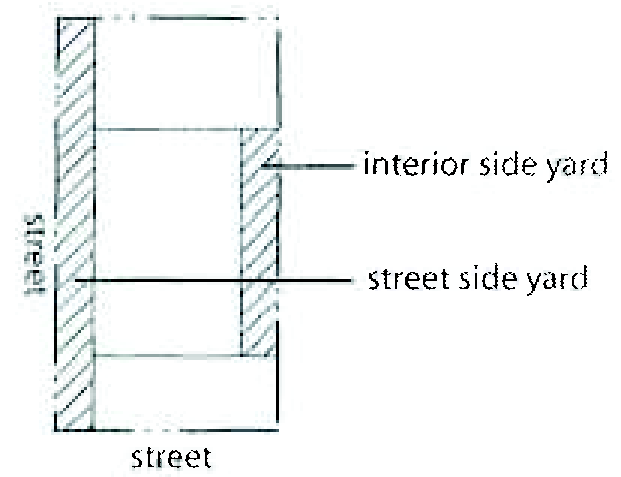
(Ord. No. 120783, § 1, 10-4-2012)
88-810-1630 - SIGN
Any advertisement, announcement, direction or communication produced in whole or in part by the construction, erection, affixing or placing of a structure on any land or on any other structure, or produced by painting on or posting or placing any printed, lettered, pictured, figured or colored material on any building, structure or surface. Includes any animated attention attracting device that may or may not contain text.
(Ord. No. 120783, § 1, 10-4-2012; Ord. No. 180600, § 1, 8-23-2018)
88-810-1640 - SIGN, ADVERTISING COPY
All letters, numbers, and symbols constituting an advertising message.
(Ord. No. 120783, § 1, 10-4-2012)
88-810-1650 - SIGN, ANIMATED
Any sign with moving, rotating (other than on a vertical axis) or other mechanical parts, including banners, pennants or other advertising devices strung across a building or premises, which relies upon wind currents to create movement or the illusion of movement.
(Ord. No. 120783, § 1, 10-4-2012)
88-810-1660 - SIGN, AWNING, MARQUEE, OR CANOPY
A sign that is attached to an awning, marquee, or canopy that extends from the building and covers the walkway.
(Ord. No. 120783, § 1, 10-4-2012; Ord. No. 160341, § 1, 5-12-2016)
88-810-1670 - SIGN, BUSINESS ADVERTISING
Any sign, other than an incidental sign as defined by this chapter, which directs attention to a business, commodity, service, activity or product sold, conducted, or offered on the premises where such sign is located.
(Ord. No. 120783, § 1, 10-4-2012)
88-810-1680 - SIGN, CABINET
A sign with text or symbols printed on a plastic or acrylic sheet that is mounted on a box or cabinet that houses the lighting source and equipment.
(Ord. No. 120783, § 1, 10-4-2012)
88-810-1690 - SIGN, CHANGEABLE COPY PANEL
Any panel which is characterized by changeable copy, illuminated or unilluminated, regardless of method of attachment.
(Ord. No. 120783, § 1, 10-4-2012)
88-810-1700 - SIGN, CHANNEL
A sign comprised of fabricated or formed three-dimensional letters, numbers, and/or symbols.
(Ord. No. 120783, § 1, 10-4-2012)
88-810-1710 - SIGN, DIGITAL
A sign or component of a sign that uses changing lights to form a message or series of messages that are electronically programmed or modified by electronic processes.
(Ord. No. 120783, § 1, 10-4-2012)
88-810-1720 - SIGN, ELECTRONIC
A sign that is electronically programmed or modified by electronic processes.
(Ord. No. 120783, § 1, 10-4-2012)
88-810-1730 - SIGN, INCIDENTAL
A sign which guides or directs pedestrian or vehicular traffic.
(Ord. No. 120783, § 1, 10-4-2012)
88-810-1740 - SIGN, INTERIM
A sign that is designed to be used only for a specified period and not permanently mounted to a structure or permanently installed in the ground.
(Ord. No. 120783, § 1, 10-4-2012)
88-810-1750 - SIGN, MONUMENT
A sign placed upon a base that rests upon the ground where the width of the base of the sign is a minimum of 75 percent of the width of the longest part of the sign.
(Ord. No. 120783, § 1, 10-4-2012)
88-810-1760 - SIGN, MOTORIZED
A sign that is caused to be in constant physical motion by a motor or motorized mechanism. A remotely controlled pricing sign is not considered a motorized sign.
(Ord. No. 120783, § 1, 10-4-2012)
88-810-1770 - SIGN, OUTDOOR ADVERTISING
A sign which directs attention to a business; commodity, service, activity, or product sold, conducted, or offered off the premises where such sign is located.
(Ord. No. 120783, § 1, 10-4-2012; Ord. No. 150600, § A, 7-23-2015)
88-810-1780 - SIGN, PORTABLE
Any sign that is not permanently attached to the ground or other permanent structure, or a sign that is designed to be transported by means of wheels, skids or other similar device. Does not include a sidewalk sign, as further defined in 88-810-1815.
(Ord. No. 120783, § 1, 10-4-2012; Ord. No. 180600, § 1, 8-23-2018)
88-810-1785 - Sign, Projected Image
A sign which involves an image projected on the face of a wall, structure, or other building surface, from a distant electronic device, such that the image does not originate from the plane of the wall, structure, or other surface.
(Ord. No. 260281, § 2, 3-26-2026)
88-810-1790 - SIGN, PROJECTING
A sign which is affixed in some way to an exterior wall of a building or structure and which projects perpendicularly from an exterior wall or radially from a corner of a building or structure and presents two faces with advertising copy to the public.
(Ord. No. 120783, § 1, 10-4-2012)
88-810-1800 - SIGNAGE, REPLACEMENT
Signage which is being changed to accommodate changing tenants.
(Ord. No. 120783, § 1, 10-4-2012)
88-810-1810 - SIGN, ROOF
A sign, any part of which extends above the low point of a roof or parapet wall of a building and which is wholly or partially supported by the building.
(Ord. No. 120783, § 1, 10-4-2012)
88-810-1815 - SIGN, SIDEWALK
A self-standing sign placed on a sidewalk, within 2 feet of the wall containing the business. The sign shall be double-faced and not permanently attached to the ground or a structure. The purpose of the sign is to direct attention to a business, product, commodity, or service for sale or lease on the premise immediately adjacent.
(Ord. No. 180600, § 1, 8-23-2018)
88-810-1820 - SIGN STRUCTURE
A structure which ordinarily serves no other purpose than to support a sign. Structures or symbols such as statuary or similar devices that are used for advertising purposes will be construed as a business advertising sign or as an outdoor advertising sign, as the case may be.
(Ord. No. 120783, § 1, 10-4-2012)
88-810-1830 - SIGN, TRI-VISION
A sign which, by the intermittent, simultaneous revolving of portions of its surface area, exhibits different messages in succession on the surface area, but with only one message viewable at any one time. Tri-vision signs are not considered animated signs.
(Ord. No. 120783, § 1, 10-4-2012)
88-810-1840 - SIGN TYPE
A group or class of signs that are regulated, allowed or not allowed in this code as a group or class. Sign types include, but are not limited to, pole signs, monument signs, oversized monument signs, outdoor advertising signs, wall signs, projecting signs, roof signs, ornamental tower signs, electronic or digital signs, motorized signs, banner signs, and temporary signs. Any type of sign that is separately defined in this Code is also considered a sign type.
(Ord. No. 120783, § 1, 10-4-2012; Ord. No. 120915, § A, 12-20-2012)
88-810-1850 - SIGN, UNDER-MARQUEE
A lighted or unlighted display attached to the underside of a marquee, awning, or canopy and protruding over private sidewalks or rights-of-way.
(Ord. No. 120783, § 1, 10-4-2012)
88-810-1860 - SIGN, WALL
A sign which is either painted on or affixed in some way to an exterior or parapet wall of a building and which projects not more than 12 inches from the wall and presents only one face with advertising copy to the public.
(Ord. No. 120783, § 1, 10-4-2012; Ord. No. 160759, § 1, 10-20-2016; Ord. No. 170566, § A, 9-7-2017)
88-810-1870 - SIGN, WIND-BLOWN
A sign consisting of balloons or objects designed and fashioned in such a manner as to move when subjected to wind pressure.
(Ord. No. 120783, § 1, 10-4-2012)
88-810-1880 - SINGLE-PURPOSE RESIDENTIAL BUILDING
A building in which the majority of floor area on all floors of the building are occupied by residential dwelling units or accessory uses to the principal (residential) use of the building. A building in which the ground floor contains parking and the upper floors contain residential dwellings is a single-purpose residential building. If more than 50% of the floor space on the ground floor is occupied by commercial use, the building is not a single-purpose residential building, but is rather a mixed-use building.
(Ord. No. 120783, § 1, 10-4-2012)
88-810-1890 - SLOPE
The ratio of vertical distance over horizontal distance.
(Ord. No. 120783, § 1, 10-4-2012)
88-810-1895 - SOLAR ENERGY SYSTEM
A system intended to convert solar energy into thermal, mechanical or electrical energy.
88-810-1895-A. SOLAR ENERGY SYSTEM, BUILDING-INTEGRATED
A solar energy system that is an integral part of a principal or accessory building, rather than a separate mechanical device, replacing or substituting for an architectural or structural part of the building. Building-integrated systems include, but are not limited to, photovoltaic or hot water systems that are contained within roofing materials, windows, skylights, shading devices and similar architectural components.
88-810-1895-B. SOLAR ENERGY SYSTEM, STRUCTURE-MOUNTED
A solar energy system that is mounted on the façade or roof of either a principal or accessory structure.
88-810-1895-C. SOLAR ENERGY SYSTEM, FLUSH-MOUNTED
A solar energy system that is mounted flush with a finished building surface, at no more than 6 inches in height above that surface.
88-810-1895-D. SOLAR ENERGY SYSTEM, GROUND-MOUNTED
A solar energy system mounted on the ground and not attached to any other structure other than structural supports.
(Ord. No. 120697, § 1, 8-23-2012; Ord. No. 120783, § 1, 10-4-2012)
88-810-1896 - SOLAR PANEL
A group of photovoltaic cells assembled on a panel. Panels are assembled on-site into solar arrays.
(Ord. No. 120697, § 1, 8-23-2012; Ord. No. 120783, § 1, 10-4-2012)
88-810-1900 - SPECIFIED SEXUAL ACTIVITIES
Sexual conduct, being actual or simulated, normal or perverted acts of human masturbation; deviate sexual intercourse; sexual intercourse; or physical contact, in an act of apparent sexual simulation or gratification, with a person's clothed or unclothed genitals, pubic area or buttocks, or the breast of a female; or any sadomasochistic abuse or acts including animals or any latent objects in an act of apparent sexual stimulation or gratification, as such terms are defined in the pornography and related offenses chapter of the state's criminal code (RSMo ch. 573).
(Ord. No. 120783, § 1, 10-4-2012)
88-810-1905.- SPORTS COMPLEX STADIUM
A group of professional sports facilities.
(Ord. No. 200293, § 2, 6-18-2020)
88-810-1910 - STABILIZING (AREA)
An area that is expected to become stable over the next 20-year period through continued reinvestment, maintenance, or remodeling.
(Ord. No. 120783, § 1, 10-4-2012)
88-810-1920 - STABLE (AREA)
An area that is expected to remain substantially the same over the next 20 years with continued maintenance of the property. While some changes in buildings, land uses, and densities may occur, all such changes are expected to be compatible with surrounding development.
(Ord. No. 120783, § 1, 10-4-2012)
88-810-1930 - STANDARDS, SPECIFICATIONS AND DESIGN CRITERIA, CITY
The department of public works' Standards, Specifications and Design Criteria and the department of water services' Standards, Specifications and Design Criteria, as adopted, supplemented and revised in accordance with the procedures of Article 88-590.
(Ord. No. 120783, § 1, 10-4-2012)
88-810-1940 - STORY
That part of a building included between the surface of any floor and the surface of the floor next above, or, if there is no floor above, then the space between such floor and the ceiling next above it. A top story attic is a half-story when at least two of its opposite sides are situated in a sloping roof and the floor area of the attic does not exceed two-thirds of the floor area immediately below it. An unoccupied, unimproved basement is not be considered a story.
(Ord. No. 120783, § 1, 10-4-2012)
88-810-1950 - STREAM
A body of running water moving over the earth's surface and flowing at least part of the year, as designated on the Kansas City Natural Resource Protection Map. Storm sewer systems, human-made channels (except those designed to function as natural streams), and roadside ditches are not considered streams.
(Ord. No. 120783, § 1, 10-4-2012)
88-810-1960 - STREAM BUFFER
Vegetated area, including trees, shrubs, and herbaceous vegetation, that exists or is established to protect a stream system, lake, or reservoir.
(Ord. No. 120783, § 1, 10-4-2012)
88-810-1970 - STREAM CHANNEL
The streambed and its banks.
(Ord. No. 120783, § 1, 10-4-2012)
88-810-1980 - STREAM CORRIDOR
The stream channel and adjacent floodplains, wetlands, slopes over 15%, and mature riparian vegetation.
(Ord. No. 120783, § 1, 10-4-2012)
88-810-1990 - STREAM REACH
For the purposes of this ordinance, a stream reach is the continuous length of stream of the same stream order (Strahler 1952); for example, a 1st order stream reach ends when another first order stream joins it, forming a 2nd order stream.
(Ord. No. 120783, § 1, 10-4-2012)
88-810-2000 - STREET
A thoroughfare available to the public that affords the principal means of access to abutting property.
(Ord. No. 120783, § 1, 10-4-2012)
88-810-2010 - STREET CLASSIFICATIONS
An assignment of functional character and carrying capacity to streets and highways officially given in the major street plan adopted by the city council.
(Ord. No. 120783, § 1, 10-4-2012)
88-810-2020 - STREET FRONTAGE
Any portion of a lot that abuts a street.
(Ord. No. 120783, § 1, 10-4-2012)
88-810-2030 - STREET LINE
The dividing line between the street and the lot.
(Ord. No. 120783, § 1, 10-4-2012)
88-810-2040 - STREET, COLLECTOR
A street providing traffic movement between major streets and local streets and direct access to abutting property.
(Ord. No. 120783, § 1, 10-4-2012)
88-810-2050 - STREET, LOCAL
A street providing direct access to abutting property, and for local traffic movement within small areas. The function of a local street generally terminates at collector or, in some instances, major streets; however, the prime function is to serve abutting properties.
(Ord. No. 120783, § 1, 10-4-2012)
88-810-2060 - STREET, MAJOR
A street providing through traffic movement between areas and across the city and direct access to abutting property, subject to necessary control of entrances, exits, and curb use. Major streets are identified on the major street plan and are given a function designation as either primary or secondary arterials.
(Ord. No. 120783, § 1, 10-4-2012)
88-810-2070 - STREET, PERIMETER
Existing traveled roadways, whether improved to city standards or not, and with or without dedicated rights-of-way, and located along the periphery of the proposed development.
(Ord. No. 120783, § 1, 10-4-2012)
88-810-2080 - STREET, PRIVATE
A roadway or street used for internal vehicular circulation within a development that has been identified as such on the site plan, development plan or preliminary plat and is located within the access easement recorded on the plat.
(Ord. No. 120783, § 1, 10-4-2012)
88-810-2090 - STREET, RESIDENTIAL
See "Street, local."
(Ord. No. 120783, § 1, 10-4-2012)
88-810-2100 - STREETSCAPE
All of the physical elements within the public right-of-way that are encountered by people who use streets and sidewalks. Common streetscape features include:
1.
Sidewalks and crosswalks
2.
Street design including lane width and surface treatments
3.
Lighting
4.
Street trees and grates
5.
Public art
6.
Street furniture, including benches and trash receptacles
7.
Signage
8.
On-street parking
9.
Bus stops
(Ord. No. 120783, § 1, 10-4-2012)
88-810-2110 - STRUCTURAL ALTERATIONS
Any change in the supporting members of a building, such as bearing walls or partitions, columns, beams or girders, or any structural change in the roof, but not including extension or enlargement.
(Ord. No. 120783, § 1, 10-4-2012)
88-810-2120 - STRUCTURE
Anything constructed or erected that requires location on the ground or that is attached to something having a location on the ground, including but not limited to advertising signs, billboards, and poster panels, but exclusive of customary fences or boundary or retaining walls.
(Ord. No. 120783, § 1, 10-4-2012; Ord. No. 160759, § 1, 10-20-2016)
88-810-2130 - SUBDIVIDER
Any person who:
•
having an interest in land, causes it, directly or indirectly, to be divided into a subdivision; or
•
directly or indirectly, sells, leases or develops or offers to sell, lease or develop, or advertises for sale, lease or development, any interest, lot, parcel, site, unit or plat in a subdivision; or
•
engages directly or through an agent in the business of selling, leasing, developing or offering for sale, lease or development, a subdivision, or any interest, lot, parcel, site, unit or plot in a subdivision; and
•
is directly or indirectly controlled by, or under direct or indirect common control, with any of the foregoing.
(Ord. No. 120783, § 1, 10-4-2012)
88-810-2140 - SUBDIVISION
Any land, vacant or improved, that is divided or proposed to be divided into two or more lots, parcels, sites, units, plots or interests of less than 20 acres, for the purpose of offer, sale, lease or development, either on the installment plan or upon any and all other plans, terms and conditions, including resubdivision. Subdivision includes the division or development of residential and nonresidential zoned land, whether by deed, metes and bounds description, map, plat or other recorded instrument, and further includes the creation of a condominium, townhome or any other division of property into units and common elements.
(Ord. No. 120783, § 1, 10-4-2012)
88-810-2150 - SUBDIVISION PLAT
The final map or drawing, described in this zoning and development code, on which the developer's plan of subdivision is presented to the plan commission for recommendation and that, if approved by the city council, must be submitted to the county recorder of deeds for filing.
(Ord. No. 120783, § 1, 10-4-2012)
88-810-2155 - SUSPENSION
The temporary prohibition of a use permitted by this chapter. Failure to cure conditions leading to the suspension may result in revocation.
(Ord. No. 170771, § 1, 2-22-2018)
T and U Terms
88-810-2160 - THROUGH LOT
A lot having a pair of opposite property lines along two more or less parallel public streets, and that is not a corner lot.
(Ord. No. 120783, § 1, 10-4-2012)
88-810-2161 - TOPPING
The cutting back of limbs to stubs within the tree's crown, to such a degree as to remove the normal tree canopy cover and disfigure the tree; or the cutting back of limbs or branches to lateral branches that are less than one-half of the diameter of the limb or branch that is cut. Also referred to as stubbing, dehorning, pollarding, and heading.
(Ord. No. 220961, § 2, 3-16-2023)
88-810-2165 - TRANSPARENCY
Windows or doors that allow clear views of indoor spaces. To qualify as transparent, windows or doors shall not be mirrored, darkly tinted, or of any material that obscures visibility between the inside and outside. Product display windows that do not provide views into the interior of the building may be counted toward satisfying up to 50 percent of the transparency requirement, provided they are internally illuminated and at least 3 feet in depth.
(Ord. No. 150544, § 1, 7-23-2015)
88-810-2166 - TREE
Any self-supporting woody perennial plant, usually having a main stem or trunk and several branches, and at maturity normally attaining a trunk diameter greater than 3 inches at DBH and a height of over 10 feet.
(Ord. No. 220961, § 2, 3-16-2023)
88-810-2166.1 - TREE CANOPY COVER
Grouping of trees of one acre or larger in area.
(Ord. No. 220961, § 2, 3-16-2023)
88-810-2166.2 - TREE PRESERVATION AND PROTECTION PLAN
A plan that delineates areas of the site and identifies protected trees to be preserved or be removed. The plan sets forth measures to be taken to ensure protection and survivability of trees to be saved, prior to and during construction.
(Ord. No. 220961, § 2, 3-16-2023)
88-810-2166.3 - TREE PROTECTION
Fencing, barriers, or other measures intended to protect those trees to remain, including soil and root structure below, per the approved tree preservation and protection plan, construction documents, and ANSI A300 Construction Management Standard - Part 5 (2019).
(Ord. No. 220961, § 2, 3-16-2023)
88-810-2166.4 - TREE REMOVAL
Removal of a tree(s), through either direct or indirect actions including, but not limited to, clearing, topping, or cutting, causing irreversible damage to the health of the tree(s).
(Ord. No. 220961, § 2, 3-16-2023)
88-810-2170 - TRUCK
Includes tractor and trailer trucks, or any motor vehicle that carries a truck license.
(Ord. No. 120783, § 1, 10-4-2012)
88-810-2180 - UMBRELLA NEIGHBORHOOD ORGANIZATION
A group or consortium of neighborhoods, businesses and individuals, who work together formally to coordinate several neighborhoods' activities or pool resources.
(Ord. No. 120783, § 1, 10-4-2012)
88-810-2190 - UNDERGROUND SPACE
The entire cavern resulting from the extraction of subsurface-located material from underground areas in such a manner that the surface area of the property is not disturbed except in the vicinity of the entrances and easements serving the development.
(Ord. No. 120783, § 1, 10-4-2012)
88-810-2200 - USE
The purpose or activity for which the land, or building thereon, is designed, arranged or intended, or for which it is occupied or maintained. Unless the otherwise expressly indicated, the term "use" means principal use.
(Ord. No. 120783, § 1, 10-4-2012)
88-810-2210 - USE OF OPEN LAND
Storage yards, construction debris sites, used vehicle sales lots, vehicle impound yards, auto wrecking, junkyards, and similar open-air uses when the only buildings on the lot are incidental and accessory to the open-air use of the lot.
(Ord. No. 120783, § 1, 10-4-2012)
88-810-2220 - USE, PRINCIPAL
See "principal use."
(Ord. No. 120783, § 1, 10-4-2012)
88-810-2230 - UTILITY
All poles, towers, wires, lines, cables, conduits, pipes and accessory equipment providing service to multiple properties. Examples include electricity, telephone, telegraph, cable television, gas, water, sewer, steam or petroleum, distribution systems, transmission systems, and accessory equipment.
(Ord. No. 120783, § 1, 10-4-2012)
88-810-2232 - UTILITY-SCALE ENERGY PRODUCTION
An energy production facility that produces electric energy for widespread distribution through the electric power grid.
(Ord. No. 120697, § 1, 8-23-2012; Ord. No. 120783, § 1, 10-4-2012)
V and W Terms
88-810-2250 - VEHICULAR USE AREA
Any area of the lot not located within any enclosed or partially enclosed structure and that is devoted to a use by or for motor vehicles including parking (accessory or non-accessory); storage of automobiles, trucks or other vehicles; gasoline stations; car washes; motor vehicle repair shops; loading areas; service areas and drives; and access drives and driveways.
(Ord. No. 120783, § 1, 10-4-2012)
88-810-2260 - VIDEO STORE
An exclusive term, identifying a category of business that may include adult media but that is not regulated as an "adult media store." In this context, video store means a retail store offering video cassettes, disks or other video recordings for sale or rent, provided that any store in which adult media constitutes more than 40% of the stock in trade and/or occupies more than 40% of the gross public floor area is deemed an "adult media store."
(Ord. No. 120783, § 1, 10-4-2012)
88-810-2270 - WATER BODY
A body of water or waterbody (often spelled water body) is any significant accumulation of water, including accumulations of water such as lakes, ponds, or wetlands, and watercourses.
(Ord. No. 120783, § 1, 10-4-2012)
88-810-2272 - WATER COLLECTION CISTERN
A barrel or similar container that collects and stores rainwater or other water that would otherwise be lost as runoff or diverted into a storm drain.
(Ord. No. 120697, § 1, 8-23-2012; Ord. No. 120783, § 1, 10-4-2012)
88-810-2280 - WATERCOURSE
Any flowing body of water, including but not limited to rivers, streams, brooks, and anabranches (sections of a river or stream that diverts from the main channel or stem).
(Ord. No. 120783, § 1, 10-4-2012)
88-810-2285 - WATERCRAFT
A boat, houseboat, jet ski, or similar apparatus designed for use on water and propelled by oars, sails, or one or more internal combustion engine(s).
(Ord. No. 170061, § A, 3-23-2017; Ord. No. 170806, § A, 10-12-2017)
88-810-2290 - WESTPORT AREA
The area of the city bounded by the following described perimeter: beginning at the intersection of W. 43rd Street and Madison Avenue, then north along Madison Avenue and Southwest Trafficway, then east along W. 40th Street, then north along Washington Street, then east along W. 39th Street, then south along Baltimore Avenue, then southwest along Archibald Street, then southeast along Central Street, then south along Baltimore Avenue, then west along W. 43rd Street to the point of beginning.
(Ord. No. 120783, § 1, 10-4-2012)
88-810-2300 - WETLANDS
Areas that are saturated or inundated by surface water or groundwater at a frequency and duration sufficient to support, and that under normal circumstances do support, a prevalence of vegetation adapted for life in saturated soil conditions.
(Ord. No. 120783, § 1, 10-4-2012)
88-810-2310 - WILDLIFE HABITAT
High quality, regionally significant vegetated areas contiguous to the stream corridor and sites with threatened or endangered species and/or rare upland and lowland communities, as shown on the Kansas City Natural Resources Protection Plan Map.
(Ord. No. 120783, § 1, 10-4-2012)
Y and Z Terms
88-810-2320 - YARD
The actual (as opposed to "required") open space on a zoning lot that is unoccupied and unobstructed from its lowest level to the sky. See also "Setback."
(Ord. No. 120783, § 1, 10-4-2012)
88-810-2330 - YARD, FRONT
See "front yard."
(Ord. No. 120783, § 1, 10-4-2012)
88-810-2340 - YARD, LEAST DIMENSION
The least of the horizontal dimensions at any level of such yard at such level.
(Ord. No. 120783, § 1, 10-4-2012)
88-810-2350 - YARD, REAR
See "rear yard."
(Ord. No. 120783, § 1, 10-4-2012)
88-810-2360 - YARD, SIDE
See "side yard."
(Ord. No. 120783, § 1, 10-4-2012)
88-810-2370 - ZONING, LOT
A single tract of land located within a single block, that (at the time of filing for a building permit) is designated by its owner or developer as a tract to be used, developed, or built upon as a unit, under single ownership or control.
(Ord. No. 120783, § 1, 10-4-2012)
88-820-01 - LOT AREA
88-820-01-A. MEASUREMENT
The total land area contained within the property lines of a lot.
88-820-01-B. EXCEPTIONS
1.
A detached house, wherever permitted as an allowable use, may be erected on any area of land in separate ownership that was in existence at the time of the passage of the original Ordinance No. 45608, passed June 4, 1923, or any subsequent amendment thereto that causes the area of land in separate ownership to contain less area than required for a detached house in the district in which it is located, provided all setback, height, and parking requirements of this zoning and development code are met. For purposes of this section, separate ownership means any lot previously established by a recorded subdivision plat or any lot established by a recorded conveyance made prior to March 1, 1954, or made in conformance with subdivision regulations of this code, or as otherwise lawfully established.
2.
A detached house, wherever permitted as an allowable use, may be erected on any area of land established by an approved lot split or subdivision plat.
(Ord. No. 130441, § 1, 7-11-2013; Ord. No. 220398, § 1, 5-19-2022)
88-820-02 - LOT AREA PER UNIT
The amount of lot area required for each dwelling unit on the property. For example, if a minimum lot-area-per-unit standard of 1,000 square feet is applied to 6,250 square foot lot, a maximum of 6 dwelling units would be allowed on the property.
88-820-03 - LOT DEPTH
The mean horizontal distance between the front property line and the rear property line of a lot measured within the lot's boundaries.
88-820-04 - LOT FRONTAGE
The horizontal distance between side property lines on a lot, as measured along the front property line.
88-820-05 - LOT WIDTH
The mean horizontal distance between the side property lines of a lot measured within the lot's boundaries.
88-820-06 - LOT COVERAGE
The area of a lot covered by principal buildings, as measured along the exterior building wall at ground level, and including all building projections other than those expressly allowed encroaching into required setback areas.
88-820-07 - FLOOR AREA RATIO
The floor area of the building divided by the total gross area of the lot upon which the building is located.
88-820-07-A. For the purpose of calculating floor area ratios, the "floor area" of a building is the sum of the gross horizontal area of all floors in the building measured from the interior faces of the exterior walls. The "floor area" of a building expressly includes all of the following:
1.
floor area of any floor located below grade or partially below grade when more than one-half the floor-to-ceiling height of the below-grade (or partially-below-grade) floor is above grade level;
2.
elevator shafts and stairwells on each floor;
3.
floor area used for mechanical equipment, except equipment located on the roof and mechanical equipment within the building that occupies a commonly owned contiguous area of 5,000 square feet or more;
4.
those portions of an attic having clear height (head-room) of 6 feet 9 inches or more;
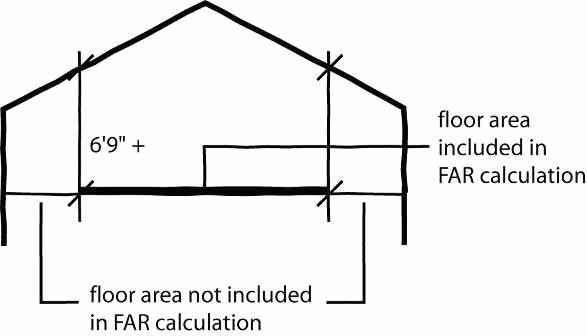
5.
mezzanines;
6.
enclosed porches;
7.
floor area devoted to non-accessory parking;
8.
floor area within a principal building that is occupied by accessory uses.
88-820-07-B. For the purpose of calculating floor area ratios, floor area devoted to accessory parking and the drive aisles and circulation area associated with such parking are not to be counted as "floor area."
(Ord. No. 120697, § 1, 8-23-2012)
88-820-08 - GROSS PUBLIC FLOOR AREA
The total area of the building accessible or visible to the public, including showrooms, motion picture theatres, motion picture arcades, service areas, behind-the-counter areas, storage areas visible from such other areas, restrooms (whether or not labeled "public"), areas used for cabaret or similar shows (including stage areas), plus aisles, hallways, and entryways serving such areas.
88-820-09 - FRONT SETBACKS
88-820-09-A. MEASUREMENT
1.
Front setbacks are to be measured from the front property line of the lot on which such building is located to the exterior wall of the building.
2.
The front yard of a corner lot will be measured as follows:
(a)
The front yard of a corner lot consisting of one platted lot will be adjacent to the street on which the lot has its least dimension.
(b)
If a corner lot consists of two or more platted lots, each whose least dimension is on the same street as the other lots in the block, then the location of the front yard will be on the same street as the other lots.
(c)
If a corner lot consist of unplatted land or a combination of platted and unplatted land, the front yard will be on the street where front the greater number of lots, either platted or unplatted.
(d)
Any question as to the measurement of a front setback on a corner lot will be determined by the city planning and development director.
3.
When existing lawfully established residential buildings on one or more abutting lots are closer to the front property line than the otherwise required front setback, additions to existing residential buildings or construction of new residential buildings on the subject lot may, at the property owner's option, comply with the average front yard depth that exists on the nearest 2 lots on either side of the subject lot instead of complying the zoning district's minimum front setback requirement.
(a)
If one or more of the lots required to be included in the averaging calculation are vacant, the vacant lots will be deemed to have a front yard depth equal to the minimum front setback requirement of the underlying zoning district.
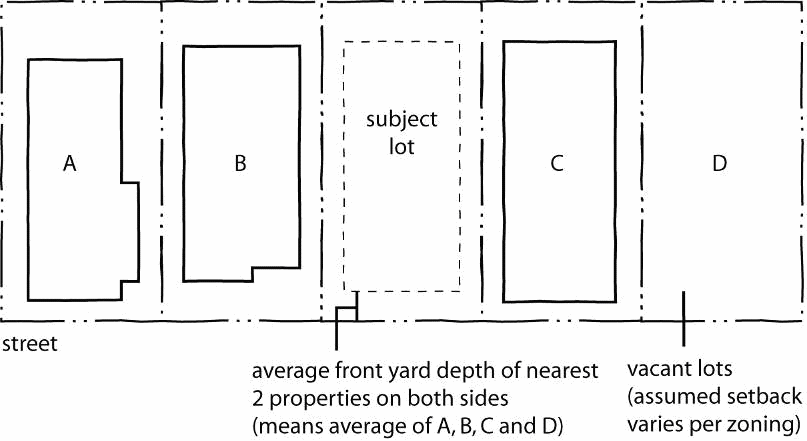
(b)
Lots that front on a different street than the subject lot or that are separated from the subject lot by a street or alley may not be used in computing the average.
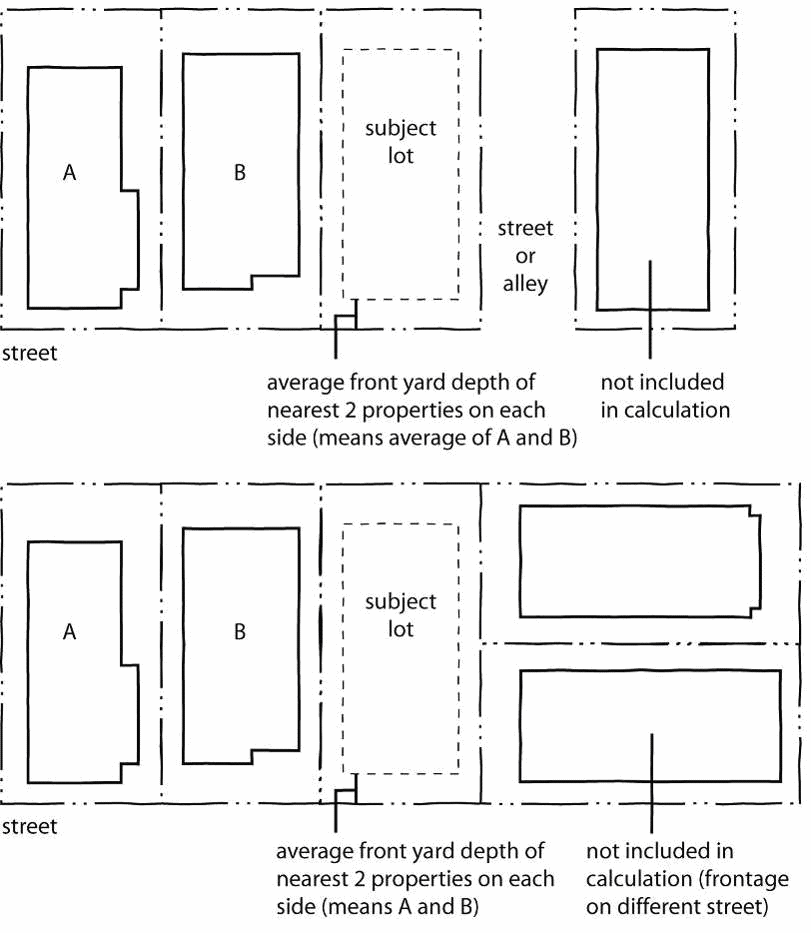
(c)
When the subject lot is a corner lot, the average front yard depth will be computed on the basis of the nearest 2 lots that front on the same street as the subject lot.
(d)
When the subject lot abuts a corner lot fronting on the same street, the average front yard depth will be computed on the basis of the abutting corner lot and the nearest 2 lots that front on the same street as the subject lot.
(e)
The planning and development department is authorized to require a survey or other reliable, verifiable data to support determination of the average front setback.
88-820-09-B. PERMITTED OBSTRUCTIONS/ENCROACHMENTS
Setbacks must be unobstructed and unoccupied from the ground to the sky except as expressly allowed in 88-820-12. All portions of front setbacks that are not occupied by permitted obstructions (See 88-820-12) must be landscaped and preserved as open space.
(Ord. No. 151013, § A, 12-10-2015)
88-820-10 - REAR SETBACKS
88-820-10-A. MEASUREMENT
Rear setbacks are to be measured from the rear property line of the lot on which such structure is located to the furthermost projection of the structure, not including those projections and features allowed within such setback pursuant to 88-820-12. Where no rear property line exists, a line parallel to the front street line, located entirely on such lot but as far as possible from the front street, and no less than 10 feet long shall be deemed the rear property line.
88-820-10-B. PERMITTED OBSTRUCTIONS/ENCROACHMENTS
Setbacks must be unobstructed and unoccupied from the ground to the sky except as expressly allowed in 88-820-12.
88-820-10-C. THROUGH LOTS
On through lots both (opposing) street lines are considered front property lines and front setback standards apply. Rear setback standards do not apply.
(Ord. No. 120783, § 1, 10-4-2012)
88-820-11 - SIDE SETBACKS
88-820-11-A. MEASUREMENT
Side setbacks are to be measured from the side property line of the lot on which such structure is located to the furthermost projection of the structure, not including those projections and features allowed within such setback pursuant to 88-820-12.
88-820-11-B. PERMITTED OBSTRUCTIONS/ENCROACHMENTS
Required setbacks must be unobstructed and unoccupied from the ground to the sky except as expressly allowed in 88-820-12.
88-820-12 - FEATURES ALLOWED TO ENCROACH IN REQUIRED SETBACKS
Required setbacks must be unobstructed and unoccupied from the ground to the sky except that features are allowed to encroach into required setbacks to the extent indicated in the following table:
(Ord. No. 120697, § 1, 8-23-2012; Ord. No. 120783, § 1, 10-4-2012; Ord. No. 130441, § 1, 7-11-2013; Ord. No. 140919, § A, 11-13-2014; Ord. No. 151013, § A, 12-10-2015; Ord. No. 160341, § 1, 5-12-2016)
88-820-13 - BUILDING HEIGHT
88-820-13-A. MEASUREMENT
The vertical distance between the "ground" and the level of the highest point of the roof beams in the case of flat roofs or roofs inclining no more than one inch to the foot and between the "ground and midpoint between top of the main plate and highest ridge in the case of all other roofs. For the purpose of measuring building height, the "ground" level is the highest of the following three levels: curb level; established or mean street grade if no curb exists; or the average finished ground level adjoining the building if the building is setback more than 10 feet from the street line.
88-820-13-B. EXCEPTIONS
1.
PARAPET WALLS AND FALSE MANSARDS
Parapet walls and false mansards may extend no more than 8½ feet above the height limit.
2.
APPURTENANCES
Exceptions shall apply to flagpoles, chimneys, cooling towers, electric display signs, elevator bulkheads, belfries, penthouses, finials, gas tanks, grain elevators, stacks, silos, storage towers, observation towers, radio or television antennas and towers, windmills, ornamental towers, monuments, cupolas, domes, spires, standpipes and necessary mechanical appurtenances which, where permitted, shall be erected to a height in accordance with existing or hereafter adopted ordinances of the city. In R districts, radio or television structures accessory to a residential use, including antenna supports and antennas, may exceed the maximum height permitted by lot and building standards, but shall not exceed 60 feet in height. Height of accessory solar and wind energy systems shall comply with 88-305-09.
3.
AMUSEMENT PARK RIDES, AMUSEMENT ATTRACTIONS OR ROLLER COASTERS
Height restrictions in any zoning district do not apply to amusement park rides, amusement attractions or roller coasters of any type that are erected in any zoning district in which they are allowed, either temporary or permanent, provided that each is set back a distance equal to its height from all property lines.
4.
LIMITATIONS ON ROOFTOP FEATURES IN R DISTRICTS
a.
Stairway enclosures and elevator penthouses in R districts are allowed to exceed the maximum building height, provided:
1.
they are set back at least 20 feet from the front building line, and
2.
do not exceed 9 feet in overall height or extend more than 5 feet above the building parapet, whichever results in a lesser height.
b.
Stairway enclosures in R districts may not contain habitable space and may not exceed 170 square feet in area.
c.
Elevator penthouses in R districts may not contain habitable space and may not exceed 465 square feet in area.
d.
Building-mounted solar energy systems may extend up to 3 feet above the applicable maximum height limit for the subject building type, provided they do not extend more than 5 feet above the roof line.
(Ord. No. 120697, § 1, 8-23-2012; Ord. No. 170360, § 1, 6-15-2017; Ord. No. 190501, § A, 7-11-2019)
88-820-14 - BUILDING COVERAGE
The percentage of the lot area covered by the building area.
88-820-15 - SEPARATION DISTANCE
Unless specified otherwise, the required separation between certain land uses shall be measured in a straight line from the nearest property line of the lot occupied by or proposed to be occupied by the regulated use or development to the nearest property line of the other listed use.
(Ord. No. 160341, § 1, 5-12-2016)

