
Kearney City Zoning Code
CHAPTER 50
SIGN REGULATIONS
50-101 - REPEALED
(Ord. No. 6864, 3-12-2002; Ord. No. 6964, 6-10-2003; Ord. No. 7424, 3-11-2008; Ord. No. 8364, § 1, 8-13-2019)
50-102 - REPEALED
(Ord. No. 6864, 3-12-2002; Ord. No. 6964, 6-10-2003; Ord. No. 7009, 12-9-2003; Ord. No. 7424, 3-11-2008; Ord. No. 7445, 7-22-2008; Ord. No. 7456, 8-12-2008; Ord. No. 7495, 12-9-2008; Ord. No. 8364, § 2, 8-13-2019)
50-103 - REPEALED
(Ord. No. 6864, 3-12-2002; Ord. No. 6964, 6-10-2003; Ord. No. 7009, 12-9-2003; Ord. No. 7456, 8-12-2008; Ord. No. 7495, 12-9-2008; Ord. No. 8115, 11-8-2016, Ord. No. 8185, 10-10-2017; Ord. No. 8364, § 3, 8-13-2019)
50-104 - REPEALED
(Ord. No. 6864, 3-12-2002; Ord. No. 7009, 12-9-2003; Ord. No. 7445, 7-22-2008; Ord. No. 7456, 8-12-2008; Ord. No. 8115, 11-8-2016; Ord. No. 8364, § 4, 8-13-2019)
50-105 - REPEALED
(Ord. No. 6864, 3-12-2002; Ord. No. 7009, 12-9-2003; Ord. No. 8364, § 5, 8-13-2019)
50-106 - REPEALED
(Ord. No. 6864, 3-12-2002; Ord. No. 6964, 6-10-2003; Ord. No. 7424, 3-11-2008; Ord. No. 8364, § 6, 8-13-2019)
50-107 - REPEALED
(Ord. No. 6864, 3-12-2002; Ord. No. 8364, § 7, 8-13-2019)
50-108 - REPEALED
(Ord. No. 6864, 3-12-2002; Ord. No. 7009, 12-9-2003; Ord. No. 8364, § 8, 8-13-2019)
50-109 - REPEALED
(Ord. No. 6864, 3-12-2002; Ord. No. 8364, § 9, 8-13-2019)
50-110 - REPEALED
(Ord. No. 6864, 3-12-2002; Ord. No. 8364, § 10, 8-13-2019)
50-111 - REPEALED
(Ord. No. 6864, 3-12-2002; Ord. No. 8364, § 11, 8-13-2019)
50-112 - REPEALED
(Ord. No. 6864, 3-12-2002; Ord. No. 8364, § 12, 8-13-2019)
50-113 - REPEALED
(Ord. No. 7424, 3-11-2008; Ord. No. 8213, 1-9-2018; Ord. No. 8364, § 13, 8-13-2019)
50-114 - REPEALED
(Ord. No. 6864, 3-12-2002; Ord. No. 7424, 3-11-2008; Ord. No. 8364, § 14, 8-13-2019)
50-115 - REPEALED
(Ord. No. 6864, 3-12-2002; Ord. No. 7424, 3-11-2008; Ord. No. 8364, § 15, 8-13-2019)
50-116 - PURPOSE AND INTENT
It is the purpose and intent of Chapter 50 to promote the public health, safety, and general welfare through reasonable, consistent, and non-discriminatory sign standards. The sign regulations in this Chapter are not intended to censor speech or to regulate viewpoints, but instead are intended to regulate the adverse secondary effects of signs. The sign regulations are especially intended to address the secondary effects that may adversely impact aesthetics and traffic and pedestrian safety.
In order to preserve and promote the City of Kearney as a desirable community in which to live, visit, work, play and do business, a pleasing, visually attractive and safe environment is of foremost importance. Further, it continues to be the purpose of Chapter 50 to promote optimum conditions for serving sign owners' needs and respecting their rights to identification while balancing the aesthetic and safety interests of the community. The regulation of signs within the City of Kearney and its zoning jurisdiction is necessary and in the public interest, and these regulations have been prepared with the intent of enhancing the visual environment of the City and promoting its continued well-being, and are intended more specifically to:
A.
Accommodate the rights of individuals to freedom of speech, promote equity among businesses and other typical sign users, and enable the fair and consistent enforcement of sign standards;
B.
Recognize the legitimate signage needs of businesses and other interests to communicate messages, provide identification, and enable wayfinding throughout the City for tourists and residents;
C.
Ensure that signage contributes to the maintenance of an aesthetically pleasing visual environment by exercising reasonable regulations over type, size, number, appearance, and location;
D.
Protect property values by minimizing the possible adverse effects of signs on nearby public and private property;
E.
Promote public safety and general welfare by ensuring that signs are properly constructed and maintained to protect the general public from property damage and personal injury;
F.
Facilitate traffic flow and safety of pedestrians, bicyclists, and motorists through enforcement of sight lines and other appropriate sign placement regulations; and
G.
Preserve and promote retention of local businesses and further the economic development goals of the City.
(Ord. No. 8365, § 1, 8-13-2019)
50-117 - APPLICABILITY, INTERPRETATION, SEVERABILITY, AND NON-COMMERCIAL SPEECH SUBSTITUTION
A.
Applicability. Each sign or part of a sign erected within the zoning jurisdiction of the City of Kearney must comply with the provisions of this chapter, other relevant provisions of the City of Kearney's Municipal Code, and applicable building codes. The regulations in this article are applicable to all signs in the City's jurisdiction, except as noted in Section 50-120.B, unless otherwise stated.
B.
Interpretation. The City shall interpret and apply the sign regulations of Chapter 50 of the Unified Land Development Ordinances (ULDO).
C.
Severability and Non-Commercial Speech Substitution. Any provision of the sign standards that imposes a limitation on freedom of speech shall be construed in a manner that is viewpoint neutral and treats expressive speech either the same as or less restrictive than commercial speech. Any provision of the sign standards that is found to be an unconstitutional limitation on freedom of speech by any court shall be severed from the sign standards in a manner that preserves the standards and protects freedom of speech.
(Ord. No. 8365, § 2, 8-13-2019)
50-118 - DEFINITION OF TERMS
The following definitions shall be used for terms contained in this Chapter and Chapter 3, Article 1. Terms not defined in this section may be defined in other areas of City Code.
A.
SIGN: Any device, fixture, placard or structure, including its component parts, which draws attention to an object, product, place, activity, opinion, person, institution, organization, or place of business, or which identifies or promotes the interests of any person and which may be viewed from the private property of another or from any public street, road, highway, right-of-way or parking area (collectively referred to as a "public area"). For the purposes of these regulations, the term "sign" shall include all structural members. The term "sign" for regulatory purposes shall not include the following objects: Grave yard and cemetery markers, vending machines, express mail and donation drop-off boxes, drive-thru menu boards, seasonal decorations visible, a building's architectural features visible, or a manufacturer's or seller's markings on machinery or equipment visible.
B.
SIGN RELATED TERMS:
1.
ARCHITECTURAL DETAIL/FEATURE/ELEMENT: Prominent or significant parts or elements of a building or structure including but not limited to; cornices, belt courses, lintels, sills, pediments, columns or pilasters, rustications, or base courses.
2.
AUXILIARY DESIGN ELEMENTS: Terms which describe secondary characteristics of a sign, including its method of illumination and other features within the bounds of its basic shape.
3.
AWNING: An architectural projection that provides weather protection, identity, or decoration and is partially or wholly supported by the building to which it is attached. An awning is typically comprised of a lightweight frame structure over which a covering in attached.
4.
BACKGROUND PANEL: An area distinctively painted, textured, or constructed as a background for the sign copy or a distinctive background area which is used to differentiate such sign copy from where the sign is mounted, affixed, or painted in a different color, material, etc. from the structure its attached.
5.
BALLOON: Any lighter than air, gas filled inflatable object attached by a tether to a fixed place or mounted on the ground or a building.
6.
CABINET: A sign structure comprised of a frame and a sign face or faces. Though a cabinet sign may include electrical components or support structure, the cabinet refers only to the frame housing the sign face.
7.
CANOPY: A permanent structure of rigid construction which a covering is attached that provides weather protection, identity, or decoration. A canopy is structurally independent.
8.
CLEARANCE: The distance between grade and the bottom edge of a sign.
9.
CITY OF KEARNEY OUTDOOR ADVERTISING SIGN REGISTRY: A list of all outdoor advertising signs shall be maintained by the City of Kearney's Finance Department, detailing location, ownership, and size of all outdoor advertising signs.
10.
COMMERCIAL BUILDING, MULTIPLE TENANT: A commercial building with two (2) or more separate tenants having individual entrances and shared parking.
11.
COMMERCIAL CENTER: A group or cluster of retail shops, offices, or employment buildings which share common parking, landscaping, and/or frontage, and may have a property owners association and have a name which is generally understood by the public to refer to the group or cluster.
12.
FRONTAGE: The length of a property line of any one (1) premise abutting and parallel to a public street, private way, or court.
13.
ILLUMINATION: Lighting sources installed for the primary purpose of lighting a specific sign or group of signs.
a.
DIRECT ILLUMINATION: An external source of illumination that is not part of or attached to a sign, which directly illuminates the sign.
b.
INDIRECT ILLUMINATION: A source of illumination, not directly visible, which lights only the background upon which the sign or individual letter is mounted.
c.
INTERNAL ILLUMINATION: A light source entirely within a sign where the source of the illumination is not directly visible.
d.
NEON ILLUMINATION: Any illumination effects using neon or any other inert gas under low pressure, which glows in a distinctive color when exposed to a high voltage electrical current.
14.
INDIVIDUAL LETTERS: A cutout or etched letter or logo which is individually placed on a wall or freestanding sign.
15.
LOGO: A graphic symbol representing an activity, use, or business. Logos are registered trademarks or symbols commonly used by a business and may include lettering in addition to graphic designs.
16.
MASTER SIGN PLAN: A set of sign design standards established for a multi-tenant building, non-residential complexes with multiple buildings, multi-family building complexes, hospitals, or large-scale mixed-use developments.
17.
MARQUEE: A permanent roofed structure attached to and supported by a building and typically extends over public right-of-way.
18.
PAN-CHANNEL LETTER: An individual three-dimensional letter constructed by means of a three-sided metal channel.
19.
PERMITTED SIGN BUDGET: The permitted square feet of sign area allowed for signage on a premise.
20.
PREMISES: A tract of one (1) or more lots or sites which are contiguous and under common ownership or control.
21.
RACEWAY: A structure used for wall-mounted signage with individual letters or characters, located upon the exterior wall surface between the wall and the letters or sign characters. Raceways contain wiring, conduit, transformers, and other electrical components.
22.
SIGN COPY: Any combination of letter or numbers which is intended to inform, direct, or otherwise transmit information.
23.
SIGN FACE: The area of a sign on which words and images are placed.
24.
SIGN STRUCTURE: The structural supports, monument base, foundation, uprights, braces, guides, anchors, and framework of a sign.
25.
VISION CLEARANCE TRIANGLE: The vision clearance triangle is defined in 50-119.B(3) for all intersections and intersections of arterial streets. For safety purposes, signs with electronic display are regulated by further setback distances from the vision clearance triangle as defined in the appropriate sections.
C.
SIGN TYPES:
1.
ABANDONED SIGN: A sign, including sign face and supporting structure, which refers to a discontinued business, profession, commodity, service, or other activity or use formerly occupying the site; or which contains no sign copy on all sign faces.
2.
ACCESS POINT SIGN: An on-site sign located at or near the access point or other wayfinding location used to identify ingress/egress points, direction, premise name, etc. for safety and directional purposes only.
3.
ATTACHED SIGN: A sign which is structurally connected to a building or depends upon that building for support
4.
AWNING SIGN: A sign painted, installed, attached, or otherwise applied to or located directly on an awning.
5.
BANNER SIGN: A temporary sign composed of cloth, canvas, plastic, fabric, or similar lightweight, non-rigid material that is attached to a structure, building, or fence with cord, rope, cable, or similar method. Detached banner signs are defined as Freestanding Yard Signs.
6.
BALLOON SIGN: A sign supported by a balloon.
7.
BANDIT SIGN: See Snipe sign.
8.
BILLBOARD: See Outdoor Advertising Signs.
9.
BLADE SIGN: A portable, stand-alone sign comprised of light fabric that moves with the wind and is supported by a pole structure and a base.
10.
BLINKING SIGN. See Flashing Sign.
11.
BUILDING MARKER: See Integral Sign.
12.
BUSINESS IDENTIFICATION SIGN: A sign which pertains to the business, service, and/or retail uses and may also include multi-tenant residential uses and other information relative to the conduct of the use located on the premises.
13.
COMMERCIAL CENTER IDENTIFICATION SIGN: A sign which identifies the name of a commercial center or commercial building with multiple tenants in single ownership or control, sharing parking and access.
14.
CANOPY SIGN: A sign painted, installed, attached, or otherwise applied to or located directly on a canopy.
15.
CHANGING MESSAGE SIGN: A sign designed to permit change of copy manually.
16.
DETACHED SIGN: A sign which is self-supporting and structurally independent from any building.
17.
DIRECTORY SIGN: A sign showing the locations of tenants in a multi-tenant commercial, office, or employment complex, or tenants in a multi-family residential project.
18.
DOUBLE-FACED SIGN: A sign consisting of no more than two (2) parallel or near parallel faces supported by a single structure. The angle created by the two (2) faces of a double-faced sign shall not exceed fifteen (15) degrees.
19.
DRIVE-THROUGH LANE SIGN: A sign oriented to occupants of vehicles utilizing a drive-through lane at an establishment that offers transactions through a window, with or without ordering capability.
20.
ELECTRONIC INFORMATION SIGNS: On-Premise signs which use an array of electrically illuminated lights, generally controlled by a computer or other electronic programming device, to display information or supporting graphics. Information may include news, events, or information about businesses or attractions.
21.
ELECTRONIC CHANGEABLE MESSAGE SIGN (ECMS): An Outdoor Advertising Sign that changes the message, advertisement, or copy on the sign face by electronic or mechanical device or process, either automated or remote, regardless of the process used.
22.
FLAG SIGN: Signs which are emblazoned on a flag, with non-commercial emblems or insignias and are intended to be displayed in a free-flowing manner.
23.
FLASHING SIGN: Any illuminated sign, on which the artificial source of light is not maintained stationary or constant in intensity and color at all times when such sign is illuminated. For the purposes of this definition, any moving illuminated sign affected by intermittent lighting shall be deemed a flashing sign.
24.
FREESTANDING YARD SIGN: Any temporary detached sign placed on the ground or attached to a supporting structure, posts, or poles, that is not attached to any building and not placed on sidewalks, driveways, or parking lots.
25.
GROUND SIGN: A detached on-premise sign built on a freestanding frame, mast, or pole(s) with a clearance no greater than three (3) feet.
26.
HANDHELD SIGN: A sign carried by persons, which may include persons dressed in costume, for the purpose of advertising a business, service, product, event, or activity.
27.
HISTORIC MARKER: A marker commemorating a recognized historic person or event, or identifying a historic place, structure, or object.
28.
INFLATABLE SIGN: A sign that is an air inflated object, which may be of various shapes, made of flexible fabric, resting on the ground or a structure, and equipped with a portable blower motor that provides a constant flow of air into the device. Inflatable signs are restrained, attached, or held in place by a cord, rope, cable, or similar method. May also be referred to as Air-Activated Graphic.
29.
INTEGRAL SIGN: A sign which includes the name of a building, date of erection, monumental citation, commemorative tablet, or other similar sign when carved into stone, concrete, or other building material or made of bronze, aluminum, or other permanent type of construction and made an integral part of the structure to which they are attached.
30.
MARQUEE SIGN: A sign painted, installed, attached or otherwise applied to or located directly on a Marquee.
31.
MONUMENT SIGN: An on-premise freestanding sign with the appearance of a solid base.
32.
MOVING SIGN: A sign designed or made to move freely in the wind or designed or made to move by an electrical or mechanical device.
33.
MURAL-ADVERTISING: See Painted Wall Sign.
34.
NONCONFORMING SIGN: A sign that was legally erected prior to the adoption of this chapter but which violates the regulations of this chapter.
35.
NUMERIC DISPLAY SIGNS: On premise signs which display numeric information only. Typical examples include time and temperature displays and fuel price displays. The numeric information may be changed electronically or manually.
36.
OBSOLETE SIGN: Sign that advertises an activity, business, product or service no longer conducted on the premises on which the sign is located.
37.
OFF-PREMISE SIGN: A sign displaying advertising copy that pertains to a business, person, organization, activity, event, place, service, or product not principally located or primarily manufactured or sold on the premises on which the sign is located.
38.
ON-PREMISE SIGN: A sign that advertises or otherwise directs attention to a business, person, organization, activity, event, place, service, or product that occurs on the same parcel where the sign is located.
39.
OUTDOOR ADVERTISING SIGNS: A panel for the display of information relating to a business, product, event, or other subject of advertising or publicity. Outdoor advertising signs may advertise on-premise or off-premise businesses or products, but are not included in the definition of premise identification signs. Also referred to as a Billboard.
40.
PAINTED WALL SIGN: A sign painted directly onto the exterior wall of a building containing a logo, business name, or advertisement. May also be referred to as a Mural-Advertising.
41.
PERMANENT SIGN. A sign constructed of durable materials, attached to the ground or a building in a manner provided by the building code.
42.
POLE SIGN: An on-premise sign built on a freestanding frame, mast, or pole(s) with a clearance greater than three (3) feet.
43.
PORTABLE SIGN: A sign not permanently attached to, mounted upon, or affixed to a building, structure, or the ground, and which is easily moved. Examples include A-Frame Signs, T-Frame Signs, and signs on wheels. Portable Sign does not include a Temporary Sign carried by a person or animal.
44.
PORTABLE MESSAGE CENTER SIGN: A sign not permanently affixed to the ground, building, or other structure, which may be moved from place to place, including, but not limited to, signs designed to be transported by means of wheels. Such signs may include changeable copy.
45.
PROJECTING SIGN: A sign other than a wall sign that is attached to and projects from a building face.
46.
PUBLIC SIGN: A sign of a noncommercial nature and in the public interest, erected by or upon the order of a public officer in the performance of his/her public duty, such as safety signs, danger signs, trespassing signs, traffic signs, memorial plaques, and other similar signs, including signs designating hospitals, libraries, schools, and other institutions or places of public interest or concern. This includes all signs erected by the City for government purposes.
47.
ROOF SIGN: Any sign or part of sign erected upon, against, or directly above a roof or on top of or above the parapet or cornice of a building.
a.
INTEGRAL ROOF SIGN: A roof sign positioned between an eave line and the peak or highest point on a roof, substantially parallel to the face of a building.
b.
ABOVE-PEAK ROOF SIGN: A roof sign positioned above the peak of a roof or above a parapet or cornice.
48.
ROTATING SIGN: A sign that revolves or turns or has external sign elements that revolve or turn. Such sign may be power-driven or propelled by the force of wind or air.
49.
SIDEWALK SIGN: A portable, stand-alone sign comprised of panel(s) or face(s) that act as a frame or stand on a base. May also be referred to as Sandwich Board Sign, A-Frame Sign, or T-Frame sign.
50.
SNIPE SIGN: A sign made of any material when such sign is tacked, taped, nailed, posted, pasted, glued, or otherwise attached to or placed on public property or in the public right-of-way such as, but not limited to, a utility pole, street sign, utility box, fire hydrant, tree, street furniture, or items located on public property; except for A-frame and T-frame signs. May also be referred to as Bandit Sign.
51.
STREET POLE BANNER SIGN: A display containing changeable copy which is mounted from brackets perpendicular to a street light pole or other freestanding armature structure.
52.
TEMPORARY SIGNS: Any sign constructed of cloth, canvas, fabric, plywood, or other light materials and intended for display for a short period of time.
53.
TRAFFIC CONTROL DEVICE SIGN: Any Government Sign located within the right-of-way that is used as a traffic control device and that is described and identified in the Manual on Uniform Traffic Control Devices (MUTCD) and approved by the Federal Highway Administrator as the National Standard. A traffic control device sign includes those Government Signs that are classified and defined by their function as regulatory signs (that give notice of traffic laws or regulations), warning signs (that give notice of a situation that might not readily be apparent), and guide signs (that show route designations, directions, distances, services, points of interest, and other geographical, recreational, or cultural information).
54.
UNLAWFUL VEHICLE SIGN: A sign which covers more than twenty (20) square feet of the vehicle and/or equipment which identifies a business, products, or services, and which is attached to, mounted, pasted, painted, or drawn on a motorized vehicle or piece of equipment, and is parked and visible from the public right-of-way; unless said vehicle or piece of equipment is used for transporting people or materials in the normal day-to-day operation of the business.
55.
WALL SIGN: A sign permanently fastened to a wall or parapet of a building or structure in such a manner that the wall or vertical surface of the structure is the supporting structure. For a sign that is painted on a wall, see Painted Wall Sign.
56.
WINDOW SIGN: A sign applied or attached to a window or visible through a window from the public right-of-way. Window Signs do not include merchandise in a window display.
Illustration 50-1:
Example Permanent Signs Illustration
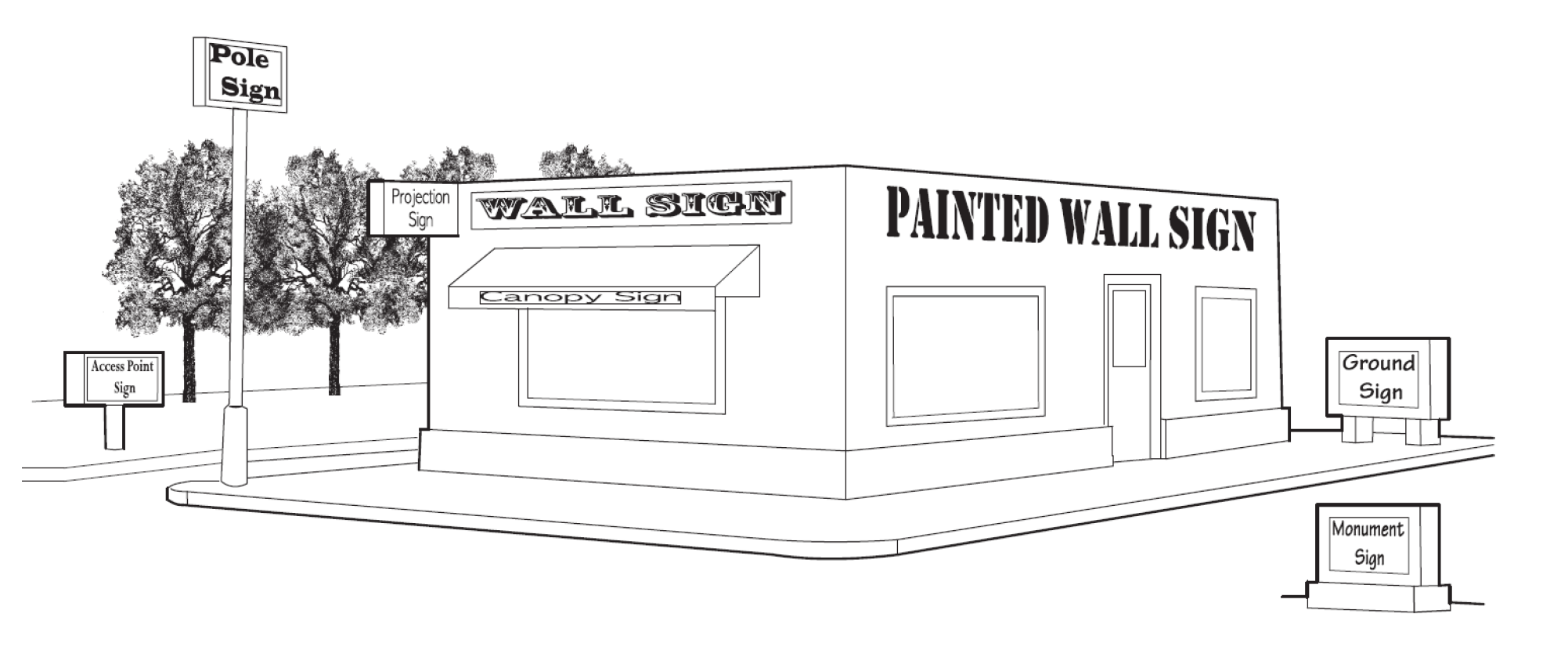
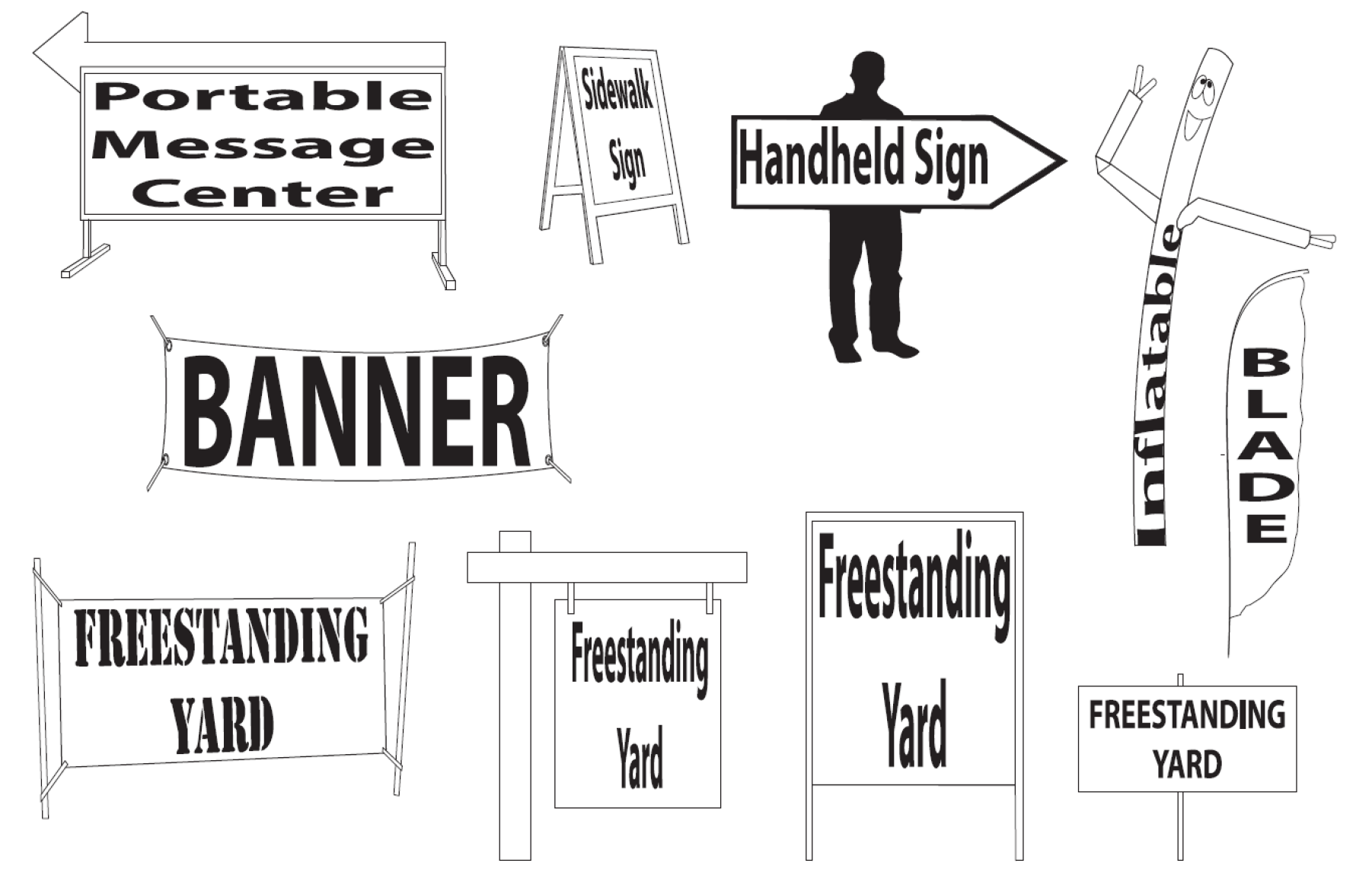
Illustration 50-2:
Example Temporary Signs Illustration
(Ord. No. 8365, § 3, 8-13-2019)
50-119 - GENERAL SIGN REGULATIONS
A.
Permits, Inspections, Maintenance, Fees, Violations, and Enforcement. All signs shall be erected, reinstalled, altered, repaired, relocated, permitted, and inspected in compliance with Chapter 3, Article 1 Construction Sign Code, Kearney's Comprehensive Fee Schedule, and the most recently adopted Unified Building Codes, as well as other applicable City codes.
B.
Location.
1.
Right-of-Way. Signs are prohibited in any public right-of-way or public property, including streets, sidewalks, parks, and public facilities unless otherwise stated in Chapter 50 or approved by the City of Kearney.
2.
Ingress/Egress Clearance. No sign shall interfere with any driveway or access way or any means of ingress or egress to any building.
3.
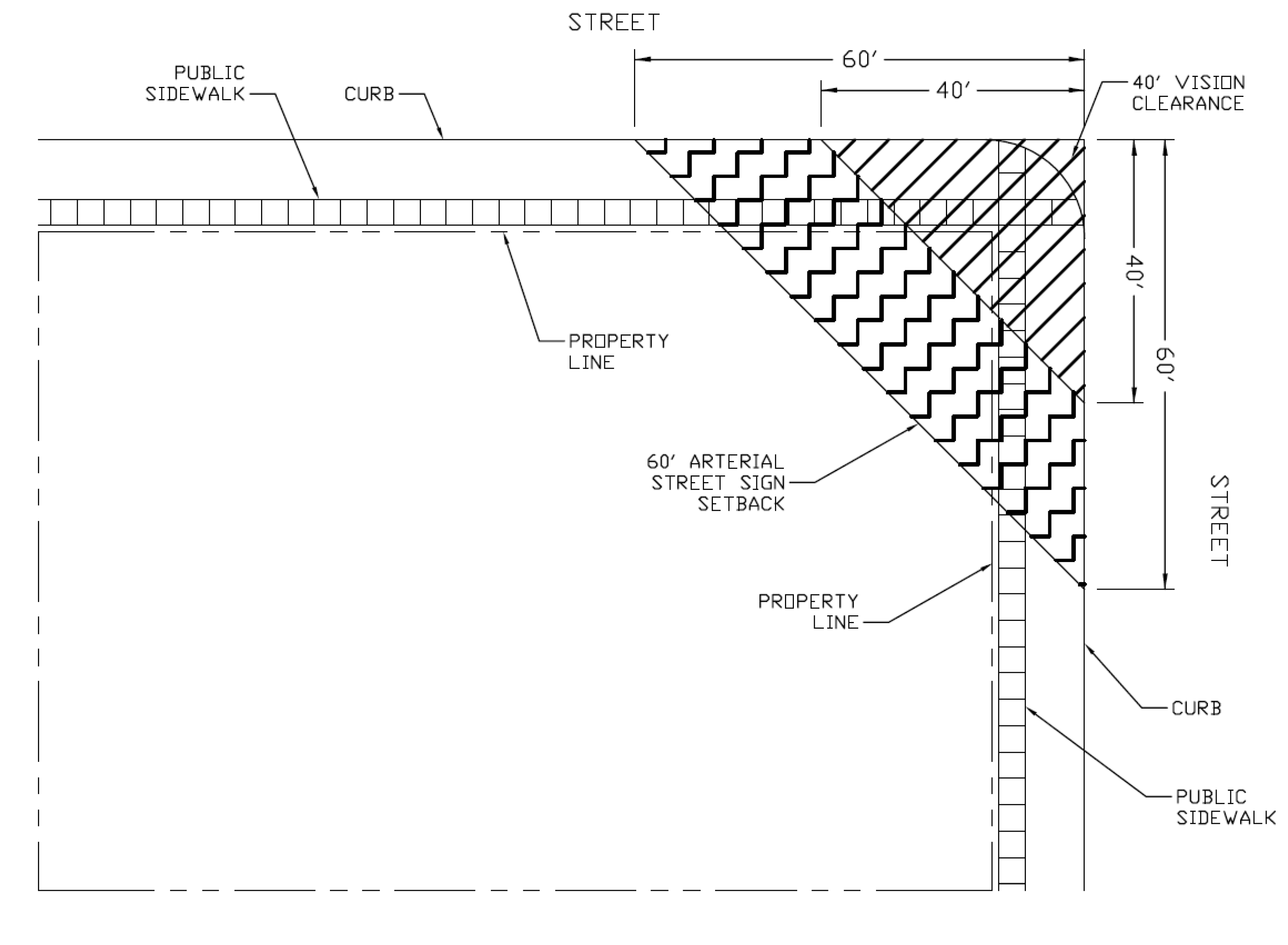
Vision Clearance Triangle. Signs shall not be located within the vision clearance triangle as defined: No sign shall be built to a height of more than two (2) feet above the established curb grade on the part of the lot within a vision clearance triangle. The vision clearance triangle shall be a triangle measured from the point of intersection of the curb lines or edge of pavement of the streets to a point forty (40) feet in each direction from the intersection along such curb lines or edges of pavement. At the intersection of arterial streets as defined in the Comprehensive Development Plan, the forty (40) foot distance shall be increased to sixty (60) feet. No sign shall be placed in such area which will materially obstruct the view of drivers approaching the street intersection. See Illustration 50-3 for a depiction of Vision Clearance measurement.
C.
Clearances and Projections. All signs must maintain the minimum clearances and projections described in Chapter 3, Article 1 Construction Sign Code.
Illustration 50-3:
Vision Clearance Measurement Illustration
(Ord. No. 8365, § 4, 8-13-2019)
50-120 - PROHIBITED AND EXEMPT SIGNS
A.
Prohibited Signs. The following signs are prohibited in all zoning districts and may be handled in accordance with 3-113 Violations and Enforcement:
1.
Abandoned or Obsolete Signs, if present for a continuous period of six (6) months.
2.
Balloon Signs.
3.
Blinking Signs.
4.
Flashing Signs.
5.
Moving Signs.
6.
Off-Premise Signs on Public Property, unless approved by the City.
7.
Off-Premise Permanent Signs on Private Property. Other than Outdoor Advertising Signs, see 50-129 Outdoor Advertising Signs; Regulations for New Installations.
8.
Roof Signs.
9.
Signs with exposed raceways or pan-channels.
10.
Snipe or Bandit Signs.
B.
Exempt Signs. The following signs are exempt from regulation of Chapter 50. No exempt signs shall be erected within the vision clearance triangle, be a minimum two (2) feet off of the property line, and must meet all other applicable building codes.
1.
City of Kearney Special Event Sign. A sign advertising a public event, providing that specific approval for the event, and associated signage, is granted by the City of Kearney.
2.
Historic Markers.
3.
Integral Signs.
4.
Public Signs.
5.
Seasonal Decorations. Signs pertaining to recognized national holidays and national observances.
6.
Signs, which are not visible from a public right-of-way, private way, court, or from a property, other than that on which the sign is installed.
7.
Signs located entirely inside the premises of a building or enclosed space, other than Window Signs.
8.
Signs on a vehicle, other than an Unlawful Vehicle Sign.
9.
Signs protected by Federal/State law.
10.
Traffic Control Device Signs.
11.
Works of graphic art painted or applied to building walls which contain no logos, advertising, or business identification messages.
(Ord. No. 8365, § 5, 8-13-2019; Ord. No. 8576, § 1, 5-10-2022)
50-121 - METHOD OF MEASUREMENT FOR REGULATORS
A.
Permitted Sign Budget. The permitted sign budget is the square footage of the area allowed for permanent signage on the premises. The permitted sign budget is a function of the property's frontage on a street or private way. To calculate the permitted sign budget of a property follow the instructions below:
1.
Identify the zoning of the premises.
2.
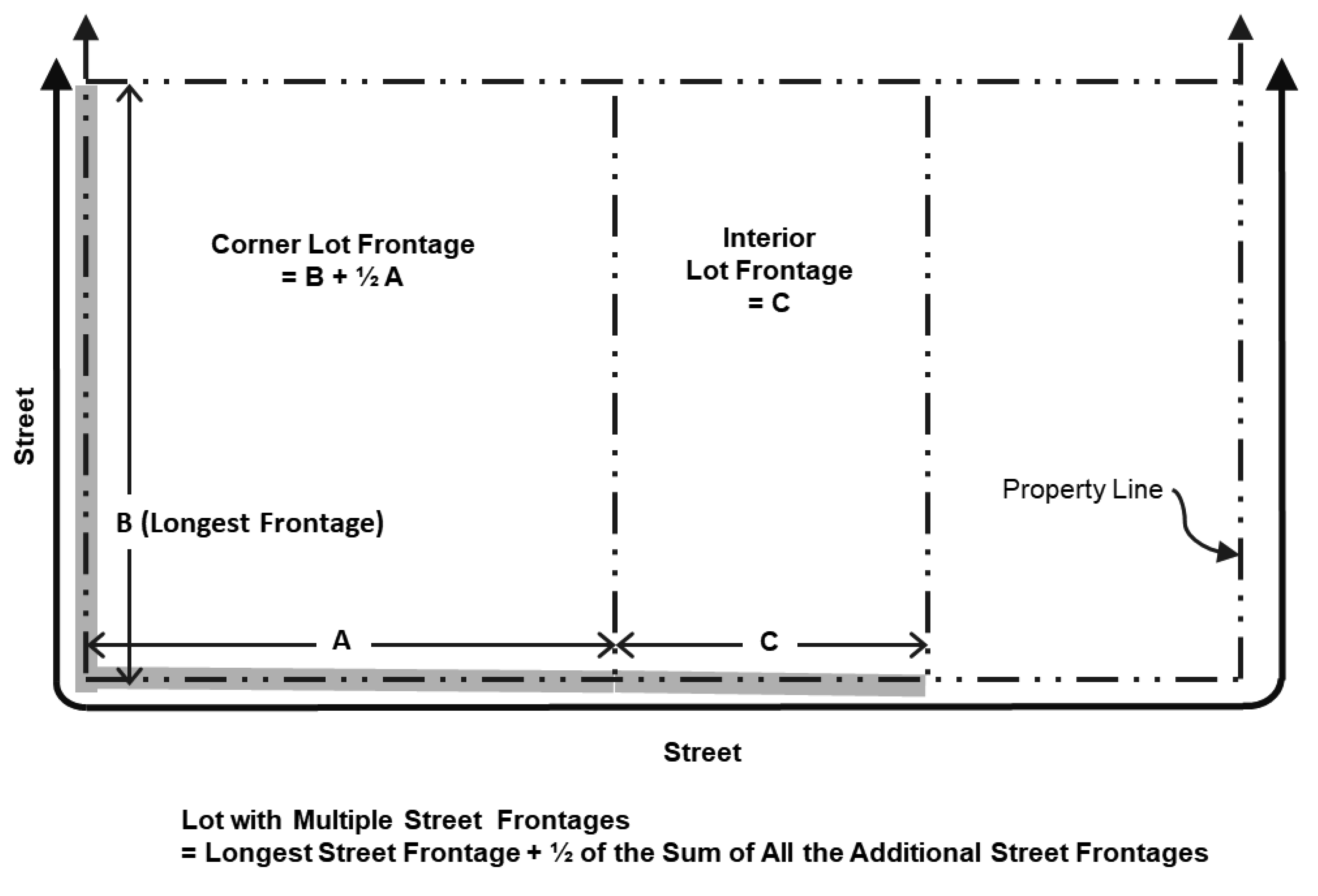
Measure the total street frontage as the length of a premise fronting a public or private street (excluding alleys). See Illustration 50-4. For multiple frontage properties, the total street frontage shall be calculated as the longest street frontage, plus one-half (½) the length of all additional street frontages.
3.
Determine the Calculated Permitted Sign Budget by multiplying the total street frontage length by the zoning district multiplier found in Table 50-1.
4.
Find the permitted sign budget by using the lesser of the Calculated Permitted Sign Budget or Maximum Permitted Sign Budget shown in Table 50-1. Compare the Calculated Permitted Sign Budget in step 3 to the Maximum Permitted Sign Budget for the premise's zoning district:
a.
If the Calculated Permitted Sign Budget, in step 3, is over the Maximum Permitted Sign Budget shown in Table 50-1 than the permitted sign budget is limited to the Maximum Permitted Sign Budget.
b.
If the Calculated Permitted Sign Budget, in step 3, is under the Maximum Permitted Sign Budget shown in Table 50-1 than the permitted sign budget is the Calculated Permitted Sign Budget.
Table 50-1: Permitted Permanent Sign Budget By District
RU: Residential Uses includes all residential uses plus permitted home based businesses
and excludes multi-family and mobile home park development use types.
NRU: Non-Residential Uses includes all non-residential uses plus multi-family and
mobile home park development use types.
Illustration 50-4:
Lot Frontage Determination Illustration
B.
Sign Area. Sign area is measured or calculated as follows:
1.
Wall Sign with Background Panel. The background panel area shall be calculated by measuring the area contained within the sum of the smallest rectangles, squares, triangles, parallelograms, circles, or ellipses that comprises the background panel.
2.
Wall Sign without Background Panel. The area of a sign consisting of copy mounted as individual letters or graphics against a wall, fascia, or parapet of a building surface or another surface, which has not been painted, textured, or otherwise altered to provide a distinctive background for the sign copy. This area shall be measured as the sum of the smallest rectangles, squares, triangles, parallelograms, circles, or ellipses that will enclose each letter, word, graphic, or discrete visual element in the total sign.
3.
Sign with Illuminated Background. The area of a sign with copy mounted, affixed, or painted on an illuminated surface, illuminated element, or a building or structure, is measured as the entire illuminated surface or illuminated element which contains sign copy.
4.
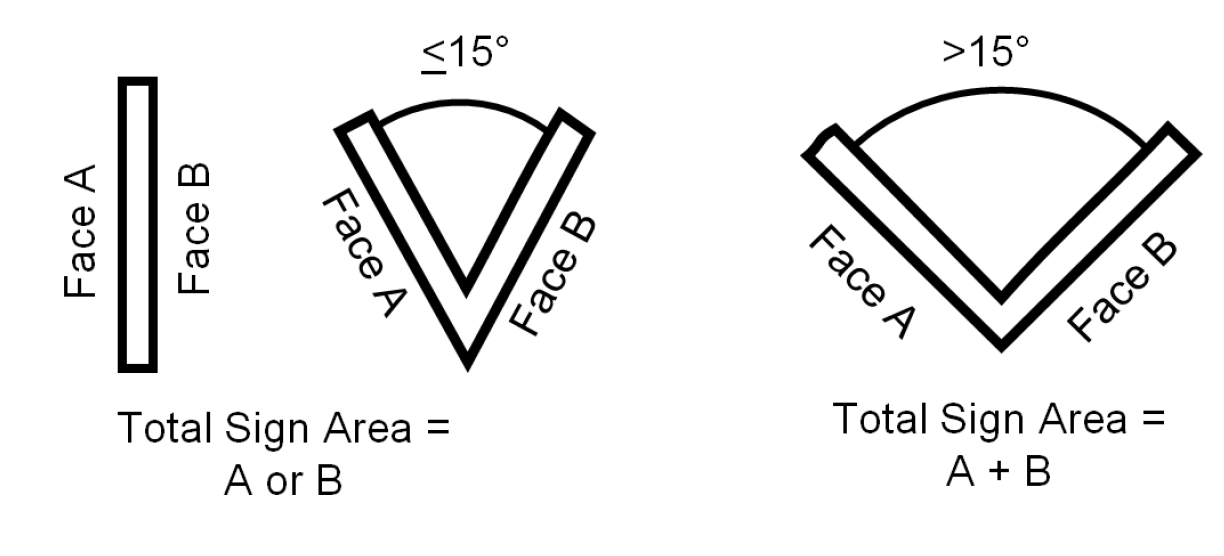
Signs with Two (2) or More Faces. Where a sign has two (2) or more faces, the area of all faces shall be included in determining the area of the sign, except that only one (1) face of a double-faced sign shall be considered in determining the sign area when both faces are parallel and the farthest distance between faces does not exceed four (4) feet, or when the interior angle of the sign faces does not exceed fifteen (15) degrees if the boards are in a "V". See Illustration 50-5, below, for a graphic representation.
Illustration 50-5:
Formulas for Determining Sign Area for
Signs with Two or More Faces
C.
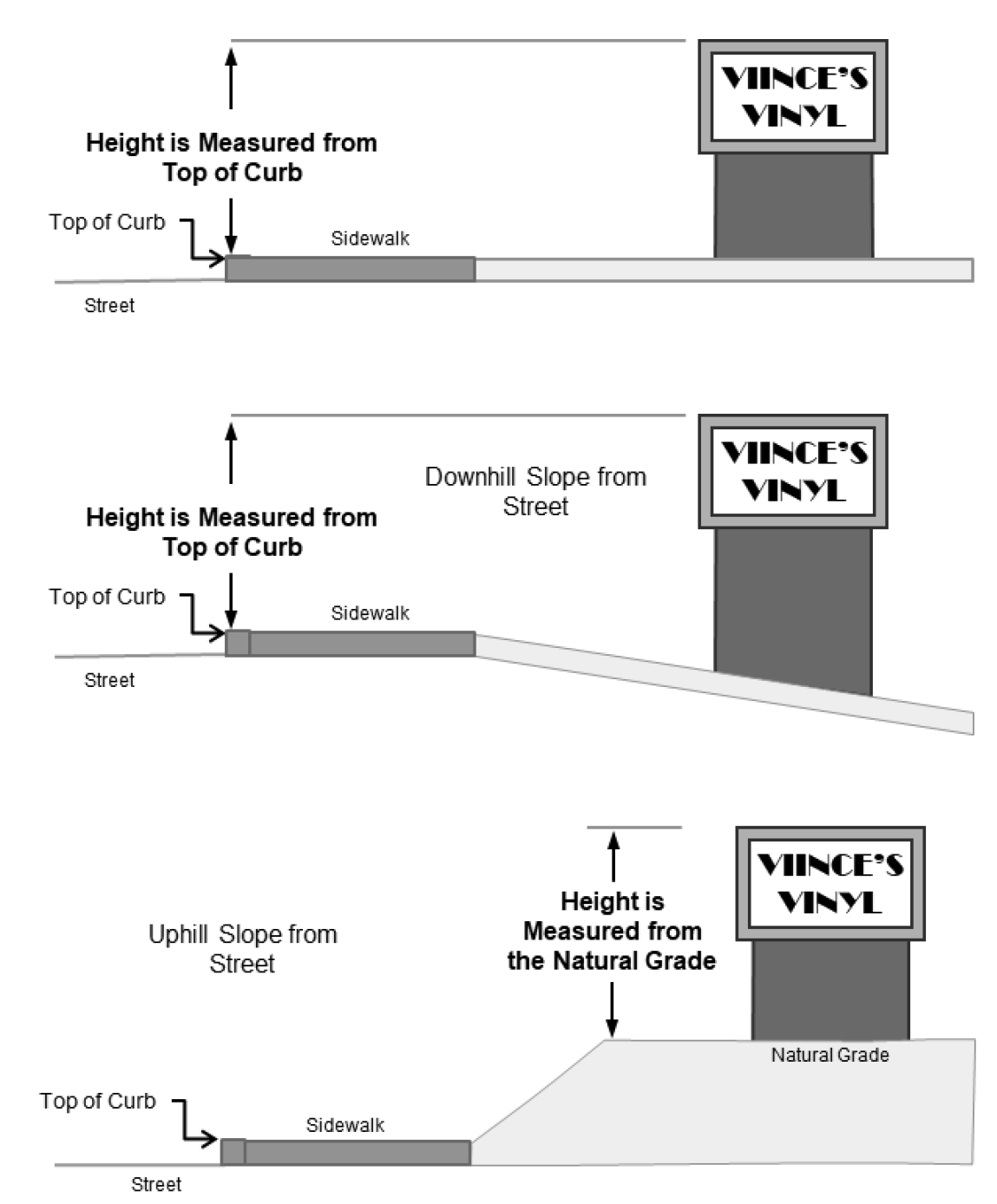
Measurement of Sign Height. The height of a detached sign shall be measured as the vertical distance from the average finished grade of the ground below the sign, excluding any filling, berming, mounding, or excavating for the purposes of increasing the height of the sign, to the top edge of the highest portion of the sign. The maximum height allowed for a detached sign is shown in Table 50-4. For the purposes of this section, average finished grade shall be considered the lower of: (a) the lowest elevation where the base of the sign meets ground level; or (b) the top of the curb of the nearest public street adjoining the property upon which the sign is erected; or (c) the grade of the land at the principal entrance to the lot on which the sign is located. See Illustration 50-6 for Measurement of Sign Height graphic.
Illustration 50-6:
Measurement of Sign Height Illustration
D.
Setback. The setback of a sign is measured from the property line to the line projected to the ground plane of the nearest portion of the sign.
(Ord. No. 8365, § 6, 8-13-2019; Ord. No. 8576, § 2, 5-10-2022)
50-122 - PERMITTED PERMANENT SIGN TYPE BY ZONING DISTRICT
Table 50-2:
Permitted Permanent Signs by Type and Zoning District
N: Not Permitted
NRU: Permitted for Non-Residential Uses includes all non-residential uses plus multi-family and mobile home park development use types.
RU: Permitted for Residential Uses includes all residential uses plus permitted home based businesses and excludes multi-family and mobile home park development use types.
(A): Permitted along arterial streets.
(A/L): Permitted along arterial and local collector streets.
(Ord. No. 8365, § 7, 8-13-2019; Ord. No. 8576, § 3, 5-10-2022)
50-123 - ILLUMINATION/LIGHTING SIGN ELEMENTS
Lighting, when installed, must be positioned in such a manner that light is not directed onto an adjoining property or onto a public street or highway, and in accordance with the Outdoor Lighting provisions of Section 47-108. No sign illumination shall impair vehicular or pedestrian circulation on the same premise or adjoining properties. Permitted illumination/lighting elements for signs is outlined in Table 50-3 below.
Table 50-3:
Permitted Illumination/Lighting Sign Elements by Zoning District
N: Not Permitted
NRU: Permitted for Non-Residential Uses includes all non-residential uses plus multi-family and mobile home park development use types.
(A/L): Permitted along arterial and local collector streets.
(Ord. No. 8365, § 4, 8-13-2019; Ord. No. 8576, § 7, 5-10-2022)
50-124 - SIGN TYPE SUPPLEMENTAL REGULATIONS: PERMANENT SIGNS
A.
Detached Signs. Ground, Monument, and Pole signs. Table 50-4 below regulates detached signs.
Table 50-4:
Permitted Site Development Standards for Detached Signs by Zoning Districts
NA - Not Applicable
N - Not Permitted
B.
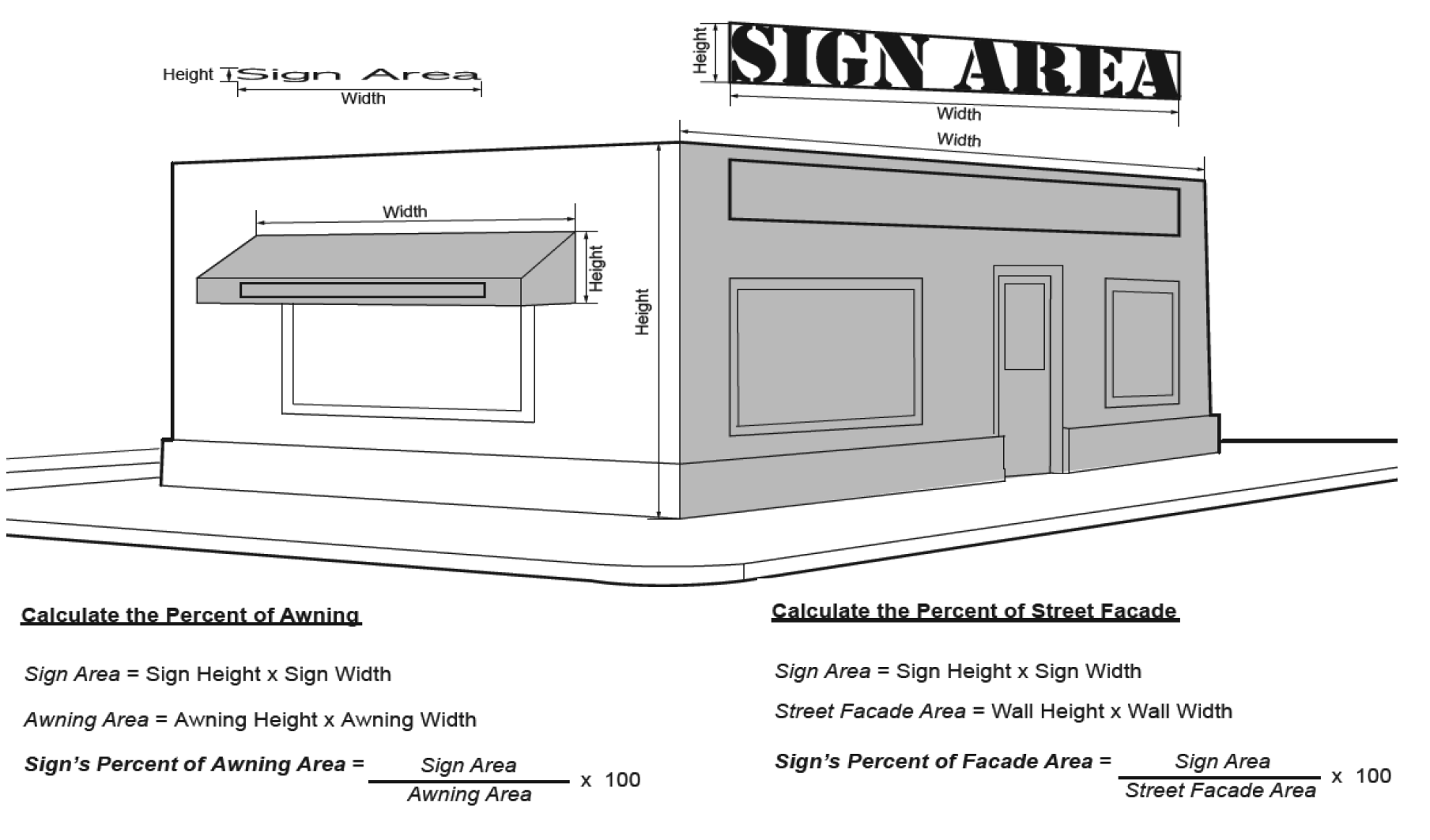
Attached Signs. Awning, Canopy, Marquee, Painted Wall, Projecting, and Wall signs. Table 50-5, below, regulates all attached signs, unless otherwise stated in the supplemental regulations. Table 50-5 outlines the maximum size allowed for an attached sign, based on the zoning district as well as the maximum percentage of street façade coverage, per premise, for all attached signs. No premise may exceed either criterion. The street façade shall be measured, as shown in Illustration 50-7, below, in order to determine the maximum percentage of street façade coverage.
Table 50-5:
Permitted Site Development Standards for Attached Signs by Zoning Districts
Illustration 50-7:
Measurement of Street Façade and Awning Percentage Illustration
1.
Awnings and Awning Signs. Awnings and awning signs, where permitted, are subject to the following regulations:
a.
The copy area of an awning sign shall not exceed twenty-five (25%) of the total face area of the awning. The combined area of all front-facing awning panels, as shown in Illustration 50-6, above, shall not exceed thirty-five percent (35%) of the total wall area, per side of building.
b.
Awnings shall not extend above the eave or parapet of the building facade and shall be a minimum of seven (7) feet six (6) inches above the sidewalk or grade, whichever is higher.
c.
Awnings may project no more than nine (9) feet from the building facade to which they are mounted and shall not extend over any area utilized by motor vehicles. Within the CBD District, an awning sign shall not be within five (5) feet of the back of curb line's vertical plane.
d.
Any awning extension beyond six (6) feet shall have plans stamped by a Nebraska licensed architect or professional engineer, certifying the structural integrity of the wall and associated structures to carry all imposed loads.
2.
Canopy Signs. Canopy signs, where permitted, are subject to the following regulations:
a.
The copy area of a canopy sign shall not exceed twenty-five (25%) of the total face area, per side of the canopy.
b.
All canopies and canopy signs must maintain the minimum clearances, projections, design, and construction standards outlined in Chapter 3, Article 1 of City Code.
3.
Marquees and Marquee Signs. Canopy signs, where permitted, are subject to the following regulations:
a.
The maximum projection of any marquee or marquee sign shall be as follows:
i.
Three (3) feet over sidewalks less than twelve (12) feet wide.
ii.
Eight (8) feet over sidewalks twelve (12) feet wide or more.
b.
All marquee and marquee signs must maintain the minimum clearances and projections and design and construction standards outlined in Chapter 3, Article 1 of City Code.
4.
Projecting Signs. Projecting signs are subject to the following general regulations.
a.
The maximum projection of any projecting sign shall be as follows:
i.
Three (3) feet over sidewalks less than twelve (12) feet wide.
ii.
Five (5) feet over sidewalks twelve (12) feet wide or more.
b.
Within the CBD District, a projecting sign shall not be within five (5) feet of the back of curb line's vertical plane. Each projecting sign must maintain at least a twelve (12) foot vertical clearance over sidewalks.
c.
Projecting signs must minimize the visible support structure.
5.
Wall Signs and Painted Wall Signs. Wall signs are subject to the following general regulations:
a.
A wall sign must be parallel to the wall to which it is attached.
b.
A wall sign shall not extend more than eighteen (18) inches from the wall to which it is attached.
c.
A wall sign may not extend beyond the corner of the wall to which it is attached, except where attached to another wall sign, it may extend to provide for the attachment.
d.
A wall sign may not extend beyond its building's roof line.
e.
A wall sign in the CBD District attached to a building on its front property line may encroach upon public right-of-way by no more than eighteen (18) inches. Such a wall sign shall provide minimum clearance of eight (8) feet, six (6) inches. This encroachment is not permitted along state or federal highways in the CBD District.
C.
Other Regulated Signs. Access Point, Commercial Center Identification, Electronic Information, and Numeric Display signs, where permitted, are subject to the following supplemental regulations.
1.
Access Point Signs. Access Point Signs, where permitted, are subject to the following supplemental regulations based on the level of permission. An access point sign shall be constructed as a detached ground or monument sign type and does not count against the Permitted Sign Budget.
a.
NRU Access Point Signs:
i.
Limited to one (1) sign at each on-property driveway or access point off of a public street or access road, and one (1) additional sign at any critical decision point internal to the premise.
ii.
Shall not exceed four (4) sq. ft. in maximum size and three (3) ft. in maximum height.
b.
RU(A) Access Point Signs:
i.
Limited to one (1) sign denoting the entrance for a residential subdivision at each major access point off of an arterial or local collector.
ii.
Shall not exceed thirty-two (32) sq. ft. in maximum size and four (4) ft. in maximum height.
2.
Commercial Center Identification Signs. Commercial Center Identification Signs, where permitted, are subject to the following regulations:
a.
A Commercial Center Identification Sign shall only be a wall sign, painted wall sign, or detached sign type.
b.
The sign shall display no more than the name and location of the commercial center.
c.
Each sign shall be subject to all other regulations for attached and detached signs set forth in this Section.
3.
Electronic Information Signs. Electronic Information Signs, where permitted, are subject to the following regulations:
a.
Electronic Information Signs shall be set back a minimum of two (2) feet from any property line.
b.
Electronic Information Signs shall not be located within the vision clearance triangle defined as a triangle measured from the point of intersection of the curb lines of the streets to a point which is seventy-five (75)-feet in each direction from the intersection.
c.
No more than one (1) Electronic Information Sign is permitted per premise.
d.
The closest point of any Electronic Information Sign shall be a minimum of one hundred seventy-five (175) feet from the closest point of any residential use structure. Except, if the sign is not within direct view of said residential use structure then the one hundred seventy-five (175) foot minimum does not apply.
e.
No Electronic Information Sign shall be programmed in a way that suggests or resembles a traffic control device, such as a traffic signal.
f.
Electronic Information Signs shall be programmed in a way that no sign copy shall flash or blink and the image, message, or lighting pattern shall hold for a minimum of two (2) seconds, however, full animation video is allowable provided such video does not flash, have rotations, or blink.
g.
The surface/face illumination of any sign shall not exceed one thousand two hundred fifty (1,250) Nits after dusk or seven thousand five hundred (7,500) Nits during daylight hours. Such illuminated sign shall be equipped with a sensor and/or timer or other device to automatically adjust the day/night light intensity levels in accordance with the standard set herein.
h.
Electronic Information Signs shall be deducted from the total sign budget allowed for the premise.
4.
Numeric Display Signs. Numeric Display Signs, where permitted, are subject to the following regulations:
a.
Numeric Display Signs shall be set back a minimum of two (2) feet from any property line.
b.
Numeric Display Signs shall not be located within the vision clearance triangle defined as a triangle measured from the point of intersection of the curb lines of the streets to a point which is seventy-five (75)-feet in each direction from the intersection.
c.
Numeric Display Signs shall be no larger than twenty-five (25) square feet in area, and if illuminated, shall not flash or blink.
d.
All illuminated Numeric Display Signs shall not exceed one thousand two hundred fifty (1,250) Nits after dusk or seven thousand five hundred (7,500) Nits during daylight hours.
e.
Numeric Display Signs shall be deducted from the total sign budget allowed for the premise.
(Ord. No. 8365, § 9, 8-13-2019; Ord. No. 8576, § 5, 5-10-2022)
50-125 - MASTER SIGN PLAN; PERMANENT SIGNS
A.
Purpose. The purpose of this section is to provide flexibility, encourage development in accordance with adopted plans and policies, and promote superior sign design and a well-organized visual environment. The Master Sign Plan process will be submitted, reviewed, and approved at an administrative level through the Development Services Department. The Master Sign Plan process was created for mixed-use, larger-scale, and/or unique developments. A Master Sign Plan may be submitted to the City by the property owners for review and approval for the uses and/or developments listed below:
1.
Multiple-tenant commercial, office, employment, or multi-family residential uses.
2.
A multiple-building complex for a single commercial or employment use in a project exceeding eight (8) net acres.
3.
Stand-alone office/employment buildings exceeding one hundred thousand (100,000) square feet.
4.
Indoor or Outdoor Entertainment and Recreation uses.
5.
Hospitals.
6.
Schools.
7.
Hotels and Commercial Lodging having at least one hundred twenty-five (125) guest rooms and a full service restaurant or conference and meeting rooms.
8.
Regional retail shopping malls.
9.
Religious assemblies exceeding one and a half (1.5) acres of total lot area.
B.
Conditions. Development Services Staff may attach conditions, requirements, or standards necessary to assure that the signs covered by the Master Sign Plan will not be materially detrimental to persons or property in the vicinity. In making its determination, the City shall not base any condition on the message content of a sign. Outdoor Advertising Signs shall not be included in a Master Sign Plan.
C.
Evaluation Criteria. Master Sign Plans shall be evaluated based on all of the following criteria:
1.
Placement. All signs shall be placed where they are visible and legible. Factors to be considered include its location relative to traffic movement, access points, site features, and other structures; orientation relative to viewing distances and viewing angles; spacing; and pedestrian and traffic safety considerations. Wall Signs may be approved on building walls, other than the wall of the space occupied by the tenant in commercial centers in which some tenants have little or no visibility from the street.
2.
Quantity. The number of signs that may be approved within any development shall be sufficient to provide necessary facilitation of internal circulation of vehicular and pedestrian traffic and way finding for safety of the occupants of vehicles and pedestrians. Factors to be considered shall be those that impact safety and land development character considerations such as the size of the development and the number of development sub-areas.
3.
Size. All signs shall be no larger than necessary for visibility and legibility. Factors to be considered in determining appropriate size include topography, volume and speed of traffic, viewing distances and angles, proximity to adjacent uses, and placement of display. In no event shall a Master Sign Plan contain a detached sign that exceeds the maximum height standard permitted by this Chapter.
4.
Design Features and Materials. Sign design themes and materials shall be compatible with the architecture, colors, materials of the project, and compatible with surrounding development.
5.
Site Development Standards. The City may not reduce any site development standard to less than fifty (50) percent of any minimum standard, nor may any site development standard be allowed to be more than one hundred fifty (150) percent of the maximum standard. For safety purposes, no sign shall be permitted to reduce the setback, or be placed within the vision clearance triangle.
6.
Permitted Sign Budget. An applicant may request use of the Calculated Permitted Sign Budget or Maximum Permitted Sign Budget, whichever is larger for the site.
D.
Review of Master Sign Plan. Applicant shall submit the completed Master Sign Plan application and submit all required documentation to the Development Services Department. All applications for a Master Sign Plan shall be considered but in no event does the submittal of a Master Sign Plan guarantee an applicant's approval of any and all requests.
E.
Master Sign Plan Approval.
1.
Action. The City shall approve or approve with modifications and/or conditions, an application for a Master Sign Plan subject to the requirements of this Chapter and based on compliance with the Purpose and Evaluation Criteria, outlined previously in this Section. An action of the City shall be accompanied by "findings of fact," giving the reasons for the action. The City may request additional information to assist in the review process.
2.
Limitations of Administrative Approval. This Section sets the parameters of the Master Sign Plan process; anything beyond these parameters is outside the boundary for administrative review. For requests diverging from the standards outlined in Chapter 50 and limits set for the Master Sign Plan process, the applicant may follow the Planned Development procedure, outlined in Chapter 38 District PD, Planned Development District, to request approval for additional signage considerations.
3.
Permitting. After approval of a Master Sign Plan, the applicant is responsible for applying for a sign permit for each sign or group of signs.
F.
Modifications/Amendments to Master Sign Plan. Minor amendments to a Master Sign Plan may be approved administratively. Minor amendments include such changes which are determined to have little to no visual impact or improved visual impact and are consistent with the intent of the original approval.
G.
Noncompliance. The applicant shall follow the approved Master Sign Plan. Any violation or noncompliance will result in a written notification of violation or noncompliance. The applicant shall be required to bring signage into compliance, at applicant's expense within the time specified in the written notification.
H.
Termination. If no substantial signage development has taken place for three (3) years following approval of the Master Sign Plan, the Master Sign Plan shall be considered null and void. If a premise with an approved Master Sign Plan becomes compliant with the current standards of Chapter 50, the property owner may request, in writing to the Development Services Department, the termination of the Master Sign Plan.
(Ord. No. 8365, § 10, 8-13-2019; Ord. No. 8576, § 6, 5-10-2022)
50-126 - PERMITTED TEMPORARY SIGN TYPE BY ZONING DISTRICT
A.
General Regulations. All temporary signs shall follow the regulations set forth in Section 50-126. Temporary signs are permitted by type and zoning district as outlined in Table 50-6, below.
1.
Location. For any off-premise, temporary sign, the sign owner shall have written approval from the property owner of where such sign will be located.
2.
Maintenance. All temporary signs shall be maintained in sound condition. Any sign that exhibits deterioration of structure or materials may be removed subject to the provisions of this Section.
3.
Removal. The City Manager or his/her designee shall order the removal of any sign not in compliance with any provisions of this Section. If the owner of the premise on which such sign is located, or the owner of the sign if unlawfully located on public property, fails to remove such sign, the City Manager or his/her designee shall be authorized to remove the sign. Any costs associated with the removal of a sign may be assessed to the owner of the property. Any such removal shall also result in the immediate cancellation of any outstanding temporary sign permit.
Table 50-6:
Permitted Temporary Signs by Type and Zoning District
*Banner and Freestanding Yard Signs thirty-two (32) square feet or larger require
a Sign Permit.
N - Not Permitted
P - Permitted
(Ord. No. 8365, § 11, 8-13-2019; Ord. No. 8576, § 7, 5-10-2022)
50-127 - SIGN TYPE SUPPLEMENTAL REGULATIONS: TEMPORARY SIGNS
A.
Banner Signs. Banner Signs, where permitted, are subject to the following supplemental regulations.
1.
Banner Signs may be an on-premise sign and must comply with all applicable building codes.
2.
Banner Signs shall be attached to a street facing, vertical façade. No Banner Sign shall be attached to a roof.
3.
Residential Uses: Includes all residential uses plus permitted home based businesses and excluding multi-family and mobile home park development use types. One (1) Banner Sign is permitted for each Residential Use with a maximum sign area of eight (8) square feet.
4.
Non-Residential Uses: Includes all non-residential uses plus multi-family and mobile home park development use types. Number permitted, total sign area of premise, and maximum area is dependent on the street frontage of the lot as shown in Table 50-7 below.
Table 50-7:
Permitted Banner Sign Number and Size by Street Frontage
5.
Banner Signs which are larger than thirty-two (32) square feet are allowed on a temporary-basis of no more than thirty (30) days per occurrence, with a limit of two (2) occurrences per calendar year per premise.
B.
Blade Signs. Blade Signs, where permitted, are subject to the following supplemental regulations.
1.
Blade Signs are restricted to on-premise signage, and may be placed within the required depth of landscaping with one (1) Blade Sign allowed per fifty (50) feet of street frontage with a maximum of five (5) per premise. Lots with less than fifty (50) feet of street frontage are allowed one (1) Blade Sign. Blade Signs are allowed within the public right-of-way, only within the CBD District
2.
Any Blade Sign must be anchored into the ground or secured in a portable based design for such function.
3.
For safety purposes, any Blade Sign must be setback a minimum of fifteen (15) feet from any overhead utilities and outside of the vision clearance triangle as defined in 50-119.B(3).
4.
No Blade Sign shall be wider than three and a half (3.5) feet, at the widest point. No Blade Sign shall have a height higher than eighteen (18) feet. The height of a Blade Sign is measured from grade and includes the full length of the supporting pole.
5.
Blade Signs may only be displayed during the hours of operation for the on-premise business, service, activity, or event.
C.
Flag Signs. Flag Signs, where permitted, are subject to the following supplemental regulations.
1.
All Flag Signs shall meet clearance standards found in Chapter 3, Article 1 Construction Sign Code.
2.
Flag Signs, when fully extended, shall not extend into the public right-of-way.
3.
Any Flag Sign on a flag pole shall comply with the setback and height regulations found in 47-104(7).
D.
Freestanding Yard Signs. Freestanding Yard Signs, where permitted, are subject to the following supplemental regulations.
1.
Freestanding Yard Signs may be an on-premise or off-premise sign and may be placed within the landscaping depth, but must remain a minimum of two (2) feet from any property line.
2.
Residential Uses: Includes all residential uses plus permitted home based businesses and excluding multi-family and mobile home park development use types. Two (2) signs are permitted for each Residential Use. Maximum sign area and maximum height is as follows:
Maximum Size: Eight (8) square feet.
Maximum Height: Four (4) feet.
3.
Non-Residential Uses: Includes all non-residential uses plus multi-family and mobile home park development use types. Number permitted, total sign area of premise, and maximum height is dependent on the street frontage of the lot as shown in Table 50-8, below.
Table 50-8:
Permitted Freestanding Yard Sign Number and Size by Street Frontage
4.
Freestanding Yard Signs which are larger than thirty-two (32) square feet are allowed on a temporary-basis of no more than thirty (30) days per occurrence, with a limit of two (2) occurrences per calendar year per premise.
5.
For safety purposes, any Freestanding Yard Sign must be out of the vision clearance triangle as defined in 50-119.B(3).
E.
Handheld Signs. Handheld Signs, where permitted, are subject to the following supplemental regulations.
1.
Handheld Signs are restricted to be on the same premise as the business, service, activity, or event that is being advertised.
2.
Any person carrying a Handheld Sign is prohibited from obstructing the sidewalk or standing in the right-of-way.
3.
Handheld Signs may only be displayed during the hours of operation for the on-premise business, service, activity, or event.
4.
Lighting, bullhorns, amplified sounds, and mannequins are prohibited as display aspects of Handheld Sign.
F.
Inflatable Signs/Air-Activated Graphics. Inflatable Signs or Air-Activated Graphics, where permitted, are subject to the following supplemental regulations.
1.
Inflatable Signs and Air-Activated Graphics are restricted to on-premise and must comply with all applicable building and electrical codes.
2.
For safety purposes, any Inflatable Sign or Air-Activated Graphic must be fastened to the ground or a structure so that it cannot shift more than three (3) feet, horizontally, under any condition.
3.
The minimum setback for any Inflatable Sign or Air-Activated Graphic is equal to or greater than the height of the sign, from all property lines and overhead utility lines and shall remain outside of any vision clearance triangle as defined in 50-119.B(3).
4.
Maximum Height: Twenty-five (25) feet.
5.
Only one (1) Inflatable Sign or Air-Activated Graphic shall be allowed on a premise at any time.
6.
Inflatable Signs and Air-Activated Graphics are allowed on a temporary-basis of no more than ten (10) days per occurrence, with a limit of two (2) occurrences per calendar year per premise.
G.
Portable Message Center Sign. Portable Message Center Signs, where permitted, are subject to the following supplemental regulations.
1.
Portable Message Center Signs are restricted to on-premise advertisement and must comply with all applicable building and electrical codes and shall be anchored securely to the ground.
2.
Portable Message Center Signs with any electronic message shall comply with all supplemental regulations of Electronic Information Signs, Section 50-124.C(3).
3.
No Portable Message Center Sign shall exceed six (6) feet in height.
4.
No Portable Message Center Sign shall be larger than thirty-two (32) square feet.
5.
Only one (1) Portable Message Center Sign shall be allowed on a premise at any time.
6.
Portable Message Center Signs are allowed on a temporary-basis of no more than thirty (30) days per occurrence, with a limit of two (2) occurrences per calendar year per premise.
H.
Sidewalk Signs. Sidewalk Signs, where permitted, are subject to the following supplemental regulations.
1.
Sidewalk Signs are allowed in the right-of-way on sidewalk pavement, provided a minimum of six (6) feet of clearance remains for clear passage of pedestrians.
2.
No Sidewalk Sign shall exceed three (3) feet in height.
3.
No Sidewalk Sign shall exceed six (6) square feet, per side or three (3) feet in width.
4.
Only one (1) Sidewalk Sign is allowed per business, service, activity, or event.
5.
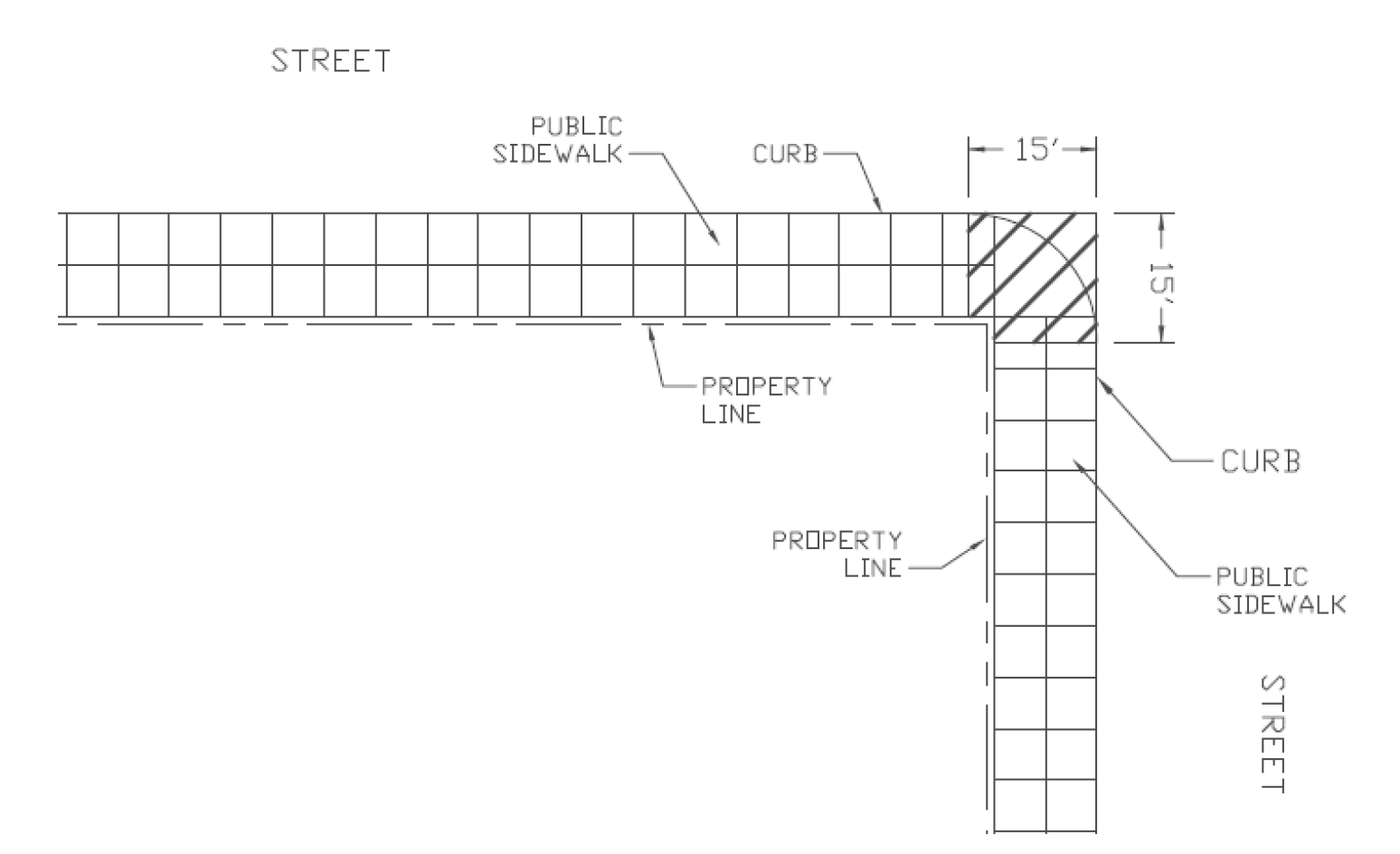
For safety reasons, no encroachments shall be made near corners of sidewalks or where crosswalks are present. This area shall be defined with a fifteen (15) foot area, beginning at the curb line at all corners or ends of blocks, see Illustration 50-8.
Illustration 50-8:
Measurement of Corner Clearance Area Illustration
6.
Sidewalk Signs shall not obstruct pedestrian or handicap accessibility to buildings, emergency exits, or parking spaces.
7.
Sidewalk Signs may only be displayed during the hours of operation for the on-premise business, service, activity, or event.
8.
No illumination is allowed for Sidewalk Signs.
I.
Window Signs. Window Signs, where permitted, are subject to the following supplemental regulations.
1.
For safety purposes, no Window Sign may exceed fifty percent (50%) of window area coverage for any single window.
(Ord. No. 8365, § 12, 8-13-2019)
50-128 - OUTDOOR ADVERTISING SIGNS
A.
Conformance Required. No billboard sign shall be erected, placed maintained, converted, enlarged, reconstructed or structurally altered which does not comply with all he regulations established in this section.
B.
Maintenance. For the purposes of this section, maintenance shall mean the routine repairing, restoring, or replacing of the sign to its constructed condition with the same type of materials used in the original sign structure and face, or to approved upgraded materials.
C.
Required Maintenance for Nonconforming Signs.
1.
Cleaning and painting of the structure including supports, faces trim, ladders, catwalks, railings and any other structural features and the immediate area around the sign structure.
2.
Changes in advertising messages and content including use of a vinyl overlay or wrap. If structural modifications are required to secure the vinyl overlay or wrap, a sign permit is required and said changes must be approved by the City.
3.
Faces and trim shall be maintained, replaced or repaired as necessary. The same number of faces, or less shall be maintained and the size of any given face shall not be increased.
4.
Lighting system may be added or replaced on any billboard as long as the lighting complies with Section 47-108 of the Kearney City Code, requiring shielded, sharp cutoff, downcast lighting fixtures. Existing fixtures may be repaired with like equipment. Changes or additions of lighting fixtures shall require an electrical permit and said changes shall be approved by the City.
5.
Safety features including ladders, catwalks, safety cables and railings may be replaced, repaired or added. Said safety features shall be designed to conform to accepted industry standards. A sign permit shall be required if safety features are added and said changes must be approved by the City.
D.
Reconstruction and Modification of Existing Nonconforming Outdoor Advertising Signs. No sign shall be reconstructed or modified except as specified in paragraph E below. The following shall constitute a substantial change to a sign and are therefore not considered maintenance or acceptable reconstruction and are herein prohibited:
1.
Any change in the location of the sign.
2.
Any increase in the size or dimension or height of the sign.
3.
The addition of additional face or faces.
4.
An increase in the number of poles supporting the structure.
5.
An increase in the height of the poles.
E.
Modifications to Existing Nonconforming Outdoor Advertising Signs. An existing legal or nonconforming sign may be modified or reconstructed as follows:
1.
The structural supports may be replaced with like materials or upgraded to steel.
2.
Any existing sign damaged by any cause, natural or manmade, may be replaced or repaired to original condition, or modified as stated in 1. above, provided there is no increase in size, height, or number of faces. Nonconforming roof-mounted signs that are damaged by any cause in excess of fifty (50) percent of their replacement value shall be permanently removed.
3.
Message area attachment systems may be changed or updated provided the area of the message surface is not increased.
4.
A sign required to be moved to a new location because of a local, state or federal project requires approval of the new location by Planning Commission and City Council and the relocated sign must comply with all regulations in force and effect at the time the relocation is approved.
5.
A replacement billboard sign can be relocated within one hundred fifty (150) feet of its current location. The new sign location must remain within the legally described property of the existing sign. The Chief Building Official or his or her designee may approve the relocation provided the sign is not located any closer to the road right-of-way or abutting property.
F.
Registration of Existing Legal or Nonconforming Outdoor Advertising Signs. The Owner of every existing legal or nonconforming outdoor advertising sign shall pay an annual occupation tax for each sign face as set forth in the City of Kearney Comprehensive Fee Schedule. At the time the occupation tax is due, the Owner shall complete the required form confirming the location, number of faces, size of each face, height of the structure, materials description, condition of each sign, and any other related information requested by the City. The Owner shall sign an affidavit stating that the information provided is accurate and that the sign has not been modified in the past twelve (12) months. Any modifications will require a Sign Permit from the Building Services Division.
G.
Electronic Changeable Message Signs. Electronic Changeable Message Signs, hereinafter known as ECMS, are considered outdoor advertising signs and shall be subject to the following requirements:
1.
For each ECMS face erected, a minimum of two (2) existing sign faces must be permanently removed.
2.
The proposed ECMS must be located where one of the existing structures was removed to meet the 2:1 replacement requirement, or, if at a new location, the ECMS must meet all Code requirements pertaining to outdoor advertising signs and meet the 2:1 replacement requirement.
3.
No two ECMS structures may have sign facings erected less than five thousand (5,000) feet apart measured from the center of the monopole along a line parallel with the highway. ECMS structures may be located on either side of the highway; however, each sign must only be visible from one direction of travel and must comply with the five thousand (5,000)-foot spacing on each side.
4.
The ECMS sign faces shall not be more than three hundred (300) square feet in size and shall be no taller than thirty-five (35) feet.
5.
Each advertisement displayed must remain fixed for at least ten (10) seconds. If there is more than one (1) advertisement per face, then when any advertisement changes, the entire face shall remain fixed for at least ten (10) seconds.
6.
When an advertisement is changed, it must be accomplished within an interval of two (2) seconds or less.
7.
Each ECMS must contain a default mechanism that will freeze the sign in one position if a malfunction occurs.
(Ord. No. 8365, § 13, 8-13-2019)
50-129 - OUTDOOR ADVERTISING SIGNS; REGULATIONS FOR NEW INSTALLATIONS
Within the total amount of sign area permitted to them, some parcels in the M-1, Limited Industrial District and M-2, General Industrial District may elect to devote a portion of their sign budgets to installation of an outdoor advertising sign, subject to the conditions contained in this section. For installation of new Electronic Changeable Message Signs (ECMS) refer to the regulations provided in Section 50-128 of this Chapter.
A.
Location. Eligible properties must be located within two hundred (200) feet of the right-of-way line of Interstate 80 or within one hundred (100) feet of the right-of-way line of Highways 30, 44, or 10.
B.
Impact on Business Identification and Other Signage. Utilization of this provision does not entitle any parcel to additional permitted sign area and the area of the sign counts against the total sign area permitted the parcel. The outdoor advertising sign shall count as a detached sign for the purpose of calculating the total number of permitted detached signs.
C.
Maximum Size and Height.
1.
The size of an outdoor advertising sign shall not exceed seven hundred (700) square feet.
2.
The maximum height of such a sign shall be forty-five (45) feet.
D.
Separation Factors.
1.
Where permitted along Interstate 80, outdoor advertising signs shall be separated by one thousand two hundred (1,200) feet from any other outdoor advertising sign of any size and three hundred (300) feet from any other detached sign.
2.
Where permitted along other settings, outdoor advertising signs shall be separated by one thousand (1,000) feet from any other outdoor advertising sign of any size and three hundred (300) feet from any other detached sign.
3.
Any such outdoor advertising sign shall be separated by two hundred (200) feet from any property in a residential zoning district, including RR-1, Rural Residential Single-Family District through R-4, Urban Residential Multi-Family District, and RM, Mobile Home Residential District.
E.
Other Standards.
1.
New installations of stacked signs or other installations of two (2) signs facing the same direction on a single structure are prohibited. Double-faced, back-to-back signs are permitted, provided that the angle formed by the sign faces does not exceed fifteen (15) degrees.
2.
Side-by-side signs are not permitted regardless of which direction they face.
3.
The area around the base of the sign shall be maintained by the sign owner or property owner in clean condition. A radius of ten (10) feet around the base of the sign shall be landscaped in accordance with the provisions of Chapter 48.
(Ord. No. 8365, § 14, 8-13-2019)

