
Kenosha City Zoning Code
SECTION 3
0.- ZONING DISTRICTS
3.01.- Establishment.
For the purpose of this Ordinance, the City of Kenosha is hereby divided into basic use districts and overlay districts designated as follows:
A.
District Boundaries. Boundaries of these districts are hereby established as shown on the maps entitled "Zoning Map-City of Kenosha, Wisconsin," dated December 1, 1984, and "Final Wisconsin Wetland Inventory Map-Kenosha, Wisconsin," dated August 12, 1986, all maps which shall be considered to accompany and are herewith made a part of this Ordinance. Such boundaries shall be construed to follow: corporate limits; U.S. Public Land Survey lines; lot or property lines; of streets, highways, alleys, easements, and railroad rights-of-way or such lines extended, unless otherwise noted on the Zoning Map.
B.
Street and Alley Vacations. Vacation of public streets and alleys shall cause the land vacated to be placed as a matter of law in the same district as the abutting land to which the vacated street or alley reverts.
C.
Annexations. Annexations to or consolidations with the City subsequent to the effective date of this Ordinance shall be placed in the A-2 Agricultural Land Holding District.
1.
The Kenosha County floodplain zoning provisions in effect on the date of annexation consolidation shall remain in effect and shall be enforced by the municipality for all annexed or consolidated areas until the municipality adopts and enforces an ordinance which meets the requirements of ch. NR 116, Wis. Adm. Code and 44 CFR 59-72, National Flood Insurance Program. These annexed or consolidated lands are described on the municipality's official zoning map. County floodplain zoning provisions are incorporated by reference for the purpose of administering this section and are on file in the office of the municipal Administrator. All plats or maps of annexation shall show the regional flood elevation and the floodway location.
2.
All lands located within the Shoreland District which are zoned County Upland or Lowland Conservancy District shall be placed within a City Upland or Lowland Conservancy District upon annexation. The Kenosha County Shoreland and Floodplain Zoning Provisions in effect on the date of annexation remain in effect administered by the City for all areas annexed by the municipality after May 7, 1982. These annexed lands are described on the municipality's Official Zoning Map. The Kenosha County Shoreland and Floodplain Zoning Provisions are incorporated by reference for the purpose of administering this Section and are on file in the office of the Administrator. All plats or maps of annexations shall show the Regional Flood Elevation and location of the floodway.
(Ord. No. 22-23, § 2, 6-19-2023; Ord. No. 08-24, §§ 2, 3, 2-21-2024)
3.02. - Zoning Map.
A.
Incorporation. The Official Zoning Map and the Kenosha Regional Airport Zoning and Height Limitation Map are incorporated herein by reference and are deemed a part of this Ordinance as if fully set forth herein. Said maps shall be available to the public in the Department of City Development.
B.
Changes. Changes to Zoning District boundaries shall be designated on the Official Zoning Map. Changes to Airport Overlay District boundaries shall be designated on the Kenosha Regional Airport Zoning and Height Limitation Map.
C.
Conflicts. If more than one (1) map or revision is referenced, the most restrictive information shall apply.
D.
Reserved.
E.
Reserved.
(Ord. No. 08-24, §§ 1, 4, 5, 2-21-2024)
3.03. - Residential Zoning Districts—General Regulations.
In addition to the general provisions contained in Section 2.0 of this Ordinance and the requirements of the respective zoning district, uses of land in the residential zoning districts shall meet the following general regulations:
A.
Number of Buildings Per Lot. Every building hereafter erected shall be located on a lot as herein defined. Only one (1) principal building shall be erected, located or moved onto a lot in the RR-1, RR-2, RR-3, RS-1, RS-2, RS-3, RD, RG-l and RG-2 Residential Districts. No accessory building or structure shall be erected, located or moved onto a lot in any residential district until a principal building is present or under construction.
B.
Lot Coverage. No lot zoned RS-1, RS-2, RS-3, RG-1, RG-2 and TRD-1 may be covered with any combination of buildings, structures, driveway aprons, sidewalks, or other surfaces which are impervious to water, the sum surface of which exceeds sixty (60) percent of the total lot area.
No lot zoned RD, RR-1, RR-2 and RR-3 may be covered with any combination of buildings, structures, driveway aprons, sidewalks, swimming pools, or other surfaces which are impervious to water, the sum surface of which exceeds fifty (50) percent of the total lot area.
C.
Minimum Lot Area and Width Exceptions.
1.
Lots in the RR-1, RR-2 and RR-3 Residential Districts.
a.
A lot which does not meet the minimum lot area and/or the width requirements of the RR-1, RR-2 and RR-3 Residential Districts, but which is at least five thousand (5,000) square feet in area (public sewerage) or ten thousand (10,000) square feet in area (private sewerage system) and a minimum of fifty (50) feet wide (public sewerage) or sixty-five (65) feet (private sewerage system), may be used as a single-family building site and shall be considered in conformance with this Ordinance, provided that the lot is of record in the Kenosha County Register of Deeds Office prior to November 5, 1984.
b.
Lots in the RS-1 and RS-2 Residential Districts. A lot which does not meet the minimum lot area and/or the width requirements of the RS-1 and RS-2 Residential Districts, but which is at least five thousand (5,000) square feet in area and forty (40) feet wide may be used as a single-family building site and shall be considered in conformance with this Ordinance, provided that the lot is of record in the Kenosha County Register of Deeds Office prior to November 5, 1984.
2.
Lots in the RS-3, RG-1 and RG-2 Residential Districts. A lot which is within the RS-3, RG-1 or RG-2 Residential Districts which does not meet the district minimum lot area and/or width requirements, may be used as a single-family building site and shall be considered in conformance with this Ordinance provided that the lot is of record in the Kenosha County Register of Deeds Office prior to October 21, 1954.
3.
Lots in the RD Residential District. A lot which does not meet the minimum lot area and/or width requirements of the RD Residential District, but which is at least six thousand (6,000) square feet in area and fifty (50) feet wide may be used as a single or two-family building site and shall be considered in conformance with this Ordinance, provided that the lot is of record in the Kenosha County Register of Deeds Office prior to November 5, 1984.
4.
Minimum Lot Width for Lots on Curved Streets and Culs-de-Sac. Where a lot fronts on a curved street or cul-de-sac, the lot shall maintain a lot width, measured at the front yard building line, equal to the minimum lot width required in the residential district. Nevertheless, such lots shall provide a minimum lot width of ten (10) feet at street frontage.
D.
Exceptions to Yard Requirements.
1.
Front Yard. As measured along the street frontage of the right-of-way of a block bounded by intersecting cross streets, if a majority of lots have a front yard other than the required front yard, no principal building may be erected or structurally altered unless the setback is equal to the average setbacks of the two (2) nearest residential developed lots on either side of the subject lot sharing the same street frontage which are most nearly adjacent to the subject lot.
Corner lots subject to this Paragraph D.1 shall comply using as an average setback, the averages of the most nearly adjacent lot along the subject frontage and the lot directly across the street of the subject frontage sharing the same street frontage.
2.
Side Yards.
a.
Interior Side Yards.
(1)
On a residential lot which provides an interior side yard less than required by this Ordinance, an addition to that side of the building is permitted provided such addition is no closer to the side lot line than the existing building line and provided that the building provides the minimum interior side yard outlined in this Section. This requirement shall also apply to decks.
(2)
A residential lot which does not meet the minimum lot width requirements of the RR-1, RR-2, RR-3, RS-1, RS-2, RD or RM-2 Districts may have a reduced interior side yard requirement provided that the lot provides the minimum interior side yard outlined in this Section.
(3)
Minimum Interior Side Yards. For existing buildings, structures and lots within the RR-1, RR-2, RR-3, RS-1, RS-2, RS-3, RG-1, RG-2, RD, RM-1 and RM-2 Districts which do not meet the minimum lot width requirements of the District, no interior side yard shall be less than outlined in this Section.
(4)
Notwithstanding the above provisions, for buildings within the RD, RG-1, RG-2, RM-1 or RM-2 Districts, a minimum five-foot interior side yard shall be provided if the proposed addition is solely limited to the second story.
b.
Street Side Yards.
(1)
On a residential lot where a building line is in existence prior to November 5, 1984, which provides a street side yard less than twelve and one-half (12½) feet, an addition is no closer to the street side lot line than the existing building line and provided that the building is at least five (5) feet from the street right-of-way or from the setback line of any major street.
(2)
Nothing in this Ordinance shall be interpreted as to reduce the buildable width of a corner lot to less than twenty-four (24) feet.
c.
Rear Lot Access. Notwithstanding the provisions of this Ordinance, on lots in a residential district, a minimum nine-foot side yard shall be maintained on one (1) side of the principal building for purposes of providing adequate rear lot access, except where an attached garage is part of the principal building or where a lot has access to an alley. Where a building line is in existence which provides a rear lot access less than nine (9) feet, an addition to that side of the building is permitted provided such addition is no closer to the side lot line than the existing building line and provided that the building provides the minimum interior side yard outlined in this Section.
3.
Rear Yard.
a.
Lots in the RS-1 and RD Districts.
(1)
A principal building located in the RS-1 or the RD District which does not meet the applicable minimum rear yard requirement of the RS-1 or the RD District, but which provides at least a twenty-five (25) foot rear yard, may be added to or reconstructed and shall be considered in conformance with this Ordinance provided that the minimum twenty-five-foot rear yard is maintained.
(2)
A residential lot located in the RS-1 or the RD District which provides less than one hundred (100) feet in lot depth, may have a minimum rear yard depth of twenty-five (25) feet.
b.
Residences with Attached Garages on Corner Lots. On a corner lot in a residential district, where a residential building has an attached garage, the rear yard requirement for the attached garage may be reduced to a minimum five (5) feet. This exception shall only apply to the attached garage and not to the remainder of the principal building.
4.
Accessory Buildings or Structures.
a.
On a residential lot where an accessory building line is in existence, which provides an accessory yard less than required by this Ordinance, an addition to the accessory building or structure is permitted and the accessory building or structure may be reconstructed provided such addition or reconstruction is no closer to any lot line than the existing accessory building line, provided that a minimum two-foot accessory yard is maintained and provided that the accessory building or structure is in conformance with all other provisions of this Ordinance.
b.
On residential lots providing less than ninety-six (96) feet in lot depth, an accessory building or structure may extend into the required accessory front yard, provided that the accessory front yard is not reduced to a dimension less than one-half (½) the lot depth or less than the required principal front yard, provided the other accessory yards are maintained and provided the building or structure does not exceed twenty-four (24) feet in depth.
c.
Lot widths of less than forty (40) feet shall have a minimum street side yard setback of eighteen (18) feet, provided the two-foot minimum side yard setback is maintained for accessory buildings.
d.
Accessory Building Size Limitations for Residentially Used Properties. The total ground area covered by all accessory buildings associated with one- and two-family residentially used properties, including those within any residential, business, or manufacturing Zoning District, or any agriculturally zoned lot not adhering to the A-1 or A-2 lot size requirements, shall not exceed fifteen (15) percent of the lot area or eight hundred forty (840) square feet, whichever is less. In no case shall a detached covered accessory structure within any residential, business, or manufacturing Zoning District, or any agriculturally zoned lot not adhering to the A-1 or A-2 lot size requirements, have a larger footprint than the footprint of the principal building. Furthermore, in no case shall the habitable living space of a residential principal building be less than any non-habitable living space, within any residential, business, or manufacturing Zoning District, or any agriculturally zoned lot not adhering to the A-1 or A-2 lot size requirements. The total ground area covered by all accessory buildings in multifamily residential developments shall not exceed fifteen (15) percent of the lot area, unless approved under a Conditional Use Permit.
5.
Swimming pools; spas; hot tubs. Swimming pool, spa and hot tub setback requirements are as follows:
a.
Interior Side Yard ..... Four (4) Feet
Rear Property Line ..... Four (4) Feet
Front Property Line ..... Forty (40) Feet
Street Side Yard ..... Twelve and One-Half (12½) Feet
b.
Exception and Necessary Conditions to Grant Exception. Swimming pools, spas or hot tubs on a residentially zoned lot having a six feet-tall opaque fence that complies with and is properly permitted by Chapter XVI of the Zoning Ordinance and that obscures the view of the swimming pool, spa or hot tub from all rights-of-way, may have a reduced street side yard requirement of four (4) feet, subject to the following conditions:
(1)
A joint application for the exception must be signed by all of the fee title owners to the property, who will hereinafter be collectively termed "applicant," containing the following:
(a)
Scale drawings in plan view and appropriate elevation views of the six feet-tall opaque fence, the plan view must show the location of the fence and swimming pool, spa or hot tub on the property, specifically showing dimensions with respect to other existing and proposed structures on the property and the adjacent setback lines of a major street;
(b)
A statement in a form that is legally enforceable by the City through injunctive relief that the fence will be built according to the drawings, and once constructed, with the exceptions of the removal of the entirety of the fence and relocation of the swimming pool, spa or hot tub to meet setback requirements in Section 3.03.D.5. or a modification approved by the Administrator, the applicant will not allow modifications to the fence or location of the swimming pool, spa or hot tub which does not meet the setback of the exception;
(c)
The deed restriction or other recordable instrument attached to and incorporated into the application, addressing the requirements in subdivision b.(2).
(2)
A deed restriction or other instrument, in recordable form that has been approved the Office of the City Attorney, that has been executed by the applicant, and that will be recorded with the Kenosha County Register of Deeds, containing provisions addressing the following:
(a)
The restriction is for the benefit of the City of Kenosha, is enforceable by the City, and may only be released by the City;
(b)
The applicant and subsequent property owners will not allow modification to the fence, unless the modification is removal of both the fence and swimming pool, spa or hot tub, or the removal of the fence in conjunction with the relocation of the swimming pool, spa or hot tub to meet setback requirements in Section 3.03.D.5 or any modifications approved by the Administrator;
(c)
A requirement that if the fence has been removed, within thirty (30) days of notification to the fee title owner of the property by the City served pursuant to then-prevailing Wisconsin law, the fee title owner of the property will remove the swimming pool, hot tub or spa, or relocate said swimming pool, hot tub or spa to meet setback requirements of Section 3.03.D.5. without cost to the City; moreover, should the applicant or their successor in interest otherwise be entitled to compensation for removal or relocation of their swimming pool, hot tub or spa for enforcement of an eminent domain right, the applicant and their successor-in-interest waive compensation for any damages associated with the removal of the structure, such waiver shall specifically include cost for the relocation of the swimming pool.
6.
Decks. A deck shall not be closer than five (5) feet to an interior side property line, nor closer than fifteen (15) feet to a rear property line.
7.
Nonconforming Buildings and Structures. Buildings or structures which were nonconforming as to yard requirements, and which continue to be nonconforming as to yard requirements established by this Ordinance, shall continue to be considered nonconforming and shall not be entitled to the yard exceptions outlined in this Section. Repairs, alterations and additions are permitted to nonconforming buildings and structures as provided in Section 7.0 of this Ordinance.
E.
Building Height Exceptions.
1.
Single-family Residences. Single-family residences in the RR-1, RR-2, RR-3, RS-1, RS-2, RS-3 and RG-1 Districts may be increased in height by not more than ten (10) feet above the district height limit when interior side yards are increased to a minimum fifteen (15) feet provided that such residences shall not exceed forty-five (45) feet in height.
2.
Antennas. Television and radio receiving antennas, used exclusively for a residence, may be erected to a height which exceeds the height limit established for any residential district, but in no instance may exceed forty-five (45) feet in height.
3.
Secondary Religious Facilities. Accessory secondary religious facilities servicing a religious institution located in a residential district may be erected to a height which exceeds the accessory building height limit established for the district, but shall not exceed the principal building height limit established for the district.
F.
Special Exceptions—Residential Accessory Building or Structures. A Special Exception from the eight hundred forty-square foot limitation of Subparagraph 3.03.D.4.d. or the height restrictions for an accessory building or structure may be granted where such Special Exception(s) will not be contrary to the spirit and purpose of this Ordinance.
1.
Exemption Criteria—A Special Exception shall meet the following criteria:
a.
The architectural appearance and functional design of the building or structure and site shall not be so dissimilar to the existing principal buildings and area so as to cause impairment of property values or a blighting influence. All sides of the principal and accessory buildings or structures are to have essentially the same or coordinated, harmonious exterior finish materials and treatment.
b.
Relief cannot be contrary to covenants associated with the subject property.
c.
For all residential districts, a maximum of two (2) accessory buildings, structures or combination building and structure shall be permitted.
d.
No accessory building or structure shall exceed the height of the principal building. However, in no case shall such accessory building or structure exceed twenty-five (25) feet in height in any residential district.
e.
A Special Exception may be granted for accessory buildings or structures as accessory uses in residential areas provided:
(1)
The total square footage of the footprint of all detached covered accessory buildings and/or structures is not larger than the smaller of the following:
i.
Eighty (80) percent of the total square footage of the footprint of a single-story principal building's livable space; or
ii.
One hundred (100) percent of the total square footage of a multi-story principal building's livable space; or
iii.
The total square footage of the footprint of the multi-story principal building; and
(2)
The maximum square footage of the footprint of all accessory buildings or structures does not exceed one thousand (1,000) square feet.
f.
Doors shall not exceed nine (9) feet in height.
g.
No negative impacts on stormwater runoff. A grading plan may be required.
h.
Utilizing the list of surrounding property owners, within one hundred (100) feet of subject property, which measurement excludes street rights-of-way, the Administrator shall mail to all such listed property owners, by regular mail, a copy of the public notice for the proposed appeal or application. It shall be sufficient that such written notice is addressed to such owner at the address stated on said roll. If no owner is stated on the tax roll, or no address appears thereon, the written notice to such property shall not be required. Failure of a property owner to receive said notice shall not invalidate any action taken by the City Plan Commission.
2.
Additionally, in consideration of a Special Exception request, the City may impose additional conditions to protect the best interests of the surrounding area or the City as a whole. Violation of any such condition is a violation of this Section and Ordinance. Additional conditions imposed may include, but are not limited to, the following:
a.
Require the use of trim, lighting or other additional architectural detail to soften the impact of the bulk and height of the proposed structure(s) or building(s).
b.
Require the visibility of the accessory building(s) or structure(s) be minimized as viewed from adjacent lots and rights-of-way through the use of topography, increased setbacks, fending, or existing or proposed vegetative landscaping.
c.
Require garage door openings are placed so as to reduce their visibility from adjacent lots and rights-of-way.
d.
Require the accessory building(s) or structure(s) be reasonably compatible with the architectural detail of the principal structure. The applicant holds the burden of proving the proposed building(s) or structure(s) are reasonably compatible with the architectural detail of the principal structure.
e.
Require the use of the same or similar window and exterior door proportion and type, as the principal building, to soften the impact of the bulk and height of the proposed structure(s).
f.
Require general compatibility with adjacent and other property in the district.
3.
Application Procedure. Any application for a Special Exception must be submitted on forms provided by the Administrator. The application must be filed with the Administrator. In order to be accepted for filing, the application must be accompanied by a receipt from the Department of City Development indicating payment of the five hundred dollar ($500.00) application fee. Within thirty (30) days of receipt of the application, the Administrator or designee thereof, shall submit a written report and a recommendation to the City Plan Commission. The City Plan Commission, within sixty (60) days of receipt of the application, shall either grant or deny the application for a Special Exception after conducting a public hearing. An applicant objecting to the decision of the City Plan Commission related to the Special Exception Request may appeal the decision to the Common Council. Such appeals must be filed with the Department of City Development within thirty (30) days of the decision by the City Plan Commission, and must include the payment of the fee therefor established by the Common Council, from time to time by resolution.
Notwithstanding the above procedure, if the owner of any property is required to be notified pursuant to Subsection 3.03.F.1.h. objects to the application in writing to the Administrator, the Special Exception request may only be granted upon an affirmative vote of a minimum of three-quarters (¾) of either the City Plan Commission members voting on the Special Exception of the Common Council members voting on the Special Exception upon appeal.
G.
Home Occupations.
1.
Purpose. It is the intent of this Section to permit home occupations in any residential dwelling, provided such uses conform to the standards and conditions set forth in this Section. Custom and tradition are intentionally excluded as criteria. In general, a home occupation is an accessory use so located and conducted that the average neighbor would not be aware of said use other than for a name plate as herein permitted. The standards and conditions for home occupations in this Section are intended to ensure compatibility with other permitted uses and with the residential character of the neighborhood.
2.
Definition."Home Occupation" means any business profession, trade or employment conducted in a person's residential dwelling which may involve that person's immediate family and/or household who reside in that residential dwelling and a maximum of one (1) other unrelated person at any one (1) time, but does not include a business involving:
a.
Explosives, fireworks, or repair of motor vehicles; or
b.
More than twenty-five (25) percent of the habitable floor area of the dwelling.
3.
Standards for Home Occupations. Home occupations are permitted accessory uses in a residential dwelling only when said use:
a.
Is not detrimental to the public health, safety and welfare;
b.
Will not impair the basic character of the residential district;
c.
Will not cause, create, or result in noxious or unpleasant loud noises;
d.
Will not create greater risk of disease, fire, explosion, or other hazard than that which is common to a residential neighborhood;
e.
Will not involve the permanent or temporary piling or storing of any goods, merchandise, filled or empty containers, tools, or equipment about the exterior of said premises;
f.
Will not involve the parking of construction equipment on or about the property; and
g.
Will not cause parking or traffic congestion in the vicinity.
4.
Necessary Conditions. Home occupations are permitted accessory uses in residential districts only so long as all of the following conditions are observed:
a.
The occupation is conducted in accordance with the Zoning Ordinance and Code of General Ordinances;
b.
The occupation is clearly incidental and secondary to the principal use of the residential building for residential purposes;
c.
The Home Occupation shall not require internal or external alterations, or involve construction features not customary in a residential building in a residential district;
d.
No mechanical or electrical equipment shall be employed in a home occupation other than machinery or equipment ordinarily designed for use in a residence in a residential district, or associated with a home hobby or avocation not conducted for gain or profit;
e.
No storage of flammable, toxic or hazardous substances other than such substances customarily used in the conduct of a residence in a residential district or associated with a home hobby not conducted for gain or profit. Other substances customarily used in the occupation may be stored on the premises if approved in writing by the Fire Chief, or designee thereof. The Fire Chief, or designee thereof, may, by written order, limit the nature, quantity, and means of storage of any such substance;
f.
No outdoor or window display of goods or outside storage of equipment or materials used in the home occupation shall be permitted;
g.
No stock in trade shall be manufactured, displayed, sold or stored on the premises, except as follows. Arts and crafts may be manufactured on the premises. Arts and crafts manufactured on the premises may be displayed, sold and stored on the premises. Other stock in trade shall not be manufactured, sold or stored on the premises, but may be displayed on the premises as a sample. Orders for such other stock in trade may be taken and stock in trade may be delivered to premises provided the manner and frequency of delivery shall not impair the residential character of the premises. Bulk delivery from semi-trailers is prohibited.
h.
No sign shall be permitted except in accordance with the provisions of Section 3.03 of this Ordinance.
5.
Nameplate Allowed. Only one (1) nameplate shall be allowed. It may display the name of the occupant and/or the name of the home occupation (e.g., John Jones, Realtor). It shall not exceed one (1) square foot in area, shall be nonilluminated, and attached flat to the principal structure or visible through a window. The limitation to one (1) nameplate is intended to apply to all lots, including corner lots.
6.
Permitted Home Occupations. Home occupations may include the following, but only when in compliance with the previously listed standards and conditions and when no more than six (6) persons (not including nonparticipating parents or legal guardians of minor children) not residing in the residential building are on the premises at any one time for purposes associated with the Home Occupation. Nothing contained herein shall limit the number of persons who, on an incidental and occasional basis, frequent the residence of a person not residing on the premises wherein the home occupation is conducted, for the purpose of the person involved in the home occupation conducting a show or demonstration and taking orders for stock in trade. "Incidental and occasional" shall mean one (1) day or less per calendar month. "Associated with" shall mean to be a customer, patron, student or attendee of a meeting.
a.
Artists, sculptors and photographers.
b.
Authors and composers.
c.
Dressmakers, seamstresses, and tailors.
d.
Child or adult day care.
e.
Arts and crafts.
f.
Office facility of a minister, rabbi, priest, or other clergy.
g.
Office facility of a salesman, sales representative, or manufacturer representative provided that no retail or wholesale transactions are made on the premises.
h.
Office facility of an architect, attorney broker, engineer, instructor in arts and crafts, insurance agent, interior designer, land surveyor, marketing analyst or musician.
i.
Classes of instruction in areas in fields such as liberal arts, science, engineering, religion, business or physical education.
j.
Facility for the repair of electronic and communication equipment.
k.
Sale and distribution of products not manufactured in the residence where the marketing of said products is through home-oriented sales on an appointment basis.
l.
Noncommercial Kennel in a single-family residence where licensed under Section 14.015 of the Code of General Ordinances and in compliance with the requirements thereof, subject to the following conditions:
(a)
The number of dogs and cats shall not exceed the number for which the premises is licensed under 14.015 of the Code of General Ordinances.
(b)
Dogs and cats may be kept in a fenced in rear yard or an outdoor kennel in a rear yard only during daylight hours.
(c)
Compliance with State and City laws regulating dogs and cats.
(d)
The maintenance of a record of all dogs and cats kept on premises, identifying name, breed, color and sex.
(e)
The maintenance of an adoption log identifying adoption activity and dogs and cats adopted, date of adoption and name and address of persons adopting animals.
(f)
The rear yard must be fenced to contain dogs and cats, unless kept in an outdoor kennel. The fence must be of a size and construction sufficient to contain the type of dogs and cats kept. The fence must be straight and well maintained.
(g)
Dogs and cats with communicable diseases must be segregated in separate enclosures, and kept away from children where the disease may be spread to children.
(h)
Dogs and cats must be spayed and neutered.
(i)
Animals must be professionally tested by a doctor of veterinary medicine for disease. These tests should include, but not be limited to, feline leukemia, feline HIV, and heartworms. Adequate and contemporaneous medical records must be maintained for all animals kept on premises for the above mentioned testing.
(j)
Any other unlisted occupation which meets the standards for Home Occupations.
7.
Family Day Care Homes. Notwithstanding the above, Family Day Care Homes licensed by the State Department of Health and Social Services or certified by Kenosha County, shall be governed by Wis. Stats. §§ 48.65 and 66.304, and HHS 55 of the Wisconsin Administrative Code, and such other State law, rule or regulation, as may be applicable. Any standard or requirement of this Section which is inconsistent with any State law, rule or regulation will be deemed superseded thereby.
8.
Occupancy Permit Required. A Certificate of Occupancy for every home occupation shall be obtained in accordance with Section 8.04 of this Ordinance. A Certificate of Occupancy, upon notice and opportunity to be heard, may be revoked by the Director of Department of City Inspections for noncompliance with the Standards for Home Occupations. The decision of the Director of Department of City Inspections may be appealed to the Zoning Board of Appeals in accordance with this Zoning Ordinance.
9.
Variance. The Zoning Board of Appeals may grant a variance from the provisions of this Section which impose a limit on the number of persons authorized to be involved in or associated with a Home Occupation; which limit a Home Occupation to the principal residential building; and which limit a Home Occupation to twenty-five (25) percent of the habitable floor area of the dwelling, provided the variance will not result in a violation of the standards for Home Occupations.
H.
Rezonings to the RS-3, RG-1, or RG-2 Districts Restricted. Land may be rezoned to the RS-3, RG-1 or RG-2 Districts if both of the following conditions are met:
1.
Subject property is contiguous to the RS-3, RG-1 or RG-2 District, or is located within one hundred (100) feet of a property zoned RS-3, RG-1 or RG-2; and
2.
Subject property was located within the Kenosha City limits on or before May 1, 1988.
I.
Design Standards. The design standards for attached garages, garage door placement, roof element/composition, building façade/composition and windows in the RR-1, RR-2, RR-3, RS-1, RS-2 and RD Zoning Districts are not applicable for subdivisions with recorded Developers' Agreements.
(Ord. No. 36-24, § 1, 9-16-2024)
3.031. - RR-1 Rural Single-Family Residential District.
The primary purpose and characteristics of the RR-1 Rural Single-Family Residential District is to provide for single-family residential development, in a predominately rural setting, at densities not to exceed 1.1 dwelling units per acre.
A.
Permitted Uses.
1.
Community Living Arrangements with a capacity of eight (8) or fewer persons that are either (a) in conformance with Wis. Stats. § 62.23(7)(i), or (b) not in conformance with Wis. Stats. § 62.23(7)(i) but all of the persons served are disabled or handicapped under the Fair Housing Amendment Act (FHAA) or the Americans with Disabilities Act (ADA) and are living in the Community Living Arrangement because of their disability or handicap.
2.
Foster family homes having less than four (4) foster children and not exceeding eight (8) total occupants which are in conformance with Wisconsin Statutes.
3.
Single-family residence.
4.
Essential services.
B.
Permitted Accessory Uses.
1.
Gardening, tool and storage sheds incidental to the residential use.
2.
Home occupations, as permitted in Section 3.03.E. of this Ordinance.
3.
Garages and carports; private, noncommercial.
C.
Conditional Uses. (See Section 4.0 of this Ordinance for the conditional use review procedures).
1.
Community Living Arrangements with a capacity for fifteen (15) or fewer persons that are either (a) in conformance with Wis. Stats. § 62.23(7)(i), or (b) not in conformance with Wis. Stats. § 62.23(7)(i) but all of the persons served are disabled or handicapped under the Fair Housing Amendment Act (FHAA) or the Americans with Disabilities Act (ADA) and are living in the Community Living Arrangement because of their disability or handicap. In the latter circumstance, compliance with Wis. Stats. § 62.23(7)(i) is not required.
2.
Wind energy conversion systems.
3.
Utility substations.
4.
Storm water detention and retention basins.
5.
All non-conforming residential uses in effect at the time of seeking a Conditional Use.
D.
Lot Area and Width. Lots shall be a minimum of forty thousand (40,000) square feet in area and shall not be less than one hundred fifty (150) feet in width.
E.
Building Height. No principal building or structure, nor the enlargement of any principal building or structure shall exceed thirty-five (35) feet in height. No accessory building or structure, nor the enlargement of any accessory building or structure, shall exceed sixteen (16) feet in height.
F.
Yard Requirements.
1.
Front Yard. There shall be a minimum front yard of sixty-five (65) feet from the right-of-way of all Federal, State and County Trunk Highways and thirty (30) feet from all other roads.
2.
Side Yard. There shall be a minimum side yard of fifteen (15) feet in width on each side of all structures.
3.
Rear Yard. There shall be a minimum rear yard of twenty-five (25) feet.
4.
Accessory Buildings, Structures or Uses.
a.
Accessory Front Yard. There shall be a minimum accessory front yard of seventy (70) feet measured from the front lot line, or from the setback line of any major street.
b.
Accessory Side Yards.
(1)
Accessory Interior Side Yards. There shall be a minimum accessory interior side yard of four (4) feet.
(2)
Accessory Street Side Yard. There shall be a minimum street side yard of twenty (20) feet measured from the street side lot line, or from the setback line of any major street.
c.
Accessory Rear Yard. There shall be a minimum accessory rear yard of four (4) feet except that where a rear lot line in a RR-1 District fronts on a street and where a side lot line in the RR-1 District abuts or is across an alley from a residential district, the other residential district yard requirement on that street shall apply as the accessory rear yard requirement.
d.
Distance Between Accessory Buildings or Structures and the Principal Building or Structure. Accessory buildings or structures shall not be constructed closer than five (5) feet to any principal building or structure on the lot.
e.
Maximum Coverage of Lot with Accessory Buildings or Structures. Accessory buildings or structures, other than swimming pools, shall not cover any portion of a lot in excess of the area outlined in Section 3.03 of this Ordinance.
5.
Shore Yard. There shall be a minimum shore yard of seventy-five (75) feet from the ordinary high water mark of any navigable water.
G.
Authorized Sanitary Sewer System.
1.
On-site sewage disposal system.
2.
Public sanitary sewer.
H.
Attached Garages.
1.
Side-loaded Garages. Side-loaded garages shall be designed to be integral with the design features of the portion of the principal building having livable space. If the side-loaded garage extends laterally from the façade of the remainder of the principal building having livable space, it shall include at least one (1) window that faces the public right-of-way that matches the windows used on the balance of the front façade of the portion of the principal building having livable space.
2.
Front-facing Garages. Front-facing garages may extend a maximum of ten (10) feet in front of the longest line of the front façade containing livable space on the ground level, and shall be subject to the following standards:
a.
Width shall be restricted to a maximum of sixty (60) percent of the total width of the principal building.
b.
The primary entrance is emphasized by a covered porch or stoop having a minimum area equal to fifty (50) percent of the width of the garage, a minimum area of twenty-five (25) square feet, and includes columns, railings, balustrades, trellises and/or decorative posts to define the perimeter.
I.
Building Composition and Character.
1.
Roof Element/Composition. The total height of the roof(s) from the lowest portion of the roof(s) to the ridge line shall be no greater than the height of the façade(s) of the building, measured vertically from the ground level of the façade(s) to the lowest portion of the roof(s).
2.
Building Façade-Composition. All buildings shall have a primary entrance facing a public street. Corner lots are only required to have one (1) primary entrance facing a public street.
3.
Windows.
a.
Minimum Opening Requirements. All façades of new principal buildings and additions constructed after January 1, 2006, including attached garages, where permitted, shall have at least one (1) window or other opening on each story with a minimum area of nine (9) square feet. Notwithstanding the above, street-facing façades of new principal buildings shall require a minimum of fifteen (15) percent of the total wall area to be comprised of windows or other openings.
b.
Exceptions.
(1)
Windows located in garage doors on attached garages shall not be counted toward the minimum fifteen (15) percent requirement of street-facing façades that contain the primary entrance.
(2)
A window shall not be required on an upper story where a lower roof line creates an upper story wall area that does not have a minimum of eight (8) feet in height, measured from the slope of the lower roof to the ceiling height of the upper story, by six (6) feet in width at any point along the upper story wall area impacted by the lower roof.
J.
Compatibility with Existing Structures. Façades of new structures and additions constructed after January 1, 2006, shall maintain a compatible relationship with the prevailing appearance of surrounding structures. Surrounding structures shall be defined as all principal and accessory structures located on the same side of the street as the subject property, to the next intersecting street(s); and all principal and accessory structures located across the street(s) from the subject property, to the next intersecting street(s). Corner lots shall take into account both streets for compatibility.
1.
Principal Building Height. The height of new principal buildings shall not vary by more than one (1) story compared to the height of surrounding principal structures.
2.
Additional Elements of Compatibility. In addition to the above, three (3) of the following five (5) compatibility elements must also be satisfied:
a.
Orientation of Principal Structure. The principal structure shall be oriented on the lot the same way as surrounding principal structures (e.g., longest wall perpendicular or parallel to the front lot line).
b.
Visual Size. The gross area of the front façade of a principal structure shall be no greater than one hundred twenty-five (125) percent of the average gross area of the front façades of the adjacent principal structures on the same side of the street.
c.
Presence of Porches. A porch shall be required where porches represent the prevailing style of surrounding principal structures.
d.
Building Materials. Building materials shall match the prevailing building materials used on surrounding principal structures.
e.
Roof Slope and Orientation. The orientation of the roof and roof slope shall be compatible with the slope and orientation of roofs on surrounding principal structures.
This Section shall not apply where the minimum standards identified in Sections H. through J. are not met in surrounding structures.
3.032. - RR-2 Suburban Single-Family Residential District.
The primary purpose and characteristics of the RR-2 Suburban Single-Family Residential District is to provide for single-family residential development in suburban settings at densities not to exceed 2.6 dwelling units per acre served by public sanitary sewage facilities.
A.
Permitted Uses.
1.
Community Living Arrangements with a capacity of eight (8) or fewer persons that are either (a) in conformance with Wis. Stats. § 62.23(7)(i), or (b) not in conformance with Wis. Stats. § 62.23(7)(i) but all of the persons served are disabled or handicapped under the Fair Housing Amendment Act (FHAA) or the Americans with Disabilities Act (ADA) and are living in the Community Living Arrangement because of their disability or handicap.
2.
Foster family homes housing less than four (4) foster children and not exceeding eight (8) total occupants which are in conformance with Wisconsin Statutes.
3.
Single-family residence.
4.
Essential services.
B.
Permitted Accessory Uses.
1.
Gardening, tool and storage sheds incidental to the residential use.
2.
Home occupations, as permitted in Section 3.03 E. of this Ordinance.
3.
Garages and carports; private, noncommercial.
C.
Conditional Uses. (See Section 4.0 of this Ordinance for the conditional use review procedures).
1.
Community Living Arrangements with a capacity for fifteen (15) or fewer persons that are either (a) in conformance with Wis. Stats. § 62.23(7)(i), or (b) not in conformance with Wis. Stats. § 62.23(7)(i) but all of the persons served are disabled or handicapped under the Fair Housing Amendment Act (FHAA) or the Americans with Disabilities Act (ADA) and are living in the Community Living Arrangement because of their disability or handicap. In the latter circumstance, compliance with Wis. Stats. § 62.23(7)(i) is not required.
2.
Utility substations.
3.
Storm water detention and retention basins.
4.
All non-conforming residential uses in effect at the time of seeking a Conditional Use.
D.
Lot Area and Width. Lots shall be a minimum of seventeen thousand (17,000) square feet in area and shall be ninety (90) feet in width.
E.
Building Height. No principal building or structure, nor the enlargement of any principal building or structure shall exceed thirty-five (35) feet in height. No accessory building or structure, nor the enlargement of any accessory building or structure, shall exceed sixteen (16) feet in height.
F.
Yard Requirements.
1.
Front Yard. There shall be a minimum front yard of sixty-five (65) feet from the right-of-way of all Federal, State and County Trunk Highways and thirty (30) feet from all other roads.
2.
Side Yard. There shall be a minimum side yard of ten (10) feet in width on each side of all structures.
3.
Rear Yard. There shall be a minimum rear yard of twenty-five (25) feet.
4.
Accessory Buildings, Structures or Uses.
a.
Accessory Front Yard. There shall be a minimum accessory front yard of seventy (70) feet measured from the front lot line, or from the setback line of any major street.
b.
Accessory Side Yards.
(1)
Accessory Interior Side Yards. There shall be a minimum accessory interior side yard of four (4) feet.
(2)
Accessory Street Side Yard. There shall be a minimum street side yard of twenty (20) feet measured from the street side lot line, or from the setback line of any major street.
c.
Accessory Rear Yard. There shall be a minimum accessory rear yard of four (4) feet except that where a rear lot line in an RR-2 District fronts on a street and where a side lot line in the RR-2 District abuts or is across an alley from a residential district, the other residential district yard requirement on that street shall apply as the accessory rear yard requirement.
d.
Distance Between Accessory Buildings or Structures and the Principal Building or Structure. Accessory buildings or structures shall not be constructed closer than five (5) feet to any principal building or structure on the lot.
e.
Maximum Coverage of Lot with Accessory Buildings or Structures. Accessory buildings or structures, other than swimming pools, shall not cover any portion of a lot in excess of the area outlined in Section 3.03 of this Ordinance.
5.
Shore Yard. There shall be a minimum shore yard of seventy-five (75) feet from the ordinary high water mark of any navigable water.
G.
Authorized Sanitary Sewer System.
1.
Public sanitary sewer.
2.
On-site sewage disposal system.
H.
Attached Garages.
1.
Side-loaded Garages. Side-loaded garages shall be designed to be integral with the design features of the portion of the principal building having livable space. If the side-loaded garage extends laterally from the façade of the remainder of the principal building having livable space, it shall include at least one (1) window that faces the public right-of-way that matches the windows used on the balance of the front façade of the portion of the principal building having livable space.
2.
Front-facing Garages. Front-facing garages may extend a maximum of ten (10) feet in front of the longest line of the front façade containing livable space on the ground level, and shall be subject to the following standards:
a.
Width shall be restricted to a maximum of sixty (60) percent of the total width of the principal building.
b.
The primary entrance is emphasized by a covered porch or stoop having a minimum area equal to fifty (50) percent of the width of the garage, a minimum area of twenty-five (25) square feet, and includes columns, railings, balustrades, trellises and/or decorative posts to define the perimeter.
I.
Building Composition and Character.
1.
Roof Element/Composition. The total height of the roof(s) from the lowest portion of the roof(s) to the ridge line shall be no greater than the height of the façade(s) of the building, measured vertically from the ground level of the façade(s) to the lowest portion of the roof(s).
2.
Building Façade/Composition. All buildings shall have a primary entrance facing a public street. Corner lots are only required to have one (1) primary entrance facing a public street.
3.
Windows.
a.
Minimum Opening Requirements. All façades of new principal buildings and additions constructed after January 1, 2006, including attached garages, where permitted, shall have at least one (1) window or other opening on each story with a minimum area of nine (9) square feet. Notwithstanding the above, street-facing façades of new principal buildings shall require a minimum of fifteen (15) percent of the total wall area to be comprised of windows or other openings.
b.
Exceptions.
(1)
Windows located in garage doors on attached garages shall not be counted toward the minimum fifteen (15) percent requirement of street-facing façades that contain the primary entrance.
(2)
A window shall not be required on an upper story where a lower roof line creates an upper story wall area that does not have a minimum of eight (8) feet in height, measured from the slope of the lower roof to the ceiling height of the upper story, by six (6) feet in width at any point along the upper story wall area impacted by the lower roof.
J.
Compatibility with Existing Structures. Façades of new structures and additions constructed after January 1, 2006, shall maintain a compatible relationship with the prevailing appearance of surrounding structures. Surrounding structures shall be defined as all principal and accessory structures located on the same side of the street as the subject property, to the next intersecting street(s); and all principal and accessory structures located across the street(s) from the subject property, to the next intersecting street(s). Corner lots shall take into account both streets for compatibility.
1.
Principal Building Height. The height of new principal buildings shall not vary by more than one (1) story compared to the height of surrounding principal structures.
2.
Additional Elements of Compatibility. In addition to the above, three (3) of the following five (5) compatibility elements must also be satisfied:
a.
Orientation of Principal Structure. The principal structure shall be oriented on the lot the same way as surrounding principal structures (e.g., longest wall perpendicular or parallel to the front lot line).
b.
Visual Size. The gross area of the front façade of a principal structure shall be no greater than one hundred twenty-five (125) percent of the average gross area of the front façades of the adjacent principal structures on the same side of the street.
c.
Presence of Porches. A porch shall be required where porches represent the prevailing style of surrounding principal structures.
d.
Building Materials. Building materials shall match the prevailing building materials used on surrounding principal structures.
e.
Roof Slope and Orientation. The orientation of the roof and roof slope shall be compatible with the slope and orientation of roofs on surrounding principal structures.
This Section shall not apply where the minimum standards identified in Sections H. through J. are not met in surrounding structures.
3.033. - RR-3 Urban Single-Family Residential District.
The primary purpose and characteristics of the RR-3 Urban Single-Family Residential District are intended to provide for single-family residential development, at densities not to exceed 4.4 dwelling units per acre.
A.
Permitted Uses.
1.
Single-family residences.
2.
Agriculture.
3.
Community Living Arrangements with a capacity of eight (8) or fewer persons that are either (a) in conformance with Wis. Stats. § 62.23(7)(i), or (b) not in conformance with Wis. Stats. § 62.23(7)(i) but all of the persons served are disabled or handicapped under the Fair Housing Amendment Act (FHAA) or the Americans with Disabilities Act (ADA) and are living in the Community Living Arrangement because of their disability or handicap.
4.
Historic monuments.
B.
Permitted Accessory Uses.
1.
Agricultural buildings and structures.
2.
Boathouses; private, noncommercial.
3.
Garages and carports; private, noncommercial.
4.
Greenhouses; private, noncommercial.
5.
Home Occupations, as permitted in Section 3.03 E. of this Ordinance.
6.
Off-street parking spaces and parking facilities for the storage of vehicles used in conjunction with a permitted principal use, in conformance with Section 6.01 of this Ordinance.
7.
Outdoor signs, in conformance with Chapter XV of the Code of General Ordinances and limited to the following:
a.
Signs, not exceeding eight (8) square feet in area per lot, pertaining to the lease, rental, or sale of a permitted building or premises.
8.
Roadside stands for display and sale of agricultural products on lots where the principal use is agriculture, in conformance with Section 2.02.A.4. of this Ordinance.
9.
Swimming pools; private, noncommercial and in conformance with Chapter IX of the Code of General Ordinances.
10.
Tennis and game courts; private, noncommercial.
C.
Conditional Uses. (See Section 4.0 of this Ordinance for the conditional use review procedures.)
1.
Community Living Arrangements with a capacity for greater than eight (8) persons which are either (a) in conformance with Wis. Stats. § 62.23(7)(i), or (b) not in conformance with Wis. Stats. § 62.23(7)(i) but all of the persons served are disabled or handicapped under the Fair Housing Amendment Act (FHAA) or the Americans with Disabilities Act (ADA) and are living in the Community Living Arrangement because of their disability or handicap. In the latter circumstance, compliance with Wis/ Stats. § 62.23(7)(i) is not required.
2.
Planned developments, as permitted in Section 3.22 of this Ordinance.
3.
Utility substations.
4.
Storm water detention and retention basins.
5.
All non-conforming residential uses in effect at the time of seeking a Conditional Use.
D.
Lot Area And Width. Lots shall be a minimum of ten thousand (10,000) square feet in area and shall not be less than eighty (80) feet in width.
E.
Building Height. No principal building or structure, nor the enlargement of any principal building or structure shall exceed thirty-five (35) feet in height. No accessory building or structure, nor the enlargement of any accessory building or structure, shall exceed sixteen (16) feet in height, except for accessory agricultural buildings or structures which may be erected to a height not to exceed thirty-five (35) feet.
F.
Yard Requirements.
1.
Front Yard. There shall be a minimum front yard of twenty-five (25) feet, measured from the front lot line, or from the setback line of any major street.
2.
Side Yards.
a.
Interior Side Yard. There shall be a minimum interior side yard of ten (10) feet. Interior lots shall have two (2) interior side yards. Corner lots shall have one (1) interior side yard and one (1) street side yard.
b.
Street Side Yard. There shall be a minimum street side yard of twelve and one-half (12½) feet, measured from the street side lot line, or from the setback line of any major street. Corner lots shall have one (1) street side yard and one (1) interior side yard.
3.
Rear Yard. There shall be a minimum rear yard of thirty (30) feet.
4.
Accessory Buildings, Structures or Uses.
a.
Accessory Front Yard. There shall be a minimum accessory front yard of seventy (70) feet, measured from the front lot line, or from the setback line of any major street. Accessory roadside agricultural stands shall provide a minimum accessory front yard of twenty-five (25) feet.
b.
Accessory Side Yards.
(1)
Accessory Interior Side Yards. There shall be a minimum accessory interior side yard of four (4) feet.
(2)
Accessory Street Side Yard. There shall be a minimum street side yard of twenty (20) feet, measured from the street side lot line, or from the setback line of any major street.
c.
Accessory Rear Yard. There shall be a minimum accessory rear yard of four (4) feet, except that where a rear lot line in an RR-3 District fronts on a street and where a side lot line in the RR-3 District abuts or is across an alley from a residential district, the other residential district yard requirement on that street shall apply as the accessory rear yard requirement.
d.
Distance Between Accessory Buildings or Structures and the Principal Building or Structure. Accessory buildings or structures shall not be constructed closer than five (5) feet to any principal building or structure on the lot.
e.
Maximum Coverage of Lot with Accessory Buildings or Structures. Accessory buildings or structures, other than swimming pools, shall not cover any portion of a lot in excess of the area outlined in Section 3.03 of this Ordinance.
G.
Attached Garages.
1.
Side-loaded Garages. Side-loaded garages shall be designed to be integral with the design features of the portion of the principal building having livable space. If the side-loaded garage extends laterally from the façade of the remainder of the principal building having livable space, it shall include at least one (1) window that faces the public right-of-way that matches the windows used on the balance of the front façade of the portion of the principal building having livable space.
2.
Front-facing Garages. Front-facing garages may extend a maximum of ten (10) feet in front of the longest line of the front façade containing livable space on the ground level, and shall be subject to the following standards:
a.
Width shall be restricted to a maximum of sixty (60) percent of the total width of the principal building.
b.
The primary entrance is emphasized by a covered porch or stoop having a minimum area equal to fifty (50) percent of the width of the garage, a minimum area of twenty-five (25) square feet, and includes columns, railings, balustrades, trellises and/or decorative posts to define the perimeter.
H.
Building Composition and Character.
1.
Roof Element/Composition. The total height of the roof(s) from the lowest portion of the roof(s) to the ridge line shall be no greater than the height of the façade(s) of the building, measured vertically from the ground level of the façade(s) to the lowest portion of the roof(s).
2.
Building Façade/Composition. All buildings shall have a primary entrance facing a public street. Corner lots are only required to have one (1) primary entrance facing a public street.
3.
Windows.
a.
Minimum Opening Requirements. All façades of new principal buildings and additions constructed after January 1, 2006, including attached garages, where permitted, shall have at least one (1) window or other opening on each story with a minimum area of nine (9) square feet. Notwithstanding the above, street-facing façades of new principal buildings shall require a minimum of fifteen (15) percent of the total wall area to be comprised of windows or other openings.
b.
Exceptions.
(1)
Windows located in garage doors on attached garages shall not be counted toward the minimum fifteen (15) percent requirement of street-facing façades that contain the primary entrance.
(2)
A window shall not be required on an upper story where a lower roof line creates an upper story wall area that does not have a minimum of eight (8) feet in height, measured from the slope of the lower roof to the ceiling height of the upper story, by six (6) feet in width at any point along the upper story wall area impacted by the lower roof.
I.
Compatibility with Existing Structures. Façades of new structures and additions constructed after January 1, 2006, shall maintain a compatible relationship with the prevailing appearance of surrounding structures. Surrounding structures shall be defined as all principal and accessory structures located on the same side of the street as the subject property, to the next intersecting street(s); and all principal and accessory structures located across the street(s) from the subject property, to the next intersecting street(s). Corner lots shall take into account both streets for compatibility.
1.
Principal Building Height. The height of new principal buildings shall not vary by more than one (1) story compared to the height of surrounding principal structures.
2.
Additional Elements of Compatibility. In addition to the above, three (3) of the following five (5) compatibility elements must also be satisfied:
a.
Orientation of Principal Structure. The principal structure shall be oriented on the lot the same way as surrounding principal structures (e.g., longest wall perpendicular or parallel to the front lot line).
b.
Visual Size. The gross area of the front façade of a principal structure shall be no greater than one hundred twenty-five (125) percent of the average gross area of the front façades of the adjacent principal structures on the same side of the street.
c.
Presence of Porches. A porch shall be required where porches represent the prevailing style of surrounding principal structures.
d.
Building Materials. Building materials shall match the prevailing building materials used on surrounding principal structures.
e.
Roof Slope and Orientation. The orientation of the roof and roof slope shall be compatible with the slope and orientation of roofs on surrounding principal structures.
This Section shall not apply where the minimum standards identified in Sections H. through J. are not met in surrounding structures.
3.04. - RS-1 Single-Family Residential District.
The primary purpose and characteristics of the RS-1 Single-Family Residential District are intended to provide for single-family residential development, at densities not to exceed 5.5 dwelling units per acre.
A.
Permitted Uses.
1.
Single-family residences.
2.
Agriculture.
3.
Community Living Arrangements with a capacity of eight (8) or fewer persons that are either (a) in conformance with Wis. Stats. § 62.23(7)(i), or (b) not in conformance with Wis. Stats. § 62.23(7)(i) but all of the persons served are disabled or handicapped under the Fair Housing Amendment Act (FHAA) or the Americans with Disabilities Act (ADA) and are living in the Community Living Arrangement because of their disability or handicap.
4.
Residential quarters for domestic help. Such quarters are permitted to be located on the same lot with a single-family residence.
5.
Educational institutions, limited to public and private elementary and secondary schools, including related administrative offices.
6.
Historic monuments.
7.
Public service buildings and uses, limited to fire and police stations and public emergency centers.
8.
Public parks and playgrounds, including buildings and grounds, and properly licensed concessions.
9.
Religious institutions, including churches, chapels, temples, synagogues, convents, seminaries, rectories, parsonages, parish houses and residential quarters for clergy. Such quarters are permitted to be located on the same lot with a religious institution.
B.
Permitted Accessory Uses.
1.
Agricultural buildings and structures.
2.
Boathouses; private, noncommercial.
3.
Garages and carports; private, noncommercial.
4.
Greenhouses; private, noncommercial.
5.
Home occupations, as permitted in Section 3.03.E. of this Ordinance.
6.
Off-street parking spaces and parking facilities for the storage of vehicles used in conjunction with a permitted principal use, in conformance with Section 6.01 of this Ordinance.
7.
Outdoor Signs, in conformance with Chapter XV of the Code of General Ordinances and limited to the following:
a.
Signs, not exceeding eight (8) square feet in area per lot, pertaining to the lease, rental, or sale of a permitted building or premises.
b.
Signs, not exceeding sixty (60) square feet in area per lot, identifying permitted public and private schools, school administrative offices, public service buildings and uses, public parks and playgrounds, and historic monuments.
c.
Signs, not exceeding one hundred (100) square feet in area per religious institution, identifying permitted religious institutions.
8.
Roadside stands for the display and sale of agricultural products on lots where the principal use is agriculture, in conformance with Section 2.02.A.4. of this Ordinance.
9.
Secondary religious facilities.
10.
Swimming pools; private, noncommercial and in conformance with Chapter IX of the Code of General Ordinances.
11.
Tennis and game courts; private, noncommercial.
C.
Conditional Uses. (See Section 4.0 of this Ordinance for the conditional use review procedures).
1.
Community Living Arrangements with a capacity for greater than eight (8) persons which are either (a) in conformance with Wis. Stats. § 62.23(7)(i), or (b) not in conformance with Wis. Stats. § 62.23(7)(i) but all of the persons served are disabled or handicapped under the Fair Housing Amendment Act (FHAA) or the Americans with Disabilities Act (ADA) and are living in the Community Living Arrangement because of their disability or handicap. In the latter circumstance, compliance with Wis. Stats. § 62.23(7)(i) is not required.
2.
Planned developments, as permitted in Section 3.22 of this Ordinance.
3.
Utility substations.
4.
Storm water detention and retention basins.
5.
All non-conforming residential uses in effect at the time of seeking a Conditional Use
D.
Lot Area and Width. Lots shall be a minimum of eight thousand (8,000) square feet in area and shall not be less than seventy (70) feet in width.
E.
Building Height. No principal building or structure, nor the enlargement of any principal building or structure shall exceed thirty-five (35) feet in height. No accessory building or structure, nor the enlargement of any accessory building or structure, shall exceed sixteen (16) feet in height, except for accessory agricultural buildings or structures which may be erected to a height not to exceed thirty-five (35) feet.
F.
Yard Requirements.
1.
Front Yard. There shall be a minimum front yard of twenty-five (25) feet, measured from the front lot line, or from the setback line of any major street.
2.
Side Yards.
a.
Interior Side Yard. There shall be a minimum interior side yard of eight (8) feet. Interior lots shall have two (2) interior side yards. Corner lots shall have one (1) interior side yard and one (1) street side yard.
b.
Street Side Yard. There shall be a minimum street side yard of twelve and one-half (12½) feet, measured from the street side lot line, or from the setback line of any major street. Corner lots shall have one (1) street side yard and one (1) interior side yard.
c.
Rear Lot Access. A minimum nine (9) foot side yard shall be maintained on one (1) side of the principal building for purposes of providing adequate rear lot access, except where an attached garage is part of the principal building or where a lot has access to an alley.
3.
Rear Yard. There shall be a minimum rear yard of thirty (30) feet.
4.
Accessory Buildings, Structures or Uses.
a.
Accessory Front Yard. There shall be a minimum accessory front yard of seventy (70) feet, measured from the front lot line, or from the setback line of any major street. Accessory roadside agricultural stands shall provide a minimum accessory front yard of twenty-five (25) feet.
b.
Accessory Side Yards.
(1)
Accessory Interior Side Yard. There shall be a minimum accessory interior side yard of four (4) feet.
(2)
Accessory Street Side Yard. There shall be a minimum accessory street side yard of twenty (20) feet, measured from the street side lot line, or from the setback line of any major street.
c.
Accessory Rear Yard. There shall be a minimum accessory rear yard of four (4) feet, except that where a rear lot line in an RS-1 District fronts on a street and where a side lot line in the RS-1 District abuts or is across an alley from a residential district, the other residential district yard requirement on that street shall apply as the accessory rear yard requirement.
d.
Distance Between Accessory Buildings or Structures and the Principal Building or Structure. Accessory buildings or structures shall not be constructed or placed closer than five (5) feet to any principal building or structure on the lot.
e.
Maximum Coverage of Lot with Accessory Buildings or Structures. Accessory buildings or structures, other than swimming pools, shall not cover any portion of a lot in excess of the area outlined in Section 3.03 of this Ordinance.
G.
Attached Garages.
1.
Side-loaded Garages. Side-loaded garages shall be designed to be integral with the design features of the portion of the principal building having livable space. If the side-loaded garage extends laterally from the façade of the remainder of the principal building having livable space, it shall include at least one (1) window that faces the public right-of-way that matches the windows used on the balance of the front façade of the portion of the principal building having livable space.
2.
Front-facing Garages.
a.
HPO Zoned Properties. Front-facing garages shall be required to be located a minimum of ten (10) feet behind the longest line of the front façade containing livable space on the ground level, and shall be subject to the following standards:
(1)
Width shall be restricted to a maximum of fifty (50) percent of the total width of the principal building.
(2)
The primary entrance is emphasized by a covered porch or stoop having a minimum area of twenty-five (25) feet, a minimum depth of six (6) feet, and includes columns, railings, balustrades, trellises and/or decorative posts to define the perimeter.
b.
All Other Properties. Front-facing garages may extend a maximum of ten (10) feet in front of the longest line of the front façade containing livable space on the ground level, and shall be subject to the following standards:
(1)
Width shall be restricted to a maximum of sixty (60) percent of the total width of the principal building.
(2)
The primary entrance is emphasized by a covered porch or stoop having a minimum area equal to fifty (50) percent of the width of the garage, a minimum area of twenty-five (25) square feet, and includes columns, railings, balustrades, trellises and/or decorative posts to define the perimeter.
H.
Building Composition and Character.
1.
Roof Element/Composition. The total height of the roof(s) from the lowest portion of the roof(s) to the ridge line shall be no greater than the height of the façade(s) of the building, measured vertically from the ground level of the façade(s) to the lowest portion of the roof(s).
2.
Building Façade/Composition. All buildings shall have a primary entrance facing a public street. Corner lots are only required to have one (1) primary entrance facing a public street.
3.
Windows.
a.
Minimum Opening Requirements. All façades of new principal buildings and additions constructed after January 1, 2006, including attached garages, where permitted, shall have at least one (1) window or other opening on each story with a minimum area of nine (9) square feet. Notwithstanding the above, street-facing façades of new principal buildings shall require a minimum of fifteen (15) percent of the total wall area to be comprised of windows or other openings.
b.
Exceptions.
(1)
Windows located in garage doors on attached garages shall not be counted toward the minimum fifteen (15) percent requirement of street-facing façades that contain the primary entrance.
(2)
A window shall not be required on an upper story where a lower roof line creates an upper story wall area that does not have a minimum of eight (8) feet in height, measured from the slope of the lower roof to the ceiling height of the upper story, by six (6) feet in width at any point along the upper story wall area impacted by the lower roof.
I.
Compatibility with Existing Structures. Façades of new structures and additions constructed after January 1, 2006, shall maintain a compatible relationship with the prevailing appearance of surrounding structures. Surrounding structures shall be defined as all principal and accessory structures located on the same side of the street as the subject property, to the next intersecting street(s); and all principal and accessory structures located across the street(s) from the subject property, to the next intersecting street(s). Corner lots shall take into account both streets for compatibility.
1.
Principal Building Height. The height of new principal buildings shall not vary by more than one (1) story compared to the height of surrounding principal structures.
2.
Additional Elements of Compatibility. In addition to the above, three (3) of the following five (5) compatibility elements must also be satisfied:
a.
Orientation of Principal Structure. The principal structure shall be oriented on the lot the same way as surrounding principal structures (e.g., longest wall perpendicular or parallel to the front lot line).
b.
Visual Size. The gross area of the front façade of a principal structure shall be no greater than one hundred twenty-five (125) percent of the average gross area of the front façades of the adjacent principal structures on the same side of the street.
c.
Presence of Porches. A porch shall be required where porches represent the prevailing style of surrounding principal structures.
d.
Building Materials. Building materials shall match the prevailing building materials used on surrounding principal structures.
e.
Roof Slope and Orientation. The orientation of the roof and roof slope shall be compatible with the slope and orientation of roofs on surrounding principal structures.
This Section shall not apply where the minimum standards identified in Sections H. through J. are not met in surrounding structures.
3.05. - RS-2 Single-Family Residential District.
The primary purpose and characteristics of the RS-2 Single-Family Residential District are intended to provide for single-family residential development, at densities not to exceed 6.2 dwelling units per acre.
A.
Permitted Uses.
1.
Single-family residences.
2.
Community Living Arrangements with a capacity of eight (8) or fewer persons that are either (a) in conformance with Wis. Stats. § 62.23(7)(i), or (b) not in conformance with Wis. Stats. § 62.23(7)(i) but all of the persons served are disabled or handicapped under the Fair Housing Amendment Act (FHAA) or the Americans with Disabilities Act (ADA) and are living in the Community Living Arrangement because of their disability or handicap.
3.
Educational institutions, limited to public and private elementary and secondary schools, including related administrative offices.
4.
Historic monuments.
5.
Public service buildings and uses, limited to fire and police stations and public emergency centers.
6.
Public parks and playgrounds, including buildings and grounds, and properly licensed concessions.
7.
Religious institutions, including churches, chapels, temples, synagogues, convents, seminaries, rectories, parsonages, parish houses and residential quarters for clergy. Such quarters are permitted to be located on the same lot with a religious institution.
B.
Permitted Accessory Uses.
1.
Boathouses; private, noncommercial.
2.
Garages and carports; private, noncommercial.
3.
Greenhouses; private, noncommercial.
4.
Home occupations, as permitted in Section 3.03.E. of this Ordinance.
5.
Off-street parking spaces and parking facilities for the storage of vehicles used in conjunction with a permitted principal use, in conformance with Section 6.01 of this Ordinance.
6.
Outdoor signs, in conformance with Chapter XV of the Code of General Ordinances and limited to the following:
a.
Signs, not exceeding eight (8) square feet in area per lot, pertaining to the lease, rental, or sale of a permitted building or premises.
b.
Signs, not exceeding sixty (60) square feet in area per lot, identifying permitted public and private schools, school administrative offices, public service buildings and uses, public parks and playgrounds and historic monuments.
c.
Signs, not exceeding one hundred (100) square feet in area per religious institution, identifying permitted religious institutions.
7.
Secondary religious facilities.
8.
Swimming pools; private noncommercial and in conformance with Chapter IX of the Code of General Ordinances.
9.
Tennis and game courts; private, noncommercial.
C.
Conditional Uses. (See Section 4.0 of this Ordinance for the conditional use review procedures).
1.
Community Living Arrangements with a capacity for greater than eight (8) persons which are either (a) in conformance with Wis. Stats. § 62.23(7)(i), or (b) not in conformance with Wis. Stats. § 62.23(7)(i) but all of the persons served are disabled or handicapped under the Fair Housing Amendment Act (FHAA) or the Americans with Disabilities Act (ADA) and are living in the Community Living Arrangement because of their disability or handicap. In the latter circumstance, compliance with Wis. Stats. § 62.23(7)(i) is not required.
2.
Planned developments, as permitted in Section 3.22 of this Ordinance.
3.
Utility substations.
4.
Storm water detention and retention basins.
5.
All non-conforming residential uses in effect at the time of seeking a Conditional Use.
D.
Lot Area and Width. Lots shall be a minimum of seven thousand (7,000) square feet in area and shall not be less than sixty (60) feet in width.
E.
Building Height. No principal building or structure, nor the enlargement of any principal building or structure shall exceed thirty-five (35) feet in height. No accessory building or structure, nor the enlargement of any accessory building or structure, shall exceed sixteen (16) feet in height.
F.
Yard Requirements.
1.
Front Yard. There shall be a minimum front yard of twenty-five (25) feet, measured from the front lot line, or from the setback line of any major street.
2.
Side Yards.
a.
Interior Side Yards. There shall be a minimum interior side yard of five (5) feet. Interior lots shall have two (2) interior side yards. Corner lots shall have one (1) interior side yard and one (1) street side yard.
b.
Street Side Yard. There shall be a minimum street side yard of twelve and one-half (12½) feet, measured from the street side lot line, or from the setback line of any major street. Corner lots shall have one (1) street side yard and one (1) interior side yard.
c.
Rear Lot Access. A minimum nine (9) foot side yard shall be maintained on one (1) side of the principal building for purposes of providing adequate rear lot access, except where an attached garage is part of the principal building or where a lot has access to an alley.
3.
Rear Yard. There shall be a minimum rear yard of twenty-five (25) feet.
4.
Accessory Buildings, Structures or Uses.
a.
Accessory Front Yard. There shall be a minimum accessory front yard of seventy (70) feet, measured from the front lot line, or from the setback line of any major street.
b.
Accessory Side Yards.
(1)
Accessory Interior Side Yard. There shall be a minimum accessory interior side yard of three (3) feet.
(2)
Accessory Street Side Yard. There shall be a minimum accessory street side yard of twenty (20) feet, measured from the street side lot line, or from the setback line of any major street.
c.
Accessory Rear Yard. There shall be a minimum accessory rear yard of three (3) feet, except that where a rear lot line in the RS-2 District fronts on a street and where a side lot line in the RS-2 District abuts or is across an alley from a residential district, the other residential district yard requirement on that street shall apply as the accessory rear yard requirement.
d.
Distance Between Accessory Buildings or Structures and the Principal Building or Structure. Accessory buildings or structures shall not be constructed or placed closer than five (5) feet to any principal building or structure on the lot.
e.
Maximum Coverage of Lot with Accessory Buildings or Structures. Accessory buildings or structures, other than swimming pools, shall not cover any portion of a lot in excess of the area outlined in Section 3.03 of this Ordinance.
G.
Attached Garages.
1.
Side-loaded Garages. Side-loaded garages shall be designed to be integral with the design features of the portion of the principal building having livable space. If the side-loaded garage extends laterally from the façade of the remainder of the principal building having livable space, it shall include at least one (1) window that faces the public right-of-way that matches the windows used on the balance of the front façade of the portion of the principal building having livable space.
2.
Front-facing Garages.
a.
HPO Zoned Properties. Front-facing garages shall be required to be located a minimum of ten (10) feet behind the longest line of the front façade containing livable space on the ground level, and shall be subject to the following standards:
(1)
Width shall be restricted to a maximum of fifty (50) percent of the total width of the principal building.
(2)
The primary entrance is emphasized by a covered porch or stoop having a minimum area of twenty-five (25) feet, a minimum depth of six (6) feet, and includes columns, railings, balustrades, trellises and/or decorative posts to define the perimeter.
b.
All Other Properties. Front-facing garages may extend a maximum of ten (10) feet in front of the longest line of the front façade containing livable space on the ground level, and shall be subject to the following standards:
(1)
Width shall be restricted to a maximum of sixty (60) percent of the total width of the principal building.
(2)
The primary entrance is emphasized by a covered porch or stoop having a minimum area equal to fifty (50) percent of the width of the garage, a minimum area of twenty-five (25) square feet, and includes columns, railings, balustrades, trellises and/or decorative posts to define the perimeter.
H.
Building Composition and Character.
1.
Roof Element/Composition. The total height of the roof(s) from the lowest portion of the roof(s) to the ridge line shall be no greater than the height of the façade(s) of the building, measured vertically from the ground level of the façade(s) to the lowest portion of the roof(s).
2.
Building Façade/Composition. All buildings shall have a primary entrance facing a public street. Corner lots are only required to have one (1) primary entrance facing a public street.
3.
Windows.
a.
Minimum Opening Requirements. All façades of new principal buildings and additions constructed after January 1, 2006, including attached garages, where permitted, shall have at least one (1) window or other opening on each story with a minimum area of nine (9) square feet. Notwithstanding the above, street-facing façades of new principal buildings shall require a minimum of fifteen (15) percent of the total wall area to be comprised of windows or other openings.
b.
Exceptions.
(1)
Windows located in garage doors on attached garages shall not be counted toward the minimum fifteen (15) percent requirement of street-facing façades that contain the primary entrance.
(2)
A window shall not be required on an upper story where a lower roof line creates an upper story wall area that does not have a minimum of eight (8) feet in height, measured from the slope of the lower roof to the ceiling height of the upper story, by six (6) feet in width at any point along the upper story wall area impacted by the lower roof.
I.
Compatibility with Existing Structures. Façades of new structures and additions constructed after January 1, 2006, shall maintain a compatible relationship with the prevailing appearance of surrounding structures. Surrounding structures shall be defined as all principal and accessory structures located on the same side of the street as the subject property, to the next intersecting street(s); and all principal and accessory structures located across the street(s) from the subject property, to the next intersecting street(s). Corner lots shall take into account both streets for compatibility.
1.
Principal Building Height. The height of new principal buildings shall not vary by more than one (1) story compared to the height of surrounding principal structures.
2.
Additional Elements of Compatibility. In addition to the above, three (3) of the following five (5) compatibility elements must also be satisfied:
a.
Orientation of Principal Structure. The principal structure shall be oriented on the lot the same way as surrounding principal structures (e.g., longest wall perpendicular or parallel to the front lot line).
b.
Visual Size. The gross area of the front façade of a principal structure shall be no greater than one hundred twenty-five (125) percent of the average gross area of the front façades of the adjacent principal structures on the same side of the street.
c.
Presence of Porches. A porch shall be required where porches represent the prevailing style of surrounding principal structures.
d.
Building Materials. Building materials shall match the prevailing building materials used on surrounding principal structures.
e.
Roof Slope and Orientation. The orientation of the roof and roof slope shall be compatible with the slope and orientation of roofs on surrounding principal structures.
This Section shall not apply where the minimum standards identified in Sections H. through J. are not met in surrounding structures.
3.06. - RS-3 Single-Family Residential District.
The primary purpose and characteristics of the RS-3 Single-Family Residential District are intended to provide for single-family residential development. The district is intended to incorporate existing and new single-family neighborhoods which are characterized by smaller lots located generally in the central area of the City. Land may only be rezoned to the RS-3 District in accordance with Section 3.03.
A.
Permitted Uses.
1.
Single-family residences.
2.
Community Living Arrangements with a capacity of eight (8) or fewer persons that are either (a) in conformance with Wis. Stats. § 62.23(7)(i), or (b) not in conformance with Wis. Stats. § 62.23(7)(i) but all of the persons served are disabled or handicapped under the Fair Housing Amendment Act (FHAA) or the Americans with Disabilities Act (ADA) and are living in the Community Living Arrangement because of their disability or handicap.
3.
Educational institutions, limited to public and private elementary and secondary schools, including related administrative offices.
4.
Historic monuments.
5.
Public service buildings and uses, limited to fire and police stations and public emergency centers.
6.
Public parks and playgrounds, including buildings and grounds, and properly licensed concessions.
7.
Religious institutions, including churches, chapels, temples, synagogues, convents, seminaries, rectories, parsonages, parish houses and residential quarters for clergy. Such quarters are permitted to be located on the same lot with a religious institution.
B.
Permitted Accessory Uses.
1.
Boathouses; private, noncommercial.
2.
Garages and carports; private, noncommercial.
3.
Greenhouses; private, noncommercial.
4.
Home occupations, as permitted in Section 3.03.E. of this Ordinance.
5.
Off-street parking spaces and parking facilities for the storage of vehicles used in conjunction with a permitted principal use, in conformance with Section 6.01 of this Ordinance.
6.
Outdoor signs, in conformance with Chapter XV of the Code of General Ordinances and limited to the following:
a.
Signs, not exceeding eight (8) square feet in area per lot, pertaining to the lease, rental, or sale of a permitted building on premises and bed and breakfast establishments.
b.
Signs, not exceeding sixty (60) square feet in area per lot, identifying permitted public and private schools, school administrative offices, public service buildings and uses, public parks and playgrounds, and historic monuments.
c.
Signs, not exceeding one hundred (100) square feet in area per religious institution, identifying permitted religious institutions.
d.
Signs, not exceeding four (4) square feet in area per lot identifying a permitted transitional parking facility.
7.
Secondary religious facilities.
8.
Swimming pools; private, noncommercial and in conformance with Chapter IX of the Code of General Ordinances.
9.
Tennis and game courts; private, noncommercial.
C.
Conditional Uses. (See Section 4.0 of this Ordinance for the conditional use review procedures).
1.
Community Living Arrangements with a capacity for greater than eight (8) persons which are either (a) in conformance with Wis. Stats. § 62.23(7)(i), or (b) not in conformance with Wis. Stats. § 62.23(7)(i) but all of the persons served are disabled or handicapped under the Fair Housing Amendment Act (FHAA) or the Americans with Disabilities Act (ADA) and are living in the Community Living Arrangement because of their disability or handicap. In the latter circumstance, compliance with Wis. Stats. § 62.23(7)(i) is not required.
2.
Transitional parking spaces and facilities for a business, manufacturing or institutional use, in conformance with Section 4.06.A.6. of this Ordinance.
3.
Transitional two-family residence on a lot which is adjacent to or across an alley from a less restrictive zoning district, (all basic zoning districts, except the RS-1, RS-2 and I-P Districts.)
4.
Utility substations.
5.
Storm water detention and retention basins.
6.
All non-conforming residential uses in effect at the time of seeking a Conditional Use.
D.
Lot Area and Width. Lots shall be a minimum of five thousand (5,000) square feet in area and shall not be less than forty (40) feet in width, except for lots used for a transitional two-family residence, which shall be a minimum six thousand (6,000) square feet in area, providing three thousand (3,000) square feet in area per dwelling unit, and shall not be less than fifty (50) feet in width.
E.
Building Height. No principal building or structure, nor the enlargement of any principal building or structure shall exceed thirty-five (35) feet in height. No accessory building or structure, nor the enlargement of any accessory building or structure, shall exceed sixteen (16) feet in height.
F.
Yard Requirements.
1.
Front Yard. There shall be a build-to line of fifteen (15) feet, measured from the front lot line, or from the setback line of any major street for new principal structures, except where the front yard is determined under Section 3.03.D.1. A minimum of fifty (50) percent of the principal building width, measured at the ground level, shall be located on the build-to line, or the average front yard determined under Section 3.03.D.1.
2.
Side Yards.
a.
Interior Side Yard. There shall be a minimum interior side yard of five (5) feet, except for two or more story transitional two-family residences, which shall provide a minimum interior side yard of ten (10) feet. Interior lots shall have two (2) interior side yards. Corner lots shall have one (1) interior side yard and one (1) street side yard.
b.
Street Side Yard. There shall be a minimum street side yard of twelve and one-half (12½) feet, measured from the street side lot line, or from the setback line of any major street. Corner lots shall have one (1) street side yard and one (1) interior side yard.
c.
Rear Lot Access. A minimum nine (9) foot side yard shall be maintained on one (1) side of the principal building for purposes of providing adequate rear lot access, except where an attached garage is part of the principal building or where a lot has access to an alley.
3.
Rear Yard. There shall be a minimum rear yard of twenty-five (25) feet.
4.
Accessory Buildings, Structures or Uses.
a.
Accessory Front Yard. There shall be a minimum accessory front yard of seventy (70) feet, measured from the front lot line, or from the setback line of any major street.
b.
Accessory Side Yards.
(1)
Accessory Interior Side Yard. There shall be a minimum accessory interior side yard of two (2) feet.
(2)
Accessory Street Side Yard. There shall be a minimum accessory street side yard of twenty (20) feet, measured from the street side lot line, or from the setback line of any major street, except for detached garages. Detached garages may not be located closer to the street side yard than fifteen (15) feet.
c.
Accessory Rear Yard. There shall be a minimum accessory rear yard of two (2) feet, except that where a rear lot line in the RS-3 District fronts on a street and where a side lot line in the RS-3 District abuts or is across an alley from a residential district, the other residential district yard requirement on that street shall apply as the accessory rear yard requirement.
d.
Distance Between Accessory Buildings or Structures and the Principal Building or Structure. Accessory buildings or structures shall not be constructed or placed closer than five (5) feet to any principal building or structure on the lot.
e.
Maximum Coverage of Lot with Accessory Buildings or Structures. Accessory buildings or structures, other than swimming pools, shall not cover any portion of a lot in excess of the area outlined in Section 3.03 of this Ordinance.
G.
Primary Entrance. The primary entrance of new principal buildings constructed after January 1, 2006, shall be located along a street-facing façade and shall be emphasized by a covered porch or stoop having a minimum area of twenty-five (25) square feet, with a minimum depth of six (6) feet. The roof over a required porch or stoop shall be no more than twelve (12) feet above the floor of the porch and be at least thirty (30) percent solid. Porches or stoops shall be defined by columns, railings, balustrades, trellises and/or decorative posts to define the perimeter.
H.
Windows.
1.
Minimum Opening Requirement. All façades of new principal buildings and additions constructed after January 1, 2006, including attached garages, where permitted, shall have at least one (1) window or other opening on each story, with a minimum area of nine (9) square feet. Notwithstanding the above, street-facing façades of new principal buildings shall require a minimum of fifteen (15) percent of the total wall area to be comprised of windows or other openings.
2.
Exceptions.
a.
Windows located in garage doors on attached garages shall not be counted toward the minimum fifteen (15) percent requirement of street-facing façades that contain the primary entrance.
b.
A window shall not be required on an upper story where a lower roof line creates an upper story wall area that does not have a minimum of eight (8) feet in height, measured from the slope of the lower roof to the ceiling height of the upper story, by six (6) feet in width at any point along the upper story wall area impacted by the lower roof.
I.
Compatibility with Existing Structures. Façades of new structures and additions constructed after January 1, 2006, shall maintain a compatible relationship with the prevailing appearance of surrounding structures built prior to November 5, 1984, as defined below. Surrounding structures shall be defined as all principal and accessory structures located on the same side of the street as the subject property, to the next intersecting streets; and all principal and accessory structures located across the street from the subject property, to the next intersecting streets. Corner lots shall take into account both streets for compatibility.
1.
Principal Building Height. The height of new principal buildings shall not vary by more than one (1) story compared to the height of surrounding principal structures.
2.
Attached Garages.
a.
Side-loaded Garages. Side-loaded garages shall not have any wall closer to the front lot line than a point on the front façade of the remainder of the principal building having livable space that is nearest to the lot line. If the side-loaded garage extends laterally from the façade of the remainder of the principal building having livable space, it shall have at least one (1) window that faces the public right-of-way that matches the windows used on the balance of the portion of the principal building having livable space. Notwithstanding the above, side-loaded garages may have a wall closer to the front lot line than a point on the front façade of the remainder of the principal building having livable space that is nearest to the lot line, when all of the following conditions are met:
(1)
The lot has a slope steeper than twelve (12) percent.
(2)
Livable space is included above the side-loaded garage and has an exterior wall plane level with the build-to line of the garage.
(3)
The livable space above the garage and the sidewall of the garage both have windows that match the windows used on the balance of the front façade containing livable space.
(4)
There are a minimum of two (2) windows on the garage sidewall that faces the public right-of way.
(5)
No portion of the sidewall visible to the public right-of way exceeds sixty (60) percent of the total maximum width of the principal building.
b.
Front-facing Garages. Front-facing garages shall be required to be located a minimum of ten (10) feet behind the longest length of the front façade's livable space on the ground level, and its width shall be restricted to a maximum of fifty (50) percent of the total width of the principal building.
3.
Additional Elements of Compatibility. In addition to the above, three (3) of the following five (5) compatibility elements must also be satisfied:
a.
Orientation of Principal Structure. The principal structure shall be oriented on the lot the same way as surrounding principal structures (e.g., longest wall perpendicular or parallel to the front lot line).
b.
Visual Size. The gross area of the front façade of a principal structure shall be no greater than one hundred twenty-five (125) percent of the average gross area of the front façades of the adjacent principal structures on the same side of the street.
c.
Raised Porches. A raised porch (porch raised above grade) shall be required where raised porches represent the prevailing style of surrounding principal structures.
d.
Building Materials. Building materials shall match the prevailing building materials used on surrounding principal structures.
e.
Roof Slope and Orientation. The orientation of the roof and roof slope shall be compatible with the slope and orientation of roofs on surrounding principal structures.
3.07. - RD Two-Family Residential District.
The primary purpose and characteristics of the RD Two-Family Residential District are intended to provide for two-family residential development.
A.
Permitted Uses.
1.
Two-family residences.
2.
Single-family residences.
3.
Community Living Arrangements with a capacity of eight (8) or fewer persons that are either (a) in conformance with Wis. Stats. § 62.23(7)(i), or (b) not in conformance with Wis. Stats. § 62.23(7)(i) but all of the persons served are disabled or handicapped under the Fair Housing Amendment Act (FHAA) or the Americans with Disabilities Act (ADA) and are living in the Community Living Arrangement because of their disability or handicap.
4.
Educational institutions, limited to public and private elementary and secondary schools, including related administrative offices.
5.
Historic monuments.
6.
Public service buildings and uses, limited to fire and police stations and public emergency centers.
7.
Public parks and playgrounds, including buildings and grounds, and properly licensed concessions.
8.
Religious institutions including churches, chapels, temples, synagogues, convents, seminaries, rectories, parsonages, parish houses and residential quarters for clergy. Such quarters are permitted to be located on the same lot with a religious institution.
B.
Permitted Accessory Uses.
1.
Boathouses; private, noncommercial.
2.
Garages and carports; private, noncommercial.
3.
Greenhouses; private, noncommercial.
4.
Home occupations, as permitted in Section 3.03.E. of this Ordinance.
5.
Off-street parking spaces and parking facilities for the storage of vehicles used in conjunction with a permitted principal use, in conformance with Section 6.01 of this Ordinance.
6.
Outdoor signs, in conformance with Chapter XV of the Code of General Ordinances and limited to the following:
a.
Signs, not exceeding eight (8) square feet in area per lot, pertaining to the lease, rental, or sale of a permitted building on premises and bed and breakfast establishments.
b.
Signs, not exceeding sixty (60) square feet in area per lot, identifying permitted public and private schools, school administrative offices, public service buildings and uses, public parks and playgrounds, and historic monuments.
c.
Signs, not exceeding one hundred (100) square feet in area per religious institution, identifying permitted religious institutions.
7.
Secondary religious facilities.
8.
Swimming pools; private, noncommercial and in conformance with Chapter IX of the Code of General Ordinances.
9.
Tennis and game courts; private, noncommercial.
C.
Conditional Uses. (See Section 4.0 of this Ordinance for the conditional use review procedures).
1.
Community Living Arrangements with a capacity for greater than eight (8) persons which are either (a) in conformance with Wis. Stats. § 62.23(7)(i), or (b) not in conformance with Wis. Stats. § 62.23(7)(i) but all of the persons served are disabled or handicapped under the Fair Housing Amendment Act (FHAA) or the Americans with Disabilities Act (ADA) and are living in the Community Living Arrangement because of their disability or handicap. In the latter circumstance, compliance with Wis. Stats. § 62.23(7)(i) is not required.
2.
Planned developments, as permitted in Section 3.22 of this Ordinance.
3.
Bed and Breakfast Establishment with no more than four (4) rooms available for lodging rental.
4.
Utility substations.
5.
Storm water detention and retention basins.
6.
All non-conforming residential uses in effect at the time of seeking a Conditional Use.
D.
Lot Area and Width. Lots shall be a minimum of eight thousand (8,000) square feet in area, two-family residences shall have four thousand (4,000) square feet in area per dwelling unit, and lots shall not be less than seventy (70) feet in width.
E.
Building Height. No principal building or structure, nor the enlargement of any principal building or structure shall exceed thirty-five (35) feet in height. No accessory building or structure, nor the enlargement of any accessory building or structure, shall exceed sixteen (16) feet in height.
F.
Yard Requirements.
1.
Front Yard. There shall be a minimum front yard of twenty-five (25) feet, measured from the front lot line, or from the setback line of any major street.
2.
Side Yards.
a.
Interior Side Yard. There shall be a minimum interior side yard of eight (8) feet for one-story buildings and ten (10) feet for two or more story buildings. Interior lots shall have two (2) interior side yards. Corner lots shall have one (1) interior side yard and one (1) street side yard.
b.
Street Side Yard. There shall be a minimum street side yard of twelve and one-half (12½) feet, measured from the street side lot line, or from the setback line of any major street. Corner lots shall have one (1) street side yard and one (1) interior side yard.
3.
Rear Yard. There shall be a minimum rear yard of thirty (30) feet.
4.
Accessory Buildings, Structures or Uses.
a.
Accessory Front Yard. There shall be a minimum accessory front yard of seventy (70) feet, measured from the front lot line, or from the setback line of any major street.
b.
Accessory Side Yards.
(1)
Accessory Interior Side Yard. There shall be a minimum accessory interior side yard of two (2) feet.
(2)
Accessory Street Side Yard. There shall be a minimum accessory street side yard of twenty (20) feet, measured from the street side lot line, or from the setback line of any major street.
c.
Accessory Rear Yard. There shall be a minimum accessory rear yard of two (2) feet, except that where a rear lot line in the RD District fronts on a street and where a side lot line in the RD District abuts or is across an alley from a residential district, the other residential district yard requirement on that street shall apply as the accessory rear yard requirement.
d.
Distance Between Accessory Buildings or Structures and the Principal Building or Structure. Accessory buildings or structures shall not be constructed or placed closer than five (5) feet to any principal building or structure on the lot.
e.
Maximum Coverage of Lot with Accessory Buildings or Structures. Accessory buildings or structures, other than swimming pools, shall not cover any portion of a lot in excess of the area outlined in Section 3.03 of this Ordinance.
G.
Attached Garages.
1.
Side-loaded Garages. Side-loaded garages shall be designed to be integral with the design features of the portion of the principal building having livable space. If the side-loaded garage extends laterally from the façade of the remainder of the principal building having livable space, it shall include at least one (1) window that faces the public right-of-way that matches the windows used on the balance of the front façade of the portion of the principal building having livable space.
2.
Front-facing Garages. Front-facing garages may extend a maximum of ten (10) feet in front of the longest line of the front façade containing livable space on the ground level, and shall be subject to the following standards:
a.
Width shall be restricted to a maximum of sixty (60) percent of the total width of the principal building.
b.
The primary entrance is emphasized by a covered porch or stoop having a minimum area equal to fifty (50) percent of the width of the garage, a minimum area of twenty-five (25) square feet, and includes columns, railings, balustrades, trellises and/or decorative posts to define the perimeter.
H.
Building Composition and Character.
1.
Roof Element/Composition. The total height of the roof(s) from the lowest portion of the roof(s) to the ridge line shall be no greater than the height of the façade(s) of the building, measured vertically from the ground level of the façade(s) to the lowest portion of the roof(s).
2.
Building Façade/Composition. All buildings shall have a primary entrance facing a public street. Corner lots are only required to have one (1) primary entrance facing a public street.
3.
Windows.
a.
Minimum Opening Requirements. All façades of new principal buildings and additions constructed after January 1, 2006, including attached garages, where permitted, shall have at least one (1) window or other opening on each story with a minimum area of nine (9) square feet. Notwithstanding the above, street-facing façades of new principal buildings shall require a minimum of fifteen (15) percent of the total wall area to be comprised of windows or other openings.
b.
Exceptions.
(1)
Windows located in garage doors on attached garages shall not be counted toward the minimum fifteen (15) percent requirement of street-facing façades that contain the primary entrance.
(2)
A window shall not be required on an upper story where a lower roof line creates an upper story wall area that does not have a minimum of eight (8) feet in height, measured from the slope of the lower roof to the ceiling height of the upper story, by six (6) feet in width at any point along the upper story wall area impacted by the lower roof.
I.
Compatibility with Existing Structures. Façades of new structures and additions constructed after January 1, 2006, shall maintain a compatible relationship with the prevailing appearance of surrounding structures. Surrounding structures shall be defined as all principal and accessory structures located on the same side of the street as the subject property, to the next intersecting street(s); and all principal and accessory structures located across the street(s) from the subject property, to the next intersecting street(s). Corner lots shall take into account both streets for compatibility.
1.
Principal Building Height. The height of new principal buildings shall not vary by more than one (1) story compared to the height of surrounding principal structures.
2.
Additional Elements of Compatibility. In addition to the above, three (3) of the following five (5) compatibility elements must also be satisfied:
a.
Orientation of Principal Structure. The principal structure shall be oriented on the lot the same way as surrounding principal structures (e.g., longest wall perpendicular or parallel to the front lot line).
b.
Visual Size. The gross area of the front façade of a principal structure shall be no greater than one hundred twenty-five (125) percent of the average gross area of the front façades of the adjacent principal structures on the same side of the street.
c.
Presence of Porches. A porch shall be required where porches represent the prevailing style of surrounding principal structures.
d.
Building Materials. Building materials shall match the prevailing building materials used on surrounding principal structures.
e.
Roof Slope and Orientation. The orientation of the roof and roof slope shall be compatible with the slope and orientation of roofs on surrounding principal structures.
This Section shall not apply where the minimum standards identified in Sections H. through J. are not met in surrounding structures.
3.08. - RG-1 General Residential District.
The primary purpose and characteristics of the RG-1 General Residential District are intended to provide for single and two-family residential development. This district is intended to incorporate existing and new single and two-family neighborhoods, which are characterized by smaller lots located generally in the central area of the City. Land may only be rezoned to the RR-1 District in accordance with Section 3.03.
A.
Permitted Uses.
1.
Single-family residences.
2.
Two-family residences.
3.
Community Living Arrangements with a capacity of eight (8) or fewer persons that are either (a) in conformance with Wis. Stats. § 62.23(7)(i), or (b) not in conformance with Wis. Stats. § 62.23(7)(i) but all of the persons served are disabled or handicapped under the Fair Housing Amendment Act (FHAA) or the Americans with Disabilities Act (ADA) and are living in the Community Living Arrangement because of their disability or handicap.
4.
Educational institutions, limited to public and private elementary and secondary schools, including related administrative offices.
5.
Fraternity or sorority houses with a capacity for eight (8) or fewer roomers.
6.
Historic monuments.
7.
Offices of a state licensed health practitioner, such as a doctor, dentist, or chiropractor.
8.
Public service buildings and uses, limited to fire and police stations and public emergency centers.
9.
Public parks and playgrounds, including buildings and grounds, and properly licensed concessions.
10.
Religious institutions including churches, chapels, temples, synagogues, convents, seminaries, rectories, parsonages, parish houses and residential quarters for clergy. Such quarters are permitted to be located on the same lot with a religious institution.
11.
Bed and Breakfast Establishment with no more than four (4) rooms available for lodging rental.
B.
Permitted Accessory Uses.
1.
Boathouses; private, noncommercial.
2.
Garages and carports; private, noncommercial.
3.
Greenhouses; private, noncommercial.
4.
Home occupations, as permitted in Section 3.03.E. of this Ordinance.
5.
Off-street parking spaces and parking facilities for the storage of vehicles used in conjunction with a permitted principal use, and in conformance with Section 6.01 of this Ordinance.
6.
Outdoor signs, in conformance with Chapter XV of the Code of General Ordinances and limited to the following:
a.
Signs, not exceeding eight (8) square feet in area per lot, pertaining to the lease, rental, or sale of a permitted building on premises and bed and breakfast establishments.
b.
Signs, not exceeding sixteen (16) square feet in area per lot, identifying permitted fraternity and sorority houses, and offices of a physician or dentist.
c.
Signs, not exceeding sixty (60) square feet in area per lot, identifying permitted public and private schools, school administrative offices, public service buildings and uses, public parks and playgrounds and historic monuments.
d.
Signs, not exceeding one hundred (100) square feet in area per religious institution, identifying permitted religious institutions.
e.
Signs, not exceeding four (4) square feet in area per lot, identifying a permitted transitional parking facility.
7.
Secondary religious facilities.
8.
Swimming pools; private, noncommercial and in conformance with Chapter IX of the Code of General Ordinances.
9.
Tennis and game courts; private, noncommercial.
C.
Conditional Uses. (See Section 4.0 of this Ordinance for the conditional use review procedures).
1.
Community Living Arrangements with a capacity for greater than eight (8) persons which are either (a) in conformance with Wis. Stats. § 62.23(7)(i), (b) not in conformance with Wis. Stats. § 62.23(7)(i) but all of the persons served are disabled or handicapped under the Fair Housing Amendment Act (FHAA) or the Americans with Disabilities Act (ADA) and are living in the Community Living Arrangement because of their disability or handicap. In the latter circumstance, compliance with Wis. Stats. § 62.23(7)(i) is not required.
2.
Transitional parking spaces and parking facilities for a business, manufacturing or institutional use, in conformance with Section 4.06.A.6. of this Ordinance.
3.
Utility substations.
4.
Rooming and boarding houses with capacity for eight (8) or fewer persons.
5.
Storm water detention and retention basins.
6.
All non-conforming residential uses in effect at the time of seeking a Conditional Use.
D.
Lot Area and Width. Lots shall be a minimum of five thousand (5,000) square feet in area and shall not be less than forty (40) feet in width, except for lots used for a two-family residence, which shall be a minimum six thousand (6,000) square feet in area, providing three thousand (3,000) square feet in area per dwelling unit, and shall not be less than fifty (50) feet in width.
E.
Building Height. No principal building or structure, nor the enlargement of any principal building or structure shall exceed thirty-five (35) feet in height. No accessory building or structure, nor the enlargement of any accessory building or structure, shall exceed sixteen (16) feet in height.
F.
Yard Requirements.
1.
Front Yard. There shall be a build-to line of fifteen (15) feet, measured from the front lot line, or from the setback line of any major street for new principal structures, except where the front yard is determined under Section 3.03.D.1. A minimum of fifty (50) percent of the principal building width, measured at the ground level, shall be located on the build-to line, or the average front yard determined under Section 3.03.D.1.
2.
Side Yards.
a.
Interior Side Yard. There shall be a minimum interior side yard of five (5) feet for one-story buildings and eight (8) feet for two (2) or more story buildings. Interior lots shall have two (2) interior side yards. Corner lots shall have one (1) interior side yard and one (1) street side yard.
b.
Street Side Yard. There shall be a minimum street side yard of twelve and one-half (12½) feet, measured from the street side lot line, or from the setback line of any major street. Corner lots shall have one (1) street side yard and one (1) interior side yard.
c.
Rear Lot Access. A minimum nine (9) foot side yard shall be maintained on one (1) side of the principal building for purposes of providing adequate rear lot access, except where an attached garage is part of the principal building or where a lot has access to an alley.
3.
Rear Yard. There shall be a minimum rear yard of twenty-five (25) feet.
4.
Accessory Buildings, Structures or Uses.
a.
Accessory Front Yard. There shall be a minimum accessory front yard of seventy (70) feet, measured from the front lot line, or from the setback line of any major street.
b.
Accessory Side Yards.
(1)
Accessory Interior Side Yard. There shall be a minimum accessory interior side yard of two (2) feet.
(2)
Accessory Street Side Yard. There shall be a minimum accessory street side yard of twenty (20) feet, measured from the street side lot line, or from the setback line of any major street, except for detached garages. Detached garages may not be located closer to the street side yard than fifteen (15) feet.
c.
Accessory Rear Yard. There shall be a minimum accessory rear yard of two (2) feet, except that where a rear lot line in the RG-1 District fronts on a street and where a side lot line in the RG-1 District abuts or is across an alley from a residential district, the other residential district yard requirement on that street shall apply as the accessory rear yard requirement.
d.
Distance Between Accessory Buildings or Structures and the Principal Building or Structure. Accessory buildings or structures shall not be constructed or placed closer than five (5) feet to any principal building or structure on the lot.
e.
Maximum Coverage of Lot with Accessory Buildings or Structures. Accessory buildings or structures, other than swimming pools, shall not cover any portion of a lot in excess of the area outlined in Section 3.03 of this Ordinance.
G.
Primary Entrance. The primary entrance of new principal buildings constructed after January 1, 2006, shall be located along a street-facing façade and shall be emphasized by a covered porch or stoop having a minimum area of twenty-five (25) square feet, with a minimum depth of six (6) feet. The roof over a required porch or stoop shall be no more than twelve (12) feet above the floor of the porch and be at least thirty (30) percent solid. Porches or stoops shall be defined by columns, railings, balustrades, trellises and/or decorative posts to define the perimeter.
H.
Windows.
1.
Minimum Opening Requirement. All façades of new principal buildings and additions constructed after January 1, 2006, including attached garages, where permitted, shall have at least one (1) window or other opening on each story, with a minimum area of nine (9) square feet. Notwithstanding the above, street-facing façades of new principal buildings shall require a minimum of fifteen (15) percent of the total wall area to be comprised of windows or other openings.
2.
Exceptions.
a.
Windows located in garage doors on attached garages shall not be calculated toward the minimum fifteen (15) percent requirement of street-facing façades that contain the primary entrance.
b.
A window shall not be required on an upper story where a lower roof line creates an upper story wall area that does not have a minimum of eight (8) feet in height, measured from the slope of the lower roof to the ceiling height of the upper story, by six (6) feet in width at any point along the upper story wall area impacted by the lower roof.
I.
Compatibility with Existing Structures. Façades of new structures and additions constructed after January 1, 2006, shall maintain a compatible relationship with the prevailing appearance of surrounding structures built prior to November 5, 1984, as defined below. Surrounding structures shall be defined as all principal and accessory structures located on the same side of the street as the subject property, to the next intersecting streets; and all principal and accessory structures located across the street from the subject property, to the next intersecting streets. Corner lots shall take into account both streets for compatibility.
1.
Principal Building Height. The height of new principal buildings shall not vary by more than one (1) story compared to the height of surrounding principal structures.
2.
Attached Garages.
a.
Side-loaded Garages. Side-loaded garages shall not have any wall closer to the front lot line than a point on the front façade of the remainder of the principal building having livable space that is nearest to the lot line. If the side-loaded garage extends laterally from the façade of the remainder of the principal building having livable space, it shall have at least one (1) window that faces the public right-of-way that matches the windows used on the balance of the portion of the principal building having livable space. Notwithstanding the above, side-loaded garages may have a wall closer to the front lot line than a point on the front façade of the remainder of the principal building having livable space that is nearest to the lot line, when all of the following conditions are met:
(1)
The lot has a slope steeper than twelve (12) percent.
(2)
Livable space is included above the side-loaded garage and has an exterior wall plane level with the build-to line of the garage.
(3)
The livable space above the garage and the sidewall of the garage both have windows that match the windows used on the balance of the front façade containing livable space.
(4)
There are a minimum of two (2) windows on the garage sidewall that faces the public right-of way.
(5)
No portion of the sidewall visible to the public right-of way exceeds sixty (60) percent of the total maximum width of the principal building.
b.
Front-facing Garages. Front-facing garages shall be required to be located a minimum of ten (10) feet behind the longest length of the front façade's livable space on the ground level, and its width shall be restricted to a maximum of fifty (50) percent of the total width of the principal building.
3.
Additional Elements of Compatibility. In addition to the above, three (3) of the following five (5) compatibility elements must also be satisfied:
a.
Orientation of Principal Structure. The principal structure shall be oriented on the lot the same way as surrounding principal structures (e.g., longest wall perpendicular or parallel to the front lot line).
b.
Visual Size. The gross area of the front façade of a principal structure shall be no greater than one hundred twenty-five (125) percent of the average gross area of the front façades of the adjacent principal structures on the same side of the street.
c.
Raised Porches. A raised porch (porch raised above grade) shall be required where raised porches represent the prevailing style of surrounding principal structures.
d.
Building Materials. Building materials shall match the prevailing building materials used on surrounding principal structures.
e.
Roof Slope and Orientation. The orientation of the roof and roof slope shall be compatible with the slope and orientation of roofs on surrounding principal structures.
3.09. - RG-2 General Residential District.
The primary purpose and characteristics of the RG-2 General Residential District are intended to provide for single, two (2) and multiple family residential development. This district is intended to incorporate only existing and new single and two (2) family residences and multiple family residences not to exceed five (5) dwelling units, which are generally characterized by smaller lots located generally in the central area of the City. Land may only be rezoned to the RG-2 District in accordance with Section 3.03.
A.
Permitted Uses.
1.
Single-family residences.
2.
Two-family residences.
3.
Community Living Arrangements with a capacity for fifteen (15) or fewer persons that are either (a) in conformance with Wis. Stats. § 62.23(7)(i), or (b) not in conformance with Wis. Stats. § 62.23(7)(i) but all of the persons served are disabled or handicapped under the Fair Housing Amendment Act (FHAA) or the Americans with Disabilities Act (ADA) and are living in the Community Living Arrangement because of their disability or handicap. In the latter circumstance, compliance with Wis. Stats. § 62.23(7)(i) is not required.
4.
Educational institutions, limited to public and private elementary and secondary schools, including related administrative offices.
5.
Fraternity or sorority houses with a capacity for fifteen (15) or fewer persons.
6.
Historic monuments.
7.
Offices of a State licensed health practitioner, such as a doctor, dentist, or chiropractor.
8.
Public service buildings and uses, limited to fire and police stations and public emergency centers.
9.
Public parks and playgrounds, including buildings and grounds, and properly licensed concessions.
10.
Religious institutions including churches, chapels, temples, synagogues, convents, seminaries, rectories, parsonages, parish houses and residential quarters for clergy. Such quarters are permitted to be located on the same lot with a religious institution.
11.
Bed and Breakfast Establishment with no more than four (4) rooms available for lodging rental.
B.
Permitted Accessory Uses.
1.
Boathouses; private, noncommercial.
2.
Garages and carports; private, noncommercial.
3.
Greenhouses; private, noncommercial.
4.
Home occupations, as permitted in Section 3.03.E. of this Ordinance.
5.
Off-street parking spaces and parking facilities for the storage of vehicles used in conjunction with a permitted principal use, and in conformance with Section 6.01 of this Ordinance.
6.
Outdoor signs, in conformance with Chapter XV of the Code of General Ordinances and limited to the following:
a.
Signs not exceeding eight (8) square feet in area per lot, pertaining to the lease, rental, or sale of a permitted building or structure on premises and bed and breakfast establishments.
b.
Signs, not exceeding sixteen (16) square feet in area per lot, identifying permitted fraternity and sorority houses, and offices of a physician or dentist.
c.
Signs, not exceeding sixty (60) square feet in area per lot, identifying permitted public and private schools, school administrative offices, public service buildings and uses, public parks and playgrounds and historic monuments.
d.
Signs, not exceeding one hundred (100) square feet in area per religious institutions, identifying permitted religious institutions.
e.
Signs, not exceeding four (4) square feet in area per lot identifying a permitted transitional parking facility.
7.
Secondary religious facilities.
8.
Swimming pools; private, noncommercial and in conformance with Chapter IX of the Code of General Ordinances.
9.
Tennis and game courts; private, noncommercial.
C.
Conditional Uses. (See Section 4.0 of this Ordinance for the conditional use review procedures).
1.
Community Living Arrangements with a capacity for greater than fifteen (15) persons that are either (a) in conformance with Wis. Stats. § 62.23(7)(i), or (b) not in conformance with Wis. Stats. § 62.23(7)(i) but all of the persons served are disabled or handicapped under the Fair Housing Amendment Act (FHAA) or the Americans with Disabilities Act (ADA) and are living in the Community Living Arrangement because of their disability or handicap. In the latter circumstance, compliance with Wis. Stats. § 62.23(7)(i) is not required.
2.
The rental or lease of pier or dock space to boat owners and operators, in conformance with Section 4.06.D.7. of this Ordinance.
3.
Transitional parking spaces and parking facilities for a business, manufacturing or institutional use, in conformance with Section 4.06.A.6. of this Ordinance.
4.
Utility substations.
5.
Rooming and boarding houses with a capacity for fifteen (15) or fewer persons.
6.
Multiple-Family Residential not to exceed five (5) dwelling units.
7.
Storm water detention and retention basins.
8.
Single-family attached residences not to exceed five (5) attached dwelling units.
9.
All non-conforming residential uses in effect at the time of seeking a Conditional Use.
D.
Lot Area and Width.
1.
Lots shall be a minimum of five thousand (5,000) square feet in area, except for lots used for a two-family residence, which shall be a minimum of six thousand (6,000) square feet in area, providing three thousand (3,000) square feet in area per dwelling unit.
2.
Lots shall be not less than forty (40) feet in width, except for lots used for a two-family or multiple family residence, which shall be not less than fifty (50) feet in width.
3.
Lots used for a rooming and boarding house shall provide a minimum of six hundred and twenty five (625) square feet of lot area per bed.
E.
Building Height. No principal building or structure, nor the enlargement of any principal building or structure shall exceed thirty-five (35) feet in height. No accessory building or structure, nor the enlargement of any accessory building or structure, shall exceed sixteen (16) feet in height.
F.
Yard Requirements.
1.
Front Yard. There shall be a build-to line of fifteen (15) feet, measured from the front lot line, or from the setback line of any major street for new principal structures, except where the front yard is determined under Section 3.03.D.1. A minimum of fifty (50) percent of the principal building width, measured at ground level, shall be located on the build-to line, or the average front yard determined under Section 3.03.D.1.
2.
Side Yards.
a.
Interior Side Yard. There shall be a minimum interior side yard of five (5) feet for one-story buildings and eight (8) feet for two (2) or more story buildings. Interior lots shall have two interior side yards. Corner lots shall have one (1) interior side yard and one (1) street side yard. Single-family attached residences may reduce the interior side yard to zero (0) feet when located adjacent to another single-family attached residence, and when approved as part of a planned development through a Conditional Use Permit.
b.
Street Side Yard. There shall be a minimum street side yard of twelve and one-half (12½) feet, measured from the street side lot line, or from the setback line of any major street. Corner lots shall have one (1) street side yard and one interior side yard.
c.
Rear Lot Access. A minimum nine (9) foot side yard shall be maintained on one (1) side of the principal building for purposes of providing adequate rear lot access, except where an attached garage is part of the principal building or where a lot has access to an alley.
3.
Rear Yard. There shall be a minimum rear yard of twenty-five (25) feet.
4.
Accessory Buildings, Structures or Uses.
a.
Accessory Front Yard. There shall be a minimum accessory front yard of seventy (70) feet, measured from the front lot line, or from the setback line of any major street.
b.
Accessory Side Yards.
(1)
Accessory Interior Side Yard. There shall be a minimum accessory interior side yard of two (2) feet. Accessory buildings located on a lot containing a single-family attached residence may reduce the accessory interior side yard to zero (0) feet for one (1) interior side yard, where adjacent to another single-family attached residential lot.
(2)
Accessory Street Side Yard. There shall be a minimum accessory street side yard of twenty (20) feet, measured from the street side lot line, or from the setback line of any major street, except for detached garages. Detached garages may not be located closer to the street side yard than fifteen (15) feet.
c.
Accessory Rear Yard. There shall be a minimum accessory rear yard of two (2) feet, except that where a rear lot line in the RG-2 District fronts on a street and where a side lot line in the RG-2 District abuts or is across an alley from a residential district, the other residential district yard requirement on that street shall apply as the accessory rear yard requirement.
d.
Distance Between Accessory Buildings or Structures and the Principal Building or Structure. Accessory buildings or structures shall not be constructed or placed closer than five (5) feet to any principal building or structure on the lot.
e.
Maximum Coverage of Lot with Accessory Buildings or Structures. Accessory buildings or structures, other than swimming pools, shall not cover any portion of a lot in excess of the area outlined in Section 3.03 of this Ordinance.
G.
Primary Entrance. The primary entrance of new principal buildings constructed after January 1, 2006, shall be located along a street-facing façade and shall be emphasized by a covered porch or stoop having a minimum area of twenty-five (25) square feet, with a minimum depth of six (6) feet. The roof over a required porch or stoop shall be no more than twelve (12) feet above the floor of the porch and be at least thirty (30) percent solid. Porches or stoops shall be defined by columns, railings, balustrades, trellises and/or decorative posts to define the perimeter.
H.
Windows.
1.
Minimum Opening Requirement. All façades of new principal buildings and additions constructed after January 1, 2006, including attached garages, where permitted, shall have at least one (1) window or other opening on each story, with a minimum area of nine (9) square feet. Notwithstanding the above, street-facing façades of new principal buildings shall require a minimum of fifteen (15) percent of the total wall area to be comprised of windows or other openings.
2.
Exceptions.
a.
Windows located in garage doors on attached garages shall not be calculated toward the minimum fifteen (15) percent requirement of street-facing façades that contain the primary entrance.
b.
A window shall not be required on an upper story where a lower roof line creates an upper story wall area that does not have a minimum of eight (8) feet in height, measured from the slope of the lower roof to the ceiling height of the upper story, by six (6) feet in width at any point along the upper story wall area impacted by the lower roof.
I.
Compatibility with Existing Structures. Façades of new structures and additions constructed after January 1, 2006, shall maintain a compatible relationship with the prevailing appearance of surrounding structures built prior to November 5, 1984, as defined below. Surrounding structures shall be defined as all principal and accessory structures located on the same side of the street as the subject property, to the next intersecting streets; and all principal and accessory structures located across the street from the subject property, to the next intersecting streets. Corner lots shall take into account both streets for compatibility.
1.
Principal Building Height. The height of new principal buildings shall not vary by more than one (1) story compared to the height of surrounding principal structures.
2.
Attached Garages.
a.
Side-loaded Garages. Side-loaded garages shall not have any wall closer to the front lot line than a point on the front façade of the remainder of the principal building having livable space that is nearest to the lot line. If the side-loaded garage extends laterally from the façade of the remainder of the principal building having livable space, it shall have at least one (1) window that faces the public right-of-way that matches the windows used on the balance of the portion of the principal building having livable space. Notwithstanding the above, side-loaded garages may have a wall closer to the front lot line than a point on the front façade of the remainder of the principal building having livable space that is nearest to the lot line, when all of the following conditions are met:
(1)
The lot has a slope steeper than twelve (12) percent.
(2)
Livable space is included above the side-loaded garage and has an exterior wall plane level with the build-to line of the garage.
(3)
The livable space above the garage and the sidewall of the garage both have windows that match the windows used on the balance of the front façade containing livable space.
(4)
There are a minimum of two (2) windows on the garage sidewall that face the public right-of-way.
(5)
No portion of the sidewall visible to the public right-of way exceeds sixty (60) percent of the total maximum width of the principal building.
b.
Front-facing Garages. Front-facing garages shall be required to be located a minimum of ten (10) feet behind the longest length of the front façade's livable space on the ground level, and its width shall be restricted to a maximum of fifty (50) percent of the total width of the principal building.
3.
Additional Elements of Compatibility. In addition to the above, three (3) of the following five (5) compatibility elements must also be satisfied:
a.
Orientation of Principal Structure. The principal structure shall be oriented on the lot the same way as surrounding principal structures (e.g., longest wall perpendicular or parallel to the front lot line).
b.
Visual Size. The gross area of the front façade of a principal structure shall be no greater than one hundred twenty-five (125) percent of the average gross area of the front façades of the adjacent principal structures on the same side of the street.
c.
Raised Porches. A raised porch (porch raised above grade) shall be required where raised porches represent the prevailing style of surrounding principal structures.
d.
Building Materials. Building materials shall match the prevailing building materials used on surrounding principal structures.
e.
Roof Slope and Orientation. The orientation of the roof and roof slope shall be compatible with the slope and orientation of roofs on surrounding principal structures.
3.10. - RM-1 Multiple-Family Residential District.
The primary purpose and characteristics of the RM-1 Multiple Family Residential District are intended to provide for areas which are occupied by multiple family residences not exceeding eleven (11) dwelling units per lot. Multiple family residential development density shall comply with Section 4.05.
A.
Permitted Uses.
1.
Two-family residences.
2.
Community Living Arrangements with a capacity for fifteen (15) or fewer persons that are either (a) in conformance with Wis. Stats. § 62.23(7)(i), or (b) not in conformance with Wis. Stats. § 62.23(7)(i), but all of the persons served are disabled or handicapped under the Fair Housing Amendment Act (FHAA) or the Americans with Disabilities Act (ADA), and are living in the Community Living Arrangements facility because of their disability or handicap.
3.
Educational institutions, limited to public and private elementary and secondary schools, including related administrative offices.
4.
Fraternity or sorority houses with a capacity for fifteen (15) or fewer persons.
5.
Historic monuments.
6.
Public service buildings and uses, limited to fire and police stations and public emergency centers.
7.
Public parks and playgrounds, including buildings and grounds, and properly licensed concessions.
8.
Religious institutions including churches, chapels, temples, synagogues, convents, seminaries, rectories, parsonages, parish houses and residential quarters for clergy. Such quarters are permitted to be located on the same lot with a religious institution.
9.
Elderly housing not to exceed eleven (11) units per lot or twelve (12) units per acre, whichever is less.
B.
Permitted Accessory Uses.
1.
Boathouses; private, noncommercial.
2.
Garages and carports; private, noncommercial.
3.
Greenhouses; private, noncommercial.
4.
Home occupations, as permitted in Section 3.03.E. of this Ordinance.
5.
Off-street parking spaces and parking facilities for the storage of vehicles used in conjunction with a permitted principal use, and in conformance with Section 6.01 of this Ordinance.
6.
Outdoor signs, in conformance with Chapter XV of the Code of General Ordinances and limited to the following:
a.
Signs not exceeding thirty-two (32) square feet in area per lot, pertaining to the lease, rental, or sale of a permitted building or structure, and bed and breakfast establishments.
b.
Signs, not exceeding sixteen (16) square feet in area per lot, identifying permitted fraternity and sorority houses.
c.
Signs, not exceeding sixty (60) square feet in area per lot, identifying permitted public and private schools, school administrative offices, public service buildings and uses, public parks and playgrounds and historic monuments.
d.
Signs, not exceeding one hundred (100) square feet in area per religious institution, identifying permitted religious institutions.
7.
Secondary religious facilities.
8.
Swimming pools; private, noncommercial and in conformance with Chapter IX of the Code of General Ordinances.
9.
Tennis and game courts; private, noncommercial.
C.
Conditional Uses. (See Section 4.0 of this Ordinance for the conditional use review procedures).
1.
Community Living Arrangements with a capacity for greater than fifteen (15) persons that are either (a) in conformance with Wis. Stats. § 62.23(7)(i), or (b) not in conformance with Wis. Stats. § 62.23(7)(i) but all of the persons served are disabled or handicapped under the Fair Housing Amendment Act (FHAA) or the Americans with Disabilities Act (ADA) and are living in the Community Living Arrangement because of their disability or handicap. In the latter circumstance, compliance with Wis. Stats. § 62.23(7)(i) is not required.
2.
Manufactured/Mobile Home Parks, not exceeding eleven (11) Manufactured/Mobile Homes, as defined in, and in conformance with Chapter XX of the Code of General Ordinances.
3.
Planned developments, as permitted in Section 3.22 of this Ordinance.
4.
The rental or lease of pier or dock space to boat owners and operators, in conformance with Section 4.05.H. of this Ordinance.
5.
Multiple-family residences not to exceed eleven (11) dwelling units per lot.
6.
Utility substations.
7.
Rooming and boarding houses with a capacity for fifteen (15) or fewer persons.
8.
Storm water detention and retention basins.
9.
All non-conforming residential uses in effect at the time of seeking a Conditional Use.
D.
Lot Area and Width.
1.
Lots shall provide a minimum lot area of eight thousand (8,000) square feet.
2.
Lots shall be not less than seventy (70) feet in width.
3.
Lots used for a rooming and boarding house shall provide a minimum of six hundred and twenty five (625) square feet of lot area per bed.
E.
Building Height. No principal building or structure, nor the enlargement of any principal building or structure shall exceed forty-five (45) feet in height. No accessory building or structure, nor the enlargement of any accessory building or structure shall exceed twenty (20) feet in height.
F.
Yard Requirements.
1.
Front Yard. There shall be a minimum front yard of twenty-five (25) feet, measured from the front lot line, or from the setback line of any major street.
2.
Side Yards.
a.
Interior Side Yard. There shall be a minimum interior side yard of fifteen (15) feet for one-story buildings, twenty (20) feet for two-story buildings, or twenty-five (25) feet for three or more story buildings. Interior lots shall have two (2) interior side yards. Corner lots shall have one (1) interior side yard and one (1) street side yard.
b.
Street Side Yard. There shall be a minimum street side yard of twelve and one-half (12½) feet, measured from the street side lot line, or from the setback line of any major street. Corner lots shall have one (1) street side yard and one (1) interior side yard.
c.
Rear Lot Access. A minimum nine (9) foot side yard shall be maintained on one (1) side of the principal building for purposes of providing adequate rear lot access, except where an attached garage is part of the principal building or where a lot has access to an alley.
3.
Rear Yard. There shall be a minimum rear yard of twenty-five (25) feet.
4.
Accessory Buildings, Structures or Uses.
a.
Accessory Front Yard. There shall be a minimum accessory front yard of seventy (70) feet, measured from the front lot line, or from the setback line of any major street. In the event a development is the subject of a Conditional Use Permit, the seventy (70) feet setback may be reduced by the designated reviewing authority.
b.
Accessory Side Yards.
(1)
Accessory Interior Side Yard. There shall be a minimum accessory interior side yard of two (2) feet.
(2)
Accessory Street Side Yard. There shall be a minimum accessory street side yard of twenty (20) feet, measured from the street side lot line, or from the setback line of any major street.
c.
Accessory Rear Yard. There shall be a minimum accessory rear yard of two (2) feet, except that where a rear lot line in the RM-1 District fronts on a street and where a side lot line in the RM-1 District abuts or is across an alley from a residential district, the other residential district yard requirement on that street shall apply as the accessory rear yard requirement.
d.
Distance Between Accessory Buildings or Structures and the Principal Building or Structure. Accessory buildings or structures shall not be constructed or placed closer than five (5) feet to any principal building or structure on the lot.
e.
Size Requirement. Accessory buildings or structures, other than swimming pools, shall not cover any portion of a lot in excess of the area outlined in Section 3.03 of this Ordinance. In the event a development is the subject of a Conditional Use Permit, the lot coverage requirement shall be established by the designated reviewing authority.
3.11. - RM-2 Multiple-Family Residential District.
The primary purpose and characteristics of the RM-2 Multiple Family Residential District are intended to provide for areas which are occupied by multiple family residences containing three (3) dwelling units or more per lot. Multiple family residential development density shall comply with Section 4.05.
A.
Permitted Uses.
1.
Community Living Arrangements with capacity for fifteen (15) or fewer persons that are either
(a)
In conformance with Wis. Stats. § 62.23(7)(i), or (b) not in conformance with Wis. Stats. § 62.23(7)(i), but all of the persons served are disabled or handicapped under the Fair Housing Amendment Act (FHAA) or the Americans with Disabilities Act (ADA) and are living in the Community Living Arrangements facility because of their disability or handicap.
2.
Educational institutions, limited to public and private elementary and secondary schools, including related administrative offices.
3.
Fraternity or sorority houses.
4.
Historic monuments.
5.
Public service buildings and uses, limited to fire and police stations and public emergency centers.
6.
Public parks and playgrounds, including buildings and grounds, and properly licensed concessions.
7.
Religious institutions including churches, chapels, temples, synagogues, convents, seminaries, rectories, parsonages, parish houses and residential quarters for clergy. Such quarters are permitted to be located on the same lot with a religious institution.
8.
Elderly housing not to exceed fifteen (15) units per lot or twelve (12) units per acre, whichever is less.
B.
Permitted Accessory Uses.
1.
Boathouses; private, noncommercial.
2.
Garages and carports; private, noncommercial.
3.
Greenhouses; private, noncommercial.
4.
Home occupations, as permitted in Section 3.03.E. of this Ordinance.
5.
Multiple-family management office, service building, or clubhouse.
6.
Off-street parking spaces and parking facilities for the storage of vehicles used in conjunction with a permitted principal use, and in conformance with Section 6.01 of this Ordinance.
7.
Outdoor signs, in conformance with Chapter XV of the Code of General Ordinances and limited to the following:
a.
Signs, not exceeding thirty-two (32) square feet in area per lot, pertaining to the lease, rental, or sale of a permitted building on premises and bed and breakfast establishments. Developments covered under Conditional Use Permits shall construct and install signs in accordance with approved plans.
b.
Signs, not exceeding sixteen (16) square feet in area per lot, identifying permitted fraternity and sorority houses.
c.
Signs, not exceeding sixty (60) square feet in area per lot, identifying permitted public and private schools, school administrative offices, public service buildings and uses, public parks and playgrounds and historic monuments.
d.
Signs, not exceeding one hundred (100) square feet in area per religious institution, identifying permitted religious institutions.
8.
Secondary religious facilities.
9.
Swimming pools; private, noncommercial and in conformance with Chapter IX of the Code of General Ordinances.
10.
Tennis and game courts; private, noncommercial.
C.
Conditional Uses. (See Section 4.0 of this Ordinance for the conditional use review procedures).
1.
Multiple-family residences containing three (3) or more units per lot, in conformance with the Development Standards outlined in Section 4.0 of this Ordinance.
2.
Community Living Arrangements with a capacity for greater than fifteen (15) persons that are either (a) in conformance with Wis. Stats. § 62.23(7)(i), or (b) not in conformance with Wis. Stats. § 62.23(7)(i) but all of the persons served are disabled or handicapped under the Fair Housing Amendment Act (FHAA) or the Americans with Disabilities Act (ADA) and are living in the Community Living Arrangement because of their disability or handicap. In the latter circumstance, compliance with Wis. Stats. § 62.23(7)(i) is not required.
3.
Manufactured/Mobile Home Parks, in conformance with Chapter XX of the Code of General Ordinances.
4.
Planned developments, as permitted in Section 3.22 of this Ordinance.
5.
The rental or lease of pier or dock space to boat owners and operators, in conformance with Section 4.05.H. of this Ordinance.
6.
Utility substations.
7.
Rooming and boarding houses.
8.
Storm water detention and retention basins.
9.
All non-conforming residential uses in effect at the time of seeking a Conditional Use.
D.
Lot Area and Width.
1.
Lots shall provide a minimum lot area of twenty-five thousand (25,000) square feet.
2.
Lots shall be not less than one hundred (100) feet in width.
3.
Lots used for a rooming and boarding house shall provide a minimum of six hundred and twenty-five (625) square feet of lot area per bed.
E.
Building Height. No principal building or structure, nor the enlargement of any principal building or structure shall exceed one hundred (100) feet in height. No accessory building or structure, nor the enlargement of any accessory building or structure shall exceed twenty (20) feet in height.
F.
Yard Requirements.
1.
Front Yard. There shall be a minimum front yard of twenty-five (25) feet, measured from the front lot line, or from the setback line of any major street.
2.
Side Yards.
a.
Interior Side Yard. There shall be a minimum interior side yard of fifteen (15) feet for one (1) story buildings, twenty (20) feet for two (2) story buildings, or twenty-five (25) feet for three or more story buildings. Interior lots shall have two (2) interior side yards. Corner lots shall have one (1) interior side yard and one (1) street side yard.
b.
Street Side Yard. There shall be a minimum street side yard of twelve and one-half (12½) feet, measured from the street side lot line, or from the setback line of any major street. Corner lots shall have one (1) street side yard and one (1) interior side yard.
3.
Rear Yard. There shall be a minimum rear yard of twenty-five (25) feet.
4.
Accessory Buildings, Structures or Uses.
a.
Accessory Front Yard. There shall be a minimum accessory front yard of seventy (70) feet, measured from the front lot line, or from the setback line of any major street. In the event a development is the subject of a Conditional Use Permit, the seventy (70) feet setback may be reduced by the designated reviewing authority.
b.
Accessory Side Yards.
(1)
Accessory Interior Side Yard. There shall be a minimum accessory interior side yard of four (4) feet.
(2)
Accessory Street Side Yard. There shall be a minimum accessory street side yard of twenty (20) feet, measured from the street side lot line, or from the setback line of any major street.
c.
Accessory Rear Yard. There shall be a minimum accessory rear yard of four (4) feet, except that where a rear lot line in the RM-2 District fronts on a street and where a side lot line in the RM-2 District abuts or is across an alley from a residential district, the other residential district yard requirement on that street shall apply as the accessory rear yard requirement.
d.
Distance Between Accessory Buildings or Structures and the Principal Building or Structure. Accessory buildings or structures shall not be constructed or placed closer than five (5) feet to any principal building or structure on the lot.
e.
Size Requirement. Accessory buildings or structures, other than swimming pools, shall not cover any portion of a lot in excess of the area outlined in Section 3.03 of this Ordinance. In the event a development is the subject of a Conditional Use Permit, the lot coverage requirement shall be established by the designated reviewing authority.
3.115. - RM-3 Elderly and Handicapped Housing District.
The primary purpose and characteristics of the RM-3 Elderly and Handicapped Housing District is to promote multifamily development designed to meet the physical, social and personal needs of the elderly and handicapped. The qualifying projects in the RM-3 District shall include efficiency, one (1) or two (2) bedroom units, congregate and assisted living facilities. Occupation of these facilities shall be by the elderly and handicapped. Housing developed within this district will normally include various support services and related facilities to serve the specific needs of the residents. Project densities in this district may be greater than the residential projects constructed in the RM-1 and RM-2 Districts due to the specialized nature of the development. Projects in this district shall be permitted only by Conditional Use Permit, requiring conditional use review and conformance to Sections 4.0 and 14.0 of this Ordinance.
A.
Permitted Uses. Elderly Housing of eight (8) units or less
B.
Permitted Accessory Uses.
1.
Home occupations, as permitted in Section 3.03.E. of this Ordinance.
2.
Outdoor signs, in conformance with Chapter XV of the Code of General Ordinances and limited to the following:
a.
Signs shall be covered under the Conditional Use Permit process and shall be designed, constructed and installed in accordance with approved plans.
b.
Signs shall not exceed thirty-two (32) square feet in area per lot, pertaining to the lease, rental or sale of building.
3.
Greenhouses, that are privately-owned and non-commercial.
C.
Conditional Uses.
1.
Elderly housing of more than eight (8) units, elderly and handicapped community living arrangements and assisted living facilities. Community Living Arrangements must either (a) be in conformance with Wis. Stats. § 62.23(7)(i), or (b) all of the persons served are disabled or handicapped under the Fair Housing Amendment Act (FHAA) or the Americans with Disabilities Act (ADA), and are living in the Community Living Arrangement because of their disability or handicap. In the latter circumstance, compliance with Wis. Stats. § 62.23(7)(i), is not required. Assisted living facilities shall be in conformance with Wis. Stats. § 50.034, and Chapter HFS-89, Wisconsin Administrative Code.
2.
Related elderly housing facilities, including management office, service building, clubhouse, centralized recreational facilities, including swimming pools; private, noncommercial and in conformance with Chapter IX of the Code of General Ordinances, tennis and game courts; private noncommercial, common dining room, infirmary and limited medical emergency facilities restricted to serving residents, limited convenience retail and service uses for the benefit of the residents and guests, not to exceed two thousand five hundred (2,500) feet per type or a total of five thousand (5,000) square feet and incorporated within a principal structure of the facility.
3.
Off-street parking spaces and parking facilities for the storage of vehicles used in conjunction with a permitted principal use, and in conformance with Section 6.01 of this Ordinance.
4.
Garages and carports; private, noncommercial; used in conjunction with a permitted principal use, and in conformance with Section 6.01 of this Ordinance.
5.
Utility substations.
6.
Storm water detention and retention basins.
7.
All non-conforming residential uses in effect at the time of seeking a Conditional Use.
D.
Lot Area and Width.
1.
Lots shall provide a minimum lot area of twenty-five thousand (25,000) square feet.
2.
Lots shall be not less than one hundred (100) feet in width.
E.
Building Height. No principal building or structure, nor the enlargement of any principal building or structure, shall exceed forty-five (45) feet in height. No accessory building or structure, nor the enlargement of any accessory building or structure shall exceed twenty (20) feet in height. The Review Authority may vary the building height requirement for a project located in the Central Business District, bounded by 45th Street on the north, 63rd Street on the south, Chicago and Northwestern Railroad on the west, and Lake Michigan on the east.
F.
Yard Requirements.
1.
Front Yard. There shall be a minimum front yard of twenty-five (25) feet, measured from the front lot line, or from the setback line of any major street.
2.
Side Yards.
a.
Interior Side Yard. There shall be a minimum interior side yard of fifteen (15) feet for one (1) story buildings, twenty (20) feet for two-story buildings, or twenty-five (25) feet for three or more story buildings. Interior lots shall have two (2) interior side yards. Corner lots shall have one (1) interior side yard and one (1) street side yard.
b.
Street Side Yard. There shall be a minimum street side yard of twenty-five (25) feet, measured from the street side lot line, or from the setback line of any major street. Corner lots shall have one (1) street side yard and one (1) interior side yard.
3.
Rear Yard. There shall be a minimum rear yard of twenty-five (25) feet.
4.
Accessory Buildings, Structures or Uses.
a.
Accessory Front Yard. There shall be a minimum accessory front yard of seventy (70) feet, measured from the front lot line, or from the setback line of any major street.
b.
Accessory Side Yards.
(1)
Accessory Interior Side Yard. There shall be a minimum accessory interior side yard of four (4) feet.
(2)
Accessory Street Side Yard. There shall be a minimum accessory street side yard of twenty (20) feet, measured from the street side lot line, or from the setback line of any major street.
c.
Accessory Rear Yard. There shall be a minimum accessory rear yard of four (4) feet, except that where a rear lot line in the RM-3 District fronts on a street and where a side lot line in the RM-3 District abuts or is across an alley from a residential district, the other residential district yard requirement on that street shall apply as the accessory rear yard requirement.
d.
Distance Between Accessory Buildings or Structures and the Principal Building or Structure. Accessory buildings or structures shall not be constructed or placed closer than ten (10) feet to any principal building or structure on the lot.
e.
Size Requirement. Accessory buildings or structures, other than swimming pools, shall not cover any portion of a lot in excess of the area outlined in Section 3.03 of this Ordinance. In the event a development is the subject of a Conditional Use Permit, the lot coverage requirement shall be established by the designated reviewing authority.
G.
Development Density.
1.
Elderly multifamily projects shall not exceed a density of twenty-four (24) units per acre.
2.
Elderly and handicapped community living arrangements and assisted living facilities shall not exceed a density of twenty-four (24) beds per acre.
3.12. - Business Zoning Districts—General Regulations.
In addition to the general provisions outlined in Section 2.0 of this Ordinance and the requirements of the respective zoning district, uses of land in the Business Zoning Districts shall meet the following general regulations.
A.
Residential Uses Permitted Above First Floor. Subject to the exception for religious residential quarters herein, in the B-1, B-2 or B-3 Business Districts, residential uses are only permitted when they are located above the first floor of the principal building, provided that the lowest finished floor of such attached residential units is constructed a minimum of nine (9) feet above the first floor elevation; provided that no portion of the first floor of any building within the Business Districts is used for residential purposes. The limitation in the previous sentence notwithstanding, residential quarters in convents, seminaries, rectories, parsonages, parish houses and other residential quarters for members of the clergy and immediate family members of the clergy living with the member of the clergy, may be located on any floor subject to other provisions of law.
B.
Detached Residential Uses Not Permitted in the B-1, B-2 or B-3 Districts.
1.
Restrictions. New construction of single-family, two-family and multiple family residences detached from a principal use is not permitted in the B-1, B-2 or B-3 Business Districts.
2.
Reconstruction of Existing Detached Residences in the B-1, B-2 or B-3 Business Zoning Districts. The reconstruction of an existing detached residential use in the B-1, B-2 or B-3 District, which has been damaged or destroyed by catastrophe or act of God, is permitted provided that the reconstructed building does not exceed the original floor area of the structure and that such reconstruction is commenced no later than one (1) year after the date of the damage or destruction, and provided the building is in conformance with all other provisions of this Ordinance.
C.
Yard Requirements Exceptions. On a lot in a business district where a building line is in existence prior to the effective date of this Ordinance and which provides yard less than required when adjacent to or across an alley from a residential district, an addition to or reconstruction of the building is permitted provided such addition or reconstruction is no closer to the lot line than the existing building line and provided that the building is in conformance with all other provisions of this Ordinance, including the parking requirements of Section 6.01 of this Ordinance.
D.
Screening.
1.
Requirements and Standards. For any use in a business district which is required to provide screening under the provisions of the respective zoning district in which such use is located, such screening shall be accomplished by a fence, wall, berm, landscaping, or some combination thereof, constituting an opaque characteristic which obstructs from horizontal view, the use required to be screened. Such screen shall not be less than four (4) feet in height except where reduced heights are required in Section 2.06 "Visual Clearance" of this Ordinance.
2.
Exceptions. The Board may authorize an exception to the screening requirement and standards where an existing screen is on the lot adjacent to the use, building or structure required to be screened, or where special circumstances render a screen unnecessary.
3.13. - B-1 Neighborhood Business District.
The primary purpose and characteristics of the B-1 Neighborhood Business District are intended to allow for limited commercial, retail and service establishments in areas where the surrounding neighborhood is predominately residential and the character and operation of which are compatible with the character of the surrounding area.
A.
Permitted Uses.
1.
Convenience retail and service stores as follows, all conducted wholly within an enclosed building and including only the retailing of new merchandise:
a.
Bakery, retail.
b.
Barbershop.
c.
Beauty or styling salon.
d.
Bicycle sales, rental and repair shop.
e.
Book and stationery shop, or newsstand; excluding adult uses, as defined.
f.
Camera and photographic supply store.
g.
Candy and ice cream store.
h.
Clothes and costume rental service.
i.
Coffee shop.
j.
Dressmaking, tailor or alteration shop.
k.
Drugstore.
l.
Florist shop.
m.
Food store; grocery; meat, poultry and fish market; and delicatessen; including the use of controlled atmosphere smoke producing and processing equipment for retail and custom order purposes.
n.
Gift or antique shop, excluding secondhand shops.
o.
Hobby shop.
p.
Jewelry store.
q.
Laundromat and dry cleaning establishment.
r.
Locksmith.
s.
Office supply store.
t.
Package beverage store.
u.
Pet shop.
v.
Photocopying center.
w.
Record or tape store.
x.
Repair, rental or servicing of any article the sale of which is a permitted use in the B-1 District.
y.
Restaurant.
z.
Shoe repair and combination shoe sales store.
aa.
Tobacco and pipe shop.
bb.
Travel bureau and transportation ticket office.
cc.
Upholstering shop.
dd.
Artisan Studio.
2.
Miscellaneous Retail and Service Uses as follows, all conducted wholly within an enclosed building and only including the retailing of new merchandise:
a.
Banks and other financial institutions.
b.
Civic, social and fraternal clubs and lodges; including for-profit and nonprofit establishments.
c.
Adult day care centers.
d.
Hardware store.
e.
Medical clinic and laboratory, excluding hospitals.
f.
Nursery and child care centers.
g.
Offices; business, professional, governmental, civic, service, philanthropic, political and union, excluding union halls.
h.
Studio for art, dance, music or photography.
3.
Institutional Uses such as religious institutions, including churches, chapels, temples, synagogues, convents, seminaries, rectories, parsonages, parish houses and residential quarters for clergy. Such quarters are permitted to be located on the same lot with a religious institution.
B.
Permitted Accessory Uses.
1.
Garages for the storage or loading of vehicles used in conjunction with the operation of a principal use.
2.
Off-street parking and loading spaces and facilities, in conformance with Section 6.0 of this Ordinance.
3.
Outdoor advertising signs, in conformance with Chapter XV of the Code of General Ordinances and limited to signs identifying a permitted building, structure or use, or signs advertising a retail product or customer service provided by a permitted use.
4.
Utility sheds, power supply units, external building heating/cooling systems, and other uses normally auxiliary to the principal use.
5.
Outdoor Dining Areas located in public rights-of-way or major street setback areas, in conjunction with an adjacent bakery, candy and ice cream store, coffee shop, food store, grocery, delicatessen or restaurant in conformance with Section 5.046 of the Code of General Ordinances.
6.
Artisan manufacturing conducted wholly within an enclosed building. Such production of items shall be an accessory use to an artisan studio and shall not cause, create or result in noxious odors, smoke, dust, or dirt, or cause objectionable sounds of an intermittent nature which become a nuisance to adjacent uses.
C.
Conditional Uses. (See Section 4.0 of this Ordinance for the conditional use review procedures).
1.
Community Living Arrangements, in conformance with Wis. Stats. § 62.23(7)(i).
2.
Bed and Breakfast Establishments.
3.
Utility substations.
4.
Rooming and boarding houses above first floor.
5.
Multiple-family residences above the first floor containing four (4) or less dwelling units, in conformance with Section 3.12.A. of this Ordinance.
6.
Storm water detention and retention basins.
D.
Lot Area and Width.
1.
There shall be no minimum lot area or width requirements, except that:
a.
For structures constructed prior to the effective date of this Ordinance, which contain multiple family residential uses above a first floor, a minimum of five hundred (500) square feet lot area per dwelling unit shall be provided.
b.
For new construction of multiple-family residential uses above a first floor; a two-story building shall provide a minimum two thousand (2,000) square feet of lot area per dwelling unit; and a three or more story building shall provide a minimum of one thousand (1,000) square feet of lot area per dwelling unit.
2.
Lots used for a rooming and boarding house or a Community Living Arrangement shall provide a minimum of five hundred (500) square feet of lot area per bed.
E.
Building Height. No building or structure, nor the enlargement of any building or structure shall exceed thirty-five (35) feet in height.
F.
Yard Requirements.
1.
Front Yard. No front yard shall be required except that where the frontage, as defined, lies partly within the B-1 District and partly within a residential district, the residential district yard requirement on that street shall apply as the front yard requirement.
2.
Side Yards.
a.
Interior Side Yard. No interior side yard shall be required, except that:
(1)
Where a side lot line in the B-1 District abuts a residential district, there shall be an interior side yard of not less than five (5) feet.
(2)
Where land is used for multiple family residential uses above a first floor, the interior side yard requirement shall be:
(a)
Two-story building: ten (10) feet.
(b)
Three or more story building: twelve (12) feet.
(c)
Where a building has a masonry wall without any windows or openings on a side of the building, the interior side yard along that side of the building may be reduced to zero (0), except that when abutting a residential district there shall be an interior side yard of not less than five (5) feet.
(d)
For buildings erected prior to November 1, 1963, there shall be an interior side yard of five (5) feet, except that where a building has a masonry wall without any windows or openings on a side of the building, and where the building does not abut a residential district, the interior side yard along that side of the building may be reduced to zero (0) feet.
(3)
Where no interior side yard is required, but is voluntarily provided, the interior side yard shall be a minimum of five (5) feet.
b.
Street Side Yard. No street side yard shall be required except that where a side lot line in the B-1 District fronts on a street and where a rear lot line in the B-1 District abuts or is across an alley from a residential district, the residential district yard requirement on that street shall apply as the street side yard requirement.
3.
Rear Yard. A rear yard of not less than twenty-five (25) feet is required, except that where a rear lot line in the B-1 District fronts on a street and where a side lot line in the B-1 District abuts or is across an alley from a residential district, the residential district yard requirement on that street shall apply as the rear yard requirement.
4.
Accessory Buildings, Structures or Fences.
a.
No accessory building or structure shall be located in any required front or street side yard or in any rear yard which fronts on a street and will be located within twenty-five (25) feet of the public right-of-way.
The minimum building to property line setback for the side and rear yards shall be five (5) feet, unless constructed in accordance with the Commercial Building Code and utilized in conjunction with an approved commercial principal use of the property.
b.
No fence shall be constructed or reconstructed in any required front yard unless said fence is approved in conjunction with a Conditional Use Permit or a variance as granted by the Board of Zoning Appeals.
5.
Accessory Uses. No yards shall be required for accessory uses where no building or structure is involved.
3.14. - B-2 Community Business District.
The primary purpose and characteristics of the B-2 Community Business District are intended to accommodate the needs of a larger consumer population than is served by the B-1 Neighborhood Business District, thereby permitting a wider range of uses and development sizes for both convenience and community shopping.
A.
Permitted Uses.
1.
Hotels and motels existing on the effective date of this Ordinance.
2.
Convenience Retail and Service Stores as follows, all conducted wholly within an enclosed building, except as provided for herein:
a.
Bakery, retail.
b.
Barber shop.
c.
Beauty or styling salon.
d.
Bicycle sales, rental and repair shop.
e.
Book and stationery shop, newsstand; excluding adult uses, as defined.
f.
Camera and photographic supply store, including drive-in, pickup/drop-off centers.
g.
Candy and ice cream store.
h.
Clothes and costume rental service.
i.
Coffee shop.
j.
Dressmaking and tailor shop.
k.
Drugstore.
l.
Florist shop.
m.
Food store; grocery; meat, poultry and fish market; and delicatessen; including the use of controlled atmosphere smoke producing and processing equipment for retail and customer order purposes.
n.
Gift or antique shop.
o.
Hobby shop.
p.
Jewelry store.
q.
Laundromat and dry cleaning establishment, including clothes or garment pickup/drop-off facilities.
r.
Locksmith.
s.
Office supply store.
t.
Package beverage store, including drive through facilities.
u.
Pet shop.
v.
Photocopying center.
w.
Record or tape store.
x.
Repair, rental, and servicing of any article the sale of which is a permitted use in the B-2 District, except automobile body repair.
y.
Restaurant, including drive-in and outdoor cafe restaurants and refreshment stands.
z.
Secondhand Article Dealer.
aa.
Shoe repair and combination shoe sales store.
bb.
Tobacco and pipe shop.
cc.
Travel bureau and transportation ticket.
dd.
Upholstering shop.
ee.
Artisan Studio.
3.
General Merchandise and Service Stores as follows, all conducted wholly within an enclosed building, except as provided for herein:
a.
Apparel store.
b.
Business machine sales and service.
c.
Catalog and mail-order store.
d.
Department store, including outdoor storage areas of building and garden supplies, as permitted in Section 3.14.A.9.i. of this Ordinance.
e.
Drapery, curtain, and fabric store.
f.
Flea market.
g.
Furniture and home furnishing store.
h.
Furriers and fur shops.
i.
Household appliance store.
j.
Interior decorating and picture framing studio
k.
Leather goods and luggage store.
l.
Musical instrument store.
m.
Opticians sales.
n.
Orthopedic and medical appliance store.
o.
Radio, television, stereophonic and other electronic appliance store.
p.
Shoe and boot store.
q.
Sporting goods and trophy store.
r.
Toy store.
s.
Variety store.
4.
Miscellaneous retail building, home improvement and gardening supply stores and uses as follows:
a.
Building supply store, not involving the manufacture, treatment, or processing of any product, or the cutting or planing of any product other than cutting or planing which is incidental or essential to the retail business. All storage which is adjacent to or across an alley from any residential district shall be within completely enclosed buildings or contained within accessory outdoor storage areas effectively screened from the residential district.
b.
Carpenter, electrical, plumbing, heating and air conditioning shop, showroom and storage area, all conducted wholly within completely enclosed buildings.
c.
Feed and fuel store. All storage of feed or fuel which is adjacent to or across an alley from any residential district shall be within completely enclosed buildings or contained within accessory outdoor storage areas effectively screened from the residential district.
d.
Floor covering and carpet store, all conducted wholly within a completely enclosed building.
e.
Garden supply, commercial nursery, greenhouse or orchard. All storage of supplies which is adjacent to or across an alley from any residential district shall be within completely enclosed buildings or located in accessory outdoor storage areas in a manner which constitutes an effective screen from the residential district.
f.
Hardware store. All storage of building or garden supplies which is adjacent to or across an alley from any residential district shall be within completely enclosed buildings or contained within accessory outdoor storage areas effectively screened from the residential district.
g.
Mobile or manufactured homes sales and services centers, excluding construction. All storage of mobile or manufactured homes which is adjacent to or across an alley from a residential district shall be within completely enclosed buildings or contained within accessory outdoor storage areas effectively screened from the residential district.
h.
Paint, glass and wallpaper store, all conducted wholly within a completely enclosed building.
i.
Storage areas of a department store containing building or garden supplies provided that when such areas are adjacent to or across an alley from a residential district, such storage is within completely enclosed buildings or contained within accessory outdoor storage areas effectively screened from the residential district.
j.
Tool and equipment rental store. All storage of retail or rental tools and equipment which is adjacent to or across an alley from a residential district shall be within completely enclosed buildings or contained within accessory outdoor storage areas effectively screened from the residential district.
5.
Miscellaneous Retail and Services Uses as follows, all conducted wholly within a completely enclosed building except as provided for herein:
a.
Amusement enterprises and pool halls. No amusement enterprise or pool hall shall be located within one thousand (1,000) feet, as measured by the most direct means, from lot line to lot line of any public or private elementary or secondary school or religious institution, as defined.
a-1.
Animal hospital, provided any structure housing animals be a minimum of fifty (50) feet from any lot line which is adjacent to or across an alley from a Residential District.
b.
Bank and other financial institutions, including drive-through facilities.
b-1.
Bowling alleys and roller skating rinks.
c.
Civic, social and fraternal clubs and lodges, and union halls, including for-profit and nonprofit establishments.
d.
Adult day care centers.
e.
Cultural institutions, including libraries, museums and art galleries.
f.
Funeral home.
g.
Janitorial supply and service store.
g-1.
Outdoor Kennel, provided any structure housing animals be a minimum of fifty (50) feet from any lot line which is adjacent to or across an alley from a Residential District.
h.
Medical clinic or laboratory, excluding hospitals.
i.
Monument and memorial sales and storage, not involving the manufacture, treatment, processing or cutting of any product other than that which is clearly incidental or essential to the retail business.
j.
Nursery and child care centers.
k.
Offices; business, professional, governmental, civic, service, philanthropic, political and union.
l.
Philanthropic and charitable institutions.
m.
Physical fitness center and health club.
n.
Printing and publishing establishment, including newspaper establishment.
o.
Private business, dance, driving, or martial arts school or other similar private school.
p.
Public administrative offices and public service buildings and uses, including fire and police stations, community centers and public emergency shelters.
q.
Public transportation uses, limited to municipal bus, railroad passenger, and transportation terminals.
r.
Public utility offices and uses, including utility substations.
s.
Radio and television station or studio.
t.
Recording and sound studio.
u.
Sign painting shop, limited to posters, banners, bumper stickers, truck and window lettering, and other non-electrical advertising displays.
v.
Studio for art, dance, music or photography.
w.
Tavern and/or cocktail lounge, including outdoor serving areas.
x.
Taxidermist.
y.
Theater; (indoor), excluding adult uses, as defined.
6.
Vehicle uses as follows, provided that all storage which is adjacent to or across an alley from any residential district shall be within completely enclosed buildings or contained within accessory outdoor storage areas effectively screened from the residential district:
a.
Vehicle parts and accessory store, only within completely enclosed buildings.
b.
Vehicle service establishment, excluding automobile body repair shops.
c.
Parking facilities, other than a Vehicle Facility, including structures and ramps.
d.
Boat service and storage establishments.
7.
Institutional Uses such as religious institutions, including churches, chapels, temples, synagogues, convents, seminaries, rectories, parsonages, parish houses and residential quarters for clergy. Such quarters are permitted to be located on the same lot with a religious institution.
8.
Off-Premises Sign in conformance with Section 15.15 of the Code of General Ordinances.
B.
Permitted Accessory Uses.
1.
Garages for the storage or loading of vehicles used in conjunction with the operation of a principal use.
2.
Off-street parking and loading spaces and facilities, in conformance with Section 6.0 of this Ordinance.
3.
Utility sheds, power supply units, external building heating/cooling systems, and other uses normally auxiliary to the principal use.
4.
Outdoor storage areas of a building supply store, a feed and fuel store, a hardware store, a department store, mobile or manufactured homes sales and service center, a tool and equipment rental store containing retail or rental goods, or a motor vehicle use, provided that, when such areas are adjacent to or across an alley from a residential district, such areas shall be effectively screened as outlined in Section 3.12.D. of this Ordinance.
5.
Outdoor storage areas of a garden supply store, a commercial nursery, greenhouse or orchard containing retail garden supplies, plants, or planting materials provided that when such areas are adjacent to or across an alley from a residential district, such storage shall be located in a manner which produces an effective screen.
6.
Public use service building or structure.
7.
Outdoor Dining Areas located in public rights-of-way or major street setback areas, in conjunction with an adjacent bakery, candy and ice cream store, coffee shop, food store, grocery, delicatessen or restaurant in conformance with Section 5.046 of the Code of General Ordinances.
8.
Exterior use of property to remove and replace vehicle tires. This subsection shall apply to only those businesses located within the area bounded by Sheridan Road on the East; 52 nd Street on the North; 64 th Street on the South; and 39 th Avenue on the West, which were existing and specifically engaged in the sale and service of vehicle tires as of January 1, 2005. This Section shall not apply to any such business subsequent to or following a change in ownership, management or change in location occurring after January 1, 2005.
9.
Permanent cosmetic makeup, only when performed in conjunction with a beauty salon or similar principal permitted use.
10.
Artisan manufacturing conducted wholly within an enclosed building. Such production of items shall be an accessory use to an artisan studio and shall not cause, create or result in noxious odors, smoke, dust, or dirt, or cause objectionable sounds of an intermittent nature which become a nuisance to adjacent uses.
C.
Conditional Uses. (See Section 4.0 of this Ordinance for the conditional use review procedures).
1.
Multiple-family residences above the first floor and in conformance with Section 3.12.A. of this Ordinance.
2.
Hotels and motels constructed after the effective date of this Ordinance.
3.
Community Living Arrangements, either (a) in conformance with Wis. Stats. § 62.23(7)(i), or (b) not in conformance with Wis. Stats. § 62.23(7)(i) but all of the persons served are disabled or handicapped under the Fair Housing Amendment Act (FHAA) or the Americans with Disabilities Act (ADA), and are living in the Community Living Arrangement because of their disability or handicap. In the latter circumstance, compliance with Wis. Stats. § 62.23(7)(i) is not required.
4.
Commercial development as follows:
a.
New developments. Any group of permitted use(s) which is planned, developed, or functions as a unit and is located on a lot or contiguous group of lots, whether or not divided by a street or alley right-of-way, which equals an area of two and one-half (2½) acres or greater.
b.
Additions, enlargements or expansions. Any addition, enlargement or expansion of any use(s) contained within a group of permitted uses, when such group is located on a lot or contiguous group of lots, whether or not divided by a street or alley right-of-way, which equals an area of two and one-half (2½) acres or greater.
c.
Buildings detached from a principal building. Any permitted use(s) which is to be located on the same lot(s) as, and detached from, any building which contains a group of permitted uses, which is planned, developed, or functions as a unit and when such group is located on a lot or a contiguous group of lots, whether or not divided by a street or alley right-of-way, which equals an area of two and one-half (2½) acres or greater.
d.
Unified Business Center. A commercial development as defined in Section 12.0 of the Zoning Ordinance.
e.
Large Scale Commercial Development. A commercial development as defined in Section 12.0 of the Zoning Ordinance.
5.
Sexually-oriented businesses, as defined, in conformance with the standards outlined in Section 4.06.B.1. of the Zoning Ordinance.
6.
Automobile body shop.
7.
Automobile or truck wash.
8.
Drive in theater, excluding adult uses.
9.
Outdoor commercial recreational uses, including: amusement parks; golf ranges; miniature golf courses; baseball ranges; and carnivals and circuses, licensed by the City, which are conducted for thirty (30) or more consecutive days.
10.
Brewpub or winery, accessory to a restaurant, tavern, cocktail lounge or package beverage store, in conformance with Wis. Stats. ch. 125, Chapter 10 of the Code of General Ordinances, and Section 4.06.B.12. of this Ordinance.
11.
Aluminum Collection Centers.
12.
Recycling Collection Centers.
13.
Bed and Breakfast Establishments.
14.
Utility substations and Communication Towers, Radio/Television/Relay Towers and Antennas.
15.
Rooming and boarding houses above first floor.
16.
Storm water detention and retention basins.
17.
Drive-thru facilities in conjunction with any permitted use, excluding alcohol beverage sales which may not be made therefrom.
18.
Self-service storage facilities.
19.
Automobile fuel station or automobile fuel and service station, including combination convenience store.
20.
Body-Piercing Establishments.
21.
Tattoo Establishments.
22.
Convenient Cash Businesses.
23.
Off-Premises Sign not in conformance with Section 15.15.H.5 or 15.15.H.7 of the Code of General Ordinances or Digital Display Off-Premises Sign.
24.
Public Safety Communication Towers and Antennas.
25.
Indoor Kennel
26.
Pawnbroker.
27.
Secondhand Jewelry Dealer.
28.
Vehicle Facility.
D.
Lot Area and Width.
1.
There shall be no minimum lot area or width requirements, except that:
a.
For structures constructed prior to the effective date of this Ordinance, which contain multiple family residential uses above a first floor, a minimum of five hundred (500) square feet of lot area per dwelling unit shall be provided.
b.
For new construction of multiple-family residential uses above a first floor; a two-story building shall provide a minimum two thousand (2,000) square feet of lot area per dwelling unit; a three-story building shall provide a minimum of one thousand (1,000) square feet of lot area per dwelling unit; and a four or more story building shall provide a minimum five hundred (500) square feet of lot area per dwelling unit.
2.
Lots used for a rooming and boarding house or a Community Living Arrangement shall provide a minimum of five hundred (500) square feet of lot area per bed.
E.
Building Height. No building or structure, nor the enlargement of any building or structure, shall exceed fifty (50) feet in height, except for Communication Towers, Radio/Television/Relay Towers and Antennas which may be installed to a height in conformance with Section 2.04.A.3. of this Ordinance or Off-Premises Signs which may be installed to a height in conformance with Section 15.15.H.5 of the Code of General Ordinances.
F.
Yard Requirements.
1.
Front Yard. No front yard shall be required except that where the frontage, as defined, lies partly within the B-2 District and partly within a residential district, the residential district yard requirement on that street shall apply as the front yard requirement.
2.
Side Yards.
a.
Interior Side Yard. No interior side yard shall be required, except that:
(1)
Where a side lot line in the B-2 District abuts a residential district, there shall be an interior side yard of not less than five (5) feet.
(2)
Where land is used for multiple family residential uses above a first floor, the interior side yard requirement shall be:
(a)
Two-story building: ten (10) feet.
(b)
Three-story building: twelve (12) feet.
(c)
Four or more story building: fourteen (14) feet to be increased two (2) feet for each story over four (4) stories.
(d)
Where a building has a masonry wall without any windows or openings on a side of the building, the interior side yard along that side of the building may be reduced to zero (0), except that when abutting a residential district there shall be an interior side yard of not less than five (5) feet.
(e)
For buildings erected prior to November 1, 1963, there shall be an interior side yard of five (5) feet, except that where a building has a masonry wall without any windows or openings on a side of the building, and where a building does not abut a residential district, the interior side yard along that side of the building may be reduced to zero (0) feet.
(3)
Where no interior side yard is required, but is voluntarily provided:
(a)
The interior side yard shall be a minimum of five (5) feet.
(b)
Street Side Yard. No street side yard shall be required except that where a side lot line in the B-2 District fronts on a street and where a rear lot line in the B-2 District abuts or is across an alley from a residential district, the residential district yard requirement on that street shall apply as the street side yard requirement.
3.
Rear Yard.
a.
A rear yard of not less than twenty-five (25) feet is required.
b.
Notwithstanding subdivision a, where a rear lot line in the B-2 District fronts on a street and where a side lot line in the B-2 District abuts or is across an alley from a residential district, the residential district yard requirement on that street shall apply as the rear yard requirement.
c.
Notwithstanding subdivision a, a lot zoned B-2 Community Business District may have a rear yard setback with respect to the principal building that is less than the required rear yard requirement of subdivision a, provided that both of the following exist:
(1)
a majority of neighboring lots zoned B-2 Community Business District have a rear yard of the principal building less than the required rear yard of subdivision a, and
(2)
after the principal building is erected or structurally altered as proposed, the resultant rear yard setback will equal or exceed the average rear yard setbacks of the two (2) most nearly adjacent commercially developed lots zoned B-2 Community Business District on either side of the subject lot.
For purposes of this subparagraph 3.c., "neighboring lots" means those lots that are on the portion of the street frontage that is on the same side of the street as the subject property and is bounded by intersecting cross streets.
4.
Accessory Buildings, Structures or Fences.
a.
No accessory building or structure shall be located in any required front or street side yard or in any rear yard which fronts on a street and will be located within twenty-five (25) feet of the public right-of-way.
The minimum building to property line setback for the side and rear yards shall be five (5) feet, unless constructed in accordance with the Commercial Building Code and utilized in conjunction with an approved commercial principal use of the property.
b.
No fence shall be constructed or reconstructed in any required front yard unless said fence is approved in conjunction with a Conditional Use Permit/Site Plan Review or a variance as granted by the Board of Zoning Appeals.
5.
Accessory Uses. No yards shall be required for accessory uses where no building or structure is involved.
(Ord. No. 43-21, §§ 1, 2, 10-5-2021; Ord. No. 47-21, § 1, 10-18-2021)
3.15. - B-3 Central Business District.
The primary purpose and characteristics of the B-3 Central Business District are intended to accommodate the retail, service, office and institutional uses characteristic of the Downtown Business District and the Uptown Shopping District.
A.
Permitted Uses.
1.
Hotels and motels existing on the effective date of this Ordinance.
2.
Convenience Retail and Service Stores as follows, all conducted wholly within an enclosed building, except as provided for herein:
a.
Bakery, retail.
b.
Barbershop.
c.
Beauty and styling salon.
d.
Bicycle sales, rental and repair shop.
e.
Book and stationery shop, or newsstand. Adult bookstores, as defined, shall conform with this Ordinance.
f.
Camera and photographic supply store, including drive-in film pickup/drop-off centers.
g.
Candy and ice cream store.
h.
Clothes and costume rental service.
i.
Coffee shop.
j.
Dressmaking, tailor or alteration shop.
k.
Drugstore.
l.
Florist shop.
m.
Food store; grocery; meat, poultry and fish market; and delicatessen; including the use of controlled atmosphere smoke producing and processing equipment for retail and custom order purposes.
n.
Gift shop.
o.
Hobby shop.
p.
Jewelry store.
q.
Laundromat and dry cleaning establishment, including clothes or garment pickup/drop-off facilities.
r.
Locksmith.
s.
Office supply store.
t.
Package beverage store.
u.
Pet shop.
v.
Photocopying center.
w.
Record or tape store.
x.
Repair, rental, and servicing of any article the sale of which is a permitted use in the B-3 District, except automobile body repair.
y.
Restaurant, including drive-in and outdoor cafe restaurants and refreshment stands.
z.
Secondhand Article Dealer.
aa.
Shoe repair and combination shoe sales store.
bb.
Tobacco and pipe shop.
cc.
Travel bureau and transportation ticket office.
dd.
Upholstering shop.
ee.
Artisan studio.
3.
General Merchandise and Service Stores as follows, all conducted wholly within an enclosed building:
a.
Apparel store.
b.
Business machine sales and service.
c.
Catalog and mail order store.
d.
Department store.
e.
Drapery, curtain, and fabric store.
f.
Flea market.
g.
Furniture and home furnishing store.
h.
Furriers and fur shops.
i.
Household appliance store.
j.
Interior decorating and picture framing studio.
k.
Leather goods and luggage store.
l.
Musical instrument store.
m.
Opticians sales.
n.
Orthopedic and medical appliance store.
o.
Radio, television, stereophonic and other electronic appliance store.
p.
Shoe and boot store.
q.
Sporting goods and trophy store.
r.
Toy store.
s.
Variety store.
4.
Miscellaneous retail building, home improvement and gardening supply stores and uses as follows, all conducted wholly within an enclosed building:
a.
Building supply store, not involving the manufacture, treatment, or processing of any product other than cutting or planing which is clearly incidental or essential to the retail business.
b.
Carpenter, electrical, plumbing, heating and air conditioning shop, showroom and storage area.
c.
Floor covering and carpet store.
d.
Garden supply store.
e.
Hardware store.
f.
Paint, glass and wallpaper store.
g.
Tool or equipment rental store.
5.
Miscellaneous Retail and Services Uses as follows, all conducted wholly within an enclosed building, except as provided for herein:
a.
Adult day care centers.
a-1.
Amusement and Recreation Enterprises.
b.
Bank and other financial institutions, including drive-thru facilities.
c.
Bowling alleys and roller skating rinks.
d.
Civic, social and fraternal clubs and lodges, and union halls, including for-profit and nonprofit establishments.
e.
Funeral home.
f.
Janitorial supply and service store.
g.
Medical clinics or laboratory, excluding hospitals.
h.
Monument and memorial sales and storage, not involving the manufacture, treatment, processing or cutting of any product other than that which is clearly incidental or essential to the retail business.
i.
Nursery and child care center.
j.
Offices; business, professional, governmental, civic, service, philanthropic, political and union.
k.
Physical fitness center and health club.
l.
Printing and publishing establishment, including newspaper establishments.
m.
Private business, dance, driving or martial arts school; or other similar private school.
n.
Radio and television station or studio.
o.
Recording and sound studio.
p.
Sign painting shop, limited to posters, banners, bumper stickers, truck and window and other nonelectrical advertising displays.
q.
Studio for art, dance, music or photography.
r.
Tavern and cocktail lounge, and combination restaurant or eatery, including outdoor serving areas.
s.
Taxidermist.
t.
Theater; indoor. Adult motion picture theaters and adult mini-motion picture theaters, as defined, shall conform with this Ordinance.
u.
Wholesale or warehouse establishments, not involving the manufacture, treatment or processing of any product and only servicing permitted uses which are located within the B-3 District.
6.
Vehicle uses as follows, provided that all storage which is adjacent to or across an alley from any residential district shall be within completely enclosed buildings or contained within accessory outdoor storage areas effectively screened from the residential district:
a.
Vehicle accessory and parts store.
b.
Vehicle service establishment, excluding automobile body repair shops.
c.
Commercial marina, including boat sales, service and storage, and rental or leasing of pier or dock space to boat owners and operators excluding any manufacturing or production process, and in conformance with applicable Federal, State and local regulations.
d.
Parking facilities, other than a Vehicle Facility, including structures and ramps.
e.
Recreation Vehicle service and storage establishments including boats and motorcycles.
7.
Institutional uses as follows:
a.
Cultural institutions, including libraries, museums and art museums.
b.
Educational institutions, including public and private schools.
c.
Historic monuments.
d.
Parks and playgrounds, including buildings and grounds, and properly licensed concessions.
e.
Philanthropic and charitable institutions.
f.
Public administrative offices and public service buildings, including fire and police stations, community centers and public emergency shelters.
g.
Public transportation uses, including municipal bus and transportation terminals and municipal marina.
h.
Public and private utility offices.
i.
Railroad passenger terminal.
j.
Religious institutions, including churches, chapels, temples, synagogues, convents, seminaries, rectories, parsonages, parish houses and residential quarters for clergy. Such quarters are permitted to be located on the same lot with a religious institution.
8.
Outdoor advertising signs, in conformance with Chapter XV of the Code of General Ordinances.
B.
Permitted Accessory Uses.
1.
Garages for the storage or loading of vehicles used in conjunction with the operation of a principal use.
2.
Off-street parking and loading spaces and facilities, in conformance with Section 6.0 of this Ordinance.
3.
Utility sheds, power supply units, external building heating/cooling systems, and other uses normally auxiliary to the principal use.
4.
Outdoor storage areas of a motor vehicle use, provided that when such areas are adjacent to or across an alley from a residential district, such areas shall be effectively screened as outlined in Section 3.12.D. of this Ordinance.
5.
Public use service building or structure.
6.
Outdoor Dining Areas located in public rights-of-way or major street setback areas, in conjunction with an adjacent bakery, candy and ice cream store, coffee shop, food store, grocery, delicatessen or restaurant in conformance with Section 5.046 of the Code of General Ordinances.
7.
Exterior use of property to remove and replace vehicle tires. This subsection shall apply to only those businesses located within the area bounded by Sheridan Road on the East; 52 nd Street on the North; 64 th Street on the South; and 39 th Avenue on the West, which were existing and specifically engaged in the sale and service of vehicle tires as of January 1, 2005. This Section shall not apply to any such business subsequent to or following a change in ownership, management or change of location occurring after January 1, 2005.
8.
Permanent cosmetic makeup, only when performed in conjunction with a beauty salon or similar principal permitted use.
9.
Artisan manufacturing conducted wholly within an enclosed building. Such production of items shall be an accessory use to an artisan studio and shall not cause, create or result in noxious odors, smoke, dust, or dirt, or cause objectionable sounds of an intermittent nature which become a nuisance to adjacent uses.
C.
Conditional Uses. (See Section 4.0 of this Ordinance for the conditional use review procedures).
1.
Multiple-family residences above the first floor and in conformance with Section 3.12.A. of this Ordinance.
2.
Hotels and motels constructed after the effective date of this Ordinance.
3.
Community Living Arrangements, either (a) in conformance with Wis. Stats. § 62.23(7)(i), or (b) not in conformance with Wis. Stats. § 62.23(7)(i) but all of the persons served are disabled or handicapped under the Fair Housing Amendment Act (FHAA) or the Americans with Disabilities Act (ADA), and are living in the Community Living Arrangement because of their disability or handicap. In the latter circumstance, compliance with Wis. Stats. § 62.23(7)(i) is not required.
4.
Automobile body shop.
5.
Automobile or truck wash.
6.
Convention center.
7.
Aluminum Collection center.
8.
Recycling Collection center.
9.
Brewpub or winery, accessory to a restaurant, tavern, cocktail lounge or package beverage store, in conformance with Wis. Stats. ch. 125, Chapter 10 of the Code of General Ordinances, and Section 4.06.B.12. of this Ordinance.
10.
Bed and Breakfast Establishments.
11.
Utility substations and Communication, Radio/Television/Relay Co-locations and Antennas.
12.
Rooming and boarding houses above first floor.
13.
Storm water detention and retention basins.
14.
Drive-thru facilities in conjunction with any permitted use, excluding alcohol beverage sales which may not be made therefrom.
15.
Automobile fuel station or automobile fuel and service station, including combination convenience store.
16.
Unified Business Center. A commercial development as defined in Section 12.0 of the Zoning Ordinance.
17.
Large Scale Commercial Development. A commercial development as defined in Section 12.0 of the Zoning Ordinance.
18.
Body-Piercing Establishments
19.
Tattoo Establishments
20.
Pawnbroker.
21.
Secondhand Jewelry Dealer.
22.
Vehicle Facility.
D.
Lot Area and Width.
1.
There shall be no minimum lot area or width requirements except that:
a.
For structures constructed prior to the effective date of this Ordinance, which contain multiple family residential uses above a first floor, a minimum of five hundred (500) square feet of lot area per dwelling unit shall be provided.
b.
For new construction of multiple-family residential uses above a first floor; a two-story building shall provide a minimum two thousand (2,000) square feet of lot area per dwelling unit; a three-story building shall provide a minimum of one thousand (l,000) square feet of lot area per dwelling unit; and a four or more story building shall provide a minimum five hundred (500) square feet per dwelling unit.
2.
Lots used for a rooming and boarding house or a Community Living Arrangement shall provide a minimum of five hundred (500) square feet of lot area per bed.
E.
Building Height. No building or structure, nor the enlargement of any building or structure, shall exceed one hundred (100) feet in height, except for communication, radio and television antennas which may be installed to a height in conformance with Section 2.04.A.3. of this Ordinance.
F.
Yard Requirements.
1.
Front Yard. No front yard shall be required except that where the frontage, as defined, lies partly within the B-3 District and partly within a residential district, the residential district yard requirement on that street shall apply as the front yard requirement.
2.
Side Yards.
a.
Interior Side Yard. No interior side yard shall be required, except that:
(1)
Where a side lot line in the B-3 District abuts residential district, there shall be an interior side yard of not less than five (5) feet.
(2)
Where land is used for multiple family residential uses above a first floor, the interior side yard requirement shall be:
(a)
Two-story building: ten (10) feet.
(b)
Three-story building: twelve (12) feet.
(c)
Four (4) or more story building: fourteen (14) feet to be increased two (2) feet for each story over four (4).
(d)
Where a building has a masonry wall without any windows or openings on a side of the building, the interior side yard along that side of the building may be reduced to zero (0), except that when abutting a residential district there shall be an interior side yard of not less than five (5) feet.
(e)
For buildings erected prior to November 1, 1963, there shall be an interior side yard of five (5) feet, except that where a building has a masonry wall without any windows or openings on a side of the building, and where a building does not abut a residential district, the interior side yard along that side of the building may be reduced to zero (0) feet.
(3)
Where no interior side yard is required, but is voluntarily provided, the interior side yard shall be a minimum of five (5) feet.
(a)
The interior side yard shall be a minimum of five (5) feet.
(b)
Street Side Yard. No street side yard shall be required except that where a side lot line in the B-3 District fronts on a street and where a rear lot line in the B-3 District abuts or is across an alley from a residential district, the residential district yard requirement on that street shall apply as the street side yard requirement.
3.
Rear Yard. A rear yard of not less than nine (9) feet is required, except that:
a.
Where a rear lot line in the B-3 District abuts an alley, a rear yard equaling nine (9) feet from the center line of the alley is required.
b.
Where a rear lot line in the B-3 District fronts on a street and where a side lot line in the B-3 District abuts or is across an alley from a residential district, the residential yard requirement on that street shall apply as the rear yard requirement.
c.
Notwithstanding Subsection 3.b., where a rear lot line in the B-3 District fronts on a street and where a side lot line in the B-3 District abuts or is across an alley from a nonresidential district, the rear yard may be reduced to zero (0) feet.
4.
Accessory Buildings, Structures or Fences.
a.
No accessory building or structure shall be located in any required front or street side yard or in any rear yard which fronts on a street and will be located within twenty-five (25) feet of the public right-of-way.
The minimum building to property line setback for the side and rear yards shall be five (5) feet, unless constructed in accordance with the Commercial Building Code and utilized in conjunction with an approved commercial principal use of the property.
b.
No fence shall be constructed or reconstructed in any required front yard unless said fence is approved in conjunction with a Conditional Use Permit/Site Plan Review or a variance as granted by the Board of Zoning Appeals.
5.
Accessory Uses. No yards shall be required for accessory uses where no building or structure is involved.
(Ord. No. 43-21, §§ 3, 4, 10-5-2021; Ord. No. 47-21, § 2, 10-18-2021)
3.155. - B-4 Mixed use District.
The primary purpose and characteristics of the B-4 Mixed Use District are intended to accommodate retail, service, office, institutional and residential uses characteristic of a mixed use neighborhood in a manner consistent with an adopted Neighborhood Plan or Site Development Plan in selected areas of the City.
A.
Permitted Uses.
1.
Convenience Retail and Service Stores as follows, all conducted wholly within an enclosed building, except as provided for herein, and in Section 3.155.B.9. of this Ordinance:
a.
Bakery, retail.
b.
Barbershop.
c.
Beauty or styling salon.
d.
Bicycle sales, rental and repair shop.
e.
Book and stationery shop, or newsstand; excluding adult uses, as defined.
f.
Camera and photographic supply store.
g.
Candy and ice cream store.
h.
Clothes and costume rental service.
i.
Coffee shop.
j.
Dressmaking, tailor or alteration shop.
k.
Drugstore.
l.
Florist shop.
m.
Food store; grocery; meat, poultry and fish market; and delicatessen; including the use of controlled atmosphere smoke producing and processing equipment for retail and custom order purposes.
n.
Gift shop
o.
Hobby shop
p.
Jewelry store.
q.
Laundromat and dry cleaning establishment, including clothes or garment pickup/dropoff facilities.
r.
Locksmith.
s.
Office supply store.
t.
Package beverage store.
u.
Pet shop.
v.
Photocopying center.
w.
Record or tape store.
x.
Repair, rental or servicing of any article the sale of which is a conditional use in the B-4 District.
y.
Restaurant, including outdoor café restaurants and refreshment stands
z.
Secondhand Article Dealer.
aa.
Shoe repair and combination shoe sales.
bb.
Tobacco and pipe shop.
cc.
Travel bureau and transportation ticket office.
dd.
Upholstering shop.
ee.
Artisan studio.
2.
General Merchandise and Service Stores as follows, all conducted wholly within an enclosed building, except as provided for in Section 3.155.B.9. of this Ordinance:
a.
Apparel store.
b.
Business machine sales and service.
c.
Catalog and mail-order store.
d.
Department store.
e.
Drapery, curtain, and fabric store.
f.
Furniture and home furnishing store.
g.
Furriers and fur shops.
h.
Household appliance store.
i.
Interior decorating and picture framing studio
j.
Leather goods and luggage store.
k.
Musical instrument store.
l.
Opticians sales.
m.
Orthopedic and medical appliance store.
n.
Radio, television, stereophonic and other electronic appliance store.
o.
Shoe and boot store.
p.
Sporting goods and trophy store.
q.
Toy store.
r.
Variety store.
3.
Miscellaneous Retail Building, Home Improvement and Gardening Supply Stores and uses as follows, all conducted wholly within an enclosed building, except as provided for in Section 3.155.B.9. of this Ordinance:
a.
Building supply store, not involving the manufacture, treatment or processing of any product other than the cutting and planing which is clearly incidental or essential to the retail business.
b.
Carpenter, electrical, plumbing, heating and air conditioning shop, showroom and storage area.
c.
Floor covering and carpet store.
d.
Garden supply store.
e.
Hardware store.
f.
Paint, glass and wallpaper store.
g.
Tool or equipment rental store.
4.
Miscellaneous Retail and Service Uses as follows, all conducted wholly within an enclosed building, except as provided for herein, and in Section 3.155.B.9. of this Ordinance:
a.
Adult day care centers.
b.
Bank and other financial institutions, including drive-thru facilities.
c.
Bowling alleys and roller skating rinks.
d.
Civic, social and fraternal clubs and lodges, and union halls, including for-profit and nonprofit establishments.
e.
Funeral homes.
f.
Janitorial supply and service stores.
g.
Medical clinics or laboratories, excluding hospitals.
h.
Nursery and child care centers.
i.
Offices; business, professional, governmental, civic, service, philanthropic, political and union.
j.
Physical fitness center and health club.
k.
Printing and publishing establishments, including newspaper establishments.
l.
Private business; dance, driving or martial arts schools, or other similar private schools.
m.
Recording and sound studio.
n.
Sign painting shop limited to posters, banners, bumper stickers, truck and windows and other nonelectrical advertising displays.
o.
Studio for art, dance, music or photography.
p.
Tavern and cocktail lounge, and combination restaurant or eatery, including outdoor serving areas.
q.
Theater; indoor.
5.
Motor Vehicle Uses as follows, provided that all storage shall be within completely enclosed buildings or contained within accessory outdoor storage areas effectively screened:
a.
Automobile accessory and parts store.
b.
Parking facilities, including structures and ramps. Parking structure and ramp facilities shall be designed with high quality materials that are compatible with other buildings on the site and shall be designed with vertical emphasis and articulation. At least fifty (50) percent of any parking structure's total ground floor frontage, excluding driveway entrances and elevators, shall be designed to accommodate commercial or office space.
6.
Institutional Uses as follows:
a.
Cultural institutions, including libraries, museums and art museums.
b.
Educational institutions, including public and private schools.
c.
Parks and playgrounds, including buildings and grounds, and properly licensed concessions.
d.
Philanthropic and charitable institutions.
e.
Public administrative offices and public service buildings, including fire and police stations, community centers and public emergency shelters.
f.
Public transportation uses, including municipal bus and transportation terminals.
g.
Public and private utility offices.
h.
Religious institutions, including churches, chapels, temples, synagogues, convents, seminaries, rectories, parsonages, parish houses and residential quarters for clergy. Such quarters are permitted to be located on the same lot with a religious institution.
B.
Permitted Accessory Uses.
1.
Garages for the storage or loading of vehicles used in conjunction with the operation of a principal use.
2.
Home occupations in residential dwellings, in conformance with the standards and conditions set forth in Section 3.03.G. of this Ordinance.
3.
Off-street parking and loading spaces and facilities, in conformance with Section 6.0 of this Ordinance. Loading docks shall be properly screened and/or recessed. Screening shall be accomplished by walls of the same building material as the principal building.
4.
Outdoor Dining Areas located in public rights-of-way or major street setback areas, in conjunction with an adjacent bakery, candy and ice cream store, coffee shop, food store, grocery, delicatessen or restaurant in conformance with Section 5.046 of the Code of General Ordinances.
5.
Power supply units, external building heating/cooling systems, and other uses normally auxiliary to the principal use. Such equipment shall be screened by fencing, walls or vegetation. Rooftop equipment shall be screened behind parapets or recessed into roofs with matching building materials, and shall be located below the highest vertical element of the building.
6.
Public use service building or structure.
7.
Trash enclosures. Such enclosures shall be constructed of building materials that match the associated building. Screening shall be provided on three (3) sides and on the fourth side by a gate which also provides screening.
8.
Signs in conformance with the following:
a.
Nonresidential uses, and residential and nonresidential uses located in the same building, shall be restricted to the requirements of the IP Column in Table 1 of Chapter XV of the Code of General Ordinances.
b.
Residential uses shall be restricted to the requirements of the RM Column in Table 1 of Chapter XV of the Code of General Ordinances.
c.
Notwithstanding the above, one (1) gateway entry feature for the overall development that includes a development identification sign and sign directory of nonresidential tenants, as permitted by the Review Authority.
9.
Sidewalk display area located on private property along the frontage of each tenant space and in compliance with the Americans With Disabilities Act.
10.
Any other accessory use as permitted by the Review Authority.
11.
Artisan manufacturing conducted wholly within an enclosed building. Such production of items shall be an accessory use to an artisan studio and shall not cause, create or result in noxious odors, smoke, dust, or dirt, or cause objectionable sounds of an intermittent nature which become a nuisance to adjacent uses.
C.
Conditional Uses Subject to Section 4.06.B.21. of the Zoning Ordinance, and Additional Standards As Noted.
1.
Single-family attached residences in conformance with Section 4.06.A.16., Zoning Ordinance.
2.
Hotels and motels in conformance with Section 4.06.B.13., Zoning Ordinance.
3.
Community Living Arrangements, that are both: (a) in conformance with Subparagraph 4.06.A.1., Zoning Ordinance; and (b) either (i) in conformance with Wis. Stats. § 62.23(7)(i), or (ii) not in conformance with Wis. Stats. § 62.23(7)(i) but all of the persons served are disabled or handicapped under the Fair Housing Amendment Act (FHAA) or the Americans with Disabilities Act (ADA) and are living in the Community Living Arrangement because of their disability or handicap. In the latter circumstance, compliance with Wis. Stats. § 62.23(7)(i) is not required.
4.
Convention center, in conformance with Section 4.06.B.4., Zoning Ordinance.
5.
Brewpub or winery, accessory to a restaurant, tavern, cocktail lounge or package beverage store, in conformance with Wis. Stats. ch. 125, Chapter 10 of the Code of General Ordinances, and Section 4.06.B.12. of this Ordinance.
6.
Bed and Breakfast Establishments in conformance with Section 4.06.A.7. of the Zoning Ordinance.
7.
Utility substations not visible from public streets or public spaces, in conformance with Section 4.06.D.11. of the Zoning Ordinance.
8.
Storm water detention and retention basins.
9.
Drive-thru facilities in conjunction with any permitted use, excluding alcohol beverage sales, and in conformance with Section 4.06.B.15 this Ordinance. Drive-thru lanes shall not be located between a building and a major street.
10.
Unified Business Center. A commercial development as defined in Section 12.0 of the Zoning Ordinance.
11.
Large Scale Commercial Development. A commercial development as defined in Section 12.0 of the Zoning Ordinance.
12.
Pawnbroker.
13.
Secondhand Jewelry Dealer.
14.
Multiple Family Residences. Such residences may be located at or above the first floor, and attached or detached to another principal use.
15.
Elderly and/or Handicapped Multifamily Units, Elderly and Handicapped Community Living Arrangements and Assisted Living Facilities. Such units, living arrangements or facilities may be located at or above the first floor, and attached or detached to another principal use. Assisted living facilities shall also be in conformance with Wis. Stats. § 50.034, and Chapter DHS89, Wisconsin Administrative Code.
16.
Related Elderly Housing Facilities, including management office, service building, clubhouse, centralized recreational facilities, including swimming pools; private, noncommercial tennis and game courts in conformance with Chapter IX of the Code of General Ordinance; private, noncommercial, common dining room, infirmary and limited medical emergency facilities restricted to serving residents; limited convenience retail and service uses for the benefit of the residents and guests.
D.
Lot Area and Width.
1.
Single-family Attached Residences.
a.
Single-family Attached Residences Located on Separate Lots. Interior lots shall be required to have a minimum lot area of two thousand five hundred (2,500) square feet and a minimum lot width of twenty-five (25) feet. Corner lots shall be required to have a minimum lot area of three thousand (3,000) square feet and a minimum lot width of thirty (30) feet.
b.
Single-family Attached Residences Located on Common Lot. A series of single-family attached residences located on a common property shall be required to have a minimum lot width of twenty-five (25) feet for each interior unit and a lot width of thirty (30) feet for each corner unit. A single-family attached residential development shall be required to have a minimum lot area of two thousand five hundred (2,500) square feet for each interior unit and a minimum of three thousand (3,000) square feet for each corner unit.
2.
Commercial, Office, Institutional, Multiple-Family Residential, Elderly and/or Handicapped Multi-Family Units, Elderly and Handicapped Community Living Arrangements, and Assisted Living Facilities.
a.
There shall be no minimum lot area or width requirements, for Commercial, Office, Institutional, Multiple-Family Residential, or Elderly and/or Handicapped Multi-Family uses.
b.
Lots used for Community Living Arrangements shall be required to have a minimum of five hundred (500) square feet of lot area per bed.
E.
Building Height.
1.
Principal Buildings or Structures. No building or structure, nor the enlargement of any building or structure, shall exceed five (5) stories or fifty (50) feet in height. Buildings shall be a minimum of twenty-five (25) feet in height at their lowest portion, or as approved by the Review Authority.
2.
Accessory Buildings or Structures. No accessory building or structure, nor the enlargement of any accessory building or structure, shall exceed twenty (20) feet in height.
F.
Yard Requirements.
1.
Single-family Attached Residences.
a.
Front Yard. There shall be a build-to line range of zero (0) feet to fifteen (15) feet, measured from the front lot line, or from the setback line of any major street. A minimum of ninety (90) percent of the principal building width measured at ground level shall be located at a consistent build-to line.
b.
Side Yards.
(1)
Interior Side Yard. There shall be a minimum interior side yard of five (5) feet for one-story buildings, and eight (8) feet for two (2) or more story buildings. Interior lots shall have two (2) interior side yards. Single-family attached residences without any windows or openings may have the interior side yard reduced to zero (0) feet when located adjacent to another single-family attached residence, and when approved as part of a planned development through a Conditional Use Permit.
(2)
Street Side Yard. There shall be a build-to line range of zero (0) feet to fifteen (15) feet, measured from the street-side lot line, or from the setback line of any major street. Corner lots shall have at least one (1) street side yard and may have a second street side yard, or one (1) interior side yard. A minimum of sixty (60) percent of the principal building width, or a combination of sixty (60) of the principal building width and accessory building width, measured at the ground level, shall be located at the build-to line on at least one (1) street side yard.
(3)
Rear Lot Access. A minimum nine-foot side yard shall be maintained on one (1) side of the principal building for purposes of providing adequate rear lot access, except where an attached garage is part of the principal building or where a lot has access to an alley.
c.
Rear Yard. There shall be a minimum rear yard of twenty-five (25) feet.
d.
Distance Between Grouped Buildings. A minimum yard of twenty (20) feet shall be maintained between two (2) or more principal buildings that are constructed on the same lot.
e.
Permitted Encroachments Beyond Build-To Line.
(1)
Notwithstanding Section 2.03.D.3. of the Ordinance, covered or uncovered porches, balconies, stoops, bay windows and stairs shall be permitted to extend into an encroachment zone up to zero (0) feet from the property line. Such encroachment zone shall be located between the front yard build-to line and front property line, and the street side yard build-to line and street side yard property line.
(2)
Eaves may extend up to four (4) feet into the permitted encroachment zone. In no case may an eave extend beyond the property line.
(3)
Garden walls or fences shall be permitted along the build-to line or property line at street or public way frontage, or at a common property line. These walls or fences may be made of either the material of the adjacent building, masonry, metal, landscape material or combination of acceptable materials.
f.
Accessory Building, Structures or Uses.
(1)
Accessory Front Yard. There shall be a minimum accessory front yard of seventy (70) feet, measured from the front lot line, or from the setback line of any major street. The minimum accessory front yard may be reduced by the designated Review Authority.
(2)
Accessory Side Yards.
(a)
Accessory Interior Side Yard. There shall be a minimum accessory interior side yard of two (2) feet.
(b)
Accessory Street Side Yard. There shall be a build-to line of fifteen (15) feet, measured from the street side lot line, or from the setback line of any major street. Corner lots shall have at least one (1) street side yard and may have a second street side yard, or one (1) interior side yard. A minimum combination of sixty (60) percent of the principal building width and the accessory building width, measured at the ground level, shall be located at the build-to line on at least one (1) street side yard.
(3)
Accessory Rear Yard. There shall be a minimum accessory rear yard of two (2) feet.
(4)
Distance Between Accessory Buildings or Structures and the Principal Building or Structure. Accessory buildings or structures shall not be constructed or placed closer than five (5) feet to any principal building or structure on the lot.
(5)
Maximum Coverage of Lot With Accessory Buildings or Structures. Accessory buildings or structures, other than swimming pools, shall not cover any portion of a lot in excess of fifteen (15) percent of the lot area, unless approved under a Conditional Use Permit.
(6)
Exterior Building and Structure Materials. Exterior building materials for accessory buildings and/or structures shall be consistent with materials used on the principal building(s).
g.
Exceptions:
(1)
Where primary entrances are located along a street side yard, or a rear yard located along a public street, a minimum of ninety (9%) percent of the principal building width measure at the ground level shall be located at a consistent build-to line.
(2)
Where primary entrances are located along a private street, there shall be a build-to line range of zero (0) feet to fifteen (15) feet, measured from the back of the curb of the private street pavement, or other defined edge as approved by the Review Authority. A minimum of ninety (90) percent of the principal building width measured at the ground level shall be located at a consistent build-to line.
2.
Multiple-Family Residential, Elderly and/or Handicapped Multi-Family Units, Elderly and Handicapped Community Living Arrangements and Assisted Living Facilities.
a.
Front Yard. There shall be a build-within range of zero (0) feet to fifteen (15) feet, measured from the front lot line, or from the setback line of any major street. A minimum of sixty (60) percent of the principal building width measured at the ground level shall be located within the build-within range. The percentage required within the build-within range may be reduced when so authorized by the Review Authority. The percentage within the build-within range may also be satisfied through a garden wall having a minimum height of three (3) feet when so authorized by the Review Authority.
b.
Side Yards.
(1)
Interior Side Yard.
(a)
One- or two-story building: ten (10) feet.
(b)
Three-story building: minimum ten (10) feet for the first and second story; twelve (12) feet for the third story.
(c)
Four-story building: minimum ten (10) feet for the first and second story; twelve (12) feet for the third story, and fourteen (14) feet for the fourth story.
(d)
Five-story building: minimum ten (10) feet for the first and second story; twelve (12) feet for the third story; fourteen (14) feet for the fourth story, and sixteen (16) feet for the fifth story.
(e)
Where a building has a masonry wall without any windows or openings on a side of a building, the interior side yard along that side of the building may be reduced to zero (0).
(2)
Street Side Yard. There shall be a build-within range of zero (0) feet to fifteen (15) feet, measured from the street side lot line, or from the setback line of any major street. Corner lots shall have at least one (1) street side yard and may have a second street side yard, or one (1) interior side yard. A minimum of sixty (60) percent of the width of the principal building, accessory building and/or garden wall having a minimum height of three (3) feet, measured at the ground level, shall be located within the build-within range on at least one (1) street side yard. The percentage required within the build-within range may be reduced when so authorized by the Review Authority.
c.
Rear Yard. A rear yard of not less than ten (10) feet is required unless the rear yard is located along a public street, in which case a build-within range of zero (0) feet to fifteen (15) feet, measured from the rear lot line, or from the setback line of any major street, shall be required. A minimum of sixty (60) percent of the width of the principal building, accessory building and/or garden wall having a minimum height of three (3) feet, measured at the ground level, shall be located within the build-within range. The percentage required within the build-within range may be reduced when so authorized by the Review Authority.
d.
Distance Between Grouped Buildings. A minimum yard of twenty (20) feet shall be maintained between two (2) or more principal buildings that are constructed on the same lot.
e.
Permitted Encroachments Beyond Build-To Line.
(1)
Notwithstanding Section 2.03.D.3. of the Ordinance, covered or uncovered porches, balconies, stoops, bay windows and stairs shall be permitted to extend into an encroachment zone of range of zero (0) feet to fifteen (15) feet. Such encroachment zone shall be located between the front yard build-to line and front property line, and the street side yard build-to line and street side yard property line.
(2)
Eaves may extend up to four (4) feet into the permitted encroachment zone. In no case may an eave extend beyond the property line.
(3)
Garden walls or fences shall be permitted along the build-to line or property line at street or public way frontage, or at a common property line. These walls or fences may be made of either the material of the adjacent building, masonry, metal, landscape material or combination of acceptable materials.
f.
Accessory Building, Structures or Uses.
(1)
Accessory Front Yard. There shall be a minimum accessory front yard of seventy (70) feet, measured from the front lot line, or from the setback line of any major street. The minimum accessory front yard may be reduced by the designated Review Authority.
(2)
Accessory Side Yards.
(a)
Accessory Interior Side Yard. There shall be a minimum accessory interior side yard of four (4) feet.
(b)
Accessory Street Side Yard. There shall be a build-to line range of zero (0) feet to fifteen (15) feet, measured from the street side lot line, or from the setback line of any major street. Corner lots shall have at least one (1) street side yard and may have a second street side yard, or one (1) interior side yard. A minimum combination of sixty (60) percent of the principal building width and the accessory building width, measured at the ground level, shall be located at the build-to line on at least one (1) street side yard.
(3)
Accessory Rear Yard. There shall be a minimum accessory rear yard of four (4) feet, except where a rear yard is located along a public street, in which case there shall be a build-to line of twelve (12) feet, measured from the front lot line, or from the setback line of any major street.
(4)
Distance Between Accessory Buildings or Structures and the Principal Building or Structure. Accessory buildings or structures shall not be constructed or placed closer than five (5) feet to any principal building or structure on the lot.
(5)
Maximum Coverage of Lot With Accessory Buildings or Structures. Accessory buildings or structures, other than swimming pools, shall not cover any portion of a lot in excess of fifteen (15) percent of the lot area, unless approved under a Conditional Use Permit.
(6)
Exterior Building and Structure Materials. Exterior building materials for accessory buildings and/or structures shall be consistent with materials used on the principal building(s).
g.
Exceptions:
(1)
Where more than one (1) building has frontage along a major street, a consistent build-to line shall be provided for all buildings, except where approved by the Review Authority.
(2)
Where a primary entrance into a building or unit is located on a street side yard, or a rear yard located on a public street, a minimum of sixty (60) percent of the principal building width measured at the ground level shall be located at a consistent build-to line.
(3)
Where an entrance for underground parking is provided from a public street, the build-to line may be increased to a maximum of twenty-five (25) feet.
(4)
Where a primary entrance into a building or unit is located along a private street, there shall be a build-to line range of zero (0) feet to fifteen (15) feet, measured from the back of the curb of the private street pavement, or other defined edge as approved by the Review Authority. A minimum of sixty (60) percent of the principal building width measured at the ground level shall be located at a consistent build-to line. Elderly and/or Handicapped Multifamily units, Elderly and Handicapped Community Living Arrangements and Assisted Living Facilities shall not be required to build to the build-to line along a private street.
(5)
Build-to lines located on lots with curved property lines at a public or private street may be substituted with a straight line located at the average depth of the curved line. Where two (2) or more buildings are located along a curved property line along a public or private street, a curved build-to line may be substituted with a straight line located at the average depth of the curved line along the frontage of each building.
(6)
Encroachments permitted under Section 3.155.F.2.e. shall also be permitted where a primary entrance into a building or unit is located along a private street, or when a rear yard is located along a public street. The encroachment zone shall be located between the build-to line and the property line, or other defined edge approved by the Review Authority.
3.
Commercial, Office, Institutional and Multiple-Family Residential Above The First Floor.
a.
Front Yard. No front yard shall be required; however, no building shall have a yard greater than fifteen (15) feet from a property line along a public street, or the setback line of any major street.
b.
Side Yards.
(1)
Interior Side Yard.
(a)
Two-story building: ten (10) feet.
(b)
Three-story building: minimum ten (10) feet for the first and second story; twelve (12) feet for the third story.
(c)
Four-story building: minimum ten (10) feet for the first and second story; twelve (12) feet for the third story, and fourteen (14) feet for the fourth story.
(d)
Five-story building: minimum ten (10) feet for the first and second story; twelve (12) feet for the third story; fourteen (14) feet for the fourth story, and sixteen (16) feet for the fifth story.
(e)
Where a building has a masonry wall without any windows or openings on a side of a building, the interior side yard along that side of the building may be reduced to zero (0) feet.
(f)
Where a building has an interior side yard along a private street, no yard shall be required; however, no building shall be less than twenty (20) feet from another building located across a private street.
(2)
Street Side Yard. No street side yard shall be required; however, no building shall have a yard greater than fifteen (15) feet from a property line along a public street, or the setback line of any major street.
c.
Rear Yard. A rear yard of not less than nine (9) feet is required unless the rear yard is located along a public street, in which case, the rear yard may be reduced to zero (0) feet. No building shall have a yard greater than fifteen (15) feet from a property line along a public street, or the setback line of any major street.
d.
Accessory Buildings, Structures or Fences.
(1)
Where a principal building and accessory structure(s) have frontage along a public street, the required yard for the accessory structure(s) shall not be less than the principal building's yard. The minimum building to property line setback for the side and rear yards that do not front on a street shall be five (5) feet, unless constructed in accordance with the Commercial Building Code and used in conjunction with an approved commercial principal use of the property.
(2)
No fence shall be constructed in any yard unless said fence is approved through a Conditional Use Permit/Site Plan Review.
(3)
Exterior Building and Structure Materials. Exterior building materials for accessory buildings and/or structures shall be consistent with materials used on the principal building(s).
e.
Accessory Uses. Landscaping requirements in Section 14.07.F. shall be required for accessory uses where no building or structure is involved.
f.
Exceptions:
(1)
Where more than one (1) building has frontage along a major street, no yard along the major street shall be greater or lesser than an adjacent building, except where approved by the Review Authority.
(2)
Where a building has frontage along two (2) or more public streets not classified as major streets, a maximum yard of fifteen (15) feet shall only be required for one (1) of the public streets.
(3)
Where a building has a front yard along a public street and a street side yard along a major street, the Review Authority may approve a setback greater than fifteen (15) feet for the front yard side of the building.
(Ord. No. 47-21, § 3, 10-18-2021)
3.156. - B-5 Downtown Mixed Use District.
The primary purpose of the B-5 Downtown Mixed Use District is to promote a compact, high-quality, mixed use, moderate-high density, urban center that implements the core principles and overall defined vision of this district. The primary characteristics of the district include a vibrant, pedestrian-oriented environment defined by appropriately located buildings having an urban form and design, coupled with generous public space and sustainable amenities. The district will contain civic, cultural, entertainment and recreational components designed to serve the needs of both the residents and visitors.
A.
Building Placement and Siting Requirements.
1.
Building Placement. The alignment of all building façades facing a public street must be parallel to the property line or the street rights-of-way line of a public street to create a sense of enclosure. All building façades facing a public street must be built close to the sidewalk and configured to minimize gaps between buildings to physically shape the street as an outdoor room. Exceptions may be permitted to terminate important vistas or to act as focal points for public or private spaces.
2.
Development on Block Corners. Buildings must anchor all street corners and be situated so that their façades extend at least eighty (80) feet in both directions or the width/depth of the lot, whichever is less, along the two (2) street frontages. Public plazas and other similar types of public open spaces can be used to fulfill this requirement as approved by the Review Authority.
3.
Open Space between Buildings. Buildings must be situated so that there is no more than sixty (60) feet of consecutive open space along street frontages. Exceptions to this requirement can be achieved with public plazas or other public open spaces approved by the Review Authority.
4.
A block will be considered fully developed upon complete satisfaction of all the street frontage requirements in Section 3.156.A.2. and 3. of this Ordinance.
B.
Street Types.
1.
The public rights-of-way, including streets and sidewalks, play both a functional and social role in the life of the city and its citizens. Streets organize the City, help to define space, and link destinations. The street is also a public place where people congregate, shop and socialize. Active, attractive streets are critical to the continued growth and success of Kenosha's downtown. This district uses Street Types as an urban design and organizing tool as shown on Figure 1.
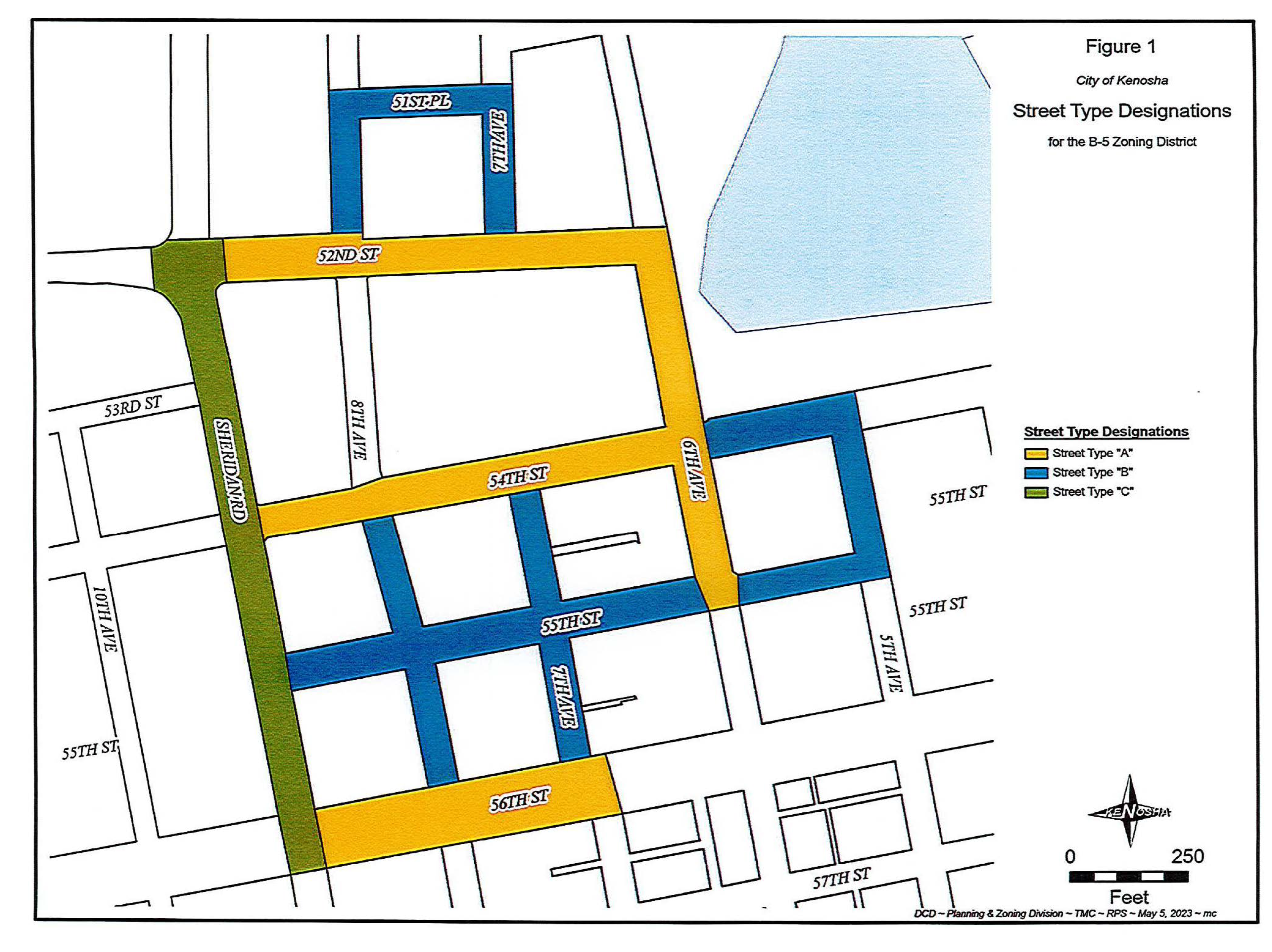
2.
All street types, including the "amenities" and "pedestrian walkway" zones as defined in Section 3.156.C. of this Ordinance, must have a continuous and consistent design with respect to the overall details, materials, textures, colors, dimensions (depth and width), and other related elements for all public improvements throughout each block. All paving materials must be ADA accessibility compliant and material selections must be sensitive to the needs of mobility impaired persons. A "pedestrian walkway zone" must be free of obstructions and constructed of concrete that meets the requirement of Section 5.05.A. of the Code of General Ordinances. Adequate space and soil must be provided to promote healthy street trees having greater access to soil, nutrients, and water that will better serve the downtown tree canopy for all street types. All street trees must be approved by the City Forester. Street furniture must be designed to complement the design of the "amenities" and "pedestrian walkway" zones, building entrances and green spaces, and to help define outdoor public space, to minimize pedestrian and vehicular conflicts, and to enhance pedestrian safety and comfort.
C.
Street Type Designations.
1.
Street Type "A" comprises a major aspect of the social and economic life of an urban area. Street Type "A" creates an opportunity to accommodate high levels of pedestrian activity and vehicular traffic. Pedestrian-scaled commercially-oriented, nonresidential development on these streets is of highest importance, as is having a continuous street wall and a wide sidewalk to provide room for pedestrian-friendly elements, such as bicycle parking, benches, landscaping, public art, public plazas, outside seating, marquees/canopies, market stalls, trash receptacles, etc. Roadway area elements include street parking, bicycle lanes, well-designed crosswalks, etc. Street Type "A" also provides opportunities for more intense, urban development with shallow building zone setbacks and increased building heights. Refer to Figure 2.
a.
Building Zone. There must be a maximum building setback of ten (10) feet, measured from the rights-of-way line of a public street, or from the setback line of any major street, whichever is greater.
b.
Pedestrian Walkway Zone, located in the public rights-of-way, must be an unobstructed, continuous public sidewalk of a minimum of five (5) feet in width.
c.
Amenities Zone is a minimum of five (5) feet in width between the Pedestrian Walkway and the Curb Zone that must primarily be a paved, hardscape area that may also include, but not limited to: art/sculptures, bicycle parking, event/market space, outdoor dining areas/cafes, public plaza/garden, street furniture, street-lights, signage, and street trees planted in wells or planters. Tree grates must have removable center rings so that the tree can expand as it grows. Such an amenities zone includes permissible plantings for Lawn Park Areas in Section 5.051 of the Code of General Ordinances.
d.
Curb Zone is a minimum of two (2) feet in width between the face of the curb and the Amenities Zone that must be free and clear from any amenities or other elements to allow ingress and egress for occupants of legally parking vehicles and not restrict access to fire hydrants.
2.
Street Type "B" creates a pleasant public space for surrounding residents and provides a network of circulation options Street Type "B" has a moderate level of pedestrian activity and vehicular traffic. Streets are pedestrian-friendly, characterized by lesser amounts of activity. These streets may either be mixed use or residential in character. In mixed use areas, a continuous street wall is maintained, and the sidewalk accommodates higher levels of pedestrian traffic. Street Type "B" is designed in a way that slows traffic, allows for street parking, and accommodates surface and structured parking entries. Refer to Figure 2.
a.
Building Zone. There must be a maximum building setback of fifteen (15) feet, measured from the rights-of-way line of a public street, or from the setback line of any major street, whichever is greater.
b.
Pedestrian Walkway Zone, located in the public rights-of-way, must be an unobstructed, continuous public sidewalk of a minimum of five (5) feet in width.
c.
Amenities Zone is a minimum of five (5) feet in width between the Pedestrian Walkway and the Curb Zone that must be an unpaved, non-hardscape area with street trees, street furniture, streetlights, and signage, unless otherwise approved by the Review Authority. Such an amenities zone includes rain gardens, bio-retention swales, and permissible plantings for Lawn Park Areas in Section 5.051 of the Code of General Ordinances.
d.
Curb Zone is a minimum of two (2) feet in width between the face of the curb and the Amenities Zone that must be free and clear from any amenities or other elements to allow ingress and egress for occupants of legally parking vehicles and not restrict access to fire hydrants.
3.
Street Type "C" (Sheridan Road) is a high traffic corridor (State Trunk Highway 32) that runs through downtown Kenosha. Direct vehicular access from adjacent parcels is prohibited onto Street Type "C." Refer to Figure 2.
a.
Building Zone. There must be a maximum building setback of fifteen (15) feet, measured from the rights-of-way line of a public street, or from the setback line of any major street, whichever is greater.
b.
Pedestrian Walkway Zone, located in the public rights-of-way, must be an unobstructed, continuous public sidewalk of a minimum of five (5) feet in width.
c.
Amenities Zone is a minimum of five (5) feet in width between the Pedestrian Walkway and the Curb Zone that must allow for amenities of a nature to calm vehicular traffic, but not encourage congregating of pedestrians, such as artistic bollards, street trees or planters, signs, and flag poles. Such an amenities zone includes rain gardens, bioretention swales, and permissible plantings for Lawn Park Areas in Section 5.051 of the Code of General Ordinances. Paved, hardscape areas are discouraged in this zone.
d.
Curb Zone is a minimum of two (2) feet in width between the face of the curb and the Amenities Zone that must be free and clear from any amenities or other elements to allow ingress and egress for occupants of legally parked vehicles and not restrict access to fire hydrants.
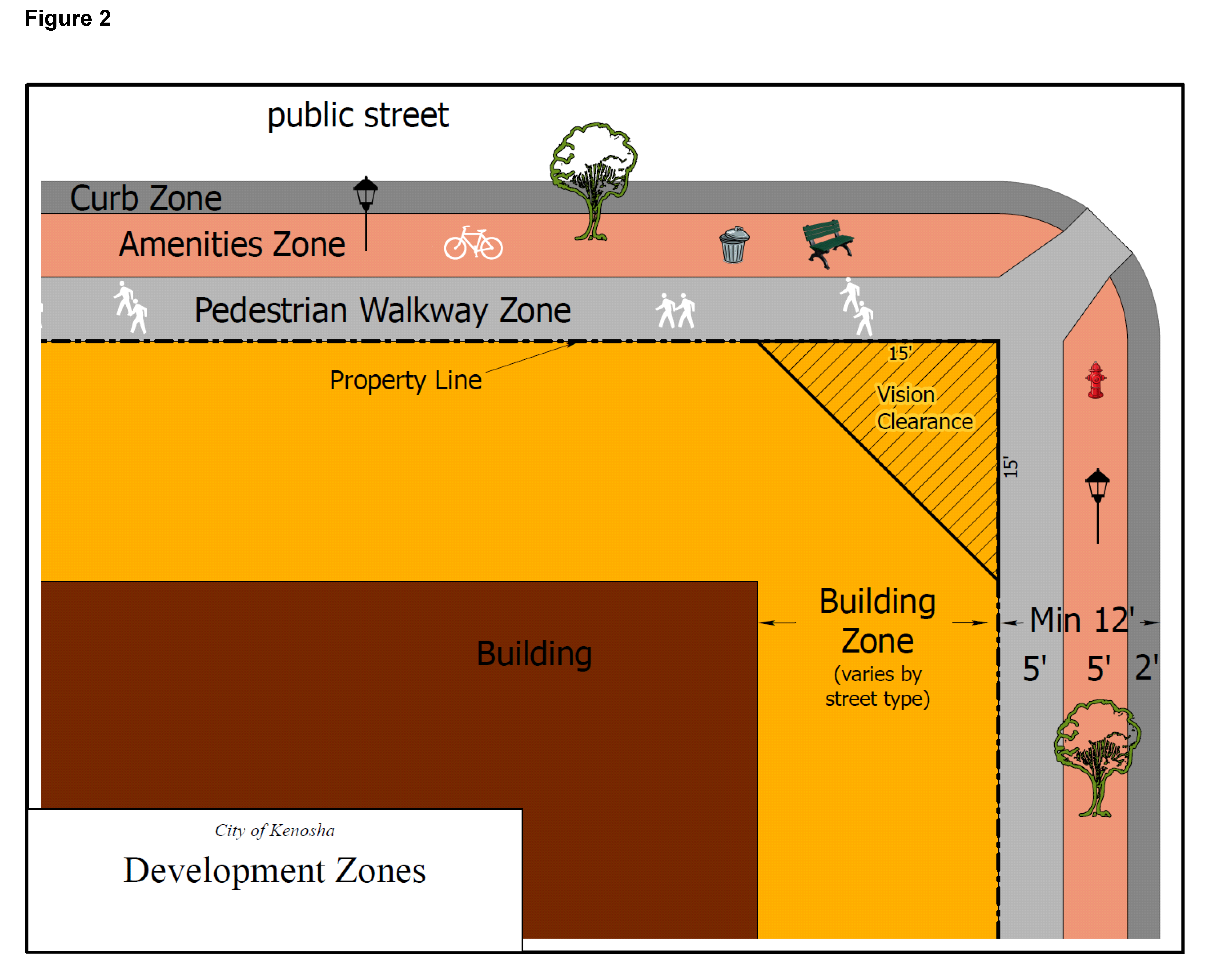
D.
Building Frontage and Façade Composition Requirements. All buildings must have a well-defined façade with the primary entrance facing a public street. Windows and doors at the street level must enliven the street environment, create interest along the sidewalk, and provide a secondary source of lighting at night.
1.
Building Windows and Openings.
a.
Base Façade Zone.
(1)
Street Type "A." Street-facing building façades on Street Type "A" must include windows, doors, and openings of at least sixty (60) percent of the total wall area at the ground-level story of the building.
(2)
Street Types "B" and "C." Street-facing building façades on Street Types "B" and "C" must include windows, doors, and openings of at least thirty (30) percent of the total wall area at the ground-level story of the building.
b.
Middle and Top Façade Zones. All street-facing building façades must include windows, doors, and openings of at least twenty (20) percent of the total wall area of each floor above the ground-level story of the building.
2.
Building Articulation. Detailing, ornamentation, and the texture of materials must provide intricacy and create visual interest at an intermediate scale between the size of building elements (windows, doors, and columns) and the scale of construction components (bricks, blocks, and lintels).
a.
Base Façade Zone. The base zone of the building façade must be articulated with a horizontal expression line establishing a base and an architectural character separate from, but integrated with, the upper façade zones.
b.
Middle Façade Zone. The middle zone of the building façade must form an expression line separating the middle area from the top and base zones of the building. The middle zone of the building façade must be articulated by surface variations of perceptible depth through windows, openings, architectural elements, etc.
c.
Top Façade Zone. The top zone of the building façade must terminate the composition in a way that punctuates the top zone and gives distinction to the whole building. It is important for the character of the roof form to be consistent with the overall style of the building. Excessive gables are discouraged, especially on buildings with four (4) or more stories.
3.
Pedestrian Entries.
a.
Base Façade Zone. At least one (1) pedestrian entrance must be provided for each building façade along public streets. If possible, pedestrian entries must be provided on the street for each distinct ground floor use or tenant. Dominant corner entrances are strongly encouraged on corner sites. The major public entry must be a prominent visual feature of a building. Mixed use buildings with upper story residential and/or commercial uses are encouraged to have separate entries with access to the public street.
4.
Parking (Structured and Surface) Frontage must be adequately screened from public view. Building façades must integrate or complement the architectural character and quality of all buildings on the block. Façade openings that face any public rights-of-way or publicly accessible open space must be vertically and horizontally aligned along the street frontage. Surface parking frontages, including service area screening, must adhere to the requirements in Section 14.08 of this Ordinance.
E.
Building Height. Buildings, structures, or the enlargements of any building or structure, must not exceed the maximum number of stories as depicted on Figure 3. Buildings, structures, or the reductions of any building or structure must not be less than the minimum number of stories as depicted on Figure 3.
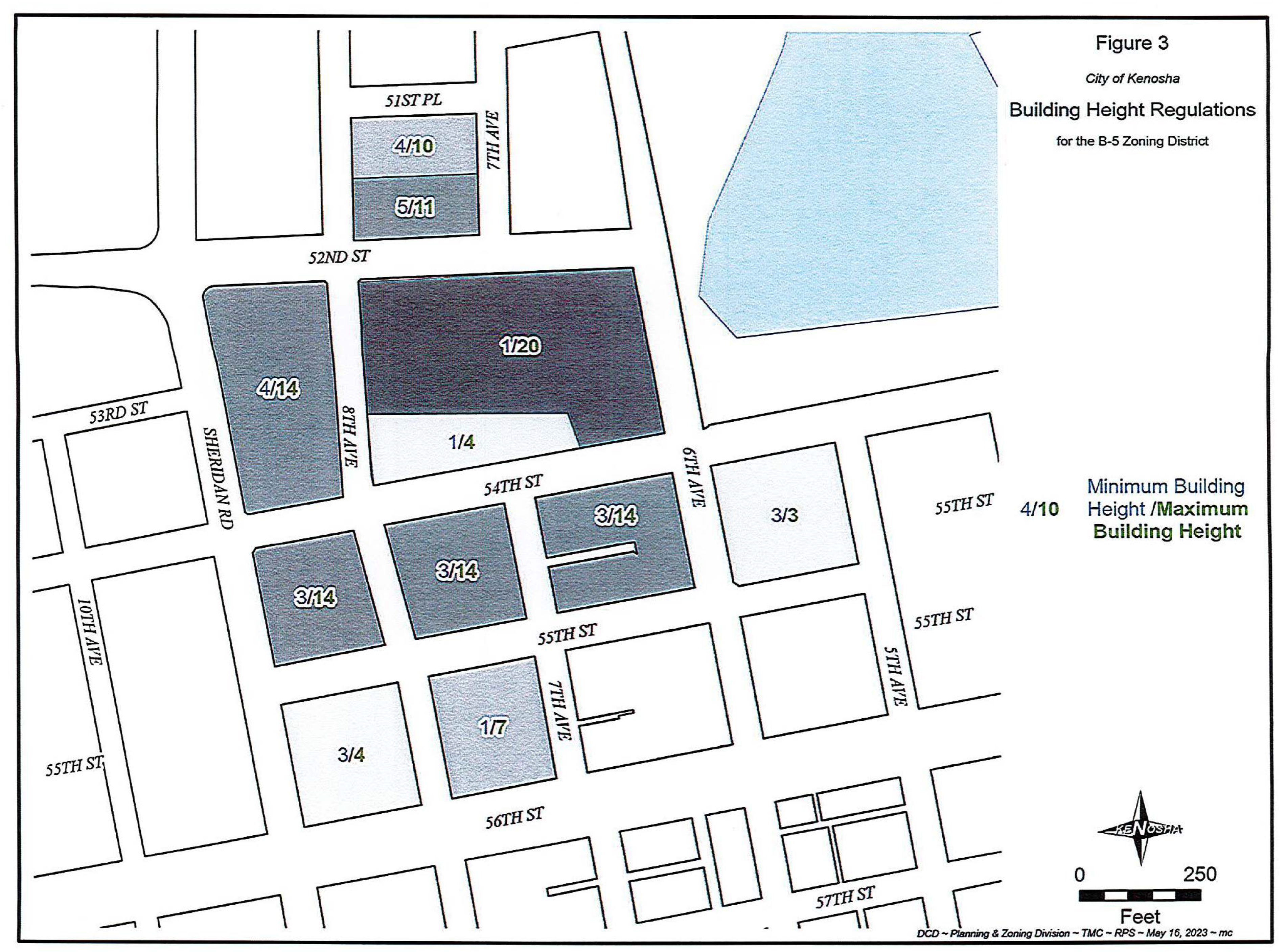
F.
Block Identification Map. A total of nine (9) blocks are identified to be included into the B-5 District (Blocks "A" through "I" are proposed naming conventions for this district). As additional blocks may be included into this district, they will be named the next available letter (e.g., the next block to be incorporated into this district will be named Block J). Refer to Figure 4.
1.
Block Restrictions.
a.
No residential development is allowed on Block E.
b.
Block E is restricted to civic institutional uses complementary to the character of the Civic Center Historic District, except that incidental commercial uses may be permitted within a civic building.
c.
No surface parking is allowed on Block F, unless approved by the Review Authority.
d.
No structured parking is allowed on Block G, except for parking below-grade.
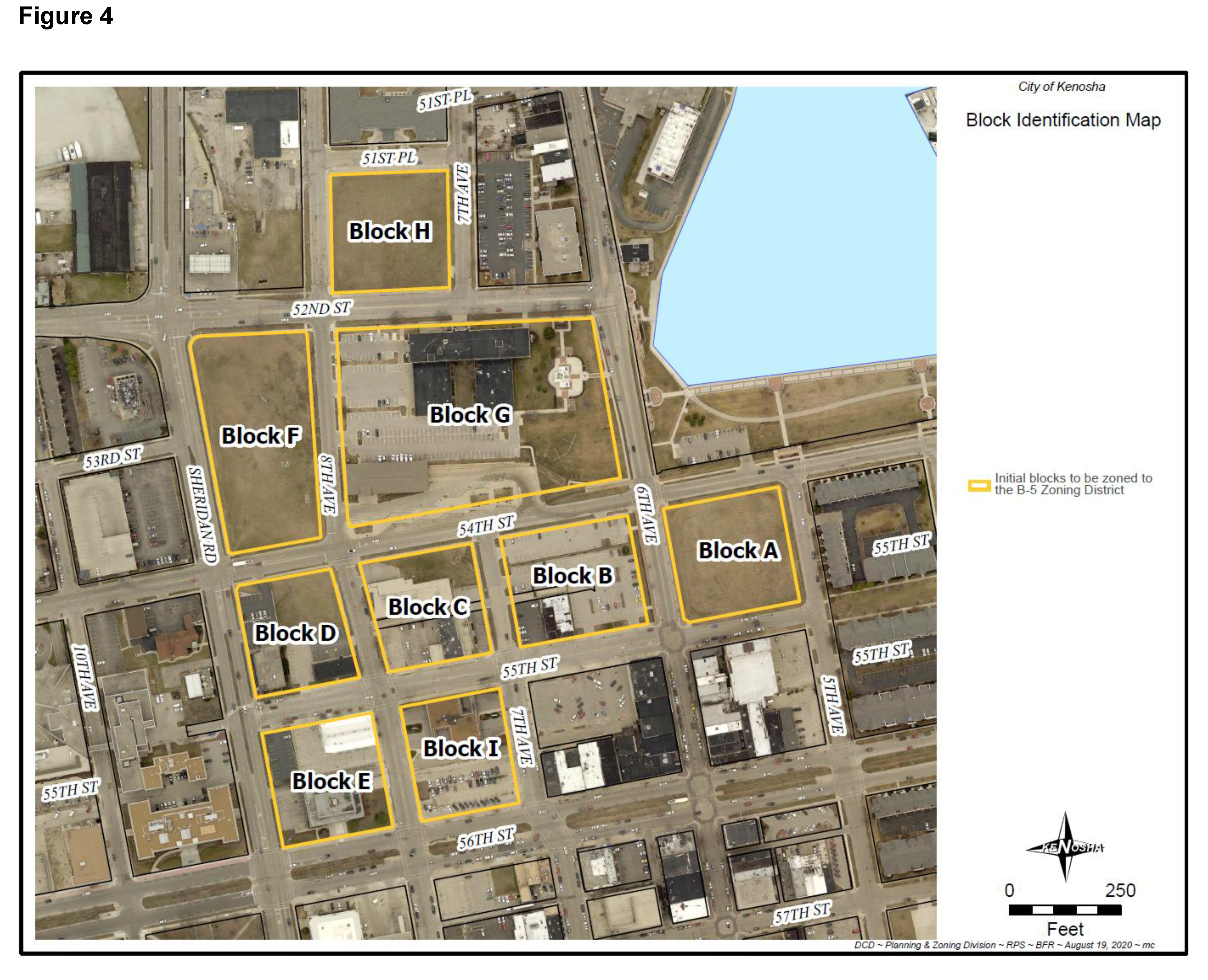
G.
Lot Area and Width. There are no minimum lot area and width requirements.
H.
Permitted Uses.
1.
Convenience Retail and Service Stores as follows, unless otherwise approved by the Review Authority.
a.
Bakery, retail.
b.
Barbershop.
c.
Beauty or styling salon.
d.
Bicycle sales, rental and repair shop.
e.
Book and stationery shop, or newsstand; excluding adult uses, as defined.
f.
Camera and photographic supply store.
g.
Candy and ice cream store.
h.
Clothes and costume rental service.
i.
Coffee shop.
j.
Dressmaking, tailor, or alteration shop.
k.
Drugstore.
l.
Florist shop.
m.
Food store; grocery; meat, poultry, and fish market; and delicatessen; including the use of controlled atmosphere smoke producing and processing equipment for retail and custom order purposes.
n.
Gift shop.
o.
Hobby shop.
p.
Jewelry store.
q.
Laundromat and dry-cleaning establishment, including clothes or garment pickup/drop-off facilities.
r.
Locksmith.
s.
Office supply store.
t.
Package beverage store.
u.
Pet shop.
v.
Photocopying center.
w.
Record or tape store.
x.
Repair, rental, or servicing of any article the sale of which is a conditional use in this Ordinance.
y.
Restaurant, including outdoor cafe restaurants and refreshment stands.
z.
Secondhand Article Dealer.
aa.
Shoe repair and combination shoe sales store.
bb.
Tobacco and pipe shop.
cc.
Travel bureau and transportation ticket office.
dd.
Upholstering shop.
ee.
Artisan studio.
2.
General Merchandise and Service Stores as follows, unless otherwise approved by the Review Authority:
a.
Apparel store.
b.
Automobile accessory and parts store.
c.
Automobile and/or truck rental, leasing or sharing establishment, provided such vehicles must be parked/displayed and stored on the premises and must not be visible from a public street.
d.
Business machine sales and service.
e.
Catalog and mail-order store.
f.
Department store.
g.
Drapery, curtain, and fabric store.
h.
Furniture and home furnishing store.
i.
Furriers and fur shops.
j.
Hardware store.
k.
Household appliance store.
l.
Interior decorating and picture framing studio.
m.
Leather goods and luggage store.
n.
Musical instrument store.
o.
Opticians sales.
p.
Orthopedic and medical appliance store.
q.
Radio, television, stereophonic and other electronic appliance store.
r.
Shoe and boot store.
s.
Sporting goods and trophy store.
t.
Toy store.
u.
Variety store.
3.
Miscellaneous Retail and Services Uses as follows, unless otherwise approved by the Review Authority:
a.
Adult day care centers.
b.
Bank and other financial institutions.
c.
Bowling alleys and roller-skating rinks.
d.
Civic, social, and fraternal clubs and lodges, and union halls, including for-profit and nonprofit establishments.
e.
Medical clinics or laboratories.
f.
Nursery and childcare centers.
g.
Offices; business, professional, governmental, civic, service, philanthropic, political and union.
h.
Physical fitness center and health club.
i.
Printing and publishing establishment, including newspaper establishments.
j.
Private business, dance, driving or martial arts schools; or other similar private schools.
k.
Recording and sound studio.
l.
Sign painting shop, limited to posters, banners, bumper stickers, truck and window and other nonelectrical advertising displays.
m.
Studio for art, dance, music or photography.
n.
Tavern and cocktail lounge, and combination restaurant or eatery, including outdoor serving areas.
o.
Theater; indoor.
4.
Institutional uses as follows, unless otherwise approved by the Review Authority:
a.
Cultural institutions, including libraries, museums and art museums.
b.
Educational institutions, limited to public and private elementary and secondary schools, colleges and universities and related dormitories, and school administrative offices.
c.
Health services, including offices of State licensed health practitioners such as a doctor, dentist, or chiropractor, medical and dental laboratories, outpatient care facilities and other health and allied services operated by a State licensed health practitioner.
d.
Parks and playgrounds, including buildings and grounds, and properly licensed concessions.
e.
Philanthropic and charitable institutions.
f.
Public administrative offices and public service buildings, including fire and police stations, community centers and public emergency shelters.
g.
Public transportation uses, including municipal bus and transportation terminals.
h.
Public and private utility offices.
i.
Religious institutions, including churches, chapels, temples, synagogues, convents, seminaries, rectories, parsonages, parish houses and residential quarters for clergy. Such quarters are permitted to be located on the same lot with a religious institution.
I.
Permitted Accessory Uses.
1.
Buildings for the storage or loading of vehicles used in conjunction with the operation of a principal use, provided such vehicles must be stored on the premises and must not be visible from a public street.
2.
Home occupations in residential dwellings, in conformance with the standards and conditions set forth in Section 3.03.G. of this Ordinance.
3.
Off-street parking and loading spaces and facilities, in conformance with Section 6.0 of this Ordinance. Loading docks must be properly screened and/or recessed. Screening must be accomplished by walls of the same building materials as the principal building.
4.
Outdoor Dining Areas and Cafes, in conformance with Sections 5.046, 10.075 and 10.076 of the Code of General Ordinances and the design standards in this Ordinance.
5.
Power supply units, external building heating/cooling systems, and other uses normally auxiliary to the principal use. Such equipment must be screened by fencing, walls or vegetation. Rooftop equipment must be screened behind parapets or recessed into roofs with matching building materials, and must be located below the highest vertical element of the building.
6.
Public use service building or structure.
7.
Trash enclosures must be constructed of building materials that match the associated building. Screening must be provided on three (3) sides and on the fourth side by a gate that also provides screening.
8.
Artisan manufacturing conducted wholly within an enclosed building. Such production of items must be an accessory use to an artisan studio and must not cause, create or result in noxious odors, smoke, dust, or dirt, or cause objectionable sounds of an intermittent nature which become a nuisance to adjacent uses.
J.
Conditional Uses.
1.
Brewpub or winery, accessory to a restaurant, tavern, cocktail lounge, or package beverage store, in conformance with Wis. Stats. ch. 125, Chapter X of the Code of General Ordinances, and Section 4.06.B.12. of this Ordinance.
2.
Communication and Radio/Television Antennas.
3.
Community Living Arrangements, that are both: a. in conformance with Section 4.06.A.1., Zoning Ordinance; and b. either (1) in conformance with Wis. Stats. § 62.23(7)(i), or (2) not in conformance with Wis. Stats. § 62.23(7)(i), but all of the persons served are disabled or handicapped under the Fair Housing Amendment Act (FHAA) or the Americans with Disabilities Act (ADA) and are living in the Community Living Arrangement because of their disability or handicap. In the latter circumstance, compliance with Wis. Stats. § 62.23(7)(i), is not required.
4.
Convention center, in conformance with Section 4.06.B.4. of this Ordinance.
5.
Drive-thru facilities in conjunction with any permitted use. Such drive-thru facilities and associated stacking lanes must not be visible from a public street.
6.
Entertainment/Performing Arts Center (EPAC).
7.
Hospitals.
8.
Hotels and motels, in conformance with Section 4.06.B.13. of this Ordinance.
9.
Multiple Family Residential. Such residential may be located at or above the first floor, and attached or detached to another principal use.
10.
New buildings/structures, additions to existing buildings/structures and/or modifications to the exterior of existing buildings/structures.
11.
Utility substations, in conformance with Section 4.06.D.11. of this Ordinance.
K.
Prohibited Uses in the B-5 District:
1.
Adult uses.
2.
Agriculture.
3.
Aluminum collection center.
4.
Bed and breakfast establishments.
5.
Building supply store.
6.
Carpenter, electrical, plumbing, heating and air conditioning shop, showroom and storage area.
7.
Cemeteries, mausoleums, crematoriums and pet cemeteries, including buildings.
8.
Convalescent and nursing homes, including extended medical care facilities and adult daycare centers.
9.
Flea Market.
10.
Fraternity or sorority houses.
11.
Funeral homes.
12.
Golf courses, public and private.
13.
Manufactured/Mobile Home Parks.
14.
Monument or memorial sales and storage.
15.
Motor vehicle uses, including:
a.
Automobile body shop.
b.
Automobile or truck wash.
c.
Recreation vehicle sales, service and storage establishments, except for motorcycles and marine craft.
16.
Municipal airports and aviation buildings and uses, except heliports.
17.
Outdoor signs identifying any prohibited uses.
18.
Outdoor storage.
19.
Penal, disciplinary, mental health and reform institutions.
20.
Recycling collection center.
21.
Rooming and boarding houses.
22.
Shelter facility.
23.
Single- and two-family residences.
24.
Wholesale or warehouse establishments.
(Ord. No. 31-23, §§ 1—4, 8-7-2023)
3.157. - B-6 Kenosha Innovation Neighborhood District.
The primary purpose of the B-6 Kenosha Innovation Neighborhood (KIN) is to develop a fully integrated, mixed use, pedestrian-oriented environment with buildings that contain innovation, educational, office, retail and residential uses. The KIN is to be designed in a manner that 1) creates opportunities for Kenoshans to stay in Kenosha; 2) is inclusive of all individuals, the surrounding neighborhoods, and the broader community; 3) creates a unique, regional destination that offers a competitive experience to other urban markets; and 4) supports the recovery and development of sustainable and resilient surrounding neighborhoods.
To accomplish these overarching goals along with specific objectives identified by the community, controls will be established within the District to control building form and placement to frame a well-defined public realm comprised of human scale streets, neighborhoods and public spaces. The boundaries of the district are limited to those areas covered under the adopted Master Plan for the Kenosha Innovation Neighborhood.
A.
Permitted Uses. All uses must meet the intent of the Kenosha Innovation Neighborhood Design Standards as determined by the KIN Board and City Plan Commission. The KIN Board and the City Plan Commission will determine if the intent of any project fits within the Kenosha Innovation Neighborhood Design Standards. Uses that are permitted include:
1.
Educational institutions, limited to public and private elementary, secondary, and post-secondary schools including related administrative offices.
2.
Hotels.
3.
Multiple family residential.
4.
Offices, including co-working spaces.
5.
Financial institutions, including one (1) drive thru lane that is screened or shielded from view or integrated within the building.
6.
Laboratories.
7.
Research and development facilities.
8.
Park and recreational uses.
9.
Retail sales and services.
10.
Restaurants, brewpubs and cafes, excluding drive thrus.
11.
Limited manufacturing, secondary to the principle use, not inconsistent with the urban character of the adopted KIN Master Plan.
B.
Permitted Accessory Uses.
1.
Buildings used for the storage or loading of vehicles used in conjunction with a principal use.
2.
Off street parking and loading facilities in conformance with Section 6.0 of this Ordinance.
3.
Outdoor dining areas and cafes.
4.
Trash enclosures.
C.
Conditional Uses.
1.
None.
D.
Prohibited Uses.
1.
Adult uses.
2.
Convenient Cash Businesses.
3.
Drive Thru facilities, except those listed above.
4.
Gas stations.
5.
Motor vehicle uses including sales, service and body shops.
6.
Outdoor storage including self-storage.
7.
Rooming and boarding houses.
E.
Kenosha Innovation Neighborhood (KIN) Design Standards. Development within the B-6 District shall conform to the KIN Design Standards, which are incorporated into this ordinance and may be amended from time to time, and the Kenosha Innovation Neighborhood Master Plan. The KIN Design Standards address issues such as building location, height, placement, parking locations, building architecture and streetscape. The adopted KIN Design Standards are on file in the Department of City Development.
F.
New Buildings, Additions to Buildings and or Site Changes. Site Plan and architectural review is required from the City Plan Commission before any permits can be issued for all new buildings, additions to existing buildings or exterior site modifications to approved plans within the B-6 district.
G.
Review and Decision Process.
1.
KIN Board. The KIN Board was created by the Cooperation and Development Agreement passed by the City of Kenosha Common Council on December 5, 2022. The KIN Board is comprised of seven (7) or more appointed individuals. The KIN Board will appoint the Architectural Committee to review all development applications for new buildings, additions to existing buildings, uses and site modifications for compliance with the KIN Design Standards. The Architectural Committee will forward any approved plans for development to the KIN Board for concurrence and to the Department of City Development for plan approval.
2.
City Site Plan Approval. Upon the submittal of all required plans, fees and application-the Department of City Development and applicable City Departments will review all site plan applications for compliance with City ordinances and the KIN Design Standards. The Department of City Development will provide a recommendation to the City Plan Commission upon completion of the review.
3.
City Plan Commission. The City Plan Commission will review the Site and architectural plans for compliance with city ordinances and the KIN Deign Standards. After considering recommendations from City staff and the KIN Board the City Plan Commission will either approve, deny or approve with conditions.
H.
Development Standards. Development within the B-6 District shall conform to the requirements of the Zoning Ordinance and with the KIN Design Standards. In the event of conflicting development standards between the zoning ordinance and the KIN Design Standards, the development standards contained in the KIN Design Standards shall take precedence.
I.
Appeals. Any petitioner/applicant objecting to any decision of the City Plan Commission related to Site Plan Review may appeal the decision to the Common Council. Such appeals shall be filed, accompanied by the fee therefor established by the Common Council, from time to time, by Resolution, with the City Clerk/Treasurer within thirty (30) days of the decision by the City Plan Commission. The Common Council shall hold a hearing on an appeal within sixty (60) days of the filing of the appeal. The Common Council shall notify the appellant of the hearing by mail. At the hearing, the appellant shall appear in person or by agent or attorney.
J.
Permits. No building, construction or Site Work Permits shall be issued by the City until the Site plan has been approved by the KIN Board and City Plan Commission and all applicable conditions of approval satisfied. Any changes of use within developed buildings will need KIN Board approval so long as the use is permitted and must receive an Occupancy permit from the City. Any changes to site plans or building exteriors will require permission from both the KIN Board and City Plan Commission prior to issuance of any construction permits by City.
K.
Expiration of Site Plan Review Approvals for Failure to Timely Obtain a Construction Permit or Obtain an Occupancy Permit.
1.
Site Plan Review with a Single Building or Use. Either the first required Construction Permit, or in the event that no Construction Permit is required, the Occupancy Permit, must be obtained within twelve (12) months of the date of approval of the Site Plan Review by the City Plan Commission. The twelve-month period from Site Plan Review approval may be extended by the City Plan Commission once for up to an additional twelve (12) months.
2.
Site Plan Review with Multiple Buildings. The first required Construction Permit must be obtained within twelve (12) months of the date of Site Plan Review approval by the City Plan Commission. Required Construction Permits shall be obtained for all remaining buildings within twenty-four (24) months of the date of the Site Plan Review approval by the City Plan Commission, or within an extension of the twenty-four-month period from approval by the City Plan Commission. Only one (1) extension of the twenty-four-month period from approval may be granted, and such extension may not exceed an additional twelve (12) months.
3.
Expiration. If neither a first required Construction Permit nor an Occupancy Permit has been issued within the time periods required in this paragraph the Site Plan Review approval expires.
L.
Conditions to Run with the Land. Any conditions applied to an approved Site Plan Review shall run with the land and be binding upon the owner/occupier of the land and upon any subsequent successor owners and occupiers of the land. All conditions applied shall be maintained indefinitely by the property owner/occupier unless and until otherwise approved by the City Plan Commission.
M.
Definitions.
KIN. The Kenosha Innovation Neighborhood (KIN) consists of the area identified in the KIN Master Plan
KIN Board. The KIN Board is comprised of seven (7) or more appointed individuals with a variety of experience and tenure with the City of Kenosha, its educational, business, and other community partners. The KIN Board will create the Architectural Committee through the appointing of three (3) board members and three (3) citizen members. The Architectural Committee will review all development applications for new buildings, additions to existing buildings, uses and site modifications for compliance with the KIN Design Standards.
KIN Design Standards. The Design Standards which have been adopted by the Common Council for development within the KIN site and as may be amended by the City Plan Commission from time to time.
KIN Master Plan. The Master Plan for the Kenosha Innovation Neighborhood as adopted by the Common Council.
N.
Exceptions to the KIN Design Standards. The City Plan Commission may upon request consider granting exceptions to the KIN Design Standards provided the intent of the ordinance is still met.
(Ord. No. 22-23, § 3, 6-19-2023)
3.16. - Manufacturing Zoning Districts—General Regulations.
In addition to the general provisions outlined in Section 2.0 of this Ordinance and the requirements of the respective zoning district, uses of land in the manufacturing zoning districts shall meet the following general regulations.
A.
Residential Uses Not Permitted.
1.
Restrictions. New construction of single-family, two-family and multiple-family residences is not permitted in the manufacturing districts, other than residential quarters for an owner, caretaker or watchman.
2.
Existing Residences in the Manufacturing Zoning Districts.
a.
Reconstruction of Existing Residences in the Manufacturing Zoning Districts. The reconstruction of an existing residential use in the M-1 or M-2 Districts, which has been damaged or destroyed by catastrophe or act of God, is permitted provided the reconstructed building does not exceed the original floor area of the structure and provided such reconstruction is commenced no later than one (1) year after the date of the damage or destruction and provided the building is in conformance with all other provisions of this Ordinance.
b.
Additions to Existing Residences in the Manufacturing Zoning Districts. Additions to existing residences in the M-1 or M-2 Districts are not permitted.
B.
Yard Requirements Exceptions. On a lot in a manufacturing district where a building line is in existence prior to the effective date of this Ordinance and which provides a yard less than required when adjacent to or across an alley from a residential district, an addition to or reconstruction of the building is permitted provided such addition or reconstruction is no closer to the lot line than the existing building line and provided that the building is in conformance with all other provisions of this Ordinance, including the parking requirements of Section 6.01 of this Ordinance.
3.17. - M-1 Light Manufacturing District.
The primary purposes and characteristics of the M-1 Light Manufacturing District are intended to provide for light manufacturing and industrial uses, and for warehousing and wholesaling uses of a limited nature and size that do not create appreciable nuisances or hazards.
A.
Permitted Uses.
1.
Residential quarters for a single caretaker or watchman of a permitted use shall not exceed five hundred (500) square feet in area.
2.
Ambulance or taxi service and dispatch center.
3.
Bottling company and distribution plant.
4.
Contractor's or construction office.
5.
Distribution plant.
6.
Engineering or scientific laboratory or research establishment.
7.
Food commissary.
8.
General Merchandise and Service Stores as follows:
a.
Business machine sales and service.
b.
Factory outlet store, secondary to the principal use.
c.
Household appliance sales and service.
d.
Repair, rental or service store.
9.
Ice and cold storage plant.
10.
Industrial laundry, cleaning and dyeing works, and carpet and rug cleaning works.
11.
Lithographing, typesetting, photoengraving, photostating or blueprinting.
12.
Machine or welding shop excluding presses over twenty (20) tons rated capacity and drop hammers.
13.
Mail-order establishment.
14.
Manufacturing, processing and/or storage of the following:
a.
Apparel and other finished products made from fabrics and similar material.
b.
Candles and other wax products.
c.
Cosmetic and pharmaceutical products.
d.
Electrical and electronic machinery equipment and supplies.
e.
Finished paper products, excluding paper and pulp manufacture.
f.
Finished products from previously prepared glass, and precious or semiprecious metals or stones.
g.
Food and kindred products, except vinegar and yeast, and excluding slaughter and the rendering or refining of fats and oils.
h.
Furniture and fixtures.
i.
Fur processing, excluding slaughter of animals.
j.
Ice and cold storage products.
k.
Leather and leather products, excluding tanning and finishing.
l.
Lumber and wood products, excluding a planing mill as the principal use.
m.
Measuring, analyzing and controlling instruments; photographic, medical, dental, optical and orthopedic goods; watches and clocks.
n.
Musical instruments and supplies.
o.
Office, computing and accounting machinery, including writing and drafting instruments.
p.
Pottery and ceramics using only previously pulverized base materials.
q.
Printing, publishing, and allied products.
r.
Signs and advertising displays.
s.
Sporting goods, novelty and toy products.
t.
Textile mill products, including, but not limited to, carpet, rug, curtain and drapery products.
u.
Tire retreading, recapping or reconditioning.
v.
Tobacco.
15.
Miscellaneous Retail and Services Uses as follows:
a.
Janitorial supply and service store.
b.
Radio and television station.
c.
Recording and sound studio.
16.
Miscellaneous retail building, home improvement and gardening supply stores and uses as follows:
a.
Building supply store, including a sales or lumberyard. Supplies for sale may include rock, sand, gravel and the like, but excluding concrete mixing. Planing mill shall not be principal use.
b.
Carpenter, electrical, plumbing, heating and air conditioning shop, showroom and storage area.
c.
Feed and fuel store.
d.
Floor covering and carpet store.
e.
Garden supply, commercial nursery, greenhouse or orchard, including wholesale establishments.
f.
Mobile or manufactured homes sales and service center, excluding construction.
g.
Paint, glass and wallpaper store.
h.
Tool or equipment rental store.
17.
Vehicle uses as follows:
a.
Vehicle and/or truck accessory and parts store.
b.
Vehicle upholstering or body shop, excluding salvage dealers, shops and yards.
c.
Vehicle truck wash.
d.
Parking facilities, including structure or ramps.
18.
Municipal service and storage buildings.
19.
Office building, secondary to the principal use.
20.
Photographic processing plant.
21.
Public and private utility offices.
22.
Public transportation uses, including bus and transportation terminals.
23.
Railroad terminal.
24.
Sheet metal shop.
25.
Small boat building, but not ship building.
26.
Storage of petroleum, provided that above ground storage does not exceed a total capacity of five thousand (5,000) gallons.
27.
Wholesale and warehouse establishments.
28.
Off-Premises Sign in conformance with Section 15.15 of the Code of General Ordinances.
29.
Data Center.
B.
Permitted Accessory Uses.
1.
Garages for the storage or loading of vehicles used in conjunction with the operation of a principal use.
2.
Off-street parking and loading spaces and facilities, in conformance with Section 6.0 of this Ordinance.
3.
Utility sheds, power supply, external building heating/cooling systems, and other uses normally auxiliary to the principal use.
C.
Conditional Uses. (See Section 4.0 of this Ordinance for the conditional use review procedures).
1.
Airports and commercial heliports, including landing fields, runways, flying schools, hangars, terminal buildings, and other auxiliary facilities.
2.
Storage yard for construction equipment and materials used by a contractor.
3.
Aluminum Collection Center.
4.
Recycling Collection Center.
5.
Utility substations and Communication Towers, Radio/Television/Relay Towers and Antennas.
6.
Storm water detention and retention basins.
7.
Truck or freight terminal and/or bulk intermodal distribution center related to air, water and/or land transportation.
8.
Self-service storage facilities.
9.
Off-Premises Sign not in conformance with Section 15.15.H.5 or 15.15.H.7 of the Code of General Ordinances or Digital Display Off-Premises Sign.
10.
Golf Range, Batting Range, Batting Cage, or Golf and/or Batting Simulator.
11.
Public Safety Communication Towers and Antennas.
12.
Physical Fitness Center
13.
Vehicle Facility.
D.
Lot Area and Width. None.
E.
Building Height. No building or structure, nor the enlargement of any building or structure, shall exceed seventy-five (75) feet in height, except for Communication Towers, Radio/Television/Relay Towers and Antennas which may be installed to a height in conformance with Section 2.04.A.3. of this Ordinance.
F.
Yard Requirements.
1.
Front Yard. No front yard shall be required except that where the frontage, as defined, lies partly within the M-1 District and partly within a residential district, the residential district yard requirement on that street shall apply as the front yard requirement.
2.
Side Yards.
a.
Interior Side Yard. No interior side yard shall be required except that where a side lot line in the M-1 District abuts a residential district, there shall be an interior side yard of not less than five (5) feet. In cases where no interior side yard is required, but is voluntarily provided, the interior side yard shall be a minimum five (5) feet.
b.
Street Side Yard. No street side yard shall be required except that where a side lot line in the M-1 District fronts on a street and where a rear lot line in the M-1 District abuts or is across an alley from a residential district, the residential district yard requirement on that street shall apply as the street side yard requirement.
3.
Rear Yard. A rear yard of not less than nine (9) feet is required, except that where a rear lot line in the M-1 District fronts on a street and where a side lot line in the M-1 District abuts or is across an alley from a residential district, the residential district yard requirement on that street shall apply as the rear yard requirement.
4.
Accessory Buildings or Structures. No accessory building or structure shall be located in any required front, side or rear yard. In cases where a front, side or rear yard is not required, and the accessory building or structure is voluntarily set back from an interior lot line, the accessory building or structure shall maintain an accessory yard of not less than five (5) feet. In cases where a front, side or rear yard is not required, and the accessory building or structure is of wood frame or unprotected metal construction and is less than five hundred (500) square feet in floor area, the accessory building or structure shall maintain an accessory yard of not less than five (5) feet from any interior lot line.
5.
Accessory Uses. No yards shall be required for accessory uses where no building or structure is involved.
(Ord. No. 43-21, §§ 5, 6, 10-5-2021; Ord. No. 54-24, § 1, 12-16-2024)
3.18. - M-2 HEAVY MANUFACTURING DISTRICT.
The primary purpose and characteristics of the M-2 Heavy Manufacturing District are intended to provide for heavy manufacturing and industrial uses.
A.
Permitted Uses.
1.
Any use permitted in the M-1 Light Manufacturing District.
B.
Permitted Accessory Uses.
1.
Garages for the storage or loading of vehicles used in conjunction with the operation of a principal use.
2.
Off-street parking and loading spaces and facilities, in conformance with Section 6.0 of this Ordinance.
3.
Utility sheds, power supply, external building heating/cooling systems, and other uses normally auxiliary to the principal use.
C.
Conditional Uses. (See Section 4.0 of this Ordinance for the conditional use review procedures).
1.
Airports and commercial heliports, including landing fields, runways, flying schools, hangars, terminal buildings, and other auxiliary facilities.
2.
Hazardous waste sites and facilities.
3.
Manufacturing, processing and/or storage of the following:
a.
Acid.
b.
Cement, lime and gypsum.
c.
Explosives.
d.
Fat and oil, including rendering and refining.
e.
Fertilizer.
f.
Glue.
g.
Leather tanning and finishing.
h.
Petroleum, including refining and storage of petroleum or petroleum products in aboveground tanks which exceed five thousand (5,000) gallons in total capacity.
i.
Tar and asphalt, including refining and batch plants.
j.
Yeast.
k.
Abrasive and asbestos.
l.
Acetylene gas.
m.
Aircraft and aircraft supplies.
n.
Automobiles and automobile parts.
o.
Battery plant, only with previously processed acid and acidic products.
p.
Brick, tile, or terra cotta.
q.
Chemicals, soaps, alcohol, and vinegar products.
r.
Graphite.
s.
Household appliances.
t.
Insulating materials.
u.
Linoleum and other hard surface floor coverings. Ceramic floor and wall tile.
v.
Machinery, tools and dies.
w.
Motor vehicles and motor vehicle equipment.
x.
Paint and paint products.
y.
Paper and allied products, including potash and charcoal.
z.
Primary metals
aa.
Pyroxylin.
bb.
Rubber and miscellaneous plastic products.
cc.
Stone, glass, and concrete products, excluding cement line or gypsum.
dd.
Transportation equipment.
ee.
Wire, rope, cord, twine, and other cordage products.
4.
Mining operations, including a quarry or stone mill and rock crushers.
5.
Power generating plant.
6.
Resource recovery plant.
7.
Salvage dealers.
8.
Salvage shops.
9.
Salvage yards.
10.
Smelting of metals, ores or alloys.
11.
Stock yards or slaughter houses.
12.
Storage yard for construction equipment and materials used by a contractor.
13.
Aluminum Collection Center.
14.
Recycling Collection Center.
15.
Incinerator.
16.
Waste Disposal, Treatment and Transportation Facility.
17.
Concrete mixing plant.
18.
Truck or freight terminal and/or bulk intermodal distribution center related to air, water and/or land transportation.
19.
Storm water detention and retention basins.
20.
Utility substations and Communication Towers, Radio/Television/Relay Towers and Antennas.
21.
Reserved.
22.
Blast furnace or coke oven.
23.
Boiler works.
24.
Ceramic base and pottery material mixing.
25.
Construction of Manufactured/Mobile Homes and modular buildings and structures.
26.
Feed mill.
27.
Foundry or forge plant.
28.
Grain storage and processing.
29.
Machine or welding shop with presses over twenty (20) tons rated capacity and/or drop hammers.
30.
Metal and ore reduction and refinement, excluding smelting.
31.
Planing mill, as a principal use.
32.
Plating works.
33.
Railroad repair or freight yard, shop or terminal.
34.
Rolling mills.
35.
Salt works.
36.
Self-Service Storage Facilities.
37.
Ship building and repair.
38.
Off-Premises Sign not in conformance with Section 15.15.H.5 or 15.15.H.7 of the Code of General Ordinances or Digital Display Off-Premises Sign.
39.
Golf Range, Batting Range, Batting Cage, or Golf and/or Batting Simulator.
40.
Public Safety Communication Towers and Antennas.
41.
Physical Fitness Center.
42.
Vehicle Facility.
D.
Lot Area and Width. None.
E.
Building Height. No building or structure, nor the enlargement of any building or structure, shall exceed one hundred (100) feet in height, except for Communication Towers, Radio/Television/Relay Towers and Antennas which may be installed to a height in conformance with Section 2.04.A.3. of this Ordinance.
F.
Yard Requirements.
1.
Front Yard. No front yard shall be required except that where the frontage, as defined, lies partly within the M-2 District and partly within a residential district, the residential district yard requirement on that street shall apply as the front yard requirement.
2.
Side Yards.
a.
Interior Side Yard. No interior side yard shall be required, except that where a side lot line in the M-2 District abuts a residential district, there shall be an interior side yard of not less than five (5) feet. In cases where no interior side yard is required, but is voluntarily provided, interior side yard shall be a minimum five (5) feet.
b.
Street Side Yard. No street side yard shall be required except that where a side lot line in the M-2 District abuts or is across an alley from a residential district, the residential district yard requirement on that street shall apply as the street side yard requirement.
3.
Rear Yard. A rear yard of not less than nine (9) feet is required, except that where a rear lot line in the M-2 District fronts on a street and where a side lot line in the M-2 District abuts or is across an alley from a residential district, the residential yard requirement on that street shall apply as the rear yard requirement.
4.
Accessory Buildings or Structures. No accessory building or structure shall be located in any required front, side or rear yard. In cases where a front, side or rear yard is not required, and the accessory building or structure is voluntarily set back from an interior lot line, the accessory building or structure shall maintain an accessory yard of not less than five (5) feet. In cases where a front, side or rear yard is not required, and the accessory building or structure is of wood frame or unprotected metal construction and is less than five hundred (500) square feet in floor area, the accessory building or structure shall maintain an accessory yard of not less than five (5) feet from any interior lot line.
5.
Accessory Uses. No yards shall be required for accessory uses where no building or structure is involved.
(Ord. No. 43-21, § 7, 10-5-2021)
3.19. - I-P Institutional-Park District.
The primary purposes and characteristics of the I-P Institutional-Park District are intended to provide for areas which are primarily devoted to public, institutional and recreational uses. Office uses, which are related to the character and operation of the permitted civic, governmental and institutional uses, are permitted as appropriate mixed uses.
A.
Permitted Uses.
1.
Agriculture.
2.
Bicycle, hiking, nature and cross-country ski trails.
3.
Botanical and zoological gardens.
4.
Cemeteries, mausoleums, crematoriums and pet cemeteries, including buildings.
5.
Civic, social and fraternal clubs and lodges, nonprofit.
6.
Convalescent and nursing home, including extended medical care facilities and adult day care centers.
7.
Cultural institutions, including libraries, museums and art galleries.
8.
Educational institutions, including public and private elementary and secondary schools, colleges and universities and related dormitories, and school administrative offices.
9.
Funeral homes.
10.
Golf courses
a.
Private, including food and alcoholic beverages sales ancillary to the permitted golf course upon obtaining applicable licenses.
b.
Public, including food and fermented malt beverages sales ancillary to the permitted golf course.
11.
Greenhouse or arboretum, public.
12.
Historic monuments.
13.
Health services, including offices of state licensed health practitioners such as a doctor, dentist, or chiropractor, medical and dental laboratories, outpatient care facilities and other health and allied services operated by a State licensed health practitioner.
14.
Hospitals.
15.
Nursery and child care centers.
16.
Offices; professional, civic, service, philanthropic, political and union, which are related to the character and operation of a use permitted in the I-P District.
17.
Parking structures and ramps.
18.
Philanthropic and charitable institutions.
19.
Public administrative offices, and public service buildings and uses, including fire and police stations, community centers, and public emergency shelters.
20.
Public parks and playgrounds, including building and grounds, and properly licensed concessions.
21.
Restaurants located within public park buildings and grounds, upon:
a.
A properly executed Lease Agreement with the City of Kenosha; and
b.
Obtaining applicable licensing pursuant to State law and local Ordinances.
22.
Public transportation uses, as follows:
a.
Municipal airports and heliports, including landing fields, runways, taxiways, together with hangars, terminal buildings and aviation uses permitted under and as regulated by Section 18.03 "Airport Development Code" of the Code of General Ordinances.
b.
Municipal bus terminal, and related uses, including equipment storage areas and maintenance buildings.
c.
A municipally owned Marina, operated by the municipality or by a licensee or lessee, to include the leasing or rental of boat slips and mooring spaces, the providing of boat lift in and lift out services, boat sales incidental to a Marina operation, boat storage incidental to a Marina operation, the sale of products and services associated with boating or the provisioning of boats, and boat repair incidental to a Marina operation.
23.
Religious institutions, including churches, chapels, temples, synagogues, convents, seminaries, rectories, parsonages, parish houses, and residential quarters for clergy. Quarters are permitted to be located on the same lot with a religious institution.
24.
Refuge Center, licensed in accordance with Chapter XIII of the Code of General Ordinances.
B.
Permitted Accessory Uses.
1.
Garages for the storage of vehicles used in conjunction with a permitted principal use.
2.
Off-street parking spaces and parking facilities for the storage of vehicles used in conjunction with a permitted principal use and in conformance with Section 6.01 of this Ordinance.
3.
Off-street loading spaces and facilities in conformance with Section 6.02 of this Ordinance.
4.
Outdoor signs, in conformance with Chapter XV of the Code of General Ordinances and limited to signs identifying a permitted use, not exceeding sixty (60) square feet in area per lot, with the following exceptions:
a.
Signs, not exceeding eight (8) square feet in area per lot, pertaining to the lease, rental, or sale of a permitted building or structure or identifying permitted Community Living Arrangements and Bed and Breakfast Establishments.
b.
Signs, not exceeding sixteen (16) square feet in area per lot, identifying permitted agricultural uses, conference centers, health services, nursery and child care centers, adult day care centers, and offices.
c.
Signs, not exceeding one hundred (100) square feet in area per lot, identifying permitted hospitals, public administrative offices, public service buildings and uses, and religious institutions.
d.
Signs, identifying permitted arenas, auditoriums, exhibition halls and stadiums; penal, disciplinary, mental health and reform institutions; and public transportation uses, which shall not have any area restrictions, except as outlined in said Chapter XV.
5.
Service buildings and facilities normally auxiliary to a permitted principal use.
6.
Heliports for Emergency Medical Centers.
7.
Food and nonalcoholic beverage sales in conjunction with the following principal or conditional uses upon obtaining applicable licenses:
a.
Colleges, technical schools and universities.
b.
Conference centers and/or bed and breakfast establishments.
c.
Cultural institutions, including libraries, museums and art galleries.
d.
Hospitals.
e.
Public transportation uses under Section 3.19.A.22. of this Ordinance.
C.
Conditional Uses. (See Section 4.0 of this Ordinance for the conditional use review procedures).
1.
Arena, auditorium, exhibition halls and stadiums.
2.
Community Living Arrangements, either (a) in conformance with Wis. Stats. § 62.23(7)(i), or (b) not in conformance with Wis. Stats. § 62.23(7)(i) but all of the persons served are disabled or handicapped under the Fair Housing Amendment Act (FHAA) or the Americans with Disabilities Act (ADA), and are living in the Community Living Arrangement because of their disability or handicap. In the latter circumstance, compliance with Wis. Stats. § 62.23(7)(i) is not required.
3.
Penal, disciplinary, mental health and reform institutions.
4.
The rental or lease of pier or dock space to the public, the operation of which is conducted and owned by a private individual or corporation, and meeting the standards of Section 4.06.D.7. of this Ordinance.
5.
Conference Center and/or Bed and Breakfast Establishment.
6.
Notwithstanding Section 3.19.G., a shelter facility.
7.
Utility substations and Communication Towers, Radio/Television/Relay Towers and Antennas.
8.
Storm water detention and retention basins.
9.
Financial institutions, including related drive-thru facilities.
10.
Development consisting of two (2) or more buildings for permitted or conditional uses located on a single parcel of land or contiguous parcels, which are part of the same development.
11.
A building with twenty thousand (20,000) square feet or greater of gross floor area which contains permitted or conditional use(s).
12.
Medical transportation offices used exclusively for arranging transportation of individuals to and from health care providers as defined in Wis. Stats. § 146.81, but excluding taxicab offices and vehicle maintenance facilities.
13.
Public Safety Communication Towers and Antennas.
D.
Lot Area and Width. There shall be no minimum lot area or width requirements except for existing residential uses, which shall provide a minimum lot area and width as would be required if such residences were located in the RG-2 General Residential District, Section 3.09 of this Ordinance.
E.
Building Height. No building or structure, nor the enlargement of any building or structure, shall exceed fifty (50) feet in height, except for Communication Towers, Radio/Television/Relay Towers and Antennas which may be installed to a height in conformance with Section 2.04.A.3. of this Ordinance.
F.
Yard Requirements.
1.
Front Yard. No front yard shall be required except that where the frontage, as defined, lies partly within the I-P District and partly within a residential district, the residential yard requirement on that street shall apply as the front yard requirement.
2.
Side Yards.
a.
Interior Side Yard. No interior side yard shall be required except that where a side of a lot in the I-P District abuts a residential district, the interior side yard of the lot in the I-P District shall not be less than five (5) feet. In cases where no interior side yard is required, but is voluntarily provided, the interior side yard shall be a minimum five (5) feet.
b.
Street Side Yard. No street side yard shall be required except that where a side lot line in the I-P District fronts on a street and where a rear lot line in the I-P District abuts or is across an alley from a residential district, the residential district yard requirement on that street shall apply as the street side yard requirement.
3.
Rear Yard. A rear yard of not less than nine (9) feet is required, except that:
a.
Where a rear lot line in the I-P District abuts an alley, a rear yard equaling nine (9) feet from the center line of the alley is required.
b.
Where a rear lot line in the I-P District fronts on a street and where a side lot line in the I-P District abuts or is across an alley from a residential district, the residential yard requirement on that street shall apply as the rear yard requirement.
4.
Accessory Buildings, Structures or Fences.
a.
No accessory building or structure shall be located in any required front or street side yard or in any rear yard which fronts on a street and will be located within twenty-five (25) of the public right-of-way.
The minimum building to property line setback for the side and rear yards shall be five (5) feet, unless constructed in accordance with the Commercial Building Code and utilized in conjunction with an approved commercial principal use of the property.
b.
No fence shall be constructed or reconstructed in any required front yard unless said fence is approved in conjunction with a Conditional Use Permit/Site Plan Review or a variance as granted by the Board of Zoning Appeals.
5.
Accessory Uses. No yards shall be required for accessory uses where no building or structure is involved, except for off-street parking spaces and facilities, which shall not be located in any required front or street side yard.
6.
Yards for Existing Residences. Existing residential uses, located in the I-P District, shall provide front, side, rear and accessory yards as would be required if such residential uses were located in the RG-2 General Residential District, Section 3.09 of this Ordinance.
G.
Restrictions on Residential Uses in the I-P District.
1.
Restrictions. New construction of single-family, two-family and multiple-family residences is not permitted.
2.
Existing Residences—Reconstruction of Existing Residences. The reconstruction of an existing residential use, which has been damaged or destroyed by catastrophe or act of God is permitted provided that the reconstructed building does not exceed the original floor area of the structure and provided such reconstruction is commenced no later than one (1) year after the date of damage or destruction provided the building is in conformance with all other provisions of this Ordinance.
3.20. - Reserved.
Editor's note— Ord. No. 08-24, § 1, adopted Feb. 21, 2024, repealed § 3.20, which pertained to FW Floodway District and derived from Code of 2021 § 3.20.
3.21. - Reserved.
Editor's note— Ord. No. 08-24, § 1, adopted Feb. 21, 2024, repealed § 3.21, which pertained to GFP General Floodplain District and derived from Code of 2021 § 3.21.
3.22. - PDO Planned Development Overlay District.
The primary purpose and characteristics of the PDO Planned Development Overlay District are intended to promote innovative, well-designed residential developments which are planned as a unit, preserve open space, respect the natural characteristics of the land and which may reduce the overall costs of the development. The PDO District is a supplemental zoning classification applied "over" an underlying zoning district or districts to provide an opportunity to develop land in a manner that does not fit the configuration or standards of the underlaying zoning districts. The PDO District will allow for flexibility of overall development design with benefits from such design flexibility intended to be derived by both the developer and the community, while at the same time maintaining the residential density standard set forth in the underlying zoning district(s).
An authorization of a PDO District zoning classification requires Common Council approval of both a Conditional Use Permit and a rezoning. The Conditional Use Permit authorizes the use of the development site according to stated conditions, while the rezoning indicates the authorized location of the development site. Any stated conditions and the rezoning shall be recorded with the Kenosha County Register of Deeds and be filed with the Administrator under the title "Developer's Declaration."
A.
Procedural Requirements—Creation of PDO District:
1.
Pre-Petition Conference. Prior to the official submission of the petition for the approval of a PDO District, the owner or owner's agent making such petition shall meet with the Department of City Development to discuss the scope and proposed nature of the contemplated development.
2.
Petition—Required Documents and Plans. Following the pre-petition conference, the owner or owner's agent may file a petition with the City Clerk for approval of a PDO District. Such petition shall be accompanied by the fee established therefor by the Common Council, from time to time, by Resolution, as well as a "Development Statement" and "Development Plan," as described below. The "Development Statement" shall set forth the general character of the proposed planned development and include the following information:
a.
Total area to be included in the PDO District, area of common open space, proposed number of dwelling units, residential density computations, and availability of or requirements for municipal services and utilities.
b.
A general summary of the total estimated value of the completed development including structures, site improvement costs, landscaping and special features.
c.
Title and certificates indicating present tract ownership according to the official records of the Kenosha County Register of Deeds and title under which the proposed development is to be recorded, with names and addresses of owners.
d.
Articles of Incorporation and Bylaws of any property owners' or managements' association, which may be proposed to be established for the purpose of providing any necessary private services and maintenance of common open space including a "Common Open Space Covenant," as specified in Section 3.22.A.3.c.(20) of this Ordinance, which will govern the use and maintenance of common open space; and copies of any other covenants or deed restrictions which will govern the use, maintenance and continued protection of the planned development.
e.
Any development held under condominium ownership shall meet the minimum requirements of Wis. Stats. ch. 703, "Condominiums," and shall provide a copy of all documents required under Wis. Stats. ch. 703 which are required to be recorded with the Kenosha County Register of Deeds.
f.
Any proposed departures from the standards of the underlying zoning district(s) as set forth in this Ordinance.
g.
The expected date of the commencement of the physical development of the site, which shall include a statement outlining the amount of construction which shall constitute "commencement of the physical development of the site." As a condition of processing, this date and statement shall be mutually agreed upon by the petitioner and the City and shall be used to assure compliance with Section 3.22.E.1. of this Ordinance.
h.
A written construction schedule mutually agreed upon by the petitioner and the City, which details the amount of completed construction which will be equivalent to seventy-five (75) percent of the projected cost of the development, as outlined in Section 3.22.A.2.b. of this Ordinance. For purposes of this Ordinance, such figure shall be referred to as the amount of development construction which has been "substantially completed." This figure will be used to assure compliance with Section 3.22.E.2. of this Ordinance.
i.
A performance or surety bond equaling the total estimated value of the completed development as outlined in Section 3.22.A.2.b. of this Ordinance. This bond will be used to assure compliance with Section 3.22.E.2. of this Ordinance.
The "Development Plan" detailed on a drawing or a series of drawings, at a scale and size appropriate for recording purposes, shall include:
j.
A legal description of the boundaries of the subject property included in the proposed PDO District.
k.
The location and specifications of public and private roads, driveways, parking facilities and sidewalks.
l.
The designation of adequate provisions for the access of fire and police vehicles to any lot or common open space.
m.
The size, arrangement, and location of proposed structures, including architectural plans, elevation and perspective drawings.
n.
The location of recreational areas, common open space areas and areas reserved or dedicated for public uses, including parks and drainageways. Certificates, seals, and signatures required for the dedication of land and recording of the document.
o.
Landscape Plan and specifications.
p.
The existing and proposed location of municipal and private utilities or other easements.
q.
A Drainage Plan showing existing topography at a contour interval of not less than two (2) feet; spot elevations of high points, depressions, and wet areas, with any previous flood elevations; floodplain boundaries, if applicable; and soil characteristics where applicable. The drainage plan shall also show proposed topography of the site denoting elevations and natural drainage after construction, and the location of any proposed storm water retention areas, gutters, culverts or other drainage facilities.
r.
A subdivision plat of all subdivided lands in the same form and meeting all the requirements of a normal subdivision plat, if subdivided lands are included in the planned development.
The submission of one (1) or more of the above documents and plans, or a portion(s) of any one (1) of the above documents and plans may be waived by the Department of City Development when such are not applicable for the review of a particular type of development.
3.
Review of the Petition.
a.
Referral to Plan Commission. The petition for a PDO District shall be referred to the City Plan Commission for its review, public hearing, and recommendation. The Commission may require or impose any conditions or restrictions which it may deem necessary or appropriate.
b.
Common Council. The Commission shall forward its recommendations to the Common Council who shall hold a public hearing. Notice for such hearing shall include reference to the "Development Statement" and "Development Plan" filed in conjunction with the requested PDO District.
c.
Standards for Approval of the Petition. The Commission, in making its recommendation and the Common Council, in making its decision shall consider whether the following standards have been met:
(1)
The petitioners for the proposed PDO District shall indicate that they intend to commence the physical development of the planned development as outlined in Section 3.22.A.2.g. of this Ordinance and that the development will be carried out according to the written construction schedule as outlined in Section 3.22.A.2.h. of this Ordinance. The construction schedule shall be a binding legal agreement between the developer and the City, requiring signatures of the authorized agent of the planned development and of the City. Failure of the developer to commence the physical development of the planned development within the specified time period, or failure of the developer to complete the development as agreed under the construction schedule, empowers the City to take the necessary actions specified in Section 3.22.E. of this Ordinance.
(2)
That the proposed PDO District is consistent with the purpose of this Section and the spirit and intent of this Ordinance; is in conformity with the adopted comprehensive plan or any adopted component thereof; and that the planned development would not be contrary to the public health, safety and general welfare of the community.
(3)
Individual lots, buildings, streets, and parking spaces and facilities shall be designed and situated to minimize alteration of the natural site features to be preserved.
(4)
The proposed site shall be provided with adequate drainage facilities for surface and storm waters.
(5)
The proposed site shall be accessible from public roads that are adequate to carry the traffic that can be expected to be generated by the proposed development.
(6)
No undue constraint or burden will be imposed on public services and facilities, such as fire and police protection, street maintenance, and maintenance of public areas of the proposed development.
(7)
The streets and driveways on the site of the proposed development shall be adequate to serve the residents of the proposed development and shall meet the minimum standards of all applicable ordinances or administrative regulations of the City.
(8)
The planned development shall have proper placement of all utility systems, in conformance with applicable City ordinances and utility rules and regulations. The approval may require the underground installation of lines and distribution points, the elimination of poles and overhead lines, and the simultaneous organization and installation of all utility systems. New subdivisions require underground installation of utility systems per Chapter XVII of the Code of General Ordinances.
(9)
At the time of the filing of the petition, the entire tract or parcel(s) of land to be included in a PDO District shall be held under single or corporate ownership, and the petition for such PDO District shall be considered as one (1) tract or parcel.
(10)
Minimum Area Requirements. Areas designated as PDO Districts shall, at the time of petition, contain a minimum development area of five (5.0) acres.
(11)
Permitted Locations. Areas designated as PDO Districts are permitted in the RS-1 Single-family, the RS-2 Single-Family, the RD Two-Family, the RM-1 Multiple-Family and the RM-2 Multiple-Family Residential Zoning Districts, and any combination thereof.
(12)
Permitted Uses. Any use permitted in the underlying zoning district(s); however, all permitted uses within the PDO District shall be subject to review by the Commission at the time of petition and shall not be permitted solely by right.
(13)
Permitted Accessory Uses. Any accessory use permitted in the underlying zoning district(s).
(14)
Conditional Uses. Any conditional use permitted in the underlying zoning district(s). The review of conditional uses proposed to be located within the planned development would be conducted as part of the overall review of the PDO District petition.
(15)
Density. The net density in the planned development area shall not exceed the maximum number of dwelling units that would have been permitted within the underlying zoning districts if the PDO District had not been utilized.
(16)
Minimum Lot Area Requirements.
(a)
Minimum Lot Area. Provided the overall number of dwelling units per acre (density) is not increased beyond the number of dwelling units that would have been permitted if the PDO District had not been utilized, and provided adequate open space is maintained, the planned development may include lot areas per dwelling unit smaller than those normally required in the underlying zoning district, however, no lot shall be less than the minimum lot areas indicated below:
(b)
Minimum Lot Width. Provided lot areas are not less than the minimum lot areas described in Section 3.22.A.3.c.(16)(a) of this Ordinance, the planned development may include lot widths smaller than those normally required in the underlying zoning district; however, no lot shall be less than the minimum lot widths indicated below:
(17)
Building Height. The planned development may include buildings and structures erected at a height which exceeds the height permitted in the underlying district(s), however, no building or structure shall exceed the maximum building heights indicated below:
(18)
Yard Requirements. Within the boundaries of the planned development, such development may include yards less than those required in the underlying zoning district(s), except that along the periphery of such planned development, yards shall be provided as follows:
(19)
Accessory Buildings, Structures or Uses. Within the boundaries of the planned development, such development may vary the underlying district requirements for accessory buildings, structures or uses, except the following minimum standards shall be as follows:
(20)
Common Open Space Standards.
(a)
"Common Open Space Covenant." All common open space shall be protected by a "Common Open Covenant," approved by the Commission and sufficient to assure its maintenance and preservation. Such "Common Open Space Covenant" shall specify: ownership of any common open space; property rights of owners to such common open space; method of maintenance; responsibility of maintenance, maintenance assessment and insurance; enforcement of nonpayment of assessments; enforcement of negligent maintenance; an agreement that noncompliance with said covenant enables the City to assess the property owners of the common open space, to cover the cost of assuming maintenance or improvements; a warranty that any change in such covenant will not be made without the consent of the Commission and the Common Council; and any other specifications deemed necessary by the Commission and the Common Council. Said covenant shall obligate the stated responsible party to adequately maintain any common open space and complete any necessary improvements to any common open space.
(b)
Recording of the "Common Open Space Covenant." Such covenant shall be written so as to run with the land and the covenant shall become part of the deed to each lot or parcel within the development. Such covenant shall be contained within the "Developer's Declaration" and shall be recorded with the Kenosha County Register of Deeds and filed with the Administrator.
(c)
Enforcement of the "Common Open Space Covenant." Noncompliance with the above standards governing common open space, empowers the City, as well as other owners in the development, to enforce the "Common Open Space Covenant." If the City determines that the responsible party is not in compliance with any provisions of the covenant and is not satisfactorily maintaining the common open space, or has not made the necessary improvements to the common open space, the City may, at its own discretion, maintain the common open space, or complete any necessary improvements to the common open space, and may specifically assess the property owners within the development which have a right of enjoyment of the common open space, an amount of money sufficient to cover any costs incurred by the City. Such charges shall be paid by the owners of said properties within thirty (30) days after receipt of a statement therefor and if not paid, such charges will be placed on the property tax roll as a special assessment.
(d)
Any common open space held under condominium ownership shall meet the minimum requirements of Wis. Stats. ch. 703, "Condominiums," and shall provide a "Common Open Space Covenant" as part of the required condominium declaration.
4.
Decision. The Common Council, after due consideration of the standards outlined above, may deny the petition, approve the petition as submitted, or approve the petition subject to additional conditions and restrictions. Common Council approval of a PDO District shall be considered approval of the "Developer's Declaration," which shall contain the elements described in Section 3.22.B. of this Ordinance.
B.
"Developer's Declaration."
1.
Required Elements of "Developer's Declaration." The "Developer's Declaration" shall be prepared by the petitioner utilizing the documents which were required to be submitted by the developer under Section 3.22.A.2. of this Ordinance, and shall contain the following all assimilated into a document suitable for recording purposes:
a.
The submitted "Development Statement," with any amendments.
b.
The submitted "Development Plan," with any amendments.
c.
A record of the decision of the Common Council, exceptions granted, conditions applied or modifications ordered. Such record shall include any exceptions in minimum lot area and width, building height and yard requirements, which were agreed upon.
d.
A copy of the rezoning, noting the approved location of the PDO District.
e.
Notarized signatures of the authorized agent of the development and of the City.
The recording of one (1) or more of the documents and plans, or a portion(s) of any one (1) of the above documents and plans may be waived by the Department of City Development when such is not applicable for a particular type of development.
2.
Filing and Recording of Approved "Developer's Declaration." A copy of the approved "Developer's Declaration" containing the information required under Section 3.22.B.1. of this Ordinance shall be filed with the Administrator and shall be recorded with the Kenosha County Register of Deeds by the developer. Proof of such recording shall be required prior to the issuance of Building Permits.
3.
Deed Clause Referencing the Approved "Developer's Declaration." Each individual deed within the development shall contain a clause referencing the approved "Developer's Declaration" and clarifying title to ownership of any common open space. Such clause shall be binding on the owner of the deed, their successors, grantees and assigns.
C.
Chances and Additions. A planned development shall be developed only according to the approved and recorded "Developer's Declaration" and all supporting data. The recorded "Developer's Declaration" and supporting data together, with all recorded amendments, shall be binding on the petitioners, their successors, grantees and assigns.
1.
Major Changes. Subsequent changes which alter the concept or intent of the planned development, shall be defined as a "major change" and shall include the following:
a.
Any change in the boundaries of the PDO District.
b.
Any change in the permitted use to a less restrictive use.
c.
Any construction of an accessory building or structure which is greater than seven hundred fifty (750) square feet in area.
d.
Any increase in the number of dwelling units. Such change shall not result in a density greater than that permitted within the underlying zoning district(s).
e.
Any change in the lot area or width requirements which were established at the time of approval.
f.
Any change in the yard requirements which were established at the time of approval.
g.
Any change in the amount or maintenance responsibility of common open space.
h.
Any change in street locations or alignment.
i.
Any change in the drainage plan.
j.
Any change in the final governing agreements, provisions or covenants, agreed upon at time of approval.
k.
Any subsequent land division, as defined in Section 3.22.D. of this Ordinance.
l.
Any other change which is determined by the Administrator to constitute a major change.
The Administrator shall forward any major change to the Commission and the Common Council for approval. Notice of the proposed change shall be given to all current property owners within the planned development, at the expense of the petitioner, and shall be forwarded to any established association, pursuant to the procedures of the submitted association Bylaws. Such major change must be submitted as an amendment to the PDO District, shall follow the petition procedures of this subsection and be subject to the payment of the applicable fee provided for in Section 11.0 of this Ordinance.
2.
Minor Changes. The Administrator may approve minor changes in the planned development which do not alter the concept or intent of the planned development, without Commission or Common Council approval. The Board of Appeals may approve any variance in the planned development which does not constitute a major change, as defined, and which does not alter the concept or intent of the planned development, without Commission or Common Council approval. Minor changes are defined as any change not defined as major change.
D.
Subsequent Land Division. Any division of land or lands, as defined in Chapter XVII of the Code of General Ordinances, within the PDO District shall be forwarded to the Commission and Common Council for approval. Such division of any land or lands must also be accomplished pursuant to the land division regulations of the City Ordinances and State Statutes and when such division is contemplated, a preliminary plat of the lands to be divided may be required.
E.
Commencement of Construction and Construction Schedule.
1.
Commencement of Construction. Failure to "commence the physical development of the site" as defined in Section 3.22.A.2.g. of this Ordinance, within the specified date as stated in the recorded "Developer's Declaration," empowers the Commission to initiate action to revoke the approved Conditional Use Permit and to rescind the PDO District designation on the Official Zoning Map. Such action allows the land in question to revert to its underlying zoning district(s) classification. Such action requires that the developer or owner of record of any lot in default be notified at least sixty (60) days prior to the date of the revocation and rescission of public hearing. Upon Common Council approval to revoke the Conditional Use Permit and to rescind the PDO District designation, the standards of the underlying zoning district(s) shall be in effect and no vested rights in the PDO Overlay District shall be deemed to have been accrued. The Common Council, for good cause, may extend for a reasonable period of time, not to exceed one (1) year, the period for the developer to "commence the physical development of the site."
2.
Construction Schedule. Failure to "substantially complete" the development, as stated in the recorded "Developer's Declaration" empowers the Commission to initiate action for the City to, at its own discretion, make claim against the required performance or surety bond, as required under Section 3.22.A.2.i. of this Ordinance, and to direct the appropriate authorities to fully complete the development.
Such action requires that the developer or owner of record of any undeveloped lot(s) in default be notified at least sixty (60) days prior to the date of the Commission public hearing at which a recommendation on such action will be forwarded to the Common Council. The Common Council, for good cause, may extend for a reasonable period of time, not to exceed one (1) year, the period for the developer to "substantially complete" the development. For purposes of this Section, the amount of construction which shall constitute "substantial completion" of the development shall be equivalent to the figure mutually agreed upon by the petitioner and the City under Section 3.22.A.2.h. of this Ordinance.
3.23. - SWO Shoreland Wetland Overlay District.
The primary purpose and characteristics of the SWO Shoreland Wetland Overlay District are intended to:
1.
Promote the public health, safety, convenience and general welfare;
2.
Maintain the storm and flood water storage capacity of wetlands;
3.
Prevent and control water pollution by preserving wetlands which filter or store sediments, nutrients, heavy metals or organic compounds that would otherwise drain into navigable waters;
4.
Protect fish, their spawning grounds, other aquatic life and wildlife by preserving wetlands and other aquatic habitat;
5.
Prohibit certain uses detrimental to the shoreland-wetland area; and
6.
Preserve shore cover and natural beauty by restricting the removal of natural shoreland cover and controlling shoreland-wetland excavation, filling and other earth moving activities; since uncontrolled use of the shoreland-wetlands and the pollution of the navigable waters of the City would adversely affect the public health, safety, convenience, and general welfare and impair the tax base.
A.
District Boundaries. The Shoreland-Wetland Overlay Zoning District includes all wetlands in the City which are five (5) acres or more and are shown on the final Wetland Inventory Map that has been adopted and made a part of this Ordinance and which are:
1.
Within one thousand (1,000) feet of the ordinary high water mark of navigable lakes, ponds, or flowages. Lakes, ponds or flowages in the City shall be presumed to be navigable if they are listed in the Department publication "Surface Water Resources of Kenosha County" or are shown on the United States Geological Survey quadrangle maps or other zoning base maps which have been incorporated by reference and made a part of this Ordinance.
2.
Within three hundred (300) feet of the ordinary high water mark of navigable rivers or streams, or to the landward side of the floodplain, whichever distance is greater. Rivers and streams shall be presumed to be navigable if they are designated as either continuous or intermittent waterways on the United States Geological Survey quadrangle maps or other zoning base maps which have been incorporated by reference and made a part of this Ordinance. Floodplain zoning maps adopted in Section 3.01.A., shall be used to determine the extent of floodplain areas.
Determination of navigability and ordinary high water mark location shall initially be made by the Administrator. When questions arise, the Administrator shall contact the appropriate district office of the Department of Natural Resources for a final determination of navigability or ordinary high water mark.
When an apparent discrepancy exists between the shoreland-wetland district boundary shown on the official Zoning Maps and actual field conditions at the time the maps were adopted, the Administrator shall contact the appropriate district office of the Department to determine if the shoreland-wetland district boundary, as mapped, is in error. If Department of Natural Resources staff concur with the Administrator that a particular area was incorrectly mapped as a wetland, the Administrator shall have the authority to immediately grant or deny a Zoning Permit in accordance with the correct wetland grant or deny a Zoning Permit in accordance with the regulations applicable to the correct zoning district. In order to correct wetland mapping errors shown on the official shoreland-wetland zoning maps, the Administrator shall be responsible for initiating a map amendment within a reasonable period.
B.
Permitted Uses. The following uses are permitted subject to the provisions of Wis. Stats. chs. 30 and 31, and the provisions of other local, State and Federal laws, if applicable:
1.
Activities and uses which do not require the issuance of a Zoning Permit, provided that no wetland alteration occurs:
a.
Hiking, fishing, trapping, hunting, swimming, snowmobiling and boating;
b.
The harvesting of wild crops, such as marsh hay, ferns, moss, wild rice, berries, tree fruits and tree seeds, in a manner that is not injurious to the natural reproduction of such crops;
c.
The practice of silviculture, including the planting, thinning, and harvesting of timber;
d.
The pasturing of livestock;
e.
The cultivation of agricultural crops; and
f.
The construction and maintenance of duck blinds.
2.
Uses which do not require the issuance of a Zoning Permit and which may involve wetland alterations only to the extent specifically provided below:
a.
The practice of silviculture, including limited temporary water level stabilization measures which are necessary to alleviate abnormally wet or dry conditions that would have an adverse impact on the conduct of silvicultural activities if not corrected;
b.
The cultivation of cranberries, including limited wetland alterations necessary for the purpose of growing and harvesting cranberries;
c.
The maintenance and repair of existing drainage systems to restore pre-existing levels of drainage, including the minimum amount of filling necessary to dispose of dredged spoil, provided that the filling is otherwise permissible and that dredged spoil is placed on existing spoil banks where possible;
d.
The construction and maintenance of piers, docks, walkways, observation decks and trail bridges built on pilings, including limited excavating and filling necessary for such construction or maintenance;
e.
The installation and maintenance of sealed tiles for the purpose of draining lands outside the shoreland-wetland overlay zoning district provided that such installation or maintenance is done in a manner designed to minimize adverse impacts upon the natural functions of the shoreland-wetland listed in Section 10.08.B.1.7. of this Ordinance; and
f.
The maintenance, repair, replacement and reconstruction of existing highways and bridges, including limited excavating and filling necessary for such maintenance, repair, replacement or reconstruction.
C.
Permitted Uses Requiring Zoning Permits. Uses which are allowed upon the issuance of a Zoning Permit and which may include wetland alterations only to the extend specifically provided below:
1.
The construction and maintenance of roads which are necessary for the continuity of the municipal street system, the provision of essential utility and emergency services or to provide access to uses permitted under Section 3.23 of this Ordinance, provided that:
a.
The building is used solely in conjunction with a use permitted in the shoreland-wetland overlay district or for the raising of water fowl, minnows, or other wetland or aquatic animals;
b.
The road is designed and constructed to minimize adverse impacts upon the natural functions of the wetland as defined in Section 10.08.B.1.—7. of this Ordinance;
c.
The road is designed and constructed with the minimum cross-sectional area practical to serve the intended use;
d.
Road construction activities are carried out in the immediate area of the roadbed only; and
e.
Any wetland alteration must be necessary for the construction or maintenance of the road.
2.
The construction and maintenance of nonresidential buildings provided that:
a.
The building is used solely in conjunction with a use permitted in the shoreland-wetland district or for the raising of water fowl, minnows or other wetland aquatic animals;
b.
The building cannot, as a practical matter, be located outside the wetland;
c.
The building does not exceed five hundred (500) square feet in floor area; and
d.
Only limited filling and excavating necessary to provide structural support for the building is allowed.
3.
The establishment and development of public and private parks and recreation areas, outdoor education areas, historic, natural and scientific areas, game refuges and closed areas, fish and wildlife habitat improvement projects, game bird and animal farms, wildlife preserves and public boat launching ramps, provided that:
a.
Any private development allowed under this paragraph shall be used exclusively for the permitted purpose;
b.
Only limited filling and excavating necessary for the development of public boat launching ramps, swimming beaches or the construction of park shelters or similar structures is allowed;
c.
The construction and maintenance of roads necessary for the uses permitted under this paragraph are allowed only where such construction and maintenance meets the criteria in Section 3.23.3.a. of this Ordinance; and
d.
Wetland alterations in game refuges and closed areas, fish and wildlife habitat improvement projects, game bird and animal farms and wildlife preserves shall be for the purpose of improving wildlife habitats or otherwise enhance wetland values.
4.
The construction and maintenance of electric and telephone transmission lines, water and gas distribution lines and sewage collection lines and related facilities and the construction and maintenance of railroad lines provided that:
a.
The utility transmission and distribution facilities and railroad lines cannot, as a practical matter, be located outside the wetland;
b.
Only limited filling or excavating necessary for such construction or maintenance is allowed; and
c.
Such construction or maintenance is done in a manner designed to minimize adverse impacts upon the natural functions of the wetland listed in Section 10.08.B.l.7. of this Ordinance.
D.
Prohibited Uses.
1.
Any use not listed in Sections 3.23.2. and 3. of this Ordinance is prohibited unless the wetland or a portion of the wetland has been rezoned by amendment of this Ordinance in accordance with Section 10.08 of this Ordinance.
2.
The use of a boathouse for human habitation and the construction or placement of a boathouse or fixed houseboat below the ordinary high water mark of any navigable waters are prohibited.
E.
Interpretation. Where a provision of this Ordinance is required by a standard in Chapter NR 117, Wisconsin Administrative Code, and where the Ordinance provision is unclear, the provision shall be interpreted in light of the Chapter NR 117 standards in effect on the date of the adoption of this Ordinance or in effect on the date of the most recent text amendment to this Ordinance.
F.
Abrogation and Greater Restrictions. This Ordinance supersedes all provisions of any municipal Zoning Ordinance enacted under Wis. Stats. § 62.23 or 87.30, which relate to floodplains and shoreland-wetlands, except that where another municipal Zoning Ordinance is more restrictive than this Ordinance, that Ordinance shall continue in full force and effect to the extent of the greater restrictions, but not otherwise.
3.24. - A-1 General Agricultural District.
The primary purpose and characteristics of the A-1 General Agricultural District is to maintain, preserve, and enhance agricultural lands historically utilized for crop production and which are generally best suited for smaller farm units, including truck farming, horse farming, hobby farming, orchards, and other similar agricultural related farming activity. This District is also intended to provide areas for activities normally associated with rural surroundings, such as rural estate and other existing residential development such as existing residential development abutting town and county roads along which further development may occur as essential services become available.
A.
Permitted Uses.
1.
Apiculture (beekeeping).
2.
Animal hospitals, shelters, commercial boarding and riding stables, kennels, and veterinary services provided that all such uses shall be totally enclosed within a building and that such structure or animal enclosure shall maintain the street yard requirements and not be located closer than fifty (50) feet from all other property boundaries.
3.
Community Living Arrangements with a capacity of eight (8) or fewer persons and which are in conformance with Wis. Stats. § 62.23(7)(i), except that if all of the persons served are disabled or handicapped under the Fair Housing Amendment Act (FHAA) or the Americans with Disabilities Act (ADA) and are living in the adult family home or community-based residential facility because of their disability or handicap, compliance with Wis. Stats. § 62.23(7)(i), is not required.
4.
Contract sorting, grading and packaging of fruits and vegetables.
5.
Corn shelling.
6.
Equestrian trails.
7.
Dairy farming and general agriculture.
8.
Essential services.
9.
One-Farm Dwelling.
10.
Existing residential dwellings remaining after the consolidation of farms with said dwellings not to be considered a nonconforming use, provided that the remaining lot shall conform to the yard requirements of this district and the lot area and width requirements for a second single-family dwelling.
11.
Single-family residence on lots of record created prior to the adoption of this Ordinance where said existing lot is less than thirty-five (35) acres.
12.
Floriculture (cultivation of ornamental flowering plants).
13.
Forest and game management.
14.
Snowmobile trails.
15.
Storage of recreational vehicles and/or boats or snowmobiles provided that the storage of more than two (2) recreational vehicles and/or boats or snowmobiles shall be within an enclosed structure.
16.
Grazing or pasturing.
17.
Greenhouses, not including retail sales of plants and flowers.
18.
Hay baling.
19.
Livestock raising, except commercial feed lot and fur farms.
20.
Orchards.
21.
Paddocks.
22.
Pea viners.
23.
Plant nurseries.
24.
Riding academies.
25.
Poultry raising, except commercial egg production and commercial poultry feed lots.
26.
Raising of grain, grass, mint and seed crops.
27.
Raising of tree fruits, nuts and berries.
28.
Sod farming.
29.
Threshing services.
30.
Vegetable raising.
31.
Viticulture (grape growing).
B.
Permitted Accessory Uses.
1.
Feed lot (not commercial and only for permitted farm uses).
2.
Garages or carports.
3.
General farm buildings including agricultural windmills, barns, silos, sheds and storage binds provided, however, that said structures are located at least one hundred (100) feet away from any off-premises neighboring residential buildings.
4.
Home occupations as permitted in Section 3.03.E. of this Ordinance.
5.
Roadside stands (one (1) such stand permitted only for selected farm products produced on the premises and not exceeding three hundred (300) square feet in floor area).
6.
Storage, curing, drying, churning and packaging of products and crops produced on the land provided, however, such products are not processed on the land provided, further that such products are not commercially sold as part of a retail business conducted on the land.
C.
Conditional Uses. (See Section 4.0 of this Ordinance for the conditional use review procedures).
1.
Air strips, landing fields and hangars for personal or agricultural related uses.
2.
Community Living Arrangements with a capacity for fifteen (15) or fewer persons which are in conformance with Wis. Stats. § 62.23(7)(i).
3.
Housing for farm laborers.
4.
Housing for seasonal or migratory farm workers.
5.
A second single-family farm residential dwelling.
6.
Wind energy conversion systems.
7.
Storm water detention and retention basins.
8.
Utility substations and communication towers and antennas.
D.
Lot Area and Width. Lots shall be a minimum of ten (10) acres in contiguous area and shall have a frontage of not less than three hundred (300) feet in width.
E.
Building Height.
1.
Residential dwellings, or any part thereof, shall not exceed thirty-five (35) feet in height.
2.
Farm buildings, or any part thereof, shall not exceed one hundred (100) feet in height.
3.
Communication Towers shall comply with the height requirements of Section 2.04.A.3. of this Ordinance.
F.
Yard Requirements.
1.
Front Yard. There shall be a minimum front yard of sixty-five (65) feet from the right-of-way of all Federal, State, and County Trunk Highways and forty (40) feet from all other roads.
2.
Side Yard. There shall be a minimum side yard of twenty-five (25) feet in width on each side of all structures.
3.
Rear Yard. There shall be a minimum rear yard of fifty (50) feet.
4.
Shore Yard. There shall be a minimum shore yard of seventy-five (75) feet from the ordinary high water mark of any navigable water.
G.
Authorized Sanitary Sewer System.
1.
On-site sewage disposal system.
2.
Public sanitary sewer.
3.25. - A-2 Agricultural Land Holding District.
The primary purpose and characteristics of the A-2 Agricultural Land Holding District is to maintain and generally preserve for a period of time, those agricultural lands where urban expansion is proposed to take place. It is intended that comprehensive land use plans be prepared for these areas to guide future nonagricultural development in the A-2 Zone.
A.
Permitted Uses. Any permitted use in the A-1 General Agricultural District.
B.
Permitted Accessory Uses. Any permitted accessory use in the A-1 General Agricultural District.
C.
Conditional Uses. (See Section 4.0 of this Ordinance for the conditional use review procedures). Any permitted conditional use in the A-1 General Agricultural District.
D.
Area Lot and Width. As specified in the A-1 General Agricultural District.
E.
Building Height. As specified in the A-1 General Agricultural District.
F.
Yard Requirements.
1.
As Specified in the A-1 Agricultural District.
a.
Front Yard.
b.
Side Yard.
c.
Rear Yard.
d.
Shore Yard.
G.
Authorized Sanitary Sewer System. As specified in the A-1 General Agricultural District.
3.26. - C-1 Upland Resource Conservancy District.
The primary purpose and characteristics of the C-1 Upland Resource Conservancy District is to preserve, protect, enhance and restore all significant woodlands, areas of rough topography and related scenic areas. Regulation of these areas will serve to control erosion and sedimentation and maintain the natural beauty of the landscape.
A.
Permitted Uses.
1.
Agricultural uses.
2.
Hunting and fishing.
3.
Preservation of scenic, historic and scientific areas.
4.
Forest and game management.
5.
Park and recreation areas.
6.
Single-family residence.
7.
Utility substations.
B.
Permitted Accessory Uses.
1.
Gardening, tool and storage sheds incidental to the residential use.
2.
General farm buildings, including barns, silos, stables, sheds and storage bind.
3.
Home occupations as permitted in Section 3.03.E. of this Ordinance.
4.
Garages and carports; private, noncommercial.
C.
Conditional Uses. (See Section 4.0 of this Ordinance for the conditional use review procedures).
1.
Wind energy conversion system.
2.
Storm water detention and retention basins.
D.
Lot Area and Width. Lots shall be a minimum of five (5) acres and shall have a frontage of not less than three hundred (300) feet.
E.
Building Height. No principal building or structure, nor the enlargement of any principal building or structure shall exceed thirty-five (35) feet in height.
F.
Yard Requirements.
1.
Front Yard. There shall be a minimum front yard of sixty-five (65) feet from the right-of-way of all Federal, State, and County Trunk Highways and forty (40) feet from all other roads.
2.
Side Yard. There shall be a minimum side yard of twenty-five (25) feet in width of each side of all structures.
3.
Rear Yard. There shall be a minimum rear yard of fifty (50) feet.
4.
Shore Yard. There shall be a minimum shore yard of seventy-five (75) feet from the ordinary high mark of any navigable water.
G.
Authorized Sanitary Sewer System.
1.
On-site sewage disposal system.
2.
Public sanitary sewer.
3.27. - C-2 Lowland Resource Conservancy District.
Primary Purpose and Characteristics. The C-2 Lowland Resource Conservancy District is intended to be used to prevent destruction of valuable natural or man made resources and to protect water courses and marshes including the shorelands of navigable waters, and areas that are not naturally drained, or which are subject to periodic flooding, where development would result in hazards to health or safety or would deplete or destroy natural resources or otherwise be incompatible with public welfare.
A.
Designation of Lowland Conservancy Area. For the purpose of determining which areas are to be located in the C-2 Lowland Resource Conservancy District, the Department of City Development shall develop district maps reflecting the best data available. The district delineation process shall make use of the Wisconsin Wetland Inventory Maps for Kenosha County, dated May 13, 1986, and stamped "FINAL"; and other maps used by the Southeastern Wisconsin Regional Planning Commission in delineating primary environmental corridors.
B.
Mapping Disputes in the C-2 District. Whenever it is alleged that a discrepancy exists between a Lowland Resource Conservancy District delineation and actual field conditions, the Department of City Development shall resolve the discrepancy in the following manner:
1.
The Department of City Development staff shall request that the staff of the Wisconsin Natural Resources make a field inspection of the disputed lot and stake the limits of the Lowland Resource Conservancy District.
2.
The Department of City Development shall notify the property owner of the preliminary results of the field investigation. The property owner shall determine, within thirty (30) days, whether he or she will pursue a final wetland determination of the property.
3.
Should the property owner decide to pursue a final wetland determination, he or she shall have a plat of survey prepared by a Wisconsin Registered Land Surveyor. The plat of survey shall show all property lines, structures on the lot or parcel, and the location of the wetland boundary as staked in the field. The plat of survey shall be filed with the Department of City Development.
4.
The Department of City Development shall institute the appropriate action to change the Zoning Map to conform to the plat of survey. No fee shall be required of the property owner for this action.
C.
Permitted Uses.
1.
The following are permitted uses provided they do not involve filling, flooding, draining, dredging, ditching, tiling, or excavation:
a.
Hiking, fishing, trapping, hunting, swimming, and boating, unless otherwise prohibited by law.
b.
The harvesting of wild crops, such as marsh hay, ferns, moss, wild rice, berries, tree fruits, and tree seeds, in a manner that is not injurious to natural reproduction of such crops.
c.
The pasturing of livestock.
d.
The cultivation of agricultural crops.
e.
The practice of silviculture, including the planting, thinning, and harvesting of timber.
2.
The following uses which may involve filling, flooding, draining, dredging, ditching, tiling, and excavating, but only to the extent specifically provided below:
a.
Temporary water level stabilization measures necessary to alleviate abnormally wet or dry conditions that would have an adverse impact on silvicultural activities if not corrected.
b.
The cultivation of cranberries including flooding, dike and dam construction or ditching necessary for the growing and harvesting of cranberries.
c.
The maintenance and repair of existing agricultural drainage systems including ditching, tiling, dredging, excavating and filling necessary to maintain the level of drainage required to continue the existing agricultural use. This includes the minimum filling necessary for disposal of dredged spoil adjacent to the drainage system provided that dredged spoil is placed on existing spoil banks where possible.
d.
The construction or maintenance of piers, docks, or walkways built on pilings, including limited excavating and filling necessary for such construction and maintenance.
e.
The construction or maintenance of piers, docks, or walkways built on pilings, including limited excavating and filling necessary for such construction and maintenance.
f.
The maintenance, repair, replacement or reconstruction of existing City streets and County and State highways and bridges, including limited excavating and filling necessary for such maintenance, repair, replacement or maintenance.
D.
Conditional Uses. (See Section 4.0 of this Ordinance for conditional use review procedures.)
1.
Roads necessary to conduct silvicultural and agricultural cultivation activities.
2.
Nonresidential buildings for wildlife management.
3.
Park and recreation areas.
4.
Railroad lines.
5.
Utilities.
6.
Wetland enhancement projects.
7.
Storm water detention and retention basins.
E.
Lot Area. Where a lot or parcel is located partially within a C-2 Lowland Resource Conservancy District and partially within an adjoining use district, that area of the lot or parcel in the C-2 District may be used to meet the lot area requirement of the adjoining district provided that at least fifty (50) percent of the minimum lot area requirement is provided outside the C-2 District where public sanitary sewerage facilities area available, and at least forty thousand (40,000) square feet is provided outside the C-2 District where public sanitary sewerage facilities are not available.
F.
Structures. No structure shall be permitted, except those permitted by conditional use permit, in the C-2 Lowland Resource Conservancy District. Furthermore, no on-site soil absorption sanitary sewage system, holding tank, or private well used to obtain water for ultimate human consumption shall be constructed in the C-2 Lowland Resource Conservancy District.
3.28. - Historic Preservation Overlay District (HPO).
The primary purpose of the HPO Historic Preservation Overlay District is to identify and protect any historic district, structure or site as designated by the Common Council in accordance with Section 15 of this Ordinance.
A.
Permitted Uses. Any use of land which is permitted in the underlying zoning district.
B.
Permitted Accessory Uses. Any accessory use of land which is permitted in the underlying zoning district.
C.
Conditional Uses. Any conditional use of land which is specified in the underlying zoning district.
3.29. - Harborpark Overlay District (HRPO).
The purpose of the HRPO Harborpark Overlay District is to provide for the development of the Harborpark site in a manner consistent with the adopted Harborpark Neighborhood Code, approved by the City Plan Commission on February 4, 1999, and certified to the City Common Council on February 17, 1999, and as amended by the City Plan Commission on January 6, 2000, and certified to the Common Council on January 19, 2000.
A.
District Boundaries. The Harborpark Overlay District includes all property as referenced in Figure 3.29-1, generally bounded by Lake Michigan, 54th Street, 6th Avenue and 57th Street.
B.
Permitted Uses. Any use permitted in the underlying Zoning Districts subject to a Conditional Use Permit, except for Prohibited Uses listed in Subsection E.
C.
Permitted Accessory Uses. Any accessory use permitted in the underlying Zoning Districts subject to a Conditional Use Permit, except for Prohibited Uses listed in Subsection E.
D.
Conditional Uses. Each use is a Conditional Use. Conditional Use Permits are available only for permitted uses and permitted accessory uses in the underlying Zoning Districts. Conditional Use Permits are not available for prohibited uses listed in Subsection E.
E.
Prohibited Uses. The following uses, irrespective of whether in an otherwise appropriate Zoning District and irrespective of whether listed as a Permitted Use, Permitted Accessory Use, or Conditional Use, shall be prohibited and ineligible for a Conditional Use Permit:
1.
Prohibited Uses in the RM-2 District:
a.
Educational institutions, limited to public and private elementary and secondary schools, including related administrative offices.
b.
Fraternity or sorority houses.
c.
Religious institutions, including churches, chapels, temples, synagogues, convents, seminaries, rectories, parsonages, parish houses and residential quarters for clergy.
d.
Secondary religious facilities.
e.
Manufactured/Mobile Home Parks.
f.
Planned developments.
g.
Rooming and boarding houses.
h.
Drive-thru facilities.
i.
Outdoor storage.
j.
Outdoor signs identifying any prohibited uses.
2.
Prohibited Uses in the B-3 District:
a.
Adult uses.
b.
Single and two-family residences.
c.
Multiple family residences detached from a principal use.
d.
Flea Market.
e.
Building supply store.
f.
Outdoor storage.
g.
Outdoor signs identifying any prohibited uses.
h.
Carpenter, electrical, plumbing, heating and air conditioning shop, showroom and storage area.
i.
Funeral home.
j.
Monument or memorial sales and storage.
k.
Wholesale or warehouse establishments.
l.
Motor vehicle uses, including:
(1)
Automobile accessory and parts store.
(2)
Automobile sales and/or service establishment.
(3)
Automobile fuel station, including combination convenience store, or automobile fuel and service station, including combination convenience store.
(4)
Automobile and/or truck rental or leasing establishment.
(5)
Recreation vehicle sales, service and storage establishments, except for motorcycles and marine craft.
(6)
Automobile body shop.
(7)
Automobile or truck wash.
m.
Aluminum collection center.
n.
Recycling collection center.
o.
Rooming and boarding houses.
p.
Convention center, except conference or meeting facilities.
q.
Drive-thru facilities.
3.
Prohibited Uses in the I-P District:
a.
Single-family, two-family and multi-family residences.
b.
Agriculture.
c.
Cemeteries, mausoleums, crematoriums and pet cemeteries, including buildings.
d.
Convalescent and nursing homes, including extended medical care facilities and adult daycare centers.
e.
Educational institutions, including public and private elementary and secondary schools, colleges and universities and related dormitories, and school administrative offices.
f.
Funeral homes.
g.
Golf courses, public and private.
h.
Health services, including offices of State licensed health practitioners such as a doctor, dentist, or chiropractor, medical and dental laboratories, outpatient care facilities and other health and allied services operated by a State licensed health practitioner.
i.
Hospitals.
j.
Nursery and child care centers.
k.
Offices, except those which are navigation or marine related.
l.
Philanthropic and charitable institutions.
m.
Municipal airports and aviation buildings and uses, except heliports.
n.
Religious institutions, including churches, chapels, temples, synagogues, convents, seminaries, rectories, parsonages, parish houses, and residential quarters for clergy.
o.
Community living arrangements.
p.
Penal, disciplinary, mental health and reform institutions.
q.
Bed and breakfast establishments.
r.
Shelter facility.
s.
Financial institution.
t.
Drive-thru facilities.
u.
Outdoor storage.
v.
Outdoor signs identifying any prohibited uses.
F.
Harborpark Neighborhood Code. Development within the HRPO District shall conform to the Harborpark Neighborhood Code, as may be amended from time to time. The Harborpark Neighborhood Code consists of the Harborpark Master and Development Plans; the Urban Development Guidelines, which addresses the issues of building use, building placement, building height, fencing, parking and outbuildings on each building site within Harborpark; and the Architectural Development Guidelines, which addresses issues of architectural character of the development within Harborpark.
G.
Application Procedure. Applications for Conditional Use Permits for projects within the HRPO District may be obtained from and shall be filed with the Department of City Development. Applications shall contain required information as stipulated in Sections 4.05, 4.06, 14.06 and 14.07 of the Zoning Ordinance, consistent with the Harborpark Neighborhood Code. Fifteen (15) copies of the plans required shall be submitted for developments within this District.
H.
Review and Decision Process.
1.
Department of City Development and City Department Review. The Department of City Development and applicable City departments will review the development application using the standards referenced in this Section, make a written recommendation and forward the recommendation to the Harborpark Management Team within thirty (30) days of applicant's submission to the City of all required plans and documents.
2.
The Harborpark Management Team. The Harborpark Management Team, created by Resolution of the City Common Council, will review the development application using the standards referenced in this Section, after considering the recommendations of the Department of City Development and City departments make a written recommendation and forward the recommendation to the City Plan Commission within thirty (30) days of receipt of the recommendations by the Department of City Development and City departments.
3.
City Plan Commission. The City Plan Commission will review the development application using the standards referenced in this Section after considering the recommendation from the Harborpark Management Team and either approve, deny or modify the application. The City Plan Commission, during the review process, may request the applicant or City departments or agents to furnish additional information and reports relevant to the scope and standard of review.
4.
Pre-existing Applications. The requirements of this subsection shall not apply to public or private developers who have applied for architectural or site plan approval prior to the effective date of this Ordinance under circumstances where the development is otherwise in compliance with the Harborpark Neighborhood Code.
I.
Development Standards. Development within the Harborpark Overlay District shall conform to the requirements of the Zoning Ordinance and Harborpark Neighborhood Code. In the event of conflicting development standards between the Zoning Ordinance and Harborpark Neighborhood Code, the development standards in the Harborpark Neighborhood Code shall take precedence with respect to design standards.
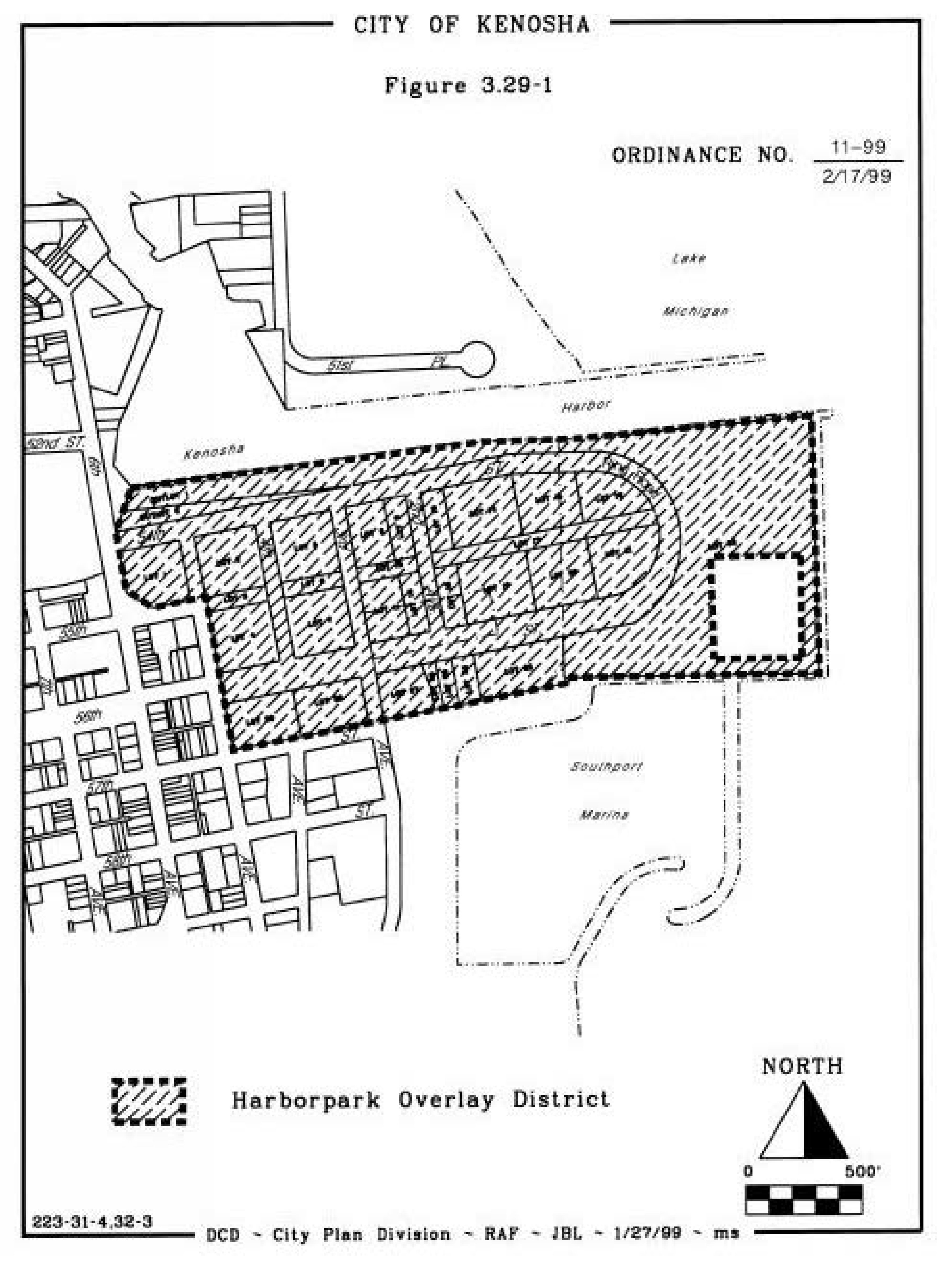
3.30. - Pike Creek Neighborhood Overlay District (PCNO).
The purpose of the PCNO Pike Creek Neighborhood Overlay District is to provide for the development of the Pike Creek Neighborhood site in a manner consistent with the adopted Pike Creek Neighborhood Code, approved by the City Plan Commission on September 7, 2000, and certified to the City Common Council on September 18, 2000, and as subsequently amended by the City Plan Commission.
A.
District Boundaries. The Pike Creek Neighborhood Overlay District includes all property as referenced in Figure 3.30-1, generally bounded by 67 th Street on the North, 75 th Street on the South, Green Bay Road (STH 31) on the East, and 70 th Court on the West.
B.
Permitted Uses. Any use permitted in the underlying Zoning Districts subject to a Conditional Use Permit, except for Prohibited Uses listed in Subsection E.
C.
Permitted Accessory Uses. Any accessory use permitted in the underlying Zoning Districts subject to a Conditional Use Permit, except for Prohibited Uses listed in Subsection E.
D.
Conditional Uses. Each use is a Conditional Use. Conditional Use Permits are available only for permitted uses and permitted accessory uses in the underlying Zoning Districts. Conditional Use Permits are not available for Prohibited Uses listed in Subsection E.
E.
Prohibited Uses. The following uses, irrespective of whether in an otherwise appropriate Zoning District, and irrespective of whether listed as a Permitted Use, Permitted Accessory Use, or Conditional Use, shall be prohibited and ineligible for a Conditional Use Permit:
1.
Prohibited Uses in the RM-2 District:
a.
Educational institutions, limited to public and private elementary and secondary schools, including related administrative offices.
b.
Fraternity or sorority houses.
c.
Religious institutions, including churches, chapels, temples, synagogues, convents, seminaries, rectories, parsonages, parish houses and residential quarters for clergy.
d.
Secondary religious facilities.
e.
Manufactured/Mobile Home Parks.
f.
Rooming and boarding houses.
F.
Pike Creek Neighborhood Code. Development within the PCNO District shall conform to the Pike Creek Neighborhood Code as may be amended from time to time. The Pike Creek Neighborhood Code consists of the Pike Creek Neighborhood Master and Development Plans; the Urban Development Guidelines, which addresses the issues of building use, building placement, building height, fencing, parking and outbuildings on each building site within the Pike Creek Neighborhood; and the Architectural Development Guidelines, which addresses issues of architectural character of the development within the Pike Creek Neighborhood.
G.
Application Procedure. Applications for Conditional Use Permits for projects within the PCNO District may be obtained from and shall be filed with the Department of City Development. Applications shall contain required information as stipulated in Sections 4.05, 4.06, 14.06 and 14.07 of the Zoning Ordinance, consistent with the Pike Creek Neighborhood Code. Ten (10) copies of the plans required shall be submitted for developments within this District.
H.
Review and Decision Process. Department of City Development and City Department Review. The Department of City Development and applicable City departments will review the development application using the standards referenced in this Section, make a written recommendation and forward the recommendation to the City Plan Commission.
I.
Development Standards.
1.
Development within the Pike Creek Neighborhood Overlay District shall conform to the requirements of the Zoning Ordinance and Pike Creek Neighborhood Code. In the event of conflicting development standards between the Zoning Ordinance and Pike Creek Neighborhood Code, the development standards in the Pike Creek Neighborhood Code shall take precedence with respect to design standards.
2.
Notwithstanding provisions to the contrary in the underlying zoning districts in the Pike Creek Neighborhood Overlay District the interior side yard requirement shall be eight (8) feet. In no event shall any principal building be located closer than twenty (20) feet to another principal building regardless of the property boundaries.
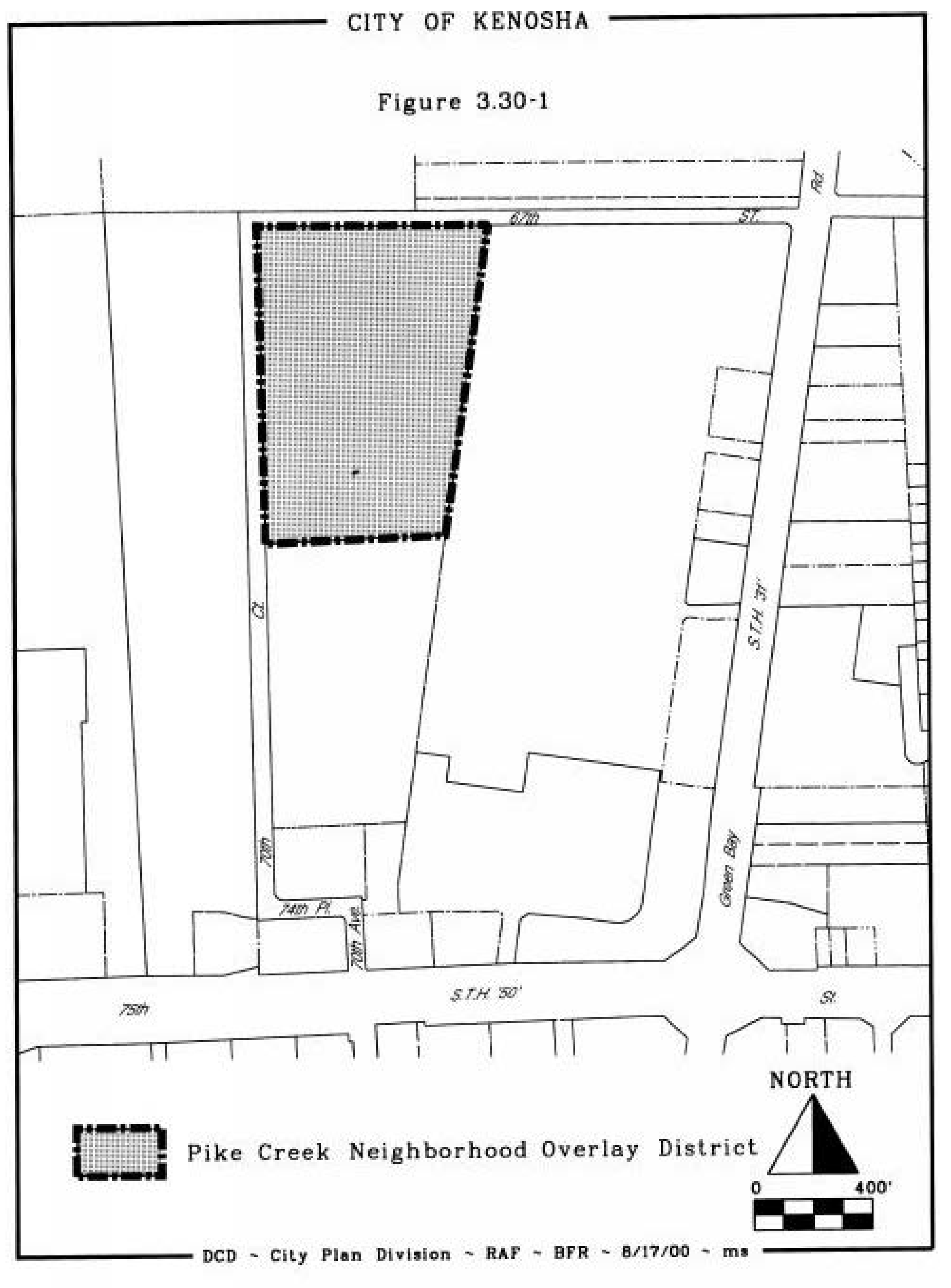
3.31. - TRD-1 Traditional Single- and Two-Family Residential District.
The primary purpose and characteristics of the TRD-1 Traditional Single-Family and Two-Family Residential District is to provide for residential development at densities not to exceed six (6) dwelling units per acre. This District is further intended to provide for a traditional residential community encompassing no less than five (5) acres of land or at least one (1) entire block with housing types that are designed to establish and/or reinforce the street with building entrances primarily addressing the street and creating an environment that promotes pedestrian activity and interest on the street. The principal buildings are typically situated on narrower lots with shorter setbacks to the front and side yards, which still allow for porches, fences and small lawns. The parking is generally located at or behind the front façade of the principal building.
A.
Permitted Uses.
1.
Single-family and two-family residences, to a maximum density of six (6) dwelling units per acre, unless otherwise specified in an adopted Land Use or Master Plan.
2.
Foster family homes housing less than four (4) children and not exceeding eight (8) total occupancies, which are in conformance with Wisconsin Statutes.
3.
Community Living Arrangements with a capacity for eight (8) or fewer persons which are in conformance with Wis. Stats. § 62.23(7)(i), except that if all of the persons served are disabled or handicapped under the Fair Housing Amendment Act (FHAA) or the Americans with Disabilities Act (ADA) and are living in the adult family home or community-based residential facility because of their disability or handicap, compliance with Wis. Stats. § 62.23(7)(i), is not required.
B.
Permitted Accessory Uses.
1.
Boathouses; private, noncommercial.
2.
Garages and carports; private, noncommercial.
3.
Greenhouses; private, noncommercial.
4.
Home Occupations, as permitted in Section 3.03 of this Ordinance.
5.
Off-street parking spaces and parking facilities, in conformance with Section 6.01 of this Ordinance.
6.
Outdoor signs, in conformance with Chapter XV of the Code of General Ordinances, and limited to signs, not exceeding eight (8) square feet in area per lot, pertaining to the lease, rental or sale of a permitted building or premises.
7.
Swimming pools; private, noncommercial and in conformance with Chapter IX of the Code of General Ordinances.
8.
Tennis and game courts; private, noncommercial.
C.
Conditional Uses.
1.
Community Living Arrangements with a capacity for greater than eight (8) persons, but not more than fifteen (15) persons which are in conformance with Wis. Stats. § 62.23(7)(i), including Assisted Living Facilities.
2.
Historic monuments.
3.
Private parks and playgrounds, buildings and grounds, properly licensed concessions primarily serving residents and guests.
4.
Utility substations.
5.
Storm water detention and retention basins.
D.
Lot Area and Width. Lots shall be a minimum of five thousand (5,000) square feet in area and shall not be less than fifty (50) feet in width.
E.
Building Height. All buildings shall not exceed thirty-five (35) feet in height.
F.
Front Yards. Interior lots shall have one (1) front yard with street frontage and corner lots shall have two (2) front yards with street frontages.
1.
Setback and Frontage Requirements. The front façades of all buildings which face a public or private street shall adhere to the following requirements:
a.
There shall be a minimum front yard setback of fifteen (15) feet and a maximum front yard setback of twenty-five (25) feet, measured from the front lot line, which is the right-of-way line of any public street or any required easement or accessway for a private street, or from the setback line of any major street, whichever is greater.
b.
A minimum of forty (40) percent of the principal building width, measured along the ground level of the front façade, shall be located within the front yard setbacks. Accessory buildings, including approved integrated architectural walls, garden walls, retaining walls, and fences, shall count toward this requirement, provided that they are located at or behind the ground level of the front façade that is located closest to the front lot line.
c.
An exception to the maximum front yard setback requirement in Section F.1.b. may be granted for the street-facing façade that does not contain a primary entrance when the Department of City Development has determined that a lot is considered an irregular-shaped corner lot, provided that this façade still complies with the maximum front yard setback requirement to the extent possible.
2.
Projection Requirements. The front façade of each principal building which faces a public or private street shall adhere to the following requirements:
a.
Any permitted architectural elements and/or similar features, such as awnings, bay windows, balconies, stairs, roof eaves, and trellises, including unenclosed and covered porches, stoops, patios, porticos and pergolas, as well as approved integrated architectural walls, garden walls, retaining walls and fences, are allowed no closer than seven (7) feet from the front lot line. The roof over an unenclosed and covered porch, stoop, patio, portico and pergola shall be at least thirty (30) percent solid.
b.
A minimum of twenty-five (25) percent of the principal building width containing a primary entrance, measured along the ground level of the front façade, excluding the garage wall where the garage door openings face a public or private street, shall include one (1) or more of the permitted items identified in Section F.2.a. that extend at least two (2) feet beyond the living portions of the front façade.
G.
Interior and Rear Yards. Interior lots shall have two (2) interior yards. Corner lots shall have one (1) interior yard.
1.
Interior and Rear Yard Setbacks for Principal Buildings. There shall be a minimum interior and rear yard of five (5) feet for one-story buildings and eight (8) feet for two or more story buildings from the lot line to the principal building.
2.
Interior and Rear Yard Setbacks for Accessory Buildings. There shall be a minimum interior and rear yard of four (4) feet from the lot line to the accessory building, and a minimum of four (4) feet shall be maintained between accessory buildings.
3.
Distances Between Accessory Buildings and Principal Buildings. Accessory buildings shall not be constructed closer than five (5) feet to any principal buildings.
4.
Rear Lot Access. A minimum nine-foot interior yard shall be maintained on one (1) side of the principal building for purposes of providing adequate rear lot access, except where an attached garage is part of the principal building or where a lot has alternative access to a public or private street.
H.
Front-Facing Garages. The width of front-facing garages shall not comprise more than fifty (50) percent of the width of the principal building as measured along the ground level of the front façade containing the primary entrance. In addition, one (1) of the following requirements shall be met:
1.
Front-facing garages shall not extend closer to the front lot line than the liveable space of the principal building; or
2.
Front-facing garages shall not extend closer to the front lot line than an unenclosed and covered porch and/or pergola provided that the width of the unenclosed and covered porch and/or pergola is at least fifty (50) percent of the width of the front-facing garage wall as measured along the ground level of the front façade containing the primary entrance. The unenclosed and covered porch and/or pergola shall be a minimum of twenty-five (25) square feet and incorporate the use of decorative posts, columns, piers, railings, balustrades, brackets, trellises, or other similar design elements to minimize the appearance of the front-facing garage to the extent possible.
I.
Off-Street Parking Requirement.
1.
The driveway apron shall be a minimum of twenty (20) feet in length, measured from the front lot line, and such driveway apron shall not exceed the width of the driveway approach at the front lot line.
2.
There shall be a minimum of two (2) parking spaces for each dwelling unit.
J.
Building Composition and Character.
1.
Roof Element/Composition. Roofs shall be pitched, hipped or gabled, and overhanging eaves are encouraged. Flat roofs with articulated parapets and cornices are allowed. The total height of the roof that faces a public or private street from the lowest portion of the roof to the ridge line shall be no greater than the height of the façade of the building, measured vertically from the ground level of the façade to the lowest portion of the roof.
2.
Building Façade/Composition. All buildings shall have a well-defined front façade with the primary entrance facing a public or private street. The buildings shall be aligned so the dominant lines of their façades parallel the line of the street and create a sense of enclosure. Departures may be permitted to terminate important vistas or to act as focal points for public or private spaces.
a.
A minimum of one (1) primary entrance shall face a public or private street for all principal buildings, and only one (1) primary entrance shall be required where the front façade of the principal building faces more than one (1) street, and this entrance shall first face the public street where available.
b.
Windows and/or entrances shall comprise at least ten (10) percent of the total wall area of each façade of the principal building, provided that at least five (5) percent of the total wall area for each floor of the principal building includes windows and/or entrances. Windows in garage walls, but not in garage doors, shall count toward this requirement. Any projections and recesses involving the principal building, including garage walls and garage door openings that face a public or private street shall be included in the total area of each façade. The total wall area shall be calculated as follows:
(1)
The vertical distance between the floor and ceiling lines for each floor, excluding any overhangs and roof projections, shall be used to determine the overall total wall area of each façade. Any projections and recesses involving a change in a wall plane of at least six (6) feet in depth shall be calculated separately in order to satisfy the window and/or entrance requirement for each floor of the principal building in Section J.2.b.
(2)
Windows and/or entrances shall only be required for all wall areas of each floor with a minimum of eight (8) feet in height and a minimum of six (6) feet in width, whether or not the wall area includes living portions of the principal building.
(3)
Where there is no living portion of the principal building, a decorative wall vent and/or louver of at least five (5) percent of the total wall area may be substituted for a window and/or entrance, and such wall vent and/or louver shall be calculated separately from the total wall area requirement for windows and/or entrances in Section J.2.b.
3.
Garage Façade/Composition. The side(s) of the garage wall, whether attached to, or detached from, the principal building where the garage door openings do not face a public or private street, shall be designed to be integral with the design features of the principal building.
K.
Building Materials.
1.
Permitted Building Materials. The exterior of all buildings shall include one (1) or more of the following: natural stone, brick, precast concrete and/or finished concrete masonry units (only at common brick sizes), terra cotta, glass, stucco or EIFS with a smooth or roughcast (pebbled) finish, and clapboards, including wood, fiber cement (masonry), vinyl and aluminum siding. In addition, the following requirements shall be met:
a.
Integrated architectural walls, garden walls, retaining walls, fences and gates shall be of masonry, wood or decorative metal. Chainlink or similar material is prohibited.
b.
Hedges and evergreen shrubs used in combination with masonry and/or decorative metal fencing may replace mandated integrated architectural walls, garden walls, retaining walls and fences.
2.
Prohibited Building Materials. Exterior building materials shall not include smooth-faced concrete blocks, tiltup panels, or prefabricated steel panels.
L.
Mechanical Equipment/Outdoor Storage.
1.
Mechanical Equipment. All vents, conduits, utility meters and other mechanical equipment or similar facilities which are attached to or detached from the front façade of the principal building, including all rooftop equipment, shall either be compatible with or integrated into the building and roof design to the extent possible and/or screened from view of a public or private street through the use of approved integrated architectural wall and/or landscape treatments.
2.
Outdoor Storage, Loading, and Parking. Service entries, trash collection and/or compaction, along with other service functions, shall be incorporated into the overall design of the building and the landscape so that the architectural design is consistent. The above areas shall be located and screened so the visual and acoustical impact of these functions are fully contained and out of view from adjacent properties and public or private streets to the extent possible.
M.
Special Exceptions.
1.
Procedure. Special exception requests shall be made in writing to the Department of City Development. Any special exception granted shall be considered unique to the project and will not set any precedent for future decisions. The City Plan Commission is designated the authority for granting a special exception from the requirements of the District. The special exception shall only be granted to the minimum extent practical in order to provide relief to the requirements of the District.
2.
Criteria. The City Plan Commission may consider granting a special exception from the requirements of the District, provided that all of the following criteria are met:
a.
Unique Circumstances. There are exceptional, extraordinary or unusual circumstances or conditions where a literal enforcement of the requirements of the District would result in severe hardship. Such hardships shall not generally apply to other properties or be of such a recurrent nature as to suggest that the requirements of the District should be changed.
b.
Absence of Detriment. The special exception will not create a substantial detriment to adjacent property. In addition, the special exception shall not result in development that would be impractical or detract from the appearance of the District and shall not adversely affect emergency vehicle access and deprive adjoining residential properties of light and air.
c.
Conformity.
(1)
The special exception will not conflict in any way with the Wisconsin State Statutes or the City Comprehensive Plan.
(2)
The special exception shall be in harmony with the overall purpose of the land use and development standards and guidelines for the District.
(3)
The proposed design substantially meets the intent of the District to line streets with active living spaces, create pedestrian-oriented streetscapes, and provide variety and visual interest in the exterior design of the buildings.
3.32. - TRD-2 Traditional Multiple Family Residential District.
The primary purpose and characteristics of the TRD-2 Traditional Multiple Family Residential District is to provide for residential development at minimum density of six (6) dwelling units per acre, but not to exceed twelve (12) dwelling units per acre, unless otherwise specified in an adopted land use or master plan. This District is further intended to provide for a traditional residential community encompassing no less than five (5) acres of land or at least one (1) block, which accommodates a mixture of multiple family housing types, such as apartment buildings, townhouses, and condominiums that are designed to establish and/or reinforce the street with building entrances primarily addressing the street and creating an environment that promotes pedestrian activity and interest on the street. The principal buildings are typically situated on narrower lots with shorter setbacks to the front and side yards, which still allow for porches, fences and small lawns. The parking is generally accessed from a rear alley and located behind the front façade of the principal building.
A.
Permitted Uses. Community Living Arrangements with a capacity for fifteen (15) or fewer persons which are in conformance with Wis. Stats. § 62.23(7)(i), including Assisted Living Facilities.
B.
Permitted Accessory Uses.
1.
Boathouses; private, noncommercial.
2.
Garages and carports; private, noncommercial.
3.
Greenhouses; private, noncommercial.
4.
Home Occupations, as permitted in Section 3.03 of this Ordinance.
5.
Off-street parking spaces and parking facilities, in conformance with Section 6.01 of this Ordinance.
6.
Outdoor signs, in conformance with Chapter XV of the Code of General Ordinances, and in conformance with any more restrictive requirements of an approved Developers' Agreement.
7.
Swimming pools; private, noncommercial and in conformance with Chapter IX of the Code of General Ordinances.
8.
Tennis and game courts; private, noncommercial.
C.
Conditional Uses.
1.
Multifamily residences containing three (3) or more units per lot in conformance with the Development Standards of this Ordinance, at a minimum density of six (6) dwelling units per acre, to a maximum density of twelve (12) dwelling units per acre, unless otherwise specified in an adopted Land Use or Master Plan.
2.
Community Living Arrangements with a capacity for greater than fifteen (15) persons which are in conformance with Wis. Stats. § 62.23(7)(i), including Assistant Living Facilities.
3.
Historic monuments.
4.
Private parks and playgrounds, including buildings and grounds, and properly licensed concessions primarily serving residents and guests.
5.
Utility substations.
6.
Storm water detention and retention basins.
D.
Lot Area and Width. There shall be no minimum lot area and width requirements, except that all other provisions of the Zoning Ordinance and Code of General Ordinances shall be met.
E.
Building Height. Principal buildings shall not exceed forty-five (45) feet in height. Accessory buildings shall not exceed thirty-five (35) feet in height.
F.
Front Yards. Interior lots shall have one (1) front yard with street frontage and corner lots shall have two (2) front yards with street frontages.
1.
Setback and Frontage Requirements. The front façades of all buildings which face a public or private street shall adhere to the following requirements:
a.
There shall be a minimum front yard setback of fifteen (15) feet and a maximum front yard setback of twenty-five (25) feet, measured from the front lot line, which is the right-of-way line of any public street or any required easement or accessway for a private street, or from the setback line of any major street, whichever is greater.
b.
A minimum of sixty (60) percent of the principal building width, measured along the ground level of the front façade, shall be located within the front yard setbacks. Accessory buildings, including approved integrated architectural walls, garden walls, retaining walls and fences, shall count toward this requirement, provided that they are located at or behind the ground level of the front façade that is located the closest to the front lot line.
c.
An exception to maximum front yard setback requirement in Section F.1.b. may be granted for the street-facing façade that does not contain a primary entrance when the Department of City Development has determined that a lot is considered an irregular-shaped corner lot, provided that this façade still complies with the maximum front yard setback requirement to the extent possible.
2.
Projection Requirements. The front façades of each principal building which face a public or private street shall adhere to the following requirements.
a.
Any permitted architectural elements and/or similar features, such as awnings, bay windows, balconies, stairs, roof eaves and trellises, including unenclosed and covered porches, stoops, patios, porticos and pergolas, as well as approved integrated architectural walls, garden walls, retaining walls, and fences, are allowed no closer than seven (7) feet from the front lot line. The roof over an unenclosed and covered porch, stoop, patio, portico and pergola shall be at least thirty (30) percent solid.
b.
A minimum of twenty-five (25) percent of the principal building width containing a primary entrance, measured along the ground level of the front façade, excluding the garage wall where the garage door openings face a public or private street, shall include one (1) or more of the permitted items identified in Section F.2.a. that extend at least two (2) feet beyond the living portion(s) of the front façade.
G.
Interior and Rear Yards. Interior lots shall have two (2) interior yards. Corner lots shall have one (1) interior yard.
1.
Interior and Rear Yard Setbacks for Principal Buildings. There shall be a minimum interior and rear yard of ten (10) feet from the lot line to the principal building, and a minimum of twenty (20) feet shall be maintained between principal buildings.
2.
Interior and Rear Yard Setbacks for Accessory Buildings. There shall be a minimum interior and rear yard of four (4) feet from the lot line to the accessory building, and a minimum of four (4) feet shall be maintained between accessory buildings.
3.
Distances Between Principal and Accessory Buildings. Accessory buildings shall not be constructed closer than five (5) feet to any principal buildings.
H.
Front-Facing Garages. The width of front-facing garages shall not comprise more than fifty (50) percent of the width of the principal building as measured along the ground level of the front façade containing the primary entrance. In addition, one (1) of the following requirements shall be met:
1.
Front-facing garages shall not extend closer to the front lot line than the liveable space of the principal building; or
2.
Front-facing garages shall not extend closer to the front lot line than an unenclosed and covered porch and/or pergola provided that the width of the unenclosed and covered porch and/or pergola is at least fifty (50) percent of the width of the front-facing garage wall as measured along the ground level of the front façade containing the primary entrance. The unenclosed and covered porch and/or pergola shall be a minimum of twenty-five (25) square feet and incorporate the use of decorative posts, columns, piers, railings, balustrades, brackets, trellises, or other similar design elements to minimize the appearance of the front-facing garage to the extent possible.
I.
Off-Street Parking Requirements. Ground level parking shall be located at or behind the front façade of the principal building. Any parking which is located at the side of the principal building shall be screened through the use of approved integrated architectural wall and/or landscape treatments.
1.
The driveway apron shall be a minimum of twenty (20) feet in length, measured from the front lot line, and such driveway apron shall not exceed the width of the driveway approach at the front lot line.
2.
There shall be a minimum of one (1) parking space for dwellings units with less than two (2) bedrooms, and a minimum of two (2) parking spaces for dwelling units with two (2) or more bedrooms.
J.
Building Composition and Character.
1.
Roof Element/Composition. Roofs shall be pitched, hipped, or gabled, and overhanging eaves are encouraged. Flat roofs with articulated parapets and cornices are allowed. The total height of the roof that faces a public or private street from the lowest portion of the roof to the ridge line shall be no greater than the height of the façade of the building, measured vertically from the ground level of the façade to the lowest portion of the roof.
2.
Building Façade/Composition. All buildings shall have a well defined front façade with the primary entrance facing a public or private street. The buildings shall be aligned so the dominant lines of their façades parallel the line of the street and create a sense of enclosure. Departures may be permitted to terminate important vistas or to act as focal points for public or private spaces.
a.
A minimum of one (1) primary entrance shall face a public or private street for all principal buildings, and only one (1) primary entrance shall be required where the front façade of the principal building faces more than one (1) street, and this entrance shall first face the public street where available. All principal buildings with front façades which exceed three hundred (300) feet in width shall have more than one (1) primary entrance facing the public or private street.
b.
Windows and/or entrances shall comprise at least ten (10) percent of the total wall area of each façade of the principal building, provided that at least five (5) percent of the total wall area for each floor of the principal building includes windows and/or entrances. Windows in garage walls, but not in garage doors, shall count toward this requirement. Any projections and recesses involving the principal building, including garage walls and garage door openings that face a public or private street shall be included in the total area of each façade. The total wall area shall be calculated as follows:
(1)
The vertical distance between the floor and ceiling lines for each floor, excluding any overhangs and roof projections, shall be used to determine the overall total wall area of each façade. Any projections and recesses involving a change in a wall plane of at least six (6) feet in depth shall be calculated separately in order to satisfy the window and/or entrance requirement for each floor of the principal building in Section J.2.b.
(2)
Windows and/or entrances shall only be required for all wall areas of each floor with a minimum of eight (8) feet in height and a minimum of six (6) feet in width, whether or not the wall area includes living portions of the principal building.
(3)
Where there is no living portion of the principal building, a decorative wall vent and/or louver of at least five (5) percent of the total wall area may be substituted for a window and/or entrance, and such wall vent and/or louver shall be calculated separately from the total wall area requirement for windows and/or entrances in Section J.2.b.
3.
Garage Façade/Composition. The sides of the garage wall, whether attached to, or detached from, the principal building where the garage door openings do not face a public or private street, shall be designed to be integral with the design features of the principal building.
K.
Building Materials.
1.
Permitted Building Materials. The exterior of all multifamily buildings shall consist of architectural masonry and/or glass. In addition, the following requirements shall be met:
a.
Integrated architectural walls, garden walls, retaining walls, fences and gates shall be of masonry, wood or decorative metal. Chainlink or similar material is prohibited.
b.
Hedges and evergreen shrubs used in combination with masonry and/or decorative metal fencing may replace mandated integrated architectural walls, garden walls, retaining walls, and fences.
2.
Prohibited Building Materials. Exterior building materials shall not include smooth faced concrete block, tiltup panels, or prefabricated steel panels.
L.
Mechanical Equipment/Outdoor Storage.
1.
Mechanical Equipment. All vents, conduits, utility meters and other mechanical equipment or similar facilities which are attached to or detached from the front façade of the principal building, including all rooftop equipment, shall either be compatible with or integrated into the building and roof design to the extent possible and/or screened from view of a public or private street through the use of approved integrated architectural wall and/or landscape treatments.
2.
Outdoor Storage, Loading, and Parking. Service entries, trash collection and/or compaction, along with other service functions, shall be incorporated into the overall design of the building and the landscape so that the architectural design is consistent. The above areas shall be located and screened so the visual and acoustical impact of these functions are fully contained and out of view from adjacent properties and public or private streets to the extent possible.
M.
Special Exceptions.
1.
Procedure. Special exception requests shall be made in writing to the Department of City Development. Any special exception granted shall be considered unique to the project and will not set any precedent for future decisions. The City Plan Commission is designated the authority for granting a special exception from the requirements of the District. The special exception shall only be granted to the minimum extent practical in order to provide relief to the requirements of the District.
2.
Criteria. The City Plan Commission may consider granting a special exception from the requirements of the District, provided that all of the following criteria are met:
a.
Unique Circumstances. There are exceptional, extraordinary or unusual circumstances or conditions where a literal enforcement of the requirements of the District would result in severe hardship. Such hardships shall not generally apply to other properties or be of such a recurrent nature as to suggest that the requirements of the District should be changed.
b.
Absence of Detriment. The special exception will not create a substantial detriment to adjacent property. In addition, the special exception shall not result in development that would be impractical or detract from the appearance of the District and shall not adversely affect emergency vehicle access and deprive adjoining residential properties of light and air.
c.
Conformity.
(1)
The special exception will not conflict in any way with the Wisconsin State Statutes or the City Comprehensive Plan.
(2)
The special exception shall be in harmony with the overall purpose of the land use and development standards and guidelines for the District.
(3)
The proposed design substantially meets the intent of the District to line streets with active living spaces, create pedestrian-oriented streetscapes, and provide variety and visual interest in the exterior design of the buildings.

