
King City City Zoning Code
ARTICLE V
- Development Review
Chapter 16.179 - COMMUNICATION FACILITIES AND STRUCTURES[4]
Editor's note— Ord. No. O-98-01, § 1, adopted October 7, 1998, amended the Code by adding provisions designated as a new Ch. 16.178. Inasmuch as provisions already exist so designated, at the discretion of the editor Ord. No. O-98-01 has been codified as a new Ch. 16.179. See also the Code Comparative Table and Disposition List.
16.152.010 - Purpose.
A.
The purpose of the site plan review provisions is to establish process and standards for the review of development proposals to assist in conserving and enhancing the appearance of the city and to assist in promoting functional, safe and innovative site development.
B.
It is in the public interest that this chapter be applied to:
1.
Eliminate undue burdens on public facilities; and
2.
Assure that scale, layout and design are compatible with the surrounding environment and the character of the surrounding neighborhood or area.
C.
The intent is to assure that:
1.
There is compatibility between adjoining uses;
2.
Privacy is maximized;
3.
Private and common outdoor space is provided;
4.
Vehicular, pedestrian, and bicycle access and circulation is safe and convenient;
5.
Parking areas are made attractive and safe;
6.
The site is well drained;
7.
The needs of the handicapped are met;
8.
Adequate landscaping is provided to assure visual quality; and
9.
Crime prevention and public safety factors are considered.
(Ord. 96-4 § 1 (part), 1996)
16.152.020 - Applicability of provisions.
Site plan review shall be applicable to all new developments and major modifications of existing developments, except it shall not apply to:
A.
Single-family detached or attached dwellings; duplexes, quadplexes, triplexes, or cottage clusters;
B.
Proposed minor modification of an existing development which does not cause or create:
1.
An increase in dwelling unit density or increase in lot coverage for residential development, unless the increase in dwelling unit density is due to conversion of an existing dwelling or the addition of dwelling units to accommodate duplexes, quadplexes, triplexes, or cottage cluster;
2.
A change in the ratio or number of different types of dwelling units, unless the change in ratio or number of different types of dwelling units is due to conversion of an existing dwelling or the addition of dwelling units to accommodate duplexes, quadplexes, triplexes, or cottage cluster;
3.
A need for additional on-site parking in accordance with this title;
4.
An increase in the height of the building(s) by more than twenty percent, unless the increase in height is due to conversion of an existing dwelling or the addition of dwelling units to accommodate duplexes, quadplexes, triplexes, or cottage cluster; this provision applies only to non-residential buildings;
5.
A change in the type and location of accessways and parking areas where off-site traffic would be affected;
6.
An increase in vehicular traffic to and from the site of more than twenty vehicles per day as determined by using the International Transportation Engineer's (ITE) Manual or a professional traffic engineer;
7.
An increase in the floor area of nonresidential uses by more than ten percent, excluding expansions under five thousand square feet;
8.
A reduction in project amenities below the minimum established by this title or by more than ten percent where specified in the approved site plan including:
a.
Recreational facilities,
b.
Screening and buffer areas, and/or
c.
Landscaping and open space; and
9.
A modification of the conditions imposed at the time of site plan review approval which are not the subject of subsections B.1 through B.8 of this section.
C.
Alterations which cause or create one or more of the impacts listed in subsection B of this section shall be considered as a major modification.
D.
Alterations that do not cause or create any of the impacts listed in subsection B of this section shall be subject to the administrative review process.
(Ord. 96-4 § 1 (part), 1996; Ord. No. O-2015-01, § 1(Exh. A), 3-18-2015; Ord. No. O-2021-01, § 2(Exh. B), 8-18-2021)
16.152.030 - Administration.
A.
Site plan review applications and major modifications to existing development shall be administered and reviewed as a planning commission review in accordance with Article II of this title.
B.
Minor modifications, as described in Section 16.152.020(C), shall be administered and reviewed as a city manager decision in accordance with Article II of this title.
C.
Permits to construct a single-family residence or duplex shall be administered and reviewed as an administrative decision in accordance with Article II of this title.
(Ord. 96-4 § 1 (part), 1996)
16.152.040 - Submittal requirements.
A.
In addition to the application form and information required in Section 16.44.030, the applicant shall submit each of the following:
1.
A site plan, with the number of copies to be determined at the preapplication conference, and necessary data or narrative which explains how the development conforms to the standards, and:
a.
The site plans and required drawings shall be drawn on sheets preferably not exceeding eighteen inches by twenty-four inches;
b.
The scale for site plan shall be an engineering scale; and
c.
All drawings of structure elevations or floor plans shall be a standard architectural scale, being one-fourth inch or one-eighth inch.
2.
The site plan, data and narrative shall include the following:
a.
An existing site conditions analysis as described in Section 16.152.050;
b.
A site plan, as detailed in Section 16.152.060;
c.
A grading plan as detailed in Section 16.152.070;
d.
Architectural elevations of all structures as detailed in Section 16.152.080;
e.
A landscape plan as detailed in Section 16.152.090;
f.
A sign plan as detailed in Section 16.152.100; and
g.
A copy of all existing and proposed restrictions or covenants.
B.
The manager may require information in addition to that required by this chapter when it is found that certain information is necessary to properly evaluate the application.
C.
The manager may waive a specific requirement for information when it is found that such information is not necessary to properly evaluate the application.
(Ord. 96-4 § 1 (part), 1996)
16.152.050 - Site conditions.
The site analysis drawings shall include:
A.
A vicinity map showing streets and access points, pedestrian and bicycle pathways, transit stops and utility locations;
B.
The site size and its dimensions;
C.
Contour lines at two-foot contour intervals for grades zero to ten percent and five-foot intervals for grades over ten percent;
D.
The location of drainage patterns and drainage courses;
E.
The location of natural hazard areas including:
1.
The one hundred-year floodplain;
2.
Slopes in excess of twenty-five percent;
3.
Unstable ground (areas subject to slumping, earth slides or movement);
4.
Areas having a high seasonal water table within zero to twenty-four inches of the surface for two weeks or more of the year;
5.
Areas having a severe soil erosion potential;
6.
Areas having severe weak foundation soils;
F.
The location of resource areas including those shown on the comprehensive plan inventory data:
1.
Wildlife habitats; and
2.
Wetlands;
G.
The location of resource areas including those shown on the comprehensive plan inventory data:
1.
Rock outcroppings;
2.
Trees with six inches diameter or greater measured four feet from ground level;
3.
Streams and drainageways; and
H.
The location of existing structures on the site and proposed use of those structures; and
I.
The locations and types of noise sources on the site or on adjoining property such as traffic ways, mechanical equipment or noise producing land uses if requested by the city manager. See Section 8.04.130 for noise provisions.
(Ord. 96-4 § 1 (part), 1996)
16.152.060 - Site plan.
The proposed site plan shall be at the same scale as the site analysis and shall include the following information:
A.
The proposed site and surrounding properties;
B.
Contour line intervals as required by Section 16.152.050(C);
C.
The location, dimensions and names of all:
1.
Existing and platted streets and other public ways and easements on the site and on adjoining properties, and
2.
Proposed streets or other public ways and easements on the site;
D.
The location and dimensions of:
1.
Entrances and exits on the site,
2.
Parking and circulation areas,
3.
Loading and service areas,
4.
Pedestrian and bicycle circulation,
5.
Outdoor common areas, and
6.
Above ground utilities;
E.
The location, dimensions and setback distances of all:
1.
Existing structures, improvements and utilities on the site or which are located on adjacent property within twenty-five feet of the site and are permanent in nature, and
2.
Proposed structures, improvements and utilities on the site;
F.
The location of all areas to be landscaped;
G.
The location and type of outdoor lighting, considering crime prevention techniques;
H.
The location of mailboxes;
I.
The location of proposed utility lines;
J.
The location of all structures and their orientation; and
K.
The size and location of mixed solid waste and recyclables storage areas.
(Ord. 96-4 § 1 (part), 1996)
16.152.070 - Grading plan.
The site plan shall include a grading plan at the same scale as the site analysis drawings and shall contain the following information:
A.
Requirements in Sections 16.152.050 and 16.152.060;
B.
The location and extent to which grading will take place indicating general contour lines, slope ratios and slope stabilization proposals;
C.
A statement from a registered engineer supported by factual data substantiating:
1.
The validity of the slope stabilization proposals;
2.
That any increase in intensity of the runoff caused by development must be facilitated on the site and the intensity of runoff leaving the site in its developed state shall not exceed that in its undeveloped state. The statement shall include as a minimum a storm frequency of occurrence of ten years or greater, depending upon evaluation of potential for damage when a storm of higher frequency occurs;
3.
When on-site detention of an increased volume of water caused by development is not feasible or acceptable, a plan which identifies and which mitigates any off-site adverse effects resulting from increased runoff shall be prepared by a registered civil engineer; and
4.
Compliance with clean water services requirements for erosion control during construction.
(Ord. O-02-4 § 2 (part), 2002; Ord. 96-4 § 1 (part), 1996)
16.152.080 - Architectural drawings.
The application shall include:
A.
Floor plans indicating the square footage of all structures proposed for use on-site; and
B.
Typical elevation and section drawings of each structure.
(Ord. 96-4 § 1 (part), 1996)
16.152.090 - Landscape plans.
A.
The landscape plan shall be drawn at the same scale as the site analysis plan, or a larger scale if necessary, and shall indicate:
1.
Location of underground irrigation system sprinkler heads where applicable;
2.
Location and height of fences, buffers and screening;
3.
Location of terraces, decks, shelters, play areas and common open spaces; and
4.
Location, type, size and species of existing and proposed plant materials.
B.
The landscape plan shall include a narrative which addresses:
1.
Soil conditions;
2.
Erosion control measures that will be used; and
3.
A plan for soil treatment such as stockpiling the top soil.
(Ord. 96-4 § 1 (part), 1996)
16.152.100 - Sign plan.
A.
Sign drawings shall be submitted in accordance with Chapter 16.148 of this title.
B.
Freestanding signs shall be described at the time of site plan review by identifying:
1.
Location of any freestanding signs shown on the site plan; and
2.
A drawing to scale submitted to the city manager showing the dimensions, height, color, material and means of illumination of the sign.
(Ord. 96-4 § 1 (part), 1996)
16.152.110 - Approval standards.
The planning commission shall approve, approve with conditions or deny an application based on findings of fact with respect to the approval standards of this section.
A.
Provisions of the following parts of this title:
1.
Accessory uses and structures—Chapter 16.176;
2.
Additional yard and setback requirements—Section 16.80.060;
3.
Base zone requirements—Chapters 16.80 through 16.112;
4.
Building height exceptions—Section 16.80.070;
5.
Circulation and access—Chapter 16.136;
6.
Landscaping and screening—Chapter 16.124;
7.
Parking and loading—Chapter 16.132;
8.
Public facility and service requirements—Chapter 16.196;
9.
Flood plain and drainage hazard areas—Chapter 16.140;
10.
Signs—Chapter 16.148;
11.
Solar balance point standards—Chapter 16.116;
12.
Tree removal—Chapter 16.128;
13.
Vision clearance—Chapter 16.144; and
14.
Neighborhood circulation—Chapter 16.212.
15.
Manufactured/Mobile Home Regulations - Chapter 16.120;
16.
West King City Planning Area Goal 5 Safe Harbor - Chapter 16.142;
17.
Residential Density Calculation - Chapter 16.146;
18.
Planned Development - Chapter 16.150; and
19.
King City Plaza master plan - Section 16.104.060.
B.
Relationship of the Natural and Physical Environment.
1.
Buildings shall be:
a.
Located to preserve existing trees, topography and natural drainage to the degree possible;
b.
Located in areas not subject to ground slumping or sliding;
c.
Located to provide adequate distance between adjoining buildings on-site and off-site to provide for adequate light, air circulation and fire fighting; and
d.
Oriented with consideration for sun and wind.
2.
Trees having a six-inch diameter or greater diameter, four feet from the base, shall be preserved or replaced by new plantings of equal character.
C.
Exterior Elevations.
1.
Along the vertical face of single-family attached and multi-family structures, offsets shall occur at a minimum of every thirty feet by providing any two of the following:
a.
Recesses (decks, patios, entrances, floor area, etc.), of minimum depth of eight feet,
b.
Extensions (decks, patios, entrances, floor area, etc.), of minimum depth of eight feet, a maximum length of an overhang shall be twenty-five feet, or
c.
Offsets or breaks in roof elevations of three or more feet in height.
D.
Buffering, Screening and Compatibility between Adjoining Uses.
1.
Buffering shall be provided between different types of land uses (for example, between single-family and multi-family residential, and residential and commercial), and the following factors shall be considered the adequacy of the type and extent of the buffer (see Chapters 16.180 and 16.124 for specific provisions);
a.
The purpose of the buffer, for example to decrease noise levels, absorb air pollution, filter dust, to provide a visual barrier,
b.
The size of the buffer required to achieve purpose in terms of width and height,
c.
The directions from which buffering is needed,
d.
The required density of the buffering, and
e.
Whether the viewer is stationary or mobile.
2.
On-site screening from view from adjoining properties of such things as service areas, storage areas, parking lots and mechanical devices on rooftops (e.g., air cooling and heating systems) shall be provided and the following factors will be considered in determining the adequacy of the type and extent of the screening (see Chapters 16.180 and 16.124 for specific fence and screening provisions):
a.
What needs to be screened,
b.
The direction from which it is needed,
c.
How dense the screen needs to be,
d.
Whether the viewer is stationary or mobile, and
e.
Whether the screening needs to be year round.
E.
Privacy and Noise.
1.
Structures which include residential dwelling units shall provide private outdoor areas, that are screened from adjoining units;
2.
Structures shall be oriented in a manner which protects private spaces on adjoining properties from view and noise;
3.
Residential units shall be located on the portion of the site having the lowest noise levels;
4.
On-site uses which create noise, lights, or glare shall be buffered from adjoining residential uses (see subsection (D)(2) of this section for specific provisions); and
5.
All uses and structures shall comply with the provisions of Title 8 of this code.
F.
Private Outdoor Areas—Residential Uses.
1.
In addition to the requirements of subsection (D)(2) of this section, each ground level residential living unit shall have an outdoor private area (patio, terrace, porch), and shall be at least forty-eight square feet in size with a minimum width dimension of four feet and: Balconies used for entrances or exits shall not be considered as open space except where such exits or entrances are for the sole use of the unit;
2.
Wherever possible, private outdoor open spaces should be oriented toward the sun; and
3.
Private outdoor spaces shall be screened or designed to provide privacy for the users of the space.
G.
Shared Outdoor Recreation Areas—Residential Uses.
1.
In addition to the requirements of subsections (E) and (F) of this section, usable outdoor recreation space shall be provided in residential development for the shared or common use of all residents in the following amounts:
a.
Studio size up to and including two-bedroom units, two hundred square feet per unit,
b.
Three or more bedroom units, three hundred square feet per unit, and
c.
For manufactured/mobile home parks, two hundred fifty square feet per dwelling with each shared outdoor recreation area having a minimum size of two thousand five hundred square feet.
2.
The required recreation space may be provided using one or more of the following options:
a.
It may be all outdoor space,
b.
It may be part outdoor space and part indoor space, for example, an outdoor tennis court and indoor recreation room,
c.
It may be all public or common space,
d.
It may be part common space and part private, for example, it could be an outdoor tennis court, indoor recreation room and balconies on each unit, or
e.
Where balconies are added to units, the balconies shall not be less than forty-eight square feet.
3.
Shared outdoor recreation space shall be readily observable for reasons of crime prevention and safety;
4.
Parks shall be conveniently located so as to provide direct public access and availability from a public street;
5.
Parks shall be bordered by at least one public street for a sufficient distance to encourage public use and provide visual access.
H.
Where landform alteration and/or development are allowed within and adjacent to the one hundred-year floodplain, the city shall require the preservation of open space within the one hundred-year floodplain as provided in Chapter 16.140.
I.
Demarcation of Public, Semipublic and Private Spaces—Crime Prevention.
1.
The structures and site improvements shall be designed so that public areas such as streets or public gathering places, semipublic areas and private outdoor areas are clearly defined in order to establish persons having a right to be in the space, in order to provide for crime prevention and to establish maintenance responsibility; and
2.
These areas may be defined by:
a.
A deck, patio, low wall, hedge or draping vine,
b.
A trellis or arbor,
c.
A change in the texture of the path material,
d.
Signs, or
e.
Landscaping;
J.
Crime Prevention and Safety.
1.
Windows shall be located so that areas vulnerable to crime can be surveyed by the occupants;
2.
Interior laundry and service areas shall be located in a way that they can be observed by others;
3.
Mail boxes shall be located in lighted areas having vehicular or pedestrian traffic;
4.
The exterior lighting levels shall be selected and the angles shall be oriented towards areas vulnerable to crime; and
5.
Light fixtures shall be provided in areas having heavy pedestrian or vehicular traffic and in potentially dangerous areas such as parking lots, stairs, ramps and abrupt grade changes. Fixtures shall be placed at a height so that light patterns overlap at a height of seven feet which is sufficient to illuminate a person.
K.
Parking and Circulation. In addition to the provisions of this title, the following shall apply to all uses:
1.
The parking area shall have less than a five percent grade, and shall be free of areas which pond water;
2.
Pedestrian walkways shall be provided in parking areas having fifteen or more spaces;
3.
The parking and circulation patterns shall be clear to minimize traffic hazards and congestion and to facilitate emergency vehicles; and
4.
If any parking is provided for the public or visitors, or both, the needs of the handicapped shall be considered and accommodated.
L.
Landscaping.
1.
All landscaping shall be designed in accordance with the requirements set forth in this title Article IV, Chapter 16.124.
2.
Residential Uses. In addition to the open space and recreation area requirements of subsections 16.152.110 (E) and (F) of this section, a minimum of twenty-five percent of the gross area including parking, loading and service areas shall be landscaped.
3.
Non-residential Uses. A minimum of fifteen percent of the gross site area shall be landscaped with landscaping located within parking areas.
4.
Parking, Loading or Service Areas.
a.
A parking, loading or service area which abuts a street shall be set back from the right-of-way line by a landscaped strip at least five feet in width and the landscaped area shall comply with the provisions of Chapter 16.124.
b.
A parking, loading or service area which abuts a property line shall be separated from the property line by a landscaped area that complies with the provisions of Chapter 16.124.
M.
Drainage. All drainage plans shall be designed in accordance with criteria within the city's public facilities plan.
N.
Manufactured/Mobile Home Park Standards. In addition to the other applicable standards of this title, a Manufactured/Mobile Home Park shall comply with all of the following criteria:
1.
A minimum lot gross area of one acre;
2.
A minimum frontage of one hundred feet;
3.
A minimum depth of one hundred fifty feet;
4.
A front and rear yard setback of twenty-five feet;
5.
A side yard setback of ten feet, except on a corner lot abutting a street side yard shall be twenty-five feet;
6.
Evidence shall be provided that the park will be eligible for a certificate of sanitation required by state law;
7.
Each manufactured/mobile home shall be adequately serviced by public facilities such as, but not limited to, water supply, sewers, sidewalks, street lights and improved streets;
8.
Each unit shall be provided with full public utilities including but not limited to water, sewer, electrical connection and cable television;
9.
No mobile home, accessory building or other structure shall be closer than eight feet from another mobile home, accessory building or other structure;
10.
Each vehicular way in a mobile home park shall be named and marked with signs which are similar in appearance to those used to identify public streets; and a map of the named vehicular ways shall be provided to the fire district and the police department;
11.
If a mobile home space or permanent structure in the park is more than five hundred feet from a public fire hydrant, the park shall provide:
a.
Water supply lines designed with fire hydrants which shall be provided within five hundred feet of such space or structure; and
b.
Each hydrant within the park shall be located on a vehicular way and shall conform in design and capacity to city and water and fire district standards.
12.
There shall be no outdoor storage of furniture, tools, equipment, building materials or supplies belonging to the occupants or management of the park;
13.
Reserved.
14.
Accessways or driveways shall be lighted in accordance with city standards;
15.
Primary access to the manufactured/mobile home park shall be from a public street;
a.
Where necessary, additional street right-of-way shall be dedicated to the city to maintain adequate traffic circulation into and out of the park.
b.
Private access driveways connecting units to a public street shall have a width of not less than thirty-six feet, of which not less than twenty-four feet shall be paved.
c.
Driveways shall be designed to provide for all maneuvering and parking of units without encroaching on a public street.
O.
Mixed Solid Waste and Recyclable Storage.
1.
Applicability. The mixed solid waste and source separated recyclables storage standards in this subsection shall apply to new multi-family residential buildings containing five or more units and non-residential construction that are subject to site plan or conditional use review.
2.
General Requirements.
a.
The storage area requirement is based on the predominant use(s) of the building, (i.e., residential, office, retail, educational/institutional or other). If a building has more than one of the uses listed in subsection (O)(3) of this section and that use occupies twenty percent or less of the floor area of the building, the floor area occupied by that use shall be counted toward the floor area of the predominant use(s). If a building has more than one of the uses listed in subsection (O)(3) of this section and that use occupies more than twenty percent of the floor area of the building, then the storage area requirement for the whole building shall be the sum of the requirement for the area of each use.
b.
Storage areas for multiple uses on a single site may be combined and shared.
c.
The specific requirements are based on an assumed storage height of four feet for solid waste/recyclables. Vertical storage higher than four feet but no higher than seven feet may be used to accommodate the same volume of storage in a reduced floor space (potential reduction of forty-three percent of specific requirements). Where vertical or stacked storage is proposed, the site plan shall include drawings to illustrate the layout of the storage area and dimensions of containers.
3.
Specific Requirements.
a.
Multi-unit residential buildings containing five to ten units shall provide a minimum storage area of fifty square feet. Buildings containing more than ten residential units shall provide an additional five square feet per unit for each unit above ten.
b.
Non-residential buildings shall provide a minimum storage area of ten square feet, plus.
Office: four square feet/one thousand square feet of gross floor area (GFA);
Retail: ten square feet/one thousand square feet of GFA;
Educational and Institutional: four square feet/one thousand square feet of GFA;
Other: four square feet/one thousand square feet of GFA.
4.
Location, Design and Access Standards for Storage Areas. The following location, design and access standards for storage areas shall be satisfied.
a.
Location Standards.
i.
To encourage its use, the storage area for source separated recyclables shall be located with the storage area for residual mixed solid waste.
ii.
Indoor and outdoor storage areas shall comply with uniform building and fire code requirements.
iii.
Storage area space requirements can be satisfied with a single location or multiple locations, and can combine both interior and exterior locations.
iv.
Exterior storage areas can be located within interior side yard or rear yard areas. Exterior storage areas shall not be located within a required front yard setback or in a yard adjacent to a public or private street.
v.
Exterior storage areas shall be located in central and visible locations on a site to enhance security for users.
vi.
Exterior storage areas can be located in a parking area, if the proposed use provides at least the minimum number of parking spaces required for the use after deducting the area used for storage and access. Storage areas shall be appropriately screened according to the provisions in subsection (O)(4)(b) of this section.
vii.
The storage area shall be accessible for collection vehicles and located so that the storage area must not obstruct pedestrian or vehicle traffic movement on the site or on public streets adjacent to the site.
b.
Design Standards.
i.
The dimensions of the storage area shall accommodate containers consistent with current methods of local collection.
ii.
Storage containers shall meet Uniform Fire code standards and be made and covered with waterproof materials or situated in a covered area.
iii.
Exterior storage areas shall be enclosed by a sight obscuring fence, wall or hedge at least six feet in height. Gate openings which allow access to users and haulers shall be provided. Gate openings for haulers shall be capable of being secured in a closed and open position.
iv.
Storage area(s) and containers shall be clearly labeled to indicate the type of materials accepted.
c.
Access Standards.
i.
Access to storage areas can be limited for security reasons. However, the storage area shall be accessible to users at convenient times of the day, and to collection service personnel on the day and approximate time they are scheduled to provide collection service.
ii.
Storage areas shall be designed to be easily accessible to collection trucks and equipment, considering paving, grade and vehicle access. A minimum of ten feet horizontal clearance and eight feet of vertical clearance is required if the storage area is covered.
iii.
Storage areas shall be accessible to collection vehicles without requiring backing out of a driveway onto a public street. If only a single access point is available to the storage area, adequate turning radius shall be provided to allow collection vehicles to safely exit the site in a forward motion.
(Ord. O-03-2 § 1 (part), 2003; Ord. O-02-4 § 2 (part), 2002; Ord. 96-4 § 1 (part), 1996)
(Ord. No. O-2015-01, § 1(Exh. A), 3-18-2015; Ord. No. O-2024-01, § 1(Exh. A), 12-18-2024)
16.152.120 - Exceptions to provisions.
The planning commission may grant an exception to the dimensional building setback or yard requirements of the applicable zone based on findings that the approval will result in the following:
A.
A reduction of a required setback which is not greater than fifteen percent;
B.
Promotion of a more efficient use of the site; and
C.
Preservation of unique site conditions or features such as wetlands, flood plains, steep slopes or mature trees.
(Ord. 96-4 § 1 (part), 1996)
16.152.130 - Agreement and security.
The developer and property owner shall, as a condition of approval, execute a development agreement for any public improvements required by site plan review. The agreement shall be on a form approved by the city attorney. The property owner may be required to file with the city a performance bond or other security as approved by the city attorney to assure full performance of the required improvements. The bond shall be for the estimated cost of the improvements plus ten percent. The bond shall remain in effect until the public improvements are accepted by the city. Landscaping shall be installed prior to issuance of an occupancy permit unless the city manager determines that a delay in planting is justified to promote the maintenance of the landscaping. In this case, security equal to the cost of landscaping, as determined by the city manager, must be filed with the city assuring installation of landscaping within six months after occupancy.
(Ord. 96-4 § 1 (part), 1996)
16.152.140 - Maintenance.
All on-site improvements shall be the ongoing responsibility of the property owner or occupant. Should landscaping materials die after installation, it shall be the ongoing responsibility of the property owner to provide replacement plantings to maintain the intent of the approved landscape plan. All other facilities, including parking areas, walks, signage and other improvements shall be maintained in good serviceable quality so that the quality appearance of the site is maintained at all times.
(Ord. 96-4 § 1 (part), 1996)
16.156.010 - Purpose.
A.
A conditional use listed in this title may be permitted, enlarged or altered upon authorization of the planning commission in accordance with the standards and procedures of this chapter.
B.
In permitting such uses, it shall be determined that the use at the particular location is desirable to the public convenience and welfare and not detrimental or injurious to the public health, peace or safety or to the character of the surrounding properties.
C.
It is in the public interest that this chapter be applied to:
1.
Eliminate undue burdens on public facilities; and
2.
Assure that scale, layout and design of a proposed conditional use are compatible with the environment and the character of the surrounding neighborhood or area.
D.
The intent is to assure that:
1.
There is compatibility between adjoining uses;
2.
Privacy is maximized;
3.
Private and common outdoor space is provided;
4.
Vehicular, pedestrian, and bicycle access and circulation is safe and convenient;
5.
Parking areas are made attractive and safe;
6.
The site is well drained;
7.
The needs of the handicapped are met;
8.
Adequate landscaping is provided to assure visual quality; and
9.
Crime prevention and public safety factors are considered.
(Ord. 96-4 § 1 (part), 1996)
16.156.020 - Applicability of provisions.
A.
The provisions of this chapter shall apply to all conditional uses listed in this title. It shall also apply to a proposed major modification of an existing development which is classified as a conditional use as described in Section 16.152.020(C) of this title.
B.
Minor modifications of an existing conditional use, using criteria described in Section 16.152.020(C), shall not be subject to the provisions of this chapter.
C.
In the case of a use existing prior to the effective date of this title, and classified in this title as a conditional use, any change in the use or in lot area or an alteration of structure shall conform with the requirements of this chapter for conditional uses.
(Ord. 96-4 § 1 (part), 1996)
16.156.030 - Administration.
A.
Conditional use applications and major modifications of existing conditional uses shall be administered and reviewed as a planning commission decision in accordance with Article II of this title.
B.
Minor modifications of an existing conditional use shall be administered and reviewed as a city manager decision in accordance with Procedures of this title.
(Ord. 96-4 § 1 (part), 1996)
16.156.040 - Submittal requirements.
A.
The submittal for a conditional use shall be the same as the requirements for site plan review applications in Sections 16.152.050 through 16.152.100 of this title.
B.
The manager may require information in addition to that required by this chapter when it is found that certain information is necessary to properly evaluate the application.
C.
The manager may waive a specific requirement for information when it is found that such information is not necessary to properly evaluate the application.
(Ord. 96-4 § 1 (part), 1996)
16.156.050 - Approval standards.
A.
The planning commission shall approve, approve with conditions or deny an application for a conditional use or major modification of an existing conditional use based on findings of fact with respect to each of the following criteria:
1.
The site size and dimensions provide adequate area for the needs of the proposed use;
2.
The characteristics of the site are suitable for the proposed use considering size, shape, location, topography and natural features;
3.
All required public facilities have adequate capacity to serve the proposal;
4.
The applicable requirements of the zoning district are met except as modified by this chapter; and
5.
The applicable criteria set forth in Section 16.152.110 are met.
(Ord. 96-4 § 1 (part), 1996)
16.156.060 - Approval standards for specific uses.
Additional approval criteria for specific conditional uses are indicated below. They shall be satisfied in addition to Section 16.156.050 and the standards of the applicable zoning district.
A.
Community Services.
1.
If the use is in a residential zone, its location will not by itself or in combination with other nearby conditional uses, decrease the desirability of the area for the retention of existing housing or the development of new housing.
2.
The proposal must mitigate differences in appearance or scale through such means as setbacks, screening, landscaping and other design features.
3.
Buildings over the required height of the base zone shall have an additional building setback of one foot for every foot over the building height standard.
4.
The transportation system is capable of safely supporting the proposed use in addition to the existing uses in the area. Evaluation factors include street capacity and level of service, access to collector or arterial streets, transit availability, on-street parking impacts, access requirements and neighborhood impacts.
5.
Safe and convenient pedestrian and bicyclist access shall be provided to the site.
B.
Family Care—Day Care Group Home and Adult Day Care.
1.
Minimum lot area of eight thousand square feet;
2.
Noise buffering for adjoining residential property for outside play areas.
C.
Hospital.
1.
If the use is in a residential zone, its location must not by itself or in combination with other nearby conditional uses, decrease the desirability of the area for the retention of existing housing or the development of new housing.
2.
The proposal must mitigate differences in appearance or scale through such means as setbacks, screening, landscaping and other design features.
3.
Buildings over the required height of the base zone shall have an additional building setback of one foot for every foot over the building height standard.
4.
Nearby properties shall be buffered from potential noise impacts related to activities occurring on the site.
5.
The transportation system is capable of safely supporting the proposed use in addition to the existing uses in the area. Evaluation factors include street capacity and level of service, access to arterials, transit availability, on-street parking impacts, access requirements, neighborhood impacts, and pedestrian and bicyclist safety.
6.
Any ambulance service provided by the hospital shall have direct access to a major collector or arterial street.
D.
Live-Work Unit in the NMU Zone
1.
Deliveries shall be made between the hours of eight a.m. and six p.m.;
2.
Deliveries shall not require the use of tractor trailers, semi-trucks, or heavy equipment;
3.
There shall be no offensive noise, vibration smoke, dust, odors, heat, or glare noticeable at or beyond the property line resulting from the operation;
4.
The home occupation shall be operated entirely within the unit, including storage of any materials;
5.
Indoor storage and use of materials or products shall not exceed the limitations imposed by the provisions of applicable building and fire codes, and there shall be no storage and/or distribution of toxic or flammable materials;
6.
A maximum of sixty percent of the total floor area of the live-work unit may be devoted to the business use;
7.
Sufficient parking shall be provided on-site and/or on-street along the property frontage for employees and customers;
8.
The following uses are not allowed:
a.
Auto-body repair and painting;
b.
Ongoing mechanical repair conducted outside of an entirely enclosed building
c.
Junk and salvage operations; and
d.
Storage and sale of fireworks.
E.
Motel.
1.
The proposal must mitigate differences in appearance or scale through such means as setbacks, screening, landscaping and other design features.
2.
The use shall have direct access to a collector or arterial street.
F.
Office and Retail Sales and Service Uses in the NMU Zone
1.
Deliveries shall be made between the hours of eight a.m. and six p.m.;
2.
Nearby properties shall be buffered from potential adverse noise and visual impacts including, but not limited to, vehicles, heating and air conditioning units, exhaust fans, outdoor trash and recycling, headlights, exterior lighting, and associated outdoor activity;
3.
The transportation system is capable of safely supporting the proposed use in addition to the existing uses in the area. Evaluation factors include street capacity and level of service, access to collector or arterial streets, transit availability, on-street parking impacts, access requirements, and neighborhood impacts;
4.
Access to a local street may be allowed only if it is found that adverse traffic impacts will not be created for surrounding properties.
5.
Safe and convenient pedestrian and bicycle access shall be provided to the site.
G.
Parks and Open Space (in the R-9, R-12, R-15 and R-24 districts).
1.
Recreational areas, tennis courts, basketball courts, baseball diamonds and off-street parking lots shall be located a minimum of forty-five feet from any adjoining residential properties.
2.
Nearby residential properties shall be buffered from potential noise impacts related to activities occurring on the site.
3.
Safe bicycle and pedestrian access shall be available to the site.
4.
A plan for adequate maintenance of the park shall be developed.
5.
Vehicle queuing shall not create a conflict with pedestrian routes on the site or adjacent public sidewalks.
H.
Public Safety Facilities.
1.
If the use is in a residential zone, its location must not by itself or in combination with other nearby conditional uses, decrease the desirability of the area for the retention of existing housing or the development of new housing.
2.
The proposal must mitigate differences in appearance or scale through such means as setbacks, screening, landscaping and other design features.
3.
Nearby residential properties shall be buffered from potential noise impacts related to activities occurring on the site.
4.
The use shall have direct access to a collector or arterial street. Access to a local street may be allowed only if it is found that adverse traffic impacts will not be created for surrounding properties.
I.
Quick Vehicle Servicing.
1.
All cleaning, repair and maintenance work shall be conducted indoors.
2.
No outdoor storage of vehicles or equipment.
3.
Nearby properties shall be buffered from potential noise impacts related to activities occurring on the site, including inside the building(s).
4.
The transportation system is capable of safely supporting the proposed use in addition to the existing uses in the area. Evaluation factors include street capacity and level of service, access to collector or arterial streets, transit availability, on-street parking impacts, access requirements, neighborhood impacts, and pedestrian and bicyclist safety.
5.
Alterations that do not cause or create any of the impacts listed in subsection (C) of this section shall be subject to the administrative review process.
J.
Religious Assembly.
1.
If the use is in a residential zone, its location must not by itself or in combination with other nearby conditional uses, decrease the desirability of the area for the retention of existing housing or the development of new housing.
2.
Buildings over the required height of the base zone shall have an additional building setback of one foot for every foot over the building height standard.
3.
The proposal must mitigate differences in appearance or scale through such means as setbacks, screening, landscaping, and other design features.
4.
The use shall have direct access to a collector or arterial street. Access to a local street may be allowed only if it is found that adverse traffic impacts must not be created for surrounding properties.
K.
Retail Sales and Service—Drive-through Facilities.
1.
Nearby properties shall be buffered from potential noise impacts related to activities occurring on the site. Special attention shall be given to outdoor speakers.
2.
The transportation system is capable of safely supporting the proposed use in addition to the existing uses in the area. Evaluation factors include street capacity and level of service, access to collector or arterial streets, transit availability, on-street parking impacts, access requirements and neighborhood impacts.
3.
Drive-through facilities shall be designed to provide safe and convenient pedestrian and bicyclist access.
4.
Drive-through service windows shall be on the rear or side of a building and shall not be located on the front of a building.
5.
Vehicle queuing shall not be located between the front of a building and a street or create a conflict with pedestrian routes on the site or adjacent public sidewalks.
L.
Schools.
1.
Buildings over the required height of the base zone shall have an additional building setback of one foot for every foot over the building height standard.
2.
The proposal must mitigate differences in appearance or scale through such means as setbacks, screening, landscaping and other design features.
3.
The transportation system is capable of safely supporting the proposed use in addition to the existing uses in the area. Evaluation factors include street capacity and level of service, access to collector or arterial streets, transit availability, on-street parking impacts, access requirements, neighborhood impacts, and pedestrian and bicyclist safety.
4.
Schools shall be designed to provide safe and convenient pedestrian and bicyclist access.
5.
Facilities shall be provided to accommodate student drop-off and pick-up by automobiles and buses so that public streets are not adversely affected.
M.
Self-service storage. Self-service storage shall only be allowed on Tax Lots 2900 and 3000, Assessor's Map 2S1 15BD, located on the west side of SW Pacific Highway and north of SW Fischer Road as shown in Figure 1.
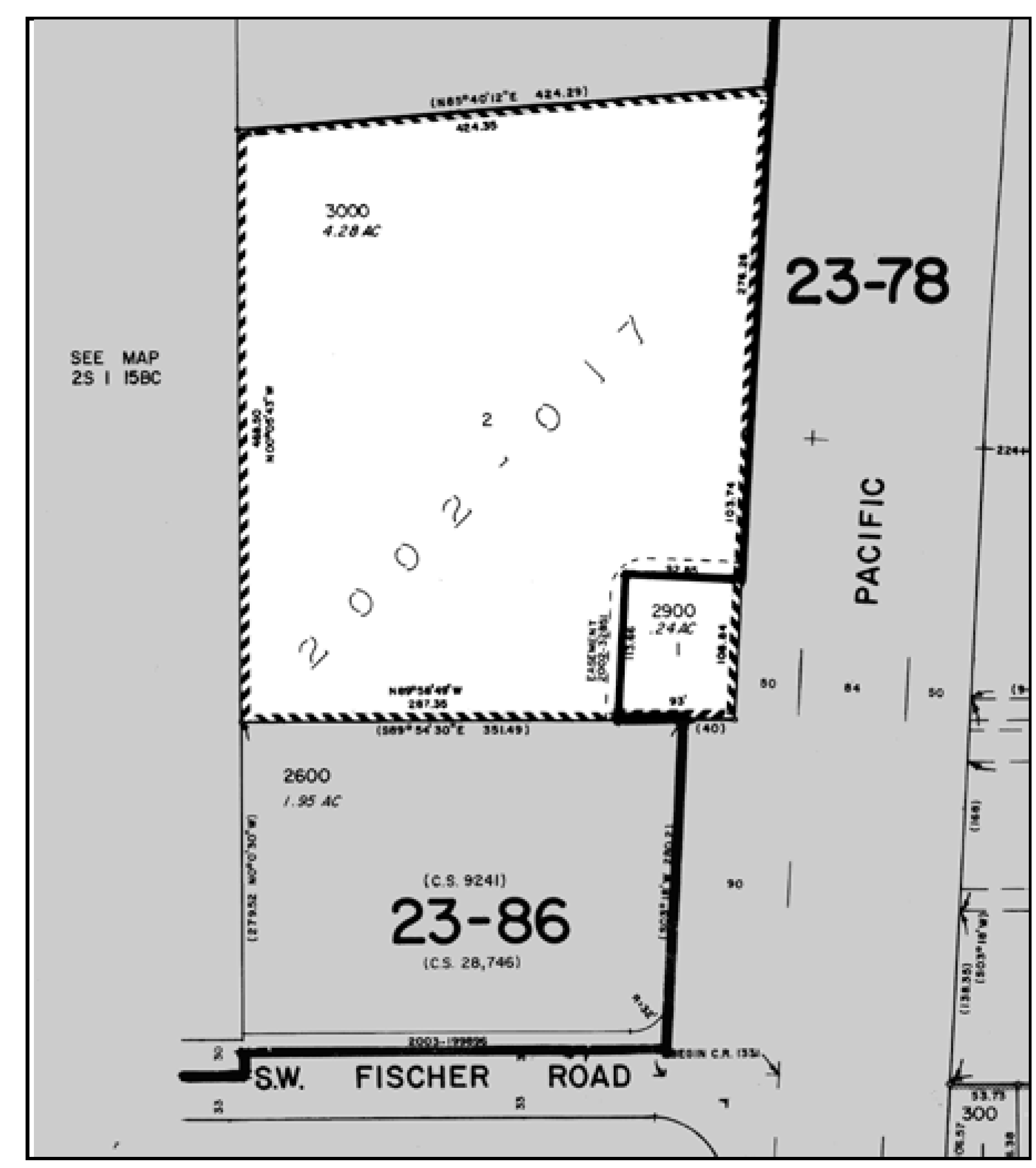
Figure 1. Location of Self-Service Storage
N.
Utilities.
1.
The proposal must mitigate differences in appearance or scale through such means as setbacks, screening, landscaping and other design features.
2.
Buildings over the required height of the base zone shall have an additional building setback of one foot for every foot over the building height standard.
3.
Utilities intended for public access, such as transit stops or park and ride facilities, shall provide safe and convenient pedestrian and bicyclist access.
O.
Recreational Vehicle Park.
1.
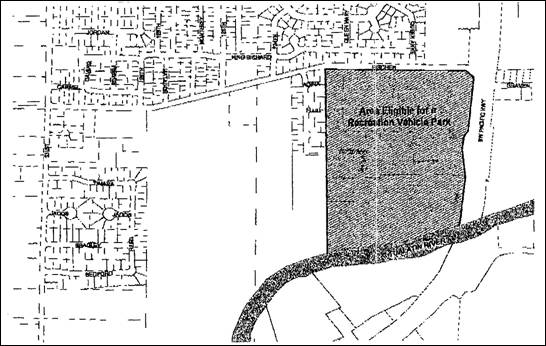
It shall be located in the southeastern corner of the city as illustrated below:
2.
The site shall be a minimum of two acres;
3.
The number of recreational vehicle or trailer sites shall not exceed fifteen per acre.
4.
Public water and sewer facilities shall be provided, including sanitary dumping facilities for recreational vehicles and trailers.
5.
All applicable health and sanitation requirements shall be satisfied.
6.
Direct driveway access to a collector or arterial street shall be provided and approved by Washington County, ODOT, and/or the city as appropriate.
7.
Access and circulation shall be approved by the fire marshal.
8.
Individual recreational vehicle and trailer sites shall have a minimum setback of twenty feet from abutting residential properties. Recreation areas, laundry facilities, rest rooms and other similar common buildings or facilities shall have a minimum setback of forty feet from abutting residential properties.
9.
At a minimum, landscaping shall comply with the provisions Chapter 16.124 including the buffering and screening requirements in Sections 16.124.100 and 16.124.110. For the purposes of this conditional use type, it will be considered as a commercial use when determining buffering and screening requirements. The planning commission may require landscaping, screening or buffering which exceed the minimum standards in Chapter 16.124 when it is found to be necessary to provide appropriate impact mitigation for surrounding properties.
10.
All lighting shall be directed away from adjacent residential districts.
(Ord. O-03-2 § 1 (part), 2003; Ord. O-02-4 § 2 (part), 2002; Ord. 96-4 § 1 (part), 1996)
(Ord. No. O-2015-01, § 1(Exh. A), 3-18-2015; Ord. No. O-2018-04, § 2(Exh. B), 8-1-2018; Ord. No. O-2019-01, Exh. B, 2-20-2019)
16.156.070 - Extended business hours.
A.
Hours of operation or use of the conditional uses noted above and all uses located in the limited commercial (LC) zone shall occur between the hours of eight a.m. and ten p.m. Extended hours of operation shall require conditional use review and approval by the planning commission as provided in this chapter. The special submittal requirements and review standards are described in the remainder of this section.
B.
Submittal Requirements. In addition to the submittal requirements for a conditional use application, the following information shall be provided by the applicant:
1.
A traffic analysis which describes the number and types of vehicle trips generated by the use throughout the day;
2.
A description of the primary goods or services expected to be sold during the period of the extended hours of operation;
3.
A map illustrating the types of land uses and zoning districts within eight hundred feet of the site; and
4.
Proposed method(s) for mitigating potential negative impacts on nearby properties.
C.
Evaluation Criteria. In order to approve extended hours of operation, the planning commission shall find that all of the following criteria can be satisfied:
1.
Business uses in the limited commercial (LC) zone shall have a minimum distance of one hundred feet between the nearest customer door of the business building and the nearest residentially zoned property;
2.
Uses in non-commercial zones shall have activity areas, such as building entrances, parking lots and loading areas located a minimum of one hundred feet from the nearest residential property;
3.
Nearby properties shall be buffered from potential noise impacts related to activities occurring on the site; and
4.
All other conditional use criteria of this chapter are satisfied.
(Ord. 96-4 § 1 (part), 1996)
16.156.080 - Conditions of approval.
In permitting a new conditional use or a major modification of an existing conditional use, the planning commission may impose, in addition to those standards and requirements expressly specified in this title, additional conditions which the commission considers necessary to protect the best interests of the surrounding area or the city as a whole. The conditions may include, but are not limited to the following:
A.
Increasing the required lot size or yard dimensions;
B.
Limiting the height, size or location of buildings;
C.
Controlling the location or number of vehicle access points;
D.
Increasing the street width;
E.
Increasing the number of required off-street parking spaces;
F.
Limiting the number, size, location or lighting of signs;
G.
Requiring fencing, screening, landscaping or other facilities to protect adjacent or nearby property;
H.
Designating sites for open space; and
I.
Requiring interceptors between site, storm, water and other drainage runoff and public storm sewer systems or streams in order to separate such materials as gasoline, oil, grease, detergents or other runoff which may be deemed hazardous to downstream water quality by the city.
(Ord. 96-4 § 1 (part), 1996)
16.156.090 - Exceptions to provisions.
The planning commission may grant an exception to the dimensional building setback or yard requirements in an applicable zone based on findings that the approval will result in the following:
A.
A reduction of a required setback which is not greater than fifteen percent;
B.
Promotion of a more efficient use of the site; and
C.
Preservation of unique site conditions or features such as wetlands, flood plains, steep slopes or mature trees.
(Ord. 96-4 § 1 (part), 1996)
16.156.100 - Agreement and security.
The developer and property owner shall, as a condition of approval, execute a development agreement for any public improvements required by site plan review. The agreement shall be on a form approved by the city attorney. The property owner may be required to file with the city a performance bond or other security as approved by the city attorney to assure full performance of the required improvements. The bond shall be for the estimated cost of the improvements plus ten percent. The bond shall remain in effect until the public improvements are accepted by the city. Landscaping shall be installed prior to issuance of an occupancy permit unless the city manager determines that a delay in planting is justified to promote the maintenance of the landscaping. In this case, security equal to the cost of landscaping, as determined by the city manager, must be filed with the city assuring installation of landscaping within six months after occupancy.
(Ord. 96-4 § 1 (part), 1996)
16.156.110 - Maintenance.
All on-site improvements shall be the ongoing responsibility of the property owner or occupant. Should landscaping materials die after installation, it shall be the ongoing responsibility of the property owner to provide replacement plantings to maintain the intent of the approved landscape plan. All other facilities, including parking areas, walks, signage and other improvements shall be maintained in good serviceable quality so that the quality appearance of the site is maintained at all times.
(Ord. 96-4 § 1 (part), 1996)
16.160.010 - Purpose.
Nonconforming uses and development are created when the application of a specific zoning district to a site changes, or a regulation in this title changes. As a result of such changes, existing uses or development might no longer be allowed. The intent of these amendments is not to force all nonconforming situations to be immediately brought into compliance. Instead, the intent is to guide future uses and development in a new direction consistent with city policy.
This chapter provides a method to limit modifications to nonconforming situations while allowing the continuation of these situations in a manner that is not unnecessarily burdensome to the property or business owner.
(Ord. 96-4 § 1 (part), 1996)
16.160.020 - Administration.
A.
The manager shall make an administrative decision whether a situation is nonconforming as provided in Article II, Procedures.
B.
If the applicant wishes to provide evidence to prove legal nonconforming status, such evidence will be reviewed as a city manager decision as provided in Article II.
(Ord. 96-4 § 1 (part), 1996)
16.160.030 - Types of nonconforming situations.
A.
Nonconforming uses are activities that are conducted on a property that are not listed as a permitted or conditional use for the zoning district that applies to the property.
B.
Nonconforming development or structures are physical site improvements such as buildings, driveways, parking areas, landscaping and signs that do not comply with the dimensional standards of this title.
C.
Nonconforming residential density applies to residential development which exceeds the maximum allowable density for the zoning district that applies to the property.
D.
Nonconforming lots of record are parcels of land that do not meet the area or dimensional standards of this title.
(Ord. 96-4 § 1 (part), 1996)
16.160.040 - Regulations that apply to all nonconforming situations.
A.
Ownership changes do not affect the status of nonconforming situations.
B.
Change to a conforming situation may occur by right as a permitted use or through conditional use approval. Once a conforming situation occupies the property or site, the nonconforming rights are lost and a nonconforming use may not be re-established.
C.
Normal maintenance and repair of nonconforming situations is allowed.
(Ord. 96-4 § 1 (part), 1996)
16.160.050 - Specific provisions for nonconforming situations.
A.
Nonconforming Uses.
1.
Nonconforming uses may continue to operate. Changes in operations are allowed. However, nonconforming uses may not extend their hours of operation beyond the period of eight a.m. to ten p.m.
2.
A nonconforming use can not be changed without approval by the city as a permitted or conditional use.
3.
Nonconforming uses shall not expand the building floor area or land area occupied on a site.
4.
If the nonconforming use is discontinued or abandoned for any reason for a period exceeding six months, any subsequent use shall conform to the regulations specified in this title.
5.
When a structure containing a nonconforming use is damaged, the use shall not be re-established if the repair cost of the structure is more than seventy-five percent of its assessed value.
B.
Nonconforming Development or Structures.
1.
A nonconforming site development or structure may be expanded, enlarged or modified only if such change does not increase its degree of nonconformity with the provisions of this title.
2.
When a nonconforming development or structure is damaged, it shall not be re-established if the repair cost of the structure is more than seventy-five percent of its assessed value.
C.
Nonconforming Residential Density.
1.
A residential development that exceeds the applicable density standards may be modified, as provided by this title, if the number of dwelling units is not increased.
2.
When a residential structure containing nonconforming residential units is damaged, it shall not be re-established if the repair cost of the structure is more than seventy-five percent of its assessed value.
D.
Nonconforming Lots of Record.
1.
Nonconforming lots may be developed or redeveloped when all relevant requirements of this title are satisfied.
(Ord. 96-4 § 1 (part), 1996)
16.164.010 - Purpose.
The purpose of this chapter is to provide standards for the granting of variances from the applicable provisions of this title where it can be shown that, owing to special and unusual circumstances, the literal interpretation of these provisions would cause an undue or unnecessary hardship without a corresponding public benefit.
(Ord. 96-4 § 1 (part), 1996)
16.164.020 - Applicability of provisions.
A variance application may be requested relating to any provision of this title, except that a variance request to the permitted or conditional use requirements in Chapters 16.80 through 16.112 shall not be granted.
(Ord. 96-4 § 1 (part), 1996)
16.164.030 - Administration.
Variance applications shall be administered and reviewed as a planning commission review in accordance with Article II of this title.
(Ord. 96-4 § 1 (part), 1996)
16.164.040 - Submittal requirements.
A.
In addition to the application form and information required in Section 16.44.030, the applicant shall submit each of the following:
1.
A narrative and/or site plan, with the number of copies to be determined at the preapplication conference, which explains the variance satisfies the relevant approval criteria, and:
a.
The site plans and required drawings shall be drawn on sheets preferably not exceeding eighteen inches by twenty-four inches;
b.
The scale for the site plan shall be an engineering scale; and
c.
All drawings of structure elevations or floor plans shall be a standard architectural scale of one-fourth inch or one-eighth inch equals one foot.
B.
The manager may require information in addition to that required by this chapter when it is found that certain information is necessary to properly evaluate the application.
C.
The manager may waive a specific requirement for information when it is found that such information is not necessary to properly evaluate the application.
(Ord. 96-4 § 1 (part), 1996)
16.164.050 - Approval criteria.
The planning commission shall approve, approve with conditions or deny an application for a variance based on an evaluation of all of the following criteria:
A.
The proposed variance will equally or better meet the purpose of the regulation being modified and any associated policies of the comprehensive plan;
B.
There are special circumstances, such as peculiar lot size or shape, topographic constraints or limitations caused by existing development, over which the applicant has no control, and which are not applicable to other properties in the same zoning district;
C.
The use proposed is a permitted or conditional use as allowed in the applicable zoning district, and the standards of this code must be maintained to the greatest extent that is reasonably possible while permitting some economic use of the land;
D.
Existing physical and natural systems, such as but not limited to transportation facilities, utilities and sensitive lands, must not be adversely affected any more than would occur if the use or structure were developed in accordance with the provisions of this title; and
E.
The hardship is not self-imposed and the variance requested is the minimum variance which would alleviate the hardship.
(Ord. 96-4 § 1 (part), 1996)
16.168.010 - Purpose.
A.
The purpose of this chapter is to establish standards for the approval of temporary uses which are:
1.
Seasonal or directed toward a specific event; and
2.
Consistent with the uses and activities that may be permitted in the relevant zoning district.
B.
The temporary uses permitted under the provisions of this chapter are intended to be truly temporary in nature and have no adverse impacts on the surrounding area and land uses. Temporary uses have no inherent rights within the zone in which they locate.
C.
This chapter is not intended to provide a way to circumvent the strict application of the provisions of this title.
(Ord. 96-4 § 1 (part), 1996)
16.168.020 - Applicability of provisions.
A.
Business tax registration, as provided in Chapter 5.04, shall be required for temporary uses.
B.
Residential, Community Facilities (CF), Recreational Golf Course (RGC), and Kingston Terrace District zones—Types of Uses Permitted.
1.
Use associated with the sale of fresh fruits, produce and flowers grown on the property.
2.
Use associated with construction of roads, utilities or development, including storage of equipment and staging areas for a maximum of three consecutive months.
3.
Temporary sales office or model home located within the boundaries of the subdivision or tract of land in which parcels, homes or dwelling units are being sold or rented.
C.
Limited Commercial (LC) Zone—Types of Uses Permitted.
1.
Use associated with the sale of fresh fruits, produce, and flowers grown for a maximum of three consecutive months.
2.
Use associated with construction of roads, utilities or development, including storage of equipment and staging areas.
3.
Temporary building for use only associated with the primary use on the property.
4.
Seasonal outdoor sales, such as fireworks and Christmas trees for a maximum of one month.
5.
Fairs and carnivals for a maximum of two consecutive weeks.
6.
Activities and structures needed as the result of a natural disaster or other health and safety emergency for the duration of the emergency.
D.
Garage Sales. The provisions of this chapter must not apply to garage sales and other sales of items from the site that occur for no more than three consecutive days on two different occasions during a calendar year.
(Ord. 96-4 § 1 (part), 1996)
(Ord. No. 2023-04, § 1(Exh. A), 10-18-2023)
16.168.030 - Administration.
A.
Temporary use applications shall be administered and reviewed as a city manager decision as described in Article II of this title.
B.
Extensions of a temporary use approval shall also be administered and reviewed as a city manager decision. The city manager shall only grant one extension which does not exceed the time limit of the original approval. The city manager shall process the request for an extension as a new application as provided in this chapter.
(Ord. 96-4 § 1 (part), 1996)
16.168.040 - Submission requirements.
A.
In addition to the application form and information required in Section 16.44.030, the applicant shall submit the following:
1.
A site plan, with the number of copies to be determined at the preapplication conference, and necessary data or narrative which explains how the development conforms to the standards, and:
a.
The site plans and required drawings shall be drawn on sheets preferably not exceeding eighteen by twenty-four inches;
b.
The scale for the site plan shall be an engineering scale; and
c.
All drawings of structure elevations and floor plans (if required) shall be a standard architectural scale of one-fourth inch or one-eighth inch equals one foot.
2.
The site plan, data and narrative shall include:
a.
The proposed site and its structures, driveways, parking and landscaped areas;
b.
The number and location of all parking spaces to be used in conjunction with the temporary use;
c.
The location of any booth, stand, trailer or vehicles;
d.
The location of any temporary signs;
e.
The location and type of surrounding land uses and related improvements; and
f.
The proposed dates and hours of operation.
B.
The city manager may require information in addition to that required by this chapter when it is found that certain information is necessary to properly evaluate the application.
C.
The city manager may waive a specific requirement for information when it is found that such information is not necessary to properly evaluate the application.
(Ord. 96-4 § 1 (part), 1996)
16.168.050 - Approval standards.
A.
Temporary uses shall satisfy all of the following criteria:
1.
The use must be limited in duration to only accommodate the purposes for which the permit is sought such as fairs or other exhibitions, sales of goods, wares, merchandise, produce or Christmas trees, and other similar temporary needs, but in no case shall the use continue for a period of more than one year;
2.
Adequate and safe access must be provided when combined with the other uses of the property, as required by Chapter 16.136 and Chapter 16.144;
3.
Adequate parking for the customers and/or employees as required by Chapter 16.132;
4.
Traffic hazards or congestion must not result;
5.
Safe and convenient access shall be retained or provided for pedestrians, bicyclists and other nonmotorized traffic;
6.
Adverse off-site impacts including noise, odors, vibrations, glare or lights must not affect adjoining uses in a manner which is inconsistent with the requirements of this code;
7.
Signs shall be in conformity with Chapter 16.148; and
8.
In the case of a request for an extension, the applicant has operated the temporary use in a manner conforming with the conditions of approval required by the city.
B.
A temporary sales office or model home in residential zones shall also satisfy the following additional criteria:
1.
It is located within the boundaries of the subdivision or tract of land in which parcels, homes or dwelling units are being sold or rented; and
2.
It is designed to be a permanent residence.
(Ord. 96-4 § 1 (part), 1996)
16.172.010 - Purpose.
It is the purpose of this chapter to:
A.
Permit residents an opportunity to use their homes to engage in small-scale business ventures which could not be sustained if it were necessary to lease commercial quarters, or because the nature of the activity would make it impractical to expand to a larger-scale enterprise;
B.
Provide an option for people to work at home and not have to commute to work; and
C.
Establish approval criteria and standards to ensure that home occupations are conducted as lawful uses which are subordinate to the residential use of the property and are conducted in a manner that is not detrimental or disruptive in terms of appearance or operation to neighboring properties and residents.
(Ord. 96-4 § 1 (part), 1996)
16.172.020 - Applicability and exemptions.
A.
No person shall conduct a home occupation, or permit such use to occur on property which that person owns or is in lawful control of, contrary to the provisions of this chapter or Chapter 5.04.
B.
Exemptions from the provisions of this chapter are:
1.
Garage sales and other sales of items from the site that occur for no more than three consecutive days on two different occasions during a calendar year;
2.
Production of produce or other agricultural products grown on the premises. The temporary or seasonal sale of produce or other food products grown on the premises is subject to the provisions of Chapter 16.168;
3.
Hobbies which do not result in payment to those engaged in such activity;
4.
Proven nonconforming home occupations according to Chapter 16.160; and
5.
Care facilities, including family care, residential facility and residential home.
(Ord. 96-4 § 1 (part), 1996)
16.172.030 - Nonconforming uses.
A.
Ongoing home occupations may be granted nonconforming status provided that they were permitted under county authority prior to annexation to the city and have been in continuous operation since county approval.
B.
A nonconforming situation is further governed by Chapter 16.160. Such use may continue until the use is expanded or altered so as to increase the level of noncompliance with this title.
C.
The burden of proving a home occupation's nonconforming status rests with the property owner or tenant.
D.
Home occupations without city or county approval which cannot prove nonconforming status shall be considered in violation of this chapter and shall cease until the appropriate approvals have been granted.
(Ord. 96-4 § 1 (part), 1996)
16.172.040 - Administration.
A.
Home occupations shall be administered as either Type I or Type II uses. The two types of home occupation are described in the subsections below.
1.
A Type I home occupation shall exhibit no evidence that a business is being conducted from the premises. A Type I home occupation shall meet the approval criteria in Section 16.172.060.
2.
A Type II home occupation may exhibit limited evidence that a business is being conducted from the premises. A Type II home occupation shall meet the approval criteria in Section 16.172.060.
B.
Type I applications shall be administered and reviewed as a city manager decision as described in Article II of this title.
C.
Type II applications shall be administered and reviewed as a planning commission decision as described in Article II of this title.
(Ord. 96-4 § 1 (part), 1996)
16.172.050 - Submission requirements.
A.
In addition to the application form and information required in Section 16.44.030, the applicant shall submit the following:
1.
A site plan, with the number of copies to be determined at the preapplication conference, and necessary data or narrative which explains how the development conforms to the standards, and:
a.
The site plans and required drawings shall be drawn on sheets preferably not exceeding eighteen by twenty-four inches;
b.
The scale for the site plan shall be an engineering scale (required for Type II only); and
c.
All drawings of structure elevations and floor plans (if required) shall be a standard architectural scale of one-fourth inch or one-eighth inch equals one foot.
2.
The site plan, data and narrative shall include:
a.
The proposed site and its structures, driveways, parking and landscaped areas;
b.
The number and location of all parking spaces to be used in conjunction with the home occupation;
c.
A floor plan of all structures on the property which are to be used for the home occupation;
d.
The location and drawing for any proposed signs (allowed for Type II only);
e.
The location and type of surrounding land uses and related improvements; and
f.
The proposed hours of operation.
B.
The city manager may require information in addition to that required by this chapter when it is found that certain information is necessary to properly evaluate the application.
C.
The city manager may waive a specific requirement for information when it is found that such information is not necessary to properly evaluate the application.
(Ord. 96-4 § 1 (part), 1996)
16.172.060 - Approval standards.
A.
All home occupations, except those that have proven nonconforming status as provided in Section 16.172.030, shall satisfy all of the following standards:
1.
Home occupations may be undertaken only by the principal occupant(s) of the residential property;
2.
There shall be no more than three deliveries of supplies per week to the residence between the hours of eight a.m. and six p.m.;
3.
The business, including deliveries from other businesses, shall not require the use of tractor trailers, semi-trucks, or heavy equipment;
4.
There shall be no retail sales, other than telephone sales;
5.
No remodeling of the exterior of the dwelling or the accessory structure is required which changes the residential character or the area;
6.
There shall be no offensive noise, vibration, smoke, dust, odors, heat or glare noticeable at or beyond the property line resulting from the operation and the home occupation shall comply with all relevant provisions of this code;
7.
The home occupation shall be operated entirely within the dwelling unit and/or a conforming accessory structure. The total area which may be used in the accessory building for either material product storage and/or the business activity shall not exceed five hundred square feet. In addition, the home occupation and associated storage of materials and products shall not occupy more than twenty-five percent of the combined gross floor area of the residence and accessory structure. The indoor storage of materials or products shall not exceed the limitations imposed by the provisions of the building, fire, health and housing codes;
8.
More than one business activity constituting two or more home occupations shall be allowed on one property only if the combined floor space of the business activities does not exceed twenty-five percent of the combined gross floor area of the residence and/or accessory structure. Each home occupation shall apply for a separate home occupation permit, as required by this chapter, and each shall also have separate business tax registration as provided in Chapter 5.04;
9.
A home occupation shall not require a change in the uniform building code use classification of a dwelling unit. Any accessory building that is used must meet uniform building code requirements and be in conformity with Chapter 16.176 of this title;
10.
There shall be no storage and/or distribution of toxic or flammable materials, and spray painting or spray finishing operations that involve toxic or flammable materials which in the judgement of the fire marshal pose a dangerous risk to the residence, its occupants and/or surrounding properties. Those individuals which are engaged in such home occupations shall make available to the fire marshal for review the material safety data sheets which pertain to all potentially toxic and/or flammable materials associated with the use;
11.
There shall be no exterior storage of vehicles of any kind used for the business except that one commercially licensed vehicle which is not larger than a three-fourth ton pick-up, passenger van or similar size, may be parked outside of a structure or screened area; and
12.
No exterior storage of materials shall occur on the premises.
B.
Type I home occupations shall satisfy all of the following additional criteria:
1.
No outside volunteers or employees shall be engaged in the business activity other than the persons residing on the premises;
2.
No exterior sign(s) shall identify the business;
3.
No clients or customers shall visit the premises for any reason; and
4.
The home occupation shall not require any on or off-street parking other than that normally required for a residence.
C.
Type II home occupations shall satisfy all of the following additional criteria:
1.
A maximum of one outside volunteer or employee, who is not a resident of the premises;
2.
No more than six daily customers or clients, with visits limited between the hours of eight a.m. and six p.m.;
3.
If off-street parking is necessary, a plan for additional parking shall be approved if:
a.
The residential character of the property is not changed; and
b.
The parking area does not detract from the visual appearance of the residence; and
4.
One non-illuminated sign, which does not exceed two square feet, may be permitted when it is attached to the residence or accessory structure or placed in a window.
D.
The following uses are not allowed as home occupations:
1.
Auto-body repair and painting;
2.
Ongoing mechanical repair conducted outside of an entirely enclosed building;
3.
Junk and salvage operations; and
4.
Storage and/or sale of fireworks.
(Ord. 96-4 § 1 (part), 1996)
16.176.010 - Purpose.
The purpose of this chapter is to:
A.
Establish criteria for regulating the type, size and location of accessory structures in residential zoning districts;
B.
Allow the property to be more useful while not altering the residential character of the principal structures of the neighborhood; and
C.
Allow for accessory structures within non-residential zones including the limited commercial (LC), community facilities (CF), and recreational golf course (RGC) districts.
(Ord. 96-4 § 1 (part), 1996)
16.176.020 - Applicability of provisions.
A.
Review by the city manager of accessory structures is required except for the following situations.
1.
Non-habitable buildings or structures within residential zoning districts which are less than two hundred square feet in gross floor area, meet applicable building setback requirements (see Section 16.176.050.A), and ten feet or less in height, measured from the finished floor to the wall or top plate.
2.
Accessory buildings or structures attached to the principle building or structure. Attached means wall-to-wall or any permanent roof attachment such as breezeways. Said structures shall be considered as building additions and shall require building permits and compliance with the applicable setback standards for the principle building or structure;
3.
Accessory buildings are subject to the provisions of Chapter 16.152 in the limited commercial (LC), community facilities (CF) and recreational golf course (RGC) zoning districts. If a new or remodeled accessory structure represents a major modification, as provided in Section 16.152.020, it will be subject to the provisions of Chapter 16.152; and
4.
Fences and Walls.
B.
All of the provisions and regulations of the underlying zone apply unless modified by this chapter.
(Ord. 96-4 § 1 (part), 1996; Ord. No. O-2020-01, § 1(Exh. A), 8-19-2020)
16.176.030 - Administration.
A.
Accessory structure applications shall be administered and reviewed as an administrative review in accordance with Article II of this title.
B.
In instances where an alteration, extension or reconstruction is requested, the applicant shall apply for an accessory structure permit in accordance with this chapter.
C.
A conflict of interpretation concerning whether a structure is an accessory structure shall be resolved in accordance with the provisions of Section 16.40.050.
(Ord. 96-4 § 1 (part), 1996)
16.176.040 - Submission requirements.
A.
In addition to the application form and information required in Section 16.44.030, the applicant shall submit the following:
1.
A site plan(s) and necessary data or narrative, which demonstrates how the accessory structure proposal conforms to the standards:
a.
Sheet size for an accessory structure site plan(s) and required drawings shall be drawn on sheets preferably not exceeding eighteen inches by twenty-four inches;
b.
The scale of the site plan shall be an engineering scale; and
c.
All drawings of structure elevations shall be at standard architectural scale, being one-fourth inch or one-eighth inch.
2.
The proposed accessory structure site plan and narrative shall include:
a.
The location of all existing and proposed structures on the site and directly abutting the site, and their orientation;
b.
The location of existing and proposed utility lines and easements;
c.
The location of any streets abutting the site;
d.
The location of any accessway to the proposed structure;
e.
The dimensions and square footage of the accessory structure; and
f.
A copy of all existing and proposed restrictions or covenants.
3.
The proposed architectural plans for the accessory structure shall include:
a.
At least the front and side elevations of any proposed structure; and
b.
If a building permit is required, all structural drawings and data required by the current Oregon Building Code shall be included.
B.
The city manager may require information in addition to that required by this chapter when it is found that certain information is necessary to properly evaluate the application.
C.
The city manager may waive a specific requirement for information when it is found that such information is not necessary to properly evaluate the application.
(Ord. 96-4 § 1 (part), 1996; Ord. No. O-2020-01, § 1(Exh. A), 8-19-2020)
16.176.050 - Approval standards.
A.
The following dimensional standards shall apply to all accessory structures:
1.
Residential Zones.
a.
Minimum front yard setback as required by the applicable zone;
b.
Minimum side and rear yard setback as required by the applicable zone; and
c.
Maximum height of eighteen feet, unless another standard is provided in the applicable zoning district.
2.
Non-residential Zones.
a.
Minimum front, side and rear setbacks shall comply with the requirements of the applicable zone; and
b.
Maximum height shall comply with the requirements of the applicable zone.
3.
All detached accessory structures and the setback between the accessory structure and the principle building shall comply with the current Oregon Building Code.
4.
All freestanding and detached towers, antennas, wind generating devices and TV receiving dishes shall have setbacks equal to or greater than the height of the proposed structure.
B.
The following non-dimensional approval criteria shall be satisfied:
1.
Accessory structures or buildings shall comply with all requirements for the principal structure, except where specifically modified by this chapter;
2.
No accessory building or structure shall be allowed in any required front yard;
3.
The applicant shall present documentation of the possession of any required license by any federal, state or local agency;
4.
Any accessory building or structure attached to the principal building or structure must comply with all setbacks of the zoning district (attached means wall-to-wall or any permanent roof attachment such as breezeways);
5.
No accessory building or structure shall encroach upon or interfere with the use of any adjoining property or public right-of-way including, but not limited to, streets, alleys and public or private easements;
6.
TV receiving dishes, greater than twenty-four inches in diameter, may be erected upon the roof of a structure only within a non-residential zone; and
7.
Accessory structures which are nonconforming shall satisfy the requirements of Chapter 16.160 where an alteration, extension or reconstruction is requested.
(Ord. O-02-4 § 2 (part), 2002; Ord. 96-4 § 1 (part), 1996)
(Ord. No. O-98-01, § 3, 10-7-1998; Ord. No. O-2020-01, § 1(Exh. A), 8-19-2020)
16.178.010 - Purpose.
Accessory dwelling units are allowed to:
A.
Create new housing units while respecting the character of single-family residential neighborhoods;
B.
Utilize existing housing stock and infrastructure more efficiently;
C.
Provide a mix of housing types that respond to changing household needs;
D.
Provide a means for residents, particularly seniors, single parents and other established residents to remain in their homes and neighborhoods, and obtain extra income, security, companionship and services; and
E.
Provide a broader range of affordable housing options.
(Ord. O-03-2 § 1 (part), 2003; Ord. No. O-2020-01, § 1(Exh. A), 8-19-2020)
16.178.020 - Applicability of provisions.
The provisions of this chapter shall apply to all new accessory dwelling unit construction or floor area expansion of an existing accessory dwelling in the R-9, SF, AT, R-12, R-15, R-24, and NMU districts.
(Ord. O-03-2 § 1 (part), 2003; Ord. No. O-2020-01, § 1(Exh. A), 8-19-2020)
16.178.030 - Administration.
Applications for a new accessory dwelling unit or an alteration, extension or reconstruction of an existing accessory dwelling unit shall be administered and reviewed as an administrative review in accordance with Article II of this title.
(Ord. O-03-2 § 1 (part), 2003; Ord. No. O-2020-01, § 1(Exh. A), 8-19-2020)
16.178.040 - Submission requirements.
A.
In addition to the application form and information required in Section 16.44.030, the applicant shall submit the following:
1.
A site plan(s) and necessary data or narrative, which explains how the accessory dwelling unit conforms to the standards of this title:
2.
The application for a proposed accessory dwelling unit or the alteration, extension or reconstruction of an existing accessory dwelling unit shall include:
a.
A site plan showing the location of all existing and proposed structures on the site and directly abutting the site, and their orientation:
i.
The location of existing and proposed utility lines and easements;
ii.
The location of any streets abutting the site;
iii.
The location of any accessway to the proposed accessory dwelling unit;
iv.
The dimensions and square footage of the accessory accessory dwelling unit; and
v.
A copy of all existing and proposed restrictions or covenants.
b.
The proposed architectural plans for the accessory accessory dwelling unit shall include:
i.
At least the front and side elevations of any proposed structure; and
ii.
If a building permit is required, all structural drawings and data required by the current Oregon Building Code shall be included.
B.
The city manager may require information in addition to that required by this chapter when it is found that certain information is necessary to properly evaluate the application.
C.
The city manager may waive a specific requirement for information when it is found that such information is not necessary to properly evaluate the application.
(Ord. O-03-2 § 1 (part), 2003; Ord. No. O-2020-01, § 1(Exh. A), 8-19-2020)
16.178.050 - Approval standards.
A.
Creation. An accessory dwelling unit may only be created through the following methods:
1.
Converting existing living area, attic, basement, garage, or detached accessory structure;
2.
Adding floor area to an existing residence or detached accessory structure;
3.
Constructing a detached accessory dwelling unit on a site with an existing house, attached house or manufactured home; or
4.
Constructing a new house, attached house, or manufactured home with an internal or detached accessory dwelling unit.
B.
Maximum Number. A maximum of one accessory dwelling unit is allowed per dwelling.
C.
Other Development Requirements for New and Existing Accessory Dwellings.
1.
A building containing an accessory dwelling unit shall provide front, side and rear setbacks and have a maximum building height which comply with the applicable zone district.
2.
A detached accessory dwelling unit shall not be located within a front yard.
3.
Properties with a detached accessory dwelling unit are allowed to increase the maximum lot coverage standard of the applicable zone up to ten percent.
4.
No additional off-street parking is required for an accessory dwelling unit.
5.
A detached accessory dwelling unit shall not exceed eight hundred square feet of floor area, or seventy-five percent of the primary dwelling's floor area, whichever is less.
6.
Conversion of an existing legal nonconforming structure to an accessory dwelling unit is allowed provided that the conversion does not increase the degree of nonconformity.
7.
Accessory dwelling units are exempt from density calculations and requirements.
(Ord. O-03-2 § 1 (part), 2003; Ord. No. O-2020-01, § 1(Exh. A), 8-19-2020; Ord. No. O-2021-01, § 2(Exh. B), 8-18-2021)
16.179.010 - Purpose.
The purpose of this chapter is to:
A.
Establish criteria for regulating the type, size and location of communication facilities and structures in all zoning districts;
B.
Allow the construction of communication facilities and structures in a manner which is compatible with adjacent land uses, especially residential neighborhoods;
C.
Encourage co-location of wireless communication facilities to minimize the number of separate communication facilities while providing quality wireless communications services for the city and surrounding area; and
D.
Comply with the requirements of the Federal Telecommunications Act of 1996.
(Ord. No. O-98-01, § 1, 10-7-1998)
16.179.020 - Applicability of provisions.
A.
Communication facilities and structures shall satisfy the provisions of this chapter except for the following situations:
1.
Emergency or routine repairs and maintenance, reconstruction, or replacement which do not increase the facility's height or create a significant additional visual impact of a previously approved facility;
2.
Facilities and structures which do not exceed ten feet in height;
3.
All freestanding and detached radio antenna (including amateur short wave radio), television antenna, television receiving dishes and wind generating devices for private or non profit use (excluding wireless communication facilities and structures as defined by this title); and
4.
Related equipment buildings or cabinets which are less than one hundred twenty square feet in gross floor area and ten feet in height.
B.
All of the provisions and regulations of the applicable zone and this title apply unless modified by this chapter.
(Ord. No. O-98-01, § 1, 10-7-1998)
16.179.030 - Administration.
A.
Applications to construct or alter a communication facility and/or structure shall be administered and reviewed as an administrative, city manager, or planning commission review in accordance with Article II of this title. The types of review procedure is determined in Section 16.179.030 B.
B.
Review Procedures for Communication Facilities.
C.
A conflict of interpretation concerning whether a facility and/or structure is subject to the provisions of this chapter shall be resolved in accordance with the provisions of Section 16.40.050.
(Ord. No. O-98-01, § 1, 10-7-1998)
16.179.040 - Submission requirements.
A.
In addition to the application form and information required in Section 16.44.030, the applicant shall submit each of the following:
1.
A site plan, with the numbers of copies to be determined at the pre-application conference and necessary data or narrative which explains how the communication facility conforms to the standards using the following format:
a.
The site plans shall be drawn on sheets preferably not exceeding eighteen inches by twenty-four inches;
b.
The site plan shall be drawn using an engineering scale; and
c.
All drawings of structure elevations or floor plans shall be drawn using a standard architectural scale of one-quarter-inch or one-eighth-inch equaling one foot.
2.
The site plan, data, and narrative shall include:
a.
The location of all existing and proposed structures on the site and directly abutting the site as well as their orientation;
b.
The location of existing and proposed utility lines and easements;
c.
The location of any streets abutting the site; and
d.
The location of any accessway to the proposed communications facility.
3.
Architectural elevations of the structure and communication facility.
4.
A landscape plan as detailed in Section 16.124.030
B.
The city manager may require information in addition to that required by this chapter when it is found that certain information is necessary to properly evaluate the application.
C.
The city manager may waive a specific requirement for information when it is found that such information is not necessary to properly evaluate the application.
(Ord. No. O-98-01, § 1, 10-7-1998)
16.179.050 - Approval standards.
A.
General Standards. Communication facilities and structures shall comply with all of the following standards:
1.
Building permit approval as required by the King City Building Official.
2.
Facilities which are between ten feet high and the maximum height allowed in the base zone (e.g., thirty or forty feet), shall meet the applicable setback requirements of the base zone.
3.
For communication structures which exceed the maximum base zone height, the setback requirement shall be a minimum of fifteen feet, plus an additional one foot of setback for every foot in height over fifty feet, from residential (R-9, SF, AT, R-15, and R-24) properties.
4.
Suitable protective anti-climb fencing and a landscape planting screen, in accordance with Chapter 16.124, (Landscaping and Beautification), shall be provided and maintained around these structures and accessory attachments.
5.
The applicant shall present documentation as to their possession of any required license by any federal, state, or local agency.
B.
New Wireless Communication Facilities and Structures.
1.
Requests for wireless communication facilities and structures must be accompanied by evidence that the applicant made every reasonable effort to locate on existing wireless communication facilities and/or existing buildings, with no success or that location in existing towers is not feasible.
2.
The wireless communication facilities and structures which are located within or on properties adjacent to a residential zoning district must be a monopole design, and the facilities must be sleek, clean, and uncluttered in appearance.
3.
Facilities and structures located within or on properties adjacent to a residential zoning district must be screened by a ring of trees. The trees must be a variety that has a mature tree height which is not taller than the height of the proposed structure. The trees must be spaced in a way that provides a visual barrier around the structure.
4.
Accessory equipment associated with the facility is encouraged to be stored underground or inside an existing building. If a new structure is necessary, it must be designed and/or screened to be compatible with the adjacent residentially zoned properties.
5.
New wireless communication facilities and structures, which exceed the maximum height requirement of the base zone, shall be located on properties with a minimum lot size of forty thousand square feet within a CF or RGC zone and twenty thousand square feet within the LC zone.
6.
New wireless communication facilities and structures shall be designed to allow co-location of wireless communication facilities on the new structure.
C.
New Wireless Communication Facilities Attached to Existing Structures or Buildings.
1.
New communication facilities which are co-located on an existing communication structure with similar facilities shall not cause the height of the structure and facilities to exceed the existing height by more than ten feet. Additional height over ten feet shall be reviewed as a new structure.
2.
New communication facilities which are located on the exterior of other structures or buildings must be hidden from view or sufficiently camouflaged as to not be readily visible. This can be accomplished by using compatible building features such as dormers, mounted flush to the facade of the building and painted to match, located in the middle of a roof where it is not visible from the street below, or hidden by other method that minimizes visual impact.
3.
Accessory equipment associated with the facility can be stored underground or inside an existing building. If a new accessory equipment structure is necessary, it must be designed and/or screened to be compatible with the adjacent residentially zoned properties.
4.
TV receiving dishes may be erected upon the roof of a building only within LC, CF, or RGC zone.
D.
Accessory Equipment Buildings or Cabinets. Accessory equipment buildings or cabinets shall be subject to the provisions of Chapter 16.176 Accessory Structures.
E.
New Wireless Communication Facilities Which are Located Inside Buildings.
1.
The facilities must be hidden from view by being located inside of a building. This can be accomplished by locating the facility in an enclosed space or by using compatible building features such as dormers to hide the facility.
2.
Accessory equipment associated with the facility cannot be visible. It can be stored underground, inside of an existing building. If a new structure is necessary, it must be designed to be compatible with the existing structures in the site.
(Ord. No. O-98-01, § 1, 10-7-1998)
16.179.060 - Unused facilities.
A wireless communication facility or structure which has not been used for a continuous period of one year, shall be removed by the property owner. Failure to remove these facilities and structures shall be enforced as a zoning violation according to this title.
(Ord. No. O-98-01, § 1, 10-7-1998)
16.180.010 - Purpose.
The purpose of this chapter is to establish criteria for regulating the type, size and location of fences within the city, and to allow the property to be more useful while not altering the residential character of the principal structures or the neighborhoods.
(Ord. 96-4 § 1 (part), 1996)
16.180.020 - Applicability of provisions.
The provisions of this chapter shall apply to all construction of new and altered fences.
(Ord. 96-4 § 1 (part), 1996)
16.180.030 - Administration.
A.
Applications for fences and walls shall be administered and reviewed as an administrative review in accordance with Article II of this title.
B.
In instances where an alteration, extension or reconstruction is requested, the applicant shall apply for an accessory structure permit in accordance with this chapter.
(Ord. O-03-2 § 1 (part), 2003; Ord. 96-4 § 1 (part), 1996)
16.180.040 - Standards.
New fences or fence alterations shall satisfy all the following standards:
A.
Maximum Height Standards.
1.
Fences or walls in all zones shall meet the following standards unless modified by subsections (A)(2) through (A)(6) of this section.
a.
Front yard: 3 feet
b.
Rear interior side yard: 6 feet
c.
Corner side yard: 6 feet
2.
When deemed appropriate by the city during site plan or conditional use approval, the maximum fence height may be increased for purpose of providing improved buffering and screening between properties. Fences or walls over six feet in height shall require a building permit.
3.
When fences or walls are located on top of a berm or retaining wall, they shall have a maximum height of eight feet measured from the base of the berm or retaining wall. This maximum height requirement shall be amended only when necessary to comply with subsections (A)(2) or (A)(4) of this section.
4.
For fences or walls that are located along the top of a retaining wall or change in grade, a maximum height of three feet may be permitted, even if the total height exceeds eight feet as measured in subsection (A)(3) of this section.
5.
When a side yard abuts the front yard of an adjoining lot, the maximum fence height for that side yard shall be three feet.
6.
Visual clearance requirements may require elimination or height reduction of a proposed fence.
B.
The prescribed heights of fences or walls shall be measured from the base to the top of the fence as illustrated below.
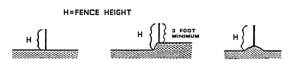
C.
Visual clearance standards in Chapter 16.144 of this title.
D.
Landscaping and beautification standards in Chapter 16.124 of this title.
E.
Fences and walls shall be constructed of wood, chain link, brick, wrought iron, decorative metal or similar material approved by the city manager.
F.
The unfinished or structural side of the fence shall face the owner's property.
G.
The owner must assume all responsibility for accurately determining property boundaries, and for any excavating within designated utility easements.
H.
Fences and walls shall be located within private property and shall not be placed on public property or rights-of-way.
(Ord. 96-4 § 1 (part), 1996)
16.180.050 - Standards for maintenance.
A.
The residents of the existing attached single-family and multi-family housing units in planned unit developments are permitted to repair or replace fences and walls in keeping with the original design concepts of those planned unit developments in lieu of the standards contained in this section.
B.
Fences and walls shall be maintained in a safe condition by the property owner.
(Ord. 96-4 § 1 (part), 1996)
16.180.060 - Restrictions.
A.
No fence, wall or other structure shall be placed or maintained in any rear yard abutting the golf course.
B.
No barbed wire fence shall be constructed or maintained along a sidewalk, public way or an adjoining property except such wire may be placed above the top of other fencing that is six feet in height. The total fence height, including the barbed wire, shall not exceed seven feet.
C.
Electric fence shall not be constructed or maintained along a sidewalk, public way or an adjoining property.
(Ord. 96-4 § 1 (part), 1996)
16.184.010 - Purpose.
The purpose of this chapter is to:
A.
Establish criteria for regulating the type, size and location of patio covers and enclosures in residential zoning districts;
B.
Allow the property to be more useful while not altering the residential character of the principal structures or the neighborhood; and
C.
Allow for patio covers and enclosures within nonresidential zones including the limited commercial (LC), community facilities (CF) and recreational golf course (RGC) districts.
(Ord. 96-4 § 1 (part), 1996)
16.184.020 - Applicability of provisions.
The provisions of this chapter shall apply to all construction of new and altered patio covers and patio enclosures.
(Ord. 96-4 § 1 (part), 1996)
16.184.030 - Administration.
A.
Applications for patio covers and patio enclosures shall be administered and reviewed as an administrative review in accordance with Article II of this title.
B.
In instances where an alteration, extension or reconstruction is requested, the applicant shall apply for an accessory structure permit in accordance with this chapter.
(Ord. O-03-2 § 1 (part), 2003; Ord. 96-4 § 1 (part), 1996)
16.184.040 - Submission requirements.
Any property owner wishing to enclose a patio must file a building permit with the city, in accordance with Section 16.44.030, along with the following:
A.
A site plan and necessary data or narrative which explains how the proposed structure conforms to the standards;
B.
The proposed site plan and narrative shall include:
1.
The location of all existing and proposed structures on the site and directly abutting the site, and their orientation;
2.
The location of existing and proposed utility lines and easements;
3.
The location of any streets abutting the site;
4.
The location of any accessway to the proposed structure;
5.
The dimensions and square footage of the proposed structure; and
C.
All structural drawings and date required by the uniform building code.
D.
The city manager may waive a specific requirement for information when it is found that such information is not necessary to properly evaluate the application.
(Ord. 96-4 § 1 (part), 1996)
16.184.050 - Patio cover uses.
Patio covers shall be used only for recreational, outdoor living purposes and not as carports, garages, storage rooms or habitable rooms.
(Ord. 96-4 § 1 (part), 1996)
16.184.060 - Approval standards.
A.
Patio covers must be constructed in compliance with the state of Oregon's uniform building code, 4901 through 4904.
B.
Materials may be awning, fiberglass, metal, wood or any other suitable material which is non-reflective.
C.
Patio covers must be constructed to be no closer than three feet from a property line.
D.
Eaves may overhang up to one foot into a setback area, but be no closer than two feet from the property line.
E.
Gutters and down spouts are required and must be directed into a storm drain.
F.
Any property owner wishing to construct a structure closer than the stated distances must obtain appropriate permits and approvals from the city, in accordance with Chapter 16.164.
G.
All detached structures and the setback between the accessory structure and the principle building shall comply with the uniform building code.
H.
No structure shall encroach upon or interfere with the use of any adjoining property or public right-of-way including, but not limited to, streets, alleys and public or private easements.
I.
Structures which are nonconforming shall satisfy the requirements of Chapter 16.160 where an alteration, extension or reconstruction is requested.
(Ord. 96-4 § 1 (part), 1996)
16.184.070 - Patio cover enclosures.
A covered patio shall be considered to be enclosed when the property owner chooses to add from one to three walls.
(Ord. 96-4 § 1 (part), 1996)
16.188.010 - Purpose.
The purpose of this chapter is to:
A.
Establish criteria for regulating the type, size and location of decks, spas and hot tubs in residential zoning districts; and
B.
Allow the property to be more useful while not altering the residential character of the principal structures or the neighborhood.
(Ord. 96-4 § 1 (part), 1996)
16.188.020 - Applicability of provisions.
The provisions of this chapter shall apply to all construction of new and altered decks, spas and hot tubs.
(Ord. 96-4 § 1 (part), 1996)
16.188.030 - Administration.
A.
Applications for decks, spas and hot tubs shall be administered and reviewed as an administrative review in accordance with Article II of this title.
B.
In instances where an alteration, extension or reconstruction is requested, the applicant shall apply for an accessory structure permit in accordance with this chapter.
(Ord. O-03-2 § 1 (part), 2003; Ord. 96-4 § 1 (part), 1996)
16.188.040 - Submittal requirements.
A.
The applicant shall submit an application form and information in accordance with Section 16.44.030, and the following:
1.
A site plan and necessary data or narrative which explains how the proposed structure conforms to the standards;
2.
The proposed site plan and narrative shall include:
a.
The location of all existing and proposed structures on the site and directly abutting the site, and their orientation;
b.
The location of existing and proposed utility lines and easements;
c.
The location of any streets abutting the site;
d.
The location of any accessway to the proposed structure;
e.
The dimensions and square footage of the proposed structure; and
f.
A copy of all existing and proposed restrictions or covenants.
B.
All structural drawings and date required by the uniform building code.
C.
The city manager may waive a specific requirement for information when it is found that such information is not necessary to properly evaluate the application.
(Ord. 96-4 § 1 (part), 1996)
16.188.050 - Deck standards.
The following standards shall apply to all decks constructed within the city:
A.
All decks require a building permit.
B.
Establishing accurate lot lines and locating buried cables and pipes in the utility easements is the sole responsibility of the owner. The city assumes no liability for repair or reconstruction of decks built over utility lines.
C.
Setback requirements are:
1.
For a rear or side yard deck, a minimum of three feet from the property line;
2.
For a front deck, the same setback as for the principal structure.
D.
When reviewing an application for a deck, spa or hot tub the city manager will consider but not be limited to the following issues:
1.
Distance to the windows and patio area of the house next door;
2.
Grade of the land;
3.
Elevation of the proposed deck;
4.
Fencing or screening.
E.
A railing at least thirty-six inches high is required for decks built thirty inches or more above grade. Vertical members shall be spaced closer than six inches apart.
F.
Steps shall have risers no higher than eight inches and treads at least nine inches wide.
G.
The stairway shall have a guardrail thirty-six inches high and a handrail thirty-two inches to thirty-six inches high. (One rail may serve both purposes—depending upon design materials.)
H.
Accessory structures shall comply with all requirements for the principal structure, except where specifically modified by this chapter.
I.
No structure shall encroach upon or interfere with the use of any adjoining property or public right-of-way including, but not limited to, streets, alleys and public or private easements.
J.
Structures which are nonconforming shall satisfy the requirements of Chapter 16.160 where an alteration, extension or reconstruction is requested.
(Ord. 96-4 § 1 (part), 1996)
16.188.060 - Spa and hot tub standards.
The following standards shall apply to all spa and hot tub installations:
A.
Installation of a spa or a hot tub requires a building permit.
B.
Establishing accurate lot lines and locating buried cables and pipes in the utility easements is the sole responsibility of the owner. The city assumes no liability for repair or reconstruction of decks built over utility lines.
C.
Setback requirements are:
1.
For a rear or side yard, a minimum of three feet from the property line;
D.
Spas or hot tubs shall not be installed forward of the front setback.
E.
The inspection will include adequate structural support if placed on a deck, and whether there is proper electrical, gas, water and drain connections, conformance with the uniform building code (UBC), and conformance with Section 8.04.130(A) of this code.
F.
All detached structures and the setback between the accessory structure and the principle building shall comply with the uniform building code.
G.
Accessory structures shall comply with all requirements for the principal structure, except where specifically modified by this chapter.
H.
No structure shall encroach upon or interfere with the use of any adjoining property or public right-of-way including, but not limited to, streets, alleys and public or private easements.
I.
Structures which are nonconforming shall satisfy the requirements of Chapter 16.160 where an alteration, extension or reconstruction is requested.
(Ord. 96-4 § 1 (part), 1996)
16.192.010 - Purpose.
The purpose of this chapter is to establish procedures and criteria for annexations under the provisions of Metro Code Chapter 3.09 and Oregon Revised Statutes including, but not limited to, ORS Chapter 222.
(Ord. No. 2023-04, § 1(Exh. A), 10-18-2023)
16.192.020 - Applicability of provisions.
The provisions of this chapter apply to all proposals to bring property under Washington County jurisdiction into the city.
(Ord. No. 2023-04, § 1(Exh. A), 10-18-2023)
16.192.030 - Administration.
A.
A quasi-judicial annexation application shall be processed through the Type III CC procedure as provided in Section 16.40.030.
B.
A legislative annexation application shall be processed through the Type IV procedure as provided in Section 16.40.040.
(Ord. No. 2023-04, § 1(Exh. A), 10-18-2023)
16.192.040 - Submittal requirements.
A.
In addition to the application form and information required in Section 16.44.030, the applicant shall submit the following:
1.
A site map and necessary data or narrative which explains how the annexation conforms to the approval criteria in Section 16.192.050, and:
2.
Site information and narrative shall include the following:
a.
A description of the existing site conditions;
b.
The comprehensive plan and zoning designations sought; and
c.
A copy of all existing restrictions or covenants.
3.
For annexation to the Kingston Terrace District, one of the following:
a.
An adopted Local Wetlands Inventory (LWI) that includes the subject property; or
b.
A Department of State Lands approved Local Wetlands Inventory (LWI) that includes the subject property; or
c.
Proof that the Department of State Lands is currently reviewing a proposed LWI that includes the subject property together with the materials submitted to the Department of State Lands in connection with such inventory.
B.
The manager may require information in addition to that required by this chapter when it is found that certain information is necessary to properly evaluate the application.
C.
The manager may waive a specific requirement for information when it is found that such information is not necessary to properly evaluate the application.
(Ord. No. 2023-04, § 1(Exh. A), 10-18-2023)
16.192.050 - Approval criteria.
A.
The city council shall approve or approve with modification an annexation application when it complies with the relevant provisions of:
1.
Metro Code 3.09;
2.
The Oregon Revised Statutes;
3.
The comprehensive plan;
4.
Kingston Terrace Master Plan;
5.
The requirements of this title;
6.
Applicable intergovernmental agreements; and
7.
Section 16.192.060 for properties to be annexed to the Kingston Terrace District.
B.
The comprehensive plan and zoning designation placed on the property shall conform with the city or Washington County comprehensive plan designation. Where the county comprehensive plan and zoning designation govern, the city shall assign a zoning designation that most closely resembles the county zoning designation.
C.
Assignment of comprehensive plan and zoning designations. Assignment of the designation shall occur automatically and concurrently with annexation approval. In the case of land that carries county designations, the City will convert the County's Comprehensive Plan Map and Zoning Designations to the appropriate City designation. Land within the Kingston Terrace Master Plan will receive a designation of Kingston Terrace District.
(Ord. No. 2023-04, § 1(Exh. A), 10-18-2023)
16.192.060 - Kingston Terrace District Protection of Locally Significant Wetlands.
A.
Applicability. The regulations of this Section 16.192.060 shall be applicable to all properties included within the Kington Terrace planning area. This area contains approximately 528-acres, located south of Beef Bend Road, east of Roy Rogers Road, and north of the Tualatin River between 137 th Avenue and Roy Rogers Road. This area is shown on the comprehensive plan and zoning maps.
B.
Purpose. The purpose of Section 16.192.060 is to establish:
1.
Procedures and criteria for the adoption of the Local Wetlands Inventories (LWIs) and list of Locally Significant Wetlands (LSW) for the Kingston Terrace District consistent with OAR 660-023-0100; and
2.
The implementation of a Goal 5 program to protect LSW through adoption of one or both of the following:
a.
A program to achieve the goal, as identified by an ESEE analysis meeting the requirements of OAR 660-023-0040 and 660-023-0050;
b.
A safe harbor ordinance.
C.
Application Procedures. The application shall include the LWI products developed in accordance with OAR 141-086—through 0350 that have been submitted to Department of State Lands for review.
D.
Notice Requirements. Upon receipt of all required application materials, including those set forth above in Section 16.192.040, the City shall provide public notice of the LWI consistent with Section 8.02 of the King City Charter of 2006 and Chapter 16.48. The notice shall state that comments on the proposed LWI must be received by the City no later than fourteen days after the date of mailing of the public notice. The City shall forward any comments received regarding the LWI to the Oregon Department of State Lands consistent with the requirements of OAR 141-086-0228.
E.
Adoption of Local Wetlands Inventory. The City shall not schedule a public hearing for adoption of a Kingston Terrace LWI until the City has received a letter of approval for the LWI from the Department of State Lands pursuant to OAR 141-086-0228(5).
F.
Landowner Notification. When the LWI is approved by Oregon Department of State Lands, the City shall notify by mail within one hundred twenty calendar days all landowners of record whose parcel contains or abuts a mapped wetland or probable wetland. The City shall provide a copy of the landowner notification letter to the Oregon Department of State Lands consistent with the requirements of OAR 141-086-0240(2).
G.
Public Hearing Notice. Upon receipt of a letter of approval from the Department of State Lands pursuant to OAR 141-086-0228(5), the City shall schedule a public hearing for the first reading of an ordinance adopting the LWI. Notice of the public hearings shall be as set forth in Section 8.02 of the King City Charter of 2006 and Chapter 16.48.
H.
Local Wetlands Inventory. The ordinance adopting the LWI shall include a map identifying the location of the inventoried wetlands, including any wetlands designated as LSW pursuant to OAR 141-086-0350, and all associated inventory materials. The LWI shall be consistent with the letter of approval from the Department of State Lands pursuant to OAR 141-086-0228(5). The ordinance shall also revise the map in Section 16.114.080 to include the inventoried locally significant wetlands associated with the subject LWI. The ordinance adopting the LWI and map of inventoried wetlands in Section 16.114.080 shall thereafter constitute a part of the City's LWI as required by OAR 660-023-0100.
I.
Annexation. The city shall not adopt an ordinance for annexation of a property to the city into the Kingston Terrace District before the LWI that includes the subject property and that meets the requirements set forth in Section 16.192.060.E is adopted.
J.
Locally Significant Wetlands. Properties annexed to City in the Kingston Terrace District, and which contain or are within one hundred feet of LSW pursuant to OAR 141-086-0350 shall be subject to one of the following:
1.
The Kingston Terrace Wetland Safe Harbor provisions in Section 16.114.080; or
2.
Land use regulations adopted by the city as a program to achieve Goal 5, as identified by an ESEE analysis meeting the requirements of OAR 660-023-0040 and 660-023-0050.
(Ord. No. 2023-04, § 1(Exh. A), 10-18-2023)

