
La Grande City Zoning Code
CHAPTER 101
GENERAL AND ADMINISTRATIVE PROVISIONS
Sec. 101-1.- Title.
This subpart shall be known as the "Land Development Code of the City of La Grande, Union County, Oregon."
(Ord. No. 3266 (Series 2023), § 1.1.001, 8-2-2023)
Sec. 101-2. - Definitions.
(a)
Purpose. The purpose of this section is to define the terms and phrases of this subpart which are technical, specialized, or may not reflect common usage. To carry out the purpose and intent of this subpart and alleviate any ambiguities, the words, phrases and terms included herein shall be deemed to have the meaning ascribed to them in this subpart.
(b)
Definitions included by reference. The following words, terms and phrases, when used in this subpart, shall have the meanings ascribed to them in this section, except where the context clearly indicates a different meaning:
Abut or abutting means the same as adjoining.
Access or accessway means the place, or way by which pedestrians and vehicles shall have safe, adequate and usable ingress and egress to or from property or use.
Accessory structure means a detached structure customarily incidental and subordinate to the principal structure on the same lot or parcel. Typical structures include garages, sheds for storage of lawn equipment or wood, and signs (also see Dwelling, accessory dwelling unit).
Adjacent means two or more lots or parcels of land having a common boundary.
Adjoin or adjoining means two or more lots or parcels of land which are in direct contact at some point or property line.
Administrative and professional services means offices of private firms or organizations which are primarily used for professional, executive, management or administrative services. Typical uses include administrative offices, legal offices, financial, insurance, real estate, architectural, engineering, surveying, or consulting offices.
Advisory agency. The planning commission may serve in such capacity to the city council on all matters designated by the city council.
Agriculture means the raising, harvesting and selling of crops or the feeding, breeding, management and sale of, or produce of, livestock, poultry, fur-bearing animals or honeybees or for dairying and the sale of dairy products or any other agricultural or horticultural use or animal husbandry or any combination thereof.
Airport-heliport means private and publicly operated commercial airports and heliports.
Aisle means an accessway to required vehicular parking spaces within a private, public or semi-public parking lot.
Alley means a public or private right-of-way permanently reserved as a means of secondary vehicular access to the side or rear of properties abutting a street or highway.
Alteration means any act or process that changes one or more of the exterior architectural features of a structure, including, but not limited to, the erection, construction, reconstruction, or removal of any structure.
Ambulance services means the transportation of ill or injured persons to and from treatment facilities together with incidental storage and maintenance of necessary vehicles.
Amendment means a change in the wording, context or substance of this subpart, or a change in the zoning maps, which are part of this subpart when adopted in the manner prescribed by law.
Animal sales and services means establishments or places of business primarily engaged in animal-related sales and services. The following are animal sales and services use types:
Grooming means grooming of dogs, cats and similar small animals. Typical uses include dogs bathing and clipping salons or pet grooming shops.
Horse keeping means boarding, breeding or raising of horses not owned by the occupants of the premises or their non-paying guests. Typical uses include boarding stables or public stables, riding arenas and trails.
Kennels means kennel services for dogs, cats and similar small animals. Typical uses include boarding kennels, animal shelters, pet motels, dog training centers, or breeding establishments.
Livestock sale yard means a large enclosed yard, usually with pens or stables, in which livestock, such as cattle, are temporarily kept until slaughtered, sold, or shipped elsewhere.
Pet sales/shops means sales of aquatic and small animals as well as the sales of animal-related supplies and services.
Veterinary (large animals) means veterinary services for large animals. Typical uses include animal hospitals or veterinary hospitals.
Veterinary (small animals) means veterinary services for small animals. Typical uses include pet clinics, dog and cat hospitals or animal hospitals.
Animal shelter means a place used for the temporary detention of stray or unlicensed animals having facilities for four or more animals.
Apartment house means a building or portion thereof used or containing three or more dwelling units (includes residential condominiums).
Appeal means a request by an affected party for planning commission, city council or land use board of appeals (LUBA) review of a land use decision.
Architectural feature means open-work fences, open-air grills, decorative facade which may or may not be attached to the main building, and may project there from. The term "architectural feature" does not include patios.
Area means the total square foot or acreage of a parcel or tract of land.
Area, net, means the square foot or acreage of a lot or parcel of land exclusive of:
(1)
Public alleys, highways or streets, unless otherwise provided herein; or
(2)
Proposed public facilities such as alleys, highways, streets or other necessary public sites when included within a proposed development project, unless otherwise provided herein.
Area of shallow flooding means a designated AO or AH zone on the flood insurance rate map (FIRM). The base flood depths range from one to three feet; a clearly defined channel does not exist; the path of flooding is unpredictable and indeterminate and velocity flow may be evident. AO is characterized as sheet flow and AH indicates ponding.
Area of special flood hazard means the land in the floodplain within a community subject to a one percent or greater chance of flooding in any given year. Designation on maps always include the letter A or V.
Artisan manufacturing means small-scale consumer product businesses, roughly 10,000, plus or minus, square feet or less in size, that manufacture artisan goods or specialty foods primarily focused on consumer sales on site and online. The term "artisan manufacturing" includes activities relating to small-scale production of consumer products, artisan crafts, and food and beverage production. Examples include, but are not limited to, small-batch bakeries, micro-distilleries, micro-breweries, and other small-scale food and beverage producers, small-scale production of textiles, and other artisan consumer goods, including, but not limited to, small-scale welding, metalworking, leather, glass, cutlery, hand tools, wood, furniture, ceramic, and yarn or fabric products.
Assembly building means a building or portion of a building used for the gathering together of 50 or more persons for such purposes as deliberation, education, instruction, worship, entertainment, amusement, drinking or dining or awaiting transportation.
Automotive and equipment means establishments or places of business primarily engaged in automotive-related or heavy equipment sales and services. The following are automotive and equipment use types:
(1)
Automotive wrecking yard means any property where two or more vehicles not in running condition or parts thereof are: wrecked, dismantled, disassembled, or substantially altered for sale or not for sale, and not enclosed; or any land, building, or structure used for wrecking or storing of such motor vehicles or parts thereof for two motor vehicles or parts thereof for a period exceeding three months. Automobile wrecking yard shall not be construed to mean scrap yard junk or salvage and not include the incidental storage of inoperative or disabled vehicles in connection with the operation of an automobile repair garages, automobile body and fender repair shop or automobile impound yard. Automobile wrecking yards must be licensed by both the state motor vehicle department and the city and state fire code.
(2)
Cleaning means washing and polishing of automobiles. Typical uses include auto laundries, auto detailing, or car washes.
(3)
Fleet storage means fleet storage of vehicles used regularly in business operations and not available for sale or long-term storage. Typical uses include taxi fleets, mobile catering truck storage or auto storage garages.
(4)
Parking means parking of motor vehicles on a temporary basis within a publicly or privately owned off-street parking lot with or without a fee. Typical uses include commercial parking lots and/or garages.
(5)
Repairs, heavy equipment, means repairs of motor vehicles such as aircraft, boats, recreational vehicles, trucks, etc., as well as the sale, installation and servicing of automobile equipment and parts together with body repairs, painting and steam cleaning. Typical uses include truck transmission shops, body shops or motor freight maintenance groups.
(6)
Repairs, light equipment, means repair of automobiles and the sale, installation and servicing of automobile equipment and parts but excluding body repairs and painting. Typical uses include muffler shops, auto repair garages, tire shops or auto glass shops.
(7)
Sales/rentals, farm equipment, means sales, retail or wholesale and/or rental from the premises of farm equipment together with incidental maintenance. Typical uses include farm equipment dealers.
(8)
Sales/rentals, heavy equipment, means sale, retail or wholesale and/or rental from the premises of heavy construction equipment, trucks and aircraft together with incidental maintenance. Typical uses include aircraft dealers, boat dealers, or heavy construction equipment dealers.
(9)
Sales/rentals, light equipment, means sales, retail or wholesale and/or rental from the premises of autos, noncommercial trucks, motorcycles, motor homes and trailers together with incidental maintenance. Typical uses include automobile dealers, or car rental agencies or recreational vehicles sales and rental agencies.
(10)
Storage, nonoperating vehicles, means storage of nonoperating motor vehicles. Typical uses include storage of private parking towaways or impoundment yards.
Base flood means the flood having a one percent chance of being equaled or exceeded in any given year. The term "base flood" is also referred to as the "100-year flood" or "special flood hazard area (SFHA)" by FEMA. Designation on maps always includes the letters A or V.
Basement means any area of the building having its floor subgrade (below ground level).
Bed and breakfast inn. See Short-term rental.
Billboard means an off-premises advertising sign.
Block means an area of land within a subdivision which area may be entirely bounded by streets, highways or ways (except alleys), and the exterior boundary or boundaries of the subdivision.
Boardinghouse means a building other than a hotel or restaurant where meals or lodging are regularly furnished by prearrangement for compensation for six or more persons not members of a family, but not exceeding 12 persons and not open to transient customers.
Body and fender shop means a building used for the repair of motor vehicles including reforming of parts of the vehicle body, replacing fenders, doors, windows, upholstery, wheels, bumpers, radiators, headlights, etc., painting or repainting, aligning or realigning of component parts and such other work to cause such motor vehicles to be operable in accordance with the state vehicle code.
Breezeway means a roofed passageway, the design and construction of which is in keeping with that of the main building and which provides direct access between a main and detached accessory building and shall comply with all requirements of accessory buildings. Such breezeways shall be not more than six feet in width and six feet in length, such dimensions shall be exclusive of eaves or overhangs.
Building means any structure used or intended for supporting or sheltering any use or occupancy.
Building, accessory, means a detached subordinate building, the use of which is customarily incidental to that of the main building or to the principal use of the land in which it is located on the same lot or parcel of land with the main building or principal use of the land. A building attached to the main building by a structural feature, such as a breezeway, that does not contain a foundation, walls and a roof shall be considered, for purposes of this subpart, to be a detached accessory building.
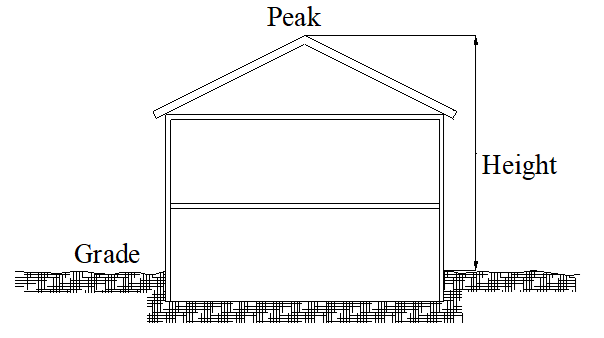
Building height means the vertical distance from the grade to the highest point of the structure.
Building line means a line on a plat indicating the limit beyond which buildings or other structures may not be erected.
Building, main, means a building in which is conducted a principal use of the lot or parcel of land upon which it is situated.
Building maintenance services means establishments primarily engaged in the provision of maintenance and custodial services to firms rather than those to individuals. Typical uses include janitorial, landscape maintenance, or window cleaning services.
Building setback line means the minimum distance required between the property line of a lot or parcel of land and any point of a building or structure related hereto, exclusive of those architectural features permitted to extend into yards or open spaces.
Building site, lot, or parcel means a lot or parcel of land occupied or intended to be occupied by a principal use and/or building permitted by this subpart and includes the property size, dimensions, open space and off-street parking required for such site. Each building site shall abut a state, or county highway, a city street, or an easement with a private road conforming to the standards of the city. Lots or parcels with proper area and size for more than one building site, but under one ownership, shall be considered as only one site until a separate lot or parcel is legally created from the original site and recorded in the county clerk's office.
Business equipment sales and services means establishments or places of business primarily engaged in the sale, rental or repair of equipment and supplies used by office, professional and service establishments to the firms themselves rather than to individuals, but excludes automotive, construction and farm equipment. Typical uses include office equipment and supply firms, small business machine shops or hotel equipment and supply firms.
Business support services means establishments primarily engaged in the provision of services of a clerical, employment, protective, or minor processing nature to firms rather than to individuals and where the storage of goods other than samples is prohibited. Typical uses include secretarial services, telephone answering services, or blueprint services.
Camping means the use of land for temporary overnight occupancy without a permanently fixed structure, such as a recreational vehicle, travel trailer, tent, bivouac, tarp or other portable bedding or shelter.
Canal or drainage channel means any existing or proposed open ditch, culvert or channel created, designed or constructed to transmit water for irrigation, drainage, or flood control purposes.
Caretaker's residence means a dwelling unit used as an accessory use to businesses for the purpose of providing essential security or essential operations on a 24-hour basis. See section 109-372 for standards.
Carport means a permanently roofed structure with not more than two enclosed sides, used or intended to be used for automobile shelter and storage belonging to the occupant of the property.
Cellar. See Basement.
Cemetery means land used or intended to be used for the burial or interment of the deceased and dedicated for cemetery purposes. The term "cemetery" includes columbaria, crematories and mausoleums and may include mortuaries and chapels when operated in conjunction with and within the boundary of such cemetery.
Centerline means the centerline of a right-of-way.
Certificate of appropriateness means a certificate issued by the landmarks commission indicating its approval of plans for alteration, construction, removal, or demolition of a landmark or of a structure within a historic district.
Certificate of economic hardship means a certificate issued by the landmarks commission authorizing an alteration, construction, removal, or demolition, even though a certificate of appropriateness has previously been denied.
City means the City of La Grande, Oregon.
City council means the city council of the city.
City official means an authorized representative within the department or division who is appointed by the city manager.
Civic administrative services means consulting, record keeping, clerical or public contact services that deal directly with the citizen, together with incidental storage and maintenance of necessary equipment and vehicles. The term "civic administrative services" includes governmental services, such as administration offices, public safety buildings (such as police stations and courthouses), and similar service facilities. Administrative and professional services may be included as an incidental or secondary use to a civic administrative service use.
Clear vision area or sight triangle means a triangular-shaped area at the intersection of two public rights-of-way or a public right-of-way and a private driveway, in which no obstruction to clear vision may be placed or maintained. See section 107-147 for standards.
Club means any building or premises used by an association of persons, whether incorporated or unincorporated, organized for some common purpose, but not including a group organized solely or primarily to render a service customarily carried on as a commercial enterprise.
Code means regulation set by federal, state, county, or city government as it pertains to subject (i.e., building code, state fire code, land development code, etc.).
Commercial means the purchase, sale or other transaction involving the handling or disposition (other than that included in the term "industry") of an article, substance, commodity or service for livelihood or profit, including motels, public garages, office buildings, offices of doctors or other professionals, outdoor advertising signs and/or structures, public stables, recreation and amusement enterprises, places where commodities or services are sold or offered for sale either by direct handling of merchandise or by agreements to furnish them.
Commission or planning commission means the planning commission of the city.
Communication equipment building means the building housing operating mechanical or electronic switching equipment of a telephone or similar communication system and personnel necessary for operation of such equipment.
Communications services means establishments primarily engaged in the provision of broadcasting and other information relay services accomplished through the use of electronic, telephonic and wireless mechanisms but excludes those classified as extensive impact services and utilities. Typical uses include television studios, radio stations or telecommunication service centers (e.g., internet service providers).
Community education means education services provided by public, private, and parochial pre-elementary, elementary, junior high and senior high school, junior colleges, colleges, universities, and trade schools.
Community garden means a piece of land (public or privately held) that is cultivated by a group of people rather than a single family or individual. It is generally managed and controlled by a group of individuals or volunteers, usually the gardeners themselves, for the purpose of growing flowers or vegetables. It may consist of one community plot, many individual plots, or a series of plots dedicated to "urban agriculture" where the produce may be grown for personal use or a market.
Community recreation means recreational, social or multi-purpose uses within buildings or open facilities, owned and operated by a governmental agency or a nonprofit community organization (e.g., ball fields, tracks, etc.).
Component means a building subassembly such as a wall, floor or roof panel, plumbing wall, electrical service wall, refrigerator panels or similar subassemblies.
Comprehensive plan means the comprehensive plan of the city, which is a plan adopted by the city council as a guide to the growth and improvement of the city including modifications, refinements and amendments which may be made from time to time.
Concert means a public performance.
Conditional use permit means a discretionary permit issued after planning commission review through a public hearings process. Specific conditional uses are listed in most land use zones in the city and are considered to have impacts beyond immediate property. Therefore, at the discretion of the planning commission, conditions may be placed upon the use to mitigate those impacts or the proposed conditional use permit may be denied.
Condominium means real estate property consisting of an individual interest in common in a portion of real property together with a separate interest in space for residential, commercial, industrial or other purposes. A condominium may include, in addition, a separate interest in other portions of such real property.
Congregate residence means any building or portion thereof which contains facilities for living, sleeping and sanitation, as required by the building code, and may include facilities for eating and cooking, for occupancy by other than a family. A congregate residence may be a shelter, convent, monastery, dormitory, fraternity or sorority house but does not include jails, hospitals, nursing homes, hotels or lodginghouses.
Construction means the act of adding an addition to an existing structure or the erection of a new principal or accessory structure on a lot or property.
Construction, actual, means the actual placing of construction materials in their permanent position, fastened in a permanent manner, except where a basement is being excavated, or where demolishing or removal of an existing building or structure has been started preparatory to rebuilding, providing in all cases the actual construction work be carried out diligently until completion of the building or structure involved.
Construction office means a trailer that is eight feet or less in width and of any length, used for commercial or business purposes temporarily on a construction site for office purposes only.
Construction sales and services means establishments or places of business primarily engaged in construction activities and storage on lots other than construction sites as well as the retail or wholesale sale, from the premises, of materials used in the construction of buildings or other structures other than retail sales of paint, fixtures and hardware; but excludes those classified as one of the automotive and heavy equipment use types. Typical uses include building materials stores, tool and equipment rental or sales, building contractors, or tree pruning and removal contractors.
Contiguous means two or more lots or parcels of land which are in direct contact along a portion of a common property line or separated only by a public street.
Contributory building or site means a building or site which individually may lack the necessary historical or architectural significance to merit designation as a historic landmark, but which, because it is either a part of a group nomination or historic district, does still contribute to the overall character of the group or district and should be protected.
Convalescent home. See Nursing home.
Convenience store means a building or group of buildings for commercial retail use and motor vehicle fuel-dispensing station, with sales within and outside of the building.
Corner lot. See Lot, corner.
Corporate headquarters/campus means the development of a large-scale operation that serves as a corporate headquarters for a state, regional, or national corporation. The development may include a single principle structure and multiple secondary structures designed to accommodate a variety of services, such as administrative offices, research and development, training, manufacturing and logistics, marketing, and other ancillary activities associated with the corporation. Additional campus services and activities may include on-site childcare, food service establishments, retail, assembly and recreation facilities, performance venue, and outdoor gathering spaces.
Council means the city council.
Court means a space, open and unobstructed to the sky, located at or above grade level, on a lot and bounded on three or more sides by walls of a building.
Coverage means that portion of a lot or building site which is occupied by any building or structure, regardless of whether said building or structure is intended for human occupancy.
Cul-de-sac means a street with one end open to traffic and terminated at the other end by a vehicle turnaround.
Cultural exhibits and library services means museum-like preservation and exhibition or works of art or library collection of books, manuscripts, etc., for study and reading.
Custom manufacturing means establishments primarily engaged in on-site production of goods by hand manufacturing which involves only the use of hand tools, domestic mechanical equipment not exceeding two horsepower or a single kiln not exceeding eight kilowatts and the incidental direct sale to consumers of only those goods produced on site. Typical uses include ceramic studios, candle-making shops or custom jewelry manufacture.
Day nursery or day care center means a facility providing supervision and care to 13 or more preschool and/or school age children, especially during the hours their parents or guardians are at work.
Dedication means an act of dedicating to a certain use or the setting aside for a particular purpose.
Demolition means any act or process that destroys in part or in whole a historic site, landmark, or a structure within a historic district.
Density, gross, means a number, expressed in dwelling units per acre, arrived at by dividing the total acreage of a given parcel by the number of dwelling units per acre allowed for the given parcel as set forth in the given zone.
Density, net, means a number, expressed in dwelling units per acre, arrived at by dividing the total acreage of a given parcel, minus the acreage of lands needed for public facilities, by the number of dwelling units per acre allowed for the given parcel as set forth in the given zone. If the amount of land needed for public facilities is unknown, a factor of 20 percent shall be used.
Design guideline means a standard of appropriate activity that will preserve the historic and architectural character of a structure or site.
Designation means the legal listing of a site, structure, building, natural feature, or district, as a historic site or landmark pursuant to this chapter.
Developer means an entity who proposes to, or does develop the land, whether it be for public or private purposes.
Development means any division of land through partitioning or subdivision. The carrying out of any construction, the making of any material change in the use or appearance of any structure or land, or a change in the intensity or type of the use, or materials located within the area of special flood hazard.
Development review committee means an informal committee consisting of city department and division representatives, utility representatives, government agency representatives and others who have expressed an interest in receiving and reviewing development plans.
Director means a person appointed by the city manager who is the director of a department or division with the city.
Domestic animal means any animal that is commonly held as a household pet by a person, other than livestock, poultry, or exotic animals.
Drainage, storm drain, or stormwater channel means an existing, or proposed open ditch, culvert or open channel created, designed or constructed to transmit water for flood control or irrigation purposes.
Driveway means an access to required off-street parking from a public street or alley.
Dwelling means the residential occupancy of a dwelling unit by a family for a period greater than 30 days. Typical uses include single-family residences, duplexes, apartments, condominiums, and manufactured home parks.
Dwelling, accessory dwelling unit (ADU), means an auxiliary and detached dwelling unit that is located in an accessory structure on the same lot as a primarily single-family dwelling and which contains its own living facilities, including provisions for sleeping, eating, cooking and sanitation, as required by the building code. (Please refer to standards set forth in chapter 107, article IX.)
Dwelling, apartment, means any structure designed exclusively for occupancy by three or more families and containing three or more separate dwelling units.
Dwelling, cottage home, means any structure on a lot or parcel that is 1,000 square feet or less and designed for occupancy by one family and containing one dwelling unit, either site built or a manufactured dwelling.
(1)
One cottage home on a lot or parcel may also be considered a detached single-family dwelling.
(2)
Two cottage homes on a lot or parcel, if one is not an accessory dwelling, shall be considered a detached duplex.
(3)
Three cottage homes on a lot or parcel shall be considered similar to a triplex.
(4)
Four or more cottage homes on a lot or parcel, shall be considered similar to multifamily apartments.
Dwelling, detached single-family, means any structure on a lot or parcel that is designed exclusively for occupancy by one family and containing one dwelling unit, either site built or a manufactured dwelling.
Dwelling, townhouse, means a one-family dwelling unit in a row of two or more, with common walls, in which each unit is located on its own lot or parcel and with its own front and rear access to the outside. No unit is located over another unit, and each unit is separated from the other unit by fire-resistant walls as required by the building code. Each dwelling is served with separate water, sewer and utility services.
Dwelling, two-family attached (duplex), means any building designed exclusively for occupancy by two families and containing two separate dwelling units.
Dwelling unit means any building or portion thereof which contains living facilities, including provisions for sleeping, eating, cooking and sanitation, as required by the building code, for not more than one family.
Easement means a grant of the right to use a portion of land for specific purposes.
Eating and drinking establishments means establishments or places of business primarily engaged in the sale of prepared food and beverages for on-premises consumption. Typical use includes restaurants, short-order (fast foot) eating places, bars, or brew pubs and also includes mobile food units and mobile food courts which are defined as follows:
Mobile food court means two or more mobile food units located on the same site for the purpose of selling food and/or beverages.
Mobile food unit means a vehicle or structure that is self-propelled or towed, in which food is cooked, prepared, processed, or converted, or which is used in selling and dispensing food or beverages.
Educational institution means public, parochial and other nonprofit institutions conducting regular academic instructions at kindergarten, elementary, secondary and collegiate levels, and including graduate schools, universities and nonprofit research institutions. Such institutions must either offer general academic instruction equivalent to standards prescribed by the state board of education or confer degrees as a college or university or undergraduate or graduate standing or conduct research. The term "educational institution" does not include schools, academies or institutions, incorporated or otherwise, which operate for a profit, nor does it include commercial or trade schools. The term "educational institution" may include, but not be limited to, classrooms, athletic fields, gymnasiums, parking, observatories, etc.
Electrical generation facility means hydro, solar, thermal, wind, or biomass electrical generation facility.
Emergency situations means any unforeseen circumstances or combination of circumstances, which calls for immediate action by the commission, in order to obtain building and demolition permits to remedy a damaging, dangerous, unhealthy, or otherwise adverse situation to a nominated or designated historic landmark.
Erect means to build, construct, attach, hang, place, suspend, or fix.
Essential services.
(1)
The term "essential services" means those public and semi-public utilities necessary to provide basic urban infrastructure to the community. The term "essential services" includes the services which are necessary to support principal development involving only minor structure such as pipelines, power lines, distribution feeders, and poles which are necessary to support principal development.
(2)
The essential services use type refers to services which are necessary to support principal development and involve only minor structures such as streets, roads, alleys, public rights-of-way, pipelines, power lines, distribution feeders, and poles which are necessary to support principal development.
Exempt off-street parking district means an area within the city depicted on a map adopted as part of this subpart, in which no off-street parking or loading is required.
Exotic animals means any lion, tiger, leopard, cheetah, ocelot, or any other cat not indigenous to the state, except the species Felis catus (domestic cat). Any monkey, ape, gorilla or other nonhuman primate. Any wolf or any canine not indigenous to the state, except the species Canis familiaris (domestic dog) any bear, except the black bear (Ursus americanus), and any snake.
Extensive impact services and utilities means services and utilities which have substantial impact on surrounding land uses. Such uses may be conditionally permitted in any zone when the public interest supersedes the usual limitations placed on land use and transcends the usual restraints of zoning for reasons of necessary location and community-wide interest. Typical places or uses are sanitary landfills, airports, detention and correction institutions, fairgrounds, public safety buildings, police stations, jails and prisons, fire stations, ambulance services, parks, wireless communication facilities, or other communication structures, substations, and electrical generation facilities.
Family means an individual or two or more persons related by blood, marriage or adoption, living together in a dwelling unit, which may also provide meals or lodging for not more than four additional persons living in the same dwelling unit; or a group of not more than five persons who need not be related by blood or marriage living together in a dwelling unit. The term "family" includes two or more handicapped persons, as defined in the Fair Housing Act of 1988, living as a single housekeeping unit.
Family day care provider means a day care provider which accommodates fewer than 13 children, including the children of the provider, in the provider's home and is considered by state law to be a residential use.
Family residential means the residential occupancy of a dwelling, by families on for a period greater than 30 days. Typical uses include occupancy of single-family residences, duplexes, apartments, condominiums, and manufactured home parks.
Federal government means the government of the United States.
Fence means any structure consisting of posts, rails and a physical barrier of lumber, vinyl, wire, wire mesh, masonry or other material approved by the community development director/planner, which is so constructed to be impenetrable to persons and animals, or mark a boundary. Fences constructed in a manner to prevent clear vision through the fence are considered sight-obscuring fences. Fences constructed in a manner that allows for clear vision through the fence are considered non-sight-obscuring fences. Such determinations shall be made by the community development director/planner.
Final subdivision means the plat of a plan, dedication, or any portions thereof, approved and prepared for filing for record with the county clerk, and containing those elements and requirements as set forth in this subpart, and as required by the Oregon Revised Statutes.
Fire lane means all fire apparatus access roads required by sections 901 and 902 of the state fire code, and all private streets shall be declared fire lanes.
Flood or flooding means a general and temporary condition of partial or complete inundation of normally dry land areas from:
(1)
The overflow of inland or tidal waters; and/or
(2)
The unusual and rapid accumulation of runoff of surface waters from any source.
Flood elevation study means an examination, evaluation, and determination of flood hazards, and if appropriate, corresponding water surface elevations.
Flood insurance rate map (FIRM) means the official map on which the Federal Insurance Administration has delineated both the areas of special flood hazards and the risk premium zones applicable to the community.
Flood insurance study. See Flood elevation study.
Floodway means the channel of a river or other watercourse and the adjacent land area that must be reserved in order to discharge the base flood without cumulatively increasing the water surface elevation more than one foot.
Floor area means the area included within the surrounding exterior walls of a building or portion thereof, exclusive of vent shafts and courts. The floor area of a building, or portion thereof, not provided with surrounding exterior walls shall be the usable area under the horizontal projection of the roof or floor above.
Floor, lowest, means the lowest floor of the lowest enclosed area (including basement). An unfinished or flood-resistant enclosure, usable solely for parking of vehicles, building access or storage in an area other than a basement area, is not considered a building's lowest floor, provided that such enclosure is not built so as to render the structure in violation of the applicable non-elevation design construction.
Food and beverage retail sales means establishments or places of business primarily engaged in the retail sales of food and beverages for home consumption. Typical uses include groceries, liquor stores, retail sales, or delicatessens.
Freeway means a four-lane or more interstate highway.
Frontage means all that portion and extent of property along or abutting one or more roads, streets, way, or dedicated street rights-of-way.
Fuel sales means establishments or places of business primarily engaged in the retail sale, from the premises, of petroleum products with the incidental sale of automotive related items. Typical uses include automobile service stations, truck stops, LP (propane) tank refill stations and LP (propane) tank exchange stations.
Funeral and interment services means establishments primarily engaged in the provision of services involving the care, preparation or disposition of human dead other than in cemeteries. The following are funeral and interment services use types:
Cremating means services involving the purification and reduction of the human body by fire. Typical uses include crematories or crematoriums.
Interring means services involving the keeping of human bodies other than in cemeteries. Typical uses include columbariums, mausoleums, or cinerariums.
Undertaking means services such as preparing the dead for burial and arranging and managing funerals. Typical uses include funeral homes or mortuaries.
Future street plan means a proposed right-of-way as may be designated by the planning commission, or such other agency or authority as provided for herein, which street is necessary for the future subdivision of property, shown on the subdivision plats and/or maps, but present dedication and/or construction of such street is not warranted.
Garage, private, means a building or a portion of a building in which only motor vehicles used by the tenants of the building on the premises are stored or kept.
Garage, public or commercial, means any garage other than a private garage, designed or used for equipping, servicing, repairing, hiring, selling, or storing motor driven vehicles.
Garage or yard sales means sales of new or used goods from a residential zone or a residential use in a nonresidential zone, limited to a maximum of six events per year and no more than four days in any two-week period.
General industrial means industrial facilities primarily engaged in manufacturing, custom manufacturing, compounding, processing, assembling, packaging, treatment or fabrication of materials and property, cabinet shops, textiles, and metal fabrication.
Geological hazards means areas which have high groundwater; steep slopes where basalt is interbedded with tuff and in those areas of colluvium slopes subject to instability.
Grade means the lowest point of elevation of the finished surface of the ground, paving or sidewalk within the area between the building and the property line or, when the property line is more than five feet from the building, between the building and a line five feet from the building. For the purpose of determining building height, the average of the grades on all four sides of a building shall be used in determining the grade.
Grade, finished, means the finished grade or elevation of the ground or surface as measured from the ground level to the finished grade of the sidewalk, curb, street, or foundation.
Greenhouse means a building or structure constructed chiefly of glass, glass-like or translucent material, cloth or lath, which is devoted to the protection or cultivation of flowers or other plants and shall be classified as a building in determining lot coverage.
Group care residential means the residential occupancy and services provided in residential facilities or in facilities authorized to provide living accommodations to groups of more than five persons who are not related by blood, marriage or adoption, on a weekly or longer basis. Typical uses include halfway houses, intermediate care facilities, nursing homes, convalescent hospitals, foster care homes, residential facility, residential home, and rest homes. The term "group care residential" does not include hospitals, prisons, or other extensive impact services.
Guest room means any room used or intended to be used by a guest for sleeping purposes. Every 50 square feet of superficial floor area in a dormitory shall be considered to be a guest room.
Half street means a portion of the ultimate width of a street, usually along the edge of a subdivision where the remaining portion of the street has been or could later be provided by another subdivision.
Hazardous or dangerous building means a building that has been determined by the building official to be structurally unsound or unsafe to the general public in accordance with the provisions of section 203 of the building code.
Health studio or salon means a studio or salon providing facilities and services to aid in personal health pursuits.
Heavy industrial means all other industrial plants such as processing of raw materials and tannery.
Hedge means trees, shrubs, or other vegetation so arranged to form a physical barrier or enclosure.
Height. See Building height.
Heliport means an area of land or water or a structural surface which is used, or intended for use, for the landing and take-off of helicopters, and any appurtenant areas which are used, or intended for use, for heliport buildings and other heliport facilities.
Helistop means an area of land or water or a structural surface which is used, or intended for use, for the landing and take-off of helicopters, where there is no fueling, de-fueling, maintenance, repairs or storage of helicopters.
Highway includes a parkway, major or secondary highway or freeway.
Historic district means an area of defined geographic boundaries which may contain one or more historic sites or landmarks, and which may have within its boundaries other properties that, while not of such historic or architectural significance to be designated as landmarks or historic sites, nevertheless contribute to the overall visual characteristics and integrity of the significant properties within the district.
Historic site means any district, building, structure, object, or site formally designated to the city list of historic sites pursuant to procedures prescribed herein.
Historic structure means a structure within the city and its urban growth area which has historical significance, and is registered with federal, state, or city registries.
Home occupation means an occupation or enterprise carried on within a dwelling for financial gain or support by a member or members of the immediate family residing within the dwelling.
Hospital means an institution providing physical or mental health services, inpatient or overnight accommodations, and medical or surgical care of the sick or injured. Hospital includes sanitarium, sanatorium and institutions for the cure of chronic drug addicts and mental patients.
Hotel means any building or portion of any building with access provided through a common entrance, lobby or hallway to six or more guest rooms, having no cooking facilities, and which rooms are designed, intended to be used or are used, rented or hired out as temporary or overnight accommodations for guests.
Household pet means any domesticated animal commonly maintained in residence with humans.
Improvements means physical facilities and infrastructure, including, but not limited to, curbs, gutters, sidewalks, streetlights, street signs, roadbed, road surface, storm drains and appurtenances, fire hydrants, sanitary sewers and appurtenances, and underground utilities.
Incidental use (accessory use) means the use which may occur on a lot or parcel in conjunction with the primary use of the property but which is clearly incidental and subordinate to the primary use of the property.
Industry means the manufacture, fabrication, processing, reduction or destruction of any article, substance or commodity, or any other treatment thereof, in such a manner as to change the form, character, or appearance thereof, including storage elevators, truck terminals and the like, warehouse, wholesale storage and other similar types of endeavors.
Intensive level survey means detailed historic research and documentation of the structure's significance, including information on previous owners, the builder, and or architect; significant events that may have taken place on the property; a detailed description of the building and site, including the form and style of the building, distinctive architectural features, exterior materials, and a description of any additions or changes that may have altered the original character of the structure.
Junk means any old or scrap aluminum, copper, brass, rope, rags, batteries, paper, trash, rubber, tires, debris, waste; or junked, dismantled, wrecked, unlicensed, scrapped or ruined motor vehicles, or motor vehicle parts and machinery, iron, steel or other old or scrap ferrous, or nonferrous material, metal or nonmetal materials, glass, wood, appliances and similar materials. Junk shall also include the baling of cardboard, cardboard boxes, paper and paper cartons and any other discarded materials.
Junk yard means any establishment or place of business or residence where there is accumulated on the premises three or more inoperable motor vehicles or an equivalent volume of junk that is maintained, operated or used for storing, keeping, buying or selling of junk and the term "junk yard" includes automobile graveyards, garbage dumps and scrap metal processing facilities. Junk yards along state highways are regulated by the state.
Kennel means any lot or premises maintained for the primary purpose of boarding, breeding, raising or training of four or more cats, dogs, or other animals at least four months of age for a fee, or for sale. The term "kennel" does not include the incidental or accessory use of a property for animal breeding, provided that a home occupation permit is obtained pursuant to chapter 101, article III, division 11.
Kitchen means any space within a building designed, intended to be used, or used for cooking or preparation of food.
Landmark means any property or structure formally designated to the state landmarks register pursuant to procedures prescribed herein.
Landmarks commission means the city landmarks commission.
Landscaping means the planting and maintenance of some combination of trees, shrubs, vines, ground covers, flowers or lawns. In addition, the combination or design may include natural features such as rock, stone, and structural features, including, but not limited to, foundations, reflecting pools, art works, screens, walls, fences and benches.
Laundry services means establishments primarily engaged in the provision of laundering, dry cleaning or dying services other than those classified as personal services. Typical uses include laundry agencies, diaper services or linen supply services.
Legal description means a method by which the outer boundaries of the building site or premises and all applicable easements, restrictions, or covenants are described or established by reference to established points, monuments, etc.
Legislative means a term applied to the action of public officials who determine what the law shall be for the regulation of future issues falling under its provisions. This is to be distinguished from a judicial act, which is a determination of what the law is in relation to some existing issues.
Livestock means horses, mules, jackasses, cattle, llamas, sheep, goats, swine, domesticated fowl and any fur-bearing animal bred and maintained commercially or otherwise, within pens, cages and hutches. As per ORS 596.020, the breeding, raising, producing in captivity, and marketing of foxes, mink, chinchilla, rabbit or caracul is an agricultural pursuit. All such animals raised in captivity are domestic fur-bearing animals within the meaning of ORS 596.010.
Loading space means an area, other than a street or alley, on the same lot with a building or group of buildings, which is permanently reserved and maintained for the temporary parking of commercial vehicles while loading or unloading merchandise or materials.
Lodging means establishments primarily engaged in the provision of lodging services on a 30 day or less basis with incidental food, drink and other sales and services intended for the convenience of guests. The following are lodging use types:
Campground means campground services involving camping areas for travelers in recreational vehicles or tents. Typical uses include recreational vehicle parks.
Lodging services involving the provision of room and/or board includes motels, hotels, short-term rentals and emergency shelters (e.g., warming and homeless).
Resort means resort services including the provision of extensive outdoor recreation and entertainment services especially for vacationers. Typical uses include resort and recreational facilities, health spas, resort hotels and motels, and recreation camps.
Lot means a unit of land that is created by a subdivision of land, except that when used in conjunction with other terms, such as lot area or lot depth. The term "lot" may refer to both a parcel as well as a lot as defined here.
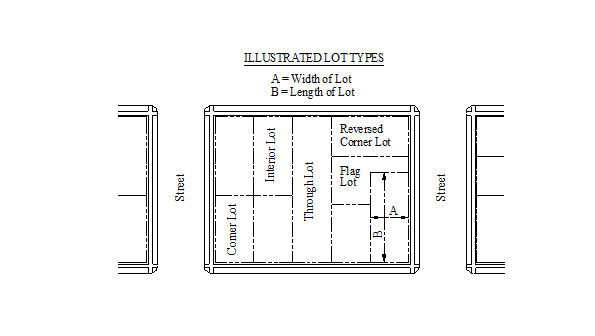
Lot, corner, means a lot at least two adjacent sides of which abut streets other than alleys, provided the angle of intersection of the adjacent streets does not exceed 135 degrees.
Lot, flag, means a lot that is mostly separated from a street by other lots but that has a long, narrow extension (e.g., flagpole) that reaches to the street; also called a panhandle lot. Results in an inefficient design, wasting land, delaying or precluding development of public roads, and generally not recommended.
Lot, interior, means a lot or parcel of land other than a corner lot.
Lot, island or land locked, means a parcel or lot which is completely surrounded on all four sides by another lot or parcel.
Lot, reversed corner, means a lot that has its frontage at right angles to the general pattern that prevails in a block or neighborhood.
Lot, substandard, means a lot which area, width or depth is less than that required by the zone in which it is located.
Lot, through, means an interior lot having a frontage on two streets and/or highways provided each frontage is at least ten feet wide.
Lot area means the total area, measured in a horizontal plane included within the lot lines of a lot or parcel of land.
Lot depth means the horizontal distance measured between the mid-points of the front and rear lot lines.
Lot line adjustment means an adjustment of a property line by the relocation of a common boundary where an additional unit of land is not created and where the existing unit of land reduced in size by the adjustment complies with any applicable zoning ordinance. The relocation of a common property line between two abutting properties.
Lot line, front.
(1)
In the case of an interior lot, the term "front lot line" means the lot line separating the lot from the street.
(2)
In the case of a corner lot, the term "front lot line" may be either lot line.
(3)
In the case of a flag lot, the term "front lot line" may be either the lot line parallel to the street providing access or the lot line parallel to the flagpole.
Lot line, rear, means a lot line which is opposite and most distant from the front lot line. For a triangular shaped lot, the rear lot line shall mean a line having a length of not less than ten feet within the lot which is parallel to the front lot line, or parallel to the chord of a curved front lot line, and at the maximum distance from the front lot line.
Lot line, side, means any lot boundary line which is not a front lot line or a rear lot line.
Lot of record means a lot, the legal description of which is recorded in the office of the county recorder.
Lot width means the horizontal distance between the side lot lines measured at right angles to the lot depth line at a distance midway between the front and rear lot lines.
Manufactured (mobile) home means structures with a Department of Housing and Urban Development (HUD) label certifying the structure is constructed in accordance with the National Manufactured Housing Construction Safety Standards Act of 1974, as amended on August 22, 1981.
Manufactured home park means any place where four or more manufactured dwellings are parked within 500 feet from one another on a lot, tract or parcel of land under the same ownership, the primary purpose of which is to rent space or keep space for rent to any person for a charge or fee paid or to be paid for the rental or use of facilities or to offer space free in connection with securing the trade or patronage of such person. May be occupied by both manufactured dwellings and park trailers according to ORS 446.003.
Map means a final diagram, drawing, or other writing concerning a major or minor partition.
Marijuana means all parts of the plant cannabis family Cannabaceae, whether growing or not; any part of the plant, the seed of the plant, the resin extracted from any part of the plant, and every compound, manufacture, salt, derivative, mixture, or preparation of the plant or its resin, whether kept for medicinal use or otherwise.
Marijuana facility means any establishment related to producing, processing, testing, wholesaling, selling, and/or dispensing of marijuana as defined by this subpart. The following are marijuana facility types:
Marijuana processing means the processing, drying, compounding or conversion of marijuana into cannabinoid products, cannabinoid concentrates or cannabinoid extracts. A marijuana processing facility may also include packaging and storage of marijuana related products after processing.
Marijuana producer means the manufacturing, planting, cultivation, growing or harvesting of marijuana.
Marijuana retailer means a business engaged in displaying and selling marijuana or any product processed from the plant to a consumer in a retail environment.
Marijuana testing means a laboratory accredited by ORELAP and licensed by OLCC to sample and perform tests on marijuana and/or marijuana products.
Marijuana wholesaler means a business engaged in purchasing marijuana for resale to a person other than to a consumer.
Medical marijuana dispensary means a business registered under the state medical marijuana program (ORS 475B.858) to sell medical marijuana to a consumer.
Marginal access street means a minor street parallel and adjacent to a major arterial street providing access to abutting properties but protected from through traffic.
Marquee means a permanent, roofed structure attached to and supported by the building and projecting over public property.
Master plan means a plan for an entire property, showing how the entire property will ultimately be divided into developable lots and served with streets and utilities in conformance with applicable city standards.
Material recovery facility means a solid waste management facility which separates materials for the purposes of recycling from an incoming mixed solid waste stream by using manual and/or mechanical methods, or a facility at which previously separated recyclables are collected.
Medical services means establishments primarily engaged in the provisions of personal health services ranging from prevention, diagnosis and treatment or rehabilitation services provided by physicians, dentists, nurses and other allied health professionals as well as the provision of medical testing and analysis services. Typical uses include medical clinics, dental clinics chiropractic clinics, dental laboratories or allied health professionals.
Minor street means a street intended primarily for access to abutting properties.
Mobile office means a temporary office for construction or sales purposes.
Modular home. See Prefabricated structures.
Motel means one or more buildings containing guest rooms or dwelling units, with one or more such rooms or units having a separate entrance leading directly from the outside of the building or from an inner court/hallway. Such facilities are designed, used, or intended to be used, rented or hired out, for temporary or overnight accommodations for guests, and are offered primarily to automobile tourists or transients by signs or other advertising media. The term "motel" includes auto courts, motor lodges, tourist courts and motor hotels.
Motor vehicle means a device licensed by the state by which any persons or property may be propelled, moved, or drawn upon a street or highway, excepting a device moved by human power or used exclusively upon stationary rails or tracks.
Neighborhood convenience center means one or more buildings for commercial retail use, which does not exceed 5,000 square feet of gross floor area per building, one story in height, complies with the setbacks of the zone, and has all sales within the buildings. The primary consumer group would be residents in the general area. Allowable uses for neighborhood convenience centers are limited to:
(1)
Bed and breakfast inns;
(2)
Administrative and professional services;
(3)
Dwelling unit, limited to one unit associated with a neighborhood convenience use;
(4)
Eating and drinking establishments;
(5)
Food and beverage retail sales;
(6)
Fuel sales;
(7)
Medical services;
(8)
Personal services;
(9)
Postal services. except major processing and distribution centers; and
(10)
Retail sales.
Drive-through facilities are not permitted for neighborhood convenience centers.
New construction means structures for which the start of construction commenced on or after September 30, 1980, and includes any subsequent improvements to such structures, pertaining to flood zone.
Nomination means the act of proposing a site, structure, building, natural feature, or district to be formally designated as a historic resource, in accordance with this subpart.
Nonconforming structure means any structure or improvement that was lawfully established and in compliance with all applicable laws at the time this subpart or any amendment thereto became effective, but which, due to the application of this subpart or any amendment thereto, no longer complies with all the applicable regulations and standards of the zone in which the structure or improvement is located.
Nonconforming use means any use of land or property that was lawfully established and in compliance with all applicable ordinances and laws at the time this subpart or any amendment thereto became effective but which, due to application of this subpart or any amendment thereto, no longer complies with all of the applicable regulations and standards of the zone in which the use is located.
Nursing home means a facility, other than a single-family dwelling, providing care and nurturing for the elderly.
Occupancy means the purpose for which a building is used or intended to be used. A change in occupancy occurs when the use of the building is changed.
Off-premises advertising sign. See the sign ordinance.
Official map means any map adopted by the planning commission which has depicted thereon existing or proposed street locations and designations, land use, zoning, building and setback lines, house numbering, and such other information pertaining to the development of land; a copy of which is on file with the city.
Open sales lot means places of business primarily engaged in the sale and/or rental of new and/or used manufactured homes, prefabricated structures, or any other good or service sold in the outdoor environment. Open sales lots shall be processed in accordance with article III, division 6 of this chapter.
Open space means the area of a lot which is not occupied by building coverage, parking lot or driveways. The term "open space" also can include lands dedicated to the public for park purposes, recreational, scenic, or other public purposes.
Ordinance means an ordinance duly enacted by the city council.
Owner means the individual, firm, association, syndicate, partnership or corporation having proprietary interest in real property.
Owner of record means the person, corporation, or other legal entity listed as owner on the records of the county.
Parcel means a unit of land that is created by partitioning of land.
Park means a public or private open space providing outdoor passive and active recreation opportunities.
Park trailer means a vehicle built on a single chassis, mounted on wheels, designed to provide seasonal or temporary living quarters which may be connected to utilities for operation of installed fixtures and appliances, of such a construction as to permit set-up by persons without special skills using only hand tools which may include lifting, pulling and supporting devices and a gross trailer area not exceeding 400 square feet when in the set-up mode.
Parking space means a readily accessible area, not including driveways, ramps, loading or work areas, maintained exclusively for the parking of one motor vehicle.
Parkway means a parkway shown as such on a master plan of streets and highways.
Participant sports and recreation means establishments or places primarily engaged in the provision of sports or recreation by and for participants. Any spectators would be incidental and on a nonrecurring basis. Participant sports and recreation use types include those uses conducted within an enclosed building, such as bowling alleys, arcades, youth centers, martial arts studios, dance studios, health/fitness clubs, gymnasiums or billiard parlors, indoor shooting ranges and those uses conducted in open facilities such as golf courses and driving ranges, and miniature golf courses.
Parties to the hearing means all persons whose names appear as interested parties, and all individuals, corporations, partnerships, or any other groups who appear either in person or who submit written testimony to a public hearing.
Partition means either an act of partitioning land or an area or tract of land partitioned.
Partition, land, means to divide land into two or three parcels of land within a calendar year, but does not include:
(1)
Division of land resulting from a lien foreclosure, foreclosure of a recorded contract for the sale of real property or the creation of cemetery lots;
(2)
An adjustment of a property line by the relocation of a common boundary where an additional unit of land is not created and where the existing unit of land reduced in size by the adjustment complies with any applicable zoning ordinance; or
(3)
A sale or grant by a person to a public agency or public body for state highway, county road, city street or other right-of-way purposes, provided that such road or right-of-way complies with the applicable comprehensive plan and ORS 215.213(2)(q)—(s) and 215.283(2)(p)—(r).
Partition, major, means a partition which includes the creation of a road or street.
Partition, minor, means a partition that does not include the creation of a road or street.
Partition plat includes a final map, other writing containing all the descriptions, locations, specifications, provision, and information concerning a major or minor partition.
Patio means a roofed or unroofed area permanently open on the long side and not less than two sides, used solely for outdoor living. Said patio will be considered to be open when enclosed by screening or any structure or structural material forming a physical barrier so not less than 65 percent of the vertical surface is permanently open to permit the transmission of light, air and vision through said surface in a horizontal plane, but which is impenetrable to persons or animals.
Pedestrianway means a right-of-way reserved for pedestrian traffic.
Person means any individual, firm, partnership, joint venture, association, social club, fraternal organization, corporation, estate, trust, business trust, receiver, syndicate, district, political subdivision, foreign country, or any other group or combination acting as a unit.
Personal services means establishments primarily engaged in the provision of informational, instructional, personal improvement and similar services of a nonprofessional nature, but excludes services classified as spectator sport and entertainment, participant sports and recreation. Typical uses include photography studios, barber shops, hair salons, or massage therapy.
Petroleum bulk plant means any premises used for the wholesale distribution and storage of gasoline, oil, or petroleum, but shall not include the storage of liquid petroleum gas, a tank farm, or be connected to a pipeline constituting in effect, a petroleum terminal.
Planned unit development means a development approved by the proper authorities based on a comprehensive and complete design or plan denoting all forms of uses of the land affected by the plan.
Plat includes a final subdivision plat, diagram, replat, or partition plat, containing all the descriptions, locations, specifications, dedications, provisions, and information concerning a subdivision.
Plat, preliminary, means the map, drawing, diagram, replat or other writing submitted with an application to subdivide land.
Plat, subdivision, includes a final map and other writings containing all descriptions, locations, specifications, dedications, provisions, and information concerning a subdivision.
Porch or veranda means an open, often roofed structure; an appendage to a building.
Postal services means mailing services and processing and distribution centers, as traditionally provided by the United States Postal Service, United Parcel Service, and Federal Express.
Poultry means domestic birds and/or fowl customarily raised or kept on a farm for profit or other purposes.
Prefabricated building means a structure built as one unit or divided into transportable sections and intended to be permanently installed on a building site.
Prefabricated structure means a building or subassembly constructed entirely or in part using closed construction which has been in whole or substantial part manufactured at an off-site location to be installed on a building site but does not include a manufactured home or recreational vehicle.
Primary structure. See Building, main.
Private home office means an office contained within the residence of a member of a profession which is used by said professional in the provision of such professional's services.
Private street means any part of a development outside of public rights-of-way open to vehicular circulation, except parking spaces and driveways.
Public research area means land and the appurtenant buildings operated by governmental, educational and other public or nonprofit bodies dedicated to pure or applied scientific discovery in the fields of agriculture, wildlife management, forestry, geology, archaeology, ecology, astronomy, and the like.
Public utility means any corporation, including municipal or quasi municipal corporation, service district, company, individual, or association that owns or operates any plant or equipment:
(1)
For the conveyance of telecom, internet or telephone services, with or without wires;
(2)
For the transportation of water, gas, or petroleum products by pipeline;
(3)
For the production, transmission, delivery or furnishing of heat, light, water, or electricity;
(4)
For the transmission and delivery of television pictures and sound by cables;
(5)
For the transportation of persons or property by street railroads or other street transportation or common carriers;
(6)
For the treatment and disposal of sewage; or
(7)
For the disposal of stormwater runoff.
Quasi-judicial means a type of process used in a contested case hearing in which the land use issue involves a specific use of property or properties and the impact of the decision will be limited to a specific area of the city.
Recreational vehicle means a unit, with or without motive power, which is designated for human occupancy and is used temporarily for recreational or emergency purposes (including camping trailers, motor homes, park trailers and travel trailers, which are separately defined in this section).
Recreational vehicle park means a plot of land upon which two or more recreational vehicle sites are located, established or maintained for occupancy by recreational vehicles of the general public as temporary living quarters for recreational or vacation purposes.
Recycling center means a business which receives and markets source separated recyclables. Any process by which solid waste materials are transformed into new products in such a manner that the original products may lose their identity. See also Material recovery facility.
Redevelopment plan, also known as a "shadow plat" or "ghost subdivision," means where the applicant demonstrates how the property may be developed in the future. Buildings on the interim lots would be located so as not to interfere with the final property boundaries shown on the redevelopment plan.
Religious assembly means religious services only involving public assembly such as customarily occurs in synagogues, temples, and churches. This use type does not include parochial schools. Permitted accessory uses include religion classes, weddings, funerals, childcare and meal programs. Private or parochial school education for pre-kindergarten through grade 12 or higher education facilities shall not be considered accessory uses.
Relocation means any relocation of a building or structure on its site or to another site in the city.
Repair services means establishments primarily engaged in the provision of repair services to individuals and households rather than firms. Typical uses include appliance repair shops, apparel repair firms, or instrument repair firms.
Replat includes a final map of reconfiguration of lots and easements of a recorded subdivision or partition plat and other writings containing all the descriptions, locations, specifications, dedications, provisions, and information concerning a recorded subdivision. Pursuant to state law, a replat shall not serve to vacate a public street or road.
Research services means establishments primarily engaged in research of an industrial or scientific nature which is provided as a service or which is conducted by and for a private firm but excludes medical testing and analysis and product testing. Typical uses include electronics research laboratories, space research and development firms, soil and material testing labs, or pharmaceutical research labs.
Residential facility means a facility licensed under the authority of the department of human resources (DHR) providing residential care of six to 15 individuals.
Residential home means a home licensed under the authority of the department of human resources (DHR) which provides residential care for five or fewer individuals.
Rest home. See Nursing home.
Retail sales means places of business primarily engaged in the sale of commonly used goods and merchandise, but excludes those classified as automobile and equipment, construction sales and services and gasoline sales.
Right-of-way means the area between boundary lines of a street, way or other easement.
School, private, means a building wherein instruction is given to pupils in the arts, crafts, or trades and is operated as a commercial enterprise as distinguished by schools endowed and/or supported by taxation.
School, public, means a school under the control of and financed by a legal constituted public school district in the state.
School, trade, means private schools offering instruction in the technical, commercial and/or trade skills, such as real estate schools, business colleges, electronic schools, automotive and aircraft technician schools, and similar commercial establishments.
Scrap operations means places of business primarily engaged in storage, dismantling or other processing of used or waste material which are intended for re-use in their original form. Typical uses include junk yards, paper salvage yards, auto salvage yards, or appliance salvage yards.
Setback means the line which defines the width or depth of a required yard. Such setback line is parallel with the property line. No portion of the building shall project into such yard except as provided for in this subpart.
Short-term rental means rental of a dwelling unit or portion of a dwelling unit for a period of less than 30 consecutive days. The following are short-term rental use types:
(1)
Bed and breakfast inn or hosted home share means a single-family dwelling, occupied by the owner or manager, in which no more than five guest sleeping rooms are provided for short-term rental, with or without a meal. This includes the short-term rental of a portion of the primary dwelling (e.g., bedrooms) or an accessory dwelling unit on the same property.
(2)
Vacation home rental means the short-term rental of an entire single-family dwelling unit, which may also include an accessory dwelling on the same property, in which no more than five guest sleeping rooms are provided for short-term rental.
Sidewalk means a pedestrian walkway with a permanent surface.
Sight triangle. See Clear vision area.
Significant building, structure, or site means a building, structure, or site which has been found by the landmarks commission, or a qualified historic preservation consultant, to possess enough historic and/or architectural value and structural integrity to be potentially eligible for listing on the city historic sites list or landmarks register.
Site plan means a plan other than a building plan showing the physical arrangement, design or use of a lot or parcel of land, buildings or structures indicating uses, form, dimensions and other pertinent data.
Slope easement means a grant of the right to use a strip of land for the purpose of constructing embankment or earth slopes, when required for the purpose of maintaining or creating a safe and stable topographical condition.
Solid fill project means any operation of a parcel of land where more than 1,000 cubic yards of solid fill materials are deposited for any purpose including the grading or reclaiming of land.
Solid waste means decomposable or non-decomposable waste, including, but not limited to, garbage, rubbish, refuse, ashes, wastepaper, and cardboard.
Solid waste transfer facility means a fixed or mobile facility other than a collection vehicle where solid waste is taken from a smaller collection vehicle and placed in a larger transportation unit for transport to a final disposal location.
Spectator sports and entertainment means establishments or places primarily engaged in the provision of cultural, entertainment, athletic and other events to spectators as well as those involving social or fraternal gatherings. Spectator sports and entertainment use types include those uses conducted both within open facilities or within an enclosed building. Typical uses include small theaters, meeting halls, large exhibition halls, service club and membership organizations, social and fraternal orders, or sports stadiums and arenas, and golf courses.
Start of construction includes substantial improvement, and means the date the building permit was issued, provided the actual start of construction, repair, reconstruction, rehabilitation, addition placement, or other improvement was within 180 days of the permit date. The actual start means either the first placement of permanent construction of a structure on a site, such as the pouring of slab or footings, the installation of piles, the construction of columns, or any work beyond the stage of excavation; or the placement of a manufactured home on a foundation. Permanent construction does not include land preparation, such as clearing, grading and filling; nor does it include the installation of streets and/or walkways, excavation for a basement, footings, piers, or foundations, or the erection of temporary forms, installation on the property of accessory buildings, such as garages or sheds not occupied as dwelling units or not part of the main structure.
State means the State of Oregon.
Storm drainage means a system of open or enclosed drainageways designed to direct and carry stormwater runoff away from the site.
Story means that portion of a building included between the upper surface of any floor and the upper surface of the floor next above, except that the topmost story shall be that portion of a building included between the upper surface of the topmost floor and the ceiling or roof above. If the finished floor level directly above a usable or unused under-floor space is more than six feet above grade, as defined herein, for more than 50 percent of the total perimeter or is more than 12 feet above grade, as defined herein, at any point, such usable or unused under-floor space shall be considered as a story.
Story, first, means the lowest story in a building which qualifies as a story, as defined herein, except that a floor level in a building having only one floor level shall be classified as a first story, provided such floor level is not more than four feet below grade, as defined herein, for more than 50 percent of the total perimeter, or not more than eight feet below grade, as defined herein, at any point.
Story, half, means a story with at least two or its opposite sides situated immediately under a sloping roof, with the floor area of the said story not in excess of two-thirds of the floor area of the floor immediately below it.
Stream means a perennial natural watercourse.
Street and public street.
(1)
The term "street" means:
a.
A public or private way which is created to provide ingress and egress for persons to one or more lots, parcels, areas or tracts of land.
b.
The portion of street right-of-way developed for vehicular traffic.
(2)
The term "public street" means:
a.
Any street officially established for the use of the public by the city council under procedures authorized in the state statutes;
b.
Any street established by a good and sufficient deed, properly executed forever dedicating the land and granting such public street easement, which deed has been, or is, accepted by the city council and placed on record; or
c.
Any street dedicated to the use of the public for street purposes by a final plat of a subdivision, which has been approved and accepted by the city council and placed on record.
(3)
The following uses are examples of street classifications:
Arterial street means a public street which provides primary access into and through the city and connects with county arterials and/or state highways.
Collector street means a public street which connects individual land uses within neighborhood to an arterial street.
Local street means a public street within neighborhoods that provides access to abutting properties.
Semi-private local street means a public street that is within neighborhoods that provides access to abutting properties, but which includes private street improvements that are maintained entirely by the adjacent property owners and not by the city.
Street plug or reserve strip means a narrow strip of land controlling access to a street or half street, title to which is dedicated to the city and the disposal of which lands shall be placed within the jurisdiction of the city council for disposal under conditions approved by the planning commission.
Structural alteration means any change in the supporting members of a building, such as bearing walls, column, beam or guides, floor or ceiling joists, roof rafters, roof diagrams, roof trusses, foundations, piles, retaining walls or similar components.
Structure means anything constructed or erected, which requires a fixed location on the ground, or is attached to something having a fixed location on the ground.
Structure, advertising, means a structure existing, erected or maintained to serve exclusively as a stand, frame or background for the support display of signs.
Structure, primary. See Building, main.
Subdivide means the division of an area or tract of land into four or more lots within a calendar year, when such area or tract of land exists as a unit or contiguous units of land under single ownership at the beginning of such year.
Subdivider means any person who causes land to be subdivided into a subdivision for themself or for others, or who undertakes to develop a subdivision, but does not include a public agency or officer authorized by law to make subdivisions.
Subdivision means the act of subdividing land or an area or tract of land which has been subdivided.
Substantial damage means damage of any origin sustained by a structure whereby the cost of restoring the structure to its before damaged condition would equal or exceed 50 percent of the market value of the structure before the damage occurred. Substantial damage also means flood-related damages sustained by a structure on two separate occasions during a ten year period for which the cost of repairs at the time of each such flood event, on the average, equals or exceeds 25 percent of the market value of the structure before the damage occurred.
Substantial improvement.
(1)
The term "substantial improvement" means any repair, reconstruction, rehabilitation, addition, or other improvement of a structure, the cost of which equals or exceeds 50 percent of the market value of the structure either:
a.
Before the start of construction of the improvement or repair; or
b.
If the structure has been damaged and is being restored, before the damage occurred.
For the purposes of this definition, substantial improvement is considered to occur when the first alteration of any wall, ceiling, floor, or other structural part of the building commences, whether or not that alteration affects the external dimensions of the structure.
(2)
The term "substantial improvement" does not, however, include either:
a.
Any project for improvement of a structure to comply with existing state or local health, sanitary, or safety code specifications which are the minimum necessary to ensure safe living conditions; or
b.
Any alteration of a structure listed on the National Register of Historic Places or a state inventory of historic places, provided that the alteration will not preclude the structures continued designation as a historic structure.
(3)
The term "substantial improvement" also includes structures that have incurred repetitive loss or substantial damage regardless of the actual amount of work performed.
Swimming pool means an artificial structure and its appurtenances, which contains water more than two feet deep which is expressly designated or which is used with the knowledge and consent of the owner or operator for swimming.
Temporary real estate office means a temporary real estate office in a dwelling, not including a manufactured home, within a subdivision, shall be permitted subject to provisions pursuant to the applicable zone.
Temporary use means impermanent usage of land or structure on a short-term basis. Uses to be permitted include, but are not limited to, signs, temporary office structures, trailers used as construction offices, medical hardship residences, and units used seasonally as locations for food vending. Any temporary uses must meet applicable codes as they apply to any occupied structure.
Tenant or occupant includes any person holding a written or oral lease of, or who occupies the whole or part of, a building or land, either alone or with others.
Tentative plat means a clearly legible and approximate drawing of the proposed layout of streets, blocks, lots, and other elements of a subdivision which shall help furnish a basis for the planning commission's approval or denial of the general layout of the subdivision.
Transient means a person normally limited to a 30-day (or less) occupancy.
Transportation plan means the transportation plan of the city as adopted by the city council.
Transportation services means establishments primarily engaged in the provision of transportation services. Typical uses include taxi companies or bus depots.
Unit means a room or suite of two or more rooms occupied or suitable for occupancy as a residence for one family.
Urban area means all lands located within the long-term urban growth boundaries shown in the comprehensive master plan.
Use means the primary or principal activity, structure, or facility occurring upon land.
Use, accessory, means an activity, facility, or structure which is incidental and subordinate to a permitted use established on the same lot and which may be necessary for the successful operation of said permitted use.
Vacation or vacate means a process by which a public jurisdiction returns to private ownership a public right-of-way, alley, or portion thereof. The term "vacation" also applies to returning subdivision plats to their former lot configuration. There are specific state statutes to be followed.
Variance means a specific procedure in which a deviation is permitted from the specific terms of this subpart. Variance may be granted for some physical requirement of this subpart but not to grant another land use other than specified by this subpart.
Wholesaling, storage and distribution means establishments or places of business primarily engaged in wholesaling, storage, distribution and open-air handling of materials and equipment other than live animals and plants. The following are wholesaling, storage, and distribution use types:
Storage means open air and enclosed building storage of non-combustibles. Typical uses include building contractors, RV storage, boat and trailer storage, household storage, personal storage and mini-warehouses (mini-storage).
Wholesaling, storage and distribution, heavy, means open air storage, distribution and handling of materials and equipment. Typical uses include monument or stone yards, grain elevators, open storage yards, or petroleum storage facilities.
Wholesaling, storage and distribution, light, means wholesaling, storage and warehouse services within enclosed structures. Typical uses include wholesale distributors, wholesale buying operations, storage warehouses, and moving and storage firms.
Wireless communication facility means any structure built for the primary purpose of supporting antennas and their associated facilities used to provide services licensed by the FCC. Associated facilities include, but are not limited to, towers, power supplies, electronic equipment, antennas, fences and other support structures.
Wrecking business means the conducting, in whole or in part, the buying, selling or dealing in vehicles for the purpose of wrecking, dismantling, disassembling and offering for sale the used vehicle components thereof. Carries on or conducts, in whole or in part, the business of buying, selling or dealing in vehicles for the purpose of wrecking, dismantling, disassembling or substantially altering the form of any motor vehicle. Carries on or conducts, in whole or in part, the business of selling at wholesale wrecked, dismantled, disassembled or substantially altered vehicles. Engages in the activity of wrecking, dismantling, disassembling or substantially altering vehicles including the crushing, compacting or shredding of vehicles. The local government shall also control the licensing of wrecking operations.
Yard means an open space on a lot or parcel of land, other than a court, unoccupied and unobstructed by a building from the ground upward. See following diagram.
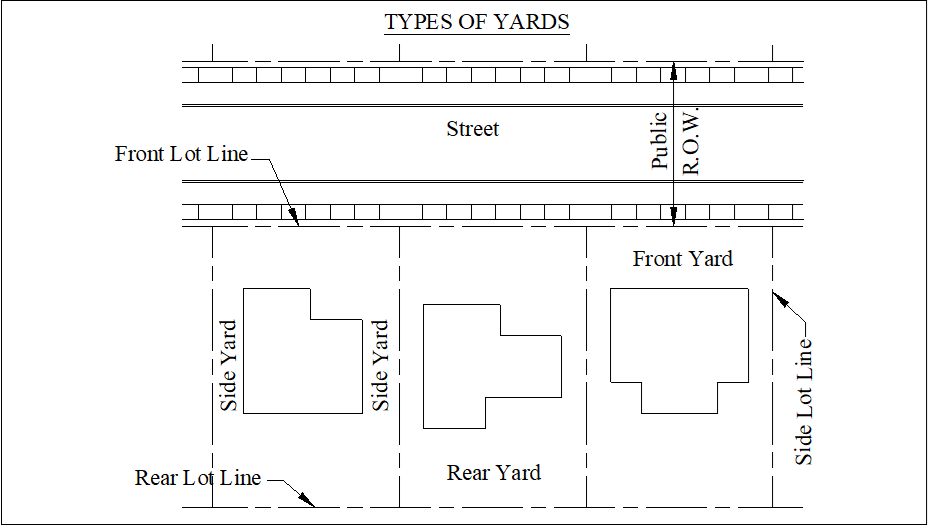
Yard, front, means a yard extending across the full width of the lot or parcel of land. The depth of a required front yard shall be a specified horizontal distance between the front lot line, where the front lot line is co-terminus with the property line of a fully widened street or highway, or the ultimate street line of a partially widened street or highway and a line parallel thereto on the lot or parcel of land. In the case of a flag lot, the front yard shall be either the yard located parallel to the street providing access, or the yard located parallel to and abutting the flagpole.
Yard, rear, means a yard extending across the full width of the lot or parcel of land. The depth of a required rear yard shall be a specified horizontal distance between the real lot line and a line parallel thereto on the lot or parcel of land.
Yard, side, means a yard extending from the required front yard, or the front lot line where no front yard is required to the required yard or to the rear lot line where no rear yard is required. The width of a required side yard shall be a specified horizontal distance between each side lot line and a line parallel thereto on the lot or parcel of land. Where a side yard is bounded by a street or highway, the width of such required side yard shall be a specified horizontal distance between the side lot line on the street or highway side, where said side lot line is co-terminus with the street line of a fully widened street or highway, of the ultimate street line parallel thereto on the lot or parcel of land.
Zone change means an amendment to the zoning map or text in which an existing zoning designation is replaced with another.
Zoning designation means specific land use designations placed on land within the city.
Zoning ordinance means those sections of this land use development code which specify land uses and physical requirements of these land uses in the city.
(Ord. No. 3266 (Series 2023), §§ 1.3.001, 1.3.002, 8-2-2023)
Sec. 101-3. - Purpose.
The purpose of the land development code is to coordinate the city regulations governing the use and development of land, and more specifically:
(1)
To implement the city comprehensive plan and to guide and manage the future growth of the city in accordance with that plan.
(2)
To promote and to protect the public health, safety, and general welfare of the citizens of the city.
(3)
To regulate land use in a manner that will encourage and support the orderly development and beneficial use of lands within the city.
(4)
To assist the public in identifying and understanding regulations affecting the development and use of specific parcels of land.
(Ord. No. 3266 (Series 2023), § 1.1.002, 8-2-2023)
Sec. 101-4. - Authority.
The land development code is enacted pursuant to state statutes.
(Ord. No. 3266 (Series 2023), § 1.1.003, 8-2-2023)
Sec. 101-27. - Scope and compliance.
(a)
Proposed uses. The provisions of this subpart are applicable to all lots, buildings, and structures and uses of land to be created, established, constructed or altered subsequent to the adoption of the ordinance from which this subpart is derived unless specifically exempted by this section.
(b)
Existing uses. The provisions of this subpart are not retroactive in their effect on a use of land lawfully established on the date of adoption of the ordinance from which this subpart is derived, unless an alteration, expansion or modification to an existing use is proposed which requires a land use decision pursuant to this subpart. All variances, conditional use permits, or other permits granted pursuant to the provisions of duly enacted ordinances shall remain in effect and shall be subject to all the conditions and provisions governing such variances, conditional use permits or other permits, unless otherwise revoked, pursuant to applicable provisions contained herein.
(c)
Compliance with conditions. Conditions imposed upon any land use permit governed by this subpart may be incorporated into a developer agreement which shall be binding on the property owner and the owner's heirs and assigns as a continuing obligation running with the property which is the subject of such permit authorization. The community development director/planner is authorized to execute such agreements on behalf of the city.
(Ord. No. 3266 (Series 2023), § 10.1.001, 8-2-2023)
Sec. 101-28. - Consistency with plans and laws.
(a)
Actions initiated under this subpart shall be consistent with the adopted city comprehensive plan, the joint management agreement between the city and county, and with applicable city, county, state, and federal laws and regulations as these plans, laws, and regulations may now or hereafter provide.
(b)
Whenever reference is made to any portion of this subpart, or of any other law or ordinances, the reference shall apply to all amendments and additions now or hereafter made.
(c)
If any provisions or portions of any provisions of this subpart, or the application thereof to any property or person are held invalid, the remainder of the subpart and the application of such provision to other persons or lands shall not be affected.
(d)
The rights granted by any variances, conditional use permit, temporary use permit, or building permit pursuant to any ordinances repealed by this subpart shall not be affected by such repeal. However, such permit or approval shall be contained or maintained in accordance with the provisions of this subpart.
(e)
Any use established or conducted, or any building or structure existing in violation of any duly enacted ordinance upon the effective date of the ordinance from which this subpart is derived, shall not be deemed to have acquired status of rights of a nonconforming classification by reason of the adoption of the ordinance from which this subpart is derived or any provisions thereof. To the extent that such use, building or structure was in violation of such ordinance, statute or law, or in violation of this subpart, such shall be deemed a continuing violation.
(f)
Consistency with plans and laws. Standards and conditions contained herein have been reviewed and deemed consistent with plan policies contained in the general comprehensive plan. Findings addressing plan policies are, therefore, not required for applications submitted under this subpart which do not require plan change or ordinance amendment.
(g)
Except as provided under ORS 227.178, the city shall take final action on all zone change applications, conditional use permit and variances, including resolution of all appeals to the city council under ORS 227.180, within 120 days from the date the completed application is submitted to the city. Within 30 days of receipt of an application, the city will review the application to determine whether it is complete. The applicant will be notified of any missing materials within the 30-day period. The 120-day time period will commence on the date the application is complete.
(Ord. No. 3266 (Series 2023), § 10.1.002, 8-2-2023)
Sec. 101-29. - Official zoning maps.
In the various zones defined in this subpart and denoted on the official zoning map (or maps) of the city, the following provisions shall apply:
(1)
Where boundaries are indicated as approximately following lot lines, rights-of-way of highways, streets, alleys, roads, canals, railroads, or contours and the like, such lines shall be construed to be such boundaries. When a zone boundary divides a parcel 10,000 square feet or less in size, the entire parcel shall be deemed to be in the zone in which a majority of the parcel lies. When such a parcel is equally split between zones, the parcel shall be deemed to be in the zone of least intensity, as determined by the community development director/planner. Zoning of parcels over 10,000 square feet in size shall be strictly construed based on the boundary depicted on the official zoning map.
(2)
In the case of unsubdivided property where a zone boundary; divides a lot or parcel of land, the location of such boundary which is not indicated by dimension or legal description shall be determined by the community development director/planner.
(3)
Where a public highway, street, or alley or any portion thereof is officially vacated or abandoned, the area comprising such vacated highway, street, or alley shall have applied thereto the same zone as that of the property to which it reverts. Existing or functioning highway and road rights-of-way and areas used primarily for automobile and truck transportation shall be deemed to permit the continued use as such, as well as other uses supportive of the primary use.
(4)
Railroad rights-of-way and areas used solely for the purpose of accommodating tracks, signals and other operative devices and the movement of rolling stock shall be deemed to be zoned to permit the continued use as such, as well as other uses supportive of the primary use.
(5)
Easements or land areas used solely for electric power lines and poles, telephone lines and poles and gas transmission lines shall be deemed to be zoned to permit the continued use as such.
(6)
Upon application, all contiguous lands under one ownership and used as of the effective date of the ordinance from which this subpart is derived, in conjunction with a higher use shall be zoned with the higher use. The application shall be reviewed by the planning commission as a zone correction per chapter 101, article III, division 6.
(Ord. No. 3266 (Series 2023), § 10.1.003, 8-2-2023)
Sec. 101-30. - Fees required.
Any application for a land use or development decision shall be accompanied by a fee when prescribed by this subpart, the amount of which fee shall be adopted by resolution of the city council.
(Ord. No. 3266 (Series 2023), § 10.1.004, 8-2-2023)
Sec. 101-31. - Rules of interpretation.
(a)
Effect of provisions.
(1)
Minimum requirements. The regulations and standards set forth in this subpart are to be considered minimum requirements, which are binding upon all persons and bodies charged with administering or enforcing this subpart.
(2)
Effect upon private agreements. It is not intended that these regulations are to interfere with or abrogate or annul any easements, covenants or other agreement between parties. When these regulations impose a greater restriction upon the use of land than are imposed or required by other ordinances, rules, or regulations, these regulations shall control. The city cannot enforce private agreements.
(b)
Language.
(1)
Construction. When used in this subpart, the words "must," "shall," "will," and "is to" are always mandatory and not discretionary. The words "should" or "may" are permissive. The present tense includes the past and future tenses; the future tense includes the present. The singular number includes the plural, and the plural the singular.
(2)
Time of day. Whenever a certain hour or time of day is specified in this subpart, or any permit, condition of approval or notice issued or given as set forth in this subpart, such hour shall be standard time or daylight savings time, whichever is in current use in the city.
(3)
Number of days. Whenever a number of days is specified in this subpart, or in any permit, condition of approval or notice issued or given as set forth in this subpart, such number of days shall be deemed to be consecutive calendar days, unless the number of days is specifically identified as business days.
(4)
Rounding of quantities. Whenever this subpart requires consideration of distances, numbers of dwelling units, parking spaces or other aspects of development or the physical environment expressed in numerical quantities which are fractions of whole numbers, such numbers are to be rounded to the next highest whole number when the fraction is 0.5 or more, and to the next lowest whole number when the fraction is less than 0.5.
(5)
Gender. Words of gender include all genders.
(c)
Procedure of interpretation. If questions arise from persons or bodies charged with administering this subpart concerning the content or application of the text of the land development code, it is the duty of the city legal counsel to ascertain all pertinent facts, and make a determination, within a reasonable timeframe.
(Ord. No. 3266 (Series 2023), § 10.1.005, 8-2-2023)
Sec. 101-51. - Enforcement responsibility.
This subpart shall be administered by the community development department director/planner. The responsibility and process for the enforcement of provisions of this subpart shall be as set forth in the city enforcement ordinance.
(Ord. No. 3266 (Series 2023), § 10.2.001, 8-2-2023)
Sec. 101-52. - Building permit.
(a)
No building permit shall be issued by the community and economic development department/building division for any development unless the city planner has granted zoning approval by determining that the:
(1)
Proposed development complies with the provisions of this subpart, including any conditions of approval established by the authority of the city council, planning commission, historic landmarks commission, or city planner as authorized by this subpart, city ordinance or state law.
(2)
Proposed development complies with all applicable city ordinances and requirements including all city adopted plans such as the transportation system plan, public facilities plans, parks master plan, and other adopted plans.
(3)
Required development permits have been issued.
(b)
It is the applicant's responsibility to ensure that the land use and building permit applications are consistent with applicable state and federal standards and regulations, such as those of the state department of environmental quality (DEQ), the state department of state lands (DSL), etc., that are not regulated by the city through this subpart, city ordinances and requirements, and/or conditions of approval.
(Ord. No. 3266 (Series 2023), § 10.2.002, 8-2-2023)
Sec. 101-53. - Enforcement and penalties.
A violation of a provision of this subpart shall be enforced and subject to penalties pursuant to the provisions of the city enforcement ordinance.
(Ord. No. 3266 (Series 2023), § 10.2.003, 8-2-2023)
Sec. 101-80. - Enforcement.
In the event that there is no community development director/planner, the city manager or designee shall have authority to enforce the provisions of this article.
(Ord. No. 3266 (Series 2023), § 10.3.001, 8-2-2023)
Sec. 101-81. - Filing fee refunds, withdrawals, and waivers.
(a)
Filing fees are utilized to cover the cost of public hearings, mailings, postings, transcripts, and staff time involved in processing applications. As such, refunds due to denials are not permitted.
(b)
In case of withdrawal, the community development department/planning division shall authorize a refund based on the pro-rata cost and determination of the status of the application at the time of withdrawal.
(c)
It is the policy of the city to not waive filing fees.
(Ord. No. 3266 (Series 2023), § 10.3.002, 8-2-2023)
Sec. 101-106. - Purpose.
The purpose of this article is to specify the various land use and development procedures provided by this subpart, to describe the intent of each, and to establish the applicable procedures, including review procedures, and criteria.
(Ord. No. 3266 (Series 2023), § 8.1.001, 8-2-2023)
Sec. 101-126. - Purpose.
(a)
The purpose of site plan approval and business permit is to ensure compliance with this subpart and other applicable codes and ordinances by the establishment of any use or development which is permitted by the land use zone.
(b)
Site plan approval is required of the following: The construction, alteration, addition, change of occupancy, or other site improvements for all apartment house, civic, commercial and industrial properties. Site plans for new development shall be approved by the community development department/planning division with community development department/building division concurrence.
(c)
A business permit may be substituted for the site plan approval for an existing structure where there is a change of ownership or occupancy, where the use remains the same and the anticipated investment in a single or phased remodeling or addition is equal to or less than 30 percent of the assessed value of the improvements. The business permit must be approved by the community development director/planner.
(d)
If site plan approval is sought for an addition, alteration or change of occupancy located on a site that does not comply with city on-site improvement standards, this subpart does not require that the entire site be brought to city on-site improvement standards. However, at a minimum, ten percent of the cost of the project (building addition, remodeling or alteration, or other requires supporting site improvements) shall be allocated to bringing on-site improvements into compliance with city standards unless such standards can be met at lesser cost. Off-site improvement requirements are set forth in chapter 105, article III.
(Ord. No. 3266 (Series 2023), § 8.2.001, 8-2-2023)
Sec. 101-127. - Review procedure.
Application for site plan approval shall be subject to the community development department/planning division review procedure. No building permit shall be issued until a site plan has been approved by the community development director/planner. Upon receiving site plan approval, work must begin within one year from the approval date, with the option of a one year extension or the site plan approval will be revoked.
(Ord. No. 3266 (Series 2023), § 8.2.002, 8-2-2023)
Sec. 101-128. - Review criteria.
A site plan shall be approved if the reviewing authority shall find that it satisfies all applicable requirements of this subpart and other applicable codes and ordinances.
(Ord. No. 3266 (Series 2023), § 8.2.003, 8-2-2023)
Sec. 101-129. - Processing.
In the processing of site plan approval, the following procedures shall be followed, in accordance with article IV of this chapter:
(1)
Initiation. Application for site plan approval shall be initiated by the owner and/or the owner's authorized representative, for which site plan approval is sought.
(2)
Filing. Application for site plan approval shall be filed on forms provided by the city community development director/planner, shall set forth in detail all the information requested, and shall be accompanied by a filing fee. Twenty copies of the site plan drawing shall be submitted to the community development department/planning division, for distribution to and review by the development review committee, along with the application and appropriate filing fee. The application shall be accompanied by any such information as listed on the application submittal checklist.
(3)
Filing fee. There shall be a filing fee set by the city council, by resolution, to defray the costs incidental to the review process.
(4)
Review by appropriate authority. The community development director/planner, as provided by article IV of this chapter, shall review the application and render a decision as provided by the review procedure.
(5)
Site plan approval. Within one year of the date of approval, the improvements shall commence in accordance with the site plan approval. The development shall be completed within two years of site plan approval. Failure to complete improvements in accordance with the site plan approval within two years, such approval shall become void and a new application shall be filed for site plan approval. However, the review authority may grant one extension, limited to one year, upon the request of the applicant and a showing of good cause. Any site plan improvements or repairs to private or public improvements damaged during construction not completed prior to building occupancy will require a bond equal to the estimated remaining improvement or repair costs. No deviation from the approved site plan will be permissible without approval of the community development director/planner.
(Ord. No. 3266 (Series 2023), § 8.2.004, 8-2-2023)
Sec. 101-130. - Site plan requirements.
Site plans shall be drawn to clearly depict the following characteristics of the property and proposed project:
(1)
Location, exterior boundaries, and dimensions of property involved; scale and north arrow.
(2)
Location, name, width, and pavement type of adjacent streets or alleys; and proposed curbs, gutter and sidewalk improvements, if any.
(3)
Location, dimensions (including height), and use or occupancy of all existing and proposed structures on the property, including accessory structures, and including any decks, balconies, and other structural elements that protrude into yard areas.
(4)
Corner elevations of primary structures and direction of surface water flows onto, through, and off the property including the location of channels, creeks, swales and other existing or proposed drainage facilities affecting the proposed site plan.
(5)
Location, type, and dimensions of proposed on-site sewage disposal and water supply, if any.
(6)
Location and dimensions of existing or proposed driveways and enclosed or open parking areas, including type of surface materials.
(7)
Location and descriptions of any major topographic, natural or manmade features on the site, such as rock outcrops, water features, existing vegetation, trees, graded areas, etc.
(8)
Landscaping as required by chapter 107, article VI.
(9)
Parking and loading areas as required by chapter 107, article VII.
(10)
Signs as required by chapter 107, article VIII.
(11)
Vehicular access and circulation as required by chapter 105, article II.
(12)
Street trees, curbs, gutters, and sidewalks as required by chapter 105, article III.
(13)
Site drainage and grading as required by chapter 105, article V.
(14)
Utilities as required by chapter 105, article IX.
(15)
Solid waste facilities as required by chapter 105, article X.
(16)
Signature of applicant, printed name, address and telephone number.
(17)
Location, type, and dimensions of utility easements crossing the property.
(18)
Any submittal requirements shown on the application form checklist for site plan applications.
(Ord. No. 3266 (Series 2023), § 8.2.005, 8-2-2023)
Sec. 101-159. - Purpose.
The purpose of the temporary use permit is to allow the establishment of specified uses on a short-term basis in certain specified land use zones.
(Ord. No. 3266 (Series 2023), § 8.3.001, 8-2-2023)
Sec. 101-160. - Expiration and extensions.
(a)
Medical hardship residences.
(1)
Upon approval of a temporary use permit for a residential unit associated with a medical hardship, the approval shall be effective through the end of the current calendar year, or the following calendar year if less than six months remain in the current year. The permit may be renewed by the community development director/planner if the medical hardship continues to exist.
(2)
Temporary use permit approval will require the applicant to record with the title of the property a declaration which would state the temporary dwelling unit must be removed prior to any sale of the property. A copy of the recorded document is to be provided to the community development department/planning division prior to occupancy of the temporary dwelling unit.
(b)
Other temporary uses. Upon approval of a temporary use permit for other purposes, the approval shall be effective for six months with provision for a six month extension allowed, at the discretion of the community development director/planner, at the expiration of the initially permitted time period. The planning commission may grant any requests for extension beyond a one-year period. Temporary use permits shall be limited to a one-year term with planning commission approval for one additional year and limiting the total temporary use permit use/operation to a period of time not longer than two years.
(c)
Bonding. A bond to cover the cost of removal of the temporary use must be posted at the time of approval for the duration of the permit. Such bond will be utilized to remove any temporary use existing after the permitted time expires, if the applicant fails to remove the temporary use. All unused bonds will be returned.
(Ord. No. 3266 (Series 2023), § 8.3.002, 8-2-2023)
Sec. 101-161. - Uses permitted.
Uses to be permitted include medical hardship residences, temporary office structures, trailers used as construction offices, units or trailers used seasonally as locations for food and/or beverage vending, or other uses as determined by the community development director/planner.
(1)
Central business zone. The following temporary uses may be permitted within the central business zone: nursery, produce market, auction gallery, flea market, and art and craft fairs.
(2)
Temporary real estate office. A property owner or developer may establish and maintain a temporary real estate sales office in a subdivision or planned unit development containing more than 50 lots or dwelling units for the sale of lots or dwelling units that remain available for sale to the public.
(Ord. No. 3266 (Series 2023), § 8.3.003, 8-2-2023)
Sec. 101-162. - Review procedure.
Application for a temporary use permit shall be subject to the community development department/planning division review procedure.
(Ord. No. 3266 (Series 2023), § 8.3.004, 8-2-2023)
Sec. 101-163. - Review criteria.
A temporary use permit shall be granted if the community development director/planner or other designated city official finds that it satisfies all applicable requirements of this subpart.
(Ord. No. 3266 (Series 2023), § 8.3.005, 8-2-2023)
Sec. 101-164. - Processing.
In the processing of temporary use permits, the following procedures shall be followed, in accordance with article IV of this chapter:
(1)
Initiation. Application for a temporary use permit shall be initiated by the owner of the property proposed as the site of the temporary use or by the agent of the owner. The authorization of said agent shall be in writing and filed with the application.
(2)
Filing. Application for a temporary use permit shall be filed on forms provided by the community development department/planning division, shall set forth in detail all of the information requested, shall be accompanied by a site plan and any such information as listed on the application submittal checklist. Twenty copies of the site plan drawing shall be submitted to the community development department/planning division, for distribution to and review.
(3)
Filing fee. Application for a temporary use permit shall be accompanied by a filing fee set by the city council, by resolution, to defray costs incidental to the proceedings.
(4)
Review by appropriate authority. The community development director/planner, as provided by article IV of this chapter, shall review the application and render a decision as provided by the review procedure.
(5)
Attachment of conditions. the community development director/planner may approve the temporary use permit subject to such reasonable conditions as are necessary to ensure compliance with the applicable standards of this subpart.
(6)
Appeal of decision. The decision of the community development director/planner shall be final unless an appeal in writing is filed as provided by article IV, division 7 of this chapter, within ten business days of the date of mailing the notification of decision.
(7)
Temporary permit conditions. Reasonable, clear, and objective conditions may be imposed by the community development director/planner in connection with the temporary permit as necessary to meet the purposes of article III, division 3 of this chapter. Guarantees and evidence may be required that such conditions will be or are being complied with. Such clear and objective conditions shall be quantifiable whenever possible, and may include, but are not limited to:
a.
Special yards and spaces.
b.
Fences and walls.
c.
Control of points of vehicular ingress and egress.
d.
Special provisions for signs.
e.
Landscaping and maintenance of such landscaping.
f.
Maintenance of the grounds.
g.
Control of noise, vibration, and odors.
h.
Limitation of operation hours for certain activities.
i.
A time period within which the proposed use shall be developed.
(8)
False information or use violations on permit. In the event the community development director/planner finds that the application for a permit contains false information or that the use violates the conditions of the permit or any provisions of this subpart, the permit may be immediately revoked at the discretion of the community development director/planner.
(Ord. No. 3266 (Series 2023), § 8.3.006, 8-2-2023)
Sec. 101-165. - Site plan requirements.
Site plans shall be submitted and must include all applicable characteristics outlined in section 101-130 for temporary structures.
(Ord. No. 3266 (Series 2023), § 8.3.007, 8-2-2023)
Sec. 101-166. - Standard for temporary uses.
(a)
Mobile office/construction trailer time limitation exemption. A construction trailer shall be allowed for the duration of the project plus 30 days upon completion.
(b)
Medical hardship residence.
(1)
The current principal use of the land must be single family residence, or a vacant lot adjacent to the single family residence under the same ownership.
(2)
The temporary residence must be for an immediate family member of the current resident, defined as a grandparent, parent, child, brother or sister, either by blood or legal relationship.
(3)
Certification of need by a licensed physician is required with the initial application and each request for renewal.
(4)
Setback and height requirements for accessory buildings must be met by the temporary residence, and the front setback of the temporary residence shall be no less than that of the principal residence.
(5)
Temporary residences shall not be expanded or have attached permanent structures except to provide access to the temporary residence.
(6)
The installation of a temporary manufactured dwelling shall meet the requirements of the state manufactured dwelling standards.
(7)
A temporary manufactured dwelling must be equipped with skirting which in design, color and texture appears to be an integral part of the adjacent exterior wall of the manufactured dwelling.
(8)
A temporary manufactured dwelling must comply with all applicable federal, state and local special flood hazard area rules and regulations.
(9)
The minimum size of a temporary manufactured dwelling shall be 320 square feet and it shall meet the requirements of a park trailer, mobile home, or manufactured dwelling, not older than ten years of age.
(10)
The maximum size of a temporary manufactured dwelling shall be 1,080 square feet of enclosed living space with no more than two bedrooms.
(11)
The temporary residence must connect to city sewer and water services or to an approved septic tank and well system. Billing will be at double rate if connection is via an approved connection through the principal residence.
(12)
The temporary use permit is nontransferable; no one is to occupy the temporary residence except the person named in the application.
(13)
No property right to a second dwelling unit is established by the temporary use permit.
(Ord. No. 3266 (Series 2023), § 8.3.008, 8-2-2023)
Sec. 101-186. - Purpose.
The purpose of a variance is to permit justifiable departures from the requirements of this subpart where their literal application would impose an undue or unnecessary hardship on the citizens of the city or the owners of property within the city, except that no variance shall be granted for a parcel of property which would authorize a use or activity not permitted by the land use zone regulations governing the parcel of property.
(Ord. No. 3266 (Series 2023), § 8.4.001, 8-2-2023)
Sec. 101-187. - Review procedure.
(a)
Application. Application for a variance related to the design and improvement standards for an accompanying subdivision or planned unit development application shall be subject to the planning commission review procedure.
(b)
Zoning code. The variance request must be for relief from a physical requirement of the land development code. Cost shall not be used as a factor in considering a variance.
(Ord. No. 3266 (Series 2023), § 8.4.002, 8-2-2023)
Sec. 101-188. - Review criteria.
(a)
The variance may be granted only in the event that all of the following circumstances are found to exist. These criteria shall be addressed in writing and accompany the variance application.
(1)
Exceptional or extraordinary circumstances apply to the property, which do not apply generally to other property in the same zone or vicinity. Such circumstances are a result of lot size or shape, topography, or other circumstances over which the applicant has no control.
(2)
The variance is necessary for the preservation of a property right of the applicant, substantially the same as owners of other property in the same zone or vicinity.
(3)
The variance would not be detrimental to the purposes of this division or to property in the same zone for which the variance is requested, or otherwise conflict with the objectives of any city plan or policy.
(4)
The hardship necessitating the variance does not arise as a result of a violation of this division since its effective date.
(5)
The variance requested is the minimum variance which will alleviate the hardship.
(b)
Also, please refer to section 109-307 for flood plain variance criteria.
(Ord. No. 3266 (Series 2023), § 8.4.003, 8-2-2023)
Sec. 101-189. - Processing.
In the processing of a variance, the following procedures shall be followed, in accordance with article IV of this chapter:
(1)
Initiation. A request for a variance shall be initiated by a property owner or the owner's authorized agent by filing an application with the community development department/planning division. The authorization of said agent shall be in writing and filed with the application.
(2)
Filing. An application for a variance shall be filed on forms provided by the community development department/planning division, shall set forth in detail all information requested, shall be accompanied by a site plan and any such information as listed on the application submittal checklist.
(3)
Filing fee. Application for a variance with the requested information attached shall be accompanied by a filing fee set by the city council, by resolution, to defray the costs incidental to the proceedings. Twenty copies of the application materials shall be submitted to the community development department/planning division, for distribution to and review.
(4)
Review by appropriate authority. The review authority, as provided by article IV of this chapter, shall review the application and render a decision as provided by the review procedures.
(5)
Attachment of conditions. The review authority may grant a variance subject to such conditions as will ensure that the departures from the requirements of this subpart thereby authorized shall not constitute a grant of special privileges inconsistent with the limitations upon other properties in the vicinity and land use zone in which the subject property is located, and which it finds necessary to protect the best interest of the surrounding property or neighborhood.
(6)
Noncompliance with conditions. The community development director/planner may, as provided by this subpart, take action where it reasonably appears that any conditions imposed upon the granting of a variance have not been complied with.
(7)
Prior variance. Any variance granted pursuant to a zoning ordinance enacted prior to the effective date of the ordinance from which this subpart is derived shall be construed to be a variance in full effect unless otherwise voided pursuant to this section.
(8)
Limitation. No request for a variance shall be considered by the planning commission within a one-year period immediately following a previous denial of such request.
(Ord. No. 3266 (Series 2023), § 8.4.004, 8-2-2023)
Sec. 101-190. - Site plan requirements.
Site plans shall be submitted and shall contain the applicable information as outlined in section 101-130.
(Ord. No. 3266 (Series 2023), § 8.4.005, 8-2-2023)
Sec. 101-191. - Administrative variances.
(a)
Purpose. The purpose of this section is to allow for community development director/planner review of certain minor variances which are limited in scope and which are unlikely to have impacts beyond the property on which they are located.
(b)
Applicability. The administrative variance procedure will be used to review the following:
(1)
A building setback reduction not greater than 20 percent of the required setback.
(2)
A proposed building that would exceed the height limitations by not more than ten percent.
(3)
A proposed accessory building that would exceed the maximum wall or roof ridge height by no more than 25 percent of the respective standard.
(4)
A proposed accessory building that would exceed the 50 percent rear yard coverage standard by not more than an additional five percent.
(c)
Procedure. An application and site plan shall be filed as required by sections 101-189 and 101-190. In reviewing the variance, the community development director/planner shall apply the criteria of section 101-188 and make findings and decision in writing.
(d)
Notice. Notice of the decision shall be sent to the applicant and to the owners of property located within 100 feet of the subject property.
(Ord. No. 3266 (Series 2023), § 8.4.006, 8-2-2023)
Sec. 101-221. - Purpose.
The purpose of the conditional use permit is to provide a mechanism whereby uses which may be suitable only in certain locations or only if designed or operated in a particular manner may be allowed within the basic zone designation.
(Ord. No. 3266 (Series 2023), § 8.5.001, 8-2-2023)
Sec. 101-222. - Review procedure.
Application for a conditional use permit shall be subject to the planning commission review procedure. Application for a conditional use permit when in conjunction with a comprehensive land use plan change shall be subject to the planning commission review procedure.
(Ord. No. 3266 (Series 2023), § 8.5.002, 8-2-2023)
Sec. 101-223. - Review criteria.
A conditional use permit shall be granted only if the reviewing authority shall find that it satisfies all of the following criteria, as well as all other criteria and standards of this subpart and other applicable codes and ordinances:
(1)
That the use is listed as being conditionally permitted in the zone in which it is proposed to be located;
(2)
That all required public facilities, including water, sanitary sewer, and streets, have adequate capacity or are to be improved to serve the proposed development, consistent with city standards;
(3)
That the site location, size, access and existing improvements are adequate to support the proposed development and its operating characteristics, taking into consideration the proposed building mass, aesthetics, parking, traffic, safety noise, odors, dust, and other characteristics; and
(4)
That significant adverse impacts attributable to the proposed development, if any, on adjacent properties or on the public can be mitigated through additional development improvements permitted by this subpart, or other reasonable conditions of approval.
(Ord. No. 3266 (Series 2023), § 8.5.003, 8-2-2023)
Sec. 101-224. - Processing.
In the processing of a conditional use permit, the following procedures shall be followed, in accordance with article IV of this chapter:
(1)
Initiation. An application for a conditional use permit shall be initiated by the owner of the property for which the conditional use permit is sought or by the representative of the owner. The authorization of said agent shall be in writing and filed with the application.
(2)
Filing. An application for a conditional use permit shall be filed on forms provided by the community development department/planning division, shall set forth in detail all the information requested, shall be accompanied by a site plan and any such information as listed on the application submittal checklist. Twenty copies of the application materials shall be submitted to the community development department/planning division, for distribution to and review.
(3)
Filing fee. Application for a conditional use permit with the requested information attached shall be accompanied by a filing fee set by the city council, by resolution, to defray the costs incidental to the proceedings.
(4)
Review by appropriate authority. The review authority, as provided by article IV of this chapter, shall review the application and render a decision as provided by the review procedures.
(5)
Attachment of conditions. The review authority may approve the conditional use permit subject to such reasonable conditions as are necessary to ensure that the use is compatible with other uses in the vicinity and to mitigate adverse impacts caused by the use. Conditions may include, but are not limited to:
a.
Regulations of use or uses.
b.
Special yards, spaces and buffers.
c.
Fences, hedges and walls.
d.
Surfacing of parking area.
e.
Requiring street, service road or alley dedications and improvements or appropriate bonds.
f.
Regulation of points of vehicular ingress and egress.
g.
Regulation of signs.
h.
Requiring landscaping and maintenance thereof.
i.
Requiring maintenance of the grounds.
j.
Regulation of noise, vibration, odors, etc.
k.
Regulation of time for certain activities.
l.
Time period within which the proposed use shall be developed.
m.
Duration of use.
n.
Such other conditions as will make possible the development of the city in an orderly and efficient manner and conformity with the intent and purposes of applicable ordinances.
(6)
Appeal of decision. The decision of the review authority shall be final unless an appeal in writing is filed as provided in article IV, division 7 of this chapter.
(7)
Noncompliance with conditions. The community development director/planner may take action as provided by article II, division 2 of this chapter where it reasonably appears that any condition imposed upon the granting of a conditional use permit has not been complied with. In addition, a conditional use permit may be modified or revoked if the planning commission finds one or more of the following:
a.
That the permit was obtained by misrepresentation or fraud;
b.
That the conditions imposed on said use permit have not been complied with;
c.
That the use is detrimental to the health, safety or general welfare of persons residing in the vicinity or injurious to property in the vicinity;
d.
That the conditional use has been materially altered or expanded beyond the scope of the use originally authorized. Factors, such as, but not limited to, increased number or size of structures, finding that a nuisance exists, or alteration of the approved site plan may be cause for modification or revocation of a conditional use permit.
(8)
Prior conditional use permit. A conditional use permit granted pursuant to a zoning ordinance enacted prior to the effective date of the ordinance from which this subpart is derived shall be construed to be a conditional use permit in full effect unless otherwise voided pursuant to subsection (9) of this section.
(9)
Revisions and expiration of a valid conditional use permit. Any variations, alterations, or changes in a valid conditional use permit requested by the deed holder shall be considered in accordance with the procedures of this article as though a new conditional use permit were being applied for. A valid conditional use permit shall be considered revoked or expired when the use for which the permit was granted has ceased for six months or longer.
(10)
Limitation. No request for a conditional use permit shall be considered by the review authority within a one-year period immediately following a previous denial of such request.
(Ord. No. 3266 (Series 2023), § 8.5.004, 8-2-2023)
Sec. 101-225. - Site plan requirements.
Site plans shall be submitted and shall contain the applicable information as outlined in section 101-130.
(Ord. No. 3266 (Series 2023), § 8.5.005, 8-2-2023)
Sec. 101-226. - Time limit on conditional use permit approval.
(a)
A conditional use permit shall be void after one year if conditions of the conditional use permit have not been met. If substantial improvements have been made, the community development director/planner may grant a one-year extension. However, the review authority may extend the one-year period at the hearing on the initial application or at a later date upon the request of the applicant and a showing of good cause thereafter. The reviewing authority may place such conditions upon the granting of additional time, including, but not limited to, the requirement of a performance bond or cash deposit to be forfeited to the city in the event substantial progress on the proposed development has not been made at the end of the period of time granted by the reviewing authority.
(b)
Substantial progress shall require consideration by the reviewing authority of the following factors:
(1)
The ratio of expenditures incurred to the total cost of the project.
(2)
The good faith of the landowner.
(3)
Whether the expenditures have any relationship to the completed project or could apply to various other uses of the land.
(4)
The kind of project, location and ultimate cost.
(5)
Whether the acts of the landowner arise beyond mere contemplated use or preparation, such as leveling of land or boring test holes for preliminary negotiations with contractors or architects.
(Ord. No. 3266 (Series 2023), § 8.5.006, 8-2-2023)
Sec. 101-246. - Purpose.
The purpose of a zone designation change is to provide for revision in response to individual landowner needs, and for zone changes required to maintain conformance with the city comprehensive plan.
(Ord. No. 3266 (Series 2023), § 8.6.001, 8-2-2023)
Sec. 101-247. - Review procedure.
All requests for a zone designation change shall be subject to the planning commission and city council review procedures.
(Ord. No. 3266 (Series 2023), § 8.6.002, 8-2-2023)
Sec. 101-248. - Review criteria.
A proposed zone designation change shall meet the following criteria:
(1)
The zone designation change is in conformance with the comprehensive plan, and all other provisions of the land development code;
(2)
The property affected by the zone designation change is adequate in size and shape to facilitate those uses that are normally allowed in conjunction with such zoning;
(3)
The property affected by the proposed zone designation change can adequately serve the uses that may be permitted therein; and such change is in conformance with the state transportation planning rule (OAR 660-012-0060);
(4)
The proposed zone designation change will have no adverse effect on the appropriate use and development of abutting properties.
(Ord. No. 3266 (Series 2023), § 8.6.003, 8-2-2023)
Sec. 101-249. - Processing.
In the processing of a zone designation change, the following procedures shall be followed, in accordance with article IV of this chapter:
(1)
Initiation by property owner. An application for a zone designation change may be initiated by the owner of the subject property or the authorized representative of the owner. The authorization of said representative shall be in writing and filed with the application.
(2)
Filing. Application shall be made on forms provided by the community development department/planning division, shall set forth in detail all required information, and shall be accompanied by a filing fee set by resolution of the city council to defray a portion of the costs incidental to the proceedings. The application shall be accompanied by any such information as listed on the application submittal checklist. Twenty copies of the application materials shall be submitted to the community development department/planning division, for distribution to and review. Additional copies may be required as needed for review and consideration by the city planning commission and city council.
(3)
Incomplete application. No review shall be scheduled if it is determined by the community development director/planner that the application does not provide the required information. Upon receipt of notification from the city that an application is incomplete, the applicant shall have up to 60 days to supply the required information or the application shall be terminated by the city. In lieu thereof, the applicant may advise the community development director/planner that they are unable to submit the requested information and request that the application be processed and a decision issued based on the information submitted.
(4)
Initiation by the community development director/planner. The community development director/planner may initiate proceedings for a zone designation change limited to zone designation changes required to implement the city comprehensive plan. The community development director/planner shall refer said zone designation changes to the planning commission. If a mapping error is to be corrected in the affected zoning maps, said error shall be referred to the planning commission by the community development director/planner. Mapping error and zone designation change shall be in writing stating the purpose of the proposed change.
(5)
Public hearing by planning commission. Upon receipt of an application for a zone designation change, the community development director/planner shall set a date for a public hearing, as provided by article IV, division 5 of this chapter.
(6)
Notice.
a.
Notice of a hearing on a proposed zone designation change shall be provided as prescribed in section 101-588. Notice of the proposal shall also be submitted to the state department of land conservation and development and other affected agencies for review in accordance with state administrative rules.
b.
If an application would change the zone of property which includes all or part of a mobile home park as defined in ORS 446.003, the governing body shall give written notice by first class mail to each existing mailing address for tenants of the mobile home park at least 20 days, but not more than 40 days, before the date of the first hearing on the application. The governing body may require the applicant for such a zone designation change to pay the cost of such notice. The failure of a tenant to receive notice which was mailed shall not invalidate any zone designation change.
(7)
Review. The planning commission shall review the proposed zone designation change and make a recommendation to the city council in accordance with the procedure established in article IV of this chapter.
(8)
Limitation. No request for a zone designation change shall be considered by the planning commission on the same property or substantially the same property within a one-year period immediately following a previous denial of such request except the reviewing authority may consent to a new hearing if in the opinion of the reviewing authority new evidence or a change of circumstances warrant it.
(9)
Public hearing by city council. Upon receipt of a recommendation of the planning commission, the community development director/planner shall set a date for public hearing, as provided by article IV, division 5 of this chapter, before the city council.
(10)
Review by city council. The city council shall review the proposed zone designation change and reach a decision in accordance with the procedure established in article IV of this chapter, and state statutes. If the decision of the city council is to approve the proposed zone change, such action shall be confirmed through amendment of the official zoning map by the community development department/planning division.
(Ord. No. 3266 (Series 2023), § 8.6.004, 8-2-2023)
Sec. 101-277. - Purpose.
The purpose of the comprehensive plan designation change is to provide for revisions in the comprehensive plan map in response to an individual change in land use as a result of changing public needs, desires, and the rate of development in the city and in order to carry out the state-wide planning goals.
(Ord. No. 3266 (Series 2023), § 8.7.001, 8-2-2023)
Sec. 101-278. - Review procedure.
Requests for a comprehensive plan designation change shall be subject to the planning commission and city council review procedures.
(Ord. No. 3266 (Series 2023), § 8.7.002, 8-2-2023)
Sec. 101-279. - Review criteria.
A proposed comprehensive plan designation change shall meet the following criteria:
(1)
The proposed change is in compliance with the statewide planning goals;
(2)
The proposed change is in conformance with all policies of the city comprehensive plan; and
(3)
The proposed change is supported by specific studies or other factual information which documents the public need for the change.
(Ord. No. 3266 (Series 2023), § 8.7.003, 8-2-2023)
Sec. 101-280. - Processing.
In the processing of a comprehensive plan designation change, the following procedures shall be followed, in accordance with article IV of this chapter:
(1)
Initiation by property owner. An application for a comprehensive plan designation change may be initiated by the owner of the subject property or the authorized representative of the owner. The authorization of said representative shall be in writing and filed with the application form.
(2)
Filing. Application shall be made on forms provided by the community development department/planning division, shall set forth in detail all the information required, and shall be accompanied by a filing fee set by resolution of the city council to defray the costs incidental to the proceedings. The application shall be accompanied by any such information as listed on the application submittal checklist. Twenty copies of the application materials shall be submitted to the community development department/planning division, for distribution to and review. Additional copies may be required as needed for review and consideration by the city planning commission and city council.
(3)
Incomplete application. No review shall be scheduled if it is determined by the community development director/planner that the application does not provide the required information. Upon receipt of notification from the city that an application is incomplete, the applicant shall have up to 60 days to supply the required information or the application shall be terminated by the city. In lieu thereof, the applicant may advise the community development director/planner that they are unable to submit the requested information and request that the application be processed and a decision issued based on the information submitted.
(4)
Initiation by the community development director/planner. The community development director/planner may initiate proceedings for a comprehensive plan designation change limited to changes required to maintain state-wide goal compliance and to correct any errors in the official comprehensive plan designation maps.
(5)
Public hearing by planning commission. Upon receipt of an application for a comprehensive plan designation change, the community development director/planner shall set a date for a public hearing, as provided by article IV, division 5 of this chapter.
(6)
Notice. Notice of a hearing on a proposed comprehensive plan designation change shall be provided as prescribed by section 101-588. Notice of the proposal shall also be submitted to the state department of land conservation and development and other affected agencies for review in accordance with state administrative rules.
(7)
Review by planning commission. The reviewing authority shall review the proposed comprehensive plan designation change and make a recommendation to the city council in accordance with the procedure established in article IV of this chapter.
(8)
Limitation. No request for a comprehensive plan designation change shall be considered by the planning commission on the same property or substantially the same property within a one-year period immediately following a previous denial by the review authority of such request except the reviewing authority may consent to a new hearing if in the opinion of the review authority new evidence or a change of circumstances warrant it.
(9)
Public hearing by city council. Upon receipt of a recommendation of the planning commission, the community development director/planner shall set a date for public hearing, as provided by article IV, division 5 of this chapter, before the city council.
(10)
Review by city council. The city council shall review the proposed comprehensive plan designation change and reach a decision in accordance with the procedure established in article IV of this chapter, and state statutes. If the decision of the city council is to approve the proposed comprehensive plan designation change, such action shall be confirmed through amendment of the comprehensive plan document by the community development department/planning division.
(Ord. No. 3266 (Series 2023), § 8.7.004, 8-2-2023)
Sec. 101-309. - Purpose.
The purpose of the land development code amendment is to provide for its revision in response to revisions to the city comprehensive plan, or to provide for the continued efficient administration of this subpart, or to provide for revision and update as deemed necessary.
(Ord. No. 3266 (Series 2023), § 8.8.001, 8-2-2023)
Sec. 101-310. - Review procedure.
Land development code amendment requests shall be subject to the planning commission and the city council review procedures.
(Ord. No. 3266 (Series 2023), § 8.8.002, 8-2-2023)
Sec. 101-311. - Review criteria.
A proposed land development code amendment shall be in compliance with the statewide planning goals and with the comprehensive plan policies.
(Ord. No. 3266 (Series 2023), § 8.8.003, 8-2-2023)
Sec. 101-312. - Processing.
In the processing of land development code amendments, the following procedures shall be followed, in accordance with article IV of this chapter:
(1)
Initiation by the community development director/planner, planning commission, or city council. The community development director/planner, planning commission or city council may initiate proceedings to amend the land development code by majority vote, providing that, if said community development director/planner or council initiates the amendment, it shall be referred to the planning commission for hearing. Said referral shall be in writing stating the text of the amendment.
(2)
Public hearing by planning commission. Upon receipt of either a request for a land development code amendment or a motion from the planning commission or city council to consider a proposed amendment, the community development director/planner shall set a date for a public hearing, as provided by article IV, division 5 of this chapter before the planning commission.
(3)
Notice. Notice of a hearing on a proposed land development code amendment shall be provided as set forth in section 101-588. Notice of the proposal shall also be submitted to the state department of land conservation and development and other affected agencies for review in accordance with state administrative rules.
(4)
Review by the planning commission. The planning commission shall review the proposed land development code amendment in accordance with the procedure established in article IV of this chapter and make a recommendation to the city council.
(5)
Public hearing by city council. Upon receipt of a recommendation of the planning commission, the community development director/planner shall set a date for public hearing, as provided by article IV, division 5 of this chapter, before the city council.
(6)
Review by city council. The city council shall review the proposed land development code amendment and reach a decision in accordance with the procedure established in article IV of this chapter, and state statutes relating to enactment of ordinances. If the decision of the city council is to approve the proposed amendment, such action shall be confirmed through amendment of the land development code by the community development department/planning division.
(7)
Limitation. No request for a land development code amendment shall be considered by the planning commission on the same matter or substantially the same matter within a one-year period immediately following a previous denial of such request except the planning commission may consent to a new hearing if in the opinion of the planning commission, new evidence or a change of circumstances warrant it.
(Ord. No. 3266 (Series 2023), § 8.8.004, 8-2-2023)
Sec. 101-343. - Purpose.
The purpose of the comprehensive plan document amendment is to provide for changes in periodic needs, desires, and the rate of development, and in order to carry out the statewide planning goals. Major revisions of the plan should not occur more frequently than when periodic review required by ORS 197.628 through 197.644 is undertaken, while minor revisions may occur more frequently based upon submission of an application for change. Major revisions in the comprehensive plan are usually regarded as legislative, and include land use changes that have wide-spread and significant impact beyond the immediate area, such as quantitative changes producing large volumes of traffic; a qualitative change in the character of the use; or a spatial change that affects large areas from many different ownerships. Minor changes in the plan are regarded as quasi-judicial, and are those which do not have a significant effect beyond the immediate area of the change, such as those which are narrow in scope and which focus on specific situations or lands.
(Ord. No. 3266 (Series 2023), § 8.9.001, 8-2-2023)
Sec. 101-344. - Review procedure.
Comprehensive plan document amendment requests shall be subject to the planning commission and city council review procedure.
(Ord. No. 3266 (Series 2023), § 8.9.002, 8-2-2023)
Sec. 101-345. - Review criteria.
A proposed comprehensive plan document amendment shall be approved if the reviewing authority finds:
(1)
That the proposed amendment is in compliance with state planning goals;
(2)
That the proposed amendment is in conformance with the policies of the comprehensive plan; and
(3)
That the proposed amendment is supported by specific studies or other factual information which documents the public need for the amendment.
(Ord. No. 3266 (Series 2023), § 8.9.003, 8-2-2023)
Sec. 101-346. - Processing.
In the processing of comprehensive plan document amendments, the following procedures shall be followed:
(1)
Initiation by the community development director/planner, planning commission or city council. The community development director/planner, planning commission or city council may initiate proceedings to amend the comprehensive plan document by majority vote, providing that if said council initiates the amendment, it shall be referred to the planning commission for hearing. Said referral shall be in writing stating the text of the amendment. A quasi-judicial amendment may be initiated by a property owner or an authorized representative of the owner.
(2)
Public hearing by planning commission. Upon receipt of a comprehensive plan document amendment request, or a motion from the planning commission or city council to consider a proposed amendment, the community development director/planner shall set a date for a public hearing as provided by article IV, division 5 of this chapter, before the planning commission.
(3)
Notice. Notice of a hearing on a proposed comprehensive plan document amendment shall be provided as set forth in section 101-588. Notice of the proposal shall also be submitted to the state department of land conservation and development and other affected agencies for review in accordance with state administrative rules.
(4)
Review by the planning commission. The planning commission shall review the proposed comprehensive plan document amendment in accordance with the procedure established in article IV of this chapter and make a recommendation to the city council.
(5)
Public hearing by city council. Upon receipt of a recommendation of the planning commission, the community development director/planner shall set a date for public hearing, as provided by article IV, division 5 of this chapter, before the city council.
(6)
Notice. Notice of a public hearing before the city council shall be given in the manner prescribed by subsection (3) of this section.
(7)
Review by city council. The city council shall review the proposed comprehensive plan document amendment and reach a decision in accordance with the procedure established in article IV of this chapter, and state statutes relating to enactment of ordinances. If the decision of the city council is to approve the proposed amendment, such action shall be confirmed through an ordinance amending the comprehensive plan document by the city council.
(8)
Appeal. Appeal from the decision of the city council shall be to the land use board of appeals (LUBA) as provided by state statutes (ORS).
(9)
Limitation. No request for a comprehensive plan document amendment shall be considered by the planning commission on the same matter or substantially the same matter within a one-year period immediately following a previous denial of such request, except the planning commission may consent to a new hearing if in the opinion of the planning commission new evidence or a change of circumstances warrant it.
(10)
Urban growth boundary management agreement amendment. Amendment of an urban growth boundary management agreement may be initiated by the county, city, a county resident, or property owner in accordance with the provisions of the La Grande/Union County Urban Growth Boundary Management Agreement.
(Ord. No. 3266 (Series 2023), § 8.9.004, 8-2-2023)
Sec. 101-366. - Processing.
Street, alley, or other right-of-way vacations shall be filed on applications available through the community development department/planning division, and processed in accordance with ORS ch. 271, with fees charged as set forth within the statute. The application shall be accompanied by any such information required by the statute or as listed on the application submittal checklist.
(Ord. No. 3266 (Series 2023), § 8.10.001, 8-2-2023)
Sec. 101-367. - Review criteria.
A public right-of-way vacation request is a discretionary action on the part of the city and that meeting the following review criteria does not require the city to approve the request:
(1)
The proposed vacation may be approved when there are no public utilities or services existing within the right-of-way or proposed to be installed within the right-of-way; and when determined by the community development director/planner, a public utility easement shall be provided in lieu of the public right-of-way.
(2)
The proposed vacation will have no adverse effect on the property owners adjacent to the right-of-way and the owners of affected property within the vicinity of 400 feet to either end of the right-of-way proposed to be vacated and within the vicinity of 200 feet to either side of the right-of-way proposed to be vacated. To ensure this is the case, a public hearing to consider a vacation request shall not be held until property owners representing all of the property adjacent to the proposed vacation consent to the proposal on forms provided by the city. In addition, two-thirds of the property owners (by land area) within the affected area shall submit their consent to the vacation proposal prior to the hearing.
(3)
The vacation may be granted if the reviewing authority finds that it satisfies all applicable requirements of the land development code, comprehensive plan and state statutes.
(4)
The vacation may be denied if access, utilities and other street improvements provided, or planned to be provided, in the right-of-way proposed to be vacated are necessary to serve development permitted by the land development code and comprehensive plan.
(5)
The vacation will not prevent the development of through streets which are identified on the county assessor's plats in areas where such through street is identified on an adopted transportation system plan or is deemed necessary by the community development director/planner or other reviewing authority.
(6)
The vacation maintains a uniform development pattern and does not conflict with established development patterns in the same zone or vicinity.
(Ord. No. 3266 (Series 2023), § 8.10.002, 8-2-2023)
Sec. 101-368. - Review procedure.
Vacation requests shall be subject to the planning commission and city council review procedures set forth in article IV, divisions 3 and 4, of this chapter. Vacation requests are not limited land use decisions and decisions of the city council shall be final and not subject to further appeal.
(Ord. No. 3266 (Series 2023), § 8.10.003, 8-2-2023)
Sec. 101-369. - Notice.
Notice of a vacation hearing shall be provided to the affected property owners and interested agencies, such as utility and emergency service providers, in accordance with ORS ch. 271.
(Ord. No. 3266 (Series 2023), § 8.10.004, 8-2-2023)
Sec. 101-397. - Purpose.
The purpose of this division is to ensure that occupations conducted within one's own residence shall not be objectionable to the neighborhood in which it is located and shall maintain the residential character and appearance of both the dwelling and neighborhood.
(Ord. No. 3266 (Series 2023), § 8.11.001, 8-2-2023)
Sec. 101-398. - Where permitted.
(a)
Home occupations shall be permitted in any residential use, subject to article IV, division 2 of this chapter. Application shall be made on forms provided by the community development department/planning division. The application shall be accompanied by any such information as listed on the application submittal checklist.
(b)
Exception. If a home occupation is to employ no persons from outside the home, anticipates no clients or customers calling at the home to do business, erects no signage visible from the exterior of the home and meets all of the other home occupation standards of this article, such home occupation shall be processed as a business permit.
(Ord. No. 3266 (Series 2023), § 8.11.002, 8-2-2023)
Sec. 101-399. - Home occupation criteria.
A home occupation permit shall be granted if the community development director/planner or other designated city official finds that it satisfies all applicable requirements of this subpart.
(Ord. No. 3266 (Series 2023), § 8.11.003, 8-2-2023)
Sec. 101-400. - Processing.
In the processing of a home occupation permit, the following procedures shall be followed, in accordance with article IV of this chapter:
(1)
Initiation. Application for a home occupation permit shall be initiated by the business owner, with written support or endorsement by the property owner.
(2)
Filing. Application for a home occupation permit shall be filed on forms provided by the city community development director/planner, shall set forth in detail all the information requested, and shall be accompanied by a filing fee. Twenty copies of the submittal information shall be submitted to the community development department/planning division, for distribution to and review by the development review committee, along with the application and appropriate filing fee.
(3)
Filing fee. There shall be a filing fee set by the city council, by resolution, to defray the costs incidental to the review process.
(Ord. No. 3266 (Series 2023), § 8.11.004, 8-2-2023)
Sec. 101-401. - Standards for home businesses.
Home businesses are subject to the requirements of the base zone, as well as the following standards, which have been established to preserve the neighborhood character of which the dwelling engaged in a home business is a part:
(1)
No home business shall be operated in such a manner as to cause a nuisance (e.g., noise, vibration, dust, odors, glare, debris, smoke, television or radio interference, heat, radiation), or other nuisances as defined by the community development director/planner that are detectable outside the dwelling, accessory structure or through vertical or horizontal common walls of an attached dwelling;
(2)
The home business shall be clearly incidental and secondary to the use of the dwelling for residence purposes, and shall not change the residential character nor shall it alter the external or internal appearance of the dwelling unit other than those alterations normally allowed for residential structures;
(3)
There shall be no sales of products other than products handcrafted by the occupants, or products which are related and incidental to a service provided;
(4)
Only one sign, visible from any public street, identifying the home business is allowed; the sign cannot exceed three square feet of area, must be non-illuminated, and mounted flat against the wall of the principal building;
(5)
No more than 25 percent of the gross floor area of one floor of said residence shall be used for the purpose of the home business, exclusive of garage floor areas and floor areas of accessory structures;
(6)
The use does not involve the storage of hazardous, flammable, or combustible liquids or materials, other than those customarily found in or of greater intensity and/or duration of those customarily associated with a residence;
(7)
Business hours are limited to 9:00 a.m. and 8:00 p.m. by appointment only (an exception may be granted by the community development director/city planner for those home businesses that do not involve disruptive activities);
(8)
The entrance to the space devoted to the home business shall be from within the main dwelling unit and there shall be no internal or external alterations to the existing residence that would operate to provide an entrance other than the same of the entire dwelling unit;
(9)
The home business shall be restricted to either the interior of the dwelling unit or the interior of no more than one accessory structure;
(10)
No outdoor storage may occur. Any interior areas devoted to storage of inventory or products shall be counted toward the 25 percent square footage standard of subsection (5) of this section;
(11)
No more than one person other than residents of the dwelling shall work or report to work on the premises. An allowable exception is that two persons other than the resident may work on the premises if their work hours are not simultaneous and when combined, do not exceed 40 hours per week (one FTE);
(12)
Only two clients are permitted in the dwelling at any one time (residential garage sales being the only exception);
(13)
No article may be regularly displayed, sold, or offered for sale on the premises (residential garage sales being the only exception);
(14)
An order may be filled on the premises if it is placed earlier by a patron using telephone, mail order, or through attendance at a sales party;
(15)
The home business shall not generate pedestrian or vehicular traffic and/or parking in excess of what is normal in a similar residential dwelling not having a home business. Specifically, the home business shall cause no more than 12 visits in any one 24-hour day by those patronizing the home business by vehicle. Nor shall the home business cause delivery vehicles to visit the site more than once in a five-day work week (excluding normal package delivery by the United States Postal Service, United Parcel Service, or other company involved in small package delivery);
(16)
The home business shall not generate refuse, sewage, electrical, or water use in excess of what is normal for a similar residential dwelling not having a home business;
(17)
No mechanical or electrical equipment may be installed or maintained other than such as is customarily incidental to a domestic use;
(18)
Vehicles with commercial signing shall be prohibited, other than one such vehicle that is regularly used by the occupant for transportation. If such a vehicle is not removed from the residential neighborhood at least once every 72 hours, it must be stored within an enclosed structure on the premises; and
(19)
The dwelling is the principal residence of the business operator and the applicant complies with all city laws, regulations, ordinances, and any other requirements, as established by the community development director/planner.
(Ord. No. 3266 (Series 2023), § 8.11.005(1), 8-2-2023)
Sec. 101-402. - Businesses prohibited in the home.
The following uses by the nature of the investment or operation have a pronounced tendency to rapidly increase beyond the limits permitted for home businesses or includes characteristics that may adversely impact the safety or residential character of the dwelling or neighborhood (e.g., hazardous materials, noise, odors, other), and thereby substantially impair the use and value of a residentially zoned area for residential purposes:
(1)
Animal breeding beyond three litters per year of domestic animals (e.g., cats, dogs, rabbits, birds, etc.);
(2)
Appliance repair; other than the repair of small household appliances;
(3)
Dental or other medical offices;
(4)
Hair salons, unless limited to two stations;
(5)
Motorized garden tool repair, such as, but not limited to, lawnmowers, chain saws, and leaf blowers;
(6)
Pest control;
(7)
Painting of vehicles, trailers, boats, and like vehicles/vessels;
(8)
Vehicle-related uses, such as, but not limited to, the cleaning, dismantling, embellishment, installation, manufacture, repair or service, sale, lease, or rental, and towing of vehicles. The dispatching of vehicles such as limousines, taxicabs, and ambulances is allowed as a home business so long as those vehicles need not regularly come into the vicinity of the subject residence;
(9)
Welding;
(10)
Any uses which require a hazardous materials permit from the city fire department; and
(11)
Any other uses as determined by the community development director/planner to be inappropriate as a home business.
(Ord. No. 3266 (Series 2023), § 8.11.005(2), 8-2-2023)
Sec. 101-433. - Purpose of review procedures.
The purpose of this article is to establish uniform procedures for decisions on matters pertaining to the use and development of lands within the city. It is the intent of this article to provide review procedures ensuring that the amount of private and public resources devoted to reaching a particular decision is commensurate with its complexity and potential impact. These procedures are designed to encourage public familiarity with and understanding of how land decisions are reached. It is the long-term purpose of these standardized procedures to increase the overall speed by which land use decisions are reached.
(Ord. No. 3266 (Series 2023), § 9.1.001, 8-2-2023)
Sec. 101-434. - Types of review procedures.
All reviewing authorities listed in this section shall be governed by the comprehensive plan policies. In order to achieve the purposes set forth above, three types of review procedures are established:
(1)
Community development department/planning division review procedure. This procedure is provided for reaching objective, administrative decisions requiring no discretionary judgment, but only the application of measurable standards to specific fact situations. The land use or development proposals reviewed under this procedure will have minimal or no effect on surrounding lands or persons.
(2)
Planning commission review procedure. This procedure provides for reaching complex decisions where discretion is required either to apply subjective, qualitative criteria or to weigh the merits of competing positions. The land use or development proposals reviewed under this procedure will have significant effects on a broad range of lands and persons.
(3)
City council review procedure. This procedure provides for reaching complex decisions regarding land use policy.
(Ord. No. 3266 (Series 2023), § 9.1.002, 8-2-2023)
Sec. 101-435. - Land use application review process.
All land use applications shall be reviewed in accordance with the following review process:
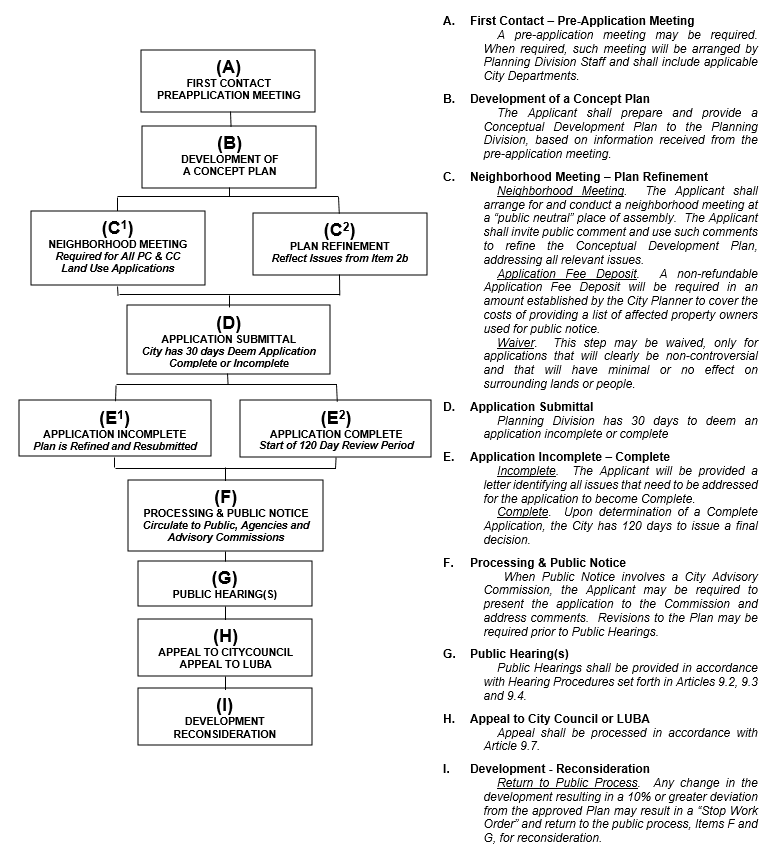
(Ord. No. 3266 (Series 2023), § 9.1.003, 8-2-2023)
Sec. 101-454. - Purpose.
The purpose of the community development department/planning division review procedure is to provide for the administrative review of certain land use and development decisions by the community development director/planner. It is the further purpose of this procedure to provide for the expeditious review of development subject to community development department/planning division review.
(Ord. No. 3266 (Series 2023), § 9.2.001, 8-2-2023)
Sec. 101-455. - Application.
The following development shall be subject to community development director/planner review:
(1)
Duplex division.
(2)
Fence height waiver.
(3)
Floodplain development permit.
(4)
Geologic hazard site plan.
(5)
Historic landmarks review.
(6)
Home occupation permit.
(7)
Land use approval time extension.
(8)
Livestock permit.
(9)
Lot line adjustment.
(10)
Minor land partition.
(11)
Public right-of-way encroachment.
(12)
Segregation of tax lot.
(13)
Sign permit.
(14)
Site plan review.
(15)
Temporary use permit.
(16)
Variance permit (administrative).
(17)
Wetland plan review.
(18)
Zoning approval.
(Ord. No. 3266 (Series 2023), § 9.2.002, 8-2-2023)
Sec. 101-456. - Notice.
Community development department/planning division review shall be conducted by the community development director/planner. Notice shall be mailed or otherwise delivered to property owners within 100 feet of the proposed land use listed in section 101-455, as well as to affected local, state, and federal agencies at least 14 days prior to the decision date. The notice shall also be conspicuously posted on-site ten days prior to the date of the scheduled decision.
(Ord. No. 3266 (Series 2023), § 9.2.003, 8-2-2023)
Sec. 101-457. - Review and decision.
(a)
The community development director/planner shall review the application and determine its compliance with applicable codes and ordinances. Conditions of approval may be imposed as necessary to ensure compliance with this subpart and other applicable codes. The community development director/planner may, at the community development director/planner's discretion or if requested, refer any application under section 101-455 to the planning commission for a public hearing and decision.
(b)
A determination of denial shall prohibit the applicant from undertaking the proposed development.
(c)
Written notice of community development director/planner approval or denial shall be given to all parties to the proceeding, to include all those parties to whom notice must be given under ORS 227.173.
(Ord. No. 3266 (Series 2023), § 9.2.004, 8-2-2023)
Sec. 101-458. - Appeal.
A decision of the community development director/planner may be appealed to the planning commission within 12 days of mailing of notification in accordance with procedures set forth in article IV, division 7 of this chapter.
(Ord. No. 3266 (Series 2023), § 9.2.005, 8-2-2023)
Sec. 101-485. - Purpose.
The purpose of this planning commission review procedure is to ensure that land use and development proposals which will have significant effects on a broad range of lands and persons are in compliance with this subpart and all other applicable codes and ordinances.
(Ord. No. 3266 (Series 2023), § 9.3.001, 8-2-2023)
Sec. 101-486. - Application.
The following shall be subject to planning commission review:
(1)
Recommendation to the city council:
a.
Amendment of the comprehensive plan document (legislative).
b.
Amendment of the land development code (legislative).
c.
Comprehensive plan map and zoning map amendments, including limited use overlay designations and specific plans.
d.
Right-of-way vacations.
e.
Right-of-way dedications.
(2)
Decisions:
a.
Subdivisions of land and major partitions (except final subdivision and major partition plats).
b.
Conditional use and variance permits.
c.
Planned unit developments.
(3)
Appeal of community development department/planning division decisions.
(Ord. No. 3266 (Series 2023), § 9.3.002, 8-2-2023)
Sec. 101-487. - Public hearing and notice.
The community development department/planning division shall set a date for a noticed public hearing for planning commission review as provided in article IV, division 5 of this chapter.
(Ord. No. 3266 (Series 2023), § 9.3.003, 8-2-2023)
Sec. 101-488. - Review and decision.
The planning commission will conduct a public hearing to review the land use application or policy decision before it. At the hearing, the planning commission shall take testimony from all interested persons. The planning commission may approve, conditionally approve, or disapprove matters before it, as set forth in article IV of this chapter. The planning commission may continue the hearing where it reasonably appears that additional testimony needs to be taken or the applicant is granted additional time in which to make recommended changes in such applicant's application. At the close of the hearing, the planning commission shall make its decision including the supportive findings of fact and conclusions of law. The decision of the planning commission shall be prepared in the form of the final planning commission order from the official hearing minutes and record.
(Ord. No. 3266 (Series 2023), § 9.3.004, 8-2-2023)
Sec. 101-489. - Appeal.
A decision of the planning commission shall be final unless appealed to the city council within 12 days of its mailing, by the applicant or a party having standing in accordance with procedures set forth in article IV, division 7 of this chapter. If the property subject to the appeal is within the urban growth area, the decision of the city council may be appealed to the county board of commissioners in accordance with the joint management agreement and county ordinance.
(Ord. No. 3266 (Series 2023), § 9.3.005, 8-2-2023)
Sec. 101-517. - Purpose.
The purpose of the city council review procedure is to establish a process for reaching major public policy decisions concerning the use and development of lands within the city and the urban growth boundary. This procedure recognizes that certain decisions may be administrative in nature, while other decisions may be legislative.
(Ord. No. 3266 (Series 2023), § 9.4.001, 8-2-2023)
Sec. 101-518. - Application.
The following shall be subject to city council review:
(1)
Amendment of the comprehensive plan document.
(2)
Amendment of the land development code.
(3)
Change in comprehensive plan and zone map designation, including limited use overlay designations and specific plans.
(4)
Appeals of planning commission decisions.
(5)
Final subdivision and major partition plats.
(6)
Right-of-way vacations.
(7)
Right-of-way dedications.
(Ord. No. 3266 (Series 2023), § 9.4.002, 8-2-2023)
Sec. 101-519. - Public hearing and notice.
The community development department/planning division shall set a date for a noticed public hearing for city council review as provided by article IV, division 5 of this chapter.
(Ord. No. 3266 (Series 2023), § 9.4.003, 8-2-2023)
Sec. 101-520. - Review and decision.
For actions under section 101-518, the city council must receive recommendations from the planning commission. The city council shall conduct a de-novo public hearing to review the applications, except section 101-518(5) and (7). The council may approve the application or proposed policy as initially submitted, or it may disapprove the application or policy stating its reasons therefore. The council may continue its public hearing where it reasonably appears that additional testimony needs to be taken. The council shall make its decision at the time of the public hearing, but in the event more time is needed, the council shall have a maximum of 45 days to hold an additional public hearing for such decision, so long as the total time required to process the land use application is less than 120 days from the date the submittal is deemed complete, except as provided in ORS 227.178(7).
(Ord. No. 3266 (Series 2023), § 9.4.004, 8-2-2023)
Sec. 101-521. - Appeal.
A decision of the city council shall be final unless appealed to the land use board of appeals in accordance with state law. If the property subject to the appeal is within the urban growth area, the decision of the city council may be appealed to the county board of commissioners in accordance with the joint management agreement and county ordinance.
(Ord. No. 3266 (Series 2023), § 9.4.005, 8-2-2023)
Sec. 101-551. - Responsibility of community development department/planning division.
The community development department/planning division shall perform the following duties pertaining to a hearing, all in accordance with other provisions of this subpart:
(1)
Upon receipt of a complete application for a land use and development or policy decision requiring a public hearing, the community development department/planning division shall schedule a date for a public hearing. All such applications must be received and deemed complete by the community development department/planning division in advance of any public notice deadlines for the regular monthly hearing or special hearing at which consideration is requested. The community development department/planning division may schedule special hearings as warranted by the agenda loads of regular hearings.
(2)
Conduct the correspondence of the hearing body.
(3)
Give notice in accordance with article IV, division 6 of this chapter.
(4)
Maintain a record and enter into the record relevant dates such as those of giving notice, hearings, postponement and continuances and a summary of action taken by the hearing body.
(5)
Prepare minutes to include the decision on the matter heard and the reasons for the decision.
(6)
Reduce the decisions of the hearings body to writing within a reasonable time.
(7)
Mail a copy of the decision to all parties to a hearing or review.
(Ord. No. 3266 (Series 2023), § 9.5.001, 8-2-2023)
Sec. 101-552. - Challenges to impartiality.
A party to a hearing or a member of a hearing body may challenge the qualifications of a member of the hearing body to participate in the hearing and decision regarding the matter. The challenge shall state the facts relied upon by the challenger relating to a person's bias, prejudgment, personal interest, or other facts from which the challenger has concluded that the member of the hearing body cannot participate in an impartial manner. The challenge shall be incorporated into the record of the hearing.
(Ord. No. 3266 (Series 2023), § 9.5.002, 8-2-2023)
Sec. 101-553. - Disqualification.
No member of a hearing body shall participate in a discussion of the proposal, or vote on the proposal when any of the following conditions exist:
(1)
Any of the following have a direct or substantial financial interest in the proposal: the hearing body member or the member's spouse, brother, sister, child, parent, father-in-law, mother-in-law, any business in which the member is then serving or has served within the previous two years, or any business with which the member is negotiating for or has an arrangement or understanding concerning prospective partnership or employment.
(2)
The member owns property within the area entitled to receive notice of a quasi-judicial public hearing.
(3)
The member has a direct private interest in a proposal being considered in a quasi-judicial public hearing.
(4)
For any other valid reason, the member has determined that participation in the hearing and decision cannot be in an impartial manner.
(Ord. No. 3266 (Series 2023), § 9.5.003, 8-2-2023)
Sec. 101-554. - Participation by interested officers or employees.
No officer or employee of the city who has a financial or other private interest in a proposal shall participate in discussion with or give an official opinion to the hearing body on the proposal without first declaring for the record the nature and extent of such interest.
(Ord. No. 3266 (Series 2023), § 9.5.004, 8-2-2023)
Sec. 101-555. - Ex parte contacts (quasi-judicial hearing).
The general public has a right to have hearing body members free from prehearing or ex parte contacts on matters heard by the hearing body. Hearing body members shall reveal any written or oral prehearing or ex parte contact with regard to any matter at the commencement of the public hearing on the matter. If such contacts have not impaired the member's impartiality or ability to vote on the matter, the member shall so state and shall participate or abstain in accordance with section 101-566. Communication with city staff is not ex parte contact.
(Ord. No. 3266 (Series 2023), § 9.5.005, 8-2-2023)
Sec. 101-556. - Abstention or disqualification.
Abstention or disqualification shall be the member's own judgment. A member seeking disqualification may not vote on the motion.
(Ord. No. 3266 (Series 2023), § 9.5.006, 8-2-2023)
Sec. 101-557. - Rights of disqualified member of the hearing body.
(a)
A member who represents personal interest at a hearing may do so only by abstaining from voting on the proposal, physically vacating the seat on the hearing body, and making full disclosure of such member's status and position at the time of addressing the hearing body.
(b)
If all members of a hearing body abstain or are disqualified, all members present after stating their reasons for abstention or disqualification shall by so doing be requalified and proceed to resolve the issues.
(c)
A member absent during the presentation of evidence in a hearing may not participate in the deliberations or final decision regarding the matter of the hearing unless the member has reviewed the evidence received.
(Ord. No. 3266 (Series 2023), § 9.5.007, 8-2-2023)
Sec. 101-558. - Burden and nature of proof.
The burden of proof is upon the proponent. The more drastic the change or the greater the impact of the proposal in the area, the greater is the burden upon the proponent. The proposal must be supported by proof that it conforms to the applicable elements of the comprehensive plan and to applicable provisions of this subpart, especially the specific criteria set forth for the particular type of decision under consideration. Additionally, the following factors are deemed relevant and material and shall be considered by the hearing body in reaching its decision on a proposal:
(1)
Mistake in the original designation or provision.
(2)
Change of conditions within the vicinity in which the development is proposed.
(Ord. No. 3266 (Series 2023), § 9.5.008, 8-2-2023)
Sec. 101-559. - Order of proceedings.
An order of proceedings for a hearing will depend in part on the nature of the hearing. The following shall be supplemented by administrative procedures as appropriate:
(1)
Before receiving information on the issue, the order of proceedings shall be read into the record and the following shall be determined:
a.
Any objections on jurisdictional grounds shall be noted in the record and if there is objection, the person presiding has the discretion to proceed or terminate.
b.
Any abstentions or disqualifications shall be determined.
(2)
The person presiding at the hearing may take official notice of known information related to the issue, such as the following:
a.
Provisions of the charter or state law or of an ordinance, resolution, order, rule, or officially promulgated policy of the city.
b.
Other public records and facts.
(3)
Matter officially noticed need not be established by evidence and may be considered by the hearing body in the determination of the matters. Parties requesting notice shall do so on the record; provided, however, that the hearing body may take notice of matters listed in subsection (2) of this section if stated for the record. Any matter given official notice may be rebutted.
(4)
The hearing body may view the area in dispute with or without notification to the parties, but shall place the time, manner and circumstances of the viewing in the record.
(5)
Information shall be received from the staff and from proponents and opponents. The presiding officer may approve or deny a request from a person attending the hearing to ask a question. Unless the presiding officer specifies otherwise, if the request to ask a question is approved, the presiding officer will direct the question to the person submitting testimony.
(6)
The presiding officer may establish time limits for oral testimony.
(7)
When the hearing has ended, the hearing body shall openly discuss the issue and may further question a person submitting information or the staff if opportunity for rebuttal is provided.
(8)
All evidence, testimony, deliberations, and decisions shall be made before the public, recorded, and made a part of the record.
(Ord. No. 3266 (Series 2023), § 9.5.009, 8-2-2023)
Sec. 101-560. - Decision.
Following the hearing procedure described in section 101-559, the hearing body shall make a decision to approve or deny the application. If the hearing is in the nature of an appeal, the hearing body shall affirm, reverse, or remand the decision that is on appeal. A decision on an application or appeal shall be made within 30 days of the final hearing on the matter, except that with the agreement of the hearing body and an applicant or appellant, the processing of a matter under consideration may be extended for a reasonable period of time as determined by the hearing body, but not to exceed 120 days from the date the application is deemed to be complete, unless an extension is requested by the applicant, except as provided in ORS 227.178(7).
(Ord. No. 3266 (Series 2023), § 9.5.010, 8-2-2023)
Sec. 101-561. - Preparation of findings and order.
The community development director/planner shall prepare and present findings of facts and an order which shall include:
(1)
A statement of the applicable criteria and standards against which the proposal was tested, and of the hearing body's interpretation of what would be required to achieve compliance with the criteria and standards.
(2)
A statement of the facts which the hearing body found established compliance or noncompliance with each applicable criteria and assurance of compliance with applicable standards.
(3)
The reasons for a conclusion to approve or deny.
(4)
The decision to deny or approve the proposed change with or without conditions.
(5)
The final order shall be filed with the community development department/planning division, and a copy mailed to the applicant at the address indicated on the application and to other parties to the hearing requesting a copy.
(6)
The hearing body shall make a final decision by approving, denying, or modifying the findings of facts and order.
(Ord. No. 3266 (Series 2023), § 9.5.011, 8-2-2023)
Sec. 101-562. - Record of proceedings.
The secretary to the hearing body shall be present at each hearing and shall cause the proceedings to be recorded electronically.
(1)
Testimony shall be transcribed verbatim if required for judicial review or if ordered by the hearing body, at an additional cost.
(2)
The hearing body shall, where practicable, retain as part of the hearing record each item of physical or documentary evidence presented and shall have the items marked to show the identity of the person offering the same and whether presented on behalf of the proponent or opponent. Exhibits received into evidence shall be retained in the hearing file until after the applicable appeal period has expired, at which time the exhibits may be released to the person identified thereon, or otherwise disposed of.
(3)
The findings of fact and order shall be included in the record.
(4)
A person shall have access to the record of the proceedings at reasonable times, places and circumstances. A person shall be entitled to copies of the record at the person's own expense.
(Ord. No. 3266 (Series 2023), § 9.5.012, 8-2-2023)
Sec. 101-588. - Time and method of public notice.
(a)
Legislative hearings. Notices of public hearings on legislative matters shall be given by the body conducting the hearing by publication in a newspaper of general circulation in the city at least 20 days but not more than 40 days before the hearing. Notice shall be mailed to all property owners in the city if the proposal constitutes a measure 56 rezoning.
(b)
Quasi-judicial hearings. Notices of public hearings for quasi-judicial land use hearings shall be given by the body conducting the hearing by publication in a newspaper of general circulation in the city at least ten days prior to the hearing. In addition, notice of the hearing shall be provided to the applicant and to the owners of record of property as shown on the most recent property tax assessment roll provided by the county, where the property is located within 100 feet of the property which is the subject of the notice. The notice shall be mailed at least 20 days before the first public hearing, or if two or more public hearings are allowed, ten days before the first public hearing, and shall:
(1)
Explain the nature of the application and proposed use or uses which could be authorized.
(2)
List the applicable criteria from the ordinance and the plan that apply to the application.
(3)
Set forth the street address or other easily understood geographical reference to the subject property.
(4)
State the date, time, and location of the hearing.
(5)
State that failure to raise an issue by the close of the record at, or following the final evidentiary hearing at the planning commission level, in person or by letter, precludes appeal to the city council, or ultimately LUBA based on that issue.
(6)
State that failure to provide sufficient specificity to afford the decision maker at the planning commission level an opportunity to respond to an issue that is raised precludes appeal to the city council and, ultimately, to LUBA based on that issue.
(7)
Include the name of a local government representative to contact and a telephone number where additional information may be obtained.
(8)
State that a copy of the application, all documents and evidence relied upon by the applicant, and applicable criteria are available for inspection at no cost and will be provided at reasonable cost.
(9)
State that a copy of the staff report will be available for inspection at no cost at least seven days prior to the hearing and will be provided at reasonable cost.
(10)
Include a general explanation of the requirements for submission of testimony and the procedure for the conduct of hearings.
(c)
Amendments to limited use designations. In addition to the notification requirements in subsection (b) of this section, notices shall be given to the state department of transportation and the department of land conservation and development pertaining to any amendments to limited use (LU) designations within the urban growth area.
(d)
Failure to receive notice. Failure of a person to receive the notice prescribed in this section shall not impair the validity of a hearing, nor the validity of the action taken.
(e)
Filing of affidavit. Upon completion of publication of this notice as provided for in subsection (a) of this section, or completion of the publication and mailing of the notices as provided in subsection (b) of this section, the secretary of the body conducting the hearing shall cause an affidavit of such mailing or publication to be filed in the permanent records of the particular proceedings to which such notices pertain.
(Ord. No. 3266 (Series 2023), § 9.6.001, 8-2-2023)
Sec. 101-610. - Purpose.
The purpose of this division is to establish uniform procedures for the appeal of land use and development and policy decisions provided in article III of this chapter.
(Ord. No. 3266 (Series 2023), § 9.7.001, 8-2-2023)
Sec. 101-611. - Appeal authority.
(a)
Decisions reached by the following review authorities pursuant to article III of this chapter shall be subject to appeal to the authority shown:
(1)
Community development department/planning division/community development director/planner: Decision may be appealed to the planning commission.
(2)
Planning commission: Decision may be appealed to the city council.
(3)
Landmarks commission: Decision may be appealed to the city council.
(4)
City council: Decision may be appealed to the land use board of appeals (LUBA).
(b)
Any request for modification or removal of conditions of approval shall be subject to review by the approving body. The approving body shall grant such request or portions thereof, only upon finding that the application of the condition or conditions would impose an undue or unnecessary hardship on the applicant, and that the condition causing the difficulty was not created by the applicant.
(Ord. No. 3266 (Series 2023), § 9.7.002, 8-2-2023)
Sec. 101-612. - Standing to appeal.
To have standing to appeal, persons must participate either orally or in writing at the public hearing.
(Ord. No. 3266 (Series 2023), § 9.7.003, 8-2-2023)
Sec. 101-613. - Initiation of appeal.
A decision of a review authority pursuant to article III of this chapter shall be appealed by a party with standing within the time limits prescribed in article IV of this chapter. The filing of a notice of appeal shall be accompanied by the fee prescribed by resolution of the city council. The notice of appeal shall be submitted upon the form provided by the community development department/planning division, shall include any such information as listed on the application submittal checklist and contain the following:
(1)
A concise description of the land use decision sought to be reviewed, including the date of decision.
(2)
A statement of the interest of the appellant seeking review and, that the appellant was a party to the initial proceedings.
(3)
The grounds relied upon for review.
(Ord. No. 3266 (Series 2023), § 9.7.004, 8-2-2023)
Sec. 101-614. - Scope of review on appeal.
All appeals to the planning commission or city council shall include a de novo evidentiary hearing.
(Ord. No. 3266 (Series 2023), § 9.7.005, 8-2-2023)
Sec. 101-615. - Review of the record.
(a)
When an appeal is scheduled for hearing by the planning commission or city council, the community development department/planning division shall prepare and transmit the record, which shall include:
(1)
Findings prepared by the community development department/planning division or the order adopted by the planning commission.
(2)
All exhibits, materials, pleadings, memoranda, stipulations and motions submitted by any party and received or considered in reaching the decision under review.
(3)
Minutes of any hearing or meeting during which the matter was discussed.
(b)
The appeal authority shall make its decision based upon the record and the testimony received during the hearing.
(Ord. No. 3266 (Series 2023), § 9.7.006, 8-2-2023)
Sec. 101-616. - Notice of appeal hearing.
Notice of the hearing held by an appeal authority shall be of the same type as that required for the original hearing. Notice shall be mailed to the appellant, to all persons originally notified, and to parties to the hearing who may not have been on the original notification list.
(Ord. No. 3266 (Series 2023), § 9.7.007, 8-2-2023)
Sec. 101-617. - Appeal authority decision.
(a)
Upon review, the appeal authority may by order remand, affirm, reverse, or modify a determination or requirement of the decision that is under review. When the appeal authority renders a decision that reverses or modifies a decision of the hearing body, the appeal authority, in its order, shall set forth its findings and state its reasons for taking the action encompassed in the order. When the appeal authority elects to remand the matter to the hearing body for further consideration, it shall include a statement explaining the errors or omissions found to have materially affected the outcome of the original decision and the action necessary to rectify such.
(b)
Action by the appeal authority shall be decided by a majority vote of a quorum of the hearing body. The appeal authority shall render its decision no later than 30 days from the date at which review was made. Findings of fact and an order shall be prepared in accordance with section 101-561.
(Ord. No. 3266 (Series 2023), § 9.7.008, 8-2-2023)

