
La Pine City Zoning Code
ARTICLE 6
SPECIAL USE STANDARDS
CHAPTER 15.104. - SPECIAL USE STANDARDS - RESIDENTIAL USES AND ACCESSORY USES[1]
State Law reference— Restrictions on manufactured dwellings and recreational vehicles and parks, ORS 197.475 et seq.
Sec. 15.102.010. - Purpose.
Special uses included in article 6 are uses which, due to their effect on surrounding properties, must be developed in accordance with special conditions and standards. These special use standards may differ from the development standards established for other uses in the same zoning district.
Sec. 15.102.020. - Applicability.
All uses listed in chapter 15.104 and chapter 15.108 are subject to the standards of article 6. Special use standards may apply to an entire use category, as described in chapter 15.14, use categories, or a specific use within a use category. The standards of this chapter supplement the other requirements of this article. When a dimensional standard for a special use differs from that of the underlying district, the standard for the special use shall apply.
Sec. 15.104.010. - Accessory dwellings.
A.
Applicability. Accessory dwellings, where allowed, are subject to review and approval through a Type I procedure pursuant to chapter 15.308, zoning permit, provided the following standards are met.
B.
Standards.
1.
One unit. A maximum of one accessory dwelling is allowed per legal lot containing a single-family dwelling unit. Accessory dwellings do not count toward maximum density standards of the base zone. The unit may be a detached building, in a portion of a detached accessory building (e.g., above a garage or workshop), or a unit attached or interior to the primary dwelling (e.g., an addition or the conversion of an existing floor). Detached units must provide adequate separation from other structures, as required by building code and the fire marshal.
2.
Floor area. An accessory dwelling shall not exceed 800 square feet of floor area, or 75 percent of the primary dwelling's floor area, whichever is smaller. However, accessory dwellings that result from the conversion of a level or floor (e.g., basement, attic, or second story) of the primary dwelling may occupy the entire level or floor, even if the floor area of the accessory dwelling would be more than 800 square feet.
3.
Other development standards. Accessory dwellings shall meet all other development standards (e.g., height, setbacks, lot coverage, etc.) for buildings in the zoning district, except that:
a.
Conversion of an existing legal non-conforming structure to an accessory dwelling is allowed, provided that the conversion does not increase the non-conformity.
b.
In order to encourage the development of housing units for disabled and handicapped individuals and persons with limited mobility, the city may allow reasonable deviation from the stated conditions where necessary to install features that facilitate access and mobility for disabled persons. This shall be regulated through the exceptions process.
c.
All accessory dwelling units shall be permanently placed on a foundation and connected to required utilities. A manufactured home may be used as an accessory dwelling, provided that the manufactured home shall be placed on an excavated and back-filled foundation and enclosed at the perimeter such that the manufactured home is located not more than 16 inches above grade, and complies with the minimum set-up standards of the adopted state Administrative Rules for Manufactured Dwellings, OAR ch. 918. Where the building site has a sloped grade, no more than 16 inches of the enclosing material shall be exposed on the uphill side of the home.
(Ord. No. 2025-04, § 13(exh. L), 3-11-2026)
Sec. 15.104.020. - Townhomes.
A.
Applicability. All townhome developments shall comply with the following standards which are intended to control development scale; avoid or minimize impacts associated with traffic, parking, and design compatibility; and ensure management and maintenance of common areas. Townhome developments with three or more dwelling units shall require approval through a Type II procedure, pursuant to chapter 15.312, site plan review.
B.
Standards.
1.
Setbacks and lot width. Notwithstanding anything in this Development Code to the contrary, there shall be no required side yard setback between attached townhomes (i.e. where a party wall is sited). Townhomes shall otherwise comply with the applicable setbacks in the underlying zone. The minimum lot width for townhome lots shall be 25 feet.
2.
Building mass and facade variation supplemental standard. The number and width of consecutively attached townhomes shall not exceed five units. The facades of townhomes in groups of three or greater shall be varied by changed front yard setbacks so that not more than two abutting townhouses will have the same front yard setback for its full width.
3.
Garages. Every townhome shall include, at a minimum, a single car garage.
4.
Alley access developments. Townhome developments in newly created subdivisions shall receive vehicle access only from a rear alley, except when existing development patterns or topography make construction of an alley impractical (see subsection 5 of this section for standards for street access developments). Alley(s) shall be created at the time of subdivision approval.
5.
Street access developments. Where available, townhomes shall take access from an alley. Townhomes receiving access directly from a public or private street shall comply with all of the following standards, in order to minimize interruption of adjacent sidewalks by driveway entrances, slow traffic, improve appearance of the streets, and minimize paved surfaces for better stormwater management:
a.
When garages or carports face the street, the garage or opening shall set back a minimum of 20 feet from the property line fronting the street.
b.
Except where required to be shared, the maximum allowable apron and driveway width facing the street is 24 feet per dwelling unit. The maximum combined garage width per unit facing the street is 50 percent of the total building width.
c.
Two adjacent garages shall share one driveway, with a maximum width of 30 feet. when individual driveways would otherwise be separated by less than 20 feet (i.e. the width of one on-street parking space). When a driveway serves more than one lot, the developer shall record an access and maintenance easement/agreement to benefit each lot, acceptable to the city, prior to building permit issuance.
6.
Common areas. All areas commonly owned by the owners within a townhome development shall be maintained by a homeowners association or by the owners under a joint-maintenance agreement. Covenants, restrictions and conditions or a joint maintenance agreement acceptable to the city shall be recorded prior to issuance of a building permit.
7.
Party walls. If not addressed through covenants, conditions and restrictions, an agreement(s) for joint maintenance of party walls acceptable to the city shall be recorded prior to issuance of a building permit.
8.
Waste disposal and mechanical equipment screening. All waste disposal collection areas and mechanical equipment areas shall be screened from public view.
9.
Fences. Front yard fencing shall be three feet or less in height and constructed of split rails, wood pickets, wrought iron, or similar materials and design, as approved by the city. Fences shall not be placed within the site vision triangle.
Sec. 15.104.030. - Duplexes.
A.
Applicability. The following standards apply to duplexes which are located on corner lots.
B.
Standards.
1.
The duplex, if located on a corner lot and containing two garages, shall have each garage entrance orient to a different street or alley.
2.
The duplex shall have no blank wall oriented to a street. This standard is met if any elevation facing a street is composed of not less than 15 percent windows and door surface area.
Sec. 15.104.040. - Multi-family development.
A.
Applicability. New multi-family developments, where allowed, are subject to review and approval through a Type II procedure, pursuant to chapter 15.312, site plan review, and shall conform to all of the following standards. Multiple detached single-unit dwellings or duplexes located on the same lot are classified as cottage cluster developments and subject to section 15.104.050.
B.
Standards for multi-family structures.
1.
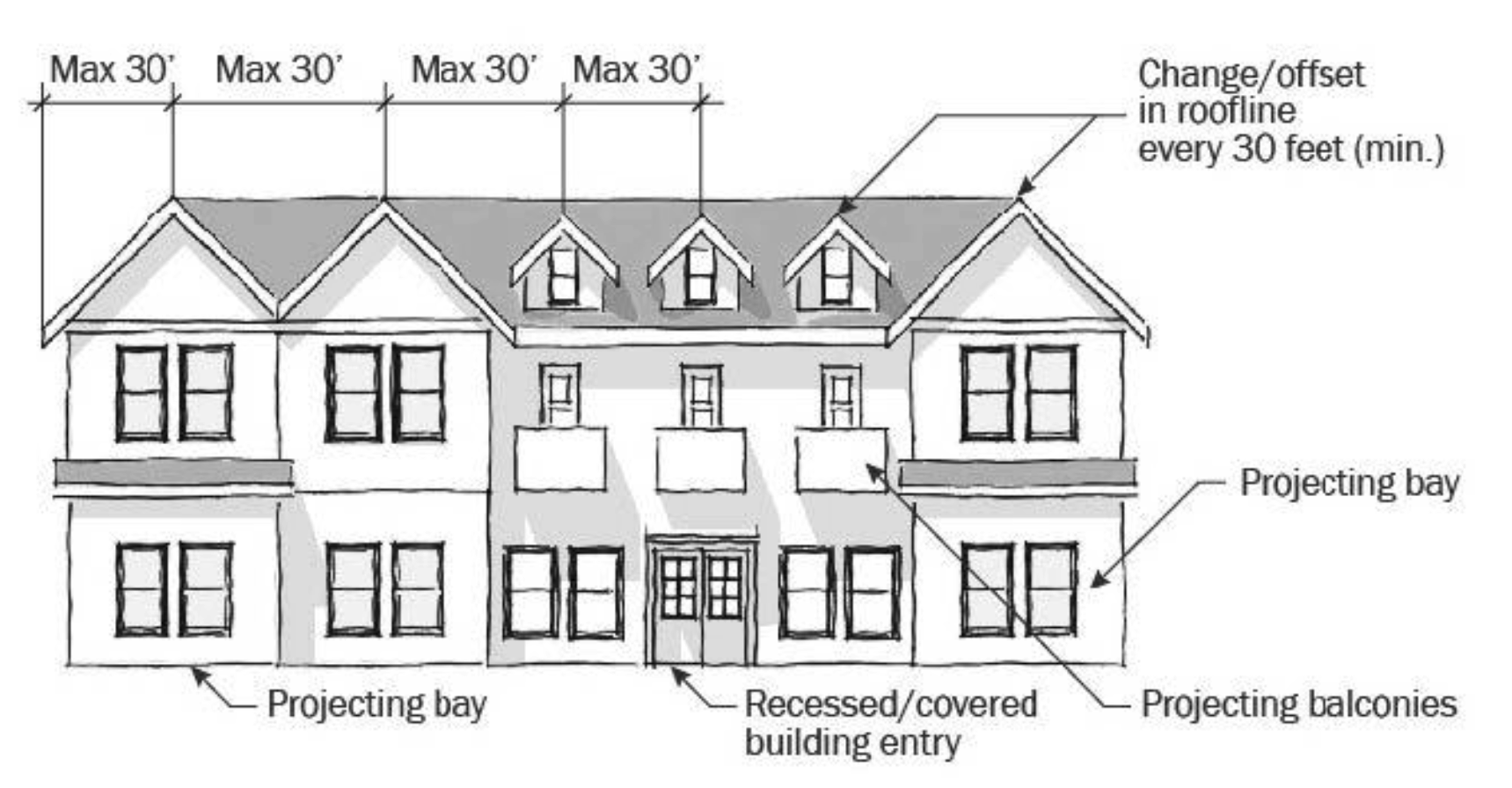
Articulation. Plans for multi-family structures shall incorporate design features such as varying rooflines, offsets, balconies, projections (e.g., overhangs, porches, or similar features), recessed or covered entrances, window reveals, or similar elements that break up otherwise long, uninterrupted elevations (see Figure 15.104-1). Such elements shall occur at a minimum interval of 30 feet, and each floor shall contain at least two elements from the following options:
a.
Recess (e.g., porch, courtyard, entrance balcony, or similar feature) that has a minimum depth of four feet;
b.
Extension (e.g., floor area, porch, entrance, balcony, overhang, or similar feature) that projects a minimum of two feet and runs horizontally for a minimum length of four feet; or
c.
Offsets or breaks in roof elevation of two feet or greater in height.
Multi-Family Articulation Standard
2.
Detailed design. All structures shall provide detailed design along all elevations (i.e., front, rear and sides). Detailed design shall be provided by using at least two of the following architectural features on all elevations, as appropriate for the proposed building type and style (may vary features on rear/side/front elevations):
a.
Covered front porch: not less than six feet in depth and not less than 30 percent of the width of dwelling, excluding the landing for dwelling entrance.
b.
Dormers: must be a functional part of the structure, for example, providing light into a living space.
c.
Recessed entrance: not less than three feet deep.
d.
Windows: not less than 30 percent of surface area of all street-facing elevation(s).
e.
Window trim: minimum four-inch width (all elevations).
f.
Eaves: overhang of not less than 12 inches.
g.
Offset: offset in facade or roof (see subsection 1, "Articulation").
h.
Bay window: projects from front elevation by 12 inches.
i.
Balcony: one per dwelling unit facing street.
j.
Decorative top: e.g., cornice or pediment with flat roof or brackets with pitched roof.
k.
Other: feature not listed but providing visual relief or contextually appropriate design similar to [subsections] a—j, as approved by the planning official through a Type II procedure.
3.
Common open space and landscaping. A minimum of 15 percent of the site area in residential zones shall be designated and permanently reserved as common area or open space, in accordance with all of the following criteria:
a.
"Site area," for the purposes of this section, is defined as the subject lot or lots after subtracting any required dedication of street right-of-way.
b.
The common area or open space shall contain one or more of the following: outdoor recreation area, tree grove (e.g., existing mature trees), turf play fields or playgrounds, sports courts, swim pool, walking fitness course, natural area with picnic benches, or similar open space amenities as appropriate for the intended residents.
c.
In order to be counted as eligible toward the minimum open space area, such areas shall have dimensions of not less than 20 feet.
d.
Open space and common areas not otherwise developed with recreational facilities shall be landscaped; alternatively, the city may approve a tree preservation plan (retain mature tree groves) in lieu of landscaping.
4.
Private open space. Private open space areas shall be required for dwelling units based on the following criteria:
a.
A minimum of 40 percent of all ground-floor dwelling units shall have front or rear patios or decks containing at least 48 square feet of usable area. Ground floor housing means the housing unit entrance (front or rear) is within five feet of the finished ground elevation (i.e., after grading and landscaping).
b.
A minimum of 40 percent of all upper-floor housing units shall have balconies or porches containing at least 48 square feet of usable area. Upper-floor housing means housing units that are more than five feet above the finished grade.
5.
Landscaping, fences, parking and loading, public facilities. The standards of article 5 shall be met.
6.
Trash storage. Trash receptacles, recycling, and storage facilities shall be oriented away from building entrances, setback at least ten feet from any public right-of-way and adjacent residences, and shall be screened with an evergreen hedge or solid fence or wall of not less than six feet in height. Receptacles must be accessible to trash pick-up trucks.
Sec. 15.104.050. - Cottage cluster developments.
A.
Purpose. The purpose of this section is to:
1.
Provide a housing type that responds to differing household sizes and ages (e.g., retirees, small families, single-person households), and offers opportunities for affordability;
2.
Provide opportunities for small, detached dwellings in several zoning districts by creating special development regulations that allow this type of use;
3.
Encourage creation of usable open space for residents of the development through flexibility in density and development standards;
4.
Support growth management through efficient use of urban residential land; and
5.
Provide regulations to ensure compatibility with surrounding uses.
B.
Applicability. Cottage cluster developments are permitted outright in the RSF, RMF, C, CRMX, CN zones. Cottage cluster developments are allowed with a Type II review, in accordance with chapter 15.312, site plan review.
C.
Lot size. Cottage cluster developments are permitted as a form of multi-family development where multiple single-dwelling units or duplexes are located on a single lot. The primary lot must not be divided into individual lots, however condominium ownership is permitted. The development must meet the applicable minimum lot size and lot width of the base zone.
D.
Density. For the purpose of this section, density is calculated as gross units per acre.
1.
Minimum density. The minimum density for cottage cluster developments is three units per acre in the RSF zone and 12 units per acre in all other zones.
2.
Maximum density. The maximum density for cottage cluster developments is seven units per acre in the RSF zone and 20 units per acre in all other zones.
E.
Development area. Cottage cluster developments shall contain a minimum of four and a maximum of 12 cottages arranged in a cluster. A cottage cluster development may contain more than one cluster.
F.
Lot coverage and floor area.
1.
There is no maximum lot coverage for cottage housing developments.
2.
The maximum floor area per dwelling unit without an attached garage is 1,100 square feet. A dwelling unit with an attached garage shall have a maximum floor area of 1,200 square feet including the garage. The maximum floor area is defined as the area included within the surrounding walls of a cottage building on all levels.
G.
Setbacks. The front, side, and rear setbacks of the base zone must be met.
H.
Required common open space. Common open space is intended to be an amenity shared by all residents of the cottage housing development.
1.
Provide a centrally located open space area for the cottage cluster development and have cottages abutting at least two sides.
2.
Contain a minimum of 400 square feet per cottage.
3.
At least 50 percent of the cottages shall abut a common open space.
4.
Each cottage shall be connected to the common by a pedestrian pathway.
5.
Areas such as utility vaults, setbacks and common parking areas and driveways are not counted in the common open space requirements.
6.
Common open space shall have a minimum average width of 20 feet.
7.
The common open space areas shall be constructed and landscaped prior to final occupancy of the first cottage.
I.
Required private open space. Private open space adjacent to each cottage is intended for the exclusive use by the cottage resident.
1.
Provide a total of 400 square feet of private open space that includes a minimum of 200 square feet of contiguous usable open space adjacent to each cottage with no dimension less than ten feet. Front porches are not included in the private open space calculation.
2.
No more than 50 percent of the private open space can be within an unenclosed covered patio.
J.
Development standards.
1.
At least 50 percent of the cottages shall be oriented around and have their main entrance facing the common open space.
2.
Each cottage shall have a covered entry of at least 80 square feet with a minimum dimension of six feet on any side.
3.
Pedestrian pathways must be included to provide for movement of residents and guests from parking areas to homes and other amenities.
4.
Individual detached garages cannot exceed 450 square feet of floor area and no more than 18 feet in height. Only one garage is allowed per cottage.
5.
Accessory dwelling units shall not be permitted in cottage cluster developments.
6.
Accessory structures for common usage are allowed in the common open space areas. Other accessory structures (except garages) are prohibited.
7.
Manufactured dwellings may be placed in a cottage cluster development, provided that the dwellings meet the following placement and foundation skirting requirements:
a.
Placement. The manufactured home shall be placed on an excavated and back-filled foundation and enclosed at the perimeter such that the manufactured home is located not more than 16 inches above grade, and complies with the minimum set-up standards of the adopted state Administrative Rules for Manufactured Dwellings, OAR ch. 918. Where the building site has a sloped grade, no more than 16 inches of the enclosing material shall be exposed on the uphill side of the home.
b.
Foundation skirt. The foundation area of the manufactured home shall be fully skirted with concrete, horizontal wood or vinyl siding, or other materials, pursuant to applicable building codes.
K.
Parking. Parking for cottage cluster developments shall be located on the property and identified on the site plan. On-site parking shall meet the following standards:
1.
Parking may be located within an enclosed garage, carport or unenclosed parking space.
2.
Parking shall not be located in the exterior setback and must be screened from public streets and adjacent residential uses by a ten-foot landscape buffer containing landscaping and/or architectural screening.
3.
Parking is allowed between or adjacent to structures only when it is located toward the rear of the cottage and is served by an alley or private driveway.
4.
The development must meet the minimum off-street vehicle and bicycle parking requirements of chapter 15.86, parking and loading.
5.
All parking shall provide a minimum of 24 feet for maneuvering and backing movements from garages, carports and/or parking areas.
Sec. 15.104.060. - Manufactured dwelling parks.
A.
Applicability. Manufactured dwelling parks, where permitted, are subject to compliance with the following standards. All applications for a manufactured dwelling park are subject to a type II land use review procedure in accordance with LPDC section 15.204.020.
B.
Standards.
1.
General standards. Development of manufactured and mobile home parks, meaning four or more manufactured dwellings or prefab structures located in one area, including placement of manufactured and mobile homes with a park, shall comply with applicable building codes and state requirements for mobile home and manufactured dwelling parks in ORS 446.
2.
Existing parks. Existing manufactured dwelling parks shall be allowed to expand in accordance with the criteria of this chapter, except for any existing manufactured dwelling parks within any non-residentially zoned lands.
3.
Minimum area required. All manufactured home parks must be a minimum area of one acre.
4.
Permitted uses. Manufactured home parks may contain manufactured homes, prefabricated structures and accessory structures permitted in this chapter, community laundry and recreation facilities and other common buildings for use by park residents only, and one residence other than a manufactured home for the use of a caretaker or a manager responsible for maintaining or operating the property. Manufactured homes may only be used as single-family dwellings. No manufactured home is permitted to be used for commercial use.
5.
Density. The maximum number of manufactured dwellings shall not exceed the density standards of the underlying zone.
a.
Density bonus.
i.
If all required recreational facilities and play areas include approved equipment such as swings, slides, or other playground or recreational equipment, an additional 10 percent increase in spaces per acre may be granted.
ii.
If a recreation/community building is provided, an additional 10 percent increase in spaces per acre may be granted.
iii.
If the park provides a variety of manufactured dwelling unit types, where at least 40 percent of manufactured dwellings are "double" or "triple-wide," an additional 10 percent increase in spaces per acre may be granted.
6.
Park characteristics
a.
At a minimum, applicant must meet all of the applicable plan submittal and park construction sections of the current Oregon Manufactured Dwelling and Park Specialty Code.
b.
Site size.
i.
A manufactured dwelling may not be constructed in a site less than 2,500 square feet in total area.
ii.
The total area of a lot occupied by a manufactured dwelling and all accessory structures and buildings shall not exceed 75 percent of the total site area.
c.
Interior setbacks.
i.
A manufactured dwelling shall not be installed closer than 10 feet from a property line.
ii.
Manufactured dwellings shall not be located closer than 15 feet from another manufactured dwelling or general use building.
iii.
No manufactured dwelling accessory building or structure on a manufactured dwelling space shall be closer than 10 feet from a manufactured dwelling accessory building or other structure on another dwelling space.
d.
Utilities. Each manufactured dwelling shall be provided with an adequate supply of healthful water, electric power, and sewage facilities.
e.
Fire hydrants. If a manufactured home space or permanent structure in a park is more than 500 feet from a public fire hydrant, the park shall have water supply mains designed to serve fire hydrants and hydrants shall be provided within 500 feet of each space or structure and shall conform to the design and capacity requirements required by the state fire marshall and the city.
f.
Parking.
i.
All parking and loading provided must comply with LPDC chapter 15.86, in addition to the following standards:
ii.
Each manufactured dwelling shall provide at a minimum two off-street parking space per dwelling. A usable garage or carport on a manufactured dwelling lot shall satisfy these parking requirements.
iii.
Additional guest parking spaces shall be provided within 400 feet of the manufactured dwellings served at a ratio of one parking space per 2 manufactured dwelling spaces. Parking lots with spaces for 10 or more vehicles are subject to the parking lot landscaping standards in 15.82.010.E.
iv.
Each recreational facility shall have a minimum of two parking spaces provided for every 2,500 square feet of area and shall be located within 100 feet of the recreational facility served.
v.
At least 4 percent of all parking spaces for guest or public use shall be made ADA accessible.
g.
Access drives.
i.
Internal roadways shall be not less than 30 feet in width if parking is permitted on the margin of the roadway, or not less than 20 feet in width if parking is not permitted on the edge of the roadway and shall be surfaced with asphalt, concrete, or similar surface.
ii.
Internal roadways shall be of adequate width and design to provide for the necessary access of emergency vehicles.
1.
Manufactured dwelling parks with the following range of dwelling spaces shall have the following number of park access: 10—20 units have 2 access points, 21—30 units have three, 31—40 have three, etc.
2.
Dead end access. If one-way access drives are proposed, they must provide adequate turnaround space that does not involve the use of individual driveways.
a.
The city may determine the need for additional access, hammerhead, or a cul-de-sac bulb to be provided, in conformance with the street design standards of LPDC section 15.90.070 and the State Manufactured Dwelling Specialty Codes, including:
i.
Cul-de-sacs with parallel parking permitted shall have a minimum 38-foot radius excluding curbs, sidewalks, walkways, or shoulders.
iii.
Interior access drives for manufactured dwelling parks containing more than 50 dwellings must be named and signed in accordance with Public Works standards.
iv.
Lighting shall be installed along the access ways of the manufactured home park at all intersections and near the required recreation areas in accordance with standards set forth by the city and the serving utility company. Wires for service to light poles and manufactured home spaces shall be underground lighting shall be shielded and hooded so as not to project onto adjacent properties.
v.
Walkways.
1.
Concrete walkways meeting all public facility design standards shall be provided to connect facility buildings to an access way or public street.
2.
For manufactured dwelling parks with more than 10 dwelling spaces, a concrete sidewalk at least 6 feet wide shall be provided to connect the area to a public sidewalk.
h.
Perimeter screening and landscaping.
i.
Except for the access roadway into the park, the park shall be screened on all sides by a sight obscuring fence not less than six feet in height, unless otherwise approved by the city. For the purposes of this section and this section only, site obscuring must be provided through the use of durable materials, including combination chain-link and vertical slats.
ii.
When manufactured dwellings are oriented with their back or side yards facing a public right-of-way, the city shall require the planting of a landscape buffer of five to ten feet in width between the right-of-way and a manufactured home park for the privacy and security of park residents or for privacy of adjacent residences.
i.
Outdoor storage. A neat appearance shall be maintained at all times. Except for vehicles, there shall be no outside storage of materials or equipment belonging to the park or to any guest of the park.
j.
Decks and patios. All manufactured dwellings shall include a private or semi-private deck, covered porch, or additional patio area.
k.
Trash facilities. Communal trash facilities provided to tenants must be located in a fully enclosed and sight-obscured structure that provides appropriate access for removal and service.
l.
Recreational facilities. A separate general play area of at least 2,500 sq. feet, or at least 100 sq. feet of play area per dwelling, shall be provided for each manufactured dwelling, whichever is greater. The area shall be dedicated for recreational play, group, or community activities, and constructed in accordance with all standards set forth in the Oregon Manufactured Dwelling and Park Specialty Code section 10-7 Play Areas, notwithstanding the following requirements:
i.
Play areas shall be improved with grass, plantings, surfacing, or buildings suitable for recreational use.
ii.
No play area shall be open to the general public.
iii.
Play areas must be separated from other areas within the manufactured dwelling park by a fence in conformance with the fencing standards of this development code.
iv.
If a proposed manufactured dwelling park is to be built in phases, one play area shall be provided and constructed with each phase. One play area may serve all phases provided its construction is completed prior to the opening of the first phase.
7.
Landscape plan and requirements.
a.
A manufactured dwelling park must contain a minimum 20 percent landscaped area. Landscaped areas must be continuously maintained and irrigated with permanent facilities sufficient to maintain the plant material.
b.
A landscape plan shall be included with the application materials. This plan shall be drawn to scale and show the location of existing trees and vegetation proposed to be removed or retained on the site, the location and design of landscaped areas, the varieties and sizes of trees and plant materials to be planted on site, and any other pertinent information. The plan shall be consistent with the requirements set forth in LPDC 15.82.010 and the following additional requirements.
c.
Facility landscaping. Interior access roads must contain street trees in accordance with street tree design standards set forth in this code, including placement every 35 feet and observing the appropriate clear vision requirements.
d.
Site landscaping. Manufactured dwelling site areas not occupied by an approved manufactured dwelling, driveway, or accessory structure must be landscaped. Landscaping must be at least 50 percent living material and prioritized to establish a perimeter between dwellings to reduce negative visual effects of roads, vehicle parking, and other storage.
8.
Wildfire resilience. To protect the park, its residents, and surrounding properties from the threat of wildfire, the following standards apply:
a.
Skirting. Skirting made of metal mesh (1/8-inch or smaller) shall be used in areas including under porches, exterior stairs, and anywhere the underside of the dwelling is exposed.
b.
Noncombustible zone. A noncombustible zone shall be provided underneath and 5 feet out from the dwelling on all sides. This area shall be completely removed of combustible material and shall use rock and other non-combustible landscaping. This area does not count toward the nonliving plant material requirements of the landscaping requirements, below.
c.
Defensible space. The area between the noncombustible zone and the boundary of the dwelling space site, not to exceed 30 feet, shall contain adequate separation between trees, shrubs, and other items that could catch fire.
d.
Fire-resistant attachments. Any attachments, such as steps, porches, and carports, shall be built with non-combustible ignition-resistant materials.
e.
Vents. Dwelling vents, including those on roof and walls, shall be covered with 1/16-inch metal mesh screens.
f.
Windows. Windows shall be installed with reinforcements, such as noncombustible screens and shutters.
(Ord. No. 2025-04, § 13(exh. L), 3-11-2026)
State Law reference— Restrictions on manufactured dwellings and recreational vehicles and parks, ORS 197.475 et seq.
Sec. 15.104.070. - Temporary recreational vehicle dwelling.
A.
Applicability. The placement of an RV on a temporary basis on the same lot occupied by a principal structure may be permitted when a medical condition creates a hardship and the following standards are met. Temporary RVs may be approved through a Type I procedure, pursuant to chapter 15.308, zoning permit.
B.
Standards.
1.
Verification. The medical condition must be verified by a doctor's written statement, which shall accompany the zoning permit application.
2.
Owner occupancy. The property owner shall occupy the principal structure.
3.
Permits. The applicant shall obtain all necessary permits from the county building and environmental health divisions prior to initiating the use.
4.
Setbacks. The manufactured dwelling shall be placed behind the principal structure at a separation distance of no less than 15 feet and shall comply with the rear yard requirement for principal structures in the zone.
5.
Time limit and extensions. The manufactured dwelling shall be in place for a period of no more than one year. An extension of time may be granted by the city manager if the property owner provides verification, in the form of a doctor's written statement, that the medical hardship continues to exist.
6.
Discontinuance. The manufactured dwelling shall be removed, and disconnected from any electric, water or sewer facility connection for which a permit has been issued not later than 90 days following the date the medical condition ceases to exist.
(Ord. No. 2025-04, § 13(exh. L), 3-11-2026)
State Law reference— Restrictions on manufactured dwellings and recreational vehicles and parks, ORS 197.475 et seq.
Sec. 15.104.080. - Residential care homes and residential care facilities.
A.
Applicability. The following standards are intended to implement state and federal laws pertaining to the Fair Housing Amendments Act. State law allows "residential homes" and "residential facilities" to be placed in any zone that allows a single-family dwelling or multi-family dwelling, respectively. (See ORS 197.665-197.667.) Residential care homes are subject to review and approval through a Type I review procedure under chapter 15.308, zoning permit, prior to issuance of building permits. Residential care facilities are subject to a Type II review and approval under chapter 15.312, site plan review.
B.
Standards. Residential care homes and residential care facilities, where allowed, shall conform to all of the following standards and procedures:
1.
Licensing and state requirements. Residential care homes and residential care facilities shall be licensed by the State of Oregon and comply with state requirements, pursuant to ORS 197.660 through 197.670.
2.
Residential care homes. Residential care homes may provide residential care alone, or in conjunction with treatment or training, for five or fewer individuals who need not be related. Staff required to meet state licensing requirements is not counted in the number of facility residents and need not be related to each other or the residents. The same Development Code standards that apply to single-family dwellings also apply to residential care homes, except where state law supersedes city standards.
3.
Residential care facilities. Residential care facilities may provide residential care alone, or in conjunction with treatment or training, for between six and 15 individuals who need not be related. Staff required to meet state licensing requirements is not counted in the number of facility residents and need not be related to each other or the residents. The same Development Code standards that apply to multi-family dwellings also apply to residential care homes, except where state law supersedes city standards.
4.
Access. The access and circulation standards of chapter 15.88 shall be met.
5.
Parking. The parking standards of chapter 15.86 shall be met.
6.
Landscaping. Residential care facilities are required to comply with the landscaping and screening standards of chapter 15.82. The city may require the installation of a landscape hedge or fence on the property line separating a residential care facility from an abutting lot containing a single-family dwelling for the purposes of visual screening and privacy between uses. The landscaping standards do not apply to building permits for individual residential care homes.
(Ord. No. 2025-04, § 13(exh. L), 3-11-2026)
Sec. 15.104.090. - Home occupations (home-based business).
A.
Applicability. This section applies to home occupation uses in residential zones. A home-based business in a commercial or mixed use zone is considered a commercial use and is not subject to the standards of this section. Home occupations of less than 1,000 square feet of lot area are permitted, provided the owner completes a zoning permit pursuant to chapter 15.308. Home occupations greater than 1,000 square feet of lot area are allowed, subject to approval of a conditional use permit, pursuant to chapter 15.316. For the purpose of this section, "lot area" includes building floor area, areas within accessory structures, and all other portions of a lot.
B.
Standards. Home occupations shall conform to all of the standards below, except the city may approve adjustments to the standards through the conditional use permit approval, provided all uses and structures on the subject property conform to applicable city regulations, including, but not limited to, building codes and nuisance regulations.
1.
Maximum size. No more than 25 percent of the combined gross floor area of the dwelling and accessory structure(s) shall be devoted to the home-based business.
2.
Appearance of residence.
a.
The home occupation shall be restricted to lawfully built enclosed structures and be conducted in such a manner as not to give an outward appearance of a business.
b.
The home occupation shall not result in any structural alterations or additions to a structure that will change its primary use or building code occupancy classification.
c.
The home occupation shall not violate any conditions of development approval (i.e., prior land use development permit or approval).
d.
No products or equipment produced or used by the home occupation may be displayed to be visible from outside any structure.
e.
The home occupation shall be conducted entirely within either the owner-occupied dwelling unit or accessory structure, provided that such accessory structure is clearly accessory and subordinate to the dwelling.
3.
Storage.
a.
Outside storage visible from the public right-of-way or adjacent properties that exceeds what is customary for a single-family residence in the vicinity is prohibited.
b.
On-site storage of hazardous materials (including toxic, explosive, noxious, combustible, or flammable material) beyond those normally incidental to residential use is prohibited.
c.
Storage of inventory or products and all other equipment, fixtures, and activities associated with the home occupation shall be enclosed in a structure or otherwise screened from view from adjacent properties and public right-of-way.
4.
Employees.
a.
Other than family members residing within the dwelling located on the home occupation site, there shall be not more than two employees at the home occupation site at any given time. As used in this chapter, the term "home occupation site" means the legal lot on which the home occupation is conducted.
b.
Additional individuals may be employed by or associated with the home occupation, so long as they do not report to work, pick up, or deliver at the home occupation site.
c.
The home occupation site shall not be used as a headquarters for the assembly of employees for instruction or other purposes, including dispatch of employees to other locations.
5.
Vehicles, parking, and traffic.
a.
Not more than one commercially licensed vehicle associated with the home occupation is allowed at the home occupation site in the same 24-hour period. Vehicles shall be of a size that would not overhang into the public right-of-way when parked.
b.
There shall be no commercial vehicle deliveries between 9:00 p.m. to 7:00 a.m.
6.
Business hours. There shall be no restriction on business hours, except that clients or customers are permitted at the home occupation only from 7:00 a.m. to 9:00 p.m.
7.
Prohibited home occupation uses.
a.
Any activity that produces radio, TV, or other electronic interference; noise, glare, vibration, smoke, or odor beyond allowable levels as determined by local, state, or federal standards, or that can be detected beyond the property line, is prohibited.
b.
Any activity involving on-site retail sales, including garage sales exceeding the thresholds of a temporary use, is prohibited, except that the sale of items that are incidental to a permitted home occupation is allowed. For example, the sale of lesson books or sheet music from music teachers, art or craft supplies from arts or crafts instructors, computer software from computer consultants, and similar incidental items for sale by the home business is allowed.
c.
The following uses, and uses with similar objectionable impacts because of motor vehicle traffic, noise, glare, odor, dust, smoke, or vibration, are prohibited:
(1)
Ambulance service.
(2)
Animal hospital, veterinary services, kennels, or animal boarding.
(3)
Auto and other vehicle repair, including auto painting.
(4)
Repair, reconditioning, or storage of motorized vehicles, boats, recreational vehicles, airplanes, or large equipment on-site.
(Ord. No. 2025-04, § 13(exh. L), 3-11-2026)
Sec. 15.104.100. - Short-term rentals.
A.
Purpose; applicability. The purpose of this section is to protect the character of the city's residential neighborhoods by limiting and regulating short-term rental of dwelling units. The provisions contained in this section apply to all lawfully established short-term rentals within the city. No person shall establish, maintain, advertise, offer, rent, occupy, use, operate or manage, nor offer or negotiate to use, lease, or rent, a dwelling unit for short-term rental occupancy without first applying for and obtaining a short-term rental permit in accordance with this section or satisfying the legal non-conforming use requirements under subsection (I) of this section. A separate land use approval is required for each dwelling unit proposed for use as a short-term rental.
B.
Application submittal requirements. The following information shall be submitted to the city along with a form approved by the city in order to apply for a short-term rental permit.
1.
The name(s), address(es), email address(es), and telephone number(s) of the owner(s) of the short-term rental for which the permit is to be issued, and the same for the authorized representative if different than the owner(s). An application may be submitted by an owner with the buyer as the applicant and upon written request, the approval will be granted to the buyer.
2.
Acknowledgment by signature that the owner and authorized representative have read all the regulations relating to the operation of a short-term rental in this section.
3.
Certification of the accuracy of the information submitted and agreement to comply with the conditions of the permit.
4.
Consent to city's inspection of the subject property and dwelling unit to ensure compliance with this section.
C.
Review type. Applications for short-term rentals are subject to the following review processes:
1.
Short-term rentals within commercial zoning districts (C, CRMX, CMX, CN) shall be:
a.
Processed as a Type I application; and
b.
Exempt from the concentration limits in subsection (E) of this section.
2.
Short-term rentals within residential zoning districts (RSF, RMF), shall be:
a.
Processed as a Type I application; and
b.
Subject to the concentration limits in subsection (E) of this section.
3.
Short-term rentals in existence prior to January 1, 2026 are reviewed in accordance with subsection (I)(2) below.
D.
Prohibited uses.
1.
No recreational vehicle, travel trailer or other temporary shelter shall be inhabited as or used in conjunction with a short-term rental.
E.
Concentration limits.
1.
A short-term rental cannot be approved on a property within the RSF, RMF zones, if proposed to be sited within 250 feet of another property that has a valid short-term rental approval or is a legal non-conforming use approved under subsection (I) of this section.
2.
Where a property subject to the concentration limits in subsection (E)(1) above has multiple dwelling units (i.e., ADUs, duplexes, apartments, condominiums, etc.), only one dwelling unit on the property may be used as a short-term rental.
3.
"Within 250 feet" means a straight-line measurement in a radius extending for 250 feet or less in every direction from the closest point on the property line of the subject property to the closest point on the property line of the other property as determined by the community development director.
F.
Limits on permit transfer. Notwithstanding anything contained in the Development Code to the contrary, any approval of a short-term rental application submitted after January 1, 2026, is specific to the owner of the property or owner-authorized buyer. This means that the short-term rental approval shall not run with the land, but shall terminate and be void, with no further proceedings, upon transfer of the real property subject to such a short-term rental approval. To continue the short-term rental use after a transfer, the transferee of such a real property must file, and receive approval of, a new application for a short-term rental, which application will be evaluated under the then-current regulations for short-term rentals (including, without limitation, the concentration limits). Then-current regulations for short-term rentals may preclude approval of such an application, and thus preclude continuation of the short-term rental use, following the transfer. For purposes of this section, "transfer" means any change of ownership of a property lawfully allowed to operate as a short-term rental, whether or not there is consideration; provided, however, "transfer" does not include the following: (a) upon the death of the owner, a change in ownership where title is held in survivorship with a spouse or domestic partner; (b) upon the death of the owner, a transfer to a trust which benefits only the decedent's spouse, child(ren), or registered domestic partner for the lifetime of the spouse, child(ren), or registered domestic partner; (c) the transfer of ownership of the real property to or between the members of a limited liability company or partnership when the transfer involves the same owner(s); and/or (d) the transfer to a trustee, a corporation, a partnership, a limited partnership, a limited liability partnership, or other similar entity, if at least one owner is living at the time of transfer and retains at least a twenty-five percent interest in the entity.
G.
Abandonment of use.
1.
Notwithstanding chapter 15.08, Non-Conforming Uses and Structures, and except as provided in a temporary hardship exemption issued pursuant to subsection (G)(3) of this section, authorization to operate a short-term rental will be deemed void with no further proceedings or action required by the city (a) if short-term rental use ceases for any period of 365 consecutive days, and/or (b) the operating license is otherwise revoked.
a.
For short-term rentals lawfully established prior to January 1, 2026, the period of use shall initially be measured from the 365 days prior to the due date for obtaining the initial operating license. Thereafter, the period of use for such short-term rental shall be measured as any 365-day period.
2.
The following will be considered prima facie evidence of abandonment of use: (a) failure to pay transient room tax within any 365-day period.
3.
Temporary hardship exemption.
a.
A temporary hardship exemption from this section may be granted by the community development director, in the community development director's sole discretion. To apply for a hardship, the applicant must complete the form prescribed by city and submit proof, acceptable to city, that:
i.
A medical condition of the owner, spouse, domestic partner or immediate family member that jeopardizes the ability of the owner to operate the short-term rental;
ii.
The death of a spouse, domestic partner or immediate family member that jeopardizes the ability of the owner to operate the short-term rental; or
iii.
The structural integrity of the short-term rental renders it uninhabitable for tenants and the owner is taking reasonable measures to repair or replace the short-term rental.
iv.
The operator cannot reasonably operate the short-term rental due to disease, war, riot, epidemic, act of God, and/or other natural disaster, including, without limitation, wildfire.
b.
The community development director shall establish the duration of the temporary hardship exemption, but such duration shall not exceed 180 days. A one-time extension of the temporary hardship exemption, not to exceed 180 days, may be approved upon request if one of the conditions of subsection (G)(3)(a) of this section continues to apply.
H.
Expiration of approval and initiation of use. If the owner does not initiate the use by renting the short-term rental at least one night within 180 days of the date of the short-term rental approval, the short-term rental approval shall be void with no further proceedings.
I.
Prior existing use.
1.
Existing permits. Any short-term rental approved and legally permitted before January 1, 2026, that does not comply with the current standards may continue as a legal non-conforming use provided:
a.
That the use is not abandoned under subsection (G) of this section; and
b.
The owner has the burden of establishing a valid prior approval and continuous operation when applying for an operating license or operating license renewal.
c.
Approved permits of short-term rental applications submitted after January 1, 2026, are subject to the transfer restrictions under subsection (F) of this section.
2.
Legal non-conforming uses. Any short-term rental that was lawfully established prior to January 1, 2026, when the initial short-term rental regulations were adopted, and has been lawfully and continually operating since that time, may continue as a legal non-conforming use provided:
a.
The non-conforming use is verified through a declaratory ruling in accordance with chapter 15.328.
b.
That the use is not abandoned under subsection (G) of this section.
J.
Inspection.
1.
Commencing on January 1, 2026, prior to issuance of an operating license, the community development director may require any dwelling unit authorized as a short-term rental to be inspected to verify that the dwelling unit is in compliance with all applicable building codes.
2.
The community development director may visit and inspect the site of a short-term rental and reinspect on a schedule prescribed by the community development director, to ensure compliance with all applicable regulations. Such inspections shall occur during normal business hours, with reasonable notice, and pursuant to such other procedural requirements adopted by the community development director. Code violations shall be processed in accordance with LCO chapter 8, Code Enforcement.
K.
Revocation.
1.
If three or more code violations related to the use of the short-term rental, verified by the community development director, have occurred on the property containing the short-term rental within a period of 365 consecutive days, the city may revoke any authorization to operate a short-term rental.
2.
Complaints to the city regarding code violations related to the use of the short-term rental shall be filed in accordance with LCO chapter 8, Code Enforcement.
Violations shall be processed in accordance with LCO chapter 8, Code Enforcement.
(Ord. No. 2025-04, § 13(exh. L), 3-11-2026)
Sec. 15.108.010. - Artisanal and light manufacturing uses.
A.
Applicability. The following provisions are intended to encourage mixed-use development, including cottage industries and business incubators, by integrating small-scale manufacturing with commercial uses. Artisanal and light manufacturing uses are permitted in the C and CN zones as a primary use with a conditional use permit. Artisanal and light manufacturing uses may also be permitted as an accessory to a permitted use in a commercial or mixed-use zones. Whether a primary or accessory use, all artisanal and light manufacturing uses in commercial or mixed-use zones must meet the standards of this section.
B.
Standards.
1.
Where an artisanal and light manufacturing use is allowed in a commercial or mixed-use zone, it shall be wholly enclosed in a building.
2.
Where an artisanal and light manufacturing use is allowed in a commercial or mixed-use zone and the subject site is located within 100 feet of a residential zone, the city may limit the hours of operation of the use to between 7:00 a.m. and 10:00 p.m. where it has identified concerns about noise, parking, or other impacts related to the use.
Sec. 15.108.020. - Campgrounds and recreational vehicle parks.
A.
Applicability. Campgrounds and recreational vehicle parks allow for transient (nonresidential) use. These standards apply to campgrounds in all zones where they are permitted.
B.
Site design standards.
1.
Minimum lot area shall be two acres.
2.
Access to the site shall be from an arterial or collector street, except that access to the site may be taken from a local street, when:
a.
The local street connects to an arterial or collector street, within 200 feet of the primary access point;
b.
The local street connection to the arterial or collector street does not pass through any residential zone; and
c.
The local street connection to the arterial or collector street is constructed to city standards.
3.
Except for the access roadway into the campground, the campground shall be screened on all sides by a sight obscuring fence not less than six feet in height, unless otherwise approved by the city.
4.
Drainage of increased stormwater runoff caused by the development shall be managed so as to prevent ponding, accelerated erosion, or flooding of adjacent properties and roads.
5.
No tent, camp site, including sites for RV's, or buildings shall be located within 50 feet of a neighboring lot line.
6.
Trash receptacles for the disposal of solid waste materials shall be provided in convenient locations for the use of guests of the campground and located in such number and of such capacity that there is no uncovered accumulation of trash at any time.
7.
The space provided for each recreational vehicle shall not be less than 700 square feet exclusive of any space used for common areas such as roadways, general use structures, walkways, parking spaces for vehicles other than recreational vehicles and landscaped areas.
8.
A space provided for a recreational vehicle shall be covered with crushed gravel or paved with asphalt, concrete, or similar material and be designed to provide for the control of runoff of surface water. The part of the space, which is not occupied by the recreational vehicle, not intended as an access way to the recreational vehicle or part of an outdoor patio, need not be paved or covered with gravel provided the area is landscaped or otherwise treated to prevent dust or mud.
9.
A recreational vehicle space shall be provided with piped potable water and sewage disposal service. A recreational vehicle staying in the park shall be connected to the water and sewage service provided by the park if the vehicle has equipment needing such service.
10.
A recreational vehicle space shall be provided with electrical service.
11.
The total number of parking spaces in the campground and recreational vehicle park, except for the parking provided for the exclusive use of the manager or employees of the campground, shall be one space per recreational vehicle space. Parking spaces shall be covered with crushed gravel or paved with asphalt, concrete or similar material.
12.
The campground and recreational vehicle park shall provide toilets, lavatories and showers for each sex in the following ratios: For each 15 recreational vehicle spaces or any fraction thereof, one toilet, one urinal, one lavatory and one shower for men; two toilets, one lavatory and one shower for women. The toilets and showers shall afford privacy and the showers shall be provided with private dressing rooms. Facilities for each sex shall be located in separate buildings, or, if in the same building, shall be separated by a soundproof wall.
13.
The campground and recreational vehicle park shall provide one utility building or room containing one clothes washing machine, one clothes drying machine and 15 square feet of space for clothes drying lines for each ten recreational vehicle spaces or any fraction thereof, unless such facilities are available within a distance of three miles and are adequate to meet these standards.
C.
Use standards.
1.
Required building spaces shall be lighted at all times of night and day, shall be ventilated, shall be provided with heating facilities which shall maintain a room temperature of 68 degrees Fahrenheit, shall have floors of waterproof material, shall have sanitary ceiling, floor and wall surfaces and shall be provided with floor drains adequate to permit easy cleaning.
2.
A neat appearance shall be maintained at all times. Except for vehicles, there shall be no outside storage of materials or equipment belonging to the campground or to any guest of the park.
3.
Evidence shall be provided that the campground will be eligible for a certificate of sanitation as required by state law.
(Ord. No. 2025-03, § 2, 12-10-2025; Ord. No. 2025-04, § 14(exh. M), 3-11-2026)
Sec. 15.108.030. - Large land area commercial recreation.
A.
Applicability. The purpose of these regulations is to allow commercial recreation uses that require large land area in a rural or low-density development setting, but also generate above-normal traffic and related activity. Large land area is defined as anything larger than ten acres which is used for commercial recreation.
B.
Standards.
1.
A full plan of the proposed activity and land area to be utilized and a plan for traffic circulation and ingress to/egress from the site must be presented.
2.
Any club house or other buildings for use of the public shall be located at least 100 feet from any property line.
3.
The use shall not produce or cause to be produced noise or lighting that results in a hazard or a nuisance to neighboring properties.
4.
Permanent facilities for stock car or other motorized vehicle racing is prohibited.
Sec. 15.108.040. - Automotive wrecking, salvage and junk yards.
A.
Applicability. Automotive wrecking, salvage and junk yards are allowed with conditional use approval within the light industrial and public facility zone and are required to meet the following license standards.
B.
License standards. No person shall engage in business as a junk dealer, or maintain a junk yard without first having obtained a license from the city, for which license a fee in accordance with the schedule hereinafter set forth shall be paid to the city for the use of the city. The license shall be issued for the 12-month period beginning July 1 and ending June 30 of the following year, and each license must be renewed annually on or before the first day of July of each year.
1.
Application for license. The license provided for in this section shall be issued by the city after written application shall have been made therefor by the person desiring to be licensed. Such license shall state the name of the person to whom such license is issued and the premises on which such business is to be conducted, or such junkyard is to be maintained. Such license shall be posted conspicuously upon the premises thereunder. The written application for license described above shall be accompanied by a form, every question of which must be answered, and the form will be supplied by the city. Applicant shall also submit a plot of the premises used or to be used in connection with such license.
2.
Issuance of license. Upon receipt of an application by the city, the city shall issue a license or shall refuse to issue a license to the person applying therefore after an examination of the application and taking into consideration the suitability of the property proposed to be used for the purpose of the license, the character of the properties located nearby, and the effect of the proposed use upon the city, both economic and aesthetic. In the event the city shall issue a license, it may impose upon the license and the person applying therefor such terms and conditions in addition to the regulations herein contained and adopted pursuant to this section as may be deemed necessary to carry out the spirit and intent of this section.
3.
License fee. A license fee, in an amount prescribed by the city, shall be paid immediately upon the issuance or renewal of a license.
4.
License limitation. No person licensed under this section shall, by virtue of one license, keep more than one place of business within the city or maintain more than one junkyard, for the purpose of buying, selling and dealing in junk. No person shall engage in business as a junk dealer in any place other than the place designated upon his/her license, or maintain a junkyard in any place other than the place designated upon his/her license.
5.
Transfer of license. No license issued by the city shall be transferable by the licenser to any other person unless such a transfer is authorized by the city. Any person desiring to transfer his/her license shall notify the city in writing, which notification shall be accompanied by an application for a license, as described in subsection B.1 of this section, by the transferee.
6.
Transfer fee. In the event the city shall approve the transfer of a license the transferee shall immediately pay to the city a transfer fee in an amount prescribed by resolution of the city council.
7.
Regulations. Every person licensed under this section shall constantly maintain the licensed premises in accordance with any special provisions imposed by the city and in the manner prescribed by this section and any subsequent regulations adopted by the city.
C.
Maintenance.
1.
Such premises shall at all times be maintained so as not to constitute a nuisance or a menace to the health of the community or of residents nearby or a place for the breeding of rodents and vermin.
2.
No garbage or other organic waste shall be stored in such premises.
3.
Whenever any motor vehicles shall be received in such premises as junk, all gasoline and oil shall be drained and removed therefrom. Gasoline in an amount not exceeding ten gallons may be stored above ground in said junk yards, provided the same be placed in containers approved by appropriate authority. All other gasoline which is kept in the premises shall be stored underground, which underground storage must be approved by appropriate authority.
4.
The manner of storage and arrangement of junk, and the drainage facilities of the premises shall be such as to prevent the accumulation of stagnant water upon the premises, and to facilitate access for firefighting purposes.
5.
The lot on which such are located shall be enclosed on all sides, except for an entrance and exit not over 25 feet in width, by a solid fence or wall at least six feet in height and maintained in good condition. As an alternative, a cyclone, or equal, wire fence at least six feet in height and surrounded, except for exit and entrance described above, by evergreens at least six feet in height and planted no further than six feet apart so as to form a solid screen may be used.
6.
The premises to be licensed shall be set back a minimum distance of 200 feet from the center of any road and a minimum distance of 100 feet from all other property lines. The area between the set-back line and the road and all other property lines shall be at all times kept clear and vacant.
7.
It shall not emit any offensive odors or noxious, toxic, or corrosive fumes or gases.
8.
It shall not exhaust into the air any excessive dust or smoke.
9.
It shall be carried on only in buildings classified as fire-resistant and be carried on in such a manner and with such precautions against fire and explosion hazards as to produce no exposure hazards to an adjacent property.
10.
It shall not discharge any wastes, whether liquid or solid, into river/sloughs or streams, including any surface and underground waters, both natural and artificial, unless approved by the city and/or any other public regulatory agency which has jurisdiction in water quality.
Sec. 15.108.050. - Marijuana businesses.
A.
Applicability. The requirements of this section apply to all marijuana businesses.
B.
Procedures.
1.
Marijuana businesses, including a new marijuana business located at the same location as a previously approved marijuana business, shall obtain a zoning checklist pursuant to chapter 15.308, and/or a site plan review approval pursuant to chapter 15.312, whichever is required by article 8.
2.
All applications shall be made in the same name as the "registrant," or the "licensee," as those terms are defined in ORS 475C.
3.
For purposes of this section, the term "premises" means:
(a)
All public and private enclosed areas at the location that are used in the business operated at the location, including, without limitation, offices, kitchens, restrooms, and storerooms; and
(b)
All areas outside the building that are licensed and/or registered (or proposed to be specifically licensed and/or registered) under applicable Oregon law.
Applicable setbacks and buffers for a proposed marijuana business are measured from the boundary of the premises of the marijuana business.
C.
Additional approval criteria. In addition to any applicable approval criteria for zoning permit and/or site plan review approval, the applicant shall comply with the following approval criteria:
1.
An application for a marijuana business must have a current city business license at the time of application.
2.
Applicant's proposal must demonstrate compliance, or the ability to comply (with appropriate conditions of approval), with applicable provisions of the time, place, and manner restrictions.
3.
Marijuana businesses shall be setback at least 50 feet from Highway 97.
4.
A public entrance to a marijuana business shall not be visible from or oriented towards Highway 97 or Huntington Road, unless the marijuana business is located in a building that is more than 50 feet from the right-of-way of those roadways.
5.
A marijuana business cannot be approved as a home occupation or home-based business.
6.
Marijuana businesses can only be approved in the zones in which the specific type of marijuana business is expressly identified as an allowed use. Permissibility of one type of marijuana business in a particular zone cannot be the basis to allow a non-permitted type of marijuana business as a similar use in that zone.
7.
Co-location of marijuana businesses on the same property is permitted except as prohibited by state law, the time, place, and manner restrictions, and this Development Code.
8.
All marijuana businesses will conduct operations inside secure, enclosed structures. Marijuana products may not be displayed in a manner that is externally visible to the public. No drive-through, curb-side, mobile, or other external sale methods are permitted.
9.
The applicant shall demonstrate how the proposed marijuana business complies with all state security system requirements applicable to the proposed marijuana business.
10.
The applicant must demonstrate how measures to control odors satisfies applicable requirements set forth in the time, place, and manner restrictions.
11.
The structure within which the marijuana business will operate must meet applicable fire and building code requirements.
12.
Applications for a specific type of marijuana business shall satisfy the additional standards applicable to that type of marijuana business set out in subsections D. through G. below.
D.
Additional criteria for marijuana dispensaries.
1.
The premises for a proposed marijuana dispensary must comply with the applicable location restrictions set forth in the time, place, and manner restrictions.
2.
Marijuana dispensaries are considered "retail stores" for purposes of parking requirements.
E.
Additional criteria for marijuana production facilities.
1.
Marijuana production facilities shall only be approved if the growing activities occur exclusively within permanent, fully enclosed, rigid, non-translucent structures that require a structural building permit. All lighting used for growing purposes must be contained completely inside the structure. No hoop-houses, sheds, shipping containers, trailers, or similar structures are permitted.
2.
Under no circumstances, and notwithstanding anything in this Development Code to the contrary, may retail sales of marijuana products occur at the same location as a marijuana production facility.
3.
Where multiple producers operate in the same building or on the same property, initial construction and any expansion to any building shall be subject to site plan review. Each tenant, and each change in tenant, shall require approval of a zoning permit.
F.
Additional criteria for marijuana processing facilities.
1.
Marijuana processing operations shall only occur in permanent, fully enclosed, rigid, non-translucent structures requiring a structural building permit.
2.
Under no circumstances, and notwithstanding anything in this Development Code to the contrary, may retail sales of marijuana products occur at the same location as a marijuana processing facility.
3.
Where multiple processors operate in the same building or on the same property, initial construction and any expansion to any building shall be subject to site plan review. Each tenant, and each change in tenant, shall require approval of a zoning permit.
G.
Additional criteria for marijuana testing laboratories.
1.
Under no circumstances, and notwithstanding anything in this Development Code to the contrary, may retail sales of marijuana products be conducted by a marijuana testing laboratory.
H.
Conditions of approval. In addition to any conditions of approval imposed as part of zoning checklist and/or site plan review approval, and any other standards for the zone in which the marijuana business is located, marijuana businesses are subject to the following conditions of approval:
1.
The applicant for a marijuana business shall obtain and present documentation of all applicable state approvals, registration, licensing, and permitting to the city within six months of zoning permit or site plan review approval.
2.
Marijuana businesses shall keep all required state registration, licensing, and permitting current.
3.
Marijuana businesses shall keep all required city business license or other required permits current.
4.
At all times, marijuana businesses shall remain compliant with applicable provisions of the time, place, and manner regulation and applicable state laws governing the applicable marijuana business, all as they may be amended from time to time.
5.
The applicant shall provide the city notice and applicable documentation from the state of any change in the "licensee" or "registrant" for a marijuana business or the suspension, loss, or forfeiture of any state approval, registration, licensing, or permitting.
6.
The zoning checklist and/or site plan review approval for a marijuana business shall be void if any condition of approval is violated and not cured within 30 days of notice from the city unless a cure is not reasonably possible within 30 days in which case the applicant must provide sufficient evidence, in the city's discretion, that the applicant has made reasonable progress towards a cure and the cure will be remedied in a timely manner, but no later than 60 days.
7.
The zoning checklist and/or site plan review approval shall expire if the business does not operate for any period of six consecutive months.
(Ord. No. 2020-05, § 2(exh. B), 2-12-2020; Ord. No. 2025-04, § 14(exh. M), 3-11-2026)
Sec. 15.108.060. - Mining.
A.
Applicability. Excavation of sand, soil, gravel, coal, oil, natural gas, or other minerals from the ground may be permitted only in the industrial zone and only as a conditional use upon application to and approval by the city. Conditional approval and these regulations do not apply where such excavation activities are to be conducted entirely as a non-commercial accessory or subordinate use to a principal use permitted by the zone.
B.
Standards. Prior to approval of the excavation activities by the city, the applicant for a conditional use shall comply with the following conditions:
1.
An approved permit from the State of Oregon, if needed, shall be presented to the city.
2.
The applicant shall guarantee that a notice of the final inspection conducted by the State of Oregon, if needed, will be provided to the city in order that the city has the opportunity to participate in the inspection.
Sec. 15.108.070. - Mobile food units.
A.
Applicability. The following standards apply to the setup and operation of mobile food units and mobile food unit sites. Mobile food unit sites are required to obtain a permit, in accordance with chapter 15.318. The following uses are exempt from the standards of this section:
1.
Locations where mobile food units are stored when not in operation; however, the storage of commercial vehicles may be subject to other requirements of this Development Code.
2.
Mobile food units and other mobile vending units that are operated as part of a city-approved event.
B.
Mobile food unit site standards. The following standards apply to mobile food unit sites:
1.
Zoning. Mobile food unit sites are not permitted in residential zones, but are permitted, as restricted, within the commercial and industrial district use tables found within this Development Code.
2.
Accessory items and structures. Trash receptacles for customer use shall be maintained no more than ten feet from the mobile food units. Portable accessory items, such as picnic tables, are permitted. With Type II approval, new accessory structures may be constructed, as follows:
a.
A maximum of two restroom structures, provided that the combined square footage does not exceed 200 square feet;
b.
One trash enclosure; and
c.
Outdoor seating areas, which may have roofs, floors, and railings, but no walls (e.g., decks, picnic shelters), provided that the square footage does not exceed 200 square feet per mobile vending unit and that no single structure exceeds 200 square feet.
3.
Signs. Signs are restricted to one "A-Frame" sign only which shall not exceed three feet in height and two feet wide. Signs shall not be placed in the right-of-way or off-premises.
4.
Minimum setbacks and separation distance. All mobile food units on the site shall be located a minimum of:
a.
Five feet from any structure or other mobile food unit;
b.
Ten feet from any front lot line; and
c.
Five feet from any side or rear lot line, except if such lot line abuts a residential district, the minimum setback shall be 20 feet.
5.
Screening. If the mobile food unit site is located less than 20 feet from a residential zoning district, the residential property shall be screened from the mobile food unit site, which may be a portion of a property including the mobile food unit, seating, queuing, etc., abutting the residential zoning district and may not necessarily extend to the shared property line. Required screening:
a.
May be provided by an existing, continuous, sight-obscuring structure, fence, or hedge;
b.
If new, shall be a continuous, sight-obscuring vegetative screen; or if fencing is utilized as screening, shall be stained cedar or ornate metal. Chain-link fencing with slats shall not qualify as acceptable screening material; and
c.
Shall have a minimum height of six feet.
6.
Setback from vehicular and pedestrian use areas. Windows and doors used for service to customers shall be located a minimum of ten feet from loading areas, driveways, on-site circulation drives, and parking lot aisles, and a minimum of five feet from bicycle parking spaces and walkways.
7.
Obstruction of vehicular and pedestrian use areas and landscape areas. No mobile food unit or associated element, such as aboveground power cords, seating areas, trash receptacles, signs, and customer queuing areas, shall occupy bicycle parking spaces, loading areas, or walkways. Mobile vending units shall not occupy landscaping areas approved as part of a prior design review or other land use application. However, occupying existing on-site automobile parking spaces is permitted.
8.
Surfacing. All mobile food units shall be placed on an existing hard-surfaced area, and any associated parking, loading, and maneuvering areas for vehicles shall be on existing hard-surfaced areas, unless a permeable parking, loading, or maneuvering area surface was authorized as part of a previously implemented site plan review approval for the site.
9.
Driveway access. No new or modified driveway access is permitted.
10.
Clear vision areas. The mobile food unit and any attachments or accessory items shall comply with the and clear vision area standards of section 15.88.040.
11.
Lighting. Outdoor lighting shall be required per this chapter if not already provided by an existing use.
12.
Utilities. To the extent that utilities are desired by the applicant or required by applicable regulations, mobile vending units shall have self-contained utilities, or if on-site utility connections are proposed, such utilities shall be installed underground, except where prohibited by the utility district or company. Notwithstanding this requirement:
a.
If allowed by the utility district or company and any applicable Oregon Specialty Code, aboveground utility connections are permitted, when a mobile vending unit will remain on the subject property for no more than 120 days in a calendar year. For the purpose of this exception:
i.
If a mobile vending unit is replaced by another, the number of days shall be calculated by adding the days spent on-site by each unit.
ii.
If a mobile vending unit spends any portion of a day on the subject property, it shall count as one day.
b.
If allowed by the utility district or company and the Oregon Electrical Specialty Code, aboveground power cords are permitted to connect the mobile vending unit to an approved electricity source.
c.
If allowed by the utility district or company and the Oregon Plumbing Specialty Code, aboveground hoses are permitted to connect the mobile vending unit to an approved water source.
13.
Sanitation facilities. Existing restrooms within a building on the same lot shall be utilized and remain available to the public as long as the cart is open for business. For five carts or more or where no restrooms exist on the same lot, permanent restrooms shall be constructed.
14.
Sewage disposal. Subsurface sewage disposal is prohibited.
15.
Central pavilions. Outdoor seating areas, which may have roofs, floors, walls, railings, etc. are permitted with a Type III mobile food unit site permit, provided that the combined square footage does not exceed 200 square feet per mobile vending unit and that no single structure exceeds 5,000 square feet in size.
16.
Vendor parking. For any mobile food unit site requiring a Type II approval, vendor parking shall be provided in addition to the off-street parking requirements of section 15.86.030 at the rate of one parking stall per mobile food unit. Vendor parking may be satisfied by the provision of off-site, shared parking agreements.
D. [C.]
Mobile food units. The following standards apply to each mobile food unit on the site:
1.
Attachments. Attachments to the mobile vending unit, such as awnings or canopies, are permitted only if they are supported entirely by the unit and do not touch the ground. Neither the mobile food unit nor any item relating to the unit shall lean against or hang from any structure or utility pole. No structure shall be attached to the mobile food unit.
2.
Accessory storage. Except as specifically allowed by subsection C, items relating to the mobile food unit shall be stored in, on, or under the unit.
3.
Interior seating or vending. Customer seating or vending inside the mobile food unit is prohibited.
4.
Skirting. Skirting shall be placed around the perimeter of the mobile vending unit.
5.
Other licenses required. Besides meeting the requirements of this section, the operator of a mobile food unit must have an active city business license and must comply with the permit requirements of Deschutes County Environmental Health Department.
Sec. 15.108.080. - Specialized animal raising, care, and processing.
A.
Applicability. The following provisions apply to the keeping of livestock or other animals in the City of La Pine.
B.
Standards.
1.
Minimum lot area shall be one acre.
2.
No more than two recreation or meat/milk producing livestock animals shall be allowed per acre. This includes horses, cattle, llamas, goats, alpaca, sheep, pigs and similar species.
3.
Twelve chicken hens are permitted per half-acre, but not roosters.
4.
Twelve rabbits are permitted per half-acre.
5.
No pens, runs, or buildings used for housing stock or processing shall be closer than 75 feet from neighboring lot lines.
6.
If containing runs for more than two birds or mammals, the owner must provide evidence that waste products or manure will be removed weekly and not create a malodorous nuisance.
7.
The animal raising, care, and/or processing use shall comply with all appropriate local, state, and federal environmental regulations.
8.
Properties which do not comply with the above requirements shall have six months from May 31, 2012 to remove animals and manure piles so as to be in conformance with this Development Code.
Sec. 15.108.090. - Temporary uses.
A.
Purpose. The following provisions are intended to allow for temporary uses while limiting their impacts.
B.
Applicability. Temporary uses are characterized by their short term nature and by the fact that permanent improvements are not made to the site. Temporary uses include, but are not limited to: construction trailers, leasing offices, seasonal sales such as Christmas tree sales and vegetable stands and similar uses. Temporary uses occur only once in a calendar year and for not longer than 30 days consecutively in any calendar year.
C.
Type I review.
1.
Applicability.
i.
The use occurs only once in a calendar year and for not longer than 30 consecutive days.
ii.
The use does not require any connection to water or sewer.
iii.
The use does not require any new access.
iv.
Notwithstanding anything herein to the contrary, the planning official, at its discretion, may elevate any proposed temporary use to a Type II review.
2.
Approval criteria.
i.
The use is permitted in the underlying zone, and does not violate any conditions of approval for the property (e.g., prior development permit approval).
ii.
The applicant, if different than the property owner, has proof of the owner's permission to place the use on the property.
iii.
The use complies with applicable setbacks.
iv.
There is sufficient parking to accommodate the temporary use and other uses existing on the site, pursuant to chapter 15.86, parking and loading.
v.
The applicant has obtained and will maintain all required licenses and permits.
D.
Type II review.
1.
Applicability.
i.
Any temporary use proposal that does not qualify for a Type I review.
2.
Approval criteria. In addition to obtaining site plan approval under chapter 15.312, Type II temporary uses shall comply with the following:
i.
The use is permitted in the underlying zone and does not violate any conditions of approval for the property (e.g., prior development permit approval).
ii.
The lot development standards of article 5 are met.
iii.
Ingress and egress are adequate and do not raise safety concerns when the proposed use is combined with the other uses of the site, pursuant to chapter 15.88, access and circulation.
iv.
The use does not conflict (i.e., create a nonconformity) with the provisions of chapter 15.82, landscaping, buffering, and fences.
v.
There is sufficient parking to accommodate the temporary use and other uses existing on the site, pursuant to chapter 15.86, parking and loading.
vi.
The temporary use does not conflict (i.e., create a nonconformity) with the provisions of chapter 15.90, public facilities.
vii.
The use does not create adverse off-site impacts including vehicle traffic, noise, odors, vibrations, glare, or lights that affect an adjoining use in a manner in which other uses allowed outright in the district do not affect the adjoining use.
viii.
The use is adequately served by sewer or septic system and water, as applicable.
ix.
The structure complies with applicable building codes.
x.
Except where specifically authorized by the planning official, the length of time that the temporary structure may remain on a site shall not exceed three consecutive months or a total of six months in any one calendar year.
xi.
The applicant has obtained and will maintain all required licenses and permits.
xii.
Public health, safety, and welfare are protected through the installation of a water meter, if necessary, and other improvements, pursuant to chapter 15.90, public facilities, as necessary.
Sec. 15.108.100. - Waste treatment and recycling.
A.
Applicability. Waste treatment and recycling, where allowed, are subject to review and approval through a Type II procedure, pursuant to chapter 15.312, site plan review, and shall conform to all the following standards.
B.
Standards.
1.
The applicant shall comply with all applicable regulations and requirements of the State of Oregon and shall present to the city an approved permit for the proposed facility.
2.
The applicant shall grant a right of entry to the proposed facility to the city or its authorized representatives, upon written request by the city, in order to inspect the facility and ensure that all applicable regulations and requirements are being met while the facility is in operation.
3.
The city may impose other conditions, based on consideration of the unique physical conditions and natural and man-made characteristics of the proposed facility site and its surroundings, which do not violate the minimum standards of the State of Oregon and which are reasonably necessary to provide maximum protection to the city's underground and surface water supplies and to minimize adverse impacts to surrounding properties.
Sec. 15.108.110. - Wireless communication facilities.
A.
Applicability. The following standards apply to wireless communication facilities in all locations in the city. For a definition of wireless communication facilities and component parts, see article 2. For use regulations that apply to wireless communication facilities in each zone, see article 3.
B.
Standards for communication antennas and communication equipment buildings.
1.
Building mounted communication antennas shall not be located on any single-family, two-family or multi-family dwelling.
2.
Building mounted communication antennas shall be permitted to exceed the height limitations of the applicable zone by no more than 20 feet.
3.
Omnidirectional or whip communications antennas shall not exceed 20 feet in height and seven inches diameter.
4.
Directional or panel communication antennas shall not exceed five feet in height and three feet in width.
5.
Any applicant proposing communications antennas to be mounted on a building or other structure shall submit evidence from a registered professional engineer certifying that the proposed installation will not exceed the structural capacity of the building or other structure, considering wind and other loads associated with the antenna location.
6.
Any applicant proposing communication antennas to be mounted on a building or other structure shall submit detailed construction and elevation drawings indicating how the antennas will be mounted on the structure for review by the city for compliance with this Development Code.
7.
Any applicant proposing communication antennas to be mounted on a building or other structure shall submit to the city evidence of agreements and/or easements necessary to provide access to the building or structure on which the antennas are to be mounted so that installation and maintenance of the antennas and communications equipment building can be accomplished.
8.
Communication antennas shall comply with all applicable standards established by the Federal Communications Commission governing human exposure to electromagnetic radiation.
9.
Communication antennas shall not cause radio frequency interference with other communications facilities located in Deschutes County.
10.
A communication equipment building shall be subject to the height and setback requirements of the applicable zone for an accessory structure.
11.
The owner or operator of communications antenna shall be licensed by the Federal Communications Commission to operate such antennas.
12.
Any applicant proposing communications towers to be constructed shall submit evidence from a registered professional engineer certifying that all facilities will be constructed to meet federal, state, and local requirements for loads.
13.
The tower foundation and base, as well as any other communications equipment buildings, shall be screened from the abutting properties.
14.
The applicant and owner of record of any wireless telecommunications facilities must supply a facility removal plan and provide evidence that removal expenses have been properly estimated. The owner must file, at its cost and expense, a security performance bond with the city to ensure the removal of abandoned or unused facilities.
15.
Any unused or abandoned wireless telecommunications facilities must be dismantled by the permit holder within one year of the date of abandonment. After this timeframe, the city may use the security bond to dismantle the abandoned tower.
16.
Private HAM operator towers and antennae must comply with all local, state and federal rules. This includes the maximum height restriction permitted in the specific zones.
D. [C.]
Standards for communications towers.
1.
All communication towers shall have a security fence installed around the tower base no less than 50 feet in any direction and no less than eight-foot height. Additional fencing may be required to protect the public from operational energy.
2.
All applicants must co-locate on existing towers or locate on land owned or leased by the city or county. If the applicant does not do this, they must prove hardship as to why they could not co-locate or locate on city or county lands before they can construct a tower on private land.

