
La Plata City Zoning Code
ARTICLE I
- GENERAL PROVISIONS
Sec. 191-1. - Title and applicability.
A.
This chapter shall be known as the "Zoning Ordinance for the Town of La Plata, Maryland" and may be referred to in this chapter as the "zoning ordinance", and shall apply to the following:
1.
The location, height, bulk, and size of structures;
2.
Setbacks, minimum frontages, depths, and areas of lots and percentage of lots which may be covered;
3.
The size of yards' courts and other open spaces;
4.
The erection of accessory and temporary structures;
5.
The density and distribution of population;
6.
The uses of land, structures and premises for trade industry, residence, recreation, agriculture, public activities and other purposes, by zone; and
7.
The installation of utilities, sidewalks, public facilities, and streets.
(Ord. No. 20-09, § 2, 9-28-2020, eff. 10-13-2020)
Sec. 191-2. - Purpose.
A.
The purpose of this chapter is to promote the public health, safety and general welfare through provisions designed to:
1.
Encourage the most appropriate use of land;
2.
Prevent the overcrowding of land and congestion of streets;
3.
Provide for adequate light and air;
4.
Secure safety from fire, flood, and other dangers;
5.
Preserve the value of land and structures;
6.
Facilitate the adequate provision of transportation, water, sewerage, and other public facilities; and
7.
Implement the policies and proposals of the La Plata Comprehensive Plan.
(Ord. No. 20-09, § 2, 9-28-2020, eff. 10-13-2020)
Sec. 191-3. - Vested zoning rights.
A.
The following vesting provisions establish when a property owner may continue to use a property in accordance with granted permits and approvals when a subsequent amendment to the zoning ordinance would make such use unlawful.
B.
A property owner's right to a particular use of the property pursuant to the provisions of this chapter is vested upon the occurrence of all of the following:
1.
The approval of a valid building permit and other required Federal, state and local permits and approvals;
2.
Visible activity pursuant to all permits and approvals so that the neighborhood may be advised that the land is being devoted to that use; and
3.
The implementation and validity periods of all permits and approvals has not expired.
C.
A property owner's right to a particular construction or development on the property pursuant to the provisions of this chapter shall be vested upon the occurrence of the following:
1.
The issuance of a valid building permit.
2.
Actual, physical commencement of significant and visible construction pursuant to the building permit, and
3.
The commencement of construction undertaken in good faith with the intention to continue with the construction and to carry it through to completion.
D.
Unless otherwise provided, a vested zoning right is not a personal right but shall attach to and run with the property.
E.
Limitations. The establishment of a vested zoning right in accordance with subsections B. and C. does not preclude the following:
1.
The application of a zoning reclassification that imposes additional requirements but does not affect the allowable type or intensity of use;
2.
The application of an amendment to any building code or to any environmental laws or regulations to any uncompleted construction project;
3.
Subject to the provisions of article VIII of this chapter, the application of an amendment to the sign provisions of this chapter, except with respect to signs existing or in the process of being installed at the time of the amendment; or
4.
The application of any changes in Federal or state law to which the property may be subject.
(Ord. No. 20-09, § 2, 9-28-2020, eff. 10-13-2020)
Sec. 191-4. - Transitional provisions.
A.
In order to maintain continuity for development approvals filed and processed in good faith under the provisions of this chapter in effect prior to August 15, 2018, the following provides a process for completing the development review process.
B.
Previously approved developments. The following provisions apply to any portion of a development approved prior to August 15, 2018.
1.
Site plan and subdivision.
a.
Construction under a site plan in process or approved prior to the August 15, 2018, must commence within two (2) years from the date of the approval by the Planning Commission or Chief Executive Officer. If not commenced within two (2) years subdivision or site plan approval will expire. The approving authority may grant two (2) extensions, not exceeding one (1) year each, unless otherwise stated in this chapter.
b.
All applications submitted before August 15, 2018, will be processed under this chapter then existing. Any such application must receive approval within two (2) years of the submittal date. If an approval is not granted within two (2) years the applicant shall conform to the zoning requirements in place at that time. The Planning Commission may grant an extension of one (1) year to receive approval for good cause shown.
C.
Applications for properties in the Planned Unit Development (PUD), Mixed Use Development (M-U) Zone, or proposed for Traditional Neighborhood Development (TND) designations, submitted on or before August 15, 2018, will be processed under this chapter then existing in accordance with section 191-4.B.1.(b) of this chapter and may be approved to meet the requirements of planned developments under section 191-27.
(Ord. No. 20-09, § 2, 9-28-2020, eff. 10-13-2020)
Sec. 191-5. - Word usage and definitions.
A.
Unless a contrary intention clearly appears, words used in the present tense include the future, the singular includes the plural, the term "shall" is always mandatory, and the term "may" is permissive.
B.
For the purpose of this chapter, certain terms are hereby defined as follows:
ADULT — A person who is at least eighteen (18) years of age.
ADULT ENTERTAINMENT BUSINESS — An establishment whose business is based primarily on materials and performances that depict, describe or relate to sexual activities.
ALLEY — A right-of-way that provides secondary access for vehicles to the side and rear of abutting properties.
ALTERATIONS — Any change in the supporting members of a structure, including but not limited to load bearing walls or partitions, columns, beams or girders, or any substantial change in the roof or in the exterior walls.
AMEND or AMENDMENTS — Any change to the existing zoning ordinance; any change in the number, shape, boundary, or area of a zone; any change in an approved site plan or developers agreement; or any repeal or abolition of any map part or addition.
AMUSEMENTS — A commercial establishment such as amphitheaters, theme parks, miniature golf, batting cages, ice rinks, and the like where entertainment is offered to the public.
ANIMAL BOARDING — Shelter and care (feeding, exercise, incidental medical care) for animals including kennels and boarding facilities for domestic animals and pets and shelters for unwanted or abandoned animals.
ANIMAL CLINIC — An office or group of offices for one (1) or more veterinarians engaged in the treatment of animals, not including inpatient care.
ANIMAL HOSPITAL — Establishments for the medical and surgical treatment of domestic and farm animals, including grooming and boarding of animals for no more than thirty (30) days if incidental to the hospital uses and limited to animals receiving in-patient medical care.
ANTENNA — Any structure or device used to collect, receive, transmit, or radiate radio, telephone, telecommunication, or television signals.
APPURTENANCES and ENVIRONMENTAL SETTINGS — All that space of grounds and structures thereon which surrounds a designated site or structure and to which it relates physically or visually. Appurtenances and environmental settings shall include, but not be limited to, walkways and driveways (whether paved or not), trees, landscaping, pastures, croplands, waterways, open space, setbacks, parks, public spaces, and rocks.
ASSISTED LIVING FACILITY — A residence or facility that provides ancillary supportive services, supervision, personalized assistance, health related services, or a combination thereof, to meet the needs of residents who are unable to perform or who need assistance in performing, the activities of daily living, or instrumental activities of daily living in a way that promotes optimum dignity and independence for those persons.
ATHLETIC FIELD ENCLOSURE — Any fence that surrounds an athletic field including, but not limited to baseball, football and soccer fields, basketball courts, tennis courts and the like.
AWNING — Any non-rigid material, such as fabric or flexible plastic, that extends from the exterior wall of a structure and is supported by or attached to a frame.
BANQUET HALL — A food service and meeting facility where space and food are provided to groups as opposed to individuals.
BEACON — Any light with one (1) or more beams directed into the atmosphere or directed at one (1) or more points not on the same site as the light source; also, any light with one (1) or more beams that rotate or move.
BED AND BREAKFAST — A single detached dwelling that is owner occupied and provides visitor accommodations providing guest rooms for lodging, for compensation, on a less than weekly basis, with incidental eating and drinking service provided to lodgers and their guests.
BOARDINGHOUSE — An establishment, other than a bed and breakfast or inn, where meals and/or lodging is provided for compensation other than in dwelling units, and other than in an assisted living facility, without limitation on time periods involved and for a total of five (5) to nineteen (19) roomers and/or boarders.
BREWERY — A facility operated under a Class 5M brewery license pursuant to § 2-206 of Article 2B of the Annotated Code of Maryland. May include an area or separate facilities for product sampling, incidental administrative office functions; incidental retail sales of beer and related promotional items, promotional events held pursuant to a permit from the comptroller, and kitchen facilities for preparing and serving food pursuant to the license.
BREWPUBS — A restaurant with a state-issued Class 6 pub-brewery license, as an accessory use, where the beer it produces is sold in draft form exclusively at its own premises. This operation may sell other supplier's beer, including other hand-crafted or micro-brewed beers as well as wine to patrons for consumption on its premises. Off-sale of alcoholic beverages shall be limited to beers brewed on-site.
BUS SHELTER — A detached structure designated as a pick-up or drop-off point for passengers for school or public transportation.
BURIAL GROUNDS — Cemeteries, crypts, tombs, mausoleums, or columbariums for the interment or inurnment of deceased humans or animals. This classification does not include crematories or mortuaries.
CANOPY — A structure constructed of rigid materials, including, but not limited to, metal, wood, concrete, plastic, or glass, which is attached to and supported by a building, or which is free-standing and supported by columns, poles, or braces extended to the ground. Unlike a marquee, a canopy generally has very limited vertical surface area; and unlike an awning, a canopy is generally supported by vertical elements rising from the ground.
CERTIFICATE OF APPROPRIATENESS — A certificate issued by the historic zone commission indicating its approval of plans for construction, alteration, reconstruction, moving, or demolition of a individually designated landmark, site or structure or of a site or structure within a designated preservation zone.
CHIEF EXECUTIVE OFFICER — The La Plata Town Manager or the Town Manager's designee.
CLINIC — A facility where persons receive medical treatment, examination, advice and/or counseling, primarily on an outpatient basis, including physical, psychological, mental, and other treatment, examination, advice and/or counseling.
CLUBS, LODGES — Structures and facilities owned or operated for a social, educational, fraternal or recreational purpose, but not primarily for profit. This classification includes union halls, community centers, social clubs, and youth centers.
COMMERCIAL — A type of activity where goods or services are sold or traded with the expectation of profit or gain.
COMMON SIGN PLAN — A plan establishing parameters for the size, location, and design of signs on a property being constructed or managed as a single development.
COMMUNICATION TOWER — A fixed transmitter or receiver.
COMMUNITY GARDENS — A piece of land gardened by a group of people, utilizing either individual or shared plots on private or public land. the land may produce fruit, vegetables, and/or ornamentals.
CONFERENCE CENTER — A facility with a maximum gross floor area of one hundred thousand (100,000) square feet, that provides meeting halls, trade centers, merchandise marts, or for training and other gatherings for large numbers of people for similar functions and may be developed separately or in combination with any other permitted use.
CONSTRUCTION MATERIALS and EQUIPMENT STORAGE — Stockpiling and storage of construction vehicles, materials and equipment, or commercial goods, and contractors' yards.
CONSTRUCTION TRAILER/OFFICE — Prefabricated structure, used as offices and/or storage during project construction.
CONVALESCENT HOME — A place where regular managed care is provided by persons who reside on the premises for three (3) or more persons, who are not members of the individual's family.
CONVENTION CENTER — A large structure, with a gross floor area greater than one hundred thousand (100,000) square feet, that is designed to hold a convention, where individuals and groups gather to promote and share common interests. Convention centers typically have at least one (1) auditorium and may also contain concert halls, lecture halls, meeting rooms, and conference rooms.
COVENANT — A written agreement between two (2) or more parties by an owner where required by this chapter or imposed by the Planning Commission in accordance with authorization contained in this chapter and recorded among the land records of Charles County.
CULTURAL INSTITUTION — Nonprofit institution displaying or preserving objects of interest in the arts or sciences. This classification includes visitors' centers, libraries, museums, and galleries. Facilities may include auditoriums, exhibition halls, classrooms, administrative support facilities, and concessions for visitors or any combination thereof.
DAY CARE, FAMILY — A residence in which care is given to a child in place of parental care as defined by the State of Maryland in COMAR.
DAY CARE CENTER, CHILD — A place where day care is provided, other than in a family day care as defined by the State of Maryland in COMAR.
DAY CARE FACILITY, MEDICAL — A facility that provides a full scope of medical services, and may include social, rehabilitative, and recreational programs, during the day.
DEMOLITION BY NEGLECT — Any willful neglect in the maintenance and repair of an individually designated landmark, site, or structure, or a site or structure within a historic preservation zone, (not including any appurtenances and environmental settings), and which results in any of the following conditions:
(1)
The deterioration of the foundations, exterior walls, roofs, chimneys, doors, or windows, so as to create or permit a hazardous or unsafe condition to exist; or
(2)
The deterioration of the foundations, exterior walls, roofs, chimneys, doors, or windows, the lack of adequate waterproofing, or the deterioration of interior features which will or could result in permanent damage, injury or loss of or loss to foundations, exterior walls, roofs, chimneys, doors, or windows.
DENSITY — The number of residential dwellings allowed per lot or acre in a given zone; or, for commercial zones, the permitted floor area ratio.
DEVELOPMENT — Any construction, modification, extension or expansion of structures or structures; placement of fill or dumping; storage of materials; land excavation; land clearing; land improvement; or any combination thereof, including the subdivision of land or action that results in construction. (Includes the terms "development activities", "develop" and "re-development".)
DISTILLERY — A facility operated under a Class 1 manufacturer's license pursuant to § 2-202 of Article 2B of the Annotated Code of Maryland. May include an area or separate facilities for incidental administrative office functions, tours, product sampling, retail sales of products manufactured on the licensed premises and related merchandise, promotional events incidental to the distillery, and a kitchen facility for preparing and serving food at permitted events.
DWELLING — A structure that contains one (1) or more dwelling units or other space intended for human habitation.
DWELLING, ATTACHED — A structure containing not more than one (1) dwelling attached at the side or sides in a series or group of three (3) or more similar structures. Each structure shall be separated from the adjoining structure or structures in the series or group by a wall or walls extending from footings through roofs. The term "attached dwelling" is intended to refer to a townhouse, townhouse unit, or row house.
DWELLING, DETACHED — A structure containing not more than one (1) dwelling, or one (1) dwelling and an accessory dwelling unit, entirely separated from other structures. the term "detached dwelling" shall not include mobile homes, travel trailers, or other forms of portable or temporary housing.
DWELLING, MULTIPLE-FAMILY — A structure containing three (3) or more dwellings. the term "multifamily dwelling" shall include cooperative apartments, condominiums (other than townhouse condominiums), apartments, and the like. Regardless of how rental units are equipped, any multifamily dwelling in which one (1) or more units are available for rental periods of less than one (1) week shall be considered a hotel.
DWELLING, TWO-FAMILY — One (1) or two (2) structures containing not more than two (2) dwellings. The term "two-family dwelling" is intended to imply single-family semidetached dwellings and duplexes or any form which conforms to this definition.
DWELLING UNIT — Any room or group of rooms located within a dwelling and forming a single habitable unit, with facilities which are used or intended to be used for sleeping, cooking, and sanitation.
DWELLING UNIT, ACCESSORY (ADU) — An ADU is a self-contained apartment located in, or attached to, a principal owner-occupied single-family dwelling, or located in a separate structure on the same lot as a principal owner-occupied single-family dwelling.
EASEMENT — A recorded grant or reservation by the owner of land for the use of all or a portion of such property to the public or others, for a specific purpose.
EDUCATIONAL FACILITY, COLLEGE — Public or private institution of higher education providing curriculum of a general, religious, or professional nature, typically granting recognized degrees. This classification includes establishments engaged in the teaching of vocational and technical skills.
EDUCATION FACILITY, ELEMENTARY and MIDDLE SCHOOL — Public or private facility for primary education, including elementary, and middle schools and private institutions having a curriculum comparable to that required in the public schools in the State of Maryland.
EDUCATION FACILITY, HIGH SCHOOL — Public or private facility for high schools and private institutions having a curriculum comparable to that required in the public schools in the State of Maryland.
ENFORCEMENT OFFICIAL — A person charged by the Chief Executive Officer or Chief Executive Officer's designee with enforcement of the provisions of this chapter.
EXTERIOR FEATURES, HISTORIC — The architectural style, design, and general arrangement of the exterior of an historic structure, including the nature and texture of structure material, and the type and style of all windows, doors, light fixtures, signs, or similar items found on or related to the exterior of an historic structure.
EXTRACTIVE INDUSTRY — Removal of natural materials from the surface or subsurface of the Earth for sale or further processing. This classification includes sand and gravel mining and mineral extraction.
FAÇADE — The exterior walls of a structure or structure exposed to public view or that wall viewed by a person not within a structure.
FENCE — A barrier, railing, or other upright structure enclosing an area of ground to mark a boundary, control access, or prevent escape.
FINANCIAL INSTITUTION — Establishments including banks, credit union offices, savings and loans, or check cashing services, which provide central banking, functions to individuals and businesses. This classification includes only those institutions engaged in the on-site circulation of money.
FAMILY — One (1) or more persons occupying a single dwelling unit, that may be made up of partners, children, parents, and grandparents with the number of occupants being in accordance with the applicable Residential Building Code, housing standards, and habitability.
FARMERS MARKET — A designated area where, on designated days and times, vendors may sell directly to the public, in accordance with applicable state and town regulations. The town shall have the right to relocate or discontinue the market, to specify the days and times of its use and to stipulate what goods may be sold.
FLOODPLAIN, REGULATORY — The area adjoining a particular river or stream which would be inundated by the discharge of the regulatory flood.
FLOOD, REGULATORY — A large flood with an associated discharge which is reasonably characteristic of what can be expected on a particular river or stream with a recurrent frequency of once every one hundred (100) years after total development of the watershed.
FLOODWAY, FRINGE — The outer areas of the floodplain which do not contribute appreciably to the conveyance of flood flows but which would be inundated by the regulatory flood without increasing water surface elevations more than one (1) foot.
FLOODWAY, REGULATORY — The river or stream channel and portions of the floodplain immediately adjacent which are required to convey the discharge of the base flood without cumulatively increasing the water surface elevation more than a designated height.
FLOOR AREA — The sum of the gross horizontal areas of each floor encompassed by the exterior walls of the structure, measured from the exterior faces of the exterior walls or from the center line of walls separating two (2) structures, but not including attic space, basements or crawl spaces providing headroom of less than seven (7) feet, or fire escapes.
FOOTPRINT — The area encompassed by a structure's outer walls at ground level.
FRONTAGE — The portion of a building or a lot that is abutting a street and situated between lot lines intersecting such street.
FRONTAGE, STREET — The distance for which a lot line adjoins a public or private street from one (1) lot line intersecting said street to the furthest lot line intersecting the same street.
FRONTAGE, STRUCTURE — The linear length of the structure façade where the primary entrance faces a public street. A structure's frontage shall be considered all parts of a wall, walls, or elevation that are parallel to such street.
FUEL SALES — Structures and premises where petroleum products and alternative motor fuel sources may be supplied and dispensed at retail. "Fuel sales" does not include repair or body shops.
FUNERAL and INTERMENT SERVICES — Services involving the care, preparation or disposition of human or small domestic animal remains other than in a cemetery. Typical uses include crematories and mortuaries.
GATE — A movable barrier to create an opening in a wall, fence or hedge to provide access to or from an area of ground or structure.
GOVERNMENT FACILITY — Administrative, clerical, or public contact offices and facilities of Federal, state or local government agencies.
GREENHOUSE — A structure in which plants are grown for protection from the elements under managed growing conditions.
HEIGHT, STRUCTURE — A structure's vertical measurement from the mean level of the finished grade along the structure's frontage to the highest point in the roofline of a flat roof or of a roof having a slope of less than fifteen degrees (15°) from the horizontal and to a point midway between the peak and the eaves of a roof having a slope of fifteen degrees (15°) or more.
HEIGHT, SIGN — As applied to a sign, the combined overall vertical dimension of the entire sign structure, including the sign message area, and all foundations, framing, trim, or embellishments, as measured from the finished grade of the surrounding site in the immediate vicinity of the sign to the highest point of the structure from the ground.
HELISTOPS — A specified area where helicopters land and take off, usually without the support facilities of a heliport.
HISTORIC AREA WORK PERMIT — A permit issued by the town upon receiving a certificate of appropriateness from the historic zone commission for all projects that affect properties within a designated zone or individually designated sites or landmarks.
HOME OCCUPATION — The use of a designated portion of a dwelling unit, not to exceed ten percent (10%) of the floor area of the dwelling unit, for the purpose of conducting or engaging in a business, profession, trade, occupation, or employment in the dwelling unit, and which is not defined as a home office.
HOME OFFICE — See definition for office, home.
HOSPITAL — A hospital means an institution or facility, licensed as such by the State of Maryland, that provides a full range of physical, mental, medical, surgical, or other healthcare treatments and services, to persons who are sick, injured, or infirm, in a building that contains at least fifty (50) inpatient beds. Treatment and services may be also provided on an outpatient basis. "hospital" includes all related facilities and buildings integral, ancillary, or incidental to the hospital, such as laboratories, outpatient centers, clinics, helistops, heliports, training facilities, classrooms, administrative and professional offices, service facilities, dining and restaurant facilities, retail facilities and other related facilities.
HOSPITAL CAMPUS — The physical environment and site area, which may include one (1) or more lots or parcels of a medical facility owned, in whole or in part, by a hospital organization, to include a hospital building and other buildings and structures, located within an on-site complex. Hospital campus shall include any parcel or parcels within the site area owned, in whole or in part, by the hospital organization used in support of the hospital, including, but not limited to, all drive aisles and parking areas.
HOSPITAL ORGANIZATION — Hospital organization shall mean an entity, group of entities, corporation, limited liability company, partnership, joint venture, structure, or organization that owns and/or operates a hospital within the town municipal boundaries, that is licensed by the State of Maryland as such. "Hospital organization" shall include all parent companies, subsidiaries, and related or commonly owned or controlled entities to the primary hospital organization.
HORTICULTURE — Agricultural activity primarily consisting of raising and harvesting crops, including gardens, nurseries, greenhouses, and orchards.
HOTEL— An establishment where lodging is provided for twenty (20) or more persons for compensation, other than in a bed and breakfast, rental housing, dwelling units, assisted living facilities for senior persons and life care facilities for senior persons. "Hotels" may serve meals to both occupants and others. The term "hotel" is also intended to imply motel, motor court, motor lodge, tourist court, or any form which conforms to this definition.
IMPERVIOUS AREA — Any surface that does not allow stormwater to infiltrate into the ground.
INFORMATION, PIECE OF — A word, whole number, telephone number, price, logo, picture, punctuation mark, or similar separately identifiable unit on a sign.
INN — See bed and breakfast.
LANDMARK — Any designated site or structure outside the boundaries of a historic zone that is of exceptional historic, archeological, or architectural significance.
LANDSCAPED AREA — A portion of the site or property containing vegetation to exist after construction is completed. Landscaped areas include, but are not limited to, natural areas, buffers, streetscapes, lawns, and plantings.
LAYBACK SLOPE — A building restriction line that may limit height of structure below what is permitted in the zone based on its location to surrounding uses. The restriction line is based on an angle from a set point that creates a triangle with the hypotenuse (long side opposite of a right angle) being the slope to which a structure cannot penetrate.
LIGHT MANUFACTURING — Manufacturing of finished products or parts, primarily from previously prepared materials, and provision of industrial services, both within an enclosed structure. This classification includes commercial bakeries and businesses engaged in processing, fabrication, assembly, treatment, and packaging, but excludes basic industrial processing from raw materials, food processing (except for commercial bakeries), and vehicle/equipment services.
LIVE ENTERTAINMENT — Any establishment that provides performances for the purpose of amusing a guest or patron on a scheduled basis more than three (3) times a calendar year, regardless of whether the performers are compensated. this classification also includes any form of dancing by guests or patrons that occurs on a scheduled basis.
LOGO — The graphic or pictorial presentation of a message, including, but not limited to, the use of shapes, designs, decorations, emblems, trademarks, symbols, illustrations, the superimposition of letters or numbers, or any other use of graphics or images other than the sequential use of letters and numbers.
LONG-TERM CARE FACILITY — A facility primarily engaged in providing inpatient nursing and rehabilitative services to individuals requiring twenty-four (24) hour nursing care for an extended period of time. This classification includes nursing homes, rest homes, and homes for senior persons with nursing care.
LOT — A parcel or quantity of land. Lots include the following:
LOT AREA — The total horizontal area within the lot lines of the lot.
LOT, BUILDABLE — Any recorded lot that meets the current zone regulations that can accommodate minimum development standards.
LOT, CORNER — A lot located at the intersection of two (2) or more streets. a lot abutting a curved street shall be considered a "corner lot" when the projected tangents of the lot lines along those streets meet at an interior angle of less than one hundred thirty-five degrees (135°).
LOT COVERAGE — The percentage of the lot covered by any structure.
LOT FRONTAGE — The portion of a lot that abuts the nearest street. For purposes of determining setback requirements on corner lots and through lots, all sides of the lot adjacent to streets shall be considered "frontage".
LOT, INTERIOR — A lot with only one (1) frontage on a street.
LOT LINE — A boundary line of a lot, provided that any right-of-way lines shall be considered "lot lines" for purposes of this chapter.
LOT LINE, FRONT— The boundary line running along the front of the lot and separating it from the street. In a through lot and a corner lot, both lines abutting the street are deemed to be front lot lines.
LOT LINE, SIDE — A boundary line connecting a front lot line to a rear lot line. A side lot line is also applied under the following conditions:
(a)
In the case of a corner lot, there must be one (1) rear and one (1) side lot line for the purpose of meeting both the side and rear setback requirements.
(b)
In the case of a through lot, two (2) side lot lines separate the lot from abutting lots or parcels and connect the two (2) front lot lines.
(c)
In the case of a corner lot where there is only one (1) lot line that is not a front lot line, the lot line abutting another lot or parcel is deemed to be a side lot line.
LOT LINE, REAR — The lot line generally opposite or parallel to the front lot line, except in a through lot. If the rear lot line is less than ten (10) feet long or the lot comes to a point at the rear, the rear is assumed to be a line not less than ten (10) feet long, lying wholly or within the lot, parallel to the front lot lines, or in case of a curved front lot line, parallel to the chord of the arc of the front lot line, as depicted in figure 1 below.
Figure 1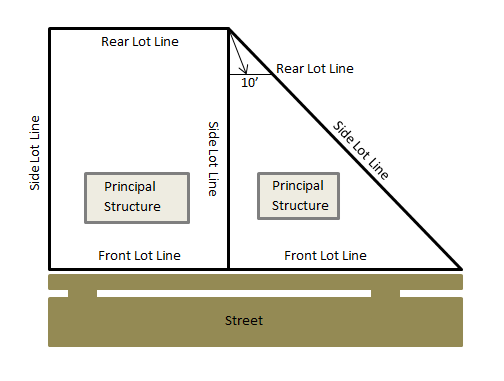
LOT, RECORD — The land designated as a separate and distinct parcel on a legally approved and recorded subdivision plat filed among the land records of Charles County.
LOT, THROUGH — A lot other than a corner lot with frontage on two (2) opposite or parallel streets, as depicted in figure 2 below.
Figure 2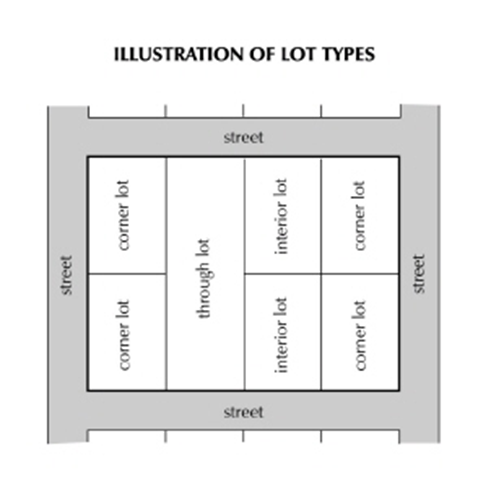
LOT WIDTH — The width of a lot measured at the front setback line, as depicted in figure 3 below.
Figure 3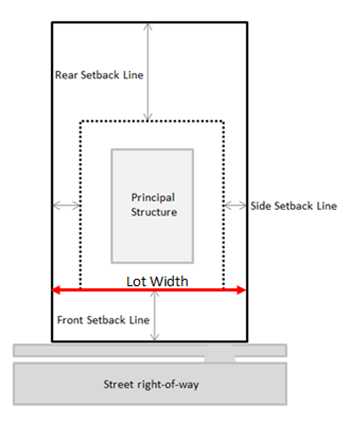
MAINTENANCE and REPAIR SERVICE, MAJOR — Establishments engaged in maintenance and repair of industrial equipment and machinery and any other repair maintenance service that provides outdoor storage and work areas in addition to interior shop space for working on equipment and implements. Use may include the sale, installation, and service of related equipment and parts. Use excludes maintenance and repair of vehicles, boats, or ships.
MAINTENANCE and REPAIR SERVICE, MINOR — Repair and incidental sales of supplies for appliances, office machines, home electronic equipment, bicycles, tools, small engines, garden equipment and similar types of items. This classification includes furniture refinishing and repair, but excludes maintenance and repair of vehicles, boats, ships, or industrial equipment and machinery.
MANSARD ROOF — A hip roof, each face of which has a steeper lower part and a shallower upper part.
MARQUEE — A canopy-like structure typically associated with theaters that cantilevers over the principal entrance of a building, that has no vertical supports other than the wall from which it cantilevers, and that provides a wall surface typically used for signage and changeable copy signage support.
MASTER SIGN PLAN — See common sign plan.
MEDICAL MARIJUANA — Marijuana used for medical purposes including any product containing medical marijuana, manufactured in accordance with all state and local laws, which may be administered to treat or alleviate a qualifying patient's debilitating medical condition or symptoms associated with the patient's debilitating medical condition.
MEDICAL MARIJUANA CULTIVATION FACILITY — A structure used for the cultivation and storage of medical marijuana that is physically separate and off-site from a medical marijuana dispensary.
MEDICAL MARIJUANA DISPENSARY — A nonprofit entity, that sells, distributes, dispenses, or otherwise provides medical marijuana to qualifying patients.
MEDICAL MARIJUANA QUALIFYING PATIENT — A person who has been diagnosed by a physician as having a debilitating medical condition for which medical marijuana has been prescribed.
MICROBREWERY — A facility in which beer is brewed for distribution and consumption, and which possesses the appropriate Class 7 license from the State of Maryland. Tasting rooms for the consumption of on-site produced beer are permitted on the premises.
MOBILE FOOD SERVICE FACILITY — A self-contained mobile or motor vehicle or trailer that sells food to the public from a parking lot curb or parked side of the vehicle. A mobile food service facility does not include ice cream trucks, or sandwich trucks parked at commercial construction sites to serve primarily workers at those sites.
MOTOR VEHICLE MAINTENANCE SERVICE, MAJOR — Repair of automobiles, trucks, motorcycles, tractors, motor homes, recreational vehicles, recreational or commercial watercraft and marine engines, including the sale, installation, and servicing of related equipment and parts. This classification includes engine repair, body and fender shops, vehicle painting, wheel repairs, tire sales and installation, and/or repair of heavy trucks or construction vehicles, but excludes vehicle dismantling or salvage, and tire re-treading and recapping.
MOTOR VEHICLE MAINTENANCE SERVICE, MINOR — Establishments where vehicle repairs and routine maintenance are made in enclosed bays and no vehicles are stored overnight, including quick-service oil, tune-up, tire, brake, and muffler shops; and washing, waxing, or cleaning of automobiles or similar vehicles. This classification excludes uses providing towing, engine repair, body and fender work, vehicle painting, or repair of heavy trucks or construction vehicles.
MOTOR VEHICLE SALES — Establishments engaged in the retail sale of new or used vehicles of all types undertaken in indoor retail show-room or outdoor sale lots, and related offices, may provide repair and major maintenance services, and may sell related parts, accessories, and equipment.
MULTIPLE OCCUPANCY PROPERTY — A property with an approved development of one (1) or more parcels with multiple occupancies of one (1) or more land use types that share elements such as parking, signage, building lobbies, common open areas, storm water facilities and/or other similar elements.
MUNICIPAL DECORATIVE FLAGS — A device, limited to government speech of the Town of La Plata, attached to a bracket located on an electric light pole owned or leased by the Town of La Plata.
NET ACREAGE — The total acreage of a lot, tract, or parcel, excluding land in existing and proposed streets and street rights-of-way.
NONCONFORMING SIGN or DEVICE — A sign or device lawfully existing prior to the adoption of this chapter and amendments which could not be built, erected, or installed under the current terms of this chapter.
NONCONFORMING LOTS OF RECORD — Any lot which does not conform to the currently applicable requirements and standards for lot dimensions prescribed in the regulations for the zone in which the lot is located by reason of adoption or amendment of the chapter.
NONCONFORMING STRUCTURE — A structure that was lawfully erected but which does not conform to the currently applicable requirements and standards for yard spaces, height of structures, or distances between structures prescribed in the regulations for the zone in which the structure is located by reason of adoption or amendment of the chapter.
NONCONFORMING USE — A use that was lawful when established but no longer conforms to the requirements of the zone in which it is located because of the adoption or amendment of the zoning ordinance or zoning map.
DEVELOPMENT STANDARDS NONCONFORMITY — A building, structure, or site improvement that was lawful when established but no longer conforms to development standards of the zone in which it is located, as set forth in this chapter (such as, but not limited to, parking, lot coverage, green space, etc.), because of the adoption or amendment of this chapter or the zoning map.
OCCUPANCY, CERTIFICATE OF — The certificate issued by the Chief Executive Officer or designee, which permits the use of a structure in accordance with the approved plans and specifications and which certifies compliance with the provisions of the law for the use and occupancy of the structure as specified in the Town Code.
OFFICE — Offices of firm(s) or organization(s) providing professional, executive, management, or administrative services.
OFFICE, HOME — The use of a designated portion of a dwelling unit, not to exceed ten percent (10%) of the floor area of the dwelling unit, for telephone and other technological communication with customers, clients, suppliers and others, for occasional consultation with customers, clients, suppliers, and others, and/or for the performance of administrative work such as bookkeeping, processing of correspondence, preparation of reports or other written materials, etc., in support of a business, profession, trade, occupation, or employment.
OFFICE, MEDICAL — A facility used to provide the diagnosis and treatment for medical, dental, optical, mental health and related services, including medical/dental laboratories incidental to the medical office use, and medical clinics.
OPEN SPACE — A parcel or parcels of land or an area of water or a combination of land and water that are designated and intended for either:
A.
The recreational use and enjoyment of residents of a development from which it was established and for the general public, or
B.
For the exclusive recreational use and enjoyment of residents of the development from which it was established.
C.
Open space may include:
(1)
GREEN AREA/SPACE — An area of land accessory to a structure for the purpose of providing light, air, and open space. such areas shall generally be available for entry and use of the occupants of the premises and may include lawns, gardens, decorative plantings and wooded areas, landscaped areas used for screening purposes, landscaped areas covering structures, required yards, sidewalks and pedestrian bicycle paths, water surfaces, village greens, parks, and include active and passive recreational areas. "Green area" shall not include streets, drives, or parking or loading areas.
(2)
PUBLIC USE SPACE — An area of land or place that is open and accessible to all people. These are gathering spaces such as playgrounds, public seating areas, squares, courtyards, plazas, and other active recreational amenities.
OUTDOOR STORAGE — Storage or placement of equipment, merchandise, or products not otherwise permitted inside of a structure. This does not apply to agricultural use classifications.
PARCEL — A contiguous area of land described in a single description by a deed or other instrument or as one (1) number of lots on a plat or plan, capable of being separately conveyed.
PARKING, JOINT USE — A condition wherein two (2) or more uses may provide required off-street parking spaces in a common parking facility if the total spaces provided are not less than the sum of the spaces required for each use individually.
PARKING, SHARED — Shared parking is the condition wherein differing day/night and weekday/weekend schedules allow the parking to be shared by more than one (1) structure or more than one (1) use within the same structure.
PARKING AREA, INTERIOR — The area within the perimeter of the curbs or edge of paving and does not include drive aisles without parking on either side, sidewalks, through islands, areas within islands that contain utilities below, signs, or other landscaping.
PARKING AREA, PERIMETER — An area adjoining the perimeter of the parking area or edge of paving, excluding driveways or walkways providing access to the parking area.
PARKING FACILITIES, PRIVATE — Private parking garages or lots not intended for public use.
PARKING FACILITIES, PUBLIC — Public parking garages or lots intended for public use.
PARKLAND — A large open area available for recreation, comprised of paths, trails, open lawn, trees, open shelters, or similar amenities, that is owned or administered by the town and is available to the general public.
PERMANENT MATERIALS — Rigid, durable material that can hold in all weather conditions such as hard plastic, wood, stone, MDO plywood, aluminum, steel, PVC, glass, and plexiglas. Fabric, corrugated plastic, vinyl structures, and the like are not considered permanent materials.
PENNANT — Any lightweight plastic, fabric, or other material, whether or not containing a message of any kind, which is suspended from a rope, wire, string, or pole, and which is designed to move in the wind.
PERSON — Any individual, association, company, corporation, limited liability company, firm, organization, or partnership, singular or plural, of any kind.
PERSON, SENIOR — A person who is at least fifty-five (55) years of age.
PERSONAL or BUSINESS SERVICE — Establishment providing a range of support activities or services and incidental sales to persons and businesses. This classification includes, but is not limited to, small-scale retail, grocery, and/or specialty stores, barber and beauty shops, tattoo parlors, dog grooming, watch and jewelry repair shops, engraving studios, picture framing shops, shops for tailors, shoe repair, dry cleaners, locksmiths, film developing, telegraph and fax services, delivery services, self-service laundries, janitorial or maintenance services, document delivery, mail receiving and distribution, drafting, blueprinting, typesetting, copying, and photographic or other similar services.
PERSONAL IMPROVEMENT SERVICE — Establishment providing facilities for and instruction examples including photography, fine arts, music, crafts, dance, gymnastics, yoga and personal fitness, martial arts, driving, scuba instruction, sailing, and weight management.
PLANNED DEVELOPMENT GOVERNING DOCUMENTS — The collection of documents that establish the density, use, development standards, and special provisions that guide the build-out of a planned development located in any of the planned development zones contained in this chapter. Those documents include one (1) or more of the following:
A.
Any resolution of approval by the Town Council and any subsequent amendment thereto including any attachments;
B.
Any master site development plan approved by the town council and any subsequent amendment thereto including any attachments;
C.
Any preliminary development plan approval by the Planning Commission and any subsequent amendment thereto including any attachments;
D.
Any annexation agreement or development agreement;
E.
The provisions of the predecessor to this chapter applicable to the particular planned development prior to the effective date of this chapter and not inconsistent with the resolution of approval, the approved preliminary development plan, the annexation agreement or other development agreement.
PLAT — A plotted map, chart, or plan, or a map of a legally recorded subdivision showing the boundaries and locations of the lot or lots recorded thereon.
PORTICO — A porch or walkway, open to the outside air, that is covered by a roof supported by columns or pillars, typically leading to the entrance of a structure. A portico is considered a "canopy" for purposes of determining signage.
PRODUCTION INDUSTRY, CUSTOM — On-site production of goods by hand manufacturing involving the use of hand tools and small-scale equipment. this classification includes custom carpentry, cabinet and small scale furniture making and woodworking, blacksmiths, welding, machine shops, sail lofts, small-scale sawmills for custom work and custom jewelry making.
PRODUCTION INDUSTRY, GENERAL — Manufacturing of products, primarily from extracted or raw materials, or bulk storage and handling of such products and materials. this classification includes food processing and packaging, furniture manufacture, laundry and dry cleaning plants, stonework and concrete products manufacture, and large-scale sawmills and kiln drying operations.
PUBLIC MAINTENANCE FACILITY — Facilities providing maintenance and repair services for public and utility vehicles and equipment, and materials storage areas. This classification includes utility and road maintenance depots, equipment service centers, and similar facilities.
PUBLIC SAFETY FACILITY — Facility for public safety and emergency services, including fire protection, rescue squad, police, and detention service. Includes private non-profit medical transport services, emergency medical care offices and communications facilities located entirely within structures.
PUBLIC UTILITY EASEMENT (PUE) — An easement dedicated by the owner of real property and depicted on a subdivision plat and/or site plan for the purpose of granting unto the Town of La Plata, utility companies or their assigns the right to locate utility facilities, to include but not limited to, electric, broadband, telephone, gas, and other types of public utilities, within the designated length and width of the public utility easement so depicted. A utility easement passes on when the property is transferred or sold.
RECONSTRUCTION — The process of reproducing by new construction the exact form and detail of a vanished structure, or part thereof, as it appeared at a specific period of time.
RECREATIONAL FACILITY, MAJOR — This classification includes commercially operated indoor and outdoor recreation and entertainment facilities not specifically classified elsewhere that provides accommodations for any number of spectators or that occupy fifteen (15) acres or more of land. This use type includes, but is not limited to, drive-ins, amphitheaters, sports arenas, golf courses, amusement parks, and water parks.
RECREATIONAL FACILITY, MINOR INDOOR — This classification includes but is not limited to commercially operated indoor recreation and entertainment facilities such as bowling alleys, billiard parlors, ice or roller skating rinks, public swimming pools, miniature golf, tennis or racquetball courts, health or fitness clubs and gyms, dance halls, and game centers including pinball arcades, or establishments having five (5) or more coin-operated electronics or mechanical game machines.
RECREATIONAL FACILITY, MINOR OUTDOOR — This classification includes but is not limited to commercial outdoor recreation and entertainment facilities such as miniature golf or scale-model courses, skating rinks, public swimming pools, tennis or racquetball courts, target shooting, golf driving, or batting ranges.
RECREATIONAL FACILITY, PUBLIC — Non-commercial park, playground, recreation structure, and publicly accessible open space. This classification includes fields for amateur and youth sports including, but not limited to, baseball, softball, football, lacrosse, and soccer fields.
RELIGIOUS ASSEMBLY — A structure or group of structures used or proposed to be used for conducting organized religious services and accessory uses associated with the use, including incidental religious education not including private schools.
RENTAL HOUSING — Any structure or combination of related structures and appurtenances; including personal living quarters, or a building in which a landlord provides dwelling space for a tenant for consideration. Rental housing does not include:
A.
Any transient housing, such as a guest room in an apartment, hotel, boarding house, bed and breakfast, inn, motel, hotel, school dormitory, hospital, or medical facility; or
B.
Any housing operated for religious or charitable purposes.
RESEARCH AND DEVELOPMENT — Industrial or scientific research, including limited product testing. this classification includes electronic research firms, computer software development and pharmaceutical research laboratories, and laboratories primarily engaged in developing new methods for processing, analysis, and testing for manufacturing or medical activities.
RESTAURANT — A business establishment where refreshments and/or meals are prepared and served on the premises.
RESTAURANT, CARRY-OUT — Any establishment where ready-to-eat food primarily intended for immediate consumption is available upon a short waiting time and packaged or presented so it can readily be eaten away from the premises as there are limited facilities for on-premises consumption of food.
RESTAURANT, FAST-FOOD — Any establishment where ready-to-eat food primarily intended for immediate consumption is available upon a short waiting time and packaged or presented so it can readily be eaten outside or inside the premises and whose method of operation includes serving customers in motor vehicles either at a drive-through window or while parked.
RESTAURANT, WALK-UP — A food establishment where a patron would typically walk up to an exterior window and place an order for ready-to-eat food primarily intended for immediate consumption available upon a short waiting time.
RESTORATION — The process of accurately recovering the form and details of a property as it appeared at a specific period of time by means of removal of later work and the replacement of work missing from that period.
RETAIL SALES GENERAL — Establishment that occupies a gross floor area in excess of fifteen thousand (15,000) square feet, engaged in retail sales of goods and merchandise not specifically listed under another use classification. Use type includes department stores, discount stores and shopping "clubs", home furnishing stores, supermarkets, retail plant nurseries and garden centers, and establishments engaged in retailing or wholesaling of building supplies or equipment including lumberyards and implement, tool, and equipment sales.
RETAIL SALES LIMITED — Establishment engaged in retail sales of limited types of goods and merchandise not specifically listed under another use classification, including, but not limited to, specialty stores engaged in the retail sale of antiques, appliances, art, art supplies and services, new automotive parts and accessories, (excluding service and installation), bicycles, cameras, carpeting and floor coverings, coins, electronic equipment, handcrafted items, hardware, hobby materials, jewelry, kitchen utensils, medical supplies, office supplies, paint and wallpaper, photographic supplies, records, sporting goods, toys, used merchandise, groceries, liquor and similar types of goods.
RIGHT-OF-WAY, PUBLIC — The legal right of a pedestrian or vehicle to proceed along a path, road, street, or highway, that was preserved or dedicated by plat, easement, eminent domain, purchase, fee simple title, or prescriptive use.
SECURITY — "Security" and "bonding" refer to any of the types of security accepted by the town to secure performance of required obligations.
SENIOR LIVING COMMUNITY — Residential communities where occupancy is designed for and restricted to senior persons.
SETBACKS — The minimum perpendicular distance required between a lot line and the principal structure or structure constructed, or which may be constructed thereon consistent with the setback requirements of the zone in which such lot is located, as depicted in figure 4 below.
Figure 4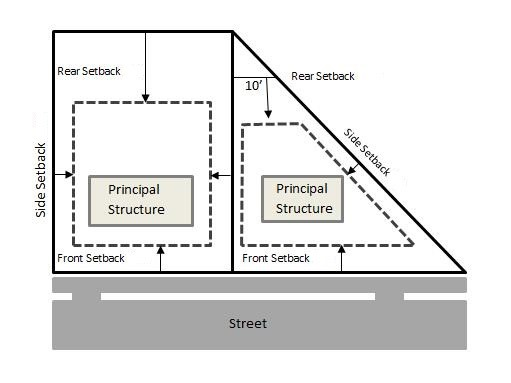
SHOWS and EVENTS — Temporary indoor or outdoor events occurring at a site intended for such purpose, including animal shows for domestic or farm animals, art fairs and shows, indoor display and sale of hand crafts and similar objects, equipment and trade fairs, concerts, carnivals, fairs, and other similar events; and events that provide games, eating and drinking facilities, live entertainment, or similar activities.
SIGHT VISIBILITY TRIANGLE (or HORIZONTAL SIGHT DISTANCE) — As depicted below, the triangular space provided across all property corners created by either the intersection of two (2) streets or the intersection of a driveway and a street. The sight visibility triangle is determined by drawing a diagonal line across the corner of the lot measured from two (2) points drawn twenty-five (25) feet back from the street or driveway intersections with a street, as depicted in figure 5 below.
Figure 5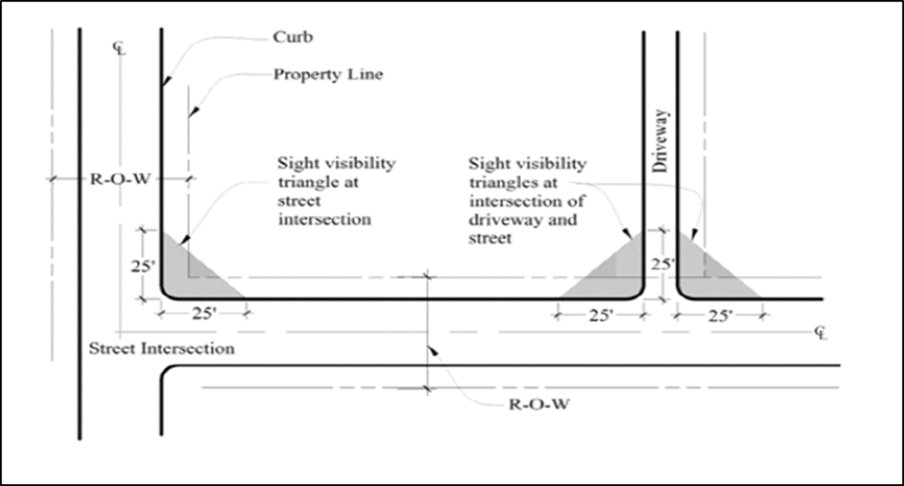
SIGN — Any device, fixture, placard, painting, or structure, or portion thereof, that uses any color, form, material, graphic, illumination, symbol or writing to advertise, announce the purpose of, or identify the purpose of a person or entity, or to communicate information of any kind to the public. Signs include:
ACCESSORY BUILDING SIGN — A wall sign placed on an accessory structure incidental to a principal structure on the same lot.
ANIMATED SIGN — Any sign that uses movement or change of lighting to depict action or create a special effect or scene.
ATTACHED SIGN — A sign attached to or painted on a building.
AWNING SIGN — A sign containing text or graphics located on an awning as depicted in figure 6 below.
Figure 6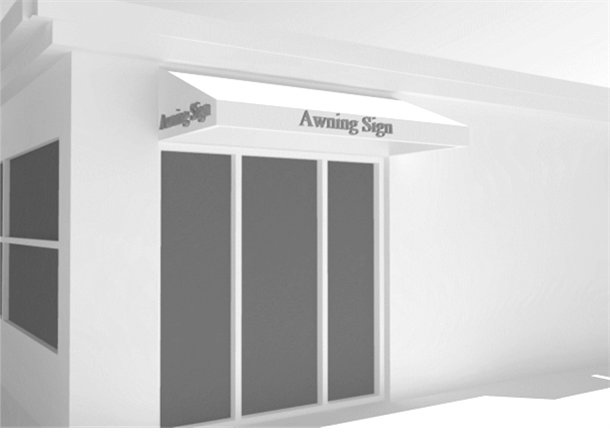
BANNER — A sign made of lightweight fabric, vinyl, or similar material that is mounted or secured to poles or a building or other means.
BUILDING MARKER — Any sign indicating the name of a building, date, and incidental information about its construction. Such sign typically is cut into a masonry surface or made of bronze or other permanent material.
BUILDING SIGN — Any sign attached to any part of a building, as contrasted to a "ground sign" or "freestanding sign".
CANOPY SIGN — Any sign that is a part of, or attached to a canopy over a door, entrance, window, or outdoor service area, as depicted in figure 7 below.
Figure 7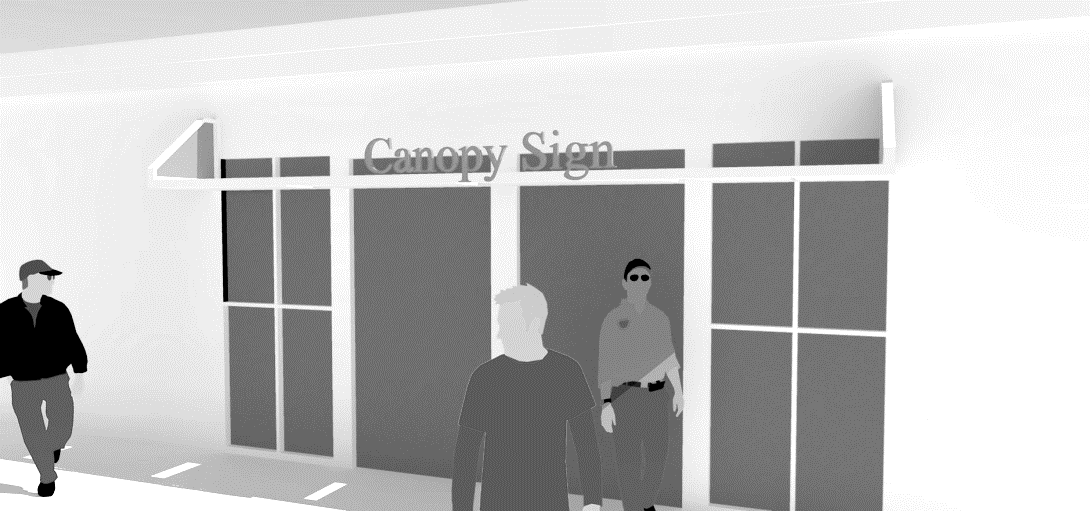
CHANGEABLE COPY SIGN — Any sign designed so that letters or numbers can be changed to indicate a different message, including electronic signs.
COMMERCIAL MESSAGE — Any sign, wording, logo, color scheme, or other representation, that, directly or indirectly, names, advertises, or calls attention to an entity, product, service, or other commercial activity.
COMMUNITY SIGN — Any temporary sign or banner on government, education, homeowner's association or religious owned property.
DETACHED SIGN — A sign not attached to or painted on a building but which is affixed to the ground.
DIRECTORY SIGN — A sign that lists tenants or occupants of a building or lot and which may have unit numbers, arrows, or other directional information to aid in way finding.
DISPLAY BOX — A pedestrian scale wall sign enclosed in glass for the expressed purpose of displaying items and information.
DOOR SIGN — A type of incidental sign that is pedestrian in scale and located near an entity's public entrance.
DRIVE-THROUGH LANE SIGNAGE — Signage oriented to the occupants of a drive-through lane.
ELECTRONIC SIGN — Signs with alphabetic, pictographic, or symbolic informational content that can be changed or altered by an electronic or computerized process, on a fixed electrically illuminated display screen.
FLASHING SIGN — A sign, the illumination of which is not constant in intensity when in use, and which exhibits sudden or marked changes in lighting effects.
FREESTANDING SIGN — A sign supported upon the ground by poles, pylons, braces, or a solid base and not attached to any building. Freestanding signs include those signs otherwise known as "pedestal signs", "pole signs", "pylon signs", and "monument signs".
GROUND SIGN — Any sign attached to the ground, as contrasted to a "building" sign.
ILLUMINATED SIGN — A sign that is illuminated by electrical or other artificial devices.
INCIDENTAL SIGN — A sign, generally informational, that has a purpose secondary to the use of the site on which it is located, such as "no parking", "entrance", "loading only", "telephone", "open", store hours, and similar information and directives, as depicted in figure 8 below.
Figure 8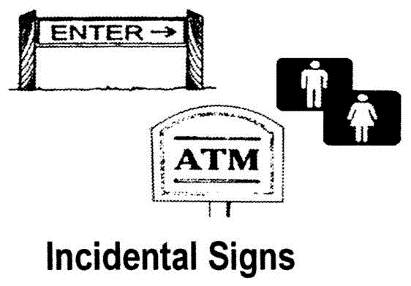
MARQUEE SIGN — A sign or changeable copy sign integrated into the face of the marquee attached to, or mounted on top of a marquee.
MENU BOARDS, DRIVE-THROUGH LANE — A sign providing items and prices associated with drive-through restaurant.
MONUMENT SIGN — A free standing sign, the bottom of which is usually flush with the ground, supported by or affixed to a wood, stone, masonry, or brick wall-like base, as depicted in figure 9 below.
Figure 9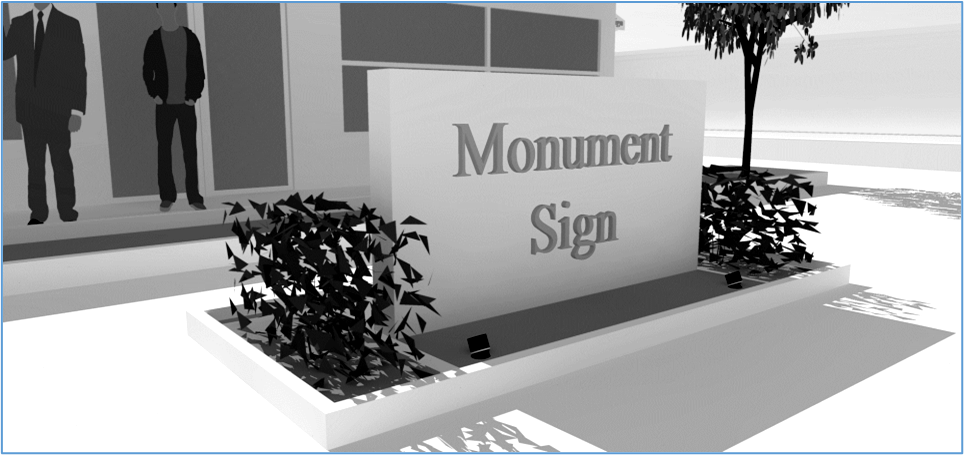
MOTOR FUEL PRICE SIGN — Any sign displaying the price of motor fuel for sale.
NAME PLATE — A sign no greater than one (1) square foot that identifies the person or entity on or near the entity's public entrance.
ORDER WINDOW SIGNAGE — Signage oriented to the visitors of a walk-up restaurant window that identifies products available for purchase at the window.
PEDESTAL SIGN — A free standing sign mounted on or supported by a wood, stone, masonry, or brick column(s), that is generally less than four (4) feet in height.
PEDESTRIAN ORIENTED SIGNS — A sign composed of a sign panel and supporting structure or of two (2) angled panels which form both the structure and sign faces in an a-frame design. This may include sandwich boards, chalkboards, a-frame, water base, t-base, and other like signs which are designed and oriented to communicate to pedestrians.
POLE SIGN — Any sign wholly supported by a single vertical upright element that measures less than twenty-five percent (25%) of the width of the sign panel and more than twice the height of the sign panel, as depicted in figure 10 below.
Figure 10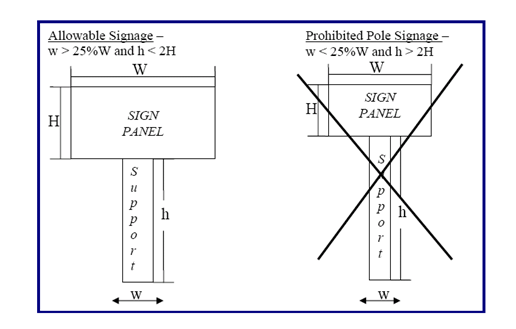
PORTABLE SIGN — Any sign, other than pedestrian oriented sign, not permanently attached to the ground or a non-mobile object and that is designed to be moved.
PYLON SIGN — A free-standing sign up to twenty (20) feet in overall height, usually with the bottom of the sign area elevated and supported by a wood, brick, masonry, or stone tower-like structure or columns, commonly used in centers for centralized tenant signage.
ROOF SIGN — Any sign erected and constructed wholly on and over the roof of a building, supported by the roof structure, except a sign wholly on the lower slope of a mansard; and any sign extending vertically above the highest portion of the roof.
SHINGLE SIGN — A building sign that projects outward, typically at a ninety (90°) degree angle, and hangs from a bracket or support that is located over or near a building public entrance.
SIGN ON PROPERTY FOR SALE or LEASE — A limited duration sign on a property for sale or for lease.
SUSPENDED SIGN — A sign that is hung from the underside of a canopy, or supported by/attached to a building or a post, as depicted in figure 11 below.
Figure 11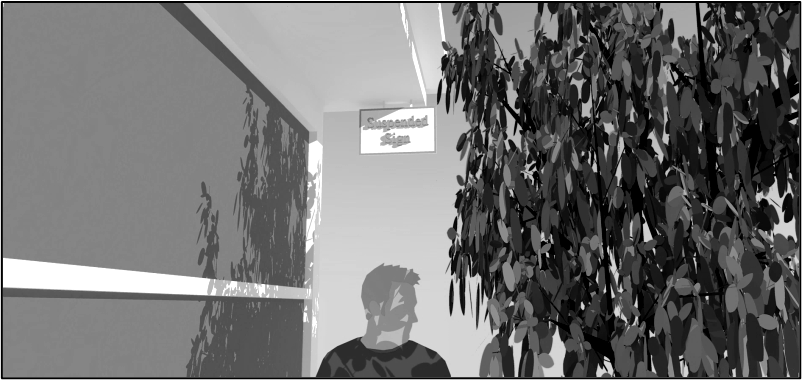
TEMPORARY PRIVATE LIGHT POLE BANNER — A sign that is affixed to light poles on private property for a limited duration.
TEMPORARY SIGN — Any sign that is intended to be used temporarily and is not permanently mounted.
TRAFFIC CONTROL SIGN — A sign implementing federal, state, or municipal regulations for automobile, truck, bicycle, or pedestrian movement.
WALL SIGN — Any sign painted on, or attached to, an exterior wall or the lower slope of a mansard roof, as depicted in figure 12 below.
Figure 12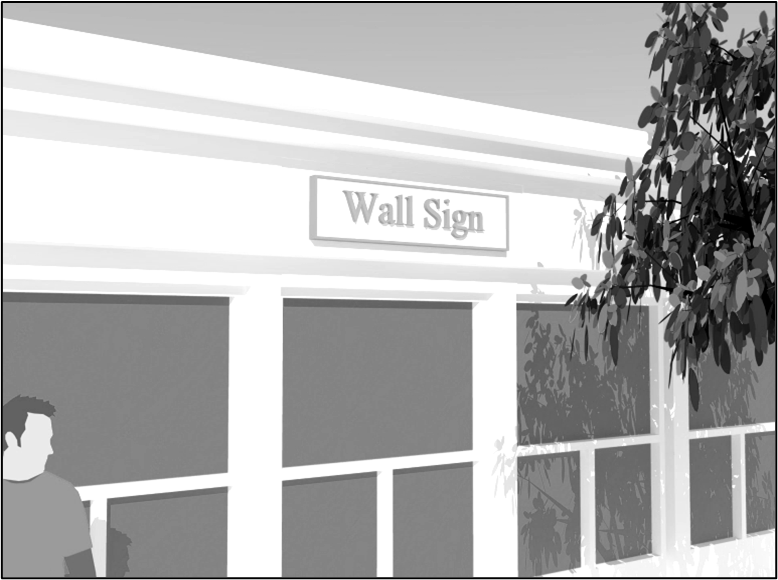
WINDOW SIGN — Any sign, poster, banner, sticker, cling, pictures, symbol, stencils, lettering, or combination thereof located in a window, as depicted in figure 13 below.
Figure 13
SITE — One (1) or more lots, tracts, or parcels of land considered as one (1) land-unit for purposes of this chapter. For a single-family residence, the site shall be the lot on which it is located. For multifamily projects, the site shall be all land occupied by the structures in the project and adjoining such property and under common ownership with it. For vacant land, the site shall be all of the adjoining vacant land under single ownership. For single-occupancy, nonresidential properties, the site shall be the land unit that is occupied. For planned shopping centers or multiple-occupancy properties, the site shall be all land included under the original "site plan" or "subdivision plan" approval or all land included under the original "common sign plan" approval under this chapter or its predecessor, whichever land area is larger.
SITE, HISTORIC — The location of an event of historic significance or a structure, whether standing or ruined, which possesses historic, architectural, archeological, or cultural significance.
SITE PLAN — A plan depicting the proposed development of a property, in terms of the location, scale, and configuration of structures and other features.
SMOKING LOUNGE — A business establishment that is dedicated, in whole or in part, to the smoking of tobacco products.
SOLID WASTE FACILITY — Any facility for the collection, source separation, storage, transportation, transfer, processing, treatment, or disposal of solid wastes and recycling, including hazardous wastes, whether such facility is associated with facilities generating such wastes or otherwise such as transfer stations, landfills or dumps.
STORY —Any floor of a structure at or above grade.
STREET — A public dedicated way which affords the principal means of access along the frontage of a buildable lot.
STREET, ARTERIAL (MAJOR) — A street that primarily carries local and through traffic to and from destinations outside local communities, connects cities and rural centers, and carries moderate-to-heavy volumes of traffic at moderate-to-high speeds.
STREET, ARTERIAL (MINOR) — A street that primarily connects collectors to higher order roadways and carries moderate volumes of traffic at moderate speeds.
STREET, COLLECTOR — A street that is a principal carrier within neighborhoods or single land use areas. Collectors link neighborhoods with major activity centers, other neighborhoods and arterials and are generally not for through traffic. They carry low-to-moderate volumes of traffic at low-to-moderate speeds. New collectors should intersect minor arterials rather than major arterials.
STREET, LOCAL — A street designed to provide access to abutting property and to connect to higher order roads, and on which calming measures may be appropriate. New local roads should intersect connectors, collectors or, if necessary, minor arterials, and are inappropriate for through traffic.
STREET LEVEL — A level of a building at which access from a street or the principal/main entrance to the building is located.
STREET WALL — A continuous wall or fence adjacent to a street with a minimum height of thirty-six (36) inches and ninety percent (90%) opacity.
STRUCTURE — Anything constructed or erected with a fixed location on the ground or attached to something with a fixed location on the ground. Among other things, "structures" include buildings, and parking garages.
STRUCTURE, ACCESSORY — A structure that is customarily incidental and subordinate to the principal structure on a property and may include, but is not limited to sheds, decks, detached garages, and gazebos.
STRUCTURE LINE — The lines that mark the location, height, bulk, and size of a structure.
STRUCTURE, PRINCIPAL — A structure in which a principal use is conducted on a lot or parcel that has been lawfully established in a particular zone, provided it conforms to all regulations, requirements, and standards of such zone and receives approval for such use.
SUBDIVISION — The division of a single lot, tract, or parcel of land or part thereof into two (2) or more lots, tracts, or parcels of land for the purpose, whether immediate or future, of transfer of ownership or of development. The term "subdivision" includes re-subdivision and, when appropriate to the context, shall relate to the process of subdividing or to the land subdivided.
SWIMMING POOL — Above or in-ground structure filled or intended to be filled with water for swimming.
TAVERN — A licensed establishment serving alcoholic beverages in which fifty percent (50%) or more of gross receipts are from the sale of such beverages at retail for immediate consumption, and which may provide limited food and entertainment (primarily music) services.
TEMPORARY RESIDENCE DURING CONSTRUCTION — A mobile home used as a temporary residence in conjunction with the construction of a permanent home.
TEMPORARY HOUSING — Any tent, trailer, or other structure used for human shelter which is designed to be transportable and which is not attached to the ground, to another structure, or to any utilities system on the same premises for more than thirty (30) consecutive days.
THEATER — An establishment whose primary purpose is to offer to the public movies, live performances or other entertainment.
TRANSIT STATION — An off-street at-grade, under, or above street level facility for stopping of transit vehicles to pick up and drop off passengers, usually with a boarding/alighting platform, waiting area, fare collection, information, and related facilities.
USE — The purpose or activity for which land or any structure thereon is designed, arranged or intended, or for which it is occupied or maintained.
USE, ACCESSORY — A use only allowed with the principal use on the same lot or within the same structure with and of a nature customarily incidental and subordinate to the principal use.
USE, PERMITTED WITH CONDITIONS — Use listed permitted by right, but that requires additional review and conditions for approval.
USE, PRINCIPAL — A use which may be lawfully established in a particular zone, provided it conforms to all regulations, requirements, and standards of such zone and receives approval for such use.
UTILITY INSTALLATIONS, PUBLIC — Public utility that is necessary to support legally established uses and involves only minor facilities or structures such as a small drainage channel; aqueduct; small sewer or water pump station or substation; above ground distribution or transmission lines including service for telephone or cable television; underground water, sewer, drainage, gas, electricity, telephone, or related utility lines; telephone switching centers; and telegraph or cable television transmitting offices.
UTILITY, MAJOR — Power generating plant, or power substation, water reservoir, water or wastewater treatment plant and associated disposal ponds, or similar facility of a public agency or public utility on a lot larger than or equal to two (2) acres.
UTILITY, MINOR — Power generating plant, or power substation, water reservoir, water or wastewater treatment plant and associated disposal ponds, or similar facility of a public agency or public utility on a lot smaller than two (2) acres.
VEHICLE, COMMERCIAL — A vehicle that is used for a commercial business and/or belongs to a company or corporation and is registered as a "business owned vehicle" with the Motor Vehicle Administration (MVA).
WALL, EXTERIOR — A vertical, exterior structural component of a structure. A parapet extending not more than twelve (12) inches above a flat roof shall be considered part of the exterior wall for purposes of determining signage.
WAREHOUSING and STORAGE, GENERAL — Long or short-term storage of goods or materials produced off-site within an enclosed structure prior to their distribution to wholesale or retail outlets, excluding discount clubs and similar establishments engaged in retail sales of bulk items.
WAREHOUSING and STORAGE, LIMITED — An establishment whose principle business is the leasing of enclosed compartmentalized storage space, not exceeding five hundred (500) square feet of floor area and twelve (12) feet in height, for the dead storage of household items, business items, and nonvolatile goods.
WHOLESALING and DISTRIBUTION CENTER — Indoor storage and sale of factory-direct merchandise and bulk goods. This use includes mail-order sales, importing and the wholesale sale of goods imported by the establishment and wholesale distribution, but does not include discount clubs and similar establishments engaged in retail sales of bulk items.
WINDOW AREA — The area of glass, including mullions, of a single window unit, set between structural elements.
WORK OF ART — A painting, sculpture, mural, or other creative piece devoid of commercial message.
WRECKING and SALVAGE — Storage or dismantling operation of inoperative vehicles, machinery, or other goods, including, but not limited to establishments engaged in the sale of used parts recovered from on-site vehicles and machinery. objects may either be displayed as individual items or assembled into partial or complete vehicles or other machines.
YARD — An open area between a lot line and the principal structure on an individual lot.
YARD, FRONT — Open space extending across the full width of a lot between the front lot line and the nearest projection of the principal structure.
YARD, REAR — Open space extending across the full width of the lot between the rear lot line and the nearest project of the principal structure thereof.
YARD, SIDE — Open space between a side lot line and the nearest projection of a principal structure and extending from the front yard to the rear yard.
Types of yards are depicted in figure 14 below.
Figure 14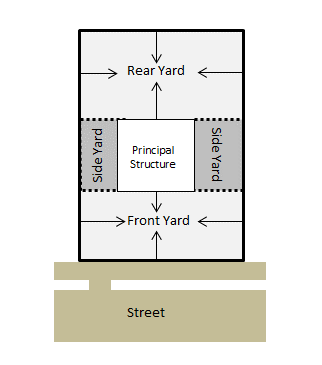
(Ord. No. 20-09, § 2, 9-28-2020, eff. 10-13-2020; Ord. No. 21-34, § 1, 11-23-2021, eff. 12-8-2021)
Sec. 191-6. - Establishment of zones.
For the purpose of this chapter, the Town of La Plata, Maryland is hereby divided into the following zones:
(Ord. No. 20-09, § 2, 9-28-2020, eff. 10-13-2020; Ord. No. 21-34, § 1, 11-23-2021, eff. 12-8-2021)
Sec. 191-7. - Zoning map.
The location and boundaries of the zones established shall be shown on the map entitled the "Official Zoning Map of La Plata, Maryland." The Official Zoning Map, with all notations, dimensions, designations, references and other data shown, shall accompany and is part of this chapter and shall be signed by the Mayor and attested to, upon adoption, by the Town Clerk. Amendments to the Official Zoning Map shall be approved by the Town Council of La Plata, Maryland, and shall promptly be portrayed on the Official Zoning Map. No such amendment shall become effective until such time of portrayal on the Official Zoning Map. Said maps shall be available for public inspection in the office of the Town Clerk.
(Ord. No. 20-09, § 2, 9-28-2020, eff. 10-13-2020)
Sec. 191-8. - Interpretation of zoning boundaries.
A.
Where uncertainty exists as to the boundaries of zones as shown on the Official Zoning Map, the following rules shall apply:
1.
A zoning boundary shown as approximately following a right-of-way line, alley, railroad, stream, or other identifiable boundary line shall be construed to follow such right-of way line or physical feature.
2.
A zoning boundary shown as lying within, but not contiguous to a right-of way line, alley, railroad, or other identifiable boundary line shall be construed to follow the centerline of the right-of-way or boundary line.
3.
Where a boundary is shown as being located a specific distance from a front lot line or other physical feature, the specified distance shall control.
4.
Where boundaries are not otherwise indicated and where the property has been or may hereafter be divided into blocks and lots, the boundaries shall be construed to be the lot lines, and where boundaries are shown as approximately following lot lines, such boundaries shall be construed as following such lot lines, unless otherwise indicated.
5.
On un-subdivided property, unless otherwise indicated, boundaries shall be determined by the use of the scale on the Official Zoning Map.
6.
Where a property is split by a zoning boundary including overlay zones, the rules of the zone shall apply to that portion of the land located in each zone.
7.
If uncertainty remains as to the location of a zoning boundary or other feature shown on the Official Zoning Map, the location shall be determined by the Chief Executive Officer or designee.
(Ord. No. 20-09, § 2, 9-28-2020, eff. 10-13-2020)
Sec. 191-9. - Application of regulations.
A.
In the event of a conflict between information contained in the tables or figures and other provisions of this article, the provisions in other sections of this article shall prevail.
B.
Except as may be lawfully modified by variance, the regulations set by this chapter shall be minimum regulations and shall apply uniformly to each class or kind of structure or land, except as hereinafter provided:
1.
No land shall hereafter be used or occupied except in conformity with all regulations herein applicable within the zone in which it is located.
2.
No structure shall hereafter be erected, constructed, reconstructed, moved, enlarged, or structurally altered to the extent of increasing floor area except in conformity with all regulations herein applicable within the zone in which it is located.
3.
No sign shall hereafter be erected, hung, placed, painted, altered, or moved except in conformity with regulations applicable within the zone in which it is located.
4.
No part of a yard, open space, off-street parking, or off-street loading space required in connection with any structure for the purpose of complying with this chapter shall be included as part of a yard, open space, off-street parking, or loading space similarly required for any other structure.
5.
No lot or setbacks existing at the effective date of adoption of this chapter shall be reduced in dimension or area below the minimum requirements set forth herein. Lots or setbacks created after the effective date of adoption of this chapter shall meet the minimum requirements established by this chapter.
6.
No accessory structure shall be constructed upon a lot until the construction of the principal structure has actually commenced. No accessory structure shall be used unless the principal structure on the lot is also being used. No cellar or basement shall be used as a dwelling prior to substantial completion of the dwelling of which it is part.
7.
No permit shall be issued for any structure located in a designated Town of La Plata Historic Area prior to the receipt of a certificate of appropriateness issued by the Historic Zone Commission in conformity with Article IX of this chapter. No permit shall be issued for any structure located in the CB Central Business Zone, CBT Central Business Transition Zone, CH Commercial Highway Zone, or in the PBPE Planned Business Park and Enterprise Zone without review and action by the Design Review Board in conformity with Chapter 16.
(Ord. No. 20-09, § 2, 9-28-2020, eff. 10-13-2020)
Sec. 191-10. - Table of permitted uses.
A.
Use of designations P, PC, SE, T and asterisk (*) in the table of permitted uses:
1.
When used in connection with a particular use in the table of permitted uses, the letter "P" means that the use is permitted in the indicated zone.
2.
The letters "PC" means a use is permitted in the indicated zone, subject to the conditions outlined in the underlying zone in Article VI.
3.
The letters "SE" means a special exception must be obtained from the Board of Appeals and that there are additional regulations applicable in Article VI.
4.
The letter "T" means a use is temporary in the indicated zone, subject to the conditions outlined in code section 191-40.
5.
An asterisk symbol "*" means the use is not permitted in the zone.
B.
Permitted uses and specific exclusions:
1.
The table of permitted uses depicted below sets forth the uses allowed in each zone. However, subject to paragraphs 2., 3. and 5. of this subsection, those uses that are not listed in a particular zone shall be assigned by the Chief Executive Officer to a zone that includes uses listed that have similar impacts as the undesignated uses.
2.
The table of permitted uses shall not be interpreted to allow a use not expressly allowed in a zone when the use in question is more closely related to another specified use that is permissible in other zones.
3.
Whenever a proposed use could fall within more than one (1) use classification in the table of permitted uses, the Chief Executive Officer shall interpret the proposed use to be included in that classification which most closely and most specifically describes the proposed use.
4.
Any use that is not listed in the table of permitted uses is not allowed unless otherwise interpreted in accordance with subsection B.1.
5.
The Planned Redevelopment and Infill Overlay Zone (PRID) is not listed under the table of permitted uses. All uses shall be determined in accordance with section 191-33.
C.
Use types:
1.
The table of permitted uses, table 1 below, has been organized by use types, which include:
a.
Agricultural uses;
b.
Residential uses;
c.
Public/semi-public uses;
d.
Commercial uses;
e.
Industrial uses;
f.
Transportation/utility uses;
g.
Accessory uses; and
h.
Temporary uses.
Table 1
(Ord. No. 20-09, § 2, 9-28-2020, eff. 10-13-2020; Ord. No. 21-34, § 1, 11-23-2021, eff. 12-8-2021)

