
La Plata City Zoning Code
ARTICLE VIII
- SIGNS
Sec. 191-63. - Purposes, applicability, and effect.
A.
Intent and purpose.
1.
It is the intent of this section to provide standards for the effective use of signs as a means of communication in the town and ensure fair and consistent enforcement of the regulations, while still preserving the right to free speech and expression.
2.
The purpose of these regulations is to protect and enhance the small town character of the Town of La Plata by requiring new and replacement signage which is:
a.
Creative and distinctive while enhancing an attractive economic and business climate;
b.
Compatible with its surroundings ensuring no adverse effects to nearby public and private property;
c.
An integral component of the style and character of the building to which it conveys;
d.
Properly sized for its context and appropriate to the type of activity to which it pertains;
e.
Expressive of the identity of the individual proprietors or of the community as a whole;
f.
Properly installed and adequately maintained; and
g.
Designed to minimize distraction to vehicular traffic.
B.
Applicability and effect.
1.
A sign may be erected, placed, established, painted, created, or maintained in the town only in conformance with the standards, procedures, exemptions, and other requirements of this article.
(Ord. No. 20-09, § 2, 9-28-2020, eff. 10-13-2020)
Sec. 191-64. - Computations.
A.
Sign area.
1.
The area of a sign is computed by means of the smallest square, circle, rectangle, triangle, or combination of no more than three (3) of these shapes thereof which will encompass the extreme limits of the writing, representation, emblem, or other display, together with any material or color forming an integral part of the background of the display or used to differentiate the sign from the backdrop or structure against which it is placed, but not including any supporting framework, bracing, or decorative fence or wall, when such fence or wall otherwise meets the provisions of this title, and is clearly incidental to the display itself. These principles are depicted in figure 26.
Figure 26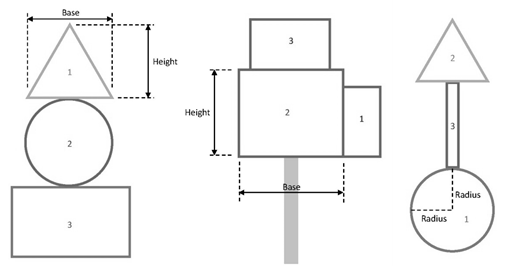
B.
Multiple signs.
1.
Signs less than one (1) foot apart are measured as one sign and space between the elements must be included in the calculation of the sign. Signs more than a foot apart, that are not two (2) sided (as defined below), are calculated as separate signs. these principles are depicted in figures 27 and 28.
Figure 27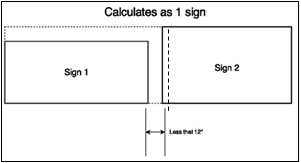
Figure 28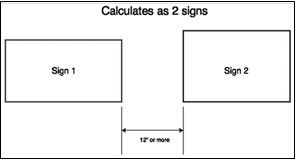
C.
Two (2) sided and two (2) sided angled signs.
1.
Signs with two (2) flat sides or with an angle less than sixty (60) degrees shall have one (1) of the two (2) sides count towards the total sign area, computed by multiplying the width by the height. Two (2) sided signs with an angle greater than sixty (60) degrees shall have the two (2) sides count towards the total sign area, computed by multiplying the width and height of each side. These principles are depicted in figure 29.
Figure 29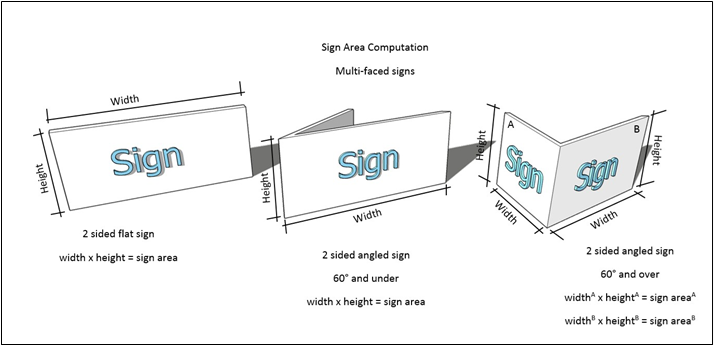
(Ord. No. 20-09, § 2, 9-28-2020, eff. 10-13-2020)
Sec. 191-65. - Sign types.
A.
Table of permitted signs.
1.
The following table 21 highlights the type of attached and detached signs allowed without a permit or allowed with an approved permit in each zone and a summary of the limiting factors when allowed or permitted. A blank cell denotes that type of sign is not permitted or allowed in that zone. The table provides a generalization of some, but not all, of the regulations for each sign type. A full narrative for each sign type follows the table and may have additional information on the sign's allowed size, illumination, location, whether that sign type counts towards the overall allowed square footage, or other factors.
Table 21
B.
Table of prohibited signs.
1.
The following table 22 highlights the types of signs prohibited in all zones.
Table 22
(Ord. No. 20-09, § 2, 9-28-2020, eff. 10-13-2020)
Sec. 191-66. - Signage allowed with permits.
A.
The requirements and standards of this section apply to signs for which permits are required. Unless other wise stated in this article; all signage for which permits are required in the CB, CBT, CH and PBPE Zones require approval from the Design Review Board, in accordance with Chapter 16 of this Code, before a permit can be issued. Existing signage on the hospital campus as of the date of this chapter is deemed permitted under the zoning ordinance and shall be adopted as a common sign plan for the existing hospital campus. The need for additional signage for wayfinding within the hospital campus and on the perimeter of the hospital campus shall be liberally construed so as to aid the community with quick and efficient wayfinding on the hospital campus, particularly, with respect to the Emergency Department entrance. Except as provided in Section 191-66, all new signage shall require a permit and inspection to ensure compliance with safety standards. Without limitation to the forgoing, no signage shall be permitted to block sight visibility for motor vehicles and/or pedestrians on public and private streets, based upon an analysis of "sight-visibility triangle," as reviewed by the town planning director prior to the placement of any new signage. Size and dimensional elements of new signage shall be consistent with existing signage on the hospital campus as of the date of adoption of this chapter pursuant to the existing approved common sign plan for the hospital campus. Size and dimensional compatibility shall be review and approved by Town Planning Director prior to the placement of any new signage. Size and dimensional requirements of the sign ordinance shall otherwise not be applicable. Each building shall be limited to one (1) sign, except for wayfinding signs and temporary signs for special events or healthcare emergencies.
Figure 30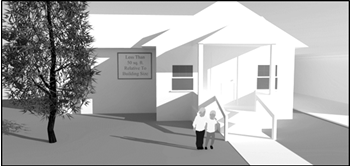
B.
Attached signs.
1.
Size allowance for attached signage. each entity is allowed signage surface area as related to building frontage of the structure in which it is located. The combined area of attached signage may not exceed:
a.
Entities in the Central Business (CB), Central Business Transition (CBT), and Industrial (LI) Zones may have one (1) square foot of signage per linear foot of that entity's building frontage.
b.
Entities along Crain Highway and/or a public road in the Commercial Highway (CH) or Planned Business Park Enterprise (PBPE) Zone may have one and one-half (1.5) square feet of signage per linear foot of that entity's building frontage for the first fifty (50) feet of the building frontage for a total of seventy-five (75) square feet of signage. Each additional foot of building frontage may have an additional one and one-quarter (1.25) square feet of signage. Entities within any other zone that have frontage within fifty (50) feet of Crain Highway may also use the computation as described in §191-63.
c.
Regardless of whether an entity has any building frontage, an entity is allowed at least fifty (50) square feet of signage, as depicted in figure thirty (30) above, if the building size or structure can adequately accommodate the sign as approved by the design review board, provided that:
(1)
The sign(s) may not cover more than fifty percent (50%) of any one building elevation; and
(2)
Signs may not cover windows, doors, or other main architectural elements.
2.
Attached sign types that count toward overall sign allowance.
a.
Awning and canopy signs. awning and canopy signs are allowed as follows:
(1)
The awning or canopy signage, including but not limited to logos, drawings, trademarks, designs, may not exceed seventy-five percent (75%) of the total awning; writing, representation, emblems, or other branding found on the awning is part of the entity's overall allowed sign area and only this area may be backlit; and
(2)
Design review board approval is not required for awning and canopy signs that meet the following requirements:
(a)
Such sign may not exceed twenty-five (25) square feet in area;
(b)
Such sign must be located over the entity's public entrance or window; and
(c)
The colors, materials, illumination, and font used in the creation of the sign must come from approved signs on a parcel within three hundred (300) feet of the entity's public entrance, provided that:
[1]
Parcels that front on the same street or are across the street from the entity's public entrance may be used;
[2]
Corner parcels may use both frontages and any parcel across the street within three hundred (300) feet of the public entrance;
[3]
A logo, regardless of the number of colors and fonts, may be part of the sign for a maximum of twenty percent (20%) of the sign area up to a maximum of five (5) square feet.
b.
Marquee signs. In the Commercial Highway (CH), Planned Business Park Enterprise (PBPE) Zone, Central Business (CB), and Central Business Transition (CBT) Zones marquee signs are allowed.
c.
Wall signs. Wall signs are allowed, as follows:
(1)
A maximum of two (2) upper story wall signs are allowed on the top floor of buildings that are a minimum of four (4) stories in height, with no signs allowed between the second and top floor;
(2)
Design review board approval is not required for wall signs that meet the following requirements:
(a)
Do not exceed twenty-five (25) square feet in area;
(b)
Are limited to a maximum of three (3) signs per façade;
(c)
The sign must be located over or near the entity's public entrance; and
(d)
The colors, materials, illumination, and font used in the creation of the sign must come from permitted signs on a parcel within three hundred (300) feet of the entity's public entrance, provided that:
[1]
Only parcels that front on the same street may be used;
[2]
Corner parcels may use both frontages; and
[3]
A logo, regardless of the number of colors and fonts, may be part of the sign, for a maximum of twenty percent (20%) of the sign area not to exceed five (5) square feet;
d.
Home occupation or family day care signs. Home occupation and family day care signs are allowed in residential zones and senior living communities as follows:
(1)
Signs are limited to a maximum of one (1) sign per dwelling;
(2)
Signs may not exceed a maximum of two (2) square feet total sign area and may not project more than three (3) inches from the exterior wall of the building; and
(3)
Home occupation and family day care signs may not be internally illuminated.
e.
Suspended signs. suspended signs are allowed, provided that such signs may not:
(1)
Exceed one (1) per public entrance; and
(2)
Be internally illuminated.
3.
Attached sign types that do not count toward overall sign allowance.
a.
Directory signs. Directory signs are not considered part of the entity's overall allowed sign area. Directory signs are subject to design review board approval as part of a common sign plan.
b.
Display boxes. Entities in the CH, CB, CBT, LI, and PBPE Zones are allowed display boxes as follows:
(1)
Limited to one (1) per public entrance;
(2)
May not be greater than four (4) square feet in size;
(3)
Any information in the box must be pedestrian in scale and not legible from the street.
c.
Walk-up order window signage. In the CH, CB, CBT, LI, and PBPE Zones walk-up order window signage is allowed provided that:
(1)
Such signs may not exceed fifteen (15) square feet in area.
d.
Drive through lane signage. In the Commercial Highway (CH) Zoning District drive-through lane signage is allowed, provided that:
(1)
Such signs in excess of four (4) square feet in size must be approved by the Design Review Board;
(2)
Such signs may not exceed thirty (30) square feet in area, or six (6) feet in height;
(3)
Permanent and temporary drive-through lane signage is oriented to the drive thru patrons;
(4)
Temporary drive through lane signage does not exceed four (4) square feet.
e.
Temporary signage subject to section 191-66.
C.
Detached signs.
1.
Size allowance for detached signs. Each lot is allowed one (1) detached sign that is considered part of the entity's overall allowed sign area, unless otherwise stated. A detached sign may combine different types of detached signage into one (1) sign. However, a corner lot may have two (2) detached signs. the combined area of detached signage may not exceed:
a.
In the CH and PBPE Zone a maximum of seventy (70) square feet and twenty (20) feet in height;
b.
In the CB, CBT, and LI Zones and for nonresidential uses in residential zones a maximum of fifty (50) square feet and twelve (12) feet in height; and
c.
The design review board may approve an increase in the size and height of detached signage in the CB and CBT Zones up to a maximum of seventy (70) square feet and twenty (20) feet in height if it finds:
(1)
The lot is abutting the CH Zone, is not adjacent to a single family residential dwelling and the proposed signage is in keeping in the size and scale of neighboring signage.
2.
Detached sign types that count toward overall sign allowance.
a.
Changeable copy signs. Changeable copy signs are allowed provided that the sign area and structure are limited as follows:
(1)
In the CH and PBPE Zone:
(a)
Twenty-five (25) square feet in area; and
(b)
No sign or any portion of its supporting structure may exceed twenty (20) feet in height.
(2)
In all other zones:
(a)
Twenty (20) square feet in area; and
(b)
No sign or any portion of its supporting structure may exceed twelve (12) feet in height.
b.
Freestanding signs. Freestanding signs may not exceed overall allowed sign area for detached signs.
3.
Detached sign types that do not count toward overall sign allowance.
a.
Directory signs. Directory signs are subject to Design Review Board approval as part of a common sign plan and each entity's allowable signage must be proportional to the number of tenants.
b.
Drive-through lane signage. In the Commercial Highway (CH) Zoning District drive-through lane signage is allowed, provided that:
(1)
Such signs in excess of four (4) square feet in size must be approved by the Design Review Board;
(2)
Such signs may not exceed thirty (30) square feet in area, or six (6) feet in height;
(3)
Permanent and temporary drive-through lane signage is oriented to the drive thru patrons; and
(4)
Temporary drive through lane signage does not exceed four (4) square feet.
c.
Motor fuel price signs. size may not exceed minimum size required by state law.
d.
Temporary signage subject to section 191-66.
(Ord. No. 20-09, § 2, 9-28-2020, eff. 10-13-2020; Ord. No. 21-34, § 1, 11-23-2021, eff. 12-8-2021)
Sec. 191-67. - Signs allowed without a permit.
The following signs are allowed without a permit under section 191-64 of this article and do not count toward overall allowed sign area:
A.
Traffic control signs on private property, such as stop, yield, entrance, loading, and similar signs, which meet government required standards, such as the Manual of Uniform Traffic Control Devices (MUTED);
B.
Any sign inside an enclosed athletic field;
C.
Signs not exceeding two (2) square feet in area including:
1.
Directory signs on a building: Directory signs included in a common sign plan as part of a multiple tenanted building in the CH, CB, CBT, PBPE, and LI Zones, and subject to the following:
a.
Not more than one (1) sign per public entrance; and
b.
May contain only the logo, address, suite number, or name of the occupant or entity served by the public entrance.
2.
Incidental signs. Incidental signs subject to the following:
a.
Not more than one (1) "open" sign per public entrance, which may be illuminated;
b.
Non-illuminated store hours at each public entrance;
c.
Two (2) "now hiring" signs per entity located on the entity's site;
d.
Three (3) door signs within five (5) feet of a public entrance that must be pedestrian in scale and with no information legible from the street; and
e.
Signs attached to gas pumps must be pedestrian in scale and with no information legible from the street.
D.
Suspended sign; one (1) sign per entity that may not exceed three (3) square feet nor be internally illuminated;
E.
Community signs not to exceed thirty-two (32) square feet;
F.
Window signs. Window signs provided that:
1.
Signs may not exceed a maximum of twenty-five percent (25%) of the window area; and
2.
Are placed within three (3) feet inside a window or upon the window panes of glass and is visible from the exterior of the window.
[G.]
Shingle signs. One (1) shingle sign is allowed per entity, provided that each sign satisfies the following:
1.
Design standards:
a.
Maximum sign area nine (9) square feet;
b.
Maximum height three (3) feet;
c.
Minimum spacing from façade six (6) inches;
d.
Maximum width three (3) feet; and
e.
Maximum depth six (6) inches.
2.
Must be located within eight (8) feet of an active pedestrian public entrance;
3.
Must be located below the second floor windowsill;
4.
Must provide eight (8) feet of clearance when hung over a sidewalk unless a four (4) foot wide planter is provided below the sign and at least sixty (60) inches of sidewalk clearance is maintained in conformance with the accessibility requirements of the Americans With Disabilities Act; and
5.
May not be internally illuminated.
[H].
In the HC Zone, temporary signage as is necessary for special events, such as public health emergencies, health clinics, community health activities, and the like, shall be permitted without regulation by the town. The message or face of any approved permanent signage, per the Common Sign Plan, may be replaced with signage faces of equal or lesser size without regulation by the town.
(Ord. No. 20-09, § 2, 9-28-2020, eff. 10-13-2020; Ord. No. 21-34, § 1, 11-23-2021, eff. 12-8-2021)
Sec. 191-68. - Prohibited signs.
The following are prohibited:
A.
Portable signs;
B.
Any sign that presents a safety hazard, including but not limited to;
1.
Any sign that obstructs or substantially interferes with the sight visibility triangle or horizontal sight distance;
2.
Any sign that obstructs or substantially interferes with any sidewalk, window, door, fire escape, stairway, ladder, or opening intended to provide light, air, ingress, or egress to any building; and
3.
Any sign that interferes with any sidewalk, street, alley, or other way open to pedestrian or vehicular circulation.
C.
Signs on vehicles, trailers, or equipment as follows:
1.
Any sign located on a vehicle, trailer, or equipment which has been parked or located so as to be seen from a public right-of-way;
2.
Notwithstanding paragraph 1, signs are allowed on a vehicle, trailer, and equipment providing the following conditions are met:
a.
The primary purpose of such vehicle, trailer, or equipment is not the display of signs;
b.
Signs are painted upon or applied directly to any part of the vehicle, trailer, or equipment;
c.
The vehicle, trailer, or equipment is in operating condition, currently registered and licensed to operate on public streets if required, and actively used in the daily function of the entity to which such signs relate;
d.
The vehicle, trailer, or equipment is not used primarily as a static display;
e.
The vehicle, trailer, or equipment is not utilized as a storage, shelter, or distribution point for commercial products or services for the general public; and
f.
The vehicle, trailer, or equipment is parked in a designated parking space, not abutting the adjacent right of way, except when no other parking is available on the site.
D.
Any sign attached to a utility pole, light pole, telephone pole, or traffic control sign, etc., except for municipal decorative flags, temporary private light pole banners, utility identifications, or similar pole identifications;
E.
Roof signs;
F.
Pole signs;
G.
Internally illuminated translucent canopies, except as in accordance with subsection 191-63 B.2.; and
H.
Off-site signs, except as specifically provided in this chapter, or approved by the design review board as part of a single common sign plan covering multiple sites.
(Ord. No. 20-09, § 2, 9-28-2020, eff. 10-13-2020)
Sec. 191-69. - Temporary signs.
A.
Temporary signs are allowed with the following conditions:
1.
The temporary sign must be securely anchored to the building or ground.
2.
Not be located in a way that obstructs permanent or temporary signs on the property and be no closer than six (6) feet from another permanent or temporary sign.
3.
Notwithstanding anything to the contrary contained within the code of the Town of La Plata, a pending application for a sign permit shall not otherwise delay or interfere with the issuance of a use and occupancy permit.
B.
Temporary sign types allowed with a permit unless limited as part of a common sign plan, are subject to the following terms:
1.
Temporary signs and banners provided that:
a.
A temporary sign permit allows the use of one (1) temporary sign limited to thirty-two (32) square feet for a specified fifteen (15) day period;
b.
Twelve (12) temporary sign permits may be issued to the same entity on the same site in any calendar year, except that only one (1) sign per entity is allowed during any given permitted fifteen (15) day period; and
c.
Temporary sign permits do not require the approval of the Design Review Board.
2.
Private light pole banners. Private light pole banners on private property subject to the following conditions:
a.
A private light pole banner permit allows the use of vertical banners limited to ten (10) square feet each for a consecutive one hundred and eighty (180) day period;
b.
Private light pole banners may only be affixed to electric light poles on private property within or immediately adjacent to a parking lot or parking spaces on the site of the entity or organization;
c.
One (1) private light pole banner permit per entity or organization will be issued for all vertical banners affixed to electric light poles on an eligible property, whether for one or multiple banners;
d.
One (1) private light pole banner permit may be issued to the same entity or organization on the same site in any five (5) year period, except that only one (1) entity or organization's sign is allowed per pole at any one (1) time;
e.
Two (2) or more entities or organizations occupying the same site may display private light pole banners at the same time, however only one entity or organization may display at one (1) time on an individual pole;
f.
Private light pole banners may be single hung or double hung with a maximum of two (2) banners affixed per light pole standard;
g.
Private light pole banners may not exceed twenty-four (24) inches in width;
h.
Private light pole banners must be constructed of pliable and durable fabrics or vinyl especially designed for outdoor display and use;
i.
Private light pole banners must be attached to light poles capable of withstanding wind loads generated by banner attachments;
j.
The bottom of private light pole banners must be at least twelve (12) feet above grade, unless it overhangs a drive aisle in which case it must be at least fifteen (15) feet above grade;
k.
Private light pole banners may not project more than three (3) feet from the pole onto which it is mounted;
l.
Private light pole banners must be attached to poles utilizing banner hardware, which must be attached to the light poles with proper banding materials. Light poles may not be penetrated or altered in any manner by the installation or removal of banners or banner hardware;
m.
Private light pole banners on light poles must be securely attached at both ends, perpendicular to light pole standards;
n.
If a public safety-related problem is discovered, the applicant must act immediately to correct the problem, and if it fails to do so, the town may act to correct the problem at the expense of the applicant. To ensure private light pole banners remain safe and attractive, the applicant is responsible for monitoring and maintaining the banner(s) at all times. If a problem unrelated to public safety exists, the applicant is required to remove, replace, repair, or otherwise correct the problem within forty-eight (48) hours of notice;
o.
Sites covered by a common sign plan must include private light pole banners within the common sign plan prior to a permit being issued; and
p.
The permit applies to private light pole banner hardware which is a component of private light pole banner, and banner hardware must be removed at the expiration of the permit time.
C.
Temporary sign types are allowed without a permit unless limited as part of a common sign plan, and are subject to the following conditions:
1.
Pedestrian oriented signs. One (1) pedestrian oriented sign is allowed per entity, per street frontage, or per motor fuel pump island, as follows:
a.
The total area of the sign may not exceed twelve (12) square feet, with a maximum height of four (4) feet;
b.
The sign must be constructed of durable materials and have a neat and finished appearance;
c.
The sign may be displayed only during those hours in which the entity is open to the public and shall be brought indoors at the end of each business day;
d.
The sign may not impede the flow of pedestrian traffic by maintaining at least sixty inches (60") of sidewalk clearance and its location must conform to the accessibility requirements of the americans with disabilities act; and
e.
The sign may not create a safety hazard, must be located on the same lot as the entity, and no further than twenty (20) feet from a public entrance to the entity. At no time may such sign be placed within the public right-of-way or in a manner that restricts sight distance at a driveway or intersection.
2.
Sign on property for sale or lease. additional signs on a property for sale, lease, or rent are allowed as follows:
a.
One (1) on-site sign for each street frontage, limited to a total of thirty-two (32) square feet in area; and
b.
Signs must be removed within two (2) weeks after the sale, lease, or rental of the property;
3.
Temporary walk-up or drive-through lane signage for a lot that includes a drive-through window provided that:
a.
Signs are oriented to the walk-up and drive-through patrons; and
b.
Temporary walk-up or drive-through lane signs may not exceed four (4) square feet.
4.
Temporary signs of a limited duration may be installed on a lot in addition to any other signage allowed in this article, in accordance with the following conditions:
a.
A sticker issued by the Town Planning Department and dated for seven (7) days after the date of issuance is affixed to the back of the sign, provided that stickers may be issued only on Mondays through Thursdays;
b.
The sign must be removed no later than the date on the sticker;
c.
The sign may not exceed four (4) square feet;
d.
The sign may not exceed thirty-six (36) inches in height;
e.
The sign may not be attached to any utility pole or traffic control sign as described in subsection 191-65.D.;
f.
Only one (1) such sign may be located on a lot;
g.
The earliest issued sign on a lot will remain if a subsequent sign is placed on the lot, unless the lot owner directs the subsequent sign to remain and the first to be removed by Code Official;
h.
The sign may only be placed with consent of lot owner; and
i.
Not more than fifteen (15) stickers may be issued to an applicant at one (1) time.
5.
Temporary sign during an electoral season provided that:
a.
In addition to any other signs allowed on a lot, one (1) or more signs, not exceeding a total of thirty-two (32) square feet at any one (1) time, are allowed on a lot during an electoral season.
(Ord. No. 20-09, § 2, 9-28-2020, eff. 10-13-2020)
Sec. 191-70. - Design, construction and maintenance standards.
All signs must be designed, constructed, maintained and operated in accordance with the following standards:
A.
Except for banners, pedestrian oriented signs, temporary signs, and window signs conforming in all respects with the requirements of this article unless otherwise stated, all signs must be constructed of permanent materials and be permanently and directly attached to the ground, a building, or another structure;
B.
All signs regulated by this article, must be maintained in good structural condition; must comply with applicable provisions of the current Building Code and the Electrical Code and be in conformance with the code of the Town of La Plata at all times;
C.
A sign must not have weeds, trees, vines, or other vegetation growing upon it, or obscuring the view of the sign;
D.
Signs must be maintained in good condition and repaired whenever damage to the sign, its structure, or its illumination source occurs;
E.
Electronic signs may be operated provided that:
1.
Messages and images change no more than once in a five (5) minute period; and
2.
No blinking, flashing, or animation is used.
F.
If a sign advertises or is intended to draw attention to, an entity, service, commodity, accommodation, attraction, or other enterprise or activity that is no longer operating or being offered or conducted, that sign must be removed within thirty (30) days after the cessation of such enterprise or activity.
(Ord. No. 20-09, § 2, 9-28-2020, eff. 10-13-2020)
Sec. 191-71. - Grandfathered signs.
A.
Intent. This section is intended to require the eventual compliance of signs which do not comply with this article. the compliance of signs is important to the purposes stated in section 191-60;
B.
All grandfathered signs must be removed or altered to conform to the provisions of this article:
1.
When the sign is changed or modified either in shape, increase in size, or increase in height; or
2.
When in the event that an organization, establishment, or other entity is closed, goes out of business, is inactive, or is in any way not operated, for a period of one hundred eighty (180) consecutive days, the grandfathered sign must be removed and not replaced except in conformance with this chapter; or
3.
When the message portion of a grandfathered sign is removed, leaving only the supporting "shell" of a sign or the supporting braces, anchors, or similar components; the owner of the grandfathered sign, the owner of the property where the grandfathered sign is located, or other person having control over such grandfathered sign must, within thirty (30) days of the removal of the message portion of the sign, either replace the entire message portion of the sign with an approved permit or remove the remaining components of the sign.
C.
A grandfathered sign may not be enlarged or altered in a way which would increase its nonconformity;
D.
If the grandfathered sign is removed from its location, it may not be reused or replaced. Any new sign must comply with the requirements of this chapter; and
E.
Should any grandfathered sign be damaged by any means to an extent of more than fifty percent (50%) of its replacement cost at time of damage, it may not be replaced except in conformity with the provisions of this article.
(Ord. No. 20-09, § 2, 9-28-2020, eff. 10-13-2020)
Sec. 191-72. - Common sign plans.
A.
A common sign plan approved by the Design Review Board regulates signage for multiple entities and tenants. A common sign plan is mandatory for new or modification to any:
1.
Existing or new building or complex which is twenty-five thousand (25,000) square feet or more in size;
2.
Buildings with three (3) or more tenants; and
3.
Directory signs; or
4.
Buildings or complexes situated on two (2) or more adjacent parcels.
B.
An owner may limit signage, including temporary signage, as part of a common sign plan.
C.
A common sign plan shall provide for consistency among signs.
D.
All existing master sign plans remain in effect. Any sign not detailed in a master sign plan is not permitted. A master sign plan may be amended or modified to come into conformance with common sign plan requirements.
E.
A common sign plan must demonstrate consistency with at least four (4) of the following elements to be approved:
1.
Materials;
2.
Location of each sign on the building;
3.
Sign proportions;
4.
Color scheme;
5.
Lighting;
6.
Lettering; or
7.
Graphic style.
F.
The following items should also be stated, provided, or addressed in the common sign plan:
1.
Location and use of temporary signs among tenants following the standards found in this article to avoid conflicting or overlapping signage by different entities on the same site;
2.
Establishment of an allowable area of signage for existing and future tenants with regard to all allowed signs types;
3.
A description of how existing non-compliant signs will be brought into compliance as well as the amount and location of on-premises signage to be allocated to each tenant under the plan;
4.
A computation of the maximum total sign area, the maximum area for individual signs, the maximum height and sign area for free-standing sign(s) allowed for the site.
G.
A common sign plan may be amended by filing a new common sign plan that conforms to all requirements of Town Code in affect at that time.
H.
An existing Master Sign Plan remains in effect until superseded by a common sign plan as provided for in this section.
I.
After approval by the Design Review Board of a common sign plan, a sign may not be erected, placed, painted, or maintained, except in accordance with such plan, and such plan may be enforced in the same way as any provision of this article. In case of any conflict between a provision of a common sign plan and one (1) or more provisions of this article, this article controls;
J.
A sign permit is required for each type of sign for each entity under the control of an approved common sign plan unless exempt by this chapter;
K.
Sign limitations:
1.
The signage subject to a common sign plan may take the form of one (1) or more signs, except that multiple signs may be erected on a single façade only if needed to serve secondary tenants who are operating completely from within the primary tenant's facility or there are multiple public entrances to an entity; and
2.
Each sign erected must also conform to the standards of consistency established in an approved common sign plan.
(Ord. No. 20-09, § 2, 9-28-2020, eff. 10-13-2020)
Sec. 191-73. - Process for issuance of sign permits.
A.
If a sign requiring a permit under this article is to be placed, constructed, erected, or modified on a site, the owner of the property must secure a sign permit prior to the construction, placement, erection, or modification of such a sign in accordance with the requirements of this article, unless exempt under section 191-63 of this article.
B.
A sign permit may not be issued for an existing or proposed sign unless such sign is consistent with:
1.
Any common sign plan approved and in effect for the property; and
2.
The provisions of this article.
C.
Application requirements.
1.
An application for a sign permit may be filed only by the owner of the property on which the sign is to be erected, or by an agent, lessee, or contract purchaser specifically authorized by the owner to file such application;
2.
An application for a sign permit must be filed with the town on a form prescribed by the town, along with the applicable fee adopted by the Town Council;
3.
Each application for a sign permit must contain the following:
a.
All information required on the application form;
b.
A picture or graphic of the proposed sign drawn to scale; and
c.
Such other information regarding the proposed sign as the town may deem necessary in order to determine whether the proposed sign complies with the applicable requirements of this article and other applicable town laws.
4.
The Chief Executive Officer shall determine whether the application is complete. If the application is not complete, then the applicant will be notified of any deficiencies and the town may not take any further steps to process the application until the applicant remedies the deficiencies.
D.
Approval procedure.
1.
Signs identified in this article as requiring a permit may be erected, installed, or created only in accordance with a duly issued and valid sign permit. Such permit shall be issued as follows:
a.
An application for construction, creation, or installation of a new sign or for modification of an existing sign must be accompanied by a detailed drawing to show the dimensions, design, structure, and location of each sign;
b.
Common sign plans require application to the Design Review Board for approval in accordance with section 191-69;
c.
Within fifteen (15) business days of receiving an application for a sign permit or for a common sign plan, the Chief Executive Officer shall:
(1)
Review application for completeness. If incomplete the Chief Executive Officer shall notify the applicant of the specific ways in which the application is deficient, with appropriate references to the applicable sections of the code of the Town of La Plata;
(2)
Issue the sign permit, if the sign conforms with the requirements of the code of the Town of La Plata and any applicable common sign plan; or
(3)
Schedule the application to be reviewed by the Design Review Board per Chapter 16 of the Town Code if required.
E.
Denial procedure.
1.
Deny the sign permit if the sign fails to conform to the requirements of this article and any applicable common sign plan. In case of a denial, the Chief Executive Officer shall specify the sections of the code of the Town of La Plata with which the sign is inconsistent;
F.
Procedures for appeals and variances are included in sections 191-71 and 191-51.
(Ord. No. 20-09, § 2, 9-28-2020, eff. 10-13-2020)
Sec. 191-74. - Violations and enforcement.
A.
Violations. Any of the following is a violation of this article and is subject to the enforcement remedies and penalties provided by this article, by other ordinances of the town, and by state law:
1.
To install, create, erect, or maintain any sign;
a.
In violation of any provision of this article; or
b.
In a way that is inconsistent with any plan or permit governing such sign or the site on which the sign is located; or
c.
For which a permit is required without having obtained such a permit.
2.
To fail to remove any sign that is installed, created, erected, or maintained in violation of this article.
3.
To continue any such violation of section 191-71. Each such day of a continued violation is a separate violation when applying the penalty portion of this article;
4.
Each sign installed, created, erected, or maintained in violation of this article is a separate violation when applying the penalty portions of this article.
B.
Informal remedial procedures.
1.
For temporary signs.
a.
Notice for first violation. The enforcement official shall, where practicable, upon finding a violation of this article, inform the owner, manager, or other responsible person on the site, in writing, of the existence and nature of the violation for the first offense; noting the sign at issue and the code section and giving the responsible person twenty-four (24) hours to remedy the violation, or demonstrate no violation has occurred.
b.
Removal. After providing written notice for a first violation in a calendar year, where it is practicable to do so without disturbing the peace and after having determined no permit has been issued, the enforcement official may remove any temporary sign subsequently erected or placed in violation of this article that calendar year.
c.
If the enforcement official does not remove the sign and the property owner, manager, or other responsible person has not eliminated the violation, the enforcement official will follow the procedure in subsection 191-71.B.2.
2.
For all other signs. procedures set forth in this paragraph apply to violations of this article involving any sign other than a temporary sign, erected or placed in violation of this article.
a.
The enforcement official shall, where practicable, upon finding a violation of this article, inform the owner, manager, or other responsible person on the site, in writing of the existence and nature of the violation, noting the sign at issue and the code section. The enforcement official shall keep records of the time and place of such contact or, where such contact was not practicable, the reason that it was not.
b.
When the enforcement official has not been successful in making contact with a responsible individual on the premises at the time of discovery or inspection of the violation, or where the enforcement official has made such contact and the violation has not been remedied within three (3) business days, the enforcement official shall give formal notice of violation to the holder of any business license on the premises or to the custodian or manager on the premises, and to the record owner of the property. The enforcement official may also give such notice to the individual or company that placed such sign on the property, such as the sign contractor or the real estate agent. Such notice shall be given to the property owner or occupant informing them that they have at least seven (7) but not more than thirty (30) days to cure the violation before formal enforcement action begins. The length of time shall be based on the enforcement official's best judgment regarding the practical difficulty of eliminating the violation.
c.
If, at the expiration of the period given for cure, the property owner or occupant has eliminated the violation, there shall be no formal enforcement action regarding that violation;
d.
If, at the expiration of the period given for cure, the property owner or occupant has not eliminated the violation but has begun diligent and good faith efforts to do so, the enforcement official may, but is not required to, give one (1) additional period of not more than thirty (30) days to complete the elimination of the violation;
e.
If, at the expiration of the last available period for cure, the violation has not been eliminated, the enforcement official shall begin formal enforcement proceedings. The period allowed for cure shall be computed in the period of violation for purposes of determining the applicable fine.
3.
For signs on sites with continuing construction. Where the violation is on a site with continuing construction, the enforcement official may issue a stop-work order, in accordance with subsection C.1. of this section, without following the informal remedial procedures set forth in this subsection.
4.
For signs on sites with recent violations. Where the violation is on a site on which there have been one (1) or more formal notices of violation or formal enforcement actions for violations of this article within the previous year, the enforcement official may proceed with all formal enforcement procedures without following the informal remedial procedures set forth in this subsection, or, in her or his sole discretion, the enforcement official may follow these informal remedial procedures, provided that the period of cure may be not more than seven (7) days.
C.
Formal enforcement and remedies. Any violation or attempted violation of this article or of any conditions or requirement adopted pursuant hereto may be restrained, corrected, or abated, as the case may be, by injunction or other appropriate proceedings. A violation of this article is a violation of the town ordinances. The remedies of the town include the following:
1.
Issuing a stop work order for any and all work on any signs on the same site;
2.
Seeking an injunction or other order of restraint or abatement that requires the removal of the sign or the correction of the nonconformity;
3.
In the case of a sign that poses an immediate danger to the public health or safety, taking such measures as are available to the town under applicable provisions of the building and zoning portions of the Town Code for such circumstances; and
4.
Issuing a municipal infraction citation;
a.
Fine as infraction. In addition to the remedies set forth in this chapter, a violation of this article or of any order or permit issued under this article is declared to be an infraction. The fine for violations is as provided in Chapter 1 of the Town Code;
b.
Enforcement officials. The following officials are hereby empowered and authorized to enforce this article:
(1)
The Director of Inspections;
(2)
The Town Chief Executive Officer;
(3)
Any officer of the La Plata Police Department; and
(4)
Any Town Code Enforcement Officer.
D.
Other remedies. The town has such other remedies as are and as may from time to time be provided for or allowed.
E.
Remedies cumulative. All such remedies provided herein are cumulative. To the extent that state law may limit the availability of a particular remedy set forth herein for a certain violation or a part thereof, such remedy remains available for other violations or other parts of the same violation.
(Ord. No. 20-09, § 2, 9-28-2020, eff. 10-13-2020)
Sec. 191-75. - Appeals and variances.
A.
Appeal or variance process. In the event a sign permit is denied or an applicant desires a variance to this article, the applicant may appeal the decision or request a variance from the Board of Appeals in accordance with section 191-51:
1.
A decision on a sign permit application may be appealed on the record to the Board of Appeals within fifteen (15) days of the decision.
2.
The Board of Appeals shall consider the application relative to the regulations in this article and applicable Town of La Plata Community Design Guidelines based upon the merits of the record, not de novo;
3.
The design review board shall provide a recommendation to the Board of Appeals for any sign appeal of a Design Review Board decision in accordance with Chapter 16 of the Code of the Town of La Plata;
4.
The Board of Appeals shall determine whether the application meets the objectives of these regulations and the Town of La Plata Community Design Guidelines and render a decision for approval, approval with conditions, or disapproval;
5.
Following approval by the Board of Appeals, the Chief Executive Officer shall issue the sign permit.
(Ord. No. 20-09, § 2, 9-28-2020, eff. 10-13-2020)

