
La Plata City Zoning Code
ARTICLE V
- DEVELOPMENT STANDARDS
Sec. 191-36. - Applicability.
The development standards, set forth herein, contains supplemental land use and use-specific site development requirements that are applicable to all zones established in article I of this chapter, unless otherwise stated.
(Ord. No. 20-09, § 2, 9-28-2020, eff. 10-13-2020)
Sec. 191-37. - Lots.
A.
Except as otherwise permitted by this chapter, not more than one (1) principal structure used for dwelling purposes shall be permitted on any single lot. Establishment of an accessory dwelling unit in accordance with section 191-52, a building with separate dwelling unit for rent, and a cooperative or condominium on a single lot shall not violate this requirement.
B.
On through lots or lots with double frontage, the required front yard shall be provided on each street.
C.
On lots which adjoin more than one (1) street, the front yard shall be met on both frontages. the direction in which the principal structure faces shall determine the side and rear yards of the lot, as illustrated in figure 16 below.
Figure 16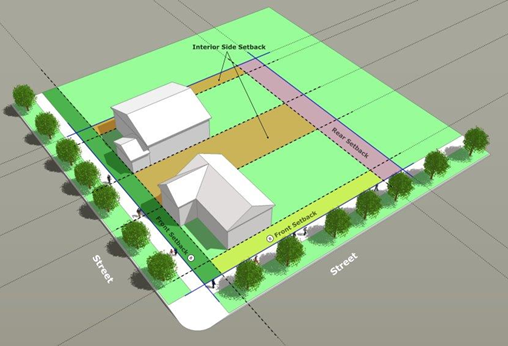
D.
Development in mapped streets.
1.
Structural development occurring after the official mapping of a right-of-way, including structural expansions of pre-existing development where the development or expansion of a site is proposed to be located on lands where future streets are officially mapped, shall comply with setbacks from the officially mapped future right-of-ways, with the following provision uniquely applicable to pre-existing development as described below:
a.
Structural development established before the official mapping of the future right-of-way and continuing forward shall not be deemed to have non-conforming status for zoning purposes because of the mapped right-of-way or the base yard setback from that mapped right-of-way. Such pre-existing development shall become nonconforming in zoning status as a result of not conforming to the official mapping or associated setback requirements only when some or all of the adjacent right-of-way affecting the subject property is acquired by the town for street or highway purposes.
E.
Development access.
1.
Every structure housing a principal use hereafter erected or moved shall be on a lot with direct access to a public or private street, and all such buildings shall be so located as to provide safe and convenient access for servicing and off-street parking.
2.
The Planning Commission may require the consolidation of entrances among adjoining lots or parcels, or limit the number of curb cuts on a public or private street, in order to minimize traffic patterns and turning movements that would conflict with other existing or proposed entrances or turning bays.
(Ord. No. 20-09, § 2, 9-28-2020, eff. 10-13-2020)
Sec. 191-38. - Public utility easements.
A.
Development within a public utility easements shall be in accordance with the following:
1.
Storm water management devices, storm water easements, and town infrastructure shall not be located within a public utility easement except for crossing water, sewer house connections and storm drainage.
2.
If storm water management devices and/or easements are required adjacent to road rights-of-way or property lines, an additional public utility easement not less than ten (10) feet wide will be required adjacent to the storm water easement.
3.
All town required infrastructure (street trees, sidewalks, buffer areas, etc.) shall not be placed within a public utility easement but shall be placed in the road right-of- way or a separate easement be required, as in the case of storm water management, and an additional ten (10) foot wide (minimum) PUE be provided adjacent to the public utility easement.
4.
A clear minimum ten (10) foot wide public utility easement shall be shown on all site plans for all properties.
(Ord. No. 20-09, § 2, 9-28-2020, eff. 10-13-2020)
Sec. 191-39. - Setback encroachments.
A.
Improvements may be located in the required setbacks as follows:
1.
Awnings, bay windows, balconies, chimneys, porches, canopies, cornices, eaves, or other architectural features may project three (3) feet or less into the required setback.
2.
Decks may project ten (10) feet into the rear setback.
3.
Uncovered stairs, landings or ramps may project:
a.
Ten (10) feet or less into the front setback provided they are not greater than ten (10) feet in width;
b.
Three (3) feet or less into the side setback, provided they are not greater than six (6) feet in width; and
c.
Ten (10) feet into the rear setback.
4.
The customary extension of a building's roof or roof guttering system may project thirty (30) inches or less over any setback.
(Ord. No. 20-09, § 2, 9-28-2020, eff. 10-13-2020)
Sec. 191-40. - Exceptions to height limits.
A.
General standards.
1.
Building height limitations are set forth in Article IV Zoning Regulations.
2.
The height limitations contained in Article IV Zoning Regulations does not apply to the following:
a.
Belfries, cupolas, radio and television antennas, water tanks, elevator bulkheads, chimneys, towers, steeples, spires, flagpoles, roof structures including gable roof systems that do not include approved living space, fire or parapet walls or other appurtenances usually required to be placed above the roof level and not intended for human occupancy.
(Ord. No. 20-09, § 2, 9-28-2020, eff. 10-13-2020)
Sec. 191-41. - Lighting standards.
A.
General requirements.
1.
All properties that are located within the Commercial Highway Zone (CH), Commercial Business Zone (CB), or the Commercial Business Transition Zone (CBT) will require the approval of the Design Review Board for any lighting that is proposed in those zones, except for ornamental lighting which may be displayed without Design Review Board review during the months of November and December.
2.
Exterior lighting will be evaluated in the site plan review process to ensure that functional and security needs of the project are met in a way that does not adversely affect adjacent properties or neighborhoods. The degree to which exterior night lighting affects the project, adjacent properties and the neighborhood will be evaluated considering the light source, level of illumination, hours of illumination, and the need for illumination.
3.
Maximum on-site lighting levels must not exceed ten (10) foot-candles, except for loading and unloading platforms where the maximum lighting level must not exceed twenty (20) foot-candles and with the exception of athletic field lighting which shall be governed by the Illumination Engineering Society of North America (IESNA) recommended practice for sports and recreation area lighting.
4.
Light levels measured at any property line shall be measured at a height of six (6) feet and no cause illumination in excess of one-half (0.5) foot-candle above the background level present when all on-site lights are turned off. Applicants shall consider all possible design features, to the maximum extent feasible that will reduce spill and glare.
5.
Light levels measured one (1) foot above any exterior light fixture shall not cause illumination in excess of one-half (0.5) foot-candle above the background present when all on-site lights are turned off.
6.
Light levels measured three (3) feet to the side (toward the nearest property line) and even with the bottom of any exterior light fixture shall not cause illumination in excess of one-half (0.5) foot-candles above the background level present when all on-site lights are turned off.
7.
Outdoor parking facility lighting shall not employ a light source higher than thirty (30) feet.
8.
Design standards. The proposed lighting must also comply with the following design standards:
a.
Fixtures shall be a type and design appropriate to the lighting application.
b.
For lighting roadways, sidewalks, paths, entrances, and parking areas, fixtures shall be aimed straight down.
c.
Fixtures shall be equipped with light directing and/or shielding devices such as shields, visors, skirts, or hoods to redirect offending light distribution and or to reduce direct or reflect glare.
d.
Site lighting that may be confused with warning, emergency or traffic signals is prohibited.
e.
Areas, such as parking lots, must be illuminated to the minimum extent possible to meet the functional needs of safe circulation and protecting people and property. Areas, such as building entrances and plaza seating areas must use local lighting that defines the space without glare.
f.
Light sources must be concealed or shielded to the maximum extent feasible to minimize the potential for glare and unnecessary diffusion on adjacent properties and to eliminate to the maximum extent possible illumination of the night sky.
g.
Flickering or intense sources of light shall be controlled so as not to cause a nuisance across any lot lines.
h.
Lighting systems should include timing devices to turn off unneeded lighting during the time the project is not in use.
i.
Outdoor lighting should be efficient but not excessive.
j.
Outdoor lighting should be designed to enhance safety.
k.
The use of accent lighting on buildings and in landscaped areas is encouraged, provided such lighting does not create off-site glare or increase light pollution.
l.
Commercial lighting should be directed away from residential areas. As a general rule, the cumulative total height of the light poles and mounting base (if any) should not exceed the height of the building.
(Ord. No. 20-09, § 2, 9-28-2020, eff. 10-13-2020)
Sec. 191-42. - Accessory uses and structures.
A.
Unless otherwise expressly stated in this chapter, accessory uses as specified in table 1, the table of permitted uses, and specified accessory structures are permitted in conjunction with an allowed principal use.
B.
Accessory uses shall be subject to the following:
1.
Where accessory uses are permitted, the standards of the applicable base zoning district, as well as any overlay district on the property, shall apply, including but not limited to, setbacks, building heights, landscaping and other requirements outlined in this chapter except where otherwise provided in this section.
C.
Accessory structures shall be subject to the following:
1.
All accessory structures which are attached to the principal structure shall comply with the setback requirements of the principal structure.
2.
No detached accessory structure shall occupy any portion of the required front or side yard or be located within five (5) feet of any other accessory structure, principal structure or lot line.
3.
Notwithstanding subsection C.2.
a.
A detached accessory structure less than one hundred twenty (120) square feet in area, and used for storage, may be located within two (2) feet of a lot line.
b.
Residential driveways, parking lots and parking structures, may be located within five (5) feet of an accessory structure, principal structure or lot line.
c.
All freestanding accessory radio towers and satellite dishes shall be located behind the principal structure.
4.
Corner visibility.
a.
In order to provide the opportunity for vehicles at an intersection to maintain adequate visibility, the following standards shall apply:
(1)
No fence, wall, shrub, tree, sign or other obstruction shall encroach into the sight visibility triangle. The limbs and foliage of trees within the sight visibility triangle must be maintained to provide clear visibility.
(Ord. No. 20-09, § 2, 9-28-2020, eff. 10-13-2020)
Sec. 191-43. - Temporary uses and structures.
A.
Temporary uses as specified in table 1, the table of permitted uses shall be subject to the following:
1.
Temporary uses shall require the issuance of a temporary use permit for the use location which shall specify the use, dates, location, hours of operation and such other information as reasonably may be required by the Chief Executive Officer.
2.
A temporary use permit may be issued if the Chief Executive Officer finds that the use proposed in the application will not:
a.
Adversely affect the health or safety of persons residing or working in the neighborhood of the proposed use;
b.
Be detrimental to the public welfare or injurious to property or other improvements in the neighborhood; and/or
c.
Constitute a violation of any provision of this Code or other applicable law.
3.
Any sales or trade of goods, wares or merchandise including but not limited to furniture, clothing, tools, implements, works of art and any tangible personal property of whatever kind, from a temporary stand, is prohibited unless otherwise permitted under a temporary use permit.
4.
Special requirements for temporary uses.
a.
Temporary buildings, trailers, portable storage units, or yards for construction materials or equipment, both incidental and necessary to construction in the immediate area, and temporary offices incidental to and necessary for the sale or rental of real property or temporary relocation of a business during construction in the immediate area may operate for as long as there is a valid building permit for the associated construction, but must cease operation no later than the issuance of the last required occupancy permit. If such temporary uses are included in a valid building permit, no temporary use permit is required. Portable storage units may also be used on property improved with single unit detached, semi-detached, attached, or townhouse dwellings for the short-term storage of items, including but not limited to, clothing, equipment, goods, household or office fixtures or furnishings, materials, and merchandise, for a period not to exceed thirty (30) days, which period may, for good cause shown, be extended for not more than an additional sixty (60) days.
b.
Temporary residence during construction.
(1)
A building permit and certificate of occupancy shall be required for the temporary residential use;
(2)
The temporary residential use shall be served by temporary water and sanitary facilities approved by the Charles County Health Department;
(3)
The temporary residential use shall meet all yard and setback requirements for a single-family detached dwelling;
(4)
A permanent electrical connection to the site shall not occur prior to the disconnection of the temporary residence;
(5)
No certificate of occupancy for a permanent residence on a site shall be issued until the temporary residence is removed from the site; and
(6)
The temporary residence shall not be permitted as a storage unit after the completion of the permanent residence.
c.
Shows and events.
(1)
The temporary use permit for shows and events shall specify the use, dates, and hours of operations of the event.
(2)
The temporary use may not exceed five (5) consecutive days or fifteen (15) days in any twelve (12) month period.
(3)
Adequate arrangements for temporary sanitary facilities must be approved by the County Department of Health.
(4)
No permanent or temporary electrical power for lighting or other uses shall be installed without an electrical permit demonstrating compliance with the County's Electrical Code.
(5)
The site shall be cleared of all debris at the end of the event and cleared of all temporary structures within three (3) days thereafter. A bond in a sufficient amount as determined by the Chief Executive Officer shall be provided to ensure that the premises shall be cleared of all debris. For an event of one thousand (1,000) or more attendees, the bond amount may also include an amount for the purpose of assuring that all emergency service agencies will be paid for the provision of agreed upon services.
(6)
Adequate off-street parking shall be provided and a stabilized drive to the parking area shall be maintained.
(7)
It shall be the responsibility of the applicant to guide traffic to parking areas. The applicant shall notify the local enforcement authority and shall provide adequate traffic control.
(8)
No structure or equipment shall be located within two hundred (200) feet of any residential lot less than five (5) acres. Outdoor loudspeaker systems shall be allowed with an approved noise permit.
B.
Exceptions.
1.
A temporary use permit is not required for a portable storage unit used on residential property for five (5) days or less for moving or other short-term purposes. Portable storage units are not permitted to be placed in the public right-of-way.
(Ord. No. 20-09, § 2, 9-28-2020, eff. 10-13-2020)
Sec. 191-44. - Parking requirements.
A.
Off-street parking.
1.
For all structures and uses established after the effective date of this chapter, off-street parking shall be provided as required in this chapter.
2.
Whenever a structure or use is changed the parking shall be evaluated to determine the appropriate number of parking spaces that should be added or taken away from the site in accordance this chapter.
3.
Where computation of the required parking spaces results in a fractional number, any fraction thereof shall be counted as one (1).
4.
Parking or storage of commercial vehicles with a gross vehicle weight rating of ten thousand (10,000) pounds or more, vehicles without current registration, travel trailers, recreational vehicles (RV) or boats are prohibited on public streets or in required front yards.
B.
Unless otherwise provided in this chapter, the off-street parking and loading requirements for all use types shall be as set forth in table 9 below.
Table 9
C.
Parking deferral.
1.
Criteria for parking deferral.
a.
The Chief Executive Officer may defer the construction and provision of up to ninety percent (90%) of the off-street parking spaces required in an industrial zone, thirty-five percent (35%) in a commercial zone, and twenty percent (20%) in any other zone if an applicant demonstrates that:
(1)
The character of the use lowers the anticipated need for off-street parking, and data from similar uses establishes that there is not a present need for the parking;
(2)
The use is immediately proximate to public transportation that serves a significant proportion of the use's residents, employees, or customers;
(3)
There is an effective private or company car pool, van pool, bus, or similar group transportation program to serve the use; or
(4)
The deferred percentage of residents, employees, and customers regularly walk or use bicycle or other non-motorized vehicular forms of transportation to and from the use.
2.
Parking deferral with a concurrent use review.
a.
If a proposed use requires both a review and a public hearing, the Chief Executive Officer will make a recommendation to the approving agency to approve, modify and approve, or deny the parking deferral as part of the use review approval.
3.
Applicants for a parking deferral shall submit a site plan demonstrating that the total required parking can be accommodated on-site and designating the land to be reserved for future parking.
4.
Landscaping shall be provided as required under section 191-46, "parking lot landscaping standards," and shall be indicated on the site plan.
5.
Notice of change of condition.
a.
A person having an interest in property subject to a parking deferral shall notify the Chief Executive Officer of any change in the conditions set forth in paragraph 1.A. of this subsection that the Chief Executive Officer considered in granting the deferral.
6.
Construction of deferred parking areas.
a.
The Chief Executive Officer may require the construction of the deferred parking at any time upon thirty (30) days written notice by mail to commence construction of such parking. a person having an interest in the property shall comply with such a notice within thirty (30) days of receiving the written notice.
D.
Parking maximum.
1.
An applicant may propose a maximum percentage or number of spaces that could be provided in surplus of the required parking without receiving approval from the Planning Commission, as depicted in table 10 below.
2.
The applicant shall develop and submit data and evidence, including but not limited to parking accumulation and utilization data, which demonstrates the need for additional parking spaces to be created, in the opinion of the Chief Executive Officer.
Table 10
E.
Joint and shared parking requirements.
1.
Required off-street parking spaces shall be located on the same lot with the principal use, or, when this requirement cannot be met, such parking spaces may be located off-site. Off-site parking spaces shall be located within four hundred (400) feet from the lot, and the parking spaces shall be held in fee simple by the owner of the use requiring such parking, or the parking spaces shall be leased or rented through a written agreement satisfactory to the Town Attorney.
2.
The total number of spaces provided collectively shall not be less than the sum of spaces required for each separate use, provided that such uses are not operated during the same hours.
3.
In the case of a site plan for development within the NCX or TDX zones, the Planning Commission may reduce the total number of required spaces by up to forty percent (40%) upon making the determination that the parking demands of the uses will be met. In other nonresidential zones, the Planning Commission may modify the total number of required spaces for a use by up to forty percent (40%) upon making the determination that the parking demands of the uses being served do not overlap.
4.
The collective off-street parking shall not be located farther than four hundred (400) feet from the building or use being served without crossing a major thoroughfare.
5.
An easement or other formal written agreement assuring the continuing joint usage of said common parking for the combination of uses or buildings must be properly drawn and executed by the parties concerned and submitted to the Town Attorney for approval.
F.
Parking waiver.
1.
An applicant may seek a parking waiver when strict compliance with section 191-44 (off-street parking and loading requirements table 9) of this chapter cannot be achieved in the design of a parking facility. In determining whether or not sufficient off-street parking is available to satisfy the requirements of this section, vacant land or spaces allotted to other uses shall not be considered.
2.
The applicant shall submit a parking waiver request that demonstrates that fewer spaces than those required by this chapter will adequately serve the proposed uses and that it will not adversely affect the site or adjacent area.
G.
Requirements not specified.
1.
Any principal use which does not have specific off-street parking requirements specified in this chapter shall provide sufficient off-street parking so that no public street shall be used for parking as determined by the Chief Executive Officer.
H.
Design standards.
1.
No parking area of more than two (2) spaces shall be designed as to require any vehicle to back into a public street, except on a tertiary local street or alley approved by the Planning Commission.
2.
Parking areas of up to eight (8) parking spaces may be designed to require a vehicle to back into a tertiary local street or alley only. Such parking areas shall be separated by a planted separator island at least fifteen (15) feet in width. Any parking area of more than five (5) spaces shall be sufficiently screened in the form of a solid fence or shrubbery to protect neighboring residences. Large expanses of un-channeled parking areas shall be avoided. All parking areas shall be all-weather surfaced.
3.
Design standards for required handicap accessible off-street parking spaces.
a.
Each required handicap accessible off-street parking space shall comply with the requirements set forth in the edition of the International Building Code as adopted by the town in Chapter 75 of this Code and as required by the American Disabilities Act and comparable laws of the State of Maryland, at the time of development, redevelopment, change in occupancy, and/or any construction which requires such accessible spaces on the property; and where possible, the handicap accessible spaces shall be provided on-site of the use where space is available, and not be located at an off-site facility.
4.
The required width of drive aisles shall be as shown in tables 11 and 12 below:
Table 11
Table 12
5.
The required parking stall dimensions shall be as shown in table 13 below:
Table 13
(Ord. No. 20-09, § 2, 9-28-2020, eff. 10-13-2020; Ord. No. 21-34, § 1, 11-23-2021, eff. 12-8-2021)
Sec. 191-45. - Off-street loading.
A.
The loading space requirements specified in table 10 in section 191-41 shall apply to all zones.
B.
Where a building is devoted to more than one (1) use and where the floor area for each use is below the minimum required for a loading space but the aggregate floor area of such uses is above such a minimum, then off-street loading spaces shall be provided as if the entire building were devoted to that use in the building for which the most loading spaces are required.
C.
Required off-street loading spaces shall be located on the same lot with the principal use requiring such space. No loading space shall be located within thirty (30) feet of the nearest point of intersection of two (2) streets or require any vehicle to back into a public street.
D.
Design standards.
1.
Every loading space shall be sufficiently screened in the form of a solid fence or shrubbery to protect neighboring residences.
2.
Loading space dimensions shall be as shown in the table 14 below:
Table 14
(Ord. No. 20-09, § 2, 9-28-2020, eff. 10-13-2020)
Sec. 191-46. - Screening.
A.
Ground units.
1.
All mechanical equipment located on ground level that is used to serve any building in the CH, CBT, CB, IL or IH Zone shall be positioned, screened, or both so that the mechanical equipment is not visible from any public street, right-of-way and any residentially zoned property. screening enclosures shall be the same or compatible, in terms of color, texture, quality, and material as the principal structure, and the screening shall form a continuous enclosure around the mechanical equipment at least one (1) foot taller than the tallest equipment enclosed.
B.
Rooftop units.
1.
All mechanical equipment located on or above the roof of any commercial, office, institutional, recreational, agricultural, industrial, or multi-family residential building shall be positioned, screened, or both so that the rooftop mechanical equipment is not visible from any public street, right-of-way and any adjacent property at ground level. Screening enclosures shall be the same as or compatible with, in terms of color, texture, quality, and material, the principal structure, and the screening shall form a continuous enclosure around the mechanical equipment at least one (1) foot taller than the tallest equipment enclosed.
C.
Trash and recycling containers.
1.
All trash and recycling containers located on the ground that are used to serve any commercial, office, institutional, recreational, agricultural, industrial, or multi-family residential building shall be positioned, screened, or both so that they are not visible from any public street, right-of-way and any adjacent property. Screening enclosures shall be the same or compatible, in terms of color, texture, quality, and material as the principal structure, and the screening shall form a continuous enclosure around the mechanical equipment at least one (1) foot taller than the tallest equipment enclosed.
D.
Loading areas, docks and parking structures.
1.
All loading areas and loading docks shall be positioned, screened, or both so that they are not visible from any public street, right-of-way and any adjacent property. Screening can be established by a wall, fence, berm, landscaping, or a combination thereof that has a minimum height of ten (10) feet and shall be the same as or compatible with the principal structure in terms of color, texture, quality, and material.
2.
All parking structures should be screened by a building, architectural treatment, landscaping or a combination thereof that is similar to or of the same quality as the surrounding buildings.
E.
Fences, gates, walls and hedges.
1.
Notwithstanding the provisions of this chapter, fences, gates, walls and hedges may be permitted in any required yard or along the edge of any required yard, provided that no such fence, gate, wall or hedge shall exceed a height of four (4) feet along the sides or front edge of any required front yard, except as provided in paragraph [191-42 C.4.] for corner visibility, and no such fence, gate, wall or hedge shall exceed a height of eight (8) feet in any other required yard.
2.
Security fences and gates for business, industrial or institutional uses are not permitted in a front yard and shall not exceed ten (10) feet in height, in the rear yard or side yard, above the elevation of the surface of the ground unless otherwise necessary to comply with screening requirements.
3.
Athletic field enclosures, including gates, are exempt from height restrictions.
F.
All properties in the CB, CBT and CH Zones shall be required to obtain approval of all enclosures and screening required by this section from the Design Review Board in accordance with Chapter 16, Design Review, of this Code.
(Ord. No. 20-09, § 2, 9-28-2020, eff. 10-13-2020)
Sec. 191-47. - Open space.
A.
Relationship to other requirements.
1.
Any open space established by the provisions of this chapter may be applied to dedication and reservation requirements contained in the town subdivision regulations in Chapter 173 and may be applied to green area requirements of this chapter, subject to the limitations as defined herein.
B.
Buildings and structures.
1.
Open space areas may contain complementary buildings and structures appropriate for the recreational use and enjoyment of the residents of the development for which they were established.
C.
Dedication.
1.
When open space or any portion thereof is approved for dedication and complementary improvements are completed and accepted by the town, a deed shall be conveyed to the Town of La Plata.
D.
Reservation.
1.
When open space or any portion thereof is to be reserved for the exclusive use and enjoyment of the residents of the development for which it was established, the following requirements shall apply:
a.
Where open space is established to serve a development of less than one hundred (100) residential properties, the developer shall establish conditions as to the ownership, maintenance and use of such areas as deemed necessary by the town to ensure preservation of their intended purposes.
b.
Where open space is established to serve a development of one hundred (100) or more residential properties, the developer shall create an incorporated nonprofit residential property owners' association before the plat has been recorded and before any lots are sold. A recorded declaration of covenants and restrictions applicable to the platted area shall be required, which automatically makes each residential property owner an association member. these declarations and restrictions shall:
(1)
Expressly provide each residential property owner with the right to the use and enjoyment of the open space;
(2)
Expressly enumerate the residential property enjoyment of the open space;
(3)
Expressly enumerate the residential property owners' obligation to pay maintenance assessments with enforcement through both a lien on the property and a personal money judgment;
(4)
Expressly enumerate the residential property owners' voting rights in the association; and
(5)
Expressly provides for the association's right to enforce covenants and restrictions and expresses a definite undertaking by the developer to convey open space and complementary buildings and structures to the association at an appropriate specified time.
(Ord. No. 20-09, § 2, 9-28-2020, eff. 10-13-2020)
Sec. 191-48. - Landscaping.
A.
The following standards are intended to promote the health, safety and general welfare of the public while conserving natural resources and creating a more attractive community.
B.
To accomplish the purposes of this section plant materials shall conform to the following:
1.
All proposed plant materials shall be designed for energy efficiency, drought tolerance, adaptability, relationship to the environment, habitat value, color, form and pattern, ability to provide shade, soil retention, and fire resistance and shall be a species native to the Chesapeake Bay Tributary.
2.
Plant materials shall not be located such that, at maturity:
a.
They interfere with safe sight distances for vehicular, bicycle or pedestrian traffic; or
b.
They conflict with overhead or underground utility lines, overhead lights, or walkway lights.
C.
Parking lot landscaping.
1.
Shading of parking lots shall be required as a means of remediating the harsh environment created by excessive hard surface paving. Shading, spacing and quantity requirements shall be designed to accentuate the tree plantings in relationship to the movement of the sun to cast shade over the parking during the longest period of a day.
2.
The distance between shade trees is dependent upon class, size of tree and extent of tree canopy; as well as time of day or year and, angle and azimuth of the sun. Tree classes shall be in accordance with the street tree factsheets (Gerhold, 1993) and as defined below:
a.
Class A: Trees that reach over forty-five (45) feet in height at maturity are discouraged within the interior of a parking lot but may be used on the perimeter. Minimum spacing for class A trees used for shading should be forty (40) feet apart on center.
b.
Class B: Trees that reach thirty (30) feet to forty-five (45) feet in height at maturity. Class B trees with a small root system are better used on the interior of a parking lot to produce a shade canopy. Class B trees should have a minimum spacing of twenty (20) feet apart on center and a maximum of thirty (30) feet on center.
c.
Class C: Trees that are thirty (30) feet or less in height at maturity and may be effectively used within parking lot interiors, but will not cast sufficient shade so should not be used for shading. Class C trees should have a minimum spacing of ten (10) feet apart on center.
3.
Landscaped islands, peninsulas and medians must be matched to tree class. The size of the planting space must be matched to the potential Critical Root Zone (CRZ) of the tree species to be planted. Therefore, there are created two (2) allowable classes of parking lot planting areas as seen below.
a.
Dimensions of landscaped islands or peninsulas shall be as follows:
(1)
Class A: Shall be a minimum of eight (8) feet in width in order to be planted with class A trees.
(2)
Class B: Shall be six (6) feet in width in order to be planted with class B trees.
(3)
Class C: Shall be four (4) to six (6) feet in width in order to be planted with class C tree.
b.
Dimensions of landscaped medians shall be as follows:
(1)
Class A: Shall be ten (10) feet in width and may be planted with any class tree.
(2)
Class B: Shall be eight (8) feet in width and may be planted with any class B and class C trees.
(3)
Class C: Shall be six (6) feet in width and may be planted with only class C tree.
4.
Ground cover or plantings shall be provided for all interior and perimeter planting spaces in order to completely fill each island, peninsula or median.
5.
Interior parking area landscaping.
a.
The internal area of any surface parking facility must be landscaped, according to the following standards.
(1)
Trees shall be planted within the interior of the parking areas at the rate of one (1) class A or two (2) class B trees as shown in table 15 below.
Table 15
6.
Perimeter parking area landscaping.
a.
All landscaping around the perimeter of a parking area shall provide a mix of class A, B and C trees, and ground cover plantings in accordance with this section.
b.
The perimeter of any surface parking facility must be landscaped, according to the standards shown in table 16 below.
Table 16
D.
Maintenance.
1.
The owner of the property shall be responsible for proper maintenance of the landscape.
2.
As used in this section, "maintenance" includes watering; fertilizing; litter removal; weeding; pruning; trimming; insect, disease, rodent, and weed control; and replacement of plant materials as needed to preserve the health and appearance of the plantings.
3.
Plant materials showing signs of insect or disease infestation or other damage shall be appropriately treated to restore the health of the plant materials and dead plant material removed and replaced.
4.
A note shall be placed on all site plans stating the above requirement.
(Ord. No. 20-09, § 2, 9-28-2020, eff. 10-13-2020)
Sec. 191-49. - Buffer yards.
A.
Applicability of buffer yard standards.
1.
The buffer yard standards of this chapter shall apply to the following:
a.
All new development on vacant land;
b.
Addition or expansion of an existing building; and
c.
Any change in use that increases the development intensity and results in increased traffic, noise, etc.
B.
Buffer yards required.
1.
Buffer yards are required to minimize conflicts between potentially incompatible but otherwise permitted uses on adjoining lots.
2.
The Planning Director may allow for deviations from the buffer yard standards as set forth in section 191-48. Any deviations must be approved by the Planning Commission.
C.
Location.
1.
Buffer yards shall be located on the outer perimeter of a lot or parcel, extending to the lot or parcel boundary line and shall be owned and maintained by a homeowners association.
2.
Where a lot, parcel or tract under proposed development adjoins a lot, parcel or tract of a lower density, a buffer yard shall be provided in accordance with the table of buffer yard requirements, to help alleviate the impact of the development on the adjoining use. Where, in the case of a simultaneous development of two (2) or more lots, parcels or tracts of differing use, the developer of the higher density property shall have the responsibility for institution of the buffer yard requirements.
3.
Where a lot, parcel or tract under proposed development within the Town of La Plata adjoins a lot, parcel or tract within Charles County, the Chief Executive Officer shall determine the equivalent town zoning designation for the county zoning designation in order to determine the appropriate buffer yard requirement in table 17.
4.
Notwithstanding any other provision of this section, when an improved street separates two (2) lots, parcels or tracts, a buffer yard shall not be required if the proposed development and adjacent land use classifications are respectively, R5 and R21, R5 and R10, R5 and R8, R3 and R21, R3 and R10, R3 and R8, IL and CH, and IH and CH.
D.
Buffer yard standards.
1.
The letter designations contained in table 17 below, refer to the standards contained in subsection E., buffer yard diagrams of the Town of La Plata.
2.
Existing plant material and/or land located on the proposed lot, parcel or tract which meets the requirements of this chapter may be counted in the buffer yard requirement.
3.
Existing plant material and/or land located on the adjacent lot, parcel or tract which meets the requirements of this chapter may be counted in the buffer yard requirement, provided that the property owner of the adjacent lot, parcel or tract consents and that a maintenance agreement for the landscaping is developed, approved and recorded.
4.
Buffer yards required shall be as set forth in the buffer yard plan and design guidelines for the HC Zone.
5.
The buffer yard standards shall be as shown in Table 17 below:
Table 17
E.
Buffer yard requirement details.
1.
The following details in figures 17 through 23 graphically indicate the specifications of each buffer yard. Buffer yard requirements are stated in terms of the width of the buffer yard and the number of plan unites required per one hundred (100) linear feet of buffer yard. The requirements of a buffer yard may be satisfied by any of the options thereof illustrated. The type and quantity of plant materials required by each buffer yard and each buffer yard option are specified in this section. The options within any buffer yard are designed to be equivalent in terms of their effectiveness in eliminating the impact of adjoining uses. Cost equivalence between options was attempted where possible. all of the details are drawn to scale and depict the buffer yard according to the average projected diameter of plant materials at five (5) years after planting.
Figure 17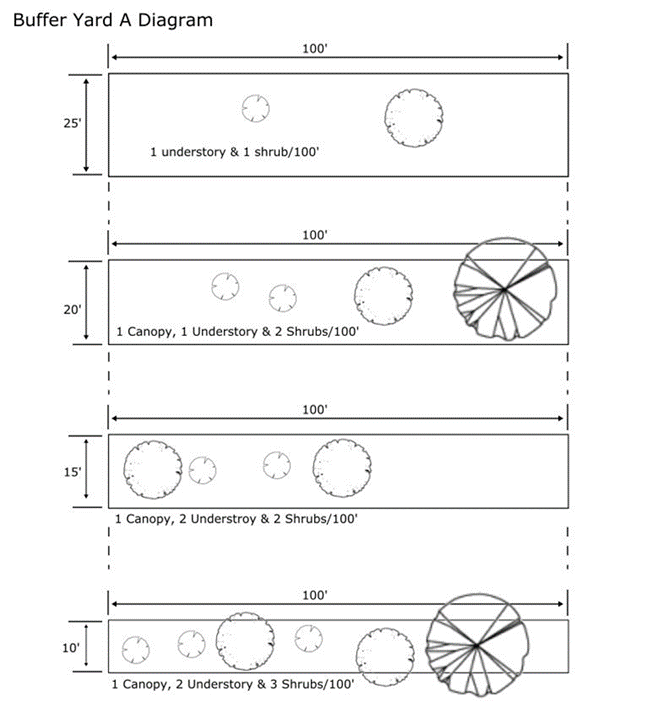
Figure 18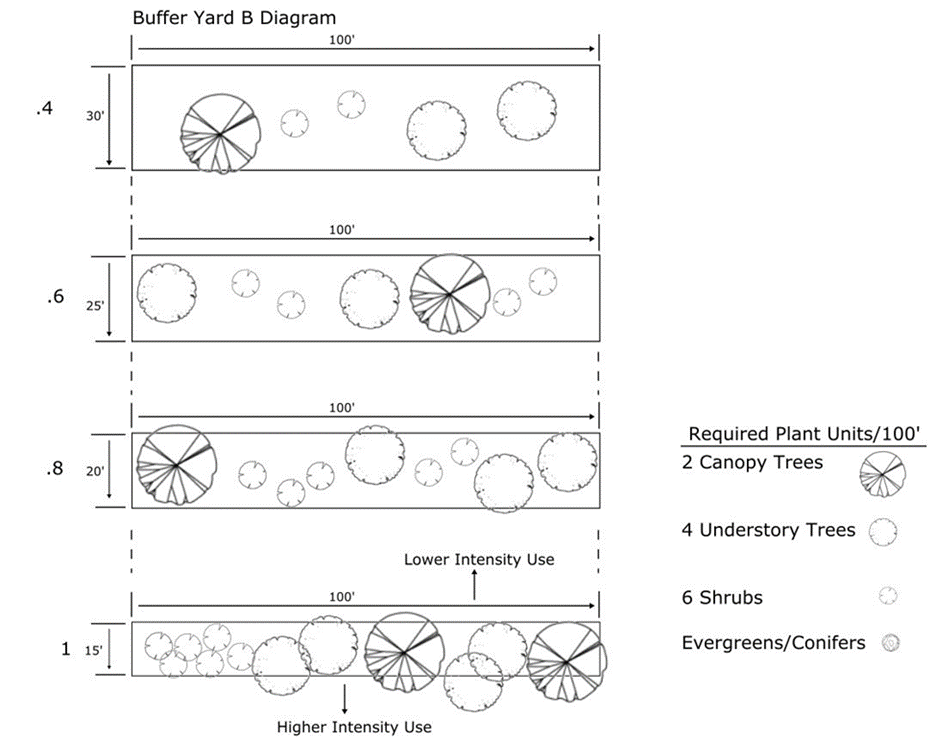
Figure 19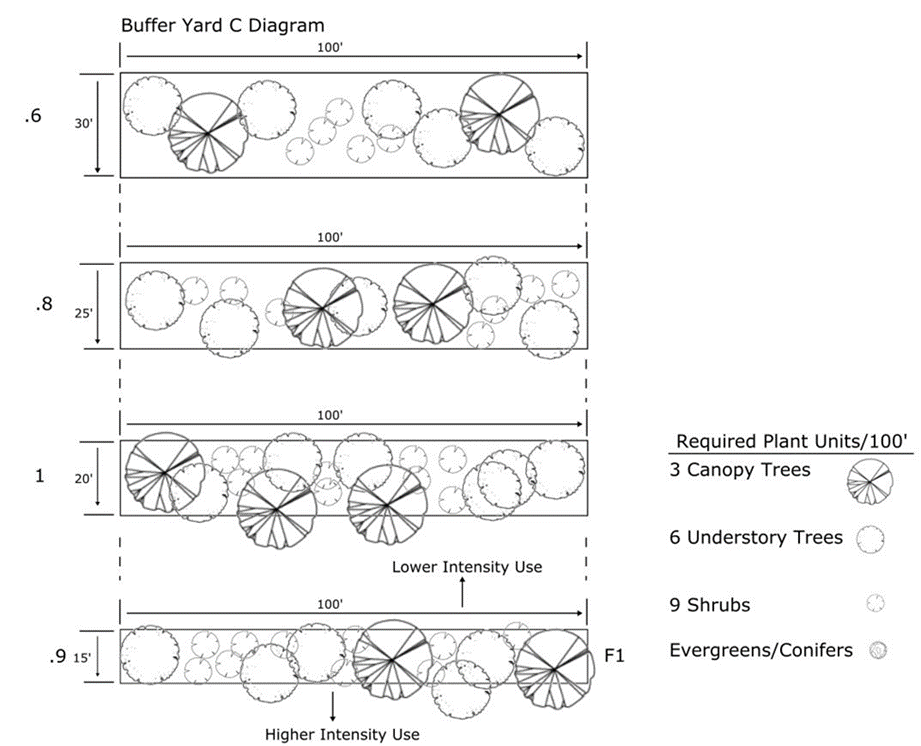
Figure 20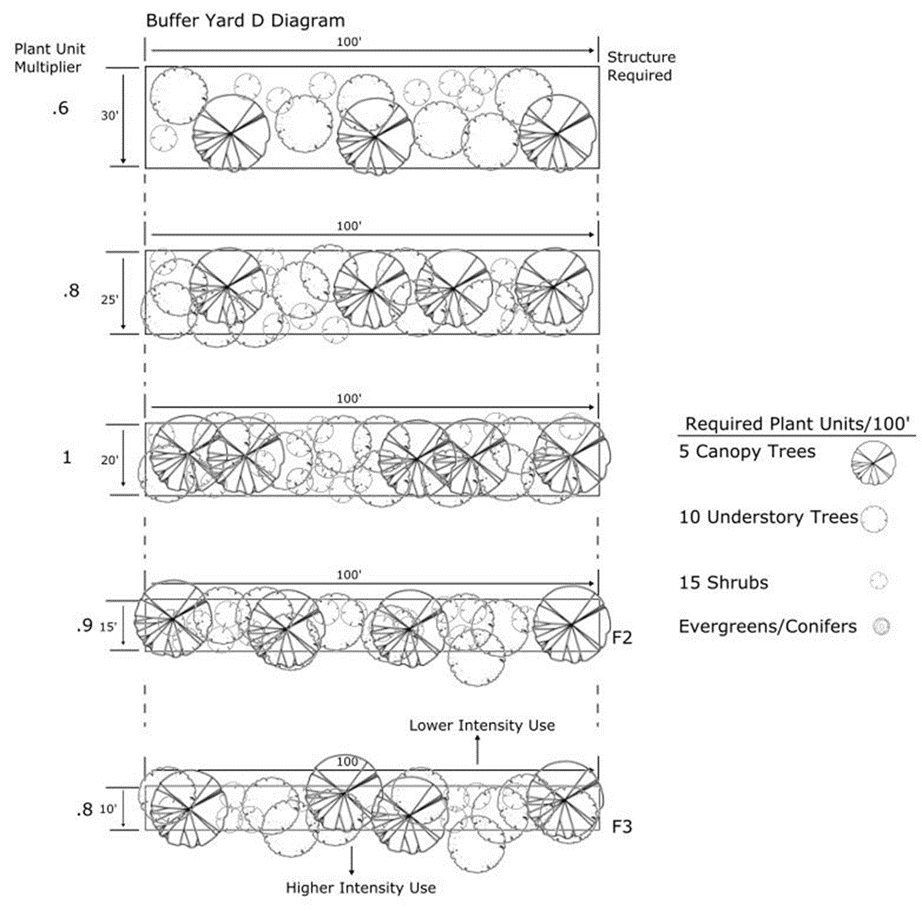
Figure 21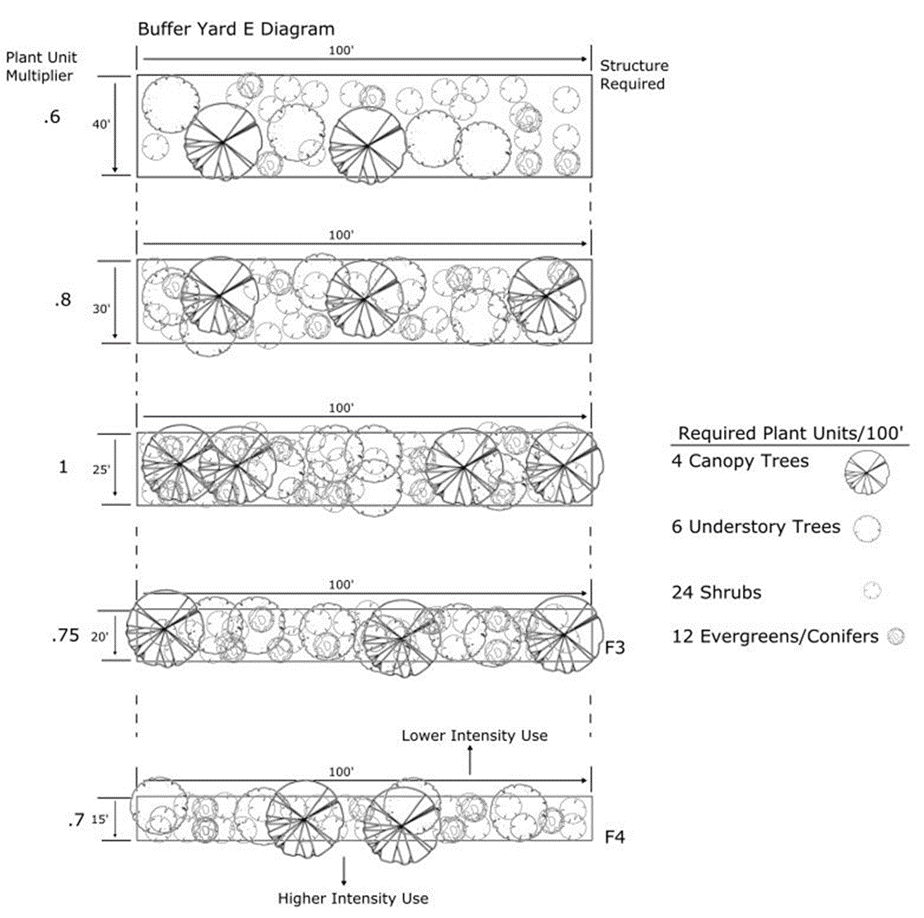
Figure 22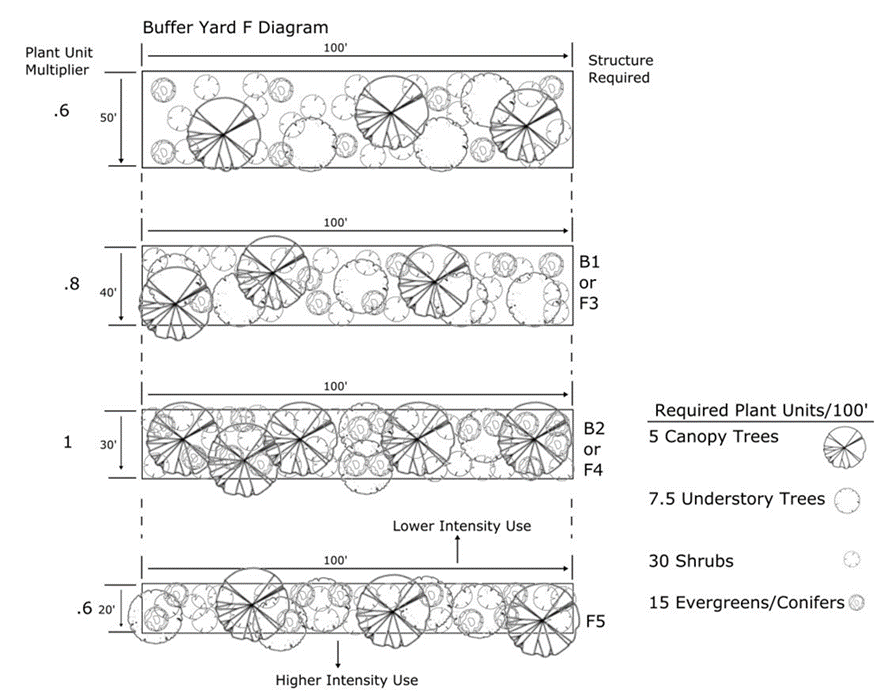
Figure 23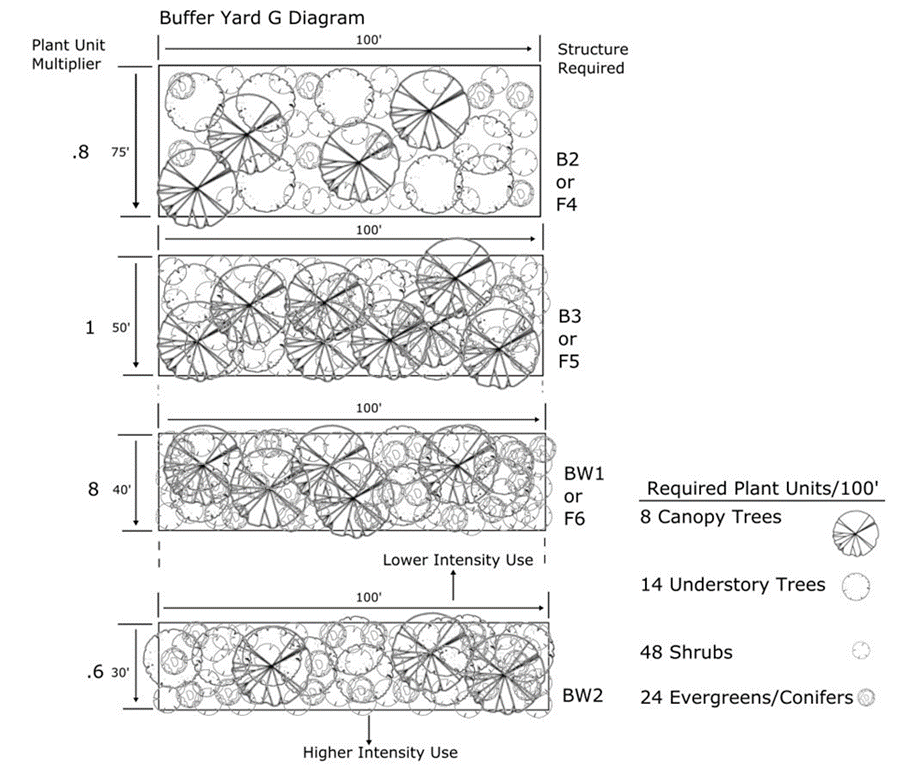
F.
Maintenance.
1.
The developer, his successor, or the owner of the property shall be responsible for proper maintenance of the buffer yard.
2.
As used in this section, "maintenance" includes: watering; fertilizing; litter removal; weeding; pruning; trimming; insect, disease, rodent, and weed control; and replacement of plant materials as needed to preserve the health and appearance of the plantings.
3.
Plant materials showing signs of insect or disease infestation or other damage shall be appropriately treated to restore the health of the plant materials and dead plant material removed and replaced.
4.
A note shall be placed on all site plans stating the above requirement.
G.
The following plant material substitutions shall satisfy the requirements of this section:
1.
In buffer yards E., F. and G., evergreen canopy or evergreen understory trees may be substituted for deciduous canopy trees without limitation.
2.
In buffer yards A., B., C. and D., evergreen canopy or evergreen understory trees may be substituted not to exceed fifty percent (50%) of the total number of the deciduous trees required.
3.
In all buffer yards, evergreen or coniferous shrubs may be substituted for deciduous shrubs without limitation.
4.
All buffer yards shall be seeded in accordance with the permanent stabilization and seeding notes of the sediment and erosion control plan approved by the Charles County Soil Conservation District.
H.
Whenever a wall, fence or berm is required within a buffer yard, these are shown as "structure required" in the following details in subsection E., wherein their respective specifications are also shown. Whenever a wall or fence is required, the wall or fence shall be located closest to the higher intensity use, in order to provide maximum sound absorption.
1.
The following structures identified in table 18 and figures 24 and 25 are equivalent and may be used interchangeably, so long as both structures are specified in the buffer yard details in this section:
Table 18
Figure 24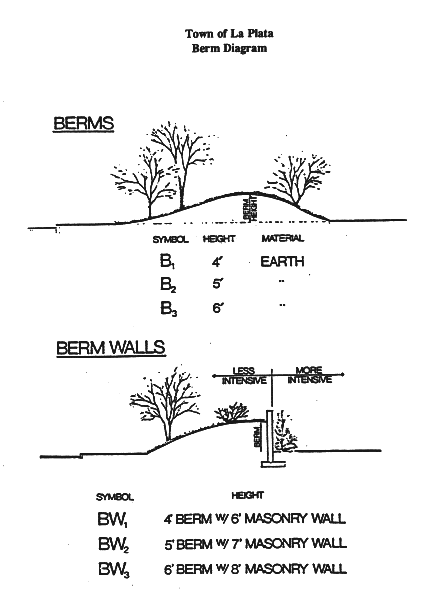
Figure 25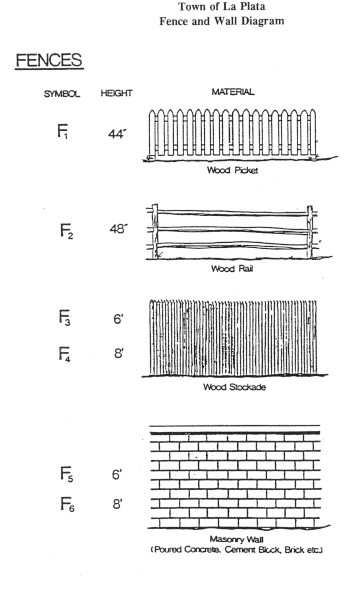
(Ord. No. 20-09, § 2, 9-28-2020, eff. 10-13-2020; Ord. No. 21-34, § 1, 11-23-2021, eff. 12-8-2021)

