
Laguna Woods City Zoning Code
CHAPTER 13
18.- OFF-STREET PARKING REGULATIONS
Sec. 13.18.010.- Off-street parking regulations.
These regulations apply to all districts and specific plan areas, unless otherwise specified.
(Ord. No. 03-03, § 5(18.30.500), 4-16-2003; Ord. No. 11-01, § 4(Exh. 7), 1-19-2011)
Sec. 13.18.020. - Intent.
The intent of the off-street parking regulations is to provide for the on-site, off-street parking of motor vehicles that are attracted by the use or uses on the premises. The parking facilities for motor vehicles required by this section are assumed to be the minimum, which will be required by the various land use categories. However, the parking and maneuvering facilities required by this section should not be used as a fixed standard to determine the amount of off-street parking which may be adequate for any specific use. If the decision maker determines minimum parking standards are inadequate for a specific project, he may require the developer, owner or operator of any specific use to provide the adequate parking even though such addition may be in excess of the minimum requirements set forth in this section. It is intended that these regulations will result in the installation of properly designed parking facilities of sufficient capacity to minimize traffic congestion, enhance public safety, generally provide for the parking of motor vehicles at locations other than on the streets, and for safe passage of pedestrians to and from parked vehicles.
(Ord. No. 03-03, § 5(18.30.505), 4-16-2003; Ord. No. 11-01, § 4(Exh. 7), 1-19-2011)
Sec. 13.18.030. - General requirements.
(a)
Location of off-street parking.
(1)
Required parking facilities shall be located on the same building site and conveniently proximate to the use or uses they serve.
(2)
Property within the ultimate right-of-way of a street (either public or private) shall not be included in provision of the minimum parking.
(b)
Accessibility. All required off-street parking spaces shall be designed, located, constructed and maintained so as to be fully and independently usable and accessible at all times.
(c)
Usability.
(1)
The required off-street parking facilities and driveways shall not be used for any purpose, which at any time would preclude the use of the area for the temporary storage of motor vehicles.
(2)
Unless otherwise provided by an approved discretionary permit, no owner or tenant shall lease, rent or otherwise make unavailable to intended users any off-street parking spaces required by this chapter.
(d)
Access to arterial highways.
(1)
Wherever access to a parking area is off an arterial highway designated on the Master Plan of Arterial Highways, parking spaces, driveways, and maneuvering areas shall be designed so that motor vehicles may enter the arterial highway traveling in a forward direction.
(2)
Vehicular access to arterial highways designated on the Master Plan of Arterial Highways will be permitted only in accordance with specifically approved driveway locations and access design.
(e)
Maximum grades permitted.
(1)
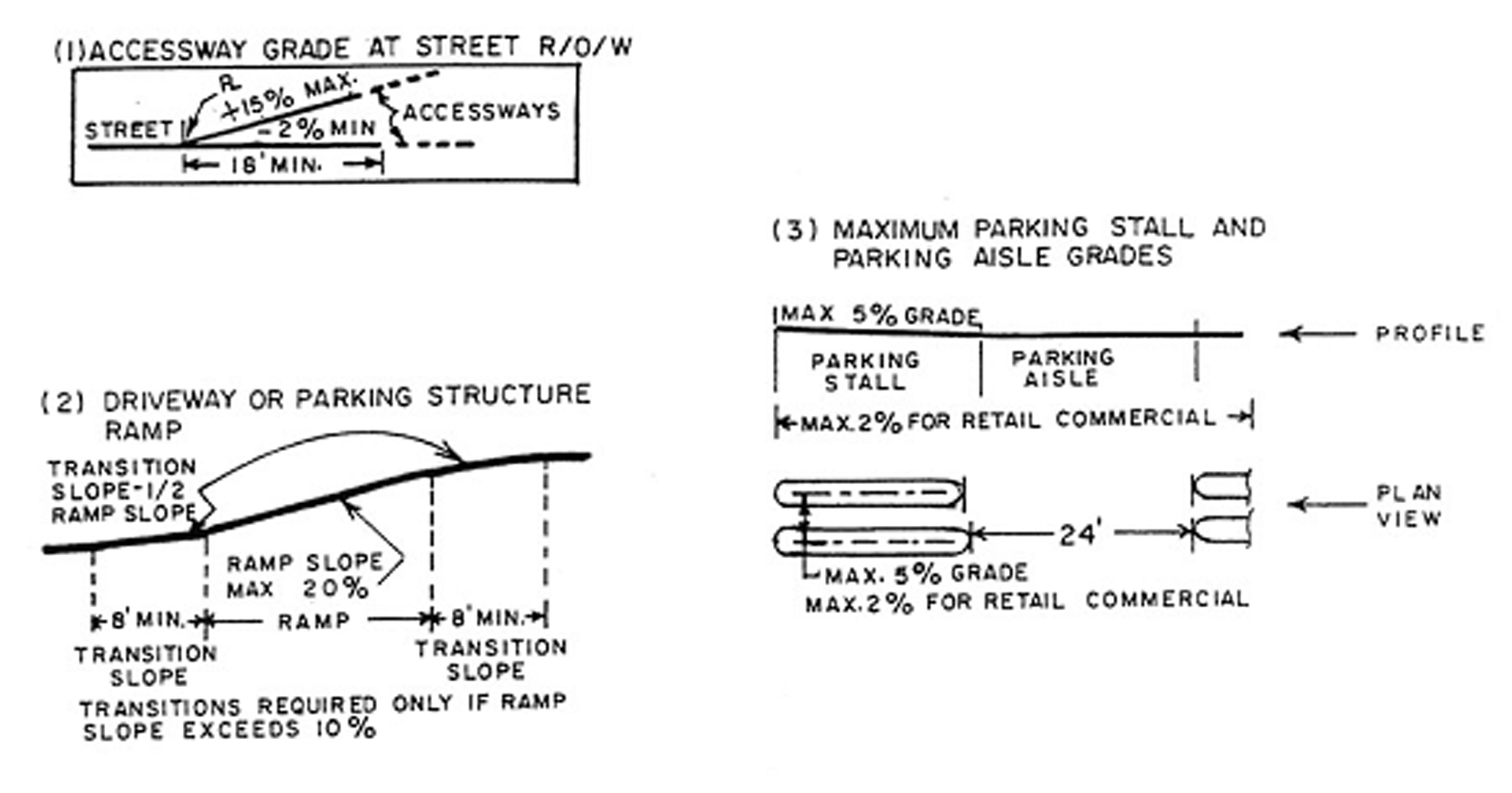
Whenever access is taken from a street, alley or driveway to an off-street parking area serving four or less dwelling units, the driveway or other vehicular accessway shall have a maximum grade of plus ten percent or minus six percent, measured from the street, alley or driveway grade along the driveway centerline, for a distance of not less than 18 feet from the street, alley or driveway right-of-way line.
(2)
Whenever access is taken from a street, alley or driveway to an off-street parking area serving industrial, commercial or professional uses, public or community facilities, or five or more dwelling units, the driveway or other vehicular accessway shall have a maximum grade of plus ten percent or a minus two percent, measured from the street, alley or driveway grade along the driveway centerline for a distance of not more than 18 feet from the street, alley or driveway right-of-way line.
(3)
The maximum grades in Subsections (e)(1) and (e)(2) of this section will generally provide adequate sight distance at street level and prevent vehicles from dragging on extreme grade breaks. Exceptions may be approved by the Director, where physical design prevents such extreme grade breaks and provides safe sight distance.
(4)
Off-street parking spaces and the abutting parking aisles shall have a maximum grade of two percent for retail commercial and five percent for all other uses. Said grade shall be measured across the parking space and the abutting parking aisle in any direction.
(5)
Ramps or driveways providing vehicular access within the interior of an off-street parking area located beyond 18 feet from the ultimate right-of-way line of a street, alley or driveway shall have a maximum slope of plus or minus 20 percent. When such ramp or driveway slopes exceed plus or minus ten percent, the ramp or driveway design shall include transitions not less than eight feet in length, having a slope equal to one-half the ramp slope. When parking is provided on a ramp, the maximum slope shall not exceed six percent.
(f)
Parking area notices and directional instructions. Notwithstanding the regulations of any district or any specific plan, parking area notices, each not to exceed two square feet in area, and directional instructions lettered on the paved surface of driveways and parking areas are permitted for parking facilities serving industrial, commercial, or professional uses; public or community facilities; and five or more residential dwelling units. Such parking notices may contain the name of the owner or occupant of the property an only such words and symbols that are directly related or essential to parking, enforcement, or the direction of vehicular traffic within the parking area.
(g)
Paving. All permanent parking spaces, driveways and maneuvering areas shall be paved and permanently maintained with asphaltic concrete, cement concrete or other all-weather, noneroding, hard surfacing. Temporary parking spaces, driveways and maneuvering areas may use decomposed granite or other stable, all-weather surfacing.
(h)
Lighting. Any lights used to illuminate the parking spaces or driveways shall be designed and located so that direct rays are confined to the property.
(i)
Change or increase in use of property. Whenever the occupancy or use of any premises, which is not in compliance with off-street parking requirements, is changed to a different use or the existing use is altered, enlarged, expanded or intensified, parking to meet the requirements of this section shall be provided for the new use or occupancy. This provision shall not apply to the addition of rooms or other alterations of a single-family dwelling, which do not increase the total floor area more than 50 percent.
(j)
Fractional parking spaces. Whenever the computation of the number of off-street parking spaces required by this section results in a fractional parking space, one additional parking space shall be required for one-half or more fractional parking space, and any fractional space less than one-half of a parking space shall not be counted.
(k)
Parking facilities for the physically handicapped. Public accommodations or facilities, including industrial, commercial, professional, institutional, and multifamily dwellings of five or more units, shall provide parking spaces for the physically handicapped in compliance with the following provisions:
(1)
Spaces required. The following table establishes the number of handicapped parking spaces required:
(2)
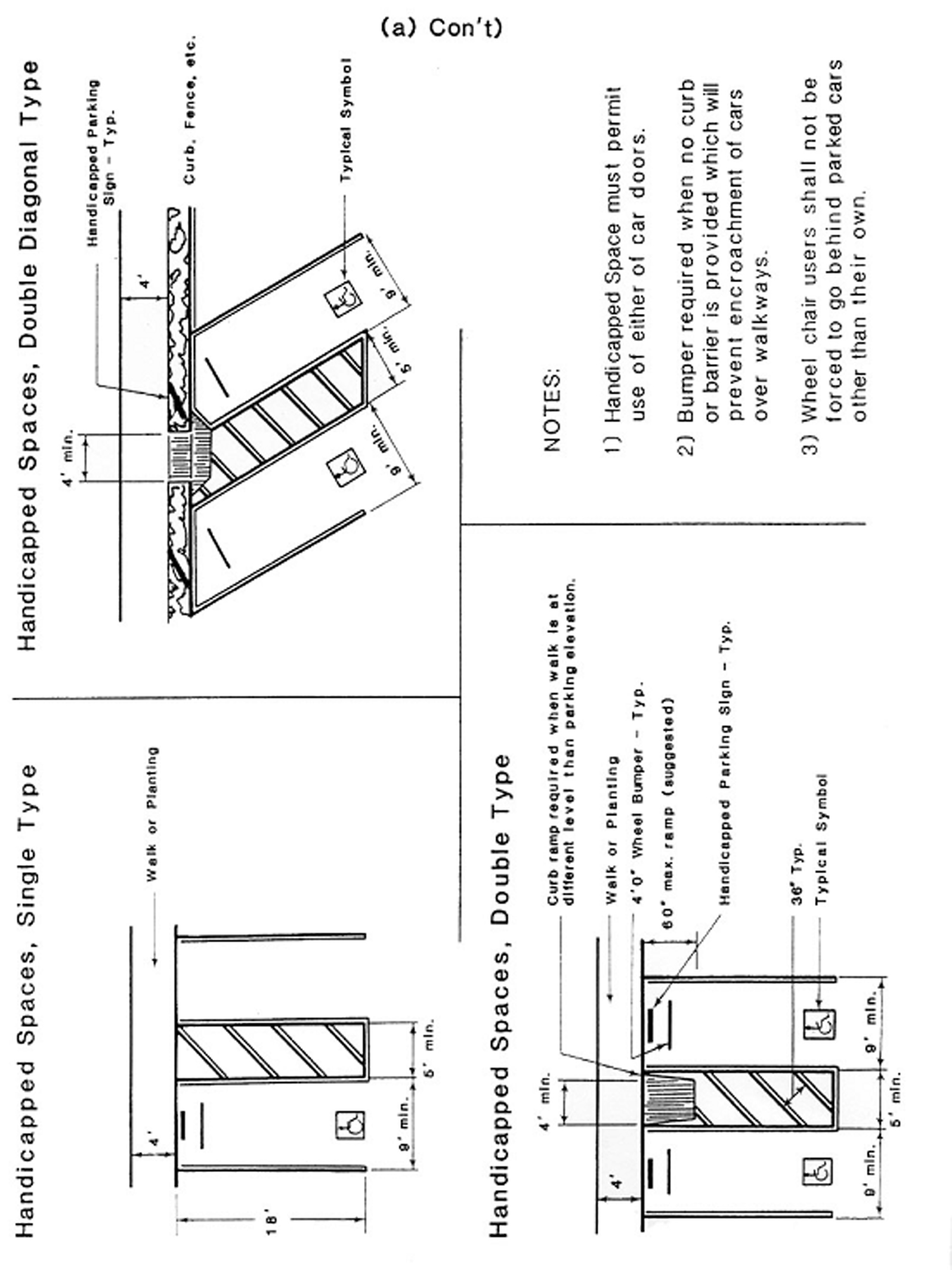
Parking space size. Physically handicapped parking spaces shall be located as near as practical to a primary entrance. If only one space is provided, it shall be 14 feet wide and outlined to provide a nine-foot parking area and a five-foot loading and unloading area. When more than one space is provided in lieu of providing a 14-foot wide space for each parking space, two spaces can be provided within a 23-foot wide area lined to provide a nine-foot parking area on each side of a five-foot loading and unloading area in the center. The minimum length of each parking space shall be 18 feet.
(3)
Arrangement of parking space. In each parking area, a bumper or curb shall be provided and located to prevent encroachment of cars over the required width of walkways. Also, the space shall be so located that a handicapped person is not compelled to wheel or walk behind parked cars other than their own. Pedestrian ways, which are accessible to the physically handicapped, shall be provided from each such parking space to related facilities, including curb cuts or ramps as needed. Ramps shall not encroach into any parking space except where such encroachment into the length of any handicapped space does not limit the handicapped person's capability to leave or enter their vehicle.
(4)
Slope of parking space. Surface slopes of parking spaces for the physically handicapped shall be the minimum possible and shall not exceed one-half percent in any direction.
(5)
Identification. Each parking space reserved for the handicapped shall be identified by a permanently affixed reflectorized sign constructed of porcelain on steel, beaded text, or equal, displaying the international symbol of accessibility. This sign shall not be smaller than 70 square inches in area and shall be centered at the interior end of the parking space at a minimum height of 80 inches from the bottom of the sign to the parking space finished grade, or centered on the wall at the interior end of the parking space at a minimum height of 36 inches from the parking space finished grade, ground, or sidewalk. A sign shall also be posted, in a conspicuous place, at each entrance to the off-street parking facility, not less than 17 inches by 22 inches in size with lettering not less than one inch in height, which clearly and conspicuously states the following:
"Unauthorized vehicles not displaying distinguishing placards or license plates issued for physically handicapped Persons may be towed away at owner's expense. Towed vehicles may be reclaimed at _____________________ or ______________________ by telephoning______________."
In addition to the above requirements, the surface of each parking place shall have a surface identification duplicating the symbol of accessibility in blue paint, at least three square feet in area.
(6)
Parking structures. Entrances to and vertical clearances within parking structures shall have a minimum vertical clearance of eight feet, two inches, where required for accessibility to handicapped parking spaces.
For additional handicapped site development requirements, including curbs, ramps, and landing requirements, refer to the State of California "Regulations for the Accommodation of the Disabled." Information is available at: Office of the State Architect, Access Compliance Unit, 1500 5th street, Sacramento, CA, 95814.
(Ord. No. 03-03, § 5(18.30.510), 4-16-2003; Ord. No. 11-01, § 4(Exh. 7), 1-19-2011)
Sec. 13.18.040. - Residential off-street parking requirements.
Off-street parking facilities shall be provided for all residential uses in compliance with this section.
(1)
Size of parking spaces.
a.
Each required covered off-street parking space for single-family dwellings shall be in a garage or carport a minimum of ten feet in width and 20 feet in length of unobstructed area. In garages or carports containing two or more side-by-side parking spaces, the required minimum width may include the exterior walls or supports of the structure, provided minimum unobstructed dimensions of ten feet in width and 18 feet in length are met.
b.
Uncovered off-street parking spaces shall be a minimum of nine feet in width and 18 feet in length. In measuring the length of paving required for uncovered parking spaces, allowance may be made for vehicular projection beyond the bumper or tire stop if such projection does not interfere with screening or pedestrian use, except under [subsection] (7)c following.
c.
When a side of any space abuts a building, fence, support column or other obstruction, which interferes in any way with access to a motor vehicle, the space shall be a minimum of two feet wider than otherwise required by this section.
d.
Uncovered off-street parking spaces located parallel to and adjoining private accessways shall not be less than eight feet in width and 18 feet in depth, with a minimum of eight feet separating each pair of such parking spaces.
(2)
Driveway widths and lengths.
a.
Single-family residence driveways shall be paved to a minimum of ten feet in width from access street or alley to the garage maneuvering area.
b.
Driveways providing access to garages, carports and uncovered parking areas serving two, three or four dwelling units shall be paved to a minimum of 12 feet wide for one-way traffic and 16 feet wide for two-way, traffic, except when a wider width is required for maneuvering area in front of the garages, carports or uncovered parking spaces.
c.
Driveways providing access to garages, carports and uncovered parking areas serving five or more dwelling units shall be paved to a minimum of 12 feet wide for one-way traffic and 24 feet wide for two-way traffic, except when a wider width is required for maneuvering area in front of the garages, carports or uncovered parking spaces. Additional width may be required as necessary to provide transition to a driveway approach.
d.
Driveway lengths for residential developments shall measure 18 feet or more, or five feet or less.
(3)
Maneuvering areas. Maneuvering areas for access into and out of garages, carports and uncovered parking spaces shall have minimum widths as follows:
a.
Garages. Thirty feet of unobstructed area (measured from garage door), unless modified by Subsection (3)d below.
b.
Carports. Twenty-eight feet of unobstructed area (measured from outward end of parking stall), unless modified by [Subsection] (3)d below.
c.
Uncovered parking. Twenty-four feet of unobstructed area (measured from outward end of parking stall), except for one-way driveways.
d.
Where there is no physical barrier over six inches in height opposite a garage or carport entry that would prevent a motor vehicle from projecting beyond the driveway maneuvering area, the required width may be reduced a maximum of two feet. Additionally, where a one-car garage has an interior width in excess of ten feet and a door wider than eight feet, the maneuvering area in front of such garage may be reduced by the same amount that the width of the garage door exceeds eight feet, to a maximum reduction of two feet; or if the garage is a two-car or more structure and the garage door is at least 16 feet wide, the maneuvering area may be reduced a maximum of two feet.
(4)
Number of required off-street parking spaces. The minimum number of off-street parking spaces required for each category of residential use shall be as follows:
a.
Attached or detached single-family dwellings. Two covered parking spaces for each dwelling. Those dwellings having less than a 17-foot setback from the back of curb or sidewalk, whichever is closest to the garage or carport, shall provide one additional parking space within 200 feet of the dwelling. On-street parking, where permitted, may be used for the additional space.
b.
Two or more dwelling units on one building site. (Note: For purposes of this section, a room such as a den, study, or sewing room shall be considered a bedroom.)
1.
Zero to one-bedroom dwelling units. One and one-half off-street parking spaces for each dwelling unit. Except as otherwise provided in Subsection (4)d. below, one space shall be covered for each dwelling unit.
2.
Two-bedroom dwelling units. Two off-street parking spaces for each dwelling unit. Except as otherwise provided in Subsection (4)d. below, one of the spaces shall be covered for each dwelling unit.
3.
Three or more bedroom dwelling units. Two and one-half off-street parking spaces for each dwelling unit, plus one-half off-street parking space for each Bedroom in excess of three. Except as otherwise provided in Subsection (4)d. below, two spaces shall be covered for each dwelling unit.
4.
Covering. Notwithstanding the provisions of this subsection, the requirement that off-street parking spaces be covered is not applicable for multifamily projects of five or more dwelling units or "second" units per Section 13.26.100.
c.
Five or more dwelling units. For building sites containing five or more dwelling units, the following off-street parking requirements may be used in lieu of Subsection (2) above.
1.
Minimum required parking spaces:
2.
Each dwelling unit shall be assigned at least one standard size parking space.
d.
Guest parking. In addition to the above, at least one guest parking space per every four dwelling units, rounded up to the next nearest whole number, shall be provided.
(5)
Location of residential parking spaces.
a.
Assigned spaces shall be located within 200 feet of the dwelling unit they serve.
b.
Assigned spaces shall be designated as to the dwelling unit to which they are assigned on all plot plans or site plans submitted for permits.
(6)
Roadway widths for attached or detached single-family dwellings.
a.
Attached or detached single-family dwellings shall have roadway widths in the following ratio:
b.
Roadways less than 36 feet wide shall allow on-street parking on one side of the roadway only. Roadways must be 36 feet wide or greater to allow on-street parking on both sides of the roadway.
(7)
Parking area design. Common off-street parking areas, including multiple garages and carports serving five or more dwelling units shall comply with the following:
a.
The off-street parking area shall be designed so that a vehicle within the parking area will not have to enter a street to move from one location to any other location within that parking area.
b.
Parking and maneuvering areas, including garages and carports, shall be designed so that any vehicle can leave the parking area and enter into the nearest street traveling in a forward direction.
c.
Bumpers or tire stops shall be provided at the end of each uncovered parking space along any property line, abutting a public walkway, street or alley, except where screening is positioned, to ensure that the motor vehicle will not extend into the public right-of-way.
d.
No perpendicular parking, covered or uncovered, shall be permitted on an entrance road of a multifamily project within a minimum of 60 feet from the intersection of arterial or collector street. The measurement shall be taken from the near curb face of the arterial or collector street.
(8)
Location of driveway on a corner lot. When a building site abuts two intersecting streets, the driveway approach shall be located within the half of either street frontage that is farthest from the intersection of the two streets. If one of the intersecting streets is an arterial highway, the driveway approach shall be off the other street.
(9)
Screening. Uncovered off-street parking spaces shall be screened whenever such parking spaces abut the boundary of the building site or are located between a building or buildings and an abutting street, with screening materials not less than [three] feet in height, and in compliance with the "fences and walls" section. It may consist of one, or any combination of the following types:
a.
Walls. A wall shall consist of concrete, stone, brick, tile or similar type of solid masonry material a minimum of four inches thick.
b.
Fences, solid. A solid fence shall be constructed of wood or other materials to form an opaque screen.
c.
Fences, open. An open-weave or mesh type fence shall be combined with plant materials to form an opaque screen.
d.
Planting. Plant materials, when used as a screen, shall consist of compact evergreen plants. They shall be of a kind, or used in such a manner, as to provide screening, having a minimum thickness of two feet, within 18 months after initial planting.
(Ord. No. 03-03, § 5(18.30.520), 4-16-2003; Ord. No. 11-01, § 4(Exh. 7), 1-19-2011)
Sec. 13.18.050. - Nonresidential off-street parking requirements.
The following off-street parking requirements are applicable to all uses other than residential uses and are in addition to the general requirements:
(1)
Size of parking spaces.
a.
All covered or uncovered off-street parking spaces, except as noted below, shall be a minimum clear unobstructed nine feet in width and 18 feet in length. For non-accessible parking spaces, a maximum of two and one-half feet of the minimum parking space length may be landscaped, provided that a curb, bumper, or tire stop is provided as an abutment to the landscaped area and included within the dimensions of the landscaped area.
b.
Parking spaces parallel to a curb may be eight feet in width and 18 feet in length, with a minimum of eight feet separating each pair of such parking spaces.
c.
When a side of any space abuts a building, fence, support column or other obstruction, which interferes in any way with access to a motor vehicle, the space shall be a minimum of two feet wider than the standard required width.
d.
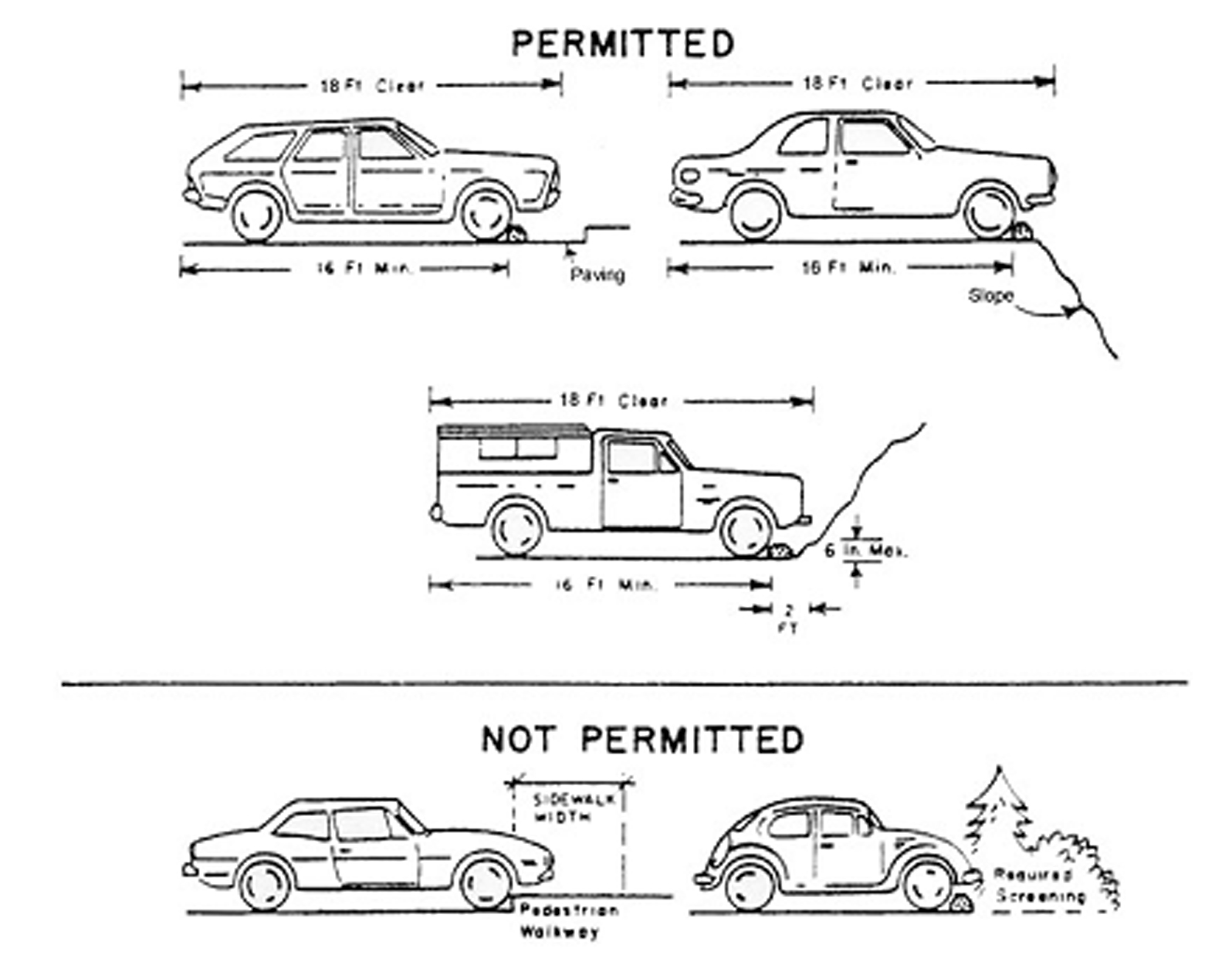
In measuring the length of paving required for uncovered parking spaces, allowance may be made for vehicular project beyond a bumper or tire stop, if such projection does not interfere with screening or pedestrian use, except under Subsection (2)d. following. See illustration for examples of permitted project.
_____
Section (a)(5) Illustrations
e.
All covered and uncovered off-street parking spaces provided for the use of alternative vehicles as defined by this code shall be a minimum, clear unobstructed five-feet, six-inches in width and ten feet in length.
(2)
Parking facility design.
a.
Off-street parking facilities shall be designed so that a car within a facility shall not have to enter a street to move from one location to any other location within that parking facility. On industrial or office sites, separate noncontiguous parking facilities may be provided with independent entrances for employee and visitor parking, provided the designated use is clearly identified on all plot plans or site plans submitted for permits.
b.
Parking and maneuvering areas shall be arranged so that any vehicle can leave the parking area and enter into an adjoining vehicular right-of-way traveling in a forward direction.
c.
No dead end parking aisles serving more than five consecutive stalls will be permitted unless said aisle is provided with a turnaround area constructed in a manner meeting the approval of the Director.
d.
Bumpers or tire stops shall be provided along any abutment to a pedestrian walkway, access or driveway, street or alley, except where screening is positioned, to ensure that the motor vehicle will not extend into these areas.
e.
The point of exit or entry from any off-street parking space shall not be closer than 20 feet from the curb face or the ultimate curbline at a street opening.
f.
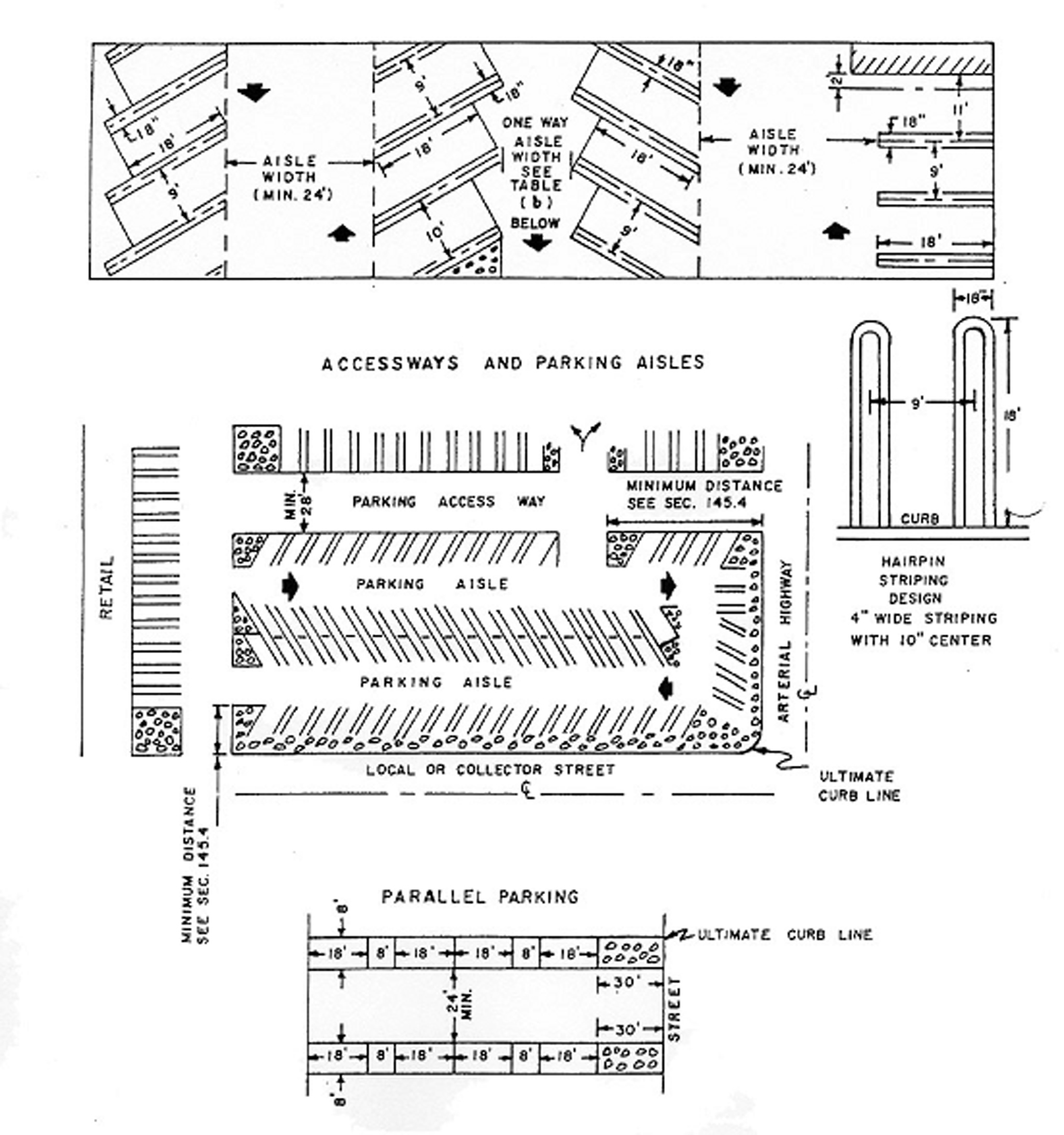
All paved parking stalls, except parallel spaces and alternative vehicle spaces which may be single line, shall be clearly outlined with double or hairpin lines or special paving techniques on the surface of the parking facility.
(3)
Parking accessways. Parking accessways are those driveways that provide ingress or egress from a street to the parking aisles, and those driveways providing interior circulation between parking aisles. No parking is permitted on an accessway.
a.
All parking facilities taking access from an arterial highway shall have a parking accessway between the highway and parking aisles.
b.
Parking accessways from arterial highways shall not have parking spaces taking direct access there from and shall not be intersected by a parking aisle or another parking accessway for a minimum distance of 30 feet for projects with zero to 200 parking spaces, 50 feet for 201 to 350 spaces, 70 feet for 351 to 450 spaces and 90 feet for 451 spaces or more. All distances shall be measured from the curb face of the ultimate curbline of the adjacent street.
c.
Parking accessways from nonarterial highways shall not be less than 20 feet in length from the ultimate curbline of the adjacent street.
d.
One-way accessways shall have a minimum width of 15 feet unless it is a fire lane, which requires a minimum of 20 feet.
e.
Two-way accessways shall have a minimum width of 28 feet.
(4)
Parking aisles. Parking aisles are driveways, which provide direct access to parking spaces. Parking aisles shall have a minimum width of 14 feet. In no case shall the parking aisles for two-way traffic be less than 24 feet in width.
(5)
Number of required off-street parking spaces.
a.
The minimum number of off-street parking spaces required shall be in compliance with the listed requirements set forth for each general category of land use.
b.
Whenever any commercial/industrial use is located on a building site that is also used for residential purposes, parking facilities shall be provided for the residential use as required, in addition to the parking required for the nonresidential use or uses.
c.
For all uses except cannabis storefront retailers, alternative vehicle parking spaces in-lieu may be substituted for standard spaces at a rate of ten percent of the total standard spaces in locations where ten or more parking spaces are required. The permitted amount of alternative vehicle spaces shall be calculated based on total spaces required rounded to the nearest whole space.
(6)
Landscaping. Landscaping of parking areas shall be provided in accordance with the provisions of the applicable land use district regulations. In all cases, space within the off-street parking area not utilized for driveways, maneuvering areas, parking stalls or walkways shall be landscaped. Landscaped areas shall be separated from paved driveway, parking space and maneuvering areas by a minimum six inch high curb, bumper, or tire stop.
(7)
Screening. Open parking spaces and parking structures shall be screened in accordance, whenever such parking is adjacent to a street right-of-way and when the street separates such parking from any districted zoned for residential or agricultural uses. Screening shall be located adjacent to the inside edge of any required boundary landscaping and to the outside edge of the paved parking area when there is no landscaping.
(8)
Vehicular access standards. A site development permit or use permit for the community commercial, commercial highway, and neighborhood commercial districts shall be in substantial conformity with the following:
a.
The first street opening from an intersection should be a minimum of 110 feet from the point of intersection of the ultimate right-of-way lines of the abutting streets.
b.
The second street opening should be a minimum of 300 feet from the point of intersection of the ultimate right-of-way lines of the abutting streets.
c.
Any additional street openings should be a minimum of 300 feet, from center to center from any other street opening except in the neighborhood commercial district, where the distance between street openings should be a minimum of 150 feet from center to center.
d.
There should be a minimum distance of 22 feet measured at the ultimate property line between a street opening in these districts and any existing street opening in any other district.
(9)
Joint use of parking facilities. Uses on multiple building sites may share common parking facilities within one or more parking areas located within such multiple building sites, provided the following requirements are met:
a.
A detailed parking plan, showing all common parking facilities, shall be approved by the Director.
b.
Parking facilities shall be within 300 feet of the entry point of the uses they serve.
c.
Adequate assurance is provided to guarantee that required parking will continue to be maintained.
d.
The assurance required by Subsection (9)c and the parking plan required by Subsection (9)a shall be recorded in the Office of the Orange County Recorder.
e.
Individual uses which result in a parking demand more than is provided by existing parking on the site shall be required to provide added parking as required by the Director.
(Ord. No. 03-03, § 5(18.30.530), 4-16-2003; Ord. No. 09-07, §§ 2—4, 9-16-2009; Ord. No. 11-01, § 4(Exh. 7), 1-19-2011; Ord. No. 13-06, §§ 1—3, 12-18-2013; Ord. No. 23-01, § 3(Exh. A), 8-16-2023)
Sec. 13.18.060. - Parking design requirements.
(a)
Off-street parking stall and access standards.
_____
(b)
Minimum parking aisle width for one-way traffic.
(c)
Minimum parking aisle width for two-way traffic. For two-way traffic, aisle widths and maneuvering areas shall be a minimum of 24 feet wide.
(Ord. No. 03-03, § 5(18.30.540), 4-16-2003; Ord. No. 11-01, § 4(Exh. 7), 1-19-2011)
Sec. 13.18.070. - Off-street parking requirements.
(a)
Minimum requirements. All land uses shall provide off-street parking in compliance with the following requirements unless otherwise modified by the provisions contained in this Code. The off-street parking requirements listed under this section are the minimum requirements for each specific use; however, it shall be the responsibility of the developer, owner or operator of any specific use to provide adequate off-street parking, even though such parking may be in excess of the minimum requirements set forth in this section.
(b)
Requirements not specified. If no provisions for the required number of off-street parking spaces are set forth in these regulations, or the provisions are not clear for any specific use or uses, the Director shall determine the number of off-street parking spaces required.
(c)
Calculation of gross floor area. Areas to be included for purposes of calculating the required number of parking spaces include restrooms, closets, storage, mechanical rooms, exterior patios intended to be occupied (such as outdoor dining), and elevator and stairwells (counted once only at the ground floor). Areas that may be excluded are interior spaces devoted to parking, circulation, access drives or landscaping, exterior breezeways, hallways, and balconies with no permanent use.
(Ord. No. 03-03, § 5(18.30.550), 4-16-2003; Ord. No. 03-08, 11-19-2003; Ord. No. 11-01, § 4(Exh. 7), 1-19-2011; Ord. No. 11-02, § 8, 1-19-2011; Ord. No. 23-01, § 3(Exh. A), 8-16-2023Ord. No. 25-01, § 3(Exh. A), 3-19-2025)
Sec. 13.18.080. - Alternatives to off-street parking regulations.
Alternative provisions to any of the off-street parking regulations may be permitted subject to the approval of a use permit application approved in compliance with the provisions of this Code. Any such application may be approved provided the approving authority finds:
(1)
Applicable off-street parking requirements are excessive or inappropriate due to the nature of the specific use involved or because of special circumstances applicable to the property; and
(2)
The proposed off-street parking facilities comply with the intent of the Zoning Code related to parking requirements.
(3)
The proposed alternative vehicle parking exceeds the maximum number of permitted alternative vehicle parking space alternatives as described in Nonresidential off-street parking requirements and the City Council finds that:
a.
The site is accessible by an established golf cart path and/or golf cart/golf car crossing, or the particular use is accessible to and encourages the use of alternative vehicles.
b.
Sufficient onsite parking is provided or proposed.
c.
The proposed parking plan will not negatively impact public health and safety.
(Ord. No. 03-03, § 5(18.30.600), 4-16-2003; Ord. No. 09-07, § 5, 9-16-2009; Ord. No. 11-01, § 4(Exh. 7), 1-19-2011; Ord. No. 13-06, § 4, 12-18-2013)
State Law reference— Congestion management, Government Code § 65088 et seq.
Sec. 13.18.090. - Transportation demand management.
(a)
Purpose and intent. It is the purpose and intent to meet the requirements of Government Code Title 7, Div. 1, Ch. 2.6 (Government Code § 65088 et seq.) to mitigate the impacts that development projects as specified herein, may have on transportation mobility, congestion and air quality, and to promote transportation demand management strategies.
(b)
Applicability.
(1)
These regulations apply to any discretionary permit for commercial, industrial, institutional, office/professional or other uses which are estimated to employ 100 or more persons, as determined by the employee generation factors specified within Subsection (4) of this section. This also includes any discretionary permit for an existing facility, which is expanding its use to add 100 or more employees. In the case of an expanded use, these regulations shall apply only to the newly expanded portion. These regulations do not apply to a facility expanding its use by less than 100 employees.
(2)
These regulations apply to all districts and specific plan areas including those covered by development agreements. These regulations shall supersede other ordinances adopted previously in which there is a conflict.
(3)
Notwithstanding Subsection (b)(1) above, the following uses and activities shall be specifically exempt from the provisions of this section:
a.
Temporary construction activities on any affected project, including activities performed by engineers, architects, subcontractors and construction workers.
b.
Other temporary activities, or as authorized by the Director when such temporary activities are for a period not to exceed 30 days and occur no more than once a year.
(4)
Employee generation factors shall be based on one of the following:
a.
Employment projections developed by the property owner, subject to approval by the Director.
b.
Building sizes considered equivalent to the 100-employee threshold as follows:
1 The employment projection for a mixed use development shall be calculated on a case-by-case basis based upon the proportion of the development devoted to each type of use.
(c)
Site development standards. Development projects subject to this section shall comply with the following site development standards through the discretionary approval of precise plans of development:
(1)
Parking for carpool vehicles.
a.
The following minimum percentages of the total required parking spaces for the worksite shall be reserved and designated for employee carpool vehicles by marking such spaces "Carpool Only":
b.
Carpool spaces shall be located near the building's employee entrance(s) or at other preferential locations within the employee parking areas as approved by the Director.
(2)
Parking for vanpool vehicles. Parking for vanpool vehicles shall be provided as follows unless determined otherwise by the Approving Authority:
a.
The number of vanpool parking spaces shall be at least five percent of the employee carpool parking spaces and reserved for such by marking the spaces "Vanpool Only." These spaces will replace five percent of the carpool spaces.)
b.
For parking structures, vanpool vehicle accessibility shall include a minimum seven-foot, two inches vertical clearance.
c.
Vanpool parking spaces shall be located near employee entrance(s) or other preferential locations within the employee parking areas as approved by the Director.
(3)
Bicycle parking.
a.
Bicycle parking facilities shall be provided within the worksite at the minimum rate of one bicycle parking space for every 25 employees, in a secure location, and near employee entrances for use by employees or tenants who commute to the worksite by bicycle. Maximum number of bicycle parking spaces required is 50 spaces.
b.
A bicycle parking facility shall be a stationary object to which the user can lock the bicycle frame and both wheels with a user-provided six-foot cable and lock.
(4)
Shower facilities. Shower facilities shall be provided for use by employees who commute to the worksite by means other than a motorized vehicle, unless determined otherwise by the approving authority, at the time of approving the discretionary permit. The use of such facilities shall be provided at no fee or charge to the employee user. The design of such facilities shall be shown on the plot plans in the permit application and conform to the following. Shower facilities shall be provided at a minimum rate as follows:
(5)
Locker facilities. Locker facilities shall be provided for use by employees who commute to the site by means other than a motorized vehicle. The use of such facilities shall be provided at no fee or charge to the employee user. The design of such facilities shall be shown on the plot plans in the permit application. Lockers shall be provided at a minimum ratio of one for every 25 employees. Maximum number of lockers required is 50 lockers.
(6)
Commuter information area. A commuter information area shall be provided within the worksite to offer employees appropriate information or alternative transportation modes. This area shall be centrally located and accessible to all employees, and shall be of sufficient size to accommodate such information on alternative transportation modes.
(7)
Passenger loading areas. Passenger loading areas to embark and disembark passengers from rideshare vehicles within the worksite shall be provided as follows unless determined otherwise by the approving authority at the time of approving the discretionary permit.
a.
Passenger loading areas shall be large enough to accommodate the number of waiting vehicles equivalent to one percent of the total required parking for the project. Maximum loading area size required for less than 1,000 employees shall be large enough to accommodate four waiting vehicles. Maximum loading area size for 1,000 or more employees shall be large enough to accommodate six waiting vehicles.
b.
The passenger loading areas shall be located as close as possible to the identified employee entrance(s), and shall be designed in a manner that does not impede vehicular circulation in the parking area or in adjoining streets.
(8)
Transit/bus stops. Bus shelters, pullouts, and pads shall be provided as necessary in consultation with, and approved by affected transit service providers unless determined otherwise by the approving authority at the time of approving the discretionary permit.
(Ord. No. 03-03, § 5(18.30.655—18.30.675), 4-16-2003; Ord. No. 11-01, § 4(Exh. 7), 1-19-2011)

