
Lake Elmo City Zoning Code
TITLE 5
PUBLIC WORKS
08-253
08-245
2023-010
2022-04
2026-02
2025-13
2022-01
08-251
5.16.010 General Operation
- The municipal surface water system shall be operated as a public utility (hereinafter called the surface water management utility), pursuant to M.S.A. § 444.075, as it may be amended from time to time, from which revenues will be derived subject to the provisions of this chapter and state statutes.
- In general, revenue from the surface water utility shall be used for preparation of a surface water management plan, maintenance of existing ditches, culverts, pond, and storm sewers, capital improvement in developed areas, equipment, planning, inventories, and water quality improvements, including weed control.
Adopted by Ord. 08-253 on 11/3/2021
5.16.020 Surface Water Management Utility Equations
The utility charge (UC) shall be reviewed and determined annually by the city council. The utility equation for various land uses to determine the surface water management fees are assigned as follows:
| Property Class Code | Current Land Use | Utility Factor (Multiplied by the Utility Charge (UC)) |
| 151--208, 402 | Residential | 1.0* UC per Lot |
| 101--111, 401 | Agricultural | 3.0* UC ÷ 40* Total Acres |
| 210 | Manufactured Home Park | 0.52* UC per Acre |
| 230, 231, 233--241 | Commercial/Industrial | 3.08* UC per Acre |
| 250--252 | Vacant Land | 0.15* UC per Acre |
| 232 | Golf/Park | 0.35* UC per Acre |
| 900--999 | School/Church | 1.12* UC per Acre |
| -- | Conditional Use Permit | Site Specific |
Adopted by Ord. 08-253 on 11/3/2021
5.16.030 Surface Water Management Fee
Surface water management fees shall be established for a period of time as set by city council resolution.
Adopted by Ord. 08-253 on 11/3/2021
5.16.040 Surface Water Management Fee Adjustment Credits
- The city council, upon report and recommendation of the city administrator, finance director and public works director, shall apply a credit to a property owner's surface water management fee provided the property owner has contributed to the management of surface water through intentional acts of retaining or re-using surface water to have a minimal impact on the municipal surface water management system or surface waters of the state. The council may apply a 25 percent to 75 percent credit based on the property owner's employment of surface water retention practices in accordance with LEC 105.04.770. These practices include the installation of:
- Rain barrel;
- Rain garden;
- Retention pond;
- Swales, ditches or manmade watercourses;
- Riparian area plantings;
- Other practices that may be deemed as intentional detention of surface water run-off.
- The city council may grant a one-time or ongoing credit based on the effectiveness of the surface water retention as it relates to the management of the municipal surface water management system as a whole. For practices, such as rain gardens constructed in the adjacent right-of-way, the city council may grant an ongoing credit in exchange for the adjacent property owner's participation in the maintenance of the surface water retention device. This credit will not exceed 50 percent of the annual surface water management fee.
- The city council, upon the report and recommendation of the city administrator and finance director, may apply a financial hardship credit of no greater than 75 percent based on a review of the property owner's ability to pay.
Adopted by Ord. 08-253 on 11/3/2021
5.16.050 Exemptions
The following land uses are exempt from the surface water management fee:
- Public rights-of-way;
- Parks;
- Lakes; and
- Railroad property.
Adopted by Ord. 08-253 on 11/3/2021
5.16.060 Statement Of Surface Water Management Charges
Statements for the preceding yearly surface water management service shall be mailed to each customer on or before March 5.
Adopted by Ord. 08-253 on 11/3/2021
5.16.070 Appeal Of Fee
- If a property owner or person responsible for paying the surface water management fee believes that a particular assigned fee is incorrect, the person may request that the fee be recomputed.
- Appeals will be heard once a year, in a manner determined by the council in accordance with the schedule established for credit applications, in established city policy.
Adopted by Ord. 08-253 on 11/3/2021
5.16.080 Delinquent Payments
A penalty equal to $5.00 or ten percent of the amount due, whichever is greater, shall be added to accounts not paid in full on or before May 1.
Adopted by Ord. 08-253 on 11/3/2021
5.16.090 Annual Certification Of Delinquent Accounts
- Each year the city staff shall prepare a list of delinquent surface water management service charge accounts, including accrued penalties thereon, in the form of an assessment roll.
- On or before December 28th of each year, the city council shall review the delinquent surface water management service charge assessment roll and adopt an appropriate resolution directing that the assessment roll be certified to the county auditor as a lien against the premises served and directing that the county auditor collect the assessment as part of the ensuing year's tax levy.
Amended by Ord. 08-251 on 9/21/2021
Adopted by Ord. 08-253 on 11/3/2021
5.16.100 Stormwater Area Districts
- Establishment of stormwater area districts. The city may create stormwater area districts throughout the city, in which districts the city will require payment for the use of the city's storm drainage facilities, either through the connection and discharge to the city's storm drainage facilities or the receipt of volume control credits. Payments are required to assist in paying the costs of the establishment, construction, reconstruction, repair, replacement, enlargement, and improvement of the city's stormwater and surface water drainage system. It is determined by the city council that charges in accordance with the rates provided in the city's fee schedule shall be paid for every lot, parcel, or piece of land that connects to, or receives volume control credits from, the use of the city's stormwater and surface water drainage system in any stormwater area district which the city may establish in the future.
- Benefit. It has been determined by the city council that the city's stormwater and surface water drainage systems benefit all properties located within the city's stormwater area districts by providing for the conveyance, storage, treatment, and drainage of stormwater, which protects the residents and property in the city. Charges against all real property in the city's stormwater area districts will be calculated by the city to reasonably represent the benefit the city's stormwater and surface water drainage system provides to the property in the particular stormwater area district. The city council determines that such benefit is in addition to any previous assessment or charge for construction of any stormwater interceptor, trunk, or sub-trunk, and does not include any other fee or charge for service or availability, any amount paid for any permit fee, charges paid for inspection of connection pursuant to any other ordinance of the city or any other governmental agency or entity.
- Connection and volume control use charges. The applicable stormwater and surface water system connection charge or volume control use charge shall be imposed by the city upon those parcels or land located within the boundaries of any applicable stormwater area district. No city approvals, including, but not limited to, building permits or other development permits or approvals, shall be issued, or any permits or approvals granted, within the established stormwater area district, except upon payment of such stormwater and surface water system connection or volume control use charges to the city. At the time a city approval, such as a building permit or development permit or approval, is required, the stormwater and surface water system connection or volume control use charge shall be computed by the city. Payment of the connection or volume control use charge shall be required at the time the permit is issued or approval granted.
- Establishment of the Downtown Regional Stormwater District and connection charges. The Downtown Regional Stormwater District is hereby established, and shall encompass that area of land and those lots, parcels, and pieces of property within the city, that are more particularly described and depicted on the city's Downtown Regional Stormwater District Map which is on file with the city clerk. This map and all notations, references, and data thereon are hereby incorporated by reference into this section and shall have the same force and effect as if fully set forth and described within this section. The amount of the Downtown Regional Stormwater District connection charge is set forth in the city's fee schedule.
- Establishment of the Regional Infiltration Basin Stormwater District and volume control use charge. The Regional Infiltration Basin Stormwater District is hereby established, and shall encompass that area of land and those lots, parcels, and pieces of property within the city, that are within the Downs Lake Subwatershed as defined by the Valley Branch Watershed District. The purpose of this charge is to allow properties within the Regional Infiltration Basin Stormwater District to pay a use charge in order to receive a credit toward meeting the volume control requirements for the property's Valley Branch Watershed District permit. The property is not allowed to connect to and discharge stormwater to the city's regional infiltration basin. The amount of the regional infiltration basin volume control use charge is set forth in the city's fee schedule. If or when the volume control capacity is depleted at the regional infiltration basin, stormwater management must be provided elsewhere by the property owner.
Adopted by Ord. 08-253 on 11/3/2021
5.20.010 Establishment
An environmental commission for the city is hereby established.
Adopted by Ord. 08-253 on 11/3/2021
5.20.020 Purpose
The general purpose of the commission is to assist the city council in establishing plans, policies, and procedures in matters affecting the environment. This will include, but not be limited to, the orderly disposal of solid waste, recycling, composting, stormwater runoff, water quality improvements, wetland conservation and management, air quality, groundwater (drinking), tree preservation, and quality of the environment and natural resources. Additionally, the commission may assist in educational tasks and other environmental interests and concerns that council deems appropriate. All conclusions reached by the commission shall serve as recommendations and powers of execution shall be vested in the council.
Adopted by Ord. 08-253 on 11/3/2021
5.20.030 Composition; Appointment And Terms Of Members
- The environmental commission shall consist of five regular members, appointed by the council for three-year terms. The initial term for appointments to the commission shall be staggered so that only one new appointment or re-appointment needs to be made in any one year. Commission members must be voting age residents of the city. Vacancies during a term due to resignation or removal from the commission shall be filled by a council appointment for the remainder of the unexpired term. Resignation of environmental management commission members shall be submitted in writing to the council. A majority of the serving members shall constitute a quorum.
- At their discretion, the council may appoint up to two ex officio members and up to two student representatives to serve on the commission. The individuals shall serve in an advisory role without voting privileges and do not need to meet the age or residency requirements for a commissioner.
Adopted by Ord. 08-253 on 11/3/2021
5.20.040 Residency Requirement
No person appointed to represent the residents shall continue to serve on the commission once that member has taken residence outside of the corporate limits of the city. A resignation shall be submitted to the council in this instance.
Adopted by Ord. 08-253 on 11/3/2021
5.20.050 Organization
Officers of the environmental commission shall be the chair and vice-chair. These officers shall be elected annually by the members of the commission at the first meeting in January. The environmental management commission may elect the other officers as may be necessary and may give the chair the authority to appoint and change committees if the appointments might become necessary. The environmental management commission shall provide for the date, time, and location for meeting.
Adopted by Ord. 08-253 on 11/3/2021
5.20.060 Commission Meetings And Records
The environmental commission shall hold regular meetings as established by the commission and approved by the council. These meetings shall be open to the public. The environmental management commission shall submit to the council written minutes of its meetings and actions.
Adopted by Ord. 08-253 on 11/3/2021
5.20.070 Commissioner To Attend City Council Meetings
The environmental commission shall have one or more of its members present at all pertinent council meetings.
Adopted by Ord. 08-253 on 11/3/2021
5.20.080 Duties
It shall be the duty of the environmental commission:
- To assist the council in developing and reviewing policies, plans, reports, regulations, and other matters affecting solid waste disposal, recycling, composting, stormwater runoff, water quality improvements, or other areas affecting the environment that may be assigned by the council;
- To advise the council and residents on solid waste disposal, recycling, composting, stormwater runoff, water quality improvements, or other issues affecting the environment;
- To assist in the collection of background data to determine goals, policies, and programs that will maintain or improve the environment in the city;
- To assist in preparing public education materials and methods on solid waste disposal, recycling, composting, stormwater runoff, water quality improvements, and other issues affecting the environment;
- To recommend additional methods, policies, or procedures that will reduce the solid waste stream, expand recycling, and/or improve the orderly disposal of solid waste;
- To hold public meetings; and
- To cooperate with other agencies, commissions, and volunteer organizations to achieve common goals related to solid waste and the environment.
Adopted by Ord. 08-253 on 11/3/2021
5.20.090 Commission Expenditures
The expenditures of the environmental commission shall be within amounts appropriated for the purpose by the council; provided, however, that all expenditures are duly authorized through normal administrative purchasing policies.
Adopted by Ord. 08-253 on 11/3/2021
5.20.100 Removal Of Commission Members For Nonattendance
Given that the council expects diligence in attendance by the members of the environmental management commission at commission meetings, excessive absences will be considered as grounds for removal from the commission. Excessive absences may be considered as absence from more than one-third of the meetings, or absence from three or more consecutive meetings.
Adopted by Ord. 08-253 on 11/3/2021
5.04.010 Public Utility
The city's municipal water system (the water system) shall be operated as a public utility and convenience from which revenue will be derived, subject to the provisions of this chapter.
Adopted by Ord. 08-253 on 11/3/2021
5.04.020 Construction
No person, firm, or corporation shall make, construct, or install any water service installation, or make use of any water service connected to the water system, except in the manner provided in this chapter. No person, firm, or corporation shall otherwise make, construct, install, or make use of any installation connected to the water system contrary to the regulatory provisions of this chapter.
Adopted by Ord. 08-253 on 11/3/2021
5.04.030 Phone Read Meter Interface Unit Installation Instructions
The city's phone read meter interface unit installation instructions are hereby adopted by reference and incorporated herein as if set out in full.
Adopted by Ord. 08-253 on 11/3/2021
5.04.040 Applications
- Application forms for service installations. All applications for service installations and for water service shall be made at the city office on printed forms furnished by the city.
- Application by owner; payment. All applications for service installations shall be made by the owner of the property to be served, or owner's duly authorized agent, and shall state the size and location of the service connection required. The applicant shall, at the time of making application, pay to the city the amount of fees or deposit required for the installation of the service connection as provided in this chapter.
- Application information needed. The application shall also contain the name of the owner, an account number, and a description of the property, lot, block, and addition, name of the street upon which the property fronts and the official street number assigned to the premises as shown by the records of the city and the signature of the applicant, or applicant's agent, agreeing to conform to the rules and regulations that may be established by the city as conditions for the use of water.
- Application for water service. When service connections have been installed, application for water service may be made at the city office either by the owner, a duly authorized agent, or by the tenant or occupant of the premises.
- Water meter; notification. A meter spacer interface unit will be furnished to the contractor or plumber, at the time a connection permit is issued. The plumber shall notify the building official within 24 hours after piping is complete, giving street address and permit number. The city shall then program the meter interface unit.
Adopted by Ord. 08-253 on 11/3/2021
5.04.050 Plumbing Permits
- A permit must be obtained to connect to the water system. The fee for each permit shall be as provided in the city fee schedule. No permit shall be issued except to a licensed plumber. All costs to connect to an existing water main shall be paid for by the property owner.
- If for any reason the contractor laying the service pipe should fail to have the connection made at the time specified in the contractor's application, notice must be given to the city building official affixing another day on which the contractor wishes to make the connection. The notice must be given at least two business days prior to the excavation for laying of the service pipe, and the connection must be made before 3:00 p.m., except in special cases, and then the work must be done only upon a written order from the city building official.
Adopted by Ord. 08-253 on 11/3/2021
5.04.060 Trunk Water Main Facilities And Lateral Water Main Connection Charges
- A full lateral benefit assessment shall be levied for any building unit which is directly served by a trunk utility main and therefore requires no lateral main, if the building unit resides in a municipal urban service area designated by the city comprehensive plan. The building unit must connect to the municipal utility service within two years of the installation of the trunk utility main.
- A lateral benefit assessment shall be levied for any building unit which is directly served by a trunk utility main and therefore requires no lateral main, if the building resides outside a municipal urban service area as designated by the city comprehensive plan. A stub shall be placed in front of the building unit and the building unit shall be levied at an equivalent of 0.5 lateral benefit assessment. If the building unit requests connection to water service subsequent to the completion of the utility main, the building unit shall be levied the remaining 0.5 lateral benefit assessment and charged all related connection and availability charges consistent with the city's current fee schedule and the cost of any restoration to the street, right-of-way, or water transmission infrastructure that results from the building unit connection.
- The council shall set the fee from time to time by resolution, using the most recent project data.
Adopted by Ord. 08-253 on 11/3/2021
5.04.070 Listing Of Accounts By House And Street Number
- All accounts shall be kept on the books of the city by the house and street number and under the account number assigned to the account and by the name of the owner or of the person signing the application for service.
- All bills and notices sent out by the city shall be sent to the house and street number of the property.
- If nonresident owners or agents desire personal notice sent to a different address, they shall file an application for the different address to the city.
- Any error in address shall be promptly reported to the city.
Adopted by Ord. 08-253 on 11/3/2021
5.04.080 Water Rates
- Establishment of rates. The rate due and payable to the city by each water user for water taken from a water system shall be that rate established by the council by resolution.
- Malfunctioning meter. In case the meter is found to have stopped, or to be operating in a faulty manner, the amount of water used will be estimated in accordance with the amount used previously in comparable periods of the year.
- Billings. Water bills shall be mailed to the customers quarterly and shall specify the water consumed and charge in accordance with the foregoing rates.
- Sprinkler system charges. Where a connection is made to an automatic sprinkler system for standby service only, a charge as set by the council by resolution shall be made on an annual basis. These rates shall apply in all cases where automatic sprinklers are installed and where fire gates and other outlets are sealed. Meters or detector check valves must be installed on the services as required by the city. The amount of these rates shall be due January 1 of the year for which service is to be provided and shall be payable on or before February 1 of that year. Where service is for less than an annual period, the annual charge shall be prorated on a monthly basis and the prorated amount shall be paid at the time of the connection of the sprinkler system.
- Unmetered water. Should it be found that water not metered is used through a fire connection for any purpose other than the extinguishing of a fire upon the premises, the owner and occupant will be notified, and if the improper conditions are not corrected within ten days, the water will be shut off until proper adjustments are made. The owner shall be subject to the penalties as provided in LEC 1.04.230. Regular inspections shall be made of all fire service connections with all piping, fire gates, and other attached appurtenances. The city shall have access to the premises for the inspection and shall keep a record of all inspections made.
Adopted by Ord. 08-253 on 11/3/2021
5.04.090 Statements; Delinquent Accounts
- Statements. Statements for charges for water service for the period shall be mailed to each customer on or before January 5, April 5, July 5, and October 5 of each year. The statements shall be due and payable to the city administrator on or before the first day of the second month following the quarterly period covered by the statement.
- Delinquent accounts. It shall be the duty of the city to endeavor to collect delinquent accounts as promptly as possible. Where satisfactory arrangements for payment have not been made, instructions shall be given to discontinue service by shutting off the water at the stop box. All delinquent accounts may be certified to the clerk/administrator, who shall prepare an assessment roll each year providing for assessment of the delinquent accounts against the respective property served. This assessment roll shall be delivered to the council for adoption on or before October 1 of each year. Upon approval of the assessment roll, the city administrator shall certify to the county auditor the amount due. The county auditor shall then enter the amount as part of the tax levy on the premises to be collected during the ensuing year. The action may be optional or subsequent to taking legal action to collect delinquent accounts.
- Delinquent account fee. All delinquent accounts shall be charged a service fee as set forth from time to time by resolution of the city council.
Adopted by Ord. 08-253 on 11/3/2021
5.04.100 Discontinuance Of Water Service
Water service may be shut off at any stop box connection whenever:
- Connection violations. The owner or occupant of the premises served, or any person working on any pipes or equipment on the premises which as connected with the water system, has violated or threatens to violate or causes to be violated any of the provisions of this chapter;
- Delinquent charges. Any charge for water, service, meter, or other financial obligation imposed on the present or former owner or occupant of the premises served is unpaid;
- Fraud; misrepresentation. Fraud or misrepresentation by the owner or occupant of the premises served in connection with an application for service;
- Service charge for disconnection. For turning off water service for non-payment of water bill, failure to repair leak, discontinuance of service, or any other cause, and the like; and/or
- Property access. Failure to allow city employees or authorized representatives onto property for the purposes of installing or repairing water meters and/or remote reading devices (MIU).
Adopted by Ord. 08-253 on 11/3/2021
5.04.110 Authorized Water Shut Downs
- The city shall not be liable for any deficiency or failure in the supply of water to consumers, whether occasioned by shutting the water off for the purpose of making repairs or connections, or from any other cause whatever. In case of fire, or alarm of fire, water may be shut off to ensure a supply for firefighting. In making repairs or construction of new works, water may be shut off at any time and kept shut off as long as necessary.
- Water turn-on/off. No person, except an authorized city employee, shall turn on or off any water supply at the stop box without permission from the city.
- Service charge for reconnection. For turning on water where service has been turned off for non-payment of water bill, failure to repair a leak, discontinuance of service, or any other cause, a service charge, as set forth from time to time by council resolution, will be made.
Adopted by Ord. 08-253 on 11/3/2021
5.04.120 Separate Meters Required
No more than one housing unit or building shall be supplied from one service connection except by special permission of the city. Whenever two or more parties are supplied from one pipe, connecting with the distribution main, each building or part of the building must have a separate stop box and a separate meter.
Adopted by Ord. 08-253 on 11/3/2021
5.04.130 Authorization Required
Only persons authorized by this chapter shall tap any distributing main or pipe of the water system, or insert stopcocks or ferrules in the main or pipe.
Adopted by Ord. 08-253 on 11/3/2021
5.04.140 Service Pipes
- Maintenance of service pipe. It shall be the responsibility of the consumer or owner to maintain the service pipe from the curb box into the house or building. In the case of failure upon the part of any consumer or owner to repair any leak occurring in the owner's pipe within 24 hours after verbal or written notice of the leak, the water will be shut off and will not be turned on until the service charge set forth from time to time by council resolution, and as specified in LEC 5.04.110, has been paid and the leak repaired. When the waste of water is great, or when damage is likely to result from the leak, water may be turned off immediately pending repairs.
- Frozen service pipes. If the service pipe is frozen, the service pipe will be restored to proper operating condition only by an authorized city employee. The property owner/customer shall pay all costs associated with thawing out water service.
- Specifications for service pipe. Every service pipe must be laid with sufficient waving to allow not less than one foot of extra length and in a manner to prevent rupture by settlement. The service pipe must be placed not less than eight feet below the surface and arranged to prevent rupture by freezing. Service pipes must extend from the curb box to the inside of the building, if not taken into a building, then to the hydrants or other fixtures which it is intended to supply. A shut-off or other stop-cock with waste valve, of the size and strength required, shall be used and placed to be well protected from freezing. Type K copper tubing shall be used up to and including two-inch services. All underground joints are to be mechanical, unless otherwise approved by the plumbing inspector. Joints on copper tubing shall be kept to a minimum, with not more than one joint used for service up to 70 feet in length. All joints and connections shall be left uncovered until inspected and tested at normal water line pressure. Services over two inches shall be Type K copper or Doctile iron pipe. Connections with the mains for domestic supply shall be at least one inch.
Adopted by Ord. 08-253 on 11/3/2021
5.04.150 Abandoned Services
- Disconnection of abandoned/unused services, charges. All service installations that have been abandoned or have not been used for one year or, for any reason, have become useless for further service, shall be disconnected at the main by the city and all pipe and appurtenances removed shall be the property of the city. Any expense of the city shall be charged to the property and, if not paid within 30 days, shall be treated as a delinquent account pursuant to LEC 5.04.090.
- Changes to "old," existing connections. When new buildings are erected on the site of the old ones, and it is desired to increase or change the old water service, no connections with the mains shall be given until all the old service shall have been removed and the main plugged. If any contractor, worker, or employee upon the building shall cause or allow any service pipe to be hammered together at the ends to stop the flow of water, or to save expense in removing the pipe from the main, the owner of the building, the worker, and contractor shall, upon conviction of the violation, be subject to the penalties as set forth in LEC 1.04.230, and shall remove the service pipe from the main. If the contractor, worker, or employee fails to do so on 24 hours notice, the contractor, worker, or employee shall be obligated to pay the city the cost incurred by it for the removal.
Adopted by Ord. 08-253 on 11/3/2021
5.04.160 Water Pipe Connected To Pump, Wells, Or Tank
No water pipe of the water system shall be connected with any pump, well, tank, or piping that is connected with any other source of water supply, and when these connections are found, the building official shall notify the owner to disconnect the connection. If not done immediately, the water supply shall be turned off immediately. Before any new connection to the water system is permitted, the plumbing inspector shall ascertain that no cross connection will exist when the new connection is made. No person shall permit water from the water system to be used for any purpose except upon the person's own premises unless written consent is first obtained from the city.
Adopted by Ord. 08-253 on 11/3/2021
5.04.170 Water Connections For Newly Acquired City Property
In any and all cases where water mains of the city have been or shall be extended to or constructed in any road, street, alley, or public highway, adjacent to or outside the corporate limits of the city, the council is authorized to issue permits to the owners or occupants of the properties adjacent to, or accessible to, the water mains and to make proper water service pipe connections with the water mains of the city and to be supplied with water in conformity with and subject to all the terms, conditions, and provisions of this chapter. Persons accepting the service shall agree to be bound and obligated by this subchapter.
Adopted by Ord. 08-253 on 11/3/2021
5.04.180 Water Use Restrictions
- Emergency authority. To protect the health and safety of the consumers, as well as the general welfare, the mayor or city council may impose emergency regulations pertaining to city water use. Whenever the city shall determine that a critical water deficiency prevails, it may limit the times and hours during which water may be used from the city water system for lawn and garden sprinkling, irrigation, car washing, air conditioning, and other nonessential uses. It is unlawful for any water consumer to cause or permit water to be used in violation of such determination after public announcement thereof has been made through publication or by posting in the city hall and city website specifically indicating the restrictions thereof.
- The mayor or city council may declare a critical water deficiency to prevail within the city whenever it finds and determines that the ordinary demands and requirements of water consumers cannot be satisfied without depleting the water supply of the city to the extent that there would be insufficient water for human consumption, sanitation, and fire protection.
- The mayor or city council shall thereupon enact such regulations and restrictions on the delivery of water and the consumption within the city to conserve the water supply for the greatest public benefit with particular regard to domestic use, sanitation, and fire protection.
- When the governor declares a critical water deficiency, the mayor or city council will enact and enforce water conservation restrictions in accordance with M.S.A. § 103G.291.
- Water use regulations and restrictions may include the right to deny applications for new or additional service connections, and provisions for their enforcement by discontinuing service to customers willfully violating the regulations and restrictions.
- Permanent water use restrictions. To ensure the availability of essential water and fire protection, encourage water conservation and allow flexibility in the city's water system in meeting peak demands, and to reduce the required water supply and storage capacity requirements allowing for a lower cost water system, certain limitations must be placed on the city's water supply.
- Water Irrigation Zones. Property owners in Zone A may water, sprinkle, or irrigate on Mondays and Fridays. Property owners in Zone B may water, sprinkle, or irrigate on Tuesdays and Fridays. Property owners in Zone C may water, sprinkle, or irrigate on Wednesdays and Saturdays. Property owners in Zone D may water, sprinkle, or irrigate on Thursdays and Sundays. A map depicting the zones will be maintained by the Public Works Department and appear on the City's website.
- Time of day sprinkling ban. All property owners are prohibited from watering, sprinkling, or irrigating their lawns between the hours of 5:00 a.m. and 5:00 p.m. daily.
- Exceptions. The permanent water use restrictions do not apply in the following situations:
- Private wells.
- Recently established lawns if permission is granted through a watering restriction waiver form, allowing daily watering for up to 15 days after installation. Watering must still adhere to the restricted hours for the time of day sprinkling ban. New sod or seeded lawns or other landscaping requiring watering, sprinkling, or irrigation, shall not be installed during a water shortage emergency.
- Attended hand-watering of plants, shrubs, trees, and gardens.
- Lawn watering, sprinkling, and irrigation. All lawn sprinkler systems and irrigation systems connected to the municipal water system, whether such systems are aboveground or underground, shall require a permit for connection and shall be installed in accordance with the state plumbing code. To conserve water, all lawn sprinkler systems and irrigation systems which are automatic or are equipped to operate automatically and which are connected to the municipal water system, shall be equipped with a rain-detection device such to prevent the system from operating when it rains (per M.S.A. § 103G.298). All lawn sprinkler systems and irrigation systems connected to the municipal water system shall be constructed and operated to prevent water waste resulting from inefficient landscape irrigation by prohibiting runoff, low head drainage, over spray, or other similar conditions where water flows onto adjacent property, non-irrigated areas, walks, roadways, or structures.
- Enforcement. Failure to comply with restrictions or prohibitions imposed under this section shall result in a surcharge for water service for each violation in an amount determined by resolution of the city council, which shall be added to the water bill for the property on which such violation occurs. Each day of violation shall be deemed a separate violation. Continued violation shall be cause for discontinuing water service.
Amended by Ord. 08-245 on 7/20/2021
Adopted by Ord. 08-253 on 11/3/2021
Amended by Ord. 2023-010 on 5/16/2023
5.04.190 Private Wells
- Dual water system. Except as provided in subsection (b) of this section, a private well may be maintained and continued in use after connections made to the city water system, provided that there is no means of cross connection between the private well and the city water supply at any time. Hose bibs that will enable the cross connection of the two systems are prohibited on internal piping of the well supply system. Threads of the boiler drain of the well volume tank shall be removed or the boiler drain hose bib replaced with a sink faucet. Outside hose bibs will not be installed on the municipal water system where dual water systems are in use.
- Sealing of well required. A private well which has been declared to be a known or potential health hazard by resolution of the city council shall be sealed pursuant to the regulations of the department of health.
Adopted by Ord. 08-253 on 11/3/2021
5.04.200 Water-Cooled Air Conditioning System
No water-cooled air conditioning systems shall be connected to the water system.
Adopted by Ord. 08-253 on 11/3/2021
5.04.210 Operation Of Fire Hydrants
No persons, other than authorized city employees, shall operate fire hydrants or interfere in any way with the water system without first obtaining a permit to do so from the city, subject to the following conditions:
- Use of fire hydrant. A permit to use a fire hydrant shall be issued for each individual job or contract for a minimum period of 30 days, and for additional 30-day periods as are requested and deemed necessary. The permit shall state the location of the hydrant and shall be for the use of that hydrant and none other.
- Deposit for use. The user shall make an advanced cash deposit, as set forth from time to time by council resolution, to guarantee payment for water used and to cover breakage and damage to the hydrant or meter. This sum shall be refunded upon expiration of the permit, less applicable charges for use.
- Rental charge for use. The user shall pay a rental charge, as set forth from time to time by resolution of the council, for each 30-day period or fraction of that 30-day period and the required amount for each 1,000 gallons of water used, as set forth from time to time by resolution of the council.
Adopted by Ord. 08-253 on 11/3/2021
5.04.220 Sources Of Water Contamination
The following possible sources of contamination shall not be installed within 75 feet of any public well:
- Building plumbing;
- Building drains;
- Septic tanks;
- Storm sewers;
- Sanitary sewers;
- Cesspools;
- Leaching pits; and/or
- Drain fields.
Adopted by Ord. 08-253 on 11/3/2021
5.04.230 Curb Stop Boxes
- Installation/location of stop box. Curb stop boxes will be installed at a point on the property line most suitable to the property and shall be left in an accurate vertical position when backfilling is completed. One will be installed on each vacant platted lot. Curb stop boxes will be installed at an approximate depth of eight feet below the grade established by the owner. Type K copper tubing shall be used for installation of the water service.
- Connections to be made by licensed plumber. All piping connections from curb box to house supply piping shall be made under the supervision of a licensed plumber.
Adopted by Ord. 08-253 on 11/3/2021
5.04.240 Water Service Excavators
All water service excavation work shall be performed by water service excavators licensed by the city.
Adopted by Ord. 08-253 on 11/3/2021
5.04.250 Water Meters
- Generally.
- Except for extinguishing of fire, no person except authorized city employees shall use water from the water supply system or permit water to be drawn from the system unless the water is metered by passing through a meter supplied or approved by the city. No person not authorized by the city shall connect, disconnect, and take apart, or in any manner change or cause to be changed, or interfere with any meter or the action of the meter.
- Water meter charge. A charge for water meters, and meter interface units, shall be paid to the city by customers for water meters in advance before meter interface unit delivery of the water meter for installation. The charge shall be determined by resolution by the council. Remote reading devices will be required on all water meters.
- Meter repair/replacement. The city shall maintain and repair all meters when rendered unserviceable through ordinary wear and tear and shall replace them if necessary. Where any replacement, or repair, or adjustment of any meter is necessary because of damage from hot water backup, damage from freezing water, or damage from any act, carelessness, or negligence of the owner or occupants of any premises, any expense incurred by the city to repair the damage shall be charged against and collected from the water consumer. Water service may be discontinued until the cause is corrected and the amount charged collected.
- Meter re-readings. When a consumer makes a complaint that the bill for any past services has been excessive, the city shall, upon written request, have the meter re-read. If the consumer remains dissatisfied and desires that the meter be tested, the consumer shall then make a deposit pursuant to the city’s fee and deposit schedule, and the city shall test the meter. The consumer shall, if the consumer desires, be present when the test is made. In case a test should show an error of over five percent of the water consumed in favor of the city, the deposit will be refunded to the consumer, and a calibrated meter will be installed and the date of the written request and the minimum charge shall not be affected. In case the test shows an accurate measurement of water or an error in favor of the consumer, the amount deposited shall be retained by the city to cover part of the expenses of making the test, and the additional costs, if any, will be included on the next quarterly statement. The deposit charges for a meter testing are those set by resolution by the council.
- Meters property of city. All water meters shall be and remain the property of the city and may be removed or replaced or changed as to size and type by the city whenever deemed necessary.
- Access for meter readings. Authorized city employees shall have free access at reasonable hours of the day to all parts of every building and premises connected to the water system for reading of meters and inspection. The city administrator shall be authorized to make adjustments in water charges when, in the administrator's opinion, the amount billed is erroneous due to a meter deficiency or other mistake.
- Installation of water meters.
- The installation of a water meter shall be installed at the time of structure construction, and shall meet the requirements of this section and shall not be installed prior to receiving a permit approved by the building official. The building official shall maintain permit application forms.
- Installation. Installation of the water meter, raising the curb box to finished grade, and flushing of the lines shall be the responsibility of a plumber duly licensed and registered according to state statute. The city's water department must perform turning on of the water service. The meter setting shall be provided as follows:
- Meter settings shall be located in the utility, laundry, or furnace room and in every case shall be located no more than eight feet from the nearest floor drain unless there is prior approval from the building official.
- The setting shall be installed to provide that the meter is between six and 12 inches from the wall and between 18 and 36 inches from the finished floor.
- The water meter shall have full accessibility with a clear space of three feet in all directions except as noted in subsection (b)(2)a.2 of this section.
- Each meter setting shall be provided with a ball valve on the street side and the house side of the meter. The valves shall be well protected from freezing. Meters one inch and larger shall be provided with ball valve, valved bypass (one nominal size less than inlet) and ball valve, valved drain outlet with iron pipe threads (plugged one nominal size less than inlet). This tee and ball valve shall be installed between the meter outlet and the meter outlet ball valve.
- Meter setting shall be accomplished with brass mechanical joint ahead of the inlet ball valve.
- A meter interface unit (MIU) shall be securely installed on the exterior surface of the wall closest to the water meter. A single RJ11 telephone jack receptacle shall also be installed on the exterior surface of the wall within 18 inches of the MIU. This jack receptacle shall be wired into the existing active telephone circuit. The water meter encoded register (ECR) shall be connected to the MIU with three-wire conductor type as specified by the water utility. The MIU shall be connected to the telephone jack with telephone wire and a RJ11 jack plug. Use of wire ties or clips shall secure all wires.
- Notification of completion of installation. The water utility shall be notified that the meter setting is complete, at which time the water utility will inspect and approve the installation, seal the water meter, and program the MIU.
- Stop and waste valve. All meter installations shall have a stop and waste valve on the street side of the meter. There shall be no more than 12 inches of pipe exposed between the point of entrance through the basement floor and the stop and waste valve. A stop and waste valve shall also be installed on the house side of the meter. Meter setting devices for five-eighths-inch, three-fourths-inch, and one-inch meters shall be of copper pipe or tubing from the terminus of the service pipe up to and including the house side stop and waste valve. Gate valves shall be brass 125 pounds standard. There shall also be installed on the house side of the meter gate valve a three-fourths-inch side outlet tee and a two-inch by four-foot minimum air chamber or shock absorber, or an air chamber of equal volume.
- Installation. Installation of the water meter, raising the curb box to finished grade, and flushing of the lines shall be the responsibility of a plumber duly licensed and registered according to state statute. The city's water department must perform turning on of the water service. The meter setting shall be provided as follows:
Adopted by Ord. 08-253 on 11/3/2021
5.08.010 Intent And Purpose
This subchapter is adopted for the purpose of protecting the health, safety and welfare of the residents of the city through regulating the location, design, installation, use and maintenance of individual sewage treatment systems so as to prevent contamination of surface waters and groundwaters.
Adopted by Ord. 08-253 on 11/3/2021
5.08.020 Regulations Adopted By Reference
Chapter four of the county development code entitled, "Subsurface Sewage Treatment Systems Regulations," Ordinance # 196 (the county regulations), with the exception of sections 3.1, 3.3, 3.4, 22.10, 23, 26.3, 28.1, and 29.1, is hereby adopted by reference and made part of this chapter. Whenever the term "department" appears in the county regulations, it shall mean the city planning department. Whenever the term "county" appears in the county regulations, it shall mean the City of Lake Elmo, except as used in section 3.14 of the county regulations. Whenever the term "local unit of government" appears in the county regulations, it shall mean the City of Lake Elmo.
Adopted by Ord. 08-253 on 11/3/2021
5.08.030 Exceptions To County Regulations
The following provisions are adopted in addition to the county regulations and are more restrictive than the county regulations: Mound systems are not allowed for new collector systems in the OP Open Space Preservation District except to replace existing noncompliant systems.
Adopted by Ord. 08-253 on 11/3/2021
5.08.040 Generally
- General requirements; community sewage treatment systems.
- Lawful connections to community sewage treatment systems will be allowed, with a city permit.
- When an existing individual sewage treatment system is failing and the property in question is near the community sewage treatment system, provided capacity is available in all components of the community sewage treatment system.
- A new connection to a community sewage treatment system will not be permitted for new construction, unless the previous structure in which the new construction occurs was previously connected to the existing community sewage treatment system. In that event, a city permit is required.
- The fee for new connections will be determined by the city. The new user will be responsible for paying all costs to connect to the system, plus a charge to pay for previously built drainfield areas.
- No persons shall uncover, make any connections with or opening into, use, alter, or disturb any community sewage treatment system or appurtenance of the system without first obtaining a written permit from the city. This provision shall not apply to certified qualified employees performing tasks within their area of certification for which a permit is not required. The definition of the term "certified qualified employee" shall be as set forth in the county regulations.
Adopted by Ord. 08-253 on 11/3/2021
5.08.050 Administration Board Of Adjustment And Appeals
- Administrative appeals.
- An aggrieved party may appeal a decision by the permitting authority regarding the interpretation or application of the provisions of LEC 5.08.010 et seq.
- Appeals shall be reviewed and determined by the city's board of adjustment and appeals.
- Variance procedures.
- Request for variances to the provisions of LEC 5.08.010 et seq. shall be reviewed pursuant to the procedures and standards contained in the zoning code.
- No variances with respect to sections 4.1, 4.7, 4.8, 4.9, and 16.2(1) through 16.2(4) of the county regulations will be considered or granted by the city. The city may grant a variance with respect to section 4.8(4)(A) of the county regulations for replacement MSTS serving existing dwellings or other establishments.
Adopted by Ord. 08-253 on 11/3/2021
5.08.060 General Operation
The municipal sanitary sewer system shall be operated as a public utility and convenience from which revenues will be derived, subject to the provisions of this chapter.
Adopted by Ord. 08-253 on 11/3/2021
5.08.070 Definitions
Unless specifically defined within LEC 5.08.060 et seq., common definitions, words, and phrases used in LEC 5.08.060 et seq. shall be interpreted so as to give them the same meaning throughout this Code, and are found in LEC 1.08.
Adopted by Ord. 08-253 on 11/3/2021
5.08.080 Connections With Sewer Required
- Any building used for human habitation or in which a toilet or other plumbing facility for the disposal of human waste is installed and located on property adjacent to a sewer main, or in a platted block through which the system extends, shall be connected to the municipal sanitary sewer system within two years from the date on which a connection is available to the building.
- Any owner of any residential property that has a building failing to meet the two-year connection deadline set forth in subsection (a) of this section will be charged the city's residential sewer base charge as set forth in the city's fee schedule. The owner of a commercial or industrial property that has a building failing to meet the two-year connection deadline set forth in subsection (a) of this section will be charged the city's sewer base fee for each residential equivalent unit as determined by the project feasibility report, metropolitan council determination, or similar estimate.
- Properties with buildings failing to connect within two years to the municipal sanitary sewer system may not be sold, conveyed, or transferred until connection occurs. Properties that have buildings that will be demolished after sale, transfer, or conveyance are exempted from this provision, provided that a demolition permit for the building has been issued by the city.
- All buildings subsequently constructed within the city on property adjacent to a sewer main or in a platted block through which the municipal sanitary sewer system extends, shall be provided with a connection to the sewer system for the disposal of human waste.
Adopted by Ord. 08-253 on 11/3/2021
5.08.090 Supervision Of Sewer Connections
- The building official shall supervise all sewer connections made to the municipal sanitary sewer system and excavations for installing or repairing the connections.
- All sewer installers shall verify the location and elevation of a sewer connection stub by securing a written statement from the city engineer before proceeding with the installation of the sewer house connection.
- The city engineer shall not deviate from the planned location without written permission from the council.
Adopted by Ord. 08-253 on 11/3/2021
5.08.100 Permits
- Persons desiring a connection to the municipal sanitary sewer system shall apply to the city for a permit. The application shall be made on forms furnished by the administrator and shall be accompanied by plans, specifications, and other information required by the building official, together with a permit fee as set forth from time to time by resolution of the council. When reinspection is necessary, a fee as set forth from time to time by resolution of the council for the reinspection shall be paid. All costs and expenses incident to the installation and connection shall be borne by the owner, and the owner shall indemnify the city for any loss or damage that may, directly or indirectly, be occasioned by the installation of the sewer connection, including restoring streets and street surfaces.
- Permits for connections will be issued only to the property owner or to a person duly licensed to make the connection under the provisions of this chapter.
Adopted by Ord. 08-253 on 11/3/2021
5.08.110 Connection Charge
- A connection charge as determined by resolution of the council and the permit fee as set forth from time to time by resolution of the council shall be paid at the time of making application for a connection to the municipal sanitary sewer system.
- Before a permit shall be issued, the following conditions shall be complied with:
- Permit requirements. No permit shall be issued to connect any lot or tract of land with the municipal sanitary sewer system of the city, either directly or indirectly, unless it shall be determined that:
- The lot or tract of land to be served by the connection has been assessed for the cost of construction of the sanitary sewer main with which the connection is made;
- If no assessment has been levied for the construction cost, the proceedings for levying the assessment have been or will be commenced and completed in due course; or
- If no assessment has been levied, and no assessment proceedings will be completed in due course, a sum equal to the portion of cost of construction of the sanitary sewer main which would be assessable against the lot or tract has been paid to the city.
- Additional connection fee.
- If none of the above conditions are met, no permit to connect to any sanitary sewer main shall be issued unless the applicant shall pay an additional connection fee which shall be equal to the portion of the cost of construction of the sanitary sewer main which would be assessable against the lot or tract to be served by the connection.
- The assessable cost is to be determined by the administrator upon the same basis as any assessment previously levied against other property for the main.
- If no assessment has been levied, the assessable cost will be determined upon the basis of the uniform charge which may have been or which shall be charged for similar connection with the sanitary sewer main, determined on the basis of the total assessable cost of the main, allocated on a frontage basis, acreage basis, or both.
- Permit requirements. No permit shall be issued to connect any lot or tract of land with the municipal sanitary sewer system of the city, either directly or indirectly, unless it shall be determined that:
Adopted by Ord. 08-253 on 11/3/2021
5.08.120 Types Of Wastes Prohibited
- Unlawful discharges. It is unlawful to discharge any of the following described waters or wastes into the municipal sanitary sewer system:
- Any liquid or vapor having a temperature higher than 150 degrees Fahrenheit;
- Any water or waste containing more than 100 parts per million by weight of fat, oil, or grease;
- Any liquids, solids, or gases which by reason of their nature or quantity are, or may be, sufficient either alone or by interaction with other substances to cause fire or explosion or be injurious in any other way to the wastewater disposal system or to the operation of the system. Prohibited materials include, but are not limited to, gasoline, kerosene, naphtha, benzene, toluene, xylene, ethers, alcohols, ketones, aldehydes, peroxides, chlorates, perchlorates, bromates, carbides, hydrides, and sulfides;
- Any wastewater having a pH of less than 5.0 or greater than 9.5 or having any other corrosive property capable of causing damage or hazard to structures, equipment, and personnel of the wastewater disposal system;
- Any wastewater containing toxic pollutants, including pesticides and herbicides, in sufficient quantity, either singularly or by interaction with other pollutants, to inhibit or disrupt any wastewater treatment process, constitute a hazard to humans or animals, or create a toxic effect in the receiving waters of the wastewater disposal system. A toxic pollutant shall include, but not be limited to, any pollutant identified pursuant to section 307(a) of the Clean Water Act of 1977, as amended;
- Any garbage that has not been properly shredded;
- Any ashes, cinders, sand, mud, straw, shavings, metal, glass, rags, feathers, plastics, wood, manure, or any other solid or viscous substances capable of causing obstruction to the flow in sewers or other interference with the proper operation of the sewage system;
- Any waters or wastes containing suspended solids of a character and quantity that unusual attention or expense is required to handle the materials at the sewage treatment plant;
- Any noxious or malodorous gas or substance capable of creating a public nuisance; and/or grease, oil, and sand interceptors shall be provided when, in the opinion of the building official, they are necessary for the proper handling of liquid wastes containing grease in excessive amounts, or any inflammable wastes, sand, or other harmful ingredients; except that the interceptors shall not be required for private dwelling units which discharge only normal wastes. Grease and oil interceptors shall be of substantial construction, watertight, and equipped with easily removable covers, which, when bolted in place, shall be gastight and watertight. All grease, oil, and sand interceptors shall be maintained by the owner, at owner's expense, and in continuously efficient operation at all times.
- Substances prohibited.
- No person shall discharge or cause to be discharged directly or indirectly the following described substances to any public sewers unless, in the opinion of the city, the discharge will not harm the municipal sanitary sewer system facilities, nor cause obstruction to free flow in sewers, nor otherwise endanger life, limb, or public property, nor constitute a nuisance. In forming its opinion as to the acceptability of the wastes, the city may give consideration to the factors as the materials or construction of the sewers, nature of the sewage treatment process, capacity of the municipal sanitary sewer system facilities, the city's SDS/NPDES permit and other pertinent factors. The city may make the determination either on a general basis or as a discharges from individual users or specific discharges, and may prohibit certain discharges from individual users because of unusual concentrations or combinations which may occur.
- The substances prohibited are:
- Any waters or wastes containing strong acid, iron and pickling wastes, or concentrated plating solutions, whether neutralized or not;
- Any waters or wastes containing phenols or other taste or odor-producing substances which constitute a nuisance or hazard to the structures, equipment, or personnel of the sewage works, or which interfere with the treatment required to meet the requirements of the state or federal government, or any other public agency with proper authority to regulate the discharge from the sewage treatment plant; and
- Any radioactive wastes or isotopes of the half-life or concentration that they are not in compliance with regulations issued by the appropriate authority having control over their use or may cause damage or hazards to the treatment works or personnel operating it.
- Water runoff discharge prohibited. It shall be unlawful to discharge or cause to be discharged into the municipal sanitary sewer system, either directly or indirectly, any roof water, stormwater, surface water or groundwater of any type or kind, or water discharged from any air conditioning unit or system.
Adopted by Ord. 08-253 on 11/3/2021
5.08.130 Pretreatment, Control, And Refusal Of Extraordinary Wastes
- Generally.
- If any waters or wastes are discharged, or are proposed to be discharged directly or indirectly to the public sewers, which waters or wastes do not meet the standards set out in or promulgated under this section, or which in the judgment of the city may have a deleterious effect upon the treatment facilities, processes, equipment, and soil, vegetation, and groundwater or which otherwise create a hazard to life, or constitute a public nuisance, the city may take all or any of the following steps:
- Refuse to accept the discharges;
- Require control over the quantities and rates of discharge;
- Require pretreatment to an acceptable condition for the discharge to the public sewers; and/or
- Require payment to cover the added cost of handling or treating the wastes.
- The design and installation of plant or equipment for pretreatment or equalization of flows shall be subject to the review and approval of the city, and subject to the requirements of 40 CFR 403, as it may be amended from time to time, entitled, "Pretreatment Standards," and the state pollution control agency.
- If any waters or wastes are discharged, or are proposed to be discharged directly or indirectly to the public sewers, which waters or wastes do not meet the standards set out in or promulgated under this section, or which in the judgment of the city may have a deleterious effect upon the treatment facilities, processes, equipment, and soil, vegetation, and groundwater or which otherwise create a hazard to life, or constitute a public nuisance, the city may take all or any of the following steps:
- Operation and maintenance; preliminary treatment. Where preliminary treatment, flow equalization, or interceptors are required for any water or waste, they shall be effectively operated and maintained continuously in satisfactory and effective condition by the owner at owner's expense and shall be available for inspection by the city at all reasonable times.
- Control; observation devices.
- When required by the city, the owner of any property serviced by a building sewer carrying industrial wastes shall install a suitable control structure together with the necessary meters and other appurtenances in the building sewer to facilitate observation, sampling, and measurement of the wastes.
- The structure and equipment, when required, shall be constructed at the owner's expense in accordance with plans approved by the city and shall be maintained by the owner so as to be safe and accessible at all times.
- Sampling. All measurements, tests, and analysis of the characteristics of water and waste to which reference is made in this section shall be determined in accordance with 40 CFR 136, as it may be amended from time to time, Guidelines Establishing Test Procedures for the Analysis of Pollutants; the latest edition of Standard Methods for the Examination of Water and Waste Water; and shall be determined at the control structure provided, or upon suitable samples taken at the control structure. If no special structure has been required, the control structure shall be considered to be the nearest downstream manhole in the public sewer from the point at which the building sewer is connected. Sampling shall be carried out by customarily accepted methods to reflect the effluent constituents and their effect upon the treatment works and to determine the existence of hazards to life, health, and property. Sampling methods location, times, durations, and frequencies are to be determined on an individual basis subject to approval by the city.
- Proof of compliance. The owner of any property serviced by a building sewer carrying industrial wastes shall, at the discretion of the city, be required to provide laboratory measurements, tests, and analysis of waters or wastes to illustrate compliance with LEC 5.08.060 et seq. and any special condition for discharge established by the city or regulatory agencies having jurisdiction over the discharge. The number, type, and frequency of sampling and laboratory analysis to be performed by the owner shall be as stipulated by the city. The industry must supply a complete analysis of the constituents of the wastewater discharge to assure that compliance with the federal, state, and local standards are being met. The owner shall bear the expense of all measurements, analysis, and reporting required by the city. At the times as deemed necessary, the city reserves the right to take measurements and samples for analysis by an outside laboratory.
- New connections; sufficient capacity. New connections to the sanitary sewer system shall be prohibited unless sufficient flow capacity is available in all downstream facilities.
- Special considerations. No statement contained in LEC 5.08.060 et seq. shall be construed as preventing any special agreement or arrangement between the city and any industrial concern where an industrial waste of unusual strength or character may be accepted by the city for treatment, subject to payment for the special agreement/arrangement by the industrial concern, providing that National Categorical Pretreatment Standards and the city's NPDES and/or state disposal system permit limitations are not violated.
Adopted by Ord. 08-253 on 11/3/2021
5.08.140 Tampering With Municipal Sanitary Sewer System Prohibited
No person shall maliciously, willfully, or negligently damage, destroy, uncover, deface, or tamper with any part of the municipal sewer system.
Adopted by Ord. 08-253 on 11/3/2021
5.08.150 Entry Upon Private Property
The building official, bearing proper credentials and identification, shall at reasonable times be permitted to enter upon all properties connected to the municipal sanitary sewer system for the purpose of inspection, observation, measurement, sampling, and testing in connection with the operation of the municipal sanitary sewer system.
Adopted by Ord. 08-253 on 11/3/2021
5.08.160 Maintenance Of Municipal Sanitary Sewer Connections
Each property owner shall be responsible at all times for the maintenance of owner's sewer connection to the municipal sanitary sewer system, and shall have the obligation to keep the connection in good repair, to the end that there shall be no interference or obstruction to the sewer system as a whole, nor shall there be any violation of this chapter, and the laws of the state. The building official is authorized to make the inspections of the sewer connections as the building official may deem necessary to accomplish this purpose, and the property owner shall be responsible for carrying out the instructions as the building official deems necessary to accomplish this purpose.
Adopted by Ord. 08-253 on 11/3/2021
5.08.170 Rates And Charges
Except as provided in LEC 5.08.060 et seq., the council shall prescribe by resolution the rates to be charged for sewer service and the method of billing and payments. Delinquent accounts may be assessed against the respective property served.
Adopted by Ord. 08-253 on 11/3/2021
5.08.180 Establishment Of Strength Charges
- The metropolitan waste control commission, a metropolitan commission organized and existing under the laws of the state (the Commission), in order to receive and retain grants in compliance with the federal Water Pollution Control Act Amendments of 1972 (the Acts), as amended from time to time, and the regulations under the Act, has determined to impose an industrial user sewer strength charge upon users of the metropolitan disposal system (as defined in M.S.A. § 473.121, subd. 24, as it may be amended from time to time) to recover operation and maintenance costs of treatment works attributable to the strength of the discharge of industrial waste; the sewer strength charge being in addition to the charge based upon the volume of discharge. In order for the city to pay the costs based upon strength of industrial discharge and allocated to it each year by the commission, it is found, determined, and declared to be necessary to establish sewer strength charges and a formula for the computation of the charges for all industrial users receiving waste treatment services within or served by the city. Furthermore, M.S.A. § 444.075, subd. 3, as it may be amended from time to time, empowers the city to make the sewer charge a charge against the owner, lessee, occupant, or all of them and certify unpaid charges to the county auditor as a tax lien against the property served.
- For the purpose of paying the costs allocated to the city each year by the metropolitan waste control commission that are based on the strength of discharge of all industrial users receiving waste treatment service within or served by the city, in addition to sewer charge based on volume of discharge, a sewer charge shall be made upon each person, company, or corporation receiving waste treatment services within or served by the city, based upon strength of industrial waste discharged into the sewer system of the city, the charges referred to as "strength charge."
- Establishment of strength charge formula. For the purpose of computation of the strength charge established by this section, there is established, approved, and adopted the same strength charge formula designated in Resolution No. 76-172 adopted by the metropolitan waste control commission on June 15, 1976, a formula based upon pollution qualities and difficulty of disposal of the sewage produced through an evaluation of pollution qualities and quantities in excess of an annual average base and the proportionate costs of operation and maintenance of waste treatment service provided by the commission.
- Strength charge payment. The strength charge established by this section shall be paid by each industrial user receiving waste treatment services and subject to the charge before the 20th day next succeeding the date of billing of the charge to the user by or on behalf of the city. The payment of the charge shall be deemed to be delinquent if not paid to the billing entity before the date. If the payment is not paid before the date, an industrial user shall pay interest compounded monthly at the rate of two-thirds of one percent per month on the unpaid balance due.
- Establishment of tax lien.
- As provided by M.S.A. § 444.075, subd. 3, as it may be amended from time to time, if payment of the strength charge established by this section is not paid before the 60th day next succeeding the date of billing of the charge to the industrial user by or on behalf of the city, the delinquent sewer strength charge, plus accrued interest, shall be deemed to be a charge against the property served, and the city or its agent shall certify the unpaid delinquent balance to the collection as other taxes are collected.
- The certification shall not preclude the city or its agent from recovery of the delinquent sewer strength charge and interest on the charge under any other available remedy.
Adopted by Ord. 08-253 on 11/3/2021
5.08.190 Intent And Purpose
The provisions of LEC 5.08.190 et seq., are adopted for the purpose of:
- Setting forth the requirements for accruing revenues to enable the city to comply with the state and federal laws and to provide sufficient revenues to financially balance expenditures for the administration of those wastewater systems within the city constructed with federal and state grant funds; and
- Charging those users of the wastewater utilities within the city, which are constructed with federal and state grant funds, for the operation, maintenance, and replacement costs in proportion to use.
Adopted by Ord. 08-253 on 11/3/2021
5.08.200 Regulations
- The city has established a wastewater service charge system whereby revenues collected from users of the wastewater treatment facilities will be used to offset all expenditures incurred for administration, annual operation and maintenance, and equipment replacement.
- A passive maintenance program shall be required of all those properties utilizing individual on-site sewage treatment systems while all properties connected to community collection and treatment systems, cluster system, or individual off-site treatment systems shall be on the active maintenance program.
- For those properties on the passive maintenance program, the property owner shall be responsible for the cost of operating, maintaining, and replacing owner's system. This will include arranging for all repairs and maintenance to septic tanks, pipes, pumps, controls, drain fields, as well as septic tank pumping. The property owner shall report all problems and the steps taken to alleviate the problems to the city administrator. The city will supply inspection cards to the pumpers within the city. When a septic tank is pumped, the tank will also be inspected by the pumper and the signed inspection card returned to the city. The city shall, at regular intervals, and at least biennially, determine which septic tanks have not been inspected and/or pumped. If owners on passive maintenance fail to pump their septic tanks or to return the inspection card, the city will, at its option, inspect the system and perform the required maintenance. All costs of the inspection and maintenance shall be charged to the property owner.
- For those properties on the active maintenance program, the city shall be responsible for operating, maintaining, and replacing the collection and final treatment and disposal system. The city shall arrange for all repairs and maintenance on sewers, lift stations, controls, and drain fields. The property owner shall be responsible for all repairs and maintenance to septic tanks, including septic tank pumping, and to all individual pump stations and sewer pipes up to the collector sewer or final treatment and disposal system. Unless otherwise prescribed, city ownership and the city's responsibility for conducting operation, maintenance, and replacement shall begin at the property line.
- If owners on active maintenance fail to pump their septic tanks or to return the inspection card, the city will, at its option, inspect the system and perform the required maintenance. All costs of the inspection and maintenance shall be charged to the property owner. Property owners shall report all problems to the city administrator, who will determine responsibility for their correction. Damages caused by the abuse of the system by the property owner will be repaired by the city and assessed against the property owner.
- When it has been determined that maintenance and replacement is necessary on an individual or community sewage treatment system (apart from septic tank pumping addressed above), the maintenance and replacement shall be accomplished in a manner acceptable to the city. Replacement parts, equipment, and appurtenances shall be of a design and quality acceptable to the city and shall be installed in a manner acceptable to the city and in conformance with requirements of Minn. R. ch. 7080, Individual Sewage Treatment Systems, as it may be amended from time to time. In the absence of Code provisions or in the amplification of Code provisions, materials and procedures shall be as set forth in appropriate specifications of the ASTM, and WPCF Manual of Practice No. 9. Replacement effected on individual systems shall be reported to the sewer authority.
- Community sewage treatment system service charges will be established based on equivalent residential units (ERU). One ERU is defined as a unit of wastewater volume of 250 gallons per day with a theoretical waste strength of 250 mg/L of BOD and 300 mg/L of total suspended solids. The assignment of ERUs will be made by the city administrator in accordance with Tables I and II of Appendix A.
- In accordance with federal and state requirements, each user will be notified annually at the beginning of each calendar year of the user charge rates attributable to wastewater treatment services.
- In accordance with federal and state requirements, the city will be responsible for maintaining all records necessary to document compliance with the wastewater service charge system adopted.
Adopted by Ord. 08-253 on 11/3/2021
5.08.210 Determination Of Community Sewage Treatment System Service Charge
- Intent.
- It is the intent of LEC 5.08.190 et seq. that the user charges shall cover the costs of operating and maintaining the wastewater systems, and that costs are recovered from all users in a proportionate manner. The city administrator shall maintain a proper system of accounts suitable for determining the operation and maintenance, equipment replacement, and debt retirement costs of the collection and treatment facilities.
- These costs shall be reviewed at regular annual intervals. The city shall determine whether or not sufficient revenue is being generated for the effective operation and maintenance and management of the wastewater system, and that user charges are being distributed proportionately to all users. Any inequities and/or shortages shall be corrected by adjusting the rates accordingly by council resolution.
- The annual user charge per equivalent residential unit is described as follows:
- User charge rate per equivalent residential unit:
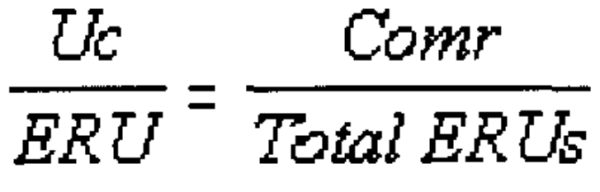
- Where:
- Uc = Annual user charge;
- Comr = Total annual OM&R costs;
- ERU = Equivalent residential unit; and
- Total ERUs = The total number of ERUs connected to community sewage treatment systems.
- User charge rate per equivalent residential unit:
- Use formula. All users shall be charged in accordance with the methodology described below.
- Individual off-site or clustered sewage treatment units:
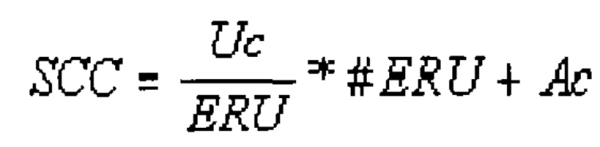
- Where:
- SCC = Sewer service charge;
- Uc = User charge for operation, maintenance, and replacement;
- Ac = Administration charge; and
- #ERU = Number of ERUs assigned to a particular connection.
- Individual off-site or clustered sewage treatment units:
- Individual on-site sewage treatment units:
SCC = Ac - Where:
- SCC = Sewer service charge; and
- Ac = Administration charge.
- Individual on-site sewage treatment units:
- Basis for annual user charge. All users of the wastewater treatment facilities shall be charged annually for sewer service based on the number of equivalent residential units assigned to each and based on whether the unit is seasonal or year-round.
- Additional requirements.
- If a user discharges toxic pollutants or wastes of unusual strength of character to the treatment facilities which cause or increase the operation and maintenance costs, the user shall be ordered either to install pretreatment facilities or pay for the extra costs of treating the wastes.
- This decision will be made by the city administrator at the time the user begins to discharge extra strength wastes.
Adopted by Ord. 08-253 on 11/3/2021
5.08.220 Delinquent Accounts; Revocation
- Delinquent accounts. Any bill not paid for four weeks after date of billing shall be declared delinquent and a past-due notice shall be issued to the billed party. The past-due notice shall contain an additional charge to cover the costs of the rebilling. Additional delinquent notices including their respective charges shall be sent at eight and 12 weeks after the billing date. Should a bill still be delinquent after 120 days, the city may elect to take the following actions:
- Tax. Whenever wastewater service charge bills become delinquent, the amount due shall be certified to the city auditor for inclusion with the following year's tax statement.
- Lien. Whenever wastewater treatment bills become delinquent, the same shall become and constitute a lien upon the real estate to which the sewer service is supplied. Statements rendered for the charge shall be deemed notice to all parties, whether or not the person charged with the statement is the owner of the property served. The claim for lien shall be made in the form of a sworn statement setting forth:
- A description of the real estate, sufficient for the identification of the real estate, upon or for which the sewage service was supplied;
- The amount of money due for the sewage service; and
- The date or dates when the amount or amounts became delinquent. If all amounts shown due remain unpaid after recording as provided by state statutes, the city may foreclose the lien in the same manner and with the same effect as in the foreclosure of mortgages on real estate.
- Civil action.
- In the alternative of levying a lien, the city may, at its discretion, file suit in a civil action to collect the amounts as are delinquent and due against the occupant or user of the real estate and shall collect, as well, all attorney's fees incurred by the city in filing the civil action.
- The attorney's fees shall be fixed by order of the court.
- Delinquent account penalties. In addition to all penalties and costs attributable and chargeable to recording notices of the lien or filing a civil action, the owner or user of the real estate being served by the treatment works shall be liable for interest upon all unpaid balances at the rate of 12 percent per annum.
- Revocation. The city reserves the right to revoke discharge permits and to disconnect service to any user whenever wastewater treatment becomes delinquent.
Adopted by Ord. 08-253 on 11/3/2021
5.08.230 Community Sewage Treatment System Service Fund
- Purpose.
- The city, by LEC 5.08.190 et seq., establishes a sewer service fund as an income fund to receive all revenues generated by the sewer service charge system, and all other income dedicated to the operation, maintenance, replacement, and construction of the wastewater treatment works, including taxes, special charges, fees, and assessments intended to retire construction debt.
- The city also establishes the following accounts as income and expenditure accounts within the sewer service fund:
- Operation and maintenance account;
- Equipment replacement account; and
- Debt retirement account.
- Management of funds.
- All revenue generated by the sewer service charge system, and all other income pertinent to the treatment system, including taxes and special assessments dedicated to retire construction debt, shall be held by the clerk separate and apart from all other funds of the city.
- Funds received by the sewer service fund shall be transferred to the operation and maintenance account, the equipment replacement account, and the debt retirement account in accordance with state and federal regulations and the provisions of LEC 5.08.190 et seq.
- Replacement. Revenue generated by the sewer service charge system sufficient to ensure adequate replacement throughout the design or useful life, whichever is longer, of the wastewater facility shall be held separate and apart in the equipment replacement account and dedicated to effecting replacement costs. Interest income generated by the equipment replacement account shall remain in the equipment replacement account.
- Operation and maintenance. Revenue generated by the sewer service charge system sufficient for operation and maintenance shall be held separate and apart in the operation and maintenance account.
Adopted by Ord. 08-253 on 11/3/2021
5.08.240 Intent And Purpose
- Health, safety, and welfare. The purpose of the provisions of LEC 5.08.240 et seq., is to protect the health, safety, and welfare of the residents of the community, present and future.
- Contamination of surface/groundwater. The purpose of LEC 5.08.240 et seq. is to regulate the location, design, installation, use, and maintenance of alternative waste disposal systems so as to prevent the contamination of the surface water and groundwater within the community.
- Contamination of private water supply wells. The intent of LEC 5.08.240 et seq. is to protect the individual water supply wells of the community from contamination by inadequate, improperly designed, located, installed, or maintained individual and community sewage treatment systems.
- Open space development. The intent of LEC 5.08.240 et seq. is to allow subsurface flow wetland treatment systems to be an allowed alternative system within cluster developments.
Adopted by Ord. 08-253 on 11/3/2021
5.08.250 Rules
- Specifications which apply. This chapter shall apply, except as provided in LEC 5.08.030. Each dwelling shall have its own sewage tank and a stilling tank shall be installed before the first cell.
- Location of systems.
- Setbacks.
- All components of a wetland treatment system within a new residential or commercial development, including stilling tanks, pump stations, and treatment cells, shall be located a minimum of 100 feet from any property line, and 200 feet from any existing or proposed home. Stilling tanks may, however, be located 50 feet from a street right-of-way.
- Wetland treatment systems used to replace failed septic systems shall have setbacks considered reasonable for the site and the neighboring properties.
- Groundwater. Treatment cells shall have a minimum of three feet between the bottom of the cell and the groundwater table. Drain tile or French drains shall not be used to artificially lower the groundwater table.
- Setbacks.
- System design.
- Designer. Wetland treatment systems shall be designed by a registered professional engineer with experience and specific training in the design of these types of systems.
- Design flow. Wetland treatment systems shall be sized based on a minimum of 50 gallons per day per person.
- Level of treatment.
- Wetland treatment systems shall be designed to remove total suspended solids (TSS), phosphorous (P), total nitrogen (TN), and fecal coliforms (FC), and reduce the five-day carbonaceous biochemical oxygen demand (CBOD5). Calculations showing the design level of treatment shall be submitted.
- Prior to discharge into the infiltration cell, the following discharge limits shall be met:
- CBOD5: 50 mg/L;
- TSS: 20 mg/L;
- TN: 15 mg/L;
- NH4: ten mg/L;
- TP: five mg/L; and
- FC: 200 mg/L.
- One foot below the infiltration cell, the following discharge limits shall be met:
- CBOD5: zero mg/L;
- TSS: zero mg/L;
- TN: five mg/L;
- NH4: one mg/L;
- TP: one mg/L; and
- FC: ten mg/L.
- Inspection points. Inspection and monitoring ports shall be located within the system so that the water level can be determined, and a water sample can be easily taken in each treatment cell, and one foot below the infiltration cell.
- Operating plan. An operating plan shall be developed by the designer. This plan shall include standard operating procedures and maintenance of the system.
- Monitoring plan.
- Systems designed for greater than 1,500 gallons per day shall have a monitoring plan developed by the designer. It shall include monitoring of sludge and scum levels in the septic tanks and pumping stations, and effluent flow into the system. Water quality exiting the first treatment cell shall be monitored to ensure that it meets the design level of treatment. Monitoring one foot below the second treatment cell shall be done to ensure that it meets the design level of treatment. Monitoring shall be conducted annually.
- The city shall be sent a copy of all test results.
- Mitigation plan. The system designer shall develop a plan to follow in case expansion or abandonment of the system is necessary.
- City review. The city shall review and approve all parts of the system design and associated plans prior to any construction taking place. Once approval of the system is given, a permit shall be issued by the city.
- Construction.
- Sanitary sewers. All sanitary sewers shall be constructed and tested in accordance with the City Engineers' Association of Minnesota Standards for Utility Construction.
- Treatment cells; testing.
- Liners of treatment cells shall be visually inspected for tears, holes, or poor seams prior to placing rock. A leak test shall be performed after the rock is in place. The liner shall be uncovered, repaired, and the test rerun if any leaks show up during this testing.
- A city representative shall be present for all treatment cell testing.
- Turf establishment; plant growth.
- The designer shall prepare a vegetation plan to establish a wetland community over the treatment cells.
- Prior to final acceptance, wetland plants shall display vigorous growth, and turf shall be established outside of the treatment cell area.
- No erosion shall be present on the site.
- Certification. The system designer shall certify in writing to the city that the treatment system has been constructed in accordance with the approved plans and specifications, and that all test requirements have been met. This certification must be received before start-up of the system.
Adopted by Ord. 08-253 on 11/3/2021
5.12.010 Purpose
The general purpose of LEC 5.12.010 et seq., is for the following:
- To protect the public health, safety, comfort, convenience, and general welfare of the residents of the city;
- To establish powers, duties, rules, regulations, and standards for the removal of solid waste from the city;
- To promote a program to reduce waste materials purchased and promote yard waste reduction through separation of recyclables, yard wastes; and encourage the purchasing of products that contain recycled or recyclable materials;
- To set minimum standards and requirements established by rules of the Minnesota Pollution Control Agency;
- To adopt the plans, policies, rules, standards, and requirements of the Minnesota Pollution Control Agency and the county regarding solid waste; and
- To provide for the administration of LEC 5.12.010 et seq.
Adopted by Ord. 08-253 on 11/3/2021
Amended by Ord. 2022-04 on 7/5/2022
5.12.020 State Rules Adopted
Solid Waste rules 7035 of the Minnesota Pollution Control Agency, as they may be amended from time to time, are hereby adopted by reference as part of LEC 5.12.010 et seq., as they apply to cities.
Adopted by Ord. 08-253 on 11/3/2021
Amended by Ord. 2022-04 on 7/5/2022
5.12.030 Minnesota Pollution Control Agency Plan Adopted
The Metropolitan Solid Waste Management Policy 2016-2036 document number w-sw7-21 is hereby adopted by reference as part of LEC 5.12.010 et seq., as they apply to cities.
Adopted by Ord. 08-253 on 11/3/2021
Amended by Ord. 2022-04 on 7/5/2022
5.12.040 Conflict
In case of conflict between LEC 5.12.010 et seq. and the Minn. R. ch. 7035, as it may be amended from time to time, or the Metropolitan Solid Waste Management Policy, the wording and meaning of the Minn. R. ch. 7035, as it may be amended from time to time, or the Metropolitan Solid Waste Management Policy shall prevail.
Adopted by Ord. 08-253 on 11/3/2021
Amended by Ord. 2022-04 on 7/5/2022
5.12.050 Definitions
- Unless specifically defined in LEC 5.12.010 et seq., common definitions, words, and phrases used herein shall be interpreted to give them the same meaning as they have in common usage throughout this code.
- Definitions are found in LEC 1.08.010
Adopted by Ord. 2022-04 on 7/5/2022
5.12.060 Required Collection Of Mixed Municipal Solid Waste
- Every residential dwelling, multiple dwelling, and commercial/industrial establishment must be under a contract for at least weekly collection of mixed municipal solid waste.
- A residential dwelling, multiple dwelling, or commercial/industrial establishment may apply to the council or its designees for an exemption from this requirement. The applicant must present a plan that ensures an environmentally sound alternative. The council or its designees may deny any exemption requests that do not present an acceptable alternative.
Adopted by Ord. 08-253 on 11/3/2021
Amended by Ord. 2022-04 on 7/5/2022
5.12.070 Disposal Requirements
- It shall be unlawful for any person, firm, or corporation to allow the accumulation of garbage, refuse, and/or waste materials upon owned or occupied property. All garbage, refuse, and waste material must be disposed of in a sanitary manner at least as often as hereinafter provided, or more frequently as needed to prevent accumulation. All garbage and refuse shall be stored out of sight of neighbors and not visible from the street. The building inspector may authorize an exception to the aforementioned requirements for a time period not to exceed 72 hours.
- Targeted recyclables shall be source separated, placed in separate containers, and set out with the regular pick-up of garbage/refuse. Recycling shall be voluntary at this time but the separation of targeted recyclables from the refuse is encouraged. The hauler shall not landfill or incinerate any targeted recyclable materials collected, nor sell, trade, or give materials to any person or business for the purpose of landfilling or incinerating the materials without the prior written consent of the city.
- Yard waste shall be separated from other refuse.
- Food waste and other organic waste can be separated from the refuse stream by being placed in a separate container or compostable bag.
- Contractor's waste building materials, which accumulate on construction sites, must be contained within an enclosure to prevent waste from escaping. Enclosures can be a fenced-in area or a dumpster. The capacity of the enclosure must be sufficient for the project or planned removal (pick-ups) must be scheduled. Waste materials cannot be stored in the structure. Failure to contain and control waste building materials will result in a stop work order.
- Disposing of garbage, refuse, targeted recyclables, waste materials, or yard waste in an unregulated manner on any street, alley, drive, park, playground, or other public place or on any occupied or vacant privately-owned lot shall constitute a violation of LEC 5.12 et seq., whether the material is discarded by the individual upon whose premises the material originates or whether it is discarded by some other person or collector, licensed or unlicensed.
- Any person, firm, business, or corporation that picks up garbage, refuse, waste materials for the city, including, but not limited to, its city office, city parks, city maintenance department, or city fire department must manage garbage, refuse, or waste materials in accordance with the county's Solid Waste Management Plan and deliver to the Recycling & Energy Center in Newport, Minnesota, pursuant Minnesota Statutes 115A.46 and 115A.471.
Adopted by Ord. 08-253 on 11/3/2021
Amended by Ord. 2022-04 on 7/5/2022
5.12.080 Container Required; Placement
- Every person, firm, or corporation who owns or occupies any residential dwelling, boarding house, multiple dwelling, restaurant, place of business, or other establishment where garbage and recycling is generated, who does not otherwise dispose of the garbage and/or recycling in a sanitary manner, shall have one or more fly-tight containers to contain all garbage, recycling and other refuse which may accumulate between the time for collection hereinafter set forth. Each can must have an enclosed pail with handles, have a tightfitting cover, and be so anchored or fastened that it cannot easily be accidentally tipped over.
- The owners, operators, or managers of any dwelling containing more than four rental dwelling units or of any firm or corporation where garbage, recycling or refuse accumulates in excess of four 30-32 gallon containers per week may elect to have vat service weekly from a licensed hauler. The vats shall be of a minimum capacity of one cubic yard and of any approved sanitary type with the proper attachments for lifting on to licensed trucks.
- Each person, firm, or corporation, unless supplied by the city or the hauler, shall provide one or more containers sufficient to retain all targeted recyclables, which may accumulate between the times for collection. The container shall be constructed to allow the contents to be lifted by suitable rectangular handles and must have a capacity not to exceed 95 gallons for residential dwelling units.
- All garbage, recycling and refuse containers shall be placed as follows in residential areas:
- Except for collection day, all containers shall be kept behind the front setback line of the dwelling, in the garage, or otherwise screened from view from the street and at least ten feet from any abutting dwelling.
- On collection day, except where vat or in-yard service is required, containers shall be placed at the curb, in a location easily accessible for motor vehicle pick-up. Containers must be placed for pick-up before 6:00 a.m. on the day of collection to ensure service. The hauler shall complete pick-ups by 7:00 p.m., unless emergency permission is granted by the city, and all containers must be removed from the curb no later than 8:00 p.m. on collection day.
Adopted by Ord. 08-253 on 11/3/2021
Amended by Ord. 2022-04 on 7/5/2022
Amended by Ord. 2026-02 on 2/17/2026
5.12.090 License To Collect Required; Exception
- No person, firm, or corporation, except city employees, shall collect garbage, refuse, recyclables, or waste materials belonging to another in the city without a license from the city.
- Hauler must obtain a license from the city as well as a county haulers license in order to collect garbage, refuse, recyclables or other waste materials in the city.
- No person, firm, or corporation, except city employees, shall scavenge, sort through, or in any way handle the garbage, refuse, recyclables, or waste materials of another person, firm, or corporation without a license from the city or permission from the owner thereof.
Adopted by Ord. 08-253 on 11/3/2021
Amended by Ord. 2022-04 on 7/5/2022
5.12.100 Hauler Equipment Requirement
Hauler licenses shall be granted only upon the condition that the licensee have watertight packer-type vehicles. Haulers must have appropriate container vehicles in good condition to prevent loss of liquid or solid cargo while in transit. All vehicles used by haulers must be kept clean and as free from offensive odors as possible. Vehicles cannot stand in any street longer than reasonably necessary to collect garbage, refuse, and yard waste materials or recyclables. Said vehicles cannot be parked any place or in any manner that constitutes a traffic hazard of nuisance.
Adopted by Ord. 08-253 on 11/3/2021
Amended by Ord. 2022-04 on 7/5/2022
5.12.110 Types Of Licenses
- There are two license categories, each is defined by the type of account served:
- Commercial refuse/recycling. A commercial refuse/recycling license is required for any hauler that serves commercial establishment(s) as defined in LEC 1.08.
- Residential refuse/recycling. A residential refuse/recycling license is required for any hauler that serves residential dwelling(s) as defined in LEC 1.08.
- Residential refuse/recycling and commercial refuse/recycling licensees must pick up refuse and recycling on the same day.
- Every licensed hauler shall offer collection and disposal of yard waste, unless otherwise provided by council action.
Adopted by Ord. 08-253 on 11/3/2021
Amended by Ord. 2022-04 on 7/5/2022
5.12.120 Conditions Of Licensing
- Residential dwelling(s) collection shall only occur on Mondays and Thursdays. It shall be unlawful for a licensed hauler to operate on residential streets in the city on any day that is not regularly scheduled for collection, except to collect a missed pick-up, a special pick-up or when an observed holiday interrupts regularly scheduled collection.
- The council, in the interest of maintaining healthful and sanitary conditions in the city, hereby reserves the right to limit the number of licenses issued within the city.
- Before a license is issued or renewed, applicants must file a schedule of proposed rates with the city.
- Licensees must notify customers of any rate increase at least 30 days prior to effectuating any increase and must provide written notice of said rate increase to the city at least 15 days prior to notifying any customer.
- Residential refuse/recycling license rates shall include a minimum of two levels of regular service, priced on the basis of volume beginning at a volume of 32 gallons or less and in increments of 32 gallons or less. Residential refuse/recycling licenses shall also include a cost for curbside recycling.
- Commercial refuse/recycling license rates shall also include a cost for curbside recycling.
- Residential refuse/recycling licenses rates shall include a separate rate for both refuse and recycling. The recycling collection rate cannot be more than reuse collection for residential dwelling unit(s).
- No hauler shall exceed weight limits established by the city.
- No hauler shall operate in a residential district after 7:00 p.m. or before 6:00 a.m. on any day, and no hauler shall operate in a residential district on Sunday.
- Each vehicle for which a hauler's license is issued shall exhibit the license in a prominent position on the vehicle.
- All residential refuse/recycling and commercial refuse/recycling license holders shall report to the city, on a form provided for the purposes, the yard waste abated from the landfills, as well as any other recycling information requested. The reports are to be submitted quarterly on or by January 10, April 10, July 10, and October 10, respectively. The penalty for not submitting the reports is $500.00 for the first offense, $500.00 plus an appearance before the city council for the second offense, and automatic license revocation for the third offense.
- All licensee employees shall report to the licensees any violations of LEC 5.12.010 et seq. they observe in the performance of their work and the licensees shall report all the violations to the city's code enforcement officer.
Adopted by Ord. 08-253 on 11/3/2021
Amended by Ord. 2022-04 on 7/5/2022
Amended by Ord. 2025-13 on 8/6/2025
5.12.130 Licensing Procedure
- Applications for hauler license must be made to the city using a form prepared by the council. The application must include the name and address of the applicant, a list of the equipment which the hauler proposes to use in the collection, the portion of the city in which collections are to be made, and any other information the city may require, as specified on the form. Completed application shall be submitted to the city for investigation and recommendation.
- The city will review all applications and make recommendations for approval/denial to the city council.
- The city council, after any additional investigation it deems necessary, will approve or deny applications.
- In order to control the number of heavy trucks that use city streets, reduce the wear of those streets, reduce air and noise pollution, and reduce the traffic hazard in residential neighborhoods where children play, the city will not issue more than ten licenses for residential refuse/recycling, as defined in LEC 1.08.
Adopted by Ord. 08-253 on 11/3/2021
Amended by Ord. 2022-04 on 7/5/2022
5.12.140 Insurance Certificate
Before a license can be issued, the applicant must file an executed indemnification and proof of insurance with the city. Any proof of insurance as filed with the county, in an amount and in the form as shall be established from time to time by resolution of the city council.
Adopted by Ord. 08-253 on 11/3/2021
Amended by Ord. 2022-04 on 7/5/2022
5.12.150 Cash Deposit Or Surety Bond Required For License
The applicant shall deposit with the city the sum of $3,000.00, or, in the alternative, shall file a surety bond in the amount of $3,000.00. The condition of the bond shall bind the holder of the license to comply with all applicable provisions of this chapter and any other items as maybe imposed by the council. The council, based on a review and favorable recommendation of the city attorney, shall approve the bond. Where a cash deposit is used, all or any part thereof may be subject to forfeiture in case of the violation of any provisions of LEC 5.12.010 et seq.
Adopted by Ord. 08-253 on 11/3/2021
Amended by Ord. 2022-04 on 7/5/2022
5.12.160 License Fee; Expiration; Transferability
- The fees for a license required by LEC 5.12.010 et seq. will be established from time to time by resolution of the city council.
- Every license shall expire on December 31 next after its issuance.
- The fee for part of a year shall be prorated.
- No license shall be issued for more than one year.
- The license shall not be transferable from one person to another.
Adopted by Ord. 08-253 on 11/3/2021
Amended by Ord. 2022-04 on 7/5/2022
5.12.170 License Revocation Or Suspension
- Licenses issued under LEC 5.12.010 et seq. are subject to revocation, suspension, or civil fines of up to $2,500.00 as imposed by the council for a violation of any law or regulation pertaining to solid waste adopted by the city, county, or state.
- If the county revokes any hauler's license, the city license, will be automatically terminated without any further action from the city. If the county suspends a license, the city license will also be automatically suspended for the same length of time, without further actions of the city.
- No suspension or revocation takes effect until the licensee afforded an opportunity for a hearing under M.S.A. §§ 14.57 to 14.69 of the Administrative Procedure Act, as they may be amended from time to time.
Adopted by Ord. 08-253 on 11/3/2021
Amended by Ord. 2022-04 on 7/5/2022
5.12.180 Frequency Of Collections
Each licensed hauler shall make collections of garbage and refuse, at least weekly, or more often as sanitary conditions warrant as determined by the code enforcement officer. Single-sort residential recycling shall be collected at least bi-weekly.
Adopted by Ord. 08-253 on 11/3/2021
Amended by Ord. 2022-04 on 7/5/2022
5.12.190 Burying And Burning
No person shall bury or burn any garbage, solid waste, household hazardous waste, recyclable materials, or other waste materials within the city.
Adopted by Ord. 08-253 on 11/3/2021
Amended by Ord. 2022-04 on 7/5/2022
5.12.200 Rules And Regulations
The city council, by resolution, has the authority to make rules and regulations concerning type and location of waste containers, the collection of yard wastes and recyclables, information required for license applications, and any other matter concerning solid waste management which is not in conflict with this chapter.
Adopted by Ord. 08-253 on 11/3/2021
Amended by Ord. 2022-04 on 7/5/2022
5.12.210 Yard Waste Composting
All yard waste collected by any individual shall be disposed of at a licensed compost site or on-site. If composting on site, residents must comply with the following regulations:
- Location of compost. The compost shall be kept in the rear yard of the property, at least five feet from lot lines, outside any drainage easement, and placed at least 50 feet away from any adjacent habitable building, other than the resident's own home.
- Prohibited materials. The following materials cannot be composted: meat, bones, fats, oils, dairy products, whole branches or logs, plastics, synthetic fibers, human or pet wastes, and/or diseased plants.
- Proper maintenance required.
- Compost shall be properly managed to minimize odor generation and promote effective decomposition of the material.
- The operation of composting in a manner that results in objectionable odors and/or the placing of prohibited materials for composting may create a health hazard and/or be considered a public nuisance.
Adopted by Ord. 08-253 on 11/3/2021
Amended by Ord. 2022-04 on 7/5/2022
5.12.220 Purpose
- The purpose of the policies set forth within LEC 5.12.220 et seq., is to reduce the amount of solid waste sent to landfills through source separation of recyclable items.
- Section 5.12.220 et seq. is intended to:
- Raise the public's awareness of recycling and to make recycling services available to city residents; and
- Encourage recycling activity within the city.
Adopted by Ord. 08-253 on 11/3/2021
Amended by Ord. 2022-04 on 7/5/2022
5.12.230 Definitions
Unless specifically defined LEC 5.12.220 et seq., common definitions, words, or phases used in LEC 5.12.230 et seq. shall be interpreted so as to give them the same meaning as they have in common usage throughout this code. Definitions are found in LEC 1.08.
Adopted by Ord. 2022-04 on 7/5/2022
5.12.240 Curbside Recycling
- The city has a program that affords every resident of the city the opportunity to voluntarily separate recyclable solid waste.
- The city will provide curbside pickup of recyclables based on the conditions established in 5.12.240 to 5.12.310.
Adopted by Ord. 08-253 on 11/3/2021
Amended by Ord. 2022-04 on 7/5/2022
5.12.250 Collection
All collection of recyclables shall be at curbside on the boulevard.
Adopted by Ord. 08-253 on 11/3/2021
Amended by Ord. 2022-04 on 7/5/2022
5.12.260 Participation
The curbside collection of recyclables is voluntary. This program may be supported by mandatory source separation at the discretion of the city, the county, or the state, pending further analysis.
Adopted by Ord. 08-253 on 11/3/2021
Amended by Ord. 2022-04 on 7/5/2022
5.12.270 Materials Collected Curbside
- Items to be collected and instructions for preparation shall be uniform throughout the city.
- Material to be collected shall follow Washington County's Standard List of Recyclable Materials.
Adopted by Ord. 08-253 on 11/3/2021
Amended by Ord. 2022-04 on 7/5/2022
5.12.280 Ownership
- Ownership of recyclable materials set out for the purpose of participating in curbside recycling programs shall remain that of the person or household from which the materials originated until collected by the authorized collector.
- Upon removal by the city or its designated agents or contractors from a designated collection point, ownership of properly prepared and stored recyclable materials intended for a city authorized collection program shall pass to the authorized collector.
- Materials not prepared, cleaned, or stored according to city specifications shall remain the responsibility and property of the individuals or household from which the materials originated.
- Nothing in LEC 5.12.220 et seq. shall abridge the right of any individual or household to give or sell their recyclable materials to any recyclable material program.
Adopted by Ord. 08-253 on 11/3/2021
Amended by Ord. 2022-04 on 7/5/2022
5.12.290 Scavenging
- Purpose: Unauthorized collection or "scavenging" may reduce the volumes of material collected as part of a designated program and threaten the economic viability of the authorized program. Scavenging may also cause confusion among participating residents and disrupt the publicity and educational processes of an authorized program.
- It is unlawful for any person who is not authorized by the city to take or collect recyclable material set out for authorized collection programs within the city.
Adopted by Ord. 08-253 on 11/3/2021
Amended by Ord. 2022-04 on 7/5/2022
5.12.300 Land Disposal Of Yard Waste
- The Waste Management Act of 1980 prohibits the deposit of yard waste:
- In mixed municipal solid waste;
- In a disposal facility; and/or
- In a resource recovery facility except for the purposes of composting or co-composting.
- In compliance with this state law, the city shall prohibit the deposit of yard waste:
- In mixed municipal solid waste;
- In a disposal facility; and/or
- In a resource recovery facility except for the purposes of composting or co-composting.
Adopted by Ord. 08-253 on 11/3/2021
Amended by Ord. 2022-04 on 7/5/2022
5.12.310 City's Commitment To Solid Waste Abatement
The city is dedicated to educating the public on the importance of natural resource protection and preservation, and the many environmentally and socially responsible ways in which the resources can be used and enjoyed.
Adopted by Ord. 08-253 on 11/3/2021
Amended by Ord. 2022-04 on 7/5/2022
5.12.320 City May Be More Restrictive Than State Law
The council is authorized to impose, and has imposed in this article, additional restrictions on open burning within its limits beyond those contained in Minn. Stat. ch. 88, as it may be amended from time to time.
Adopted by Ord. 08-253 on 11/3/2021
Amended by Ord. 2022-01 on 4/5/2022
5.12.330 Adoption By Reference
The ambient air quality standards, air pollution control regulations of the Minnesota Pollution Control Agency (MPCA), and the Open Burning Restrictions and Permitting Regulations of the state department of natural resources (DNR) are adopted by reference and have the same force and effect as if they were reproduced in their entirety.
Adopted by Ord. 08-253 on 11/3/2021
Amended by Ord. 2022-01 on 4/5/2022
5.12.340 Purpose
The purpose of this article is to regulate open burning within the City of Lake Elmo, to protect the public health, safety and welfare. Through passage of this article, the designated fire official is hereby authorized to adopt and impose burning restrictions to aid in the prevention of wildfire and to consult with the department of natural resources (DNR), division of forestry to develop any restrictions or other criteria.
Amended by Ord. 2022-01 on 4/5/2022
5.12.350 Definitions
For purposes of this article, the following definitions shall apply unless the context clearly indicates or requires a different meaning:
Fire code official means the city’s fire chief or their authorized representative. Open burning means the burning of any matter if the resulting combustion products are emitted directly into the atmosphere without passing through a stack, duct or chimney, except a recreational or campfire as defined herein. Mobile cooking devices such as charcoal grills, wood smokers, manufactured hibachis, and propane or natural gas devices are not considered open burning devices. Portable outdoor fireplace means a portable, outdoor, solid-fuel-burning fireplace that may be constructed of steel, concrete, clay or other noncombustible material. A portable outdoor fireplace may be open in design or may be equipped with a small hearth opening and a short chimney or chimney opening in the top. Recreational fire means a fire no more than three feet in diameter contained within a recreational fire site: using dry, clean wood, producing little detectable smoke, odor or soot beyond the property line; conducted with an adult tending the fire at all times; for recreational, ceremonial, or social food preparation; extinguished completely before quitting the occasion; and respecting weather conditions, neighbors, burning bans, and air quality requirements so that nuisance, health or safety hazards will not be created. No more than one recreational fire is allowed on any property at one time. Recreational fire site means an area of no more than a three-foot diameter circle (as measured from the inside of the fire ring or border); surrounded by non-combustible and non-smoke or odor producing material, either natural rock, cement, brick, tile, blocks or ferrous metal. Burning barrels are not a recreational fire site as defined herein. Recreational fire sites shall not be located closer than 25 feet to any structure or combustible material. Running fire means an attended fire allowed to spread through surface vegetative matter under controlled conditions for the purpose of vegetative management, forest management, game habitat management, or agricultural improvement. Starter fuels means dry, untreated, unpainted, kindling, branches or charcoal fire starter. Paraffin candles are permitted as a starter fuel and an aid to ignition only. Propane gas torches or other clean gas burning devices causing minimal pollution may be used to start an open burn. Vegetative materials means dry leaves, dry grass clippings, twigs, branches, tree limbs, and other similar materials. Paper and cardboard are not considered vegetative materials. Wood means dry, clean fuels, twigs, branches, limbs, manufactured fireplace logs, charcoal, or cord wood. "Wood" does not include wood or wood based products that is green with leaves or needles, rotten, wet, oil soaked, treated or manufactured with paint, glue, preservatives or other chemicals.
Amended by Ord. 2022-01 on 4/5/2022
Amended by Ord. 2026-05 on 6/22/2026
5.12.360 Recreational Fires
- Recreational fires are allowed without a permit under the following guidelines:
- Only clean, dry, wood can be burned.
- The fire shall not exceed three feet in diameter with a flame height of three feet maximum.
- The fire shall take place on the owner's property and shall be a minimum of 15 feet from property lines.
- The fire shall not be conducted within 25 feet of a structure or combustible material.
- Portable outdoor fireplaces shall be used in accordance with the manufacturer's instructions and shall not be operated within 15 feet of a structure or combustible material.
- The fire shall not be conducted if the wind speed exceeds ten miles per hour.
- The use of flammable or combustible liquid accelerants is not permitted.
- The fire must be constantly attended and supervised by an adult until the fire has been completely extinguished.
- A connected garden hose or other means to extinguish the fire must be readily available.
- Any person planning to have a recreational fire must be aware of local burning bans that have been issued by the state department of natural resources. If a burning ban is in effect, all recreational fires are prohibited.
- The fire must be extinguished if it becomes a nuisance to others or if not under adult supervision
Amended by Ord. 2022-01 on 4/5/2022
5.12.370 Prohibited Materials
- No person shall conduct, cause or permit the open burning of dimensional lumber, oils, petroleum fuels, rubber, plastic, chemically treated materials, or other materials that produce excessive or noxious smoke such as, but not limited to: tires; railroad ties; treated, painted or glued wood composite shingles; tar paper; insulation; composition board; sheet rock; wiring; or paint and paint filters.
- No person shall conduct, cause or permit the open burning of: hazardous waste or materials from salvage operations; solid waste generated from an industrial or manufactured process; materials from a service or commercial establishment; or building materials generated from construction and/or demolition of commercial or institutional structures.
- No person shall conduct, cause or permit the open burning of discarded materials resulting from the handling, processing, storage, preparation, serving or consumption of food.
- No person shall conduct, cause or permit the open burning of any leaves or grass clippings.
- No person shall conduct, cause or permit the open burning of any wood or other vegetative materials using a burner, as described in Minn. Stat. § 88.16, within the city's jurisdiction.
- No person shall conduct, cause or permit the open burning of any materials that have been hauled onto the site.
- No person shall conduct, cause or permit the open burning on any commercial property within the City of Lake Elmo.
Amended by Ord. 2022-01 on 4/5/2022
Amended by Ord. 2026-05 on 6/22/2026
5.12.380 Open Burning Prohibited Except By Permit
No person shall start or allow any open burning on any property in the city without first having obtained an open burning permit. A permit is not required for any fire which is a recreational fire as defined in section 5.12.350 or campfire as defined in Minn. Stat. 88.01, Subd. 25, as amended from time to time.
Amended by Ord. 2022-01 on 4/5/2022
Amended by Ord. 2026-05 on 6/22/2026
5.12.390 Permitted Open Burning; Special Circumstances
- Under special or extraordinary circumstances, open burning permits may be issued by the city or by a DNR forestry official for: (1) Elimination of health hazard that cannot be abated by other practical means, as determined by the commissioner of health or the local health authority. (2) Ground thawing for utility repair and construction. (3) Running fires (prairie restoration). (4) Disposal of diseased trees generated on-site, diseased or infected nursery stock, or diseased bee hives.
- Fire training permits may only be issued by the Minnesota Department of Natural Resources (DNR).
- Permits for the operation of a permanent tree and brush burning sites may only be issued by the Minnesota Department of Natural Resources (DNR).
Amended by Ord. 2022-01 on 4/5/2022
.5.12.395 Permitted Open Burning, Where Permitted
- Licenses, When Required.
- An open burning permit may beissued for an open burn in areas of the city zoned:
- As Agricultural, Rural Single Family, Rural Residential, Rural Transitional, Open Space Planned Unit Development, and on select Public Facilities
- As Low Density Residential, One and Two Family Residential, Residential Estate, Village Low Density Residential, and Village Mixed Use, subject to special considerations at the time of application
- An open burning permit shall not be issued for any area of the city which is not zoned in a classification provided under 5.12.395(a), including Medium Density Residential, High Density Residential, Village Medium Density Residential, Village High Density Residential, and any/all Commercial districts, except that open burning for the purpose of conducting a running fire may be permitted in any zoned area of the City if such open burning is performed by a contractor with a valid and appropriate license from the Minnesota Department of Natural Resources (DNR) .
Adopted by Ord. 2026-05 on 6/22/2026
5.12.400 Open Burn Permit Application Procedure
- The applicant must submit a completed Open Burn Permit application and fire service fee will be charged in accordance with the city’s fee schedule.
- Schedule a preliminary site inspection to locate the proposed burn site.
- No burning shall take place without first having obtained an open burn permit.
- An extended length of the burn permit shall be determined by the fire chief or designee of the fire chief.
Amended by Ord. 2022-01 on 4/5/2022
5.12.410 Denial
If established criteria for the issuance of an open burning permit are not met, or during review of said application, it is determined that a practical alternative method of disposal of the material exists, or a pollution or nuisance condition would result, then the fire chief, or designee of the fire chief may deny the open burning permit application.
Amended by Ord. 2022-01 on 4/5/2022
5.12.420 Revocation
The open burning permit is subject to revocation at the discretion of the city fire chief, or designee of the fire chief. Reasons for revocation include, but are not limited to: a fire hazard existing or developing during the course of the burn, any of the conditions of the permit being violated during the course of the burn, pollution or nuisance conditions developing during the course of the burn, or a fire smoldering with no flame present.
Amended by Ord. 2022-01 on 4/5/2022

