
Las Cruces City Zoning Code
ARTICLE VI
- SPECIAL PROVISIONS
Sec. 38-50. - Temporary uses.
A.
Purpose. The purpose of this section is to identify specific temporary uses that may be conducted within listed zoning districts for certain time periods and under special conditions.
B.
Definition. A "temporary use" is a use (business, sale, display or event) which is conducted for a limited time. Temporary uses may be conducted in tents, temporary or permanent buildings, vehicles, trailers or outside. Other temporary uses not listed in this section may be listed under permitted uses for a specific zone.
C.
Submittal requirements. To obtain a permit for a temporary use, the following information must be provided for the permit:
1.
A description of the temporary use.
2.
A site plan showing the location of all structures (both temporary and permanent) including the distance from these structures to the property lines and each other. Temporary structures must be at least five feet from all side and rear property lines and at least 15 feet from property lines along a roadway. These structures shall not violate the clear sight triangle. These structures, excluding fences and signs, must be at least ten feet from all other buildings on the property.
3.
The site plan must also show the traffic circulation including parking spaces and driving aisles on the property. Temporary uses are not permitted to obstruct more than:
•
25 percent of the parking area if there are 20 parking spaces or less.
•
15 percent of the parking area if there are between 21 and 50 parking spaces.
•
Ten percent of the parking area if there are more than 50 parking spaces.
The temporary use shall not obstruct disabled accessible parking spaces. There shall be adequate room for traffic circulation around the temporary use.
4.
The date the temporary use will start and end and the hours of operation.
5.
The name and address of the property owner at the location of the temporary use. Property owners must consent in writing to the temporary use on their property.
6.
The Municipal Code has additional submittal requirements for various uses which must be submitted with the permit application. Listed in the next section are time limitations for specific temporary uses and the sections of the Municipal Code that apply to that use.
7.
All uses proposed to be located in city parks shall comply with chapter 20 of the Municipal Code (see section 38-53).
D.
Time limitations. Temporary uses are restricted to the time limits and zoning districts listed below. Temporary uses not listed in this section shall be permitted for up to 14 calendar days at one location in a calendar year. A nonconforming property (including but not limited to the use, structure, or lot) shall not be permitted to be used for temporary uses for more than a total of 90 calendar days in a calendar year. A single temporary use conducted for longer than the time limits stated in this section for that use shall be considered a permanent use and shall comply with all Municipal and other Code requirements.
Carnival, amusement park or hall, circus: These uses are permitted for no more than 14 calendar days at a single location one time in a calendar year (not including the time required to set up and take down the structures associated with the use). Permitted in OS-R, C-3, M1/M2 and M-3 zones (also see Municipal Code, chapter 6, article II and chapter 16, article IV). If the use will be for more than 14 calendar days, a special use permit shall be required (see section 38-54).
Christmas tree stands: Sales of Christmas trees shall not occur before November 15 or after December 31. Permitted in C-2, C-3, M1/M2 and M-3 zones.
Community wide event. Temporary uses at the time of a community wide event are permitted to begin one week (seven calendar days) before the beginning of the community wide event and shall end three calendar days from the last day of the community wide event. These temporary uses are permitted in addition to other types of temporary uses such as tent sales and outdoor sales and displays. Permitted in OS-R, R-4, O-2, C-2, C-3, M1/M2 and M-3 zones (also see Municipal Code chapter 16, article IV).
Firework stands: Sale of fireworks shall not occur before June 20 or after July 6. Sale of fireworks is also permitted three calendar days preceding and including New Year's Day, Chinese New Year and Cinco de Mayo of each year. Permitted in C-3, M1/M2 and M-3 zones (also see Municipal Code, chapter 11, article III).
Flea markets: Temporary flea markets shall operate for no more than 30 calendar days at one location in a calendar year. Permitted in C-3, M1/M2 and M-3 zones (also see Municipal Code, chapter 21.)
Kiddie ride carnival and exhibits: These uses shall be permitted for no more than 14 calendar days at a single location one time in a calendar year. Permitted in OS-R, C-3, M1/M2 and M-3 zones (also see Municipal Code chapter 6, article II and chapter 16, article IV.)
Special events: These events shall be permitted for no more than 14 calendar days at a single location one time in a calendar year. Permitted in OS-R, CBD, C-3, M1/M2 and M-3 zones (also see Municipal Code, chapter 16, article IV). Equestrian-related and agricultural-related events in the EE and REM zoning districts shall be permitted for no more than a cumulative grand total of 30 calendar days within a calendar year at a single location.
Temporary outside sales and displays: These types of sales and displays shall be permitted for no more than 21 calendar days at a single location one time in a calendar year. Permitted in C-2, C-3, M1/M2 and M-3 zones (also see Municipal Code chapter 16, article IV).
Temporary stands: These uses are permitted for no more than three months for the sale of seasonal merchandise and for no more than 30 calendar days for nonseasonal merchandise. Permitted in OS-R (when associated with a community wide or special event), C-3, M1/M2 and M-3 zones (also see Municipal Code, chapter 16, article IV).
Tent sales and activities: These types of sales and activities shall be permitted for no more than 21 calendar days at a single location one time in a calendar year. Permitted in OS-R (when associated with a community wide or special event), O-2, C-2, C-3, M1/M2 and M-3 zones (also see Municipal Code chapter 16, article IV). The fire department has several requirements for tents which must also be met.
Yard, garage or rummage sales, fund raising or celebration activities for nonprofit organization. These types of uses shall be conducted for no more than four calendar days, three times at one location in a calendar year. No permits are required for these uses when conducted from an individual's dwelling or an institution. If conducted from a business or other property not used mainly for residential or institutional purposes, all requirements for temporary uses must be met. This use is permitted in all zones.
E.
Signs. Signs for temporary uses shall comply with the sign code requirements for temporary signs.
F.
Conversion from temporary to permanent. When an applicant wants a temporary use to become a permanent and legal use or when the temporary use exceeds the stated time limits, the use must meet all applicable city codes. After meeting the requirements of all city codes, approvals must be obtained from all reviewing agencies within the business registration review process. Specific requirements that shall be met include, but are not limited to:
1.
Landscaping. This issue shall be reviewed by the city community development department to determine if the minimum landscaping requirement is met, and
2.
Parking and drainage. The city community development department shall review these issues to determine if the minimum parking and drainage requirements are met.
(Ord. No. 2354, § I, 1-22-07)
Sec. 38-51. - Accessory uses and structures.
A.
Purpose. The purpose of this section is to define the regulations regarding accessory uses and structures related to a residential use in residential zoning districts. All permitted nonresidential uses and associated structures in any zoning district are considered principal or primary and shall comply with all other requirements of this Code. Special zoning districts, e.g., University District Overlay, rely upon this section for regulating accessory uses and structures or have specific requirements for accessory uses and structures.
B.
Definition.
Accessory use or structure is a subordinate use or structure, the use of which is incidental to and customarily found in connection with the principal dwelling on the same property. Examples: gazebo, greenhouse, tool shed, detached garage, guest dwelling, swimming pool, tennis court, barn, and flag pole.
C.
Accessory uses and use of accessory structures.
1.
An accessory structure shall not be utilized for human habitation, except in the case of a guest dwelling.
2.
An accessory use or an accessory structure may be proposed on a separate lot adjacent to the lot containing the residential use; however, the lots shall be replatted to create one property. This provision shall not apply to properties in an EE or REM rural residential zoning district when complying with chapter 7, animals, of the Municipal Code and for agricultural, farm, or equestrian uses.
3.
No accessory use or accessory structure may be permitted on a property without a residential use, except in the case of property located in an EE or REM rural residential zoning district when complying with chapter 7, animals, of the Municipal Code and for agricultural, farm, or equestrian uses.
4.
Development standards, such as setbacks and height, for a residential use and its associated accessory uses and structures in an office, commercial or industrial zoning district shall be the same as the zoning district in which the residential use is located. See section 38-32D.
5.
Metal shipping containers (a.k.a. cargo containers and intermodal freight containers) are not allowed to be used as accessory structures in single-family residential zones or multi-family residential zones consisting of single-family dwellings, except in the case when the primary structure/dwelling is constructed using shipping containers. The shipping container shall be required to follow the urban design requirements of this section.
Said shipping containers used for storage purposes are permitted within multi-family, commercial and industrial zoned or other non-residential zones and uses provided they comply with urban design requirements of section 38-61 LCMC.
Shipping containers are allowed on private property in all zones temporarily to store building materials and/or construction tools during construction pursuant to an active building permit on the same property or within a centralized location within a construction area. Said container(s) shall be removed upon completion of the project and/or issuance of a certificate of occupancy or completion.
Shipping containers, PODS or similar "you pack" type moving containers are allowed within the front yard (driveway only) of residential uses for the purposes of packing/unpacking in preparation of or after a move to or from the subject property. Use of such containers shall be limited to 21 days (three weeks) after which the unit shall be removed from the property.
D.
General development standards and exceptions.
1.
No structure, whether a building permit is required or not, shall be permitted within the setback of the required front yards, primary and secondary, except flag poles, walls and fences, or decorative structures such as a bird bath.
2.
Tier development requirements—Residential zoning districts:
Tier 1:
a.
Uses: Uses within this category are storage, recreational and pet uses, such as storage buildings, doghouses and kennels, playhouses, swing sets, and sand boxes.
b.
Cumulative number and size limits: There is no limit on the number of such structures, provided all storage buildings, doghouses, kennels, playhouses, swing sets, and sand boxes do not exceed a cumulative square footage of 300 square feet and no single structure exceeds 120 square feet.
c.
Building permit required: No.
d.
Development standards:
(1)
Maximum height: Same as the principal structure on the same parcel.
(2)
Maximum coverage of the required rear yard: Not applicable.
(3)
Minimum building separation: Not applicable.
(4)
Separation (setbacks) for interior and corner lots: Not applicable.
(5)
Urban design compliance: Not applicable.
Tier 2:
a.
Uses: Uses within this tier are swimming pools and tennis courts.
b.
Cumulative number and size limits: There is no limit on the number or size of such structures, provided the required setback listed in d(4) is met.
c.
Building permit required: Yes.
d.
Development standards:
(1)
Maximum height: Not applicable.
(2)
Maximum coverage of the required rear yard: Not applicable.
(3)
Minimum building separation: Not applicable.
(4)
Setbacks for interior and corner lots: Five feet from all property lines.
(5)
Urban design compliance: Not applicable.
Tier 3:
a.
Uses: This category includes all accessory uses, buildings and structures when:
(1)
A structure exceeds 120 square feet, or
(2)
The cumulative square footage of all structures exceeds 300.
(3)
Tier 2 uses are excluded.
b.
Cumulative number and size limits: There is a limit of three such structures for each property. The maximum cumulative, combined square footage for all structures is 1,089 square feet for property one-half acre or less. For property more than one-half acre, the maximum cumulative, combined square footage for all structures is five percent of the total land area of the property.
c.
Building permit required: Yes.
d.
Development standards:
(1)
Maximum height: Same as the principal structure on the same parcel. If no principal structure is required by that zoning district, the maximum building height for that zoning district applies, except in EE and REM rural residential districts where 45 feet is the maximum when complying with chapter 7, animals, of the Municipal Code and for agricultural, farm, or equestrian uses.
(2)
Maximum coverage of the required rear yard: 30 percent.
(3)
Minimum building separation: The minimum building separation between structures located on the same lot, tract or parcel shall meet the requirements of the adopted Building Code.
(4)
Separation (setbacks) for interior and corner lots: Accessory uses or structures shall meet the minimum separation from the property line as required by the adopted Building Code. Any portion of an accessory use or structure encroaching into the separation requirement shall be required to meet the fire rating requirements of the adopted Building Code.
e.
Urban design compliance: Yes.
Urban design: Accessory uses and structures in all residential zoning districts, except the EE and REM zoning districts when complying with chapter 7, animals, of the Municipal Code and for agricultural, farm, or equestrian uses, shall comply with the following:
1.
Architectural style: Accessory structures shall be of the same or compatible architectural style as the principal dwelling.
2.
Construction materials: Accessory structures shall be finished on the exterior with similar construction materials as the principal dwelling. Metal building material may be used, provided the accessory structure is of a same or compatible architectural style and colors as the principal dwelling.
3.
Color: Accessory structures shall be of similar or the same color as the principal dwelling.
The community development director or designee shall determine compliance. Appeal of a staff decision may be made to the planning and zoning commission.
E.
Drainage. Water run-off contributed by an accessory use or accessory structure shall be contained on site and be consistent with the city's design standards unless approved by the community development department director or designee. Furthermore, no accessory use or accessory structure shall be located in the required on-site ponding area. Calculations shall be provided to indicate that all water runoff will be accommodated on site consistent with the city's design standards.
F.
Other exceptions.
1.
See section 38-59, antennas, towers, communication structures, and other vertical structures.
2.
See section 38-60, walls and fences.
3.
See guest dwelling, section 38-33A and section 38-53, conditional uses.
(Ord. No. 2824, § I(Exh. A), 9-18-17)
Editor's note— Ord. No. 2824, § I(Exh. A), adopted Sept. 18, 2017, repealed the former § 38-51 and enacted a new § 38-51 as set out herein. The former § 38-51 pertained to similar subject matter and derived from Ord. No. 2354, § I, adopted Jan. 22, 2007.
Sec. 38-52. - Home occupation business registration.
A.
Purpose and intent. The purpose of a home occupation business registration is to allow a home occupation that is compatible with the neighborhood. The specific intent of a home occupation business registration is to:
1.
Protect residential areas from any negative impacts associated with home occupations.
2.
Allow residents a broad choice in the use of their homes as a place for income and livelihood.
3.
Establish criteria and standards for conducting home occupations within zoning districts in which a residence is permitted.
A home occupation business registration is required for a proposed business in any residential structure regardless of the zoning district. However, the property owner may receive a business registration in compliance with article IV of chapter 16 of the Las Cruces Municipal Code for a proposed business in a residential structure in a nonresidential zoning district if the property complies with all other codes and ordinances, e.g., parking, landscaping, drainage, building code requirements.
B.
General conditions. A home occupation is permitted in any residential structure or accessory building(s) subject to the following conditions:
1.
No more than one person, in addition to the permanent occupants residing on the premises, shall be engaged in a home occupation at the residence.
2.
The home occupation use of a dwelling shall be clearly incidental and subordinate to its residential use. Not more than 25 percent of the dwelling's gross floor area, not to exceed 500 square feet, shall be used in conducting the home occupation; this square footage limitation shall not apply to a babysitting service or child care.
3.
Any home occupation or storage in connection with any home occupation shall be totally enclosed within the dwelling or accessory building(s) and limited to services and items which are necessary to conduct the home occupation or have been ordered by a customer, but have not been delivered to the customer. However, no alcoholic beverages for sale shall be stored on the premises.
4.
There shall be no direct sale of products off display shelves or racks. Retail sales shall only be conducted if product orders are placed earlier by telephone/fax, mail, computer or at a sales party. Sales or service to customers shall be arranged by appointment and scheduled so that not more than one customer vehicle is at the dwelling. This requirement shall include the sale of firearms, but does not apply to a sales party or babysitting service.
5.
There shall be no change in the outside appearance of the building or premises, except as described in paragraph 6 below, or other visible evidence of the conduct of a home occupation. There shall be no outside storage of business- related equipment or supplies except one company owned vehicle only, which is one ton or smaller and also used for personal transportation purposes, shall be exempt from this condition. Only this vehicle shall be permitted to have signs and advertising in accordance with the vehicle sign provisions within the sign code.
6.
Signs shall not be permitted to advertise a home occupation business or its products, except a sign one square foot in size, non-illuminated, mounted flush against the home. This provision shall supersede any sign code requirements.
7.
No equipment or process shall be used in a home occupation which creates noise, vibration, glare, fumes, odor or electrical interference detectable at the property line, and no equipment or process shall be used which creates visual or audible interference for any radio or television receivers on and near the premises, which exceeds that normally found in a residential area.
8.
There shall be no toxic (pesticides, herbicides, rodenticides), explosive, highly flammable, combustible, corrosive, radioactive or other restricted materials used or stored on the premises of a home occupation beyond the amount kept at a normal residential dwelling or on hand to operate or maintain equipment and permitted by the Uniform Fire Code as adopted by the city.
9.
No home occupation shall cause an increase in the use of any one or more public utility (water, sewer, electricity or garbage collection) to double. The combined utility usage of the dwelling and home occupation shall not exceed two times the average usage for the 12 months prior to the home occupation beginning.
10.
All home occupations shall be required to obtain a home occupation business registration from the community development department.
C.
Permitted home occupations and conditions. Permitted home occupations shall be classified into categories of similar uses. For the purpose of this section, the use categories shall be professional office, professional service, instructional service, home artisan business, small item repair service and babysitting/child care home occupations. Nonspecified home occupations which are similar to those home occupations listed below may be permitted by the Community Development Director or designee.
1.
Professional office: A professional office shall be considered an office for accountants, appraisers, architects, attorneys, contractors, engineers, financial planners, insurance agents, consulting services, real estate and similar office uses. Dentist or medical doctor offices for consulting services only, no testing that would produce medical waste, shall be permitted home occupations as a professional office. No hazardous waste, including medical waste, except ordinary household hazardous and medical waste, shall be generated.
2.
Professional service: A professional service shall be considered computer programming, beautician, barber shop, direct distribution (Amway, Avon, Tupperware, etc.), maid service, mail order, massage therapy, ironing, pet grooming, telephone/fax answering, word processing and similar service use. Beauticians, barber shops, and massage therapists licensed by the state shall be limited to one customer station per property.
A person with a home occupation business registration may travel to another person's property to, for example, change oil, fix flat tires, replace belts and hoses, do vehicle detailing on the other person's private vehicles. However, under no circumstances is the person registered under the home occupation business registration authorized to perform these services for other people at his/her residence.
The following professional service business shall be prohibited as home occupations. These uses include, but are not limited to, adult bookstores/video stores/adult amusement establishments, fortune telling, health and exercise facilities, massage parlors, palm reading, tattoo and body piercing parlors.
3.
Instructional service: An instructional service use shall be considered educational tutoring, music lessons and similar instructional services. A maximum of five students may be at the dwelling at any one time. No music instruments may be amplified. The city's noise ordinance shall be complied with regardless of the number of students at the dwelling.
4.
Home artisan business: A home artisan business shall be considered artist studios, cabinet making, dress making, engraving, furniture making, hobby crafts, jewelry making, sewing, tailor, writing studio and similar uses.
5.
Small item repair service: A small item repair service shall be considered bicycle, computer, television, vacuum cleaner, locksmith, watch, tool, shoe and similar repair services. Auto repair, motorcycle repair, lawn mower repair, large appliance repair, small engine repair and similar large item repair shall not be considered a small item repair service home occupation.
6.
Babysitting service/child care: A maximum of six children at one time may be at a dwelling for babysitting service. More than four children, but no more than 12 at one time at a dwelling shall be considered child care which requires compliance with state licensing regulations and this Code for a family child care home (five to six children) or a group child care home (seven to 12 children). In all cases, a home occupation business registration shall be required.
D.
Home occupation parking requirements. The parking requirements for home occupations shall conform to the following conditions:
1.
On-street parking near a home occupation for customers or clients shall be permitted only if the residential appearance of a neighborhood is maintained.
2.
No more than two client or customer vehicles per hour shall frequent a home occupation, except for instructional service, babysitting service or child care.
3.
Deliveries in connection with and to home occupations shall be limited to:
a.
No more than two deliveries per week from a two axle, six tire vehicle;
b.
No more than one delivery per month from a three-axle vehicle;
c.
No delivery vehicles with four or more axles;
d.
On-street parking near a home occupation by delivery vehicles for delivery purposes, only.
4.
Vehicles larger than one ton shall not be used, stored or parked by the business operating as a home occupation at the residence or on the street.
5.
A home occupation shall not cause the elimination of any required off-street parking for the main dwelling.
E.
Home occupation business registration approval. Home occupations shall be approved through the city business registration and licensing process as administered by the community development department.
1.
Application. Application for a home occupation business registration permit shall be submitted to the community development department. The deputy city clerk for business registrations and licensing or designee shall provide the appropriate forms. The complete application shall be reviewed by the community development department for compliance with applicable city codes and regulations.
2.
Review and scope. If compliance can be determined through the completed application, the home occupation business registration will be issued automatically by the community development department. If compliance cannot be determined through the completed application or if questions arise as part of the review of the application, a more thorough review and/or inspection will be conducted by the community development department and/or fire department.
Applications for home occupation business registrations which do not meet the constraints of this section shall be denied. The denial determination may be com pleted at either the time of application, as part of the application review process, or the inspection process.
3.
Renewal. A home occupation business registration shall be renewed each year, provided no provisions of this section have been violated. Information or confirmation of adherence to the home occupation requirements may be required as part of the renewal process.
F.
Home occupation business registration revocation. A home occupation business registration may be revoked by the city for nonconformance with this section or any city codes. The following process shall be followed for the revocation of a home occupation business registration.
1.
Scope. The city may revoke any home occupation business registration for noncompliance with the requirements of this section or any city code. Any home occupation business registration which is revoked or not renewed shall become null and void and such use shall cease. Noncompliance of a home occupation shall be determined by paragraph F.3. below.
2.
Home occupation inspections. Home occupation business registration recipients shall allow reasonable inspection of their premises at any time by officials of the city to determine compliance with the requirements of this section, any other section of this code or other city ordinance.
3.
Revocation process. The procedure to be followed by the city to revoke a home occupation business registration includes:
a.
A home occupation business registration shall be revoked for the following reasons:
1)
A change in home occupation use.
2)
A failure to renew the business registration and/or license for the home occupation.
3)
A failure to permit the city to inspect the premises of a home occupation.
4)
The providing of false or incomplete information on the home occupation business registration application.
5)
A failure of the home occupation to meet any of the requirements of this section or any other section of this code or other city ordinance.
b.
The steps followed by the city to revoke a home occupation business registration shall include:
1)
After inspection or failure to allow inspection, the city determines a violation of this section has occurred.
2)
The City notifies the proprietor of the home occupation of this Code violation by certified mail. This notification shall include:
a)
A specific description of the violation of this section.
b)
The alternatives available to make the home occupation conform to this section.
c)
A maximum 30 calendar day time period to abate the violation to this section. Violations impacting health, safety and welfare may be given a time period less than 30 calendar days for abatement.
d)
A description of further action the city will take if the violation is not abated.
3)
The proprietor of a home occupation shall be notified of the revocation of a home occupation business registration by certified mail if the violation is not abated within the time period stated within the initial letter explaining the violations.
4)
The city shall take all necessary actions to enforce this section.
G.
Appeal. An appeal concerning any action by the city in regards to this section may be submitted per article II of this Code.
H.
Violations. Home occupations are subject to section 38-16, enforcement provisions, of this Code and section 1-10 of the Municipal Code.
(Ord. No. 2354, § I, 1-22-07)
Sec. 38-53. - Conditional uses.
The following land uses are permitted in the zoning districts listed by complying with the specific conditions described. Other conditions and requirements, e.g., parking, walls and fences, that apply to all land uses are found in other sections of this Code. There also may be requirements in the Municipal Code with which specific land uses must comply.
Section 38-33H. Above Ground Storage Tanks for Flammable and Combustible Liquids and Liquid Petroleum (LP) Gas (All zoning districts). Tanks shall be permitted only when meeting Uniform Fire Code requirements as adopted by the City of Las Cruces, when receiving approval from the Las Cruces Fire Department, or when receiving approval from the State of New Mexico LP Gas Bureau. This provision also applies to Contractor's Yard installations.
Section 38-33A. Accessory Dwelling Unit (EE, RE, REM, R-1c, R-1a, R-1b, R-1cM, R-1aM, and R-1bM). (See Guest Dwelling in this section.) This use is intended to allow flexibility in existing and proposed housing designs in order to better accommodate family living arrangements which often result due to growing economic and social demands and/or impacts. Accessory dwelling unit means a self-contained living quarter containing independent kitchen (cooking/culinary) facilities attached to and under the same roof as the main dwelling, created by:
1.
The conversion of an existing single-family dwelling; or
2.
The addition to an existing single-family dwelling; or
3.
The incorporation of applicable areas into a new single-family dwelling design which is subsequently constructed.
This use shall be permitted provided:
a)
Owner of record shall reside in either the main or accessory dwelling unit for a minimum of six months of each calendar year. Instances where non-residency occurs in excess of six months due to a legitimate illness or accident requiring hospitalization or special care shall be exempt from this provision; and
b)
No more than one accessory dwelling unit shall exist per single-family dwelling/lot; and
c)
Accessory dwelling units shall be created solely to accommodate those related to the family. Actual occupancy is subject to Item a) above; and
d)
A maximum permitted increase to the size of an existing dwelling for purposes of an accessory unit shall be 30 percent of the heated/cooled floor area. No more than 30 percent of the heated/cooled floor area for new construction may be allocated for the accessory dwelling unit; and
e)
Exclusive of the applicant's proposal, no more than ten percent of single-family dwellings, in zoning districts that permit single-family dwellings, within a 500-foot radius of the applicant's property (measurement shall be from property line to property line exclusive of rights-of-way) shall have accessory dwelling units. If there are no appropriately zoned properties within the radius measured, the proposal shall be considered as meeting the ten percent requirement; and
f)
The lot/parcel proposed for such use shall meet the minimum area requirements of the zoning district; and
g)
Every effort shall be made to avoid additional entrances or other visible changes on the facade of the house facing the street. Modifications or initial designs shall to the extent possible, conform to the overall design of the house. Exterior materials used for the accessory unit shall, to the extent possible, be of a compatible color, texture, and type; and
h)
Accessory dwelling units shall retain direct internal access to the main dwelling in a manner that will allow easy reconversion back as part of the single-family unit (single kitchen). Accessory dwelling units created through an addition or designated as such in new construction, shall be connected to the main dwelling by a common wall(s). A minimum of four feet, including a doorway at least three feet wide, of the accessory unit's common wall(s) length shall be used in the connection. Direct internal access to the accessory living areas shall exist through functional/integral living areas such as a living room, family room, main hallway, etc. Ancillary hallways, garages, laundry rooms, or similar areas shall not serve as the sole connecting facility; and
i)
Landscaping shall be used, to the extent possible, to minimize the impact to adjacent properties; and
j)
Accessory dwelling unit shall conform to Section 38-53, Off-Street Parking requirements; and
k)
The accessory dwelling unit use shall be discontinued on the grounds of non-compliance with any applicable conditions, codes, or ordinances and thereby, require reconversion back as a single-family dwelling. A change in ownership of property where an accessory dwelling unit exists for a person(s) who is/are no longer a family member of the accessory dwelling unit occupant or a change in the intended accessory dwelling unit occupancy status shall cause said use to immediately become void. In such instances, it shall be the responsibility of the new/present owner to either apply for continued accessory unit use or reconvert the structure back to a single-family unit as required pursuant to all applicable regulations.
Section 38-33A. Apartment (R-4). The residential uses identified may be used; however, in their use the minimum density threshold shall be met.
Section 38-33F. Bank, Bonding & Financial Institution/Facility (Drive Thru including ATM and other electronic banking drive thru) (O-2, C-2, and C-3). Stacking lanes shall be provided and designed to insure that no bank or ATM traffic backs into the street giving access to the bank. Banks or ATMs shall have access to a major local or higher designated roadway. For stacking lane requirements, see Section 38-58.
Section 38-33A. Bed and Breakfast (EE, RE, REM, R-1c, R-1a, R-1b, R-1cM, R-1aM, R-1bM, R-2, R-3, R-4, O-1, O-2, C-1 and C-2). This land use shall have direct access to at least a major local-designated roadway. In the EE, RE, REM, R-1c, R-1a, R-1b, R-1cM, R-1aM, R-1bM, R-2, R-3, O-1 and C-1 zoning districts, the number of rooms is limited to eight. In the R-4, O-2 and C-2 zoning districts, the number of rooms is limited to 15. In application of Matrix 1, overall design of buildings and/or site design shall be consistent with the residential neighborhood, architecturally compatible with existing buildings or be architecturally compatible with building types normally found in the zoning district in which it is located. All parking shall be screened from view along any street.
Section 38-33G. Cannabis Retailer (C-1, C-2, C-3). Cannabis establishments shall comply with all State of New Mexico regulatory and licensing requirements. Cannabis retailers shall be located 300 feet from a school or daycare, excepting commercial schools and schools of higher learning serving those 18 years and older. Further, no cannabis retailer in C-1, C-2 or C-3 zoning districts shall be located closer than 300 feet to a single-family residential zone and shall not be closer than 300 feet to another cannabis retailer unless a special use permit is obtained per Section 33-54. On-site consumption of cannabis is limited to indoors and is entirely prohibited in the C-1 zoning district.
Section 38-33G. Cannabis Retailer (M-1/M-2). Cannabis establishments shall comply with all State of New Mexico regulatory and licensing requirements. A cannabis retailer in the M-1/M-2 zoning district is only permissible as accessory to a cannabis industry and is limited to 5,000 square feet of retail sales space or retail sales space limited to 49 percent of the total building square footage, whichever is less. On-site consumption of cannabis is limited to indoors.
Section 38-33D. Cemetery/Columbarium (R-2, R-3, R-4). Any cemetery site shall contain at least five acres and shall be located on a major local or higher designated roadway. A Columbarium shall be located on a major local or higher designated roadway with the lot size meeting the zoning district minimum lot size.
Section 38-33D. Child Care or Preschool (EE, RE, REM, R-1c, R-1a, R-1b, R-1cM, R-1aM, R-1bM, R-2, MT, M1/M2 and M-3). Child Care Center, Group Child Care Home, Family Child Care Home, preschool, nursery school, day nursery, kindergarten and similar uses shall be in accord with State licensing requirements. Care of 13 or more children at one time is prohibited in the residential zoning districts listed. When provided in industrial zoning districts, Child Care Center shall be accessory to industrial uses and shall be within buildings of one of the industrial uses served. See Section 38-52, Home Occupation Business Registration, for babysitting service/child care when 12 or fewer children are cared for.
Section 38-33D. Community Buildings—Uses: Public or Private (EE, RE, REM, R-1c, R-1a, R-1b, R-1cM, R-1aM, R-1bM, R-2, R-3, and OS-R). These uses shall be located on a collector or higher designated roadway. Structures or parking located within 25 feet of a residential zoning district shall provide an opaque buffer consisting of landscape and walls or fences. Dumpsters or other garbage collection facilities shall not be located within 25 feet of property used for residential purposes.
Section 38-33I. Construction Yard or Building(s) (Temporary) (All zoning districts). Such yard or building(s), including a mobile home or recreational vehicle for a temporary residence or construction office, or any other facilities or arrangement approved by the Community Development Director or designee shall be removed upon completion of construction and in compliance with the Chapter 30 of the Municipal Code. Construction yards and buildings or any other facilities shall be maintained in a neat and orderly fashion. Open yards shall be enclosed by a fence at least five feet in height.
Section 38-33A. Guest Dwelling (EE, RE, REM, R-1c, R-1a, R-1b, R-1cM, R-1aM, and R-1bM). (See Accessory Dwelling Unit in this section.) No more than one guest dwelling shall be permitted per lot with a single-family dwelling. A guest dwelling may be attached to or detached from a single-family unit. The guest dwelling shall be no more than 50 percent of the main dwelling's heated/cooled square footage and shall not contain a kitchen. A guest dwelling that is not part of the main dwelling is considered an accessory building and shall meet the requirements for accessory buildings, including setback and size restrictions. A guest dwelling is to be used for temporary occupancy only and is not to be rented or leased. Properties using a septic tank may not have a separate septic tank for a guest dwelling.
Section 38-33H. Parking Facilities, Commercial (Garages & Parking Lots) (R-4). Parking lots must be within 500 feet of any office, commercial, or industrial use or zoning district. The parking area shall be suitably landscaped, paved and drained, lighted, and maintained free of debris. (See Section 38-58)
Section 38-33E. Park, Public and Private (All zoning districts).
•
Neighborhood Parks: Generally, these parks will be up to ten acres in size. Commercial amusements, circuses, carnivals, craft fairs, etc., shall be prohibited. Only recreational activities and neighborhood affairs, such as, concerts, may be permitted.
•
Community Parks: Generally, these parks will be up to 100 acres, but not less than ten acres in size, and should be located on a minor arterial or higher designated roadway. Recreational activities, concerts, craft fairs may be permitted.
•
Regional Parks: Generally, these parks will be more than 100 acres in size and should be located on a major arterial. All types of recreational activities and high intensity uses (carnivals and circuses) amusements, concerts, and craft fairs may be permitted.
All uses proposed to be located in City parks shall comply with Chapter 20 of the Municipal Code.
Section 38-33G. Private Club or Lodge (EE, RE, REM, R-1c, R-1a, R-1b, R-1cM, R-1aM, R-1bM, R-2, R-3, R-4, and OS-R). A private club or lodge shall be located on a major local or higher designated street. Structures or parking located within 25 feet of a residential zoning district shall provide an opaque buffer consisting of landscaping and walls or fences. Dumpsters or other garbage collection facilities shall not be located within 25 feet of property used for residential purposes.
Section 38-33J. Public/Private Utility Installations, e.g., substations, waterwells, transformers, regulators, lift stations, telecommunication site (All zoning districts). The site shall be developed and maintained in conformance with the general character and appearance of the district, and such development shall include landscaping and suitable opaque screening in the form of a solid wall, fence or compact shrubbery around the entire perimeter of the lot or tract, or around the installation itself in cases such as transformers. A wall or fence may be up to ten feet high.
Section 38-33D. Religious Institutions (Over Ten Persons)/Columbarium (All zoning districts except Industrial). Religious institutions, with or without a columbarium, shall be located on a major local or higher designated roadway. Structures or parking located within 25 feet of a residential zoning district shall provide an opaque buffer consisting of landscape and walls or fences. Dumpsters or other garbage collection facilities shall not be located within 25 feet of property used for residential purposes.
Section 38-33D. Schools (K-12) Public, Private, Parochial/College or University/Commercial, Trade or Technical (For zoning districts, see page Section 38-33D). Elementary, Middle or High Schools shall be located on a collector or higher designated roadway. Commercial, Trade or Technical Schools, College or University shall be located on a minor arterial or higher designated roadway. All sites shall have a minimum of one acre. Structures or parking located within 25 feet of a residential zoning district shall provide an opaque buffer consisting of landscape and walls or fences. Dumpsters or other garbage collection facilities shall not be located within 25 feet of property used for residential purposes.
Section 38-33E. Swimming Pool, Commercial or Public (All zoning districts except O-1, C-1 and M-3). A protective fence or wall no less than six feet in height, measured from the highest abutting property, shall be provided which completely encloses the pool area, and the pool shall be no closer than 25 feet from any property line. Approval from the electric utility is required to ensure safety. (See Section 38-60)
(Ord. No. 2354, § I, 1-22-07; Ord. No. 2986, § (I)(Exh. A), 9-7-21)
Sec. 38-54. - Special Use Permits.
A.
General provisions and procedures. A Special Use is a use that is not permitted by right in a zoning district. A Special Use requires review and approval by the Planning and Zoning Commission to determine impacts on the surrounding area. The procedures for such approval are as follows:
1.
Pre-application procedures. Any proposed Special Use Permit shall first be reviewed at a pre-application meeting scheduled and held by the Community Development staff. The pre-application process shall be subject to the provisions provided for in Section 38-10.C. This meeting does not require a written application or fee. The results of this meeting shall not obligate the Planning and Zoning Commission or City Council.
2.
Application procedures. An official application, including the Development Statement, for a Special Use Permit shall be obtained from the Community Development Department. Application requirements shall include, but not be limited to:
a.
A letter of intent stating the following:
1)
A statement of the purpose and use of the property;
2)
All property improvements to be made; and
3)
A development schedule indicating the approximate dates at which construction or phases of construction will begin and end.
b.
An accurate and complete boundary survey shall be made of the land to be developed. Property lines shall be shown giving the bearings in degrees, minutes and seconds. Distances shall be shown in feet and hundredths. Curved boundaries or lines on the survey shall provide sufficient data to enable the re-establishment of curves on the property. The location and description of all monuments set or found shall be included where applicable. If only part of the property is to be used for the Special Use, the limits or boundary of the Special Use shall be described in addition to the entire property.
c.
Site plans. The site plans shall be at a scale that adequately represents the information as determined by the Community Development Director or designee. The plans shall be prepared on sheets of paper that are at least eight and one-half inches by 11 inches in size. Copies provided shall be legible and of a good quality, with no limit to the number of sheets used. The plans shall indicate the following:
1)
Title of site plan.
2)
Total acreage of site.
3)
Date of preparation, north arrow, written and graphic scale.
4)
Identification of site by lot, block, subdivision, if applicable.
5)
A statement of ownership, signed by the property owner, that complies with Section 38-10.C.8.
6)
Name and address of property owner.
7)
Name and address of applicant, if applicable.
8)
Name and address of consulting firm or representative, if applicable.
9)
Location and type of all land uses.
10)
All site improvements with all setbacks indicated.
11)
Dimensions of all buildings.
12)
Existing and proposed vehicular circulation systems, including parking areas, storage areas, service areas, loading areas, and major points of access, including street pavement width and right-of-way.
13)
A landscaping plan, to include the location, size, common name, and biological name of all landscaping materials.
14)
Where applicable, pedestrian and bicycle circulation system, and its relation to surrounding circulation.
15)
Where applicable, location and arrangement of all open space, common recreational space, and private open space.
d.
Architectural renderings or artistic drawings. The drawings shall be prepared on sheets of paper that are at least eight and one-half inches by 11 inches in size. Copies provided shall be legible and of a good quality, with no limit to the number of sheets used. The drawings shall illustrate the following:
1)
All new development illustrating all exterior building materials and colors.
2)
All new development illustrating relationships to neighboring uses, including site lighting.
3)
Sign location, materials, color, size, shape, and lighting.
A drainage facilities plan, environmental impact statement and/or other items not listed above may be required by the Community Development Director or designee, or the Planning and Zoning Commission.
Application materials which are illegible and/or otherwise of a low quality will not be accepted.
A portion of the submittal requirements may not be required in all cases. Upon receipt of a written request justifying the deletion of required information, the Community Development Director or designee may waive any submittal requirement. The Planning and Zoning Commission may require additional items and resulting information in addition to the submittal requirements as per this section. Additional items and/or information requested by staff may include, but not be limited to, the need for early notification to a neighborhood group(s) and/or defined noticed area. Additional requests shall be justified in writing. The City Council may require additional information before acting on an appeal.
Special Use Permit applications processed via the IDP for residential uses may exclude the landscaping plan and schedule as part of the submittal. All landscaping requirements of the City Design Standards shall be complied with at time of construction.
e.
Copy of early notification letter to neighborhood group(s) and/or defined noticed area and copy of minutes (summary or verbatim) from any required meeting pursuant to Section 38-10.C.1.(d)(v).
3.
Public hearing and notice procedure. A public hearing shall be held by the Planning and Zoning Commission for all Special Use Permits in accordance with the provisions of Section 38-10 of this Code.
4.
Review and approval procedures. The Planning and Zoning Commission may deny a Special Use Permit request or may grant final approval including the minimum conditions listed in Paragraph 38-54.B. Also, approval may be granted with additional conditions imposed which are deemed necessary to implement the Comprehensive Plan and Plan elements and to insure that the purpose and intent of this Code are met to protect and provide safeguards for persons and property in the vicinity. Appeal of a Planning and Zoning Commission decision may be made to the City Council in accord with the provision of Section 38-13.
5.
Time limitations, revocations, and development standards. In addition to the imposition of conditions, the Planning and Zoning Commission may impose a time limitation on the Special Use Permit. If a Special Use is discontinued for a period of one year, said permit shall automatically be revoked. If a certificate of occupancy and/or a business registration is not issued for the property with the Special Use Permit within two years from the date of Planning and Zoning Commission approval, or if appealed, City Council approval, the Special Use Permit shall be revoked automatically. All improvements shall be in accord with the development standards within the district, except as otherwise authorized by the Special Use Permit. There shall be no major revisions in the approved Special Use site plan, except as approved by the Planning and Zoning Commission, or if appealed, approved by City Council.
Any major revision proposed to the Special Use Permit and site plan shall require resubmittal of the Special Use Permit and site plan in their entirety. Minor revisions are those changes that are not major and may be approved by the Community Development Director or designee. Major revisions to the Special Use Permit and site plan shall include, but are not limited to:
a.
Any change in land use;
b.
Fifteen percent cumulative increase in land use or building square footage;
c.
Fifteen percent cumulative increase in vehicular traffic on any roadway segment or intersection;
d.
Any increase or decrease in size of the Special Use area;
e.
Any reduction in screening, bufferyards and setbacks at the Special Use boundary line;
f.
Fifteen percent cumulative increase in the buildable area for structures including signs;
g.
Reduction or elimination of time limitations; and
h.
Renewal of the Special Use Permit.
6.
Recording of the special use permit. After approval, the Special Use Permit shall be issued by the Community Development Director or designee and shall include all information, conditions, reference to site plans, and other provisions of the Special Use. The Special Use Permit shall be filed in the Doña Ana County property records. The Special Use Permit shall not become effective until adequate evidence of filing in County records has been provided to the Community Development Director or designee. Approval of a Special Use Permit is not a zoning district change.
B.
Special uses enumerated. The following are special uses that may be approved by the Planning and Zoning Commission in accord with the provisions and conditions of this Section. The Planning and Zoning Commission may, at its discretion, impose additional conditions when deemed necessary. Such uses may be approved only within the districts stipulated.
Section 38-33G. Adult Bookstore/Video Store or Adult Amusement Establishment (M1/M2, and M-3). These uses shall be permitted provided:
1.
Such uses are located at a minimum of 1,000 feet from a property line of a:
a.
School;
b.
Church;
c.
Nursery/day care;
d.
Public park or recreational facility; and
e.
Residential zoning district.
2.
These uses shall be permitted provided such uses are located at a minimum of 500 feet from the property line of a liquor establishment. The distance shall be measured from the Adult Bookstore/Video Store or the Adult Amusement Establishment to the property line of the liquor establishment; and
3.
The operator of an Adult Bookstore/Video Store or Adult Amusement Establishment shall affix a sign to the exterior wall nearest the primary entrance to the structure in which such enterprise is located. Such signs shall be 36 inches by 18 inches, shall have red lettering (letters shall be two inches in width and three inches in height) on a white background and it shall state as follows:
WARNING:
ADULT BOOKSTORE/VIDEO STORE.
THE BUSINESS WITHIN IS SEXUALLY ORIENTED.
or
WARNING:
ADULT AMUSEMENT ESTABLISHMENT.
THE BUSINESS WITHIN IS SEXUALLY ORIENTED.
4.
Distance measurements shall include streets, alleys, channels, canals, other public rights-of-way and railroad right-of-way.
Section 38-33H. Airport, Privately and Publicly Owned (C-2, C-3, M1/M2 and M-3). The Las Cruces International Airport (LCIA) property is zoned M-3 (Conditional). The condition is that land uses will be in accordance with current City-Federal (Federal Aviation Administration) agreements and the adopted LCIA Master Plan. Parking, drainage, landscaping and other development standards are determined by the City Council through Chapter 7.5 of the Municipal Code, as amended, and Resolution 98-371, as amended. The LCIA Master Plan substitutes for a Special Use Permit. No special use permit is required.
Properties within 20,000 feet of an active runway at any airport will not be allowed to conduct land uses that would violate Federal Airspace Protection Regulations, including 14 CFR (Code of Federal Regulations), Part 77.
All other airports shall comply with 14 CFR, Part 77. Development standards, e.g., parking requirements, required runway paving standards, land uses will be determined as part of the Special Use Permit (SUP) review process. A Noise Exposure Study shall be submitted with the SUP application.
Section 38-33J. Antennas, Towers, Communication Structures and Other Vertical Structures (All zoning districts). See Section 38-59.
Section 38-33E. Amusement Park (Permanent) (EE, RE, REM, C-3, MT, M1/M2 and M-3). See Section 38-33E.
Section 38-33E. Archery and Firing Range, Outdoor (OS-R, C-3, M1/M2, and M-3). See Section 38-33E.
Section 38-33G. Auto/Truck Full or Self-Service/Automated Wash/Wax/Detailing (CBD). See Section 38-43.
Section 38-33G. Auto/Truck Repair and Service (CBD). See Section 38-43.
Section 38-33A. Boarding House (CBD). See Section 38-43.
Section 38-33C. Brewery and Winery (EE and REM).
Section 38-43. Building Height over 50 feet (CBD).
Section 38-33A. Campground (C-3, and M1/M2). See Section 38-57.
Section 38-33C. Cannabis Microbusiness (EE and REM). Such uses shall be accessory to a primary residence and shall be located in a fully enclosed accessory structure located no less than 100 feet from adjacent residences excluding any residence on the same property on which the cannabis microbusiness is proposed. Cannabis products for retail sale shall be derived from those cultivated on-site. Parking minimums shall be based on the specific use(s) as outlined in Sec. 38-33.
Section 38-33G. Cannabis Retailer (C-1, C-2 and C-3). Allows decreased minimum distance requirement from a residential zone and/or from another cannabis retailer.
Section 38-33D. Cemetery/Columbarium (EE, RE, REM, R-1c, R-1a, R-1b, R-1cM, R-1aM and R-1bM). Any cemetery site shall contain at least five acres and shall be located on a major local or higher designated roadway. A Columbarium shall be located on a major local or higher designated roadway with the lot size meeting the zoning district minimum lot size.
Section 38-33D. Group Child Care Home (EE, RE, REM, R-1c, R-1a, R-1b, R-1cM, R-1aM, R-1bM and R-2).
Section 38-33E. Country Club, Golf Course and/or Driving Range (EE, RE, REM, R-1c, R-1a, R-1b, R-1cM, R-1aM, R-1bM, R-2, R-3, R-4, and OS-R). There shall be screening and buffering on property lines abutting residential areas and no structures shall be within 50 feet of a residential property line. The parking areas for these uses shall have access to a collector or higher designated roadway. Country clubs within the OS-R zone shall be designed in concert with a golf course or similar large open area.
Section 38-33I. Extraction of Raw Materials (Not to include Manufacture, Processing or Treatment) (EE, RE, and REM). Such uses shall be a minimum of 400 feet from a residential district boundary or from an existing residential property. Uses shall not create a significant nuisance due to noise, odor, pollution, traffic or other similar problems. See Section 38-33I.
Section 38-33G. Gas Station (CBD). See Section 38-43.
Section 38-33A. Halfway House (EE, RE, REM, R-1c, R-1a, R-1b, R-1cM, R-1aM, R-1bM, R-2, R-3 and R-4).
Section 38-33H. Heliport/Helistop (EE, REM, R-4, O-2, C-2, C-3, M1/M2 and M-3). Use shall be in accordance with federal Airspace Protection Regulations, including 14 CFR, Part 77.
Section 38-33C. Racetrack, Animal/Rodeo Arena (EE, RE-Mobile, C-3, M1/M2 and M-3).
Section 38-33E. Racetrack, Auto/Truck (M-3).
Section 38-32D. Single Business/Use (Non-Center)—Increased Square Footage Above Maximum (C-1 and C-2). Additional square footage not to exceed 2,000 may be granted in the C-1 district. Additional square footage not to exceed 6,000 may be granted in the C-2 district.
Section 38-33E. Sports Complex/Stadium: Baseball, Football, Soccer, Softball, Track, etc. (EE, REM, C-3, M1/M2, and M-3). Parking and structures shall be located a minimum of 300 feet from any residential zoning district boundary.
Section 38-33J. Waste Transfer Stations/Sewage Treatment Plants (M1/M2 and M-3). Use shall be located at least 300 feet from any residential zoning district boundary.
(Ord. No. 2354, § I, 1-22-07; Ord. No. 2687, § I(Exh. A), 8-5-13; Ord. No. 2986, § (I)(Exh. A), 9-7-21)
Sec. 38-56. - Flexible development standards.
A.
Purpose. The purpose of this section is to establish a three-tier system to allow flexibility in certain planning-related development standards, e.g., setbacks, that are part of a building permit or business registration request. The City Council grants to the Community Development Director or designee administrative discretion to allow limited departures that are generally considered insignificant from certain planning-related development standards. Applicants desiring departures from planning-related development standards associated with signs and lighting shall not use the procedures described in this section (see section 38-10, Planning and Zoning Commission).
B.
Application procedures. An applicant requesting a departure from a planning-related development standard shall file a complete application, including the development statement that includes the following:
1.
Official building permit or business registration application,
2.
Submittal fee,
3.
Notarized affidavit,
4.
Copy of property's survey and legal description,
5.
Copy of site plan, if applicable, (requirements to be detailed),
6.
Description and justification of requested departures from standards,
7.
Request and justification to waive submittal requirements, and
8.
An application that meets the following conditions:
a)
The application shall be signed by all property owners of record (including all trustees of an estate or all persons that have a specific "power of attorney" for the subject property as recorded in the county clerk's office). Persons who have an equitable interest in the subject property, but no legal title, shall not be deemed the "owners of record" of said property for purposes of this Code.
b)
Any pending litigation or any final order entered by any court of law regarding the ownership of the subject property shall be disclosed by the applicant at the time the application is submitted.
c)
The Community Development Director or designee may reject any application if the ownership of the subject property is not clearly established.
C.
Tier system.
1.
Tier 1. A request of up to a 25 percent departure from a planning-related development standard may be granted by the Community Development Director or designee. Minimum lot area/width/depth departures may be granted as necessary to prevent a taking of property as well as requests that are a result of governmental action, e.g., right-of-way acquisition.
2.
Tier 2. A request for more than 25 percent and up to the following maximum departures from planning-related development standards may be granted by the Community Development Director or designee. However, the Community Development Director or designee is required to negotiate with the applicant to receive on behalf of the public one or more benefits, e.g., additional landscaping for reduced setbacks, deemed equivalent to the requested departure from standard.
Types of departure requests:
a.
Setbacks/bufferyards/screens: 100 percent.
b.
Landscaping: 33 percent (from 15 percent to ten percent area coverage).
c.
Parking and all other requests not excluded in paragraph A.: 50 percent.
(See other parking flexibility options in section 38-58, off-street parking.)
3.
Tier 3. All requests not covered by tier 1 or tier 2 and those requests excluded in paragraph A. shall be submitted to the Planning and Zoning Commission as described in section 38-10.
4.
Tier 4. All requests associated with the installation of a tower, antenna, communication structure, and all other vertical structures. The Community Development Director or designee may grant up to a 100 percent departure from the required standards involving chapter 32, article IV (design standards, development standards for landscaping), section 38-58 (off-street parking), including construction materials, and any other site design requirements. This flexibility shall not involve issues related to height, spacing, and setbacks. However, the Community Development Director or designee is required to negotiate with the applicant to receive on behalf of the public one or more benefits, deemed equivalent to the requested departure from standard.
D.
Notice of request. The Community Development Director or designee shall decide the appropriate surrounding property owners to be contacted by regular mail before acting on a request. Written comments about the request shall be delivered to the community development department to be considered by the Community Development Director or designee within ten working days of the date the notice of the request was mailed.
E.
Action on the request. Within ten working days after mailing the notice of the request to surrounding property owners, the Community Development Director or designee shall act on the request.
F.
Notice of decision. The surrounding property owners that were contacted about the request and the applicant will be notified in writing about the decision on the request. The Community Development Director or designee, for any reason, may require an applicant to follow the procedures required in Section 38-10.
G.
Appeal. Any person aggrieved by a determination of the Community Development Director or designee may appeal to the City Council within 15 days of the date of the decision.
(Ord. No. 2354, § I, 1-22-07)
Sec. 38-57. - Mobile home parks/recreational vehicle parks.
A.
Mobile home parks (MHP). A MHP is allowed in the following zoning districts: R-2, R-3 and R-4, by complying with the conditions in this section. A MHP may be developed as a planned unit development (see section 38-55). Mobile homes, as defined herein, when used for living purposes shall be located solely within a MHP or on property zoned for mobile homes except in the case of a caretaker's residence or when used in a temporary construction yard. Refer to section 38-57.C. for definitions.
1.
Application. An application, the development statement, and site plan to build, enlarge or alter a MHP shall be submitted to the community development department for consideration. If phasing of the MHP is proposed, the site plan shall clearly describe the order of phasing and how all requirements will be met. Approval of the MHP shall be required prior to the installation of any mobile home, manufactured home or site-built structure.
2.
Permitted uses in a MHP.
a.
Residential mobile homes with complete hookup to utilities. Manufactured homes or site built homes are permitted.
b.
Accessory buildings, swimming pools, home occupations, and recreation areas and buildings.
c.
Convenience establishments of a commercial nature, including laundries, stores, beauty shops and barbershops, may be permitted in mobile home parks subject to the following restrictions:
1)
Such establishments and their parking area shall not occupy more than seven percent of the area of the park;
2)
Shall be subordinate to the residential use and character of the park;
3)
Shall be considered accessory uses to the principal use of mobile homes or other dwelling types and shall be discontinued if the mobile home park is discontinued.
4)
Shall be located, designed and intended to serve frequent trade or service needs of persons residing in the park only; and
5)
Shall present no visible evidence of their commercial character outside the park.
d.
Home for the disabled.
3.
Mobile home park standards.
Mobile home space (MHS) within an MHP:
Area: Zoning districts: R-2, R-3, and R-4, minimum MHS square footage 3,500 sq. ft.
Width: 35′ (if depth is 100′) or 90′ (if depth is 39′) (minimum).
Depth: 90′ (if width is 39′) or 35′ (if width is 100′) (minimum).
Height: 35′ (maximum) See section 38-59.
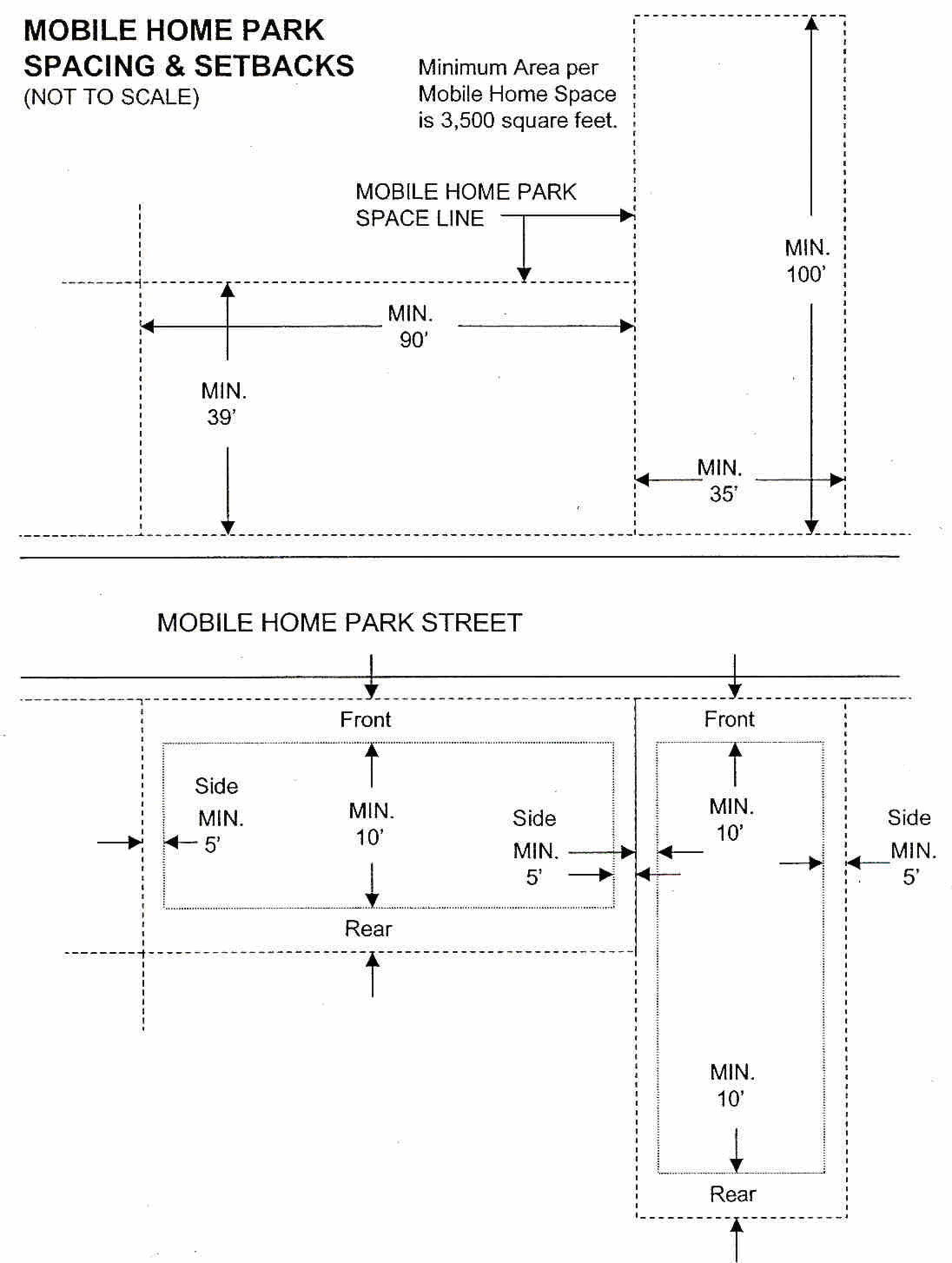
Setbacks and spacing (minimum including awnings, canopies, decks and any other structures attached to, adjacent to or touching a mobile home) (see the exceptions and modification, section 38-62).
Dwelling unit front setback: 10′.
Dwelling unit side setback: 5′.
Dwelling unit rear setback: 10′.
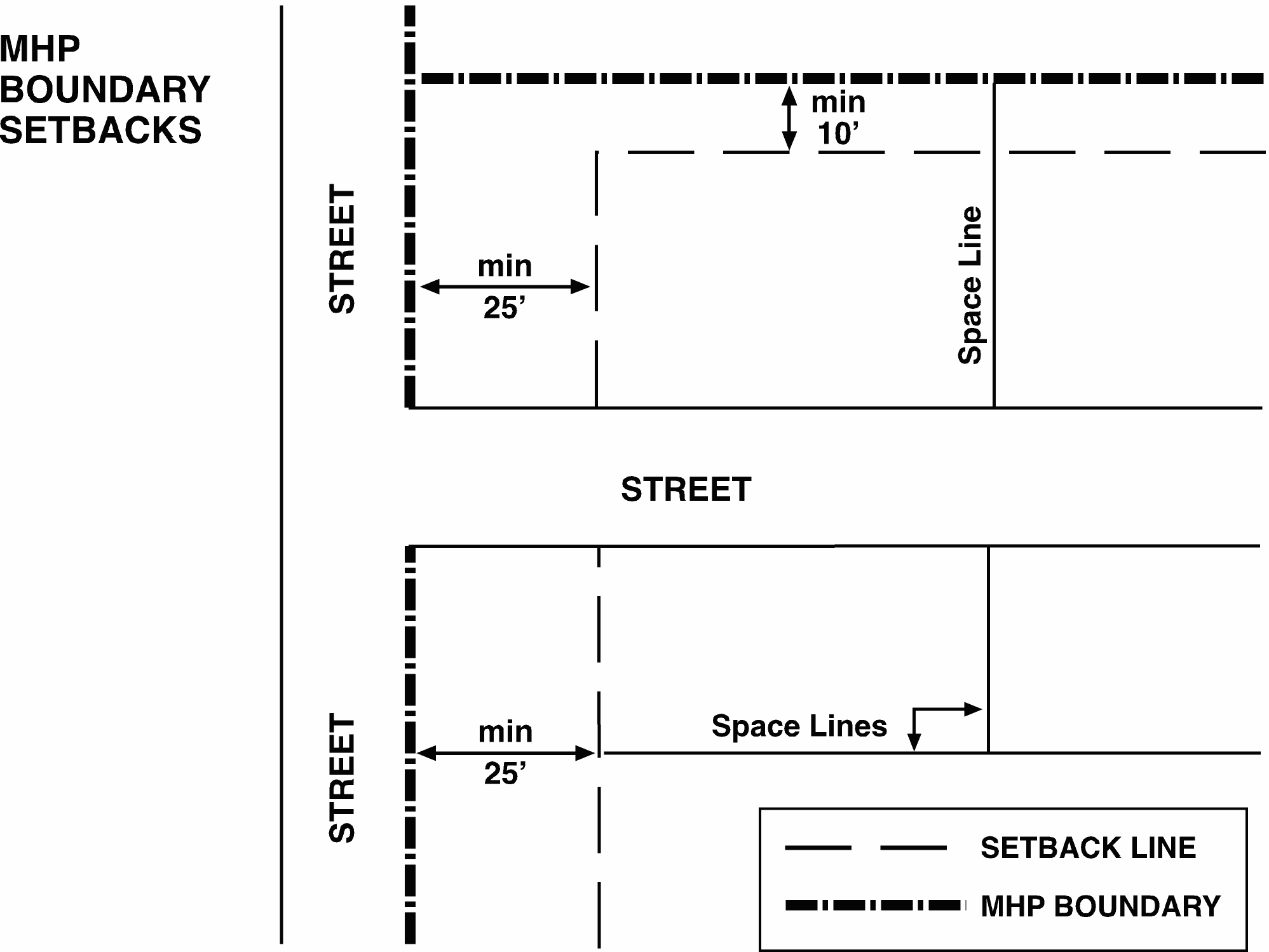
MHP boundary to any dwelling unit: 10′, except adjacent to public right-of-way.
MHP boundary to any dwelling unit: 25′ adjacent to public right-of-way.
Dwelling unit to any building including accessory building: 10′.
Density.
MHP minimum size is five acres and used for the continuous accommodation of 12 or more occupied mobile homes.
One dwelling unit per mobile home park space.
4.
Design standards.
a.
Swimming pools are permitted in accordance with other sections of the Municipal Code for private swimming pools and state environmental regulations.
b.
All mobile home parks shall have a landscape plan approved for all areas not devoted to structures, streets, alleys, drives, walks and paths. At least 15 percent of the total land area shall be set aside in landscaping consistent with the city's design standards.
c.
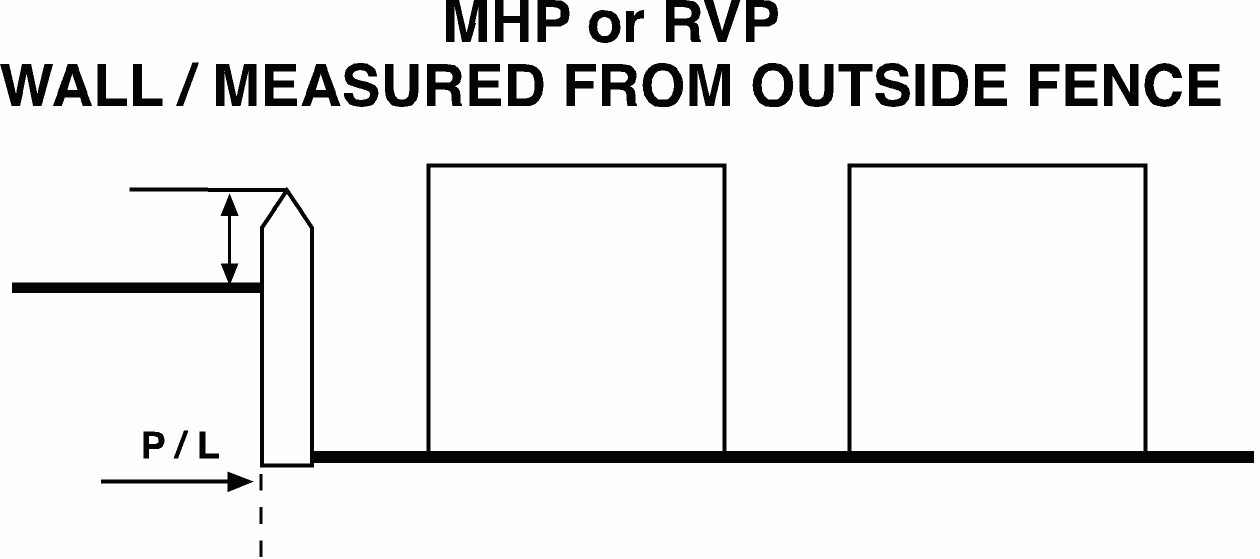
All MHP shall have opaque perimeter walls and/or fences at least five feet in height (measured at ground level on the exterior of the MHP) completely installed prior to the issuance of a certificate of occupancy for the MHP or each phase of the MHP. Each MHS shall have a wall and/or fence defining the MHS. Walls, fences, and hedges shall conform to section 38-60, with the following exception: A clear-sight triangle of 20 feet in both directions on the mobile home space from the corner of the internal streets is required. A clear-sight triangle at all MHP entrances and exits shall be provided consistent with section 32-405 of the Municipal Code.
d.
Utility placement shall be approved by the utilities department director or designee.
e.
Federal, state and local accessibility requirements shall be met.
5.
Streets and access standards.
a.
All MHP shall have direct motor vehicle access from a collector or higher designated roadway.
b.
Each mobile home space shall have direct access to an internal street. Direct access to exterior public streets shall be prohibited.
c.
Street layout shall be designed for preservation of natural features and to follow topography to the greatest extent possible and to encourage the orientation of mobile homes in such a manner as to permit the use of solar energy systems.
d.
All streets, excluding sidewalks, within a MHP shall be surfaced with two-inch HMAC over an acceptable six-inch base course or five-inch concrete meeting the city's standard specifications for road construction and shall meet the following minimum widths:
* Parallel parking lanes are to be striped at nine feet in width.
e.
No street within a mobile home park shall dead end, except for cul-de-sac streets, which shall have a minimum turning radius of 50 feet at the termination point (see chapter 32, design standards, for alternatives).
f.
There shall be a network of sidewalks connecting mobile home spaces with each other and with MHP facilities constructed in accordance with the city's design standards.
g.
Private driveways shall be designed to increase ease of access, increase privacy, and provide safety.
h.
All MHS and streets shall be designed to insure proper drainage. A complete drainage plan including elevations and drainage calculations shall be approved by the community development department director or designee. No on-lot (MHS) retention ponds are to be incorporated within the drainage plan for mobile home parks.
i.
Street lighting shall be provided to illuminate all private and public access ways and walkways for the safe movement of vehicles and pedestrians at night. All outdoor lighting shall comply with chapter 39 of the Municipal Code.
j.
Two parking spaces per dwelling unit located on each mobile home space, in compliance with section 38-58, off-street parking, shall be provided.
k.
No internal street intersections shall be less than 125 feet from MHP entrances/exits or other internal street intersections. Each intersection, internal and external, shall be designed as close to 90 degrees as possible.
6.
Signs. Signs shall conform to the city's sign code (see chapter 36).
7.
Refuse. The management of a MHP shall provide adequate refuse collection facilities. These collection facilities shall be constructed and maintained in accordance with all municipal health regulations, shall be properly screened, and shall be designed to bar animals from access to refuse. Refuse shall be removed from collection sites at least once a week.
8.
RV storage. MHP may have a storage yard for recreational and other vehicles (RVSA). Such storage yards shall have a minimum of 60 square feet of storage area per mobile home space in the development and shall be located so as not to detract from surrounding properties. All recreational and other vehicles shall be parked in the storage yard while not in use.
9.
Personal storage options. Each mobile home space may have a personal storage unit provided by the MHP owner or tenant. If provided by the MHP owner, such storage shall be at least six feet in height with a storage capacity of at least 300 cubic feet. Each storage unit shall be anchored permanently to the ground. The storage unit may be located on the mobile home space lot line if the storage unit meets the requirements of chapter 30. As an option to storage units being located on individual mobile home spaces by the MHP owner, storage units may be grouped into a mini-storage building arrangement. At least 300 cubic feet of storage space per mobile home space shall be provided.
10.
Expansion or alteration. Any existing MHP desiring to expand its area or alter its approved site plan shall do so in accordance with the provisions of this Code.
11.
Mobile home installation permit or building permit. Each mobile home to be located in a MHP shall require a mobile home installation permit (MHIP) meeting the requirements of chapter 30. The owner of a manufactured housing (MH) unit shall receive a MHIP or building permit prior to locating the MH unit in the MHP. All site-built structures, e.g., carport, are required to have a building permit.
B.
Recreational vehicle parks (RVP). An RVP is allowed in the following zoning districts: C-3, and M-1/M-2, by complying with the conditions in this section. Recreational vehicles, as defined herein, when used for temporary or permanent living purposes, shall be located solely in an RVP except as approved by the Community Development Director or designee as follows:
-
Arrangements for temporary construction yards,
-
One RV temporarily located on a single-family lot, or
-
Other temporary arrangement.
Refer to section 38-57.C. for definitions.
1.
Application. An application, the development statement, and site plan to build, enlarge or alter an RVP shall be made to the community development department for consideration. If phasing of the RVP is proposed, the site plan shall clearly describe the order of phasing and how all requirements will be met.
2.
General requirements.
a.
RVP shall have direct motor vehicle access to or be located on a collector or higher designated roadway. No entrance to or exit from a RVP shall be permitted through a residential zoning district.
b.
Water, sewer, electricity, telephone, and other necessary utilities shall be available at the RVP.
c.
Driveways shall be designed to increase ease of access, increase privacy, and provide safety.
d.
The minimum RVP size is two acres. The density of spaces in any recreational vehicle park shall not exceed 20 spaces per acre.
3.
Development standards.
a.
There shall be at least 14 feet between the sides of all recreational vehicles and eight feet between the backs of all recreational vehicles. Any structure, including awnings, attached to or touching a RV shall, for purposes of this separation requirement, be considered part of the RV.
b.
No recreational vehicles shall be closer than 15 feet to any private access way or to the property line of the RVP.
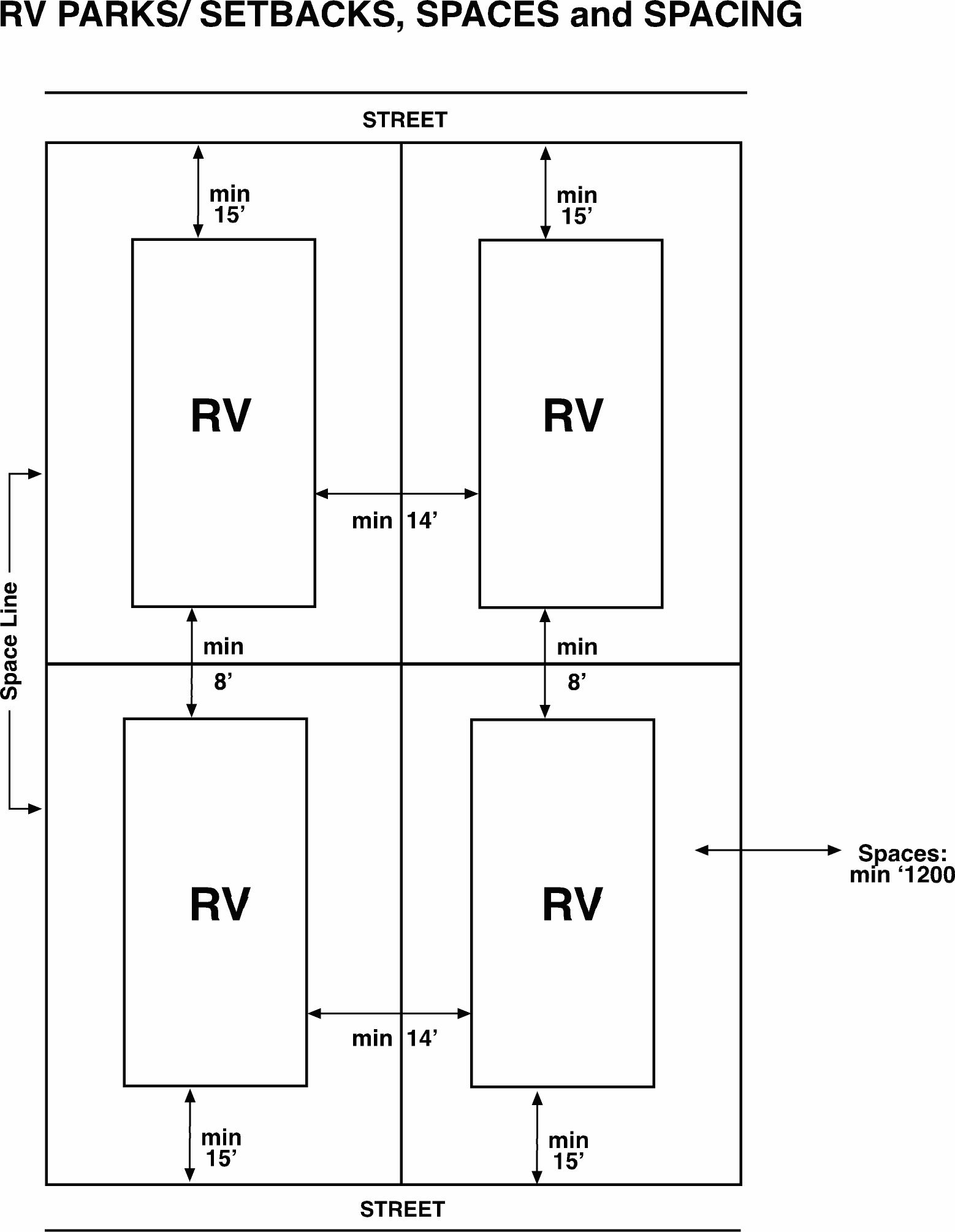
c.
Spaces for recreational vehicles shall be a minimum of 1,200 square feet not including sidewalks or streets.
d.
No recreational vehicles shall be closer than 20 feet to any building.
e.
No structure within an RVP shall exceed 35 feet in height. See section 38-59.
f.
A landscaping plan, consistent with the city's design standards, shall be submitted.
g.
All RVP shall have opaque perimeter walls and/or fences at least five feet in height (measured at ground level on the exterior of the RVP) completely installed prior to the issuance of a certificate of occupancy for the RVP or each phase of the RVP. Each RV space shall have a wall and/or fence defining the RV space. Walls, fences, and hedges shall conform to section 38-60, with the following exception: A clear-sight triangle of 20 feet in both directions on the mobile home space from the corner of the internal streets is required. A clear-sight triangle at all RVP entrances and exits shall be provided consistent with section 32-405 of the Municipal Code.
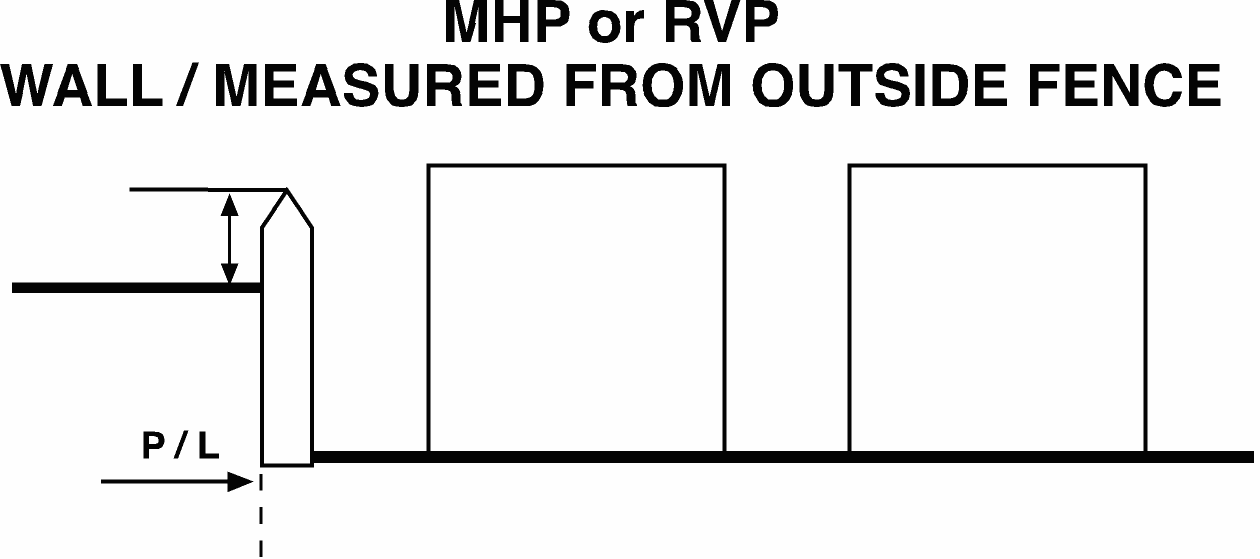
h.
Private access ways and individual space arrangements shall be designed to accommodate the frequent movement of recreational vehicles.
i.
All streets, excluding sidewalks, within a RVP shall be surfaced with two-inch HMAC over an acceptable six-inch base course or five-inch concrete meeting the city's standard specifications for road construction and shall meet the following minimum widths:
*
Parallel parking lanes are to be striped at nine feet in width.
j.
There shall be at least three parking spaces designated in the RVP for each two RV spaces. Parking may be provided in common parking areas, on individual RV spaces or on RVP streets.
k.
Street layout shall be designed for preservation of natural features and to follow topography to the greatest extent possible.
l.
There shall be an active, usable recreational area(s) for tenants, comprising at least five percent of the gross site area, which shall not include required setback areas or similar areas not usable for recreational activities.
m.
There shall be a community building or buildings which shall provide for the recreational and service needs of occupants of the RVP. It may include management offices, dumping stations, restrooms, showers, laundry/dry cleaning facilities and other uses and structures customarily incidental to operation of an RVP. The area of the community building or buildings may not be calculated as part of the required recreational area.
n.
Convenience establishments of a commercial nature, including laundries, stores, beauty shops and barber shops, may be permitted in RVP subject to the following restrictions:
1)
Such establishments and their parking area shall not occupy more than seven percent of the area of the park;
2)
Shall be subordinate to the residential use and character of the park;
3)
Shall be considered accessory uses to the principal use of an RV and shall be discontinued if the RVP is discontinued.
4)
Shall be located, designed and intended to serve frequent trade or service needs of persons residing in the park only; and
5)
Shall present no visible evidence of their commercial character outside the park.
o.
Adequate refuse collection facilities shall be provided, constructed, and maintained in accordance with all municipal health regulations, and shall be screened from view and designed to bar animals from access to refuse. Refuse shall be removed from collection sites at least once a week.
p.
Lighting shall be provided to illuminate access ways and walkways for the safe movement of vehicles and pedestrians at night. All outdoor lighting shall comply with chapter 39 of the Municipal Code.
q.
A means for emptying sewage holding tanks shall be provided and approved by city and the state environment department.
r.
One mobile home may be placed in the RVP for use by a caretaker. A site built dwelling or manufactured dwelling may substitute for the mobile home.
4.
Expansion or alteration. Any existing RVP desiring to expand its area or alter its approved site plan shall do so in accordance with the provisions of this Code.
C.
Definitions for mobile home parks and recreational vehicle parks.
Manufactured housing. "Manufactured housing" means a manufactured home or modular home that is a single-family dwelling with a heated area of at least 36 feet by 24 feet and at least 864 square feet and constructed in a factory to the standards of the United States Department of Housing and Urban Development, the National Manufactured Housing Construction and Safety Standards Act of 1974 and the Housing and Urban Development Zone Code 2 or the Uniform Building Code, as amended to the date of the unit's construction, and installed consistent with the Manufactured Housing Act and with the regulations made pursuant to that act.
Mobile home (MH). "Mobile home" means a moveable or portable housing structure larger than 40 feet in body length, eight feet in width or eleven (11) feet in overall height, designed for and occupied by no more than one family for living and sleeping purposes, but does not include structures built to the standards of any municipal building code and other technical codes.
Mobile home park (MHP). A privately owned tract of land, at least five acres in size, used for the continuous accommodation of 12 or more occupied mobile homes and operated for the pecuniary benefit of the owner of the parcel of land, his agents, lessees, or assigns. It also may be known as a mobile home court, trailer court or trailer park. Manufactured homes or site built homes are permitted.
Mobile home space (MHS). A parcel of land within a mobile home park rented or intended to be rented to prospective renters. MHS includes required yards, parking spaces, attached and/or detached accessory buildings, open spaces and utilities. MHS does not include sidewalks or streets.
Recreational vehicle (RV). The following shall be known as recreational vehicles:
1.
Travel trailers, camping trailers, fifth-wheel trailers, and all other vehicles that are constructed to include a chassis, integral wheels and a towing hitch, and are primarily designed or constructed to provide temporary, readily moveable living quarters for recreation, camping, or travel uses.
2.
Pickup campers, either mounted or non-mounted, or any structure designed to be mounted in the bed of a truck and providing living quarters for recreation, camping, or travel uses.
3.
Chassis mount, motor home, mini-motor home or other recreational structure or vehicles constructed integrally with a truck or motor van chassis and incapable of being separated there from, and designed to be used for moveable living quarters for recreational, camping, or travel uses.
4.
Recreational vans or converted and chopped vans or other vehicles which are either initially constructed or converted to contain living quarters for recreational, camping, or travel uses.
5.
Trailers, boats, etc.
Recreational vehicle park (RVP). A tract of land at least two acres in size, on which two or more RV sites are located, established or maintained for occupancy by recreational vehicles that are parked temporarily in rental spaces for periods not exceeding 120 days during any 12 month period. Recreational vehicles may not be stored in RVPs except in RVSAs. Any action toward removal of wheels of a RV except for temporary purposes of repair or to attach the RV to the ground for stabilizing purposes is prohibited.
Recreational vehicle space (RVS). A plot of ground within a RVP intended for the accommodation of a RV, tent, or other individual camping unit on a temporary basis.
Recreational vehicle storage area (RVSA). A parcel of land in a MHP or RVP on which recreational and other vehicles are stored while not in use. RVSA is not the same as storage of RV in commercial or industrial zoning districts for sale, lease, rent or storage.
(Ord. No. 2354, § I, 1-22-07)
Sec. 38-58. - Off-street parking.
A.
Purpose. The purpose of this section is to:
1.
Allow flexibility in addressing vehicle parking, loading, and access issues by presenting a menu of strategies to address parking issues rather than only parking space requirements;
2.
Ensure that off-street parking, loading, and access demands associated with new development are met without adversely impacting surrounding land uses and neighborhoods;
3.
Accommodate safe and convenient movement of vehicles, bicycles, pedestrians and transit.
B.
Application. These parking regulations apply to all properties within the corporate limits of the city. However, special overlay zoning district's parking regulations may override the regulations found in this section. For those regulations, the specific section of the special overlay zoning district should be consulted.
C.
Definitions. Pertinent definitions are found later in this section or in article III of this Code.
D.
Size of parking stalls and driving aisles. The minimum dimensional requirements for parking stalls and driving aisles are shown in the following table. Twenty-four feet is the minimum two-way driving aisle width, including non-dedicated streets or private drives, when there is no parking on both sides of the driving aisle. Twelve feet is the minimum width for a one-way driving aisle. The city fire department may require wider driving aisles whenever necessary to address fire and safety concerns as addressed in the International Fire Code, as amended.
Notes:
1.
Driving/back-up aisles are not required for one single-family dwelling per lot or one duplex per lot. All other land uses shall provide driving aisles when parking stalls are required.
2.
All angle parking, except 90 degree and parallel parking shall have aisles designed for one-way traffic flow only, except that two-way traffic is permitted in designs approved by the community development department director or designee.
3.
All parking lot designs shall have primary ingress and egress to a public street or access easement. Secondary access only may be to an alley. However, access to or from an alley and parking lot is permitted if single-family or duplex dwelling units are located on property that abuts the alley. Primary ingress/egress to an alley is permitted for single-family and duplex dwelling units.
4.
Except for single-family or two-family dwelling units, parking and loading areas shall be arranged so that vehicles will not be required to back out of parking or loading spaces directly into a public way. Circulation within a parking lot shall be designed to minimize aisles with one inlet/outlet. Aisles with only one inlet/outlet shall provide "back outs" for end spaces.
5.
Land uses that involve the servicing of motor vehicles shall not service vehicles in the required parking stalls.
6.
Driving aisle widths for gas stations:
a.
Gas pump islands designed to accommodate two or more vehicles on each side: A minimum of 24 feet (perpendicular) shall be provided between gas pump islands, islands and buildings, curbs, other types of driving aisle obstructions, and between the back of parking stalls and the end of the gas pump vehicle stall. (Distance may be reduced to 18 feet between parking stalls and pump vehicle stall if one-way and angle parking.)
b.
Gas pump islands designed for one vehicle on each side: A minimum of 18 feet (perpendicular) shall be provided. (24 feet required between parking stalls and pump vehicle stall unless one-way and angle parking.)
c.
Diesel pump islands for tractor-trailer trucks only; no automobiles or recreational vehicles will use these pumps. A site plan shall show diesel pumps spaced at least seventeen (17) feet, center-to-center distance, with a minimum of fourteen (14) feet of one-way driving clearance between pump islands.
7.
Recreational vehicles and motor vehicle appurtenances, e.g., RVs, camper shells, boats, trailers, boat on trailer, camper shell on truck, shall be limited to a maximum of one per main dwelling unit within any open area between the front and side of the main dwelling and the front and side property lines with no limit in the rear open areas. The land area in front of or to the side of the main dwelling on which the recreational vehicle or motor vehicle appurtenance is parked or stored shall be graveled or paved. However, no parking or storage of recreational vehicles and motor vehicle appurtenances shall be permitted on graveled areas considered to be part of the property's landscaping. Furthermore, no parking or storage of recreational vehicles and motor vehicle appurtenances shall be located within a ten foot (side property line) by 20 foot (front property line) clear sight triangle at the front property line on interior lots and within the clear sight triangle on corner lots that shall be provided consistent with section 32-405 of the Municipal Code. This paragraph does not apply to the EE and REM rural residential zoning districts and the Holding zoning district.
8.
Parking and storage areas for any motor vehicle or its appurtenances, including the necessary driveways to get to and from the parking and storage areas, shall not cover more than one-half of any open area between the front, including the secondary front, of the main dwelling and the front property line in a one-family/two-family property, except in the case of a lot on a cul-de-sac, up to two-thirds of any open area between the front of the main dwelling and the front property line may be used. Townhouse lots may use up to three-fourths of any open area between the front, including the secondary front, of a building or structure and the front property line. Regardless of the zoning district, no motor vehicle or its appurtenances shall be parked or stored on any sidewalk within any public right-of-way or protrude onto any public right-of way.
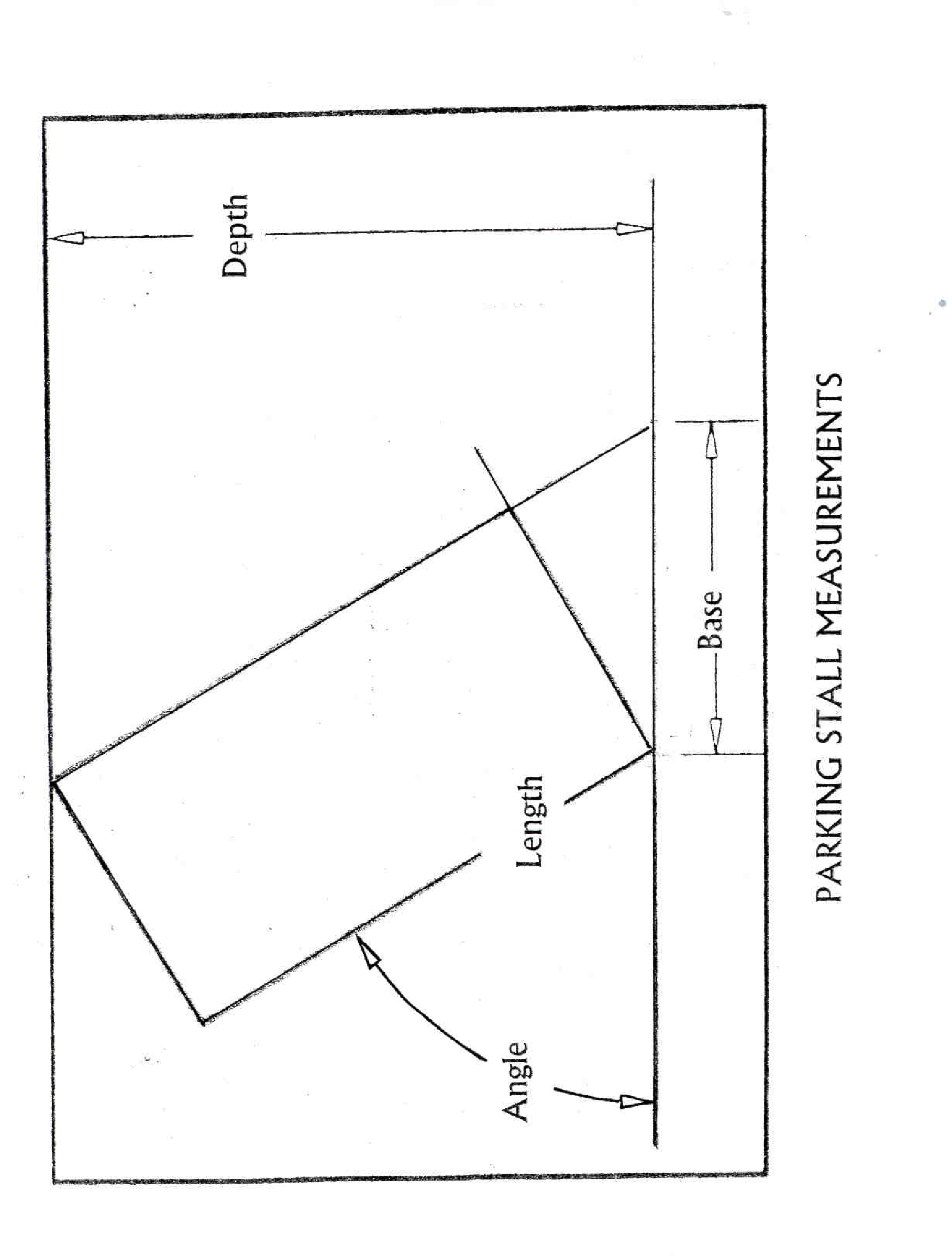
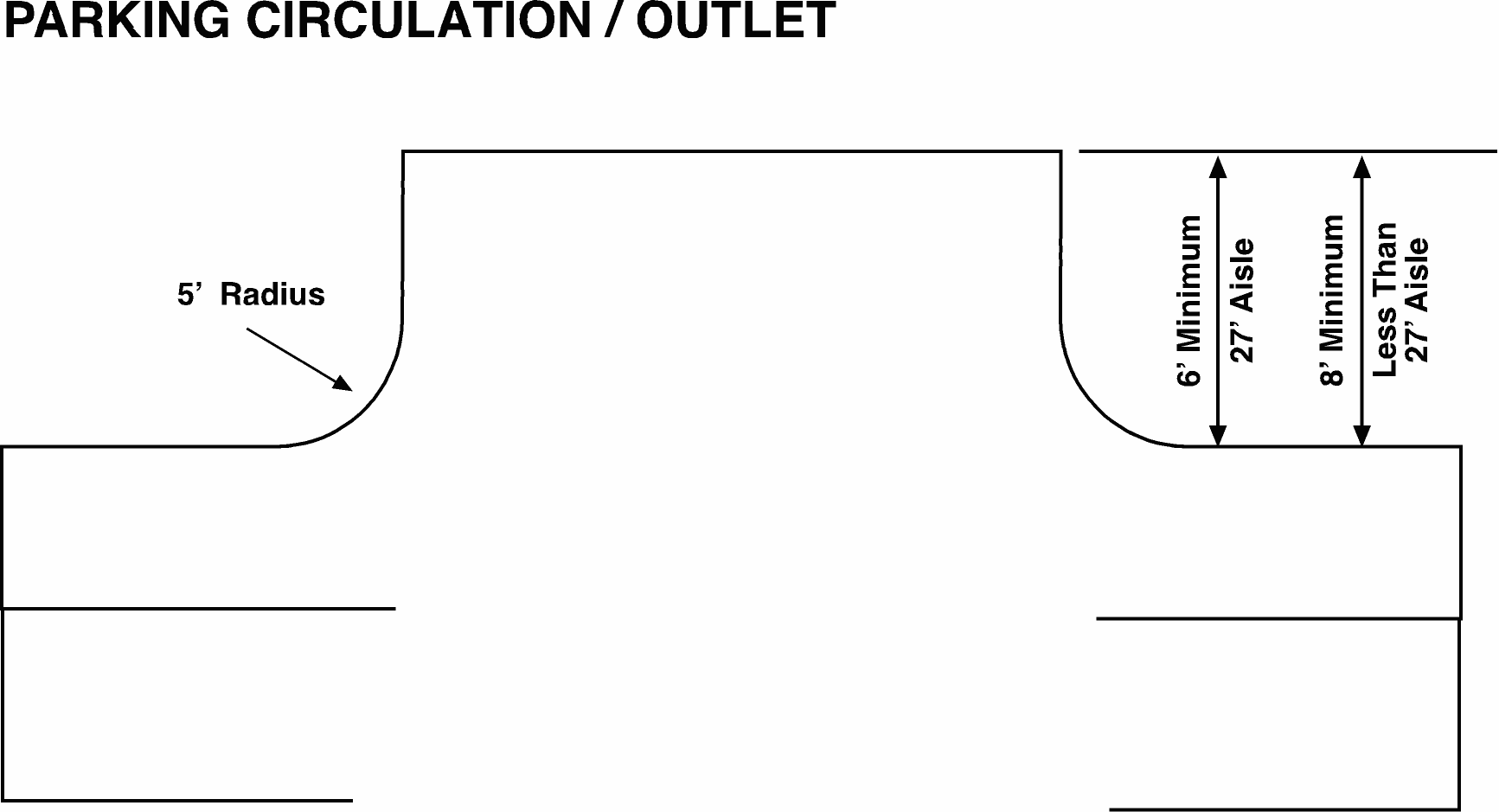
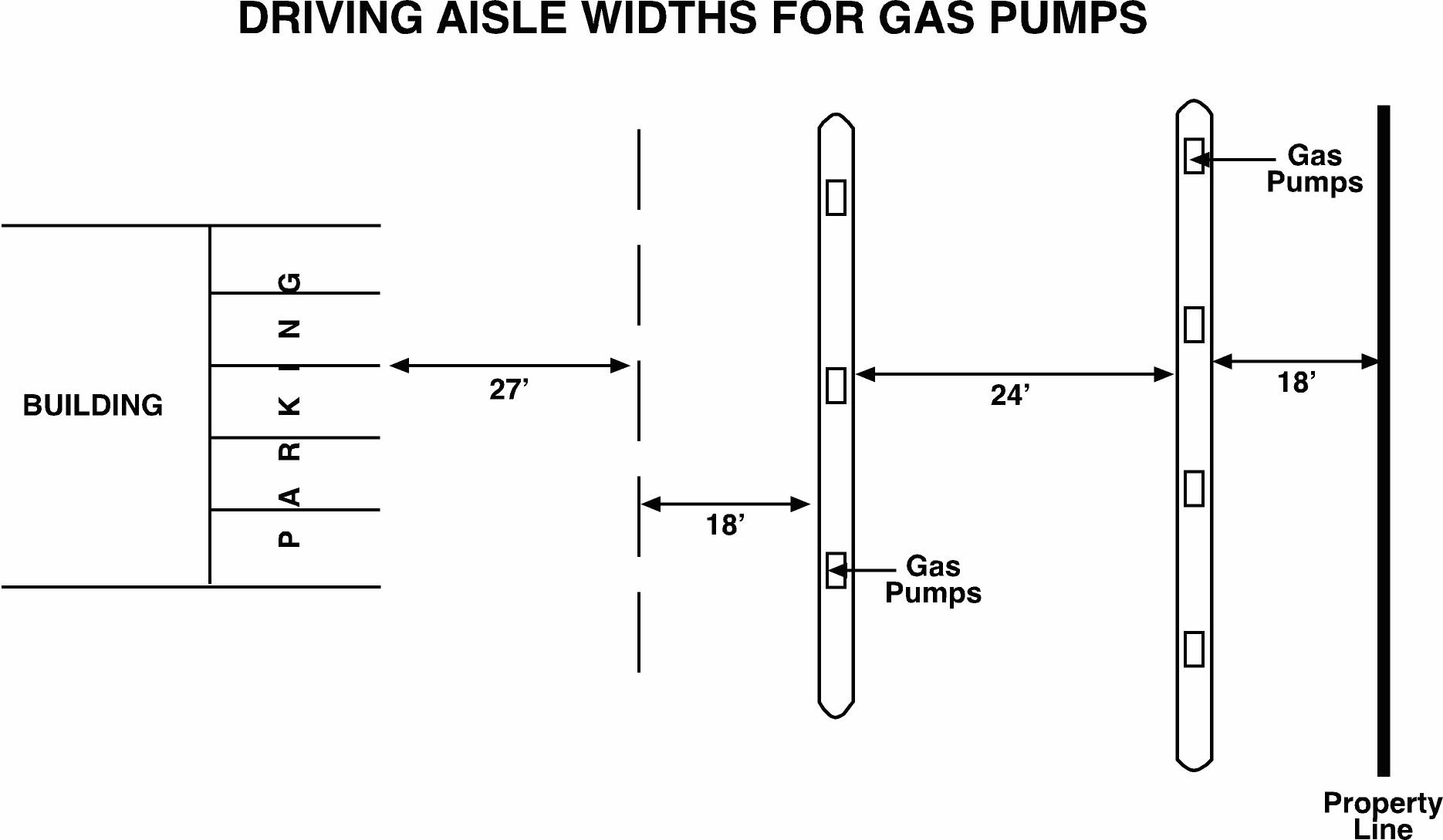
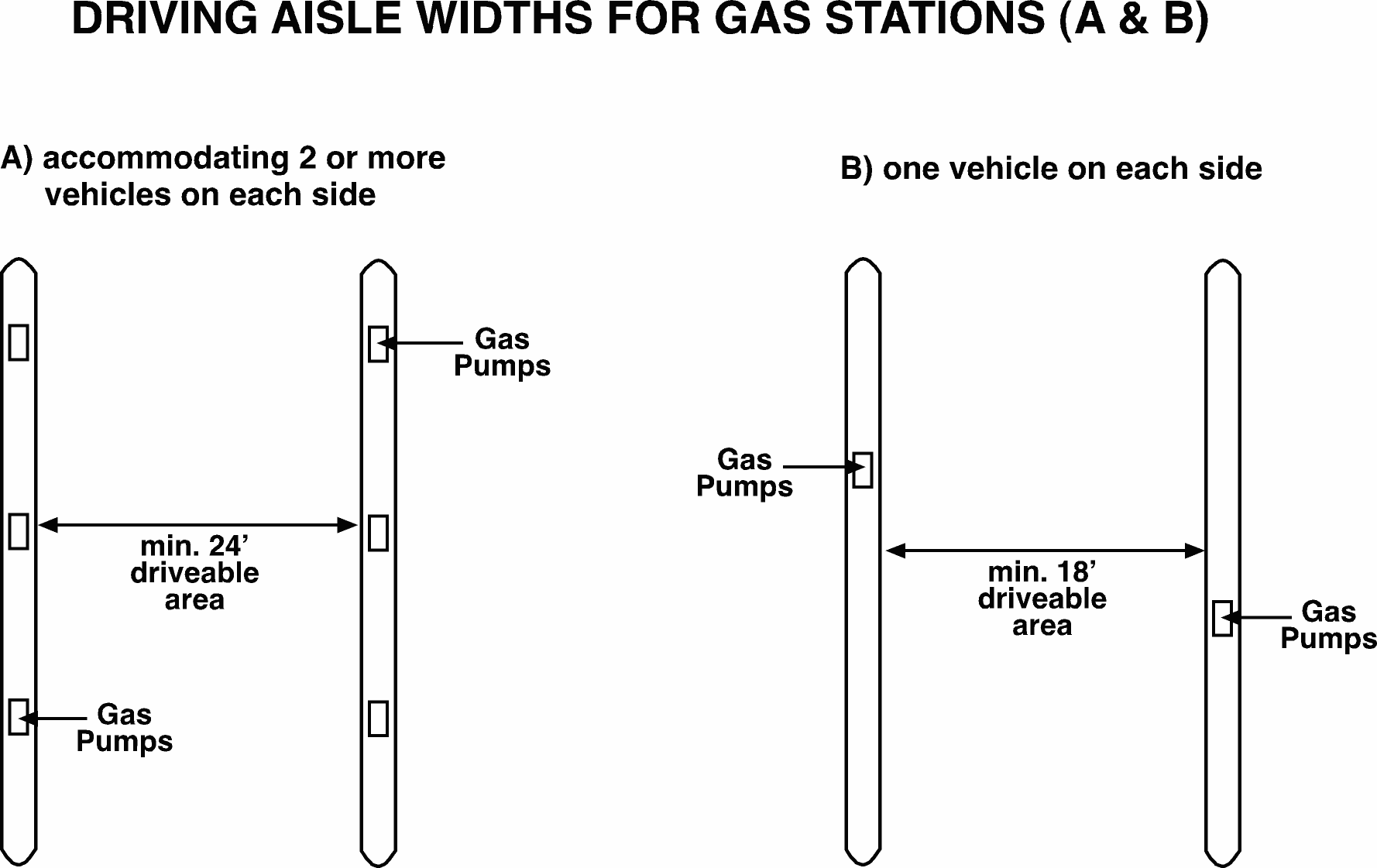
E.
Minimum number of on-site automobile and bicycle parking stalls allowed.
1.
The formula for calculating the number of parking stalls allowed for a specific land use is found in section 38-33, land uses in general zoning districts and number of parking stalls allowed. The minimum number of parking stalls shall be two: one van accessible stall and one stall for the non-disabled, except in the case of a utility substation. The number of stalls allowed shall be rounded up to the nearest whole number, e.g., if the calculation results in 25.1 allowed parking stalls, this number (25.1) is rounded up to 26 parking stalls. Gross floor area is calculated by using the exterior dimensions of all buildings, including multiple stories, on a site. Enclosed garages are included in gross floor area. However, for example, carports are not included in the calculation.
2.
Proposed land uses not specified shall follow the parking requirements for a specified use within the category most appropriate to the proposed use as determined by the Community Development Director or designee.
3.
The number of spaces provided shall not be reduced below the minimums allowed in section 38-33. Any request for a deviation to the allowed parking spaces shall follow the city's variance and/or flexible standards process.
4.
Loading space shall be provided for each nonresidential use as approved by the Community Development Director or designee.
5.
Up to 40 percent of the allowed parking stalls may be provided on property separate from the property served provided parking is a permitted use and all of the separate parking is within 500 feet from the property served. A parking agreement assuring that the allowed off-street parking is required for the life of the land use shall be properly executed by all the separate property owners, approved as to content and form by the city attorney and the Community Development Director, and recorded with the County Clerk's Office.
6.
Shopping center/business-service center: When two or more separate land uses/businesses, as defined in article III, are to be located on the same property, the following formulas shall be used to calculate the total number of parking stalls allowed:
A.
Less than 15,000 square feet of gross floor area (GFA): One parking stall per 300 square feet of GFA is allowed.
B.
15,000 square feet or more of gross floor area (GFA): One parking stall per 350 square feet of GFA is allowed.
This provision shall be used in calculating the total number of parking stalls required rather than the formula for each separate land use found in section 38-33. However, sections 38-48, 38-54, and 38-58.G. offer options for the reduction in the total number of parking stalls allowed.
7.
Covered parking, e.g., carport, or enclosed parking, e.g., garage, meeting the minimum parking stall and driving aisle dimensions will be counted toward the number of parking stalls allowed.
8.
Site plans shall specify the proposed land uses before a building permit will be issued. In any space on a property that does not have the land use specified, the number of parking stalls allowed will be based on the allowed land use requiring the most number of parking stalls.
9.
Shopping cart parking or storage areas located within parking lots for motor vehicles shall not reduce the number of parking stalls below the minimum allowed. Shopping cart or storage areas to be located within parking lots shall be shown on the site plan.
10.
Bicycle parking, in accordance with the bicycle parking design standards, shall be required in accordance with section 38-33.
11.
Bicycle parking design standards: The bicycle parking design standards, as illustrated in figures 1, 2, and 3, define what type of bicycle lockers and racks shall be used for bicycle parking in commercial, office, and multi-family apartment land uses. Any bicycle rack design that incorporates two-point, flat panel support and does not present sharp edges may be acceptable. The Community Development Director or designee shall have final approval on all provided bicycle parking facilities.
The design standards, as illustrated in figure 4, guide how bicycle parking facilities can be constructed. The dimensions indicated shall guide the placement of bicycle parking facilities next to any wall or immovable object. This illustration may be adapted to bicycle parking facilities that are clustered in a standard automobile parking stall.
Bicycle parking facilities shall not impede the route of travel for pedestrians, bicyclists, motorists, or any who have ADA-related issues. The parking facilities shall be located on the property in a way that provides the optimum security for the bicycles. The parking facilities shall be located as near as practicable to the main entrance of the building they are intended to serve. If the parking facilities are to be clustered for a shopping center or mall, they shall be placed in a centralized location near an entrance to a business they are intended to serve. The parking facilities shall be located as near as practicable to a lighted area on the property to provide safety for pedestrians, bicyclists, motorists, or any who have ADA-related issues. Adequate signs and striping shall be used to identify the bicycle parking facilities.
The design standards, as illustrated in figures 5, 6, 7, and 8, identify examples of types of bicycle parking facilities that are prohibited when providing bicycle parking.
FIGURE 1. ACCEPTABLE BIKE LOCKER DESIGNS
Acceptable lockers are those that properly secure bicycles.
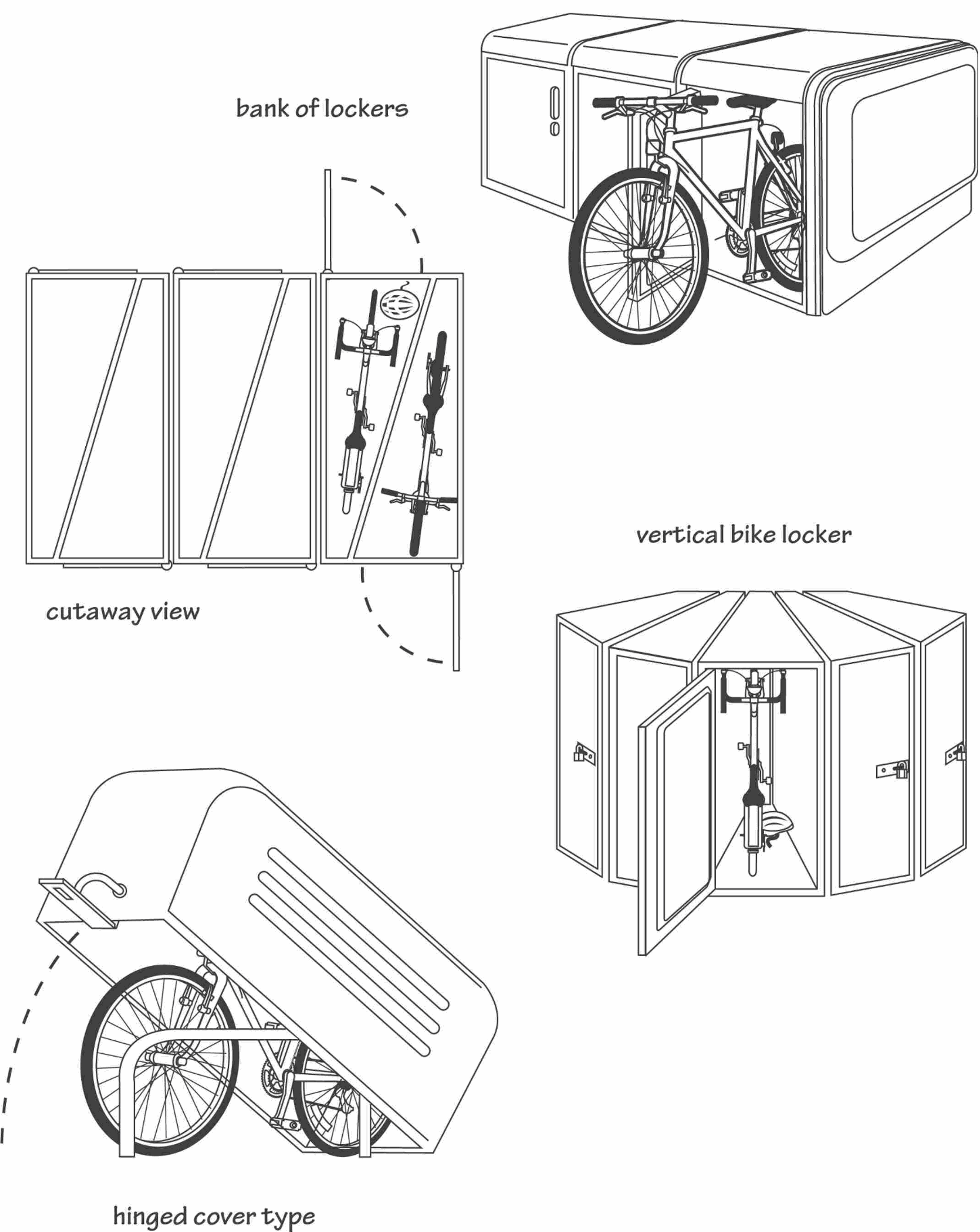
FIGURE 2. ACCEPTABLE BIKE RACK DESIGNS WITH TWO POINT SUPPORT
Good designs with two-point, 'flat panel' support. These allow for easy access and locking of frame and two wheels. The designs present no sharp edges to pedestrians.

FIGURE 3. ACCEPTABLE BIKE RACK DESIGNS WITH TWO POINT SUPPORT AND ARTISTIC RACK DESIGNS
Good designs with two-point, 'flat panel' support. These allow for easy access and locking of frame and two wheels. The designs present no sharp edges to pedestrians.
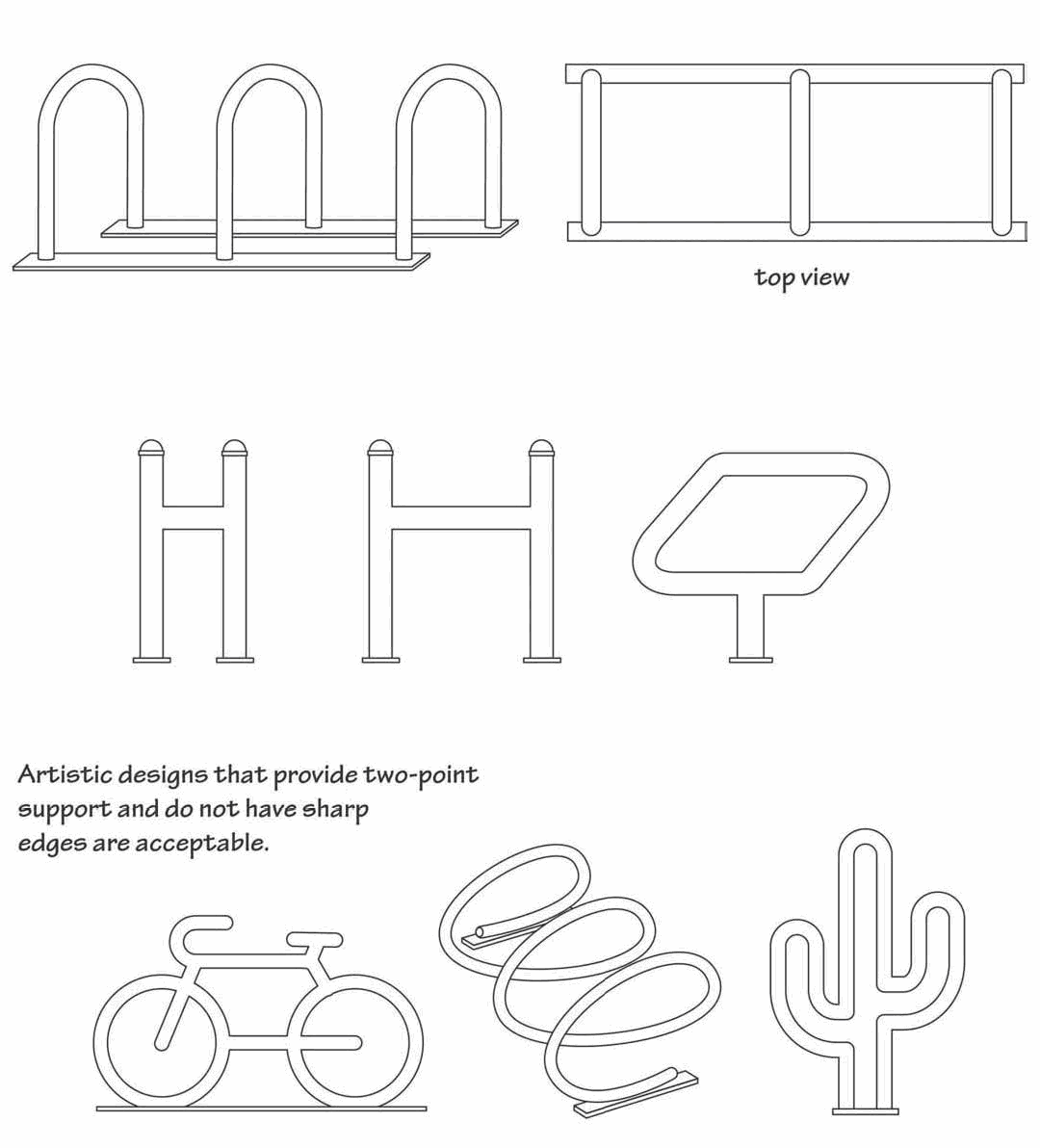
FIGURE 4. REQUIRED BIKE PARKING SPACE DIMENSIONS
Minimum clearances for bicycle racks. This configuration may also be adapted for use in a standard size automobile parking stall.
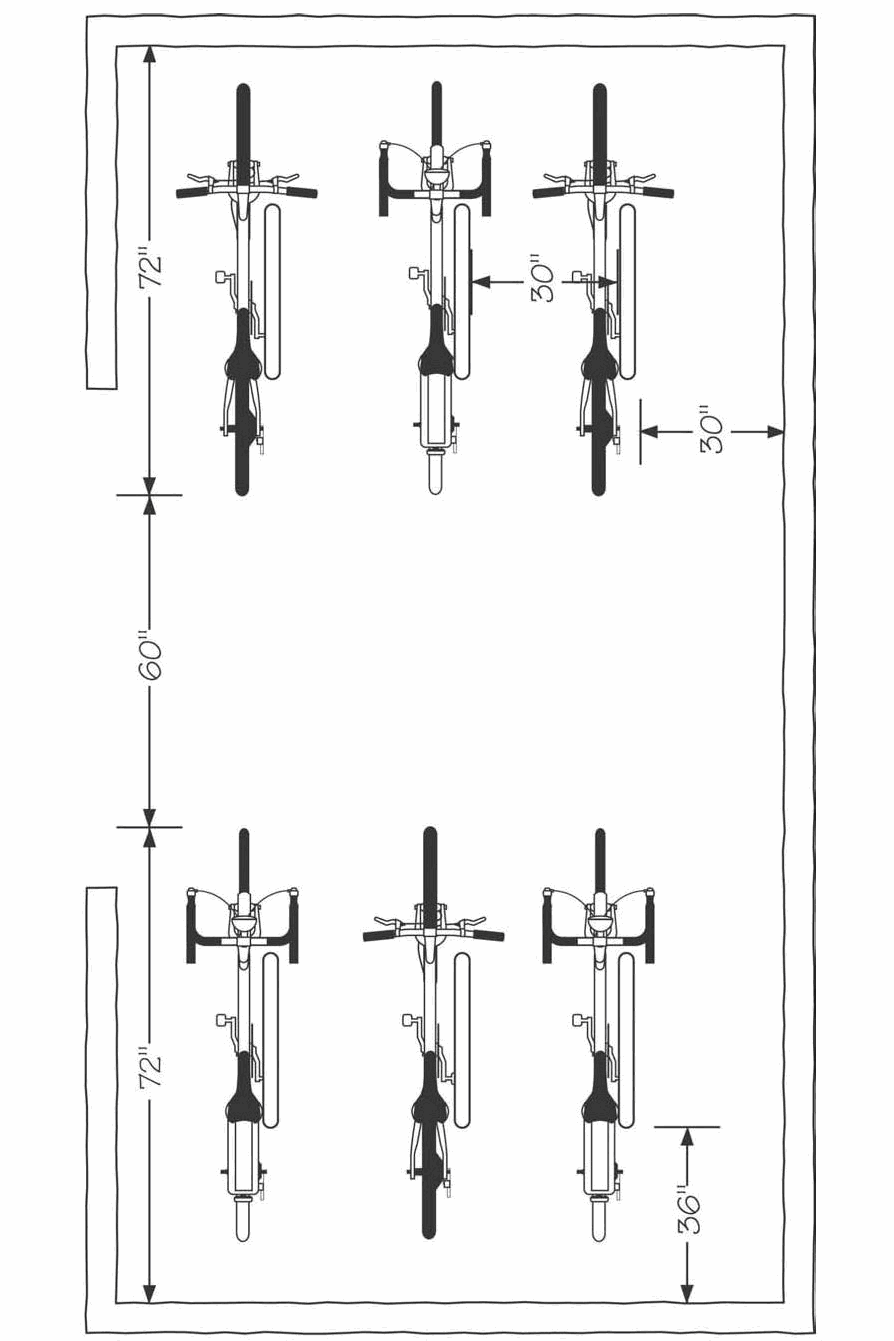
FIGURE 5. PROHIBITED BIKE RACK DESIGNS WITH SINGLE POINT SUPPORT
These designs do not provide two-point support for bicycles. Bicycles can fall over easily and become damaged. Bicycle could also fall into pedestrian right-of-way. Single post designs with sharp edges can be hazardous to pedestrians with visual disabilities.
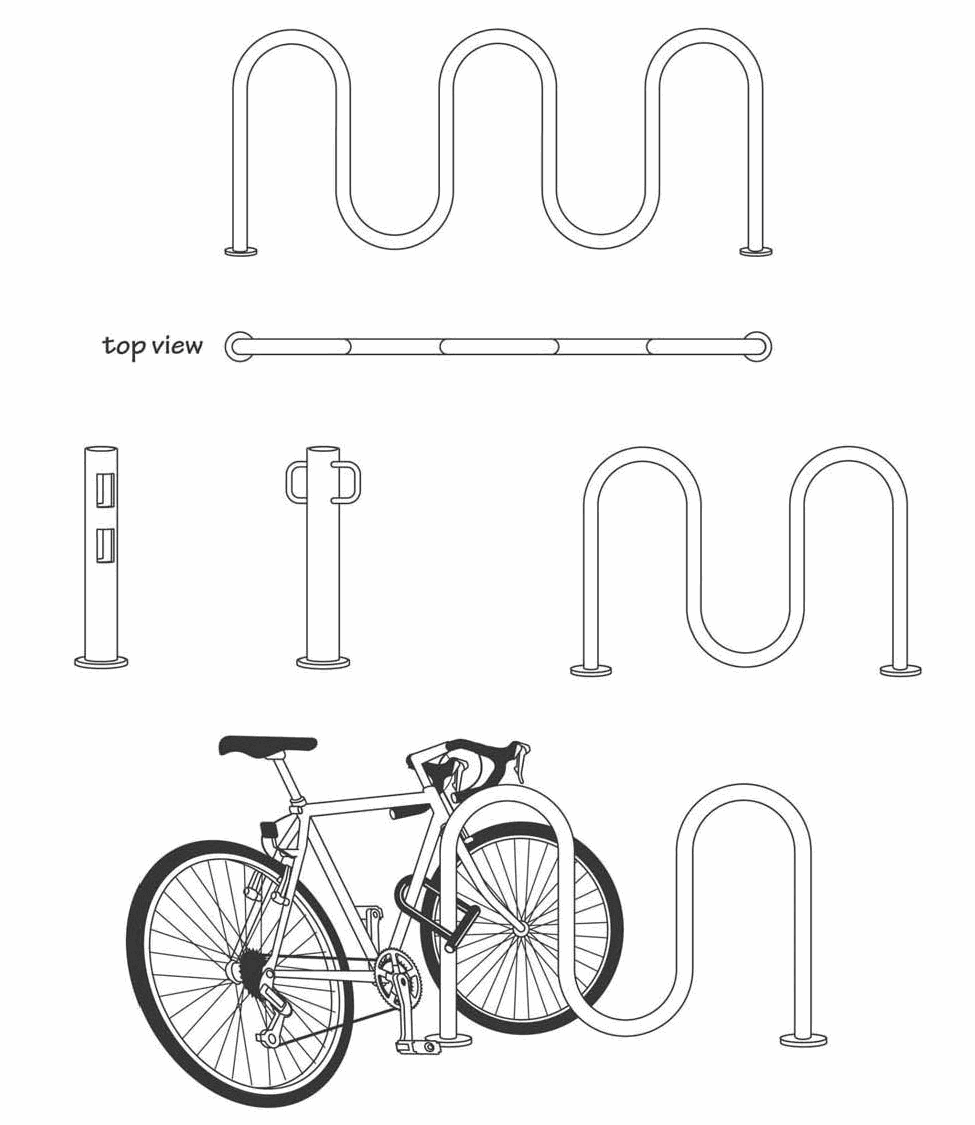
FIGURE 6. PROHIBITED BIKE RACK DESIGNS THAT POORLY ACCOMMODATE BICYCLES
These designs are made to accommodate traditional 'double diamond' frames with small diameter steel frames. They do not often fit modern bicycle designs, large diameter aluminum frame tubes or full suspension bicycles. These types of racks can cause paint and frame damage to bicycles and can be a hazard to persons with visual disabilities.
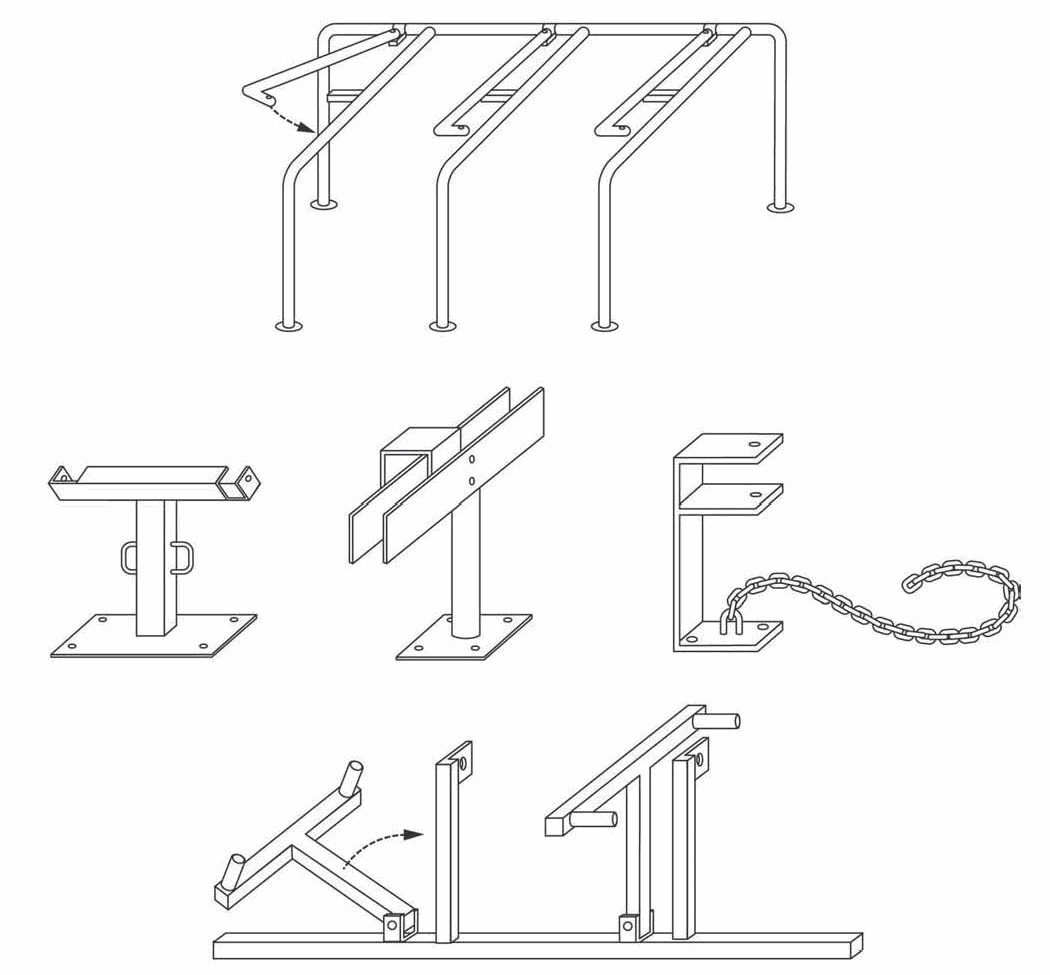
FIGURE 7. PROHIBITED BIKE RACK DESIGNS THAT ARE HAZARDOUS TO PEDESTRIANS
These designs present sharp edges and can be hazardous to pedestrians, especially persons with visual disabilities.
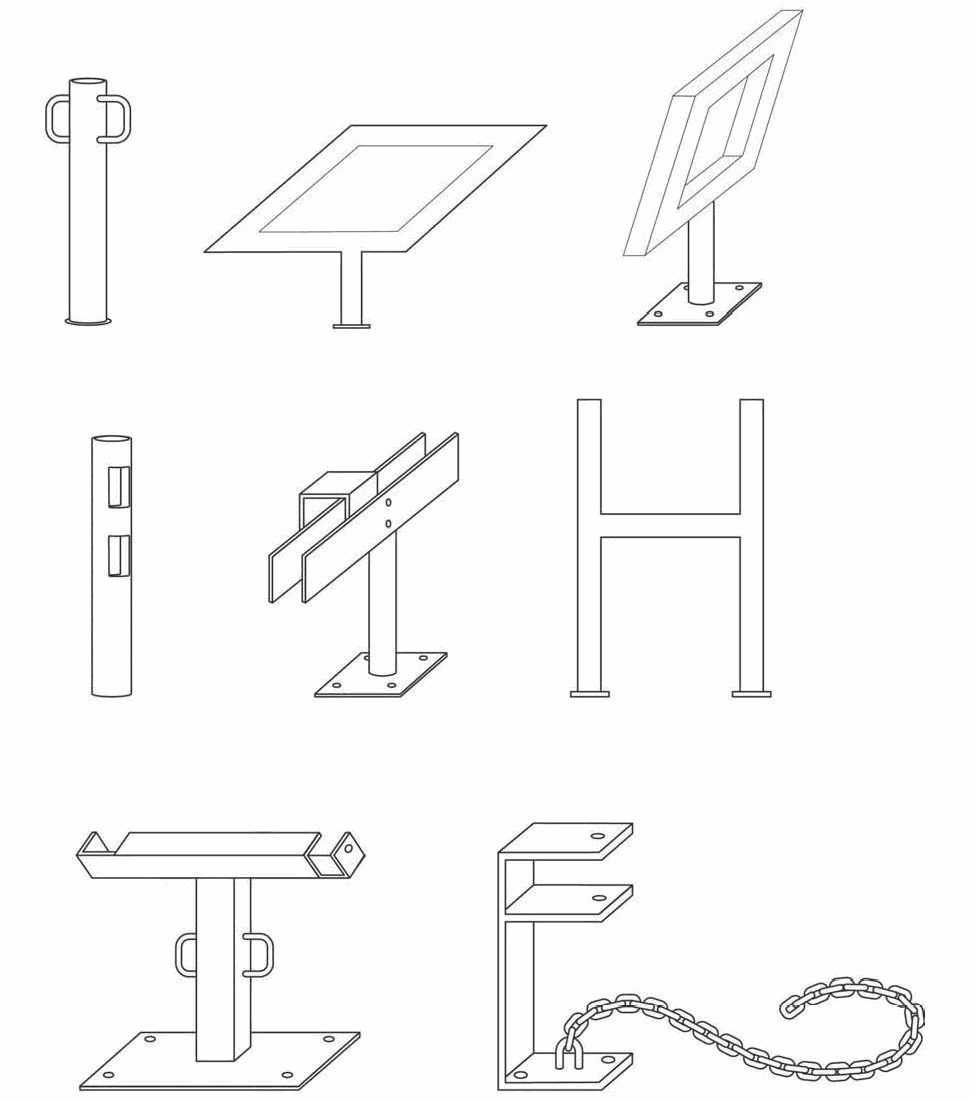
FIGURE 8. PROHIBITED BIKE RACK DESIGNS THAT OFFER INSUFFICIENT SECURITY FOR BICYCLES
Obsolete designs that only allow for locking of one wheel when used as designed. These types of racks contribute to the problem of bicycle theft. Also, because the rack only supports one wheel, rims can be easily bent.
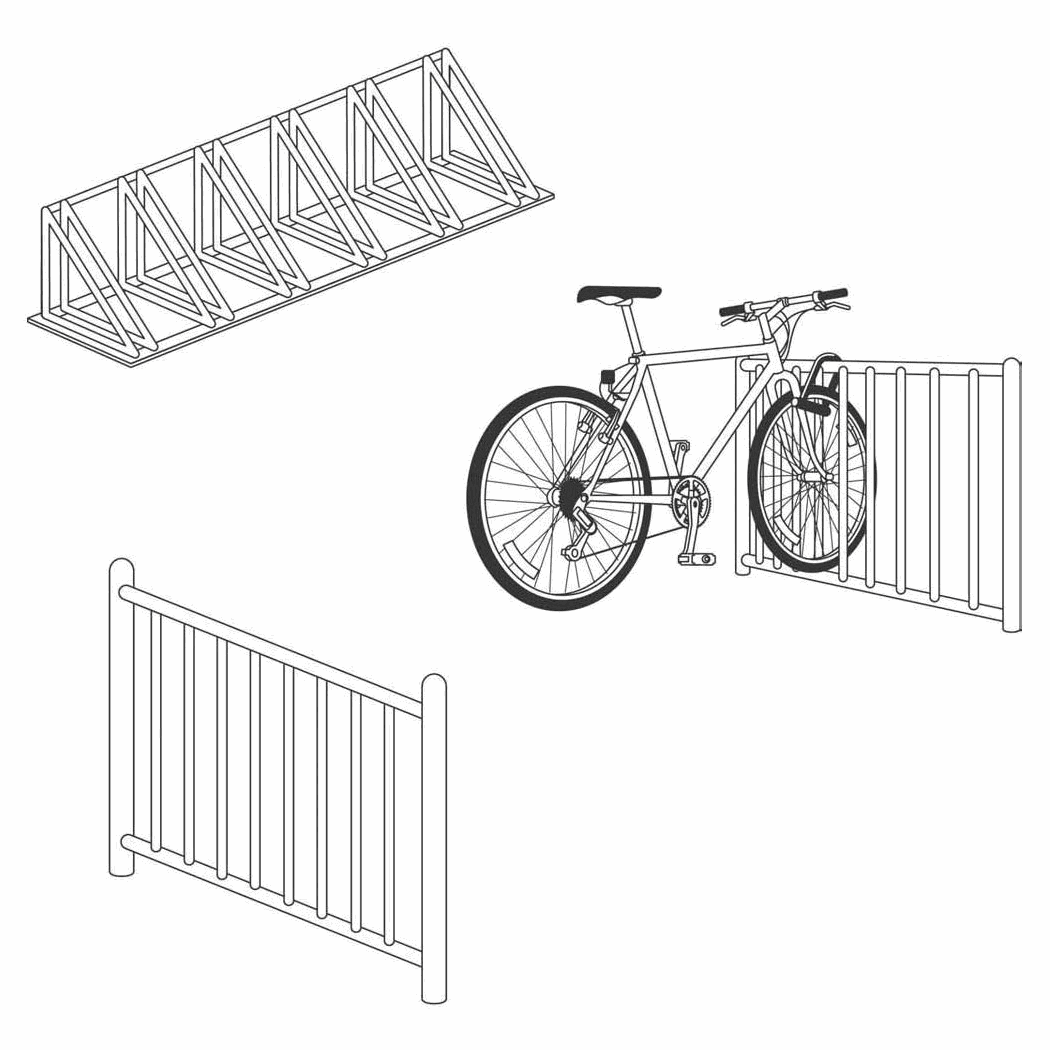
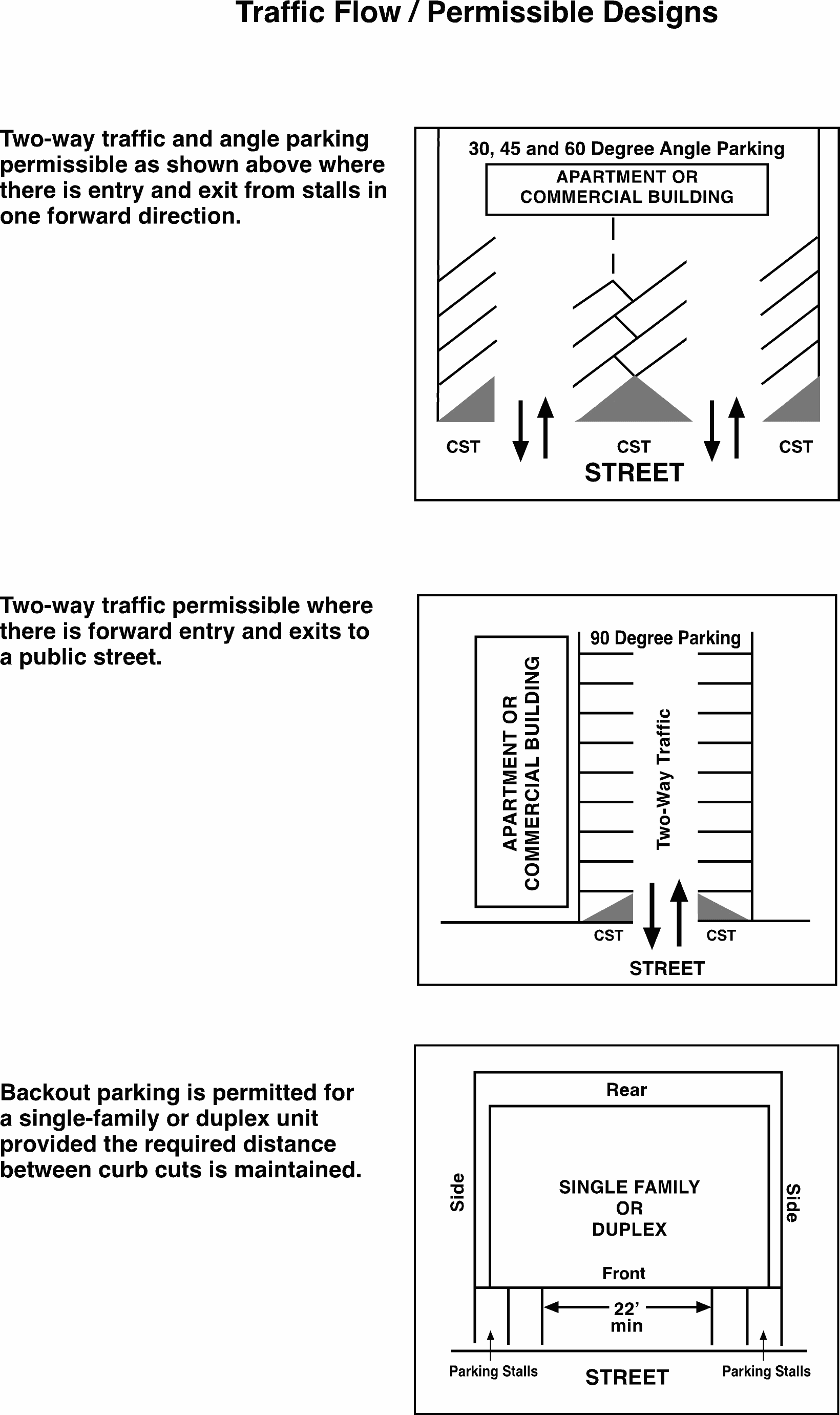
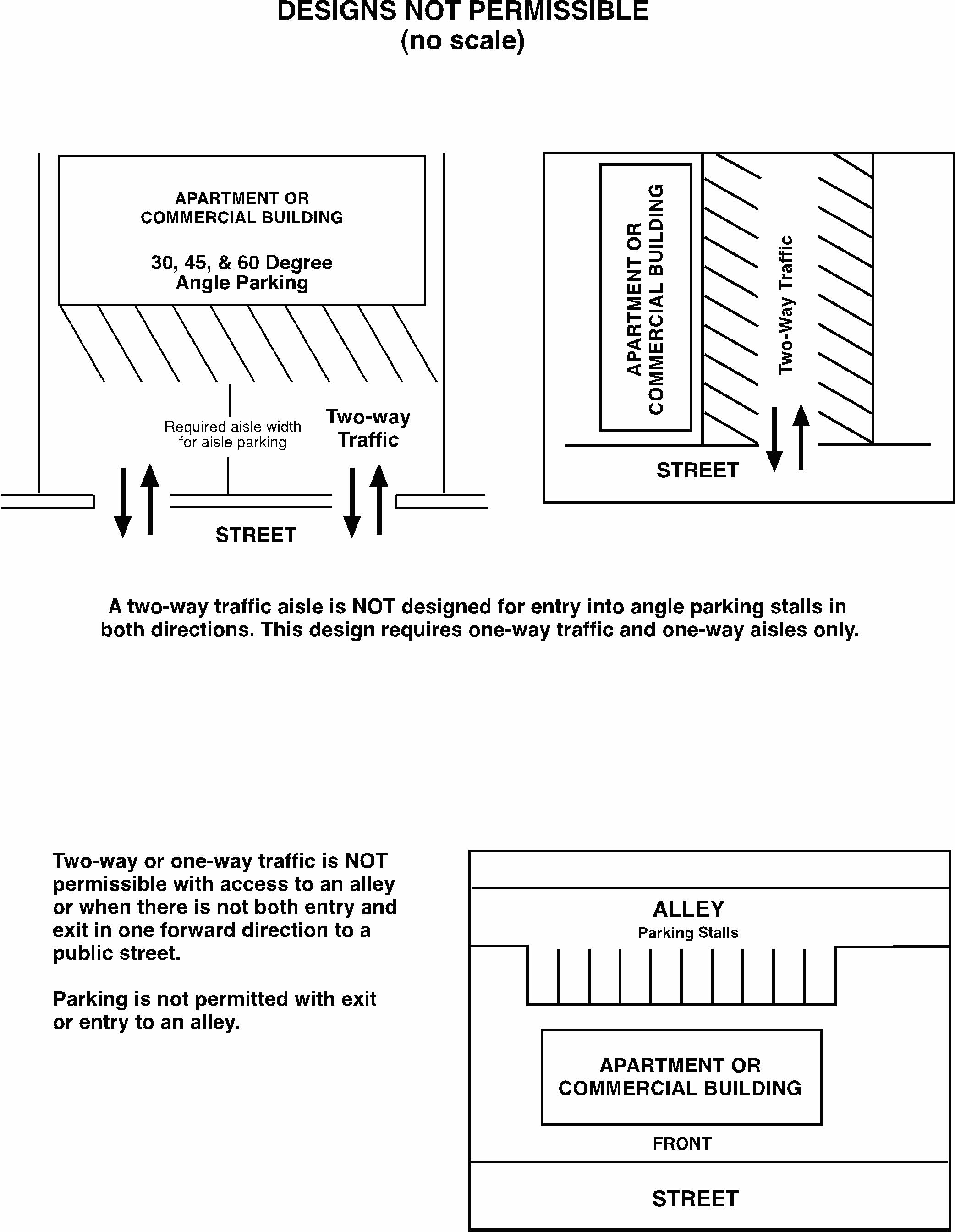
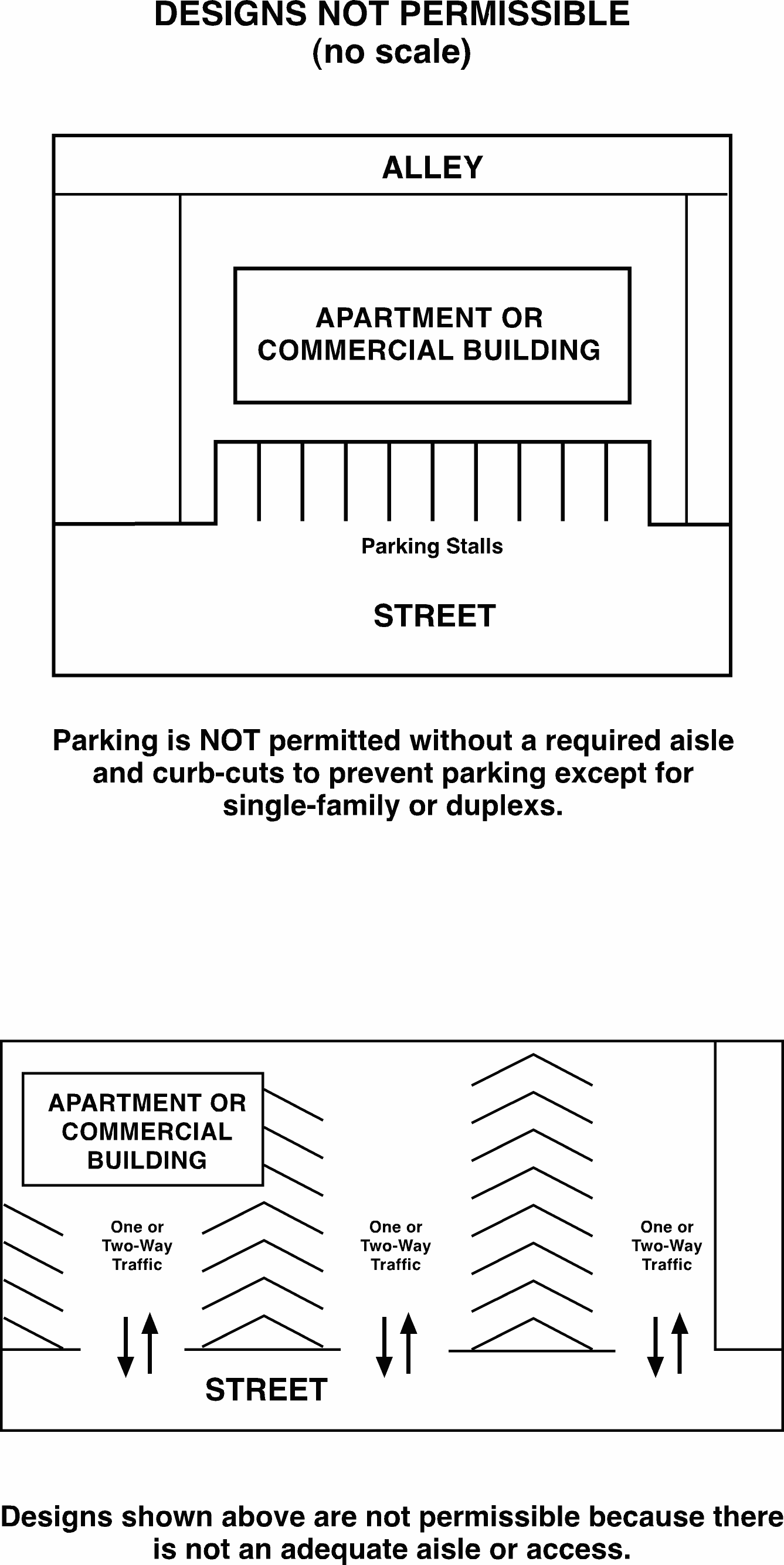
F.
Parking stalls for the disabled.
1.
Definitions as used in this section.
a.
Curb cut: A short ramp through a curb or built up to the curb.
b.
Designated, disabled parking stall: Any parking stall constructed, marked and reserved for the parking of a passenger vehicle which carries registration plates or a placard indicating disability in accordance with federal law, Americans with Disabilities Act, and NMSA 1978, Section 66-3-16. Such a place shall be designated by a conspicuously posted sign bearing the international sign of accessibility.
c.
Accessible route: A continuous unobstructed path connecting all accessible elements and parking stalls of a facility that is usable by persons with physical disabilities. Exterior accessible routes may include parking access aisles, curb ramps, crosswalks at vehicular ways, walks, ramps and lifts.
d.
Parking lot: An area provided for self-parking by employees, visitors, and/or patrons of any office of state or local government, any public accommodations, commercial or industrial establishments or any other business open to the general public. This shall also include the area provided for self-parking by residents, visitors or employees of a residential building, larger than a duplex, available to the general public.
2.
Parking lot standards. Every parking lot shall have designated disabled parking stalls provided as follows:
a.
Accessible parking stalls shall be nine feet wide minimum and shall have an adjacent access aisle of five feet wide minimum with a slope no greater than 1:48 (2.08%) in all directions. Parking access aisles shall be part of the accessible route to the building or facility entrance. Two accessible parking stalls shall be permitted to share a common access aisle. Accessible parking stalls shall be identified by a sign showing the international symbol of access mounted in accordance with the city sign code. Signs shall not be obscured by a vehicle parking in the stall. Accessible parking stalls shall be marked using federal blue paint.
b.
Van parking stalls shall be nine feet wide minimum, shall have an adjacent access aisle of eight feet wide minimum, shall have an eight feet and two inches vertical clearance and shall have a sign showing the international symbol of access and sign indicating "van accessible" mounted in accordance with the city sign code. Van accessible parking stalls shall be marked using federal blue paint.
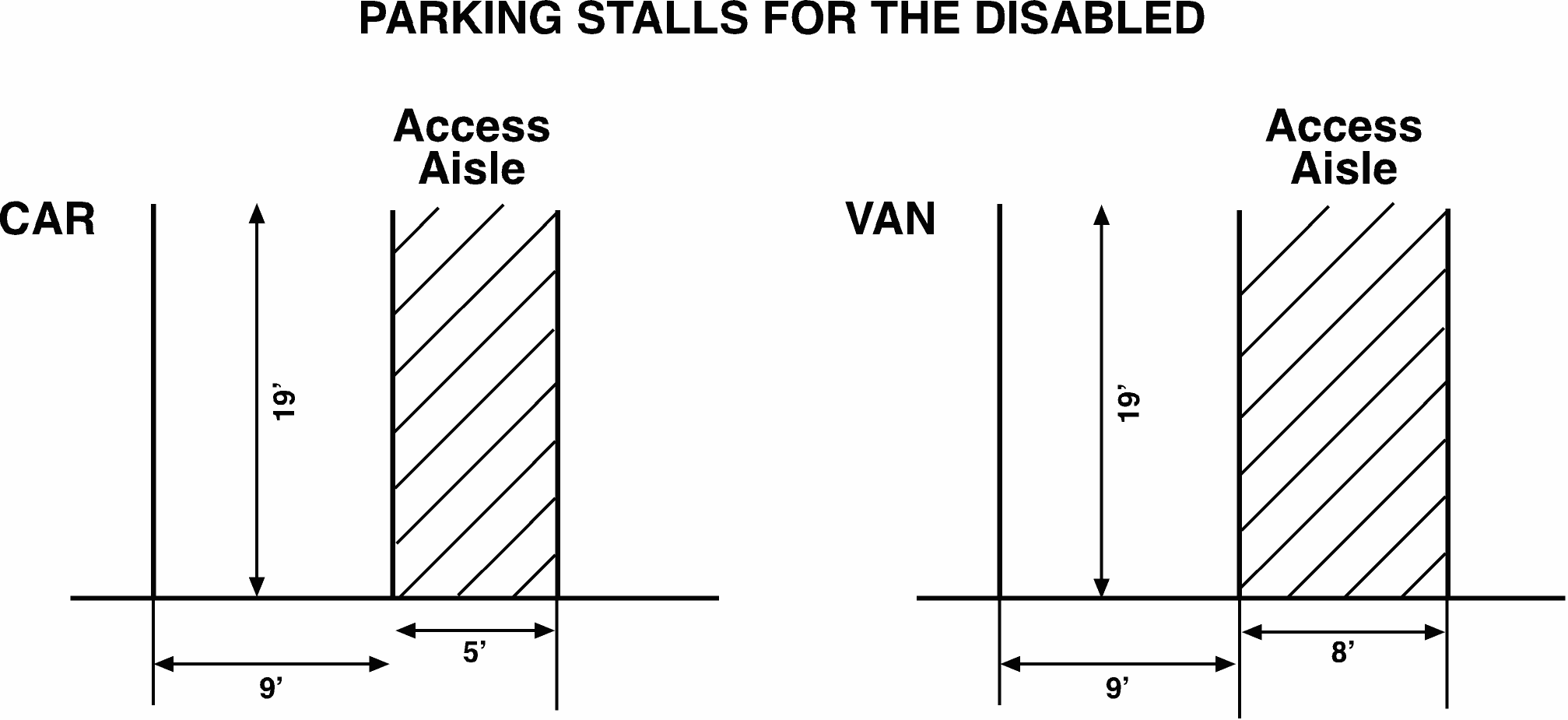
c.
Curb cuts shall be provided wherever an accessible route crosses a curb and shall comply with the city's design standards.
d.
Built-up curb ramps shall be located so that they do not protrude into vehicular traffic lanes or into parking stall access aisles and shall not be steeper than 1:12 (8.34%) with side flares not steeper than 1:10 (10%).
e.
An accessible route shall consist of one or more of the following components:
1)
Walking surfaces with a slope not steeper than 1:20 (5%) and a minimum width of four feet, marked crossings at vehicular ways, access aisles, ramps and curb cuts.
2)
At least one accessible route shall be provided from public transportation stops, accessible parking and accessible passenger loading zones and public streets or sidewalks to the accessible building entrance. The accessible route shall be the shortest possible route from adjacent parking to the accessible entrance and shall, to the maximum extent feasible, coincide with the route for the general public.
3.
Minimum number of accessible parking stalls: The minimum number of designated accessible parking stalls shall be determined by provisions of the adopted building code in effect at the time of permitting.
4.
It is the property owner's and/or business owner's responsibility to ensure that all accessible parking (including stalls, access aisles, loading areas, etc.) are designed according to federal law, i.e., Americans with Disabilities Act, and state law.
G.
Parking stall and driving aisle reduction options. The following provisions are methods to reduce the number, size, and/or square footage of area required for on-site parking. Any combination of the following options may be used, but in no event shall the reduction be more than 35 percent. The minimum number of parking stalls required is two. These methods cannot be applied to any provision regarding disabled parking.
1.
Shared and joint use of parking areas.
a.
Shared parking areas.
1)
Multi-dwelling and nonresidential uses are encouraged to seek shared parking agreements with multi-dwelling and nonresidential uses on adjoining properties.
(a)
These agreements shall be approved as to form and content by the city attorney and Community Development Director and once completed, filed with the county clerk's office.
(b)
Agreements may be made with adjoining property owners regardless of the hours of operation of the adjoining uses.
(c)
In combining parking requirements, a minimum of ninety percent (90%) of the required off-street parking for all uses shall be met.
(d)
For uses requiring a shared parking arrangement in order to meet parking provisions, the agreement shall pertain to no more than 40 percent of the number of parking stalls they are responsible to provide. The remaining 60 percent must be provided on-site on each property.
(e)
An agreement for shared and joint use of parking areas shall become null and void if there is a change in the specific land uses that are covered by the agreement, platting or re-platting of the land. In these instances, a new agreement shall be required.
b.
Shared driving aisles and curb-cuts. Abutting properties may share driving aisles provided there is a written agreement establishing the conditions of joint use, of maintenance requirements and of ingress/egress requirements. The joint use of a driving aisle does not exclude the minimum parking requirements for the abutting lots. The agreement shall be properly executed by the owners of all affected properties and approved as to content and form by the city attorney and Community Development Director. A copy of the executed agreement shall be submitted with an application for a building permit after recording in the county clerk's office.
2.
Off-street parking in the historic districts. In particular circumstances, it is possible to allow exceptions to certain parking requirements for small businesses within R-4, O-1, O-2, C-1 and C-2 zones and are located within the Alameda-Depot or the Original Townsite/Mesquite Street Historic Districts in exchange for the improvement or maintenance of the subject property in terms of building improvements and/or landscaping (historic district designation shall be determined by Federal Register or state historic preservation division data). Allowances for exceptions are intended to assist in maintaining a residential atmosphere in these areas, where possible. Furthermore, it is intended to be used as a tool to help facilitate the use of older buildings in these districts in addition to maintaining/improving their overall appearance.
a.
Qualified businesses.
1)
An attempt must first be made to meet parking, landscaping, and drainage requirements (refer to section 38-58, off-street parking; section 38-56, flexible development standards; section 32-101 to 32-135, urban drainage criteria and section 32-266 to 32-280, development standards for landscaping). If the subject property cannot physically meet the requirements in either of these sections or can demonstrate aesthetic concerns due to parking lot requirements, the subject property is in one of the city's historic districts, the subject property is located in an appropriate zoning district, and meet the established criteria listed in this section (section 38-58.G.2.a.), a property/business owner may apply for a parking exception in a historic district (note: flexible standard provisions may not be used in conjunction with this historic district parking exception provision).
2)
A small business shall be considered as such when said business requires no more than eight parking stalls. All uses, whether residential, office or retail, situated on a particular parcel, are considered when calculating parking requirements. In the instance where nine or more parking stalls are required, a parking exception is not an option. Property/business owners in this instance must follow standard procedure of either providing an off-street parking area or apply to the Planning and Zoning Commission for a variance (exception: when there is available off-street parking that complies with current zoning code requirements for any residential units located on a property, those parking stalls will not be counted as a part of that business' requirement).
3)
Suitable businesses must have R-4, O-1, O-2, C-1 and C-2 zoning designations.
4)
For safety purposes, only those businesses that are located adjacent to streets that have a minimum paving width of 30 feet will be considered for these exceptions.
Note: Those applying only for an exception(s) to the required back-up and/or driving aisle must, at minimum, meet the first, second, and third criteria established in this section.
b.
Permitted exceptions.
1)
Applicants may request one or more exceptions to the typical parking requirements, found elsewhere in this section (section 38-58), for the business. Under these parking exceptions, a business will be able to utilize on-street parking for a maximum of eight parking stalls in lieu of the off-street parking area requirement (the number of allowed parking stalls for varying types of businesses may be found in section 38-33). If a business is able to provide off-street parking, but cannot meet back-up and/or driving aisle requirements, exceptions to the length of required back-up and/or driving aisles may also be requested.
2)
Every effort to provide as many off-street parking stalls as possible for the business should be attempted and may become a condition of any exception granted at the discretion of the Community Development Director. Additionally, all ADA provisions must be met and any off-street parking areas must be paved in accordance with section 38-58.J. of this article.
3)
Businesses that are granted an exception(s) are expected to provide a landscaped area of 15 percent as well as any needed building improvements, e.g., new roofing, repairing cracks in walls, chimney repair, repairing fencing, patching and painting walls, as a benefit to the neighborhood and general community. All landscaping and building improvement information will be provided as a part of the application/letter of intent as per Section 38-58.G.2.c.1. Exterior remodeling of historic structures shall not result in the removal of a historic designation (note: the Community Development Director may forego the entire or a portion of the landscaped area if an applicant can demonstrate that the subject property cannot physically support this requirement).
c.
Application procedure.
1)
Applicants shall submit, to the community development department, a letter of intent that describes the nature of the business, location, the number of employees working at the business at any one time, expected number of customers on a typical weekday and weekend, what exceptions are being requested, why allowing these exceptions will not create a negative impact to the surrounding area, what benefit the city/neighborhood will result from this request in terms of building and landscaping improvements as per 38-58.G.2.b.3, and any other information deemed necessary by the Community Development Director. Those applying for back up and/or driving aisle exceptions only must also demonstrate that exceptions to these requirements will not create a hazard to the surrounding area.
2)
With the information included in the letter of intent, the Community Development Director will determine whether or not the proposal will create a negligible impact to the surrounding area and if property improvements can be considered as a benefit to the neighborhood/community. Should the Community Development Director determine that the proposal is unacceptable, applicants may apply for the appropriate variances with the Planning and Zoning Commission. If an exception is issued, the Community Development Director will issue a certificate of parking exception. These provisions shall only pertain to the specific type and size of business that applies for and is granted an exception(s) and not for any future business that differs in any way from the original application request. The certificate of parking exception must be filed with the county clerk's office and kept as a record of the property.
3.
On-street parking. In areas where on-street parking is permissible and verified by the public works department director or designee, this parking can be used for up to 25 percent of the required parking of a use as long as the on-street parking is adjacent to the property on which the use is located. To receive credit for on-street parking, stalls shall meet the stall dimensional requirements and the street shall meet the city's design standards. In the event that the street is later widened, or the status changed to prohibit on-street parking, the use on the property will become legal nonconforming.
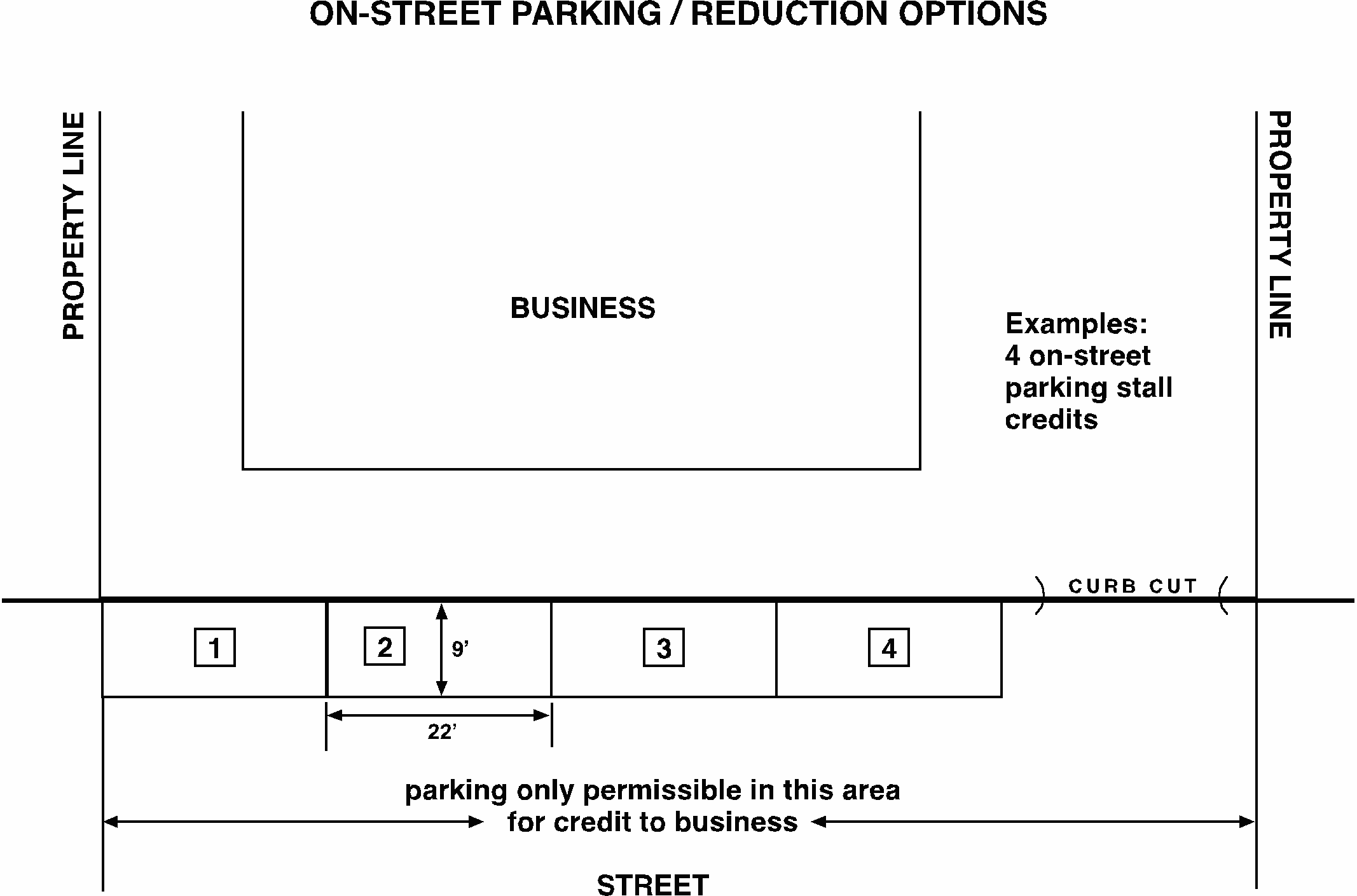
4.
Landscaping. Up to a ten percent reduction in the required number of parking stalls will be allowed if shade trees are provided. Each stall eliminated through this option shall be replaced with a minimum of two trees. This provision is in addition to the minimum landscaping requirements.
a.
Trees, two inch caliper minimum, located within the parking area shall maintain a minimum of six feet before the first lateral branch and shall reach a canopy diameter at maturity of 20 feet.
b.
Trees shall be located in an island or planter in which the tree trunks shall be protected from motor vehicles.
(1)
A barrier such as a curb, wheel stop, or bollard shall be used as protection.
(2)
Islands shall be a minimum of three feet wide, have a minimum area of 34 square feet and a raised border of at least four inches in height.
5.
Studies. If information or research can be presented to the city for a specific type of use or method of parking, the Community Development Director or designee may grant a reduction in the number of required parking stalls and driving aisle width.
6.
Bicycle stalls. One motor vehicle parking stall can be replaced with 4 bicycle spaces. This option can be used for not more than five vehicle stalls or not more than ten percent of the allowed parking stalls, whichever is less. Bicycle parking facilities shall meet the design standards found in section 38-58.E.9.
7.
Parking structure. A ten percent reduction in the total number of required parking stalls will be granted if the required parking is provided in a parking structure that is two stories or more.
8.
Tandem parking stalls. Tandem parking provides for two or more parking stalls, one behind the other, where access to one parked vehicle can only be gained through the abutting space (see drawing). Tandem parking can be utilized for no more than 50% of all required parking stalls to reduce the amount of driving aisle required. Tandem parking shall only be utilized for specific, property owner/manager controlled cases such as:
a.
Employee parking.
b.
Company owned vehicles.
c.
Controlled parking situations (funeral homes, sporting events).
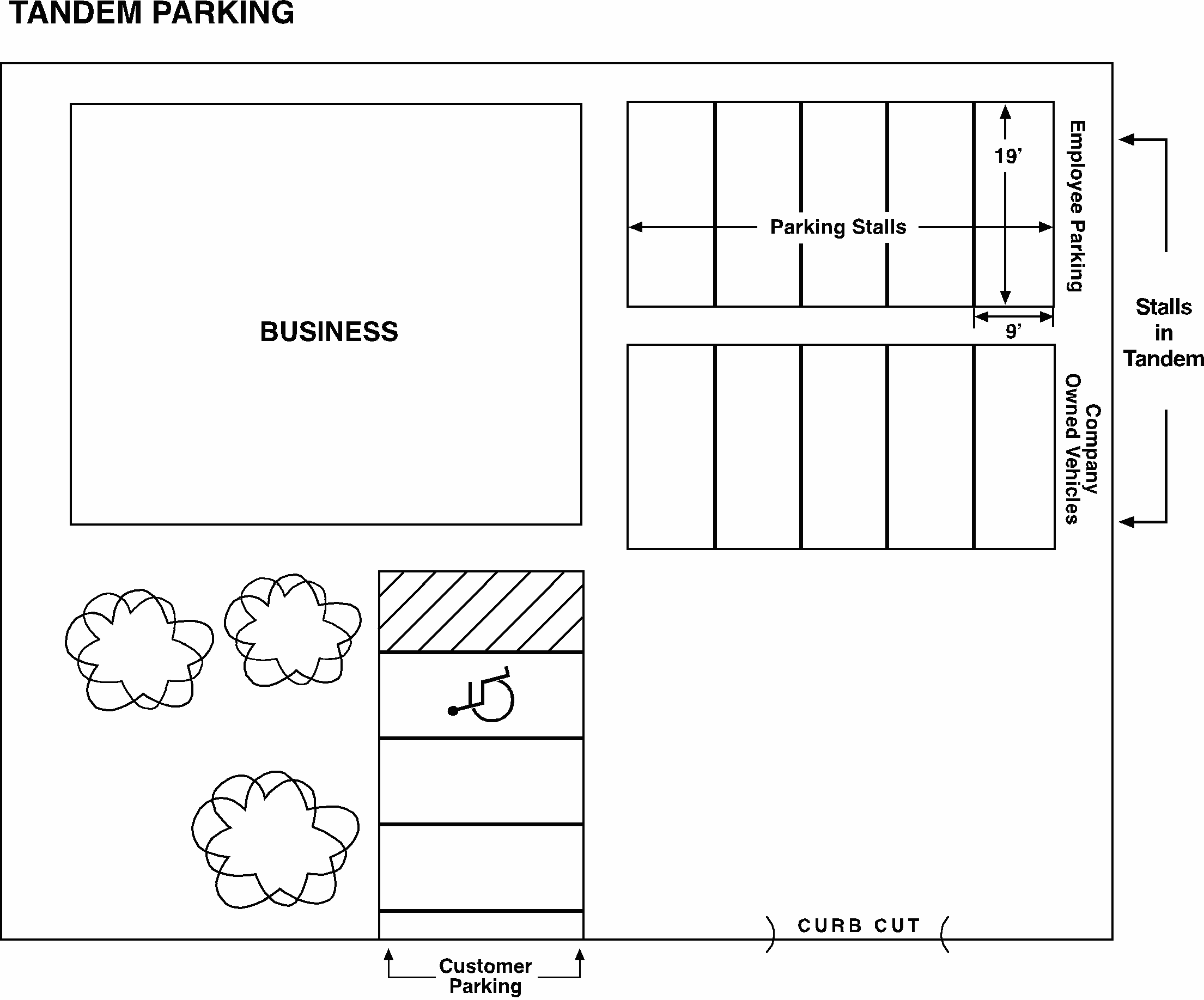
H.
Stacking lane requirements. The minimum stacking lane requirements are as follows:
Length required: 100 feet.
Width required: Ten feet, except nine feet of drivable area at the point of service.
The measurement of the length of the stacking lane begins at the middle of the last point of service and ends at the point of entry of the lane.
When two or more stacking lanes are provided, a reduction of stacking lane length is permitted. The total length normally required shall be divided by the number of lanes. This product shall be the required length for each of the lanes.
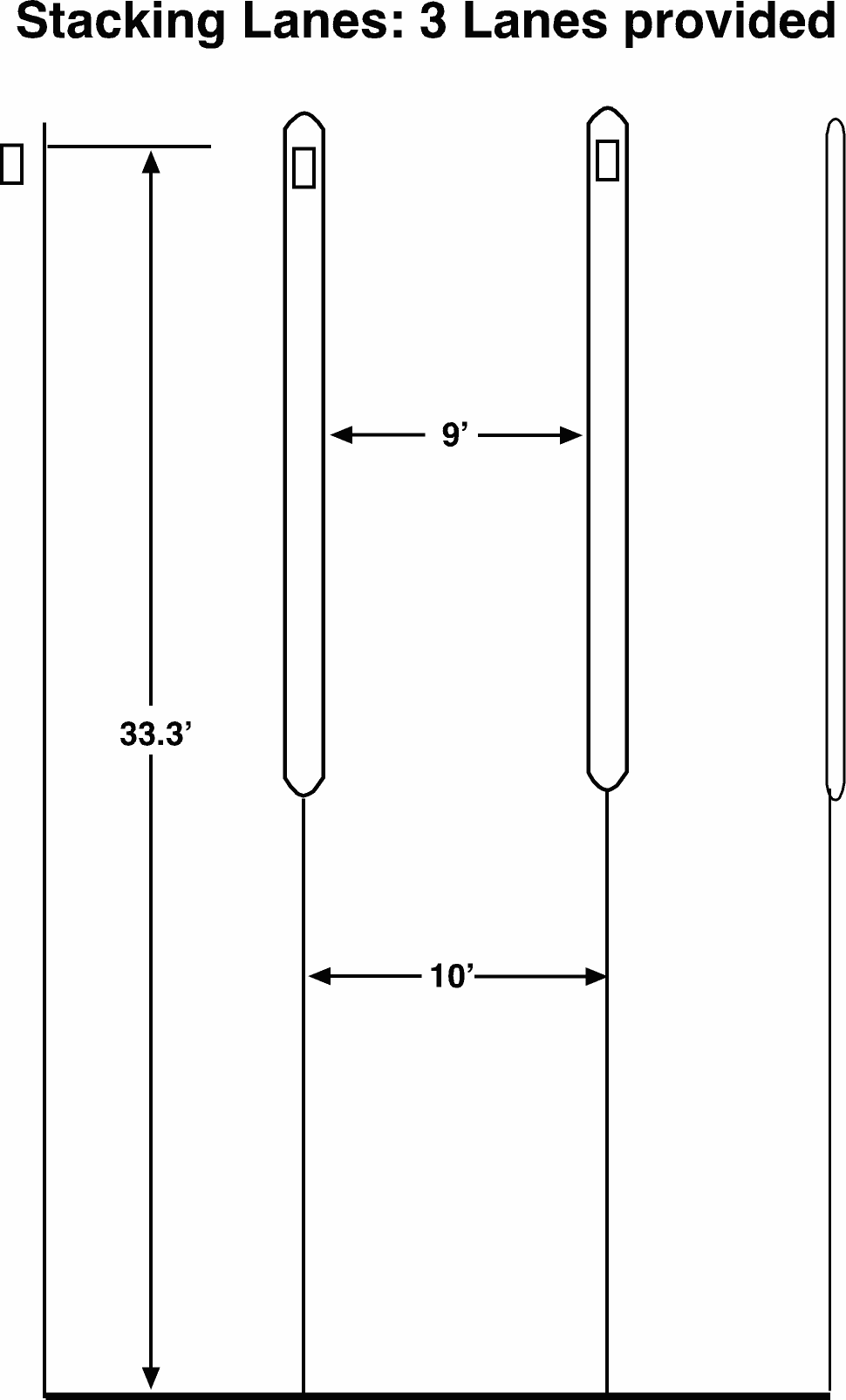
A stacking lane shall be designed in a manner that permits appropriate traffic circulation and avoids congestion in the parking area.
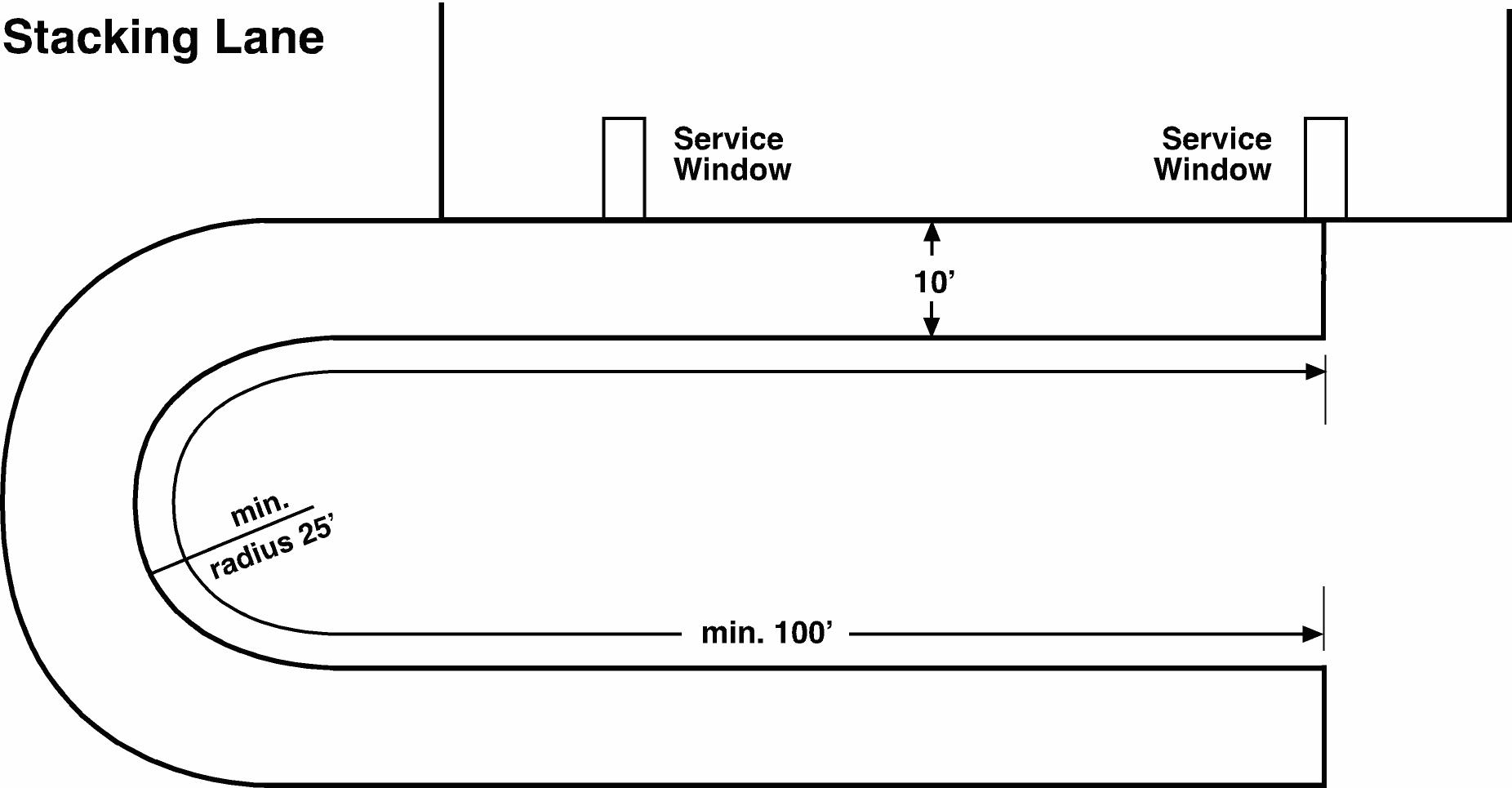
The minimum radius of a stacking lane shall be 25 feet.
I.
Wheelstop provisions.
1.
Size requirements: Six feet in length, six inches in height.
2.
Horizontal in placement: Two feet from base of parking stall, securely anchored to parking surface.
3.
Materials: Wheel stop material shall be compatible and appropriate to the site. Materials such as concrete, railroad ties, landscape timbers, or molded steel may be used.
4.
Alternative wheel stop methods:
a.
Adjacent to sidewalk: When the parking stall base is adjacent to a four foot required sidewalk, the sidewalk may be widened to six feet, essentially making two feet of the sidewalk the wheel stop.
b.
Adjacent to building, structure, wall or fence: When a parking stall base is adjacent to a building structure or wall, a two foot pad or landing may be constructed adjacent to the structure or wall. The pad or landing's construction must be of a minimum asphalt standard. The pad or landing cannot take the place of a required sidewalk.
c.
Adjacent to landscaping/aggregate: Low lying (no taller than three inches and below the top of the curbing) landscape may be placed within the two foot area where the pad or landing would be present. The landscaping shall be enclosed by a six-inch curb and be properly irrigated.
5.
Parking stall measurement: When utilizing one of the alternative wheel stop methods, the parking stall length will be measured two feet less or 17 feet.
6.
Exceptions: One and two-family dwellings are not required to provide wheel stops.
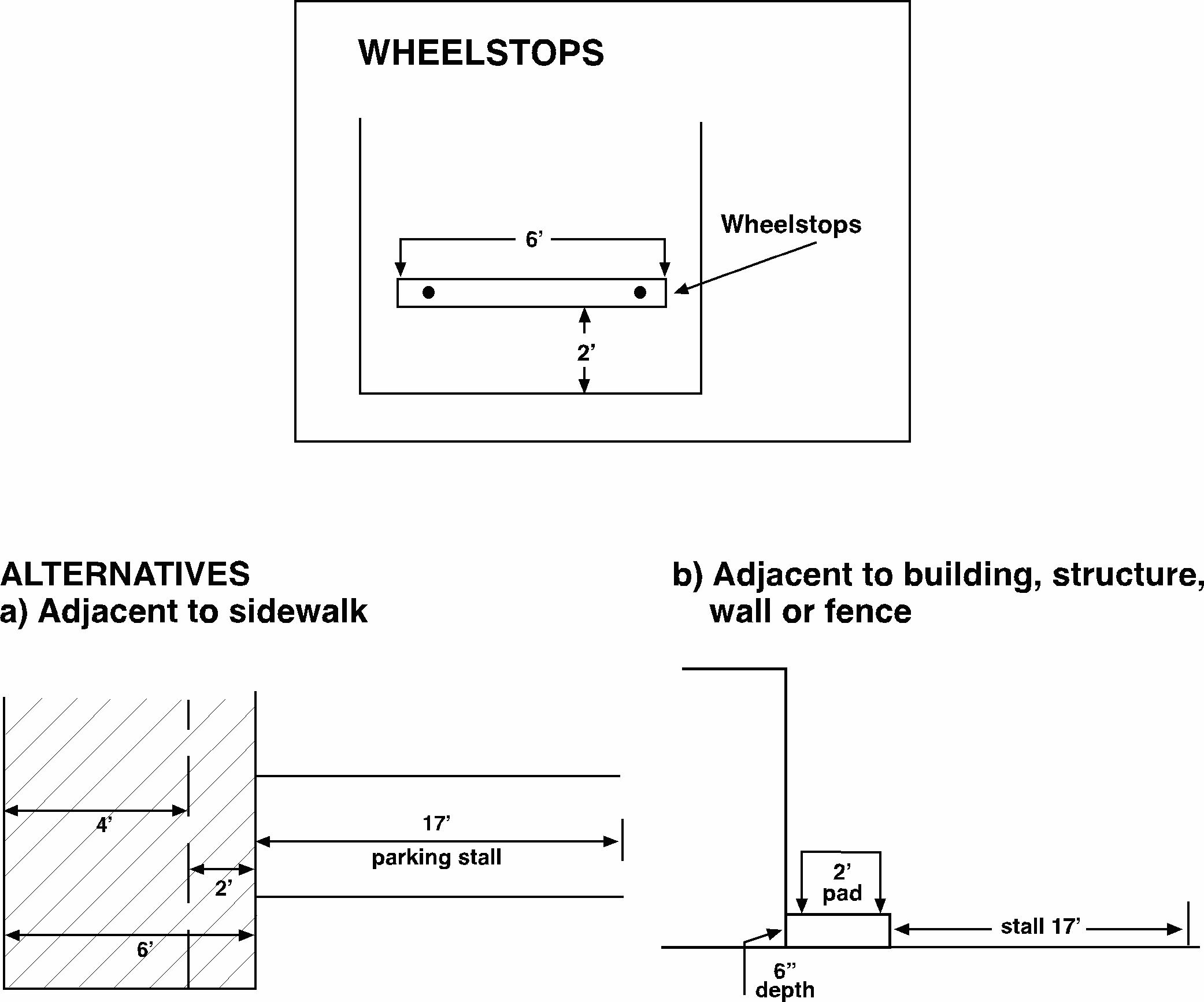
J.
Construction and maintenance of parking areas.
1.
Individual single-family or two-family dwelling developments. Crushed stone or crusher fines is the minimum surface that may be used for driveways or parking areas for a single-family or two-family dwelling on one property. However, compliance with sections 38-58.D.6. and 7. is required.
2.
All other developments.
a.
Construction materials. All parking stalls, loading areas, back-up aisles and access aisles to the nearest public street shall be paved with a permanent surface, consisting of a minimum of five inches of concrete, or a minimum of 1½ inches of asphaltic concrete on a prime coat over a four-inch compacted subgrade, or a surface of equal or superior performance characteristics as determined by the community development department director or designee.
All parking and loading areas shall be maintained in a safe, usable, dust-proof condition, graded and drained to dispose of all surface water.
b.
Striping. Parking spaces, back-up aisle, loading areas, entrances, exits and clear sight triangles shall be appropriately marked to indicate their location. Striping shall not be required for single-family or two-family properties.
c.
Landscaping and irrigation. Landscaping and an irrigation system in compliance with the city's design standards will be required with the installation of a parking area.
d.
Drainage. The installation of a drainage facility in compliance with the city's design standards will be required with the installation of a parking area.
e.
Temporary parking area installation delay. Shall only be utilized by nonresidential uses and shall not apply to new construction on vacant land.
1)
Candidates for a time delay: A time delay may only be utilized if and/or when:
a)
The applicant is a new business or business that has recently relocated, and is a nonresidential use.
b)
The required parking area contains one to ten parking spaces.
c)
The business is not a business center, shopping center, mall or planned commercial center.
d)
A time delay has not been previously granted for the property.
e)
The new or recently relocated business is not occupying a newly constructed structure.
2)
Application submittal.
a)
A delay in the installation of parking areas shall not be granted without a written agreement establishing the conditions for the delay and length of time for the delay.
b)
The time delay application packet can be obtained in the community development department. The packet must be completed and returned to the community development department, in order for approval consideration. In order to complete the time delay application packet, an applicant will be required to:
(1)
Complete the application. Information such as name, address, number of stalls required, and signature shall be provided.
(2)
Complete the agreement. Information such as project address, date and a notarized signature will be required.
(3)
Submit a site plan of the project property and parking area. The site plan must be a drawing to scale and clearly indicate relevant information, as discussed in the packet. Can be combined with landscape and irrigation plan item (4).
(4)
Submit and receive approval of a landscape and irrigation plan. Can be combined with site plan item (3).
(5)
Submit an estimated cost of parking area improvements from a licensed contractor.
(6)
Pay processing fee.
3)
Approval of time delay.
a)
The following criteria shall be used by the Community Development Director or designee to consider a time delay for construction of parking areas.
(1)
Application of the terms of the zoning code shall be in harmony with the general purpose and intent as stated in Section 38-2.
(2)
Granting any time delay to parking area construction shall not merely serve as a convenience to the applicant, but the delay shall be the minimum necessary for relief due to some demonstrable hardship, and shall be granted only in such instances where reasonable alternative means are not available to resolve the problems.
(3)
Time delays to parking area construction shall not be granted in such cases where it would adversely affect adjoining properties.
(4)
Time delays to parking area construction shall not be granted in such cases that will impair an adequate supply of light and air to adjacent property, unreasonably increase the congestion in public streets, increase the danger of fire, endanger public safety or diminish or impair established property values.
b)
Upon obtaining approval signatures, the written agreement shall be filed/recorded at the county clerk's office, at the applicant's expense, and a filed copy returned to the community development department. If a filed/recorded copy is not returned to the community development department, a business license will not be issued.
c)
A temporary business license shall be issued to a business that has received a time delay for the construction of a parking area. The temporary business permit shall only be valid for the length of the time delay for construction of parking areas.
4)
Conditions of a time delay.
a)
No delay shall exceed 24 months from approval of the agreement.
b)
The agreement shall be executed by the Community Development Director or designee and the owner of the property containing the parking area.
c)
The content and form of the agreement shall be approved by the city attorney and Community Development Director.
d)
The agreement may not be extended for an additional time period.
e)
Approval of a time delay for the construction of parking areas shall be applicable to all successors and heirs.
f)
The property owner must be the business owner requesting the variance. If the business owner is not the property owner, a joint application may be submitted by both parties.
g)
The delay for the specific parcel of property shall be for one time only; it may not be extended, renewed, or subsequently reapplied for by a new property owner or new business owner, regardless of the length of time any previous delay was utilized.
h)
The parking lot must be substantially completed no later than thirty (30) days prior to the expiration of the waiver.
i)
All parking and loading areas shall be maintained in a usable, dust-proof condition, graded and drained to dispose of all surface water.
j)
Landscaping requirements are not included with the time delay for required parking area improvements. However, if it can be demonstrated that landscaping is proposed to be present in the required parking area, installation for that landscaping only may be delayed until such time as the paving is completed. All other landscaping shall be installed prior to business license issuance.
k)
Drainage requirements for existing structures with unimproved parking areas shall be constructed at the time of parking area improvement (paving). The drainage facility shall be engineered for that parking area's impervious area at a minimum.
l)
The minimum standard for the surface of parking stalls and driving aisles during the time delay is gravel, crusher fines, compacted subgrade or base course.
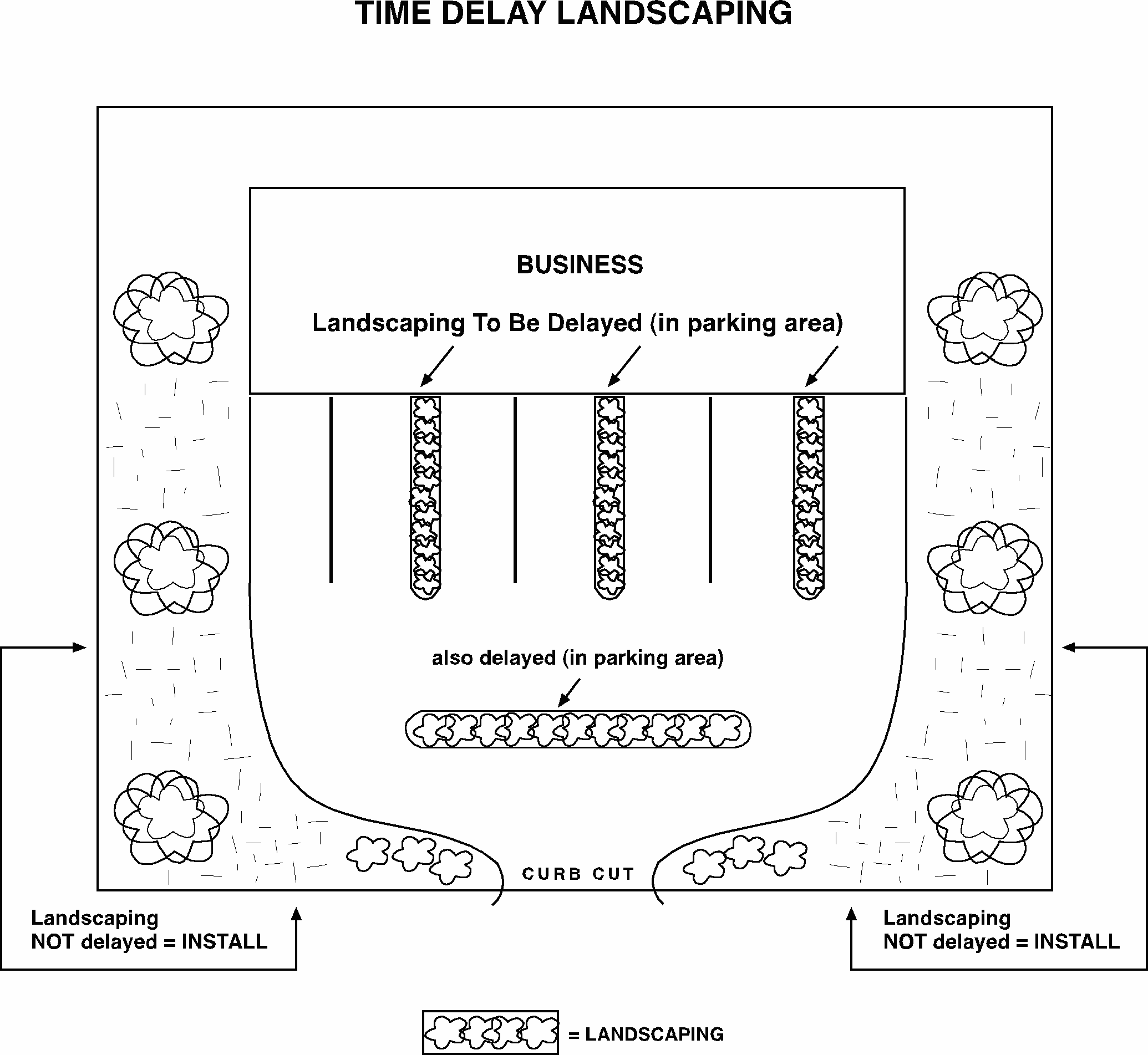
(Ord. No. 2354, § I, 1-22-07; Ord. No. 2775, § I(Exh. A), 2-16-16; Ord. No. 2882, § I(Exh. A), 12-17-18)
Sec. 38-59. - Antenna, towers, communication structures, and other vertical structures.
A.
Purpose. The purpose of this section of the zoning code is to address the placement, height, and other restrictions related to all types of communication structures, including antennas, towers, and other vertical structures not related to communications. This section also addresses the urban design criteria, special use permit and variance processes, and nonconforming issues for the same structures. This article is intended to address the public health, safety, and general welfare associated with such structures, in accordance with the comprehensive plan and other sections of this Code.
B.
Definitions.
Antennas: Any structure that radiates or receives radio or other communication signals.
Collocation: The physical attachment and/or placement of one communication structure upon another communication structure, and may include placing different or similar communication structures on the receiving structure. For example, a cellular transmitter being placed on a television receiver tower or a cellular transmitter on another cellular transmitter tower.
Communication structures: Any structure, including antennas and satellite service devices, or any other device which is normally used for radio, television, microwave, or wireless communications. This shall include any device that is attached to a new or an existing tower, or attached to a building facade or roof or other noncommunication structure, and such attachment is made to the facade or roof vertically, horizontally and/or diagonally.
Facial mount: The physical attachment of a communication structure to a building or other noncommunication structure, which does not substantially increase the height of the building or structure. Examples of other structures include, but are not limited to: freestanding signs and billboards, stadium lights, gas station canopies, electric poles, area and street lights, and church spires. This can include attaching the structure either vertically, horizontally, or diagonally along the structure's building facade, facades, walls, roofs, or other surfaces.
Satellite service device (SSD): Any structure used to receive satellite programming services specifically associated with television reception from the transmission of signals from a satellite to a receiver, usually a round "dish" that can vary in size. This does not include those dishes or devices used for two-way communications.
Tower: Any structure, vertical in inclination, which is normally used to support antenna or other communication structures. This may include television and radio towers, guy towers, and all other free standing towers, either for private or commercial purposes.
Vertical structure: Any built object that is either independent of or attached to any building that is perpendicular in its direction to the nearest adjacent ground. May include such structures as spires, belfries, flag poles, steeples, and other similar structures, but does not include antennas, towers, communication structures, and satellite service devices.
Commercial purposes: Structure used by any individual, firm, organization, or company, through leases for profit or any privilege granted to any other individual(s), firm, organization, or company for any type of communication service. This includes those nonprofit agencies that provide such communication service to other users and not for the nonprofit agencies' sole use. Home occupations whose primary function is the leasing of communication service space on communication or other structures, permanent or portable, are considered commercial purposes.
Private purposes: Structure owned by any individual, firm, organization, company, or an amateur radio operator as licensed by the FCC, not using the structure for profit as part of its communication needs. This includes any structure used by any local, state, or federal entity for the communication needs and functions of that entity, as authorized.
C.
General standards and construction provisions.
1.
All structure heights shall be measured from the lowest adjacent ground level vertically to the highest point of all structures, whether attached to the ground, the building, or other structure(s).
2.
All structures shall be constructed and installed to manufacturer's specification, and constructed to withstand a minimum 75 mile per hour (mph) wind, or the minimum wind speed as required by the city's adopted Uniform Building Code, as amended, and required setback provisions as prescribed for the zoning districts below.
3.
Structures shall be permitted and constructed to meet current, adopted city Building Code requirements.
4.
All structures shall conform to Federal Communication Commission and/or Federal Aviation Administration regulations, if applicable.
5.
Any setback or bufferyard as prescribed within Matrix 1 of this Code that requires a greater distance than required of this Section, the greater setback shall apply.
6.
Any increase to the height of or a reduction to the setbacks for private purposes in any residential zoning district require the approval of a variance by the Planning and Zoning Commission, and not a special use permit.
7.
Business registrations are required for each communication structure for commercial purposes located inside the city limits, regardless whether said structure is freestanding, collocated, facial or roof mounted, or part of an integrated structure or improvement.
8.
Abandonment or cessation of use of the communication structure shall require the removal of all facilities associated with the communication structure from the subject property within six months after the abandonment or cessation of use. Foundations for such structures should be altered or removed in order to be visually appealing and safe.
D.
Collocation, facial and roof mount, and integrated communication structures provisions. Co-locating, facial and roof mounting, or constructing integrated improvements in which communication structures are disguised or made part of a new building or structure, is required for all commercial use communication structures in all zoning districts, historic districts, historic properties, and within 200 feet of historic districts or properties unless evidence is provided that clearly indicates that co-locating, facial or roof mounting, or improvement integration cannot and should not occur. Evidence, may include, but is not limited to, that no other structure suitable for collocation, mounting, or improvement integration exists:
1)
Within a one-mile radius to meet the applicant's engineering requirements or structural strength or space availability needs for all improvements;
2)
In which unavoidable electromagnetic interference would occur between the new and any existing communication structures;
3)
In which other factors render the use of existing structures unsuitable;
4)
In which urban design features and aesthetic views would be hampered, beyond the objectives desired with the creation of this requirement, of existing natural and man-made structures;
5)
Whose owners of existing structures would not allow the placement of the applicant's structure or such owners are requiring payments thereof that substantially exceed commercially reasonable rates; and
6)
Cases in which violations of this Code would be created.
Such evidence shall be presented to the community development department for review and approval by the Community Development Director or designee. Such proof may be required as part of the special use permit and/or building permit approval processes, and only then shall an independent, freestanding communication structure be allowed in accordance with other requirements of this Code.
1.
Collocation of structures shall be in accordance with the following provisions:
a.
Height limit exceptions for collocation only:
1)
If the height of the receiving structure exceeds the maximum height permitted for that type of structure in the parcel's zoning district, then the receiving structure shall be granted a legal-nonconforming use certificate and the collocation of the new communication structure shall be allowed by right provided that the addition of the new structure does not increase the height of the receiving structure.
2)
If the height of the receiving structure meets or is below the maximum height permitted for that type of structure in the parcel's zoning district, collocation of the new communication structure shall be allowed by right provided that the addition of the new structure does not increase the height by more than 20 feet above the maximum height allowed for that zoning. If the collocation of the new structure will exceed the 20 feet height limit above the maximum allowed height, then applying for, complying with, and receiving approval of a special use permit shall be required.
b.
If the receiving structure has previously received a special use permit for its use and placement, including necessary variances for height and setbacks, the original special use permit does not need to be amended provided all requirements of the original special use permit have been met, including landscaping and screening, and that all height and setback increases are in accordance with limits prescribed within items "a" and "b" above.
1)
Technical engineering information will need to be submitted with the building permit application indicating compliance with the building codes and structural provisions to ensure that the receiving structure can support the new communication structure.
2)
Additional buildings and/or additions to existing equipment and accessory buildings for towers will require compliance to architectural and urban design criteria and must be reflected on necessary special use permits, if applicable. If not reflected on special use permits, amendment provisions must be followed in accordance with the special use permit section of this Code.
c.
An unlimited number of communication structures may be placed on an existing tower and/or other communication structure, provided all other requirements are met, including building codes and urban design criteria.
2.
Facial and roof mount placement of structures can be utilized on existing building and structures, not including other communication structures, provided that the addition of the communication structure does not: (1) exceed the maximum height allowed for the receiving structure and/or building, (2) violate setbacks required for that type of structure in that parcel's specific zoning district, and (3) encroach on required setbacks and/or bufferyards from adjacent land uses and zoning districts. Additionally, the proposed communication structure shall be compatible with the integrity and style of architecture of the receiving building and/or structure.
Facial and roof mounting of structures shall be in accordance with the following provisions:
a.
Facial and roof mounts must be securely mounted to the structure with approved fasteners in accordance with the current building code, as amended, or other accepted engineering practices for such attachments.
b.
If not governed specifically by this section, the building or structure receiving the facial mount communication structure must comply with all applicable zoning and building code provisions, if applicable, or other city ordinances and/or state laws related to their placement, use, and construction.
c.
All facial mounts must be an integrated architectural design feature and painted or textured such a color as to blend in with their visual background.
d.
When roof mounts are used, at a minimum, the first five feet of the communication structure shall be screened from view on all sides through the use of building design elements, such as varied roof heights and/or parapets.
e.
Facial mounts cannot project more than three feet from the surface of the facade of the building and the projection cannot violate any of the normally required building setbacks and/or bufferyards. Structures that are attached parallel to a pitch roof surface cannot project more than three feet above the surface of such roof.
Exception: This does not apply to roof top mounted structures that vertically ascend upward from a flat roof or structures placed at the apex of pitched roofs.
f.
All facial mount communication structures must maintain a minimum clearance of eight feet above the nearest adjacent ground and/or walking surface.
g.
There shall be no limit on number of facial and roof mount structures, except in items h. and i. below, in any zoning district provided the structure is compatible with and integrated to the architecture of the receiving structure and can be demonstrated in plans to be submitted to the community development department for review and approval.
h.
In the UAC and ADM overlay zones, the number of structures is limited to one facial mounted structure only, and such structure shall be in accordance with design criteria and approval processes for the specific overlay zone and no other communication structure, either for private or commercial purposes, is located on the same parcel. In all R-1, R-2, R-3 and rural residential zoning districts, the number of commercial communication structures is limited to either one facial mounted structure or one roof mounted structure.
i.
In the West Mesa Industrial Park overlay zone, the number of structures is limited to one facial mount and one roof mounted structure, in addition to one structure for use by the property owners, and in accordance with design criteria and approval processes for this zone.
3.
The placement of communication structures, for commercial purposes, as an integral part of a building, new, existing, or with improvements, is intended to provide more options for the placement and use of communication structures while integrating or concealing the communication structure into an improvement. This option may be used on privately or city-owned property that furthers the needs of both the community and the communication company.
a.
Communication structures integrated into public facilities shall be in accordance with the following provisions:
Approval for such facilities shall occur as an agreement between the communication provider and the city council. Such agreement shall serve as a lease to the specific property with clarification as to the type of facility, its use, access to the site, and maintenance provisions. The city shall expect clear indication to the placement of the communication structure(s) within the public facility or improvement, terms for abandonment of the facility, and other minimum guarantees to protect the public health, safety, and welfare. Nothing within the agreement shall mandate the city's acceptance of the proposal and to allow the use of the public facility or to make improvement to allow the accommodation of a private or commercial communication structure(s).
All such proposals shall be submitted to the city's property manager or designee for review and recommendation to the city council for review and approval. The property manager shall submit the request for review and comments to the community development department, at a minimum, and other city departments, staff, and boards, as the manager determines to be appropriate for review. Such reviews shall be to determine the impacts, if any, on the proposal as it relates to city use and functions of the existing public facility and the facility after the integration of a communication structure, with or without improvement to the public facility. The use of this section shall allow for the violation of standards and requirements for communication structures as allowed within the zoning district in which the public property is located.
b.
Communication structures integrated into private facilities shall be in accordance with the following provisions:
Approval for such facilities shall occur as part of a master plan or site plan approval process. The master plan or site plan approval process shall outline a clear indication to the placement of the communication structure(s) within a facility or improvement, terms for abandonment of the facility, and other minimum guarantees to protect the public health, safety, and welfare.
All such master plans and site plans shall be submitted to the community development department for review and recommendation to the Planning and Zoning Commission for review and approval. Through the master plan or site plan approval process, this section shall allow for the violation of standards and requirements for communication structures as required within the zoning district in which the private property is located, provided that the integrated facility provides an aesthetic benefit to the community versus that of nonintegrated or freestanding communication structures.
c.
Examples of communication structures integrated and/or concealed into public or private facilities include but are not limited to:
1)
Flagpoles,
2)
Spires, bell towers, and other architectural features added to buildings,
3)
Integrated communication structures on utility substations, buildings and water tanks,
4)
Extensions of communication antennas to existing lighting poles at sports facilities, and
5)
Any other proposed communication structure that is integrated and/or concealed within a building or structure and is approved in accordance with the provisions of this section.
E.
Urban design criteria—All communication structures.
1.
General provisions.
a.
Building architecture, not including the tower, shall be consistent with surrounding structures in both style and construction material.
b.
Access to all communication structures and associated buildings on the property shall be shown on the site plan as part of special use or building permit approval processes.
c.
No chain link fencing around any communication structures is allowed along arterial or collector streets.
2.
Commercial provisions.
a.
If a tower site or any other communication structure for commercial purposes is being built, it must conform to all city design standards, including landscaping as required within this Code and other city codes.
b.
Opaque buffers are required for any freestanding tower, antenna, and other communication structure, and associated equipment buildings adjacent to single family residential zones unless there is no reasonable expectation that the adjacent property will be used for single-family residential purposes.
c.
Semi-opaque buffers are required for any freestanding tower, antenna, and other communication structure, and associated equipment buildings adjacent to all other residential zoning districts and the office zones unless there is no reasonable expectation that the adjacent property will be used for residential zoning district or office zoning district purposes.
d.
Equipment buildings associated with communication structures shall follow an architectural style, construction materials, and colors similar to existing buildings within the neighborhood; i.e. building facades for tower accessory buildings and the first 20 feet of towers shall be painted earth-tones or similar colors to existing structures within the neighborhood and constructed of similar building materials.
e.
On-site driving aisle and parking stalls shall be required for all commercial communication structures. Driving aisles shall be at least 12 feet in width and such length to provide access to the nearest public street or paved right-of-way. At least one parking stall shall be provided on the site and shall be 12 feet in width and 19 feet in length. Paved connection between the driving aisle and parking stall shall be provided.
f.
Antennas or other radiating/receiving devices are not required to have architectural treatments or other design features, such as painting and texturing, applied as required within this Code, as such treatments would interfere with the operation of the device. Such treatments are required of the supporting structure, including towers, and not the radiating/receiving device.
3.
Residential provisions.
a.
All private communication structures on residentially zoned property are encouraged to either be painted or treated the same color as the primary structure or the surface in which the structure is attached. This includes painting or screening roof-mounted communication structures.
b.
Screening and/or painting of roof-mounted structures is encouraged on all sides the residential property in which a communication structure is to be or is placed.
F.
Placement provisions—Freestanding communication structures and other vertical structures.
Table 38-59-1: Maximum Permitted Heights
*Towers and communication structures are permitted for private purposes provided the
structure is placed to the rear of the primary structure and is approved in accordance
with the overlay zone for the University Avenue Corridor or the Avenida de Mesilla
Corridor. Structures for commercial uses are prohibited within these overlay zones.
** Structures for commercial purposes will be permitted only in accordance with facial and roof mount, improvement integration, and urban design provisions of this section.
1.
Towers and other communication structures, and satellite service devices in residential zoning districts (H, EE, RE, REM, R-1c, R-1a, R-1b, R-1cM, R-1aM, R-1bM, R-2, R-3, R-4, O-1, O-2, CBD, UAC, ADM, WMIP).
a.
Setbacks: Structure shall be placed within the primary buildable area for the parcel's specific zoning district and must be to the side and/or rear of any and all residential dwelling structures (e.g., house, apartment, duplex, triplex, quadplex, townhouse, etc). Private communication structures in these zones may pursue a variance from the Planning and Zoning Commission for increases in height and reductions in required setbacks.
b.
Structures for commercial purposes shall be permitted only in accordance with facial and roof mount, improvement integration, and urban design provisions of this Section.
2.
Towers and other communication structures in the commercial zoning districts (C-1/C-2/C-3).
a.
Setbacks for antennas, communication structures, and satellite service devices:
1)
Structure shall be placed within the primary buildable area for the parcel's specific zoning district and must be to the side and/or rear of the primary building structure. If the antenna, communication structure, or satellite service device is the primary structure or use of the property, then such structure shall be within the primary buildable area, including all equipment buildings.
2)
Structures shall be set back at least one foot for each one foot in height from any residential dwelling structure on any adjacent parcel.
3)
Equipment and accessory buildings shall conform to building and accessory building maximum heights and minimum setbacks for the parcel's specific zoning district.
b.
Setbacks and placement restriction for towers:
1)
Structure shall be placed within the primary buildable area for the parcel's specific zoning district and must be to the rear of the primary building structure. If there is no primary building, then the tower must be within the primary buildable area.
2)
Towers shall also be set back one foot for each one foot in height plus 10% of the total height from any residential use on any adjacent or the same parcel.
3)
Towers shall not be constructed on lots adjacent to property zoned R-1c, R-1a, R-1b, R-1cM, R-1aM, R-1bM, unless approved through the special use permit process. A special use permit may be granted to permit such towers adjacent to R-1c, R-1a, R-1b, R-1cM, R-1aM, R-1bM zoned property.
4)
A special use permit may be granted to permit tower height greater than what is allowed. The special use permit process shall be used to determine tower height greater than what is allowed. The special use permit process shall also be used for any variances related to setbacks and/or bufferyards.
4.
Towers and other communication structures in industrial zoning districts (M1/M2,or M-3).
a.
Setbacks for antennas, communication structures, and satellite service devices:
1)
Structure shall be placed within the primary buildable area for the parcel's specific zoning district and must be to the side and/or rear of the primary building structure. If the antenna, communication structure, and satellite service device is the primary structure or use of the property, then such structure shall be within the primary buildable area, including all equipment buildings.
2)
Structures shall be set back at least one foot for each one foot in height from any residential dwelling structure on any adjacent parcel.
3)
Equipment and accessory buildings shall conform to building and accessory building maximum heights and minimum setbacks for the parcel's specific zoning district.
b.
Setbacks and placement restrictions for towers:
1)
Structure shall be placed within the primary buildable area for the parcel's specific zoning district and must be to the rear of the primary building structure. If the tower shall be the only or primary structure on the parcel, the tower must be within the primary buildable area or setbacks.
2)
Towers shall be set back one foot for each one foot in height plus 10% of the total height from any residential zone and/or use.
3)
Towers shall not be constructed on lots adjacent to property zoned R-1c, R-1a, R-1b, R-1cM, R-1aM, R-1bM, unless approved through the special use permit process. A special use permit may be granted to permit such towers for commercial purposes adjacent to R-1c, R-1a, R-1b, R-1cM, R-1aM, R-1bM zoned property.
4)
A special use permit may be granted to permit tower height greater than what is allowed. The special use permit process shall be used to determine tower height greater than what is allowed. The special use permit process shall also be used for any variances related to setbacks and/or bufferyards.
5.
Towers and other communication structures located in historic districts or on historic properties and all properties within 200 feet of a historic district or property. The 200-foot distance is based on minimal property notification requirements for this Code and the maximum height allowed for any tower without a special use permit. Historic district or properties include any district or property listed or identified on any of the national, state, or local register of historic places, if any.
a.
All communication structures, not including towers:
1)
All structures, not including towers, shall not exceed 65 feet if located in a historic district or on a historic property. Any request for these structures to exceed the maximum building height shall require a special use permit.
2)
These structures shall follow placement and setback provisions for the zoning district for the specific type of structure.
b.
Placement restriction for towers:
1)
Towers shall not be permitted unless located within the C-3, M1/M2, or M-3 zoning district.
2)
Within historic districts or on historic properties:
a)
Towers shall not exceed 65 feet in height.
b)
Any tower height greater than 65 feet shall require a special use permit and the maximum tower height shall be determined as part of the special use permit process.
c)
No tower shall exceed 200 feet if located in a historic district or on historic property. Moreover, the special use permit process cannot be used to obtain a tower height variance greater than 200 feet.
3)
Within 200 feet of a historic district or property:
a)
Towers shall not exceed 65 feet in height.
b)
Any tower height greater than 65 feet shall require a special use permit and the maximum tower height shall be determined as part of the special use permit process.
4)
These structures shall follow placement and setback provisions for the zoning district for the specific type of structure.
6.
Special use provisions for all commercial communication structures. All special use permit requests for any type of commercial communication structure shall follow submittal requirements as required within the special use section of this Code, including the established fee and within the established submittal deadlines. Additional provisions for all commercial communication structures:
a.
A complete description of the commercial communication service to be provided or received and the proposed service area for commercial purposes.
b.
A technical analysis prepared by a professional engineer for the proposed site. The analysis shall include:
1)
A comprehensive statement and justification for the proposed structure location and site.
2)
A communication coverage pattern calculation for the proposed structure location at:
a)
The maximum height allowed for the respective zoning district for the site.
b)
The proposed height.
c)
At a mid-point height between the proposed height and the maximum height allowed for the zoning district of the site.
3)
Analytical evidence demonstrating that no other location or height exists to provide the commercial communication service including cellular or similar communication service.
c.
As part of the review of the special use permit application for commercial communication structures, the applicant is required to pay the established special use permit fee and all expenses associated with the city hiring a qualified expert to review and provide written recommendation to the Planning and Zoning Commission of the technical information submitted as part of the application.
7.
Vertical structures in all zoning districts, not including communication structures.
a.
Height: The height of such structures shall be limited to ten feet above the maximum building height.
b.
All such structures shall be placed within the primary buildable area and all such freestanding structures shall be set back one foot for each one foot in height from any residential use or building on any adjacent property. All structures attached to or mounted on building or other structure shall meet the setback and placement provisions for the building or other structure.
c.
Increases in heights and/or reductions to minimum setbacks for noncommunication, vertical structures shall require the approval of a variance by the Planning and Zoning Commission.
G.
Flexible development standards. See section 38-56. Deviating from specific development requirements may not be permitted in the event that a special use permit is required or approval of a variance by the Planning and Zoning Commission as referenced in this section.
(Ord. No. 2354, § I, 1-22-07)
Sec. 38-59.1. - Wireless communication facilities.
1.
Amendment. That existing section 38-59 of the Las Cruces Zoning Code is hereby amended by adding a new section 38-59.1).
2.
Purpose.
(a)
To establish policies and procedures for the placement of small wireless facilities in rights-of-way within the City, which will provide public benefit consistent with the preservation of the integrity, safe usage, and visual qualities of the City rights-of-way and the City as a whole;
(b)
To prevent interference with the use of streets, sidewalks, alleys, parkways and other public ways and places;
(c)
To prevent the creation of visual and physical obstructions and other conditions that are hazardous to vehicular and pedestrian traffic;
(d)
To prevent interference with the facilities and operations of facilities lawfully located in rights-of-way;
(e)
To preserve the character of the neighborhoods in which facilities are installed;
(f)
To facilitate rapid deployment of small wireless facilities to provide the benefits of advanced wireless services;
(g)
To ensure City zoning regulations are applied consistently with federal and state telecommunications laws, rules and regulations of the Federal Communications Commission ("FCC") and controlling court decisions; and
(h)
To provide regulations which are specifically not intended to, and shall not be interpreted or applied to, (1) prohibit or effectively prohibit the provision of personal wireless services, (2) unreasonably discriminate among functionally equivalent service providers, or (3) regulate wireless communication facilities and wireless transmission equipment on the basis of the environmental effects of radio frequency emissions to the extent that such emissions comply with the standards established by the FCC.
3.
Definitions. As used in this Ordinance, the following terms shall have the meanings set forth below:
(a)
"Antenna" means communications equipment that transmits or receives electromagnetic radio frequency signals and that is used to provide wireless services.
(b)
"Antenna array" means a single or group of antenna elements, not including small wireless facilities, and associated mounting hardware, transmission lines, remote radio units, or other appurtenances which share a common attachment device such as a mounting frame or mounting support structure for the sole purpose of transmitting or receiving wireless communication signals.
(c)
"Applicable codes" means uniform building, fire, electrical, plumbing or mechanical codes adopted by a recognized national code organization and enacted by the City, including the local amendments to those codes enacted by the City solely to address imminent threats of destruction of property or injury to persons, to the extent that those amendments are consistent with the Wireless Consumer Advanced Infrastructure Investment Act ("Act").
(d)
"Applicant" means a wireless provider that submits an application.
(e)
"Application" means a request submitted by an applicant to the City for a permit to collocate one or more small wireless facilities or to approve the installation, modification or replacement of a utility pole or wireless support structure.
(f)
"City" means the City of Las Cruces.
(g)
"City utility pole" means a utility pole, owned or operated by the City, in a right-of-way.
(h)
"Collocate" or "Collocation" means to install, mount, maintain, modify, operate or replace one or more wireless facilities on, in, or adjacent to a wireless support structure or utility pole.
(i)
"Design district" means an area zoned or otherwise designated by municipal ordinance and for which a municipality maintains and uniformly enforces unique design and aesthetic standards.
(j)
"FAA" means the Federal Aviation Administration.
(k)
"Fee" means a one-time charge.
(l)
"Historic district" means a group of buildings, properties or sites that fall within the category defined in 47 C.F.R. 1.1307(a)(4) and are: (a) listed in the national register of historic places or formally determined eligible for listing in that register by the keeper of the register in accordance with the nationwide programmatic agreement found in 47 C.F.R. Part 1, Appendix C; or (b) designated as a historic district in accordance with the Historic District and Landmark Act.
(m)
"Law" means federal, state or local law.
(n)
"Permit" means the written permission of the City for a wireless provider to install, mount, maintain, modify, operate or replace a utility pole or to collocate a small wireless facility on a utility pole or wireless support structure.
(o)
"Person" means an individual, corporation, limited liability company, partnership, association, trust or other entity or organization and includes the City.
(p)
"Rate" means a recurring charge.
(q)
"Right-of-way" means the area on, below or above a public roadway, highway, street, sidewalk, alley or utility easement. Right-of-way does not include the area on, below or above a federal interstate highway, a state highway or route under the jurisdiction of the department of transportation, a private easement or a utility easement that does not authorize the deployment sought by a wireless provider.
(r)
"Small wireless facility" means a wireless facility whose:
(1)
Antennas are, or could fit, inside an enclosure with a volume of six or fewer cubic feet; and
(2)
Other ground- or pole-mounted wireless equipment, not including the following, is 28 or fewer cubic feet in volume:
(i)
Electric meter;
(ii)
Concealment elements;
(iii)
Telecommunications demarcation box;
(iv)
Grounding equipment;
(v)
Power transfer switch;
(vi)
Cutoff switch;
(vii)
Vertical cable runs for the connection of power and other services; and
(viii)
Design elements required by the City.
(s)
"Stealth design" means technology that minimizes the visual impact of wireless communication facilities by camouflaging, disguising, screening or blending into the surrounding environment. Examples of stealth design include, but are not limited to, facilities disguised as trees (mono-pines), flagpoles, utility and light poles, bell towers, clock towers, ball field lights and architecturally screened roof-mounted antennas or flush-mounted antennas that are either painted to match or enclosed in an architecturally-applicable box.
(t)
"Tower" means any structure built for the sole or primary purpose of supporting any FCC-licensed or authorized antennas and their associated facilities, including structures that are constructed for wireless communications services including, but not limited to, private, broadcast, and public safety services, as well as unlicensed wireless services and fixed wireless services such as microwave backhaul, and the associated site.
(u)
"Utility pole" means a pole or similar structure used in whole or in part for communications services, electricity distribution, lighting or traffic signals. Utility pole does not include a wireless support structure or electric transmission structure.
(v)
"Wireless facility" means equipment at a fixed location that enables wireless communications between user equipment and a communications network, including equipment associated with wireless communications; radio transceivers, antennas, coaxial or fiber-optic cables, regular and backup power supplies and comparable equipment, regardless of technological configuration; and includes a small wireless facility. Wireless facility does not include:
(1)
The structure or improvements on, under or within which the equipment is collocated;
(2)
A wireline backhaul facility, coaxial cable or fiber-optic cable between wireless support structures or utility poles; or
(3)
Coaxial or fiber-optic cable otherwise not immediately adjacent to, or directly associated with, an antenna.
(w)
"Wireless infrastructure provider" means a person, other than a wireless services provider, that may provide telecommunications service in New Mexico and that builds or installs wireless communications transmission equipment, wireless facilities' utility poles or wireless support structures.
(x)
"Wireless provider" means a wireless infrastructure provider or wireless services provider.
(y)
"Wireless services" means services provided to the public that use licensed or unlicensed spectrum, either mobile or at a fixed location, through wireless facilities.
(z)
"Wireless services provider" means a person that provides wireless services.
(aa)
"Wireless support structure" means a freestanding structure, including a monopole or guyed or self-supporting tower, but not including a utility pole.
(bb)
"Wireline backhaul facility" means a facility used to transport services by wire from a wireless facility to a network.
4.
Exempt facilities. The following are exempt from this section:
(a)
FCC licensed amateur (ham) radio facilities;
(b)
Satellite earth stations, dishes or antennas used for private television reception not exceeding one meter in diameter; and
(c)
A temporary, commercial wireless communication facility installed for providing coverage of a special event such as news coverage or sporting event, subject to approval by the City. The facility shall be exempt from the provisions of this section for up to one week before and after the duration of the special event.
5.
Permitted use; application and fees.
(a)
Permitted use. Collocation of a small wireless facility or a new or modified utility pole for the collocation of a small wireless facility shall be a permitted use subject to the other requirements of this chapter.
(b)
Permit required. No person shall place a small wireless facility in the rights-of-way, without first filing a small wireless facility application and obtaining a permit therefore.
(c)
Permit application. All small wireless facility applications for permits filed pursuant to this section shall be on a form, paper or electronic, provided by the City.
(d)
Application requirements. The small wireless facility permit application shall be made by the wireless provider or its duly authorized representative and shall contain the following:
(1)
The applicant's name, address, telephone number, and email address;
(2)
The names, addresses, telephone numbers, and email addresses of all consultants, if any, acting on behalf of the applicant with respect to the filing of the application;
(3)
A general description of the proposed work and the purposes and intent of the small wireless facility. The scope and detail of such description shall be appropriate to the nature and character of the work to be performed, with special emphasis on those matters likely to be affected or impacted by the work proposed;
(4)
A small wireless facility shall comply with all applicable codes.
(e)
Routine maintenance and replacement. The City may not require an application, approval or permit or impose a fee, rate or other charge for the routine maintenance of a small wireless facility or the replacement of a small wireless facility with one that is similar in size to, the same size as or smaller than it as long as the wireless provider notifies the City of the replacement at least ten days before the replacement. The City may require a permit for routine maintenance or replacement of a small wireless facility in the rights-of-way that affect traffic patterns or require lane closures.
(f)
Application fees. The City may charge an applicant an application fee in the amount of $100.00 for each of up to five small wireless facilities and $50.00 for each additional small wireless facility whose collocation is requested in a single application.
6.
Permit applications.
(a)
Review of small wireless facility applications.
(1)
The City shall review the application for a small wireless facility permit in light of its conformity with applicable regulations of this section, and other applicable local ordinances, and shall issue a permit on nondiscriminatory terms and conditions subject to the following requirements:
(i)
Within 30 days of receiving an Application, the City must determine and notify the applicant whether the application is complete. If an application is incomplete, the City must specifically identify the missing information in writing. The processing deadline is tolled from the date the City sends the notice of incompleteness to the date the applicant provides the missing information. The processing deadline may also be tolled by agreement of the applicant and the City. The application is deemed complete if the applicant is not notified within the 30-day period subject to tolling.
(ii)
Make its final decision to approve or deny the application within 90 days of receipt of a completed application, subject to the tolling provisions herein; and
(iii)
Advise the applicant in writing of its final decision, and in the final decision document the basis for a denial, if any, including specific code provisions on which the denial was based, and send the documentation to the applicant. In the 90 days after the City receives an application to collocate a small wireless facility, the City may provide public notice of the application and an opportunity for written public comment on the application, submit the written public comment to the applicant and request that the applicant respond to it. If the City determines that applicable codes or laws require that a utility pole or wireless support structure be replaced before an application for collocation is approved, the City may condition approval of the application on that replacement. The applicant may cure the deficiencies identified by the City and resubmit the application within 30 days of the denial without paying an additional application fee. The City shall approve or deny the revised application within 30 days of receipt of the amended application. The subsequent review by the City shall be limited to the deficiencies cited in the original denial. The City may require the applicant to certify that the small wireless facilities to be collocated conform with the FCC's regulations concerning radio frequency emissions.
(2)
If the City fails to act on an application within the 90 day review period, subject to tolling, the application is deemed approved. The City may also request an extension of the 90 day period, and the City and the applicant may agree to extend that period. An applicant shall not unreasonably deny a City's request to extend the period.
(3)
The City may only deny a completed application to collocate small wireless facilities if the application does not conform with applicable codes or local laws concerning:
(i)
Public safety;
(ii)
Design for utility poles to the extent that the standards are objective;
(iii)
Stealth and concealment but only to the extent that the restrictions are reasonable; and
(iv)
The spacing of ground-mounted equipment in a right-of-way; or
(v)
If there is non-conformance with design district or historic district requirements.
(4)
An applicant seeking to collocate small wireless facilities may, at the applicant's discretion, file a consolidated application and receive a single permit for multiple small wireless facilities. Provided, that the City's denial of one or more small wireless facilities in a consolidated application shall not delay the processing of any other small wireless facilities submitted in the same application.
(5)
The City may require an applicant to obtain one or more permits to collocate a small wireless facility in a right-of-way if the requirement is of general applicability to users of the right-of-way. An applicant seeking to collocate within the City up to 25 small wireless facilities, all of which are substantially the same type, on substantially the same types of structures, may file a consolidated application for the collocation of the facilities. An applicant shall not file with the City more than one consolidated application in any five-business-day period. The applicant shall include in a consolidated application an attestation that, unless a delay in collocation is caused by the lack of commercial power or fiber at the site, the collocation will begin within 180 days after the permit issuance date. The City and provider may subsequently agree to extend that period.
7.
Small wireless facilities in the row; maximum height; other requirements.
(a)
Maximum size of permitted use. Small wireless facilities, and new or modified utility poles for the collocation of small wireless facilities, may be placed in the rights-of-way as a permitted use contingent upon the approval of an application by the City and subject to the following requirements:
(1)
A new replacement or modified utility pole associated with the collocation of a small wireless facility in the right-of-way is not subject to zoning review and approval, except for that which pertains to under-grounding prohibitions, unless the utility pole is higher than whichever of the following is greater: ten feet plus the height in feet of the tallest existing utility pole excluding a utility pole supporting wireless facilities that is in place on the effective date of the Act, located within 500 feet of the new, replacement or modified utility pole, in the same right-of-way, and 50 or fewer feet above ground level or 50 feet.
(2)
New small wireless facilities in the rights-of-way may not extend:
(i)
More than ten feet above an existing utility pole in the rights-of-way in place as of the effective date of this section; or
(ii)
More than ten feet above the height for a new utility pole.
(3)
A small wireless facility collocated on a utility pole or wireless support structure that extends ten or fewer feet above the pole or structure in a right-of-way in any zone is classified as a permitted use and is not subject to zoning review or approval.
(b)
Application required for a utility pole. An application for the installation of a new, replacement or modified utility pole for the collocation of a small wireless facility in the right-of-way is required. The application shall be approved unless the installation does not conform with:
(1)
Applicable codes or laws regarding public safety, design, or under-grounding prohibitions if those regulations require under-grounding by a date certain within one year after the application, include a waiver of zoning or other processes and allow the replacement of utility poles;
(2)
Federal or state standards for pedestrian access or movement;
(3)
Design or historic district requirements;
(4)
Contractual requirements between the City and a private property owner concerning the design of utility poles in the right-of-way; or
(5)
The City's laws concerning public safety and reasonable minimum spacing requirements for new utility poles in the rights-of-way.
(c)
Application processing. An application for a permit to install a new, replacement or modified utility pole for the collocation of a small wireless facility shall be processed within 150 days after receipt of the application. If the City fails to act on the application within that time period, the application is deemed approved. The application fee shall be $750.00.
Installation, modification or replacement shall begin within 180 days after the permit issuance unless the City and wireless provider agree to extend that time or a delay is caused by a lack of commercial power or fiber at the site. The new, modified or replacement utility pole may be maintained for ten years and the permit will be renewed for one ten-year period unless the utility pole does not conform with applicable codes or local laws. At the expiration of the permit renewal/extension, the permit shall lapse and a new application will be required.
(d)
Zoning. Any wireless provider that seeks to install, modify, operate or replace a utility pole in the rights-of-way that exceeds the height or size limits contained in this Chapter shall be subject to applicable zoning requirements.
(e)
Decorative poles. A wireless provider shall be permitted to replace a decorative pole when necessary to collocate a small wireless facility, but any replacement pole shall reasonably conform to the design aesthetics of the decorative pole being replaced and shall be subject to local approval, which shall not be unreasonably denied.
(f)
Underground district. In areas designated solely for underground or buried cable and utility facilities, the City shall allow replacement of City poles in the designated area. The wireless provider is permitted to seek a waiver of the undergrounding requirements for the placement of a new utility pole to support small wireless facilities.
(g)
Historic and design districts. The City may require as they pertain to small wireless facilities located in design districts or historic districts reasonable, technically feasible, non-discriminatory and technologically neutral design or concealment measures and reasonable measures for conforming to the design aesthetics of design districts or historic districts. Any such measures may not have the effect of prohibiting a wireless provider's technology.
8.
Effect of permit.
(a)
Authority granted. A permit from the City authorizes an applicant to undertake only certain activities in accordance with this chapter, and does not create a property right or grant authority to the applicant to impinge upon the rights of others who may already have an interest in the rights-of-way.
(b)
Permit duration. Work described in a permit granted pursuant to this section shall be completed within 180 days of the permit issuance date unless the City and applicant agree to extend this period due to delay caused by the lack of commercial power or communications facilities. Subject to applicable relocation requirements and the applicant's right to terminate collocation at any time, the permit is valid for a period of ten years, and will be renewed for one ten-year term unless the City finds that the small wireless facility does not conform with applicable codes and local laws. At the expiration of the permit renewal/extension, the permit shall lapse and a new application will be required.
9.
Removal, relocation or modification of small wireless facilities in the ROW.
(a)
Notice. Within 90 days following written notice from the City, a wireless provider shall, at its own expense, protect, support, temporarily or permanently disconnect, remove, relocate, change or alter the position of any small wireless facilities within the rights-of-way whenever the City has determined that such removal, relocation, change or alteration, is reasonably necessary for the construction, repair, maintenance, or installation of any City improvement in or upon, or the operations of the City in or upon, the rights-of-way.
(b)
Emergency removal. The City retains the right and privilege to cut or move any small wireless facility located within the rights-of-way of the City, as the City may determine to be necessary, appropriate or useful in response to any public health or safety emergency. If circumstances permit, the City shall notify the wireless provider and provide the wireless provider an opportunity to move its own facilities prior to cutting or removing a facility and shall notify the wireless provider after cutting or removing a small wireless facility.
(c)
Abandonment of facilities. Upon abandonment of a small wireless facility or utility pole within the rights-of-way of the City, the wireless provider shall notify the City in writing of its intention to discontinue use of a small wireless facility or utility pole. The notice shall inform the City of the time and the way in which the small wireless facility or utility pole will be removed. The wireless provider is responsible for the costs of the removal. The City may require the wireless provider to return the property to its pre-installation condition according to the City's reasonable and nondiscriminatory requirements and specifications. If the wireless provider does not complete the removal within 45 days after notice, the City may complete the removal and assess the costs of removal against the wireless provider. The permit for the small wireless facility or utility pole expires upon removal.
(d)
Damage and repair. The City may require a wireless provider or the provider's contractor to repair all damage to the City's property or rights-of-way caused by the activities of the wireless provider or contractor and return the property and rights-of-way to their pre-damage condition according to the City's requirements and specifications upon written notice of the requirements to the provider. If the wireless provider fails to make the repairs within a reasonable period after receiving the notice, the City may effectuate those repairs and charge the provider the reasonable, documented cost of such repairs.
10.
Rates.
(a)
Annual rate for use of right-of-way. The City may charge a wireless provider for the provider's use of the right-of-way in constructing, installing, maintaining, modifying, operating or replacing a utility pole or in collocating a small wireless facility in the right-of-way an annual rate of $250.00 multiplied by the number of small wireless facilities placed by the wireless provider in the City's right-of-way.
(b)
Annual rate increase for use of right-of-way. The City may adjust the annual rate, but no more often than once a year and by no more than an amount equal to one-half the annual change, if any, in the most recent Consumer Price Index for all urban consumers for New Mexico, as published by the United States Department of Labor. The City shall notify all wireless providers charged the pre-adjusted rate of the prospective adjustment and shall make the adjustment effective 60 days or more following that notice.
(c)
Annual rate for use of city utility poles. The rate for collocation of a small wireless facility on a City utility pole in the right-of-way shall be $20.00 per year.
11.
Attachment to or utility poles in the right-of-way.
(a)
Placement of small wireless facilities and poles. Subject to the approval of an application by the City, a wireless provider may collocate small wireless facilities and construct, install, modify, mount, maintain, operate and replace utility poles associated with the collocation of a small wireless facility along, across, on or under City right-of-way. The City shall not enter into an exclusive agreement with a wireless provider for the use of a right-of-way in constructing, installing, maintaining, modifying, operating or replacing a utility pole or collocating a small wireless facility on a utility pole or wireless support structure.
(b)
Review of applications. The City shall process an application for approval to collocate a small wireless facility on a City utility pole in accordance with this section. The City may condition the issuance of a permit on the wireless provider's replacement of the City utility pole if applicable codes or local laws concerning public safety require that replacement. The City shall process an application for a permit to install a replacement City pole in accordance with this section. The City shall retain ownership of the replacement utility pole.
12.
Proper placement.
(a)
A wireless provider that deploys a utility pole or small wireless facility in a right-of-way shall construct, maintain and locate it so as not to obstruct travel, endanger the public or interfere with another utility facility in the right-of-way. The wireless provider's operation of a small wireless facility in the right-of-way shall not interfere with the City's public safety communications. The wireless provider shall comply with the National Electric Safety Code and all applicable laws. The City may, through its Public Works Department, adopt reasonable regulations concerning the separation of the wireless provider's utility poles and small wireless facilities from other utility facilities in the right-of-way.
(b)
If the City determines that a utility pole or the wireless support structure of a wireless provider must be relocated to accommodate a public project, the provider shall assume the cost of relocating the wireless facility deployed on the pole or structure.
(c)
Without the City's written consent, a wireless provider shall not install a new utility pole in a right-of-way adjacent to a street or thoroughfare that is 50 feet wide or less and adjacent to single family residential lots or other multifamily residences or to undeveloped land designated for residential use by zoning or deed restrictions.
(d)
Exempt from zoning review.
(1)
Small wireless facilities, Distributed Antennae Systems (DAS) and other similar networks on poles in public rights-of-way, on City-owned property, on private property, or on other structures, including stealth facilities, monopoles or replacement poles under 50 feet that are located in the public rights-of-way for placement of small wireless facilities, DAS and other similar networks, are exempt from zoning review and shall be subject only to encroachment or building permits by administrative review.
(2)
Notwithstanding any other provision of this section, the City may not require an applicant or provider to submit an application or pay a rate for:
(i)
Routine maintenance that does not require excavation or closing of sidewalks or vehicular lanes in a public right-of-way;
(ii)
Replacing or upgrading a small wireless facility, DAS, other similar network with a facility that is substantially similar in size or smaller and that does not require excavation or closing of sidewalks or vehicular lanes in a public right-of-way;
(iii)
Temporary small wireless facilities, DAS or communications facilities placed for a period of not more than:
(a)
Twenty-one days for temporary uses related to special events;
(b)
Ninety days for temporary uses related to repair facilities; or
(c)
Not more than 90 days at any location within the City after declaration of an emergency or a disaster by the Governor of New Mexico.
(3)
For purposes of the foregoing exemptions, a small wireless facility, DAS, other similar network, or pole is considered to be "substantially similar" if:
(i)
The new or upgraded facility, including the antenna or other equipment element, will not be more than ten percent larger on a one-time basis than the existing facility, provided that the increase may not result in the facilities exceeding the size limitations provided elsewhere in this chapter;
(ii)
The new or upgraded pole will not be higher than the existing pole;
(iii)
The replacement or upgrade does not include replacement of an existing service pole;
(iv)
The replacement or upgrade does not defeat existing concealment elements of the existing pole; and
(v)
The determination of whether a replacement or upgrade is substantially similar is made by measuring from the dimensions of the small wireless facility or pole as approved by the City.
(e)
Collocation. Support structures for small wireless facilities or similar networks shall be capable of accommodating the collocation of other service providers.
(f)
Signage. Signs located at the small wireless facilities, DAS, and similar networks shall be limited to ownership and contact information, FCC Antenna registration number (if required) and any other information as required by an applicable governmental authority. Commercial advertising is strictly prohibited.
(g)
Accessory equipment. Accessory equipment, including any buildings, cabinets or shelters, shall be used only to house equipment in support of the operation of the small wireless facility or its support structure. Any equipment not used in direct support of such operation shall not be stored on the site.
13.
General requirements for towers and poles.
(a)
Inventory of existing sites. Each applicant for a pole or tower exceeding the height limitation of the affected zoning district shall provide to the City Planner an inventory of its existing poles or towers that are either within the jurisdiction of the City or within one mile of the border thereof, including specific information about the location, height, and design of each pole or tower. The applicant shall only be required to provide this information in its first application following implementation of this section, and not thereafter. The City Planner may share such information with other applicants applying for permits under this section or other organizations seeking to locate poles or towers within the jurisdiction of the City, provided, however, that the City Planner is not, by sharing such information, in any way representing or warranting that such sites are available or suitable.
(1)
Towers shall either maintain a galvanized steel finish or, subject to any applicable standards of the FAA, be painted a neutral color so as to reduce visual obtrusiveness.
(2)
At a tower site, the design of the buildings and related structures shall, to the extent possible, use materials, colors, textures, screening, and landscaping that will blend them into the natural setting and surrounding buildings.
(3)
If an antenna is installed on a structure other than a tower, the antenna and supporting electrical and mechanical equipment must be of a neutral color that is identical to, or closely compatible with, the color of the supporting structure so as to make the antenna and related equipment as visually unobtrusive as possible.
(b)
Lighting. Towers shall not be artificially lighted, unless required by the FAA or other applicable authority. If lighting is required, the lighting alternatives and design chosen must cause the least disturbance to the surrounding views.
(c)
State or federal requirements. All towers and antennas must meet or exceed current standards and regulations of the FAA, the FCC, and any other agency of the state or federal government with the authority to regulate towers and antennas. If such standards and regulations are changed, then the owners of the towers and antennas governed by this chapter shall bring such towers and antennas into compliance with such revised standards and regulations within six months of the effective date of such standards and regulations, unless a different compliance schedule is mandated by the controlling state or federal agency.
(d)
Building codes; standards. To ensure the structural integrity of towers, the owner of a tower shall ensure that it is maintained in compliance with standards contained in applicable state or local building codes and the applicable industry standards for towers, as amended from time to time. If, upon inspection, the City concludes that a tower fails to comply with such codes and standards and constitutes a danger to persons or property, then upon notice being provided to the owner of the tower, the owner shall have 30 days to bring such tower into compliance with such standards. Failure to bring such tower into compliance within said 30 days shall constitute grounds for the removal of the tower at the owner's expense.
(e)
Visual impact. All towers and antennas, including equipment enclosures, shall be sited and designed to minimize adverse visual impacts on surrounding properties and the traveling public to the greatest extent reasonably possible, consistent with the proper functioning of the structure or equipment. Such equipment enclosures shall be integrated through location and design to blend in with the existing characteristics of the site. Such enclosures shall also be designed to either resemble the surrounding landscape and other natural features where located in proximity to natural surroundings, or be compatible with the built environment, through matching and complimentary existing structures and specific design considerations such as architectural designs, height, scale, color and texture or be consistent with other uses and improvements permitted in the relevant zone.
(f)
Use of stealth design. Concealment techniques in design districts and historic districts must be appropriate given the proposed location, design, visual environment, and nearby uses, structures, and natural features. Stealth design shall be designed and constructed to substantially conform to surrounding building designs or natural settings, so as to be visually unobtrusive.
(g)
Building-mounted equipment.
(1)
All transmission equipment shall be concealed within existing architectural features to the maximum extent feasible. Any new architectural features proposed to conceal the transmission equipment shall be designed to mimic the existing underlying structure, shall be proportional to the existing underlying structure or conform to the underlying use and shall use materials in similar quality, finish, color and texture as the existing underlying structure.
(2)
All roof-mounted transmission equipment shall be set back from all roof edges to the maximum extent feasible consistent with the need for "line-of-sight" transmission and reception of signals.
(3)
Antenna arrays and supporting transmission equipment shall be installed so as to camouflage, disguise or conceal them to make them closely compatible with and blend into the setting or host structure.
(h)
Pole-mounted or tower-mounted transmission equipment. All pole-mounted or tower-mounted transmission equipment shall be mounted as close as possible to the pole or tower so as to reduce the overall visual profile to the maximum extent feasible consistent with safety standards.
(i)
Concealment of pole-mounted small wireless facilities equipment. All pole-mounted equipment must be reasonably concealed to the extent technically feasible in a manner that minimizes the visual impact of the pole-mounted equipment. The concealment method and materials must receive prior written approval by the City, not to be unreasonably withheld. Antenna size limitations are exclusive of any concealment materials or fabrication. Concealment materials shall have a color and finish consistent and appropriate with the pole on which they are mounted.
(j)
Accessory equipment. All accessory equipment located at the base of a small wireless facility shall be located or placed (at the applicant's choice) in an existing building, underground, or in an equipment shelter that is (a) designed to blend in with existing surroundings, using architecturally compatible construction and colors; and (b) be located so as to be unobtrusive as possible consistent with the proper functioning of the small wireless facility.
(k)
Site design flexibility. Individual small wireless facility sites vary in the location of adjacent buildings, existing trees, topography and other local variables. By mandating certain design standards, there may result a project that could have been less intrusive if the location of the various elements of the project could have been placed in more appropriate locations within a given site. Therefore, the small wireless facility and supporting equipment may be installed so as to best camouflage, disguise them, or conceal them, to make them more closely compatible with and blend into the setting or host structure.
(l)
Structural assessment. The owner of a proposed tower shall have a structural assessment of the tower conducted by a professional engineer, licensed in the State of New Mexico, which shall be submitted with the application for a permit.
(m)
Radio frequency emissions compliance report. A written report will be prepared, signed and sealed by a New Mexico-licensed professional engineer or a competent employee of the applicant, which assesses whether the proposed small wireless facility demonstrates compliance with the exposure limits established by the FCC. The employee of the applicant must be qualified in the field of RF emissions and provide satisfactory evidence of his/her qualifications to the City.
(n)
Residential provisions.
(1)
All small wireless facilities on residentially zoned property are encouraged to either be painted or treated the same color as the primary structure or the surface to which the facilities are attached. This includes painting or screening roof-mounted communication structures.
(2)
Screening or painting of roof-mounted structures is required on all sides of the residential property in which a small wireless facility is to be or is placed.
(o)
Screening of ground-mounted equipment. Ground equipment and equipment enclosures shall be screened by a screen wall, painted, and/or landscaped.
(1)
Screening and equipment enclosures shall blend with or enhance the surrounding area in terms of scale, form, texture, materials, and color. Equipment shall be concealed as much as possible by blending into the natural and/or physical environment. All screening shall be at the reasonable discretion of the City.
(2)
When trees, bushes, rocks, and other forms of landscaping are used for screening, such landscaping must match the predominant landscaping form and species within one block of the facilities.
(p)
Additional screening requirements. Any new, modified, or replacement poles installed in the right-of-way in conjunction with the installation of a small wireless facility, including any ground mounted equipment, electrical service meter, and screening shall:
(1)
Be designed to blend in with the surrounding streetscape with minimal visual impact;
(2)
Satisfy all required Americans with Disabilities Act requirements;
(3)
Not impair or interfere with line of sight visibility; and
(4)
Not block or obstruct existing roadway, or commercial signage.
14.
Preferred tower locations.
(a)
New small wireless facilities must, to the maximum extent feasible, collocate on existing towers or other structures of a similar height to avoid construction of new towers.
(b)
The City encourages all new towers to follow siting priorities, from most-preferred (1) to least-preferred (8):
(1)
City-owned or operated property or facilities, not including rights-of-way;
(2)
Commercial and industrial zones;
(3)
Office zones;
(4)
Other non-residential zones;
(5)
City rights-of-way in non-residential zones;
(6)
City rights-of-way in residential zones;
(7)
Parcels of land in residential zones;
(8)
Designated design or historic districts.
(c)
Collocation consent. A written statement will be signed by a person with the legal authority to bind the applicant and the project owner, which indicates whether the applicant is willing to allow other transmission equipment owned by others to collocate with the proposed small wireless facility whenever technically and economically feasible and aesthetically desirable.
(d)
Documentation. Applications submitted under this section for small wireless facilities shall include the following materials:
(1)
A color visual analysis that includes to-scale visual simulations that show unobstructed before-and-after construction daytime and clear-weather views from at least four angles, together with a map that shows the location of each view.
(2)
A written analysis that explains how the proposed design complies with the applicable design standards under this section to the maximum extent feasible. A design justification must identify all applicable design standards under this section and provide a factually detailed reason why the proposed design either complies or cannot feasibly comply.
(3)
A noise study, if requested by the City.
(4)
A scaled site plan clearly indicating the location, type, height and width of the proposed small wireless facilities, on-site land uses and zoning, adjacent land uses and zoning, separation distances, adjacent roadways, a depiction of all proposed transmission equipment, proposed means of access, setbacks from property lines, elevation drawings of the proposed small wireless facilities and any other structures, topography and utility runs.
(5)
The setback distance between the proposed small wireless facility and the nearest residential unit, platted residentially zoned properties, and un-platted residentially zoned properties.
(6)
The separation distance from other poles and towers within one mile of the subject pole or tower, shall be shown on an updated site plan or map.
(7)
If applicable, the method of camouflage and illumination.
(8)
A written statement of purpose which shall minimally include: (1) a description of the technical objective to be achieved; (2) a to-scale map that identifies the proposed site location and the targeted service area to be benefited by the proposed project; and (3) full-color signal propagation maps with objective units of signal strength measurement that show the applicant's current service coverage levels from all adjacent sites without the proposed site, predicted service coverage levels from all adjacent sites with the proposed site, and predicted service coverage levels from the proposed site without all adjacent sites. These materials shall be reviewed and signed by a New Mexico-licensed professional engineer or a qualified employee of the applicant. The qualified employee of the applicant shall submit his or her qualifications with the application.
15.
Independent technical and legal review. Although the City intends for City staff to review administrative matters to the extent feasible, the City may retain the services of independent experts of its choice to provide technical and legal evaluations of permit applications for small wireless facilities and poles. The expert's review may include, but is not limited to (a) the accuracy and completeness of the items submitted with the application; (b) the applicability of analysis and techniques and methodologies proposed by the applicant; (c) the validity of conclusions reached by the applicant; and (d) whether the proposed small wireless facilities comply with the applicable approval criteria set forth in this section. The applicant shall pay the actual, direct and reasonable cost for any independent consultant fees through a deposit, paid within ten days of the City's request. When the City requests such payment, the application shall be deemed incomplete for purposes of application processing timelines until the deposit is received. In the event that such costs and fees do not exceed the deposit amount, the City shall refund any unused portion within 30 days after the final permit is released or, if no final permit is released, within 30 days after the City receives a written request from the applicant. If the costs and fees exceed the deposit amount, then the applicant shall pay the difference to the City.
16.
Installation safety review.
(a)
For the period beginning on the date a permit is issued and ending on the date the permitted work is accepted, the City may perform a safety review of construction, reconstruction or installation of all small wireless facilities and poles as it deems necessary to ensure compliance with this section and the Municipal Codes. All City plans, reviews, inspections, standards, and other rights and actions related to the wireless provider's improvements are for the City's sole and exclusive benefit and neither the wireless provider nor any other person may rely on the City's safety reviews or have any rights related to the reviews. The preceding sentence does not prevent the wireless provider from relying on consents, permits, or approvals the City may grant based on the City's plans, reviews, and inspections. As a condition of obtaining the permits authorized by this section, the wireless provider grants the City the right to access the wireless provider's small wireless facilities and poles. Except for emergencies, this right of access is limited to dates and times agreed to by the parties.
(b)
The City may recover the City's costs incurred to perform such safety reviews.
17.
Final inspection.
(a)
A certificate of completion will only be granted upon satisfactory evidence that the small wireless facilities were installed in substantial compliance with the approved plans.
(b)
If it is found that the small wireless facilities installation does not substantially comply with the approved plans, the applicant shall make any and all such changes required to bring the facilities into compliance promptly and in any event prior to putting the facilities in operation.
18.
Compliance.
(a)
All small wireless facilities must comply with all standards and regulations of the FCC and any state or other federal government agency with the authority to regulate those facilities.
(b)
The site and small wireless facilities, including all landscaping, fencing and related transmission equipment must be maintained at all times in a neat and clean manner and in accordance with all approved plans.
(c)
If any FCC, state or other governmental license or any other governmental approval to provide communication services is ever revoked as to any site permitted or authorized by the City, the permittee must inform the City of the revocation within 30 days of receiving notice of such revocation.
19.
Indemnification. Each permit issued for small wireless facilities located in City right-of-way or other City property shall be deemed to have as a condition of the permit a requirement that the wireless provider defend, indemnify and hold harmless the City and its officers, agents, employees, volunteers, and contractors from any and all liability, damages, or charges (including attorneys' fees and expenses) arising out of claims, suits, demands, or causes of action as a result of the construction, performance, operation, maintenance, repair, replacement, removal, or restoration of the small wireless facilities.
20.
Laws, rules and regulations. This Ordinance shall be subject to all applicable laws, rules and regulations now or hereafter enacted.
21.
Severability. The various parts, sentences, paragraphs, sections and clauses of this Ordinance are hereby declared to be severable. If any part, sentence, paragraph, section or clause is adjudged unconstitutional or invalid by a court of competent jurisdiction, the remainder of the Ordinance shall not be affected thereby.
22.
Conflicts. In the event of a conflict between the provisions of this Section and the Wireless Consumer Advanced Infrastructure Investment Act ("Act"), the Act shall control. Any ordinance or parts thereof or other provisions of the Las Cruces Zoning Code in conflict with the provisions of this Ordinance are hereby repealed to the extent of such conflict.
(Ord. No. 2872, 9-4-18)
Sec. 38-60. - Walls and fences.
A.
Purpose. A wall or fence is not required by this Code except in mobile home parks/recreational vehicle parks. When provided, this section defines the regulations regarding walls and/or fences. The wall/fence height regulations are defined for residential land uses and nonresidential land uses regardless of the zoning district in which the land use is located. However, see section 38-57, mobile home parks/recreational vehicle parks, for when walls or fences are required to be provided and additional regulations.
B.
Definitions.
Common wall or common fence. An artificially constructed barrier or structure along a property line between two or more properties owned by two or more separate property owners.
Fence. An artificially constructed barrier of posts, wire, wood, steel, cable or similar material erected to enclose or screen areas of land (design standards, chapter 32).
Retaining wall. Is a designed wall constructed of brick, block, rock, concrete, MSE, or reinforced concrete, to retain a specific depth of soil or surcharge. This wall type is designed to resist the sum of all specific soil pressures with a predetermined safety factor.
Wall. An artificially constructed barrier of solid material such as brick, block, rock, or concrete, erected to enclose or screen areas of land (design standards, chapter 32).
C.
Height.
1.
Residential land uses (regardless of the zoning district in which the land use is located):
a.
Required front yard: Four-foot maximum.
b.
Required rear and side yard: Eight-foot maximum.
c.
Corner lots: A maximum height of eight feet shall be permitted on the secondary front yard, behind the primary required front yard setback. However, clear sight triangle requirements shall be met.
d.
Arches or entryways in required front yards (see drawings at the end of this section):
1)
Maximum height of eight feet permitted.
2)
Arch width shall not exceed eight feet.
3)
A "step-down" design is permitted in conjunction with the arch. A two-foot length on both sides of the arch is permitted at a height not to exceed six feet.
4)
Maximum of one arch or entryway is permitted in the required front yard.
5)
Arches or entryways are permitted behind the required front yard setback at any width, with a maximum height of eight feet.
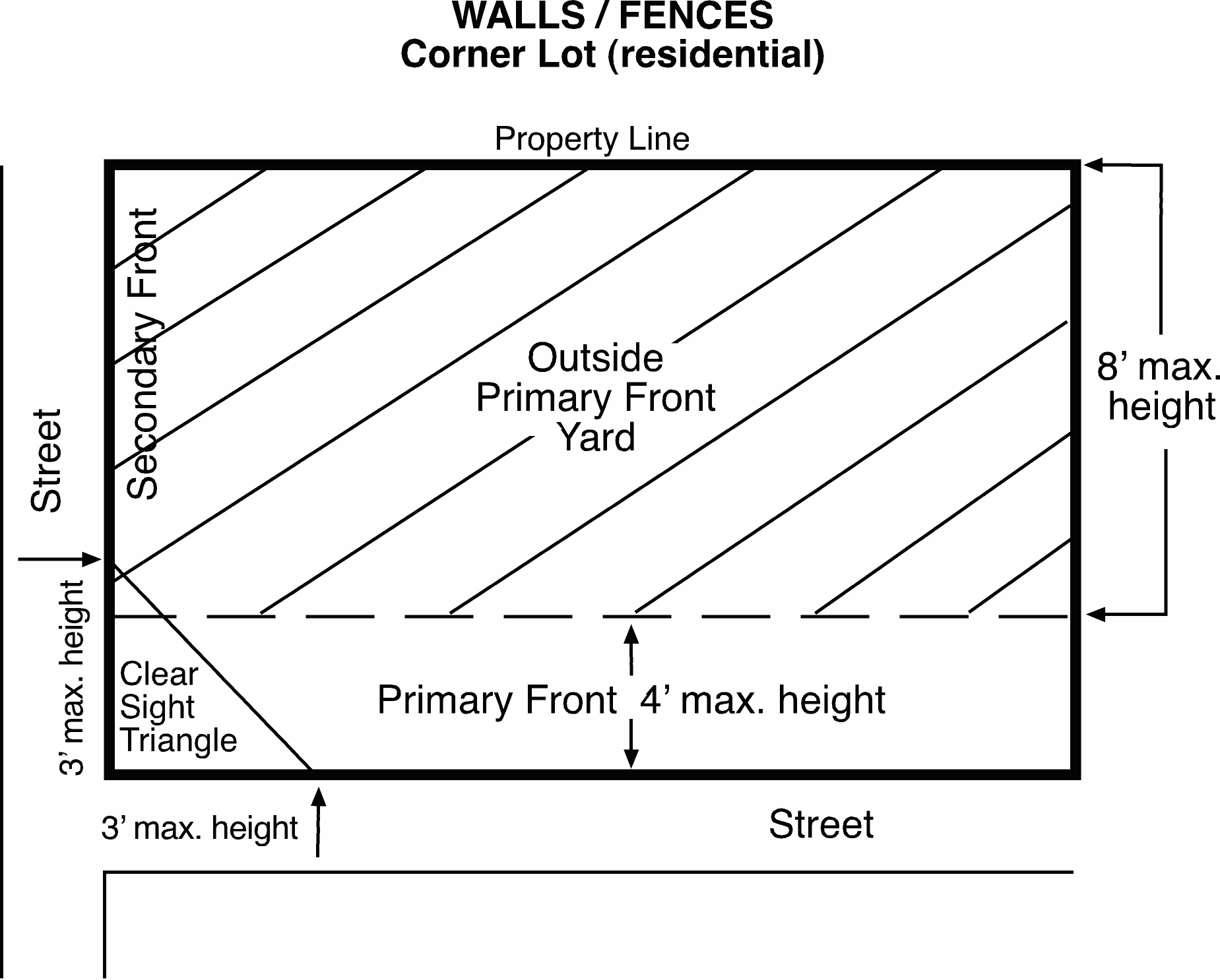
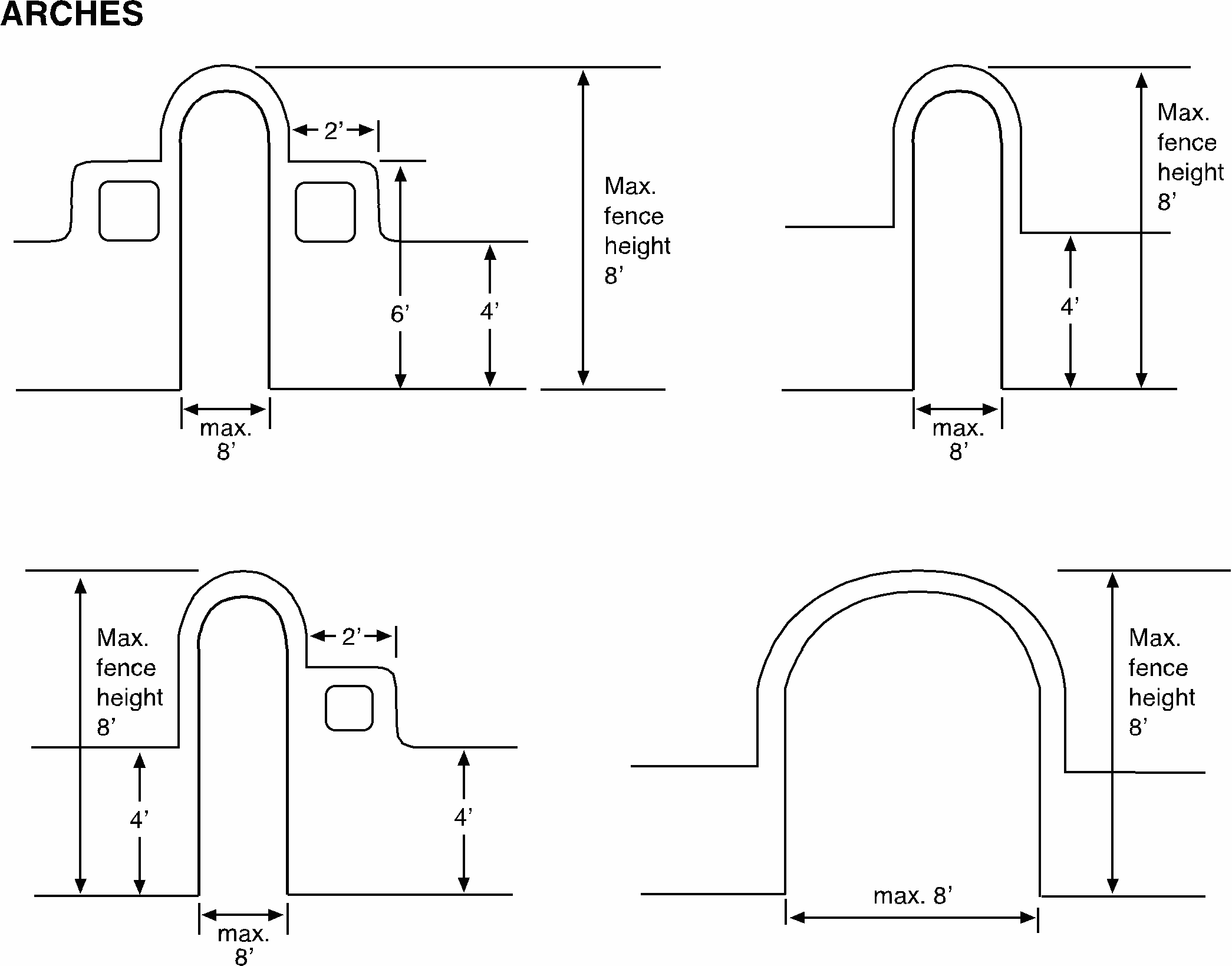
2.
Nonresidential land uses (regardless of the zoning district in which the land use is located):
a.
Required front yard: Six-foot maximum.
b.
Rear and side yard: Eight-foot maximum.
c.
Corner lots: A maximum height of eight feet shall be permitted on the secondary front yard, behind the primary required front yard setback. However, clear sight triangle requirements shall be met.
3.
The height measurement of a wall or fence, including a retaining wall, shall be made on the side of the wall or fence at the lowest non-artificially raised grade level. In cases of topographic variations, the grade average shall be used for wall/fence height measurement. The Community Development Director or designee may grant height adjustments in unusual physical property situations, e.g., substantial topographic variations.
D.
Retaining wall requirements. Retaining wall requirements are found in the city design standards, chapter 32. The proposed retaining wall design shall be submitted by the property owner/applicant to the community development department for approval consideration.
E.
Clear sight triangle limitations. All clear sight triangle requirements can be found in chapter 32, article VI of the Municipal Code.
F.
Specific wall/fence types requirements.
1.
Barbed wire and other similar types of containment wire:
a.
Permitted only when located at least six feet above the highest adjacent ground surface and will be included in the overall measurement of the fence or wall (See drawing below).
b.
Permitted only in holding, flood control, EE, RE, REM, O-2, C-2, C-3, M1/M2, and M-3 zoning districts.
c.
Barbed wire and other similar types of containment wire, e.g., horse wire, "no climb" wire, and access-prohibiting wire in EE and REM zoning districts, on airport property or along interstate highways is permitted at any height, up to eight feet.
d.
Barbed wire and other similar types of containment wire shall not be permitted in the required front yard of any property. The exceptions shall be fencing for utility substations, agricultural-related uses and equestrian-related uses.
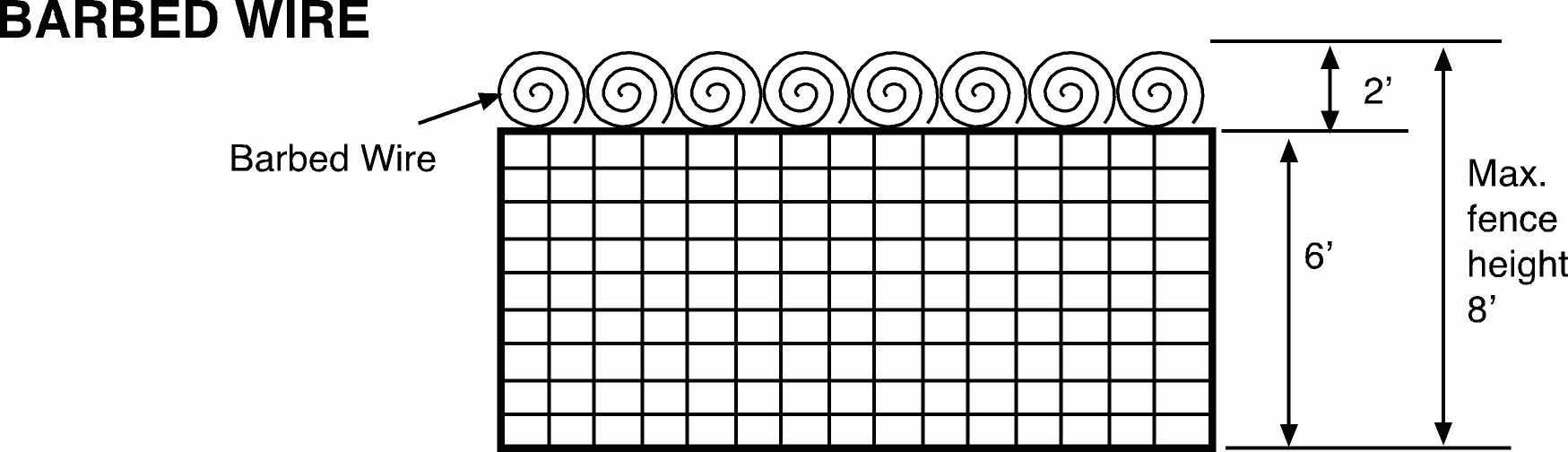
2.
Swimming pools, whirlpools, hot tubs, and other similar structures:
a.
All water recreational structures, except commercial or public swimming pools, shall be completely enclosed by a wall or fence at least four feet in height. A minimum four-foot fence or wall completely enclosing the entire yard or portion thereof where the structure is located will satisfy this requirement. All gates in fences shall be self-closing and equipped with self-latching devices.
b.
For commercial or public swimming pools, a protective fence or wall no less than six feet in height shall be provided which completely encloses the pool area, and the pool shall be no closer than 25 feet from any property line. All gates in fences shall be self-closing and equipped with self-latching devices.
c.
All other building permit code requirements for the construction of swimming pools and other similar structures shall be met.
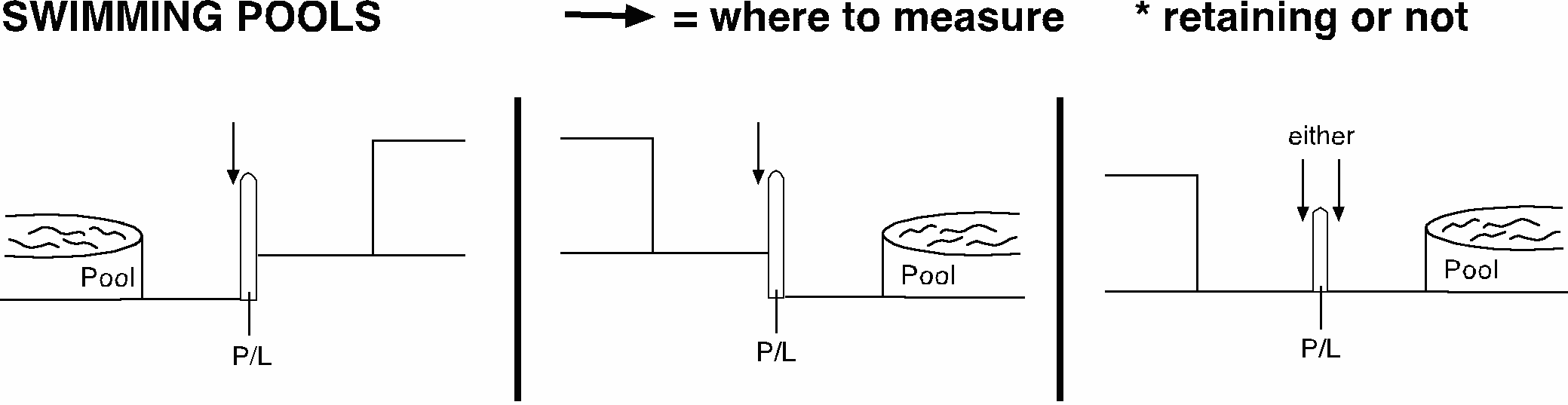
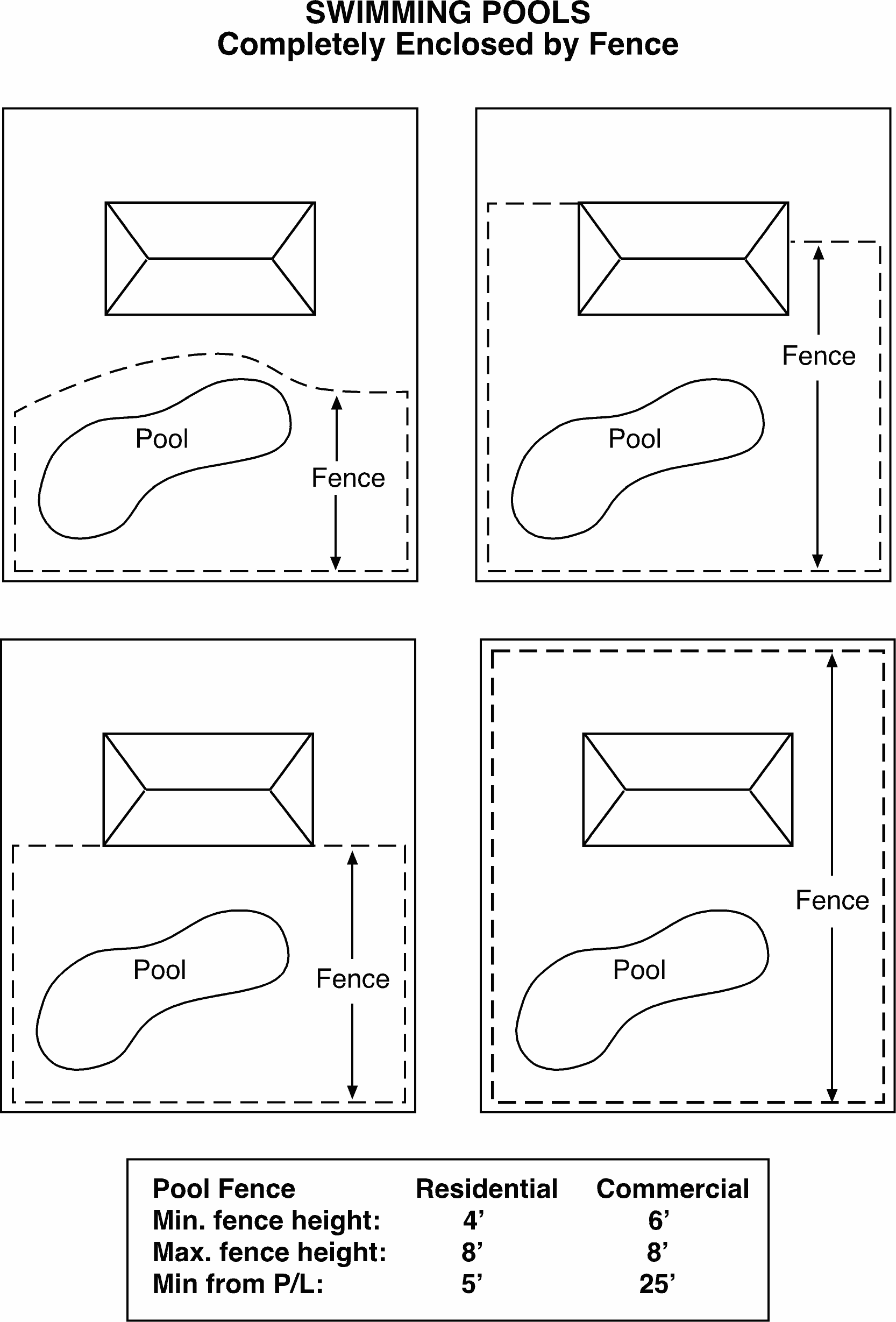
3.
Right-of-way/easements:
a.
No wall or fence shall be permitted in a public right-of-way or easement, unless an encroachment agreement is obtained and approved by the city's right-of-way coordinator.
b.
If written approval of the governing agency, affected utility or individuals is obtained, a wall or fence may be placed on an easement.
4.
Common wall or fence:
a.
A common wall or fence shall not be structurally altered in any manner without the written consent of adjacent property owners who share ownership of the wall or fence.
b.
Written consent must be submitted at the time of request for a building permit.
5.
Tennis courts, batting cages, golf driving ranges, golf course or other similar uses:
a.
Maximum height of 16 feet.
b.
The fence or wall shall not be permitted between the front property line and the required front yard setback of the property.
c.
Golf driving ranges and golf courses may be granted a height above 16 feet by the Community Development Director or designee to protect the public and property. Subparagraph 5.b does not apply to golf driving ranges or golf courses.
(Ord. No. 2354, § I, 1-22-07; Ord. No. 2699, § III(Exh. B), 11-18-13)
Sec. 38-61. - Urban design requirements for residential and other development.
A.
Residential development—Purpose and intent. The purpose of this section is to provide urban design standards for residential development within the city. These urban design standards may include, but are not limited to, site design and building styles. The standards are intended to ensure functional, appealing and attractive neighborhoods throughout our community.
1.
Applicability. All new single-family residences, whether site-built, modular or manufactured housing, are required to meet the residential urban design standards found within this section.
2.
Process and appeal. The applicant will submit detailed elevations and floor plans at the time of building permit submittal. Applicants will be required to sign a disclosure statement to ensure that the proposed project is compatible with adjacent properties according to selected design strategies chosen and noted on the disclosure statement by the applicant. Those wishing to utilize the city's over-the-counter permitting process will be required to sign an additional disclosure stating that the applicant shall bear the sole responsibility for compliance of all applicable rules, regulations, and codes, including this section, involved in the proposed building project. Community development department staff will review plans to ensure that the application, at minimum, meets the intent of this Code. Should an applicant disagree with the determination of the plan reviewer, an appeal may be filed in writing within 15 calendar days of the determination to the Community Development Director or designee. If an agreement between the community development department and the applicant cannot be reached, an appeal may then be filed within 15 calendar days of that determination to the Planning and Zoning Commission. The Community Development Director or designee has the authority to allow flexibility in design when dealing with unusual situations provided that a project meets the spirit and intent of the goals, objectives, and policies found in the 1999 City Comprehensive Plan and Urban Design Element.
3.
General design requirements. Community development department staff shall use the standards found in this section for the purposes of design review to ensure compliance with the intent of this Code.
a.
Site design/architectural design: In order to promote a variety of housing design styles in the city and as a means of providing visual interest and avoiding monotony, the city prohibits repetitive housing facade designs that are located adjacent to one another. As such, adjacent housing facade designs must, at minimum, differ from one another by at least four of the following nine design options (exception: residential units which are attached by at least one common wall will not be considered adjacent units for purposes herein stated). Following the required site design/architectural design standards for residential developments that are completely gated/walled (with the result of being screened from general view) and contain private roadways for interior circulation will be determined on a case-by-case basis by the Community Development Director or designee.
1)
Surface material;
2)
Color of house;
3)
Reversed floor plans;
4)
Roofing styles;
5)
Variation in building heights;
6)
Ornamental fixtures (e.g., Vigas, portales, latias);
7)
Location and shape of windows and doors;
8)
Variation in front yard patios, walls, garages, etc.;
9)
Variation in front yard setbacks. A minimum five-foot variation must be used to qualify for this item. All setback requirements as determined by zoning district still apply in this instance.
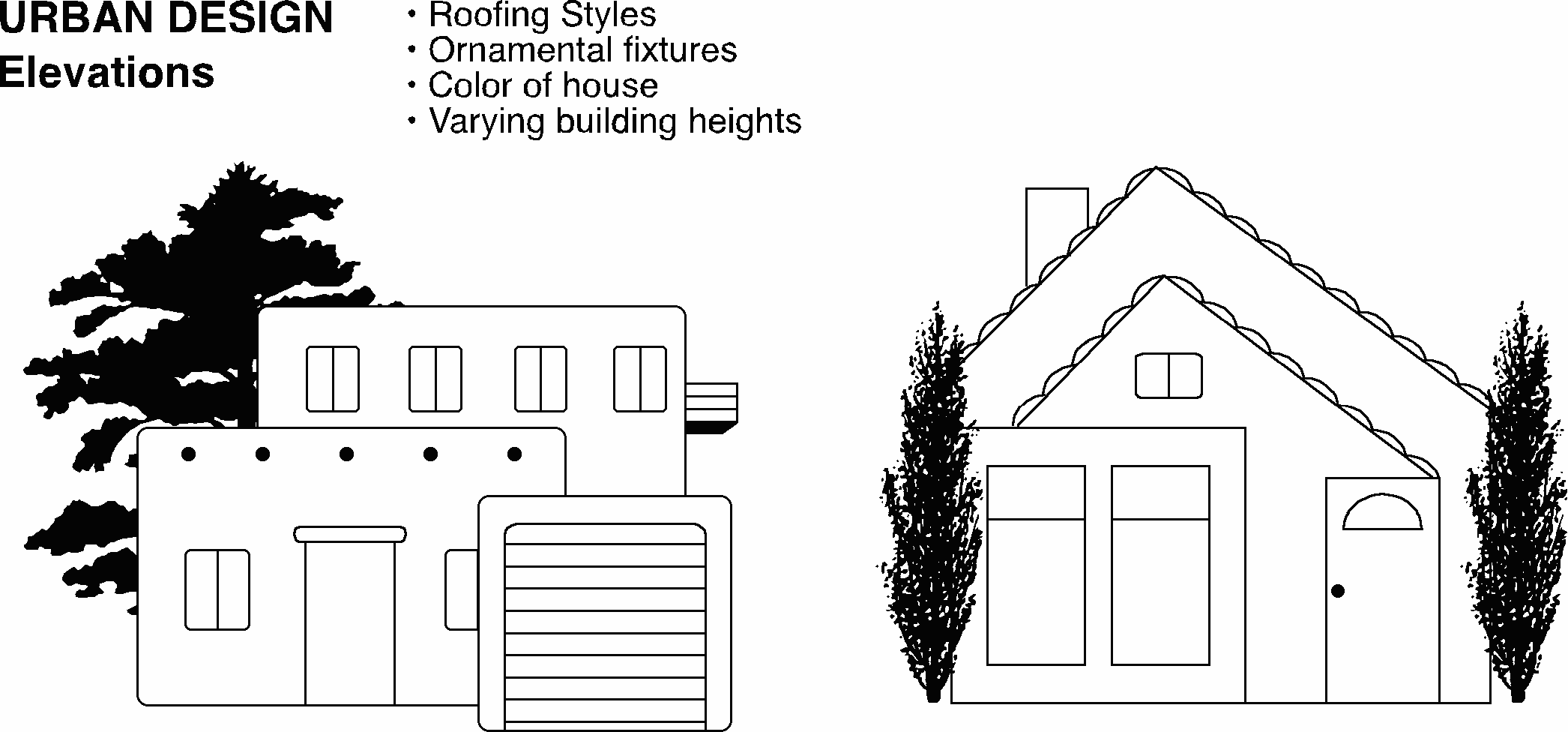
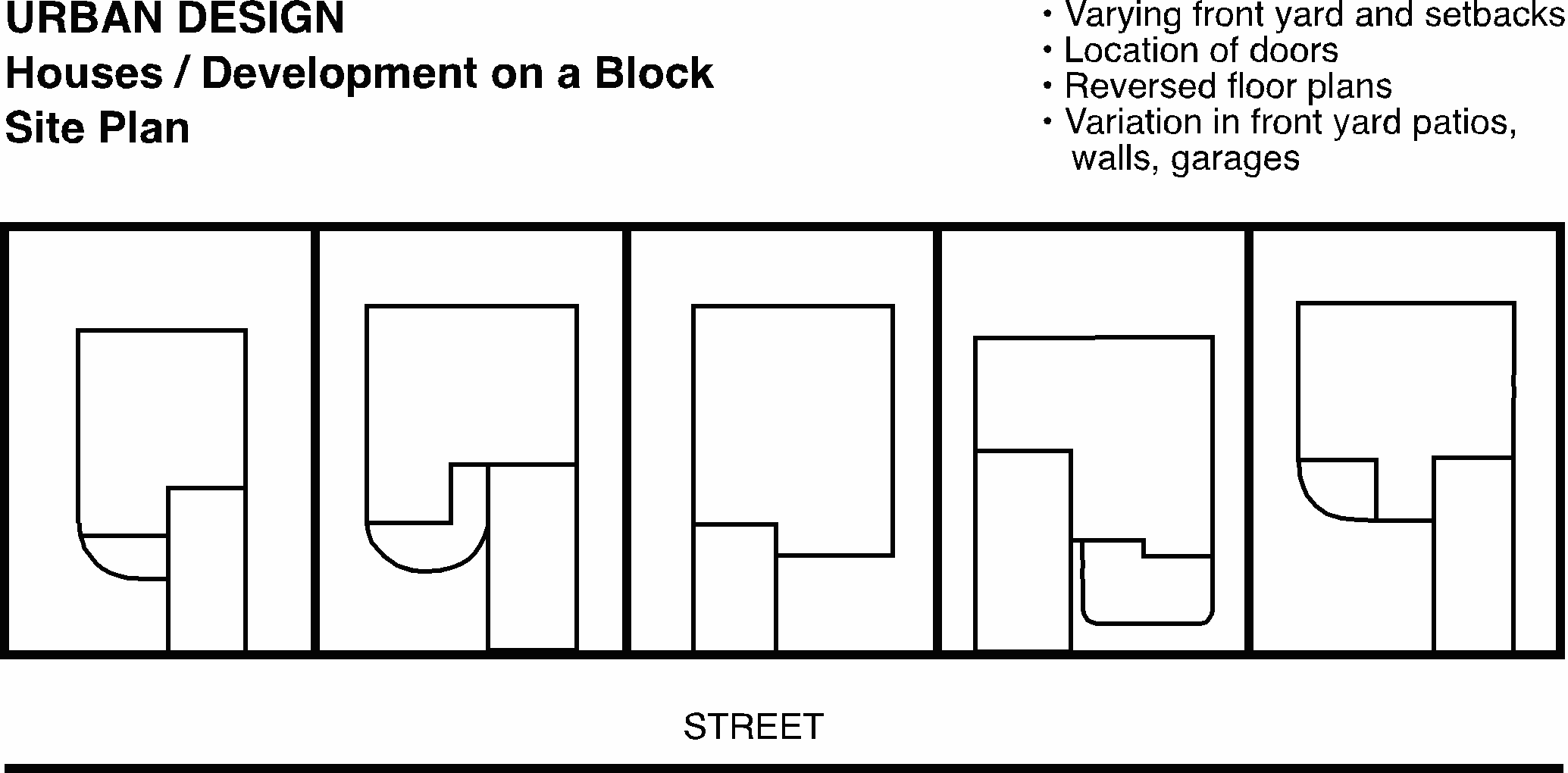
B.
Other development—Purpose and intent. The purpose of the latter part of this section is to provide urban design standards for all types of development located within R-2, R-3, R-4, O-1, O-2, C-1, C-2, C-3, and M1/M2 and M-T zones in the city. Urban design standards may include, but not be limited to, site design, landscaping, buffering, screening, building color, building style, construction materials, lighting, and signage. These standards are intended to assist in creating an all-over aesthetically pleasing and attractive environment throughout our community. Additionally, as the city's mixed use policy establishes and integrates a mix and variety of land uses within the city, these standards will play a continued role as they aid in mitigating potential negative impacts generated by higher land use intensities adjacent to lower land use intensities. These standards are also intended to provide for originality, flexibility, and innovation in site planning and development.
These requirements apply to all new construction and exterior remodeling throughout the city in the appropriately designated zones. In instances of mixed-land uses and/or in the case of rezoning property, it may be necessary to meet additional requirements as found in matrix 1.
1.
Applicability.
a.
Properties that are required to meet all of the urban design standards found within this section are as follows:
•
All new building construction located in R-2, R-3, R-4, O-1, O-2, C-1, C-2, C-3, M-T, and M1/M2 zones.
b.
Properties that are required to meet the urban design standards regarding screening, buffering, and landscaping standards found within this section/chapter are as follows:
•
All new parking lots (aside from resurfacing).
•
All outdoor storage and display areas.
c.
Properties with M-T, M1/M2 and M-3 designations are required to follow front facade treatments, streetscape, buffering, and parking lot standards.
2.
Process and appeal. The applicant will submit detailed elevations and a color scheme at the time of building permit submittal. Community development department staff will review plans to ensure that the application, at minimum, meets the intent of this Code. Should an applicant disagree with the determination of the plan reviewer, an appeal may first be filed with the Community Development Director or designee. If an agreement between the community development department and the applicant cannot be reached, an appeal may then be filed to the Planning and Zoning Commission within 15 calendar days of receiving said judgment.
The community development department realizes that some applicants may not be able to meet one or more provisions due to a physical hardship of the subject property. Examples may include constraints due to topography or the size of the subject property. In such cases, the applicant may prove this supposition to the Community Development Director or designee in order to have particular requirements waived. Once again, should the applicant disagree with the judgment of the Community Development Director or designee, the applicant may file an appeal to the Planning and Zoning Commission within 15 calendar days of receiving said judgment.
3.
General design requirements. Community development department staff shall use the standards found in this section for the purposes of design review to ensure compliance with the intent of this document.
a.
Site design: In order to promote an attractive streetscape in and around the city, a building's site design shall be governed closely. As such, regulations governing the views from public right-of-way, backs and sides of buildings, parking areas, and the placement of mechanical equipment, dumpsters, and loading docks/bays have been established.
1)
Building orientation. One means of providing an attractive streetscape for both vehicular and pedestrian traffic is to direct the placement of a building on a parcel of land and to prohibit a large expanse of blank walls on the buildings/structures where viewed from public right-of-way.
a)
The position and location of the building itself on a particular parcel of land plays a large role in the look and feel of an area. In order to assist in supporting an interesting and pleasant environment, developments that are not oriented towards the primary frontage property line shall be required to be designed to invoke the impression/image of a front entrance. Architectural features used to comply with this requirement may include, but are not limited to: recesses, projections, wall insets, arcades, window display areas, awnings, balconies, window projections, landscape structures and other features that complement the structure's design and are acceptable to the reviewing authority.
b)
Architectural features must be included on all building walls that are immediately adjacent to city streets and/or residential areas. Architectural features used to comply with this requirement are noted in part 3.a.1)a) of this section (if a project is developing adjacent to vacant property, the vacant property's existing zoning will be used to determine wall detail requirements).
2)
Parking layout. Landscaping can contribute to the attractiveness and appeal of our community by de-emphasizing and softening the harsh look of large expanses of parking areas via visual screens and buffers. Visual screens and buffers may be achieved through the use of required landscaping, landscaping elements, garden walls, berms, hedges, and/or other landscaping features as directed in this section.
The city especially encourages those businesses that limit or avoid streetfront parking lots. As a means of supporting these businesses, it is possible to reduce building setbacks or other similar development standards. Please refer to section 38-56 for information regarding flexible zoning options, section 38-55 for information regarding planned unit development, or section 38-48 for further information regarding infill development.
At minimum, at least one of the following buffering techniques must be followed:
(1)
Landscaped buffer with berm.
(2)
Landscaped buffer with wall/fence.
(3)
Landscaped drainage pond.
3)
Other types of buffers. Service areas (loading docks/bays, dumpsters, etc.) and building and utility equipment are required to be screened and/or buffered to soften their overall impact and create a more aesthetically appealing environment.
a)
Dumpsters: Dumpsters shall be constructed of materials in terms of color, texture, physical style, and scale that are used in the main building with which the dumpster is associated. Dumpsters shall be screened by a wall on three sides and an opaque gate (for easy access) on the fourth side. The wall and gate must be a minimum of twelve inches higher than the lid of the open container/dumpster.
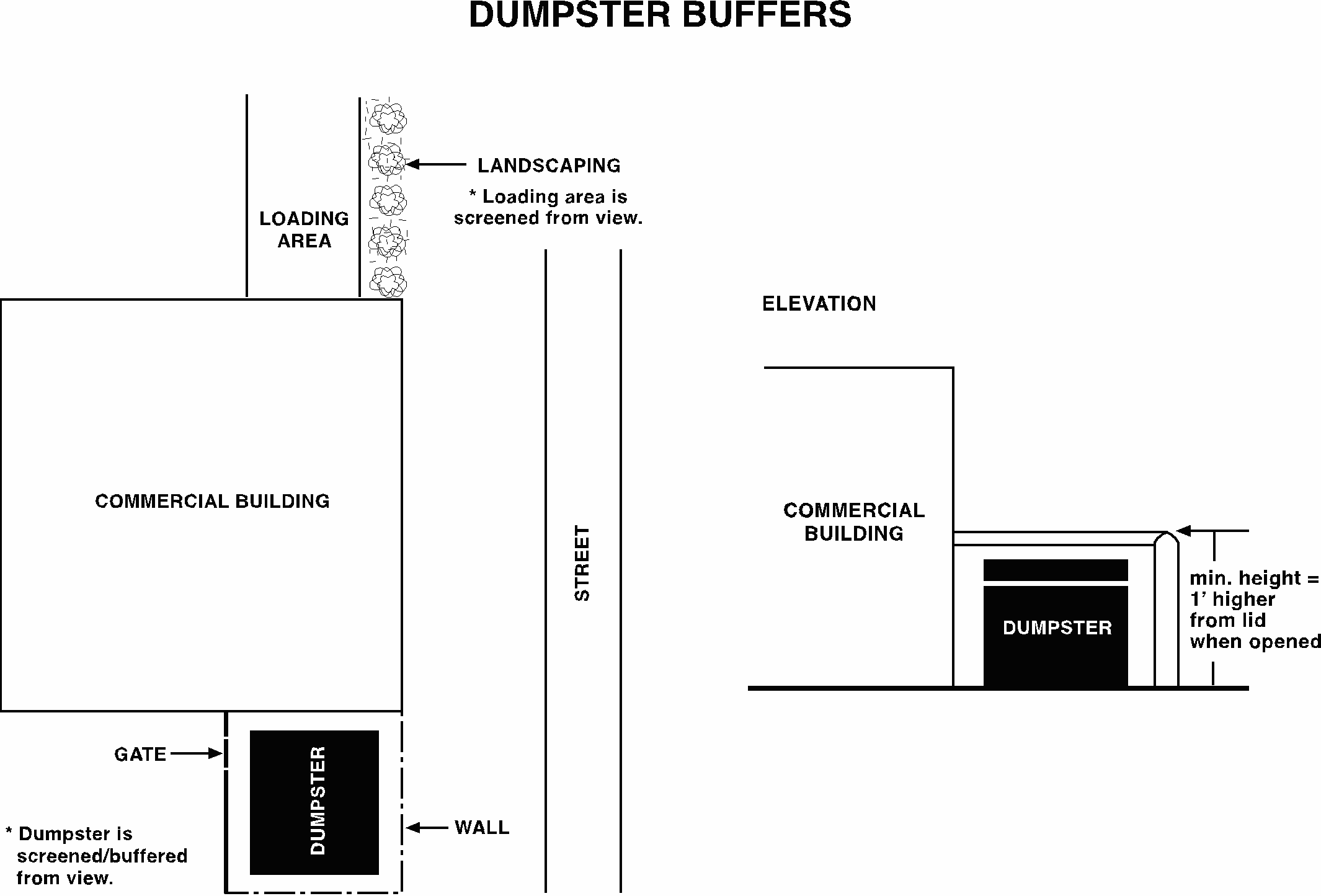
b)
Mechanical/utility equipment: Mechanical/utility equipment must be screened from view from all angles using landscaping or walls in a manner that conceals the equipment. Such screening must remain consistent with the landscaping and architectural character (especially in terms of color, physical style and scale).
When located on a rooftop or otherwise attached to the building, mechanical/utility equipment shall be screened from view through the use of building design elements such as varied roof height, parapets, etc. In instances where adjacent rights-of-way are significantly higher in elevation to adjacent properties, rooftop equipment should be screened to the best extent possible. When the chosen architectural style selected does not lend itself to using these techniques, such equipment must be shielded from view by an opaque screen that is treated in a manner that most accurately matches the look, design, and texture of the building to which it is attached.
Exterior mechanical/utility equipment mounted on building facades shall be prohibited unless used as an integrated architectural design feature and painted such a color as to blend in with their visual background and/or building to which they are attached.
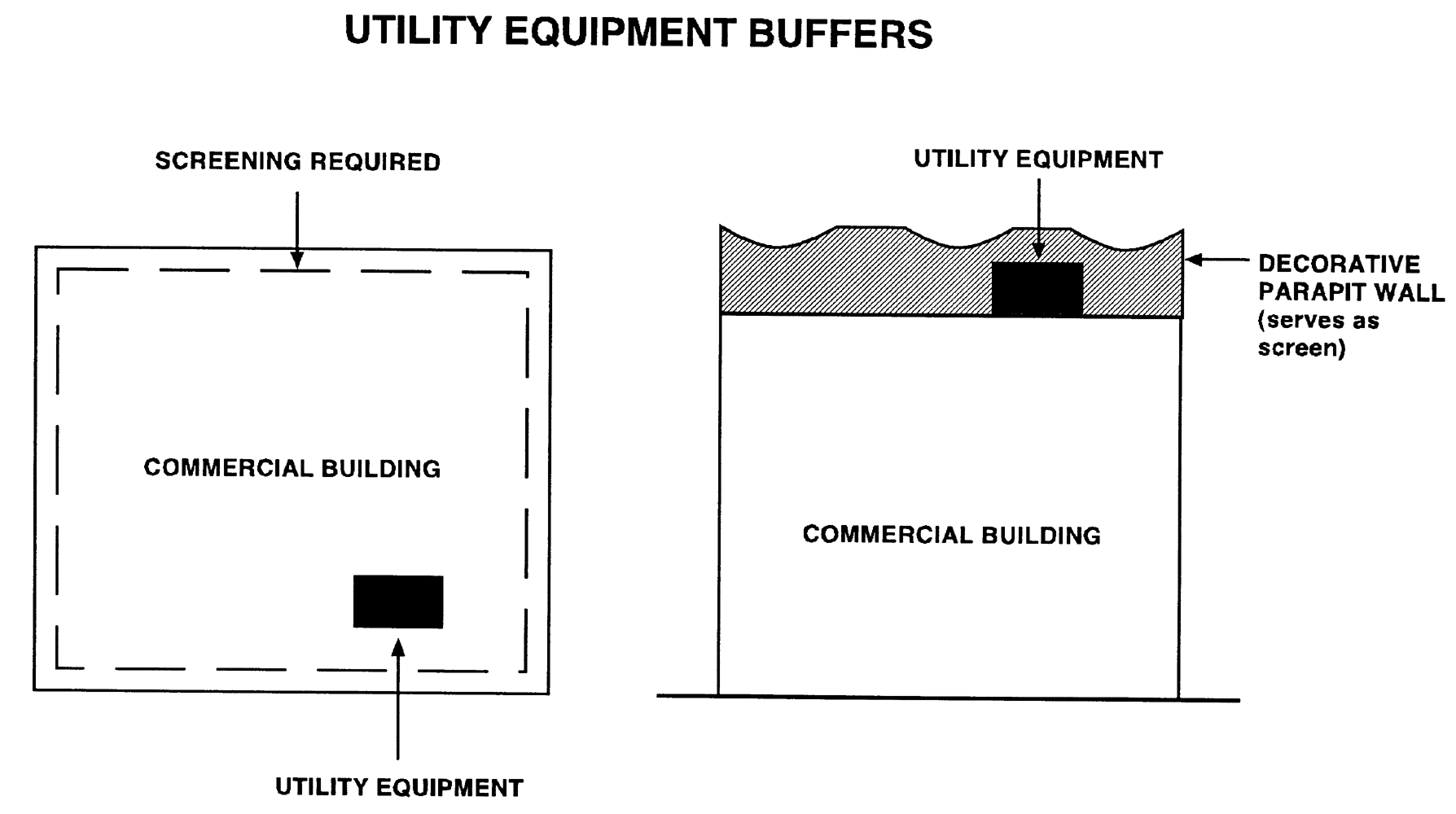
c)
Storage areas/bins: Any outside areas containing storage materials directly for sale or otherwise shall, at minimum, be fully enclosed on four sides and fully sight-obscuring. Outside storage areas/bins must be compatible with the architectural character of the development, especially in terms of color, texture, physical style, and scale.
d)
Loading and unloading docks/bays: Loading and unloading zones must be screened from the street via landscaping, walls, fencing, etc. Screening should be sight obscuring (semi-opaque at minimum) and a minimum of six feet in height.
e)
All stacking lanes/drive-up aisles (associated with a drive-up service) must be de-emphasized. Techniques to de-emphasize stacking lanes/drive-up include, but are not limited to, utilizing landscaping as a screen or placing lanes/aisles where they are not readily seen from streets and sidewalks.
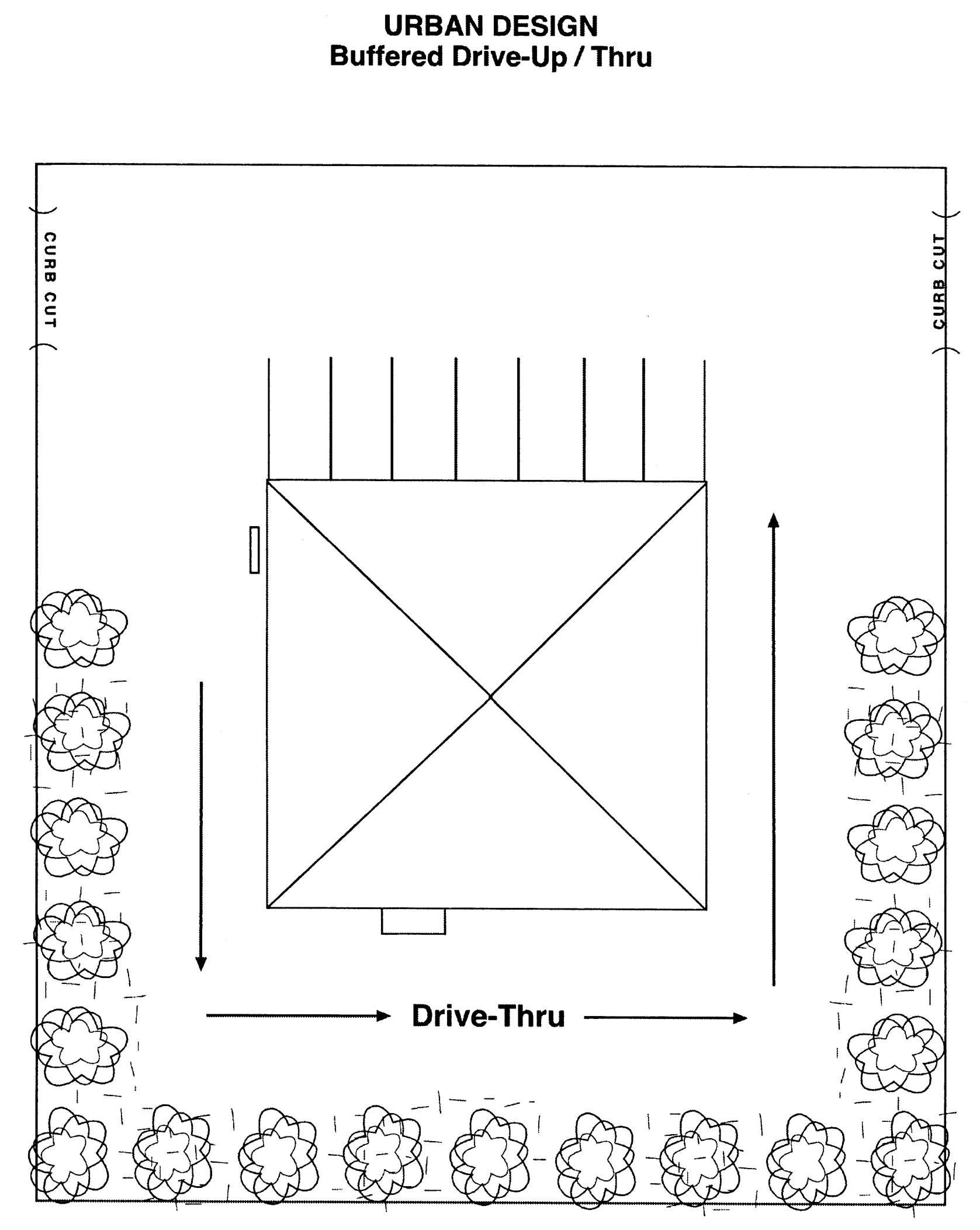
4)
Architecture/structural design. To promote an attractive image throughout the city, regulations regarding a building's over-all design must be followed.
a.
All structures must be both in scale and architecturally compatible with one another throughout a project. For instance, a gas station's canopies must be in scale with its associated service and/or retail area in addition to being in a compatible architectural style. Individual businesses within shopping centers must also create a common architectural style and scale.
b.
Reflective materials are prohibited (i.e., corrugated metal siding/roofs) unless an applicant can demonstrate architectural significance with respect to traditional southwestern styles of architecture, such as the Folk Territorial style utilizing metal roofing materials. Other exceptions may include metal roofing materials that are treated to prevent glare. The Community Development Director or building official may approve further exceptions.
c.
Rooflines shall be designed to reduce the apparent exterior mass of a building, add visual interest and be appropriate to the architectural style. Variations within one architectural style are required. Architectural methods, such as parapets, shall be used to conceal flat roofs.
d.
Accessory structures, playgrounds, etc. shall be secondary in emphasis to the main structure. The use of architectural characteristics in accessory structures shall mimic that of the primary structure. Playgrounds shall be contained within the primary structure.
e.
Chain-link fencing shall be prohibited on property lines adjacent to roadways with collector or higher designations.
f.
Walls that are constructed in individual projects that front along a particular street segment must provide continuity in design and compatibility in texture and color with adjacent projects along that particular street segment.
g.
A combination of trees, shrubs, climbing vines, and/or architectural features shall be employed along the periphery of all fences or walls to avoid the monotony of a large, blank surface.
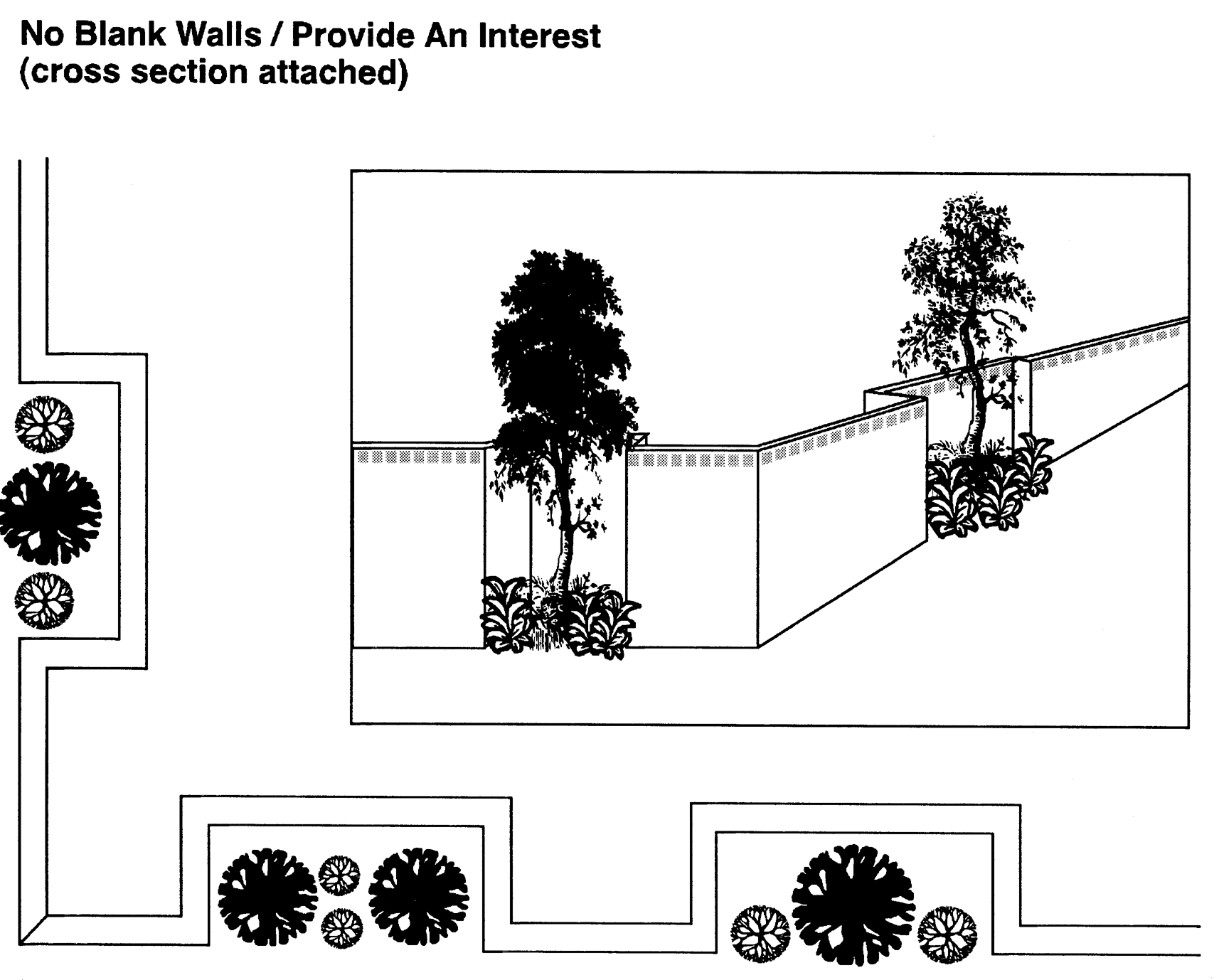
All developments are required to provide parking lot trees and landscaping. Please refer to chapter 32 (design standards) for further information.
4.
Nonconforming design. An existing structure that is altered/remodeled and results in a cumulative square footage increase greater than ten percent of the total gross floor area is required to adhere to the design requirements of this section. Said structures are also required to follow all other applicable nonconfoming provisions noted in article VII (nonconforming uses, structures, and properties).
(Ord. No. 2354, § I, 1-22-07)
Sec. 38-62. - Exceptions and modifications.
A.
Yard requirements and exceptions: Residential zoning districts. (Note: Also see staff interpretation No. 02-002 (Z) at the end of this section.) The following provisions shall apply to all development in a residential zoning district:
1.
Setback exceptions.
a.
A minimum side yard setback of zero feet shall be permitted for patio homes, provided all of the following requirements are met:
1)
The setbacks are on an entire side of a block as part of an approved subdivision;
2)
There shall be no less than ten feet between structures, as described below;
3)
All zero lot lines shall be on the same side of all lots except lots for townhouses.
4)
No building projection of any kind is permitted on the zero setback side of a lot; and
5)
No storm water shall drain onto the property adjacent to the zero lot line development and all storm water shall be retained in accordance with the city's design standards.
b.
New dwellings or additions to existing dwellings may be erected as close to a front property line as the average distance established by the existing dwellings that are within the required setback, provided that at least 40 percent of the lots on the same block face are developed.
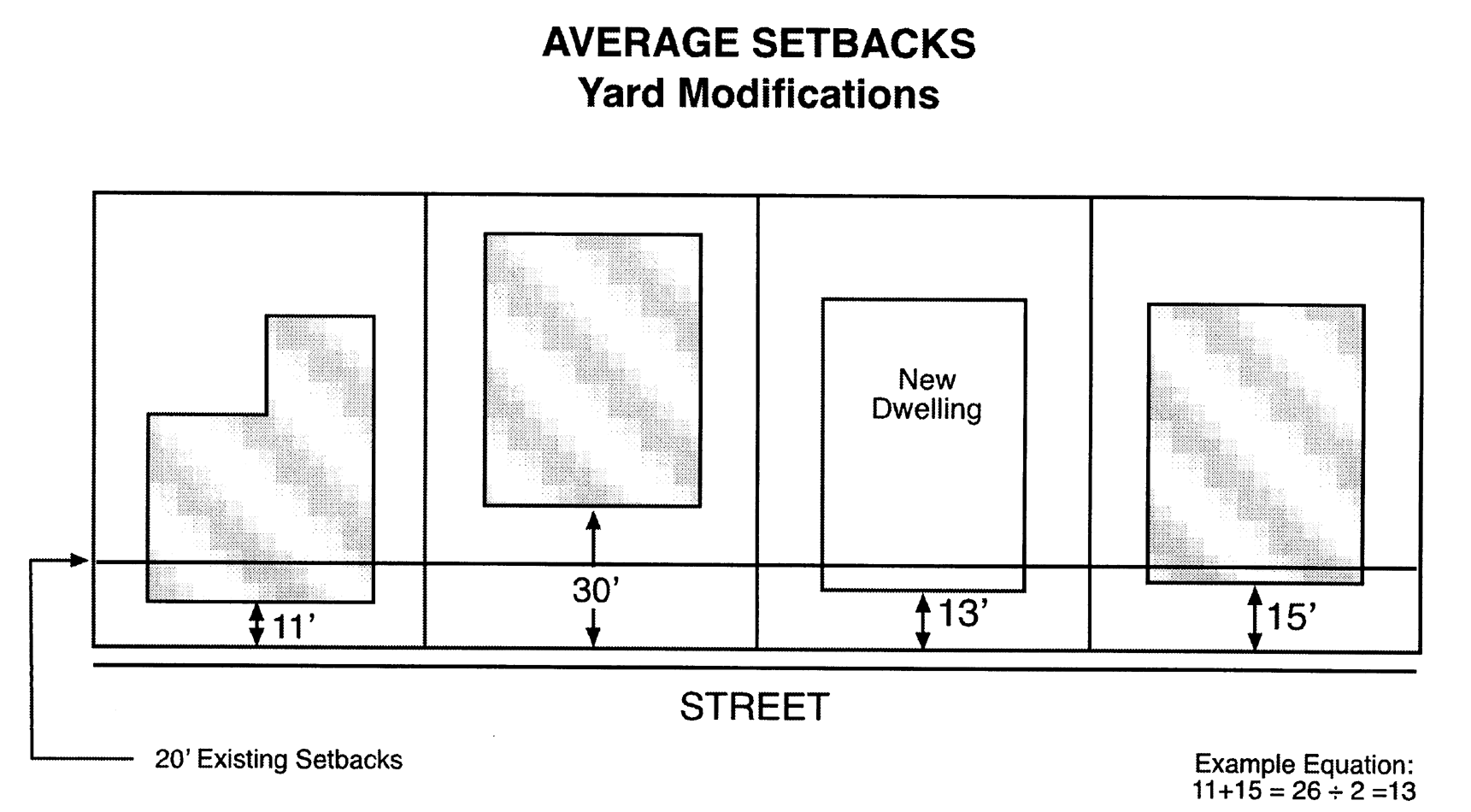
c.
A main dwelling, which has nonconforming setbacks and any other nonconforming property features, shall be permitted additions within the extension of existing building lines. Additions may not be larger than 50 percent of the main dwelling (see section 38-73.B.).
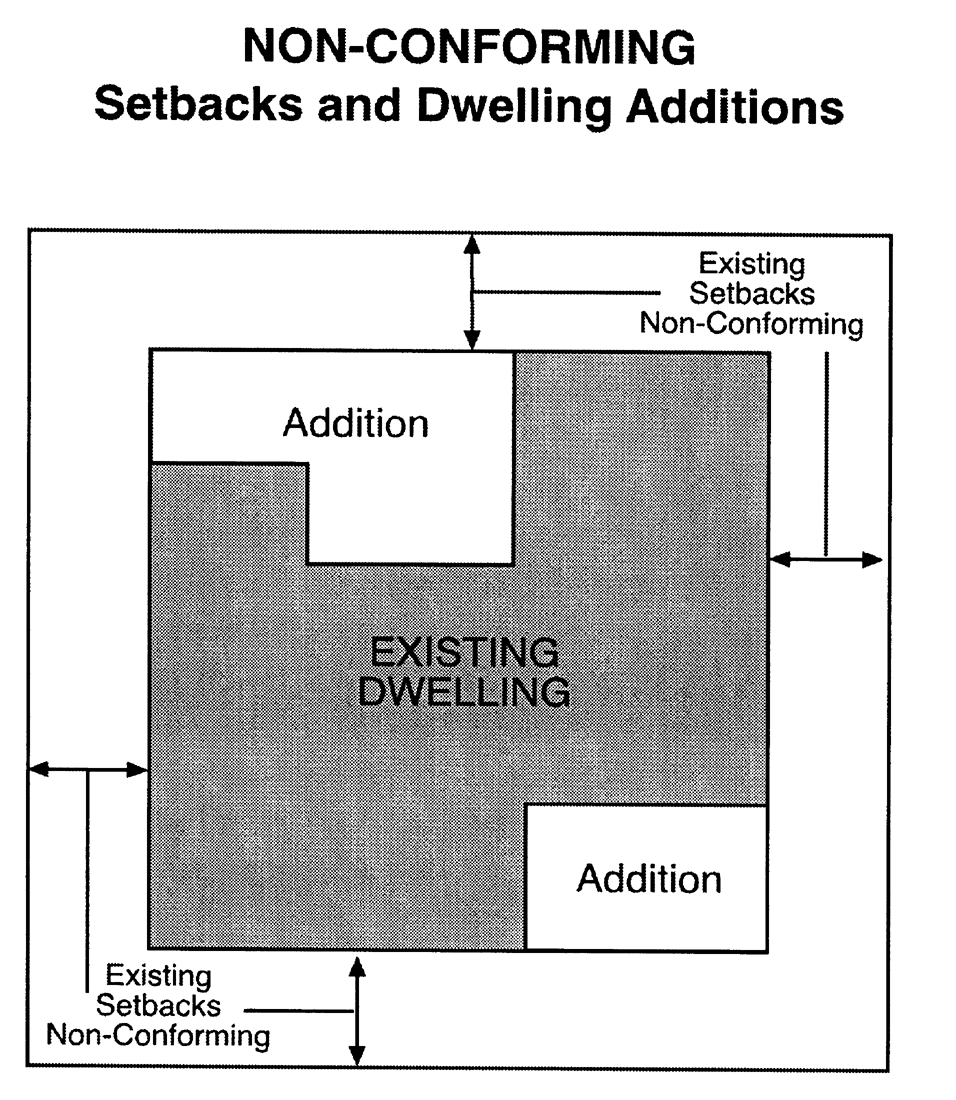
2.
Townhouse lots and area. The minimum front and rear yard lot lines for townhouses may be reduced to 24 feet, provided that no lot shall be less than 2,880 square feet in area. In addition, end units must meet side yard requirements of the zoning district in which they are located.
3.
Townhouse attachment requirements. A townhouse shall have at least one room of the house attached to the adjoining townhouse. One hundred percent of the wall length of that one room of the townhouse must attach to the adjoining townhouse. Any remaining room(s) that will not be placed on or attached along the shared property line shall maintain a minimum of ten feet of building separation between the adjoining townhouse. Room is defined as either habitable space in a structure used for living, sleeping, eating, or cooking (i.e., living rooms, bedrooms, dining rooms, and kitchens) or space not used for living, sleeping, eating, or cooking purposes (i.e., bathrooms, utility and storage space, and garages). Attached walls shall be appropriately fire walled and constructed in accordance with the adopted building code (see illustrations at the end of this section).
4.
Subdivisions permitting mobile homes. As an option to the development standards listed in section 38-31.D., the development standards for mobile homes found in section 38-57.A.3., mobile home parks/recreational vehicle parks, may be used to design a subdivision that permits mobile homes.
5.
Minimum dwelling/garage setbacks in R-1a, R-1aM, R-1b, and R-1bM residential zoning districts. When a garage door is located facing a side yard or secondary front yard and a garage wall is facing the front yard instead, it may be possible that the wall of the garage may follow a reduced front yard setback of 20 feet and not the 25 foot required front yard setback for garages if certain architectural criteria and driveway dimensions are met.
To utilize the reduced front yard setback of 20 feet, the side of the garage facing the front yard must look like an integral part of the primary dwelling unit. This may be accomplished by utilizing architectural features that are identical and/or complementary to the primary dwelling unit. Architectural details may include, but are not limited to, windows, window projections, awnings, recesses, and projections. Additionally, the centerline dimension of the driveway itself must be a minimum of 25 feet from the garage door to the property line regardless of whether the driveway is located within the primary or secondary front yard or both. The Community Development Director or designee shall determine if the garage's architectural design and length of driveway meet the intent of this provision.
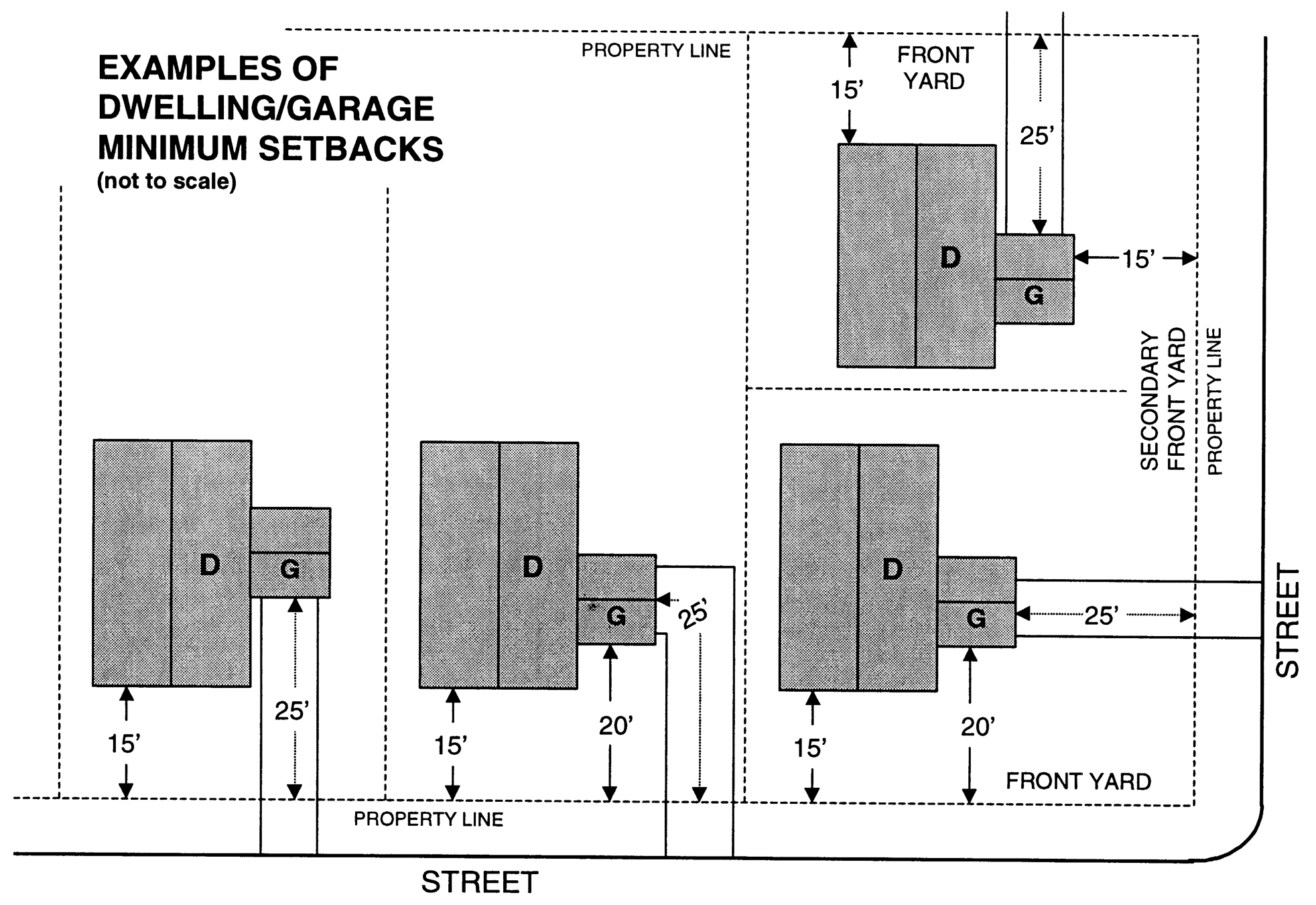
B.
Yard requirements and exceptions: office, commercial and industrial zoning districts. The following provisions shall apply to all developments, including residential and the associated accessory uses and accessory structures, in an office, commercial, or industrial zoning district.
1.
Setback exceptions.
a.
A zero foot side yard and/or rear yard shall be permitted only when:
1)
A building on the abutting side is at least five feet from the property line; or
2)
Both buildings share a common wall on the property line; or
3)
When the abutting property is undeveloped; and
4)
No building projection of any kind is permitted; and
5)
No storm water is permitted to drain onto the adjacent property and shall be retained in accordance with the city's design standards.
Otherwise, the setback distance listed in the development standards table 38-32.D. shall apply.
b.
Industrial, commercial or office developments that abut railroad tracks shall not be required to set back from such tracks if designed to have docking facilities for railroad cargo or passengers.
C.
Modifications and exceptions: all zoning districts. (Note: Also see Staff Interpretation No. 02-002 (Z))
1.
Setback exceptions.
a.
A 15-foot setback shall be permitted on one front yard of corner lots and double frontage lots and on two front yards of triple frontage lots.
b.
Setbacks for odd-shaped lots shall be determined by the Community Development Director or designee.
c.
Setback requirements as shown on plats filed after the effective date of this Code, which are more restrictive than the zoning code setback requirements, shall be applied.
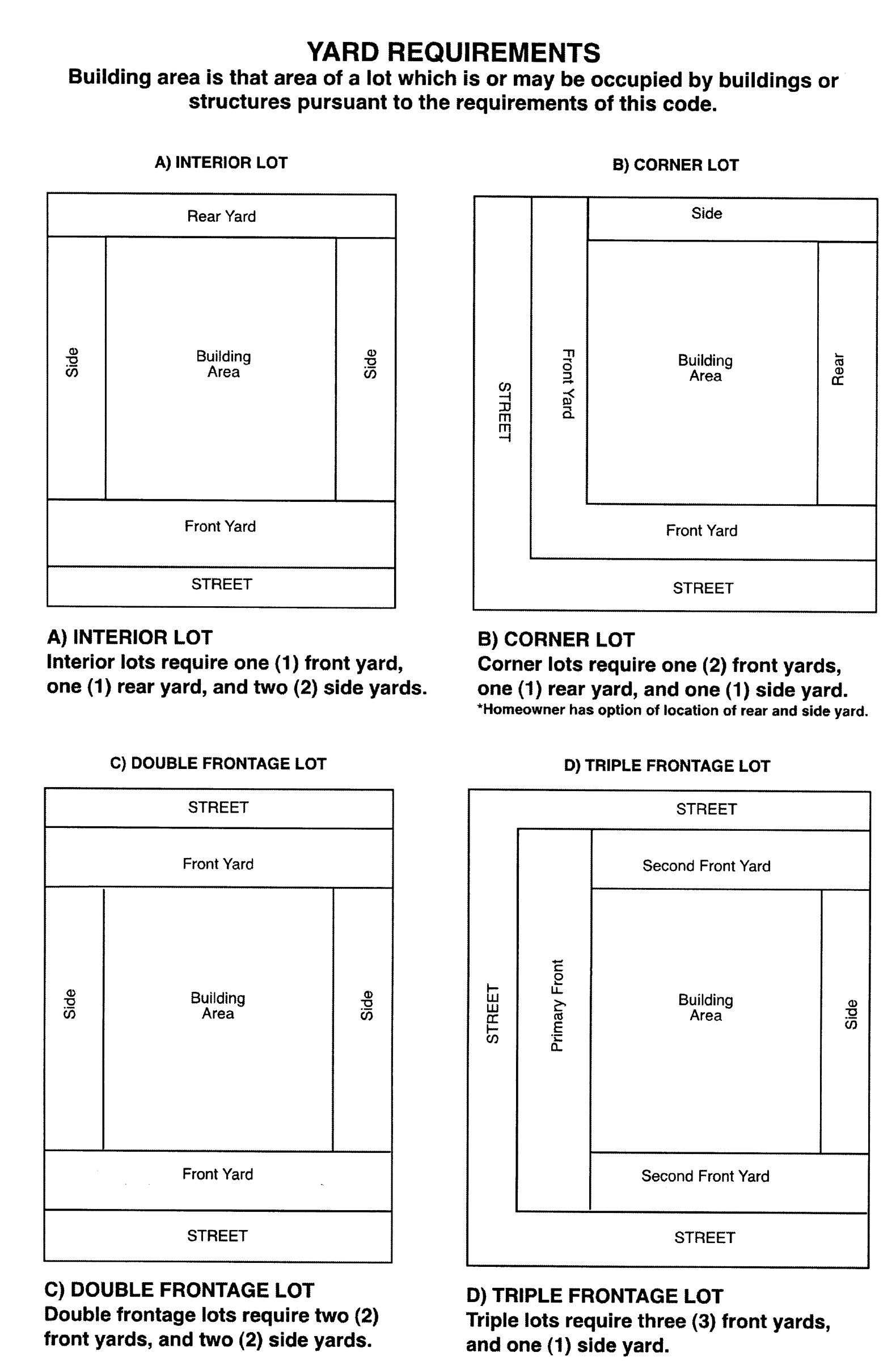
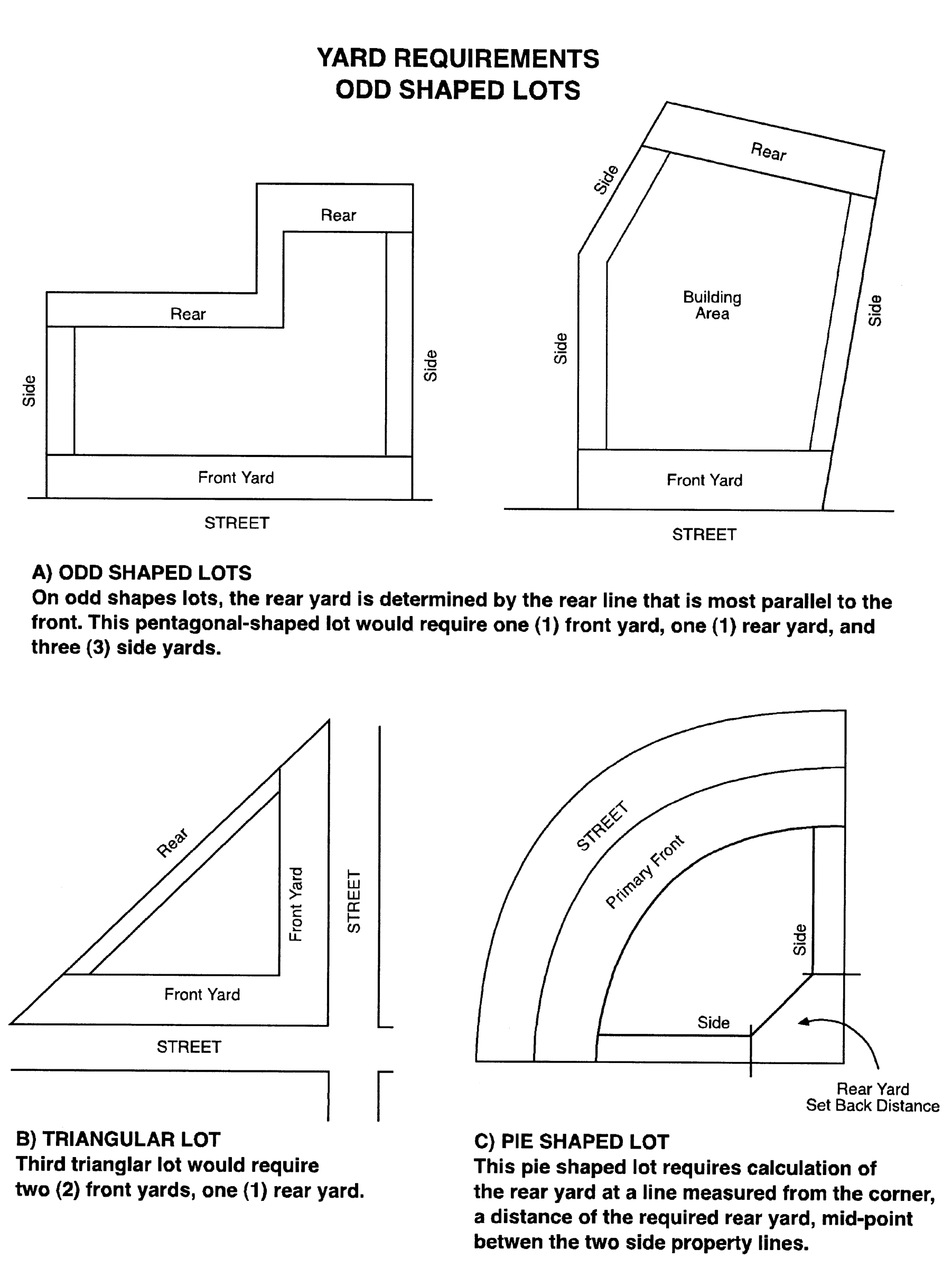
2.
Building projections. There shall be no structure in a required setback, except as permitted elsewhere in this Code (see section 38-51, accessory uses and structures, section 38-59, antennas, towers, communication structures and other vertical structures, and section 38-60, walls and fences). The ordinary projection of, for example, sills, scuppers, cornices, ornamental features, roof overhangs, fireplace chimneys, buttresses and wing walls shall not extend into the required setback area.
3.
Minimum distance between structures. There shall be no less than ten feet between buildings or structures as measured from the wall of one structure to the wall of the other structure, including accessory buildings and structures, located on the same lot, tract, or parcel. However, the ordinary projection of sills, cornices, ornamental features, roof overhangs, fireplace chimneys, buttresses and wing walls may be within the ten feet, but shall not exceed a total of four feet for both structures.
4.
Right-of-way/easement encroachments. There shall be no permanent structures located on right-of-way or easements without written approval of the governing agency.
5.
Cul-de-sac. The minimum width of a front yard lot line on a cul-de-sac shall be 40 feet, provided there shall be a minimum width of 60 feet at the front of the building nearest to the front property line. The exception for townhouse lots on a cul-de-sac permits the front yard lot line and front yard setback line to be a minimum of 24 feet.
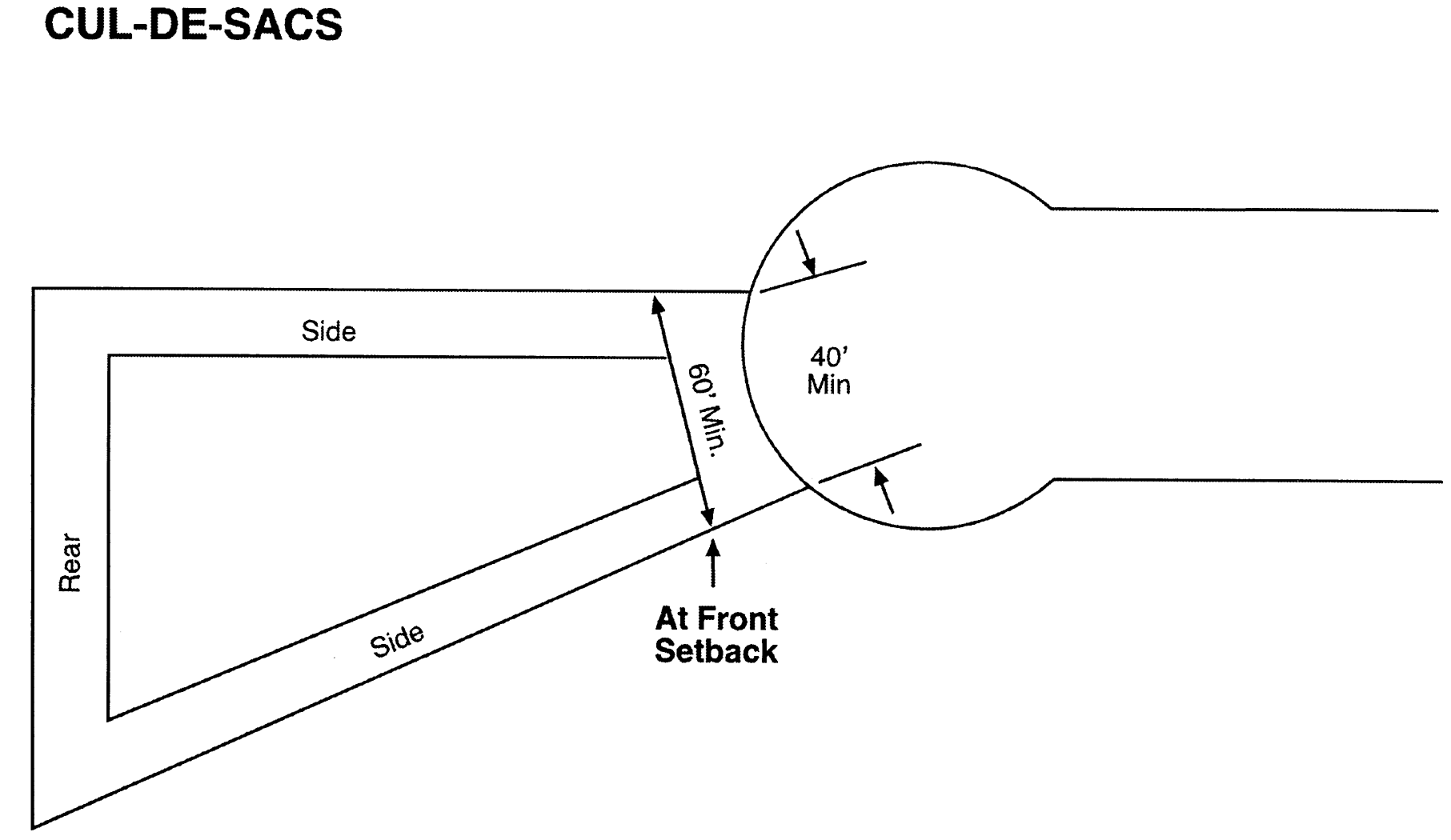
6.
Flag lot regulations. A flag lot may be permitted for the following reasons:
a.
Encouraging infill development,
b.
Preserving natural site features,
c.
Developing otherwise land-locked areas,
d.
Prohibiting single-family/duplex driveway access to a collector or higher designated roadway, or
e.
Improving development design.
A flag lot shall meet the minimum lot size requirements of the zoning district exclusive of the size of the private access way. Flag lot width-depth and front-rear-side yard setbacks of the flag portion of the flag lot shall be established by the development review committee (DRC) at the preliminary plat stage consistent with the intent of the development standards for the zoning district within which the property is located.
Private access way requirements:
1)
When serving a single-family dwelling or a duplex, the private access way shall have a minimum width of 12 feet and a maximum length of 150 feet.
2)
When more than two dwelling units, multi-family development, and/or any nonresidential development are proposed on a private access way, the private access way shall have a minimum width of 24 feet and a maximum length of 150 feet and shall be paved meeting the city's design standards.
The DRC may grant a waiver to these standards. Appeal of a DRC decision may be made to the Planning and Zoning Commission as part of the consideration of the preliminary plat.
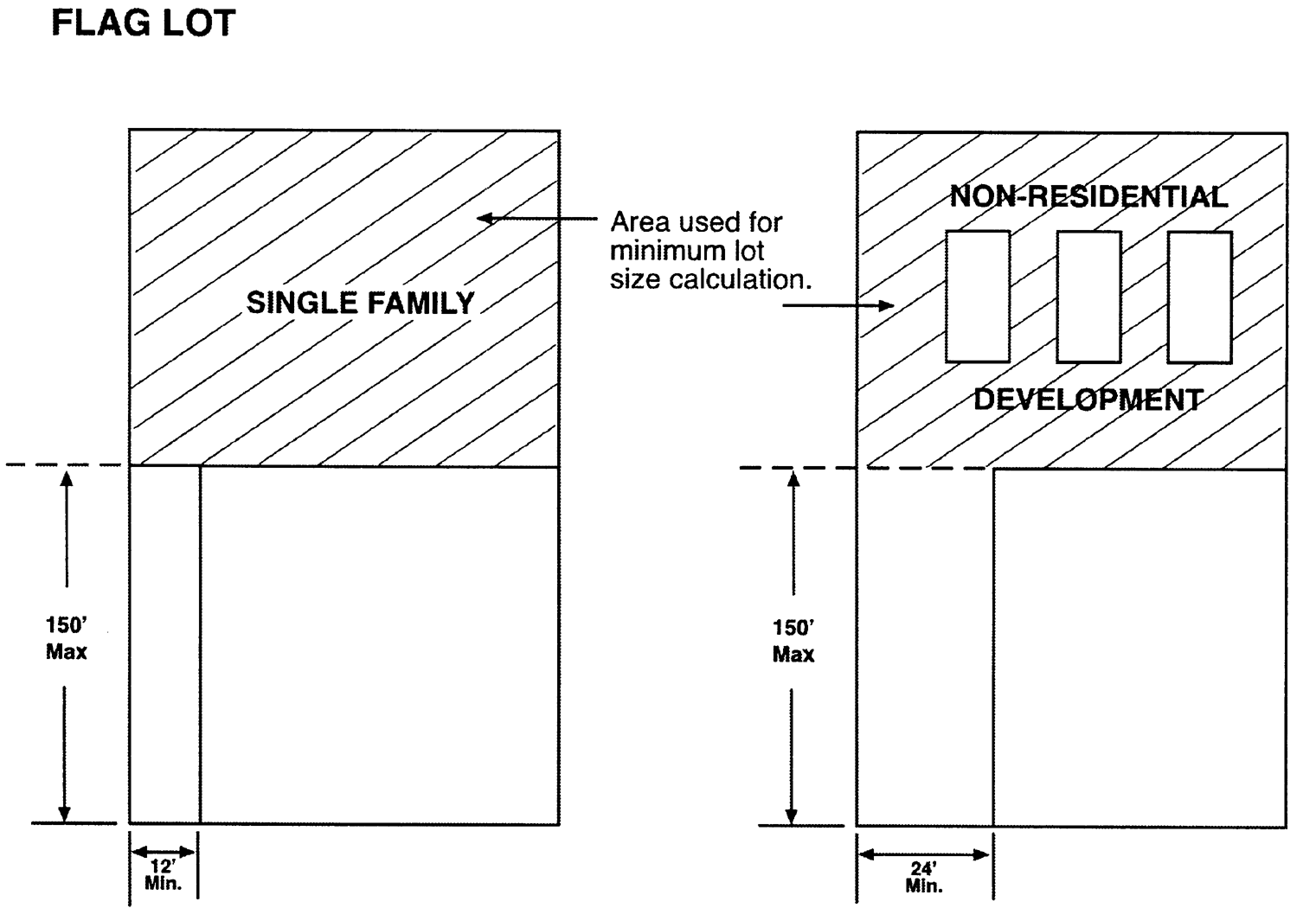
7.
Status of the provisions of this section. Any two or more exceptions or modifications in this section may be applied to a property. Any provision in this section shall supersede any more restrictive provision in any other section of this Code. Where any two or more provisions in this section conflict, the Community Development Director or designee shall determine the appropriate provision to apply.
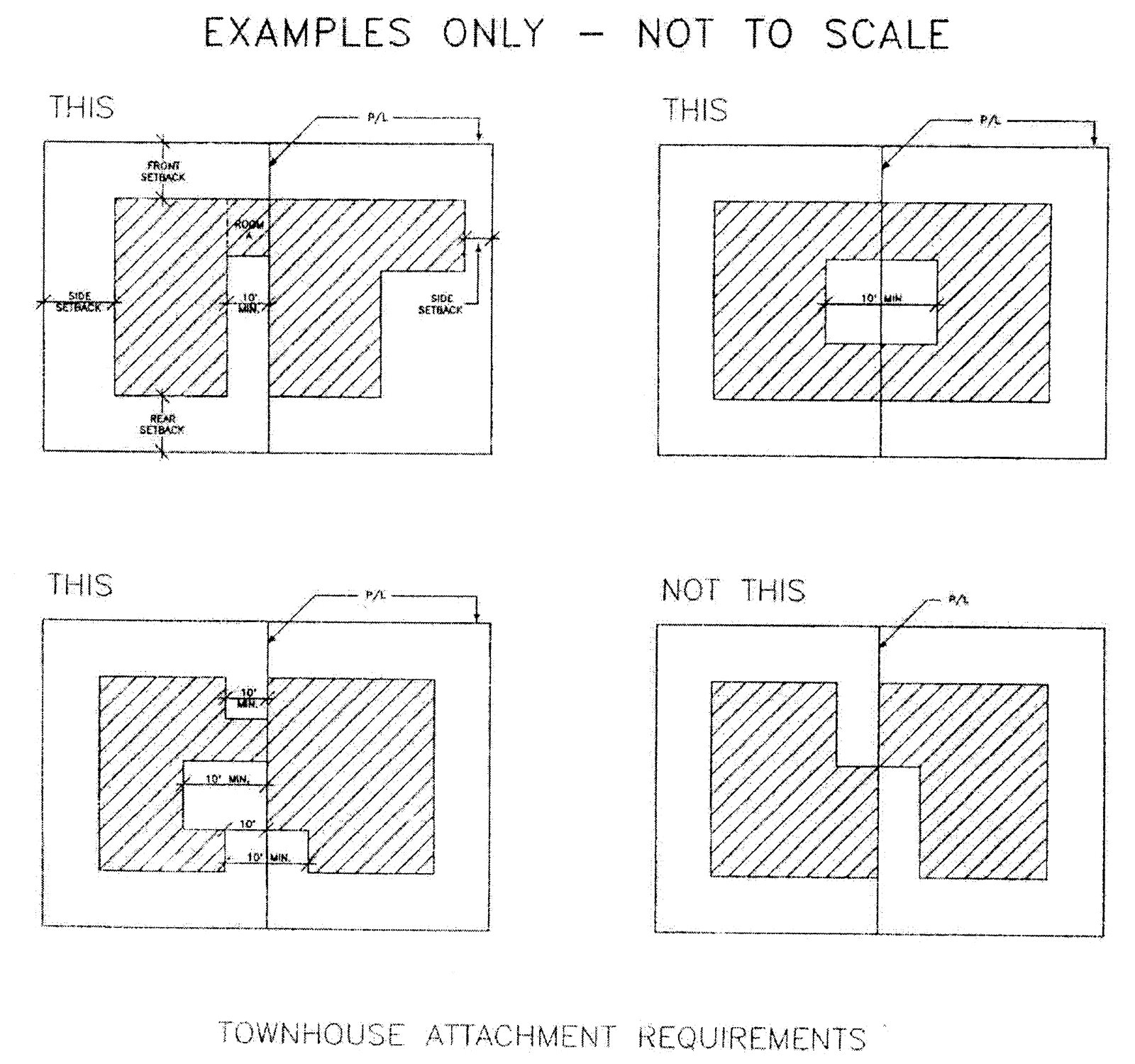
(Ord. No. 2354, § I, 1-22-07)

