
Lauderdale Lakes City Zoning Code
CHAPTER 10
LANDSCAPING REQUIREMENTS AND TREE CONSERVATION
Sec. 1001.- Landscaping requirements.
1001.1.
Intent and purpose. The purpose and intent of this article is to provide regulation for the installation and maintenance of landscaping and landscaped open space. Trees and plants are integral and vital parts of the earth's ecosystem: they conserve energy; they provide essential and desirable benefits to man, including the production of life supporting oxygen, the reduction of carbon dioxide, the filtering of dust and gaseous pollutants; they serve as a natural abatement to noise pollution; they camouflage unsightly views; they provide shelter to birds and wildlife; they enhance the value of property; they preserve open space; and they maintain and improve the aesthetic quality of the city, thereby promoting the health and general welfare of its citizenry. In addition, it is the policy of the city commission that every effort shall be made to preserve and maintain viable vegetation within the city.
1001.2.
Applicability. The provisions contained herein shall be applicable to all projects comprising new construction or substantial additions and alterations, except as set forth in subsection 1001.3 under administrative waiver. Also, if landscape in excess of 25 percent of total site landscaping requires replacement, the entire property shall be brought up to current landscape standards and requirements. This provision regarding existing development shall be applicable to the greatest extent reasonably possible as determined by community development director or designee. This chapter establishes minimum standards and shall apply to all public and private development when a building permit is required.
1001.3.
Definitions. The following words, terms and phrases, when used in sections 1001 and 1003, shall have the meanings ascribed to them in this subsection, except where the context clearly indicates a different meaning:
ABH (area at breast height means the area in square inches at breast height (four and one-half feet above ground level) of a tree according to the formula where the radius of the tree in inches at breast height diameter.
Accent plant means living plant material usually larger than shrubs and groundcover that may include small palms.
Arborist means an ISA certified specialist knowledgeable about the needs of trees and are trained and equipped to provide proper care, canopy pruning, root pruning and relocation.
Caliper means the diameter of a dicot or conifer tree trunk as measured at the heights as follows:
(1)
Dicot: Six inches from the ground on trees up to and including four inches in caliper.
(2)
Twelve inches above the ground for larger trees.
(3)
Monocot is the diameter of the tree trunk measured one foot above the ground.
Clear trunk means the point above the root ball along the vertical trunk or trunks of a tree/palm at which lateral branching or fronds which may include the front boot.
Common area means the area under common ownership of a subdivision (e.g. recreation area, open space) excluding rights-of-way.
Conifer means a cone bearing seed plan.
Drip line encroachment means any activity that has the effect of causing soil compaction, injury to lower limbs, grade change, contamination of soil, or damage to the root system. Specifically, this definition shall include acts such as parking of vehicles, use of heavy earth moving or grading equipment, placement of construction materials, excavation and filling, trenching, and the exposure of paints, oils, or chemicals within a tree's drip line. Specifically excluded from this definition are routine maintenance activities such as mowing or walking within the tree's drip line.
Dicotyledonous (Dicot) tree means a tree having a woody stem and branches and leaves with net veination and having a separate, distinct outer bark which can be peeled from the tree.
Detention means the delay of storm water runoff prior to discharge into receiving waters.
Drip line means the natural outside end of the branches of a tree or shrub projected vertically to the ground.
Dumpster means a refuse container of one cubic yard or larger.
Equivalent replacement means a tree (or trees) whose condition, size, and location is determined by the city landscape architect or designee to be equivalent to the tree (or trees) which it replaces.
Equivalent value means an amount of money, which reflects the cost of replacing a dicot, monocot or conifer tree, as determined by the city landscape architect or their designee based on species, structure, health, location, other environmental factors and/or industry fair market value.
Foundation plantings means consist of landscape material placed in a minimum of two distinct tiers (i.e. shrubs, ground covers, small trees and palms so as to hide structure foundations from view at eye level from the center of the structure as seen from the adjacent street rights-of-way. Foundation plantings are required to be planted any side of building structures and shall screen the foundation portions of the structure not covered by driveways or doorways.
Foundation plantings—A buffer of pervious area from the face of the building to the edge of pavement, the width of the buffer shall be directly proportional to the height of the structure; the size of the plant material shall be directly proportional to the height of the structure.
Gray wood means the portion of the palm trunk which is mature, hard wood measured from the top of the root ball to the base of the new, green, soft, terminal growth or fronds.
Ground cover means plant material which normally can be maintained at a height between 12 inches and 24 inches in height.
Hatracking means to flat-cut the top or sides of a tree or both; severing the leader or leaders; or internodal cutting within the tree's canopy; or trimming to a degree as to remove the normal tree canopy and disfigure the tree.
Hedge means an evenly spaced planting of shrubs to form a compact, dense, visually opaque living barrier or screen.
Height of tree/palm means the point at which at least three mature branches or three frond petals level off above grade at planting as established by the latest edition of grades and standards.
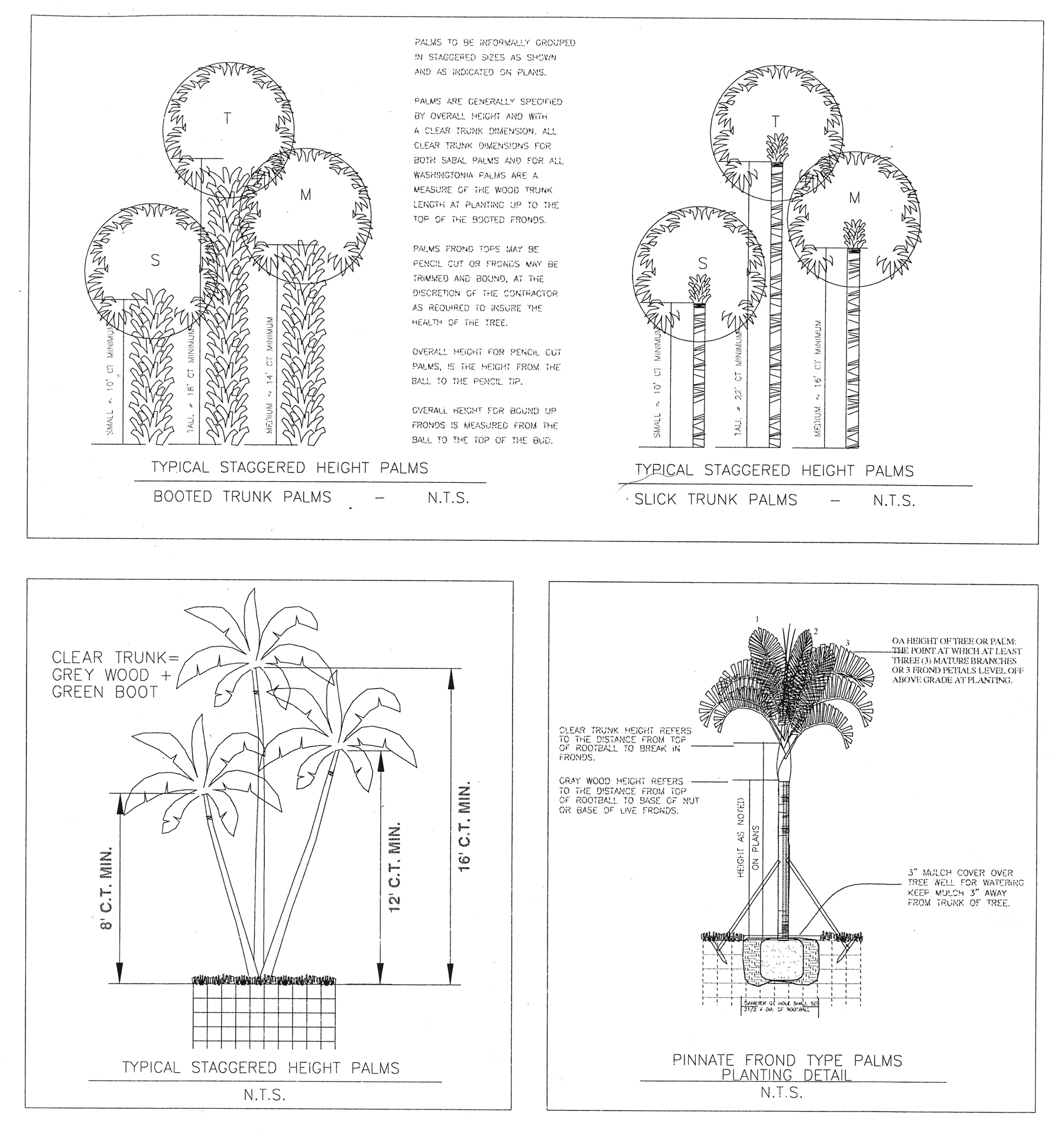
Height of tree/palm
Historic tree means a tree which has been determined by the city commission to be of notable historic interest because of its age, type, size or historic association and has been so designated as part of the official records of the city.
Irrigation means the supply of water to landscaped areas by an mechanical sprinkler system required to sustain plant material with 100 percent coverage.
Landscape architectural plans means any landscaped plans required to be submitted under this Code for governmental approval may only be submitted by the actual person owning the property or by a person registered as a landscape architect in the state under F.S. Ch. 481, Part II, or persons otherwise exempt there under. All plans, specifications, or reports prepared or issued by a registered landscape architect and filed for public record shall be signed by the registered landscape architect, dated, and stamped with his seal. The signature, date and seal constitute evidence of the authenticity of that to which they are affixed and their compliance with this city's comprehensive landscape ordinance requirements.
Landscaping material means any of the following or a combination thereof such as, but not limited to: Grass, ground cover, shrubs, vines, hedges, trees or palms; other materials such as rocks, pebbles, sand, but not including paving or interlocking pavers of any kind.
Mitigation means replacement of trees that have been removed or damaged. Mitigation shall be required to offset any environmental impacts caused by the unlawful removal or effective destruction of any tree. Replacement shall be in the form of new trees based on a caliper inch replacement or a monetary value to be determined by the city.
Monocotyledonous (Monocot) tree means a tree having fronds with parallel veination and no true woody bark.
Mulch means an organic material such as compost, wood chips, pine straw or bark from treated Melaleuca or Eucalyptus trees. Mulch to be placed on the soil to reduce evaporation, prevent erosion, control weeds, enrich the soil and lower soil temperature. Does not include recycled wood products.
Natural area means an area identified on an approved site plan containing natural vegetation which will remain undisturbed when the property is fully developed.
Net lot area means the green area remaining after full development of the site that qualifies a permeable area which allows passage of air and water to the subsurface area.
Nuisance trees means certain non-native trees, often termed exotic, specifically Schinus terebinthifolius (Brazilian Pepper), Metopium toxiferum (Poison Wood), Melaleuca quinquenervia (Punk Tree, Cajeput or Paper Bark), Casuarina spp. (Australian Pine, all specie), Brassaia actinophylla (Schefflera), Acacia auriculaeformis (Earleaf Acacia), Bischofia javanica (Bishopwood), Ficus benjamina (Weeping Fig), Ficus retusa (Laurel Fig), Dalbergia sissoo (Indian Rosewood) and Ricinus communis (Castor Bean).
Palm means a monocot tree which normally attains an overall height of at least 20 feet.
Pedestrian zone means an area located between the VUA and the building facade which includes the pedestrian walk and developed foundation plantings.
Plot area means the extents of a parcel of land defined by the property line.
Prune means the removal of dead, dying, diseased, weak or objectionable branches in a manner consistent with the American National Standards Institute (ANSI A-300) standards as incorporated herein, and as may be amended from time to time.
Relocation means the transplanting of plant material from one location to another location that is acceptable by the city landscape architect or designee following proper horticultural and arboricultural procedures which includes but is not limited to root pruning for a period of at least six weeks, providing adequate irrigation from the act of root pruning to relocation and providing care and irrigation for a period of one year or until the plant material is established.
Retention means the prevention of storm water runoff from direct discharge into receiving waters; included as examples are systems which discharge through percolation, exfiltration, filtered bleed-down and evapotranspiration processes.
Retention/detention area (dry) means water storage area with bottom elevation at least one foot above the control elevation of the area. Sumps, mosquito control swales and other minor features may be at a lower elevation.
Retention/detention area (wet) means a water storage area with bottom elevation lower than one foot above the control elevation of the area.
Root ball means the earthen ball encompassing the root system of a tree or plant.
Setback and yard areas means the front, side and rear areas or yards as established and required under this chapter and within the zoning district requirements applicable thereto.
Shade tree means a dicot or conifer tree, usually with one vertical stem or main trunk which naturally develops a more or less distinct and elevated crown and provides at maturity a minimum shade crown of 30 feet in diameter.
Shrub means a bushy, woody plant, usually with several permanent stems, and usually not over ten feet in height at its maturity.
Shock means a physiological state of or degeneration of the vital processes resulting from but not limited to root damage, wounds, impact, partial or total girdling, or improper cutting.
Small tree means any self-supporting wood perennial plant which at maturity normally attains an overall height between ten to 25 feet. Trees with a multiple trunk growth characteristic shall have no more than five main trunks. These trees shall provide the mid-level landscaping within the specified height range.
Specimen palm means large species of palm with a canopy or combined canopy of multi-stem palms that are equal to the coverage of a code tree. Species include but not limited to; Royal palms, Date palms, Coconut palms, Bismarkia's.
Specimen tree means a tree which has a DBH of 18 inches or greater, with the exception of the following:
(1)
Non-native fruit trees that are cultivated or grown for the specific purpose of producing edible fruit, including but not limited to mangos, avocados or citrus.
(2)
Nuisance trees.
(3)
All multi-trunk palms.
(4)
Trees that are in poor condition or form as determined by the city based on the Guide to Judging Plant Condition, International Society of Arboriculture (ISA).
Street trees means trees and palms that occur outside the property lines but within the ROW. Setback of trees and palms from the roadway shall be determined by the design speed of the roadway and subject to approval by the local governing agencies.
Storage area means any exterior area used for the keeping of garbage or trash cans, dumpsters, newspaper containers, oil and bottled gas tanks, swimming pool equipment, air conditioners and mechanical appurtenances.
Tiered landscaping beds means the combination of different types or heights of appropriate plant material creating a multi-level landscape mitigating the vertical appearance of structures or berms.
Topsoil means a medium composed of naturally occurring mineral particles and organic matter which provides physical, chemical and biological properties necessary for plant growth.
Traffic way means a street designed as a traffic way by the city commission of the city as found in this Code.
Tree means any living, self-supporting woody perennial plant which at maturity attains a trunk diameter of at least three inches or more when measured at a point four and one-half feet above ground level and which normally attains an overall height of at least 15 feet, usually with one main stem or trunk and many branches.
Tree abuse means:
(1)
Improper pruning that reduces the height or spread of a tree (strike that has not attained a height or spread of 30 feet,) by altering the dominant stem(s) within the tree crown to such a degree as to remove the natural canopy of the tree; or
(2)
Improper pruning that leaves stubs or results in a flush cut; or splitting of limb ends; or
(3)
Peeling or stripping of bark; or the removal of bark to the extent that, if a line is drawn at any height around the circumference of the tree, over one-third of the length of the line falls on portions of the tree where bark no longer remains; or
(4)
Using climbing spikes, nails or hooks, except for purposes of total tree removal or as specifically permitted by American National Standards Institute (ANSI A-300) as the same may be amended from time to time and incorporated herein;
(5)
Destroying the natural habit of growth which causes irreparable damage and permanent disfigurement to a tree such that, even with regrowth, the tree will never regain the original characteristics of its tree species, or is a danger to the public or property; or
(6)
Improper pruning that results in flat-cutting the top or sides of a tree, to sever the leader or leaders or to prune a tree by stubbing off mature wood, except where removal of a branch is necessary to protect public safety:
(7)
Exception: The removal of diseased or dead portions of a tree (such as palm fronds), the removal of an interfering, obstructing or weak branch shall not constitute tree abuse under this section. Interference with or obstruction of street lights, stop signs or traffic signals is an example of pruning which, if accomplished by the American National Standards Institute (ANSI A-300), is not a violation of this section.
(8)
The following trees are exempt from tree except when they are to be removed abuse: Norfolk Island Pine, Schefflera, Melaleuca, Florida Holly or Brazilian Pepper, Australian Pine, Ficus Benjamina and Ficus Nitida.
Vehicular use area (VUA) means any area used by vehicles except public thoroughfares, including but not limited to areas for parking, display, storage or traverse of any and all types of motor vehicles, bicycles, watercraft, trailers, airplanes or construction equipment.
Vines means plants which normally require support to reach mature form.
Visual screen means a physical obstruction used to separate two areas or uses which is at least 75 percent opaque. Visual screens shall be living plant material, natural or manmade construction material or any combination thereof.
Water control district means the governmental agency with primary responsibility for the conveyance or retention of storm water within an established area as defined by the state statutes. Within these development standards this reference will generally refer to the South Florida Water Management District.
Xeriscape means a type of landscaping utilizing native plants and ground cover and needs little maintenance and less water once established, which is detailed in the South Florida Water Management District publication, Xeriscape, Plan Guide II, incorporated herein by reference.
1001.4.
Minimum landscape requirements for single-family residential zoning districts.
(a)
RS-5A and RS-5B. Each plot shall have a minimum of:
(1)
Three trees, 30 shrubs and/or groundcover, five accents in the front half of the plot. A minimum of two of these trees shall be shade trees. Foundation plantings are required.
(2)
Two trees and ten shrubs in the rear half of the plot. A minimum of one of these trees shall be a shade tree. All RS-5A and RS-5B properties shall comply with these regulations by December 30, 2008.
(3)
In addition, each plot shall have a minimum of one tree and five shrubs for each 2,000 square feet of plot area over 10,000 square feet of which 50 percent of these additional trees shall be shade trees. Shrubs used to screen accessory structures shall not be counted for minimum plot requirements.
(4)
Corner plots shall contain a minimum of one shade tree and 15 shrubs and/or groundcover in the required street side yard in addition to other requirements of this section.
(b)
RS-5C and RS-5D. Each plot shall have a minimum of:
(1)
Three trees, 30 shrubs and/or groundcover, five accents in the front one-half of the plot. A minimum of one of these trees shall be a shade tree. Foundation plantings are required.
(2)
One tree and ten shrubs in the rear half of the plot. A small tree shall not be used to meet this requirement. All RS-5C and RS-5D properties shall comply with these regulations by December 30, 2008.
(3)
In addition, each plot shall have one tree and five shrubs for each 2,000 square feet of plot over 6,000 square feet, or portion thereof. Not less than 50 percent of these additional trees shall be shade trees. Shrubs used to screen accessory structures shall not be counted for minimum plot requirements.
(4)
Corner plots shall contain a minimum of one tree and 20 shrubs in the required street side yard in addition to other requirements of this section.
(c)
RP-10. Each plot shall have a minimum of:
(1)
One tree, ten shrubs and/or groundcover, in the front one-half of the plot. This tree shall be a shade tree. Foundation plantings are required.
(2)
One tree and five shrubs in the rear half of the plot.
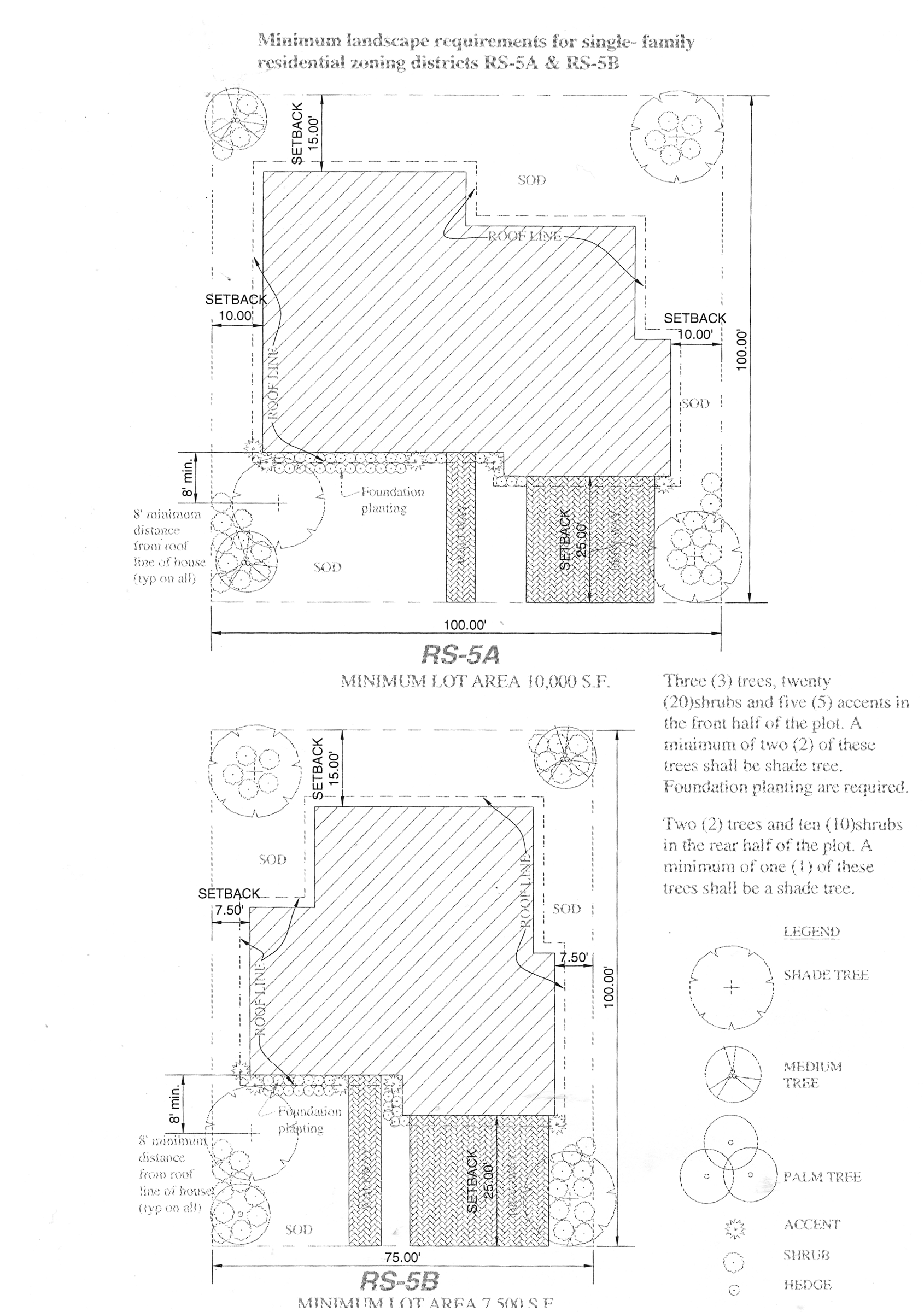
Min. landscape requirements for single-family residential zoning districts RS-5A and
RS-5B
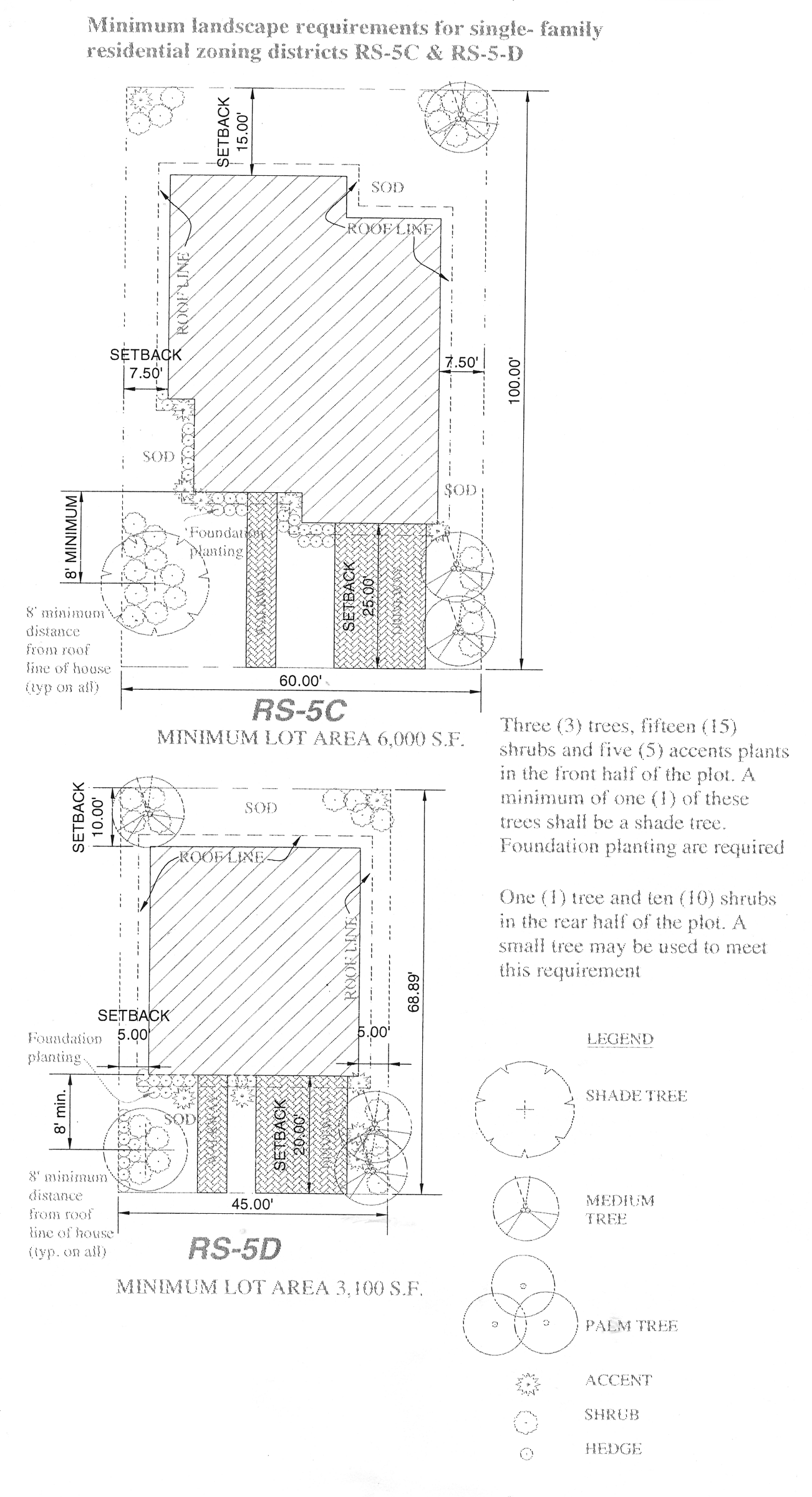
Min. landscape requirements for single-family residential zoning districts RS-5C and
RS-5D
1001.5.
Minimum landscape requirements for multi-family zoning districts. Residential-10 (RM-10), Residential-16 (RM-16), Residential-25 (RM-25) districts:
(1)
Each plot shall contain a minimum of one tree, 20 shrubs, and 40 groundcover per 2,000 square feet of plot area, or portion thereof, not utilized for structures or vehicular use areas, in addition to landscaping required in other portions of this chapter.
(2)
A diversity of tree species shall follow the criteria set fort in the landscape code subsection 1001.15(n)(1).
(3)
Multifamily buildings shall provide foundation plantings of one flowering tree and 15 shrubs for every 30 l.f.
1001.6.
Minimum landscape requirements for non-residential zoning districts.
(a)
Neighborhood Business (B1), Community Business (B2), General Business (B3), Intense Business (B4), Heavy Business (B5), Planned Unit Business (B6), Commercial Recreation (CR), Community Facilities (CF), Light Industrial (M1) districts:
(1)
Each plot shall contain a minimum of one tree and 20 shrubs, and 50 groundcover for every 1,000 square feet of plot area, or portion thereof, not utilized for structures, outdoor storage, or vehicular use areas in addition to landscaping required in other portions of this chapter.
(2)
A diversity of tree species shall follow the criteria set fort in the landscape code section 1001.15(n)(1).
(3)
Recreation/Open Space (ROS) and Utilities (U) districts.
(4)
Each plot utilized for other than athletic playing fields or courts, open play areas, golf courses or water bodies shall contain a minimum of one tree and ten shrubs for every 1,000 square feet of plot area, or portion thereof, not utilized for structures or vehicular use areas in addition to landscaping required in other portions of this chapter.
(b)
Town Center (TC) districts. Reserved.
1001.7.
Special provisions.
(a)
In all districts where a planting strip or planting easement is designated or required, landscaping shall be required in the said planting strip or planting easement of a minimum of one tree and 20 shrubs per 40 lineal feet.
(b)
Landscape material shall be placed on all areas not covered by main and accessory structures, walks and vehicular use areas. Landscape material shall extend to any abutting street pavement edge and to the mean water line of any abutting canal, lake or waterway (not to exceed 30 feet from the property line). Where the slope does not exceed 2:1, landscape material shall be used and installed in such a manner as to allow reasonable maintenance. Where existing slopes are steeper than 2:1, they shall be cut back at time of construction to result in a slope of 2:1 or less. No slope shall be changed without approval of the city engineer and water control district having jurisdiction.
(1)
The community development department may grant special written permission to allow the planting of trees or shrubs less than the required sizes outlined in this section if quality plants, such as Florida Department of Agriculture "Florida Fancy" grade, are used; or if a greater number of plants than the minimum number required by the ordinance are planted. However, the increased number of trees that may be required shall not exceed 50 percent of those otherwise required by this chapter. No such permitted tree shall be less than six feet in height, nor shall any permitted shrub be less than 18 inches in height by 18 inches in width at the time of planting. Written approval for such deviation shall be obtained prior to the planting of such trees and/or shrubs.
(2)
In all districts a tennis court must be screened on all sides visible from off site with a contiguous hedge at least two feet in height at time of planting.
1001.8.
Sight distance for landscaping adjacent to public right-of-way and points of access.
(a)
When an accessway intersects a public right-of-way, or when the subject property abuts the intersection of two or more public rights-of-way, all landscaping within the triangular areas described below shall provide unobstructed cross-visibility at a level between 30 inches and six feet provided that they are located so as not to create a traffic hazard, with the following exceptions:
(1)
Trees or palms having limbs and foliage trimmed in such a manner that no limbs or foliage extend into the cross-visibility area;
(2)
Horizontal rail fences;
(3)
No landscaping other than grass or ground cover shall be permitted in the public right-of-way without written approval of the city engineer;
(4)
Required grass or ground covers.
(b)
Any landscaping located within the triangular areas described herein shall be maintained to the standards set forth so as to not create an obstruction. The triangular areas referred to above are:
(1)
The areas of property on both sides of an accessway formed by the intersection of each side of the accessory and the public right-of-way line with two sides of each right-of-way line with two sides of each triangle being 20 feet in length from the point of intersection and the third side being a line connecting the ends of the other two sides. The site distance triangle shall be indicated on the site plan and the landscape plans.
(2)
The area of property located at a corner formed by the intersection of two or more public rights-of-way with two sides of the triangular area being 30 feet in length along the abutting public right-of-way lines, measured from their point of intersection, and the third side being a line connecting the ends of the other two lines. The site distance triangle shall be indicated on the site plan and the landscape plans.
(3)
When the pavement surface is less than ten feet from the abutting property line the triangular areas shall be determined by an onsite inspection of existing conditions. Said determination shall be made by the city engineer and shall not be less than the distance described above.
(4)
When road modifications occur or when existing conditions do not conform to the above criteria, the property owner shall modify the landscaping to conform to the above standards.
1001.9.
Perimeter landscaping.
(a)
Single-family residential development. On all such lots of less than 70 feet average width, the following landscaping along the perimeters of the development shall be provided:
(1)
The landscaping shall include two trees for each 40 lineal feet of fraction thereof. A minimum of two of these trees shall be a shade tree. Shade trees shall be planted no further apart than 60-foot intervals and no closer than 20 to 25 feet apart. Palms shall not be substituted for required shade trees. Palms utilized to meet the non-shade tree portions of this requirement shall be substituted on a three for one basis and planted in groups of three. The trees shall be located along the perimeters of the development.
(2)
In addition, a hedge, wall or other durable landscape barrier of at least three feet in height shall be placed along the interior perimeter of the landscape strip.
(3)
Minimum height of hedge at installation vs. min height to be maintained?
(4)
If the durable barrier is of non-living material, for each five feet thereof, one shrub or vine shall be planted along the street side of the barrier.
(5)
Walls shall have a continuous hedge on the exterior side of the wall. The remainder of the required landscaped areas shall be landscaped with grass, ground cover or other landscape treatment except paving.
(b)
Multi-family residential development.
(1)
The landscaping shall include two trees for each 40 lineal feet or fraction thereof. A minimum of one of these trees shall be a shade tree. Shade trees shall be planted no further apart than 60-foot intervals and no closer than 25 feet apart. Palms utilized to meet portions of this requirement shall be planted in groups of three unless a specimen palm is planted and can be planted no closer than 100 feet apart. The trees shall be located along the perimeters of the development.
(2)
In addition, a hedge, wall or other durable landscape barrier of at least four feet in height shall be placed along the interior perimeter of the landscape strip to provide a visual screen. If the durable barrier is of non-living material, for each five feet thereof, one shrub or vine shall be planted along the street side of the barrier. Walls shall have a continuous hedge on the exterior side of the wall.
(3)
The remainder of the required landscaped areas shall be landscaped with grass, ground cover or other landscape treatment except paving.
(c)
All non-residential districts developments, the following landscaping along the perimeters of the development not covered by building structures shall be provided:
(1)
The landscaping shall include two trees for each 40 lineal feet or fraction thereof. A minimum of one of these trees shall be a shade tree. Shade trees shall be planted no further apart than 60-foot intervals and no closer than 15 feet apart. Palms utilized to meet portions of this requirement shall be planted in groups of three unless a specimen palm is planted and can be planted no closer than 100 feet apart. The trees shall be located along the perimeters of the development not covered by building structures.
(2)
In addition, a hedge, wall or other durable landscape barrier of at least four feet in height shall be placed along the interior perimeter of the landscape strip. If the durable barrier is of non-living material, for each five feet thereof, one shrub or vine shall be planted along the street side of the barrier. Walls shall have a continuous hedge on the exterior side of the wall. Both wall and hedge shall be within the property limits.
(3)
The remainder of the required landscaped areas shall be landscaped with grass, ground cover or other landscape treatment except paving.
(4)
These provisions shall not be applicable where the development abuts an existing landscape strip containing the required hedges and trees of the subsection or when zero side yard setbacks are utilized.
1001.10.
Landscaping requirements for temporary construction-related structures. Landscaping requirements for temporary construction-related structures as defined in chapter 5 when said structures are utilized for real estate sales are as follows:
(a)
Plot area: The plot area to be landscaped shall be the area of the sales structure plus the following.
(1)
Fifteen feet on each side of the proposed sales location;
(2)
Twenty-five feet immediately in front of the proposed sales location;
(3)
Minimum plot size shall be 5,000 square feet.
(4)
One tree for 1,000 square feet of plot area or fraction thereof;
(5)
One shrub for every 100 square feet of plot area or fraction thereof;
(6)
A continuous hedge shall be required around all vehicular use areas except at points of vehicular and pedestrian ingress and egress;
(7)
All landscaping shall be kept in a healthy growing condition at all times
1001.11.
Parking interiors. In districts, except single-family residential, interior landscaping for parking areas shall:
(a)
Provide a total area of interior landscaping in all off-street parking areas, with the exception of master parking areas, equal to not less than 20 percent of the total paved vehicular use areas. Any perimeter landscaping areas may be counted as part of the parking interior area requirements as long as such landscaping is contiguous to the vehicular use areas.
(b)
Be installed in landscaped areas designed and arranged for the purpose of controlling traffic, providing shade, screening unnecessary views into and within the vehicular use areas and separating the parking circulation and service area.
(c)
Interior parking landscape areas shall have the following dimensional requirements.
(1)
Islands in parking bays shall have a minimum landscaped areas (inside of curb to inside of curb) of nine feet width and 16 foot length. The island shall include at least one tree.
(2)
Medians between double parking bays shall be curbed and shall have a minimum width as follows:
i.
Multi-family residential: Ten feet in green area, not including curbing.
ii.
Nonresidential office: Eight feet in green area, not including curbing.
iii.
Nonresidential commercial: Eight feet in green area, not including curbing.
(3)
Islands must be located no further apart than every ten parking spaces and at the terminus of all rows of parking. However, islands directly abutting building facades may have an average spacing of ten parking spaces provided no islands are more than 14 parking spaces apart. If there are 14 spaces provided in front of a facade then the terminal islands bounding the 14 spaces must be a minimum of 12 feet wide inside of curb to inside of curb.
(4)
Islands shall be filled with clean fill and topsoil to two inches below the top of curb if mulch is the top overlay and up to one inch to the top of curb if sod is the top overlay, the top of the curb.
(5)
Islands to be protected by continuous curbing type "D" or "F".
(d)
A diversity of tree species shall follow the criteria set fort in the landscape code subsection 1001.15(n)(1).
1001.12.
Berms. Berms when used to satisfy shall meet the following standards:
(a)
All berms shall be planted with ground cover or sod.
(b)
When berms are used to satisfy the minimum screening requirement they shall not exceed a 1:3 slope and must have a plateau equal to the height of the berm and must be planted with a hedge which meanders and undulates.
(c)
The height of a berm shall be measured from the grade of the property closest to that section of the berm.
1001.13.
Street trees.
(a)
Street trees shall be shade trees, unless restricted by other provisions of this chapter and placed in rights-of-way by the developer or builder prior to the issuance of a certificate of occupancy and maintained in accordance with this article.
(b)
Variety and species shall be according to the approved list maintained by the community development department.
(c)
Minimum size shall be in accordance with the standards set forth in this article for the zoning of the project for which the trees are required.
(d)
One tree shall be required for every 40 feet of street frontage, with one being a shade tree (unless the city approves another species.)
(e)
Access ways permitted in accordance with these LDRs from the public rights-of-way through all such landscaping shall be permitted to service the parking of other vehicular use areas. Such access ways may be subtracted from the lineal dimensions used to determine the number of trees required.
(f)
Shade trees shall be planted no further apart than 60-foot intervals and no closer than 25 feet apart. Small trees shall be planted no closer than 15 [feet] apart.
(g)
All street trees are to be placed in a location in accordance with the requirements of the city engineer in order to accommodate location of utilities and street widening and will require the use of root barriers to protect the sidewalk and utilities from root damage. The root barrier will be installed per manufacturer's recommendations.
(h)
If insufficient rights-of-way exist for street tree installation, these requirements shall be added to the overall requirements of the site. At the discretion of the city landscape reviewer/staff, the street tree requirement shall be waived or the street trees shall be planted elsewhere in a city R.O.W. or a monetary dollar value may be submitted to the tree bank.
(i)
The planning and zoning board shall have the authority to grant administrative variances from the foregoing requirements of this section upon the city manager's finding that the foregoing either:
(1)
Conflicts with the design standards and safety requirements pertaining to unobstructed visibility and vehicle recovery zones of the state department of transportation, or
(2)
Cannot be implemented and presents a hardship based on unique characteristics of the land involved. The determination of a hardship shall be pursuant to the criteria established in section 506.7. Upon either of the foregoing findings, the city manager may grant an administrative variance from the foregoing requirements but only upon acceptance of a binding commitment by the responsible party to comply with one of the following options at the city manager's discretion:
a.
Utilize fewer but larger trees, based upon an equivalent dollar value or canopy coverage (or combination thereof), at the city manager's discretion;
b.
Donate an equivalent dollar value for the trees not planted to a fund for the landscaping of public property in the city, which equivalent value shall include the cost of the trees and installation; or
c.
Donate an equivalent number of trees to be installed on public property in the city, which equivalent value shall include the trees and cost of installation.
d.
The city's development review committee shall approve a site plan which specifies the planting requirements approved pursuant to the administrative variance.
(j)
The community director may grant an extension of time for the planting of street trees which are required with the construction of a roadway if such trees would be disrupted or destroyed by construction of a future phase of the same roadway. This extension may only be granted if it is determined that the future phase of construction will not occur more than three years in the future. The responsible party shall be required to post a bond in an amount equal to 125 percent of the costs of purchase and installation of landscaping required pursuant to this section as security for the required plantings. The responsible party shall provide a reasonable time frame for the future phases of road construction and the installation of required street trees. The required plantings shall be installed as part of the future road construction. The trees which shall be required at the time of planting shall be based on the requirements which were in effect at the time of the original postponement plus an adjustment in the size or number of trees planted to account for the natural growth which would have occurred had the trees been planted at the time originally required. Upon reasonable notice, the city manager may require the responsible party to install all required landscaping if it is determined that the road construction's additional phases will be significantly postponed or not completed. The city's development review committee shall approve a site plan which specifies the planting requirements approved pursuant to the administrative variance.
1001.14.
Other vehicular use areas. All yard areas and areas used for the display or parking of any and all types of vehicles or equipment, whether such vehicles or equipment, whether such vehicles or equipment are self-propelled or not, and all land upon which vehicles traverse the property as a function of the primary use, heretofore referred to as "other vehicle uses," including but not limited to, activities of a drive-in nature, such as service stations, grocery and dairy stores, banks, restaurants, new and used car lots, and the like, shall conform to the minimum landscaping requirements herein provided, including areas used for parking or other vehicular uses and parking areas serving residential dwellings.
1001.15.
Plant material and installation requirements. All required plant materials shall conform to the Grades and Standards for Florida No. 1 or better as given in Grades and Standards for Nursery Plants, Part 1 (current edition) by the Florida Department of Agriculture, Consumer Services Division. Plant material shall be on the city-approved plant list.
(a)
Standards. All elements of landscaping shall be installed so as to meet applicable City Code requirements. The Lauderdale Lakes Landscape Manual is an illustrative interpretation and guide for landscaping in accordance with the standards required. Landscaped areas abutting front-end parking shall require protection from vehicular encroachment by placing curbing or car stops at least three feet from the edge of such landscaped areas except in RS and RP districts. Other landscaped areas abutting curved or angular drives shall be curbed. The community development director or his designee shall inspect all landscaping and no certificate of occupancy or similar authorization will be issued unless the landscaping meets the requirements herein provided.
(b)
Dimensions. All minimum dimensions of landscape material refer to dimensions at the time of planting.
(c)
Topsoil. Topsoil shall be clean and free of construction debris, weeds, rocks, noxious pests and diseases. The topsoil for planting areas shall be amended with horticultural acceptable organic material. All soils used shall be suitable for the intended plant material. The source of the topsoil shall be known to the applicant and shall be acceptable to the city.
(1)
The minimum topsoil depth shall be minimum 12 inches for ground covers, flowers, shrubs and hedges.
(2)
Trees shall receive minimum 12 inches of topsoil around and beneath the root ball.
(3)
Native topsoil on the site shall be retained on-site only if approved by the city and landscape architect and used when there is sufficient quantity to cover at least some of the on-site landscaped areas a minimum 12 inches deep.
(d)
Use of organic mulches. A three-inch minimum thickness of approved organic mulch material, after initial watering, shall be installed in all landscaped areas not covered by buildings, pavement, sod, decorative stones, preserved areas and annual flower beds. Each tree shall have a ring of organic mulch no less than 18 inches beyond its trunk in all directions.
(e)
Stabilization. All trees and palms planted as trees shall be securely guyed, braced and/or staked at the time of planting until establishment. All stabilization systems shall be clearly marked (flagging, painted, etc.) to prevent hazards. An approved stabilization detail is contained in the city's landscape manual. Trees shall be restaked in the event of blow over or other failures of the staking and guying. The use of nails, wire, rope, or any other methods which damage the tree or palm is prohibited. All plants shall be installed so that the top of the root ball remains even with the soil grade. All guys and staking material should be removed when the tree is stable and established but in no case more than one year after initial planting of tree. Stabilization shall be in accordance with the National Arborist Association Standards.
(f)
Installation. All plants shall be installed so that the top of the root ball remains even with the soil grade. All guys and staking material should be removed when the tree is stable and established but in no case more than one year after initial planting of tree. Stabilization shall be in accordance with the National Arborist Association Standards.
(g)
Protection of public infrastructure. All shade trees installed within ten feet of public infrastructure shall utilize a root barrier system, as approved by the city.
(h)
Fertilization. All plantings shall be properly fertilized at the time of installation with at least a minimum of 25 percent organic 6-6-6 with trace elements or better fertilizer unless specified differently in the landscape plans.
(i)
Ground cover. Ground covers shall be planted with a minimum of 75 percent coverage, with 100 percent coverage occurring within three months of installation.
(j)
Vines. Vines shall be a minimum of 30 inches in supported height immediately after planting and may be used in conjunction with fences, visual screens or walls.
(k)
Native species required. Ninety percent of the trees required shall be water-conserving, native plant material indigenous to South Florida. Ninety percent of shrubs required shall be installed as native plant material.
(l)
Nuisance vegetation (exotics). The eradication of nuisance vegetation (exotics) is required on all sites, including abutting rights-of-way, prior to the issuance of a certificate of occupancy. Privately owned natural areas shall be included in this requirement.
(m)
Growth of plant material. Growth of plant material at maturity shall be considered prior to planting, where future conflicts such as views, signs, overhead and underground utilities, security lighting, fire access, drainage easements and traffic circulation, might arise.
(n)
Trees.
(1)
No one species of tree shall exceed the percent of the minimum number of trees as outlined below. Neither existing trees nor trees in excess of the minimum number required shall be subject to this limitation.
(2)
Palms. Palms shall be considered trees in accordance with standards set forth in the current official "Landscape Manual" available at the community development department. The minimum height of a palm at planting shall have a minimum of six-foot clear trunk or four-foot Grey wood. When the location of proposed trees are affected by overhead wires then the guidelines as set forth by FP&L shall govern the placement, size and choice of the plant species.
(3)
Shade trees. Shade trees shall be considered in accordance with standards set forth in the current official "Landscape Manual" available at the community development department. In all zoning districts, shade trees have a minimum trunk diameter of three inches measured at four and one-half feet from top of root ball at the time of planting. In all zoning districts, shade trees shall be a minimum of 12 feet overall height with a spread of five feet and a minimum of four and one-half feet clear trunk immediately after installation. No shade trees shall be located closer than 25 feet from street lights. When the location of proposed trees are affected by overhead wires then the guidelines as set forth by FP&L shall govern the placement, size and choice of the plant species.
(4)
Small trees. For small trees, as defined herein, the minimum planting height shall be eight feet overall planting height at the time of installation. However, if a small tree is not commercially available at the eight-foot overall planting height, the community development department may approve the placement of a small tree with a minimum overall planting height of six feet. Trees with a multiple trunk growth characteristic shall have no more than five main trunks. All small trees shall have a minimum of four feet of clear trunk at the time of planting.
(o)
Shrubs.
(1)
Shrubs shall be considered in accordance with standards set forth in the current official "Landscape Manual" available at the community development department. Shrubs classified as "spreading type" shall have a minimum height of 24 inches with a minimum spread of 24 inches, and those classified as "upright type" shall have a minimum height of 30 inches with a spread of 24 inches, when measured immediately after planting.
(2)
Hedges, where required, shall be planted and maintained so as to form a continuous visual screen. Shrubs used as hedges shall be Florida Department of Agriculture Grade No. 1 or better with a minimum height of 24 inches and a minimum spread of 24 inches, when measured immediately after planting and shall be capable of reaching a minimum of three feet in height within one year from the date of planting. Hedges shall be planted with branches touching, so as to create a solid screen with no visual spaces between plants at time of installation. Plant spacing shall be adjusted according to plant sizes so long as a solid screen is achieved.
(p)
Grass.
(1)
Grass areas shall be sodded with a species of grass that will survive as a permanent lawn in Broward County (assuming adequate watering and fertilizing). Sod provided must be viable, reasonably free of weeds, and capable of growth and development. In general, sod strips shall be aligned with tightly fitted joints and no overlap of butts or sides. Subgrade of lawn area shall be reasonably free of all stones, sticks, roots and other matter prior to the placement of sod. However, grass areas may be seeded to meet these requirements provided that the area presents a finished appearance and complete coverage before a certificate of occupancy is issued. Ground covers used in lieu of grass in whole or in part shall be planted in such a manner as to present a finished appearance and complete coverage.
(2)
Grass sod shall be clean, free of weeds and noxious pests or diseases. Grass seed shall be delivered to the job site in bags with Florida Department of Agriculture tags attached, indicating the seed grower's compliance with the department's quality control program.
(q)
[Native trees preserve on site.] All native trees which are preserved on site may be counted toward the minimum native tree percentage required. Ninety percent of the required trees brought on site shall be native species. Ninety percent of the required shrubbery brought on site shall be native species.
1001.16.
Maintenance requirements. All owners of land or their agents shall be responsible for the maintenance of all landscaping. This includes mowing and maintaining abutting rights-of-way, swales, lakes and canal banks. Landscaping shall be maintained in a good condition so as to present a healthy, neat and orderly appearance at least equal to the original installation and shall be mowed or trimmed in a manner and at a frequency so as not be detract from the appearance of the general area. Landscaping shall be maintained to minimize property damage and public safety hazards, including removal of living, dead or decaying plant material, removal of low hanging branches and those obstructing street lighting and maintenance of sight distance standards as set forth herein. Landscaping shall be maintained in accordance with the following standards:
(a)
Insects, disease, etc. Landscaping shall be kept shall be kept free of visible signs of insects and disease and appropriately irrigated and fertilized to enable landscaping to be in a healthy condition.
(b)
Mulching. Three inches of clean, weed-free, approved organic mulch shall be maintained over all areas originally mulched at all times until landscaped area matures to 100 percent coverage. Each tree shall have a ring of organic mulch no less than 18 inches beyond its trunk in all directions.
(c)
Turf edge trimming. All roadways, curbs and sidewalks shall be edged to prevent encroachment from the adjacent turfed areas. Line trimmers shall not be used to trim turf abutting trees or other plant material.
(d)
Maintenance of irrigation systems. Irrigation systems shall be maintained to eliminate water loss due to damaged, missing or improperly operating sprinkler heads, emitters, pipes and all other portions of the irrigation system and shall not be installed or operated to place water on roads. All landscaped areas shall have an underground irrigation system designed to provide 100 percent coverage except in RS districts.
(e)
Control of nuisance species. All areas developed after the effective date of this ordinance shall be maintained free of nuisance species. This shall include natural areas within developed property.
(f)
Replacement requirements. An owner is responsible to ensure that living material and trees which are required to be planted by this subsection of the code or are installed pursuant to a landscaped code previously in effect, are replaced if such living material or trees die, or are abused, following the issuance of a certificate of occupancy. Preserved vegetation which dies following the issuance of the certificate of occupancy shall be replaced with equivalent living material or trees. Developed single family properties need not replace nuisance trees provided that they meet the minimum landscape requirements for their zoning district.
(g)
Removal of root systems. Removal of root systems which show evidence of destroying public or private property is required.
(h)
Tree abuse. Tree abuse is prohibited in the city. Abused trees shall not be counted toward fulfilling minimum landscape requirements and shall be replaced.
(i)
Tree pruning.
(1)
All developers or their agents must prune trees in accordance with the American National Standards Institute (ANSI A-300). If the pruning is tree abuse and causes tree removal, a permit for tree removal shall be required from the city pursuant to subsection 1003.3. Any tree pruning listed in this section shall be accomplished by the direction and/or supervision of a certified arborist.
(2)
Any pruning performed without conformance to the American National Standards Institute (ANSI A-300) shall be subject to enforcement by the city. All tree pruners who provide services in the city shall hold a valid occupational license in Broward County.
(3)
Emergencies. Failure to remove or properly prune a tree damaged by a natural disaster within 30 days shall be a violation.
(4)
Tree pruning standards applied to utilities. The Hazard Pruning Standards and the Crown Reduction Standards of the American National Standards Institute (ANSI A-300), as may be amended from time to time, apply to utility companies.
(5)
Pruning exemptions. The removal of diseased or dead portions (such as palm fronds) of a tree or the removal of an interfering, obstructing or weak branch of a tree such that the result is a tree which is not a threat to public safety or to adjacent property is allowed. Pruning to reduce or eliminate interference with or obstruction of street lights, stop signs or traffic signals is an example of an allowed pruning activity, provided tree abuse does not occur.
(6)
Crown thinning. Crowns of mature shade trees may be thinned to allow for more light penetration and less wind resistance, however, not more than one-quarter of the growth in the crown may be removed in any given year (ANSI A-300, 5.3.1.4), and one-half of the foliage shall remain evenly distributed in the lower two-thirds of the crown (ANSI A-300, 5.3.1.5).
(7)
Excessive lifting. Lifting may be performed to eliminate a hazard to pedestrians or to protect the tree from vehicular damage only, not for visibility to signage in lieu of crown thinning. What is regarded as excessive is species dependant, however under no circumstances may the trunk and denuded lower branches account for more than 50 percent of the total height of the tree.
1001.17.
Maintenance of swales.
(a)
Definition. For the purpose of this section a swale is defined as all unpaved portions of a right-of-way located between the edge of pavement and the property line or an easement located on property adjacent to the right-of-way line.
(b)
Maintenance responsibility. It shall be the responsibility of the adjacent property owner to maintain the swale area to the following minimum standards.
(1)
Free of debris;
(2)
Grass and or weeds cut no higher than six inches and edged away from the sidewalk;
(3)
Shrubs shall be kept trimmed to a height not to exceed four feet and provide unrestricted visibility at driveways and street intersections;
(4)
Overhanging branches of trees shall be pruned to a height of at least 13 feet above grade;
(5)
The swale shall be kept free and clear of prohibited species, as defined in this Code.
1001.18.
Non-conforming sites. No existing properties shall be permitted to increase the degree of nonconformity as it pertains to this article. Wherever existing developments have required landscaped areas, said areas are to conform to this article; specifically, sections 1001.3, 1001.12, 1001.15, and 1004.
1001.19.
Landscape manual. The community development department shall prepare, and from time to time revise, a landscape manual and make the same available to the public, which manual shall provide an illustrative interpretation of the above standards and suggested guide for landscaping in accordance with the above standards. Pruning standards established by the American National Standards Institute (ANSI A-300) as amended from time to time and incorporated herein by reference shall be included in this document.
Sec. 1002. - Designation of protected trees, specimen trees and historic trees.
1002.1.
Purpose. The community development director may recommend from time to time the designation of certain trees located within the city as specimen or historic trees. The city manager shall review such recommendation and add thereto his/her own comments and recommendations, and the matter shall be presented to the city commission for its determination. The city commission shall consider the report of the community development department and the recommendation of the city manager and shall accept, modify or deny the recommendation and may designate by resolution those trees it deems appropriate as specimen or historic trees.
(a)
When a protected tree is on a site which cannot be put to any significant use without the removal of the protected tree, removal of the protected tree will be allowed with all such conditions being imposed as are appropriate pursuant to the guidelines applying to the removal of non-protected trees and to the special status of the protected tree.
(b)
When a protected tree is on a site to be developed or redeveloped, the owner, developer, or contractor shall take all reasonable measures to prevent damage to the tree and root system out to the natural drip line. The extent of the drip line will be based on caliper and species without respect to previous pruning activities.
1002.2.
Consideration of credits for existing plant material. In instances where healthy plant material exists on a site, and is to be retained, the city manager or his designee may adjust the application of the minimum requirements to allow credit for or consideration of such plant material, if such an adjustment is in keeping with and will preserve the intent of this chapter.
(a)
When allowances are given, in no case shall the quantities of existing plant materials retained to be less than the quantities required in this chapter.
(b)
In such cases, a survey shall be provided specifying the specie, approximate height and caliper, as well as the location and condition of any plant material used as a basis for requesting this adjustment.
(c)
Any adjustment shall be based on unique circumstances applicable to the plot in question with the object of such adjustment being to preserve existing vegetation or to maintain a tree canopy.
1002.3.
Plan approval. Prior to the issuance of a building permit, a landscape plan shall be submitted to and approved by the community development director or his designee.
(a)
The landscape plan shall be drawn to a scale not less than 1":30', including dimensions, areas and distances, and clearly delineate the existing and proposed parking spaces, or other vehicular use areas, access aisles, driveways, coverage of required irrigation systems, water outlet locations and the location and size of buildings.
(b)
The plan shall also designate, by name, size and location, the plant material to be installed, or if existing, to be used in accordance with the requirements hereof and shall include in tabular form, the required, provided and existing vegetation.
(c)
No permit shall be issued for such building unless such landscape plan complies with the provisions herein. Only the design professional whose seal is affixed to the landscape plan or his designee may make minor modifications to the landscape plans.
(d)
In residential single-family districts only, a landscape plan is not required. However, required landscaping detail, including quantity, size and location, shall be shown on the site plan.
Sec. 1003. - Tree protection and conservation.
1003.1.
Purpose. Owing to the many benefits provided by trees, it is the intent of the city to protect this valuable resource through permitting for land clearing and tree removal. While the destruction of one tree may not have a significant environmental impact, there can be a significant deterioration of the quality of life with the removal of trees. In the evaluation of a tree removal permit, priority shall be given to protected trees for the preservation or relocation, replacement and/or payment into the tree trust fund.
1003.2.
Definitions. All definitions listed in section 1001 shall carry forward in this section. For the purposes of this section, the following words and phrases shall have the following meanings:
ABH (area at breast height) means the area in square inches at breast height (four and one-half feet above ground level) of a tree according to the formula where r is the radius of the tree in inches at breast height diameter.
Bond means security in a form acceptable to and payable to the city in an amount equal to the fair market value of the replacement tree(s) to be relocated or whose drip line may be encroached upon, and given by the applicant as guarantee of replacement for a period of one year. The fair market value shall be established by resolution of the city commission each year and based upon published trade wholesale price lists with the appropriate multiplier representing maintenance, installation, warranty and other costs factored in.
Building footprint means the portion of the lot, parcel or plot upon which buildings are to be placed.
Building pad means the building footprint plus the five-foot distance from each of its sides.
Complete application means the application and supporting documents have addressed all applicable sections of the prescribed application and that those sections and supporting documents are sufficient in comprehensiveness of data or in quality of information provided.
DBH (diameter at breast height) means the measurement of a tree's trunk diameter in inches at breast height (four and one-half feet above ground level). For trees with less than four and one-half feet of clear trunk, diameter shall be of the largest leader measured four and one-half feet above ground level. For multi-trunk trees it shall be the sum of the diameter of the individual trunks measured four and one-half feet above ground level.
Designated for conservation means trees which have been determined for conservation by the city as shown on an approved tree permit or areas within the city which have been determined by Broward County or the city as subject to conservation and as stated specifically within the tree permit as defined herein.
Equivalent replacement means the replacement of a removed or damaged tree to compensate for that tree's removal or its damage either with one tree the same diameter or a combination of smaller trees that will equal that removed tree's DBH as defined herein. The minimums established in the landscape code of the city for tree planting may not count toward the equivalent replacement amount established here, except where replacement occurs on site. The replacement species shall be native trees as defined herein or trees of similar species to those removed as approved by the city manager or his designee.
Equivalent value means an amount of money, which reflects the fair market value of the required replacement trees. The current market price of replacement trees shall be established by the city manager or his designee, presented to the city commission in tabular form and approved by that body annually.
Existing tree inventory plan. This plan shall be presented as part of the tree permit and shall be required for all trees whose drip line is planned to be encroached upon by any construction, excavation, fill or other activities associated with the development of the site. It shall include:
(i)
Designation of each tree subject to any drip line encroachment;
(ii)
The reasons for the encroachment;
(iii)
Detailed description of the proposed efforts to protect the tree from damage due to the encroachment, and
(iv)
A plan to ensure it survivability per Builder's Manual of Department of Agriculture.
Land clearing means the indiscriminate removal of trees, shrubs and/or undergrowth by stripping or any other process, with the intention of preparing real property for non-agricultural development purposes. This definition shall not include: the selective removal of non-native tree and shrub species when the soil is left relatively undisturbed; removal of dead trees; or normal mowing operations.
Landscape manual means the document prepared by the planning department which provides an illustrative interpretation of landscape standards and a suggested guide for landscaping in accordance with the above standards.
Map of environmentally sensitive lands means the map prepared by planning department and approved by the city commission as part of this section that identifies areas of native vegetation within the city.
Native tree means a tree of a species approved by the city manager or his designee or identified as native to this area by the Association of Florida Native Nurseries as may be amended from time to time, and incorporated herein by reference.
Optional cash payment means a fee equal to the fair market value of the required replacement tree(s) which may be paid by the applicant after recommendation from city staff that replacement of trees on-site or off-site pursuant to subsection (f) herein, is not feasible.
Tree credit means the utilization of native dicotyledons measured at inches DBH or native palm trees measured tree-for-tree as off-site replacement trees for sites being developed. These native trees must be planted after the date of this amendment. This credit only applies for a five-year period from date of planting of trees to be utilized for tree credit. This credit is for the inches at planting and is available only for off-site replacement.
Tree-for-tree replacement means replacing a removed tree with a tree or trees with a minimum of three inches in cumulative trunk diameter at breast height.
Tree permit consists of the application and all necessary information relating to existing trees on site and proposed relocation, removal, drip line encroachment and barricading. Except for nuisance species, this permit shall not be approved prior to city approval of the underlying project.
Tree survey means a sealed survey prepared by a state licensed land surveyor and shall show, in addition to all boundary information, the exact location, size, botanical and common name, and diameter of all trees at least three inches in diameter measured four and one-half feet above ground level within the area affected by the development except that groups of nuisance trees as defined herein may be designated as "clumps," with the predominant type shown. The tree species noted on the tree survey shall be certified by a landscape architect. The expense of the survey shall be borne by the applicant.
Trim means to reduce, shorten or diminish gradually a plant or parts of a plant without altering the natural shape.
Understory means the plant life existing under a tree canopy including ferns, bushes and groundcovers.
Undeveloped land means land which is unimproved, in that no principal building or structure has been constructed upon it.
1003.3.
Permit requirements.
(a)
Tree permit. A tree permit shall be required prior to any person natural or corporate, encroaching upon a tree drip line, or cutting down, destroying, removing, relocating or destructively damaging any tree or causing any tree to be encroached upon (within the tree's drip line), cut down, destroyed, removed or relocated or destructively damage.
(b)
Protected trees. The property owner or his authorized agent shall apply for a tree permit from the community development department, prior to the removal, relocation, or drip line encroachment of any protected tree subject to the conditions of this Code. Protected vegetation includes; street trees, perimeter vegetation, vegetation in parking and vehicular use areas, historical trees, any tree in a city area of particular concern, any special status category tree and any specimen tree.
(c)
Wetlands. Prior to any land clearing activity in a potential wetlands area, as designated on the city's "floodplains and wetlands" map of the comprehensive plan, a property owner shall be responsible for obtaining the necessary permits from the Army corps of Engineers and the Broward County Office of Natural Resource Protection in addition to the permit required by this Code.
(d)
Application for permit. Application for a tree removal permit or land clearing permit shall be made to the community development department and shall include a legal description of the property and a map showing the size and location of the site where the tree removal or land clearing activities are to be conducted. The department may require the submission of a tree survey designating those trees which are proposed to be preserved, relocated, or removed.
(e)
Land clearing and tree removal permit. No permit shall be issued for land clearing or tree removal unless one of the following conditions exists:
(1)
The site is proposed to be used for bonafide agricultural purposes and is not within a jurisdictional wetland area;
(2)
A site plan submitted by the applicant shows that a proposed structure, permissible under all applicable laws and regulations, can be situated on the subject parcel only if specific trees are removed or relocated;
(3)
The tree is in such proximity to existing or proposed structures that the utility or structural integrity of such structures is materially impaired;
(4)
The tree materially interferes with the location, servicing or functioning of public utility lines or service;
(5)
The tree obstructs views of oncoming traffic or otherwise creates a substantial traffic hazard;
(6)
The tree is diseased, injured, or in danger of falling;
(7)
Any law or regulation requires the tree's removal; or
(8)
The vegetation is being maintained or planted for municipal use under the direction of the city's public works or parks and recreation departments.
(9)
This permit, if approved, shall be granted for a maximum of six months.
(10)
This permit shall be posted in a protected area and in a conspicuous place on the site.
(11)
A sign with the minimum dimension of two feet by three feet shall be posted along each roadway frontage of the site and shall be readable from the roadway and shall state:
TREES ON THIS SITE BEING REMOVED ACCORDING TO PERMIT NO. ________ PURSUANT TO CITY OF LAUDERDALE LAKES CODE
For those permits not requiring tree removal, the sign may read:
TREES ON THIS SITE BEING PROTECTED ACCORDING TO PERMIT NO. ________ PURSUANT TO CITY OF LAUDERDALE LAKES CODE
(f)
Application fee. The city shall adopt by a fee schedule that outlines the various permit fees associated with the implementation of this section.
1003.4.
Replacement trees. A removed tree shall be replaced with its equivalent diameter inches at breast height. The replacement tree shall be a species that has shade potential and other positive values, as further described in the landscape manual, at least equal to that of the tree being removed, and shall be a minimum of ten feet in height and two inches in caliper when planted. The replacement tree(s) shall be native species as defined herein. Non-native species may be approved at the discretion of the community development department.
The value of specimen trees shall be established by the methodology contained in The International Society of Arboriculture (ISA) "Guide for Plant Appraisal," current edition.
(a)
Exceptions.
(1)
On lots to be developed for single-family, duplex, townhouse or zero lot line dwelling purposes, trees within the building pad defined herein, the individual driveway leading to that unit excluding circular drives shall be replaced on a tree-for-tree basis.
(2)
Within multifamily development, trees within the building pad defined herein shall be replaced on a tree-for-tree basis.
(3)
Within nonresidential properties noted in the city area of particular concern, trees within the building pad as defined herein shall be replaced on a tree-for-tree basis.
(b)
Maintenance of relocated and replacement trees. Trees must be relocated or replaced as specified by this section within 60 days of the approval for tree removal; provided however, if the trees are to be removed to facilitate construction or development activities, said relocation or replacement must be completed prior to the issuance of certificate of occupancy on the construction, development site or phase of development, as applicable. The trees to be relocated or replaced on-site or off-site private property must be maintained in a healthy growing condition and guaranteed for a period of at least one year. Trees to be relocated or replaced on public property must be guaranteed. The guarantee period shall end one year from the date of installation or at acceptance by city staff (whichever is earlier) of any relocated or replaced trees.
1003.5.
Optional cash payment. An optional cash payment equal to the fair market value of the required replacement tree(s) paid by the applicant after approval from the community development department staff that replacement of trees on-site pursuant to this subsection is not feasible.
1003.6.
Credit for existing landscaping materials. Existing trees may be credited as provided below toward required landscaping provided they are designated for preservation on the final site plan and approved by the director. In no case shall trees located within areas required to be preserved by law be credited toward required landscaping.
1003.7.
Bond for tree relocation, replacement, or drip line encroachment. A bond shall be held by the city for one year to insure tree replacement in the event that tree relocation or drip line encroachment results in the death of any tree subject to a tree permit or for any tree damaged or destroyed in any pre-development or development activities such as surveying. Such bond amount shall be assessed at the fair market value of the required replacement tree(s) or for tree replacement which cannot be effected prior to issuance of a certificate of occupancy for the underlying project. If the developer/builder desires, it may employ a landscape architect to supply revised bonding amount for city review and approval if the landscape architect determines that the trees or palms subject to relocation or drip line encroachment are unlikely to die as a result of the pre-construction or construction activities. Tree bond amounts of under $1,500.00 are to be guaranteed through a letter of guarantee rather than through a posting of a cash bond.
1003.8.
Tree trust fund.
(a)
Establishment. A tree trust line item (hereinafter referred to as the Lauderdale Lakes Tree Preservation Account or the "trust") is hereby established as a depository for tree removal fees and penalty monies. Such monies shall be utilized solely for the purpose of funding tree replacement on public property within the city.
(b)
Term of existence. The Lauderdale Lakes Tree Preservation Account shall be self-perpetuating from year to year unless specifically terminated by the city commission.
(c)
Trust assets. All monies received pursuant to the provisions of this section from public or private concerns shall be placed in trust for an inure to the use and benefit of the city and its successors and assigns in interest.
(d)
Trust administration. Trust funds shall be expended, utilized and disbursed only for the purpose designated by the budget of the city to administer the tree preservation program pursuant to this Code.
(e)
Disbursal of assets. Trust funds shall be used to obtain trees, landscaping, sprinkler systems and any other items or materials necessary and proper for the preservation, maintenance, relocation or restoration of tree ecosystems, on any public land in the city. These monies may also be utilized to engage support elements, such as landscape architects and may also be used to cover the expense of relocation of trees in the city.
1003.9.
Standards for tree protection during development. The following are minimum standards necessary to protect trees designated for preservation from damage during development activities after the tree permit has been approved.
(a)
Protection of existing trees. Prior to any clearing of improved, vacant or unimproved land unless specifically exempted from this section (including land designated for conservation by Broward County or the city) shall have barriers constructed around them by the developer to prevent physical damage from heavy equipment and other activities incidental to development. Required barriers shall be subject to inspection by the city as a condition of permit approval and prior to any such clearing.
(1)
Barriers or barricades. The barriers or barricades shall be:
i.
Large enough to include the entire area inside the out edge or drip line of the tree; and
ii.
Conspicuous enough and high enough to be seen easily by operators of trucks and other equipment; and
iii.
Constructed of sturdy, orange, plastic barricading as approved by the of community development director based on professional judgment that the intent of this provision shall be met.
iv.
Including 4" × 4" posts and signage as per approved detail, subject to inspection prior to commencement of construction.
v.
Constructed as a condition of, the issuance of any land clearing, building or other development permit and prior to any construction or other development activities and required to remain in place throughout the construction period. Barriers or barricades shall be completely removed from the site at the end of the construction period, (immediately prior to the issuance of a certificate of occupancy by the city) unless otherwise stipulated in the approved tree preservation plan.
(2)
Clearing trees and vegetation.
(b)
Clearing by hand. Within the drip line of trees designated for preservation, only clearing by hand is permissible, unless otherwise stipulated in the approved tree permit.
(c)
Storage. Trees and vegetation cleared during construction or other development activities shall be stored in an area designated by the community development director with the grant of a tree permit.
(d)
Removal. All trees and vegetation cleared and stored pursuant to this section shall be removed within two weeks after completion of the clearing.
(e)
Other required protection of trees and under story. Developer shall protect the trees and under story plants designated for preservation in the approved tree permit from chemical poisoning, excavation and grade changes to at least the following minimum standards.
(1)
Utility line trenches. Utility line trenches shall be routed away from trees to an area outside the drip line to the maximum extent possible.
(2)
Grade changes. Retaining walls and dry wells shall be utilized where needed to protect trees from severe grade changes. For shallow fills, the fill material shall be gently sloped down to the level of the tree roots leaving the tree in a depression larger than the spread of its crown.
(3)
Parking on-site during construction or development activities. No parking, vehicle maintenance, storage of construction materials or debris, or cleaning of equipment shall take place within areas marked for preservation specifically including, but not limited to, within the drip line of any individual trees. Parking and storage areas. The developer or contractor shall establish regular parking and storage areas under the supervision of the city to facilitate compliance with the above standard.
(4)
Encroachment. Encroachment into any barricaded area shall be forbidden with the exception of activities specifically permitted by the approved tree permit including drip line encroachment plan as established herein.
(f)
Pruning of trees and vegetation. The developer shall be permitted to cut or prune branches and roots of trees designed for preservation, only under the supervision of the community development department. The standards for pruning as established by the National Arborist Association and as outlined in the landscape manual shall be utilized in the pruning of trees within the city.
(g)
Root system protection. The root systems of trees shall be protected as follows:
(1)
Excavation within the drip line. The community development department director may approve a drip line encroachment plan, upon an applicant's request to excavate within the drip line of a tree, as part of a tree permit.
(2)
Standards for root protection. The community development department may establish additional standards for root protection consistent with this Code. If roots are exposed, the developer shall provide temporary earth cover mixed with peat moss and wrapped with burlap to prevent exposed roots from drying out before permanent backfill is placed. Support of tree or root system. The developer shall also water, maintain in moist condition, and otherwise temporarily support and protect the tree or root from damage until the tree or root is permanently covered with earth.
(3)
Protection of the tree root system. The developer shall protect tree root systems from damage due to noxious materials in solution caused by runoff, or spillage during mixing and placement of construction materials, or drainage from stored materials. The developer shall also protect root systems from flooding, erosion or excessive wetting resulting from dewatering operations.
(h)
Trees damaged during construction. The developer shall have trees damaged by construction repaired by a professional arborist in a manner acceptable to the city.
(1)
Immediate notification of city. The community development department must be notified immediately after any damage to any tree damaged by construction operations.
(2)
Prompt repair. Such repairs as necessary shall be made promptly after damage occurs to prevent progressive deteriorations of damaged trees.
(3)
Removal and replacement of damaged trees. The developer shall remove trees which are determined by the community development department to be incapable of restoration to normal growth pattern. Such trees shall be subject to replacement under the provisions of this Code.
(4)
Any tree designated for preservation which is damaged by development activities in violation of this Code (not including bonded trees in a drip line encroachment plan) under this subsection and which dies as a result of this damage shall be subject to the tree replacement or removal requirements contained herein except that these requirements may use ABH instead of DBH as defined herein to calculate the equivalent value or equivalent replacement for the dead tree.
(i)
Exemptions.
(1)
Damaged trees. Trees destructively damaged or destroyed by an act of God or an act of war is exempt from this Code.
(2)
Licensed plant and tree nurseries. Licensed plant and/or tree nurseries shall be exempt from the terms and provisions of this article only in relation to those trees planted and growing on-site for wholesale or retail sale purposes in the ordinary course of said licensees business.
(3)
Governmental and private nurseries. All governmental and private nurseries with respect to trees which have been planted and are growing for future relocation are exempt from this Code.
(4)
Emergency conditions. During emergency conditions caused by a hurricane or other disaster, or to protect public safety, the provisions of this section may be suspended at the direction of the city manager.
(5)
Nuisance trees. Nuisance trees as defined herein are exempt from the provisions of this Code except for pruning standards and the requirement to obtain a permit prior to their removal. However, no fee shall be assessed for this removal permit.
(6)
Small trees. Trees less than three inches in diameter as measured four and one-half feet from grade are exempt from the provisions of this Code (diameter at breast height, or DBH).
(7)
Planted trees. Trees planted on vacant residential property may be relocated but not subjected to drip line encroachment. A relocation permit is required for all trees with a DBH of three inches or larger. All tree removal shall require a tree permit pursuant to this section.
Sec. 1004. - Waivers.
The city commission may grant a waiver from the height, numbers or spread of landscape material including street trees required by this chapter beyond that provided for herein based on the following:
(a)
Written statement supplied by the applicant specifying the section of this Code for which a waiver is requested, the precise extent and duration of said waiver and the reason for the request.
(b)
Written recommendation of the city manager or his/her designee based on evaluation of the request in view of its effect on the landscape objectives of the city.
(c)
Any waiver granted by the city commission shall specify the section of the Land Development Code waived and the precise extent and duration of the waiver. Said waiver shall apply only to lands and circumstances to which the waived section would apply.
Sec. 1005. - Administration, enforcement, violations, and penalties.
1005.1.
Enforcement. The community development department shall assist the city by making necessary inspections in connection with the enforcement of this subsection. The department shall be responsible for promptly stopping any work attempted to be done without or contrary to any development approval required under this subsection; and shall further be responsible for ensuring that any work not in accordance with a development approval is voluntarily corrected to comply with said development approval.
1005.2.
Violation and penalties. Each violation of this Code or any of its subsections is deemed a separate and distinct infraction of the Land Development Code. Each violation of this Code shall be punishable in a court of competent jurisdiction by a fine of no more than $500.00 plus the cost of replacement of the trees removed from the site, the costs associated with investigation and prosecution together with any equitable remedies deemed reasonable and proper by the court (cost of replacement tree in this context may be measured utilizing up to the removed tree's ABH to determine its value or other such measures as deemed appropriate by the court). The removal, relocation or destruction, including drip line encroachment, of each tree for which a tree permit is required in violation of this Code shall constitute a separate offense under this Code. Each tree to be protected may be the subject of individual enforcement. The owner of any property where a tree or trees have been cut down, destroyed, removed, relocated or destructively damaged shall be held strictly liable for a violation of this Code unless it can be proven that the damage was caused by:
(a)
An act of God;
(b)
An act of war;
(c)
Development activities on the property pursuant to an approved tree permit; or
(d)
The owner alleges that the damage was caused by vandals or trespassers and the owner of the property has filed a police report for the incident and had taken reasonable security measures to prevent unauthorized access to the property.
1005.3.
Stop-work order. The enforcement agency shall immediately issue an order to cease and desist any work being carried out in violation of this section or any permit conditions promulgated under this section. Upon notice of such violation, no further work shall take place until appropriate remedial action is instituted, as determined by the enforcement agency.
1005.4.
Withholding or revocation of city permits. Failure of any party to follow the procedures as required by this Code shall constitute grounds for withholding or revoking site plan approval, building permits, occupancy permits or any other appropriate approvals necessary to continue development. Such extraordinary sanctions, however, shall be instituted immediately upon the direction of the city manager and with the ratification of the city commission at its next regular or special meeting. This ratification shall be considered a public hearing at which all interest parties shall have notice and an opportunity to be heard and to be represented by legal counsel.

