
Lauderdale Lakes City Zoning Code
CHAPTER 7
USE REGULATIONS
Sec. 701.- Zoning districts.
701.1.
Purpose. In order to effectively protect and promote the general welfare and to accomplish the purposes of the city's comprehensive plan, land use element, the city is divided into districts of such number, shape and area, and of such common unity of purpose, adaptability and use that are deemed most suitable so as to provide for the best general civic use and promote improved wholesome, slightly, harmonious and economic results in civic service, activities and operations; and there are hereby imposed upon the land and structures located and uses to be conducted within such districts, such further regulations as are necessary or appropriate to limit the location, use and occupancy of buildings, structures and land to be used for commerce, industry, residential, community or other purposes references to the land use plan and land use plan map shall refer to those portions of the city's adopted comprehensive plan as may be amended.
701.2.
Division of city into districts. For the purpose of regulating the use of land, water, building, form, population density, the intensity of use and provision of open space, the city is hereby divided into the following districts.
Conservation (CNS)
Residential Districts (R)
Single Family (RS-1)
Single Family (RS-2)
Single Family (RS-3)
Single Family (RS-4)
Low Medium
Residential-10 (RM-10)
Mobile Home Park-10 (RP-10)
Medium Density
Residential-16 (RM-16)
Medium-High Density
Residential-20 (RM-20)
Business Districts (B)
Neighborhood Business (B1)
Community Business (B2)
General Business (B3)
Intense Business (B4)
Special Business (B5)
Special Business-Passive Storage (B6)
Planned Commercial District (PCD)
Office Park (OP)
Town Center District (TC)
Town Center (TC-1)
Traditional Neighborhood - Planned Unit development (TND - PUD)
Industrial District (M)
Light Industrial (M-1)
Commercial Recreation (CR)
Community Facilities District (CF)
Recreation/Open Space District (ROS)
Utilities District (U)
The zoning districts contained herein generally correspond by name and purpose to the categories of the city's adopted land use plan, however; some districts may be applied to more than one future land use map category.
701.3.
Water area. The water surface and land under the water surface of all canals, lakes and other water areas in the city not otherwise zoned is hereby placed in the CNS zoning district.
701.4.
Districting of vacated ways. Where a street or alley shown on the zoning district map is hereafter officially vacated by replatting or otherwise, the land formerly in such street or alley right-of-way shall be included within the zoning district of adjoining property on either side of said vacated street or alley. In the event such street or alley was a district boundary between two or more different zoning districts, the new district boundary shall be the former centerline of the vacated street or alley.
701.5.
Boundaries of districts. Unless otherwise shown, the zoning district boundaries are street centerlines, alley centerlines or subdividing or boundary lines of recorded plats or the extensions thereof.
701.6.
Zoning for annexed areas. The city commission at the time of annexation shall assign the zoning district applicable to the annexed area consistent with the requirements of this chapter.
701.7.
Designation of zoning districts on zoning map. No later than 60 days after the adoption of the land development regulations, the city manager shall present for city commission adoption a new official zoning map.
Sec. 702. - Conservation zoning district.
702.1.
Purpose. The conservation (CNS) district is intended to provide for only those uses compatible with the continuing conservation of the natural resources located within the district. The uses within this district shall be consistent with, but may be more restrictive than, the conservation land use plan category permitted uses. This zoning district shall be applied to land designated conservation on the city's land use plan map.
702.1.1.
Uses permitted. No building or structure, or part thereof, shall be erected, altered or used, or land used in whole or part for other than one or more of the following specific uses.
a.
Passive outdoor recreational uses such as wildlife sanctuaries and feeding stations, nature centers and trails, outdoor research stations and walkways.
b.
Fishing, boating and camping facilities.
c.
Structures used for flood control, drainage and water storage.
d.
Uses which do not impair the natural environment or disturb the natural ecosystem of the area and which are not in conflict with applicable water management and wildlife protection policies of local, state and federal agencies.
e.
Waterways.
Sec. 703. - Residential zoning districts.
703.1.
Purpose. These residential districts are intended to provide for residential development in conformance with the parcel's future land use map designation. A residential parcel's zoning designation shall be equivalent to the designation of the future land use map. The number of dwelling units permitted per gross acre of a zoning parcel, as defined in the LDRs, shall not exceed the total number of dwelling units permitted by the city's comprehensive plan designation for the zoning parcel. The uses within this district shall be consistent with, but may be more restrictive than, the corresponding residential land use plan category permitted uses. These zoning districts shall be applied to land designated residential or town center on the city's future land use map. A development parcel may have a maximum number of dwelling units based on an adopted development order or resolution.
703.2.
Single-family residential districts (RS-1, RS-2, RS-3, RS-4). The following regulations shall apply to all RS-1, RS-2, RS-3, RS-4 districts:
703.2.1.
Purpose of district. The RS-1, RS-2, RS-3, RS-4 zoning districts are established for one-family living environment with a wide range of lot sizes to be utilized for individually owned one family homes. Densities shall not exceed ten units per net acre.
703.2.2.
Uses permitted. No building or structure, or part thereof, shall be erected, altered or used, or land used in whole or part for other than one or more of the following specific uses:
One-family detached dwelling.
Community residential homes as regulated in F.S. ch. 419.
Family day care home, subject to the following standards:
(1)
The use shall be separated by a distance of 1,500 feet from any other family day care home, large family child care home, or special residential facility use as measured by the shortest airline measurement between the nearest points on any plot to be occupied by the family day care home and any of the above-referenced uses.
(2)
The use may only operate during the weekday and between the hours of 7:00 a.m. and 6:00 p.m.
(3)
The property owner and occupants 13 years of age or over shall be subject to a background check. The city shall not issue a local business tax receipt for this use if the background check reveals any owner or occupant has been convicted of a sexual battery offense under F.S. ch. 794, a prostitution offense under F.S. ch. 796, lewdness or indecent exposure offense under F.S. ch. 800, a bigamy or incest offense under F.S. ch. 826, an obscene literature and profanity offense under F.S. ch. 847, a forgery or counterfeiting offense under F.S. ch. 831, a perjury offense under F.S. ch. 837, an obstruction of justice offense under F.S. ch. 843, a gambling offense under F.S. ch. 849, a drug abuse prevention and control offense under F.S. ch. 893, a racketeering or illegal debts offense under F.S. ch. 895, a financial transactions offense under F.S. ch. 896, or any of the above offenses under analogous statutes of another state, county or city.
(4)
A family day care home operator shall provide proof of insurance.
Uses accessory to any of the above uses when located on the same plot.
703.2.3.
Conditional uses. The following uses may be established if first approved as a conditional use:
[Reserved]
703.2.4.
Minimum lot area and width. Every plot upon which a residential structure is hereafter erected shall have a minimum lot size:
(a)
RS-1 district: Minimum lot area of at least 10,000 square feet and minimum average lot width of 100 feet.
(b)
RS-2 district: Minimum lot area of at least 7,500 square feet and minimum average lot width of 75 feet.
(c)
RS-3 district: Minimum lot area of at least 6,000 square feet and minimum average lot width of 60 feet.
(d)
RS-4 district: Minimum lot area of at least 4,500 square feet and minimum average lot width of 45 feet.
703.2.5.
Maximum height. No building or structure, or part thereof shall be erected to a height exceeding either two stories or 30 feet.
703.2.6.
Front yards. Every plot upon which a residential structure is hereafter erected shall have a minimum front yard as follows:
RS-1, RS-2, RS4 and RS-3 districts: 25 feet in depth.
RS-4 district: 20 feet in depth.
In all cases, a minimum distance of 20 feet shall be maintained between a front-entry garage and the right-of-way line or sidewalk, whichever is closer. Side entry garages shall meet the structural setback of the district in which they are located.
Each platted single-family lot shall have a minimum of 40 feet of frontage upon a street.
703.2.7.
Side yards. Every plot upon which a residential structure is hereafter erected shall have a minimum side yard as follows:
RS-1 district: Ten feet in width.
RS-2 and RS-3 districts: Seven and one-half feet in width.
RS-4 district: Five feet in width.
Upon corner plots in all zoning districts included in this section there shall be a front yard as herein specified, and in addition thereto, a side yard at least 15 feet in width on the side of the plot abutting on the side street for all RS-1, RS-2 and RS-3 zoning districts and a side yard of at least ten feet for all other RS-4 zoning districts.
703.2.8.
Rear yards. Every plot upon which a residential structure is hereafter erected shall have a minimum rear yard as follows:
RS-1, RS-2 and RS-3 districts: Fifteen feet in depth.
RS-4 district: Ten feet in depth.
703.2.9.
Minimum floor areas. The minimum floor area not including garage or non-air conditioned areas shall be as follows:
(a)
RS-1 district: Two thousand two hundred fifty square feet
(b)
RS-2 district: One thousand six hundred square feet.
(c)
RS-3 district: One thousand fifty square feet.
(d)
RS-4 districts: One thousand fifty square feet.
703.2.10.
Plot coverage. The combined plot area covered by all principal and accessory buildings shall not exceed the following:
RS-1, RS-2 and RS-3 districts: Forty percent of the area of the lot.
RS-4 districts: Fifty percent of the area of the lot.
703.2.11.
Landscaped open space. The combined area occupied by all principal buildings, accessory buildings, sidewalks, swimming pools, pool decks, driveways and other concrete areas shall not exceed:
RS-1, RS-2 and RS-3 districts: Sixty percent of the area of the lot.
RS-4 districts: Sixty-five percent of the area of the lot.
Water surface may be applied to the open space requirement only if it is surrounded on all sides by dry land area within the same plot and amounts to no more than 20 percent of the area of that plot.
703.3.
Multi-family residential districts (RM-10, RM-16, RM-20). The following regulations shall apply to all RM-10, RM-16, RM-20 districts:
703.3.1.
Purpose of districts. The RM-10, RM-16, RM-20, RM-25 zoning districts are established to provide suitable sites for the development of well-planned, environmentally compatible, low-medium, medium and medium-high density multi-family residential use and single-family detached structures in areas consistent with the city's comprehensive plan future land use element. Densities shall not exceed ten units per gross acre in the RM-10, 16 units per gross acre in the RM-16, 20 units per gross acre in the RM-20, and 25 units per gross acre in the RM-25 zoning districts.
703.3.2.
Uses permitted. No building or structure, or part thereof, shall be erected, altered or used, or land used in whole or part for other than one or more of the following specific uses:
Two-family dwellings.
Townhouses not to exceed six units in any one group.
Apartments.
Single-family detached dwellings subject to the applicable provisions of this section and if first approved as a conditional use pursuant to section 503 of this Code.
Community residential homes as regulated in F.S. ch. 419.
Uses accessory to any of the above uses when located on the same plot.
703.3.3.
Multifamily residential districts (RM-10, RM-16, RM-20). The following regulations shall apply to all RM-10, RM-16, RM-20, RM-25 districts:
(a)
[Reserved]
703.3.4.
Minimum lot area and width. Every plot upon which a residential structure is hereafter erected shall have a minimum lot size as follows:
Duplexes: Each dwelling of a two-family structure shall be located on a plot not less than 40 feet in width and 4,000 square feet in area. The common party wall separating two such separate dwelling units must be located on the common plot line for a distance of not less than four feet.
Townhouses: Not less than 160 feet in width and 16,000 square feet in plot area. Where townhouse dwellings are designed, arranged and constructed for the ownership of each dwelling unit and the land there under by a separate and different owner, each dwelling unit may be located on a lot not less than 20 feet in width, and 80 feet in depth.
Single-family detached unit: 3,600 square feet, with minimum lot dimensions of 45 feet wide by 80 feet deep.
703.3.5.
Maximum height. No building or structure, or part thereof shall be erected to a height exceeding the following standards:
RM-10 district: Two stories or 30 feet.
RM-16 district: Three stories or 35 feet.
RM-20 district: Four stories or 50 feet.
RM-25 district: Four stories or 50 feet.
Townhouse and duplex: Two stories or 30 feet.
Single-family detached unit: Two stories or 30 feet.
703.3.6.
Plot coverage. The maximum combined plot area covered by all principal and accessory buildings shall not exceed 40 percent of the area of the plot for two to four story buildings or 45 percent of the area of the plot for one story building. The maximum for a single-family detached unit shall be 50 percent.
703.3.7.
Landscaped open space. The minimum landscaped open space required shall be 35 percent. Water surface may be applied to the open space requirement only if it is surrounded on all sides by dry land area within the same plot and contains no more than 20 percent of the area of that plot. Developments of five acres or more in size shall provide a play area lot with play equipment designed for children. At least 50 percent of said play lot and at least three units of said play equipment shall be designed for children ages two through six. The balance shall include improved land and facility improvements to include basketball courts, tennis courts, open play fields and the like as determined by the DRC. For multifamily developments, said play lot shall have at least 30 square feet of area for each dwelling unit with two or more bedrooms; for single-family detached developments, the play lot shall have at least 500 square feet of area for each dwelling unit with two or more bedrooms. The minimum size for any play lot shall be 1,500 square feet. The play lot shall be located in an area not directly adjoining or across a water body from any single-family zoned lot unless it is impractical, as determined by the community development director. All or a portion of usable open space may be used to provide the play lot. However, the requirements for a play lot will not be applied to multifamily developments restricted by deed which in the opinion of the city attorney creates said restriction to adults.
Land utilized for this play area shall be an acceptable dimension, topography and general character to support the appropriate fall zone required by the U.S. Consumer Product Safety Commission.
Playground equipment shall conform to the U.S. Consumer Product Safety Commission requirements.
Surfaces shall be as follows:
Approved sand shall be to a depth and equal to sieve testing as stated in the most recent U.S. Consumer Product Safety Code.
Any and all rubber surfaces must conform to the U.S. Consumer Product Safety Code and be approved by the parks and recreation director.
Fall zones shall conform to the U.S. Consumer Product Safety Commission requirements.
703.3.8.
Front yards. Every plot upon which a residential structure is hereafter erected shall have a minimum front yard as follows:
RM-10: Twenty-five feet in depth or a depth equal to the height of the building, whichever is greater.
RM-16, and RM-20 and RM-25 districts: Thirty feet in depth or a depth equal to the height of the building, whichever is greater.
Townhouse and duplexes: Twenty-two feet in depth.
Non-residential: Forty feet in depth or the height of the principal building, whichever is greater.
Single-family detached unit: Twenty feet to a garage; 15 feet to a structure; ten feet to a front porch.
703.3.9.
Side yards. Every plot upon which a residential structure is hereafter erected shall have a minimum side yard as follows:
RM-10, RM-16, and RM-20 and RM-25 districts: Fifteen feet in depth or one-half the height of the building, whichever is greater.
Townhouse and duplexes: Principal structure ten feet.
Corner lots: Upon corner plots in all zoning districts included in this section, there shall be a front yard as herein specified, and in addition thereto, a side yard at least 20 feet in width on the side of the plot abutting on the side street. This provision shall not apply to a single-family detached plot.
Non-residential: Twenty-five feet plus one foot additional for each two feet of principal height.
Single-family detached unit: Five feet.
703.3.10.
Rear yards. Every plot upon which a residential structure is hereafter erected shall have a minimum rear yard as follows:
RM-10: Twenty feet in depth or a depth equal to the height of the building, whichever is greater.
RM-16, and RM-20 and RM-25 districts: Twenty-five feet in depth or a depth equal to the height of the building, whichever is greater.
Townhouse and duplexes: Fifteen feet in depth.
Non-residential: Forty feet in depth or 25 feet plus one foot additional for each two feet of principal height whichever is greater.
Lots bordering on canal or waterway: All lots which border in the rear of the lot upon a canal or waterway shall provide a minimum setback of 30 feet in depth.
Single-family detached unit: Twenty feet.
703.3.11.
Minimum distances between buildings. The following regulations shall apply to multifamily residential structures within the RM-10, RM-16, RM-20 and RM-25 districts:
Standard building separations: Buildings shall be separated from one another as follows:
Buildings that are arranged side to side shall have a minimum separation of 20 feet or the average of their median heights, whichever is greater. If arranged in a lineal form, the provisions of subsection 703.3.9(b) shall apply.
Buildings that are arranged side to front or side to back shall have a minimum separation of 25 feet or the average of their median heights, whichever is greater.
Buildings that are arranged front to front, front to back, or back to back shall have a minimum separation of 30 feet or the average of their median heights, whichever is greater. However, the average separation between such buildings shall not be less than 40 feet.
703.3.12.
Minimum floor areas.
One-family dwelling unit: One thousand four hundred square feet.
Two-family dwelling unit: One thousand two hundred square feet.
Multiple-family dwelling unit:
Efficiency unit: Seven hundred square feet.
One bedroom unit: Eight hundred square feet.
One bedroom unit with den: Nine hundred twenty-five square feet.
Two bedroom unit: One thousand square feet.
Three bedroom unit: One thousand one hundred fifty square feet.
For each additional bedroom in excess of three, add 150 square feet.
703.3.13.
Accessibility. All multi-family development projects within the RM zoning district shall provide a walkway that links buildings and parking areas to onsite amenities.
703.4.
Mobile home RP-10 district (RP-10). The following regulations shall apply to the RP-10 district.
703.4.1.
Purpose of district. The RP-10 mobile home park zoning district is intended to apply to areas to be used for the parking or placement of mobile homes for occupancy as living quarters, wherein the park is owned or operated as a unit and individual spaces are occupied on a rental basis. Densities shall not exceed ten units per net acre.
703.4.2.
Uses permitted. No building or structure, or part thereof, shall be erected, altered or used, or land used in whole or part for other than one or more of the following specific uses:
Community residential homes as regulated in F.S. ch. 419.
Mobile homes and modular housing units.
Administrative office, recreation buildings and facilities, playgrounds, playfields, parks, and other uses normally accessory to a mobile home park.
703.4.3.
Conditional uses. The following uses may be established if first approved as a conditional use:
Retail stores and personal service shops for the care or treatment of the occupants or their clothing, subject to the following limitations and requirements:
(1)
Such uses are wholly conducted within a completely enclosed building;
(2)
There are no signs or displays visible from any public street, indicating such uses; and
(3)
Such uses are conducted for the convenience of occupants of the mobile home park and not normally made available to other persons.
703.4.4.
Minimum lot area and width. Every plot upon which a mobile home or travel trailer is placed shall not be less than 100 feet in width and one-half acre in area. The required 100-foot minimum width need not be measured at a street line if the plot extends to a street by means of a strip at least 50 feet in width.
703.4.5.
Maximum height. No building or structure, or part thereof shall be erected to a height exceeding either two stories or 30 feet, whichever is less.
703.4.6.
Front yards. Every plot shall have a front yard not less than 25 feet in depth, and this minimum depth of yard shall be provided on all streets upon which the plot abuts.
703.4.7.
Side yards. Each side of every plot shall have a side yard not less than ten feet in width.
703.4.8.
Corner plots. Upon corner plots there shall be a front yard as herein specified, and in addition thereto, a side yard at least 25 feet in width on the side of the plot abutting on the side street, provided in every event that there shall be a setback of a depth of 50 feet from the right-of-way of any trafficway as depicted on the Broward County Trafficways Plan, as the same may exist from time to time, with respect to the front and side yards of a corner lot.
703.4.9.
Rear yards. Every plot shall have a minimum rear yard not less than 15 feet in depth.
703.4.10.
Minimum site requirements. A mobile home consisting of one or more units designed as a single dwelling shall be placed upon a site not less than 3,200 square feet in area and not less than 40 feet in average width.
703.4.11.
Separation. No part of any mobile home or any addition or appurtenance thereto shall be placed within ten feet of any other mobile home or appurtenance thereto. No part of any mobile home or travel trailer or addition or appurtenance thereto shall be located within 25 feet of any accessory or service building or structure used in connection with a mobile home park.
703.4.12.
Access to sites. Each site shall abut a driveway or private roadway not less than 30 feet in width, which space shall have unobstructed access to a public street. Such driveway or private roadway shall have a hard-surfaced roadway not less than 22 feet in width and shall be adequately lighted.
703.4.13.
Porches and additions.
703.4.13.1.
Structures of a permanent nature shall not be added or attached to a mobile home unless such mobile home is placed upon a site conforming to the minimum requirements for a mobile home.
703.4.13.2.
Structures of a permanent nature added or attached to a mobile home such as enclosed porches, screened enclosures, storage closets and carports shall conform to all applicable provisions of the Florida Building Code. The total combined area of all such additions or attachments shall not exceed the gross area of the mobile home or travel trailer itself. Carports are not included in the above area limitations, if the width of the site is adequate for separation requirements.
703.4.13.3.
All portable or demountable awnings, roofs or appurtenances which do not meet the requirements of subsection 703.4.13.2 shall be dismantled and stored either within the mobile home or in some permanent building during the following circumstances.
703.4.13.3.1.
Within one hour after all hurricane alerts by the U.S. Weather Bureau.
703.4.13.3.2.
If the mobile home or travel trailer is not to be occupied for a period of 30 days or more.
(Ord. No. 07-12, §§ 2, 3, 5-8-2007; Ord. No. 09-02, § 3, 2-10-2009; Ord. No. 2015-05, §§ 2—8, 3-24-2015; Ord. No. 2016-18, § 2, 7-12-2016; Ord. No. 2018-006, § 3, 4-24-2018)
Sec. 704. - Business zoning districts.
704.1.
Purpose. These business districts are intended to provide for commercial development in conformance with the comprehensive plan and provide for a variety of zoning districts to accommodate the city's business and commerce needs.
704.2.
Neighborhood business (B1) district. This district is intended to provide primarily for retail sales and services to a surrounding neighborhood. Retail stores permitted therein are intended to include primarily convenience goods which are usually a daily necessity for a residential neighborhood. The district is appropriate for location on a collector or an arterial roadway.
704.2.1.
Uses permitted. No building or structure, or part thereof, shall be erected, altered or used, or land used in whole or part for other than one or more of the following specific uses provided the requirements set forth elsewhere in this section are satisfied:
(a)
Grocery stores and pharmacies with each store limited to 20,000 square feet of total floor area.
(b)
Stores for sale of new merchandise, directly to the ultimate consumer only, with each use limited to 10,000 square feet of total floor area per establishment and limited to the following:
Arts and crafts.
Arts studios and galleries.
Bakery.
Bicycles sales, rentals and repairs (no motorized goods or vehicles permitted).
Bookstore, new or used.
Camera shops.
Convenience store.
Dairy.
Florist.
Gift/card shop.
Hardware.
Jewelry.
Leather goods.
Luggage.
Meat market or poultry shop.
Music store.
Newsstand.
Notions.
Optical.
Paint and wall paper.
Picture framing shop.
Pottery shops.
Shoes.
Small electronics.
Sporting goods.
Sundries.
Tailor shops.
Tobacco products.
(c)
Convenience stores over 1,200 square feet in floor area shall be subject to the following conditions:
(1)
The minimum lot area shall be 20,000 square feet.
(2)
The minimum frontage on a street shall be 150 feet.
(3)
The minimum setback of any building from all street lot lines shall be 65 feet.
(4)
Convenience stores within 200 feet of properties in residential, community facility or recreation open space zoning districts, shall protect those properties from headlight glare, undesirable noise and views by the following:
a.
A decorative masonry wall, of uniform appearance six feet in height, above finished grade, except along street frontages abutting a right-of way with a width of 80 feet or greater.
b.
A five-foot wide landscape area which shall be outside the wall and consist of a two-foot high continuous hedge at the time of planting and maintained at a height of at least four feet.
c.
Such masonry wall and landscaping shall be maintained in good condition at all times. This masonry wall and landscaping may be interrupted by normal entrances or exits, and shall have no signs hung or attached thereto other than those permitted pursuant to the LDRs.
(d)
Personal services with each use limited to 2,500 square feet of total floor area per use and limited to the following:
Barbershop
Beauty shop.
Consumer electronic repair and small appliance repair.
Drugstore.
Dry-cleaning (not included on premises).
Interior design.
Laundromat (7:00a.m. to 11:00 p.m. only).
Manicurist.
Photographic film pickup.
Postal facilities.
Restaurants or café without drive-through facilities.
Shoes repair.
Tailoring and alterations.
Travel agency.
Video rental.
(e)
Print shop limited to 2,500 square feet of gross area per establishment and subject to the following limitations:
(1)
The plate size shall be limited to 30 by 42 inches.
(2)
The equipment shall be limited to photocopy, diazo process or similar type print machines, facsimile and offset duplicator machines.
(f)
Office uses such as the following, limited to 20,000 square feet per use: professional, business offices, medical outpatient or dental offices or clinics. Medical outpatient offices defined as pain management clinics shall be subject to the following limitations:
(1)
Medical directors and/or medical practitioners employed at pain management clinics operating within the city shall be board certified in pain medicine or anesthesia by a board approved by the American Board of Medical Specialties or any other board-approved specialty organization approved by the Board of Medicine/Board of Osteopathic Medicine and as set forth in F.A.C. 64B8-11001(8) and F.A.C. 64B15-14.001, as may be amended from time to time, recognized by the Florida Boards of Medicine and Osteopathic Medicine; or has successfully completed a post-graduate training program in pain medicine/management accredited by the Accreditation Council for Graduate Medical Education/American Osteopathic Association, College of Family Physicians of Canada, or Royal College of Physicians and Surgeons in Canada.
(2)
The primary practice of pain management clinics operating within the city shall be to provide pain management treatment. Pain management treatment under this section shall not include treatment for substance abuse.
(3)
On-site dispensing of controlled substances that are identified in Schedule II. III, or IV in F.S. §§ 893.03, 893.035 or 893.036, unless otherwise expressly permitted by statutory or general law, is prohibited.
(g)
Banks and financial institutions, excluding drive-through facilities, limited to 20,000 square feet per establishment.
(h)
Reserved.
(i)
Reserved.
(j)
Antique shops.
(k)
Reserved.
(l)
Reserved.
(m)
Reserved.
(n)
Reserved.
704.2.2.
Conditional use. The following uses may be established if first approved as a conditional use:
Outdoor cafes.
Drive-through facility.
Aboveground storage tanks. Aboveground storage tanks (AST) only as an accessory use and only for the purpose of storing fuel for emergency generators. ASTs must conform to the following requirements:
(1)
Be of 550 gallons capacity or less.
(2)
Be installed and operated under valid permits required of any Broward County and/or state environmental protection agency.
(3)
Be fully screened by a masonry or concrete wall with a self-closing and locking metal door or gate. Such wall shall be landscaped in accordance with the city's landscape code.
(4)
Be located in a manner consistent with the site development standards of the B1 zoning district.
(5)
Installation of any AST shall require a building permit from the city. Application for building permit shall be accompanied by a site plan indicating the location of the AST relative to property lines, the primary structure served by the AST, any other structures within 300 feet as well as a landscape plan prepared by a state licensed architect or landscape architect and other supporting documentation as deemed necessary by the city manager or designee.
704.2.3.
Uses prohibited. The permitted uses enumerated in this district shall not be construed to include, either as a principal or accessory use, any of the following:
Any use not specifically permitted.
Adult entertainment establishments as defined in the LDRs.
Medical marijuana treatment dispensing facilities.
Sale of goods to other than the ultimate consumer.
Sales, display or storage of used merchandise other than antiques.
Sale of alcoholic beverages for on-premises consumption except with meals.
Sale of fruit or merchandise from trucks, wagons or other vehicles parked on or along public or private streets or from open stands or vacant lots. Such business on private or public property shall be conducted only from within approved permanent substantial buildings.
Purchase of used goods.
704.2.4.
Limitations of uses and structures. Except for automobile parking lots and play areas of day nurseries of public and private schools, all activities of permitted uses, including sale, display, preparation and storage, shall be conducted entirely within a completely enclosed building. Storage shall not be made above the height of the walls. Overhead doors or other openings larger than eight feet in width shall not be located on the front or immediate street side elevations of buildings. If oriented toward contiguous residentially zoned land said opening shall be screened in accordance with the requirements contained in this chapter.
704.2.5.
Maximum height. No building or structure shall be erected or altered to a height exceeding 35 feet.
704.2.6.
Minimum lot area and width. There shall be no minimum required width or area of plot except as otherwise provided.
704.2.7.
Setbacks. Except as otherwise provided every plot shall have a front yard not less than 65 feet in depth. Every plot shall have a street side yard of not less than 20 feet in depth. There is no side yard setback for a plot which is not adjacent to a street or alley. Where a plot abuts a dedicated alley, a rear yard of not less than ten feet shall be provided. A clear access way of at least five feet in width shall be provided from each egress point from the building to said alley.
704.2.8.
Plot coverage. The maximum combined plot area covered by all principal and accessory buildings shall not exceed 40 percent of the area of the plot for two to four story buildings or 45 percent of the area of the plot for one story building. The maximum for a single-family detached unit shall be 50 percent.
704.2.9.
Landscaped open space. The minimum landscaped open space required shall be 35 percent. Water surface may be applied to the open space requirement only if it is surrounded on all sides by dry land area within the same plot.
704.3.
Community business (B2) district. This district is intended primarily to provide for general commercial activity for a wide range of goods and services to the entire community and sub region. Such businesses generally require locations convenient for both vehicular and pedestrian traffic and would be expected to have orientation toward and direct access to arterial roadways.
704.3.1.
Uses permitted. No building or structure, or part thereof, shall be erected, altered or used, or land used in whole or part for other than one or more of the following specific uses provided the requirements set forth elsewhere in this section are satisfied:
Automobile new parts and equipment, sales only.
Bait and tackle shops.
Banks, including drive-in teller service.
Convenience stores over 1,200 square feet in floor area shall be subject to the following conditions:
(1)
The minimum lot area shall be 20,000 square feet.
(2)
The minimum frontage on a street shall be 150 feet.
(3)
The minimum setback of any building from all street lot lines shall be 65 feet.
(4)
Convenience stores within 200 feet of properties in residential, community facility or recreation open space zoning districts shall protect those properties from headlight glare, undesirable noise and views by the following:
a.
A decorative masonry wall, of uniform appearance six feet in height, above finished grade, except along street frontages abutting a right-of-way with a width of 80 feet or greater.
b.
A five-foot wide landscape area which shall be outside the wall and consist of a two-foot high continuous hedge at the time of planting and maintained at a height of at least four feet.
c.
Such masonry wall and landscaping shall be maintained in good condition at all times, This masonry wall and landscaping may be interrupted by normal entrances or exits, and shall have no signs hung or attached thereto other than those permitted pursuant to the LDRs.
d.
Except that convenience stores that are within 60 feet of residential property shall be subject to the perimeter buffering requirements set forth elsewhere in this chapter.
Department stores.
Dog and pet hospitals in air-conditioned buildings, subject to the following conditions and limitations:
All facilities shall be contained within completely enclosed structures without windows in any area where animals are contained or treated.
Adequate soundproofing in any area where animals are contained or treated.
No exterior cages.
No animals may be exercised outdoors before 7:00 a.m. or after 7:00 p.m.
Shall contain an approved air-handling system for disinfection and odor control.
Shall contain adequate waste control facilities, such as a flush system or equal.
Shall contain no crematory facilities.
Such facility shall contain a minimum of 2,500 square feet.
All boarding activities shall be ancillary to the primary use.
Dry cleaning establishments, using noninflammable solvents in self-contained dry cleaning units of the Prosperity type or Dedrick type or an equal, provided such establishments contain not more than 3,000 square feet of floor area.
Electrical appliance and fixture stores including related repair shops.
Furniture stores, retail of new merchandise only.
Grocery stores and pharmacies with each store limited to 20,000 square feet of total floor area.
Stores for sale of new merchandise, directly to the ultimate consumer only, with each use limited to 10,000 square feet of total floor area per establishment and limited to the following:
Arts and crafts.
Bakery.
Bicycles sales, rentals and repairs (no motorized goods or vehicles permitted).
Bookstore, new or used.
Camera shops.
Dairy.
Florist.
Gift/Card shop.
Hardware.
Jewelry.
Leather goods.
Luggage.
Meat market or poultry shop.
Music store.
Newsstand.
Notions.
Optical.
Paint and wall paper.
Picture framing shop.
Pottery shops.
Shoes.
Small electronics.
Sporting goods.
Sundries.
Tailor shops.
Lawn mowers, retail, sales and service.
Motorcycles sales and repairs.
Office uses such as the following, limited to 20,000 square feet per use: professional, business offices, medical outpatient or dental offices or clinics. Medical outpatient offices defined as pain management clinics shall be subject to the following limitations:
(1)
Medical directors and/or medical practitioners employed at pain management clinics operating within the city shall be board certified in pain medicine or anesthesia by a board approved by the American Board of Medical Specialties or any other board-approved specialty organization approved by the Board of Medicine/Board of Osteopathic Medicine and as set forth in F.A.C. 64B8-11001(8) and F.A.C. 64B15-14.001, as may be amended from time to time, recognized by the Florida Boards of Medicine and Osteopathic Medicine; or has successfully completed a post-graduate training program in pain medicine/management accredited by the Accreditation Council for Graduate Medical Education/American Osteopathic Association, College of Family Physicians of Canada, or Royal College of Physicians and Surgeons in Canada.
(2)
The primary practice of pain management clinics operating within the city shall be to provide pain management treatment. Pain management treatment under this section shall not include treatment for substance abuse.
(3)
On-site dispensing of controlled substances that are identified in Schedule II, III, or IV in F.S. §§ 893.03, 893.035 or 893.036, unless otherwise expressly permitted by statutory or general law, is prohibited.
Pet shops and dog beauty parlors in air-conditioned buildings.
Package liquor stores, limited to a maximum of one establishment per multi-tenant shopping center.
Printing shops subject to the following limitations:
The plate size shall be limited to 30 by 42 inches.
The equipment shall be limited to photocopy, diazo process or similar type print machines, facsimile and offset duplicator machines.
There shall be a maximum of 5,000 square feet of gross floor area per establishment.
Personal services with each use limited to 10,000 square feet of total floor area per use and limited to the following:
Barbershop.
Beauty shop.
Consumer electronic repair and small appliance repair.
Dry-cleaning (not included on premises).
Interior design.
Laundromat (7:00 a.m. to 11:00 p.m. only).
Manicurist.
Photographic film pickup.
Postal facilities.
Restaurants or café without drive-through facilities.
Shoes repair.
Tailoring and alterations.
Travel agency.
Video rental.
704.3.2.
Conditional use. The following uses if first approved as a conditional use:
Aboveground storage tanks. Aboveground storage tanks (AST) only as an accessory use and only for the purpose of storing fuel for emergency generators. ASTs must conform to the following requirements:
(1)
Be of 550 gallons capacity or less.
(2)
Be installed and operated under valid permits required of any Broward County and/or state environmental protection agency.
(3)
Be fully screened by a masonry or concrete wall with a self-closing and locking metal door or gate. Such wall shall be landscaped in accordance with the city's landscape code.
(4)
Be located in a manner consistent with the site development standards of the B2 zoning district.
(5)
Installation of any AST shall require a building permit from the city. Application for building permit shall be accompanied by a site plan indicating the location of the AST relative to property lines, the primary structure served by the AST, any other structures within 300 feet as well as a landscape plan prepared by a state licensed architect or landscape architect and other supporting documentation as deemed necessary by the city manager or designee.
Automobile car wash, subject to the following:
(a)
A site plan shall be required showing vehicle stacking, circulation, turning movements in and out of car wash, and buildings, structures, parking, driveways and landscaping on the property, as required, in accordance with the provisions of section 801 of the land development regulations. Enforcement shall be administered through the regular site plan review and/or permitting process.
(b)
Vehicle stacking and parking should be accommodated within a drive-through facility as provided in accordance with the provisions of subsection 712.37.11. Accessory use standards and/or subsection 801.7.—Drive through service window, as applicable.
(c)
Car wash bays must be fully enclosed by a permanent concrete or masonry wall. Car wash opening in the building may only be provided at the entrance and exit. The sides of the car wash may not contain opening of any kind. The enclosed bay must have a roof and car wash openings at entrance and exit must have roll-up doors as regulated pursuant to the Florida Building Code.
(d)
Drying and detailing activities may be provided outside an enclosed building only within designated areas and wherein is not part of the permanent parking for the site.
(e)
All parking shall be in accordance with the required parking for the established use as specified in section 801 of the land development regulations.
Automobile, truck and trailer rentals, subject to the following:
Submittal of a site plan describing with particularity the specific storage area for rental vehicles. All parking for the storage of rental vehicles shall be in excess of required parking for the establishment.
Stored rental vehicles may not have more than two axles. Only vehicles that may be driven with a non-commercial driver's license issued by the Florida Department of Motor Vehicles may be stored on site. Rental and storage of construction and heavy equipment shall not be permitted.
Display and storage of not more than 15 trucks or utility trailers for rental purposes providing these uses are located in the rear of the principal building, and the trucks are screened from pedestrian and vehicular traffic.
Outdoor cooking and barbecuing pursuant to the limitations set forth in section 704.3.4.
Gun sales.
Self-storage facility, subject to the following:
(1)
Self-service storage facilities shall be limited to self-storage only.
(2)
Self-service storage facilities shall be located at least 2,500' from any other self-service storage facility. The distance shall be measured and computed by following a straight line from the nearest property line of the proposed self-storage facility to the nearest property line of an existing self-service storage facility.
(3)
Any self-storage facility which faces an arterial or collector street shall have a facade facing that street which presents the appearance of an office or retail commercial use and be consistent with the site development standards of the B2 zoning district.
(4)
No businesses other than the self-storage business shall be permitted to operate from, or be licensed at, the facility. No personal activities, such as but not limited to, hobbies, arts and crafts, woodworking, repair, restoration, or maintenance of vehicles, machinery or equipment, etc. shall be permitted.
(5)
Storage of hazardous materials such as toxic or explosive substances shall be prohibited.
(6)
The self-service storage facility and each unit shall be climate controlled. The maximum individual unit size shall be 400 square feet.
(7)
There shall be an on-site manager during the regular business hours when the self-service storage facility is in operation.
(8)
There shall be no outdoor storage of any kind.
(9)
There shall not be any direct access to individual self-storage units from the exterior of the building. All individual units shall be accessed from the interior of the facility.
(10)
Overnight parking and outdoor storage of vehicles shall be prohibited.
(11)
A fully operational video-surveillance system that records continuously, 24 hours a day, the interior of the building and exterior of the building at building entrances must be maintained at all times. Pin pad access shall also be provided at entrances and exits.
(12)
Site arrangement, landscaping, signage, building size and architectural design elements such as roof pitch, materials, colors, elevation details (doors, windows, trim) shall be designed so as to ensure that the property does not appear as an industrial warehouse development or facility.
704.3.3.
Uses prohibited. The permitted uses enumerated in this district shall not be construed to include, either as a principal or accessory use, any of the following:
Any use not specifically permitted.
Adult entertainment establishments as defined in the land development regulations.
Medical marijuana treatment dispensing facilities.
Sale of goods to other than the ultimate consumer.
Off-premises catering.
Sales, display or storage of used merchandise other than antiques.
Purchase of used goods.
Sale of fruit or merchandise from trucks, wagons or other vehicles parked on or along public or private streets or from open stands or vacant lots. Such business on private or public property shall be conducted only from within approved permanent substantial buildings.
704.3.4.
Limitations of uses and structures. All activities of permitted uses, including sale, display, preparation and storage shall be conducted within a completely enclosed building except as follows:
Open-air retail sales of plant materials not grown on-site, home garden supplies and related merchandise (garden shop) are permitted as an accessory use to a retail business subject to the following conditions:
The garden shop must be accessory to and operating as a part of a retail business.
Total square footage of the garden shop shall not exceed the total square footage of floor space within the principal retail business.
An accessory garden shop shall be enclosed by at least an eight-foot wall; the wall on the side contiguous to the main structure must be solid concrete or masonry; however, the three noncontiguous walls may be constructed with up to 50 percent of the eight-foot height in these locations consisting of decorative or ornamental fencing (not chain link fencing or similar materials). No machinery, supplies, inventory, products, equipment or other materials other than living plant materials and the pots in which they are planted, shall be visible through the openings in the wall from the property line of the development boundary. One side of the garden center shall be contiguous to the principal use to which it is accessory.
Stocking of the garden shop shall be done internally or through a single gate at the rear of the premises.
No more than one other gate in addition to the gate described above, at the rear of premises shall be provided to allow bulky items to be carried out for customer pickup.
Any storage activity must be enclosed by a concrete or masonry wall at least eight feet in height. No machinery, supplies, inventory, products, equipment or materials, other than landscaping, exceeding eight feet in height shall be allowed in such permitted area.
Outdoor seating area when utilized as an accessory use to a restaurant.
Play areas of day nurseries or public or private schools.
Any drive-through business.
Refueling areas of vehicle service stations.
Tennis, racquetball, squash and handball courts, swimming pools, and running tracks, and outdoor seating areas appurtenant thereto.
Overhead doors or other openings larger than eight feet in width and eight feet in height shall not be located on the front or immediate streetside elevations of buildings. If oriented toward contiguous residentially zoned land said opening shall be screened with a masonry or stucco wall in accordance with the requirements contained in this chapter.
Outdoor cooking and barbequing shall be limited to accessory uses and located towards the rear of a primary restaurant facility. Cooking shall be located within an area designated within the facility's site plan and within a structure encircled by a three feet high "knee wall." The design of the structure shall be subject to the approval of the city during site plan approval. The sale or consumption of any food prepared within an outdoor structure from such structure shall be prohibited.
704.3.5.
Maximum height. No building or structure shall be erected or altered to a height exceeding 50 feet. That portion of a building or structure within 100 feet of any residential zone shall be subject to a height limitation of one foot in height for every two feet in distance from the residential zoned plot unless the application of this requirement would limit the building height to less than 25 feet.
704.3.6.
Minimum lot area and width. Except as otherwise provided herein, there shall be no minimum width or area of plot.
704.3.7.
Setbacks. Every plot upon which a structure is hereafter erected shall have setbacks as follows:
Notwithstanding anything to the contrary contained herein, a setback of a depth of 50 feet from the right-of-way of any trafficway, as depicted on the Broward County Trafficways Plan, as the same may exist from time to time, shall be required. From any other street or property line, 25 feet. No storage shall occur within the front yard setback.
Every plot shall have a street side yard of not less than 20 feet in depth.
Where a plot abuts a dedicated alley, a rear yard of not less than ten feet shall be provided. A clear accessway of at least five feet in width shall be provided from each egress point from the building to said alley.
704.3.8.
Special provisions for shopping center outparcels. No more than 30 percent of the frontage of any shopping center may be obstructed by out parcel development consisting of walls, buildings or other visual obstruction except for landscaping materials and signs less than three feet in height. However, where an out parcel has been subdivided from the parent shopping center tract in accordance with the provisions of the land development code, no more than 33 percent of the frontage of the outparcel shall be permitted to be obstructed by development consisting of walls, buildings or other visual obstruction except for landscaping materials and signs less than three feet in height. No out parcel building shall be located closer than 70 feet at the closest point or by the height of the higher of the two buildings to any other out parcel building, whichever is greater.
704.3.9.
Plot coverage. The maximum combined plot area covered by all principal and accessory buildings shall not exceed 40 percent of the area of the plot for two to four story buildings or 45 percent of the area of the plot for one story building.* The maximum for a single-family detached unit shall be 50 percent.
704.3.10.
Landscaped open space. The minimum landscaped open space required shall be 35 percent. Water surface may be applied to the open space requirement only if it is surrounded on all sides by dry land area within the same plot.
704.4.
General business (B3) district. T This district is intended to provide locations for planned commercial centers, sharing a common identity, parking and other support facilities developed according to an overall development plan; and for a wide range of goods and services to serve a market beyond the community itself. Such commercial concentrations are expected to draw substantial patronage from outside areas and are not expected to serve the convenience needs of local residents. As such, these centers should be oriented towards, and have direct access to arterial roadways, particularly major arterials.
704.4.1.
Uses permitted. No building or structure, or part thereof, shall be erected, altered or used, or land used in whole or part for other than one or more of the following specific uses provided the requirements set forth elsewhere in this section are satisfied:
Accessory uses and structures.
Appliance, furniture and small equipment rental agencies.
Banquet hall.
Bar/lounge and nightclubs in accordance with Chapter 6 of the Code of Ordinances, including restaurants and dinner clubs holding a 4COP alcoholic beverage license from the state.
Billiard rooms and pool rooms.
Convenience stores over 5,000 square feet in floor area shall be subject to the following conditions:
(1)
The minimum lot area shall be 20,000 square feet.
(2)
The minimum frontage on a street shall be 150 feet.
(3)
The minimum setback of any building from all street lot lines shall be 65 feet.
(4)
Convenience stores within 200 feet of properties in residential, community facility or recreation open space zoning districts shall protect those properties from headlight glare, undesirable noise and views by the following:
a.
A decorative masonry wall, of uniform appearance six feet in height, above finished grade, except along street frontages abutting a right-of-way with a width of 80 feet or greater.
b.
A five-foot wide landscape area which shall be outside the wall and consist of a two-foot high continuous hedge at the time of planting and maintained at a height of at least four feet.
c.
Such masonry wall and landscaping shall be maintained in good condition at all times, This masonry wall and landscaping may be interrupted by normal entrances or exits, and shall have no signs hung or attached thereto other than those permitted pursuant to the LDRs.
d.
Except that convenience stores that are within 60 feet of residential property shall be subject to the perimeter buffering requirements set forth elsewhere in this chapter.
Childcare center, limited to a maximum of one establishment per multi-tenant shopping center, subject to the following:
(1)
Building shall be located at least 30 feet from any "RS" zoned lands.
(2)
At least one completely fenced and secured play lot shall be established, maintained and used for children at play.
(3)
The fence shall be not less than five feet in height.
(4)
Play lots located closer than 50 feet to the plot line shall be screened by an opaque fence or wall or compact evergreen hedge not less than five feet in height.
Commercial transportation business including taxi dispatch, bus and tram depot.
Communication broadcast and production facility.
Dancing halls or dancing academies in air-conditioned buildings providing that such establishments are not located closer than 500 feet to an RS district.
Employment agencies.
Grocery stores and pharmacies with each store limited to 20,000 square feet of total floor area.
Health and exercise clubs and spas, martial arts dance and exercise studios.
Hotels, motels, resorts and time share units, subject to the following:
The minimum plot area shall be 1.5 acres.
Any outdoor recreation areas including swimming pools shall be located at least 25 feet from the plot line of any adjacent residentially zoned property and screened from any such adjacent properties in accordance with the landscape code.
The minimum floor area of a rental sleeping room in a motel or hotel, which includes all areas to be individually rented by a customer, shall be 300 square feet.
Indoor commercial recreation uses including, but not limited to: theater, bowling center, miniature golf, skating rink, health clubs and physical fitness facilities.
Off-premises catering.
Package liquor stores, limited to a maximum of one establishment per multi-tenant shopping center.
Professional offices.
Office uses such as the following, limited to 20,000 square feet per use: professional, business offices, medical outpatient or dental offices or clinics. Medical outpatient offices defined as pain management clinics shall be subject to the following limitations:
(1)
Medical directors and/or medical practitioners employed at pain management clinics operating within the city shall be board certified in pain medicine or anesthesia by a board approved by the American Board of Medical Specialties or any other board-approved specialty organization approved by the Board of Medicine/Board of Osteopathic Medicine and as set forth in F.A.C. 64B8-11001(8) and F.A.C. 64B15-14.001, as may be amended from time to time, recognized by the Florida Boards of Medicine and Osteopathic Medicine; or has successfully completed a post-graduate training program in pain medicine/management accredited by the Accreditation Council for Graduate Medical Education/American Osteopathic Association, College of Family Physicians of Canada, or Royal College of Physicians and Surgeons in Canada.
(2)
The primary practice of pain management clinics operating within the city shall be to provide pain management treatment. Pain management treatment under this section shall not include treatment for substance abuse.
(3)
On-site dispensing of controlled substances that are identified in Schedule II, III, or IV in F.S. §§ 893.03, 893.035 or 893.036, unless otherwise expressly permitted by statutory or general law, is prohibited.
Religious facilities.
Sales and installation of automobile tires, batteries and window tinting.
Telephone exchange and telemarketing.
Stores for sale of new merchandise, directly to the ultimate consumer only, with each use limited to 10,000 square feet of total floor area per establishment and limited to the following:
Arts and crafts.
Bakery.
Bicycles sales, rentals and repairs (no motorized goods or vehicles permitted).
Bookstore, new or used.
Camera shops.
Dairy.
Florist.
Gift/card shop.
Hardware.
Jewelry.
Leather goods.
Luggage.
Meat market or poultry shop.
Music store.
Newsstand.
Notions.
Optical.
Paint and wall paper.
Picture framing shop.
Pottery shops.
Shoes.
Small electronics.
Sporting goods.
Sundries.
Tailor shops.
Printing shops subject to the following limitations:
The plate size shall be limited to 30 by 42 inches.
The equipment shall be limited to photocopy, diazo process or similar type print machines, facsimile and offset duplicator machines.
There shall be a maximum of 5,000 square feet of gross floor area per establishment.
Personal services with each use limited to 10,000 square feet of total floor area per use and limited to the following:
Barbershop
Beauty shop.
Consumer electronic repair and small appliance repair.
Dry-cleaning (not included on premises).
Interior design.
Laundromat (7:00 a.m. to 11:00 p.m. only).
Manicurist.
Photographic film pickup.
Postal facilities.
Restaurants or café without drive-through facilities.
Shoes repair.
Tailoring and alterations.
Travel agency.
Video rental.
704.4.2.
Conditional use. The following uses may be established if first approved as a conditional use:
Aboveground storage tanks. Aboveground storage tanks (AST) only as an accessory use and only for the purpose of storing fuel for emergency generators. ASTs must conform to the following requirements:
(1)
Be of 550 gallons capacity or less.
(2)
Be installed and operated under valid permits required of any Broward County and/or state environmental protection agency.
(3)
Be fully screened by a masonry or concrete wall with a self-closing and locking metal door or gate. Such wall shall be landscaped in accordance with the city's landscape code.
(4)
Be located in a manner consistent with the site development standards of the B3 zoning district.
(5)
Installation of any AST shall require a building permit from the city. Application for building permit shall be accompanied by a site plan indicating the location of the AST relative to property lines, the primary structure served by the AST, any other structures within 300 feet as well as a landscape plan prepared by a state licensed architect or landscape architect and other supporting documentation as deemed necessary by the city manager or designee.
Automobile car wash, subject to the following:
(a)
A site plan shall be required showing vehicle stacking, circulation, turning movements in and out of car wash, and buildings, structures, parking, driveways and landscaping on the property, as required, in accordance with the provisions of section 801 of the land development regulations. Enforcement shall be administered through the regular site plan review and/or permitting process.
(b)
Vehicle stacking and parking should be accommodated within a drive-through facility as provided in accordance with the provisions of subsection 712.37.11. Accessory use standards and/or subsection 801.7.—Drive through service window, as applicable.
(c)
Car wash bays must be fully enclosed by a permanent concrete or masonry wall. Car wash opening in the building may only be provided at the entrance and exit. The sides of the car wash may not contain opening of any kind. The enclosed bay must have a roof and car wash openings at entrance and exit must have roll-up doors as regulated pursuant to the Florida Building Code.
(d)
Drying and detailing activities may be provided outside an enclosed building only within designated areas and wherein is not part of the permanent parking for the site.
(e)
All parking shall be in accordance with the required parking for the established use as specified in section 801 of the land development regulations.
Automobile, truck and trailer rentals, subject to the following:
Submittal of a site plan describing with particularity the specific storage area for rental vehicles. All parking for the storage of rental vehicles shall be in excess of required parking for the establishment.
Stored rental vehicles may not have more than two axles. Only vehicles that may be driven with a non-commercial driver's license issued by the Florida Department of Motor Vehicles may be stored on site. Rental and storage of construction and heavy equipment shall not be permitted.
Display and storage of not more than 15 trucks or utility trailers for rental purposes providing these uses are located in the rear of the principal building, and the trucks are screened from pedestrian and vehicular traffic.
Business-related schools, subject to the following:
A maximum of one establishment when located within a multi-tenant shopping center, and
A limitation of 20,000 square feet or 25 percent of gross leasable area, whichever is less, per establishment when located within a multi-tenant shopping center.
Drive-through facility pursuant to the limitations set forth in section 801.7 - Drive-through service windows, as applicable.
Gun sales.
Mortuaries or funeral homes, subject to the following conditions:
(a)
A site plan shall be required showing guest parking and storage of funeral vehicles.
(b)
The parking areas shall be located to the interior side of a lot or behind the primary building whenever possible.
(c)
Service vehicles—A maximum of 5 vehicles for each 5,000 square feet gross floor area.
(d)
Main use shall be limited to a maximum of one establishment per multi-tenant shopping center.
(e)
No mortuaries or funeral homes shall be located within 1,500 lineal feet of another such establishment.
Sale or rental of automobiles, trucks, trailers, motor homes and boat.
Storage and distribution facilities.
Outdoor cafes.
Outdoor cooking and barbecuing pursuant to the limitations set forth in section 704.4.4.
Automobile repair and service shops, excluding paint and body repair.
Automobile paint and body shops, subject to the following:
When established in conjunction with an automobile new or used car sales agency.
Building housing paint and body repair use shall be located at least 200 feet from any "R" zoned lands.
The limitations set forth in section 712.6.
Bio-diesel processing facilities, subject to the following:
Tanks and equipment must be stored either within a completely enclosed building or stored in an area surrounded by solid walls at least six feet high.
Facility may not serve as a bio-diesel fuel service station.
704.4.3.
Uses prohibited. The permitted uses enumerated in this district shall not be construed to include, either as a principal or accessory use, any of the following which are listed for emphasis:
Any use first permitted in industrial districts.
Adult entertainment establishments as defined in the LDRs.
Medical marijuana treatment dispensing facilities.
Sale of goods to other than the ultimate consumer.
Sales, display or storage of used merchandise other than antiques.
Purchase of used goods.
Sale of fruit or merchandise from trucks, wagons or other vehicles parked on or along public or private streets or from open stands or vacant lots. Such business on private or public property shall be conducted only from within approved permanent substantial buildings.
Open air sale or display of machinery or construction equipment.
704.4.4.
Limitations of uses and structures. All permitted uses in this district shall be conducted within a completely enclosed building except as follows:
Any activity which is enclosed by a concrete or masonry wall at least eight feet in height effectively screening such use from outside direct view at ground levels.
Seating area when utilized as an accessory use to a restaurant.
Motor vehicles sales or rental providing the storage area is contained fully within a six-foot high decorative masonry wall. Said masonry wall shall provide along the extension thereof, a five-foot planting strip to be landscaped in accordance with the LDR.
Play areas of day nurseries or public or private schools.
Drive-through businesses.
Refueling areas of service stations.
Car wash.
Recreational uses.
Storage area in this district may be provided outside an enclosed building providing the storage area is contained fully within a six-foot high decorative masonry wall. Said masonry wall shall provide along the extension thereof, a five-foot planting strip to be landscaped in accordance with the LDR.
The following specific uses shall be permitted only when the entire site so utilized is not closer than 300 feet from an R district:
Cabinet and carpenter shop.
Heating and air conditioning contractor shop.
Sign shop.
Tinsmith shop.
Overhead doors or other openings larger than eight feet in width shall not be located on the immediate street side of buildings. If oriented toward contiguous residentially zoned land said opening shall be screened in accordance with the requirements contained in this chapter.
Outdoor cooking and barbequing shall be limited to accessory uses and located towards the rear of a primary restaurant facility. Cooking shall be located within an area designated within the facility's site plan and within a structure encircled by a three feet high "knee wall." The design of the structure shall be subject to the approval of the city during site plan approval. The sale or consumption of any food prepared within an outdoor structure from such structure shall be prohibited.
704.4.5.
Maximum height. No building or structure shall be erected or altered to a height exceeding 50 feet. That portion of a building or structure within 100 feet of any residential zone shall be subject to a height limitation of one foot in height for every two feet in distance from the residential zoned plot unless the application of this requirement would limit the building height to less than 25 feet.
704.4.6.
Minimum lot area and width. Except as otherwise provided, there shall be no minimum width or area of plot.
704.4.7.
Setbacks. Every plot upon which a structure is hereafter erected shall have setbacks as follows:
Notwithstanding anything to the contrary contained herein, a setback of a depth of 50 feet from the right-of-way of any trafficway, as depicted on the Broward County Trafficways Plan, as the same may exist from time to time, shall be required. From any other street or property line, 25 feet. No storage shall occur within the front yard setback.
Every plot shall have a street side yard of not less than 20 feet in depth.
Where a plot abuts a dedicated alley, a rear yard of not less than ten feet shall be provided. A clear accessway of at least five feet in width shall be provided from each egress point from the building to said alley.
704.4.8.
Special provisions for shopping center outparcels. No more than 30 percent of the frontage of any shopping center may be obstructed by out parcel development consisting of walls, buildings or other visual obstruction except for landscaping materials and signs less than three feet in height. However, where an out parcel has been subdivided from the parent shopping center tract in accordance with the provisions of the land development code, no more than 33 percent of the frontage of the outparcel shall be permitted to be obstructed by development consisting of walls, buildings or other visual obstruction except for landscaping materials and signs less than three feet in height. No out parcel building shall be located closer than 70 feet at the closest point or by the height of the higher of the two buildings to any other out parcel building, whichever is greater.
704.4.9.
Plot coverage. The maximum combined plot area covered by all principal and accessory buildings shall not exceed 40 percent of the area of the plot for two to four story buildings or 45 percent of the area of the plot for one story building.* The maximum for a single-family detached unit shall be 50 percent.
704.4.10.
Landscaped open space. The minimum landscaped open space required shall be 35 percent. Water surface may be applied to the open space requirement only if it is surrounded on all sides by dry land area within the same plot.
704.5.
Intense business (B4) district. This district is intended to provide locations for intensive retail, service, wholesale and light industrial or processing nature which generally play a distributive or supporting role to the overall business community and do not require immediate access to the consumer public. It is intended that sufficient setback, yard area and landscape requirements will be imposed and sufficient discretion will be vested in and exercised by the city commission in the approval of site planning that the contiguous or nearby residential areas will not suffer as a result of the use of the area within the district.
704.5.1.
Uses permitted. No building or structure, or part thereof, shall be erected, altered or used, or land used in whole or part for other than one or more of the following specific uses provided the requirements set forth elsewhere in this section are satisfied.
Air conditioning and refrigeration services.
Amusement equipment sales and service.
Bakeries.
Barber and beauty supply services.
Bottling plants.
Building contractor shops: Carpenters, electricians, masons, plasterers, plumbers, roofers and similar trades subject to the following limitations: Loading zones and parking areas for employees shall be adequately screened from public view from thoroughfares and adjacent residential districts and noisy operations are conducted in soundproofed buildings.
Carpet cleaners.
Cleaning services.
Dairy products processing.
Drugstore suppliers.
Dry cleaning plants.
Engravers and lithographers.
Furniture and home furnishings, wholesale.
Furniture manufacturers.
Linen supply services.
Lumber and construction material sales without outside storage of lumber or building products.
Machine shops.
Marine supply stores.
Monument sales.
Moving and transfer sales.
Ornamental ironworks.
Plate glass sales and installation.
Printing plants, publishers and bookbinders.
Produce distributors.
Religious facilities.
Restaurant.
Restaurant equipment and supplies.
Secondhand merchandise sales.
Sign shops.
Swimming pool sales and service.
Upholsterers.
Vending machine sales and service.
Warehouse, dry and cold storage.
Warehouse self-storage, including vehicles, boats, and recreational vehicles within enclosed bays located between 3435 NW 19th Street and 3699 NW 19th Street.
Wholesale distributors.
704.5.2.
Conditional use. The following uses may be established, if first approved as a conditional use:
Adult entertainment establishments as defined in the LDRs.
Ambulance service.
Assembly plants; assembly of smaller machinery, appliances and other products that does not involve heavy equipment which emits noise beyond the property line.
Automobile and light truck, internet used sales agency subject to the specific conditions set forth in section 712.
Automobile recovery subject to the specific conditions set forth in section 712.
Automobile repair and service shops, including paint and body shops.
Boat engine repair subject to the specific conditions set forth in section 712.
Truck and heavy equipment sales and rental.
Gun sales.
Massage parlor.
704.5.3.
Uses prohibited. The permitted uses enumerated in this district shall not be construed to include, either as a principal or accessory use, any of the following which are listed for emphasis:
Sale of fruit or merchandise from trucks, wagons or other vehicles parked on or along public or private streets or from open stands or vacant lots. Such business on private or public property shall be conducted only from within approved permanent substantial buildings.
Medical marijuana treatment dispensing facilities.
Open air sale or display of machinery or construction equipment.
Pawnshops.
Foundry.
Drop forging.
Stamping, dyeing, shearing or punching of metal exceeding one-eighth inch in thickness.
Paint or varnish manufacture.
Oil compounding or barreling.
Manufacture of asphalt, brick, tile, cement, lime, plaster, concrete or products thereof.
Acid or corrosive material manufacturing.
Manufacture or storage of explosives.
Packing or canning plants or slaughter yards.
Stockyards.
704.5.4.
Limitations of uses and structures.
(a)
All permitted uses in this district shall be conducted within a completely enclosed building except as follows:
Any activity which is enclosed by a concrete or masonry wall at least eight feet in height effectively screening such use from outside direct view at ground levels.
Seating area when utilized as an accessory use to a restaurant.
Motor vehicles sales or rental providing the storage area is contained fully within a six-foot high decorative masonry wall. Said masonry wall shall provide along the extension thereof, a five-foot planting strip to be landscaped in accordance with the LDR.
Play areas of day nurseries or public or private schools.
Recreational uses.
(b)
The following specific uses shall be permitted only when the entire site so utilized is not closer than 300 feet from an R district:
Cabinet and carpenter shop.
Heating and air conditioning contractor shop.
Sign shop.
Tinsmith shop.
(c)
Overhead doors or other openings larger than eight feet in width shall not be located on the immediate street side of buildings. If oriented toward contiguous residentially zoned land said opening shall be screened in accordance with the requirements contained in this chapter.
(d)
The passive storage of automobiles, boats, trailers and recreational vehicles is allowed as a conditional use, subject to the following limitations and requirements:
1.
All storage must be within enclosed garage bays.
2.
No repair work shall be permitted to take place within garage bays.
3.
No business shall be permitted to operate from the garage bays.
4.
All bays proposed for such storage shall be identified on a site plan filed at the time application is filed for conditional use approval.
5.
The property owner shall maintain a list of items stored within each bay approved for such storage.
704.5.5.
Maximum height. No building or structure shall be erected or altered to a height exceeding 50 feet. That portion of a building or structure within 100 feet of any residential zone shall be subject to a height limitation of one foot in height for every two feet in distance from the residential zoned plot unless the application of this requirement would limit the building height to less than 25 feet.
704.5.6.
Minimum lot area and width. Every plot upon which a permitted structure or use, other than an accessory structure or use, is erected or placed shall not be less than two gross acres in size and 150 feet in width.
704.5.7.
Setbacks. Every plot upon which a structure is hereafter erected shall have setbacks as follows:
Notwithstanding anything to the contrary contained herein, a setback of a depth of 50 feet from the right-of-way of any trafficway, as depicted on the Broward County Trafficways Plan, as the same may exist from time to time, shall be required. From any other street or property line, 25 feet. No storage shall occur within the front yard setback.
Every plot shall have a street side yard of not less than 20 feet in depth.
Where a plot abuts a dedicated alley, a rear yard of not less than ten feet shall be provided. A clear accessway of at least five feet in width shall be provided from each egress point from the building to said alley.
704.5.8.
The combined area occupied by all roofed structures shall not exceed 40 percent of the plot area.
704.6.
Special business (B5) district. Reserved.
704.7
NW 31stAvenue overlay district.
704.7.1
Establishment. The NW 31 st Avenue overlay district is hereby established to include supplemental regulations and shall overlay all other existing, or as such may be amended from time to time, underlying zoning classification where it is applied so that any parcel of land lying within the overlay district shall also lie within one or more of the other zoning classifications provided in the land development regulations.
704.7.2
Purpose and intent. The purpose and intent of the NW 31 st Avenue overlay district is to:
(1)
Improve the existing character and enhance the community's identity;
(2)
Maintain and improve property values;
(3)
Reduce the impact of blighted areas resulting from uncoordinated and non-uniform standards and regulations; and
(4)
Protect the public health, safety and welfare of residents.
704.7.3
Boundaries. The NW 31 st Avenue overlay district includes the public right-of-way on NW 31 st Avenue from NW 39 th Street north to NW 43 rd Street for two property depth from west to east between NW 31 st Terrace and NW 30th Terrace, as shown on the map in Figure 704.7.3.A. The overlay district encompasses approximately 28.5 acres and over 98 structures.
Figure 704.7.3.A Boundary Map of NW 31 Avenue Overlay District
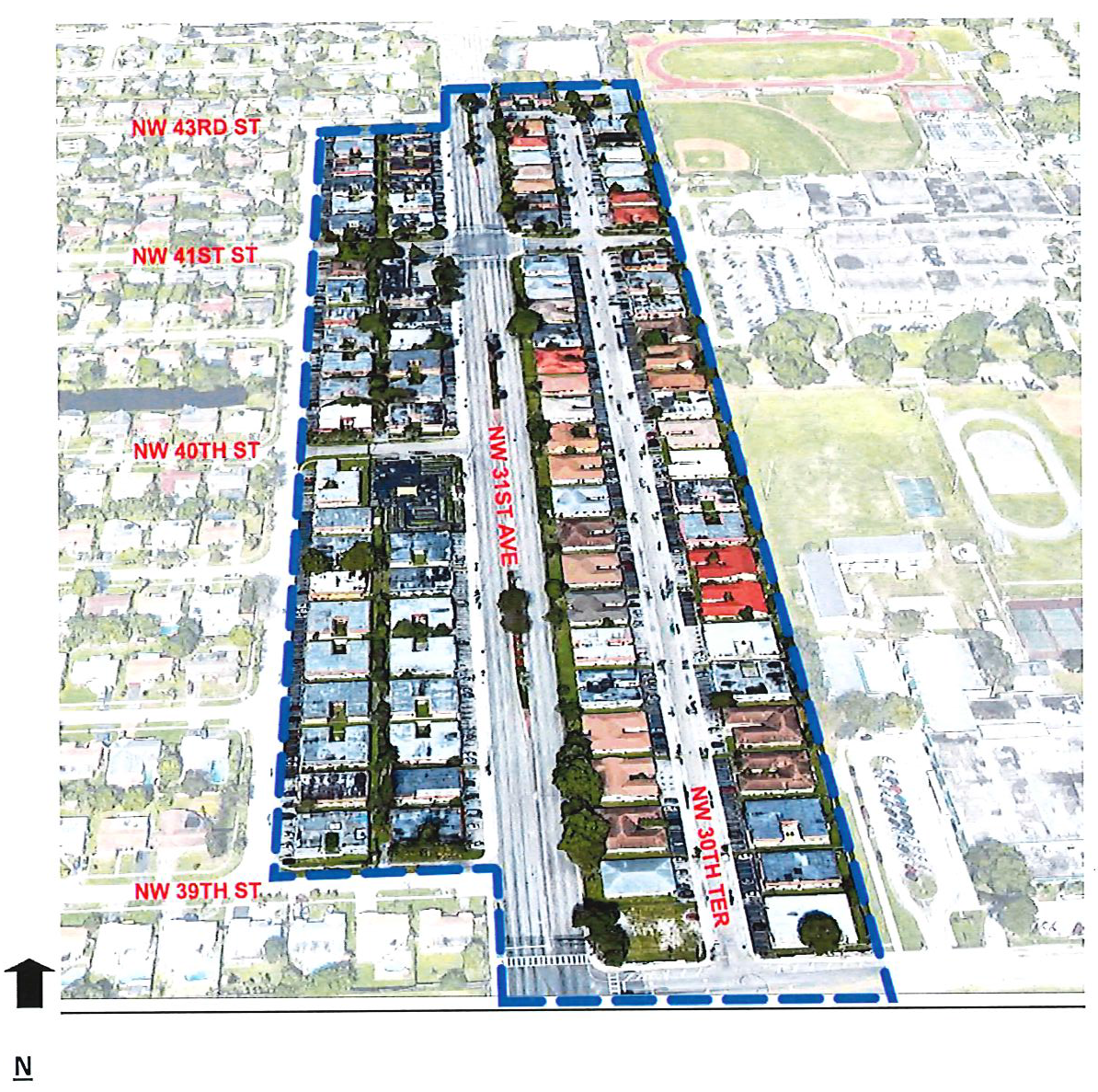
704.7.4.
Applicability. The provisions of NW 31 st Avenue overlay district shall apply to all structures and spaces within the boundaries of the overlay district as follows:
(a)
The standards and regulations set forth in this overlay, in addition to existing land development regulations, shall be the minimum standards and regulations for parcels, buildings, structures and/or improvements within the overlay district which undergo new development or substantial modification after the effective date of this article.
(b)
Existing buildings or uses. The requirements of the NW 31 st Avenue overlay district shall not apply to any modification, alteration, renovation or refurbishment of an existing building or use provided that: (1) such reconstruction is necessitated due to an Act of God; (2) such reconstruction is substantially similar to such building or accessory structure, or portions thereof, which was damaged or destroyed by an Act of God; and (3) such reconstruction does not cause nonconformity with the provisions of this article or increase its size, height, or other physical characteristics or intensity of the site when compared to the building or accessory structure, or portions thereof, which was destroyed or damaged by an Act of God. Any such modification, alteration, renovation or refurbishment shall, however, remain subject to the architectural requirements of the overlay of a building or accessory structure, or portions thereof, legally existing and lawfully conforming with the Code as of the effective date of this article.
(c)
New buildings or structures constructed shall conform to 100 percent of the NW 31 st Avenue overlay district regulations.
(d)
Minor repairs, maintenance, or similar improvements under $1,500 are exempt from the NW 31 st Avenue overlay district regulations.
704.7.5.
Use regulations. The land uses permitted pursuant to the prescribed underlying zoning district regulations remain unchanged by the creation of the NW 31st Avenue overlay district. The following uses shall be permitted as of right by pursuant to the NW 31 st Avenue overlay district:
(a)
Pocket parks.
(b)
Public utilities, including electrical power plant substations and transmission facilities.
704.7.6
Effective date and amortization of nonconforming uses and development standards.
(a)
The NW 31 st Avenue overlay district shall become effective immediately upon its final passage.
(b)
Amortization of nonconforming uses and development standards shall be complete by October 27, 2025.
(c)
Applications submitted after the effective date of the NW 31 st Avenue overlay district shall be reviewed in accordance with the applicable standards and procedures enumerated in section 704.7.
704.7.7.
Supplemental overlay district regulations.
(a)
General maintenance standards. Residential properties shall be protected from the negative impacts of noise, illumination, unsightliness, odors, dust, dirt, smoke, and other objectionable influences. Maintenance of premises shall be subject to Chapter 42 of the City's Code of Ordinances. Supplemental standards to ensure maintenance of premises are as follows, along with the following conditions:
(1)
Driveways and parking. It shall be the responsibility of the owner of the property whose driveway or other entrance to his property intersects the public right-of-way to maintain the driveway or other entrance, including without limitation that portion (sidewalk and/or swale) which is on the public right-of-way.
(2)
Vehicle use areas within the overlay district shall be constructed of the same material, i.e., asphalt pavement, brick pavers, concrete, or stamped concrete. The materials used for driveways and parking shall complement the architecture of the principal building and provide equivalent durability, aesthetic appearance, and maintainability.
(3)
Parking and vehicle circulation shall be clearly delineated using directional signage.
(4)
Only private use vehicles are permitted to be parked or stored overnight where visible from the public rights-of-way.
(5)
Striping: All off-street parking areas shall be marked with white or yellow paint or paver lines maintained in clearly visible condition, curbs or other means to indicate individual spaces. Signs or markers should be used as necessary to insure efficient and safe circulation within the lot.
(6)
Vehicle parking spaces for handicapped persons shall be identified with the appropriate and visible at all times.
(7)
Curbing and wheel stops: Wheel stops or curbing shall be provided to prevent vehicles from damaging or encroaching upon any adjacent parking or loading space, sidewalk, landscaped area, or parking lot area, fence, wall, or building. Wheel stops shall be constructed of the same material (i.e., recycled rubber, concrete) and shall be painted white or yellow marked by painted numbering.
Figure 704.7.7.A Illustrative Architectural Elements: Existing Property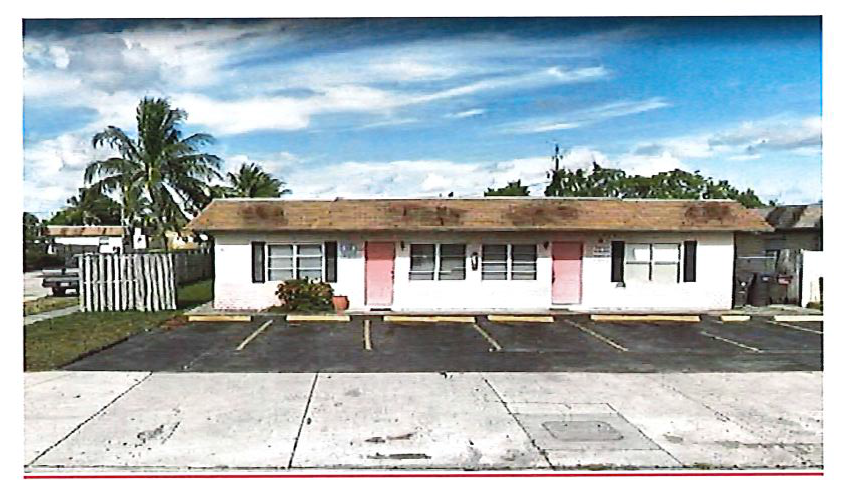
Figure 704.7.7.B Illustrative Architectural Elements: Proposed Improvements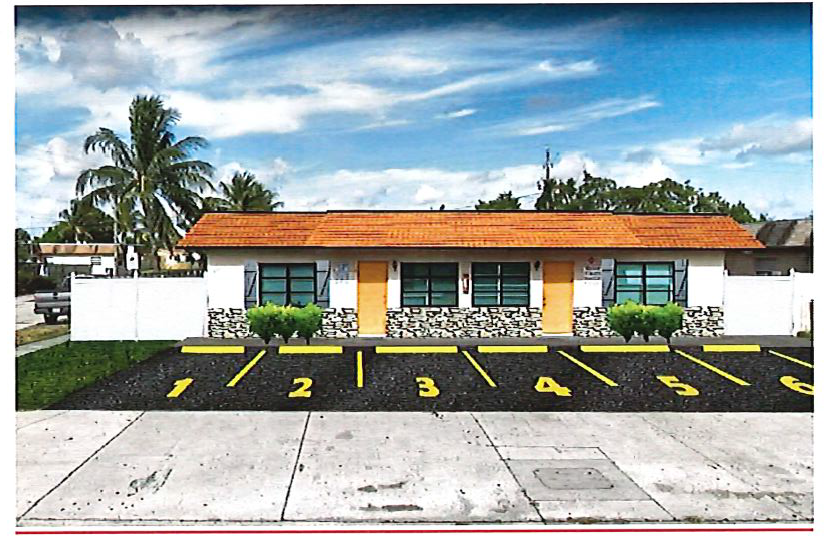
(b)
Exterior paint and colors. Except as provided herein, colors for buildings shall be included in three categories: base colors, accent colors or trim colors. The property owners affected by these regulations shall select colors in accordance with the City's color palette and regulations set forth in section 42-9 of the Code of Ordinances.
(1)
Base colors relate to the main area of the wall on the building and include light-range intensity colors such as whites, light grays, soft pastels and light beiges.
(2)
Accent colors that are used for larger trim areas include mid-range intensity colors and shall be limited to 25 percent of the total building surface area of each elevation.
(3)
Trim colors are used for accent purposes (i.e., door/window trims, doors, door frames, fascia, soffits, trellises, and small decorative elements) and include mid-range intensity to bright colors and shall be limited to ten percent of the total building surface area of each elevation.
(4)
All sides and elevations of buildings, walls, or block fences visible at ground level from a public right-of-way or an adjacent parcel must be architecturally finished (i.e. brick, stucco, or textured concrete masonry units).
(c)
Building facades. The design of buildings shall include elements such [as] colors, shapes, materials, varying height, and forms that break up large expanses of blank walls. All design plans submitted to the City for approval shall contain these design elements.
(1)
Building, principal structures, accessory structures, awnings, canopies and street addresses whether painted on a building, or affixed using house numbers shall have a consistent and cohesive style.
(2)
Except for zero lot line townhouse development and attached dwelling units, building facades visible from right-of-way shall incorporate methods of articulation and accessory elements in the overall architectural design as shown below:
(i)
Showcase, display, recessed windows;
(ii)
Window openings with visible trim material, or painted detailing that resembles trim;
(iii)
Set the wall back and provide a landscaped or raised planter bed in front of the wall, with plant material that will obscure or screen the wall's surface;
(iv)
Architectural features such as setbacks, indentations, overhangs, projections, articulated cornices, bays, reveals, canopies, and awnings; and
(v)
Material variations such as colors, brick, veneer, or textural changes.
Figure 704.7.7.C Illustrative Building Architectural Elements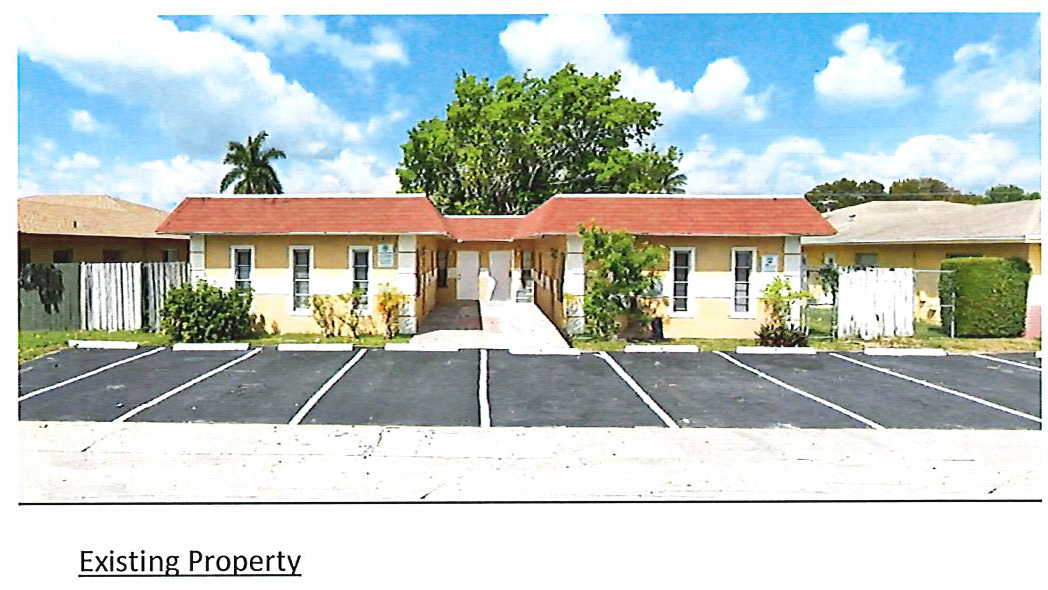
Figure 704.7.7.D Illustrative Building Architectural Elements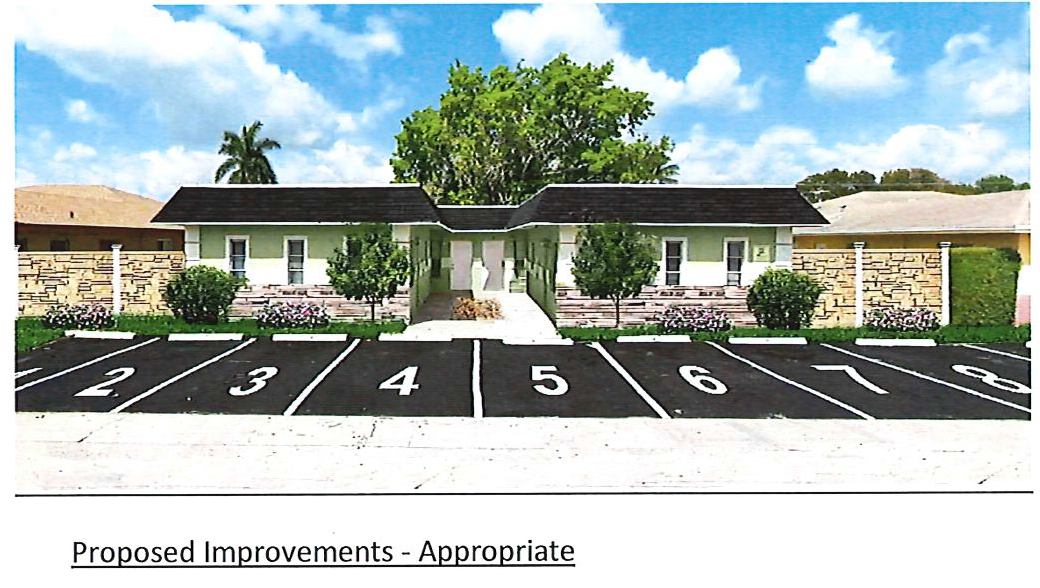
(3)
Architectural features including, but not limited to, trellises, lattice panels, archways, and arbors are permitted, subject to the following regulations:
(i)
An architectural feature (such as a trellis or lattice panel), which is no more than 12 inches in height, may be added above the maximum height limit of the fences as specified in this subsection as long as there remains at least ten inches of open space above the top of the fence.
(ii)
Supports for the architectural feature placed on top of the fence shall be spaced no closer than three feet on center.
(4)
Roofs. All materials used in a roof assembly shall complement the architecture of the principal building and enhance the appearance of the community. The following design characteristics are encouraged:
(i)
Flat roofs with an articulated parapet of four feet in height necessary to screen mechanical equipment.
(ii)
Hip or gable roofs, minimum of 1:3 pitch, positioned so that the hip roof end is facing the street.
(iii)
Pitched roofs or shed-style arcades of flat, S-shape, or barrel-vaulted cement or clay tiles.
(iv)
Mansard roof, which shall wrap around the building so that there is visual continuity around the entire building. Vertical roofs and mansard roofs used on a portion of the building perimeter only are prohibited.
(v)
Overhangs over pedestrian walkways are encouraged to provide shade and rain protection. All overhangs shall wrap around the building to provide continuity around the entire building.
(vi)
Materials for pitched roofs shall include glazed or unglazed ceramic tiles, concrete tiles, or slate barrel, "s" shape, or similar style clay or cement tiles.
(vii)
The roofline at the top of the structure shall not run continuously for more than 60 feet without offsetting or jogging the roof plane.
Figure 704.7.7.E Illustrative Roof Lines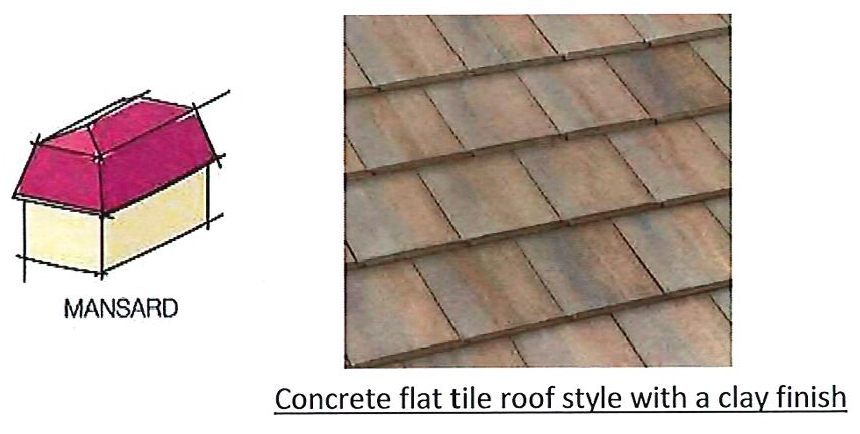
(d)
Walls and fences. Walls and fences shall be installed and maintained in accordance with the following standards:
(1)
Fences, walls and hedges may be erected to a maximum height of six feet along the rear and side property lines.
(2)
Walls and fences shall not be permitted within a required front yard.
(3)
Barbed or razor wire, polyvinyl chloride (PVC), chain-link or similar fencing are not permitted.
(4)
The finished side of all stockade fences or walls shall face outward to the abutting property or right-of-way.
(5)
Perimeter walls, if utilized, shall be architecturally compatible with the principal structure(s) relative to architecture, materials and colors.
(6)
Wall[s] or fences erected on a property line shall be constructed of opaque fencing such as vinyl, or aluminum or pressure treated wood such as shadowbox, or masonry or concrete block completely finished with stucco and/or paint.
(7)
The exterior of sheds and similar structures shall complement to the overall style of architecture and shall be constructed of one or more of the following materials: clapboard made of wood, vinyl, or fiber cement (Hardie-Plank®); or stucco.
Figure 704.7.7.F Illustrative Fences and Shade Siding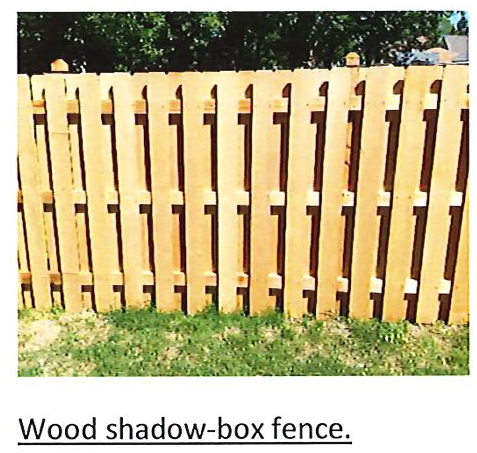
(e)
Garbage containers (garbage receptacles).
(1)
Residents, owners, operators and occupiers of the premises of any properties in this overlay shall also comply with the provisions of section 42-6 of the City's Code of Ordinances without exception, as well as the following:
(i)
Trash and recycling receptacles shall include covers to prevent odor and wind-blown litter.
(ii)
No trash or recycling receptacles shall be placed for curbside collection prior to 4:00 p.m. on the day preceding the regular collection day and shall be removed from the curb before 7:00 p.m. of the day of the pick-up.
(iii)
All receptacles shall be placed over concrete pads in the side or back yard in landscaped, fenced or walled-in areas so that the receptacles are not visible from any street.
(f)
Landscaping. In order to assure that the aesthetic appearance of the community is maintained, the following shrubbery and landscape requirements shall apply:
(1)
Homeowners must maintain healthy landscaping, to include spraying, watering, weeding, trimming, and minimum fertilizing.
(2)
All lot areas not covered by driveways, or other paved areas or structures shall be planted with lawn grass, ground cover or other appropriate landscape materials, free of weeds. Lawns shall be neatly maintained at a height of four inches or less.
(3)
Modifications to existing landscape material (as defined herein) shall be of equivalent replacement.
(4)
Landscape material shall not create pedestrian and/or motor vehicle hazards.
(g)
Lighting. All exterior lighting shall be shielded and directed away from windows and native vegetation and shall be affixed to the wall. Lighting levels shall not spill onto adjacent properties.
Code compliance. The code compliance and zoning divisions are charged with the responsibility of enforcing the overlay zoning standards as established pursuant to this division as well as other applicable City and state codes and regulations.
704.8.
Business and professional office overlay district. The purpose of the "BPO" (business and professional office) overlay district is to promote and perpetuate the continued economic viability of older and larger commercial shopping centers which are experiencing a decline in their retail tenant base. To achieve this purpose, development regulations specific to the district are provisioned to encourage a greater intensity of business, professional and medical office uses than that permitted within the underlying general business zoning district, thereby providing an economic stimulus to the district.
704.8.1.
Use regulations. Properties designated as a "BPO" (business and professional office) overlay district shall have no limitation on the maximum square footage of business, professional or medical office use permitted within the boundaries of the overlay district.
704.8.2.
Designation criteria. To be designated as a "BPO" (business and professional office) overlay district, the area must meet the following criteria:
(a)
Be developed as a multi-tenant shopping center, and
(b)
Have an underlying General Business, B-3 zoning designation.
704.8.3.
Zoning authority. Separate ordinances are required to designate each "BPO" (business and professional office) overlay district. Ordinances designating each district shall identify the designated boundaries and applicable designation criteria for that district and shall be consistent with any adopted neighborhood and/or community plans.
704.9.
Office park (OP) district. This district is intended to provide for high-quality, semi-professional and professional offices in a campus setting reflecting creative design and environmentally compatible use of space and perimeter buffer areas. This zoning district may be applied to land designated business and office and industrial and office on the city's future land use map, however the uses within this district shall be consistent with, but may be more restrictive than, the corresponding business and office and industrial and office category permitted uses.
704.9.1.
Uses permitted. No building or structure, or part thereof, shall be erected, altered or used, or land used in whole or part for other than one or more of the following specific uses:
Business/professional offices.
Laboratories for scientific and industrial research and development, including the use of scientific laboratory equipment and devices.
Dental and medical offices. Medical outpatient offices defined as pain management clinics shall be subject to the following limitations:
Medical directors and/or medical practitioners employed at pain management clinics operating within the city shall be board certified in pain medicine or anesthesia by a board approved by the American Board of Medical Specialties or any other board-approved specialty organization approved by the Board of Medicine/Board of Osteopathic Medicine and as set forth in F.A.C. 64B8-11001(8) and F.A.C. 64B15-14.001, as may be amended from time to time, recognized by the Florida Boards of Medicine and Osteopathic Medicine; or has successfully completed a post-graduate training program in pain medicine/management accredited by the Accreditation Council for Graduate Medical Education/American Osteopathic Association, College of Family Physicians of Canada, or Royal College of Physicians and Surgeons in Canada.
The primary practice of pain management clinics operating within the city shall be to provide pain management treatment. Pain management treatment under this section shall not include treatment for substance abuse.
On-site dispensing of controlled substances that are identified in Schedule II, III, or IV in F.S. §§ 893.03, 893.035 or 893.036, unless otherwise expressly permitted by statutory or general law, is prohibited.
Banks, savings and loans (no drive-in tellers).
Restaurants accessory to primary uses (no drive-in facilities).
Uses generally accessory to the above principal uses. Accessory uses are those uses that are associated with the principal use(s) and which provide service primarily to employees and patrons of the office park. The accumulative total of all accessory uses shall be limited to a maximum of 15 percent of the total gross interior square footage of the buildings proposed for the site. Such uses shall have no outside advertising.
704.9.2.
Conditional use. The following uses may be established if first approved as a conditional use:
Business-related schools.
Churches or synagogues and other houses of worship, subject to the following:
(1)
A maximum of one establishment when located within the office park (OP) district, and
(2)
A limitation of 8,000 square feet of gross owner-occupied or gross leasable area per establishment.
Pharmacies limited to drugs and medical supplies.
Uses that exceed the height limitations.
Hotels, motels, resorts and time share units, subject to the following:
(1)
The minimum plot area shall be 1.5 acres.
(2)
Any outdoor recreation areas including swimming pools shall be located at least 25 feet from the plot line of any adjacent residentially zoned property and screened from any such adjacent properties in accordance with the landscape code.
(3)
The minimum floor area of a rental sleeping room in a motel or hotel, which includes all areas to be individually rented by a customer, shall be 300 square feet.
Aboveground storage tanks. Aboveground storage tanks (AST) are permitted as an accessory use only for the purpose of storing fuel for emergency generators. Such ASTs must conform to the following requirements:
Be of 550 gallons capacity or less.
Be installed and operated under valid permits required of any Broward County and/or state environmental protection agency.
Be located within a walled service court area or be fully screened by a masonry or concrete wall with a self-closing and locking metal door or gate. Such wall shall be landscaped in accordance with the city's landscape code. ASTs located within a service court area must be located atop a curbed reveal and shall be protected from turning and backing trucks with bollards.
Be located in a manner consistent with the site development standards of the OP zoning district.
Installation of any AST shall require a building permit from the city. Application for building permit shall be accompanied by a site plan indicating the location of the AST relative to property lines, the primary structure served by the AST, any other structures within 300 feet. A landscape plan prepared by a state licensed architect or landscape architect and other supporting documentation shall be provided if required by the city.
704.9.3.
Uses prohibited. Except as specifically permitted in this section, the following uses are expressly prohibited as either principal or accessory uses:
Residential uses.
Adult entertainment.
Retail.
Medical marijuana treatment dispensing facilities.
704.9.4.
Minimum lot area and width. Every plot upon which a structure is hereafter erected shall have a minimum lot size of 1.5 acres and a lot width of not less than 100 feet.
704.9.5.
Maximum height. No building or structure, or part thereof shall be erected to a height exceeding five stories or 60 feet, whichever is less.
704.9.6.
Front yards. Every plot upon which a structure is hereafter erected shall have a minimum front yard as follows:
50 feet in depth.
Adjacent to any trafficway depicted on the Broward County Trafficways Plan, as amended from time to time, 75 feet in depth.
No parking areas shall be located within 30 feet of any residentially zoned property or within ten feet of any street line.
704.9.7.
Side yards. Every plot upon which a structure is hereafter erected shall have a minimum side yard of 15 feet.
704.9.8.
Rear yards. Every plot upon which a structure is hereafter erected shall have a minimum rear yard of 25 feet.
(Ord. No. 07-13, §§ 2, 3, 5-8-2007; Ord. No. 07-23, § 2, 11-27-2007; Ord. No. 08-23, §§ 2—5, 7-22-2008; Ord. No. 08-24, § 3, 7-22-2008; Ord. No. 09-10, § 2, 6-9-2009; Ord. No. 09-13, §§ 2, 3, 7-28-2009; Ord. No. 2010-18, § 4, 11-23-2010; Ord. No. 2010-21, § 2, 12-28-2010; Ord. No. 2011-02, § 3, 4-12-2011; Ord. No. 2010-19, § 3, 5-10-2011; Ord. No. 2011-15, § 2, 8-9-2011; Ord. No. 2013-04, § 2, 5-14-2013; Ord. No. 2013-20, §§ 2—5, 9-10-2013; Ord. No. 2013-25, §§ 2—7, 11-26-2013; Ord. No. 2013-28, § 2, 1-14-2014; Ord. No. 2015-14, § 2, 11-10-2015; Ord. No. 2015-15, § 2, 1-12-2016; Ord. No. 2017-017, §§ 2—6, 11-28-2017; Ord. No. 2018-004, § 2, 2-27-2018; Ord. No. 2018-006, §§ 4—6, 4-24-2018; Ord. No. 2018-013, §§ 2, 3, 12-11-2018; Ord. No. 2020-002, §§ 2, 3, 5-12-2020; Ord. No. 2020-006, § 5, 10-27-2020; Ord. No. 2021-013, § 4, 11-9-2021)
Sec. 705. - Town center district (TC).
The illustrative drawings contained in this section shall serve as guidance to the development review committee with regard to the city's intent for land development within the TC zoning district. All illustrative drawings and images contained in this section are meant to demonstrate the character intended for a traditional neighborhood development (TND), but are for illustrative purposes only. The accompanying text and numbers are the rules that govern permitted development. The following regulations shall apply to the TC zoning district:
705.1.
Purpose of district; applicability. The TC zoning district is provided for the development of new neighborhoods and the redevelopment, revitalization or extension of existing neighborhoods, intended to be structured upon a network of interconnecting pedestrian oriented streets and other public spaces. These developments or redevelopments are intended to offer a mixture of housing types and prices, prominently sited civic or community buildings, and stores/offices/workplaces to provide a balanced mix of activities. A TC district is intended to serve as the hub of a larger traditional neighborhood, and the designs of both are intended to be integrated.
The regulations set forth herein are primarily intended to apply to construction on larger parcels, the size and nature of which will accommodate the overall purposes expressed herein, and to such parcels when new construction is designed to substantially and materially change existing improvements to accommodate new and different uses or to resolve overall issues of slum and blight with respect to such parcel. It is not the intention hereof to materially devalue or inordinately burden existing improvements or the property upon which they are situated or to require material alterations in existing operations or enterprises in connection with which an inordinately burdensome affect would arise.
The initial town center (TC) districts apply to existing shopping centers which have historically served "big-box" users, as well as to an array of "mom-and-pop" users, all of which were permitted in the previous general business district (B-3) zoning districts, by the application of the pyramidal zoning concepts applied before the advent of the form-based zoning concepts which underpin these TC district regulations. It is, therefore, necessary and advisable to establish objective standards and criteria to assist in the interpretation and application of the TC zoning regulations to existing and developed sites, in order to give full attention to the constitutionally-protected property rights of affected property owners, while maximizing the opportunity to realize the community's overarching goal of providing a better environment to address the evolving concerns of the community.
705.1.1.
The following standards and criteria shall control the interpretation and application of the regulations herein contained:
705.1.1.1.
The size of a parcel shall be based upon ownership or a combination of ownerships, controls, managements or uses of common private infrastructure such as driveways, drive aisles, parking or the like, so that the size of a particular parcel shall include all adjacent lands owned by the same owner or owned by an affiliate(s) of such owner. In determining the size of a parcel for the purposes hereof, the parcel shall be deemed to include all adjacent lands under common management or control or which provide common private infrastructure to the parcel, and the parcel shall likewise be deemed to include non-adjacent lands, divided by public rights-of-way or artificially created strips, the ownership of which, in context, does not bear a reasonable relationship to the value of the divided or artificially created land or does not bear a reasonable relationship to the utility of such land to serve the purpose for which such land is zoned.
705.1.1.2.
No parcel less than ten acres in size, as determined in accordance with subsection 705.1.1.1, shall be subject to these regulations.
705.1.1.3.
No parcel undergoing renovation of less than 50 percent of the area of the existing improvements or 50 percent of the value of the existing improvements within the lands of common ownership shall be subject to these regulations, otherwise applied, on account of such renovations, provided, however, that the percentages described herein shall be applied cumulatively and in the aggregate. Nevertheless, for the purposes hereof, the term "renovations" shall not include renovations which involve interior improvements. The term "renovations" shall include structural demolition of or structural changes to the outside envelope of the improvements, exclusive of changes or repair to see-through areas (e.g. glass, curtain, walls, etc.); roof areas, parking areas, painting, stuccoing, fire safety revisions and other changes required by governmental regulations.
705.1.1.4.
No parcel undergoing a change of tenant shall be subject to these regulations, otherwise applied, solely on account of such change in tenancy or class of occupation, as determined by the state building code or any successor code.
705.1.1.5.
No parcel shall be subject to these regulations, otherwise applied, solely on account of an application for or the issuance of a building permit or certificate use.
705.1.1.6.
No parcel shall be subject to these regulations, otherwise applied, solely on account of renovations or repairs necessitated by non-voluntary acts such as hurricanes, fires, natural disasters or matters completely beyond the control of the owner.
705.1.2.
Properties meeting the exceptions identified in subsections 705.1.1.2 or 705.1.1.2, shall be developed in accordance with the development provisions and standards of the B-3 general business zoning district.
705.2.
Conflicts. In the event that a conflict arises between language contained in this section and language contained elsewhere in the City Code or this Code, the language contained in this section shall take precedence.
705.3.
Definitions. The following definitions shall be applicable to this section. Terms used throughout this section shall take their commonly accepted meaning unless otherwise defined herein. Terms requiring interpretation specific to this subchapter are as follows:
Block means a combination of lots surrounded by streets, other accessways, or open space areas.
Block face means the line where a block meets a street, other accessway, or open space area.
Boulevard means a street or street segment that serves as either a link from the center of a TND neighborhood to its edge, a link between TND neighborhoods, or describes the edge of the TND or TND neighborhood and is customarily comprised of sidewalks, street trees/planting area/optional utility allocation, curb and gutter, on-street parking, bicycle lanes, travel lanes, and a median.
Bulb-out means a curbed landscaped area that projects at a 90 degree or lesser angle into an on-street parking area.
Category of use—Civic use means property designated for governmental uses or any use allowed, except for parks, within the community facilities (CF) zoning district.
Category of use—House use means property designated for detached single-family residential uses.
Category of use—Public use means property designated for civic use structures, streets, public accessways, open space areas and recreation property.
Category of use—Rowhouse use means property designated for either multi-family residential or mixed multi-family residential and commercial uses where commercial uses, except for live/work units, are only permitted on the ground floor of the structure.
Category of use—Shopfront use means property designated for either non-residential or mixed multi-family residential and non-residential uses where residential uses are not permitted on the ground floor of the structure.
Clear area means the area that may include roadway surface, curb and gutter, sidewalk, and planting area that is established free of all vertical obstructions including but not limited to trees, sign poles, fire hydrants, electrical boxes, or newspaper boxes.
Close means a street design which either a courtyard of space at the end of a street which splits vehicular traffic or a deep courtyard space alongside a street which does not split the traffic.
Colonnade means a roof or building structure, extending over the sidewalk, open to the street and sidewalk except for supporting columns or piers.
Commercial street means a street or street segment located in a mostly built-up, non-residential area of a TND neighborhood and which is customarily comprised of sidewalks, street trees/planting area/optional utility allocation, curb and gutter, on-street parking, bicycle lanes, and travel lanes.
Curb return means the curved edge of the street at corners of intersections. Curb return radius is measured at the edge of the travel lanes, or along the face of the curb where concrete curb is present.
Eyebrow means a street design which is a shallow space within the street that splits vehicular traffic.
Frontage line means the line between a building or parcel of land and a street (excluding lanes) that is parallel and adjacent to the edge of a street right-of-way (excluding lanes), plaza, or square. In the case of a building or lot having more than one possible frontage line, the street, plaza, or square or which the building or lot address is based shall be considered the frontage line. In the absence of an address, the part of the building or lot having the narrowest frontage on any street, plaza, or square, shall be considered the frontage line. In all cases of a building or lot having more than one possible frontage line, the street(s), plaza(s), or square(s) that are not considered the frontage line shall be considered the secondary frontage line.
Green belt means an optional open space or mitigation area adjoining the TND or TND neighborhood.
Guest house means a building used for lodging of transients. Includes what is commonly known as a bed and breakfast.
Lane means a street or street segment that facilitates vehicular ingress and egress for residential uses, provides service access for non-residential uses, and usually contains utilities; and which is customarily comprised of street trees/planting area, utilities, and vehicular travel lanes.
Live/work unit means a dwelling unit that is also used as the primary place of work by the occupant of that dwelling unit.
Outbuilding means a secondary structure used for residential, guesthouse, parking, storage use, and the like.
Pedestrian accessways means interconnecting paved, gravel, or other type of improved walkways that provide pedestrian passage through blocks running from street to street.
Play lot means an open space recreational area designed for children ages two through six.
Plaza means an outdoor, pedestrian oriented open space area that contains less than 50 percent pervious area.
Production support activity means a nonpolluting, light industrial activity that manufactures or repairs items for use by a business or residence within the TND.
Residential street means a street or street segment located in a mostly residential area of a TND neighborhood and customarily comprised of sidewalks, street trees/planting area/optional utility allocation, curb and gutter, on-street parking, bicycle lanes, and travel lanes.
Shared parking means a parking space that is utilized for multiple uses occurring at different times, where persons utilizing the spaces are unlikely to need the spaces at the same time of the day (e.g., offices and taverns).
Square means an outdoor, pedestrian oriented open space area that contains at least 50 percent pervious area.
Street means any public or private accessway of the following four types: Boulevard, commercial street, residential street, and lane.
Streetedge means a partition built along the frontage line meant to define the space of the street.
Street vista means a view along a street centerline which is not less than 600 feet in length.
Streetwall means a partition built along the frontage line meant to define the space of the street and screen views into a lot.
TND means a development within the TC zoning district that consists of one or more TND neighborhoods and also may contain mitigation areas, green belts, or other open areas.
TND neighborhood means an area within a TND that consists of lots, blocks, buildings, streets, open space areas, and the like, but excluding mitigation areas, green belts and other open periphery areas. A TND may contain more than one TND neighborhood.
Tree grate means a permeable metal grating that may be walked upon and that fits around the base of a tree.
705.4.
Comprehensive plan. In conformance with the city comprehensive plan, TNDs may be located in the local activity center or in other areas of the city through the allocation of "reserve units" or application of the city's "flexibility" provisions, if necessary.
Comprehensive plan rules regarding the placement of residential uses in non-residential property as designated by the comprehensive plan, and the placement of non-residential uses in residential property as designated by the comprehensive plan, take precedence over the regulations contained in this section.
705.5.
Procedure. TNDs require rezoning and site plan approval. Applicants are encouraged to submit TND rezoning applications together with a proposed site plan. Prior to the preparation of a TND rezoning application, each applicant shall meet with the community development director. The general outlines of the proposal should be discussed and a conceptual site plan and written description of the intended plan of development should be provided by the applicant for consideration at such meeting(s). The community development director may also suggest that the applicant meet with state, regional, or county agencies, and affected civic and neighborhood groups, in connection with the preparation of the rezoning application. The purpose of the pre-application conference is to assist in bringing the overall application, as consistently as possible, into conformity with these and other regulations; to define specifically those variations from the usual application of the provisions of the land development code; and to furnish the applicant with recommendations that would inform and assist with the preparation of the components of a TND rezoning application. Submission of the conceptual site plan in no way vests any development rights with respect to the subject property.
705.6.
Elements of a TND.
(a)
Size. In order to ensure the development of a cohesive neighborhood that contains all the necessary features of a TND, but not to preclude the possibility of the extension of an existing development in this manner, the minimum size of a TND neighborhood shall be ten acres. In order to ensure that a TND neighborhood's central focus is within walking distance for all residents, a TND Neighborhood should not exceed one-half mile at its widest point.
(b)
Categories of use allocation. There are five categories of uses that make up a TND: Public, civic, shopfront, rowhouse, and house. All property within a TND must be allocated to one of these five categories of uses. Categories of uses should not be concentrated in a particular area; they should be mixed together in a pedestrian friendly and compact manner. The following are the minimum percentages of land area to be allocated per category of use in a TND. In the event that a space is intended to be utilized for more than one use (i.e., live/work unit), only the primary use should be utilized for this and all calculations contained in this section.
(1)
Civic use. Minimum of two percent.
(2)
Public use. Minimum of five percent, excluding streets, rights-of-way, and accessways.
(3)
Shopfront use. Minimum of 25 percent.
(4)
Rowhouse use and house use. Minimum of 25 percent.
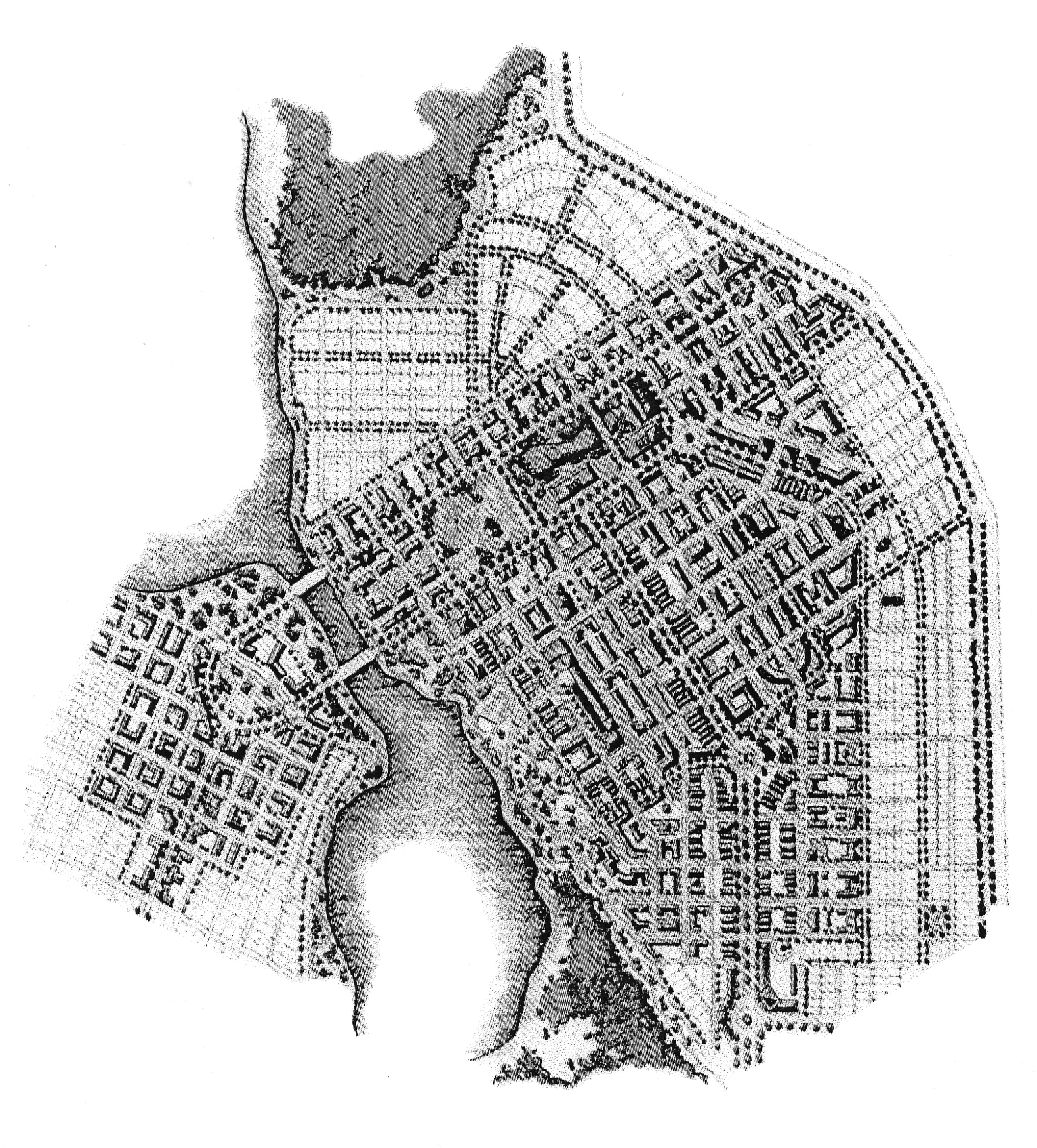
Traditional Neighborhood Map
(c)
Architectural design and general standards. The purpose of these requirements is to ensure design continuity in the neighborhood as a whole, without forcing monotonous design indicative of many modern subdivisions. The community appearance board will review prospective TNDs with respect to these criteria.
(1)
A Mediterranean architectural theme, as defined in section 1103, is required for all structures and shall be outlined in a pattern book. The pattern book must demonstrate the types of Mediterranean styles used and define their principles; define the principles for placing structures on their sites; define the layout of the structures in relationship to neighboring uses, adjacent streets, public spaces, and the TND neighborhood; demonstrate general facade detailing; demonstrate planting details, their interrelationship between the public and private landscaping, and mechanism of maintaining the landscaping; and demonstrate light pole types and generalized locations.
(2)
Colonnades shall have, at and/or over the sidewalk, a minimum clear height of ten feet (excluding signage or lighting) and a minimum clear width of eight feet (from building facade to inside column face). Colonnades may be built over sidewalks for all uses except house uses. Colonnades shall not cause roof drainage into a right-of-way without proper positive drainage design.
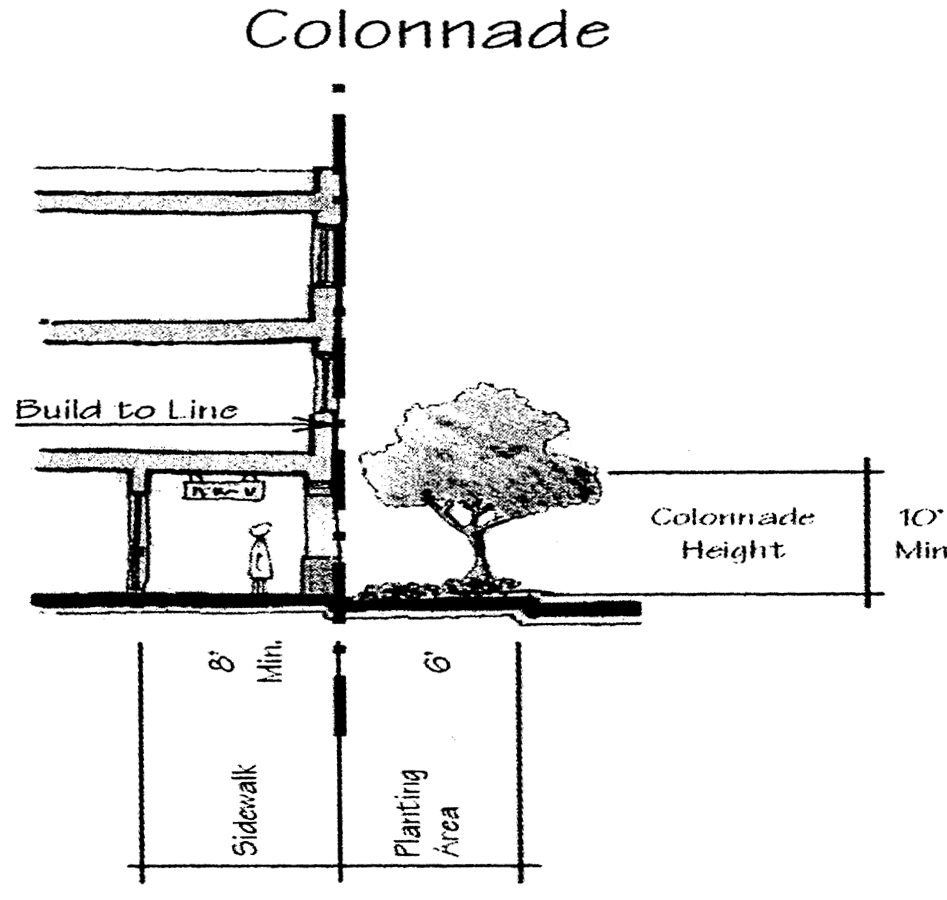
Colonnade
(3)
Porches shall have a minimum depth of six feet on the front facade and a minimum width of eight feet on the front facade. Porches are encouraged to extend to other house elevations as well.
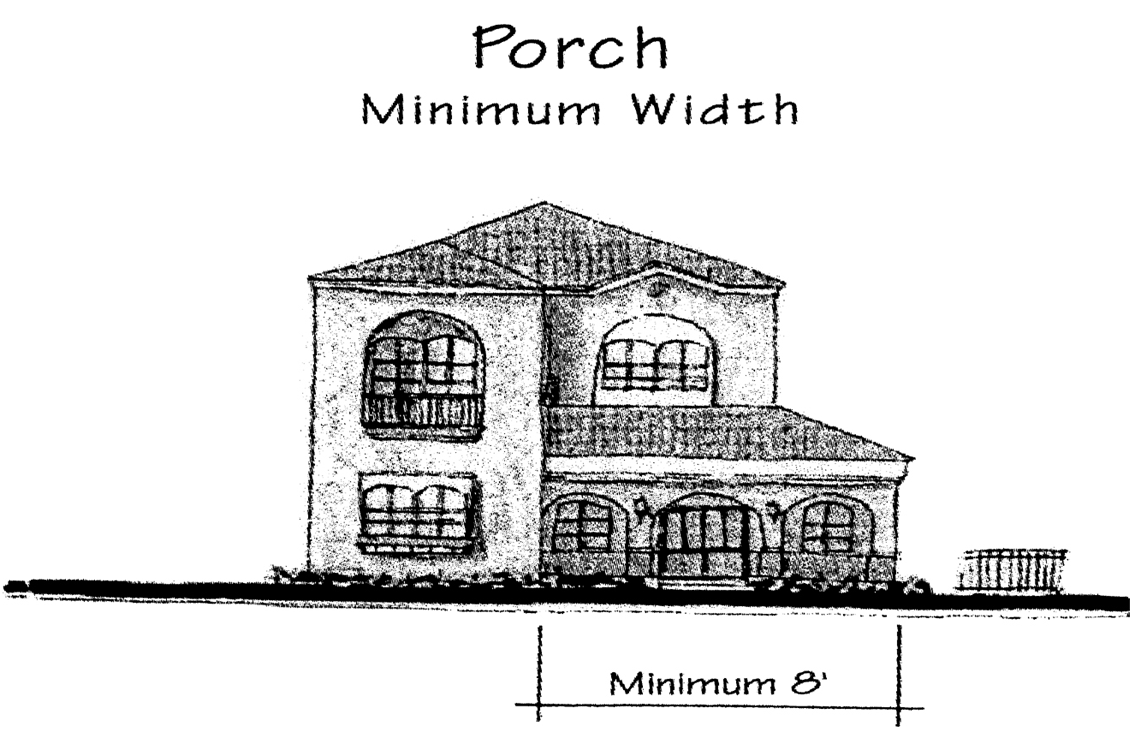
Porch, Minimum Width
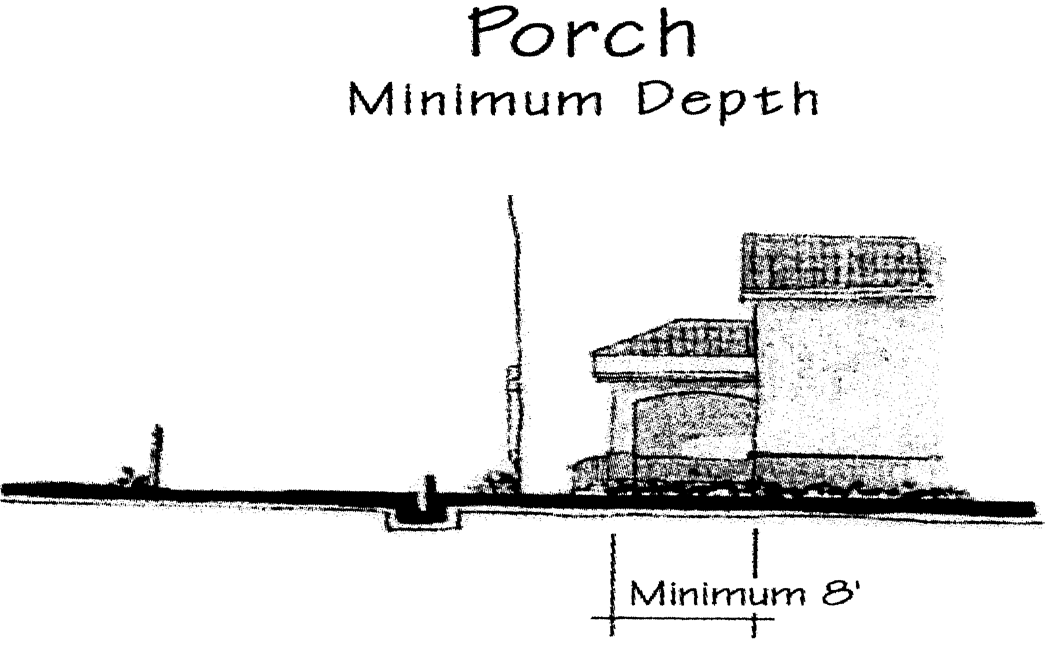
Porch, Minimum Depth
(4)
Awnings shall have a minimum clear height of eight feet and a maximum length of six feet.
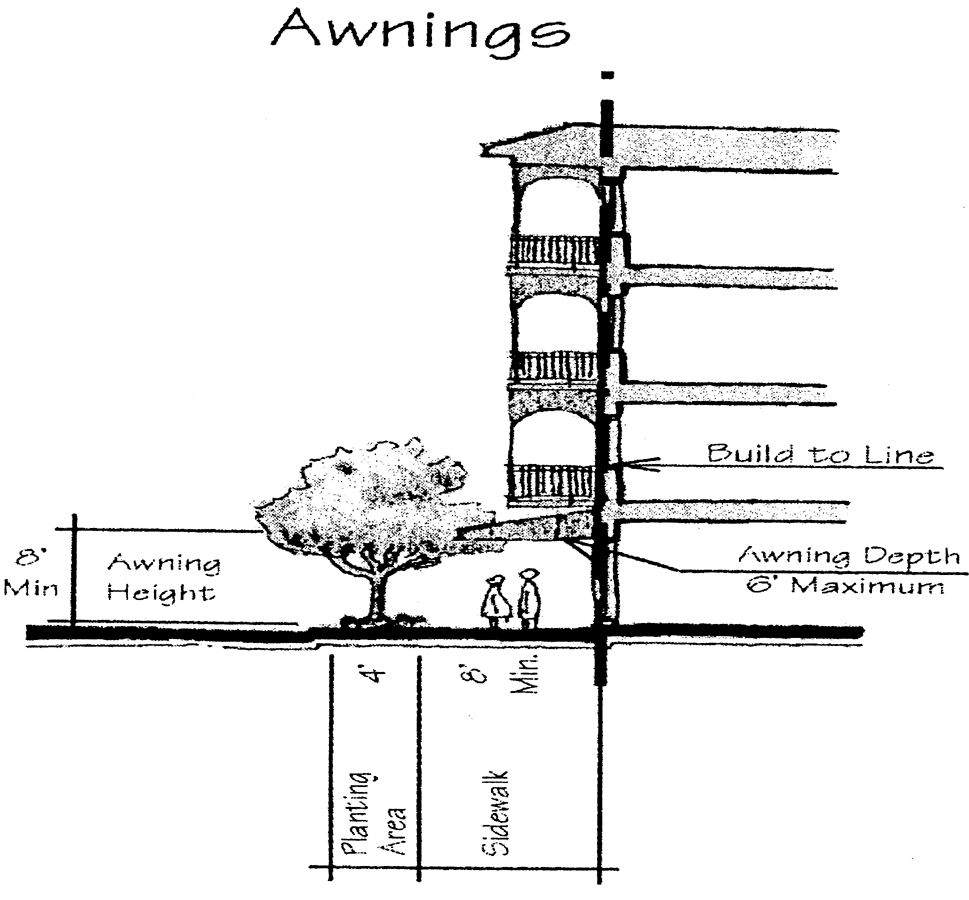
Awnings
(5)
Balconies shall have a minimum depth of four feet. Balconies with a minimum of ten feet of clearance above grade shall be permitted to extend over the sidewalk for all categories of use except house uses.
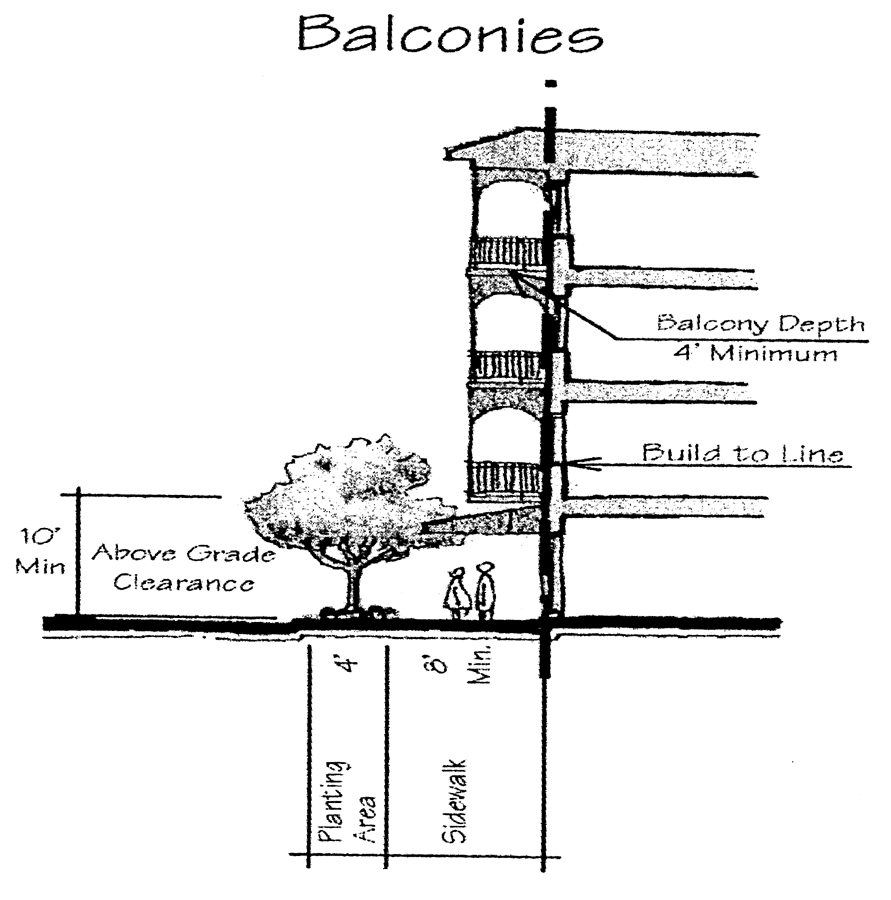
Balconies
(6)
Streetwalls shall be comprised of a masonry wall, black aluminum fence, wrought iron fence, or landscaped hedge, and shall be six feet in height, no less than 75 percent opaque, and built along the frontage line. Openings along the streetwall should be gated. (The percent opacity is calculated including all openings).
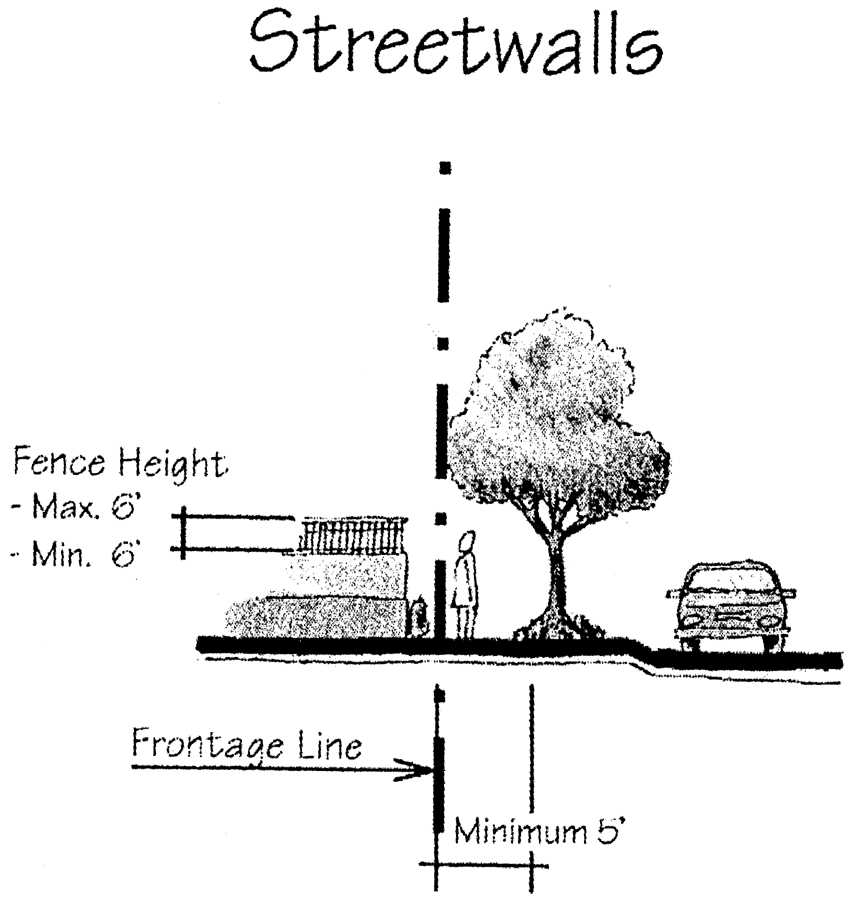
Streetwalls
(7)
Streetedges shall be comprised of a masonry wall, black aluminum fence, wrought iron fence, white picket fence, or landscaped hedge, and shall be two and one-half feet to four feet in height, at least 50 percent transparent, and built along the frontage line. Openings along the streetedge are encouraged to be gated. (The percent opacity shall be calculated including all openings).
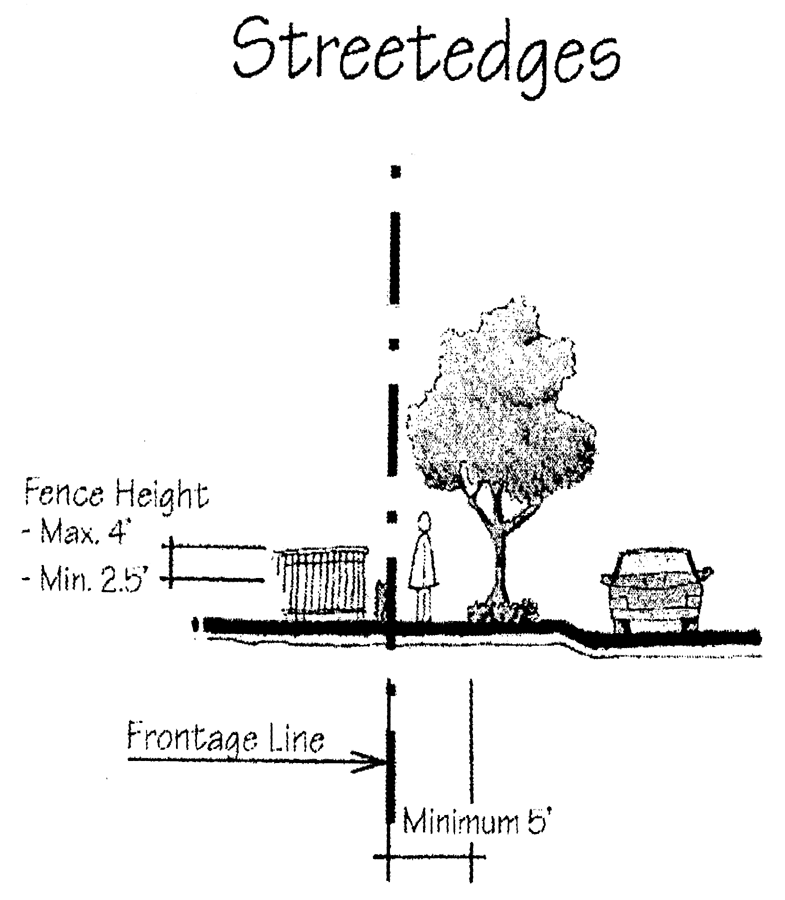
Streetedges
(8)
Residential garages shall be located in the rear-half (farthest from a non-lane street) of the building(s) that they intend to serve.
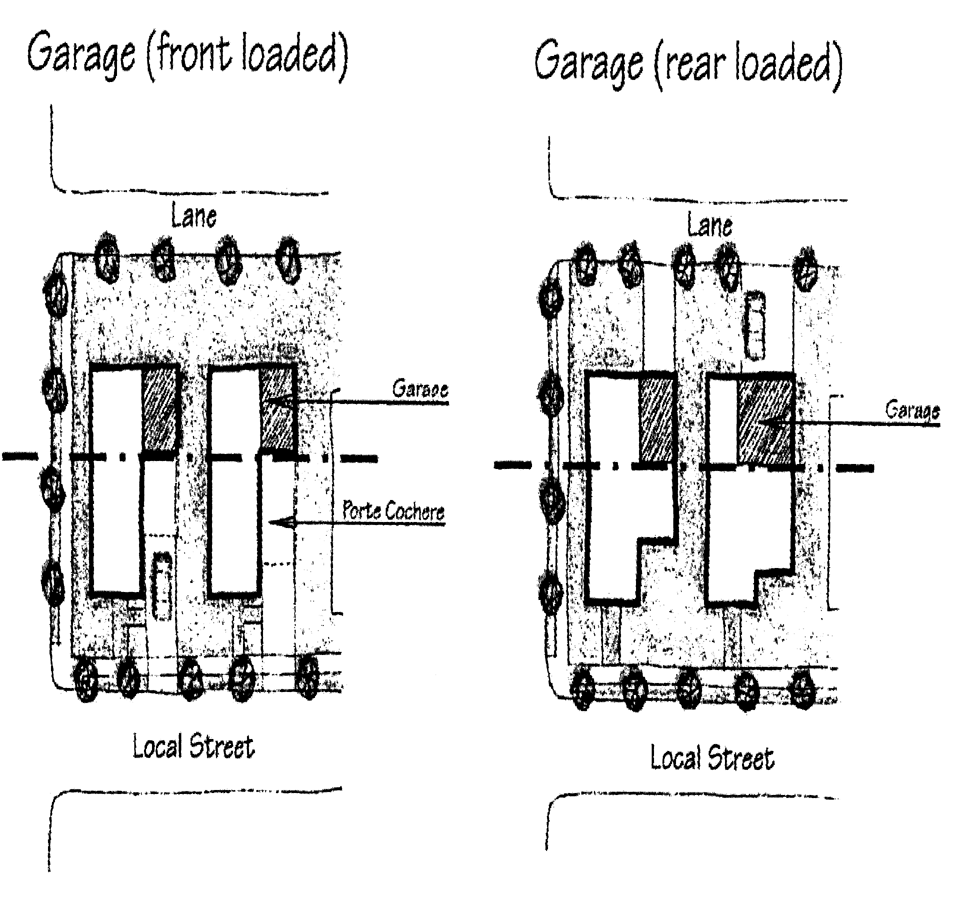
Garages
(9)
Except for requirements contained in this section, structures shall not be required to be setback to any street or right-of-way either within or outside of the TND.
(d)
Phasing. In order to provide residents with employment and recreational opportunities and non-residential uses with a solid customer base, residential and non-residential uses must be built concurrently. A phasing plan must be submitted with a site plan for development of a TND that demonstrates the following:
(1)
It is recommended that at least 25 percent of the non-residential uses be constructed prior to the construction of the initial 50 percent of the residential uses and at least 25 percent of the residential uses be constructed prior to the construction of the initial 50 percent of the non-residential uses.
(2)
At a minimum, at least 20 percent of the non-residential uses shall be constructed prior to the construction of the initial 90 percent of the residential uses and at least 20 percent of the residential uses shall be built prior to the construction of the initial 90 percent of the non-residential uses.
(3)
Gross square feet shall be used when calculating these percentages for non-residential uses and number of dwelling units shall be used when calculating these percentages for residential uses.
(e)
Streets. Streets in a TND are to be inviting public space and integral components of community design. A hierarchical street network should provide for a rich variety of transportation options. In descending order of importance, the hierarchy shall consider pedestrians as the most important, followed by cyclists, mass transit, and automobiles. This system shall be designed to connect and provide access between uses within a TND and adjacent uses within surrounding communities. In order for this street network to be safe for motorists, pedestrians, and cyclists, all design elements must consistently be applied to calm automobile traffic and to facilitate pedestrian use.
(1)
Streets shall be classified into the following four categories:
a.
Boulevard.
b.
Commercial street.
c.
Residential street.
d.
Lane.
(2)
Streets shall, wherever practicable, terminate at other streets within the TND and connect to existing and projected streets outside the TND. Street stubs shall be provided within the development adjacent to open land to provide for future connections. Cul-de-sacs and other dead-end streets are discouraged. In the event a cul-de-sac must be used, it shall not exceed 250 feet in length, must be accessed from a street providing internal or external connectivity, and shall be permanently terminated by a vehicular turnaround. In most instances, a close or eyebrow is preferred to a cul-de-sac. Vehicular turnarounds of various configurations are acceptable so long as emergency access is adequately provided, as determined by the city's fire department.
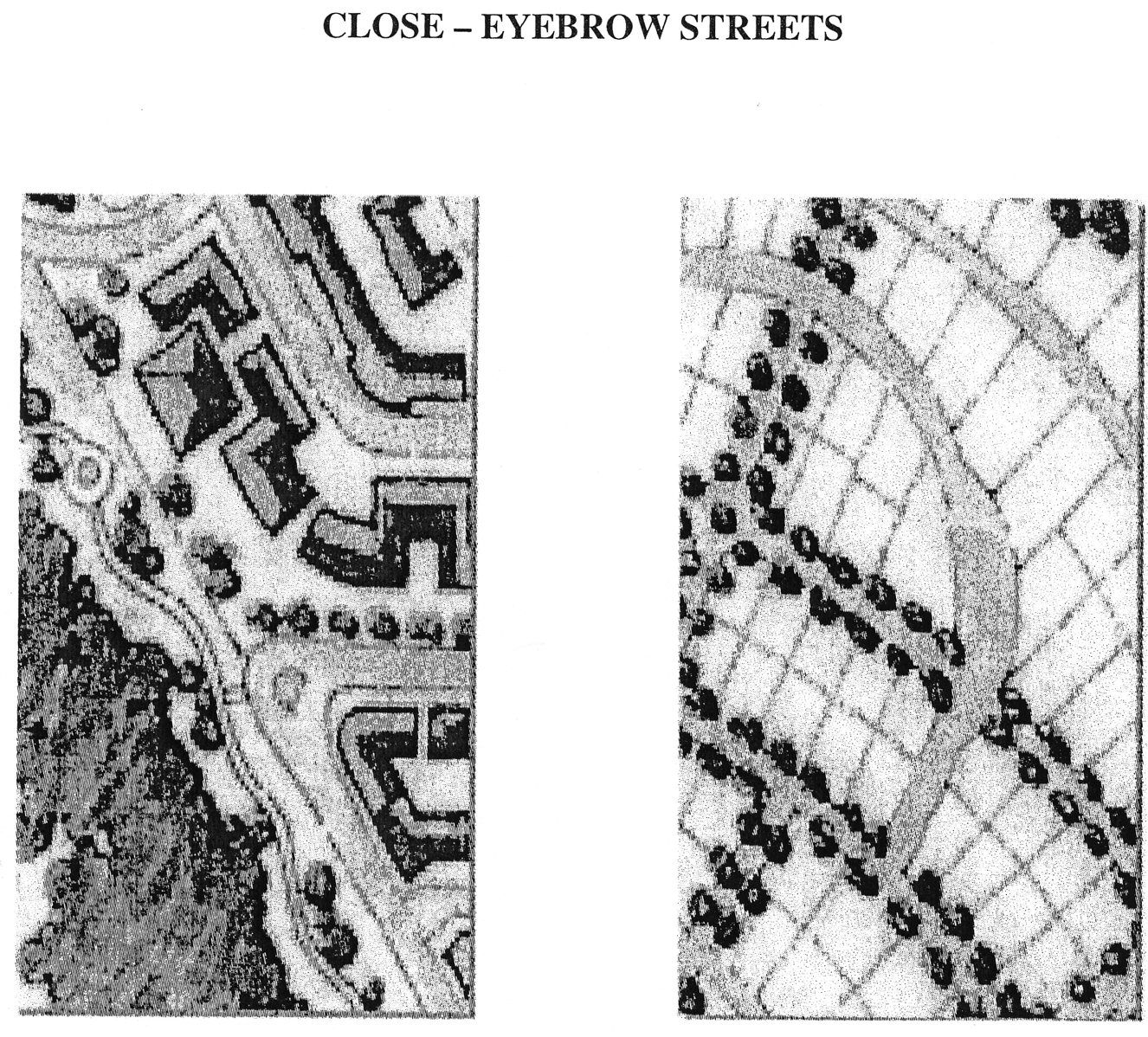
(3)
The average perimeter of all blocks within a TND neighborhood shall not exceed 1,500 feet. The maximum perimeter of any block within a TND neighborhood shall not exceed 2,000 feet. No block face within a TND neighborhood shall have a length greater than 500 feet without a publicly dedicated pedestrian pathway or street providing through access to another street. No block face within a TND neighborhood shall have a length greater than 800 feet without a publicly dedicated street providing through access to another street. These requirements may be exceeded due to superior project design as determined by the community development director.
(4)
A continuous network of rear and side lanes is encouraged to be provided for all buildings in a TND. Where provided, lanes shall serve as the primary means of vehicular ingress and egress for residential uses. Lanes may not provide access to the front of buildings.
(5)
In order to facilitate pedestrian movement and inhibit reckless drivers from turning corners at high speeds, curb return radii shall be nine to 15 feet on all streets. A clear area of sufficient radius, as outlined in the Florida Building Code (FBC) or amendments thereto, shall be established for streets designated as a fire access road, as defined by the FBC or amendments thereto. Streets designated as a fire access road, as defined by the FBC or amendments thereto, shall be constructed in conformance with FBC regulations regarding fire access roads.
(6)
In order to distinguish pedestrian areas from vehicular areas, specialty paving is encouraged. Specialty paving is encouraged in order to indicate the entrance to the TND or TND neighborhood.
(7)
Streets may be comprised of segments. Each segment should have the characteristic of one street type.
(8)
Utilities shall be placed underground and should be located along lanes in order to minimize the disruption caused by their placement and maintenance. In the event that utilities must be placed in streets other than lanes, they should be located in a manner that does not conflict with plantings.
(9)
TND streets shall be organized according to a hierarchy based on function, size, capacity, and design speed; street right-of-ways are therefore expected to differ in dimension. The proposed hierarchy of streets shall be indicated on the submitted site plan with each street type being separately detailed. The elements that comprise streets are as follows: sidewalk, street tree/planting area/optional utility allocation, curb and gutter, on-street parking, bicycle lanes, travel lanes, and landscaped medians.
a.
Sidewalks are required on both sides of streets, except for lanes or a street straddling the undeveloped edge of a TND or TND neighborhood. Sidewalk width shall be a minimum of four feet for residential streets, six feet for boulevards, and eight feet for commercial streets.
b.
Street trees shall be planted approximately every 20 feet on both sides of all streets per chapter 10. Street trees shall not be required in lanes. The planting area for street trees shall be a minimum of five feet in width for boulevards and residential streets and be a minimum of four feet in width for commercial streets. The planting area may contain other landscaping in addition to the required street trees. A planting area for landscaping shall be a minimum of three feet in width for lanes. The required planting area width may be combined with the required sidewalk width to expand the sidewalk beyond the required width, as long as the street trees are preserved and tree grates or sufficient landscaped area is provided around the base of the trees; this provides for the flexibility of allowing planting areas in any area within the combined area. Provisions should be made to accommodate the proper root zone below finished grade.
c.
On-street parking is required on both sides of the street for commercial streets. On-street parking is required on at least one side of the street for boulevards and residential streets. Parallel on-street parking areas (including area of adjacent paved gutter) shall be seven feet wide for residential streets and seven to eight feet wide for commercial streets and boulevards, and 22 feet long for all streets. In order to ensure that pedestrian crossing distance is minimized, angled on-street parking is not encouraged, but may be provided only along commercial streets and boulevards as long as wheel stops are provided. Angled parking dimensions shall be as provided for in figure 802. A two-foot overhang past the wheel stop is permitted and shall count toward meeting the angled parking stall depth requirements. On-street parking width shall include the adjacent paved gutter area. Curbed bulb-outs containing streets trees and/or other plantings are encouraged to be built at regular intervals and at all intersections within a dedicated on-street parking area.
d.
Where provided, bicycle lanes shall be between three and four feet in width and be placed between on-street parking areas and travel lanes, or between the curb and gutter and the travel lanes in the absence of on-street parking areas. Bicycle lanes are required on streets with design speeds over 35 miles per hour. When four-foot wide bike lanes are used, they shall include standard pavement markings and signs.
e.
Commercial streets, residential streets, and lanes may contain one (one-way) or two travel lanes. Boulevards may contain up to four travel lanes. Travel lanes do not include dedicated turn lanes. Dedicated right-turn lanes are discouraged as they impede pedestrian travel.
f.
Medians in boulevards shall be curbed and contain plantings, water features, and/or specialty pavement and be at least five feet in width, excluding curb.
g.
Design speeds may not exceed 30 miles per hour for most streets within a TND neighborhood, except for four-lane boulevards. For streets with design speeds of 25 miles per hour or less, travel lanes shall be ten feet wide. For streets with design speeds greater than 25 miles per hour but less than 35 miles per hour, travel lanes shall be ten or 11 feet wide. For streets with design speeds greater than 35 mile per hour, travel lanes shall be 11 or 12 feet wide.
h.
The following cross-section diagrams illustrate typical examples of ways in which street cross-sections may be assembled:
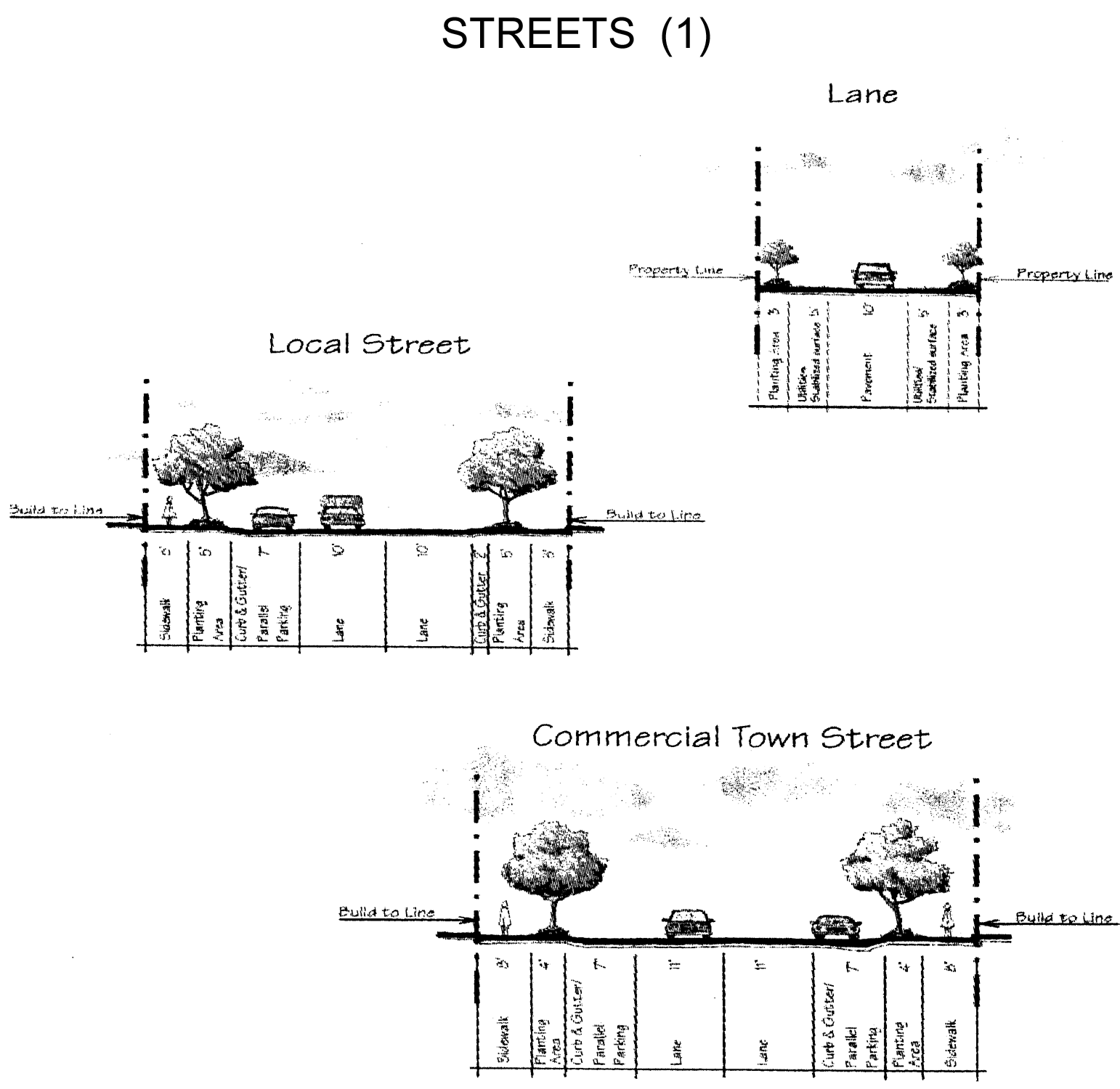
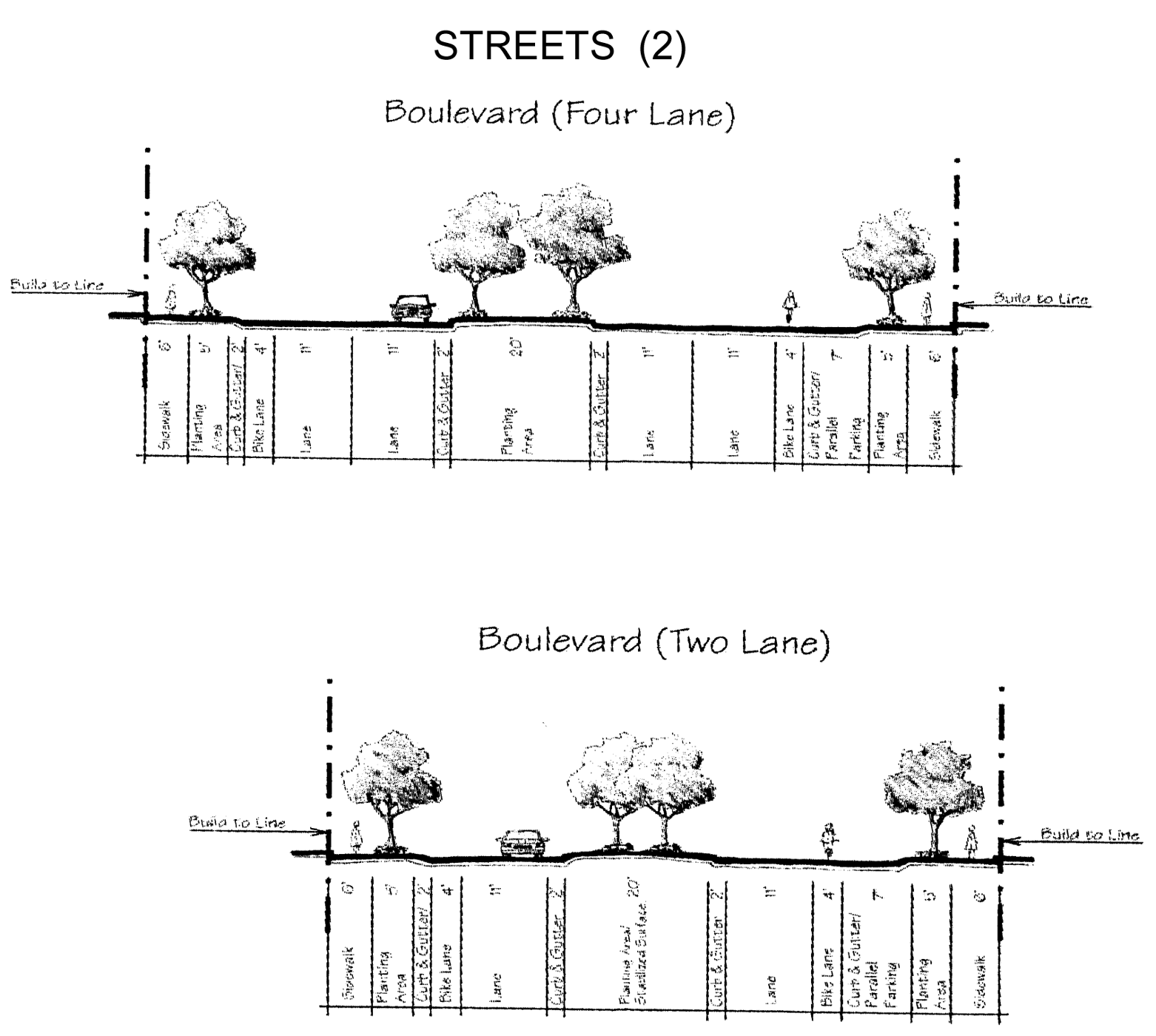
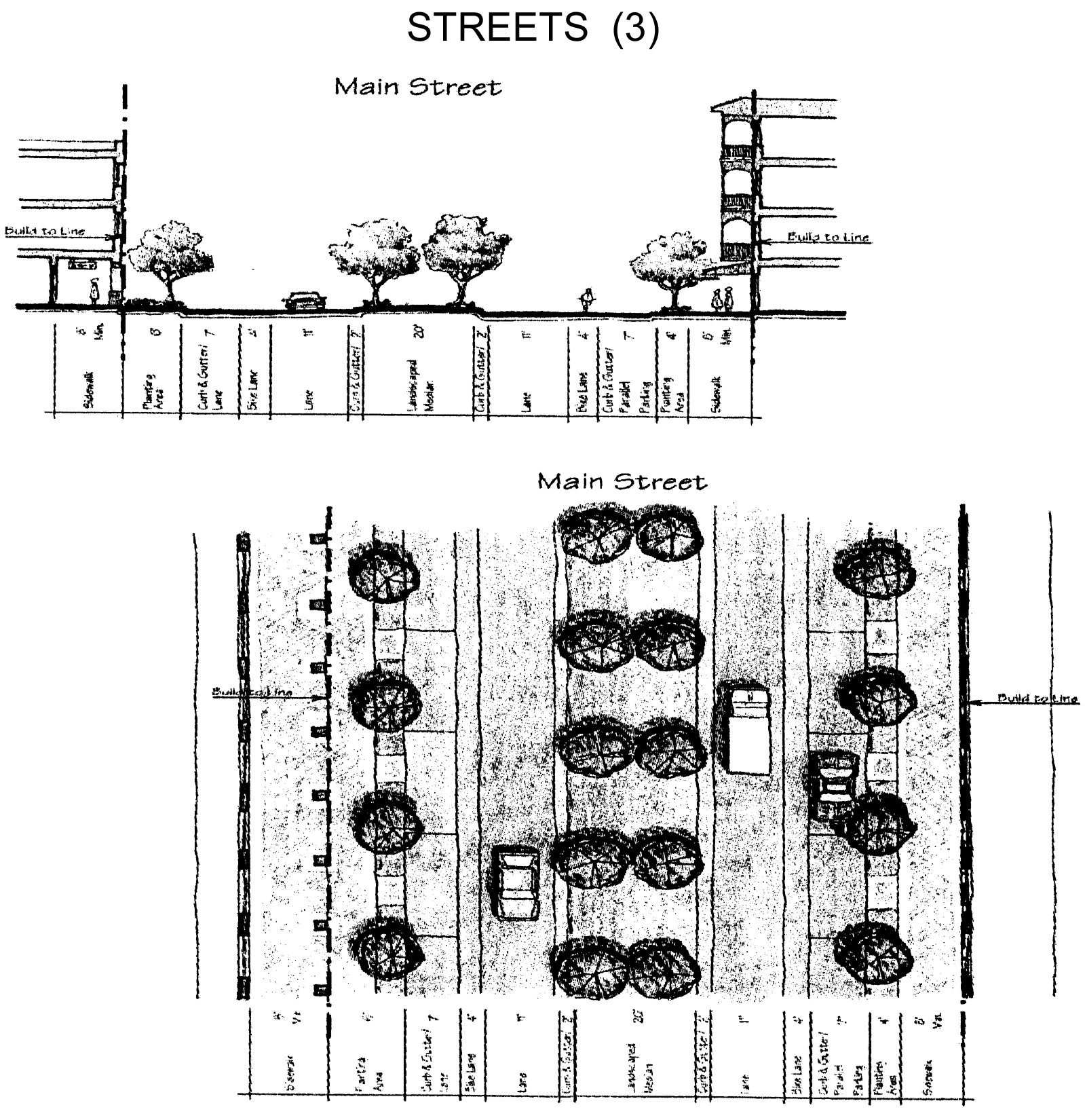
(f)
Parking. Parking shall be provided pursuant to section 801, subject to the exceptions noted below and elsewhere in this section:
(1)
Due to their design and compactness, TNDs encourage non-automotive trips between residential and non-residential uses. In order to reflect the reduced necessity of the automobile in this type of efficient development, the amount of parking required for all non-residential uses shall be reduced by 25 percent.
(2)
The parking requirements for buildings containing more than one use shall be the total of the amount of parking required for each use.
(3)
On-street parking adjacent to a building or lot shall count toward fulfilling the parking requirements for that building or use. In the event that there is no building or use on the opposite side of the street, on-street parking on the opposite side of the street, along the same building elevation or lot width may count toward fulfilling the parking requirements. A building or use must cease to utilize parking on the opposite side of the street to fulfill its parking requirements at the time when a building or use is constructed adjacent to said parking. In the event that an on-street parking space is adjacent to more than one property, the property to which the majority of space is adjacent, as determined by the community development director, shall count. However, all house uses shall maintain a minimum of one on-site parking space. On-street parking not adjacent to any building or lot may count toward fulfilling the overall parking requirements of the TND neighborhood.
(4)
The maximum number of parking spaces required for any dwelling unit is four.
(5)
Garages or carports shall not be required for any dwelling unit.
(6)
Off-site parking areas (i.e., parking lot, parking garage, etc.) are permitted for all categories of use except house uses and shall be credited to the required parking for individual uses. House uses may utilize on-street parking to fulfill their parking requirements, as regulated in this section. Off-site parking areas should provide parking for multiple users and shall be within one-quarter mile of the activity that is utilizing its parking capacity.
(7)
On-street parking and spaces within an off-site parking area may be utilized as shared parking when calculating the required parking for applicable uses. The use of shared parking must be authorized in writing by the community development director. The shared spaces shall not conflict with spaces that have already been designated as shared spaces for other uses likely to occur at the same time. A document graphically outlining the locations, number of shared parking spaces and times of use must be submitted to the community development director prior to shared parking authorization.
(8)
Off-street parking areas shall be located at the rear or at the side of buildings within all categories of use. Parking areas shall not be built into the front elevation of any building, except for buildings containing structured parking, in which case such elevation shall be designed to imitate the surrounding uses. Streetwalls shall be built on the frontage line of all parking lots.
(9)
Parking areas shall not abut street intersections or terminate a street vista. On-street parking shall not be closer than 25 feet to a street intersection, measured from the extended right-of-way lines.
(10)
Up to five percent of the required parking spaces for all uses except house uses may be replaced by providing spaces for motorcycles, motor bikes or racks for bicycles.
(g)
Landscaping and open space.
(1)
Landscaping. Landscaping in a TND is intended to reinforce community identity, minimize visual blight and noise, maintain building and property values, prevent soil erosion, reduce stormwater runoff, increase groundwater recharge, create shade and reduce solar overheating.
a.
A cohesive planting theme should emanate throughout the TND. Plantings layout and style should not conflict within the TND.
b.
Landscaping requirements shall adhere to the requirements of chapter 10.
c.
Shade trees are recommended in the planting areas along all streets, particularly in the absence of colonnades or awnings that provide shade directly over a sidewalk. It is desirable for street trees opposite each other to have their branches grow into each other to create a canopy effect over the street.
d.
Bufferyards shall not be required adjacent to areas that would offer a natural extension of the TND or that are compatible with the TND as determined by the community development director. This is meant to facilitate the interconnectedness of compatible uses.
(2)
Open spaces. TND open spaces shall be planned, improved and within walking distance from persons living nearby. Open space areas are a vital part of the focal point for each neighborhood. A square or plaza located at the central focus of a TND neighborhood, for example, may comprise a majority of the required open space. There shall be at least one central plaza or square for each TND neighborhood. There shall be a hierarchy of open space within TND neighborhoods, to serve the needs of all residents.
a.
Each TND neighborhood shall contain open space recreational areas of at least 100 square feet per residential unit. At least 25 percent of this requirement shall be designed as a play lot. The minimum size of any open space recreation area shall be 1,500 square feet. The balance shall include improved land and facility improvements, to include basketball courts, tennis courts, gazebos, open play fields and the like, as determined by the development review committee (DRC). The play lot shall not be located in an area directly adjoining a water body, unless it is otherwise impractical. Residential uses shall not be located further than 600 feet from an open space recreational area.
b.
Each TND neighborhood shall contain at least one square or plaza. The minimum size of any square or plaza shall be one acre or two percent of the TND neighborhood land area, whichever is less. The square or plaza should be located near the geometric center of the TND neighborhood or at its focal point and shall be within one-quarter mile of 80 percent of all residential uses in that neighborhood.
c.
Fifty percent of the border of a plaza must be defined by adjacent buildings, except house use buildings. The remainder may be bordered by streets or pedestrian accessways.
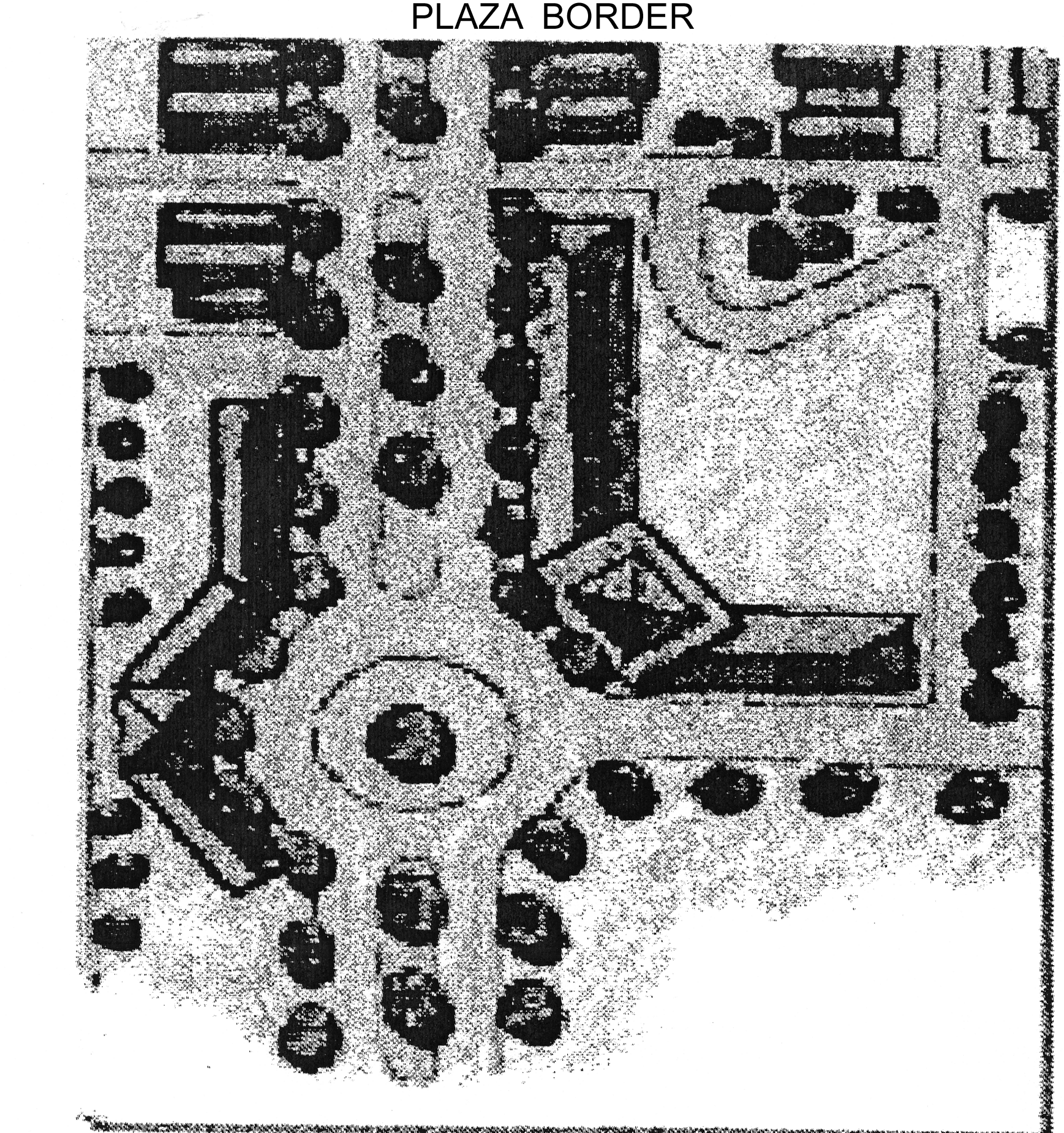
d.
Seventy-five percent of the border of a square must be defined by streets, except lanes.
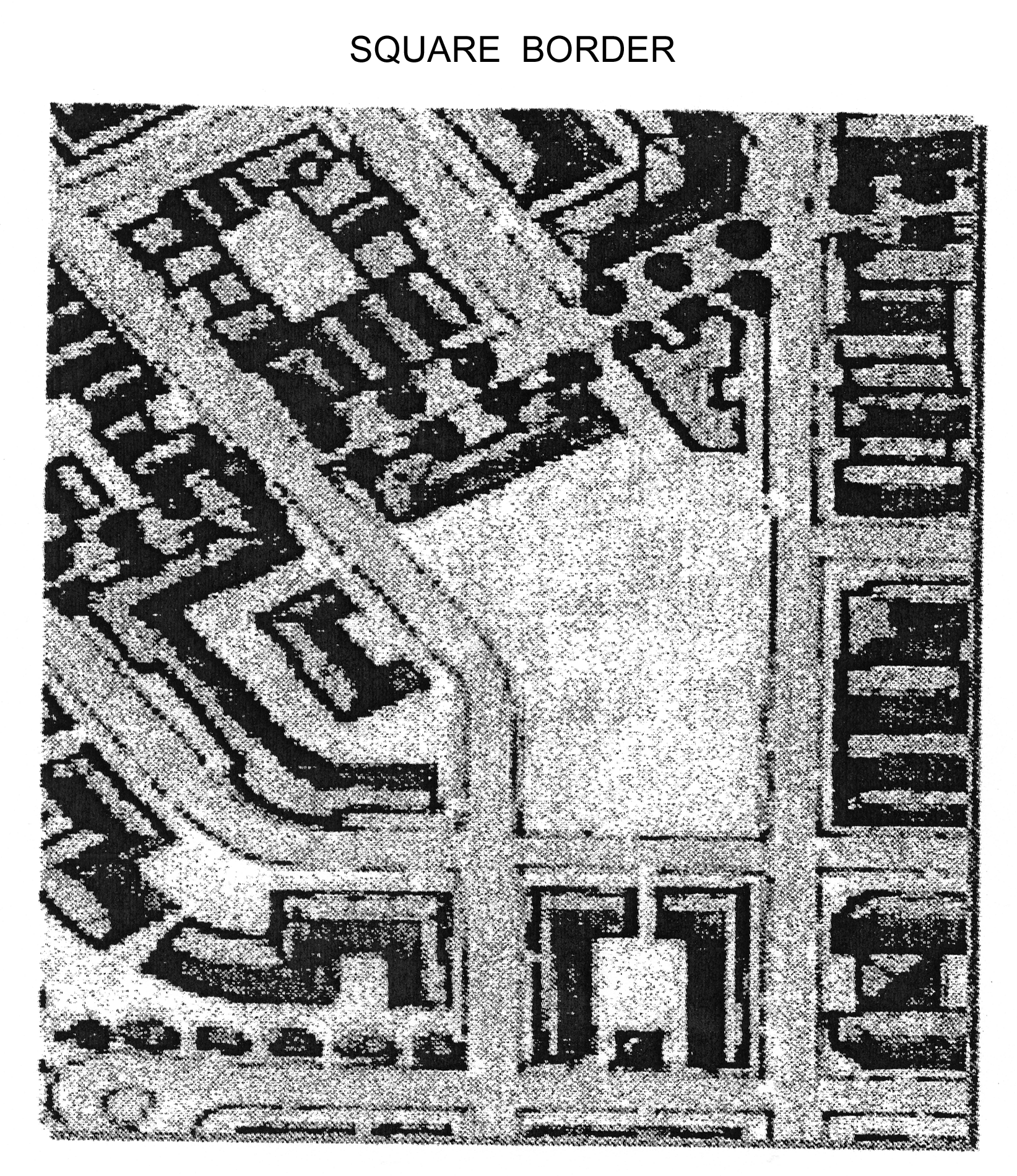
(h)
Lighting. The general rule for lighting in a TND is to prefer a greater amount of smaller lights, as opposed to fewer high-intensity lights. This is in keeping with the overall goal of maintaining the elements of a TND street in a human scale, but also allows for more aesthetic matters, such as allowing people to see the night sky.
(1)
Height of freestanding lights. For this section, height includes the pole and fixture.
a.
Lighting within the interior of parking areas of two or more acres shall not exceed 25 feet in height, except along the perimeter where it shall not exceed 12 feet in height.
b.
Lighting within the interior of parking areas of less than two acres shall not exceed 16 feet in height, except along the perimeter where it shall not exceed 12 feet in height.
c.
Street lights shall not exceed 12 feet in height.
d.
Lighting in pedestrian and recreational areas shall not exceed ten feet in height.
e.
Lighting within ballfields and recreational uses shall not exceed 40 feet in height, shall be designed to be as inconspicuous as possible, and shall not light surrounding uses, excluding streets.
f.
In cases where the light fixture is placed below the highest point of the pole, the pole may extend an additional three feet.
Examples of lighting:
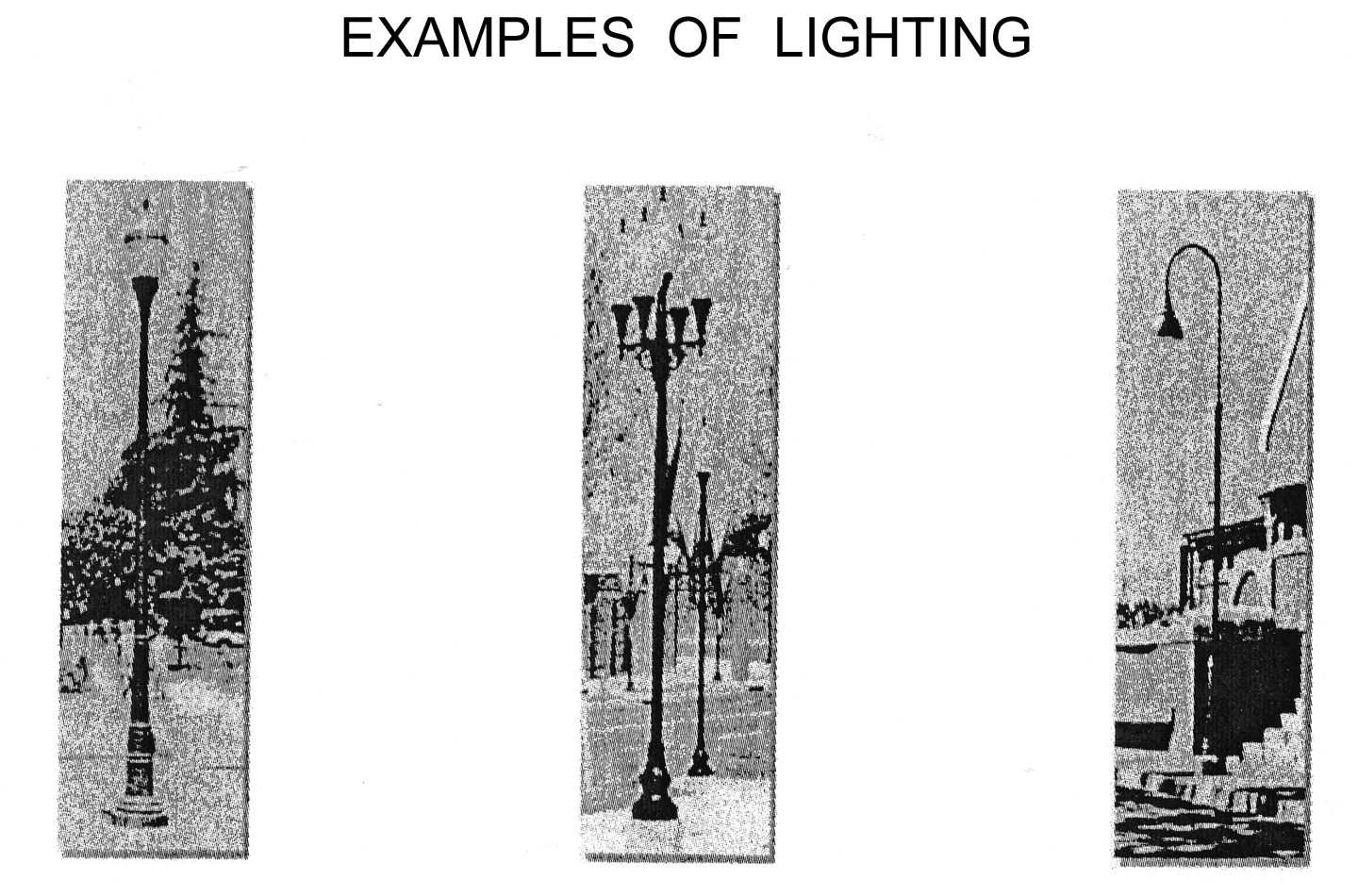
(2)
Color of light. Lighting elements that provide full-spectrum light (white light) should be used for all street lights, so that colors at night are realistic. This has the effect of deterring criminal activity and providing people with a better awareness of their surroundings. White light sources include incandescent, fluorescent, mercury vapor, and metal halide, with metal halide being preferred.
(3)
Separation from plantings. Lighting that is meant to provide visibility for ground locations (i.e., street lights, parking lot lights, etc.) should not be placed in a manner that illuminates the top of trees or is blocked by structures.
(4)
Decorative lighting. Lighting that enhances the architectural design of buildings and plantings is encouraged.
(i)
Transportation. The TND shall be built in a manner that encourages the viability of transportation mode alternatives to the automobile. The design of the TND should be of sufficient density and accessibility to encourage pedestrian or bicycle travel within the development and to allow coordinated mass transit nodes for travel outside of the development.
(1)
Transit. Since the highest levels of patronage for transit stations and stops are often found where such transit may be conveniently walked to, TND design should be inherently compatible with transit. To properly plan for transit, designers should try to have transit access as direct as possible to locations and buildings in the TND. Each transit route should also have direct, safe, secure, and pleasant pedestrian and bicycle access planned as a part of each route. Transit services should go directly into the center of each TND Neighborhood, since TND neighborhood centers typically have shops and services which provide people with a safe and pleasant environment while waiting for the transit to arrive.
(2)
[Mass transit.] Mass transit mode is dependent on the number of persons likely to patronize the mode. Mass transit may consist of motorized vehicles (buses, trolleys, shuttles), light rail, or heavy rail. It is expected that mass transit will be limited to motorized vehicles within the City's bounds. Therefore, bus shelters and bays must be accommodated in the design of the TND.
(j)
Income levels. A mix of income levels should be represented within a TND to ensure that all occupations necessary to the TND employment areas are adequately represented within the residential population. At least two dwelling unit types (single-family house, garden apartment, mixed use residential/commercial, or townhouse) shall be provided within a TND Neighborhood in order to effect a mix of income levels.
705.7.
Specific use standards.
(1)
Distance requirements between establishments that sell alcoholic beverages shall not be applied within a TND.
(2)
No business establishment shall be permitted to sell alcoholic beverages, for consumption either on or off the premises, if the business establishment is adjacent to any established house of worship or school, except as provided for in F.S. ch. 563, as may be amended from time to time.
(3)
Guesthouses shall contain no more than six rooms for the lodging of guests. Transients shall not be lodged for more than 30 consecutive days.
(4)
The following uses are prohibited where visible from open space areas and all streets, except lanes: Utility boxes and machinery, including but not limited to: backflow devices, electric meters, and air conditioning units, except for fire hydrants and fire department connections.
705.8.
Regulations per category of use.
(a)
Public use.
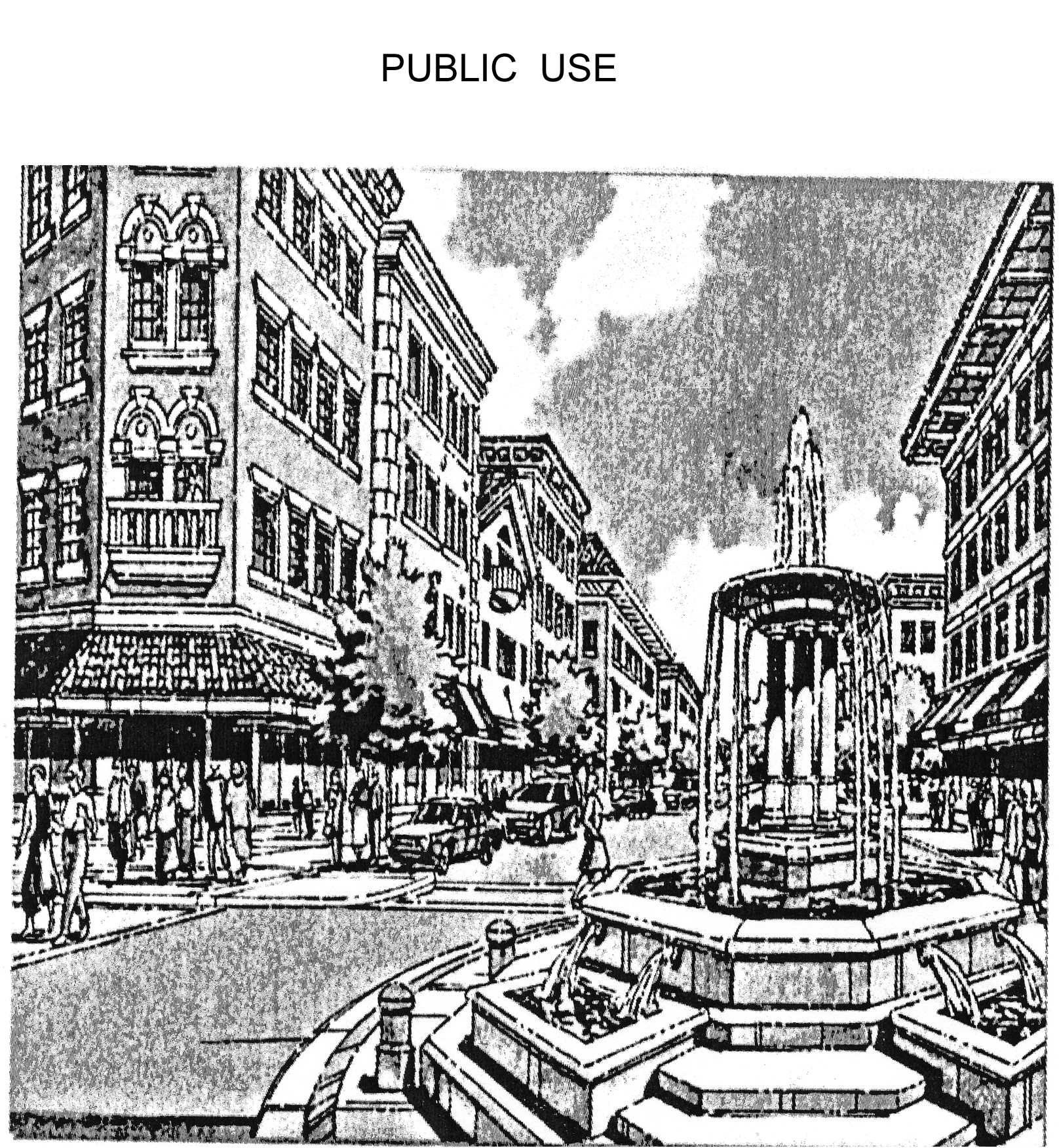
Land use. Land designated for public use shall consist of open space and recreational property, civic use structures, streets, and public accessways.
(b)
Civic use.
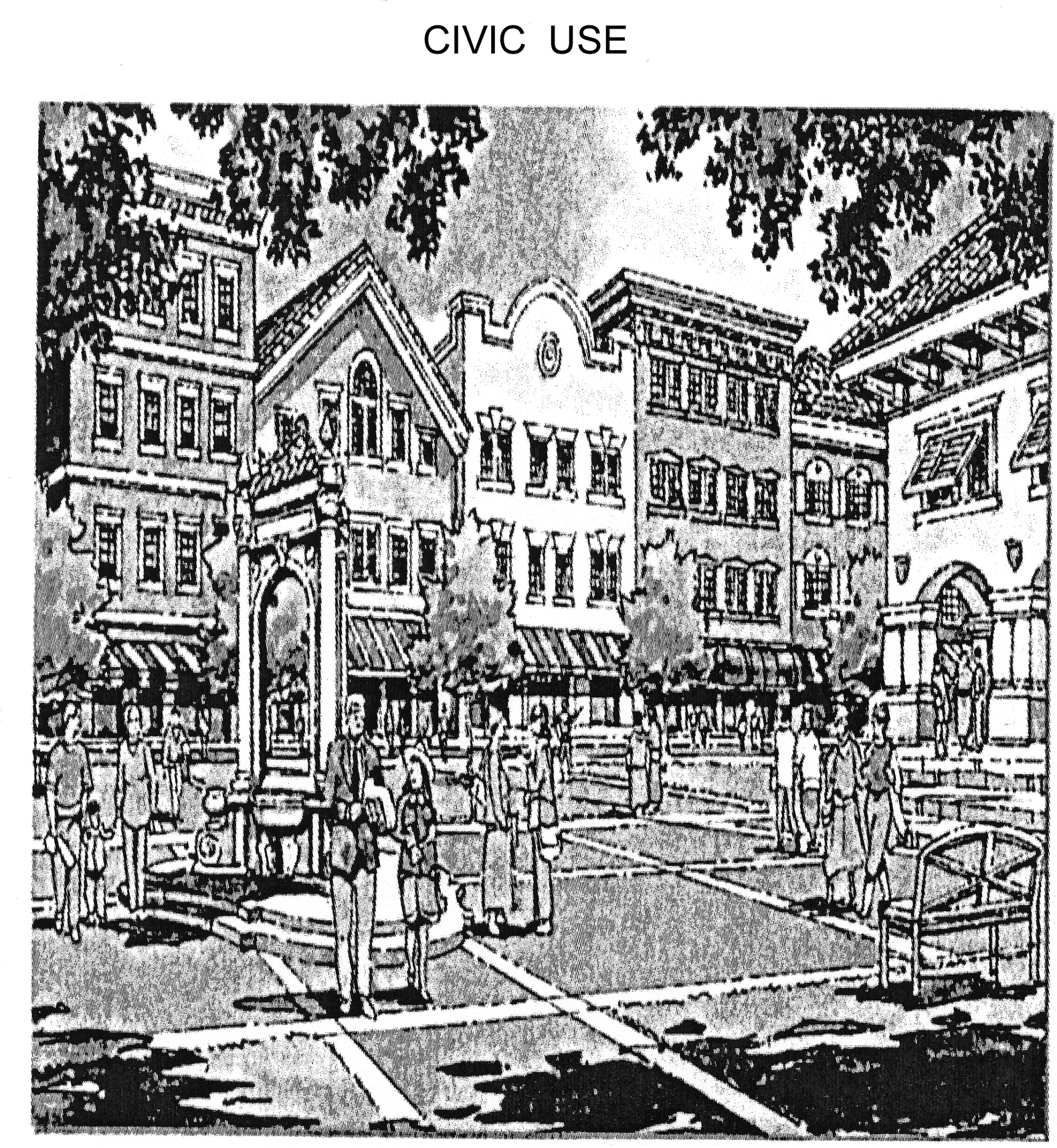
(1)
Land use. Land designated for civic use may include any use permitted in the community facilities (CF) zoning district.
(2)
Location. Civic use buildings should be located within or adjacent to a square or plaza or on property terminating a street vista.
(3)
Lots and buildings. Civic use buildings shall not exceed 80 feet in height, excluding spires, cupolas, campaniles, monuments, flag poles, and chimneys.
(c)
Shopfront use.
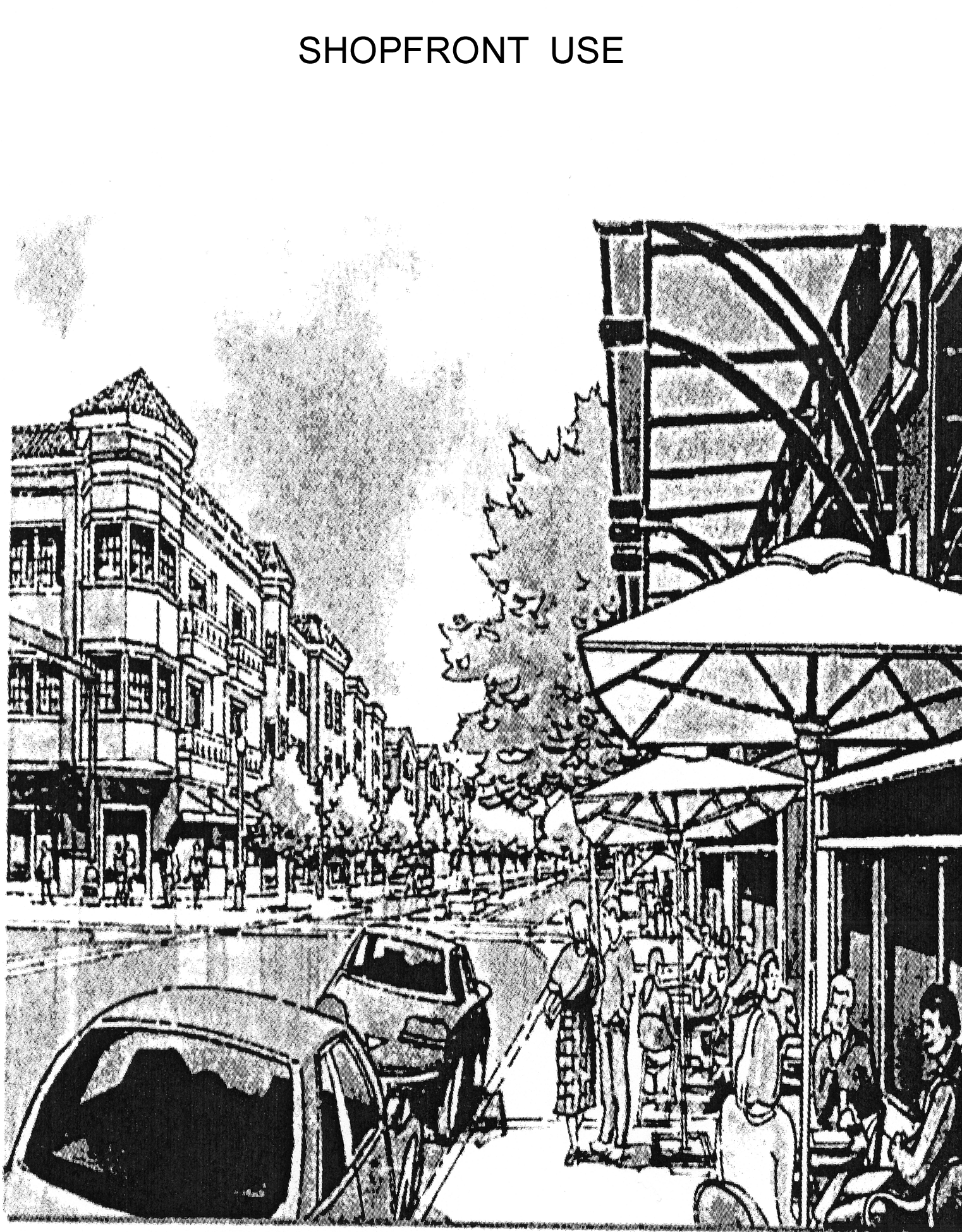
(1)
Land use.
a.
Land designated for shopfront use may include any use permitted in the neighborhood business district (B1) and multi-family residential districts (RM10, RM16 and RM-20); guesthouses; and production support activities (artist studios, pottery shops, etc.) as determined by the community development director.
b.
Residential uses, except for entries, lobbies, and recreational support uses for residential uses, are not permitted on the ground floors of shopfront use buildings.
(2)
Lots and buildings.
a.
Shopfront use lots and buildings shall have the facade or column face of the colonnade built directly on their frontage line along at least 70 percent of their linear frontage. For lots and buildings with more than one possible frontage line, the facade or column face of the colonnade shall also be built directly on the secondary frontage line(s) for at least 50 percent of their linear frontage.
b.
Shopfront use lots and buildings shall have a streetedge built along the unbuilt portions of their frontage line or their secondary frontage line(s).
c.
A shopfront use building shall be built up to an adjacent property line or building along at least one of its sides.
d.
Minimum floor area, minimum lot area, and minimum lot width shall be as provided for in the land development code for multi-family dwelling units.
e.
Shopfront use buildings shall not be less than 24 feet in height and shall not exceed 80 feet in height (excluding chimneys and elevator towers), except where adjacent to a house use. Where adjacent to a house use, the 15 feet of the building closest to the house use shall not exceed 35 feet in height.
(d)
Rowhouse use.
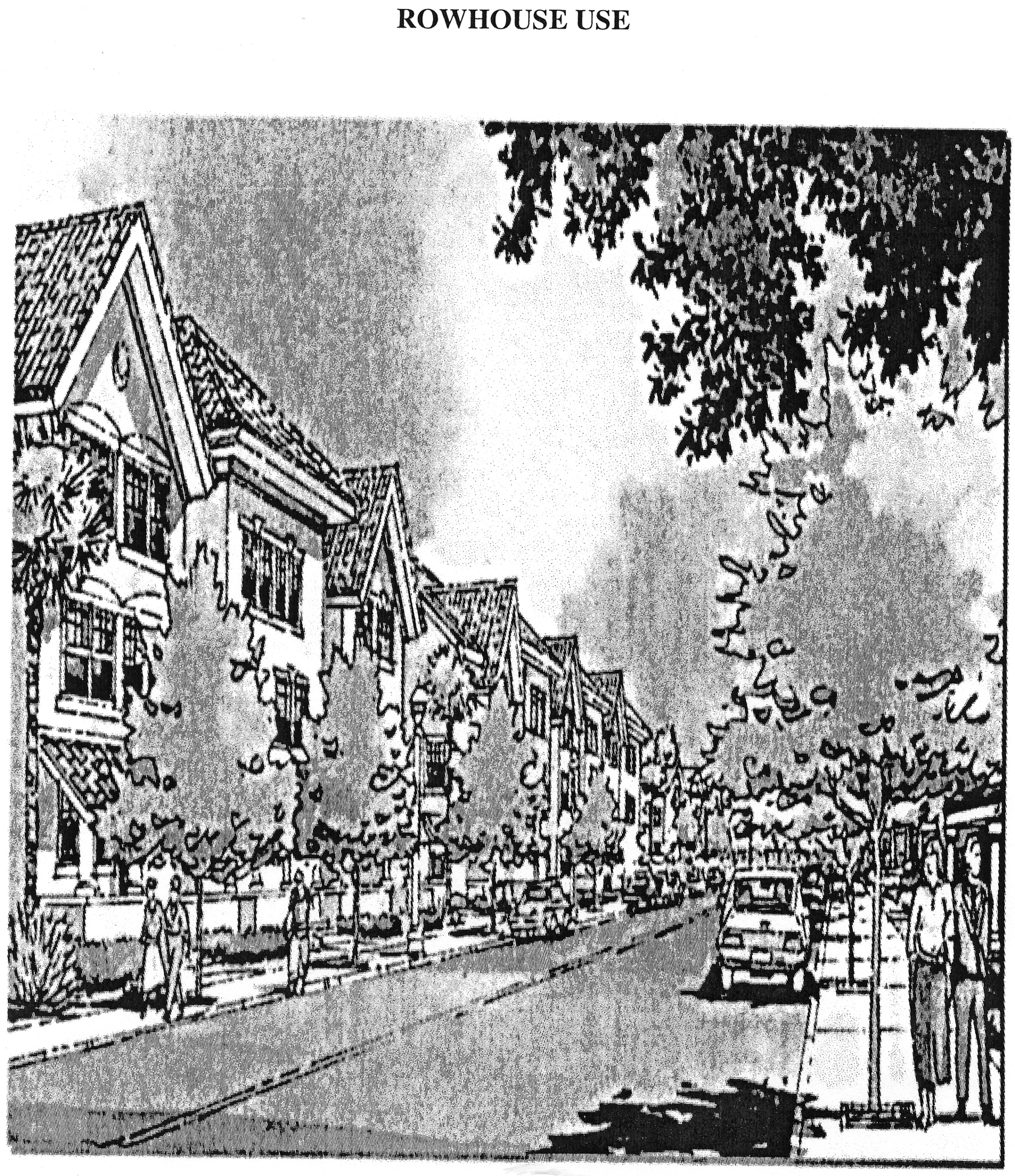
(1)
Land use.
a.
Land designated for rowhouse use may include any use permitted in the neighborhood business district (B1) and multi-family residential districts (RM10, RM16, and RM20), and guesthouses.
b.
Non-residential uses, except live/work units, are only permitted on the ground floors of rowhouse use buildings.
(2)
Lots and buildings.
a.
Rowhouse use lots and buildings are encouraged to have a streetedge built along the unbuilt portions of their frontage line and secondary frontage line(s).
b.
Rowhouse use principal buildings shall have a first floor front elevation of at least two feet above finished sidewalk grade, except for areas used for non-residential uses and buildings that are required to provide a handicapped accessible ramp per the state accessibility code for building construction.
c.
Rowhouse use buildings may be set back a maximum of ten feet from their frontage line and secondary frontage line(s).
d.
Minimum floor area, minimum lot area, and minimum lot width in rowhouse use buildings shall be as provided for in the land development code for multi-family dwelling units.
e.
Rowhouse use buildings shall not exceed 60 feet in height (excluding chimneys and elevator towers), except where adjacent to a house use. Where adjacent to a house use, the 15 feet of the building closest to the house use shall not exceed 35 feet in height.
(e)
House use.
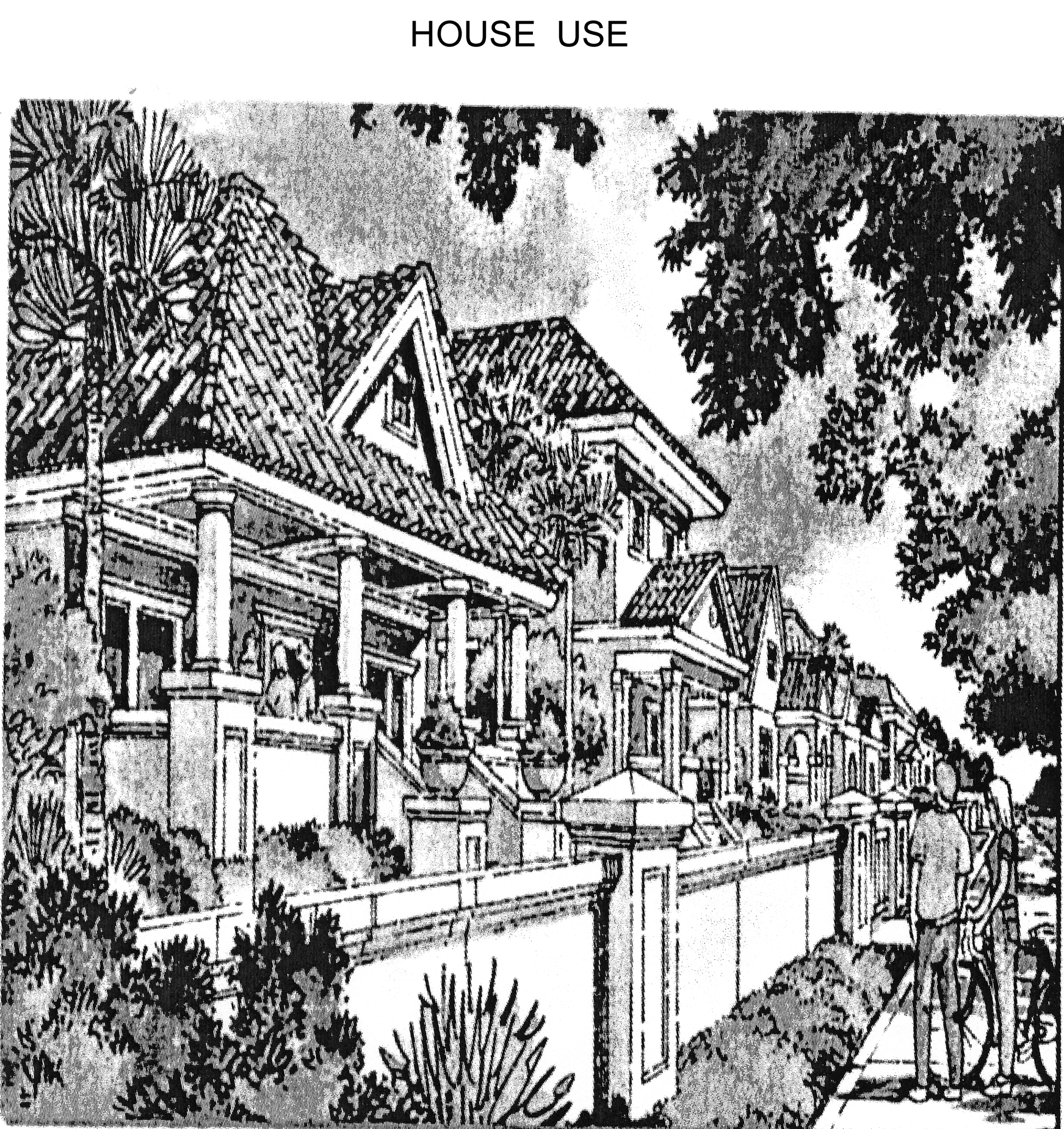
(1)
Land use. Land designated for house use may include any use permitted in the single-family residential districts (RS1, RS2, RS3, and RS4) and guesthouses.
(2)
Lots and buildings.
a.
House use lots and buildings are encouraged to have a streetedge built along the unbuilt portions of their frontage line and secondary frontage line(s).
b.
House use principal buildings shall have a first floor front elevation of at least two feet above finished sidewalk grade.
c.
House use principal buildings shall be set back a minimum of five feet and a maximum of 25 feet from their frontage line and secondary frontage line(s).
d.
House use secondary buildings shall be set back a minimum of five feet from their frontage line and secondary frontage line(s).
e.
House use principal buildings shall be set back from the side lot lines (in total) a minimum of 20 percent of the width of the lot. The entire setback may be allocated to one side; however, a minimum of five feet shall be maintained between adjacent principal structures.
f.
House use lots shall have a minimum width of 40 feet with a minimum lot size of 4,000 square feet.
g.
The minimum floor area of a house use principal building, not including garage or non-air-conditioned areas, shall be 1,200 square feet.
h.
House use buildings shall not exceed 35 feet in height (excluding chimneys).
i.
A maximum of 75 percent of a house use lot's area may be covered by a structure. Front porches and stoops are encouraged and shall not count toward this maximum and may be placed within the front yard setback.
(f)
Accessory uses. Outbuildings on shopfront use, rowhouse use, and house use property are limited to 50 percent of the floor area of the principal structure(s).
(Ord. No. 07-04, § 2, 4-24-2007)
Sec. 706. - Traditional neighborhood district—Planned unit development.
706.1.
Purpose. The traditional neighborhood PUD is specifically intended as discretionary zoning, where there is no specific entitlement to specific uses, except in accordance with an approved development agreement.
The traditional neighborhood (PUD) is intended to be applied, with an associated agreement between the property owner and the city, to property designated commercial or local activity center (LAC) on the city's future land use map. The traditional neighborhood (PUD) provisions are intended to establish a necessary level of preplanning for development of medium and large tracts of land and to encourage innovative design solutions, while retaining good land use relationships and compatibility of uses. A specific function is to facilitate the variation of standards of the zoning and subdivision codes, under proper planning, to achieve unique and innovative community design wherever it can be demonstrated that such variation will result in an environment superior to that possible under normal application of standards. The traditional neighborhood (PUD) is intended to be employed principally on infill and greyfield parcels located along major arterials within the city's community redevelopment area. The purposes and goals of the traditional neighborhood (PUD) are more particularly the following:
706.1.1.
Community development that is diverse, compact and walkable; the protection of landscapes that are ecologically and culturally valuable;
706.1.2.
The complex neighborhood unit as the basic increment of settlement;
706.1.3.
Neighborhood size determined by a pedestrian shed small enough that most residents would walk to its center;
706.1.4.
Retail for ordinary household needs within the neighborhood; workplaces, including those integrated with dwellings, available near the neighborhood; of land uses; the height, bulk and siting, and the use or reuse of structures; the alignment and dimensions of streets and rights-of-way; the size, location, and use of open spaces; the provision of public facilities and services, access points and any other relevant information; to enable the planning and zoning board and city commission to determine consistency with the purposes of the district.
706.1.5.
The integration of housing types, suitable for younger and older persons, single households and family;
706.1.6.
Balancing investment in transportation and civic infrastructure, towards the provision of civic open space and buildings;
706.1.7.
Transportation options that include walking, cars, transit, and bicycles;
706.1.8.
A fine grained network of thoroughfares dispersing traffic and connecting to the regional system;
706.1.9.
Thoroughfares conceived equitably for pedestrians, bicyclists, and automobiles;
706.1.10.
Building frontages that mask parking and support pedestrian activity.
706.2.
Procedure. A traditional neighborhood (PUD) may be established by the filing of an application for rezoning to traditional neighborhood planned unit development district by the owner of the property or the owner's authorized agent. The application for rezoning shall include a written description of the proposed development, a conceptual development plan and a completed application for a concurrency certificate consistent with the requirements of these LDRs. The conceptual development plan shall set forth the proposed types and arrangement of land uses, the height, bulk and siting, and the use or reuse of structures, the alignment and dimensions of streets and rights-of-way; the size, location, and use of open spaces; the provision of public facilities and services, access points and any other relevant information; to enable the planning and zoning board and city commission to determine consistency with the purposes of the district.
706.2.1.
The application for rezoning shall be processed in conformance with the procedures and notice requirements contained in these LDRs.
706.2.2.
During the consideration of the proposed rezoning and conceptual development plan, the city commission may identify limitations, restrictions, and conditions that are needed to ensure that the proposed development.
706.2.3.
Will be consistent with the stated intent and purpose of the traditional neighborhood (PUD).
706.2.4.
Will be compatible with existing and planned uses of adjoining property.
706.2.5.
Will be served with adequate public facilities and services and will not place an unfunded or an underfunded burden on city services and facilities; and will protect the general health, safety and welfare of the public.
706.2.6.
Concurrent with the approval of a proposed rezoning to traditional neighborhood (PUD), the property owner and the city shall enter into a development agreement setting forth the approved development and any necessary limitations, restrictions and conditions upon the approved development. The agreement shall make reference to or specifically incorporate the approved conceptual development plan on file with the city, architectural and other aesthetic features graphically depicted with attendant specifications, as well as a preliminary site plan and it shall include a legal description of the affected property and shall be recorded in the public records of Broward County as a restriction upon the use of the property.
706.2.7.
Following the approval of, or at the option of the applicant, concurrent with the application for rezoning to traditional neighborhood (PUD), the applicant shall file a complete application for site plan approval consistent with all of the procedures and requirement of chapter 5 of the developmental code. The proposed site plan shall be consistent with the approved conceptual development plan and with any limitations, restrictions and conditions contained within the approved development agreement. No building permit for a principal building shall be issued until a site plan has been approved by the city commission.
706.3.
Uses permitted. No building or structure, or any part thereof, shall be erected, altered or used, or land or water shall be reasonably construed to encourage the creative uses of land with internally mixed uses, in association in a single operation, under common control or ownership, or as separate entitles, listed below:
706.3.1.
Any retail, office, financial printing and copy center, day care center, health club, medical, dental, health care, personal service, restaurant, catering, artist studio and gallery, educational, religious, assembly hall, auditorium, theater, civic, government, community facility, entertainment or recreation use.
706.3.2.
Hotel, motel or dormitory.
706.3.3.
Uses accessory, customary and incidental to a permitted use.
706.4.
Uses prohibited. The permitted uses enumerated under section 706.3 shall not be construed to include, either as a principal or accessory use, any of the following, which are specifically prohibited.
706.4.1.
Adult uses.
706.4.2.
Pawnshops, secondhand or thrift stores, tattoo or body piercing parlors, adult attractions and/or enterprises, adult book or video stores, adult motion picture theaters, massage or modeling parlors or studios, or nightclubs allowing the performance of specified area service, restaurant, catering, artist studio and gallery, educational, religious, assembly hall, auditorium, theater, civic, governmental, community facility, entertainment or recreation use.
706.4.3.
Manufacturing as a principal use.
706.4.4.
Warehousing, storage or distribution facilities as principal uses.
706.4.5.
Secondhand or used merchandise offered for sale, displayed or stored, except in a bona fide antique or collectible store or only as incidental to the sale of new merchandise.
706.4.6.
Any use that would constitute a nuisance to adjoining property in terms of unsightly appearance, excessive noise, obnoxious odors, vibration, or electromagnetic interference as determined by the city commission.
706.4.7
Medical marijuana treatment dispensing facilities.
706.5.
Limitations on use. All uses shall be conducted entirely within an enclosed building, except for outdoor uses specifically requested by the applicant, shown on the conceptual development plan and approved by the city commission. Any permitted outdoor uses shall be effectively buffered from adjoining residential properties and rights of way in accordance with an approved development agreement and site plan.
706.6.
Building height. No building or structure, or part thereof, shall be erected or altered to a height exceeding six stories or 85 feet, whichever is less.
(Ord. No. 2017-017, § 7, 11-28-2017)
Sec. 707. - Industrial zoning district.
707.1.
Purpose. This district is primarily intended for the development of non-polluting light industry and complementary entities providing opportunities for vocational training, including cosmetology, barbering, health—services, massage and metalworking training, as well as the manufacture, processing and assembly of articles and products not involving the use of any materials, processes or machinery likely to cause undesirable effects upon nearby or adjacent business or residential property. The uses within this district shall be consistent with, but may be more restrictive than, the industrial land use plan category permitted uses. This zoning district may be applied to land designated industrial on the city's land use plan map. The minimum area for an I-1 district is one acre.
707.1.1.
Uses permitted. No building or structure, or part thereof, shall be erected, altered or used, or land used in whole or part for other than one or more of the following specific uses provided the requirements set forth elsewhere in this section are satisfied:
Business-related schools.
Dry cleaning, carpet cleaning and laundry plants.
Newspaper and job printing plants.
Contractor shops.
The following motor vehicle-related businesses conducted solely within a building:
Paint and body shops.
Upholstery shops.
Tire recapping and vulcanizing shops.
Radiator, transmission, brake, muffler and engine overhaul shops.
Lawnmower and motorcycle repair.
Warehousing, including crating, packing and shipping.
Secondhand merchandise sales of household furnishings, office equipment and electronic devices, subject to the following limitations:
(1)
The use shall be limited to a maximum of 1,200 square feet or less in area.
(2)
The use shall be separated by a distance of 500 feet from any other such use as measured by the shortest airline measurement between the nearest points on any plot to be occupied by the subject uses.
Manufacturing research and development business limited to buildings of 25,000 square feet or less in area per lot.
Manufacture of the following:
Brooms and brushes.
Candles.
Candy.
Ceramic products, electrically fired.
Cigars, cigarettes or snuff.
Clothing and hats.
Cosmetics and toiletries, except soap.
Dairy products.
Ice cream.
Jewelry.
Leather goods and luggage.
Optical equipment.
Orthopedic and medical appliances.
Paper products and cardboard products.
Perfume.
Pharmaceutical products.
Plastic products, except pyroxylin.
Pottery, electrically fired.
Shoes.
Silverware.
Spices and spice packing.
Stationary.
Television, radio and phonograph.
Artificial flowers, feathers, or plumes.
Bags.
Buttons or novelties.
Canvas products.
Manufacture of products from aluminum, brass, bronze, copper, steel, or other metal, or from bone, cloth, hair, leather, paper, rubber, shell, plastic, wood, or other materials, provided power not in excess of 20 horsepower on any one machine.
Electrical fixtures.
Electronic devices.
Food products, chewing gum, syrups, fruit juices, extracts, drugs or medicines.
Hardware and cutlery.
Musical instruments.
Small parts and devices.
Any of the following:
Bakery.
Cutting or blending of liquor.
Cheese making.
Carpenter and cabinet shop.
Electroplating.
Egg storage, candling or processing.
Hydroponic garden.
Hatchery, fish or fowl.
Motion picture studio.
Pattern making.
Printing, publishing, lithography and engraving.
Stamping, dying, shearing or punching of metal not over eight inches in thickness.
Tool, die and gauge shop.
Transformer and electrical switching station.
Plumbing or electrical shop entirely within an enclosed building.
Slat house.
Manufacture or powder blends, potting compounds and plastisols.
Manufacture of water-based and/or epoxy-based coatings, adhesives, sealants and paints.
Bottled gas storage, filling and distribution.
Accessory uses and structures, including living quarters intended as on-site security accessory to a permitted use.
Office uses which serve or represent any primary industrial use.
707.1.2.
Conditional use. The following uses, if first approved as a conditional use:
Stores for the sale or rent of new or used merchandise, conducted solely within a building, whether or not to the ultimate consumer.
The sale, service and storage of motor vehicles, trailers, motor homes and boats.
Health club or spa and physical fitness facilities.
All uses permitted in the U district.
All uses permitted in the ROS district.
Daycare centers.
707.1.3.
Uses prohibited. Except as specifically permitted in this division, the following uses are expressly prohibited as either principal or accessory uses:
Foundry.
Drop forging.
Any processing of animal products or disposal or incineration of dead animals.
Salvage yards, automobile crushing operations, storage of automobiles or trucks for parts sales.
Recycling or processing of construction and demolition debris, materials recycling facilities.
Paint or varnish manufacture.
Oil compounding or barreling.
Die casting.
Meat processing, slaughtering.
Fish smoking, curing and canning.
Bus storage or repair facilities.
Manufacture of asphalt, brick, tile, glues, cement, lime plaster, concrete or products thereof, acids, carbon, plastics, disinfectants, poison, insecticides and batteries.
Open air storage in bulk of asphalt, brick, building materials, butane, cement, clay products, concrete products, contractors equipment, fuel, gravel, hay, grease, lime, plaster, pipe, lumber, machinery, roofing, sand, stone, tar or creosoted products, timber or wood.
Institution for the housing of sick, indigent, aged or minor persons.
Hotels and motels.
Manufacturing and/or storage of explosives.
Bars and cocktail lounges.
Mortuaries.
Any use not specifically permitted.
Open air display, sale or storage of merchandise, materials or equipment, or any service or process performed outdoors unless enclosed by a masonry wall not less than six feet in height.
Pulp or paper mills.
Adult entertainment.
Hospitals, sanitariums, orphanages and similar institutions for the care or treatment of persons.
Pulp or paper mills.
Any use not in a permitted category.
Medical marijuana treatment dispensing facilities.
707.1.4.
Limitations of uses and structures. All permitted uses in this district shall be conducted within a completely enclosed building except as follows:
Overhead doors or other openings larger than eight feet in width shall not be located on the immediate streetside elevations of buildings. However, on corner and double frontage lots said doors shall be permitted behind a six-foot decorative masonry wall with doors fronting properties of like zoning. If oriented toward contiguous residentially zoned land said opening shall be screened in accordance with the requirements contained in this Code.
Building facades facing roadways shall be designed to appear to be the fronts of buildings. This provision shall apply to corner and double frontage lots.
707.1.5.
Minimum lot area and width. Except as otherwise provided, there shall be no minimum required size of plots.
707.1.6.
Maximum height. No building or structure shall be erected or altered to a height exceeding 100 feet.
707.1.7.
Setbacks. Every plot upon which a structure is hereafter erected shall have setbacks as follows:
No building or roofed structure shall be located less than 50 feet from any street line nor less than 25 feet from any plot line other than a street line.
Adjacent to any trafficway depicted on the Broward County Trafficways Plan, as amended from time to time, 50 feet in depth.
No more than one-half of the depth of any required setback area measured from a street line or a plot line may be used for parking and such parking shall be located on the half of the required setback furthest from the street or front plot line. The balance of the minimum required setback area shall be landscaped.
No structure shall be located closer than 100 feet from any residentially zoned land.
All walls except those located along an interior side or rear plot line shall have a minimum landscaped setback of not less than 20 feet in depth. Walls, dumpsters, fences or hedges (over three feet in height) shall be located no closer than ten feet from a dedicated alley.
707.1.8.
Performance standards.
No building or structure, or part thereof, shall be erected or used, in whole or in part, in any manner that is obnoxious, objectionable, a nuisance or a hazard to adjoining properties, as it relates to sound, vibrations, odors, glare, radioactive materials, smoke and particular matters.
All necessary exterior lighting on the plot shall be installed as not to cause any nuisance to adjoining areas.
There shall be no open outside storage of materials, supplies, products, equipment or machinery or marine vehicles, except automotive vehicles, unless area used for such outside storage is effectively screened from the direct view at ground level from any street or from adjacent property. Said screening shall form a complete opaque screen up to eight feet in vertical height. Said screening may include fencing up to a height of eight feet, provided that said fence is surrounded by trees and/or hedges of a height not less than three feet at time of planting and maintained at the height of the fence. Outdoor storage shall be meant to include parking of all company owned and operated vehicles with the exception of passenger vehicles. No storage shall be permitted between a frontage street and the building line unless behind a six-foot decorative masonry wall. Such wall shall be constructed a minimum of five feet from the property line and densely landscaped in the required five-foot strip.
Fuel storage tanks may be above ground for emergency generators if fully screened by a masonry or concrete wall, finished in a manner consistent with the structure and landscaped with a continuous hedge and trees on each elevation of the wall. All other fuel tanks, regardless of type will be located underground. There will be no bulk storage of any fuels permitted other than fuels stored for the purpose of servicing vehicles used in the regular course of business and for back-up generator day tanks.
All improved land shall be well graded and free from underbrush and objectionable plant growth. All unimproved land shall be kept free of debris and shall not be used for storage of any materials. The road right-of-way landscaped areas shall be mowed at least every two weeks by the adjoining property owner.
All property shall be kept free from rubbish or debris. All buildings shall be kept painted and protected from deterioration and shall not be permitted to become dilapidated.
All driveways, walkways, parking areas, storage and loading areas of developed property shall be well graded and surfaced with at least asphaltic concrete or other equivalent hard, dustless materials.
The nature of any light industrial use shall not be dangerous to the comfort, peace, enjoyment, health or safety of the community or the abutting areas or create a disturbance or annoyance.
(Ord. No. 09-04, § 2, 4-14-2009; Ord. No. 2011-08, § 2, 6-14-2011; Ord. No. 2017-017, § 8, 11-28-2017)
Sec. 708. - Commercial recreation zoning district.
708.1.
Purpose. The commercial recreation (CR) district is intended to provide for major public and private commercial recreational activities, including civic and cultural facilities, which offer recreational opportunities to residents and tourists. Recreational activities may be of a spectator or participant type. Commercial recreation uses include but are not limited to sports arenas. Racetracks, theme parks, amusement parks or golf courses. Commercial recreation uses may include move theaters, bowling alleys, health clubs, pool halls, or video arcades if they are accessory uses to the main recreational uses. The uses within this district shall be consistent with, but may be more restrictive than, the commercial recreation land use plan category permitted uses. This zoning district may be applied to land designated commercial recreation on the city's land use plan map.
708.1.1.
Uses permitted. No building or structure, or part thereof, shall be erected, altered or used, or land used in whole or part for other than one or more of the following specific uses:
Active and passive recreational areas.
Golf course.
Tennis clubs.
Fishing pier.
Baseball driving range.
All uses permitted in OS district.
Parks.
Bowling alleys.
Skating rink.
Uses accessory to any of the above uses when located on the same plot.
708.1.2.
Conditional use. The following uses, if first approved as a conditional use:
Privately owned camp grounds, overnight and short-term.
Miniature golf course.
Sports stadium or arena.
Jai alai frontons.
Hotels and motels in conjunction with the primary recreation use.
Game room arcade.
Drive-in theater.
708.1.3.
Minimum lot area and width. Every plot upon which a structure is hereafter erected shall have a minimum lot size of 10,000 square feet in area and a lot width of not less than 100 feet.
708.1.4.
Maximum height. No building or structure, or part thereof shall be erected to a height exceeding five stories or 60 feet, whichever is less.
708.1.5.
Setbacks. Every plot upon which a structure is hereafter erected shall have a minimum setbacks as follows:
Side yard: Twenty-five feet in depth.
Front yard: Forty or the height of the building, whichever is greater.
Adjacent to any trafficway depicted on the Broward County trafficways plan, as amended from time to time, 75 feet in depth.
No parking areas shall be located within 20 feet of any residentially zoned property or within five feet of any street line.
Sec. 709. - Community facilities zoning district.
709.1.
Purpose. The community facilities (CF) district is intended for those uses of institutional character such as houses of worship, schools, government and cultural buildings, public facilities, hospitals and parks and other facilities, which generally benefit the community. This zoning district may be applied to land designated residential, parks and recreation, town center, business and office, industrial and office on the city's future land use.
709.2.
Uses permitted. No building or structure, or part thereof, shall be erected, altered or used, or land used in whole or part for other than one or more of the following specific uses:
(1)
Parks.
(2)
Schools.
(3)
Educational or vocational institutes.
(4)
Churches or synagogues and other houses of worship.
(5)
Libraries.
(6)
Cultural, civic and community centers.
(7)
Municipal government, administration, services and maintenance facilities.
(8)
Police and fire protection facilities.
(9)
Uses generally accessory to the above principal uses.
709.3.
Conditional use. The following uses, if first approved as a conditional use:
(1)
Governmentally sponsored or subsidized residential/care facilities for the aged and/or handicapped, nursing homes, convalescent homes, and congregate care facilities.
(2)
Hospitals and clinics, subject to the following limitations:
Medical directors and/or medical practitioners employed at pain management clinics operating within the city shall be board certified in pain medicine or anesthesia by a board approved by the American Board of Medical Specialties or any other board-approved specialty organization approved by the Board of Medicine/Board of Osteopathic Medicine and as set forth in F.A.C. 64B8-11001(8) and F.A.C. 64B15-14.001, as may be amended from time to time, recognized by the Florida Boards of Medicine and Osteopathic Medicine; or has successfully completed a post-graduate training program in pain medicine/management accredited by the Accreditation Council for Graduate Medical Education/American Osteopathic Association, College of Family Physicians of Canada, or Royal College of Physicians and Surgeons in Canada.
The primary practice of pain management clinics operating within the city shall be to provide pain management treatment. Pain management treatment under this section shall not include treatment for substance abuse.
On-site dispensing of controlled substances that are identified in Schedule II, III, or IV in F.S. §§ 893.03, 893.035 or 893.036, unless otherwise expressly permitted by statutory or general law, is prohibited.
(3)
Non-municipal governmental facilities and buildings.
(4)
Private fraternal, civic, charitable, or professional associations; or private clubs and associations with periodic assemblies.
(5)
Federal post office.
(6)
Funeral homes, subject to the following conditions:
(a)
A site plan shall be required showing guest parking and storage of funeral vehicles.
(b)
The parking areas shall be located to the interior side of a lot or behind the primary building whenever possible.
(c)
Service vehicles—A maximum of 5 vehicles for each 5,000 square feet gross floor area.
(d)
Main use shall be limited to a maximum of one establishment per multi-tenant shopping center.
(e)
No funeral homes shall be located within 1,500 lineal feet of another such establishment.
(7)
ALF.
709.4.
Aboveground storage tanks. Aboveground storage tanks (AST) only as an accessory use and only for the purpose of storing fuel for emergency generators. ASTs must conform to the following requirements:
Be of 550 gallons capacity or less.
Be installed and operated under valid permits required of any Broward County and/or state environmental protection agency.
Be fully screened by a masonry or concrete wall with a self-closing and locking metal door or gate. Such wall shall be landscaped in accordance with the city's landscape code.
Be located in a manner consistent with the site development standards of the CF zoning district.
Installation of any AST shall require a building permit from the city. Application for building permit shall be accompanied by a site plan indicating the location of the AST relative to property lines, the primary structure served by the AST, any other structures within 300 feet as well as a landscape plan prepared by a state licensed architect or landscape architect and other supporting documentation as deemed necessary by the city manager or designee.
709.5.
Uses prohibited. Except as specifically permitted in this section, the following uses are expressly prohibited as either principal or accessory uses:
(1)
Residential uses.
(2)
Retail uses, except for gift stores or secondhand stores operated as an accessory use to a religious facility or fraternal organization.
(3)
Adult entertainment uses.
(4)
Industrial uses.
(5)
Medical marijuana treatment dispensing facilities.
709.6.
Minimum lot area and width. Every plot upon which a structure is hereafter erected shall have a minimum lot size of 20,000 square feet in area and a lot width of not less than 100 feet.
709.7.
Maximum height. No building or structure, or part thereof shall be erected to a height exceeding five stories or 60 feet, whichever is less.
709.8.
Front yards. Every plot upon which a structure is hereafter erected shall have a minimum front yard as follows:
(1)
Twenty-five feet in depth.
(2)
Adjacent to any trafficway depicted on the Broward County Trafficways Plan, as amended from time to time, 75 feet in depth.
(3)
No parking areas shall be located within 20 feet of any residentially zoned property or within five feet of any street line.
709.9.
Side yards. Every plot upon which a structure is hereafter erected shall have a minimum side yard of 25 feet.
709.10.
Rear yards. Every plot upon which a structure is hereafter erected shall have a minimum rear yard of 20 feet.
(Ord. No. 2010-18, § 5, 11-23-2010; Ord. No. 2017-017, § 9, 11-28-2017; Ord. No. 2020-002, §§ 4, 5, 5-12-2020)
Sec. 710. - Recreation/open space zoning district.
710.1.
Purpose. The recreation open space (ROS) district is intended to provide for the recreation and open space needs of the city. The uses within this district shall be consistent with the parks and recreation future land use map category permitted uses. This zoning district may be applied to land designated recreation and open space, residential and/or town center on the city's future land use map. Because of the nature of uses involved and the variety of arrangements of uses and facilities, general regulations for plot size, yards, setbacks and height must be adequate for any location at which an ROS district may be established.
710.1.1.
Uses permitted. No building or structure, or part thereof, shall be erected, altered or used, or land used in whole or part for other than one or more of the following specific uses:
(a)
Open space and passive recreational areas.
(b)
Golf course.
(c)
Boat ramps and docks.
(d)
Outdoor cultural, educational and civic facilities.
(e)
Parks.
(f)
Waterways.
(g)
Uses accessory to any of the above uses when located on the same plot.
710.1.2.
Conditional use. The following uses, if first approved as a conditional use:
(a)
Buildings exceeding the height limitation.
(b)
Privately owned camp grounds, overnight and short-term.
710.1.3.
Uses prohibited. Except as specifically permitted in this section, the following uses are expressly prohibited as either principal or accessory uses:
(a)
Any business or commercial use except when meeting the requirements of an accessory use.
(b)
Any industrial or manufacturing use.
(c)
Drive in theater.
(d)
Residential uses.
(e)
Adult entertainment uses.
(f)
Medical marijuana treatment dispensing facilities.
710.1.4.
Minimum lot area and width. Every plot upon which a structure is hereafter erected shall have a minimum lot size of 10,000 square feet in area and a lot width of not less than 100 feet.
710.1.5.
Maximum height. No building or structure, or part thereof shall be erected to a height exceeding two stories or 30 feet, whichever is less.
710.1.6.
Setbacks. Every plot upon which a structure is hereafter erected shall have minimum setbacks as follows:
(a)
Twenty-five feet in depth.
(b)
Adjacent to any trafficway depicted on the Broward County Trafficways Plan, as amended from time to time, 75 feet in depth.
(Ord. No. 2017-017, § 10, 11-28-2017)
Sec. 711. - Utilities zoning district.
711.1.
Purpose. The utilities district (U) is intended to provide for all public utility uses. This zoning district may be applied to land designated industrial and office, residential or business and office on the city's future land use map.
711.1.1.
Uses permitted. No building or structure, or part thereof, shall be erected, altered or used, or land used in whole or part for other than one or more of the following specific uses:
(a)
Water and wastewater pumping stations.
(b)
Wellfields.
(c)
Electrical utility substations.
(d)
Public utilities.
(e)
Communication facilities.
(f)
Railroads.
(g)
All uses permitted in ROS district.
(h)
Uses accessory to any of the above uses when located on the same plot.
711.1.2.
Conditional use. The following uses if first approved as a conditional use:
(a)
Solid waste disposal, transfer or recycling facility.
(b)
Power plants.
(c)
Waste transfer station.
(d)
Water and wastewater plants.
(e)
Telecommunications towers or transmission facilities.
711.1.3.
Minimum lot area and width. The minimum size of plots shall be 10,000 square feet and the minimum width shall be 100 feet.
711.1.4.
Maximum height. No building or structure shall be erected or altered to a height exceeding seven stories or 80 feet, whichever is less.
711.1.5.
Setbacks. Every plot upon which a structure is hereafter erected shall have minimum setbacks as follows:
(a)
All 25 feet.
(b)
Adjacent to any trafficway depicted on the Broward County Trafficways Plan, as amended from time to time, 75 feet in depth.
(c)
No parking areas shall be located within 20 feet of any residentially zoned property or within five feet of any street line.
Sec. 712. - Specific use regulations.
The specific conditions set out below shall be applied to each proposed use during conditional use and site plan review.
712.1.
Adult uses. Adult uses shall be subject to the following conditions:
(a)
No adult use shall be established within 1,500 feet from any established church or school, as measured from the nearest point of the church or school grounds through the air to the main entrance point of the proposed use.
(b)
No adult use shall be permitted within 1,000 feet of an existing adult use, as measured from the main entrance point of the existing establishment through the air to the nearest point of the proposed use.
(c)
No adult use shall be permitted within 500 feet of a residential zoning district or land designated as residential on the city's land use plan map, as measured through the air to the nearest point of the proposed use.
712.2.
Alcoholic beverages sales. All establishments selling or otherwise distributing alcoholic beverages are subject to the restrictions and limitations contained in chapter 6 of the City Code. Any establishment holding a 4COP license from the state shall be considered a nightclub for purposes of subsection 6-2(c) of the City Code. An establishment holding a 4COP-SRX license may be either a restaurant or a nightclub, depending on whether the criteria for defining a nightclub contained in section 6-1 of the City Code are met.
712.3.
Automobile and light truck, new sales agency or rental. An automobile and light truck, new sales agency or rental shall be permitted only upon approval after public hearing in any business or industrial zoning district and subject to the following conditions:
(a)
That a continuous, densely-planted greenbelt of not less than 15 feet in width, penetrated only at points approved by the community development director for ingress or egress to the property, shall be provided along all property lines abutting public rights-of-way or properties zoned residential. Said greenbelt shall have shade trees planted at a maximum spacing of 30 feet on center. The shade trees shall have a minimum caliper of two and one-half inches at time of planting.
(b)
That a decorative masonry wall at least five feet in height shall enclose the vehicle storage area and repair area, approved through public hearing. The placement of said wall, and openings through same shall comply with the requirements contained elsewhere in this chapter.
(c)
That all outdoor paging or speaker systems are expressly prohibited.
(d)
That no repair work of any type is permitted on premises unless approved after public hearing.
(e)
That used vehicle sales shall be permitted as an accessory use providing said vehicles are in good condition, late model and operable.
(f)
All outdoor display areas and visitor parking areas shall be clearly designated on an approved site plan. All parking and display areas shall be paved and striped. Required yards, bufferyards, landscaping and open space shall be protected by non-mountable curbing. Visitor parking shall be provided at the rate provided for in the parking and loading requirements. Merchandise shall not be displayed within any required yard or bufferyard.
712.4.
Automobile and light truck, internet used sales agency. An automobile and light truck, internet used sales agency shall be permitted only upon approval after public hearing subject to the following conditions:
(a)
Vehicles shall be stored indoors at all times.
(b)
Viewing and test driving of vehicles shall be by appointment only.
(c)
Vehicles for sale shall be operable.
(d)
Number of vehicles offered for sale at any one time shall be limited to a total of 15.
(e)
No automobile and light truck, internet used sales agency shall be located within 500 linear feet of another such establishment.
712.5.
Automobile recovery subject to the following conditions:
712.5.1.
Indoor storage of vehicles only.
712.5.2.
All stored vehicles shall be operable.
712.5.3.
No automobile recovery establishment shall be located within 500 linear feet of another such establishment.
712.6.
Automobile repair, paint and body shops.
712.6.1.
Storage of damaged vehicles. Damaged automobiles must be stored either within a completely enclosed building or stored in an area surrounded by solid walls at least six feet high.
712.6.2.
Overnight storage of vehicles. Vehicles left overnight must be stored either within a completely enclosed building or stored in an area surrounded by solid walls at least six feet in height.
712.6.3.
Distance separation requirement. No automobile repair, paint or body shop shall be located within 250 linear feet of another such establishment or of a boat engine repair shop.
712.7.
Boat engine repair shops.
712.7.1.
Limitations on use. Boat engine repair shall be limited to the repair of boat engines only. Boat hulls or bodies shall be prohibited on site.
712.7.2.
Storage of damaged engines. Boat engines shall be stored within a completely enclosed building/bay at all times.
712.7.3.
Distance separation requirement. No boat engine repair shop shall be located within 250 linear feet of another such establishment or an automobile repair, paint or body shop.
712.8.
Bottle club. Any bottle club, as defined by F.S. ch. 561, shall be required to obtain conditional use approval.
712.9.
Child or adult care centers. Child or adult care centers shall be required to provide a designated drop-off and pick-up area which is not part of the permanent parking for the site. All required play areas shall be grassed or mulched. Paved areas shall be not be considered as play areas. Outdoor play areas shall be fenced and screened from trafficways and adjacent properties.
712.10.
Drive-through windows. All uses which provide drive-through service shall meet the design requirements contained in the parking and loading requirements.
712.11—712.22.
Reserved.
712.23.
Multifamily residential. Multifamily residential projects shall be under the unified control of a single person, homeowners' association or condominium association.
712.24.
Municipal uses. Buildings, structures and facilities under the ownership or control of the city are permitted in all zoning districts.
712.25.
Outdoor cooking and barbecuing. All cooking and barbecuing of meats and other foods for sale shall take place only on permanent, fully-enclosed facilities intended for such purposes. However, outdoor cooking and barbequing of foods as an accessory use to any restaurant may be permitted as a conditional use within the B-2 and B-3 zoning districts under the conditions specified within sections 704.3.2 and 704.3.4 for the B-2 zoning district and sections 704.4.2 and 704.4.4 for the B-3 zoning district.
712.26.
Outdoor sales. All sales, service and storage shall be conducted in a completely-enclosed building except where specifically permitted. No permanent outdoor sales shall be permitted within any public or private right-of-way, required parking or traffic circulation area, fire lane, any landscape area or within a sidewalk.
712.27.
Outdoor storage. All businesses which store materials, work in progress, finished products, machinery or equipment outside of an enclosed building shall be required to obtain conditional use approval unless otherwise specified in these regulations. This regulation shall not apply to cars or trucks used in the normal course of business parked overnight in designated parking areas. All outdoor storage shall be indicated on a site plan and buffered from adjacent properties by the required bufferyard of this chapter with the addition of a finished concrete wall.
712.28.
Prohibited uses. No land, water, building or structure or part thereof shall be used, in whole or in part, for any of the following uses, either as a principal or accessory use:
712.28.1.
Cemetery or crematory.
712.28.2.
Check cashing store.
712.28.3.
Firing range or gun range, either indoor or outdoor.
712.28.4.
Fortune teller, tarot card reader, palmistry reader, or similar activity.
712.28.5.
Garbage disposal or materials recycling facility.
712.28.6.
Junk dealer or junkyard.
712.28.7.
Manufacturing or storage of explosives, including fireworks and ammunition.
712.28.8.
Manufacturing or storage or hazardous, radioactive or biohazardous material.
712.28.9.
Pawn shop.
712.28.10.
Rock and sand yard.
712.28.11.
Wrecking yard, automobile.
712.28.12.
Wrecking yard, building.
712.28.13.
Fuel service stations (gas stations).
712.28.14.
Medical marijuana treatment dispensing facilities.
712.29.
Parking of trailers, boats or recreational vehicles. No person shall park, store or knowingly permit another person to park or store any trailer, boat or recreational vehicle in a residential or residentially-zoned area within the city, unless such trailer, boat or recreational vehicle is parked or stored in a garage or other enclosure having opaque sides and roof; provided, however, that such garage or enclosure may have a door or doors for the purpose of ingress and egress of persons and vehicles, but that such door or doors shall not be left open or ajar in such a way that the trailer is visible to the public for more than 30 consecutive minutes.
712.30.
Parking of portable storage containers. The following rules and regulations shall apply to the storage or parking of portable storage containers:
712.30.1.
Prior to parking or storing a portable storage container on any site, the owner or occupant of the site must apply for and obtain a permit from the community development department. Upon issuance, the permit shall be displayed on the outside of the portable storage container in a clear pouch.
712.30.2.
The total square footage for portable storage containers shall not exceed 130 square feet in area. Only one portable storage container shall be located on a site at any given time.
712.30.3.
Portable storage containers shall not be parked or stored in, upon, or across any street, right-of-way or swale; shall only be parked or stored in driveways; and shall be set back a minimum of ten feet from the front property line.
712.30.4.
Portable storage containers shall not be parked or stored for periods exceeding five consecutive days, and shall not be stored at the same location in excess of six days in a calendar year. However, portable storage containers shall be removed immediately by the owner or occupant upon the issuance of a hurricane warning by an authorized governmental agency.
712.30.5.
Owners and occupants of sites where portable storage containers are stored or parked must ensure that they are kept in good condition, free from evidence of vandalism or deterioration. When not in use, portable storage containers shall be kept locked. Hazardous substances shall not be stored or kept in portable storage containers.
712.31.
Rehabilitation centers. No rehabilitation center shall be established within 1,500 feet of an existing rehabilitation center, as measured from the edge of the parcel containing the existing facility.
712.32.
Restaurants. Reserved.
712.33.
Splitting of parcels into multiple zoning districts. No single parcel or lot shall be divided into more than one zoning category. All zoning district boundaries shall follow established lot or parcel boundary lines.
712.34.
Warehouse-self storage. A warehouse self-storage facility shall not be permitted to contain businesses which require an occupational license for the premises. No wholesale or retail sales are permitted.
712.35.
Wetland mitigation banks. Wetland mitigation banks shall be a permitted use in land designated water or parks and recreation on the future land use map. On-site mitigation for a development project is a permitted use.
712.36.
Propane and liquid petroleum gas storage tanks. Except as provided below, all propane and LP gas storage tanks larger than 125 gallons, other than gas storage tanks owned by the city, shall be required to obtain conditional use approval prior to issuance of a building permit. This subsection shall apply to gas storage tanks which are installed on a lot or parcel for the purpose of serving a primary use on that site. This subsection shall also apply to gas storage tanks used to provide service to off-site customers or clients. This provision does not apply to gas storage tanks which are maintained upon residential lots or parcels for customary accessory use by homeowners, including use for emergency generators, barbecue grills and swimming pool or spa heating purposes and similar accessory uses. This provision does not apply within the utilities zoning district.
712.37.
Fuel service station with mini-market/convenience store.
712.37.1.
Locational criteria.
(1)
Fuel service stations shall front onto either Oakland Park Boulevard or State Road 7 (U.S. Highway 441).
(2)
Minimum separation distance from a residential property (property line to property line): 200 feet. Where the pump service area is screened by the principal building, this distance may be reduced to 150 feet.
712.37.2.
Intensity standards. Development shall be in accordance with the following standards:
1 Permitted maximum number of service positions = number of pumps × 2.
712.37.3.
Minimum street frontage. 150 feet.
712.37.4.
Minimum setbacks from street lines.
a.
Principal building: 65 feet.
b.
Accessory building: 75 feet.
c.
Gas pumps canopy (required): 50 feet.
712.37.5.
Hours of operation. Where the use is located 500 feet or closer to a residential property (property line to property line), the hours of operation shall be limited to 7:00 a.m. to 11:00 p.m.
712.37.6.
Parcel access from the right-of-way. The following provisions are intended to minimize potential traffic access and circulation conflicts and to facilitate the efficient coordination of traffic flows between the fuel service use, adjacent roads, and adjacent/nearby developments. All access drives must comply with the driveway separation standards of this Code.
(1)
Facility located on shopping center outparcel. Street access shall be provided in accordance with the following hierarchy of alternatives. Where the highest ranked alternative is used (i.e., 1., main shopping center drive), it shall be the only access provided. Where the lower ranked alternative is proposed, the applicant must demonstrate why the highest ranked alternative is not feasible.
1.
Main shopping center drive.
2.
Shared access drive with adjacent outparcel. Where the site is adjacent to more than one other outparcel, only one shared access shall be permitted.
Shared internal access drives between the outparcel and other outparcels are encouraged.
(2)
Other locations. A maximum of one full access drive (all turning movements) is permitted. Corner properties may provide a second access drive, provided it is limited to right turns only and is located on the street not containing the full access drive.
712.37.7.
Reserved.
712.37.8.
Pump island planting. At both ends of all pump islands, a planter area shall be provided to accommodate a small tree (ten feet maximum) and ground cover (shrubs).
712.37.9.
Gasoline vent stacks. Vent stacks are to be placed either in the rear half of the property or away from the street and enclosed within a decorative structure or painted an inconspicuous color (CAB approved).
712.37.10.
Maintenance stations. Two automotive maintenance stations are permitted, limited to the following items: air hose, water hose, vacuum. These stations shall be physically separated from other uses on the site and a minimum of one parking space provided for each station in addition to that required for the other uses.
712.37.11.
Accessory use standards.
Automatic car wash.
(1)
The facility shall be located either to the side or rear of the principal building.
(2)
The facility shall be fully automatic, with no employees conducting any related functions or services.
(3)
Maximum capacity: One vehicle per wash cycle.
(4)
The facility must have a working oil/sand interceptor to which all drainage from the car wash must flow.
(5)
The hours of operation may be no longer than the principal use, but in no case 24 hours.
(6)
Screening of vehicle opening. A wall, berm, or similar opaque visual buffer shall be provided for the facility opening when it is oriented toward the street side of the lot.
Attendant car wash.
(1)
The facility shall be located either to the side or rear of the principal building.
(2)
The facility must have a working oil/sand interceptor to which all drainage from the car wash must flow.
(3)
The hours of operation may be no longer than the principal use, but in no case 24 hours.
(4)
Vehicle stacking/parking.
i.
Drive-through facility.
ii.
Non drive-through facility: Two per service position, separated from access drives and internal drive aisles.
(5)
Screening of service area. A wall, berm, or similar opaque visual buffer shall be provided for the service area when it is oriented toward the street side of the lot.
Convenience store/mini-market. Convenience stores meeting the size limitations specified in subsection 712.23(2) shall not be counted as an accessory use for calculating the maximum number of permitted accessory uses allowed by subsection 712.23(2).
Food service (prepared on site by staff per customer order from a menu).
(1)
Drive-through facilities are prohibited.
(2)
The hours of operation may be no longer than the principal use, but in no case 24 hours.
(3)
A maximum of two food service operations are permitted.
(4)
Indoor table service (staff receives and delivers food orders at the tables) is prohibited.
(5)
Outdoor seating is prohibited.
(6)
Where an indoor seating area is provided, additional parking shall be provided for the portion of floor area used, based on the parking ratio for a fast food restaurant use.
Oil change/lube facility.
(1)
The use shall only be conducted within an enclosed building.
(2)
The facility shall be located either to the side or rear of the principal building.
(3)
Screening of vehicle opening. A wall, berm, or similar opaque visual buffer shall be provided for the facility opening when it is oriented toward the street side of the lot.
(4)
Vehicle stacking shall be provided at the rate required by this Code for the fuel service.
(5)
The hours of operation shall be limited to 7:00 a.m.—9:00 p.m.
(6)
Vehicle storage is prohibited.
(7)
Automotive repair is prohibited.
712.37.12.
Previously approved fuel service stations. A prior approval for a fuel service station that complies with the requirements of 712.37 shall not be considered a non-conforming use.
712.38.
Self-service storage facility. A fully enclosed space used for warehousing which contains individual storage units with floor area no greater than 400 square feet and an interior height not to exceed 12 feet per unit. Within the intense business, B-4 district, individual storage units shall not exceed 5,000 square feet in area and 18 feet in interior height when established on properties located between 3435 NW 19th Street and 3699 NW 19th Street.
(Ord. No. 08-23, § 6, 7-22-2008; Ord. No. 2010-19, § 4, 5-10-2011; Ord. No. 2015-15, §§ 3—5, 1-12-2016; Ord. No. 2016-05, § 3, 4-12-2016; Ord. No. 2016-18, § 3, 7-12-2016; Ord. No. 2017-017, § 11, 11-28-2017; Ord. No. 2021-013, § 4, 11-9-2021)

