
Leesburg City Zoning Code
ARTICLE VI
SIGN REGULATIONS
Sec. 25-421.- Purpose and intent.
This article creates the legal framework for signage regulation that is intended to facilitate an easy and agreeable communication between people. The chapter recognizes the need to protect the safety and welfare of the public, the needs for a well-maintained and attractive appearance in the community and the need for adequate business identification and advertising and communication. This chapter also recognizes the need for uniformity where possible between the city and county to facilitate the use of signage by the community.
The use of signs visible from public rights-of-way shall be permitted, following the establishment procedure for securing a permit to do so and provided the signs are:
(1)
Compatible with their surroundings, pursuant to the objective of proper design and zoning amenities;
(2)
Allowing and promoting optimum conditions for meeting the sign user's needs while at the same time promoting the amendable environment desired by the general public;
(3)
Designed, constructed, installed and maintained in such a manner that they do not endanger public safety or traffic safety;
(4)
Legible, readable and visible in the circumstances in which they are used;
(5)
Respectful of the reasonable rights of other advertisers whose messages are displayed.
(Ord. No. 04-27, § V(6.1), 5-10-04)
Sec. 25-422. - Applicability.
(a)
Sign permits required. To ensure compliance with the regulations of this article, a sign permit shall be required in order to apply, erect, move, alter, reconstruct, or repair any permanent or temporary sign. Exemptions include those signs that are in compliance with subsection 25-424(i) (temporary and accessory signs) and replacement of the face panel of a sign with the same size panel.
(b)
Sign standards. The sign standards provided in this article are intended to apply to signs in each zoning district in the city. Only signs authorized by this article shall be allowed.
(c)
Sign amortization schedules. To provide compliance with the regulations of this article, all nonconforming signs shall be removed or brought into compliance as specified in this article.
(d)
Other signs.
(1)
Conditional use permits in residential, commercial, or industrial zoning districts. The size of the sign area for freestanding signs for conditional use permits in residential zoning districts shall be the same as those in the residential professional district. The size of the sign area for free-standing signs for conditional use permits in commercial and industrial zoning districts shall be the size allowed in that district.
(Ord. No. 04-27, § V(6.2), 5-10-04; Ord. No. 10-26, § I, 4-12-10)
Sec. 25-423. - Nonconformities.
(a)
A sign or advertising structure existing within the city limits on the date of adoption of this sign code, or a sign or advertising structure existing in an area annexed to the city after the date of adoption of this sign code, which, by its height, square feet area, allocation, use, type, architecture or structural support does not conform to the requirements of this article shall hereafter be termed nonconforming and shall comply with the following requirements and amortization schedule.
(b)
All wall signs exceeding the requirements of section 25-424, Permitted signs, shall be considered nonconforming. All wall signs except as referenced by this section shall be brought into compliance with this code at such time as they are enlarged, altered, relocated, reconstructed, substituted, or structurally altered or by June 1, 2019, whichever occurs first.
(c)
All nonconforming free standing signs except as referenced by this section shall be brought into compliance with this code at such time as they are enlarged, altered, relocated, reconstructed, substituted, or structurally altered (except for replacement of existing face panels) or by June 1, 2021, whichever occurs first.
(d)
The following provisions for converting existing nonconforming signs are provided to encourage those affected owners of pole and wall signs, made nonconforming by this article, to bring those signs into conformance, owners may relocate the sign assembly from an existing support system to a ground (monument) sign. If such change takes place within twelve (12) months from the date of adoption of this article, the owners of such sign shall be entitled to:
(1)
An additional fifty (50) percent increase in the existing sign area or up to seventy-five (75) square feet for ground signs and up to two hundred twenty-five (225) square feet for wall signs, whichever is less.
(2)
A waiver of associated permitting fees.
(3)
The city shall pursue the adoption of a sign grant program for the CRA area's that provides a financial incentive for early replacement of existing nonconforming signs.
(e)
Any change in use of the property, whereby a change from one (1) specific use classification, as identified in section 25-284(3), District use regulations, Use Table, to another use classification or a change in use as defined by the Florida Building Code constitutes a change in use of the property. Upon a change in use, on-site signage shall be brought into full compliance with this amendment.
(f)
Should any addition be made to a structure or parking area that exceeds a twenty-five (25) percent increase in the size of the structure(s), the on-site signage shall be brought into full compliance with this article.
(g)
All existing billboard signs, except for the Florida Turnpike, including those annexed into the city subsequent to December 3, 1981, legally constructed prior to December 3, 1981, and which are nonconforming because of location or size as provided by this article, shall be deemed to be pre-existing nonconforming signs and may remain as is, repaired and maintained until fifty (50) percent of the structure is removed, which ever occurs first, at which time such sign must be brought into full conformity with all sections of this article.
(Ord. No. 04-27, § V(6.3), 5-10-04; Ord. No. 10-26, § I, 4-12-10)
Sec. 25-424. - Permitted signs.
(a)
Residential districts. The following provisions govern signage in residential districts.
(1)
Subdivision entrance signs.
a.
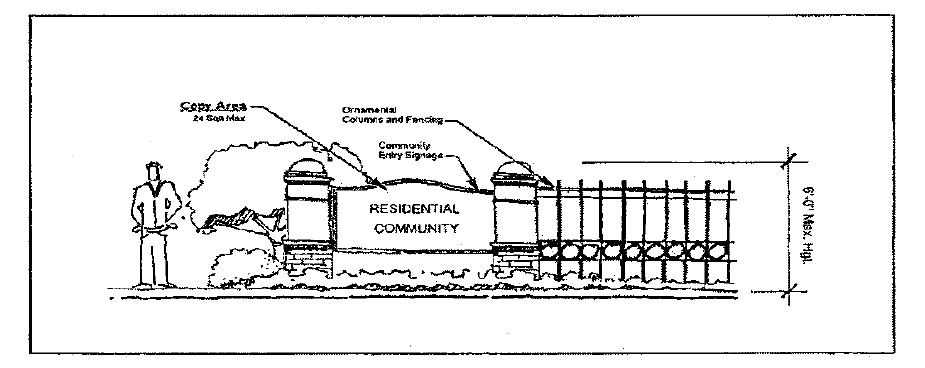
A maximum of two (2) grounds or wall residential entrance or gate signs may be located at the main entrance to a single-family, multifamily or mobile home subdivision. In the alternative, one (1) double faced identification sign may be permitted when placed in the median of a private entrance road. The maximum allowable sign surface area per wall or sign shall not exceed sixty (60) square feet.
b.
Secondary entranceways shall be restricted to one (1) ground sign, not to exceed twenty (20) square feet in area and a vertical dimension of four (4) feet.
c.
Entrance signs shall contain only the name of the subdivision, the insignia or logo of the development and shall not contain promotional or sales material.
d.
The sign area shall not exceed the height or length of the wall or gate upon which it is located.
e.
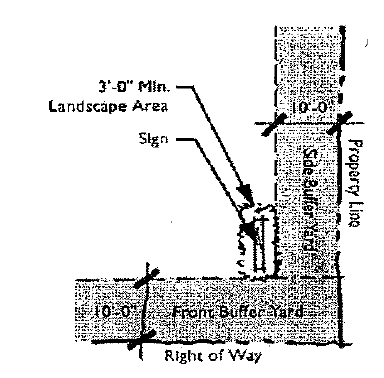
Subdivision entrance signs shall maintain a fifteen-foot setback from all property and right-of-way lines, with the exception of identification signs which are part of a masonry wall and which may be located along the property lines.
f.
Height-sign(s) shall be a maximum of six (6) feet and be measured from the finished grade level or crown of road to the top of the sign face, provided if the sign is integrated into a fence, wall or column, and the sign shall not exceed the maximum height permitted for a fence in the applicable district.
g.
The city shall not accept any liability or responsibility for maintenance of decorative entrances, structures or landscaping features. Sign construction and maintenance shall be at the expense of the developer or the property owners association and their successors, assigns and heirs.
h.
Decorative entrances shall not protrude into the twenty-five-foot visibility triangle.
i.
Developments with over three hundred (300) feet entrance way frontage and more than one (1) entrance street are allowed one (1) additional single faced sign per street frontage.
j.
The sign(s) shall be constructed of ornamental metal, stone, brick, masonry, or other permanent material, which architecturally complements the architectural style of the residential development.
k.
Vertical structure supports for double faced identification ground signs shall be concealed in an enclosed base. The width of such enclosed base shall be equal to at least one-half (½) the horizontal width of the sign surface. The base shall be of an architectural style similar to that of the principal building to include split face block, finished metal or brick or stucco finish.
l.
A landscaped planting area with a minimum of one hundred (100) square feet in size shall be provided around the base of any ground sign. The landscaped area shall include shrubs and groundcover. The landscape area shall be counted towards the minimum landscape and pervious area requirements for a site. For redevelopment or retrofitting of developed sites where the existing impervious areas make it impractical to provide irrigation as determined by the community development director (or designee), landscaping shall not be required.
m.
Ground signs may be illuminated internally or externally. The source of externally illuminated signs shall be installed so that it is arranged or screened as to not shine, glare or adversely impact adjacent properties or roadways.
(2)
Subdivision development signs.
a.
One (1) temporary on-site subdivision sign may be permitted for subdivisions, identifying the name of the development, company and general contractor.
1.
On parcels over fifty (50) acres in size a temporary sign shall not exceed sixty-four (64) square feet.
2.
On parcels less than fifty (50) acres in size a temporary sign shall not exceed thirty-two (32) square feet.
b.
Subdivision development signs shall not be located closer than twenty (20) feet to any property line.
c.
Subdivision development signs which do not exceed sixty-four (64) square feet do not require a permit under this article. All other subdivision development signs require a permit.
Picture 1
(b)
Residential professional districts. The following provisions govern signage in residential professional districts.
(1)
Ground signs.
a.
All signs shall be ground signs.
b.
Ground signs may not be permitted on vacant property.
c.
One (1) ground sign per parcel for each primary street frontage shall be permitted. The maximum allowable copy area is twenty-four (24) square feet.
d.
Height.
1.
Ground signs fronting on two-lane highways shall not exceed eight (8) feet in height.
2.
Ground signs fronting on four-lane divided highways shall not exceed twelve (12) feet in height.
3.
The height of any ground sign shall be measured from the finished grade or the roadway, whichever is higher, to the top of the sign face.
e.
Setbacks.
1.
The minimum setback from the right-of-way line shall be five (5) feet.
2.
The minimum setback from any side or rear yard property line shall be ten (10) feet.
3.
The minimum setback from any residential zoning district shall be twenty (20) feet.
f.
Design.
1.
Vertical structure supports for ground signs shall be concealed in an enclosed base. The width of such enclosed base shall be equal to at least one-half (½) the horizontal width of the sign surface.
2.
The base shall be of an architectural style similar to that of the principal building to include split-face block, finished metal, brick or stucco finish.
3.
Alternative designs for the ground enclosure supports and bases of a ground sign may be approved by the community development director (or designee) where the architectural style would be in keeping with the intent of these sign regulations.
g.
Sign landscaping. A landscaped planting area with a minimum of one hundred (100) square feet in size shall be provided around the base of any ground sign. The landscaped area shall include shrubs and groundcover. The landscape area shall be counted towards the minimum landscape and pervious area requirements for a site. For redevelopment or retrofitting of developed sites where the existing impervious areas make it impractical to provide irrigation as determined by the community development director (or designee), landscaping shall not be required.
h.
Sign illumination. Ground signs may be illuminated internally or externally. The source of externally illuminated signs shall be installed so that it is arranged or screened as to not shine, glare or adversely impact adjacent properties or roadways.
(2)
Wall signs. Wall signs are permitted with a maximum allowable copy area of twenty-four (24) square feet.
(3)
Projecting signs.
a.
Projecting signs may be substituted for wall signs.
b.
Projecting signs shall not project more than four (4) feet from the building wall on which the sign is attached.
c.
Projecting signs shall be a minimum of twelve (12) feet above ground level.
d.
Projecting signs shall not project above the roofline of the building to which it is attached.
(4)
Awning signs. The sign area shall be counted toward the total wall sign area allowed for the single occupancy site.
(c)
Commercial districts. The following provisions govern signage in commercial districts.
(1)
Single occupancy commercial sites.
a.
Ground signs.
1.
All signs shall be ground signs.
2.
Ground signs may not be permitted on vacant property.
3.
One (1) ground sign per parcel for each primary street frontage shall be permitted. The maximum allowable copy area is:
i.
Sixty (60) square feet per face for sites on designated arterial roadways.
ii.
Forty-eight (48) square feet per face for sites on designated collector roadways.
iii.
Thirty-two (32) square feet per face for sites on all other roadways.
iv.
Additional allowances provided in Table 6.1.
4.
If a single occupancy business has multiple frontages with an architectural design indicating front street orientation to both frontages, an additional ground sign shall be permitted with a maximum square footage of up to fifty (50) percent of that allowed on the primary frontage.
5.
Height.
i.
Ground signs fronting on two-lane highways shall not exceed eight (8) feet in height.
ii.
Ground signs fronting on four-lane divided highways shall not exceed twelve (12) feet in height.
iii.
The height of any ground sign shall be measured from the finished grade or the roadway, whichever is higher, to the top of the sign face.
iv.
Additional allowances provided in Table 6.1.
6.
Setbacks.
i.
The minimum setback from the right-of-way line shall be five (5) feet.
ii.
The minimum setback from any side or rear yard property line shall be ten (10) feet.
iii.
The minimum setback from any residential zoning district shall be twenty (20) feet.
7.
Design.
i.
Vertical structure supports for ground signs shall be concealed in an enclosed base. The width of such enclosed base shall be equal to at least one-half (½) the horizontal width of the sign surface.
ii.
The base shall be of an architectural style similar to that of the principal building to include split face block, finished metal or brick or stucco finish.
iii.
Alternative designs for the ground enclosure supports and bases of a ground sign may be approved by the community development director (or designee) where the architectural style would be in keeping with the intent of these sign regulations.
8.
Sign landscaping.
i.
A landscaped planting area with a minimum of one hundred (100) square feet in size shall be provided around the base of any ground sign.
ii.
The landscaped area shall include shrubs and groundcover.
iii.
The landscape area shall be counted towards the minimum landscape and pervious area requirements for a site.
iv.
For redevelopment or retrofitting of developed sites where the existing impervious areas make it impractical to provide irrigation as determined by the community development director (or designee), landscaping shall not be required.
9.
Sign illumination. Ground signs may be illuminated internally or externally. The source of externally illuminated signs shall be installed so that it is arranged or screened as to not shine, glare or adversely impact adjacent properties or roadways.
TABLE 6.1. COMMERCIAL, INDUSTRIAL, COMPLEX AND CAMPUS GROUND SIGNS ADDITIONAL AREA PER FRONTAGE ON RIGHT-OF-WAY
(lin. ft.) - Measured in linear feet.
(sq. ft.) - Measured in square feet.
*Based on approved accesses in conceptual site plan
**For each additional foot of setback exceeding five (5) feet from right-of-way, the area and height may be increased by one (1) percent for each additional foot to a maximum of twenty-five (25) percent increase of the allowable sign area and height. For each foot of setback less than five (5) feet from right-of-way, the area and height may be decreased by five (5) percent for each additional foot of the allowable sign area and height.
b.
Wall signs. Wall signs are permitted for a total of one (1) square foot of copy area for each linear foot of building frontage, up to one hundred fifty (150) square feet or as permitted in Table 6.2. Single occupancy businesses with multiple frontages may be permitted an additional sign area up to one-half (½) of a square foot for each linear foot of secondary building frontage not to exceed fifty (50) percent of the allowable building frontage signage; provided that the same or similar façade treatment is used on both front and side and there is an entrance for the general public on such sides.
TABLE 6.2. COMMERCIAL, INDUSTRIAL, COMPLEX AND CAMPUS
WALL SIGNS ADDITIONAL AREA
*Measured in linear feet.
**See requirements based on road type and building size per section 25-424(c)(1)b. and (2)b. and (d)(2) per code for additional criteria.
(2)
Multiple occupancy commercial sites.
a.
Commercial center identification ground signs.
1.
Multi-tenant commercial shopping centers and office complexes shall be permitted signage under this section. A center identification ground sign shall be located on the site and shall be limited to the name of the center and/or the names of the occupants of the center.
2.
Maximum sign area. Sign area shall be in addition to the sign area allowed for the individual occupants and shall be based on the gross leasable areas (GLA) within the center.
i.
Centers of seventy-five thousand (75,000) square feet or more shall be a maximum of one hundred twenty (120) square feet.
ii.
Centers of ten thousand (10,000) square feet to seventy-five thousand (75,000) square feet shall be a maximum of seventy-five (75) square feet.
iii.
Centers up to ten thousand (10,000) square feet shall be a maximum of sixty (60) square feet.
iv.
Additional allowances provided in Table 6.1.
3.
One (1) additional ground sign, not to exceed sixteen (16) square feet may be permitted for the major tenant provided that there is a minimum six-hundred-foot separation between signs.
4.
If the building has multiple frontages with an architectural design indicating front street orientation to both frontages, an additional ground center identification sign shall be permitted with a maximum square footage of up to fifty (50) percent of that allowed on the primary frontage.
5.
Height. The maximum height for any commercial center sign shall be:
i.
Twenty (20) feet for centers of seventy-five thousand (75,000) square feet or more.
ii.
Sixteen (16) feet for centers of ten thousand (10,000) square feet to seventy-five thousand (75,000) square feet.
iii.
Twelve (12) feet for centers up to ten thousand (10,000) square feet.
iv.
All signs shall be measured from the finished grade level or crown of the road which ever is greater to the top of the sign face.
v.
Additional allowances provided in Table 6.1.
6.
Setbacks.
i.
Fifty (50) feet from any side lot lines, or equidistant from side lot lines.
ii.
The minimum setback from the right-of-way line shall be five (5) feet.
7.
Design.
i.
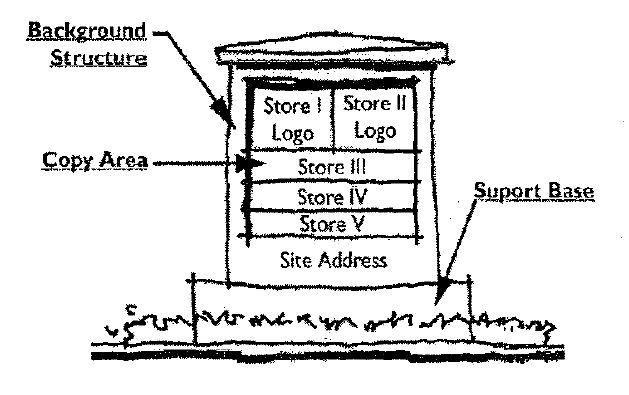
Vertical structure supports for ground signs shall be concealed in an enclosed base. The width of such enclosed base shall be equal to at least one-half (½) the horizontal width of the sign surface.
ii.
The base shall be of an architectural style similar to that of the principal building to include split face block, finished metal or brick or stucco finish.
iii.
Alternative designs for the ground enclosure supports and bases of a monument sign may be approved by the community development director where the architectural style would be in keeping with the intent of these sign regulations.
8.
Sign landscaping. A landscaped planting area a minimum of one hundred (100) square feet in size shall be provided around the base of any ground sign. The landscape shall include shrubs and groundcover. The landscape area shall be counted towards the minimum landscape and pervious area requirements for a site. For redevelopment or retrofitting of developed sites where the existing impervious areas make it impractical to provide irrigation as determined by the community development director, landscaping shall not be required.
Picture 2
b.
Shopping center wall signs.
1.
Wall signage for individual businesses in shopping centers shall be allowed a sign area of one (1) square foot for each linear foot of building front not to exceed one hundred fifty (150) square feet per building front or as provided in Table 6.2.
2.
Individual businesses in a shopping center with multiple frontage may be permitted an additional sign area of one-half (½) square foot for each linear foot of building frontage; provided that the same or similar façade treatment is used on both front and side and there is an entrance to the general public on such sides.
(3)
Feather flags are generally prohibited, but are allowed within commercial districts on a limited basis under the following restrictions:
a.
Feather flags may only be utilized on site, by a property owner or lawful tenant, either currently in operation at the location of the feather flags in compliance with all provisions of this Code, or a religious or eleemosynary organization owning or lawfully occupying the property where the feather flags are to be located, which has applied for and received a permit for the use of feather flags. The city commission shall prescribe the permit fee by resolution.
b.
Feather flags are only allowed on a temporary basis, and shall be present for no more than seven (7) consecutive days at a time. The permit shall expire at the end of the seventh day after the feather flags are first posted, or thirty (30) days after the permit is issued, whichever comes first.
c.
A permit for use of feather flags may only be issued twice within any calendar year, for use of feather flags by the same business or organization, or at the same geographic location.
d.
Any feather flags in existence on the date this subsection becomes effective, which are not in compliance with ordinances pertaining to feather flags prior to the effective date of this subsection, shall be removed within thirty (30) days of the effective date of this subsection.
(d)
Industrial districts. The following provisions govern signage in industrial districts.
(1)
Ground signs.
a.
All signs shall be ground signs.
b.
Ground signs may not be permitted on vacant property.
c.
One (1) ground sign per parcel for each primary street frontage shall be permitted as follows:
1.
Sites on designated arterial roadways is sixty (60) square feet per face.
2.
Sites on designated collector roadways is forty-eight (48) square feet.
3.
Sites on all other roadways is thirty-two (32) square feet per face.
4.
Or as provided in Table 6.1.
d.
Height.
1.
Ground signs fronting on two-lane highways shall not exceed eight (8) feet in height.
2.
Ground signs fronting on four-lane divided highways shall not exceed twelve (12) feet in height.
3.
The height of any ground sign shall be measured from the finished grade or the roadway, whichever is higher, to the top of the sign face.
4.
Shall be measured from the finished grade level or crown of the road which ever is greater to the top of the sign face.
5.
The maximum clearance of the bottom of the sign face of any ground sign shall be two (2) feet from the finished grade level or crown.
6.
Or as provided in Table 6.1.
e.
Setbacks.
1.
The minimum setback from right-of-way line shall be five (5) feet.
2.
The minimum setback from any side or rear yard property line shall be ten (10) feet.
3.
The minimum setback from any residential zoning district shall be twenty (20) feet.
4.
Or as provided in Table 6.1.
f.
Design.
1.
Vertical structure supports for ground signs shall be concealed in an enclosed base. The width of such enclosed base shall be equal to at least one-half (½) the horizontal width of the sign surface.
2.
The base shall be of an architectural style similar to that of the principal building to include split face block, finished metal or brick or stucco finish.
3.
Alternative designs for the ground enclosure supports and bases of a monument sign may be approved by the community development director where the architectural style would be in keeping with the intent of these sign regulations.
g.
Sign landscaping. A landscaped planting area a minimum of one hundred (100) square feet in size shall be provided around the base of any ground sign. The landscape shall include shrubs and groundcover. The landscape area shall be counted towards the minimum landscape and pervious area requirements for a site. For redevelopment or retrofitting of developed sites where the existing impervious areas make it impractical to provide irrigation as determined by the community development director, landscaping shall not be required.
h.
Sign illumination. Ground signs may be illuminated internally or externally. The source of externally illuminated signs shall be installed so that it is arranged or screened as to not shine, glare or adversely impact adjacent properties or roadways.
(2)
Wall signs are permitted for with a total of one (1) square foot of copy area for each linear foot of building frontage, as permitted in Table 6.2. Single occupancy businesses with multiple frontages may be permitted an additional sign area of up to fifty (50) percent of for each linear foot of secondary building frontage; provided that the same or similar façade treatment is used on both front an side and there is an entrance to the general public on such sides.
(3)
Projecting signs.
a.
Projecting signs may be substituted for wall signs.
b.
Projecting signs shall not project more than four (4) feet from the building wall on which the sign is attached.
c.
Projecting signs shall be a minimum of twelve (12) feet above ground level.
d.
Projecting signs shall not project above the roofline of the building to which it is attached.
(4)
Awning signs. The sign area shall be counted toward the total wall sign area allowed for the single occupancy site.
(5)
Directory signs for industrial parks.
a.
Individual sites within an industrial park shall comply with all provisions regarding ground signs and wall signs.
b.
For multiple occupancy complexes, in addition to ground and wall signage, one (1) directory sign per street frontage, which is accessed by the park, shall be permitted as follows:
1.
Sites less than one hundred thousand (100,000) square feet shall be permitted up to forty-eight (48) square feet.
2.
Sites of one hundred thousand one (101,000) square feet or more shall be permitted up to sixty (60) square feet.
c.
Height. Maximum height shall be:
1.
Twenty (20) feet for centers of seventy-five thousand (75,000) square feet or more.
2.
Sixteen (16) feet for centers of ten thousand (10,000) square feet to seventy-five thousand (75,000) square feet.
3.
Twelve (12) feet for centers up to ten thousand (10,000) square feet.
4.
Shall be measured from the finished grade level or crown of the road which ever is greater to the top of the sign face.
5.
The maximum clearance of the bottom of the sign face of any ground sign shall be two (2) feet from the finished grade level or crown.
d.
Setbacks. There shall be a minimum setback of five (5) feet from the road right-of-way.
e.
Support base. The ground sign base shall be encased or provide external support and meet the following standards:
1.
Signs shall be in an enclosed base.
2.
If any support, upright, bracing or framework is utilized or proposed to support a ground sign said support, upright, bracing or framework shall be either:
i.
Architectural feature. Encased in an ornamental shell of stone, brick, ornamental metal or similar and/or compatible materials with the architecture of the building or other site features; or
ii.
Background structure. Be constructed of an external support structure extending between grade and the base of the copy area that shall not exceed two (2) supports.
Picture 3
(6)
Building signs.
a.
General standards for building signs.
1.
Shall only advertise one (1) person, firm, company, corporation or major enterprise occupying the premises.
2.
The sign shall be clearly integrated with the architecture of the building and shall be consistent in design and materials with the architecture of the proposed building. The use of florescent colors is prohibited.
b.
Types of signs. Building signs shall be limited to wall, canopy, awning, marquee, and projecting signs.
c.
Maximum number of signs. One (1) building signs are permitted per building frontage. A corner lot shall permit no more than a total of two (2) building signs per tenant.
Picture 4
(7)
Placement. The building signs permitted may be placed on the wall, awnings, or be a projecting sign in compliance with the following standards:
a.
Projecting signs shall be limited to occupants that have a minimum of twenty (20) feet of occupied building frontage provided that:
1.
All projecting signs shall not exceed fourteen (14) feet in height and shall have a minimum clearance of eight (8) feet from the ground to the bottom of the sign. A projecting sign may be a minimum of six (6) feet from the ground when it is located above a landscaped area or other area that does not permit pedestrian traffic beneath said sign;
i.
The projecting sign shall be placed on the building so that said signs are intended to be viewed by the pedestrians on the abutting street or pedestrian way;
ii.
The projecting sign shall not extend more than four (4) feet from the wall of the building on which it is erected and shall not extend above the roofline or the parapet of the wall of the building on which it is erected; and
iii.
Maximum copy area of four (4) square feet.
2.
Other building signs (wall, awning, marquee, canopy).
i.
Wall signs shall display only one (1) surface and shall not be mounted more than six (6) inches from any wall.
ii.
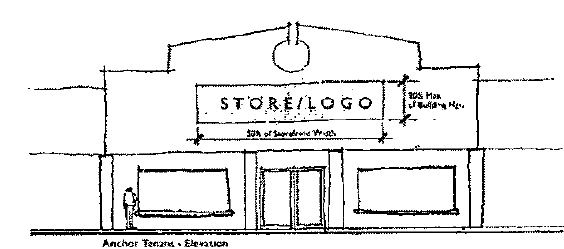
The maximum height of letters and logos for anchor tenants in a retail center shall not exceed twenty (20) percent of the building height and shall not exceed one hundred fifty (150) square feet.
iii.
The length of the sign may occupy up to fifty (50) percent of the linear feet of the storefront the business occupies.
(e)
Large multiple use complexes and campus signage. The following provisions govern signage for large multiple use complexes and campus uses of ten (10) to fifty (50) acres.
(1)
Ground signs.
a.
All signs shall be monument ground signs except where the design and architectural style for consistency with the overall complex or campus would be better accomplished with a different style sign such as a modified pole sign with decorative columns. This exception shall require approval from the planning commission as a conditional use.
b.
Ground signs may not be permitted on vacant property.
c.
One (1) ground sign per parcel for each primary street frontage shall be permitted as follows:
1.
Signs on designated arterial roadways are one hundred (100) square feet per face.
2.
Signs on designated collector roadways are sixty (60) square feet.
3.
Signs on all other roadways are thirty-two (32) square feet per face.
4.
Or as provided in Table 6.1.
d.
Height.
1.
Ground signs fronting on two-lane highways shall not exceed twelve (12) feet in height.
2.
Ground signs fronting on four-lane divided highways shall not exceed twenty (20) feet in height.
3.
The height of any ground sign shall be measured from the finished grade level or crown of the road whichever is greater to the top of the sign face.
4.
The minimum clearance of the bottom of the sign face of any ground sign shall be two (2) feet from the finished grade level or crown of the road.
5.
Or as provided in Table 6.1.
e.
Setbacks.
1.
The minimum setback from right-of-way line shall be five (5) feet.
2.
The minimum setback from any side or rear yard property line shall be ten (10) feet.
3.
The minimum setback from any residential zoning district shall be twenty (20) feet.
f.
Design.
1.
Vertical structure supports for ground signs shall be concealed in an enclosed base. The width of such enclosed base shall be equal to at least one-half (½) the horizontal width of the sign surface. For signs that have a setback of fifteen (15) feet or move from the right-of-way line, the width of the base may exceed one-half (½) the horizontal width of the sign surface.
2.
The base shall be of an architectural style similar to that of the principal building to include split face block, finished metal or brick or stucco finish.
3.
Alternative designs for the ground enclosure supports and bases of a monument sign may be approved by the community development director where the architectural style would be in keeping with the intent of these sign regulations and the complex or campus design.
g.
Sign landscaping. A landscaped planting area a minimum of one hundred (100) square feet in size shall be provided around the base of any ground sign. The landscape shall include shrubs and groundcover. The landscape area shall be counted towards the minimum landscape and pervious area requirements for a site. For redevelopment or retrofitting of developed sites where the existing impervious areas make it impractical to provide irrigation as determined by the community development director, landscaping shall not be required.
(e.1)
Large multiple use complexes and campus signage for properties of more than fifty (50) acres with twenty-five (25) separate uses, businesses, tenants etc.
(1)
Ground signs.
a.
All signs shall be monument ground signs with design and architectural style consistent with the overall complex or campus.
b.
Ground signs may not be permitted on vacant property.
c.
One (1) ground sign per parcel for each primary street frontage entrance shall be permitted as follows:
1.
Signs on designated arterial roadways and collector roadways are one thousand two hundred (1,200) square feet per face.
2.
Signs on all other roadways are five hundred (500) square feet per face.
d.
Height.
1.
Ground signs fronting on two-lane highways shall not exceed twenty-five (25) feet in height.
2.
Ground signs fronting on four-lane divided highways shall not exceed sixty (60) feet in height.
3.
The height of any ground sign shall be measured from the finished grade level or crown of the road whichever is greater to the top of the sign face.
4.
The minimum clearance of the bottom of the sign face of any ground sign shall be two (2) feet from the finished grade level or crown.
e.
Setbacks.
1.
The minimum setback from right-of-way line shall be five (5) feet.
2.
The minimum setback from any side or rear yard property line shall be ten (10) feet.
3.
The minimum setback from any residential zoning district shall be twenty (20) feet.
f.
Design.
1.
Vertical structure supports for ground signs shall be concealed in an enclosed base. The width of such enclosed base shall be equal to at least one-half (½) the horizontal width of the sign surface.
2.
The base shall be of an architectural style similar to that of the principal building to include split face block, finished metal or brick or stucco finish.
3.
In order to soften the impact of larger monument signs provided in these regulations, the main entrance areas at arterial roadways and collector roadways shall have significant architectural design feature such as water features, large stone or brick features such as arched entrances, large trees such as thirty (30) feet canary island date palms, hard wood trees etc.
4.
Alternative designs for the ground enclosure supports and bases of a monument sign may be approved by the community development director where the architectural style would be in keeping with the intent of these sign regulations and the complex or campus design.
g.
Sign landscaping. A landscaped planting area a minimum of five hundred (500) square feet in size shall be included in the main entrance design plans for ground sign. The landscape shall include shrubs and groundcover. The landscape area shall be counted towards the minimum landscape and pervious area requirements for a site. For redevelopment or retrofitting of developed sites where the existing impervious areas make it impractical to provide irrigation as determined by the community development director, landscaping shall not be required.
(f)
Miscellaneous signage.
(1)
Changeable copy signage shall be permitted subject to the following restrictions:
a.
Freestanding on or off-premises signs are permitted copy area as changeable copy. Electronic changeable copy shall display static images only. Such image shall remain static for a period of at least three (3) seconds before instantaneously transitioning to another static image. Flashing, animated coursing and the appearance of any movement other than an instantaneous change from one (1) message to the next are explicitly prohibited.
b.
Electronic changeable copy (LED or similar) signage displays may occupy no more than one hundred (100) percent of the actual copy and graphic area of the permitted sign. The remainder of the sign must not have the capability to have dynamic displays even if not used. Only one (1) contiguous LED (or similar) display area is allowed on a sign face.
c.
All electronic changeable copy (LED or similar) signs installed after December 31, 2009, must be equipped with a mechanism that automatically adjusts the brightness in response to ambient (day/night) conditions. These signs must also be equipped with a means to immediately turn off the display or lighting if it malfunctions, and the sign owner or operator must immediately turn off the sign or lighting when notified by the city that it is not complying with the standards in this section.
d.
All electronic changeable copy signs shall not exceed a brightness level of 0.3 foot candles above ambient light conditions, as measured using a foot candle (Lux) meter measured at a distance of one hundred (100) feet from the display except for electronic digital billboards which shall be measured at a distance of two hundred (200) feet.
(2)
National, federal, state, and local flags. Standards are as follows (see Picture 6):
a.
Only four (4) national, federal, state, and local flags shall be permitted up to one (1) acre with a maximum for two (2) acres of six (6) flags.
b.
The flags shall not be flown higher than a sixty (60) foot pole, measured from grade (see Table 1).
c.
Size of flags per pole shall be per Table 1 below. Only one (1) flag per pole up to six (6) feet by ten (10) feet, or two (2) flags per pole up to four (4) feet by six (6) feet, may be flown.
d.
The flag shall extend no closer than three (3) feet from the edge of any adjacent public right-of-way.
e.
All existing federal or state flags mounted on flag poles including those annexed into the city legally constructed, and which are nonconforming because of location or size as provided by this article, shall be deemed to be pre-existing nonconforming signs and may remain as is. For example, Cecil Clark Chevrolet's one-hundred-foot tall metal pole with a thirty (30) by sixty (60) feet American flag is considered a local landmark because it has been in existence for more than twenty-five (25) years. However, a nonconforming pole/flag not used for a period of six (6) months shall be considered abandonment thereof and such nonconforming use shall not thereafter be revived.
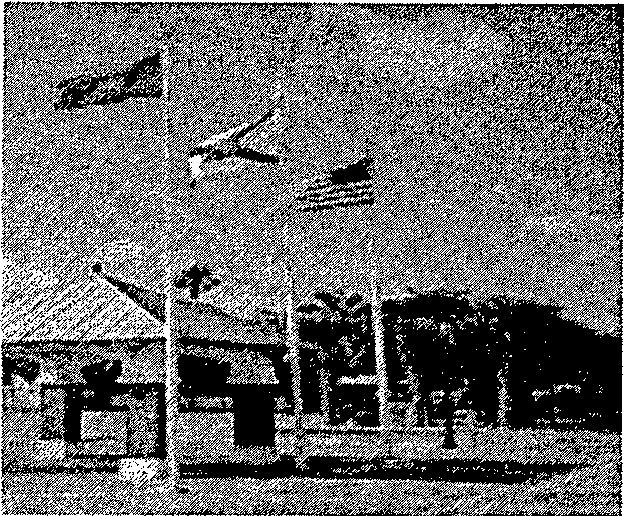
Picture 6 Federal, state, and local flags
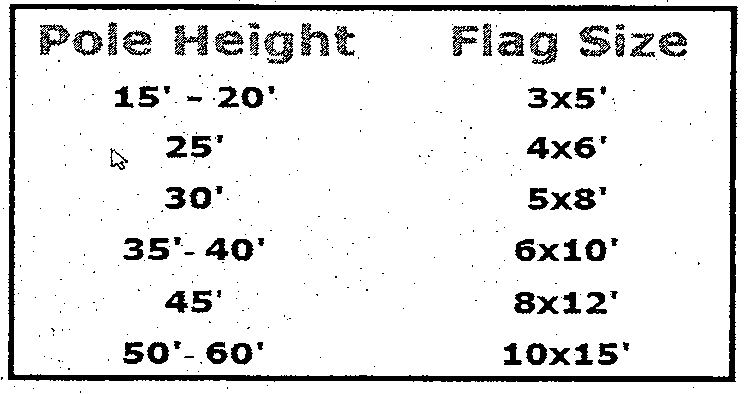
Table 1 Federal, state, and local flags
f.
Decorative rectangle or feather flags shall be permitted as approved on the conceptual plans for PUD zoned property (see Picture 7).
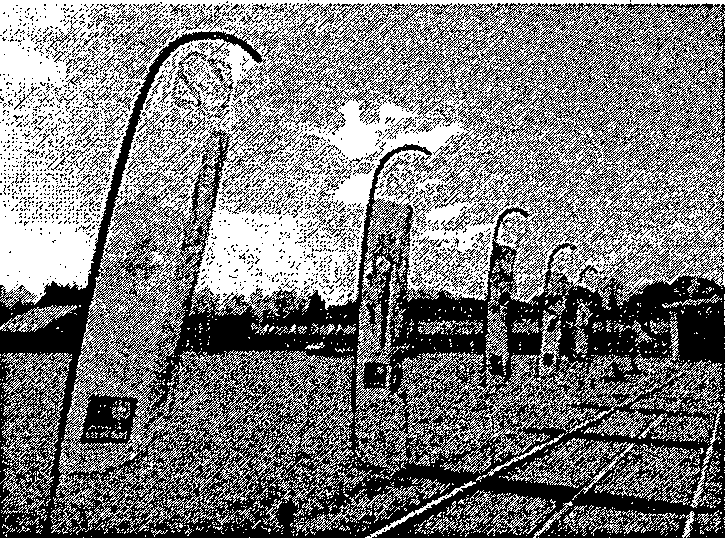
Picture 7 Feather flags
g.
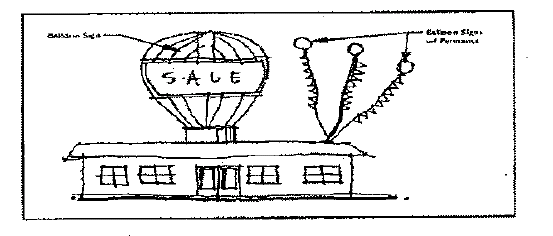
Pennants, balloons, banners, ribbons, streamers, spinners, banners, and other similar types of attention-getting devices whether stationary on private property or moving shall be allowed on-site (no more than eighteen (18) inches in area per unit). Banners shall not exceed thirty-two (32) square feet. Total permitted square footage of promotional devices shall be one (1) square foot for each linear foot of road frontage. Attention-getting devices such as flags, balloons etc. shall be maintained and not become faded, torn or otherwise an eyesore (unsightly) or they will become a code violation requiring removal. In no case shall inflatable signs or devices be allowed on public rights-of-way.
h.
The United States Federal Flag Code as found in Title 4 of the United States Code, shall be the reference for use and display of the flag under section (2)a.—e. above or as amended by this section.
(3)
Bed and breakfast signs.
a.
Signs attached directly to the house which does not exceed two (2) square feet. Such signs do not require a permit under this article.
b.
Signs attached directly to the house which do not exceed four (4) square feet. Such signs do not require a permit under this article.
c.
Signs that are freestanding which do not exceed six (6) square feet. A permit is required for such signs.
d.
Bed and breakfast inn signs that are freestanding which do not exceed sixteen (16) square feet. A permit is required for such signs.
(4)
Nonresidential conditional use permits utilizing freestanding signs which do not exceed four (4) square feet. Such signs do not require a permit under this article.
(5)
Weekend directional signs are permitted to assist the traveling public in locating new residential developments and model homes not directly accessed off an arterial roadway. A maximum of six (6) temporary off-site directional signs per project are permitted subject to the following provisions.
a.
The signs shall not exceed six (6) square feet in size.
b.
The subdivision plat must be recorded and infrastructure construction completed.
c.
The signs may be placed on private property with the property owner's permission.
d.
The signs shall be set no earlier than 3:00 p.m. on Friday and collected before sunset on Sunday.
e.
The developer or real estate agent shall be responsible for the collection of signs.
f.
A permit under this article is not required.
g.
A single permit can be issued to cover all signs for one (1) event.
(6)
Theater signs. In addition to the signage permitted by this article, a theater shall be permitted a changeable message sign, the surface of which shall not exceed one hundred fifty (150) square feet in area and shall be in conformance with this Code.
(7)
Special events.
a.
Temporary signs not prohibited by this chapter are permitted for purposes such as: art festivals; bicycle festivals; civic events; parade of homes; triathlons; fairs; carnivals and rodeos, and other special events as determined by the city manager or designee.
b.
No signs may be placed in the public rights-of-way. A single permit can be issued to cover all signs on private property for one (1) event.
c.
Display of temporary signs for special events shall not exceed fourteen (14) days.
d.
Special event signs shall not exceed forty-eight (48) square feet.
e.
The placement and removal of special event signs shall be the responsibility of the person or organization sponsoring the event.
f.
A permit under this article is not required.
(8)
Menu boards must not exceed thirty-two (32) square feet of sign area and must be oriented toward the drive-through area, which it is to serve. Only one (1) outdoor menu board and one (1) pre-menu board shall be permitted, per order window, for drive-throughs on a lot. Menu boards must be internally illuminated. For seat down and take-out only restaurants, one (1) external menu board may be permitted that does not exceed eight (8) square feet of sign area except for restaurants where food is consumed in vehicles parked adjacent to menu boards.
(9)
Projecting signs.
a.
Projecting signs may be substituted for wall signs.
b.
Projecting signs shall not project more than four (4) feet from the building wall on which the sign is attached.
c.
Projecting signs shall be a minimum of twelve (12) feet above ground level.
d.
Projecting signs shall not project above the roofline of the building to which it is attached.
(10)
Directional signs. On-site directional signs or instructional signs used to direct on-premises vehicular or pedestrian traffic is permitted.
a.
Sign height shall be limited to a maximum of four (4) feet.
b.
Sign area shall be limited to a maximum of six (6) square feet.
(11)
Murals when approved by the city commission. Murals must be determined to be of a general public interest and not used as a sign for the attraction of the public to any place, subject, person, form, corporation, public performance, division, machine or merchandise, whatsoever, which is displayed in any manner outdoors.
(12)
Home occupation sign. One (1) wall sign that is a nonilluminated identification sign shall be permitted, not to exceed one-half (½) square feet of sign area for each sign face for the following permitted uses; offices in residences, home occupations, and boardinghouses and lodging houses. The maximum aggregate sign area shall be three (3) square feet.
(13)
Subdivision or plat signs.
a.
Temporary signs advertising an undeveloped subdivision shall be allowed provided the signs do not exceed thirty-two (32) square feet of area. The signs may be erected only at dedicated street entrances to the subdivision.
b.
The signs shall be removed if construction of subdivision improvements is not in progress within one (1) year following the date of the erection of the signs or as soon as eighty (80) percent of the lots are developed and sold, whichever comes first.
(14)
Corporate color stripes shall count as part of the signage allowed on a building but not counted in the calculation of the maximum allowable wall signage. However, stripes would not be allowed to be replaced with actual wall signage after the adoption of this section. Corporate logo/signage on gas isle canopies shall be allowed a maximum of two (2) per canopy not to exceed six (6) square feet per logo or twelve (12) square feet for signage and shall not be counted as part of the allowed building signage.
(g)
Illumination. Freestanding and building signs may be illuminated in compliance with the following:
(1)
Internally illuminated.
a.
The sign shall be constructed with either: an opaque background and translucent letters and symbols; or, a translucent darker colored background with a lighter contrasting color for the letters and symbols.
b.
The darker background color shall have a luminous transmittance, which does not exceed fifteen (15) percent. The lighter lettering or symbols shall have a luminous transmittance, which does not exceed thirty-five (35) percent.
c.
No internal lighting shall include exposed incandescent or fluorescent bulbs.
(2)
External illuminated.
a.
The lighting of signs must be from the top of the sign and directed downward;
b.
The lighting of signs that have a height of eight (8) feet or less may be illuminated from the top of the sign or from the ground.
c.
Indirect light sources must be shielded from the view of persons viewing the sign and be further shielded and directed so that the light shines only on the sign and that illumination beyond the copy area is minimized.
d.
If a registered trademark or logo is not in compliance with the illumination requirements of this section then such area shall be limited to a maximum of thirty (30) percent of the copy area.
(h)
Maintenance.
(1)
Maintenance. All signs shall be maintained in good condition and working order, and be free of graffiti, peeling paint, faded colors, and/or broken and damaged materials.
(2)
Discontinued signs. The owner of any sign which is a discontinued sign for a period of ninety (90) or more consecutive days shall remove the sign, not including the background structure, by painting over the copy area, or replacing the copy area with a blank insert. Signs that are discontinued for one (1) year shall be brought into compliance with this article.
(i)
Temporary and accessory signs. The following signs required a review by the planning and zoning division, however, may not require a building permit provided the following standards are met. If the standards are not met, the community development director may request a sign permit be obtained.
(1)
Temporary signs.
a.
A site plan shall be submitted showing location of all proposed signs with written approval from property owners.
b.
Model signs. Temporary signs directing the public to a model home or unit, provided that such signs are set back a minimum of fifteen (15) feet from any property line or public right-of-way and which do not exceed six (6) square feet in area and are not illuminated.
c.
Political and campaign signs are permitted in all zoning districts of the city subject to the following regulations:
1.
A cash bond of one hundred dollars ($100.00) shall be posted with the office of the city clerk by the candidate or their representative prior to erecting any campaign signs to ensure removal of signs within fifteen (15) days following the election. The cash bond will be released after removal of signs if done within the specified time period.
2.
No sign shall be located within or over the public right-of-way or located on utility poles.
3.
The city may remove and destroy any sign erected and for which a bond has not been posted, or any sign that is remaining fifteen (15) days following an election.
d.
Real estate signs, provided that there shall be only one (1) real estate sign per parcel for each public street frontage, such signs are set back a minimum of fifteen (15) feet from any property line or public right-of-way, that the maximum height of any such sign shall be four (4) feet six (6) inches, and such signs shall not exceed four (4) square feet in area in residential districts and shall not exceed thirty-two (32) square feet in nonresidential districts.
e.
Real estate open house signs, provided there shall be only two (2) such signs placed off-premises; the size of each sign shall be a maximum of six (6) square feet in size and three (3) feet in height above grade; signs shall not be affixed to other signs, utility poles, fire hydrants or trees; signs may be located in the public right-of-way but shall be placed at least ten (10) feet from the curb or fifteen (15) feet from the pavement edge where there is no curb, the person or firm placing signs on properties shall be allowed for a maximum of eight (8) hours per day, and the signs shall be removed within one (1) hour following the closing of the open house.
f.
Garage sale, yard sales and estate sale signs, announcing the sale of household goods, provided that there is only one (1) sign per premise; that they are on-premises only, entirely on private property; that they are setback a minimum of fifteen (15) feet from any property line or public street right-of-way; that they do not exceed six (6) square feet in area, that they are erected no earlier than one (1) business day before and shall be removed one (1) business day after the announced sale.
g.
Land development project signs, signs pertaining to the sale, lease, rent or development of a subdivision, planned shopping center, office building, industrial park or similar land parcel. Such signs are allowed for a period of one (1) year upon issuance of a permit. Said permit may be extended for one (1) additional year by approval from the planning and zoning manager. Total number and size of signs allowed shall be controlled according to the following schedule: Such project signs shall comply with height and placement regulations for the zoning district in which they are located.
h.
Grand opening sign. One (1) on-site sign including banners announcing the opening of a new business, which does not exceed thirty-two (32) square feet in copy area and that is not displayed for longer than ninety (90) days after initial turn-on of utility service to the business, for those businesses which meet the following conditions:
1.
The business is new at the particular location; or
2.
The business is under new ownership; or
3.
The business has undergone a major expansion which has received a building permit; or
4.
The business has reopened after being closed for at least one (1) year.
5.
The business is a seasonal business such as tax preparation, fireworks sales, Christmas tree sales, fair or carnival, and other uses similar and temporary in nature.
i.
Construction signs.
1.
One (1) temporary on-site construction sign may be permitted for each development parcel identifying the name of the development, company and general contractor or sponsor. For developments having frontage on more than one (1) street as a major collector or arterial, a second construction sign shall be permitted.
2.
Size.
i.
On parcels over one hundred one (101) acres in size a construction sign shall not exceed sixty-four (64) square feet.
ii.
On parcels one hundred (100) acres in size or smaller a construction sign shall not exceed thirty-two (32) square feet.
3.
Setbacks.
i.
Temporary construction signs shall not be located closer than fifteen (15) feet to any property line.
ii.
Temporary construction signs shall not be located closer than fifteen (15) feet from the road right-of-way.
(2)
Accessory signs/requirements.
a.
Nameplate. Address, owner or occupant nameplate and other signs of up to two (2) square feet in area attached to a mailbox, light fixture, or an exterior wall.
b.
Integral signs. Names of buildings, dates of erection, monumental citations, commemorative tables when carved into stone, concrete or similar material or made of bronze, aluminum or other noncombustible material and made an integral part of the structure and not exceeding six (6) square feet.
c.
Historical maker. Plaques or signs describing local, state or national designation as an historic site or structure and/or containing narrative, not exceeding six (6) square feet.
d.
Parking lot signs indicating restrictions on parking, when placed within a permitted parking lot, area maximum of ten (10) feet in height, and do not exceed six (6) square feet in area.
e.
Noncommercial signs. Signs containing noncommercial messages, such as those designating the location of public telephones, restrooms, restrictions on smoking and restrictions on building entrances provided that such signs do not exceed two (2) square feet in area.
f.
Up to two (2) signs identifying or directing motorists to a rental or management office in a multiple-family development, provided that such signs are maximum of four (4) feet in height, are set back a minimum of fifteen (15) feet from any property line or public right-of-way, and do not exceed three (3) square feet in area.
g.
Window signs. Total area of a window signs shall not exceed twenty (20) percent of the total glass area of the window in which they are placed. Window signs shall count against total allowable copy area and shall not exceed twenty-five (25) percent of the total allowable building signage if they are permanently attached. Window signage can not obstruct the visibility of store clerks from view of law enforcement personnel.
h.
Corner lots visibility triangle. No part of a ground sign may be located within a triangular area formed by the street right-of-way lines and a line connecting them at points twenty-five (25) feet from the right-of-way intersection.
(Ord. No. 04-27, § V(6.4, 6.4.1—6.4.8), 5-10-04; Ord. No. 08-99, 11-10-08; Ord. No. 10-26, § I, 4-12-10; Ord. No. 12-32, § I, 5-14-12; Ord. No. 15-07, § I, 2-23-15; Ord. No. 18-12, §§ II, III, 5-29-18; Ord. No. 20-28, § III, 7-13-20)
Sec. 25-425. - Prohibited signs.
The following signs shall be prohibited in any district in the city:
(a)
No sign, permanent or temporary, shall be erected or placed so that it interferes with a clear sight triangle distance per the code.
(b)
No sign shall be placed in the public rights-of-way unless approved by the city commission.
(c)
Signs on trailer frames with or without mounted wheels.
(d)
No sign shall be placed with in ten (10) feet of any electric lines unless approved by the electric department.
(e)
Vehicle signs or signs on or attached to vehicles which have a total copy area in excess of ten (10) square feet, except when vehicles are owned or leased by the business advertised and used on a regular bases to support the activities of the specific business advertised for such things as service, deliveries etc.
A vehicle shall not be considered "regularly used in the conduct of the specific business" if the vehicle is used primarily for advertising, or for the purpose of advertising. Signage on vehicles shall not be used for commercial advertising of other businesses.
(f)
Flashing, moving, animated coursing, blinker, racer-type, intermittent, rotating, moving or revolving signs, whirligig devices, inflatable signs, and other similar types of attention-getting devices whether stationary on private property or moving on public rights-of-way except as provided in section 25-424, permitted signs, subsections (f) miscellaneous signage signs, and (i) temporary and accessory signs.
(g)
Signs other than dedicatory or commemorative plaques, on bus stop or other transit shelters, whether on public rights-of-way or private property.
(h)
Signs on benches or waste receptacles, other than dedicatory or commemorative plaques, whether on public rights-of-way or private property.
(i)
Roof signs, any sign erected, constructed, and maintained upon and which projects beyond the roof of the building.
(j)
Traffic sign replica.
(k)
Pole signs.
(l)
Pylon signs.
(m)
Nonregulatory signs placed in any public right-of-way, attached to a utility pole or affixed to a tree or other sign.
(n)
Portable signs, as defined, unless otherwise provided for in this article. All nonconforming portable commercial and industrial business signs shall be removed or brought into compliance by June 1, 2005.
(o)
Electronic changeable copy sign when not in compliance with section 25-424(f)(1).
(p)
Murals when not in compliance with section 25-424(f)(11).
(q)
Search, flood or spot lights.
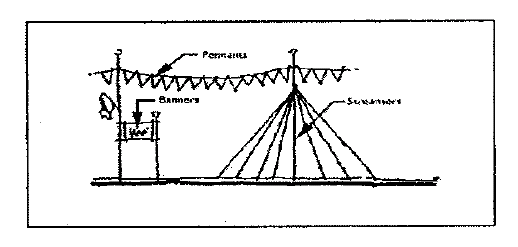
Picture 6
Picture 7
(Ord. No. 04-27, § V(6.5), 5-10-04; Ord. No. 04-43, § I, 6-28-04; Ord. No. 10-26, § I, 4-12-10; Ord. No. 12-32, § I, 5-14-12; Ord. No. 15-07, § I, 2-23-15)
Sec. 25-426. - Off-site signs.
(a)
Off-site signs advertising service or goods not sold on the property where erected may be located within C-3 (Highway Commercial), PUD (Planned Development Districts) and M (Industrial) districts only. In addition, such signs:
(1)
Shall not exceed forty (40) feet in height above normal grade. The sign shall not exceed three hundred twenty (320) square feet per side of sign area;
(2)
Shall not be less than five hundred (500) feet in any direction, on either side of the same right-of-way, from the other billboards (or off-site sign). The distance between off-site signs shall be measured along the centerline of the common right-of-way on which the sign fronts;
(3)
Shall be located not less than fifteen (15) feet from the front area property line and/or ten (10) feet from utility lines. Such sign shall be located not closer than ten (10) feet from the side lot lines and on a corner lot, shall be located not closer than one hundred (100) feet from an intersection;
(4)
Shall be located no closer than one hundred (100) feet from any residential zoning district boundary line;
(5)
Shall be oriented toward the roadway or street, away from the residential districts;
(6)
In all of the above, any overriding jurisdiction shall prevail.
(b)
An off-site billboard inventory shall be developed which lists all locations of off-site signs for which a city sign permit has been issued on or before July 1, 2004. The off-site sign inventory shall be maintained in the office of the city manager or his designate and shall at all times reflect current information relating to the locations of the permitted off-site signs. Unpermitted off-site signs shall be deemed illegal and shall be subject to immediate removal following July 1, 2004.
(1)
Off-site signs listed and maintained in the off-site sign inventory may be reconstructed in conformity with the provisions of this section. A properly permitted off-site sign may be reconstructed upon the same parcel of land that it occupied on July 1, 2004, and if so reconstructed, shall be required to conform to the construction standards set forth in this section. An off-site sign constructed on a new parcel of land shall be required to conform to all provisions of this section. Off-site signs may not be constructed upon a new parcel of land unless an existing, properly permitted off-site sign is removed and the city sign permit for the removed off-site sign is transferred to the new location except as permitted by this section.
Where two (2) properly permitted off-site signs structures are removed and the city sign permits are transferred to a new single sign location, a single electronic digital sign may be permitted for the square footage removed not to exceed the single largest sign face with a maximum of three hundred seventy-eight (378) square feet excluding the cabinet. Where one (1) off-site sign which is the only one owned by an individual as of May 14, 2012 and is properly permitted within the city, it may be reconstructed as an electronic digital sign as permitted by this section. A single sign is considered to be a sign with one (1) or two (2) faces.
Digital billboard operators shall also provide for regional emergency public service announcements and alerts to be displayed on the digital billboard without charge and on an as-needed basis. i.e. evacuation, tropical storm, Amber/Silver Alert messages, safety, or disaster information.
It is the express intent of this provision that the number of off-site signs shall not increase but may decrease beyond the number existing on July 1, 2004, except for subsequently annexed property as set forth in subsection (b)(2) of this section. A city sign permit for an off-site sign may be freely transferred from one (1) parcel of land to another, provided the off-site sign to be constructed on the new parcel of land fully complies with all the provisions of this section, and any additional permit fees (if applicable) are paid. A city off-site sign permit may be transferred from one (1) permit owner to another.
(2)
Any off-site signs located on property that is annexed into the city after July 1, 2004 and zoned C-3 (Highway Commercial), PUD (Planned Development Districts) or M (Industrial) shall be added to the off-site sign inventory set forth in subsection (b)(1) of this section. Any off-site sign located on property that is annexed into the city after the effective date of this section that is not zoned C-3 (Highway Commercial), PUD (Planned Development Districts) or M (Industrial) shall be deemed a nonconforming sign as of the date of the annexation.
(Ord. No. 04-27, § V(6.6), 5-10-04; Ord. No. 12-32, § I, 5-14-12)

