
Levy County Unincorporated
City Zoning Code
City Zoning Code
ARTICLE I
- IN GENERAL
Sec. 50-1.- Definitions.
The following words, terms and phrases, when used in this chapter, shall have the meanings ascribed to them in this section, except where the context clearly indicates a different meaning. In addition, any word used in this chapter that is not defined herein shall be defined by its plain and ordinary meaning:
Accessory dwelling unit means an additional dwelling unit, including a separate entrance and permanent provisions for living, sleeping, eating, cooking and sanitation, that is incidental and subordinate to the principal single family dwelling or principal mobile home dwelling on the lot.
Accessory use or structure means a use or structure located on the same lot as the principal use or structure and which is subordinate or customarily incidental to the principal use or the principal structure. Accessory structures include, but are not limited to, barns, pole barns, unattached garages, swimming pools, sheds, storage buildings, and other similar structures.
Adult or child care facility means a business that is not an adult or child care home and holds a current license from the state pursuant to F.S. ch. 402 or ch. 429, part III.
Adult or child care home means a business conducted in an occupied residence that holds a current license from the state: under F.S. § 402.313, as a "family day care home;" or under F.S. § 402.3131 as a "large family child care home;" or under F.S. § 429.67 as an "adult family-care home."
Agricultural operation, bona fide means the use of land for bona fide agricultural purposes per F.S. § 193.461, which includes, but is not limited to, horticulture; floriculture; viticulture; forestry; dairy; livestock; poultry; bee; pisciculture, if the land is used principally for the production of tropical fish; aquaculture as defined in F.S. § 597.0015; algaculture; sod farming; all forms of farm products as defined in F.S. § 823.14(3); and farm production. And includes all accessory uses that serve or are a related part of the bona fide agricultural operation such as the sale of agricultural products, the logging of forestry products, fuel and fertilizer storage, welding and fabrication.
Agricultural operation,intensive means a bona-fide agricultural operation that is reasonably expected to produce substantial offsite impacts, such as noise, odor, dust and/or fumes. Such intensive operations may include, but are not limited to, agricultural product processing, warehousing, packaging, crating and distribution, and/or concentrated animal density generally associated with milking barns, feed lots, hog farms, chicken houses, or holding pens.
Alley means a right-of-way providing a secondary means of access and service to abutting property.
Antiquated subdivision means, as defined in F.S. ch. 163, part II, a subdivision that was recorded or approved more than 20 years ago and that has substantially failed to be built and the continued buildout of the subdivision in accordance with the subdivision's zoning and land use purposes would cause an imbalance of land uses and would be detrimental to the local and regional economies and environment, hinder current planning practices, and lead to inefficient and fiscally irresponsible development patterns as determined by the county.
Automotive sales, service or repair means a business that sells or provides on-site service or repairs to any one or more of automobiles, recreational vehicles, all terrain and utility vehicles, golf carts, heavy equipment, boats, and trailers, and may include the incidental sale of parts, supplies or accessories. This use does not include automotive paint and body work or a junkyard or scrapyard.
Basement means a story having a part, but not less than one-half, of its height below grade plane.
Block means a group or tier of lots existing within well-defined and fixed boundaries, usually being an area surrounded by streets or other physical barriers and having an assigned number, letter or other name through which it may be identified.
Building means a structure designed or build for support, enclosure, shelter or protection of persons, animals or property of any kind. "Building" or "structure" includes parts thereof and these terms may be used interchangeably.
Building coverage means that percentage of the plot of land area covered by the principal and accessory buildings, including covered porches, carports and breezeways, but excluding open patios.
Building height means the vertical distance measured from grade plane to the average height of the highest roof surface.
Building official means the officer or other designated employee charged by the board of county commissioners and by the provisions of F.S. ch. 553, with the administration and enforcement of the Florida Building Code.
Building setback line (refer to definition of setback).
Business means activity conducted on the property that is done for monetary payment, donations, grants or other form of compensation, in contrast to activity that is predominantly personal to the property owner or occupant. For example, a pet dog that has one litter of puppies that are given to friends or taken off-site for sale may be considered a personal use; while having several pet dogs that produce multiple litters per year and are sold on premises may be considered a business.
Cemetery, as defined in F.S. § 497.005, means a place dedicated to and used or intended to be used for the permanent interment of human remains or cremated remains. A cemetery may contain land or earth interment; mausoleum, vault, or crypt interment; a columbarium, ossuary, scattering garden, or other structure or place used or intended to be used for the interment or disposition of cremated remains; or any combination of one or more of such structures or places.
Central sewer system means any domestic or industrial wastewater system which is regulated by the state department of environmental protection pursuant to F.S. ch. 403, part I.
Central water system means any public water system which is regulated by the state department of environmental protection pursuant to F.S. ch. 403, part VI.
Coastal high hazard area or high hazard area subject to high velocity wave action or v-zone means the special flood hazard area extending from offshore to the inland limit of a primary frontal dune along an open coast and any other area subject to high velocity wave action from storms or seismic sources. The area is designated on the FIRM as zone V1-V30, VE or V.
Collector street means a street that serves to connect local streets (which provides primarily low-speed, low-volume access to property) to the arterial system, which serves primarily to carry high-speed, high-volume, through traffic between relatively remote origins/destinations. As used in this chapter, collector streets shall be further defined as:
(1)
Collector I. Any street, regardless of the number of interconnections, which serves or which has the potential to serve between 30 and 60 lots, parcels, tracts and multifamily dwelling units combined.
(2)
Collector II. Any street, regardless of the number of interconnections, which serves or which has the potential to serve more than 60 lots, parcels, tracts and multifamily dwelling units combined.
Community residential home (small) or (large) is defined in F.S. § 419.001(1) as a dwelling unit licensed to serve six or fewer residents (small) or seven to 14 residents (large) by providing a living environment that operates as the functional equivalent of a family, including such supervision and care by supportive staff as may be necessary to meet the physical, emotional, and social needs of the residents.
Comprehensive plan means the Levy County Comprehensive Plan, adopted pursuant to the Local Government Comprehensive Planning and Land Development Regulation Act, F.S. ch. 163, and any other applicable law.
Construction permit means a permit authorizing installation of improvements, issued following the approval of the preliminary plat and construction plans.
Cul-de-sac means a street terminated at the end by a vehicular turnaround.
Departments mean departments authorized by the board of county commissioners to conduct the various functions performed by the county, such as the road and bridge department, the development department, the planning and zoning department, the parks and recreation department, etc.
Developer means any person who engages in development, either as the owner or as the agent of an owner of the property.
Development means the carrying out of any building activity or mining operation, the making of any material change in the use or appearance of any structure or land, or the dividing of land into three or more parcels, and as further defined in F.S. § 380.04.
Development review committee (DRC) means the staff committee that reviews site plans and other development proposals for purposes of providing technical expertise and guidance to the zoning official who is charged with reviewing and rendering a decision. The DRC may include the county engineer, road department, development director, and other county staff whose technical expertise is relevant to the development proposal.
Domestic animals mean all animals kept for personal companionship and not raised or kept as a business.
Dwelling, duplex, means a detached or semidetached site-built building where not more than two dwelling units are entirely separated by vertical walls or horizontal floors, unpierced except for access to the outside.
Dwelling, single-family, means a manufactured home, a modular home or a site-built home that contains one dwelling unit.
Dwelling, triplex, means a detached or semidetached site-built building where not more than three dwelling units are entirely separated by vertical walls or horizontal floors, unpierced except for access to the outside or to a common cellar.
Dwelling unit means a single unit providing complete independent living facilities for one family, including permanent provisions for living, sleeping, eating, cooking and sanitation.
Easement means a strip of land intended for public or private utilities, drainage, sanitation, or other specified uses having limitations, the title to which shall remain in the name of the property owner, subject to the right of use designated in the reservation of the servitude. Easements for ingress and egress that serve no more than two lots, tracts or parcels shall be at least 30 feet in width. Easements for ingress and egress that serve more than two lots, tracts or parcels shall be at least 60 feet in width, inclusive of a ten-foot utility easement.
Essential public utility services means electric and gas transmission and distribution facilities, including lines, poles, substations; voice, data, internet and other communications lines and facilities; street lighting; stormwater facilities; water and sewer facilities, including distribution and collection lines and lift stations and other similar equipment necessary for the furnishing of adequate utility services. This definition specifically excludes generation and treatment facilities and communications towers and antenna that are separately regulated in this Code.
Family means one or more natural persons who are living together and interrelated as spouse, domestic partner, child, stepchild, foster child, parent, stepparent, foster parent, brother, sister, grandparent, niece, nephew, father-in-law, mother-in-law, son-in-law, daughter-in-law, sister-in-law, brother-in-law, or legal guardian, as evidenced by written documentation of such relationship, plus no more than two additional unrelated natural persons. A family may also include live-in domestic servants and temporary gratuitous guests (natural persons occasionally visiting the family for a short period of time.) Pursuant to F.S. § 419.001, family also means six or fewer residents who operate as the functional equivalent family and reside together in a dwelling unit that otherwise meets the definition of a community residential home.
Fill means extracted mineral or natural resources deposited onto a parcel of land. The source of the material originates from another location and shall include any suitable material deposited for the purpose of raising the level of the natural land surface. The cumulative effects of tree farming and plant nurseries shall not be construed as excavation or fill activities, or as fill removal.
Fishing camp or club means the use of more than one acre of land adjacent to the water for fishing and temporary camping in recreational vehicles and/or dwellings that are self-contained. The temporary occupants at a fishing camp or club must have valid fishing licenses and fishing equipment.
Flood hazard area means the greater of the following two areas:
(1)
The area within a floodplain subject to a one-percent or greater chance of flooding in any year.
(2)
The area designated as a flood hazard area on the community's flood hazard map, or otherwise legally designated.
Floodplain management regulations means the flood damage prevention provisions contained in article VI of this chapter, and other zoning regulations, subdivision regulations, building codes, health regulations, special purpose regulations including, but not limited to, floodplain regulations, grading regulations, and erosion control regulations, if any, as any of the foregoing may be amended, and other applications of police power which control development in flood-prone areas. This term describes federal, State of Florida, or local regulations in any combination thereof, which provide standards for preventing and reducing flood loss and damage.
Floor area means the square footage of enclosed conditioned (heated and/or cooled) space on all floors within a building.
Florida Building Code or FBC means the family of codes adopted by the Florida Building Commission, as the same may be amended, including: Florida Building Code: Building; Florida Building Code: Residential; Florida Building Code: Existing Building; Florida Building Code: Mechanical; Florida Building Code: Plumbing; Florida Building Code: Fuel Gas; Florida Building Code: Test Protocols; Florida Building Code: Accessibility; Florida Building Code: Energy Conservation, and all other codes adopted as part of the Florida Building Code, and the National Electric Code and the Florida Fire Prevention Code.
Future land use designation means the land use category for a particular lot or parcel shown on the adopted county comprehensive plan future land use map.
Governing body means the board of county commissioners, or, when appropriate to the context, shall include the legal governing body of another county, municipality, town or village of the state.
Grade or grade plane means the average of the finished ground level adjoining the exterior walls of the building.
Highest adjacent grade means the highest natural elevation of the ground surface, prior to construction, next to the proposed walls or foundation of a structure.
Historic structure means, for purposes of the provisions of this chapter unrelated to the flood damage prevention provisions contained in article VI of this chapter, means any structure that is:
(1)
Listed individually in the National Register of Historic Places (a listing maintained by the U.S. Department of Interior) or preliminarily determined by the U.S. Secretary of the Interior as meeting the requirements for individual listing on the National Register of Historic Places; or
(2)
Certified or preliminarily determined by the U.S. Secretary of the Interior as contributing to the historical significance of a registered historic or a district preliminarily determined by the U.S. Secretary of the Interior to qualify as a registered historic district; or
(3)
Individually listed on the Florida Master Site File of historic places, which has been approved by the Florida Secretary of State; or
(4)
Individually listed on a local inventory of historic places in communities with historic preservation programs that have been certified either:
a.
By the approved Florida program as determined by the Florida Secretary of State; or
b.
Directly by the U.S. Secretary of the Interior.
Hospital means a facility as defined and licensed by the state pursuant to F.S. ch. 395.
Hotel means a facility as defined and regulated by the state pursuant to F.S. ch. 509, part I.
Hunting camp or club means the use of land (consisting of the minimum acreage required in its zoning district) for hunting and associated temporary camping in recreational vehicles and/or dwellings that are self-contained. The temporary occupants at a hunting camp or club must have valid hunting licenses and must own or lease sufficient acreage for hunting, or must have a current membership in a local hunting club, or must have a valid stamp/permit to hunt on State lands.
Improvements means and includes, but are not limited to, street pavements, curbs and gutters, sidewalks, alley pavements, walkway pavements, water mains, sanitary sewers, storm sewers or drains, street names, signs, landscaping, permanent reference monuments (PRMs) or any improvement required by the board of county commissioners.
Institutional means nonprofit or quasi-public uses or institutions, such as houses of worship, libraries, public or private schools, hospitals, or government owned or operated buildings, structures, or land used for public purposes.
Junkyard means an area of land, with or without buildings, primarily used for the storage (outside of a completely enclosed building) of used and discarded materials, including, but not limited to, waste paper, rags, metal, building materials, house furnishings, machinery, vehicles or parts thereof, broken or wrecked motor vehicles or parts thereof, with or without the dismantling, processing, salvage, sale or other use or disposition of such materials.
Land alteration means any change or alteration of the land's natural grade.
Land surveyor means a person who holds a current license issued pursuant to F.S. ch. 472, to engage in the practice of surveying and mapping.
Local street means a local street serves primarily to provide access to property. A local street generally carries relatively low volumes of low-speed traffic. As used in this chapter, a local street shall further be defined as:
(1)
Local I. A dead-end street, terminating in a cul-de-sac, which serves no more than 20 lots, tracts, parcels and multifamily dwelling units combined.
(2)
Local II. A street which is connected to other streets at no more than two points, and which serves no more than 30 lots, tracts, parcels, and multifamily dwelling units combined.
Lot means a tract or parcel of land intended for transfer of ownership, use or improvement.
(1)
Corner lot means a lot abutting two or more streets at their intersection or at a street corner having an interior angle of less than 135 degrees.
(2)
Lot depth means the mean horizontal distance between the front and rear lot lines.
(3)
Lot line means the property lines bounding the lot.
a.
Lot line, front, means the property line that includes or provides vehicular access to the lot whether via easement or public or private road.
b.
Lot line, rear, means the lot line opposite from the front lot line.
c.
Lot line, side, means any lot line other than a front or rear lot line.
d.
Lot line, street, means a lot line separating the lot from a street.
e.
Lot line, waterfront, means a lot line that abuts or lies within a waterbody (such as the Gulf of Mexico, bays, bayous, rivers, streams, creeks, canals, lakes, or impounded reservoirs). A waterfront lot line may be a front, rear or side lot line and for purposes of measuring its setback, a waterfront lot line is measured from the mean high water line (for tidally influenced waterbodies) and the ordinary high water line (for non-tidally influenced waterbodies.)
(4)
Lot width means the distance between the two side lot lines measured at the intersection of the required front yard setback line with the side lot lines.
(5)
Lot area means the total horizontal plane, expressed in square feet or acres, within the lot lines. For the purpose of satisfying the minimum lot area requirements for an existing lot (not a lot being newly created by metes and bounds description or by subdivision), the lot may include a portion of any adjoining public (federal, state, county or city) street right-of-way in calculating the lot area. The portion of right-of-way that may be included shall be calculated by multiplying the length that the lot fronts the public street by the average distance from the lot line that adjoins the public street to the centerline of the public street. Provided, however, no lot shall have a lot area less than 85 percent of the minimum lot area requirement when such public street is excluded from the computation.
Lot of record, legal means a parent parcel or a lot that was created in accordance with applicable county code at the time the lot was recorded by plat or deed in the office of the clerk of the court.
Lot of record, unlawful means a lot that does not meet the definition of legal lot of record. An unlawful lot of record is not eligible for building permits or other development permits unless its unlawful status is remedied in accordance with this Code.
Mangroves or mangrove stand means an assemblage of mangrove trees which consists mostly of low trees noted for a copious development of interlacing adventitious roots above ground and which contain one or more of the following species: black mangrove (Avicennia Nitida); red mangrove (Rhizophora mangle); white mangrove (Languncularia Racemosa); and buttonwood (Conocarpus Erecta).
Manufactured home means a single-family dwelling that was fabricated on or after June 15, 1976 to meet the Manufactured Home Construction and Safety Standards promulgated by the U.S. Department of Housing and Urban Development (HUD) that is transportable in one or more sections which is 12 body feet or more in width; over 35 feet in length; with a minimum floor area of 400 square feet; and, which is built on an integral chassis, designed to be used as a dwelling when connected to the required utilities and includes the plumbing, heating, air conditioning and electrical systems contained therein. A structure not meeting these dimensional requirements is considered a recreational vehicle not a dwelling unit. A manufactured home must bear the HUD label and be installed by a manufactured home installer licensed by the Florida Department of Highway Safety and Motor Vehicles. The interconnection of two or more manufactured homes is prohibited.
Modular home means a manufactured building pursuant to F.S. ch. 553 that is a residential structure constructed to standards promulgated by the Florida Building Commission, away from the installation site, and which bears a Florida Department of Community Affairs (DCA) Insignia on the inside of the cover of the home's electrical panel.
Motel means a facility as defined and regulated by the state pursuant to F.S. ch. 509, part I.
Municipality means any incorporated city or town.
Nonconforming legal lot of record means a lot that does not meet the minimum lot size, lot depth, lot width or other requirements of its zoning district, but which was in compliance with all applicable regulations at the time such lot was recorded in the office of the clerk of the court.
Nonconforming lot means any lot which does not conform with the minimum width, depth and size specified for the zoning district in which such lot is located.
Nonconforming use means the use of any building or land which was, allowed at the time the use commenced, but is now prohibited by its current zoning district.
Office means the building, room or space where clerical or administrative activities are performed.
Open space means a yard area which is open and unobstructed and not used for or occupied by a driveway, off-street parking, loading space, impervious surfaces or structures.
Parent parcel means a lot that is reflected in the 1989 parent parcel maps on file in the county planning and zoning office.
Parking lot means an open area used exclusively for the temporary storage of motor vehicles, where fees may be charged, but no vehicles are to be equipped, repaired, rented or sold.
Permanent control point (PCP) means a reference monument meeting the requirements of F.S. ch. 177, part I.
Permanent reference monument (PRM) means a permanent reference monument meeting the requirements of F.S. ch. 177, part I.
Person means an individual, association, partnership, corporation, governmental agency, business trust, estate, trust, co-partnership, joint venture or any entity, public or private in nature.
Planned unit development (PUD) means the overlay zoning district established in article XIII, division 2 and division 6 of this chapter.
Planning commission means the board that serves as the local planning agency pursuant to F.S. § 163.3174, and has such other responsibilities as provided by this chapter or state law.
Plat or replat means a map or delineated representation of the subdivision of land, being a complete exact representation of the subdivision and the other information in compliance with the requirements of all applicable sections of this Code.
Portable sanitation services means a business that handles liquid waste associated with the rental, installation and maintenance of portable restrooms, portable handwashing facilities, restroom trailers, shower trailers or portable or stationary holding tanks for domestic wastewater.
Principal building or principal structure means a structure in which is conducted the principal use of the lot on which it is situated. In any residential district, the primary dwelling is deemed the principal building or principal structure.
Principal use means the primary use for which land or a building is used.
Public recreational uses mean recreational facilities, structures and land that are owned and/or operated by a governmental agency and open to the public, including parks and picnic areas, noncommercial playgrounds, boat ramps, fishing piers, tennis courts, walking/hiking trails, bridle trails and facilities, greenways, trail heads and other similar recreational uses.
Recreational vehicle means a recreational vehicle-type unit designed for temporary recreational, camping or travel use, as identified in F.S. ch. 320. These units include, without limitation, a travel trailer, camping trailer, truck camper, motor home, motor coach, van conversion, park trailer, and fifth-wheel trailer.
Residential land use means the F/RR, A/RR, RR, ULDR, UMDR and UHDR land use categories set forth in the future land use element of the comprehensive plan.
Right-of-way means land dedicated, deeded, used or to be used, for a street, alley, walkway, boulevard, drainage facility, access for ingress and egress, or other purposes by the public, certain designated individuals or others.
Riverine means relating to, formed by, or resembling a river (including tributaries), stream, brook, or other similar water bodies.
Sand dunes means naturally occurring accumulations of sand in ridges or mounds landward of the beach.
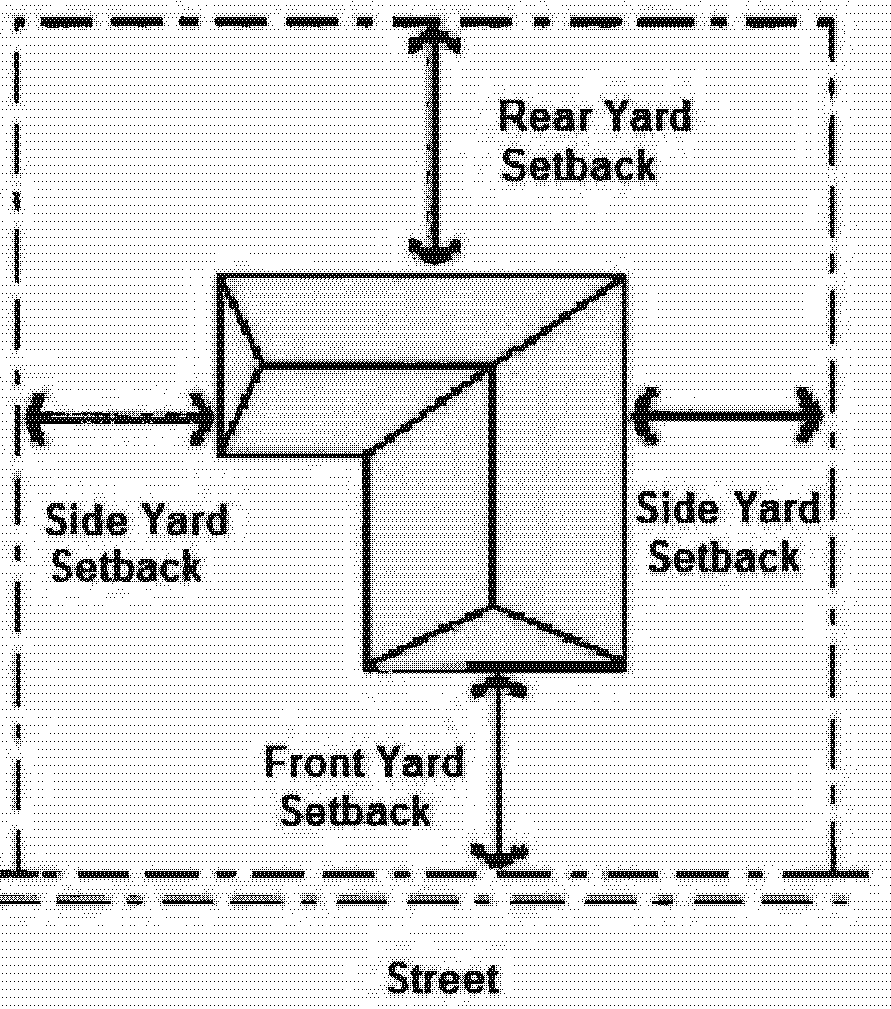
Setback means the required distance that the foundation of a building or structure is required to be separated from the lot line. A soffit or any other part of the roof or structure may extend up to two feet into a required setback area. The diagram below illustrates the concept of setback.
Slope means the ratio of a horizontal distance to the vertical distance between two points.
Start of construction means the date of issuance of permits for new construction and substantial improvements, provided the actual start of construction, repair, reconstruction, rehabilitation, addition, placement, or other improvement is within 180 days of the permit issuance date. The actual start of construction means either the first placement of permanent construction of a structure (including a manufactured home) on a site, such as the pouring of slab or footings, the installation of piles, the construction of columns. Permanent construction does not include land preparation such as clearing, grading or filling, the installation of streets or walkways, excavation for a basement, footings, piers, or foundations, the erection of temporary forms or the installation of accessory buildings such as garages or sheds not occupied as dwelling units or not part of the main structure. For a substantial improvement, the actual start of construction means the first alteration of any wall, ceiling, floor, or other structural part of a building, whether or not that alteration affects the external dimensions of the building.
State plane coordinates means the system of plane coordinates as defined in F.S. § 177.031(19). State plan coordinates may be used to define or designate the position of points of the surface of the earth in accordance with F.S. § 177.151.
Story means that portion of a building included between the surface of any floor and the surface of the floor next above it, then the space between the floor and the ceiling above.
Street or road means any access way such as a street, road, highway, alley, parkway, viaduct, circle, court, terrace, place or other similar designations, or cul-de-sac, or other ways intended for travel by the general public, whether improved or unimproved, but shall not include easements of any type or those accessways such as easements and rights-of-way intended for limited utility purposes such as for electric power lines, gas lines, telephone lines, water lines, sanitary sewers or other such uses, and shall not include easements for ingress and egress as provided in this chapter.
Street frontage means all the property on one side of a street that lies between two streets which intersect such street (crossing or termination), measured along the line of the street. If the street is a dead end street, then all of the property that lies on one side between a street which intersects such street and the dead end of the street.
Structure means anything constructed, installed, or portable, and which is over 30 inches in height or requires a building permit, located on land or water. It includes a movable structure while it is located on land for use either temporarily or permanently. "Structure" also includes fences, billboards, swimming pools, towers, smokestacks, and signs. "Building" or "structure" includes parts thereof and these terms may be used interchangeably.
Subdivision means the division of land into three or more lots, parcels, tracts, tiers, blocks, sites, units, or any other division of land; and includes establishment of new streets and alleys, additions, and resubdivisions; and, when appropriate to the context, relates to the process of subdividing or to the lands or area subdivided.
Survey data means all information shown on the face of a plat that would delineate the physical boundaries of the subdivision and any parts thereof.
Surveying data means:
(1)
P.C.—Point of curvature: The point where a tangent circular curve begins.
(2)
P.T.—Point of tangency: The point where a circular curve ends and becomes tangent.
(3)
P.C.C.—Point of compound curvature: The point where two circular curves have a common point of tangency, the curves laying on the same side of the common tangent.
(4)
P.R.C.—Point of reverse curvature: The point where two circular curves have a common point of tangency, the curves lying on opposite sides of the common tangent.
Utility means any public or private utility, such as, but not limited to, storm drainage, sanitary sewers, electric power, water service, gas service or telecommunication lines, whether underground or overhead.
Watercourse means a river, channel, creek, stream, or other topographic feature in, on or over which waters flow at least periodically.
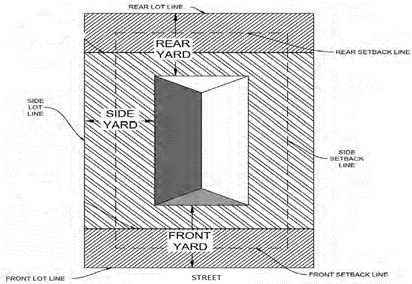
Yard means an area, on the same lot with a building, that is unoccupied and unobstructed from the ground upward except as permitted in this chapter. The diagram below illustrates the concept of lot line, yard and setback.
(1)
Yard, front, means the yard extending across the full width of the lot from the front lot line to the principal structure.
(2)
Yard, rear, means the yard extending across the full width of the lot from the rear lot line to the principal structure.
(3)
Yard, side, means the yard extending across the full depth of the lot from any side lot line to the principal structure.
Zoning officer or zoning official means the administrative officer charged with the duty of enforcing and administering the provisions of this chapter.
(Ord. No. 77-3, § III, 9-29-1977; 1991 LDR ch. 47, §§ 1.01—1.03; 1991 LDR ch. 57, art. 2; 1991 LDR ch. 68, art. 2; 1991 LDR ch. 71, art. 3; 1991 LDR ch. 79, art. 3; Ord. No. 99-5, § 80-6(2), 11-16-1999; Ord. No. 00-1, § 1, 2-3-2000; Ord. No. 00-02, § 2, 6-27-2000; Ord. No. 02-07, 9-17-2002; Ord. No. 05-01, § 1, 5-17-2005; Ord. No. 05-02, §§ 1, 2, 6-7-2005; Ord. No. 2007-03, § 2, 7-17-2007; Ord. No. 2007-05, § 1, 9-18-2007; Ord. No. 2007-06, § 1, 11-20-2007; Ord. No. 2007-07, § 1, 11-20-2007; Ord. No. 2008-08, § 1, 4-8-2008; Ord. No. 2009-01, §§ 1, 2, 6-2-2009; Ord. No. 2009-02, § 1, 7-7-2009; Ord. No. 2011-05, § 3, 9-19-2011; Ord. No. 2012-04, § 1, 10-16-2012; Ord. No. 2014-02, § 1, 4-22-2014; Ord. No. 2014-03, § 2, 4-22-2014; Ord. No. 2017-01, § 1, 1-17-2017; Ord. No. 2018-004, § 3, 3-20-2018; Ord. No. 2021-015, § 1, 12-21-2021; Or. No. 2022-3, § 1, 2-8-2022; Ord. No. 2022-9, § 1, 4-5-2022; Ord. No. 2022-10, § 1, 5-17-2022; Ord. No. 2022-13, §§ 1—6, 6-21-2022; Ord. No. 2023-5, § 6, 3-21-2023; Ord. No. 2023-9, § 3, 12-5-2023; Ord. No. 2024-1, § 1, 4-2-2024; Ord. No. 2025-5, § 1, 9-2-2025)
Cross reference— Definitions generally, § 1-2.
Sec. 50-2. - Notice of public hearings.
A.
Generally. This section sets forth the notice requirements for public hearings - which may be legislative hearings or quasi-judicial hearings. If state law is revised to impose more stringent or expansive notice requirements, state law shall prevail until this section is amended to comply. A request by an applicant to continue a hearing will require the applicant to incur the costs of the additional public notice.
B.
Failure to perfect notice. If an applicant fails to provide posted or mailed notice in accordance with this section prior to a hearing, then their petition will be continued or withdrawn from the agenda to allow time for the applicant to comply. The failure of any person to receive mailed notice, or failure to perfect posted or mailed notice (if the applicant made a good faith attempt to comply) may not be construed to invalidate final action by the county on a land development decision. Pursuant to F.S. § 125.66(5), five years after the adoption of any ordinance, no cause of action may be commenced as to the validity of the ordinance based on the failure to strictly adhere to the ordinance notice requirements.
(Ord. No. 2023-9, § 4, 12-5-2023)
Sec. 50-3 - Types of public notice.
(a)
Mailed notice. The applicant is responsible for sending supplemental mailed notice. The mailed notice must identify the property appraiser's parcel identification number(s) for the subject property, the physical address of the subject property (if no address is assigned, the general vicinity or nearest intersection); the date, time, and location of the public hearing; and a general description of the application. The notice must be mailed by certified mail at least 15 calendar days prior to the date of the hearing to all real property owners whose property lies within 300 feet, or 2,500 feet for a special exception for electric generating facilities, or 2,500 feet for a special exception for mining (without blasting and 49 or less one way truck trips per day), or two miles for a special exception for mining (that includes blasting or 50 or more one way truck trips per day) from any property line of the property that is the subject of the application. Addresses for mailed notice must be obtained from the county property appraiser's current ad valorem tax records.
(b)
Posted notice. Notice signs (which can be obtained from the county planning and zoning office) must be posted by the applicant as follows:
(1)
Content of notice. Posted notices shall include the following clearly written on the sign. The petition or ordinance number with brief description of the request, the parcel identification numbers and the county phone number to contact for additional information.
(2)
Location of signs.
a.
Street frontage. One sign shall be placed along each road that fronts the property. Signs should be placed on the property (not within the road right-of-way) so as to be visible from the road.
b.
Lack of street frontage. If the property does not have frontage on a road, at least one sign shall be placed on the property at the access point and additional signs shall be placed on the nearest public right-of-way with an indication of the location of the property.
c.
Installation, maintenance and removal. Signs shall be posted in a professional manner and maintained on the subject property by the applicant until final action on the application. The applicant shall remove the sign(s) within ten calendar days after final action on the application.
(3)
Timing of posting and affidavit. Signs shall be posted no later than ten calendar days after the application has been deemed sufficient and the county has notified the applicant of the hearing date(s). A notarized affidavit shall be submitted to the department within 72 hours after the posting, certifying that the signs were posted in compliance with this section. The zoning official may require submittal of photographs of all signs as part of the affidavit. Applications will not be considered complete and will not be processed until the signed and notarized affidavit has been received.
(c)
Published advertisement. The county will publish notice of each meeting at least ten calendar days prior to the date of the meeting and, at a minimum, the notice must contain the following information:
(1)
The date, time and place of the meeting;
(2)
The title, or a general description, of the petition(s);
(3)
The place(s) within the county where the petition(s) may be inspected by the public;
(4)
That "Interested parties may appear at the meeting and be heard with respect to the petition(s)";
(5)
That "In accordance with F.S. § 286.0105, should any person decide to appeal any decision made with respect to any matter considered at this meeting, such person will need a record of the proceedings, and for such purpose, may need to ensure that a verbatim record of the proceeding is made, which record includes the testimony and evidence upon which the appeal is to be based"; and
(6)
That "In accordance with the Americans with Disabilities Act, persons needing a special accommodation or an interpreter to participate in the proceeding should contact the Office of the Board of County Commissioners at (352) 486-5217, at least two days prior to the date of the meeting. Hearing impaired persons can access the foregoing telephone number by contacting the Florida Relay Service at 1-800-955-8770 (Voice) or 1-800-955-8771 (TDD)."
(d)
Ordinance mailed notice. In accordance with F.S. §125.66(5)(a), the county must mail notice to each property owner whose property will be re-designated. The notice must state: the substance of the proposed ordinance and the date, time, and location of the public hearing. The notice must be mailed at least 30 calendar days prior to the date of the hearing, and a copy of such notice shall be available for public inspection in the office of the clerk of the board of county commissioners.
(e)
Ordinance large published advertisement. The ad must be no less than two columns wide by ten inches long in a standard or tabloid size newspaper and the headline of the ad must be 18 point type or larger. The ad must be placed in a newspaper of general paid circulation in the county; of general interest and readership, not one of limited subject matter; and published at least five days a week (unless it is the only newspaper in the county). The ad cannot be placed in the legal notices or classified ad sections of the newspaper. The ad must be in substantially the following form:
NOTICE OF (INSERT TYPE OF) CHANGE
The Levy County Board of County Commissioners proposes to adopt the following ordinance: (insert title)
A public hearing on the ordinance will be held on (insert date and time) at (insert address and name of meeting location). The proposed ordinance may be inspected at (insert location). Interested parties may appear at the meeting and be heard with respect to the proposed ordinance.
In accordance with Section 286.0105, Florida Statutes, should any person decide to appeal any decision made with respect to any matter considered at this meeting, such person will need a record of the proceedings, and for such purpose, may need to ensure that a verbatim record of the proceeding is made, which record includes the testimony and evidence upon which the appeal is to be based.
In accordance with the Americans with Disabilities Act, persons needing a special accommodation or an interpreter to participate in the proceeding should contact the County Clerk's Office at (352) 486-5266, or the Office of the Board of County Commissioners at (352) 486-5217, at least two (2) days prior to the date of the meeting. Hearing impaired persons can access the foregoing telephone number by contacting the Florida Relay Service at 1-800-955-8770 (Voice) or 1-800-955-8771 (TDD).
In addition, if the ordinance proposes rezoning property, the ads must contain a geographic location map that clearly indicates the area to be rezoned. The map must include major street names to identify the general area.
(f)
Ordinance small published advertisement. The ad must be in substantially the following form:
(1)
The date, time and place of the meeting;
(2)
The title(s) of the proposed ordinance(s);
(3)
The place(s) within the county where the proposed ordinance(s) may be inspected;
(4)
That interested parties may appear at the meeting and be heard with respect to the proposed ordinance(s);
(5)
That "In accordance with Section 286.0105, Florida Statutes, should any person decide to appeal any decision made with respect to any matter considered at this meeting, such person will need a record of the proceedings, and for such purpose, may need to ensure that a verbatim record of the proceeding is made, which record includes the testimony and evidence upon which the appeal is to be based"; and
(6)
That "In accordance with the Americans with Disabilities Act, persons needing a special accommodation or an interpreter to participate in the proceeding should contact the County Clerk's Office at (352) 486-5266, or the Office of the Board of County Commissioners at (352) 486-5217, at least two (2) days prior to the date of the meeting. Hearing impaired persons can access the foregoing telephone number by contacting the Florida Relay Service at 1-800-955-8770 (Voice) or 1-800-955-8771 (TDD)."
(Ord. No. 2023-9, § 4, 12-5-2023)

