
Levy County Unincorporated
City Zoning Code
City Zoning Code
APPENDIX A
U.S. 19 OVERLAY DISTRICT23
Editor's note— Printed herein are the U.S. 19 Overlay District Regulations of the County, as adopted by Ordinance No. 2003-02 on April 8, 2003. Amendments to the ordinance are indicated by parenthetical history notes following amended provisions. The absence of a history note indicates that the provision remains unchanged from the original ordinance. Obvious misspellings and punctuation errors have been corrected without notation. For stylistic purposes, headings and catchlines have been made uniform and the same system of capitalization, citation to state statutes, and expression of numbers in text as appears in the Code of Ordinances has been used. Additions made for clarity are indicated by brackets.
I.- Intent and purpose.
The purpose of the U.S. Highway 19 Overlay District is to manage access to land development along U.S. Highway 19 in a manner that preserves the safety, efficiency, development potential, and character of the highway corridor. Specific purposes are as follows:
(a)
To protect the safety of motorists traveling on U.S. Highway 19 and its crossroad intersections and preserve the efficiency of traffic flow along the U.S. Highway 19 corridor.
(b)
To protect the safety of pedestrians and bicyclists and provide for pedestrian facilities in appropriate locations.
(c)
To encourage development on the corridor that is compatible with or does not detract from the aesthetic character or natural beauty of the surrounding area.
(d)
To preserve and enhance development options along the highway corridor by promoting consolidation of small, irregular lots into larger, more developable properties and promoting development of unified access and circulation systems that serve more than one property.
(e)
To assure that driveways and street connections to U.S. 19 are designed according to standards, have adequate sight distance for safe entry and exit, and are adequately spaced in accordance with the access spacing requirements of the Florida Department of Transportation for U.S. Highway 19.
(f)
To accomplish these goals through cooperative planning and coordination between area property owners and the many agencies that have an interest in the U.S. Highway 19 corridor, including but not limited to Levy County, the City of Chiefland, the City of Fanning Springs, and the Florida Department of Transportation.
II. - Applicability.
The U.S. Highway 19 Overlay District applies to all land that contains frontage on U.S. 19 or has frontage on any road intersecting U.S. 19 for a distance of 660 feet from the intersection and extends from north boundary of the City of Chiefland's city limits to the south boundary of the City of Fanning Spring's city limits, as more specifically described and shown on maps which shall be kept on file with the Levy County Development Department and Planning Department. These regulations shall be in addition to all other existing regulations of Levy County. Persons with property divided by the highway overlay district or that do not have frontage but request an access connection in the affected area must comply with the district standards. This district does not change the zoned use of property. Permitted, conditional, or provisional uses in the overlay district shall be as provided for in the existing underlying zoning districts. The overlay district will be shown on the zoning map of Levy County.
Connections permitted prior to the adoption of the U.S. 19 Overlay District shall be allowed to remain and will be considered legal and conforming until such time as there is a change in use per section VI.
III. - Definitions.
Connection means a driveway, street, turnout, or other means of providing access to or from U.S. 19 and other controlled access facilities on the state highway system. Two oneway connections to a property may constitute a single connection.
Corner clearance means the distance from an intersection of a public or private road to the nearest connection along a controlled access facility. This distance is measured from the closest edge of pavement of the intersecting road to the closest edge of pavement of the connection measured along the traveled way (through lanes).
Local access road means a public or private street or road, auxiliary to a controlled access facility, which has as its purpose the maintenance of local road continuity and/or provision of access to parcels adjacent to the controlled access facility.
Minimum connection spacing means the minimum allowable distance between nonconforming connections, measured from the closest edge of pavement of the first connection to the closest edge of pavement of the second connection along the edge of the traveled way.
Nonconforming connection permit means a permit providing temporary access to a property with specified conditions for bringing the connection into conformance with this policy.
Permitting authority means the Florida Department of Transportation or local government agency authorized to regulate access to the state highway system.
Reasonable access means the minimum number of connections, direct or indirect, necessary to provide safe ingress and egress to U.S. 19 based on the access management classification, projected connection and roadway traffic volumes, and the type and intensity of the land use.
Significant change means a change in the use of the property, including land, structures or facilities, or an expansion of the size of the structures or facilities causing an increase in the trip generation of the property, based on the latest edition of "Trip Generation" by the Institute of Transportation Engineers, exceeding 25 percent more trip generation (either peak hour or daily) and exceeding 100 vehicles per day more than the existing use.
IV. - U.S. 19 access management review committee.
A committee shall be established to oversee implementation of the U.S. 19 Overlay District and to promote consistency in review of requests for deviation from standards. The committee shall be comprised of staff representing Levy County, and will include representatives of the City of Chiefland and the City of Fanning Springs at such time that the U.S. 19 Overlay District regulations are adopted by each city. The committee shall establish procedures governing the review of requests for major deviation from connection spacing and corner clearance requirements of this district.
V. - Specific regulations.
(a)
Lot frontage requirements.
(1)
The minimum lot frontage for all newly created lots within the overlay district shall not be less than the applicable minimum connection spacing standard. The frontage requirement shall not apply to properties that obtain driveway access only from an interior road.
(2)
Existing or assembled lots with less than the required frontage may be permitted individual access to U.S. 19 only where alternative access or joint and cross access with adjacent properties is clearly impractical as provided in subsection (c)(5).
(b)
Setbacks and landscaping.
(1)
No structure or required parking area shall be located within 50 feet of the edge of the U.S. Highway 19 right-of-way.
(2)
All land uses abutting U.S. Highway 19 shall reserve a 25-foot wide strip of land from the U.S. Highway 19 right-of-way line. This shall serve as the front perimeter landscape area and shall meet or exceed the following material requirements:
a.
The area shall include or be landscaped with a minimum of one shade tree for each 25 feet of linear frontage on U.S. Highway 19.
b.
The remainder of the front perimeter landscape area shall be landscaped in grass, ground cover, shrubs, and/or other natural landscape material.
c.
All shade trees and landscaping materials shall conform with the guidelines of the FDOT Landscaping Guide.
(3)
Access connections through required landscaped strips shall not be subtracted from the lineal dimension used to determine the minimum number of trees required, unless such calculation would result in a violation of the connection spacing requirements of this district.
(4)
To preserve visibility at driveways and street connections to U.S. Highway 19, the following standard shall be met:
a.
Nothing shall be erected, placed, parked, planted or allowed to grow in such a manner as to materially impede the sight triangle according to FDOT Standard Index 546.
(c)
Connection spacing.
(1)
An access connection to U.S. 19 requires a connection permit from the Florida Department of Transportation (FDOT). All direct access connections to U.S. Highway 19 shall meet or exceed the minimum connection spacing requirements in Table 1, as set forth by Rule 14-97 of the FDOT. All applicants are encouraged to request a pre-application meeting with the FDOT and the Levy County Development Department regarding the proposed access connection and site plan prior to filing an application for a connection permit. The purpose of the pre-application meeting is to establish the application category and the general location and design of connections to the property, as well as any traffic study requirements that may be necessary.
Table 1: Minimum Connection Spacing
* Posted speed limit
(2)
A notice of intent to permit an access connection to U.S. 19 from the Florida Department of Transportation (FDOT) is not a final connection permit and does not constitute development approval from Levy County. FDOT will notify Levy County of all requests for access connections to U.S. 19. The County in coordination with FDOT may require modifications to property access during development review in accordance with Levy County's policies and regulations governing land development and interparcel circulation.
(3)
Deviation from access spacing standards may be permitted as follows:
a.
Minor deviations of ten percent or less of the allowable connection spacing standard may be authorized by the Florida Department of Transportation in coordination with Levy County where a property is otherwise unable to meet the minimum connection spacing standards and where this deviation would not create a safety problem on the public road.
b.
Requests for major deviations of greater than ten percent shall be reviewed by the U.S. 19 Access Management Review Committee, except as provided in subsection (c)(4). The committee shall consider the request and may recommend approval, approval with conditions, or denial to the permitting authority. Applicants requesting a major deviation from standards must submit an access management plan to the committee for consideration and a traffic impact study may be required at the expense of the applicant to assist in these determinations. At a minimum, the plan must:
(i)
Encompass a study area defined by the length of the site's frontage plus the distance of the applicable connection spacing standard, measured from the property lines;
(ii)
Include a review of both existing and future access for all properties within the study area;
(iii)
Include a justification for the requested deviation. The justification must address how the proposed plan advances the principles of access management and, where a waiver is being sought under subsection (c)(4), the justification must clarify why development of a unified or shared access and circulation system is impractical.
(4)
Where the existing configuration of properties and driveways in the vicinity of the subject site precludes spacing of an access point in accordance with subsection (c)(1), the permitting authority may waive the spacing requirement if all of the following conditions have been met:
a.
A joint use driveway will be established to serve two or more abutting building sites;
b.
The building site is designed to provide cross access and unified circulation with abutting sites with cross access easements provided in accordance with subsection (e); and
c.
The property owner signs an agreement to close any pre-existing curb-cuts that do not meet the requirements of this section after the construction of both sides of the joint use driveway, and agrees to enter a joint maintenance agreement defining maintenance responsibilities of property owners that share the joint use driveway and cross access system.
(5)
The permitting authority, upon recommendation by the U.S. 19 access management review committee, may modify or waive the requirements of this section where the characteristics or layout of abutting properties would make development of a unified or shared access and circulation system impractical.
(d)
Corner clearance.
(1)
The purpose of corner clearance requirements is to preserve safe and efficient traffic movement within the functional area of an intersection. Corner clearance for connections to U.S. 19 shall meet or exceed the minimum connection spacing requirements in subsection (c)(1). Where a side street connects to U.S. 19, corner clearance of connections to the side street shall meet or exceed the FDOT connection spacing standard for state highways, or 300 feet for roadways under local jurisdiction. Additional corner clearance may be required where engineering analysis indicates it is needed due to the trip characteristics of the development or the typical length of standing queues on the abutting roadway.
(2)
When a property cannot meet the minimum corner clearance requirements of this section, the permitting authority may waive the corner clearance standards where joint access is established with an abutting property, as provided in subsection (c)(4). All other requests for deviation from the requirements of this section will be subject to the provisions of subsection (c)(3).
(e)
Joint and cross access.
(1)
Adjacent commercial or office properties and compatible major traffic generators (i.e. shopping plazas, office parks, apartments, etc.) shall provide a cross access drive and pedestrian access way to allow circulation between sites (see Figure 1). This requirement shall also apply to a new building site that abuts an existing developed property unless the local permitting authority finds that this would be clearly impractical. Property owners shall record a cross access easement and a joint maintenance agreement in the public records of Levy County.
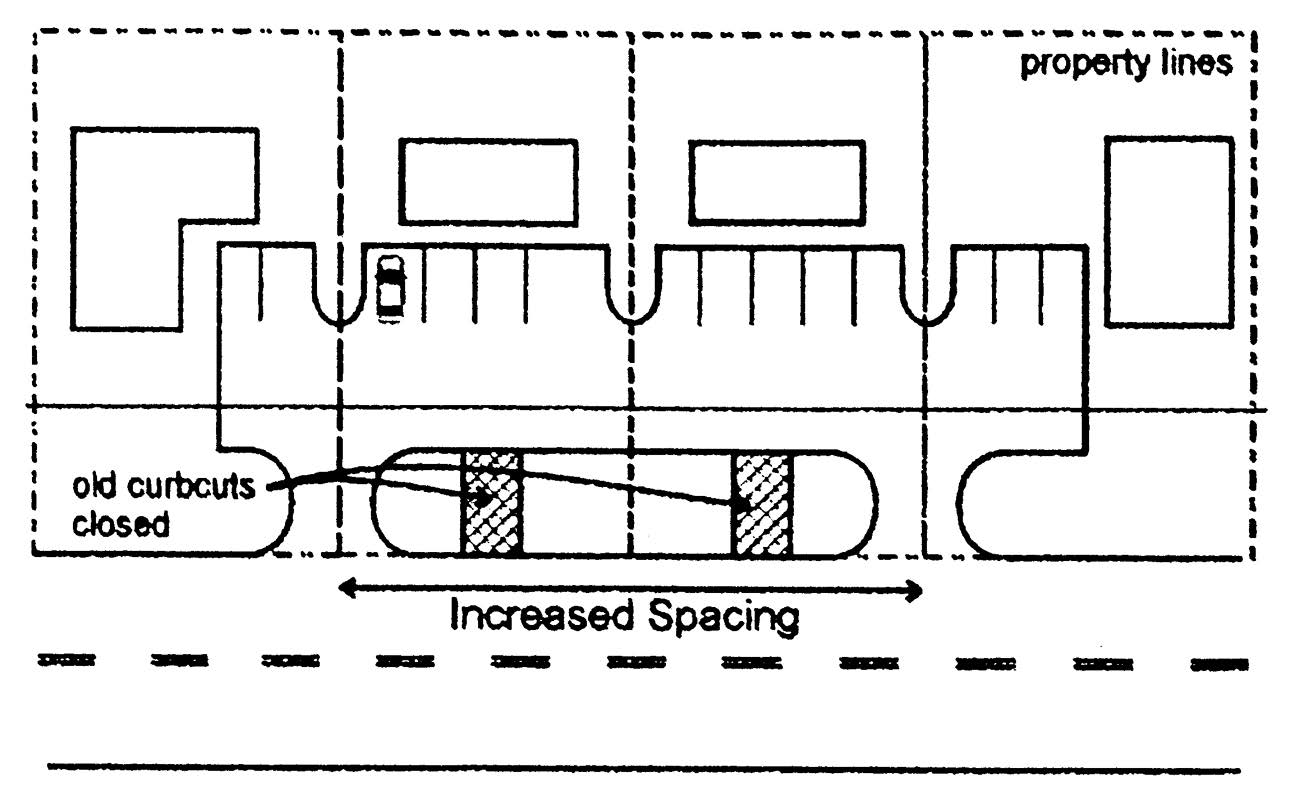
Figure 1: Joint and Cross Access
(2)
Property owners that provide for joint and cross access may be granted a non-conforming connection permit, where necessary, to provide reasonable access until such time as the joint use driveway and cross access drives are provided with adjacent properties. All necessary easements and agreements shall be recorded with the deed to the property, including:
a.
An easement allowing cross access to and from the adjacent properties;
b.
An agreement to close and eliminate any pre-existing driveways provided for access in the interim after construction of the joint-use driveway; and
c.
A joint maintenance agreement defining maintenance responsibilities of property owners that share the joint use driveway and cross access system.
(f)
Access to residential lots.
(1)
When a residential subdivision is proposed, it shall be designed to provide access to individual lots that abut U.S. Highway 19 from a frontage road or interior local road (see Figure 2). A berm or buffer may be required at the rear of residential lots to buffer residences from traffic on U.S. 19. The berm or buffer shall not be located within the public right-of-way.
(2)
Direct driveway access to individual one- and two-family dwellings shall be avoided on U.S. 19. All other reasonable access alternatives shall be investigated and judged unacceptable by Levy County, in coordination with the FDOT, before direct residential driveway access to U.S. 19 is permitted.
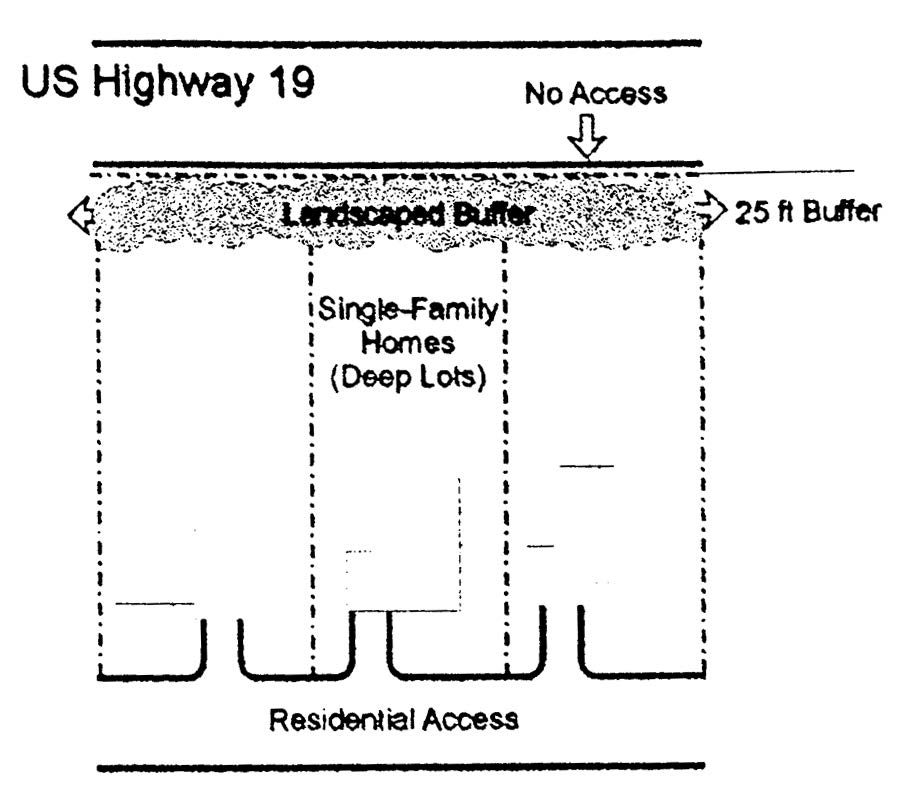
Figure 2: Reverse Frontage
(g)
Unified access and circulation.
(1)
In the interest of promoting unified access and circulation systems, development sites under the same ownership or consolidated for the purposes of development and comprised of more than one building site shall be considered unified parcels for the purposes of compliance with the access requirements of this section. This shall also apply to phased development plans. Accordingly, the following requirements shall apply:
a.
The number of connections permitted shall be the minimum number necessary to provide reasonable access to the overall site and not the maximum available for that frontage.
b.
All easements and agreements required under subsection (e)(2) shall be provided.
c.
Access to outparcels shall be internalized using the shared circulation system and designed to avoid excessive movement across parking aisles or queuing across surrounding parking and driving aisles (see Figure 3).
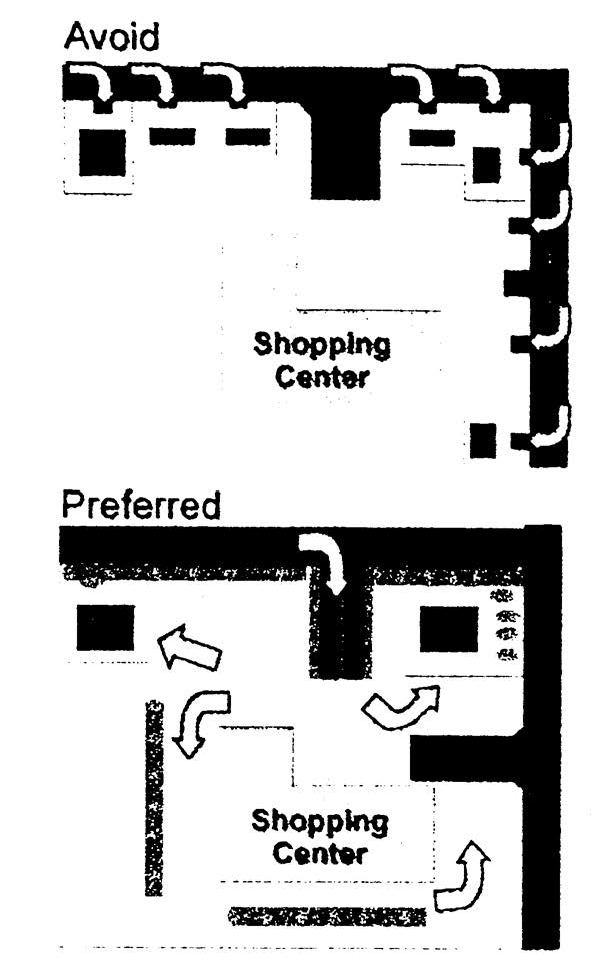
Figure 3: Access to
Shopping Center
Outparcels
d.
Where abutting properties are in different ownership and not part of an overall development plan, cooperation between the various owners in development of a unified access and circulation system shall be sought. However, only the building site(s) under consideration for development approval shall be subject to the requirements of this section. Abutting properties shall be required to provide unified access and circulation when a change in use occurs as provided in section VI.
(h)
Local access roads.
(1)
Local access roads shall be used for direct access to property within the overlay district instead of individual driveway connections, wherever feasible. Access roads may be required for access to properties abutting U.S. Highway 19, in accordance with the following standards:
a.
The access drive shall be designed for extension and/or alignment with existing or planned access drives.
b.
The access drive shall be designated in a duly recorded easement, which will permit access onto adjacent parcels. The easement shall provide for continued maintenance and for Levy County to be able to enter upon the easement for maintenance purposes.
c.
The access drive shall be paved and the road right-of-way and paved surface shall be at least 20 feet wide. The paved surface for any access drive adjacent to U.S. Highway 19 shall be at least 30 feet from the right-of-way line of the main road.
d.
No buildings, structures, or parking lots shall be permitted within the access drive or its easement, unless necessary for traffic control or traffic directional purposes.
(2)
Where properties are under the same ownership or consolidated for the purposes of development, the local access road shall be constructed by the developer. Where the road will serve properties under separate ownership, a method will be established to apportion the costs of initiating and constructing the road.
(i)
Driveway location and design.
(1)
Driveway connections shall be located and designed to provide adequate sight distance. Florida Department of Transportation (FDOT) standards for sight distance shall apply.
(2)
The Florida Department of Transportation, in coordination with the Levy County Development Department, may require turn lanes where deemed necessary due to traffic volumes or where a safety or operational problem exists. The design of left-turn and right-turn lanes shall conform to FDOT design standards.
(3)
Construction of driveways along turn lanes and tapers is prohibited unless no other access to the property is available.
(4)
Driveways across from median openings shall be consolidated wherever feasible to coordinate access at the median opening.
(5)
Driveways with more than one entry and one exit lane shall incorporate channelization features to separate the entry and exit sides of the driveway. Double yellow lines may be considered instead of medians, where truck off-tracking is a problem.
(6)
Driveways shall be designed with adequate on-site storage for entering and exiting vehicles to reduce unsafe conflicts with through traffic or on-site traffic and to avoid congestion at the entrance. Guidelines for driveway throat length are provided in Table 2.
Table 2: Driveway Throat Length Guidelines
(j)
Bicycle and pedestrian access.
(1)
Opportunities for bicycle/pedestrian mobility should be enhanced through site design strategies and bicycle/pedestrian ways that seek to shorten walking distances and increase accessibility between neighborhoods, schools, recreation areas, community centers, shopping areas or employment centers as follows:
a.
Sidewalks shall be incorporated along the right-of-way of U.S. 19 within the U.S. 19 Overlay District when the opportunity arises through the development or roadway improvement process.
b.
Sidewalks within developments shall be designed to connect to the existing or planned sidewalk system of U.S. 19 and other surrounding roadways. To the maximum extent feasible, sidewalks within developments should be designed to connect to the Nature Coast State Recreational Trail or future extensions of the trail.
c.
Bicycle/pedestrian ways shall be incorporated into new development to connect residential developments or residential uses with nearby schools, neighborhood community centers, churches, parks, commercial and office developments, or other compatible land uses. To the maximum extent feasible, bicycle/pedestrian ways should be incorporated into new development to connect with the Nature Coast State Recreational Trail or future extensions of the trail.
d.
A pedestrian/bicycle crossing of U.S. 19 connecting the east and west sides of the U.S. 19 Overlay District and connecting to the Nature Coast State Recreational Trail shall be constructed and integrated into the existing or planned sidewalk system of U.S. 19 when the opportunity arises through the development or roadway improvement process.
(2)
Where Levy County determines that a bicycle/pedestrian connection is desirable from a subdivision to schools, parks, playgrounds, or other roads or facilities and that such access is not conveniently provided by sidewalks adjacent to the streets, the developer may be required to reserve an unobstructed easement to provide such access.
(3)
Commercial development shall be designed to support bicycle and pedestrian mobility in accordance with the following:
a.
Safe and convenient pedestrian ways shall be provided between parking areas and from the building entrance to surrounding streets, external sidewalks and development outparcels.
b.
Pedestrian circulation shall be provided, where appropriate, between abutting commercial properties through the use of walkways and similar pedestrian-oriented facilities.
c.
Pedestrian facilities may be incorporated into the required landscape buffer.
(Ord. No. 2007-07, § 19, 11-20-2007)
VI. - Change in use.
(1)
Properties with access connections that do not meet the requirements of the U.S. 19 Overlay District shall be brought into compliance with the U.S. 19 Overlay District when modifications to the roadway are made or when there is a significant change in use of the property, including land, structures or facilities, resulting in an increase in the trip generation of the property exceeding 25 percent (either peak hour or daily) and exceeding 100 vehicles per day, as determined by one of the following methods:
a.
An estimation based on the latest edition of "Trip Generation" by the Institute of Transportation Engineers for typical land uses; or
b.
Traffic counts made at similar traffic generators located in the area; or
c.
Actual traffic monitoring conducted during the peak hour of the adjacent roadway traffic for the property.
(2)
Where such additional traffic is projected due to expansion or redevelopment, the Levy County Development Department shall notify FDOT and the property owner shall contact FDOT to determine if a new permit application and modifications to existing connections will be required. Failure to contact FDOT prior to initiating a change to the property may result in revocation or modification of the existing permit and closure of the connection as specified in FDOT Rule Section 14-96.011(2).
(3)
If the principal activity on a parcel with access connections that do not meet the regulations herein is discontinued or out of service for a period of one year or more, then that parcel must comply with all applicable access requirements of this overlay district.

