
Little Elm City Zoning Code
ARTICLE IV
SPECIAL DISTRICTS
Sec. 106.04.01 - US 380 Overlay District.
(a)
Purpose. The U.S. 380 Overlay District (380-OD) is identified in the 2017 Comprehensive Plan as the town's major commercial hub for employment. To this end, enhanced regulations are adopted to stimulate high-quality employment opportunities in this area. The 380 Overlay District is intended to substantially advance a legitimate governmental interest that includes promoting the economic development of the overlay district area, promoting a job base for the residents of Little Elm, and to regulate the character of growth along the 380 Corridor.
(b)
Description. The Town of Little Elm hereby adopts the U.S. Highway 380 Overlay District establishing development standards for properties within the 380 Corridor in the Town of Little Elm jurisdictional limits, regarding use regulations, height regulations, signage, landscaping, and lighting requirements.
(c)
Boundary. The physical boundaries of the US 380 Overlay District are identified in exhibit A of Ordinance No. 835, as it exists or is amended by town council.
(d)
Use regulations.
(1)
Permitted uses. The base zoning district of the subject property determines the permitted land uses in the US 380 Overlay District. Furthermore, the only permitted zoning districts in the overlay district are as follows: LC Light Commercial, HC Heavy Commercial, LI Light Industrial, HI Heavy Industrial, and related PD Planned Development Districts. Permitted land uses are outlined in section 106.05.01(b), "schedule of uses - nonresidential." All applicable regulations for use, yard, area, lot dimensions, utility placement, and landscaping shall be those specified for each district, including planned development stipulations except as otherwise stated in this chapter.
(2)
Prohibited uses. The following uses are prohibited in the US 380 Overlay District, unless approved through the specific use permit process:
a.
Automobile or truck leasing or renting.
b.
Automobile sales, new or used.
c.
Batching plant (concrete or asphalt, permanent).
d.
Boat repair.
e.
Boat sales, new or used.
f.
Brick company with outside storage.
g.
Building materials and hardware (outside display).
h.
Church or rectory.
i.
Commercial amusement (outdoor).
j.
Dance hall.
k.
Firing range, indoor/outdoor.
l.
Flea market.
m.
Heavy vehicle sales or storage.
n.
Landfill (commercial).
o.
Motorcycle sales with outside display.
p.
Open or outside storage of products or materials that are not screened.
q.
Pawn shop.
r.
Portable building sales.
s.
Recreational vehicle sales, new or used.
t.
Residence home for the aged.
u.
Rock quarries, sand, gravel, or earth excavation.
v.
Salvage or reclamation of products that are not screened.
w.
School, public primary or secondary.
x.
Self-storage or mini warehouse.
y.
Sexually oriented businesses.
z.
Storage or repair of furniture and appliances, outside building.
aa.
Tire retreading and recapping.
bb.
Tire sales with outside storage.
cc.
Trailer or manufactured home display or sales or rental.
dd.
Truck and bus rental or repair.
ee.
Truck sales, new or used.
ff.
Vehicle or automobile wash, self-serve.
gg.
Veterinarian clinic or kennel with outside pens.
hh.
Wrecking yard, auto salvage, junkyard, or outside reclamation.
(e)
Buffer zones required between industrial uses or zoning districts and single-family uses or zoning districts. A buffer zone shall be required between industrial and single-family residential zoning districts or uses to provide separation between the two areas. These special buffering requirements are necessary in order to mitigate the impact associated with adjacent non-compatible uses. A 40-foot transitional buffer is required for industrial uses or zoning districts adjacent to single-family residential uses or zoning districts within the 380 Overlay District. Any transitional buffer area that is provided shall be landscaped and irrigated. Trees shall be provided at a rate of one tree per 30 linear feet. Fifty percent of the trees shall be evergreen and shall be evenly dispersed.
(f)
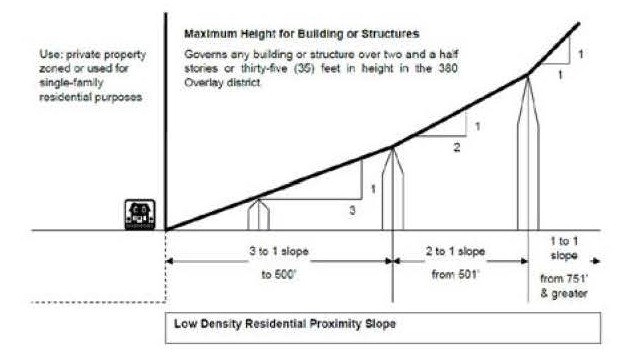
Height and setback regulations. In the US 380 Overlay District the height of buildings and the setback regulations shall be as follows:
Note 1. Height. There will be no building height limitation as long as the setback regulations set forth below are met. Setbacks (shown above) shall be applied to all buildings over two and one-half stories or 35 feet in height. Buildings that are less than 35 feet in height shall use the setbacks identified in each zoning district. See the figure below for additional information regarding the required setbacks.
Note 2. This includes land zoned or used for single-family residential purposes regardless of jurisdiction.
Note 3. A height setback envelope is a plane projected upward and outward from a site of origination, which is defined as any private property that is zoned or used for single-family residential purposes.
Note 4. When referring to height setback envelopes, all slopes in this chapter are stated as to horizontal run to vertical rise.
Note 5. Surface parking facilities may be located within the height setback envelope, as required for nonresidential uses, so long as the parking does not encroach into the required landscape setbacks.
(g)
Signage. In the US 380 Overlay District, signs shall be subject to the following regulations:
(1)
Internal illumination. Outdoor, internally illuminated advertising signs may have a background, letters, and/or symbols of any color combination.
(2)
Monument sign.
a.
Area: The maximum area for a monument sign shall be 100 square feet.
b.
Height: The maximum height for a monument sign shall be ten feet.
(3)
Multi-tenant monument sign:
a.
Area: The maximum area shall be based upon the size of the development.
b.
Five acres or less is 150 square feet.
c.
For every acre over five acres, the sign size may be increased by ten square feet with the maximum allowed area 240 square feet is permitted.
d.
Height: The maximum height shall be 24 feet.
(4)
Wall sign area:
a.
For each one linear foot of primary building face, three square feet of wall sign is allowed. A maximum of 200 square feet of wall signage is allowed per building or tenant.
b.
Big box primary tenants may use a total of 400 square feet.
(5)
Electronic Message Signs:
a.
The portion of the sign that may be electronic message is limited to 60 percent of the total sign.
b.
Any change of pictures or information on said sign may not include animation but may include transitions which change at a rate no faster than every six seconds.
(h)
Landscaping. Landscaping shall conform to the requirements found in the landscaping ordinance. In addition to these requirements, the following are required:
(1)
Perimeter landscaping:
(2)
A thirty-foot front landscape setback adjacent to US 380 shall be maintained. The landscape setback shall generally consist of trees, shrubs, groundcover, berms, and/or related elements.
(3)
For the perimeter landscaped area adjacent to US 380, one large canopy tree and one small ornamental tree shall be required every 25 linear feet of street frontage. Trees may be grouped or clustered to facilitate site design.
(i)
Lighting. The installation of lighting shall limit off-site spill (off the parcel containing the development) to a maximum of 0.5 footcandles at any location on any residential property, and no limit at any location on any nonresidential property, as measurable from any orientation of the measuring device.
(Ord. No. 1407, § 2, 8-15-2017; Ord. No. 1745, § 2, 1-16-2024)
Sec. 106.04.02 - Lakefront District.
DIVISION 1. PURPOSE, GOALS, AND INTENT
(a)
Purpose.
The purpose of the Lakefront District is to implement the adopted recommendations of the comprehensive plan by establishing a pedestrian-oriented lakefront which will serve as the civic and cultural heart of the town for generations.
(b)
Goals. The goals of this Code are:
(1)
To build on the Town's targeted "lakeside community character," with built form and materials that are reminiscent of lakefront communities.
(2)
Make the sustainable through:
a.
Providing for integrated mixed use;
b.
Embodying LEED-ND (Leadership in Energy and Environmental Design Neighborhood Development) principles; and
c.
Assuring pedestrian and bicycle friendliness;
(3)
To provide development and land use flexibility within the framework of a form-based development code;
(4)
To provide a mix of residential, retail and office uses in a pedestrian and bicycle-friendly environment; and
(5)
To encourage high quality development through providing a balance of development standards and expeditious administrative approvals for projects which meet the intent of this Code.
(c)
Intent. The intent of this Code is:
(1)
To provide a comfortable and attractive environment for pedestrians, which include such things as buildings framing public space, interesting street walls, street trees, lighting, and street furniture;
(2)
To construct buildings close to the sidewalk and street;
(3)
To construct continuous building frontage along block faces except where it is desirable to provide for pedestrian and auto pass-through to parking at mid block;
(4)
To provide shared parking that will benefit the entire district;
(5)
To encourage the use of public parks and plazas as a focus for mixed use developments;
(6)
To design and build flexible buildings that can accommodate a range of uses over time;
(7)
To design streets, access lanes and buildings that will provide a high level of connectivity between parcels and projects for pedestrians, bicycles, and autos; and
(8)
To create a safe multi-modal mixed use environment.
(Ord. No. 1407, § 2, 8-15-2017; Ord. No. 1729, § 2, 9-19-2023)
DIVISION 2. DEFINITIONS
The following definitions shall apply within the Lakefront Code.
Access lane. Any on-site drive or lane intended to accommodate autos or pedestrians.
Art installation. A large-scale, mixed-media construction, often designed for a specific place, includes three-dimensional works designed to transform the perception of space, sculptures, murals, or other forms of creative visual art produced primarily or solely for its imaginative, aesthetic, or intellectual content reflective of the Lakefront District vision; may also contain reference to a business or its logo; is not used for sole purposes of advertising; is not used to promote political or religious views, or social causes.
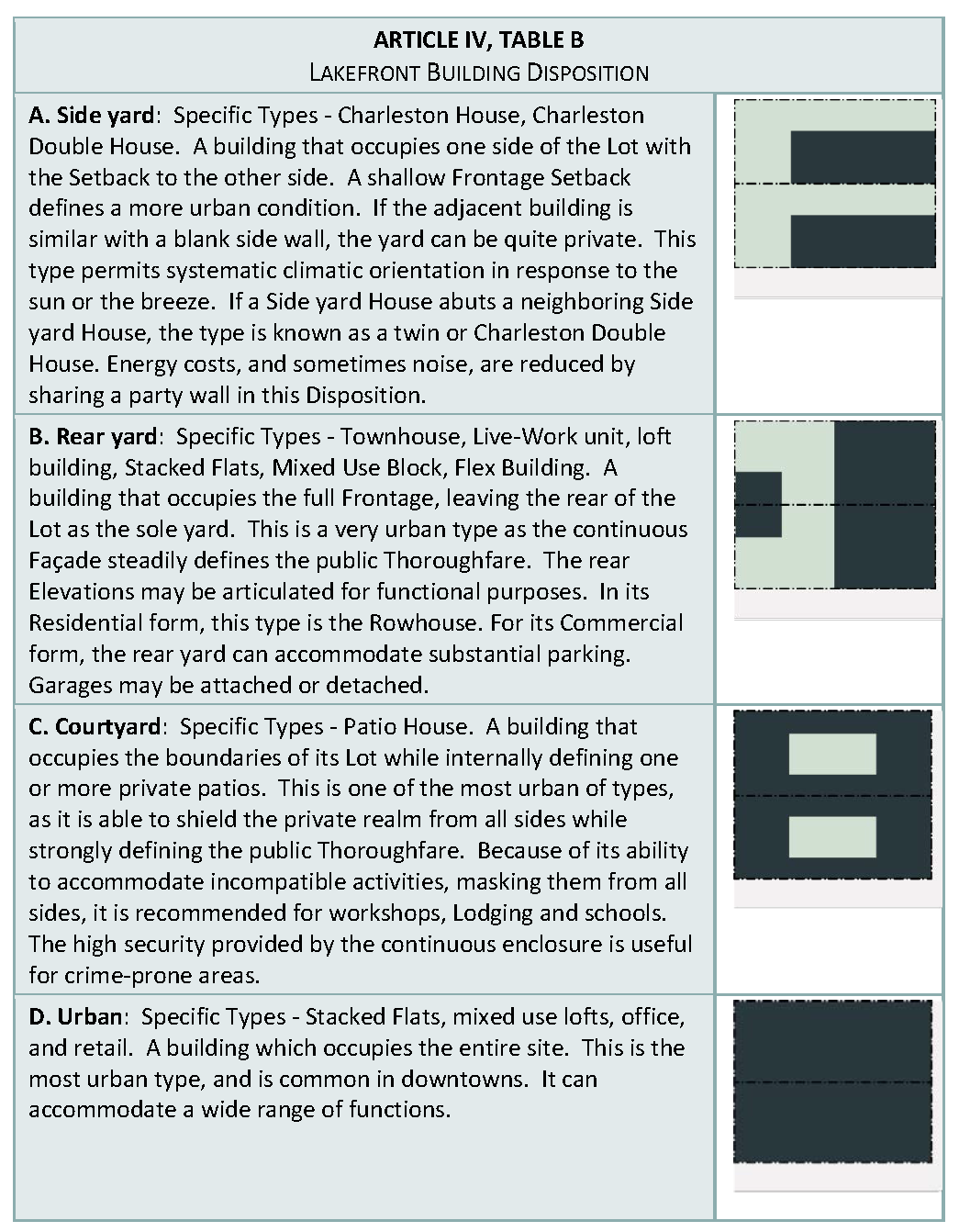
Charleston house. This is a house that is built close to the front sidewalk but also has one building edge adjacent to a shared property line, thereby creating a useable side yard. (See table 1 Building Disposition) A double Charleston house is two single-family Charleston houses which share a common wall (and property line).
Review committee. A committee constituted by the town to advise the director on major development waivers. (See section 106.04.02, "Lakefront District - Division 9(b) review process")
Building facade, primary. Any facade that faces a public street or open space.
District. The entire area covered by the lakefront code.
Entry, primary. The main entry to a building on a block face. There must be at least one main building entry for each ground floor use, tenant or lobby on each block face which contains the use or tenant.
Flats. Urban apartments located in a pedestrian friendly mixed use development, and usually positioned above the ground floor.
Landmark buildings. Buildings which are located on axis with a terminating street or at the intersection of streets. Such buildings shall incorporate architectural features which address height and articulation that emphasize the importance of such a location.
Live-work. A fee-simple dwelling unit that contains, to a limited extent, a separate commercial component on the ground floor. It is in the form similar to a townhouse or store with residential quarters above or behind commercial use.
Loft. A flexible residential space which may be partially used for an artist or design studio, and which is characterized by higher than normal ceilings, open floor plans and often, exposed duct work.
Loft, mixed use. A mixed use building that includes a majority of residential use such as lofts, apartments, condominiums, and offices, but contains nonresidential use in a portion of the ground floor.
Major thoroughfare. This refers to the ultimate configuration of Eldorado Parkway.
Parking, shared. Parking which is shared by tenants, visitors, and the general public. Hours of availability and use may be further defined in cooperation with the Town.
Patio house. This refers to a home which occupies the boundary of the lot while defining one or more private patios. (See Table 1 Building Disposition)
Regulating plan. A plan that governs the development of a multi-phased project area as defined in. (See section 106.04.02, "Lakefront District - Division 9(c) regulating plan")
Retail use. For the purposes of the Lakefront Code, retail use is defined as a business having as its primary function, the supply of merchandise or wares to the end consumer. Such sales constitute the "primary function of the business when sales equal at least 80 percent of the gross sales of the business.
Stacked flat. A condominium, apartment or loft which is part of a building of similar units. Flats located on the ground floor must still meet the requirements for direct front door access to a stoop and a public sidewalk.
Stoop. A structure that is located approximately at the level of the first floor of the structure and intended to provide access to a residential unit.
Story. That portion of a building, other than a basement, included between the surface of any floor and the surface of the floor next above it, or if there is no floor above it, then the space between the floor and the ceiling above the floor of such story. This includes any mezzanine or loft which may comprise only a portion of a full floor plate. A standard story may range from ten feet to 16 feet depending on the use.
Streetscape. The urban element that establishes the major part of the public realm. The streetscape is composed of thoroughfares (travel lanes for vehicles and bicycles, parking lanes for cars, and sidewalks or paths for pedestrians) as well as the visible private frontages (building facades and elevations, porches, yards, fences, awnings, etc.), and the amenities of the public frontages (street trees and plantings, benches, streetlights, etc.).
Lakefront engineering and landscape standards. Any approved Town standards which govern such items as street, streetscape, drainage, signage, and other public improvements in the Lakefront District.
Town Manager. The Town Manager of the Town of Little Elm or his designee.
Townhouse. An attached dwelling unit located on a platted lot which shares at least one common wall with another such unit. Townhouses are grouped together in clusters of three to six units.
Urban design officer (UDO). The planning manager shall serve as the urban design officer for the Lakefront District.
Waiver to design standards, major (major waiver). A significant change to the standards of this Code, as identified in the District regulations and requiring planning and zoning commission and town council approval. (See section 106.04.02, "lakefront District Division 3(g) and 9(e) regarding waivers of design standards")
Waiver to design standards, minor (minor waiver). A minor change to the standards of this Code that is not contrary to the stated goals and intent of the district. (See section 106.04.02, "lakefront District Division 3(g) and 9(e) regarding waivers of design standards")
(Ord. No. 1407, § 2, 8-15-2017; Ord. No. 1651, § 2, 12-7-2021; Ord. No. 1729, § 2, 9-19-2023)
DIVISION 3. GENERAL DISTRICT STANDARDS
(a)
Building and land use.
Intent. It is intended that allowed uses will encourage pedestrian-oriented mixed use projects that are well integrated with retail and residential activities.
(1)
Retail, personal service, residential and office uses shall be allowed throughout the district in accordance with the list of authorized uses set forth in Appendix 1 Lakefront Land Use. Uses which are not specifically authorized require a major waiver.
(2)
Where "required retail at-grade construction" is designated on the conceptual framework plan, the ground floor adjacent to the street should be constructed to retail building standards for a depth of at least 50 feet, however a smaller depth may be allowed if the retail is serving as a "liner" use which is masking a parking garage, by minor waiver.
(3)
All changes to access drives require a minor waiver.
(b)
Blockface.
Intent. It is intended that building walls should be continuous along block faces to create a strong edge to the street and contribute to creating an attractive and active pedestrian environment, with allowance for some limited variation and opportunities for outside dining, pocket parks and special building entry features. Buildings should also be constructed close to the street to provide a sense of enclosure.
It is also intended that blocks be as short as practical to both support pedestrian access/walkability and to facilitate the process of renewal and regeneration of buildings and frontages over the long term.
(1)
Continuous building frontage will be considered to be met if 80 percent or more of the primary building facade is located within 15 feet of the right-of-way or build-to line designated on an approved plan. This shall apply to each phase of development unless otherwise approved. However, administrative approval of a minor waiver will permit down to 70 percent, provided that the reduction results in an attractive outdoor dining area, building entry feature or other amenity which contributes to the streetscape. A greater reduction shall require approval of a major waiver.
(2)
Facades shall generally be built parallel to the street frontage, except at street intersections, where a facade containing a primary building entrance may be curved or angled toward an intersection.
(3)
Build-to lines.
a.
Build-to lines shall be measured from the planned street right-of-way or public easement, as established on the approved regulating plan and the standards in this chapter. The entire area between the back-of-curb and the primary building facade shall be dedicated as public right-of-way or have a public access easement placed upon it.
b.
Exterior steps, stoops, chimneys, and bay windows may encroach beyond the build-to line by two feet, but not into a public right-of-way. Balconies ten feet or more above the sidewalk may encroach up to six feet including a public right-of-way or access lane.
c.
Awnings may encroach above the public sidewalk without limit, but may not extend into a vehicular roadway or accessway.
(c)
Streets; intent. It is the intent that public and private streets and accessways provide a framework that will facilitate the movement of pedestrians and autos in an attractive environment, and provide for incremental long term revitalization and redevelopment of parcels to meet changing market sector needs. All streets and blocks in the Lakefront Code shall conform to the provisions of this section.
1.
Street standards. Standards for streets within the District shall be approved as part of a regulating plan and shall be in general conformity with Appendix 2 thoroughfare assemblies.
2.
Street pattern. The pattern of all streets in the project area shall be based upon a small scale grid system of interconnecting streets, and shall connect to adjoining no single-family properties.
(d)
Streetscape and landscape; intent. It is the intent to both encourage and require streetscape and landscaping that reinforces the lakefront character of Little Elm as envisioned in the comprehensive plan. It is also the intent to create comfortable pedestrian environments and lower summer ambient temperature by shading sidewalks, parking areas and drive lanes.
1.
Streetscape standards. Shade trees are required along all public street rights-of-way, either within the ROW or immediately adjacent at an average of 20 feet on center. Where buildings are not adjacent to the sidewalk, a second row of trees shall be provided in place of a building wall unless adjacent to a plaza or pocket park or approved by minor waiver as a temporary condition.
2.
Site landscaping shall include drought tolerant grasses and shrubs as listed in the Town's list of approved plant materials.
3.
Residential ground floor frontages shall be required to landscape a minimum of five feet between the edge of sidewalk and the primary building facade, excluding access to sidewalks, stairs, stoops, porches, and patios. This area may be landscaped with ground cover, low shrubs, ornamental trees, and street trees. In addition, street tree wells may also be landscaped. Landscaping for tree wells is limited to ground cover and low shrubs.
(e)
Transition from single-family zoning. On any property in the Lakefront District which shares a lot line with a single-family zoned property:
(1)
The setback shall be a minimum of 20 feet from the property line, and
(f)
Waivers of design standards. The following waivers are authorized within the Code, subject to the procedures in Division 9E and as otherwise specified in this Code.
Minor waivers include:
• Requirement to line a parking garage with buildings
• Requirement for continuous building frontage
• Establishment of build-to line
• Encroachment into the build-to line
• Residential landscape requirement
• Design of buildings without tri-partite architecture
• Required frequency of building entries along a street edge
• Window detailing
• Exterior building and roof materials
• Exterior building color
• Retail at-grade design standards
• Landscape standards
• Location of bicycle parking
• Minor revisions to thoroughfare assemblies
• Permitted signs
Major waivers include:
• Required retail construction
• Building height
• Exceeding the maximum leasable retail area
• Residential at-grade design standards
• Parking requirements
• Parking garage design standards
(Ord. No. 1407, § 2, 8-15-2017; Ord. No. 1651, § 2, 12-7-2021; Ord. No. 1729, § 2, 9-19-2023)
DIVISION 4. BUILDINGS
(a)
Intent. The intent of this section is to create an attractive and active Lakefront Town style District; and the size, disposition, function, and design of buildings play an important role in achieving that goal. This includes encouraging the appropriate use of:
• Landmark "lighthouse" elements
• Cementitious fiberboard siding in the form of planks or board and batten
• Metal or tile - (clay or cement) roofing material
It is also intended that commercial spaces are designed and constructed in a manner that allows flexibility to accommodate a range of uses over time in order to avoid the need to demolish and rebuild for successive uses. Buildings should directly contribute to the attractiveness, safety, and function of the street and public areas. Buildings that accommodate retail at-grade should feature the retail activity over the building's architecture. Buildings should be constructed in a manner, and with materials, that are highly durable and will continue to endure and be attractive over a long time, especially adjacent to public and pedestrian areas.
It is intended by this section, to encourage a variety of building and design solutions in response to the standards and regulations outlined herein.
(b)
General building configuration.
(1)
General building disposition.
a.
Buildings shall be disposed in relation to the boundaries of their lots according to Table 1 Building Disposition.
b.
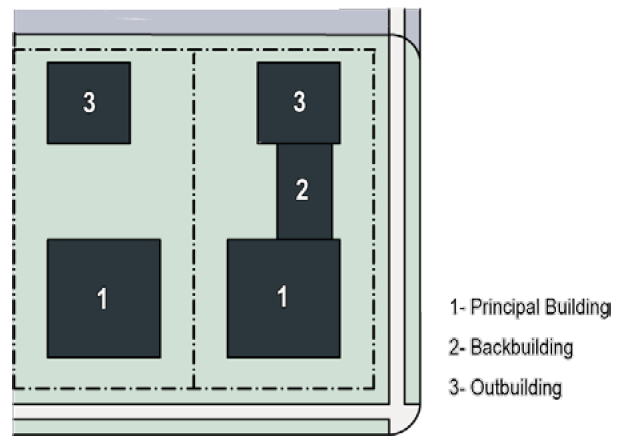
One principal building at the frontage and one outbuilding to the rear may be built on each lot. A back-building may be built between the principal building and the outbuilding on the side-frontage of corner lots as shown in Table 2 Building Location.
c.
Facades shall be built generally parallel or tangent to the principal frontage line. For lots having two frontages, the one along the more urban frontage of the two shall be the principal frontage unless otherwise determined by minor waiver.
d.
Single-Family outbuilding rear setbacks shall be a minimum of eight feet from the alley right-of-way to the garage door if there is one, or three feet to the building wall if not. Townhomes with rear patios and a detached garage may have a minimum setback of three feet. In the absence of a rear alley or lane, the rear setback shall be a minimum of three feet.
e.
Loading docks and service areas shall be permitted on frontages only when absolutely necessary, by minor waiver.
Building disposition. This table approximates the location of the structure relative to the boundaries of each individual lot, establishing suitable basic building types for each transect zone.
(c)
Building standards.
(1)
Building form.
a.
Buildings shall not exceed three stories, or 45 feet, in height; additional height along Eldorado Parkway may be allowed at specific locations by major waiver.
b.
All buildings shall be designed and constructed in tri-partite architecture so that they have a distinct base, middle and top.
c.
Buildings which are located on axis with a terminating street or access lane or at the intersection of streets and/or access lanes shall be considered a landmark building. Such buildings shall be designed with landmark features which take advantage of that location, such as an accentuated entry and a unique building articulation which is off-set from the front wall planes and goes above the main building eave or parapet line.
(2)
Architectural features. Where clearly visible from a public street, open space, or access lane:
a.
Roofs. For buildings with hip, gable, or mansard roofs (unless otherwise allowed by minor waiver):
1.
Allowed materials include standing seam, clay, or concrete tile (barrel or Roman shape)
2.
Skylights and roof vents shall not be visible.
b.
Windows, except for retail at-grade, shall be vertical in proportion and have at least a three-inch reveal. Vertically proportioned windows which are joined together by a mullion shall be considered as meeting this standard.
c.
Each building and separate lease space at-grade along the street edge shall have a functioning primary entry from the sidewalk. Such entries must be inset from the front building plane by at least three feet. Functioning entries must be located no greater than 60 feet apart. Corner entries may count as a primary entry for both intersecting street frontages.
(3)
Exterior facade materials. The following shall apply to all exterior walls of buildings and parking structures which are clearly visible from a public street, walkway, or open space:
a.
Allowed exterior materials. Allowed exterior surface materials are categorized into three groups:
1.
Group A. Brick and stone.
2.
Group B. Stucco, architectural concrete block with integrated color, factory primed cementitious fiberboard (in the form of lap siding or board and batten). Cementitious fiberboard is limited to 20 percent of any facade.
3.
Group C. Accent; Metal, EIFS, wood and tile.
b.
Prohibited exterior materials. Prohibited exterior surface materials include cinderblock and aggregate finished surfaces.
c.
Primary facades. The following shall apply to all exterior walls of buildings which are clearly visible from a public street, open space, or active storefront:
Primary facades, excluding windows, doors, and other openings, shall be constructed of at least 80 percent group A materials and up to 20 percent group B materials. However, accent materials from group C may be allowed in limited application for architectural features.
d.
Secondary facades. The following shall apply to all exterior walls of buildings (15,000 square feet or larger) which are not clearly visible from a public street, open space, or active storefront:
1.
Walls, excluding windows, doors, and other openings, shall be constructed of a minimum of 20 percent group A materials and up to 80 percent group B materials. However, the color of the walls shall match the primary facades.
2.
Wrapping the primary facade treatment. Secondary facades which are adjacent to the primary facade shall contain the primary facade treatment for at least ten percent of its area. This may occur as a simple continuation of the primary facade treatment, or elements such as cornices, bases, and vertical elements. In all cases, however, wall surface materials shall wrap the corner.
3.
Walls which are constructed on a property line as one of a series of in-line buildings where the wall will become part of a common wall shall be subject to minor waiver approval and may include a greater distance of "wrapping" and more lenient use of other materials such as cinder block.
e.
Two materials. At least two materials shall be used on all exterior facades.
f.
Windows and glazing shall be limited to a minimum of 30 percent and maximum of 70 percent of each building elevation (see 6.b below for special requirements for retail at-grade).
g.
A variation of up to 15 percent of the standard above, and the material type may be approved by administrative approval of a minor waiver, provided that it is demonstrated that:
1.
The requested material use will result in achieving the Town's architectural goals, and
2.
The change will result in an improved architectural design without degrading the quality of public areas or increasing the need for maintenance.
(4)
Color.
a.
The dominant color of all buildings (including any above-grade parking structures) shall be muted shades of color. There are no restrictions on accent colors which comprise less than one percent of the building face, except that florescent colors are prohibited.
b.
Roof colors shall be a muted shade of cool gray, warm gray, brown or red.
(5)
Residential at-grade.
a.
All buildings which have residential unit floor plates within six feet of grade shall include a primary front door entrance into the unit which may be accessed from the sidewalk. Any change to this standard shall be considered a major waiver.
b.
The entry shall be located a minimum of two feet above the sidewalk elevation and include a minimum 24 square foot stoop. If pre-empted by topographic conditions, the entry may be lowered in elevation, subject to approval of the director. However, up to 50 percent of units may be ADA accessible from the sidewalk provided there is a maximum four-foot largely transparent metal fence separating the private area from the public sidewalk area. Any change to this standard shall be considered a major waiver.
c.
Units must also include windows which provide residents a view of the street or public access easement and sidewalk area. Any change to this standard shall be considered a minor waiver if pre-empted by topographic conditions.
d.
Lobbies to upper stories may be located at-grade level.
e.
Balcony and patio railings and fences shall be largely transparent and constructed of glass, wrought iron or metal. Masonry columns may be used on patios provided that they are used as accents. Wood fences and railings and chain-link fencing are prohibited.
f.
Townhouses shall meet the town standards for that unit type.
(6)
Nonresidential at-grade.
a.
The ground floor entry must be located at the approximate elevation of the adjacent sidewalk.
b.
Retail uses adjacent to the sidewalk at-grade shall:
1.
Be constructed to meet fire code separation from any other uses constructed above;
2.
Have a minimum clear height of 16 feet between finished floor and the bottom of the structure above. Mezzanines within the retail space shall be allowed per building code;
3.
Have an awning or canopy which extends at least six feet over the sidewalk for at least 75 percent of the frontage on any portion of the primary facade. Such awning or canopy shall maintain a minimum seven and one-half foot clearance over the sidewalk; and
4.
Have highly transparent glass windows for at least 60 percent, but no greater than 80 percent, of the ground floor facade.
(Ord. No. 1407, § 2, 8-15-2017; Ord. No. 1651, § 2, 12-7-2021; Ord. No. 1729, § 2, 9-19-2023)
DIVISION 5. PARKING AND ACCESSIBILITY
(a)
Vehicle parking.
(1)
Intent. The following is the intent of the town's parking policies and this Code:
a.
Support the creation of shared parking in order to enable visitors to park once at a convenient location and to access a variety of commercial enterprises in a pedestrian and bicycle-friendly environment.
b.
Manage parking so that it is convenient and efficient, and supports an active and vibrant mixed use environment.
c.
Ensure ease of access to parking.
d.
Provide flexibility for changes in land uses which have different parking requirements within the district.
e.
Provide flexibility for the redevelopment of small sites.
f.
Avoid diffused, inefficient single-purpose reserved parking.
g.
Avoid adverse parking impacts on residential neighborhoods.
h.
Ensure that any parking structures do not dominate the public environment, by lining the edge of structures with residential or commercial uses where visible from public roads and open space.
(2)
Parking requirements. Off-street facilities shall be provided in accordance with this subsection.
a.
Off-street parking spaces for the applicable use classification shall meet the following minimum number of spaces in Table 3 Parking Calculations.
b.
Parking location. All off-street surface parking shall be located at least 15 feet behind the front facade which faces on a street or public open space, and shall be accessed by alley or short driveway between buildings. Any change to this standard shall be considered a minor waiver.
c.
At-grade parking. All at-grade parking lots fronting roadways shall be screened from view as outlined in Division 3(e) streetscape and landscape and Division 8 landscape of this Code. Landscaping of the internal surface parking area shall not be required unless it is planned to serve as long term parking. In which case, such long term surface parking areas shall meet the requirements of Division 7(e) parking lot landscape. For the purpose of this section, long term parking shall be determined by the director, and may include parking which has a likelihood of being in place for a period of seven years or more.
d.
Parking calculations. The shared parking factor for two functions, when divided into the sum of the two amounts as listed on the required parking table below, produces the effective parking needed for each site involved in sharing. Conversely, if the sharing factor is used as a multiplier, it indicates the amount of building allowed on each site given the parking available.
* Parking requirements are based on at least 90 percent non-reserved stalls; otherwise, the requirement shall be 1/300 square feet for office, retail, or restaurant use.
Note 1. Open space and civic space do not require parking.
Note 2. Active recreation or sports facilities parking requirements shall be determined by minor waiver.
Note 3. On-street parking shall not count toward meeting residential parking requirements.
e.
Parking garages—Where approved.
1.
Parking garages which are adjacent to a street shall be set back a minimum of 50 feet and lined with buildings containing any permitted use but parking.
2.
Off-street below grade parking is permitted to the lot lines, but must be designed to allow planting of landscape as defined in Division 7 landscape. No below grade parking beneath a building shall be visible from the sidewalk.
f.
Shared parking.
1.
Uses may join in establishing shared parking areas if it can be demonstrated that the parking for two or more specific uses occurs at alternating time periods, or where shared parking is massed and configured in a way that increases its efficient use. Required parking shall be determined by a parking analysis study approved by the director.
2.
Shared parking shall be clearly designated with signs and markings.
(b)
Bicycle parking.
(1)
Goals. Bicycle parking is required in order to encourage the use of bicycles by providing safe and convenient places to park bicycles.
(2)
Required bicycle parking. Bicycle parking shall be provided based on at least one space for every ten automobile parking spaces required as part of the base parking requirement in subsection (a)(2) above.
(3)
Bicycle parking standards.
a.
Location.
1.
Required bicycle parking must be located within 50 feet of an entrance to the building. With approval of a minor waiver, bicycle parking may be located in the public right-of-way.
2.
Bicycle parking may be provided within a building, but the location must be easily accessible to bicycles.
3.
Any bicycle parking in the public right-of-way should be located within the band created by street trees and pedestrian street lights, however, it must be placed in a manner that avoids conflicts with pedestrian and vehicular paths.
b.
Signs. If bicycle parking is not visible from the street, then a sign must be posted indicating the location of the bicycle parking facilities.
(4)
Standards for bicycle rack types and dimensions.
a.
Rack type. Bicycle rack types and standards shall be approved by the Town.
b.
Parking space dimensions.
1.
Bicycle parking spaces must be at least six feet long and two feet wide, and in covered situations, the overhead clearance must be at least seven feet.
2.
An aisle for bicycle maneuvering must be provided and maintained beside or between each row of bicycle parking. This aisle must be at least five feet wide.
3.
Each required bicycle parking space must be accessible without moving another bicycle.
(c)
Accessibility throughout the district area. All parcels within a project area shall be platted and laid out in a manner that ensures connectivity for pedestrian and automobile movement both within the project and to adjacent nonsingle-family zoned properties.
DIVISION 6. LIGHTING AND MECHANICAL
(a)
Intent. It is the intent of this section to provide a level and consistency of lighting that supports pedestrian activity and promotes safety, and to reduce the visual impact of mechanical equipment on the public realm.
(b)
Standards.
(1)
Average lighting levels within project areas should be approximately:
a.
Urban residential three foot-candles (fc);
b.
Urban retail six fc;
c.
Parking areas 1.5 fc;
d.
Street intersections three fc;
e.
Street centerline 1.7 fc.
(2)
Lighting elements shall be incandescent, metal halide, halogen, or LED in a white spectrum light. No HID or fluorescent lights (except fluorescent bulbs that screw into standard socket fixtures) may be used on the exterior of buildings.
(3)
All lighting shall be focused downward or narrowly focused on its intended target such as signs, parking, and pedestrian walkways. No lighting source from a commercial activity shall be visible by a residential unit.
(4)
The entire district shall utilize the basic fixtures and furnishings in the public areas as are approved by the Town.
(5)
Mechanical and electrical equipment, transformers, meters, garbage containers and loading areas shall meet Town standards.
(Ord. No. 1407, § 2, 8-15-2017; Ord. No. 1729, § 2, 9-19-2023)
DIVISION 7. LANDSCAPE
(a)
Intent. Landscaping within the Lakefront Code shall comply with the provisions in this section, the Town's list of approved plant materials and with the standards contained in Article VI, part two, landscaping of the Town's Zoning Ordinance. Where conflicts exist between this district and the Zoning Ordinance, the requirements in this district shall be applied.
It is the intent of this section to:
(1)
Support the comprehensive plan's goals for a Lakefront character;
(2)
Provide the town with a unique and identifiable streetscape corridor;
(3)
Contribute to pedestrian safety and comfort;
(4)
Reduce the amount of solar heat gain in paved and hard surface areas.
(b)
Street trees.
(1)
Street trees may be planted between the sidewalk and the curb. They may also be planted within three feet of a curb, sidewalk, or other structure, provided that they are selected from the Town's urban tree list.
(2)
All required street trees shall be:
a.
At least four-inch caliper;
b.
Single trunk;
c.
Limbed-up to six feet.
(c)
Plant material. Front yards shall be landscaped except at building entries, seating areas and adjacent to commercial uses, where the front yard may be paved. Plant materials shall consist of shade trees, ornamental trees, shrubs, evergreen ground covers, vines, and seasonal color in conformity with the Town's list of approved plant materials and Article VI of the Town's Zoning Ordinance.
(d)
Paving material.
(1)
Paving material in front yards and on sidewalks shall be warm toned, natural materials such as brick, stone, and concrete.
(2)
Asphalt and gravel as paving materials are prohibited.
(e)
Parking lot landscape.
(1)
Surface parking lots shall be screened to a minimum height of 30 inches from all adjacent public streets and open space. The screen must extend along all edges of the parking lot and must be in conformity with screening standards set out in Article VI, Division 2, landscaping of the Town's Zoning Ordinance. It may be accomplished through the use of masonry walls, ornamental metal, evergreen plant materials, or a combination thereof. Planting beds for screen planting shall be a minimum of four feet in width.
(2)
Interior parking lot landscape shall also be consistent with Article VI, Division 2, landscaping of the Town's Zoning Ordinance. However, parking lots shall not exceed eight spaces in a row without being interrupted by a landscaped island (nine-foot minimum). Islands shall be planted with a minimum of one shade tree for every eight vehicle spaces.
(3)
No landscaping shall be required for the interior of structured parking facilities.
(f)
Detention/retention ponds. Detention/retention ponds shall be designed in a manner as to be an amenity to the development and shall not require fencing.
(g)
Open space and landscaping for residential mixed use projects.
(1)
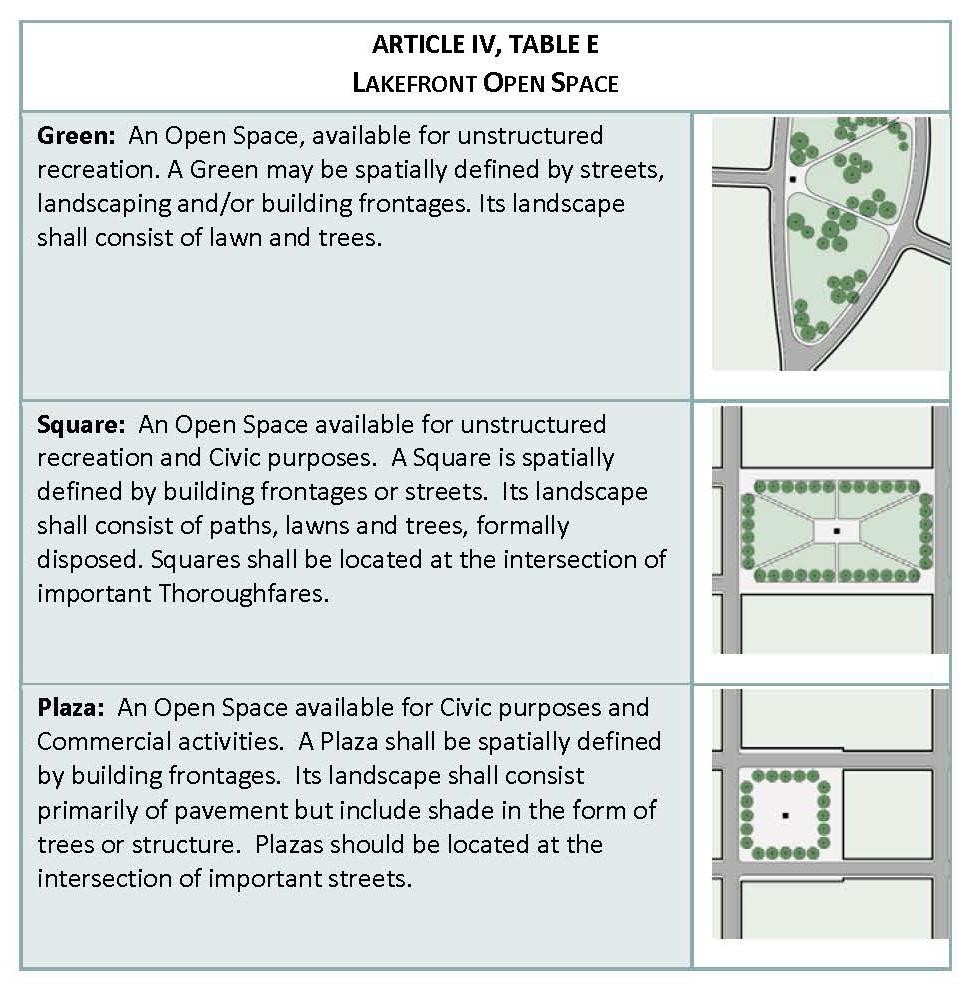
In lieu of the Town's requirement for open space and trees for residential development, a green, square or plaza shall be provided and approved as part of the regulating or site plan. (See Table 4 Open Space)
(h)
Other landscape requirements.
(1)
The requirement for a ten-foot landscape buffer between parcels shall not apply except where adjacent to single-family zoned property.
DIVISION 8. SIGN STANDARDS
(a)
Intent. The intent of this section is to establish architectural controls, limit clutter and regulate commercial and locational signage. It is also intended to help enliven retail and restaurant mixed use areas. These standards should not be interpreted to prevent a for-sale sign, a political sign, or a noncommercial sign that is an exercise of noncommercial freedom of speech. Commercial and locational signage within the district are limited, regulated, and controlled as provided in this Code, and all other signage shall be subject to the requirements of such Town ordinances, rules and regulations that are in effect from time to time.
(b)
Signs, general standards.
(1)
General standards.
a.
Signage may only be externally lit with full-spectrum source, unless otherwise approved.
b.
One address number, no more than six inches vertically, shall be attached to the building in proximity to the principal entrance.
(c)
Prohibited signs.
(1)
The following signs shall not be allowed:
a.
Off-premise signs;
b.
Internally lit sign boxes;
c.
Flashing or running light signs;
d.
Pole signs;
(2)
Signs shall not be mounted on roofs or project above roof line without approval of a minor waiver, and it is determined to make a positive contribution to the district as a whole.
(d)
Permitted signs.
(1)
Wall signs.
a.
One wall sign per occupancy, per street frontage.
b.
Maximum size is 30 square feet if located 12 feet or higher above grade; ten square feet if less than 12 feet above grade.
c.
Minimum ten-foot distance between wall signs (excluding building identification sign or directory sign).
d.
In addition, one wall-mounted sign, not exceeding six square feet in area, is permitted on any side or rear entrance open to the public. Such wall signs may only be lighted during the operating hours of business.
(2)
Projecting and hanging signs, including graphic or icon signs, mounted perpendicularly to the wall.
a.
A maximum of one per occupancy per building face.
b.
A maximum area of six square feet per face; and a maximum of three feet in width.
c.
Distance from the ground to the lower edge of the sign shall be seven and one-half feet or greater.
d.
Minimum 15-foot distance between signs.
e.
The height of the top edge of the signboard shall not exceed the height of the wall from which the sign projects, if attached to a single story building; or the height of the sill or bottom of any second story window, if attached to a multi-story building unless approved by minor waiver.
(3)
Window signs.
a.
The sign shall not exceed 30 percent of the window area.
b.
Neon signs are allowed behind windows in commercial areas, but shall count toward the allowed window sign area.
(4)
Building identification signs.
a.
One per building face.
b.
Must be 12 feet or higher above sidewalk level.
c.
Maximum size 25 square feet.
d.
Twenty-four-inch maximum height for letters or logos.
e.
Applied letters shall be constructed of painted cast metal, bronze, brass, or anodized aluminum. Applied plastic letters are not permitted.
(5)
Awning signs (for ground floor uses only).
a.
One per occupancy per building face.
b.
Minimum eight feet above sidewalk level for pedestrian clearance.
c.
Ten square feet maximum sign area.
d.
If acting as an auxiliary business sign, it shall be located on the valance only, and the height of the lettering shall not exceed four inches.
e.
If acting as the main business sign, it shall not be in addition to a wall-mounted sign.
(6)
Monument signs.
a.
Monument signs shall only be allowed adjacent to the Eldorado right-of-way.
b.
Architecturally compatible monument signs shall not exceed six feet in height or eight feet in length.
c.
Vertically oriented monument signs may also be allowed by minor waiver where it is deemed that such signs will enliven the area.
(7)
Building directory signs.
a.
One per entrance.
b.
The sign shall be located next to the entrance.
c.
The sign shall project out from the wall to which it is attached no more than six inches.
d.
The sign shall not extend above the parapet, eave or building facade.
e.
Maximum size shall be eight square feet.
(8)
Restaurants and cafes.
a.
In addition to other signage, restaurants and cafes shall be permitted the following, limited to one of each type of sign per business:
b.
A wall-mounted display featuring the actual menu as used at the dining table, to be contained within a shallow wood or metal case, and clearly visible through a glass front. The display case shall be attached to the building wall, next to the main entrance, at a height of approximately five feet, shall not exceed a total area of three square feet, and may be lighted.
c.
An A-frame sidewalk sign displaying the name of the eatery, offerings, and hours of operation.
d.
Restaurant and retail areas may have a neon or special designed exterior sign, if approved by the CRC.
(9)
Art Installations.
a.
In addition to other signage, a property may be permitted an art installation with approval of a minor waiver.
b.
Must meet the definition, as well as make a positive contribution to the visual environment and the district as a whole. Must reflect the intent of the design guidelines as referenced within Appendix A.
c.
Requires professionally designed, digital, scaled plans, with an installation and maintenance agreement.
d.
May only be approved by the review committee.
(Ord. No. 1407, § 2, 8-15-2017; Ord. No. 1729, § 2, 9-19-2023)
DIVISION 9. LAKEFRONT PROCEDURES
(a)
Intent. It is the intent of this section to off-set the high level of detailed standards in this Code with an expeditious approval of projects which meet its general goals and intent, and:
(1)
To ensure adequate linkages and connections within and between project areas, and
(2)
To ensure consistency and quality of design through use of professional review assistance.
(b)
Review process.
(1)
A review committee ("committee") shall be established to provide guidance of interpretation of the Lakefront Code and make recommendations on significant issues that may arise. It is not intended to meet and review every administrative or legislative application that comes forward within the district.
• The committee shall be comprised of the following:
• Director of development services ("Director")
• Director of economic development ("EDC rep")
• Planning manager (serving as "urban design officer" or "UDO")
• Town engineer ("engineer")
• A representative of the town council ("Council Liaison")
• A representative of the Planning and Zoning Commission ("P&Z Commission Liaison")
(2)
The urban design officer (UDO) shall serve as a technical advisor to the Director and the committee. The UDO shall be the planning manager and a portion of the expense of the UDO's services will be borne by development fees paid to the town for development of land within the Lakefront District.
(3)
The director shall coordinate with the UDO and committee, and have staff administrative jurisdiction over any processes authorized under the Lakefront Code. The director of development services, the UDO and the committee shall be expeditious in their review and advance the permitting process by undertaking any action consistent with this code, state law, and the Town Charter to facilitate the permitting process.
(c)
Regulating plan.
(1)
Approval of a regulating plan is required prior to approval of a site plan for any portion of a multi-phased project site area.
(2)
The regulating plan provides the framework for development and serves as a conceptual layout of a project area. It shall include such things as:
a.
Street and access lanes within the project area and connections to adjacent nonsingle-family zoned properties;
b.
The location of general land use sites and for identification of retail at-grade;
c.
Public open space and plazas; and
d.
Hike and bike corridors and trails.
(3)
An application for a regulating plan shall be processed in accordance with the Town's procedures for determining whether an application is complete. Following a determination of completeness, and unless the application is accompanied by a request for a major waiver, the director, or his designee, shall approve, approve with conditions, or deny the application for a regulating plan and shall notify the applicant of his decision. In his deliberations, the director may consider a recommendation from the UDO.
(4)
Denial or conditional approval of a regulating plan by the director may be initially appealed to the planning and zoning commission and, following the recommendation of the commission, to the town council. The appeal shall be filed within 30 days of the date of the director's action on the application for approval of a regulating plan.
(5)
If the application includes a request for a major waiver, the director shall request a recommendation from the UDO and if appropriate the CRC, and schedule the application for hearing before the Planning and Zoning Commission with his recommendation on the application. The planning and zoning commission, following a public hearing, shall forward its recommendation to the town council for hearing on the application and waiver request. The town council, following a public hearing, shall approve, approve with conditions, or deny the application for a regulating plan and the major waiver request. The notice and hearing procedures for approval of a specific use permit shall be used to process the regulating plan and major waiver application.
(6)
The director in making an initial decision on a regulating plan application, the planning and zoning commission in making recommendations to the town council, or the town council in deciding the application for regulating plan approval, shall determine whether the plan is consistent with the comprehensive plan and meets the goals and intent of the Lakefront Code.
(d)
Site plan.
(1)
Prior to obtaining a building permit, a site plan must be approved by the Director or Town council, demonstrating that the proposal meets the goals, intent and general standards contained in this Code.
(2)
A site plan application must include the following information and documents that demonstrate compliance with the Lakefront Code:
a.
Detailed site plan showing proposed streets, buildings, parking areas, and landscaped areas;
b.
Proposed uses;
c.
Building elevations and sections, along with a line of sight study referencing how the development will impact the views of the lake from off site;
d.
Proposed parking calculations;
e.
Any waivers being requested;
(3)
An application for a site plan shall be processed in accordance with the Town's procedures for determining whether an application is complete. Following a determination of completeness, and unless the application is accompanied by a request for a major waiver, the director, or his designee, shall approve, approve with conditions, or deny the application for a site plan and shall notify the applicant of his decision. In his deliberations, the director may consider a recommendation by the UDO.
(4)
Denial or conditional approval of a site plan by the Director may be initially appealed to the Planning and Zoning Commission and, following the recommendation of the commission, to the town council. The appeal shall be filed within 30 days of the date of the manager's action on the application for approval of a site plan.
(5)
If the application includes a request for a major waiver, the director shall request a recommendation from the UDO and if appropriate the CRC, and schedule the application for hearing before the planning and zoning commission with his recommendation on the application, the planning and zoning commission, following a public hearing, shall forward its recommendation to the town council for hearing on the application and waiver request. The town council, following a public hearing, shall approve, approve with conditions, or deny the application for a site plan and the major waiver request. The notice and hearing procedures for approval of a specific use permit shall be used to process the site plan and major waiver application.
(6)
The director in making an initial decision on a site plan application, the planning and zoning commission in making recommendations to the town council, or the town council in deciding the application for site plan approval, shall determine whether the plan is consistent with the regulating plan for the property (if there is one), and meets the goals, intent, and standards of the Lakefront Code.
(e)
Waivers of design standards.
(1)
For the purposes of this district, there shall be two types of waivers of design standards - minor and major. Requests for waivers shall not be subject to review or decision by the board of adjustment. A waiver request may only be made in conjunction with an application for a regulating plan, a site plan or subsequent to approval of a site plan.
(2)
Minor waivers are those changes to design standards in the Lakefront Code that are determined to meet the goals and intent of this Code as stated in Division 1 and throughout this Code. Minor waivers may be approved administratively by the director or his designee. At the discretion of the director, an application shall require a recommendation from the committee.
(3)
Major waivers are major changes to the design standards in the Lakefront Code or which may appear to be in conflict with the goals and intent of this Code. Major waivers may only be approved by the town council, following a recommendation by the UDO and the planning and zoning commission, in conjunction with a decision on an application for approval of a regulating plan or site plan. In order to approve a major waiver, the town council must find that the waiver:
a.
Meets the general intent of this district, and
b.
Is consistent with the overall plan and vision for the district, and
c.
Will result in an improved project which will be an attractive contribution to the Lakefront District.
(4)
The town may impose conditions on granting any waiver in order to implement the regulating plan for the property or to mitigate negative impacts to neighboring properties or public streets or open space.
(f)
Amendments to the regulating plan.
(1)
Amendments to an approved regulating plan or site plan may be accomplished in the same manner as approval of the original approval, and may be accompanied by a request for major or minor waivers.
(2)
An amendment to an approved regulating plan or site plan must be made prior to the time for lapse of approval provided in subsection (g) below. In the event an amended plan is approved, the approving authority amending the plan shall specify the time for lapse of such approval, consistent with subsection (g).
(g)
Lapse of approval. If a building permit has not been obtained within two years following approval of a regulating plan or site plan, such plan shall lapse unless the property owner requests an extension prior to the expiration of the two-year period. The request for extension shall be considered by the original approving authority in the same manner as for approval of the existing plan. The authority may grant an extension of the time for expiration of the plan for a period not to exceed two years from the date of expiration of the original application.
Every request for extension shall include a statement of the reasons why the expiration date should be extended. The approving authority may grant a request for extension upon demonstration that circumstances beyond the control of the applicant have resulted in the applicant's inability to perform the tasks necessary to prevent the plan from expiring before the lapse date.
(h)
Graphics incorporated into Code. Any and all graphics from the approved form based codes document not supported by textual technological limitations are hereby codified as supporting material by reference.
(Ord. No. 1407, § 2, 8-15-2017; Ord. No. 1651, § 2, 12-7-2021; Ord. No. 1729, § 2, 9-19-2023)
Sec. 106.04.03 - Planned development districts.
(a)
Purpose. The purpose of a planned development district is to allow and encourage the highest and best use of land, to encourage walkable neighborhoods that include residential, employment and retail opportunities within a relatively compact geographic area, and to allow a mixture of land uses, development standards, innovative techniques and materials that would not be allowed within a single zoning district.
(b)
Use regulations/land area requirements. The town council, after public hearing and proper notice to all parties affected and after recommendation from the planning and zoning commission, may authorize the creation of the following types of planned development districts for the following:
(1)
Service, retail, office or residential uses on tracts of three acres or more.
(2)
Industrial uses on tracts of ten acres or more.
(3)
Medical center, hospital, or institutional uses of tracts of three acres or more.
(4)
A combination of any of the above uses.
(5)
PD Planned Developments can be used as transition districts whereby the provision of off-street parking, screening walls, open space, and planting would create a protective transition between a lesser or a more restrictive district and a more intense use or district.
(6)
A PD district acreage may be less than the above requirements when carrying out the relative recommendations of the Comprehensive Plan.
(c)
Base Zoning District. A PD shall contain at least one base zoning district to regulate all uses and development regulations not identified as being modified. If the standards of the base zoning district are amended, then the most recently amended standards shall apply to a PD district unless the standards have been individually listed within the PD adoption ordinance as being different from the base zoning district.
(d)
Height and area regulations. In said PD Planned Development District the height of buildings, the minimum dimensions of lots and yards and the minimum lot area per family on any lot shall generally be in conformity to the height and area regulation specified in the various district regulations of the zoning ordinance of the town; however, the commission shall establish specific height and area regulations as may be applicable to implement and adjust the planned development.
(e)
Connectivity. PD Planned Developments that are all or in part nonresidential shall provide pedestrian and/or bike access to the nearest residential community.
(f)
Paving regulations. In said PD Planned Development District the minimum off-street parking and loading regulations shall be a concrete paved surface and shall generally be in conformity to parking regulations specified in the various district regulations of the zoning ordinance of the town; however, the planning and zoning commission shall establish reduced parking regulations as may be applicable to implement and adjust the planned development.
(g)
Application. An application for a PD Planned Development District may be made to the planning and zoning commission in the same manner that an application for a zoning map amendment is made. Applications for approval of a PD Planned Development District shall be processed according to the procedure specified herein and a conceptual plan and related data shall be submitted for approval in accordance with the requirements set out in the development schedule below.
(h)
Procedure for establishing standards. In approving the ordinance and the associated conceptual site plan establishing the PD Planned Development District, the town council shall, after recommendation by the planning and zoning commission, specify such maximum height, floor-area ratio, density, and minimum off-street parking and loading standards within the limits of those specified in the districts listed for the specific uses involved as is appropriate for the development. The town council shall, after receiving the recommendation of the planning and zoning commission, establish the standards for yards, signs, building spacing, site coverage, access, screening walls or landscaping, building area, open space, pedestrian ways, public or private streets, and alleys to be observed in a PD Planned Development District and such standards shall be specified in the ordinance establishing the district.
(i)
Standards of the zoning ordinance. Any development standard that is not specifically spelled out in the PD Planned Development ordinance shall revert to the standards of the underlying zoning district, as it exists or may be amended.
(j)
Innovation. The PD Planned Development process is designed to encourage innovation in design and layout of the proposed development. Creative use of materials, siting, landscaping, and hardscaping will be considered as part of the development regulations.
(k)
Conceptual plan required. An application for a PD Planned Development District shall include and be accompanied by a conceptual plan which shall become a part of the amending ordinance and shall be referenced on the zoning district map. (See section 106.02.14, "conceptual plan approval," for more information). Changes in the conceptual plan shall be considered the same as changes in the zoning district map and shall be processed as required except that changes of detail which do not alter the basic relationship of the proposed development to adjacent property and which do not alter the uses permitted or increase the density, floor-area ratio, height or coverage of the site, or which do not decrease the off-street parking ratio, or reduce the yards provided at the boundary of the site as indicated on the approved conceptual plan may be authorized by the planning and zoning commission. Any applicant may appeal the decision of the planning and zoning commission to the town council for review and decision as to whether an amendment to the PD Planned Development District ordinance shall be required.
(l)
Planned development district approval. Every PD Planned Development District approved under the provisions of this chapter shall be considered as an amendment to the official zoning map as applicable to the property involved. In carrying out the development of a PD Planned Development District, the development conditions and the development schedule, if required, shall be complied with and such conditions as are specified for the development of a PD Planned Development District shall not be construed as conditions precedent to the approval of the zoning amendment, but shall be construed as conditions precedent to the granting of a certificate of occupancy and compliance.
(Ord. No. 1407, § 2, 8-15-2017; Ord. No. 1518, § 2, 9-3-2019; Ord. No. 1527, § 2, 10-15-19)
Sec. 106.04.04 - Floodplain Overlay District.
(a)
Floodplain prefix. To provide for the appropriate use of land that has a history of inundation or is determined to be subject to flood hazard, and to promote the general welfare and provide protection from flooding, portions of certain districts are designated with a floodplain prefix, "FP." Areas designated on the zoning district map by an "FP" Prefix shall be subject to the following provisions:
(b)
Uses permitted. The permitted uses in that portion of any district having a floodplain ("FP") prefix shall be limited to the following:
(1)
Agricultural activities including the ordinary cultivation or grazing of land and legal types of animal husbandry.
(2)
A maximum of 50 percent of the required parking for a development may be located at or above the 534-foot elevation line, subject to review and approval by the director. The remainder of the parking must be located above the floodplain line (537-foot elevation).
(3)
Electrical substations.
(4)
All types of local utilities including those requiring special use permits when approved as provided in section 106.02.17, "special use permit approval."
(5)
Parks, community centers, playgrounds, public golf courses.
(6)
Private open spaces.
(7)
Heliports when approved by a special use permit as provided in section 106.02.17, "specific use permit approval."
(c)
Floodplain requirements. In addition to the provisions of this zoning ordinance applicable to the zoning district in which the subject land is located, the use and development of land located within an area of special flood hazard or controlled flood protection shall be subject to the provisions of chapter 54 of the Code of Ordinances, as amended. In the event of any irreconcilable conflict between the provisions of this zoning ordinance and said chapter 54, the provisions of said chapter 54 shall control.
(Ord. No. 1407, § 2, 8-15-2017)
106.04.05 - Reserved.
Editor's note— Ord. No. 1587, § 2, adopted Jan. 5, 2021, repealed section 106.04.05, which pertained to the manufactured home district, and derived from Ord. No. 1407, § 2, adopted Aug. 15, 2017.
Sec. 106.04.06. - Lakefront Residential Overlay District.
DIVISION 1. PURPOSE, GOALS AND INTENT
(a)
Purpose. The future land use section of 2017 comprehensive plan calls for an objective within the recommendations section of the Lakefront District to plan for redevelopment and expansion of the district. In working with council, staff has identified the residential areas surrounding the Lakefront Zoning District as areas prime for redevelopment. The purpose for the overlay is to establish zoning for residential areas around the existing Lakefront District within the context of redevelopment. The associated standards and visual examples will function to create a residential area that provides flexibility and variety in unique architectural design and high quality alternative materials.
(b)
Goals. To expand on the town's targeted "lakeside community character" by:
(1)
Creating flexibility in residential architectural design.
(2)
Promoting the utilization of a variety of high quality building materials not typically permitted in the town's standard residential zoning districts.
(3)
Catalyzing and encouraging residential redevelopment within the Overlay District by providing a balance of unique development standards and expeditious administrative approvals for projects which meet the intent of this Code.
(c)
Intent. The intent of the Overlay District is to expand upon the Lakefront District's desire to provide a comfortable and attractive environment that will provide a unique, yet compatible residential neighborhood by encouraging redevelopment that is distinct from traditional residential subdivisions.
(d)
Boundary. As identified in exhibit A, including any subsequent modifications as approved by town council.
(Ord. No. 1437, § 2, 12-19-2017; Ord. No. 1527, § 2, 10-15-2019)
DIVISION 2. INTENT
The following definitions shall apply within the Lakefront Residential Overlay District:
Building facade. An exposed exterior wall of a building.
Center-loaded. A lot where setbacks are regulated so that the two associated side-yard setbacks are equal.
District. The entire area contained within the Lakefront Residential Overlay District.
Frontage. The width of front portion of a subject lot adjacent to the right-of-way. The frontage width can be established at the build line.
Gifts to the street. Building improvements that enhance the feel and experience of the street. Examples include but not limited to, porches, stoops, bay windows, balconies, masonry-clad footed chimneys, sun rooms, attached pergolas and colonnades.
Lakefront residential design committee ("LRDC"). The review and decision-making committee for proposed residential redevelopment within the Lakefront Residential Overlay District.
Redevelopment. New construction typically after demolishing an existing structure on a subject property. Can also mean additional "add-on" construction to an existing structure.
(Ord. No. 1437, § 2, 12-19-2017; Ord. No. 1527, § 2, 10-15-2019)
DIVISION 3. BUILDING AND DESIGN STANDARDS
(a)
Existing zoning. The existing zoning for the residential homes within the Overlay District are made up of Single Family (A1), Single Family (A2), Single Family 4 (SF4). The area, yard, and bulk requirements of the A1, A2, and SF4 zoning districts shall be followed with the following exceptions:
(b)
Options for redevelopment.
(1)
Subdividing lots (Only applicable for residential lots in Boundary 2) - residential lots containing 80-foot or greater lot widths may be subdivided into two, 40-foot or greater lots provided the following conditions are satisfied:
a.
Subdivided, 40-foot frontage lots shall be "center-loaded".
b.
Subdivided, 40-foot frontage lots shall have a side yard setback of five feet.
(2)
Front yard setback reduction for "gifts to the street" - gifts to the street may project a maximum of ten feet into the required 25-foot front yard setback.
(c)
Preferred architectural styles. The visual representations shown in the appendix, as identified in exhibit B, show examples of the following architectural styles: Carpenter (Arts and Craft), Colonial, Classic Revival, Southern Vernacular, Modern, Tudor, Texas, Spanish, and Mediterranean.
The styles shown in the appendix shall be used as a guide to follow for redevelopment. The applicant redeveloping the property does not necessarily have to choose an exact style, but shall identify the style(s) being referenced for the intended project. The Lakefront Residential Architectural Design Review Committee will have the authority to determine if the proposed design meets the intent of the Overlay District.
(d)
Architectural elements.
(1)
Architectural variety. No facade may be repeated within any five adjacent lots or across the street from those lots. A request to vary from this standard shall be reviewed and approved by the LRDC.
(2)
Tripartite architecture. The exterior facades of homes shall be broken up into three distinct sections (base, middle, top) utilizing different primary and accent materials, colors, and/or general orientation of materials.
(3)
Gifts to the street. Homes shall provide a minimum of two gifts to the street. Proposed features not noted in the definition for "gifts to the street" shall be approved at the discretion of the LRDC.
(4)
Fences. Fences adjacent to public parks, open space, drainage areas or floodplains shall be constructed of black tubular (wrought iron) fencing. All other fencing shall adhere to the residential fences section (section 106.06.32) of the zoning ordinance.
(5)
Roofs. Roofs shall be constructed with architectural grade shingles, or better. Seamed metal, clay and slate tile roofs (cement based) are permitted. Flat roofs may be utilized so long as they can properly drain which will be determined by the building official.
(6)
Windows. Openings and panes shall be vertically proportioned or square and be separated with trim.
(7)
Gutters. Gutters shall be copper, galvanized steel, aluminum or painted if exposed.
(8)
Chimneys. If chimneys are located on a street-facing wall, they shall extend to the ground.
(9)
Concealed items. HVAC units, trash storage, and utility meters shall be concealed.
(e)
Allowed materials.
(1)
Masonry. Masonry shall include brick, stone, and three step stucco.
(2)
Other materials. Architectural concrete block with integrated color, engineered wood, cementitious fiberboard. Alternative materials may be considered and approved by the LRDC.
(3)
One hundred percent usage. With the exception of architectural concrete blocks. Exterior facades can be composed of 100 percent of a specified allowed material. Up to 20 percent of any facade of the residential structure can consist of architectural concrete block.
(f)
Prohibited materials.
(1)
EIFS, vinyl.
(Ord. No. 1437, § 2, 12-19-2017; Ord. No. 1527, § 2, 10-15-2019)
DIVISION 4. PROCEDURES
(a)
Intent. It is the intent of this section to identify the entities involved along with outlining the path towards successful residential redevelopment within the overlay.
(b)
Review committee.
(1)
A lakefront residential design committee shall be established to provide guidance of interpretation of the Lakefront Residential Overlay District and make recommendations on proposed redevelopment within the overlay. The committee shall be comprised of the following:
a.
Director of development services ("director").
b.
Building official ("building official").
c.
Planning manager ("urban design officer").
d.
Representative of the town council ("council liaison").
(2)
The urban design officer (UDO) shall serve as a technical advisor to the director and the committee. The UDO shall be the planning manager and a portion of the expense of the UDO's services will be borne by development fees paid to the town for development of land within the Lakefront District.
(3)
The director shall coordinate with the UDO and committee, and have staff administrative jurisdiction over any processes authorized under the Lakefront Residential Overlay District. The director of development services, the UDO and the committee shall be expeditious in their review and advance the permitting process by undertaking any action consistent with this Code, state law, and the town Charter to facilitate the permitting process.
(c)
Site plan and elevations.
(1)
Prior to obtaining a residential building permit, a site plan application and building elevations shall be submitted for review by the LRDC.
(2)
The site plan may be a property survey showing metes and bounds of the subject lot along with associated setbacks which will identify the proposed "buildable" area.
(3)
Elevations shall be drawn architecturally showing all facades in architectural-scale. Elevations shall be submitted in color showing proposed colors accurately. A material breakdown shall be provided indicating proposed materials along with the percentage of each material to be used per facade. If alternative materials are being proposed, physical samples shall be submitted for consideration.
(d)
Application and approval process.
(1)
An application for residential permit shall be processed in accordance with the town's residential permitting procedures. The site plan and color elevations will accompany the permit application to be reviewed by the LRDC. The LRDC shall approve, approve with conditions or deny the application for residential building permit and shall notify the applicant of the decision.
(2)
Denial or conditional approval of a residential building permit by the LRDC may be initially appealed to town council. The appeal shall be filed within 30 days of the date of the decision made by the LRDC.
(3)
The LRDC in making an initial decision on a residential building permit application, along with town council, shall determine whether the proposed residential redevelopment is consistent with the intent, standards and goals of the Lakefront Residential Overlay District.
(4)
No residential building permit shall be issued for any residential structure located within the District until a development agreement between the town and the applicant has been approved by the town council, which development agreement shall memorialize all agreed-upon development terms and conditions for the residential construction identified by the LRDC and agreed to by the applicant.
(e)
Lapse of approval. If construction has not commenced within one year of residential building permit approval, such permit shall lapse unless the property owner requests an extension prior to the expiration of the one-year period. The request for extension shall be considered by the original approving authority in the same manner as for approval of the existing permit. The authority may grant an extension of the time for expiration of the permit for a period not to exceed one year from the date of expiration of the original application.
Every request for extension shall include a statement of the reasons why the expiration date should be extended. The approving authority may grant a request for extension upon demonstration that circumstances beyond the control of the applicant have resulted in the applicant's inability to perform the tasks necessary to prevent the permit from expiring before the lapse date.
(Ord. No. 1437, § 2, 12-19-2017; Ord. No. 1527, § 2, 10-15-2019)

