
Little Elm City Zoning Code
ARTICLE V
- USE REGULATIONS
Sec. 106.05.01 - Schedule of uses.
Land and buildings in each of the following classified districts may be used for any of the following listed uses but no land shall hereafter be used, and no building or structure shall hereafter be erected, altered or converted which is arranged or designed or used for other than uses specified for the district in which it is located as set forth by the use schedule located in section 106.05.01(a) and (b), "Schedule of uses - residential" and "schedule of uses - nonresidential," respectively.
(a)
Residential zoning districts uses. P=permitted by right; C=conditional use; S=specific use permit required. A blank space indicates the use is prohibited in that district.
(b)
Nonresidential zoning districts uses. P=permitted by right; C=Conditional Use; S=Specific Use Permit required.
(Ord. No. 1407, § 2, 8-15-2017; Ord. No. 1582, § 2, 12-1-2020; Ord. No. 1587, § 2, 1-5-2021; Ord. No. 1646, § 2, 11-16-2021; Ord. No. 1682, § 2, 8-16-2022; Ord. No. 1745, § 2, 1-16-2024)
Sec. 106.05.02.1 - Accessory uses.
(a)
Accessory structures for nonresidential districts/land uses.
(1)
Application. Commercial accessory structures require a building permit.
(2)
Definition. An accessory building or structure is a subordinate building/structure, the use of which is secondary to and supportive of the main building or primary use. Accessory buildings or structures shall not be permitted without a main building or primary use in existence and include, but are not limited to, automated intake machines, automated dispenser machine, automatic teller machine (ATM), and storage buildings.
(3)
Regulations. The following area regulations shall be observed for all accessory buildings and structures in all commercial, retail, office, industrial, and multifamily districts:
a.
All accessory structures 200 square feet (approximately 10 feet by 20 feet) or more require a building permit and administrative site plan approval. Buildings that are less than 200 square feet in size do not require a building permit. Modular storage units, portable on demand storage containers, donation bins, and drop off bins/trailers are considered accessory structures.
b.
Non-enclosed accessory structures (non-buildings) shall be screened by a minimum eight-foot-tall masonry wall with solid metal gate, primed and painted.
c.
Nonresidential accessory structures shall abide by the setbacks of the primary structure and shall not conflict with site features such as fire lanes, landscape buffers, required parking, and other issues deemed pertinent by the director.
(4)
Architectural requirements. Accessory structures require the following design elements:
a.
Accessory structures 200 square feet or greater shall abide by all architectural standards in regard to masonry coverage and shall match the exteriors of the primary building.
b.
Accessory structures with pervious roofs may be constructed with fire-treated and rot-resistant wooden material, provided that the columns are encased in masonry to match the primary building.
(5)
Approval. Building permits are approved by the building official, following review and approval of the site plan by the director.
(b)
Accessory structures for single-family, duplex, and manufactured home districts and land uses.
(1)
Application. Residential accessory structures 200 square feet or more require a building permit and administrative site plan approval. Buildings that are less than 200 square feet in size do not require a building permit. Accessory structures not requiring a permit must still be in compliance with the building code.
(2)
Definition. An accessory building or structure is a subordinate building/structure, the use of which is secondary to and supportive of the main residence or primary use. Accessory buildings or structures shall not be permitted without a main building or primary use in existence.
(3)
Architectural requirements. Accessory structures for residential districts require the following design elements:
a.
Accessory structures shall abide by all architectural standards in regard to masonry coverage and shall match the exteriors of the primary building.
b.
Accessory structures with pervious roofs may be constructed with fire-treated and rot-resistant wooden material, provided that the columns are encased in masonry to match the primary building.
c.
Cementitious fiberboard or engineered wood may be used to fulfill masonry requirements for an accessory building or structure of 200 square feet or less in a single-family or two-family district, and cementitious fiberboard or engineered wood may be used to fulfill masonry requirements for structures accessory to an existing primary structure that is constructed entirely of wood, metal, or vinyl siding.
d.
Metal or wood may be used as an exterior construction material for an accessory building or structure of 199 square feet or less in a single-family or two-family district.
(4)
Regulations. The following area regulations shall be observed for all accessory buildings or accessory structures in all single-family, two-family or manufactured home districts:
a.
Permanent foundation. All accessory structures greater than 200 square feet shall be constructed on a permanent, engineered foundation, per the currently adopted international codes.
b.
Front yard. Accessory structures shall not be located in the front yard area. This excludes temporary uses such as basketball hoops, bike or skateboard ramps or other moveable recreational devices. However, any such device shall be located entirely within the boundaries of the private property and shall not be placed in the right-of-way, the street, the sidewalk, or the parkway (defined as the area between the sidewalk and the curb).
c.
Side yard, standard interior lot. Accessory structures side yard setbacks shall be a minimum of three feet.
d.
Side yard, corner lot. Accessory structures side yard setbacks adjacent to a street right-of-way shall be a minimum of 18 feet from the back of curb.
e.
Rear yard. Accessory structures rear yard setbacks shall be a minimum of three feet. However, in no case shall an accessory structure encroach into an easement.
f.
Siting. No minimum separation is required between the primary building and accessory structure. Attached structures must meet the setbacks of the primary structure or five feet, whichever is less. An accessory structure located within 20 feet of a property line shall have at minimum a six-foot-high wooden or masonry fence installed along the property line in compliance with section 106.06.32, "residential fences." Exceptions to this regulation are residential lots that back to scenic views and therefore do not have fences inhibiting said view. These lots include, but are not limited to, lots backing to a park, amenity center, golf course, or lakefront. In these cases, the applicant may (but is not obligated to) install a decorative metal fence to indicate the rear lot line.
g.
Height. Accessory structures shall have a maximum height of 14 feet except on properties one-half acre and larger in area. In that case, accessory buildings may be greater than 14 feet in height provided that one additional foot for each additional foot of height over 14 feet is maintained at the rear and side yard setback lines. In all cases, the maximum height of a residential accessory structure shall be 20 feet. An accessory structure shall not exceed the height of the primary structure and shall be limited to one story in height.
h.
Maximum square footage. Accessory buildings shall not exceed the square footage of the primary building and be limited in size of footprint and in number as follows:
1.
Property or lot less than one-half acre in area = maximum of 750 square feet (measured by total floor area) and one accessory structure.
2.
Property or lot greater than one-half acre and less than one acre = maximum of 1,000 square feet (measured by total floor area) and two accessory structures.
3.
Property or lot greater than one acre in area = maximum of 2,500 square feet, cumulatively applied to a maximum of accessory structures
(5)
Approval. Building permits are approved by the building official, following review and approval of the site plan by the Director.
(c)
Swimming pools and spas/hot tubs.
(1)
Application. Swimming pools and spas/hot tubs require a building permit.
(2)
Regulations. The following regulations apply to swimming pools and spas/hot tubs:
a.
Shall not be located in the front yard area,
b.
Shall comply with the minimum side yard and corner lot requirements for accessory structures; and
3.
Be a minimum five-foot setback from an interior side yard or rear yard property line.
(3)
Approval. Building permits are approved by the building official, following review and approval of the site plan by the director.
(d)
Detached garages.
(1)
Application. Detached garage accessory structures require a building permit.
(2)
Regulations. The following regulations apply to detached garages:
a.
Rear yard setback for front-loading garages shall be ten feet;
b.
Rear yard setback for alley access garages shall be 20 feet;
c.
Side yard setback shall be five feet;
d.
Side yard at corner setback shall be 20 feet;
e.
The size (i.e. area), height, and architectural restrictions are the same as for accessory structures, except that a minor height waiver for associated pitched roofs may be discretionarily granted by the building official.
(3)
Architectural requirements. Accessory structures require the following design elements:
a.
The exterior facades of a detached garage shall be constructed of a masonry material (brick, stone, or stucco) that matches the main building or structure.
b.
Cementitious fiberboard or engineered wood may be used to fulfill masonry requirements for an accessory building or structure of 200 square feet or less in a single-family or two-family district, and cementitious fiberboard or engineered wood may be used to fulfill masonry requirements for structures accessory to an existing primary structure that is constructed entirely of wood, metal, or vinyl siding.
(4)
Approval. Building permits are approved by the building official, following review and approval of the site plan by the director.
(e)
Carports.
(1)
Application. Carport accessory structures require a building permit which includes a site plan indicating the proposed placement of the carport.
(2)
Regulations. The following regulations apply to carports:
a.
Support poles shall be fully encased in masonry (brick/stone).
b.
Carports shall have a pitched roof, be attached to the primary residence, and meet the same building setbacks as garages.
c.
In no case are carports allowed in the front yard.
d.
Manufactured homes may install a carport, which shall be designed to shelter a maximum of two vehicles, shall not exceed ten feet in height, and shall not be located closer than three feet to any side or rear lot line.
(3)
Approval. Building permits are approved by the building official, following review and approval of the site plan by the director.
(f)
Accessory dwelling units.
(1)
Application. Accessory dwelling units require a building permit which includes a site plan indicating the proposed placement of the accessory dwelling unit.
(2)
Definition. An accessory dwelling unit is a subordinate building or structure or a portion of a building or structure, intended for habitation. Accessory buildings or structures shall not be permitted without a main building or primary use in existence and are subject to zoning district limitations (see article V, tables A and B).
(3)
Regulations. The following area regulations shall be observed for all accessory dwelling units whether located on the ground or erected over a private garage:
a.
Accessory dwelling units may not be sold separately from the sale of the entire property, including the main dwelling unit, and shall be located on the same lot as the primary structure.
b.
Utility services shall be metered by the same meter as those serving the main structure on the premises.
c.
Accessory dwelling units shall abide by the same setback, height, and architectural regulations as detached garages, except that the rear yard setback shall be 20 feet.
d.
The total square footage of an accessory dwelling units is limited to 50 percent of the primary residence, or 1,200 square feet, whichever is smaller, if all other regulations, including appropriate zoning for the accessory dwelling, are met.
(4)
Architectural requirements. Accessory structures require the following design elements:
a.
The exterior facades of a detached garage or other accessory building or structure shall be constructed of a masonry material (brick, stone, or stucco) that matches the main building or structure.
b.
Cementitious fiberboard or engineered wood may be used to fulfill masonry requirements for an accessory building or structure of 200 square feet or less in a single-family or two-family district, and cementitious fiberboard or engineered wood may be used to fulfill masonry requirements for structures accessory to an existing primary structure constructed entirely of wood, metal, or vinyl siding.
(5)
Approval. Building permits are approved by the building official, following review and approval of the site plan by the director.
(g)
Patios, covered and/or enclosed.
(1)
Application. Enclosed or covered patios 200 square feet or greater require a building permit for the above-ground structure (see "patios, flatwork" for the foundation requirements, below).
(2)
Regulations. The following restrictions shall apply to all covered patios, enclosed patios or partially enclosed patios, and other similar installations.
a.
No patio is allowed within three feet of any property line, nor in the front yard.
b.
Covered or partially enclosed patios may be connected to the primary structure. However, should the applicant wish to convert the partially enclosed patio into a fully functioning room, the setbacks for the zoning district in which the residence is located shall apply.
(3)
Approval. Building permits are approved by the building official, following review and approval of the site plan by the director.
(h)
Patios, flatwork (concrete or pavers).
(4)
Application. Patios and other flatwork require a building permit.
(5)
Regulations. The following restrictions shall apply to all impervious surface, concrete, grading, and other similar installations.
a.
All new parking and drives must be constructed with concrete to the town's engineering design criteria.
b.
Any flatwork 200 square feet or greater is required to be designed to town standards. Plans may be required to be designed by a licensed engineer and display the engineer's seal at the discretion of the director, or designee.
c.
No flatwork is allowed within three feet of any property line, nor in the front yard area, unless the flatwork is for a driveway to a front-loading garage. This shall not be interpreted to allow for enlarged driveways, whose width should match the width of the enclosed garage and not be expanded into the side yard setback.
d.
Nothing within this section allows the creation of a drainage hazard or issue, and all flatwork must be sloped or graded to drain.
e.
Paving is limited to 20 percent of total lot coverage, including the driveway but not including any patio, walkway, pool deck, sports courts or other interior paved feature.
f.
A residential property shall continue to maintain the majority of each of its yards in living landscape, as required by the landscape ordinance and administered by the director. Mulch, gravel, rock gardens, decorative stone, and similar material may be used for patterns, beds, erosion control, and in other limited application with adequate associated landscaping; however, their use shall not be the predominant groundcover. (See section 106.06.16(a), "residential landscape requirements")
g.
Proposed flatwork for the purpose of storing trash bins may be permitted at the discretion of the Director, or designee.
(6)
Exceptions. Alternative design, methods, and proposals that deviate from the above language are subject to the review and approval of the director, or designee. Exceptions shall generally apply to residential lots that have 100 feet of frontage and an area of more than 10,000 square feet.
(7)
Approval. Building permits are approved by the building official, following review and approval of the site plan by the Director.
(i)
Farm accessory structures.
(1)
Application. Farm accessory structures require a building permit.
(2)
Definition. Any accessory structure that is typically used on a farm, orchard, or ranch.
(3)
Regulations. The following regulations apply to barns, sheds or livestock shelters:
a.
A barn, shed or shelter for the keeping of livestock, crops or equipment related to the operation of a farm.
b.
The site must be a minimum of five acres or more and be currently classified and in operation as an agricultural enterprise.
(6)
Approval. Building permits for farm accessory structures are approved by the building official, following review and approval of the site plan by the director. Accessory buildings or structures shall not be permitted without a main building or primary use in existence and subject to zoning district limitations.
(Ord. No. 1407, § 2, 8-15-2017; Ord. No. 1527, § 2, 10-15-2019)
Sec. 106.05.02.2 - Permanent land uses (other than accessory uses).
(a)
Airport/helipad/heliport.
(1)
Application. Approval of an airport, landing field, or heliport requires a special use permit, subject to review and approval by town council.
(2)
Definitions.
a.
Airport/heliport. A place where aircraft and/or helicopters can land and take off, usually equipped with hangars, facilities for refueling and repair, and various accommodations for pilots and passengers.
b.
Helipad. A place, typically on the roof of a hospital or a small ground area where helicopters may land and take off, but without any service or fueling capabilities.
(3)
Regulations.
a.
No such use shall be located within 400 feet of any residential structure, and no residential structure shall be located within 400 feet of any such use.
b.
No such use shall be located within 400 feet of any area zoned residential by the town or shown as residential on the existing Comprehensive Land Use Plan of the town.
c.
Such distances shall be measured as the shortest possible distance in a straight line from the closest point of the proposed use to the closest point of the residential structure or area.
d.
Notwithstanding the foregoing, such uses may be located in closer proximity by specific use permit.
(4)
Approval. Town council through the SUP process.
(b)
Alternative energy sources—Solar panels/devices.
(1)
Application. The application to allow a solar device or system, for residential use, requires the approval of a conditional use permit, issued at the discretion of the director; for non-residential use, requires the approval of a specific use permit, subject to the review and approval by town council.
(2)
Definition. A solar panel or device is a structure that is intended to capture the light from the sun and transfer that energy to electricity for general use.
(3)
Regulations for single-family residential use:
a.
Is in compliance with state law and poses no threat to public health or safety;
b.
Is located solely on private property;
c.
Includes approval letter from the HOA with submittal for the CUP, if applicable.
d.
Installation and maintenance in compliance with manufacturer's recommendations and warranties;
e.
Roof mounted:
1.
Panels shall be designed and installed in conformance with the International Fire Code, as amended;
2.
Panels must conform to the slope of the roof, unless mounted on a roof slope that is not visible from the right-of-way; and
3.
Roof mounted panels should be designed and installed to reduce excessive glare.
f.
Ground mounted:
1.
Prohibited in front yards.
2.
Ground mounted devices shall follow the setbacks required for accessory structures within the specific zoning district.
3.
Device shall not be visible from either the public right-of-way or the adjacent properties;
4.
Device shall be screened by a wooden or masonry fence and no device shall extend above the fence line.
5.
Where fences are not allowed within the residential subdivision, a solid evergreen hedge which shall be maintained at a minimum of six feet in height within 18 months of planting.
(4)
Regulations for nonresidential structures:
a.
Is in compliance with state law and poses no threat to public health or safety;
b.
Is located solely on private property;
c.
Installation and maintenance in compliance with manufacturer's recommendation and warranties;
d.
Is located on the roof;
e.
Panels located on a sloped roof may not extend beyond the roofline and must conform to the slope of the roof, unless mounted on a roof slope that is not visible from the public right-of-way.
f.
Panels located on a flat roof must be screened from view from the adjacent roadways.
(5)
Approval. For residential use, once the director has determined that the conditions listed in (3) above have been met, approval for the conditional use permit may be granted. For non-residential use, approval is subject to review by town council through the SUP process.
(c)
Alternative energy sources—Wind Energy Conversion System (WECS).
(1)
Application. The application to allow a WECS system, for residential use, requires the approval of a conditional use permit, issued at the discretion of the director; for non-residential use, requires the approval of a specific use permit, subject to the review and approval by town council.
(2)
Definition. A WECS device is a structure that is intended to capture the wind and transfer that energy to electricity for general use.
(3)
Regulations for single-family residential use:
a.
Freestanding WECS are prohibited on residential lots less than one acre in size.
b.
Shall not be allowed in the front yard.
c.
The highest point of a roof-mounted WECS shall not project more than five feet above the roof line, excluding the highest point of the blade arc.
d.
Freestanding WECS shall be of monopole design and shall not be located in any required setback.
e.
Freestanding WECS shall abide by the height and setback regulations of the specific zoning district and be located at least a distance equal to the height of the pole away from any structure or property line.
(4)
Regulations for other than single-family residential use:
a.
WECS may exceed the height limits of the zoning district, up to a maximum of 80 feet, if located at least a distance from any residential district boundary line or residential dwelling equal to the height of the support structure. Height shall not include the highest point of the blade arc and shall refer to the highest point of the pole structure.
b.
The minimum lot size required for a WECS is one acre. Only one low impact WECS shall be allowed per platted lot.
c.
The WECS shall not be located within any required setback area for the front, side or rear yards.
d.
The WECS' freestanding blade arc spheres shall have a minimum 30-foot clearance from any structure, tree or any other impediment.
e.
All associated wiring shall be buried underground by means of a conduit system, or if ground-mounted equipment is required, then a minimum eight-foot-high masonry wall shall be constructed.
f.
The WECS shall be constructed in a monopole design of tubular steel and shall be self-supporting without the use of guy wires or other similar features.
g.
The WECS shall be a neutral or earth tone color. The proposed paint type shall be a dull or matte finish so as to reduce the possibility of any glare or reflection and to minimize the visual obtrusiveness of the WECS.
h.
All commercial signs, flags, lights and attachments shall be prohibited on the WECS, unless required for structural stability, or as required for flight visibility by the Federal Aviation Administration (FAA).
i.
The WECS shall be equipped with both a manual and an automatic braking device capable of stopping the WECS' operation in high winds.
j.
The WECS shall meet or exceed current standards and regulations of the FAA and any other agency of the state or federal government with the authority to regulate such systems.
k.
The WECS shall not be grid-interconnected until and unless evidence has been provided to the town that the appropriate electric power provider has approved the customer's intent to install a grid-connected customer-owned WECS and that the customer's system meets the utility's approved specifications for interconnection.
l.
The WECS shall be grounded and shielded to protect against natural lightning strikes and stray voltage, including the blades.
m.
The WECS shall be adequately designed structurally, electrically, and in all other respects to accommodate the safety and general well-being of the public.
n.
The WECS shall be maintained at all times according to the manufacturer's specifications.
o.
The WECS shall be filtered, shielded or otherwise designed and constructed so as not to cause electrical, radio frequency, television and other communication signal interference.
p.
The WECS shall be prohibited from including a tower climbing apparatus within 12 feet of the ground.
q.
The WECS shall adhere to the performance standards of the zoning ordinance, in regard to maximum sound pressure levels. The noise levels measured at the property line of the property on which the conversion system has been installed shall not exceed 60 decibels and in no event shall the conversion system create a nuisance.
r.
If the WECS is not in operation for a period of six months, it shall be deemed abandoned and shall be removed at the owner's expense.
(5)
Approval. For residential use, once the director has determined that the conditions listed in (3) above, as applicable, have been met, approval for the conditional use permit may be granted. For non-residential use, approval is subject to review by town council through the SUP process.
(d)
Alternative financial services.
(1)
Application. Approval of an alternate financial services facility requires a specific use permit, subject to review and approval by town council.
(2)
Definition. A check cashing business, payday advance or loan business, money transfer business, car title loan business or pawn shop (see section 106.01.14, "land use definitions" for more detailed definitions of each type of alternative financial services).
(3)
Regulations.
a.
Alternative financial services shall be situated only within a freestanding building on a platted lot and shall not be co-located in the same structure as other uses.
b.
A lot containing an alternative financial service shall be located at least 1,000 feet from any lot containing another alternative financial service, as measured in a straight line between the nearest points of one lot to the other lot.
c.
A lot containing an alternative financial service shall be located at least 200 feet from any lot zoned or used for residential purposes, as measured in a straight line between the nearest points of one lot to the other lot.
d.
No lot containing an alternative financial service shall be located within 500 feet of the rights-of-way of Eldorado Parkway, F.M. 720 or F.M. 423.
e.
No alternative financial services shall be permitted within the Lakefront District.
(4)
Approval. Town council through the SUP process.
(e)
Bars/brewpubs (this classification also includes wine tasting bars, growlers, and other similar uses).
(1)
Application. Approval of a bar or brewpub requires a specific use permit, subject to review and approval by town council, unless located within a zoning district or overlay district that allows these uses by right.
(2)
Definition. An establishment principally for the sale and consumption of alcoholic beverages on the premises that derives 75 percent or more of its gross revenue on a quarterly (three-month) basis from the sale or service of alcoholic beverages, as defined in the Texas Alcoholic Beverage Code, for on-premises consumption.
(3)
Regulations.
a.
Prior to issuance of a certificate of occupancy, the business owner shall provide the town with a copy of its state permit to operate as a bar, brewpub, or similar use.
b.
All alcohol-related activities must meet all standards found in chapter 10, alcoholic beverages, of the Little Elm Code of Ordinances.
(4)
Approval. Town council through the SUP process, unless located within a zoning district that allows these uses by right.
(f)
Bed and breakfast.
(1)
Application. The application to allow a bed and breakfast within a private residence requires the approval of a conditional use permit, issued at the discretion of the director.
(2)
Definition. A residential home, occupied by the owner or manager, where the owner or manager rents one or more bedrooms for remuneration and provides a breakfast meal to the guest(s).
(3)
Regulations.
a.
Guest parking must be provided on the residential lot and not on the street.
b.
The owner or manager shall be responsible for any noise or disruption of the neighborhood caused by the guests.
c.
The owner or manager shall register with the state to pay any applicable taxes and shall pay the hotel occupancy tax to the Town of Little Elm on an quarterly basis.
(4)
Approval. Once the director has determined that the bed and breakfast is appropriate for the location requested and that the regulations listed in (3), above, have been met and will continue to be met, approval for the conditional use permit may be granted.
(g)
Caretaker or guard residence.
(1)
Application. Part of the site plan process.
(2)
Definition. A residence located on a premises with a main nonresidential use and occupied only by a caretaker or guard, and his/her family, employed on the premises.
(3)
Regulations—No specific regulations. Approval is subject to the director's discretion.
(4)
Approval. A caretaker or guard residence shall be approved as part of the site plan process.
(h)
Communication antennas.
(1)
Application. Approval of an additional or substitute antennas on an existing communication tower requires a conditional use permit, issued at the discretion of the director.
(2)
Definition. An antenna is an instrument or device consisting of wires, poles, rods, or reflecting discs, designed for transmitting or receiving any portion of the radio, microwave, or electromagnetic spectrum.
(3)
Regulations.
a.
A commercial antenna may be attached to a utility structure (elevated water tank, electric transmission pole, etc.) regardless of the height of said structure, provided that the antenna does not extend more than ten feet above the height of said structure.
b.
A commercial antenna may be placed wholly within any building permitted in the zoning district. A commercial antenna may be mounted flush to the exterior of a building/structure if it is painted and/or disguised to integrate into the overall architectural design and is not readily visible/identifiable as an antenna from public roadways or neighboring residential properties.
c.
All commercial signs, flags, lights and attachments shall be prohibited on any antenna or antenna support structure, unless required for communications operations, structural stability, or as required for flight visibility by the FCC and the Federal Aviation Administration (FAA).
d.
No communication tower, antenna, antenna support structure, microwave reflector/antenna, or associated foundations or support wires or appurtenances shall be located within any required setback area for the front, side or rear yards.
e.
At time of application, existing condition coverage maps of the vicinity shall be submitted showing current coverage and coverage after construction.
[f.]
Collocation of antennas and antenna support structures shall be required.
(4)
Approval. Once the director has determined that the location of the antenna or antennas is appropriate for the tower or location requested and that the regulations listed in (3), above, have been met and will continue to be met, approval for the conditional use permit may be granted.
(i)
Communication support structure/tower.
(1)
Application. Approval of a communication tower or support structure requires a special use permit, subject to review and approval by town council.
(2)
Definitions.
a.
Antenna support structure, commercial. An antenna and its support structure used for commercial broadcasting or telecommunication purposes. This definition shall also include a satellite dish exceeding 12 feet in diameter and a microwave-transmitting tower. All radiating equipment must comply with Federal Communications Commission (FCC), Environmental Protection Agency (EPA), Occupational Health and Safety Administration (OSHA), and all other applicable state and federal regulatory agency requirements and guidelines for human safety, as they exist or may be amended. Definition includes ancillary ground equipment.
b.
Antenna and/or antenna support structure, noncommercial. An instrument or device consisting of wires, poles, rods, or reflecting discs and its support structure not exceeding 40 feet in height above the ground elevation at the base of the support structure, designed for transmitting or receiving any portion of the radio, microwave, or electromagnetic spectrum. This definition shall also include a satellite dish antenna not to exceed 12 feet in diameter.
c.
Antenna, stealth. A stealth antenna is a commercial antenna that is designed to be non-obtrusive, or virtually transparent or invisible to the surrounding neighborhood. Stealth antennas include, but are not limited to:
1.
Antennas within a building's attic space,
2.
Antennas on the roof of a minimum three-story building and not visible from the property line of the lot on which the antenna is located,
3.
Antennas on a public utility structure, such as a water tower or high transmission line support tower, and painted to match the structure,
4.
Antennas located within a structure such as a flagpole, church steeple, subdivision monument, clock tower, or similar architectural feature, and antennas located on an athletic field light pole.
d.
Antenna support structure. Any tower, mast, pole, tripod, box frame, or other structure utilized for the purpose of transmission, retransmission, and/or reception of electromagnetic, radio, television, or microwave signals.
(3)
Regulations.
a.
Commercial towers may exceed the height limits of the zoning district, up to a maximum height of 125 feet, if located a distance from any residential district boundary line or residential dwelling at least equal to the height of the support structure.
b.
Towers shall be of stealth, monopole design with no visible antennas, wires, racks or transmitters.
c.
Tower sites shall be screened with a minimum eight-foot-high solid masonry wall with a solid metal gate.
d.
Towers shall be designed structurally, electrically, and in all respects to accommodate both the applicant's antennas and comparable antennas for at least three additional users if the tower is 100 feet or greater in height, or for at least two additional users if the tower is over 50 feet, but less than 100 feet in height.
e.
Towers shall be a muted and dull shade of grey or blue to match the sky, or if applicable, shall match the background color of the landscape and terrain.
f.
Towers shall be accessible by a 24-foot-wide concrete fire lane, subject to review and approval by the fire marshal.
g.
There shall be a minimum of one concrete parking space that is not located in a fire lane.
h.
A commercial antenna may be attached to a utility structure (elevated water tank, electric transmission pole, etc.) regardless of the height of said structure, provided that the antenna does not extend more than ten feet above the height of said structure.
i.
A commercial antenna may be placed wholly within any building permitted in the zoning district. A commercial antenna may be mounted flush to the exterior of a building/structure if it is painted and/or disguised to integrate into the overall architectural design and is not readily visible/identifiable as an antenna from public roadways or neighboring residential properties.
j.
All commercial signs, flags, lights and attachments shall be prohibited on any antenna or antenna support structure, unless required for communications operations, structural stability, or as required for flight visibility by the FCC and the Federal Aviation Administration (FAA).
k.
No communication tower, antenna, antenna support structure, microwave reflector/antenna, or associated foundations or support wires or appurtenances shall be located within any required setback area for the front, side or rear yards.
l.
At time of application, existing condition coverage maps of the vicinity shall be submitted showing current coverage and coverage after construction. Communication towers require site plan approval, prior to making application for a building permit.
m.
Collocation of antennas and antenna support structures shall be required. No new towers shall be permitted unless the applicant demonstrates to the reasonable satisfaction of the town that no existing antenna support structure can accommodate the applicant's proposed antenna. Evidence submitted to demonstrate that no existing tower or structure can accommodate the applicant's proposed antenna may consist of any of the following:
1.
No existing towers or structures are located within the geographic area which meet the applicant's engineering requirements;
2.
Existing towers or structures are not of sufficient height to meet the applicant's engineering requirements;
3.
Existing towers or structures do not have sufficient structural strength to support the applicant's proposed antenna and related equipment; or
4.
The applicant demonstrates that there are other limiting factors that render existing towers and structures unsuitable.
n.
A lot containing a communication tower shall be located at least 2,000 feet away from any lot containing another communication tower greater than 50 feet in height, as measured in a straight line between the nearest points of one lot to the other lot.
o.
With the approval of a specific use permit, any one or more of the above development standards may be excused, subject to review and approval by the town council.
(4)
Approval. Town council through the SUP process.
(j)
Home child care.
(1)
Application—None required from the town. Home child care facilities are regulated by the state.
(2)
Definition. A home occupation that provides regular child care for compensation in their primary residence for less than 24 hours a day.
(3)
Regulations. It is considered a violation of this section for a facility to provide care for a number of children that exceeds what is allowed per the classification shown on the state permit to be submitted with the town's home occupation registration. Uses must register with the town annually and show proof of state permit. This use is subject to regulation by the Texas Department of Family and Protective Services and all home occupation regulations of the Town of Little Elm Code of Ordinances.
(4)
Approval. No approval is needed from the town.
(k)
Home occupations.
(1)
Application. None required unless if subsection (3) applies. Home occupations are conducted at the discretion of the property owner.
(2)
Definition. A home occupation is defined as a business, occupation or profession which is an accessory use of a residential dwelling unit conducted by a resident thereof and which is clearly customary, incidental and a subordinate secondary use of the residential dwelling unit or residential premises by the resident thereof and which does not alter the exterior of the property or affect the residential character of the neighborhood. Home occupations may be permitted in accordance with the use chart in section 106.05.01(a), "schedule of uses - residential." A home-based business is permitted as an incidental use and is secondary to the use of a dwelling. As such, the town council may at any time amend this subsection to terminate any or all home-based business uses without creating nonconforming rights to the continuance of a home-based business.
(3)
Certificate of occupancy (CO) required in specific cases. No resident shall be allowed to operate a home-based business that employs anyone other than the occupants of the residence unless and until the building official has issued an annual registration certificate and has conducted a certificate of occupancy inspection. The issuance of a certificate requires that a person operating a home occupation affirm knowledge of, and intent to comply with, all ordinances applicable to home occupations. The building official shall establish that the proposed use is allowable under the terms of this chapter. The issuance of a certificate of occupancy shall not authorize any violations of any ordinance, rule, code or regulation of the Town of Little Elm.
(4)
Regulations. Home occupations are subject to the following conditions and requirements:
a.
No signage associated with the home occupation and visible from outside of the dwelling shall be allowed on the premises, except as may be authorized or permitted by other applicable ordinances of the town.
b.
Only occupants of the residence may be employed on-site at any time. This shall not include the coordination or supervision of employees who do not regularly visit the house or premises for purposes related to the business. If employees other than the residents of the house are present, then a certificate of occupancy must be obtained from the building official (see 3, above).
c.
Outdoor activities are not allowed, unless the activities are screened from neighboring property and public rights-of-way.
d.
Hours of operation shall be limited from 8:00 a.m. to 8:00 p.m. for outdoor activities.
e.
There shall be no exterior storage of material, equipment, vehicles and/or supplies used in conjunction with the home occupation.
f.
A home occupation shall not serve as an office or storage facility for a vehicle fleet operation in which fleet vehicles visit the site. A "fleet" is defined as three or more business vehicles.
g.
The home occupation shall not produce offensive noises, vibrations, smoke, dust, odors, heat or glare that extend beyond the property lines.
h.
No major alterations to the property or exterior of the dwelling unit shall be allowed that changes the residential character of the dwelling unit or premises. The occupation use must be clearly incidental and secondary to the residential use of the dwelling and may not alter the existing residential character of the principal dwelling or the garage/accessory building.
i.
No repair or servicing of vehicles, internal combustion engines, large equipment or large appliances shall be allowed.
j.
No storing of hazardous materials for business purposes shall be allowed on the premises either inside or outside the structures.
k.
Merchandise, commodities, goods, wares, materials or products shall not be offered or displayed for sale on the premises, excluding fruits and vegetables grown on-premises. Sales incidental to a service shall be allowed; and orders previously made by telephone or at a sales party may be filled on the premises.
l.
No traffic shall be generated by a home occupation in greater volumes than normally expected in a residential neighborhood or create unreasonable parking or traffic congestion for the abutting or adjoining neighbors or for the immediate neighborhood, and any need for parking must be accommodated within the off-street parking provided for the residence (i.e. the driveway or garage) and along the street frontage of the lot in question.
m.
Homeowners/occupants who establish an occupation in their residence must adhere to all of the above conditions.
(5)
Approval. No approval is needed unless the home based business meets the criteria listed in (3), above. In that case, the building official must determine that the home based business meets all the criteria listed in (4) above and issue a certificate of occupancy (CO) for a period of one year. This CO must be renewed each year.
(l)
Hotel, extended stay.
(1)
Application. The application to allow a residence or extended stay hotel requires the approval of a specific use permit, subject to review and approval by town council.
(2)
Definition. A building or group of buildings used as a temporary dwelling place for individuals in exchange for financial consideration where customary hotel services such as linen, housekeeping service, and telephone are provided. Residence hotel room units are designed to be suitable for long term occupancy with financial consideration typically being calculated on a weekly or monthly basis. Typical residence hotel attributes include, but are not limited to, kitchen facilities and living spaces in addition to a sleeping area.
(3)
Regulations. Residence or extended stay hotels shall include all of the following amenities:
a.
A minimum of 80 guest rooms and/or suites;
b.
Guest room access from an interior hallway;
c.
Laundry facilities adequate to serve the residents at full capacity;
d.
Playground equipment and open space as determined by the director; and
e.
Minimum of 800 square feet of pool surface area;
(4)
Approval. Following a recommendation from the planning and zoning commission, the town council has the discretion to approve or deny the SUP for an extended stay hotel based on if the regulations listed in (3), above, have been met and that the proposed location is in keeping with the comprehensive plan.
(m)
Hotel, full service.
(1)
Application. A full service hotel that meets all of the requirements listed in (3) below requires only site plan approval since they are allowed by right in those districts that allow hotels. Any failure to meet one or more of the listed regulations requires an application for a special use permit, which is subject to review and approval by the town council.
(2)
Definition. A full service hotel is considered a top tier hotel in terms of amenities and service. It includes all of the amenities listed in (3) below and often exceeds these minimum standards.
(3)
Regulations. Full service hotels shall include all of the following amenities:
a.
A minimum of 80 guest rooms and/or suites;
b.
A minimum of 4,000 square feet of meeting room space;
c.
A minimum of one restaurant that provides three meals per day with on-site preparation and service provided by wait staff, hostesses, etc. and seating for a minimum of 30 customers;
d.
Guest room access from an interior hallway;
e.
Minimum of 800 square feet of pool surface area; and
f.
Attached covered drive-through area adjacent to the hotel lobby or reception area.
(4)
Approval. Full service hotels that meet all of the amenities listed above may be approved by right in those districts that allow hotels. Any failure to meet one or more of the above list of amenities shall be considered by the town council through the SUP process.
(n)
Hotel, limited service.
(1)
Application. The application to allow a limited service hotel requires the approval of a special use permit, subject to review and approval by town council.
(2)
Definition. A limited service hotel provides travelers an economical choice with fewer amenities than a full service hotel.
(3)
Regulations. Limited service hotels shall include all of the following amenities:
a.
A minimum of 700 square feet of meeting room space;
b.
Limited food and beverage service, but including breakfast buffet service;
c.
Guest room access from an interior hallway;
d.
Minimum of 400 square feet of pool surface area; and
e.
Attached covered drive-through area adjacent to the hotel lobby or reception area.
(4)
Approval. Following a recommendation from the planning and zoning commission, the town council has the discretion to approve or deny the SUP for a limited service hotel based on if the regulations listed in (3), above, have been met and that the proposed location is in keeping with the comprehensive plan.
(o)
Liquor stores.
(1)
Application. The application to allow a liquor store requires the approval of a special use permit, subject to review and approval by town council.
(2)
Definition. A retail establishment that offers for sale beer, wine and liquor and related accessory items. Subject to the review and approval by TABC.
(3)
Regulations.
a.
The lot containing a liquor store shall be located at least 1,000 feet from any lot containing another like use, as measured in a straight line between the nearest points of one lot to the other.
b.
Prior to issuance of a certificate of occupancy, the business owner shall provide the town with a copy of its state permit to operate a liquor store.
c.
All alcohol-related activities must meet all standards found in chapter 10, alcoholic beverages, of the Little Elm Code of Ordinances
(4)
Approval. Town council through the SUP process.
(p)
Manufactured home replacement.
(1)
Application. The application to allow the one-time replacement of a manufactured home requires the approval of a conditional use permit, issued at the discretion of the director.
(2)
Definition. The federal government allows a one-time replacement of a manufactured home under certain circumstances.
(3)
Regulations.
a.
In the event that a HUD-Code manufactured home occupies a lot within the town, the owner of the HUD-Code manufactured home may remove the HUD-Code manufactured home from its location and place another HUD-Code manufactured home on the same property, provided that the replacement is a newer HUD-Code manufactured home, and is at least as large in living space as the prior HUD-Code manufactured home. Except in the case of a fire or natural disaster, the owner of the HUD-Code manufactured home is limited to a single replacement of the HUD-Code manufactured home on the same property.
b.
Property owners who have a HUD-Code manufactured home which has been placed on a lot in violation of the terms of this chapter shall not have the right to replace the illegal use. This subsection shall not be interpreted to legitimize an otherwise illegal use.
c.
Except with regard to the above clause, the replacement provisions of this section shall not apply in the MH-1 zoning district.
(4)
Approval. Once the director has determined that the replacement of the manufactured home has met the regulations listed in (3), above, approval for the conditional use permit may be granted.
(q)
Media studios (radio/television/cable).
(1)
Application. The application to allow media studios requires the approval of a conditional use permit, issued at the discretion of the director.
(2)
Definition. A facility where radio, television or similar uses are produced, edited, and broadcast.
(3)
Regulations.
a.
Internal noise shall not be audible from the outside of the building.
b.
All activity must take place within an enclosed building.
c.
Mass reproduction, duplication or storage of recorded material for distribution, sale or promotion is prohibited.
d.
Parking requirements shall be the same as for a commercial use.
(4)
Approval. Once the director has determined that the media studio is appropriate for the location requested and that the regulations listed in (3), above, have been met, approval for the conditional use permit may be granted.
(r)
Mixed use building.
(1)
Application. Requires the approval of a specific use permit, subject to review and approval by town council.
(2)
Regulations. Mixed use buildings shall follow the following regulations:
a.
The ground floor entry must be located at the approximate elevation of the adjacent sidewalk and should be inset by at least four feet.
b.
Retail uses at-grade adjacent to the sidewalk shall:
1.
Be constructed to meet fire code separation from any other uses constructed on upper floors;
2.
Have a minimum clear height of 16 feet between finished floor and the bottom of the structure above. Mezzanines within the retail space shall be allowed per building code;
3.
Have an awning or canopy which extends at least six feet over the sidewalk for at least 75 percent of the frontage on any portion of a building. Such awning or canopy shall maintain a minimum eight foot clearance over the sidewalk; and
4.
Have highly transparent glass windows for at least 60 percent, but no greater than 80 percent, of the ground floor facade.
c.
Two zones, between back of curb and the building line, shall be created and maintained:
1.
Streetscape zone. A minimum five-foot-wide area adjacent to the back-of-curb for trees and street furniture, including a one-foot dismount strip. An urban tree in a tree well shall be provided for each 25 linear feet in the streetscape zone. For each three urban trees, a bike rack, trash receptacle, bench, lighted bollard, or other approved street furniture is required.
2.
Sidewalk zone. A minimum ten-foot-wide sidewalk. The sidewalk zone may be encroached by a three-foot-high fenced patio area for dining, as long as a minimum clearance is maintained for pedestrian traffic.
d.
Build-to line. At least 70 percent of the building face shall be constructed within a minimum of 15 feet from the back of curb and a maximum of 20 feet. The remainder of the building frontage may be setback further to allow such things as outdoor dining, plazas, entry courts, and pass- throughs to parking.
(3)
Exceptions.
(4)
Approval. If all the regulations listed in (2) above are met, approval is subject to review by town council through the SUP process.
(s)
Open storage, permanent or ongoing.
(1)
Application. The application to allow permanent or ongoing open storage shall be considered through the special use permit process or a PD amendment, subject to review and approval by town council.
(2)
Applicability. This only includes storage in zoning districts where outside storage of equipment, material, goods and supplies is allowed as an accessory use to a primary use on the same lot. The restriction on open storage does not apply to the display of goods for sale incidental to a retail use; plant nursery; sale and rental of motor vehicles, mobile homes, boats, or trailers and utility equipment. Retail use is defined as an establishment engaged in the selling of goods and merchandise to the general public for personal or household consumption and rendering services incidental to the sale of such goods.
(3)
Definition. For the purposes of this subsection, the definition of open storage is the keeping of any goods, material, merchandise, vehicles, trailers, modular storage units, or equipment outside a building on a lot. Examples are home and garden supplies, bagged mulch and seed, and automobiles and other vehicles for sale.
(4)
Prohibited. There shall be no outside storage of tires or readily flammable merchandise of any kind, either for display or storage purposes. Tires and readily flammable merchandise must be housed indoors at all times, on fire department approved storage racks to minimize the fire hazard.
(5)
Regulations.
a.
Open storage is only allowed in zoning districts as indicated in section 106.05.01(b), "schedule of uses - nonresidential," of the zoning ordinance.
b.
The area designated as open storage in LC Light Commercial or related PD Planned Development zoning districts shall not exceed 15 percent of the total gross square foot of the building located on the same lot as the open storage. Permanent open storage shall not be permitted in any portion of the lot between a public street and a lines projected from the faces of the building lot lines, except as described in subsection (5)i., below.
c.
The square footage of the area designated for open storage in HC Heavy Commercial, LI Light Industrial, HI Heavy Industrial, or related PD-Planned Development zoning districts is not restricted as long as it is located on the same lot.
d.
The storage area must be attached to a wall of the principal building and enclosed by a solid masonry wall a minimum of eight feet in height abutting the principal building, when a principal building exists. Additional wall height may be constructed of screening material.
e.
An exception to the location of open storage in subsection (5)(a) above shall be the location of shopping carts, which may utilize designated areas within the store's parking lot, so long as the shopping carts are gathered within steel corrals suitable for retaining carts and preventing carts from interfering with traffic flow or customer parking. (See section 106.05.03(g), "open storage under eave display" for regulations)
f.
Open storage may not be permanently located in any fire lane, maneuvering aisle, or customer pick-up lane.
g.
Open storage may not be located in any required front, side, or rear setback.
h.
Open storage may not be located in any parking space (except as described in (5)i. below).
i.
"Big box" stores (i.e. stores greater than 50,000 square feet in size) may display garden merchandise for sale within excess parking spaces on a temporary basis. Examples of appropriate merchandise for this type of parking lot storage include, but is not limited to, mulch or soil bags, bedding plants, saplings, and storage sheds. Approval of any parking lot open storage or display shall require a revised site plan showing the location of the open storage or display, indicating the number of parking spaces required to ensure that the storage or display is located in spaces in excess of those required, and the type of merchandise to be displayed or stored. The director shall approve or disapprove any parking lot storage or display.
j.
Open storage may not obstruct visibility or interfere with pedestrian or vehicular circulation. If items are placed on a sidewalk or other pedestrian area, a six-foot-wide pedestrian path shall be maintained through or adjacent to the outside display area. The pedestrian path must be concrete or asphalt and may not be located within off-street parking areas, including parking spaces, fire lanes, maneuvering aisles, and customer pick-up lanes.
k.
Nothing in this article shall prohibit temporary open storage of merchandise for display and sale during a sidewalk sale (considered "under eave" storage - See section 106.05.03(g), "open storage - under eave display" for regulations).
l.
Special standards for businesses in operation prior to the adoption date of this ordinance [from which this chapter is derived] (date of ordinance):
1.
Businesses existing prior to the adoption of this ordinance have until (one year from passage) to come into compliance with these standards.
2.
If the facility's primary structure is a nonconforming structure in regard to the town's existing masonry requirements and has less than 75 percent masonry content, the owner may apply for administrative approval for a wooden screening fence built to the town standards with the following additional standard: When the storage is located adjacent to public streets, a minimum seven and one-half-foot and maximum eight-foot tall wood privacy fence with masonry columns located at a minimum of every 40 feet is required.
(6)
Screening of open storage.
a.
All open storage and outside display shall be screened from the view of adjacent streets and adjacent properties unless located in an LI Light Industrial or HI Heavy Industrial zoning district, where open storage is required to be screened only from the street right-of-way.
b.
Screening shall be a minimum of eight feet in height; and
1.
Be of masonry construction; or
2.
Be constructed of metal ornamental fencing in combination with a landscape screen; or
3.
Be constructed of a solid, evergreen shrub landscape screen without a fence or wall.
4.
Evergreen shrubs used for a landscape screen shall be placed so as to create at least a six foot tall solid screen within two years of their planting. All landscaping shall be irrigated with an automatic sprinkler system and maintained in a healthy and growing condition.
c.
Screening may not be constructed of wood fencing or chain link with slats. No screening fence may exceed eight feet, six inches in height.
d.
Open storage may not exceed the height of screening, unless evergreen shrubs used for a landscape screen are placed so as to create at least a six-foot tall solid screen within two years of their installation along the length of the stored material. The open storage of living plants and trees as inventory for freestanding garden center uses may exceed the height of screening, when the garden center is developed as the primary use of the lot.
e.
No materials stored shall be stacked in such a manner as to be visible above the top of the screening device. Individual items that exceed the height of the screening device are permitted provided they are not stacked.
f.
Vehicles kept overnight which are under or awaiting repair shall be screened from public view or stored inside the building.
g.
All storage areas, including modular storage units, not screened by an intervening building shall be screened from view from any public street right-of-way and from residential uses or districts, unless located in a LI Light Industrial or HI Heavy Industrial zoning district.
h.
Utilities or accessory facilities, such as storage tank towers that cannot feasibly be completely screened by a masonry wall shall be located and designed so as to "blend in" and to minimize visual impact from public rights-of-way and adjacent properties. Architectural design and landscaping materials shall be used in order to lessen any negative visual impact.
i.
If the standards required for screening of open storage cannot be met due to site-specific issues the property owner or developer may petition the planning and zoning commission to approve alternative screening methods that meet the purpose and intent of the ordinance.
j.
All screening shall be accomplished by an opaque screen built according to the standards outlined in section 106.06.31, "screening."
(7)
Exceptions to screening requirements.
a.
No screening is required for open storage and outside display of goods, materials, merchandise, or equipment as an accessory use if generally placed "under eaves." This area is defined as the area not more than ten feet from the front building face, as designated by the main entrance and not stacked to exceed four feet in height. (See section 106.05.03(g), "open storage, under eave display" for regulations)
b.
Screening is not required for items placed adjacent to a gasoline pump island that do not exceed three feet in height, except for those items expressly prohibited in subsection (4) above.
c.
Parked self-propelled vehicles or trailers shall not constitute open storage or outside display, except when staged, parked, or stored at collision, towing, auto storage, mini-warehouse, auto repair, or wrecker service.
d.
Temporary outdoor storage may be allowed under certain circumstances. Please see sections 106.05.03(f), "open storage, temporary" and 106.05.03(g), "open storage, under eave display" for regulations.
e.
The town council may waive these requirements if no public purpose would be served by the construction of a required screen, or if natural features exist that sufficiently screen the open storage.
(8)
Approval. Town council through the SUP or PD process.
(t)
Private street developments/gated communities—Existing subdivisions.
(1)
Application. Private street developments for existing residential tracts shall be considered through the specific use permit process, subject to review and approval by town council.
(2)
Definition. To convert public streets to private streets, the ownership and maintenance of said streets shall be transferred to the homeowners association (HOA) and that association may be restrict public access on them to residents and emergency vehicles only.
(3)
Regulations.
a.
Thoroughfare plan. Private street developments are subject to provisions of the master thoroughfare plan and the subdivision ordinance, as it exists or may be amended. Private street developments may not cross an existing or proposed thoroughfare as shown on the town's adopted thoroughfare plan nor shall a private street development disrupt an existing or proposed hike and bike route.
b.
Locations. Private street developments shall be located in an area that is surrounded on at least three sides, and in any event no less than approximately 75 percent of the perimeter, by natural barriers or similar physical barriers created by man. Examples of natural barriers would be creeks and floodplains. Examples of similar barriers created by man would be a golf course, school location, park, railroad tracks or a limited access roadway. Non-qualifying manmade barriers include screening walls, local roadways, manmade drainage ditches, detention ponds, landscape buffers, earthen berms, utility easements and right-of-way.
c.
Connectivity. The comprehensive plan calls for all plans for development in the town to include a high degree of connectivity within developments and between one development and another. Any proposed private street development adjacent to an existing public street subdivision that can be reasonably connected, including by constructing a bridge or culvert, for example, should not be approved as a private street development. The two adjacent subdivisions should allow cross-connectivity using public streets. This is especially critical when one of the two adjacent subdivisions has a school site within one of the developments.
d.
Established escrow account. Any private street development proposed for an existing subdivision must show that the home owners association has established an escrow account to be kept for the purposes of street repair and replacement.
(4)
Considerations for approval. The planning and zoning commission and town council shall use the criteria listed within the subsection for approval for private streets within new subdivisions, when considering a private street development plus:
a.
Submittal of a petition signed by 100 percent of the property owners in the existing subdivision requesting conversion to private streets;
b.
Existence of a home owners association (HOA) that is financially able and willing be responsible for owning and maintaining the converted streets and rights-of-way;
c.
Applicants must agree to contract with the town for the purchase of the installed infrastructure and rights-of-way from the town at fair market appraised value for cash in full payment, and agree to maintain the infrastructure and rights-of-way at town standards thereafter prior to the approval of the special use permit;
d.
All documents are subject to the review and approval of the town attorney; and/or
e.
Subsequent to the approval of the private street designation, the entire subdivision affected shall be replatted to reflect the ownership changes and remove the town's ownership and maintenance obligation from the streets and rights-of-way.
(5)
Approval. Town council through the SUP or PD process.
(u)
Private street developments/gated communities—New subdivisions.
(1)
Application. Private street developments for new residential tracts shall be considered through the specific use permit process or through the approval of a planned development district, subject to review and approval by town council.
(2)
Definition. Private streets are constructed and maintained by the (HOA) and may be restrict public access on them to residents and emergency vehicles only.
(3)
Regulations.
a.
Thoroughfare plan. Private street developments are subject to provisions of the master thoroughfare plan and the subdivision ordinance, as it exists or may be amended. Private street developments may not cross an existing or proposed thoroughfare as shown on the town's adopted thoroughfare plan nor shall a private street development disrupt an existing or proposed hike and bike route.
b.
Locations. Private street developments shall be located in an area that is surrounded on at least three sides, and in any event no less than approximately 75 percent of the perimeter, by natural barriers or similar physical barriers created by man. Examples of natural barriers would be creeks and floodplains. Examples of similar barriers created by man would be a golf course, school location, park, railroad tracks or a limited access roadway. Non-qualifying manmade barriers include screening walls, local roadways, manmade drainage ditches, detention ponds, landscape buffers, earthen berms, utility easements and right-of-way.
c.
Connectivity. The comprehensive plan calls for all plans for development in the town to include a high degree of connectivity within developments and between one development and another. Any proposed private street development adjacent to an existing public street subdivision that can be reasonably connected, including by constructing a bridge or culvert, for example, should not be approved as a private street development. The two adjacent subdivisions should allow cross-connectivity using public streets. This is especially critical when one of the two adjacent subdivisions has a school site within one of the developments.
d.
Established escrow account. Any private street development proposed for a new subdivision must show that the home owners association has established an escrow account to be kept for the purposes of street repair and replacement.
(4)
Considerations for approval.
a.
No disruption of planned public roadways or facilities/projects (thoroughfares, parks, park trails, public pedestrian pathways, etc.);
b.
No disruption to and from properties of future developments either on site or off site to the proposed subdivision;
c.
No negative effect on traffic circulation on nearby public streets;
d.
Not less than 100 feet of street frontage on which to locate the main entrance gate;
e.
No more than two gated street entrances, subject to approval by the city engineer, may face a designated thoroughfare within a one-mile segment of that thoroughfare;
f.
No impairment of access to and from public facilities including schools or public parks;
g.
No impairment of the adequate and timely provision of essential municipal services (emergency services, water/sewer improvements or maintenance, etc.);
h.
The main entrance to the private street development shall have adequate throat depth to provide for residents, their guests and any accidental access and have an escape aisle for those vehicles not admitted into the subdivision;
i.
Existence of natural and/or qualifying manmade boundaries around 75 percent of the development;
j.
Absence of a concentration of private street developments in the vicinity of the requested private street development; and
k.
Developers who wish to develop as a private street/gated community shall agree to maintain the infrastructure and rights-of-way at town standards.
(5)
Approval. Town council through the SUP or PD process.
(v)
Sexually oriented businesses. Sexually oriented businesses are governed by chapter 82 of the Little Elm Code of Ordinances.
(w)
Vending kiosk, commercial.
(1)
Application. Approval of a commercial vending kiosk greater than 120 square feet in size requires a conditional use permit, issued at the discretion of the director.
(2)
Definition. An unmanned structure that provides a product for remuneration. Examples are ice machines, video vending machines.
(3)
Regulations.
a.
A permanent structure with a permanent foundation is required.
b.
The structure should have a primarily brick/stone veneer that matches adjacent development.
c.
All utility service lines shall be buried.
d.
No commercial kiosk 120 square feet or greater shall be installed within two miles of another such structure.
e.
Site location should not provide a strong visual presence on a major thoroughfare, nor impede fire lanes or cause other traffic flow problems, subject to review and approval by staff.
f.
Lighting and signage shall be minimal, per existing regulations.
g.
Concrete parking shall be available, and a restroom agreement or other accommodation with a public store within 100 feet is required if manned.
h.
Permits are required, as is property owner authorization, and installation shall abide by all applicable building, fire, health, subdivision, engineering design, and zoning codes.
i.
The site location shall be a part of a platted lot.
j.
Structures shall be removed with a valid demolition permit by the property owner if inoperable or abandoned for more than six months. Seasonal sales are not allowed per this use.
k.
The planning and zoning commission has jurisdiction over any appeals to staff determination.
l.
A development agreement between the town and the conditional use applicant regarding the commercial vending kiosk shall be required prior to issuance of a conditional use permit for the commercial vending kiosk. The development agreement shall contain, at a minimum, the conditions and standards required by the town for a commercial vending kiosk.
(4)
Approval. Once the director has determined that the commercial vending kiosk is appropriate for the location requested and that the regulations listed in (3), above, have been met, approval for the conditional use permit may be granted.
(x)
Vending kiosk, not-for-profit.
(1)
Application. Approval of a not-for-profit vending kiosks requires a conditional use permit, issued at the discretion of the director.
(2)
Definition. An unmanned structure that provides a product. The fee for such product may be reduced or waived.
(3)
Regulations.
a.
If the kiosk is greater than 120 square feet in size, a structure with a permanent foundation is required.
b.
The structure should have a primarily brick/stone veneer that blends with adjacent development.
c.
All utility service lines shall be buried.
d.
Not-for-profit kiosks greater than 120 square feet in size shall not be installed within two miles of another such structure.
e.
Site locations should not provide a visual distraction for drivers along major thoroughfares, nor impede fire lanes or cause other traffic flow problems, subject to review and approval by staff.
f.
The site location should be a part of a platted lot and written permission for placement from the owner of the property shall be included in the permit application.
g.
Lighting and signage shall be minimal, per existing regulations.
h.
Structures shall be removed with a valid demolition permit by the property owner if inoperable or abandoned for more than six months.
i.
The planning and zoning commission has jurisdiction over any appeals to staff determination.
j.
A development agreement between the town and the applicant regarding not-for-profit vending kiosks shall be required prior to issuance of a conditional use permit for the not-for-profit vending kiosk. The development agreement shall contain, at a minimum, the conditions and standards required by the town for a not-for-profit vending kiosk.
(4)
Approval. Once the director has determined that the not-for-profit vending kiosk is appropriate for the location requested and that the regulations listed in (3), above, have been met, approval for the conditional use permit may be granted.
(y)
Drive-in or drive-thru facilities
(1)
Application. Drive-in or drive-thru facilities shall be considered through the specific use permit process, subject to review and approval by town council.
(2)
Definition. Establishments providing services to customers in motor vehicles that are either temporarily parked, or through a service window and a drive-thru lane, such as drive-in or drive-thru restaurants, banks offering drive-thru services, gas pumps/fuel sales, or similar concepts.
(3)
Regulations.
a.
Drive-thru and queue lanes shall not be located between the front of the building (primary entrance) and a public right-of-way.
b.
Auto-oriented facilities shall not block or conflict with pedestrian or bicycle access or walkways.
c.
Screening shall be provided between the facility and any public right-of-way using evergreen screening vegetation, at least 36 inches in height, at the time of planting, a low fence or wall, no more than 42 inches in height, or a combination of both.
d.
Pertaining to corner lots, the first 25 feet on a side street from the intersection, shall also be considered front of the building and a primary entrance.
Placement example on a corner lot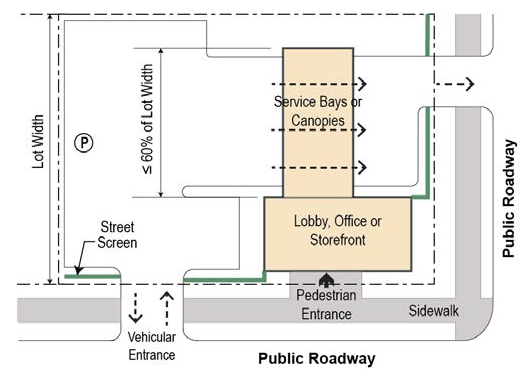
Placement example on a limited access roadway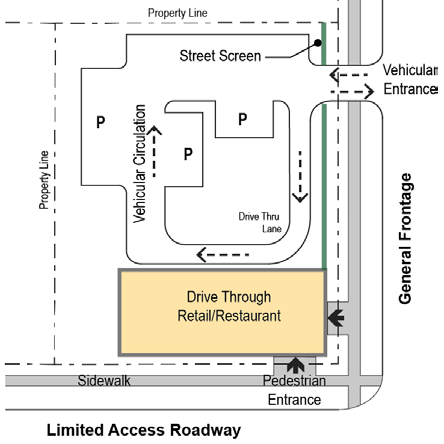
(4)
Approval. Town council through the SUP process.
(Ord. No. 1407, § 2, 8-15-2017; Ord. No. 1527, § 2, 10-15-2019; Ord. No. 1587, § 2, 1-5-2021; Ord. No. 1682, § 2, 8-16-2022)
Sec. 106.05.03 - Special regulations for specific temporary land uses.
(a)
Batch plants, temporary.
(1)
Application. The application for a temporary batch plant requires the approval of a conditional use permit, issued at the discretion of the director.
(2)
Definition. A temporary manufacturing facility for the on-site production of concrete or asphalt during construction of a project, and to be removed when the project is completed. Following removal, the tract shall be returned to its previous condition.
(3)
Regulations.
a.
Applicants for a permit to operate a temporary concrete or asphalt batching plant must submit a letter from the Texas Commission on Environmental Quality (TCEQ) indicating that the proposed facility is exempt from the permitting procedures under the standard exemption, as adopted and amended from time to time.
b.
All stockpiles shall be sprinkled with water or dust suppressant chemicals, or both, as necessary to achieve maximum control of dust emissions. The stockpile sprinkler system shall be operable at all times.
c.
The facility shall be operated in a manner which mitigates the effect of dust, noise and odor (including covering trucks, hoppers and chutes, loading and unloading devices, mixing operation and maintaining driveways and parking areas free of dust).
d.
The facility must produce concrete or asphalt for the specific subdivision or project site upon which it is located, and may not produce concrete or asphalt for any other unrelated subdivision or project.
e.
Spilled cement and fly ash used in the batch shall be cleaned up immediately and contained or dampened to minimize dust emissions due to wind erosion and vehicle traffic.
f.
All open-bodied vehicles transporting material from a dry batch plant to the paving mixer shall be loaded with a layer of sand on top, and the truck shall be covered with a tarp to minimize the emission of dust under existing conditions.
g.
Temporary concrete batching plants (including associated stationary equipment and stockpiles) shall be located at least 500 feet from any recreational area, school, or residence. This distance limitation does not apply to structures within the boundaries of the project for which the facility is to pour concrete, provided that the facility is located on or contiguous to the project.
h.
Temporary asphalt batching plants shall be located at least one-half mile from any recreational area, school, or residence.
i.
The temporary batch plant shall only furnish concrete, asphalt, or both, to the specific project for which the temporary permit is issued.
j.
The applicant shall clear the site of all equipment, material and debris upon completion of the project, and return the area as close to its original state as reasonably possible.
k.
The facility may operate only between the hours of 7:00 a.m. and 8:30 p.m., Monday through Friday, 8:00 a.m. and 8:30 p.m. on Saturdays; and 1:00 p.m. and 8:30 p.m. on Sundays.
l.
The permit for temporary concrete and asphalt batching plants shall contain an expiration date not to exceed 180 days, and shall not be transferable to any other construction company or individual. Further, the permit shall be limited to a specific construction project and shall not be transferable to any other construction project.
(4)
Approval. Once the director has determined that the temporary batch plant is appropriate for the location requested and that the regulations listed in (3), above, have been met and will continue to be met, approval for the conditional use permit may be granted.
(5)
Revocation of permit. The following shall be grounds for the revocation of an issued permit:
a.
The facility fails to comply with any of the requirements as listed in this section; or
b.
The facility violates any of the standards as listed on the standard exemption list adopted by the Texas Natural Resources Conservation Commission as amended from time to time.
c.
The facility fails to comply with any of the requirements set forth in its conditional use permit.
(b)
Construction yard, temporary.
(1)
Application. The application for a temporary construction yard requires the approval of a conditional use permit, issued at the discretion of the director.
(2)
Definition. An open storage yard for supplies and operational equipment, but not constituting a junk or salvage yard.
(3)
Regulations—No specific regulations. Approval is subject to the director's discretion.
(4)
Approval. Temporary construction yards may be approved during the site plan process or as a separate conditional use permit.
(c)
Farmers market, temporary.
(1)
Purpose and intent. It is the purpose of this section to establish a farmers market ordinance for the Town of Little Elm in order to:
a.
To give Denton County and North Texas farmers alternative marketing opportunities.
b.
To promote the sale of Texas-grown farm products.
c.
To improve the variety and freshness of produce and related products available in Little Elm.
d.
To enhance the quality of life in Little Elm by providing community activities which foster social gathering and interaction.
(2)
Application. The application for a conditional use permit for a farmers market must meet all the requirements listed in subsection (4) and (5), below, and include a detailed site plan showing the location of vendors, bathroom facilities, and any closed streets or alleys. In addition, the following information is required:
a.
The applicant's full name, street address, phone number, e-mail address, and farm/organization name;
b.
Copy of the valid driver's license or other state identification of the applicant or the applicant's agent;
c.
A comprehensive list of products to be sold;
d.
The signature of the applicant or applicants, or agents; and
e.
Such other information as the town council deems necessary.
(3)
Definitions. The following terms, wherever used or referred to in this chapter, shall have the following respective meanings, unless a different meaning clearly appears from the context:
Farmers market means an area containing individual vendors who offer fruits, vegetables, herbs, spices, edible seeds, nuts, live plants, flowers, and honey for sale. This definition does include the sale of meat, fish, poultry, eggs, refrigerated dairy products, or home canned or packaged items when the proper health rules and regulations are followed and/or health permit obtained.
Food manager means a person who has shown proficiency of required information through passing a test that is part of a food protection management program accredited by the exas Department of State Health Services, pursuant to Chapter 25 Texas Administrative Code § 229.172, and has responded correctly to questions as they relate to specific food operations.
Health Code refers to the Texas Food Establishments, 25 Texas Administrative Code, Sections 229.161—229.171, and 229.173—229.175, as amended.
Horticultural goods means seeds, seedlings, shrubs, trees or other nursery stock.
Locally grown goods or locally produced goods means goods or products grown in Denton County or surrounding counties, which goods are sold at the farmers market by those persons or any member of the family of those persons who are substantially responsible for growing or producing said goods or products.
Permit means the document, issued by the regulatory authority, which authorizes a person to operate at a farmers market.
Potentially hazardous food means a food that is natural or synthetic and that requires temperature control because it is in a form capable of supporting the rapid and progressive growth of infectious or toxigenic microorganisms; the growth and toxin production of clostridium botulinum; or, in raw shell eggs, the growth of salmonella enteritidis.
Vendor means any person who participates in a farmers market by the selling of goods or products therein.
(4)
Regulations.
a.
Location. A farmers market may be permitted in the town limits, within the following zoning districts; LC Light Commercial, LI Light Industrial, or in a specifically designed or designated town park.
b.
Eligibility. Applicants who already maintain food, or agricultural retail operations or retail stores in the Town of Little Elm are not be eligible to sell at a Little Elm Farmers Market. All foods must be sold retail only.
c.
Dates of operation. A farmers market may be open daily year round or as otherwise designated by the town council.
d.
Setup and maintenance. Vendors may set up on a table or sell from a truck no larger than one ton (2,000 pounds). Each vendor shall be responsible for maintaining his or her space in a clean and orderly manner and shall leave the space clean and free of debris during sale hours and prior to departing after sale hours. Failure to properly maintain a market space may result in suspension of such vendor's license to do business in the farmers market.
e.
Site design criteria. Each vendor space must meet the following minimum criteria:
1.
A standard vendor space is ten feet by ten feet, and may include electricity.
2.
Vendor spaces shall have a concrete pad.
3.
All vendors shall have a sign on their space with their name and name of business/organization.
f.
Parking—All parking must be concrete. One space for each vendor stall and one and one-half spaces for each 200 square feet of designated market area is required. Shared parking can be approved through the SUP. Parking lots must meet the landscape requirements for a parking lot.
g.
Fire lanes. Fire lanes must be approved by the Town of Little Elm Fire Marshal.
h.
Health regulations. Each farmers market and each individual stand or booth selling produce, baked goods or other products that may be a health concern shall operate according to the town's health code.
1.
The operator or an employee of the farmers market shall be a certified food manager.
2.
All items intended for human consumption must be kept off the ground above six inches, at all times and be in safe and sound condition. The vendor is solely responsible for damages resulting from the sale of unsafe, unapproved or unsound goods.
3.
A minimum five-gallon capacity hand washing station is required. A hand washing station consists of:
• A container with a hands free dispensing valve;
• A five-gallon catch basin;
• Potable water, approximately at 100 degrees Fahrenheit;
• Liquid hand washing soap in pump or squeeze bottle; and
• Paper towel supply for the entire day.
4.
A conveniently located permanent toilet facility, located within 300 feet, shall be available. A letter from the business owner granting the market vendors access to toilet facilities during all hours of the farmers market operation shall be submitted with the permit application. If a permanent toilet facility is not available within 300 feet of the farmers market, then a permanent toilet facility must be located on site pursuant the following guidelines:
• Fifty vendor stalls or fewer = one permanent toilet facility
• Over 50 vendor stalls = one men's and one women's toilet facility
5.
The premises occupied by the farmers market shall be kept clean and free of accumulated trash, refuse or garbage during and after the hours of operation. All discarded fresh fruits, vegetables or other products shall be placed in a plastic bag and disposed of in onsite waste containers or dumpster. All dumpsters must follow the town ordinances regarding screening and other specifications unless approved otherwise through the SUP.
6.
No potentially hazardous, pre-packaged or whole produce or products are permitted for sale, unless the following standards have been met:
• Prepackaged foods. All prepackaged foods must be properly labeled.
• Egg products. An egg producer that sells only ungraded eggs from their own flock may be exempt from licensing from the Texas Department of Agriculture, but must be permitted by the department of state health services or the health inspector.
• Meat products. Only meat products that do not require refrigeration such as dried or salt cured meat or jerky will be allowed to be sold.
• Milk products. Fluid milk, dry milks and milk products complying with Grade A standards shall be pasteurized.
• Refrigerated foods. All refrigerated foods must be maintained below 41 degrees using mechanical refrigeration that complies with standards that meet or exceed NSF and used as manufacturer intended.
7.
Fruits, vegetables, salsas, chips, jerky and honey may be displayed for samples if the following guidelines are practiced:
• All fruits and vegetables must be rinsed thoroughly in clean water.
• Sample servings must be protected from contamination at all times (such as with a hinged cover or cake-type cover).
• Serving must be done in a manner that protects the sample from any bare hand contact by employees. The use of gloves, single service utensils, napkins or tissues, or toothpicks may be used to sample.
• A vendor who offers food samples will be required to obtain a health permit.
8.
Scales and weights. Every person who shall offer for sale, at a farmers market, any article by weight or measure shall have all scales, weights and measures properly examined, tested, stamped, and sealed.
(5)
Vendors.
a.
Application. Each vendor shall be required to obtain a permit issued by the Town of Little Elm at a cost of $25.00 for each 30-day permit issued. Each vendor shall be required to display his or her license in a prominent position while such vendor is doing business at a farmers market.
b.
Vendors' goods and products. Vendors shall only sell items that have been approved. All goods and products sold at a farmers market must be locally grown or locally produced goods.
1.
Each participating vendor, upon making application for a vendor's license shall sign a statement affirming that all goods or products which vendor intends to sell are locally grown or locally produced goods as defined in this chapter.
2.
Fruits and nuts, vegetable and horticultural goods may be offered for sale at the market without any special permits.
3.
Canned, preserved and baked items must be prepared in a certified commercial kitchen and labeled according to regulatory requirements of the State of Texas.
4.
Meat, poultry, eggs, cheeses and exotic animal products require a health permit from the Town of Little Elm if they are to be sold at a farmers market.
5.
Other items such as crafts and personal care items shall be allowed for sale at a farmers market without permission, but with a permit, and may not constitute more than 20 percent of the occupied vendor spaces.
c.
Liability. The town shall have no liability for any injury to the person or property of any vendor, member of a vendor's family, customer, or any other person, arising from the operation of the farmers market.
d.
Vendor permit requirements. All persons wanting to sell at a farmers market must agree to the terms of this chapter and show their agreement to this chapter by signing the application and other documents that accompany these rules. These forms must be returned to the Town of Little Elm and must be on file before set-up or any participation.
e.
Day-of applications. Vendors submitting the application and other forms, and fees, the day of the market, will be permitted to sell at the market.
(6)
Approval. Once the director has determined that all the regulations listed in subsections (4) and (5), above, have been met and will continue to be met, approval for the conditional use permit may be granted.
(d)
Field office, temporary.
(1)
Application. Temporary field offices require the approval of a conditional use permit, issued at the discretion of the director.
(2)
Definition. A temporary building or structure, used in connection with a development or construction project. Temporary permits for "temporary buildings" shall be issued for a period of time not to exceed 18 months. Extensions may be granted only by the town council. Upon due notice and hearing by and before the town council, any such permits granted may be revoked if the town council finds the use of the building or structure is contrary to the intent of this section or results in increased noise, traffic or other conditions considered to be a nuisance or hazard. Subject to temporary permit and removal at completion of project.
(3)
Approval. Once the director has determined that the temporary field office is appropriate for the time limit requested, approval for the conditional use permit may be granted.
(e)
Model home, temporary.
(1)
Application. Temporary use of a new residential home as part of a sales office requires the approval of a conditional use permit, issued at the discretion of the director and an approved final plat.
(2)
Definition. Use of a new residential home to display the construction, design, exterior and interior finishes, and provide a temporary sales office for the home builder and/or real estate agents to sell similar homes within the subdivision.
(3)
Approval.
a.
Approval of a final plat by the planning and zoning commission is required prior to the temporary occupancy of the model home. The plat need not be filed, but must be filed prior to the sale of the model home to the individual owner.
b.
Approval of a temporary certificate of occupancy as required by the chief building official.
c.
Once the director has determined that the temporary certificate of occupancy has been obtained and the plat has been approved by the planning and zoning commission, approval for the conditional use permit for temporary use as a model home may be granted.
(f)
Open storage, temporary.
(1)
Application. Temporary outside display or storage requires the approval of a conditional use permit with a revised site plan indicating the location of the proposed open storage or display.
(2)
Definition. Temporary outdoor storage and display of merchandise is not permitted to exceed a 90-day duration, unless specifically allowed by the underlying zoning district or by the approval by the director. Seasonal display of merchandise may be displayed for the normal duration of the season, so long as the display does not utilize required parking spaces or impede normal traffic patterns.
(3)
Location of temporary open storage or display. Open storage may not be located in any required front, side, or rear setback and must not impede vehicle, emergency fire lanes, or pedestrian movement on the site.
(4)
Storage or display in parking lots. Open storage may not be located in any parking spaces, except "big box" stores (i.e. stores greater than 50,000 square feet in size) may display garden merchandise for sale within excess parking spaces on a temporary basis. Examples of appropriate merchandise for this type of parking lot storage includes, but is not limited to, mulch or garden soil bags, bedding plants, saplings, and storage sheds. Approval of any parking lot open storage or display shall require a revised site plan showing the location of the open storage or display, indicating the number of parking spaces required to ensure that the storage is located in spaces in excess of those required, the type of merchandise to be displayed or stored, and the duration of the sale.
(5)
Approval. Once the director has reviewed the revised site plan and has determined that the temporary open storage or display is located so that it will not impede vehicle or pedestrian movement, conflict with fire lanes or emergency vehicle movement, and is appropriate for the time limit requested, approval for the conditional use permit may be granted.
(g)
Open storage, temporary, under eave display.
(1)
Application. Temporary outside display or storage that is located near the main entrance to the facility and generally located under the front or side eaves requires a revised site plan indicating the location of the proposed open storage or display with the approval of a conditional use permit, issued at the discretion of the director.
(2)
Definition. This definition includes, but is not limited to, seasonal merchandise that may be placed outside the main entrance to a facility that is on sale or featured, such as pumpkins, cords of wood, lawn mowers, barbeque grills, bedding plants, etc. This definition also includes the outdoor, under eave storage of shopping carts. This definition may also be used for the temporary use of food purveyors, such as hot dog or lemonade stands used as part of a sales promotion.
(3)
Timing. Such merchandise may be displayed or sold for the normal duration of the season, so long as the display is limited to the under eave area.
(4)
Regulations.
a.
Limited to within ten feet from the front facade of the building) so long as pedestrian and/or vehicular traffic patterns are not impeded.
b.
A four-foot-wide clearance shall be provided for a walkway within the display, if needed, and
c.
A six-foot-wide clearance shall be provided on the sidewalk leading to the entrance of the building.
(5)
Approval. Once the director has determined that the temporary under eave storage or display is appropriate for the location and time limit requested, approval for the conditional use permit may be granted.
(h)
Seasonal sales.
(1)
Application. Any application for a conditional use permit for seasonal sales shall include the following:
a.
A letter from the property owner, allowing the temporary use.
b.
A tax certificate from the state is required prior to approval of a permit.
c.
A site plan drawn to scale must be submitted with the application showing property boundaries, fencing, signage, display and sales areas, existing and temporary structures, ingress and egress locations, parking and delivery areas (with surface material indicated), and location of available restroom facilities.
d.
The conditional use is allowed only during the timeframes listed in subsection (2), below.
(2)
Definitions. The applicant shall choose one of the following four seasonal sales categories:
a.
Holiday items. Temporary display and sale of cut holiday trees with incidental sales of holiday decorations and firewood for a maximum 60 days; or
b.
Fall items. Temporary display and sale of pumpkins with the incidental sale of fall decorations for a maximum of 60 days;
c.
Winter items. Temporary display and sale of firewood with the incidental sale of firewood accessories between October 1 and March 1; or
d.
Summer items. Temporary display and sale of snow-cones or ice-cream products between June 1 and October 1.
(3)
Regulations. A permit is required for any seasonal sales operation, as defined in section 106.01.14, "land use definitions" of the Code of Ordinances; is only allowed during normal and generally accepted seasonal periods; and shall encompass all proposed signage, structures, uses, fencing, and other site alterations and scope of business activities. Seasonal sales are also subject to the following regulations:
a.
Only one seasonal sales permit is allowed per applicant, per lot, or per calendar year.
b.
Temporary use of tents, portable buildings (maximum 200 square feet), or other existing nonconforming structures located on the subject property is allowed for temporary offices, but is required to meet setbacks and be reviewed and approved by the fire marshal prior to issuance of a permit.
c.
One sign is allowed and shall be reviewed and approved prior to issuance of a permit. If a banner, it shall be no larger than 48 square feet, and it may be attached to the building or be freestanding if not higher than six feet off the ground. If a freestanding sign (non-banner), it shall be no larger than 40 square feet with a two-foot clear space and be no taller than eight feet in height. Any sign shall be set back a minimum 20 feet from the front property line, have no electric or illuminated components, and shall abide by all other provisions of chapter 86, signs, of the Code of Ordinances.
d.
Any temporary fencing shall be reviewed and approved prior to issuance of a permit.
e.
Restroom facilities for employees must be provided either on-site (e.g. portable toilet), or off-site if within 300 feet of the subject property and accompanied with a letter of permission from the property owner.
f.
The site shall provide safe vehicular access, off-street parking, and accommodate the delivery of materials. Vehicular use areas shall be an all-weather surface, which can include a maintained gravel surface.
g.
The scope of the activity cannot encumber required parking spaces of an adjacent business, shall be wholly located on an undeveloped lot of a minimum two acres in size, and be located in a nonresidential zoning district.
h.
Merchandise shall be neatly organized and not haphazardly piled. Firewood seasonal sales lasting more than 60 days shall be orderly stacked and shall not be sold from a trailer, unless used for customer delivery purposes and parked to mitigate visibility.
i.
Within ten calendar days following the permit's expiration, the site shall be clear of all structures, fencing, signage, trailers, material, merchandise, and equipment associated with the seasonal sale operation not existing at time of application as well as any trash and debris that may have accumulated.
(4)
Approval. Once the director has determined that the temporary seasonal sales operation is appropriate for the location and time limit requested, and that all the regulations listed in (3), above, have been met and will continue to be met, approval for the conditional use permit may be granted.
(Ord. No. 1407, § 2, 8-15-2017)
Sec. 106.05.04 - New and unlisted uses.
It is recognized that new types of land use will develop and forms of land use not anticipated may seek to locate in the town. In order to provide for such changes and contingencies, a determination as to the appropriate classification of any new or unlisted form of land use shall be made as follows:
(a)
The director shall consider any new or unlisted use and make an interpretation as to the zoning classification into which such use should be placed. The referral of the use interpretation question shall be accompanied by a statement of facts listing the nature of the use and whether it involves dwelling activity, sales, processing, type of product, storage and amount, and nature of noise, odor, fumes, dust, toxic material, and vibration likely to be generated and the general requirements for public utilities such as water and sanitary sewer.
(b)
The director shall consider the nature and described performance of the proposed use and its compatibility with the uses permitted in the various districts and determine the zoning district within which use should be permitted.
(c)
Appeals can be made to the planning and zoning commission. The commission shall approve the director's recommendation or may make its own determination concerning the classification of such use as is determined appropriate based upon its findings.
(Ord. No. 1407, § 2, 8-15-2017)
Sec. 106.05.05 - Nonconforming uses and structures.
(a)
Intent. Within the districts established by this chapter or amendments that may later be adopted, there exist lots, structures, and uses of land and structures which were lawful before this chapter was passed or amended, but which would be prohibited, regulated, or restricted under the terms of this chapter or future amendments.
(1)
It is the intent of this chapter to permit these nonconformities to continue until they are removed, but not to encourage their survival. Such uses are declared by this chapter to be incompatible with permitted uses in the districts involved. It is further the intent of this chapter that nonconformities shall not be enlarged upon, expanded, or extended, nor be used as grounds for adding other structures or uses prohibited elsewhere in the same district.
(2)
A nonconforming use of a structure, a nonconforming use of land, or a nonconforming use of a structure and land shall not be extended or enlarged after passage of this chapter by attachment on a building or premises of additional signs intended to be seen from the street or off the premises, or by the addition of other uses of a nature which would be prohibited generally in the district involved.
(3)
To avoid undue hardship, nothing in this chapter shall be deemed to require a change in the plans, construction, or designated use of any building on which actual construction was lawfully begun prior to the effective date of adoption or amendment of this chapter and upon which actual building construction has been diligently carried on. Actual construction is hereby defined to include the placing of construction materials in permanent position and fastened in a permanent manner; except that where demolition or removal of an existing building has been substantially begun in preparation for rebuilding, such demolition or removal shall be deemed to be actual construction, provided that work shall be diligently carried on until completion of the building involved.
(b)
Nonconforming lots of record.
(1)
In any district in which single-family dwellings are permitted, notwithstanding limitations imposed by other provisions of this chapter, a single-family dwelling and customary accessory buildings may be erected on any single lot of record at the effective date of adoption or amendment of this chapter. Such lot must be in separate ownership and not of continuous frontage with other lots in the same ownership. This provision shall apply even though such lot fails to meet the requirements for area or width standards, or both, that are generally applicable in the district, provided that yard dimensions and other requirements not involving area or width, or both, of the lot must conform to the regulations for the district in which such lot is located. Variance of area, width, and yard requirements may be obtained only through action of the board of adjustment (see section 106.02.02(a)(3) for more information).
(2)
If two or more lots or combinations of lots and portions of lots with continuous frontage in single ownership are of record at the time of passage or amendment of this chapter, and if all or part of the lots do not meet the requirements for lot width and area as established by this chapter, the lands involved shall be considered to be an undivided parcel for the purposes of this chapter, and no portion of said parcel shall be used which does not meet lot width and are requirements established by this chapter, nor shall any division of the parcel be made which leaves remaining any with width or area below the requirements stated in this chapter.
(c)
Nonconforming uses of land. Where, at the effective date of adoption or amendment of this chapter, lawful use of land exists that is made no longer permissible under the terms of this chapter as enacted or amended, such use may be continued, so long as it remains otherwise lawful, subject to the following provisions:
(1)
No such nonconforming use shall be enlarged or increased, nor extended to occupy a greater area of land than was occupied at the effective date of adoption or amendment of this chapter;
(2)
No such nonconforming use shall be moved in whole or in part to any other portion of the lot or parcel occupied by such use at the effective date of adoption or amendment of this chapter;
(3)
If any such nonconforming use of land is intentionally abandoned for at least six months, all nonconforming rights are terminated and any subsequent use of such land shall conform to the regulations specified by this chapter for the district in which such land is located.
(d)
Nonconforming uses of structures. If a lawful use of a structure, or of structure and premises in combination, exists at the effective date of adoption or amendment of this chapter that would not be allowed in the district under the terms of this chapter, the lawful use may be continued so long as it remains otherwise lawful, subject to the following provisions:
(1)
No existing structure devoted to a use not permitted by this chapter in the district in which it is located shall be enlarged, extended, constructed, reconstructed, moved, or structurally altered except in changing the use of the structure to a use permitted in the district in which it located.
(2)
Any nonconforming use may be extended throughout any parts of a building which were manifestly arranged or designed for such use at the time of adoption or amendment for this chapter, but no such use shall be extended to occupy any land outside such building.
(3)
Any structure, or structure and land in combination, in or on which a nonconforming use is superseded by a permitted use, shall thereafter conform to the regulations for the district in which such structure is located, and the nonconforming use may not thereafter be resumed.
(4)
When a nonconforming use of a structure, or structure and premises in combination, is discontinued or abandoned for six consecutive months or for 18 months during any three-year period, the structure thereafter shall not be used except in conformance with the regulations of the district in which it is located.
(5)
Where nonconforming use status applies to a structure and premises in combination, removal or destruction of the structure shall eliminate the nonconforming status of the land.
(6)
Where nonconforming use status applies to a conforming structure, such use shall be immediately terminated upon transfer to another ownership or lease.
(e)
Changing uses and nonconforming rights.
(1)
Nonconforming use to conforming use. Any nonconforming use may be changed to a conforming use, and once such change is made, the use shall not be changed back to any nonconforming use.
(2)
Nonconforming use to another nonconforming use. A nonconforming use may not be changed to another nonconforming use.
(3)
Conforming use in a nonconforming structure. Where a conforming use is located in a nonconforming structure, the use may be changed to another conforming use by the process outlined in section 106.05.05(f), expansion of nonconforming uses and structures.
(f)
Expansion of nonconforming uses and structures. An expansion of a nonconforming use or structure is allowed in accordance with the following.
(1)
Nonconforming use expansion in existing building. A nonconforming use located within a building may be extended throughout the existing building, provided.
a.
No structural alteration, except as provided in section 106.05.05(f)(5) below, may be made on or in the building except those required by law to preserve such building in a structurally sound condition.
b.
The number of dwelling units or rooms in a nonconforming residential use must not be increased so as to exceed the number of dwelling units or rooms existing at the time said use became a nonconforming use.
(2)
Nonconforming use prohibited from expansion beyond existing building. Nonconforming use within a building shall not be extended to occupy any land outside the building.
(3)
Off-street loading and parking. Nonconforming use of land or building shall not be enlarged, increased, or extended to occupy a greater area of land than was occupied at the time the land became a nonconforming use, except to provide off-street loading or off-street parking space.
(4)
Residential lot exemption. The minimum residential lot areas for the various zoning districts shall be in accordance with their respective districts except that a lot having less area than herein required which was an official "lot of record" prior to [date of adoption of ordinance], may be used for a single-family dwelling.
(5)
Expansion of nonconforming buildings with conforming uses. Buildings or structures which do not conform to the area regulations or development standards in this chapter but where the uses are deemed conforming shall not increase the gross floor area greater than ten percent from the date when the building became nonconforming.
(6)
Reuse of abandoned or vacant buildings by conforming uses allowed. Buildings or structures which have been vacant or abandoned for less than six months and do not meet the current area regulations or development standards shall be allowed to be reoccupied by a conforming use.
(g)
Restoration of nonconforming structures.
(1)
Total destruction. If a nonconforming structure is destroyed by fire, the elements, or other cause, it may not be rebuilt except to conform to the provisions of this chapter.
(2)
Partial destruction. In the case of partial destruction of a nonconforming structure not exceeding 51 percent of its total appraised value as determined by the Appraisal District, reconstruction will be permitted, but the existing square footage or function of the nonconforming structure cannot be expanded.
(h)
Movement of nonconforming structures.
(1)
Relocation of a nonconforming structure within a platted lot. Nonconforming structures may be relocated within the same platted lot.
(2)
Compliance. Nonconforming structures shall comply with all setback and screening requirements.
(i)
Repairs and maintenance. On any building devoted in whole or in part to an nonconforming use, work may be done in any period of 12 consecutive months on ordinary repairs, or on repair or replacement of nonbearing walls, fixture, wiring or plumbing, to an extent not exceeding ten percent of the current replacement value of the building, provided that the cubic content of the building as it existed at the time of passage or amendment of this chapter shall be not increased. Nothing in this chapter shall be deemed to prevent the strengthening or restoring to a safe condition of any building or part thereof declared to be unsafe by any official charged with protecting the public safety, upon order of such official.
(j)
Uses under exception provisions not nonconforming uses. Any use for which a special exception is permitted as provided in this chapter shall not be deemed a nonconforming use, but shall without further action be deemed a conforming use in such district only for the single property granted such exception.
(k)
Termination of Nonconforming Uses and Compensation for such Termination.
(1)
A person using a property in a manner considered to be a nonconforming use as a result of the adoption of or change to a zoning regulation or boundary may continue to use the property in the same manner unless required by the town to stop the nonconforming use of the property.
(2)
If the town requires a property owner or lessee to stop the nonconforming use of a property as described by Subsection (k)(1), the owner or lessee of the property is entitled to compensation as set forth in V.T.C.A., Local Government Code § 211.019(d).
(3)
Not later than the tenth day after the date the town imposes a requirement to stop a nonconforming use of a property under this section, the town shall give written notice to each owner or lessee of the property, as indicated by the most recently approved municipal tax roll, who is required to stop a nonconforming use of the property of the requirement and of the remedies which an owner or lessee of the property is entitled to under V.T.C.A., Local Government Code § 211.019(d).
(4)
A person entitled to a remedy under V.T.C.A., Local Government Code § 211.019 may appeal a compensation determination to the board of adjustment not later than the 20th day after the date the determination is made.
(Ord. No. 1407, § 2, 8-15-2017; Ord. No. 1635, § 2, 9-7-2021; Ord. No. 1745, § 2, 1-16-2024)

