
Little Elm City Zoning Code
ARTICLE VI
SITE DEVELOPMENT STANDARDS
Sec. 106.06.01 - Limitations to development.
(a)
Residential development.
(1)
One unit per lot. Only one residential unit is allowed per lot in single-family residential districts, except SF-RE Single-Family Residential Estate, which may have one accessory dwelling unit (such as a mother-in-law unit).
(2)
One meter per lot. Only one utility meter per lot is allowed.
(3)
Conformance status of lots previously platted. Lots in a subdivision or shown on a plat legally approved and properly recorded in Denton County prior to the effective date of Ordinance No. 427 which do not meet the minimum lot sizes and area requirements set forth in this chapter shall not be considered to be in violation of said requirements and, for purposes of this section, shall be deemed to conform to the requirements set forth in this section.
(4)
Occupation of an RV prohibited. Occupying or otherwise residing in a recreational vehicle (RV), camp trailer, or other wheeled vehicles parked on a single-family lot or within the public right-of-way is prohibited. This is waived for visitors occupying said vehicle for a period of seven days or less.
(5)
Foundation requirements. All residential structures within the town, except for manufactured homes, shall be built upon engineered foundations, subject to review and approval by the building official.
(b)
Senior living. Multiple-family dwelling, senior (senior apartment) means any building or portion thereof, which is designed, built, rented, leased or let to contain three or more dwelling units or apartments on a single lot, or which is occupied as a home or place of residence by three or more age-restricted (55 years of age or older) families living in independent dwelling units on a single lot. This use shall also be subject to the following requirements:
(1)
Minimum number of seniors in residence. At least one person 55 years of age or older shall reside in at least 80 percent of the senior multifamily residential development's dwelling units;
(2)
Deed restrictions and covenants. Prior to the issuance of a certificate of occupancy, each senior multifamily residential development shall adopt a series of deed restrictions and covenants, subject to review and approval by the town attorney, establishing the development's intent to operate as a senior multifamily residential development in accordance with the requirements established herein and any other applicable laws or regulations.
(3)
Reporting. At least once every two years, each senior multifamily residential development shall provide to the town's development services department a certified affidavit demonstrating that the requirements established herein as well as the requirements of the Fair Housing Act continue to be satisfied.
(4)
Revocation of CO. Failure to completely adhere to the requirements herein shall be deemed a violation of this chapter and may result in the revocation of the development's certificate of occupancy or other penalties as detailed in section 106.01.11, "penalties and enforcement" of this chapter.
(Ord. No. 1407, § 2, 8-15-2017; Ord. No. 1587, § 2, 1-5-2021)
Sec. 106.06.02 - Architectural design standards, generally.
(a)
Applicability and process.
(1)
Purpose. The purpose of architectural standards is to set minimum requirements for the appearance and quality of buildings and corresponding site elements which are recognized as factors that enhance property values and are in the interest of the general welfare of the Town of Little Elm.
(2)
Applicability. The regulations provided in this subsection shall apply to all structures within all zoning districts. Where the regulations of this subsection conflict with other sections or provisions of this chapter, the regulations of this subsection shall apply.
(3)
Submittal information. Sufficient information shall be submitted to evaluate the architectural standards criteria outlined herein as part of the site plan submittal.
(4)
Color elevations and/or samples. Color elevations of all four facades shall be submitted for each building, listing each proposed exterior material, with a percentage breakdown of each material used, exclusive of windows and doors. A listing of the selected auxiliary design standards, described herein, should also be included to ensure compliance.
(5)
Streetscape elements. For any proposed streetscape elements (such as bike racks, trash receptacles, lampposts, tree grates, bollards, outdoor seating, and/or other street furniture) or screening devices (masonry walls screening dumpsters, mechanical equipment, residential subdivision, etc.), graphics should also be submitted showing the material, color, height, and any other pertinent details.
(Ord. No. 1407, § 2, 8-15-2017)
Sec. 106.06.03 - Architectural standards for residential structures.
(a)
Intent. The intent of this subsection is to create residential neighborhoods which reflect the character of Little Elm, preserve and enhance property values, and contribute to the tax base of the town. It is not the intent of this section to discourage innovation. The use of exceptional design features, such as alternate exterior materials or design features, or other unique and outstanding architectural ornamentation worthy of merit that make a positive contribution to the surrounding visual environment is encouraged. If the alternate design does not meet the letter of the ordinance, but is deemed to meet the intent of the ordinance, the director shall have the discretion to allow the alternate design.
(b)
Compulsory design standards for residential development. All new residences within the Town of Little Elm shall conform to the following design standards:
(1)
Minimum masonry requirement. The front facing exterior facades of the main building or structure shall be constructed of 100 percent masonry finishing material that is comprised of brick, stone, cast stone, or a combination thereof. The overall minimum masonry content of all facades shall be 85 percent. Stucco may be used as a design feature with no more than 15 percent of any facade other than those facing a right-of-way being made up of this material. Other materials of equal or similar characteristics may be allowed at the discretion of the director.
(2)
Alternate stucco architecture. If a home is designed with a specific architectural style that warrants the use of stucco as the primary exterior material, including but not limited to Mediterranean, Spanish, southwest or modern, then the use of stucco as a primary material may be approved by the director. All elements of the architectural style must be consistently incorporated, including but not limited to clay roof tiles, typical of the style. Residences with primarily stucco finishes shall be accented with heavy wood beams, stonework or other features to enhance the style. Elevations with no discernable style that simply disregard the required masonry requirement will not be considered.
(3)
Cementitious fiberboard and engineered wood. Cementitious fiberboard or engineered wood may constitute up to 50 percent of the exterior facades of stories other than the first floor if the 85 percent masonry finishing materials is maintained overall. Cementitious fiberboard or engineered wood may also be used for architectural features, including window box-outs, bay windows, roof dormers, columns, chimneys not part of an exterior wall, or other architectural features approved by the director.
(4)
Elevation repetition. Each unique house elevation shall not be repeated on the lot most directly across the street, nor shall it be repeated on two lots in either direction on the same side of the street. A wide variety of elevations is desired as it augments the character of the subdivision and reduces monotony of design. Houses that have a primarily stucco exterior shall be limited to one per block face.
(5)
Elevation masonry mix and pattern. Front elevations should use more than one type of masonry construction in a variety of patterns to vary the architectural appeal of the streetscape. Regardless of the 85 percent minimum Category A masonry requirements, every facade shall be a mixture of materials and no one facade may be constructed of cementitious fiberboard or engineered wood or a combination of these products.
(6)
Doors. Garage doors and front entry doors visible from the right-of-way shall consist of stained cedar, redwood, spruce, fir or other hardwood, or other products, including products that are not wood but have a wood appearance and approved by the director.
(7)
Roof pitch. Minimum roof pitch of residential structures is 6:12.
(8)
Roof materials. All roof materials shall meet the minimum standards as listed in the adopted International Building Code, which includes the use of solid solar shingles.
(9)
Screening of utility units. HVAC units shall be screened from view from streets with shrubs or a stained wood fence.
(10)
Mailboxes, individual. Individual mailboxes shall be brick or stone to match the residence and, where practical, be clustered in pairs. Sufficient structural support to keep the mailbox strictly upright is required.
(11)
Mailboxes, grouped. When mailboxes are grouped, the exterior of the structure shall be masonry, the roof made of metal materials, and maintained by the home owners association (HOA).
(12)
Driveways. All driveways shall be concrete and have a minimum width of ten feet and a maximum width of 24 feet, unless the drive is accommodating more than a two-car garage. Greater drive widths shall be approved on a case-by-case basis by of the director.
(c)
Architectural design features. All new residential structures must include at least four of the following design features on the front facade or visible from the front or side street:
(1)
Carriage style garage door(s) with hardware;
(2)
Architectural pillars or posts;
(3)
Bay window(s);
(4)
Brick chimney on exterior wall;
(5)
Cast stone accents;
(6)
Covered front porches (minimum of 60 square feet covered by main roof or an architectural extension);
(7)
Cupulas or turrets;
(8)
Dormers or gables;
(9)
Garage door not facing the street (J-swing garage style);
(10)
Roof accent upgrades (e.g. metal, tile, slate, solar tiles);
(11)
Recessed entries a minimum of three feet deeper than main front facade;
(12)
Greater than 6:12 primary roof pitch, or variable roof pitches;
(13)
Transom windows;
(14)
Shutters;
(15)
Masonry arches;
(16)
Mixed masonry patterns (over and above what is required by section 106.06.02(b)(5), above);
(17)
Coach lights at entrances;
(18)
Decorative attic or gable feature, minimum two square feet in size (e.g. vent, window, brick detail);
(19)
Decorative driveway paving (e.g. salt finish, exposed aggregate, or other treatments approved by the town's building official).
(Ord. No. 1407, § 2, 8-15-2017)
Sec. 106.06.04 - Architectural standards for multifamily structures (including townhomes and patio homes).
(a)
Intent. The following goals apply to multifamily and townhome development:
(1)
The intent of this subsection is to create buildings which reflect the lakefront character of Little Elm. The size, disposition and design of buildings play an important role in achieving that goal.
(2)
Multifamily buildings should be constructed in a manner that contributes to the attractiveness of the town.
(3)
Buildings should be constructed in a manner, and with materials, that are highly durable and will continue to endure and be attractive over a long time, especially when adjacent to public and pedestrian areas.
(4)
It is not the intent of this section to discourage innovation. The use of exceptional design features, such as tower elements, exposed beams, or other unique and outstanding architectural ornamentation worthy of merit that make a positive contribution to the surrounding visual environment is encouraged and will be considered on a case-by-case basis.
(b)
Exterior materials for multifamily construction.
(1)
Categories of exterior materials. The Town of Little Elm has categorized exterior building materials into three categories, as described below and in table A:
a.
Category A materials are defined as the superior masonry products from which the town prefers buildings to be predominantly constructed. Unless otherwise provided for in this chapter, acceptable Category A masonry finishing materials are brick, natural stone, and manufactured stone.
b.
Category B materials are the secondary products that the town recognizes as masonry materials acceptable for use, but also as products that are less desirable and therefore should not be the predominant material. Unless otherwise provided for in this chapter, acceptable Category B masonry finishing materials include three-step stucco, architectural concrete block with integrated color (i.e. split-face CMU), engineered wood, and cementitious fiberboard with integrated color (in the form of lap siding or board and batten).
c.
Category C materials are accent products acceptable in limited application for architectural accents and features and for walls on upper stories of multiple story buildings. Unless otherwise provided for in this chapter, acceptable Category C materials include metal, tile, glass block, exterior insulation and finish systems (EIFS), and wood.
(2)
Roof designs and materials. For buildings with a visible hip, gable or mansard roof, allowed materials include metal (standing seam), slate or tile (clay or cement, barrel or Roman-shaped).
3)
Prohibited materials. Prohibited exterior surface materials for multifamily developments include plain concrete block, concrete tilt wall, vinyl, plastic, and aggregate pea-gravel finished surfaces.
(c)
Design standards.
(1)
Uniform architectural style. All buildings within a common development, as shown on a development plan, conceptual plan, or site plan, shall have similar architectural styles, materials, colors and detailing.
(2)
Exterior materials. All structures shall be architecturally finished on all four sides (exclusive of doors and windows) with a minimum of 85 percent Category A materials on the first floor with the remainder being comprised of Category B materials; a minimum of 50 percent Category A and on the second and third floors with the remainder being comprised of Category B materials; and with subsequent floors being comprised of either Category A or Category B materials in any percentage desired. Use of Category C materials shall be limited to decorative accents. The use of materials will create a tri-partite architecture façade that has a distinct base, middle and top, separated by horizontal elements. (See table B, below)
(3)
Two masonry materials required. At least two masonry materials shall be used on all exterior facades.
(4)
Interior courtyard materials. Interior courtyards may be constructed of a minimum of 50 percent Category A with the remainder being comprised of Category B materials. Accents made up of Category C materials may be used within courtyard areas.
(5)
Facades parallel to street. Facades shall generally be built parallel to the street frontage.
(6)
Accessory building materials. Amenity centers, covered garages, and other accessory buildings shall meet the exterior material requirements of the first floor of the multifamily architecture. Carports shall meet the exterior material requirements of the first floor of the multifamily architecture with the exception of the support poles, which may be constructed of painted metal.
(7)
Amenities/hardscape. All streetscape elements and site amenities, such as bike racks, trash receptacles, lampposts, and tree grates shall be metal, rust and flake/chip resistant, and generally be black "storm cloud" in color. Bollards may be concrete or cast metal and shall be of decorative design.
(8)
Roof design. Roofs shall be peaked with either hip, gable or mansard design with a minimum one-to-four (1:4) pitch, or a parapet wall or false mansard design with a minimum one-to-two (1:2) pitch is acceptable only if constructed around the entire perimeter of a building so that no flat roof shall be visible from a public street or along an active storefront.
(9)
Building color.
a.
The dominant color of all buildings shall be muted, natural or earth-tone shades of color. Black and stark white shall not be used except as an accent color.
b.
Accent colors which comprise less than one percent of the building face may use a wider spectrum of colors than those allowed as the dominant color, except that no high intensity colors, neon colors or fluorescent colors shall be used on exterior surfaces of the building.
c.
Bright, reflective, pure tone primary or secondary colors are permissible only in limited application as accent colors on door and window frames, moldings, cornices, canopies, awnings, signs, etc. This provision shall not be construed as a license to employ corporate imaging or logos on the primary building facade.
d.
No more than one color shall be used for visible roof surfaces; however, if more than one type of roofing material is used, the materials shall be varying hues of the same color.
(10)
Auxiliary design standards. All multifamily and townhome primary buildings shall be designed to incorporate no less than four of the architectural elements from the list below:
a.
Canopies, awnings, porticos with colonnade or arcades; raised pilaster cornices (end columns at corners), or quoined corners (any of various bricks of standard shape for forming corners of brick walls or a wedge-shaped piece of wood, stone, or other material, used for various ornamental purposes at corners).
b.
Vertical elements (tower, cupola, lighthouse, turret, arches, etc.);
c.
Accented windows and doors framed with smooth cobble, cast stone, limestone or other decorative masonry headers and sills; or dormer windows;
d.
Outdoor patios and/or courtyards (landscaped and furnished);
e.
Decorative ornamentation integrated into the building facade, such as corbels, medallions (non-signage), functioning clocks, niches, wrought iron, balconettes, gargoyles, or horizontal and rhythm patterned brickwork;
f.
Other similar architectural features, as approved by the director.
(Ord. No. 1407, § 2, 8-15-2017)
Sec. 106.06.05 - Architectural standards for commercial structures (includes office, retail, commercial, mixed use, etc.).
(a)
Intent. The following apply to nonresidential developments, including institutional buildings:
(1)
The intent of this subsection is to create buildings which reflect the lakefront character of Little Elm. The size, disposition and design of buildings play an important role in achieving that goal.
(2)
Buildings should be constructed in a manner that allows flexibility to accommodate a range of uses over time in order to avoid the need to demolish and rebuild for successive uses.
(3)
Buildings should directly contribute to the attractiveness, safety, and function of the street and public areas.
(4)
Buildings should be constructed in a manner, and with materials, that are highly durable and will continue to endure and be attractive over a long time, especially adjacent to public and pedestrian areas.
(5)
It is not the intent of this section to discourage innovation. The use of exceptional design features, such as tower elements, exposed beams, or other unique and outstanding architectural ornamentation worthy of merit that make a positive contribution to the surrounding visual environment is encouraged.
(b)
Design standards.
(1)
All buildings within a common development, as shown on a development plan, concept plan, or preliminary site plan, shall have similar architectural styles, materials, colors, and detailing.
(2)
All structures shall be architecturally finished on all sides that can be seen from a public right-of-way with similar styles, materials, colors, and detailing.
(3)
Facades shall generally be built parallel to the street frontage, except at street intersections, where a facade containing a primary building entrance should be curved or angled toward an intersection.
(4)
All buildings shall be designed and constructed in tri-partite architecture so that they have a distinct base, middle and top, separated by horizontal elements (see examples next page).
(5)
All buildings shall be constructed of 100 percent masonry finishing material, as outlined in Table B and in the proportions illustrated in Table C.
(6)
All streetscape elements and site amenities, such as bike racks, trash receptacles, lampposts, and tree grates shall be metal, rust and flake/chip resistant, and generally be black "storm cloud" in color. Bollards can be concrete or cast metal and shall be of decorative design.
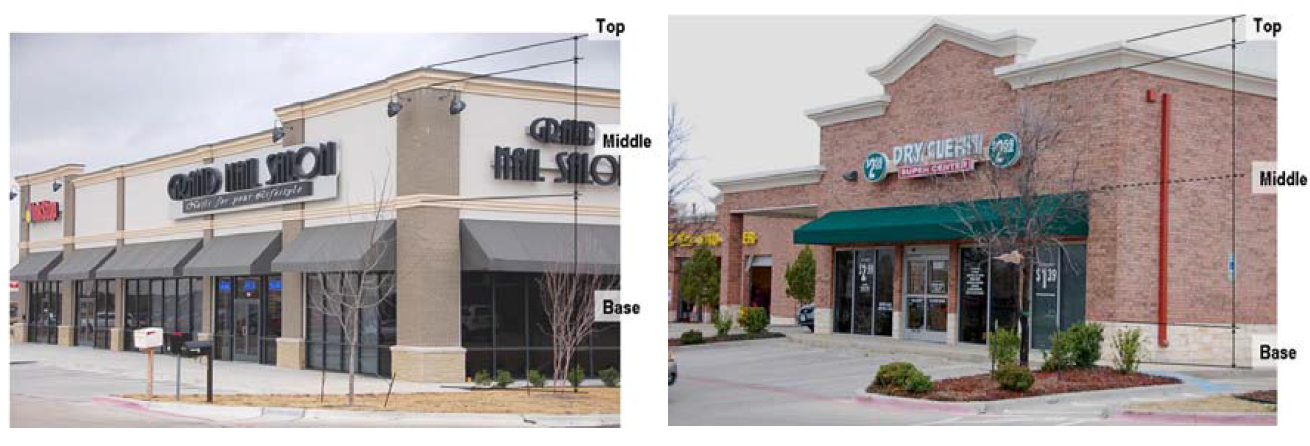
Examples of Tri-partite Construction
(c)
Exterior materials for all commercial development.
(1)
Categories of exterior materials. The Town of Little Elm has categorized exterior building materials for commercial buildings into three categories, as follows:
(2)
Category A materials are defined as the superior masonry products from which the town prefers buildings to be predominantly constructed. Unless otherwise provided for in this chapter, acceptable Category A masonry finishing materials are brick, natural stone, and manufactured stone.
(3)
Category B materials are the secondary products that the town recognizes as masonry materials acceptable for use, but also as products that are less desirable and therefore should not be the predominant material. Unless otherwise provided for in this chapter, acceptable Category B masonry finishing materials include three-step stucco, architectural concrete block with integrated color (i.e., split-face CMU), concrete tilt wall (colored or stamped), engineered wood, and cementitious fiberboard with integrated color (in the form of lap siding or board and batten).
(4)
Category C materials are accent products acceptable in limited application for architectural accents and features and for walls on upper stories of multiple story buildings. Unless otherwise provided for in this chapter, acceptable Category C materials include metal, tile, glass block, exterior insulation, and finish systems (EIFS), and wood.
(5)
Windows. Windows and glazing shall be limited to a minimum of 30 percent and maximum of 70 percent of each building elevation facing a street, major access lane, or side yard greater than ten feet. This does not apply to big box buildings (greater than 50,000 square feet in size). Faux (i.e., false) windows are allowed for side yards.
(6)
Roof designs and materials. For buildings with a visible hip, gable, or mansard roof, allowed materials include metal (standing seam), slate or tile (clay or cement, barrel or Roman-shaped).
(7)
Prohibited materials. Prohibited exterior surface materials include cinder block, vinyl, plastic, and aggregate pea-gravel finished surfaces.
(d)
Facade design standards for buildings 15,000 square feet or smaller. The following shall apply to all exterior walls of buildings that are 15,000 square feet or smaller and which are clearly visible from a public right-of-way or along an active storefront (see table C):
(1)
Walls, excluding windows, doors, and other openings, shall be constructed of a minimum 80 percent Group A materials and a maximum of 20 percent Group B materials. However, accent materials from Group C may be allowed in limited application for architectural accents or features.
(2)
A big box may use split-face CMU (architectural block) for up to 20 percent of the primary facade, in addition to the 20 percent of other Group B materials.
(3)
All exterior walls of buildings less than 15,000 square feet are considered primary facades, regardless of orientation.
(e)
Facade design standards for buildings larger than 15,000 square feet. The following shall apply to all exterior walls of buildings 15,000 square feet or larger and which are not clearly visible from a public street or along an active storefront, or are constructed on a property line as one of a series of in-line buildings where the wall will become part of a common wall (see table C):
(1)
Primary facades. Allowed materials. Walls, excluding windows, doors, and other openings, shall be constructed of a minimum 20 percent Group A materials and a maximum of 80 percent Group B materials. In any case, the color of the walls shall match the primary facades.
(2)
Secondary facades. Secondary facades which are adjacent to the primary facade shall continue the primary facade treatment by wrapping the corner. This may be achieved with elements such as cornices, bases, and vertical elements. In all cases, however, wall surface materials shall wrap the corner.
(f)
Building articulation design standards. Primary facades clearly visible from a public street or along an active storefront shall meet the following minimum standards for articulation:
(1)
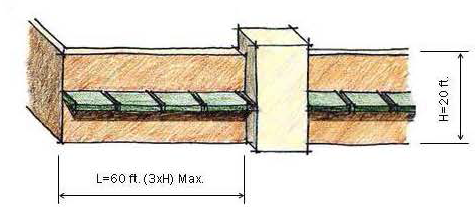
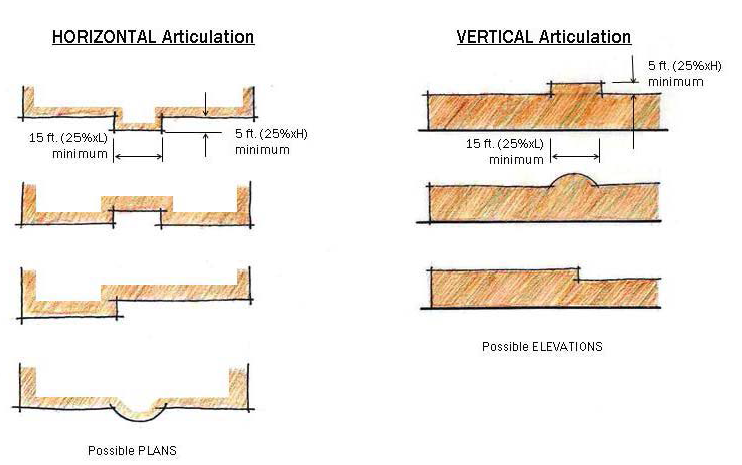
Horizontal articulation. No building wall shall extend for a distance equal to three times the wall's height without having an offset equal to 25 percent of the wall's height, and that new plane shall extend for a distance equal to at least 25 percent of the maximum length of the first plane.
(2)
Vertical articulation. No wall length shall extend for a distance greater than three times the height of the wall without changing height by a minimum of 25 percent of the wall's height, and that new plane shall extend for a distance equal to at least 25 percent of the maximum length of the first plane. Pitched roofs shall count toward achieving vertical articulation, provided they are 65 degrees or less from horizontal.
(g)
Design standards.
(1)
Two masonry materials required. At least two masonry materials shall be used on all exterior facades.
(2)
Roof design. Roofs shall be peaked with either hip, gable, or mansard design with a minimum 1:4 pitch, or a parapet wall or false mansard design with a minimum 1:2 pitch is acceptable only if constructed around the entire perimeter of a building so that no flat roof shall be visible from a public street or along an active storefront.
(3)
Landmark buildings.
a.
Buildings which are located on an axis with a terminating street or major access lane or at the intersection of streets and/or major access lane shall be considered a landmark building.
b.
Such buildings shall be designed with landmark features which take advantage of that location, such as an accentuated entry and a unique building articulation which is offset from the front wall planes and goes above the main building eave or parapet line.
c.
Landmark features shall be in proportion to the building and are subject to review and approval by the director.
(4)
Building color.
a.
The dominant color of all buildings shall be muted, natural or earth-tone shades of color. Black and stark white shall not be used except as an accent color.
b.
There are no restrictions on accent colors which comprise less than one percent of the building face including wall signs, except that no high intensity colors, neon colors or fluorescent colors shall be used on exterior surfaces of the building.
c.
Bright, reflective, pure tone primary or secondary colors are permissible only in limited application as accent colors on door and window frames, moldings, cornices, canopies, awnings, signs, etc. This provision shall not be construed as a license to employ corporate imaging on the primary building facade.
d.
No more than one color shall be used for visible roof surfaces; however, if more than one type of roofing material is used, the materials shall be varying hues of the same color.
(5)
Auxiliary design standards. All structures shall be designed to incorporate no less than four of the architectural elements from the list below. Buildings over 50,000 square feet must include a minimum of five of the referenced architectural elements:
a.
Canopies, awnings, porticos with colonnade or arcades;
b.
Raised pilaster cornices (end columns at corner), or quoined corners;
c.
Vertical elements (tower, cupola, lighthouse, turret, arches, etc.);
d.
Accented windows and doors framed with smooth cobble, cast stone, limestone or other decorative masonry headers and sills; or dormer windows;
e.
Outdoor patios and/or courtyards (landscaped and furnished);
f.
Decorative ornamentation integrated into the building facade, such as corbels, medallions (non-signage), functioning clocks, niches, wrought iron, balconettes, gargoyles, or horizontal and rhythm patterned brickwork;
g.
Other architectural features approved by the director.
(Ord. No. 1407, § 2, 8-15-2017; Ord. No. 1745, § 2, 1-16-2024)
Sec. 106.06.06 - Architectural standards for industrial structures.
The following apply to structures constructed in an industrial zoning district and proposing an industrial and/or manufacturing use, per the use chart of the zoning ordinance (section 106.05.01(b), "schedule of uses - nonresidential"):
(1)
The main entry or office area of the building shall be articulated both horizontally and vertically by at least six feet or twenty percent of the adjacent wall length, whichever is greater. Building corners shall also be articulated, as approved by the director.
(2)
Primary exterior facades which are clearly visible from a public street shall be constructed with a minimum ten percent Group A materials and up to 90 percent Group B materials. Group C materials may be used for accents. The Group A materials noted above shall be applied to corners, entries, and other areas in order to mitigate monotony and increase the aesthetic value. A minimum of two different materials shall be used.
(3)
Secondary exterior facades NOT facing a public street may be constructed with up to 100 percent Group B materials.
(4)
A uniform color scheme is required. Colors shall be neutrals, creams, pastels, or deep, rich, non-reflective, natural or earth-tone colors.
(5)
Structures shall incorporate two of the auxiliary design standards listed in section 106.06.05(g)(5), above.
(Ord. No. 1407, § 2, 8-15-2017)
Sec. 106.06.07 - Architectural standards for specific structures.
(a)
Gas pumps and fueling stations.
(1)
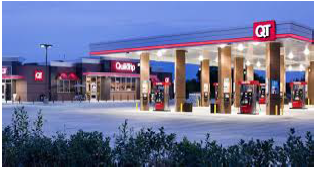
Roofs of the associated pump canopy of convenience store buildings shall not be flat or straight-lined, and should be noticeably pitched or otherwise distinguished, subject to review and approval by the director.
(2)
Canopy columns shall be fully encased with Category A masonry materials that are complimentary to the material and color used on the main building.
(3)
The canopy band face shall be flat with no projections or stripes, shall not be of plastic and shall be generally a metal or masonry based material, be primarily one earth-tone color that matches or accents the primary building, shall not be backlit or otherwise illuminated or used as signage, and should generally be no greater than four feet in height, except as follows:
a.
The canopy band face may utilize one small button logo on each face that can be internally illuminated, as long as each button logo does not exceed 15 square feet for bands three feet in height and 20 square feet for bands four feet in height, is generally as tall as it is wide, and does not protrude more than 18 inches from the canopy in any direction.
b.
The canopy band face may utilize an external LED halo type light, if properly shielded/recessed and oriented downward/upward so that only the "wash" is visible.
c.
The canopy band face may utilize internally illuminated rings, as long as the source is LED, it is flush with the band face and only protrudes nominally (up to a maximum of six inches), and the size of the ring does not exceed more than 25 percent for single rings and 50 percent for multiple rings of the thickness of the canopy band face.
(4)
Exhaust valves for underground fuel storage tanks shall be designed to be located against a building, dumpster screening wall, or other structure to mitigate their visual impact and should be an earth-tone color. If impractical, the exhaust valves may be located in an interior landscape area, if properly screened, but should not be located in the exterior landscape buffer adjacent to the public right-of-way.
(b)
Mechanical/electrical equipment.
(1)
Exposed conduits, ladders, exhaust valves, utility boxes and drain spouts shall be a color matching the building, an accent color, or earth-tone color.
(2)
Outside equipment, coolers, and/or other mechanical items shall be screened in accordance with the screening standards of the zoning ordinance, or be 100 percent enclosed with a Category A masonry finishing material matching the primary building.
(3)
All new utilities shall be underground.
(c)
Dumpster enclosures.
(1)
Location. Dumpster enclosures shall be placed away from the public right-of-way to the greatest extent practical, allowing for ease of access and minimum pedestrian and vehicular conflict. Gates to the dumpster enclosure should not face the right-of-way and shall be closed at all times except when accessed.
(2)
Minimum size. Dumpster enclosure shall be constructed a minimum of 12 feet wide and 14 feet deep for a single container and 25 feet wide and 14 feet deep for a double container - or of a sufficient size to adequately access the containers by the vehicles assigned that task.
(3)
Landscaping and screening of dumpster enclosure. Screening of the dumpsters shall be of the same masonry material as the primary structure and be a minimum of eight feet in height. Evergreen shrubs, 24 inches in height at the time of planting, shall be planted on the three solid masonry sides of the dumpster enclosure, spaced three feet on center.
(4)
Recycling encouraged. New developments greater than three acres in size are encouraged to include a recycling container along with the required dumpsters for trash.
(d)
Buildings that include bay doors.
(1)
Orientation. Bay doors shall not be oriented toward the right-of-way.
(2)
Screening of bay doors. If bay doors are located perpendicular to the right-of-way, a screening wall shall be provided along the side of the property that faces the bays. This screening wall shall be of masonry materials to match the primary structure and be a minimum of six feet in height and a maximum of eight feet in height. The location of the screening wall shall extend to the front façade of the primary structure.
(3)
Exception from screening. Structures that include bay doors located in the LI Light Industrial and HI Heavy Industrial zoning districts are not required to screen the bay doors.
(Ord. No. 1407, § 2, 8-15-2017)
Sec. 106.06.08 - Special area and height regulations.
(a)
Roof-mounted equipment. Necessary mechanical appurtenances (such as chimneys, cooling towers, vent stacks, etc.), parapet walls, gables, and false mansards shall not extend more than six feet above the height limit established by the zoning district.
(b)
Special features. Public or semi-public institutional buildings (e.g. schools, churches, government), where permitted, may erect special architectural features (steeples, domes, etc.) to a height not exceeding 75 feet.
(c)
Designated rights-of-way. Where an official right-of-way line has been established for future widening or opening of a street upon which a lot abuts, then the depth or width of a yard shall be measured from such official line to the nearest line of the building.
(d)
Unobstructed air space. Every part of a required yard shall be open from its lowest point to the sky unobstructed, except for the ordinary projection of sills, belt courses, cornices, chimneys, buttresses, ornamental features, and eaves; and provided, however, that none of the above projections shall extend from the primary structure into a minimum side or rear yard more than four feet; provided further that a structure attached to the primary structure which is open on at least three sides of 200 square feet or less may project a maximum of ten feet into the required rear yard. For the purposes of this section, insect screening is considered open. However, no part of the open structure may be closer than ten feet to the rear property line.
(e)
Fire escapes. An open fire escape may project into a required side yard not more than half the width of such yard and not more than four feet from the building. Fire escapes, solid floored balconies and enclosed outside stairways may not project more than four feet into the rear yard.
(f)
Location of dwellings and buildings. Only one main building for single-family, two-family, or townhouse use with permitted accessory buildings may be located upon a lot of record. Every dwelling shall face a front upon a public street, or approved place, other than an alley. Where a lot is used for retail, commercial, industrial, purposes, or a combination of same, more than one main building may be located upon the lot.
(g)
Sight triangles.
(1)
All sight/visibility triangle distances shall be measured from the intersection edges of the curb, or where there is no curb, from the end of the pavement or gravel, unless otherwise specified.
(2)
Nothing shall be erected, placed, planted, or allowed to grow in such a manner as to materially impede vision over a height of two feet above the centerline grades of the intersection streets in the sight triangle. Trees that encroach into the sight triangle must be limbed up to 14 feet to allow the safe passage of emergency vehicles.
(3)
Street Intersections. Where two streets meet, the intersection shall have a sight triangle of thirty (30) feet on each street from the point of intersection at the curb.
(4)
Street to alley intersection. Where an alley intersects with a street, the intersection shall have a sight triangle of 15 feet on each leg from the point of intersection at the curb.
(5)
Driveway to street. Where a driveway intersects with a street, the intersection shall have a sight triangle of 15 feet along the street and 15 feet along the driveway from point of intersection.
(6)
Driveway to alley. Where a driveway intersects with an alley, the intersection shall have a sight triangle of six feet on each leg from the point of intersection.
(7)
The director may require additional sight distances to be maintained where specific conditions render such provisions necessary to provide for the public health and safety.
(Ord. No. 1407, § 2, 8-15-2017)
Sec. 106.06.11 - Landscaping general administration.
(a)
Purpose and intent. It is the purpose of this section to establish certain regulations pertaining to landscaping within the Town of Little Elm. The town recognizes that landscaping can be a significant expense to businesses and residents. At the same time, landscaping improves the livability of residential neighborhoods, enhances the appearance and customer attraction of commercial areas, increases property values, improves the compatibility of adjacent uses, screens undesirable views, and can reduce air and noise pollution. Furthermore, these regulations provide standards and criteria for new landscaping which are intended to promote the value of property, enhance the welfare, and improve the physical appearance of the town.
(b)
Scope.
(1)
The standards and criteria contained within this section are deemed to be minimum standards and shall apply to all new development and existing developments that are expanding or redeveloping 30 percent or more of that development. In addition, any project authorized as a planned development (PD) must comply with the standards set forth in the PD. In unique situations, the director shall have the ability to review and modify the applicability of these standards to proposed development.
(2)
The official tree board for the Town of Little Elm shall be the planning and zoning commission.
(c)
Enforcement. The provision of this section shall be administered and enforced by the director. If, at any time after the issuance of a certificate of occupancy (CO), the approved landscaping is found to be in nonconformance to the standards and criteria of this section or to the approved landscape plan, the director shall issue notice to the owner, citing the violation and describing what action is required to comply with this section. The owner, tenant or agent shall have 30 days from the date of said notice to restore the landscaping as required. If the landscaping is not restored within the allotted time, such person shall be in violation of the ordinance from which this article derives and is subject to fines and the loss of the CO.
(d)
Permits.
(1)
Prior to the issuance of a building, paving or construction permit for any use other than single-family dwellings, a landscape plan shall be submitted to and approved by the community development department. In the event that the proposed development requires an approved site plan or master development plan, final approval shall not be granted until a landscape plan is submitted and approved.
(2)
Prior to the issuance of a certificate of occupancy (CO) for any building or structure, all screening and landscaping shall be in place in accordance with the landscape plan required this section.
(3)
In any case in which a CO is sought at a time in which the director determines that it would be impractical to plant trees, shrubs or grass, or to lay turf, a CO may be issued notwithstanding the fact that the landscaping required by the landscape plan has not been completed provided the applicant deposits cash in an escrow account in the amount of the estimated cost of landscaping that complies with this article. Such escrow deposit shall be conditioned upon the installation of all required landscaping within six months of the date of the application and shall give the town the right to draw upon the escrow deposit to complete the said landscaping if the applicant fails to do so.
(e)
Tree removal/alteration. Prior to the removal or the critical alteration of any protected tree in the town, an application for tree removal permit must be submitted and approved, unless otherwise exempt under a provision of the ordinance from which this section derives.
(1)
Tree removal permit. Any tree survey proposing the removal of a protected tree or trees shall be accompanied by a tree removal application. The burden shall be upon the applicant to show the necessity for any and all trees proposed for removal.
(2)
Fees. All tree removal applications shall be accompanied by a check made payable to the Town of Little Elm in the amount specified by town council.
(3)
Authority for review. The director shall be responsible for the review and approval of all permit applications for tree removal submitted in accordance with the requirements specified herein.
(4)
Denial. The director shall deny a tree removal application if it is determined that any of the following conditions exist:
a.
Removal of the tree is not reasonably required in order to conduct anticipated activities or to develop the property; or
b.
A reasonable accommodation can be made to preserve the tree; or
c.
The purpose and intent of this chapter is not being met by the applicant.
(5)
Appeals. Any decision made may be appealed to the planning and zoning commission acting as the tree board. All decisions made by the commission shall be final and binding.
(6)
Permit expiration. Permits for tree removal issued in connection with a building permit shall be valid for the period of that building permit's term. Permit(s) for tree removal not issued in connection with a building permit shall become void 180 days after the issue date on the permit.
(f)
Tree survey required. All grading permits, building permits, tree removal permits, and any other development and construction permits shall contain a tree survey of the subject property, or a note on the landscape plan stating that no protected trees are located on-site.
(1)
Tree survey requirements. Tree surveys shall:
a.
Include all individual trees which have a DBH of six inches or greater or which are otherwise noteworthy because of species, age, size or rarity.
b.
Contain a tree location map identifying each tree by its caliper size (at DBH), common name, scientific species categorization, whether the tree is located in a floodplain or not, and whether the tree is proposed to be removed, transplanted/relocated, or preserved.
c.
Illustrate the location of all existing and proposed buildings, structures, floodplains, pools, and other existing or proposed improvements for the site, including the limits of construction line, if applicable.
d.
The name and phone number or arborist, licensed surveyor, or landscape architect who prepared the survey.
e.
These requirements may be modified by the director as needed to administer the ordinance from which this division derives. Upon prior approval by the director, the map exhibit may be limited only to the applicable portion of the site. An aerial photograph may be allowed if it clearly meets these requirements and the intent of the ordinance.
(g)
Exceptions.
(1)
No person, directly or indirectly, shall cut down, destroy, remove or move, or effectively destroy through damaging or other means, any protected tree situated on property regulated by this division without first obtaining a tree removal permit unless otherwise specified in this division.
(2)
A tree removal permit and tree mitigation requirements shall not be required under any of the following circumstances:
a.
Private property. An individually platted parcel zoned for residential uses and used as a homestead shall be exempt from the tree protection and replacement requirements of this division as it pertains to that residential property, until such time as the property is no longer used as a single-family residence.
b.
Damaged/diseased trees. The tree is dead, diseased, damaged beyond the point of recovery, in danger of falling, or endangers the public health, welfare or safety, as determined by the director. This would include removal of a diseased tree by the town to reduce the chance of spreading the disease to adjacent healthy trees. This exception does not apply to newly planted trees that have died that are part of landscape plan, nor native trees that have short shelf lives.
c.
Public infrastructure. Rights-of-way, capital improvement projects, bridges, and other activity conducted by a municipal entity, whether leased or owned, excluding property used for administration offices or functions.
d.
Utility service interruption. The tree has disrupted a public utility service due to a tornado, storm, flood, or other act of God. Removal shall be limited to the portion of the tree reasonably necessary to reestablish and maintain reliable utility service.
e.
Business interests. The following business ventures shall be exempt from the requirements specified herein as follows:
1.
Landscape nursery. All licensed plant or tree nurseries shall be exempt from the tree protection and replacement requirements and from the tree removal permit requirements only in relation to those trees planted and growing on the premises which are so planted and growing for the sale to the general public.
2.
Golf course. Golf courses shall be exempt from the tree protection and replacement requirements and from the tree removal permit requirements for removal of protected trees within areas designated as tee boxes, fairways or greens. All other areas shall be subject to these requirements.
(Ord. No. 1407, § 2, 8-15-2017)
Sec. 106.06.12 - Landscaping definitions.
Berm. An earthen mound designed to provide visual interest, screen undesirable views and/or decrease noise levels.
Bubbler. An irrigation type that allows water to gently soak into the ground with minimal erosion or loss of water.
Buffer. The use of landscaping (other than grass on flat terrain), either alone or in conjunction with berms, walls or decorative fences that at least partially and periodically obstruct the view from the street, in a continuous manner, of vehicular use areas, parking lots and their parked cars and detention ponds.
Caliper. The diameter of a tree trunk measured 12 inches above ground level. The caliper of a multi-trunk tree is determined by the full caliper of the largest trunk, plus half the caliper of the other trunks. This measurement is used for newly planted trees.
Critical root zone. The area of undisturbed natural soil around a tree defined by a concentric circle with a radius equal to the distance from the trunk to the outermost portion of the drip line.
DBH. Diameter-at-breast-height (caliper) is calculated by measuring the tree trunk diameter in inches at a height of four and one-half feet above the ground. If a tree splits into multiple trunks below four and one-half feet, the tree shall be measured in two places, the narrowest point beneath the split and sum of the calipers of the trunks immediately above the split. Whichever is the greater measurement is to be the measurement applied. This measurement is used for existing trees.
Director. The director of development services of the Town of Little Elm and includes his or her designee.
Drip line. A vertical line run through the outermost portion of the canopy (leafy portion) of a tree and extending to the ground.
Drought tolerant/low water demand plant. The ability of a plant to be drought tolerant is primarily due to the plant's ability to limit water loss through the leaves and acquire more water through the roots. Plants have developed several mechanisms to reduce water loss, many of which can be recognized in native and cultivated plants. Characteristics of drought tolerant plants include: small, narrow, or pinnate leaves; fuzzy surfaces; resinous surfaces; leathery leaves; and/or succulence.
Green. An open space, available for unstructured recreation. A green may be spatially defined by streets, landscaping, and/or building frontages. Its landscape shall consist of lawn and trees.
Groundcover. Low growing plants, deciduous or evergreen species that cover the ground and used instead of turf. Plants that generally do not exceed 18 inches in height are classified as groundcover.
Impervious. A substance that does not allow the passage of water through it.
Irrigation system. An automatic watering system designed for watering landscaping and landscaped areas for a specified amount of time at a specified time of day. Irrigation systems are typically used to conserve water and time. All irrigation systems shall be equipped with an approved backflow prevention device to protect the water supply (if connected to Little Elm water supply) and a freeze and rain sensor.
Landscaped area. The area within the boundaries of a given lot or, where applicable, the adjoining street right-of-way, which is devoted to and consists of plant material, including, but not limited to, grass, trees, shrubs, flowers, vines and other groundcover, native plant materials, planters, brick, stone, natural forms, water forms, aggregate and other landscape features.
Landscaping. Any live plant material such as trees, shrubs, groundcover and grass used in spaces void of any impervious material or building structure and areas left in their natural state.
Large canopy tree. Sometimes evergreen, but more commonly deciduous tree planted for its high crown of foliage or overhead canopy, a large woody perennial having one or more self-supporting trunks and numerous branches reaching a mature height of at least 30 feet and a mature spread of at least 25 feet. See the recommended plant materials chart for a listing of acceptable large canopy tree varieties.
Low water use irrigation system. The term low water use irrigation system is used to describe any low pressure system that applies water in a controlled area. The most important feature of these systems is that it applies water very slowly and allows the water to be absorbed fully into the soil with minimal evaporation loss.
Ornamental grasses. A grass type that is generally considered in the landscaping industry to have ornamental qualities, and which is typically grown in a flower garden. Typically grows to a height of between six inches and 36 inches and does not tolerate being cut below six inches. These said grasses are usually used as an accent grass and not the main coverage of a yard. These grasses are commonly grown for the display of their leaves or flowers and may contain a variety of colors depending on the season.
Parkway. The area of public right-of-way located between the curb or edge of pavement and the property line or between the curb or edge of pavement and the sidewalk.
Plaza. An open space available for civic purposes and public commercial activities. A plaza is spatially defined by adjacent building frontages. Its landscape shall consist primarily of pavement, but may include shade in the form of planters with small ornamental trees or structure. Plazas frequently utilize fountains or water features.
Protective fencing. Snow fencing, chain link fence, orange vinyl construction fencing, or other similar fencing which is approximately four feet in height. This fencing is meant to be of a temporary nature.
Screening. A technique used to protect and separate uses and site functions from one another for the purpose of decreasing adverse noise, wind or visual impacts and to provide privacy (e.g., walls, fences, berms, landscaping).
Shrub. A self-supporting woody perennial plant of low to medium height characterized by multiple stems and branches continuous from the base, usually not more than ten feet in height at maturity.
Sight triangle (visibility triangle). The area of unrestricted visibility required at a corner to allow for the observation of other vehicular movement, pedestrians and cyclists in the proximity of intersecting streets and sidewalks.
Small ornamental tree. A relatively low growing tree at least seven feet at planting, that may grow to a mature height of up to 25 feet and a mature spread of up to 25 feet and provide color due to its fruit (berries), flowers or leaves. See the recommended plant materials chart for a listing of acceptable small ornamental tree varieties.
Square. An open space available for unstructured recreation and civic purposes. A square is spatially defined by building frontages or streets. Its landscape shall consist of paths, lawns and trees, formally disposed. Squares shall be located at the intersection of important thoroughfares.
Topsoil. Topsoil is the surface layer of soil containing partly decomposed organic debris, and which is usually high in nutrients. This term may also apply to good quality soil sold at nurseries and garden centers.
Tree, protected. Any tree that has a trunk DBH of six inches or greater at a height of four and one-half feet above the ground or which is otherwise noteworthy because of species, age, size or rarity.
Tree valuation. An established value set by the National Arborist Association per the tree valuation schedule, set forth herein to be used for all purposes of this article. See section 106.06.22(h), "tree mitigation."
Turf grass. Grass commonly used in regularly cut lawns or play areas, such as, but not limited to: Bermuda, St. Augustine, Fescue and Ryegrass blends.
Urban tree. A tree specifically selected for its ability to withstand harsh urban conditions, its relatively low maintenance, its suitability for use in the streetscape through its noninvasive root system and upright branching habit, and its associated imagery and overtones. See the recommended plant materials chart for a listing of acceptable urban tree varieties.
Weeds. Vegetation that because of its height and growth pattern is objectionable, unsightly or unsanitary; this term specifically excludes ornamental grasses, shrubs, bushes and trees, cultivated flowers and cultivated crops.
Xeriscaping. A method of landscaping that emphasizes water conservation, accomplished by following sound horticultural and landscaping practices, such as planning and design, soil improvement, limited turf areas, use of mulches, use of low water demand plants, efficient irrigation practices and appropriate maintenance.
Yard, front. The area extending across the front of a lot between the side lot lines and the minimum horizontal distance between the street, the main building or any projections thereof other than the projections of uncovered steps, balconies or porches. On corner lots, the front yard shall face the street on which the lot has the shortest dimension.
Yard, rear. The area extending across the rear of a lot and being the required minimum horizontal distance between the rear lot line and the rear of the main building or any projections thereof other than the projections of uncovered steps, unenclosed balconies or unenclosed porches.
Yard, side. The area between the main building and the side line of the lot, and extending from the required front yard to the required rear yard and being the minimum horizontal distance between a side lot line and the side of the main buildings or any projections thereof.
(Ord. No. 1407, § 2, 8-15-2017)
Sec. 106.06.13 - Landscaping plans.
(a)
Landscape plan submittal. Landscape plans shall be submitted to the development services department from a licensed landscape architect as a part of the site plan submittal. The director or his designee shall review such plans for compliance with the criteria of these regulations. If the plans are not in accord or complete, they shall be disapproved and shall be accompanied by a written statement setting forth the changes necessary for compliance.
(b)
Landscape plan requirements. Landscape plans must be prepared and sealed by a registered landscape architect and shall contain the following information:
(1)
Minimum scale of one inch equals 50 feet;
(2)
A symbol indicating north;
(3)
A tree survey with the location, size and species of all on-site trees; or a note indicating that no protected trees exist on-site;
(4)
Location of all plant and landscaping material to be used including plants, paving, benches, screens, fountains, statues or other landscape features;
(5)
The species, size, spacing and quantities of all plant material to be used in a tabular form (shall be from the recommended plant materials list);
(6)
A list of all plant material proposed to be used that does not come from the recommended plant materials list. This plant material must also be specifically designated on the landscape plan;
(7)
The date of the landscape plan, including any revision dates;
(8)
Layout and description of irrigation systems including placement of water sources. A Texas License Irrigation Seal is necessary on all irrigation plans;
(9)
Description of detention and retention facilities (if applicable);
(10)
Description of maintenance provision for the landscape plan;
(11)
Person(s) responsible for the preparation of landscape plan, including the landscape architect's seal;
(12)
Dimensions of all required landscape setbacks;
(13)
Description of any hardscape features;
(14)
Parking lot layout with location of dumpster(s) and dumpster screen(s);
(15)
An analysis table of ordinance requirements and the associated landscaping (including point requirements, interior and perimeter landscaping);
(16)
Indication that all landscaped areas, including parkways and medians, will have a minimum of six inches of topsoil;
(17)
Additional information as deemed necessary to adequately evaluate the landscape plan.
(18)
Dumpster enclosure(s) shall be shown on the landscape plan. Dumpster enclosures shall not be seen from the public right-of-way. Screening of the dumpsters shall be of the same masonry material as the primary structure and be a minimum of eight feet in height. Evergreen shrubs, 24 inches in height at the time of planting, shall be planted on the three solid masonry sides of the dumpster enclosure, spaced three feet on center.
(c)
Landscape plan standard notes. The following standard notations shall be placed on all landscape plans:
(1)
The owner, tenant and their agent, if any, shall be jointly and severally responsible for the maintenance of all landscaping. All required landscaping shall be maintained in a neat and orderly manner at all times. This shall include mowing, edging, pruning, and fertilizing, watering, weeding and such activities common to the maintenance of landscaping.
(2)
Landscape areas shall be kept free of trash, litter, weeds and other such material or plants not a part of the landscaping.
(3)
No substitutions for plant materials are allowed without written approval by the director and acknowledged by an approval stamp on the landscape plan.
(4)
The right-of-way adjacent to required landscape areas shall be maintained by the adjacent property owner in the same manner as the required landscape area. All driveways will maintain visibility as approved by the director. All plantings intended for erosion control will be maintained. The town may require revegetation to prevent erosion or slippage.
(5)
All plant material shall be maintained in a healthy and growing condition as is appropriate for the season of the year. Plant materials which die shall be replaced with plant material of similar variety and size, within 30 days or a date approved by the director, based on current seasons and weather conditions (e.g. drought or freeze).
(6)
When power lines are present, trees shall not be planted underneath and should be oriented in a manner to avoid conflict. Substitution of plant material is not allowed without prior written authorization from the director.
(7)
All required landscape areas shall be provided with an automatic underground irrigation system with rain and freeze sensors and evapotranspiration (ET) weather-based controllers and said irrigation system shall be designed by a qualified professional and installed by a licensed irrigator.
(8)
All trees are to be equipped with a bubbler irrigation system.
(9)
Required landscaped open areas and disturbed soil areas shall be completely covered with living plant material, per the landscape ordinance.
(10)
All landscaping shall be in a planned area that is defined by edging, mulch or another practice approved by the town.
(11)
All streetscape furniture (benches, bollards, lampposts, trash receptacles, patio furniture, bike racks, etc.) shall be a chip and flake resistant metal, decorative, and generally black "storm cloud" in color.
(Ord. No. 1407, § 2, 8-15-2017; Ord. No. 1527, § 2, 10-15-2019)
Sec. 106.06.14 - Landscaping standards.
(a)
Quality. Plant materials used in conformance with the provisions of this article shall conform to the standards of the American Standard for Nursery Stock, or equal thereto. Grass seed, sod and other material shall be clean and reasonably free of weeds and noxious pests and insects.
(b)
Quantity. The quantity of plant material required by this article must equal or exceed the minimum number of plants required by this article. Unless otherwise noted on the approved landscape plan, required plant material can be placed in groupings or utilized in appropriate planting designs that are proposed by the landscape architect and approved by the town. All required landscaped open areas shall be completely covered with living plant material. Mulch and rock can be used in conjunction with shrub and tree plantings in smaller areas.
(c)
Trees. Trees required by this article shall be from the recommended plant materials list or a species recommended by the landscape architect and approved on the landscape plan. All required trees shall be common to this area of Texas, and shall have a single trunk limbed up to six feet. Trees shall be of a minimum of four caliper inches when measured 12 inches above ground at time of planting. When the type of tree required is unclear, it is assumed that a large canopy tree is required, unless otherwise approved by the director.
(1)
No more than 25 percent of the required trees shall be of the same species for any tree type (large, small, or urban) in order to discourage monocultures and the spread of disease.
(2)
Three trees from the small ornamental tree list may be substituted for one large canopy tree, not to exceed 25 percent of the required large trees if approved by the Town.
(3)
Large canopy trees must be planted four feet or greater from curbs, sidewalks, utility lines, screening walls and/or other structures. Small trees can be placed closer than four feet, with approval on landscape plan. Utility installation that includes common trench and conduit banks is exempt from the large canopy tree planting distance requirements.
(4)
Trees and shrubs shall not overhang or encroach upon walkways, drives, parking areas, and traffic signs to the extent that they interfere with the intended use of these facilities.
(5)
Tree wells shall be a minimum 20 square feet in size with generally similar lengths and widths.
(6)
No landscaping shall be required for the interior of structured parking facilities.
(d)
Shrubs and hedges. Evergreen screening plants shall be at least 36 inches high at time of planting and shall be a type and species on the recommended plant list that will attain a minimum height of four feet within 18 months of planting and will form a continuous hedge. Sporadic breaks in the hedge row may be approved to achieve unique designs.
(e)
Vines. Vines shall be a minimum of two feet in height immediately after planting and may be used in conjunction with fences, screens or walls to meet screening requirements as specified.
(f)
Groundcover. Groundcovers used in lieu of grass in whole and in part shall be planted in such a manner as to present a finished appearance and reasonably complete coverage within one year of planting.
(g)
Lawn grass. Grass areas shall be sodded, except that large, expansive lawn areas may be hydromulched, plugged, sprigged or seeded with approval from the director, as long as the edges, adjacent to the curb and within six feet of the sidewalk or curb, are sodded, to reduce water and soil runoff.
(h)
Hardscape. Horizontal hardscape elements, where required, should utilize smooth cobble river stone, where appropriate.
(i)
Credit for existing trees. Any protected trees preserved on a site meeting the herein specifications shall be credited toward meeting the tree requirement of landscaping provisions that apply to the area where the tree is preserved. Trees of exceptional quality due to size, large canopy cover, trunk diameter, rareness, age or species may, at the discretion of the director, be credited as two trees under the minimum landscape area requirements.
(j)
Compliance letter. Prior to issuance of a Certificate of Occupancy (CO), a letter must be submitted to the director from the landscape architect indicating the site is in compliance with the approved landscape plan.
(k)
Detention/retention ponds. Stormwater control devices, such as detention/retention basins and ponds, shall be landscaped to reduce their visual impacts. Such landscaping shall not negatively impact the operation of such devices, but may include suitable planting materials that will control siltation and erosion, and in all cases shall be sodded. Ponds shall be designed in the following ways, subject to review and approval by the town engineer:
(1)
Amenity retention (wet) ponds shall be designed in a manner to be an amenity to the development by providing a gentle six-to-one (6:1) slope (a partial decorative stone retaining wall may be allowed), a large canopy tree for each 20 linear feet of the perimeter (which may be clustered), benches, fountains, trash receptacles and public art. Such ponds shall include aeration to ensure water quality. The area shall be accessible by patrons and be maintained by the property owner or established property owners association. Ponds shall have a decorative retaining wall and shall provide a minimum four foot high black tubular metal (wrought iron style) fence around the perimeter with evergreen screening if the pond isn't being used as a park feature.
(Ord. No. 1407, § 2, 8-15-2017; Ord. No. 1518, § 2, 9-3-2019; Ord. No. 1527, § 2, 10-15-2019)
Sec. 106.06.15 - Plant list.
(a)
Approved list of plant materials. All required plant material, including required residential trees, shall be from the following list unless alternate plant materials are approved through the landscape plan:
(Ord. No. 1407, § 2, 10-20-2009; Ord. No. 1527, § 2, 10-15-19; Ord. No. 1745, § 2, 1-16-2024)
Sec. 106.06.16 - Residential landscape requirements.
(a)
Single-Family requirements.
(1)
Landscape plans. Landscape plans are not required for detached single-family homes or duplexes; however, the following standards must be met prior to the issuance of a certificate of occupancy.
(2)
Irrigation required. All front yards must be irrigated with an automatic underground irrigation system with rain and freeze sensors and evapotranspiration (ET) weather-based controllers.
(3)
Tree bubblers required. All trees are to be equipped with a bubbler irrigation system.
(4)
Yard: All residential lawns must be covered with vegetation, including grass, living groundcover, mulch, and/or decorative stone, in order to help hold the soil in place and prevent erosion. Mulch, living groundcover, gravel, rock gardens, and decorative stone may be used for patterns, beds, erosion control, and in other limited application; however their use shall not be the predominant groundcover.
a.
Stone, gravel and rock. If stone, gravel, decorative rock, crushed granite or other non-plant derived materials are used in a residential front yard, no more than 30 percent of the yard area may be made up of these materials. Non-plant derived materials should be used as an accent to the areas of the lawn made up of sod, living ground cover, low bushes or plants, or mulch and shall include vegetative plantings within the stone/rock beds. In no case shall stone, gravel, rock or other non-plant derived materials be installed so that an impermeable surface area is created.
b.
Artificial or synthetic turf (e.g. AstroTurf TM ). Artificial or synthetic turf is prohibited in any yard that can be viewed from a public street.
(5)
Vegetation requirement;i§ .....i;. Trees shall be planted to meet the total number of caliper inches referenced in the table below. Required large trees shall not be smaller than four caliper inches; required small trees shall not be smaller than two caliper inches in size. All plants shall be selected from the approved plant list. Trees planted in the front yard or side yard on a corner shall be planted in the area between residence and the sidewalk. No trees shall be planted in the area between the sidewalk and the street pavement unless approved by the town.
Note 1. On a cul-de-sac lot or a lot with a pronounced curve limiting the area of the front yard, one large tree may be moved from the front to the rear lot but must be replaced with a small tree in the front yard.
(6)
Hardscape. All residential developments submitted after the adoption of this ordinance shall be required to include stained and stamped crosswalks at the entrances to the development.
(7)
Residential development entries. The landscape island at the main or secondary entrances to the residential development shall be within a platted common area lot to be owned and maintained by the homeowners association (HOA). Landscaped entries shall be a minimum size of six feet by 30 feet and may include a monument entrance sign. Entry designs shall be subject to the approval of any HOA and the director.
(b)
Townhome requirements.
(1)
Minimum front yard landscaping. Townhome frontages shall be required to landscape a minimum of six feet between the edges of the sidewalk and the primary building facade, excluding access to sidewalks, stairs, stoops, porches and patios. This area shall be landscaped with groundcover, shrubs and a variety of tree types.
(2)
Minimum open space. Open space and landscaping for townhome developments:
a.
A minimum open space for a townhome development shall be an area equal to 15 percent of the building's footprint.
b.
A minimum of three large canopy trees and six small ornamental trees shall be provided for every 1,600 square feet of open space area.
(3)
Hardscape. All townhome developments submitted after the adoption of this ordinance shall be required to include stained and stamped crosswalks from parking lots or structures to the main entrances of the buildings and other areas, as determined to be appropriate by the town.
(4)
Stone, gravel and rock. If stone, gravel, decorative rock, crushed granite or other non-plant derived materials are used in a residential front yard, no more than 20 percent of the yard area may be made up of these materials. Non-plant derived materials should be used as an accent to the areas of the lawn made up of sod, living ground cover, low bushes or plants, or mulch and shall include vegetative plantings within the stone/rock beds. In no case shall stone, gravel, rock or other non-plant derived materials be installed so that an impermeable surface area is created.
(5)
Artificial or synthetic turf. Artificial or synthetic turf is prohibited.
(6)
Entrances to townhome developments. The landscape island at the main or secondary entrances to the townhome development shall be within a platted common area lot to be owned and maintained by the homeowners association (HOA). Landscaped entries shall be a minimum size of six feet by 20 feet and may include a monument entrance sign. Entry designs shall be subject to the approval of any HOA and the town.
(Ord. No. 1407, § 2, 10-20-2009; Ord. No. 1527, § 2, 10-15-2019)
Sec. 106.06.17 - Multifamily landscape requirements.
(a)
Minimum open space. New multi-family developments shall use the following regulations:
(1)
Open space per bedroom. Each lot or parcel of land used for multiple-family residences shall provide on the same lot or parcel of land usable open space, in accordance with the table below:
(2)
Minimum dimensions. Each open space area shall have a minimum dimension of not less than 30 feet.
(3)
Minimum overall percentage of open space. No less than 15 percent of the required open space shall be arranged or located as a contiguous mass. This contiguous mass must be located within the required open space.
(4)
Credits for amenities. In meeting these requirements, a credit of three square feet may be applied for each square foot utilized for:
a.
Swimming pools and adjacent decks, patios, or lounge areas within ten feet of a pool;
b.
Developed and equipped children's play areas;
c.
Usable portions of recreational buildings; and
d.
Private balconies and enclosed patios with a minimum dimension of five square feet. Tennis courts are specifically excluded from this credit allowance.
(5)
Credit for sloped areas. At the time of site plan approval, the director of development services may give full or partial credit for open areas that exceed the maximum slope of two percent, if it is determined that such areas are environmentally significant and that their preservation would enhance the development.
(6)
Access to public parks. At the time of site plan approval, the planning and zoning commission and town council may allow a credit not to exceed ten percent of the total required usable open space for adjacent and immediately accessible public parks. The combined credit for areas calculated at a 3:1 basis and for public parks shall not exceed 50 percent of the total usable open space for an individual lot or parcel of land.
(7)
Minimum number of trees in open space. One large canopy tree shall be provided per 1,000 square feet of required open space.
(8)
Hardscape. All multi-family developments submitted after the adoption of this section shall be required to include stained and stamped crosswalks from parking lots or structures to the main entrances of the buildings and other areas, as determined to be appropriate by the director.
(9)
Stone, gravel, and rock. If stone, gravel, decorative rock, crushed granite, or other non-plant derived materials are used in a residential front yard, no more than 20 percent of the yard area may be made up of these materials. Non-plant derived materials should be used as an accent to the areas of the lawn made up of sod, living ground cover, low bushes or plants, or mulch and shall include vegetative plantings within the stone/rock beds. In no case shall stone, gravel, rock or other non-plant derived materials be installed so that an impermeable surface area is created.
(10)
Mailboxes. When mailboxes are grouped or clustered, they may be located in the right-of-way. The exterior of the mailbox structure shall be masonry to match the main buildings and the roof made of metal materials or materials that match the main buildings.
(11)
Artificial or synthetic turf. Artificial or synthetic turf is prohibited.
(12)
Entrances to multi-family developments. The landscape island at the main or secondary entrances to the multi-family development shall be within a platted lot to be owned and maintained by the management company. Landscaped entries shall be a minimum size of six feet by 30 feet and may include a monument entrance sign. Entry designs shall be subject to the approval of the director.
(13)
Landscaping for corner lots and residential/mulitfamily driveways.
a.
A minimum landscaped area of 900 square feet shall be located at the intersection corner of the lot, and commercial main entrance as shown on the landscape/site plan.
b.
The landscaped area shall be provided within an area measured a minimum distance of 40 feet from the projected corner of the intersection on both sides of the lot or main entrance area.
(Ord. No. 1407, § 2, 10-20-2009; Ord. No. 1527, § 2, 10-15-2019; Ord. No. 1587, § 2, 1-5-2021; Ord. No. 1745, § 2, 1-16-2024)
Sec. 106.06.18 - Commercial landscape requirements.
(a)
Interior landscape requirements.
(1)
Minimum landscaped area. A minimum of ten percent of the gross vehicular use area shall be devoted to living landscape which includes grass, groundcover, plants, shrubs, and trees. This is to be measured from the edge of the parking and/or driveway paving and sidewalks. Where practical, the majority of this landscaped area should be visible from the roadway.
(2)
Minimum trees provided overall. There shall be a minimum of one large canopy tree planted for each 400 square feet or fraction thereof of required interior landscape area. Three small ornamental trees, a minimum of six feet in height and three inches in diameter, may be substituted for one required large canopy tree not to exceed 25 percent of the required large canopy trees if approved by the town.
(3)
Parking lot islands and terminus row islands. Interior areas of parking lots shall contain planting islands located so as to best relieve the expanse of paving. Such islands shall contain at least one large canopy tree, and shall be located at the terminus of all parking rows. The remainder of the island space shall be landscaped with shrubs, lawn and living groundcover not to exceed three feet in height. Any trees located within a planting island may be counted towards the required number of interior trees. The minimum total area of such islands shall be ten feet by 18 feet, but may design the radii to facilitate traffic maneuverability.
(4)
Parking lot island spacing. Planting islands shall not be spaced greater than every ten spaces unless approved on the landscape plan in order to preserve existing trees and natural features or due to unique site features. Islands shall provide one large canopy tree. In all cases, the total area requirements for landscaped islands for the respective parking areas shall be satisfied.
(5)
Parking lot swales. In some cases, the use of landscaped swales in lieu of curbs and/or curb stops may be allowed. Appropriate drainage plans and plants must be submitted if this option is proposed.
(6)
Parking lot medians: There shall be a landscaped median between two rows of head-in parking, at every 20 spaces.
(7)
Big box parking lot walkway. "Big box" stores shall provide a minimum ten foot wide continuous landscape island every eight single rows of parking, with a large canopy tree every 30 linear feet, subject to review and approval by the town. This does not waive the requirement for terminus islands and trees on parking rows.
(8)
Entrances to big box stores. In "big box" developments of 50,000 square feet or more, an urban tree shall be placed in a tree grate or tree well every 30 feet on center within a minimum 12 foot wide sidewalk along active storefronts and mixed-use building fronts. Trees may be clustered so not to block the main entrance. Facade trees are not required in areas with an architectural arcade.
(9)
Vehicular access drives. A small ornamental tree is required along major access lanes every 25 linear feet within a development where reasonable, subject to review and approval by the director.
(10)
Pedestrian connections. One urban tree is required along internal pedestrian connections every 30 linear feet.
(11)
Curbs and wheel stops. All landscaped areas will be protected by a raised four inch concrete curb and/or wheel stop. Wheel stops are required for all perimeter parking spaces. Pavement will not be placed closer than four feet from the trunk of a tree unless approved by the director.
(12)
Hardscape. All nonresidential developments submitted after the adoption of this ordinance shall be required to include stained and stamped crosswalks from parking lots or structures to the main entrances of the buildings and other areas, as determined to be appropriate by the director.
(13)
Variety. The applicant is also encouraged to plant a variety of ornamental trees, shrubs, and flowers in addition to the required plantings. Any permeable surface not occupied by trees, shrubs, planting beds, signs or other permitted fixtures shall be planted with turf or other living groundcover.
(14)
Stone, gravel, and rock. If stone, gravel, decorative rock, crushed granite, or other non-plant derived materials are used in an interior landscape area, no more than 20 percent of the area may be made up of these materials. Non-plant derived materials should be used as an accent to the landscaped areas made up of sod, living ground cover, low bushes, plants, or mulch and may include vegetative plantings within the stone/rock beds. In no case shall stone, gravel, rock or other non-plant derived materials be installed so that an impermeable surface area is created.
(15)
Artificial or synthetic turf prohibited (e.g. AstroTurf TM ). Artificial turf is prohibited in interior landscape areas.
(16)
Exception to interior landscape requirements. Industrial uses shall be exempt from the interior landscape requirements, subject to review and approval by the director.
(b)
Foundation planting and other landscaping.
a.
Foundation plantings or sidewalk tree gates are required for buildings or groups of contiguous buildings that are 5,000 square feet or larger. One large canopy tree four inch minimum caliper, shall be required for every one thousand square feet of gross building area. These trees shall be located within 20 feet of the face of the building. These plantings are intended to provide pedestrian areas while breaking up the large areas of impervious surface. Trees required by other sections of this ordinance will not meet this requirement. Trees can be grouped or planted in singular form. These tree plantings should be placed so as not to impede sign visibility or pedestrian safety.
b.
Trees planted less than four feet from the back of curb shall be located in a tree gate with a minimum dimension of four feet.
c.
Ornamental trees may be substituted for half of the required large canopy trees at a building's foundation at the rate of five ornamentals for each required large tree with town approval.
d.
The above requirements may be reduced if approved by the town and additional pedestrian features; such as plazas, seating areas, fountains, and outdoor recreation facilities are provided. These facilities must occupy an area equal to or greater than ten percent of the total building area.
(c)
Landscaping for corner lots and commercial driveways.
a.
A minimum landscaped area of 900 square feet shall be located at the intersection corner of the lot, and commercial main entrance as shown on the landscape/site plan.
b.
The landscaped area shall be provided within an area measured a minimum distance of 40 feet from the projected corner of the intersection on both sides of the lot or main entrance area.
(d)
Perimeter landscape requirements.
(1)
Vehicular screening from right-of-way. All vehicular use areas shall be screened from all abutting properties and the public right-of-way with a wall, fence, evergreen hedge, berm, or other durable landscape barrier. Plants and shrubs used in living barriers shall be at least 36 inches high at time of planting and shall be a type and species from the recommended plant list that will form a continuous hedge. Sporadic breaks in the hedge row may be approved to achieve unique designs. Any landscape barrier not containing live plants or trees shall be a minimum of three feet high at time of installation. One large tree four inch caliper minimum shall be planted per 20 linear feet of landscape edge.
(2)
Additional Screening. Where any portion of parking lots, drives, access easements or other rights-of-way abut the landscape edge, shrubs 36 inches minimum shall be planted to form a contiguous buffer along the common boundary line.
i.
The number of required shrubs shall be calculated solely on the area of the required landscaped edge.
ii.
All landscaped areas including shrubs shall be planted in a defined planting bed or Town approved area.
iii.
A berm will be required in addition to shrubs if the pad site elevation at the property line is within two feet above or below the ROW elevation.
iv.
The berm must be 24 to 40 inches above the average grade of the street and parking lot curbs.
v.
The slope of the berm shall not exceed a 33 percent grade.
(3)
Minimum landscape buffer along rights-of-way. Except in the Lakefront District, for all residential, nonresidential, and multiple-family parcels, a minimum 25 foot landscape buffer adjacent to the right-of-way is required.
(4)
Landscape ROW buffer corner clip. For all nonresidential and multifamily parcels located at the intersection of two dedicated public rights-of-way (ROW), a minimum 25 foot landscape buffer shall be provided parallel to the corner clip right-of-way dedication.
(5)
Minimum number of trees within ROW landscape buffers. Landscape buffers adjacent to the public right-of-way shall contain at least one large canopy tree each 20 linear feet or fraction thereof of street frontage, inclusive of driveways. Trees may be grouped or clustered to facilitate site design if approved by the town.
(6)
Landscape buffers between properties. A perimeter landscape buffer of at least ten feet in width shall be maintained between adjacent properties. This landscaping can be reduced to five feet when abutting property of the same zoning. This buffer does not apply to various lots within a unified development. Access ways between lots may be permitted through all perimeter landscape areas.
(7)
Minimum number of large trees within perimeter landscape buffers. Perimeter landscape buffers not adjacent to the public right-of-way shall contain at least one large canopy tree every 25 linear feet or fraction thereof when adjacent to another commercial use, and at least one large canopy tree every 20 linear feet when adjacent to residential uses or zoning. Trees may be grouped or clustered to facilitate site design and shall be appropriately staggered when adjacent to property of the same zoning.
(8)
Minimum number of small trees within perimeter landscape buffers. For every five large canopy trees or fraction thereof required along the street frontage and perimeter, three ornamental trees shall also be provided.
(9)
Stone, gravel, and rock. If stone, gravel, decorative rock, crushed granite, or other non-plant derived materials are used in a perimeter landscape area, no more than ten percent of the area may be made up of these materials. Non-plant derived materials should be used as an accent to the landscaped areas made up of sod, living ground cover, low bushes, plants, or mulch. In no case shall stone, gravel, rock or other non-plant derived materials be installed so that an impermeable surface area is created.
(10)
Artificial or synthetic turf. Artificial or synthetic turf is prohibited in perimeter landscape areas.
(e)
Residential adjacency landscaping standards. In order to preserve and protect the integrity, protect the quiet enjoyment, and maintain property values of single family and other residential neighborhoods, the town has determined that it is necessary and appropriate to adopt specialized regulations for non-single family residential uses and buildings that are constructed within 100 feet of properties used for single family residences.
a.
A minimum of 20 feet wide landscaped buffer shall be provided adjacent to existing residential or vacant land zoned for residential uses.
b.
A double row of trees four inch caliper minimum on offset 15 foot centers is planted within the required rear landscape edge, where 50 percent of the trees are large trees.
(f)
Landscape point system.
(1)
Purpose. The purpose of the landscape point system is to afford developers the freedom to design interesting and unique landscaping to augment the architecture of the development. Developers are encouraged to be creative in selecting the amenity type to create unique and memorable features.
(2)
Points shown on plan. Landscape plans must show a minimum number of points in order to obtain approval. Landscape points are determined by the size of the lot being developed. These requirements are in addition to the interior and perimeter landscaping requirements.
(3)
List of amenities and points earned. The following is a list of landscape elements and their associated point value, subject to review and approval by the director:
(4)
Developer discretion. The developer may use any combination of the aforementioned landscape elements to obtain the necessary number of points required for the development. Different lots and landscapes will lend themselves to different types of designs. These regulations attempt to encourage creativity, diversity, and water conservation in landscaping.
(5)
Scale, size, type. Elements, both in terms of quantity and quality, should be in scale with the development, as determined by the Director. Multiple repetitions of an element can be awarded extra points, as determined by the director.
(g)
Approval of landscape site plan alternative waivers.
a.
The town council through a landscape site plan waiver may approve waiver alternatives to the landscape provisions.
b.
All waivers must be processed through a developer's agreement that is approved by the town council.
(Ord. No. 1407, § 2, 8-15-2017; Ord. No. 1527, § 2, 10-15-2019; Ord. No. 1745, § 2, 1-16-2024)
Sec. 106.06.19 - Thoroughfare and median landscaping.
(a)
Thoroughfare parkway landscaping.
(1)
Applicability. As thoroughfares in Little Elm are widened and/or improved, the town may elect to landscape the parkway.
(2)
Definition of parkway. The "parkway" is defined as the undeveloped area included in the right-of-way that is located between the paved lanes and the private property line of adjacent districts.
(3)
Minimum requirements for parkway landscaping:
a.
All trees and plant materials shall be chosen from the town's approved plant list;
b.
One canopy tree per 25 linear feet of parkway, with a minimum of four-inch caliper trunk, and a well-formed canopy that is typical of the species. Canopy trees shall be planted no closer than 30 feet from streetlights if located in the parkway and no closer than 15 feet from any overhead electrical line;
c.
Two ornamental trees per 30 linear feet of parkway. Ornamental trees shall be a minimum two-inch caliper and eight feet in height at time of planting and shall be used primarily as accent trees near the median nose and dispersed among the larger canopy trees;
d.
Ornamental and canopy trees need not be evenly spaced and may be clustered for a more pleasing aesthetic effect;
e.
Since underground infrastructure is often located within the parkway, the planting of certain tree types may be impractical or may necessitate the use of root guards to prevent encroachment into and damage to the underground system. Care should be taken to install trees that will not encroach into underground infrastructure or negatively affect sidewalks.
f.
Parkways shall also be sodded or interspersed with native grasses, xeriscape elements, crushed granite or rock.
g.
If stone, gravel, decorative rock, crushed granite or other non-plant derived materials are used in a parkway area, no more than ten percent of the area may be made up of these materials. Non-plant derived materials should be used as an accent to the landscaped areas made up of sod, living ground cover, low bushes, plants, or mulch. In no case shall stone, gravel, rock or other non-plant derived materials be installed so that an impermeable surface area is created.
h.
All plant materials shall be chosen from the town's approved plant list.
i.
Median lighting shall be provided using the design and spacing requirements from the engineering design manual.
(4)
Town participation. The town, county and/or state is responsible for the landscaping within the parkway, depending on the legal ownership of the roadway.
(b)
Median landscaping. Landscaping improvements shall be installed within the medians of all proposed or planned divided roadways within the town limits as shown on the town master thoroughfare plan. Frontage is defined as wherever a property abuts the right-of-way of the divided thoroughfare, and separate frontages exist on each side of the thoroughfare.
(1)
Applicability. Only developments or subdivisions abutting or adjacent to a divided roadway, as defined in the master thoroughfare plan, shall be subject to this section.
(2)
Developer obligation. The developer shall be fully responsible for the construction and installation of the required landscaping and maintenance of the improvements for a period of one year. During the first year following installation, the developer shall replace any tree, shrub, sod, groundcover or hardscape in substandard condition. Following the first year, the director shall inspect the installation and determine what, if any, plant materials and/or hardscape must be replaced prior to the town taking over maintenance.
(3)
Installation or deferment. In the event that the town engineer, in his sole discretion, determines that the installation of improvements at any given time period is impractical due to further road construction or other factors, the developer shall establish an escrow account for future median landscaping and/or maintenance.
(4)
Escrow account. Should the town engineer, at his sole discretion, determine that the immediate installation of median landscaping is impractical; the developer shall enter into a development agreement and established an escrow account for the estimated cost of the purchase and installation of the median landscaping. The escrow account shall be collected prior to filing the final plat with the county. The escrow account shall be applied to the design, construction, reconstruction, upgrading, and installation of median landscaping of divided roadways within the adjacent median landscape areas.
(5)
Town participation. At the discretion of the director, the developer may install landscaping across the full width of the median, and be reimbursed by the town for the landscaping provided for the second frontage at the per linear foot of frontage rate or the actual cost of the improvements, whichever is less, if funds are available.
(6)
Plan design burden/escrowed cost. In the case where undeveloped land exists on both sides of a divided public street, the first to develop shall carry the burden of submitting plans for landscaping, hardscape and irrigation of the median.
(7)
Installation burden. However, if the town declines to participate in the immediate landscaping of the median in question, the second to develop will utilize the approved plans (or modify the approved plans with town approval of the modifications) and shall be responsible for the purchase and installation of the median improvements, using the escrowed account from the first developer and shall contribute an equal amount to the overall cost of the median landscaping. In the event that the original escrow amount has fallen short of current material and/or installation costs, the town will make up the difference in cost or the plans shall be modified to be installed within the cost allotted.
(8)
Minimum requirements for median landscaping:
a.
All trees and plant materials shall be chosen from the town's approved plant list;
b.
Two ornamental trees per 30 linear feet of median. Ornamental trees shall be a minimum two-inch caliper and eight feet in height at time of planting and shall be used primarily as accent trees near the median nose and dispersed among the larger canopy trees;
c.
One canopy tree per 25 linear feet of median, with a minimum of four-inch caliper trunk, and a well-formed canopy that is typical of the species. Canopy trees shall be planted no closer than 30 feet from streetlights located in the median, no closer than 20 feet to an intersection, and no closer than 15 feet from any overhead electrical line;
d.
Ornamental and canopy trees need not be evenly spaced and may be clustered for a more pleasing aesthetic effect;
e.
When the nose of a median is tapered to five feet or less, that portion of the median shall install stamped concrete aligned with the top of curb;
f.
Stone, gravel and rock. Not including the stamped concrete area within the nose of the median mentioned above, up to 40 percent of the area may be made up of stone, gravel, decorative rock, crushed granite or other non-plant derived materials in clearly defined beds to reduce the amount of sod to be moved in these areas. Non-plant derived materials should be used as an accent to the landscaped areas made up of sod, living ground cover, low bushes, plants, or mulch. In no case shall stone, gravel, rock or other non-plant derived materials be installed so that an impermeable surface area is created;
g.
A minimum of 20 percent of the landscaped area shall be planted in evergreen shrubs, ground cover and/or native grasses;
h.
Planting beds shall be separated from turf grass using 14-gauge steel edging to define ground cover beds and reduce weed incursion;
i.
Artificial turf (e.g. AstroTurf TM ). Artificial turf is prohibited in medians;
j.
Irrigation installation shall be installed at the time of planting and shall include bubblers or drip irrigation for all canopy and ornamental trees. Irrigation systems should be designed to uniformly water the planting beds with minimal water waste and shall be equipped with rain-freeze sensors; and
k.
Landscape and installation plans shall be subject to review and approval by the director and the town engineer. The location and placement of landscaping shall conform to the town street design standards and shall be placed to accommodate the ultimate number of traffic lanes, although shrubs, native grasses and ornamental trees may be placed in future traffic lanes if it is determined that these lanes will likely not be constructed in less than ten years.
(Ord. No. 1407, § 2, 8-15-2017)
Sec. 106.06.20 - Xeriscaping.
(a)
Intent. The intent of the xeriscaping ordinance is to encourage the use of drought-resistant native plants in all or a portion of landscaped areas in order to conserve water.
(b)
Re-use water. When practical, private and public users are encouraged to connect to the town's non-potable, treated re-use water for irrigation instead of the town's drinkable, affluent water.
(c)
Native plant usage. Texas has an abundance of native plants which are naturally adapted to the region. Most native or adapted plants are drought tolerant or have lower water demands, and by combining Texas natives with well adapted exotic plants, water is conserved. The use of xeriscape can:
(1)
Reduce landscape water and maintenance use by 60 percent or more, which helps extend limited water supplies and conserve water resources;
(2)
Provide an enhanced regional identity for Little Elm;
(3)
Lower pest problems and require less fertilizer needs than many non-adapted, exotic plants brought into Texas landscapes. By eradicating weeds, competition for available water resources is diminished;
(4)
Lower monthly water bills for users;
(5)
Reduce runoff through the plants root system, which helps water percolate into the soil, reducing erosion and runoff, improving water quality.
(d)
Reduction of water usage. In order to promote prudent use of the town's water resources and reduce the need for additional water system infrastructure, additional water resources and water purification systems, and to help ensure viability of required plantings during periods of drought, all required landscaping shall comply with the following requirements designed to reduce water usage:
(1)
All landscaping shall be from the recommended plant material list, which is comprised of native and adapted vegetation, unless alternate plant materials are approved through the landscape plan.
(2)
For maximum reduction in water usage, xeriscape plants shall not be interspersed in plant massing with plants requiring higher water usage.
(3)
Irrigation systems shall be designed to provide the appropriate amount of water without over watering.
(4)
Lawn or turf is not permitted in areas with a dimension of less than eight square feet.
(e)
Sight visibility. In complying with the landscaping requirements set forth herein, no landscaping shall be permitted to cause visibility obstructions and/or blind corners at intersections. All sight/visibility triangle distances herein shall be measured from the intersection edges of the curb or, where there is no curb, from the end of the pavement, unless otherwise specified.
(1)
Street intersections. Each such intersection shall have a sight triangle of 45 feet on each leg from the point of intersection, or as determined by the town engineer.
(2)
Driveway to street intersections. Each driveway intersection shall have a sight triangle of 45 feet along the street and 20 feet along the driveway from the point of intersection, or as determined by the town engineer.
(3)
Vertical clearance. Landscaping within the triangular visibility area shall be designed to provide unobstructed vertical cross-visibility at a level between three and ten feet in height. Trees may be permitted in this area provided they are trimmed in a manner that prevent limbs or foliage from extending into the vertical visibility area.
(f)
Distance from street pavement. Landscaping, except required grass and low groundcovers, shall not be located closer than three feet from the edge of any accessway pavement.
(g)
Conflicts. In the event other visibility obstructions are apparent in the proposed landscape plan, as determined by the director, the minimum landscape area requirements set forth herein may be reduced to the extent to remove the conflict.
(Ord. No. 1407, § 2, 8-15-2017)
Sec. 106.06.21 - Tree preservation.
(a)
Purpose. The purpose of this section is to encourage the preservation of mature trees which once removed cannot be replaced by equivalent trees, to preserve protected trees during construction, and to control the removal of protected trees when necessary. It is the intent of this section to achieve the following:
(1)
Prohibit the indiscriminate clearing of property.
(2)
Protect and increase the value of residential and commercial properties within the town.
(3)
Maintain and enhance a positive image for the attraction of new business enterprises to the town.
(4)
Protect healthy quality trees and promote the natural ecological environmental and aesthetic qualities of the town.
(5)
Help provide needed shaded areas in order to provide relief from the heat by reducing the ambient temperature.
(b)
Construction regulations.
(1)
Tree pruning restrictions. No protected tree shall be pruned in such a manner which significantly disfigures the tree or in a manner which would reasonably lead to the death of a tree, except where such pruning is necessary for the safety of the public and to maintain utility service. Utility companies may prune trees as necessary to re-establish disrupted utility service. The practice of "topping" trees, either ornamental or canopy, is absolutely prohibited except when necessary for utility provision, public safety or some other official nuisance.
(2)
Fill and grading. The area within the drip line of a protected tree shall not be filled or graded.
(3)
Maintenance after development. If any of the trees required to be retained or trees planted as a part of this division should die within a period of one year after completion of the activities associated with construction, the owner of the property shall replace the trees within six months at a ratio of three-to-one (3:1) with an approved large canopy tree from the recommended plant materials chart, which is the same size as the tree removed.
(c)
Regulations prior to construction.
(1)
Tree flagging. All protected trees on the subject property within 40 feet of a construction area or surface improvements such as driveway, walks, etc., shall be flagged with bright fluorescent orange vinyl tape wrapped around the main trunk at a height of four feet or more such that the tape is highly visible to workers operating construction equipment. This shall not include the flagging of protected trees adjacent to ROW within approved residential subdivisions during the construction of the roadway.
(2)
Protective fencing. Solid, protective fencing a minimum of three feet in height will be located at the drip lines of all protected trees that border the limits of construction. In situations where a protected tree is located within the immediate area of intended construction, protective fencing will be located at or beyond the drip line.
(d)
Regulations during construction—Prohibited activities. The following activities shall be prohibited within the limits of the critical root zone of any protected tree, subject to the requirements of this division:
(1)
Material storage. No materials intended for use in construction or waste materials accumulated due to excavation or demolition shall be placed within the limits of the critical root zone of any protected tree.
(2)
Equipment cleaning/liquid disposal. No equipment shall be cleaned or other liquids deposited or allowed to flow overland within the limits of the critical root zone of a protected tree. This would include paint, oil, solvents, asphalt, concrete, mortar or similar materials.
(3)
Tree attachments. No signs, wires or other attachments, other than those of a protective nature shall be attached to any protected tree.
(4)
Vehicular traffic. No vehicular and/or construction equipment traffic or parking shall take place within the limits of the critical root zone of any protected tree other than on an existing street pavement. This restriction does not apply to single incident access within a critical root zone for purposes of clearing underbrush, emergency restoration of utility service, or routine mowing operations.
(5)
Grade changes. No grade changes (cut or fill) shall be allowed within the limits of the critical root zone of any protected tree unless adequate construction methods are approved by the director.
(6)
Impervious paving. No paving with asphalt, concrete or other impervious materials in a manner which may reasonably be expected to kill a tree shall be placed within the limits of the critical root zone of a protected tree.
(7)
Removal of protective fencing. Protective fencing may only be removed from the construction site at the time of the installation of additional, permanent landscaping features.
(e)
Permanent construction methods and standards.
(1)
Boring. Boring of utilities under protected trees may be required in certain circumstances. When required, the length of the bore shall be the width of the critical root zone at a minimum and shall be a minimum depth of 48 inches.
(2)
Trenching. All trenching where possible shall be designed to avoid trenching across the critical root zone of any protected tree. This shall not inhibit the placement of necessary underground services such as electric, telephone, gas, etc.
(3)
Root pruning. It is recommended that all roots two inches or larger in diameter which are exposed as a result of benching or other excavation be cut off square with a sharp medium tooth saw and covered with pruning compound within two hours of initial exposure.
(Ord. No. 1407, § 2, 8-15-2017)
Sec. 106.06.22 - Tree mitigation.
(a)
General rule. In the event that it is necessary to remove a protected tree, the applicant shall be required to replace the protected tree being removed with a large canopy tree from the recommended plant materials chart, or pay into the town's tree fund.
(b)
Replacement trees. Trees shall be replaced at a ratio determined by the tree valuation schedule (for every one inch removed, "X" inches must be replaced). If any replacement tree cannot be properly located on the subject property, the applicant may plant the replacement tree(s) on property owned by the town and/or common area open space, subject to review and approval by the director.
(c)
Mitigation. If the tree is not replaced on-site, or other town-approved location, fees must be paid to the town based on the tree valuation schedule and the tree valuation formula of this division. This fee shall be paid in addition to any tree removal permit fee and shall be held in a separate account (tree fund) to be used exclusively for future installation of trees within public lands owned by the town.
(d)
Landscape plan. All replacement trees shall be shown with their caliper size and common name on an approved landscape plan.
(e)
Replacement restriction. Any required replacement tree shall not be planted within an area such that the mature canopy of the tree will interfere with overhead utility lines, or that the mature root zone of the tree interferes with underground public utility lines.
(f)
Landscaping limitation. Trees required to be added to the development per the landscaping requirements in the zoning ordinance or by virtue of deed restrictions shall not be considered or credited as replacement trees.
(g)
Enforcement.
(1)
Any person, firm, corporation, agent or employee thereof who violates any of the provisions of this article shall be deemed guilty of a misdemeanor and upon conviction hereof shall be fined a penalty of a sum not to exceed $500.00 for each offense and a separate offense shall be deemed committed on each day during or on which a violation occurs. The unlawful destruction or removal of each protected tree shall be considered a separate offense and each offense subjects the violator to the maximum penalty of $500.00 per tree for each day that the tree is not replaced. Unless otherwise specifically set forth herein, or in state law as adopted, allegation and evidence of culpable mental state are not required for the proof of an offense defined by this article.
(2)
No acceptance of public improvements shall be authorized until all fines for violations of this ordinance have been paid to the town.
(3)
No certificate of occupancy shall be issued until all fines for violations of the ordinance from which this article derives have been paid to the town.
(4)
No building permit shall be issued unless the applicant signs an application or permit request which states that all construction activities shall meet the requirements of the tree preservation ordinance. The building official shall make available to the applicant a copy of the tree preservation ordinance.
(h)
Tree valuation schedule. The following charts shall be used in interpreting the provisions of this article:
(i)
Tree valuation formula.
FORMULA: Tree diameter squared × 0.7854 = CROSS SECTION × VALUE/SQ.IN = TREE VALUE
NOTE: Values of trees greater than 30 feet will be determined by a tree expert retained by the contractor and approved by the owner and architect.
NOTE: Diameter measured four and one-half feet above the ground.
(Reference: National Arborist Association)
Sec. 106.06.31 - Screening.
(a)
Intent. The intent of this section is to ensure the screening of commercial areas and service areas from roadways, open space corridors, and residential properties.
(b)
General specifications.
(1)
The requirements set forth herein shall apply to all new development or any building expansion of over 30 percent from what existed April 17, 2007, the date of the original ordinance adoption.
(2)
Subdivision perimeter walls require a building permit and shall be constructed at the time of infrastructure. See also section 106.06.32(b), "residential fences."
(3)
All screening or perimeter walls shall be constructed of laid in place stone, rock, brick, or monolithic concrete panels. Modular screening walls are generally prohibited.
(4)
Chain link and wooden fences are generally prohibited on nonresidential and multifamily development.
(5)
Integral color split-face concrete masonry units (CMU), or an eight-foot-high cedar board-on-board wooden fence with a decorative cap with masonry columns where appropriate, in unique circumstances, may be utilized, subject to discretionary review and approval by the director, as long as there is not an adverse impact on surrounding property, the spirit and intent of this chapter is maintained, and a financial hardship is not the sole justification for the use of a reduced screening standard.
(6)
Engineered concrete foundations with piers are required, per review and approval by the town engineer. Spacing, depth and dimensions of the piers shall be determined by a licensed design engineer based on a geotechnical report. All walls four feet in height or greater must be designed and sealed by a professional engineer who is licensed by the State of Texas. Record drawings certified by a licensed engineer shall be submitted to the Town of Little Elm after completion of construction.
(7)
No portion of a screening wall shall be used as a retaining wall.
(8)
Walls shall be equally finished on all sides and constructed in one style using consistent materials.
(9)
Each contractor is to verify location of all existing utilities prior to construction of the screening wall.
(10)
No screening wall or fence shall be erected on public right-of-way or in visibility easements.
(11)
Specifications for stone, rock or brick screening walls are as follows:
a.
A decorative column no less than every 20 feet is required unless otherwise approved by the director and supported by the engineering design.
b.
Lintels, bottom row soldier courses with concrete mow strip, and a decorative cap are to be applied to all walls. Openings along the bottom of the screening wall shall only be wide enough to allow for proper drainage as determined by the engineering design.
c.
Construction of brick screening walls shall be in accordance with the requirements of "Recommended Practice for Engineered Brick Masonry" published by the Brick Institute of America.
d.
Must be constructed of masonry that has colors complimentary to the rest of the development.
(12)
Wall height.
a.
Subdivision perimeter walls shall be eight feet in height
b.
Required screening walls separating residential and nonresidential (including MF Multifamily and TH Townhome Districts) uses must be between seven and one-half and eight feet in height.
(13)
Living screen requirements. The use of a living screen with an open screening fence option is encourage in Little Elm. When a screening hedge is used as a required screening device in conjunction with an open fence (such as decorative metal or wrought iron), one type of plant shall be used, as allowed by the landscaping ordinance. Plants shall not be less than five-gallon size at the time of planting, growing to not less than six feet in height within 18 months of planting. The property owner/developer, at its sole expense, shall furnish or cause to be furnished, all labor, materials, equipment, accessories, meters and irrigation and services necessary to maintain or replace all plant materials if and when they become damaged or die.
a.
If adjacent to a residential zone or use, the developer shall provide a double row of shade trees planted on 20 foot centers at an alternating offset.
(14)
Maintenance. Required screening walls shall be maintained in good condition by the property owner. Any repairs or replacement shall match the existing adjacent sections.
(c)
Subdivision walls.
(1)
Perimeter walls required with residential subdivisions. Subdivision perimeter screening walls must be constructed by the developer at the time the subdivision infrastructure is constructed. Perimeter landscaping and irrigation is required adjacent to rights-of-way, subject to review and approval by the director or his designee.
(2)
Materials allowed.
a.
Solid masonry wall a minimum of eight feet in height adjacent to either multifamily or nonresidential uses unless a living screen with an open fence option is approved during the site plan process.
b.
The director may allow the use of wrought iron or decorative metal, not in excess of 50 percent of the subdivision perimeter wall, in conjunction with berms and landscaping, if deemed appropriate.
(3)
Wall located within buffer. Subdivision solid perimeter walls are required to be constructed within a 20-foot-wide platted common area adjacent to collector roads or arterials, as indicated on the master thoroughfare plan, or other such roads that have a right-of-way of 60 feet or greater.
(4)
Cul-de-sac adjacency. If a cul-de-sac abuts a collector or arterial roadway, the screening across the landscaped area adjacent to the cul-de-sac may be a living screen in conjunction with an open fence (such as decorative metal or wrought iron) with solid masonry columns in keeping with the solid masonry screening perimeter walls.
(5)
Wall located within a common area lot or easement. Subdivision perimeter screening walls are required to be located within a common area lot maintained by a home owners association (HOA) or in an easement dedicated to the HOA.
(6)
Perimeter wall extension required. When a perimeter fence is provided at the outer boundaries of a residential subdivision, the termination of a given side of the fence shall not occur in the middle of the adjacent property, but extend to the property line of the last platted lot that has partial adjacency with the perimeter fence. An easement may be required by separate instrument in order to construct this portion of the wall on the adjacent property.
(7)
Timing. The owner or developer of a residential property adjacent to an undeveloped property zoned nonresidential or multifamily shall be responsible for and shall build the required masonry wall to provide screening between the two properties at the time of infrastructure development, prior to any vertical development on the site.
(8)
Maintenance easement. A minimum five-foot-wide wall maintenance easement shall be provided at time of platting where screening walls are forecasted or required along adjacent property.
(9)
Individual fences exempt. Individual single-family lots built in a subdivision without a perimeter wall are exempt from the requirement to install the masonry wall. In lieu, an eight-foot-high cedar board-on-board wooden fence with a decorative cap (and columns where appropriate) may be utilized.
(d)
Screening requirements.
(1)
In the event that any nonresidential use or zone, including the MF Multifamily District, is adjacent to or backs upon a residential district or use, a solid masonry screening wall of eight feet in height shall be erected on the property line separating these districts.
(2)
Where an allowed institutional use (e.g. school, church, etc.) is adjacent to a residential district, the property owner or developer may choose to use an irrigated living screen and/or wrought iron fencing with brick columns, subject to discretionary review and approval by the director.
(3)
The owner or developer of a property adjacent to an undeveloped property zoned residential shall be responsible for and shall build the required masonry wall to provide screening between the two properties at the time of infrastructure development, prior to any vertical development on the site.
(4)
In cases where the director finds this screening requirement to be impractical for immediate construction, it may grant a temporary or permanent waiver of the required screening wall or fence, until such time as the screening wall is deemed necessary by the director.
(5)
In the event that a development is being constructed adjacent to an existing development where a screening wall is not in place, the construction of the screening wall will be the responsibility of the new developer or property owner.
(e)
Other screening requirements.
(1)
Roof projections. Screening is required for all projections that are above the building roofline. Roof projections shall include, but are not limited to such projections as heating and air conditioning units and mechanical equipment, but does not include communications equipment or devices. The required screening shall be compatible with those used in the front facade of the structure and shall be constructed to a height appropriate for screening the roof projection from public view at ground level within 60 feet of the subject structure.
(2)
Mechanical equipment. All mechanical equipment shall be screened on all sides from public view at a point six feet above ground level at the property line. If a parapet does not accomplish this screening, a masonry screening wall equal to the height of the equipment shall be provided. For ground-mounted equipment a solid evergreen hedge of sufficient height and density to screen equipment within 18 months of planting may be used if properly irrigated and maintained. If the owner wishes for the mechanical equipment to be enclosed, then a masonry wing wall or black tubular steel with sufficient evergreen screening is acceptable.
(3)
Open storage. All allowed open storage of materials, equipment, or commodities shall be screened in accordance with section 106.05.02.2(s), "open storage - permanent or ongoing" of the zoning ordinance.
(4)
Loading facilities. Loading docks or structures shall be screened from view from the public right-of-way, from adjacent residential property, and from adjacent nonresidential property, other than industrial.
a.
Screening shall be by masonry wing walls matching the color and building materials of the primary structure or freestanding walls with complimentary landscaping as is needed to be compatible with the project design.
b.
Screening walls shall be of adequate height to screen loading vehicles and the scope of the operation and activity.
(5)
Waste collection areas.
a.
Waste disposal collection areas, including nonresidential polycarts and all other service related equipment, shall be screened from public view.
b.
Trash dumpsters, recycling containers and other waste receptacles shall be screened with a clay-fired brick or stone wall of a color that is consistent with the color of the primary building, minimum eight-foot in height. Screening enclosures shall be visually and aesthetically compatible with the overall project.
c.
Trash compactors shall be screened with a foot clay-fired brick or stone wall of a color that is consistent with the color of the primary building, minimum eight-foot in height. Screening enclosures shall be visually and aesthetically compatible with the overall project.
d.
Collection area enclosures shall incorporate on the open, fourth side a solid metal gate (chain-link with slats is prohibited) to visually screen the dumpster or compactor, which shall remain shut at all times other than when being actively accessed.
e.
Evergreen shrubs, 24 inches in height at the time of planting, shall be planted on the three solid masonry sides of the dumpster enclosure, spaced three feet on center.
f.
Collection area enclosures shall be located behind the front building line and the service gate shall not directly face a public street or any residentially zoned property. Where this standard is not feasible, as determined by the director, the standards can be varied.
g.
Dumpster pad sites shall be a minimum of 12 feet wide and 14 feet deep. Pads to accommodate two dumpsters or recycling shall be a minimum of 25 feet wide and 14 feet deep.
h.
Dumpster pad sites shall be generally located to provide a minimum of 40 feet of clear backing, but not more than 80 feet, which is considered excessive.
i.
Engineered concrete foundations with piers are required, per review and approval by the town engineer.
j.
New commercial development shall provide space for a minimum two dumpster pad sites screened with masonry enclosures with the extra pad site being for recycling containers.
(6)
Utility substations and tower facilities. Above ground mechanical equipment shall be screened to mitigate its negative visual impact and safely secure the site. The screening device shall be scaled accordingly to the height, size, scope, and area of the proposed facility, subject to discretionary review and approval by the director. Generally, masonry walls shall be eight to 12 feet in height, with decorative metal in limited application for visibility, ventilation, and access points. Larger facilities shall also provide evergreen large canopy screening trees every 20 feet on center to be irrigated and maintained accordingly. Concrete access shall be provided, in addition to associated easements necessary for development. Any associated overhead utilities shall be buried. Appeals to staff determination are the jurisdiction of the planning and zoning commission, with town council reserving final appellate review, all of which require a public hearing with all property owners within 1,000 feet of the subject property sent notices by U.S. mail.
(Ord. No. 1407, § 2, 8-15-2017; Ord. No. 1527, § 2, 10-15-2019)
Sec. 106.06.32 - Residential fences.
(a)
General requirements.
(1)
Permit required.
a.
Fence construction or repair of greater than 50 percent of the length of the fence requires a permit. Repairs with a total length of less than one full length of the fence (side or back yard) may be completed without a permit with materials matching the existing fence.
b.
A plan showing exact materials, location, height, dimensions from property lines, sidewalks, curbs, and location of gates must accompany the completed application form and fee. The design of the fence must accommodate vision sight lines at the intersections of two roadways and the intersection of a drive with an alley or a roadway with a five-foot by five-foot triangle in these locations, measured from the edge of pavement.
(2)
Regulations.
a.
Maximum height of residential fences. Fences shall not be greater than eight feet in height, excluding a maximum six inches allowance for ground clearance and a decorative cap.
b.
Materials allowed. No fence material shall be used to construct a fence except for those listed and regulated in this chapter. Generally, residential fences should only be wooden or black tubular steel (powder coated ornamental iron).
c.
Materials prohibited. Barbed wire, electric, and other injurious fence material is prohibited in the town, unless the property is an agricultural district over five acres in size with a current AG Agricultural exemption tax status, legitimately needed for industrial purposes, or otherwise approved by the director.
d.
Fences that back or side to other residences. Fences that back or side to another residence may have either side of the fence face the interior of the lot.
e.
Fences located on corner lots. On all corner lots, fences shall not be closer than 15 feet from the face of any curb, unless otherwise approved by the director.
f.
Fences facing rights-of-way (on back, side or corners). All fences erected on side yards of corner lots and reverse corner lots or backing to a right-of-way of shall be cedar, board-on-board, with a decorative cap so that a finished fence side faces the street.
g.
Fences located between houses that face the street. The portion of fence that is parallel to the street and perpendicular to the fence along the side yard must be constructed of cedar, board-on-board, with a decorative cap so that a finished fence side faces the street.
h.
Fences in front yards. Fences and walls are only allowed in front yards up to 30 inches in height and must be either: split-rail, wrought iron, picket fence, or decorative masonry wall. Lots over one acre in size are exempt from this regulation, subject to review and approval by the director. All front yard fences should generally be 50 percent open, except for walls when allowed.
i.
Public rights-of-way, easements. No fence shall be erected on public right-of-way or within any drainage easement, unless otherwise authorized by the director.
j.
Within property lines. Fences shall not encroach upon any property line (front, side, or rear).
k.
Fences adjacent to scenic views. All fences installed adjacent to a floodplain, creek, or dedicated open space shall be black tubular steel.
l.
Neighborhood Integrity Grant Program. Properties that have exterior fences improved by the town through the Neighborhood Integrity Grant Program shall maintain, repair, and replace the fence to the same standard as it was installed by the town.
m.
Vacant lots. Fences cannot be located on vacant or undeveloped lots.
(3)
Required inspections.
a.
A footing inspection is required. The footing inspection must be completed prior to pouring concrete.
b.
A final inspection is required and must be scheduled within one week (five business days) of completion.
c.
All fence installers are required to be registered with the Town of Little Elm.
d.
Fences that fail inspection through the rental registration program shall be repaired or replaced accordingly.
(b)
Wooden fence standards.
(1)
Vertical posts. All vertical posts shall be galvanized steel with a minimum two and three-eighths-inch diameter, a minimum CS 20 (.095) thickness, and set in a concrete footing.
(2)
Concrete footings. Concrete footings shall be a minimum of eight inches in diameter and must be at least six inches deeper than the post depth.
(3)
Spacing of footings. For fences less than seven feet in height, posts shall be spaced at a maximum of eight feet on center, set in a concrete footing of no less than 24 inches deep. For fences that are seven feet or greater in height, posts shall be spaced at a maximum of six feet on center, set in a concrete footing of no less than 36 inches deep.
(4)
Allowed materials. Residential wood material shall be stained Western Red Cedar. White wood, if pre-stained or stained a natural brown or earth tone color, is also allowed.
(5)
Construction. All materials shall be securely fastened, vertical boards to horizontal stringers, stringers to vertical posts, top rail, to ensure an ongoing attractive appearance and safe condition, free from rot, rust, vandalism, and other sources of decay.
(6)
Kick board. The bottom of the fence shall be designed to prevent ground-to-wood contact and allow drainage beneath it. This can be achieved through the use of a concrete mow strip poured between the fence supports or by installing a two- by six-inch pressure treated kick board to cover the gap between the bottom of pickets and the ground. The kick board may have ground contact so long as it does not inhibit drainage.
(7)
Private residential fence adjacent to a subdivision perimeter wall. A fence that is parallel to or perpendicular to such wall shall not exceed the height of the adjacent subdivision wall. A fence that is separated from the subdivision screening wall by a public alley or right-of-way is deemed to not be adjacent to the subdivision screening wall. If abutting, the height of the residential fence is allowed to transition or increase in height from the height of the subdivision screening wall to the maximum allowable height of the residential fence, provided that the transition is an even or smooth rate of increase and does not exceed a span of 16 feet in length.
(8)
Fences facing streets. When a residential fence is visible to the right-of-way, the construction must be board-on-board with a decorative cap and with support posts placed on the inside of the fence (i.e., facing the enclosed area). This applies to both new fences and existing fences being replaced.
(c)
Exceptions.
(1)
Materials. The use of chain link, vinyl, split-rail, and composite materials may be allowed, if constructed to manufacturer's specifications, subject to discretionary review and approval by the director. Otherwise, these materials are generally prohibited. Existing non-conforming chain link fences may be replaced with similar material.
(2)
Interior fences. Defined as fences within the property fence for specific uses, such as dog runs, swimming pool fences, and other similar situations within the interior of a back yard. These interior fences may be constructed of alternate materials, as long as all exterior and shared fence lines are built to compliance with section 106.06.32(a) and (b) and the alternate interior materials are shorter than the exterior fence and not visible to the public, subject to discretionary review and approval by the director.
(3)
Gate embellishments. Decorative gate embellishments are allowed; however, they shall not exceed the height of the fence by more than two feet.
(4)
Submittal for review and approval. Alternate materials and methods that deviate from the fence standards listed above may be submitted, subject to discretionary review and approval by the director.
(Ord. No. 1407, § 2, 8-15-2017; Ord. No. 1745, § 2, 1-16-2024)
Sec. 106.06.41 - Parking standards.
(a)
Purpose. To secure safety from fire, panic, and other dangers; to lessen congestion on public streets; to facilitate the adequate provision of transportation; to conserve the value of buildings; and to encourage the most appropriate use of land. Minimum off-street parking, stacking, and loading shall be provided as set forth in the following schedules and provisions. The following regulations are in support of the following goals:
(1)
To manage parking so that it is convenient, efficient, and supports an active and vibrant retail environment;
(2)
To decrease the expansive "seas" of parking that are too common in the suburbs, noting that most new development is typically over-parked, resulting in wasted space, unnecessary impervious surface, higher construction costs, and loss of retail square footage;
(3)
To support the creation of shared parking in order to enable visitors to park once at convenient location and access a variety of commercial enterprises in a pedestrian and bicycle-friendly environment;
(4)
To provide flexibility for changes in land uses which have different parking requirements within the district.
(5)
To ensure ease of access to parking;
(6)
To provide flexibility for the redevelopment of small sites;
(7)
To avoid diffused, inefficient single-purpose reserved parking; and
(8)
To avoid adverse parking impacts on residential neighborhoods.
(b)
Parking regulations, general.
(1)
Except for allowed on-street parking, maneuvering of vehicles shall take place entirely on site or within a mutual access easement. No public right-of-way shall be used for backing or maneuvering into or from a parking space, or for circulation within the parking lot.
(2)
Parking spaces shall be clearly identified by stripes, buttons, tiles, curbs, barriers, or other approved methods. Non-permanent type marking, such as paint, shall be regularly maintained to ensure continuous clear identification of the space. All vehicular use areas must also be maintained without large cracks or other failures.
(3)
No parking or loading area shall be used for storage of inventory, materials, display, sanitation containers, supplies, or for any other use, except as approved through the site plan process. Under no circumstances shall a required parking space be used for any purpose other than parking except and unless specifically approved for temporary use for a special event of limited duration, as approved by the director.
(4)
All off-street parking areas shall be kept free of litter, trash, debris, vehicle repair operations, display, and advertising uses.
(5)
The property owner shall be responsible for adequately maintaining all parking facilities, including paving, striping, elimination of debris, and correction of use violations.
(c)
Parking design.
(1)
Dimensions. The minimum dimensions for off-street parking shall be as follows:
a.
Standard parking space: ten feet by 20 feet.
b.
Parallel parking space: eight feet by 22 feet.
c.
Stacking space: ten feet by 20 feet.
(2)
Each standard off-street surface parking stall and structure shall conform to the following table:
Note 1. If an applicant wishes to reduce any of the above requirements, a turning study may be submitted for review and comment by the director.
(3)
Allowed paving material. All vehicular use areas, whether newly constructed or rehabilitated, shall be concrete.
(4)
Floodplain parking. A maximum of 50 percent of the required parking may be located at or above the 534-foot elevation line, subject to review and approval by the director. The remainder of the parking must be located above the floodplain line (537-foot elevation).
(5)
Two-way drives. Two-way drive aisle widths within parking lots shall be 24 feet unless specifically approved by the director.
(6)
Dead-end parking. Dead-end parking rows are generally prohibited; although the director may approve a dead-end parking row of no greater than six spaces during the site plan process if the property has unusual features that requires such a layout.
(7)
Fire lanes. Fire lanes shall be provided as required by the adopted fire code of the town, and shall be adequately reinforced to withstand heavy vehicle loading, subject to review and approval by the fire marshal.
(8)
Cross access required. For safety, firefighting purposes, and increased connectivity, cross access between parking areas of adjacent nonresidential parcels shall be provided and is required.
(9)
Striping. Striping for parking spaces shall be white.
(10)
ADA ramps. Ramps as prescribed by the Americans with Disabilities Act (ADA) (handicapped access) shall be pavers or stamped concrete to provide added traction and painted or stained in muted shades of adobe red or terra cotta for added visibility.
(11)
Revisions to location or number of spaces. At no time after initial approval of the parking area layout can changes be made to the location or number of provided spaces, unless approved by the director.
(12)
Construction and architectural standards. All parking structures must conform to the construction and architectural design standards of the district in which they are located.
(Ord. No. 1407, § 2, 8-15-2017; Ord. No. 1527, § 2, 10-15-2019)
Sec. 106.06.42 - Parking access from a public street—All districts.
(a)
[Parking space.] All parking space configuration, location, arrangement, size and circulation in all districts shall be constructed according to this section.
(b)
Entrances to developments. During the review and approval of a conceptual plan or site plan, design consideration shall be given to providing entrance and exit drives which extend out from the site to provide adequate queuing of vehicles on the site and outside of the public rights-of-way.
(c)
Minimizing traffic congestion. In all districts, except single-family zoning districts, building plans shall provide for entrance and exit drives appropriately designed and located to minimize traffic congestion or conflicts within the site and that align with adjoining public streets, as approved by the director.
(1)
Based upon analysis by the town, if projected volumes of traffic entering or leaving a development are likely to interfere with the projected peak traffic flow volumes on adjacent streets, additional right-of-way and paving in the form of a deceleration lane or additional turn lane may be required of a developer in order to reduce such interference.
(2)
The determination of additional right-of-way or paving requirements shall be made at the time the final site plan is approved.
(3)
Any additional right-of-way required by the town shall be dedicated to the town with the cost of engineering design, materials and installation borne entirely by the developer.
(d)
No alley access. Vehicular access to nonresidential uses shall not be permitted from alleys serving residential areas.
(e)
"Head-in" parking restrictions. Head-in parking spaces that are accessed directly from the street are prohibited in all nonresidential uses except in the Office, Neighborhood Services, and the Lakefront Districts. Head in spaces are to be avoided if possible in all districts.
(f)
Perimeter landscaping. Necessary access drives from the public right-of-way shall be permitted through all perimeter landscaping required in section 106.06.18(b), "commercial landscape requirements - perimeter landscape requirements." The width for access drives shall be between 30 and 50 feet for nonresidential two-way movements and a minimum 20 feet for nonresidential one-way movement.
(g)
Commercial property access and connectivity.
(1)
Access to the parking lot shall be limited to a side street, common drive, or from a cross-access easement through the block. Access from TxDOT roadways shall be managed through TxDOT permitting process.
(2)
Cross-access priority shall be at the rear of the lot or through an alley. When rear cross-access or alley is not available, a slip lane condition at the front of the lot may be permitted.
(3)
Driveways shall be limited to side streets as a primary option. An alternative to side street access, shared driveways between lots may be permitted. Preference will be given towards overall corridor connectivity.
(4)
Director of Development Services, or assignee, shall have the discretionary authority to consider and approve exceptions to these requirements, on a case-by-case basis, based on compelling evidence requiring alternate measures to ensure traffic safety and circulation.
Interior lot drive thru with temporary driveway entrance until cross access is built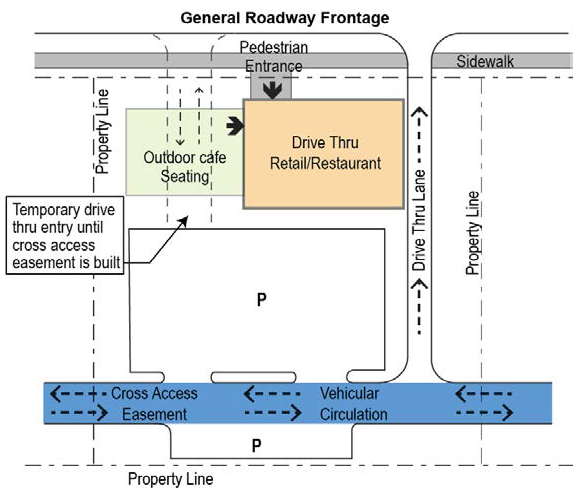
Slip lane cross-access connectivity example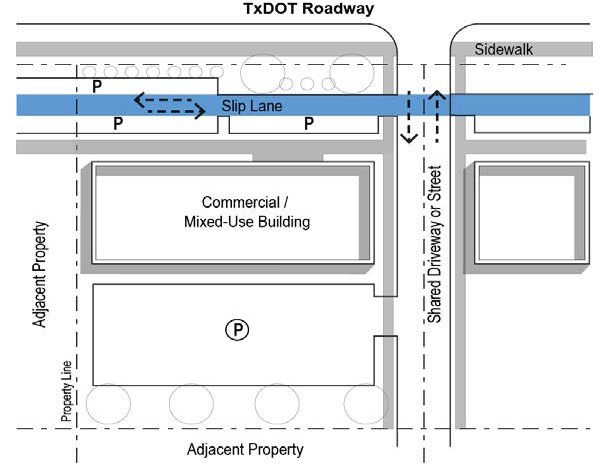
(Ord. No. 1407, § 2, 8-15-2017; Ord. No. 1682, § 2, 8-16-2022)
Sec. 106.06.43 - Off-street parking standards—Residential districts.
(a)
Parking to be located on lot. Required off-street parking shall be provided on the same site as the use it is to serve.
(b)
Concrete parking standard. All required vehicle parking shall be on a suitably paved parking surface. All driveways and approaches to parking spaces shall be similarly paved, except in the AG Agricultural and SF-RE Ranchette Estate Districts.
(c)
Heavy load vehicles prohibited. No required parking space, garage, carport, or other automobile storage space shall be used for the storage of any heavy load vehicle (see section 106.01.15, "other zoning ordinance definitions").
(Ord. No. 1407, § 2, 8-15-2017)
Sec. 106.06.44 - Off-street parking standards—Nonresidential and multifamily districts.
(a)
Lighting provided in parking lots. To prevent nuisance or unsafe situations, parking lots serving multiple-family residential developments shall provide sufficient lighting for safe movement to and from vehicles. All parking area lighting shall be designed and operated so as not to reflect or shine on adjacent properties.
(b)
Emergency access. For safety and firefighting purposes, free access through to adjacent nonresidential parking areas shall be provided in accordance with the following:
(1)
Location. Fire lanes shall be provided in all multiple-family, manufactured home, and nonresidential developments, and in some single-family attached, as required by the adopted fire code of the town and the subdivision ordinance.
(2)
Dimension. Fire lanes shall be a minimum width of 24 feet of paving, and shall have a minimum inside turning radius at curves of 30 feet, or as required by the adopted fire code of the Town of Little Elm.
(3)
Vertical clearance. The minimum overhead vertical clearance over fire lanes shall be 14 feet for a linear distance of 50 feet on each side (in front of and behind, as a fire apparatus would traverse underneath) of any overhead structure, such as a canopy, roof overhang or vertical height control device.
(c)
Concrete parking standard. All off-street parking, maneuvering, loading and storage areas shall be constructed of concrete in accordance with the parking lot paving requirements in the town's Code of Ordinances and with any other applicable state or local requirements.
(d)
Entrances. Entrances to thoroughfares shall consist of decorative pavement at a width matching the required 20-foot landscape buffer plus the width of the crosswalk.
(e)
Parking space markings. Parking spaces shall be permanently and clearly identified by stripes, buttons, tiles, curbs, barriers, or other approved methods. Non-permanent type marking, such as paint, shall be regularly maintained to ensure continuous clear identification of the space.
(f)
Curb stops. All parking and loading spaces, and vehicle sales areas on private property shall have a vehicle stopping device, such as a curb or wheel stop at the perimeter of parking lots, installed so as to prevent encroachment of motor vehicles in any required landscaped areas, to prevent vehicles from damaging buildings, to protect public and/or private utility structures or facilities, and to prevent parked vehicles from overhanging into a public right-of-way line, a public or private sidewalk, or into adjacent private properly. An extra-wide walkway on private property may be permitted so as to allow encroachment of vehicle overhang while maintaining an unobstructed four-foot minimum walkway width. The requirement shall apply only where spaces are adjacent to the walks, right-of-way, and required landscaping. Parking shall not be permitted to encroach upon the public right-of-way in any case. In all nonresidential and multiple-family zoning districts, the perimeter of all parking lots and driveways shall be provided with ribbon concrete curbs or other means to control traffic, unless an approved landscape swale system has been utilized between parking rows and at the perimeter of parking lots to allow free water run-off into landscaped areas. Curb stops shall be used to prohibit vehicle encroachment into landscaped areas and/or walkways when swales are used.
(g)
On-street parking adjacent to multifamily development. When a public roadway bisects a multiple-family residential development, no on-street parking shall be allowed unless the following conditions apply:
(1)
The planned development district regulations specifically call out on-street parking as part of the required parking;
(2)
The public roadway is designed for on-street parking and is of sufficient right-of-way width to accommodate parking and travel lanes, as determined by the town engineer;
(3)
The on-street parking includes landscaped bump-outs a minimum of every three parking spaces;
(4)
Sufficient spaces for visitor parking are provided on site;
(5)
Crosswalks are provided with protective bump-outs at sidewalk corners and are either painted or constructed of stamped concrete to afford a high degree of visibility for pedestrians, bikers and drivers; and
(6)
The director has approved the overall parking plan.
(h)
Location of refuse storage facilities. Refuse storage facilities placed in a parking lot shall not be located in a designated parking or loading space. Each refuse facility shall be located so as to facilitate pickup by refuse collection agencies, with a minimum of 40 feet of clear backing space, and shall be appropriately screened, as required by section 106.06.31(e)(5), "screening."
(i)
Handicapped parking spaces. Parking space(s) for persons with disabilities and other associated provisions shall be provided according to building codes, state laws, and requirements of the Americans with Disabilities Act (ADA). Parking spaces for persons with disabilities shall be as close as possible to the entryway of the appropriate structure, and shall be appropriately and clearly marked with ADA standard signage and pavement markings.
(j)
Prohibited activities in parking lots. In all nonresidential and multiple-family zoning categories, designated parking and loading areas shall not be used for the repair, storage, dismantling or servicing (except for normal maintenance of a private vehicle) of vehicles or equipment, or for the storage of materials or supplies, or for any other use in conflict with the designated parking and loading areas, including, but not limited to, advertising or open storage of raw materials.
(k)
Maintenance. To ensure that all requirements set forth in this section are carried forward, it will be the responsibility of the owner of the parking area to adequately maintain the facility, including but not limited to timely repainting parking space markings and repair of pavement. All off-street parking areas shall be kept free of trash, debris, vehicle repair operation or display and advertising uses. At no time after initial approval of the parking area layout can changes be made in the location and number of provided spaces without approval of the city manager or his designee.
(l)
Infrastructure for electric charging stations. Infrastructure for one electric charging station shall be provided for every 25 required parking spaces.
(m)
New construction. All new construction shall have parking developed to the side or rear of the building, with cross-access connectivity between lots to access parking from side streets.
(1)
Temporary driveways may be used to provide access to side and rear parking lots while cross-access is being established.
(2)
Front parking may be accommodated by using slip lanes along TxDOT highways.
i.
If a slip lane is planned, there shall be no more than one row of head-in parking on either side of the drive aisle (one row along the right-of-way and one row along the building).
ii.
If a slip lane is planned, screening of the front parking is required using evergreen screening vegetation, at least 36 inches in height, at the time of planting, a low fence or wall, no more than 42 inches in height, or a combination of both.
Frontage of a building on a corner lot and points of access to the building.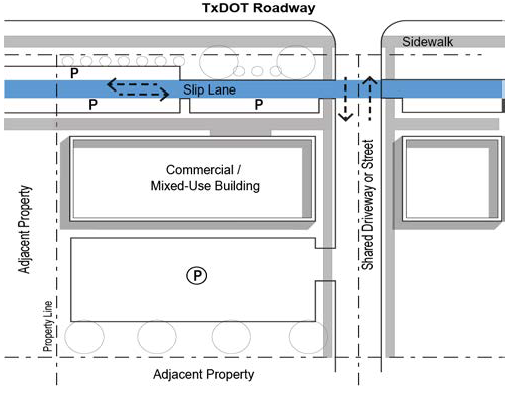
(Ord. No. 1407, § 2, 8-15-2017; Ord. No. 1527, § 2, 10-15-2019; Ord. No. 1682, § 2, 8-16-2022)
Sec. 106.06.45 - Parking requirements per land use.
(a)
Computation of parking spaces. In computing the number of parking spaces required for any building or development, the following rules shall govern:
(1)
The term "floor area" means the gross floor area of the specific use.
(2)
Where fractional spaces result, the parking spaces required shall be constructed to be the next higher whole number.
(3)
The parking space requirement for a use not specifically mentioned herein shall be the same as required for a use of similar nature, subject to review and approval by the director.
(b)
Compliance upon changes of use. Whenever a building or use is changed or enlarged in floor area, number of employees, number of dwelling units, seating capacity, or otherwise, which creates a need for an increase in the number of existing parking spaces, such spaces shall then and thereafter comply with the parking requirements set forth herein.
(c)
Off-street parking. When a building or structure is constructed or expanded, off-street parking shall be provided, per the following table:
(d)
Parking penalty. Where parking exceeds the minimum number of required spaces by more than ten percent, landscaping of parking areas shall be increased so that planting islands shall not be spaced greater than every ten spaces rather than the required 12 spaces.
(Ord. No. 1407, § 2, 8-15-2017; Ord. No. 1527, § 2, 10-15-2019; Ord. No. 1745, § 2, 1-16-2024)
Sec. 106.06.46 - Stacking standards.
(a)
Minimum size. A stacking space shall be an area on a site measuring ten feet by 20 feet with direct forward access to a service window or station of a drive-through facility which does not constitute space for any other circulation driveway, parking space, escape lane or maneuvering area.
(b)
Distinctive markings. All stacking spaces shall be marked with stamped or stained concrete to differentiate the spaces from drive aisles or parking spaces.
(c)
Escape lane. If the director deems that an escape lane is necessary by to allow vehicles to get out of stacking lane in the event of a stalled vehicle, emergency, or accidental entry, it shall be of at least eight feet in width and shall have a negotiable geometric design.
(d)
Minimum number of stacking spaces per land use. Off-street stacking requirements for drive-through facilities shall be as follows:
(Ord. No. 1407, § 2, 8-15-2017; Ord. No. 1745, § 2, 1-16-2024)
Sec. 106.06.47 - Off-street loading spaces.
(a)
Loading and unloading of goods/merchandise.
(1)
Loading spaces required. All retail, commercial, and industrial structures in excess of 5,000 square feet of building area shall provide and maintain off-street facilities for the loading and unloading of merchandise and goods within a building or on the lot or tract. The loading space(s) shall be stained, painted or stamped so that the area is easily identified.
(2)
Loading space minimum size. Such off-street loading space or truck berth shall consist of a minimum area of ten feet by 45 feet, and such spaces or berths shall be provided in accordance with the following schedule:
(3)
Siting and maneuverability. All drives and approaches shall provide adequate space and clearances to allow for the maneuvering of trucks off-street. Each site shall provide a designated on-site maneuvering area for trucks. Such off-street loading space may be adjacent to, but not on any portion of, a public alley or private service drive, or it may consist of a truck berth within the structure.
(4)
Prohibited loading locations.
a.
Loading docks or service or delivery entrances shall not be constructed facing any public street, and shall not be visible from any public street.
b.
Loading docks that are adjacent to a residential use or district shall be set back from the adjacent residential district boundary by a distance of at least 60 feet.
c.
Loading docks shall be designed and constructed so as to enclose the loading operation on three sides, in order to reduce the effects of the noise of the operation on any adjacent residences.
(5)
Exceptions. In instances where three or more sides of the building face dedicated streets, loading berths and apron spaces shall be located at the rear or side of the building. These loading areas shall be screened from abutting streets as follows:
a.
A combination of permanent architectural and landscape elements such as walls, berms, trees and shrubs shall be placed so as to distract, soften or interrupt the view of the casual observer. These elements shall be installed along approximately 50 percent of the affected property line;
b.
Screening shall be to the height of the top of the dock door but no greater than 12 feet above the truck dock apron;
c.
When viewed from a perpendicular angle from the street, the truck berths shall be screened completely, except for driveway openings; and,
d.
The loading dock or service bay doors shall not be allowed on any portion of a front wall facing FM 423 or Eldorado Parkway, on a side or rear wall within 100 feet of FM 423 or Eldorado Parkway right-of-way, or within 60 feet of any front property line along FM 423 or Eldorado Parkway.
(b)
Loading and unloading of children.
(1)
Purpose. In order to ensure the safety of children entering and exiting day care centers or other places where loading and unloading to automobiles and/or buses occurs, the following regulations shall apply.
(2)
Designated loading/unloading spaces. Schools, day care centers, and similar child training and care establishments shall provide loading and unloading parking spaces as close to the front door of the establishment as is practical. These spaces shall be located on an internal drive that does not block the fire lane or other businesses' vehicular movement and shall be stained, painted or stamped so that the area is easily identified.
(3)
Drop-off lane. Kindergartens, elementary schools, day schools, and similar child training and care facilities shall provide a separate, concrete-paved loading and unloading lane area adjacent to an entrance that allows drivers to approach the entrance and, without exiting the vehicle, the staff will assist in loading and unloading of the children in and out of the vehicle. This drop-off lane should be one-way and with sufficient stopping points to allow a minimum of two cars to unload simultaneously. In addition, the drop-off lane shall be constructed to allow vehicles to exit the lane without impeding the movement of other vehicles using other drive aisles or causing a safety hazard with parents and/or children entering or exiting the building.
(Ord. No. 1407, § 2, 8-15-2017)
Sec. 106.06.48 - Bicycle parking.
Bicycle
parking is required in nonresidential districts in order to encourage the use of bicycles by providing convenient and secure places to park bicycles.
(a)
Bicycle parking per vehicle parking spaces. Bicycle parking shall be provided based on at least one standard bike rack* for each development or one bike rack per 100 car parking spaces required, whichever is greater, unless otherwise approved by the director. No more than five bicycle racks shall be required per development.
(b)
Bicycle parking location. Required bicycle parking should be located within 50 feet of a public entrance to the building. Bicycle parking may be provided within a building, but the location must be easily accessible by the public.
(c)
Bicycle parking to be included on site plans. Site plans shall include the location of all proposed bike racks, which are subject to the streetscape architectural standards of the zoning ordinance
* A standard bicycle rack holds six bicycles.
(Ord. No. 1407, § 2, 8-15-2017)
Sec. 106.06.51 - Lighting administration.
(a)
Purpose and intent. The use of outdoor lighting is often necessary for adequate nighttime safety and utility, but common lighting practices can also interfere with other legitimate public concerns. Principles among these concerns are:
(1)
The degradation of the nighttime visual environment by production of unsightly and dangerous glare;
(2)
Unnecessary waste of energy and resources in the production of excessive or wasted light;
(3)
Interference in the use or enjoyment of property which is not intended to be illuminated at night; and
(4)
The loss of the often-neglected scenic view of the night sky due to increased urban sky-glow.
(b)
Applicability.
(1)
New uses, buildings and additions. All proposed new land uses, developments, buildings, structures, or building additions of 25 percent or more in terms of additional dwelling units, gross floor area, seating capacity, or other units of measurement specified herein, either with a single addition or cumulative additions subsequent to the effective date of this provision, shall meet the requirements of this Code for the entire property. For all building additions of less than 25 percent cumulative, the applicant shall only have to meet the requirements of this Code for any new outdoor lighting provided.
(2)
Change of use/intensity. Except as otherwise provided within, whenever the use of any existing building, structure, or premises is changed to a new use, or the intensity of use is increased through the incorporation of additional dwelling units, gross floor area, seating capacity, or other units of measurement specified herein, and which change of use or intensification of use creates a need for an increase in the total number of parking spaces of 25 percent or more, either with a single change or cumulative changes subsequent to the effective date of this provision, then all outdoor lighting sources shall meet the requirements of this Code for the entire property, to the maximum extent possible as determined by the director. For changes of use or intensity which require an increase in parking of less than 25 percent cumulative, the applicant shall only have to meet the requirements of this Code for any new outdoor lighting provided.
(c)
Nonconformity.
(1)
Whenever a nonconforming use, structure or lot is abandoned for a period of 180 consecutive days and then changed to a new use according to the requirements of section 106.05.04, "new and unlisted uses," of the zoning ordinance, then any existing outdoor lighting shall be reviewed and brought into compliance as necessary for the entire building, structure or premises, to the maximum extent possible as determined by the director.
(2)
No outdoor lighting fixture or use which was lawfully installed or implemented prior to the enactment of this Code shall be required to be removed or modified except as expressly provided herein; however, no modification or replacement shall be made to a nonconforming fixture unless the fixture thereafter conforms to the provisions of this Code, except that identical lamp replacement is allowed.
(3)
In the event that an outdoor lighting fixture is abandoned or is damaged to the point of requiring repairs for safe operation, the repaired or replacement fixture shall comply with the provisions of this Code.
(Ord. No. 1407, § 2, 8-15-2017)
Sec. 106.06.52 - Lighting calculations and definitions.
(a)
General calculations.
(1)
Computation of illumination. For the purpose of this Code, the luminance shall be computed by the formula: L (d 2 + h 2)
Where "L" is the fixture candlepower in candelas in the direction of the point from which the calculations are to be made, "d" is the shortest distance in feet measured horizontally from the property line to a point directly under the luminaire, and "h" is the height of the luminaire at five feet above the ground.
(2)
Computation data. Computation methods shall consist of an Illuminating Engineering Society of North America (IESNA) accepted method, using certified photometric data furnished by the fixture manufacturer, lamp manufacturer, photometric laboratory, or other reliable authority satisfactory to the town. Computations shall be based on new, properly seasoned lamps, new and clean fixtures, and at rated voltage and wattage, with ballasts, lenses, shields, diffusers, and other appurtenances in place, and with proper regard taken for mounting height, relative elevation, natural and manmade objects and industry standard maintenance factors.
(3)
Metering equipment. Lighting levels shall be measured in footcandles with a direct reading portable light meter.
(4)
Method of footcandle measurement. The meter sensor shall be not more than six inches above ground level in a horizontal position. The reading shall be taken only after the cell has been exposed long enough to provide a constant reading.
(b)
Lighting definitions. As used in this Code, unless the context clearly indicates otherwise, certain words terms, and phrases shall mean the following:
Bulb or lamp means the source of electric light. To be distinguished from the whole assembly, lamp is used to denote the bulb and its housing.
Candela means the unit of luminous intensity in a given direction. It is commonly considered one candlepower.
Class 1 lighting means all outdoor lighting used for, but not limited to, outdoor sales or eating areas, assembly or repair areas, advertising and other signs, recreational facilities and other similar applications where color rendition is important.
Class 2 lighting means all outdoor lighting used for, but not limited to, illumination for walkways, roadways, equipment yards, parking lots and outdoor security where general illumination of the grounds is the primary concern.
Class 3 lighting means any outdoor lighting used for decorative effects including, but not limited to, architectural illumination, flag monument lighting, and illumination of trees or other features.
Direct illumination means illumination resulting from light emitted directly from a lamp, luminary or reflector, not light diffused through translucent signs or reflected from other surfaces such as the ground or building facades.
Director means the director of development services for the Town of Little Elm or his or her designated representative.
Floodlight means a luminaire designed to project its light in a well-defined area. It is directional in character.
Floodlight beam means the angular spread of light between two orthogonal planes each of which equal ten percent of the maximum candlepower within the beam.
Footcandle means the amount of illumination provided by one lumen uniformly distributed on one square foot of surface.
Fixture means the assembly that holds the lamp in a lighting system. It includes the elements designed to give light output control, such as a reflector (mirror) or defractor (lens), the ballast, housing and the attachment parts.
Full cutoff luminaire means a luminaire that allows no direct light above a horizontal plane, from the lowest light emitting part of such device, in its mounted form. This applies to all lateral angles around the luminaire.
Fully shielded fixture means that fixtures are shielded in such a manner that light rays emitted by the fixture, either directly from the lamp or indirectly from the fixture, are projected below a horizontal plane running through the lowest point on the fixture where light is emitted.
Glare means direct lighting emitted from a luminaire that causes reduced vision or temporary blindness, especially to motorists.
High pressure sodium (HPS) means a high-intensity discharge lamp where radiation is produced from sodium vapor at relatively high partial pressures (100 tore). HPS is essentially point source light.
Horizontal plane means a line horizontal to the lowest point on the fixture from which light is emitted.
Illumination means the density of the luminous flux (lumens) incident on a surface. It is the quotient of the luminous flux divided by the area of the surface, expressed in footcandles.
Incandescent lamp means any lamp that produces light by heating a filament by means of an electric current.
Installed means the attachment, or assembly fixed in place, whether or not connected to a power source, or any outdoor light fixture.
Light source means a device (such as a lamp) which produces visible energy as distinguished from devices or bodies which reflect or transmit light such as a luminaire.
Light trespass means light extending outside the boundary of property for which it was originally intended or needed. Also referred to as spillover light or obtrusive light.
Low pressure sodium (LPS) means a discharge lamp where the light is produced by radiation from sodium vapor at a relatively low partial pressure (about 0.001 tore). LPS is a "tube source" monochromatic light.
Lumen means the quantity of luminous flux intercepted by a surface of one square foot, all points of which are one foot from a uniform source of one candela.
Luminaire means a device or fixture containing a light source and means for directing and controlling the distribution of light from the source.
Luminance means the luminous intensity per unit projected area of a given surface viewed from a given direction for purposes of this Code expressed in candelas divided by distance squared.
Maintenance (factor) means 70 percent footcandles maintained for illuminating devices. Check number.
Mercury lamp means a high intensity discharge lamp where light is produced by radiation from mercury vapor.
Metal halide lamp means a high intensity discharge lamp where light is produced by radiation from metal halide vapor.
Mounting height means the maximum height of the pole from ground level. The lighting fixture shall not exceed the height of the pole.
Motion sensing security lighting means a fixture designed, and properly adjusted, to illuminate an area around a residence or other building by means of switching on a lamp when motion is detected inside a specific perimeter, and switching the lamp off when the detected motion ceases.
Multi-class lighting means any outdoor lighting used for more than one purpose, such as security and decoration, when those purposes fall under the definitions for two or more lighting classes as defined for Class 1, 2 and 3 lighting above.
Net acreage means the remaining ground area of a parcel after deleting all portions for proposed and existing public rights-of-way and undeveloped area.
Outdoor light fixtures means all outdoor illuminating devices, reflective surfaces, lamps and other devices, either permanently installed or portable, which are used for illumination or advertisement. Such devices shall include, but are not limited to, searchlights, spotlights and floodlights for:
• Buildings and structures;
• Recreational areas;
• Parking lot lighting;
• Landscape and architectural lighting;
• Billboards and other signs (advertising or other);
• Street lighting;
• Product display area lighting;
• Building overhangs and open canopies; and
• Security lighting.
Outdoor recreation facility means an area designed for active recreation, whether publicly or privately owned, including but not limited to parks, baseball diamonds, soccer and football fields, golf courses, tennis courts and swimming pools.
Photometric means quantitative measurements of light levels and distribution.
Security lighting is lighting designed to illuminate a property or grounds for the purpose of visual security. This includes fully shielded lighting designed to be left on during nighttime hours as well as motion sensing lighting fixtures.
Temporary lighting means lighting which does not conform to the provisions of this Code and which will not be used for more than a single 45-day period within a calendar year. Temporary lighting is intended for uses which by their nature are of limited duration (e.g. holiday decorations, civic events, or construction projects).
Total outdoor light output means the maximum total amount of light, measured in lumens, from all outdoor light fixtures on a property. For lamp types that vary in their output as they age (such as high pressure sodium and metal halide), the initial output, as defined by the manufacturer, is the value to be considered.
Unshielded fixture means a fixture that allows light to be emitted above the horizontal directly from the lamp or indirectly from the fixture or a reflector.
Watt is the unit used to measure the electrical power consumption (not the light output) of a lamp.
(Ord. No. 1407, § 2, 8-15-2017)
Sec. 106.06.53 - Lighting regulations.
(a)
Outdoor lighting types.
(1)
Full cutoff luminaries over 15 watts shall be required in all outdoor lighting installations unless permitted below. Lamp types shall be prohibited or permitted as specified below:
(2)
All light fixtures, including security lighting, except street lamps, shall be aimed or shielded so that the direct illumination shall be confined to the property boundaries of the source. Particular care is to be taken to ensure that the direct illumination does not fall onto or across any public or private street or road. Motion sensing lighting fixtures shall be properly adjusted, according to the manufacturer's instructions, to turn off when detected motion ceases.
(3)
Class 1 lighting, including but not limited to, sales, service, commercial, assembly, repair, maintenance, and industrial areas, may only continue in operation until 10:00 p.m., or for as long as the area is in active use.
(4)
Class 2 lighting shall have no time restrictions except as specified by the town council for new projects as specified herein.
(5)
Class 3 lighting, except for flag pole lighting, shall be extinguished after 10:00 p.m. or when the business closes, whichever is later, except that low-wattage holiday decorations may remain on all night from November 1 to January 31.
(6)
Multi-class lighting, except for security lights, must conform to the time limitations of the strictest class.
(7)
Lighting for all outdoor athletic fields, courts, tracks or ranges shall be subject to approval of the town council. All events shall be scheduled so as to complete all activity by 10:00 p.m. Illumination shall be permitted after 10:00 p.m. only to conclude a scheduled event that was unable to conclude before 10:00 p.m. When the proposed light levels exceed the allowed limits, the installation shall be designed to achieve no greater than the minimum illumination levels for sports lighting set forth in "Sports and Recreational Area Lighting," RP-6-01, published by the IESNA. Lighting shall meet cutoff standards so that light is primarily aimed at and directed to the activity area.
(8)
Outdoor lighting shall be constructed and installed in a manner consistent with this Code and shall be located so as not to produce glare or direct illumination across the building property line or onto rights-of-way and private streets.
(9)
Lighting used for all externally illuminated signs shall conform to all restrictions of this Code and shall be fully shielded and oriented toward the ground and not toward the sky.
(10)
Outdoor light fixtures used to illuminate flags, statues, or any other objects mounted on a pole, pedestal, or platform shall use a very narrow cone of light for the purpose of confining the light to the object of interest and minimize spill-light and glare. Compliance with this provision shall be subject to approval by the director.
(11)
Building facades and architectural features of buildings may be floodlighted when the following conditions are met:
a.
Floodlight fixtures are equipped with shields and are located so as to limit the fixture's direct light distribution to the facade or feature being illuminated;
b.
The configuration of the floodlight installation shall block all view to the floodlight fixture's lamps from adjacent properties; and
c.
The maximum luminance of any floodlighted surface does not exceed the footcandles specified in the IESNA Lighting Handbook for floodlighting surfaces.
(b)
Illumination levels. The maximum outdoor illumination level on the subject property shall not exceed 20 footcandles at any one point, except where stated and allowed below.
(1)
Townhouse and multifamily residential uses should average no more than three footcandles, with a maximum of ten footcandles, and a minimum of one footcandle.
(2)
Retail uses should average no more than six footcandles, with a maximum of 15 footcandles, and a minimum of one footcandle.
(3)
Parking areas should average no more than one and one-half footcandles, with a maximum of ten footcandles, and a minimum of one-half footcandle.
(4)
Lighting under canopies (such as service stations) shall not exceed 30 footcandles. All luminaries shall be flush with the lower surface of canopies and utilize flat glass or plastic covers.
(5)
Lighting for car dealerships shall not exceed 30 footcandles within the front yard. The remainder of the property cannot exceed 20 footcandles.
(c)
Spill-over. The limit of illumination on neighboring property emanating from an establishment shall be based on the zoning and/or use of the neighboring property. Maximum computed maintained and maximum measured footcandles at the neighboring property line shall not exceed:
(1)
One-quarter footcandle for single-family residential and duplex districts.
(2)
One-half footcandle for multifamily and agricultural districts.
(3)
Three footcandles for commercial districts and rights-of-way.
(4)
Exception. Illumination at interior property lines on contiguous lots in a multitenant, nonresidential development may exceed the above criteria when necessary to provide constant lighting of adjoining parking areas, fire lanes and interior access roadways, as determined by the director.
(5)
When a dispute arises regarding the district/use of an adjoining property and the allowed "spill-over," the director's decision shall be binding.
(d)
Pole heights. Lighting standards (i.e. poles) shall be sized in such a manner that the top of any luminary does not exceed 30 feet above the adjacent grade. Lighting located in industrial zoned districts may be 35 feet in height. Where within 100 feet of a residential district or use, the maximum allowed pole height is 20 feet.
(e)
Infrared security lighting. Such lighting is permitted in all zones with the following restrictions:
(1)
Fixed lights must be fully-shielded.
(2)
Moveable lights, such as spot lights attached to infrared-sensitive cameras, must be mounted such that the lights cannot be directed higher than 20 degrees below the horizontal, measured from the center of the light beam.
(f)
Prohibited lighting. The following lighting is prohibited. No owner or occupant of land shall permit any of the following conditions to exist:
(1)
An unshielded light source, including bare bulbs, above 15 watts, except for temporary holiday lighting;
(2)
"Cobra head" type light fixtures having dished or "drop" lenses or refractors which house other than incandescent light sources;
(3)
Light sources or luminaries are prohibited in buffer areas and within required setback yard areas except on pedestrian walkways, hike and bike trails, and internal access drives when needed for safety;
(4)
The operation of searchlights, strobes, flickering, flashing, or pulsating lights;
(5)
The use of partial cutoff light source;
(6)
The use of a drop lens; or
(7)
Any combination of lighting that creates a nuisance, as determined by the director.
(g)
Permitting.
(1)
Single-Family residential and duplex development are not required to submit lighting plans.
(2)
Sufficient information shall be submitted to evaluate the photometric criteria outlined herein as part of the site plan submittal whenever a person is required to obtain a building or electrical permit for outdoor lighting or signage, a specific use permit, subdivision approval or any development plan approval by the town, including all town projects, or whenever a person requests annexation or rezoning. All applications may be subject to review and action by the town council at the discretion of the director or the town council.
(3)
Photometric plans shall include the following:
a.
A site exhibit, drawn to scale, indicating the proposed location of all outdoor lighting fixtures;
b.
A description of each illuminating device, fixture, lamp, support and shield. This description may include, but is not limited to, manufacturer's catalog cuts and drawings (including sections where required), lamp types and lumen outputs; and the mounting height of the light;
c.
Photometric data showing illumination levels (average, minimum, and maximum) on the property, at the property line and just beyond the property line, as well as other data such as that furnished by manufacturers or similar data showing the angle of cut off for light emissions;
d.
The height of all proposed poles; and
e.
Such other information as the director may determine is necessary to ensure compliance with this Code.
(4)
Prior to final approval and issuance of a certificate of occupancy, the applicant shall submit to the planning division a photometric plan, stamped by a certified engineer that illustrates that the proposed lighting is in compliance with this Code.
(5)
Should any outdoor lighting fixture or type of light source be changed therein after the building permit has been issued, a change request must be submitted to the building official for approval together with the adequate information to ensure compliance with this Code, which must be received and approved prior to substitution.
(6)
If the director determines that the proposed lighting does not comply with this Code, the permit shall not be issued or the plan approved.
(Ord. No. 1407, § 2, 8-15-2017)
Sec. 106.06.54 - Lighting exemptions and variances.
(a)
Temporary exemptions.
(1)
The director may grant a permit for temporary lighting if he or she finds all of the following:
a.
The purpose for which the lighting is proposed is not intended to extend beyond 45 days;
b.
The proposed lighting is designed in such a manner as to minimize light pollution as much as is feasible;
3.
The proposed lighting will comply with the general intent of this Code; and
4.
The permit will not conflict with the public interest.
(2)
The director shall rule on the application within five business days from the date of submission of the request and notify the applicant in writing of his or her decision. The director may grant one renewal of the permit for an additional 30 days if he or she finds that, because of an unanticipated change in circumstances, a renewal would not be in conflict with the public interest. The director is not authorized to grant more than one temporary permit and one renewal for the same property within one calendar year. Any person aggrieved by a decision of the director under this subsection may appeal the decision to the town manager, if, within five days of the date of director issuing his or her opinion, the applicant provides written notice of appeal to the town manager. The decision of the town manager shall be final.
(3)
Temporary lighting permits are not required for typical holiday lighting.
(b)
Variances.
(1)
A variance may be permitted by the board of adjustment from the regulations set forth in this Code. A person seeking a variance from the express terms of this section shall demonstrate the existence of a hardship which would exempt the applicant from compliance with the regulation in question. Such variances shall only be allowed as provided by the Town of Little Elm Zoning Ordinance.
(2)
The provisions of this Code are not intended to prevent the use of any design, material, or method of installation or operation not specifically prescribed by this Code, provided any such alternate has been approved by the town council.
(3)
The town council may approve any such proposed alternate provided that such alternate:
a.
Provides at least equivalence to the applicable specific requirements of this Code; and
b.
Is otherwise satisfactory and complies with the intent of this Code; and
c.
Does not create a nuisance as defined in this Code.
(Ord. No. 1407, § 2, 8-15-2017)
Sec. 106.06.61 - Performance standards, generally.
In all zoning districts, any use indicated as a permitted use shall conform in operation, location, and construction to the performance standards hereinafter specified. In the LI Light Industrial Zoning District, HI Heavy Industrial Zoning District, and PD Planned Development Zoning District with underlying zoning of industrial, in addition to the permitted uses, there shall be permitted any other manufacturing, processing, fabrication, packing, or storage use, except those requiring specific use permits, which conform in operation, location, and construction to the performance standards hereinafter specified for noise, smoke, and particulate matter, odorous matter, fire, or explosive hazard material, toxic and noxious matter, vibration, glare, and open storage.
(Ord. No. 1407, § 2, 8-15-2017)
Sec. 106.06.62 - Noise.
(a)
General noise prohibition. No person shall make, continue, or cause to be made or continued:
(1)
Any unreasonably loud, disturbing, and unnecessary noise; or
(2)
Any noise which unreasonably disturbs, injures, or endangers the comfort, repose, health, peace, or safety of reasonable persons of ordinary sensitivity; or
(3)
Any noise which is so harsh, prolonged, unnatural, or unusual in time or place as to occasion unreasonable discomfort to any persons within the neighborhood from which said noise emanates, or as to unreasonably interfere with the peace and comfort of neighbors or their guests, or operators or customers in places of business, or as to detrimentally or adversely affect such residences or places of business.
(b)
Factors for determination. Factors considered in determining whether a sound is unreasonably loud and raucous include, but are not limited to, the following:
(1)
The proximity of the sound to sleeping facilities, whether residential (homes) or commercial (hotels);
(2)
The land use, nature, and zoning of the area from which the sound emanates and the area where in which it is received or perceived;
(3)
The time of day or night the sound occurs;
(4)
The duration of the sound; and
(5)
Whether the sound is recurrent, intermittent, or constant.
(c)
General noise definitions. For the purposes of this section, the following words and phrases shall have the meanings ascribed to them by this section:
"A" level. The total sound level of all noise as measured with a sound level meter using the "A" weighting network. The unit of measurement is dBA.
Decibel (dBA). A unit of measurement for sound pressure level at a specified location.
(d)
Types of noises. The following list of noises that may cause offense to a person of reasonable sensibilities is not considered comprehensive, but should be used for those uses listed in table Q and a reference for unlisted uses of a similar nature. Refer to table Q, "Maximum Noise Levels," for specific maximum noise levels per activity, type, or venue. Note that any type of noise production that has specific hours of operation are also subject to the "all other noises" maximum noise levels during hours outside the listed hours of operation.
(1)
Construction activities. Any construction, grading, or use of heavy machinery, including but not limited to the activities of erection, excavation, demolition, alteration or repair work on any building, is prohibited at any time other than between the hours of 7:00 a.m. and 9:00 p.m. During the allowed hours, the operation must adhere to the maximum noise levels listed in table Q. However, the director may issue a town special event permit to extend the hours of operation and/or the maximum noise level for a limited time for such work in case of urgent necessity and in the interest of public safety and convenience.
(2)
Loading and unloading activities. The creation of any loud and excessive noise in connection with the loading or unloading of any vehicle or the opening or destruction of bales, boxes, crates or containers is prohibited at any time other than between the hours of 7:00 a.m. and 9:00 p.m. During the allowed hours, the loading and unloading activities must adhere to the maximum noise levels listed in table Q.
(3)
Big box stores. Stores or facilities greater than 50,000 square feet must adhere to the maximum noise levels listed in table Q for the timeframes listed.
(4)
Outdoor music event. At any outdoor music event, it shall be unlawful for any person or group sponsoring the event to make, cause, allow, or permit any noise that exceeds those listed in table Q when measured at the established perimeter of the event. Exceptions to this regulation for extended hours or increased sound levels may be allowed by the application for and approval of an annual outdoor music license to be approved by the director.
(5)
Music. The playing of any phonograph, television, radio or any sound-emitting instrument or device in such a manner or with such volume as to annoy or disturb the quiet, comfort, or repose of persons of ordinary sensibilities inside any dwelling, hotel or other type of residence or in or near a town building or park, is prohibited at any time.
(6)
Amplification. The use of any stationary loudspeaker, amplifier or musical instrument in such a manner or with such volume as to annoy or disturb the quiet, comfort, or repose of persons of ordinary sensibilities in the immediate vicinity of dwellings, hotels or other residences is prohibited at any time. Exceptions to this regulation may be allowed by the application for and approval of a town special event permit for a special event when the public interest will be served thereby.
(7)
Trash collection. Noise created by trash and/or recycling haulers within 300 feet of residential zoning is prohibited at any time other than between the hours of 7:00 a.m. and 9:00 p.m. During the allowed hours, the trash collection activities must adhere to the maximum noise levels listed in table Q.
(8)
Lawn care (Blowers, lawn mowers and similar devices). In residential areas, the operation of any noise-creating blower, power fan, mower, or any internal combustion engine, the operation of which exceeds those listed in table Q, is prohibited at any time. During the allowed hours listed in table Q, the operation must adhere to the maximum noise levels listed in table Q.
(9)
Ice cream vendors. Noise from bells or music boxes used on vehicles operated by ice cream and snow cone vendors to produce jingles or music to attract children as patrons that exceed those listed in table Q, are prohibited at any time. During the allowed hours listed in table Q, the operation must adhere to the maximum noise levels listed in table Q.
(10)
Adjacent to schools and hospitals. The creation of any excessive noise on any street adjacent to any school in session, or adjacent to any hospital, which unreasonably interferes with the operation of such institution is prohibited at any time; provided, however, that conspicuous signs are displayed or other evidence is available indicating school or hospital quiet zones.
(11)
Steam-produced noise. The blowing of any steam whistle attached to any stationary boiler or the blowing of any other loud or far-reaching steam whistle within the corporate limits is prohibited at any time, except to give notice of the time to begin or stop work or as a warning of danger.
(12)
Compressed air noise. The use of any mechanical device operated by compressed air is prohibited at any time unless the noise created is effectively muffled and reduced.
(13)
Animals and birds. The keeping of any animal or bird which, by causing frequent or long, continued noise, shall disturb the comfort and repose of any person of ordinary sensibilities in the immediate vicinity is prohibited at any time. Each and every person shall prevent each, any and every dog, cat, or bird upon any premises in the town controlled or used by such person from barking, howling, or producing other excessive noises for any period of more than three consecutive minutes, and from making any such noises as could reasonably be expected to disturb the peace, rest, quietude or comfort of any person of normal sensibilities.
(14)
Peddlers. The raucous shouting or crying of peddlers, hawkers and vendors which disturbs the peace and quiet of the neighborhood is prohibited at any time.
(15)
Public speaking. The loud speaking, preaching, orating or exhorting by any person upon any public street or sidewalk within the corporate limits of the town which disturbs the peace and quiet of the neighborhood is prohibited at any time.
(16)
Noise used to attract. The use of any drum, loudspeaker, or other instrument or device for the purpose of attracting attention, which causes crowds of people to block or congregate upon the sidewalks or streets near or adjacent thereto is prohibited at any time.
(17)
Vehicular noises. The excessive spinning of the tires of any motor vehicle, or the racing of its engine unnecessarily, or the running of a vehicle so out of repair that it emits loud or unnecessary grating, grinding or rasping noises, or the running of vehicles without proper mufflers, which disturbs the peace and quiet of a neighborhood is prohibited at any time.
(18)
Vibration. Using or causing the use of any device that creates any ground vibration which is perceptible without instruments at any point on or beyond the property boundary of the source if on private property or at 50 feet from the source if on public property; or the creation of vibration or bass reverberations at any time if it is perceptible inside a complaining person's residence, through the sense of touch or through visual observation of moving objects, or through the sense of hearing, is prohibited at any time. (See section 106.06.67, "vibration" for more information)
(e)
Maximum noise levels. The following chart illustrates the maximum noise levels allowed:
Note 1. All measurements of sound shall be taken at the property line, 5 feet above grade, using ASNI Type 2 or greater precision instrument.
Note 2. Noise measurement shall be a minimum of 30 seconds in duration - the highest decibel level during the 30-second measurement shall be used.
Note 3. Any noise occurring outside the hours of operation listed above shall be considered to be limited to the general "all other noises" category per the type of zoning district in which the noise emanates.
(f)
Exceptions.
(1)
Emergencies. Noise that is caused in the performance of emergency or public service, including police, fire and public utility operations, acting in the performance of lawful duties to protect the health, safety or welfare of the community.
(2)
Street or utility repairs. Noise as a result of repairs of utility structures which pose a clear and immediate danger to life, health, or significant loss of property.
(3)
Town service work. Noise created by power equipment being operated by town employees or utility company employees, during normal performance of duties.
(4)
Town events. Noise resulting by the use of amplification equipment or sounds created at official municipal functions, parades approved by the town, events sanctioned or sponsored by the town occurring at lakeside, or the use of amplification equipment in conjunction with functions or events for which a special event permit has been issued under the town's ordinances.
(5)
School activities. Noise resulting from reasonable activities conducted on public playgrounds and public or private school grounds, which are conducted in accordance with the manner in which such spaces are generally used, including, but not limited to, school athletic and entertainment events.
(6)
Horns or backing warning devices. Horns or other warning devices required by law.
(7)
Church bell. A person operating a bell for a religious activity.
(g)
Annual outdoor music license. A venue or activity that incorporates music or other loud noises (such as a pub or outdoor event venue) on an ongoing and basis shall apply for an annual outdoor music license. This license will ensure that the applicant is aware of and willing to comply with the maximum dBA levels listed on table Q and that specific sound mitigation efforts are being used to contain the sound.
(1)
Application. The application for an outdoor music venue or any other entity that expects, as part of normal operation, to include a high noise level requires the approval of an annual outdoor music license, issued at the discretion of the director.
(2)
Definition. Music venue/tavern/pub. Any physical building with or without an outside pavilion or patio that is anticipated to include a high noise level, including but not limited to musicians, entertainers, or loud-speakers. This type of business will utilize the annual outdoor music license application.
(3)
Regulations. The applicant for an annual outdoor music license shall provide the following information and is obligated to meet the standards stated in the application for the duration of the permit:
a.
Dates and times. The dates and timeframes for which the license is required.
b.
Noise level. The maximum dBA anticipated (not to exceed the maximum limit on table Q).
c.
Noise abatement measures. The noise abatement measures to be taken to limit the noise from extending beyond the property line, including but not limited to placement of speakers, noise containment structures, landscaping, and fencing.
d.
Signature of person in authority. The application must include the person or persons who are responsible for the operation of the venue and who will be liable for any penalties and/or fines due to exceeding the noise levels listed in the license application.
(4)
Approval. Once the director has determined that the noise levels requested for the particular location and venue are appropriate for the location requested, the date(s) and time(s) requested, will not place an unwarranted burden on the persons located in adjacent properties, and that the regulations listed in (3), above, have been met and will continue to be met, approval for the annual outdoor music license may be granted.
(h)
Special event permit.
(1)
Application. The application for an infrequent special event that includes high noise levels that may exceed those listed in table Q requires the approval of a special event permit, issued at the discretion of the director.
(2)
Definition. For the purposes of this chapter section, a "special event" is defined as any outside activity that may include noise levels that are anticipated to exceed those listed in table Q, including but not limited to musicians, entertainers, loud-speakers, fireworks, parades, charity events, races, or other similar functions or activities. This type of activity will use the special event permit application form and will only be considered for events that occur infrequently.
(3)
Regulations. The applicant for a special event permit shall provide the following information and is obligated to meet the standards stated in the application for the duration of the permit:
a.
Date and time. The date and timeframe for which the permit is required.
b.
Noise level. The maximum dBA anticipated (if greater than the stated maximum in table Q).
c.
Signature of person in authority. The application must include the person or persons who are responsible for the operation of the event and who will be liable for any penalties and/or fines due to exceeding the noise levels listed in the permit.
(4)
Approval. Once the director has determined that the noise levels requested for the particular location and venue are appropriate for the location requested, the date(s) and time(s) requested, will not place an unwarranted burden on the persons located in adjacent properties, and that the regulations listed in (3), above, have been met and will continue to be met, approval for the special event permit.
(i)
Enforcement and penalties. Once one of the above permits is approved, the permittee shall place the approved permit in a prominent location, easily seen by the public. If a special events permit, the permit will state the dates and times that noise may exceed those listed in table Q and will list the new maximum sound level and any other exceptions that have been approved by the town. If an annual outdoor music license, will state the date on which the annual license expires.
(1)
First offense. An entity either with or without a special event permit or an annual outdoor music license that exceeds the noise limits listed either in the approved special event permit or table Q, respectively, will be given a warning by a town official or police officer. Immediate action to reduce the noise levels to the approved acceptable levels must be taken.
(2)
Second offense.
a.
With a permit or license. A second offence for an entity with an approved special event permit or an approved annual outdoor music license that exceeds the noise limits listed either in the special event permit or table Q, respectively, will be fined the amount equal to the application fee.
b.
Without a permit or license. A second offence for an entity without an approved permit or license shall be fined the amount equal to the special event permit application fee.
c.
Immediate action to reduce the noise levels to the written acceptable levels must be taken.
(3)
Third or subsequent offense.
a.
With a permit or license. Any third or subsequent offense for an entity with an approved special event permit or an approved annual outdoor music license that exceeds the noise limits listed either in the special event permit or table Q, respectively, may be fined double the amount equal to the application fee, at the discretion of the town manager. In addition, the special event permit or the annual outdoor music license may be revoked, also at the discretion of the town manager. No registration fees shall be returned to the entity in violation. If the offending entity, company, or individual's permit or license is revoked, no new special event permit or music license will be approved for that entity, company, or individual for a period not less than six months following the revocation of the permit or license.
b.
Without a permit or license. Any third or subsequent offense for an entity producing excessive noise may be fined double the amount equal to the special event permit application fee, at the town manager's discretion.
(4)
A violation of this section is a nuisance. The prosecution of an offense under this section does not limit the town's right to abate the nuisance, including the use of injunctive or other civil relief.
(Ord. No. 1407, § 2, 8-15-2017)
Sec. 106.06.63 - Smoke and particulate matter.
(a)
Smoke and particulate matter in all districts except HI Heavy Industrial District. No operation or use shall cause, create, or allow the emission for more than three minutes in any one hour or air contaminants which at the emission point or within the bounds of the property are:
(1)
As dark or darker in shade as that designated as No. 2 on the Ringlemann Chart as published by the United States Bureau of Mines Information Circular 7118.
(2)
Of such opacity as to obscure an observer's view to a degree equal to or greater than does smoke or contaminants in the standard prescribed in section 106.05.04, "new and unlisted uses," except that; when the presence of uncombined water is the only reason for failure to comply or when such contaminants are emitted inside a building which prevents their escape into the atmosphere the standards specified in section 106.05.04, "new and unlisted uses," shall not apply.
(3)
The emission of particulate matter from all sources shall not exceed one-half pound per acre of property within the plant site per any one hour.
(4)
The open storage and open processing operations, including on site transportation movements which are the source of wind or air borne dust or other particulate matter, or which involves dust or other particulate air contaminants, generating equipment such as used in paint spraying, grain handling, sand or gravel processing or storage or sand blasting shall be so conducted that dust and other particulate matter so generated are not transported across the boundary line of the tract on which the use is located in concentrations exceeding four grains per 1,000 cubic feet of air.
(b)
Smoke and particulate matter in HI Heavy Industrial District. No operation or use shall cause, create, or allow the emission for more than three minutes in any one hour or air contaminants which at the emission point or within the bounds of the property are:
(1)
As dark or darker in shade as that designated as No. 2 on the Ringlemann Chart as published by the United States Bureau of Mines Information Circular 7118.
(2)
Of such opacity as to obscure an observer's view to a degree equal to or greater than does smoke or contaminants in the standard prescribed in section 106.05.04, "new and unlisted uses," except that; when the presence of uncombined water is the only reason for failure to comply or when such contaminants are emitted inside a building which prevents their escape into the atmosphere the standards specified in section 106.05.04, "new and unlisted uses," shall not apply.
(3)
The emission of particulate matter from all sources shall not exceed one pound per acre of property within the plant site per any one hour.
(4)
The open storage and open processing operations, including on site transportation movements which are the source of wind or air borne dust or other particulate matter; or which involves dust or other particulate air contaminants, generating equipment such as used in paint spraying, grain handling, sand or gravel processing or storage or sand blasting shall be so conducted that dust and other particulate matter so generated are not transported across the boundary line of the tract on which the use is located in concentrations exceeding four grains per 1,000 cubic feet of air.
(Ord. No. 1407, § 2, 8-15-2017)
Sec. 106.06.64 - Odorous matter.
(a)
Odorous matter in all districts except HI Heavy Industrial District.
(1)
No use shall be located or operated which involves the emission of odorous matter from a source of operation where the odorous matter exceeds the odor threshold at the bounding property line or any point beyond the tract on which such use or operation is located.
(2)
The odor threshold as herein set forth shall be determined by observation by a person. In any case, where uncertainty may arise or where the operator or owner of an odor emitting use may disagree with the enforcing officer or where specific measurement of odor concentration is required, the method and procedures specified by American Society for Testing Materials A.S.T.M.D. 1391-57 entitled Standard Method for Measurement of Odor in Atmospheres shall be used and a copy of A.S.T.M.D. 1391-57 is hereby incorporated by reference.
(b)
Odorous matter in HI Heavy Industrial District.
(1)
No use shall be located or operated which involves the emission of odorous matter from a source of operation where the odorous matter exceeds a concentration at the bounding property line or any point which when diluted with an equal volume of odor free air exceeds the odor threshold (2 odor units).
(2)
The odor threshold as herein set forth shall be determined by observation by a person. In any case, where uncertainty may arise or where the operator or owner of an odor emitting use may disagree with the enforcing officer or where specific measurement of odor concentration is required, the method and procedures specified by American Society for Testing Materials A.S.T.M.D. 1391-57 entitled Standard Method for Measurement of Odor in Atmospheres shall be used and a copy of A.S.T.M.D. 1391-57 is hereby incorporated by reference.
(Ord. No. 1407, § 2, 8-15-2017)
Sec. 106.06.65 - Flammable or explosive hazard material.
(a)
Flammable or explosive hazard materials in all districts except HI Heavy Industrial District.
(1)
No use involving the manufacture or storage of compounds or products which decompose by detonation shall be permitted except that chlorates, nitrates, perchlorates, phosphorus, and similar substances and compounds in small quantities for use by industry, school laboratories, druggists or wholesalers may be permitted when approved by the fire department.
(2)
The storage and use of all flammable liquids and materials such as pyroxylin plastics, nitrocellulose film, solvents, and petroleum products shall be permitted only when such storage or use conforms to the standards and regulations of the fire department.
(b)
Flammable or explosive hazard materials in HI Heavy Industrial District.
(1)
No use involving the manufacture or storage of compounds or products which decompose by detonation shall be permitted except when such use is in conformance with all other ordinances of the town and has been approved by the fire department.
(2)
The storage and use of all flammable liquids and materials such as pyroxylin plastics, nitrocellulose film, solvents, and petroleum products shall be permitted only when such storage or use conforms to the standards and regulations of the fire department.
(Ord. No. 1407, § 2, 8-15-2017)
Sec. 106.06.66 - Toxic and noxious matter.
Toxic and noxious matter in all districts. No operation or use shall emit a concentration across the bounding property line of the tract on which such operation or use is located of toxic or noxious matter which will exceed ten percent of the concentration (exposure) considered as the threshold limit for an industrial worker as such standards are set forth by the Texas State Department of Health in Threshold Limit Values Occupational Health Regulation No. 3. and a copy of which is hereby incorporated by reference and is on file in the office of the building official.
(Ord. No. 1407, § 2, 8-15-2017)
Sec. 106.06.67 - Vibration.
(a)
Vibration in all districts except HI Heavy Industrial District. No operation or use shall at any time create earthborn vibration which when measured at the bounding property line of the source operation exceed the limits of displacement set forth in the following table in the frequency ranges specified:
(b)
Vibration in HI Heavy Industrial District. No operation or use shall at any time create earthborn vibration which when measured at the bounding property line of the source operation exceed the limits of displacement set forth in the following table in the frequency ranges specified:
Sec. 106.06.68 - Glare.
Glare in all districts. No use or operation in any zoning district shall be located on or conducted so as to produce intense glare or direct illumination across the bounding property line from a visible source of illumination nor shall any such light be of such intensity as to create a nuisance or detract from the use and enjoyment of adjacent property.
(Ord. No. 1407, § 2, 8-15-2017)

