
Live Oak City Zoning Code
ARTICLE VIII
SIGNS2
Editor's note— Ord. No. 1674, § 1, adopted Oct. 29, 2024, repealed the former Art. VIII., §§ 76—91, and enacted a new Art. VIII as set out herein. The former Art. VII pertained to similar subject matter and derived from Ord. No. 1641, § 1(Exh. A), 8-9-22.
Sec. 24-76.- Purpose.
The regulations enacted in this chapter are to promote the health, safety and general welfare of the city; and also provide in each area standards which promote a positive city image reflecting order, harmony and pride, thereby strengthening the economic stability in Live Oak business, residential and cultural areas.
(Ord. No. 1674, § 1(Exh. A), 10-29-24)
Sec. 24-77. - Objectives.
(a)
The objectives of this article are to pursue application of specific standards as follows:
(1)
To ensure safe sign construction.
(2)
To prevent the construction of signs that would restrict the sight distance or confuse vehicle operators and or pedestrians to proceed in a safe manner.
(3)
To prevent the obstruction of streets, alleys and other public places by signs.
(4)
To provide for the orderly installation and construction of signs without creating confusion, unsightliness, or visual obscurity of adjacent buildings or businesses.
(5)
To assure that all signs in terms of brightness, size, scale, height and location are properly related to the overall adjacent land use characteristics and development lot size.
(6)
To assure all signs, the supports and bases are, in terms of color, form, material and design, compatible with other structural forms on development lots and adjacent areas.
(7)
To assure, by permit and inspection, the construction of safe signs thereby preventing obstruction of streets, alleys or public places and not unduly restricting the sight or safety of vehicle operators and pedestrians.
(Ord. No. 1674, § 1(Exh. A), 10-29-24)
Sec. 24-78. - General provisions.
(a)
A sign permit shall be obtained prior to placement or erection of any sign not exempted herein.
(b)
All signs, where applicable, shall meet the standards of the city building code.
(c)
Except as herein provided, no person or business firm, acting either as principal or agent, shall alter the copy face or lettering of any sign, (except for signs with temporary messages made from interchangeable characters attached to tracks or grooves on the sign board) either by changing the message or by renovating an existing message or shall erect any sign or sign structure until a sign permit for such work has been issued by the appropriate staff official.
(d)
No sign, sign structure, or sign support shall project over any property line or into a public right-of-way except that a sign placed flat against the wall of a building which is on the property line may project 18 inches beyond the property line over public property.
(e)
Trees, rocks, bridges, fences, towers, utility poles and dilapidated buildings shall not be used as sign supports.
(f)
Business locations shall be identified by a street number attached to the building and must be clearly visible from the street. The characters will be a minimum of six inches. Shopping malls and centers having a common address are exempt; however, the main sign for the mall or center must display the full street address.
(g)
All residences shall be identified by a street number attached to the building and clearly visible from the street. Characters shall be a minimum of three inches. Residences may also display a yard sign that includes address information not more than three and one-half feet tall or three and one-half feet in width. These yard signs shall only be made of masonry, stone, tile and ornamental metals.
(h)
In the event that more than one sign-related definition applies to an existing or proposed sign, resulting in conflicting regulations thereon, the most restrictive regulation shall apply.
(i)
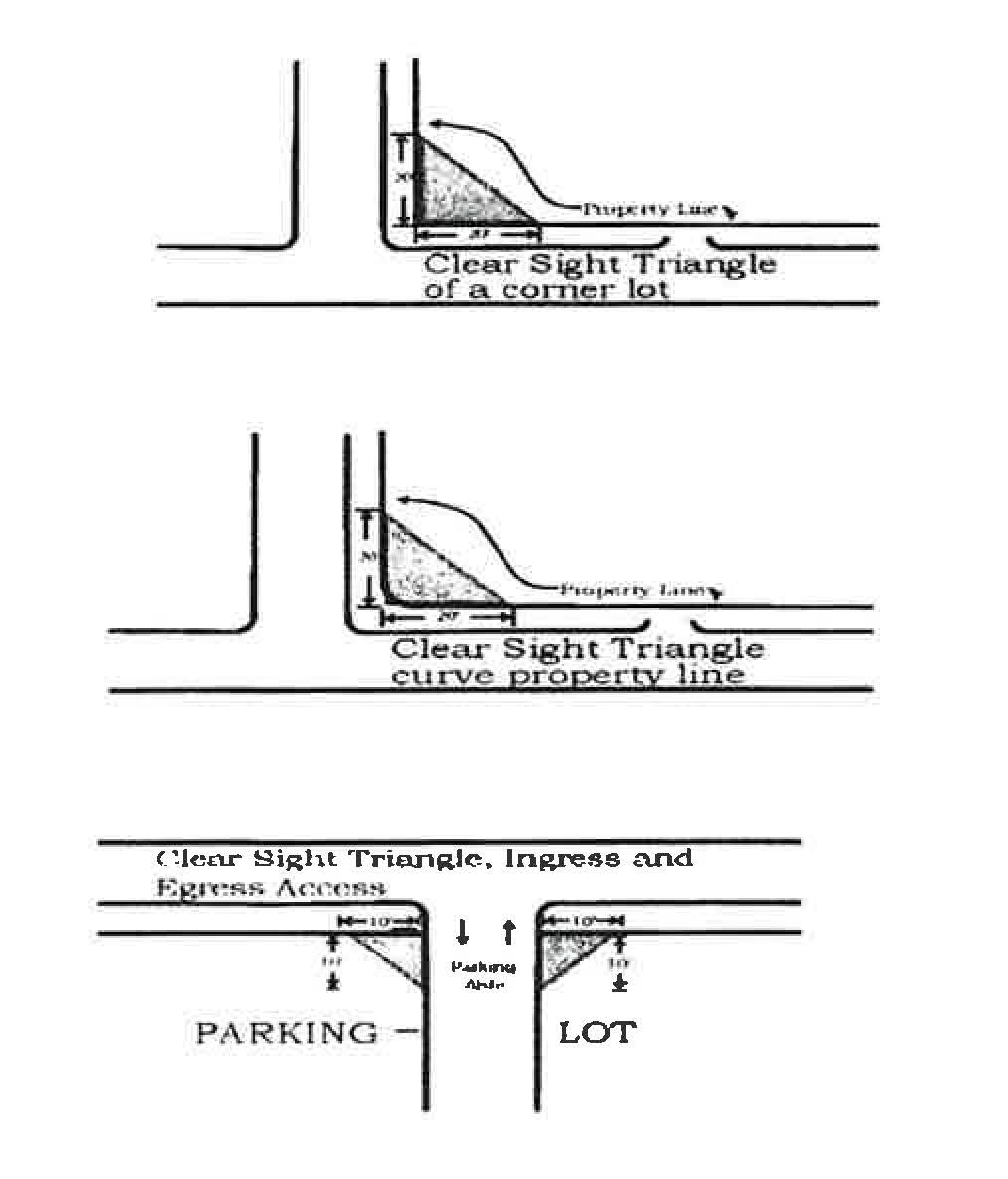
Clear sight triangle, parking lot driveway. A clear sight triangle shall be formed on both sides of a driveway into a parking lot. Size shall be determined by measuring ten feet along the property line and ten feet along the driveway. No sign more than two feet in height shall be erected or placed in this triangle.
(j)
Clear sign triangle, street corner. A clear sight triangle shall be formed by measuring 25 feet along the property line in both directions from the corner of the lot adjacent to the intersecting streets. No sign or landscaping more than two feet in height shall be erected or placed in this triangle. A single support with no sign structure or copy between a point 30 inches and 84 inches above the street grade is not considered a violation of clear sight triangle.
(k)
See Exhibit 1 in the definitions of this article for schematic of clear sight triangles.
(l)
For the purpose of this chapter and regulations within it, including digital displays and message boards, "sign" does not include signs erected and maintained pursuant to and in discharge of any governmental function or required by law, ordinance or governmental regulation, including schools, community service organizations, educational facilities and libraries. All other applicable ordinance regulations must be followed.
(m)
No sign permit shall be required for one flagpole per development lot. Flags shall be limited to no more than three per flagpole and are limited to official flags of governmental jurisdictions, flags indicating weather conditions, or flags displaying colors or designs associated with a school, sports team, or similar non-commercial flags. Other flags, or flags beyond this limit, shall be considered signs subject to freestanding sign requirements.
(Ord. No. 1674, § 1(Exh. A), 10-29-24)
Sec. 24-79. - Types of signs.
(a)
Subdivision sign.
(1)
Time. A sign permit is required. A sign permit may not be issued until the subdivision or land development has received all required approvals from the city. These signs may remain in place until all units in the subdivision are sold.
(2)
Place. The sign shall not be placed within any city easement or right-of-way or within ten feet of a property line.
(3)
Manner. Such signs shall not exceed 200 square feet in face area and may be indirectly lighted. Flashing or moving parts are not permitted.
(4)
Number. Such signs shall be limited to one per street intersection at the perimeter of the subdivision, not to exceed one sign per 200 feet. Subdivision signs at intersections may be broken up into two signs, one on each side of the roadway, however the two sign areas when combined may not exceed the 200 square foot maximum.
(b)
Political signs.
(1)
In this section, "private real property" does not include real property subject to an easement or other encumbrance that allows a municipality to use the property for a public purpose.
(2)
Time. A sign permit is not required. Political signs shall be removed within ten calendar days after the election is decided.
(3)
Place. Political signs can only be located on private property with the consent of the property owner in any zoning district. A political sign shall not be placed or posted:
a.
Closer than ten feet from the edge of the street pavement;
b.
On any public property except where authorized by law; and/or
c.
Within a designated public easement or right-of-way.
(4)
Manner. Political signs shall not:
a.
Exceed eight feet in height measured from the ground to the highest point of the sign;
b.
Exceed 36 square feet in area;
c.
Be illuminated;
d.
Contain any moving elements or parts; and
e.
Shall not be dilapidated or cause a hazard. (V.T.C.A., Local Government Code, § 216.903)
(c)
Canopy signs.
(1)
Time. A sign permit is required. A sign permit shall not be issued to erect, install or place a canopy sign on a property until a site plan has received all necessary approvals by the city for development of the property and after the issuance of a building permit for a building on the property.
(2)
Place. Canopy signs may only be erected on the two sides of the canopy band that face a public street for non-residential and multifamily uses.
(3)
Manner. Canopy signs shall be counted as part of and limited to the total square footage allowable for wall signs. Awning signs are permitted in this section. A building permit or certificate of occupancy is required for placement of a canopy sign.
(d)
Freestanding signs.
(1)
Time. A sign permit is required.
(2)
Place. Freestanding signs are permitted on development lots for non-residential and multifamily uses.
(3)
Manner. Listed below:
a.
One freestanding sign for each freestanding building, not to exceed one freestanding sign per development lot.
b.
Area. The area of a freestanding sign shall not exceed 64 square feet of sign area. All 64 square feet may be composed of an electronic video screen and an electronic message center.
c.
Height. The height of a freestanding sign shall not exceed 35 feet.
d.
Setback. The setback of a freestanding sign shall be a minimum of ten feet from all lot lines.
e.
Corner lots. On corner lots the major or primary street shall be construed to be the development lot frontage, and no more than one sign shall be permitted. On a development lot located at the intersection of two major thoroughfares or two expressways or a major thoroughfare and an expressway, a freestanding sign shall be permitted on each such thoroughfare or expressway.
(e)
Temporary signs.
(1)
Time. A sign permit is required.
(2)
Place. A temporary sign shall not be placed within a designated public easement or right-of-way, and may be placed in windows and cannot be placed closer than ten feet from the edge of the street pavement, on any public property except where authorized by law, and/or within a designated location.
(3)
Manner. Any sign shall have a combined area not exceeding 50 percent of the area of all the windows on the same wall; with the exception of signs listed below in subsections (5) and (6), a freestanding temporary sign shall not exceed five feet in height measured from the ground to the highest point of the sign and shall not exceed 20 square feet in area. Said sign area shall not be counted against total permitted sign area. Temporary signs shall not be illuminated, contain any moving elements or parts, be dilapidated or cause a hazard. Temporary sign may only stay up for a total period of 30 days once per calendar year.
(4)
Banners, pennants, search lights, business flags, banner flags, twirling signs, sandwich or "A" frame signs, sidewalk or curb signs, balloons or other inflatable objects. These types of signs may be authorized for a period not to exceed 30 days once per calendar year and may not exceed 15 feet in height or, for signs attached to a building, the height of the building. Extensions will only be permitted to properties awaiting permanent sign fixture with proof of order. A permit must be obtained from the appropriate city official and follow the city's permitting process.
(5)
Up to two additional temporary signs may be placed on a development lot or subdivision without a permit during time periods the property on which the signs are located is for sale or lease, provided such signs shall not exceed 32 square feet in area and eight feet in height. A sign permit is not required. Signs must be removed within 14 days following the purpose or use of the sign is concerned. These signs can only be located on private property with the consent of the property owner. These signs shall not be placed or posted:
a.
Closer than ten feet from the edge of the street pavement;
b.
On any public property except where authorized by law; and/or
c.
Within a designated public easement or right-of-way.
These signs must not be illuminated or have any electronic component. In areas noted in section 24- 81(c), signs may not exceed 200 square feet in face area for the proposed use of property on which they are placed. In residential areas, one unlighted sign not exceeding four square feet in face area is permitted under this section.
(6)
Up to two additional temporary signs may be placed on construction sites without a permit, provided such signs shall not exceed 64 square feet in area and eight feet in height after approval of a site plan, plat or building permits, as applicable, and/or which do not remain erected for more than seven days after the completion of the construction project.
(f)
Portable or wheeled signs.
(1)
Time. A sign permit is required. A portable or wheeled sign is authorized for a period not to exceed 30 calendar days in any calendar year. The 30 calendar days may be broken into any combination of increments.
(2)
Place. A portable or wheeled signs may not be displayed on property that does not maintain a certificate of occupancy or building permit.
(3)
Manner. Flashing parts, moving parts, or any appurtenance causing a visual distraction to motorists or pedestrians is prohibited.
(g)
Monument Sign.
(1)
Time. A sign permit is required.
(2)
Place. Monument signs are permitted on development lots for non-residential or multifamily uses.
(3)
Manner. Listed below:
a.
One monument sign per development lot per street frontage.
b.
Area. The area of a monument sign shall not exceed 50 square feet of sign area. Electronic video screen and an electronic message center are prohibited on monument signs.
c.
Height. The height of a monument sign shall not exceed five feet six inches.
d.
Setback. The setback of a monument sign shall be a minimum of 15 feet from all lot lines.
e.
Material requirements. All monument sign bases generally should be constructed of masonry material consisting of brick, stone or split face concrete block. Alternative materials of similar quality may be allowed. Sculpted aluminum sign panels will be allowed. All sign text and graphic elements shall be limited to a minimum of six inches from the outer limits of the sign structure.
f.
Illumination. Monument signs shall only be illuminated utilizing internal lighting for sculpted aluminum panels or a ground lighting source where the light itself and supporting sign structure are not visible from public right-of-way.
(h)
Wall signs.
(1)
Time. A sign permit is required.
(2)
Place. Wall signs are permitted on development lots for non-residential or multifamily uses and shall be attached to the building face.
(3)
Manner. The total of all wall signs shall not exceed 15 percent of each building facade or 300 square feet, whichever is less. For multi-tenant buildings, wall signs for each tenancy space shall not exceed 15 percent of the facade of the individual space. Wall signs shall project no more than two feet perpendicular from the wall and not more than three feet vertically above the wall of the building. A wall sign may include neon tubing attached directly to a wall surface when forming a border for the subject matter or when forming letters, logos, or pictorial designs. No building shall have both a wall sign and any other type of sign on the same building face.
(i)
Miscellaneous signs. In nonresidential zones, miscellaneous signs may not exceed four square feet. Signs placed with the intent of warning or advising the public of possible danger that may be encountered on private property shall not exceed two square feet in face area in residential areas and may not exceed four square feet in face area in nonresidential areas. These limits do not apply to signs placed by the city or signs for city sponsored events, as authorized by the city manager or his/her designee.
(Ord. No. 1674, § 1(Exh. A), 10-29-24)
Sec. 24-80. - Digital display regulations.
This section applies to electronic messaging center and electronic video screens.
(1)
Digital displays are restricted to the areas specified as special sign use districts in this chapter. The minimum distance between digital displays for an individual business or property shall be 200 feet.
(2)
Digital displays shall be illuminated at a level no greater than 0.3 foot-candles over ambient light levels for the location and time, and shall employ light cutoff devices such as, but not limited to, louvers to minimize light escaping above the horizontal plane. Foot-candle readings shall be measured at ground level at a distance of 100 feet from the source.
(3)
Digital displays within 200 feet of residential areas shall be illuminated at a level no greater than 0.2 foot-candles as measured from the nearest residential property line.
(4)
All digital displays must be equipped with both a dimmer control and a photocell which automatically adjusts the display's intensity according to natural ambient light conditions and should be dimmed 30 minutes prior to dusk each night.
(5)
All digital displays shall contain a default mechanism to turn off the sign in case of malfunction or shall be manually turned off with 24 hours of a reported malfunction.
(6)
Digital displays, as defined, lawfully in existence prior to the effective date of this chapter are exempted from the provisions of this chapter until such time the displays are replaced.
(7)
Any sign related to a governmental function is exempt from the times requirement of these regulations.
(8)
Digital display signs must comply with all rules and regulations for electronic signs adopted by the Federal Highway Administration, United States Department of Transportation and the Texas Department of Transportation.
(9)
Digital display sign permit applicants must present a TxDOT outdoor advertising permit as outlined in the permit application and present to staff at least 15 days before installation of the sign begins.
(10)
Moving animations with flashing or traveling images on the electronic video screen are prohibited.
(11)
Electronic video screens and electronic message centers shall be set so as to not cycle through messages more than once every ten seconds.
(12)
A permit application for a digital sign shall include a photometric plan indicating compliance with the provisions of this section.
(Ord. No. 1674, § 1(Exh. A), 10-29-24)
Sec. 24-81. - Special district sign requirements.
(a)
Residential districts.
(1)
Time. No sign permit is required.
(2)
Place. A person having a legal home occupation may display a nameplate on the face of the building or porch. Noncommercial signs, such as but not limited to, real estate signs, garage sale signs, celebratory signs, political signs, and holiday signs, may be placed on a residential lot.
(3)
Manner. A home occupation nameplate shall be attached directly to, and parallel to, the face of the building or porch. It shall not exceed one square foot in area, shall not be illuminated in any way, and shall project not more than six inches beyond the building or porch. Noncommercial signs may not exceed two square feet in sign area and no property shall have more than two such signs displayed.
(b)
Manufactured home park district. A ground sign or wall sign not more than 100 square feet in total area may be erected on property of the mobile home park and may be indirectly lighted.
(1)
Time. A sign permit is required.
(2)
Place. A mobile home park sign may be erected on property of the mobile home park.
(3)
Manner. A mobile home park district sign may be a ground sign or wall sign not more than 100 square feet in total area and may be indirectly lighted.
(c)
Garden offices.
(1)
Time. A sign permit is required.
(2)
Place. Any zoning district where B-1, B-2, or B-3 is permitted.
(3)
Manner. One pylon sign per complex may be erected advertising the total number of office tenants. If the complex is located on a corner lot, the corner lot provision contained in section 24-79 (e) shall apply. The face area of the sign may not be larger than ten feet by 30 feet, mounted six feet above the ground with a maximum height of 36 feet. The sign and the street address must have letters no less than six inches high will appear at the top of the sign. There may be one sign no larger than 15 square feet in face area and placed flush on the wall near the entrance. As an alternate one hanging sign or one ground sign containing no more than six square feet in face area may be erected.
Sec. 24-82. - Special sign use districts.
The following special sign use districts (SSUDs) are created with specific requirements as specified:
(1)
SSUD-1.
The area extending 200 feet on both sides of the Toepperwein Road right-of-way from the intersection of Toepperwein Road and Miller Road west to the intersection of Toepperwein Road and Village Oak Drive is hereby designated as SSUD-1.
The following additional criteria shall apply to freestanding signs in SSUD-1:
a.
Area. No sign shall exceed 64 square feet in sign area.
b.
Height. No sign shall exceed 25 feet in height.
c.
All 64 square feet may be composed of an electronic video screen or an electronic message center, which must be in compliance with section 24-80.
d.
In a garden office complex, one freestanding sign per complex may be erected to include the total number of tenants. The face area of the sign may not be larger than ten feet by 20 feet if located in SSUD-1.
e.
All other nonconflicting provisions of this article shall apply to SSUD-1.
(2)
SSUD-2.
The area extending 200 feet on both sides of the IH-35, Loop 1604, and Pat Booker Road rights-of-way within the city limits of the City of Live Oak is hereby designated as SSUD-2.
The following additional criteria shall apply to freestanding signs in SSUD-2:
a.
Area. No sign shall exceed 200 square feet in sign area.
b.
Height. No sign shall exceed 60 feet in height.
c.
Setback. All signs shall have a minimum setback often ten feet from all lot lines or as specified by the state department of highways and public transportation if applicable.
d.
All requirements of the state department of transportation must be met, and evidence of compliance provided to the city as part of the permit process.
e.
All other nonconflicting provisions of this article shall apply to SSUD-2.
(3)
SSUD-3.
The area extending from the intersection of Hwy 218 (Pat Booker Rd.) and the Loop 1604 Eastbound access road, west 1,200 feet along both joining state roadways (Hwy 218 and Loop 1604) and connecting and encompassing the area between, within the city limits of the City of Live Oak, shall be designated as SSUD-3. Map is attached to Ord. No. 1489 and on file with the city.
The following additional criteria shall apply to all freestanding signs in SSUD-3:
a.
Area. No sign shall exceed 200 square feet in sign area.
b.
Height. No sign shall exceed 60 feet in height.
c.
Setbacks. All signs shall have a minimum setback often ten feet from all lot lines or as specified by the state department of transportation as applicable.
d.
Special provisions. Development lots within SSUD-3 may have up to two ground signs, no more than one at the frontage of each state highway.
e.
All requirements of the state department of transportation must be met, and evidence of compliance provided to the city as part of the permit process.
f.
All other nonconflicting provisions of this article shall apply to SSUD-3.
(Ord. No. 1674, § 1(Exh. A), 10-29-24)
Sec. 24-83. - Prohibited signs.
The following signs shall be prohibited in all districts:
(a)
Any signs and supports, other than those signs and supports owned or required by a governmental authority, or for which a street use license has been issued, which are located on the public right-of-way, including on public streets, alleys and parkways.
(b)
Signs with flashing, blinking or traveling lights.
(c)
Displays are classified as a sign and is not permitted in any residential district.
(d)
Any signs which resemble an official traffic sign or signal, or which bear the words of traffic control, except for government signs.
(e)
Signs which, by reasons of their size, location, movement, content, coloring, or manner of illumination, may be confused with or construed as a traffic control sign, signal or device, or the light of an emergency or road equipment vehicle, or which hide from view any traffic or street sign or signal or device.
(f)
Any sign which emits sound, odor or visible matter which serves as a distraction to persons within the public right-of-way.
(g)
No signs shall be erected except as noted under this article.
(h)
Signs constructed of scrap materials, paper, tree, rock, bridge, or other such fragile or materials which are non-weather resistant.
(i)
The use of fluorescent paint, metallic paint, or similar nonconventional paint emitting luminosity upon exposure to external radiation or bombardment by a stream of particles is expressly prohibited.
(j)
Any sign in apparent compliance with this chapter, but which staff deems is by design, construction or erection hazardous to persons, will require approval of council in accordance with the variance or appeal process outlined in this article.
(k)
No electronic video screens and electronic message centers are permitted in a residential district.
(l)
Window border lights or other lighting directed to exterior of the building which outline doors, windows, attached columns or other parts of the building.
(m)
Any sign not referenced in or governed by this article.
(n)
Any sign erected or installed without the issuance of a permit, either prior to or after the adoption of this chapter (if a permit was required).
(o)
Any sign erected or installed in or over a public right-of-way, utility pole, or access easement, unless permitted within this article.
(p)
Any sign that does not comply with this or other applicable municipal ordinances, or those which do not comply with federal or state laws.
(q)
Prohibited signs, if not specifically mentioned in this article otherwise are as follows:
(1)
Abandoned sign.
(2)
Balloons and other floating devices.
(3)
Cloud buster balloon and air devices.
(4)
Neglected sign.
(5)
Bandit signs, except signs placed by the city or signs for city sponsored events, as authorized by the city manager or his/her designee.
(6)
Signs on public property or in the public right-of-way, including public easements, except for those specifically licensed or permitted by the city.
(7)
Painted signs.
(8)
Roof signs.
(9)
Billboards.
(Ord. No. 1674, § 1(Exh. A), 10-29-24)
Sec. 24-84. - Parking of vehicles.
No person shall park a vehicle or trailer to be used as a sign on a public right-of-way, on public property, or on private property so as to be visible from a public right-of-way, except in accordance with section 24-79(f.). A vehicle containing advertising that is a personal vehicle or is a vehicle used regularly in the course of business is exempt provided that the vehicle is in operable condition, including valid license plate and registration, and is parked in an appropriate parking space. Such vehicle signage shall not be illuminated, shall contain no flashing or moving elements, and shall not include any type of digital display.
(Ord. No. 1674, § 1(Exh. A), 10-29-24)
Sec. 24-85. - Existing signs.
(a)
Where existing signs are in newly annexed areas a permit shall be obtained.
(b)
Where existing signs do not comply with this chapter with respect to location, height, size, area of display, minimum ground clearance and are not a hazard or nuisance and are in good condition, an exception may be granted upon filing of an application for a permit, when required, and passage of an inspection by the city staff official or a variance may be applied for to submit to city council.
(c)
All abandoned and damaged signs and their supports shall be removed within 60 days from the date of abandonment. All damaged signs shall be repaired or removed within 60 days. The appropriate staff official shall have the authority to grant a time extension not exceeding an additional 60 days for an abandoned, nondamaged sign.
(d)
Should the responsible party or parties after due notice fail to correct a violation of this section, the appropriate staff official shall cause such signs and supports to be removed. This official, on behalf of the city, shall also take necessary action to file against the property a lien in the amount of the cost of such work if such costs are not paid by the property owner within 15 days after he is billed.
(e)
Nonconforming sign registration and amortization.
(1)
Registration. The operator and/or owner of any nonconforming sign shall register such nonconforming sign and obtain from the city manager and/or his designee a certificate of nonconforming rights, within ten years after the sign becomes nonconforming or ten years after the date of publication of the current version of this sign chapter, whichever occurs later. If a sign qualifies as a nonconforming sign and the operator and/or owner registers the sign with the city, the city manager or his/her designee shall issue a certificate of nonconforming rights. Failure to obtain this certificate of nonconforming rights within the requisite time shall terminate the sign's status as a nonconforming sign and such sign shall be considered an illegal sign, which must come into compliance with all current ordinances.
(2)
Amortization. Any nonconforming sign may be amortized and removed by the city in accordance with the procedural and compensation requirements specified in V.T.C.A., Local Government Code, ch. 216 and as outlined in this chapter.
(f)
Maintenance of signs and neglected and abandoned signs.
(1)
All signs, including but not limited to nonconforming signs shall be maintained to consistently have a neat appearance. Sign panels and/or sign graphics shall be secured and maintained so that they do not separate from, hang from, or fall from a sign. Sign panels and sign graphics shall not be faded, ripped, or have any other damage.
(2)
Abandoned signs and neglected signs shall be considered a public nuisance and are prohibited by this chapter. Upon written notification by the building official or his/her designee, such abandoned signs shall be removed from the premises and neglected signs shall be repaired or removed from the premises by the owner, agent or person having beneficial use of the land, building or structure upon which such sign is located. The notification shall state that the offending sign shall be repaired or removed by the owner, agent or person having beneficial use of the land, building or structure upon which such sign is located within ten calendar days after written notification to do so by the building official or his/her representative. The notification shall further state that if the sign is not removed or repaired, a citation may be issued and the city may resort to any civil remedy available to remove or repair the sign, up to and including impoundment. If any sign is determined to present an immediate danger to public health, safety or welfare, the city shall remove it immediately upon obtaining a written court order for such removal. Within ten calendar days of the removal of the sign, the building official shall notify the owner of the property on which the sign was located of the reason(s) for the removal of such sign.
(3)
It shall be unlawful for any person, firm, entity or corporation receiving such written notification to fail to comply with the direction of the notice. In the event failure to comply with such notice provided under this section, the building official is hereby authorized to cause the removal and impoundment of such sign upon the issuance of a written court order authorizing the removal and impoundment of such sign. Any expenses incident thereto shall be the responsibility of the owner, agent, or person having beneficial use of the land, building or structure upon which such sign was located. The city shall invoice the owner, agent, or person having beneficial use of the land for such expenses incurred by the city associated with the removal and impoundment of such sign.
(Ord. No. 1674, § 1(Exh. A), 10-29-24)
Sec. 24-86. - Permits.
(a)
Restrictions.
(1)
Except as otherwise provided for herein, no sign shall be erected, posted or otherwise produced, changed, reconstructed in whole or in part, retained or maintained within the City of Live Oak without first obtaining a permit. The city is authorized to charge a fee for issuance of sign permits in accordance with the city's fee schedule adopted by the city council and as amended from time to time as necessary.
(2)
Any sign requiring a permit shall be installed or erected by an individual registered and licensed by the city for such work. No sign requiring an electrical permit or incorporating any electrical lighting or wiring shall be erected, modified, or repaired by anyone not licensed for such work in the city.
(b)
Requirements. A sign requiring a permit shall be inspected annually by the appropriate staff official or his duly appointed agent, assistant or deputy to ensure compliance with the provisions of this chapter and other relevant city ordinances. Additional inspections may be conducted at the discretion of the appropriate staff official during the term of the permit to enforce the provisions of this chapter.
(c)
Issuance.
(1)
A permit shall not be issued when:
a.
An existing sign is in a deteriorated, unsafe or unsightly condition.
b.
A sign is not in compliance with or authorized under this chapter.
c.
Authorization of the property owner has not been obtained.
d.
The property at issue for the sign permit does not have either a building permit or a certificate of occupancy issued by the development services department on the property.
(2)
A permit shall not be required for:
a.
Displaying street numbers.
b.
Temporary signs under section 24-79(e)(5).
c.
Simple routine maintenance, adjustments, replacement of light globes etc. on existing signs as authorized under this article.
d.
When a sign has been damaged by fire, windstorm or other causes, immediate work to repair may be done to prevent damage to property or hazard to persons, and to this extent only. Notice will be given by the property or business owner as soon as practical to the appropriate staff official to advise of such damage and repair.
(d)
Fees.
(1)
Sign permit fees shall be charged in accordance with the fee schedule adopted by the city council and as amended from time to time as necessary.
(Ord. No. 1674, § 1(Exh. A), 10-29-24)
Sec. 24-87. - Master sign plan.
(a)
Purpose. Master sign plans are authorized under this section to allow, within parcels as this section deems applicable, the following:
(1)
The unified presentation of signage throughout applicable parcels;
(2)
The authorization to deviate from the existing rules relating to number, height, dimensions, locations, or design characteristics of attached or freestanding signs within the master sign plan area when the design and quality components of the signs proposed in the master sign plan area exceed the existing rules in other aspects;
(3)
The flexibility to provide for unique environments; and
(4)
A pre-approval of designs and design elements process that will make subsequent applications for sign permits under an approved master sign plan more efficient.
(b)
Applicability. An application for approval of a master sign plan is authorized only for those developments located within the General Business District (B-3) that meet the criteria that follows:
(1)
Single-use development. A single use development that exceeds 100,000 square feet of gross floor area; or
(2)
Multi-tenant development. A multi-tenant development that exceeds 150,000 square feet of gross floor area.
(c)
Definitions. In this section, the terms below shall have the definitions that follow:
Administrator shall mean the city manager or his/her designee who shall be authorized to review and approve or reject master sign plan applications and have administrative authority over approved master sign plan applications.
Applicable rules means the city's sign rules and regulations a sign would otherwise be subject to but for its inclusion in an approved master sign plan.
Development means an existing or proposed single use development that exceeds 100,000 square feet of gross floor area or mulita-tenant development that exceeds 150,000 square feet of gross floor area.
No progress means that no sign authorized by an approved master sign plan has been installed.
Uniformed codes means those national codes, including but not limited to the International Building Code and the International Electrical Code, that have been adopted by the city.
(d)
Application.
(1)
The owner of a platted lot of real property on which a development is currently located or is proposed may submit an application, on such form as is provided by the administrator and the application fee, as set out in the city's fee schedule adopted by city council and amended from time to time as necessary.
(2)
A master sign plan application shall include three copies of the site layout of the single-use or multi-tenant development and a narrative.
a.
Contents of site plan. The site plan shall depict the proposed signage for the entire development. For example, shopping center master sign plans shall include all tenants and out parcels; and office or industrial parks shall include all types of signs for wayfinding and tenants or uses within the development. The site plan shall include the following:
i.
Identification of development as single-use or multi-use with total square footage of gross floor area in the development;
ii.
A depiction of all proposed signs that will deviate from the underlying sign regulations;
iii.
Size, location, and number of all signs, including area, letter height, and height;
iv.
Materials, styles (letter colors, background colors, text, fonts, etc.), and colors for all signs subject to the master sign plan, including context of where signs are to be placed on any given facade;
v.
Proposed illumination (external, internal, etc.), including illumination levels;
vi.
A design theme with illustrative examples of each sign type and the proposed general locations of each sign type;
vii.
Site plans for multi-tenant developments shall provide that wall signs displayed by two or more businesses using common parking facilities shall be uniform in construction (i.e. channel letters, plaques) and lighting (i.e. direct, indirect); and
viii.
Landscaping and/or ornamental structures including fences, fountains, public art, ground cover, and other landscaping elements that are intended to complement those proposed signs that would deviate from the underlying sign regulations.
b.
Narrative. The application shall include a narrative explaining the reasons for any deviation under existing rules from the number, height, dimensions, locations, or design characteristics of attached or freestanding signs that is sought under the under the master sign plan. The narrative should articulate design and quality components that exceeds the requirements of the existing rules, including but not limited to the use of brick or natural stone; uniformity of sign size, style, and color across the development; use of landscaping around a sign base; use of channel lettering; use of directional signs; greater spacing between signs along street frontages; signage in locations to assist with direction in a location not on the lot of the existing business; incorporation of retaining walls for signage; or use of entry signs. In additions the narrative should establish an integrated architectural vocabulary and cohesive theme for the applicable single-use or multitenant development.
(e)
Approval.
(1)
The application shall be reviewed by the administrator. Within ten business days from the date of receipt of the application the administrator shall verify the application is administratively complete and includes the application fee. An application that is not administratively complete shall not be processed.
(2)
Upon determination that the application is administratively complete, the request shall be presented to the planning and zoning commission. The commission may approve, approve with conditions or amendments, or deny the request. The commission's approval of the request shall be based upon finding that the application demonstrates that the master sign plan will:
a.
Result in a substantially improved, comprehensive, and unified use of signs within the applicable single or multi-tenant development, compared to what is allowed through strict compliance with the applicable rules; and
b.
Provides for all signs to be architecturally integrated into or complimentary to the design of the buildings and character of the site, and use similar and coordinated design features, materials, and colors; and plans for multitenant developments provide for uniformity of signs.
(3)
The applicant may appeal a denial of a master sign plan to the city council. The council may approve, approve with conditions, or deny the request. The council's approval shall be based upon the same findings as the planning commission noted above.
(4)
Expiration. An approval shall expire two years from the date of approval if no progress has been made towards completion of the placement of signs pursuant to the master sign plan. If a master sign plan expires it is of no further force and effect and a new application shall be required to implement a master sign plan for that development.
(f)
Authorized deviation from applicable rules. The maximum deviation from the applicable rules that may be authorized under an approved master sign plan are as follows:
(1)
Maximum sign height may be increased no more than 30%;
(2)
Number of signs;
(3)
Location of signs;
(4)
Inclusion of multiple multi-tenant signs; wall signs; pylon signs; subdivision signs; and monument signs; and
(5)
Maximum sign area may be increased no more than double the normal allowance.
(g)
Prohibited signs and sign elements.
(1)
Except as otherwise authorized in this section, signs and sign elements prohibited by the applicable rules are prohibited from inclusion in a master sign plan.
(2)
Nonconforming signs. Existing non-conforming signs are not permitted within a development that is subject of master sign plan. A master sign approval for a development on which an existing non-conforming sign is located shall require that that the existing non-conforming sign be eliminated or brought into conformance with the standards of the approved master sign plan before the installation of any new signs under the approved master sign plan.
(h)
Conditional approval. The administrator may impose reasonable conditions on the master sign plan relating to the design, materials, locations, placements, or orientations, and sign specifications; provided that such conditions are related to time, place and manner matters and does not attempted to regulate sign content. Reasonable conditions are conditions imposed on the master sign plan that promote the purpose of this section and the approval criteria set out in in this section.
(i)
Amendment.
(1)
A valid master sign plan may be amended upon application by the permittee and approval by the administrator. An amendment application may seek to alter the design, materials, locations, placements, orientations, and specifications of a sign or signs designated within an approved master sign plan; provided the amendment does not attempt to increase the area or height of any freestanding or wall sign subject to the original master sign program by more than ten percent.
(2)
To request an amendment the permittee shall submit a completed master plan amendment application, on such form as provided by the administrator, and a site plan and narrative as is required for a master sign plan. The administrator shall review the request for administrative completeness and may issue a master plan amendment if the administrator finds the proposed amendment advances the objectives of this section and the approval criteria stated in this section. The city manager or his/her designee may approve the amended master sign plan if it is consistent with this section, and does not increase the area or height of any freestanding or wall sign subject to the original master sign program by more than ten percent.
(j)
Other permits. The approval of a master sign plan shall not relieve the applicant from the requirements of the uniform codes, including permitting requirements required therein.
(Ord. No. 1674, § 1(Exh. A), 10-29-24)
Sec. 24-88. - Variance and appeal procedure.
(a)
Sign variances.
(1)
A request for a variance of requirements as set forth in this article may be made to the board of adjustment. The variance must be made in writing at the time of the permit application. If the applicant is not the property owner, authorization from the property owner is required for the variance application.
(2)
In order to approve a request for a variance, the board of adjustment shall determine that the request meets three of the following four criteria:
a.
The proposed sign shall not adversely impact the adjacent property (visibility, size and the like);
b.
The proposed sign shall be of a unique design or configuration;
c.
The variance is needed due to restricted area, shape, topography, or physical features that are unique to the property or structure on which the proposed sign would be erected; or
d.
The variance will substantially improve the public convenience and welfare and does not violate the intent of this chapter.
(3)
A variance shall not be approved for a sign that is prohibited by this chapter.
(4)
The board of adjustment's decision is final.
(b)
Appeal of a decision by city staff regarding this article may be made to the board of adjustment by notification, within ten days of the decision to the city secretary. The appeal will be placed on an agenda as soon as practical to conduct a hearing before the board of adjustment. Staff shall notify the petitioner of their right to appeal.
(Ord. No. 1674, § 1(Exh. A), 10-29-24)
Sec. 24-89. - Penalties for violation.
Any person or other responsible party who shall violate any provision of this article shall be charged with a misdemeanor and shall, upon conviction thereof, be assessed a fine of not less than $10.00 nor more than $500.00 unless it is a health and safety issue which includes a max fine of $2,000.00. Each responsible party may be charged separately for a violation of this chapter and, if convicted, be held individually liable for resulting civil and/or criminal penalties, as applicable and in accordance with other law. The primary beneficiary of any sign installed in violation of this chapter is, until proven otherwise, presumed to have authorized or caused the installation, use or maintenance of the sign in violation of this chapter and may be charged with an offense under this section. It is a defense to prosecution that the property owner or beneficiary of a sign did not give consent for the placement of the sign.
(Ord. No. 1674, § 1(Exh. A), 10-29-24)
Sec. 24-90. - Severability.
If any section, subsection, sentence, clause, phrase or word of this chapter is for any reason held to be unconstitutional, such holding shall not affect the validity of the remaining portions of this article.
(Ord. No. 1674, § 1(Exh. A), 10-29-24)
Sec. 24-91. - Definitions.
The following words, terms and phrases, when used in this article, shall have the meanings ascribed to them in this section, except where the context clearly indicates a different meaning. See below Exhibit 1 for specific graphic examples of signs:
A-frame sign. A temporary sign made of two pieces of wood, metal or other similar material approved by the building official connected at the top by hinges or similar device(s) and may collapse when the connecting device(s) are overextended or the two pieces of wood, metal or other similar material are against one another. Also, commonly referred to as a "sandwich board sign."
Abandoned sign. A sign that had a permit on a piece of property or premises, but the permit has been expired for more than one year and has become dilapidated or has ceased use in that timeframe. Abandoned signs are prohibited in the city.
Amortization. In terms relevant to signage and urban planning, it conveys the "grace period" beginning on the date a sign owner is notified that removal of a previously conforming sign has been ordered, and ending on the date removal is required. This process makes a sign structure, which was legally erected or placed pursuant to permit, legally nonconforming for a period of time—the amortization period. After the amortization period expires, the sign becomes illegally nonconforming and must be removed.
Animation. Shall mean the use of movement or some element thereof to depict action or create a special effect or scene.
Apartment sign. A temporary stake sign made of wood, metal or other similar material approved by the building official in zoning district RS.
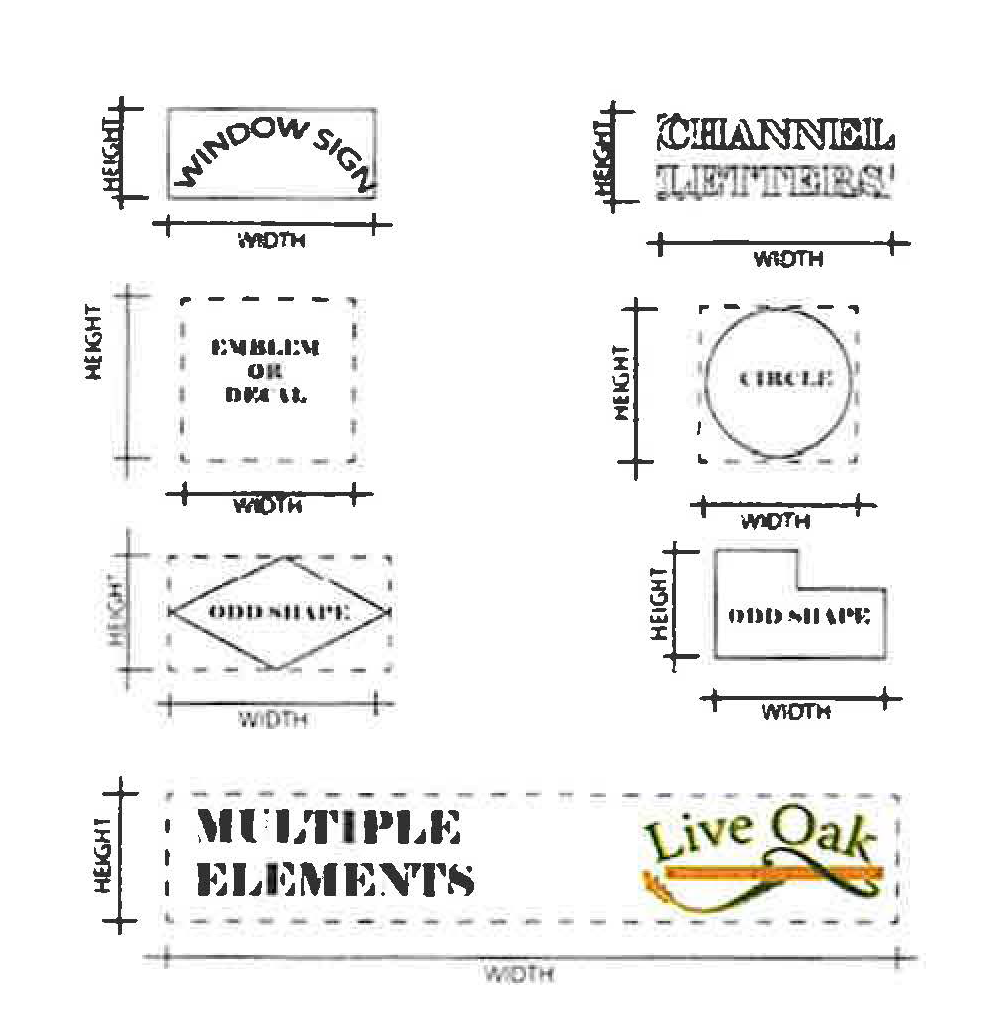
Area of sign. Shall be the total face area which includes the message and the border of the sign. It does not include the supporting super-structure. See Exhibit 1 to this article for determining the face area of an irregular shape or other than a rectangle. Only one surface of a two-sided freestanding sign is counted if the two sides are back to back, have identical content, and are not separated by more than four feet at the widest point.
Bandit Sign. Any sign posted on a utility pole, street sign, or other street furniture or a sign posted on public property or public right-of-way in violation of this chapter.
Banner. A temporary sign having characters, letters, or illustrations applied to plastic, cloth, canvas, or other light fabric or similar material, with the only purpose of such nonrigid material being for background.
Billboard. A sign which exceeds the maximum allowed area of a freestanding sign and that advertises a business, product, service, or event that is located off the property where the sign is installed.
Canopy sign. A sign that is applied, attached or affixed on a canopy or other roof-like covered areas where it is intended for protection from the weather or other safety measure.
Canopy/awning sign. Any sign that is a part of or attached to an awning, canopy, or other fabric, plastic, or structural protective cover over a door, entrance, patio, deck, or window, and any sign attached to a freestanding canopy structure, which may be retractable or nonretractable projection, shelter or structure. A marquee is not a canopy.
Developed. A developed property is a nonresidential property for which a building permit or certificate of occupancy has been issued by the building official to occupy a building on the property or a residential property for which a certificate of final acceptance has been issued by the city.
Development lot. Developed lot which is ground leased or which has structures in place for use and has a building permit, and/or certificate of occupancy, or a certificate of final acceptance.
Digital conversion. Shall mean the replacement of a previously installed static sign face with a digital display.
Digital display. Shall mean an electronic video screen or electronic message center.
Dilapidated. Any surface element, background, or support of any sign that has finished materials that are missing, broken, bent, cracked, decayed, dented, harmful, hazardous, illegible, leaning, splintered, ripped, torn, twisted, or unsightly.
Distance between signs. The distance between signs shall be measured from the nearest part of each sign, including sign faces and all structural elements of the sign.
Dwell time. Shall mean the interval of change between each individual message. Dwell time shall include the one second or less required to change a message.
Electronic message center. Shall mean a sign or portion of a sign which uses LED technology to form a sign message or messages in text form, with or without fixed images, wherein the sequence of messages the rate of change is electronically programmed and can be modified by electronic processes.
Electronic video screen. Shall mean a sign or portion of a sign which displays an electronic video which may or may not include text including television screens, plasma screens, digital screens, flat screens, LED screens, tri-vision technology, video boards and holographic displays.
Flashing. Shall mean a pattern of changing light illumination where the sign illumination alternates suddenly between fully illuminated and fully non-illuminated, employs inverse illumination, or operates with transitory bursts for periods of less than one second. This term shall include blinking, strobe, and twinkling illuminations.
Animation, as defined, shall not fall under the definition of flashing.
Foot-candle. Shall mean a unit of light measurement equal to one lumen per square foot. Foot-candle may be abbreviated "fc."
Freestanding sign. Shall mean any sign supported by structures or supports that are placed on, or anchored in the ground, and that are independent from any building or other structure.
Full-motion video. Shall be defined as the use of live action footage shot with a video camera or similar device and sized to fit and be displayed by an electronic message sign or similar device.
Garden office. Business offices with multiple tenants and/or buildings, where not all the tenants front onto the street.
Ground sign. Any sign which is supported by structures or supports in or upon the ground and independent of support from any building. A ground sign may be a freestanding sign or a monument sign.
Government sign. A sign installed, maintained, or used (i) by the city, county, state or the federal government, required or specifically authorized for the public purpose pursuant to regulations promulgated by the state or federal government, (ii) a traffic-related sign installed by any government agency within public right-of-way, or (iii) convey information to the public regarding city, state, or federal government activities and special events.
Height of sign. The vertical distance measured from the lowest adjacent natural grade to the highest point of the sign or sign structure.
Miscellaneous sign. Permanent or temporary informational signs, such as, but not limited to, parking lot directional signs, warning signs, and holiday signs.
Monument sign. A sign supported from the grade to the bottom of the sign having or appearing to have a solid base.
Moving sign. Any sign, sign appendages or apparatus designed or made to move freely in the wind or designed or made to move by an electrical or mechanical device. Moving signs, and/or any sign appendage that moves.
Neglected sign. A sign that has any missing panels, burned out lights, missing letters or characters, has rust, has loose parts, has damage, faded from its original color, supports or framework with missing sign or parts, or is not maintained.
Noncommercial sign. A sign that does not contain information or advertising for any business, commodity, service, entertainment, product, or other attraction.
Nonconforming sign. Any sign and its supporting structure that does not conform to all or any portion of this chapter and was in existence and lawfully erected prior to the effective date of this chapter; and was in existence and lawfully located and used in accordance with the provision of any prior ordinances applicable thereto, or which was considered legally nonconforming there under, and has since been in continuous or regular use; or was used on the premises at the time it was annexed into the city and has since been in regular and continuous use continuously existed as a nonconforming sign.
Painted sign. A sign that is painted directly on the face of a building, fence, canopy, or other structure, with the exceptions of noncommercial murals or other such artwork.
Pole sign. A sign erected on a vertical framework consisting of one or more uprights supported by the ground. With the exception of the pole signs specifically authorized by this chapter, pole signs are prohibited in the city. A pole sign is also freestanding sign under section 4.5.
Portable sign(s). Any sign designed or intended to be relocated from time-to-time, whether or not it is permanently attached to a building or structure or is located on the ground. Portable signs include signs on wheels or on portable or mobile structures, such as, among other things, trailers, skids, banners, tents or other portable structures, A-frame signs, T-shaped signs, airborne devices, or other devices used for temporary display or advertising.
Portable sign(s). Any sign designed or intended to be relocated from time-to-time, whether or not it is permanently attached to a building or structure or is located on the ground. Portable signs include signs on wheels or on portable or mobile structures, such as, among other things, trailers, skids, banners, tents or other portable structures, airborne devices, or other devices used for temporary display or advertising. Portable signs are prohibited in the city and its extraterritorial jurisdiction, except as specifically allowed by other sections of this chapter. A vehicle sign is not a portable or wheeled sign.
Public nuisance. Any sign or similar device that is obscene, causes a hazard or dangerous condition to the general public.
Public right-of-way. An area or strip of land, dedicated or conveyed for municipal public use, occupied or intended to be occupied by a street, walkway, utility line, drainage channel, or other municipal public uses as authorized by law.
Responsible party. Any of the following shall be considered a responsible party, as applicable: any entity (individual person, corporation, organization, etc.) or its agent whose product, service, activity or enterprise is announced or advertised by a sign, or whose message is carried by a sign, including other persons or entities acting on behalf of, at the direction of, or to primarily benefit said entity; the owner of the property upon which a sign is located; and/or the lessee/tenant of the property upon which a sign is located.
Roof sign. A sign mounted on and supported by the roof portion of a building or above the uppermost edge of a parapet wall of a building and which is wholly or partially supported by such a building or a sign that is applied directly on the roof or top of a building or structure. A sign that is mounted on mansard facades, pent eaves or architectural projections, such as canopies or the fascia (wall) of a building or structure shall not be considered to be a roof sign.
Sign. Any form of an object conveying information or instruction by means of words, lettering, parts of letters, figures, numerals, phrases, sentences, emblems, devices, trade names or trademarks, or other pictorial matter designed to convey such information and displayed by means of print, bills, posters, panels, or other devices erected on an open framework, or attached or otherwise applied to stakes, posts, poles, trees, buildings, or structures or supports. This definition shall also include any device, fixture, placard, or structure that uses any color, form, graphic, illumination, symbol, or communicate information of any kind to the public.
Subdivision. For purposes of this chapter, the subdivision in its entirety, including all phases, sections, villages, or units under a common development plan.
Subdivision sign. A permanent sign identifying an entrance to a residential subdivision. A subdivision sign may be authorized for qualifying non-residential subdivisions in conjunction with the approval of a Master Sign Plan.
Temporary sign. Any sign used to display information with a limited duration which is not rigidly and permanently installed into or on the ground, attached to a building, or as identified in this chapter.
Variance. An official written request to the city council to allow exceptions to regulations or requirements of this appendix.
Vehicle. Any operable or inoperable motorized machine on wheels, treads, or runners by which any person, materials, commodity, or property is or may be transported.
Vehicle sign. A sign painted upon or applied directly (to include magnetic, but not signs taped) to any vehicle, truck, car, bus, trailer, boat, recreational vehicle, motorcycle or any other vehicle. Vehicle signs shall exclude bumper stickers and state required registration or inspection stickers/identifications.
Wall sign. Any sign erected against an exterior wall, erected parallel to a wall or applied directly onto a wall. A wall sign is a sign applied to or erected parallel to and extending not more than 12 inches from the facade of any building to which it is attached, supported throughout its entire length by the building face.
Window sign. Any sign, poster, window slick, or other similar displayed item, excluding banners (see "banners"), located on the internal or external surface of a window that is visible from a public street or sidewalk. A sign applied on or over a window and/or visible through a window from the exterior of a building is a wall sign. An interior sign that faces a window exposed to public view and located within three feet of the window is considered a window sign.
EXHIBIT 1
DETERMINING THE TOTAL FACE AREA OF A SIGN
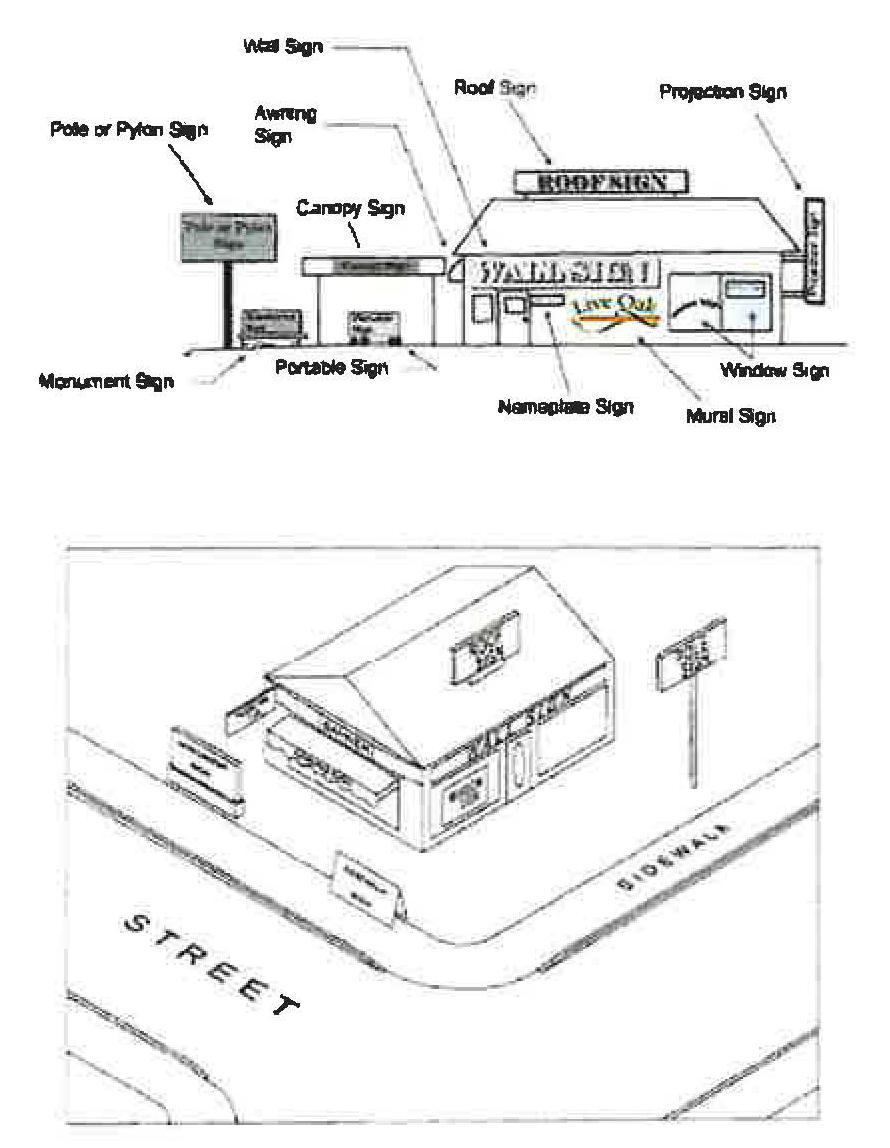
(Ord. No. 1674, § 1(Exh. A), 10-29-24)

