
Live Oak City Zoning Code
ARTICLE IX
WIRELESS ANTENNAS AND ANTENNA FACILITIES
Sec. 24-96.- Purpose.
(a)
The purpose of this article is to further an overall plan for the enhancement of public safety, consistent community development, preservation of property values and the general welfare of the city while providing for the communication needs of the residents and businesses in the city. The purpose of this article is to govern the placement of these facilities to:
(1)
Ensure that their location and use do not compromise the aesthetic quality of the community;
(2)
Facilitate the provision of wireless telecommunication services to the residents and businesses of the city;
(3)
Encourage operators of antenna facilities and antennas to locate them in areas where the adverse impact on the community is minimal;
(4)
Encourage co-location on both new and existing antenna facilities;
(5)
Encourage operators of antenna facilities and antennas to configure them in a way that minimizes the adverse visual impact through careful design, landscape screening, and innovative stealth techniques; and
(6)
Enhance the ability of wireless telecommunication providers to provide services to the community effectively and efficiently.
(Ord. No. 1641, § 1(Exh. A), 8-9-22)
Sec. 24-97. - Definitions.
In this article the following definitions apply:
Alternative tower structure. Clock towers, steeples, light poles and similar alternative-design mounting structures that camouflage or conceal the presence of antennas or towers. See also the definition of "Stealth facility."
Amateur radio antenna. A radio communication antenna used by a person holding an amateur station license from the Federal Communications Commission.
Antenna. A device used in communications, which transmits or receives radio signals, television signals, digital signals, analog signals, radio frequencies (excluding radar signals), wireless telecommunications signals or other communication signals.
Antenna, building attached. An antenna attached to an existing structure in two general forms:
(1)
roof-mounted, in which antennas are placed on the roofs of buildings; or
(2)
building-mounted, in which antennas are placed on the sides of buildings.
These antennas can also be mounted on structures such as water tanks, billboards, church steeples, electrical transmission towers, etc.
Antenna facility. The antenna, mast, pole, structure, tower, building, equipment and other supporting material used to mount the antenna and equipment, equipment storage buildings and concealing or screening structures needed to operate an antenna.
Co-location. The act of locating wireless communications equipment for more than one telecommunications carrier on a single antenna facility.
Equipment storage building. An unmanned, single-story equipment building or structure used to house telecommunications equipment necessary to operate the telecommunications network.
Monopole tower. A self-supporting tower facility composed of a single spire used to support telecommunication antennas. Monopole towers cannot have guy wires or bracing.
Preexisting towers and preexisting antennas. Any tower or antenna for which a building permit or special exception has been properly issued prior to the effective date of this article, including permitted towers or antennas that have not yet been constructed so long as such approval is current and not expired.
Satellite antenna. An antenna, greater than one meter in diameter, which enables the transmission of signals directly to and from satellites. Such antennas are commonly known as a satellite dish, dish antenna, parabolic antenna, or satellite earth station antenna.
Satellite receive-only antenna. An antenna, one meter or less in diameter that enables the receipt of television signals transmitted directly from satellites to be viewed on a television monitor. Such antennas are commonly known as a satellite dish, television receive-only antenna, dish antenna, parabolic antenna, or satellite earth station antenna.
Stealth facility. "Stealth" is a generic term describing a method that would hide or conceal an antenna, supporting electrical or mechanical equipment, or any other support structure that is identical to, or closely compatible with, the color of the supporting structure so as to make the antenna and related equipment as visually unobtrusive as possible to the surrounding neighborhood. Stealth facilities may include totally enclosed antennas, wireless facilities that replicate or duplicate the construction of common structures such as flagpoles, alternative tower structures, and camouflaged wireless facilities that are constructed to blend into the surrounding environment.
Telecommunications tower. Any structure that is designed and constructed for the purpose of supporting one or more antennae used for the provision of commercial wireless telecommunications services. This definition includes monopole towers, alternative mounting structures or any other vertical support used for wireless telecommunications antennae. This definition does not include commercial radio or television towers; nor does it include such things as satellite receive only antenna or amateur radio antennas.
Telecommunications tower facility. A facility that contains a telecommunications tower and equipment storage building or structure.
TV antenna. An antenna that enables the receipt of television signals transmitted from broadcast stations.
(Ord. No. 1641, § 1(Exh. A), 8-9-22)
Sec. 24-98. - Applicability/general regulations.
The following regulations apply to all antenna facilities and antennas located within any district:
(1)
Applicability. Except as specifically provided, all new telecommunications towers or antennas in the city shall be subject to the regulations contained in this article. Preexisting towers or antennas lawfully in existence at the time of the enactment of the ordinance from which this article derives shall not be required to meet the requirements of this article, other than those contained in sections 24-104 and 24-106 below:
(2)
Equipment storage building. An equipment storage building associated with an antenna facility or an antenna shall be screened and landscaped as described in other sections of this article, or be incorporated into the stealth treatment so that it is consistent and complementary with the existing structures and uses on the premises. All equipment storage buildings must only be constructed material approved for use by a national model code, published within the last three code cycles, applicable to the construction, renovation, maintenance, or other alteration of the equipment storage building.
(3)
Driveway surfaces. All telecommunication tower facilities must have an access drive that is constructed of asphalt or concrete. One off-street parking space must be provided at each telecommunication tower facility.
(4)
Lights. No outdoor lighting shall be allowed on any antenna facility except lights or lighting that is by required by the Federal Aviation Administration or the Federal Communications Commission.
(5)
Antenna facility capacity. All new antenna facilities must be structurally designed to allow for at least two sets of antennas.
(6)
Tower types. Only monopole, alternative mounting structures or stealth towers are permitted in the city.
(7)
Prohibited in easements. Antenna facilities shall not be placed in easements unless authorized by the easement holder.
(8)
Construction standards. A building permit must be obtained prior to the construction or installation of any antenna facility. An antenna facility must be installed according to the manufacturer's recommendations and under the seal of a professional engineer registered in the state. Additionally, all antenna facilities shall comply with applicable state and local building codes.
(9)
Building codes/safety standards. To ensure the structural integrity of antenna facilities, the owner of an antenna facility must ensure that it is maintained in compliance with all provisions of the city's building code and zoning regulations. If upon inspection, the city concludes that an antenna facility fails to comply with such codes and regulations and/or constitutes a danger to persons or property, then upon written notice to the owner of the antenna facility, the owner shall have 30 days to bring such tower into compliance with applicable standards. Failure to bring such tower into compliance shall constitute grounds for the removal of the antenna facility at the owner's expense. This notice requirement shall not preclude immediate action by the building official as allowed by law if public safety requires such action.
(10)
Contained on property. No part of an antenna facility, antennas, or other attachment may extend beyond the property lines or required building lines of the lot on which the antenna or antenna facility is located.
(11)
State or federal requirements. All antenna facilities must meet or exceed current standards and regulations of the FAA, the FCC, and any other agency of the state or federal government with the authority to regulate towers and antennas. If such standards and regulations are changed, and if the controlling state or federal agency mandates compliance, then the owners of the towers and antennas governed by this article shall bring such towers and antennas into compliance with such revised standards and regulations within six months of the effective date of such standards and regulations, unless a different compliance schedule is mandated by the controlling state or federal agency.
(12)
Variance requirement. A variance granted by the board of adjustment is required for an antenna or antenna facility which will not comply with the requirements of this article unless otherwise specified herein.
(Ord. No. 1641, § 1(Exh. A), 8-9-22)
Sec. 24-99. - Amateur radio antenna and TV antennas.
Amateur radio antenna and TV antennas are allowed in any zoned district. Amateur radio antennas and TV antennas must comply with the following regulations:
(1)
TV antennas.
a.
Antenna location. TV antennas can only be located on a roof or in the back yard of a structure.
b.
Number of facilities per lot. No more than one TV antenna is permitted on each lot.
c.
Height limitations. A TV antenna cannot extend more than eight feet above the maximum height limitation applicable for the zoning district.
d.
Setbacks. TV antennas are not permitted within any required setback area.
(2)
Amateur radio antennas.
a.
Amateur radio antennas and associated antenna structures shall be the minimum height and size necessary to reasonably accommodate the operator's communication needs, in accordance with FCC regulations as set forth in FCC order "PRB-1" and section 97.15 of title 47 of the Code of Federal Regulations, and in accordance with V.T.C.A., Local Government Code, § 250.002, or the respective successor sections thereto. An applicant for an amateur radio antenna and associated antenna structure shall provide objective technical data to support the antenna height requested where such requested height exceeds the maximum height permitted by right in the zone.
b.
No portion of any amateur radio antenna, associated support structure, or related equipment shall overhang a property line that is not part of the subject site at any time.
c.
Retractable antenna structures shall be required for amateur radio antenna structures over 30 feet in height that are in or within 300 feet of any residential zoning district. At times when not in operation, the antenna structure may be required to be retracted to the lowest elevation possible in order to maintain a safe clearance above any nearby building, accessory structure, overhead utility, landscaping and/or any other site improvements.
d.
No amateur radio antenna or facility shall be sited or operated in such a manner that it creates at any time, either by itself or in combination with other wireless communication facilities, power densities in any inhabited area that exceed the FCC's maximum permissible exposure (MPE) limits for electric and magnetic field strength and power density for transmitters or any applicable more restrictive standard subsequently adopted by the city, county, state or federal government. Absolute compliance with FCC Office of Engineering Technology (OET) Bulletin 65 or any successor document thereto, is mandatory, and any violation shall be grounds for the city to immediately terminate any permit granted hereunder, or to order the immediate service termination of any non-complying facility within the city.
e.
At least one resident, tenant or property owner of the property shall be an amateur radio operator licensed by the FCC.
f.
The square footage area and winding loading of all antennas shall not exceed those maximums as specified by the manufacturer of the associated support structure.
g.
If at any time there is not a least one resident, tenant or property owner of the subject property licensed by the FCC as an amateur radio operator the city may require any antenna and associated support structure to be removed within 90 days.
i.
Any antenna or associated support structure which exists on a property where at least one resident, tenant or property owner is a licensed by the FCC as an amateur radio operator is hereby declared a nuisance.
h.
All applicable usual city permit requirements and other applicable laws, ordinances and other regulations for antenna structures of this type shall apply.
i.
All manufacturers' safety and installation requirements shall be adhered to in the installation of any tower, antenna and boom.
j.
Any used associated support structures erected shall be inspected by a qualified engineer to ensure its structural integrity and a report shall be provided to city council by the inspecting engineer verifying its structural integrity.
(Ord. No. 1641, § 1(Exh. A), 8-9-22)
Sec. 24-100. - Satellite receive only antennas, less than one meter in diameter.
Satellite dish receiving antennas, two meter or less in diameter shall be permitted in the R-1, R-2A, R-2B, R-2C, R3, R-4, R-5, R-6, or any residentially zoned planned development district. Satellite receive only antenna must comply with the following regulations:
(1)
Antenna location. Satellite receive only antenna less than one meter in diameter can only be located on a roof or in the back yard of a residence.
(2)
Number of facilities per lot. No more than one satellite receive only antenna less than one meter in diameter is permitted on each lot.
(3)
Height limitations. A satellite receive only antenna less than one meter in diameter cannot extend more than eight feet above the maximum height limitation applicable for the zoning district.
(4)
Setbacks. Satellite receive only antennas less than one meter in diameter are not permitted within any required setback area.
(Ord. No. 1641, § 1(Exh. A), 8-9-22)
Sec. 24-101. - Satellite antennas greater than one meter in diameter.
A satellite antenna greater than one meter in diameter is permitted is under the following conditions:
(1)
Nonresidential zoning districts. Satellite antennas greater than one meter in diameter is an accessory use permitted by right in nonresidential zoning districts.
(2)
Residential zoning districts. Satellite antennas greater that one meter in diameter are only allowed in residential zoning districts upon the approval of a special exception granted by the board of adjustment.
(3)
Height. Satellite antennas greater than one meter in diameter shall not exceed ten feet in height above the base of their mount.
(4)
Location. Satellite antennas greater than one meter in diameter cannot be erected in any required setback or in the front of residential structures.
(5)
Screening. Satellite antennas greater than one meter in diameter that are mounted on the ground shall be screened from view from adjoining properties by solid fencing or evergreen plants to a height of a least six feet.
(Ord. No. 1641, § 1(Exh. A), 8-9-22)
Sec. 24-102. - Placement on antenna facilities.
This section does not apply to amateur radio, TV, and satellite receive-only antennas. For the purpose of determining the appropriate locations for the placement of antenna facilities, the city is divided into land use threshold areas that establish different regulations pertaining to height, location, and type of antenna facility. These land use thresholds are defined as follows:
(1)
Full commercial ("FC"). Property within the I-1, I-2, B-2, B-2, B-3 districts.
(2)
Undeveloped residential ("UR"). Property within R-1, R-2's, R3, R-4, R-5, R-6, or any residentially zoned planned development districts, that:
a.
Is not a part of a recorded subdivision; or
b.
Is a part of a recorded subdivision but has not had a building permit issued for a residential structure; and
c.
Not located within the calculated limits of the developed residential ("DR") threshold.
(3)
Wireless corridors ("WC"). Property within, and 150 feet either side of, the right-of-way of a freeway or a major or minor arterial roadway, as indicated on the city's thoroughfare plan.
(4)
Developed residential ("DR"). Property within the R-1, R-2A, R-2B, R-2C, R-3, R-4 R-5 and R-6, or any residentially zoned planned development districts, which:
a.
Is a recorded subdivision that has had at least one building permit for a residential structure; or
b.
Is within 600 feet of areas described in subsection (4)a. above.
(Ord. No. 1641, § 1(Exh. A), 8-9-22)
Sec. 24-103. - Antenna facility impact levels.
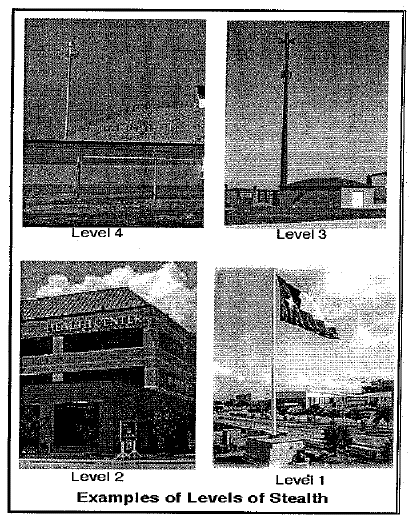
For the purpose of determining appropriate locations for antenna facilities, the city recognizes differing levels of impact for antenna facilities depending upon physical location, aesthetics, and land use compatibility. These antenna facility impact levels are described as follows:
(1)
Monopole. A monopole tower requires a special exception. The antenna equipment may not extend more than five feet above the highest point on the monopole.
(2)
Level 4 stealth facility. The antenna on a level 4 stealth facility is located on an existing structure (other than a telecommunications tower) including, but not limited to, a building, water tower, utility tower, steeple, or light pole. The antenna is neither screened nor hidden. For the purpose of this level, a pole or tower may be reconstructed to structurally hold the antenna but the height of the structure cannot be increased.
(3)
Level 3 stealth facility. The antenna on a level 3 stealth facility is located on an existing structure (other than a telecommunications tower) including, but not limited to, a building, water tower, utility tower, steeple, or light pole. The antenna shall be aesthetically painted, constructed, or applied with material so that it is incorporated into the pattern, style, and material of the structure to effectively render the antenna unnoticeable. A new structure may be constructed to hold or house the antenna or equipment; however, the structure must be consistent with the overall architectural features of the primary buildings.
(4)
Level 2 stealth facility. The antenna on a level 2 stealth facility is attached to the structure in such a manner that if it is seen it appears unrecognizable as an antenna, and the structure in which or on which the antenna is attached is an integral part of an overall development.
(5)
Level 1 stealth facility. The antenna on a level 1 stealth facility is attached to the structure in such a manner that the antenna is completely unseen and the structure in which or on which the antenna is attached is an integral part of an overall development.
(Ord. No. 1641, § 1(Exh. A), 8-9-22)
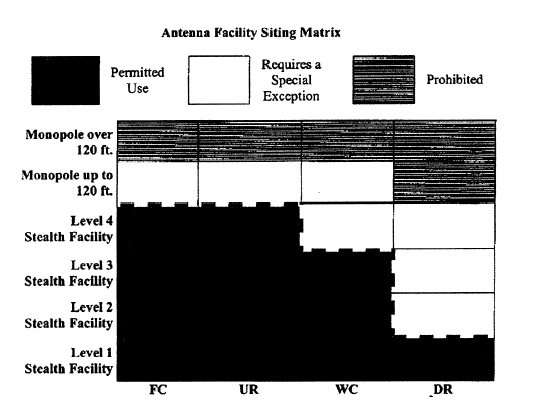
Sec. 24-104. - Antenna facility siting matrix.
Antenna facilities shall be located in accordance with the following siting matrix. This matrix provides for areas where antenna facilities may be located as permitted uses, areas where they may be located with a special exception, and areas where they are prohibited.
(Ord. No. 1641, § 1(Exh. A), 8-9-22)
_____
Sec. 24-105. - Special exception.
When a special exception is required by this article for the location of an antenna facility or an antenna, the applicant must submit an application in accordance with the procedure established in this article. Special exceptions to this article are granted by the board of adjustment in accordance with this article.
(1)
Application. In order to properly evaluate an application to locate an antenna facility or an antenna that requires a special exception, the applicant must provide:
a.
A completed special exception application and appropriate application fee.
b.
A narrative detailing the proposed antenna facility. The narrative must indicate the following:
i.
Whether the proposed structure is a co-location, a new monopole tower or a new alternate mounting structure.
ii.
The height of the proposed tower.
iii.
Why the antenna facility is necessary at the proposed location.
iv.
The name(s) of the telecommunications providers or other users of the antenna or tower and describe the use to be made by each user;
v.
Whether the applicant has made an effort to co-locate the facilities proposed for this antenna facility on existing antenna facilities in the same general area. Identify the location of these existing sites, and describe in detail these efforts and explain in detail why these existing sites were not feasible.
vi.
Attach all studies or tests performed which demonstrate why the existing sites will not provide sufficient signal coverage.
vii.
Provide written documentation from existing sites' owners and/or operators which confirm the statements provided.
viii.
Indicate whether the existing sites allow/promote co-location and, if not, describe why not.
ix.
Whether co-location will be allowed to other telecommunications providers at the requested site. If they are not allowed, state every reason and the basis of each reason.
a.
Provide a site plan of the proposed antenna facility at a scale of 1 inch=30 feet. The site plan should be on a single 24-inch by 36-inch sheet and include:
i.
A survey and legal description of the proposed antenna facility;
ii.
A detail on how access to the site is to be achieved;
iii.
A plan view layout of the proposed antenna facility clearly showing:
iv.
The location of the facility,
v.
All equipment and structures in the proposed antenna facility,
vi.
The required off-street parking space,
vii.
Distances to property lines,
viii.
Required setbacks,
ix.
Adjacent land uses and zoning designations,
x.
Existing structures on the site,
xi.
Required landscaping or screening of the base of the tower,
xii.
All recorded and proposed easements, and
xiii.
Natural features, such as water courses and trees.
d.
Elevation drawings showing:
i.
The design and height of the proposed antenna facility,
ii.
Detailed drawings of all structures and equipment,
iii.
Screening requirements,
iv.
All requirements specified in wireless antenna facility special exception request site plan check list.
e.
If the requested location is in a residential district the applicant must provide evidence that they have made an effort to locate the facility in a nonresidential district. Identify the location of these nonresidential district sites, describe in detail these efforts, and explain in detail why these nonresidential sites were not feasible. Attach all studies or tests performed which demonstrate why the nonresidential sites will not provide sufficient signal coverage.
f.
Provide a map showing the proposed provider's current coverage area for the city. The map must show the roadway network and be labeled. The applicant must also provide propagation analysis showing the areas the proposed provider's existing antenna currently covers, the areas the applicant's existing sites and the requested site would cover. The propagation analysis must be labeled and have a legend.
g.
Describe the applicant's master antenna facilities plan for the city. Attach maps and other related documentation. Provide information indicating each phase of the plan.
(2)
Consideration of application. In considering whether to grant a special exception, the board of adjustment shall consider the following:
a.
The appropriateness of the location and design of the antenna facility;
b.
The potential for interference with the enjoyment of the use surrounding properties;
c.
Aesthetics; impact, including but not limited to, the surrounding topography, surrounding tree coverage and foliage; proposed buffering; and the design of the antenna facility, with particular reference to design characteristics that have the effect of reducing or eliminating visual obtrusiveness;
d.
The proposed height of the antenna facility relative to surrounding structures;
e.
The zoning district and the adjoining zoning districts of the property for which special exception is sought;
f.
The compliance with the city's regulations; and
g.
The availability of suitable alternative sites. Suitable alternative site(s) shall mean a location or locations that would provide the same or better signal coverage than the proposed site for which a special exception is requested. The applicant shall provide documentation supporting his contention that alternative site(s) are not suitable and/or available.
(3)
Application fees. The application fee for consideration of a special exception under this article shall be in accordance with the city's fee schedule and the actual engineering expenses expended by the city in review of the applicable application.
(4)
Procedures for consideration of special exception. The procedures for consideration of an application for a special exception requested under this section of the chapter shall be the same as those procedures for a request of a special exception under article XII of this chapter.
(Ord. No. 1641, § 1(Exh. A), 8-9-22)
Sec. 24-106. - Written report.
Denial of an application for a special exception under this article must be documented in writing.
(Ord. No. 1641, § 1(Exh. A), 8-9-22)
Sec. 24-107. - Appeal.
An applicant may appeal the decision of the board of adjustment to the district court by filing a written notice of appeal within ten days following the date the administrator notifies the applicant of his decision. A decision not timely appealed in accordance with this article shall be final.
(Ord. No. 1641, § 1(Exh. A), 8-9-22)

