
Livonia City Zoning Code
ARTICLE IX
PARKING, LOADING, AND ACCESS MANAGEMENT
Section 9.01 - Applicability.
The parking requirements of this Code must be met when one (1) or more of the following takes place.
(1)
Any new building or structure.
(2)
Commencement of use of any land.
(3)
Any alterations to a building or structure which would require additional parking.
(4)
Any alteration to the use of any building or structure or use of land which would require additional parking.
Section 9.02 - Access Management.
(1)
Standards for the Number of Nonresidential Driveways. Access shall be provided for each site. Where feasible, access may be provided via a shared access driveway. Where it is not possible to provide shared access, access may be provided by a single driveway. One (1) additional driveway may be allowed for properties with a continuous frontage of over five hundred (500) feet and one (1) additional driveway for each additional two hundred fifty (250) feet of frontage. Uses requiring more than one driveway, detailed elsewhere in this Ordinance, are subject to those specific standards and the standard above will not apply. The City Council may determine additional driveways are justified due to the amount of traffic generated by the use without compromising traffic operations along the public street, based upon a traffic impact study submitted by the applicant.
(2)
Minimum Width. Each ingress and/or egress driveway must have a minimum width of twenty (20) lineal feet and must be so designed so as to provide adequate turning and maneuvering for emergency and service vehicles.
(3)
Driveway Spacing Standards.
A)
Between Driveways. The minimum spacing between two (2) nonresidential driveways on the same side of the road shall be based upon posted speed limits along the parcel frontage. The minimum spacings indicated below are measured from centerline to centerline. For sites with insufficient road frontage to meet the driveway spacing standards below, the City Council may modify the spacing requirements.
B)
Spacing from Intersections. Minimum spacing requirements between a proposed nonresidential driveway and an intersection must be setback fifty (50) feet from the right of way. The City Council may modify the spacing standards.
(4)
Driveway Distance from Single-Family Residential Zone. Each entrance and exit to and from any off-street parking lot located in a non-residential district must be at least twenty-five (25) feet from an adjacent residential use.
(5)
Modification of Standards for Special Situations. During site plan review, the City Council shall have the authority to modify the standards of this Section upon consideration of the following:
A)
The standards of this Section would prevent reasonable access to the site.
B)
Access via a shared driveway or service/frontage road is not possible due to the presence of existing buildings or topographic conditions.
C)
Roadway improvements (such as the addition of a traffic signal, center turn lane or bypass lane) will be made to improve overall traffic operations prior to project completion, or occupancy of the building.
D)
The use involves the redesign of an existing development or a new use which will generate less traffic than the previous use.
E)
The proposed location and design are supported by the Michigan Department of Transportation (MDOT) or Wayne County as an acceptable design under the existing site conditions. The City Council may also request the applicant provide a traffic impact study to support the requested access design.
F)
Where there is a change in use or expansion at a site that does not comply with standards of this Ordinance, the City Council shall determine the amount of upgrade needed in consideration of the existing and expected traffic pattern and the capability to meet the standards of this Ordinance to the extent practical.
(6)
Traffic Impact Studies. The City Council may require a traffic impact study (TIS) for all development proposals that it reviews. The TIS shall be accordance with and meet the standards of the City. The TIS shall be submitted by the developer or applicant to determine the potential future traffic conditions on adjacent roadways once a proposed development is finished. TIS shall predict the peak-hour operational conditions at site driveways and road intersections affected by the development. The results of the TIS shall be used in the final design of access points and internal circulation and may identify necessary off-site road improvements. At a minimum, the TIS shall meet standards as published by the Southeast Michigan Council of Governments (SEMCOG) and MDOT in the handbook titled Evaluating Traffic Impact Studies and shall be found acceptable by the City Council prior to being used.
Section 9.03 - Off-Street Parking Requirements.
In all zoning districts, off-street parking facilities for the storage or parking of self-propelled motor vehicles for the use of occupants, employees, and patrons of the buildings hereafter erected, altered or extended after the effective date of this Ordinance, shall be provided and maintained as herein prescribed.
(1)
Non-Residential. Off-street parking for nonresidential uses shall be either on the same lot or within three hundred (300) feet of the building it is intended to serve, measured from the nearest public entrance to the building to the nearest point of the off-street parking lot, except as may be provided for by this Ordinance.
(2)
Off-Street Parking. Off-street parking facilities for one- or two-family dwellings shall be located on the same lot or plot of ground as the building they are intended to serve. The location of required off-street parking facilities for other than one- and two-family dwellings shall be within three hundred (300) feet of the building they are intended to serve, measured from the nearest point of the off-street parking facilities and the nearest point of the building. Such facilities for multiple dwelling, commercial and professional uses, in order to ensure their use as a parking area for the building they are intended to serve, shall be located in a convenient and conspicuous position with reference to such building. For this purpose, the area to the rear of the building shall be considered as satisfying this requirement only when the building is to have a heavily used public entrance in the rear.
(3)
Existing Parking. Off-street parking existing at the effective date of this Ordinance, in connection with the operation of an existing building or use, shall not be reduced in size to an amount less than hereinafter required for a similar new building or new use.
(4)
Parking Deferment. Where the property owner can demonstrate or the City Council finds that the required number of parking spaces is excessive and the proposed parking will meet the demand for the proposed use, the City Council may, as a condition of site plan approval, permit up to twenty-five (25) percent of the total number of required parking spaces to be reserved for future consideration (i.e., "banked"), subject to the following:
A)
The consequent reduction in off-street parking provided will not impair the functioning of the subject development or have a negative effect on traffic flow or parking on and/or adjacent to the site.
B)
That a reserved area be shown on the site plan of sufficient size to meet the parking space, circulation, and maneuvering requirements of this Article, including dimensions and dotted parking lot layout. The reserved area shall be retained as open space. The reserved area designated as deferred parking shall be on the same lot as the principal use.
C)
The reserved area shall not be within a required parking setback, landscape area, or greenbelt.
D)
A written legal agreement, provided by the applicant, which has been approved by the City attorney, shall include provisions to construct the deferred parking and the agreement shall be referenced on the site plan.
E)
The applicant shall agree in writing to install such "banked" parking within 180 days of a City Council resolution in which it is determined that such additional parking is needed.
F)
The Department of Inspection may require posting of a performance guarantee to cover the estimated construction cost of the deferred parking with a refund in two (2) years if the additional parking is not found to be necessary.
(5)
Maximum Parking Allowable. In order to minimize excessive areas of pavement which depreciate aesthetic standards and contribute to higher rates of storm water runoff and higher micro temperatures, exceeding the minimum parking space requirements of Section 9.05 by greater than twenty percent (20%) is prohibited, except as approved by the City Council. In its request for additional parking spaces, the applicant must submit a parking study to the City Council demonstrating that additional parking spaces are needed based on the nature of the use and/or peak times thereof. In determining whether to grant additional parking spaces, the City Council shall also consult the most recent edition of Parking Generation, published by the Institute of Traffic Engineers (ITE), or another acceptable standard.
(6)
Minimum Parking Required. The minimum number of off-street parking spaces by type of use shall be determined in accordance with the schedule contained in Section 9.05 herein; however, for projects or uses that require City Council approval, the City Council may modify the numerical requirements for off-street parking based on evidence that another standard would be more reasonable based on the level of current or future employment and/or level of current or future customer traffic. For projects or uses that don't require City Council approval, the Planning Department may modify the numerical requirements for off-street parking based on evidence that another standard would be more reasonable based on the level of current or future employment and/or level of current or future customer traffic. In determining whether to permit fewer parking spaces, the City Council and Planning Department shall consult the most recent edition of Parking Generation, published by the Institute of Traffic Engineers (ITE), or another acceptable standard.
(7)
Snow Storage. An area equivalent to ten percent (10%) of the required parking stall area must be provided for snow storage. The snow storage area must be landscaped and if the parking lot is bounded by a fence, the snow storage area must be located on the parking lot side of that fence. The snow storage area may be located in a landscape area required in Article X or in a storm water management area, subject to approval by the City.
(8)
Carports and Garages. Carports and garages in multiple-family dwelling developments shall have a maximum height of fourteen (14) feet, measured from the grade to the peak of the structure. Carports shall be at least partially screened on any side facing a public or internal street or drive unless the side is used for entrance and exit.
(9)
Changes in Use. Should the use of the land or building change, the parking shall be provided based on the new use(s). For example, purposes only, should an approved elderly housing facility for independent or dependent living are converted to general occupancy, the parking shall be provided based on the requirements for multiple-family dwellings.
(10)
Parking Measurement Standard. When units of measurement determining the number of required parking spaces result in the requirement of a fractional space, any fraction up to and including one-half (½) shall be disregarded and fractions over one-half (½) shall require one (1) parking space.
(11)
Parking Calculation Standard Floor Area. For the purpose of this Ordinance, "Floor Area," in the case of offices, merchandising or service types of uses, shall mean the gross floor area used or intended to be used for services to the public as customers, patrons, clients or patients or as tenants, including areas occupied for fixtures and equipment used for display or sale of merchandise.
(12)
Parking Standard—Employee Based. For the purpose of computing the number of parking spaces required based on the number or employees, the parking shall be calculated based on the number of employees likely to be on the premise during the peak shift.
(13)
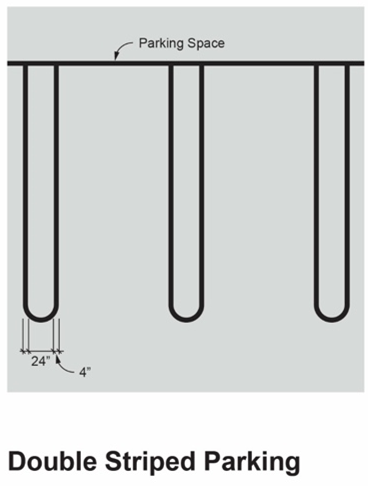
Double Striping. All parking spaces shall be clearly marked by the use of double striping. Except for parallel parking, all parking spaces shall be clearly striped with four (4) inch wide double lines, twenty-four (24) inches apart, to facilitate movement and to help maintain an orderly parking arrangement. See image below.
(14)
Required Parking for Uses Not Provided. In the case of a use not specifically provided for herein, the City Council shall determine the off-street parking requirements for such use based on the most recent edition of Parking Generation, published by the Institute of Traffic Engineers (ITE), or another acceptable standard applicable for that use or a similar use.
(Ord. of 2-14-2023)
Section 9.04 - Off-Street Parking Space Layout Standards.
Whenever the building of an off-street parking facility is required, such off-street parking lots shall be laid out, constructed and maintained in accordance with the following standards and regulations.
(1)
Dimensional Layout. Plans for the layout of off-street parking facilities shall be in accordance with the following minimum requirements:
(2)
Shorter Parking Stall Length. The requirements for parking stall length may be reduced by two (2) feet where 90-degree parking abuts a sidewalk, other pavement, or sodded area at the front of the stalls provided such pavement or sidewalk measures a minimum of eight (8) feet in width, or at least two (2) additional feet of landscaped area are provided. This is to account for the vehicle overhang.
(3)
Maneuvering Lane Access. All spaces must be provided adequate access by means of maneuvering lanes. Backing directly onto a street or requiring the use of a street for a maneuvering lane is prohibited. Parking spaces must be clearly identified and marked with durable striping to distinguish the boundaries of the maneuvering lane and parking stalls.
(4)
Modifications. Where site constraints limit the ability to meet the requirements of this Section, the City Council may approve modifications to the parking space and maneuvering lane dimensions as part of Site Plan Review, except in no case shall parking stalls be less than nine (9) feet in width or eighteen (18) feet in length. For general and professional office centers that contain a minimum gross floor area of 15,000 square feet, the City Council may, upon the review and approval of a site plan by the City Planning Commission, allow up to ninety (90) percent of the required off-street parking spaces (exclusive of the required number of handicap parking spaces) to be nine (9) feet in width and one-hundred eighty (180) square feet in area. Such spaces shall be used primarily by the employees of the office center and shall be referred to in this ordinance as "designated employee parking spaces." In order to provide an adequate number of visitor and customer spaces for such office centers, no less than ten (10) percent of the total number of required parking spaces (exclusive of the required number of handicap parking spaces) shall be ten (10) feet in width and two hundred (200) square feet in area and shall be clearly marked and situated in close proximity to the building entrance(s).
(Ord. of 4-18-2022)
Section 9.05 - Minimum Number of Parking Spaces Required.
Section 9.06 - Barrier-Free Parking Required.
Each parking lot that services a building entrance, except single- or two-family residential or temporary structures, shall provide parking spaces for the physically handicapped which shall be located as close as possible to walkways and entrances. All parking lots shall be designed in conformance with Michigan State Act No. 1 of the Public Acts of 1966 as amended, and the Americans with Disabilities Act, as summarized in the Table below.
Section 9.07 - Parking and Loading for Multiple Uses and Joint Use.
The parking and loading regulations for any premises in multiple usages must be the sum of the minimum requirements for the individual uses on the premises.
In order to meet the minimum amount of required off-street parking spaces for a given use, application must be made to the City Council for the right to engage in the joint use of owned parking spaces. Prior to approving the joint use of parking spaces to meet the minimum amount of required off-street parking for a given use in a given zoning district, the City Council must verify by a preponderance of the evidence that each of the following statements are true:
(1)
The commercial enterprises, industrial establishments, residential uses, places of public assembly, and religious institutions engaged in the joint use of off-street parking spaces are unlikely to have a need for the joint parking spaces at overlapping times.
(2)
The parking spaces designated for joint use comprise less than seventy-five percent (75%) of the applicant's minimum required off-street parking spaces.
(3)
The parking spaces designated for joint use are within five hundred (500) lineal feet of the applicant's most appropriate entrance.
(4)
Written contracts, in the form of cross-access agreements, between the applicant and the owner/operator of the parking spaces approve this joint use.
(5)
There must be adequate pedestrian access provided between the shared parking lot and the associated buildings and uses.
Section 9.08 - Off-Street Loading Space.
On the same premises with every building structure, or part thereof, erected and occupied for manufacturing, storage, warehouse purposes, department store, wholesale store, market, hotel, hospital, mortuary, laundry, dry cleaning, or other uses similarly involving the receipt or distribution of vehicles or materials or merchandise, there shall be provided and maintained on the lot adequate space for standing, loading and unloading services in order to avoid undue interferences with public use of the streets or alleys. Such space shall be provided as follows:
(1)
All loading spaces shall be in addition to the off-street parking area access drive and maneuvering lane requirements.
(2)
Off-street loading space shall have a clearance of fourteen (14) feet in height.
(3)
Off-street loading space may be completely enclosed within a building or may occupy a portion of the site outside of the building, provided that where any portion of a loading space is open to public view from a public way, the space shall be screened in accordance with Article X.
(4)
All loading and unloading in an industrial district shall be provided off-street in the rear yard or interior side yard and shall in no instance be permitted in a front yard. In those instances where exterior side yards have a common relationship with an industrial district across a public thoroughfare, loading and unloading may take place in the exterior side yard when the setback is equal to at least fifty (50) feet.
Section 9.09 - Parking structures.
(1)
Districts Permitted. Parking structures are subject to the following standards and are treated as a permitted use in the P-L and M-2 Districts and as a waiver use in the C-2, C-3, C-4, ML, M-1, and P Districts.
(2)
Maximum Height. The height of any parking structure shall not exceed the maximum height of the district in which it is located.
(3)
Location. Parking structures shall not be located in the Front Yard. No parking space within a parking structure may be closer to the street than the front face of the principal building.
(4)
Traffic Circulation. Traffic circulation shall be designed so that no automobile need enter a public street in order to progress from one aisle to another within the same structure and so that no automobile need enter a public street backwards in order to leave the structure. Clear signs or pavement markings shall be provided to indicate traffic circulation.
(5)
Screening. Parking structures shall be designed to screen vehicles and light trespass onto adjacent properties.
(6)
Architectural Standards.
A)
The design of all parking structures should be more than just a rectangular utilitarian box composed of concrete or steel beams and columns. Variation in forms and detail along with high quality facing materials are required where viewable by the general public.
B)
Exterior elevations shall incorporate design components and materials utilized and compatible with the primary building(s). The incorporation of brick, stone, and precast concrete are preferred choices.
C)
Floors shall be designed horizontally to support adaptive reuse of the structure.
(7)
Exemptions. Parking structures are not required to have interior landscape islands as required in Section 10.03Section 10.03(2) (Section 10.03(2)B)).
Section 9.10 - Surfacing and Drainage.
(1)
Hard Surfacing. Unless waived by City Council, all parking areas, regardless of size, must be hard surfaced. Pavement type and thickness must be approved by the City Engineer prior to construction, taking into consideration soil conditions and traffic loadings.
(2)
Storm Water Management. Storm water runoff created as a result of the improvements to the parking area must be controlled in such a manner so as to reduce and/or eliminate draining onto neighboring properties. To reduce storm water runoff, developers shall consider using permeable, pervious pavements wherever feasible. Improved parking areas may be incorporated into the storm water management plan for the proposed project. Site grading as well as storm water control provisions must be reviewed and approved by the City Engineer or Wayne County prior to site construction.
(3)
Maintenance. All off-street parking areas shall be continually maintained in satisfactory condition so as to be safe, attractive, and free of any hazard, nuisance, or other unsafe condition.
(Ord. of 2-14-2023)
Section 9.11 - Curb.
Except for those parking areas serving a single- and two-family dwelling unit, concrete curbs, sidewalks, and other items as necessary for the protection of the public and adjoining properties must be provided and maintained around all parking areas, including where parking spaces abut landscaping, property lines, or required setback areas. The City Council may approve an alternative design when opportunity exists to substantially improve the water quality of the site. In all cases where parking lots abut public sidewalks, a concrete curb at least six (6) inches high must be installed so that a motor vehicle cannot be driven or parked within two (2) feet of a public sidewalk.
Section 9.12 - Approval.
Plans for the development of any such parking area must be approved by the City Council before construction is started. No such land shall be used for parking purposes until approved by the Department of Inspection.
Section 9.13 - Off-Street Parking: Study and Report.
The City Council shall routinely make studies of the various areas in the City of Livonia for the purpose of determining areas within which there is need for the establishment of off-street parking facilities to be provided by the City of Livonia and to be financed wholly or in part by a special assessment district, or by other means, where such need is found. This study and report shall include recommendations on the site, location and other pertinent features of the proposed off-street parking facilities and the area they should be intended to serve. Wherever, pursuant to such recommendations, the City Council shall establish off-street parking facilities by means of a special assessment district or by any other means, it may also determine, upon completion and acceptance of such off-street parking facilities by the City, all existing buildings and uses and all buildings erected or uses established thereafter within the special assessment district, or districts which shall be exempt from the requirements of this section for privately supplied off-street parking facilities.
Section 9.14 - Illegal Parking of Motor Vehicles; Tickets; Towing of Motor Vehicles.
(1)
It shall be unlawful for any motor vehicle which is abandoned, unlicensed, wrecked, inoperative, in a state of major disassembly, disrepair, or in the process of being stripped or dismantled, to be parked on any private property unless the same is completely enclosed within a garage or other suitable building or structure. A vehicle of any type shall not at any time undergo major overhaul, including body work, in any residential district.
(2)
For the purpose of this section, a vehicle of any kind, as described in paragraph (1) of this section, or any unlicensed vehicle, shall be deemed abandoned when it has remained parked, stored, or left or been permitted to be parked, stored, or left on private property for a period of forty-eight (48) continuous hours or more. Provided, however, that this section shall not be applicable where a vehicle is being stored, used, or repaired, in connection with the following designated uses:
A)
The repair and service facilities of a new and used automobile dealership or a new and used truck dealership when owned and operated in conjunction therewith by the same proprietor and located on the same property.
B)
Garage, repair shops, and similar highway services.
(3)
The officer authorized to enforce the provisions of this Zoning Ordinance, may in his or her discretion remove, cause to be removed, or tow away under his or her direction, any such motor vehicle which is flagrantly, continuously or persistently violating the provisions of the Zoning Ordinance relating to the parking of motor vehicles on private property. Any such motor vehicle thus removed or towed away shall be taken to the City automobile or motor vehicle pound or to a privately owned garage and kept under the custody or control of the officer or person in charge thereof; provided, however, that any such removal or towing shall be at the risk of the owner of said vehicle, and provided further that the disposition of said vehicle after removal shall be in accordance with the provisions set forth in Sections 10.21.210—10.21.260 of the Livonia Code of Ordinances, as amended, which provisions are made a part hereof and incorporated herein by reference.
(4)
In any prosecution or proceeding under this section, the registration plate displayed on a motor vehicle shall constitute in evidence a prima facie presumption that the registered owner of such vehicle was the person who parked such vehicle at the place where such violation occurred. Whenever the owner or operator of any such motor vehicle is convicted of violating any of the provisions of said Ordinance pertaining to the parking of motor vehicles on private property, such violation shall be deemed to be a misdemeanor and shall be subject to all the penalties set forth in this Zoning Ordinance
Section 9.15 - Electric Vehicle (EV) Charging Stations or Ports.
(1)
Accessory Use. Electric Vehicle (EV) Charging Stations or Ports, when treated as an accessory use, shall be allowed in all zoning districts, subject to the review and approval of the Department of Inspection and the following:
A)
Size and Signage.
i)
Commercial. On commercial properties, all above-ground equipment associated with an EV Charging Station or Port shall be limited to a height of eight (8) feet and a width of four (4) feet, including any sign that is a part of or attached to the equipment, which sign shall not exceed two (2) square feet in area; provided, however, that in the case of an EV Charging Station that has a setback of one-hundred (100) feet or more from any public place, including any public right-of-way, the area of the sign shall be a maximum of ten (10) square feet. The use of neon-type or LED lighting around the frame, perimeter or any part of the EV Charging Station is strictly prohibited.
ii)
Single-Family. On single-family lots, any equipment used in connection with an EV Charging Station located in a front or side yard shall be limited to a height of four (4) feet. In a rear yard, all EV Charging equipment shall be limited to a height of six (6) feet.
B)
Setbacks and Pedestrian Walkways.
i)
Commercial. No EV Charging Station shall be located closer than ten (10) feet from any public right-of-way, and no EV Charging Station shall be located within any part of a public right-of-way without the prior written approval of the authority having jurisdiction over the right-of-way. EV Charging Stations shall not encroach upon or inhibit the use of pedestrian walkways.
ii)
Single-Family. EV Charging equipment on single-family lots shall not be located in any required front, side, or rear yard setback.
C)
Landscaping and Protection. On commercial properties, any landscaping that must be removed for the installation of an EV Charging Station shall be replaced in the same general area as where it was removed. Adequate spacing or protection shall be provided around or adjacent to the EV Charging Station, such as steel or concrete-filled bollards.
D)
Coverings. All structural or non-structural canopies, coverings, overhangs or structures designed to fully or partially enclose or protect an EV Charging Station shall comply with the height, area and setback requirements of the zoning district in which the EV Charging Station is located. Such coverings or structures in any commercial zoning district shall first require approval of a site plan pursuant to Section 13.13(12).
E)
Residential. In residential zoning districts, use of EV Charging Stations shall be limited to the owners, occupants or visitors of the property, and there shall be no remuneration or compensation charged for the services.
F)
Limitation. In nonresidential zoning districts, no more than fifteen (15%) percent of the required number of parking spaces shall be dedicated EV Charging Stations unless an exception is granted by the Department of Inspection.
(2)
Principal Use. Electric Vehicle (EV) Charging Stations or Ports as a principal use of the property, shall be treated as a waiver use limited to C-2 and C-3 zoning districts and subject to review and submission of findings by the City Planning Commission and approval by the City Council pursuant to Section 6.26.
Section 9.16 - Limitation of the Use.
(1)
Parking areas shall be used for parking of private passenger vehicles only.
(2)
Parking may be with or without charge.
(3)
No business involving the repair or services to vehicles permitted thereon or sale, or other storage, or display thereof, shall be conducted from or upon such premises.

