
Livonia City Zoning Code
ARTICLE II
DEFINITIONS
Section 2.01 - General.
(1) Definitions Pertaining to Grammatical Usage.
Meaning of Words and Phrases. The words and phrases defined in this Article, when used in this Ordinance, shall, for the purpose of this Ordinance, have the meanings ascribed to them in this Article, except in those cases where the context clearly indicates a different meaning. Words used in the present tense include the future tense, words in the singular number include the plural number, words in the plural number include the singular number, and the word "shall" is always mandatory and not merely directory. The word "building" includes the word "structure," and the word "dwelling" includes the word "residence." The word "lot" includes the word "plot" or "parcel." Terms not herein defined shall have the meaning customarily assigned to them.
Occupied and Used. The word "occupied", and the word "used" shall each be considered and construed as though followed by the words "or intended, arranged, or designed to be used or occupied."
Person. The word "person" shall include any individual, firm, co-partnership, corporation, company, association, club, joint venture, estate, trust, or any other group or combination acting as a unit, and the individuals constituting such group or unit and the plural as well as the singular number; the singular masculine pronoun, the singular feminine pronoun, and the corresponding plural pronouns shall include the masculine, feminine, neuter and plural unless the intention to give a more limited meaning is disclosed by the context.
(2) Definitions of General Zoning Terms.
Board of Appeals. The Zoning Board of Appeals operating pursuant to the provisions of Michigan Zoning Enabling Act, MCL 125.3101 et seq., as amended.
Building Official. The Director of the Department of Inspection or any of his or her duly authorized assistants.
Department of Inspection. The Department of Inspection of the City of Livonia.
Family. A family is any number of persons living together in a single dwelling unit comprising a single housekeeping unit and related by blood, marriage, adoption, or any unrelated person who resides therein as though a member of the family and including the domestic employees thereof. Any group of persons not so related but inhabiting a single dwelling unit shall, for the purpose of this Ordinance, be considered to constitute one (1) family for each five (5) persons exclusive of domestic employees contained in such group.
Future Transportation Map. Current adopted Future Transportation Map included in the Livonia Vision 21 Master Plan, as amended.
Non-Conforming Building. A building or structure, lawfully existing at the time of enactment of this Ordinance or a subsequent amendment thereto, that does not conform to the regulations or provisions of this Ordinance applicable to the zoning district in which it is located.
Non-Conforming Use. A use of a building, structure, or of a tract of land, lawfully existing at the time of enactment of this Ordinance or a subsequent amendment thereto, that does not conform to the regulations or provisions of this Ordinance applicable to the zoning district in which it is situated.
Planning Commission. The City Planning Commission operating pursuant to the provisions of the Michigan Planning Enabling Act, MCL 125.3801, et seq., as amended.
Plat. A map or chart of a subdivision of land.
Platted Subdivision. A parcel or tract of land which has been partitioned or divided by the proprietor thereof or by his or her heirs, executors, administrator, legal representative, successors, or assigns for the purpose of sale or of building development where the act of division created parcels in accordance with the provisions of MCL 560.101 et seq., as amended, being the "Land Division Act."
Single Ownership. Ownership by a person or by two or more members of the same family of a lot of record which is completely isolated from any other property held by the same person or persons.
Subdivision Regulations. Regulations and amendments thereto adopted by the City Planning Commission and authorized by the Michigan Planning Enabling Act, MCL 125.3801 et seq., as amended and Land Division Act, MCL 560.101 et seq., as amended.
Use. The purpose for which land or buildings thereon are designed, arranged, or intended to be occupied, used, or for which they are occupied or maintained.
Variance. A modification of the literal provisions of the Zoning Ordinance granted by the Board of Appeals when in its judgment the strict enforcement of the Zoning Ordinance would cause practical difficulty or undue hardship owing to circumstances unique to the individual property on which the variance is granted.
Waiver Use. Uses as enumerated under the zoning district that are permitted upon review and submission of findings by the City Planning Commission and approved by the City Council. Waiver uses are synonymous to special land uses, as defined in Section 125.3502 of the Michigan Zoning Enabling Act.
Waiver Use Open Space Planned Residential Development. The variation of residential zoning district requirements so as to achieve greater flexibility in the creation of open space and improved design without increasing density.
(3) Definitions Pertaining to Rights-of-Way and Public Utilities.
Alley. A passage or way open to public travel, not more than thirty (30) feet wide, affording a secondary means of vehicular access to abutting property and not intended for general traffic circulation.
Cul-de-sac. A street with only one (1) outlet having sufficient space at the closed end to provide vehicular turning facilities.
Essential Services. The construction, alteration, or maintenance by private companies, municipal departments, or commissions of the various transmission, distribution, or disposal systems that are necessary for the preservation of the public health, safety, or general welfare, such as gas, electricity, telephone, telegraph, fire alarm, steam, water and sewage. This term shall also include all poles, wires, mains, drains, sewers, pipes, conduits, cables, fire alarm boxes, police call boxes, traffic signals, hydrants, emergency outdoor warning sirens, and other similar equipment or accessories reasonably necessary for the furnishing of adequate service by such private company, municipal department, or commission, but it shall not be deemed to include buildings or public utility substations. This term shall not include telecommunication towers, solar energy facilities, and wind energy conversion systems.
Major Thoroughfare. An arterial street intended to serve as a large volume trafficway for both the City of Livonia and the region beyond and which may be designated as a parkway, freeway, expressway, arterial highway, arterial street, special arterial, city major, or equivalent term for identification purposes. Any street with a width, either existing or proposed (as shown on the Future Transportation Map) of one hundred (100) feet or more shall be considered a master or major thoroughfare.
Minor Street. A street designated as a minor street pursuant to Act 51 of the Public Acts of 1951 intended primarily for providing access to abutting properties. A "Minor Street" includes a street supplementary to a secondary street intended to serve the local needs of the neighborhood and of limited continuity used primarily as access to abutting residential properties.
Public Utility. Any person, firm, corporation, municipal department, or board, duly authorized to furnish and furnishing general community services to the public, under state or municipal regulations, including, but not restricted to, electrical, gas, steam, communication, transportation, sewer, or water service. Telecommunication towers, small wireless communication facilities, solar energy facilities, and wind energy conversion systems are not public utilities.
Public Utility Buildings. This term shall include telephone exchange buildings, transformer stations and substations, gas regulator stations, and similar structures.
Street. A dedicated and accepted public thoroughfare, other than a public alley, open to public travel, whether designated as a road, avenue, highway, boulevard, drive, lane, circle, place, court, terrace, or any similar designation, having a right-of-way at least thirty (30) feet in width. A street may also accommodate non-motorized traffic.
(4) Definitions of Basic Types of Buildings and Uses.
Accessory Buildings and Structures. A subordinate building or structure whether attached, detached, or a subordinate adjunct to the principal building.
Building, Principal. A building or, where the context so indicates, a group of buildings in which the main or principal use of the lot is conducted.
Educational Uses. Uses that provide educational services, such as public libraries, public primary and secondary schools, and publicly owned and operated institutions of higher learning.
General Farming. Standard farming activities such as horticulture, dairying, livestock and poultry raising, farm forestry, and similar bona fide agricultural enterprises or uses of land and structures, except farms operated wholly or in part for the disposal of garbage, sewage, rubbish, offal, and wastes from rendering plants.
Use, Accessory. A use normally incidental to, and subordinate to the principal use of the premises.
Use, Principal. The primary and chief purpose for which a lot is used.
Temporary Use, Temporary Building, Temporary Structure. A structure building or use permitted by the City Building Official or City Council to exist during periods of construction of the principal use, for special events, or purposes, which shall not exceed one (1) year unless otherwise permitted or extended by the City Council. Temporary uses shall be only those which are clearly short duration.
(5) Definitions of Basic Building and Structural Terms.
Alterations. A change, addition, or modification in construction or type of occupancy. Any change in the structural members of a building, such as walls, partitions, columns, beams, or girders, the consummated act of which may be referred to herein as "altered" or "reconstructed."
Basement. That portion of a building which is wholly or partly below the average grade of the ground level adjoining the building is a basement when the height from the grade up to the first floor level is less than the height from the grade level down to the floor; provided, however, that if the height from the grade level to the first floor level is five (5) feet or more, such basement shall be considered a story.
Building. Any structure, either temporary or permanent, having a roof and used or built for the shelter or enclosure of persons, animals, chattels, or property of any kind. This shall include tents, awnings or vehicles situated on private property and used for purposes of a building.
Building Area. That portion of the lot occupied by the main building, accessory building, and other structures. The term is synonymous with lot coverage.
Building, Front of. That façade of a building most nearly parallel to and nearest the front lot line.
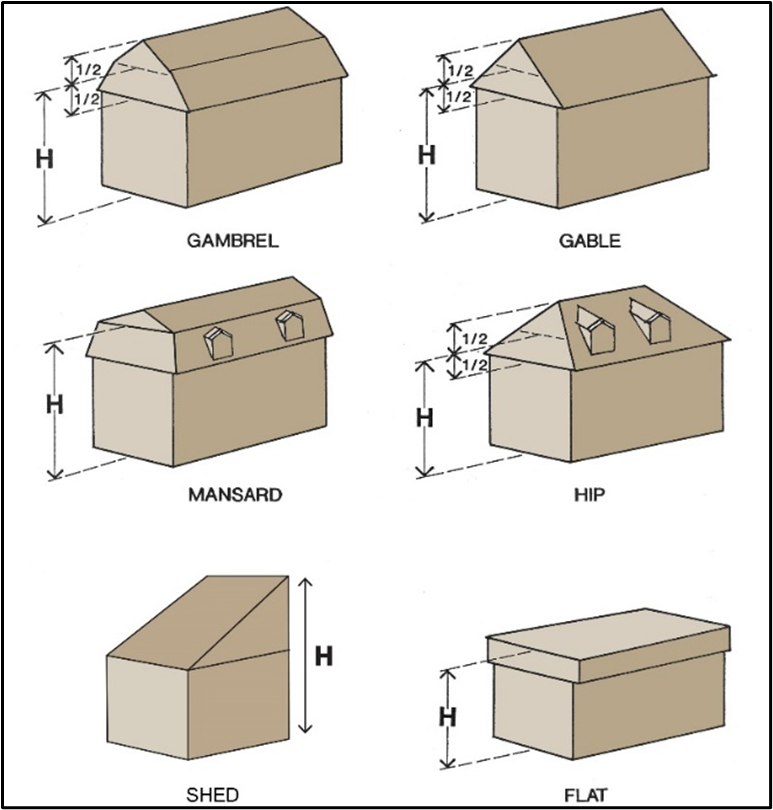
Building Height. The vertical distance between the average grade (see definition of "Grade") and the highest point of the roof surface for flat roofs; to the deck line of Mansard roofs; the average height between eaves and ridge for gable, hip, and gambrel roofs; and the average height between the lowest point and the highest point on a shed roof.
Building Line. The line formed by the outer surface of a building, structure, or enclosure wall at ground level.
Erected. The word "erected" includes built, constructed, reconstructed, moved upon, or any physical operations on the premises required for the building. Excavations, fill drainage, and the like, shall be considered a part of erection.
Grade, Finished. The final elevation of ground surface after man-made alterations to a site in conformance with the approved plans or designs relating thereto.
Grade, Natural. The elevation of the undisturbed natural surface of the ground prior to any excavation or fill.
Mezzanine. An intermediate floor in any story occupying not to exceed one-third (⅓) of the floor area of such story.
Soil. Includes land, earth, dirt, clay, sand, gravel, soil components, minerals, and kindred substances.
Story. That portion of a building included between the upper surface of any floor and the upper surface of the floor next above, or any portion of a building between the upper surface of the topmost floor and the ceiling above it.
Story, Half. A half story is an uppermost story lying under a sloping roof, the usable floor area of which does not exceed seventy-five (75) per cent of the floor area of the story immediately below it.
Structure. A structure is anything erected or constructed which requires permanent location on the ground or attachment to something having such location.
Usable Floor Area, Non-Residential. The measurement of usable floor area for non-residential uses shall be the sum of the area of the first floor, as measured to the exterior face of the exterior walls, plus that area, similarly measured, of all other stories that are accessible by a fixed stairway, ramp, escalator or elevator, which may be made fit for occupancy. The measurement shall include the floor area of all accessory buildings measured similarly.
Usable Floor Area, Residential. The measurement of usable floor area for residential uses shall be the sum of the area of the first floor, as measured to the exterior face of the exterior walls, plus that area, similarly measured, of all other stories having more than ninety (90) inches of headroom that are accessible by a fixed stairway and which may be made usable for human habitation, but excluding the floor area of uninhabitable basements, cellars, garages, accessory buildings, attics, unenclosed breezeways, and unenclosed porches.
Utility Room. A utility room, or space, is a room, or space, located other than in the basement, specifically designed and constructed to house any home utilities such as the heating unit and laundry facilities.
(6) Definitions Pertaining to Lots and Areas.
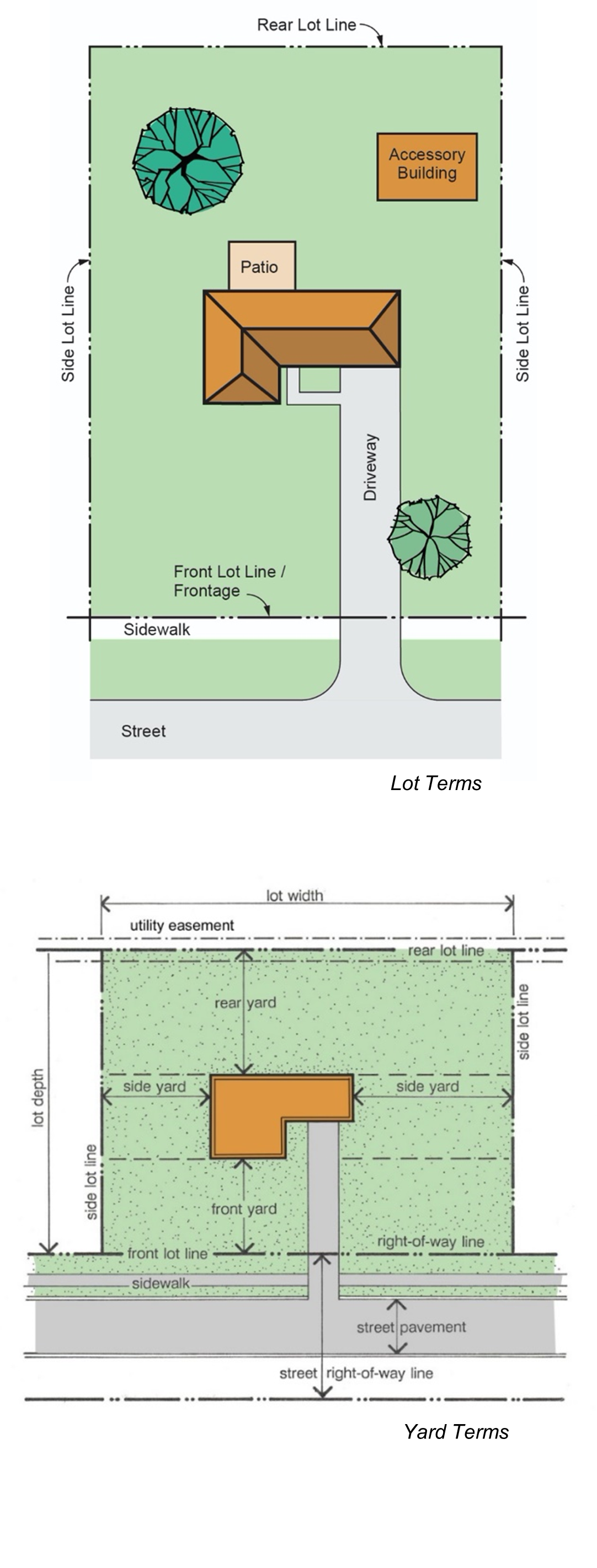
Lot. An area of land, which may consist of lots of record and/or parcels or parts thereof, occupied or intended for occupancy by not more than one main building or dwelling unit, unless otherwise specifically provided in this Ordinance.
Lot, Area. The total horizontal area within the lot lines of a lot.
Lot, Corner. A lot located at the intersection of two (2) or more streets where the corner interior angle formed by the intersection of the two (2) streets is one hundred thirty-five (135) degrees or less; or a lot abutting upon a curved street or streets if tangents to the curve at the two (2) points where the lot lines meet the curve, form an interior angle of less than one hundred thirty-five (135) degrees.
Lot Coverage. That part or percent of the lot occupied by buildings, including accessory buildings.
Lot Depth. The average depth of a lot.
Lot, Double Frontage. An interior lot having a street line for both the front lot line and the rear lot line.
Lot, Interior. An interior lot is a lot other than a corner lot.
Lot of Record. A lot of record is a lot the dimensions of which are shown on a plat recorded in the office of the Register of Deeds prior to the effective date of this Ordinance, and which actually exists as so shown.
Lot Lines. The lines bounding a lot as defined herein. In case a recorded ownership is to the center line of a public thoroughfare, the lot line, for the purposes of this Ordinance, shall be the outside line of the right-of-way as shown on the Future Transportation Map.
Lot Line, Front. The line abutting a street. On a corner lot the shorter street line shall be considered the front lot line. Where new street lines are established by ordinance or the Future Transportation Map of the City of Livonia, such lines shall be the front lot line. See Figure above.
Lot Line, Rear. The rear lot line is that boundary which is opposite and most distant from the front lot line. In the case of a lot pointed at the rear, the rear lot line shall be that assumed line parallel to the front lot line, not less than ten (10) feet long, lying most distant from the front lot line and wholly within the lot. See Figure above.
Lot Line, Side. A side lot line is any lot boundary line not a front lot line or a rear lot line. A side lot line separating a lot from a street is a side street lot line. A side lot line separating a lot from another lot, or lots is an interior lot line. See Figure above.
Lot Width. The shortest straight-line dimension of a lot measured between side lot lines at the distance required for a front yard, but not encroaching into the setback, in the district in which the lot is located.
Outlot. An outlot is a parcel of land which must be designated on a recorded plat as an outlot before it may be legally considered as such.
Setback. The minimum required horizontal distance between the foundation of a building or other structure, excluding allowable projections and encroachments, and the front, side, or rear lot line or right-of-way line.
Setback Lines. A line marking the setback distance from the lot lines which establishes the minimum required front, side, or rear yards of a lot.
Yards. The open spaces on the same lot with a principal building are established by and between the lot lines and the required building setback lines and which are open, unoccupied, and unobstructed by any structure or any part thereof from the ground upward, except as may otherwise be provided in this Ordinance.
Yard, Front. A front yard is an open space extending the full width of a lot and of a uniform depth equal to required setback line as measured horizontally and perpendicular to the front lot line, unoccupied from the ground upward except as hereinafter specified. See Figure below.
Yard, Rear. A rear yard is an open space extending the full width of a lot and of a uniform depth equal to the required setback line measured horizontally and perpendicular to the rear lot line, unoccupied from the ground upward except as hereinafter specified. See Figure to the right.
Yard, Side. A side yard is an open space extending from the front yard to the rear yard and of a uniform width equal to the required setback line measured horizontally and perpendicular to the side lot line, unoccupied from the ground upward except as hereinafter specified. See Figure to the right.
(7) Definitions Pertaining to Types of Dwellings.
Apartments. A leased dwelling unit comprised of one or more rooms with private bath and kitchen facilities and located in a building containing three (3) or more apartments.
Condominium. A form of property ownership in which dwelling units are owned individually but the associated land (limited and common) and common elements in the structure are owned jointly.
Congregate Elderly Housing. Apartments and dwellings for the elderly with communal dining facilities and services, such as housekeeping, organized social and recreational room(s) and activities, transportation services, and other support services appropriate for the residents under common management.
Dwelling, Converted. A "converted dwelling" is a building containing more dwelling units than the number for which it was originally designed and constructed.
Dwelling, Multiple Family. A building containing three (3) or more dwelling units arranged either side by side or one above the other.
Dwelling, One-Family. A separate detached building designed exclusively for and containing only one (1) dwelling unit.
Dwelling, Two-Family. A separate detached building designed exclusively for and containing only two (2) dwelling units, each of which is independent from the other.
Dwelling Unit. Any room or group of rooms located within a dwelling and forming a residential household unit with facilities that are used or intended to be used for living, sleeping, cooking, and eating, with a restroom(s) and bathing facility(ies) to be utilized by a family, a household unit as that term is defined in this Chapter, or three or more unrelated individuals. A building or portion thereof designed as a unit for occupancy by only one (1) family for residential living purposes and having principal kitchen facilities.
Independent Elderly Housing. Attached or detached dwellings (apartment, townhouse, or single-family structures) occupied by elderly persons in good health who desire and are capable of maintaining independent households as part of a planned development and provided with qualified management services, such as security, housekeeping, and recreational and social activities, to maintain the premises.
Mobile Home. A structure, transportable in one (1) or more sections, which is built on a chassis and is designed to be used as a one-family dwelling, with or without a permanent foundation, when connected to the required utilities, and which includes the plumbing, heating, air conditioning and electrical systems contained in the structure.
Mobile Home Park. A parcel or tract of land under the control of a person upon which three (3) or more mobile homes are located on a continual non-recreational basis, and which is offered to the public for that purpose regardless of whether a charge is made therefor, together with any building, structure, enclosure, street, equipment, or facility used or intended for use incidental to the occupancy of a mobile home and which is not intended for use as a temporary trailer park.
Modular Home. A structure, transportable in two (2) or more sections and designed to be used as a one-family dwelling with a permanent foundation.
Senior Assisted Living Facility. Elderly residences that provide 24-hour supervision and are designed and operated for elderly people who require some level of support for daily living. Such support shall include meals, security, and housekeeping, and may include daily personal care, transportation, and other support services, where needed. Individual dwellings may contain kitchen facilities.
Site Condominium. Any development which is (i) exempt, pursuant to MCL 559.110(1), being Section 10(1) of the Condominium Act, MCL 559.101, et seq ., from the provisions of the Land Division Act, MCL 560.101, et seq., and (ii) not a condominium as that term is used in Section 2.01(7) of this Ordinance, and shall include, but not be limited to, one-family dwellings.
(8) Definitions of Terms Relating to Commercial Buildings and Uses.
Adult Businesses:
A)
Adult Bookstore. An establishment housing as a substantial or significant portion of its stock in trade, books, magazines, periodicals, or other materials which are distinguished or characterized by their emphasis on sexually explicit matter, or an establishment with a segment or section devoted to the sale or display of such material.
B)
Adult Motion Picture Theater. An enclosed building with a capacity of four hundred (400) or more persons used for the presentation of material that has a dominant theme which is distinguished or characterized by an emphasis on the depicting or describing of sexually explicit matter, for observation by patrons therein.
C)
Adult-oriented Merchandise. Goods, products, commodities, or other ware, including, but not limited to videos, CD ROMs, DVDs, computer disks or other storage devices, magazines, books, pamphlets, posters, cards, periodicals, or non-clothing novelties which depict, describe, or simulate sexual activities.
D)
Adult-oriented Retail. An enclosed building or any portion thereof which for money, including any portion thereof, or any other form of consideration, devotes a significant or substantial portion of stock in trade to the sale, exchange, rental, loan, trade, transfer, or viewing of adult-oriented merchandise.
Antique Store. A retail establishment selling objects made in a bygone period having special value because of their age.
Artisan, Craftsman, Printing, Engraving Shops, and other similar uses. A service that requires a skilled trade, especially one that involves making things by hand.
Bakeries, Dairies, Creameries, Soft Drink and Bottling Plants, and other similar uses. Retail stores where bread and cakes are made and sold; establishments for the storage, processing, and distribution of milk and milk products at said retail stores; and the production and manufacturing of soft drinks and bottles to be sold at retail stores.
Banquet Facility. An establishment rented by individuals or groups to accommodate private functions, including but not limited to banquets, weddings, parties, anniversaries, and other similar gatherings of fifty (50) or more people or in a room or space that exceeds 1,000 square feet in size, and where food and drink are consumed. Banquet Facilities shall include Ballrooms, Dance Halls, and Event Facilities.
Consignment Shop. A store that sells second-hand items (typically clothing and accessories) on behalf of the original owner, who receives a percentage of the selling price.
Escort Services. An establishment which provides the services of escorting members for payment of a fee.
Garage, Community. A community garage is a structure or a series of structures, for the storage of motor vehicles, having no public shop or services in connection therewith, and separated into compartments or sections with separate vehicular entrances, for the use of two (2) or more owners or occupants of property in the vicinity.
Garage, Public. A public garage is a structure, other than a private or community garage, for the storage, care, repair, or refinishing of motor vehicles. Except that a structure or room used solely for the display and sale of such vehicles, in which they are not operated under their own power and in connection with which there is no repair, maintenance, or refinishing service or storage of vehicles other than those displayed, shall not be considered a garage for the purposes of this Ordinance.
Gasoline Service Station. Buildings or premises, or portions thereof, arranged or designed to be used for the retail sale of oil, gasoline, or other fuel for the propulsion or lubrication of motor vehicles, including facilities for changing of tires, tube repairing, polishing, greasing, washing, or minor servicing of such motor vehicles, but excluding high-speed automotive washing, high-speed automotive steam cleaning, body repairing, chassis repairing, and bumping and painting.
Home Occupation. Any use customarily conducted entirely within a dwelling unit by the inhabitant thereof which is incidental and secondary to the use of the dwelling unit for dwelling purposes not requiring internal or external alterations or construction features or the use of equipment, machinery, outdoor storage, or signs not customary in residential areas. Clinics, hospitals, barber shops, beauty parlors, tea rooms, tourist homes, bed and breakfast establishments, animal hospitals, kennels, and uses of similar character shall not be deemed to be home occupations.
Hotel. An establishment providing accommodations, meals, and other services for travelers and tourists.
Ice Cream Parlor. An ice cream parlor is any establishment where ice cream (which may be in bulk form), desserts, confectioneries, packaged dairy products, and beverages are sold and which ice cream, desserts, confectioneries, and beverages may be consumed in the establishment at chairs and tables located within the premises only; provided, however, that there shall be no in-car customer service on the premises, and provided, further, that no food other than that enumerated above shall be consumed on the premises.
Indoor recreational activities. Indoor commercial amusement services such as but not limited to bowling alleys; billiard parlors and poolrooms; and swimming pools.
Junkyard. Place, structure, or parcel of land where junk, waste, discarded, salvaged, or similar materials, such as old iron or other metal, wood, lumber, glass, paper, rags, cloth, bagging, cordage, barrels, containers, etc., are bought, sold, exchanged, baled, packed, disassembled, or handled. Including auto wrecking yards, used lumber yards, house wrecking yards, and places or yards for use of salvaged house wrecking and structural steel materials, and equipment; excluding pawn shops, establishments for the sale, purchase or storage of used cars, salvaged machinery, used furniture, radios, stoves, refrigerators, or similar household goods, and the processing of used, discarded or salvaged materials as part of manufacturing operations.
Kennel. A kennel is a building, pen or enclosure used for the keeping, sheltering, maintaining, or boarding of four (4) or more dogs, or for the keeping or boarding of any number of dogs as a regular business. The term "kennel" shall not include the keeping or maintaining of puppies less than three (3) months old when borne by dogs which are legal accessory house pets.
Loading Space. An off-street space on the same lot with a building or group of buildings, for the temporary parking of a commercial vehicle while loading or unloading merchandise or vehicles.
Massage Establishment. A place where manipulated massage or manipulated exercises are practiced for pay upon the human body by anyone using mechanical, therapeutic, or bathing devices or techniques, other than the following: a duly licensed physician, osteopath, or chiropractor; a registered or practical nurse operating under a physician's directions; or, registered physical or occupational therapist or speech pathologist who treats patients referred by a licensed physician and operates only under such physician's direction. Massage establishments, as defined herein, shall not include properly licensed hospitals, medical clinics, nursing homes, beauty salons, barber shops, tanning and/or nail salons, athletic clubs, or other licensed facilities where massages are administered as an incidental or accessory use to the main use of the premises, provided, that the facility maintains a separate room equipped with appliances and apparatus for massages and; provided further, that the massages are administered only by massage therapists who are licensed by the State of Michigan and have and continue to satisfy all the requirements and abide by all the restrictions and prohibitions set forth in the Mich. Admin. Code R 338.701 through R 338.727 inclusive, as amended; and, provided further, that the establishment or facility has obtained a separate zoning compliance permit from the Inspection Department for this use on an annual basis. Massage establishments, as defined herein, shall also not include offices where occasional chair massages are administered as an incidental or accessory use to the main use of the premises as long as the massages are administered only by massage therapists who are licensed by the State of Michigan and have and continue to satisfy all the requirements and abide by all the restrictions and prohibitions set forth in the Mich. Admin. Code R 338.701 through R 338.727 inclusive, as amended.
Motel. A motel is a building or group of buildings, cabins, courts or similar structures, containing primarily rooming units with the number of dwelling units being not greater than ten percent (10%) of the total number of rooming units, and designed, intended and actually used, if at all, for the provision of sleeping accommodations for travelers and auxiliary facilities for the person or persons in charge of such motel. The term "motel" shall include tourist cabins, motor courts, automobile courts, auto cabins, motor lodges, and similar facilities within this definition, but it shall not include tourist homes, bed and breakfast establishments, rooming houses, boarding houses, multiple dwellings, or hotels.
Nursery. Any grounds or premises on or in which nursery stock is propagated, grown, or cultivated for the purpose of distributing and/or selling the same as a business and required to be licensed under Insect Pest and Plant Disease Act, MCL 286.201, et seq., as amended.
Office Business. Place of business where professional or clerical duties are performed. Includes but not limited to advertising offices and businesses; consumer credit reporting agencies and offices; and telephone and public utility business offices.
Outdoor Dining Areas. Use of an adjacent, outside area by a food or beverage establishment for the same eating and drinking activities that occur within the establishment.
Paint Shops, Automotive. A service shop where vehicles and parts are painted, typically by spraying.
Payday Lenders. Any business licensed pursuant to the deferred presentment service transactions act, MCL 487.2121 et seq.
Places of Assembly. Shall include limited service and full-service restaurants; banquet facilities; business schools, colleges, and trade schools; auditoriums and theaters; lodge halls, social clubs, and fraternal organizations; and religious institutions.
Restaurants:
A)
Full-Service Restaurant. A structure or portion of a structure which is maintained, operated, and advertised or held out to the public as a place where food, confections, frozen dessert, and beverages are served and consumed at chairs and tables primarily within the structure and which has a minimum seating capacity for more than thirty (30) persons.
B)
Limited Service Restaurant. A structure or portion of a structure which is maintained, operated, and advertised or held out to the public as a place where food, confections, frozen dessert, and beverages are served and consumed within the structure, and which has seating for no more than thirty (30) persons.
C)
Carry-out Restaurant. A structure which is maintained, operated, and advertised or held out to the public as a place where the principal activity is food, confections, frozen dessert and beverage take-out service and which includes, as an accessory use, a dining or eating area which has seating for no more than twelve (12) persons, where food and beverages may be selected and consumed within the structure.
D)
Drive-In Restaurant. Any establishment where food, confections, frozen dessert, and/or beverages are served to customers while seated in their motor vehicles upon the premises. It shall also include any establishment where the customers may serve themselves and are permitted to consume food and beverage in a motor vehicle parked on the premises or at other facilities which are provided for the use of the patron for the purpose of consumption, and which are located outside of the building.
E)
Drive-Thru Restaurant. A structure or portion of a structure which is maintained, operated, and advertised or held out to the public as a place where food, confections, frozen dessert, and/or beverages are purchased by customers from a drive-up window while seated in their motor vehicle and where no consumption of such food or beverage, when purchased at the drive-thru, shall take place anywhere on the site or within the structure.
Retail Sales. A business that sells commodities or goods to the public for personal, household, or business consumption. Includes but not limited to automobile accessory stores; monument sales, not including stone cutting; and office equipment sales.
Retail Sales and Service Incidental to Trades in which a workshop is required. A business that sells commodities or goods in small quantities to the public for personal, household, or business consumption that also includes a workshop. Includes but not limited to air conditioning sales, service and repair shops; electrical and lighting fixture sales, service, and repair shops; lawnmower sales, service and repair shops; and office equipment sales, service, and repair establishments.
Retail Services. Retailing that focuses on services rather than goods. Includes but not limited to blueprint, photostat, and photo-copying establishments; dry cleaning stores (including coin-operated) and plants; and exterminating services and shops.
Retail Stores. A place of business usually owned and operated by a retailer but sometimes owned and operated by a manufacturer or by someone other than a retailer in which merchandise is sold primarily to ultimate consumers. Includes but not limited to antique shops, with no outside storage; bicycle stores, including sales, rental, and repairs; candy, confectionery stores, and ice cream parlors; electrical and household appliance stores; garden supply and seed stores; locksmith shops; orthopedic and medical supply stores, not including assembly or manufacture of such articles; and sporting goods stores.
Sexually Explicit Matter. "Sexually explicit matter," as defined in MCL 722.673, as amended. All definitions therein are hereby adopted and included herein by reference.
Specially Designated Distributor (S.D.D). A person engaged in an established business licensed by the Michigan Liquor Control Commission pursuant to Michigan Public Act 58 of 1998, as amended, to distribute spirits and mixed spirit drink in the original package for consumption off the premises.
Specially Designated Merchant (S.D.M.). A person engaged in an established business licensed by the Michigan Liquor Control Commission pursuant to Michigan Public Act 58 of 1998, as amended, to sell beer or wine, or both, at retail for consumption off the licensed premises.
Storage. The keeping of goods, merchandise, or materials for subsequent sale, distribution or use on the site wherein said goods, merchandise, or materials are stored.
Theater. An enclosed building used principally for presenting performances or motion pictures which are observed by paying patrons from seats situated within the building.
Theater, Drive-In. An open-air theater constructed and operated in an established location, without cover or roof, displaying motion pictures for the general public who view the screen or stage while seated in automobiles. The term as used herein shall mean and include the entire premises upon which such theater is constructed, including parking areas, and all other facilities accessory to such business but excluding driveways and marquees.
Used Car Lot. A used car lot shall include and refer to any lot or parcel of land, or to any part thereof, used for the identification, exchange, or sale of used motor vehicles or used house trailers of any description whatsoever.
Wholesale Business Uses. The sale of goods or merchandise to retailers; to industrial, commercial, institutional, or other professional business users; or to other wholesalers. Includes but not limited to candy, jewelry, and tobacco products.
(Ord. of 2-14-2023)
Section 2.02 - Specific Terms.
(1) Definitions of Parking Terms.
Off-street Parking Lot. A facility providing vehicular parking spaces with adequate drives and aisles for maneuvering, so as to provide access for entrance and exits for the parking of more than two (2) vehicles. Off-street parking lots must be durable and smooth.
Parking Space. An area suitable for the parking of a motor vehicle with a driveway connecting such parking space with a street or alley, arranged to facilitate the convenient and safe ingress and egress of a motor vehicle. The minimum area required above shall be exclusive of necessary driveways, aisles, or maneuvering areas for all uses other than one- and two-family dwellings.
(2) Definition of Miscellaneous Terms.
Adult Foster Care Facility. A governmental or nongovernmental establishment that provides foster care to adults. Subject to Michigan Public Act 218 of 1979, as amended, and MCL 400.701 et seq., adult foster care facilities include facilities and foster care family homes for adults who are aged, mentally ill, developmentally disabled, or physically disabled, who require supervision on an ongoing basis but who do not require continuous nursing care. An adult foster care facility does not include a nursing home, home for the aged, hospital, hospital for the mentally ill, facility for the developmentally disabled, county infirmary, child caring institution, an establishment commonly described as an alcohol or substance abuse rehabilitation center, a residential facility for persons released from or assigned to adult correctional institution, or any other use excluded under Act 218 of 1979, as amended.
Agriculture. The art and science of cultivating the ground, the production of crops or livestock, and the processing of milk produced on the farm on which the processing is located, excluding, however, commercial greenhouses, the sale of nursery stock, riding stables, mink or fox or similar fur farms, hog or poultry farms using garbage as the principal source of feed, and dairy processing operations.
Automobile Car Wash Establishment. A facility for the washing or cleaning of vehicles. A car wash may be:
A)
a single unit type which has a single bay or a group of single bays with each bay to accommodate one vehicle only where a person uses a high-pressure hose to wash the vehicle by hand; or
B)
an automated single unit type which has a single bay to accommodate one vehicle at a time; or
C)
a tunnel unit type which allows washing of multiple vehicles in a tandem arrangement while moving through the structure.
Automobile or Vehicle Dealership. A business that sells new or used cars at the retail level. It may also provide maintenance services for cars and employ automotive technicians to stock and sell spare automobile parts and process warranty claims.
Automobile Service Station. A complex used for the sale of gasoline or other motor fuels, oils, lubricants, and auto accessories; and which may or may not include washing, lubricating, and other minor servicing except for automobile body work.
Bed and Breakfast Establishment. An owner-occupied dwelling where no more than five (5) guest rooms are made available for the temporary accommodation of the traveling or vacationing public. Such an establishment may offer meals only to those persons temporarily residing at the establishment. See also definition of "Bed and Breakfast Inn" and "Homestay."
A)
Bed and Breakfast Inn. A structure primarily used for lodging purposes where the use as a residence is clearly secondary. A structure where more than five (5) but not more than thirty (30) guest rooms are made available for the temporary accommodation of the traveling or vacationing public. Such an establishment may offer meals to the public and persons temporarily residing at the establishment. See also definition of "Bed and Breakfast Establishment" and "Homestay."
B)
Homestay. An owner-occupied, single-family dwelling, or a dwelling unit in a duplex or multi-family dwelling structure, that may rent up to three (3) single bedrooms with bathroom access for overnight accommodations for periods as short as one overnight stay. Meals are not provided with rental, but kitchen and/or dining facilities may be available for guests to prepare their own meals. Only properties that have received approval of a rental registration application are recognized as a Homestay for purposes of complying with City of Livonia ordinances. See also definition of "Bed and Breakfast Establishment" and "Bed and Breakfast Inn."
Breezeway. A roofed outdoor passage, as between a house and a garage.
Bulk Storage. Goods for sale, storage, or display that have a large size, mass, or volume and are not easily moved or carried, such as railroad ties, large bags of feed, fertilizer, wood, sand, gravel, stone, lumber, equipment, and other similar materials and supplies.
Caregiver Grow Facility. An enclosed, locked facility in which a "caregiver" or "patient," as those terms are used in the Michigan Medical Marihuana Act, Initiated Law 1, MCL 333.226421 et seq., cultivates marijuana.
Electric Vehicle (EV) Charging Station or Port. Equipment that connects a single electric or plug-in hybrid vehicle to a source of electricity.
Enclosed. Surrounded or closed off on all sides.
Establishments for the distribution of or the packaging, assembling, secondary processing, alteration, or repair. Includes but not limited to printing, publishing and related products; glass products made of purchased glass; and professional, scientific, and control instruments and parts; toys; amusement; sporting and athletic goods; office and artist materials; and jewelry and notions.
Exotic Vehicle. An investment-grade sport or luxury automobile specially made or produced in sufficiently limited numbers to be recognized for rarity, beauty, and general distinction.
Family Child Care Home. As defined by Public Act 1973, No. 116 of the State of Michigan, MCL 722.111 et seq., as amended.
Farm. A farm is a platted or unplatted parcel of land more than three (3) acres, in area in single ownership or single operation, on which agriculture takes place.
Fence. An artificially constructed physical barrier used to contain or enclose an area for protective measures, privacy, decorative purposes, or to mark a boundary.
Food Truck. A large-wheeled vehicle from which food is sold that typically contains cooking facilities where the food is prepared.
Garage, Private. A private garage is a structure bearing a garage door and typically designed for the storage principally of non-commercial motor vehicles having no public shop or services in connection therewith.
Group Day Care Home. As defined by 1973 PA 116, of the State of Michigan, as amended, and MCL 722.111 et seq., as amended.
Heavy Manufacturing. Heavy manufacturing means primarily moderate- and high-impact industrial uses that need to be separated from residential and other uses due to potential land use conflicts. Heavy manufacturing usually means continuous processing, as in the assembly of motor vehicles or the manufacture of chemicals, and may involve the manufacture, processing or packaging of raw or unprocessed materials which that are inherently dangerous or hazardous due to flammability, radioactivity, explosiveness, or toxicity. This category shall also include any establishment or facility using large unscreened outdoor structures such as conveyor belt systems, cooling towers, cranes, storage silos, or similar equipment, that cannot be integrated into the building design, or engaging in largescale outdoor storage. Any industrial use that generates noise, odor, vibration, illumination, or particulate that may be offensive or obnoxious to adjacent land uses or requires a significant amount of on-site hazardous chemical storage, shall be classified under this land use. This use shall include any packaging of the product being manufactured on-site. Examples include but are not limited to the production of the following: large-scale food and beverage operations, lumber, milling, and planning facilities; aggregate, concrete, and asphalt plants; foundries, forge shops, open air welding, and other intensive metal fabrication facilities; chemical blending, mixing, or production, and plastic processing and production.
Helicopter. A vehicle where support in the air is derived from the vertical component of the force produced by airfoils mechanically rotated about an approximately vertical axis.
Heliport. An area of land, water, or a structural surface which is designed, used, or intended to be used for the landing and take-off of helicopters, and any appurtenant areas which are designed to be used for helicopter support facilities such as maintenance, refueling, and parking.
A)
Personal-use Heliport. Any heliport used exclusively by the owner and/or operator.
B)
Public-use Heliport. Any heliport open to the general public and not requiring prior permission of the owner and/or operator to land.
C)
Private-use Heliport. Any heliport that restricts usage to the owner and/or operator or to persons authorized by the owner and/or operator.
D)
Temporary Heliport. Any heliport used on a one-time or temporary basis which is limited to a maximum of ten (10) operations per day for not longer than thirty (30) consecutive days.
Home, Rooming. A rooming house is a building where, for compensation, and by prearrangement for definite periods, lodging or lodging and meals are provided for more than three (3) persons. The term "rooming house" shall include lodging house and boarding house, but not a tourist home, bed and breakfast establishment, automobile court, hotel, or motor court.
Home, Tourist. A dwelling furnishing overnight sleeping quarters to transient guests and containing not more than three (3) guest bedrooms.
Hospital. A hospital is an institution for the diagnosis and treatment of sick or injured people with both in-patient and outpatient facilities. The term "hospital" shall not include any institution established principally for the care of mental disorders or the treatment of alcoholics or drug addicts.
House Unit, Rooming. Any room or group of rooms forming a single habitable unit used for living and sleeping, but which does not contain cooking or eating facilities.
Industrial Park. A legally recorded subdivision that has been specifically designed for industrial purposes and use.
Industrial plants manufacturing, processing, or assembling. Industries that engage in the transformation of goods, materials, or substances into new products. The transformational process can be physical, chemical, or mechanical. Manufacturers often have plants, mills, or factories that produce goods for public consumption. Includes but not limited to agricultural products; food and kindred products, excluding, slaughterhouses and abattoirs; fabricated metal products, except heavy machinery, transportation equipment, and steel fabricators; and dies, gauges, instruments, patterns, and leather goods.
Landscaping. Notwithstanding any other provisions contained in this Ordinance, in commercial and industrial zoning districts, sodding, seeding or decorative treatment of the area lying between the property line and the pavement shall be required of the owner and/or developer of the lot, as approved by the Inspection Department.
Light Manufacturing. Light manufacturing refers to industrial activity that uses small or moderate amounts of raw or partially processed materials to produce items of relatively high value per unit weight. Light manufacture is most often associated with batches or discrete production runs. The manufacturing of clothes, furniture, consumer electronics, household items, jewelry, pottery, food, and beverages are some examples of light manufacturing. In determining whether a use is classified as light manufacturing or some other classification of use (e.g., heavy manufacturing, commercial, accessory use, home occupation, etc.), the Building Official shall consider the material, process, quantities, and/or other similar factors.
Name Plate. A sign indicating the name and/or address of a building or the name of an occupant thereof and the nature of a permitted occupation therein.
Nature Preserve. An area of land managed to conserve wildlife, plant habitat, or other natural features. Activities such as hiking, day camping, and educational laboratories can take place in a Nature Preserve.
Nursing Home. (Convalescent Home-Sheltered Care Home.) An establishment for the care of children, the elderly, or infirm. Such an establishment shall not contain equipment for or provide care in maternity cases or for psychotics or other unruly, mentally deranged persons nor for surgical or medical cases commonly treated in hospitals and shall be licensed as a nursing home by the State of Michigan.
Office, Medical. Medical office includes such occupations as physicians, dentists, and similar medical personnel for the treatment and examination of patients solely on an outpatient basis, provided that no overnight patients are kept on the premises.
Outdoor Recreation Uses. Recreation engaged in out of doors, most commonly in natural settings. Including, but not limited to, baseball, soccer, basketball, nature trails, educational laboratories, etc.
Personal Service Establishments. An establishment engaged primarily in providing services involving the care of a person or apparel, includes but not limited to barber shops; custom dressmaking shops; health studios (not including reducing salons, massage parlors, and public baths); rental business with no outside storage or display of goods; and watch repair shops.
Professional. Having to do with a vocation, calling, occupation, or employment involving labor, skill, and education of an advanced type in a field of science or learning customarily acquired by a prolonged course of specialized intellectual instruction and study.
Professional Offices. Including, but not limited to, the following: Medicine, osteopathy and dentistry (excluding veterinary clinics); Law, engineering and architecture; Optometry and chiropractic; and Insurance.
Psychiatric Hospital. A licensed publicly or privately-owned facility for in-patient care and treatment of mental disorders or the treatment of substance abusers such as alcoholics and drug addicts.
Publicly or privately-owned facility. Any facility in which a service is provided by any person, firm, corporation, municipal, county, state, or federal department or board, duly authorized and licensed to furnish such services to the public, under federal, state, county, or municipal regulations.
Recreational Equipment. Recreational equipment is defined and shall include the following:
A)
A "travel trailer" is a vehicular, portable structure built on a chassis, designed to be used as a temporary dwelling for travel, recreational and vacation uses; not to exceed eight (8) feet in width.
B)
A "pickup camper" is a structure designed primarily to be mounted on a pickup or truck chassis and with sufficient equipment to render it suitable for use as a temporary dwelling for travel, recreational, and vacation uses.
C)
A "motorized home" is a portable dwelling designed and constructed as an integral part of a self-propelled vehicle.
D)
A "folding tent trailer" is a folding structure, mounted on wheels and designed for travel and vacation uses.
E)
Boats and "boat trailer" shall include boats, floats, and rafts, plus the normal equipment to transport the same on the highway.
F)
Snowmobile and "snowmobile trailer" shall include all motorized tracked recreational vehicles for use on snow and ice and normal equipment to transport the same on the highway.
Religious Institution. A Religious Institution for the purpose of this Ordinance shall mean: an institution that people regularly attend to participate in or hold religious services, meetings, and other activities. The term "Religious Institution" shall not carry a secular connotation and shall include buildings in which the religious services of any denomination are held. Structures owned or operated by Religious Institutions located on parcels other than where the principal structure for religious services are held shall not, for the purpose of this Ordinance, be considered a Religious Institution, and the principal use of this structure shall be its use and the use shall conform to the requirements of the district in which it is located.
Residential Homes for Mentally or Physically Handicapped Persons. A state licensed residential facility constructed for the purpose of providing resident services with twenty-four (24) hour supervision or care for more than six (6) mentally or physically handicapped persons.
School. A building used for the purpose of elementary or secondary education, which meets all requirements of the compulsory education laws of the State of Michigan, and not providing residential accommodations.
School, Nursery. A public or private school or kindergarten wherein day care or day care and education are provided for five (5) or more children aged five (5) years and under.
School, Private. A building used for the purpose of elementary or secondary education and having a curriculum essentially the same as ordinarily given in a public school.
Site Plan. An accurate plan prepared by the applicant for evaluation by the Planning Commission and/or the City Council.
Solar Charging Facility. An infrastructure that supplies electric energy for the recharging of plug-in electric vehicles—including electric cars, neighborhood electric vehicles, and plug-in hybrids.
Sound Level. Sound level, in decibels, is defined as the reading of a sound level meter which conforms to the latest Standards of the American Standards Association for Sound Level Meters.
Steel fabricators, truck terminals, truck and trailer rental facilities, and special trade contractors. Including but not limited to concrete contractors; excavating contractors; paving contractors; septic tank installers and cleaners; landscape contractors; and vehicle tow yards.
Truck Stop. An establishment which shall be located on a major thoroughfare, and which shall be designed for and contain facilities to meet the needs of commercial truck traffic while in transit, including restaurants and vehicle service (minor), but excluding storage buildings, warehouses, and repair shops.
Vehicle Repair. All general repair and reconditioning of motor vehicles, including engine rebuilding, repair of collision damage, overall painting, and vehicle rust proofing.
A)
Vehicle Repair, Major. Major repairs include engine rebuilding; rebuilding or reconditioning of vehicles; collision service, such as body, frame, or fender straightening and repair; overall painting and undercoating of vehicles; overhauling of engine requiring removal of cylinder head or crank case pan; steam cleaning; and similar activities.
B)
Vehicle Repair, Minor. Buildings or structures which are designed or used for the retail sale and furnishing fuel, lubricants, air, water, and other operating commodities for motor vehicles, including aircraft and water craft, but excluding semi-trucks, and which has space and facilities for:
i)
the storage of such fuel in underground tanks;
ii)
the installation of such commodities on or in such vehicles, and the storage, minor repair; or
iii)
servicing of such vehicles, but which does not have a space and facilities for the major repair, bumping, painting, refinishing, overhauling, steam cleaning, rust proofing, or high-speed washing of such vehicles.
Warehouse. A building, or part of a building, used or intended to be used primarily for the storage of goods or chattels that are to be sold retail or wholesale from other premises; sold wholesale from the same premises; for the storage of goods or chattels to be shipped on mail order; for the storage of equipment or materials to be used or installed at other premises by the owner or operator of the warehouse; or for similar storage purposes.
(3) Definitions Pertaining to Signs.
The following definitions describe particular characteristics of certain words and phrases as used in the Ordinance. All other words and phrases used herein shall adhere to the rules of language construction described in Section 2.01, Section 2.01(1) above.
Abandoned Sign. Any sign which no longer directs a person to or advertises a bona fide business, tenant, owner, product or activity conducted, or product available on the premises where such sign is displayed, or any sign pole, frame or structure no longer containing a sign, or any sign not repaired or maintained properly, after notice pursuant to the terms of the Ordinance.
Area of Sign. The area of a sign, expressed in square feet, shall mean the entire area within any circle, triangle or rectangle, or square enclosing the extreme limits of writing, representation, emblem or any figure, or similar character, together with any frame or other material or color forming an integral part of the display or used to differentiate the sign from the background against which it is placed; excluding the necessary supports or uprights on which such sign is placed. Where a sign has two (2) or more faces, the area of all faces shall be included in determining the area of the sign, except that where two (2) such faces are placed back-to-back and are at no point more than two (2) feet from one another, the area of the sign shall be taken as the area of one (1) face if the two (2) faces are of equal area, or as the area of the larger face if the two (2) faces are of unequal area.
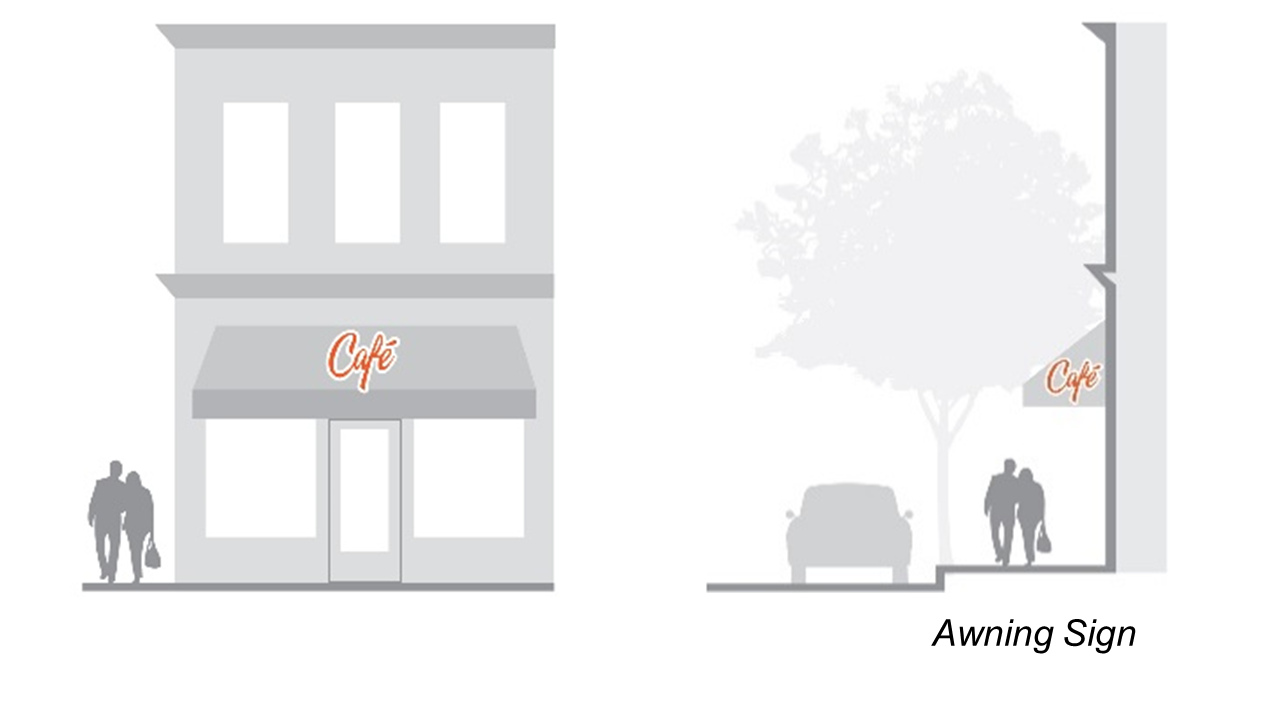
Awning Sign. A permanent Projecting Sign painted or printed on the exterior surface of an awning. Such signs may be internally illuminated pursuant to the requirements of this Ordinance. See Figure to the right.
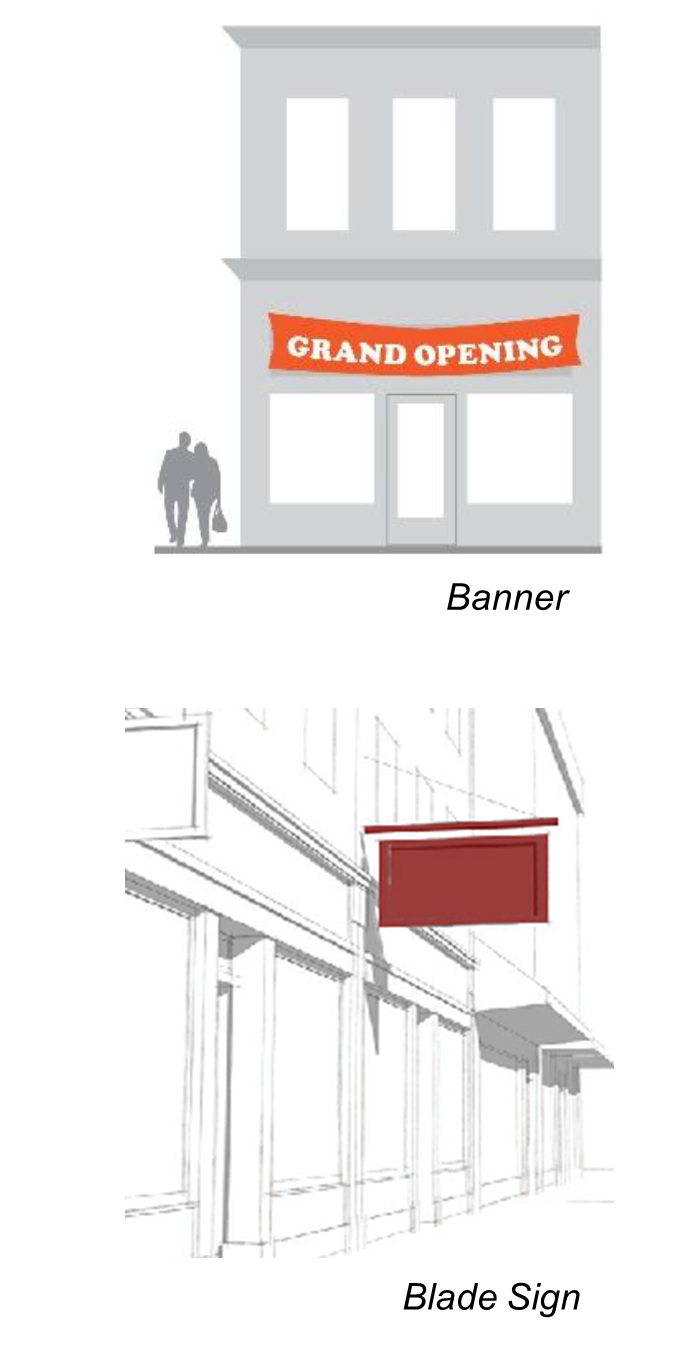
Banner. A temporary sign made of cloth used in connection with some special event or promotion.
Billboard. A ground sign advertising a product, event, person, business, or subject not related to the premises on which the sign is located. Billboards typically have much greater height and area than signs permitted by this ordinance, and have characteristic types of installation, whether as pylon signs or with a substantial support structure.
Blade Sign. A small, pedestrian-oriented sign mounted so that the sign face is perpendicular to the face of the building.
Bulletin Board. A sign with temporary or replaceable letters or characters used to announce dates of functions or activities.
Business. Any legal use of a building other than for a religious institution, school, home occupation or residence by a person, firm, or corporation. Although contained in the same building as another business and owned by the same person, an activity may be treated as a separate business if it is physically separated from, uses different personnel than, and provides different products or services than such other related business.
Business Center. A group of four (4) or more contiguous businesses or offices, research facilities, or industrial facilities developed as a planned complex which collectively have a name different from the name of any individual business, are under common ownership or management and share a common parking area or otherwise present the appearance of one (1) development site.
Business Center Sign. A sign which gives direction, name and identification to a business center.
Business Sign. A sign which directs attention to a business or profession conducted or to a product, service, or activity sold or offered upon the premises where such sign is located.
Construction Sign. A sign erected at a construction site identifying the architects, engineers, contractors or other parties responsible for a project, or identifying the intended purposes or uses of the building.
Department. The Inspection Department of the City of Livonia.
Directional Sign. A sign directing vehicular or pedestrian traffic to parking areas, loading areas, or to portions of a building.
Development Site. A lot, combination of lots, or parcels of property when combined form a complete parcel of land for development purposes.
Director. The Director of Building Inspection.
Electronic Message Center (EMC) Sign. An electrically activated changeable-copy sign whose variable message and/or graphic presentation capability can be electronically programmed. EMCs typically use light emitting diodes (LEDs) as lighting sources.
Entranceway Sign. A sign that designates the street entranceway to a residential or industrial subdivision from a public right-of-way.
Flag. A piece of cloth or bunting bearing the symbol of a nation, state, corporation, or organization.
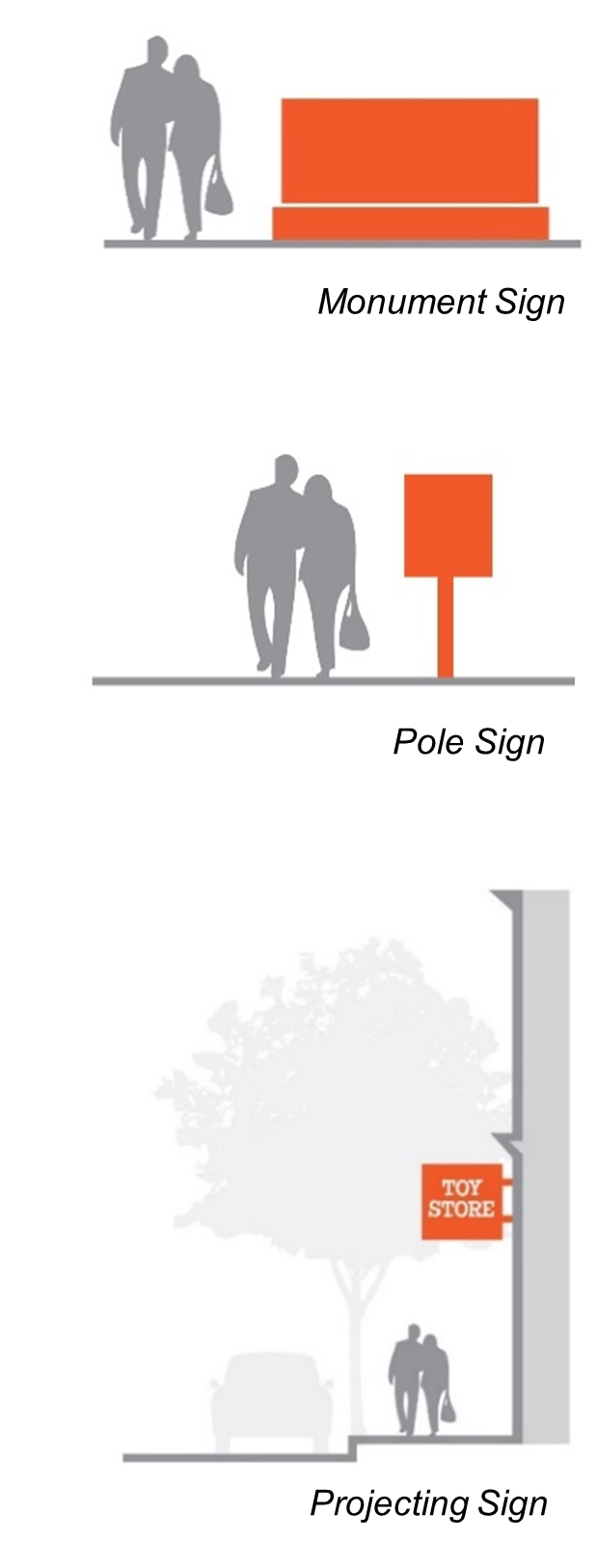
Freestanding Sign. A sign supported by one or more uprights, poles, pylons, monuments, or braces placed in the ground and not attached to any building or other structure. Freestanding signs include, but are not limited to, Pole Signs and Monument Signs.
Frontage. Expressed in lineal feet, the width of the first-floor portion of a building occupied by a single business facing a street adjacent to the premises on which the business is located.
Group Identification Sign. A single sign or entranceway structure listing the names and addresses only of the establishments occupying a development or subdivision. The erection of such identification signs is so intended to assist the public in locating establishments within its immediate area and shall be placed upon property within the development or subdivision.
Height of a Sign. The vertical distance measured from the surface grade of the land beneath the midpoint of the face of the sign to the highest point of the sign or supporting structure without including any berm, landscaping, grading, or other artificially or unnaturally constructed raised portion of land at the point of measurement.
Identification Sign. A sign containing the name of a business operating on the premises, where located, the type of business, owner or resident, and/or the street address, and sets forth no other advertisement display.
Master Sign Plan. A plan for signage used in a plaza, mall, business center, office complex, industrial complex, or shopping center indicating the location, style, and maximum square footage of possible wall signage and the location and size of ground signs and all other signs on the development site.
Monument Sign. A base-mounted, freestanding sign placed in the ground and not attached to any building or other structure. See Figure Below.
Moving Sign. A sign that has motion either constantly or at intervals, or that gives the impression of movement through intermittent flashing, scintillating, or varying the intensity of illumination whether or not said illumination is reflected from an artificial source or from the sun. Such signs shall include spinners, streamers and feather flags, but shall not include banners, pennants, or barber poles.
Murals. A painting or texturing applied to the surface of a wall or structure.
Nameplate. A wall sign not exceeding one (1) square foot in area stating the name of a person, firm, or name or description of a certain permitted use.
Natural Materials. Substances determined to be "natural materials" for the purposes of this Ordinance shall include, but not be limited to wood, stone, and brick. Substances specifically excluded from this definition are plywood, pressed board, drywall, wood or metal paneling, sheet metal, or any substances synthetically created in a manufacturing process. A natural material sign may only be illuminated by an indirect light source.
Non-Conforming Sign. Any advertising structure or sign which was lawfully erected and maintained prior to the effective date of this Ordinance, and any amendments thereto, and which fails to conform to all applicable regulations and restrictions of this Ordinance, or a sign for which a permit was previously issued that does not comply with the provisions of this Ordinance.
Off-Premise[s] Sign. A sign which contains a message unrelated to a business or profession conducted on the subject property, or to a commodity, service, or activity not sold or offered upon the premises where such sign is located.
Outline Tubing Sign. An arrangement of tubes or bands of light that outline and call attention to a window or other building feature or certain features of an advertising device such as individual letters, figures, shapes, or words commonly referred to as a neon sign.
Owner. A person, firm, partnership, association, or corporation and/or their legal successors.
Pennant. A narrow triangular cloth of the general type which is sometimes associated with naval signaling.
Pole Sign. A type of freestanding sign that is elevated above the ground on poles or braces.
Portable Sign. A sign that is freestanding, not permanently anchored or secured to either a building or the ground, including but not limited to "A" frame signs, commonly called sandwich signs; "T" frame signs; or any other sign which by its description or nature may be, or is intended to be, moved from one location to another.
Poster Panel. A device used to draw attention to matters ordinarily temporary or transitory in nature announcing price changes, bargains, loss leaders, and is accessory to the property upon which such sign is located.
Premises. Any contiguous real property under common management or ownership.
Projecting Sign. A sign which is affixed to any building or structure other than a marquee and projects in such a way that the message is not parallel to the wall to which it is attached.
Public Sign. A sign, noncommercial in nature, including but not limited to the following: legal notices, historic site designations, municipal facility directional or identification signs, street or traffic signs, railroad crossings, danger, and other emergency signs as may be authorized by the City of Livonia or any Federal, State, or County agency having jurisdiction over the subject matter of the sign.
Pylon Sign. A type of ground sign with a clear space of more than six (6) feet between the bottom of the face of the sign and the grade.
Real Estate Development Sign. A temporary non-illuminated business sign, of any content the owner deems appropriate, placed on the premises of a subdivision or other real estate development to advertise the development and provide information relative to availability while the development site is under construction.
Real Estate Sign. A temporary non-illuminated sign, of any content the owner deems appropriate, pertaining to the sale, lease, or rental of a single lot, parcel, or existing building situated thereon.
Regional Center. A planned complex of buildings containing a total gross leasable area of five hundred thousand (500,000) square feet or more and sharing a common parking area.
Required Announcement Sign. A temporary ground sign announcing to the general public a pending request for a lot split or rezoning of the property upon which the sign is displayed.
Roof Sign. A sign which is attached to a building and any part of which extends or projects above or beyond the roof or parapet.
Seasonal Decorations. Signs of a decorative nature not used for any commercial purpose and commonly associated with any national, local, or religious holiday.
Sign. A name, identification, description, display, light, balloon, flag, pennant, streamer, banner, illustration, letter, numeral, work, model, logo, trademark, representation, or device of any kind whatsoever, which is affixed to, painted, otherwise located, or set upon or in a building, structure, or piece of land and which directs attention to an object, product, place, activity, person, institution, organization, or business and which is visible from any public street, sidewalk, alley, park, or public property. The definition includes interior and exterior signs but not signs primarily directed at persons within the premises of the sign owners and does not include goods displayed in a store window.
Sign Erector. Any person engaged in the business of erecting, altering, or removing signs on a contractual or hourly basis.
Sign Setback. The distance measured from the portion of the sign structure nearest to the property lines or public rights-of-way. For the purpose of this measurement, the property lines and public right-of-way lines extend vertically and perpendicularly from the ground to infinity.
Temporary Sign. A display, information sign, or banner with or without a structural frame intended for a limited period of display including decorative displays for holidays or public demonstrations, civic projects, or other special events of a temporary nature.
Trailer Sign. A sign calling attention to special events, sales, services, products, or new attractions and is portable by virtue of being part of a trailer, attached to wheels, or towed by a vehicle.
Variable Electronic Message Sign. A light emitting diode (LED), digital or other similar sign such as, but not limited to, a liquid crystal display sign, fiber optic sign, or plasma display screen sign, the content of which can be electronically changed by remote or automatic means without altering the face of the sign. A sign or portion of a sign on which the message or display is an electronic indication of fuel price is an example of a variable electronic message sign.
Wall Sign. A sign attached to, inscribed or painted on, or placed flat against the exterior surface of any building or the vertical face of a "mansard roof," no portion of which projects more than twelve (12) inches from the wall and which may not project above the roof or parapet line. The roof line meaning the vertical distance measured from the established grade to the highest point of the roof surface for flat roofs; to the deck line of mansard roofs; and the average height between eaves and ridge boards for gable, hip and gambrel roofs.
Window Sign. A sign which is applied, affixed, or attached to the interior of any building window or which is displayed through the glass area so as to be visible from the exterior of the building.
(4) Flood Plain Terms.
Base Flood. A 100-year flood having a one (1) percent chance of being equaled or exceeded in any given year.
Flood or Flooding. A general and temporary condition of partial or complete inundation of normally dry land areas from:
A)
the overflow of inland or tidal waters;
B)
the usual and rapid accumulation or runoff of surface waters from any source.
Flood Hazard Area. Land which on the basis of available flood plain information is subject to a one (1) percent or greater chance of flooding in any given area. Flood Hazard Area shall also mean the designated regulatory flood plain.
Flood Hazard Boundary Map (FHBM). An official map of the City of Livonia, issued by the Federal Insurance Administration, where the boundaries of the areas of special flood hazards have been designated as Zone A.
Flood Insurance Rate Map (FIRM). An official map of the City of Livonia, on which the Federal Insurance Administration has delineated both the areas special flood hazards and the risk premium zones applicable to the City.
Flood Insurance Study. The official report provided by the Federal Insurance Administration. The report contains flood profiles as well as the Flood Hazard Boundary Floodway Map and the water surface elevation of the base flood.
Flood Plain. Any land area susceptible to being inundated by water from any source (see definition of flood).
Floodway. The channel of a river or other water course and the adjacent land areas designated in the Flood Insurance Study which must be reserved in order to discharge the base.
Special Flood Hazard Area. The land area covered by the floodwaters of the base flood on National Flood Insurance Program (NFIP) maps.
(Ord. of 2-14-2023)

