
Livonia City Zoning Code
ARTICLE VII
GENERAL PROVISIONS
Section 7.01 - Applicability.
The provisions of this Article shall apply to all districts within the City of Livonia, except where otherwise expressly stated in this Ordinance.
Section 7.02 - Scope.
No building or land, or part thereof, shall be used, altered, constructed or reconstructed except in conformity with the provisions of this Ordinance and the regulations hereby established which apply to the district in which it is located. No building shall be erected or altered to exceed in height the limit herein established for the district in which such building is located; no building shall be erected, nor shall an existing building be altered, enlarged, or rebuilt, nor shall any open space surrounding any building be encroached upon or reduced in any manner, except in conformity with the provisions of this Ordinance and the regulations hereby established for the district in which it is located.
Section 7.03 - Buildings Under Construction.
Any building or structure for which a building permit has been issued and the construction of the whole or a part of which has been started, or for which a contract or contracts have been entered into pursuant to a building permit issued prior to the effective date of this Ordinance, may be completed and used in accordance with the plans and application on which said building permit was granted.
Section 7.04 - Building and Easement Grades.
(1)
Surface Water. Any building requiring yard space shall be located at such an elevation that a sloping grade shall be maintained to cause the flow of surface water to run away from the walls of the building. A building grade line (sometimes referred to as the finish grade or finish grade line) shall mean the elevation of the ground adjoining the building on all four sides. A first-floor elevation shall mean the height which the first floor extends above the building grade. A sloping earth grade beginning at a sidewalk level shall be maintained and established from the center of the front lot line to the finish grade line at the front of the building and from the rear wall of the building to the rear lot line, subject to approval of the Building Official and City Engineer. The height of the finish grade line of any dwelling shall not be less than twelve (12) inches nor more than eighteen (18) inches above the average front sidewalk elevation; the first-floor elevation shall not be more than twenty-six (26) inches above the finish grade line of the building. When a new building is being constructed on a vacant lot between two (2) existing buildings or adjacent to an existing building, the yards around the new building shall be graded in such a manner so as not to permit runoff of surface water to flow onto the adjacent properties. Whenever the natural drainage of the land is such as is likely to or will cause the flow of surface water to be from the front yard to the rear yard, or where the natural topography dictates a modification from the foregoing requirements, the building grade may be established otherwise than hereinbefore provided; provided, however, that in all such cases the altered design shall be submitted to and approved by the Department of Public Works. Surface grades shall be approved by the Department of Public Works before the issuance of any building permit.
(2)
Grading. Where any lot, part or parcel of land, has located upon it a duly recorded easement for any purpose whatsoever, that portion of such land whereon the easement exists shall be graded as indicated by the Department of Public Works, and in no event shall be graded so as to obstruct or substantially slow down the natural flow of surface water across such easement. The grade in easements shall in all cases be subject to the approval of the Department of Public Works.
Section 7.05 - Minimum Lot Size and Width.
The size and width of each residential lot on which or in relation to which any building or use is affected by the provisions of this Ordinance shall not be less than the minimum size and width requirements established by this Ordinance which apply to the district in which the residential lot is located.
Section 7.06 - Application to Lots of Record.
Where two (2) or more abutting lots of record are held under one (1) ownership and where one (1) or more of such lots are nonconforming, the provisions of this Ordinance relating to lot width and area in the district in which such lots are located shall be observed and shall not be avoided by any sale or conveyance of all or any portion of any such lots after the effective date of this Ordinance; provided, however, that any lot of record which is the same width and area as, or a larger width and area than, fifty-five percent (55%) or more of the lots in the same subdivision in which such lot is located, which have already been developed, with dwellings, and as building sites, may be developed as a separate building site of a width and area consistent with the majority of the lots theretofore developed.
Section 7.07 - Approval of Plats.
No proposed plat of a new subdivision shall hereafter be approved by the City Planning Commission unless all the lots within such plat equal or exceeds the minimum lot size and width requirements which apply to the district in which the land sought to be platted is located and unless such plat in all other respects fully conforms with the statutes of the State of Michigan, the ordinances of the City of Livonia, and the Subdivision Regulations of the City Planning Commission.
Section 7.08 - Lot Limitation.
No more than one (1) principal building shall be constructed, erected, or placed on any lot in a recorded subdivision or on any parcel of land except for:
(1)
Outlots. Parcels described and designated as "outlots" in a recorded plat which are so arranged or subdivided as to provide for one or more principal buildings with a land area allocated to each building which is equal to or greater than the lot area required in the district, and the building and land comply with all other requirements of the district in which it is located.
Section 7.09 - Single-Family Residential Accessory Buildings and Recreational Equipment Storage.
(1)
Residential Accessory Buildings.
A)
Maximum Size. For the purpose of this Section, a garage, whether attached or detached, shall be considered a residential accessory building. On single family lots, the combined ground floor area of all attached and detached residential accessory buildings shall not exceed nine hundred twenty (920) square feet; provided, however, the maximum ground floor area of any attached accessory building shall not exceed seven hundred twenty (720) square feet and the maximum ground floor area of any detached accessory building shall not exceed two hundred (200) square feet. On lots that do not contain any detached accessory buildings, the ground floor area of an attached residential accessory building shall not exceed seven hundred twenty (720) square feet or the ground floor area of the house (excluding the area of the attached accessory building), whichever is larger, subject to a maximum size limit of one thousand (1,000) square feet. On lots that do not contain attached accessory buildings, the combined ground floor area of all detached accessory buildings shall not exceed the ground floor area of the house, subject to a maximum size limit of one thousand (1,000) square feet. Notwithstanding the above, on lots measuring one-half (½) acre or more, one (1) detached residential accessory building not to exceed a ground floor area of three hundred (300) square feet shall be allowed solely for the purpose of housing or keeping of animals pursuant to Section 6.34 or Section 6.49. Further, on lots measuring one (1) acre or more, one (1) detached residential accessory building not to exceed a ground floor area of six hundred (600) square feet shall be allowed solely for the purpose of housing or keeping of animals pursuant to Section 6.34 or Section 6.49.
B)
Maximum Number. On lots less than one-half (½) acre in size, no more than two (2) residential accessory buildings, including one (1) attached accessory building, are allowed. On lots which are more than one-half (½) acre, a total of three (3) residential accessory buildings, including one (1) attached accessory building, are allowed.
C)
Maximum Height. Detached residential accessory buildings shall not exceed sixteen (16) feet in height.
D)
Minimum Setbacks. Attached residential accessory buildings shall comply, in all respects, with the requirements of this ordinance applicable to the principal building. Detached residential accessory buildings shall not be located nearer than two (2) feet to the side lot line, two (2) feet to the rear lot line and shall not be constructed closer than ten (10) feet to the principal building; provided, further, however, that the minimum distance between detached residential accessory buildings on the same lot or parcel shall be four (4) feet. Detached residential accessory buildings proposed to be constructed on corner lots shall not be located closer to the side street lot line than that wall of the principal building which is parallel to such side street line. All residential accessory buildings used for the housing or keeping of animals pursuant to Section 6.34 or Section 6.49 shall be located not less than twenty-five (25) feet from any lot line.
E)
Maximum Lot Coverage. The combined floor area of all detached residential accessory buildings shall not occupy more than twenty (20) percent of the area of any rear yard.
F)
Exempt Structures. Landscaping structures, art displays, and minor structures (dog houses, playgrounds, treehouses, etc.) are not considered residential accessory buildings and are not regulated by this Section.
(2)
Residential Accessory Building and Storage Therein. All inoperable or unlicensed vehicles or vehicles bearing visible commercial advertising, equipment, or accessories shall be housed in a residential accessory building when not in use.
(3)
Recreational Equipment Storage. Unoccupied recreational equipment may be housed in a residential accessory building, and no more than one (1) unit of recreational equipment may be stored in the rear yard, except that no such unit may be stored within the corner side yard, as that term is defined in Section 15.44.030 of the Livonia Code of Ordinances, as amended. The temporary parking of one (1) unit of recreational equipment on the recreational equipment owner's or user's front or side driveway shall be permitted for a period not to exceed seventy-two (72) hours cumulatively in any five (5) day period for the purpose of repairing and maintaining the Recreational Equipment unit for suitable vacation use.
Section 7.10 - Reserved.
Editor's note— An ordinance adopted April 18, 2022, repealed § 7.10, which pertained to Separate Dwellings for Domestic Employees and derived from the original Zoning Regulations.
Section 7.11 - Yards; Double Frontage Lots.
On double frontage lots, a front yard, as prescribed for the district as herein established, shall be provided on both streets.
Section 7.12 - Front Yards; Schoolcraft Road.
Notwithstanding anything in this Ordinance to the contrary, where a residentially zoned lot or parcel is adjacent to or abuts on Schoolcraft Road in the City of Livonia, no building shall be erected, moved, enlarged, or otherwise established on such lot or parcel closer than seventy-five (75) feet to the lot line abutting the major street.
Section 7.13 - Yards; Use.
In any residential district no part of any required yard, except a rear yard, shall be used for any detached garage or any accessory building other than an attached garage or for the storage of vehicles. Any portion of a residential lot in front of the front building line shall be used for landscaping purposes only and nothing shall be placed thereon except trees, shrubs, or items of similar nature and required driveways.
Section 7.14 - Yard; Alley.
Wherever there is a public alley at the rear of a lot upon which the lot abuts for the full width, measurements of the depth of any abutting rear yard required under this Ordinance may be made to the center line of such alley.
Section 7.15 - Lots; Use for Yards, Courts, Etc.
No portion of a lot used in complying with the provisions of this Ordinance for yards, courts, lot area per family, or percentage of lot occupancy in connection with an existing or proposed building or structure shall again be used as part of the lot required in connection with any other building or structure existing or intended to exist at the same time.
Section 7.16 - Room Requirements.
Any dwelling hereafter constructed or altered shall comply with the Housing Law of Michigan.
Section 7.17 - Heights; Public, Quasi-Public, Form-Based Development Option, Planned Developments, and Major Business Buildings.
The height of public or semi-public buildings, churches, cathedrals, temples, hospitals, sanitariums, schools, major business buildings when developed as a part of a complete shopping center, and buildings when developed under the Form-Based Development Option pursuant to Section 5.04 or as a Planned Development pursuant to Section 5.02, shall not in any case exceed one hundred and fifty-five (155) feet, subject to the General Waiver Requirements and General Standards as set forth in Section 13.13(6).
Section 7.18 - Height; Items Not Included.
Chimneys, cooling towers, elevator bulkheads, fire towers, grain elevators, silos, penthouses, stacks, stage towers, scenery lofts, sugar refineries, tanks, water towers, pumping towers, television and radio towers and antennas, church steeples, monuments, cupolas, and mechanical appurtenances, including signs, pertaining to and necessary to the permitted use of the district in which they are located, shall not be included in calculating the height of the principal structure; provided, however, that in residentially zoned districts, television and radio towers and antennas which have a height, as measured from the established grade, of greater than 75 feet shall be prohibited. Television and radio towers and antennas in residentially zoned districts may be erected to a height of up to 40 feet, as measured from the established grade, but shall be prohibited for heights which exceed 40 feet but which are less than 75 feet, as measured from the established grade, unless written permission has first been obtained from the owners of at least two-thirds (⅔) of the lots which adjoin or abut the property upon which the proposed tower or antenna is to be located when the height of the proposed tower or antenna be greater than the distance from the center of the base of the tower or antenna to any of the property lines of such adjoining or abutting lots; provided, further, that all freestanding television and radio within residentially zoned districts shall be of a self-supporting design; and provided, further, however, that the location of television and radio towers or antennas shall be further subject to the following limitations:
(1)
Radio Towers or Satellite Antenna Dishes. The location of television and radio towers or antennas including satellite dish antennas and cellular mobile towers in the established or minimum front yard of any zoning district is prohibited; provided, however, that the foregoing prohibition shall not apply to television or radio antennas, satellite dish antennas or cellular mobile towers located in M-1 and M-2 Districts in Section 25 through 30, when a site plan therefor is approved by the City Council subject to compliance with the general standards contained in Section 13.13, Section 13.13(6) of this Ordinance and the following additional standards; provided, however, that site plan approval shall not be required for satellite dish antennas which do not exceed 24 inches in diameter or 500 square inches in area, whichever is greater. Provided further, however, that prior to installation of any satellite dish antenna, a permit shall be obtained from the Inspection Department:
A)
That such site plan shall include:
i)
The proposed location of the antenna and detailed plans and specifications indicating its size, weight, color and specific materials to be used in construction of the antenna.
ii)
The proposed method of screening the antenna from public view.
iii)
Any other pertinent information the applicant or City Council deems necessary to properly evaluate the proposed antenna and its location.
B)
Signs attached to or painted on such antenna are prohibited.
Section 7.19 - Height; Parapet Walls.
Parapet walls may extend not more than five (5) feet above the allowable height of a building.
Section 7.20 - Height; Public Buildings; Utilities.
The City Planning Commission may recommend and the City Council approve the erection and use of a building or an addition to an existing building which is publicly owned or owned by a public service corporation to be used for a public use or for public utility purposes, in any permitted district to a greater height or of larger area than the district requirements herein established, and permit the location in any use district of a public building or a public utility building, structure or use, provided the City Planning Commission shall find such use, height, area, building or structure reasonably necessary for the public convenience and service; and, provided further, that such building, structure or use is designed, erected and landscaped to conform harmoniously with the general architecture and plan of such district.
Section 7.21 - Division or Partitioning of Lots.
Upon petition by the owner of a parcel of land, the City Council may approve the division of the said parcel in accordance with Act 172 of the Public Acts of 1929 of the State of Michigan, as amended, and the City's Lot Partition Ordinance, Chapter 32 of Title 16 of the Livonia Code of Ordinances, as amended. Any nonconformity waived pursuant to the City's Lot Partition Ordinance shall be deemed waived pursuant to this Ordinance, subject to any conditions contained in the City Council resolution waiving same. Except for deficiencies as to lot width, area, accessibility, and depth-to-width ratio, any deficiencies not waived shall be subject to the jurisdiction of the Board of Appeals.
Section 7.22 - Lighting.
(1)
Purpose and Intent. The regulations in this section aim to ensure that sufficient lighting is provided in the publicly accessible areas of buildings and surrounding property, to provide for the security of property and safety of the general public. These regulations promote the use of appropriate lighting practices and systems and discourage the adverse effects of inappropriate lighting such as glare, light trespass onto adjoining properties, light pollution and sky glow, and energy waste. This section also intends to encourage the use of innovative lighting designs and fixtures which complement the natural and built environments found throughout the City.
(2)
General Requirements.
A)
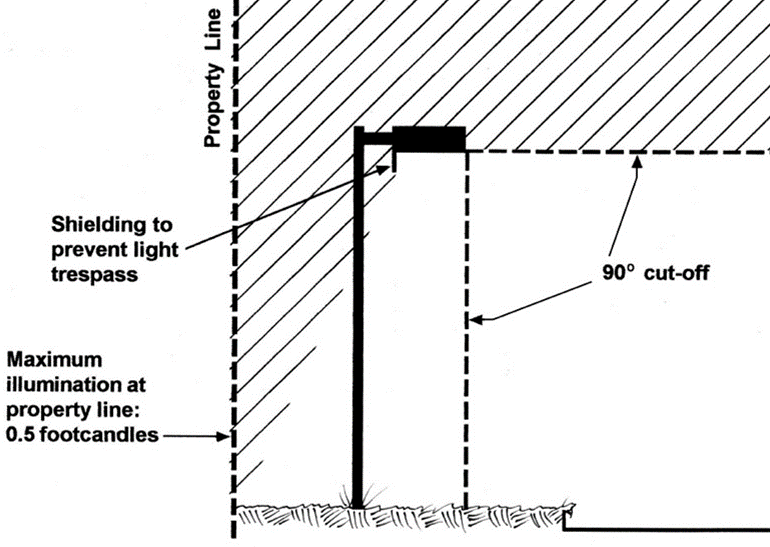
Shielding. All outdoor lighting in all use districts other than residential shall be shielded so the surface of the source of the light shall not be visible from adjacent residential districts, adjacent residences, and public right-of-way. All outdoor lighting must be directed toward and confined to the ground areas. Full cut-off fixtures must be used to prevent light from projecting above a ninety (90) degree horizontal plane (see figure).
B)
Illumination Levels. Sufficient lighting, as specified in the following table, shall be required for parking areas, walkways, driveways, building entrances, loading areas, and public common areas to ensure security of property and safety of persons.
C)
Light Trespass Limits. Exterior lighting sources shall be designed, constructed, located, and maintained in a manner that minimizes light trespass onto neighboring properties. The light trespass from a property shall not exceed 0.5-foot-candles at the property line, measured five (5) feet from the ground. The light-emitting element of a light fixture shall not be directly visible from neighboring properties, as this is the primary cause of glare.
D)
Up-lighting. All up-lighting in nonresidential districts used for the external illumination of buildings, so as to feature the buildings, shall be placed and shielded so as to not interfere with the vision of persons on adjacent highways or adjacent property. The light-emitting element of such fixtures shall not be directly visible from a vehicle or pedestrian travel area so as to not interfere with the vision of persons on adjacent highways or adjacent property. Such lighting shall be shielded in such a manner as to minimize or eliminate light pollution and sky glow.
E)
Height. The height of light fixtures shall be measured from the finished grade to the top of the fixture. All lighting fixtures in non-industrial districts shall not exceed twenty (20) feet in height. In industrial districts, or on large-scale commercial developments, lighting fixtures up to a maximum height of thirty-five (35) feet may be allowed if the proposed lighting over twenty (20) feet in height has no adverse impacts on the surrounding land uses and on the natural environment.
(3)
Prohibited Lighting.
A)
All illumination of outdoor features of a flashing, moving, or intermittent type are prohibited.
B)
No outdoor recreational facility, public or private, shall be illuminated after 11:00 p.m., except to conclude a permitted recreational or sporting event or other activity already in progress prior to 11:00 p.m.
C)
The use of laser source light or any similar intensity light for outdoor advertising or entertainment is prohibited.
D)
The operation of searchlights for advertising purposes is prohibited.
(4)
Exempt Lighting. The following exterior lighting fixtures and systems are exempt from the regulations of this section. The Planning Director reserves the right to enforce standards to minimize glare, reduce light pollution, and otherwise protect the health, safety, and welfare of the public.
A)
Light fixtures placed by a governmental agency in the right-of-way.
B)
Decorative holiday lighting.
C)
Pedestrian walkway lighting.
D)
Temporary festival and civic lighting.
E)
Temporary construction or emergency lighting.
F)
Instances where federal, state, or local laws, rules, or regulations take precedence over the provisions of this section.
(5)
Waiver Process. The City Council has the ability to waive the lighting requirements of this Section upon evidence that the required lighting would have a negative impact on neighboring properties.
Section 7.23 - Accessory Structures and Uses.
(1)
Accessory structures and uses:
A)
The following standards apply to accessory structures in the N1 and N2 Districts:
i)
Private garages and detached accessory structures are permitted in accordance with Section 2.02, Section 2.02(2) and Section 7.09 of this Ordinance.
ii)
Must be customarily incidental to the principal permitted use on the site.
B)
In addition to the standards above the following standards shall apply to accessory structures and uses in the R-U-F District:
i)
No more than one (1) temporary structure (which may be of wood construction and shall have not more than three (3) walls and a roof with at least one (1) open side) which structure shall only be used for the sale of products grown on the site in the greenhouse or truck garden between May 15 and October 31 and thereafter shall be removed, dismantled and stored in the rear yard only.
ii)
Such temporary structure shall be located on a parcel of land at least one-half (½) acre in size and not less than twenty-five (25) feet from the street or highway right-of-way line.
iii)
An open space for parking, twenty-five (25) feet off the street or highway right-of-way, shall be provided for patrons of the temporary structure. Provided, however, that the outdoor storage of trucks, merchandise and equipment is prohibited.
C)
The following standards apply to accessory structures in the NM1 and NM2:
i)
Not more than one of which may be a commercial vehicle which shall not exceed three-quarter (¾) ton capacity, and which shall be kept housed within a garage when not used, provided said commercial vehicle is owned and operated by a member of the family who resides in said living unit.
ii)
The storage or parking of trucks, truck tractors and truck trailers of over one (1) ton capacity, automobile trailers or the storage, parking or use of coaches, bus or street car bodies, or tourist cabins, tents or similar dwellings and enclosures shall not be allowed or considered a legal accessory use in an NM1 District. This shall not, however, prohibit the storage in the rear yard only of one (1) unoccupied recreational equipment unit for each dwelling unit which equipment is the property of or in the trust of the occupant of the dwelling unit.
iii)
Must be customarily incidental to the principal permitted use on the site.
D)
The following standards apply to accessory structures in the C-1, C-2, C-3 and C-4 Districts:
i)
Must be customarily incidental to the principal permitted use on the site.
ii)
A storage garage for the storage of commercial vehicles used by a business or other permitted activity, when located on the same lot therewith and occupying not more than twenty-five (25) percent of the area of such lot shall be considered a legal accessory building.
iii)
Accessory uses to those permitted in this section include assembly, repair and storage which is clearly incidental to the conduct of the permitted use.
iv)
Except where prescribed herein, fences are prohibited in all commercial zoning districts.
E)
The following standards apply to accessory structures in the M-L, M-1, and M-2 Districts:
i)
Must be customarily incidental to the principal permitted use on the site.
ii)
Any portion of the lot area not used for structures, driveways, parking areas and sidewalks shall be landscaped and thereafter permanently maintained. Such landscaping shall include the total area of the established or minimum front yard exclusive of driveways, parking areas and sidewalks.
(2)
Accessory residential use for apartments. Provided they do not constitute more than twenty (20) percent of the total floor area of the building.
Section 7.24 - Fences and Walls.
(1)
Fences. Except where prescribed herein, fences are prohibited in all commercial zoning districts. Yards may be used for fences and similar structures as set forth in Chapter 44 of Title 15 of the Livonia Code of Ordinances, as amended.
(2)
Masonry Screen Walls and Opaque Fences.
A)
Design and Construction. Masonry screen walls required pursuant to Section 10.03(5) shall be continuous, unpierced and constructed of either reinforced poured concrete with a brick design or concrete masonry units (CMU) with a brick veneer. Where there are several contiguous property owners who are required to build a masonry wall or opaque fence, such wall or fence shall be constructed using the same materials and having uniformity in appearance. The protective wall or fence shall be at least six (6) feet in height to adequately screen such parking, multi-family, commercial, or industrial districts from abutting residential districts, with the exception that upon the recommendation of the Inspection Department when it deems necessary for the protection of the public to allow the nearest ten (10) feet of wall or fence adjacent to any public right-of-way to be limited to a height of three (3) feet.
B)
Permit Required. The construction of such wall or fence shall not be commenced until a building permit therefor has been secured from the Inspection Department.
C)
Maintenance. It shall be the responsibility of the owner of the multi-family, commercial or industrial property or parking area to maintain the wall or fence in a state of good repair and to keep the area between the wall and property line of the commercial or industrial property or parking area free and clear of any debris, trash, weeds, and waste of any material and at all times to keep such area in a neat, clean and orderly fashion.
(Ord. of 2-14-2023)
Section 7.25 - Alternative Energy.
(1)
Solar Energy.
A)
Roof-Mounted and Wall-Mounted Solar Energy Systems. Roof-mounted and wall-mounted solar energy systems for on-site use are permitted accessory structures in all zoning districts, subject to the following regulations:
i)
Height. Roof-mounted systems shall not extend more than three (3) feet above the roofline nor above the maximum permitted height of the building to which it is attached.
ii)
Location.
a)
Roof-mounted solar energy systems may be located anywhere on a roof of a principal or accessory structure. However, roof-mounted solar energy systems shall not protrude beyond the edge of the roof. A solar panel may function as a roof element, such as an awning.
b)
Wall-mounted solar energy systems may be located anywhere on the wall of a principal or accessory structure. Wall-mounted systems shall not extend above the edge of the roof.
B)
Ground-Mounted Solar Energy Systems. Ground mounted and freestanding solar energy systems for on-site use are permitted accessory structures in all zoning districts. Total system production is limited to 10kW in all zoning districts, except M-1 and M-2, subject to the following regulations:
i)
Location and Setbacks. Solar energy systems must be located in the rear of the principal building. Solar energy systems must also meet the minimum setbacks of the zoning district.
ii)
Height. The height of the solar energy system and any mounts must not exceed ten (10) feet when oriented at maximum tilt.
iii)
Screening. Evergreen landscaping must be provided to screen the racking and framing below the panels from view on all sides.
iv)
Power Lines. All power lines between solar panels and inverters must be placed underground.
C)
Performance Guarantee. All applications for a solar energy system must be accompanied by a performance guarantee sufficient to ensure the decommissioning and removal of the system when it is abandoned or no longer needed.
D)
Insurance. The applicant must submit proof of sufficient property damage and liability insurance.
E)
Utility Connection. The applicant must submit evidence that the utility company has been informed of the customer's intent to install an interconnected, customer-owned solar energy system and that such connection has been approved. Off-grid systems are exempt from this requirement.
(2)
Wind Energy.
A)
Districts Permitted.
i)
Roof-Mounted Small Wind Energy Systems are permitted by right in all zoning districts, provided that the system does not fall within the front yard and meets all of the applicable requirements of this Ordinance.
ii)
Tower-Mounted Small Wind Energy Systems shall be treated as a waiver use in the RUF, P-L, and M-L Districts and as a permitted use in the M-1 and M-2 Districts, provided that the system does not fall within the front yard and meets all of the applicable requirements of this Code.
B)
Minimum Lot Area.
i)
Roof-Mounted Small Wind Energy Systems will have no minimum lot area.
ii)
Tower-Mounted Small Wind Energy Systems must be located on a lot with a minimum area of one (1) acre.
C)
Maximum Wind Turbine Height.
i)
Roof-Mounted Small Wind Energy Systems will have a maximum height of ten (10) feet above the highest point of the roof or ten (10) feet above the maximum height of the zoning district, whichever is lower.
ii)
Tower-Mounted Small Wind Energy Systems will have a maximum height of seventy (70) feet.
D)
Minimum Setbacks.
i)
Roof-Mounted Small Wind Energy Systems must adhere to the minimum setbacks of the zoning district.
ii)
Tower-Mounted Small Wind Energy Systems must be set back from all property lines, overhead utility rights-of-way and easements, and other towers a distance equal to or greater than the height of the tower.
E)
General Standards. The following requirements are applicable to all wind energy systems:
i)
Noise. A wind energy system must comply with the noise standards set forth in the City's Ordinances.
ii)
Shadow Flicker. The application for a wind energy system must include a shadow flicker analysis demonstrating impact on adjacent and nearby residential properties. Wind energy systems must be constructed in locations that minimize the impacts of shadow flicker on residences.
iii)
Lighting. No wind energy system will be artificially lighted unless required by the Federal Aviation Administration (FAA).
iv)
Appearance, Color, and Finish. The wind energy system must be maintained in the color or finish that was originally applied by the manufacturer, unless otherwise approved in the building permit. All wind energy systems will be a single non-reflective, non-obtrusive, matte finished color (white or gray).
v)
Electrical Wires. All electrical wires associated with a wind energy system, other than wires necessary to connect the wind generator to the tower wiring, the tower wiring to the disconnect junction box, and grounding wires, must be located underground.
vi)
Compliance with Electrical Code. Building permit applications for wind energy systems must be accompanied by line drawings of the electrical components in sufficient detail to allow for a determination that the manner of installation conforms to the National Electrical Code.
vii)
Construction Codes, Towers, and Interconnection Standards. Wind energy systems, including towers, must comply with all applicable state construction and electrical codes and local building permit requirements. Wind energy systems including towers, must comply with the FAA requirements, and other applicable local and state regulations. A wind energy system connected to the public utility electrical grid must comply with the Michigan Public Service Commission and Federal Energy Regulatory Commission standards. Off-grid systems are exempt from this requirement.
viii)
System Access. Small wind energy systems must be designed and installed such that step bolts, ladders, or other means of access readily accessible to the public are located at least eight (8) feet above grade level.
ix)
Safety. A wind energy system must have an automatic braking, governing, or feathering system to prevent uncontrolled rotation or over speeding. All wind towers must have lightning protection. If a tower is supported by guy wires, the wires must be clearly visible to a height of at least six (6) feet above the guy wire anchors.
x)
Minimum Ground Clearance. The lowest extension of any blade or other exposed moving component of a tower mounted wind energy system must be at least twenty (20) feet above the surrounding grade at its highest point within twenty (20) feet of the base of the tower and at least twenty (20) feet above any outdoor surface intended for human use, such as balconies or roof gardens, that are located below the wind energy system.
xi)
Roof-Mounted Small Wind Energy Systems. Roof-mounted small wind energy systems must be limited to roof mounting and must not be mounted on any other building wall or surface.
xii)
Performance Guarantee. All applications for a small wind energy system must be accompanied by a performance guarantee in an amount sufficient to ensure the decommissioning and removal of the system when it is abandoned or no longer needed.
xiii)
Insurance. The applicant must submit proof of sufficient property damage and liability insurance.
xiv)
Utility Connection. The applicant must submit evidence that the utility company has been informed of the customer's intent to install an interconnected, customer-owned wind energy generator and that such connection has been approved. Off-grid systems are exempt from this requirement.
Section 7.26 - Encroachments and Exempt Structures.
(1)
Permitted Yard Encroachments.
A)
Open Decks, Stairways, Porches, Paved Terraces, and Patios in the Front Yard Setback. Open decks, stairways, porches, paved terraces, and patios which are at or below the finished first floor level of the building may encroach up to six (6) feet into the required front yard setback area on any lot, provided that in no case may any paved terrace, patio, deck, or other similar structure be located closer than 25 feet from a regulated wetland(s) or a detention pond or non-regulated wetland as shown on an approved site plan. Open decks, stairways, porches, paved terraces, and patios that encroach into the required front yard setback area may have a required railing and be covered with a roof that is no higher than the first story and does not encroach more than 6 feet into the front yard setback area. Any deck, terrace or patio that encroaches into the front yard setback must remain open and shall not be enclosed.
B)
Open Decks, Paved Terraces, and Patios in the Rear Yard Setback. Open decks, stairways, porches, paved terraces and patios which have no roof or other projections above any required railing and which are at or below the finished first floor level of the building may encroach up to ten (10) feet into the required rear yard setback area on any lot, provided that in no case may any paved terrace, patio, deck, or other similar structure be located closer than 25 feet from a regulated wetland(s) or a detention pond or non-regulated wetland as shown on an approved site plan.
C)
Chimneys, Fireplaces, Eaves, Overhangs, and Cornices in the Side, Rear and Front Yard Setbacks. Chimneys, fireplaces, eaves, overhangs, and cornices may encroach up to twenty-four (24) inches into the required side, rear or front yard setback area on any lot, provided that in the case of a side yard, a minimum setback of four (4) feet shall be maintained.
D)
Landscaping, Garden, and Retaining Walls. Landscaping, garden, and retaining walls raised three (3) feet or less above the finished grade may be located in a yard setback.
E)
Walls, Fences, and Other Protective Barriers. Walls, fences, and other protective barriers may be located in a yard setback pursuant to Chapter 44 of Title 15 of the Livonia Code of Ordinances.
F)
Swimming Pools. Swimming pools may be located in required yard setback subject to the requirements in Section 6.48.
G)
Public Use. The City Planning Commission may recommend and the City Council approve the erection and use of a building or an addition to an existing building which is publicly owned or owned by a public service corporation to be used for a public use or for public utility purposes, in any permitted district to a greater height or of larger area than the district requirements herein established, and permit the location in any use district of a public building or a public utility building, structure or use, provided the City Council shall find such use, height, area, building, or structure reasonably necessary for the public convenience and service; and, provided further, that such building, structure or use is designed, erected, and landscaped to conform harmoniously with the general architecture and plan of such district.
(Ord. of 4-18-2022)
Section 7.27 - Subdivision and Site Condominiums.
No portion of any site condominium may be sold or offered for sale, nor shall a permit be issued for construction of same in the City of Livonia unless the master deed for such site condominium has been approved by the City Council upon review and submission of findings by the City Planning Commission, which master deed shall include as attachments thereto bylaws and a site plan that complies with the requirements of Section 5.02 and the Subdivision Control Ordinance, Title 16, Chapters 16.04-16.40 of the Livonia Code of Ordinances, and shall pay the filing fees set forth therein.
(1)
Applicability of Subdivision Improvement Regulations for Site Condominiums. Sewer, water, storm drainage, other utility services and streets and roads for site condominium projects shall conform to design, layout, and improvement standards as provided in the City of Livonia Subdivision Control Ordinance. The plat review and approval process required by the Subdivision Control Ordinance and Subdivision Rules and Regulations shall not apply to site condominiums.
(2)
Utilities.
A)
The Master Deed shall grant utility easements or the right of access to utility easements to the City of Livonia as may be required to construct, operate, inspect, maintain, repair, alter, replace, and/or remove pipelines, mains, and other installations of a similar character for the purpose of providing public utilities.
B)
The Master Deed shall require that any stormwater detention pond(s) or underground stormwater detention facilities installed in connection with development of the site condominium shall be located in private parks, outlots, or general common areas and shall not be installed on limited common areas or any portion of any unit offered for sale. This requirement may be waived or modified, if Council finds that compliance with same would be unduly onerous, by a resolution in which two-thirds (⅔) of the City Council concur. To prevent an inadvertent waiver or modification of the prohibition on detention ponds in limited common areas and units offered for sale, such resolution must be separate from the resolution approving the Master Deed.
(3)
Master Deed. The site condominium developer shall furnish a copy of the Master Deed as approved by the City Council, including bylaws and site plans, to the City Assessor and to the Inspection Department.
(4)
Bonds required.
A)
For any site condominium or other project which requires the approval of the City Council pursuant to this Zoning Ordinance, as amended the City Council may require the posting of a cash deposit, certified check, irrevocable bank letter of credit, or surety bond acceptable to the City covering the estimated cost of completing any or all of the following (the "improvements"):
i)
roadways
ii)
lighting
iii)
utilities
iv)
sidewalks
v)
screening
vi)
drainage
vii)
such other features and actions which are considered necessary by the City Council to protect the health, safety, and welfare, of residents of the city, subject to the limitations of Section 125.584e of the Michigan Compiled Laws.
B)
Any such performance guarantee shall be deposited with the City Clerk, at the time of the issuance of the permit authorizing the activity or project, to insure faithful completion of the improvements. Any cash deposits made to assure completion of an improvement shall be rebated at such time as completion of the improvement is attested by the City Engineer and Department of Inspection.
C)
This section shall not be applicable to improvements for which a cash deposit, certified check, irrevocable bank letter of credit, or surety bond has been deposited pursuant to the Subdivision Control act, being Act No. 288 of the Public Acts of 1967, as amended, Section 560.101 to 560.293 of the Michigan Compiled Laws.
(5)
Completion. The proprietor shall be responsible for completing all common elements as shown on the approved site plan.
Section 7.28 - Industrial Parks.
(1)
Setback Requirements. When an industrial building is hereafter erected fronting on an internal road within an Industrial Park, the front yard shall be at least sixty (60) feet in depth as measured from the centerline of the publicly dedicated street.
(2)
Maximum Ground Coverage by Principal Structure. In an Industrial Park located in this district, no more than fifty percent (50%) of the total lot area shall be occupied by the principal structure.
(3)
Landscaping Requirements. Any portion of the lot area not used for structures, driveways, parking areas, and sidewalks, shall be landscaped and maintained.
(4)
Driveways and Parking Areas. All driveways and parking areas shall be surfaced with concrete or plant-mixed bituminous material within two (2) years from the date that the Certificate of Occupancy is issued by the Bureau of Inspection.
(5)
Off-Street Parking Requirements. Off-street parking facilities shall be provided as hereinafter specified in Article IX of this ordinance, except that no parking of automobiles or other motor vehicles shall be permitted in the front yard setback if such setback is less than eighty-five (85) feet in depth as measured from the centerline of the publicly dedicated internal street.
(Ord. of 4-18-2022)

