
Livonia City Zoning Code
ARTICLE X
- LANDSCAPING AND SCREENING
Section 10.01 - Applicability.
The requirements set forth in this Section shall apply to all uses, lots, site, and parcels for which Site Plan Review is required and which are developed or expanded following the effective date of this Ordinance. No site plan shall be approved unless that site plan shows landscaping and screening consistent with the provisions of this Section. Furthermore, where landscaping and screening are required, a Building Permit shall not be issued until the required landscape plan is submitted and approved and a Certificate of Occupancy shall not be issued unless provisions set forth in this Article have been met or a performance guarantee has been provided.
In cases where the use of an existing building changes or an existing building is altered or re-occupied, all of the standards of this Article shall be met.
The requirements of this Article are minimum requirements, and nothing in this Article shall preclude a developer and the City from agreeing to more extensive landscaping.
(Ord. of 4-18-2022)
Section 10.02 - Landscape Plan Requirements.
The Landscaping Plan must be drawn at a reasonable scale to indicate all types of proposed landscape improvements at a minimum of one-inch equals thirty feet (1" = 30') and must include at least the following information:
(1)
North arrow and scale;
(2)
Name of the project applicant/owner;
(3)
Name, address and phone number of the person or firm responsible for the preparation of the Landscaping Plan;
(4)
Signed and sealed landscape architect stamp;
(5)
Dates on which the plan was submitted or revised;
(6)
All existing and proposed buildings and other structures, paved areas, planted areas, fencing, walls, water outlets, utility poles, fire hydrants, luminaires, underground utilities, signs, fences, dumpster locations, and other permanent features to be added to or retained on the site;
(7)
All existing plant material to be removed or retained and all proposed additions or changes to landscaping, buffering, and walkways, illustrating existing natural land features including, but not limited to: trees, forest cover, and water resources (Water resources include ponds, lakes, streams, wetlands, flood plains, and drainage ditches and retention areas, rivers, and any other body of water or waterway);
(8)
A schedule of all new landscaping materials to be installed. The plant list must include the common name, specified installation size, and on-center planting dimensions when applicable. When the list of plant material to be removed contains existing trees, the Landscaping Plan must justify that building location and placement has been developed with due consideration given to minimizing removal of trees. Quantities of plant material required shall be referenced on the plan;
(9)
All property lines and easements;
(10)
Details must be shown for the planting of trees, shrubs and ground cover within the buffered or landscaped area;
(11)
Proposed irrigation fixtures shall also be shown, including, but not limited to the location and type of all sprinkler heads, the size of mainline and irrigation piping, the location and size of water meters and all valves, and the location of back flow prevention devices and irrigation controllers;
(12)
Location and description of any and all storm water management or low impact development techniques used in site design (i.e., rain gardens, detention/retention ponds, filter strips, etc.); and
(13)
Any other information which is determined necessary by the Planning Director or City Council for adequate review of the proposal.
Section 10.03 - Landscaping Design Requirements.
The following requirements must be satisfied by all projects set forth by Section 10.01 above. The following requirements must be detailed on a Landscaping Plan pursuant to Section 10.02 above. Existing landscaping or natural vegetation, as shown on a Landscaping Plan and that are in satisfactory condition, may be used to meet the standards and satisfy the requirements below in whole or in part, if protected and maintained during the construction phase of the development.
(1)
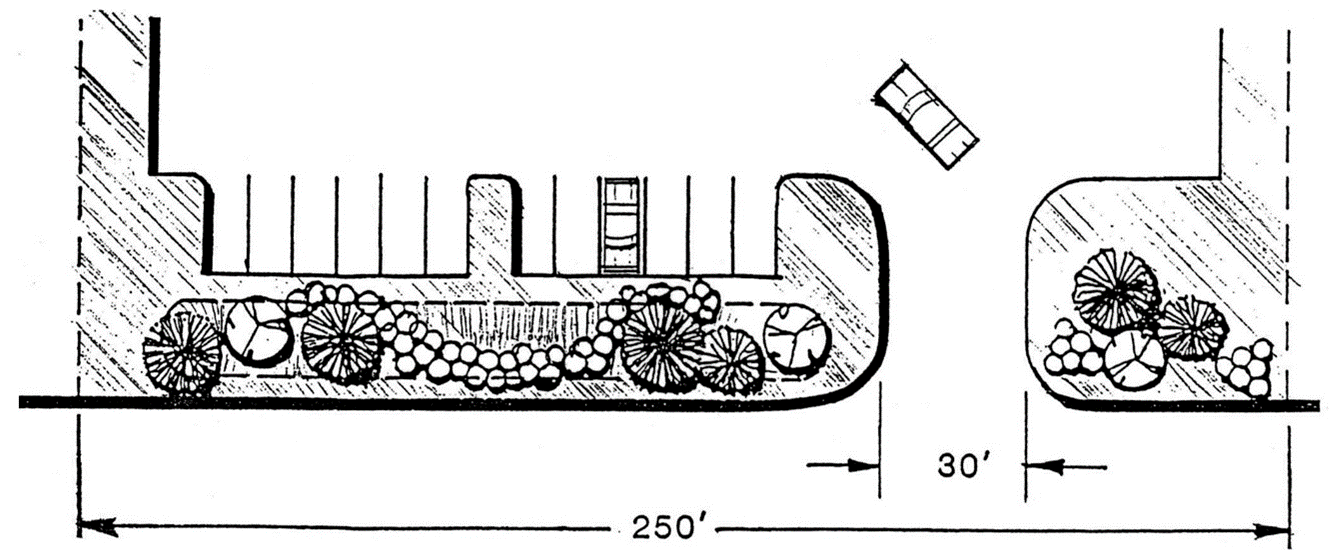
Frontage Landscaping. Where the site abuts a public road right-of-way, the following frontage landscaping shall be provided in the front yard area adjacent to the road right-of-way (see Example of Frontage Landscaping below):
The depth of the frontage landscaping area shall be sufficient to contain the required landscaping and ensure the survivability of plant material. For the purposes of computing length of road frontage, openings for driveways and sidewalks shall not be counted. Trees and shrubs may be planted at uniform intervals, at random, or in groupings. However, the City Council or Planning Director may require the planting design to use massing or groupings of materials to create a stronger visual impact from the public right-of-way.
(2)
Parking Lot Landscaping. All parking areas and other paved ground surface areas used for vehicular parking must have perimeter and internal landscaping to provide visual and climatic relief from broad expanses of pavement and to channelize and define logical areas for pedestrian and vehicular circulation.
A)
Parking Lot Screening. Parking lot screening adjacent to a parking lot is not required if the paved ground surface area is completely screened from the public right-of-way by an intervening building or structure. Where paved ground surface areas are located adjacent to sidewalks, streets, and other public rights-of-way, landscaping shall be provided between the public right-of-way and the paved ground surface area within ten (10) feet of the paved ground surface area with landscaping, a berm, a masonry wall, or a combination of these, as follows:
i)
Parking Lot Screening Landscaping. Landscaping shall include a landscaped yard at least five (5) feet in width containing an opaque screen of landscaping (evergreen or deciduous hedge) at least three (3) feet in height. The landscaping shall be planted in a manner where the landscaping can be expected to provide an unbroken visual screen within three (3) years. The landscaping shall be located at least two (2) feet from the front of a parking space curb so as to account for vehicle overhang.
ii)
Parking Lot Screening Berm. Berms shall be at least three (3) feet in height (measured above the elevation of the adjacent parking surface) and meet the requirements of Section 10.03(7).
iii)
Parking Lot Screening Wall. Walls shall be at least three (3) feet in height and constructed of the same or compatible material and colors of the principal building in terms of texture and quality.
B)
Interior Parking Lot Landscaping. All off-street parking areas of forty (40) parking spaces or more must have internal landscaping.
i)
Size of Interior Parking Lot Landscaping Areas. Interior landscaping must account for a minimum of five percent (5%) of all paved parking areas, including parking and loading spaces, driveways, and aisles. Each separate interior landscaped area must be a minimum of three hundred (300) square feet in area and must have a minimum width of ten (10) feet.
ii)
Minimum Number of Trees. Each interior landscape area must contain at least one (1) tree. One (1) tree must be planted for each three hundred (300) square feet of interior landscaping.
iii)
Location of Landscaping. All required interior parking lot landscaping must be planted within the landscaped islands or in landscaped areas within twenty (20) feet of the perimeter of the parking lot, provided that such landscaping is not also counted toward other landscape or screening requirements.
iv)
Groundcover. Interior parking lot landscape areas must include groundcover of grass, perennials, shrubs, and/or hardwood mulch. Rock, stone, or pebbles are not permitted ground cover.
v)
Protection with Curbing or Wheel Stops. All interior parking lot landscaping must be protected from vehicular encroachment by six (6) inch high concrete curbing or wheel stops.
vi)
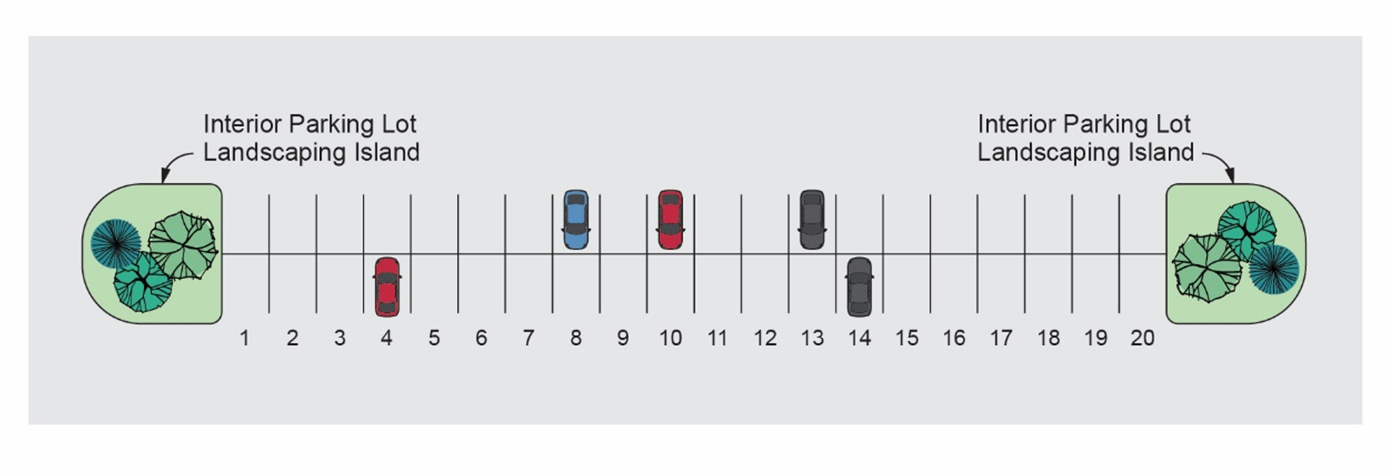
Maximum Number of Parking Spaces in a Row. Landscaping islands with or without walkways must be used to subdivide parking areas into parking rows with no more than twenty (20) spaces. See image below.
vii)
Maintenance. The internal landscaping must be installed and maintained so that, when mature, it does not obscure traffic signs, fire hydrants, lighting, drainage patterns, or vision for safety or ingress or egress.
(3)
Loading Area Landscaping. All loading areas (including, but not limited to, truck docks, overhead doors, or trailer staging areas) not screened by an intervening building shall be screened from a perpendicular view from any public street rights-of-way or adjacent residential zoning district for the entire length except for necessary access. It is the intent of this Section to screen loading areas and delivery vehicles as completely as practicable. Screening for loading areas may be accomplished by one (1) or a combination of the following:
A)
An opaque fence or wall which is at least six (6) feet high and is made of the same or compatible material, in terms of texture and quality, as the material and color of the principal building. Additional evergreen planting materials shall be provided so that no more than two-thirds (⅔) of the surface area of the closed fence or wall is visible from the street within three (3) years of erection of the structure.
B)
Evergreen trees at least eight (8) feet in height and planted in a staggered double row spaced fifteen (15) feet on center. Any plant material used to fulfill these requirements shall meet or exceed the minimum size requirements of Section 10.04 when planted.
(4)
Display Area Screening. Screening of display areas may, at the discretion of the City Council, be accomplished by plants, fences, walls or earthen berms, or any combination thereof to meet the requirements of this Section. The City Council must base its discretion on the material being displayed and the visual impact on surrounding areas. The City Council may modify or waive these requirements where outdoor display is integral to the principal use of the property (e.g., Outdoor Vehicle Sales).
A)
The plants, fence, walls, earthen berms, or combination thereof, must provide a buffer no less than three (3) feet in height equal to the length of the display area, exclusive of driveways and sight lines used for safe automobile access and egress. In the case of vehicle or equipment display, the buffer must create a screen.
B)
Walls which are used shall be of the same or compatible material, in terms of texture and quality, with the material and color of the principal building. Additional planting materials shall be provided so that no more than one-half (½) of the surface area of the wall is visible from the street within three (3) years of erection of the structure. Forty percent (40%) of this plant material may be deciduous.
C)
All shrubs shall comply with the requirements of Section 10.04. Vegetation planted on berms may have a lesser mature height required by the Article provided that the combined height of the berm and the plantings after three (3) years are at least three (3) feet high. Up to forty percent (40%) of all shrubs may be deciduous.
(5)
Screen Wall and Greenbelt Buffering. The intent of this Section is to reserve an appropriate area of a lot to screen and buffer the lot and its use(s) based on its zoning district and the zoning district of the adjacent lots, regardless of whether the adjacent lots are developed. A screen wall and/or greenbelt as specified in the table below shall be provided for all uses requiring Site Plan Review.
A)
Planting Setback. Trees and shrubs must not be placed closer than four (4) feet to the fence line or property line. Single family uses are excluded from this requirement.
B)
City Review. The City Council or Planning Director may modify the greenbelt buffering to allow less buffering or require additional buffering based on the proposed use's impact on adjacent lots.
C)
Greenspace Lawn. The remainder of the greenspace area which is not planted with the aforementioned stock must be kept in lawn or another approved native vegetation. All plant materials must be maintained in a healthy growing condition and in a neat and orderly appearance as required in this Article.
D)
Existing Buffering. If an existing wall, fence, or vegetation exists on the site that meets the greenspace buffering standards of this Ordinance, the City Council or Planning Director may accept the existing screening or require only supplemental screening to meet the intent of this Article.
E)
Circumstances Requiring Construction of a Wall. City Council, in the review of a site plan or waiver use petition, may require the construction of a masonry wall where it is determined that construction of a wall is needed to adequately buffer a developing district from an adjacent use or district.
F)
Separation Agreement. Upon receipt by the Inspection Department of a written agreement for a term of not more than five years, among the owner(s) of property requiring installation of a protective wall or greenbelt and the owner(s) of all abutting residential properties, and proof that a buffer complying with such agreement is in place, the requirements of this section shall be waived during the time such agreement remains in effect. Such an agreement may be renewed, for terms not exceeding five years for each renewal, pursuant to a written agreement of the owners of property described above. Any agreement made pursuant to this paragraph shall be expressly made binding on the parties' successors in title for the duration of the agreement. This paragraph shall only apply where the property requiring the protective wall cannot meet the standards for greenbelts set forth above due to a condition on the property which existed at the time this paragraph (f) was added to this Section.
(6)
Open Space Landscaping. All remaining open areas on the site that are not required landscaping areas as described elsewhere in this Article (frontage landscaping, parking lot landscaping, loading and display area landscaping, and greenbelt buffering) shall be planted with one (1) tree per three thousand (3,000) square feet of open area. All open space landscaping areas shall be planted with grass or another suitable vegetative ground cover.
(7)
Berms. Where required, earth berms, or landscaped berms must conform to the following standards:
A)
The berm must be at least constructed with slopes no steeper than one (1) foot vertical for each three (3) feet horizontal with at least a two (2) foot flat area on the top unless a different size is required in this Ordinance.
B)
The berm must be planted with grass or other suitable ground cover to ensure that it withstands wind, weather, and erosion, and retains its height and shape.
C)
Unless a specific planting pattern is required by the Ordinance or the City Council, required trees and shrubs may be planted at uniform intervals, at random or in groupings.
D)
Berm height must be measured as elevation above grade.
(8)
Garbage, Refuse, and Recycling Collection Areas. All garbage, refuse, and recycling must be placed within a sealed container that shall be screened utilizing an enclosure that meets the following requirements:
A)
An enclosure of sufficient height to completely screen the dumpster is required on three (3) sides of the waste receptacle with a solid gate on the fourth side. The height of the enclosure must be not less than six (6) feet or at least one (1) foot above the height of the dumpster, whichever is greater. This requirement specifically supersedes the maximum height requirement of a fence as set forth in Chapter 44 of Title 15 of the Livonia Code of Ordinances, as amended. The enclosure gates shall be of solid panel steel construction or durable, long-lasting solid panel fiberglass and, when not in use, closed at all times.
B)
The enclosure must be constructed of the same or compatible material and colors of the principal building in terms of texture and quality.
(9)
Mechanical and Utility Equipment Screening. All mechanical equipment, utility meters, storage tanks, air conditioning equipment, transformers, or similar equipment, incidental to any building, including roof-mounted equipment must be totally enclosed or screened from view off-site and must be an integral part of the architectural or landscape design of the building and site. This requirement does not apply to equipment serving a single-family unit or duplex.
(10)
Right-of-Way and Access Easement Landscaping. In addition to any other landscaping requirements of this Ordinance for public rights-of-way and other access easements, any public right-of-way and access easement areas adjacent to required landscaped areas shall be planted with grass or other suitable ground cover and maintained by the owner of the adjacent property as if they were part of required landscaped areas.
Section 10.04 - Standards for Plant Materials.
(1)
Lawn Areas. Lawn areas shall be planted in species of grass normally grown as permanent lawns in southeast Michigan. Grass may be sodded or seeded and mulched, except that solid sod shall be used in swales or other areas subject to erosion. Sod or seed shall be clean, free of weeds and noxious pests or disease.
(2)
Recommended Species of Trees, Shrubs, and Perennials. The plant palette should emphasize native trees, shrubs, and perennials which are hardy to the southeast Michigan region. The following is a list of recommended species and required minimum sizes of plant materials. The City of Livonia may permit other species that are not listed below.
(3)
Prohibited Species. Based on the undesirability of the following species, they are prohibited from being planted as required landscaping. The City Council or Planning Director may prohibit other species that are not listed below.
(4)
Minimum Requirements for Plant Material.
A)
All plant material must conform to the description consistent with generally accepted and published nursery and landscape standards. Plant materials must be typical of their species or variety, have normal habitat of growth, well-branched, and densely foliated when in leaf.
B)
Plant materials must be chosen according to soil, climatic conditions, and environmental factors for the proposed development, the location of the installation, and its desired function.
C)
Artificial plants are prohibited from satisfying landscape requirements.
Section 10.05 - Landscape Installation and Maintenance.
(1)
Installation.
A)
Installation Period. Whenever planting is required by this Ordinance, it must be planted prior to the issuance of the Certificate of Occupancy. If the weather does not permit the planting, the required planting must take place within six (6) months from the date of issuance of the Certificate of Occupancy.
B)
Installation Method. All landscaping must be installed in a manner consistent with generally accepted and published nursery and landscape standards, the approved landscaping plan, and the following:
i)
High Quality and Healthy Plant Material. Plant material must be freshly dug. Plant material must be of sound health, vigorous and uniform in appearance with a well-developed root system and free from disease, insects, pests, eggs, or larvae. Trees must have straight trunks with leaders intact, undamaged and uncut.
ii)
Mulching. Trees, shrubs, hedges, vines, perennials, and live groundcovers (except turf grasses) must be generously mulched at the time of planting with hardwood bark mulch or similar natural material. Because stone, rocks, and pebbles trap heat and do not retain moisture, these materials must not be permitted as a ground cover or mulch.
iii)
Topsoil. A minimum of four (4) inches of topsoil must be provided for all lawn areas, ground covers, berms, and planting beds.
iv)
Plant Material Required in All Portions of Landscaped Areas. All portions of the landscaped areas must be planted with grass, groundcover, shrubbery, or other suitable plant material, except that paved patios, terraces, sidewalks, and similar site features may be incorporated with City Council approval.
v)
Planting Locations. Unless a specific planting pattern is required by the Ordinance or the City Council, required trees and shrubs may be planted at uniform intervals, at random, or in groupings, provided they are planted in accordance with the approved plan. Landscaping must be located and maintained in a manner that minimizes conflicts with overhead or underground utilities, and that allows reasonable view of storefronts and signs.
vi)
Protection of Existing Vegetation. Existing vegetation to be preserved must be protected during construction through the use of temporary fencing around the drip line.
(2)
Maintenance.
A)
The owner of the property is responsible for the regular maintenance of all plants and must replenish mulch, control weeds, fertilize plants, and prune plants as necessary beginning upon completion of construction of landscaping. All diseased, dead, or damaged plants must be replaced within thirty (30) days, unless the season is not appropriate for planting, in which case such plant material must be replaced at the beginning of the next planting season.
B)
The approved landscape plan must be considered a permanent record and integral part of site plan approval. Unless otherwise approved in accordance with the procedures for amending a site plan, any revisions to or removal of plant materials that are not replaced will cause the parcel to be in nonconformity with the originally approved landscape plan and must be viewed as a violation of this Ordinance.
(3)
Irrigation Required. All landscape areas (including lawns) shall be provided with an automatic underground irrigation system. The City Council or Planning Director may approve an alternate form of irrigation for a particular area, or may waive the irrigation requirement in an area upon determining that the underground irrigation is not necessary to maintain site landscaping in good condition due to the characteristics of the proposed plant materials.
(4)
Snow Storage. Landscape areas may be used for snow storage, provided they are designed to accommodate the large volumes of snow, planted with salt-tolerant landscape material that can survive in winter conditions, and maintained in accordance with this Article.
Section 10.06 - Modifications.
In consideration of the overall design and impact of the landscape plan, the City Council may modify or adjust the requirements outlined in this Article for required landscaping, provided that any such adjustment is keeping with the intent of this Ordinance and more specifically, with the intent of this Article.

