
Lyons City Zoning Code
ARTICLE 1
General Provisions
Sec. 16-1-10.- Title.
This Chapter establishes the regulations and standards governing the use and development of land within the Town of Lyons. Included are provisions for the annexation and zoning of land, as well as the administrative procedures governing the submission of applications and administrative and public reviews.
(Prior code 9-1-1; Ord. 956 § 1, 2014)
Sec. 16-1-20. - Short title.
This Chapter shall be known and may be cited as the Lyons Zoning Regulations. Within this Chapter, the Lyons Zoning Regulations shall simply be referred to as "this Chapter."
(Prior code 9-1-2; Ord. 956 § 1, 2014)
Sec. 16-1-30. - Authority.
(a)
This Chapter is adopted pursuant to the authority contained in the Colorado Revised Statutes and the Colorado Constitution, Chapter XX, Section 6. Local governments are provided broad authority to plan for and regulate the use of land within their jurisdictions, as authorized in Article 20 of Title 29, et seq., and Article 23 of Title 31, et seq., C.R.S. Additional statutory authority may also exist for specific types of land use regulation.
(b)
Whenever a section of the state statutes that is referred to in this Chapter is later amended or superseded, this Chapter is deemed amended to refer to the amended section or section that most nearly corresponds to the superseded section.
(Prior code 9-1-3; Ord. 956 § 1, 2014)
Sec. 16-1-40. - Jurisdiction.
(a)
This Chapter shall be effective throughout the Town's corporate boundaries. The Town's planning jurisdiction includes all land within the Town and, where applicable, the land within the Town's Comprehensive Plan boundaries. For purposes of zoning, this Chapter only applies to lands within the Town's corporate boundaries.
(b)
A copy of a map showing the boundaries of the Town and the area within the Comprehensive Plan shall be available for public inspection in the Town offices.
(Prior code 9-1-4; Ord. 956 § 1, 2014)
Sec. 16-1-50. - Purpose.
The purpose of this Chapter is to create a vital, cohesive and well-designed community in order to enhance the Town's character and further the citizens' goals as identified in the Comprehensive Plan. This Chapter is designed to:
(1)
Encourage the most appropriate use of land within the Town;
(2)
Encourage innovative and quality site design, architecture and landscaping;
(3)
Encourage new developments to relate to the Town's historic development pattern;
(4)
Promote compact, well-defined and sustainable neighborhoods that enhance the Town's character;
(5)
Create livable neighborhoods that foster a sense of community and reduce dependency on private vehicles;
(6)
Encourage the proper arrangement of streets in relation to existing and planned streets and ensure that streets facilitate safe, efficient and pleasant walking, biking and driving;
(7)
Provide a variety of lot sizes and housing types in every neighborhood;
(8)
Protect sensitive natural and historic areas and the Town's environmental quality;
(9)
Integrate a high quality natural environment into the developed portions of the community;
(10)
Facilitate the adequate and efficient provision of transportation, water, sewage, schools, parks and other public requirements;
(11)
Provide protection from geologic, flood and fire hazards and other dangers; and
(12)
Promote the health, safety, morals and general welfare of Town residents.
(Prior code 9-1-5; Ord. 956 § 1, 2014)
Sec. 16-1-60. - Interpretation.
In their interpretation and application, the provisions of this Chapter shall be held to be minimum requirements for the promotion of the public health, safety and welfare. Whenever the requirements of this Chapter are at variance with the requirements of any other lawfully adopted rules, regulations or ordinances, the more restrictive or that imposing the higher standards shall govern.
(Prior code 9-1-6; Ord. 956 § 1, 2014)
Sec. 16-1-70. - Applicability of Chapter.
(a)
The provisions of the Lyons Zoning Regulations shall apply to any and all development of land within the municipal boundaries of the Town, unless expressly and specifically exempted or provided otherwise in this Chapter. No development shall be undertaken without prior and proper approval or authorization pursuant to the terms of this Chapter. All development shall comply with the applicable terms, conditions, requirements, standards and procedures established in this Chapter.
(b)
Except as herein provided, no building, structure or land shall be used and no building, structure or part thereof shall be erected, constructed, reconstructed, altered, repaired, moved or structurally altered except in conformance with the regulations herein specified for the zone district in which it is located, nor shall a yard, lot or open space be reduced in dimensions or area to an amount less than the minimum requirements set forth herein.
(c)
Whenever both the provisions of this Chapter and provisions of any other law cover the same subject matter, whichever rule is more restrictive shall govern.
(d)
This Chapter establishes procedural and substantive rules for obtaining the necessary approval to develop land and construct buildings and structures. Development applications will be reviewed for compliance with the Comprehensive Plan and with adopted regulations, policies and other guidelines.
(Prior code 9-1-7; Ord. 956 § 1, 2014)
Sec. 16-1-80. - Relationship to existing ordinances.
(a)
All ordinances, resolutions or motions of the Board of Trustees or parts thereof in conflict with this Chapter are to the extent of such conflict hereby superseded and repealed, provided that no such repealer shall repeal the repealer clauses of such ordinance, resolution or motion or revive any ordinance, resolution or motion thereby. The adoption of this Chapter shall not adversely affect the Town's right to seek remedies for any violation of previous ordinances that occurred while those ordinances were in effect.
(b)
In the event of a conflict or inconsistency between this Chapter and any previously adopted provision of this Code, this Chapter shall govern.
(Prior code 9-1-8; Ord. 956 § 1, 2014)
Sec. 16-1-90. - Relationship to Comprehensive Plan.
(a)
Intent. It is the intention of the Town that this Chapter implement the planning policies adopted in the Comprehensive Plan for the Town and its extraterritorial planning area. While this relationship is reaffirmed, it is the intent of the Town that neither this Code nor any amendment to it may be challenged on the basis of any alleged nonconformity with the Comprehensive Plan.
(b)
Requirement for Comprehensive Plan Amendment. Where a development proposal would be in substantial conflict with the Comprehensive Plan, an amendment to the Comprehensive Plan will be required prior to any zoning or subdivision approvals.
(c)
Criteria for Evaluating Amendment Proposals. Amendments to the Comprehensive Plan resulting from development proposals under this Chapter shall be evaluated according to the criteria and procedure outlined in the Comprehensive Plan.
(Prior code 9-1-9; Ord. 956 § 1, 2014)
Sec. 16-1-100. - Effective date.
The provisions of this Code became effective May 5, 2008, and were originally adopted by Ordinance No. 835, on March 25, 2008. Development plans approved under previous regulations that received vested property rights through a site-specific development plan pursuant to Section 24-68-101, et seq., C.R.S., shall be valid for the duration of that vested property right, provided that all terms and conditions of the site-specific development plan are followed. Existing legal uses that may become nonconforming by adoption of this Chapter shall become legal nonconforming uses subject to the provisions of Section 16-7-40 of this Chapter.
(Prior code 9-1-10; Ord. 956 § 1, 2014)
Sec. 16-1-110. - Fees.
Reasonable fees sufficient to cover the costs of administration, inspection, publication of notice and similar matters will be charged to applicants for permits, zoning amendments, variances, site-specific development plans and other administrative relief. The fee schedule will be adopted periodically by resolution of the Board of Trustees and is available from the Town Hall.
(Prior code 9-1-11; Ord. 956 § 1, 2014)
Sec. 16-1-120. - Severability.
If any part, section, subsection, sentence, clause or phrase of this Chapter is for any reason held to be invalid, such invalidity shall not affect the validity of the remaining sections of this Chapter. The Board of Trustees hereby declares that it would have passed these Zoning Regulations, including each part, section, subsection, sentence, clause or phrase thereof, irrespective of the fact that one (1) or more parts, sections, subsections, sentences, clauses or phrases are declared invalid.
(Prior code 9-1-12; Ord. 956 § 1, 2014)
Sec. 16-1-130. - Computation of time.
(a)
In computing a period of days, the first day is excluded and the last day is included.
(b)
If the last day of any period is a Saturday, Sunday or legal holiday, the period shall be extended to include the next day which is not a Saturday, Sunday or legal holiday.
(c)
If a number of months is to be computed by counting the months from a particular day, the period ends on the same numerical day in the concluding month as the day of the month from which the computation is begun, unless there are not that many days in the concluding month, in which case the period ends on the last day of that month.
(Prior code 9-1-13; Ord. 956 § 1, 2014)
Sec. 16-1-140. - Grammatical interpretation.
(a)
As used in this Chapter, words used in the singular include the plural and words used in the plural include the singular.
(b)
The words must, shall and will are mandatory; may, can, should and might are permissive.
(Prior code 9-1-14; Ord. 956 § 1, 2014)
Sec. 16-1-150. - Acronyms.
Acronyms used in this Chapter are defined as follows:
BOT means the Board of Trustees.
C.R.S. means the Colorado Revised Statutes, as they may be amended from time to time.
DIP means the Downtown Improvement Plan.
IGA means an Intergovernmental Agreement.
PCDC means the Planning and Community Development Commission.
POST means Parks, Open Space and Trails.
PUD means a Planned Unit Development.
(Prior code 9-1-16; Ord. 956 § 1, 2014)
Sec. 16-1-160. - Definitions.
For purposes of this Chapter, the following terms shall have the meanings indicated:
Abutting means bordering or touching, such as sharing a common lot line.
Accessory building means a subordinate building or structure, the use of which is customarily incidental to that of the main building or to the main use of the land, which is located on the same lot (or on a contiguous lot in the same ownership) with the main building or use. Accessory buildings are only permitted when they are incidental or accessory to an existing and permitted principal or conditional use.
Accessory use means a subordinate use, clearly incidental and related to the main structure, building or use of land, and located on the same lot (or on a contiguous lot in the same ownership) as that of the main structure, building or use.
Adjacent means meeting or touching at some point or separated from a lot or parcel by one (1) of the following: a street, alley or other right-of-way, lake, stream or open space.
Adjacent property owner is an owner of record of any estate, right or interest in real property abutting and within a specified distance, which can vary.
Adult-oriented use means a use of property where the principal use, or a significant or substantial adjunct to another use of the property, is the sale, rental, display or other offering of live entertainment, dancing or material which is distinguished or characterized by its emphasis on depicting, exhibiting, describing or relating to specified sexual activities or specified anatomical areas as the primary attraction to the premises.
Agritourism or agricultural tourism means a commercial enterprise at a farm, ranch or vineyard that provides enjoyment or education to visitors and generates supplemental income to growers. These enterprises also provide opportunities for urban populations to experience a rural or agricultural environment. Agritourism can include farm stands, farm tours, wildlife viewing or bird watching, festivals and farm-animal petting zoos, while tasting or pick-your-own crops.
Alley means a minor or secondary way which is used primarily for vehicular service access to the back or side of properties otherwise abutting on a street.
Alter means the act or result of any change, addition or modification in construction, occupancy or use.
Animal boarding. See "Boarding, large animal" and "Boarding, small animal".
Antenna means any transmitting or receiving device or equipment mounted on a tower, building or structure that radiates, captures, receives, switches, emits or transmits electromagnetic waves, digital signals, analog signals, radio frequencies (excluding radar signals), wireless telecommunications signals or other communication signals, including, but not limited to, paging, enhanced specialized mobile radio service, commercial mobile radio service, personal communication services, microwave link antenna, cellular telephone and other related technologies.
Antenna, panel means any antenna with both a vertical and horizontal plane designed to receive, transmit, direct, relay, aim or switch signals associated with telecommunication services. Panel antennae are mounted to lawfully existing buildings and structures.
Antenna, whip means any antenna cylindrical in shape and less than eight (8) inches in circumference that emits signals in a three-hundred-sixty-degree horizontal plane for the transmission or reception of wireless communications signals.
Apartment means a room or suite of rooms with cooking facilities available which is occupied as a residence by a group of individuals living together and is rented. This includes any unit in buildings with two (2) or more dwelling units.
Applicant means the owner of land, the owner's authorized representative or the optionee of the land, as well as mineral owners and lessees.
Area of lot or lot area means the total horizontal area within the lot lines of a lot.
Artisan studio and gallery means the workshop or studio of an artist, craftsperson, sculptor or photographer, which workshop is primarily used for onsite production of unique custom goods through the use of hand tools or small-scale equipment and may be used as an accessory gallery or for sales.
Artisan manufacturing means the small-scale firms that focus on direct sales rather than the wholesale market, who are involved in the on-site production of hand-fabricated or hand manufactured goods through the use of hand tools or small scale, light mechanical equipment. Artisan production includes fabrication and textiles such as apparel manufacturing, jewelry making, wood and metal working, pottery and glass making, and equivalents typically not permitted in non-industrial zone districts. Artisan manufacturing is intended to be compatible with surrounding commercial development. An allowance for public viewing or customer service space is required, such as teaching, equipment rentals or showrooms and ancillary sales of goods produced on-premises. In general, artisan manufacturing limits external impacts associated with nuisances such as odor, vibration, smoke, gas, dust, sound, soot, heat, glare or lighting. It also limits utility usage. All activities except loading and outdoor product displays shall occur within buildings; outdoor storage/repair is prohibited. Loading docks and service doors should not face residential uses.
Assisted living facility means a state-licensed establishment which provides permanent living quarters and a variety of limited personal care and supportive health care to individuals who are unable to live independently but who do not need skilled nursing care. The facility may provide supportive health care monitoring, such as assistance with medication, but is limited to services which do not require state or federal licensing.
Associated residential dwelling unit means a residential dwelling unit that is located in a building in which fifty (50) percent or more of the first floor area is devoted to a use for which the primary and principal purpose is the sale of goods, products or services that are subject to local sales tax, with the exception of stairways, entrance areas necessary to serve the associated residential dwelling unit and retail facades. An associated residential dwelling unit must be intended for use on a long-term basis, shall not made available for lease or rent for periods of less than six-month terms and shall maintain an exterior entrance separate and apart from any other use within the building.
Automotive repair, major means an establishment primarily engaged in the repair or maintenance of commercial and heavy truck-oriented motor vehicles, trailers and similar large mechanical equipment, including paint, body and fender and major engine and engine part overhaul, provided that it is conducted within a completely enclosed building. Such use shall not include the sale of fuel, gasoline or petroleum products.
Automotive repair, minor means an establishment primarily engaged in the repair or maintenance of passenger and light truck-oriented motor vehicles, trailers and similar mechanical equipment, including brake, muffler, upholstery work, tire repair and change, lubrication, tune-ups and transmission work, car washing, detailing, polishing or the like, provided that it is conducted within a completely enclosed building. Such use shall not include the sale of fuel, gasoline or petroleum products.
Awning means a roof-like cover of canvas or other material extending in front of a doorway or window or over a deck, to provide protection from the sun or rain.
Awning sign means a wall sign which is painted, stitched, sewn or stained onto the exterior of an awning.
Bar means an establishment providing or dispensing fermented malt beverages and/or malt, vinous or spirituous liquors, and in which the sale of food products such as sandwiches or light snacks is secondary.
Bed and breakfast means an establishment operated in a private dwelling or portion thereof in which the owner of the dwelling concurrently resides and:
(1)
Provides temporary accommodations to one (1) or more booking parties at the same time for a fee; and
(2)
May serve at least one (1) meal daily for overnight guests only.
A bed and breakfast shall not constitute or be regulated as a short-term rental.
Bikeway means a path designed for use by bicyclists, which may be used by pedestrians.
Board of Trustees means the governing board of the Town of Lyons.
Boarding house means a building other than a hotel, cafe or restaurant where, for compensation, directly or indirectly, lodging and/or meals are provided for roomers or boarders. The word compensation shall include compensation in money, services or other things of value.
Boarding, large animal means the operation of an establishment in which domesticated animals other than household pets are housed, groomed, bred, boarded, trained or sold. This term shall not include the operation of a kennel.
Boarding, small animal means a facility licensed to house dogs, cats or other household pets and/or where grooming, breeding, boarding, training or selling of animals is conducted.
Building means any permanent structure built for the shelter or enclosure of persons, animals, chattels or property of any kind, which is governed by the following characteristics:
a.
Is permanently affixed to the land.
b.
Has one (1) or more floors and a roof.
Building code means the set of standards that must be followed in the construction and remodeling of buildings and structures. The building code used by the Town is the International Building Code, adopted in Chapter 18 of this Code.
Building frontage means the horizontal, linear dimension of that side of a building which abuts a street, a parking area or other circulation area open to the public and has either a main window display or a public entrance to the building.
Building height means the average of the vertical height measured from the finished grade at the center of each wall to the highest roof beam. The horizontal measurement point is three (3) feet from each wall. See Figure 16-1-1 below.
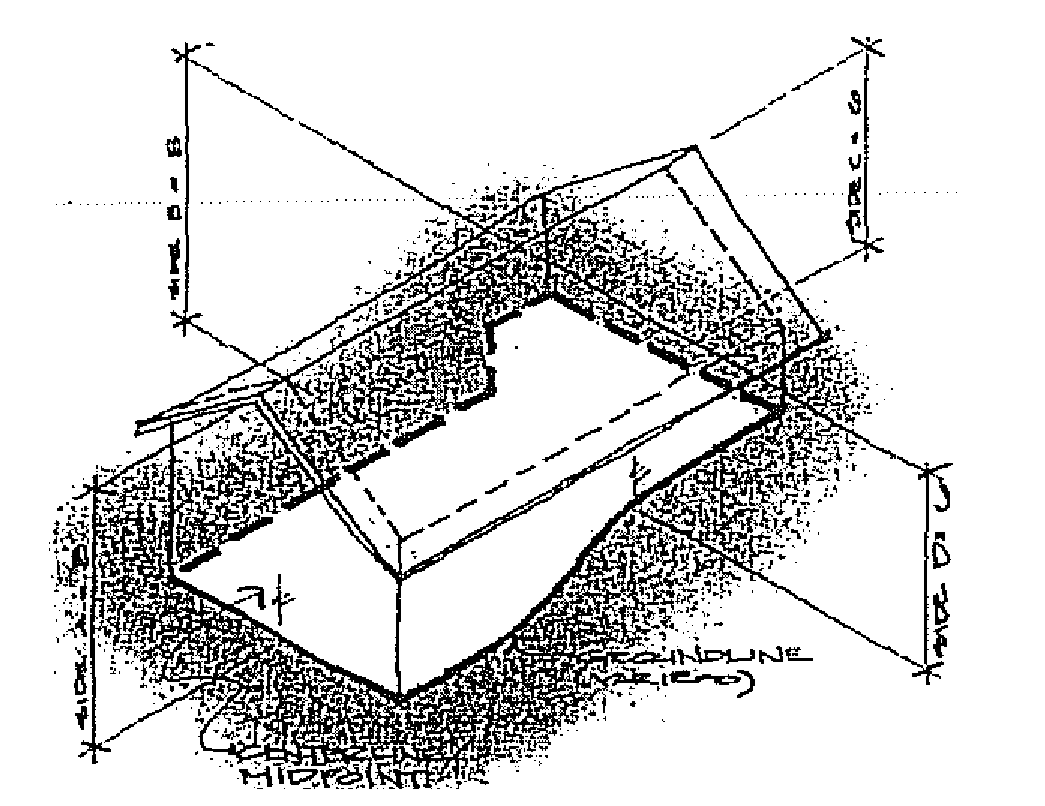
Figure 16-1-1 Building Height
Diagram shows the building height of this structure as 7, determined by adding Sides A, B, C and D (8+8+6+6) and dividing by 4.
Building, principal means one (1) building housing the principal (primary or most important) uses permitted for the lot upon which it is located.
Campground means an area established, maintained, operated or used by a public or private entity for temporary occupancy of recreational vehicles, tents or other camping equipment.
Canopy sign means a wall sign that is permanently affixed to a roofed shelter attached to and supported by a building, by columns extending from the ground or by a combination of a building and columns.
Cemetery means land used or intended to be used for the burial of the dead and dedicated for cemetery purposes, including mausoleums and mortuaries when operated in conjunction with, and within the boundaries of, such cemetery.
Character means those attributes, qualities and features that make up and distinguish a development project and give such project a sense of purpose, function, definition and uniqueness.
Child care center. See Day care center, child.
Church or place of worship and assembly means a building containing a hall, auditorium or other suitable rooms used for the purpose of conducting religious or other services or meetings of the occupants of such structure. Church or place of worship and assembly shall include churches, synagogues or the like, but shall not include buildings used for commercial endeavors, including, but not limited to, commercial motion picture houses or stage productions.
Clinic means a building designed and used for the diagnosis and treatment of human patients that does not include overnight care facilities.
Clubs and lodges means organizations of persons for special purposes or for the promulgation of sports, arts, literature, politics or other common goals, interests or activities, characterized by membership qualifications, dues or regular meetings, excluding clubs operated for profit and/or places of worship or assembly.
Commercial mineral deposits means aggregates, stone and other natural deposits that may be extracted from a property for economic benefit.
Common open space means a parcel of land, an area of water or a combination of land and water within the site designated for a planned unit development, designed and intended primarily for the use or enjoyment of residents, occupants and owners of the planned unit development.
Community facility means a publicly owned facility or office building which is primarily intended to serve the recreational, educational, cultural, administrative or entertainment needs of the community as a whole.
Compatibility means the characteristics of different uses or activities or design which allow them to be located near or adjacent to each other in harmony. Compatibility does not mean the same as. Rather, compatibility refers to the sensitivity of development proposals in maintaining the character of existing development.
Condominium means a single dwelling unit in a multiple unit structure, which is separately owned and which may be combined with an undivided interest in the common areas and facilities of the property.
Conservation easement means a right of the owner of the easement to prohibit certain acts with respect to the property in order to maintain the property in a manner that will preserve its value for recreation, education, habitat, open space or historical importance. See also Section 38-30.5-102, C.R.S. (NOTE: For a conservation easement to create tax benefits for the donor at the federal or state level, it must meet either or both of the Internal Revenue Service or State of Colorado definitions).
Constant care facility. See "Nursing facility."
Container (also known as cargo or shipping container) means a truck trailer body that can be detached from the chassis for loading into a vessel or a rail car or stacked in a container depot. Containers may be ventilated, insulated, refrigerated, flat rack, vehicle rack, open top, bulk liquid or equipped with interior devices. A standard container may be twenty (20) feet, forty (40) feet, forty-five (45) feet, forty-eight (48) feet or fifty-three (53) feet in length, eight (8) feet or eight and one-half (8½) feet in width, and eight and one-half (8½) feet or nine and one-half (9½) feet in height.
Covenants means a private written agreement outlining regulations specific to a development. As private restrictions, they are not enforced by the Town. In the event of conflict between the covenants and this Chapter, this Chapter controls.
Cul-de-sac means a local street with only one (1) outlet and having the other end for the reversal of traffic movement.
Day care means a use which is the temporary care and supervision of persons not related to the caregiver. Day care facilities shall have limited hours of operation and shall not offer permanent full-time care. Day care facilities are not considered schools.
Day care center, adult means a facility which is maintained for a part of a day for the care of persons over the age of sixteen (16) years who are not related to the owner, operator or manager, whether such facility is operated with or without compensation.
Day care center, child means a facility which is maintained for a part of a day for the care of children under the age of sixteen (16) years who are not related to the owner, operator or manager, whether such facility is operated with or without compensation. The term includes, but is not limited to, facilities commonly known as day nurseries, nursery schools, preschools, play groups, day camps, summer camps and centers for developmentally disabled children, but specifically excludes any group care home as defined in this Chapter.
Dedication means any grant by the owner of a right to use land for the public in general, involving a transfer of property rights, and an acceptance of the dedicated property by the appropriate public agency.
Density means the overall average number of dwelling units located on the gross or net residential acreage (as applicable) contained within the development and calculated on a per-acre basis. Density is calculated by dividing the total number of units by the total acreage. This calculation is frequently referred to as gross density.
Department store means a business which is conducted under a single owner's name wherein a variety of unrelated merchandise and services are housed, enclosed, exhibited and sold directly to the customer for whom the goods and services are furnished.
Design standard means the standard that sets forth specific improvement requirements.
Developer means any person, partnership, joint venture, limited liability company, association or corporation which participates as owner, promoter, developer or sales agent in the planning, platting, development, promotion, sale or lease of a development.
Development means the carrying out of any building activity or mining operation, the making of any material change in the use or appearance of any structure or land or the dividing of land into two (2) or more parcels. When appropriate in context, development shall also mean the act of developing or the result of development.
a.
Development shall also include:
1.
Any construction, placement, reconstruction, alteration of the size or material change in the external appearance of a structure on land;
2.
Any change in the intensity of use of land, such as an increase in the number of dwelling units in a structure or on a tract of land or a material increase in the intensity and impacts of the development;
3.
Any change in use of land or a structure;
4.
Any alteration of a shore or bank of a river, stream, lake, pond, reservoir or wetland;
5.
The commencement of drilling oil or gas wells, mining, stockpiling of fill materials, filling or excavation on a parcel of land;
6.
The demolition of a structure;
7.
The clearing of land as an adjunct of construction;
8.
The deposit of refuse, solid or liquid waste or fill on a parcel of land;
9.
The installation of landscaping within the public right-of-way, when installed in connection with the development of adjacent property; and
10.
The construction of a roadway through or adjoining an area that qualifies for protection as a wildlife or natural area.
b.
Development shall not include:
1.
Work by a highway or road agency or railroad company for the maintenance or improvement of a road or railroad track if the work is carried out on land within the boundaries of the right-of-way;
2.
Work by any public utility for the purpose of inspecting, repairing, renewing or constructing, on established rights-of-way, any mains, pipes, cables, utility tunnels, power lines, towers, poles or the like; provided, however, that this exemption shall not include work by a public entity in constructing or enlarging mass transit or fixed guide way mass transit depots or terminals or any similar traffic-generating activity;
3.
The maintenance, renewal, improvement or alteration of any structure if the work affects only the interior or the color of the structure or the decoration of the exterior of the structure;
4.
The use of any land for an agricultural activity (refer to Section 16-3-110 of this Chapter);
5.
A change in the ownership or form of ownership of any parcel or structure; or
6.
The creation or termination of rights of access, easements, covenants concerning development of land or other rights in land.
Development plan means the written and graphical documents that detail the provisions for any development. These provisions may include, and need not be limited to, easements, covenants and restrictions relating to use; location and bulk of buildings and other structures; intensity of use or density of development; utilities, private and public streets, ways, roads, pedestrian areas and parking facilities; common open space; and other public facilities.
Discount store means a bulk-purchase retail establishment that is usually membership-based, wherein a variety of unrelated merchandise and services are housed, enclosed, exhibited and sold directly to the customer for whom the goods and services are furnished.
Downtown means the downtown neighborhood as defined in the Comprehensive Plan.
Drive aisle means the lane in a parking lot devoted to the passage of vehicles, as opposed to the parking stalls. The term drive aisle does not include lanes used only or primarily for drive-in customer service.
Drive-in use means an establishment which, by design, physical facilities, service or packaging procedures, encourages or permits customers to receive services, obtain goods or be entertained while remaining in their motor vehicles.
Drive-up window means a window at a business establishment, such as a bank or restaurant, where patrons may transact business or order goods while staying in their vehicles; for example, to cash a check at the drive-up window of a bank.
Driveway, private means a constructed vehicular access connecting one (1) or more properties to a private or public road or street.
Dry-cleaning retail outlet means a dry-cleaning business which consists primarily of serving retail customers, provided that any laundry and dry-cleaning processing that occurs on the premises is limited to items which are brought directly to the premises by the retail customer.
Dwelling means a building or a portion thereof used exclusively for residential occupancy.
Dwelling, multi-unit means a building consisting of three (3) or more dwelling units, but not including motels or hotels. A multiple-unit dwelling may also be known as multi-family dwelling units, multiple-family dwelling units, duplexes, triplexes, fourplexes, condominiums, apartment buildings or similar multiple dwelling unit arrangements.
Dwelling, attached means a residential building containing principal dwelling units, each of which has primary ground floor access to the outside and which are attached to each other by party walls without openings. The term is intended primarily for such dwelling types as townhouses and duplexes. An attached dwelling may also be referred to as a one-family attached dwelling or single-family dwelling, attached.
Dwelling, detached means a dwelling which is not attached to any other dwelling or building by any means, including manufactured housing on a permanent foundation. An attached dwelling may also be referred to as a one-family attached dwelling or single-family dwelling, attached. A detached dwelling may also be referred to as a one-family detached dwelling or single-family dwelling, detached.
Dwelling, single detached means a detached building containing one (1) dwelling unit.
Dwelling, duplex means a building containing two (2) principal dwelling units.
Dwelling unit means one (1) or more rooms and a single kitchen and at least one (1) bathroom, designed, occupied or intended for occupancy as separate quarters for living, cooking and sanitary purposes.
Dwelling unit, accessory (ADU) means a second, subordinate unit co-located on the same lot as a principal residence in a single detached dwelling zone district. An accessory dwelling unit is no larger than eight hundred (800) square feet and may be either added to, co-located with as a detached unit, or created within a principal single detached dwelling. ADUs are created for the purpose of accommodating a second dwelling unit that lives separately from the primary single detached dwelling. An ADU is a separate spatially segregated living space that provides for cooking, sanitation and sleeping that is separate from and accessory to and subordinate to the principal single detached dwelling.
Easement means a right to use or control the property of another for a designated purpose, such as access, conservation, drainage or utility, generally established by deed or dedication on a recorded plat.
Electric vehicle (EV) charge station means a device/facility that provides electricity to charge the batteries of EVs and plug-in hybrid vehicles. This definition includes devices/facilities that require solar hoods and battery banks. This definition does not include single-use/private charge stations associated with a private residence.
Entertainment facilities means a building or part of a building devoted to showing motion pictures or dramatic, musical or live performances.
Event center, large means a facility designed and constructed for hosting festivals, receptions, parties, conferences, conventions or other gatherings, with a capacity of more than five hundred (500) people for an outdoor event center or more than seven thousand five hundred (7,500) gross square floor area for an indoor event center.
Event center, small means a facility designed and constructed for hosting festivals, receptions, parties, conferences, conventions or other gatherings, with a capacity of fewer than five hundred (500) people for an outdoor event center or less than seven thousand five hundred (7,500) gross square floor area for an indoor event center.
Farmers' market means an occasional or periodic market held in an open area or in a structure where groups of individual sellers offer for sale to the public such items as fresh produce, seasonal fruits, fresh flowers, arts and crafts items, and food and beverages dispensed from booths on site.
Financial institution includes the following types of businesses: banks, including savings and loans, credit agencies, investment companies, brokers and dealers of securities and commodities, security and commodity exchanges, and insurance agents.
Flagpole means an annexation in which a Town-owned platted street or alley, a public or private right-of-way, a public or private transportation right-of-way or area, or a lake, reservoir, stream or other natural or artificial waterway is used to reach a portion of territory that would not otherwise be directly continuous to the Town and to establish the one-sixth (⅙) contiguity with the Town limits, required by Subparagraph 15-1-310(2)a. of this Code.
Floodplain means areas which have been designated by FEMA as susceptible to flooding.
Floor area, also called gross floor area, means the total square footage of the building measured along the outside walls of the building and including each floor level basement areas, but not including open balconies, garages or other enclosed automobile parking areas.
Formula business means a business which does, or is required by contractual or other arrangement or as a franchise, to maintain two (2) or more of the following features, which causes it to be substantially identical to other businesses: Standardized array of services and/or merchandise, including signage, menu, trademark, logo, service mark, symbol, decor, architecture, facade, layout, uniforms or color scheme, and which are utilized by ten (10) or more other businesses nationwide regardless of ownership or location. Formula businesses may include, but are not limited to: restaurants, bars, retail establishments, hotels/motels, gas stations, automotive/motorcycle repair and servicing (major and minor), and grocery stores.
Freestanding facility means a telecommunications facility that consists of a stand-alone structure, such as a monopole or lattice tower, attached antennae and associated equipment storage shelters.
Functional open space means open space which is large enough to serve a practical purpose, such as recreation, wildlife habitat or preservation of areas of agricultural, archaeological or historical significance, and shall exclude areas used for off-street parking, off-street loading, service driveways and setbacks from oil and gas wells or their appurtenances, or other hazards to the public.
Funeral chapel means a building used for the preparation of the deceased for burial or cremation, for the display of the deceased and/or for ceremonies or services related thereto, including cremation and the storage of caskets, funeral urns, funeral vehicles and other funeral supplies.
Gallery means an establishment engaged in the sale, loan or display of art books, paintings, sculpture or other works of art, excluding libraries, museums or noncommercial art galleries.
Garage means an accessory building or portion of a principal building that is intended or used primarily for the storage of motor vehicles, and which is enclosed in such a manner that the stored or parked motor vehicle is contained entirely within the building.
Gasoline station means any building, land area, premises or portion thereof, where gasoline or other petroleum products or fuels are sold.
Geologic hazard means unstable or potentially unstable slopes, undermining, faulting, landslides, rockfalls, flood, wildfire or similar naturally occurring dangerous features or soil conditions or natural features unfavorable to development.
Grade, finished means the final elevation of the ground surface after development.
Green Building means the practice of reducing resource consumption while also reducing harmful environmental impacts throughout the life cycle of a building. Four (4) main concepts of Green Building include:
a.
Creating efficient buildings that reduce the consumption of energy, water, nonrenewable building materials and other resources in their construction, renovation, operations and maintenance;
b.
Creating a healthy environment for building users, including air quality, lighting, electromagnetic fields and enhanced opportunity for healthy activities;
c.
Reducing off-site negative impacts, such as construction waste, stormwater runoff, wastewater and air pollution; and
d.
Implementing site design that integrates the site with surrounding properties.
Green Building strives to maximize the long-term economic and social benefits of a building while participating in the protection of a stable and sustainable environment.
Grocery store means a retail establishment which primarily sells food, but also may sell other convenience and household goods.
Gross floor area means the total floor area designed for occupancy and use, including basements, mezzanines, stairways and upper floors, if any, expressed in square feet and measured from the centerline of joint partitions and from outside wall faces.
Group care home means a facility which provides twenty-four-hour care or supervision of persons and the operator or manager thereof.
Home business means an accessory use of a dwelling unit (or of an accessory structure allowed on a residential lot) for gainful employment of the residents of the dwelling unit, which use does not change the essential residential character or appearance of the dwelling unit.
Hospital means an institution providing health services primarily for human inpatient medical or surgical care for the sick or injured, and including related facilities such as laboratories, outpatient departments, training and central services facilities and staff offices.
Hotel/motel, large means a building that contains more than seventy-five (75) guest rooms intended and used for occupancy as a temporary abode for individuals who are lodged with or without meals.
Hotel/motel, small means a building that contains seventy-five (75) guest rooms or less that are intended and used for occupancy as a temporary abode for individuals who are lodged with or without meals.
Illumination means lighting by means of a light source.
Impound lot or yard means an area used exclusively for the temporary storage of automobiles, motor vehicles and recreational vehicles impounded pursuant to order of a public law enforcement agency or insurance organization licensed to conduct business in the State and stored solely for the purposes of law enforcement investigation, insurance investigation, title clearance and transfer and/or litigation. This definition does not include the dismantling or disassembly of vehicles except pursuant to litigation, the sale of vehicle parts or the storage of nonimpounded vehicles or their parts.
Junkyard means an industrial use contained within a building, structure or parcel of land, or portion thereof, used for collecting, storing or selling wastepaper, rags, scrap metal or discarded material or for collecting, dismantling, storing, salvaging or demolishing vehicles, machinery or other material, and including the sale of such material or parts thereof. Junkyard shall not include a recycling facility.
Kennel. See "Boarding, small animal."
Large accessory building means an accessory building which is two (2) stories or above or is an accessory building with sewer or water services.
Laundry, self-service means a laundry business which consists primarily of serving retail customers, provided that any laundry processing which occurs on the premises is limited to items which are brought directly to the premises by the retail customer.
Light industrial means [uses] engaged in the manufacturing, predominantly from previously prepared materials, of finished products or parts, including processing, fabrication, assembly, treatment, packaging, incidental storage, sales or distribution of such products. Further, light industrial means uses such as the manufacture of electronic instruments, preparation of food products, pharmaceutical manufacturing, research and scientific laboratories, or the like. Light industrial uses are generally non-polluting and do not have external impacts on surrounding areas such as excessive noise, light, air, water, pesticide, and solid waste pollution. Light industrial shall not include uses such as heavy manufacturing, mining and extracting industries, junk and salvage yards, petrochemical industries, rubber refining, primary metal or related industries.
Limited indoor recreation facility means a place where recreation activities occur completely within an enclosed structure, including, but not limited to, bowling alleys, skating rinks, pool halls, video arcades and pinball parlors.
Limited outdoor recreation facility means a place with outdoor activities, including, but not limited to, miniature golf, batting cages, water slides, skateboard parks, driving ranges and go-cart tracks.
Livestock means animals customarily and commonly associated with the practice of agriculture and ranching activities, such as horses, cattle, sheep and goats; but not including dogs, cats or similar common household pets.
Long-term care facility means any of the following:
a.
Convalescent center means a health institution that is planned, organized, operated and maintained to offer facilities and services to inpatients requiring restorative care and treatment and that is either an integral patient care unit of a general hospital or a facility physically separated from, but maintaining an affiliation with, all services in a general hospital.
b.
Intermediate health care facility means a health-related institution planned, organized, operated and maintained to provide facilities and services which are supportive, restorative or preventive in nature, with related social care, to individuals who, because of a physical or mental condition or both, require care in an institutional environment but who do not have an illness, injury or disability for which regular medical care and twenty-four-hour-per-day nursing services are required.
c.
Nursing care facility means a health institution planned, organized, operated and maintained to provide facilities and health services with related social care to inpatients who require regular medical care and twenty-four-hour-per-day nursing services for illness, injury or disability. Each patient shall be under the care of a physician licensed to practice medicine in the State. The nursing services shall be organized and maintained to provide twenty-four-hour-per-day nursing services under the direction of a registered professional nurse employed full-time.
Lot means a parcel of land created through a subdivision plat with a separate legal description for purpose of conveyance or use.
Lot, corner means a lot situated at the junction of a front street and a side street.
Lot, double frontage means a lot which fronts on one (1) public street and backs on another.
Lot line, front means the property line dividing a lot from a street. On a corner lot, only one (1) street line shall be considered as a front line, and the shorter street frontage shall be considered the front line.
Lot line, rear means the line opposite the front lot line.
Lot line, side means any lot lines other than front lot lines or rear lot lines.
Lot size. See Area of lot or lot area.
Lot width means the distance parallel to the front lot line, measured at the front building setback line.
Lyons Comprehensive Plan means the plan which was adopted by the Planning and Community Development Commission and Board of Trustees in accordance with Section 31-23-206, C.R.S, to guide the future growth, protection and development of the Town, affording adequate facilities for housing, transportation, comfort, convenience, public health, safety and general welfare of its population.
Machine shop means a workshop where power-driven tools are used for making, finishing or repairing machines or machine parts.
Manufactured home means a single detached dwelling which:
a.
Is partially or entirely manufactured in a factory.
b.
Is permanently affixed to and installed on an engineered permanent foundation.
c.
Complies with HUD or IBC standards, as applicable, or meets or exceeds equivalent requirements and performance engineering standards.
Medical and dental offices and clinics means an establishment operated by one (1) or more duly licensed members of the human health care professions, including, but not limited to, physicians, dentists, chiropractors, psychiatrists, osteopaths, physical therapy, massage therapy and acupuncture, where patients are not lodged overnight but are admitted for examination and/or treatment.
Medical marijuana center means a person licensed pursuant to the Colorado Medical Marijuana Code to operate a business as described in Section 12-43.3-402, C.R.S.
Medical marijuana-infused products manufacturer means a person licensed pursuant to the Colorado Medical Marijuana Code to operate a business as described in Section 12-43.3-404, C.R.S.
Membership club. See Clubs and lodges.
Mini-storage facility means a building or a group of buildings containing separate, individual self-storage units divided from the floor to ceiling by a wall with an independent entrance from the exterior of the building, designed to be rented or leased on a short-term basis to the general public for private storage of personal goods, materials and equipment.
Minimum lot area variance means a reduction or other dispensation concerning the Minimum Lot Area requirement of Section 16-3-150(d)(1).
Mixed use means the development of a lot, tract or parcel of land, building or structure with two (2) or more different uses.
Mixed-use building means a building designed, planned and constructed as a unit, the primary use of which shall be nonresidential. Primary use means that at least fifty (50) percent of the square footage must be nonresidential.
Model home means a dwelling temporarily used as a sales office or demonstration home for a residential development under construction, said dwelling being used as an example of a product offered for sale to purchasers (by a realtor, building developer or contractor). The dwelling may be furnished but not occupied as a residence while being used as a model home.
Mortuary. See Funeral chapel.
Multiple unit dwelling. See "Dwelling, multiple unit."
Nonconforming building means a building or structure, or portion thereof, that does not conform to the regulations of this Chapter, but that was lawfully constructed under the regulations in force at the time of construction.
Natural medicine means psilocybin or psilocyn and other substances described in the Natural Medicine Regulatory Act as "natural medicine."
Natural medicine business means any of the following entities licensed under the Natural Medicine Regulatory Act including a natural medicine healing center, a natural medicine cultivation facility, a natural medicine products manufacturer, and a natural medicine testing facility or another licensed entity created by the state licensing authority.
Natural medicine healing center means a facility where an entity is licensed by the state licensing authority that permits a facilitator as defined by the Natural Medicine Regulatory Act, to provide and supervise natural medicine services for a participant as defined by the Natural Medicine Regulatory Act, which includes a participant consuming and experiencing th effects of regulated natural medicine or regulated natural medicine product under the supervision of a facilitator.
Natural medicine product means a product infused with natural medicine that is intended for consumption, as provided by the Natural Medicine Regulatory Act.
Natural Medicine Regulatory Act means the Colorado Natural Medicine Code codified in Colorado Revised Statutes.
Natural medicine services means a preparation session, administrative session, and integration session, as provided by the Natural Medicine Regulatory Act.
Nonconforming lot means a lot which does not meet the minimum lot area, lot width or lot depth requirements, but that was lawfully created under the regulations in force at the time it was subdivided.
Nonconforming use means a use that does not conform to the use regulations of this Chapter, but that was lawfully established under the regulations in force at the time the use was established and has been in regular use since that time.
Nursing facility means a facility, or a distinct part of a facility, which meets the state nursing home licensing standards, is maintained primarily for the care and treatment of inpatients under the direction of a physician and meets the requirements in federal regulations for certification as a qualified provider of nursing facility services. Nursing facility includes private, nonprofit or proprietary intermediate nursing facilities for the mentally retarded or developmentally disabled.
Off-street parking area means a site or portion of a site devoted to the off-street parking of motor vehicles, including parking spaces, aisles, access drives and landscaped areas.
Open space means any land or water area with its surface open to the sky, which serves specific uses of: providing park and recreation opportunities, conserving natural areas and environmental resources, structuring urban development form and protecting areas of agricultural, archeological or historical significance. Open space shall not be considered synonymous with vacant or unused land but serves important urban functions. Functional (usable) open space shall exclude areas used for streets, parking spaces, parking access ways, private yards and buildings.
Optional premises cultivation operation means a person licensed pursuant to the Colorado Medical Marijuana Code to operate a business, as described in Section 12-43.3-403, C.R.S.
Outdoor storage means the keeping, in an unroofed area, of any equipment, goods, junk, material, merchandise or vehicles in the same place for more than twenty-four (24) hours.
Owner means any person as defined by this Chapter, who, alone, jointly or severally with others, or in a representative capacity (including, without limitation, an authorized agent, executor or trustee) has legal or equitable title to any property in question.
Parcel means a tract or plot of land.
Park means an area open to the general public and reserved for recreational, educational or scenic purposes.
Parking garage means an off-street parking area within a building.
Parking lot means off-street parking area or vehicular use area.
Participant means an individual who is twenty-one (21) years of age or older who receives natural medicine services prescribed by and under the supervision of a facilitator, as provided by the Natural Medicine Regulatory Act.
Pedestrian scale (human scale) means the proportional relationship between the dimensions of a building or building element, street, outdoor space or streetscape element and the average dimensions of the human body, taking into account the perceptions and walking speed of a typical pedestrian.
Personal and business service shops means shops primarily engaged in providing services generally involving the care of the person or such person's apparel or rendering services to business establishments, such as laundry or dry-cleaning retail outlets, portrait or photographic studios, beauty or barber shops, employment service or mailing and copy shops.
Place of worship or church means a building containing a hall, auditorium or other suitable rooms used for the purpose of conducting religious or other services or meetings of the occupants of such structure. Place of worship or church shall include churches, synagogues, mosques, or the like, but shall not include buildings used for commercial endeavors, including, but not limited to, commercial motion picture houses or stage productions.
Plan means the maps and supporting documentation for a development which includes, but is not limited to, lots, blocks, easements, rights-of-way, pedestrian ways, park and school sites, open space areas and conservation areas in accordance with the requirements of this Code.
Planned unit development (PUD) means a land area under unified control designed and planned to be developed in a single phase or a series of phases according to an approved final development plan.
Plat means a map of certain described area prepared in accordance with the requirements of this Chapter and Section 38-51-106, C.R.S., as an instrument for recording of real estate interests with the County Clerk and Recorder.
Principal dwelling unit means one (1) or more rooms and a single kitchen and at least one (1) bedroom, designed, occupied or intended for occupancy as separate quarters for living, cooking and sanitary purposes, either detached or attached. An accessory dwelling unit as defined herein is not a principal dwelling unit.
Principal use means the main use of land or of a structure as distinguished from a subordinate or accessory use.
Professional office means an office for professionals, such as physicians, dentists, lawyers, architects, engineers, artists, musicians, designers, teachers, accountants and others who through training are qualified to perform services of a professional nature.
Proof of ownership means ownership as specified in a current title insurance commitment or policy, or certification of title, issued by a title insurance company licensed by the State.
Property means any real property, including any buildings or structures or improvements located thereon.
Property interest or interest in the property means a right, claim, title, estate or legal share in a property.
Property line means the legally described boundary line that indicates the limits of a parcel, tract, lot or block to delineate ownership and setback requirements.
Public facilities means those constructed facilities, including, but not limited to, municipal offices; transportation systems or facilities; water systems or facilities; wastewater systems or facilities; storm drainage systems or facilities; fire, police and emergency systems or facilities; electric, gas, telecommunication utilities or facilities; and publicly owned buildings or facilities.
Public hearing means a meeting called by a public body for which public notice has been given, and that is held in a place at which the general public may attend to hear issues and to express their opinions.
Public improvement means any improvement including, but not limited to, drainage ditch, roadway, parkway, sidewalk, pedestrian way, tree lawn, landscaped open space, off-street parking area or lot improvement, not limited to streets, alleys, sidewalks, trails, water and sewer lines, electric facilities, storm drainage facilities, arterial right-of-way landscaping or other facility which benefits the public.
Public open space means an open space area conveyed or otherwise dedicated to the Town, State, County or other public body for recreational or conservation uses.
Public sanitary facilities means toilets, urinals, lavatories, showers, utility sinks and drinking fountains, and the buildings containing these units.
Public school. See "School."
Public utility means a common carrier supplying electricity, wire telephone service, natural gas, water, wastewater or stormwater service or similar public services, but does not include wireless telecommunications facilities (q.v.).
Reception hall means a building or portion of a building available for lease by private parties for social and dining purposes.
Recreational vehicle (RV) means a vehicular type unit primarily designed as temporary living quarters for recreational, camping or travel use, which either has its own motive power or is mounted on or drawn by another vehicle.
Recycling collection point means an accessory use that serves as a drop-off point for temporary storage of recyclable material.
Regulated natural medicine means natural medicine that is cultivated, manufactured, tested, stored, distributed, transported, or dispensed, as provided by the Natural Medicine Regulatory Act.
Regulated natural medicine product means a natural medicine product that is cultivated, manufactured, tested, stored, distributed, transported, or dispensed, as provided by the Natural Medicine Regulatory Act.
Restaurant means an establishment whose principal business is to serve food and beverages in a ready-to consume state for consumption either within the restaurant building; off the premises as carry-out orders; or in an outdoor seating area on the premises.
Retail establishment, large means a retail establishment, or any combination of retail establishments in a single building or in multiple buildings, devoted to the sale or rental of goods, including stocking, to the general public for personal or household consumption, or to services incidental to the sale or rental of such goods, occupying more than seven thousand five hundred (7,500) cumulative gross square feet as measured on all levels of all buildings on a single parcel of land.
Retail establishment, small means a retail establishment, or any combination of retail establishments in a single building or in multiple buildings, devoted to the sale or rental of goods, including stocking, to the general public for personal or household consumption, or to services incidental to the sale or rental of such goods, occupying seven thousand five hundred (7,500) or fewer cumulative gross square feet as measured on all levels of all buildings on a single parcel of land.
Right-of-way means a strip of land occupied or intended to be occupied by a street, crosswalk, railroad, road, electric transmission line, gas pipeline, water main, sanitary or storm sewer main, or for another special use.
Sanitary waste station means a facility used for removing and disposing of waste from self-contained camping vehicle sewage holding tanks.
School means any building or part of any building used for instructional purposes to provide elementary, secondary, post-secondary or vocational education. School does not include day care centers but includes the following more specific uses:
a.
Public schools are elementary, secondary or post-secondary schools that meet all applicable prescribed state standards; and
b.
Private schools are schools that are not public and include schools affiliated with a particular religion (commonly referred to as parochial schools), private boarding schools, private colleges and universities or military schools.
Setback means the minimum distance in linear feet measured on a horizontal plane between the outer perimeter of a building or structure and each of its lot lines. For purposes of this Chapter, a wheelchair ramp, constructed on any property pursuant to all applicable permit requirements and in accordance with all applicable building code requirements, shall not be considered or measured as part of the perimeter of a building or structure and shall not be required to meet any setback requirements. This exception shall apply only to wheelchair ramps and not to any associated deck or porch. A maximum of thirty (30) inches of roof may project into a required yard where it does not conflict with adopted building codes. Where all or any part of a public right-of-way, street, road, alley or other thoroughfare bisects, divides or is included within any lot, the setback shall also apply to the distance in linear feet measured on a horizontal plane between the outer perimeter of a building or structure and the edge of such public right-of-way, street, road, alley or other thoroughfare.
Short-term rental means the use of any dwelling, dwelling unit, or portion of any dwelling unit, that is located in the A-1, A-2, E, EC, R-1, R-2, C, CD, and CEC zone districts that is rented or leased to no more than one (1) booking party per night for valuable consideration for individual occupancy periods of less than thirty (30) days with or without provision of meals. This definition does not include commercial hotels or motels. A short-term rental is a use that is accessory to the primary residential use of the dwelling unit, for which the principal use remains occupancy by the owner as their primary residence. In commercial districts (CEC, CD, and C), a short-term rental is also a use that is accessory to the primary business use of the property, for which the principal use remains a business open to the public on the same property. As such, the short-term rental use must remain incidental and subordinate to the primary use of the dwelling as a permanent residence or the public oriented business.
Sidewalk means the hard surface path within the street right-of-way for use by pedestrians.
Sight distance triangle means an area of land at the intersection of streets, or a street and a driveway, within which nothing may be erected, planted, placed or allowed to grow in a manner which will obstruct the vision of motorists entering or leaving the intersection.
Site plan means a scaled drawing for a lot, use or building, specifying how the entire site will be developed, including, but not limited to, building envelopes, uses, densities, open space, parking/circulation, access, drainage, building area, landscaping and signs.
Sleeping room means any room that has a bed, bunk beds, daybed, or other furniture for sleeping, including, without limitation, a roll-out couch or futon. To qualify as a sleeping room, the sleeping room shall comply with all pertinent building code regulations, including, without limitation, requirements regarding exit or egress, ceiling height, and windows.
Small accessory building means an accessory building which is one (1) story and does not have sewer or water services.
Solar garden means a system composed of a solar energy collector which may include an energy storage facility and components for the distribution of transformed energy, and which may be used for one (1) or more users.
State licensing authority means the authority created under the Natural Medicine Regulatory Act for the purpose of regulating and controlling the licensing of the cultivation, manufacturing, testing, storing, distribution, transfer, and dispensation of regulated natural medicine and regulated natural medicine product, as provided by the Natural Medicine Regulatory Act.
Street means any public or private thoroughfare which affords a principal means of access to abutting property, and includes such terms as public right-of-way, highway, road and avenue.
Street furniture means constructed objects, such as outdoor seating, kiosks, bus shelters, sculptures, tree grids, trash receptacles, fountains and telephone booths, that have the potential for enlivening and giving variety to streets, sidewalks, plazas and other outdoor spaces open to and used by the public.
Structure means anything constructed or erected that is located on the ground or attached to something located on the ground, but not including fences or walls used as fences; or poles, lines, cables or other transmission or distribution facilities of public utilities; patios, concrete slabs or decks twenty-four (24) inches in height or less; or landscape materials.
Structure, conforming means any building or structure which complies with all of the regulations of this Code and any amendments thereto.
Structure, nonconforming means a structure which, when originally constructed or erected, was conforming but which no longer conforms due to changes made to this Code after it was constructed or erected.
Studio means a work space for artists or artisans, including individuals practicing one (1) of the fine arts or skilled in an applied art or craft.
Subdivider means any person, partnership, joint venture, association, corporation, person in a representative capacity or other legal entity or legal representative who participates in any manner in the division of land for the purpose, whether immediate or future, of sale or development.
Subdivision means the division or re-division of a lot, tract, parcel or structure into two (2) or more parcels, building sites, tracts, lots or estates in land.
Supermarket. See Grocery store.
Sustainable agricultural means the application of husbandry experience and scientific knowledge of natural processes to create integrated, resource-conserving farming systems, based on respect for the people and animals involved, which systems reduce environmental degradation and promote agricultural productivity and economic viability in both the short and long term.
Tavern. See "Bar."
Telecommunications facility, structure- or building-mounted means any telecommunications facility, antenna or equipment attached to or mounted upon any structure or building. The phrase structure- or building-mounted facility does not include a freestanding facility.
Telecommunications support facilities means support buildings, structures, equipment cabinets, electrical and mechanical equipment, utilities poles and lines and other forms of physical improvements used in support of towers or structure- or building-mounted facilities for the provision of telecommunication services.
Telecommunications facility means the plant, equipment, buildings, fencing and other real and personal property, including, but not limited to, cables, wires, conduits, ducts, pedestals, antennas, towers, structures, electronics and other appurtenances used to transmit, receive, distribute, provide or offer telecommunications services. The term telecommunications facility shall not include:
a.
Amateur radio operators' equipment licensed by the FCC;
b.
Any noncommercial satellite earth station antenna two (2) meters in diameter or less which is located in an area zoned industrial or commercial;
c.
Any noncommercial satellite earth station antenna one (1) meter or less in diameter, regardless of zoning category; or
d.
Any antennae expressly exempted from local regulation by federal law or federal regulation that receives television broadcast signals, direct broadcast satellite service or multichannel multipoint distribution services, or that receives or transmits fixed wireless communication signals, as such phrases are defined by federal law or federal regulation.
Telecommunications provider means a person, whether public or private, providing telecommunications service.
Telecommunications service means the providing or offering of any transmission, reception, relay, aiming, switching or other manipulation of voice, data, image, graphic and video programming, or other form of information between or among points by wire, cable, fiber optics, laser, microwave, radio, satellite or similar facilities.
Telecommunications site means the real property and physical area upon which telecommunications facilities are located or proposed to be located, as described in an application for a special use permit in accordance with this Chapter.
Temporary use means a use established for a fixed period of time with the intent that such use will terminate automatically upon expiration of the fixed time period unless permission to conduct the use is renewed.
Tourist facility means an establishment set up to primarily provide local tourist information to visitors.
Tower means any structure designed and constructed primarily to support one (1) or more antennae for the purpose of providing telecommunications service, including, but not limited to, monopole towers and lattice towers. This term also includes any antenna or antenna array lawfully attached to the tower.
Tower height means, when referring to a tower or other structure used for the purpose of erecting, concealing or supporting one (1) or more antennae, the distance measured from the lowest point within ten (10) feet of the tower or other structure to the highest point on the tower or other structure, including the base pad and any antenna attached to the tower.
Tower, lattice means any tower or structure designed and constructed primarily to support antennae and comprised of interconnected poles, pipes, bars, beams, strips, wires or cross-members. A lattice tower shall include any type or form of tower that incorporates guy or supporting wires. A lattice tower is not a monopole tower.
Tower, monopole means any structure designed and constructed to support antennae for the purpose of providing telecommunications services and which consists solely of a stand-alone ground-mounted support pole, pipe or other solid structure. A monopole tower shall not include any tower supported or attached to guy or support wires. A monopole tower is not a lattice tower.
Town means the Town of Lyons, a municipal corporation in the County of Boulder and State of Colorado, and representatives and boards of the Town.
Townhouse means a single dwelling attached by walls to one (1) or more additional dwelling units and oriented so that all exits open to the outside.
Use means the activity occurring on a lot or parcel for which land or a building is arranged, designed or intended, or for which land or a building is or may be occupied, including all accessory uses.
Use, conditional means a use or occupancy of a structure, or a use of land, permitted only upon issuance of a conditional use permit and subject to the limitations and conditions specified therein.
Use, special. See Use, conditional.
Vacation of easement means to abandon publicly dedicated easements. When an easement is vacated, the right to use the land for the purpose established in the easement dedication is terminated. Easements that have dedicated to the public may only be vacated by ordinance of the Board of Trustees.
Vacation of right-of-way means to abandon a right-of-way dedicated to the public. When a right-of-way is vacated, the ownership of property reverts to the abutting properties as contemplated by state law. Rights-of-way that have been dedicated to the public may only be vacated by ordinance of the Board of Trustees.
Vacation, plat means any termination, elimination and vacation of a previously approved and recorded minor plat or final plat so as to return all of the previously platted property to an unplatted and unsubdivided condition. A plat vacation is not a vacation of a public street or right-of-way.
Variance means a waiver, modification, reduction or other dispensation concerning a standard or requirement imposed by this Code for an identifiable lot, block or property.
Vested property right means the right to undertake and complete the type and intensity of development and use of property under the terms and conditions of an approved site-specific development plan for a period of three (3) years from the date of approval.
Veterinary hospital means a facility rendering surgical and medical treatment to large animals and household pets and providing overnight accommodations, outdoor runs or crematory facilities.
Veterinary facilities, small animal clinic means any facility maintained by or for the use of a licensed veterinarian in the diagnosis, treatment or prevention of animal diseases wherein the animals are limited to dogs, cats or other comparable household pets and wherein the overnight care of said animals is prohibited except when necessary in the medical treatment of the animal.
Visual impact analysis means a written and graphic assessment which determines the appropriate contextual relationship of a proposed building with respect to architectural composition and compatibility.
Warehouse and distribution means a use engaged in storage, wholesale and distribution of manufactured products, supplies or equipment, including accessory offices or showrooms, including incidental retail sales, but excluding bulk storage of materials that are inflammable or explosive or that create hazardous or commonly recognized offensive conditions.
Wetland means an area that is inundated or saturated by surface or ground water at a frequency and duration sufficient to support, and that under normal circumstances do support, a prevalence of vegetation typically adapted for life in saturated soil conditions. Wetlands generally include swamps, marshes, bogs and similar areas.
Workshop and custom small industry means a facility wherein goods are produced or repaired by hand, using hand tools or small-scale equipment, including small engine repair, furniture making and restoring, upholstering, restoration of antiques and other art objects or other similar uses.
Yard means an open space not occupied by any principal building or accessory building for a depth or width specified by the regulation for the district in which the lot is located.
Yard, front means a yard extending across the full width of the lot between the front lot line and nearest line or point of the building.
Yard, rear means a yard extending across the full width of the lot between the rear lot line and the nearest line or point of the building.
Yard, side means a yard extending from the front yard to the rear yard between the side lot line and the nearest line or point of the building.
Zero lot line means a common lot line on which a wall of a structure may be constructed.
Zoning district means any designated area delineated on the official zoning district map under the terms and provisions of this Chapter or which may hereinafter be created subsequent to the enactment of this Chapter for which regulations governing the area, height, use of buildings or use of land, and other regulations relating to development or maintenance of existing uses or structures, are uniform.
Zoning map means the official zoning map adopted by the Town by ordinance.
(Prior code 9-1-15; Ord. 891 §2, 2011; Ord. 894 § 1, 2011; Ord. 897 §2, 2011; Ord. 910 §3, 2013; Ord. 912 §3, 2014; Ord. 956 § 1, 2014)
(Ord. No. 1006, §§ 2, 3, 12-5-2016; Ord. No. 1019, §§ 3, 4, 9-18-2017; Ord. No. 1048, § 2, 12-3-2018; Ord. No. 1063, § 3, 8-5-2019; Ord. No. 1066, § 3, 9-3-2019; Ord. No. 1130, § 2, 9-19-2022; Ord. No. 1170, § 3, 9-3-2024; Ord. No. 1174, § 2, 10-21-2024; Ord. No. 1180, § 2, 3-3-2025; Ord. No. 1212, § 2(Exh. A), 3-16-2026)
Sec. 16-1-170. - Relationship to Section 17-11-20, design standards minimum requirements.
The minimum lot width and minimum lot depth standards as set forth in Article 3 of Chapter 16 may be modified, provided the minimum lot area remains conforming, by the Board of Trustees subject to the standards and requirements in section 17-11-20 of the Subdivision Regulations.
(Ord. No. 975, § 1, 7-6-2015)
Sec. 16-1-180. - Occupancy limitations generally
The number of persons occupying each Dwelling Unit for each dwelling type as provided for in this Chapter shall not exceed the maximum permitted by the applicable adopted building code or safety code, or by any applicable state or federal law or regulation, or by affordable housing guidelines applicable to the Dwelling Unit.
(Ord. No. 1180, § 3, 3-3-2025)

