
Lyons City Zoning Code
ARTICLE 9
Sign Regulations
Sec. 16-9-10. - Sign permits and administration.
(a)
Sign Permit Required. To ensure compliance with the regulations of this Article, a sign permit shall be required in order to erect, move, alter, reconstruct or repair any permanent or temporary sign, except signs that are exempt from permits in compliance with Section 16-9-50 of this Article. In multiple tenant buildings, a separate permit shall be required for each business entity's sign. Separate building and electrical permits may be required for signs and will be determined on a case-by-case basis. Changing or replacing the copy only on an existing lawfully permitted sign shall not require a new or amended permit, provided that the copy change does not change the nature of the sign, structurally alter the sign or render the sign in violation of this Chapter.
(b)
Application for Sign Permit.
(1)
Sign permit application requirements. Applications for sign permits shall be made in writing on forms furnished by Town. The application shall contain:
a.
A completed application in a form approved by the Town Administrator; and
b.
Payment of a nonrefundable application fee in an amount established by resolution of the Board of Trustees to cover the administrative costs of processing the application.
(2)
Staff review and approval. Following a determination by the Town that the application is complete, the Town Administrator shall review the sign permit in accordance with the established review criteria and has the authority to approve, approve with conditions or deny the sign permit. Upon the Town Administrator's approval of the sign permit, the sign permit and any building or electrical permits required for the sign shall be issued to the applicant.
(c)
Sign Permit Review Criteria. The following review criteria will be applied by the Town Administrator to evaluate all sign permit applications:
(1)
The sign meets the requirements of this Article;
(2)
The sign conforms to the applicable requirements of the building code and electrical code; and
(3)
The sign conforms to the applicable requirements of this Chapter for the zoning district in which the sign is located.
(d)
Appeal of Town Administrator's Decision Regarding Application. Any appeal of the Town Administrator's decision regarding an application for a sign permit may be made to the Board of Adjustments as provided by Article 16 of this Chapter. A written request for appeal must be submitted to the Town Administrator within ten (10) days of the date of the Town Administrator's decision. Unless otherwise approved by the person seeking an appeal, the hearing shall be set for a date not more than thirty (30) days from the date the written request for appeal is submitted to Town Administrator.
(e)
Town Administrator Authority. The Town Administrator is authorized to delegate any duty or function provided by this Article to another employee or agent of the Town. The Town Administrator shall prepare and require the use of application forms, guidelines, interpretive memoranda and other information necessary or convenient to implement the provisions of this Article.
(f)
Variance Authorized. A variance to the number, height, size or location requirements of this Article may be granted by the Board of Adjustments for any property within the Business (B) Zone District, Commercial (C) Zone District, Commercial Downtown (CD) Zone District or Commercial East Corridor (CEC) Zone District. All of the procedures and standards applicable to the granting of a variance pursuant to Article 16 of this Chapter shall apply to a variance to the provisions of this Article; provided, however, that, instead of finding that a "practical difficulty" or "unnecessary hardship" exists, a variance to this Article may be granted upon a demonstration by the applicant and a finding by the Board of Adjustments that:
(1)
There exist one (1) or more special circumstances related to the location of permanent structures or topography that are not found on other properties in the same zone district;
(2)
The special circumstances are located either on the property or adjacent to the property; and
(3)
The special circumstances prevent signs that are otherwise lawfully authorized by this Article to be effective in advertising the products, services or activities available on the property to an extent similarly enjoyed by other properties in the same zone district.
(Prior code 9-5-1; Ord. 956 § 1, 2014)
Sec. 16-9-20. - Nonconforming signs.
(a)
Nonconforming Signs. A sign existing upon property zoned within the Commercial (C) Zone District, Business (B) Zone District, Commercial Downtown (CD) Zone District, Commercial East Corridor (CEC) Zone District, General Industrial (GI) Zone District or any Agricultural (A) Zone District shall be deemed a nonconforming sign by the Town where such sign meets all of the following criteria:
(1)
The sign:
a.
Was lawfully erected as evidenced by a Town-issued permit, and
b.
The sign existed prior to and on April 21, 2003, in the same location affixed in a permanent manner to the ground or to a building without modification other than routine maintenance and repair;
(2)
The sign is associated with an existing and operating business or activity; and
(3)
The sign fails to conform to one (1) or more requirements of this Article pertaining to size, height, materials or location.
(b)
Town Record of Nonconforming Signs. The Town Administrator shall cause to be made, maintained and certified a record of permanent signs existing within the Commercial (C) Zone District, Business (B) Zone District, Commercial Downtown (CD) Zone District, Commercial East Corridor (CEC) Zone District, General Industrial (GI) Zone District or any Agricultural (A) Zone District of the Town that meet the requirements of Subsection (a) above. The record shall include photographs and other materials prepared at the direction of the Town Administrator suitable to memorialize nonconforming signs in the event a later conflict arises regarding the legality of the location, size or other aspect of a permanent sign. The record shall establish a rebuttable presumption that the permanent signs memorialized within the record are nonconforming signs for purposes of this Article. Property owners may request in writing that the Town Administrator supplement the Town's record of nonconforming signs with additional information provided by the owner. The Town Administrator shall supplement the record upon such request when the Town Administrator finds that the sign depicted in the owner's supplement is a nonconforming sign within the requirements of Subsection (a) above. The Town Administrator's decision regarding supplementation of the Town's record shall be subject to appeal in accordance with Article 16 of this Chapter.
(c)
Effect of Nonconforming Sign Status. A nonconforming sign as defined by this Article shall be deemed lawful subject to all requirements of this Chapter and this, Code with the following exceptions: (1) the requirement to obtain a sign permit; and (2) enforcement by the Town for exceeding or violating limitations on size, shape, location or design imposed by this Article. All nonconforming signs shall be subject to the following requirements and restrictions:
(1)
Each nonconforming sign shall be considered a lawful sign for so long as the sign remains in the same location without enlargement or change other than routine maintenance and change in copy.
(2)
Damage or change to a nonconforming sign from any cause or reason in an amount exceeding fifty percent (50%) of the sign's value or exceeding fifty percent (50%) of the sign shall require the sign, if repaired or replaced, to be brought into conformance with this Article and applicable provisions of this Chapter.
(3)
Discontinuation of the commercial or business operation of the property on which a nonconforming sign is located for more than three hundred sixty-five (365) days shall require such sign to be brought into conformance with this Chapter and applicable provisions of this Chapter, or for such sign to be permanently removed.
(4)
All nonconforming signs on a property shall be considered in the calculation or computation of the total number and size of signs that may be lawfully permitted for the property as specified by this Article.
(Prior code 9-5-2; Ord. 956 § 1, 2014)
Sec. 16-9-30. - Use of public right-of-way.
(a)
Encroachment Generally Prohibited. No sign shall occupy or encroach into a Town-owned or Town-controlled public right-of-way except where the occupancy or encroachment is authorized by the Town in accordance with this Section.
(b)
License for Existing Lawful and Nonconforming Signs. The Town hereby grants a license for continued use of the public rights-of-way owned by the Town to the owners of lawfully erected and nonconforming signs that are located within or encroach within such right-of-way as of the effective date of this Chapter, May 5, 2008. Such license shall be subject to the following conditions:
(1)
The owner's continued use of the public right-of-way for a lawful or nonconforming sign following said effective date constitutes the owner's acceptance and approval of the license.
(2)
The license is revocable as may be permitted by law; provided, however, that the Town shall not revoke a license unless the Town finds:
a.
That the sign presents a hazard to the public health, safety or welfare; or
b.
The use of the right-of-way is necessary for a public purpose and the continued occupancy of the sign unreasonably interferes with such public purpose.
(3)
The Town's grant of a license to an owner shall not constitute an agreement by the Town to indemnify or to hold the sign owner harmless for damages resulting from such sign.
(c)
New Signs. Except for signs authorized to occupy the public right-of-way by Subsection (b) above, signs proposed for location or encroachment, in whole or in part, into the Town-owned public right-of-way shall first obtain a license. The form of license shall be a standardized license agreement between the Town and the sign owner in a form approved by the Board of Trustees. The Town Administrator shall be authorized to execute the standardized form of license agreement where the Town Administrator finds that:
(1)
The owner has properly executed the license agreement;
(2)
The proposed sign meets the requirements of this Article; and
(3)
The sign's location within the right-of-way will not interfere with the traveled portion of any roadway, any sidewalk or pedestrian way, any trail or the public use of any public property.
(Prior code 9-5-3; Ord. 956 § 1, 2014)
Sec. 16-9-40. - Enforcement.
(a)
Removal of Signs for Discontinued Establishments. Whenever a business, industry, service or other use is discontinued, the signs pertaining to such use shall be removed or the copy obscured by the person or entity owning or having possession over the property within ninety (90) days after the discontinuance of such use or within one hundred eighty (180) days for a seasonal use. For purposes of this Section, seasonal use shall mean a commercial enterprise that is customarily and routinely open only for a specific and identifiable period of time during a calendar year as the result of the seasonal nature of the business, such as but not limited to ski and winter sports stores.
(b)
Illegal Signs.
(1)
Illegal signs constitute nuisance. Signs that fail to meet one (1) or more of the following are hereby deemed unlawful and declared nuisances:
a.
Any sign for which a permit has not been issued in accordance with this Article or for which a nonconforming sign certificate has not been issued.
b.
Any sign prohibited by Section 16-9-60 of this Article.
(2)
Removal of illegal signs in the public right-of-way or on public property. Without notice to the owner of the sign, the Town may remove any sign within or extending into the public right-of-way or on publicly owned property for which a license or license agreement has not been issued by the Town.
(3)
Enforcement against illegal signs. Illegal signs shall be subject to removal, abatement and enforcement in the manner provided for nuisances by Chapter 7 of this Code.
(4)
Storage of removed signs. Signs removed in compliance with this Section shall be stored by the Town for thirty (30) days, during which they may be recovered by the owner only upon payment to the Town for the Town's costs of removal and storage. If not recovered within the thirty-day period, the sign and supporting structure shall be declared abandoned and title shall vest with the Town. The costs of removal and storage (up to thirty [30] days) may be billed to the owner. If not paid, the applicable costs may be imposed as a lien against the property and certified to the County for collection in the same manner as property taxes.
(Prior code 9-5-4; Ord. 956 § 1, 2014)
Sec. 16-9-50. - Exempt signs.
The following types of signs are exempt from permit requirements of this Article but shall be subject to all other provisions of this Article, including but not limited to Section 16-9-60. An exempt sign is permitted in any zone district unless otherwise limited or specified by this Section. All exempt signs (except government signs) shall be located on private property outside of the public right-of-way unless a license or a license agreement has been issued by the Town for such sign pursuant to Section 16-9-30 above. Signs shall not interfere with the visibility of traffic signs or interfere with the minimum sight distance triangle at intersections as may be provided by this Code.
(1)
Address signs. A sign not to exceed two (2) square feet in total surface area that identify the address and/or occupants of a residential dwelling unit or the address of a commercial or business establishment.
(2)
Architectural features. Integral decorative or architectural features of buildings, so long as such features do not contain letters, numbers, trademarks or moving parts.
(3)
Art. Integral and permanent decorative or architectural features of buildings and works of art, so long as such features or works do not contain letters, numbers, trademarks, moving parts or lights. Sculpture or other three-dimensional art must be capable of being contained within a box no greater than two hundred sixteen (216) cubic feet (e.g., a space six [6] feet in width, six [6] feet in depth and six [6] feet in height).
(4)
Banners. A banner constructed of paper, plastic or fabric used to decorate or attract attention to a commercial or business establishment located only in the Commercial (C) Zone District, Business (B) Zone District, Commercial Downtown (CD) Zone District or Commercial East Corridor (CEC) Zone District.
(5)
Building identification and historical markers. Non-illuminated signs no larger than three (3) square feet in area constructed of metal or masonry that are permanently affixed to buildings or structures for the purpose of identifying the original name of a building, date of erection or other historical information, such as the original owner or architect of the building.
(6)
Political signs. A temporary sign announcing or supporting candidates or issues in connection with any national, state or local election.
(7)
Temporary construction signs. One (1) temporary construction sign for each lot upon which a current and valid building permit is issued and is effective, provided that:
a.
The sign shall not exceed sixteen (16) square feet in area within any residential zone district. The sign shall not exceed thirty-two (32) square feet in area within any nonresidential zone district.
b.
The sign shall not be illuminated either directly or indirectly in a residential zone district. Illumination of signs in nonresidential zone districts is permitted.
c.
The sign shall be located only on the lot described in the building permit.
(8)
Courtesy signs. A nonilluminated or indirectly illuminated sign located within the Commercial (C), Business (B), Commercial Downtown (CD) or Commercial East Corridor (CEC) Zone District that identifies, as a courtesy to business customers, items such as credit cards accepted, menus or room availability (e.g., "Vacancy" or "No Vacancy). A courtesy sign shall be limited to one (1) sign for each use, not to exceed two (2) square feet in sign area. A courtesy sign may be attached to the building, attached as a projecting or wall sign or included as an integral part of a freestanding or monument sign.
(9)
Decorations (holiday or seasonal). Temporary decorations or displays when such are clearly incidental to and are customarily and commonly associated with any national, state, local or religious holiday or celebration; provided that such signs shall be displayed for not more than sixty (60) days in any one (1) year.
(10)
Directional or private regulatory signs. On-premises directional and instructional signs not exceeding four (4) square feet in area each, such as "No Parking," "Parking in Rear," No Entry," "Exit" or "No Trespassing."
(11)
Door signs. Signs located within the Commercial (C), Business (B), Commercial Downtown (CD) or Commercial East Corridor (CEC) Zone District not exceeding twenty-one (21) square feet in size, affixed to the primary pedestrian entrance door that identifies the name and/or address of an establishment.
(12)
Flags. Flags, crests or banners of nations, organizations of nations, states and cities or professional, fraternal, religious or civic organizations. No more than one (1) flag, crest or banner may be displayed upon any lot. No flag, crest or banner shall exceed fifty (50) square feet in size.
(13)
Garage sale, estate sale, yard sale or farm produce sale signs. Signs that advertise a private garage sale, yard sale or farm produce sale conducted on the lot upon which the sign is located.
(14)
Hazards. Temporary or permanent signs erected by the Town, public utility companies, oil and gas companies or construction companies to warn of danger or hazardous conditions, including signs indicating the presence of underground cables, gas lines and similar devices.
(15)
Memorial signs. Memorial signs, plaques or grave markers that are noncommercial in nature and located within a cemetery or other lawfully authorized place of burial.
(16)
Merchandise. Goods, merchandise, pictures or models of products that are incorporated as an integral part of a commercial establishment's window display located within the Commercial (C), Business (B), Commercial Downtown (CD) or Commercial East Corridor (CEC) Zone District.
(17)
Temporary off-premises directional signs. A temporary sign with the primary intent of announcing directions to a specific location for a specific event.
a.
Temporary off-premises directional signs shall not exceed six (6) square feet in sign area and shall be no higher than forty-two (42) inches at the highest point.
b.
When used in conjunction with an event, a temporary off-premises directional sign shall be erected no earlier than two (2) days before the event and must be removed within twenty-four (24) hours after the event.
c.
Temporary off-premises directional signs shall be permitted to be located in the public right-of-way, provided that the placement of such signs does not create a hazard to the public by obstructing the view or passage of pedestrians, cyclists or motorists.
(18)
Public information. Signs that identify restrooms or public telephones or provide instructions as required by law or necessity, provided that the sign does not exceed two (2) square feet in area. This category shall be interpreted to include such signs as "Exit," "No Smoking," "Restrooms," "No Solicitors," "Self-Service" and similar informational signs.
(19)
Religious symbols. Religious symbols located on a building or lot used for organized religious services.
(20)
Scoreboards. Scoreboards for athletic fields located on the property of a governmental agency, recreation district or public or private school.
(21)
Sandwich board signs. One (1) temporary, portable sign consisting of two (2) identically shaped flat sign faces attached to each other on one (1) edge with each sign face not exceeding two (2) feet in horizontal width and four (4) feet in vertical height may be displayed on any commercially zoned lot, provided that such sign and the lot meet all of the following requirements:
a.
The sign advertises a product, service or activity conducted by an operating commercial enterprise that is conducted on the same lot on which the sign is displayed.
b.
Only one (1) sandwich board sign for each business may be displayed, regardless of the number of business enterprises operating on such lot.
c.
The sign shall not be illuminated in any manner.
d.
The sign may be displayed only when the associated business is open and shall be removed from public view during any period that the business is closed.
e.
During periods of display, the sign shall be weighted, attached to the ground or otherwise secured in a manner to prevent movement by wind or weather conditions. Attachment to a utility pole, utility equipment, benches, planters or publicly owned signs or sign poles is prohibited.
f.
The sign does not impede pedestrian or vehicular travel.
g.
The sign shall be located on private property or public property directly in front of the business during regular business hours.
(22)
Strings of light bulbs. Displays of string lights, provided that such lights are:
a.
Decorative displays that only outline or highlight landscaping or areas of a window of a private building or structure.
b.
Bulbs shall be no greater in intensity than five (5) watts.
c.
Not placed on or used to outline signs, sign supports, awnings and/or canopies.
d.
Not be assembled or arranged to convey messages, words, commercial advertisements, slogans and/or logos.
e.
Not create a safety hazard with respect to placement, location of electrical cords or connection to power supply.
(23)
Subdivision monumentation sign. A permanent ground-placed monument sign located within a sign easement or upon private property owned and controlled by a homeowners' association (or other similar organization created to provide permanent maintenance of such sign) for the purpose of identifying a platted subdivision of eight (8) or more lots located within the Town. A subdivision monumentation sign shall include only permanent copy (as opposed to changeable copy). A subdivision monument sign constructed from sandstone or concrete colored to simulate sandstone (excluding elements of any non-visible support structure) shall not exceed forty-eight (48) square feet in sign area; all other subdivision monument signs shall not exceed eighteen (18) square feet in sign area.
(24)
Vehicular signs. Signs mounted or displayed on trucks, buses, trailers or other vehicles which are being operated or stored in the normal course of a business, such as signs indicating the name of the owner or business which are located on moving vans, delivery trucks, rental trucks, trailers and the like, shall be exempt from the provisions of this Article, provided that the primary purpose of such vehicles is not for the display of the signs, and provided that they are parked or stored in areas appropriate to their use as vehicles.
(25)
Vending machine signs. A sign integral to and incorporated into a vending machine, provided that the advertisement upon the vending machine sign is limited to the product vended.
(26)
Window signs. Any sign located on the interior of a window in the Commercial (C), Business (B), Commercial Downtown (CD) or Commercial East Corridor (CEC) Zone District.
(27)
Feather banners. Each business located in the Commercial (C) Zone District, Business (B) Zone District, Commercial Downtown (CD) Zone District, Commercial East Corridor (CEC) Zone District or PUD-C Zone District may display up to two (2) temporary signs; at any given time, a business may display no more than one (1) banner sign and no more than one (1) sandwich board sign. Temporary signs do not require a sign permit and do not count towards the total area allowed, but need to follow the following restrictions:
a.
Feather banners must be of profession quality, upkept well, and displayed in a safe manner.
b.
The total size of any one feather banner shall not exceed sixteen (16) square feet.
c.
The feather banner may only advertise a product, service or activity conducted by an operating commercial enterprise that is conducted on the same lot on which the sign is displayed.
d.
The feather banner shall not be illuminated in any manner.
e.
The feather banner shall be displayed only when the associated business is open and shall be removed from public view during any period that the business is closed, or by 10:00 p.m. daily, whichever is sooner.
f.
During periods of display, the feather banner shall be weighted, attached to the ground or otherwise secured in a manner to prevent dangerous movement by wind or weather conditions.
g.
The feather banner shall not be attached to a utility pole, utility equipment, benches, planters or publicly owned signs or sign poles.
h.
The feather banner does not impede pedestrian or vehicular travel and shall not be located in a vision clearance area.
i.
The feather banner shall be located on private property. The feather banner may be located on public right-of-way adjacent to the business following approval of a sign permit issued by the Town.
(Prior code 9-5-5; Ord. 956 § 1, 2014)
(Ord. No. 1194, § 1, 8-18-2025)
Sec. 16-9-60. - Prohibited signs.
The following signs are inconsistent with the purposes and standards in this Article and are prohibited in all zoning districts, regardless of the provisions of Section 16-9-50 above.
(1)
Other than strings of light bulbs as permitted in Paragraph 16-9-50(22) above, flashing, rotating, blinking or moving signs, animated signs, signs with moving, rotating or flashing lights or signs that create the illusion of movement.
(2)
Any sign that is erected in such a location as to cause visual obstruction or interference with motor vehicle traffic or traffic-control devices, including any sign that interferes with the minimum sight distance triangle at intersections as may be provided by this Code.
(3)
Any sign or portion of a sign located on, or extending into, a public right-of-way or other public property unless erected by a governmental agency or expressly authorized by a revocable license agreement or other written contract between the owner of the sign and the Town and, where applicable, the Colorado Department of Transportation.
(4)
Any sign or portion of a sign incorporating a mirror or constructed with a mirrored surface.
(5)
Mechanical or electrical appurtenances, such as revolving beacons, that are designed to compel attention.
(6)
Roof signs (to include any sign or portion of a sign extending above the crest of the roof or above any permanent parapet wall). A roof sign may be mounted upon an angled or pitched roof, provided that such sign does not project above the crest of the roof.
(7)
In the residential zone districts, off-premises advertising signs or any other sign not pertinent and clearly incidental to the permitted use on the property where located, except off-premises nonconforming signs (see Section 16-9-20) or an approved Comprehensive Sign Program (see Division 2 of this Article).
(8)
Any sign that interferes with free passage from or obstructs any fire escape, downspout, window, door, stairway, ladder or opening intended as a means of ingress or egress or providing light or air.
(9)
Any sign located in such a way as to intentionally block the view of an existing sign.
(10)
Vehicle-mounted signs, including but not limited to signs painted on, mounted on or attached to trailers or cargo containers when exhibited on public property or upon private property adjacent to public right-of-way for the primary purpose of advertising business, activities or services. A vehicle-mounted sign shall be considered used for the primary purpose of advertising when the vehicle, trailer or container is not employed on a daily basis for commercial use or is parked in a location other than where the advertised business, activity or service is provided.
(11)
Portable signs, signs mounted on wheels or any other sign not permanently affixed or attached to the ground or to a structure, except sandwich board signs as provided by Section 16-9-50 above.
(12)
Rotating signs.
(13)
Searchlights.
(14)
Signs with optical illusion of movement by means of a design that presents a pattern capable of reversible perspective, giving the illusion of motion or changing of copy.
(15)
Inflatable signs or tethered balloons.
(16)
Fabric signs, flags, pennants or banners when used for commercial advertising purposes, except as permitted in Section 16-9-50 above.
(17)
Electronic message boards, except signs erected by a governmental agency for warning, information or other governmental purposes.
(18)
Wind signs.
(19)
Any sign (together with its supporting structure) now or hereafter existing which, ninety (90) days or more after the premises have been vacated, advertises an activity, business, product or service no longer produced or conducted upon the premises upon which such sign is located. If the sign or sign structure is covered or the identifying symbols or letters removed, an extension of time may be granted by the Town Administrator upon good cause for such extension being shown. This provision shall not apply to permanent signs accessory to businesses that are open only on a seasonal basis, provided that there is clear intent to continue operation of the business.
(20)
Any sign or sign structure that:
a.
Is structurally unsafe;
b.
Constitutes a hazard to safety or health by reason of inadequate maintenance or dilapidation;
c.
Is not kept in good repair; or
d.
Is capable of causing electrical shocks to persons likely to come in contact with it.
(21)
Any sign or sign structure that:
a.
In any other way obstructs the view of, may be confused with or purports to be an official traffic sign, signal or device or any other official sign;
b.
Uses any words, phrases, symbols or characters implying the existence of danger or the need for stopping or maneuvering a vehicle;
c.
Creates in any other way an unsafe distraction for motor vehicle operators; or
d.
Obstructs the view of motor vehicle operators entering a public roadway from any parking area, service drive, private driveway, alley or other thoroughfare.
(22)
Any sign that misstates the law, including but not limited to signs located on private property that designate portions of the public street as "no parking" where public parking is lawfully permitted.
(Prior code 9-5-6; Ord. 956 § 1, 2014)
Sec. 16-9-70. - Temporary residential signs.
(a)
Temporary Signs Permitted in Residential Zone Districts. Temporary signs may be posted on property in all residential zones of the Town, subject to the following requirements and those applicable provisions stated elsewhere in this Article. Although the content or message of a temporary sign is not regulated, such signs are intended to permit reasonable opportunity for the display of messages such as support for political causes and candidates and real estate-related offers (e.g., for sale or for rent).
(1)
The total square footage for all temporary signs posted on a residential lot, property or parcel shall not exceed thirty (30) square feet, with no individual sign face exceeding six (6) square feet in surface area.
(2)
No temporary sign shall obstruct or impair access to a public sidewalk, public or private street or driveway, traffic control sign, bus stop, fire hydrant or any other type of street furniture, or otherwise create a hazard, including a tripping hazard.
(3)
A temporary sign shall be designed to be stable under all weather conditions, including high winds.
(4)
No temporary sign shall be illuminated.
(5)
A temporary sign shall only be posted with the consent of the property owner or occupant.
(6)
A temporary sign shall not advertise or promote any commercial enterprise or event not conducted on the same building lot.
(b)
Removal Requirements for Temporary Signs. In addition to the requirements stated above, temporary signs shall comply with the following requirements:
(1)
A temporary sign located on the exterior of a building may be posted for a period of up to ninety (90) days, at which time the sign shall be removed or replaced.
(2)
Notwithstanding the display limitation in Paragraph (1) above, a temporary sign related to proposed real estate transaction shall be removed within fourteen (14) days after the closing of sale, rental of the property or completion of the transaction, as applicable.
(3)
Temporary signs located within the interior of a building may be posted indefinitely, subject to all other requirements of this Article.
(Prior code 9-5-7; Ord. 956 § 1, 2014)
Sec. 16-9-80. - Measurement of sign area and height.
(a)
Sign Surface Area. The area of a geometric shape enclosing any message, logo, symbol, name, photograph or display face shall be measured using standard mathematical formulas as measured from the nearest whole inch.
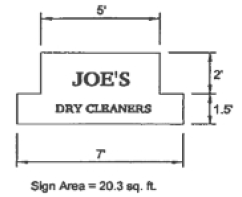
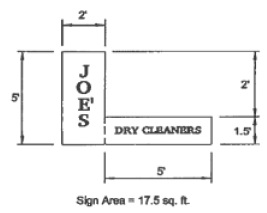
Figure 16-9-1 Sign Area Measurement
(b)
Sign Support. Supporting framework or bracing that is clearly incidental to the display itself shall not be computed as sign area.
(c)
Double-Faced Signs. Double-faced signs shall be regarded as a single sign only if sign faces are parallel, of identical size and shape, are mounted on a single structure and the distance between each sign face does not exceed two (2) feet at any point.
(d)
Three-Dimensional Signs. Where a sign consists of one (1) or more three-dimensional objects (i.e., balls, cubes, clusters of objects, sculpture), the sign area shall be measured as their maximum projection upon a vertical plane.
(e)
Wall Signs. If a sign is attached to a wall, only that portion of the wall onto which the sign face or letter are placed shall be calculated in the sign area.
(f)
Sign Height. The height of a sign shall be measured from the highest point of a sign to the ground surface beneath it. When berms are used in conjunction with the signage, the height of the sign shall be measured from the mean elevation of the fronting street.
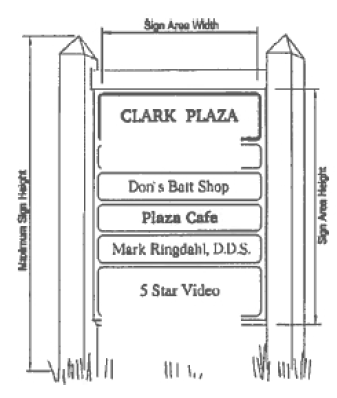
Figure 16-9-2 Sign Measurement Details
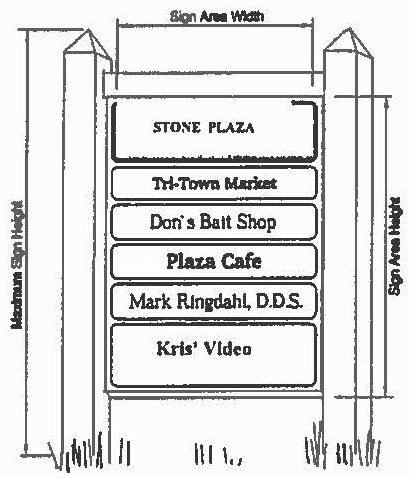
Figure 16-9-3 Sign Measurement Details
(Prior code 9-5-8; Ord. 956 § 1, 2014)
Sec. 16-9-90. - Sign illumination.
Sign illumination shall be permitted only in accordance with this Section.
(1)
Use of illumination limited. Illumination shall be used only if necessary to provide information during evening and nighttime hours. Signs erected for the purpose of identifying locations, events or other activities only available during daylight hours shall not be illuminated.
(2)
Use existing light source. When possible, signs should use existing sources of illumination as opposed to creating new sources of illumination. See Figure 16-9-4 below.
(3)
Use direct light source. All lighted signs shall direct lighting in such a manner as to illuminate only the face of the sign. When external light sources are directed at the sign surface, the light source must be concealed for pedestrians' and motorists' lines of sign. See Figure 16-9-4 below.
(4)
Signs shall be illuminated in a manner that does not cause glare onto the street and upon adjacent properties. Signs shall be lighted only to the minimum level for nighttime readability.
(5)
All light sources shall be shielded so as not to be visible except when viewed from a point directly in front of the sign face.
(6)
All lighted signs shall meet all applicable electrical codes.
(7)
Flashing, moving, blinking, chasing or other animation effects shall be prohibited on all signs.
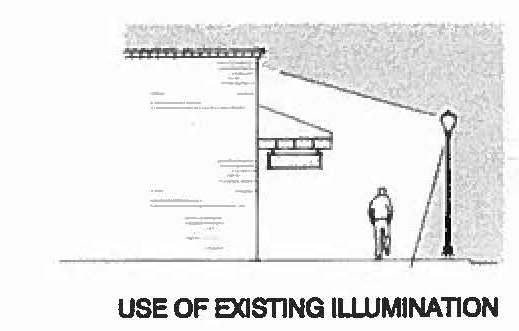
Figure 16-9-4 Existing Illumination
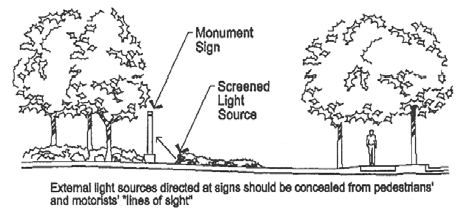
Figure 16-9-5 Light Sources
(Prior code 9-5-9; Ord. 956 § 1, 2014)
Sec. 16-9-100. - Installation and maintenance.
(a)
All signs and components thereof, including sign structures and sign faces, shall be kept in a good state of repair and in compliance with all building and electrical codes. The Town may inspect any sign governed by this Article and shall have the authority to order the repair, alteration or removal of a sign which constitutes a hazard to safety, health or public welfare by reason of inadequate maintenance, dilapidation or obsolescence.
(b)
Owners of projecting signs erected after the effective date of the initial ordinance codified herein, May 5, 2008, extending over public right-of-way or public property shall be required to apply for and obtain a revocable license agreement from the Town and, where applicable, any other applicable public agency owning or controlling the property.
(Prior code 9-5-10; Ord. 956 § 1, 2014)
Sec. 16-9-110. - Specific sign standards.
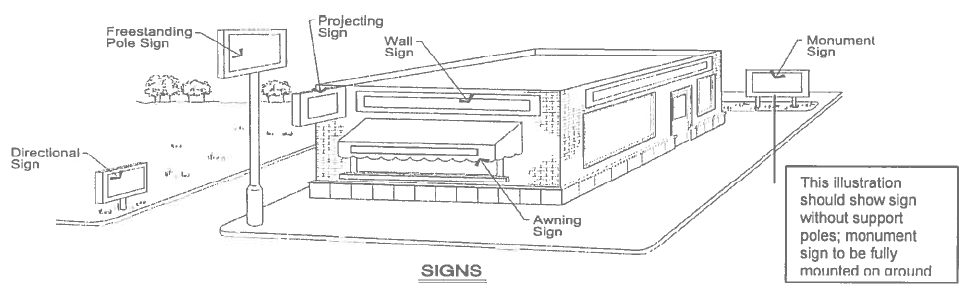
Figure 16-9-5 Sign Types
___________
(a)
Awning Signs. An awning sign is a wall sign that is painted, attached, sewn or stained onto the exterior of an awning. An awning is a removable shelter supported entirely from the exterior wall of a building and composed of non-rigid materials except for the supporting framework.
(1)
Location. Signs may be placed only on awnings that are located on first- and second-story building frontages, including those fronting a parking lot or pedestrian way.
(2)
Maximum area and height. Sign area shall comply with the requirements established by Section 16-9-120 below. No structural element of an awning shall be located less than eight (8) feet above finished grade of a private sidewalk or right-of-way. No structural element of an awning located above or within a public right-of-way or public property shall be located below the height authorized by the necessary revocable license agreement. No awning, with or without signage, shall extend above the roofline of any building.
(3)
Lighting. Awnings shall not be internally illuminated. Lighting directed downwards that does not illuminate the awning is allowed.
(b)
Freestanding Signs. A freestanding sign is a sign which is supported by one (1) or more columns, uprights, poles or braces extended from the ground, but does not include a sign attached to a structure.
(1)
Location. The freestanding sign may be located only on a site frontage adjoining a public street.
(2)
Maximum area and height. The sign shall comply with the height and area requirements established in Section 16-9-120 of this Article.
(3)
Sign mounting. The sign shall be mounted on one (1) or more posts.
(4)
Any freestanding sign that extends into a public right-of-way or over a public right-of-way shall require issuance of a revocable license agreement by the Town.
(c)
Monument Signs. A monument sign is a permanent sign where the entire bottom of the sign is affixed to the ground and is not supported by poles or attached to a building or other structure.
(1)
Location. The sign may be located only along a site frontage adjoining a public street. Any monument sign that extends into a public right-of-way or over a public right-of-way shall require issuance of a revocable license agreement by the Town.
(2)
Maximum area and height. The sign shall comply with the height and area requirements established in Section 16-9-120 of this Article.
(3)
Design. The design and placement of the sign shall not obstruct traffic safety sight distance areas.
(d)
Off-Premises Signs. Off-premises signs, also known as off-site signs, are prohibited except for:
(1)
Off-premises signs that are nonconforming in accordance with Section 16-9-20 of this Article; and
(2)
Off-premises signs in nonresidential zone districts, provided that the total size of signage on the property does not exceed the maximum size allowed in the zone district as described in this Article.
(3)
Subdivision monumentation signs located within public right-of-way as approved through the Town's sign permit review process. A subdivision monumentation sign shall include only permanent copy (as opposed to changeable copy), shall be constructed from sandstone or concrete colored to simulate sandstone (excluding elements of any nonvisible support structure), and shall not exceed forty-eight (48) square feet in sign area.
(4)
Town-erected monument or freestanding signs intended to direct the traveling public to public properties, public parking, points of interest, Town-sponsored or regional events and merchants and business opportunities available within the Town.
(e)
Projecting Signs. A projecting sign is any sign supported by a building wall and projecting from the building wall at least twelve (12) inches or more horizontally beyond the surface of the building to which the sign is attached. See Figure 16-9-6 below for an example of a projecting sign.
(1)
Location. Projecting signs shall be placed only on a ground floor facade, except for businesses located above the ground level with direct exterior pedestrian access.
(2)
Maximum area and height. Projecting signs shall not be higher than the wall from which the sign projects if attached to a single-story building, or the height of the bottom of any second-story window if attached to a multistory building. Projecting signs must have eight (8) feet of clearance over any private right-of-way or private sidewalk or such greater clearance as may be required by a revocable license agreement when extending over or into a public right-of-way or public sidewalk. Projecting signs may not extend more than four (4) feet from the building wall except where the sign is an integral part of an approved canopy or awning.
(3)
Any projecting sign that extends into a public right-of-way or over a public right-of-way shall require issuance of a revocable license agreement by the Town.
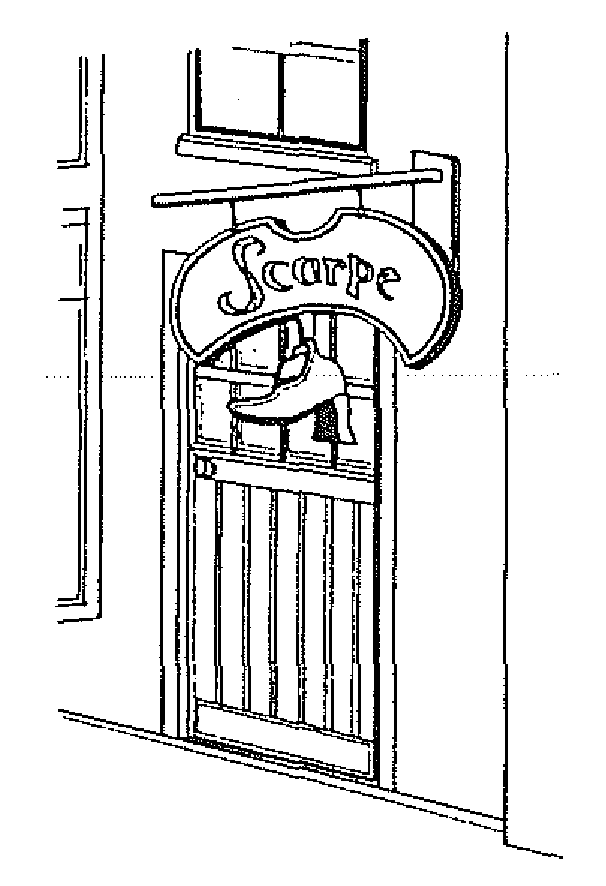
Figure 16-9-6 Projecting Sign
(f)
Sign Plaza. A sign plaza contains a monument sign on public property identifying businesses or activities and is subject to review and approval by the Board of Trustees.
(g)
Wall Signs. A wall sign is any sign painted on, incorporated in or affixed to the building wall, or any sign consisting of cut-out letters or devices affixed to the building wall with no background defined on the building wall. A wall sign shall also include a canopy sign, defined as a sign that is permanently affixed to a roofed shelter attached to and supported by a building, by columns extending from the ground or by a combination of a building and columns (See Figure 16-9-7 below for a general illustration of a canopy sign).
(1)
Maximum area and height. Wall signs shall not be higher than the roof ridgeline of the principal building. The sign shall comply with the height and area requirements established in Section 16-9-120 of this Article.
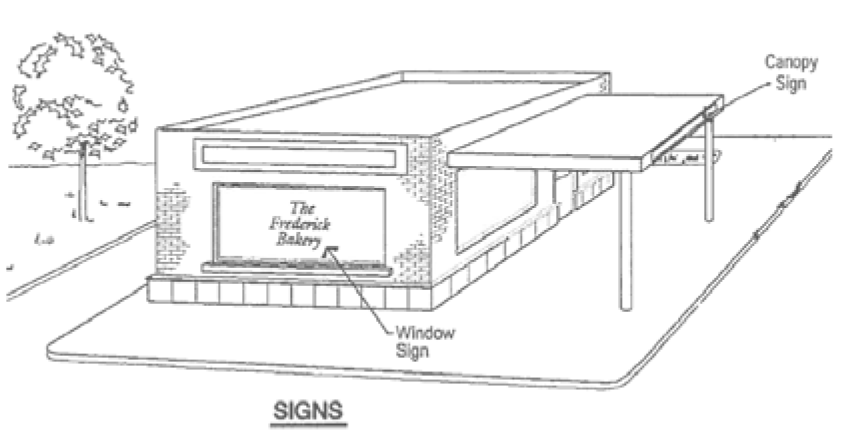
Figure 16-9-7 Signs
(2)
Projection from wall. No sign part, including cut-out letters, may project from the surface upon which it is attached more than required for construction purposes, and in no case more than twelve (12) inches.
(Prior code 9-5-11; Ord. 956 § 1, 2014)
___________
Sec. 16-9-120. - Sign standards by zoning district.
(a)
Residential Signs. Signs in the Estate Residential (E), Estate County (EC), Low Density Residential (R-1), Medium Density Residential (R-2), Medium-High Density Residential (R-2A), High Density Residential (R-3), any residential lot of a Planned Unit Development (PUD) and Agricultural (both A-1 and A-2) Zone Districts may include and shall be limited to:
(b)
Business, Commercial and Industrial Signs. Signs in the Business (B), Commercial (C), Commercial Downtown (CD), Commercial East Corridor (CEC), Light Industrial (LI) and General Industrial (GI) Zone Districts may include and shall be limited as provided in the table below.
___________
TABLES:
Maximum Freestanding or Monument
Sign Area for Commercial Zones.
For purposes of the following Table, "Zone A" refers to commercially zoned properties located west of the eastern edge of the downtown area and fronting (sharing a property line or boundary with) Highway 36/66, Main Street or Broadway Avenue. "Zone B" refers to all commercially zoned properties not located in Zone A and which front (share a property line or boundary with) Highway 36/66. Tables apply only to freestanding or monument signs. Lot frontage in linear feet is to be interpreted as including any lot up to the specified linear feet as determined by the Town of Lyons based on a review of property maps.
ZONE A
ZONE B
(Prior code 9-5-12; Ord. 956 § 1, 2014)
Sec. 16-9-210. - Purpose.
The purpose of the Comprehensive Special Event Sign Program is to facilitate innovative and creative planning by allowing flexibility in the application of the Town's Sign Code set forth in this Article. Use of the comprehensive sign program should be limited in its application to special events (such as annual community festivals or Town-wide community events) and to property devoted to a variety of different or separate uses on a single lot (such as shopping centers and industrial parks) and for which the strict application of this Article will not provide sufficient signage for each of the uses. For reoccurring annual or semi-annual special events, program approval should include a comprehensive written resolution or an agreement documenting the terms and conditions of the allowable signs.
(Prior code 9-5-13; Ord. 956 § 1, 2014)
Sec. 16-9-220. - Application.
Applicants seeking Town approval of a comprehensive sign plan shall submit an application to the Town Administrator that includes the following:
(1)
A completed application in a form approved by the Town Administrator, setting forth general information deemed relevant to the Town Administrator to contact the applicant.
(2)
Payment of a nonrefundable application fee in an amount established by resolution of the Board of Trustees to cover the administrative costs of processing the application.
(3)
The location by street number and the legal description of the property proposed for a comprehensive sign program.
(4)
Names and addresses of the owner, sign contractor and sign installer.
(5)
Legible site plans that include the specific location of the signs within the program and setbacks to adjacent property lines and buildings.
(6)
A detailed drawing indicating the dimensions, materials and colors of the proposed signs within the program. For any freestanding or projecting signs, a certification of compliance with applicable adopted building and safety codes made by a structural engineer may be required by the Town Administrator when, following consultation with the Building Inspector, the Town Administrator determines that the sign may be structurally unsound or present a hazard.
(7)
A graphic drawing or photograph of all proposed signs in the program.
(8)
A description of the lighting to be used for each sign, if applicable.
(Prior code 9-5-13; Ord. 956 § 1, 2014)
Sec. 16-9-230. - Application process.
(a)
Application Certification of Completion. Within a reasonable time of the date of application submission, the Town shall either certify that the application is complete and in compliance with all submittal requirements or reject it as incomplete and notify the applicant in writing of any deficiencies.
(b)
Staff Review and Approval. Following the Town's determination that the application is complete, the Town Administrator shall review the sign permit in accordance with the established review criteria. The Town Administrator shall make a recommendation to the applicant and to the Planning and Community Development Commission and Board of Trustees regarding the comprehensive sign program's conformance with this Article.
(c)
Planning and Community Development Commission Administrative Review. Following Town Staff review, an application shall be set first for an administrative review and recommendation by the Planning and Community Development Commission. Such review and consideration shall require no public notice other than inclusion of the matter on the posted agenda of the Planning and Community Development Commission. Following review and consideration, the Planning and Community Development Commission shall make a recommendation to the Board of Trustees to approve, approve with conditions or deny the application for a comprehensive sign program. The Planning and Community Development Commission shall base its recommendation upon the conformance of the application with the criteria for approval specified in Section 16-9-240 below.
(d)
Board of Trustees Public Hearing. Following the Planning and Community Development Commission's administrative review, the Board of Trustees shall conduct a public hearing to consider the application's conformance with the criteria for approval specified in Section 16-9-240. Notice of the public hearing shall be the same as required for a rezoning of property by this Chapter. The Board of Trustees may impose reasonable conditions upon the approval of a comprehensive sign Program designed to ensure the greatest degree of conformance with the policies and intent of this Article or as may be needed to mitigate adverse impacts of the sign program upon adjacent properties and the public.
(e)
Sign permit applications for repetitive events shall be reviewed and approved by Town Staff. Only sign permit applications that Town Staff determines to be a significant modification of the originally approved sign shall be reviewed by the Planning and Community Development Commission as described in Subsection (c) above and the Board of Trustees as described in Subsection (d) above.
(Prior code 9-5-13; Ord. 956 § 1, 2014)
Sec. 16-9-240. - Sign permit review criteria.
The following review criteria will be applied by the Planning and Community Development Commission and the Board of Trustees to evaluate all comprehensive sign program applications:
(1)
The sign program generally meets the policies and intent expressed in this Article, although one (1) or more particular signs fail to strictly meet the location, number or size requirements. Deviations from design (to include, for example, lighting, materials and colors) shall not be permitted unless the Planning and Community Development Commission or the Board of Trustees finds that such deviations are absolutely necessary to permit reasonable display of the proposed sign.
(2)
All signs within the comprehensive sign program conform to the requirements of the Town's applicable adopted building and electrical codes.
(3)
The type of signs within the program are permitted signs within the zoning district in which the signs are located (e.g., a permanent freestanding sign is not proposed in a residential zone district).
(4)
No sign would interfere with pedestrian or vehicular safety.
(5)
No sign would be located so as to negatively and substantially impact an adjacent property.
(6)
The proposed sign program would not detract from the pedestrian quality of the street or the immediate area.
(7)
The sign program would not add to an over-proliferation of signs on a particular property or area.
(Prior code 9-5-13; Ord. 956 § 1, 2014)

