
Lyons City Zoning Code
ARTICLE 6
Commercial Design Standards1
Editor's note— Sec. 2 of Ord. No. 1112, adopted March 7, 2022, repealed and replaced Art. 6 to read as herein set out. Former Art. 6 pertained to commercial and mixed-use design standards, consisted of §§ 16-6-10—16-6-100, and derived from Ord. 932, 2013; and Ord. 956, 2014.
Sec. 16-6-10.- Applicability.
(a)
The provisions of this article apply to all projects involving new construction, or exterior renovation of a building, requiring a building permit within the Town of Lyons, excluding development in Residential and Agricultural zoning districts (R-1, R-2, R-2A, R-3, A-1, A-2).
(b)
Additional overlay guidelines apply to the Historic Downtown (HDT) and Eastern Corridor (EC) areas, which are shown in the map below. The additional criteria can be found in Section 16-6-30 and Section 16-6-40. If any specific HDT or EC overlay design guideline conflicts with the general design guidelines, the specific HDT and EC guidelines apply.
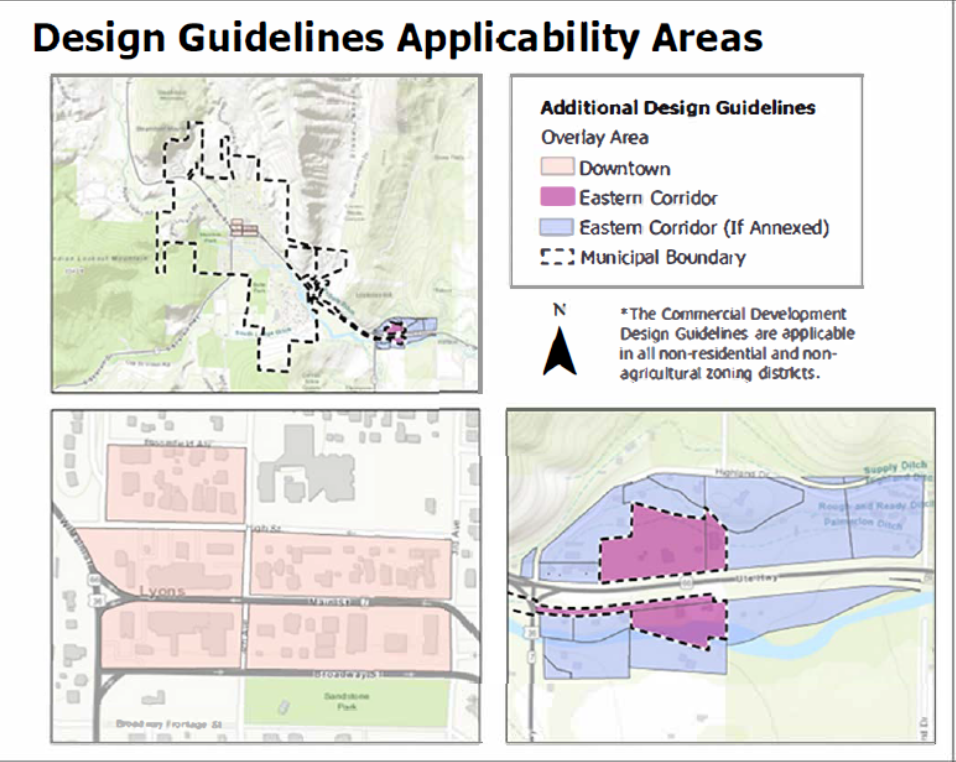
(Ord. No. 1112, § 2, 3-7-2022)
Sec. 16-6-20. - Purpose and intent.
(a)
The character of the Town of Lyons is special. Nestled in the first significant rise of the Colorado Front Range north of Boulder, Lyons's setting is integral to its character. Natural stone formations and uncluttered hillsides surround the Town. Both the North St. Vrain River and the South St. Vrain River flow into the Town and merge midway to form the St. Vrain River. The natural environment attracts new residents and visitors. Throughout Town, businesses tend to be locally owned and operated in buildings that have changed little over time, and the built environment tends to resonate with the natural surroundings. The downtown area physically embodies Lyons's historic character and is central to the community. Residents and visitors strolling the historic downtown area might frequent the local shops and restaurants or simply appreciate the area's relaxed pace. In summer, flowers abound, and trees shade the sidewalks. Festivals and concerts often fill the air with music and the parks with music lovers. In winter, the trees sparkle with holiday lighting and occasional snow clings to the mountainsides.
(b)
The existing natural and historic character of the Town is an asset that should be preserved, even as new and renovated commercial enterprise is encouraged. Such new commercial development can improve access to goods and services for residents and visitors. In addition to providing safety and convenience, new development and adaptive reuse also produces jobs and encourages vibrancy and sustainability in the local economy. Therefore, commercial developments should respect the historic nature of the Town and consider the outdoor amenities that abound.
(c)
The Commercial Design Guidelines are intended to preserve Lyons's sense of place, including both the historic built environment and natural environment, and maintain the essential asset of the Town's character. At the same time, these guidelines should enable development that enhances the availability of goods, services, and amenities for residents of the Town, residents of nearby areas, and visitors.
(d)
The following design guidelines are intended as a reference to assist developers in understanding the Town's goals and objectives for high-quality development and to encourage developments to:
(1)
Emphasize preservation of the Town's historic character and natural features;
(2)
Emphasize conservation of resources;
(3)
Consider pedestrians and bicyclists;
(4)
Serve the residents and visitors of the Town;
(5)
Provide opportunities for art and outdoor experiences.
(e)
These guidelines shall apply to all projects involving new construction, or exterior renovation of a building, requiring a building permit in the area of applicability described in this section. Although these guidelines allow for flexibility and encourage development, an application can be denied for flagrant (for example safety or health concerns such as unsecured trash that may attract wild animals) or extensive (Such as a building with poor quality materials or extensive use of materials reflecting styles that are inconsistent with the appearance of other Lyons structures such as exposed cinder block or pervasive glass and aluminum construction) deviation from the guidelines.
(Ord. No. 1112, § 2, 3-7-2022)
Sec. 16-6-30. - Using the commercial design guidelines and evaluation.
(a)
The guidelines should be consulted for any development within the applicability area, but they may be interpreted with some flexibility in their application to specific projects. During the Town's development review process, proposals will be evaluated against the design guidelines to ensure new developments align with comprehensive plan goals and objectives, respect the natural environment, and become a compatible part of the overall community.
(b)
Applicants should refer to the design guidelines and comprehensive plan when creating their plans and submissions and are encouraged to meet as many guidelines as possible. Not every design guideline will apply to every project, and guidelines are not requirements; however, a project that substantially conforms to these guidelines and the comprehensive plan would have a high level of defensibility during the review of the development proposal.
(c)
Reviewers of a development proposal or building permit application shall consider the design guidelines when evaluating a project located in an area of design guideline applicability. Reviewers should consider which guidelines are or are not relevant to each specific project. During development review, the design guidelines should be considered as a whole when evaluating whether they have been sufficiently addressed.
(d)
All applicable local, State, County, Federal, and Fire District requirements must be abided by for any development in Town. The Town's zoning code should always be consulted as the first step of any commercial development project. All structures and landscaping must comply with all applicable safety and health requirements, including those for flood and fire mitigation, as well as the most recent applicable Building Code adopted by the Board of Trustees.
(Ord. No. 1112, § 2, 3-7-2022)
Sec. 16-6-40. - Building placement.
(a)
Placement of structures should consider the existing context of the area; this includes the location and character of adjacent and nearby land uses, the location of major traffic generators, as well as an analysis of the specific site's built and natural characteristics.
(b)
Building orientation should be optimized for heat gain in winter, shading in summer, daylighting and natural ventilation.
(c)
Structures should be sited in a manner that will complement adjacent and nearby structures. Sites should be developed in a coordinated manner to provide order, a reasonable level of consistency with varying elements that enhance interest.
(d)
Developments should be conducive to pedestrian and bicycle access by connecting to sidewalks, trails and well-designed (CDOT compliant) bicycle lanes to the degree practical
(e)
Whenever possible, new structures should be clustered rather than creating long rows of structures. This allows for plazas or pedestrian malls with amenities such as shade, benches, public art, etc. When clustering is impractical, a visual link between separate structures should be established. This link can be accomplished through the use of an arcade system, trellis or other open structure. This guideline does not apply to the Historic Downtown areas as defined Section 16-6-10 above.
(f)
Structures should be located to minimize pedestrian/vehicle conflicts. Driveways that cross sidewalks or trails should include markings or variations in surface appearance to improve awareness of the potential for vehicle crossings for the sake of safety for pedestrians and cyclists.
(g)
Freestanding, singular commercial structures should be oriented with their major entry toward the street where access is provided. The façade should be parallel to the street or, in the case of clusters of buildings, structures should face in the directions of most common access, with the elevations of buildings most visible from roads and streets covered in materials and colors consistent with the façade.
(Ord. No. 1112, § 2, 3-7-2022)
Sec. 16-6-50. - Parking and circulation.
(a)
Commercial developments should provide separate vehicular and pedestrian circulation systems with a strong emphasis on pedestrian linkages between areas. Commercial buildings should provide convenient connection from parking areas and, where practical to sidewalks and trails.
(b)
Pedestrian walkways should provide safe, convenient, well-lit (see lighting guidelines) and well-defined access between parking areas, public sidewalks and the main public access to the building. If no sidewalk currently exists, convenient access to the nearest parking area or sidewalk should be provided.
(c)
Parking lots should be sufficient to provide parking for anticipated numbers of employees, customers/clients and visitors. Off-street parking should not be located between the primary building and arterial routes when possible. Requirements for off-street parking can be found in LMC Section 16-8-30, with additional requirements for handicap parking spaces in LMC Section 16-8-50.
(d)
Individual considerations will be made for developments in areas with shared parking access such as exists in the commercial downtown area.
(e)
Provide parking facilities for bicycles protected from traffic flows.
(Ord. No. 1112, § 2, 3-7-2022)
Sec. 16-6-60. - Landscaping and screening.
(a)
Landscaping should be in scale with adjacent structures and be of appropriate size at maturity to accomplish its intended purpose, such as shading or screening.
(b)
Landscaping should be used to define specific areas, such as emphasizing entrances to buildings and parking lots, defining the edges of various land uses, providing transition between neighboring properties (buffering), and providing screening for loading, refuse, and equipment areas.
(c)
New commercial development should provide for street trees parallel to streets in planter strips, spaced at regular intervals along the street. This provision does not apply if trees are already present. New development should avoid removal or replacement of existing trees without approval from the Town Administrator or designee. Commercial developments should commit to maintenance of living trees and replacement of deteriorating trees within their properties and adjacent rights-of-way.
(d)
Screening for outdoor storage should be a minimum of six (6) feet and a maximum of ten (10) feet high. The height should be determined by the height of the material or equipment being screened. Exterior storage should be confined to portions of the site least visible to public view.
(e)
Refuse storage and pick-up areas should be combined with other service and loading areas where practicable and located away from public view as much as possible. Loading docks, refuse collection areas and mechanical equipment such as HVAC equipment should be placed away from public streets, parks, plazas and adjoining development. Views of such areas from streets, parks, plazas, pedestrian walkways and adjoining development should be screened.
(f)
Screening enclosures should be incorporated into the building architecture and utilize the same materials as the principal building to the greatest degree possible. Screening should include walls, fences or evergreen plantings to provide complete screening from normal eye level (six-foot height recommended) on all sides where access is not needed.
(g)
Refuse containers should accommodate trash, recycling and compost handling and be consolidated to a minimum number of site locations. Containers should be fully enclosed with screening from pedestrian and vehicular sight lines (six (6) feet recommended) utilizing durable, animal-resistant, and architecturally compatible, high-quality materials. Enclosures should be integrated with buildings and/or loading docks whenever possible with properly graded (less than three (3) percent recommended), surfaced, and permanently reserved pedestrian and vehicular access. Curbing, grading and drainage direction should succinctly control run-off from the enclosure away from public areas of the site, utilizing drought-resistant landscaping. Layouts should allow waste management vehicles efficient and unfettered access to containers without stacking or obstructions and provide fully-opening, gated access equipped with heavy-duty, locking, animal-resistant hardware.
(Ord. No. 1112, § 2, 3-7-2022)
Sec. 16-6-70. - Lighting.
(a)
Safety is a prime consideration for lighting around commercial buildings. Lighting should be directed to walkways and paths connecting to parking areas or other lighted areas, without spilling into adjacent areas or shining into residences. Please see Appendix 1 (located at end of Section 16-6-110) for recommended illumination levels.
(b)
Lighting should be compatible with and integrated into building and landscape design. Lighting should be designed, directed and shielded in such a manner that direct light does not leave the perimeter of the site and the nighttime sky is preserved.
(c)
Timing mechanisms and photo cells are encouraged to be used to reduce light levels and conserve energy during non-operational hours.
(Ord. No. 1112, § 2, 3-7-2022)
Sec. 16-6-80. - Architecture.
These architecture guidelines are intended to encourage building appearance that is appropriate for the form and scale of the project and to provide human scale interest and variety. The following list is not intended to be the only techniques that may be used to accomplish an attractive building design. Commercial developments should reflect the historic nature of the Town and recognize the outdoor adventure opportunities that abound.
(a)
Developments should provide shifts in building massing (The perception of the general shape and form as well as the size of a building),, variation in height, profile and roof form, while maintaining formal relationships of building placement to public street frontage or common courtyards or common parking areas. Consider setbacks, siting, and building mass and form contextually.
(b)
Where practical, vary the building form such as recessed or projecting bays. Wall planes should not run in one (1) continuous direction for more than fifty (50) feet without a significant change in materials and/or massing.
(c)
Variation of materials, expressed joints and details, surface relief and color should be used to break up large building forms and wall surfaces. Such detailing could include sills, headers, reveals, pilasters, window bays and similar features.
(d)
Shading on east, west and south walls with overhangs, awnings or deciduous trees is encouraged.
(e)
Building entries are encouraged to provide projecting or recessed forms, details, color or materials and provide some protection in inclement weather by use of awnings or overhangs.
(f)
The use of local stone, such as sandstone and river rock for visible surfaces is strongly encouraged.
(g)
Building facades adjoining or oriented towards streets and pedestrian areas should incorporate glazing (glass windows) at all occupied levels. Such glazing should be appropriate to the anticipated use of the building and the context of the development; for example, uses that require more privacy, such as a medical facility, may limit the use of glazing.
(h)
Automotive and other industrial uses should have windows and doors on the street-facing facades. Auto service bays should face away from the street when practical.
(i)
All rooftop equipment should be screened from public view by screening materials of the same nature as the structure's basic materials or material that blends well with the basic material and the surrounding natural environment. Mechanical equipment should be located below the highest vertical element of the building.
(j)
Since walkability is a desired characteristic of the commercial areas of town, features that promote interest and comfort for walkers are encouraged. This may include architectural, artistic, landscaping and seating elements.
(Ord. No. 1112, § 2, 3-7-2022)
Sec. 16-6-90. - Art.
(a)
Lyons is an arts-rooted destination noted for its music, artists, and beautiful mountain setting. The Town and the Lyons Arts and Humanities Commission (LAHC) welcome diverse artistic perspectives of all peoples and cultures and recommend the following guidelines to ensure public art that is distributed throughout town and is sited in such a way as to enhance and activate public spaces.
(b)
New construction and renovations are encouraged to create a holding place for public art . The Town and the Lyons Arts and Humanities Commission will provide consultation to artists and developers related to public safety and overall plans for public art.
(Ord. No. 1112, § 2, 3-7-2022)
Sec. 16-6-100. - Historic Downtown Area Design Guidelines Overlay.
(a)
The Historic Downtown ("HDT") area of Lyons holds a significant character of its own. The DT area design guidelines overlay is a set of guidelines specific to the HDT area that should be referenced in addition to the general design guidelines when applicable. It is intended to preserve the area's character while enabling development and redevelopment that benefits the community. New construction should complement the character existing historic buildings.
(b)
Applicability. In addition to the general design guidelines that apply to the entire Town, the HDT area Design Guidelines Overlay additionally applies to the following locations:
(1)
Main Street between 3rd and 5th;
(2)
High Street between 4th and 5th; and
(3)
Broadway between 3rd and 5th (applicable upon completion of planned streetscaping).
(c)
Building Placement.
(1)
The intent of the HDT area is to encourage retail storefront design at the street level, so that pedestrian-oriented retail, dining, entertainment uses and similar activity generating uses can locate in the Downtown. This applies even if the initial use is not retail, dining, or entertainment.
(2)
In the HDT area between 4th and 5th on Main Street, the front of buildings should align to the sidewalk and have a façade consistent with the facades in this area.
(d)
Parking and Circulation. Parking in the HDT area is limited. Developments in the HDT area should not cause a reduction in the number of available parking spaces and, where practical, should add more parking spaces. Refer to LMC Section 16-8-90 to determine if your development is exempt from off-street parking requirements.
(e)
Landscaping and Screening.
(1)
The design model for the HDT area is a tree-lined street where walking is encouraged.
(2)
Screening of loading docks, refuse collection areas, and mechanical equipment for commercial developments or substantial improvements should maintain or, preferably, improve existing screening as practical using materials consistent with the major structural elements of the proposed development and nearby buildings.
(3)
Permanent chain link fencing is strongly discouraged in the HDT area.
(f)
Architecture.
(1)
The design model for the HDT area is buildings with one- to two-story height, with the first floor designed for pedestrian-oriented retail and activity generating uses and upper stories available for residential, office, or commercial use. Where practical, upper floors will generally be differentiated from first floor designs. Designs for three-story structures will be considered based on acceptance by the Lyons Regional Fire District of its fire safety and emergency services assessment.
(2)
The Town will consider the successful massing of a development to comply with inherent view corridors of important geographic features (e.g., Steamboat Mountain) from prominent public spaces; this intent may be achieved by stepping back upper stories.
(3)
Windows should generally occupy the majority of the first-floor sidewalk-facing area of the building.
(4)
Entrances should be inset or recessed so that doors can open without encroaching into the sidewalk right-of-way.
(5)
It is desirable for all four (4) sides of a building to be designed with consistent architectural elements as the building front, unless the elevations are not visible (i.e., flush with an adjoining building). This should not deter a developer from retaining historical features and using complementary materials and colors on other areas of the building.
(6)
The use of local sandstone or river rock on visible external features such as facades and sidewalks is strongly encouraged to recognize the historic contribution that local sandstone quarrying has provided and continues to provide to the community.
(7)
Alterations to historic buildings designated at the local, state, or national level must follow the review processes required in LMC Section 16-12. Alterations to any building older than fifty (50) years are recommended to follow the Secretary of the Interior's Standards for Rehabilitation in order to preserve the Town's valuable historic resources. Alterations to any building abutting a historic building should consider compatibility with and differentiation from the historic building in design.
(Ord. No. 1112, § 2, 3-7-2022)
Sec. 16-6-110. - Eastern Corridor Design Guidelines Overlay.
(a)
The intent of the Eastern Corridor ("EC") design guidelines overlay is to provide an entrance into the Town that identifies Lyons as an attractive place to live and do business. The EC should convey that business investment is welcome and encouraged. Development that celebrates the natural beauty, outdoor adventure opportunities, and the Lyons music and arts culture is strongly encouraged. The Town welcomes collaboration and innovation from developers to achieve quality design in this gateway area. Developers may apply for a PUD status with flexible land use, parking, setback, and mixed-use standards.
(b)
Applicability. In addition to the general design guidelines that apply to the entire town, the Eastern Corridor Design Guidelines Overlay additionally applies to all in-Town properties east of the U.S. Rt. 36/Colorado Rt. 66 interchange. These standards will also apply to locations adjacent to the U.S. Rt. 36/Colorado Rt. 66 interchange (if and when such properties may be annexed).
(c)
Building Placement. Buildings should be located to make good use of the land and permit adequate parking, easy pedestrian flow and safe access for cyclists.
(d)
Parking and Circulation.
(1)
There should be well-defined access between parking areas, public sidewalks, and the main public access to the building. Connectivity with trails, sidewalks, and bicycle lanes that connect (or are planned to connect) with the other areas of town is strongly encouraged.
(2)
Parking should be located in a manner that balances effective use of the land and the cosmetic appearance from the highways and neighboring lots.
(3)
To the extent practical, access driveways should be shared between buildings or facilities to comply with CDOT requirements.
(4)
Shared parking between residential and non-residential use is encouraged.
(5)
Due to the absence of on-street parking, parking lots should be sufficient to provide parking for anticipated numbers of employees, customers/clients and visitors. Parking areas should incorporate landscaping that generally fits with surrounding areas, provides shading where practical and is visually appealing. See LMC Section 16-8 for off-street parking requirements.
(6)
Parking lots should provide safe parking facilities for bicycles.
(e)
Landscaping and Screening. To the extent practical, in the EC areas, loading docks, and refuse collection areas should be placed away from pedestrian areas. Views of such areas from streets, parks, plazas, pedestrian walkways and adjoining development should be screened. Screening enclosures should be incorporated into the building architecture and utilize the same materials as the principal building to the greatest degree possible. Screening should include walls, fences or evergreen plantings of a minimum height of six (6) feet to provide complete screening from normal eye level on all sides where access is not needed.
(f)
Lighting. Pedestrian walkways should provide safe, convenient, well-lit (see Appendix 1).
(g)
Architecture.
(1)
Large, featureless, box-like structures are out of character in Lyons.
(2)
Buildings should have architectural variety (windows, materials, projections) on the ground floor to create visual interest to pedestrians.
Appendix 1.
(1)
Recommended Illumination Table. The following recommended levels of illumination should be maintained for each of the specific locations:
(Ord. No. 1112, § 2, 3-7-2022)

