
Maitland City Zoning Code
ARTICLE 7
PUBLIC FACILITY FUNDING
SECTION 7.3. - ADDITIONAL PUBLIC FACILITY FUNDING
Development may be subject to additional public facility funding requirements not specifically referenced in the LDC, including but not limited to the following:
(a)
Water and sewer connection fees (see Section 20-2 of the City Code);
(b)
Fire protection facilities and services impact fee (see Section 6-51 et seq. of the City Code); and
(c)
School impact fees (see Section 23-121 et. seq of the Orange County Code).
7.1.1. - Authority.
(a)
The City Council has the authority to adopt this section in accordance with Article VIII of the Florida Constitution; Chs. 163 and 166, Fla. Stat. (including Section 163.3180, Fla Stat.), and the City Charter.
(b)
Planning for new multimodal facility improvements needed to serve new growth and development that generate the need for additional improvements, and the implementation of these plans through the comprehensive planning process, is a responsibility of the City under Section 163.3161 et seq., Fla. Stat., and is in the best interest of the health, safety, and welfare of the citizens of the City.
7.1.2. - Purpose and Intent.
(a)
The purpose of this section is to allow new development to share in the burdens of growth in accordance with the comprehensive development plan. New development shares in this burden by paying a pro rata share of the reasonably anticipated costs of multimodal facilities needed to accommodate the person-miles of travel (PMT) demands created by new development, as well as by complying with other appropriate development approval conditions.
(b)
This intent of this section is to impose a mobility fee, payable prior to issuance of a building permit, in an amount based upon the average amount of new PMT attributable to new development and the average cost of providing the multimodal capacity needed to serve such new travel. It is also intended to provide flexibility to address the needs of individual developments that, because of location, timing, or other characteristics, require different treatment in the form of reduced fees or supplemental requirements.
(c)
This section shall not be construed to authorize imposition of fees related to multimodal improvement needs attributable to existing development.
7.1.3. - Adoption of Mobility Fee Technical Report.
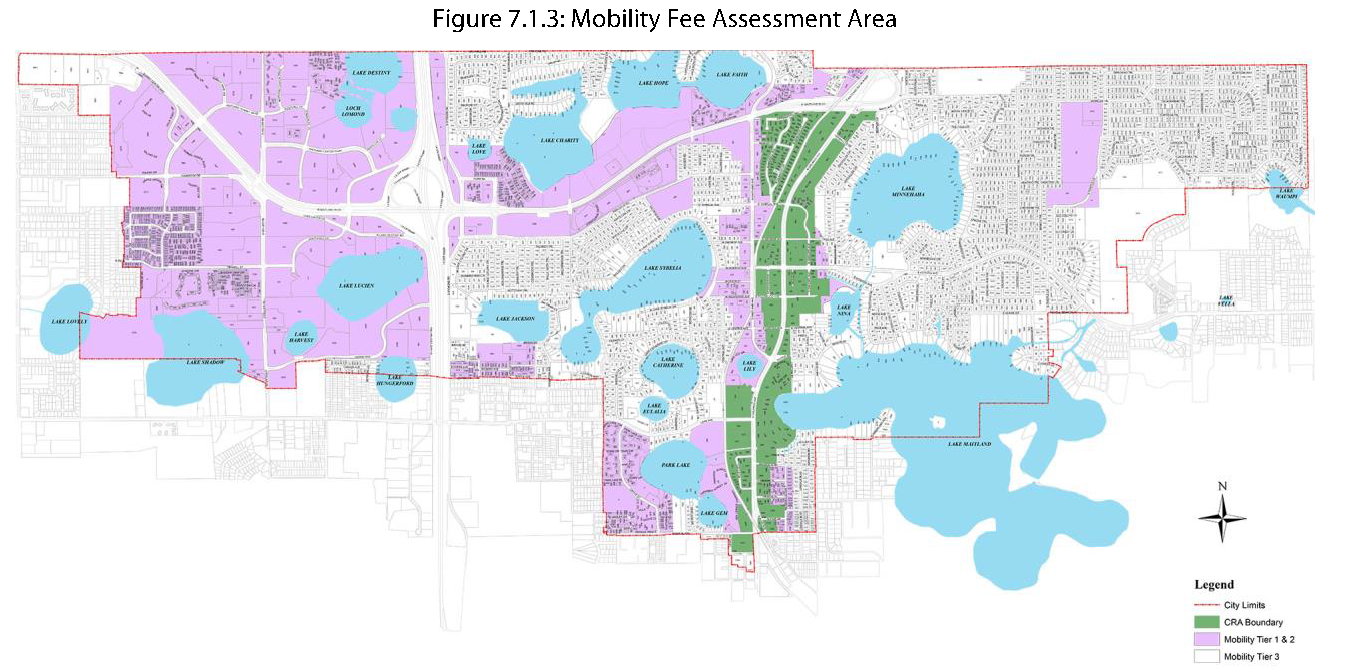
The mobility fee technical report entitled "City of Maitland Mobility Fee Technical Report—July, 2016," prepared by NUE Urban Concepts, LLC, is hereby adopted. This adoption includes, but is not limited to: the basis of the assumptions, conclusions, and findings in the study as to the basis of the mobility fee, the methodology for calculating the mobility fee, the PMT assigned to various land use categories, as well as the findings for internal and community capture for the three assessment areas and the basis for the mobility fee benefit district boundary. The three assessment areas are: (1) Community Redevelopment Area (CRA), (2) Mobility Tiers 1 and 2, and (3) Mobility Tier 3 and are identified in Figure 7.1.3: Mobility Fee Assessment Areas. The study presents the technical analysis and detailed methodology supporting the City of Maitland Mobility Fees.
7.1.4. - Mobility Fee Imposition.
(a)
The mobility fee imposed by this section shall apply to new applications for building permits.
(b)
The mobility fee shall not be imposed on building permits otherwise necessary for:
(1)
Room additions, remodeling, rehabilitation, or other improvements to an existing structure, provided there is no increase in person trips or PMT and no increase in gross floor area for non-residential uses and no increase in the number of dwelling units for residential uses;
(2)
Rebuilding of a damaged or destroyed structure, whether voluntary or involuntary, provided there is no increase in the intensity of use, or no increase in gross floor area for non-residential uses and no increase in the number of dwelling units for residential uses;
(3)
A change in occupancy that does not generate additional person trips or person miles of travel, or any increase in gross floor area for non-residential uses or increase in the number of dwelling units for residential uses; or
(4)
An accessory structure that does not result in an increase in person trips or person miles of travel (e.g. detached garage, sheds, parking structures, covered parking).
(c)
There is hereby imposed upon all impact generating land development activity a mobility fee due at the time of issuance of a building permit, and no building permit shall be issued until the required mobility fee has been paid except as otherwise provided in this section. Mobility fees are assessed at the mobility fee rate in effect at the time the building permit is issued. If the building permit is for less than the entire contemplated development, the fee shall be computed for the proportion of development covered by the permit. The obligations for payment of mobility fees shall run with the land.
(d)
Any developer who paid City road impact fees prior to the effective date for mobility fees shall have those amounts applied to the balance due for the current mobility fee for a building permit not previously issued.
(e)
Additionally, the mobility fee shall be imposed for any structure that is altered, expanded, or replaced that results in an increase in person trips and person miles of travel over the existing land use.
(f)
The mobility fee is calculated on the basis of the PMT generated from the land use. If the PMT increases due to a change in size or use, the fee due shall be the incremental difference resulting from the alteration, expansion, or replacement as determined by the mobility fee schedule, less the fee that would be imposed under the applicable rate prior to the alteration, expansion, or replacement.
(g)
Even if there is a change in use that results in a decrease in PMT generated by the previously allowed use, the applicant shall not be entitled to a refund or credit.
(h)
Any person who initiates any new impact generating land development activity shall, except as otherwise provided for in this section, pay a mobility fee as set forth in Table 7.1.4: Mobility Fee Schedule, subject to an increase due to inflation in accordance with Section 7.1.15, Review and Update.
7.1.5. - Mobility Fee Determination.
(a)
The mobility fee shall be determined using the land use classification under the applicable land use categories in the mobility fee schedule in accordance with Table 7.1.4: Mobility Fee Schedule.
(b)
If a project involves a land use not contemplated in Table 7.1.4: Mobility Fee Schedule, the Community Development Director shall determine the mobility fee utilizing the closest land use category in Table 7.1.4.
(c)
In the event of a development that involves a mixed use project, the Community Development Director shall determine the mobility fee based on each separate mobility fee land use classification included in the proposed mixed use project.
(d)
The mobility fee shall be determined using the appropriate rate depending on which assessment area the development is located within the City. Separate rates apply for development within the three assessment areas: (1) Community Redevelopment Area, (2) Mobility Tiers 1 and 2 and (3) Mobility Tier 3. Maps of each of the assessment areas is available in the Community Development Department.
7.1.6. - Alternative Mobility Fee or Special Mobility Fee Determinations.
(a)
Authorized. If an applicant believes that the cost to mitigate the impact of the development of improvements needed to serve the applicant's proposed development is less than the fee established in this section, the applicant may request consideration of and submit an alternative mobility fee or special mobility fee determination request, along with a review fee as determined by the City, and support materials to substantiate the request to the Mobility Fee Administrator in accordance with this subsection. If the Mobility Fee Administrator finds that the data, information, assumptions, formulae, and methodology used by the applicant to calculate the alternative mobility fee or special mobility fee satisfy the requirements of this section, the alternative mobility fee or special mobility fee shall be deemed the mobility fee due and owing for the proposed development.
(b)
Procedure. The Mobility Fee Administrator is responsible for calculating mobility fees in accordance with the provisions of this section. If an applicant believes project impacts are lower than justified by the findings of this section, or believes the proposed use is incorrectly assigned as identified in the Table 7.1.4: Mobility Fee Schedule, or that the assumptions that derive the mobility fee are not applicable to a specific proposed land use, an adjustment to the fees may be requested along with an application and review fee. The Mobility Fee Administrator shall determine whether the request shall be reviewed as either an alternative mobility fee determination or a special mobility fee determination, based upon the impact of the proposed land use on the City's mobility. The process for reviewing alternative mobility fee determinations is provided in subsection (c) below. The process for special mobility fee determinations for minor projects with significantly less impacts is provided in subsection (d) below.
(c)
Alternative Mobility Fee Determination.
(1)
The alternative mobility fee determination shall be based on data, information, assumptions, formulae, and methodology contained in this section, and the mobility fee technical report referred to in Section 7.1.3 above, or independent sources, provided that:
(A)
The independent source is:
1.
An accepted standard source of transportation engineering or planning data or information; or
2.
A local study carried out by a qualified planner or engineer in accordance with an accepted methodology of planning or engineering.
(B)
Where different data, information, assumptions, formulae, or methodology are employed, such differences shall be specially identified and justified.
(2)
An alternative mobility fee calculation shall be undertaken through the submission of an application for review of an alternative mobility fee determination for the mobility fee component for which an alternative mobility fee calculation is requested, as follows:
(A)
A developer shall submit the application in conjunction with the submittal of any development plan or petition for new or redevelopment or as otherwise agreed to in a mobility fee agreement.
(B)
The City may submit such an application for any proposed land development activity for which it concludes the nature, timing, or location of the proposed development makes it likely to generate impacts costing substantially more to remedy than the amount of the fee that would be generated by the use of Table 7.1.4: Mobility Fee Schedule.
(3)
Within thirty (30) days of receipt of an application for review of an alternative mobility fee determination, the Mobility Fee Administrator shall determine if the application is complete. If the Mobility Fee Administrator determines that the application is not complete, a written statement specifying the deficiencies shall be sent to the applicant. The application shall be deemed complete if no deficiencies are specified. The Mobility Fee Administrator shall take no further action on the application until it is deemed complete.
(4)
When the Mobility Fee Administrator determines the application is complete, the application shall be reviewed and a written decision shall be rendered in thirty (30) days, or as soon thereafter as possible, as to whether the mobility fee should be modified, and if so, what the amount should be.
(5)
If the Mobility Fee Administrator finds that the data, information, assumptions, formulae, and methodology used by the applicant to compute the alternative mobility fee calculation satisfies the requirements of this section, the re-determined mobility fee shall be deemed the mobility fee due and owing for the proposed land development activity. This adjustment in the fee shall be set forth in a Mobility Fee Agreement which shall be entered into in accordance with Section 7.1.7, Presumptions, Agreements, and Security Requirements.
(6)
A determination by the Mobility Fee Administrator that the alternative mobility fee re-determination does not satisfy the requirements of this section may be appealed to the City Council.
(7)
The applicant shall be responsible for the full costs that the City may incur to review the alternative mobility fee data and methodology, including consultant and legal costs. Payment shall be due at the time of the request for the alternative calculations.
(8)
An applicant who submits a proposed alternative mobility fee in accordance with this section and desires the issuance of a building permit prior to the resolution of the pending alternative mobility fee shall pay the applicable mobility fee prior to or at the time the applicant desires the building permit. This payment shall be deemed paid "under protest" and shall not be construed as a waiver of any rights. Any difference in the amount of the mobility fee after the determination of the pending alternative mobility fee shall be refunded to the applicant.
(d)
Special Mobility Fee Determination. An applicant may request a special mobility fee determination for smaller, less intense projects when data and information are presented that substantiates that a project has unique characteristics other than those upon which the mobility fee calculation was based. It is the applicant's responsibility to submit adequate justification and support data to substantiate a lower impact to the Mobility Fee Administrator. The Mobility Fee Administrator may review the request and ask for additional information. The applicant is responsible for additional costs that the City may incur to review these special requests, including consultant and legal costs. Payment will be due at the time of request for the determination.
7.1.7. - Presumptions, Agreements, and Security Requirements.
(a)
A proposed development shall be presumed to generate the maximum impact generated by the most intensive use permitted under this LDC and the comprehensive development plan, or under applicable deed or plat restrictions.
(b)
In-lieu of the payment of fees as calculated in Table 7.1.4: Mobility Fee Schedule, or Section 7.1.6(c), Alternative Mobility Fee Determination, any applicant may propose to enter into a mobility fee agreement with the City designed to establish just and equitable fees or their equivalent, and standards of service appropriate to the circumstances of the specific development proposed. Such an agreement may include but shall not be limited to provisions which:
(1)
Modify the presumption of maximum impact set forth in subsection (a) above and provide a mobility fee which may differ from that set forth in Table 7.1.4: Mobility Fee Schedule, or Section 7.1.6(c), Alternative Mobility Fee Determination, by specifying the nature of the proposed development for purposes of computing actual impact, provided that the agreement establishes legally enforceable means for ensuring that the impact will not exceed the impact generated by the agreed-upon development;
(2)
Permit the construction of specific improvements in-lieu of or with a credit against the mobility fees assessable and/or pursuant to a payback schedule, which would allow the developer to recover the actual cost of such improvements in excess of the amount which would have been assessed by this section as subsequent users of such improvements obtained building permits and pay mobility fees.
(3)
Permit a schedule and method for payment of the mobility fees in a manner appropriate to the particular circumstances of the proposed development in-lieu of the requirements for payment of the fees as set forth in Section 7.1.5, Mobility Fee Determination, provided that security is posted ensuring payment of the fees, in a form acceptable to the City; this security may be in the form of a cash bond, surety bond, irrevocable letter of credit, negotiable certificate of deposit or escrow account, or lien or mortgage on lands to be covered by the building permit.
(c)
Any agreement proposed by an applicant in accordance with this subsection shall be presented to and approved by the City Council prior to the issuance of a building permit. Any such agreement may provide for execution by mortgages, lienholders, or contract purchasers in addition to the landowner, and may permit any party to record such agreement in the official records of Orange County. The City Council shall approve such an agreement only if it finds that the agreement will apportion the burden of expenditure for new facilities in a just and equitable manner.
7.1.8. - Mobility Fee Credits.
(a)
Fee Credit Availability.
(1)
An applicant shall be entitled to a credit against any mobility fee assessed in accordance with this section in an amount calculated as follows:
(A)
The cost of off-site multimodal improvements or contributions of land, money, or services for off-site mobility improvements contributed or previously contributed, paid for or committed to by the applicant or his predecessor in interest as a condition of any development order issued by the City for the same development; or
(B)
For excess capacity created by the applicant or the applicant's predecessor in interest that was provided at the request of the Public Works Director or through a development order, and credit for the excess capacity is agreed to by the mobility fee administrator in advance of the creation of the excess capacity and provided for in a mobility fee agreement, subject to City Council approval.
(2)
Mobility fee specific credits are eligible for projects that have made a contribution or improvement to multimodal facilities improvements beyond minimum-required mobility strategies in the Mobility Element of the comprehensive development plan. Site access improvements for turn lanes, sidewalks, trails, roundabouts, or traffic signals at project entrances or immediately adjacent improvements are not eligible for any credit. If an additional mobility fee credit remains from the prior eligible contribution, the remaining mobility fee credit shall be applied to the development occurring after the effective date of the mobility fee on a dollar for dollar basis.
(b)
Calculation of Credit. The amount of developer contribution credit to be applied to the mobility fee shall be determined according to the following standards of valuation and limitations:
(1)
The appraised fair market land value of the contributed parcel as of the date of building permit, agreement to contribute, or contribution, whichever is earlier, as determined by an appraiser selected and paid for by the applicant. The appraiser shall have earned the MAI designation from the Appraisal Institute. In the event the Mobility Fee Administrator disagrees with the appraised value, another appraiser shall be engaged and the value shall be an amount equal to the average of the two appraisals. No credit should be granted in accordance with this section unless the cost of the improvements were paid for and the contributions made within the last five years;
(2)
The cost of anticipated construction of off-site improvements shall be based upon cost estimates certified by a registered professional engineer, and such estimate shall be reviewed and approved by the Public Works Director. The City reserves the right to require the developer to competitively bid in accordance with the City Code, in which case the credit shall be limited to the actual cost or 100 percent of the lowest responsible bid amount, whichever is less. All bidders shall be qualified to construct the off-site improvements; and
(3)
Should the cost of the land conveyance and/or construction of the off-site improvements exceed the mobility fee due from the development project, the credit received by the applicant shall be limited to the mobility fee generated by the development project.
(c)
Procedure.
(1)
Prior to issuance of a building permit, the applicant shall submit to the Mobility Fee Administrator a proposed plan for the construction or conveyance of off-site improvements to the multi-modal network. The proposed plan shall include:
(A)
A designation of the development project for which the plan is being submitted;
(B)
A list of contemplated off-site improvements to the multimodal network;
(C)
A legal description of any land proposed to be donated and a written appraisal prepared in accordance with subsection (b) above;
(D)
An estimate of proposed construction costs based on detailed unit costs that are less than one-year-old and sealed by a professional engineer; and
(E)
A proposed time schedule for completion of the proposed plan.
(2)
Upon receipt of the proposed plan, the Mobility Fee Administrator shall review the application and the proposed plan to determine if it complies with this section. The Mobility Fee Administrator shall render a decision 45 days following receipt of the proposed plan to grant or deny the credit. Failure to render a decision within 45 days shall be deemed a denial.
(3)
If the request for credit is denied, the applicant shall have thirty (30) days to file a notice of appeal with the City Manager. The City Manager shall render a decision within thirty (30) days of the notice of appeal. An applicant may appeal the City Manager's decision to the City Council by filing a notice of appeal with the City within thirty (30) days of the City Manager's determination. The City Council shall hear the appeal at the next available meeting. The decision of the City Council shall be considered final administrative action, and shall be subject to court review based only upon the record established at the hearing before the Council. An applicant shall have thirty (30) days to appeal the City Council determination to Circuit Court by writ of certiorari.
(4)
If a proposed plan of conveyance or construction is approved for credit by the Mobility Fee Administrator, upon appeal by the City Manager or City Council, the applicant and the City shall enter into a Credit Agreement which shall provide for the timing of the action to be taken by the applicant and the obligations and responsibilities of the parties, including but not limited to:
(A)
The timing of actions to be taken by the applicant and the obligations and responsibilities of the applicant, including but not limited to the construction standards and requirements to be complied with;
(B)
The obligations and responsibilities of the City, including but not limited to inspection of the project; and
(C)
The amount of credit as determined in accordance with subsection (b) above
(5)
All construction cost estimates shall be based upon, and all construction plans and specifications shall be in conformity with, the road construction standards of the City and any other jurisdiction having responsibility for the right-of-way, and shall be approved by the Public Works Director prior to the commencement of construction.
(6)
An applicant who submits a proposed plan in accordance with this section and desires the issuance of a building permit prior to the resolution of the pending credit shall pay the applicable mobility fee prior to or at the time the applicant desires the building permit. Such a payment shall be deemed paid "under protest" and shall not be construed as a waiver of any review rights. Any difference in the amount of mobility fee after the determination of the pending credit shall be refunded to the applicant or owner.
(d)
Additional Provisions.
(1)
Previous development permits or agreements approved prior to January 1, 2017, where voluntary road impact fees were specified and paid or obligated to be paid shall be binding as to any building permit already issued on land subject to the development permit. Improvements required by previous development permits shall not be given a credit unless they comply with the requirements of subsection (a) above.
(2)
Credit for contributions, payments, construction, or dedications of a mobility fee shall not be transferable to another property where a mobility fee is imposed but may be transferred within a single development such as a planned development.
(3)
Credit for redevelopment of existing uses shall be based upon the closest applicable land uses in Table 7.1.4: Mobility Fee Schedule. Any redevelopment credits shall be used within five years from the date of demolition to the date of the subsequent building or development permit.
7.1.9. - Mobility Fee Benefit District.
(a)
There is hereby established a mobility fee benefit district. The boundary of the mobility fee benefit district is the same as the City boundaries in effect at the time of the collection of any mobility fees within the City, as depicted on map H in the mobility fee technical report (see Section 7.1.3, Adoption of Mobility Fee Technical Report).
(b)
The establishment of a Citywide mobility fee benefit district to regulate mobility fee expenditures is the best method of ensuring that the mobility fees paid provide a benefit to the development which paid the mobility fees. The basis for the citywide benefit district is the existing Citywide travel patterns which accommodate daily trips from development throughout the City, the compact nature of the City, and the location of the boundaries of existing adjacent municipalities and counties.
(c)
The Citywide mobility fee benefit district provides a clearly defined boundary for the expenditure of mobility fee revenue. Using the Citywide mobility fee benefit district ensures that funds paid by development are spent on projects to accommodate person-miles of travel, providing a reasonable nexus between the expenditure of mobility fee revenue and the development for which the mobility fees are paid.
7.1.10. - Mobility Fee Funds Account.
There is hereby established a separate mobility fee fund account. For accounting purposes, the mobility fee funds shall be considered special revenue funds. Mobility fees collected from property located in the mobility fee benefit district shall be deposited into the corresponding mobility fee fund. Funds withdrawn from these accounts shall be used solely in accordance with the provision of Section 7.1.11 below.
7.1.11. - Mobility Fee Expenditures.
(a)
Amounts on deposit in the mobility fee fund account shall be used by the City solely for designing and constructing multimodal improvements or for financing directly, or as a pledge against bonds, revenue certificates and other obligations of indebtedness, the costs of multi-modal facilities, or portions thereof, that are located in the mobility fee benefit district from which the funds were collected, that are funded or unfunded improvements identified in the City's Capital Improvement Element and program, Mobility Plan, Bicycle and Pedestrian Plan, Trails Plan, or Transit Development Plan, and are shown to provide a capacity benefit to new development located within the mobility fee benefit district.
(b)
All funds shall be used exclusively for multi-modal improvements that add multimodal capacity and accommodate person miles of travel through walking, bicycling, riding transit, driving, or sharing rides in a motor vehicle, along with other modes of travel that provide person mobility.
(c)
The amounts on deposit in the mobility fee fund shall not be used for a transportation operation and maintenance expense.
(d)
Funds withdrawn from these accounts shall be used solely in accordance with the provisions of this section. The disbursal of funds shall require the approval of the City Council upon recommendation of the City Manager.
(e)
Any funds on deposit not immediately necessary for expenditure shall be invested in interest-bearing accounts. Funds may be pooled for investment provided all income derived from the fund's assets is deposited in the applicable fund account.
7.1.12. - Mobility Fee Refunds.
The fees collected in accordance with this section shall be returned to the then-present owner of the development if the fees have not been encumbered or spent by the end of the calendar quarter immediately following ten years from the date the fees were collected, or if the development for which the fees were paid was never begun. The refund shall be returned in accordance with the following procedure:
(a)
The then-present owner is required to petition the City Council for the refund within one year following the end of the calendar quarter immediately following ten years from the date on which the fee was received.
(b)
The petition shall be submitted to the City Manager and contain:
(1)
A notarized sworn statement that the petitioner is the current owner of the property or the authorized agent;
(2)
A copy of the dated receipt issued for payment of the fee or other competent evidence of payment;
(3)
A certificate of title or attorney's title opinion showing the petitioner to be the current owner of the property or his authorized agent;
(4)
A copy of the most recent ad valorem tax bill; and
(5)
A copy of the building permit or development agreement pursuant to which the mobility fees were paid.
(c)
Within 60 days from the date of receipt of petition for refund, the City Manager shall advise the petitioner and City Council of the status of the fee requested for refund. For the purposes of determining whether fees have been spent or encumbered, the first money placed in a trust fund account shall be deemed to be the first money taken out of that account when withdrawals have been made in accordance with Section 7.1.11, Mobility Fee Expenditures.
(d)
When the money requested is still in the trust fund account and has not been spent or encumbered by the end of the calendar quarter immediately following ten years from the date of when the fees were paid, the money shall be returned with interest at the rate of two percent per annum.
(e)
When a refund is requested because construction was never begun, all development order approvals shall have expired and the applicant shall execute an agreement acknowledging the expiration of development order approval.
(f)
A request for a refund of impact fees or mobility fees shall be made one year from the issuance of the building permit or six months from the expiration of the permit, whichever is later, only if no development activity has started. The refund amount will be less ten percent of the fees that were ultimately to have been paid, regardless of the amount actually paid. If the applicant does not apply within the time limits stated above, there will be no refund.
7.1.13. - Effect of LDC.
(a)
The payment of mobility fees shall not ensure nor grant compliance or approval with any development permits or development approvals in this LDC or the City Code, including regulations relating to transportation corridor management, access management, substandard roads, secondary access, timing, and phasing, and, where applicable, development of regional impact review. However, if such regulations require transportation mitigation for the same impacts addressed through the payment of mobility fees, such regulations shall be deemed to provide for mobility fee credit against imposed mobility fees consistent with state and federal law and this section.
(b)
The listing of a land use in the mobility fee schedule is solely for purposes of establishing the applicable mobility fee schedule for such use, and such listing does not mean that the land use is permitted or available in accordance with this LDC and the comprehensive development plan. In addition, the listing of the land use in the mobility fee schedule shall not be considered evidence that the land use is appropriate in any land use classification or zone district.
7.1.14. - Annual Report.
The City shall comply with all audit requirements of the Florida Statutes. The City shall include in its annual Capital Improvements Plan update an accounting of projects funded by mobility fees. The annual budget shall indicate mobility fee revenues and expenditures.
7.1.15. - Review and Update.
(a)
This section shall be reviewed by the City Council at least once every five years unless a more frequent review is determined necessary by the City Council or the City undertakes an update to the comprehensive development plan that amends the mobility plan, which served as the basis for the mobility fee. The review and update shall consider all factors utilized in the most recent computation of mobility fees. However, if a full re-evaluation and update are not complete within the required five year period, the last adopted mobility fee shall remain in effect until the re-evaluation is complete. The purpose of this review is to analyze the effects of inflation on the actual costs of multimodal improvements, and to ensure that the mobility fee charged on new land development will not exceed its reasonably anticipated expansion costs for capital improvements necessitated solely by its presence.
(b)
To ensure that mobility fees keep pace with inflation, on January 1 of each calendar year, the mobility fees in Table 7.1.4: Mobility Fee Schedule, may increase by the projected rate of inflation for the upcoming calendar year as determined by the most recent edition of FDOT Transportation Cost Report Construction Cost Inflation Factors, released on or about August of each calendar year.
(c)
The City shall update the mobility fees in Table 7.1.4: Mobility Fee Schedule, on or before September 30 of each calendar year if necessary, in accordance with subsection (b) above, and shall advertise the fees in a publication of general circulation available to City residents and businesses, or as permitted by Florida Statutes. The update shall be placed on the City's website. The advertisement shall be published and/or posted 90 days prior to the increase of the mobility fees.
(d)
The requirements of subsection (b) above shall serve as notice to the public that mobility fees will increase on an annual basis, adjusted for inflation. This section shall be deemed to address statutory requirements that notice be provided 90 days prior to an increase in a mobility fee. The notice in subsection (c) above is provided as a courtesy reminder.
7.1.16. - Development Agreements.
(a)
An applicant may enter into a development agreement with the City to establish mobility fees or to provide equivalent multi-modal facility improvements necessary to serve new development. A development agreement may include but shall not be limited to, provisions which:
(1)
Permit the construction of multi-modal facility improvements in-lieu of or with a credit against the mobility fee otherwise assessable under Table 7.1.4: Mobility Fee Schedule;
(2)
Provide for a transfer of credits as provided for in Section 7.1.8, Mobility Fee Credits, to any successor in interest in land; and
(3)
Allow a schedule and method of payment of mobility fees in a manner different than provided in Section 7.1.4(b) above.
(b)
Any agreement proposed by an applicant in accordance with this section shall be presented to and approved by the City Council prior to the issuance of a building permit. Any such agreement shall provide for execution by any mortgagees, lienholders, or contract purchasers in addition to the landowner, and shall require the applicant to record such agreement in the public records of Orange County. The City Council shall approve such an agreement only if it finds that the new agreement will apportion the burden of expenditure for new facilities in a just and equitable manner, consistent with applicable Florida Statutes, case law, and this section.
7.1.17. - Vested Rights.
(a)
It is not the intent of this section to abrogate, diminish, or modify the rights of any persons that have vested rights in accordance with a valid governmental act of the City. An applicant may petition the City Council in accordance with Section 2.5.4(f), Vested Rights Determination, for a vested rights determination which would exempt the applicant from the provisions of the section. The City shall evaluate the petition and submit a recommendation to the City Council, and the City Council shall make its decision based on whether the following standards are met in addition to the decision standards in Section 2.5.4(f)(5), Vested Rights Determination Decision Standards:
(1)
There exists a valid, unexpired governmental act of the City, authorizing the building for which applicants seeks a certificate of occupancy.
(2)
The applicant has made or incurred expenditures or obligations in reliance upon the authorizing act of the government that is reasonably equivalent to the fee required by Table 7.1.4: Mobility Fee Schedule.
(3)
That it would be inequitable to deny the applicant the opportunity to occupy a previously approved building under the conditions of the previous approval by requiring the applicant to comply with the provisions of this section.
(b)
If an applicant has previously entered into a development agreement with the City that includes conditions regarding off-site multi-modal facility improvements, the applicant or applicant's successor in interest may request a modification of the prior development agreement in order to bring the conditions into consistency with this section. The applicant shall file a request for such modification with the DRC within one year of the effective date of this section.
7.1.18. - Penalty.
Violations of this section shall constitute a misdemeanor enforceable in accordance with Section 1-8 of the City Code, or by an injunction or other legal or equitable relief in the circuit court against any person violating this section, or by both civil injunctive and criminal relief.
7.1.19. - Definitions.
Unless otherwise expressly stated, the following words and terms shall, for the purposes of this section only, have the meanings shown in this section.
APPLICANT. The property owner, or duly designated agent of the property owner, of land on which a building permit is requested and a mobility fee is due in accordance with this section.
BUILDING PERMIT. An official document or certificate issued by the City authorizing the commencement of construction of any structure or portion of a structure in accordance with this LDC, and the City Code. If no building permit is required for the construction or occupation of a structure then the term shall be deemed to include a change of tenant, an occupancy permit, or other form of final City approval for the construction, installation, or occupancy of a structure.
CAPITAL EXPENDITURES. The expenditures for multi-modal improvements identified in the Capital Improvements Element and Capital Improvements Program and associated stormwater management areas:
1)
The repayment of principal and interest or any redemption premium for loans, advances, bonds, bond anticipation notes, and any other form of indebtedness then outstanding;
2)
Reasonable administrative and overhead expenses necessary or incidental to expanding and improving the transportation facilities;
3)
Expenses of planning, corridor and alternatives analysis, route studies and pond siting analysis reports, soil borings, tests, surveys, construction plans, and legal and other professional advice or financial analysis relating to transportation facilities, including the reimbursement of the city for such expenses incurred before the transportation facilities were approved and adopted into the capital improvement plan;
4)
The acquisition of rights-of-way and easements for the transportation facilities, including the costs incurred in connection with the exercise of eminent domain;
5)
The clearance and preparation of any transportation facility site, including the demolition of structures on the site and relocation of utilities;
6)
Floodplain compensation and wetland mitigation;
7)
All expenses incidental to or connected with the issuance, sale, redemption, retirement, or purchase of bonds, bond anticipation notes, or other forms of indebtedness, including funding of any reserve, redemption, or other fund or account provided for in the ordinance or resolution authorizing such bonds, notes, or other form of indebtedness; and
8)
Costs of design and construction, including mobilization, maintenance of traffic during construction, and CEI (construction engineering and inspection) services.
CAPITAL IMPROVEMENT ELEMENT. The element of the comprehensive development plan, as amended annually by the Capital Improvements Program (CIP), which evaluates the need for public facilities as identified in the comprehensive development plan elements and on the mobility plan, as defined in the applicable definition of each public facility, estimates the cost of improvements, analyzes the fiscal capability of the local government to finance and construct improvements, adopts financial policies to guide the funding of improvements, and schedules the funding and construction of improvements in a manner necessary to ensure that capital improvements are provided when required based on the needs identified in the comprehensive development plan.
COMMUNITY RETAIL. Individual freestanding retail uses outside of a retail center or a retail center that are between ten thousand one (10,001) square feet and one hundred thousand (100,000) square feet in size and are not otherwise specifically included as a separate and distinct land use in the mobility fee schedule.
CONDOMINIUM. A building containing two or more dwelling units that are individually owned and occupied or rented out by the owner, unlike a cooperative building where dwelling units are collectively owned. A condominium may include duplexes, triplexes, fourplexes, garden style apartments, and multi-story structures with multiple dwelling units that are individually owned. An owners' association may own and manage common spaces and/or the exterior of the building. Compare to the definition of Multifamily Apartment.
CONVENIENCE MARKET AND GAS. A use which sells fuel to the public or through a membership club, and includes land uses with fuel pumps such as, but not limited to gas stations, service stations or convenience markets. Fuel positions are the total number of motor vehicles that can fuel at one time, with a standard fuel pump typically having two (2) fuel positions. An attached restaurant with drive-through shall be assessed a separate mobility fee in accordance with the mobility fee schedule.
DESIGN GUIDELINES OR STANDARDS. The current LDC and City Code, and any other applicable land development regulations, pattern books, or guidelines enacted by the City by ordinance that are applicable to development.
DWELLING UNIT. A room or rooms connected together, constituting a separate, independent living entity, for owner occupancy or rental or lease on a daily, weekly, monthly, or longer basis, and physically separated from any other rooms or dwelling units which may be in the same structure and containing sleeping and sanitary facilities and one kitchen. The term shall be deemed to include living facilities where mobility fees are based on the number of beds.
INDUSTRIAL USES. Those activities which are predominantly engaged in the assembly, finishing, processing, packaging and/or storage of products, and which include those uses specified in the ITE Trip Generation Manual under Land Use Code Series 000 and 100, but excluding mini-warehouses.
INSTITUTIONAL USES. Those activities which are predominantly engaged in education, religious observation, and cultural activities or oversight of persons outside and which include those uses specified in the ITE Trip Generation Manual under Land Use Code Series 500.
LIVING AREA. The sum of the area of each floor of a dwelling unit, measured from the exterior surface of the exterior walls or walls adjoining public spaces such as apartment hallways, or the centerline of common walls shared with other dwelling units. Living area does not include garages or unenclosed areas.
MOBILITY FEE BENEFIT DISTRICT. All areas within the geographic area of the City established for the purposes of collecting and expending mobility fees.
MOBILITY FEE TECHNICAL REPORT. The City's Mobility Fee Technical Report dated July 2016 and prepared by NUE Urban Concepts, LLC which supports the imposition of the mobility fee.
MULTIFAMILY APARTMENT. A building containing two or more dwelling units that are not individually owned, are for rent or lease, and often have common utility meters. For purposes of this definition, multifamily apartment includes duplexes, triplexes, fourplexes, garden style apartments, and multi-story structures with multiple dwelling units. Compare with the definition of condominium.
MULTIPURPOSE RECREATIONAL FACILITY. An indoor and/or outdoor entertainment venue where impact is measured by the total acreage of the area used to carry out the principal function of the facility and includes uses such as, but not limited to: bowling, skating, go-carts, mini-golf, batting cages, bounce houses, trampolines, dance, gymnastics, climbing walls and driving ranges, and uses not otherwise specified in the mobility fee schedule.
NEIGHBORHOOD RETAIL. Any individual freestanding retail use outside of a retail center or a retail center that is less than ten thousand (10,000) square feet in size that is not otherwise specifically included as a separate and distinct land use in the mobility fee schedule.
NONRESIDENTIAL USES. The carrying out of entertainment, lodging, recreational, institutional, office, medical, commercial, industrial, or service activity and which include those uses specified in the ITE Trip Generation Manual under Land Use Code Series 000, 100, 300, 400, 500, 600, 700, 800, and 900, and excludes all uses under ITE Trip Generation Manual under Land Use Code Series 200.
OFFICE USE. The carrying out of a professional or governmental service that does not result in the production, manufacturing, or sale of a physical object on premises and which includes those uses specified in the ITE Trip Generation Manual under Land Use Code Series 700, except for medical and dental offices.
PRINCIPAL USE. The carrying out of any building activity or the making of any material change in the use of a structure or land that requires the issuance of a building permit, and which generates person trips and person miles of travel over and above the existing use of the structure or land.
RECREATION USES. Those activities which are predominantly engaged in physical activities, recreation, sports, outdoor activities, and entertainment, and which include those uses specified in the ITE Trip Generation Manual under Land Use Code Series 400.
REGIONAL RETAIL. An individual freestanding retail use outside of a retail center or a retail center that is greater than one hundred thousand (100,000) square feet in size and not otherwise specifically included as a separate and distinct land use in the mobility fee schedule.
RESTAURANT, SIT-DOWN. A free standing or outparcel restaurant establishment that prepares and serves food primarily for consumption on-premises and that does not have drive-thru or drive-in facilities.
RESTAURANT WITH DRIVE-THROUGH. A free standing outparcel or inline retail center restaurant establishment that prepares and serves any food or drink for consumption on or off-premises that has one (1) or more drive-thru lanes, pick-up window accessible by motor vehicle or any drive-in facilities or drive-up facilities where orders are placed while in a motor vehicle.
RESIDENTIAL USE. A dwelling unit or dwelling units that shall include those uses specified in the ITE Trip Generation Manual under the Land Use Code Series 200.
RIGHT-OF-WAY. Land, property, or interest therein, that is necessary to accommodate all of the required elements for and to support the construction and/or improvement of multi-modal transportation facilities.
(Ord. No. 1433, § 10, 10-14-24)
7.2.1. - General.
The City Council hereby establishes a parks and recreation impact fee schedule of $2,151 for each new single-family dwelling unit and $2,151 for each new multifamily dwelling unit to ensure new development bears a proportionate share of the cost of capital expenditures by the City to provide capital park and recreation facilities made necessary by such new development. The parks and recreation fee is based on the level of service standard for park land and facilities adopted as a part of the Parks and Recreation Master Plan of the City.
7.2.2. - Time of Payment.
No building permit shall be issued until the parks and recreation impact fee required under this section is paid.
7.2.3. - Benefit District.
For purposes of this section, there is hereby established a single citywide parks and recreation impact fee benefit district which is coterminous with the City boundaries.
7.2.4. - Trust Account.
7.2.5. - Use of Funds.
Funds collected from parks and recreation impact fees shall be used for the purpose of capital improvements for City parks and recreation facilities, including new parks, playgrounds, boat ramps, athletic fields and courts, and trails, as well as capital improvements for any of the foregoing.

