
Marin County Unincorporated
City Zoning Code
City Zoning Code
ARTICLE III
SITE PLANNING AND GENERAL DEVELOPMENT REGULATIONS
Chapter 22.28 - SIGNS[4]
Editor's note—Ord. No. 3666, § II(exh. A), adopted March 14, 2017, repealed the former Ch. 22.28, §§ 22.28.010—22.28.060, and enacted a new Ch. 22.28 as set out herein. The former Ch. 22.28 pertained to the same subject matter and derived from Ord. No. 3577, adopted Jan. 24, 2012.
22.20.010 - Purpose of Chapter.
The provisions of this Chapter are intended to ensure that the construction of new development and the establishment of new and modified uses contribute to the maintenance of a stable and healthy environment, that new development is harmonious in character with existing and future development and that the use and enjoyment of neighboring properties are protected, as established in the Countywide Plan.
(Ord. No. 3577, 2012)
22.20.020 - Applicability—General Standards.
A.
The standards of this Chapter shall be considered in combination with the standards for each zoning district in Article II (Zoning Districts and Allowable Land Uses) and Article V (Coastal Zone Development and Resource Management Standards), and any standards established by Chapter 22.30 (Standards for Specific Communities). Where a conflict is perceived, the standards specific to the zoning district or specific community shall override these general standards (e.g., Section 22.30.050 (Sleepy Hollow Community Standards) shall control).
B.
All proposed development and new land uses shall conform with all of the standards of this Chapter and any applicable Community and Specific Plan prior to construction, unless specifically exempted by the Director. All uses requiring a discretionary land use permit or entitlement shall comply with any applicable Community and Specific Plan as determined by the review authority.
C.
Development that does not meet the requirements of this Chapter is generally subject to the requirements of Chapter 22.54 (Variances). The Director may modify or waive any one or more of the standards of this Chapter as they may apply to a development, based upon findings consistent with the provisions of this Chapter.
(Ord. No. 3577, 2012; Ord. No. 3666, § II(exh. A), 2017)
22.20.030 - Access Standards.
Every structure or use shall have frontage upon a public street or permanent means of access to a public street by way of a public or private easement or recorded reciprocal (mutual) access agreement, as determined by the Director. Driveways shall be developed in compliance with the standards contained in Chapter 24.04 (Improvements) of the County Code and applicable fire protection district regulations.
(Ord. No. 3577, 2012)
22.20.040 - Outdoor Construction Activities.
Outdoor construction activities that require Building Permits shall meet the standards enumerated below in addition to any other requirements imposed by Federal, State, or local agencies.
A.
Construction Signs. Post a publicly visible sign with the construction supervisor's name, telephone number, and address to contact regarding dust control, noise control, and other complaints about the construction activities. Unless otherwise specified by the conditions of approval for a development project, construction signage shall consist of a single yard sign with a maximum area of six feet and a maximum height of six feet and the sign shall remain on site until the outdoor construction activities are completed.
B.
Landscape Irrigation Efficiency. During the Building Permit review process for a project that includes landscape irrigation, an applicant shall provide written verification from the local water district to the Community Development Agency that all landscape irrigation complies with the water district's irrigation efficiency requirements or is exempt from those requirements. This requirement applies only at the request of the water district.
C.
Dust and Emission Control. The following dust and emission control measures shall apply to projects involving ground disturbance that are subject to environmental review:
1.
All unpaved exposed surfaces (e.g., parking areas, staging areas, soil piles, and graded areas, and unpaved access roads) shall be watered two times a day.
2.
All haul trucks transporting soil, sand, or other loose material off-site shall be covered.
3.
All visible mud or dirt track-out onto adjacent public roads shall be removed using wet power vacuum street sweepers at least once per day. The use of dry power sweeping is prohibited.
4.
All vehicle speeds on unpaved roads shall be limited to a maximum of 15 miles per hour.
5.
All roadways, driveways, and sidewalks to be paved shall be completed as soon as possible. Building pads shall be laid as soon as possible after grading unless seeding or soil binders are used.
6.
Idling times shall be minimized either by shutting equipment off when not in use or reducing the maximum idling time to five minutes (as required by the California Airborne Toxics Control Measure Title 13, Section 2485 of California of Regulations). Clear signage shall be provided for construction workers at all access points.
7.
All construction equipment shall be maintained and properly tuned in accordance with manufacturer's specifications. All equipment shall be checked by a certified emissions evaluator.
D.
Building verifications. The following verifications shall be required during construction, under the conditions specified below, unless the Director waives or modifies the requirement due to unusual circumstances or conformance with the conditions of approval for a development project:
1.
Setback verification is required for setback distances when structural development is located up to or within one foot of the minimum required setback on conventionally zoned properties and when structural development is located within five feet of a property line, right-of-way, or access easement on planned district zoned properties. In these cases, the applicant shall have a licensed land surveyor or civil engineer with proper surveying certification verify that the project complies with the approved setback distances as shown on the approved building permit plans and submit a written (stamped) Building Setback Certification to the Planning Division.
2.
Building height verification is required if the building height is within two feet of the maximum height allowed for projects located on conventionally zoned properties. In these cases, the applicant shall have a licensed land surveyor or civil engineer with proper surveying certification submit a written (stamped) building Roof Elevation Certification confirming that the building conforms to the roof ridge elevations that are shown on the approved Building Permit plans, based on a benchmark that is noted on the plans.
3.
Floor area ratio verification is required if the floor area ratio resulting from a project would be within two percent of the maximum floor area ratio allowed for projects located on conventionally zoned properties. In these cases, the applicant shall submit a written (stamped) building Floor Area Certification from the project surveyor or engineer confirming that the floor area of the building conforms to the floor area that is shown on the approved Building Permit plans.
E.
Archaeological, Historical, and Paleontological Resources. In the event that archaeological, historic, or paleontological resources are discovered during any construction, construction activities shall cease, and the Agency shall be notified so that the extent and location of discovered materials may be recorded by a qualified archaeologist, and disposition of artifacts may occur in compliance with State and Federal law. The disturbance of an Indian midden may require the issuance of an Excavation Permit by the Department of Public Works, in compliance with Chapter 5.32 (Excavating Indian Middens) of the County Code.
F.
Roosting Bat Protection Measures. For the purposes of protecting roosting bats, outdoor construction activity that involves tree removal in an area where a biological assessment has identified a high probability of roosting bats on site are subject to the requirements enumerated below before and during site preparation and construction activities, unless separate project mitigation measures have been adopted that override these requirements. These standards apply only to tree removal that takes place during the nesting seasons of March 1 and April 15 or between September 1 and October 15.
1.
Trees identified as containing suitable roost habitat shall be removed using a two-step process if they are removed during the nesting season. Trees removed during the nesting season shall be felled the first day and left overnight before the felled trees are removed the following day or later.
2.
A qualified biologist shall be responsible for overseeing the removal of trees that provide suitable bat habitat and will submit written confirmation to the County verifying that these measures have been undertaken.
G.
Nesting Bird Protection Measures (excluding Northern Spotted Owl). For the purposes of protecting nesting birds, outdoor construction activity that involves tree removal, grading, or other site disturbances in an area where a biological assessment has identified a high probability of the presence of nesting birds are subject to the requirements enumerated below before and during site preparation and construction activities, unless separate project mitigation measures have been adopted that override these requirements.
1.
Construction activities that may disturb birds shall be conducted outside the nesting season, which generally occurs between February 1 and August 15.
2.
If commencing construction activities between August 16 and January 31 is infeasible and ground disturbance or tree removal needs to occur within the nesting season, a pre-construction nesting bird survey of the property shall be conducted by a qualified biologist. If no nesting birds are observed by the biologist, no further action is required, and construction activities shall occur within one week of the survey.
3.
If active bird nests are observed during the pre-construction survey, a disturbance-free buffer zone shall be established around the nest tree(s) until the young have fledged, as determined by a qualified biologist.
4.
To delineate the buffer zone around a nesting tree, orange construction fencing shall be placed at the specified radius from the base of the tree within which no machinery or workers shall intrude. After the fencing is in place, there will be no restrictions on grading or construction activities outside the prescribed buffer zones, but County staff during routine site inspections may verify that fencing remains in place.
5.
Pre-construction surveys will be documented and provided to the County by the qualified biologist. If construction fencing is required, photographs of the fencing, directly after installation, will be submitted to the County.
H.
Northern Spotted Owl. For the purposes of protecting Northern Spotted Owls (Strix occidentalis caurina), outdoor construction activity that involves tree removal, grading, or other site disturbances in an area where a biological assessment has identified a spotted owl nest within 500 yards of a project are subject to the requirements enumerated below before and during site preparation and construction activities, unless separate project mitigation measures have been adopted that override these requirements.
1.
Construction activities that may disturb Northern Spotted Owls shall be conducted outside the nesting season, which occurs between February 1 and July 9.
2.
If conducting construction activities between July 10 and January 31 is infeasible and construction or tree removal needs to occur within the nesting season, a pre-construction survey shall first be conducted by a qualified biologist. If no Northern Spotted Owls are observed by the biologist, no further action is required, and construction activities shall occur within one week of the survey.
3.
If active bird nests are observed during the pre-construction survey, a disturbance-free buffer zone of 500 yards shall be established around the nest tree(s) until the young have fledged, as determined by a qualified biologist.
4.
To delineate the buffer zone around a nesting tree, orange construction fencing shall be placed at the specified radius from the base of the tree within which no machinery or workers shall intrude.
5.
Pre-construction surveys will be documented and provided to the County by the qualified biologist. If construction fencing is required, photographs of the fencing, directly after installation, will be submitted to the County.
(Ord. No. 3577, 2012; Ord. No. 3666, § II(exh. A), 2017; Ord. No. 3706, 2019; Ord. No. 3745, § 1(exh. A), 2021; Ord. No. 3797, § II(exh. A), 2023)
22.20.045 - Energy Efficiency.
The following standards shall be applied to development projects requiring discretionary permits for the purpose of incorporating efficient and sustainable energy use in the design and/or location of new buildings and structures:
A.
Project design. The project design includes cost-effective features that foster energy and natural resource conservation while maintaining compatibility with the prevailing architectural character of the area.
B.
Solar access. Solar access shall be considered through appropriate studies or other information verifying that proposed structures are located and/or designed for solar gain.
The type and extent of energy efficient features shall be consistent with the size and scale of the proposed development and the physical characteristics of the development site.
(Ord. No. 3577, 2012)
22.20.050 - Fencing and Screening Standards.
The following standards shall apply to the installation of all fences and screening walls.
A.
Height limitations. Fences, walls, and trellises are subject to the following height limitations:
1.
General height limit. The general height limit for fences and screening walls is the same for other detached accessory structures, provided they meet the required setback. The required setback shall be either that setback established by the governing conventional district, an established building envelope, or the setbacks set forth in the R1:B3 zoning district if no other setbacks apply. All other solid fences and screening walls shall not exceed a height of six feet above grade, except as provided for below:
a.
A fence or screening wall having a maximum height of four feet or less above grade may be located within a required setback for a front yard or side yard that abuts a street.
b.
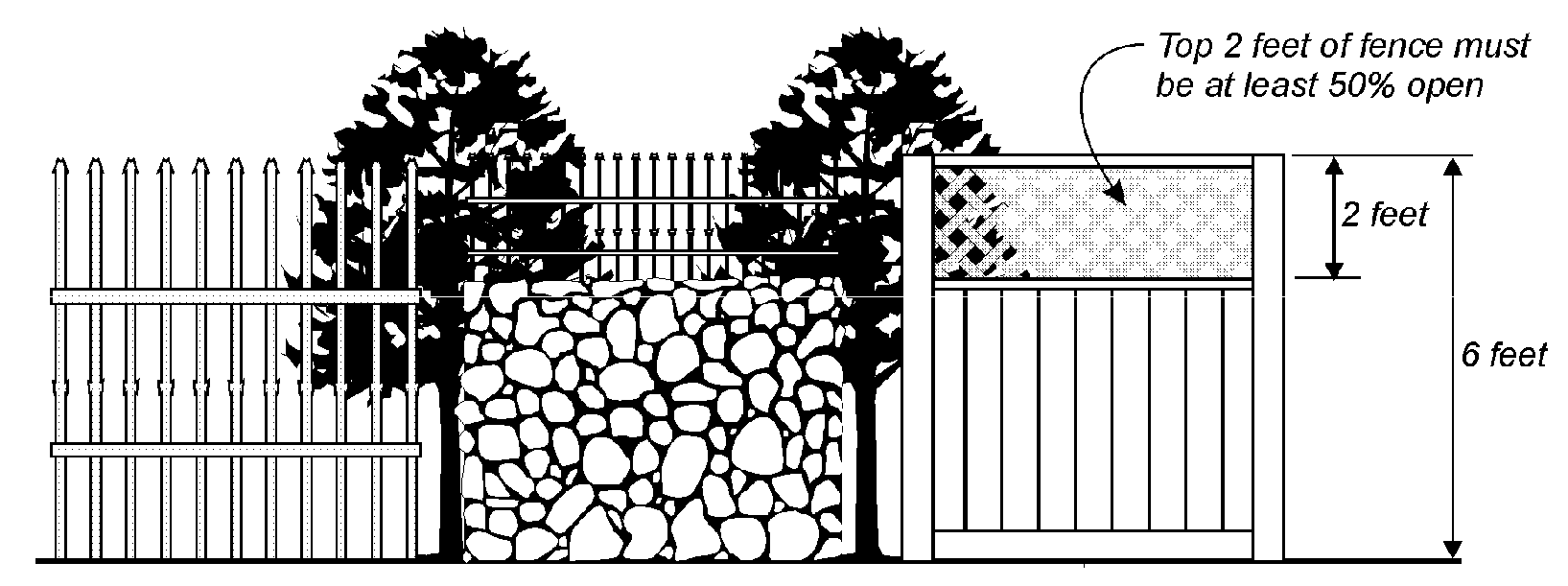
A fence or screening wall having a maximum height exceeding four feet but no more than six feet above grade may be located within a required setback for a front yard or side yard that abuts a street if the entire section or portion of the fence or wall above four feet in height above grade has a surface area that is at least 50% open and unobstructed by structural elements. (See Figure 3-1.)
c.
A trellis above a gate or opening along the line of a fence, not exceeding a maximum height of eight feet above grade and a width of six feet, is permitted within a required setback for a front, side, or rear yard that abuts a street.
FIGURE 3-1
EXAMPLES OF FENCES WITH THE AREA
ABOVE FOUR FEET AT LEAST 50% OPEN
2.
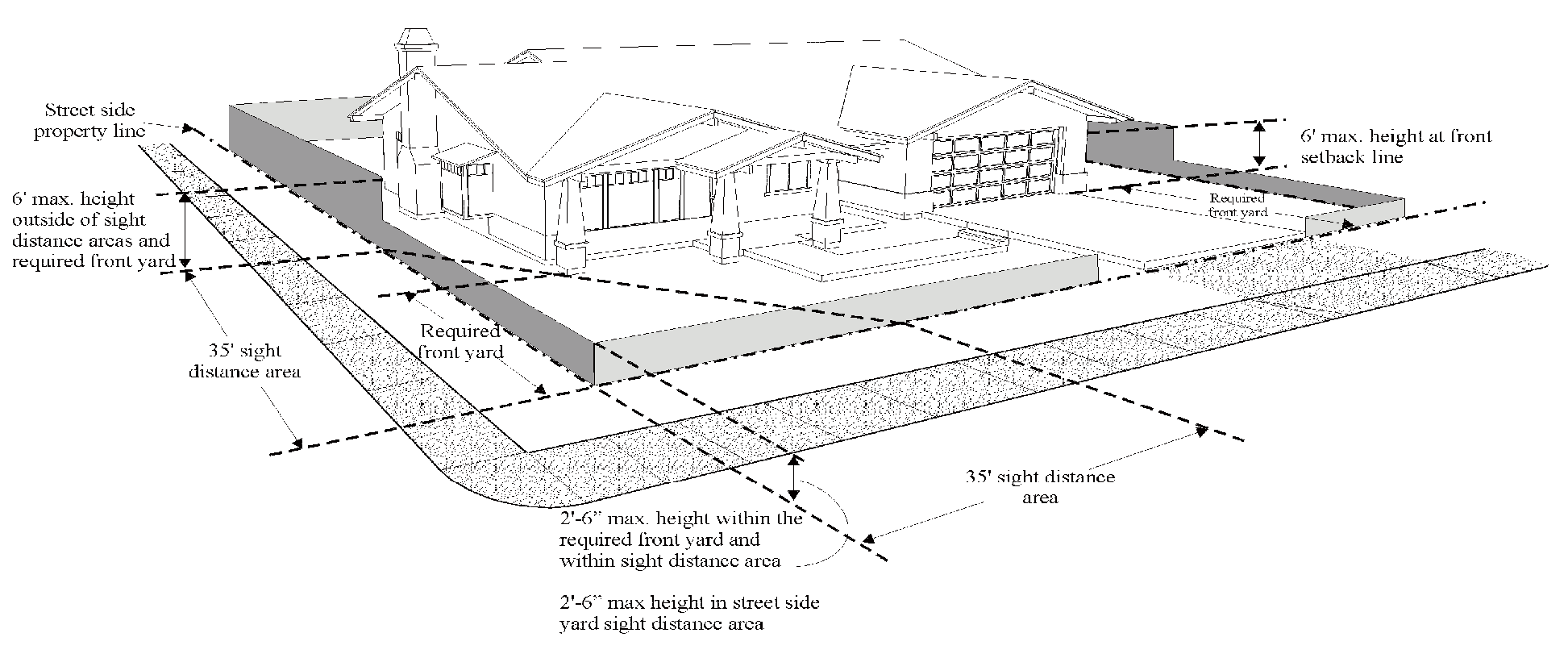
Corner lots. Fences within the front and/or street side setbacks of a corner lot shall not exceed a height of two feet, six inches above the street level of an adjacent intersection, within the area between the property lines and a diagonal line joining points on the property lines which are 35 feet from their intersection. See Chapter 13.18 (Visibility Obstructions) of the County Code. See Figure 3-2.
FIGURE 3-2
HEIGHT LIMITATIONS FOR FENCES ON CORNER LOTS
3.
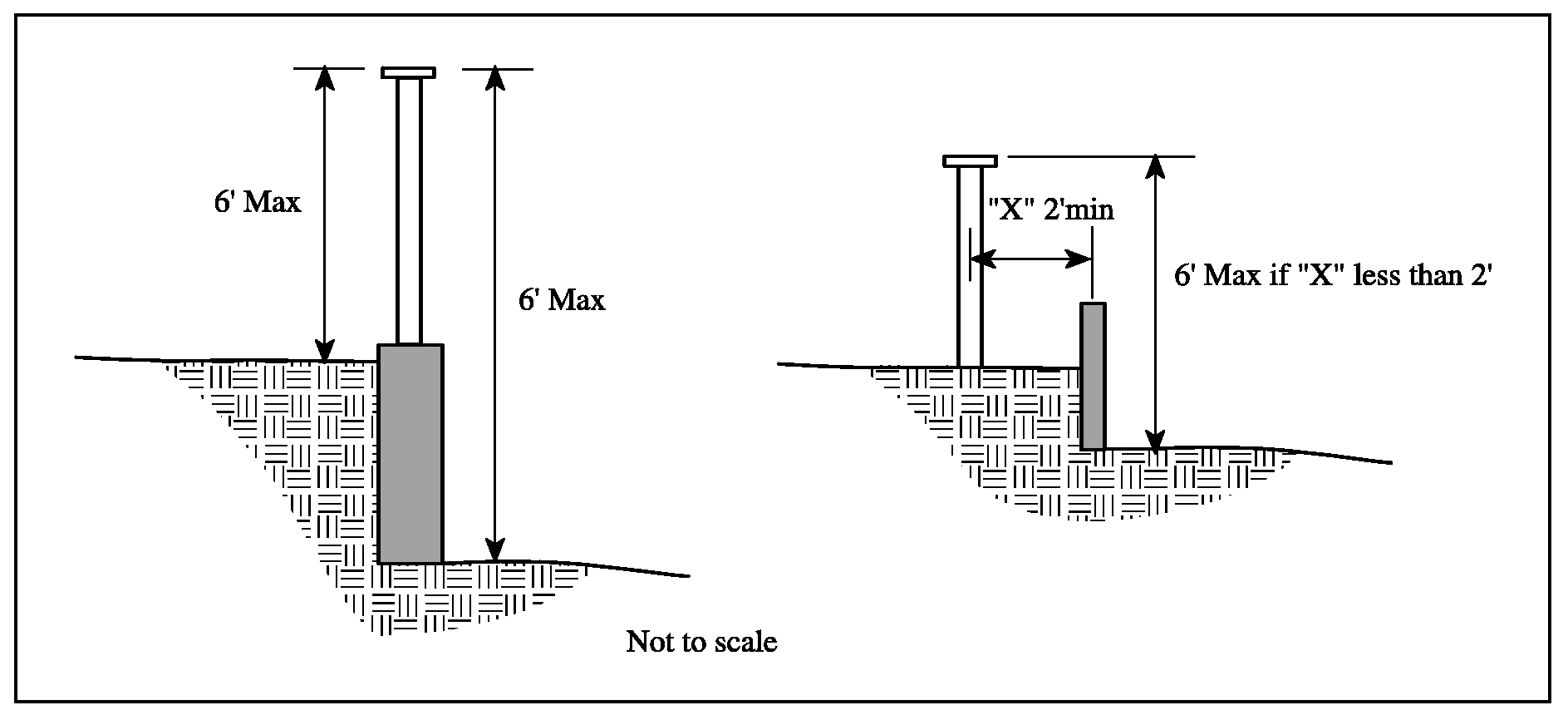
Lots with grade differential. Where there is a difference in the ground level between two adjoining lots, the height of the fence or wall shall not exceed six feet as measured from grade on either side of the structure. See Figure 3-3 (Fence Height Limits).
4.
Parallel fences and walls. Two approximately parallel fences and/or screening walls shall maintain a separation of at least two feet to encourage landscaping between the separation, or the height of both structures shall be computed as one structure, subject to the six foot height limitation. See Figure 3-3 (Fence Height Limits).
B.
Setback requirements. Fences or screening walls up to four feet in height or six feet in height above grade may be located within a required setback or on property lines in compliance with the height limits of Subsection A., above.
FIGURE 3-3
FENCE HEIGHT LIMITS
(Ord. No. 3577, 2012; Ord. No. 3666, § II(exh. A), 2017)
22.20.052 - Retaining Wall Standards.
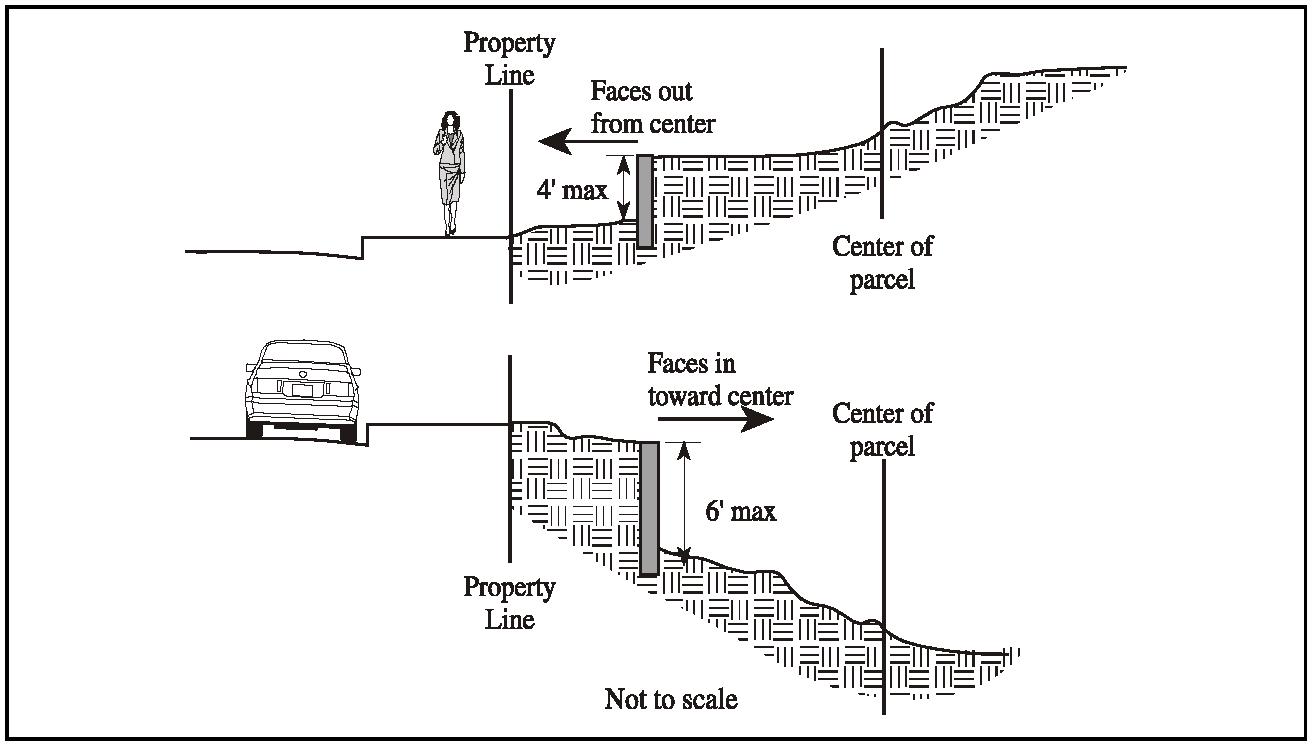
The following standards shall apply to all retaining walls that are outside of the footprint of a building. See Figure 3-4 (Maximum Height for Retaining Walls).
A.
Retaining walls may reach a maximum height of six feet above grade if the exposed face of the retaining wall faces into the center of the property.
B.
Retaining walls may reach a maximum height of four feet above grade if the exposed face of the retaining wall faces outward from the center of the property, unless they are at least 25 feet from all property lines, in which case they can reach a maximum height of 8 feet above grade.
FIGURE 3-4
MAXIMUM HEIGHT FOR RETAINING WALLS
(Ord. No. 3666, § II(exh. A), 2017)
22.20.055 - Bridge Standards.
The following standards shall apply to the installation of all bridges in A, A2, RA, RR, RE, R1, R2, C-RA, C-R1 and C-R2 zoning districts. Bridges require Design Review in all other zoning districts:
A.
Height limitations. Bridges with a deck or surface elevation that does not exceed the minimum height above creek bank required to comply with Chapter 24.04 (Improvements) and Section 22.82.030 (Drainage Facilities) may be located within a required setback, or on the property line. A bridge may have design or structural features that are no more than six feet in height above the top of bank.
B.
Setback requirements. Bridges that do not exceed the minimum height above creek bank required to comply with County flood control standards may be located within a required setback or on property lines in compliance with the height limits of 22.20.055.A (Height Limitations), above.
(Ord. No. 3577, 2012; Ord. No. 3666, § II(exh. A), 2017)
22.20.060 - Height Measurement and Height Limit Exceptions.
All structures shall meet the following standards relating to height, except for fences, which shall comply with Section 22.20.050 (Fencing and Screening Standards), above:
A.
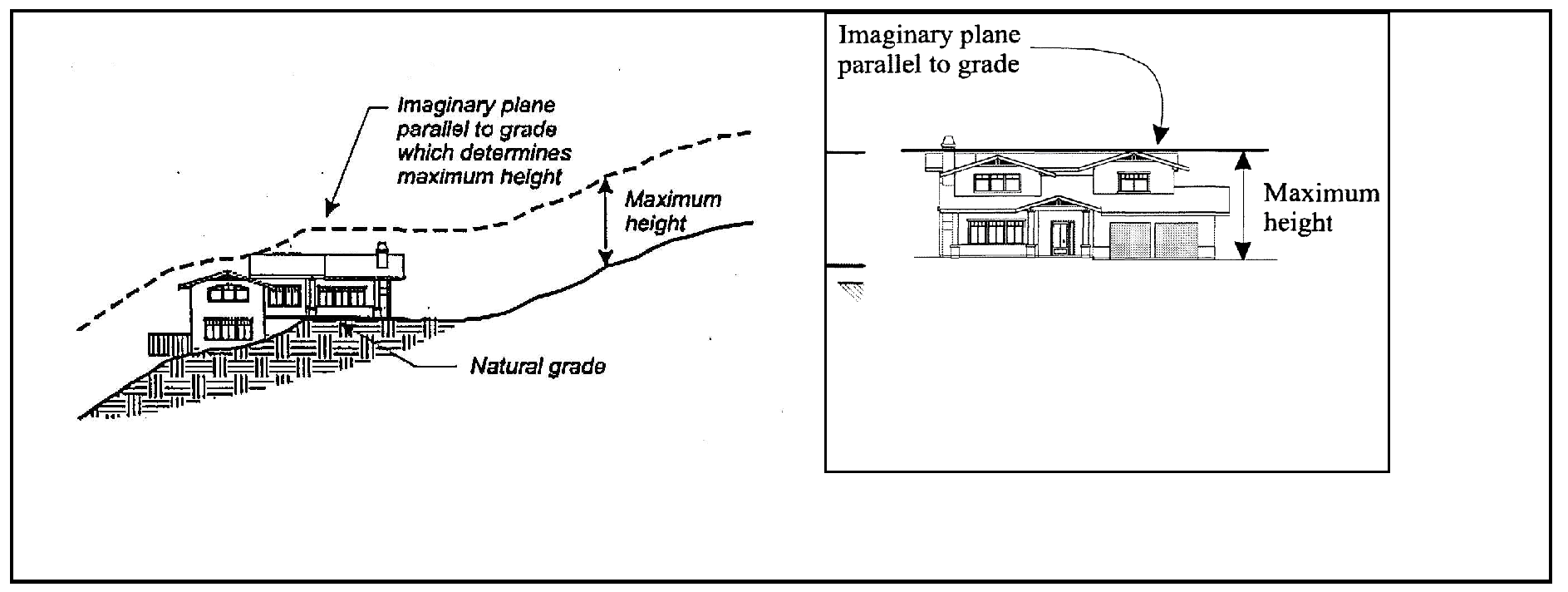
Maximum height. The height of any structure shall not exceed the standard established by the applicable zoning district in Article II (Zoning Districts and Allowable Land Uses) and Article V (Coastal Zone Development and Resource Management Standards). Maximum height shall be measured as the vertical distance from grade to an imaginary plane located the allowed number of feet above and parallel to the grade. See Figure 3-5 (Measurement of Maximum Height) and definition of "Grade" in Article VIII (Definitions).
FIGURE 3-5
MEASUREMENT OF MAXIMUM HEIGHT
B.
Detached accessory structures. A detached accessory structure shall not exceed 16 feet in height above grade. However, a detached accessory structure may be constructed to the height allowed for primary structures, by the applicable zoning district, if the accessory structure is located at least 40 feet from all property lines.
C.
Structures for parking. A detached parking structure is subject to the height limit required by Section 22.20.090.E.2 (Parking Structures on Steep Lots), above. Where a garage or other parking structure is located three feet from a front (or otherwise street-facing) or side property line, in compliance with Section 22.32.130.B.2 (Residential Accessory Uses and Structures - Front setback exception), its height shall be measured from the floor level of the parking area.
D.
Fences. Height limits for fences are established by Section 22.20.050.A (Fencing and Screening Standards—Height Limitations), above.
E.
Exceptions to height limits:
1.
Institutional buildings. Where the maximum height established by the applicable zoning district is less than 75 feet, public and semi-public buildings, churches, hospitals, schools, and other institutional structures allowed in the zoning district may be erected to a height not exceeding 75 feet; provided that:
a.
The front, side, and rear yard setbacks shall be increased one foot for each one foot by which the structure exceeds the height limit established by the zoning district; and
b.
The Director determines that the amount of structure height allowed above the height limit of the underlying zoning district will not result in significant glare, light, privacy, shadow, or visual impacts to surrounding properties or scenic locations.
2.
Dwellings. Dwellings in an A, A2, RA, RR, RE, R1, and R2 zoning district may be increased in height without Variance approval by a maximum of 10 feet when side setbacks of 15 feet or greater are provided, subject to the regulations of Chapter 22.42 (Design Review).
3.
Floor area under parking. Where floor area is developed beneath a parking structure in conformance with Section 22.20.090.E.2, the maximum height of the building shall be 30 feet above grade.
4.
Spires, towers, water tanks, etc. Chimneys, cupolas, flag poles, gables, monuments, spires, towers (e.g., transmission, utility, etc.), water tanks, similar structures and necessary mechanical appurtenances may be allowed to exceed the height limit established for the applicable zoning district, subject to the following standards.
a.
The structure shall not cover more than 15 percent of the lot area at any level, except with Site Plan Review approval.
b.
The area of the base of the structure shall not exceed 1,600 square feet.
c.
No gable, spire, tower or similar structure shall be used for sleeping or eating quarters or for any commercial purpose other than that which is incidental to the allowed uses of the primary structure.
d.
No structure shall exceed a maximum height of 150 feet above grade, except with Design Review approval. See Chapter 22.42 (Design Review).
6.
Wind Energy Conversion Systems. Height limits for WECS are established in Section 22.32.180 (Wind Energy Conversion Systems (WECS)).
F.
Height limit exceptions by Variance or Design Review.
1.
Primary structure. A primary structure may exceed the height limit of the applicable conventional zoning district with Variance approval. See exceptions for dwellings in certain zoning districts contained in Section 22.20.060.E.2. See Chapter 22.54 (Variances).
2.
Detached accessory structure. A detached accessory structure may exceed the height limit of the applicable conventional zoning district with Design Review approval provided that the structure shall not exceed the height limit for the primary structure. See Chapter 22.42 (Design Review).
3.
Agricultural structure. An agricultural structure may exceed the height limit of the applicable zoning district with Design Review approval. See Chapter 22.42 (Design Review).
(Ord. No. 3577, 2012; Ord. No. 3602, § II(exh. A), 2013; Ord. No. 3666, § II(exh. A), 2017; Ord. No. 3706, 2019; Ord. No. 3745, § 1(exh. A), 2021)
22.20.070 - Hillside Development Standards.
The following standards apply to subdivisions and other development proposed in hillside areas where the slope of the proposed site is six percent or greater:
A.
Subdivision design. Proposed subdivisions shall comply with the standards of Section 22.82.050 (Hillside Subdivision Design).
B.
Substandard lots. The following requirements apply where the area of a vacant lot proposed for single-family residential development is less than 50 percent of the minimum lot area required by Section 22.82.050 (Hillside Subdivision Design):
1.
The proposed development shall be subject to Design Review (Chapter 22.42); and
2.
The setback requirements otherwise prescribed for the site by the applicable zoning district shall be waived, provided that nothing in this Section shall imply that the applicable setbacks shall not be applied wherever possible.
(Ord. No. 3577, 2012)
22.20.080 - Parking Requirements.
Parking standards for new and existing land uses are contained in Sections 24.04.330 through 24.04.400 (Parking and Loading) of the County Code. Every structure or use created or established shall be provided with the minimum number of off-street parking and loading spaces specified in Sections 24.04.330 through 24.04.400 (Parking and Loading), and in compliance with Chapter 15.06 (Trip Reduction) of the County Code. Applicants are encouraged, to the extent permitted by Marin County Code Chapter 24.04 (Development Standards), to utilize shared parking arrangements and pervious surfaces (e.g., Turfblock, porous asphalt and gravel) in order to reduce the area of impervious surfaces.
(Ord. No. 3577, 2012)
22.20.090 - Setback Requirements and Exceptions.
A.
Purpose. This Section establishes standards for the use and minimum size of setbacks. These standards are intended to provide for open areas around structures for: Visibility and traffic safety; access to and around structures; access to natural light, ventilation and direct sunlight; separation of incompatible land uses; and space for privacy, landscaping, recreation, and fire safety.
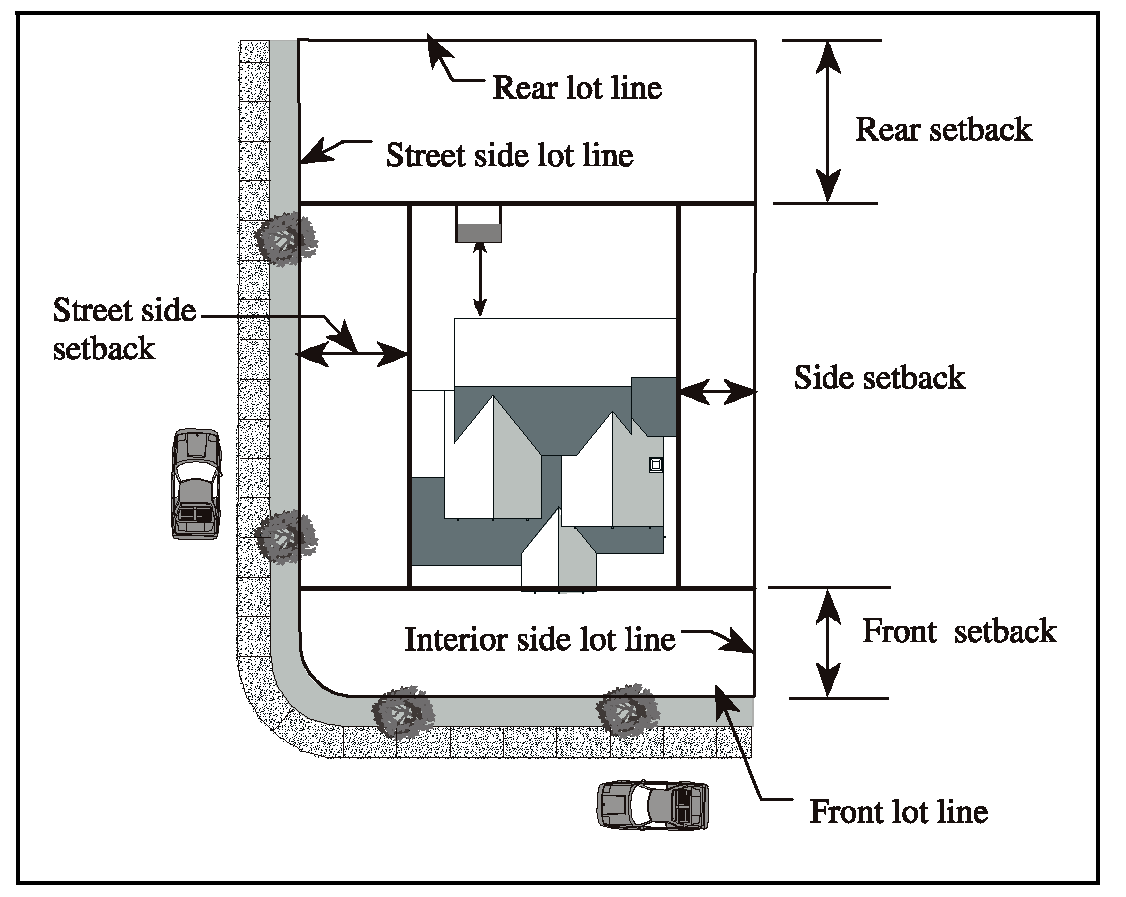
FIGURE 3-6
LOCATION AND MEASUREMENT OF SETBACKS
B.
Measurement of Setbacks. Setbacks shall be measured from property lines, as shown by Figure 3-6 (Location and Measurement of Setbacks), and as follows; however, if an access easement or street right-of-way line extends into or through a yard setback, the measurement shall be taken from the nearest point of the easement or right-of-way line, not the more distant property line. On irregularly shaped lots, the Director shall determine the location of the front, side, and rear property lines. See Figure 3-7 (Front and Side Setbacks with Easements).
1.
Front yard setbacks. The front yard setback shall be measured at right angles from the nearest point on the front property line of the lot to the nearest point of the wall of the structure, establishing a setback line parallel to the front property line.
a.
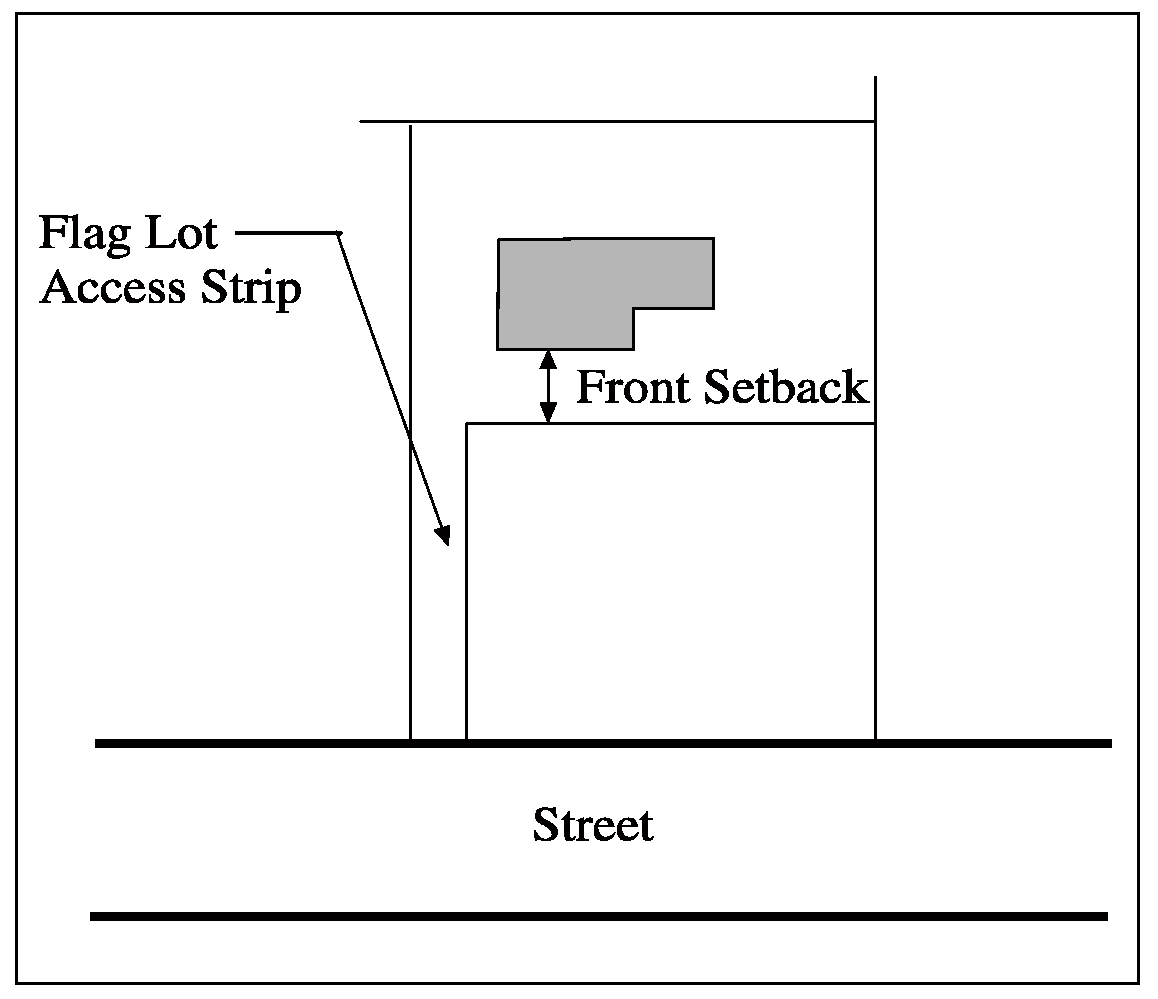
Flag lots. For a lot with a fee ownership strip extending from a street or right-of-way to the building area of the parcel, the measurement shall be taken from the nearest point of the wall of the structure to the point where the access strip meets the bulk of the lot along a continuous line, establishing a setback line parallel to it. See Figure 3-8 (Flag Lot Setbacks).
FIGURE 3-7
FRONT AND SIDE SETBACKS WITH EASEMENTS
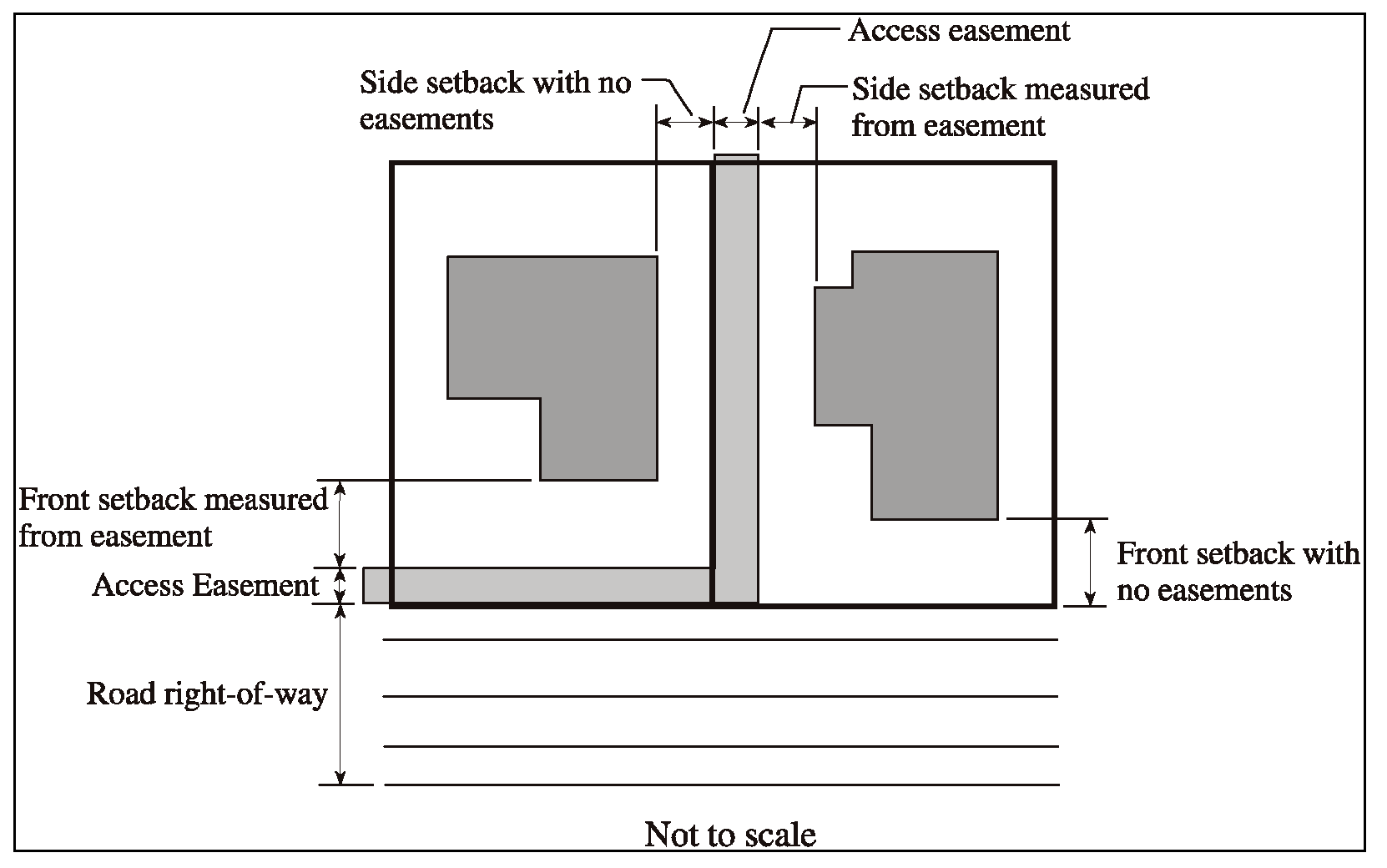
FIGURE 3-8
FLAG LOT SETBACKS
b.
Corner lots. The measurement shall be taken from the nearest point of the structure to the nearest point of the property line adjoining the street to which the property is addressed and the street from which access to the property is taken.
2.
Side yard setbacks. The side yard setback shall be measured at right angles from the nearest point on the side property line of the lot to the nearest point of the wall of the structure; establishing a setback line parallel to the side property line, which extends between the front and rear yards.
3.
Street side yard setbacks. The side yard on the street side of a corner lot shall be measured at right angles from the nearest point of the side property line adjoining the street to the nearest point of the wall of the structure, establishing a setback line parallel to the side property line which extends between the front and rear yards.
4.
Rear yard setbacks. The rear yard shall be measured at right angles from the nearest point on the rear property line to the nearest point of the wall of the structure, establishing a setback line parallel to the rear property line.
5.
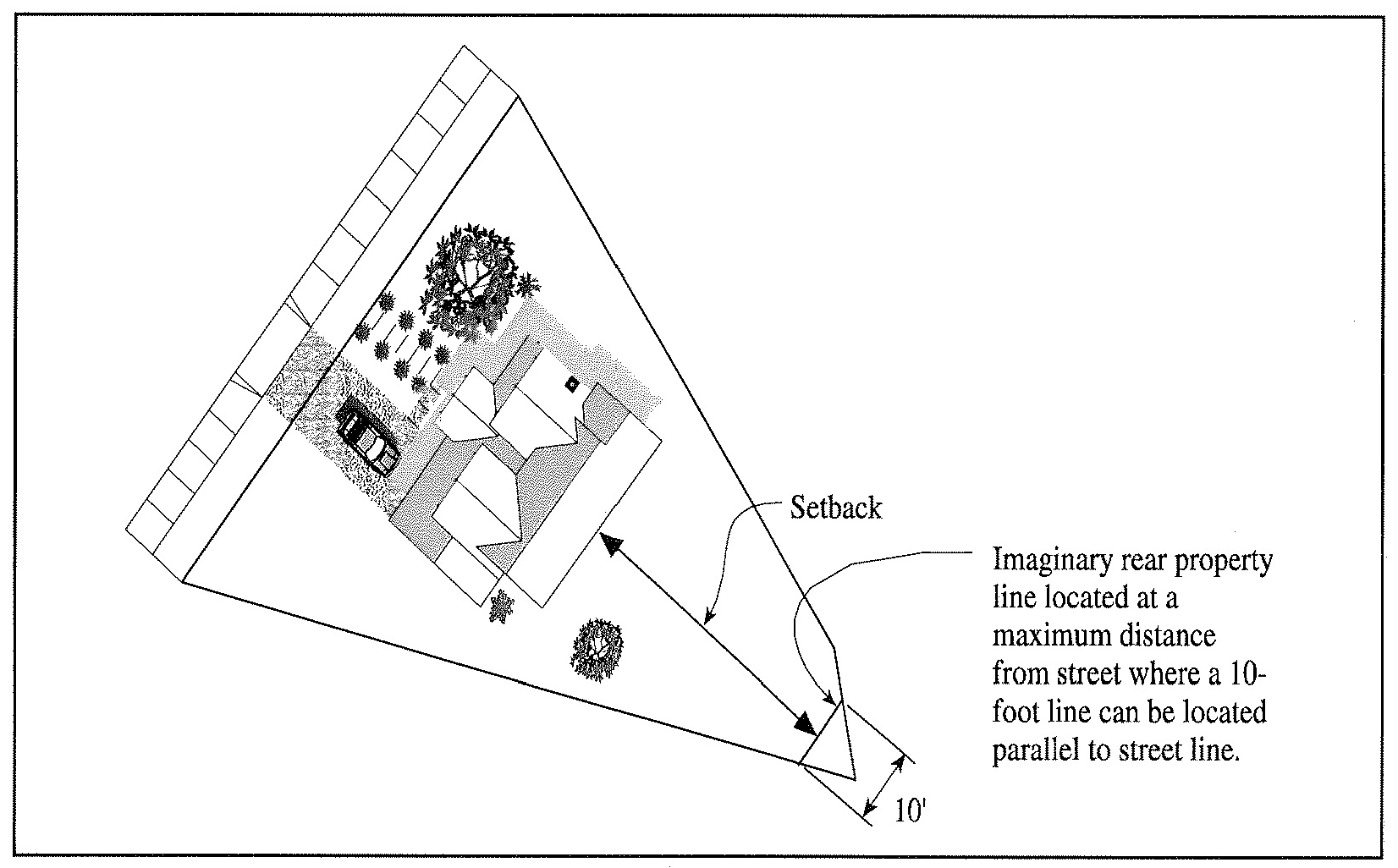
Rear yard setbacks in triangular or gore-shaped lots. On a triangular or gore-shaped lot, where it is difficult to identify a rear lot line, the rear yard shall be measured at right angles from a line 10 feet in length within the lot, parallel to and at a maximum distance from the front property line. See Figure 3-9 (Rear Setback in Irregular lots).
FIGURE 3-9
REAR SETBACK IN TRIANGULAR OR GORE-SHAPED LOTS
C.
Setback requirements. Unless exempted in compliance with Subsections D and E, below, all structures shall conform with the setback requirements established for each zoning district by Article II (Zoning Districts and Allowable Land Uses) and Article V (Coastal Zone Development and Resource Management Standards), and with any special setbacks established for specific uses by this Development Code, except as otherwise provided by this Section.
1.
Accessory structures. Detached accessory structures shall comply with the same setback requirements established by the applicable conventional zoning district for primary structures, except as follows.
a.
The rear yard setback for a detached accessory structure shall equal the required side setback to a maximum rear setback of 10 feet; except that the rear setback on a through lot shall be 20 percent of the lot depth to a maximum of 25 feet.
b.
Detached accessory structures may be located within a required setback with Design Review approval. See Chapter 22.42 (Design Review).
2.
Detached site elements. Detached decks, swimming pools and spas, steps, terraces, and other site design elements that are placed at or below grade, and which exceed a height of 18 inches above grade at any point, shall conform with the setback requirements of this Chapter for detached accessory structures. Hand railings and other safety features required by the California Building Code and attached directly to a detached site element shall not be included in the measurement of the maximum height of the detached site element.
3.
Exempt site elements. Site design elements less than 18 inches above grade are exempt from setback requirements in compliance with Subsection D (Exemptions from setback requirements), below. Examples of site design elements less than 18 inches above grade include ponds, shuffleboard courts, and water elements (e.g., fountains, sprays, etc.).
D.
Exemptions from setback requirements. The minimum setback requirements of this Development Code apply to all development except the following:
1.
Development that is equal to or less than 18 inches above grade;
2.
Fences or screening walls that comply with the height limits specified in Section 22.20.050 (Fencing and Screening Standards) and as restricted by Chapter 13.18 (Visibility Obstructions) of the County Code;
3.
Retaining walls that comply with the height limits specified in Section 22.20.052 (Retaining Walls);
4.
Detached energy efficiency devices located within required rear yard and side yards that do not exceed a height of four feet in height above grade;
5.
Decks, freestanding solar devices, swimming pools and spas, steps, terraces, and other site design elements which are placed at or below grade and do not exceed a height of 18 inches above grade at any point. Hand railings and other safety features required by the Uniform Building Code and attached directly to a detached site element which meets the criteria herein are exempt from the minimum setback requirements;
6.
Flag poles that do not exceed a height of 30 feet above grade; and
7.
An application for single-family residential development that requires Design Review pursuant to Section 22.42.020 (Design Review for Substandard Building Sites).
8.
Floor area directly beneath a parking structure that is built in reliance on Section 22.20.090.E.2 (Parking structures on steep lots) may be built to within three feet of the front property line that abuts the adjoining street from which vehicular access is taken, provided the floor area does not extend beyond the footprint of the parking structure.
E.
Allowed projections into setbacks. Attached architectural features and certain detached structures may project into or be placed within a required setback in compliance with the following requirements:
1.
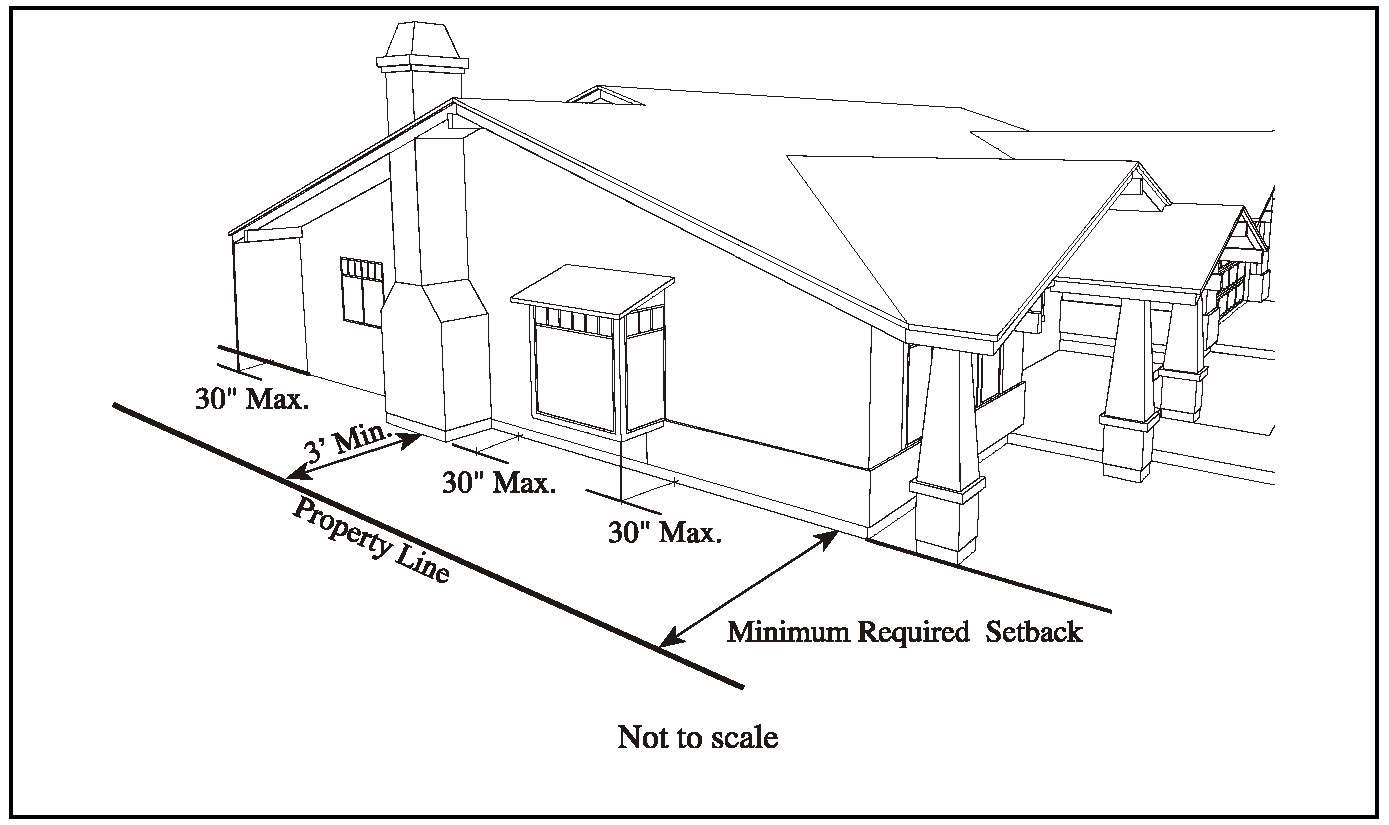
Architectural features. Architectural features attached to a building may extend beyond the wall of the structure and into the front, side and rear yard setbacks, in compliance with Table 3-1 (Allowed Projections into Setbacks). See also Figure 3-10 (Examples of Allowed Projections into Required Setbacks).
TABLE 3-1
ALLOWED PROJECTIONS INTO SETBACKS
Notes:
(1) Feature may project no closer than three feet to the property line.
(2) Cantilevered architectural features including balconies, bay windows, cornices, eaves and roof overhangs may project into setbacks as shown.
(3) Decks less than 18 inches above grade are exempt, in compliance with Section 22.20.090.D.3 (Exemptions from Setback Requirements), above.
(4) A porch may project into a setback, provided it is enclosed only by a railing in compliance with Title 19 (Buildings) of the County Code, and is located at the same level as the entrance floor of the structure. An additional projection into the front yard setback may be allowed with Design Review approval.
(5) A stairway may project into a setback, provided it is not roofed or enclosed above the steps.
2.
Parking structures on steep lots. In any zoning district allowing residential uses, where the slope of the one-half of the parcel beginning at the street-access side is 20 percent or more, or where the elevation of the lot at the property line from which vehicular access is taken is five feet or more above or below the elevation of the adjoining street, a parking structure may be built to within three feet of the front and side property lines that abut the adjoining street from which vehicular access is taken. Driveway structures that provide access to a parking structure that comply with the provisions of this section are exempt from setback requirements.
FIGURE 3-10
EXAMPLES OF ALLOWED PROJECTIONS INTO REQUIRED SETBACKS
F.
Restrictions on the use of front yard setbacks in residential districts. No junk or scrap shall be allowed in the front yard on any lot in any residential zoning district. This restriction includes the storage of operable or inoperable vehicles in other than improved parking or driveway areas.
(Ord. No. 3577, 2012; Ord. No. 3666, § II(exh. A), 2017; Ord. No. 3706, 2019; Ord. No. 3745, § 1(exh. A), 2021; Ord. No. 3797, § II(exh. A), 2023)
22.20.100 - Solid Waste/Recyclable Materials Storage.
A.
Purpose. This Section provides for the construction and maintenance of storage areas for solid waste and recyclable materials in compliance with the California Solid Waste Reuse and Recycling Access Act (Public Resources Code Sections 42900—42911, as may be amended from time to time), and Chapter 7.02 (Theft of Recyclable Materials) of the County Code.
B.
Applicability. This Section applies to the new construction or remodeling of multi-family residential projects with five or more dwelling units, commercial, and other non-residential and non-agricultural projects.
C.
Multi-family residential structures. Multi-family residential projects with five or more dwellings shall provide on-site solid waste and recyclable material storage areas as follows:
1.
Individual unit storage requirements. Each dwelling unit shall include an area, within the dwelling, designed for the storage of solid waste and recyclable material.
2.
Common storage area requirements. Facilities shall be provided for the temporary storage of solid waste and recyclable materials, adequately sized to serve the needs of the project, as determined by the review authority. Table 3-2 provides suggested standards for shared solid waste and recyclable materials storage areas for individual structures within multi-family projects.
TABLE 3-2
SOLID WASTE STORAGE - MULTI-FAMILY PROJECTS
D.
Non-residential structures and uses. Non-residential structures and uses shall be provided with solid waste and recyclable material storage areas, adequately sized to serve the needs of the project, as determined by the review authority. Table 3-3 provides suggested minimum storage area standards for each individual structure.
TABLE 3-3
SOLID WASTE STORAGE - NON-RESIDENTIAL PROJECTS
E.
Location requirements. Solid waste and recyclable materials storage areas may be located indoors or outdoors as long as they are accessible to all residents and employees, as follows:
1.
Location and design of storage areas. Solid waste and recyclable material storage areas shall be adjacent to, or combined with one another. They may only be located inside a specially-designated structure; or outdoors, within an approved fence or wall enclosure, a designated interior court or yard area with appropriate access, or in a rear yard or interior side yard.
2.
Accessibility. The storage area(s) shall be accessible to residents and employees. Storage areas within multi-family residential developments shall be located within 250 feet of the dwellings which they are intended to serve.
3.
Unobstructed vehicle access. Driveways or aisles shall provide unobstructed access for collection vehicles and personnel, and shall provide at least the minimum clearance required by the collection methods and vehicles of the designated collector. Where a site is served by an alley, all exterior storage area(s) shall be directly accessible from the alley.
F.
Design and construction requirements for multi-family and non-residential development. The design and construction of storage areas in multi-family residential and non-residential developments shall comply with the following standards:
1.
Architectural compatibility, screening. The storage enclosure shall be architecturally compatible with the surrounding structures and subject to the approval of the Director. Storage areas shall be appropriately located and screened from view on at least three sides and shall not conflict or interfere with surrounding land uses.
2.
Security. The storage enclosure shall be properly secured to prevent access by unauthorized persons while allowing authorized persons access for disposal of materials in compliance with Chapter 7.02 (Theft of Recyclable Materials) of the County Code.
3.
Concrete pad and apron. The storage area shall include a concrete pad within a fenced or walled area, and a concrete apron, to facilitate the handling of the individual bins or containers.
4.
Weather protection. The storage area and individual bins or containers shall be enclosed to protect the recyclable materials from adverse weather conditions which may render the materials unmarketable.
5.
Runoff protection. The storage area and individual bins or containers shall, to the extent feasible, incorporate a curb or berm to protect the pad from run-on surface drainage, and a drainage system that connects to the sanitary sewer system.
Certain types of projects and properties are subject to the specific requirements of the County's Municipal Pollutant Discharge Elimination System (NPDES) permit, including removal of trash with a size of five millimeters or greater out of runoff before it reaches a public storm drain system. These projects and properties include commercial, industrial, high-density residential, mixed urban, and public transportation stations. Those projects that are subject to the NPDES permit requirements shall include the installation of Certified Trash Full Capture Systems that meet State and County Standards. In addition, an operation and maintenance plan, subject to the review and approval of the Department of Public Works, shall be recorded and implemented to ensure long term maintenance of these systems in conformance with the standards of the State and County.
(Ord. No. 3577, 2012; Ord. No. 3666, § II(exh. A), 2017; Ord. No. 3706, 2019; Ord. No. 3745, § 1(exh. A), 2021)
22.20.110 - Undergrounding of Utilities.
Utilities to serve proposed development shall be placed underground except where the Director determines that the cost of undergrounding would be so prohibitive as to deny utility service to the development.
(Ord. No. 3577, 2012)
22.20.120 - Accessory Structures.
Accessory structures are allowed only where a primary or conditionally permitted use has been established on the lot, with the exception of certain fences; open wooden post and wire mesh fences that do not exceed a height of six feet above grade may be installed on a lot where no primary use has been established.
(Ord. No. 3666, § II(exh. A), 2017)
22.22.010 - Purpose of Chapter.
Marin County is experiencing a shortage of homes affordable to the workforce of the county, seniors and individuals with disabilities. The California Legislature has found that the availability of housing is of vital statewide importance and a priority of the highest order, and that local governments have a responsibility to use the powers vested in them to facilitate the improvement and development of housing to make adequate provision for the housing needs of all economic segments of the community.
To help attain local and state housing goals, this Chapter requires new developments to contribute to the County's affordable housing stock through the provision of housing units, land dedication, and/or fees. This Chapter provides procedures and requirements applicable to development proposals in the unincorporated areas of Marin County, which are intended to achieve the following goals:
A.
Countywide Plan housing goals. Enhance the public welfare and ensure that further residential and non-residential development contribute to the attainment of the housing goals of the Countywide Plan by increasing the production of affordable housing, and stimulating funds for development of affordable housing.
B.
Reduce affordable housing shortage. Reduce the housing shortage for income qualifying households.
C.
Balanced community. Achieve a balanced community with housing available for households with a range of income levels.
D.
Affordable housing requirements. Ensure that remaining developable land within the County is utilized in a manner consistent with the County's housing policies and needs. This can be accomplished in part by applying the residential and non-residential affordable housing requirements or fees contained in this Chapter.
(Ord. No. 3577, 2012; Ord. No. 3666, § II(exh. A), 2017)
22.22.020 - Applicability.
The provisions of the Chapter apply to new market rate development that entails the development of new residential floor area, lot creation, multifamily housing, residential care facilities, and the development of new non-residential floor area. Additional applicability standards are enumerated below. Table 3-4a provides examples of housing and fee requirements for different types of development.
TABLE 3-4a
EXAMPLES OF AFFORDABLE HOUSING REQUIREMENTS
A.
Single-family dwellings. All new single-family dwellings greater than 2,000 square feet, except those located in subdivisions previously subject to an inclusionary requirement, shall pay an Affordable Housing Impact Fee per Ordinance 3500.
B.
Multi-family rental housing. New multi-family housing developed without a subdivision map and where dwelling units cannot be sold separately shall provide affordable housing consistent with Section 22.22.090 (Inclusionary Housing Standards).
C.
Multi-family housing with a subdivision map. All new multi-family housing and condominium conversions approved with a subdivision map or with dwelling units that can be sold separately, including multi-family housing, condominiums, townhouses, and stock cooperatives, shall provide affordable housing consistent with Section 22.22.090 (Inclusionary Housing Standards).
D.
Lot creation with proposed dwellings. Any subdivision with a proposed development of one or more dwellings shall provide affordable housing consistent with Section 22.22.090 (Inclusionary Housing Standards).
E.
Lot creation without proposed dwellings. Any subdivision creating one or more new lots shall provide inclusionary lots for the immediate or future development of affordable housing consistent with Section 22.22.090 (Inclusionary Housing Standards).
F.
Non-residential developments. Non-residential development shall pay a Jobs/Housing linkage fee consistent with Section 22.22.100 (Non-Residential and Mixed Use Affordable Housing Standards).
G.
Mixed use developments. Mixed use developments are subject to both the non-residential and residential affordable housing requirements.
H.
Affordable housing regulations. The requirements of this Chapter shall be imposed only once on a given development approval. Affordable housing requirements imposed on a development shall be consistent with the affordable housing requirements in effect at the time of each successive Precise Development Plan or Design Review approved in conformance with a governing Master Plan. Subdivisions subject to an inclusionary requirement are also not subject to the Affordable Housing Impact Fee, but may be subject to other applicable inclusionary in-lieu fees.
(Ord. No. 3577, 2012; Ord. No. 3706, 2019; Ord. No. 3745, § 1(exh. A), 2021; Ord. No. 3798, § II(exh. A), 2023)
22.22.030 - Application Filing.
An affordable housing plan shall be submitted as part of the first application for any development project, including a housing development project, subject to this Chapter, except single-family dwellings subject to the Affordable Housing Impact Fee, and shall be processed, reviewed, and approved, conditionally approved, or denied concurrently with all other applications required for the project. Any request for a waiver of requirements of this Chapter must be submitted as part of the affordable housing plan.
(Ord. No. 3577, 2012; Ord. No. 3745, § 1(exh. A), 2021)
22.22.040 - Prohibitions.
In Marin County, it shall be unlawful to restrict housing choice on the basis of race, color, disability, religion, sex, familial status, national origin, sexual orientation, marital status, ancestry, age, and source of income.
(Ord. No. 3577, 2012; Ord. No. 3798, § II(exh. A), 2023)
22.22.050 - Exemptions.
The following shall be exempt from the provisions of this Chapter: agricultural development; agricultural worker housing and all related accessory structures; development by special districts and authorities subject to the Marin Local Agency Formation Commission's (LAFCO) authority over boundaries and organization; up to one SB 9 lot/unit; residential Accessory Dwelling Units; and residential projects developed at the targeted income level and percentage cited in the Housing Overlay Designation policies in the Countywide Plan. Affordable housing shall be exempt from Inclusionary Housing Standards; however, if State or Federal Regulations establish a limited term affordability requirement, then the inclusionary standards in this Chapter shall begin to apply once that term is completed, and shall apply in perpetuity.
(Ord. No. 3577, 2012; Ord. No. 3602, § II(exh. A), 2013; Ord. No. 3666, § II(exh. A), 2017; Ord. No. 3706, 2019; Ord. No. 3745, § 1(exh. A), 2021; Ord. No. 3798, § II(exh. A), 2023)
22.22.060 - Waivers.
The review authority may grant a waiver to the requirements of this Chapter if they determine an alternative affordable housing proposal demonstrates a better means of serving the County in achieving its affordable housing goals than the requirements of Chapter 22.22 (Affordable Housing Regulations).
A.
Residential projects. The review authority may approve one or more of the following alternative means of compliance with the requirements of Section 22.22.090 (Inclusionary Housing Standards) or the mixed use residential inclusionary requirements of Section 22.22.100.B (Mixed use development). Any proposed alternative means of compliance must include an analysis of fair housing implications to ensure that any proposed off-site location will promote diversity. Required units or lots must be located in an unincorporated area of the County within the same census tract or in an identified Racially Concentrated Area of Affluence. The options below are listed in order of priority, with the provision of in-lieu fees being the lowest priority. The applicant must demonstrate that each option is infeasible before the County may consider the next option.
1.
Affordable units off-site. Inclusionary units may be constructed on one or more sites not contiguous with the proposed development. The off-site property shall be located within the same census tract or in an identified Racially Concentrated Area of Affluence with appropriate zoning, density, location, size, accessibility to public transportation, and other services, consistent with sound community planning principles and shall be devoid of contaminants and other hazardous wastes. The offsite location must include either a greater number of inclusionary units than required on-site or the same number of inclusionary units that are affordable at a lower income level.
2.
Lots. The applicant may dedicate suitable real property to the County or its designee to develop the required inclusionary units. The property shall be within the same census tract or in an identified Racially Concentrated Area of Affluence with appropriate zoning, density, location, size, accessibility to public transportation, and other services, consistent with sound community planning principles and shall be devoid of contaminants and other hazardous wastes. The offsite location must include either a greater number of inclusionary units than required on-site or the same number of inclusionary units that are affordable to a lower income level.
3.
In-lieu fee. The applicant may pay an in-lieu participation fee based on 125% of the requirement of Section 22.22.090 (Inclusionary Housing Standards). The review authority shall apply the lowest preference to the payment of an in-lieu fee for compliance with the requirements of this chapter.
B.
Non-Residential Development and Residential Care Facilities. If the review authority finds that an alternative provides a better means of serving the County in achieving its affordable housing goals, one or more of the following alternative means may be approved for compliance with the requirements of this chapter. Any proposed alternative means of compliance must include an analysis of fair housing implications to ensure that any proposed off-site location will promote housing diversity. Required units or lots must be located in an unincorporated area of the County within the same census tract or in an identified Racially Concentrated Area of Affluence. A combination of both income-restricted units and affordable housing fees may be allowed. The options below are listed in order of priority, with the provision of in-lieu fees being the lowest priority. The applicant must demonstrate that each option is infeasible before the County may consider the next option.
1.
Affordable units off-site. Affordable units may be constructed off-site on an adjacent property or on one or more sites not contiguous with the proposed development. The off-site property shall be located within the same census tract or in an identified Racially Concentrated Area of Affluence with appropriate zoning, character and density, location, size, accessibility to public transportation, and other services, consistent with sound community planning principles and shall be devoid of contaminants and other hazardous wastes. The offsite location must include either a greater number of inclusionary units than required on-site or the same number of inclusionary units that are affordable to a lower income level.
2.
Lots. The applicant may dedicate suitable real property to the County or its designee to be developed for affordable housing by the County, or a profit or nonprofit, private or public applicant. The off-site property shall be located in the same census tract or in an identified Racially Concentrated Area of Affluence and shall be appropriately sized and zoned for development equivalent to or more than the residential units that are not created on-site. The property shall be offered in a condition that is suitable for development, including appropriate access and services, consistent with sound community planning principles and shall be devoid of contaminants and other hazardous wastes.
3.
In-lieu fee. The applicant may pay an in-lieu participation fee based on 125% of the requirement of Section 22.22.090 (Inclusionary Housing Standards). The review authority shall apply the lowest preference to the payment of an in-lieu fee for compliance with the requirements of this chapter.
(Ord. No. 3577, 2012; Ord. No. 3602, § II(exh. A), 2013; Ord. No. 3706, 2019; Ord. No. 3798, § II(exh. A), 2023)
22.22.080 - General Affordable Housing Standards.
A.
Property Restriction. All affordable housing units shall be restricted by a Regulatory Agreement recorded against the property to place certain rules and regulations on the operation and maintenance of the site and restrict the rental/sale of the housing to Income Qualifying Households at an affordable rental level or sale price.
B.
Eligible occupants. All affordable housing units shall be sold or rented to Income Qualifying Households, at income levels established pursuant to the applicable affordable housing requirement, as certified by the County or its designee.
C.
Income restriction. All affordable housing units shall be income-restricted in perpetuity, unless the review authority reduces the term of the affordability requirement to reflect the maximum term that is permitted by Federal or State financing sources. Once that limited term has expired, the requirements of this Chapter shall begin to apply and shall apply in perpetuity.
D.
Affordable unit cost. Units shall be developed using a mix of affordability levels based on Area Median Income, adjusted for household size, as described in Table 3-4b. Required ownership units shall be affordable to households at 35 percent of the household income. Any affordable rental units shall be offered at an affordable rent not exceeding 30 percent of the household income. The housing unit prices shall be established based on applicable income range, the number of bedrooms and consistent with the following:
TABLE 3-4b
AFFORDABLE HOUSING INCOME RANGES AND ASSOCIATED RENT
LEVELS/SALES PRICE REQUIREMENTS
E.
Location of affordable housing units. All required affordable housing units on-site shall be disbursed throughout the development. This requirement may be modified for cause by the review authority. The review authority may grant a waiver to this requirement if they determine an alternative proposal demonstrates a better means of serving the County in achieving its affordable housing goals.
F.
Design and character of affordable housing units. Required affordable housing units shall be dispersed throughout the project, and shall contain, on average, the same number of bedrooms as the market rate units in a residential development, and shall be compatible with the exterior design and use of the remaining units in appearance, materials, amenities, and finished quality. Interior appearance. amenities, and finishes shall be of similar design and materials as market rate units. Residential units constructed on behalf of, or funded by a public entity, must comply with the Department of Justice's Standards for Accessible Design and other relevant state and federal requirements for accessibility.
G.
Lots dedicated to affordable housing. Any required inclusionary lot shall be offered in a condition that is suitable for development, including appropriate access and services, consistent with sound community planning principles, and shall be devoid of contaminants and other hazardous wastes.
H.
Use and payment of affordable housing fees. Affordable housing fees (including Affordable Housing Impact Fees, Rental Housing Impact Fees, Jobs/Housing linkage fees, and In-lieu fees) shall be used by the County or its designee for the purpose of developing and preserving affordable housing for income qualifying households, with preference for use in the unincorporated areas of the county.
I.
Requested rental affordable housing. An applicant may request to provide affordable rental units as an alternative to the provision of ownership units otherwise required by Sections 22.22.090 (Inclusionary Housing Standards) and 22.22.100 (Non-Residential and Mixed Use Affordable Housing Standards). To ensure compliance with the Costa-Hawkins Act (Chapter 2.7 of Title 5 of Part 4 of Division 3 of the California Civil Code) the County may only approve such a proposal if the applicant agrees in a rent regulatory agreement with the County to limit rents in consideration for a direct financial contribution or a form of assistance specified in Chapter 4.3 commencing with Section 65915 of Division 1 of Title 7 of the Government Code. All affordable rental units proposed by an applicant shall comply with all provisions related to rentals in Section 22.22.080 (General Affordable Housing Standards).
J.
Accessory Dwelling Units. Accessory Dwelling Units and Junior Accessory Dwelling Units cannot be used to satisfy affordable housing requirements.
(Ord. No. 3577, 2012; Ord. No. 3602, § II(exh. A), 2013; Ord. No. 3745, § 1(exh. A), 2021; Ord. No. 3798, § II(exh. A), 2023)
22.22.090 - Inclusionary Housing Standards.
This Section addresses the inclusionary housing standards for lot creation with or without proposed dwellings, multifamily development within an existing lot, and the residential portion of mixed use developments. This Section also provides the means to levy in-lieu fees for the construction of affordable housing in cases where the inclusionary requirement includes a decimal fraction of a unit or lot or when a combination of both inclusionary units and an in-lieu fee is required.
A.
Number of inclusionary units/lots required. Twenty percent of the total number of dwelling units or lots within a subdivision shall be developed as, or dedicated to, affordable housing. Projects with 4 or fewer units/lots where the inclusionary housing calculation results in a decimal fraction greater than 0.70, the fraction shall be rounded up to one additional dwelling unit or lot. Projects with five or more units/lots, where the inclusionary housing calculation results in any decimal fraction, the project applicant shall comply with State Density Bonus Law round up provisions.
Developers of rental units shall select from the following two options for establishing the number of inclusionary units and affordability levels:
TABLE 3-4c
AFFORDABLE RENTAL HOUSING REQUIREMENTS
Developers of ownership units shall establish the number of inclusionary units and affordability levels based on the project size:
TABLE 3-4d
AFFORDABLE OWNERSHIP HOUSING REQUIREMENTS
Developers may choose to develop units at lower-income ranges than the above inclusionary policy specifies.
1.
Lots developed with a primary residence and a Certificate of Occupancy issued at least five years prior to subdivision approval shall be deducted from the total number of lots in the proposed subdivision for the purpose of applying the inclusionary requirement.
B.
In-lieu fee. A fee shall be required in addition to inclusionary units or lots in cases where the inclusionary requirement includes a decimal fraction of a unit or lot or when a combination of both inclusionary units and in-lieu fees is required. The current Affordable Housing Fee as established by the County shall be multiplied by the fraction of the inclusionary requirement to determine the applicable fee to be paid.
(Ord. No. 3577, 2012; Ord. No. 3798, § II(exh. A), 2023)
22.22.100 - Non-Residential, Mixed Use, and Residential Care Facility Affordable Housing Standards.
Developments with no residential component are required to pay a Jobs/Housing linkage fee. Mixed use developments proposing residential rental units are required to pay a Jobs/Housing linkage fee for the non-residential component and are subject to the Inclusionary Housing Standards for the residential component. Mixed use developments proposing residential units which can be sold separately shall comply with the applicable provision of Section 22.22.020.C through E (Applicability). Mixed use development shall also provide new affordable units for the non-residential component consistent with Table 3-4c rather than payment of a Jobs/Housing Linkage Fee. All required affordable housing units shall comply with Section 22.22.080 (General Affordable Housing Standards).
A.
Non-residential development and Residential Care Facilities. The Jobs/Housing linkage fees for all non-residential development shall be determined based on the development type and floor area of the development. Alternatively, an applicant for a non-residential development may propose to provide new affordable units, based on relevant data from the applicant or information from the County's relevant housing studies, at the discretion of the Director. All affordable housing units shall comply with Section 22.22.080 (General Affordable Housing Standards).
Job/Housing linkage fees are established using per square foot of floor area [3] unless noted otherwise for the following development types:
• Office 2 /Research and Development
• Retail/Restaurant 3
• Hotel/Motel
• Residential Care Facility
• Medical-Extended Care
Other types of non-residential development will be assessed based on project specific factors including number of employees and the use of the development.
B.
Mixed use development. Mixed use developments are subject to both the non-residential and residential affordable housing requirements. The residential inclusionary requirement shall be calculated consistent with the applicable Section 22.22.090 (Inclusionary Housing Standards) and the non-residential inclusionary requirement shall be calculated consistent with Section 22.22.100.A (Non-residential development) above.
Affordable housing units provided under this Section shall comply with the Section 22.22.080 (General Affordable Housing Standards).
(Ord. No. 3706, 2019; Ord. No. 3798, § II(exh. A), 2023)
Editor's note— Ord. No. 3706, adopted March 12, 2019, amended § 22.22.100 in its entirety to read as herein set out. Former § 22.22.100 pertained to non-residential and mixed use affordable housing standards and derived from Ord. No. 3577, adopted in 2012; Ord. No. 3602, § II(exh. A), adopted in 2013; and Ord. No. 3666, § II(exh. A), adopted in 2017.
For purposes of this Chapter, the floor area excludes all areas permanently allocated for vehicle parking, unless such areas are used for commercial or industrial purposes. 2 Office uses include offices associated with professional, business, medical, religious and educational services. 3 Accessory uses, such as retail, restaurant, and meeting facilities within a hotel shall be subject to requirements for a retail use.
22.22.110 - Post Approval.
A.
Requirements Post approval. Before issuance of construction permits for any approved project that is subject to the requirements of this Chapter, the applicant shall submit an affordable housing plan for review and approval and subsequently conform to the approved affordable housing plan. The approved housing plan shall:
1.
Specify the construction of the affordable units and/or the timing of payment of fees. All affordable housing units and other phases of a development shall be constructed prior to, or concurrent with, the construction of the primary project unless the review authority approves a different schedule;
2.
Specify the number of units at appropriate price levels, as determined by the review authority;
3.
Specify provisions for any incentives granted pursuant to Chapter 22.24 (Affordable Housing Incentives) where applicable;
4.
Determine when in-lieu fees shall be paid, including whether payment shall be made prior to recordation of the map or issuance of any building permit;
5.
Require a written agreement between the County and the applicant prior to recordation of any final or parcel map or issuance of any building permit which indicates the number, type, location, size, and construction scheduling of all affordable housing units, and the reasonable information that shall be required by the County for the purpose of determining compliance with this Chapter. This agreement shall also specify provisions for income certification and screening of potential purchasers and/or renters of units, and specify resale control mechanisms, including the financing of ongoing administrative and monitoring costs. The applicant shall be responsible for any direct costs associated with the negotiation of this agreement.
B.
Project review procedure. Affordable housing plans shall be analyzed by the County Housing Division to ensure that the plan is consistent with the purpose and intent of this Chapter.
(Ord. No. 3577, 2012; Ord. No. 3706, 2019; Ord. No. 3798, § II(exh. A), 2023)
Editor's note— Ord. No. 3798, § II(exh. A), adopted September 19, 2023, renamed § 22.22.100 from "decision" to "post approval."
22.22.120 - Affordable Housing Plan Implementation.
A.
Administration. The County or its designee shall monitor required affordable housing units.
B.
Required inclusionary units. In addition to the standards in Section 22.22.090 (Inclusionary Housing Standards) the property owner shall enter into a Regulatory Agreement with the County or its designee, to ensure that the following standards are applied to required affordable housing units:
1.
Limitation on Resale Price. In order to maintain the affordability of the housing units constructed in compliance with this Chapter, the County shall impose the following resale condition. The price received by the seller of a resale unit shall be the lowest of the following:
a.
Median income. The original price paid by the seller increased by an amount equal to purchase price multiplied by the percentage increase in the median household income for the San Francisco Primary Metropolitan Statistical Area since the date of purchase;
b.
Index price. The original price increased by an amount equal to the original price multiplied by the percentage increase in the Consumer Price Index for the San Francisco Bay Area since the date of purchase; or
c.
Fair market value. The fair market value of the resale unit as determined by an appraiser approved by the County or its designee and paid for by the seller.
2.
Eligible purchasers. Ownership inclusionary units shall be sold and resold from the date of the original sale only to income qualifying households, as determined to be eligible for inclusionary units by the County or its designee, in compliance with the requirements of this Chapter.
a.
Every purchaser of an inclusionary housing unit shall certify by a form acceptable to the County or its designee that the unit is being purchased for the purchaser's primary place of residence. The County or its designee shall verify this certification. Failure of the purchaser to maintain eligibility for a homeowner's property tax exemption shall be construed to mean that the inclusionary unit is not the primary place of residence of the purchaser.
b.
The seller shall not levy or charge any additional fees, nor shall any "finders' fee" or other monetary consideration be allowed other than customary real estate commissions and closing costs.
c.
The County or its designee shall advertise the inclusionary units to the general public. Upon notification of the availability of ownership units by the applicant, the County or its designee shall seek and screen qualified purchasers through a process involving applications and interviews. Where necessary, the County or its designee shall hold a lottery to select purchasers from a pool of income-eligible applicants.
3.
Income restrictions. The owners of any inclusionary unit shall, upon purchase, sign and record appropriate resale and other restrictions, deeds of trust, and other documents as provided by the County or its designee, stating the restrictions imposed in compliance with this Chapter. The recorded documents shall afford the grantor and the County the right to enforce the restrictions. The restrictions shall include all applicable resale controls, occupancy restrictions, and prohibitions required by this Chapter.
4.
Notice of resale restrictions. The County or its designee shall advise all prospective purchasers of the resale restriction applicable to ownership inclusionary units.
5.
Monitoring of Resales. The County or its designee shall be given the responsibility of monitoring the resale of ownership inclusionary units. The County or its designee shall have the option to commence purchase of ownership inclusionary units after the owner gives notification of intent to sell or in the event of any default or violation of the income restrictions. Any abuse in the resale provisions shall be referred to the County for appropriate action.
C.
Requested affordable housing rental units. In addition to the standards in Section 22.22.080 (General Affordable Housing Standards), the Review Authority shall ensure that the following standards are applied to any requested affordable rental units after they are constructed:
1.
Advertising and screening. The applicant or owner shall agree to advertise available rental housing, screen applicants, and perform annual income certifications for the affordable rental units, or retain a qualified entity to do so. The applicant or owner shall have final discretion in the selection of eligible tenants, provided that the same rental terms and conditions are applied to tenants of income-restricted units as are applied to all other tenants, with the exception of rent levels, household income, and any requirements of government subsidy programs.
2.
Recorded agreements. For any requested rental units, the owner shall enter into recorded agreements with the County and take appropriate steps necessary to ensure that the required affordable rental units are provided, and that they are rented to income qualifying households. Recorded documentation may include a Marketing Plan, Rent Regulatory Agreement, Compliance Report, Notice of Affordability Restrictions on Transfer of Property, and other documents as may be required by the County to maintain the continued affordability of the affordable units.
3.
Monitoring. The owner shall be required to provide tenant income qualification reports to the County or its designee for monitoring on an annual or biennial basis.
(Ord. No. 3577, 2012; Ord. No. 3798, § II(exh. A), 2023)
22.24.010 - Purpose of Chapter.
This Chapter provides procedures for granting incentives for the construction of affordable housing, senior housing, the provision of childcare facilities, following California Government Code Sections 65915-65918 ("Density Bonuses and Other Incentives"), to encourage the production of affordable housing, and to achieve the following additional goals:
A.
Countywide Plan goals and policies. To implement goals and policies contained in the Countywide Plan providing for incentives for the construction of affordable housing.
B.
Compliance with State law. To comply with the provisions of Government Code Section 65915-65918, which mandates the adoption of a County ordinance specifying procedures for providing density bonuses and other incentives and concessions, waivers or reductions of development standards, and/or reduced parking ratios, to housing development projects that include a specified percentage of housing for moderate income households, low income households, very low income households, senior citizens, transitional foster youth, disabled veterans, homeless persons, or lower income students or providing childcare facilities. This Chapter is intended to be used in conjunction with applicable sections of State law and refers to those sections for brevity and clarity.
(Ord. No. 3577, 2012; Ord. No. 3745, § 1(exh. A), 2021)
22.24.020 - Density Bonus and Other Incentives Pursuant to State Law.
This Section specifies standards and procedures for providing density bonuses and other incentives and concessions as required by State law (Government Code Section 65915-65918).
A.
Applicability. Density bonuses and other requirements under State law, including incentives, concessions, waivers or reductions of development standards and parking requirements, are available to the following types of projects:
1.
A housing development with at least five percent of the units at affordable rent or affordable housing cost for very low income households, as defined by Section 50105 of the Health and Safety Code, or 10 percent of the units at affordable rent or affordable housing cost for lower income households, as defined by Section 50079.5 of the Health and Safety Code.
2.
A housing development in which at least 80 percent of the units are for lower income households, as defined by Section 50079.5 of the Health and Safety Code, with the remaining units in the development for moderate-income households, as defined in Section 50053 of the Health and Safety Code.
3.
A senior citizen housing development, as defined in Sections 51.3 and 51.12 of the Civil Code, or a mobile home park that limits residency based on age requirements for housing for older persons pursuant to Section 798.76 or 799.5 of the Civil Code.
4.
A student housing development where at least 20 percent of the units (beds and associated common areas) are reserved for lower income students, subject to the requirements of Government Code Section 65915.
5.
Childcare facilities built in conjunction with a housing development, subject to the requirements of Government Code Section 65915.
6.
Land donation of a size and character consistent with the requirements of Government Code Section 65915.
7.
A housing development where at least 10 percent of the total dwelling units are reserved for persons and families of low or moderate income, as defined in Section 50093 of the Health and Safety Code, provided that all units in the development are offered to the public for purchase.
8.
A housing development where at least 10 percent of the total units are provided at the same affordability level as very low income units for transitional foster youth, as defined in Section 66025.9 of the Education Code, disabled veterans, as defined in Section 18541 of the Government Code, or homeless persons, as defined in the Federal McKinney-Vento Homeless Assistance Act. The affordability shall be guaranteed for a limit of 55 years for these types of housing developments.
All of the types of projects listed above shall be eligible for a density bonus and other incentives, concessions, and waivers or reductions of development standards and parking requirements, as required by State law. Normally, complying with the County's inclusionary housing standards is sufficient for a project to be eligible for a density bonus.
B.
Density bonuses; calculation of bonuses. Pursuant to State law, the bonuses a particular project is eligible for are described below and shown in Table 3-5a. Density bonus calculations refer to the number of units (beds and common areas in the case of student housing projects) over the maximum allowable residential density.
1.
A housing development project is eligible for a 20 percent density bonus if the applicant seeks and agrees to construct any one of the following:
a.
Ten percent of the units at affordable rent or affordable ownership cost for low income households;
b.
Five percent of the units at affordable rent or affordable ownership cost for very low income households; or
c.
A senior citizen housing development of 35 units or more as defined in Section 51.3 of the Civil Code.
2.
The density bonus for which the housing development project is eligible shall increase if the percentage of units affordable to very low, low, and moderate income households exceeds the base percentage established in subsections (2) and (3) above, as established in California Government Code Section 65915(f).
3.
For an affordable housing development project in which at least 80 percent of the units are for lower income households with any remainder for moderate-income households, the following shall apply:
a.
The maximum density bonus for which the affordable housing project is eligible shall increase up to 80 percent, subject to the findings included in Section 22.24.030.E (Review of application).
b.
If the project is located within one-half mile walking distance of a major transit stop, as defined in subdivision (b) of Section 21155 of the Public Resources Code: (1) The project shall receive a height increase of up to three additional stories, or 33 feet; and (2) The project shall be exempt from any maximum controls on density.
If the project is located within a one-half mile walking distance or farther of a major transit stop and receives a waiver from any maximum controls on density, the project shall not be eligible for, and shall not receive, a waiver or reduction of development standards other than density, parking, and height requirements.
4.
A housing development in which units are for sale where at least 10 percent of the total dwelling units are reserved for persons and families of moderate income, provided that all units in the development are offered to the public for purchase, shall be eligible for a density bonus based on the percentage of moderate income units shown in the sliding scale provided in Government Code Section 65915(f)(4).
5.
Density bonuses may also be granted for childcare facilities, and land donation in excess of that required by Chapter 22.22 (Affordable Housing Regulations), pursuant to Government Code Sections 65915(g), 65915(h) and 65915(i).
TABLE 3-5a
CALIFORNIA STATE DENSITY BONUS CALCULATION
PER GOVERNMENT CODE SECTION 65915
6.
When an applicant proposes to construct a housing development project that conforms to the requirements of Section A above, and proposes to include additional rental or for-sale units affordable to very low-income households or moderate-income households, and meets any of the following requirements:
a.
The housing development project provides 24 percent of the total units to lower-income households; or
b.
The housing development project provides 15 percent of the total units to very low-income households; or
c.
The housing development project provides 44 percent of the total units to moderate-income households.
The applicant may be granted additional density bonus and concessions and incentives, as calculated in Tables 3-5b and 3-5c, provided that the resulting housing development project would not restrict more than 50 percent of the Total Units to moderate-income, lower-income, or very low-income households.
TABLE 3-5b
CALIFORNIA STATE DENSITY BONUS CALCULATION
PER GOVERNMENT CODE SECTION 65915(v)(2)
7.
The following provisions apply to the calculation of density bonuses:
a.
When calculating the number of permitted density bonus units, any calculations resulting in fractional units shall be rounded up to the next larger integer. When calculating the number of required affordable units, any calculations resulting in fractional units shall be rounded up to the next larger integer.
b.
A project proposed below the maximum allowable residential density may qualify for incentives, concessions, waivers or reductions of development standards if it is eligible for a density bonus.
c.
The County may, at its sole discretion, grant a density bonus exceeding the state requirements where the applicant agrees to construct a greater number of affordable housing units or at greater affordability than required by this subsection A. If an additional density bonus is granted by the County and accepted by the applicant, the additional density bonus shall be considered an incentive or concession for purposes of Government Code Section 65915.
d.
The density bonus units shall not be included when determining the number of affordable units required to qualify for a density bonus.
C.
Incentives and concessions. Subject to the findings included in Section 22.24.020.E (Review of application), when an applicant seeks a density bonus and requests incentives, concessions, waivers or reductions of development standards and parking requirements as incentives or concessions, the County shall grant the incentives or concessions as shown in Table 3-5b and as described in this section.
Incentives and concessions other than waivers or reductions of development standards and parking requirements that result in identifiable and actual cost reductions to provide for affordable housing shall be approved. Waivers of development standards and parking requirements shall be approved when those standards would physically preclude construction of the project that qualifies for a density bonus or incentive. Applicants may request an unlimited number of waivers.
TABLE 3-5c
DENSITY BONUS INCENTIVES AND CONCESSIONS
REQUIRED BY GOVERNMENT CODE SECTION 65915
1.
For the purposes of this section, incentive or concession means the following:
a.
A reduction in the site development standards of this Development Code or other County policy, or local architectural design requirements which exceed the minimum building standards approved by the State Building Standards Commission in compliance with State law (Health and Safety Code Sections 18901 et seq.), including, but not limited to, height, setback, coverage, floor area, and/or parking requirements, which result in identifiable and actual cost reductions, to provide for affordable housing costs, as defined in Section 50052.5 of the Health and Safety Code, or for rents for the targeted units to be set aside specified based upon appropriate financial analysis and documentation consistent with Section 22.24.020.E.
b.
Approval of mixed use zoning in conjunction with the proposed residential development project if non-residential land uses will reduce the cost of the residential development, and the non-residential land uses are compatible with the residential development project and existing or planned surrounding development.
c.
Other regulatory incentives or concessions proposed by the applicant or the County that will result in identifiable and actual cost reductions and based upon appropriate financial analysis and documentation as specified in Section 22.24.020.D (Application for density bonuses, incentives and concessions).
2.
Nothing in this section requires the provision of direct financial incentives for the residential development project, including, but not limited to, the provision of financial subsidies, publicly owned land, fee waivers, or waiver of dedication requirements. The County at its sole discretion may choose to provide such direct financial incentives. Any such incentives may require payment of prevailing wages by the residential development project if required by State law.
3.
The County, at its sole discretion, may provide incentives or concessions for a housing development project that is eligible for a density bonus pursuant to Section 22.24.020.A (Density bonuses; calculation of bonuses) but where the applicant does not request a density bonus, providing the following findings can be made:
a.
The project is a deed-restricted housing development that is affordable to very low or low income persons, or is any residential development project developed pursuant to the Housing Overlay Designation policies included in the Countywide Plan.
b.
The incentive or concession is in compliance with the California Environmental Quality Act and will not be detrimental to the public interest, health, safety, convenience, or welfare of the County, or injurious to the property or improvements in the vicinity and zoning district in which the real property is located.
4.
An applicant for a housing development project that is eligible for a density bonus pursuant to Section 22.24.020.A and who requests a density bonus, incentives, or concessions may seek a waiver and reduction of development standards that have the effect of physically precluding the construction of the project with the density bonus or with the incentives or concessions permitted by this section. There is no limit to the number of waivers and reductions to development standards and parking requirements.
D.
Standards for affordable housing units. Affordable units that qualify a housing development project for a density bonus pursuant to this section shall conform to the provisions applicable to affordable housing units as established in Sections 22.22.080.A through E (General Affordable Housing Standards), 22.22.110 (Decision and Findings), and 22.22.120 (Affordable Housing Post Approval), except:
1.
Rental prices shall be determined pursuant to Health and Safety Code Section 50053 and Section 6922, Title 25, California Code of Regulations, and the units shall be affordable for at least 30 years.
2.
Sales prices shall be determined pursuant to Health and Safety Code Section 50052.5 and Section 6924, Title 25, California Code of Regulations. Units affordable to very low and low income households shall be affordable for 30 years or as long as a period of time permitted by current law, and units affordable to moderate income households shall be affordable in perpetuity.
E.
Application for density bonus, incentives, and concessions. Any request for a density bonus, incentive, concession, parking reduction, or waiver pursuant to Section 22.24.020 shall be included in the affordable housing plan submitted as part of the first approval of any residential development project and shall be processed, reviewed, and approved, conditionally approved, or denied concurrently with all other applications required for the project. The affordable housing plan shall include, for all affordable units that qualify a housing development project for a density bonus pursuant to this section, the information that is required for inclusionary units as specified in Section 22.22.030 (Application Filing). In addition, when requested by staff, the affordable housing plan shall include the following information:
1.
A description of any requested density bonus, incentive, concession, waiver of development standards, or modified parking standard.
2.
Identification of the base project without the density bonus, number and location of all affordable units qualifying the project for a density bonus, and identification of the density bonus units.
3.
Written financial statement demonstrating that any requested incentives and concessions result in identifiable and actual cost reductions, unless the request for incentives and concessions is submitted pursuant to Section 22.24.030.B.3 (Incentives and concessions). The written financial statement shall include: (a) the actual cost reduction achieved through the incentive or concession; and (b) evidence that the cost reduction allows the applicant to provide affordable rents or affordable sales prices.
4.
For waivers of development standards: evidence that the development standards for which the waivers are requested would have the effect of physically precluding the construction of the residential development project at the density or with the incentives or concessions requested. Information must include narrative descriptions, analyses, and architectural diagrams that clearly articulate how many units would be lost due to the application of the specific development standard(s). Where more than one waiver is sought, the application shall clearly demonstrate why the waivers are cumulatively necessary to prevent a development standard from physically precluding the construction of the development.
5.
If an incentive or waiver is requested, submittal of information sufficient to allow the County to assess whether any of the requested incentive(s) or waiver(s) will have a specific adverse impact on any real property that is listed in the California Register of Historical Resources, or if there is such an impact, an analysis of potential methods to satisfactorily mitigate or avoid the specific adverse impact without rendering the residential housing development project unaffordable to moderate-, low-, and very low-income households, and the feasibility of such methods.
6.
The County may require that any written statement submitted pursuant to Section 22.24.020.D.3 include information regarding capital costs, equity investment, debt service, projected revenues, operating expenses, and such other information as is required to evaluate the written financial analysis. The cost of reviewing any required financial data, including, but not limited to, the cost to the County of hiring a consultant to review the financial data, shall be borne by the applicant.
7.
If a density bonus is requested for a land donation, the application shall show the location of the land to be dedicated and provide evidence that each of the findings in Government Code Section 65915(g)(2) can be made.
8.
If a density bonus or concession is requested for a child care facility, the application shall provide evidence that the findings in Government Code Section 65915(h) can be made.
9.
If a request for a density bonus, incentive, concession, parking reduction, or waiver is submitted after the first approval of any housing development project, an amendment to earlier approvals may be required if the requested density bonus, incentive, concession, parking reduction, or waiver would modify either the earlier approvals or the environmental review completed pursuant to the California Environmental Quality Act.
F.
Review of application. Any request for a density bonus, incentive, concession, parking reduction, or waiver pursuant to this Section 22.24.020 shall be submitted as part of the first approval of any housing development project and shall be processed, reviewed, and approved or denied concurrently with the discretionary applications required for the project.
1.
Before approving a request for a density bonus, incentive, concession, parking reduction, or waiver, the review authority shall make the following findings, as applicable:
a.
The housing development project is eligible for a density bonus and any concessions, incentives, waivers, or parking reductions requested; conforms to all standards for affordability included in this chapter; and includes a financing mechanism for all implementation and monitoring costs.
b.
Any requested incentive or concession will result in identifiable and actual cost reductions based upon appropriate financial analysis and documentation if required by Section 22.24.020.D unless the incentive or concession is provided pursuant to Section 22.24.020.B.3.
c.
If the density bonus is based all or in part on dedication of land, all of the findings included in Government Code Section 65915(h) can be made.
d.
If the density bonus, incentive, or concession is based all or in part on the inclusion of a child care facility, all of the findings included in Government Code Section 65915(i) can be made.
e.
If the incentive or concession includes mixed uses, all of the findings included in Government Code Section 65915(k)(2) can be made.
f.
If a waiver is requested, the waiver is necessary because the development standards would have the effect of physically precluding the construction of the residential development project at the densities or with the incentives or concessions permitted by this Section 22.24.020.
2.
The review authority may deny a request for an incentive or concession for which the findings set forth in Section 22.24.020.E.1 (Review of application) above can be made only if it makes a written finding, based upon substantial evidence, of one of the following:
a.
The incentive or concession does not result in identifiable and actual cost reductions and is not required to provide for affordable rents or affordable ownership costs; or
b.
The incentive or concession would have a specific adverse impact upon public health or safety or on any real property that is listed in the California Register of Historic Resources and for which there is no feasible method to satisfactorily mitigate or avoid the specific adverse impact without rendering the development unaffordable to low, very low and moderate income households. For the purpose of this subsection, "specific adverse impact" means a significant, quantifiable, direct, and unavoidable impact, based on objective, identified, written public health or safety standards, policies, or conditions, as they existed on the date that the application was deemed complete; or
c.
The incentive or concession would be contrary to State or federal law.
3.
The review authority may deny a request for a waiver for which the findings set forth in Section 22.24.020.E.1 above, can be made only if it makes a written finding, based upon substantial evidence, of one of the following:
a.
The modification would have a specific adverse impact upon health, safety and there is no feasible method to satisfactorily mitigate or avoid the specific adverse impact without rendering the development unaffordable to low, very low and moderate income households. For the purpose of this subsection, "specific adverse impact" means a significant, quantifiable, direct, and unavoidable impact, based on objective, identified, written public health or safety standards, policies, or conditions as they existed on the date that the application was deemed complete; or
b.
The modification would have an adverse impact on any real property that is listed in the California Register of Historic Resources; or
c.
The waiver would be contrary to State or federal law.
4.
The review authority may deny a density bonus, incentive, concession, or waiver that is based on the provision of child care facilities and for which the required findings can be made only if it makes a written finding, based on substantial evidence, that the County already has adequate child care facilities.
(Ord. No. 3577, 2012; Ord. No. 3666, § II(exh. A), 2017; Ord. No. 3706, 2019; Ord. No. 3745, § 1(exh. A), 2021)
Editor's note— Ord. No. 3745, § 1(exh. A), adopted 2021, renumbered § 22.24.020 as § 22.24.030.
22.24.030 - Replacement Units.
A.
Consistent with State law, a developer shall be ineligible for a density bonus or any other incentives or waivers if the residential housing development is proposed on any property that includes a parcel or parcels on which rental dwelling units are or, if the dwelling units have been vacated or demolished in the five-year period preceding the application, have been subject to a recorded covenant, ordinance, or law that restricts rents to levels affordable to persons and families of lower or very low income or occupied by lower or very low income households.
B.
Notwithstanding Subsection A. above, a developer shall remain eligible for a density bonus and related incentive(s) and waiver(s) if the conditions described in Subsection A. apply, the proposed residential housing development replaces those units, and either of the following applies:
1.
The proposed residential housing development, inclusive of the units replaced pursuant to this Section, contains affordable units at the percentages set forth in Section 22.24.020(B).
2.
Each unit in the development, exclusive of a manager's unit or units, is affordable to, and occupied by, either a lower or very low income household.
C.
For purposes of this Section, replace shall mean either of the following:
1.
If any dwelling units described in Subsection A. are occupied on the date of application, the proposed residential housing development project shall provide at least the same number of units of equivalent size to be made available at affordable rent or affordable housing cost to, and occupied by, persons and families in the same or lower income category as those households in occupancy. If the income category of the household in occupancy is not known, it shall be rebuttably presumed that lower income renter households occupied the units in the same proportion of lower income renter households to all renter households within the unincorporated area of Marin County, as determined by the most recently available data from the United States Department of Housing and Urban Development's Comprehensive Housing Affordability Strategy database. For unoccupied dwelling units described in subparagraph (A) in a development with occupied units, the proposed housing development shall provide units of equivalent size to be made available at affordable rent or affordable housing cost to, and occupied by, persons and families in the same or lower income category as the last household in occupancy. If the income category of the last household in occupancy is not known, it shall be rebuttably presumed that lower income renter households occupied these units in the same proportion of lower income renter households to all renter households within the jurisdiction, as determined by the most recently available data from the United States Department of Housing and Urban Development's Comprehensive Housing Affordability Strategy database. If the proposed development is for-sale units, the units replaced shall be subject to subsection 3 below.
2.
If all dwelling units described in Subsection A. have been vacated or demolished within the five-year period preceding the date of application, the proposed residential housing development project shall provide at least the same number of units of equivalent size as existed at the highpoint of those units in the five-year period preceding the application to be made available at affordable rent or affordable housing cost to, and occupied by, persons and families in the same or lower income category as those persons and families in occupancy at that time, if known. If the incomes of the persons and families in occupancy at the highpoint is not known, it shall be rebuttably presumed that low-income and very low income renter households occupied these units in the same proportion of low-income and very low income renter households to all renter households within the jurisdiction, as determined by the most recently available data from the United States Department of Housing and Urban Development's Comprehensive Housing Affordability Strategy database. If the proposed development is for-sale units, the units replaced shall be subject to subsection 3 below.
3.
Any for-sale unit that qualified the applicant for the award of the density bonus shall meet either of the following conditions:
a.
The unit is initially occupied by a person or family of very low, low, or moderate income, as required, and it is offered at an affordable housing cost, as that cost is defined in Section 50052.5 of the Health and Safety Code and is subject to an equity sharing agreement; or
b.
The unit is purchased by a qualified nonprofit housing corporation pursuant to a recorded contract that satisfies all of the requirements specified in paragraph (10) of subdivision (a) of Section 402.1 of the Revenue and Taxation Code and that includes all of the following:
i.
A repurchase option that requires a subsequent purchaser of the property that desires to resell or convey the property to offer the qualified nonprofit corporation the right to repurchase the property prior to selling or conveying that property to any other purchaser.
ii.
An equity sharing agreement.
iii.
Affordability restrictions on the sale and conveyance of the property that ensure that the property will be preserved for lower income housing for at least 45 years for owner-occupied housing units and will be sold or resold only to persons or families of very low, low, or moderate income, as defined in Section 50052.5 of the Health and Safety Code.
4.
All replacement calculations resulting in fractional units shall be rounded up to the next whole number. If the replacement units will be rental dwelling units, these units shall be subject to a recorded affordability restriction for fifty-five years. If the proposed development is for-sale units, the units replaced shall be subject to the provisions of Paragraph (2) of Subsection(c) of Government Code Section 65915.
5.
For purposes of this Section, "equivalent size" means that the replacement units contain at least the same total number of bedrooms and bathrooms as the units being replaced.
(Ord. No. 3819, § I(exh. A), 2024)
Editor's note— Ord. No. 3819, § I(exh. A), adopted June 4, 2024, repealed § 22.24.030 and enacted a new § 22.24.030 as set out herein. Former § 22.24.030 pertained to county incentives for affordable housing and derived from Ord. No. 3577, 2012; Ord. No. 3745, § 1(exh. A), adopted 2021.
22.24.040 - Childcare Facilities.
A.
Residential Development. When a developer proposes to construct a residential housing development that conforms to the requirements of Section 22.24.020(B), and includes a childcare facility that will be located on the premises of, as part of, or adjacent to, the residential housing development, the County shall grant either of the following:
1.
An additional density bonus that is an amount of square feet of residential space that is equal to, or greater than, the amount of square feet in the childcare facility; or
2.
An additional incentive approved by the County that would contribute significantly to the economic feasibility of the construction of the childcare facility.
B.
Requirements. The County shall require, as a condition of approving the residential housing development, that the following occur:
1.
The childcare facility shall remain in operation for a period of time that is as long as, or longer than, the period of time during which the affordable housing units are required to remain affordable pursuant to this article; and
2.
Of the children who attend the childcare facility, the children of very low-income households, lower income households, moderate income households shall equal a percentage that is equal to, or greater than, the percentage of dwelling units that are made affordable to very low-income households, lower income households, or families of moderate income households.
3.
For purposes of this section only, "childcare facility" means a facility installed, operated, and maintained under this Section for the nonresidential, care of children as defined under applicable State licensing requirements for the facility.
C.
Residential Development Bonus. The density bonus shall be calculated as follows:
1.
A maximum of five square feet of floor area for each one square foot of floor area contained in the childcare facility for existing structures.
2.
A maximum of ten square feet of floor area for each one square foot of floor area contained in the childcare facility for new structures.
3.
For purposes of calculating the density or floor area bonus under this Section, both indoor and outdoor square footage requirements for the childcare facility as set forth in applicable State childcare licensing requirements shall be included in the floor area of the child care facility.
D.
Notwithstanding any requirement of this Section, the County shall not be required to provide a density or floor area bonus or incentive for a childcare facility if it finds, based upon substantial evidence, that the community has adequate childcare facilities.
(Ord. No. 3819, § I(exh. A), 2024)
22.24.050 - Commercial Development Bonus.
A.
Residential Development. Consistent with Government Code Section 65915.7, as it may be amended from time to time, when a developer proposes to construct a commercial development and has entered into a partnered housing agreement approved by the County, the County shall grant a commercial development bonus as prescribed in subdivision (C) below. The commercial development bonus shall not include a reduction or waiver of fees imposed on the commercial development to provide for affordable housing.
B.
Requirements. The requirements for commercial development bonus are as follows, which shall also be described in the partnered housing agreement:
1.
The residential development project shall be constructed on the site of the commercial development or on a site that meets all of the following criteria:
a.
On a site within the unincorporated area of the County;
b.
Within one-half mile of a major transit stop, as defined in subdivision (b) of Section 21155 of the Public Resources Code;
c.
Located within one mile of public amenities, including schools and employment centers.
2.
At least thirty percent of the total units in the residential development project shall be made available at affordable ownership cost or affordable rent for low-income households, or at least fifteen percent of the total units in the residential development project shall be made available at affordable ownership cost or affordable rent for very low-income households.
3.
The commercial developer must agree either to directly build the affordable units concurrently with the commercial development; donate a land consistent with Section 22.22.090, for the affordable units, prior to issuance of a building permit for the construction of the commercial development; or make a cash payment to the housing developer for the affordable units prior to issuance of a building permit for the commercial development.
C.
Residential Development Bonus. The development bonus granted to the commercial developer shall consist of any one of the following:
1.
Up to a 20-percent increase in maximum allowable density.
2.
Up to a 20-percent increase in maximum allowable floor area ratio.
3.
Up to a 20-percent increase in maximum height requirements.
4.
Up to a 20-percent reduction in minimum parking requirements.
5.
An exception to a zoning ordinance or other land use regulation.
(Ord. No. 3819, § I(exh. A), 2024)
22.26.010 - Purpose of Chapter.
This Chapter provides landscaping objectives for proposed developments.
(Ord. No. 3577, 2012)
22.26.020 - Applicability—Landscaping Plans Required.
Landscaping plans shall be required for all discretionary permit applications for new development unless waived by the Director.
(Ord. No. 3577, 2012)
22.26.030 - Landscaping Plan Procedures.
A.
A preliminary landscaping plan shall be submitted as part of the development application, and be reviewed by the Agency concurrent with the land use permit application;
B.
After approval of the development application, a final landscaping plan shall be prepared and submitted concurrent with the application for a Building Permit, and shall be reviewed by the Agency concurrent with the Building Permit application; and
C.
Landscaping plans should be prepared by a landscape professional.
(Ord. No. 3577, 2012)
22.26.040 - Landscaping Objectives.
Proposed landscaping should be designed and installed to achieve the following objectives:
A.
Provide visual amenities. Landscaping should enhance the appearance of new development and surrounding areas by being designed, installed, and maintained to blend new structures into the context of an established community.
B.
Provide environmental benefits. Landscaping should be utilized to stabilize soil on hillsides, reduce soil erosion, improve air quality, reduce noise, and provide for appropriate fire protection. To the extent practicable, landscaping should also use non-toxic products or integrated pest management techniques in order to minimize impacts to water quality and wildlife habitat.
C.
Conserve water. Landscaping and related irrigation shall comply with the provisions of Chapter 23.10 (Water Efficiency in Landscaping) of the Marin County Code.
D.
Screen incompatible land uses. Landscaping should be utilized to screen incompatible land uses by creating visual separation, where deemed necessary and appropriate, between land uses.
E.
Improve safety. Landscaping should be utilized to improve pedestrian and vehicular safety by providing landscaping in proper proportion to the setting (e.g., reduced heights at intersections, driveways, etc.).
F.
Preserve the character and integrity of neighborhoods. Landscaping should be utilized to enhance and preserve the characteristics which give a neighborhood its identity and integrity by providing a prescribed selection of trees and plant materials which are compatible with those existing in the neighborhood.
G.
Preserve native plant species. Landscaping should be designed to use native plants as much as possible in order to preserve and/or enhance valuable plant habitats, create suitable habitats for wildlife, and protect endangered or threatened plants and animals.
H.
Preserve the number of trees in the County. Any trees that are to be removed and for which a Tree Removal Permit is required shall be replaced at a minimum ratio of two new, appropriately sized and installed trees for each tree removed, unless a higher or lower replacement ratio is determined to be appropriate.
I.
Provide for fire safe landscaping. Landscaping should utilize plant selection, placement and maintenance to provide a fire safe environment for individual structures, ingress, egress routes, and neighborhoods as a whole. Vegetation should not be planted in locations where, when mature, it may contact overhead power lines.
(Ord. No. 3577, 2012; Ord. No. 3666, § II(exh. A), 2017)
22.26.050 - Security for Delayed Installation.
In the event that weather or other unavoidable conditions prevent the effective installation of required landscaping prior to occupancy, adequate security, in the amount equal to 150 percent of the value of the landscaping, including installation costs, may be allowed, subject to the approval of the Director.
(Ord. No. 3577, 2012)
22.27.010 - Purpose of Chapter.
The purpose of this chapter is to promote the health, safety, and general welfare of the residents of Marin County, insofar as trees provide a wide variety of functions, values and benefits including:
1.
Providing an important and essential functional element of the plant communities that constitute Marin County's natural heritage;
2.
Providing habitat for wildlife;
3.
Stabilizing soil and improving water quality by reducing erosion and sedimentation;
4.
Allowing for the natural replenishment of groundwater supplies by reducing stormwater runoff;
5.
Controlling drainage and restoring denuded soil subsequent to construction or grading;
6.
Preserving and enhancing aesthetic qualities of the natural and built environments and maintaining the quality of life and general welfare of the County;
7.
Reducing air pollution by absorbing carbon dioxide, ozone, particulate matter, and producing oxygen;
8.
Assisting in counteracting the effects of global warming resulting from the depletion of forest and urban trees;
9.
Conserving energy by shading buildings and parking areas;
10.
Maintaining and increasing real property values;
11.
Reducing wind speed and human exposure to high winds and other severe weather; and
12.
Assisting in reducing noise pollution through the effects of vegetative buffers.
(Ord. No. 3577, 2012)
22.27.020 - Applicability.
This Chapter applies only to "protected trees" as defined in Article VIII (Development Code Definitions) on improved and unimproved lots as defined in Article VIII in the non-agricultural unincorporated areas of Marin County.
(Ord. No. 3577, 2012)
22.27.030 - Prohibition on Removal of Protected Trees.
Protected Trees shall not be removed except in compliance with Section 22.62.040 (Exemptions), and as provided for in Chapter 22.62 (Tree Removal Permits).
(Ord. No. 3577, 2012)
22.27.035 - Reserved.
Editor's note— Ord. No. 3666, § II(exh. A), adopted March 14, 2017, repealed § 22.27.035, which pertained to Oak Woodland Management Guidelines and derived from Ord. No. 3577, adopted Jan. 24, 2012.
22.27.040 - Replacement Requirements for a Permit Validly Obtained.
In order to mitigate for any trees removed under the provisions of this Chapter, the Director may require one or more of the following:
A.
Establishment and maintenance of replacement trees in conformance with Countywide Plan policies, the Landscaping Objectives identified in section 22.26.040 of this Development Code, the Single-Family Residential Design Guidelines, and/or the vegetation management requirements of the Marin County Fire Department or local Fire Protection District, as applicable.
B.
For large properties, a management plan which designates areas of the property for preservation of stands of trees or saplings and replacement plantings as required.
C.
Removal of invasive exotic species.
D.
Posting of a bond to cover the cost of an inspection to ensure success of measures described above.
In the event that tree planting on the site is not feasible or appropriate, the Director may require in lieu of planting on the specific property, the payment of money in the amount of $500.00 per replacement tree to be deposited into the Tree Preservation Fund managed by the Marin County Parks and Open Space Department for planting, maintenance, and management of trees and other vegetation.
(Ord. No. 3577, 2012)
22.27.060 - Violations and Penalties.
Where any person, firm, or corporation violates the provisions of this Chapter, the Director may pursue an enforcement action in compliance with Chapter 22.122 (Enforcement of Development Code Provisions), and County Code Chapter 1.05 (Nuisance Abatement). The enforcement action may result in substantial fines for enforcement costs and civil penalties over and above any funds paid into the Tree Preservation Fund, the exact amount to be determined through the abatement process.
(Ord. No. 3577, 2012)
22.27.070 - Tree Replacement/Preservation Fund.
Money received in lieu of replacement planting shall be forwarded to the Director of the Marin County Parks and Open Space Department for deposit in a Tree Preservation Fund. Under no circumstances shall the monies collected by the Department for the Tree Preservation Fund be directed to any other account or used for any purpose other than the planting, maintenance, and management of trees or other vegetation:
A.
On lands owned and managed for park or open space purposes by the Marin County Parks and Open Space Department or the County of Marin; and
B.
For public uses as directed by the Marin County Board of Supervisors.
(Ord. No. 3577, 2012)
22.27.080 - Site Inspection.
The Director may conduct a site inspection and require a site plan or arborist's report to determine whether trees have been removed in violation of this chapter.
(Ord. No. 3577, 2012)
22.27.090 - Liability.
Nothing in this Chapter shall be deemed to impose any liability upon the County, its officers and employees, nor to relieve the owner of any private property from the responsibility to maintain any tree on his/her property in such condition as to prevent it from constituting a hazard or impediment to travel or vision upon any public right-of-way.
(Ord. No. 3577, 2012)
22.28.010 - Purpose of Chapter.
The purpose of this Chapter is to promote the public health, safety, and welfare of the County through a comprehensive system of reasonable, effective, consistent, content-neutral, and nondiscriminatory sign/display standards and requirements to:
A.
Promote and accomplish the goals, policies, and objectives of the General Plan;
B.
Balance public and private objectives by allowing adequate avenues for both commercial and non-commercial messages;
C.
Recognize free speech rights by regulating signs in a content-neutral manner;
D.
Improve pedestrian and traffic safety by promoting the free flow of traffic and the protection of pedestrians and motorists from injury and property damage caused by, or which may be fully or partially attributable to, cluttered, distracting, and/or illegible signage;
E.
Enhance and improve properties and neighborhoods by encouraging signs which are compatible with and complementary to related structures and uses and harmonious with their surroundings;
F.
Prevent property damage, personal injury, and litter caused by signs that are improperly constructed or poorly maintained;
G.
Allow signs to serve as an effective channel of communication through flexible standards applicable in certain circumstances; and
H.
Provide clear and unambiguous sign standards that enable fair and consistent enforcement.
(Ord. No. 3666, § II(exh. A), 2017; Ord. No. 3706, 2019)
Editor's note— Ord. No. 3706, adopted March 12, 2019, amended the title of § 22.28.010 to read as herein set out. Former § 22.28.010 pertained to purpose.
22.28.020 - Applicability.
A.
Applicability.
1.
This Chapter applies to all signs within the County unless specifically exempted.
2.
Nothing in this Chapter shall be construed to prohibit a person from holding a sign while picketing or protesting on public property that has been determined to be a traditional or designated public forum, so long as the person holding the sign does not block ingress and egress from buildings, create a safety hazard by impeding travel on sidewalks, in bike or vehicle lanes, or on trails, or violate any other reasonable time, place, and manner restrictions adopted by the County.
3.
The provisions of this Chapter shall not require alteration of the display of any registered mark, or any trademark, service mark, trade name, or corporate name that may be associated with or incorporated into a registered mark, where such alteration would require the registered mark to be displayed in a manner differing from the mark as exhibited in the certificate of registration issued by the United States Patent and Trademark Office. It is the responsibility of the applicant to establish that a proposed sign includes a registered mark.
4.
Permanent signs shall be constructed, installed, or altered, only with the approval of a Sign Permit or Sign Review, and in compliance with all applicable provisions of this Chapter and Chapter 22.60. Signs that are exempt from the provisions of this Chapter are described in Section 22.60.020.B (Permits for Signs-Exemptions). Prohibited signs are described in Subsection 22.28.030.B (Prohibited Signs).
B.
Interpretations.
1.
This Chapter is not intended to and does not restrict speech on the basis of its content, viewpoint, or message. No part of this Chapter shall be construed to favor commercial speech over non-commercial speech. A non-commercial message may be substituted for any commercial message displayed on a sign, or the content of any non-commercial message displayed on a sign may be changed to a different non-commercial message, without the need for any approval or permit, provided that the size of the sign is not altered. To the extent any provision of this Chapter is ambiguous, the term shall be interpreted not to regulate on the basis of the content of the message.
2.
Where a particular type of sign is proposed in a permit application, and the type is not expressly allowed, restricted, or prohibited by this Chapter, the Director shall approve, conditionally approve, or deny the application based on the most similar sign type that is expressly regulated by this Chapter.
(Ord. No. 3666, § II(exh. A), 2017)
22.28.030 - General Restrictions for All Signs.
Signs shall only be erected, placed, constructed, altered, maintained, or otherwise located in compliance with the permit requirements or exemptions of Chapter 22.60 (Permits for Signs).
A.
Location restrictions. Signs may not be placed in the following locations, except where specifically authorized:
1.
Within, on, or projecting over County right-of-way;
2.
On public property;
3.
Any location that obstructs the view of any authorized traffic sign, signal, or other traffic control device;
4.
Signs tacked, painted, burned, cut, pasted, or otherwise affixed to cliffs, hillsides, trees, light and utility poles, posts, fences, ladders, or similar supports that are visible from the public right-of-way;
5.
Any sign mounted, attached, or painted on a trailer, boat, or motor vehicle parked to provide advertising visible from the public right-of-way or parked on public property to clearly provide advertising close to the public right-of-way;
6.
Signs constructed or placed in such a manner as to prevent or interfere with free ingress to or egress from any door, window, or any exit way required by the Building Code or Fire Department standards;
7.
Any location that impairs pedestrian and vehicular safety;
8.
Signs constructed or placed in such a way as to be confused with any authorized traffic signal or device; and
9.
Roof signs.
B.
Prohibited signs. The following signs are prohibited:
1.
Digital displays that can distract drivers;
2.
Billboards;
3.
Signs advertising a use no longer in operation;
4.
Feather signs;
5.
Signs in storage or in the process of assemblage or repair, that are located outside of a premises other than that advertised on the sign, and are visible from a public right-of-way; and
6.
Stuffed or inflated animals or characters used as signs.
C.
Display restrictions. Signs with the following display features are prohibited:
1.
Lighting devices with intermittent, flashing, blinking, or varying intensity or light or color, including animation or motion picture, or any lighting effects creating the illusion of motion, as well as laser or hologram lights unless explicitly allowed by this Chapter (e.g., electronic message center signs);
2.
Sound, odor, or smoke;
3.
Sign with reflective material;
4.
Banners, pennants, streamers except in conjunction with an athletic event, carnival, circus, fair, or during the first 30 days of occupancy of a new structure or operation of a new business in compliance with Section 22.28.060 (Temporary Sign Standards);
5.
Signs, other than clocks or meteorological devices, having moving parts or parts so devised that the sign appears to move or to be animated. Barber poles no larger than three feet high and 10 inches in diameter are excepted from this restriction;
6.
Any changeable copy LED signs, except fixed illumination display signs used to indicate that a business is "open," display prices, or to confirm an order placed in a drive through lane; and
7.
Strings of lights arranged in the shape of a product, arrow, or any commercial message.
D.
Utility clearance. The owner of any sign shall maintain legal clearance from communications and electrical facilities. No sign shall be constructed, erected, installed, maintained or repaired in any manner that conflicts with any rule, regulation or order of the California Public Utilities Commission pertaining to the construction, operation and maintenance of public utility facilities.
E.
Sign message. Any permitted sign may contain, in lieu of any other message or copy, any lawful non-commercial message, so long as the sign complies with the size, height, area, location, and other requirements of this Chapter.
F.
Sign measurement criteria. Sign area and sign height are measured as follows:
1.
Sign area measurement. The surface area of a sign shall be measured as the limits of the message, background, and any frame or outline that does not include any materials used exclusively for structural support. Where a sign message has no background material or where the background is an undifferentiated wall, the area shall be measured as the smallest rectangular shape that encompasses the total message. The area of a conic, cylindrical, spherical or multi-faced sign shall be its maximum projection onto a vertical plane (e.g., for a two-faced sign, only one side shall be measured).
FIGURE 3-11
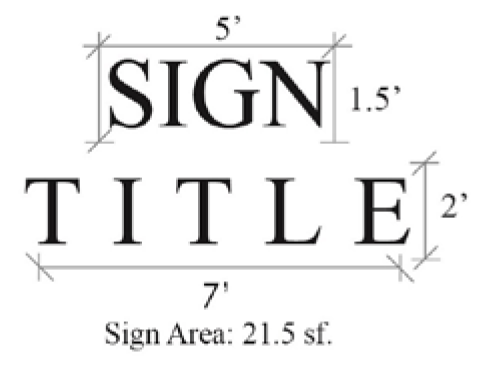
FIGURE 3-12
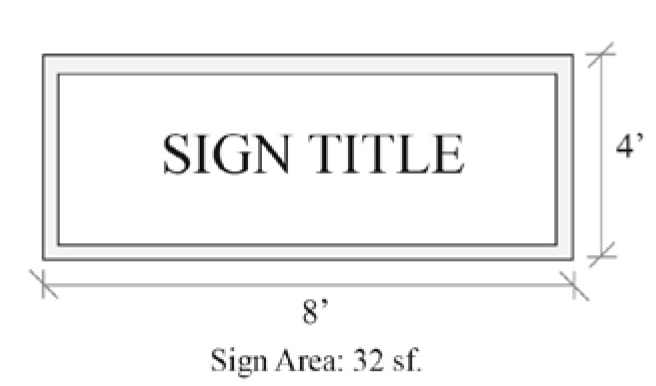
FIGURE 3-13
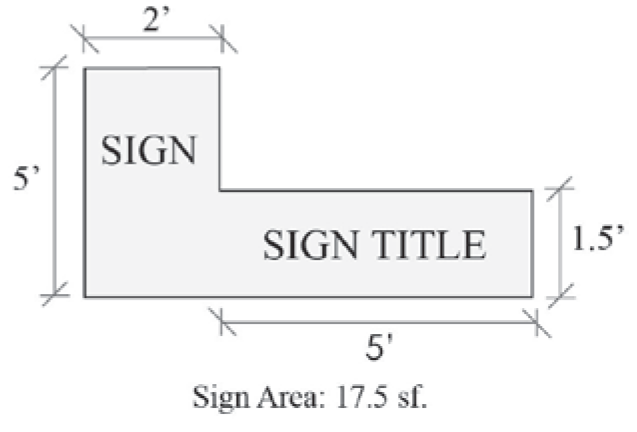
2.
Sign height measurement. Sign height is measured as follows:
a.
Building mounted signs.
i)
For all single-family residential, duplex and multi-family residential uses and mobile home parks, the height of building mounted signs is measured as the vertical distance from the grade below the sign to the top of the highest element of the sign.
ii)
Freestanding signs. The height of a freestanding sign is measured as the vertical distance from grade to an imaginary plane located the allowed number of feet above and parallel to the grade to the top of the highest element of the sign.
FIGURE 3-14
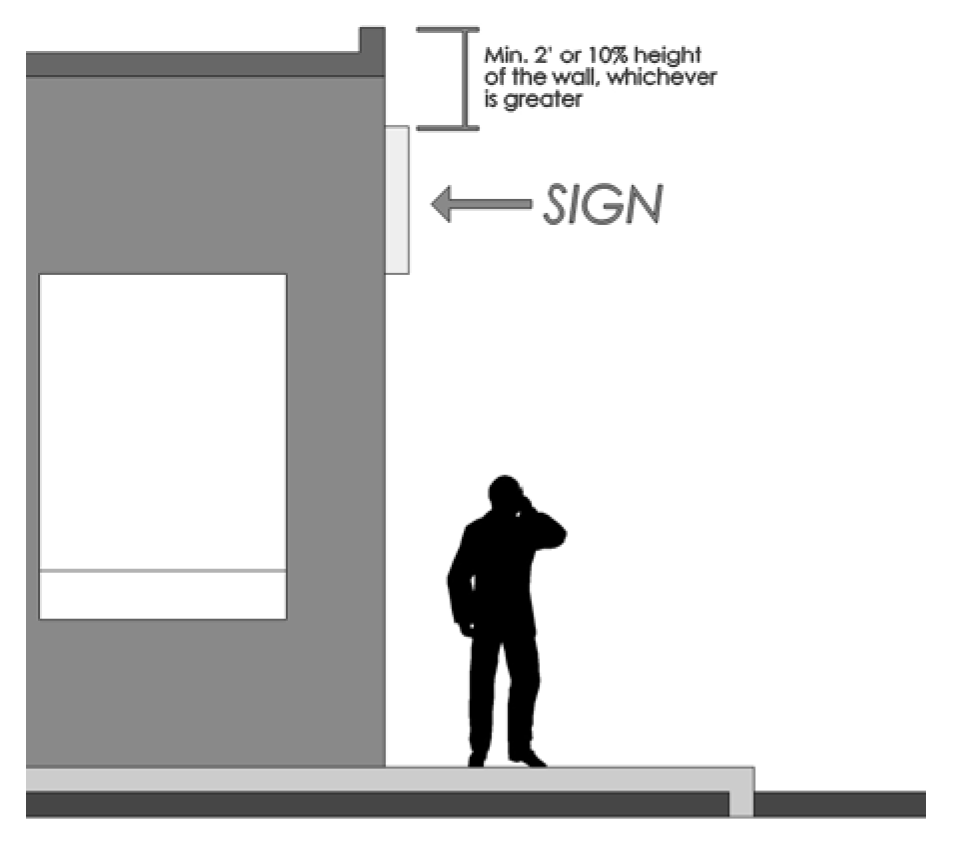
FIGURE 3-15
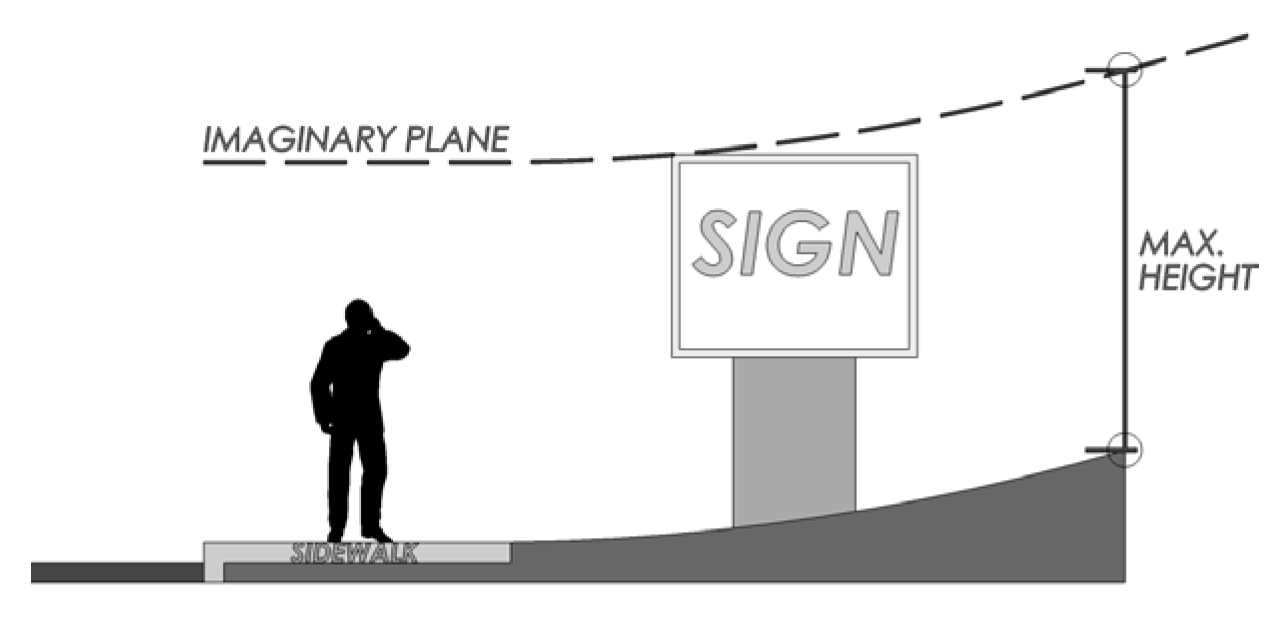
FIGURE 3-16
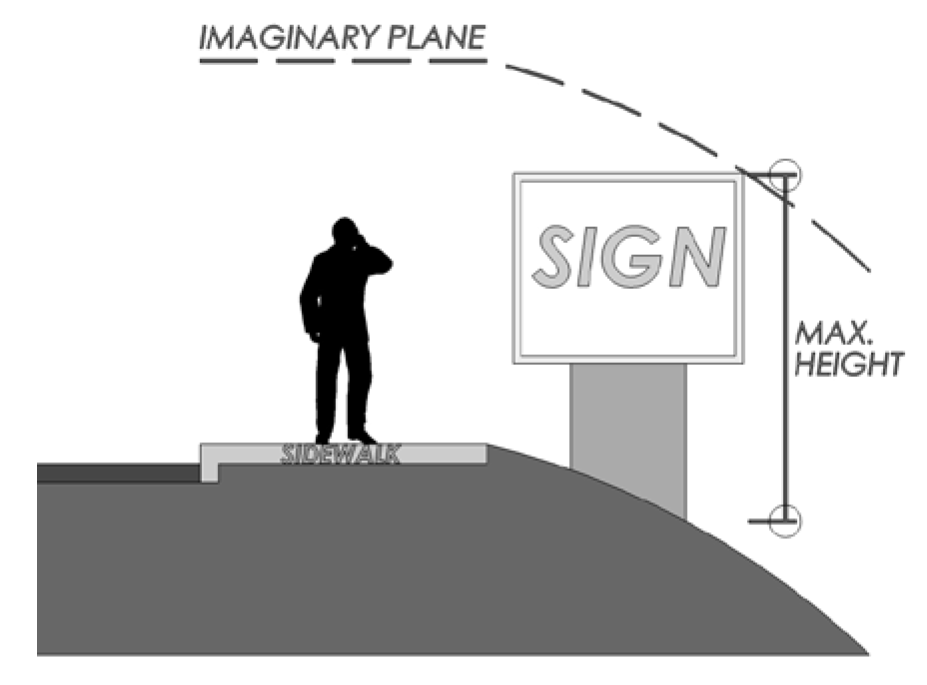
G.
Sign placement at intersection. Freestanding signs shall not obstruct sight distance as established by the County Code (Chapter 13.18) and Section 22.20.050.A.2 (Fencing and Screening Standards - Corner lots).
H.
Sign illumination. Sign illumination must be designed to minimize light and glare on surrounding rights-of-way and properties according to the following standards:
1.
Sign illumination must be limited to avoid light projection or reflection into residential zones;
2.
Sign illuminations must not blink, flash, flutter, or change light intensity, brightness, or color unless consistent with standards for electronic message center signs;
3.
Neither the direct nor reflected light from primary light sources may create hazards for pedestrians or operators of motor vehicles;
4.
Internally illuminated signs shall meet the night-time brightness standards for electronic message center signs. Externally illuminated signs must be illuminated only with steady and stationary light sources directed solely onto the sign without causing glare.
5.
Electronic message center signs.
a.
Electronic message center signs must not flash, blink, flutter, include intermittent or chasing lights, or display video messages (i.e., any illumination or message that is in motion or appears to be in motion). Electronic messages signs may display changing messages provided that each message is displayed for no less than four seconds.
b.
One electronic message center sign may be allowed per property.
c.
Night-time brightness.
i)
Night-time brightness must be measured with an illuminance meter set to measure foot candles accurate to at least two decimals. Illuminance must be measured with the electronic message off, and again with the electronic message displaying a white image for a full color-capable electronic message or a solid message for a single-color electronic message.
ii)
All measurements must be taken perpendicular to the face of the electronic message at the following distance:
Measurement Distance =

iii)
The difference between the off and solid message measurements shall not exceed 0.3 foot candles at night.
d.
Electronic message center signs must be equipped with a sensor or other device that automatically determines the ambient illumination and programmed to automatically dim according to ambient light conditions (e.g., photocell technology), or that can be adjusted to comply with the 0.3-foot candle requirement.
(Ord. No. 3666, § II(exh. A), 2017; Ord. No. 3706, 2019)
22.28.040 - General Standards for Permanent Signs By Use.
Permanent signs shall comply with the sign area, height, number, type, and other requirements of this Section.
A.
Single-Family Residential or Duplex (including home occupations and bed and breakfasts):
Maximum number of signs - one.
Maximum area - four square feet.
Maximum Height - six feet above grade.
B.
Multi-family Residential Developments/Subdivisions/Mobile Home Parks:
Maximum number of signs - one.
Maximum area - 6 square feet.
Maximum Height - 10 feet above grade.
C.
Agricultural Uses:
Maximum number of signs - one.
Maximum area - 12 square feet.
Maximum Height - A minimum distance from the top of the wall or parapet of two feet or 10% of the height of the wall, whichever is greater.
D.
Institutional or Civic Uses:
Maximum number of signs - two.
Maximum area - 24 square feet.
Maximum Height - A minimum distance from the top of the wall or parapet of two feet or 10% of the height of the wall, whichever is greater.
E.
Commercial or Industrial Uses:
Maximum number of signs - two.
Maximum area.
•
Ground floor: One square foot per one linear foot of wall to which the sign is mounted, to a maximum of 50 square feet.
•
Upper floor: 24 square feet.
Maximum Height - A minimum distance from the top of the wall or parapet of two feet or 10% of the height of the wall, whichever is greater.
F.
Outdoor Uses, including Outdoor Commercial Recreation, Outdoor Retail Sales and Activities, and Temporary Outdoor Retail Sales:
Maximum number of signs - one.
Maximum area - 0.5 square feet per one linear foot of distance of the property line that the sign faces most directly, up to a maximum of 50 square feet.
Maximum Height - A minimum distance from the top of the wall or parapet of two feet or 10% of the height of the wall, whichever is greater.
(Ord. No. 3666, § II(exh. A), 2017)
22.28.050 - Standards for Specific Sign Types.
All signs shall comply with the standards established in Table 3-6 (Standards for Specific Sign Types). Each sign type listed in this Section shall be included in the calculation of the total sign area for signs allowed on a development site by this Section. Each sign shall also comply with the sign area, height, and other requirements of 22.28.040 (General Standards for Permanent Signs by Use), and all other applicable provisions of this Chapter. Any non-commercial message may be substituted for the sign copy on any commercial sign allowed by this Chapter.
TABLE 3-6
STANDARDS FOR SPECIFIC SIGN TYPES
End Notes:
1
Only if not visible from the public right-of-way. If the sign is visible from the public right-of-way, it must be considered a freestanding or building mounted sign and will be included in the limitations for maximum number of signs and sign area.
2
Maximum window sign area includes both permanent and temporary window signs.
A.
Supplemental standards by sign type. In addition to the standards in 22.28.040 (General Standards for Permanent Signs by Use), signs must comply with the following supplemental standards applicable to the specific sign type. Each sign must also comply with the requirements of Section 22.28.030 (General Restrictions for All Signs) and all other applicable provisions of this Chapter.
1.
Awning sign. The following standards apply to awning signs (Figure 3-17), in addition to the standards in Table 3-6 (Standards for Specific Sign Types).
a.
Mounting Height.
(1)
Maximum 25 feet on ground floor awnings; and
(2)
Minimum eight feet from the bottom of the awning to the nearest grade or sidewalk.
b.
Sign Placement.
(1)
Only above the doors and windows of the ground floor of a building;
(2)
An awning shall not project above, below or beyond the edges of the face of the building wall or architectural element on which it is located;
(3)
Displayed only on the vertical surface of an awning; and
(4)
Sign width shall not be greater than 60% of the width of the awning face or valence on which it is displayed.
c.
Setback from Back of Curb. Minimum 18 inches.
d.
Illumination. Not permitted.
FIGURE 3-17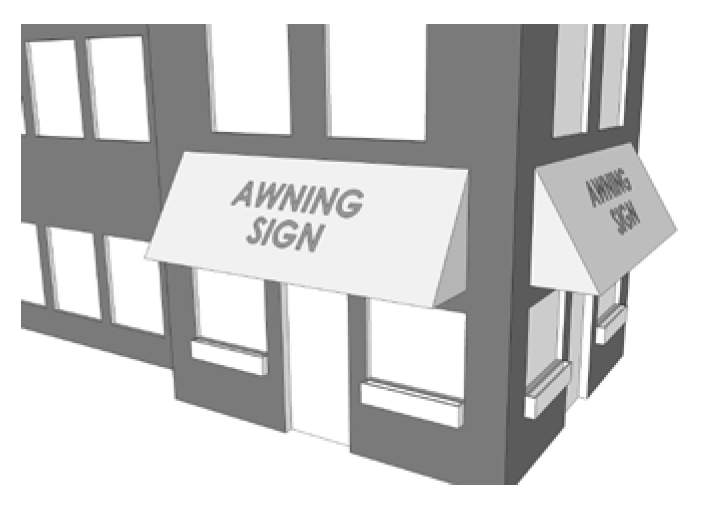
2.
Canopy sign. The following standards apply to canopy signs (Figure 3-18), in addition to the standards in Table 3-6 (Standards for Specific Sign Types).
a.
Mounting height.
(1)
Maximum 25 feet on ground floor canopies (see Figure 3-18);
(2)
Minimum eight feet from the bottom of the canopy to the nearest grade or sidewalk.
b.
Sign placement.
(1)
Only above the doors and windows of the ground floor of a building;
(2)
A canopy shall not project beyond the edges of the face of the building wall or architectural element on which it is located; and
(3)
Shall not extend horizontally a distance greater than 60% of the width of the canopy on which it is displayed.
c.
Setback from back of curb. Minimum 18 inches.
d.
Illumination. Internal illumination allowable only in commercial zoning districts. Internal illumination only for the letters or logos mounted on a canopy. May also be non-illuminated.
FIGURE 3-18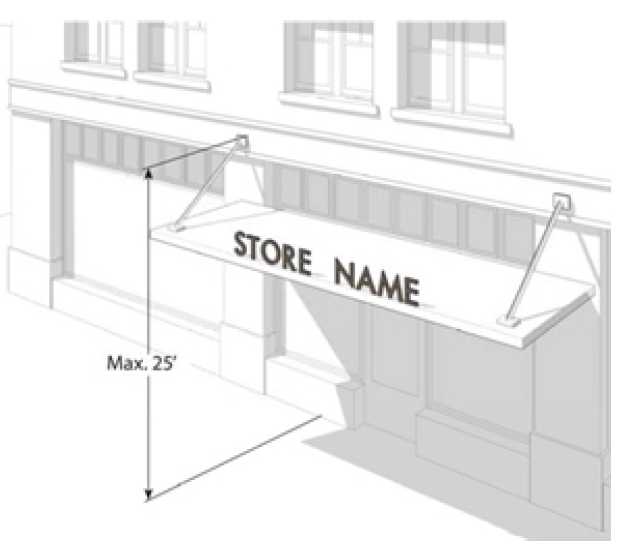
3.
Changeable copy sign. The following standards apply to changeable copy signs, including non-flashing electronic message center signs, (Figure 3-19), in addition to the standards in Table 3-6 (Standards for Specific Sign Types):
a.
For a non-commercial use, up to 50 percent but not exceeding 50 square feet of the allowed sign area may be used for changeable copy;
b.
For a multi-commercial use, over 50 percent but not exceeding 100 square feet of the allowed sign area may be used for changeable copy; and
c.
Illumination. Internal illumination allowable only in commercial zoning districts. Illumination permitted in accordance with Section 22.28.030.H (Sign Illumination). May also be non-illuminated.
FIGURE 3-19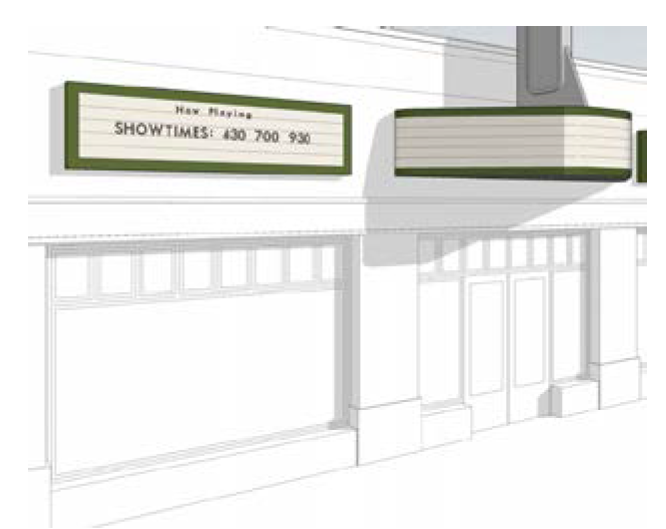
4.
Directory signs. The following standards apply to directory signs (Figure 3-20), in addition to the standards in Table 3-6 (Standards for Specific Sign Types).
a.
Maximum sign height.
(1)
Ground mounted directory signs must not exceed six feet;
(2)
Structure mounted directory signs must not exceed six feet from the bottom of the sign to the top of the sign, with the top of the sign no more than 12 feet above ground level; and
(3)
Ground mounted directory signs must comply with the standards for freestanding signs in Subsection 22.28.050.A.5 (Freestanding signs).
b.
Illumination. Internal illumination allowable only in commercial zoning districts. Illumination permitted in accordance with Section 22.28.030.H (Sign Illumination).
FIGURE 3-20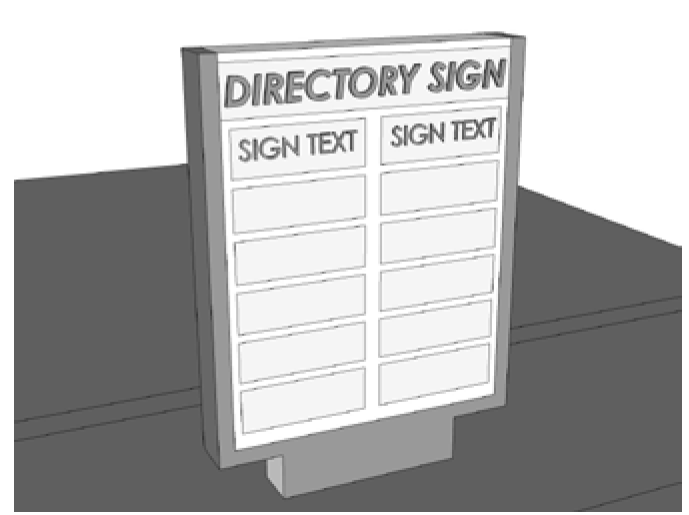
5.
Freestanding signs. The following standards apply to freestanding signs (Figure 3-21), in addition to the standards in Table 3-6 (Standards for Specific Sign Types).
a.
Setback. Minimum one foot from a property line in non-residential zones, and a minimum of five feet from a property line in residential zones.
b.
Landscaping. Freestanding signs must be surrounded by minimum of 70 square feet of landscaping.
c.
Illumination. Internal illumination allowable only in commercial zoning districts. Permitted in accordance with Section 22.28.030.H (Sign Illumination).
d.
Base width. Freestanding signs larger than four square feet or taller than three feet must include a sign base with an aggregate width of at least 40% of the width of the sign face. See Figure 3-21.
e.
Separation. Multiple freestanding signs should be separated by a minimum of 60 feet to ensure adequate visibility for all signs. The Director may modify this requirement where the locations of existing signs on adjacent properties would make the 60-foot separation impractical.
FIGURE 3-21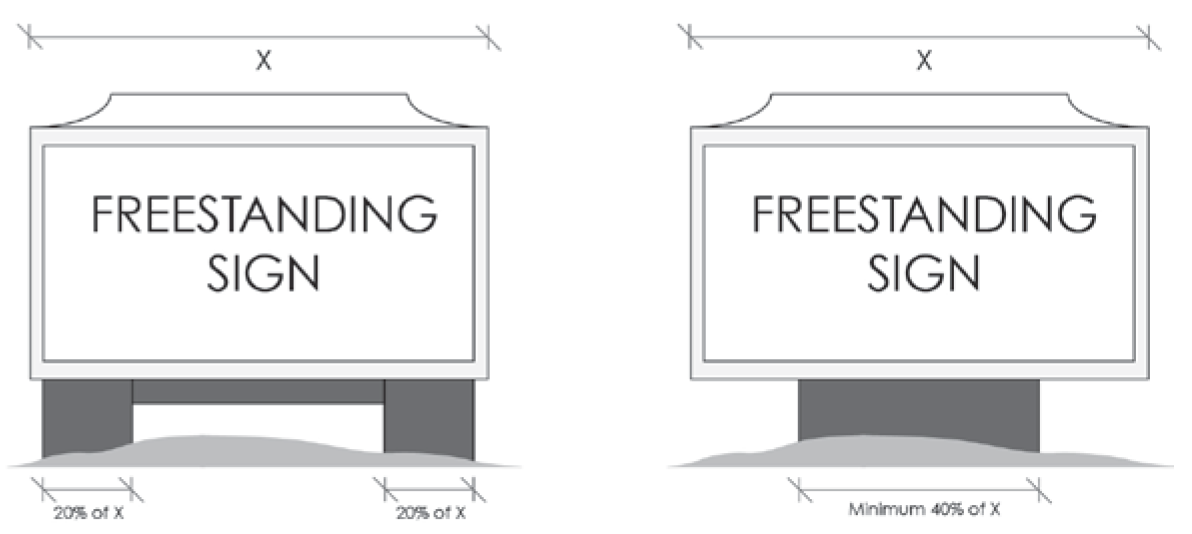
6.
Projecting signs. The following standards apply to projecting signs (Figure 3-22), in addition to the standards in Table 3-6 (Standards for Specific Sign Types).
a.
Vertical clearance. Minimum eight feet from bottom of the sign to finished grade below.
b.
Projection into public right-of-way. Signs must not encroach into the County right-of-way and must not encroach into State right-of-way unless authorized by the State.
c.
Maximum sign height. Top of sign maximum 14 feet above finish grade below.
(1)
Projecting signs must not extend more than six feet from a structure wall;
(2)
Projecting signs must be double-sided.
d.
Illumination. Internal illumination allowable only in commercial zoning districts. Permitted in accordance with Section 22.28.030.H (Sign Illumination).
FIGURE 3-22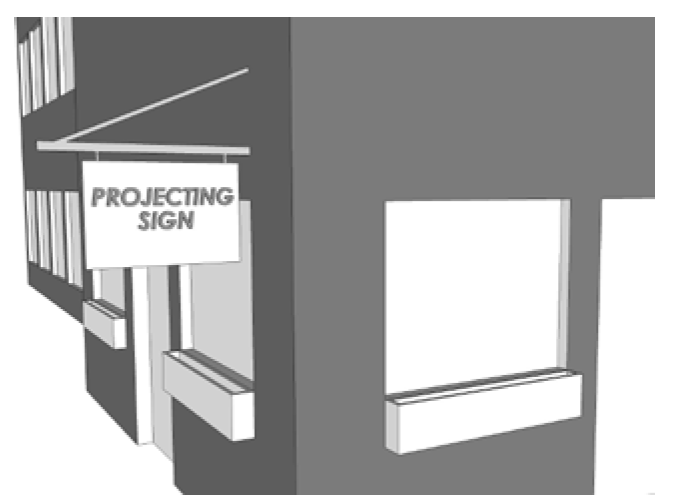
7.
Suspended signs. The following standards apply to suspended signs (Figure 3-23), in addition to the standards in Table 3-6 (Standards for Specific Sign Types):
a.
Vertical clearance. Minimum eight feet from bottom of the sign to finished grade below.
b.
Limited to ground level businesses only.
c.
Illumination. Internal illumination allowable only in commercial zoning districts. Permitted in accordance with Section 22.28.030.H (Sign Illumination).
FIGURE 3-23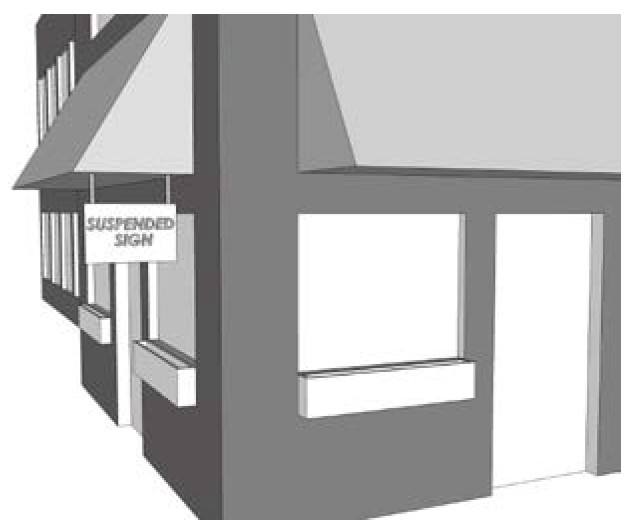
8.
Wall Signs. The following standards apply to wall signs (Figure 3-25), in addition to the standards in Tables 3-7 (Standards for All Temporary Signs On Private Property) and 3-6 (Standards for Specific Sign Types):
a.
Sign placement. The total sign area for wall signs on single-tenant or multi-tenant buildings may be placed on any building elevation, except:
i)
No sign shall face an adjoining residential zone;
ii)
Signs shall be placed the lesser of 12 inches or 20% of the width and height of the building element on which they are mounted (See Figure 3-24);
iii)
The width of the sign shall not be greater than 60% of the width of the building element on which it is displayed; and
iv)
Individual tenants in multi-tenant buildings are permitted building mounted signs only on the primary entrance elevation of the space occupied by the business.
FIGURE 3-24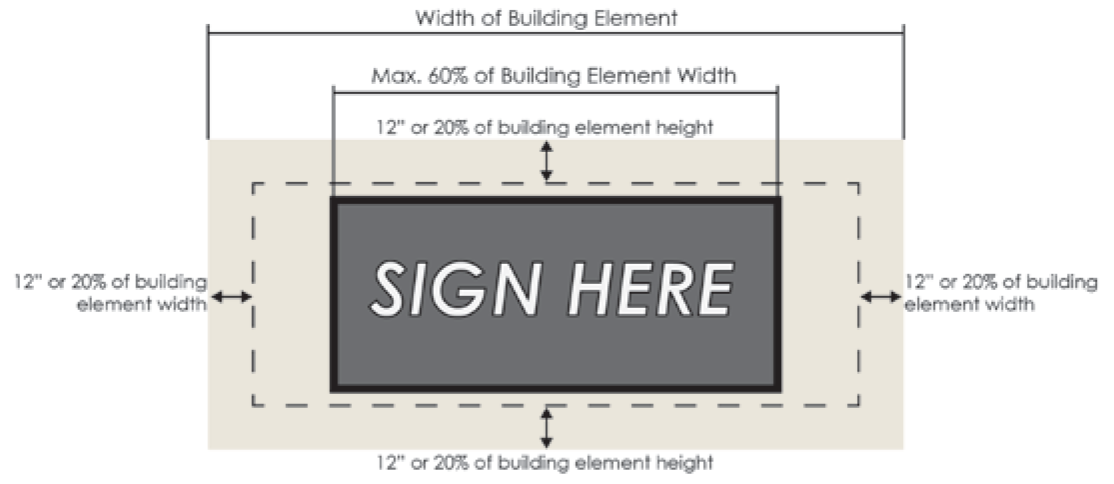
b.
Projection. A wall sign must not project more than 12 inches from the surface to which it is attached.
c.
Illumination. Internal illumination allowable only in commercial zoning districts. Permitted in accordance with Section 22.28.030.H (Sign Illumination).
FIGURE 3-25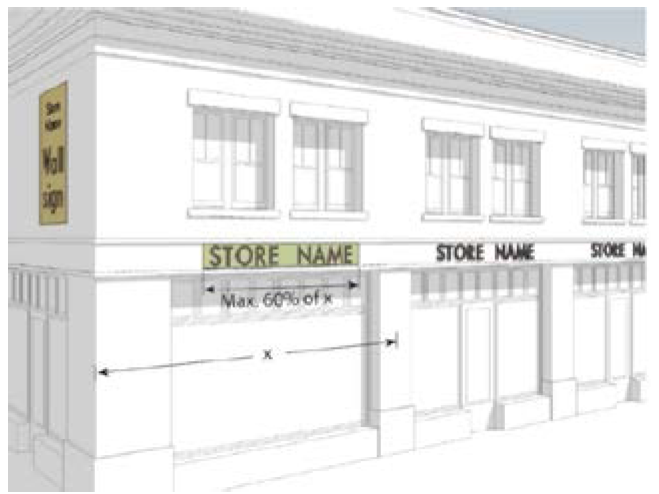
9.
Window signs. The following standards apply to window signs (Figure 3-26), in addition to the standards in Table 3-6 (Standards for Specific Sign Types):
a.
Location. Window signs are only allowed on first story windows.
b.
Other standards. Temporary signs placed in a window also count toward maximum allowable window sign area.
FIGURE 3-26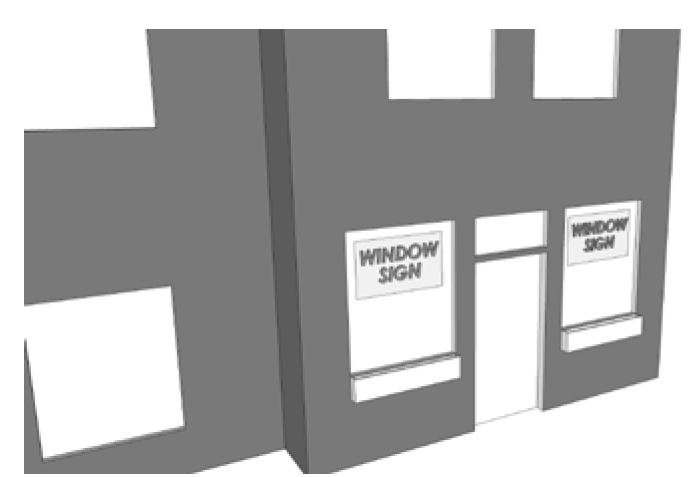
(Ord. No. 3666, § II(exh. A), 2017; Ord. No. 3706, 2019; Ord. No. 3797, § II(exh. A), 2023)
22.28.060 - Temporary Sign Standards.
A.
Purpose. The proliferation of temporary signs can be a distraction to the traveling public and creates aesthetic blight and litter that threatens the public health, safety, and welfare. The purpose of these regulations is to ensure that temporary signs do not create a distraction to the traveling public by eliminating the aesthetic blight and litter caused by temporary signs.
B.
General to all. All temporary signs must comply with the following:
1.
Wall banners shall not be displayed for more than 30 days per year and other authorized temporary signs shall not be displayed for more than 100 days per year without Temporary Sign Permit approval;
2.
Temporary signs must not be placed on or affixed to any County property, including County rights-of-way, except as specifically authorized in connection with a special event permitted in the County; and
3.
Temporary signs shall not be placed in the clear view zone at street intersections (Section 22.20.050.A.2) or driveways (refer to Chapter 13.18 (Visibility Obstructions) of the County Code).
C.
Standards for temporary signs. Temporary signs placed on private property are allowed in all zoning districts in compliance with the following standards:
1.
Time, place, and manner restrictions for temporary signs on private property. Temporary signs on private property shall comply with the standards provided in Table 3-7 (Standards for All Temporary Signs on Private Property).
TABLE 3-7
STANDARDS FOR ALL TEMPORARY SIGNS ON PRIVATE PROPERTY
2.
Types of Temporary Signs. Temporary signs shall comply with the standards provided in Table 3-8 (Standards for Specific Temporary Sign Types).
TABLE 3-8
STANDARDS FOR SPECIFIC TEMPORARY SIGN TYPES
End Notes:
1 Other temporary sign types may be allowed (e.g. fuel pump topper signs or wraps around waste receptacles) provided the max area limitation for all temporary signs is not exceeded.
(Ord. No. 3666, § II(exh. A), 2017; Ord. No. 3797, § II(exh. A), 2023)
22.30.010 - Purpose of Chapter.
This Chapter provides development standards for specific unincorporated communities, where the preservation of unique community character requires standards for development that differ from the general requirements of this Article and Article II (Zoning Districts and Allowable Land Uses).
(Ord. No. 3577, 2012)
22.30.020 - Applicability.
The provisions of this Chapter apply to proposed development and new land uses in addition to the general site planning standards of Article II (Zoning Districts and Allowable Land Uses), this Article, and all other applicable provisions of this Development Code. In the event of any conflict between the provisions of this Chapter and any other provision of this Development Code, this Chapter shall control.
(Ord. No. 3577, 2012)
22.30.030 - Communities within the Coastal Zone.
Standards for specific communities within the Coastal Zone are located in Article V (Coastal Zone Development and Resource Management Standards).
(Ord. No. 3577, 2012)
22.30.040 - Lucas Valley Community Standards.
A.
Applicability. The standards of this Section apply to development and land uses within the area identified as Lucas Valley in the Countywide Plan (Lucas Valley Land Use Policy Map 2.2) and the governing R1:BLV (Single-Family Residential Lucas Valley) zoning district.
B.
Purpose. This Section provides development standards intended to: (1) preserve the unique architectural style of the Eichler-design residences that define the predominant character of the Lucas Valley community; and (2) preserve those design attributes that characterize the lots with Eichler-design structures and those lots with non-Eichler-design structures located on Mount Tallac Court, Mount Wittenburg Court, Mount Palomar Court and Mount Muir Court.
C.
Limitation on uses within the R1:BLV zoning district. Allowable land uses shall be limited to the following on properties within the R1:BLV zoning district, instead of those normally allowed in the R1 zoning district by Section 22.10.030 (Residential District Land Uses and Permit Requirements):
1.
Single-family dwellings;
2.
Public parks and playgrounds;
3.
Noncommercial greenhouses accessory to single-family dwellings;
4.
Home occupations, in compliance with Section 22.32.100 (Home Occupations);
5.
Schools, libraries, churches, monasteries, convents, tennis courts and similar noncommercial recreational uses, subject to Use Permit approval in compliance with Chapter 22.48 (Conditional Use Permits);
6.
Child day-care facilities, in compliance with Section 22.32.050 (Child Day-Care Facilities); and
7.
Accessory buildings and accessory uses.
D.
Design standards.
1.
Height limit for Eichler-design residences. 15 feet, six inches, or the height as approved of the existing residence, whichever is greater. Structures over the height limit require Variance approval in compliance with Chapter 22.54 (Variances).
2.
Height limit for Mount Palomar Court lots. 16 feet, six inches. Structures over the height limit require Variance approval in compliance with Chapter 22.54 (Variances).
3.
Height limit for Mount Tallac Court, Mount Wittenburg Court, and Mount Muir Court lots. 30 feet. Structures over 30 feet in height and up to 35 feet in height require Design Review approval in compliance with Chapter 22.42 (Design Review). Structures over 35 feet in height require Design Review and Variance approval in compliance with Chapters 22.42 (Design Review) and 22.54 (Variances).
4.
Height limits for roof-mounted and ground-mounted solar panels. Flush-mounted solar panels may extend up to two feet in height above the roof. Height in excess of two feet above the roof shall require Design Review approval in compliance with Chapter 22.42 (Design Review). Ground-mounted solar panels located within the side and rear yards behind a solid fence shall not exceed a height of four feet above grade, unless approved through Design Review.
5.
Detached accessory structures. Height limit for lots with Eichler-design residences and for Mount Palomar Court lots: Detached accessory structures shall not exceed 100 square feet in floor area and a maximum height of eight feet. Structures over the size or height limit require Design Review approval in compliance with Chapter 22.42 (Design Review).
6.
Detached accessory structures. Height limit for Mount Tallac Court, Mount Wittenburg Court, and Mount Muir Court: Detached accessory structures shall not exceed 100 square feet in floor area and a maximum height of 15 feet or the height of the existing residence, whichever is lower. Structures over the size or height limit require Design Review approval in compliance with Chapter 22.42 (Design Review).
7.
Setback requirements. Structures shall be located in compliance with the following minimum setbacks from property lines. See Section 22.20.090.B (Measurement of Setbacks):
a.
Front: 25 feet.
b.
Sides: Six feet on each side; ten feet for a street side setback on a corner parcel.
c.
Rear: 20 percent of the lot depth, up to a maximum of 25 feet.
8.
Exemptions from setback requirements. The improvements listed in Section 22.20.090.D (Exemptions from setback requirements) are exempt from setback requirements in the R1:BLV zoning district.
9.
Allowable Floor Area Ratio (FAR). 30 percent (0.30) of lot area is permitted.
10.
Minimum lot area required. 7,500 square feet, except as provided for in Section 22.82.050 (Hillside Subdivision Design).
E.
Design Review required and additional findings. All new construction and modifications to existing structures in the R1:BLV zoning district, with the exception of those improvements listed in Section 22.30.040.F. below, shall be subject to Design Review approval in compliance with Chapter 22.42 (Design Review). The review authority may approve a Design Review, with or without conditions, only if all of the following findings are made:
1.
All mandatory findings contained in Section 22.42.060 (Design Review - Decision and Findings) can be made.
2.
For an Eichler-design residence, the proposed development and improvements retain and preserve the classic architectural design elements and design concepts including, but not necessarily limited to: Retention of the simple, rectilinear style, form, and facades; respect of the post-and-beam detailing; window and door details; roof slopes; exterior finishes and colors; scale and proportions; transition of spaces; entry courtyards; atrium features; and deep roof overhangs.
3.
The over-all residential development preserves, and is compatible with, the existing character and quality of the prevailing single-family residential neighborhood.
4.
The proposed development utilizes exterior building materials, surfaces, and colors consisting of natural and non-reflective materials and colors that blend into the natural environment unobtrusively. Exterior materials and colors on Eichler-design residences are consistent with the classic Eichler exterior characteristics and finishes.
5.
The landscaping design utilizes fire resistance, erosion control, and drought-tolerant species, provides visual buffering for privacy, and upon maturity will not obscure the major views of the off-site vistas as seen from public streets. The landscaping design utilizes landscaping material that blends and is consistent with the prevailing neighborhood design characteristics.
6.
Siting of additions preserves privacy and views between neighboring residences.
F.
Exemptions from Design Review. The following developments and physical improvements are exempt from Design Review:
1.
Skylights, flush-mounted solar panels that do not exceed two feet above the roof line, chimneys, satellite dishes, ground-mounted air conditioning units located within the interior side and rear yards behind a solid fence, wall-mounted air conditioning units on a building elevation that faces an interior side or rear yard, and pool equipment;
2.
Replacement and repair of exterior siding, roofing, windows and doors;
3.
Exterior painting;
4.
Interior remodels;
5.
Atrium enclosures which do not exceed the height of the existing roofline;
6.
Wood fences which do not exceed six feet in height and located within the side and rear yards or on the property line defining such yards;
7.
Decks and patios not exceeding 18 inches in height above grade;
8.
Landscape improvements;
9.
Ground-mounted solar panels that do not exceed four feet in height above grade and are located within the side and rear yards behind a solid fence; and
10.
Other work that the Director determines to be minor and incidental in nature and which is in compliance with the purpose of the Chapter 22.42 (Design Review).
(Ord. No. 3577, 2012)
22.30.045 - San Geronimo Community Standards.
A.
Applicability. The standards of this Section apply to development and land use within the area identified as San Geronimo Valley in the Countywide Plan (San Geronimo Valley Land Use Policy Map 7.10.0) and the governing SGV (San Geronimo Valley) combining district.
B.
General Development Standards. The standards of this Subsection apply to development and land use outside the Countywide Plan Stream Conservation Area in the governing SGV (San Geronimo Valley) combining district.
1.
Roads and Driveways. Non-county maintained roads and privately owned and maintained roads, including new roads and driveways, either paved or unpaved, shall be constructed to the standards specified below:
a.
Surface drainage.
1)
Road surfaces and ditches are hydrologically "disconnected" from streams and stream crossing culverts, with a maximum allowable hydrologic connectivity of 25% of the total new road surface and compacted shoulder area (paved and unpaved). To be considered disconnected, road surface runoff is dispersed, rather than collected and concentrated, and does not return to a connected ditch farther downstream.
2)
Fine sediment contributions from roads, cutbanks and ditches are minimized by utilizing seasonal closures and installing a variety of surface drainage techniques including berm removal, road surface shaping (i.e., outsloping, insloping, crowning), rolling dips, ditch relief culverts, waterbars and other measures to disperse road surface runoff and reduce or eliminate sediment delivery to the stream.
b.
Road fills.
1)
Unstable and potentially unstable road fills that could deliver sediment to a stream are excavated (removed) or structurally stabilized.
2)
Excavated spoil is placed in locations where eroded material will not enter a stream.
3)
Excavated spoil is placed where it will not cause a slope failure or landslide.
c.
Off-site retrofits. If on-site avoidance or minimization of surface runoff and sediment erosion is not feasible using the above criteria, off-site retrofit of existing impaired sites (e.g. stream crossings currently diverted or with diversion potential, culverts likely to plug or undersized culverts), would occur at a 2:1 ratio for total runoff area in a functionally equivalent riparian area of San Geronimo Creek or its major tributaries (North Fork San Geronimo Creek, Woodacre Creek. Montezuma Creek, Arroyo/Barranca/EI Cerrito Complex, Larsen Creek) within reaches accessible to anadromous salmonids. If functionally equivalent off-site mitigation opportunities cannot be identified within these locations, then opportunities can be selected elsewhere in San Geronimo Valley and/or in the downstream Lagunitas Creek watershed using existing site-specific sediment source assessments.
2.
Low Impact Development. Development outside the Stream Conservation Area that would create or replace 500 square feet or more of lot coverage shall incorporate low impact development practices and designs that are demonstrated to prevent offsite discharge from events up to the 85 th percentile 24-hour rainfall event. This requirement applies to retention of the entire volume, of each day's rainfall that does not achieve this total volume, and the first increment of rain up to this volume for those 24-hour periods whose rainfall exceeds this volume, Specifically:
a.
Complete a stormwater control plan that achieves retention of the 85th percentile, 24-hour design storm for the newly created or replaced impervious surface, or for an equivalent area of previously unretained impervious surface on the same site. It is acceptable for the stormwater control plan to use the existing runoff reduction measures as described in Appendix C of the Bay Area Stormwater Management Agencies Association (BASMAA) Post-Construction Manual to retain the 85 th percentile, 24-hour design storm standard. It is also acceptable to use the bioretention sizing factor (0.04) described in Appendix D of the BASMAA Post-Construction Manual to retain the 85 th percentile, 24-hour design storm standard.
b.
Complete a storm water control plan that achieves retention of the 85 th percentile, 24-hour design storm for the newly created or replaced impervious surface, or for all equivalent area of previously unretained impervious surface on the same site it is acceptable for the stormwater control plan to use the bioretention sizing factor (0.04) described in appendix D of the BASMAA Post-Construction Manual to retain the 85 th percentile, 24-hour design storm standard.
C.
General Stream Conservation Area Standards. The standards of this Subsection apply to development and land uses within Stream Conservation Areas in the governing SGV (San Geronimo Valley) combining district.
1.
Site Assessment. A site assessment is required as part of a Site Plan Review permit application when development is proposed in the Stream Conservation Area, where adverse impacts to riparian resources may occur, or when full compliance with Subsection 2. below, would not be met. The site assessment shall identify site specific standard management practices in accordance with Subsection 5. below, and shall confirm that the proposed development would result in no net loss of habitat acreage, value, or function.
2.
Limitations on Uses. Allowable land uses subject to the SGV combining district and located within the Stream Conservation Area shall be limited to the following:
a.
Allowable uses within 35-feet from top of bank, or from centerline of swale for ephemeral streams where there is no defined top of bank, within the Stream Conservation Area:
1)
Maintenance and repair of existing permitted structures within the existing footprint;
2)
Driveway, road, and utility crossings, if no other location that avoids encroaching in the buffer is feasible and the crossing is sited to minimize environmental impacts;
3)
Projects to improve fish and wildlife habitat;
4)
Water-monitoring installations;
5)
Passive recreation that does not disturb native species; and
6)
Necessary water supply and flood control projects that minimize impacts to stream function and to fish and wildlife habitat.
b.
Allowable uses outside 35-feet from top of bank, or from centerline of swale for ephemeral streams where there is no defined top of bank, within the Stream Conservation Area:
1)
Maintenance and repair of existing permitted structures;
2)
Additions to existing permitted structures that do not:
a.
Increase the lot coverage within the Stream Conservation Area by more than a cumulative total of 300 square feet; or
b.
Increase the horizontal encroachment into the Stream Conservation Area.
Vertical additions to existing permitted structures that do not expand the existing footprint are not counted towards the 300 square foot cumulative lot coverage allowance.
The 300 square feet of cumulative lot coverage is calculated on a per parcel basis following the effective date of this Section (August 18, 2022). No additional lot coverage may be added once the allowance is exhausted, consistent with state law. Not withstanding the foregoing, state law may require the allowance of certain other uses and/or development that is not otherwise contemplated by this Section.
3)
Driveway, road, and utility crossings, if no other location is feasible;
4)
Projects to improve fish and wildlife habitat:
5)
Water-monitoring installations;
6)
Passive recreation that does not disturb native species;
7)
Necessary water supply and flood control projects that minimize impacts to stream function and to fish and wildlife habitat:
8)
Agricultural uses that do not result in any of the following:
a.
The removal of woody riparian vegetation;
b.
The installation of fencing within the Stream Conservation Area that prevents wildlife access to the riparian habitat within the Stream Conservation Area;
c.
Animal confinement within the Stream Conservation Area; and
d.
A substantial increase in sedimentation.
The above listed uses shall comply with all other applicable requirements of this Development Code.
Land uses and improvements not listed above are prohibited, unless such improvements and land use meet the criteria for an exception in Subsection 4. below.
3.
Vegetation Removal Below Top of Bank. The removal of native vegetation below top of bank shall be prohibited.
4.
Exceptions. Exceptions to full compliance with all Stream Conservation Area criteria and standards in Subsection 2.b., above, may be allowed only if the parcel is undeveloped as of the effective date of this Section and following is true:
a.
A lot falls entirely within the Stream Conservation Area; or
b.
Development on the parcel entirely outside the Stream Conservation Area:
1)
Cannot be accomplished even if the proposed development is limited to 1,000 square feet or less of lot coverage on the parcel as a whole with the least possible encroachment into the Stream Conservation Area, or relocated to another suitable portion of the parcel that avoids encroachment in the Stream Conservation Area; or
2)
Would have greater impacts on water quality, wildlife habitat, other sensitive biological resources, or other environmental constraints than development within the Stream Conservation Area.
Exceptions under this Subsection would require an application supported by a showing of good cause and public noticing and shall be subject to the provisions in Chapter 22.114 (Appeals).
5.
Standard Management Practices. Development in the Stream Conservation Area subject to the SGV combining district shall incorporate appropriate Standard Management Practices identified in the Site Assessment, unless site specific measures identified through environmental review would result in equal or greater environmental benefit.
D.
Habitat Restoration Program. Approval of Site Plan Review permits within the SGV combining district shall be subject to compliance with any development impact fees, applicable at the time an application for Site Plan Review is approved, established to offset development impacts to the Stream Conservation Area through restoration and enhancement of riparian habitat within the San Geronimo Valley.
E.
Violations. Any violation of the provisions in this Section shall be enforced through any legal remedies available to correct and/or abate a nuisance or violation of the Development Code, including, but not limited to, the administrative citation penalty schedule as provided in Chapters 1.05 (Nuisance Abatement) and 1.07 (Imposition of Administrative Fines for Ordinance Violations) of the Marin County Code.
1.
Any violation of the limitations on use established in Section 22.30.045.C.2 constitutes a public nuisance subject to the provisions in Chapters 1.05 (Nuisance Abatement) and 1.07 (Imposition of Administrative Fines for Ordinance Violations) of the Marin County Code.
(Ord. No. 3770, § 1(exh. A), 2022)
22.30.050 - Sleepy Hollow Community Standards.
The following standards shall apply in the area identified by the Countywide Plan as Sleepy Hollow that is zoned R1:BD or A2:BD:
A.
Limitation on use, R1:BD district. Allowable land uses shall be limited to the following on properties in the R1:BD zoning district, instead of those normally allowed in the R1 zoning district by Section 22.10.030 (Residential District Land Uses and Permit Requirements):
1.
Single-family dwellings;
2.
Golf courses, country clubs, tennis courts, and similar noncommercial recreational uses;
3.
Public parks and playgrounds;
4.
Residential accessory uses and structures, in compliance with Section 22.32.130 (Residential Accessory Uses and Structures); and
5.
Home occupations, in compliance with Section 22.32.100 (Home Occupations).
B.
Limitation on use, A2:BD district. Allowable land uses shall be limited to those normally allowed in the A2 zoning district by Section 22.08.030 (Agricultural District Land Uses and Permit Requirements).
C.
Limitation on animal keeping, R1:BD district. The keeping of livestock of any kind shall be prohibited, except for ordinary household pets. Horses, donkeys, mules or ponies for the personal use of residents may be kept on the site in compliance with Section 22.32.030 (Animal Keeping), provided that the stable or barn is not located closer than 40 feet from any existing dwelling, ten feet from interior side property lines, and 15 feet from street side property lines.
The running area for the animal(s) shall not be closer than 40 feet to an existing dwelling.
D.
General development and use standards.
1.
Minimum floor area for dwelling units. The habitable floor area of each dwelling unit shall contain a minimum of 1,300 square feet, exclusive of porches and garage(s).
2.
Timely construction required. Any structure commenced to be erected or placed on a parcel shall be completed with due diligence.
3.
Setback requirements. Structures shall be located in compliance with the following minimum setbacks. See Section 22.20.090.B (Measurement of Setbacks):
a.
Front: 25 feet.
b.
Sides: Ten feet on each side; 15 feet for a street side setback on a corner parcel.
c.
Rear: 20 percent (0.20) of the parcel depth, up to a maximum of 25 feet.
4.
Height limits: 30 feet. See Section 22.20.060 (Height Measurement and Height Limit Exceptions).
5.
Floor Area Ratio (FAR): 30 percent (0.30) of lot area.
E.
Minimum lot area required. The following minimum areas shall apply in new subdivisions:
1.
General requirement. Each single-family dwelling and any accessory structures shall be located upon a parcel in one ownership with an area of not less than one acre, or an area of not less than 15,000 square feet with a frontage of not less than 100 feet on a public right-of-way.
2.
Sloping lots.
a.
Where the average ground slope is 15 percent or less, the minimum parcel area shall be 15,000 square feet; and
b.
Where the average ground slope is greater than 15 percent, 1,000 square feet of additional parcel area shall be added for each additional one percent of slope over 15 percent, to a maximum of 45,000 square feet.
(Ord. No. 3577, 2012)
22.30.060 - Tamalpais Planning Area Community Standards.
For lots within the Tamalpais Community Plan Area, the following maximum adjusted Floor Area Ratio standards shall apply to: (1) new residential construction proposed on vacant lots; (2) substantial remodels proposed on properties with a slope of 25% or greater; or (3) substantial remodels proposed on properties that do not comply with the minimum lot area requirements. For purposes of this section, substantial additions to an existing structure are additions that add 25% or more of floor area to an existing structure.
A.
Maximum adjusted Floor Area Ratio standards. Maximum adjusted Floor Area Ratio shall not exceed 30 percent (0.30) of lot area, unless modified through discretionary review pursuant to floor area guidelines contained in Appendix B of the Tamalpais Community Plan. The maximum adjusted floor area is the gross enclosed floor area, specifically including:
1.
Unconditioned, unimproved basements and unexcavated crawl spaces that potentially could be converted to living space with minimum dimensions of seven feet by seven feet and a minimum ceiling height of 7.5 feet;
2.
Cathedral ceiling space that potentially could be converted to living space with minimum dimensions 7.5 feet by ten feet and a minimum ceiling height of 7.5 feet;
3.
Accessory dwelling units;
4.
The combined total of all detached accessory structures totaling 120 square feet or more, excluding garage space;
5.
Window boxes or bays less than 18 inches above finished floor, or which extend more than three feet from the face of a building;
6.
Garage space exceeding 400 square feet on a lot 6,000 square feet or less;
7.
Garage space exceeding 480 square feet on a lot larger than 6,000 square feet; and
8.
Covered areas (other than carports or garages, porches and entryways) that potentially could be enclosed and converted to living space. These areas shall be measured to the exterior face of surrounding walls, columns, or posts.
B.
Maximum adjusted floor area permitted. For development of a new residence proposed on a vacant lot that: (1) exceeds a 25% average slope; and (2) requires Design Review, the maximum adjusted floor area permitted shall be limited to the lesser of 7,000 square feet or the adjusted floor area ratio as shown in Appendix B of the Tamalpais Area Community Plan.
(Ord. No. 3577, 2012; Ord. No. 3666, § II(exh. A), 2017)
22.32.010 - Purpose of Chapter.
This Chapter provides site planning and development standards for land uses that are allowed by Article II (Zoning Districts and Allowable Land Uses) and Article V (Coastal Zone Development and Resource Management Standards) in individual or multiple zoning districts (e.g., in residential, commercial, and industrial districts and in residential and commercial, and/or in commercial and industrial districts).
(Ord. No. 3577, 2012)
22.32.020 - Accessory Retail Uses.
The retail sales of food and other products may be allowed in a restaurant, store, or similar facility within a health care, hotel, office, or industrial complex for the purpose of serving employees or customers in compliance with this Section.
A.
Limitation on use. Accessory retail uses shall be limited to serving employees and customers in pharmacies, gift shops, and food service establishments within institutional uses (e.g., hospitals and schools); convenience stores, gift shops, and restaurants/bars within hotels and resort complexes; restaurants within office and industrial complexes; and/or other uses determined to be similar by the Director.
B.
External appearance. There shall be no external evidence (e.g., signs, windows with merchandise visible from streets or sidewalks external to the site, etc.) of any commercial activity other than the primary use of the site (except in the case of a restaurant/bar within a hotel).
(Ord. No. 3577, 2012)
22.32.023 - Agricultural Worker Housing.
The standards of this Section shall apply to agricultural worker housing. The intent of these provisions is to allow sufficient numbers of agricultural worker housing units that are necessary to support agricultural operations and that are consistent with the applicable provisions of State law.
A.
Permitted use, zoning districts. Agricultural worker housing providing accommodations for 12 or fewer employees shall be considered a principally-permitted agricultural land use in the following zoning districts: A2, A3 to A60, ARP, C-APZ, O-A, and C-OA, and are allowed by Articles II (Zoning Districts and Allowable Land Uses) and V (Coastal Zone Development and Resource Management Standards).
B.
Limitations on use.
1.
Density. The maximum density shall not exceed that allowed in the underlying zoning district which governs the site. Agricultural worker housing that exceeds the maximum density may be allowed only in A2, A3 to A60, ARP, and C-ARP zoning districts subject to Use Permit approval in compliance with Chapter 22.48 (Conditional Use Permits).
For purposes of determining compliance with the density requirements for agricultural worker housing, each agricultural worker housing that provides accommodations for six or fewer employees shall be considered equivalent to one dwelling unit, with the exception that agricultural worker housing providing accommodations for seven to 12 employees shall not be counted for purposes of computing residential density. For purposes of this section, family members are not included in the determination of the number of employees.
2.
Referrals. Prior to making a determination that agricultural worker housing which exceeds the maximum density for a specific site is necessary to support agriculture, the review authority may consult with such individuals or groups with agricultural expertise as appropriate for a recommendation.
3.
Temporary mobile home. Any temporary mobile home not on a permanent foundation and used as living quarters for seven to 12 agricultural workers is permitted subject to the requirements of the State Department of Housing and Community Development. Any temporary mobile home providing living quarters for six or fewer agricultural workers requires Use Permit approval, is counted as one dwelling unit for purposes of compliance with the zoning district's density limitations, and shall be subject to the requirements of the State Department of Housing and Community Development.
(Ord. No. 3577, 2012)
22.32.025 - Airparks.
Airparks may be located where allowed by Article II (Zoning Districts and Allowable Land Uses) of this Development Code, for business or emergency purposes, subject to the following standards:
A.
State permit required. A land Use Permit or exemption shall be obtained from the California Department of Transportation, Division of Aeronautics, and evidence of the permit or exemption shall be presented to the Agency, prior to establishing any airpark.
B.
Nuisance mitigation. A proposed airpark shall be located so that neither air or related surface traffic constitute a nuisance to neighboring uses. The applicant shall demonstrate that adequate controls or measures will be taken to mitigate offensive bright lights, dust, noise, or vibration.
Airparks shall not constitute a nuisance resulting from frequency and timing of flights, location of landing area, or departure and approach patterns that conflict with surrounding land uses.
(Ord. No. 3577, 2012)
22.32.030 - Animal Keeping.
The standards of this Section shall apply to the keeping of animals in specified zoning districts and their Coastal Zone counterparts, in addition to the standards in Chapter 8.04 (Animal Control) of the County Code.
A.
General standards. The following general standards shall apply:
1.
Requirements. All animal keeping activities shall comply with the general requirements in Tables 3-9 and 3-10; and
2.
Household pets. There shall be no more than three dogs over the age of four months allowed on a property without Use Permit approval. Other household pets are subject to the requirements for keeping small animals as set forth in Table 3-9.
TABLE 3-9
GENERAL REQUIREMENTS FOR THE KEEPING OF SMALL ANIMALS
(Chickens, Ducks, Exotics, Geese, Guinea Fowl, Pea-fowl, Rabbits, Roosters, Miniature
Goats, Potbellied Pigs and Similar Animals)
TABLE 3-10
GENERAL REQUIREMENTS FOR THE KEEPING OF LARGE ANIMALS,
HORSES, DONKEYS, MULES, AND PONIES
(Cows, Exotics, Goats, Pigs, Sheep, Llamas & Similar Animals)
B.
Standards for livestock, horses, donkeys, mules, and ponies. The following standards, which do not apply in the A-3 to A-60, ARP or APZ zoning districts, shall apply to the keeping of livestock, horses, donkeys, mules, and ponies in addition to those in Section 22.32.030.A (General Standards), above:
1.
Location of animals and structures. No animal or any structure for animals shall be located closer than 30 feet to:
a.
The public right-of-way upon which the parcel faces;
b.
Any dwelling;
c.
Any building line on an adjoining parcel (the boundary extended from the nearest edge of a primary or accessory structure or the required setback line on the adjoining parcel, whichever is closer to the property line). (see Figure 3-27); and
d.
Additionally, no animal or any structure for animals shall be located in a required setback area, or closer than ten feet to a property line.
FIGURE 3-27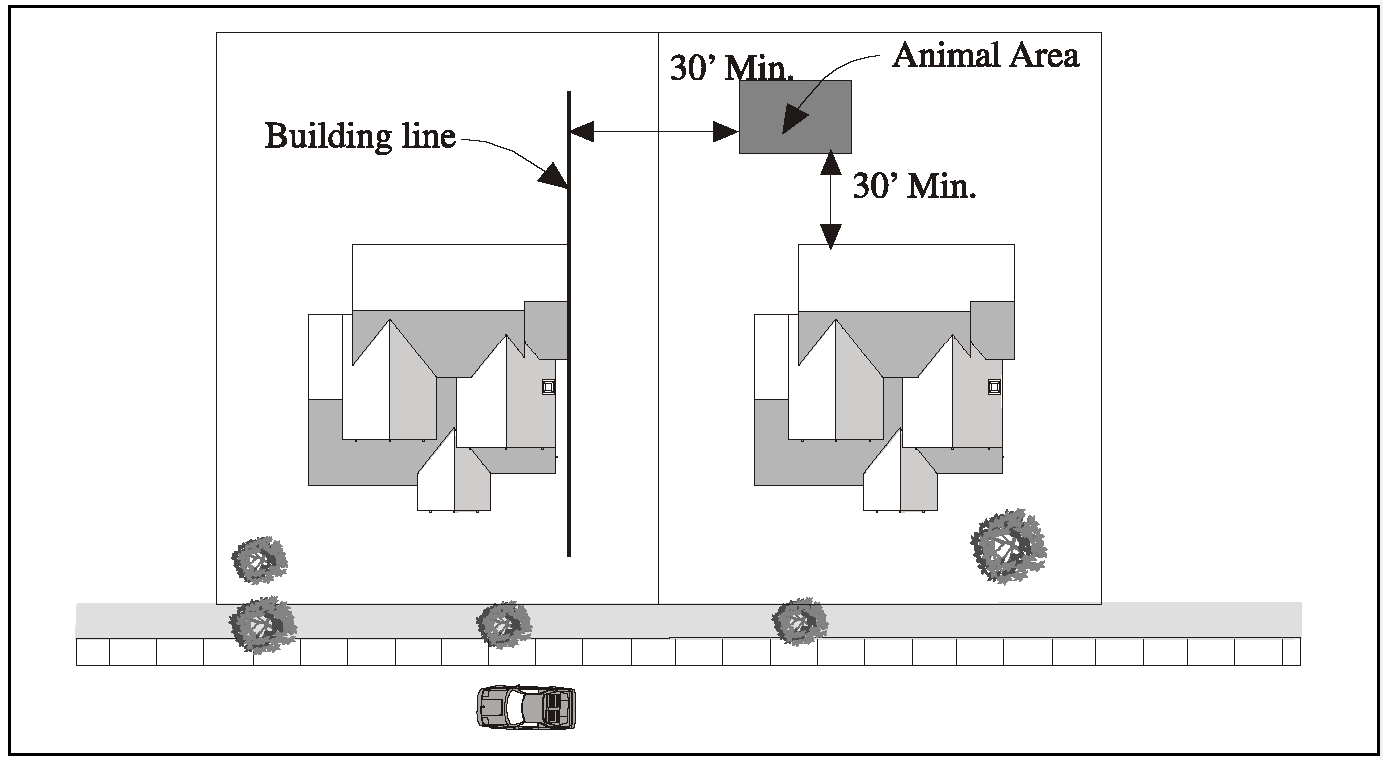
2.
Minimum area and slope standards. The keeping of livestock, horses, donkeys, mules, and ponies shall comply with the following standards:
a.
The minimum lot area for the keeping of one animal shall be 15,000 square feet for properties with one percent through 15 percent slope. For each percent of slope over 15 percent, the minimum lot area shall be increased by 1,000 square feet.
b.
For each additional animal, an additional 5,000 square feet of lot area shall be provided.
c.
No animals shall be allowed on slopes exceeding 50 percent.
3.
Erosion and drainage control plan required. An erosion and drainage control plan shall be submitted and approved by the County Department of Public Works for the keeping of animals on sites over 25 percent in slope.
4.
Site maintenance. The property owner shall submit a manure management plan that should require periodic manure collection and composting or removal of manure from the premises, subject to the approval of the County Health Officer.
5.
Water supply. An adequate supply of fresh water shall be available to animals at all times, subject to the approval of the County Health Officer.
6.
Exceptions by Use Permit. The keeping of horses, donkeys, mules, or ponies may be allowed with Use Permit approval, in compliance with Chapter 22.48 (Conditional Use Permits), in any zoning district not listed in this Section or for an exception from any of the standards.
7.
Existing uses conforming. Any residential property where horses, donkeys, mules, or ponies are legally kept as of the effective date of this Development Code shall be deemed to be conforming. Any expansion of use shall be subject to the provisions of this Section.
C.
Standards for chickens. The following standards, which do not apply in the A-3 to A-60, ARP or APZ zoning districts, shall apply to the keeping of chickens in addition to those in 22.32.030.A (General Standards), including Table 3-9, above:
1.
Location of chickens and structures. No chicken coop shall be located closer than 15 feet to a property line, access easement, or street right-of-way.
2.
Enclosure standards.
a.
Chickens shall be kept in a secured coop, pen, yard, or field at all times. Adequate fencing, walls, or other barriers shall be installed or maintained on the premises so that chickens cannot gain access to adjacent properties.
b.
A chicken coop shall be thoroughly ventilated and designed and constructed in a manner that the chickens can be securely contained.
D.
Standards for miniature goats. The following standards, which do not apply in the A-3 to A-60 or APZ zoning districts, shall apply to the keeping of miniature goats:
1.
Limitations on the keeping of miniature goats.
a.
The keeping of miniature goats shall not be for commercial purposes.
b.
Male miniature goats are prohibited.
c.
Miniature goats shall be dehorned.
d.
No more than four miniature goats shall be kept, except that offspring exceeding this number may be kept on site for up to twelve weeks from birth.
e.
Female miniature goats may be bred if all of the following conditions are met:
i.
The miniature goat is bred at a commercial location that provides stud services.
ii.
Breeding is done for the purpose of maintaining milk production.
2.
Minimum area. The minimum lot area for the keeping of miniature goats shall be 6,000 square feet.
3.
Location of miniature goats and structures. No miniature goat or any structure for miniature goats shall be located in a required setback area, or closer than 15 feet to a property line, access easement, or street right-of-way, whichever is greater.
4.
Enclosure standards.
a.
Miniature goats shall be kept in a secured goat shed, pen, yard, or field at all times. Adequate fencing, walls, or other barriers shall be installed or maintained on the premises so that miniature goats cannot gain access to adjacent properties.
b.
A structure that houses miniature goats shall be thoroughly ventilated and designed and constructed in a manner that the miniature goats can be securely contained.
E.
Standards for potbellied pigs. The following standards, which do not apply in the A-3 to A-60 or APZ zoning districts, shall apply to the keeping of potbellied pigs:
1.
Limitations on the keeping of potbellied pigs.
a.
No more than four potbellied pigs shall be kept, except that offspring exceeding this number may be kept on site for up to twelve weeks from birth.
b.
Male and female potbellied pigs may be kept. However, any potbellied pig must be spayed or neutered.
2.
Minimum area. The minimum lot area for the keeping of potbellied pigs shall be 6,000 square feet.
3.
Location of potbellied pigs and structures. No potbellied pig or any structure for potbellied pigs shall be located in a required setback area, or closer than 15 feet to a property line, access easement, or street right-of-way, whichever is greater.
4.
Enclosure standards.
a.
Potbellied pigs shall be kept in a secured, pen, yard, or field at all times. Adequate fencing, walls, or other barriers shall be installed or maintained on the premises so that potbellied pigs cannot gain access to adjacent properties.
b.
A structure that houses potbellied pigs shall be thoroughly ventilated and designed and constructed in a manner that can be securely contained.
(Ord. No. 3577, 2012; Ord. No. 3666, § II(exh. A), 2017; Ord. No. 3745, § 1(exh. A), 2021)
22.32.040 - Bed and Breakfast Inns.
Bed and breakfast inns (B&Bs) are subject to the requirements of this Section. The intent of these provisions is to ensure that compatibility between the B&B and any adjoining zoning district or use is maintained or enhanced.
A.
Permit requirement. B&Bs are allowable in the zoning districts and with the permit requirements determined by Articles II (Zoning Districts and Allowable Land Uses), and V (Coastal Zone Development and Resource Management Standards).
B.
Site requirements. Except for minimum lot size requirements, the proposed site shall conform to all standards of the applicable Residential, Commercial, Coastal, or Agricultural zoning district.
C.
Appearance. The exterior appearance of the structure used for the B&B shall maintain single-family residential characteristics.
D.
Limitation on services provided. The services provided guests by the B&B shall be limited to the rental of bedrooms and the provision of breakfast and light snacks for registered guests. There shall be no separate/additional food preparation facilities for guests.
No receptions, private parties, retreats, or similar activities, for which a fee is paid shall be allowed.
E.
Business license required. A current business license shall be obtained/posted, in compliance with Title 5, Chapter 5.54 (Business Licenses) of the County Code.
F.
Occupancy by permanent resident required. All B&Bs shall have one household in permanent residence.
G.
Transient Occupancy Tax. B&Bs shall be subject to the Transient Occupancy Tax, in compliance with Chapter 3.05 (Uniform Transient Occupancy Tax) of the County Code.
H.
Signs. Signs shall be limited to one on-site sign not to exceed four square feet in area and shall be installed/maintained in compliance with Chapter 22.28 (Signs).
I.
Fire safety. The B&B shall meet all of the requirements of the County Fire Department.
J.
Parking. On-site parking shall be provided in compliance with Sections 24.04.330 through 24.04.400 (Parking and Loading) of the County Code.
K.
Sewage disposal. Any on-site sewage disposal shall be provided in compliance with Title 18 (Sewers) of the County Code.
(Ord. No. 3577, 2012)
22.32.045 - Camping and Campgrounds.
Camping and campgrounds on private property are subject to the requirements of this section.
A.
Camping shall occur only in campgrounds, and hunting and fishing camps.
B.
Camping is only allowed for a maximum of 30 days per calendar year per person, except for camp staff.
C.
Child day-care centers.
1.
Permit requirement. A child day-care center shall require approval of a Use Permit in compliance with Chapter 22.48 (Conditional Use Permits).
2.
Standards for child day-care centers. The following standards apply to child day-care centers in addition to the standards in Subsection 22.32.050.C.2:
a.
Fencing. A six-foot high fence or wall shall be constructed on all property lines or around the outdoor activity areas, except in the front yard or within a traffic safety visibility area. All fences or walls shall provide for safety with controlled points of entry in compliance with Section 22.20.050 (Fencing and Screening Standards).
b.
Outdoor lighting. On-site exterior lighting shall be allowed for safety purposes only, shall consist of low wattage fixtures, and shall be directed downward and shielded, subject to the approval of the Director.
c.
Swimming pools/spas prohibited. No swimming pool/spa shall be installed on the site after establishment of the child day-care center, due to the high risk and human safety considerations. Any pool/spa existing on the site prior to application for approval of a child day-care center shall be removed prior to establishment of the use, unless the Director determines that adequate, secure separation exists between the pool/spa and the facilities used by the children.
(Ord. No. 3577, 2012; Ord. No. 3797, § II(exh. A), 2023)
22.32.050 - Child Day-Care Facilities.
This Section establishes standards for the County review of child day-care facilities, in conformance with State law (Health and Safety Code Section 1596.78), including the limitations on the County's authority to regulate these facilities.
These standards apply in addition to all other applicable provisions of this Development Code and any requirements imposed by the California Department of Social Services through its facility licensing procedures. Licensing by the Department of Social Services is required for all child day-care facilities.
A.
Applicability. Where allowed by Article II (Zoning Districts and Allowable Land Uses) child day-care facilities shall comply with the standards of this Section. As provided by State law (Health and Safety Code Sections 1596.78, et seq.), small and large family day-care homes are allowed within any single-family residence located in an agricultural or residential zoning district. Child day-care centers are allowed in the zoning districts determined by Article II (Zoning Districts and Allowable Land Uses), subject to Use Permit approval, in compliance with Chapter 22.48 (Conditional Use Permits), and all of the standards in Subsection D, below.
These standards apply in addition to all other applicable provisions of this Development Code and any requirements imposed by the California Department of Social Services. Licensing by the Department of Social Services is required for all child day-care facilities. A California Department of Social Services license for a child day-care facility shall be obtained and evidence of the license shall be presented to the Agency prior to establishing any child day-care facility.
B.
Definitions. Definitions of the child day-care facilities regulated by this Section are in Article VIII (Development Code Definitions) under "Child Day-Care Facilities."
C.
Child day-care centers.
1.
Permit requirement. A child day-care center shall require approval of a Use Permit in compliance with Chapter 22.48 (Conditional Use Permits).
2.
Standards for child day-care centers. The following standards apply to child day-care centers in addition to the standards in Subsection 22.32.050.C.2:
a.
Fencing. A six-foot high fence or wall shall be constructed on all property lines or around the outdoor activity areas, except in the front yard or within a traffic safety visibility area. All fences or walls shall provide for safety with controlled points of entry in compliance with Section 22.20.050 (Fencing and Screening Standards).
b.
Outdoor lighting. On-site exterior lighting shall be allowed for safety purposes only, shall consist of low wattage fixtures, and shall be directed downward and shielded, subject to the approval of the Director.
c.
Swimming pools/spas prohibited. No swimming pool/spa shall be installed on the site after establishment of the child day-care center, due to the high risk and human safety considerations. Any pool/spa existing on the site prior to application for approval of a child day-care center shall be removed prior to establishment of the use, unless the Director determines that adequate, secure separation exists between the pool/spa and the facilities used by the children.
(Ord. No. 3577, 2012; Ord. No. 3797, § II(exh. A), 2023)
22.32.060 - Cottage Industries.
A.
Limitation on use. Cottage industries shall be limited to activities involving the design, manufacture, and sale of the following products and services, or others determined by the Director to be similar. See 22.02.020.E (Rules of Interpretation—Allowable Uses of Land):
1.
Antique repair and refinishing;
2.
Catering;
3.
Ceramics;
4.
Cloth decorating by batik, dyeing, printing, silk screening, or other similar techniques;
5.
Clothing production, including dressmaking, etc.;
6.
Furniture and cabinet making and other woodworking;
7.
Jewelry making;
8.
Painting and sculpture;
9.
Photography;
10.
Sewing;
11.
Weaving; and
12.
Other handicrafts.
B.
Permit requirement. Use Permit approval, in compliance with Chapter 22.48 (Conditional Use Permits), is required for a cottage industry. During review of the application, the Zoning Administrator shall consider the adequacy of on- and off-site parking, the degree and intensity of any proposed retail sales, and shall first find that the proposed cottage industry would not result in any adverse impacts on the neighborhood.
C.
Equipment, noise. Approved cottage industries may use mechanical equipment or processes as necessary, provided that no noise shall be audible beyond the property line of its site.
D.
Employees. A cottage industry established in a dwelling or a detached accessory structure may have employees as authorized by the review authority, provided the number of employees does not exceed limitations established in an adopted community or specific plan.
E.
Other codes. Cottage industries shall comply with all applicable health, sanitary, and fire codes, and shall obtain a County Business License.
(Ord. No. 3577, 2012; Ord. No. 3666, § II(exh. A), 2017)
22.32.065 - Educational Tours.
In ARP zoning districts, either a Temporary Use Permit or a Conditional Use Permit is required for Educational Tours if the hosting property is accessed by a privately maintained road or roads that provide access to a total of three or more residentially developed properties. Either a Conditional Use Permit or a Temporary Use Permit is sufficient to allow the operation, and it is up to the applicant's discretion to choose which to obtain, provided that a maximum of two Educational Tours can be permitted under a single Temporary Use Permit.
(Ord. No. 3706, 2019)
22.32.070 - Floating Home Marinas.
This Section provides for the creation and protection of floating home marinas in pleasing and harmonious surroundings, through the control of water coverage, vessel spacing, and height of structures, with emphasis on usable public access to the shoreline.
A.
Allowed uses. In addition to floating homes, the following accessory uses may be allowed subject to appropriate conditions in floating home marinas:
1.
Car washing facilities, for residents only;
2.
Chapel;
3.
Coin-operated laundry and dry cleaning facilities, for residents only;
4.
Management office and maintenance equipment storage;
5.
Noncommercial recreation, meeting halls, club houses, etc.;
6.
Overnight accommodations, for guests of residents;
7.
Storage facilities, for residents only;
8.
Vending machines, for residents only; and
9.
Any other use which is clearly incidental and subordinate to the primary use.
B.
Allowed accessory uses - Large marinas. In floating home marinas of over 200 homes, the following accessory uses may be allowed in addition to the uses listed in Subsection A, above:
1.
Convenience goods shopping and personal service establishments, primarily for residents only; and
2.
One doctor's and one dentist's office.
C.
Standards and criteria. The following standards shall apply to the location, development, and maintenance of floating home marinas:
1.
Open water. At least 50 percent of the total water area proposed for the floating home marinas shall be open water. The balance of the water area shall be used exclusively for floating homes and ramps or exit ways.
2.
Spacing. The minimum distance between adjoining floating homes shall be six feet. This distance shall be increased to ten feet if either of the floating homes is in excess of one story. Each floating home shall abut a fairway with access to open water. The minimum width of the fairway shall be 35 feet.
3.
Type of unit. Not more than one dwelling unit per vessel shall be allowed.
4.
Required findings. Marina approval shall require findings that the area is of sufficient size, type, location and has special features (e.g., access to public transportation and shopping facilities), which makes it a desirable residential area.
5.
Appearance. Particular emphasis shall be placed upon the view of the area from surrounding communities and protection of the water habitat.
6.
Adverse impacts. A floating home marina shall not be allowed if its presence creates adverse effects on surrounding communities or would be detrimental to water quality.
7.
Density. No more than ten vessels per acre shall be allowed.
D.
Other regulations and ordinances. All pertinent County, State, and Federal laws and regulations concerning the development and operation of floating home marinas shall be observed. Nothing in this Section shall be construed to abrogate, void or minimize other pertinent regulations.
(Ord. No. 3577, 2012)
22.32.075 - Floating Homes.
This Section provides standards for the floating homes that may be located within floating home marinas.
A.
Permit requirement. No person shall, without first securing a permit from the County, move, locate, relocate, transport, or dock a floating home within the unincorporated area of the County.
B.
Standards and criteria. The following standards apply to floating homes, in addition to those contained in Title 19 (Buildings) of the County Code:
1.
Floating home size limitations. Floating homes shall not exceed the following maximum dimensions, except where a Master Plan establishes different dimensional standards or a Floating Home Exception is approved in compliance with Chapter 22.46 (Floating Home Exceptions). Floating homes may vary from the dimensional standards established by a Master Plan with Floating Home Exception approval. Maximum dimensions for length and width shall include the barge or other floatation structure.
a.
Floor area: The floor area of any story above the lowest story of the superstructure shall not exceed 80 percent of the story immediately below the second story.
b.
Height: 16 feet, measured from the water line at high tide or while the floating home is floating. (See Figure 3-28.)
c.
Length: 46 feet.
d.
Width: 20 feet.
FIGURE 3-28
FLOATING HOME HEIGHT LIMITATIONS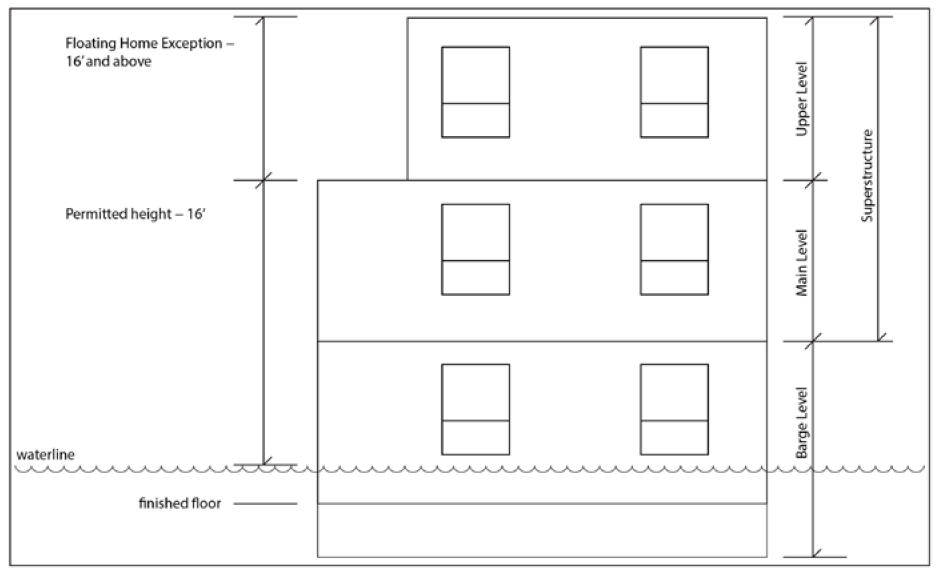
2.
Mooring. All vessels shall be securely and safely moored to ensure that the required space between floating homes is maintained at all times, in compliance with Section 22.32.070.C (Floating Home Marinas - Standards and Criteria). Vessels shall be moored to provide a clear waterway projection between adjoining boats or floating homes of at least six feet on all sides. A clearance of 10 feet shall be maintained when either floating home is in excess of one story in height. These requirements shall not apply between the vessel and the walkway or slip. See Figure 3-29.
Vessels shall be moored so as to allow landward vessels unlimited access. When used, mooring lines shall be of sufficient strength and be installed in a manner that will prevent the floating home from moving more than 12 inches in any lateral direction.
FIGURE 3-29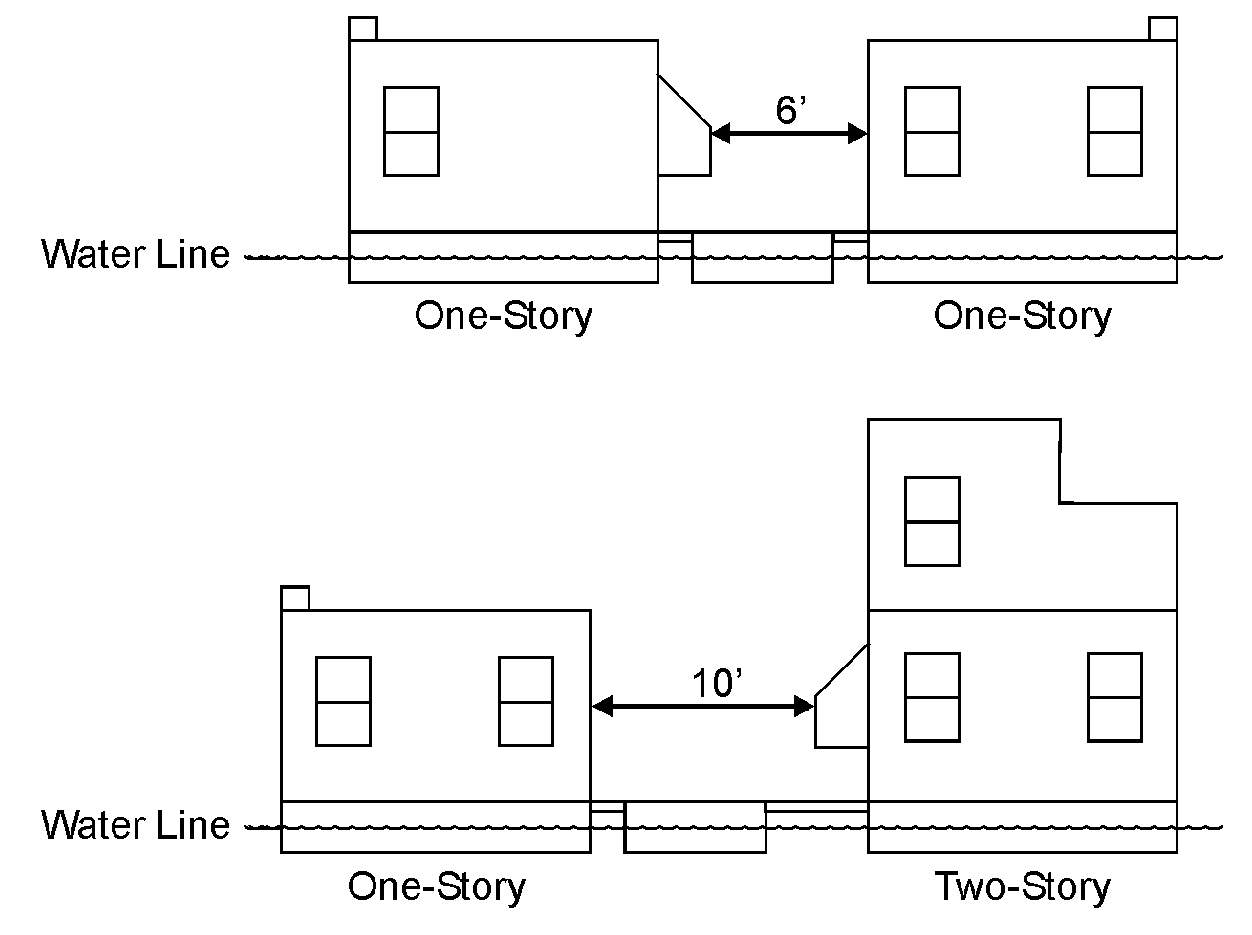
(Ord. No. 3577, 2012; Ord. No. 3666, § II(exh. A), 2017; Ord. No. 3706, 2019)
22.32.080 - Reserved.
Editor's note— Ord. No. 3666, § II(exh. A), adopted March 14, 2017, repealed § 22.32.080, which pertained to group homes and residential care facilities and derived from Ord. No. 3577, adopted Jan. 24, 2012.
22.32.085 - Single Room Occupancy (SRO).
The standards of this Section shall apply to Single Room Occupancy residential structures (SROs).
A.
Permitted use, zoning districts. Where allowed by Article II (Zoning Districts and Allowable Land Uses), Single Room Occupancy (SROs) shall comply with the standards of this Section.
B.
Permit requirements. Design Review approval, in compliance with Chapter 22.42 (Design Review), is required for SROs. The following additional findings shall apply.
C.
Standards.
1.
Density. The residential density of SROs may be allowed up to, but no more than, 30 dwelling units per acre. For the purposes of this calculation, each studio apartment shall be considered one unit.
2.
Design Characteristics. An SRO structure shall be subject to the Multi-Family Residential Design Guidelines.
3.
Rental limitations. SRO rents shall be limited to affordable housing, as defined in Article VIII (Development Code Definitions).
(Ord. No. 3602, § II(exh. A), 2013)
22.32.090 - Reserved.
Editor's note— Ord. No. 3666, § II(exh. A), adopted March 14, 2017, repealed § 22.32.090, which pertained to guest houses and derived from Ord. No. 3577, adopted Jan. 24, 2012.
22.32.095 - Homeless Shelters.
This section establishes standards for the County review of homeless shelters, in conformance with State law.
A.
Applicability. Where allowed by Article II (Zoning Districts and Allowable Land Uses), homeless shelters shall comply with the standards of this Section. Homeless shelter means housing with minimal supportive services for homeless persons that is limited to occupancy of six months or less by a homeless person. No individual or household may be denied emergency shelter because of an inability to pay.
B.
Permit requirement. The use of a homeless shelter shall require the ministerial approval of a Homeless Shelter Permit by the Director, in compliance with Chapter 22.59 (Homeless Shelter Permits), if it complies with the standards of Section 22.32.095.C.
C.
Standards.
1.
A homeless shelter shall not provide more than a maximum of 40 beds or serve 40 persons total.
2.
The number of parking spaces required on-site for residents shall be based on 25% of the total beds and staff parking shall be the total number of beds divided by ten.
3.
Shelters shall provide five square feet of interior waiting and client intake space per bed. Waiting and intake areas may be used for other purposes as needed during operations of the shelter.
4.
Management. On-site management must be provided during hours of operation.
5.
Proximity to other emergency shelters. Emergency shelters shall be at least 300 feet apart.
6.
Maximum length of stay. Maximum of six months.
(Ord. No. 3577, 2012)
22.32.100 - Home Occupations.
The following provisions allow for home occupations that are secondary to a residential use, and compatible with surrounding uses. A "Home Occupation" is any use customarily conducted entirely on properties where residences are authorized and carried on only by its residents.
A.
Permit requirement. A business license shall be obtained/posted in compliance with Title 5, Chapter 5.54 (Business Licenses) of the County Code for home occupations, which are allowed as accessory uses in all residential zoning districts. Home occupations shall comply with all health, sanitary, and fire codes.
B.
Operating standards. Home occupations shall comply with all of the following operating standards:
1.
Accessory use. The home occupation shall be clearly secondary to the full-time residential use of the property, and shall not cause noise, odors, and other activities not customarily associated with residential uses.
2.
Visibility. The use shall not require any modification not customarily found in a dwelling, nor shall the home occupation activity be visible from the adjoining public right-of-way or from neighboring properties.
3.
Display, signs. There shall be no window display or advertising sign(s), other than one name plate not exceeding one square foot in area. There shall be no display of merchandise or stock in trade or other identification of the home occupation activity on the premises.
4.
Parking. The use shall not impact the on-street parking in the neighborhood.
5.
Safety. Activities conducted and equipment or material used shall not change the fire safety or occupancy classifications of the premises. The use shall not employ the storage of flammable, explosive, or hazardous materials unless specifically approved by the County Fire Department, in compliance with Title 16 (Fire) of the County Code.
6.
Off-site effects. No home occupation activity shall create dust, electrical interference, fumes, gas, glare, light, noise, odor, smoke, toxic/hazardous materials, vibration, or other hazards or nuisances as determined by the Director.
7.
Employees. A home occupation may have a maximum of one nonresident employee, and may only exceed this number with a Conditional Use Permit, in compliance with Chapter 22.48.
C.
Prohibited home occupation uses. The following are examples of uses that are not incidental to or compatible with residential activities, and are therefore prohibited as home occupations:
1.
Adult businesses;
2.
Dance or night clubs;
3.
Mini storage;
4.
Storage of equipment, materials, and other accessories for the construction and service trades;
5.
Vehicle repair (body or mechanical), upholstery, automobile detailing and painting;
6.
Welding and machining;
7.
Any use which generates more than one client appointment at a time; and
8.
Any other use not incidental to or compatible with residential activities as determined by the Director.
(Ord. No. 3577, 2012; Ord. No. 3666, § II(exh. A), 2017)
22.32.110 - Mobile Home Parks.
This Section applies to areas set aside for mobile home parks in locations that are properly integrated with adjoining neighborhoods, in a way which will ensure the optimum benefit of residents of the mobile home park and of the larger community.
A.
Allowable uses. Mobile home parks may include the primary uses normally associated with a mobile home park. The following accessory uses may be established in compliance with the applicable standards of this Development Code:
1.
Car washing facilities, for residents, only;
2.
Chapel;
3.
Coin-operated laundry and dry cleaning facilities, for residents;
4.
Home occupations;
5.
Management office and maintenance equipment storage;
6.
Noncommercial recreation, meeting halls, club houses, etc.;
7.
Overnight accommodations, for guests of residents;
8.
Storage facilities, for residents, only;
9.
Vending machines, for residents, only; and
10.
Any other use determined by the Director to be clearly incidental and subordinate to the primary use.
B.
Large parks. The following additional accessory uses may be allowed in a mobile home park with over 200 mobile homes:
1.
Convenience goods shopping and personal service establishments primarily for residents, only; and
2.
One doctor's and one dentist's office.
C.
Standards and criteria. Mobile home parks shall comply with the following standards:
1.
Minimum site area: Ten contiguous acres.
2.
Maximum density.
a.
The maximum density for a mobile home park in the RX zoning district shall be set by the Board as part of rezoning to the RX district and simultaneous Master Plan approval (see Section 22.32.110.D (Submission Requirements), below), but shall not exceed the density provided by Section 22.32.110.C.2.b, below.
In determining the appropriate density, the Board shall consider any adopted Community Plan or the Countywide Plan, any Master Plan for the area in which the RX zoning district is to be established, existing zoning and development in the area, and any applicable parcel slope.
b.
Maximum density, determined by Master Plan approval, shall not exceed ten mobile homes of 750 square feet or less in gross floor area per acre or eight mobile homes of more than 750 square feet in gross floor area per acre; or a combination of both.
3.
Completion of construction. Prior to occupancy of the first mobile home, not less than 50 mobile home lots shall be prepared and available for occupancy.
4.
Parking requirements. The overall parking ratio shall be two parking spaces for each mobile home lot. At least one parking space shall be provided on, or immediately adjoining to, each mobile home lot, in compliance with Sections 24.04.330 through 24.04.400 (Parking and Loading) of the County Code.
5.
Setbacks. All structures and mobile homes shall be set back at least 25 feet from all property lines and streets or public rights-of-way. If a greater building line has been established by ordinance, it shall be observed. The setback area shall be landscaped and maintained as a buffer strip, in compliance with Chapter 22.26 (Landscaping).
6.
County Health requirements. A County Health Department permit shall be obtained in compliance with Chapter 7.44 (Mobile Home Parks) of the County Code.
7.
Utilities. All utilities shall be installed underground. Individual exposed antennae shall not be allowed.
8.
Height limits. The maximum height for:
a.
Mobile homes shall be 15 feet;
b.
Accessory structures shall be 15 feet; and
c.
Service facilities shall be 30 feet.
D.
Submission requirements. In addition to the general submission requirements for Master Plan and Precise Development Plan approval, in compliance with Chapter 22.44 (Master Plans and Precise Development Plans), a petition for a zoning district change for an RX district and a Master Plan for the mobile home park shall be filed simultaneously with the Agency.
For the purpose of this Section, the rezoning and the Master Plan shall be considered as one application and shall be considered in compliance with Chapter 22.116 (Development Code, Zoning Map, Community Plan and Countywide Plan Amendments).
E.
Other laws, regulations and ordinances. All applicable County and State laws and regulations concerning the development and operation of mobile home parks shall be observed. Nothing contained in this Section shall be construed to abrogate, void, or minimize other pertinent requirements of law.
(Ord. No. 3577, 2012)
22.32.115 - Non-Agricultural Uses in Agricultural Zoning Districts.
This Section applies only in those instances where Table 2-1 expressly refers to this Section. The purpose of applying the following standards is to determine whether a specific non-agricultural land use is accessory and incidental to the primary use of land for agricultural production. The intent of these provisions is to ensure that non-agricultural uses do not become the primary use of agricultural land to the detriment of agricultural production:
A.
Permitted use, zoning districts. Non-agricultural uses may be allowed as a principally permitted land use in the following zoning districts: A2, A3 to A60, ARP, C-ARP, C-APZ, O-A, and C-OA, and as allowed by Articles II (Zoning Districts and Allowable Land Uses) and V (Coastal Zone Development and Resource Management Standards) subject to the requirements of this section. This Section does not apply to ARP-1 to ARP-5 zoning districts.
B.
Limitations on use.
1.
Accessory Use. In the aggregate, identified non-agricultural uses shall be accessory and incidental to the primary use of the property for agricultural production. The following factors shall be considered in determining whether a property is used primarily for agricultural production:
a.
The primary use of the property is consistent with the definition of agriculture; and
b.
The agricultural products produced on-site are sold commercially.
2.
Referrals. In determining whether a non-agricultural use is accessory and incidental to the primary use of the property for agricultural production, the review authority may refer such a question to such individuals or groups with agricultural expertise as appropriate for a recommendation prior to making a determination. When determining whether a property is primarily used for agricultural production, the review authority may consider the following:
a.
Whether the areal extent of land dedicated to agriculture is sufficient to support agricultural production; and
b.
Whether the agricultural producer can demonstrate that agricultural products are sold commercially; and
c.
Whether the agricultural land is used at a level of intensity that is, and the income derived therefrom is, consistent with similar agricultural activities in the County and in the State.
(Ord. No. 3577, 2012)
22.32.120 - Residential Accessory Dwelling Units.
There are two categories of Accessory Dwelling Units, both with different criteria that apply as indicated below. Except as provided under State law, an Accessory Dwelling Unit may not be sold or otherwise conveyed separately from the primary dwelling unit. Category 1-Statewide Exemption Accessory Dwelling Units can be rented only for terms longer than 30 consecutive days.
A.
Category 1—Statewide Exemption. Accessory Dwelling Units in this category shall comply with the criteria listed below.
1.
Single-family Development:
a.
Consistent with State law, the Accessory Dwelling Unit is contained entirely within the building area of an existing single family dwelling.
b.
Consistent with State law, the Accessory Dwelling Unit is contained entirely within the building area of an existing outbuilding; except that the project may include an addition of not more than 150 square feet of floor area to provide access to the unit, provided the access addition meets minimum rear and side setbacks of four feet.
c.
The Accessory Dwelling Unit does not exceed a floor area of 800 square feet, and has minimum rear and side yard setbacks of four feet; a front yard setback is not required. A detached Accessory Dwelling Unit shall not exceed a height of 18 feet above grade except that two additional feet may be allowed to match the roof pitch of the primary dwelling. An attached Accessory Dwelling Unit shall not exceed the maximum height allowed in the respective zoning district or 25 feet above grade, whichever is greater.
d.
Up to two Category 1 accessory dwelling units are allowed provided that: (1) one unit is either located in an existing or proposed single family dwelling or an existing outbuilding; and (2) one unit is located in a new construction outbuilding.
2.
Multi-family Development:
a.
Up to two detached Accessory Dwelling Units are allowed provided each unit does not exceed a floor area of 800 square feet, maintains a maximum height of 18 feet above grade and minimum side and rear yard setbacks of four feet; a front yard setback is not required.
b.
Consistent with State law, multiple Accessory Dwelling Units are allowed to be built within those portions of the existing building area of a multi-family dwelling building that are not conditioned to be habitable, such as boiler rooms, storage rooms, passageways, attics, basements, and garages.
c.
At least one Accessory Dwelling Unit is allowed to be built within a multi-family dwelling building, with the maximum allowed in multi-family dwelling buildings of five units or more being 25 percent of the total existing legal units.
An Accessory Dwelling Unit that satisfies all the applicable criteria listed above shall be classified as a Category 1 Accessory Dwelling Unit.
B.
Category 2—Permit. Accessory Dwelling Units in this category shall comply with the criteria listed below and shall be subject to Accessory Dwelling Unit Permit approval.
1.
An attached Accessory Dwelling Unit contained entirely within an addition to an existing single family residence, or contained partially within a single family residence and partially within an addition to that residence, shall not exceed 50 percent of the floor area of the existing residence, provided it does not exceed the allowable floor area ratio or 1,200 square feet in floor area, whichever is more restrictive. However, a one bedroom unit that is up to 850 square feet shall be allowed and a two or more bedroom unit that is up to 1,000 square feet shall be allowed, notwithstanding any floor area restrictions.
2.
A detached Accessory Dwelling Unit shall not exceed a floor area of 1,200 square feet provided it would not exceed the allowable floor area ratio. However, a detached one bedroom unit that is up to 850 square feet shall be allowed and a detached two or more bedroom unit that is up to 1,000 square feet shall be allowed, not withstanding any floor area restrictions.
3.
An Accessory Dwelling Unit in a conventional zoning district shall comply with all development standards for that district and is located within any applicable building envelopes. However, a one bedroom unit that is up to 850 square feet shall be allowed and a two or more bedroom unit that is up to 1,000 square feet shall be allowed, notwithstanding any floor area restrictions.
4.
An Accessory Dwelling Unit in a Planned zoning district shall comply with all the development standards for the R1:B3 zoning district, except that a numerical development restriction established by a Master Plan shall govern where applicable, and the unit shall be located within any applicable building envelopes. However a one bedroom unit that is up to 850 square feet shall be allowed and a two or more bedroom unit that is up to 1,000 square feet shall be allowed, notwithstanding any floor area restrictions.
An Accessory Dwelling Unit that satisfies all the applicable criteria listed above shall be classified as a Category 2 Accessory Dwelling Unit.
(Ord. No. 3666, § II(exh. A), 2017; Ord. No. 3706, 2019; Ord. No. 3745, § 1(exh. A), 2021; Ord. No. 3806, § II(exh. A), 2023)
22.32.125 - Residential Junior Accessory Dwelling Units.
A property owner may voluntarily have existing building area recognized as a Junior Accessory Dwelling Unit if it meets all of the following eligibility criteria:
A.
The unit shall be no more than 500 square feet in size and contained entirely within a single-family dwelling structure.
B.
The unit shall have a kitchenette but shall not have a kitchen.
C.
The unit shall have a separate entrance from the main entrance to the building, with an interior entry to the main living area if the unit does not contain a separate bathroom. The unit may include a second interior doorway for sound attenuation.
D.
The unit shall be the only junior accessory dwelling unit on the property.
E.
The property shall be owner occupied, except that owner occupancy is not required if the owner is a government agency, land trust, or housing organization.
F.
The property owner has recorded a deed restriction, which shall run with the land, that stipulates the following:
1.
A prohibition on the sale of the unit separate from the sale of the single-family residence, including a statement that the deed restriction may be enforced against future purchasers.
2.
A restriction on the size and attributes of the unit that conforms to this section.
A copy of the recorded deed restriction must be provided to the agency.
(Ord. No. 3745, § 1(exh. A), 2021; Ord. No. 3806, § II(exh. A), 2023)
22.32.130 - Residential Accessory Uses and Structures.
When allowed in the zoning district applicable to a site, see Section 22.10.030 (Residential District Land Uses and Permit Requirements), specific residential accessory uses and structures are subject to the provisions of this Section. Residential accessory uses include any use customarily related to a residence, including swimming pools, workshops, studios, storage sheds, greenhouses, and garages.
A.
General requirements. All residential accessory uses and structures are subject to the following standards, except where more restrictive requirements are established by other provisions of this Section for specific uses.
1.
Relationship of accessory use to primary use. Residential accessory uses and structures shall be incidental to the primary or conditionally permitted use. Accessory uses and structures shall not be allowed until a primary or conditionally permitted use or structure has been established on the site, except as provided for in section 22.20.120.
2.
Attached structures. A residential accessory structure that is attached to a primary structure shall comply with all requirements of this Development Code applicable to the primary structure, including setbacks, height, and floor area ratio.
B.
Tennis and other recreational uses. Private non-commercial outdoor tennis courts and courts for other sports (e.g., racquetball, etc.) accessory to a residential use may be established with Design Review approval, in compliance with Chapter 22.42, and are subject to the following requirements:
1.
Fencing. Court fencing shall be subject to the height limits of Section 22.20.050 (Fencing and Screening Standards).
2.
Lighting. Court lighting may be prohibited, as a condition of the Design Review approval. If allowed, the court lighting may be installed with a height not exceeding 10 feet, measured from the court surface. The lighting shall be directed downward, shall only illuminate the court, and shall not illuminate adjacent property.
C.
Vehicle storage. The storage of vehicles, including incidental restoration and repair, shall be in compliance with Section 22.20.090.F (Restrictions on the Use of Front Yard Setbacks in Residential Districts), and Chapter 7.56 (Abandoned Vehicles) of the County Code.
D.
Workshops or studios. A residential accessory structure intended for engaging in artwork, crafts, handcraft manufacturing, mechanical work, etc. may be constructed or used as a workshop or studio in a residential zoning district solely for: non-commercial hobbies or amusements; maintenance of the primary structure or yards; artistic endeavors (e.g., painting, photography or sculpture); maintenance or mechanical work on vehicles owned or operated by the occupants; or other similar purposes.
Any use of accessory workshops for a commercial activity shall comply with the requirements for Home Occupations in Section 22.32.100 (Home Occupations) or, where applicable Cottage Industries in Section 22.32.060 (Cottage Industries).
E.
Room rentals. Room rentals in single family dwellings shall be limited to three or fewer individual bedrooms.
F.
Residential Accessory Dwelling Units. Residential Accessory Dwelling Units are subject to section 22.32.120 (Residential Accessory Dwelling Units) and Chapter 22.56 (Accessory Dwelling Unit Permits) of this Development Code.
(Ord. No. 3577, 2012; Ord. No. 3666, § II(exh. A), 2017; Ord. No. 3706, 2019)
22.32.140 - Reserved.
Editor's note— Ord. No. 3666, § II(exh. A), adopted March 14, 2017, repealed § 22.32.140, which pertained to residential second units and derived from Ord. No. 3577, adopted Jan. 24, 2012.
22.32.150 - Residential Requirements in Commercial/Mixed Use Districts.
This section applies to development projects that include new non-residential floor area where the underlying zoning district allows residential uses.
A.
Development standards.
1.
Consistent with Government Code Section 6589.5(h)(2)(B), mixed-use developments shall designate at least two-thirds of the square footage to residential use.
2.
For mixed-use developments, the commercial component of the development shall be subject to the floor area ratio standard while the residential component shall be subject to density standards.
3.
Required housing shall be provided at a minimum size of 220 square feet and a maximum size of 1,000 square feet per unit.
4.
The maximum residential density shall not exceed one unit per 1,450 square feet of lot area (30 units per acre).
5.
The affordable housing requirements contained in Chapter 22.22 (Affordable Housing Regulations) apply to proposed development.
B.
Permit requirement. Residential development required in commercial areas is subject to Chapter 22.42 (Design Review). The following additional findings shall apply:
1.
The site design is compatible with the adjacent community and incorporates design elements such as vertical mix of uses and usable common/open space areas, where appropriate.
2.
The residential uses should be designed and sited in a manner that does not conflict with the continuity of store frontages, while maintaining visual interest and a pedestrian orientation.
C.
Exemptions.
1.
For lots larger than two acres in size, renovations and additions not resulting in more than 2,000 square feet of new floor area shall be exempt from the requirements of this section.
2.
For lots two acres and less in size, renovations and additions not resulting in more than 1,000 square feet of new floor area shall be exempt from the requirements of this section.
3.
Projects developed under the Countywide Plan's Housing Overlay Designation program are subject to separate standards established in the Countywide Plan and are therefore exempt from the requirements of this section.
4.
The residential requirements are only applicable to the extent that the projected afternoon (PM) peak-hour traffic impacts of the proposed development shall not be greater than such impacts for the maximum non-residential development permissible on the site under the Countywide Plan land use designation.
D.
Waivers. The review authority may grant a waiver to the development standards if one or more of the following criteria is met:
1.
The applicant shows that the waiver is necessary to make the neighborhood serving retail development project economically viable, based upon appropriate financial analysis and documentation. The full cost of the county's review of any required pro forma data shall be borne by the applicant.
2.
The applicant proposes to include either a greater number of affordable housing units than required per Chapter 22.22 or the same number of required units that are affordable at a lower income level.
3.
Application of requirements of this Chapter would have an adverse impact on any real property that is listed in the California Register of Historic Resources.
(Ord. No. 3577, 2012; Ord. No. 3666, § II(exh. A), 2017; Ord. No. 3819, § I(exh. A), 2024)
22.32.160 - Service Stations/Mini-Markets.
The retail sales of food and beverage products and other general merchandise in conjunction with a motor vehicle service station is allowed subject to Use Permit approval, in compliance with Chapter 22.48 (Conditional Use Permits), and the following standards:
A.
Sales area. The maximum allowable floor area for retail sales shall be 175 square feet or 15 percent of the total floor area of the structure whichever is greater. These area limitations may be increased through Use Permit approval provided that the following findings are made:
1.
Retail sales shall be subordinate to the primary motor vehicle service station use(s).
2.
The proportion of retail sales to total floor area of the structure(s) shall be limited to an amount that is reasonable to allow sales of a limited number of items for the convenience of travelers as permitted by Subsection B, below.
3.
The size, extent and operation of retail sales shall not conflict with the predominant character of the area surrounding the service station.
4.
The size, extent, and operation of retail sales shall not cause a significant increase in traffic and noise in the area surrounding the service station.
B.
Allowed products. Retail sales of non-automotive products shall be limited to items for the convenience of travelers, including film, personal care products, and packaged food and beverage items.
C.
Signs. No exterior signs are allowed to advertise specific items for sale. All on-site signs shall be in compliance with Chapters 22.28 (Signs) and Title 5, Chapter 5.40 (Posting of Gasoline Prices) of the County Code.
D.
Parking. On-site parking shall comply with Sections 24.04.330 through 24.04.400 (Parking and Loading) of the County Code, and shall include sufficient spaces for all employees on a single shift.
E.
Restrooms. Restrooms shall be provided and available to the public.
F.
Self-service stations. Establishment of self-service stations or the conversion of existing full-service stations to self-service stations shall require an additional finding by the Zoning Administrator, that the establishment of a self-service station will not adversely affect public health, safety, and welfare by either diminishing the availability of minor emergency help and safety services, including minor motor vehicle repair and public restrooms, or discriminating against individuals needing refueling assistance.
(Ord. No. 3577, 2012)
22.32.162 - Slaughter Facilities, Mobile.
This Section establishes standards for the operations of mobile slaughter facilities for commercial purposes.
A.
Limitations on use. Mobile slaughter facilities shall be allowed only where a primary permitted or conditionally permitted agricultural use exists and is operational on the lot.
B.
Setback requirements. Mobile slaughter facilities shall be set back a minimum of 100 feet from all property lines and rights-of-way.
C.
Limitations on duration. A mobile slaughter facility shall not operate on a single property for more than three consecutive days per week and 12 days per calendar month unless authorized to exceed this duration with a Temporary Use Permit.
(Ord. No. 3666, § II(exh. A), 2017)
22.32.163 - Poultry Processing Facilities.
This Section establishes standards for the operations of poultry processing facilities to slaughter poultry, including rabbits, for commercial purposes.
A.
All poultry slaughtered must have been raised on the same site as the facility or on other agricultural properties located in Marin County that are owned or leased by the processing facility owner or operator.
B.
The indoor area used for the poultry slaughter operation shall not exceed of 5,000 square feet.
C.
The poultry processing operation shall not exceed the slaughter of 20,000 animals per year.
(Ord. No. 3666, § II(exh. A), 2017)
22.32.165 - Telecommunications Facilities.
This Section establishes permit requirements and standards for the development and operations of telecommunications facilities to the extent permitted by State and Federal law and in compliance with the Marin County Telecommunications Facility Policy Plan except where the Marin County Telecommunications Facility Policy Plan conflicts with this Section, State law, or Federal law. If conflict occurs between the requirements of the Marin County Telecommunications Facility Policy Plan and this Section, State law, or Federal law, the requirements of this Section, State law, or Federal law shall control.
A.
Permit requirements. Telecommunications facilities are allowed in all zoning districts, subject to the permit requirements described in Telecommunications Facilities Policy Plan Implementation Objectives RP-1 and RP-2 with the following exceptions:
1.
An eligible facility request for a modification to an existing wireless tower or base station that does not include a substantial change to the tower or base station's physical dimensions shall not require discretionary review and shall be approved.
2.
Applications for eligible facility requests shall only be required to provide documentation that is reasonably related to determining whether the request is consistent with Federal requirements for eligible facility requests.
B.
Permit waivers. A wireless telecommunications facility may be eligible for a waiver of the permit requirements described in Telecommunications Facilities Policy Plan Implementation Objectives RP-1 and RP-2. Permit waivers are separate from the permit exemptions identified in the Telecommunications Facilities Policy Plan and are not required for eligible facility requests described in Subsection A.1. It is the responsibility of the applicant to establish evidence in support of the waiver criteria required by this section. The Director shall waive the permit requirements if a facility is co-located on or adjoining an existing telecommunications facility; the existing telecommunication facility has a certified environmental impact report or adopted negative declaration or mitigated negative declaration; the existing facility has incorporated the required mitigation measures; and the new equipment or structures do not constitute a substantial change in the project or new information as outlined in Public Resources Code Section 21166.
C.
Permit review. Permit applications for telecommunications facilities shall be reviewed as follows:
1.
Eligible facility requests described in Subsection A.1 shall be approved within 60 days of application filing unless the applicant and the County mutually agree to additional time or the County provides notice to the applicant in writing within 30 days of the initial filing that identifies the application as incomplete and specifically delineates all missing information. Completeness reviews for subsequent submittals shall be based solely on the applicant's failure to supply the missing information identified within 30 days of initial filing. The County shall review subsequent submissions within 10 days for completeness. Determination of incompleteness tolls or temporarily stops the 60 day time limit.
2.
All other telecommunications facilities applications shall be approved or denied within 150 days of application filing and shall be processed as required by the California Government Code. Determination of incompleteness tolls or temporarily stops the 150 day time limit.
3.
If a decision on a telecommunication facility application is not issued in conformance with the timelines referred to in this section, then that application is deemed denied by operation of Federal law. Otherwise, if a telecommunications facilities application is denied, the reason(s) for denial shall be in writing and supported by substantial evidence. Reason(s) for denial shall be provided at essentially the same time as the denial.
D.
Electromagnetic fields. The electromagnetic field (EMF) strengths or equivalent plane-wave power densities generated by the approved facility, in combination with other existing ambient sources of EMF, shall not expose the general public to EMF levels which exceed the Maximum Permitted Exposure levels for electric and magnetic field strength and equivalent plane-wave power density in the EMF emission guidelines adopted by the Federal Communications Commission (FCC). In the event the FCC adopts a more restrictive Maximum Permitted Exposure Level, or the County adopts a more restrictive EMF exposure standard if allowed by future changes in Federal law, the applicant shall demonstrate compliance with the more restrictive standard unless such a requirement is preempted by State or Federal law.
E.
Development standards. The development standards for telecommunications facilities are identified in the policies and programs of the Marin County Telecommunications Facilities Policy Plan, as may be updated from time to time.
(Ord. No. 3577, 2012; Ord. No. 3666, § II(exh. A), 2017; Ord. No. 3706, 2019)
22.32.168 - Tidelands.
This section applies to Master Plan, Design Review, Site Plan Review, and Tentative Map applications in tidelands.
A.
Prohibitions. It is unlawful for any person, firm, corporation, or public agency to allow, cause, or do any of the following on any of the tidelands without first obtaining any required land use permits from the County:
1.
Construct, deposit, or dump within, or fill with dirt, earth, garbage, mud, refuse, or any other material;
2.
Dredge, excavate, or remove any dirt, earth, gravel, mud, sand, or any other material; and/or
3.
Place or construct any breakwater, bulkhead, pier, wall, or other structure.
B.
Exemptions. The following shall be exempt from the provisions of this Section:
1.
Emergency work. Emergency work immediately necessary to prevent, or to minimize, imminent damage to land or improvements from floodwaters, as determined by the Director. The emergency work shall be reported to the Agency, on the next business day following commencement of the work, and confirmed in writing, within 10 days after the start of the work;
2.
Maintenance of existing legal structures. Any maintenance work to legal structures which existed prior to the effective date of this Development Code;
3.
Minor/incidental work. Any structure, fill, or excavation of the tidelands which the Director finds to be minor or incidental, including maintenance dredging;
4.
Work approved by land use permit. Any structure, fill, or excavation which has been approved as part of an application, action or permit by the Director, Zoning Administrator, Commission, or Public Works Director;
5.
Work behind secured existing dikes. Any structure, fill, or excavation which is behind secured dikes, and which is normally not subject to tidal action by virtue of the dike, or which is only temporarily under tidal action due to defective tide gates; and
6.
Creeks, estuaries and rivers. Any structure, fill or excavation in creeks, estuaries, and rivers that are subject to tidal action and located upstream from certain defined points, as follows:
a.
Coyote Creek: State Highway No. 1 Bridge; and
b.
Corte Madera Creek: Downstream end of concrete channel.
C.
Criteria for Tidelands Development. The Review Authority may only approve or conditionally approve a land use permit for tidelands development in conformance with all of the following criteria:
1.
The encroachment into the tidelands is the minimum necessary to achieve the intent of this Section and the purpose of the proposed work.
2.
The proposed fill, excavation, or construction will not unduly or unnecessarily:
a.
Inhibit navigation;
b.
Inhibit access to publicly owned tidelands;
c.
Cause, or increase the likelihood of, water pollution;
d.
Cause, or increase the likelihood of, flooding of adjoining parcels;
e.
Destroy, or accelerate the destruction of, habitats essential to species of fish, shellfish, and other wildlife of substantial public benefit;
f.
Interfere with, or detract from, public viewsheds toward the water, particularly on natural features of visual prominence;
g.
Conflict with the scenic beauty of the shoreline due to bulk, mass, color, form, height, illumination, materials, or the extent and design of the proposed work;
h.
Create a safety hazard in connection with settlement of fill or earthquakes; or
i.
Reduce natural waterways by eroding banks, or causing sedimentation or siltation.
3.
The proposal is consistent with public trust policies for tidelands areas.
4.
New public benefits will be created offsetting some of the impacts that may be caused by implementation of the proposal; however, this criterion is not applicable when either of the following circumstances exists:
a.
The application covers lands wholly above the mean high tide; or
b.
The size or potential uses of the parcel are so limited that creation of a new public benefit would be infeasible, and where the amount and effect of structures, fill, or excavating, are minimal.
5.
These public benefits may be realized when one or more of the following are included in the proposed development application:
a.
Development of new recreational opportunities;
b.
Provision of new public access to the water;
c.
Enhancement of shoreline appearance;
d.
Establishment of water transportation;
e.
Facilities for land or air transportation, where all other alternatives have been exhausted;
f.
Construction of water-oriented industry or development of marine food supplies;
g.
Habitat replacement and restoration; or
h.
Other benefits considered by the Review Authority to be of comparable importance.
6.
The proposed fill, excavation, or construction will not adversely affect the existing public rights on the property.
(Ord. No. 3666, § II(exh. A), 2017; Ord. No. 3745, § 1(exh. A), 2021)
22.32.170 - Tobacco Retail Establishments.
This Section establishes permit requirements and standards for the development and operation of tobacco retail establishments.
A.
Permit requirements. Notwithstanding any provision of this title, a significant tobacco retailer may be established in the following zoning districts subject to securing a Use Permit or Master Plan where required: C1, CP, OP, H1, IP, C-H1, or C-CP.
B.
Development standards. No significant tobacco retailer shall be located within 1,000 feet from a parcel occupied by the following uses:
1.
Public or private kindergarten, elementary, middle, junior high or high schools;
2.
Licensed child day-care facility or preschool other than a small or large family day-care home;
3.
Public playground or playground area in a public park (e.g., a public park with equipment such as swings and seesaws, baseball diamonds or basketball courts);
4.
Youth or teen center;
5.
Public community center or recreation center;
6.
Arcade;
7.
Public park;
8.
Public library; or
9.
Houses of worship conducting youth programs or youth oriented activities.
C.
Exceptions. Notwithstanding any other provisions of this Code, nothing in this section shall prohibit the County from approving any of the uses specified above in Subsection B, if they are subsequently proposed to be located within 1,000 feet of an existing significant tobacco retailer, if the appropriate decision-making body finds that the establishment of such uses is necessary to protect the public, health, safety, and welfare, or other substantial governmental interest is thereby served.
(Ord. No. 3577, 2012)
22.32.180 - Wind Energy Conversion Systems (WECS).
This Section establishes permit requirements for planned zoning districts and non-planned zoning districts and standards for the development and operation of Wind Energy Conversion Systems (WECS) in compliance with Marin County policies and State and Federal laws and allows and encourages the safe, effective, and efficient use of WECS in order to reduce consumption of utility supplied electricity.
A.
Permit requirements. Small and Medium Wind Energy Conversion Systems (WECS) are allowed in all zoning districts, except the RF (Floating Home Marina) zoning district, subject to the following general requirements. Large WECS are allowed only in agricultural zoning districts (A3-A60, ARP, APZ) with a minimum lot size of 20 acres, subject to the following general requirements:
1.
Planned Zoning Districts.
a.
Small WECS in the APZ zoning district and Small Roof-Mounted and Small Non-Grid-Tied Agricultural WECS, located in parcels with a minimum lot size of one acre in the ARP zoning district and all other planned zoning districts that are not identified in Section 22.32.180.A.1.b are allowed as a ministerial permit subject to the development standards in Section 22.32.180.B.1 and Section 22.32.180.B.5 (Table 3-12).
b.
Small Roof-Mounted and Small Non-Grid-Tied Agricultural WECS located in parcels that are less than one acre in the ARP zoning district and all other Small WECS in planned zoning districts that are not identified herein or in Section 22.32.180.A.1.a shall require Design Review approval subject to the development standards in Section 22.32.180.B.2 and Section 22.32.180.B.5 (Table 3-12).
c.
Medium WECS, located in planned zoning districts, shall require Design Review approval, subject to the development standards in Section 22.32.180.B.3 and Section 22.32.180.B.5 (Table 3-12).
d.
Large WECS, located in planned zoning districts, shall require the approval of a Master Plan and Precise Development Plan subject to the development standards and requirements outlined in Section 22.32.180.B.4 and Section 22.32.180.B.5, unless the Master Plan and Precise Development Plan requirements are waived in compliance with Section 22.44.040 (Waiver of Master Plan Amendment and Precise Development Plan Amendment) and a Use Permit and Design Review are required instead.
2.
Conventional Zoning Districts.
a.
Small WECS, located in conventional agricultural zoning districts and Small Roof-Mounted and Small Non-Grid Tied Agricultural WECS located in parcels with a minimum lot size of one acre in conventional non-agricultural zoning districts, are allowed as a ministerial permit subject to the development standards outlined in Section 22.32.180.B.1 and Section 22.32.180.B.5 (Table 3-12).
b.
Small WECS, located in parcels that are less than one acre in all other conventional non-agricultural zoning districts and Small Freestanding WECS in conventional agricultural zoning districts that are not identified herein or in Section 22.32.180.A.2.a, shall require Design Review approval subject to the development standards outlined in Section 22.32.180.B.2 and Section 22.32.180.B.5 (Table 3-12).
c.
Medium WECS, located in conventional zoning districts, shall require Design Review approval subject to the development standards outlined in Section 22.32.180.B.3 and Section 22.32.180.B.5 (Table 3-12).
d.
Large WECS, located in conventional zoning districts, shall require Use Permit and Design Review approval subject to the development standards outlined in Section 22.32.180.B.4 and Section 22.32.180.B.5 (Table 3-12).
3.
Summary of Permit Requirements.
TABLE 3-11
WECS PERMIT REQUIREMENTS
Notes:
1 Exceptions to standards in Table 3-12 shall be considered through the Design Review Process.
2 Exceptions to standards in Table 3-12 shall be considered through the Use Permit Process.
3 If Master/Precise Development Plan requirement is waived, Use Permit and Design Review will be required.
4 Exceptions to standards in Table 3-12 shall be considered through the permit process.
4.
Time limits. The approval for a Large WECS shall be granted for a term of not less than ten years, except that an approval shall lapse if a Large WECS becomes inoperative or abandoned for a period of more than one year. The approval for a Small or Medium WECS shall be for an indefinite period, except that an approval shall lapse if a Small or Medium WECS becomes inoperative or abandoned for a period of more than one year.
5.
Applicability. In addition to the provisions of Section 22.32.180, all other applicable provisions of this Development Code shall apply to a new WECS land use. In the event there is any conflict between the provisions of this section and any other provision of this Development Code, the more restrictive provision shall apply.
6.
Meteorological towers (Met Towers). For the purpose of the Wind Energy Conversion System Ordinance, meteorological towers are those towers which have been temporarily installed to measure wind speed and directions plus other data relevant to siting WECS. Installations of temporary (up to one year) meteorological towers shall be considered through the Temporary Use Permit process pursuant to Chapter 22.50 (Temporary Use Permits).
B.
Development standards.
1.
Small WECS (Ministerial). A Building Permit for a Small WECS located in an agricultural zoning district pursuant to this Section shall be issued by the Agency Director upon submission of a Building Permit application containing the information specified in applicable sections of this Development Code and a determination by the Agency Director that the proposed use and development meets the development standards in Section 22.32.180.F and Sections 22.32.180.G.1, G.2, G.5, G.6, G.7, and G.9.a. Before issuance of a building permit, the County shall record a notice of decision against the title of the property stipulating that the WECS must be dismantled and removed from the premises if it has been inoperative or abandoned for a period of more than one year.
2.
Small WECS (Discretionary).
a.
Small WECS shall be subject to the development standards in Section 22.32.180.B.5 (Table 3-12). Exceptions to the standards in Section 22.32.180.B.5 (Table 3-12) for Small WECS shall be considered through the Use Permit process pursuant to Chapter 22.48 (Conditional Use Permits).
b.
Small WECS shall comply with the development standards and requirements contained in Section 22.32.180.C through Section 22.32.180.H.
3.
Medium WECS.
a.
Medium WECS shall be subject to the development standards in Section 22.32.180 B.5 (Table 3-12). Exceptions to the standards in Section 22.32.180 B.5 (Table 3-12) for Medium WECS shall be considered through the Use Permit process pursuant to Chapter 22.48 (Conditional Use Permits).
b.
Medium WECS shall comply with the development standards and requirements contained in Section 22.32.180.C through Section 22.32.180.H.
4.
Large WECS.
a.
Large WECS shall be subject to the development standards in Section 22.32.180.B.5 (Table 3-12). Exceptions to the standards in Section 22.32.180 B.5 for Large WECS shall be considered through the Master Plan process pursuant to Chapter 22.44 (Master Plans and Precise Development Plans) or Use Permit process pursuant to Chapter 22.48 (Conditional Use Permits).
b.
Prior to approval, Large WECS are subject to submittal of a comprehensive WECS Environmental Assessment prepared by a qualified consultant approved by the Marin County Environmental Coordinator. The WECS Environmental Assessment shall be prepared in consultation with the County to determine the development capabilities and physical and policy constraints of the property. The WECS Environmental Assessment shall include a mapped inventory and data base of the biological and physical characteristics of the project area. The WECS Environmental Assessment shall include a mapped delineation of the project site's sensitive environmental areas including, but not necessarily limited to: earthquake fault zones, geological hazardous areas, wetlands, watercourses and water bodies, prime agricultural lands, special status species habitats, prominent ridgelines, view corridors, and wind zones. The WECS Environmental Assessment shall include a Bird and Bat Study, as defined in Section 22.32.180.G.9. Based upon the findings, constraints, conclusions and recommendations of the WECS Environmental Assessment, specific requirements for siting and design shall be identified.
c.
Large WECS shall comply with the development standards and requirements contained in Section 22.32.180.C through Section 22.32.180.H.
d.
The maximum number of Large WECS that is allowed per parcel shall be established through the permit process.
5.
Development Standards are outlined in Table 3-12 below.
TABLE 3-12
WECS DEVELOPMENT STANDARDS
C.
Public notice. Where required, a Notice of the required application(s) shall be provided in compliance with Section 22.118.020 (Notice of Hearing or Administrative Action).
Notice of a discretionary permit application for any WECS within five miles of Federal, State, or regional park property shall be provided to the superintendent of the appropriate park.
D.
Site and design requirements:
1.
General standards. No Small, Medium, or Large WECS or supporting infrastructure shall be allowed:
a.
Within five times the total height or 300 feet, whichever is greater, of a known nest or roost of a listed State or Federal threatened or endangered species or California Department of Fish and Game designated bird or bat "species of special concern" (unless siting of the WECS preceded nest or roost establishment) based on the findings and conclusions of the required Bird and Bat Study as defined in Section 22.32.180.G.9 (Application submittal requirements).
b.
Within five times the total height or 300 feet, whichever is greater, of a known or suspected avian migratory concentration point based on the findings and conclusions of the required Bird and Bat Study as defined in Section 22.32.180.G.9.
c.
Within 1.5 times the total height or 100 feet, whichever is greater, of a Stream Conservation Area (SCA), a Wetlands Conservation Area (WCA), a State or Federal listed special status species habitat area, a designated archaeological or historical site, or a watercourse, wetland, pond, lake, bayfront area habitat island, or other significant waterbody with suitable avian habitat based on the findings and conclusions of Bird and Bat Study as defined in Section 22.32.180.G.9.
d.
Where prohibited by any of the following:
i.
The Alquist-Priolo Earthquake Fault Zoning Act.
ii.
The terms of any conservation easement or Williamson Act contract.
iii.
The listing of the proposed site in the National Register of Historic Places or the California Register of Historical Resources.
E.
Appearance and visibility. In addition to any conditions which may be required by Master Plan and Precise Development Plan or Design Review and Use Permit approvals, Small, Medium, and Large WECS shall comply with the following design standards:
1.
WECS shall be located downslope a minimum of 300 feet horizontally or 100 feet vertically, whichever is more restrictive, from a visually prominent ridgeline, unless it can be demonstrated through submittal of a County accepted Wind Measurement Study that no other suitable locations are available on the site. If this is the case, then the Wind Study will be one amongst all other standards that would be evaluated in considering whether and where the WECS application should be approved within the ridge setbacks.
2.
WECS shall be designed and located to minimize adverse visual impacts from public viewing places, such as roads, trails, scenic vistas, or parklands and from adjacent properties.
3.
No wind turbine, tower, or other component associated with a WECS may be used to advertise or promote any product or service. Brand names or advertising associated with any WECS installation shall not be visible from off-site locations. Only appropriate signs warning of the WECS installation are allowed.
4.
Colors and surface treatments, materials and finishes of the WECS and supporting structures shall minimize visual disruption. Exterior materials, surfaces, and finishes shall be non-reflective to reduce visual impacts.
5.
Exterior lighting on any WECS or associated structure shall not be allowed except that which is specifically required in accordance with Federal Aviation Administration (FAA) regulations. Wind tower and turbine lighting must comply with FAA requirements and be at the lowest intensity level allowed.
6.
WECS shall be located in a manner which minimizes their visibility from any existing Federal parklands.
7.
All new electrical wires and transmission lines associated with WECS shall be placed underground except for connection points to a public utility company infrastructure. This standard may be modified by the Director if the project area is determined to be unsuitable for undergrounding of infrastructure due to reasons of excessive grading, biological impacts, or similar factors.
8.
Construction of on-site access routes, staging areas, excavation, and grading shall be minimized. Excluding the permanent access roadway, areas disturbed due to construction shall be re-graded and re-vegetated to as natural a condition as soon as feasibly possible after completion of installation.
9.
All permanent WECS related equipment shall be weather-proof and tamper-proof.
10.
If a climbing apparatus is present on a WECS tower, access control to the tower shall be provided by one of the following means:
a.
Tower-climbing apparatus located no closer than 12 feet from the ground;
b.
A locked anti-climb device installed on the tower; or
c.
A locked, protective fence at least six feet in height that encloses the tower.
11.
WECS shall be equipped with manual and automatic over-speed controls. The conformance of rotor and over-speed control design and fabrication with good engineering practices shall be certified by the manufacturer.
12.
Latticed towers shall be designed to prevent birds from perching or nesting on the tower.
13.
The use of guy wires shall be avoided whenever feasible. If guy wires are necessary, they shall be marked with bird deterrent devices as recommended by the U.S. Fish and Wildlife Service or the California Department of Fish and Game.
F.
Noise. Small, Medium, and Large WECS shall not result in a total noise level that exceeds 50 dBA during the daytime (7:00 a.m. to 10:00 p.m.) and 45 dBA during the nighttime (10:00 p.m. to 7:00 a.m.) as measured at any point along the common property lines of adjacent properties except during short-term events such as utility outages, severe weather events, and construction or maintenance operations, as verified by specifications provided by the manufacturer.
G.
Application submittal requirements. Small, Medium, and Large WECS permit applications shall include, but may not be limited to the following information:
1.
A plot plan of the proposed development drawn to scale showing:
a.
Acreage and boundaries of the property;
b.
Location of all existing structures, their use and dimensions within five times the height of the proposed WECS;
c.
Location within a distance of five times the total height of the proposed WECS of all wetlands, ponds, lakes, waterbodies, watercourses, listed State or Federal special status species habitats, habitat islands, and designated archaeological or historical sites;
d.
Location of all proposed WECS and associated structures, and their designated use, dimensions, and setback distances;
e.
Location of all areas to be disturbed by the construction of the proposed WECS project including access routes, trenches, grading and staging areas; and
f.
The locations and heights of all trees taller than 15 feet within five times the height of the proposed WECS and the locations, heights, and diameters (at breast height) of all tress to be removed.
2.
Elevations of the components of the proposed WECS.
3.
A description of the measures taken to minimize adverse noise, transmission interference, and visual and safety impacts to adjacent land uses including, but not limited to, over-speed protection devices and methods to prevent public access to the structure.
4.
A post-installation erosion control, revegetation, and landscaping plan.
5.
Standard drawings and an engineering analysis of the system's tower, showing compliance with the Uniform Building Code (UBC), the International Building Code (IBC) or the California Building Code and certification by a professional mechanical, structural, or civil engineer licensed by this state. However, a wet stamp shall not be required, provided that the application demonstrates that the system is designed to meet the UBC or IBC requirements for wind exposure D, the UBC or IBC requirements for Seismic Zone 4, and the requirements for a soil strength of not more than 1,000 pounds per square foot, or other relevant conditions normally required by a local agency.
6.
A line drawing of the electrical components of the system in sufficient detail to allow for a determination that the manner of installation conforms to the National Electric Code.
7.
Written evidence that the electric utility service provider that serves the proposed site has been informed of the owner's intent to install an interconnected customer-owned electricity generator, unless the owner does not plan, and so states so in the application, to connect the system to the electricity grid.
8.
Wind Measurement Study. A wind resource assessment study, prepared by a qualified consultant approved by the Marin County Environmental Coordinator, may be required. The study shall be performed for a minimum six-month period during prime wind season, at the proposed site prior to the acceptance of an application. The study may require the installation of a meteorological tower, erected primarily to measure wind speed and directions plus other data relevant to appropriate siting. The study shall include any potential impacts on, or in conjunction with, existing WECS within a minimum of two miles of the proposed WECS site.
9.
Bird and Bat Study. Before issuance of County building or planning permit approvals:
a.
All WECS projects shall require the submittal of a Bird and Bat Study prepared by a qualified consultant approved by the Marin County Environmental Coordinator using the "California Guidelines for Reducing Impacts to Birds and Bats from Wind Energy Development" (California Energy Commission and California Department of Fish and Game), or any superseding State or Federal Guidelines, the State Natural Diversity Data Base, Partners in Flight Data Base, the Migratory Bird Treaty Act, the Bald and Golden Eagle Protection Act, and field data and counts from local environmental groups. The Bird and Bat Study shall identify any listed State or Federal threatened or endangered species, California Department of Fish and Game designated bird or bat "species of special concern," or raptors found to nest or roost in the area of the proposed WECS site. The study shall identify periods of migration and roosting and assess pre-construction site conditions and proposed tree removal of potential roosting sites. The Community Development Agency will maintain an inventory of all Bird and Bat Studies that are filed pursuant to the requirements of the WECS ordinance on the Agency's website. If the Bird and Bat Study for a proposed ministerial Small WECS project finds that there is a potential for impacts to any listed State or Federal threatened or endangered species or California Department of Fish and Game designated bird or bat "species of special concern" found to nest or roost in the area of the proposed WECS site, the project will become discretionary and require a Resource Management and Contingency Plan as described in Subsection G.9.b., below.
b.
Small, Medium, and Large WECS projects shall require the Bird and Bat Study to include a Resource Management and Contingency Plan to: (1) provide for pre-approval and post-construction monitoring and reporting; and (2) provide mitigation to reduce bird and bat mortality rates, if necessary.
10.
Visual Simulations. Visual simulations taken from off-site views, including from adjacent properties, as determined by the Community Development Agency shall be submitted showing the site location with the proposed WECS installed on the proposed site.
11.
Project-Specific Acoustical Analysis. A project-specific acoustical analysis may be required that would simulate the proposed WECS installation to assure acceptable noise levels and, if necessary, provide measures to comply with applicable County noise standards.
H.
Post approval requirements. Small, Medium, and Large WECS permit applications shall be subject to the following:
1.
A post-construction avian and bat monitoring program may be required of the owner during periods of nesting, roosting, foraging, and migration. The application of this requirement shall be in accordance with criteria established by a governmental agency, such as the U.S. Fish and Wildlife Service (USFWS) or the California Department of Fish and Game (CDFG), or by PRBO Conservation Science. The required monitoring program shall be conducted by a professional biologist or an ornithologist approved by the Marin County Environmental Coordinator. Monitoring protocol shall be utilized as set forth in the "California Guidelines for Reducing Impacts to Birds and Bats from Wind Energy Development" (California Energy Commission and California Department of Fish and Game). Operation of a WECS determined to be detrimental to avian or bat wildlife may be required to cease operation for a specific period of time or may be required to be decommissioned.
2.
Before issuance of a building permit, the owner/operator of any discretionary WECS shall enter into a WECS Decommissioning and Reclamation Plan and Agreement with the County, outlining the anticipated means and cost of removing the WECS at the end of its serviceable life or upon becoming a discontinued use if it remains inoperable for a period of more than one year. The owner/operator shall post suitable financial security as determined by the County in order to guarantee removal of any WECS that is non-operational or abandoned. The plan must include in reasonable detail how the WECS will be dismantled and removed. The WECS must be dismantled and removed from the premises if it has been inoperative or abandoned for a period of more than one year. The WECS Decommissioning and Reclamation Plan (Plan) shall include removal of all equipment and may require removal of all foundations and other features such as fencing, security barriers, transmission lines, disposal of all solid and hazardous waste in accordance with local, State and Federal regulations, and access roads to the satisfaction of the Director. The Plan shall include restoration of the physical state as existed before the WECS was constructed, and stabilization and re-vegetation of the site as necessary to minimize erosion. The owner/operator, at his/her expense shall complete the removal within 90 days following the one-year period of non-operation, useful life, or abandonment, unless an extension for cause is granted by the Director or a plan is submitted outlining the steps and schedule for returning the WECS to service to the satisfaction of the Director. The WECS Decommissioning and Reclamation Plan Agreement shall be recorded by the Community Development Agency against the title of the property.
3.
Any encumbrances placed on a parcel or parcels due to the installation of a WECS system shall remain in effect for as long as the WECS is on the site, and these encumbrances shall hold equal weight and be cumulative with respect to other limitations on the development of the parcel or parcels. Such encumbrances may not be the basis for granting variances or any other exception to the Marin County Development Code or Marin Countywide Plan regardless of any other additional development constraints imposed on the parcel or parcels. It is the owner's due diligence responsibility to ensure the siting of the WECS will not impose future development restrictions that are unacceptable to the owner.
4.
Construction monitoring of individual projects may be required to include, but not be limited to, surveys and/or inspections as needed, to ensure on-site compliance with all permit requirements, until implementation of requirements is complete.
5.
Upon the completion of construction and before final inspection, solid and hazardous wastes, including, but not necessarily limited to, packaging materials, debris, oils and lubricants, shall be removed promptly from the site and disposed of in accordance with all applicable County, State and Federal regulations. No hazardous materials shall be stored on the WECS site.
(Ord. No. 3577, 2012; Ord. No. 3666, § II(exh. A), 2017; Ord. No. 3745, § 1(exh. A), 2021)
22.32.184 - Senate Bill 9 Housing Development.
This section applies to development authorized under California Senate Bill 9 (SB 9) of 2021 and subsequent amendments. Regulations for urban lot splits authorized under SB 9 are provided in section 22.80.064 rather than in this section.
The standards and requirements enumerated below apply to the development of residential units proposed under the provisions of SB 9 and this section. If the project is ineligible for SB 9 processing because it does not meet the required standards, the applicant may elect to submit an application for the applicable discretionary approval.
A housing development is eligible for SB 9 processing if it satisfies all of the requirements enumerated below.
A.
The housing development contains no more than two primary units per lot, which are either attached or detached. A housing development contains two residential units if the development proposes no more than two new units (including just one unit on a vacant lot) or if it proposes to add one new unit to one existing unit.
B.
The site of the housing development is within a single family residential zoning district.
C.
The site of the housing development is located within a legal lot wholly within the boundaries of an urbanized area or urban cluster, as designated by the United States Census Bureau.
D.
The development is not located on a site that is any of the following:
1.
Either prime farmland or farmland of statewide importance, as defined pursuant to United States Department of Agriculture land inventory and monitoring criteria, as modified for California, and designated on the maps prepared by the Farmland Mapping and Monitoring Program of the Department of Conservation, or land zoned or designated for agricultural protection or preservation by a local ballot measure that was approved by the voters of that jurisdiction.
2.
Wetlands, as defined in the United States Fish and Wildlife Service Manual, Part 660 FW 2 (June 21, 1993).
3.
Within a very high fire hazard severity zone, as determined by the Department of Forestry and Fire Protection pursuant to Public Resources Code Section 51178, or within the state responsibility area, as defined in Section 4102 of the Public Resources Code. This subparagraph does not apply to sites that have adopted fire hazard mitigation measures pursuant to existing building standards or state fire mitigation measures applicable to the development, including, but not limited to, standards established under all of the following or their successor provisions:
a.
Section 4291 of the Public Resources Code or Section 51182, as applicable.
b.
Section 4290 of the Public Resources Code.
c.
Chapter 7A of the California Building Code (Title 24 of the California Code of Regulations).
4.
A hazardous waste site that is listed pursuant to Section 65962.5 or a hazardous waste site designated by the Department of Toxic Substances Control pursuant to Section 25356 of the Health and Safety Code, unless either of the following apply:
a.
The site is an underground storage tank site that received a uniform closure letter issued pursuant to subdivision (g) of Section 25296.10 of the Health and Safety Code based on closure criteria established by the State Water Resources Control Board for residential use or residential mixed uses. This section does not alter or change the conditions to remove a site from the list of hazardous waste sites listed pursuant to Section 65962.5.
b.
The State Department of Public Health, State Water Resources Control Board, or Department of Toxic Substances Control has cleared the site for residential use or residential mixed uses.
5.
Within a delineated earthquake fault zone as determined by the State Geologist in any official maps published by the State Geologist, unless the development complies with applicable seismic protection building code standards adopted by the California Building Standards Commission under the California Building Standards Law (Part 2.5 (commencing with Section 18901) of Division 13 of the Health and Safety Code), and by any local building department under Chapter 12.2 (commencing with Section 8875) of Division 1 of Title 2.
6.
Within a special flood hazard area subject to inundation by the one percent annual chance flood (100-year flood) as determined by the Federal Emergency Management Agency in any official maps published by the Federal Emergency Management Agency. If a development proponent is able to satisfy all applicable federal qualifying criteria in order to provide that the site satisfies this subsection and is otherwise eligible for streamlined approval under this section, the County shall not deny the application on the basis that the development proponent did not comply with any additional permit requirement, standard, or action adopted by the County that is applicable to the site. A development may be located on a site described in this subparagraph if either of the following are met:
a.
The site has been subject to a Letter of Map Revision prepared by the Federal Emergency Management Agency and issued to the County.
b.
The site meets Federal Emergency Management Agency requirements necessary to meet minimum flood plain management criteria of the National Flood Insurance Program pursuant to Part 59 (commencing with Section 59.1) and Part 60 (commencing with Section 60.1) of Subchapter B of Chapter I of Title 44 of the Code of Federal Regulations.
7.
Within a regulatory floodway as determined by the Federal Emergency Management Agency in any official maps published by the Federal Emergency Management Agency, unless the development has received a no-rise certification in accordance with Section 60.3(d)(3) of Title 44 of the Code of Federal Regulations. If a development proponent is able to satisfy all applicable federal qualifying criteria in order to provide that the site satisfies this subsection and is otherwise eligible for streamlined approval under this section, the County shall not deny the application on the basis that the development proponent did not comply with any additional permit requirement, standard, or action adopted by the County that is applicable to the site.
8.
Habitat for protected species identified as candidate, sensitive, or species of special status by state or federal agencies, fully protected species, or species protected by the federal Endangered Species Act of 1973 (16 U.S.C. Sec. 1531 et seq.), the California Endangered Species Act (Chapter 1.5 (commencing with Section 2050) of Division 3 of the Fish and Game Code), or the Native Plant Protection Act (Chapter 10 (commencing with Section 1900) of Division 2 of the Fish and Game Code).
9.
Lands under conservation easement.
E.
The proposed housing development would not require demolition or alteration of any of the following types of housing:
1.
Housing that is subject to a recorded covenant, ordinance, or law that restricts rents to levels affordable to persons and families of moderate, low, or very low income.
2.
Housing that is subject to any form of rent or price control through a public entity's valid exercise of its police power.
3.
Housing that has been occupied by a tenant in the last three years.
F.
The lot subject to the proposed housing development is not a lot on which an owner of residential real property has exercised the owner's rights under Chapter 12.75 (commencing with Section 7060) of Division 7 of Title 1 (the Ellis Act) to withdraw accommodations from rent or lease within 15 years before the date that the development proponent submits an application.
G.
The proposed housing development does not allow the demolition of more than 25 percent of the existing exterior structural walls, unless the site has not been occupied by a tenant in the last three years.
H.
The development is not located within a historic district or property included on the State Historic Resources Inventory, as defined in Section 5020.1 of the Public Resources Code, or within a site that is designated or listed as a city or county landmark or historic property or district pursuant to a city or county ordinance.
I.
Notwithstanding the governing zoning district for the property, the development standards of the R2 zoning district (Two Family, Residential) apply unless the development qualifies for an exception as described in subsection J below. In addition, except as provided in subsection J below, the maximum floor area of any newly constructed primary residential unit authorized under this section shall not exceed 1,600 square feet or 30 percent floor area ratio, whichever is more restrictive. Further, the residential units are not allowed to be built within a Stream Conservation Area or Wetland Conservation Area, and the development shall not entail the removal of protected or heritage trees, except in conformance with Development Code Chapter 22.62 (Tree Removal Permits).
J.
Notwithstanding subsection I above, the County shall not impose objective zoning standards, objective subdivision standards, and objective design standards that would have the effect of physically precluding the construction of up to two primary units or that would physically preclude either of the two units from being at least 800 square feet in floor area. Such units are subject to minimum front yard setbacks of 25 feet and minimum side and rear yard setbacks of four feet.
No setback shall be required for an existing structure or a structure constructed in the same location and to the same dimensions as an existing structure.
K.
The County shall require that a rental of any unit created pursuant to this ordinance be for a term longer than 30 days. A deed restriction shall be recorded against the property providing future owners with constructive notice of this restriction.
L.
The County shall not allow the creation of an Accessory Dwelling Unit as part of the development subject to this section and SB 9 if the lot on which the development is to occur was created by an Urban Lot Split approval under section 22.80.064 and SB 9 (both the authority contained with Government Code section 65852.21 related to development projects and the authority in Government Code section 66411.7 related to urban lot splits).
(Ord. No. 3780, § 1(exh. A), 2023; Ord. No. 3819, § I(exh. A), 2024)
22.32.188 - Residential Development under Assembly Bill 2011.
A.
Purpose. This section applies to development authorized under California Assembly Bill 2011 (AB 2011) of 2022, codified in Government Code Section 65912.100, allowing mixed-income and affordable residential development in zones where office, retail and parking are a principally permitted use.
The standards and requirements enumerated below apply to the development of residential units proposed under the provisions of AB 2011 and this section. If the project is ineligible for AB 2011 processing because it does not meet the required standards, the applicant may elect to submit an application for the applicable discretionary approval.
B.
Applicability. This Chapter is applicable to housing development projects proposed pursuant to AB 2011 consisting of any of the following uses: (i) residential uses only; (ii) mixed-use developments consisting of residential and nonresidential uses where at least two-thirds of the square footage is designated for residential use; or (iii) transitional housing or supportive housing. Property owners, at their sole discretion, may decide to develop under the provisions of this Chapter. Otherwise, they are subject to all other provisions of this Development Code. When a property owner decides to develop under the provisions of this Chapter, and demonstrates that the housing development project meets the general requirements to be eligible in subsection C. below, the property will become subject to the Form Based (FB) combining district.
C.
General Requirements. A housing development project is only eligible for the streamlined, ministerial review process under AB 2011, if it is proposed to be located on a site that satisfies all of the following criteria:
1.
The site of the housing development is within a Commercial District or Zone, as defined in Chapter 22.130
2.
The site of the housing development is within an unincorporated area of the County, and the legal parcel or parcels are wholly within the boundaries of an urbanized area or urban cluster, as designated by the United States Census Bureau.
3.
The housing development project is proposed on a site where at least 75 percent of the site adjoins parcels developed with Urban Uses. For purposes of eligibility for AB 2011 streamlined processing, parcels that are only separated by a street or highway shall be considered to be adjoined.
4.
The housing development project is not located on a site or adjoined to any site where more than one-third of the square footage of the site is dedicated to industrial uses. For purposes of this section, dedicated industrial use means any of the following: (a) the square footage is currently being used as an industrial use; or (b) the most recently permitted use of the square footage is an industrial use; or (c) the site is designated for industrial use in the current Countywide Plan.
5.
The dwelling units in the housing development project shall not be located within 500 feet of a freeway, as defined Section 332 of the Vehicle Code, or within 3,200 feet of a facility that actively extracts or refines oil or natural gas.
6.
The housing development project is proposed on a site that satisfies the requirements of Government Code Section 65913.4(a)(6)(B) through (K). For vacant sites, the following shall apply:
i.
No housing development shall be permitted on a vacant site located within a very high fire hazard severity zone, as indicated on maps adopted by the Department of Forestry and Fire Protection pursuant to Section 4202 of the Public Resources Code or as designated pursuant to subdivisions (a) and (b) of Section 51179.
ii.
It does not contain tribal cultural resources, as defined by Section 21074 of the Public Resources Code, that could be affected by the housing development that were found pursuant to a consultation as described by Section 21080.3.1 of the Public Resources Code and the effects of which cannot be mitigated pursuant to the process described in Section 21080.3.2 of the Public Resources Code.
7.
The housing development project is not proposed on a site that is currently or was previously governed by any of the following:
i.
Mobilehome Residency Law (codified at California Civil Code Sections 798, et seq.);
ii.
Recreational Vehicle Occupancy Law (codified at California Civil Code Sections 799.20, et seq.);
iii.
Mobilehome Parks Act (codified at Health & Safety Code Sections 18200, et seq.); or
iv.
Special Occupancy Parks Act (codified at Health & Safety Code Sections 18860, et seq.).
8.
For a housing development project proposed on a site that is vacant that the time that the application is submitted, the site shall not contain tribal resources, as defined in California Public Resources Code Section 21074, that could be affected by the housing development project that were found pursuant to a consultation as described in Public Resources Code Section 21080.1 and the effects of which cannot be mitigated pursuant to the process in Public Resources Code Section 21080.3.2.
9.
The development proponent for the housing development project shall complete a phase I environmental assessment (as defined in Health & Safety Code Section 25319.1) and any subsequent environmental review and remediation required by subdivision (f) of Government Code Section 65912.123.
10.
All housing development projects shall be subject to the FB combining district and comply with the Form Based Code (Section 22.14.100), and shall meet development standards in Transect 3 (T-3) zones that do not conflict with the standards in subsections D. and E. below. Where there is a conflict between the standards of the FBC and subsections D. and E. below, the standards in D. and E. shall govern.
D.
Mixed-Income Housing Developments in Commercial zones. A housing development project that is eligible for AB 2011 processing and subject to the FB combining district shall comply with the following development standards:
1.
Multi-Unit Residential Development. The housing development project must propose at least five residential dwelling units, excluding additional units gained through the State Density Bonus Law.
2.
Ground floor. At least one-half of the square footage of the ground floor of the housing development project shall be dedicated to retail uses, as defined in Section Chapter 22.130 of the Code.
3.
Lot size. The housing development project is not proposed on a site that is larger than twenty acres.
4.
Commercial frontage. The site on which the housing development project is proposed abuts a commercial corridor and has a frontage along the commercial corridor of a minimum of 50 feet.
5.
Prohibition on demolition. The housing development project will not require the demolition of any of the following:
i.
Housing subject to recorded covenant, deed restriction, ordinance or law that restricts rents to levels affordable to moderate-, low-, or very low-income households;
ii.
Housing that has been occupied by tenants in the last 10 years, excluding manager's units; or
iii.
A historic structure that was placed on a national, state, or local historic register.
6.
Site requirements. The housing development project meets all of the following criteria:
i.
The housing development project site was not previously used for permanent housing that was occupied by tenants, excluding any manager's units, that was demolished within ten years before the application for the housing development project is submitted.
ii.
The housing development project is not proposed on a site that currently contains one to four dwelling units or on a site that is vacant and zoned for four or fewer units.
iii.
If the housing development project is proposed on a site where there are commercial tenants at the time of submission of the application for the housing development project, the development proponent shall comply with all applicable requirements of subdivision (i) of Government Code Section 65912.124.
iv.
For vacant sites, the site satisfies both of the following:
a.
It does not contain tribal cultural resources, as defined by Section 21074 of the Public Resources Code, that could be affected by the development that were found pursuant to a consultation as described by Section 21080.3.1 of the Public Resources Code and the effects of which cannot be mitigated pursuant to the process described in Section 21080.3.2 of the Public Resources Code.
b.
It is not within a very high fire hazard severity zone, as indicated on maps adopted by the Department of Forestry and Fire Protection pursuant to Section 4202 of the Public Resources Code or as designated pursuant to subdivisions (a) and (b) of Section 51179.
v.
For a housing development project proposed on a site in a neighborhood plan, the neighborhood plan shall permit a multi-unit housing development on the site. For purposes of this section only, neighborhood plan means a specific plan adopted pursuant to Government Code Section 65450-65457, or an area plan, precise plan, urban village plan, or master plan that has been adopted by the Board of Supervisors.
7.
Density. A mixed-income housing development project shall propose a residential density that meets or exceeds the density of the greater of the following:
i.
The residential density allowed on the parcel by the Countywide Plan; or
ii.
For sites of less than one acre in size, 30 units per acre; or
iii.
For sites of one acre in size or greater located on a commercial corridor of less than 100 feet in width, 40 units per acre; or
iv.
For sites of one acre in size or greater located on a commercial corridor of 100 feet in width or greater, 60 units per acre; or
v.
Notwithstanding subparagraphs (i), (ii), or (ii), for sites within one-half mile of a major transit stop, 80 units per acre.
8.
Height. The height for the proposed housing development project shall not exceed the greater of the following:
i.
The maximum height permitted by the current zoning designation for the site, regardless of whether that height limit is applicable to residential, commercial, or other type of developments.
ii.
For a site on a commercial corridor with a right-of-way of less than 100 feet, 35 feet.
iii.
For a site on a commercial corridor with a right-of-way equal to or greater than 100 feet, 45 feet.
iv.
Notwithstanding subparagraphs (i), (ii), or (ii), a height of up to 65 feet shall be permitted for sites that meet all of the following criteria:
1.
They are within one-half mile of a major transit stop.
2.
They are not within a coastal zone, as defined in Division 20 (commencing with Section 30000) of the Public Resources Code.
9.
Setbacks. A proposed housing development project subject to this Chapter shall comply with the following setbacks:
i.
For the portion of the site that fronts the commercial corridor, no setbacks shall be required except that any parking that is provided must be set back at least twenty-five feet from the front property line. Notwithstanding the foregoing, on the ground floor of the housing development project, any building or buildings must abut the commercial corridor within ten feet of the property line for at least eighty percent of the frontage.
ii.
For any portion of the site that fronts a side street, any building or buildings shall abut the side street within ten feet of the property line for at least sixty percent of the frontage.
iii.
For any portion of the site that abuts an adjoining property that also abuts the same commercial corridor, no setbacks shall be required unless the adjoining property contains a residential use that was constructed prior to September 28, 2022, in which case the requirements of paragraph (iv) below shall apply.
iv.
For any portion of the site that does not abut the commercial corridor, a side street, or an adjoining property that also abuts the same commercial corridor as the site, but abuts a property that contains a residential use, the ground floor of the housing development project shall be set back ten feet. Starting with the second floor of the housing development project, each subsequent floor shall be stepped back in an amount equal to seven feet multiplied by the floor number. For the purposes of this paragraph, the ground floor is the first floor.
v.
For any portion of the site that does not abut the commercial corridor, a side street, or an adjoining property that also abuts the same commercial corridor as the site, but abuts a property that does not contain a residential use, the housing development project shall be set back fifteen feet.
10.
Affordable Housing in mixed-income Development. A housing development eligible for AB 2011 processing shall comply with the following development standards:
i.
Affordability. A housing development project shall comply with the affordable housing requirements enumerated in Govt Code Section 65912.122(A), (B), (C) or with affordability requirements enumerated in Chapter 22.22., whichever is greater.
ii.
Deed Restriction. A housing development project shall record a deed restriction ensuring that the required affordable units are rented to eligible households at affordable housing cost or affordable rent as follows:
a.
Rental Housing Development: A rental housing development shall be income restricted to a period no less than 55 years.
b.
Owner-occupied Housing Development: An owner-occupied housing development shall be deed restricted to a period no less than 45 years.
iii.
Characteristics of Affordable Units. The affordable units in the housing development project shall have the same proportion of each bedroom and bathroom type as the market-rate units, shall be equitably distributed within the housing development project, and shall have the same type or quality of appliance, fixtures, and finishes as the market-rate units.
11.
Commercial Tenant Notice and Relocation Assistance Requirements. If the housing development project is proposed on a site where there are commercial tenants at the time of submission of the application for the housing development project, the development proponent shall comply with all applicable requirements of subdivision (i) of Government Code Section 65912.124.
E.
Affordable Housing Developments in Commercial Zones. A housing development project that is eligible for AB 2011 processing and subject to the FB combining district shall comply with the following development standards:
1.
Multifamily Residential Development. The housing development project must entail the construction of at least five residential dwelling units.
2.
Affordable Housing. One hundred percent of the units, excluding any manager's unit or units in a housing development project proposed pursuant to this Chapter, shall be dedicated for rent to lower-income households at an affordable rent or for sale to lower-income households at an affordable cost.
3.
Deed Restriction. Any rental units in the housing development project shall be subject to a recorded deed restriction for a period of no less than fifty-five years.
4.
Density. The housing development project shall have a residential density no greater than 30 units per acre.
5.
Commercial Tenant Notice and Relocation Assistance Requirements. If the housing development project is proposed on a site where there are commercial tenants at the time of submission of the application for the housing development project, the development proponent shall comply with all applicable requirements of subdivision (c) of Government Code Section 65852.24.
(Ord. No. 3819, § I(exh. A), 2024)
22.34.010 - Purpose of Chapter.
This Chapter provides for a transfer of development rights (TDR) process that can allow the relocation of potential development from areas where environmental or land use impacts could be severe, to other areas where those impacts can be minimized, while still granting appropriate development rights to each property.
(Ord. No. 3577, 2012)
22.34.020 - Applicability of TDR Provisions.
A.
The participation of a property owner in TDR shall be on a voluntary basis and shall be subject to Master Plan approval, in compliance with Chapter 22.44 (Master Plans and Precise Development Plans).
B.
The owners of properties adjacent to an application for a TDR may participate on a voluntary basis.
C.
The properties covered in the application shall be subject to the provisions of the Countywide Plan, the Local Coastal Program or a Community Plan policy that recommends TDR as an implementation measure.
D.
The properties covered in the application shall be located within the A3 to A60, ARP, C-ARP, or C-APZ zoning districts.
(Ord. No. 3577, 2012)
22.34.030 - TDR Process.
The number of residential dwelling units allowed on one property (the donor property) may be transferred and built on another property (the receiving property), resulting in a higher density of development than that normally allowed on the receiving property by the applicable zoning district, as provided by this Section.
A.
Approval process. The use of TDR requires Master Plan approval, in compliance with Chapter 22.44 (Master Plans and Precise Development Plans).
B.
Findings. Approval of a TDR application shall require that the review authority first make the following findings, in addition to the findings required for a Master Plan as provided in Subsection A. (Approval process), above:
1.
TDR is necessary to conserve the site from which the density is proposed to be transferred.
2.
The site receiving the density can accommodate it.
3.
The proposed TDR is consistent with any TDR criteria established in the Countywide Plan, the Local Coastal Program, a Community Plan policy that recommends TDR as an implementation measure, or zoning district identified in Section 22.34.020.D (Applicability of TDR Provisions), above.
C.
Conservation easements or restrictions. A condition of TDR between properties is that the property proposed for restricted development or conservation shall have conservation easements or restrictions recorded against it which reflect the conditions of approval of the Master Plan and which restrict the future development or division of the donor property in compliance with those conditions.
The conservation easements or restrictions shall be recorded against the donor property prior to the recording of a parcel map or final map or the issuance of construction permits for the receiving property.
(Ord. No. 3577, 2012)
22.34.040 - TDR Development Design.
A.
Density bonuses. Density bonuses shall be considered if the proposed TDR meets the criteria contained in the Countywide Plan, the Local Coastal Program, or a Community Plan.
B.
Clustering. Clustering shall be considered when applying for a TDR. Generally, structures should be clustered or sited in the most accessible, least visually prominent, and most geologically stable portion or portions of the site, consistent with the need for privacy to minimize visual and sound intrusion into each unit's indoor and outdoor living area from other living areas. Clustering is especially important on open grassy hillsides. In areas with wooded hillsides, a greater scattering of structures may be preferable to save trees and minimize visual impacts.
The prominence of construction can be minimized by placing structures so that they will be screened by existing vegetation, wooded areas, rock outcroppings and depressions in the topography. In areas where usable agricultural land exists, residential development shall be clustered or sited so as to minimize disruption of existing or possible future agricultural uses.
(Ord. No. 3577, 2012)

