
Marin County Unincorporated
City Zoning Code
City Zoning Code
ARTICLE IV
LAND USE AND DEVELOPMENT PERMITS
Chapter 22.44 - MASTER PLANS AND PRECISE DEVELOPMENT PLANS[5]
Editor's note—Ord. No. 3666, § II(exh. A), adopted March 14, 2017, substantially amended former Ch. 22.44, §§ 22.44.010—22.44.050, which chapter has been replaced in entirety at the editor's discretion as herein set out. Former Ch. 22.44 pertained to the same subject matter and derived from Ord. No. 3577, adopted Jan. 24, 2012.
Chapter 22.46 - FLOATING HOME EXCEPTIONS[6]
Editor's note—Ord. No. 3666, § II(exh. A), adopted March 14, 2017, retitled Ch. 22.46 from "Floating Home Adjustments and Deviations" to read as herein set out.
Chapter 22.48 - CONDITIONAL USE PERMITS[7]
Editor's note—Ord. No. 3666, § II(exh. A), adopted March 14, 2017, retitled Ch. 22.48 from "Use Permits" to read as herein set out.
Chapter 22.52 - SITE PLAN REVIEW[8]
Editor's note—Ord. No. 3666, § II(exh. A), adopted March 14, 2017, effectively repealed former Ch. 22.52, §§ 22.52.010—22.52.070, and enacted a new Ch. 22.52 as set out herein. Former Ch. 22.52 pertained to tidelands permits and derived from Ord. No. 3577, adopted Jan. 24, 2012.
Chapter 22.56 - RESIDENTIAL ACCESSORY DWELLING UNIT PERMITS[9]
Editor's note—Ord. No. 3666, § II(exh. A), adopted March 14, 2017, effectively repealed former Ch. 22.56, §§ 22.56.010—22.56.050, and enacted a new Ch. 22.56 as set out herein. Former Ch. 22.56 pertained to second unit permits and derived from Ord. No. 3577, adopted Jan. 24, 2012.
Chapter 22.60 - PERMITS FOR SIGNS[11]
Editor's note—Ord. No. 3666, § II(exh. A), adopted March 14, 2017, repealed former Ch. 22.60, §§ 22.60.010—22.60.080, and enacted a new Ch. 22.60 as set out herein. Former Ch. 22.60 pertained to permits for displays and signs and derived from Ord. No. 3577, adopted Jan. 24, 2012.
22.40.010 - Purpose of Chapter.
This Chapter provides procedures and requirements for the preparation, submission, filing, and initial processing of development applications, land use permits, and other entitlements required by this Development Code. The procedures and requirements for the preparation, submission, and filing of applications established by the Subdivision Map Act are contained in Article VI (Subdivisions).
(Ord. No. 3577, 2012)
22.40.020 - Review Authority for County Land Use and Zoning Decisions.
State law (Government Code Sections 65900 et seq.) provides authority for the County to establish procedures to ensure that the purposes of this Development Code are achieved. Table 4-1 (Review Authority) identifies the County official or authority responsible for reviewing and making recommendations and decisions on each type of discretionary permit, entitlement, or amendment, as well as the proper authority to administer appeals.
In any case where a project involves applications for more than one entitlement, and entitlements require review and approval by different review authorities, all entitlements shall be reviewed and decided upon by the highest Review Authority. For example, where a project involves applications for a Use Permit (normally approved by the Zoning Administrator), and a Tentative Map proposing five or more parcels (normally approved by the Planning Commission), both applications shall be reviewed and decided by the Planning Commission.
TABLE 4-1
REVIEW AUTHORITY FOR DISCRETIONARY APPLICATIONS
Notes:
1. "Recommend" means that the Review Authority makes a recommendation to the decision-making body; "Decide" means that the Review Authority makes the final decision on the matter; "Appeal Action" means that the Review Authority may consider and decide upon appeals of the decision of an earlier decision-making body, in compliance with Chapter 22.114 (Appeals).
2. In any case where a project involves applications for more than one entitlement, and entitlements require review and approval by different review authorities, all entitlements shall be reviewed and decided upon by the highest Review Authority.
3. In some circumstances, the adopted fee schedule may indicate a specific level of permit with terms such as "minor," "regular," or "major." These terms are used for the purpose of establishing fees but do not change the underlying permit type or findings necessary for approval.
(Ord. No. 3577, 2012; Ord. No. 3666, § II(exh. A), 2017)
22.40.030 - Application Submittal and Filing.
A.
Applicability. This Section shall apply to the submission and processing of the following development applications:
1.
Discretionary Permit Applications:
a.
Design Reviews;
b.
Floating Home Exceptions;
c.
Master Plans;
d.
Temporary Use Permits;
e.
Tentative Maps and Vesting Tentative Maps;
f.
Lot Line Adjustments;
g.
Site Plan Reviews;
h.
Tree Removal Permits;
i.
Use Permits;
j.
Variances; and
k.
Sign Reviews.
2.
Ministerial Planning Decisions:
a.
Certificates of Compliance;
b.
Homeless Shelter Permits;
c.
Residential Accessory Dwelling Unit and Junior Accessory Dwelling Unit Permits;
d.
Sign Permits;
e.
Use Permit Renewals;
f.
Urban Lot Split Compliance Reviews;
g.
Housing Development Regulation Compliance Reviews;
h.
Permit exemptions.
B.
Eligibility for submittal of an application. Development applications may be made only by an owner or lessee of real property, an agent of the owner or lessee, or a person who has entered into a contract to purchase or lease real property contingent on the ability to obtain certain development approvals under this Development Code. All ownership interests shall be parties to the application.
C.
Required contents. Each development application and other matters pertaining to this Development Code shall be submitted by an eligible person to the Agency. The application shall be made on the County application form available from the Agency's public information counter, and shall include all required fees, plans, reports, and other information listed on the Agency's published submittal requirements. Additional information may be required.
D.
Application complete. A development application shall be considered complete and filed for processing when it has been determined to be complete in compliance with Section 22.40.050 (Initial Application Review for Discretionary Permits) and 22.40.052 (Initial Application Review for Ministerial Planning Permits).
(Ord. No. 3577, 2012; Ord. No. 3666, § II(exh. A), 2017; Ord. No. 3706, 2019; Ord. No. 3780, § 1(exh. A), 2023; Ord. No. 3797, § II(exh. A), 2023)
22.40.040 - Establishment of Application Fees.
The Board shall establish a schedule of fees for the processing of the development applications, permits, amendments, and other matters pertaining to this Development Code. The Board may change or modify the schedule of fees from time to time. The processing of an application filed in compliance with this Development Code shall not commence until all required fees and deposits have been received by the Agency.
(Ord. No. 3577, 2012; Ord. No. 3666, § II(exh. A), 2017)
22.40.050 - Application Review for Discretionary Permits and Accessory Dwelling Unit Permits.
A.
Applicability. This Section shall apply to the types of Discretionary Permits listed in Section 22.40.030 (Application Submittal and Filing and Accessory Dwelling Unit Permits).
B.
Processing of an application. All discretionary permit and accessory dwelling unit permit applications submitted to the Agency, in compliance with this Development Code, shall be initially processed as described below. More than one application may be required for proposed projects requiring more than one type of entitlement or approval. Applications for projects that are undergoing litigation shall only be processed once litigation is complete.
1.
Referral of application. A discretionary permit or accessory dwelling unit permit applications submitted, in compliance with this Development Code, may be referred to any public agency or other organization that may be affected by, or have an interest in, the proposed land use or development project. The purpose of the referral is to provide other public agencies and organizations the opportunity to provide their comments on aspects of the proposed project which are of concern or interest. Recommended conditions of approval from referral agencies will be considered when making a decision on a development application.
The referral shall be made at the discretion of the Director, or where otherwise required by this Development Code, State, or Federal law.
Examples of agencies and organizations which often receive referred applications for comment are fire protection districts, the County Open Space District, the Department of Public Works, the Department of Environmental Health, utility and public service agencies, school districts, the Army Corps of Engineers, the California Department of Fish and Game, local advisory design review boards, the cities and towns of Marin, and other community associations.
2.
Completeness review. Within 30 days of receiving a discretionary permit application(s) for processing, the Agency shall review the application(s) for completeness and accuracy of required information before it is accepted as being complete and officially filed. See Section 22.40.030.C (Application Submittal and Filing - Required contents) for further information.
3.
Completeness determination.
a.
A discretionary permit application will be deemed to be complete when the applicant has submitted all of the information and fees required by the Agency for completeness. This determination shall be made by the Agency within 30 days; otherwise, the application will be deemed complete. The determination of completeness for a discretionary permit application that requires a legislative action shall be made within 30 days after action on the legislative decision by the Marin County Board of Supervisors. A determination of completeness for environmental review purposes may precede legislative actions in compliance with the California Environmental Quality Act.
b.
When an application is determined to be incomplete, the applicant may complete and resubmit the application, and the Agency shall make a determination of the completeness of the resubmitted application within 30 days. The time used by the applicant to submit the additional required information shall not be considered part of the time within which the determination of completeness shall occur. The time available to the applicant for submittal of additional information is limited by Section 22.40.050.B.5 (Initial Application Review - Expiration of application), below.
c.
This section is intended to carry out Government Code section 65943, and nothing precludes the applicant and the County from mutually agreeing to an extension of any time limit provided by Government Code 65943. This section does not apply when preempted by other Federal or State laws or regulations; in those situations, the timelines specified by the Federal or State laws or regulations shall govern.
4.
Notification of applicant. The Agency shall inform the applicant in writing within 30 days following the submission of the application(s) that:
a.
The application is complete and has been accepted for filing; or
b.
The application is incomplete and that additional information, as specified in writing, shall be provided by the applicant.
c.
When applications involving the State Density Bonus Law (Government Code Section 65943) are deemed complete and accepted for filing, the Agency shall inform the applicant of the following:
i.
The amount of density bonus for which the application is eligible;
ii.
If the applicant requests a parking ratio as permitted in subdivision (p) of Government Code Section 65943, the parking ratio for which the applicant is eligible.
iii.
If the applicant requests incentives or concessions or waivers or reductions of development standards, whether the applicant has provided adequate information for the County to make a determination as to those incentives, concessions, waivers or reductions of development standards.
5.
Expiration of application. If the information required by the Agency, for completeness review, is not submitted within the time limits listed below, the discretionary permit or accessory dwelling unit permit application shall expire unless the applicant requests an extension prior to the expiration date, and the Director grants the extension.
a.
General time limit. An incomplete discretionary permit or accessory dwelling unit permit application shall expire 30 days following the date the Agency provides written notice that the application is incomplete, unless the Director grants extensions, not to exceed one year. This time limit shall not apply to Section 22.40.050.B.5.b (Initial Application Review for Discretionary Permits - Enforcement cases) below.
b.
Enforcement cases. An incomplete discretionary permit application, submitted to resolve a code enforcement matter, shall expire 30 days following the date the Agency provides written notice that the application is incomplete, unless the Director grants extensions not to exceed a total of 90 days. See Chapter 22.122 (Enforcement of Development Code Provisions) for further information.
6.
Time extension request. The applicant may request additional time to submit the information required by the Agency to determine completeness of the application. The applicant shall request an extension, in writing to the Director, prior to the expiration of the time limit for completeness, as stated in Section 22.40.050.B.5 (Initial Application Review - Expiration of application), above.
7.
Resubmittal after expiration of application. In the event that a discretionary permit or accessory dwelling unit permit application expires, the applicant may submit a new application, and all required fees, to the Agency in compliance with this Development Code, and the application review process will begin again.
8.
Summary Denial. In those instances where a discretionary application is subject to environmental review, but is not consistent with the mandatory findings for approval, a summary denial of the project may be issued before conducting environmental review.
9.
Additional information required for environmental review. After a discretionary permit application has been determined to be complete, the Agency may require the applicant to submit additional information necessary to conduct environmental review of the project, in compliance with Section 22.40.060 (Environmental Review), below.
(Ord. No. 3577, 2012; Ord. No. 3666, § II(exh. A), 2017; Ord. No. 3706, 2019; Ord. No. 3745, § 1(exh. A), 2021; Ord. No. 3797, § II(exh. A), 2023; Ord. No. 3806, § II(exh. A), 2023)
22.40.052 - Application Review for Ministerial Planning Permits.
A.
Applicability. This Section shall apply to the types of Ministerial Planning Permits listed in Section 22.40.030 (Application Submittal and Filing).
B.
Processing of an application. All ministerial planning permit applications submitted to the Agency, in compliance with this Development Code, shall be initially processed as described below. More than one application may be required for proposed projects requiring more than one type of entitlement or approval. Applications for projects that are undergoing litigation shall only be processed once litigation is complete.
1.
Referral of application. A ministerial planning permit application submitted, in compliance with this Development Code, may be referred to any public agency or other organization that may be affected by, or have an interest in, the proposed land use or development project. The purpose of the referral is to provide other public agencies and organizations the opportunity to provide their comments on aspects of the proposed project which are of concern or interest. Recommended conditions of approval from referral agencies will be considered when making a decision on a development application.
The referral shall be made at the discretion of the Director, or where otherwise required by this Development Code, State, or Federal law.
2.
Completeness review. After receiving a ministerial planning permit application(s) for processing, the Agency shall review the application(s) for completeness and accuracy of required information before it is accepted as being complete and officially filed. See Section 22.40.030.C (Application Submittal and Filing - Required contents) for further information.
3.
Completeness determination. A ministerial planning permit application that requires a ministerial decision will be deemed to be complete when the applicant has submitted all of the information and fees required by the Agency for completeness.
When a ministerial planning permit application is determined to be incomplete, the applicant may complete and resubmit the application, and the Agency shall make a determination of the completeness of the resubmitted application. The time used by the applicant to submit the additional required information shall not be considered part of the time within which the determination of completeness shall occur. The time available to the applicant for submittal of additional information is limited by Section 22.40.052.B.7 (Initial Application Review for Ministerial Planning Permits - Resubmittal after expiration of application), Resubmittal after expiration of application, below.
4.
Notification of applicant. The Agency should inform the applicant in writing following review of a submitted ministerial planning permit application(s) that:
a.
The application is complete and has been accepted for filing; or
b.
The application is incomplete and that additional information, specified in the written notice, shall be provided by the applicant.
5.
Expiration of application. If the information required by the Agency, for completeness review, is not submitted within the time limits listed below, the ministerial planning permit application shall expire unless the applicant requests an extension prior to the expiration date, and the Director grants the extension.
a.
General time limit. An incomplete ministerial planning permit application shall expire 30 days following the date the Agency provides written notice that the application is incomplete, unless the Director grants extensions, not to exceed one year. This time limit shall not apply to Section 22.40.052.B.5.b (Initial Application Review for Ministerial Planning Permits - Enforcement cases) below.
b.
Enforcement cases. An incomplete ministerial planning permit application, submitted to resolve a code enforcement matter, shall expire 30 days following the date the Agency provides written notice that the application is incomplete, unless the Director grants extensions not to exceed a total of 90 days. See Chapter 22.122 (Enforcement of Development Code Provisions) for further information.
6.
Time extension request. The applicant may request additional time to submit the information required by the Agency to determine completeness of the application. The applicant shall request an extension, in writing to the Director, prior to the expiration of the time limit for completeness, as stated in Section 22.40.052.B.5 (Initial Application Review Ministerial Planning Permits - Expiration of application), above.
7.
Resubmittal after expiration of application. In the event that a ministerial planning permit application expires, the applicant may submit a new application, and all required fees, to the Agency in compliance with this Development Code, and the development review process will begin again.
8.
Timing of Decisions. If any discretionary permits are required for a project in addition to a ministerial planning permit, then the ministerial planning permit shall not be issued until final decisions on all discretionary permits have been rendered and their applicable appeal periods have elapsed.
9.
Decision. The Director shall make all determinations regarding ministerial planning permits. The Director's determinations regarding ministerial planning permits are not appealable.
(Ord. No. 3577, 2012; Ord. No. 3666, § II(exh. A), 2017; Ord. No. 3797, § II(exh. A), 2023)
22.40.055 - Review of Previously Denied Applications for Discretionary Permits.
A.
Applicability. This Section shall apply to development applications listed in Section 22.40.030 (Application Submittal and Filing) that have previously been denied.
B.
Review Eligibility. All permit applications submitted to the Agency, in compliance with this Development Code, that are substantially the same as an application that was previously denied, as determined by the Director, shall not be processed within six months of the date of final action.
C.
Processing of a previously denied application. All permit applications submitted to the Agency, in compliance with this Development Code, shall be processed in accordance with Section 22.40.040 (Establishment of Application Fees) and 22.40.050 (Initial Application Review).
(Ord. No. 3577, 2012; Ord. No. 3666, § II(exh. A), 2017)
22.40.060 - Environmental Review.
A.
Review procedures. After the Agency has accepted an application for filing, the proposed project shall be reviewed in compliance with the California Environmental Quality Act (CEQA) and the County Environmental Impact Report Guidelines. See Figure 4-1 (Review Authority).
B.
Environmental determinations. Environmental determinations shall be made by the Director in compliance with the County Environmental Impact Report Guidelines and the California Environmental Quality Act.
C.
Expiration of application subject to environmental review. When a funding request is sent to an applicant to pay for the costs of environmental review, the funding shall be submitted within thirty days of the request or the project application shall expire. A one-time extension of up to 90 days for the submittal of funds may be granted by the Director before the application expires.
FIGURE 4-1
REVIEW AUTHORITY FOR ENVIRONMENTAL DETERMINATIONS
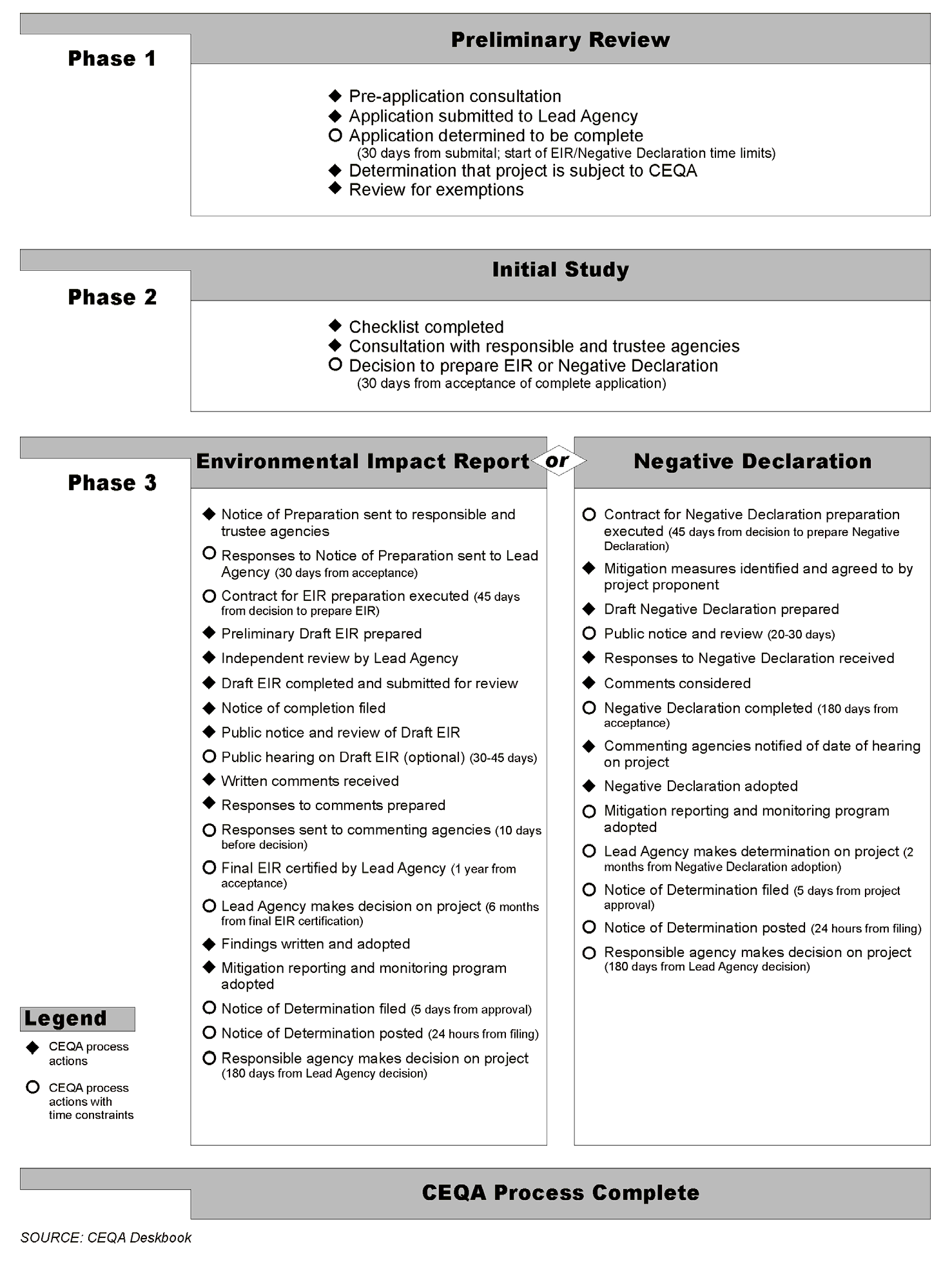
(Ord. No. 3577, 2012; Ord. No. 3666, § II(exh. A), 2017; Ord. No. 3706, 2019)
22.40.065 - Limit on Public Hearings.
Consistent with California Government Code Section 65905.5, if a proposed project that is subject to the Housing Accountability Act complies with the applicable objective Countywide Plan and zoning standards in effect at the time the application is deemed complete, then the County shall not conduct more than five public hearings in connection with the approval of the project subsequent to the application being deemed complete.
"Hearing" includes any public hearing, workshop, or similar meeting conducted by the county with respect to the proposed project, whether by the legislative body of the County, the planning agency established pursuant to Section 65100, or any other agency, department, board, commission, or any other designated hearing officer or body of the County, or any committee or subcommittee thereof. "Hearing" does not include a hearing to review a legislative approval required for a proposed project, including, but not limited to, a Countywide Plan amendment, a specific plan adoption or amendment, or a zoning amendment, or any hearing arising from a timely appeal of the approval or disapproval of a legislative action.
(Ord. No. 3745, § 1(exh. A), 2021)
22.40.070 - Staff Report and Recommendations for Discretionary Permits.
A.
Staff evaluation. The Agency staff shall review all discretionary applications submitted in compliance with this Article to determine whether or not they comply and are consistent with the provisions of this Development Code, other applicable provisions of the County Code, and the Countywide Plan and Community Plans. Agency staff shall provide a recommendation to the Director, Zoning Administrator, Commission, and/or Board, as applicable, on whether the application should be approved, approved subject to conditions, or denied.
B.
Decision or Staff Report. The Director shall prepare a written Decision for administrative actions for which the Director has final authority. When the Director does not have final authority, the Director shall prepare a written report for recommendations to the Zoning Administrator, Commission, and the Board. The decision or report shall include:
1.
A decision or recommendation for approval, approval with conditions, or denial of the application, where appropriate.
2.
Findings of fact regarding the development project's consistency with the Countywide Plan, any applicable Community or land use plan, and those findings specifically identified for each planning permit. In those instances when decisions are being issued administratively, summary findings may suffice for minor projects.
3.
Pursuant to the California Housing Accountability Act, the agency shall not disapprove a project that is subject to the Housing Accountability Act, including farmworker housing as defined in subdivision (h) of Section 50199.7 of the Health and Safety Code, for very low, low-, or moderate-income households, or an emergency shelter, or condition approval in a manner that renders the project infeasible for the use of very low, low-, or moderate-income households, or an emergency shelter, including through the use of design review standards, unless first making written findings, based upon a preponderance of the evidence in the record, as required by Govt. Code 65589.5;
4.
Information on how the decision may be appealed to a higher decision making authority.
C.
Report distribution. A staff report shall be furnished to the applicants at the same time as it is provided to the Zoning Administrator, members of the Commission, and/or Board, and any interested parties, prior to a hearing on the application.
(Ord. No. 3577, 2012; Ord. No. 3666, § II(exh. A), 2017; Ord. No. 3706, 2019; Ord. No. 3745, § 1(exh. A), 2021)
22.40.080 - Post Approval.
After an entitlement or development permit application is approved, the entitlement is subject to the expiration, extension, performance guarantee, and other applicable provisions of Chapter 22.70 (Permit Implementation, Time Limits, Extensions).
(Ord. No. 3577, 2012)
22.42.010 - Purpose of Chapter.
This Chapter provides procedures for Design Review for proposed discretionary development throughout the unincorporated areas of the County. Design Review consists of a review of plans and proposals for land use and design of physical improvements in order to implement the goals of the Countywide Plan and is intended to ensure that:
A.
Sound and creative design principles are used by applicants in designing proposed projects, which will result in high quality site planning and architectural design, and the innovative use of materials, construction methods, and techniques;
B.
Site planning, building design, and construction practices promote resource conservation through climate responsive design, use of renewable energy and resources, and cost effective use of resource conserving materials where practicable and feasible;
C.
The natural beauty of the County, and the public's ability to use and enjoy it, are preserved and encouraged;
D.
The design of the built environment respects and preserves the natural beauty of the County and the environmental resources found within;
E.
The exterior appearance of proposed structures, along with their associated landscaping, parking, signs, etc., is compatible and harmonious with the design, scale, and context of surrounding properties;
F.
The development of vacant properties which adjoin paper streets is undertaken in such a way as to minimize the impacts associated with the development; and
G.
Conflicts between land uses are eliminated, environmental values of the site are preserved, and adverse physical or visual effects which might otherwise result from unplanned or inappropriate development, design, or placement are minimized or eliminated.
(Ord. No. 3577, 2012; Ord. No. 3745, § 1(exh. A), 2021)
22.42.020 - Applicability.
New structures and exterior physical improvements, as well as additions, extensions, and exterior changes of or to existing structures and/or relocation of physical improvements, for either a single or multiple contiguous lots, as described in Subsections A through E below, shall be subject to Design Review, except as otherwise provided in Section 22.42.025 (Exemptions from Design Review) and 22.42.048 (Design Review Waivers).
A.
Planned Zoning Districts (combining coastal zones included). Residences, non-residential structures, accessory structures, agricultural structures, and other physical improvements in all Planned zoning districts.
B.
Conventional Zoning Districts. Residential buildings and additions to floor area in Conventional zoning districts on a lot that would contain more than 3,500 square feet of floor area with the proposed development and/or where the proposed development of primary structures would be greater than 30 feet in height or 16 feet in height for residential detached accessory structures. Non-residential structures and other physical improvements in all conventional zoning districts.
C.
Permit Waivers. Any waiver or exception to a standard specifically identified in this Development Code as being subject to this Chapter as well as Variance waivers identified in Chapter 22.54 (Variances).
D.
Substandard Building Sites. Where a vacant legal lot is proposed for single-family residential development, and when the lot is at least 50 percent smaller in total area than required for new lots under the applicable zoning district or slope regulations, in compliance with Section 22.82.050 (Hillside Subdivision Design Standards), whichever is more restrictive, the proposed development shall be subject to the requirements of this Chapter. In these instances, any exemption from Design Review provided by Section 22.42.025 (Exemptions from Design Review) shall be void and setback requirements shall be waived. The subsequent development and physical improvements of these properties shall continue to be subject to the requirements of this Chapter.
E.
Lots Served by Paper Streets. The development of a vacant lot served only by a paper street shall be subject to the requirements of this Chapter where required by a Community Plan pursuant to a resolution adopted by the Board of Supervisors.
F.
Deviations in the Form Based (FB) Combining District. As specified in Section 22.14.100, deviations to the provisions of the Marin County Form Based Code.
(Ord. No. 3577, 2012; Ord. No. 3602, § II(exh. A), 2013; Ord. No. 3666, § II(exh. A), 2017; Ord. No. 3706, 2019; Ord. No. 3745, § 1(exh. A), 2021; Ord. No. 3780, § 1(exh. A), 2023; Ord. No. 3797, § II(exh. A), 2023)
22.42.025 - Exemptions from Design Review.
Development and physical improvements listed below in Subsections A to T are exempt from Design Review.
A.
Single-Family Additions and Residential Accessory Structures in Planned Districts. Single-family residential additions and residential accessory structures on a lot with existing and proposed floor area not exceeding 3,500 square feet in a Planned District (see Chapter 22.16 Discretionary Development Standards) that meet the standards in Tables 4-2 and 4-3. This exemption does not apply if work authorized under a previous Design Review has not received approval of a final inspection from the Building and Safety Division.
TABLE 4-2
STANDARDS FOR EXEMPTION FROM DESIGN REVIEW FOR ONE-STORY ADDITIONS TO SINGLE-FAMILY
RESIDENCES AND FOR DETACHED ACCESSORY STRUCTURES IN PLANNED DISTRICTS
TABLE 4-3
STANDARDS FOR EXEMPTION FROM DESIGN REVIEW FOR MULTI-STORY ADDITIONS TO SINGLE-FAMILY
RESIDENCES IN PLANNED DISTRICTS
B.
Agricultural accessory structures that comply with the Stream Conservation Area and Wetland Conservation Area setbacks established in the Countywide Plan, and that are 300 feet or more from a property line of an abutting lot in separate ownership, and which are at least 300 feet from a street. The minimum setback to qualify for an exemption is reduced to 50 feet for an agricultural accessory structure that does not exceed 2,000 square feet in size, and to 25 feet for an agricultural accessory structure for retail sales of agricultural products that does not exceed 500 square feet in size. This exception does not apply to facilities for processing of agricultural products.
C.
In the A-2, C1, H1, RA, RR, RE, R1, R2, and VCR zones, open fencing, such as wood post and welded wire mesh, on lots greater than 20,000 square feet. The fencing shall be limited to eight feet in height above grade, be located outside of any required front or street side yard setback, and comply with the standards in Chapter 13.18 (Visibility Obstructions) of the County Code;
D.
In Planned Districts, fences or screening walls that comply with the fence standards in Section 22.20.050 (Fencing and Screening Standards). In addition, the following standards must be met:
1.
For purposes of compliance with Section 22.20.050, the front and street side yards shall be no less than ten feet for lots up to one acre and fifteen feet on lots greater than one acre.
2.
Fences or walls proposed within the front and street side yards or on the property line defining such yards are limited to six feet in height with the entire section or portion of the fence or wall above four feet in height limited to a surface area that is at least 50% open and unobstructed by structural elements.
3.
Fences and screening walls located outside the front and street side yards are limited to six feet in height.
E.
In the A, A-2, C1, H1, RA, RR, RE, R1, R2, and VCR zones, bridges that comply with the height limits and standards specified in Section 22.20.055 (Bridge Standards).
F.
In Planned Districts, attached front and rear yard porches having setbacks of at least ten feet.
G.
In Planned Districts, attached or detached decks not exceeding a maximum height of five feet above grade (excluding hand railings and other safety features) and having setbacks of at least five feet.
H.
In Planned Districts, replacing existing authorized driveways and widening driveways to meet minimum Title 24 or fire code standards (retaining walls must comply with Section 22.20.090(C)(6) (Setback requirements and exceptions), in addition to other applicable standards). This exemption excludes relocation of existing driveways.
I.
In Planned Districts, construction of new retaining walls that comply with the standards in Section 22.20.052 (Retaining Wall Standards), and in all zoning districts, replacement of existing retaining walls.
J.
The installation of power generators that do not exceed a height of four feet above grade and have a minimum front yard setback of 25 feet and minimum side and rear yard setbacks of 10 feet, provided they are not developed on a property with multiple primary units.
K.
Swimming pools and spas that do not exceed a height of thirty inches above grade (including integrated retaining walls) and have setbacks of at least 10 feet.
L.
In Planned Districts, new and replacement skylights, doors, and windows (including bay windows), and similar attached architectural features.
M.
Changes to any approved exterior color or material, unless review is required by prior conditions of Design Review or other discretionary permit approval.
N.
Signs subject to the regulations of Chapter 22.28 (Signs) and Chapter 22.60 (Permits for Signs).
O.
Additions up to 500 square feet, exterior remodeling, and site improvements to commercial, industrial, and institutional properties that the Director determines to be minor and incidental in nature and which are in compliance with the purpose of this chapter.
P.
Accessory Dwelling Units that meet the applicable standards set forth in Section 22.32.120. A (category 1) and B (category 2).
Q.
Other work that the Director determines to be minor and incidental in nature, and which is in compliance with the purpose of this Chapter.
R.
Repair or in-kind reconstruction work on legal structures.
(Ord. No. 3577, 2012; Ord. No. 3666, § II(exh. A), 2017; Ord. No. 3577, 2012; Ord. No. 3745, § 1(exh. A), 2021; Ord. No. 3797, § II(exh. A), 2023; Ord. No. 3806, § II(exh. A), 2023)
22.42.030—22.42.045. - Reserved.
Editor's note— Ord. No. 3666, § II(exh. A), adopted March 14, 2017, repealed §§ 22.42.030—22.42.045, which pertained to design review for substandard and hillside building sites, design review for certain driveways, design review for development along paper streets, and design review for development along anadromous fish streams and tributaries, respectively, and derived from Ord. No. 3577, adopted Jan. 24, 2012.
22.42.048 - Design Review Waiver.
Design Review shall be waived for eligible projects and the project shall instead be subject to the requirements of Chapter 22.52 (Site Plan Review). Only those projects that comply with the criteria below are eligible for Design Review waiver.
A.
The project is limited to single-family residential development, including associated accessory structures.
B.
The project is not located within an area governed by a Master Plan, unless that Master Plan provides for Site Plan Review.
C.
The development would meet the standards for height and setbacks established by the R1:B3 zoning district and Chapter 22.20.
D.
The development would not exceed a floor area of 3,500 square feet
E.
The development would not exceed a floor area ratio of 30 percent.
F.
The development would not occur in a Ridge and Upland Greenbelt Area.
(Ord. No. 3666, § II(exh. A), 2017)
22.42.050 - Application, Filing, Processing, and Noticing.
A.
Purpose. This Section provides procedures for filing, processing, and noticing of Design Review applications.
B.
Filing and processing. All Design Review applications shall be completed, submitted, and processed in compliance with Chapter 22.40 (Application Filing and Processing, Fees) and Section 22.40.050 (Initial Application Review for Discretionary Permits).
Design Review application forms are available at the Agency's public information counter.
C.
Notice of action and/or hearing date. Administrative decisions and public hearings on a proposed Design Review application shall be noticed in compliance with Chapter 22.118 (Notices, Public Hearings, and Administrative Actions). The Director may provide expanded public notice to ensure maximum public awareness of any Design Review application.
D.
Applicability to approved projects. On conventionally-zoned lots, where new or additional floor area previously approved without Design Review had not received a final inspection by the Building and Safety Division, and where the scope of work is proposed to be modified to include additional floor area that would trigger Design Review pursuant to Sections 22.42.020.B or 22.42.020.D, the scope of the Design Review shall include all new or additional floor area that has not received a final inspection.
(Ord. No. 3577, 2012; Ord. No. 3666, § II(exh. A), 2017)
22.42.055 - Project Review Procedures.
A.
Design Review Procedures. The Director shall approve, conditionally approve, or deny all Design Review applications in compliance with Section 22.42.060 (Decision and Findings), except as otherwise provide in Subsections B and C, below.
B.
Zoning Administrator review. When the Design Review application is associated with a permit application that requires a public hearing, the Design Review action may be taken by the Zoning Administrator.
C.
Referral to Commission. When the Director finds that significant policy issues are raised by the proposed project, the Director may refer the Design Review application to the Planning Commission for a final action.
(Ord. No. 3577, 2012; Ord. No. 3602, § II(exh. A), 2013; Ord. No. 3666, § II(exh. A), 2017)
22.42.060 - Decision and Findings.
The Review Authority shall issue the decision and the findings upon which the decision is based. The Review Authority may approve or conditionally approve an application only if all of the following findings are made:
A.
The proposed development complies with either the Single-family or Multi-family Residential Design Guidelines, as applicable, the characteristics listed in Chapter 22.16 (Discretionary Development Standards) and 22.32.168 (Tidelands), as well as any applicable standards of the special purpose combining districts provided in Chapter 22.14 of this Development Code.
B.
The proposed development provides architectural design, massing, materials, and scale that are compatible with the site surroundings and the community.
C.
The proposed development results in site layout and design that will not eliminate significant sun and light exposure or result in light pollution and glare; will not eliminate primary views and vistas; and will not eliminate privacy enjoyed on adjacent properties.
D.
The proposed development will not adversely affect and will enhance where appropriate those rights-of-way, streetscapes, and pathways for circulation passing through, fronting on, or leading to the property.
E.
The proposed development will provide appropriate separation between buildings, retain healthy native vegetation and other natural features, and be adequately landscaped consistent with fire safety requirements.
(Ord. No. 3577, 2012; Ord. No. 3602, § II(exh. A), 2013; Ord. No. 3666, § II(exh. A), 2017; Ord. No. 3745, § 1(exh. A), 2021)
22.44.010 - Purpose of Chapter.
This Chapter provides procedures for the filing, processing, and adoption of Master Plans. These procedures are intended to:
A.
Align with California State Law governing common interest developments;
B.
Allow for phased developments;
C.
Establish site specific development criteria to ensure that development enhances or is compatible with the surrounding neighborhood character;
D.
Promote clustering of structures to preserve open land areas and avoid environmentally sensitive areas;
E.
Protect natural resources, scenic quality, and environmentally sensitive areas.
(Ord. No. 3666, § II(exh. A), 2017)
22.44.020 - Applicability.
This Chapter applies to all existing Master Plans and Precise Development Plans, to Planned Developments in Planned zoning districts, and to subdivisions in Planned zoning districts that are subject to Final Maps. Master Plans or Master Plan amendments, as appropriate, are required for these types of projects unless they are exempt or waived by the provisions of this Chapter.
(Ord. No. 3666, § II(exh. A), 2017)
22.44.030 - Exemptions from Master Plans and Master Plan Amendments.
The following types of development are exempt from the requirements of a Master Plan or Master Plan amendment:
A.
Affordable housing, except where an applicable Community Plan or community based visioning plan approved by the Board contains policies that directly require Master Plans for development on specific properties.
B.
For non-residential development, a change in use where the proposed use is allowed as a permitted use in the zoning district, as identified with "P" in the land use tables in Article II (Zoning Districts and Allowable Land Uses) provided there is no increase in building area.
C.
Development that the Director determines is minor and incidental to a principally permitted use on the site.
(Ord. No. 3666, § II(exh. A), 2017)
22.44.040 - Waiver of Master Plan Amendment and Precise Development Plan Amendment.
In response to a proposal to deviate from the standards of a Master Plan adopted prior to January 1, 2017, the requirement for a Master Plan amendment is waived for an eligible project provided it meets the waiver criteria listed below, and the project shall instead be subject to a Conditional or Master Use Permit and/or Design Review, in compliance with Chapters 22.48 (Conditional Use Permit) 22.49 (Master Use Permit), 22.42 (Design Review) and this Section.
All Precise Development Plan amendments are subject to Chapter 22.42 (Design Review), since the Precise Development Plan is an antiquated entitlement.
In order for the requirements of a Master Plan amendment to be waived, a project that is eligible for waiver must meet the following criteria:
1.
Be consistent with the Countywide Plan and any applicable Community Plan and Local Coastal Program;
2.
Be designed so that potential impacts can be properly addressed through Use Permit and/or Design Review procedures, in compliance with Chapters 22.48 (Conditional Use Permits) or 22.49 (Master Use Permits) and 22.42 (Design Review);
3.
Not involve a Transfer of Development Rights.
(Ord. No. 3666, § II(exh. A), 2017; Ord. No. 3745, § 1(exh. A), 2021)
22.44.050 - Application Filing, Processing, and Review.
A.
Filing. An application for a Master Plan shall be submitted, filed, and processed in compliance with and in the manner described in Chapter 22.40 (Application Filing and Processing, Fees).
Master Plan application forms are available online and at the Agency's public service counter.
1.
Area covered by plan. The area of the Master Plan shall include at least all contiguous properties under the same ownership. The area covered by a proposed plan may also include multiple ownerships.
2.
Processing. A Master Plan may be reviewed in conjunction with other land use permits, with only a Master Use Permit, or the Agency may require that a Master Plan be approved before reviewing any other land use permit applications.
3.
Development Agreement. A Master Plan may be approved in conjunction with a Development Agreement (Govt. Code 65865).
4.
Application materials. Applications for Master Plan or Master Plan amendment approval shall include the information and materials required by Section 22.40.030 (Application Submittal and Filing).
B.
Project review procedure. Each application shall be analyzed by the Agency to ensure that the application is consistent with the purpose and intent of this Chapter and with the Countywide Plan and Community or Specific Plans.
(Ord. No. 3666, § II(exh. A), 2017)
22.44.060 - Master Plan Content.
A.
A new Master Plan shall set forth criteria for future development. Such criteria may be required to include the following:
1.
Density, lot areas and dimensions.
2.
Development areas, open space areas, and environmental buffers.
3.
Site planning, circulation and parking.
4.
Areas of grading, storm water management, and landscaping.
5.
Structure height, building and floor area, floor area ratio, lot coverage, and setbacks.
6.
Architectural and site design.
B.
A new Master Plan shall establish clear and unambiguous review procedures for future development, including:
1.
Development subject to ministerial review to ensure compliance with established Master Plan criteria.
2.
Development subject to discretionary review to ensure compliance with established Master Plan criteria.
3.
Procedures to deviate from established Master Plan criteria.
C.
Master Plan amendments shall be reviewed on the basis of the proposed revisions, and need not establish new development criteria or review procedures for future development.
(Ord. No. 3666, § II(exh. A), 2017)
22.44.070 - Action on Master Plan and Master Plan Amendment Applications.
A.
Master Plan and Master Plan amendment adoption.
1.
Action by Commission. The Commission may recommend approval, conditional approval, or denial of an application. The Commission's actions may specify any condition which is likely to benefit the general welfare of future residents in the development and the purposes of the district, or mitigate any impacts which may result from implementation of the development.
2.
Action by Board. The Board may approve, conditionally approve, or deny the Master Plan as recommended by the Commission. Any modification of the plan may be referred back to the Commission. The decision is a legislative act and shall be adopted by ordinance.
When a Master Plan is processed concurrently with any other permit or entitlement, the Board shall be the final authority on all associated permits and entitlements.
3.
Findings for Master Plans and Master Plan amendments. Master Plan and Master Plan amendment applications may only be approved or conditionally approved when they are consistent with the findings listed below.
a.
The Master Plan or Master Plan amendment is consistent with the goals, policies, objectives, and programs of the Countywide Plan and any applicable Community Plan.
b.
The Master Plan or Master Plan Amendment is suitable for the site, and the future development would be able to conform to the Discretionary Development Standards.
c.
The proposed Master Plan or Master Plan amendment would not be detrimental to the public interest, health, safety, convenience, or welfare of the County.
B.
Notice of action and/or hearing date. Public hearings on a proposed Master Plan or Master Plan amendment applications shall be noticed in compliance with Chapter 22.118 (Notices, Public Hearings, and Administrative Actions). The Director may provide expanded public notice to ensure maximum public awareness of an application. In addition to the requirements of Chapter 22.118 (Notice, Public Hearings, and Administrative Actions), where a Master Plan or an amendment to a Master Plan is proposed, a public notice may be mailed or delivered at least 10 days prior to the decision to all owner(s) of real property that comprise the area encompassed by the Master Plan that is the subject of the amendment.
(Ord. No. 3666, § II(exh. A), 2017; Ord. No. 3745, § 1(exh. A), 2021)
22.44.080 - Master Plan Rescission Applications.
A.
Master Plan Rescission.
1.
Action by Commission. The Commission may recommend approval, conditional approval, or denial of an application to rescind a vested Master Plan.
2.
Action by Board. The Board may approve, conditionally approve, or deny an application to rescind a vested Master Plan as recommended by the Commission. The decision is a legislative act and shall be adopted by ordinance.
B.
Notice of action and/or hearing date. Public hearings on a proposed Master Plan rescission application shall be noticed in compliance with Chapter 22.118 (Notices, Public Hearings, and Administrative Actions). The Director may provide expanded public notice to ensure maximum public awareness of an application. In addition to the requirements of Chapter 22.118 (Notice, Public Hearings, and Administrative Actions), a public notice may be mailed or delivered at least 10 days prior to the decision to all owner(s) of real property that comprise the area encompassed by the Master Plan that is the subject of the amendment.
(Ord. No. 3666, § II(exh. A), 2017)
22.46.010 - Purpose of Chapter.
This Chapter provides procedures for Floating Home Exceptions, which are intended to allow for exceptions from the strict application of the standards for maximum floor area, setback, height, length, and width standards for floating homes.
(Ord. No. 3577, 2012; Ord. No. 3666, § II(exh. A), 2017; Ord. No. 3706, 2019)
22.46.020 - Applicability.
This Chapter shall apply to floating homes, where allowed by Article II (Zoning Districts and Allowable Land Uses), and in compliance with Section 22.32.075 (Floating Homes). This chapter does not apply to Accessory Dwelling Units that meet the applicable standards set forth in Section 22.32.120. A (category 1), B (category 2), and C (category 3).
(Ord. No. 3577, 2012; Ord. No. 3745, § 1(exh. A), 2021)
22.46.030 - Application Filing, Processing, and Review.
A.
Filing.
1.
An application for a Floating Home Exception Permit shall be submitted, filed, and processed in compliance with and in the manner described in Chapter 22.40 (Application Filing and Processing, Fees).
2.
Floating Home Exception Permit application forms are available online and at the Agency's public service counter.
B.
Project review procedure. Each Floating Home Exception Permit application shall be analyzed by the Agency to ensure that the application is consistent with the purpose and intent of this Chapter.
C.
Review Authority. The Director may approve, approve with conditions or deny a Floating Home Exception Permit application for the following:
1.
Floor Area;
2.
Length;
3.
Width;
4.
Height; and
5.
Setbacks (spacing and mooring requirements).
D.
Notice of action and/or hearing date. The Director may act on Floating Home Exception administratively without holding a public hearing.
(Ord. No. 3577, 2012; Ord. No. 3666, § II(exh. A), 2017)
22.46.040 - Decision and Findings.
The Review Authority shall issue the decision and the findings upon which the decision is based. The Review Authority may approve, conditionally approve, or deny an application.
A.
Findings. The Director may approve, or conditionally approve a Floating Home Exception Permit only if all of the following findings are made:
1.
The requested exception will not adversely or substantially diminish:
a.
Light and ventilation to floating homes berthed adjacent to the proposed floating home; and
b.
Existing views and/or view corridors enjoyed by owners or tenants of neighboring or adjoining floating homes and floating home sites. The term "neighbor" is not to be construed to mean the owners or occupants of land-based properties or improvements.
2.
The size of the requested exception is:
a.
Comparable and compatible with the size of neighboring floating homes; and
b.
Will not encroach into any right-of-way, fairway, adjoining berth or any required open space.
3.
The requested exception is the minimum necessary to satisfy the objectives sought by the owner and/or builder of the floating home.
4.
The requested exception will not result in any detriment to other floating homes in the immediate vicinity of the proposed floating home.
5.
The exception will not result in public health and safety hazards, including applicable fire safety standards.
(Ord. No. 3577, 2012; Ord. No. 3666, § II(exh. A), 2017)
22.48.010 - Purpose of Chapter.
This Chapter provides procedures for Conditional Use Permits, where required by Article II (Zoning Districts and Allowable Land Uses) and Article V (Coastal Zones - Development and Resource Management Standards), which are intended to allow for an activity or use that is unique or whose effects on the surrounding environment cannot be determined prior to being proposed for a particular location.
(Ord. No. 3577, 2012; Ord. No. 3666, § II(exh. A), 2017)
22.48.020 - Applicability.
This Chapter shall apply to all conditional land use activities identified in Article II (Zoning Districts and Allowable Land Uses), and Article V (Coastal Zones - Development and Resource Management Standards), as applicable.
(Ord. No. 3577, 2012)
22.48.030 - Application Filing, Processing, and Review.
A.
Filing.
1.
An application for a Conditional Use Permit shall be submitted, filed, and processed in compliance with and in the manner described in Chapter 22.40 (Application Filing and Processing, Fees).
2.
Conditional Use Permit application forms are available online and at the Agency's public service counter.
B.
Project review procedure. Each Conditional Use Permit application shall be analyzed by the Agency to ensure that the application is consistent with the purpose and intent of this Chapter.
C.
Hearings and notice.
1.
Public hearings on a proposed Conditional Use Permit application shall be noticed in compliance with Chapter 22.118 (Notices, Public Hearings, and Administrative Actions).
2.
The Zoning Administrator shall hold a public hearing, or the Director shall refer the application to the Commission for a public hearing, in compliance with Chapter 22.118 (Notices, Public Hearings, and Administrative Actions). This hearing shall include a review of the configuration, design, location, and potential impacts of the proposed use.
(Ord. No. 3577, 2012; Ord. No. 3666, § II(exh. A), 2017)
22.48.040 - Decision and Findings.
After a public hearing, the Review Authority shall record and file the decision and the findings upon which the decision is based. The Review Authority may approve a Conditional Use Permit application, with or without conditions, only if all of the following findings are made:
A.
The proposed use is allowed, as a conditional use, within the subject zoning district and complies with all of the applicable provisions of this Chapter.
B.
The design, location, size, and operating characteristics of the proposed use are compatible with the existing and future land uses in the vicinity.
C.
That granting the Conditional Use Permit will not be detrimental to the public interest, health, safety, convenience, or welfare of the County, or injurious to the property or improvements in the vicinity and zoning district in which the real property is located.
(Ord. No. 3577, 2012; Ord. No. 3666, § II(exh. A), 2017)
22.48.050 - Post Approval.
The following shall apply subsequent to the approval of a Conditional Use Permit application. These procedures are in addition to those identified in Section 22.40.080 (Post Approval) and Chapter 22.70 (Permit Implementation, Time Limits, Extensions).
A.
Conditional Use Permit to run with the land. A Conditional Use Permit granted in compliance with the provisions of this Chapter shall continue to be valid upon a change of ownership of: the site, business, service, use, or structure that was the subject of the permit application.
B.
Changes to conditions and standards. The review authority may approve minor changes to required conditions and operating standards of an approved Conditional Use Permit, in compliance with the provisions of this Chapter and Section 22.70.060 (Changes to an Approved Project).
C.
Time Limits. Notwithstanding any other provisions of this Development Code, a Conditional Use Permit shall expire if the use ceases to operate for a five-year period or greater, unless a Use Permit Renewal is granted to extend that period of time.
(Ord. No. 3577, 2012; Ord. No. 3666, § II(exh. A), 2017)
22.49.010 - Purpose of Chapter.
This Chapter provides procedures for Master Use Permits, where a Use Permit is required by Article II (Zoning Districts and Allowable Land Uses) and Article V (Coastal Zones - Development and Resource Management Standards), which are intended to allow for activities and uses that are unique and whose effects on the surrounding environment cannot be determined prior to being proposed for a particular location. A Master Use Permit is a type of Conditional Use Permit that allows for multiple conditional land use activities on a single site or in a single Master Plan area.
(Ord. No. 3666, § II(exh. A), 2017)
22.49.020 - Applicability.
This Chapter shall apply to all circumstances where multiple conditional land use activities identified in Article II (Zoning Districts and Allowable Land Uses), and Article V (Coastal Zones - Development and Resource Management Standards), as applicable, are proposed on a single site or in a single Master Plan area.
(Ord. No. 3666, § II(exh. A), 2017)
22.49.030 - Application Filing, Processing, and Review.
A.
Filing.
1.
An application for a Master Use Permit shall be submitted, filed, and processed in compliance with and in the manner described in Chapter 22.40 (Application Filing and Processing, Fees).
2.
Master Use Permit application forms are available online and at the Agency's public service counter.
B.
Project review procedure. Each Master Use Permit application shall be analyzed by the Agency to ensure that the application is consistent with the purpose and intent of this Chapter.
C.
Hearings and notice. Public hearings on a proposed Master Use Permit application shall be noticed in compliance with Chapter 22.118 (Notices, Public Hearings, and Administrative Actions).
The Zoning Administrator shall hold a public hearing, or the Director shall refer the application to the Commission for a public hearing, in compliance with Chapter 22.118 (Notices, Public Hearings, and Administrative Actions). This hearing shall include a review of the configuration, design, location, and potential impacts of the proposed use.
(Ord. No. 3666, § II(exh. A), 2017)
22.49.040 - Decision and Findings.
After a public hearing, the Review Authority shall record and file the decision and the findings upon which the decision is based. The Review Authority may approve a Master Use Permit application, with or without conditions, only if all of the following findings are made:
A.
The proposed uses are allowed, as conditional uses, within the subject zoning district and comply with all of the applicable provisions of this Chapter.
B.
The design, location, size, and operating characteristics of the proposed uses are compatible with the existing and future land uses in the vicinity.
C.
That granting the Master Use Permit will not be detrimental to the public interest, health, safety, convenience, or welfare of the County, or injurious to the property or improvements in the vicinity and zoning district in which the real property is located.
(Ord. No. 3666, § II(exh. A), 2017)
22.49.050 - Post Approval.
The following shall apply subsequent to the approval of a Master Use Permit application. These procedures are in addition to those identified in Section 22.40.080 (Post Approval) and Chapter 22.70 (Permit Implementation, Time Limits, Extensions).
A.
Master Use Permit to run with the land. A Master Use Permit granted in compliance with the provisions of this Chapter shall continue to be valid upon a change of ownership of: the site, businesses, services, or uses that were the subject of the permit application.
B.
Changes to conditions and standards. The review authority may approve minor changes to required conditions and operating standards of an approved Master Use Permit, in compliance with the provisions of this Chapter and Section 22.70.060 (Changes to an Approved Project).
C.
Time Limits. Notwithstanding any other provisions of this Development Code, authorization for uses allowed by a Master Use Permit shall expire for any of the uses that cease to operate for a five-year period or greater, unless a Use Permit Renewal is granted to extend that time.
(Ord. No. 3666, § II(exh. A), 2017)
22.50.010 - Purpose of Chapter.
This Chapter establishes procedures for allowing short-term uses which may not meet the normal development or use standards applicable to the subject zoning district, but which may be acceptable because of their temporary nature.
This Chapter provides a review process for a proposed use to ensure that basic health, safety, and general community welfare standards are met. This Chapter also provides a process for Agency approval of a suitable temporary use with the minimum necessary conditions or limitations consistent with the temporary nature of the use.
(Ord. No. 3577, 2012)
22.50.020 - Applicability.
This Chapter shall apply to all land use activities in all zoning districts defined in Article II (Zoning Districts and Allowable Land Uses), and Article V (Coastal Zones - Development and Resource Management Standards).
(Ord. No. 3577, 2012)
22.50.030 - Application Filing, Processing, and Review.
A.
Filing.
1.
Application for a Temporary Use Permit shall be submitted, filed, and processed in compliance with and in the manner described in Chapter 22.40 (Application Filing and Processing, Fees).
2.
Temporary Use Permit application forms are available online and at the Agency's public service counter.
B.
Project review procedure. Each Temporary Use Permit application shall be analyzed by the Agency to ensure that the application is consistent with the purpose and intent of this Chapter.
C.
Notice of action. An administrative decision on a proposed Temporary Use Permit application shall be noticed in compliance with Chapter 22.118 (Notices, Public Hearings, and Administrative Decisions).
(Ord. No. 3577, 2012)
22.50.040 - Allowable Temporary Uses.
The following temporary uses may be allowed subject to the issuance of a Temporary Use Permit. Uses that do not fall into the categories listed below shall comply with the use and development standards and permit requirements that otherwise apply to the subject site:
A.
Holiday product sales lots.
1.
Lots used for the sale of seasonal holiday products, and the establishment of an accessory temporary residence and/or security trailer on the sales lots may be approved when needed for the provision of security.
2.
A permit shall not be required when the temporary sales lot is used in conjunction with an established commercial business which has been issued a valid County Business License, provided that the activity does not consume more than 15 percent of the total parking spaces on the site and does not impair vehicle access.
3.
Examples of temporary holiday sales lots are Christmas tree lots, pumpkin patches, and other seasonal holiday products. The uses may be located on vacant parcels or within existing parking lots.
B.
Mobile home used as a temporary residence. A mobile home may be approved as a temporary residence when a valid Building Permit for a new residence is in effect. Two years after the date of issuance of the residential Building Permit, and/or two months after the final inspection of the single-family residence constructed pursuant to the residential building permit, the mobile home shall be removed from the project site, unless the Temporary Use Permit specifies a different time frame.
C.
Temporary construction yards and on-site storage containers. An off-site temporary construction yard may be approved when the temporary construction yard is needed in conjunction with the construction of an approved development project. The temporary location of a storage container on the site of a construction project may be approved to securely store furniture, tools or construction materials.
A temporary construction yard or location of a storage container may be approved in conjunction with other development permits when at least one of the following conditions exist:
1.
When a valid Building or Grading Permit is in effect, and the construction or remodeling of a development project is taking place; or
2.
When an applicant can demonstrate that a temporary construction yard or storage container is needed on a short-term basis while permanent site work is being conducted.
D.
Temporary office. A temporary office may be approved as an accessory use, or as the first phase of a development project.
E.
Temporary caregiver quarters. Recreational vehicles temporarily located on a property zoned for single-family residential use and exclusively used to house dedicated caregivers for property occupants who need medical care and assistance with daily activities due to old age, disease, or disability. A Temporary Use Permit issued for this type of use shall not have a maximum term exceeding six months.
F.
Fuels management. Temporary livestock grazing may be approved on a short-term basis in any zoning district as a means of managing vegetation for fire protection purposes.
G.
Temporary operations or events. Short-term operations or events may be approved as a modification to an existing legal or legal nonconforming use for a trial period as a means of evaluating the appropriateness of allowing the operations to continue for a longer duration or events to occur on a regular basis pursuant to a Use Permit approval.
H.
Temporary real estate office. A temporary real estate office may be approved within the area of an approved residential development project only for the sale of homes and/or lots.
I.
Temporary work trailers. A trailer, coach, or mobile home may be approved as a temporary work site for employees of a business when at least one of the following conditions exist:
1.
When a valid Building Permit is in effect, and the construction or remodeling of a permanent residential, commercial, or industrial structure is taking place; or
2.
When an applicant can demonstrate that a temporary trailer is needed on a short-term basis.
J.
Temporary retail establishments and restaurants. Retail establishments and restaurants that will operate on a short-term basis.
K.
Educational tours. Educational tours in ARP zoning districts may be subject to a Temporary Use Permit as indicated in section 22.32.065.
L.
Similar temporary uses. Other temporary uses which, in the opinion of the Director, are similar to and compatible with the zoning district and surrounding land uses may be approved. The maximum time period for which these types of uses shall be allowed will depend upon the particular circumstances involved.
(Ord. No. 3577, 2012; Ord. No. 3666, § II(exh. A), 2017; Ord. No. 3706, 2019; Ord. No. 3745, § 1(exh. A), 2021)
22.50.050 - Development Standards.
Standards for floor areas, heights, landscaping, off-street parking areas, setbacks, and other structure and property development standards that apply to the category of use or the zoning district of the subject site (see Articles II (Zoning Districts and Allowable Land Uses) and III (Site Planning and General Development Regulations)) shall be used as a guide for determining the appropriate development standards for temporary uses. However, the Director may authorize variation from the specific standards, as deemed appropriate in the Temporary Use Permit.
(Ord. No. 3577, 2012)
22.50.060 - Decision and Findings.
The Director may approve or conditionally approve a Temporary Use Permit, only if the proposed temporary use is in compliance with Section 22.50.040 (Allowable Temporary Uses), above, and if all of the following findings are made:
A.
The establishment, maintenance or operation of the use will not, under the circumstances of the particular case, be detrimental to the health, safety, or general welfare of persons residing or working in the neighborhood of the proposed use.
B.
The use, as described and conditionally approved, will not be detrimental or injurious to property and improvements in the neighborhood or to the general welfare of the County.
C.
Approved measures for removing the use and restoring the site will ensure that the temporary use causes no changes to the site that will limit the range of possible future land uses otherwise allowed by this Development Code.
In order to make the determinations and findings listed above, the Review Authority shall take into consideration the temporary nature of the requested land use activity.
(Ord. No. 3577, 2012)
22.50.070 - Post Approval.
The following shall apply subsequent to the approval of a Temporary Use Permit application. These procedures are in addition to those identified in Section 22.40.080 (Post Approval) and Chapter 22.70 (Permit Implementation, Time Limits, Extensions):
A.
Condition of site following temporary use. Each site occupied by a temporary use shall be cleaned of debris, litter, or any other evidence of the temporary use upon completion or removal of the use, and shall thereafter be used in compliance with the provisions of this Development Code. A bond may be required prior to initiation of the use to ensure cleanup after the use is finished.
B.
Time limits. The Notice of Decision for a Temporary Use Permit shall specify the permit duration. However, Temporary Use Permits may only be approved for a maximum of two years. Temporary Use Permits may not be renewed, but a new Temporary Use Permit may be issued for the same use on the same site.
(Ord. No. 3577, 2012; Ord. No. 3706, 2019)
22.51.010 - Purpose of Chapter.
This Chapter establishes procedures for renewing vested Use Permits.
(Ord. No. 3577, 2012; Ord. No. 3666, § II(exh. A), 2017)
22.51.020 - Applicability.
This Chapter shall apply to all renewals of vested Use Permits. Vested Use Permits remain in full force and effect until such time as they are revoked pursuant to Chapter 22.120 (Use Permit Revocations). Use Permits that are granted in perpetuity do not require renewal.
(Ord. No. 3577, 2012; Ord. No. 3666, § II(exh. A), 2017)
22.51.030 - Application Filing, Processing, and Review.
A.
Filing.
1.
Application for a Use Permit Renewal shall be submitted, filed, and processed in compliance with and in the manner described for ministerial planning permits in Chapter 22.40 (Application Filing and Processing, Fees).
2.
Use Permit Renewal application forms are available online and at the Agency's public service counter.
B.
Project review procedure. Each Use Permit Renewal application shall be analyzed by the Agency to ensure that the application is consistent with the purpose and intent of this Chapter. The Director may require a condition compliance review to determine whether the use has been conducted in conformance with the conditions of the original Use Permit approval.
(Ord. No. 3577, 2012; Ord. No. 3666, § II(exh. A), 2017)
22.51.040 - Decision and Findings.
The Director may approve or conditionally approve a Use Permit Renewal, only when the following finding can be made:
A.
The approved use will be continued in substantial conformance with the original Use Permit.
The Director may impose such additional conditions of approval as are necessary to determine that the renewal is consistent with the finding above and may impose another limited term on the Use Permit. All the conditions of approval imposed by the original Use Permit shall continue to apply after a Use Permit has been renewed and do not need to be referenced in the decision on the Use Permit Renewal.
(Ord. No. 3577, 2012)
22.51.050 - Post Approval.
The following shall apply subsequent to the approval of a Use Permit Renewal application. These procedures are in addition to those identified in Sections 22.40.080 (Post Approval), and 22.48.050 (Use Permit Post approval) and Chapter 22.70 (Permit Implementation, Time Limits, Extensions):
A.
Use Permit Renewal to run with the land. A Use Permit Renewal granted in compliance with the provisions of this Chapter shall continue to be valid upon a change of ownership of: The site, business, service, use, or structure that was the subject of the permit application.
B.
Time Limits. Notwithstanding any other provisions of this Development Code, a renewed Use Permit shall expire if the use is abandoned or ceases to operate for a two-year period or greater.
(Ord. No. 3577, 2012)
22.52.010 - Purpose of Chapter.
This Chapter provides procedures for Site Plan Review consisting of a review of site plans for the arrangement and design of physical improvements in order to implement the goals of the Countywide Plan and is intended to ensure that:
A.
Sound and creative design principles are used by applicants in designing proposed projects, which will result in high quality site planning;
B.
The natural heritage and beauty of the County will be preserved and adverse physical effects which might otherwise result from unplanned or inappropriate development, design, or placement are minimized or eliminated.
(Ord. No. 3666, § II(exh. A), 2017)
22.52.020 - Applicability.
The provisions of this Chapter apply under any of the following circumstances:
A.
Proposed development would increase the lot coverage above 75 percent on a single-family residential lot.
B.
Site Plan Review was required by a Master Plan, Design Review Waiver, or as a mitigation measure for a previous planning permit approval.
C.
The construction of any new driveway that exceeds a length of 250 feet in the A2, C1, H1, RA, RR, RE, R1, R2, and VCR zoning districts.
D.
All development and improvements on lots accessed by paper streets, without regard to the size of the lots or the applicable zoning district.
E.
In those instances where a vacant legal lot of record in the Countywide Plan's City-Centered, Baylands, or Inland Rural Corridor is proposed for development, except for those activities, uses of land, and other improvements subject to the SGV combining, district in Subsection F, below, any proposed development within the Countywide Plan's Stream Conservation Area that adjoins a mapped anadromous fish stream and tributary shall be subject to Site Plan Review as provided by this chapter if the lot is zoned A, A-2, RA, H1, O-A, RR, RE, R1, R2, C-1, A-P, or VCR, including all combining zoning districts. Development includes all physical improvements, including buildings, structures, parking and loading areas, driveways, retaining walls, fences, and trash enclosures. The determination of the applicability of this requirement shall be based on the streams and tributaries shown on the map entitled "Marin County Anadromous Fish Streams and Tributaries," which is maintained and periodically updated by the Community Development Agency.
F.
In those instances where an activity, use of land, or other improvement subject to the SGV combining district located within the Stream Conservation Area would:
1.
Entail grading or otherwise expose soil;
2.
Increase lot coverage or surface runoff;
3.
Remove vegetation or woody riparian vegetation; or
4.
Alter the bed, bank, or channel of any stream.
G.
In those instances where development subject to the SGV combining district located outside the Stream Conservation Area would:
1.
Create new roads or driveways; or
2.
Create or replace 500 square feet or more of lot coverage.
H.
Any development seaward of the mean higher high tide, any increase of lot coverage within a tidelands area, and all docks and piers.
(Ord. No. 3666, § II(exh. A), 2017; Ord. No. 3745, § 1(exh. A), 2021; Ord. No. 3770, § 1(exh. A), 2022)
22.52.030 - Site Plan Review Exemptions.
The following types of development are exempt from Site Plan Review:
A.
Development outside of the SGV combining district that is subject to Design Review or Variance requirements.
B.
Floating homes.
C.
Accessory Dwelling Units that meet the applicable standards set forth in Section 22.32.120. A (category 1) and B (category 2).
D.
Signs.
E.
The following types of development subject to the SGV combining district:
1.
Removal of dead, invasive, or exotic vegetation, including leaf litter, except for woody debris located below the stream top of bank. Consultation with the Count, California Department of Fish and Wildlife, and/or Marin Municipal Water District is required prior to removal of any woody debris below the stream top of bank.
2.
Removal or trimming of pyrophytic combustible live trees and/or vegetation consistent with Chapter 22.62 (Tree Removal Permits) and Title 16 — Provision 16.16.040, including tanoak, California bay laurel, and Douglas fir tree species.
Removal of any live tree or vegetation that is greater than six inches in diameter at breast height and below the top of bank is not exempt, unless the tree or vegetation presents an immediate hazard to public safety.
3.
Planting of non-pyrophytic native vegetation.
4.
Voluntary creek restoration projects consistent with and authorized under the Marin Resource Conservation District's Permit Coordination Program.
5.
Repair and maintenance, including the replacement, of existing degraded septic systems that incorporate Marin County Stormwater Pollution Prevention Program (MCSTOPPP) minimum erosion and sediment controls and best management practices.
6.
Subdivision pursuant to the Subdivision Map Act (commencing with Section 66410 of the Government Code), and any other division of land where the land division is brought about in connection with the purchase of such land by a public agency for public recreational use.
7.
Development that is permitted pursuant to Chapter 11.08 (Watercourse Division or Obstruction).
(Ord. No. 3666, § II(exh. A), 2017; Ord. No. 3745, § 1(exh. A), 2021; Ord. No. 3770, § 1(exh. A), 2022; Ord. No. 3806, § II(exh. A), 2023)
22.52.040 - Application Filing, Processing, and Review.
A.
Filing.
1.
An application for a Site Plan Review shall be submitted, filed, and processed in compliance with and in the manner described in Chapter 22.40 (Application Filing and Processing, Fees).
2.
Site Plan Review application forms are available online and at the Agency's public service counter.
B.
Site Plan Review Procedures. The Director shall approve, conditionally approve, or deny all Site Plan Review applications in compliance with Section 22.42.060 (Decision and Findings), except as otherwise provide in Subsections D and E, below.
C.
Zoning Administrator review. When the Site Plan Review application is associated with a permit application that requires a public hearing, the Site Plan Review action may be taken by the Zoning Administrator.
D.
Referral to Commission. When the Director finds that significant policy issues are raised by the proposed project, the Director may refer the Site Plan Review application to the Planning Commission for a final action.
E.
Notice of action and/or hearing date. Administrative decisions and public hearings on a proposed Site Plan Review application shall be noticed in compliance with Chapter 22.118 (Notices, Public Hearings, and Administrative Actions).
(Ord. No. 3666, § II(exh. A), 2017; Ord. No. 3770, § 1(exh. A), 2022)
22.52.050 - Decision and Findings.
The Review Authority may only approve or conditionally approve an application if all of the following findings are made:
A.
The development would be consistent with all the site development criteria established in the Discretionary Development Standards.
B.
The development would be consistent with any applicable site development criteria for specific land uses provided in Section 22.30.045, Chapter 22.32 and special purpose combining districts provided in Chapter 22.14 of this Development Code.
C.
The development would employ best management practices for drainage and storm water management.
D.
The development would hold ground disturbance to a minimum and every reasonable effort would be made to retain the natural features of the area, such as skyline and ridge tops, rolling land forms, knolls, significant native vegetation, trees, rock outcroppings, shorelines, streambeds and watercourses.
E.
If substantial ground disturbance is entailed in the development, the site would be adequately landscaped with existing or proposed vegetation at project completion.
F.
Development within the Stream Conservation Area in the SGV combining district would not:
1.
Adversely alter hydraulic capacity;
2.
Result in a net loss in habitat acreage, value, or function; and/or
3.
Degrade water quality.
(Ord. No. 3666, § II(exh. A), 2017; Ord. No. 3770, § 1(exh. A), 2022)
22.54.010 - Purpose of Chapter.
This Chapter provides procedures for the adjustment from the development standards of this Development Code only when, because of special circumstances applicable to the property, including location, shape, size, surroundings, or topography, the strict application of this Development Code denies the property owner privileges enjoyed by other property owners in the vicinity and under identical zoning districts. Any Variance granted shall be subject to conditions that will ensure that the Variance does not constitute a granting of special privilege(s) inconsistent with the limitations upon other properties in the vicinity and zoning district in which the property is situated.
The power to grant Variances does not extend to land use regulations; flexibility in use regulations is provided in Chapter 22.48 (Conditional Use Permits).
(Ord. No. 3577, 2012)
22.54.020 - Applicability.
The provisions of this Chapter shall apply to all development which does not comply with the standards of this Development Code. A Variance may be granted to vary or modify the strict application of the regulations or provisions contained in this Development Code. Variances cannot be granted for relief from use limitations and minimum lot size and density requirements. Variances provide relief from standards relating to height, floor area ratio, and setbacks.
(Ord. No. 3577, 2012)
22.54.030 - Application Filing, Processing, and Review.
A.
Filing.
1.
An application for a Variance shall be submitted, filed, and processed in compliance with and in the manner described in Chapter 22.40 (Application Filing and Processing, Fees). It is the responsibility of the applicant to establish evidence in support of the findings required by Section 22.54.050 (Decision and Findings).
2.
Variance applications are available online and at the Agency's public service counter.
B.
Project review procedure. Each application shall be analyzed by the Agency to ensure that the application is consistent with the purpose and intent of this Chapter.
C.
Action on Variances. Decisions on Variances may be issued by the Director, in compliance with this Chapter, or referred to the Commission for action.
D.
Notice of action and/or hearing date. Administrative decisions and public hearings on a proposed Variance application shall be noticed in compliance with Chapter 22.118 (Notices, Public Hearings, and Administrative Actions).
(Ord. No. 3577, 2012; Ord. No. 3666, § II(exh. A), 2017)
22.54.040 - Exemptions.
A.
Reconstruction of legal or legal nonconforming structures that were damaged or destroyed by a natural disaster is exempt from Variance requirements.
B.
Accessory Dwelling Units that meet the applicable standards set forth in Section 22.32.120. A (category 1) and B (category 2).
(Ord. No. 3577, 2012; Ord. No. 3602, § II(exh. A), 2013; Ord. No. 3666, § II(exh. A), 2017; Ord. No. 3706, 2019; Ord. No. 3745, § 1(exh. A), 2021; Ord. No. 3806, § II(exh. A), 2023)
22.54.045 - Waivers.
A Variance requirement shall be waived and the project shall instead be subject to Chapter 22.42 - Design Review, provided it meets one of the following criteria:
A.
The cubical contents of the structure may only be increased with minor dormers and bay windows that provide headroom or for projects that are addressed in this Waivers section.
B.
In situations where development is proposed within the footprint of a legal or legal non-conforming building, the floor area ratio may increase by an amount not to exceed 35 percent or 300 square feet, whichever is more restrictive, except that such area limitations do not apply to circumstances in flood zones that are addressed below in section 22.54.040.C.
C.
In situations where development is proposed within the footprint of a legal or legal non-conforming building, the floor area ratio may increase above 30 percent if the increase in floor area is due to a Federal or County requirement that an existing structure be raised above the base flood elevation. In this instance, the finished floor of the first level above the base flood elevation shall not be more than 18 inches above the base flood elevation. Floor area underneath the proposed additions does not qualify for this exemption.
D.
Existing legal non-conforming setbacks may be maintained if a structure is being raised to conform to a Federal or County requirement that an existing structure be raised above the base flood elevation. In this instance, the finished floor of the first level above the base flood elevation shall not be more than 18 inches above the base flood elevation. Development underneath the proposed additions does not qualify for this exemption.
E.
The height of a roof of an existing primary structure that encroaches into a required setback is being lowered by any height or is being raised by not more than three feet in height above the existing roof, or to a maximum of 30 feet above grade, whichever is more restrictive.
F.
Detached accessory structures, retaining walls, fences and screening walls, and primary agricultural structures that would otherwise need to meet height and setback requirements, may vary from those requirements.
G.
Primary residential buildings exceeding a height of 30 feet but not exceeding a height of 35 feet above grade in conventional districts.
Roof decks above a lower level of a residence may encroach by as much as 10 feet into a front or rear yard setback, four feet beyond the standard projection allowed in Table 3-1 of section 22.20.090.
(Ord. No. 3666, § II(exh. A), 2017; Ord. No. 3706, 2019; Ord. No. 3745, § 1(exh. A), 2021)
22.54.050 - Decision and Findings.
The Review Authority shall issue a notice of decision in writing with the findings upon which the decision is based, in compliance with State law (Government Code Section 65906). The Review Authority may approve an application, with or without conditions, only if all of the following findings are made:
A.
There are special circumstances unique to the property (e.g., location, shape, size, surroundings, or topography), so that the strict application of this Development Code denies the property owner privileges enjoyed by other property owners in the vicinity and under identical zoning districts.
B.
Granting the Variance does not allow a use or activity which is not otherwise expressly authorized by the regulations governing the subject parcel.
C.
Granting the Variance does not result in special privileges inconsistent with the limitations upon other properties in the vicinity and zoning district in which the real property is located.
D.
Granting the Variance will not be detrimental to the public interest, health, safety, convenience, or welfare of the County, or injurious to the property or improvements in the vicinity and zoning district in which the real property is located.
(Ord. No. 3577, 2012; Ord. No. 3706, 2019)
22.56.010 - Purpose of Chapter.
This Chapter establishes a procedure to allow accessory dwelling units.
(Ord. No. 3666, § II(exh. A), 2017; Ord. No. 3745, § 1(exh. A), 2021)
22.56.020 - Applicability.
The provisions of this Section shall apply to Accessory Dwelling Units in the unincorporated portions of the County.
(Ord. No. 3666, § II(exh. A), 2017; Ord. No. 3745, § 1(exh. A), 2021)
22.56.030 - Application Filing, Processing, and Review of Accessory Dwelling Unit Permits.
A.
Filing.
1.
Application for an Accessory Dwelling Unit Permit shall be submitted, filed, and processed in compliance with and in the manner described for ministerial planning permit applications in Chapter 22.40 (Application Filing and Processing, Fees).
2.
Accessory Dwelling Unit Permit applications are available online and at the Agency's public service counter.
B.
Project review procedure. Each Accessory Dwelling Unit Permit application shall be analyzed by the Agency to ensure that the application is consistent with the purpose and intent of this Chapter, and the findings specified for Accessory Dwelling Units. Once a decision has been rendered on an Accessory Dwelling Unit Permit application, notice of that decision shall be referred to any special districts or County agencies that provide services to the subject property.
C.
Action on Accessory Dwelling Unit Permit. The Director shall approve or deny an Accessory Dwelling Unit Permit within 60 days of finding the application complete. A denial of an Accessory Dwelling Unit Permit shall be accompanied by a list of items that are defective or deficient, and a description of how the application can be remedied by the applicant.
(Ord. No. 3666, § II(exh. A), 2017; Ord. No. 3745, § 1(exh. A), 2021; Ord. No. 3806, § II(exh. A), 2023)
22.56.040 - Decision and Findings for Accessory Dwelling Units.
The Director may only approve or conditionally approve an application for an Accessory Dwelling Unit if the project is consistent with all of the applicable standards listed in Section 22.32.120.
(Ord. No. 3666, § II(exh. A), 2017; Ord. No. 3706, 2019; Ord. No. 3745, § 1(exh. A), 2021)
Editor's note— Ord. No. 3745, § 1(exh. A), adopted January 26, 2021, repealed § 22.56.040 and renumbered § 22.56.050 as § 22.56.040. Former § 22.56.040 pertained to exemptions and derived from Ord. No. 3666, § II(exh. A), adopted in 2017; and Ord. No. 3706, adopted in 2019.
22.59.010 - Purpose of Chapter.
This Section establishes permit requirements for the County review of any facility proposed for use as a homeless shelter.
(Ord. No. 3577, 2012)
22.59.020 - Applicability.
Where allowed by Article II (Zoning Districts and Allowable Land Uses), homeless shelters shall comply with the standards of Section 22.32.095 (Homeless Shelter Permits). Homeless shelter means housing with minimal supportive services for homeless persons that is limited to occupancy of six months or less by a homeless person. No individual or household may be denied emergency shelter because of an inability to pay.
(Ord. No. 3577, 2012)
22.59.030 - Application Filing, Processing, and Review.
A.
Filing.
1.
Application for a Homeless Shelter Permit shall be submitted, filed, and processed in compliance with and in the manner described for ministerial permits in Chapter 22.40 (Application Filing and Processing, Fees).
2.
Homeless Shelter Permit applications are available online and at the Agency's public service counter.
B.
Project review procedure. Each Homeless Shelter Permit application shall be analyzed by the Director to ensure that the application is consistent with the purpose and findings of this Chapter.
(Ord. No. 3577, 2012; Ord. No. 3666, § II(exh. A), 2017)
22.59.040 - Decision and Findings for Homeless Shelter Permits.
The Director may approve or conditionally approve a Homeless Shelter Permit if it complies with standards as set forth in Section 22.32.095, and complies with all standards established by the County Fire Department or local Fire Protection District as applicable.
(Ord. No. 3577, 2012; Ord. No. 3745, § 1(exh. A), 2021)
22.60.010 - Purpose.
This Chapter establishes the permitting requirements for permanent and temporary signs to ensure compliance with the applicable provisions of this Development Code.
(Ord. No. 3666, § II(exh. A), 2017)
22.60.020 - Applicability.
A.
Sign Authorization. Before a sign is erected, moved, altered, replaced, suspended, displayed, or attached to a surface, whether permanent or temporary, appropriate authorization from the Director is required, unless otherwise specified in this Chapter. This Chapter establishes four types of procedures for the review and approval of a new sign:
1.
Master Sign Program.
a.
A Master Sign Program is a discretionary planning permit that may be issued by the Director, in compliance with this Chapter, or referred to the Commission for action.
b.
A Master Sign Program is required for the installation of signs that do not comply with the standards specified in 22.28.040 - General Standards for Permanent Signs By Use or 22.28.050 - Standards for Specific Sign Types on any lot with four or more businesses or tenant spaces, unless signs that deviate from the standards are being proposed to be mounted on the primary entrance elevation for only one of the individual tenant spaces. A Sign Program may be requested by an applicant for a lot with fewer than four businesses or tenant spaces, but it is not required.
c.
The Master Sign Program shall detail the standards for signs to be installed on the property in the future with ministerial Sign Permit approval, rather than detailing the design of particular individual signs.
2.
Sign Review. Sign Review is a discretionary planning permit that may be issued by the Director, in compliance with this Chapter, or referred to the Commission for action. Sign Review is required for the following signs:
a.
Signs that do not comply with the standards specified in 22.28.040 - General Standards for Permanent Signs By Use or 22.28.050 (Standards for Specific Sign Types);
b.
Freestanding signs; and
c.
Internally illuminated signs.
3.
Sign Permit. A ministerial Sign Permit issued in compliance with the requirements of Section 22.60.050 (Sign Permit Procedures) is required for the following signs:
a.
All signs as specified in Section 22.28.040.A (General Standards for Permanent Signs by Use) unless specifically exempted in Section 22.60.020.B (Exemptions) or a Sign Review is required as identified in Chapter 22.28 (Signs);
b.
All signs authorized in a Sign Program.
4.
Temporary Sign Permit. A ministerial Temporary Sign Permit issued in compliance with the requirements of Section 22.60.060 (Temporary Sign Permit Procedures) is required for the following temporary signs as identified in Section 22.28.060 (Temporary Sign Standards):
a.
A wall banner displayed for more than a maximum of 30 days per year; and
b.
Another authorized type of temporary sign displayed for more than 100 days per year.
B.
Exemptions. The provisions of this Chapter do not apply to the following signs:
1.
Any sign, posting, notice or similar signs placed, installed or required by law by the County, or a Federal or State governmental agency in carrying out its responsibility to protect the public health, safety, and welfare, including, but not limited to, the following:
a.
Emergency and warning signs necessary for public safety or civil defense;
b.
Traffic and parking signs erected and maintained by an authorized public agency or approved by an authorized public agency;
c.
Signs required to be displayed by law;
d.
Numerals and lettering identifying the address from the street to facilitate emergency response and compliant with County requirements;
e.
Signs directing the public to points of interest; and
f.
Signs showing the location of public facilities.
2.
Official flags of national, state, or local governments, and any other flag adopted or sanctioned by an elected legislative body of competent jurisdiction may be displayed as provided in compliance with the law that adopts or regulates its use. No more than three flags must be displayed per property except on federal holidays.
3.
Temporary, non-commercial decorations or displays that are incidental to and commonly associated with national, local, or religious celebration, provided that such decorations and displays are only displayed during the appropriate time of year, are maintained in an attractive condition, and do not constitute a fire hazard.
4.
Signs or displays that are not visible beyond the boundaries of the lot upon which they are located or from any right-of-way or access easement, and temporary signs located within County Facilities.
5.
Business information signs. Non-illuminated signs which provide business information, including, but not limiting to, credit card acceptance, business hours, open/closed, or menus provided signs do not exceed an aggregate six square feet in sign area and do not violate the provisions of this Chapter.
6.
Signs neatly and permanently affixed on a vehicle, provided such vehicles are not used as parked or stationary outdoor display signs, unless displayed in a prohibited location (see Section 22.28.030.A). Such signage must not be a banner, board, paper, or any temporary sign and must not substantially project or deviate from the vehicle profile.
7.
Signs that constitute an integral part of a vending machine or similar facilities located outside of a business.
8.
Historical plaques erected and maintained by nonprofit organizations, memorials, building cornerstones and erection date stones.
9.
Business Name and Address on an Entry Door. Name of a business, address information, and/or contact information displayed on an entry door, not exceeding two square feet in area.
10.
Nonstructural modifications and maintenance:
a.
Changes to the face or copy of changeable copy signs;
b.
Changes to the face or copy of an existing single-tenant or multi-tenant freestanding or building mounted sign from one business to another with no structural or lighting modifications to the sign; and
c.
The normal repair and maintenance of conforming or legal nonconforming signs, except as identified in Section 22.28.060 (Nonconforming Signs).
(Ord. No. 3666, § II(exh. A), 2017; Ord. No. 3706, 2019)
22.60.030 - Master Sign Program Procedures.
A.
Application requirements. An application for a Master Sign Program must be filed on the form(s) provided by the Agency, together with all required fees and all other information and materials. The Master Sign Program shall detail the standards for signs to be installed on the property in the future with ministerial Sign Permit approval.
B.
Findings and decision. The Review Authority shall approve, conditionally approve, or deny the Master Sign Program application only after the following findings are made:
1.
If applicable, exceeding the General Standards for Permanent Signs By Use (22.28.040) and/or the Standards for Specific Sign Types (22.28.050) is necessary to overcome a visibility disadvantage caused by an unfavorable orientation of the front wall to the public right-of-way or by an unusually large setback.
2.
The signs would be in proper scale with the uses and structures on the property and in the surrounding community.
3.
The colors, contrast, typography, and materials used for the signs would be simple and attractive and compliment the architectural design found on the property and in the surrounding community.
4.
The location and appearance of the signs would be compatible with other signs in the vicinity and the character of the surrounding community.
5.
The Master Sign Program would result in signs that are visually related or complementary to each other, what they identify, and the uses and development on the site and in the surrounding community.
(Ord. No. 3666, § II(exh. A), 2017)
22.60.040 - Sign Review Procedures.
A.
Application requirements. An application for a Sign Review must be filed on the form(s) provided by the Agency, together with all required fees and all other information and materials specified by the application requirements list provided by the Agency.
B.
Findings and decision. The Review Authority shall approve, conditionally approve, or deny the application only after the following findings are made:
1.
Exceeding the General Standards for Permanent Signs By Use (22.28.040) and/or the Standards for Specific Sign Types (22.28.050) is necessary to overcome a visibility disadvantage caused by an unfavorable orientation of the front wall to the public right-of-way or by an unusually large setback.
2.
The sign would be in proper scale with the uses and structures on the property and in the surrounding community.
3.
The colors, contrast, typography, and materials used for the sign would be simple and attractive and compliment the architectural design found on the property and in the surrounding community.
4.
The location and appearance of the sign would be compatible with other signs in the vicinity and the character of the surrounding community.
(Ord. No. 3666, § II(exh. A), 2017)
22.60.050 - Sign Permit Procedures.
A.
Application requirements. An application for a ministerial Sign Permit must be filed on the form(s) provided by the Agency, together with all required fees and all other information and materials specified by the application requirements list provided by the Agency.
B.
Review and Approval. After a Sign Permit application is deemed complete, the Director shall approve, conditionally approve, or deny the application. The Director may approve a Sign Permit application, with or without conditions, only after finding that the sign complies with the standards of Chapter 22.28 (Signs), any applicable Master Plan, and any applicable Sign Program.
(Ord. No. 3666, § II(exh. A), 2017)
22.60.060 - Temporary Sign Permit Procedures.
A.
Temporary Sign Permit Requirement. Temporary wall banner signs displayed for more than 30 days per year and other authorized temporary signs displayed for longer than 100 days per year require Temporary Sign Permit approval.
B.
Duration of Temporary Sign Permit.
1.
A Temporary Sign Permit for a wall banner is valid for an additional 30 consecutive days beginning with the date of issuance.
2.
A Temporary Sign Permit for all other authorized temporary signs described in Section 22.28.060 (Temporary Sign Standards) is valid for an additional 100 consecutive days beginning with the date of issuance.
C.
Review and Approval.
1.
Application requirements. An application for a Temporary Sign Permit must be filed on the form(s) provided by the Agency, together with all required fees and all other information and materials specified by the application requirements list provided by the Agency.
2.
Findings and decision. After a Temporary Sign Permit application is deemed complete, the Director shall approve, conditionally approve, or deny the application. The Director may approve a Sign Permit application, with or without conditions, only after finding that the temporary sign complies with the standards of Chapter 22.28 (Signs).
(Ord. No. 3666, § II(exh. A), 2017)
22.60.070 - Appeal Procedures.
A decision of the Director on a Master Sign Program or Sign Review may be appealed in compliance with Chapter 22.114 (Appeals).
(Ord. No. 3666, § II(exh. A), 2017)
22.60.080 - Expiration and Extension.
Authorization for all signs for which Master Sign Program, Sign Review, Sign Permit, or Temporary Sign Permit have been issued in compliance with this Chapter are subject to the expiration and extension provisions of Chapter 22.70 (Permit Implementation, Time Limits, Extensions).
(Ord. No. 3666, § II(exh. A), 2017)
22.62.010 - Purpose of Chapter.
The purpose of this chapter is to establish regulations for the preservation and protection of native trees in the unincorporated areas of Marin County by limiting tree removal in a manner which allows for reasonable use and enjoyment of such property and to establish a procedure for processing Tree Removal Permits.
(Ord. No. 3577, 2012)
22.62.020 - Applicability.
This Chapter applies only to "protected and heritage trees" as defined in Article VIII (Definitions) on improved and unimproved lots as defined in Article VIII in the non-agricultural unincorporated areas of Marin County. Protected and heritage trees may be removed in specific circumstances as stated in Section 22.62.040 (Exemptions) without triggering a requirement for a permit. Woodlands shall be managed and trees shall be preserved or replaced in compliance with Chapter 22.27 (Native Tree Protection and Preservation).
(Ord. No. 3577, 2012)
22.62.030 - Application, Filing, Processing, and Noticing.
A.
Purpose. This Section provides procedures for filing, processing, and noticing of Tree Removal Permit applications.
B.
Filing and processing.
1.
All Tree Removal Permit applications shall be completed, submitted, and processed in compliance with Chapter 22.40 (Application Filing and Processing, Fees) and Section 22.40.050 (Initial Application Review for Discretionary Permits).
2.
Tree Removal Permit applications are available online and at the Agency's public service counter.
C.
Notice of action. Administrative decisions on a proposed Tree Removal Permit application shall be noticed in compliance with Chapter 22.118 (Notices, Public Hearings, and Administrative Actions).
(Ord. No. 3577, 2012; Ord. No. 3666, § II(exh. A), 2017)
22.62.040 - Exemptions.
The removal of any protected or heritage tree on a lot is exempt from the requirements of this Chapter if it meets at least one of the following criteria for removal:
A.
The general health of the tree is so poor due to disease, damage, or age that efforts to ensure its long-term health and survival are unlikely to be successful;
B.
The tree is infected by a pathogen or attacked by insects that threaten surrounding trees as determined by an arborist report or other qualified professional;
C.
The tree is a potential public health and safety hazard due to the risk of its falling and its structural instability cannot be remedied;
D.
The tree is a public nuisance by causing damage to improvements, such as building foundations, retaining walls, roadways/driveways, patios, sidewalks and decks, or interfering with the operation, repair, or maintenance of public utilities;
E.
The tree has been identified by a Fire Inspector as a fire hazard;
F.
The tree was planted for a commercial tree enterprise, such as Christmas tree farms or orchards;
G.
Prohibiting the removal of the tree will conflict with CC&R's which existed at the time this Chapter was adopted;
H.
The tree is located on land which is zoned for agriculture (A, ARP, APZ, C-ARP or C-APZ) and that is being used for commercial agricultural purposes. (This criterion is provided to recognize the agricultural property owner's need to manage these large properties and continue their efforts to be good stewards of the land.);
I.
The tree removal is by a public agency to provide for the routine management and maintenance of public land or to construct a fuel break;
J.
The tree removal is on a developed lot and: 1) does not exceed two protected trees within a one-year timeframe; 2) does not entail the removal of any heritage trees; and 3) does not entail the removal of any protected or heritage trees within a Stream Conservation Area or a Wetland Conservation Area.
It is recommended that a property owner obtain a report from a licensed arborist or verify the status of the tree with photographs to document the applicability of the criteria listed above to a tree which is considered for removal in compliance with this section.
(Ord. No. 3577, 2012)
22.62.050 - Decision and Findings for a Tree Removal Permit.
In considering a Tree Removal Permit application, the Director may only grant approval or conditional approval based on a finding that removal of the tree(s) is necessary for the reasonable use and enjoyment of land under current zoning regulations and Countywide Plan and Community Plan (if applicable) policies and programs, taking into consideration the following criteria:
A.
Whether the preservation of the tree would unreasonably interfere with the development of land;
B.
The number, species, size and location of trees remaining in the immediate area of the subject property;
C.
The number of healthy trees that the subject property can support;
D.
The topography of the surrounding land and the effects of tree removal on soil stability, erosion, and increased runoff;
E.
The value of the tree to the surrounding area with respect to visual resources, maintenance of privacy between adjoining properties, and wind screening;
F.
The potential for removal of a protected or heritage tree to cause a significant adverse effect on wildlife species listed as threatened or endangered by State or Federal resource agencies in compliance with the California Environmental Quality Act (CEQA);
G.
Whether there are alternatives that would allow for the preservation of the tree(s), such as relocating proposed improvements, use of retaining walls, use of pier and grade beam foundations, paving with a permeable substance, the use of tree care practices, etc.
(Ord. No. 3577, 2012)
22.64.010 - Purpose of Chapter.
This Chapter establishes procedures for various types of Housing Development Regulation Compliance Reviews (Housing Compliance Reviews) that provide for ministerial review of housing development project applications.
(Ord. No. 3780, § 1(exh. A), 2023)
22.64.020 - Applicability.
There are three distinct types of Housing Compliance Review applications, which apply as described below:
A.
Type 1. Development proposed in the Form Based (FB) combining district, under the regulations of the Marin County Form Based Code.
B.
Type 2. Development proposed under the statutory authority of Senate Bill 9 (2021, as subsequently amended). Urban lot split applications are reviewed under the Urban Lot Split provisions in section 22.80.064.
C.
Type 3. Development proposed under the statutory authority of Senate Bill 35 (2018, as subsequently amended), if applicable.
Application of the Housing Compliance Review preempts the application of discretionary development entitlements. Specific procedures for reviewing these three types of applications are provided in this Chapter. All of these types of review are ministerial in nature and shall conform to the requirements of Development Code Section 22.40.052 for ministerial planning permit reviews, except for those deviations specifically established in this Chapter.
(Ord. No. 3780, § 1(exh. A), 2023; Ord. No. 3819, § I(exh. A), 2024)
22.64.030 - Application Filing.
An application for a Housing Compliance Review shall be submitted, filed, and processed in compliance with and in the manner described in Chapter 22.40 (Application Filing and Processing, Fees).
Housing Compliance Review application forms are available online and at the Agency's public service counter.
(Ord. No. 3780, § 1(exh. A), 2023)
22.64.040 - Application Review for Type 1 Projects (Form Based).
The Director may only approve or conditionally approve an application for a Type 1 Housing Compliance Review if the project is consistent with all of the applicable standards in the Marin County Form Based Code. Deviations from these standards are subject to Design Review (Chapter 22.42), or the Exceptions process for civil engineering standards (Chapter 24.15) related to parking and access improvements.
(Ord. No. 3780, § 1(exh. A), 2023)
22.64.050 - Application Review for Type 2 Projects (SB 9).
The Director may only approve or conditionally approve an application for a Type 2 Housing Compliance Review if the project is consistent with all of the applicable standards in Section 22.32.184 (Senate Bill 9 Development Standards).
The County shall only deny a Type 2 Housing Compliance Review application that is otherwise eligible for SB 9 processing if the building official makes a written finding, based upon a preponderance of the evidence, that the proposed housing development would have a specific, adverse impact, as defined and determined in paragraph (2) of subdivision (d) of California Government Code Section 65589.5, upon public health and safety or the physical environment and for which there is no feasible method to satisfactorily mitigate or avoid the specific, adverse impact.
(Ord. No. 3780, § 1(exh. A), 2023)
22.64.060 - Application Review for Type 3 Projects (SB 35).
All sites for Type 3 (SB 35, if applicable) projects are governed by the FB (Form Based) Combining District. The Planning Commission is the Review Authority for Type 3 (SB 35) projects, and the Planning Commission may only approve or conditionally approve an application for a Type 3 Housing Compliance Review if the project is consistent with all of the applicable standards in the Marin County Form Based Code.
Type 3 (SB 35) applications are subject to the mandatory procedures provided below.
A.
Preliminary Application Filing. An applicant shall file a notice of intent to submit an SB 35 Housing Compliance Review application in the form of a preliminary application consistent with Government Code Section 65941.1. Complete Building Permit applications for the project shall be submitted concurrently with the Preliminary Application.
An applicant for an SB 35 housing development project shall be deemed to have submitted and filed a preliminary application upon providing all of the following information about the proposed project to the County:
1.
The specific location, including parcel numbers, a legal description, and site address, if applicable.
2.
The existing uses on the project site and identification of major physical alterations to the property on which the project is to be located.
3.
A site plan showing the location on the property, elevations showing design, color, and material, and the massing, height, and approximate square footage, of each building that is to be occupied.
4.
The proposed land uses by number of units and square feet of residential and nonresidential development using the categories in the applicable zoning ordinance.
5.
The proposed number of parking spaces.
6.
Any proposed point sources of air or water pollutants.
7.
Any species of special concern known to occur on the property.
8.
Whether a portion of the property is located within any of the following:
a.
A very high fire hazard severity zone, as determined by the Department of Forestry and Fire Protection pursuant to Section 51178, or within the state responsibility area, as defined in Section 4102 of the Public Resources Code. This subparagraph does not apply to sites that have adopted fire hazard mitigation measures pursuant to existing building standards or state fire mitigation measures applicable to the development, including, but not limited to, standards established under all of the following or their successor provisions:
i.
Section 4291 of the Public Resources Code or Section 51182, as applicable.
ii.
Section 4290 of the Public Resources Code.
iii.
Chapter 7A of the California Building Code (Title 24 of the California Code of Regulations).
b.
Wetlands, as defined in the United States Fish and Wildlife Service Manual, Part 660 FW 2 (June 21, 1993).
c.
A hazardous waste site that is listed pursuant to Section 65962.5 or a hazardous waste site designated by the Department of Toxic Substances Control pursuant to Section 25356 of the Health and Safety Code, unless either of the following apply: 1) The site is an underground storage tank site that received a uniform closure letter issued pursuant to subdivision (g) of Section 25296.10 of the Health and Safety Code based on closure criteria established by the State Water Resources Control Board for residential use or residential mixed uses (this section does not alter or change the conditions to remove a site from the list of hazardous waste sites listed pursuant to Section 65962.5); or 2) The State Department of Public Health, State Water Resources Control Board, Department of Toxic Substances Control, or a local agency making a determination pursuant to subdivision (c) of Section 25296.10 of the Health and Safety Code, has otherwise determined that the site is suitable for residential use or residential mixed uses.
d.
A special flood hazard area subject to inundation by the one percent annual chance flood (100-year flood) as determined by the Federal Emergency Management Agency in any official maps published by the Federal Emergency Management Agency.
e.
A delineated earthquake fault zone as determined by the State Geologist in any official maps published by the State Geologist, unless the development complies with applicable seismic protection building code standards adopted by the California Building Standards Commission under the California Building Standards Law (Part 2.5 (commencing with Section 18901) of Division 13 of the Health and Safety Code), and by any local building department under Chapter 12.2 (commencing with Section 8875) of Division 1 of Title 2.
f.
A stream or other resource that may be subject to a streambed alteration agreement pursuant to Chapter 6 (commencing with Section 1600) of Division 2 of the Fish and Game Code.
g.
Any historic or cultural resources known to exist on the property.
h.
The number of proposed below market rate units and their affordability levels.
i.
The number of bonus units and any incentives, concessions, waivers, or parking reductions requested pursuant to Section 65915.
j.
Whether any approvals under the Subdivision Map Act, including, but not limited to, a parcel map, a tentative map, or a condominium map, are being requested.
k.
The applicant's contact information and, if the applicant does not own the property, consent from the property owner to submit the application.
l.
The number of existing residential units on the project site that will be demolished and whether each existing unit is occupied or unoccupied, and the income levels of any existing tenants.
m.
A site map showing a stream or other resource that may be subject to a streambed alteration agreement pursuant to Chapter 6 (commencing with Section 1600) of Division 2 of the Fish and Game Code and an aerial site photograph showing existing site conditions of environmental site features that would be subject to regulations by a public agency, including creeks and wetlands.
n.
The location of any recorded public easement, such as easements for storm drains, water lines, and other public rights-of-way.
B.
Timeline. Within 180 calendar days after filing a preliminary application, an applicant shall submit a formal Senate Bill 35 application, provided scoping consultation has concluded consistent with Subsection C, below.
C.
Scoping Consultation.
1.
Upon receipt of the preliminary application, the County shall contact the Native American Heritage Commission for assistance in identifying any California Native American tribe that should be noticed. The County shall provide a formal notice of the applicant's intent to submit a formal application to each required California Native American tribe within 30 days of preliminary application submittal. The formal notice shall be consistent with Government Code Section 65913.4(b).
2.
If, within 30 days of receipt of the formal notice, any California Native American tribe that was formally noticed accepts the invitation to engage in scoping consultation, the County shall commence scoping consultation within 30 days of receiving that response.
3.
The scoping consultation shall be conducted consistent with Government Code Section 65913.4(b). If, after scoping consultation is concluded, a development is not eligible for Senate Bill 35 streamlining, the County shall provide written documentation as required by Government Code Section 65913.4(b) to the applicant and any California Native American tribe that is a party to that scoping consultation.
4.
Tribal consultation concludes either 1) upon documentation of an enforceable agreement regarding the treatment of tribal resources at the project site (Government Code section 65913.4(b)(2)(D)(i)), or 2) one or more parties to the consultation, acting in good faith and after a reasonable effort, conclude that a mutual agreement cannot be achieved (Government Code section 65913.4(b)(2)(D)(ii)).
D.
Formal Application. If the development remains eligible to apply under Senate Bill 35 after scoping consultation consistent with Government Code Section 65913.4(b) has concluded, an applicant may file a formal Senate Bill 35 application for compliance review.
E.
Compliance Review.
1.
Scope of Review. The County's scope of review is limited to all of the provisions contained in this Development Code, Government Code Section 65913.4(a), and the objective standards in the Marin County Form Based Code.
2.
Public Oversight and Application Review Timelines. The final review of a formal application shall be done by the Planning Commission during a hearing to determine if the application complies with all of the provisions contained in this Development Code, Government Code Section 65913.4(a), and standards of the Marin County Form Based Code, and shall occur within the following timeframes:
a.
Within 90 calendar days of formal application submittal for applications that include 150 or fewer housing units.
b.
Within 180 calendar days of formal application submittal for applications that include 151 or more housing units.
3.
Compliance Determination.
a.
Compliant Application. If the application complies with all of the provisions contained in this Development Code, Government Code Section 65913.4(a), and all applicable objective standards in the Marin County Form Based Code, the County shall complete any application review, Planning Commission hearing and any subdivision approval within the timeframes listed in Subsection E.2.
b.
Non-Compliant Application. If the application does not demonstrate compliance with all of the provisions contained in this Development Code, Government Code Section 65913.4(a), and all applicable objective standards, then the Planning Commission shall provide the applicant with written documentation of which standards the development conflicts with and an explanation of the reasons the development conflicts with each standard. If the application can be brought into compliance with minor changes to the proposal, the Planning Commission may, in lieu of making the detailed findings referenced above, allow the development proponent to correct any deficiencies within the timeframes for determining project consistency specified in C.(2) above.
c.
Resubmitted Application. If the project was found to be non-compliant, the applicant may resubmit a corrected application for Senate Bill 35 streamlined processing, and the County shall review it for compliance.
d.
Project Ineligible. If the project is ineligible for Senate Bill 35 streamlined processing, the applicant may elect to submit an application for the applicable discretionary approval.
F.
Decision on Project.
1.
Project Approval and Findings. The Planning Commission is the review authority for Type 3 Housing Compliance Review applications. The Planning Commission shall approve the application if it finds that the proposed development is compliant with all of the provisions contained in this Development Code, Government Code Section 65913.4(a), and all applicable objective standards of the Marin County Form Based Code.
2.
Conditions of Approval. The Planning Commission may impose conditions of approval provided those conditions of approval are objective and broadly applicable to development within the County.
G.
Post-decision Procedures.
1.
Subsequent Permits. Any necessary subsequent permits shall be issued on a ministerial basis subject to applicable objective standards. If a public improvement is necessary to implement a development subject to this Section, and that public improvement is located on land owned by the County, the County shall process any approvals needed as required by Government Code Section 65913.4(h).
2.
Post-Approval Modifications.
a.
Post-Approval Modification Request. An applicant or the County may request a modification to an approved development if that request is made prior to the issuance of the final building permit.
b.
Applicability of Objective Standards to Modifications. The County shall only apply objective standards in effect when the original application was submitted, except that objective standards adopted after the date of original submittal may be applied when: 1) the total number of residential units or total square footage of construction changes by 15 percent or more; or 2) when the total number of residential units or total square footage of construction changes by five percent or more, and it is necessary to subject the development to an objective standard beyond those in effect when the application was submitted in order to mitigate or avoid a specific adverse impact upon public health of safety, for which there is no feasible alternative method to satisfactorily mitigate or avoid. Objective building standards contained in the California Building Code, as adopted by the County, shall be applied to all modifications.
c.
Post-Approval Modification Review Timeframe and Decision. The County shall determine if the modification is consistent with objective planning standards and issue a decision on the applicant's modification request within 60 days after submittal unless a new Type 3 Housing Development Review application is required, in which case a decision shall be made within 90 days.
3.
Expiration. An application approved consistent with this section shall remain valid for three years; however, an application approval shall not expire if the development includes public investment in housing affordability, beyond tax credits, where 50 percent of the units are affordable to households making at or below 80 percent of the area median income consistent with Government Code Section 65913.4(e).
4.
Extension. At the discretion of the Director, a one-year extension may be granted consistent with Government Code Section 65913.4(e).
(Ord. No. 3780, § 1(exh. A), 2023; Ord. No. 3819, § I(exh. A), 2024)
22.70.010 - Purpose of Chapter.
This Chapter provides procedures for the implementation or vesting of the permits and entitlements required by this Development Code, including time limits and procedures for extensions of time. Time limits and extension criteria for Tentative Maps are found in Article VI (Subdivisions), beginning with Section 22.84.120 (Tentative Map Time Limits).
(Ord. No. 3577, 2012)
22.70.020 - Effective Date of Permits.
A.
Final determinations adopted by resolution by the Director, Zoning Administrator, or Commission (e.g., Design Reviews, Floating Home Exceptions, Use Permits, Variances), shall become effective on the 9 th business day following the date of application approval by the appropriate Review Authority, provided that no appeal of the Review Authority's action has been submitted, in compliance with Chapter 22.114 (Appeals).
B.
Final determinations adopted by resolution by the Board shall become effective immediately.
C.
Final determinations adopted by ordinance by the Board (e.g., Master Plans, Development Code, Zoning Map and Countywide Plan amendments), shall become effective on the 31st day following the date of approval by the Board.
(Ord. No. 3577, 2012; Ord. No. 3706, 2019)
22.70.030 - Deadline for Action.
The Director, Zoning Administrator or Commission shall make an initial decision on a quasi-judicial discretionary permit within 60 days after the application is determined to be complete, or the appropriate time period in compliance with the CEQA time limit requirements, or the appropriate time limit otherwise established by any State or Federal Law, or the application shall be deemed approved, subject to the noticing requirements of Government Code Section 65956. A one-time extension for a period not to exceed an additional 90 days may be provided upon mutual agreement by the Director and the applicant (Government Code Section 65957).
Any permit application deemed approved in compliance with State law (Government Code Section 65956) shall be subject to all applicable provisions of this Development Code, which shall be satisfied by the applicant prior to the issuance of any construction permit or the establishment of a land use not requiring a construction permit.
Deadlines for action and results of inaction are modified for telecommunications projects by Federal law and in accordance with section 22.32.165 (Telecommunications Facilities).
(Ord. No. 3577, 2012; Ord. No. 3666, § II(exh. A), 2017; Ord. No. 3706, 2019)
22.70.040 - Performance Guarantees.
A permit applicant may be required by conditions of approval, or by action of the review authority, to provide adequate security, in a form acceptable to the Director, to guarantee and/or monitor the faithful performance of and compliance with any/all conditions of approval imposed by the review authority on the permit.
(Ord. No. 3577, 2012)
22.70.050 - Time Limits and Extensions.
A.
Time limits, vesting. Unless conditions of approval establish a different time limit, any permit or entitlement not vested within three years of the date of approval shall expire and become void. The permit shall not be deemed vested until the permit holder has actually obtained a Building Permit or other construction permit and has substantially completed improvements in accordance with the approved permits, or has actually commenced the allowed use on the subject property, in compliance with the conditions of approval, or has recorded a Parcel or Final Map.
B.
Extensions of time. Upon request by the applicant, the Director may extend the time for an approved permit to be vested.
1.
Filing. The applicant shall file a written request for an extension of time with the Agency, at least ten days prior to the expiration of the permit, together with the filing fee required by the County Fee Ordinance.
2.
Review of extension request. The Director shall determine whether the permit holder has attempted to comply with the conditions of the permit. The burden of proof is on the permittee to establish, with substantial evidence, that the permit should not expire. The Director may instead refer the extension request to the Commission for review.
3.
Action on extension.
a.
If the Director determines that the permittee has proceeded in good faith and has exercised due diligence in complying with the conditions in a timely manner, the Director may extend the permit for a maximum period of three years following the original expiration date. If the approval was granted concurrently with a Tentative Map, the maximum amount of time extensions would be determined by Section 22.84.140 (Extensions of Time for Tentative Maps).
b.
When granting an extension, the Director may make minor modifications to the approved project if it is found that there has been a change in the factual circumstances surrounding the original approval.
4.
Hearing on extension. If the Director finds that significant policy questions are at issue, the Director may refer the application to the Commission for a public hearing in compliance with Chapter 22.118 (Notices, Public Hearings, and Administrative Actions).
5.
Coordination of expiration date among multiple permits. If a Building Permit, or other permit, is issued during the effective life of the entitlement or development application approval, the expiration date of the entitlement or development application approval shall be automatically extended to coincide with the expiration date of the Building Permit or permit.
(Ord. No. 3577, 2012)
22.70.060 - Changes to an Approved Project.
Development or a new land use authorized in compliance with this Development Code shall be established only as approved by the review authority and subject to any conditions of approval, except where changes to the project are approved in compliance with this Section.
An applicant shall propose changes in writing, and shall also furnish appropriate supporting materials and an explanation of the reasons for the request. Changes may be requested either prior to or after construction or establishment and operation of the approved use.
A.
The Director may authorize changes to an approved site plan, architecture, or the nature of the approved use if the changes:
1.
Are consistent with all applicable provisions of this Development Code;
2.
Do not involve a feature of the project that was specifically addressed or was a basis for findings in a negative declaration or environmental impact report for the project;
3.
Do not involve a feature of the project that was specifically addressed or was a basis for conditions of approval for the project or that was a specific consideration by the Review Authority in the approval of the permit; and
4.
Do not result in a significant expansion of the use.
B.
Changes to the project involving features described in Subsections 22.70.060.A.2 and A.3 (Changes to an Approved Project), above, shall only be approved by the review authority through a new permit application processed in compliance with this Development Code.
(Ord. No. 3577, 2012)

