
Mariposa County Unincorporated
City Zoning Code
City Zoning Code
17.108 Supplementary
Standards
17.108.010 Purpose And Intent
The purpose of this chapter is to establish supplementary standards for land uses.
Adopted by Ord. 704 Sec. 1 on 3/8/1988
17.108.020 Effect Of Regulations
Unless otherwise provided within any zone, the following regulations shall apply in all areas of Mariposa county.
Adopted by Ord. 704 Sec. 1 on 3/8/1988
17.108.030 Similar Uses
Upon proper findings, the planning director may determine that uses similar to those enumerated in any zone and consistent with the purpose and extent of this title shall be permitted in that zone as stated in section 17.08.120.
Adopted by Ord. 704 Sec. 1 on 3/8/1988
17.108.040 Minimum Parcel Or Lot Size Standards
Minimum parcel or lot size shall apply to all proposals or actions which will result in the creation of a parcel or lot, or the modification of the dimensions or land area of a parcel or lot.
- The minimum parcel or lot size set forth in a zone description shall not preclude the requirement for larger parcel or lot sizes on proposals resulting in the creation or modification of a parcel or lot where the planning commission or board of supervisors determines that larger acreages are necessary due to terrain or unique site considerations, standards contained in the Mariposa County General Plan or such other applicable provisions of county code or state law.
- In a proposal to modify the boundaries of one or more parcels or lots where one or more of these parcels or lots do not meet minimum parcel or lot size standards of the applicable zone, the planning commission may approve such boundary modifications provided such modifications will result in the improvement of the circumstances and/or design of both parcels or lots. Under no other circumstances can a boundary modification proposal be approved wherein such modification will result in the creation of a substandard parcel or lot.
- No variance shall be granted, under any circumstances, for reducing the minimum parcel or lot size.
- The minimum parcel or lot size set forth in a zone district shall not apply to parcels conveyed to a special district, public utility, or private utilities such as a mutual water company for utility purposes provided an enforceable restriction approved by the county is recorded on the parcel which restricts the use of the property to utility distribution facilities, sewage systems, well sites, and utility storage buildings less than one hundred forty-four (144) square feet. Such restrictions must remain effective in perpetuity. Notwithstanding the provisions of this section, the minimum parcel or lot size of the designated zone district shall apply to all non-utility parcels created by such conveyances.
Adopted by Ord. 704 Sec. 1 on 3/8/1988
Amended by Ord. 800 Sec. III on 4/2/1991
17.108.050 Density Standards
Unless specifically prohibited by a principal zone, the density standards contained in a zone description does not restrict the construction of at least one (1) single family unit on a legal existing parcel of land, even though that parcel does not contain the minimum acreage required in the land use category density standard. A parcel of land containing more than the minimum acreage called for in the density standard of an applicable zone shall allow construction of one (1) residential unit for each multiple of the minimum density allowed by the zone (e.g. a fifteen (15) acre parcel, in the five (5) acre minimum "MH" zone may have three (3) residential units on the parcel).
Adopted by Ord. 704 Sec. 1 on 3/8/1988
17.108.060 General Use Standards
In addition to the permitted uses specified within the zones of this title, the following land uses shall be permitted:
- Agricultural uses, including but not limited to animal husbandry, livestock grazing, the production of crops, horticulture, viticulture, silviculture, sale of agricultural products, and accessory uses and structures appurtenant to the agricultural use, subject to the following standards:
- The provisions of this section shall not be applicable in the AE zone and in town planning areas with specific land use policies and zoning regulations developed in accordance with section 17.12.010(a). The agricultural use shall not be conducted in such a manner as to constitute a nuisance, public or private.
- Notwithstanding anything to the contrary contained herein, no existing or future agricultural activity, operation, or facility or appurtenances thereof, conducted or maintained for commercial purposes, in a manner consistent with proper and accepted customs, standards, and practices and with all chapters of the Mariposa County Code as established and followed by similar agricultural uses, shall be or become a nuisance, public or private, pursuant to this section or Chapter 18.04 of county code, after the same has been in operation for more than one year if it was not a nuisance at the time it began. The provisions of this section shall not apply whenever a nuisance results from agricultural operations inconsistent with accepted practices and standards or contrary to local, state, or federal ordinances, laws, and regulations.
- In any enforcement action to determine if an agricultural use is a nuisance, public or private, the burden shall be upon the landowner, tenant, or person in possession or control of the land upon which the agricultural use is located to provide evidence to the planning director of the date of commencement of the agricultural use and the characteristics of the use at the date of commencement.
- The on-site harvesting and sale of firewood.
- Utilities, including but not limited to, receiving, transmission, and distribution lines, towers and poles. Substations may be considered subject to the use permit determination process specified in Chapter 17.116 of this title.
- Public schools, parks and other public facilities such as fire departments are permitted uses in the RR, MH, MT, MH, MT, MG, GF, MP, and AE zones.
- Portable sawmills and portable planing mills for the milling and planing of timber harvested on-site.
- Accessory buildings or structures.
- Loading and unloading facilities.
- On-site parking.
- Private schools for twelve (12) or fewer students and conducted in a residential structure shall be a permitted use in the RR, MH, MT, MG, GF, MP, and AE zones subject to the standards contained in section 17.108.170.
- Temporary camping, as defined by Chapter 17.148, shall be a permitted use in the MH, MT, MG, GF, MP and AE zones, as long as the temporary use is not detrimental to adjoining residential areas and uses by reason of traffic, noise, dust, smoke, increased wildland fire hazards, odor, or other emissions.
- Temporary camping, as defined by chapter 17.148, shall be a permitted use in the TPA or RR zones, unless otherwise restricted or prohibited by a community, special, specific or area plan, and if in conjunction with an existing on-site residential use on the same parcel, or shall be temporarily connected to an approved public or private on-site permitted septic disposal system. The temporary camping shall be in conjunction with an existing on-site residential use on the same parcel, or shall be temporarily connected to an approved public or private on-site permitted septic disposal system. The temporary camping use shall not be detrimental to adjoining residential areas and uses by reason of traffic, noise, dust, smoke, increased wildland fire hazards, odor, or other emissions.
Adopted by Ord. 704 Sec. 1 on 3/8/1988
Amended by Ord. 816 Sec. III on 11/12/1991
Amended by Ord. 888 Exh. B on 7/25/1995
Amended by Ord. 1038 Sec. I on 9/11/2007
17.108.070 Home Enterprises
Home enterprises on a parcel of land shall be considered as a permitted use in the RR, MH, MT, MG, GF, MP, and AE land use classifications, subject to the following:
- On site sales shall be limited to the sale of products fabricated or produced on site or merchandise that is sold as a secondary enterprise and is related to the primary enterprise;
- The on-site use has no more than one (1) employee per acre up to twenty (20) employees. The use shall be operated by the owner of the business who shall reside on the property on a permanent basis;
- The use and its principal activities are conducted primarily within structures or dwellings;
- No outdoor storage and no more than ten percent (10%) of the total business activity is conducted outside;
- The exterior use and any supporting activities or facilities are located at least fifty (50) feet from all external property lines, streets, roads, or other public right-of-ways;
- Bed and breakfast and residential transient rental establishments, as regulated by Section 17.108.180 of this title.
- "Business owner" shall mean a person who controls a fifty percent (50%) or more ownership in the business or corporation operating said business, or if no one party controls fifty percent (50%) or more of the business, the person who controls the greatest percentage of ownership in the business or corporation operating said business.
- "Property" shall mean that property which is contiguous to and under the same ownership as the parcel on which the business is located. If a portion of the property is sold or transferred, the home enterprise/rural home industry shall comply with these standards upon and after transfer of the property.
Adopted by Ord. 704 Sec. 1 on 3/8/1988
Amended by Ord. 879 Sec. 1 and 2 on 11/1/1994
17.108.080 Rural Home Industry
Rural home industry is a permitted use in the same zones as listed in home enterprise above except RR. These are trades or industries of a limited character, which are not detrimental to the district or to the adjoining residential areas, by reason of appearance, noise, dust, smoke, or odor. Excludes any use the normal operation of which causes objectionable noise, odor, dust, or smoke to be emitted, radiated, or carried beyond the boundaries of the property on which the operation is located. Rural home industries are also subject to the same standards specified for a home enterprise in section 17.108.070, with the following exceptions and additional conditions:
- If a parcel has both a home enterprise and a rural home industry, an aggregate of no more than one (1) employee per acre up to twenty (20) employees is permitted.
- Storage of supplies or materials may take place outside of a structure or dwelling provided such storage is not visible from external property lines, streets, roads or other public right-of-way fronting on the property or site.
- The use and all supporting activities or facilities are located at least fifty (50) feet from all external property lines, streets, roads, or other public right-of-ways.
- Junk yards, wrecking yards and/or dismantling yards and solid waste sites, are prohibited uses in zones wherein rural home industry is allowed. "Junk yards", "wrecking yards" and "dismantling yards" in this section means a place of more than two hundred (200) square feet in size per parcel used for the storage or keeping of junk, including scrap metals or other scrap materials, and/or for the dismantling or wrecking of automobiles or other vehicles or machinery. "Junk" means any worn-out, cast off, or discarded article or material which is ready for destruction or has been collected or stored for salvage or conversion to some use. Any article or material which, unaltered, or unchanged, and without further reconditioning, can be used for its purpose readily as or when new shall not be considered junk.
Adopted by Ord. 704 Sec. 1 on 3/8/1988
17.108.090 Mobile Home Parks
The same standards as listed in section 17.108.100 below, shall apply except mobile home parks located in TPAs with adopted specific plans are subject to all standards contained in the specific plan of that community. Mobile home parks shall be allowed in all residential zones, i.e. RR and MH.
Adopted by Ord. 704 Sec. 1 on 3/8/1988
17.108.095 Pre-1976 Mobile Homes
- Mobile homes manufactured prior to January 1976 shall be prohibited from being located into or relocated within Mariposa county unless they meet the seal standards of the United States Department of Housing and Urban Development or equivalent standards established by the California Department of Housing and Community Development.
- Each mobile home shall be installed on a foundation or tie down system meeting the requirements of California law.
- No mobile home of any age shall be used as an uninhabited storage structure.
- A legal existing, nonconforming mobile installed on a parcel in the county may remain on the parcel upon which it is installed and shall not be relocated to another parcel within the county of Mariposa.
- No legal existing nonconforming mobile home may have a new addition or expansion, which physically alters the structure of the mobile home.
- Expansion of or an addition physically attached to a conforming mobile home shall meet the standards of the Uniform Building Code or shall obtain any required certificate issued by the California Department of Housing and Community Development, such that the expansion or addition does not compromise the original structural integrity of the mobile home.
- Upon sale or rental of a mobile home manufactured prior to 1976, written notice shall be provided, in a prescribed form, to the new owner or tenant advising them of serious health and safety risks inherent in inhabiting such structures, unless the mobile home has been retrofitted to meet the seal standards of the United States Department of Housing and Urban Development or the equivalent standards established by the California Department of Housing and Community Development.
Adopted by Ord. 1023 Sec. I on 10/4/2005
17.108.100 Planned Or Cluster Residential Development And Preservation Of Open Space
Planned residential developments and cluster residential subdivisions are subject to the requirements of this section. The purpose of a cluster development is to permit a procedure for development which will result in improved living conditions, promote economic subdivision layout, encourage a variety of housing types, encourage ingenuity in site and subdivision design, preserve open space, and promote development of adequate public services and utilities.
- Planned or cluster residential development proposals may be allowed in RR and MH zones. Planned or cluster residential development proposals shall be considered a prohibited use in all other zones. Nothing in this provision shall be interpreted to preclude construction of clustered or multiple family residences in any zone as provided in section 17.108.050.
- A planned or cluster residential development shall include, but not be limited to multi-family or apartment units, common wall, condominium, mobile home or detached residential unit subdivisions, and mobile home parks.
- Prior to obtaining any construction permits, the planned residential development shall be approved by the planning commission. An application on a form approved by the county, together with a proposed planned residential development, hereinafter referred to as a PRD, must be filed with the planning department. Prior to approval of a PRD, the planning commission shall conduct public hearings as described in Chapter 17.132 of this title.
- A proposed PRD shall be filed with the planning department and shall contain the following information:
- A text and a diagram or diagrams which specify all the following in detail:
- The distribution, location, and extent of the uses of land, including open space, within the area covered by the proposal.
- The proposed distribution, location, extent and intensity of major components of public and private transportation, sewerage, water, drainage, solid waste disposal, energy, signage, and other essential facilities proposed to be located within the area covered by the proposal and needed to support the land uses described in the proposal.
- Standards and criteria by which development will proceed, and standards for the conservation, development, and utilization of natural resources, where applicable.
- A program of implementation measures including programs, public works projects, and financing measures necessary to carry out items a, b and c above.
- The proposal shall include a statement of the relationship of the proposal to the general plan. Filing fees, determinations of completeness, and interpretations shall also be in accordance with Chapter 17.08 of this title.
- A text and a diagram or diagrams which specify all the following in detail:
- A PRD shall be adopted by resolution and shall be amended as often as deemed necessary by the planning commission and the board of supervisors.
- No PRD shall be adopted or amended unless the proposed project is consistent with the Mariposa County general plan.
- Approval or disapproval and resubmission of a PRD shall be made pursuant to sections 17.08.100 and 17.08.110 of this title.
- The setback standards for a PRD shall be as specified in section 17.108.130 of this title. These standards are minimum and may be greater.
- The design criteria for a PRD shall be as specified in section 17.88.040(A) and (B), of this title. Parking shall conform to the multi-family requirements contained in "Urban Planning and Design Criteria" (UPC) by Joseph DeChiara and Lee Coppelman, as amended from time-to-time. No parking area shall have more than six (6) spaces which adjoin each other without intervening landscaping.
- Project phasing shall be permitted in a PRD and shall conform to the requirements of section 17.88.050 of this title.
- The granting of an approval for a PRD shall follow the procedures set forth in section 17.108.100(M) of this title.
- A PRD shall be subject to the following standards:
- A minimum lot size of less than two and one-half (2 1/2) acres shall be approved only when community water is provided. A minimum lot size of less than one (1) acre in gross area shall be granted only when both a community water and a community sewer system are provided.
- Minimum common open space required in MH zones shall be sixty percent (60%) of the project site, and forty percent (40%) of the project area in RR zones.
- Density determinations shall be based on the number of allowable residential units permitted by the zone. A density bonus of up to one hundred percent (100%) may be approved where both community water and sewer service is available or proposed. The density bonus shall also be subject to the water and sewer capacity of the community water and sewer systems, physical site characteristics, and availability of adequate public roads and fire protection services.
- If a density bonus is allowed pursuant to this section then notwithstanding anything to the contrary contained in this title, no secondary residences shall be permitted in addition to the density bonus.
- The open space shall not be developed with structural uses other than agriculture or recreational accessory buildings. The open space may be used for any of the following: crop production or range land; historic, archaeological, or wildlife preserves; water storage or recharge; leach field or spray disposal area; scenic areas; protection from hazardous areas; public outdoor recreation; or, other similar open space use.
- The required open space is to be maintained as open space as long as the clustered lots exist.
- The planning commission, prior to approving a PRD, must find that all the following findings can be made:
- It shall promote the preservation of open space and the protection of areas exhibiting development constraints.
- It shall support or accomplish the goals and objectives of the Mariposa county general plan housing element.
- It shall result in improving the residential environment of the area through the provisions of better public roads, fire protection, water and sanitation facilities.
- All findings specified in section 17.112.040.
Adopted by Ord. 704 Sec. 1 on 3/8/1988
Amended by Ord. 912 Sec. II on 1/7/1997
17.108.110 Mineral Or Construction Material Processing Site Standards
- The following standards shall apply to all mining and small scale mining:
- Minimum setback required: Processing may not be established on a site that is less than five hundred (500) feet from an adjacent property line unless otherwise approved under the provisions of a conditional use permit. Minimum setback requirements may be waived by the planning commission where a processing plant is located within either an MPZ or an AEZ. The planning commission shall require written notification of contiguous property owners prior to waiving any setback requirements as provided above.
- Nothing in this section should be construed to be in conflict with the applicable surface mining regulations of federal and state law or county ordinance.
- The following standards shall apply to all small scale mining, through an Administrative Use Permit:
- Small scale mining shall obtain all county, state and federal agency permits required, based on the characteristics of the project, prior to commencement of work on-site.
- Erosion and sediment control shall be proposed and maintained during all phases of the project.
- The boundaries of the approved work area shall be marked on-site prior to commencement of work; shall be inspected and documented by staff; and shall be maintained for the life of the project.
- The project shall be subject to regular inspections by staff; the interval of which may be as often as quarterly and no less than annually.
- Written reporting shall be submitted to staff, to document quantities of material processed; the interval for required reporting may be as often as monthly and no less than annually.
- Upon completion of work, the work site area shall be reclaimed. Reclamation shall include re-grading and recontouring of the disturbed site to blend with surrounding natural topography. Following re-grading work, the site shall be re-vegetated (minimum seeding and straw)
- All costs associated with processing of the Administrative Use Permit, including conduct of inspections and review of reporting, shall be the responsibility of the project proponent.
- If a small scale mining site is abandoned prior to completion of the required reclamation, the property owner shall be responsible for completing the required reclamation work.
Adopted by Ord. 704 Sec. 1 on 3/8/1988
Amended by Ord. 1114 Sec. VIII on 12/15/2015
17.108.115 Model Homes And Model Homes With Sales Offices Within Residential Zoning Districts
- In a residential subdivision within a residential zoning district model homes may be constructed for purpose of being sample single family homes that are offered for construction and sale on lots within the subdivision. One model home may be used as a place of business for real estate sales personnel.
- The sales office within the model home shall be operated by a licensed real estate broker only within an office approved by the California Department of Real Estate.
- The sales office shall be located within the subdivision in which the broker is representing lots for development.
- The sales office shall be used for the sale of undeveloped lots and residences within the subdivision.
- The model home in which the sales office is located shall not be used as a satellite office for the purposes of general sales of real estate.
- A sales office meeting these standards shall not be subject to the provisions of home occupations or home businesses in this title. The persons conducting business within the sales office located within a model home shall not be required to be residents of the model home.
- All model homes shall be constructed to standards so that it is convertible to a single family dwelling for residential purposes.
- The model home in which the sales office is located may convert the garage to an office, provided that the garage used as an office can be converted back to a garage when all lots within the subdivision are sold.
Adopted by Ord. 961 Exh. "A" on 4/3/2001
17.108.120 Off Street Parking
At the time of the issuance of a building permit for any new building and/or structure or renovation or remodeling of an existing building or structure, or at such time that a higher usage is applied to a building or structure, there shall be provisions for minimum off street parking with adequate provisions for safe ingress and egress. Except for parking for residences, all such parking areas shall be surfaced with a minimum of two (2) inches of crushed rock. The parking area shall thereafter be maintained in connection with such building or structure and use of land. The minimum requirements for off street parking are as follows:
- Two (2) parking spaces per residential unit.
- One (1) parking space per three hundred (300) square feet of retail space.
- One (1) parking space per one thousand (1,000) square feet of wholesale space.
- In addition to the minimum parking spaces required in Subsections (B) and (C) above, one (1) parking space shall be provided for each employee. For purposes of this section an owner of a business shall be considered an employee.
- Each parking space shall consist of a minimum area of ten (10) feet by twenty (20) feet usable parking area.
- Parking not covered by the above standards shall be subject to the provisions of section 17.88.040(C). The minimum parking spaces as described in subsections (B) and (C) above may be increased by order of the planning commission if, after a hearing, the planning commission determines that actual use of the site in question demands additional parking spaces. The parking regulations as specified herein shall apply in all zones except CG-1, CG-2, CR, M-1 and M-2.
Adopted by Ord. 704 Sec. 1 on 3/8/1988
17.108.130 Structure Location
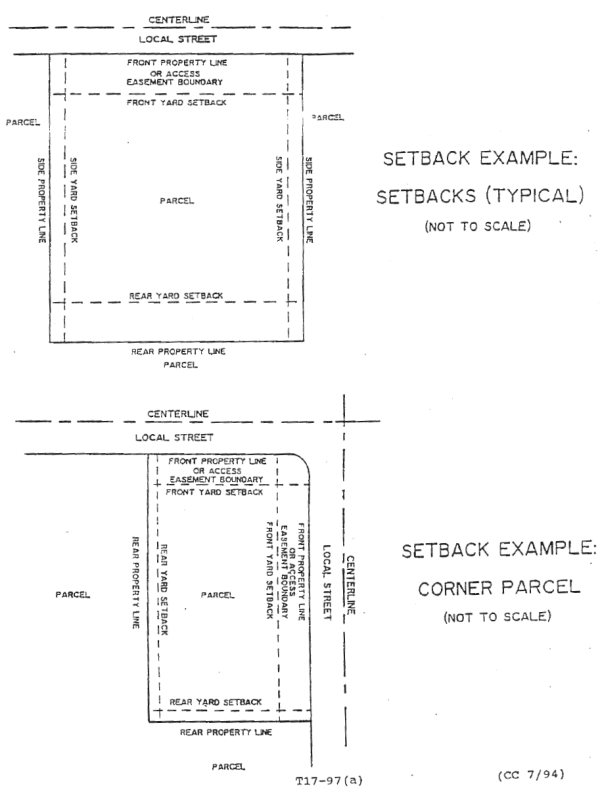
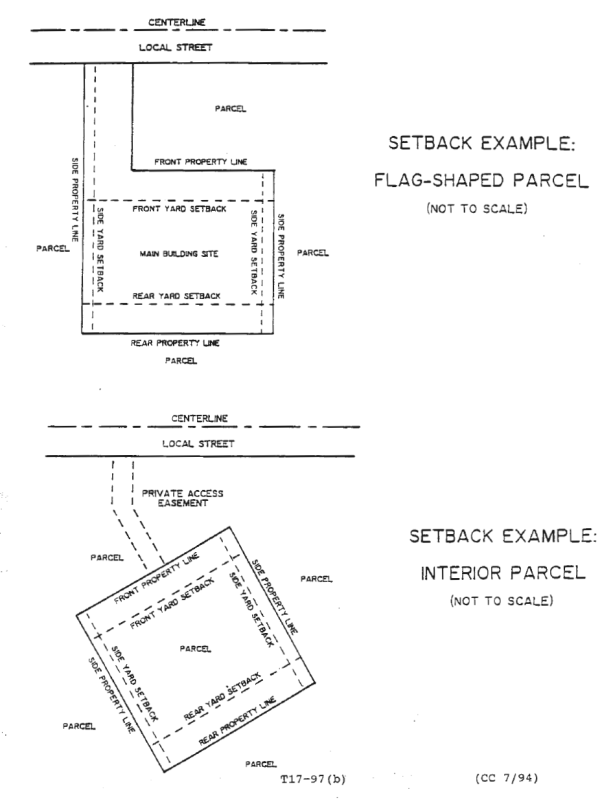
Unless otherwise prescribed, the following setback standards shall apply to all buildings with roof area exceeding one hundred twenty (120) square feet, all structures except as permitted by subsection D, and all uses set forth in subsection E. Additions to existing buildings, structures, or uses set forth in subsection E, where such building, structure, or use encroaches into a setback area, shall not be closer to the property boundary than one-half (1/2) the width of the setback requirement or closer to the property boundary than any part of the existing building, structure, or use, whichever constitutes the lesser encroachment.
- Public street and front yard setback: The front yard setback shall be a minimum of twenty-five (25) feet from the nearest point on the front property line or edge of any public street, public easement, or easement or right-of-way offered for dedication, and a minimum of fifty-five (55) feet from the center line of said street, easement or right-of-way.
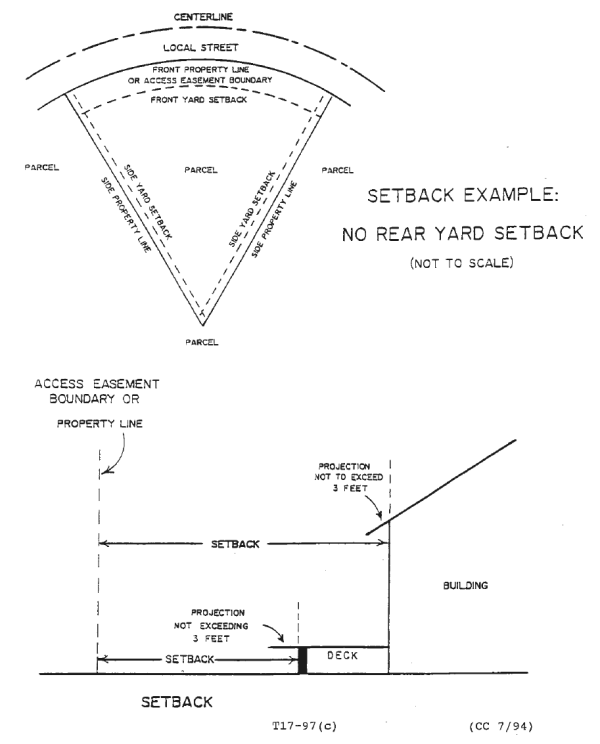
- Side yard setback: The side yard setback shall be a minimum of twenty-five (25) feet or ten percent (10%) of the lot width, whichever is less, from a side property line or parcel boundary line. For the purposes of this section, the lot width shall be the average distance between the side property lines as measured through the building envelope.
- Rear yard setback: The rear yard setback shall be a minimum of twenty-five (25) feet or ten percent (10%) of the lot depth, whichever is less, from a rear property line or parcel boundary line. For the purposes of this section, the lot depth shall be the average distance between the rear property line and the front property line as measured through the building envelope.
- Uses permitted in setback areas: The following uses shall be permitted in all setback areas:
- Wells, highway and traffic signs, signs, rural mail boxes, fences, gates, propane tanks, uncovered walkways, driveways, and underground utilities and appurtenant above-ground structures.
- Livestock loading structures can be located within the front setback of a parcel of land in the AEZs, MPZs, IMZs and GFZs, and may be located in the front setback of other land use zones, subject to planning department review and approval.
- Garages, carports, sheltered parking, and covered walkways may be constructed in front yards areas providing:
- The subject site is above four thousand (4,000) feet in elevation;
- Carports shall have no enclosing walls higher than three (3) feet above ground level;
- Garages may be considered providing sight distance standards are satisfied, and the location is approved by the road division of the public works department. A variance to these standards shall not be approved;
- The structure is located no closer than five (5) feet from the property line or the edge of the street easement or right of way offered for dedication;
- The structure is for the exclusive use of the property owner or resident for the purpose of vehicular parking, and/or pedestrian access.
- Septic systems on a lot served by a public water system or a mutual water company, provided that the septic system is not closer than five (5) feet to any property line or adjacent to a lot that is not served by a public water system or a mutual water company.
- Uses prohibited in setback areas: The following uses shall be prohibited in the setback areas:
- Septic systems unless approved through the variance process or permitted in section 17.108.130(D)(4).
- Stables or pens used for the raising or keeping of small animals.
- Covered walkways except as permitted by section 17.108.130(D)(3).
- Projections in Setback Areas: Architectural projections including eaves, canopies, and balconies; deck and porch overhangs; and signs attached to a building shall not project more than three (3) feet into a required setback area.
Adopted by Ord. 704 Sec. 1 on 3/8/1988
Amended by Ord. 744 Sec. 1 on 3/14/1989
Amended by Ord. 862 Sec. I on 11/9/1993
Amended by Ord. 1011 Sec. I on 9/7/2004
17.108.140 Structure Height
The purpose of the following section is to limit the height of structures as needed to: support public safety; protect access to natural light, ventilation, and direct sunlight; support the preservation of neighborhood character; and to preserve viewsheds and scenic vistas.
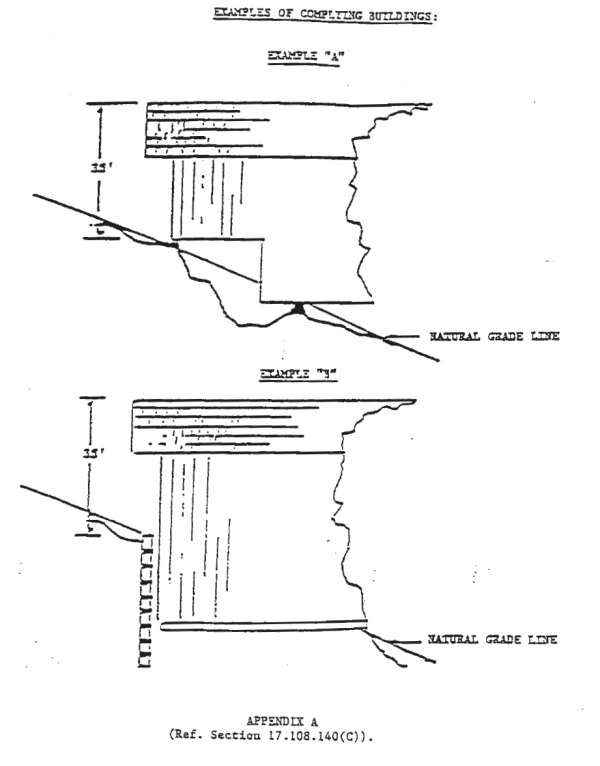
- Maximum height restricted: In any land use district, no building or structure shall be erected, placed or structurally altered to a height in excess of thirty-five (35) vertical feet above natural grade except as provided in section 17.108.140(B).
- Exceptions: The following shall be excepted from the structure height regulations of all land use districts, except that such height shall not exceed those permitted in the airport district:
- Chimneys and flues.
- Accessory farm buildings, but not to exceed sixty (60) feet in height.
- In town planning areas without adopted specific plans, and all commercial and industrial zones, exceptions for permitted and approved commercial uses may be granted by the planning commission through the use permit determination process specified in Chapter 17.116.
- Also subject to the approval of the planning commission through the use permit determination process, cooling towers, elevators, fire towers, monuments, stacks, scenery lofts, tanks, water towers, ornamental towers, spires, and mechanical appurtenances over forty-five (45) feet in height from ground level.
- Height restrictions shall not apply to broadcasting towers, aerials, t.v. antennas, windmills, or utility transmission and distribution poles and towers.
- The maximum height of any structure may be increased by not more than ten (10) feet, providing all required offsets and setbacks are increased by one (1) foot for each foot which such building exceeds the height limit of the land use district in which it is located, and the structure complies with all applicable fire code requirements.
- Measurement: For purposes of determining height limits, natural grade shall be calculated from the uphill side of a building or structural boundary and shall be utilized as described on Appendix "A" attached hereto.
Adopted by Ord. 704 Sec. 1 on 3/8/1988
17.108.150 Secondary Residences
Specific density standards of this element notwithstanding, one (1) secondary residence shall be permitted on an established parcel of land in all zones except commercial and industrial (except as specified in section 17.108.100(L)(4), of the county provided that the residence conforms to all health, safety, setback, zoning and applicable building code requirements.
Adopted by Ord. 704 Sec. 1 on 3/8/1988
17.108.160 Small Residential Care Facilities
Small residential care facilities shall be a permitted use in all zones in which residential uses are permitted when six (6) or fewer persons are provided twenty-four (24) hour care in a residence. In addition to the provisions of the Health and Safety Code, the following special standards shall apply:
- Play areas for children must be fenced to prevent uncontrolled access to and from the site.
- The facility shall conform to all other residential site design standards.
Adopted by Ord. 704 Sec. 1 on 3/8/1988
Amended by Ord. 1090 Sec. V on 8/7/2012
17.108.170 Day Care Facilities
Preschool, child day care, and adult day care facilities for twelve (12) or fewer persons shall be a permitted use in any zone in which residential uses are permitted. In addition to the provisions of the Health and Safety Code, the following special standards shall apply:
- All outdoor play areas shall be enclosed with fencing a minimum of four (4) feet high, provided that such fencing is to be solid and a minimum of six (6) feet in height on any property line abutting a residential use on an adjoining lot.
- In addition to the parking normally required for the residence an off-street drop-off area shall be provided with the capability to accommodate at least two (2) cars.
Adopted by Ord. 704 Sec. 1 on 3/8/1988
17.108.180 Bed And Breakfast And Residential Transient Rentals
For purposes of this chapter, residential transient rental and vacation rental have the same meaning.
Bed and breakfast and vacation rental establishments (residential transient occupancy facilities) shall be considered permitted in all principal zones, except the M-1 and M-2 zones. Such uses in the AE zone are also subject to the standards contained in section 17.40.010.A.1 of this title. These provisions shall also be applicable in planning areas with adopted area plans unless otherwise specifically regulated or prohibited. An agricultural homestay is a permitted use in the AE zone, subject to compliance with development standards established by the zone and as contained herein. A vacation rental application may be processed for individual condominium units as shown on the condominium plan of Yosemite West, condominium project Phase No. 1 (Record of Survey No. 1835, Units A101–A112, A201–A212, B101–B112 and B201-B212), based on a September 21, 2001 planning director determination that found that the use of the condominium structures for vacation rental purposes is a legally existing non-conforming use. These uses shall not be detrimental to the district or to adjoining areas, including residential areas, by reason of appearance, traffic, noise, dust, smoke, or odor. Excludes any use the normal operation of which causes objectionable traffic, noise, dust, smoke or odor to be emitted, radiated, or carried beyond the boundaries of the property on which the operation is located. Bed and breakfast establishments and vacation rentals are defined in Chapter 17.148 and are located in a residence owned by the applicant. Agricultural homestays are defined in Chapter 17.148 and are located in the residence of the property owner or accessory dwelling or other existing dwelling. Bed and breakfasts, agricultural homestays, and vacation rentals shall meet the following requirements:
- No more than three (3) bedrooms are available for occupancy by transients for vacation rentals.
- No more than five (5) bedrooms are available for occupancy by transients for bed and breakfast establishments and agricultural homestays.
- Occupancy in a vacation rental approved on or after April 14, 2016 shall be limited to ten (10) or fewer occupants. This limit shall apply to new vacation rental facilities, as well as vacation rental facilities which are being permitted following a property ownership change. Vacation rentals must post a minimum 8-1/2 x 11 inch notice over or next to the facility’s primary exit door stating “Maximum Occupancy 10 Persons”, or such lesser occupancy as desired by the owner or as required pursuant to section D below. Lettering shall be clearly visible through contrast from the background and a minimum of 1-1/2 inches in height and width.
- Private on-site sewage disposal systems or small, private community systems that serve a bed and breakfast or vacation rental facility shall have sufficient capacity to serve 10 occupants within the facility. If such a system does not meet this design standard, the facility shall be limited to occupancy of two (2) persons per approved bedroom. Should the “maximum occupancy” allowed be less than 10 persons, the occupancy notice as described in Section C. above shall reflect that number.
- The structure and facilities used shall be approved for such use by the Mariposa County health department and shall at a minimum comply with the following standards:
- The residence shall be serviced by an approved community sewage disposal system, or have an individual system satisfying current code requirements. Existing and newly constructed individual systems shall meet the current sizing requirements of the health department for new dwellings based on the number of bedrooms in the dwelling, or the system shall be designed to serve the planned number of occupants. Septic systems serving homes constructed in 1985 or before may be required to be upgraded when the home is being converted to bed and breakfast or vacation rental use.
- Water supply shall be by an approved community system, or from an individual well or spring approved by the health department having quality and quantity satisfying current health department requirements.
- The structure and facilities used must be inspected and found to be in conformance with the requirements contained in the current residential transient occupancy safety checklist, as developed and amended from time to time, by the Mariposa County fire department. The inspection and review shall be conducted by Mariposa County fire department staff or designee.
- The structure and facilities used must comply with applicable provisions of the residential transient occupancy safety checklist.
- An on-site sign of not more than four (4) square feet shall be posted and clearly visible from the nearest road. The sign shall contain the street address and may contain the name of the owner or the establishment. Larger signs shall require planning commission approval through the variance process.
- At a minimum, an 8-1/2 x 11 inch written notice must be placed in each rental unit, which contains the following information:
- Instructions in case of fire or other emergency, including the name and phone number of the property owner or rental manager.
- Quiet hours are between 10:00 p.m. and 8:00 a.m., and shall be strictly enforced.
- Water and energy conservation measures.
- Proper use of wood burning stoves and fireplaces.
- Parking and snow removal requirements if necessary. No parking on roadway is permitted during snow removal periods declared by the director of public works, pursuant to county code, section 10.08.110.
- An identification of the character or area in which the unit is located (i.e. rural, agricultural, residential).
- A statement relative to respect for adjacent property owner's rights and trespassing concerns.
- Proper trash disposal, and bear preventive/control measures if applicable.
- Vacation rentals must place a minimum 5 x 7 inch weather-proof notice that is easily and conspicuously visible at or near the main entrance to the vacation rental which contains the name and phone number of the property owner or rental manager. The property owner or rental manager must be available by phone in case of an emergency.
- The structure and facilities used must be inspected and found in conformance with the requirements contained in the current residential transient occupancy safety checklist, as developed and amended from time to time by the Mariposa County building department. The inspection and review shall be conducted by the Mariposa County building director or designee.
- The residential transient occupancy facility must have a valid “certificate of occupancy” issued by the building department or a “mobile home installation acceptance” issued by the California Department of Housing and Community Development (if required by the building department).
- The following parking standards shall apply:
- Bed and breakfast and agricultural homestay establishments shall have two (2) parking spaces for the residence plus at least one (1) space for each bedroom available for rent.
- Vacation rental establishments shall have one (1) parking space for each bedroom to be rented.
- Parking provided shall be maintained so that it is usable, and utilized at all times during the year, when it is occupied. Parking spaces in garages may be used to meet minimum parking standards. Stacked parking spaces may be allowed for individual vacation rental facilities but are not appropriate for bed and breakfast facilities.
- Parking spaces shall be on-site, except as follows. In the Yosemite West Subdivision, Unit 1 (Record of Survey No. 1511, Parcels 1 through 294), off-street parking spaces may be approved to achieve the minimum parking standards where it is determined by the planning and public works directors that on-site parking is not feasible. The use of off-street spaces within a right-of-way or access easement may only be allowed if the design of the parking spaces is approved by the Mariposa County public works department through the encroachment permit process. If allowed and approved, off-street spaces shall be within and along the project site’s frontage.
- Prior to issuance of a transient occupancy registration certificate, the applicant shall apply to the planning department for site plan review and approval. The planning department shall forward the application to the building department, health department, county fire department and CalFire for review. The site plan review and approval process shall not be required for a property which has a TOT Certificate and which is transferred into or within a trust; the TOT Certificate will simply require a name change to reflect the name of the trust. The site plan review and approval process shall also not be required for a property which has a TOT Certificate and which is purchased or transferred between parents and their children, as defined by California Revenue and Tax Code §63.1(c). The TOT Certificate will simply require a name change. Information specified in California Revenue and Tax Code §63.1(d)(1) may be required by the county.
- Following approval by all appropriate agencies, a valid transient occupancy registration certificate shall be issued by the Mariposa County tax collector pursuant to Chapter 3.36 of Title 3, Mariposa County Code. The facility is not considered to be legally operating until the facility is issued a valid transient occupancy registration certificate.
- Residential transient occupancy establishments are specifically excluded from the definition of "hotel" as described in this title.
- On a yearly basis, by the 30th day of April, the owner or manager of a residential transient occupancy establishment shall provide to the planning department on a county-approved form confirmation that the establishment complies with the following:
- Smoke alarms and CO detectors are in working condition with fresh batteries.
- Fire extinguishers are adequately charged.
- The structure and any improvements or modifications were constructed under appropriate building permits or permits from the CA Housing and Community Development Department (for mobile homes).
- The facility remains compliant with the residential transient occupancy safety checklist in effect at the time the transient occupancy registration certificate was issued. This self-reporting requirement shall apply to all residential transient occupancy facilities, regardless of their approval date.
- Failure of the landowner or manager to maintain the conditions and requirements of this section or failure to submit the annual facility compliance report would be deemed a violation and may result in the rescinding of the approval and Transient Occupancy Tax Certificate.
- Mobile homes manufactured prior to January 1976 shall be prohibited from being approved for any transient occupancy within Mariposa county unless they meet the seal standards of the United States Department of Housing and Urban Development or equivalent standards established by the California Department of Housing and Community Development.
- Transient occupancy uses shall be prohibited in a mobile home located within a mobile home park.
- Any alterations to a mobile home structure must be or must have been approved by the California Department of Housing and Community Development through a permitting process. A mobile home with unpermitted alterations may not be approved for use for transient occupancy. It shall be the responsibility of the applicant to submit evidence of permitted alterations.
- Only two vacation rentals shall be allowed per parcel, irrespective of the number of single-family residences located on the parcel.
Adopted by Ord. 704 Sec. 1 on 3/8/1988
Amended by Ord. 1059 Sec. I & II on 8/25/2009
Amended by Ord. 1074 Sec. III on 11/23/2010
Amended by Ord. 1116 Sec. I on 3/15/2016
17.108.190 Signs
The intent of these regulations is to reduce the proliferation of signs to maintain the scenic quality of the county’s transportation corridors and to generally preserve the rural appearance of the county. The purpose of this section is to establish specific standards for the location, installation, construction or modification of signs. These standards shall apply in all instances except as modified by specific sign standards contained in this title or other standards adopted pursuant thereto.
- A temporary or permanent on-site sign or signs with maximum aggregate area of 16 sq. ft. and containing no outline tubing, flashing lights or moving parts shall be a permitted use on all parcels. Such signs shall have a maximum height of 20 feet. Off-site signs are prohibited unless specifically permitted by the principal zone. Wayfinding signs as defined in section 17.148.010 are a permitted use on all parcels. Signs on school district property throughout Mariposa county, regardless of the land use or zoning designation, shall be exempt from all specific sign standards outlined in the Mariposa County Code. Time limits for temporary signs are contained in section 17.148.010 of the Mariposa County Code.
- A sign or signs, which convey specific information as described herein, shall be a permitted use on all parcels within the county, including parcels within town planning areas with or without adopted specific plans, notwithstanding anything to the contrary contained in any regulatory language in any specific plan, existing or adopted in the future. Such signs shall include, but not be limited to, outline tubing signs, however such signs shall contain no flashing lights or moving parts. Such signs shall be limited to a maximum aggregate area of 3 sq. ft. per business, which shall be in addition to the sign area permitted by this title or by other specific sign standards adopted pursuant thereto. An additional 3 sq. ft. of informational signage, in accordance with the standards contained herein, may be approved for businesses which have a second public entrance, provided that no more than 3 sq. ft. of informational signage is visible from any location on any public right-of-way. Such signs shall be installed inside a building, and shall be limited to the following information:
- OPEN, or CLOSED
- VACANCY, or NO VACANCY
- HOURS OF OPERATION Such signs shall not advertise the business or contain the business logo or trademark, and shall not advertise or identify products sold within or services provided by the business.
- All legally installed and permitted signs which do not conform with the standards of this title shall be considered nonconforming and shall be permitted to remain on a parcel until such sign becomes an illegal sign or is subject to any of the following conditions:
- The sign is remodeled or relocated, the business name changes or there is any change in business ownership.
- The property owner requests permission to expand, remodel or enlarge the building or land use on the parcel containing the sign and the sign is affected by the construction.
- Unless otherwise prohibited by this chapter, signs may be illuminated provided such illumination does not shine light upon a public street or on to an adjacent parcel or in any way create a public safety hazard. No sign shall be illuminated after 11:00 p.m. or close of business, whichever occurs last, or prior to 6:00 a.m.
- The following exterior signs shall be prohibited: Moving or rotating signs; sign with flashing, moving, or animated illumination except signs which display time and temperature information; advertising signs that include the words “Stop, Look, Listen” or any word, phrase, symbol, lights, motion, sound, fumes, mist, or other effluent that may interfere with, mislead, or confuse the driving public; portable signs except for temporary real estate signs which advertise the particular property; signs on inflatable advertising devices when the device is attached or secured to the ground or building and signs extending above the peak of the roof.
- Illegal signs, as defined by this title, shall be considered a zoning violation and a public nuisance and subject to the abatement procedures established in section 17.144 of this title.
- Political signs, as defined by this title, shall comply with all of the following conditions:
- No political sign shall be placed within the right-of-way of any state highway.
- No political sign shall be placed within the easement or right-of-way or on or over any portion of a county maintained road.
- No political sign shall impair traffic safety, sight distance, or traffic flow on any county maintained road, privately maintained county easement, or state highway.
- No political sign shall be placed on county property.
- No political sign shall be placed sooner than ninety (90) days prior to the scheduled election.
- All political signs shall be removed within ten (10) days after the election.
- No individual political sign shall be larger than thirty-two (32) square feet.
- Political signs shall contain no outline tubing, flashing lights, or moving parts.
- These standards shall apply to all political signs throughout Mariposa county, including in planning areas, unless there are specific standards established for a political sign in the adopted area plan for a planning area. .
- Gateway signs, as defined by this title, shall comply with all of the following conditions and requirements:
- The following locations shall be considered gateways to Mariposa county:
- The Mariposa and Merced county line at state highway 140;
- The Mariposa and Madera county line at state highway 49;
- The Mariposa and Madera county line at state highway 41 (one location to be chosen);
- The Mariposa and Stanislaus county line at state highway 132;
- The Mariposa and Tuolumne county line at state highway 132;
- The Mariposa and Tuolumne county line at state highway 120;
- Additional locations for gateway signs that are not listed above may be considered by the board of supervisors pursuant to a formal application, processing fee, and subsequent review and approval by the board.
- One sign shall be allowed at each identified community gateway location. The sign may be single or double faced.
- No gateway sign shall be placed within the right-of-way of any state highway or other county public right-of-way.
- No gateway sign shall be larger than two hundred forty (240) square feet.
- The maximum height of each gateway sign shall not exceed 16 feet in height from existing ground surface or from existing road grade measured horizontally from highest point on the travel lanes of the road adjacent to the proposed sign location, whichever is highest.
- The specific message or copy of each sign shall be directed at tourists entering or exiting Mariposa county and highlighting the tourist amenities that Mariposa county has to offer. All other information on gateway signs shall be prohibited.
- Signs may incorporate external illumination into the sign design, however internally illuminated signs shall be strictly prohibited. If external lighting is used for signs, the lighting shall be shielded and directional and shall not shine light off-site.
- No gateway sign shall be placed in such a manner as to create any safety hazard for vehicular traffic.
- Subsections D. and E. of this section shall apply to gateway signs.
- The proposed design of each gateway sign shall be reviewed and approved by the board of supervisors through a design review application, together with applicable processing fees, submitted by the proponent to the planning department to ensure that the sign complies with the requirements contained herein. The application shall be approved prior to sign fabrication or installation.
- The following locations shall be considered gateways to Mariposa county:
- Prior to adoption of an area plan, community information signs, not exceeding ninety-six (96) sq. ft. in area, may be located within a planning area. Such signs may include a map of the community, the location of or information about groups, civic organizations, and churches in the area. Such signs may also include information about meetings of community interest and other community activities and events. If the community information board is combined with an on-site advertising sign for a business or public entity, the advertising portion of the sign (for the business or public entity shall not exceed that which is otherwise allowed by county code.
Adopted by Ord. 800 Sec. I on 4/2/1991
Amended by Ord. 878 Sec. I on 11/1/1994
Amended by Ord. 889 Sec. I on 8/15/1995
Amended by Ord. 1070 Sec. II on 5/25/2010
Amended by Ord. 1092 Sec. III, IV, V & VI on 12/4/2013
17.108.200 Uses Prohibited In All Zones
The following land uses are prohibited in all zoning districts:
- Medical marijuana dispensaries;
- The collective or cooperative cultivation of marijuana;
- The cultivation of marijuana for medical purposes by person(s) not residing on the property on a permanent basis.
- Any activity and use within Mariposa County for which a license is required pursuant to California Business and Professions Code, Division 10, as it may be amended, including activities requiring a license pursuant to Adult Use of Marijuana Act, including commercial, or not for profit, cultivation, processing, manufacture, wholesale or retail sale or public consumption.
- The cultivation of hemp, including the cultivation of hemp by established agricultural research institutions.
Adopted by Ord. 1086 Sec. IV on 12/20/2011
Amended by Ord. 1129 Sec. I on 10/17/2017
Amended by Ord. 1161 Section I on 2/23/2021
17.108.210 Transitional And Supportive Housing
Transitional and supportive housing shall be a permitted use in any zone district in which residential uses are permitted. Transitional and supportive housing shall only be subject to those restrictions that apply to other residential uses of the same type in the same zone district. There shall be no additional discretionary approval process required for transitional and supportive housing.
Adopted by Ord. 1090 Sec. VI on 8/7/2012
17.108.220 Special Event Facilities
The purpose of this section is to establish a process through which special event facilities, as defined in this title, can be located in rural areas of the county while also protecting the rural character of surrounding communities and areas.
- Applicability: Special event facilities as defined in Chapter 17.148 of this title are allowed in the MH, MT, MG, MP and GF zones subject to the limits and standards set forth in this section. Such uses are also allowed in the AE zone, subject to the limits and standards set forth in this section, except such uses are not allowed on parcels encumbered by a Land Conservation Act (LCA) or Williamson Act contract.
- Permit Process Requirements:
- Administrative Use Permit: Special events occurring eighteen (18) or fewer times per calendar year for no more than two consecutive days per event are subject to the issuance of an administrative use permit as described in Chapter 17.114 of this title, and the following restrictions:
- Events involving two hundred (200) or fewer guests or attendees at any time during the event may be allowed on parcels of ten (10) acres or more in size.
- Events involving three hundred (300) or fewer guests or attendees at any time during the event may be allowed on parcels of twenty (20) acres or more in size.
- Events involving two hundred (200) or fewer guests or attendees at any time during the event may be allowed on parcels of ten (10) acres or more in size.
- Conditional Use Permit: Special events involving five hundred (500) or fewer guests or attendees at any time during the event, and located on parcels of forty (40) acres or more in size are subject to the issuance of a conditional use permit as described in Chapter 17.112 of this title. The conditional use permit shall determine the appropriate limits on the number of events to be held annually.
- Parcel Size Requirements: No events are allowed on parcels less than ten (10) acres in size, however if the property owner owns multiple adjacent parcels, then the total acreage of those adjacent parcels may be used to determine the permit process and occupancy limits.
- The number of days of operation and numbers of guests or attendees described in the permitting processes above do not apply to annual or one-time events regulated through the Public Assemblage Permit Process as described in Chapter 8.28 of this code.
- Pursuant to County Code, Section 17.148.010 Definitions, uses that are accessory to a single-family residential use including private parties, private gatherings, and similar private activities that are not subject to a use agreement (or similar document) between a private individual or group and the homeowner are not defined as a special event and not subject to the requirements established by this section.
- The Mariposa County Agricultural Advisory Committee shall review and make a recommendation on proposed projects within the Agriculture/Working Landscape Land Use Classification and/or the Agriculture Exclusive Zone.
- Administrative Use Permit: Special events occurring eighteen (18) or fewer times per calendar year for no more than two consecutive days per event are subject to the issuance of an administrative use permit as described in Chapter 17.114 of this title, and the following restrictions:
- Application: A conditional use permit or administrative use permit application shall include the following items:
- Detailed site plan showing location of all existing and proposed structures and facilities on the site, including parking and driveway areas, exterior lighting, restrooms or areas for porta-potties, and any proposed temporary structures such as tents, stages, and dance floors.
- Description of the range of uses proposed and projected times and days of the week of operation.
- Map showing the location and distance of the facility to the nearest surrounding sensitive receptors such as single-family residences and other housing types, and the location and description of the width and surfacing of roadway(s) that access the site up to the nearest major collector or arterial. If any of the access roadways are not maintained by the state or county, the application shall include information regarding any entities responsible for road maintenance.
- Traffic management plan that includes the following:
- Ingress and egress locations and provisions for the unimpeded movement of emergency vehicles;
- Provisions for ensuring the orderly and safe arrival, parking, and departure of all vehicles and ensuring that traffic will not back-up or block private easements, county roads, intersections, state highways, or private driveways;
- The location of any temporary directional signs on driveway entrances and within parking lots to ensure the orderly flow of traffic; and
- Provisions for dust management.
- Ingress and egress locations and provisions for the unimpeded movement of emergency vehicles;
- Sources and types of noise generation, expected decibel levels at property lines from all special event activities, and noise attenuation strategies.
- Information regarding food and beverages to be prepared and/or sold and/or distributed at the special events.
- Information regarding public health and sanitation facilities, including restrooms or porta-potties, drinking water, recycling areas, hand washing stations and solid waste storage and disposal.
- Fire safety provisions including limitations or allowances for open fires, fireworks, and outdoor cooking; safety for power generators; areas for mowing or weed eating; and posted emergency procedures.
- Human health and safety including availability of a land line phone (if cell service is not available) and on-site security.
- Name and contact information for person(s) responsible during events.
- Any other information necessary to determine compliance with the standards established herein.
- Detailed site plan showing location of all existing and proposed structures and facilities on the site, including parking and driveway areas, exterior lighting, restrooms or areas for porta-potties, and any proposed temporary structures such as tents, stages, and dance floors.
- Operational Standards: The following standards are minimum requirements that may be made more stringent by conditions of approval adopted through the AUP and CUP processes. It is the business owner’s responsibility to ensure his/her/their facility continuously complies with all requirements of this section and all requirements established by conditions of approval, and that the operation of the facility does not create nuisances to off-site property owners.
- Except for multi-day or multi-weekend events such as seasonal pumpkin patch/harvest festivals in which AUP or CUP conditions of approval will determine days of operation, activities at a special event facility are limited to two (2) days, not including set-up and take down days, and the event duration per day shall not exceed twelve (12) hours. Activities involving amplified sound shall not commence prior to 9:00 a.m. and shall conclude no later than 10:00 p.m. Overnight camping associated with the event, on dry camp sites, may be allowed and may be subject to a Special Occupancy Park permit from the California Department of Housing and Community Development. Pursuant to applicable regulations in this Title, a maximum of two (2) vacation rentals may also be developed in conjunction with the special event facility.
- Noise: Based upon information contained in the Mariposa General Plan Volume III Technical Background Reports regarding normally acceptable noise levels in low density residential areas, noise generated by, and for the duration of, a special event, including amplified sound, shall not exceed 60 decibels at all property lines, unless an alternative limit is established through an AUP or CUP. Should three (3) or more complaints be submitted regarding noise generated by an event facility, the county may require the facility’s operator to provide a study, including recommendations for noise attenuating measures, by a qualified acoustical consultant. The county shall have the authority to implement the recommendations of the consultant.
- Access: All roadways from the nearest major collector or arterial serving the special event site shall meet the “Adequate Capacity” requirements of the Mariposa County General Plan as described in the Mariposa County Road Improvement and Circulation Policy. Access shall also comply with State Fire Safe Regulations, including maximum allowed dead-end road length, turnarounds and turnouts.
- Driveways: On-site driveways from the nearest intersecting roadway shall be a minimum of twelve feet (12’) wide if one-way traffic is proposed, and a minimum of eighteen feet (18’) if two-way traffic is proposed. Driveways shall also comply with State Fire Safe Regulations, including maximum allowed dead-end road length, turnarounds and turnouts.
- Parking: The number of parking spaces shall be one (1) space per four (4) seats or one (1) space per four (4) people based on maximum occupancy of the event, whichever is greater.
- Aisle widths and parking lot layout within the parking areas shall conform to the dimensional standards shown in Section 17.336.030(C)(3) of this title. As an alternative, an engineered plan may be proposed.
- Public Health: Special event facilities shall provide a potable domestic water supply and an on-site sewage disposal or sewer service connection necessary to accommodate all special events in accordance with the requirements of the Mariposa County Health and Human Services Agency – Environmental Health Unit. Bottled water and/or porta-potties may be provided to meet this requirement, as approved by Environmental Health.
- Setbacks: Setbacks for all structures, permanent and temporary, and for all facilities associated with the event venue shall be a minimum of fifty (50) feet from property lines and adjoining road easements, with the exception that parking lots, parking lot access, and parking spaces may be located within the road easement setback area.
- Lighting: All new exterior/outdoor lighting shall comply with International Dark Sky Standards and shall be located, adequately shielded, and directed so that no direct light falls outside the property line, or onto the public roadway.
- Signage: All permanent and temporary signage shall comply with Section 17.108.190 of this title.
- Dust control: Fugitive dust shall be minimized by reducing vehicle speeds on driveways and parking areas on the project site, and, during visibly dry conditions, the application of water or other approved dust palliative. Paving or an appropriate depth of gravel may also be provided.
- Liability insurance: Adequate liability and property damage insurance or bonding shall be provided.
- Building occupancy: All buildings and structures proposed to be used as part of the event venue shall have obtained the required permit(s) for occupancy, including applicable Fire Code requirements.
- Accessibility for disabled persons: All requirements of California Building Code and applicable accessibility laws shall be met for the facility.
- Other permits shall be obtained as required, including but not limited to a Building Permit, a Grading Permit, an Air Pollution Control Permit, a CA ABC permit, a Food Facilities permit, and/or a commercial encroachment permit.
- Fire Safe Standards: Projects shall implement all fire safe standards required by CAL FIRE and the Mariposa County Fire Department.
- Non-compliance with operational standards or conditions of approval adopted for a project may result in the revocation of the permit to operate the facility.
- Except for multi-day or multi-weekend events such as seasonal pumpkin patch/harvest festivals in which AUP or CUP conditions of approval will determine days of operation, activities at a special event facility are limited to two (2) days, not including set-up and take down days, and the event duration per day shall not exceed twelve (12) hours. Activities involving amplified sound shall not commence prior to 9:00 a.m. and shall conclude no later than 10:00 p.m. Overnight camping associated with the event, on dry camp sites, may be allowed and may be subject to a Special Occupancy Park permit from the California Department of Housing and Community Development. Pursuant to applicable regulations in this Title, a maximum of two (2) vacation rentals may also be developed in conjunction with the special event facility.
- Operational standards specific to the AE zone:
- Special events facilities shall not be permitted on AE zoned properties where no residential use exists on the property.
- Special event facilities shall not convert agricultural land to an alternative use for the purpose of developing or expanding a special event facility.
- Special events facilities shall not be permitted on AE zoned properties where no residential use exists on the property.
- Public Noticing:
- In addition to the public hearing noticing requirements for a conditional use permit project contained in Section 17.132.020 of this title, hearing notices shall be sent to the owners of all properties located on any non-county roadway that serves the subject property, from the nearest county road and/or major collector or arterial.
- In addition to the public notification requirements contained in Section 17.08.120(D) of this title, approval of an AUP shall be noticed to the owners of all properties located within six hundred (600) feet of the subject property and the owners of all properties located on any non-county roadway that serves the subject property, from the nearest county road and/or major collector or arterial.
- In addition to the public hearing noticing requirements for a conditional use permit project contained in Section 17.132.020 of this title, hearing notices shall be sent to the owners of all properties located on any non-county roadway that serves the subject property, from the nearest county road and/or major collector or arterial.
- Annual Reporting and Monitoring of Events:
- On a yearly basis, by the last day of February, the owner or manager of a special event facility shall provide to the planning department on a county-approved form confirmation that the establishment and its operation comply with the requirements of this section. The report shall provide numbers of events held and attendance at events during the prior calendar year.
- The owner or manager of a special event facility shall keep records of events and attendance, and shall provide that information to the county upon request at any time during the calendar year (to verify compliance with the requirements of this section).
- On a yearly basis, by the last day of February, the owner or manager of a special event facility shall provide to the planning department on a county-approved form confirmation that the establishment and its operation comply with the requirements of this section. The report shall provide numbers of events held and attendance at events during the prior calendar year.
Adopted by Ord. 1167 Sec. II on 11/2/2021
17.108.230 Special Use Provisions For Historic Structures
All uses may be considered for structures or buildings included on the List of Historical Resources in Mariposa (or eligible to be on the List of Historical Resources in Mariposa as determined by the Historic Sites and Records Preservation Commission, which may require documentation), with the exception of permitted uses, regardless of the primary land use or zone within which the structure is located subject to the following provisions:
- The planning commission may approve a conditional use permit on designated historic structures where it is demonstrated that the special use will be of benefit to the community by requiring the restoration and preservation of a historic structure to reflect its original state;
- All exterior modifications, alterations or reconstruction to take place on the structure are to be described as part of the conditional use permit application, and if approved by the planning commission, are to be made part of the conditions granting the permit;
- The planning commission shall follow standard conditional use permit procedures in reviewing special historic structure uses and shall not approve uses which have the potential for creating a public nuisance or have substantial detrimental effect on adjacent property. In reviewing such matters, the commission must consider the advantages of preserving a historic structure to the benefit of the county versus the possible negative effects of permitting a normally incompatible use in an area. Such review and deliberation may encompass alternative uses which may be of a lesser negative impact yet achieve the primary purpose of feasible historic preservation and restoration of historic structures;
- The special use provisions of this section shall only apply to existing historic structures. A building or structure which has been demolished, destroyed or otherwise rendered unusable shall not be subject to these provisions nor shall these provisions apply to proposals which will result in such alterations or remodeling of the historic structure as to cause the structure to lose its original historic character and/or significance.
Adopted by Ord. 1171 Sec. I on 1/25/2022

