
Mariposa County Unincorporated
City Zoning Code
City Zoning Code
17.148 Definitions
17.148.010 Definitions Of Terms And Phrases
The following terms and phrases shall be used in this title and are listed alphabetically:
Accessory building: A building or portion of a building subordinate to the principal building and used for the purpose customarily incidental to the permitted use of the principal buildings. (Example: A garage for a residence or a maintenance building for a motel.) (Ord. 704 Sec. l, 1988)
Accessory dwelling: "Accessory dwelling" means either an attached or detached dwelling unit which provides potential living facilities for one or more persons. Included are caretaker quarters. (Ord. 1074 Sec. II, 2010).
Accessory use: A use of land subordinate to the principal use of the land and customarily incidental to the permitted use of that land; also known as a secondary use. (Ord. 704 Sec. 1, 1988).
Agricultural activity or operation: "Agricultural activity or operation" shall mean any activity or operation which has to do with agriculture and shall include, but not be limited to, the cultivation and tillage of the soil; dairying; the production, irrigation, frost protection, cultivation, growing, harvesting and processing of timber or apiculture; the raising of livestock, fur-bearing animals, fish or poultry; and any commercial agricultural practices performed as incident to or in conjunction with such operations, including preparation for market, delivery to storage or to market, or to carriers for transportation to market. (Ord. 888 Exh. "B", 1955).
Animal hospital and veterinary services: Establishments where animals receive medical treatment, surgical treatment, shelter and care on a commercial basis. This classification includes only facilities that are entirely enclosed, soundproofed, and air-conditioned. Grooming and boarding of animals is included if accessory to the hospital use; no exterior boarding of animals is allowed. (Ord. 1087 Sec. VII, 2012).
Agriculture: Animal husbandry and the production of crops. (Ord. 704 Sec. 1, 1988).
Agricultural homestay: “Agricultural homestay use” means a business that provides overnight transient occupancy accommodations in five or fewer guest rooms with not more than ten (10) guests; and serves meals at any time to only registered guests, who actively participate in the guest’s education and the on-site agricultural activities. Agricultural homestays are located in the residence of the property owner or accessory dwelling or other existing dwelling. (Ord. 1116 Sec. II, 2016; Ord. 1074 Sec. II, 2010).
Agricultural product sales: “Agricultural product sales use” means the sale of food or fiber commodities of any kind directly associated with the agricultural operation on-site. Agricultural product sales include:
- On-farm sales of products grown, raised or manufactured on-site;
- Road-side stands displaying products grown, raised or manufactured on-site, available for purchase;
- U-pick operations where the public is invited to select or harvest products grown on-site. (Ord. 1074 Sec. II, 2010).
Agritourism use: “Agritourism” means an enterprise located at a working farm (as defined by section 52262 of the California Food and Agricultural Code), ranch, or other agricultural operation or agricultural plant/facility, which is conducted for the enjoyment and education of visitors, guests or clients, and that generates income for the owner/operator. Agritourism is the act of visiting a working farm/ranch or any agricultural, horticultural or agricultural operation for the purpose of enjoyment, education or active involvement in the activities of the farm/ranch or agricultural operation that also adds to the economic viability of the agricultural operation. Agriculture must be the primary use of the land, pursuant to the standards and criteria established by section 17.40.010.A.4.a.h.
Examples of limited agritourism uses and activities allowed as permitted uses include but are not limited to an agricultural homestay, star-gazing, educational and interpretive seminars, clinics, tours, horseback riding (which may include trail riding instruction necessary for the safety of guests, if pertinent to agritourism use), and youth exchange programs when related to an on-site agricultural operation and in accordance with agricultural homestay requirements and photography. Examples of larger and more frequent agritourism uses permitted through an administrative use permit include, but are not limited to petting zoos, and hunting dog trials in which no firearms are discharged.
Arena events such as roping competitions, horse shows, rodeos and similar commercial-for-fee sporting events are specifically excluded from the allowed uses and activities in the definition of agritourism. Weddings and concerts are specifically excluded from the allowed uses and activities in the definition of agritourism. A RV park and camping are specifically excluded from the allowed uses and facilities in the definition of agritourism. (Ord. 1074 Sec. II, 2010; Ord. 1027 Sec. 1, 2006).
Agri-nature tourism use: “Agri-nature tourism use” means visitor-oriented destinations and experiences, which are centered on an agricultural and/or natural theme. The act of visiting a working farm (as defined by section 52262 of the California Food and Agricultural Code), ranch, or any agricultural, horticultural, or agribusiness operation, for the purpose of enjoyment, education, or active involvement in the activities of the farm or operation and/or activities and experiences taking place in natural areas that also adds to the economic viability of the agricultural operation. Agriculture must be the primary use of the land, pursuant to the standards and criteria established by section 17.40.010.A.4.a.h.
Examples of limited agri-nature tourism uses and activities allowed as permitted uses include but are not limited to educational and interpretive seminars, clinics, walks, cross-country skiing, picnics, gold panning, hiking, tours, working dog trials, horseback riding, wagon rides when confined to the agritourism parcel, wildlife viewing, and photography.
Examples of larger and more frequent agri-nature tourism uses permitted through an administrative use permit include, but are not limited to petting zoos, and hunting dog trials, in which no firearms are discharged. (Ord. 1074 Sec. II, 2010).
Airport: The commercial or private operation of any area of land or water designed and set aside for the landing and taking off of aircraft.
For specific definitions concerning "Airport District" see Chapter 17.64 of this title. (Ord. 704 Sec. 1, 1988).
Animal husbandry: The breeding and raising of any and all livestock and other animals. (Ord. 704 Sec. 1, 1988).
Appurtenant use or structure: A use of land or structure subordinate to the primary use or structure of the land and customarily incidental to the primary use or structure occurring on that land. (Ord. 862 Sec.I, 1993).
Average slope: Calculation of average slope from the information provided shall be the responsibility of the planning department staff. Average slope shall be calculated as follows:
Simple slopes (parcel has uniform slope and exposure)
Average slope = rise/run X 100,
Where rise = elevation change from the lowest point
to the highest point on the parcel, and
Run = distance between the highest and lowest
elevations.
Complex slopes (parcel has varying slopes and/or more than one exposure)
Average slope = (I) X (L) X (0.00229)
A
Where I = vertical distance of contour interval in feet
L = total length of all contour lines in scaled feet, and
A = total number of acres in the parcel.
Note: Calculations for parcels below 2.5 acres shall be exclusive of road easement. (Ord. 800 Sec. V, 1991).
Bed and breakfast: A “bed and breakfast” means a single family structure, a single-family dwelling unit of a duplex, or a portion of such structure or dwelling unit, rented or leased for periods of thirty (30) or less consecutive days to an individual or any party, and complying with the standards contained herein. A bed and breakfast has a full time, permanent resident family, and a limited number of guest bedrooms. Breakfast or similar early morning meal is prepared each day in a kitchen appropriately permitted by the health department. The price of food is included in the price of the accommodations. (Ord. 1116 Sec. II, 2016; Ord. 862 Sec. I, 1993).
Board: The board of supervisors of Mariposa County. (Ord. 704 Sec. 1, 1988).
Boardinghouse: "Boardinghouse" means a dwelling other than a hotel where lodging is provided for compensation as defined in Chapter 2 of the California Building Code. (Ord. 1116 Sec. II, 2016).
Building: Any structure having a roof supported by columns and/or by walls and intended for the shelter, housing, and/or enclosure of any person, animal or personal property or equipment; example: residence, mobile home, garage, barn. Any structure which is appurtenant to and attached to the building shall be considered part of the building; example: deck, staircase, balcony, awning, porch. (Ord. 862 Sec. I, 1993).
Building envelope: The area of a lot covered by a building or structure, including allowed projecting eaves, balconies, and similar features. (Ord. 862 Sec. I, 1993).
Building frontage: The length in feet of the face of a building or business within a building, parallel to the fronting street, or parking area. The side of the building used for calculating building frontage shall contain an entrance into the business. (Ord. 800 Sec. V, 1991).
Camping, temporary: Occupying or maintaining for occupancy any place for temporary living, sleeping, or other human occupancy purpose, when not in an appropriately licensed or authorized area for campgrounds or recreational parks or facilities, or zoned for camping activities, for no longer than 14 cumulative nights in any 90 day period. If such occupancy is for more than 14 cumulative nights in any 90 day period, it shall be considered a residential occupancy or residential use. Temporary camping shall not be for commercial purposes. Temporary camping does not include the parking or storage of an unoccupied and otherwise unused recreational vehicle, travel trailer, trailer coach, tent trailer, or any other similar vehicle which is established and used in accordance with all provisions of Mariposa County Code section 15.10.070. (Ord. 1038 Sec. II, 2007).
Church and religious assembly: A facility for religious worship and incidental religious education, but not including a private school. (Ord. 1087 Sec. VII, 2012).
Collaborative AgriNature Tourism Events: “Collaborative AgriNature Tourism Events” means the temporary use of multiple agricultural properties and/or facilities, for which a fee may or may not be charged, where there is a gathering of people in multiple locations to tour agricultural sites, experience agriculture in hands on workshops, and develop a respect for the natural resources of Mariposa County. These events may not exceed three (3) consecutive days per event. Event participation is determined by the total number of participants divided by the number of locations participating in the event; larger events require an Administrative Use Permit. Permits may be required, such as but not limited to Public Assemblage Permit and Food Facilities Handlers Permit. (Ord. 1074 Sec. II, 2010).
Collective or cooperative cultivation of marijuana: The association within California of qualified patients, persons with valid identification cards, and/or designated primary care givers to cultivate marijuana for medical purposes as defined in strict accordance with California Health and Safety Code sections 11362.5 and 11362.7, et seq. (Ord. 1086 Sec. VIII, 2011).
Commercial purposes: “Commercial purposes” shall mean an activity or operation that is primarily conducted for commercial use or sale of an agricultural product or commodity on the activity or operation site with financial gain as the primary aim. (Ord. 888 Exh. “B”, 1995).
Commercial timber harvesting: Tree harvesting operation where the primary purpose is the production of raw materials for forest products industry or for silvicultural purposes. The removal of diseased or fire-damaged timber standards are exempt from the provisions of commercial harvesting requirements. (Ord. 800 Sec. V, 1991).
Commercial stable: “Commercial stable use” means an equine facility, barn or stable that is used by the residents, who occupy the property and is also used by private invited clients or guests for the purpose of raising, boarding, breeding, training and riding. Use may include lessons, professional training, educational seminars and clinics. These activities may be undertaken for equines not owned by the resident of the property and such services are limited to invited or scheduled guests and/or clients as a business or income source. (Ord. 1074 Sec. II, 2010).
Community information board: A sign or structure used for providing information of general public interest on services, religious, social, recreational or other programs which are open to the public. (Ord. 800 Sec. V, 1991).
Conditional use: Use of land, buildings, structures, or equipment on a parcel or lot which is not a permitted use but which is a legal use if approved by the Mariposa County planning commission. (Ord. 704 Sec. 1, 1988).
Daycare Center: A home or commercial facility that provides non-medical care and supervision for more than 14 children in a group setting on a less than 24-hour basis. This classification includes nursery schools, preschools, and day car centers for adults and children. (Ord. 1087 Sec. VII, 2012).
Dedicated public right-of-way: Any road, street, or highway over which an offer of dedication has been recorded, or for which a public easement is of record. (Ord. 704 Sec. 1, 1988).
Density bonus: Additional residential density granted to encourage development of a desirable nature as approved by the planning commission and/or the board of supervisors in conjunction with an approved development plan and development agreement. (Ord. 704 Sec. 1, 1988).
Disability glare: Harsh light directed within the eye’s line of sight so that contact with a direct light source causes a partial blindness or reduction of visual performance. (Ord. 984 Sec. II, 2003).
Dormitory: “Dormitory” means a residence hall providing sleeping accommodations for individuals or for groups, usually without private baths. (Ord. 1116 Sec. II, 2016).
Duplex: "Duplex" means a building on a single parcel containing two single-family dwelling units totally separated from each other by an unpierced wall extending from ground to roof or an unpierced ceiling and floor extending from exterior wall to exterior wall, except for a common stairwell exterior to both dwelling units, and except that common entry ways may be provided. (Ord. 1116 Sec. II, 2016).
Dwelling: "Dwelling" means any building or portion thereof designed or used as the residence of one or more persons. Dwelling does not include dormitory. (Ord. 1116 Sec. II, 2016).
Dwelling, multiple-family: "Multiple-family dwelling" means a building arranged or designed to be occupied by more than two families in individual dwelling units as governed by the California Building Code. (Ord. 1116 Sec. II, 2016).
Dwelling, single-family: "Single-family dwelling" means one dwelling unit. (Ord. 1116 Sec. II, 2016).
Dwelling unit: "Dwelling unit" means a room or group of rooms, including sleeping, eating, cooking, and sanitation facilities, but not more than one kitchen, which constitutes an independent housekeeping unit, occupied or intended for occupancy by one household. Dwelling unit does not include a recreational vehicle. (Ord. 1116 Sec. II, 2016).
Easement: The right of a person, the public at-large, a government agency, or a public utility company to use public or private land owned by another for a specific purpose. (Ord. 862 Sec. I, 1993).
Easement, access or road: An easement which grants access to the public, an entity, or a person(s) over property owned by another and allows for the improvement of that property for access or road purposes. For the purposes of subtitle 17.300, an access or road easement need only encompass those improvements for travel lanes, parking lanes, curbs, gutters, and adjacent pedestrian pathways. (Ord. 862 Sec. I, 1993).
Easement, drainage: An easement, the purpose of which is to limit development in order to retain natural drainage channels predominantly in their natural condition, to maintain the water-carrying capacity of natural drainage channels, and to ensure safe and unobstructed flows of stormwater runoff. (Ord. 862 Sec. I, 1993).
Easement, slope: An easement, the purpose of which is to encompass cuts and fills associated with grading for road construction and to allow for maintenance of such cuts and fills. (Ord. 862 Sec. I, 1993).
Ecotourism: “Ecotourism use” means travel to fragile, pristine, and usually protected areas that strives to be low impact and (often) small scale. Ecotourism development helps educate the traveler; provides funds for conservation; directly benefits the economic development and political empowerment of local communities; and fosters respect for different cultures and for environmental justice and human rights. Ecotourism appeals to ecologically and socially conscious individuals. Generally speaking, ecotourism focuses on volunteering, personal growth and learning new or adaptive ways to live on the planet. Responsible ecotourism includes programs that minimize the negative aspects of conventional tourism on the environment and enhance the cultural integrity of local people. (Ord. 1074 Sec. II, 2010).
Electric and communication distribution facilities: In general, telephone and power lines and cables at potentials of less than twelve thousand (12,000) to thirty-three thousand (33,000) volts, depending upon the historical design characteristics of the system involved. Those parts of the electric system to and including the step-down transformers with primary voltages at transmission levels are not considered "distribution facilities" in this definition. Lines and cables extended from the secondaries of those transformers (the step-down transformers referenced above), and additional transformers having primary and secondary voltages both below transmission levels are considered "distribution facilities". All telephone utility lines between central offices and service connection facilities are considered "distribution facilities". (Ord. 800 Sec. V, 1991).
Emergency shelter: A facility or use for 7 or more persons, which provides temporary housing by homeless individuals or families, victims of domestic violence, or persons requiring temporary housing, and may involve supplemental services. An emergency shelter shall be within a structure improved and permitted pursuant to the Uniform Building Code. Supplemental services may include, but are not limited to, meal preparation, an activities center, day care for homeless person’s children, vocational rehabilitation and other similar activities. This definition does not include such temporary residential shelters as may be provided for relief following a natural disaster or during a state of emergency. (Ord. 1090 Sec. IV, 2012).
Employee housing: Residence, dwelling units or boarding house for workers employed on land owned by the owner of the property on which the housing is located. (Ord. 704 Sec. 1, 1988).
Established agricultural research institution: Same meaning as in Section 81000 of the California Food and Agricultural Code.
Family: "Family" means one or more persons living together as a single housekeeping unit in a dwelling, not including any group occupying a roominghouse or boardinghouse or dormitory or hotel or motel. (Ord. 1116 Sec. II, 2016).
Fitness or exercise studio and health club: A place of business with equipment and facilities for exercising and improving physical fitness. This classification includes health clubs, gymnasiums (that are not public), private clubs (athletic, health or recreational), reducing salons, and weight control establishments. (Ord. 1087 Sec. VII, 2012).
FTE (full time equivalent): “FTE” means full time equivalent of five (5) eight (8) hour work days per week. For agritourism and agri-nature tourism activities, FTE is counted for volunteers and paid employees alike. Family members living on-site are excluded from FTE counts. (Ord. 1074 Sec. II, 2010).
Fully shielded fixture: An outdoor lighting fixture that only allows emitted light to be projected below a horizontal plane running through the lowest part of the fixture. (Ord. 984 Sec. II, 2003).
Geotourism: “Geotourism use” means tourism that sustains the geographical character of a place – its environment, heritage, aesthetics, culture, and the well-being of its residents. Geotourism is not just about where places are, but what places are. Geotourism celebrates what makes one place different from the next. That includes not only flora and fauna, which is the realm of ecotourism, but also historic structures and archaeological sites, scenic landscapes, traditional architecture, and locally grown music, cuisine, crafts, dances, and other arts. Geotourism is environmentally responsible, committed to conserving resources and maintaining biodiversity; it is culturally responsible, committed to respecting local sensibilities and building on local heritage. (Ord. 1074 Sec. II, 2010).
Glamping: “Glamping” means a transient occupancy facility where guests occupy detached permanent upscale tent units or similar units but which are not conventional hotel, motel or cabin facilities and are not an agricultural homestay or camping as defined within county code. Payment for accommodations specifically includes overnight lodging and meals, and transient occupancy tax. Units exceeding 400 square feet in area are required to comply with applicable requirements of the California Fire Code and are required to obtain a permit and approval from the fire code official. (Ord. 1116 Sec. II, 2016; Ord. 1074 Sec. II, 2010).
Guesthouse: "Guesthouse" means a detached building occupied by guests without compensation of any kind as a condition of occupancy and used as sleeping quarters only, with sanitation facilities but without cooking or housekeeping facilities. (Ord. 1116 Sec. II, 2016).
Guest ranch or dude ranch: “Guest ranch or dude ranch use” means a transient occupancy facility where guests occupy detached cabin units, bunk units or other similar type units but which are not conventional hotel or motel facilities and are not an agricultural homestay or glamping as defined within county code. Payment for accommodations at a guest ranch or dude ranch specifically includes entertainment or participation in activities at the ranch, as well as the overnight lodging and meals. (Ord. 1074 Sec. II, 2010).
Hemp cultivation: Any activity involving the planting, growing, harvesting, drying, curing, grading, or trimming of hemp, including activities carried out by seed breeders.
Hemp: Same meaning as in Section 11018.5 of the California Health and Safety code.
Household: "Household" means all the persons, related or unrelated, who occupy a single dwelling unit. Persons not living in households are classified as living in group quarters. (Ord. 1116 Sec. II, 2016).
Kitchen: "Kitchen" means an area with appliances or other facilities for the preparation or preservation of food that includes a gas or electric range, oven or stovetop. A kitchen does not include wet bars or specialized home canning or preserving facilities. (Ord. 1116 Sec. II, 2016).
Hotel: "Hotel" means any structure, or any portion of any structure which is occupied, or intended or designed for occupancy, by transients for dwelling, lodging, or sleeping purposes, and includes, but is not limited to, any hotel, inn, motel, studio hotel, bachelor hotel, public or private club, or cabin at a fixed location, or other similar structure or portion thereof. A hotel does not include a bed and breakfast facility, a vacation rental facility, a guest ranch or dude ranch cabin, a glamping unit, an agricultural homestay, a boardinghouse, a dormitory or other similar structure. (Ord. 1116 Sec. II, 2016; Ord. 704 Sec. 1, 1988).
Junk: Any worn out, cast off or discarded article or material which is ready for destruction or has been collected or stored for salvage or conversion to some use. Any article or material which, unaltered or unchanged and without further reconditioning, can be used for its original purpose shall not be considered junk. (Ord. 704 Sec. 1, 1988).
Junk yard: (Junk yard, dismantling, or wrecking yard are synonymous) The storage of junk outside of a building on a parcel or lot, and where the storage site or sites are larger than one thousand (1,000) square feet in total ground coverage, and visible from any public street, road, or easement, or from outside of the property or parcel on which the junk is stored. The storage of equipment, machinery, or other materials used and stored in conjunction with, or necessary to, a legal use shall not be considered a junk yard. The above provisions notwithstanding, the storage of junk on any site for the purpose of resale on a regular basis shall be considered a junk yard. (Ord. 704 Sec. 1, 1988).
Junk yard within Scenic Highway Overlay Zone: (Junk yard, dismantling, or wrecking yard are synonymous) The storage of junk outside of a building on a parcel or lot, and where the storage site or sites are larger than four hundred (400) square feet in total ground coverage. The storage of equipment, machinery, or other materials used and stored in conjunction with, or necessary to, a legal use shall not be considered a junk yard. The above provisions notwithstanding, the storage of junk on any site for the purpose of resale on a regular basis shall be considered a junk yard. (Ord. 800 Sec. V, 1991).
Kennel, commercial: Shall mean any premises that are used for the commercial breeding or commercial boarding of dogs. (Ord. 704 Sec. 1, 1988).
Large family day care home: A home that provides non-medical care and supervision of no more than 14 children in the caregiver’s home on a less than 24-hour basis. (Ord. 1087 Sec. VII, 2012).
Large residential care facility: A facility which provides 24-hour care for 7 or more persons in need of personal services, protection, supervision, assistance, guidance, or training essential for sustaining the activities of daily living, for the protection of the individual. This classification includes group homes, residential care facilities for the elderly, adult residential facilities, wards of the juvenile court, and other facilities licensed by the State of California. (Ord. 1087 Sec. VII, 2012).
Livestock feed lot or feed yard: “Livestock feed lot or feed yard” means an area where livestock are confined for the purpose of preparing such for market. A “feed lot or feed yard” shall not include the confinement of livestock for the temporary purpose of identification, treatment, weaning or shipping. A “feed lot or feed yard” shall also not include the confinement of livestock for feeding when there are unusual conditions such as fire, drought, flood, etc., which demands removal of the livestock from the range. (Ord. 1027 Sec. 1, 2006).
Local street: A local street shall mean a public street as defined by this title, an unimproved county street right-of-way, a dedicated public right of way as defined by this title, or a private road or access easement which serves five (5) or more parcels. (Ord. 862 Sec. I, 1993).
Lot area: The contiguous land bounded by lot lines inclusive of land provided for public thoroughfare, flood plain, or canal. Such lot area shall be measured as a horizontal plain view, disregarding the geometric effects of the slope of land. (Ord. 704 Sec. 1, 1988).
Lot coverage: The area of a lot or parcel covered by building perimeter roof area expressed as a percentage of total land. (Ord 984 Sec. II, 2003, Ord 862 Sec. I, 1993).
Lot or parcel: A parcel of real property shown on a recorded subdivision map, or a parcel otherwise created in compliance with the Subdivision Map Act or county ordinance in effect at the time it was created. (Ord. 704 Sec. 1, 1988).
Medical marijuana: Defined in strict accordance with California Health and Safety Code sections 11362.5 and 11362.7, et seq. (Ord. 1086 Sec. VIII, 2011).
Medical marijuana dispensary: Any facility or location, whether fixed or mobile, where medical marijuana or items containing medical marijuana (e.g. food or drink products) is made available to, and/or exchanged with, an/or distributed or sold to one or more of the following: a qualified patient, a person with an identification card, or a primary caregiver as those terms are defined in California Health and Safety Code section 11362.5 and 11362.7, et seq. (Ord. 1086 Sec. VIII, 2011).
Membership camp: Permanent organizational group camps sponsored by an organization. (Ord. 704 Sec. 1, 1988).
Mineral or construction material processing: The mechanized crushing, classifying, or processing of mined materials. (Ord. 1114 Sec. IX, 2015; Ord. 704 Sec. 1, 1988).
Mining: The removal of minerals, earth or construction materials from the earth, by methods including pits, tunnels, quarries, shafts, drifts, stopes, adits, winzes, cross-cuts, raises, overburden removal, mining by the auger method, dredging, etc., and all necessary appurtenance thereto, for the purpose of resource extraction where the operation involves either the removal of more than one thousand (1,000) cubic yards of mineral, ores, and overburden, or involves the disturbance of more than one (1) acre of surface area. Mining includes a surface exploration activity; a surface mining operation; a sub-surface mining operation; or a sand, gravel (aggregate), or cobble mining operation which exceeds the thresholds established herein. Mining includes surface work incidental to a surface or sub-surface mine, in-place distillation or retorting or leaching, and the production and disposal of mining waste. (Ord. 1114 Sec. IX, 2015; Ord. 800 Sec. V, 1991).
Mining, small scale: Prospecting for, or the extraction of minerals for commercial purposes and the removal of mineral, ores and overburden in total amounts of less than one thousand (1,000) cubic yards in any one location of one acre or less when conducted in compliance with all applicable regulations and permits. (Ord. 1114 Sec. IX, 2015).
Mobile home: A ”mobile home” means a manufactured dwelling unit, transportable on its own wheels, designed and equipped to be used with or without a permanent foundation system. Mobile home includes a manufactured home, as defined in section 18007 of the Health and Safety Code. Mobile home does not include a recreational vehicle, commercial coach, or factory-built housing, as defined in section 19971 in the Health and Safety Code. (Ord. 1116 Sec. II, 2016; Ord. 704 Sec. 1, 1988).
Mobile home park: A planned or clustered residential development as set forth in section 17.108.100. (Ord. 704 Sec. 1, 1988).
Motorcycle or other vehicular racing or competition: A race, competition or similar activity conducted by any group or individual organization at a given site. (Ord. 704 Sec. 1, 1988).
Nonconforming use: A use of land, buildings, structures, or equipment on a parcel or lot which does not conform with the land use regulations governing zone in which the parcel or lot is located. The use is legal by virtue of its existence prior to adoption of applicable zoning, see section 17.08.020. (Ord. 704 Sec. 1, 1988).
Nonconforming lot or nonconforming parcel: A lot or parcel which was legally established in accordance with the then existing policies, provisions, regulations, or zoning code, but which does not conform to the present requirements of the applicable zoning district or districts. (Ord. 800 Sec. V, 1991).
Nonconforming structure: A structure which was legally established in accordance with the then existing policies, provisions, regulations, or zoning code, but which does not conform to the present requirements of the applicable zoning district or districts. (Ord. 800 Sec. V, 1991).
Nuisance: “Nuisance” shall mean anything which is injurious to health, or is indecent or offensive to the senses, or an obstruction to the free use of property, so as to interfere with the comfortable enjoyment of life or property. (Ord. 888 Exh. “B”, 1995).
Nuisance, private: Every nuisance which is not a public nuisance. (Ord. 888 Exh. “B”, 1995).
Nuisance, public: A nuisance which affects at the same time an entire community or neighborhood, or any considerable number of persons, although the extent of the annoyance or damage inflicted upon individuals may be unequal. (Ord. 888 Exh. “B”, 1995).
Open space: An area that is designed or maintained for environmental, scenic, or recreational purposes. Open space may include, but is not limited to unimproved land, grazing land, landscaped areas, walkways or trails, improved outdoor recreational areas, areas of subsurface septic systems, and water courses. Any area that is developed or improved with parking areas, streets, driveways, or other surfaces designed or intended for vehicular travel, or areas developed with carports or any covered structure shall not be considered open space. (Ord. 800 Sec. V, 1991).
Outdoor lighting fixture: An electronically powered illuminating device or other lighting fixture, portable or fixed, used for illumination. Such devices include, but are not limited to, spot flood and area lighting. (Ord. 984 Sec. II, 2003).
Outdoor storage: The storage, outside of a building and associated with a home enterprise, rural home industry, commercial, industrial, or multi-family residential use, of any goods, junk, material, merchandise, or inoperative vehicles on the same property for more than twenty-four (24) hours. (Ord. 800 Sec. V, 1991).
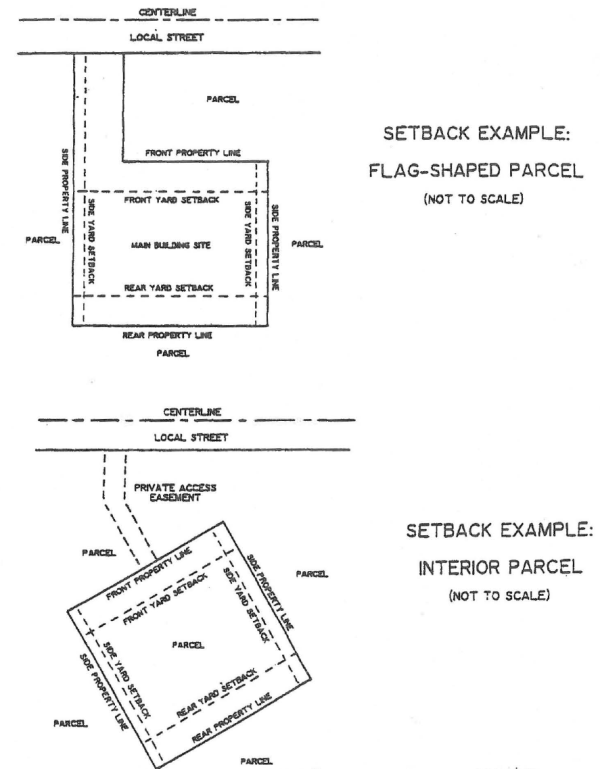
Parcel, flag-shaped: A parcel with access provided to the bulk of the parcel by means of a narrow corridor from a local street or State Highway and which is shaped and designed so that the main building site area is setback from the local street or state highway on which it fronts. (Ord. 862 Sec. I, 1993).
Parcel, interior: A parcel which does not have parallel frontage along a local street or state highway. (Ord. 862 Sec. I, 1993).
Parking lot or parking area: An area not within a building where motor vehicles may be stored for the purposes of temporary, daily, or overnight off-street parking. (Ord. 800 Sec. V, 1991).
Parking space: An unobstructed space or area other than a street or alley that is permanently reserved and maintained for the parking of one (1) motor vehicle. Each parking space must have a means of access to a public or private roadway. (Ord. 800 Sec. V, 1991).
Permit: Any formal authorization or entitlement from, or approval by the county, the absence of which would preclude establishment of a land use, activity, construction project, grading or surface mining operation. (Ord. 704 Sec. 1, 1988).
Permitted use: Shall mean the use of land, buildings, structures, or equipment on a parcel or lot which conforms with the land use regulations governing the parcel or lot. (Ord. 704 Sec. 1, 1988).
Person: Any natural person, firm, association, partnership, trustee, corporation, or other legal entity in which title to real property may vest. (Ord. 704 Sec. 1, 1988).
Petting zoo: “Petting zoo” means resident domestic animals and some resident wild species docile enough to touch and feed. Confined domestic livestock customary and incidental to agricultural operations shall not constitute a petting zoo. (Ord. 1074 Sec. II, 2010).
Planning commission: The Mariposa County planning commission. (Ord. 704 Sec. 1, 1988).
Planning office: The Mariposa County planning office. (Ord. 704 Sec. 1, 1988).
Portable planing mills: A transportable plant for processing finished wood products which is temporarily located on a property for less than one (1) year. (Ord. 704 Sec. 1, 1988).
Portable saw mills: A transportable plant for processing finished wood products which is temporarily located on a property for less than one (1) year. (Ord. 704 Sec. 1, 1988).
Preliminary grading plan: A preliminary grading plan shall consist of the following (other information submitted in conjunction with the preliminary grading plan, such as a plot plan, site plan, or development plan may also be used to fulfill these submittal requirements):
- General vicinity map.
- Parcel dimensions.
- Generalized existing contours and drainage channels including those areas of the subject site (and adjoining properties) that will be affected by the disturbance either directly or through drainage alterations. Contour interval shall be five (5) feet for projects of three (3) acres or less, ten (10) feet for projects greater than three (3) acres and less than ten (10) acres, and twenty-five (25) feet for projects of ten (10) acres or greater.
- Location of any buildings or structures that are within fifty (50) feet of the area which may be affected by the proposed grading operation.
- Limiting dimensions, elevations or finished contours to be achieved by the grading and proposed drainage channels and related construction. (Ord. 800 Sec. V, 1991).
Primary use: The main or principal use of property, buildings, or structures. (Ord. 704 Sec. 1, 1988).
Private stable: “Private stable use” means an equine facility, barn or stable that is used for and by the residents, who occupy the property, for the purpose of raising, breeding, training and riding their own horses. The use may also include training and breeding outside horses (horses not owned by the residents); however lessons for riders (other than as needed to prepare guests for an agritourism activity) are not considered agritourism or agri-nature tourism uses. Riding lessons may be allowed as a rural home industry operation in compliance with the development and performance standards in section 17.108.080 and pertinent standards in section 17.108.070, Mariposa County Code. (Ord. 1074 Sec. II, 2010).
Public facility: Uses and structures principally of an institutional nature and/or serve a public need and operated by a public agency or under authority of a public agency such as: governmental buildings, public hospital, public schools, public libraries, public museums, public parks and playgrounds, post offices, and police and fire stations. (Ord. 704 Sec. 1, 1988).
Public or community water or sewer system: A water or wastewater treatment system serving two (2) or more parcels or lots of land, and maintained by a public entity such as a special district or a private individual or organization in accordance with the provisions of State Law and Mariposa County Code. (Ord. 704 Sec. 1, 1988).
Public or private shooting ranges: An area or site utilized for target practice, competition or other types of rifle, pistol or shotgun firing on a scheduled or unscheduled basis by a club, organization or general public. This definition shall not apply to an area or site on which a property owner, resident, or guest fires a pistol, rifle or shotgun for personal recreation. (Ord. 704 Sec. 1, 1988).
Public standard road: Any street or road which satisfies or was constructed to meet the state or federal highway standards or the road improvement standards adopted by the county. (Ord. 704 Sec. 1, 1988).
Public street: A public street shall mean a federal or state highway, county road or street or a road with an unrestricted easement for ingress and egress which is of public record. Wherein such highway, road or street is constructed in an area without benefit of an easement of public record, a public street shall mean an area thirty (30) feet perpendicular from the approximate center of an improved portion of a highway, road or street in either direction. (Ord. 704 Sec. 1, 1988).
Recreation, commercial: Commercial recreational activities such as campgrounds, hunting preserves, shooting ranges, boat docks, recreational vehicle parks, ski resort and similar tourist recreation facilities excluding race tracks, off-road vehicle raceways, and similar vehicular uses. (Ord. 704 Sec. 1, 1988).
Recreation, non-commercial: Non-commercial recreation shall mean all recreation activities which are conducted on lands regulated by this title for which no charge is required, including temporary camping as defined herein. (Ord. 1038, Sec. II, 2007; Ord. 704 Sec. 1, 1988).
Recreation vehicle park: An area or tract of land for temporary occupancy by motor homes, travel trailers, truck campers, camping trailers, or other vehicles for short term recreational habitation. (Ord. 704 Sec. 1, 1988).
Residential use: Any building or portion thereof designed or used exclusively for family living purposes which includes living, sleeping, cooking and sanitation facilities. (Ord. 1116 Sec. II, 2016; Ord. 704 Sec. 1, 1988).
Roofline: The line or edge where the sides of a building and the roof of that same building meet or coincide. (Ord. 800 Sec. V, 1991).
Roof, peak of: The line, point, or plane created by the horizontal or sloped roofing surface of a flat roof or a shed roof; the ridge of a gable, hip, or gambrel roof; and highest point of intersection of all roof slopes of a mansard roof. (Ord. 800 Sec. V, 1991).
Scenic highway corridor, or corridor: The area of land which is within the Scenic Highway Overlay District, and which is generally visible to the public traveling on the scenic highway. (Ord. 800 Sec. V, 1991).
Scenic quality: A characteristic which is attributable to a general area or specific location which affords a view of unusual or spectacular significance. Scenic quality is created by a combination of natural features such as vegetation, boulders and rock outcroppings, natural waterways or drainages, and existing topography. Scenic quality can be enhanced by seasonal variations and variations in time of day. Human developments can enhance or detract from scenic quality. (Ord. 800 Sec. V, 1991).
School, public: An educational institution or facility which provide education services and is operated by a public agency. Public schools shall not include boarding schools or other types of educational activities which provide residential facilities for temporary or permanent use by students. (Ord. 816 Sec. I, 1991).
School, private: An educational institution or facility which provides educational services and is operated by a private individual or organization. A private school shall include all educational institutions or facilities which are not defined as a public school. Examples of a private school include, but are not limited to, nursery/preschools except as provided for in Section 17.108.170, parochial schools, and private elementary and secondary schools. Private schools shall not include teaching within a residential structure of family members who reside in the same residence. (Ord. 816 Sec. II, 1991).
Screen/screening: A device or method by which use of or development on a parcel is concealed or hidden from another parcel, development, location, or roadway. (Ord. 800 Sec. V, 1991).
Seed breeder: Same meaning as in Section 81000 of the California Food and Agricultural Code.
Self-service storage facility: A building or group of buildings consisting of individual small, self-contained units that are leased for the storage of business and/or household goods. (Ord. 945 Exh. A, 2000).
Service station: Any premises where gasoline and/or other petroleum products are sold and/or light maintenance activities such as engine tuneups, lubrication, minor repairs, and carburetor cleaning are conducted. Service stations shall include convenience stores or mini-marts where gasoline is sold. Service stations shall not include premises where heavy automobile maintenance activities such as engine overhauls, automobile painting, and body fender work are conducted. (Ord. 862 Sec. I, 1993).
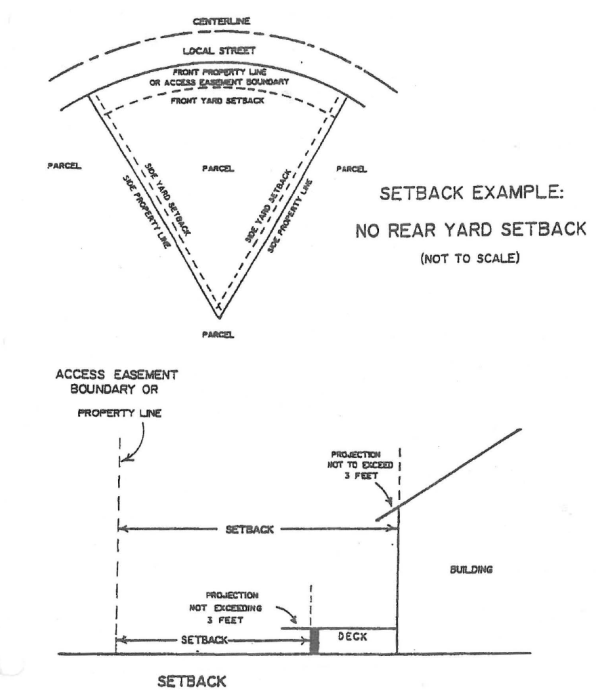
Setback: The required minimum horizontal distance between a property line, edge of access easement, and street centerline and the nearest vertical structural support or wall of a building or structure or the nearest edge of a use. (Ord. 862 Sec. I, 1993).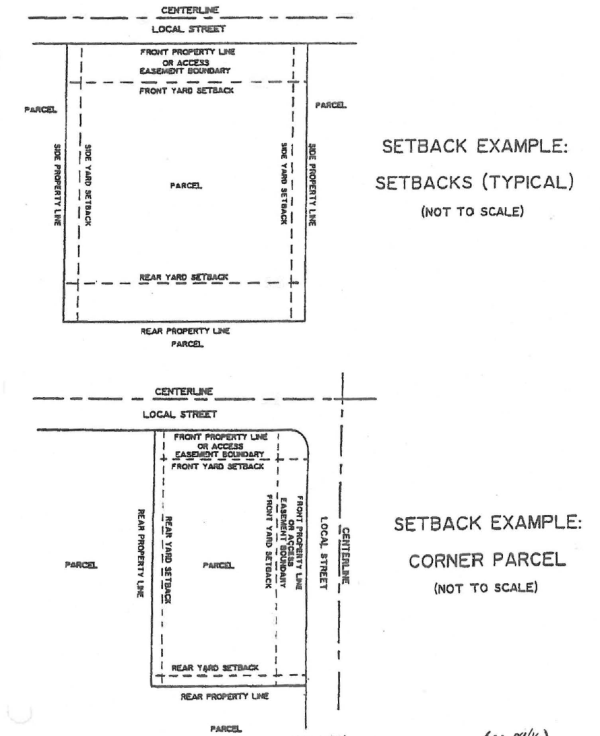
 Sign: A structure or device designed or intended to convey information to the public in written or pictorial form which is visible from the exterior of a building and/or from a public road or public right-of-way and/or from an adjacent parcel. (Ord. 1092 Sec.VII, 2012; Ord. 800 Sec. V, 1991).
Sign, amortization period: (Repealed). (Ord. 1092 Sec. VII, 2012; Ord. 800 Sec. V, 1991).
Sign, conforming: A legally established sign which conforms with the provisions of this title. (Ord. 800 Sec. V, 1991).
Sign, free standing: A sign supported by one (1) or more upright poles, columns, or braces in or on the ground and not attached to any building or structure. (Ord. 800 Sec. V, 1991).
Sign, illegal: A sign that complies with one (1) or more of the following criteria:
- Any sign erected without compliance with applicable building code and/or zoning code standards including signs expanded, remodeled or enlarged after May 15, 1991 without a permit or design review approval (if required).
- Any sign advertising a use that has ceased to exist for a period of not less than ninety (90) days.
- Any sign determined by the Mariposa County building official to be a danger to the public health and safety from the standpoint of structural integrity.
- Any sign determined by the Mariposa County public works director to be a traffic hazard not created by the relocation of streets or highways or other acts of the county. (Ord. 1092 Sec. VII, 2012; Ord. 800 Sec. V, 1991).
Sign, nonconforming: A legally established sign which does not conform with the provisions of this title. (Ord. 800 Sec. V, 1991).
Sign, off-site: A sign that identifies or communicates a commercial or noncommercial message related to an activity conducted, a service rendered, or a commodity sold at a location other than where the sign is located. (Ord. 800 Sec. V, 1991).
Sign, on-site: Any sign used for the following purposes:
- To designate, identify, or indicate the name or business of the owner or occupant of the parcel where the sign is located.
- To advertise the business conducted, services available or rendered, or the goods produced, sold, or available for sale, upon the parcel where the sign is located. (Ord. 800 Sec. V, 1991).
Sign, political: A sign which is intended to encourage a particular vote in a scheduled election. Also known as a “temporary political sign” pursuant to section 5405.3 of the State Outdoor Advertising Act (Business & Professions Code). (Ord. 1070 Sec. III, 2010).
Sign size or sign area: The area of the smallest rectangle that wholly contains the sign. The calculation for a double-faced sign shall be the area of one (1) face only, when both faces of the sign are a duplicate of each other. Double-faced signs shall be constructed so that the perimeter of both faces coincide and are parallel and not more than twenty-four (24) inches apart. The planning director may approve non-parallel, double-faced signs where necessary to provide adequate visibility on curved roadways. Such signs must have a common edge closest to the roadway. In no case shall the angle of such non-parallel, double-faced signs exceed thirty (30) degrees. (Ord. 800 Sec. V, 1991).
Sign, temporary: A display, information sign, banner or other advertising device which is displayed for a total of twenty-one (21) days or less. Advertising flag signs are considered temporary signs. The allowance for temporary signs is not intended to provide additional permanent advertising signs displayed on-site. (Ord. 1092 Sec. VII, 2012; Ord. 800 Sec. V, 1991).
Sign, wayfinding: Wayfinding signs are aides to help first time visitors to an area or community locate businesses and attractions. Wayfinding signs provide information at optimal decision points. Wayfinding signs are planned, connected, esthetically pleasing and are intended to create a positive first impression. Wayfinding signs shall be in accordance with a county-sponsored program, and shall not contain any business names or logos. (Ord. 1092 Sec. VII, 2012).
Single room occupancy: "Single room occupancy" means a dwelling within a hotel or motel that consists of one or two rooms and contains no sanitary facilities or food preparation facilities, or contains either, or contains both types of facilities. Single room occupancy could include an efficiency dwelling unit or a congregate residence as defined in the California Building Code. (Ord. 1116 Sec. II, 2016).
Site plan: The drawing or plan submitted with a building permit or variance application and satisfying the content requirements established by the building division and planning department (also referred to as a plot plan). The plan indicates the specific uses and improvements proposed for a site. (Ord. 704 Sec. 1, 1988).
Slaughterhouse: A commercial establishment for killing livestock and/or poultry and/or processing meat. (Ord. 704 Sec. 1, 1988).
Small family day care home: A home that provides non-medical care and supervision of no more than 8 children in the caregiver’s home on a less than 24-hour basis. (Ord. 1087 Sec. VII, 2012).
Small residential care facilities: A facility or use that provides residential housing with no limit on length of stay, that is occupied by 6 or fewer persons requiring personal care in accordance with the California health and safety laws. Such facilities can provide a wide variety of medical and non-medical personal services and care including but not limited to, foster care, rehabilitation services, domestic violence shelters, housing shelter needs, and care for disabled persons. Day care facility uses are not included in this definition. (Ord. 1090 Sec. IV, 2012).
Special event: A special event is a celebration, ceremony, wedding, reception, business function, arenas which are used for organized competitive events, seasonal festival, or similar activity for the benefit of someone other than the property owner that takes place on a periodic basis, involving the gathering of individuals assembled for the common purpose of attending a special event. The maximum number of guests or attendees at a special event shall not exceed 500 persons at any one time. Uses that are accessory to a single-family residential use including private parties, private gatherings, and similar private activities that are not subject to a use agreement (or similar document) between a private individual or group and the homeowner, and holiday home tours, agri-nature farm or trail tours, garage sales, yard sales, estate sales and similar events are not defined as a special event.
Special event facility: A special event facility is a facility where special events are permitted to occur. Special event facilities are subject to a use agreement (or similar document) between a private group or individual and the facility owner. The facility owner may or may not charge a fee for the use of the facility such as for a fundraiser for a charitable non-profit organization. Facilities may be located entirely within a structure, outside of a structure, or both inside and outside a structure. Facilities must include improvements or provisions to accommodate special events.
Specific plan: A plan prepared by or at the direction of the county of Mariposa for a town planning area or other areas where specific land use policies and standards are prescribed as defined by Government Code section 65451 and required by the Mariposa County general plan use element. (Ord. 704 Sec. 1, 1988).
Structure: That which is built or constructed, a building of any kind, or any piece of work artificially built up or composed of parts joined together in some definite manner. (Ord. 862 Sec. I, 1993).
Supportive housing: A facility or use that provides housing with no limit on length of stay, that is occupied by the target population, as defined by section 53260(d) of the California Health and Safety Code, and that is linked to onsite or offsite services that assist the tenant to retain the housing, improve his or her health status, maximize their ability to live and, when possible, to work in the community. Supportive housing shall be considered a residential use and only subject to those restrictions that apply to other residential uses of the same type in the same zone. Supportive housing programs may utilize small and large residential care facilities wholly or as part of their overall facilities. (Ord. 1090 Sec. IV, 2012).
Surface Mining Act: (aka: California State Surface and Mining Reclamation Act.) As defined by Public Resources Code sections 2710, et seq. (Ord. 704 Sec. 1, 1988).
Town planning area: An unincorporated community within the county of Mariposa which is designated as a TPA on the land use map of the Mariposa county general plan. (Ord. 704 Sec. 1, 1988).
Transient rental: See definition for vacation rental. (Ord. 1116 Sec. II, 2016).
Transitional housing: A facility or use that provides housing and support services for persons and families, but restricts occupancy to no more than 24 months. Support services may include meals, counseling, and other services, as well as common areas for residents of the facility. Transitional housing shall be considered a residential use and only subject to those restrictions that apply to other residential uses of the same type in the same zone. Transitional housing programs may utilize small residential care facilities wholly or as part of their overall facilities. (Ord. 1090 Sec. IV, 2012).
Utilities: Services or facilities associated with development and use of an individual parcel or a number of parcels, including but not limited to, water, gas, electric power, telephone, and cable t.v. conveyances, switching stations and substations. (Ord. 800 Sec. V, 1991).
Vacation rental (previously known as transient rental): A single family structure or a single-family dwelling unit of a duplex rented or leased for periods of 30 or less days and complying with the standards contained herein. A vacation rental is a single family structure which is available for rental to a family or a group on a transient basis. Such structures meet the definition of “boardinghouse” as shown in this chapter. (Ord. 1116 Sec. II, 2016).
Waste disposal site: County-approved or operated refuse dumps, sanitary landfills and other solid waste disposal facilities of a terminal nature, where garbage, trash or other unwanted materials are abandoned, buried or otherwise discarded with no intention of re-use. This definition does not include disposal sites for toxic or radioactive waste materials. (Ord. 704 Sec. 1, 1988).
Wellness center: An educational training business with most activities conducted in a residential structure which assists individuals in teaching nutritional cooking, menu planning, hygiene and grooming, basic housekeeping tasks, improving socialization skills, basic computing, job search, gardening and yard maintenance, and person finance and budgeting. (Ord. 1087 Sec. VII, 2012).
Yard, front: A yard or open area extending across the full width of the parcel between a front property line or edge of access right-of-way or easement and the vertical structural support or wall of a building or structure. The front yard is established parallel or concentric to the front property line. A front property line is a property line abutting a local street or state highway. For flag-shaped parcels, a front property line is the interior property line most parallel to and nearest the street or easement from which access is obtained. For interior parcels, a front property line is the property line which abuts the easement or driveway from which access is obtained. (Ord. 862 Sec. I, 1993).
Yard, rear: A yard or open space opposite to and most distant from a front yard. A parcel which has only three (3) property lines (e.g. a triangular shaped parcel) will not have a rear yard. (Ord. 862 Sec. I, 1993).
Yard, side: Any yard or open space other than a front yard or rear yard. (Ord. 862 Sec. I, 1993).
Zone: An area or portion of the county created by this title, and reserved for a particular purpose or combination of purposes. (Ord. 704 Sec. 1, 1988).
Adopted by Ord. 704 Sec. 1 on 3/8/1988
Amended by Ord. 800 Sec. V on 4/2/1991
Amended by Ord. 816 Sec. I & II on 11/12/1991
Amended by Ord. 862 Sec. I on 11/9/1993
Amended by Ord. 888 Exh. "B" on 7/25/1995
Amended by Ord. 945 Exh. "A" on 3/14/2000
Amended by Ord. 984 Sec. II on 4/8/2003
Amended by Ord. 1027 Sec. 1 on 5/9/2006
Amended by Ord. 1038 Sec. II on 9/11/2007
Amended by Ord. 1070 Sec. III on 5/25/2010
Amended by Ord. 1074 Sec. II on 11/23/2010
Amended by Ord. 1086 Sec. VIII on 12/20/2011
Amended by Ord. 1087 Sec. VII on 1/17/2012
Amended by Ord. 1090 Sec. IV on 8/7/2012
Amended by Ord. 1092 Sec. VII on 12/4/2013
Amended by Ord. 1114 Sec. IX on 12/15/2015
Amended by Ord. 1116 Sec. II on 3/15/2016
Amended by Ord. 1161 Section III on 2/23/2021
Amended by Ord. 1167 Sec. I on 11/2/2021

