
Martin County Unincorporated
City Zoning Code
City Zoning Code
ARTICLE 3
ZONING DISTRICTS
Sec. 3.1.- Applicability.
3.1.A.
This Article shall apply to all areas of land and water in the unincorporated areas of Martin County and shall be implemented as follows:
1.
No building or structure shall be erected, reconstructed, moved or structurally altered, nor shall any building, land or water be used for any purpose other than a use allowed in the district in which such building, land or water is located.
2.
No building or land shall be used so as to produce greater heights, smaller setbacks, or less open space and no building shall be occupied by more families than hereinafter prescribed for such building for the district in which it is located.
3.
No lot, which is now or may be hereafter built upon as herein required, shall be so reduced in area that the lot size, setbacks or open spaces will be smaller than prescribed by this Article.
4.
Any activity that occurs over submerged land but which relies upon access to an adjacent upland area for parking, utilities or other related services shall be subject to the requirements of this Article and other portions of the Land Development Regulations in the same manner as if the activity were to occur on the adjacent upland area. This shall mean, for example, that a restaurant located on a floating vessel which relies upon an adjacent upland parcel for providing customer parking and a means for patrons to access the vessel, shall only be allowed if a restaurant is a permitted use on the adjacent upland and that the adjacent upland site complies with all regulations that would normally be applicable to a restaurant use on such upland site.
3.1.B.
The provisions of this Article shall not interfere with or abrogate or annul any easements, covenants or other agreements between parties; provided, however, that where this Article imposes a greater restriction upon the uses of building and land or requires larger open space than is imposed or required by other rules or regulations or by easements, covenants or agreements, the provision of this Article shall govern.
3.1.C.
The zoning designations of lands which had previously been zoned in accordance with the zoning provisions of Chapter 35 of the Code of Laws and Ordinances (1974) or pursuant to those zoning provisions of Article III, Appendix "A", of the Code of Laws and Ordinances (1974) shall, by adoption of this Article, be renamed to the zoning district as shown in the following tables. This subsection shall in no way limit the discretion of the Board of County Commissioners to rezone any lands pursuant to the provisions of this Article. Planned Unit Developments approved prior to the effective date of this ordinance shall be governed by the provisions of Division 5.
(Ord. No. 608, pt. 1, 3-19-2002; Ord. No. 633, pt. 1, 9-2-2003; Ord. No. 727, pt. 1, 10-24-2006)
Sec. 3.2. - Zoning atlas and district boundaries.
3.2.A.
Creation of the Zoning Atlas. For the purposes of implementing the zoning districts and zoning provisions set forth in this Article, the Board of County Commissioners shall, by resolution, determine the appropriate zoning districts and zoning boundaries for all land in the area of unincorporated Martin County. As soon as practicable after the adoption of a zoning resolution, the Growth Management Director shall record all such zoning designations and zoning district boundaries on the Zoning Atlas. The Zoning Atlas, as may be amended from time to time by resolution of the Board of County Commissioners, shall be considered a part of this Article as though it were fully set forth herein.
3.2.B.
Procedures for amendments to the Zoning Atlas. The requirements for adopting a resolution that would change the zoning designation on a parcel of land or the dimensions of a zoning boundary as established by a previous resolution of the Board of County Commissioners, shall be as set forth in Article 10.
3.2.C.
Interpretation of district boundaries. Where uncertainty exists as to boundaries of the districts on the Zoning Atlas, the following rules shall apply:
1.
Center lines. Boundaries indicated as approximately following the center lines of streets, highways and alleys shall be construed as following the centerline between the two right-of-way lines.
2.
Lot, section and tract lines. Boundaries indicated as approximately following platted lot lines, section or tract lines shall be construed as following such lines.
3.
Political boundaries. Boundaries indicated as approximately following political boundaries shall be construed as following such political boundaries.
4.
Railroad lines. Boundaries indicated as following railroad lines shall be construed to be following the centerline of the railroad right-of-way.
5.
Shorelines. Boundaries indicated as following shorelines shall be construed as following such shorelines and, in the event of change in the shoreline, shall be construed as moving with the actual shoreline; boundaries indicated as approximately following the center line of streams, rivers, canals, or other bodies of water shall be construed to follow such center lines.
6.
Bisecting lines. Where district boundary lines approximately bisect blocks, the boundaries are the median line of such blocks, that is, they divide the blocks into two equal halves.
7.
Uncertainties. Where physical or cultural features existing on the ground are at variance with those shown on the Zoning Atlas, or in case any other uncertainty exists, the Board of County Commissioners shall interpret the intent of the Zoning Atlas as to the location of district boundaries.
8.
Street abandonment. Where a public street or alley is officially vacated or abandoned, the regulations applicable to the property to which it reverted shall apply to such vacated or abandoned street or alley.
9.
Excluded areas. Where parcels of land and water areas have been inadvertently excluded from a zoning district classification in any manner, said parcels shall be given a classification by the Board of County Commissioners that is consistent with the CGMP. Such cases shall be processed in the same manner as applications for zoning district changes.
3.2.D.
Replacement of the Zoning Atlas.
1.
In the event that the Zoning Atlas becomes damaged, destroyed, lost, or difficult to interpret because of the nature and number of changes and additions, the Board of County Commissioners may, by resolution of the board, adopt a new Zoning Atlas which shall supersede the prior Zoning Atlas, provided that such replacement does not alter the zoning categories or have the effect of materially altering the location of any zoning boundary.
2.
Unless the prior Zoning Atlas has been lost or destroyed, the prior map or any significant parts thereof remaining shall be preserved together with all available records pertaining to its adoption and amendment.
3.2.E.
Standards for amendments to the Zoning Atlas.
1.
The Future Land Use Map of the CGMP establishes the optimum overall distribution of land uses. The CGMP also establishes a series of land use categories which provide, among other things, overall density and intensity limits. The Future Land Use Map shall not be construed to mean that every parcel is guaranteed the maximum density and intensity possible pursuant to the CGMP and these Land Development Regulations. All goals, objectives and policies of the CGMP shall be considered when a proposed rezoning is considered. The County shall have the discretion to decide that the development allowed on any given parcel of land shall be more limited than the maximum allowable under the assigned Future Land Use Category; provided, however, that the County shall approve some development that is consistent with the CGMP, and the decision is fairly debatable or is supported by substantial, competent evidence depending on the fundamental nature of the proceeding. If upon reviewing a proposed rezoning request the County determines that the Future Land Use designation of the CGMP is inappropriate, the County may deny such rezoning request and initiate an appropriate amendment to the CGMP.
2.
In the review of a proposed amendment to the Zoning Atlas, the Board of County Commissioners shall consider the following:
a.
Whether the proposed amendment is consistent with all applicable provisions of the Comprehensive Plan; and
b.
Whether the proposed amendment is consistent with all applicable provisions of the LDR; and
c.
Whether the proposed district amendment is compatible with the character of the existing land uses in the adjacent and surrounding area and the peculiar suitability of the property for the proposed zoning use; and
d.
Whether and to what extent there are documented changed conditions in the area; and
e.
Whether and to what extent the proposed amendment would result in demands on public facilities; and
f.
Whether and to what extent the proposed amendment would result in a logical, timely and orderly development pattern which conserves the value of existing development and is an appropriate use of the County's resources; and
g.
Consideration of the facts presented at the public hearings.
(Ord. No. 608, pt. 1, 3-19-2002)
Sec. 3.3. - Glossary of terms.
For purposes of this Article, the following words, terms and phrases shall have the meanings as set forth below:
Accessory dwelling unit. (See: Dwelling unit, accessory.)
Administrative services, not-for-profit. Offices for the provision of government services to the public, including social services and utilities, either by a governmental entity or by a private not-for-profit service provider.
Agriculture, bona fide. Good faith commercial agricultural use of the land classified by the property appraiser for assessment purposes as agricultural, pursuant to the provisions of F.S. § 193.461.
Agriculture processing. The initial compressing, milling, shelling, threshing, sorting, grading, sawing, or packaging of farm products, which processing is reasonably required to take place in proximity to the site where such products are produced.
Agricultural veterinary medical services. Establishments providing professional medical care of nonhousehold pets (those other than dogs, cats, caged birds, etc.).
Airport. A facility designed to facilitate the take-off and landing of aircraft, including all accessory uses customarily incidental to aircraft operations, such as but not limited to, administrative offices, runways, taxiways, communication and visual guidance systems and areas, whether indoor or outdoor, for the storage and maintenance of aircraft.
Airport, general aviation. An airport encompassing all facets of civil aviation except air carriers holding a certificate of public convenience and necessity from the Federal Aviation Administration and large aircraft commercial operators or regularly scheduled commercial operators.
Airstrip. An airport that is restricted to the use of the owner of the parcel on which it is located and the invited guests of the parcel owner, and which is further restricted to agricultural support uses, such as, but not limited to, crop dusting.
Alley. A public right-of-way dedicated to public use which affords only a secondary means of access to abutting property and which is not intended for general traffic circulation.
Apartment hotel. An establishment offering transient lodging accommodations to the general public and where rooms or suites may include kitchen facilities and sitting rooms in addition to sleeping areas.
Aquaculture. The commercial cultivation of aquatic life, such as, but not limited to, fish, shellfish, and seaweed.
Assisted living facility. (See: Residential care facility.)
Bed and breakfast inn. An establishment operated by an owner or manager living on the premises which offers transient lodging accommodations to the general public. This definition specifically excludes halfway houses and nonsecure residential drug and alcohol treatment and rehabilitation facilities.
Biofuel facility. An industrial plant engaged in the collection, storage, processing or refining of vegetable oil or other non-petroleum based fats, oils and grease, for the purpose of converting such materials into fuel. "Biofuel facility" does not include restaurants or other sources of the raw materials used by a biofuel facility to produce fuel.
Bona fide agriculture. (See: Agriculture, bona fide.)
Building. Any structure having a roof supported by columns or walls, including domes.
Building coverage. The horizontal area measured from the exterior surface of the exterior walls of the ground floor of the principal and accessory structures on a lot.
Building permit. A permit issued pursuant to Chapter 21, Article 1, General Ordinances, Martin County Code.
Business and professional offices. Office uses which extend services by providing advice, information or consultation of a professional nature, such as, but not limited to, insurance, real estate, and executive management, but specifically excluding the storage or display of goods or chattels for the purpose of sale, lease, or rent and specifically excluding financial institutions. Business and professional office use shall also include the creation and processing of information, such as, but not limited to, life sciences, technology, research, computer software development, information storage and retrieval and publishing, excluding pain management clinics.
Campground. An establishment which offers transient lodging accommodations to the general public by providing designated spaces for tents or recreational vehicles, with or without utilities (see recreational vehicle park).
Cemeteries, crematory operations and columbaria. Uses typically associated with the interment of the dead.
Commercial amusements. Active or passive commercial recreation services including, but not limited to, theaters, bowling, tennis and other racket sports, miniature golf, swimming and other water-related sports and spectator sports.
Commercial day care. (See: Day care, commercial.)
Commercial kennel. (See: Kennel, commercial.)
Commercial marina. (See: Marina, commercial.)
Commercial stable. (See: Stable, commercial.)
Community center. A facility operated by a public or not-for-profit entity which is used for recreational, social, educational, or cultural activities.
Composting. A facility designed to convert organic solid waste into compost by means of biological decomposition carried out under controlled, primarily aerobic conditions.
Construction industry trades. Skilled occupations typically involved in construction, such as carpenters, painters, plumbers, masons, electricians, tile contractors, etc.
Construction sales and service. An establishment primarily engaged in construction activities which may include incidental storage on lots other than construction sites, as well as the retailing and wholesale of construction materials with outdoor storage.
Convenience restaurant. (See: Restaurant, convenience.)
Convenience store. (See: Retail sales and services, limited).
Corner lot. (See: Lot, corner.)
Craft distillery. A distillery licensed by the Florida Department of Business and Professional Regulation, Division of Alcoholic Beverages and Tobacco ("Division") that produces 75,000 or fewer gallons per calendar year of distilled spirits on its premises and has notified the Division in writing of its decision to qualify as a craft distillery. A craft distillery cannot sell its spirits for consumption on premises.
Crawl space. The area between the slab, or finished grade where there is no slab, and the base of any structure elevated above that slab or finished grade.
Crop farms. Growing and harvesting of agricultural products including, but not limited to, row crops and field crops (vegetables, fruits, grains, nuts, fibers, etc.).
Cultural or civic uses. Uses typically associated with public or not-for-profit private entities for the promotion of a common cultural or civic objective such as literature, science, music, drama, art, sport or similar objectives.
Dairies. Production of dairy products.
Day care, commercial. An establishment providing supervised care of people, either children or adults, but not overnight accommodations.
Day care, family. A residence in which child care is regularly provided for children from at least two unrelated families and which receives a payment, fee, or grant for any of the children receiving care, whether or not operated for profit as licensed by the State of Florida, pursuant to F.S. § 402.302.(7).
Distillery. A manufacturer of distilled spirits.
Dredge spoil facility. An area of land which is designed for the safe storage and processing of sand, silt, muck and other natural materials dredged from waterways under the supervision of the Florida Inland Navigation District. Spoil materials are generally allowed to dry naturally and may later be removed to be used for other purposes.
Duplex dwelling. (See: Dwelling, duplex.)
Dwelling, duplex. Two dwelling units, whether side-by-side or stacked, within one building located on a single lot but specifically excluding mobile homes as defined in this section (3.3).
Dwelling, multifamily. Three or more dwelling units within one building located on a single lot.
Dwelling, single-family detached. A dwelling unit that is not physically attached to any other dwelling by any means, which is surrounded by open space on all sides and which is the only dwelling unit on a lot. This definition specifically excludes mobile homes as defined in this section (3.3). Two or more single-family detached dwelling units placed on a single lot shall be considered a duplex or multifamily dwelling use, depending on the number of dwelling units involved.
Dwelling, townhouse. A single-family dwelling unit which is physically connected to another dwelling unit on at least one side, in which each individual dwelling unit extends from ground to roof and has a separate entrance from the outside.
Dwelling unit. A building comprised of one or more rooms providing cooking, sleeping, and sanitary facilities, designed for the exclusive use of a single-family.
Dwelling unit, accessory. A dwelling unit of any physical type (e.g., a single-family detached dwelling, a duplex dwelling, or a townhouse dwelling) except a mobile home, located on a lot developed for nonresidential purposes, and which is designed and used exclusively by the landowner as either a personal residence (for the landowner and his family) or for the use of any employee (along with the family of the employee) of any nonresidential establishment on the lot.
Dwelling, zero lot line single-family dwelling. A single-family dwelling unit which has one or more walls located on or close to one interior side lot line or shares a party wall with another such unit on an adjacent lot.
Educational institution. Public or private organizations authorized by the Florida Statutes to provide instructional services. Organizations providing instructional services which are not authorized by Florida Statutes shall be considered business and professional offices.
Exotic wildlife sanctuary. A public or private, nonprofit facility established for the protection, permanent care and/or rehabilitation of exotic Class I, Class II or Class III wild animals as defined by the Florida Fish and Wildlife Conservation Commission. Accessory uses to such facilities may include veterinary labs and services, directly related to the sanctuary, administration offices, conference rooms, maintenance facilities, a caretaker residence, indoor and outdoor wildlife enclosures, other related support facilities and infrastructure improvements as determined appropriate by the Board of County Commissioners.
Extensive impact industry. (See: Industry, extensive impact.)
Family:
1.
One or more persons related by blood, marriage, adoption, or guardianship occupying a single residential dwelling unit as a single housekeeping unit and sharing common facilities; or
2.
Any group of up to five persons occupying a single dwelling unit as a single housekeeping unit and sharing common facilities.
Family day care. (See: Day care, family.)
Farmer's market. An establishment providing for the retail sale of agricultural products, primarily involving the sale of fresh produce, such as fruits and vegetables, but also including such products and services that are customarily provided in rural or agricultural areas.
Feed lot. A plot of land on which livestock is confined and fattened.
Financial institution. A use which provides banking, or other financial services, including information, advice or consultation of a professional nature.
Fishing and hunting camps. Recreational facilities established for the purpose of hunting and/or fishing which may provide overnight accommodations, food, transportation, guides and other customary accessory uses and facilities as set forth in Section 3.76.1.
Flea market. Any premises where the principal use is the sale of new and used household goods, personal effects, tools, art work, small household appliances, and similar merchandise, objects, or equipment, in small quantities, in broken lots, not in bulk, for use or consumption by the immediate purchaser, in open air or partly enclosed booths or stalls which may or may not be within a wholly enclosed building.
Funeral homes. Undertaking and funeral services involving the care and preparation of deceased humans prior to burial but specifically excluding cemeteries, crematory operations and columbaria.
General restaurant. (See: Restaurant, general.)
General retail sales and services. (See: Retail sales and services, general.)
Golf course. A public or private establishment which allows use of golf facilities for a fee.
Gross floor area. The sum of the horizontal areas of each story of a building, measured from the outside of exterior walls or from the center line of party walls, excluding enclosed parking or loading areas and any space where the floor-to-ceiling height is less than six feet.
Guest house. A set of living quarters on the same lot as a single-family detached dwelling, having sanitary and/or cooking facilities separate from the principal dwelling, which is intended for temporary occupancy by guests of family members of the principal household.
Halfway house. A licensed home for inmates on release from more restrictive custodial confinement or where inmates are initially placed in lieu of more restrictive custodial confinement, and where supervision, rehabilitation, and counseling are provided to prepare residents for a return to society, enabling them to live independently. Such placement is pursuant to the authority of the Florida Department of Corrections, or the state judicial system.
Home occupation. Any for-profit activity carried out within, or on the same lot as a residential dwelling unit, by a resident of such dwelling unit.
Hospital. An institution requiring a certificate of need that:
1.
Offers services more intensive than those required for room, board, personal services and general nursing care;
2.
Offers facilities and beds for use beyond 24 hours by individuals requiring diagnosis, treatment, or care for illness, injury, deformity, infirmity, abnormality, disease, or pregnancy; and
3.
Regularly makes available at least clinical laboratory services, diagnostic X-ray services, and treatment facilities for surgery, obstetrical care, or other definitive medical treatment of similar extent.
A hospital may include offices for medical and dental personnel, central service facilities such as pharmacies, medical laboratories, day care centers for employees, and other related uses.
Hotels and motels. A building or other structure used, maintained or advertised as a place where sleeping accommodations are supplied for short term rent to tenants. Hotels and motels typically include accessory uses such as meeting or convention facilities and recreational facilities but individual rooms do not include kitchen facilities.
Independent living facility. (See: Residential care facility.)
Indoor shooting range. (See: Shooting range, indoor.)
Industrial use. The manufacture, warehousing, assembly, packaging, processing, fabrication, storage or distribution of goods and materials, publishing, and the research and development of pharmaceutical products.
Industry, extensive impact. An industrial use that, due to materials or processes utilized or products produced, has the potential for negative impacts on the environment or on surrounding uses in terms of noise, glare, vibration, smoke, vapors, odors, fire or explosive hazards or an industrial use where more than 20 percent of the use, measured as a percentage of the gross floor area of all buildings on the lot, is conducted outside of an enclosed building. This definition specifically excludes other separately defined uses referenced in these regulations, such as, but not limited to, mining, salvage yards, and solid waste disposal facilities.
Industry, limited impact. Any industrial use that is not an extensive impact industry.
Interior lot. (See: Lot, interior.)
Kennels, commercial. Facilities used for the commercial boarding of domestic animals such as dogs and cats.
Library, public. A government-owned or operated facility providing reading and other materials on loan to the general public and which may also provide general community services, such as meeting facilities.
Limited impact industry. (See: Industry, limited impact.)
Limited retail sales and services. (See: Retail sales and services, limited.)
Living area. The gross floor area of a dwelling unit, excluding any floor area of accessory structures.
Lot. A parcel of land, distinguished from surrounding parcels by ownership boundaries and excluding public rights-of-way.
Lot, corner. A lot abutting upon two streets at their intersections.
Lot, interior. Any lot which is not a corner lot.
Lot line means those lines defining ownership of an individual parcel of land, separating such parcel from separately owned parcels. Lots lines are further distinguished as follows:
1.
Front lot line: The line dividing a lot from the street which provides primary vehicular access to the lot. On a corner lot only one lot line shall be considered the front line.
2.
Rear lot line: The lot line opposite the front lot line.
3.
Side lot line: Any lot line which is not a front lot line or a rear lot line.
Manufacturing. The mechanical or chemical transformation of materials or substances into new products, including the assembly or manipulation of component parts, the creation of products, and the blending of materials, such as lubricating oils, plastics, resins, or liquors.
Marina, commercial. A facility with three or more wet and/or dry slips for the commercial docking, launching, mooring or storage of vessels and which may include accessory retail and service uses, such as, but not limited to, the sale, lease, or rental of boats, bait and tackle shops, off-loading and processing of commercial seafood products, and marine equipment sales.
Medical marijuana dispensing facility. A facility operated by a medical marijuana treatment center (MMTC) licensed in accordance with F.S. § 381.986 by the Florida Department of Health. The services provided at the building or structure used as a dispensing facility includes the dispensing and the delivery of medical marijuana to qualified patients or caregivers.
Medical services. The provision of therapeutic, preventive or other corrective personal treatment services by physicians, dentists, and other licensed medical practitioners, as well as the provision of medical testing and analysis services. These services are provided to patients who are admitted for examination and treatment by a physician involving no overnight lodging, excluding pain management clinics.
Microbrewery. An establishment licensed by the Florida Department of Business and Professional Regulation, Division of Alcoholic Beverages and Tobacco primarily engaged in the production of beer and other fermented malt beverages for sale and includes an accessory use such as a tasting room, restaurant, retail, demonstration area, education and training facilities and other uses incidental to the brewing business that may be open and accessible to the public. The products manufactured may be consumed on premises or sold in packages for consumption off premises via retail carryout or through distribution in compliance with the applicable licenses required by Florida Statutes.
Mining. The excavation of more than 10,000 cubic yards of rock, gravel, soil, shellrock or minerals from any project site in any calendar year, where the excavated material is hauled from that project site to another location across any street.
Mobile home. A structure transportable in one or more sections which is built on a permanent chassis and is designed for use as a single-family residential dwelling unit when connected to the required utilities. If fabricated after June 15, 1976, each section should bear a U.S. Department of Housing and Urban Development (HUD) label certifying that it is built in compliance with the Federal Manufactured Home Construction and Safety Standards, 42 USC 5401 and 24 CFR 3282 and 3283. This use does not include manufactured units meeting the criteria contained in the definition of a modular home and does not include park trailers contained in the definition of recreational vehicles.
Modular home. A structure transportable in one or more sections, with or without a permanent chassis, which is designed for and used as a residential dwelling unit when connected to a foundation and the required utilities. Fabrication of such units shall comply with F.S. Ch. 553 and the Florida Building Code. A modular home does not include manufactured units meeting the criteria contained in the definition of a mobile home and does not include park trailers contained in the definition of recreational vehicles.
Multifamily dwelling. (See: Dwelling, multifamily.)
Neighborhood assisted residence. A residential arrangement in which a state-licensed person or agency provides assistance to the residents, such as housekeeping, centralized cooking or dining, personal care, nursing care, and counseling. This land use category is limited to facilities involved in the housing and care of frail elders, as defined in F.S. § 400.618; physically disabled or handicapped persons, as defined in F.S. § 760.22(7)(a); developmentally disabled persons, as defined in F.S. § 393.063(11); nondangerous mentally ill persons, as defined in F.S. § 394.455(18); and children, as defined in F.S. §§ 39.01(11), 984.03(9), 984.03(12), and 985.03(8).
Nonsecure residential drug and alcohol treatment and rehabilitation facilities. Inpatient facilities, not involving confinement as in a prison or jail facility, which provides care for persons with drug and/or alcohol dependency problems and which may include outpatient follow-up care to the facility's patients. The residents of these facilities shall not include correctional inmates, violent offenders, or habitual criminal offenders.
Nursing home. (See: Residential care facility.)
Open space. That portion of a development that is permeable and remains open and unobstructed from the ground to the sky, specifically excluding parking areas, whether permeable or impermeable.
Orchards and groves. Growing and harvesting of tropical and deciduous fruits including citrus fruits such as oranges and grapefruits.
Outdoor shooting range. (See: Shooting range, outdoor.)
Pain management clinic. The same as the definition found in F.S. (2010) § 458.3265(1)(a), as may be amended from time to time. Notwithstanding this definition, the use of the words "wellness center" and "detox center" shall not exempt clinics, facilities or offices which advertise in any medium for any type of pain management services, or employ a medical or osteopathic physician who is primarily engaged in the treatment of pain by prescribing or dispensing controlled substance medications from this definition. Such definition shall not include any of the following:
1.
A clinic that is licensed as a facility pursuant to chapter 395; or
2.
A majority of the physicians who provide services in the clinic primarily provide surgical services; or
3.
The clinic is owned by a publicly held corporation whose shares are traded on a national exchange or on the over-the-counter market and whose total assets at the end of the corporation's most recent fiscal quarter exceeded $50 million; or
4.
The clinic is owned by, leased by or contractually affiliated with an accredited medical school at which training is provided for medical students, residents, or fellows; or
5.
The clinic does not prescribe or dispense controlled substances for the treatment of pain; or
6.
The clinic is owned by a corporate entity exempt from federal taxation under 26 U.S.C. § 501(c)(3); or
7.
A facility that is owned or operated by a chiropractic physician licensed under Chapter 460, Florida Statutes, and does not contract or employ a physician licensed under Chapter 458 or Chapter 459, Florida Statutes, who is primarily engaged in the treatment of pain by prescribing or dispensing controlled substance medications for the treatment of chronic nonmalignant pain: or
8.
A clinic that is associated with a not-for-profit hospice care provider.
Pain specialist (approved). A physician, or group of physicians licensed under either Chap. 458 or Chap. 459, Florida Statutes, and who comply with Rule 64B8-9.0131 (medical doctors), or Rule 64B15-14.005 and Rule 64B15-14.009 (osteopathic physicians), Florida Administrative Code, as each is amended from time to time.
Parking lots and garages. A public or private parking lot or parking structure operated as a principal use for the purpose of providing off-street parking or storage of operable motor vehicles, including trailers, but specifically excluding the parking or storage of construction equipment.
Perimeter enclosure. A perimeter enclosure is a requirement for screening crawl space created by the elevation of a dwelling built on a pier foundation. The perimeter enclosure must be on all four sides of the dwelling and meet the requirements in Section 3.68.2.A., Dwellings.
Pharmacy. The same as the definition in F.S. (2010) § 465.003, as may be amended from time to time, and includes community pharmacy, internet pharmacy, and special pharmacy, but does not include institutional pharmacy or nuclear pharmacy, as each of those terms are used in that section.
Place of worship. Any structure, used on a regular basis by a group of persons who assemble for religious worship, including, but not limited to, a church, synagogue, mosque, or temple.
Plant nurseries and landscape services. Establishments providing for the retail or wholesale sale of flowers, plants, shrubs and trees, products related to landscaping such as, but not limited to, soil, fertilizer, and potting materials, and landscape consultative services.
Porch. A roofed structure projecting from the wall of a building which is not enclosed with solid or opaque materials more than 30 inches above the floor thereof, except the necessary columns to support the roof.
Private stable. (See: Stable, private.)
Protective and emergency services. Fire, law enforcement, emergency medical and related uses planned and operated for the general welfare of the public.
Public library. (See: Library, public.)
Public parks and recreation areas, active. Public parks and recreation areas operated by a public or private not-for-profit entity where the primary goal is the provision of facilities for active public recreation, such as, but not limited to, tennis courts, ball fields, and picnic areas.
Public parks and recreation areas, passive. Public parks and recreation areas operated by a public or private not-for-profit entity where the primary goal is the preservation of land in its natural state for public enjoyment. Accessory uses and structures, such as parking, restrooms, and public viewing areas may be provided to facilitate public use of the preserved land but this use specifically excludes recreational facilities such as ball parks and tennis court that require large cleared areas, boat ramps for motorized vessels, or other uses which are incompatible with the preservation of native lands.
Public vehicle storage and maintenance. Use of land for the storage and maintenance of public vehicles.
Ranches. Raising, training and/or storage of livestock on improved or unimproved pasture land including, but not limited to, cattle, horses, sheep and goats.
Recreational vehicle. A vehicle or portable structure built on a chassis and designed for travel, recreation, or vacation and occupied for brief tenancies in recreational vehicle parks. A recreational vehicle shall not be considered a dwelling unit and does not qualify as a mobile home. Recreational vehicles shall include and shall be limited to:
1.
The "travel trailer," which is a vehicular portable unit, mounted on wheels, of such a size or weight as not to require special highway movement permits when drawn by a motorized vehicle. It is primarily designed and constructed to provide temporary living quarters for recreational, camping, or travel use. It has a body width of no more than 8½ feet and an overall body length of no more than 40 feet when factory-equipped for the road.
2.
The "camping trailer," which is a vehicular portable unit mounted on wheels and constructed with collapsible partial sidewalls which fold for towing by another vehicle and unfold at the campsite to provide temporary living quarters for recreational, camping, or travel use.
3.
The "truck camper," which is a truck equipped with a portable unit designed to be loaded onto, or affixed to, the bed or chassis of the truck and constructed to provide temporary living quarters for recreational, camping, or travel use.
4.
The "motor home," which is a vehicular unit which does not exceed the length, height, and width limitations provided in F.S. § 316.515, is a self-propelled motor vehicle, and is primarily designed to provide temporary living quarters for recreational, camping, or travel use.
5.
The "private motor coach," which is a vehicular unit which does not exceed the length, width, and height limitations provided in F.S. § 316.515(9), is built on a self-propelled bus type chassis having no fewer than three load-bearing axles, and is primarily designed to provide temporary living quarters for recreational, camping, or travel use.
6.
The "van conversion," which is a vehicular unit which does not exceed the length and width limitations provided in F.S. § 316.515, is built on a self-propelled motor vehicle chassis, and is designed for recreation, camping, and travel use.
7.
The "park trailer," which is a transportable unit which has a body width not exceeding 14 feet and which is built on a single chassis and is designed to provide seasonal or temporary living quarters when connected to utilities necessary for operation of installed fixtures and appliances. The total area of the unit in a setup mode, not including any bay window, does not exceed 400 square feet when constructed to ANSI A-119.5 standards, and 500 square feet when constructed to United States Department of Housing and Urban Development Standards. The length of a park trailer means the distance from the exterior of the front of the body (nearest to the drawbar and coupling mechanism) to the exterior of the rear of the body (at the opposite end of the body), including any protrusions.
8.
The "fifth-wheel trailer," which is a vehicular unit mounted on wheels, designed to provide temporary living quarters for recreational, camping, or travel use, of such size or weight as not to require a special highway movement permit, of gross trailer area not to exceed 400 square feet in the setup mode, and designed to be towed by a motorized vehicle that contains a towing mechanism that is mounted above or forward of the tow vehicle's rear axle.
Recreational vehicle park. The commercial use of land to provide individual spaces for two or more recreational vehicles on a daily fee or short-term rental basis for tenancies of less than six consecutive months. (See also: Campground).
Recycling drop-off center. A small collection facility where recyclable materials are purchased or accepted from the public. Typical uses include neighborhood recycling stations and thrift store collection trucks.
Recycling plant or transfer station. A facility for the receiving, sorting, storing, and initial processing of nonhazardous materials. This use does not involve the conversion of materials into new products (see: Industrial uses).
Residential care facility. A residential arrangement designed to house the aged or other persons with chronic or debilitating conditions where the residents require assistance with daily activities. The assistance provided may include housekeeping, centralized cooking or dining, personal care, nursing care, and counseling.
Residential storage facility. A building or series of buildings designed and used for the rental of space for the storage of household items but specifically excluding the rental of space for commercial or industrial warehousing.
Restaurant, general. An establishment where the principal business is the sale of food and/or beverages to the public in a ready-to-consume state, including microbreweries and craft distilleries.
Restaurant, convenience. An establishment where the principal business is the sale of food and beverages to the customer in a ready-to-consume state, generally in disposable wrapping or containers. Establishments that specialize in take-out food and offer seating for ten or fewer patrons, such as delicatessens and sandwich shops, shall be classified as limited retail sales and services.
Retail sales and services, general. Retail sale or rental from the premises of goods and/or services and highway-oriented sales and services that generally cater to a market area in excess of three miles, excluding establishments with significant wholesaling, warehousing, or outside storage and distribution functions and excluding pain management clinics.
Retail sales and services, limited. Shops and stores limited to retail sales of convenience items or services typically needed on a frequently reoccurring basis, excluding pain management clinics. This definition includes shops with:
l.
Limited inventory;
2.
A household market area in the immediate vicinity;
3.
A specialized market with customized service demand; or
4.
A tourist-oriented market area in the immediate vicinity.
Right-of-way. A strip of land dedicated, deeded, used or intended to be used, for a street, alley, walkway, boulevard, railroad, drainage facility, access for ingress or egress, electric transmission line, oil and gas pipeline, sanitary and stormwater sewer line, or other purpose by the public, certain designated persons, or governing bodies. It is an appropriation of the land to some public use made by the owner and accepted for such use by the public.
Salvage yard. The use of a lot for the dismantling, reduction or other processing of used or discarded durable goods which are not intended to be sold in than their original forms. Typical salvage yard operations include automobile wrecking yards and recycling transfer stations.
Shooting range, indoor. A facility, entirely enclosed in a building, designed for the safe discharge of firearms at targets.
Shooting range, outdoor. An open-air facility designed for the safe discharge of firearms from a fixed firing position at targets (including rifle, skeet and trap ranges). This excludes sporting clay courses.
Single-family dwelling. (See: Dwelling, single-family detached.)
Silviculture. That process which follows accepted forest management principles whereby the forests are tended, harvested, and reforested.
Solar energy facilities (solar farm). A production facility for electric power that utilizes photovoltaic modules (panels) to convert solar energy to electricity whereby the electricity that is produced is delivered to the transmission system and consumed off-site. Solar farms consist principally of photovoltaic modules, a mounting/racking system, power inverters, transformers, and associated components. Solar generation is generally the principal use of the property but solar farms may also include administration/maintenance buildings, transmission lines, substations, energy storage equipment and related accessory uses and structures.
Solar energy system. Any device or combination of devices or elements which rely upon direct sunlight as an energy source, including, but not limited to, any substance or device which collects sunlight for use in the heating or cooling of a structure or building, the heating or pumping of water, or the generation of electricity. A solar energy system may be used for purposes in addition to the collection of solar energy. These uses include, but are not limited to, serving as a structural member or part of the roof of a building or structure and serving as a window or wall. A solar energy system may be mounted on the building or on the ground and is not the principal use of the property.
Solid waste disposal facilities. The use of a lot for the long term placement of waste materials, such as, but not limited to, construction debris, vegetative waste, domestic waste and hazardous waste, for the primary purpose of abandoning such materials. Solid waste disposal facilities may sometimes be conducted in conjunction with salvage yards.
Sporting clay course. An open-air facility designed for the safe discharge of a shotgun at clay targets within a defined course area.
Stable, commercial. Facilities devoted to the feeding, housing and care of horses for which the operator of the premises receives compensation. Such use may involve related equestrian activities such as riding lessons and recreational horse riding.
Stable, private. An accessory structure on a lot where horses owned by the owners of the premises are kept for private use.
Story. That part of a building contained between any floor and the floor or roof next above.
Street. A public or private right-of-way which is designed to serve as the principal means of vehicular access to two or more lots.
Structure. Any material or combination of materials erected or otherwise installed on a lot, whether installed on, above, or below the surface of land or water.
Trades and skilled services. Shops providing services involving skilled labor or craftsmanship, such as, but not limited to, printing and binding, electronics repair, carpet cleaning, craft-making, decorating services and locksmithing. This shall not be construed to include shops primarily engaged in retail sales and services where the provision of skilled labor or craftsmanship is merely incidental to the retail activity.
Truck stop/travel center. An establishment engaged primarily in the fueling, servicing, repair, and short-term parking of tractor trucks, tractor-trailers, semi-trailers or similar heavy commercial vehicles, including but not limited to the sale of accessories and equipment for such vehicles. It may also include overnight accommodations, showers, and restaurant facilities primarily for the use of truck crews. This use shall be considered an extensive impact industry.
Townhouse dwelling. (See: Dwelling, townhouse.)
Utilities. The use of land which is customary and necessary to the maintenance and operation of essential public services, such as electricity and gas transmission systems; water and waste water systems; communication; and similar services and facilities.
Utility. Any organization, either private or governmental, which owns and/or operates facilities for the rendering of services to the general public, such as electric, gas, communications, transportation, water supply, sewage disposal, water conservation and drainage and garbage or refuse disposal.
Vehicular sales and service. The retail or wholesale sale, storage or rental of motor vehicles, including boats, travel trailers and mobile homes, and related equipment, with incidental services and maintenance.
Vehicular service and maintenance. Establishments providing retail sale of motor fuels and other products and services related to the operation of motor vehicles, including cleaning, washing and waxing services and including repair services, such as, but not limited to, tire and oil changes, engine repair and mechanical inspections, provided that such repair services are limited to no more than three service bays. Vehicular maintenance activities involving more than three service bays or involving tire recapping or vulcanizing, rustproofing, painting or body repair shall be considered an industrial use (see definition of "industrial use").
Veterinary medical services. Establishments providing professional medical care for animals.
Wildlife rehabilitation facility. A public or private, nonprofit facility established for the primary purpose of providing care and shelter for wild animals and for providing public educational services related to the care and protection of wildlife. Accessory uses to such facilities may include veterinary medical services related to the care of animals within the facility, administrative offices, conference rooms, maintenance facilities and a caretaker's residence.
Wholesale trades and services. Establishments offering bulk goods to other firms for eventual resale.
Yard trash processing. The processing of vegetative matter resulting from landscaping maintenance or land clearing operations, such as tree and shrub trimmings, grass clippings, palm fronds, trees and tree stumps, into mulch, compost or other products suitable for use off-site and specifically excluding the on-site disposal of such material.
Zero lot line dwelling. (See: Dwelling, zero lot line.)
(Ord. No. 608, pt. 1, 3-19-2002; Ord. No. 623, pt. 1, 11-5-2002; Ord. No. 633, pt. 1, 9-2-2003; Ord. No. 669, pt. 1, 6-28-2005; Ord. No. 833, pt. 1, 11-17-2009; Ord. No. 866, pt. 1, 6-22-2010; Ord. No. 891, pt. 1, 2-22-2011; Ord. No. 964, pt. 1, 10-21-2014; Ord. No. 970, pt. 1, 4-7-2015; Ord. No. 983, pt. 1, 9-1-2015; Ord. No. 1014, pt. 1, 12-6-2016; Ord. No. 1067, pt. 1, 5-22-2018; Ord. No. 1073, pt. 1, 7-10-2018; Ord. No. 1074, pt. 1, 7-24-2018; Ord. No. 1094, pt. 1, 1-29-2019)
Sec. 3.10.- District purposes.
3.10.A.
Zoning district categories. The zoning districts set forth in this Division are organized into categories in order to distinguish between those zoning districts which were in place prior to the adoption of the CGMP and those which were developed specifically to implement the CGMP. The Category "A" districts are specifically designed to implement the CGMP. The Category "B" and "C" districts were originally adopted by Resolution 05-09-67 and codified in Chapter 33 of the Martin County Code of Laws and Ordinances but have been incorporated into this Article to the extent possible considering the supremacy of the CGMP. Regardless of the origin, the zoning districts used in this Division are designed, or have been modified to be, consistent with the CGMP. Nevertheless, in the event of any conflict between the provisions of this Article and the CGMP, the CGMP shall prevail. The Category "B" and "C" districts shall only be applied to areas where a pattern of development had already been established prior to April 1, 1982 (the date of adoption of the first Comprehensive Plan). The provisions of the Category "C" districts are set forth in Division 7.
3.10.B.
District descriptions. The Category "A" and Category "B" zoning districts are listed in the following table. For Category "A" districts, the District Purpose statements indicate the Future Land Use category that the zoning district is intended to implement and, where there is more than one zoning district to implement a particular Future Land Use category, may provide guidance as to which may be the most appropriate zoning district. All amendments to the Zoning Atlas involving Category "A" districts shall be consistent with these district purposes.
(Ord. No. 608, pt. 1, 3-19-2002; Ord. No. 633, pt. 1, 9-2-2003; Ord. No. 866, pt. 2, 6-22-2010; Ord. No. 937, pt. 1, 8-6-2013)
Sec. 3.11. - Permitted uses.
Lands zoned in accordance with this Division shall be limited to the uses indicated as permitted in Tables 3.11.1, 3.11.2 and 3.11.3. A "P" indicates that the use is permitted within that zoning district provided that the use can be developed in accordance with the requirements set forth in Divisions 3 and 4 and all other applicable requirements of this Article and the LDR.
(Ord. No. 608, pt. 1, 3-19-2002; Ord. No. 623, pt. 1, 11-5-2002)
TABLE 3.11.1
PERMITTED USES - CATEGORY "A" AGRICULTURAL AND RESIDENTIAL DISTRICTS
(Ord. No. 608, pt. 1, 3-19-2002; Ord. No. 633, pt. 1, 9-2-2003; Ord. No. 669, pt. 1, 6-28-2005; Ord. No. 809, pt. 1, 9-9-2008; Ord. No. 937, pt. 1, 8-6-2013; Ord. No. 1045, pt. 1, 1-9-2018; Ord. No. 1067, pt. 2, 5-22-2018; Ord. No. 1074, pt. 3, 7-24-2018)
TABLE 3.11.2
PERMITTED USES - CATEGORY "A" NONRESIDENTIAL DISTRICTS
(Ord. No. 608, pt. 1, 3-19-2002; Ord. No. 623, pt. 1, 11-5-2002; Ord. No. 633, pt. 1, 9-2-2003; Ord. No. 669, pt. 1, 6-28-2005; Ord. No. 866, pt. 2, 6-22-2010; Ord. No. 891, pt. 1, 2-22-2011; Ord. No. 970, pt. 1, 4-7-2015; Ord. No. 1014, pt. 2, 12-6-2016; Ord. No. 1045, pt. 1, 1-9-2018)
TABLE 3.11.3
PERMITTED USES - CATEGORY "B" DISTRICTS
(Ord. No. 608, pt. 1, 3-19-2002; Ord. No. 633, pt. 1, 9-2-2003; Ord. No. 669, pt. 1, 6-28-2005; Ord. No. 809, pt. 1, 9-9-2008)
Sec. 3.12. - Development standards.
The land development standards set forth in Tables 3.12.1 and 3.12.2 shall apply to all lands zoned in accordance with this Division.
TABLE 3.12.1
DEVELOPMENT STANDARDS
NOTES:
(a)
Maximum residential density shall be one single-family residential dwelling unit per lawfully established lot.
(b)
In the RT district:
(1)
Mobile home subdivisions shall be surrounded by a landscaped buffer strip at least 25 feet in depth on all sides. Buffers shall be unoccupied, except for underground utilities, canals, ditches, landscaping and entrance ornamentation.
(2)
A minimum of five percent of the gross land area shall be required for recreation area.
(3)
Fences and walls located on or within five feet of lot lines shall not exceed a height of six feet, except such fences or walls shall not exceed three feet six inches when located in a required front yard.
(c)
In the TP district:
(1)
A minimum of five percent of the gross land area shall be required for recreation area.
(2)
Fences and walls located on or within five feet of lot lines shall not exceed a height of six feet, except such fences or walls shall not exceed three feet six inches when located in a required front yard.
(d)
The maximum density for the RM-8 district is 10 units per acre for sites meeting the affordable housing criteria set forth in Policy 4.13A.7.(4) of the Comprehensive Growth Management Plan.
(e)
In the MH-P district, each mobile home shall have a site area of at least 5,500 square feet.
(f)
Each mobile home subdivision shall have a site area of at least ten acres.
(g)
The maximum density for the RM-10 district is 15 units per acre for sites meeting the affordable housing criteria set forth in Policy 4.13A.7.(5) of the Comprehensive Growth Management Plan.
(h)
The minimum lot area and minimum lot width requirements shall not apply to zero lot line, townhouse or multifamily developments on lots created after March 29, 2002.
(i)
In the RT and MH-S districts, single-family detached dwellings (site-built dwellings) shall also comply with the provisions of Section 3.98.
(j)
In the TP zoning district, mobile homes, modular homes and single-family detached dwellings (site-built dwellings) shall be limited to a foot print approved by the owner of the property (e.g., president of a condominium association or cooperative). Verification of the location and foot print by the property owner shall be provided with the building permit application. Primary structures and attached accessory structures, regardless of construction type, shall maintain a ten foot separation from other primary structures and attached accessory structures. Also, single-family detached dwellings (site-built dwellings) shall comply with the provisions of Section 3.98.
(k)
In the TP zoning district the maximum residential density shall not exceed that density established on the parcel on April 1, 1982. New mobile home park development, requiring final site plan approval, in the TP zoning district shall not exceed eight units per acre.
(l)
The maximum building height shall be 40 feet for all commercial and business uses permitted in the LI zoning district as set forth in Table 3.11.2.
(Ord. No. 608, pt. 1, 3-19-2002; Ord. No. 623, pt. 1, 11-5-2002; Ord. No. 633, pt. 1, 9-2-2003; Ord. No. 809, pt. 1, 9-9-2008; Ord. No. 866, pt. 2, 6-22-2010; Ord. No. 937, pt. 1, 8-6-2013; Ord. No. 1131, pt. I(Exh. A), 5-5-2020; Ord. No. 1165, § 1, 8-10-2021)
TABLE 3.12.2.
STRUCTURE SETBACKS
NOTES:
Additional setback specifications are contained in division 3 (standards for specific uses) and division 4 (miscellaneous development standards) of this article 3.
(a)
Side setback for nonconforming lots is 7.5 feet.
(b)
Side setback for nonconforming lots is 6.5 feet.
(c)
Where the real property boundary abuts an RE, RS, MH, RM, HR-1, HR-1A, R-1, R-1A, R-1B, R-1C, R-2, R-2B, R-2C, R-2T, RT, TP, E, E-1, WE-1 zoning district, a residential use in a PUD, or the real property boundary of a public school, these increased setbacks shall apply:
(d)
Reserved.
(e)
In the R-1 district, wherever the lot abuts the Atlantic Ocean, the river or a man-made waterway, there shall be a minimum 25-foot setback from the mean high water line.
(f)
In the R-1B district, wherever the lot abuts the Atlantic Ocean, the river or a man-made waterway, there shall be a minimum 25-foot setback from the mean high water line.
(g)
In the WE-1 district, wherever the lot abuts the Atlantic Ocean, the river or a man-made waterway, there shall be a minimum 50-foot setback from the mean high water line. Where existing principal residences on adjacent lots are set back more than 50 feet from the mean high water line, the minimum setback from the mean high water line shall be the mean setback of the nearest principal residences on adjacent lots, or, where there is no principal residence within 1,000 feet, the minimum setback from the mean high water line shall be 50 feet. Accessory structures which are not roofed or enclosed by walls or screening shall only be subject to the minimum 50-foot setback from the mean high water line.
(h)
The minimum rear setback for single-family detached residences and duplex dwellings shall be 20 feet.
(i)
Setbacks shown for the TP zoning district are from property lines, i.e. the mobile home park boundary. The setbacks are not applicable between structures.
(j)
For enclosed storage structures, greenhouses, child's playhouse and gazebos, this dimension may be reduced to five feet.
(k)
The side/corner minimum setback shall be 20 feet.
(l)
For lots that have frontage on ingress/egress or access easements and not on platted road rights-of-way the front setbacks shall be measured from the easement line.
(Ord. No. 608, pt. 1, 3-19-2002; Ord. No. 633, pt. 1, 9-2-2003; Ord. No. 727, pt. 1, 10-24-2006; Ord. No. 809, pt. 1, 9-9-2008; Ord. No. 866, pt. 2, 6-22-2010; Ord. No. 937, pt. 1, 8-6-2013; Ord. No. 1014, pt. 2, 12-6-2016; Ord. No. 1165, pt. 1, 8-10-2021)
Sec. 3.13. - Calculation of residential density.
As set forth in Table 3.12.1, maximum residential density means the maximum number of residential dwelling units that may be developed per acre of gross land area on a parcel of land. The gross land area of a parcel shall include all contiguous land areas under common ownership, including land to be dedicated for public or private rights-of-way, with the following provisions and exceptions:
3.13.A.
Waterbodies. In cases where land abuts the waters of the Atlantic Ocean, St. Lucie River, Indian River, Loxahatchee River, Intracoastal Waterway, Lake Okeechobee and all tributaries and manmade canals thereof, the boundary of land shall be delineated as established by state statutes (Chapter 177, Part II, Coastal Mapping, as may be amended).
3.13.B.
Submerged land areas. No submerged land areas waterward of the boundary described above shall be included in the calculation of gross site area.
3.13.C.
Areas allocated to nonresidential uses. No land areas proposed to be allocated to nonresidential uses shall be included in the calculation of gross residential site area except for contiguous land areas to be used for:
1.
Utilities under common ownership and principally supporting the residential use;
2.
Recreational facilities for the primary use of on-site residents; and
3.
Dedication to the County or other County-approved agencies or not-for-profit corporations.
(Ord. No. 608, pt. 1, 3-19-2002)
Sec. 3.14. - Height standards.
3.14.A.
The maximum height of habitable buildings and structures shall be four stories or as specifically set forth in each zoning district in Table 3.12.1 or elsewhere in the LDR, whichever is lower. For purposes of this section, building height means the vertical distance between (1) the lowest permissible elevation above the existing grade which complies with finished floor elevation requirements as established by flood maps, the Health Department, or building code, along the front of a building and (2) either the highest point of the coping of a flat roof, the deck line of a mansard roof, or the mean height level between eaves and ridge for gable, hip and gambrel roofs. For buildings placed along the oceanfront, the oceanside of the building may be considered the front for height measurement purposes.
3.14.B.
The following are exceptions to the maximum height standards set forth in Table 3.12.1:
1.
Steeples, spires and belfries on places of worship provided such structures do not exceed 60 feet in height, are part of a principal building, and are not used for human occupancy.
2.
Roof structures including chimneys, parapet walls not over four feet high, tanks and supports, elevator machinery or shafts, penthouses used solely to enclose stairways and air conditioning equipment, provided that such structures do not exceed ten percent of the roof structure measured on a horizontal plane, are not used for human occupancy, and provided that the use of such structure does not exceed the district height requirements by more than eight feet.
3.
Utility poles and support structures.
4.
Lighting structures for public park facilities provided a lighting plan which utilizes the latest technology to minimize any stray light impacts has been approved by the Board of County Commissioners.
5.
Nonhabitable structures used exclusively for agricultural or industrial processes or for protective and emergency service uses may exceed the height limitation set forth in Table 3.12.1 by up to 50 percent, subject to approval of the Growth Management Director, provided that the resulting height is no higher than 60 feet. Such nonhabitable structures constructed after January 1, 2005, may be allowed to exceed 60 feet at the discretion of the Board of County Commissioners, provided that such development is approved by way of a major development pursuant to article 10 of the Land Development Regulations. On parcels developed prior to January 1, 2005, where one or more such nonhabitable structures already exist at heights greater than 60 feet, modifications to these structures or the construction of similar structures on the same parcel may be approved by way of an administrative amendment pursuant to section 10.14 of the Land Development Regulations despite any provision to the contrary in section 10.14.C.
6.
Wireless telecommunication facilities are exempt from the height standards set forth in this Article provided that they are approved in accordance with article 4, division 18, Wireless Telecommunication Facilities.
(Ord. No. 608, pt. 1, 3-19-2002; Ord. No. 633, pt. 1, 9-2-2003; Ord. No. 670, pt. 1, 7-12-2005)
Sec. 3.15. - Lot width and area requirements.
3.15.A.
[Minimum lot width.] The minimum lot width and area shall be as set forth in Table 3.12.1.
3.15.B.
Measurement of lot width. Lot width shall be measured along the straight line which connects the two points located on the side lot lines at a distance equal to the minimum front setback required for the proposed use from the street. (See Figure 3.15.1 which is included for illustrative purposes.)
3.15.C.
[Exceptions to requirements for development permit.] No development permit shall be issued for any lot that does not meet the minimum requirements for lot area or lot width established for each zoning district except under the following circumstances:
1.
Nonconforming lot exceptions. The lot is governed by the Section 8.4, Exceptions, in Article 8, Nonconformities.
2.
Lot reduced for public purpose. When an existing legally created lot is reduced as a result of dedication and/or conveyance to a federal, state or local government for a public purpose and the remaining lot area is at least 90 percent of the required minimum for the district in which it is located, then that remaining lot shall be deemed to be in compliance with district lot dimension requirements.
3.
Utility facilities. Equipment associated with the provision of utility services, including buildings designed to house such equipment if they are normally unoccupied, shall be exempt from minimum lot size and width requirements in all districts.
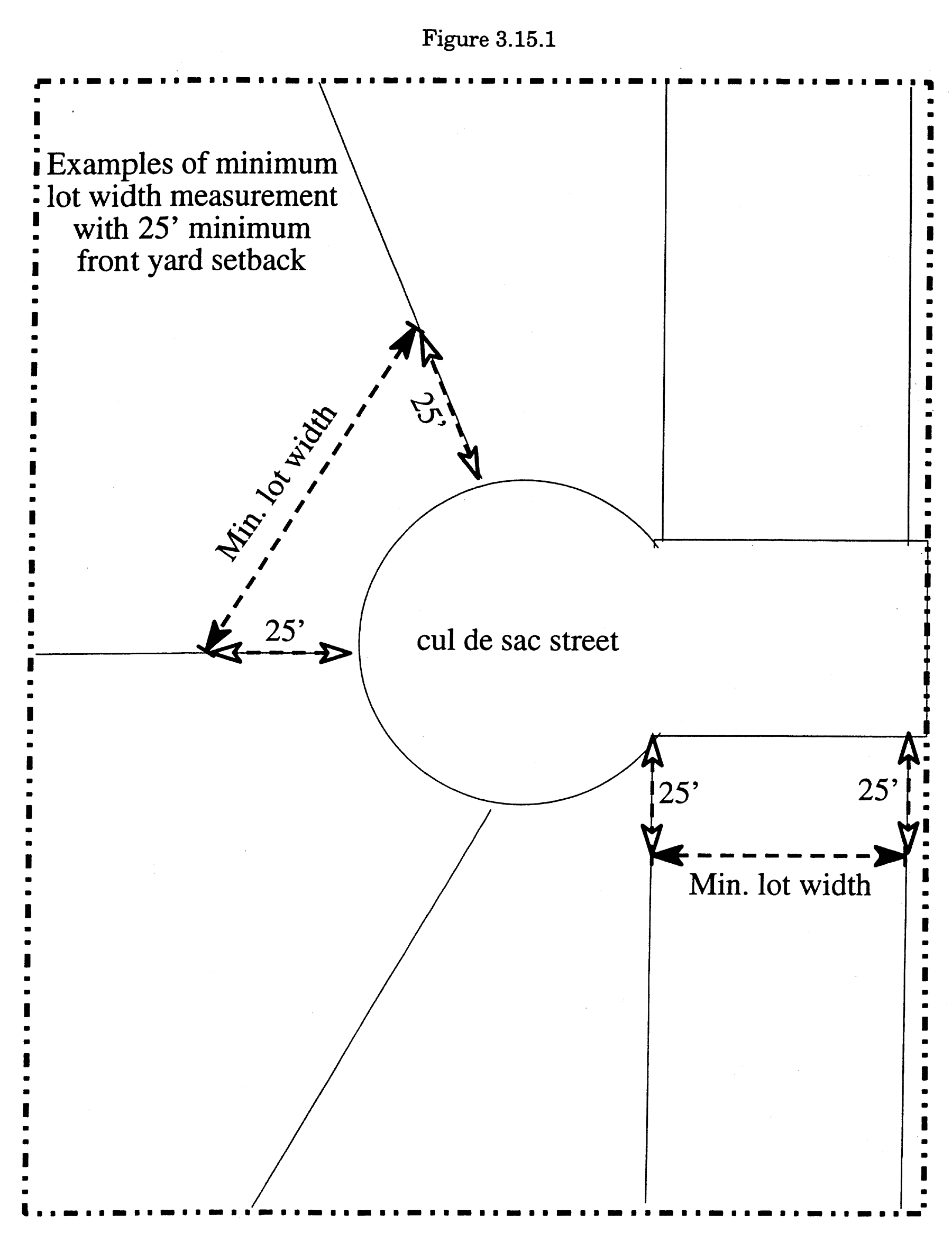
Measurement of Lot Width
(Ord. No. 608, pt. 1, 3-19-2002; Ord. No. 633, pt. 1, 9-2-2003)
Sec. 3.15.1. - Open space.
3.15.1.A.
The open space requirement referred to in Section 3.12, Table 3.12.1 shall apply on a lot-by-lot basis unless the lot has been approved as part of a final site plan which demonstrates compliance on a project-wide basis, for example, by way of setting aside common areas such as upland and wetland preserve areas and other eligible open spaces.
3.15.1.B.
For residential developments within any RE, RS, RM or MH district, at least 40 percent of the required open space shall be comprised of uplands, provided that this requirement shall not apply to any residential lot of record, so existing as of April 1, 1982.
(Ord. No. 633, pt. 1, 9-2-2003)
Sec. 3.16. - Setbacks.
3.16.A.
General requirements.
1.
Structures shall be set back from lot lines at least as far as the distance indicated in Table 3.12.2.
2.
The front setback as shown in Table 3.12.2 shall apply to all sides of a lot which are adjacent to a street. However, where the lot was lawfully established prior to May 9, 1967, and is 75 feet or less in width, as measured along the front lot line, or which is otherwise 7,500 square feet or less in total area, the front setback shall only apply to the sides of the lot providing vehicular access.
3.
Except as set forth in subsection 3.16.B below, every part of every required front, side and rear setback shall be comprised of open space.
4.
Where any building site consists of an unplatted parcel of less than a platted lot or where it takes in more than one platted lot, the setbacks required herein shall apply to the building as a whole.
3.16.B.
Exceptions to standards set by district regulations.
1.
The following may be located within setback areas unless otherwise provided for elsewhere in this Article:
a.
Trees, shrubbery or other objects of natural growth.
b.
Fences or walls which meet the height and other requirements set forth in this Article.
c.
Driveways, sidewalks and parking areas which meet the requirements set forth elsewhere in the LDR.
d.
Docks.
e.
Wells and associated pump, water treatment and water conditioning equipment, provided that the water pump is concealed by a fence or housing that is at least 50 percent opaque.
f.
Signs, which meet the requirements set forth elsewhere in the LDR.
g.
Utility transmission lines of all types, including, but not limited to, electric, telephone, cable television and data, including all associated aboveground utility cabinets.
h.
The following types of equipment may extend into the required setback area by up to 50 percent, but in no case less than three feet from a property line:
(1)
Heating, ventilation and air-conditioning equipment, whether ground-mounted, wall-mounted, window-mounted or cantilevered from a building.
(2)
Emergency electric power generators, if enclosed by an insulated cabinet.
i.
The following nonhabitable architectural features of a building may extend into the required setback area by up to three feet: roof overhangs, gutters, cantilevered balconies and bay windows, staircases, awnings over windows and doors, and chimneys.
j.
Drainage swales and water control structures.
k.
Structures installed entirely below grade which are not visible from the surface.
l.
Pumps and other mechanical equipment associated with pools and spas may extend into the required setback area by up to 50 percent, provided that such equipment is screened from view of abutting residential lots by a fence, hedge or wall or by enclosing the equipment with material (such as lattice) which is at least 50 percent opaque.
2.
Preexisting structures. Despite any provision to the contrary in article 8, Nonconformities, of the Land Development Regulations, structures of the type described in subsection 3.16.B.1 which received a building permit or were otherwise lawfully approved prior to January 1, 2007, shall not be considered in conflict with any subsequently adopted restrictions set forth in subsection 3.16.B.1. For example, in the side yard of a single-family lot with a minimum six-foot side yard setback requirement, if a building permit had been issued in 1995 for an air conditioning unit with an actual setback of just two feet from the property line, such setback would not be considered in conflict with the provision of subsection 3.16.B.1.h., and thus could be continually maintained at that location or even be replaced without regard to the current requirement to be set back at least three feet.
3.
Side yard setbacks may be reduced by the Growth Management Director for nonresidential structures, provided that:
a.
Abutting uses are zoned and designated on the Future Land Use Map of the Comprehensive Growth Management Plan for nonresidential usage.
b.
Emergency vehicle access will not be impeded.
c.
Adjacent property owners consent in writing.
3.16.C.
Centerline setbacks.
1.
Generally. All structures, except those listed as exempt pursuant to subsection 3.16.B., above, shall be set back from the centerlines of public and private streets as follows:
a.
Local streets: 50 feet.
b.
Collector or arterial street: 65 feet.
c.
U.S. Highway 1: 100 feet.
2.
Exceptions. The following shall not be subject to the above-described centerline setbacks:
a.
Structures associated with a public utility.
b.
Structures on lots within the RT and TP districts abutting local streets.
c.
Structures on lots abutting public or private right-of-way platted prior to April 29, 1986.
(Ord. No. 608, pt. 1, 3-19-2002; Ord. No. 623, pt. 1, 11-5-2002; Ord. No. 633, pt. 1, 9-2-2003; Ord. No. 743, pt. 1, 3-6-2007; Ord. No. 1156, pt. 1, 4-27-2021)
Sec. 3.31. - LI-1 district.
3.31.A.
Permitted uses. Uses in the LI-1 district shall be limited to the following:
1.
Principal uses:
Administrative services, not for profit
Business and professional offices
Community centers
Cultural or civic use
Educational institution
Electronic equipment manufacturing
Medical and dental labs
Medical equipment manufacturing
Optical equipment manufacturing
Pharmaceutical products manufacturing
Precision instrument manufacturing
Printing, publishing and bookbinding
Protective and emergency services
Public library
Public park and recreation, active
Public park and recreation, passive
Radio and television broadcasting studios
Research and development laboratories and facilities
Utilities
2.
Ancillary uses:
Commercial day care
Convenience restaurants, without drive-through facilities
Copy services and duplicating services
Financial institutions
General restaurants
Helipads
Hotels and motels
Mail services and parcel exchange
Newsstands
Physical fitness centers
Post offices
3.31.B.
Standards for ancillary uses.
1.
Ancillary uses shall be designed and operated so as to primarily support the principal uses allowed in the LI-1 district; however, for purposes of applying all other requirements of this Article, such as, but not limited to, parking, landscaping and lighting standards, the ancillary uses listed in this section shall be considered in the same manner as principal uses.
2.
Ancillary uses shall not be located on lots located on the outer boundaries of the industrial park and access shall be from roadways in the interior of the park.
3.
Signage for ancillary uses shall not be readily visible from any arterial or collector street.
4.
Ancillary uses shall comprise no more than 15 percent of the maximum gross leasable floor space of any LI-1 area.
5.
Helipads shall meet the following standards:
a.
Helipads shall be designed and operated solely for the use of the principal uses within the LI-1 district.
b.
Helipads shall not be located within 1,000 feet of any RE, RS, RM or MH district or any residential PUD.
c.
The development application shall include a plan, sealed by a registered engineer, indicating the landing and take-off corridors and demonstrating compliance with all FAA and/or FDOT requirements.
3.31.C.
Site development standards.
1.
Minimum lot area: Three acres for principal uses, one acre for ancillary uses.
2.
Minimum lot width: 100 feet.
3.
Maximum hotel density: 20 units per acre.
4.
Maximum building coverage: 50 percent.
5.
Minimum building setbacks:
Front: 25 feet.
Rear: 20 feet.
Side: 15 feet.
Corner: 25 feet.
6.
Maximum height: 40 feet, or 30 feet when located within 100 feet of a residential zoning district boundary.
7.
Minimum open space: 30 percent.
3.31.D.
Architectural design.
1.
All buildings within an LI-1 area, both for principal and ancillary uses, shall be of masonry construction, or have the appearance of masonry construction, and shall conform to a common architectural plan. A uniform architectural plan shall be incorporated into the declaration of covenants.
2.
Outside storage of materials is prohibited.
3.
Loading docks shall not be visible from public rights-of-way.
3.31.E.
Landscaping.
1.
At least 30 percent of the developed area shall be landscaped.
2.
Seventy-five percent of all required landscaping shall be native species.
3.
A type 4 landscaped buffer shall be required wherever LI-1 zoning abuts a residential zoning district.
3.31.F.
Vehicular access. Vehicular access to all principal and ancillary uses shall be via local streets created within the LI-1 area. Principal and ancillary uses shall not take vehicular access from existing arterial or collector streets.
3.31.G.
Parking. No more than ten percent of the off-street parking provided for any given principal or ancillary use shall be placed in front of the main building.
3.31.H.
Utilities. All electrical, water and sewer, communication, and utility lines shall be placed underground. Any utility equipment which cannot be reasonably located underground shall be screened from view from any street or adjacent property.
3.31.I.
Signage. All signage, both for principal and ancillary uses, including internal directory signage, shall be uniform in design. A uniform signage plan shall be incorporated into the declaration of covenants and shall, at a minimum, address the shape, size, material, color, location, and graphics of all permitted signs.
3.31.J.
Control of common elements.
1.
As part of any development application for land within the LI-1 zoning district, the applicant shall provide for and establish a property owners association, organization or other legal entity for the ownership and maintenance of any common areas, such as open spaces or utility areas, including improvements within such areas. The power and authority of such organization shall be ensured and protected by covenants running with the land, and such covenants shall be included as part of the development application and subject to approval by the County Attorney. Transfer of ownership of the common areas from the developer to the property owners association may be phased in over the development of the park but must be completed prior to the sale of 75 percent of the total acreage for principal and ancillary uses contained in the industrial park. The established organization shall not be dissolved and shall not dispose of any common areas, by sale or otherwise, without first receiving approval from the Board of County Commissioners. The Board, as a condition precedent to such dissolution or the disposal of common areas, may require dedication of common open areas or utility areas, including improvements within such areas, to the public, as deemed necessary. In addition to maintenance of common areas, the property owners association will be responsible for ensuring that property owners and tenants in the park comply with the requirements of this Article and with the covenants.
2.
Management and care of common areas.
a.
Covenants shall provide that if the organization established to own and maintain common areas (or any successor organization) fails at any time to maintain the common areas in reasonable order and condition in accordance with the approved final site plan, the Board of County Commissioners may utilize enforcement mechanisms provided for, pursuant to state law or local ordinances. In the alternative, the specified obligations may be enforced through standard code enforcement measures, as provided by F.S. ch. 162 and the Code.
b.
The covenants running with the land shall further specify that the Board may, upon public hearing with notice given and published in the same manner as above, return possession and maintenance of such common areas to the organization, or successor organization, abandon such possession and maintenance, or continue such possession and maintenance for additional one-year periods.
c.
The covenants creating such organization shall further provide that all costs associated with common element maintenance by the County shall be assessed proportionately against the properties within the development that have a right to enjoyment of the common areas, and shall become a charge or lien on such properties, and the applicable charge shall be paid by the owners of such properties within 30 days after receipt of a statement therefor.
3.31.K.
Time limits. Wherever LI-1 zoning is the result of a petition by the landowner, the landowner shall be required to:
1.
Submit an application for final site plan within two years of BCC approval of the rezoning; and
2.
Commence development of the site within three years of BCC approval of the rezoning.
Upon failure to comply with either of the above requirements, the Board of County Commissioners may, after notifying the landowner and conducting a public meeting, determine that the land should be redesignated on the Future Land Use and Zoning Atlas and initiate proceedings to make such changes.
(Ord. No. 608, pt. 1, 3-19-2002)
Sec. 3.32. - PAF public airport facility district.
3.32.A.
Definitions. In addition to any other definitions elsewhere in the LDR which may apply, for purposes of this section (3.32), the following words, terms and phrases shall have meanings as set forth below:
Aeronautical school means a commercial or educational establishment providing instruction in the flying, manufacturing or repairing of airplanes.
Air traffic control tower means a structure designed and constructed for the express purpose of providing for the safe operation and control of aircraft as denoted by Federal Aviation Administration (FAA) regulations and which is staffed by federally certified and licensed air traffic control personnel.
Air freight operations means the transportation of cargo or freight by air on a nonscheduled basis.
Aircraft assembly and service means an establishment providing assembly and/or mechanical repair for airplanes and other types of aircraft, excluding aircraft manufacturing.
Aircraft manufacturing means a use that manufactures aircraft or aircraft components.
Aircraft sales and rentals means the sale, storage or rental of aircraft including airplanes, jets and gliders, and related equipment with incidental services and maintenance.
Aircraft storage hangars means a facility used to store aircraft when not in service.
Aviation-related business and professional offices means a use which extends services by providing advice, information or consultation of a professional nature, including, but not limited to, executive management and administrative services, but excluding medical office and excluding as a principal use commercial storage of goods for the purpose of sale.
FAA means Federal Aviation Administration.
Fixed base operator (FBO) means an entity authorized and required by agreement with the County to provide aeronautical services, including the sale of aviation fuel and lubricants, tie downs, hanger space, parking of aircraft, maintenance of aircraft, and ancillary aircraft ground support services.
Flying clubs, large means nonprofit entities that own and operate aircraft larger than a twin-engine piston type aircraft and are organized for the express purpose of fostering and promoting flying for pleasure, developing aeronautical skills, and awareness of aviation techniques and requirements. Such clubs must conform to all provisions of FAA Order 5190.6A, Appendix 8.
Flying clubs, small means nonprofit entities of less than 20 members that own and operate aircraft no larger than a twin-engine piston type aircraft (example: Baron or Seneca) and are organized for the express purpose of fostering and promoting flying for pleasure, developing aeronautical skills and awareness of aviation techniques and requirements. Such clubs must conform to all provisions of FAA Order 5190.6A, Appendix 8.
Nonscheduled charter airline service means an entity that transports people or cargo by aircraft on a nonscheduled basis, specifically excluding air carriers holding a certificate of public convenience and necessity from the Federal Aviation Administration, large aircraft commercial operators or regularly scheduled commercial operators.
Personal service means establishments primarily engaged in providing services involving the care of a person or his or her apparel such as cleaning and pressing services, beauty shops, barber shops and shoe repair.
Public ground transportation means any public or private entity providing nonaeronautical transportation services, such as, but not limited to, automobile rental, bus, train or taxi service.
Research center means an establishment or other facility for carrying on investigation in the natural, physical or social sciences, and may include engineering and product development.
Runway dependent uses means aviation-related uses which are immediately and necessarily dependent upon the existence of a runway and use of airplanes, such as parachute training, air show operators, and aircraft sign towing operations.
3.32.B.
Permitted uses.
1.
In general. In order to allow development which is consistent with the CGMP and the FAA approved Master Plan for Witham Field, the following development zones are hereby created: Airport Operation; General Aviation 1., General Aviation 2., Commercial Aviation, Industrial/Commercial, and Preservation Zone/Post Planning Period Development (see Figure 3.32.1). The area designated Airport Operations is restricted to the landing, takeoff and movement of aircraft. This area also includes the safety and runway protection areas required by the FAA. The area designated as Preservation Zone/Post Planning Period Development is set aside. No aeronautical or nonaeronautical need for this area has been identified within the current planning period of the Airport Master Plan. No uses are permitted in this zone until the Airport Master Plan is revised. The permitted uses allowed in each of the other zones are as follows as indicated by an "X".
2.
Special development approval procedures. Federal Aviation Administration regulations, particularly Advisory Circular 150/5070-6A, requires land use plans for all airports subject to FAA regulation. Development plan approval shall be required for all development within the PAF district. The application shall be submitted in accordance with the procedures outlined in Article 10. The Board of County Commissioners (BCC) shall review any master or final development plans within the public airport facilities districts. The BCC shall review each development application and determine its consistency with the FAA approved Master Plan for Witham Field, as it may be amended from time to time. In addition to any other materials that may be required pursuant to Article 10, applications for development in the PAF district shall include a map showing the area within 500 feet of the site, including the location of all existing or proposed runways, taxiways and aprons.
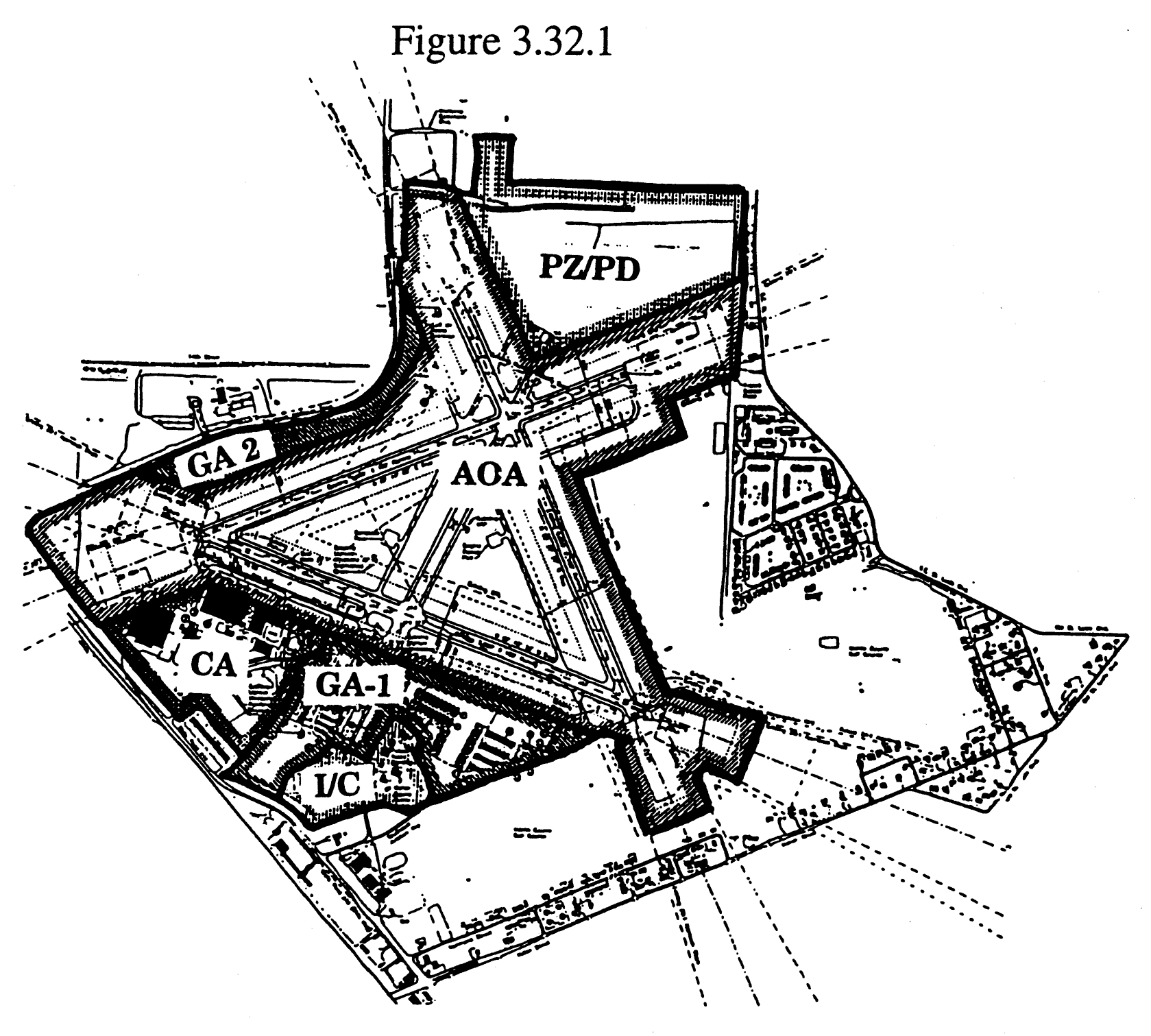
Development Zones
3.32.C.
Size and dimension criteria.
1.
Minimum lot size: 10,000 square feet.
2.
Minimum lot width: 80 feet.
3.
Maximum building height:
a.
Buildings shall be the lower of 40 feet or as per the height restrictions of the Federal Aviation Regulations, Part 77.
b.
Air traffic control towers may exceed the limit for the express purpose of providing for the safe operation and control of aircraft into, out of, and within the control area of Martin County Airport/Witham Field as denoted by the Federal Aviation Administration regulations, provided that such towers are staffed by federally certified and licenses air traffic control personnel.
4.
Setbacks:
a.
Front: 30 feet.
b.
Side (interior/corner): 25 feet/25 feet.
c.
Rear: 25 feet.
d.
There shall be no setback required adjacent to railroad right-of-way.
e.
From residential zoning districts: 100 feet.
5.
Maximum building coverage: 40 percent.
6.
Minimum open space: 40 percent (based on overall airport property acreage).
7.
Minimum internal separation of buildings: 20 feet.
3.32.D.
Specific use criteria. When located in the PAF district, the following specific use restrictions shall apply:
1.
Restaurant general.
a.
The minimum landscape buffer adjacent to residential districts shall be 50 feet wide, Type 4.
b.
Eating establishments shall not have access on a local residential street.
c.
Signs shall not exceed 20 square feet and shall be nonilluminated.
2.
Limited and extensive impact industry.
a.
When located in a PAF District, no building shall be located closer than 100 feet to any lot line which abuts a residential district.
3.
Business and professional offices.
a.
The minimum landscape buffer adjacent to residential districts shall be 50 feet wide, Type 4.
b.
Signs shall not exceed 20 square feet and shall be nonilluminated.
4.
Personal services.
a.
The minimum landscape buffer adjacent to residential districts shall be 50 feet wide, Type 4.
b.
Signs shall not exceed 20 square feet and shall be nonilluminated.
5.
Research center.
a.
No building shall be located closer than 100 feet to any lot line which abuts a residential district.
b.
No off-street parking or loading space shall be located closer than 50 feet to any lot line abutting a residential district.
6.
Recreational facility.
a.
No off-street parking area, loading area, building or structure shall be located within 50 feet of any lot line abutting a residential district.
b.
Areas which abut residential districts and accommodate active recreation, buildings, recreational apparatus or related facilities which attract large user groups shall provide a Type 4 landscape buffer.
(Ord. No. 608, pt. 1, 3-19-2002; Ord. No. 633, pt. 1, 9-2-2003)
Sec. 3.33. - Noise compatibility overlay.
3.33.A.
Noise compatibility overlay boundary.
1.
In order to allow uses which are consistent with the 2002 "Airport Noise Compatibility Planning Study" completed under Federal Aviation Regulation Part 150, and updated in 2010, a Noise Compatibility Overlay boundary is hereby created.
The Noise Compatibility Overlay boundary shall be mapped in accordance with Day-Night Average Sound Level (DNL) noise contour lines. DNL lines are measured in decibels and are shown on Figure 5-1 and 5-2 of the Martin County Airport/Witham Field Noise Exposure Map Update, dated September 2010. These lines shall be the basis for locating Zone "A" and Zone "B" of the Noise Compatibility Overlay on the Zoning Atlas.
2.
The Noise Compatibility Overlay shall be applicable within unincorporated Martin County but, shall not be applicable to parcels located within the Martin County Airport and the Martin County Golf and Country Club zoned PS and the PAF.
3.
Parcels located completely inside the geographic area bounded by the 65 DNL line (between the 65 and 70 DNL lines) shall be considered Zone A in the Noise Compatibility Overlay. Zone A shall be represented by a hatching pattern on the Zoning Atlas if it extends beyond the PS and PAF zoning districts.
4.
Parcels located completely inside the geographic area bounded by 60 and 65 DNL lines shall be considered Zone B in the Noise Compatibility Overlay. Zone B shall be represented by a hatching pattern if it extends beyond the PS and PAF zoning districts.
5.
The two zones shall be identified by two different hatching patterns on the Zoning Atlas where both extend south of the PS and PAF zoning districts.
6.
The Zoning Atlas shall be amended within six months of Federal Aviation Administration approval of the most recent update to the Noise Exposure Map adopted by the Board of County Commissioners.
7.
Where both Zones A and B appear on a parcel, the following shall apply:
a.
If more than 50 percent of the parcel is located inside Zone A the entire parcel shall be subject to the requirements of Zone A.
b.
If more than 50 percent of the parcel is located outside Zone A the entire parcel shall be subject to the requirements of Zone B.
8.
Where only Zone B appears on a parcel, the following shall apply:
a.
If more than 50 percent of the parcel is located inside Zone B the entire parcel shall be subject to the requirements of Zone B.
b.
If more than 50 percent of a parcel is located outside Zone B none of the parcel shall be subject to the requirements of Zone B.
9.
The requirements of the Noise Compatibility Overlay shall not be applicable to Lot W-36 of the Port Sewall Plat.
3.33.B.
Permitted uses.
1.
Nothing in section 3.33 shall prohibit the continued use or enjoyment of a use legally established prior to adoption of the Noise Compatibility Overlay on September 11, 2012. Likewise, uses legally established pursuant to the Noise Compatibility Overlay shall be permitted to continue regardless of future changes to the Noise Compatibility Overlay.
2.
Notwithstanding the permitted uses shown in Tables 3.11.1. thru 3.11.3., uses established after the effective date of this section within Zone B shall be limited solely to single-family detached dwellings, accessory structures associated with single-family residential dwellings and modular homes constructed or modified to meet the sound insulation requirements described in section 3.33.C., LDR.
3.33.C.
Sound insulation.
1.
New construction and substantial improvements to existing habitable residential structures in Zone A shall use design and construction methods sufficient to reduce the noise level 30 decibels between the inside and the outside of the structure.
2.
New construction and substantial improvements to existing habitable residential structures in Zone B shall use design and construction methods sufficient to reduce the noise level 25 decibels between the inside and the outside of the structure.
3.
Compliance with the aircraft sound isolation performance standards shall be established by certification from a registered professional architect or engineer that, when constructed in accordance with the approved plans the building shall achieve the specified interior noise levels. The design and construction methods shall be consistent with Advisory Circular No: 150/5000-9A prepared by the U.S. Department of Transportation, Federal Aviation Administration, July 2, 1993.
4.
For the purposes of the Noise Compatibility Overlay, "substantial improvement" means any repair, reconstruction, extension or other improvement to a building or structure, including such work conducted over a period of time, the cost of which equals or exceeds 90 percent of the assessed value of such building or structure either before the improvement is commenced or, if the property has been damaged and is being restored, before the damage occurred. For purposes of this definition, "assessed value" shall mean the assessed value of a structure for the current year as determined by the Martin County Property Appraiser.
(Ord. No. 919, pt. 1, 9-11-2012)
Sec. 3.34. - School construction zones.
3.34.A.
Pursuant to F.S. § 333.03(3), the construction of a new private or public educational facility, as defined in F.S. ch. 1013, shall be prohibited at either end of a runway of a publicly owned, public-use airport within an area which extends five miles in a direct line along the centerline of the runway, and which has a width measuring one-half the length of the runway. Exceptions approving construction of a new educational facility within the delineated area shall only be granted when the Board of County Commissioners makes specific findings detailing how the public policy reasons for allowing the construction outweigh health and safety concerns prohibiting such a location. A School Construction Zone Map depicting the area described above is on file with the Growth Management Department and with the Martin County Airport Manager.
(Ord. No. 919, pt. 1, 9-11-2012)
Sec. 3.51.- Accessory dwelling units.
3.51.A.
Accessory dwelling units shall be established only as part of a nonresidential development such as, but not limited to, a marina, residential storage facility, or manufacturing use.
3.51.B.
Accessory dwelling units shall be counted as dwelling units pursuant to the density calculation requirements set forth in Division 2 but in no case shall more than three accessory dwelling units be established on a single lot.
(Ord. No. 608, pt. 1, 3-19-2002)
Sec. 3.52. - Administrative services, not-for-profit.
3.52.A.
When located in an AG or AR district, the administrative services provided shall be designed and operated to serve the agricultural community in which the use is located.
3.52.B.
When located in a WRC or WGC district, the administrative services provided shall be limited to those which are water related or water dependent.
(Ord. No. 608, pt. 1, 3-19-2002)
Sec. 3.53. - Adult businesses.
3.53.A.
Definitions. For the purposes of this Section (3.53) the following definitions shall apply:
Adult business means individually or in combination an adult arcade, adult bookstore, adult dancing establishment, or adult motion picture theater as the terms are defined herein, and any other establishment whose employees display or expose specified anatomical areas as defined herein.
Adult arcade means an establishment where, for any form of consideration, one or more motion picture projectors, slide projectors, or similar machines for viewing are used to show films, motion pictures, video cassettes, slides, or other photographic reproductions which are characterized by emphasis upon the depiction or description of specified sexual activities or specified anatomical areas.
Adult bookstore means an establishment including a video store which sells or rents adult materials in any form to the public, the revenues of which represent more than ten percent of the gross revenues of the establishment over the same period, or that comprise more than 25 percent of the individual materials displayed within the establishment as its stock-in-trade.
Adult business premises means an enclosed building or a portion of an enclosed building which is physically occupied by an adult business.
Adult dancing establishment means an establishment whose employees display or expose specified anatomical areas while dancing.
Adult materials means books, magazines, periodicals or other printed matter, or photographs, films, motion pictures, video cassettes, slides or other visual representations or recordings which have as their primary or dominant theme matter depicting, illustrating, describing or relating to specified sexual activities or specified anatomical areas, or instruments, devices or paraphernalia which are designed for use in connection with specified sexual activities.
Adult motion picture theater means an establishment designed to permit the viewing of motion pictures and other film material which has as its primary or dominant theme matters depicting, illustrating or relating to specified sexual activities for observation by the patrons thereof.
Adult business employee means a person who works or performs in an adult business regardless of compensation or the manner of compensation, specifically including an independent contractor.
School means any public or private institution of learning including a day care facility, nursery school, preschool, kindergarten, elementary school, middle school, junior high school, senior high school, junior college, college, any special institution of learning under the jurisdiction of the state department of education, and those institutions offering instruction in dance and gymnastics to minors.
Specified anatomical areas means the human genitals, pubic region, anus, anal cleft, buttocks, and that portion of the female breast below the top of the areola.
Specified sexual activities means any sexual act which is prohibited by law, and acts of sexual intercourse, oral copulation, anal copulation, masturbation, flagellation, and the touching, caressing or fondling of breasts, buttocks, anus or genitals, or the simulation of any of the foregoing.
3.53.B.
Adult business premises regulations.
1.
All adult materials shall be located and the activities of employees, which include the exposure of specified anatomical areas, shall take place within the adult business premises.
2.
No adult materials or activities of employees, which include the exposure of specified anatomical areas, shall be visible from the exterior of the adult business premises in any way including, but not limited to, exterior apertures such as opened doors and unobscured windows.
3.
No merchandise, advertising or depictions of the activities of an adult business shall be displayed on the exterior of the adult business premises or in any location where they are visible from a street.
4.
No adult business shall display a sign:
a.
Depicting specified anatomical areas or specified sexual activities (as defined herein) or advertising the presentation of any activity prohibited by law; or
b.
Capable of leading a reasonable person to believe that the establishment engages in activity prohibited by law.
5.
Additional landscaping shall be provided adjacent to street and adjacent to private property:
a.
A landscaped strip at least five feet wide shall be provided along the boundary of an adjacent street between the right-of-way and all onsite parking areas and other vehicular use areas to consist of one tree for every 50 feet or portion thereof and a fence, wall or hedge not less than four feet in height at planting; and
b.
An opaque fence, wall or hedge shall be provided along the boundary of adjacent private property of a height of not less than four feet nor more than eight feet at planting.
3.53.C.
Distance requirements. The following distances shall be measured by straight line measurement without regard to intervening buildings from the nearest point of the building or unit within a building in which the proposed adult business is to be located to the nearest point of the lot, use, street or district from which the proposed adult business is to be separated.
1.
No adult business shall commence operation within one thousand (1,000) feet of any RE, RS, RM, MH, COR or Category "B" zoning district, as shown on the Zoning Atlas, or any Rural Density, Estate Density, Low Density, Medium Density, High Density, Mobile Home Density or Commercial Office/Residential Future Land Use designation boundary, as shown on the Future Land Use Map of the CGMP.
2.
No adult business shall commence operation within 1,000 feet of any other adult business.
3.
No adult business shall commence operation within 1,000 feet of a church or school. This distance requirement shall not apply in cases where a church or school has been established at a particular location for less than six months.
3.53.D.
Prohibited activities.
1.
It shall be unlawful for an employee or any patron of an adult business to engage in specified sexual activities (as defined herein) within or adjacent to adult business premises.
2.
It shall be unlawful for an employee of an adult business to physically touch a patron or spectator of an adult business while simultaneously revealing specified anatomical areas (as defined herein).
(Ord. No. 608, pt. 1, 3-19-2002)
Sec. 3.54. - Agricultural processing.
Any structure or activity associated with agricultural processing shall be set back at least 100 feet from any adjacent property line or street. Sawmills shall be located not less than 300 feet from any adjacent residential property line or street.
(Ord. No. 608, pt. 1, 3-19-2002)
Sec. 3.55. - Agricultural veterinary medical services.
See Section 3.107, veterinary medical services.
(Ord. No. 608, pt. 1, 3-19-2002)
Sec. 3.56. - Airports and airstrips.
3.56.A.
All airports, including general aviation airports, private use airports, airstrips, heliports and helipads shall comply with the provisions of this section. This section does not apply to Witham Field lands zoned PAF.
1.
A plan sealed by a registered engineer shall be submitted which indicates landing and take-off corridors and satisfies all FAA requirements, including conformance with appropriate flight hazard criteria which may hereinafter be imposed. The plan shall also include all existing land uses within 5,000 feet of the proposed facility.
2.
An airspace analysis conducted by the Federal Aviation Administration (FAA), and a preliminary airport license report prepared by the FDOT shall be required. Any alteration in ground facilities or the addition of navigation aids designed to facilitate an instrument approach capability shall require a new application if the original approval was granted for visual flying rules (VFR).
3.
Safety fences up to a height of six feet shall be required. Additionally, screening of at least 75 percent opacity shall be required if determined necessary to protect neighboring property from potential loss of use or diminishment of land value.
4.
No area used by an aircraft under its own power shall be located within 100 feet of any property line.
5.
No runway primary surface, as defined by the FDOT Chapter 14-60, F.A.C., shall be located within 300 feet of any property line or within 100 feet of any residential structure.
6.
No structure or navigation aid shall be located within 50 feet of any property line.
7.
In the AG and AR districts, airstrips, helipads and heliports shall be limited to those facilities and operations necessary to support bona fide agricultural use.
8.
In the AG, AR, and RE-2A districts:
a.
Operations are limited to aircraft of 12,500 pounds maximum gross take-off weight.
b.
Runway length shall not exceed 4,200 feet.
c.
Aircraft operations are limited to daylight hours. Runway and taxiway landing lights are prohibited.
3.56.B.
General aviation airports and aviation terminals shall be subject to the following specific use conditions:
1.
General aviation airports and aviation terminals must comply with the Martin County Comprehensive Growth Management Plan.
2.
General aviation airports and aviation terminals and aircraft approach and departure patterns shall not be permitted in areas which would create noise levels greater than 70 Ldn on the breeding, nesting or feeding grounds of endangered or threatened fauna identified by the Florida Fish and Wildlife Conservation Commission or the U.S. Fish and Wildlife Service.
3.
General aviation airports and aviation terminals shall be located in areas where the proposed facility will not adversely impact significant recreational areas, archaeological sites or historical resources. This shall include, but not be limited to, the prohibition of noise levels of 70 Ldn or greater in such areas.
4.
General aviation airport runways shall be located at least three statute miles from any land use that produces significant smoke, glare or other visual hazards.
5.
General aviation airport runways shall be located at least three statute miles from existing or proposed lighting or illumination which is arranged or operated in a manner that is misleading or dangerous to aircraft.
6.
Airport runways shall not be located in an area where the proposed facility or aircraft flight patterns will create noise levels above 64 Ldn on property designated for residential uses in the Comprehensive Growth Management Plan.
7.
Airports shall be located in an area where the airport operator will maintain land within designated airport clear zones under the controlling ownership of the operating entity. The lease of any such land within designated airport clear zones shall be restricted exclusively to agricultural and other uses permitted by the FAA.
8.
Airport sites shall be consistent with state airport plans.
9.
Airport sites shall comply with Federal Aviation Authority (FAA) site selection criteria.
10.
Airports shall not be permitted in areas which would adversely impact airspace at any existing public, private or military airport.
(Ord. No. 608, pt. 1, 3-19-2002; Ord. No. 633, pt. 1, 9-2-2003)
Sec. 3.56.1. - Ancillary retail.
Ancillary retail uses may be permitted in any COR zoning district as follows:
3.56.1.A.
Ancillary retail uses are limited to general restaurants, convenience restaurants, commercial day care, limited retail sales and services, which are conducted in conjunction with a residential development, office development or mix of residential and office uses.
3.56.1.B.
The accessory retail use shall be located within the same building as a principal use permitted within the zoning district.
3.56.1.C.
The building containing the principal use shall have a minimum of 10,000 square feet of gross floor area devoted to the principal use.
3.56.1.D.
The accessory retail use shall occupy no more than ten percent of the gross floor area of the overall project.
3.56.1.E.
Signs advertising an ancillary retail use shall not exceed 20 square feet in total area per business and shall not be illuminated.
3.56.1.F.
Proposed ancillary retail uses shall be reviewed at a public meeting by the Local Planning Agency. The Local Planning Agency shall make a recommendation to the Board of County Commissioners as to the appropriateness of the proposed use at the proposed location. At a minimum, the Local Planning Agency shall determine whether the principal use meets the bufferyard requirements of Article 4, Division 15, of the Land Development Regulations.
3.56.1.G.
Proposed ancillary retail uses shall be reviewed at a public meeting by the Board of County Commissioners. The Board of County Commissioners shall review the recommendation of the Local Planning Agency and approve, approve with modifications or deny the request for the proposed ancillary retail use. Where the proposed ancillary retail use is part of a Standard Development, Minor Development or other application that does not require final action by the Board of County Commissioners, no final site plan shall be approved until the Board of County Commissioners has made a determination as to the proposed ancillary retail use in accordance with this subsection.
(Ord. No. 623, pt. 1, 11-5-2002; Ord. No. 633, pt. 1, 9-2-2003)
Sec. 3.57. - Apartment hotel.
See section 3.76, hotels, motels, and apartment hotels.
(Ord. No. 608, pt. 1, 3-19-2002)
Sec. 3.58. - Bed and breakfast inn.
3.58.A.
When located in an AG or AR district, the inn shall be associated with an agricultural use, such as a commercial stable, and shall offer no more than six guest rooms.
3.58.B.
When located in a RE, RS or any Category "B" district not more than two guest rooms may be rented unless the inn is located on a lot that is at least one acre in size. If the lot is at least one acre, then the maximum number of guest rooms which may be rented shall be six.
3.58.C.
When located in a district allowing multiple-family use, not more than ten guest rooms may be rented.
3.58.D.
The owner or manager of the residence must live in and manage the bed and breakfast inn.
3.58.E.
The outside appearance of the inn shall be consistent with its use as a residence.
3.58.F.
Individual guest rooms shall not contain any cooking facilities other than small convenience appliances such as a coffee maker.
3.58.G.
Meals shall be served only to guests taking lodging in the inn.
3.58.H.
Only daily rates shall be offered, a current guest register shall be maintained, and the length of stay for any guest shall not exceed 14 consecutive days.
3.58.I.
Unless located within an area where on-street parking is allowed, there must be one off-street parking space provided for each guest room plus two spaces for the primary residential unit. Parking areas must be located to the side or rear of the inn and screened by opaque fence or plantings at a minimum height of five feet when parking is within 25 feet of residential property.
3.58.J.
If located in an area where on-street parking is allowed, the number and location of parking spaces for inn guests and the permanent residents shall be specified in the development order.
3.58.K.
Signs shall comply with the following criteria:
1.
In the AG and AR districts one free-standing or fence mounted roadside sign shall be allowed on the property subject to compliance with the following:
a.
The sign shall not exceed six square feet;
b.
The sign shall not be positioned with its top higher than six feet above street level;
c.
Positioning of the sign shall not block the view of any street intersection or driveway;
d.
Wording shall be limited to the name and type of the establishment;
e.
Lighting shall be limited to one downward directed light, positioned to illuminate only the sign.
3.58.L.
In all other districts, signs shall be allowed on the property subject to compliance with the following:
1.
Wording shall be limited to the name and type of the establishment;
2.
Signs shall not be illuminated;
3.
Signs shall not exceed four square feet;
4.
No freestanding roadside signs are allowed, roadside signs must be attached to a fence or mailbox with a top no more than six feet from ground level.
(Ord. No. 608, pt. 1, 3-19-2002; Ord. No. 633, pt. 1, 9-2-2003)
Sec. 3.58.1 - Biofuel facility.
A.
Biofuel facilities shall comply with the following setbacks:
1.
The minimum rear and side setbacks shall be 50 feet, unless a greater setback is required by the Florida Building Code or the Florida Fire Prevention Code.
2.
The real property boundary of a biofuel facility shall not be located within 150 feet of the boundary of an RE, RS, RM, MH, HR-1, HR-1A, R-1, R-1A, R-1B, R-1C, R-2, R-2B, R-2C, R-2T, RT, TP, E, E-1, WE-1, HR-2, HR-2A, R-2A, R-3, R-3B, R-4 or R-5 zoning district, the real property boundary of a residential use within a PUD zoning district, or the real property boundary of a public school.
B.
Biofuel facilities shall be located within an area specifically designated for such a facility on a site plan approved pursuant to article 10.
C.
Biofuel facilities shall meet the performance standards set forth in this subsection.
1.
Any process or storage conducted outside of a building shall be fully screened from view from adjoining streets or any adjacent non-industrial property.
2.
No smoke with opacity exceeding ten percent opacity shall be emitted.
3.
No odor which substantially and unreasonably interferes with the use or enjoyment of property by persons of ordinary sensibilities shall be permitted beyond the real property boundary.
4.
The emission or escape of gases or fumes in quantities, concentration, temperature or duration which creates a risk of injury to human health or welfare or plant or animal life or damage to property shall be prohibited.
5.
All terms and conditions of any permit required or issued by the U.S. Environmental Protection Agency or the Florida Department of Environmental Protection shall be met.
6.
Fuel storage or delivery systems shall meet all state and federal requirements in effect at the time of installation.
D.
Development review. In addition to all requirements generally applicable to the review and approval of a final site plan, a final site plan for a proposed biofuel facility shall also meet the requirements set forth in this subsection.
1.
The application for site plan approval shall include:
a.
Copies of all permits issued by federal and state agencies authorizing the construction or operation of the facility or copies of the applications for all required permits pursuant to federal and state law, including but not limited to the Federal Water Pollution Control Act (Clean Water Act), 33.U.S.C. §1251 et seq., the Clean Air Act, 42 U.S.C. §7401 et seq., and the Resource Conservation and Recovery Act (RCRA), 42 U.S.C. §6901 et seq. A claim that no permit is required pursuant to these laws must be substantiated to the satisfaction of the County Attorney.
b.
Any process hazard analysis or fire prevention, fire control or emergency action plan required by the Occupational Safety and Health Administration (OSHA), 29 CFR Part 1910. The County shall require a process hazard analysis and a fire prevention, fire control and emergency action plan even if one is not required by OSHA.
c.
A stormwater pollution prevention plan consistent with the requirements of federal and state law for such plans.
d.
Proof of registration with the United Stated Environmental Protection Agency (US EPA) as a biodiesel producer (Form 3520-12) and/or proof of registration with EPA as a biodiesel refiner (Form 3520-20A), or such other form as may be promulgated by US EPA.
e.
Proof of liability insurance naming Martin County as an insured party, to indemnify the County against risk of financial harm incurred in providing emergency response at the site. The amount of coverage of such liability insurance policy shall be in an amount to be determined by the County Administrator after consultation with the Fire Chief and the County's risk management consultant, but in no case shall be less than $1,000,000.00.
2.
The County's authority to retain independent professional or technical advice and to charge the cost of such consultation to the applicant, pursuant to section 10.2.D.2, shall be extended to fire prevention inspections related to issuance of a business tax receipt. Such independent technical consultants may include, but are not limited to, fire protection engineers, chemical process engineers, environmental engineers and testing laboratories.
3.
At its expense, an applicant shall be required to provide specialized fire suppression equipment or materials if, in the opinion of the County Administrator, in consultation with the Fire Chief, such is necessary to protect the public health, safety and welfare from risks posed by the facility, processes or materials the applicant will use.
4.
At its expense, an applicant shall be required to provide specialized training for Martin County staff if, in the opinion of the County Administrator, in consultation with the Fire Chief, such is necessary to protect the public health, safety and welfare from risks posed by the facility, processes or materials the applicant will use.
5.
An odor prevention, monitoring and control plan shall be required as part of the site plan application.
(Ord. No. 1014, pt. 3, 12-6-2016)
Sec. 3.58.2. - Business and professional offices.
When located in the WRC or WGC district, such use shall be water dependent or water related.
(Ord. No. 608, pt. 1, 3-19-2002; Ord. No. 1014, pt. 3, 12-6-2016)
Sec. 3.59. - Commercial amusements.
3.59.A.
All commercial amusements within the LC and CC districts shall be fully contained within a building.
3.59.B.
In districts other than LC and CC, all structures, buildings, mechanical devices, show or exhibit areas associated with an activity conducted in the open air as, for example, mini-golf, shall be set back at least 50 feet from any residential zoning district.
3.59.C.
Outdoor theaters are restricted as follows:
1.
No outdoor theater shall abut a residential district.
2.
No building, structure or mechanical equipment shall be located within 200 feet from the centerline of a state highway or less than 100 feet from any other street or abutting property line.
3.59.D.
Drive-in theaters are restricted as follows:
1.
No building, structure, or mechanical equipment shall be located within 200 feet from the center line of a state highway and less than 100 feet from any other street or abutting property line.
2.
The screen shall be oriented in such a manner that the picture is not visible from any street or residential area.
3.
Access and egress shall be from a minor or major arterial street, and sufficient traffic queuing lanes to the point of entrance shall be provided on the site.
4.
Off-street parking or storage lanes for waiting patrons shall be available to accommodate not less than 30 percent of the vehicular capacity of the theatre. Storage lanes to accommodate not less than ten percent of the theater capacity shall be provided between the highway and the ticket booths. However, if at least four entrance lanes with ticket dispensers are provided, then the amount may be reduced to 15 percent of the vehicular capacity. In all cases, sufficient storage space shall be provided so that vehicles will not back up on the traveled way of the access street. Storage area shall be calculated on the basis of one space per 25 lineal feet of storage lane. All access and queuing plans shall be approved by the director of public works to assure the adequacy and location of entrances, exits, acceleration or deceleration lanes, queuing space for patrons awaiting admission, or any other feature of vehicular circulation which may affect the flow of traffic upon adjacent streets.
5.
Speakers and snack bar sound systems shall not be audible beyond the boundaries of the theater property lines. Central loudspeakers shall not be permitted and individual speakers shall be provided to each vehicle, sufficient cord shall be provided to permit the speaker to be placed inside the vehicle.
3.59.E.
When located within a WRC or WGC district, such use shall be water dependent or water related.
3.59.F.
Gambling. F.S. Ch. 849 prohibits the keeping of a place for gambling.
1.
Commercial amusements offering electrical, mechanical or electromechanical machines that may be defined in F.S. Ch. 849 as slot machines shall be prohibited.
2.
Amusement games or machines offered at arcade amusement centers and truck stops may be operated pursuant to F.S. Ch. 849 and shall not conduct casino-style games in which the outcome is determined by factors unpredictable by the player or games in which the player may not control the outcome of the game through skill.
3.
Applicants seeking or renewing business tax receipts for arcades, internet cafes, truck stops or commercial amusements in unincorporated Martin County shall be reviewed by the Martin County Sheriffs Department for compliance with F.S. Ch. 849.
(Ord. No. 608, pt. 1, 3-19-2002; Ord. No. 970, pt. 1, 4-7-2015)
Sec. 3.60. - Commercial kennels.
3.60.A.
If located in a commercial district, then outside runs shall be prohibited.
3.60.B.
Pens and other structures for the confinement of animals shall:
1.
Not be located within 100 feet of any property line, unless completely enclosed and soundproofed.
2.
Be designed and maintained for secure, humane confinement.
3.60.C.
Animal wastes shall be managed in such a manner as to prevent odors from being carried beyond the property boundaries.
3.60.D.
When located in an AG or AR district, the sale of animals shall be prohibited.
(Ord. No. 608, pt. 1, 3-19-2002)
Sec. 3.61. - Community center.
3.61.A.
When located on sites facing a minor or major collector or minor or major arterial street, the principal building may exceed 5,000 square feet.
3.61.B.
No building shall be located closer than 30 feet to any lot line which abuts a residential district or residential lot.
3.6l.C.
When located in a WRC or WGC district, community centers shall be water dependent or water related.
3.61.D.
Any existing community center site may redevelop and shall comply with paragraphs A thru D to the extent practicable.
3.61.E.
When located in a Community Redevelopment Area, redevelopment of an existing community center site shall be eligible to apply for alternative compliance pursuant to Section 3.260.D. For such community centers, the alternative compliance process shall be applicable to all development standards found in Article 3.
(Ord. No. 608, pt. 1, 3-19-2002; Ord. No. 1045, pt. 1, 1-9-2018)
Sec. 3.61.1. - Composting.
Compost material piles and any associated mechanical processing equipment shall be set back at least 300 feet from any property line. However, where the abutting lot is designated Industrial or Major Power Generation Facility, the minimum setback for compost material piles and any associated mechanical processing equipment shall be the same as indicated for structures within the particular zoning district as set forth in section 3.12, Table 3.12.2.
(Ord. No. 633, pt. 1, 9-2-2003)
Sec. 3.62. - Construction industry trades.
3.62.A.
When located in LC or CC districts, outdoor storage or display of materials or products shall be prohibited.
3.62.B.
When located in LC or CC districts, the gross floor area shall be limited to 5,000 square feet.
(Ord. No. 608, pt. 1, 3-19-2002; Ord. No. 623, pt. 1, 11-5-2002)
Sec. 3.63. - Construction sales and services.
3.63.A.
When located in LC or CC districts, outdoor storage or display of materials or products shall be prohibited.
3.63.B.
When located in LC or CC districts, the gross floor area shall be limited to 5,000 square feet.
(Ord. No. 608, pt. 1, 3-19-2002; Ord. No. 623, pt. 1, 11-5-2002)
Sec. 3.64. - Correctional facilities.
3.64.A.
Such facilities shall require a minimum three (3) acre site and shall not abut a residential district.
3.64.B.
The facilities shall comply with all applicable regulations of the Florida Department of Corrections, as cited in chapter 33, Florida Administrative Code, and any other relevant requirements.
3.64.C.
No main or accessory building shall be located within 100 feet of any property line.
3.64.D.
The applicant shall submit a site development plan which demonstrates the adequacy of the site to accommodate anticipated facilities, occupants, recreation areas, off-street parking and pedestrian and vehicular circulation on site, including loading, unloading and queuing of occupants as well as any safety and security features of the facility.
(Ord. No. 608, pt. 1, 3-19-2002)
Sec. 3.64. - Craft distillery.
3.64.1.A.
A craft distillery shall not produce more than 75,000 gallons of distilled spirits per year.
3.64.1.B.
A craft distillery shall be permitted only in the LC, CC, GC, WRC, WGC and LI zoning districts or as otherwise permitted in Division 5, Division 6 and Division 7, Land Development Regulations, Martin County Code.
3.64.1.C.
No more than 75 percent of the total gross floor space of the craft distillery shall be used for the distilling function, with the remaining floor area used for a restaurant, a tasting room or retail operations.
3.64.1.D.
Craft distilleries shall also comply with all applicable federal and state laws.
(Ord. No. 1094, pt. 2, 1-29-2019)
Sec. 3.65. - Cultural and civic uses.
When located in a WRC or WGC district, cultural and civic uses shall be limited to those which are water dependent or water related.
(Ord. No. 608, pt. 1, 3-19-2002)
Sec. 3.66. - Day care, commercial.
3.66.A.
Whether designed to serve adults or children, a commercial day care facility shall:
1.
Be located on an arterial or collector street.
2.
Have a minimum lot area of 15,000 square feet.
3.
Provide special passenger loading and unloading facilities on the same lot for vehicles to pick up or deliver clientele including driveways that do not require back-up movements to enter or exit the premises.
4.
Shall satisfy all state regulations that pertain to such use.
3.66.C.
When located in an LI or GI district and designed primarily to serve the needs of the employees of businesses and industries located within such districts, the locational requirement set forth in subsection A.1, above, shall not apply.
(Ord. No. 608, pt. 1, 3-19-2002; Ord. No. 623, pt. 1, 11-5-2002)
Sec. 3.67. - Day care, family.
3.67.A.
Family day care operations shall comply with all licensing and other requirements of the state of Florida.
3.67.B.
The maximum number of children under care at one time shall be eight, including those of related to the caregiver.
3.67.C.
Family day care shall only be conducted in a single-family detached dwelling, not in other single-family dwelling unit types such as zero lot line or townhouse.
(Ord. No. 608, pt. 1, 3-19-2002)
Sec. 3.68. - Dredge spoil facilities.
3.68.A.
General requirements. The following requirements shall apply to dredge spoil management sites:
1.
As part of the application for the development of a dredge spoil management site, the developer shall provide evidence of compliance with the site selection criteria for such sites as set forth in section 4.4.N of the CGMP.
2.
Dredge spoil areas shall be enclosed by a berm of at least 15 feet in height or as necessary to ensure that all stormwater runoff is retained on the upland area of the site.
3.
The outer slope of the berm shall be landscaped with suitable ground cover or other landscaping to control erosion.
4.
The initial preparation of the site and all activities associated with the transport of spoil materials on and off the site shall be governed by Article 4, Division 8, Excavation, Filling and Mining.
3.68.B.
In the PR district, activities shall be limited to the temporary storage of dredged spoil material resulting from the construction, reconstruction or maintenance of recreational facilities.
(Ord. No. 608, pt. 1, 3-19-2002; Ord. No. 633, pt. 1, 9-2-2003)
Sec. 3.68.1. - Duplex dwellings.
Any duplex structure otherwise conforming to regulations in existence at the time of construction shall not be thereafter considered nonconforming solely because one of the dwelling units, together with its underlying land has been conveyed to a separate owner. Additions or improvements that are otherwise permitted to a residential dwelling shall not be subject to side setback restrictions from the common wall lot line. Maintenance and repair of any shared facilities, such as common walls, septic tanks, wells, etc., shall be the joint responsibility of both unit owners unless an agreement between the owners provides otherwise. In the event a duplex structure that has been conveyed in accordance with this section is destroyed, such structure may be rebuilt only in its original location and configuration.
(Ord. No. 608, pt. 1, 3-19-2002)
Sec. 3.68.2. - Dwellings.
Regardless of the method of housing construction architectural and aesthetic compatibility are important to the long term value and viability of neighborhood communities.
3.68.2.A.
Dwelling units constructed with a crawl space must be enclosed on all sides of the dwelling by a perimeter enclosure that complies with the following:
1.
The crawl space shall be enclosed by a bearing or non-bearing perimeter enclosure that is architecturally compatible with the community.
2.
The perimeter enclosure shall be securely anchored to a load bearing poured concrete footer of sufficient size to provide support to the perimeter enclosure. The load bearing concrete footer may also be used as a foundation for attachment to the dwelling.
3.
The perimeter enclosure may be constructed of poured concrete, lathe and stucco, masonry, brick or a concrete siding material. Aluminum or vinyl skirting is not allowed except in zoning districts implementing the mobile home future land use or where an existing mobile home is being replaced.
4.
The perimeter enclosure must extend from the base of the dwelling to the footer and be securely fastened to the footer. When the perimeter enclosure is constructed of poured concrete, lathe and stucco, masonry or brick, the concrete siding material need not extend below the top of the perimeter enclosure.
5.
Dwellings with a crawl space of seven feet or greater in height may not be required to enclose the crawl space.
6.
Dwellings on Hutchinson Island or in a "V flood zone" may not be required to enclose the crawl space.
7.
Existing subdivisions with deed restrictions or planned unit development agreements that control the foundation design may not be required to enclose the crawl space.
(Ord. No. 983, pt. 1, 9-1-2015)
Sec. 3.69. - Educational institution.
3.69.A.
The applicant for the institution shall submit a description of anticipated service areas and projected enrollment and relate same to a development plan explaining:
1.
Area to be developed by construction phase.
2.
Adequacy of site to accommodate anticipated enrollment, recreation areas, off-street parking and pedestrian and vehicular circulation on site including loading and queuing of school bus traffic.
3.
Safety features of the development plan.
3.69.B.
The institution shall be located on an arterial or major collector street.
3.69.C.
Vocational schools that produce noise, truck traffic, heavy machinery or require loading or storage areas similar to those uses permitted in a LI, LI-1, GI, or HI district, shall only be allowed in such districts.
3.69.D.
When located within a WRC or WGC district, such use shall be water dependent or water related (e.g., the curriculum shall be related to marine studies).
3.69.E.
Areas which abut residential districts and accommodate active recreation, shall provide a Type 2 bufferyard pursuant to Article 4, Division 15, Landscaping, Buffering and Tree Protection.
3.69.F.
The educational institution shall have a structure designed to meet state requirements to serve as an emergency evacuation shelter.
(Ord. No. 608, pt. 1, 3-19-2002; Ord. No. 633, pt. 1, 9-2-2003)
Sec. 3.70. - Exotic wildlife sanctuary.
3.70.A.
The sanctuary must be designed and operated by a nonprofit entity in accordance with all state and federal guidelines applicable to captive care of exotic wild Class I, Class II or Class III animals. The property owner shall be responsible for providing copies of all applicable permits, including any related inspection reports, to the Growth Management Director prior to final site plan approval for the facility. After the initial site plan approval, such permits and related inspection reports shall be submitted within ten days of the issuance of such documents.
3.70.B.
All captive wild animals shall be secured in wildlife enclosures that promote the animal's health and well-being and provides protection to the general public and the caretakers on the site. No wild animals shall be allowed to roam free on-site.
3.70.C.
A minimum 300-foot wide perimeter buffer within the sanctuary property shall be provided to separate structures where animals are kept from adjacent properties. The perimeter buffer may consist of preserved native upland or wetland habitat.
3.70.D.
No breeding of animals shall be allowed.
3.70.E.
The sanctuary shall not be open to the general public; however, to promote environmental awareness, the sanctuary, at its discretion, may conduct guided tours by special request from school, church, civic, community or government organizations.
3.70.F.
The minimum lot size for the sanctuary property shall be 40 acres.
3.70.G.
The sanctuary must be accessed by an open, paved street or an open street which is regularly maintained and stabilized, and have paved parking facilities sufficient for daily use activities. Stabilized parking may be used for special events and guided tours.
3.70.H.
Residences for caretaker and research scientists/students shall be permitted but shall not exceed the allowable gross residential density within the applicable land use designation.
3.70.I.
Except for sale of promotional items related to the sanctuary, no retail sales or services shall be permitted.
3.70.J.
No portion of the exotic wildlife sanctuary property shall be located within 1,000 feet of any areas used, zoned or designated for residential use.
3.70.K.
The facility must have a structure designed to meet state requirements to provide emergency shelter in the event of a hurricane or provide a Hurricane Evacuation Plan, approved by the Emergency Management Director, for the evacuation and sheltering of the animals.
3.70.L.
Prior to the issuance of final site plan approval, a performance bond, acceptable to the Board of County Commissioners, shall be required to ensure that, in the event of abandonment of the facility by the operating entity, that the facility may be properly operated for a period of one year and/or to ensure the proper disposition of the facility and the animals housed in the facility.
(Ord. No. 608, pt. 1, 3-19-2002)
Sec. 3.70.1. - Extensive impact industries.
3.70.1.A.
When located in a WGC district, such use shall be water dependent or water related. All forms of watercraft manufacturing shall be considered water dependent or water related.
3.70.1.B.
Except where the use was lawfully established prior to the effective date of this ordinance, no building or activity associated with an extensive impact industry shall be located closer than 150 feet to any RE, RS, MH, RM or Category "B" district.
3.70.1.C.
See also section 3.207 (industrial performance standards).
(Ord. No. 608, pt. 1, 3-19-2002; Ord. No. 1014, pt. 3, 12-6-2016)
Sec. 3.71. - Flea market.
3.71.A.
Shall have a minimum site area of three acres.
3.71.B.
Shall be located adjacent to a minor or major arterial street.
3.71.C.
The site plan shall provide for off-street parking, efficient vehicular circulation and controlled ingress and egress to and from the site.
3.71.D.
No building, structure, or loading area shall be located within 75 feet of a street frontage.
3.71.E.
Signs may be mounted flush with an individual booth or stall. Such sign shall not exceed two square feet in total sign area per booth or stall.
3.71.F.
Shall not abut a residential or COR district.
(Ord. No. 608, pt. 1, 3-19-2002)
Sec. 3.71.1. - Farmer's markets.
3.71.1.A.
The primary nature of this use shall be the retail sale of fresh agricultural produce; however, the retail sale of other products, such as, but not limited to, packaged foods, crafts, drinks, snacks and other convenience items, is allowed provided that such products are sold only within a permanent building and provided that the area devoted to the display of such products is no more than 50 percent of the total enclosed retail sales area provided on the site. This use may also include the outdoor sale of agricultural products, including ornamental plants, except plants which are listed as prohibited species pursuant to section 4.664.A.3 of the Land Development Regulations. This use may also include "U-pick" operations, in which customers are invited to pick their own vegetables.
3.71.1.B.
The maximum gross floor area of retail buildings shall be 5,000 square feet.
3.71.1.C.
Primary vehicular access to the site shall be by way of an arterial road.
3.71.1.D.
Prior to commencement of the use, the landowner shall submit a traffic study to the County Engineer in the manner provided in Article 5, Division 3, Traffic Impact Analysis, of the Land Development Regulations, Martin County Code. Based on the Traffic Impact analysis and the standards of Article 4, Division 19, Roadway Design, of the Land Development Regulations, Martin County Code, the County Engineer shall determine whether turning lanes are warranted, and if so, the appropriate configuration. Turning lanes shall then be provided at the expense of the landowner prior to the commencement of the use. The County Engineer shall be authorized to waive the traffic study requirement upon a determination that the proposed use is unlikely to generate sufficient traffic to warrant the installation of turning lanes.
3.71.1.E.
No farmer's market shall be located within two miles of another farmer's market, as measured from the point at which the driveway connects to the arterial road.
3.71.1.F.
Despite any provision to the contrary in Article 4, Division 14, Parking and Loading, of the Land Development Regulations, the parking and loading requirements for this use shall be limited to the provision of sufficient space for the required number of on-site parking spaces as indicated for the proposed gross floor area. For example, if the proposed development is required to provide 20 parking spaces, the site plan need only provide an area of at least 4,800 square feet for parking (20 times the minimum parking space size of 10' × 24'). Such parking areas need not be paved or meet other standards normally applicable to commercial parking areas. However, if parking areas other than handicap accessible spaces are to be paved, drainage facilities must be provided.
3.71.1.G.
For purposes of Article 4, Division 15, Landscaping, Buffering and Tree Protection, of the Land Development Regulations, this use shall be considered an agricultural use and shall thus be exempt from the requirements of Division 15, provided that a proposed farmer's market shall provide a minimum Type 2 bufferyard along any property boundary abutting an existing residential development.
3.71.1.H.
For purposes of Article 4, Division 16, Signs, of the Land Development Regulations, this use shall be considered a commercial use for purposes of approving any point of purchase signs, provided that freestanding signs shall be no larger than 64 square feet in sign area per face.
3.71.1.I.
For purposes of section 10.1.E of the Land Development Regulations, this use shall be considered a bona fide agricultural use and thus shall not require site plan approval.
(Ord. No. 669, pt. 1, 6-28-2005)
Sec. 3.72. - Funeral home.
3.72.A.
Traffic control for funeral processions shall be provided by the operator in a manner that is reviewed and approved by the Sheriff.
3.72.B.
A minimum lot of one buildable acre is required to accommodate the funeral home and accessory uses.
3.72.C.
Such use shall be located on an arterial or major collector street.
3.72.D.
The site plan submitted at the time of application shall show the location of the vehicle procession staging areas. No street shall be used for vehicle procession staging.
3.72.E.
No building shall be located within 50 feet of a residential district or within 130 feet of any existing residential structure.
3.72.F.
The internal traffic circulation system and parking areas shall provide for the safe and efficient ingress and egress and onsite maneuvering of all vehicles in order to ensure that traffic circulation will not adversely affect nearby residential neighborhoods.
3.72.G.
Parking in excess of the required minimum may be provided by stabilized grassed area.
(Ord. No. 608, pt. 1, 3-19-2002)
Sec. 3.73. - Golf course.
3.73.A.
No cart barn, maintenance facility club house or clubhouse parking shall be located closer than 300 feet from any lot line where the adjoining lot is designated for residential use. This provision shall not apply to any golf course which was lawfully established prior to April 29, 1986, and shall not affect the expansion of any cart barn, maintenance facility, club house or clubhouse parking which may have been lawfully established prior to April 29, 1986.
3.73.B.
Accessory uses may include, but are not limited to, pro shops, administrative offices, food and beverage service, maintenance/utility facilities, storage areas restrooms, driving ranges and golf cottages.
3.73.C.
Shall provide and use an agrochemical handling facility in accordance with any state regulations and the U.S. Department of Agriculture and Natural Resources Conservation Service conservation practice standards for all storage, mixing and loading of chemicals used in maintaining the golf course.
3.73.D.
Shall be required to utilize irrigation quality water, if available, from the utility serving the development.
3.73.E.
All golf cottages shall be controlled and/or operated by the owner(s) of the golf course for the exclusive use by members and their guests.
3.73.F.
No golf cottages shall be sold or conveyed to individual owners.
(Ord. No. 608, pt. 1, 3-19-2002; Ord. No. 623, pt. 1, 11-5-2002; Ord. No. 1119, pt. 1, 10-22-2019)
Sec. 3.74. - Golf driving range.
3.74.A.
Shall provide and use an agrochemical handling facility in accordance with any state regulations and the U.S. Department of Agriculture and Natural Resources Conservation Service conservation practice standards for all storage, mixing and loading of chemicals used in maintaining the driving range.
3.74.B.
If such use is not accessory to a golf course, then the structures, parking and tee-off areas must be located in a commercial or industrial district, while the landing area may extend into a an RM, LC or GC zoning district.
3.74.C.
Shall be effectively fenced and screened to prevent balls from landing outside the confines of the driving range.
(Ord. No. 608, pt. 1, 3-19-2002)
Sec. 3.75. - Halfway house.
A halfway house shall:
3.75.A.
Have a minimum lot size of three acres.
3.75.B.
Not be located on a lot adjacent to any residential, COR, or WRC district; nor shall said parcel be separated only by a street from said districts.
3.75.C.
Be limited to a maximum of 50 occupants (not including staff).
3.75.D.
Not be located within ten miles of another such facility.
(Ord. No. 608, pt. 1, 3-19-2002)
Sec. 3.76. - Hotels, motels, and apartment hotels.
3.76.A.
When designed as a suite concept, each suite may have only one exterior door from the common hallway.
3.76.B.
Shall comply with applicable state regulations.
3.76.C.
Hotels and motels shall be located on a minor or major arterial street.
3.76.D.
Shall be designed to be compatible with the community character of surrounding neighborhoods.
3.76.E.
When located within a WRC or WGC district, such use shall either be located on the same lot as a commercial marina, or other water dependent or water related use or be located within 500 feet of such uses.
(Ord. No. 608, pt. 1, 3-19-2002)
Sec. 3.76.1. - Hunting camps.
3.76.1.A.
The minimum lot size shall be 20 acres.
3.76.1.B.
Kennels for hunting dogs kept at the hunting camp shall not be located within 200 feet of any property line unless completely enclosed and soundproofed and shall be designed and maintained for secure, humane confinement. Animal wastes from the kennels shall be managed in such a manner as to prevent odors from being carried beyond the property boundary.
3.76.1.C.
Overnight accommodations shall be limited to no more than six guest rooms. The length of stay for any guest shall not exceed 14 consecutive nights.
3.76.1.D.
Meals may be served only to customers of the hunting camp. Freestanding restaurants open to the general public are not permitted.
3.76.1.E.
Overnight camping of a duration not to exceed five nights is permitted. No permanent structures shall be constructed for the purpose of overnight camping.
3.76.1.F.
Shooting ranges are not permitted within the hunting camp.
3.76.1.G.
The sale and/or rental of hunting accessories to customers of the hunting camp are permitted. Retail sales of hunting accessories to the general public are not permitted.
(Ord. No. 833, pt. 2, 11-17-2009)
Sec. 3.77. - Library.
3.77.A.
Shall be located on sites facing a minor or major collector or minor or major arterial street.
3.77.B.
No building shall be located closer than 30 feet to any lot line which abuts a residential district or residential lot.
3.77.C.
When located in any residential or COR district, the gross floor area of the principal building shall not exceed 5,000 square feet.
3.77.D.
Reserved.
3.77.E.
Reserved.
(Ord. No. 608, pt. 1, 3-19-2002; Ord. No. 1045, pt. 1, 1-9-2018)
Sec. 3.77.1. - Limited retail sales and services.
1.
When located in the WRC or WGC district, such use shall be water dependent or water related.
2.
Medical marijuana treatment center (MMTC) dispensing facility:
a.
A medical marijuana dispensing facility shall be allowed in any zoning district that permits pharmacies.
b.
A medical marijuana dispensing facility shall be located no closer than 500 feet from any public or private school. The distance between school property and licensed premises shall be measured on a straight line connecting the nearest point of the school property to the nearest point of the building of the licensed premises, as documented by a survey prepared by a licensed surveyor.
(Ord. No. 608, pt. 1, 3-19-2002; Ord. No. 1073, pt. 2, 7-10-2018)
Sec. 3.78. - Limited impact industries.
When located in a WGC district, such use shall be water dependent or water related. All forms of watercraft manufacturing shall be considered water dependent or water related.
(Ord. No. 608, pt. 1, 3-19-2002)
Sec. 3.79. - Marina, commercial.
3.79.A.
For marina activities requiring permits from state or federal agencies, copies of such permits shall be submitted to the County prior to the issuance of any development permit. Any conditions contained within such state or federal permits shall be considered conditions of any Martin County development order.
3.79.B.
Marinas shall provide sanitary pump out facilities if such are not available within one mile of the site.
3.79.C.
No building or mechanical device associated with a commercial or industrial use, other than a fence, shall be located within 100 feet of any residential district. This provision shall not apply to any marina which was lawfully established prior to the effective date of this ordinance.
3.79.D.
Fuel dispensers shall be located at least 250 feet from any RE, RS, RM, MH, residential PUD or CATEGORY "B zoning district. This provision shall not apply to any marina which was lawfully established prior to the effective date of this ordinance.
3.79.E.
In the WRC district:
1.
No repair other than emergency repairs of watercraft or marine accessories shall be permitted.
2.
The off-loading or processing of commercial seafood products shall be prohibited.
3.79.F.
In the WGC districts:
1.
Major maintenance and repair activities, such as, but not limited to, the pressure washing, sanding, scraping and painting of boat hulls and major boat engine repair, shall be conducted only within an area enclosed by an opaque fence or wall at least six feet in height.
(Ord. No. 608, pt. 1, 3-19-2002; Ord. No. 633, pt. 1, 9-2-2003; Ord. No. 970, pt. 1, 4-7-2015)
Editor's note— Ord. No. 970, pt. 1, adopted April 7, 2015, renumbered the former §§ 3.80—3.82 as §§ 3.79—3.81 as set out herein. The historical notation has been retained with the amended provisions for reference purposes.
Sec. 3.80. - Mining.
Mining shall be permitted pursuant to the provisions of Article 4, Division 8, Excavation, Filling and Mining. The Board of County Commissioners may establish additional buffer requirements for mining uses based on the impacts to surrounding land uses where the mining activity is adjacent to a different land use.
(Ord. No. 608, pt. 1, 3-19-2002; Ord. No. 633, pt. 1, 9-2-2003; Ord. No. 970, pt. 1, 4-7-2015)
Note— See the editor's note to § 3.79.
Sec. 3.81. - Mobile home.
3.81.A.
Within an AG-20A district, the following shall apply:
1.
The mobile home shall not be located within 100 feet of any property line.
2.
The mobile home shall be permitted to remain only so long as the principal use of the property is agricultural.
3.
A mobile home shall only be used as a residence.
4.
The mobile home shall be screened from view of abutting lots and public streets to a height of six feet, for example, by means of an opaque fence or landscape buffer.
3.81.B.
Within the AG and AR districts, a mobile home shall be permitted as a temporary residence while a permanent residence is under construction. The temporary mobile home shall be removed prior to receipt of the certificate of occupancy for the permanent residence or within one year of the date of issuance of the mobile home permit, whichever is sooner.
3.81.C.
In all other districts, mobile homes shall not be parked, stored or used for any purpose, either on a temporary or permanent basis, outside officially approved parks or subdivisions overnight or for a period greater than eight hours. Camping, boat and foldup-type trailers, travel trailers, motor homes in storage and small utility trailers are excluded from this provision.
(Ord. No. 608, pt. 1, 3-19-2002; Ord. No. 633, pt. 1, 9-2-2003; Ord. No. 970, pt. 1, 4-7-2015)
Note— See the editor's note to § 3.79.
Sec. 3.83. - Life science, technology and research (LSTAR) and targeted industries business (TIB).
Applicability: The purpose of the Life Science, Technology and Research (LSTAR) and Targeted Industries Business (TIB) categories in the permitted uses table are to establish life science, technology, and research areas compatible with adjacent uses, in accordance with the planning and development objectives of the County. LSTAR and TIB shall also include bioscience uses, as well as other intellectual knowledge-based industry sectors. "Bioscience uses" means those uses that support scientific and biotechnological research, including theoretical and applied research in all the sciences, as well as product development and testing. Bioscience uses shall include engineering, legal, manufacturing, and marketing uses which support such uses. Bioscience research shall also include laboratories, educational facilities, and clinical research hospitals. Office uses, limited support uses and retail uses accessory to scientific research and development shall be considered bioscience uses.
This section shall apply to areas designated Commercial Office/Residential, Commercial General, Commercial Limited, Industrial and General Institutional on the Future Land Use Map of the Comprehensive Growth Management Plan and shall be implemented as follows:
1.
Site development standards. The election of an LSTAR or TIB use is effected through approval of a final site plan, pursuant to article 10 of the Land Development Regulations. Regardless of the underlying zoning district, property on which an LSTAR or TIB use is proposed may at the election of the landowner, be developed pursuant to the site development standards set forth in either option 1 or option 2 below:
OPTION 1
OPTION 2
a.
The front of primary buildings may be constructed to the zero setback front property line. Should the building be set back greater than zero feet, this setback area shall be permanently established as a pedestrian environment on the approved final site plan.
b.
To reduce potential incompatible relationships between adjacent land uses, landscaped bufferyards shall be required between differing land uses and along certain transportation corridors pursuant to section 4.663.
2.
[Limitations.] Any LSTAR or TIB use proposed on property designated Institutional General on the Future Land Use Map of the Comprehensive Growth Management Plan shall be limited to public or not-for-profit facilities.
3.
[Accessory use limits.] Accessory uses incidental to the LSTAR or TIB use shall be limited to the following:
a.
Uses shall be conducted primarily for the convenience of the employees of the principal use.
b.
Uses shall not occupy more than ten percent of the gross floor area of a building unless the building, the designated location and the uses are part of an approved final site plan for more than one building. Where there are more than one building, the amount of space for those uses shall not exceed ten percent of the combined floor area of all constructed buildings.
c.
Uses under this category may include, but are not limited to, business and professional offices, banks, recreation and fitness facilities, restaurants and day care centers.
4.
Outdoor storage. Within 300 feet of any residential district, screening of outdoor storage and service areas shall be as follows:
a.
All outdoor storage or service areas shall be screened pursuant to the required landscape buffer.
b.
A wall or fence which is part of the required landscape buffer must be kept in good repair and sanitary conditions must be maintained within the storage area. The products or items stored must be compatible with allowable principal uses in the zoning district and shall not exceed the height of the wall or fence.
c.
Openings in fences and walls. There shall be not more than one opening in the fence or wall facing any street for each 300 feet of length. The opening shall not exceed 20 feet in width and shall be provided with a solid gate or door which must be kept closed except for passage of vehicles.
d.
All storage facilities except those for passenger vehicles shall be in completely enclosed buildings.
5.
Alternative compliance. The decision-maker may approve an alternative compliance request that varies from the standards set forth in this section for properties with legally established uses existing prior to the effective date of this section, provided that the decision-maker finds that the alternative plan complies to the maximum extent practicable.
6.
[Expedited staff review; exemption from requirements.] Development applications proposing an LSTAR or TIB use shall qualify for expedited staff review of a final site plan pursuant to article 10, Land Development Regulations and shall be exempt from the requirements for zoning changes set forth in section 3.2.E.1 and section 3.402 where such development would otherwise be consistent with the Comprehensive Growth Management Plan.
(Ord. No. 866, pt. 3, 6-22-2010)
Sec. 3.83.1. - Microbrewery.
3.83.1.A.
A microbrewery shall not produce more than 15,000 barrels (465,000 US gallons/17,602.16 hectoliters) of beer and/or malt beverages per year.
3.83.1.B
A microbrewery shall be permitted only in the LC, CC, GC, WRC, WGC and LI zoning districts or as otherwise permitted in Division 5, Division 6 and Division 7, Land Development Regulations, Martin County Code.
3.83.1.C.
No more than 75 percent of the total gross floor space of the microbrewery shall be used for the brewery function, including, but not limited to, boiling and water treatment areas, bottling and kegging lines, malt milling and storage, fermentation tanks, conditioning tanks, serving tanks, and/or the storage of materials, with the remaining floor area used for a restaurant, a tasting room or retail operations.
3.83.1.D.
Microbreweries shall also comply with all applicable federal and state laws.
(Ord. No. 1094, pt. 2, 1-29-2019)
Editor's note— Ord. No. 1094, pt. 2, adopted January 29, 2019, renumbered § 3.83.1 as § 3.83.2.
Sec. 3.83.2. - Multifamily dwellings.
Where a multifamily project is proposed adjacent to an existing single-family subdivision a transition zone shall be established between the two use types. The transition zone shall comply with the requirements set forth in Section 4.5.A.2.b. and any other applicable policies of the Comprehensive Growth Management Plan.
(Ord. No. 608, pt. 1, 3-19-2002; Ord. No. 633, pt. 1, 9-2-2003; Ord. No. 1094, pt. 2, 1-29-2019)
Editor's note— See editor's note, § 3.83.1.
Sec. 3.84. - Neighborhood assisted residence with six or fewer residents.
Neighborhood assisted residences conducted within a building designed as a single-family detached residence and having an occupancy of six or fewer residents (excluding other residents or caregivers) shall be considered single-family dwelling units and shall be permitted in all districts which permit single-family dwellings, subject to the following:
3.84.A.
The County has been properly notified of the issuance of a state license to operate such facility pursuant to F.S. § 419.001(2).
3.84.B.
Such use shall not be located within 1,000 feet, measured lot line to lot line, of another neighborhood assisted residence.
3.84.C.
The outward appearance of the home shall be that of a single-family residence.
3.84.D.
Care services, such as, but not limited to, meals, nursing, or counseling services, shall not be provided to persons not residing in the neighborhood assisted residence.
(Ord. No. 608, pt. 1, 3-19-2002)
Sec. 3.85. - Neighborhood boat launch.
3.85.A.
If located in either a residential or mixed nonresidential with residential community, then the launch shall be centrally located along a community's riparian lines.
3.85.B.
The launch shall not be located on the dead end of a canal.
3.85.C.
Launches lawfully established prior to the effective date of this ordinance shall be exempt from the above two provisions.
(Ord. No. 608, pt. 1, 3-19-2002)
Sec. 3.86. - Nonsecure residential drug and alcohol rehabilitation and treatment facilities.
3.86.A.
The facility shall have a minimum lot size of 15,000 square feet.
3.86.B.
Such facility shall at no time exceed 75 persons receiving inpatient treatment.
3.86.C.
Such facility shall be constructed and operated in compliance with F.S. (1993) chapter 397, and chapter 10E-16, Florida Administrative Code, as may be amended. Martin County shall receive copies of all licenses for the facility.
3.86.D.
Such facility shall not be located within one-half mile of another such facility.
(Ord. No. 608, pt. 1, 3-19-2002)
Sec. 3.86.1. - Pain management clinics.
3.86.1.A.
General requirements.
1.
Pain management clinics shall at all times, be in compliance with each and every provision of this section, as well as all applicable federal laws, state laws, administrative rules, and County regulations; and
2.
Pain management clinics, as defined in section 3.3, article 3, Zoning Districts, Land Development Regulations (LDR), Martin County Code (MCC), shall be permitted only in the zoning districts so specified in section 3.11, LDR, MCC and must be operated by an approved pain specialist, or as a Florida Agency for Health Care Administration (ACHA) licensed operation, under F.S. ch. 400, pt. X, and as otherwise required by Florida law; and
3.
In the event the owner or operator of a state licensed or designated pain management clinic has such license or designation revoked by the Florida Board of Medicine, the Florida Board of Osteopathic Medicine or by ACHA, any permission granted by the County to operate the pain management clinic shall simultaneously be revoked, and shall thereafter be null and void.
4.
Copies of all required state licenses and permits must be provided to the County prior to the issuance of any occupation authorizations, licenses or permits or any renewal of occupation authorizations, licenses or permits by the County.
3.86.1.B.
Location.
1.
On or after January 1, 2011, any new pain management clinic shall only be located in the zoning districts where such uses are permitted pursuant to section 3.11, Permitted uses, article 3, LDR, MCC and shall be established pursuant to the requirements of this section, subject to the other requirements of this section.
2.
Pain management clinics, regardless of location, which exist on December 31, 2010, shall be deemed a lawful use, and not subject to the requirements of this section.
3.86.1.C.
Distance requirements.
1
.Distances shall be measured by straight line measurement without regard to intervening buildings from the nearest point of the building or unit within a building in which the proposed clinic is to be located to the nearest point of the lot, use, right-of-way line or district from which the proposed clinic is to be separated.
2.
No pain management clinic shall commence operation within 1,000 feet of any other pain management clinic.
3
.No pain management clinic shall be co-located in the same office or building with a pharmacy.
4.
No pain management clinic shall commence operation within 500 feet of a pharmacy.
5.
Regardless of the other provisions of subsection 3.86.1.C., above, no pain management clinic shall commence operation within 5,000 feet from the nearest Interstate 1-95 or Florida Turnpike exit ramp or access ramp right-of-way line.
3.86.1.D.
Other regulations.
1.
It shall be unlawful for any pain management clinic to be open for operation between the hours of 6:00 p.m. and 7:00 a.m.
2.
It shall be unlawful for a pain management clinic owner or operator to direct or encourage any patient or business invitee to stand, sit, or gather outside of the building in which the clinic operates, on the adjoining sidewalk or in the area(s) designated for parking, in such manner as to restrict or interfere with the lawful entry into or out of such clinic or other uses co-located within a building. This prohibition includes sitting in or on a vehicle. The clinic owner(s) and operator(s) shall be responsible to actively monitor and apply this regulation. Clinics shall provide sufficient inside seating to insure and provide adequate seating for all patients or business invitees, and those who accompany such persons.
3.
The number of parking spaces required for pain management clinics shall be the same as for those required of medical offices.
3.86.1.E.
Signage.
1.
Approved signage for a pain management clinic shall not include any word(s) or phrase(s) which offers or suggests goods, drugs, prescriptions or services in violation of any applicable state law or which otherwise violates state law, including without limitation, the provisions of F.S. §§ 456.037 (active license required), 456.057 (patient records requirements), 458.3265 (pain management clinic registration - MD), 458.327 (medical practice violations and penalties), 458.331 (medical disciplinary actions), 459.0137 (pain management clinic registration - DO), 459.013 (osteopathic practice violations and penalties), 459.015 (osteopath disciplinary actions), 465.0276 (dispensing practitioners) or 893.055 (drug monitoring program), as currently written or amended.
2.
Signage for a pain management clinic shall not contain any word or phrase that uses the word "pain" or "detox", unless the clinic is operated by an approved pain specialist or as an AHCA licensed operation (F.S. ch. 400, pt. X). No off-premises signage, including billboards wherever located, shall be permitted for the advertisement of pain management clinics.
3.
Signage for a pain management clinic must contain the correct name of the physician or physicians designated by the clinic pursuant to F.S. § 458.3265(1), as amended from time to time, and such signage shall be kept current at all times with the correct name of the practice, the correct name of the physician(s) designated, and other relevant information.
4.
Nothing contained in this section shall be interpreted to restrict the use of the word "pain" in advertising by Florida licensed chiropractors, physical therapists, nurse practitioners, naturapaths, acupuncturists, massage therapists, dentists, oral surgeons, hospice care providers or similar treating or dispensing professionals not licensed under F.S. ch. 458 or 459.
3.86.1.F.
Landlord responsibilities. Owners or landlords who lease space to a pain management clinic must expressly incorporate the provisions of this section 3.86.1. into their lease(s) with the clinic. Any such lease, whether oral or written, must provide that a violation of any federal or state law or County ordinance regulating or affecting pain management clinics shall be a material breach of the lease and shall constitute grounds for termination and eviction by the owner or landlord.
(Ord. No. 891, pt. 1, 2-22-2011; Ord. No. 1073, pt. 2, 7-10-2018)
Sec. 3.87. - Places of worship.
3.87.A.
When located in a residential district, places of worship shall be located on an arterial or collector street.
3.87.B.
Places of worship lawfully established prior to the effective date of this ordinance which are not located on an arterial or collector street shall not be considered nonconforming with respect to subsection A., above, and may be enlarged vertically or horizontally, reconstructed or redeveloped provided that the lot is not enlarged.
(Ord. No. 608, pt. 1, 3-19-2002; Ord. No. 633, pt. 1, 9-2-2003)
Sec. 3.88. - Plant nurseries and landscape services.
3.88.A.
All storage, mixing and loading of chemicals used in the horticultural operation shall take place in an agrochemical handling facility designed and used in accordance with U.S. Department of Agriculture and Natural Resources Conservation Service conservation practice standards.
3.88.B.
Within the AG and AR districts and the RE-2A district, retail sales shall be limited to those flowers, plants, shrubs and trees raised on-site and consultative services shall be prohibited.
(Ord. No. 608, pt. 1, 3-19-2002)
Sec. 3.89. - Protective and emergency services.
3.89.A.
Vehicular access shall not be via a local street.
3.89.B.
Helipads used as an accessory to a protective and emergency service use shall comply with the requirements of set forth in section 3.56.
(Ord. No. 608, pt. 1, 3-19-2002)
Sec. 3.90. - Public parks and recreation areas, active and passive.
Active recreation facilities (such as tennis courts and sports fields) shall provide a Type 4 landscaped buffer along the border of any RE, RS, RM, MH, residential PUD or Category "B" district.
(Ord. No. 608, pt. 1, 3-19-2002)
Sec. 3.91. - Recreational vehicle park.
3.91.A.
Each recreational vehicle site shall be a minimum of 2,000 square feet.
3.91.B.
At least one wastewater pump-out station shall be provided within the facility.
3.91.C.
Such use shall provide recreational amenities such as, but not limited to, swimming pools, tennis, and all-purpose fields sized to serve the recreational vehicle population of the park.
3.91.D.
The maximum density shall not exceed ten recreational vehicle sites per acre.
3.91.E.
Recreational vehicles shall be limited to a short-term rental basis for tenancies of less than six consecutive months or a total of six months in any calendar year.
3.91.F.
A recreational vehicle park shall be considered commercial development and shall be developed with a unified site plan. Individual sites within a park shall not be subdivided, platted and sold or sold as units in a condominium or co-operative for residential occupancy.
3.91.G.
No recreational vehicle site within a recreational vehicle park shall receive a parcel control number or an address.
3.91.H.
A manager or caretaker must be identified as the facility representative.
3.91.I.
An accessory dwelling unit for a park manager or caretaker may receive a separate address from the park office. The accessory dwelling unit shall not be a recreational vehicle or a mobile home.
3.91.J.
All recreational vehicles in recreational vehicle parks established after December 2014 must begin preparation to evacuate Martin County within 12 hours of a Hurricane Watch being issued. All vehicles and occupants must be evacuated at the time a Hurricane Warning is issued.
3.91.K.
Recreational vehicle parks shall accommodate the emergency placement of recreational vehicles for a maximum period of one year from the date a disaster declaration is made on lands within Martin County. Compensation shall be provided by the agency placing recreational vehicles within the recreational vehicle park. The six-month maximum tenancies shall not apply to the installation of recreational vehicles by local, state or federal agencies for the temporary housing of displaced residents following a disaster declaration.
3.91.L.
Park trailers shall not be a permitted use in recreational vehicle parks.
3.91.M.
Mobile homes shall not be permitted uses in recreational vehicle parks.
(Ord. No. 608, pt. 1, 3-19-2002; Ord. No. 970, pt. 1, 4-7-2015)
Sec. 3.92. - Recycling drop-off center.
3.92.A.
Unmanned centers shall occupy no more than 250 square feet.
3.92.B.
Such use shall employ no mechanical sorting or processing equipment other than reverse vending machines.
3.92.C.
Such use shall be maintained free of litter, debris and residue.
3.92.D.
Containers shall be durable and covered.
3.92.E.
In residential districts, such use shall be enclosed, except for required openings for access, by building walls or a six-foot privacy fence or hedge.
3.92.F.
Thrift store collection trailers shall be limited to the LC, GC, LI, and GI districts.
3.92.G.
The name and phone number of the landowner and the party responsible for maintaining the facility shall be clearly posted on site.
(Ord. No. 608, pt. 1, 3-19-2002)
Sec. 3.93. - Residential care facility.
3.93.A.
No building or structure shall be located closer than 50 feet to any side or rear lot line abutting an RM or COR district used for residential purposes, or closer than 75 feet to any RE, RS, MH, residential PUD or Category "B" district.
3.93.B.
Residential care facilities shall establish a managed transportation system as follows:
1.
As part of the application for final site plan approval, the developer shall provide an operations manual designed to demonstrate how residents of the facility will be provided with access to the services listed below. That portion of the project operations manual containing mandatory managed transportation provisions shall be made part of the conditions of approval for the final site plan. Access to these services shall be available on-site, through easily accessible public transportation, or by transportation provided by the operator of the residential care facility. Those off-site services marked by an asterisk (*) are deemed mandatory services, and transportation to such services must be provided as regular routes in the project operations manual. The timing and location of the services and facilities provided by common transportation shall be determined by management in a manner which addresses the reasonable needs of the residents. In making this determination, when multiple facilities and services are available within the community, provision of transportation to facilities within seven miles of the project site shall be presumed to be reasonable.
a.
Grocery store*
b.
Bank*
c.
Medical emergency service
d.
Residential care or nursing home
e.
Nonemergency hospital visits*
f.
Doctor and dentist offices*
g.
Pharmacy*
h.
Retail shopping*
i.
Barber/beauty shop
j.
Post office*
k.
Recreational/civic center
l.
Churches*
m.
Library*
n.
Park*
o.
Cinema/theater
p.
Restaurant or snack shops
q.
Adult education facility
2.
The operations manual shall include an emergency evacuation plan for the facility and be approved by the Martin County Emergency Management Department.
3.93.C.
When located in an RM or COR district, a residential care facility shall not be located within a radius of 600 feet from another existing residential care facility.
3.93.D.
Residential care facilities shall have primary access to a major or minor arterial or a collector street, or access to a local street may be allowed under the following conditions:
1.
Traffic volumes on the local street are at least 750 vehicles per day on a typical weekday before the traffic from the residential care facility is added; and
2.
The local street is currently deemed an open road and has a direct connection to a minor or major arterial street; and
3.
The local street currently provides or has the potential to provide access for two or more developments; and
4.
The residential care facility has a driveway within 2,000 feet of the connecting arterial street; and
5.
The P.M. peak hour traffic projected on the local street by the residential care facility is, as determined by the latest edition of the ITE Trip Generation Report, equal to or less than the P.M. peak hour traffic that is projected by the residential use of the property according to its underlying future land use, as determined by the latest edition of the ITE Trip Generation Report; and
6.
An application for residential care facilities with primary access to a local street must be submitted and processed as a Planned Unit Development on a parcel of land a minimum of ten acres in size.
With the exception of access drives designed exclusively for emergency vehicle access, a residential care facility shall not take vehicular access via a local street unless the aforementioned conditions are met.
3.93.E.
A residential care facility shall be located within five miles of a Martin County or municipal emergency services or fire station that is available to provide service to the facility.
3.93.F.
Where a residential care facility is part of a larger development along with conventional residential uses, the architectural character of the residential care facility shall be consistent with the community character of the surrounding neighborhood.
3.93.G.
The residential care facility shall provide a covered drop-off point at each major building entrance to provide for a van transportation.
3.93.H.
The accessory nonresidential uses associated with the residential care facility may include a common dining room, central kitchen, nursing supervision station, medical examination room(s), a chapel, a library, recreation facilities or exercise rooms, multipurpose rooms, TV rooms, central laundry facilities for housekeeping services and other nonresidential uses.
3.93.I.
On-site resident services may be provided for the exclusive use of residents. Such ancillary uses may include barber/beauty shops and other personal services, banking services, immediate need retail space and other similar services not to occupy more than ten percent of the total gross floor area.
3.93.J.
The minimum living area for individual dwelling units within a residential care facility are as follows:
1.
Efficiency: Three hundred and sixty square feet
2.
One Bedroom: Four hundred seventy-five square feet
3.
Two Bedrooms: Seven hundred twenty square feet.
3.93.K.
Due to the unconventional arrangement of residential care facilities, the maximum residential densities established in each zoning district shall not apply; rather, the overall occupancy of such use, including any resident care providers, shall be limited to 2.28 persons times the number of dwelling units allowed in the zoning district in which the neighborhood assisted residence is proposed. For example, in the RM-8 district, where the maximum number of dwelling units allowed is 8 units per acre, the maximum occupancy of a neighborhood assisted residence on a one acre parcel shall be 18. The maximum occupancy approved for the development shall be stated in the development order and any increase in occupancy shall require development approval.
(Ord. No. 608, pt. 1, 3-19-2002; Ord. No. 920, pt. 1, 10-23-2012)
Sec. 3.94. - Residential storage facility.
3.94.A.
A residential storage facility shall not be used for any commercial or industrial warehousing, or as a basis for any manufacturing or retail sales or service activity.
3.94.B.
Buildings located in a COR, LC or CC district shall be designed in appearance to blend harmoniously with residential structures.
3.94.C.
Storage of explosives shall be prohibited.
(Ord. No. 608, pt. 1, 3-19-2002)
Sec. 3.95. - Restaurant, convenience.
3.95.A.
Convenience restaurants with drive-through facilities shall be located on a major arterial street.
3.95.B.
When adjacent to a RE, RS, RM, MH, residential PUD or Category "B" district, convenience restaurants with drive-through facilities shall provide a Type 4 landscaped buffer in accordance with the standards set forth in Article 4, Division 15.
3.95.C.
Convenience restaurants without drive-in facilities shall be located on a minor or major arterial street.
(Ord. No. 608, pt. 1, 3-19-2002; Ord. No. 633, pt. 1, 9-2-2003)
Sec. 3.97. - Salvage yards.
3.97.A.
Automobile, junk and mechanical equipment salvage.
1.
The minimum lot size shall be ten acres.
2.
Inoperative vehicles or any other junk or scrap shall not be located within 100 feet of any residential district, within 50 feet of the front lot line or within 30 feet of any side or rear lot line.
3.
The storage of inoperative vehicles or any other junk or scrap or mechanical equipment shall not exceed a height of 12 feet.
4.
Such use shall be visually screened with an opaque fence or wall of not less than eight feet in height, provided that, where inoperative vehicles, junk or scrap is piled more than eight feet high, the fence shall be of similar height, up to a maximum of 12 feet. All gates shall be at least six feet in height and shall be opaque.
5.
Dismantling of vehicle parts containing fuel, oil, radiator, transmission or brake fluids shall take place only in an approved containment area.
3.97.B.
Recycling plants or recycling transfer stations.
1.
Minimum lot size. Unless the activity is conducted primarily within an enclosed building, the minimum lot size for a recycling plant or recycling transfer station shall be five acres.
2.
Setbacks. Except for freestanding administrative buildings, no part of a recycling plant or transfer station, including accessory ramps, onsite circulation system or storage areas, shall be located within 50 feet of any property line. However, if the facility is in an industrial zone and is contiguous to land zoned industrial or designated as industrial by the comprehensive plan, the standard setback shall apply. No part of a recycling plant, its accessory ramps, onsite circulation system or storage areas shall be located within 100 feet of a school, park, church, library or residential lot. No additional setback beyond zoning district setbacks shall apply to recycling plants that operate completely in enclosed buildings.
3.
Screening and fencing. All storage areas shall be effectively screened from view by walls, fences or buildings. Such screening shall be designed and installed to ensure that no part of a storage area can be seen from streets or adjacent lots. In no case shall the height of recyclable or recovered materials, or nonrecyclable residue stored in outdoor areas exceed 12 feet. Said piles shall be managed in a way which prevents stored materials from being disturbed by the elements and becoming airborne.
4.
Access. Access shall not be provided via a local residential street. Access shall be restricted to approved drives with gates which can be locked and which carry official notice that only authorized persons are allowed on the site.
5.
Storage areas. All outdoor storage of recyclable materials shall be in leak-proof containers or located on a paved area that is designed to capture all potential run-off associated with the stored material and which meets the setbacks for the district. Run-off shall be handled in a manner that is in conformance with state and federal regulations.
6.
[Approved containment areas.] Any process involving the removal of hazardous materials such as, but not limited to, petroleum products, acids, or anti-freeze, shall be conducted only in an approved containment area.
(Ord. No. 608, pt. 1, 3-19-2002)
Sec. 3.98. - Single-family detached dwellings in mobile home zoning districts.
3.98.A.
Within the RT, MH-S and TP zoning districts, in addition to all other requirements of such districts, single-family detached dwellings (site-built dwellings) shall:
1.
Be allowed to replace units where the property owner has established, in the manner prescribed by law, a homestead exemption under Article VII, Section (6) (a), Florida Constitution. Verification of the homestead exemption must be included with the building permit application. Removal of the mobile home unit must occur prior to approval of the certificate of occupancy for the site-built unit.
2.
Only be allowed on lots subdivided for single-family use prior to January 1, 2007. For purposes of this section (3.98), lots situated for single-family use prior to January 1, 2007, which are organized as a condominium, pursuant to F.S. ch. 718, or as a cooperative, pursuant to F.S. ch. 719, shall be considered "subdivided for single-family use."
3.
Be limited to one-story in height, except where a building permit for a two-story dwelling was issued prior to May 22, 2007. Roof pitch shall not exceed five inches of vertical rise for every 12 inches horizontal run and the roof shall not overhang more than 16 inches from the vertical wall surface.
4.
Be limited to 1,200 square feet in gross floor area, including attached accessory structures, when located on a TP zoning district. If the square footage of the existing mobile home, including attached accessory structures, exceeds this limitation the site-built unit, including attached accessory structures, may be less than or equal to the square footage of the existing mobile home, including attached accessory structures, provided all other zoning district requirements are met.
3.98.B.
Within the RT and MH-S zoning districts, in addition to all other requirements of such districts, single-family detached dwellings (site-built dwellings) shall:
1.
Be limited to 1200 square feet in gross floor area, including attached accessory structures, when located on a lot of 5,500 square feet or smaller.
2.
Be limited to 1,500 square feet in gross floor area, including attached accessory structures, when located on a lot of less than 7,500 square feet.
3.
Be limited to 2,500 square feet, including attached accessory structures, when located on a lot of 7,500 square feet or larger.
However, Section 3.98.B. shall not apply to those lots within St. Lucie Falls, as described in Plat Book 12P, Page 48 and lying east of Pennsylvania Avenue. If the square footage of the existing mobile home, including attached accessory structures, exceeds the limitations in Section 3.98.B., the site-built unit, including attached accessory structures, may be less than or equal to the square footage of the existing mobile home, including attached accessory structures, provided all other zoning district requirements are met.
(Ord. No. 809, pt. 1, 9-9-2008)
Sec. 3.99. - Shooting range, indoor.
3.99.A.
All firing shall take place within a completely enclosed building.
3.99.B.
No shooting range shall be located within 50 feet of a residential district.
3.99.C.
Applications for the development of an indoor shooting range shall include a plan by a Florida registered engineer demonstrating that the building is soundproof and appropriately designed for such use.
(Ord. No. 608, pt. 1, 3-19-2002; Ord. No. 809, pt. 1, 9-9-2008)
Sec. 3.99.1. - Shooting range, outdoor.
3.99.1.A.
The discharge of firearms shall be conducted only within areas specifically designated for such use on an approved site plan.
3.99.1.B.
Firing positions shall be separated a minimum of 2,500 feet from the boundary of the subject property with any adjacent parcel in separate ownership. However, for an outdoor shooting range designed and used specifically and solely for a shotgun, the following shall apply: Firing positions shall be separated a minimum of 900 feet from the boundary of the subject property with any adjacent parcel in separate ownership and in addition, firing positions shall be separated a minimum of 2,500 feet from any permitted residence existing at the time of site plan approval for the proposed shooting range.
3.99.1.C.
An impenetrable berm or barrier, 20 feet or more in height, shall be constructed along the three sides lying in the direction of fire of any authorized firearm discharge area. An outdoor shooting range designed specifically and solely for shooting clay targets with a shotgun is exempt from Section 3.99.1.C.
3.99.1.D.
The perimeter of the shooting range activity, including the firearm discharge area and surrounding berms, shall be enclosed by a fence or wall, a minimum of six feet in height. Warning signs of at least one square foot each shall be attached to the perimeter fence at the rate of at least one for every 100 lineal feet plus one at each entry gate.
3.99.1.E.
The applicant shall submit a hazardous waste management plan, prepared by an independent environmental consultant, to assure the protection of groundwater from lead and other contaminants associated with the discharge of firearms.
3.99.1.F.
The applicant shall demonstrate compliance with all applicable state regulations and how safety and noise factors have been addressed through the site plan and other special features of the proposed development.
(Ord. No. 608, pt. 1, 3-19-2002; Ord. No. 810, pt. 1(3.99), 9-16-2008; Ord. No. 1074, pt. 2, 7-24-2018)
Editor's note— Ord. No. 809, adopted Sept. 9, 2008, renumbered § 3.98 as § 3.99 to allow for inclusion of a new § 3.98. Inasmuch as there already exists a § 3.99, to avoid duplication of numbers, said section has also been renumbered to read as herein set out.
Sec. 3.99.2 - Sporting clay course.
3.99.2.A.
The minimum lot size shall be 100 acres.
3.99.2.B.
The discharge of shotguns at clay targets shall be conducted only within a defined course area that uses non-permanent shooting structures.
3.99.2.C.
Firing positions shall be separated a minimum of 50 feet from the boundary of the subject property with any adjacent parcel in separate ownership. Firing positions and shot fall zones shall face away from adjacent property lines and inward on the subject property. In addition, firing positions shall be separated a minimum of 600 feet from any off-site permitted residence existing at the time of final site plan approval of the sporting clay course.
3.99.2.D.
The applicant shall submit a lead management plan in accordance with the regulations of the Florida Department of Agriculture, prepared by an independent environmental consultant, to assure the protection of groundwater from lead and other contaminants associated with the discharge of shot guns at clay targets.
3.99.2.E.
The applicant shall demonstrate compliance with all applicable state and federal regulations and in addition, how safety, perimeter security and noise factors have been addressed.
3.99.2.F.
All structures within the sporting clay course must be non-permanent, moveable structures. If a concrete pad is installed for support of a temporary structure, the pad must be depicted on an as built survey in relation to the course.
3.99.2.G.
No firearms, other than shotguns, may be discharged within the limits of the sporting clay course.
(Ord. No. 1074, pt. 2, 7-24-2018)
Section 3.100.1. - Solar energy facilities (solar farms).
3.100.1.A.
Solar energy facilities (solar farms) shall be considered a permitted use within the AG-20A and A-2 zoning districts.
3.100.1.B.
Minimum parcel size shall be 20 acres.
3.100.1.C.
Except for security fencing, project signs and access paths, no structure, equipment or building shall be located within 50 feet of the property line.
3.100.1.D.
Except for required landscaping adjacent to residential uses, administrative buildings and associated paved parking and vehicular use areas, solar energy facilities (solar farms) shall be exempt from all other landscape requirements.
3.100.1.E.
Within the first 25 feet of the 50-foot setback adjacent to residential uses, native shrubs and grasses shall be retained to provide a minimum six feet high, 50 percent opaque screen of vegetation. If existing native vegetation is not sufficient to meet this requirement, then supplemental native shrubs may be utilized to meet this requirement.
3.100.1.F.
Retention of existing vegetation and/or temporary fencing and screening may be required where appropriate to minimize impacts during construction.
3.100.1.G
Security fencing are exempt from the requirements of section 3.16 and section 3.204.
3.100.1.H.
The following maximum height provisions shall apply:
1.
Project signs: Nine feet.
2.
Solar panels or modules: 15 feet.
3.
Buildings: 25 feet.
3.100.1.I.
The maximum height provisions do not apply to transmission lines or substations, which are regulated under section 3.104.E.
3.100.1.J.
For purposes of calculating the 50 percent open space requirement for agricultural land uses, the area of the solar panels and transmission lines shall be considered open space.
3.100.1.K.
A minimum 20-foot wide, clear access way with a 12-foot wide, stabilized access path shall be permitted for access, maintenance and operation of solar facilities and transmission lines.
3.100.1.L.
A minimum 20-foot wide, stabilized access path shall be permitted for access, maintenance and operation of administration buildings, accessory buildings and substations.
(Ord. No. 1067, pt. 3, 5-22-2018)
Sec. 3.100.2 - Solid waste disposal facilities.
3.100.2.A.
Solid waste disposal facilities shall comply with the requirements of F.S. § 403.061 and section 151.171, General Ordinances, Martin County Code.
3.100.2.B.
If the solid waste disposal facility also acts as a recycling plant or transfer station, such activities shall comply with the standards set forth for such use in this division as provided under the general heading of "salvage yards."
(Ord. No. 608, pt. 1, 3-19-2002; Ord. No. 633, pt. 1, 9-2-2003; Ord. No. 1067, pt. 3, 5-22-2018)
Editor's note— Ord. No. 1067, pt. 3, renumbered § 3.100 as § 3.100.2.
Sec. 3.101. - Stable, commercial.
3.101.A.
Commercial stables shall have a minimum lot size of five acres.
3.101.B.
Any building or structure designed or intended to provide temporary or permanent shelter for horses shall be set back a minimum of 50 feet from any property line.
3.101.C.
When a separate, freestanding administrative office building is constructed in conjunction with a stable, the administrative office site shall provide paved parking.
3.101.D.
Animal wastes shall be managed in such a manner as to prevent odors from being carried beyond the property boundaries.
(Ord. No. 608, pt. 1, 3-19-2002)
Sec. 3.102. - Townhouses.
Townhouses shall have a maximum grouping of eight dwelling units and a minimum separation of 15 feet between buildings.
(Ord. No. 608, pt. 1, 3-19-2002)
Sec. 3.103. - Trades and skilled services.
3.103.A.
When located within a GC, WRC or WGC district, outside storage of equipment or materials shall be limited to an area no larger than 20 percent of the gross floor area of the principal building and shall be screened from view of adjacent lots and streets by an opaque fence of at least six feet in height.
3.103.B.
When located within a WRC or WGC district, such use shall be water dependent or water related.
3.103.C.
When located within an LC district, outdoor storage of equipment or materials shall not be permitted.
(Ord. No. 608, pt. 1, 3-19-2002)
Sec. 3.103.1. - Truck stop/travel center.
3.103.1.A.
As an extensive impact, truck stops must be located in a Category "A" zoning district implementing the Industrial future land use designation. The following standards shall be minimum requirements for all zoning districts permitting truck stops.
3.103.1.B.
Access management plan.
1.
Roadways classified as major arterial roadways shall, at a minimum, link a truck stop with parkways and limited access highways.
2.
Truck stop driveways shall directly access a major arterial roadway. Access may not be provided through private driveways or private roads within commercial or industrial subdivisions.
3.
Both passenger vehicles and trucks must directly access a major arterial roadway.
4.
Ingress and egress for passenger vehicles shall be separate from truck ingress and egress.
5.
All road construction for truck ingress and egress shall include turning lanes and turning radiuses in the right-of-way sized to accommodate the special requirements of tractor-trailers.
3.103.1.C.
The master/final site plan shall be a unified development plan for all accessory uses that may include but not be limited to: fuel sales, restaurants, retail sales, parking, truck scales, truck wash areas, hotels, laundry room, fitness room, drivers lounge, recreational vehicle dump station, heavy equipment and motor vehicle repair and service.
1.
Parking for truck stops with 50 or fewer tractor-trailer parking spaces, and all accessory uses, shall be located on not less than ten developable acres.
2.
Parking for truck stops with 51 to 75 tractor-trailer parking spaces, and all accessory uses, shall be located on not less than 20 developable acres.
3.
Parking for truck stops with 76 to 100 tractor-trailer parking spaces, and all accessory uses, shall be located on not less than 30 developable acres.
4.
Parking for truck stops with more than 100 tractor-trailer parking spaces, and all accessory uses, shall be located on not less than 50 developable acres.
3.103.1.D.
Truck tractor engines and refrigeration trailer engines shall not be allowed to idle for more than five minutes, unless being serviced. Truck engines and refrigeration trailer engines must be turned off when parked. Each parking space provided for tractor-trailer parking shall include electrical power, heating, ventilation and air conditioning while the tractor-trailer is parked.
1.
Following development approval, the property owner shall be responsible for ensuring the electrical power, heating, ventilation and air conditioning equipment is maintained in good working order and shall require parked trucks to use the equipment.
2.
Refrigeration units installed on trailers shall be prohibited from operating while the trailer is parked. Electrical power shall be provided at the truck stop parking space to power each refrigerated trailer.
3.
Excluding repairs, all recreational vehicle, passenger vehicle and tractor-trailer parking shall be limited to 48 consecutive hours. There shall be no over-flow parking outside the approved site plan or parking in the right-of-way.
3.103.1.E.
A storm water pollution prevention plan (SWPP) shall be a requirement and shall include the following:
1.
Description of potential pollutant sources, such as vehicle storage areas, and identification of the containment methods in the construction drawings.
2.
The plan must describe measures that prevent or minimize contamination of the storm water runoff from fueling areas.
3.
If product storage, as defined in F.S. § 3.77.19(1) exceeds 50,000 gallons the product shall be stored in double wall, above ground tanks pursuant to Chapter 62-762, Florida Administrative Code.
4.
A concrete vault shall surround the above ground storage tanks to provide a third method of containment. At a minimum roof structures shall cover the tanks and concrete vaults to prevent the collection of rainwater in the concrete vault.
5.
Storage of all materials used in the service and repair of vehicles (e.g., used oil, used oil filters, spent solvent, paint wastes, radiator fluids, transmission fluids, hydraulic fluids) must be maintained indoors in good condition, so as to prevent contamination of storm water.
6.
New and used tires shall be stored indoors to prevent the collection or rainwater in the tires and the breeding of mosquitoes.
7.
Service and repair shall be conducted indoors. Drip pans and dry cleanup methods shall be used. Hosing down the shop floor shall be prohibited and physical barriers such as curbs shall be used where ever possible to prevent discharge of pollutants to the storm water management system.
8.
Vehicle wash facilities and tanker cleaning facilities shall be constructed to catch and recycle the wash water and prevent commingling of wash water with storm water runoff. Disposal of vehicle wash water shall be detailed in the storm water pollution prevention plan. Vehicle wash water shall not be discharged to a sanitary sewer system operated by Martin County. A National Pollutant Discharge Elimination System permit shall be required for vehicle wash facilities.
9.
Following approval of a final site plan and certificate of occupancy for all structures the SWPP requirements listed above shall be enforceable under Chapter 67, Environmental Control, Martin County Code of Laws and Ordinances.
3.103.1.F.
A truck stop shall be constructed with back-up generator power for dispensing fuel following a disruption of normal electrical power.
3.103.1.G.
The fuel dispensing areas, parking, cueing and service areas shall include containment for any spillage of fuel or other substances that may contaminate ground water. Truck stops shall not be located in a wellfield protection zone.
3.103.1.H.
All hydraulic hoists, repair, and service not of an emergency nature, shall be conducted entirely within a building.
3.103.1.I.
All structures and truck parking areas shall be setback a minimum of 50 feet from all property lines.
3.103.1.J.
Truck stops shall comply with the requirements of Chapter 67, Article 10. Noise, Martin County Code of Laws and Ordinances (Code). To ensure protection for residential development, truck stops with:
1.
Parking for 50 or fewer trucks shall have a minimum 1,600-foot setback between the truck stop property boundary and land with a residential land use designation on the Future Land Use Map.
2.
Parking for 51 to 75 trucks shall have a minimum 3,200-foot setback between the truck stop property boundary and land with a residential land use designation on the Future Land Use Map.
3.
Parking for 76 to 100 trucks shall have a minimum 6,400-foot setback between the truck stop property boundary and land with a residential land use designation on the Future Land Use Map.
4.
Parking for more than 100 trucks shall have a minimum 12,800-foot setback between the truck stop property boundary and land with a residential future land use designation on the Future Land Use Map. The applicant shall also conduct a noise analysis by a licensed professional engineer to certify the noise levels will comply with Chapter 67, Article 10, Noise, Code.
3.103.1.K.
Surrounding the perimeter of the entire site, a Type 5 landscape buffer shall be required in accordance with the standards set forth in Article 4, Division 15, Landscape, Buffering and Tree Protection.
3.103.1.L.
For purposes of determining the landscaping requirements of Article 4, Division 15, all outdoor areas designed or used for storing vehicles shall be considered off-street parking.
3.103.1.M.
A truck stop shall evacuate all trucks at the time a Hurricane Warning is issued. A truck stop shall be available for staging of emergency equipment following a disaster declaration. Compensation shall be provided by the agency using a truck stop following a disaster.
3.103.1.N.
A truck stop shall include a dump station for sanitary disposal of waste from recreational vehicles and the dump station shall be adaptable to serve during the staging of emergency equipment following a disaster declaration. A truck stop must receive potable water and sanitary sewer service from a regional utility.
3.103.1.O.
Truck stop design and construction shall have water, sewer, and electrical power infrastructure sized to accommodate the use of a truck stop as an emergency staging area. The power supply at truck stop parking spaces shall be adaptable to serve recreational vehicles during the staging of emergency equipment.
(Ord. No. 970, pt. 1, 4-7-2015)
Sec. 3.104. - Utilities.
3.104.A.
Definitions. In addition to any other definitions in this Article that may apply, for the purposes of this section (3.104), the following words, terms, and phrases shall have the meanings as set forth below:
1.
Distribution line: An electrical facility used for the transport of electric power from neighborhood substations to the customer. Distribution lines operate at voltages below 69 kV.
2.
Electric utility substation: An electrical facility used for the transformation of electric power from one voltage to another so that it can be transported via transmission or distribution lines.
3.
Terminating structures: Also known as "pull-off structures," terminating structures are structures similar to utility poles, located within an electric utility substation, whose purpose it is to: 1) support the conductor (the wire that carries the electric current) where it makes the connection from the transmission line to the substation equipment and 2) protect the electrical facilities within the substation from damage due to lightning strikes. The height of the terminating structures is determined in accordance with minimum conductor clearance requirements of the National Electrical Safety Code.
4.
Transmission line: An electrical facility used for the transport of electrical power in bulk quantities from a generating plant to a substation or from substation to substation. Transmission lines operate at voltages of 69 kV and above.
3.104.B.
Setbacks. Electric utility substations, excluding any associated distribution or transmission lines, shall be set back at least:
1.
One hundred feet from any lot line where the adjoining lot is zoned for residential use.
2.
Fifty feet from any lot line where the adjoining lot is zoned for any nonresidential use other than another public utility use.
3.
Five hundred feet any PC zoning district or any designated public conservation area.
3.104.C.
Bufferyards.
1.
In addition to any other bufferyard requirements set forth in Article 4, electrical utility substations shall provide a bufferyard along any street. The bufferyard type shall be determined based on the use or zoning of the property on the opposite side of the right-of-way as if there were no intervening right-of-way.
2.
Exception for landscaping in transmission line and distribution line access corridors. An exception to the bufferyard requirements shall be allowed underneath the transmission lines where the lines cross the buffer so that the vegetation does not exceed 14 feet at maturity. An exception to the bufferyard requirements shall be allowed underneath the distribution lines where they cross the buffer so that the vegetation does not exceed ten feet at maturity. The buffer landscaping exception area shall be the area lying underneath the transmission and distribution lines plus ten feet beyond each of the outside conductors. In addition, the applicant shall be allowed to cut timber that could interfere with safe, reliable operation of the transmission or distribution line.
3.104.D.
Exceptions. It is intended that the standards and criteria of this section (3.104) be strictly followed. The Martin County Board of County Commissioners, by an affirmative vote of four of its members, may grant exceptions to strict application of the standards of this section (3.104) only after holding a public hearing, noticed in accordance with the requirements set forth in section 10.6 of Article 10, provided that:
1.
All reasonable efforts have been made to secure a site which would meet the strict requirements of this section (3.104); and
2.
There is no reasonable alternative to the proposed location of the substation; and
3.
Only the minimum exception necessary to allow use of the site as a substation is being sought; and
4.
The full intent of this section (3.104) to ensure compatibility with surrounding uses and to provide appropriate buffers will be met.
5.
The board may require increased buffers, landscaping or other appropriate mitigation of impacts to adjacent properties in conjunction with its decision to grant an exception.
3.104.E.
Height of structures. Terminating structures and utility poles located on the substation site shall be no higher than necessary to accommodate prudent engineering design and meet safety standards or clearance requirements of the National Electrical Safety Code, Florida Power and Light Company, and federal, state or local government agencies.
(Ord. No. 608, pt. 1, 3-19-2002; Ord. No. 633, pt. 1, 9-2-2003)
Sec. 3.105. - Vehicle sales and service.
No storage or display of merchandise or vehicles shall be permitted outside of approved storage or parking areas as designated for such use on the approved site plan.
(Ord. No. 608, pt. 1, 3-19-2002)
Sec. 3.106. - Vehicular service and maintenance.
3.106.A.
No building or structure, including, but not limited to, fuel dispensers, aboveground tanks, vent pipes, or pump island canopies, shall be located within 50 feet of any residential district.
3.106.B.
Where a retail sales establishment, such as a neighborhood convenience store, is located on the same lot as a vehicular service and maintenance use, the building housing the retail establishment shall be a minimum distance of ten feet from the fuel pumps and service areas.
3.106.C.
Fuel storage systems shall be installed and maintained in accordance with F.S. § 403.061.
3.106.D.
Where such use abuts an RE, RS, RM, MH, residential PUD or Category "B" district or is separated only by a local street, a Type 4 landscape buffer shall be required in accordance with the standards set forth in Article 4, Division 15, Landscape, Buffering and Tree Protection.
3.106.E.
When located in a GC district:
1.
A minimum lot area of 10,000 square feet with a minimum lot width of 100 feet on a minor or major arterial street shall be required.
2.
For purposes of determining the landscaping requirements of Article 4, Division 15, all outdoor areas designed or used for storing vehicles shall be interpreted as off-street parking.
3.
The internal circulation system and parking areas shall provide for safe and efficient on-site maneuvering of all vehicles using the site.
4.
All hydraulic hoists, pits, lubrication, washing, repair, and service not of an emergency nature or short term diagnostic or minor repair work shall be conducted entirely within a building. All merchandise and material for sale shall be displayed within an enclosed building except that oil for use in motor vehicles may be displayed on an appropriate rack or compartment.
(Ord. No. 608, pt. 1, 3-19-2002; Ord. No. 633, pt. 1, 9-2-2003)
Sec. 3.107. - Veterinary medical services.
3.107.A.
Within COR, LC, CC and GC districts:
1.
Shall be within a completely enclosed building which shall be soundproofed and constructed and utilized so that emission of odor or noise shall not detrimentally impact property in the immediate vicinity.
2.
There shall be no storage or boarding of animals outside of the fully enclosed and soundproofed building.
3.
Pens and other structures for the confinement of animals shall be designed and maintained for secure, humane confinement.
3.107.B.
Within the AG, AR, and RE-2A districts:
1.
Pens and other structures for the confinement of animals shall be designed and maintained for secure, humane confinement.
2.
Structures for the confinement of animals shall be located not less than 100 feet from any property line, unless such structure is completely enclosed and soundproofed.
(Ord. No. 608, pt. 1, 3-19-2002)
Sec. 3.108. - Wholesale trades and services.
3.108.A.
Within the GC district any outside storage shall be screened from view of adjacent streets and lots by an opaque fence or wall at least six feet in height.
3.108.B.
When located in the WGC district, such use shall be water dependent or water related.
(Ord. No. 608, pt. 1, 3-19-2002)
Sec. 3.108.1. - Wildlife rehabilitation facilities.
3.108.1.A.
This use shall be conducted in accordance with all applicable state and federal requirements.
3.108.1.B.
All animals shall be secured in enclosures that promote the animal's health and well being and which provide protection to the general public. No animals shall be allowed to roam free on-site.
3.108.1.C.
No animal enclosure shall be located within 500 feet of any residential building, excluding such residential buildings as may be located on the same lot as the wildlife rehabilitation facility and excluding situations in which the owner of the residential lot provides a written statement agreeing to a lesser setback distance. However, the aforementioned setback shall only apply to residential buildings lawfully established prior to the date that the final site plan application for a particular wildlife rehabilitation facility is deemed sufficient for review pursuant to Article 10, Development Review Procedures. For example, after a particular wildlife rehabilitation facility has been approved, the location of a new residential building closer than 500 feet to the wildlife rehabilitation facility shall not be considered a violation of the 500-foot setback provision.
3.108.1.D.
Animal wastes shall be managed in such a manner as to prevent odors from being carried beyond the property boundaries.
3.108.1.E.
All goods and services provided by the wildlife rehabilitation facility, including veterinary services, educational services and promotional events, shall be primarily related to the care and protection of such wildlife as is typically within the care of the particular facility.
(Ord. No. 633, pt. 1, 9-2-2003)
Sec. 3.109. - Wireless telecommunication facilities.
Wireless telecommunication facilities, which includes towers, antennas, structure-mounted facilities, pole-mounted facilities, and any associated accessory structures shall be permitted pursuant to the provisions of Article 4, Division 18, Wireless Telecommunication Facilities, of the Land Development Regulations.
(Ord. No. 608, pt. 1, 3-19-2002; Ord. No. 633, pt. 1, 9-2-2003)
Sec. 3.109.1. - Yard trash processing.
3.109.1.A.
Development review. Notwithstanding anything to the contrary in Article 10 of the Land Development Regulations, yard trash processing shall be considered a major development.
3.109.1.B.
Site access.
1.
When located on lands designated Agricultural on the Future Land Use Map, vehicular access shall be directly from an arterial street.
2.
The access route for traffic accessing the site shall be as approved by the County Engineer as part of the development order.
3.109.1.C.
Stormwater management.
1.
A stormwater management plan consistent with the Land Development Regulations and General Ordinances shall be required for any site plan approval.
2.
For operations involving composting, prior to site plan approval, the applicant shall be required to demonstrate that the use will have no negative impact on wetlands or other waterbodies.
3.109.1.D.
Minimum lot size. Within any AG district, the minimum lot size shall be 60 gross acres.
3.109.1.E.
Setbacks.
1.
Yard trash material piles (including mulch and compost piles) and any associated mechanical processing equipment shall be set back at least 300 feet from any property line.
2.
Yard trash material piles (including mulch and compost piles) and any associated mechanical processing equipment shall be set back at least 1,000 feet from any residential dwelling and 500 feet from any commercial building, specifically excepting such buildings as may be located on the same lot as the yard trash processing facility.
3.
The setback requirements set forth in paragraph 2., above, shall only apply to such residential and commercial buildings as are lawfully established on the date that the final site plan application for a particular yard trash processing facility is deemed sufficient for review pursuant to Article 10, Development Review Procedures. For example, after a particular yard trash processing facility has been approved, the location of a new commercial building closer than 500 feet to the yard trash material piles shall not be considered a violation of the provisions of paragraph 2., above.
3.109.1.F.
Material height. The maximum pile height of yard trash materials shall be 15 feet, including both processed and unprocessed materials.
3.109.1.G.
Buffers. Notwithstanding anything to the contrary in Article 4, Division 15, of the Land Development Regulations, yard trash processing facilities abutting developed lots shall provide bufferyards as follows:
Within the AG-20A district: Type 1 bufferyard.
Within the HI district: Type 2 bufferyard.
Such bufferyards shall only be required along sides abutting lots that are developed at the time of application for site plan approval for a new yard trash processing facility. For purposes of this section (3.109.1), an abutting lot shall be considered developed if buildings are located on the lot, or where the lot is vacant but is part of an approved site plan. For purposes of this section (3.109.1), a lot used for agricultural purposes and having only nonhabitable structures, such as pole barns or greenhouses, shall not be considered developed.
3.109.1.H.
Internal traffic circulation.
1.
Stacking areas for incoming trucks shall be provided as follows:
a.
Fifty feet between the front of the closed entrance gate and the nearest public right-of-way.
b.
One hundred fifty feet between the front gate and any weigh station (if provided).
2.
Any driveway providing vehicular access for trucks and heavy equipment entering or leaving the site shall be paved from the property line to the point at which it crosses the 300-foot setback line as described in subsection 3.109.1.E.1.
3.109.1.I.
Security.
1.
All vehicular entrances shall be gated and capable of being locked during hours when the site is not in operation. Fencing of the entire site is strongly encouraged.
2.
Pick-up or delivery of materials shall be prohibited outside of the permitted operating hours.
3.109.1.J.
Operating hours. When any portion of the yard trash processing operation is located within 1,000 feet of an any land designated Agricultural Ranchette, Rural Density, Estate Density, Low Density, Medium Density, High Density or Mobile Home Density on the Future Land Use Map, the hours of operation shall be limited to Monday through Friday, 8:00 a.m. to 6:00 p.m., and Saturday, 8:00 a.m. to 2:00 p.m. Chipping and grinding shall not be conducted on Saturday or Sunday.
(Ord. No. 633, pt. 1, 9-2-2003)
Sec. 3.110. - Zero lot line dwellings.
Notwithstanding any provisions to the contrary in section 3.12, zero lot line dwellings shall not be required to have a side setback between other zero lot line dwellings in the same development but shall have:
3.110.A.
A minimum overall project site area of two acres.
3.110.B.
A minimum lot size of 5,000 square feet and a minimum lot width of 40 feet.
3.110.C.
A minimum structure setback of 15 feet in the front, ten feet in the rear, and 15 feet for any side yard adjacent to a street.
3.110.D.
A minimum spacing of ten feet between buildings on adjacent lots within the zero lot line development.
3.110.E.
A maximum building height of 30 feet.
(Ord. No. 608, pt. 1, 3-19-2002; Ord. No. 633, pt. 1, 9-2-2003)
Sec. 3.201.- Accessory uses and structures.
3.201.A.
Authorization. Accessory uses and structures are permitted in any zoning district when such uses or structures:
1.
Are ancillary, in connection with, and incidental to, the principal use or structure allowed within the district in question;
2.
Contribute to the comfort, convenience or necessity of occupants within the principal use or structure served; and
3.
Are located on the same lot, or on a contiguous lot that is either under the same ownership as the lot on which the principal use occurs or is under the ownership of a homeowner's association, and are in the same zoning district as the principal use or structure.
3.201.B.
Standards applicable to all accessory uses and structures.
1.
With the exception of fences, walls and boat docks on lots zoned for single-family use, accessory uses and structures shall not be established on a lot prior to the issuance of all permits required for the development of the principal use to which it is accessory.
2.
All accessory uses and structures shall comply with the standards of this article that are applicable to the principal use unless specifically exempted.
3.201.C.
Accessory uses by zoning district. The following uses and structures shall only be permitted in the zoning district(s) as herein enumerated:
1.
In all zoning districts:
a.
One utility storage structure, incidental to a permitted use, provided no such structure shall exceed 250 square feet in floor area.
b.
Television, radio, etc., receiving dishes provided that such structures comply with the applicable district regulations for setbacks from adjacent properties.
c.
Private garages.
d.
Docks incidental to a permitted use, provided no boat shelter associated with a docking facility is greater than 500 square feet in area and no greater than 20 feet in height above the adjacent pier or platform and not less than 50 percent of the shoreline shall be unobstructed open space.
e.
Solar energy systems.
f.
Notwithstanding other restrictions on the use of recreational vehicles, after the declaration of a local state of emergency, recreational vehicles may be temporarily used for living, sleeping or other occupancy where a dwelling on the same property is uninhabitable. Such temporary use is subject to compliance with the following requirements:
(1)
The temporary use of the recreational vehicle shall be limited to the time period during which the dwelling is being reconstructed or repaired but shall not exceed one year from the date the dwelling becomes uninhabitable;
(2)
The recreational vehicle manufacturers specifications shall be followed regarding setup and stabilization of the vehicle and all electrical, potable water and sewage connections; and
(3)
Use of the recreational vehicle shall comply with all applicable requirements of the Martin County Health Department.
2.
In all Category "A," "B," "C" districts, the following shall be permitted as an accessory to residential uses:
a.
Antenna structures for television and radio, but not microwave relay or transmission structures provided that such structures shall not exceed 60 feet in height.
b.
Children's playhouse not to exceed 100 square feet of gross floor area.
c.
Disaster shelters.
d.
Gazebos and similar structures.
e.
Private swimming pools and cabanas, tennis, basketball or volleyball court and other similar private outdoor recreational uses.
f.
Boat and vehicle storage areas subject to the following limitations:
(1)
Such areas must be a part of an approved residential project or subdivision,
(2)
Such areas must be created for the exclusive use of the residents in the affected project or subdivision,
(3)
Such areas shall not exceed five percent of the overall affected project or subdivision,
g.
Doghouses, pens and other similar structures for the keeping of commonly accepted household pets.
h.
Storage or parking of recreational vehicles, including, but not limited to, boat trailers, camping trailers, travel trailers, motorized dwellings, tent trailers, and horse vans, provided that such equipment shall not be used for living, sleeping, or other occupancy when parked and provided that such equipment over 25 feet in length shall not be parked or stored within any side or rear setback area.
i.
Storage or parking of one commercial vehicle or commercial trailer, not to exceed one-ton cargo capacity, is allowed, provided:
(1)
That such vehicle or trailer is owned or operated by the resident of the property; and
(2)
That such vehicle or trailer is garaged or otherwise screened from view of adjoining properties and any adjoining street.
(3)
The restrictions in subparagraph (2) shall not apply to public service agency vehicles such as law enforcement and those providing emergency response services.
j.
Noncommercial greenhouses.
k.
Home occupation, provided such use shall comply with F.S. § 559.955.
l.
Guest houses, provided that:
(1)
The following shall apply to Category "A" districts:
(a)
The gross floor area of a guest house shall not exceed 50 percent of the gross floor area of the principal dwelling unit.
(b)
A guest house cannot be rented.
(c)
Guest houses shall only be allowed on lots in conjunction with a single-family dwelling.
(2)
The following shall apply to Category "B" districts:
(a)
Guest houses shall only be allowed in the following Category "B" districts: HR-1, R-1, R-1A, R-1C, R-2, R-2A, R-2B, HR-2, E, E-1 and WE-1.
(b)
When not attached to the principal dwelling, no more than one guest house shall be allowed on a single lot.
(c)
The total gross floor area of all guest houses on a lot shall be no more than 50 percent of the gross floor area of the principal dwelling.
3.
In the AG and AR districts and in the A-1A, A-1, and A-2 districts:
a.
The storage or parking of one owner-operator commercial vehicle or tractor-trailer exceeding one-ton rated capacity, provided that:
(1)
The commercial vehicle or tractor-trailer is owned by the owner of the lot and is used for farm related purposes.
(2)
The commercial vehicle or tractor-trailer is not used for the operation of a trucking business.
(3)
The commercial vehicle or tractor-trailer is stored or parked in compliance with the setback requirements of the applicable district.
4.
In all AG, AR, and RE-2A districts and in the A-1A, A-1 and A-2 districts:
a.
Barns and other similar structures.
b.
Roadside stands subject to the following limitations:
(1)
Shall not exceed 200 square feet in gross floor area.
(2)
Shall be for the express purpose of selling agricultural products grown only on the same property.
(3)
Shall be located not less than 30 feet from any street or adjacent property line.
(4)
Shall be located so as to provide for adequate off-street parking and safe ingress and egress to adjacent street.
(5)
Shall be allowed one wall-mounted sign
c.
Private stables, provided that any building or structure designed or intended to provide temporary or permanent shelter for horses shall be setback a minimum of 50 feet from any property line.
d.
Storage of agricultural equipment supplies and produce associated with a permitted agricultural use.
5.
In the RE-2A district:
a.
Raising of barnyard animals such as, but not limited to, pigs, goats, sheep, cows, and poultry, provided that such animals are not raised for commercial purposes.
(Ord. No. 608, pt. 1, 3-19-2002; Ord. No. 623, pt. 1, 11-5-2002; Ord. No. 633, pt. 1, 9-2-2003; Ord. No. 1067, pt. 4, 5-22-2018; Ord. No. 1138, pt. I, 8-11-2020; Ord. No. 1188, pt. I, 10-11-2022)
Sec. 3.202. - Docks and pilings.
No docks or pilings shall be erected, constructed, installed or maintained with broken glass, spikes, nails, barbed wire, electrical elements, or other hazardous material intended to impede or otherwise inflict injury to wildlife or humans.
(Ord. No. 608, pt. 1, 3-19-2002)
Sec. 3.202.1. - Duplexes.
Any duplex structure otherwise conforming to regulations in existence at the time of construction shall not be thereafter considered nonconforming solely because one of the dwelling units, together with its underlying land has been conveyed to a separate owner. Additions or improvements that are otherwise permitted to a residential dwelling shall not be subject to side setback restrictions from the common wall lot line. Maintenance and repair of any shared facilities, such as common walls, septic tanks, wells, etc., shall be the joint responsibility of both unit owners unless an agreement between the owners provides otherwise. In the event a duplex structure that has been conveyed in accordance with this section is destroyed such structure may be rebuilt only in its original location and configuration.
(Ord. No. 608, pt. 1, 3-19-2002)
Sec. 3.203. - Emergency shelters for residential development.
3.203.A.
No residential dwelling unit, including mobile homes, shall be created within an area designated as a Category V (5) Surge Zone as depicted in Figure 8.5, Hurricane Vulnerability Zone, of the CGMP unless emergency shelter space is provided as set forth in this section.
3.203.B.
To satisfy the requirements of this section, the proposed emergency shelter space shall at a minimum:
1.
Not be located within a Hurricane Category V (5) surge zone as depicted in Figure 8.5, Hurricane Vulnerability Zone, of the CGMP.
2.
Provide shelter space sufficient to accommodate 25 percent of the number of dwelling units proposed within the Hurricane Category V (5) Surge Zone (rounded up to the next full unit), multiplied by 2.88 (the average number of persons per household in Martin County).
3.
Provide 40 square feet of usable shelter space per person, or as recommended by the American Red Cross guidelines for hurricane evacuation shelter selection (ARC 4496) and the State of Florida Model Hurricane Evacuation Shelter Selection guidelines.
4.
Emergency shelter buildings shall be designed to meet the established wind load, cyclical load and impact resistance requirements contained in the Martin County, South Florida or statewide building codes.
5.
Provide on-site parking at the rate of one space per each three persons. This requirement may be reduced by the Board of County Commissioners upon a finding that the building will be served by alternative means, such as shared parking or pedestrian access. When used only for emergency shelter purposes, the required parking area need not be paved.
6.
Be completed prior to the issuance of any Certificate of Occupancy for a dwelling unit located within the Category V (5) Surge Zone.
3.203.C.
The requirements of this section shall not apply to the construction of a single-family detached dwelling or the placement of individual mobile home units on lots lawfully established for such use prior to the effective date of this ordinance.
(Ord. No. 608, pt. 1, 3-19-2002)
Sec. 3.204. - Fences, walls and hedges.
3.204.A.
General requirements.
1.
No fence, wall, or hedge shall be erected, constructed, installed or maintained within six feet of a fire hydrant or other emergency apparatus.
2.
No fence, wall, or hedge shall be allowed to create a visual obstruction to vehicular traffic.
3.
No fence or wall shall be constructed with broken glass, spikes, exposed nails, barbed wire, electrical elements, or other hazardous material, except that in nonresidential areas, a one-foot-high wire extension may be allowed when the fence or wall is at least six feet in height. The addition of barbed wire shall be deemed an addition to the height of the fence and thus will make a six foot fence subject to the setback standards applicable in the district. The barbed wire and electrical elements prohibition shall not be applicable to agricultural areas.
3.204.B.
Exceptions to setback requirements. The setback limitations set forth for each zoning district or the setback limitations that may be provided for particular uses in division 2 of this article, shall not apply to fences, walls, or hedges, that are:
1.
Six feet or less in height, as measured from the adjacent natural grade; and
2.
Thirty inches or less in height, as measured from the adjacent natural grade within the triangular area created within a distance of 25 feet along the front and side lot lines from the point of street intersection of a corner lot.
(Ord. No. 608, pt. 1, 3-19-2002)
Sec. 3.205. - Gasoline storage.
In all residential zoning districts, no lot shall be used for the storage of more than 20 gallons of gasoline or other motor fuel. This restriction shall not apply to noncommercial vehicles. Fuel storage systems shall be installed and maintained in accordance with F.S. § 403.061.
(Ord. No. 608, pt. 1, 3-19-2002)
Sec. 3.206. - Household pets, horses and other animals.
3.206.A.
For purposes of this section, household pets shall mean dogs, cats, birds, and similar animals commonly kept within, or in close proximity to a residence. This definition specifically excludes barnyard animals such as pigs, goats, sheep, horses, cows, and poultry.
3.206.B.
The keeping or boarding of common household pets is permitted in conjunction with a residential use provided that the following limits are not exceeded:
1.
Four household pets per lot on lots of one-half acre or less;
2.
Six household pets per lot on lots of one acre or less;
3.
Ten household pets per lot on lots of more than one acre, or six per established dwelling unit, whichever is greater.
3.206.C.
Regardless of whether the purpose is commercial or noncommercial, the keeping or boarding of household pets in excess of the limits set forth in subsection 3.206.B above shall be deemed a commercial kennel and shall require compliance with all zoning requirements applicable to commercial kennels.
3.206.D.
With the exception of horses, barnyard animals shall be kept or boarded only in the AG, AR, A-1A, A-1 and A-2 districts as part of an approved agricultural use or within the RE-2A district as provided for in section 3.201.C.5.
3.206.E.
Horses may be kept or boarded only in those districts which allow commercial stables or private stables.
(Ord. No. 608, pt. 1, 3-19-2002; Ord. No. 623, pt. 1, 11-5-2002)
Sec. 3.207. - Industrial performance standards.
In all districts, industrial uses shall comply with the following:
3.207.A.
No smoke with opacity exceeding 20 percent shall be emitted, except that smoke with opacity not exceeding 40 percent, shall be permitted for not more than six minutes of any one hour.
3.207.B.
No particle from any flue or smokestack exceeding two-tenths (0.2) grams per cubic foot of flue gas at stack temperature of 500 degrees Fahrenheit shall be permitted.
3.207.C.
The applicant shall present detailed plans for the prevention of odors, dust and dirt at time of application for site plan approval. These plans shall document compliance with applicable state and federal regulations.
3.207.D.
No processes which result in the escape of obnoxious gases or fumes in concentrations dangerous to plant or animal life or damaging to property shall be permitted.
3.207.E.
All fuel storage or delivery systems shall meet all County, state and federal requirements in effect at the time of installation.
(Ord. No. 608, pt. 1, 3-19-2002; Ord. No. 633, pt. 1, 9-2-2003; Ord. No. 1014, pt. 4, 12-6-2016)
Sec. 3.208. - Lighting.
3.208.A.
All outdoor lighting fixtures shall be downward directed and shielded so as to prevent other parcels and public rights-of-way from being directly illuminated.
3.208.B.
Where outdoor lighting is provided on a nonresidential parcel or on a street, the maximum incidental light spillage onto a nearby residential parcel shall be 0.2 footcandles as measured at eight feet above average grade at the property line of the receiving parcel.
3.208.C.
The provisions of subsections 3.208.A. and 3.208.B., above, shall not apply to developments governed by a homeowner's association or similar arrangement where the lot owners have agreed to less stringent lighting standards provided that such development, as a whole, is otherwise in compliance with the subsections 3.208.A. and 3.208.B.
(Ord. No. 608, pt. 1, 3-19-2002)
Sec. 3.209. - Model dwelling units.
In any residential district where there is active development of ten or more residential units, a developer or his agent may operate a sales office within a model dwelling unit or other temporary facility. All model dwelling units and sales offices shall meet all district requirements and be subject to the following restrictions:
3.209.A.
The sales office, if not in a model dwelling unit, may be permitted as an accessory use on the same lot, but shall be used only in connection with the development in which it is located.
3.209.B.
Model dwelling units may be used as a means to sell similar homes until such time as 90 percent of the homes within the development are sold to individual buyers.
3.209.C.
The sales office, if not in a model dwelling unit, may be used as an office for three years, and thereafter shall either be removed or used in accordance with regulations generally applicable within the district.
3.209.D.
At least five off-street parking spaces shall be provided on the same lot as the sales office or model dwelling unit or contiguous lots, and shall be maintained as long as the model dwelling unit is used as such, or the office maintained as an office for the sale of homes in the development.
3.209.E.
Model dwelling units, sales offices and signs shall not be illuminated or used for any business activity later than 9:00 p.m.
3.209.F.
A landscape buffer as required for limited commercial uses in Article 4, Division 15 shall be installed and maintained between any model dwelling unit, sales office, or parking area and any adjacent residentially zoned land not in the development.
3.209.G.
A removal bond shall be required for each sales office and accessory uses which is not of a permanent unit nature. The amount of the bond shall be based on the estimated removal cost for such uses.
(Ord. No. 608, pt. 1, 3-19-2002; Ord. No. 633, pt. 1, 9-2-2003)
Sec. 3.209.1. - Rental housing.
The following shall apply to any rented dwelling unit:
3.209.1.A.
The minimum bedroom size for one occupant shall be 70 square feet, excluding closets.
3.209.1.B.
The minimum bedroom size for two occupants shall be 100 square feet.
3.209.1.C.
There shall be no more than two occupants per bedroom, based on FHA guidelines.
3.209.1.D.
A room shall not be considered a bedroom if the only access is through another bedroom to access a bedroom.
3.209.1.E.
To be considered a bedroom, a room must have a closet; however, the closet area shall not be included in the square foot calculation.
(Ord. No. 608, pt. 1, 3-19-2002)
Sec. 3.209.2. - Seasonal sales, peddlers, mobile food dispensing vehicles and itinerant merchants.
3.209.2.A.
Definitions. For the purposes of this section the following definitions shall apply:
Itinerant merchant is any person offering goods for sale from a portable apparatus who conducts business by permission at the site of an existing legally operating business.
Mobile food dispensing vehicle is any vehicle that is a public food service establishment and that is self-propelled or otherwise movable from place to place and includes self-contained utilities, including, but not limited to, gas, water, electricity or liquid waste disposal.
Peddler is any person traveling by foot or vehicle, from place to place, offering goods for sale.
Seasonal sales are outdoor sales of items such as pumpkins, Christmas trees, and items that are traditionally associated with the holiday which the sale celebrates.
Yard sale is a sale to the general public of used personal property or used household items by persons residing on the premises. The term shall include, but not be limited to, garage sale, moving sale, rummage sale, and estate sale. The term shall not include the sale or offer for sale of goods on consignment or the sale of used property or household items on a regular, ongoing and continuous basis.
3.209.2.B.
General requirements.
1.
All peddlers and itinerant merchants shall apply for a business tax receipt in accordance with chapter 123, local business taxes, General Ordinances, Martin County Code.
2.
All peddlers and itinerant merchants shall keep their business tax receipt with them during business hours.
3.
Itinerant merchants and mobile food dispensing vehicles shall remove from the site all vehicles of conveyance and any portable apparatus immediately upon declaration of a hurricane watch or warning for Martin County by the National Hurricane Center.
4.
Yard sales are permitted provided that such sales occur for no more than three consecutive days, a maximum of five times, during any calendar year. The sale of items acquired for resale, barter, or exchange is specifically prohibited.
3.209.2.C.
Application process.
1.
All persons conducting seasonal sales or operating as an itinerant merchant in unincorporated Martin County shall obtain a zoning compliance determination from Martin County.
2.
Upon receipt of an application for an itinerant merchant or seasonal sale the County shall conduct a zoning compliance review of the proposed business location. The zoning compliance review shall ensure that the criteria in 3.209.2.D. have been met.
3.
If the application is found to meet all the requirements of this section, the County Administrator or designee shall approve the application.
4.
If the application does not meet the requirements of this section, the application shall be denied and the County Administrator or designee shall notify the applicant of the reason(s) for denial.
5.
All applications must be approved or denied within 15 days after submittal.
6.
Each application shall be accompanied by an application fee as established by resolution of the BCC.
3.209.2.D.
Requirements for itinerant merchants, mobile food dispensing vehicles and seasonal sales.
1.
The business location for an itinerant merchant, a mobile food dispensing vehicle or seasonal sale shall meet the following criteria:
a.
The owner of the property has provided written permission to use the site.
b.
The site shall have at least one parking space for the merchant and two parking spaces for customers.
c.
Portable toilets, or toilets contained within campers or recreation vehicles. Portable toilets may be used for temporary seasonal sales on vacant lots.
2.
Permitted site locations are as follows:
a.
Seasonal sales can be located at:
(1)
A commercial site, with or without an approved commercial site plan provided, however, such site must provide ingress and egress and on-site parking:
(2)
A place of worship: and
(3)
A community center;
b.
Itinerant merchants and mobile food dispensing vehicles shall be located at an existing legally operating commercial business in which retail sales are a permitted use.
3.
The sale of pumpkins shall be permitted each year for a period not to exceed 60 calendar days prior to October 31.
4.
The sale of Christmas trees shall be permitted each year for a period not to exceed 60 calendar days prior to December 24.
5.
Seasonal sales other than the sale of pumpkins or Christmas trees are limited to three weeks prior to the date of the holiday which the sale celebrates.
3.209.2.E.
Prohibitions.
1.
Itinerant merchants, mobile food dispensing vehicles, or seasonal sales shall not be located on County-owned land or on County road right-of-way unless authorized by the County Administrator.
2.
Peddlers, itinerant merchants, or seasonal sales shall be prohibited from offering for sale, for trade, for free, or otherwise offering for exchange any animal(s).
3.209.2.F.
Grounds for revocation. Upon written notification to the applicant, an application approved pursuant to the provisions of this section may be revoked by the County Administrator for any one of the following reasons:
1.
A violation of any of the provisions of this section.
2.
Fraud, misrepresentation or false statement contained in the application.
3.
Change of location from what was stated on the application.
3.209.2.G.
Appeal from action of County Administrator.
1.
Any person aggrieved by the action of the County Administrator as provided in this section shall have the right of appeal as provided in section 10.10, Land Development Regulations.
3.209.2.H.
Exceptions. The provisions of sections 3.209.2.C and 3.209.2.F shall not apply to mobile food dispensing vehicles.
(Ord. No. 901, pt. 3, 11-22-2011; Ord. No. 1188, pt. II, 10-11-2022)
Sec. 3.210. - Temporary construction office.
A temporary construction office may be erected only in connection with the erection of a permanent building, street, utility or other structure. A temporary construction office may be used as a temporary office or for the housing of tools, equipment and materials. A temporary construction office shall be removed no later than 30 days after receipt of the certificate of occupancy for the building under construction.
(Ord. No. 608, pt. 1, 3-19-2002)
Sec. 3.211. - Dog-friendly restaurants.
3.211.A.
Definitions. For the purposes of this section the following definitions shall apply:
Division means the Division of Hotels and Restaurants of the State of Florida Department of Business and Professional Regulation.
Dog means an animal of the subspecies Canis lupus familiaris.
Outdoor area means an area adjacent to a public food service establishment that is predominantly or totally free of any physical barrier on all sides and above.
Patron means the same as guest as provided in F.S. § 509.013.
Public food service establishment means the same as the meaning given it by F.S. § 509.013.
3.211.B.
Purpose. The Dixie Cup Clary Local Control Act, F.S. § 509.233, grants the county the authority to provide exemptions from section 6-501.115, 2001 FDA Food Code, as adopted and incorporated by the Division of Hotels and Restaurants in chapter 61C-4.010(6), Florida Administrative Code (2006). The purpose of this section is to allow dogs in public food service establishments in a manner consistent with the three-year pilot program approved by state statute. The procedure adopted pursuant to this section provides an exemption, for those public food service establishments which have received a permit, to those sections of the Food and Drug Administration Food Code that prohibit live animals in public food service establishments.
3.211.C.
[Dogs in establishments—Permit.] No dog shall be in a public food service establishment unless allowed by state law and the public food service establishment has received and maintains an unexpired permit pursuant to this section allowing dogs in designated outdoor areas of the establishment.
3.211.D.
Application requirements. Public food service establishments must apply for and receive a permit from the county, before patrons' dogs are allowed on the premises. The county shall establish a reasonable fee to cover the cost of processing the initial application and renewals. The application for a permit shall require such information from the applicant as is deemed reasonably necessary to enforce the provisions of this section, but shall require, at a minimum, the following information:
1.
Name, location, mailing address and division of hotels and restaurants-issued license number of the public food service establishment.
2.
Name, mailing address and telephone contact information of the permit applicant. The name, mailing address and telephone contact information of the owner of the public food service establishment shall be provided if the owner is not the permit applicant.
3.
A diagram and description of the outdoor area which is requested to be designated as available to patrons' dogs, including dimensions of the designated area; a depiction of the number and placement of tables, chairs and restaurant equipment, if any; the entryways and exits to the designated outdoor area; the boundaries of the designated area and of the other outdoor dining areas no surrounding property lines and public rights-of-way, including sidewalks and common pathways; and such other information as is deemed necessary by the county. The diagram shall be accurate and to scale but need not be prepared by a licensed design professional. A copy of the approved diagram shall be attached to the permit.
4.
A description of the days of the week and hours of operation those patrons' dogs will be permitted in the designated outdoor area.
5.
For permits authorizing dog-friendly restaurants, the county shall require the applicant to produce a properly executed certificate of insurance on forms which are to be furnished by the county providing commercial general liability insurance in the amount of $1,000,000.00 per occurrence, and $2,000,000.00 aggregate. The policy shall not have exclusions for animals and animal bites. All insurance shall be from companies duly authorized to do business in the State of Florida. All liability policies for dog-friendly restaurants within the outdoor areas of public food service establishments located on a county right-of-way shall provide that Martin County is an additional insured as to the operation of the sidewalk cafe; and shall provide for the severability of interest. Thirty days' written notice must be given the county of any cancellation or reduction in the policy coverage.
3.211.E.
Regulations. Public food service establishments that receive a permit for a designated outdoor area pursuant to this section shall require that:
1.
Employees shall wash or otherwise sanitize their hands promptly after touching, petting or otherwise handling any dog(s) and shall wash their hands before entering other parts of the public food service establishment from the designated outdoor area.
2.
Employees are prohibited from touching, petting or otherwise handling any dog while serving or carrying food or beverages or while handling or carrying tableware.
3.
Patrons in a designated outdoor area shall be advised by appropriate signage, at conspicuous locations, that they should sanitize their hands before eating. Waterless hand sanitizer shall be provided at all tables in the designated outdoor area.
4.
Patrons shall not leave their dogs unattended for any period of time. Patrons shall keep their dogs on a leash at all times and shall keep their dogs under reasonable control.
5.
Employees and patrons shall not allow dogs to come into contact with serving dishes, utensils, tableware, linens, paper products or any other items involved with food service operations. Patrons shall be advised of this requirement by appropriate signage at conspicuous locations.
6.
Employees and patrons shall not allow any part of a dog to be on chairs, tables or other furnishings.
7.
Employees shall clean and sanitize all table and chair surfaces with an approved product between seating of patrons.
8.
Employees shall remove all dropped food and spilled drink from the floor or ground as soon as possible, but in no event less frequently than between seating of patrons at the nearest table.
9.
Employees and patrons shall remove all dog waste immediately and the floor or ground shall be immediately cleaned and sanitized with an approved project. The public food service establishment shall keep a kit with the appropriate materials for this purpose near the designated outdoor area. Dog waste shall not be carried in or through indoor portions of the public food establishment.
10.
Employees and patrons shall not permit dogs to be in or to travel through, indoor or nondesignated outdoor portions of the public food service establishment.
11.
A sign or signs notifying the public that the designated outdoor area is available for the use of patrons and patrons' dogs shall be posted in a conspicuous manner and place, as determined by the county, that places the public on notice.
12.
A sign or signs informing patrons of these laws shall be posted on premises in a conspicuous manner and place as determined by the county.
13.
A sign or signs informing employees of these laws shall be posted on the premises in a conspicuous manner and place as determined by the county.
14.
Ingress and egress to the designated outdoor area shall not require entrance into or passage through any indoor area or nondesignated outdoor portions of the public food service establishment.
15.
The public food service establishment and designated outdoor area shall comply with all permit conditions and the approved diagram.
16.
Employees and patrons shall not allow any dog to be in the designated outdoor area of the public food service establishment if the public food service establishment is in violation of any of the requirements of this section.
17.
Permits shall be conspicuously displayed in the designated outdoor area.
18.
It shall be unlawful to fail to comply with any of the requirements of this section. Each instance of a dog on the premises of a public food service establishment without a permit is a separate violation.
3.211.F.
Expiration and revocation.
1.
A permit issued pursuant to this section shall expire automatically upon the sale of the public food service establishment and cannot be transferred to a subsequent owner. The subsequent owner may apply for a revocable permit pursuant to this section if the subsequent owner wishes to continue to allow patrons' dogs in a designated outdoor area of the public food service establishment.
2.
Permits shall expire one year from the date of issuance, unless renewed by the application of the permittee and approved by the county.
3.
When existing permits are considered for renewal, the County shall review any record of violations regarding the permit and may deny the application for renewal if a clear pattern of violation of this section is documented.
4.
A permit may be revoked at any time by the county if, after notice and reasonable time in which the grounds for revocation may be corrected, the public food service establishment fails to comply with any condition of approval, fails to comply with the approved diagram, fails to maintain any required state or local license or is found to be in violation of any provision of this section. If the grounds for revocation is a failure to maintain any required state or local license, the revocation may take effect immediately upon giving notice of revocation to the permit holder.
5.
If a public food service establishment's permit is revoked, no new revocable permit may be approved for the establishment until the expiration of 180 days following the date of revocation.
6.
Any person aggrieved by the action of the County as provided in this section shall have the right of appeal as provided in section 10.10, land development regulations.
3.211.G.
Complaints and reporting.
1.
Complaints may be made in writing to the Growth Management Director, who shall timely accept, document, and respond to all complaints. The Growth Management Director shall timely report to the division of hotels and restaurants all complaints and the response to such complaints.
2.
The Growth Management Director shall provide the division of hotels and restaurants with a copy of all approved applications and permits issued.
3.
All applications, permits and other related materials shall contain the division of hotels and restaurants-issued license number for the public food service establishment.
(Ord. No. 905, pt. 1, 1-10-2012)
Sec. 3.241.- Purpose and intent.
The Planned Unit Development (PUD) is an alternative to the standard zoning districts in which the landowner and the Board of County Commissioners negotiate the zoning standards that will apply to a specific parcel of land such that the resulting development will be of superior quality and design while protecting the health, safety and welfare of the general public.
(Ord. No. 608, pt. 1, 3-19-2002)
Sec. 3.242. - Applicability of standards of this article to PUD.
The zoning standards for each PUD shall be set forth in a PUD agreement, which shall be a written, mutual agreement signed by the landowner and the Board of County Commissioners. The PUD agreement shall include a master and/or a final development plan and shall comprehensively set forth all of the zoning standards that shall apply to the subject parcel of land and shall be approved pursuant to article 10.
(Ord. No. 608, pt. 1, 3-19-2002)
Sec. 3.243. - Status of previously adopted PUD agreements.
All PUD agreements adopted prior to the effective date of this ordinance shall continue to be governed by the terms of such agreements. All PUD zoning designations shall be indicated on the Zoning Atlas.
(Ord. No. 608, pt. 1, 3-19-2002)
Sec. 3.244. - Standards for PUD zoning agreements.
3.244.A.
All PUD zoning agreements, as well as amendments to such agreements, shall be consistent with the CGMP. Applicants for PUD zoning shall have the burden of demonstrating that the proposed PUD zoning standards will protect the health, safety and welfare of the general public to a greater extent than would have been possible pursuant to the standard zoning regulations set forth in this article.
3.244.B.
Areas designated Agricultural on the Future Land Use Map shall not be eligible for PUD zoning.
3.244.C.
Areas designated Agricultural Ranchette on the Future Land Use Map shall comply with all applicable policies of the Comprehensive Growth Management Plan. In particular, any PUD within the Agricultural Ranchette Future Land Use designation shall be consistent with the following:
The plan recognizes the primary value of these lands for small agricultural operations and open space, and, therefore, assigns reasonable development options consistent with the existing and anticipated agricultural character in the area. A density of one unit per five gross acres shall be permitted within the areas designated for agricultural ranchettes. However, residential development on these lands should be related to agricultural uses. These areas are situated in locations removed from urban services, have developed at very sparse densities, and maintain their original agricultural and rural character.
(Ord. No. 608, pt. 1, 3-19-2002; Ord. No. 633, pt. 1, 9-2-2003)
Sec. 3.260.- Reserved.
Editor's note— Ord. No. 1164, pt. 1, adopted August 10, 2021, repealed § 3.260. Former § 3.260 pertained to community redevelopment overlay districts; in general and derived from Ord. No. 591, pt. 1, § 3.60, adopted July 10, 2001; Ord. No. 696, pt. 2, adopted February 14, 2006; and Ord. No. 755, pt. 1, July 10, 2007.
Sec. 3.261. - Reserved.
Editor's note— Ord. No. 1111, pt. I, adopted September 24, 2019, repealed § 3.261. Former § 3.261 pertained to the Jensen Beach Community Redevelopment Area and derived from Ord. No. 1078, pt. II, adopted August 14, 2018. Similar provisions can be found in art. 12, div. 1, §§ 12.1.01—12.1.14 and div. 2, §§ 12.2.01—12.2.12.
Sec. 3.262. - Reserved.
Editor's note— Ord. No. 1142, pt. II, adopted September 15, 2020, repealed § 3.262. Former § 3.262 pertained to the Port Salerno Community Redevelopment Area and derived from Ord. No. 1044, pt. 1, adopted December 12, 2017. Similar provisions can be found in art. 12, div. 6.
Sec. 3.263. - Reserved.
Editor's note— Ord. No. 1134, pt. II, adopted June 16, 2020, repealed § 3.263. Former § 3.263 pertained to the Hobe Sound Community Redevelopment Area and derived from Ord. No. 599, pt. I, § 3.62, adopted September 25, 2001; Ord. No. 625, pt. 1, § 3.62, adopted November 5, 2002; Ord. No. 663, pt. 2, adopted February 8, 2005; and Ord. No. 1066, adopted May 8, 2018. Similar provisions can now be found in art. 12, div. 5, §§ 12.5.01—12.5.12.
Sec. 3.264. - Reserved.
Editor's note— Ord. No. 1121, pt. II, adopted December 17, 2019, repealed § 3.264. Former § 3.264 pertained to the Rio Community Redevelopment Area and derived from Ord. No. 1077, pt. 1, adopted August 14, 2018. Similar provisions can be found in art. 12, div. 3, §§ 12.3.01—12.3.12.
Sec. 3.265. - Reserved.
Editor's note— Ord. No. 1130, pt. II, adopted May 5, 2020, repealed § 3.265. Former § 3.26 pertained to the Old Palm City Community Redevelopment Area and derived from Ord. No. 657, pt. 1, adopted November 16, 2004; Ord. No. 663, pt. 3, adopted February 8, 2005; and Ord. No. 1065, adopted May 8, 2018. Similar provisions can now be found in art. 12, div. 4, §§ 12.4.01—12.4.12.
Sec. 3.266. - Reserved.
Editor's note— Ord. No. 1164, pt. 1, adopted August 10, 2021, repealed § 3.266. Former § 3.266 pertained to the Indiantown redevelopment overlay district and derived from Ord. No. 664, pt. 1, adopted February 8, 2005.
Sec. 3.267. - Reserved.
Editor's note— Ord. No. 1147, pt. II, adopted October 27, 2020, repealed § 3.267. Former § 3.267 pertained to the Golden Gate Community Redevelopment Area. Similar provisions can be found in art. 12, div. 7.
Sec. 3.401.- Applicability.
3.401.A.
The Category "C" zoning districts are a subset of those that were originally adopted pursuant to Resolution 05-09-67 (previously codified in Chapter 33 of the Martin County Code of Laws and Ordinances). Lands zoned pursuant to Category "C" districts shall be subject to the requirements of this division and section 3.15.C.0 and shall comply with the requirements of division 4.
3.401.B.
Exceptions. All lands zoned Category "C" subject to a covenant agreement entered into between a landowner and Martin County shall be rezoned to the most appropriate Category A zoning district prior to site plan approval.
(Ord. No. 608, pt. 1, 3-19-2002; Ord. No. 623, pt. 1, 11-5-2002; Ord. No. 1188, pt. III, 10-11-2022)
Sec. 3.402. - Consistency with future land use designation.
In order to ensure that all development is consistent with the Comprehensive Growth Management Plan, no new development shall be approved within any Category "C" zoning district unless the Future Land Use Designation of the parcel is as shown in Column 2 of the following table and the proposed development does not involve uses listed in Column 3, provided that:
3.402.A.
This section shall not prohibit the approval of residential dwellings, together with their accessory uses and structures, on any lot of record so existing as of March 29, 2002, provided that such development is otherwise allowed within the zoning district and is consistent with the Comprehensive Growth Management Plan. Residential dwellings permitted by this section shall comply with the dwellings requirements in Division 3.
3.402.B.
This section shall not prohibit the approval of development orders on lands governed by a community redevelopment overlay district where such development would otherwise be consistent with the Comprehensive Growth Management Plan.
(Ord. No. 608, pt. 1, 3-19-2002; Ord. No. 623, pt. 1, 11-5-2002; Ord. No. 633, pt. 1, 9-2-2003; Ord. No. 696, pt. 1, 2-14-2006; Ord. No. 970, pt. 1, 4-7-2015; Ord. No. 983, pt. 1, 9-1-2015; Ord. No. 1014, pt. 5, 12-6-2016)
Sec. 3.403. - Terms defined.
For the purposes of this division, the following words, terms and phrases shall have the meanings as set forth below:
Accessory building: A subordinate building or portion of the main building, the use of which is incidental to that of the main building.
Alley: A roadway dedicated to pubic use which affords only a secondary means of access to abutting property and not intended for general traffic circulation.
Alteration: Any change in the arrangement of a building, including work affecting the structural parts of a building or any change in occupancy.
Apartment hotel: An apartment building, under resident supervision, which maintains an inner lobby through which all tenants must pass to again access to the apartments.
Apartment house: Any building or part thereof where separate accommodations for more than two families living independently of each other are supplied to transient or permanent guests or tenants.
Assembly hall: A permanent structure, the design and/or use of which complies with applicable requirements and limitations of the County building code relating to assembly occupancy.
Awning: A light, protective appurtenance entirely supported by, but not permanently attached to a building, which does not exceed ten feet in length.
Barbecue pit or building: An enclosed or open pit for fireplace or an open or enclosed structure used primarily for cooking food in the "barbecue style."
Barbecue stand: A refreshment place where space is provided or allowance is made for automobiles to gather for the primary purpose of serving barbecued food to occupants thereof.
Basement: A story partly underground and having at least one-half of its height below the level of the contacting grade.
Biofuel facility. An industrial plant engaged in the collection, storage, processing or refining of vegetable oil or other non-petroleum based fats, oils and grease, for the purpose of converting such materials into fuel. "Biofuel facility" does not include restaurants or other sources of the raw materials used by a biofuel facility to produce fuel.
Boardinghouse: A rooming house where meals are served.
Body shop: Any enclosed structure used for the alteration, repairs, restoration and refinishing of the body parts or appurtenances of an automotive vehicle body.
Building: Any structure having a roof supported by columns or walls.
Building height: The vertical distance between (1) the average elevation of the finished grade of a building along the front thereof and (2) either the highest point of the coping of a flat roof, the deck line of a mansard roof, or the mean height level between eaves and ridge or gable, hip and gambrel roofs. For buildings placed along the oceanfront, the oceanside of the building may be considered the front for height measurement purposes, provided that any building space below the average building elevation shall be used only for parking and storage purposes.
Child: A person less than 18 years of age.
Child care: The care, protection and supervision of a child on a regular basis which supplements for the child, in accordance with his individual needs, daily care, enrichment opportunities, and health supervisions and where a payment, fee or grant is made for care.
Child care facility: Includes any child center or child care arrangement that provides child care for more than five children unrelated to the operator and which receives a payment, fee or grant for any of the children receiving care, wherever operated, and whether or not operated for profit, except that the following are not included: Public schools and nonpublic schools which are in compliance with the compulsory school attendance law, F.S. ch. 232; summer camps having children in full-time residence; summer day camps; and Bible schools normally conducted during vacation periods. The provisions of this act shall not apply to a child care facility which is an integral part of a church or parochial schools conducting regularly scheduled classes or courses of study.
Church: Any structure and/or site legally approved for and used upon a permanent basis by a society of persons as a place where such persons regularly assemble primarily for public worship.
Clinic, private: Any structure or premises used as an establishment for medical, dental or surgical examination and/or treatment of persons classed as outpatients when maintained and/or operated by any licensed person or organization of persons other than governmental organizations.
Clinic, public: Any structure or premises used as an establishment for medical, dental or surgical examination and/or operated by any governmental, licensed ecclesiastical or charitable organization for the benefit of the general public.
Club, private: A property owned or leased and operated by a group or an association of persons and maintained and operated solely by and for the members of such group or association and there guests and not available for unrestricted public access or use.
Cottage court: A series of detached single-family rental units which are located on one tract of land under single ownership.
Court: An open, unobstructed, unoccupied space, other than a yard, on the same premises on which the building is located. A court entirely surrounded by the building is an inner court. A court bounded on three sides by the building and on the fourth side by any lot line is a lot line court. A court with at least one side opened to a yard, alley or street is an outer court.
Craft distillery: A distillery licensed by the Florida Department of Business and Professional Regulation, Division of Alcoholic Beverages and Tobacco ("Division") that produces 75,000 or fewer gallons per calendar year of distilled spirits on its premises and has notified the Division in writing of its decision to qualify as a craft distillery. A craft distillery cannot sell its spirits for consumption on premises.
Crawl space. The area between the slab, or finished grade where there is no slab, and the base of any structure elevated above that slab or finished grade.
Designated through-traffic highway: Designated through-traffic highway is any road so designated by the planning and zoning commission.
Distillery: A manufacturer of distilled spirits.
Drive-in business: Any place of business or premise which serves, sells or otherwise makes available its services to patrons situated in automobiles.
Drive-in theatre: A place of outdoor assembly used for the showing of plays, operas, motion pictures and similar forms of entertainment, in which the viewing audience views the performance from self-propelled vehicles parked within the theatre enclosure.
Dwelling, multiple: A building or portion thereof designed as a residence for three or more families living independently or each other.
Dwelling, single-family: A detached building designed for or occupied exclusively by one family.
Dwelling, two-family (duplex): A detached building designed for or occupied exclusively by two families living independently of each other.
Excavations: Removal of earth material for purposes other than that incidental to and on the site of authorized construction.
Family: Any number of individuals related by blood, marriage or legal adoption, and not more than four persons not so related living together as a single housekeeping unit.
Filling station: Same as "service station."
Fishing and hunting camps. Recreational facilities established for the purpose of hunting and/or fishing which may provide overnight accommodations, food, transportation, guides and other customary accessory uses and facilities as set forth in section 3.412.A.
Frontage: All the property abutting on one side of a street between two intersecting streets measured along the street line.
Funeral home: A premises, structure or site used as a commercial establishment for the preparation of deceased humans for burial and/or for the conduction of funeral services prior to burial or other disposition of deceased human remains. Such a premises, structure or site shall not be used for the burial, prolonged storage or permanent disposition of deceased human remains.
Garage, mechanical: Any enclosed structure used for the storage, care, repair, refinishing or equipping for operation of motor vehicles, or where automotive mechanical service is provided.
Garage, private: A structure solely for the private use of the owner or occupant of the principal building on a lot or his family or domestic employees, for the storage of noncommercial motor vehicles and which has no public shop or mechanical service in connection therewith.
Garage, public: Any building, except those described as a private or storage garage, used for the storage or care of motor vehicles, or where any such vehicles are equipped for operation, repaired or kept for remuneration, hire or sale.
Garage, storage: Any building or premises, other than a public or private garage, used exclusively for the parking or storage of motor vehicles.
Gasoline station: Same as "service station."
Guesthouse: A single-family dwelling located on the same lot as a principal residence, but not exceeding in area 50 percent of the area of the principal residence and which is not occupied year-round except by members of the family, but which is used as a temporary residence only. Such a dwelling shall conform to the requirements for accessory buildings, except that sanitary and cooking facilities may be provided.
Home occupations: Occupations carried on entirely within a dwelling and only by members of the family permanently living therein, where products are not offered for sale from the premises and no commercial vehicles are kept on the premises or parked overnight on the premises.
Hospital, private: Any structure or premises used as an establishment for the residential, medical or surgical care of ill, injured or disabled persons on a temporary or permanent basis, as a commercial enterprise, by any licensed person or organization of persons other than governmental organizations.
Hospital, public: Any structure or premises used as an establishment for the residential, medical or surgical care of ill, injured or disabled persons by any governmental, licensed ecclesiastical or charitable organization for the primary benefit of the general public.
Hospital, veterinary, general: Any structure or premises used primarily and essentially for the medical or surgical care of ill, injured or disabled animals.
Hotels: Every building or other structure kept, used, maintained, advertised as or held out to the public to be a place where sleeping accommodations are supplied for pay to transient or permanent guests or tenants, in which ten or more rooms are furnished for the accommodation of such guests and having one or more dining rooms or cafes where meals or lunches are served to such transient or permanent guests, such sleeping accommodations and dining rooms or cafes being conducted in the same building or buildings in connection therewith.
Junk: Materials considered as valueless refuse or worthless scrap.
Loading space: A space which provides for the loading of delivery vehicles.
Lot: A parcel of land which is or may be equipped with a building or structure and accessory buildings or structures, including the open spaces required under this section:
Corner lot: A lot abutting upon two or more streets at their intersections.
Interior lot: Any lot which is not a corner lot.
Through lot: Any lot having frontage on two parallel or approximately parallel streets or highways.
Lot lines: The lines abounding a lot as defined herein:
Front lot line: The line dividing a lot from a street. On a corner lot only one street line shall be considered as a front line; provided, where the length of a shorter street line is less than 90 percent of the length of the longer street lot line, the shorter line shall be considered the front lot line.
Rear lot line: The lot line opposite the front lot line. In case of an irregular, triangular or gore-shaped lot, it shall mean a line within the lot, ten feet long, parallel to and at the maximum distance from the front lot line.
Side lot line; Any lot line which is not a front lot line or rear lot line.
Medical marijuana dispensing facility: A facility operated by a medical marijuana treatment center (MMTC) licensed in accordance with F.S. § 381.986 by the Florida Department of Health. The services provided at the building or structure used as a dispensing facility includes the dispensing and the delivery of medical marijuana to qualified patients or caregivers.
Microbrewery: An establishment licensed by the Florida Department of Business and Professional Regulation, Division of Alcoholic Beverages and Tobacco primarily engaged in the production of beer and other fermented malt beverages for sale and includes an accessory use such as a tasting room, restaurant, retail, demonstration area, education and training facilities and other uses incidental to the brewing business that may be open and accessible to the public. The products manufactured may be consumed on premises or sold in packages for consumption off premises via retail carryout or through distribution in compliance with the applicable licenses required by Florida Statutes.
Mobile home: A manufactured detached, transportable in one or more sections, single-family dwelling unit designed for long-term occupancy, having a minimum living area of 400 square feet and arriving at the site where it is to be occupied as a complete dwelling unit, containing conveniences and facilities with plumbing and electrical connections provided for attachment to approved utility systems, to include any and all accessory structures, attached or detached.
Mobile home park: A plot of ground upon which two or more trailers or mobile homes are parked or located for the purpose of sleeping or dwelling.
Mobile home site: A lot or space or plot of ground within a mobile home park or trailer park, designated for the accommodation of not more than one mobile home or trailer coach.
Modular home: A structure transportable in one or more sections, with or without a permanent chassis, which is designed for and used as a residential dwelling unit when connected to a foundation and the required utilities. Fabrication of such units shall comply with F.S. Ch. 553 and the Florida Building Code. A modular home does not include manufactured units meeting the criteria contained in the definition of a mobile home and does not include park trailers contained in the definition of recreational vehicles.
Morgue: A structure or place where bodies of known or unidentified dead persons are kept and exposed for identification or until they are claimed and removed by their relatives or friends.
Mortuary: Same as "funeral home."
Neighborhood: A surrounding or adjoining district, not dependent upon an arbitrary rule of distance or topography, but one in which one use is predominate.
Frontage. A building permit for a dwelling shall not be issued unless a lot abuts for at least 30 feet on a street, and only one single-family dwelling may be constructed on such frontage.
Nursery, plant: Any lot, structure or premises used as a commercial enterprise for the purpose of growing or keeping or plants for sale or resale.
Nursing home, private: Any approved structure or premises used for the residential care of aged, convalescent, destitute or infirm persons, as a commercial enterprise, by any licensed person or organization of persons.
Nursing home, public: Any approved structure or premises used for the residential care of aged, convalescent, destitute or infirm persons by any governmental, licensed ecclesiastical or charitable organization for the primary benefit of the general public.
Outdoor theatres: A place of outdoor assembly used for the showing of plays, operas, motion pictures and similar forms of entertainment.
Owner: A person, firm or corporation (including duly authorized agent, attorney, guardian, conservator or trustee) who or which owns or controls property, or, in case of a leased premises, the legal holder of the lease, contract or his legal representative, assign or successor.
Parking lot: An area or plot of ground used solely for the storage or parking of motor vehicles.
Perimeter enclosure. A perimeter enclosure is a requirement for screening crawl space created by the elevation of a dwelling built on a pier foundation. The perimeter enclosure must be on all four sides of the dwelling and meet the requirements in Section 3.68.2.A., Dwellings.
Porch: A roofed, open structure projecting from the front, side or rear wall of a building and having no enclosed features of glass, wood or other materials more than 30 inches above the floor thereof, except awnings or screening or necessary columns to support the roof.
Public platted right-of-way: A public thoroughfare which has been dedicated either to the general public or the sovereign for public use.
Public utility: Any organization, either private or governmental, which owns and/or operates facilities for the rendering of services to the general public, such as electric, gas, communications, transportation, water supply, sewage disposal, water conservation and drainage and garbage or refuse disposal.
Restaurant: An establishment where the principal business is the sale of food and/or beverages to the public in a ready-to-consume state, including microbreweries and craft distilleries, provided any microbrewery or craft distillery complies with the applicable Standards of Specific Uses contained in Section 3.83.1. and Section 3.64.1., Division 3, Article 3, Land Development Regulations, Martin County Code.
Rooming house: Every house or motor court, motel or other structure or any place or location kept, used, maintained, advertised or held out to the public to be a place where living quarters, sleeping or housekeeping accommodations are supplied for pay to transient or permanent guests or tenants, whether in one or adjoining buildings.
Salvage: The meaning of the work salvage, as used in this chapter, shall be construed to define any material thing subject to discard because it is no longer desired for the original purpose for which it came into being. Salvage may have some use, either in whole or in part, therefore, it differs from junk in that salvage might have some value.
Salvage yard: An area set aside for the collection, deposit, destruction or obliteration of junk or salvage.
School, accredited private: Any structure, site or premises where instruction in any branch of knowledge is conducted as a commercial enterprise by any person or organization of persons, whose instructors and/or curricula are approved by the state department of education
School, accredited public: Any structure, site or premises where instruction in any branch of knowledge is conducted as a noncommercial enterprise, for the benefit of the general public, by any governmental or ecclesiastical or charitable organization, whose instructors and/or curricula are approved by the state department of education.
Service station: A commercial enterprise established for the purpose of retail sale or supply to motor vehicles of fuel, lubrication, minor repairs to tires, minor accessories, and including the customary space and facilities for the installation of such commodities on or in vehicles, but not including space or facilities for storage, painting, repair, refinishing, body work, extensive mechanical work on or other servicing of motor vehicles.
Setback: Setback shall be synonymous with the work "yard."
Shopping center: A grouping of retail stores erected upon a parcel, lot or contiguous lots.
Stable, breeding: A stable with a capacity of not more than one horse for each one-half acre of lot area whereon such stable is located, and where such horses are owned by the owners or occupants of the premises and are kept by such owners or occupants for the purpose of breeding, raising, nurturing, rearing and training. No horses on said premises shall be kept for hire or remuneration and the owners and/or occupants, cumulatively, shall in no case sell or in any way transfer for a consideration more than 50 of the aforesaid horses per year.
Stable, private: A stable with a capacity of not more than one horse for each 3,500 square feet of lot area whereon such stable is located, and where such horses are owned by the owners or occupants of the premises and are not kept for remuneration, hire or sale.
Stable, public: A stable other than a private stable.
Story: That part of a building contained between any floor and the floor or roof next above.
Street: A public or private thoroughfare which affords the principal means of access to abutting property, including avenue, place, way, drive, land, boulevard, road and other thoroughfares, except an alley.
Structure: Anything constructed or erected, the use of which requires, more or less, permanent location on the land or attachment to something having a permanent location on the land.
Tourist camp: A site on which tents, tent houses or camp cottages are located and offered by a person, association of persons or municipality for sleeping or eating accommodations, most generally to the traveling public, and where there is a direct remuneration in money, goods or services to the owner or indirect benefit to the owner in connection with a related business.
Trailer: A residence and any devise on wheels, rollers or skids or designed to have the same added so as to be movable, not basically designed to be structurally anchored to a foundation, propelled by an attached vehicle, animal or other propelling apparatus
Trailer park: A plot of ground upon which two or more trailers or mobile homes are parked or located for the purpose of sleeping or dwelling.
Trailer site: A lot or space or plot of ground within a mobile home park or trailer park, designated for the accommodation of not more than one mobile home or trailer coach.
Truck stop/travel center: An establishment engaged primarily in the fueling, servicing, repair, and short-term parking of tractor trucks, tractor-trailers, semi-trailers or similar heavy commercial vehicles, including but not limited to the sale of accessories and equipment for such vehicles. It may also include overnight accommodations, showers, and restaurant facilities primarily for the use of truck crews. This use shall be considered an extensive impact industry.
Used car junk lot: A lot or group of contiguous lots used for the dismantling or wrecking of used automobiles or the storage, sale or dumping of dismantled or wrecked cars or their parts.
Waterfront property: The term waterfront or water frontage as used herein shall apply only to property abutting on the ocean, bays, bayous, navigable streams and on man created canals, lakes or impounded reservoirs, provided that such man-created canals, lakes or reservoirs have a minimum dry weather water surface of 75 feet, measured perpendicular to the water frontage of the abutting property, and provide a minimum water depth of three feet during dry weather.
Yard: An open space on the same lot with a building, unoccupied and unobstructed from the ground upward, except by tree or shrubbery or as otherwise provided herein.
Yard, front: A yard across the full width of the lot extending from the nearest part of the structure to the front line of the lot.
Yard, rear: A yard extending across the full width of the lot and measured between the rear line of the lot and the nearest part of the rear of the main building
Yard, side: An open unoccupied space, on the same lot with a building, between the building and the side line of the lot extending through from the front yard to the rear yard or to the rear line of the lot where no rear yard is required.
(Ord. No. 608, pt. 1, 3-19-2002; Ord. No. 833, pt. 3, 11-17-2009; Ord. No. 970, pt. 1, 4-7-2015; Ord. No. 983, pt. 1, 9-1-2015; Ord. No. 1014, pt. 5, 12-6-2016; Ord. No. 1073, pt. 3, 7-10-2018; Ord. No. 1094, pt. 3, 1-29-2019)
Sec. 3.404. - HR-2 Multiple-Family Residential District.
3.404.A.
Uses permitted. In this district, a building, structure, land or water shall be used only for the following purposes, subject to any additional limitations pursuant to section 3.402:
1.
Any use permitted in the HR-1 Single-Family Dwelling District.
2.
Multiple-family dwelling structures.
3.
Accessory uses customarily incident to the respective dwelling structure uses.
4.
Yacht clubs and marinas, for the sole use of members and their guests, after site and structure plans have been approved by the zoning board.
3.404.B.
Building height regulations. The maximum building height in this district shall be four stories or 40 feet.
3.404.C.
Building site area regulations.
1.
For single-family structures, the same as required in the HR-1 Single-Family Residential District.
2.
For two-family structures to four-family structures inclusive, the minimum building site shall not be less than 15,000 square feet, with a minimum width of 100 feet measured at the front building line.
3.
For each additional apartment unit, 2,600 square feet of property shall be added to the required building site. A maximum density of 15 apartment units may be permitted per gross acre depending on available community services and capital improvements.
4.
Percentage of land coverage:
a.
One- to four-story dwelling structures and accessory structures shall not occupy more than 30 percent of the building site required.
3.404.D.
Minimum yards required. The following minimum front, rear and side yards shall be required, measured from the front, rear and side walls of structures to the road or street right-of-way line, rear or side lines of the lot or parcel of land, respectively:
1.
Front yard:
a.
For structures of two stories or less, there shall be a front yard of not less than 50 feet measured from the street line or right-of-way to the front of the structure.
b.
For structures in excess of two stories in height, ten feet shall be added to the required front yard for each additional story.
2.
Rear yard:
a.
For structures of two stories or less, 25 feet shall be required, measured from the rear property line to the nearest side of the structure.
3.
Side yard: For structures of two stories or less, 20 feet shall be required on each side of the structure. For structures in excess of two stories in height, the side yards shall be increased ten feet for each additional story.
4.
[Structure distance from right-of-way:] No structure shall be built within 50 feet of the center line of any public platted right-of-way not a designated through-traffic highway.
5.
[Structure distance from through-traffic highway:] No structure shall be built within 65 feet of the center line of a designated through-traffic highway.
6.
[Minimum setback or yard:] A minimum setback or yard of 20 feet shall be required adjacent to water frontage.
3.404.E.
Minimum ground floor area.
1.
For single-family dwelling structures, the same as required in the HR-1 Single-Family Dwelling District
2.
For two-family dwelling structures, exclusive of breezeways, carports, patios or terraces, 2,000 square feet.
3.
For structures in excess of two dwelling units, the floor area for efficiencies shall be 580 square feet; for one-bedroom apartments, 650 square feet; and for two-bedroom apartments, 800 square feet; and for three-bedroom apartments or in excess thereof, 850 square feet.
4.
The floor area of each unit of a motel shall not be less than 250 square feet.
(Ord. No. 608, pt. 1, 3-19-2002)
Sec. 3.405. - HR-2A Multiple-Family Dwelling District.
3.405.A.
Uses permitted. In this district, buildings, structures, land or water shall be used only for the following purposes subject to any additional limitations pursuant to section 3.402:
1.
Any use permitted in the HR-1A Single-Family Dwelling District.
2.
Multiple-family dwelling structures.
3.
Accessory uses customarily incident to the respective dwelling structure uses.
4.
Motels located on the west side of and immediately adjacent to the A-1A district and to the A-1A district extended southward, after the site plans therefor have been reviewed and approved by the planning and zoning board.
5.
Yacht clubs and marinas, for the sole use of members and their guests, after the site and structure plans have been approved by the planning and zoning board.
3.405.B.
Building height regulations. The maximum building height in this district shall be four stories or 40 feet,
3.405.C.
Building site area regulations.
1.
For single-family structures, the same as required in the HR-1 Single-Family Residential District.
2.
For two-family structures to four-family structures inclusive, the minimum building site shall not be less than 15,000 square feet, with a minimum width of 100 feet measured at the front building line.
3.
For each additional apartment unit, two thousand 2,600 square feet of property shall be added to the required building site. A maximum density of 15 apartment units shall permitted per gross acre depending on available community services and capital improvements.
4.
Percentage of land coverage:
a.
One- to four-story dwelling structures and accessory structures shall not occupy more than 30 percent of the building site required.
3.405.D.
Front, rear and side yards. The following minimum front, rear and side yards shall be required, measured from the front, rear and side walls of structures to the road or street right-of-way line, rear or side lines of the lot or parcel of land, respectively:
1.
Front yard:
a.
For structures of two stories or less there shall be a front yard of not less than 50 feet measured from the street line or right-of-way to the front of the structure.
b.
For structures in excess of two stories in height, ten feet shall be added to the required front yard for each additional story.
2.
Rear yard:
a.
For structures of two stories or less, 25 feet shall be required, measured from the rear property line to the nearest side of the structure.
b.
For structures in excess of two stories in height, the rear yard shall be increased ten feet for each additional story.
3.
Side yard: For structures of two stories or less, 20 feet shall be required on each side of the structure. For structures in excess of two stories in height, the side yard shall be increased ten feet for each additional story.
3.405.E.
Minimum ground floor area.
1.
For single-family dwelling structures, the minimum main ground floor area of the dwelling structure, exclusive of breezeways, carports, patios or terraces, shall be 1,250 square feet.
2.
For two-family dwelling structures, exclusive of breezeways, carports, patios or terraces, 2,000 square feet.
3.
For structures in excess of two dwelling units, the floor area per dwelling unit shall not be less than 850 square feet. Efficiencies of not less than 580 square feet shall be permitted at a 1:4 ratio.
(Ord. No. 608, pt. 1, 3-19-2002)
Sec. 3.405.1. - R-2A Two-Family Residential District.
3.405.1.A.
Uses permitted. In this district, a building or structure or land shall be used for only the following purposes, subject to any additional limitations pursuant to section 3.402:
1.
Any use permitted in the R-1, R-2 and R-2B Single-Family Residential Districts.
2.
Two-family dwellings, duplexes, but in no case accommodation for more than two families.
3.405.1.B.
Required lot area, width, front, side and rear yards and building height limits. Lots in the R-2A Two-Family Residential District shall have an area of not less than 7,500 square feet, with a minimum width of 60 feet measured along the front property line. The maximum height of buildings or structures shall not exceed three stories or 30 feet, and not more than 35 percent of the lot area shall be occupied by structures or buildings. The minimum floor area of each one-bedroom unit shall be 600 square feet, exclusive of carports, breezeways or utility rooms. The minimum floor area of a dwelling unit in a two-family dwelling shall be 400 square feet, exclusive of carports, breezeways or utility rooms.
3.405.1.C.
Minimum yards required.
1.
Front: 20 feet.
2.
Rear and side:
1 story: 6 feet.
2 stories: 8 feet.
3 stories and over: 10 feet.
3.
No structure shall be built within 50 feet of the center line of any public platted right-of-way not a designated through-traffic highway.
4.
No structure shall be built within 65 feet of the center line of a designated through-traffic highway.
5.
A minimum setback or yard of 20 feet shall be required adjacent to water frontage.
(Ord. No. 608, pt. 1, 3-19-2002)
Sec. 3.406. - R-3 Multiple-Family Residential District.
3.406.A.
Uses permitted. In this district, a building, structure or land shall be used for only the following purposes subject to any additional limitations pursuant to section 3.402:
1.
Any use permitted in the HR-1, R-1, R-1A, R-1B, R-2, R-2B, R-2A and HR-2 Districts.
2.
Multiple-family dwellings.
3.
Apartments, hotels, motels, cottage courts.
4.
Rooming houses and boardinghouses.
5.
Clinics, except animal hospitals.
6.
Hospitals and sanitariums, except mental hospitals.
7.
Tourist homes.
8.
Colleges, clubs, lodges, social and community center buildings and/or structures.
9.
Restaurants with an enclosed seating capacity of 40 persons or more, excluding drive-ins, microbreweries or craft distilleries.
10.
Commercial television receiving towers and antennas. Commercial radio and/or television transmitting station towers, poles, masts, antennas, power plants and other incidental and usual structures pertaining to such stations. All structures and attachments thereto and appurtenances thereof shall comply with all applicable requirements of the Federal Communications Commission and the Civil Aeronautics Board and/or Authority. Towers, poles, masts and antennas shall be designed and stamped by a registered engineer or architect to assure the structure, masts, etc., will withstand hurricane force winds.
11.
Signs appertaining to the above uses.
12.
Boat docks and service facilities generally used in connection with sport fishing, excluding any major overhaul or repairs.
13.
Funeral homes, mortuaries and morgues.
3.406.B.
Required lot area and width. Lots or building sites shall have an area of not less than 7,500 square feet, with a minimum width of 60 feet measured at the building line:
1.
Single-family structures: The minimum lot size shall be the same as above. A minimum of 600 square feet of living area shall be required, exclusive of carports, breezeways or utility rooms.
2.
Two-family structures: The minimum lot size shall be 7,500 square feet, with a minimum width of 75 feet and a minimum of 800 square feet of living area per two-family structure shall be required, exclusive of carports, breezeways or utility rooms.
3.
Apartment buildings: The minimum building site shall be 15,000 square feet, with a minimum width of 100 feet measured at the building line for the first four apartment units. For each additional apartment unit, 2,600 square feet shall be added to the required minimum building site and an additional five feet shall be added to the required minimum width at the building line. A maximum density of 15 apartment units may be permitted per acre depending on available community services and capital improvements. There shall be a minimum of 325 square feet of living area in each apartment unit.
4.
Triplex structures: The minimum lot size shall be 11,250 square feet, with a minimum width of 88 feet; a minimum of 1,200 square feet of living area per three-family structure shall be required, exclusive of any carports, breezeways or utility rooms.
3.406.C.
Minimum yards required.
1.
Front:
1 story: 20 feet.
2 stories: 25 feet.
2.
Sides and rear:
1 story: 6 feet.
2 stories: 10 feet.
3.
For structures in excess of two stories, five feet shall be added to the required yards per story.
4.
No structure shall be built within 50 feet of the center line of any public platted right-of-way not designated through-traffic highway.
5.
No structure shall be built within 65 feet of the center line of designated through-traffic highway.
6.
A minimum setback or yard of 20 feet shall be required adjacent to water frontage.
3.406.D.
Building height regulations. The maximum building height in this district shall be four stories or 40 feet.
3.406.E.
Percentage of land coverage.
1.
One- to four-story dwelling structures and accessory structures shall not occupy more than 30 percent of the building site required.
(Ord. No. 608, pt. 1, 3-19-2002; Ord. No. 1094, pt. 4, 1-29-2019)
Sec. 3.407. - R-3A Liberal Multiple-Family District.
3.407.A.
Uses permitted. In this district, a building or structure or land shall be used for only the following purposes subject to any additional limitations pursuant to section 3.402:
1.
Any uses permitted in the R-3 Multiple-Family Residential District.
2.
Restaurants and/or lunchrooms with an enclosed seating capacity of ten persons or more, excluding drive-ins, microbreweries or craft distilleries.
3.
Beauty parlors and barbershops.
4.
Dry cleaning and laundry pickup stations.
5.
Fire stations.
6.
Boat docks and dry and wet storage facilities under cover, and facilities for maintenance and repairs of boats or yachts, upon submission of plans for review and approval of the planning and zoning board.
7.
Mobile home and travel trailer sales.
8.
Gasoline or other motor fuel stations, provided all structures and buildings, except principal use signs, and including storage tanks shall be placed not less than 25 feet from any side or rear property lines.
9.
Professional and business offices.
10.
Retail stores.
3.407.B.
Required lot area and width. Lots or building sites shall have an area of not less than 7,500 square feet, with a minimum width of 60 feet measured at the building line:
1.
Single-family structures: The minimum lot size shall be the same as above. A minimum of 600 square feet of living area shall be required, exclusive of carports, breezeways or utility rooms.
2.
Two-family structures: The minimum lot size shall be 7,500 square feet, with a minimum width of 75 feet a minimum of 800 square feet of living area per two-family structure shall be required, exclusive of carports, breezeways or utility rooms.
3.
Apartment buildings: There shall be a minimum building site of 15,000 square feet with a minimum width of 100 feet measured at the building line for the first four apartment units. For each additional apartment unit, 2,600 square feet shall be added to the required minimum building site and an additional five feet shall be added to the required minimum width at the building line. A maximum density of 15 apartment units may be permitted per acre depending on available community services and capital improvements. There shall be a minimum of 325 square feet of living area in each apartment unit.
4.
Triplex structures: The minimum lot size shall be 11,250 square feet, with a minimum width of 88 feet; a minimum of 1,200 square feet of living area per three-family structure shall be required, exclusive of carports, breezeways or utility rooms.
3.407.C.
Minimum yards required.
1.
Front:
1 story: 20 feet.
2 stories: 25 feet.
2.
Sides and rear:
1 story: 6 feet.
2 stories: 10 feet.
3.
For structures in excess of two stories, five feet shall be added to the required yards per story.
4.
No structure shall be built within 50 feet of the center line of any public platted right-of-way not a designated through-traffic highway.
5.
No structure shall be built within 65 feet of the center line of a designated through-traffic highway.
6.
No setback or yard shall be required adjacent to water frontage.
3.407.D.
Building height regulations.
1.
The maximum building height in this district shall be four stories or 40 feet.
3.407.E.
Percentage of land coverage.
1.
One- to four-story dwelling structures and accessory structures shall not occupy more than 30 percent of the building site required.
(Ord. No. 608, pt. 1, 3-19-2002; Ord. No. 623, pt. 1, 11-5-02; Ord. No. 1094, pt. 4, 1-29-2019)
Sec. 3.408. - R-3B Multiple-Family Residential District.
3.408.A.
Uses permitted. In this district, a building, structure or land shall be used for only the following purposes subject to any additional limitations pursuant to section 3.402:
1.
Any use permitted in the HR-1, R-1, R-1A, R-1B, R-2, R-2B and R-2A Districts.
2.
Multiple-family dwellings.
3.
Detached single-family residences, multiple dwellings, apartments, motels, hotels and garage apartments shall be permitted in this section, provided such principal detached single-family residences, multiple dwellings, apartment buildings, motels and hotels shall be completed before a permit for garage apartments shall be issued. Multiple dwellings, apartment buildings and garage apartments shall contain not less than 480 square feet of living area per family, exclusive of porches, carports, garages, etc.
4.
Buildings shall be used for residential purposes only.
5.
Signs appertaining to the above uses.
6.
Boat docks and service facilities generally used in connection with sport fishing, excluding any major overhaul or repairs.
3.408.B.
Required lot area and width. Lots or building sites shall have an area of not less than 7,500 square feet, with a minimum width of 60 feet measured at the building line:
1.
Single-family structures: The minimum lot size shall be the same as above. A minimum of 600 square feet of living area shall be required, exclusive of any carport, breezeway or utility room.
2.
Two-family structures: The minimum lot size shall be 7,500 square feet, with a minimum width of 75 feet; a minimum of 800 square feet of living area per two-family structure shall be required, exclusive of any carport, breezeway or utility room.
3.
Apartment buildings: There shall be a minimum building site of 15,000 square feet, with a minimum width of 100 feet measured at the building line for the first four apartment units. For each additional apartment unit, 2,600 square feet shall be added to the required minimum building site and an additional five feet shall be added to the required minimum width at the building line. A maximum density of 15 apartment units may be permitted per acre depending on available community service and capital improvements. There shall be a minimum of 325 square feet of living area in each apartment unit.
4.
Triplex structures: The minimum lot size shall be 11,250 square feet, with a minimum width of 88 feet; a minimum of 1,200 square feet of living area per three-family structure shall be required, exclusive of any carport, breezeway or utility room.
3.408.C.
Minimum yards required.
1.
Front:
1 story: 20 feet.
2 stories: 25 feet.
2.
Sides and rear:
1 story: 6 feet.
2 stories: 10 feet.
3.
For structures in excess of 2 stories, 5 feet shall be added to the required yards per story.
4.
No structure shall be built within 50 feet of the center line of any public platted right-of-way not a designated through-traffic highway.
5.
No structure shall be built within 65 feet of the center line of a designated through-traffic highway.
6.
A minimum setback or yard of 20 feet shall be required adjacent to water frontage.
3.408.D.
Building height regulations. The maximum building height in this district shall be four stories or 40 feet.
3.408.E.
Percentage of land coverage.
1.
One- to four-story dwelling structures and accessory structures shall not occupy more than 30 percent of the building site required.
(Ord. No. 608, pt. 1, 3-19-2002)
Sec. 3.409. - R-4 Multiple-Family Residential District.
3.409.A.
Uses permitted. In this district, buildings or structures or land or water shall be used only for the following purposes subject to any additional limitations pursuant to section 3.402:
1.
Single-family dwelling structures.
2.
Multiple-family dwelling structures.
3.
Accessory uses customarily incident to the respective dwelling structure uses.
4.
Clubs and marinas with restaurants, excluding microbreweries or craft distilleries, and overnight accommodations for the sole use of members and their guests, after site and structure plans have been approved by the zoning board.
5.
Public, parochial, and accredited private schools shall be permitted in this district only upon application to the planning and zoning commission and after public hearing before the planning and zoning commission. Subsequent to such public hearing, the planning and zoning commission shall make its report and recommendation to the Board of County Commissioners for its action thereon. If the application is approved by the Board of County Commissioners, a permit shall be obtained from the zoning director prior to the establishment of these uses and/or structures upon any premises within this district.
3.409.B.
Building height regulations. The maximum building height in this district shall be four stories or 40 feet.
3.409.C.
Building site area regulations.
1.
For single-family structures, the same as required in the HR-1 Single-Family Residential District.
2.
For two-family structures to four-family structures, the minimum building site shall not be less than 15,000 square feet, with a minimum width of 100 feet measured at the front building line.
3.
For each additional apartment unit, 2,600 square feet of property shall be added to the required building site. A maximum density of 15 apartment units may be permitted per gross acre depending on available community services and capital improvements.
4.
Percentage of land coverage:
a.
One- to four-story dwelling structures and accessory structures shall not occupy more than 30 percent of the building site required.
3.409.D.
Minimum yards required.
1.
Front: 20 feet.
2.
Rear and sides:
1 story: 6 feet.
2 stories: 8 feet.
3 stories and over: 10 feet.
3.
No structure shall be built within 50 feet of the center line of any public platted right-of-way not a designated through-traffic highway.
4.
No structure shall be built within 65 feet of the center line of a designated through-traffic highway.
5.
A minimum setback or yard of 20 feet shall be required adjacent to water frontage.
3.409.E.
Minimum floor area.
1.
For single-family dwelling structures, 1,000 square feet, exclusive of breezeways, carports, patios or terraces.
2.
For two-family dwelling structures, exclusive of breezeways, carports, patios or terraces, 1,600 square feet.
3.
For structures in excess of two dwelling units, the floor area for efficiencies shall be 580 square feet; for a one-bedroom apartment, 800 square feet; and for a three-bedroom apartment or in excess thereof, 850 square feet.
(Ord. No. 608, pt. 1, 3-19-2002; Ord. No. 1094, pt. 4, 1-29-2019)
Sec. 3.410. - R-5 Multiple-Family (Medium Density) Residential District.
3.410.A.
Intent. It shall be the intent of this zoning district to set forth requirements and regulations to govern a medium density residential use zone with the maximum allowable number of units per acre being eight.
3.410.B.
Uses permitted. In this district, buildings or structures or land or water shall be used only for the following purposes, subject to any additional limitations pursuant to section 3.402:
1.
Single-family dwelling structures.
2.
Two-family dwelling structures.
3.
Multiple-family dwelling structures.
4.
Accessory uses customarily incident to the respective dwelling structure uses including club houses and marinas for the sole use of the property owners and guests.
5.
Churches and schools, either public or parochial, shall be permitted in this district only upon application to the planning and zoning commission and after public hearing before the planning and zoning commission. Subsequent to such public hearing, the planning and zoning commission shall make its report and recommendation to the Board of County Commissioners for its action thereon. If the application is approved by the Board of County Commissioners, a permit shall be obtained from the zoning director prior to the establishment of these uses and/or structures upon any premises within this district.
3.410.C.
Building height regulations. The maximum building height in this district shall be four stories or 40 feet.
3.410.D.
Building site area regulations.
1.
For single-family structures, minimum building site shall not be less than 10,000 square feet, with a minimum width of 100 feet frontage measured along the front building line.
2.
For two-family structures, the minimum site shall not be less than 10,000 square feet, with a minimum width of 100 feet measured along the front building line.
3.
For each additional unit, in excess of the initial 10,000 square feet, 4,500 square feet of property shall be added to the required building site. A maximum of eight units shall be permitted per gross acre.
4.
Percentage of land coverage. Dwelling structures and accessory structures shall not occupy more than 30 percent of the building site required.
3.410.E.
Minimum yards required.
1.
Front: 25 feet.
2.
Rear and side:
3.
Platted right-of-way not a designated through-traffic highway.
4.
No structure shall be built within 65 feet of the center line of a designated through-traffic highway.
5.
A minimum setback or yard of 25 feet shall be required adjacent to water frontage.
6.
Where this zoning district adjoins a single-family residential district, there will be no building of over 25 in height built within 100 feet of said property line.
3.410.F.
Minimum floor area.
1.
For single-family dwelling structures, 1,000 square feet, exclusive of breezeways, carports, patios, terraces or garages.
2.
For two-family dwelling structures, exclusive of breezeways, carports, patios, terraces or garages, one thousand six hundred (1,600) square feet (minimum of 800 square feet per unit).
3.
For structures in excess of two dwelling units, the floor area of efficiencies shall be 580 square feet; and for a one bedroom apartment, 800 square feet; and for each bedroom in excess thereof, an additional 100 square feet.
(Ord. No. 608, pt. 1, 3-19-2002)
Sec. 3.411. - A-1A Agricultural District.
3.411.A.
Uses permitted. In this district, a building or structure or land shall be used for only the following purposes, subject to any additional limitations pursuant to section 3.402:
1.
Any use permitted in the R-2A Two-Family Residential District.
2.
Flower farms, nurseries, groves and greenhouses.
3.
Packing houses and other accessory buildings necessary for the operation of flower farms and nurseries, excluding labor quarters, except those complying with R-3 zoning.
4.
Any sales incidental to flowers or nursery business, wholesale or retail.
5.
Private stables, as an accessory use to a residence.
6.
Trailers. The minimum lot size for a trailer shall be 20 acres and there shall be no more than one trailer on any lot. The trailer shall not be located within 100 feet of any property line. The trailer shall be permitted to remain only so long as the principal use of the property is agricultural. The trailer shall only be used as a residence. The trailer shall be screened from view of abutting lots and public streets to a height of six feet, for example, by means of an opaque fence or landscape buffer.
7.
Farmer's markets, as defined in Division 2 and pursuant to the requirements set forth in section 3.71.1 of the Land Development Regulations.
3.411.B.
Required lot area. The required lot area shall not be less than two acres.
3.411.C.
Minimum yards required.
1.
Front: 25 feet.
2.
Rear and side: 25 feet.
3.
No structure shall be built within 50 feet of the center line of any public platted right-of-way not a designated through-traffic highway.
4.
No structure shall be built within 65 feet of the center line of a designated through-traffic highway.
5.
No setback or yard shall be required adjacent to water frontage.
(Ord. No. 608, pt. 1, 3-19-2002; Ord. No. 623, pt. 1, 11-5-2002; Ord. No. 633, pt. 1, 9-2-2003; Ord. No. 669, pt. 1, 6-28-2005)
Sec. 3.411.1. - A-1 Small Farms District.
3.411.1.A.
Uses permitted.
1.
In this district, a building or structure or land shall be used for only the following purposes:
2.
Any use permitted in the R-2A Two-Family Residential District.
3.
Barns, dairies, greenhouses, guesthouse, servants' quarters and other accessory buildings.
4.
Truck farming, fruit growing, poultry raising, nurseries and field crops.
5.
Roadside stands for the sale of fruit, vegetables and other products produced on the premises thereof.
6.
Drive-in theatres, private stables.
7.
Commercial radio and/or television transmitting stations, towers, poles, masts, antennas, power plants and the other incidental and usual structures pertaining to such stations. All structures and attachments thereto and appurtenances thereof shall comply with all of the applicable requirements of the Federal Communications Commission and the Civil Aeronautics Board and/or authority. Towers, poles, masts and antennas shall be designed and stamped by a registered engineer or architect to assure the structure, masts, etc., will withstand hurricane force winds.
8.
Trailers. The minimum lot size for a trailer shall be 20 acres and there shall be no more than one trailer on any lot. The trailer shall not be located within 100 feet of any property line. The trailer shall be permitted to remain only so long as the principal use of the property is agricultural. The trailer shall only be used as a residence. The trailer shall be screened from view of abutting lots and public streets to a height of six feet, for example, by means of an opaque fence or landscape buffer.
9.
Farmer's markets, as defined in Division 2 and pursuant to the requirements set forth in section 3.71.1 of the Land Development Regulations.
3.411.1.B.
Required lot area. The required lot area shall not be less than two acres.
3.411.1.C.
Minimum yards required.
1.
Front: 25 feet.
2.
Rear and side: 25 feet.
3.
No structure shall be built within 50 feet of the center line of any public platted right-of-way not a designated through-traffic highway.
4.
No structure shall be built within 65 feet of the center line of a designated through-traffic highway.
5.
A minimum setback or yard of 20 feet shall be required adjacent to water frontage.
(Ord. No. 608, pt. 1, 3-19-2002; Ord. No. 623, pt. 1, 11-5-2002; Ord. No. 633, pt. 1, 9-2-2003; Ord. No. 669, pt. 1, 6-28-2005)
Sec. 3.412. - A-2 Agricultural District.
3.412.A.
Uses permitted. In this district, a building or structure or land shall be used for only the following purposes, subject to any additional limitations pursuant to section 3.402:
1.
Any use permitted in the A-1 and A-1A Districts.
2.
Airports and landing fields. Airplane landing fields and accessory facilities for private or public use, including flight strips, provided runways and flight patterns are so oriented as not to constitute a nuisance to any established or planned residential areas as delineated in the comprehensive plan of the County.
3.
Cemeteries, crematories and mausoleums. Graves shall not be closer than 25 feet from the property line.
4.
Stock raising, stables and dog kennels; provided stables, kennels and dog runways are not less than 50 feet to the property line.
5.
Agricultural packinghouses, sawmills and planning mills, turpentine stills and other operations utilizing the natural resources of the region; provided, however, no such operation shall be established or conducted within 600 feet of the nearest highway right-of-way or within 50 feet of the property line.
6.
Public works projects, public stormwater management projects, and public utility facilities and service facilities, and any ancillary uses associated with the foregoing, including excavations; rock, stone, or gravel crushing facilities; and ready mix concrete plants.
7.
Fishing camps.
8.
Hunting camps subject to the following requirements:
a.
Any licensee with a Hunting Preserve License issued by the Florida Fish and Wildlife Conservation Commission which is valid as of November 17, 2009, located on land zoned A-2 within Martin County may establish one hunting camp.
b.
The minimum lot size shall be 20 acres.
c.
Kennels for hunting dogs kept at the hunting camp shall not be located within 200 feet of any property line unless completely enclosed and soundproofed and shall be designed and maintained for secure, humane confinement. Animal wastes from the kennels shall be managed in such a manner as to prevent odors from being carried beyond the property boundary.
d.
Overnight accommodations shall be limited to no more than six guest rooms. The length of stay for any guest shall not exceed 14 consecutive nights.
e.
Meals may be served only to customers of the hunting camp. Freestanding restaurants open to the general public are not permitted.
f.
Overnight camping of a duration not to exceed five nights is permitted. No permanent structures shall be constructed for the purpose of overnight camping.
g.
Shooting ranges as defined in section 3.3 are not permitted within a hunting camp.
h.
The sale and/or rental of hunting accessories to customers of a hunting camp are permitted. Retail sales of hunting accessories to the general public are not permitted.
9.
Public structures owned and operated by governmental agencies and used for public purposes.
10.
Trailers. The minimum lot size for a trailer shall be 20 acres and there shall be no more than one trailer on any lot. The trailer shall not be located within 100 feet of any property line. The trailer shall be permitted to remain only so long as the principal use of the property is agricultural. The trailer shall only be used as a residence. The trailer shall be screened from view of abutting lots and public streets to a height of six feet, for example, by means of an opaque fence or landscape buffer.
11.
Farmer's markets, as defined in division 2 and pursuant to the requirements set forth in section 3.71.1 of the Land Development Regulations.
12.
Solar energy facilities, provided however, such operations shall be conducted in accordance with section 3.100.1.
3.412.B.
Required lot area. The required lot area shall not be less than five acres; provided, however, that in the old recorded subdivisions known as Palm City Farms (Plat Book 6, page 42, Palm Beach County), St. Lucie Inlet Farms (Plat Book 1, page 98, Palm Beach County), and St. Lucie Gardens (Plat Book 1, page 35, St. Lucie County), each full (as opposed to fractional) tract shown on said plats shall for purposes of lot area requirements be considered to be ten acres, and one-half of any such tract shall for purposes of lot area requirements be considered to be five acres; and provided further, however, that the existence of road rights-of-way and road easements (other than that of the Sunshine State Parkway, also known as Florida Turnpike) shall be disregarded for purposes of lot area requirements.
3.412.C.
Minimum yards required.
1.
Front: 25 feet.
2.
Rear and side: 25 feet.
3.
No structure shall be built within 50 feet of the center line of any public platted right-of-way not a designated through-traffic highway.
4.
No structure shall be built within 65 feet of the center line of a designated through-traffic highway.
5.
No setback or yard shall be required adjacent to water frontage.
(Ord. No. 608, pt. 1, 3-19-2002; Ord. No. 633, pt. 1, 9-2-2003; Ord. No. 669, pt. 1, 6-28-2005; Ord. No. 833, pt. 4, 11-17-2009; Ord. No. 1043, pt. 1, 12-12-2017; Ord. No. 1067, pt. 5, 5-22-2018)
Sec. 3.413. - A-3 Conservation District.
3.413.A.
Purpose; determination of boundaries. This district is created to protect the public health and to reduce the financial burdens imposed upon the public, the County and other governmental agencies which may result from the improper use of lands having excessively high water tables, or which are subject to periodic floods and is subject to any additional limitations pursuant to section 3.402. The boundaries of areas zoned under this district shall be determined by drainage and soil surveys and other engineering data.
3.413.B.
Uses permitted.
1.
General agricultural operations. This shall not permit the disposal of garbage, except in area designated as sanitary landfills and operated by County or city government agencies or their duly appointed agents, nor shall it permit any use which might be obnoxious to a residence 300 feet distant.
2.
Public parks.
3.
Forestry.
4.
Reservoir for public or private water supply.
5.
Trailers. The minimum lot size for a trailer shall be 20 acres and there shall be no more than one trailer on any lot. The trailer shall not be located within 100 feet of any property line. The trailer shall be permitted to remain only so long as the principal use of the property is agricultural. The trailer shall only be used as a residence. The trailer shall be screened from view of abutting lots and public streets to a height of six feet, for example, by means of an opaque fence or landscape buffer.
3.413.C.
Reclassification. Any area zoned in this district may be reclassified for zoning into a district or districts deemed to be compatible with the area involved and adjoining areas and the overall requirements of the comprehensive plan whenever drainage development has been accomplished in a manner and to an extent necessary to overcome the circumstances considered when the area was initially zoned in this district. Upon reclassification to a use district, other than A-1 or A-2, trailers shall be remove.
(Ord. No. 608, pt. 1, 3-19-2002; Ord. No. 633, pt. 1, 9-2-2003)
Sec. 3.414. - HB-1A Hotel and Motel District.
3.414.A.
Uses permitted. In this district, buildings, structures, land or water shall be used only for the following purposes, subject to any additional limitations pursuant to section 3.402:
1.
Hotels and motels that conform to the regulations of the state division of health and the site and structure plans of which have been examined and approved by the zoning board, especially as they relate to open spaces, height, bulk and methods of ingress and egress.
2.
Restaurants, when conducted as an integral part of the hotel or motel.
3.
Retail specialty shops included within the hotel or motel and having entrances thereto within the structure, provided such hotel or motel has 70 or more guest rooms.
4.
Multiple-family dwelling structures, specifically apartments of the cooperative or condominium type.
5.
Single-family residences.
3.414.B.
Conditional uses. Marinas shall be permitted in the HB-1-A Hotel and Motel District where, after review of the application, the planning and zoning commission finds as a fact that the proposed marina or marinas are consistent with the general plan and in the public interest. No marina shall conduct a business of repairing or painting boats, have dry docks or be equipped with houses for the storage or sale of bait. They shall primarily be servicing facilities for the storage of boats in slips, sale of fuel, establishments for the sale of marine hardware, fishing tackle, boats and restaurants.
3.414.C.
Building height area regulations. The maximum building height in this district shall be four stories or 40 feet.
3.414.D.
Building site area regulations.
1.
For single-family structures, the same as required in the HR-1 Single-Family Residential District.
2.
For two-family structures to four-family structures inclusive, the minimum building site shall not be less than 15,000 square feet, with a minimum width of 100 feet measured at the front building line.
3.
For each additional apartment unit, 2,600 square feet of property shall be added to the required building site. A maximum density of 15 apartment units may be permitted per gross acre depending on available community services and capital improvements.
4.
Percentage of land coverage:
a.
One- to four-story dwelling structures and accessory structures shall not occupy more than 30 percent of the building site required.
3.414.E.
Front, rear and side yards. The following minimum front, rear and side yards shall be required, measured from the front, rear and side walls of structures to the road or street right-of-way line, rear or side lines of the lot or parcel of land, respectively:
1.
Front yard:
a.
For structures of two stories or less there shall be a front yard of not less than 50 feet measured from the street line or right-of-way to the front of the structure.
b.
For structures in excess of two stories in height, ten feet shall be added to the required front yard for each additional story.
2.
Rear yard:
a.
For structures of two stories or less, 25 feet shall be required, measured from the rear property line to the nearest side of the structure.
b.
For structures in excess of two stories in height, the rear yard shall be increased ten feet for each additional story.
3.
Side yard:
a.
For structures of two stories or less, 20 feet shall be required on each side of the structure.
b.
For structures in excess of two stories in height, the side yard shall be increased ten feet for each additional story.
(Ord. No. 608, pt. 1, 3-19-2002)
Sec. 3.415. - HB-1AA Hotel and Motel District.
3.415.A.
Uses permitted. In this district, buildings, structures, land or water shall be used for only the following purposes, subject to any additional limitations pursuant to section 3.402:
1.
Hotels and motels that conform to regulations of the state hotel commission and state division of health and the site and structure plans of which have been examined and approved by the planning and zoning board, especially as they relate to open spaces, height, bulk and methods of ingress and egress.
2.
Restaurants when conducted as an integral part of the hotel or motel.
3.
Retail specialty shops include within the hotel or motel and having entrances thereto within the structure, provided such hotel or motel has 70 or more guest rooms.
4.
Cooperative apartments.
5.
Single-family dwelling structures.
6.
Multiple-family dwelling structures, including apartments.
3.415.B.
Conditional uses. Marinas shall be permitted in the HB-1AA Hotel and Motel District where, after review of the application, the planning and zoning commission finds as fact that the proposed marina or marinas are consistent with the general plan and in the public interest. No marina shall conduct a business of repairing or painting boats, have dry docks or be equipped with houses for the storage or sale of bait. They shall primarily be servicing facilities for the storage of boats in slips, sale of fuel, establishments for the sale of marine hardware, fishing tackle, boats and restaurants.
3.415.C.
Building site area regulations.
1.
For single-family structures, the same as required in the HR-1 Single-Family Residential District.
2.
For two-family structures to four-family structures inclusive, the minimum building site shall not be less than 15,000 square feet, with a minimum width of 100 feet measured at the front building line.
3.
For each additional apartment unit, 2,600 square feet of property shall be added to the required building site. A maximum density of 15 apartment units may be permitted per gross acre depending on available community services and capital improvements.
4.
Percentage of land coverage:
a.
One- to four-story dwelling structures and accessory structures shall not occupy more than 30 percent of the building site required.
3.415.D.
Front, rear and side yards. The following minimum front, rear and side yards shall be required, measured from the front, rear and side walls of structures to the road or street right-of-way lines of the lot or parcel of land, respectively:
1.
Front yard:
a.
For structures of two stories or less there shall be a front yard of not less than 50 feet measured from the street line or right-of-way to the front of the structure.
b.
For structures in excess of two stories in height, ten feet shall be added to the required front yard for each additional story.
2.
Rear yard:
a.
For structures of two stories or less, 25 feet shall be required, measured from the rear property line to the nearest side of the structure.
b.
For structures in excess of two stories in height, the rear yard shall be increased ten feet for each additional story.
3.
Side yard:
a.
For structures of two stories or less, 20 feet shall be required on each side of the structure.
b.
For structures in excess of two stories in height, the side yard shall be increased ten feet for each additional story.
(Ord. No. 608, pt. 1, 3-19-2002)
Sec. 3.416. - HB-1 Limited Business District.
3.416.A.
Uses permitted. In this district, buildings, structures, land or water shall be used only for the following purposes, subject to any additional limitations pursuant to section 3.402:
1.
Appliance stores including radio and television service.
2.
Art and antique shops.
3.
Banks or drive-in banks.
4.
Bakeries.
5.
Barber and beauty shops.
6.
Book, stationery, camera or photographic supplies.
7.
Cafes or restaurants, but excluding drive-in restaurants.
8.
Clothing, shoes, millineries, dry goods and notions.
9.
Furniture and home furnishings, including office furniture and equipment.
10.
Florists, nurseries or gift shops.
11.
Gasoline stations, subject to the approval of the planning and zoning board and the County commission after public hearing, as not creating traffic or safety hazards and as being in accordance with the spirit and purpose of this chapter.
12.
Groceries, fruit, vegetables, meat markets, delicatessens, catering and supermarkets.
13.
Hardware and paints.
14.
Jewelry stores.
15.
Laundry and dry cleaning pickup stations and self-service laundries.
16.
Professional Offices; medical, dental; real estate; lawyer; engineer, architect; tax consultant; veterinary clinics, provided no animals are boarded or kept overnight. No animals shall be permitted outside of the walls of the main structure.
17.
Shoe repair shops.
18.
Storage garages or private automobile parking.
19.
Theatres, but excluding drive-in theatres.
20.
Pharmacies and medical marijuana dispensing facilities, provided any medical marijuana dispensing facility shall be located no closer than 500 feet from any public or private school. The distance between school property and licensed premises shall be measured on a straight line connecting the nearest point of the school property to the nearest point of the building of the licensed premises, as documented by a survey prepared by a licensed surveyor.
3.416.B.
Building height regulations. No building or structure shall exceed 35 feet in height.
3.416.C.
Building site area regulations. No structure erected for business or service shall have a floor area of less than 1,000 square feet and a height of less than 12 feet.
3.416.D.
Front, rear and side yard regulations.
1.
A minimum front yard, measured from the road or street right-of-way line to the main wall of structure, of 20 feet.
2.
A rear yard, measured from the rear lot line to the rear wall of the structure, of not less than 20 feet.
3.
A side yard shall not be required, except where a HB-1 Limited Business District abuts a residential district, then a side yard of ten feet shall be provided.
(Ord. No. 608, pt. 1, 3-19-2002; Ord. No. 1073, pt. 3, 7-10-2018)
Sec. 3.417. - B-1 Business District.
3.417.A.
Uses permitted. In this district, a building or structure or land shall be used for only the following purposes, subject to any additional limitations pursuant to section 3.402:
1.
Any use permitted in a HB-1 Limited Business District.
2.
Churches or schools may be constructed on property presently owned and held for such purposes, if such construction is commenced within five years from the date of September 14, 1965.
3.
Offices, banks, theatres (not drive-ins), beauty parlors, bars and nightclubs, photograph studios, dry cleaning and laundry pickup stations, barbershops, florists, automobile salesrooms, used car lots, parking lots and storage garages, telephone exchanges, restaurants and lunchrooms, police and fire stations, motels and hotels, golf driving ranges and putt-putt golf.
4.
Mechanical garages and gasoline and other motor fuel stations, so long as such work is confined within a building, and vehicles awaiting repair shall be screened from view on the street and abutting property.
5.
Signs appertaining to the above uses.
6.
Refuse and storage areas, which shall be screened from view.
3.417.B.
Required lot area and width. Lots or building sites shall have an area of not less than 7,500 square feet, with a minimum width of 60 feet measured along the front property line. Structures in this district shall be limited to 35 feet. Motels and hotels shall comply with the minimum requirements of the HR-2 Multiple-Family Residential District.
3.417.C.
Minimum yards required.
1.
Front: 20 feet.
2.
Rear: 20 feet.
3.
Side: None, except where a B-1 District lies adjacent to a residential district or is separated only by a road, no building shall be built within 20 feet of a common property line, and a landscaped buffer strip shall be provided between the two uses with an evergreen hedge, uniformly colored masonry wall or board fence six feet high. Such screen shall be located on the sides and rear of the property:
a.
No structure shall be built within 50 feet of the center line of any public platted right-of-way not a designated through-traffic highway.
b.
No structure shall be built with 65 feet of the center line of a designated through-traffic highway.
(Ord. No. 608, pt. 1, 3-19-2002)
Sec. 3.418. - B-2 Business-Wholesale Business District.
3.418.A.
Uses permitted. In this district, a building or structure or land shall be used for only the following purposes, subject to any additional limitations pursuant to section 3.402:
1.
Any uses permitted in the B-1 Business District.
2.
Retail, wholesale and distributing businesses, including warehouses and storage yards. Refuse and storage areas shall be screened from the street and abutting property.
3.
Veterinary hospitals, bottling works, repair shops, storage and sale of fertilizer and feeds, laundries, dry cleaning establishments, woodworking shops.
4.
Drive-in theatres.
5.
Boat yards and ways on waterfront lots.
3.418.B.
Required lot area, width, front, side and rear yards and building height limits. Lots or building sites in the B-2 District shall have an area of not less than 7,500 square feet, with a minimum of 60 feet measured along the front line. There shall be no limitation upon height or area covered, so long as the remaining provisions of this chapter are complied with. Where a B-2 District lies adjacent to a residential district or is separated only by a road, no building shall be built within 40 feet of a common property line, and a landscaped buffer strip shall be provided with a 50 percent opaque green hedge, uniformly colored masonry wall or board fence six feet high. Such screen shall be located on the sides and rear of the property.
3.418.C.
Minimum yards required.
1.
Front: 20 feet.
2.
Rear: 20 feet.
3.
Side: None.
4.
No structure shall be built within 50 feet of the center line of any public platted right-of-way not a designated through-traffic highway.
5.
No structure shall be built within 65 feet of the center line of a designated through-traffic highway.
(Ord. No. 608, pt. 1, 3-19-2002)
Sec. 3.419. - B-3 Rural Business District.
3.419.A.
Uses permitted.
1.
In this district, a building or structure or land shall be used for only the following purposes, subject to any additional limitations pursuant to section 3.402.
a.
Agriculture implements, automobiles, mobile homes or trailer sales.
b.
Building material sales yards.
c.
Farm and contractors' equipment, storage yards or plants or rental equipment yards.
d.
Creameries or ice cream manufacturing.
e.
Restaurants, food stores, drive-in businesses, where persons are served in automobiles from refreshment stands.
f.
Drive-in theatres.
g.
Golf driving ranges or tees.
h.
Skeet, trap or pistol ranges may be permitted in this district only upon application to the planning and zoning commission and after public hearing before the planning and zoning commission. Subsequent to such public hearing, the planning and zoning commission shall make its report and recommendation to the Board of County Commissioners for its action thereon. If the application is approved by the Board of County Commissioners, a permit shall be obtained from the zoning director prior to the establishment of either a skeet, trap or pistol range.
i.
Funeral homes, when not located on a designated through-traffic highway.
j.
Motels.
k.
Assembly halls or stadiums, when not located on a designated through-traffic highway.
l.
Outdoor advertising displays which advertise only commodities or service or activities available or for sale on the property occupied.
m.
Commercial horse riding stables.
n.
Public utility service yards or electrical receiving, distributing or transforming stations.
o.
Amusement enterprises, including billiard or pool halls, bowling alleys, boxing arenas, dance halls, skating rinks and the like.
p.
Bottling works.
q.
Circus quarters, when not located on a designated through-traffic highway.
r.
Transient enterprises, when not located on a designated through-traffic highway, may be operated in this district, for not to exceed 30 consecutive days, only after compliance with the following requirements has been demonstrated to the zoning director. Written waivers of objection for the specific use and length of time that the transient enterprise will remain in the location are obtained from all property owners within 500 feet of the area to be occupied; or written waivers of objection are obtained from 80 percent of the owners or tenants of residential structures within 1,000 feet of the extremities of the area to be occupied.
2.
Where adjacent to residential areas, all businesses shall provide for an evergreen hedge, uniformly colored masonry wall or board fence six feet high. Such screen shall be located on the sides and rear of the property.
3.419.B.
Required lot area, width, front, side and rear yards and building height limits.
1.
Building sites in this district shall have a minimum of 15,000 square feet in areas not served by a sanitary sewerage system and 10,000 square feet in areas served by sewers.
2.
Minimum width along front property lines shall be 100 feet.
3.
There shall be no limit on the maximum height, except where adjacent to a residential district, in which case the maximum height is limited to three stories.
4.
The height of any structure shall not be such so as to intrude into a gliding angle where adjacent to air fields.
5.
When located upon streets or highways carrying a large volume of traffic, tracts located in this district shall provide for a marginal access road with a minimum of access and egress points. There shall be a ten-foot planter strip between such access road, the right-of-way of the street or highway, and parking areas within the tract shall be accessible only from the marginal access road.
3.419.C.
Minimum yards required.
1.
Front: 30 feet.
2.
Rear and side:
1 story: 10 feet.
2 stories: 12 feet.
3 stories and over: 15 feet.
3.
No structure shall be built within 50 feet of the center line of any public platted right-of-way not a designated through-traffic highway.
4.
No structure shall be built within 65 feet of the center line of a designated through-traffic highway.
(Ord. No. 608, pt. 1, 3-19-2002)
Sec. 3.420. - M-1 Industrial District.
3.420.A.
Uses permitted. In this district, a building or structure or land shall be used for only the following purposes, subject to any additional limitations pursuant to section 3.402:
1.
Any use permitted in the B-2 Business-Wholesale Business District that meets the standards prescribed in subsections (2)(a) through (j) of this subsection.
2.
Light manufacturing plants that meet the following standards:
a.
All operations shall be conducted and all materials and products shall be stored within the buildings of the plant. All waste materials shall be stored while on the premises in a screened enclosure, which shall be counted as a part of the area allowed for occupation by buildings and structures.
b.
All machine tools and other machinery shall be electric powered. No forging, drop pressing, riveting or other processes involving impacts from other than nonpowered hand tools, or processes producing high frequency vibrations shall be permitted.
c.
No processes which result in the creation of smoke from the burning of fuels shall be permitted.
d.
No processes which emit an odor nuisance beyond the real property boundary shall be permitted. Where odors are produced and provisions for eradication within a building are provided, the burden of successful elimination of the odors shall rest on the manufacturer.
e.
Dust and dirt shall be confined within the buildings of the plant. Ventilating and filtering devices shall be provided, such being determined necessary by the building inspector.
f.
No processes which result in the escape of noxious gases or fumes in concentrations dangerous to plant or animal life or damaging to property shall be permitted.
g.
Operations creating glare shall be so shielded that the glare cannot be seen from outside the real property boundary.
h.
Buildings and fences shall be painted, unless the materials are naturally or artificially colored.
3.
Manufacture of the following:
Brooms and brushes
Candy
Cigars, cigarettes or snuff
Cosmetics and toiletries, except soap
Clothing and hats
Ceramic products, electrically fired
Candles
Dairy products
Electronic devices
Ice cream
Jewelry
Leather goods and luggage
Optical equipment
Orthopedic and medical appliances
Pottery, electrically fired
Perfume
Pharmaceutical products
Precision instruments
Plastic products, except pyroxylin
Paper products and cardboard products
Silverware
Spices and spice packing
Stationery
Shoes
Televisions, radios and phonographs
4.
Residences for the use of watchmen or custodians only.
3.420.B.
Required lot area, width, and building height limits.
1.
Lots or building sites in an M-1 Industrial District shall have an area of not less than 15,000 square feet, with a minimum width of 100 feet measured along the front property line. Not more than 40 percent of the lot area shall be occupied by structures or buildings. Buildings shall be limited to not more than 30 feet in height.
2.
Where the lot abuts a residential or estates district, the minimum lot area shall be increased by the number of square feet necessary to provide a 50-foot-wide buffer area between the line of abutment and the nearest building.
3.420.C.
Minimum yards required.
1.
Front: 50 feet, except an office building may be located within 20 feet of the front property line.
2.
Rear and side:
1 story: 15 feet.
2 stories: 15 feet.
3.
No structure shall be built within 20 feet of the property line adjoining any public platted right-of-way not a designated through-traffic highway.
4.
No structure shall be built within 40 feet of the property line adjoining a designated through-traffic highway.
5.
No setback or yard shall be required adjacent to railroad spurs or sidings.
6.
Where the lot abuts a residential or estates district, the yard requirements for the abutting sides or rear shall be increased to 50 feet.
(Ord. No. 608, pt. 1, 3-19-2002; Ord. No. 1014, pt. 5, 12-6-2016)
Sec. 3.421. - M-2 Industrial District.
3.421.A.
Uses permitted. In this district a building or structure or land shall be used for only the following purposes, subject to any additional limitations pursuant to section 3.402:
1.
Any use permitted in the M-1 Industrial District.
2.
General manufacturing plants that meet the following standards:
a.
Manufacturing operations conducted in the open shall be screened from view outside the real property boundary. All waste materials shall be stored while on the premises in a screened enclosure, which shall be counted as part of the area allowed for occupation by buildings and structures.
b.
No smoke with opacity exceeding 20 percent, shall be emitted, except smoke with opacity not exceeding 40 percent, shall be permitted for not more than six minutes of any one hour.
c.
No particle from any flue or smokestack exceeding 0.2 grains per cubic foot of the flue gas at stack temperature of 500 degrees Fahrenheit shall be permitted.
d.
No odor nuisance shall be permitted to extend beyond lot lines. Tanneries, abattoirs, glue factories, oil tank farms, soap factories, artificial gas manufacturers, rubber manufacturers, distilleries and similar industries shall present detailed plans for elimination of odors to the zoning director before a permit shall be granted.
e.
Dust and dirt shall be confined within the buildings of the plant.
f.
No processes which result in the escape of noxious gases or fumes in concentrations dangerous to plant or animal life or damaging to property shall be permitted.
g.
Operations creating glare shall be so shielded that the glare cannot be seen from outside the real property boundary.
h.
Buildings and fences shall be painted, unless the materials are naturally or artificially colored.
3.
Manufacture of the following:
Automobile accessories, except tires
Acids, except hydrochloric, nitric, picric, sulphurous or sulphuric acid
Boxes
Carbon
Canvas, cloth, cork, excelsior or textiles
Disinfectants and insecticides
Batteries and other electrical apparatus
Mattresses
Rope
Sash and doors
Starch, glucose and dextrin
4.
Any of the following:
Automatic screw machines
Automobile assembly plant
Animal refuge
Assaying
Airplane hangar
Airport
Blacksmith shop
Canning factory
Cider mill
Construction or contractor yard
Cooperage
Cemetery, columbarium, mausoleum or crematory
Die casting
Livery stable, riding academy or dude ranch
Lumberyard with planing mill
Meat processing, no slaughtering
Metal buffing, plating and polishing
Machine shop
Millwork, lumber and planing mill
Motor freight terminal and depot
Mattress and bedding renovator
Painting and varnishing
Radio or television broadcasting towers or antennas
Welding shop
5.
Storage in bulk of asphalt, brick, building materials, butane, cement, clay products, concrete products, coal, contractors' equipment, cotton, fuel, gasoline, grain, gravel, grease, hay, ice, lead, lime, liquor, plaster, pipe, lumber machinery, propane, roofing, rope, sand, stone, tar, tarred, or creosoted products, terra-cotta, timer, wood or wool, provided the area so used is located inside a fully enclosed building or masonry wall at least six feet in height.
6.
Residences for the use of watchmen or custodians only.
3.421.B.
Required lot area, width and building height limits.
1.
Lots or building sites in an M-2 Industrial District shall have an area of not less than 30,000 square feet, with a minimum width of 100 feet measured along the front property line. Not more than 50 percent of the lot area shall be occupied by structures or buildings. Buildings shall be limited to not more than 40 feet in height.
2.
Where the lot abuts a residential or estates district, the minimum lot area shall be increased by the number of square feet necessary to provide a buffer area 75 feet wide between the line of abutment and the nearest building.
3.421.C.
Minimum yards required.
1.
Front: 60 feet except an office building may be located within 20 feet of the front property line.
2.
Rear and side:
1 story: 25 feet.
2 stories: 25 feet.
3 stories and over: 35 feet.
3.
No structure shall be built within 20 feet of the property line adjoining any public platted right-of-way not a designated through-traffic highway.
4.
No structure shall be built within 50 feet of the property line adjoining a designated through-traffic highway.
5.
No setback or yard shall be required adjacent to railroad spurs or sidings.
6.
Where the lot abuts a residential or estates district, the yard requirement for the abutting sides or rear shall be increased to 75 feet.
(Ord. No. 608, pt. 1, 3-19-2002; Ord. No. 1014, pt. 5, 12-6-2016)
Sec. 3.422. - M-3 Industrial District.
3.422.A.
Uses permitted. In this district, a building or structure or land shall be used for only the following purposes, subject to any additional limitations pursuant to section 3.402:
1.
Any use permitted in the M-2 Industrial District.
2.
Heavy industrial plants that meet the following standards:
a.
No smoke with opacity exceeding 40 percent shall be emitted, except smoke of a greater opacity shall be permitted for not more than six minutes in any one hour.
b.
No particles from any flue or smokestack shall exceed 0.3 grains per cubic foot of flue gas at stack temperature of 500 degrees Fahrenheit.
c.
No gases or fumes toxic to persons or injurious to property shall be permitted to escape beyond the confines of the building in which created.
3.
Gravel, rock stone or sand crushing.
4.
Ready-mix concrete plants or asphalt plants.
5.
One residence for a watchman or custodian only.
3.422.B.
Required lot area, width and building height limits.
1.
Lots or building sites in an M-3 Industrial District shall have an area of not less than two acres, with a minimum width of 200 feet measured along the front property line. Not more than 50 percent of the lot area shall be occupied by structures or buildings.
2.
Where the lot abuts any other type district, except an industrial district, the minimum lot shall be increased by the number of square feet necessary to provide a two hundred-foot-wide buffer area between the abutting property line and the nearest building or structure.
3.422.C.
Minimum yards required.
1.
Front: 100 feet, except an office building may be located within 20 feet of the property line.
2.
Rear and side:
1 or 2 stories: 75 feet.
3 stories or more: 100 feet.
3.
No structure shall be built within 20 feet of the property line adjoining any public platted right-of-way not a designated through-traffic highway.
4.
No structure shall be built within 75 feet of the property line adjoining a designated through-traffic highway.
5.
No setback or yard shall be required adjacent to railroad spurs or sidings.
6.
Where the lot abuts any other district, except an industrial district, requirements for the abutting sides, front or rear shall be increased to 200 feet.
(Ord. No. 608, pt. 1, 3-19-2002; Ord. No. 1014, pt. 5, 12-6-2016)
Sec. 3.423. - PS Public Servicing District.
3.423.A.
Uses permitted. In this district, a building or structure or land shall be used for only the following purposes, subject to any additional limitations pursuant to section 3.402:
1.
The PS Public Servicing District shall embrace those essential services of the County, board of public instruction and sanitary district for the servicing and general welfare of the residents of Martin County.
2.
Airport. All uses normal to airport operations and such other uses as may be deemed proper by the Board of County Commissioners.
3.
Cemeteries, mausoleums, crematories:
a.
No premises shall be used or occupied for the purpose of a cemetery in any zone, unless approved after a public hearing by the Board of County Commissioners.
b.
No land for which a plat has not been recorded shall be used for any burials.
c.
Graves and/or monuments shall not be closer than 25 feet to the nearest property line.
4.
Parks, public recreation buildings, playgrounds and such other uses as may be deemed proper by the Board of County Commissioners.
(Ord. No. 608, pt. 1, 3-19-2002)
Sec. 3.424. - SY Salvage Yards.
3.424.A.
Compliance. Salvage yards shall meet the provisions of this division and all other applicable provisions of the Land Development Regulations, including any additional limitations pursuant to section 3.402.
3.424.B.
Minimum area. The minimum area of land to be so used shall not be less than one acre and the maximum area shall not exceed ten acres.
3.424.C.
Parking junked automobiles. Automobiles or vehicles which are not in running order or any other junk or scrap of whatsoever character shall not at any time be located for storage, dismantling or any other purpose within 75 feet of any boundary of any residential district, within 50 feet of the front street line, within 30 feet of any side street line, nor within 30 feet of any other property line of the lot being so used.
3.424.D.
Fencing and screening.
1.
The area to be occupied by the salvage yard shall be entirely surrounded by a substantial, continuous masonry fence or wall eight feet in height, or by vegetative screening. Such fence or wall shall be of similar composition, construction and color throughout and shall be constructed without openings, except for one entrance and one exit and such entrance and exit shall be equipped with unpierced gates. Such gates shall be closed and securely locked at all times, except during business hours. Plans for such fence or wall shall be submitted to the planning and zoning commission, who shall determine whether or not the proposed fence will meet the requirements of this chapter. No building permit shall be issued for the construction of such fence or wall until the approval of the planning and zoning commission has been secured. Such fence shall be maintained in good order and shall not be allowed to deteriorate.
2.
If vegetative screening is to be substituted for such fence or wall, plans for such screening shall be submitted to the planning and zoning commission. Such vegetative screening shall consist of a green belt strip not less than 20 feet wide where it adjoins another lot line, nor less than ten feet wide where it adjoins a street line. The greenbelt shall be composed of at least one row of deciduous or evergreen trees and one or two rows of shrubs. The planning and zoning commission shall approve or disapprove such request for vegetative screening.
3.424.E.
Nonconforming uses. Since it is the intent of this chapter to minimize the extension of nonconforming uses and to look to their possible, eventual elimination, any salvage yard existing and operating as a nonconforming use in any district as of May 9, 1968, shall be allowed to continue its operations, subject to the following provisions:
1.
The area used for the operation of such salvage yard shall not be increased at any time or under any circumstances.
2.
No additional permanent buildings shall be erected and no presently existing permanent buildings shall be structurally altered to increase their bulk or square footage area.
3.
No automobile not in running order or any other junk or scrap of whatsoever character shall at any time be located for storage, dismantling or any other purpose within 75 feet of any boundary of any residential district, within 50 feet of the front street line, within 30 feet of any side line, nor within 30 feet of any other property line of the lot being so used.
4.
The area occupied by the salvage yard shall be entirely surrounded by a substantial, continuous masonry fence or wall eight feet in height, or by vegetative screening. The fence shall meet the requirements set forth in Article 4, Division 15.
(Ord. No. 608, pt. 1, 3-19-2002; Ord. No. 633, pt. 1, 9-2-2003)
Sec. 3.425. - IZ Interim Zoning.
3.425.A.
Described. The boundary of the Interim Zoning District shall be the entire unincorporated area of Martin County, excepting those areas specifically covered by another zoning district.
3.425.B.
Uses permitted.
1.
If the neighborhood is predominantly one classification of usage, the zoning director shall be governed by the regulations for that class of usage in determining the standard zoning regulations to be applied; including required lot area, type of structure, type of use, minimum yards required, height limitations, etc.
2.
If no trend of development has been established in the neighborhood, the minimum standards of the R-2 Single-Family Zoning District shall be complied with.
3.
Uses in this district are also subject to any additional limitations pursuant to section 3.402.
3.425.C.
New subdivisions. Before a new subdivision shall be recorded in an Interim Zoning District, the area involved shall be rezoned by the usual procedure of the planning and zoning commission into a zoning district or districts deemed to be compatible with the area involved, adjoining areas and the overall requirements of the comprehensive plan.
3.425.D.
Appeals. Whenever the director of zoning refuses to issue a permit to use, construct, alter, modify, expand or move a building or premises located in an interim zoning district because the proposed use, construction, alteration, modification, expansion or movement would conflict with regulations contained herein, the person desiring a permit may apply for relief to the zoning board of adjustment by the appropriate methods, as set forth in chapter 61-2466, Special Acts of 1961 of the Legislature of the State of Florida.
(Ord. No. 608, pt. 1, 3-19-2002)

