
Mauston City Zoning Code
ARTICLE V
- PERFORMANCE STANDARDS
Sec. 114-159.- Access standards.
(a)
Purpose. The purpose of this section is to alleviate and/or prevent congestion of public rights-of-way so as to promote the safety and general welfare of the public by establishing minimum requirements for the provision of access from private property onto to public rights-of-way.
(b)
Permit required. Each access drive onto a public street or right-of-way shall have a permit issued by the DPW per Wis. Stats. § 86.07(2).
(c)
Number of access points.
(1)
Each lot in a residential district shall have not more than one access drive onto any adjacent street. Each lot in a nonresidential district shall have not more than two access drives onto any adjacent street. More access drives may be approved by conditional use. Each permitted drive shall require approval and permitting by the DPW.
(2)
In no instance shall any lot be permitted more than one access drive onto any one street if its frontage on said street is less than 100 linear feet.
(3)
On arterial streets and in certain areas experiencing, or expected to experience, congestion and/or safety problems, access drives may be required to be located on adjacent property or another street frontage.
(d)
Types of streets. Residential uses shall not have access drives onto nonresidential collector or arterial streets unless such streets provide the only available frontage for access. Nonresidential uses shall not have access drives onto residential streets unless such streets provides the only available frontage for access.
(e)
Access near street intersections. On all arterial or nonresidential collector streets, no access drive shall be located closer than 150 feet from the intersection of any two street rights-of-way. In all other cases, no access drive shall be located closer than 75 feet from the intersection of any two street rights-of-way. Access drives closer to intersections may be approved by conditional use. In all cases, access drives shall be located as far from an intersection as the lot size permits.
(f)
Distance between access drives. The minimum distance between access drives serving separate lots is established by the setback regulations in each zoning district. The minimum distance between two or more access drives serving the same property shall be 25 feet, as measured at the property line. A distance in excess of 25 feet may be required if, in the opinion of the zoning administrator and the DPW, existing or projected traffic factors warrant a greater distance. Access drives closer to intersections may be approved by conditional use.
(g)
Angle of intersection with public right-of-way. All access drives shall intersect with any public right-of-way at an angle of not less than 75 degrees, and shall intersect at an angle of 90 degrees wherever possible.
(h)
Distance from property line. Setbacks for driveways are established by the regulations for each zoning district.
(i)
Width of driveways. All access drives shall have a minimum width of ten feet for one- and two-family dwellings, and 18 feet for all other land uses, as measured at the lot line/right-of-way line. Access drives shall have a maximum width of 25 feet for all residential uses, and 36 feet for all nonresidential uses, as measured at the lot line/right-of-way line. Through the conditional use process, access drives for nonresidential units may be authorized to have a maximum width up to, but not exceeding, 50 feet. Access drives may be flared between the right-of-way line and the roadway up to a maximum of two additional feet on each side.
(j)
Traffic control. The traffic generated by any use shall be channeled and controlled in a manner which avoids congestion on public streets and other safety hazards. All off-street parking, loading and traffic circulation areas serving six or more parking spaces shall be designed and constructed so that all traffic moving into and out of such areas shall be forward moving only, with no backing into streets or pedestrian ways. Traffic control devices, pursuant to the manual on uniform traffic control devices and traffic engineering standards, shall be required subject to approval of the DPW.
(k)
Depiction on required site plan. Any and all proposed access drives on the subject property shall be depicted as to their location and configuration on the site plan required for the development of the subject property.
(l)
Paving of access. All access approach areas located within a street right-of-way shall be paved to the satisfaction of the DPW with a hard, all-weather surface, and shall be maintained so as to prevent the transport of gravel, dirt, or other eroded material from the subject property into the right-of-way. This requirement must be fulfilled before building occupancy, unless granted a time-specific extension in writing by the DPW.
(m)
Drainage. Driveways shall be designed and constructed to minimize the flow of stormwater onto the street and to maximize the flow of stormwater into the gutters, catchbasins and other stormwater drainage facilities. All driveway entrances shall be constructed as not to interfere with the drainage of streets, ditches and other stormwater drainage facilities.
(Ord. No. 2017-1092, § 1, 4-11-2017)
Sec. 114-160. - Visibility standards.
(a)
Purpose. The purpose of this section is to alleviate or prevent accidents and to promote the safety and general welfare of the public by establishing minimum requirements for the provision of vehicular visibility.
(b)
Vision clearance triangle. In order to provide a clear view of intersecting streets to motorists, there shall be a triangular area of clear vision formed by the two intersecting street rights-of-way and a chord connecting said rights-of-way, as determined by the DPW with the exception of the central business district. Generally, the following standards shall apply:
Table 114-160(b)—Vision Clearance Triangle Standards
(c)
Restrictions in triangle. Within said vision clearance triangular area:
(1)
No signs, parking spaces, or structures shall be permitted.
(2)
No earthwork in excess of 30 inches in height shall be permitted.
(3)
No vegetation, fencing, nor other such obstructions, which exceed opacity of 0.2 and which exceed 30 inches in height above either of the centerline elevations of said two streets, shall be permitted.
(d)
Depiction on required site plan. Except in the central business district where no requirement is imposed, any and all visibility triangles located on the subject property shall be depicted as to their location and configuration on the site plan required for the development of the subject property.
(Ord. No. 2017-1092, § 1, 4-11-2017)
Sec. 114-161. - Off-street parking and traffic circulation standards.
(a)
Purpose. The purpose of this section is to alleviate or prevent congestion of public rights-of-way so as to promote the safety and general welfare of the public by establishing minimum requirements for the provision of off-street parking and circulation in accordance with the utilization of various sites.
(b)
Depiction on required site plan. Any and all parking and traffic circulation areas proposed to be located on the subject property shall be depicted as to their location and configuration on the site plan required for the development of the subject property. Except as permitted by a conditional use permit, each and every on-site parking space designed to serve as required parking shall not be located farther than 300 feet from the access point to the primary area it is designated to serve, as measured along the shortest walking distance between the access point and the parking space. A garage stall meeting the access requirements of subsection (f)(4) of this section shall be considered a parking space.
(c)
Use of off-street parking areas. The use of all required off-street parking areas shall be limited to the parking of operable vehicles not for lease, rent, or sale. Within residential districts, required off-street parking spaces shall only be used by operable cars and trucks.
(d)
Traffic circulation and traffic control. Site circulation shall be designed to provide for the safe and efficient movement of all traffic entering, exiting, and on the site. Circulation shall be provided to meet the individual needs of the site with specific mixing of access and through movements, and where required, shall be depicted on the required site plan. Circulation patterns shall conform with the general rules of the road and all traffic control measures shall meet the requirements of the manual of uniform traffic control devices.
(e)
Installation and maintenance. All off-street parking and traffic circulation areas shall be completed, including surfacing, prior to building occupancy. Extensions within which to complete surfacing may be granted by the DPW or the plan commission, when weather or other special circumstances warrant an extension. All off-street parking, driveways, and vehicular access up to 50 feet from road edge shall be maintained in a dust-free condition at all times. In no instance or manner shall any off-street parking or traffic circulation area be used as a storage area, except as provided for by section 114-166.
(f)
Design standards.
(1)
Surfacing and marking. All off-street parking, driveways, and vehicular access up to 50 feet from road edge shall be paved with a hard, all-weather surface, i.e., concrete, asphalt, brick pavers, to the satisfaction of the DPW. All other circulation areas may be exempt from being paved with a hard, all-weather surface if the area meets the following criteria:
a.
Aesthetic. The traffic parking area is screened from street view.
b.
Public impact. Traffic use will be minimal, and not result in being a public nuisance with significant dust and rutting. Said surfaces intended for six or more parking stalls shall be marked in a manner which clearly indicates required parking spaces.
(2)
Curbing. All off-street parking areas designed to have head-in parking within six and one-half feet of any lot line shall provide a tire bumper or curb of adequate height and location to ensure that no part of any vehicle will project beyond the required setbacks of this chapter.
(3)
Lighting. All off-street parking and traffic circulation areas serving six or more cars shall be lit so as to ensure the safe and efficient use of said areas during the hours of use. An illumination level of between 0.4 and 1.0 footcandles is recommended for said areas, and said illumination level shall not exceed the standards of section 114-164.
(4)
Access. Each required off-street parking space shall open directly upon an aisle or driveway that is wide enough and designed to provide a safe and efficient means of vehicular access to the parking space without directly backing or maneuvering a vehicle into a public right-of-way exceeding 82.5 feet in width. All off-street parking and traffic circulation facilities shall be designed with an appropriate means of vehicular access to a street or alley, in a manner which least interferes with traffic movements.
(5)
Stacking. Off-street parking spaces for residential uses may be stacked or in front of one another for the same building unit. Parking spaces located behind an enclosed garage and located directly off a through aisle shall be a minimum of 30 feet deep.
(6)
Minimum permitted throat length. Table 114-161(f)(6) shall be used to determine the minimum permitted throat length of access drives serving parking lots, as measured from the right-of-way line along the centerline of the access drive:
Table 114-161(f)(6)—Minimum Permitted Throat Length
(7)
Handicapped parking spaces. Parking for the handicapped shall be provided at a size, number, location, and with signage as specified by state and federal regulations.
(8)
Parking space design standards. Other than parking required to serve persons with disabilities, every and all provided off-street parking space shall comply with the minimum requirements of Table 114-56(f)(6). The minimum required length of parking spaces shall be 17.0 feet, plus an additional one and one-half foot vehicle overhang area at the end of the stall. All parking spaces shall have a minimum vertical clearance of at least seven feet.
(9)
Snow storage. Required off-street parking and traffic circulation areas shall not be used for snow storage.
(10)
Landscaping. Parking lot landscaping shall comply with the requirements of the paved area landscaping requirements in section 114-216(c).
(11)
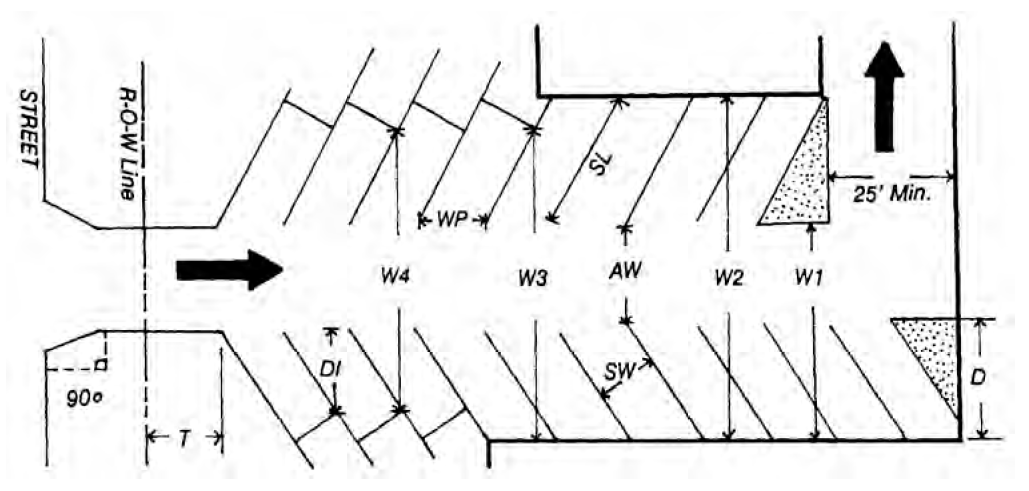
Parking lot design standards. Horizontal widths for parking rows, aisles, and modules shall be provided at widths no less than listed in Table 114-161(f)(11) shown below.
Table 114-161(f)(11)—Parking Layout Dimensions
1 Parking spaces located behind an enclosed garage and located directly off a through aisle shall be at least 30 feet deep.
2 This dimension represents AW for one-way traffic. For two-way traffic, add 8.0 feet to a maximum (AW) of 26.0 feet.
Typical Parking Layout Dimensions
(12)
Locational prohibitions for off-street parking areas.
a.
Off-street parking shall not be located between the principal structure on a residential lot and a street right-of-way, except within residential driveways and parking lots designated on the approved site plan.
b.
No private parking shall occur on street terraces, driveways, or any other areas located within a public right-of-way not explicitly designated by the director of public works.
(g)
Calculation of minimum required parking spaces.
(1)
General guidelines for calculating required parking spaces. The requirements of subsection (g)(3) of this section, shall be used to determine the minimum required number of off-site parking spaces which must be provided on the subject property.
(2)
Joint and off-site parking facilities.
a.
Parking facilities which have been approved by the director of public works to provide required parking for one or more uses, shall provide a total number of parking spaces which shall not be less than the sum total of the separate parking needs for each use during any peak hour parking period when said joint parking facility is utilized at the same time by said uses.
b.
Each parking space designed to serve as joint parking shall not be located farther than 300 feet, except as permitted by a conditional use permit, from the access to all of the various areas it is designated to serve.
c.
The applicant for approval of a joint parking facility shall demonstrate to the director of public works' satisfaction that there is no substantial conflict in the demand for parking during the principal operating hours of the two of more uses for which the joint parking facility is proposed to serve.
d.
A legally binding instrument, approved by the city administrator, shall be executed by any and all parties to be served by said joint parking facility. This instrument shall be recorded with the register of deeds office, and filed with the city clerk. A fee shall be required to file this instrument.
(3)
Minimum off-street parking requirements for land uses.
Table 114-161(g)(3)
(4)
Provision of fee-in-lieu of parking spaces development. Within the central business (CB) district, the parking requirements of this chapter may be waived or modified by the plan commission, which may impose a fee-in-lieu of parking spaces.
Sec. 114-162. - Off-street loading standards.
(a)
Purpose. The purpose of this section is to prevent congestion of public rights-of-way and private lots so as to promote the safety and general welfare of the public by establishing minimum requirements for the provision of loading facilities on various sites. Any use which has a gross floor area of 5,000 square feet or more, and which requires deliveries or makes shipments, shall provide off-street loading facilities in accordance with the regulations of this section.
(b)
Reserved.
(c)
Location. All loading berths shall be located 25 feet or more from the intersection of two street right-of-way lines. Loading berths shall not be located within any required front yard or street yard setback area. All loading areas shall be located on the private lot and shall not be located within, or so as to interfere with, any public right-of-way.
(d)
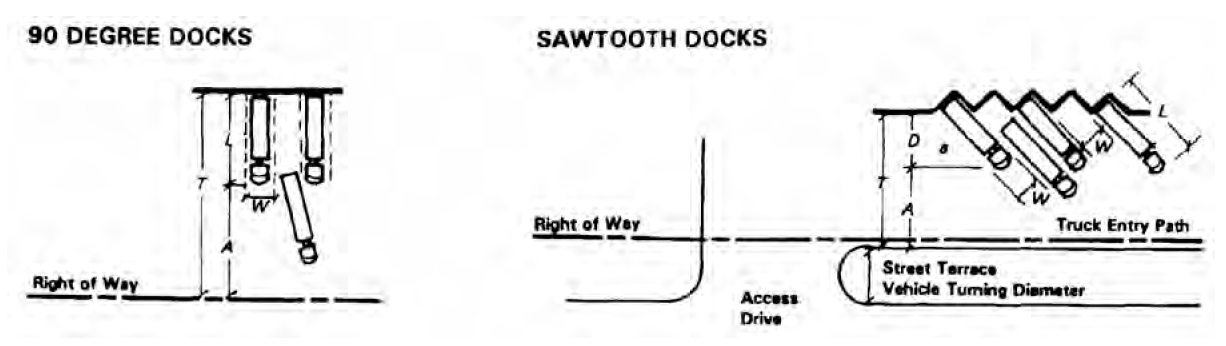
Size of loading area. The first required loading berth shall be designed in accordance with Table 114-162. All remaining required loading berths shall be a minimum of 25 feet in length. All required loading berths shall have a minimum vertical clearance of 14 feet. The following standards shall be the minimum used to design loading areas:
Table 114-162(d)—Loading Standards
(e)
Access to loading area. Each loading berth shall be located so as to facilitate access to a public street or alley, and shall not interfere with other vehicular or pedestrian traffic or the function of parking areas. In no instance shall loading areas rely on backing movements into public rights-of-way.
(f)
Surfacing and marking. All required loading areas shall be paved and maintained in a dust-free condition at all times. Said surface shall be marked in a manner which clearly indicates required loading areas.
(g)
Use of required loading areas. The use of all required loading areas shall be limited to the loading and unloading of vehicles. Said area shall not be used to provide minimum required parking spaces.
(h)
Lighting. All loading areas shall be lit so as to not exceed the standards of section 114-166.
(i)
Depiction on required site plan. Loading areas proposed to be located on the subject property shall be depicted as to their location and configuration on the site plan required for the development of the subject property.
(j)
Calculation of required loading spaces.
(1)
Indoor institutional land uses. One loading berth shall be required for each building having a gross floor area of 5,000 square feet to 29,999 square feet. For such uses located in buildings having a gross floor area of 30,000 square feet or greater, two loading berths shall be required.
(2)
Commercial, except offices, storage/disposal, transportation, and industrial land uses. One loading berth shall be required for each building having a gross floor area of 5,000 square feet to 29,999 square feet. For such uses located in buildings having a gross floor area of 30,000 square feet or greater, an additional loading berth shall be required for any portion of each 50,000 square feet of gross floor area in addition to the original 29,999 square feet.
(3)
Office land uses. One loading berth shall be required for each building having a gross floor area of 6,000 square feet to 99,999 square feet. For such uses located in buildings having a gross floor area of 100,000 square feet or greater, an additional loading berth shall be required for any portion of each 100,000 square feet of gross floor area in addition to the original 99,999 square feet.
(Ord. No. 2017-1092, § 1, 4-11-2017)
Sec. 114-163. - Exterior storage standards.
(a)
Purpose. The purpose of this section is to control the use of residential, office and commercial property for exterior storage so as to promote the safety and general welfare of the public.
(b)
Exterior storage of RVs, ATVs, boats, snowmobiles, and trailers in residential zoning districts. No person shall park or store recreational vehicles, ATV's, boats, snowmobiles, or trailers on a lot in a residential district, except within a fully enclosed structure or except as provided herein.
(1)
Definitions. The following words, terms and phrases, when used in this section, shall have the meanings ascribed to them in this subsection, except where the context clearly indicates a different meaning:
All-terrain vehicle (ATV). The definition of an ATV provided in Wis. Stats. § 340.01(2g) is adopted by reference. For the purposes of this section, a utility terrain vehicle (UTV) shall be considered an ATV.
Boat means motor boats (whether or not a motor is actually on the boat), house boats, row boats, canoes and kayaks.
Recreational vehicle (RV) means motor homes, motor coaches, pickup campers when not positioned on top of a pickup, camping trailers, travel trailers, tent campers, folding campers, carnival equipment and their trailers, and cases or boxes used to transport recreational vehicles or their equipment, and similar equipment and vehicles.
Trailer means fifth-wheel trailers, utility trailers, boat trailers, snowmobile trailers, race car trailers, and ATV trailers.
Unoccupied area of the rear yard means the gross square footage of the rear yard, less any square footage occupied by accessory structures.
(2)
Number. The following sets forth the maximum number of RVs, ATVs, boats, snowmobiles and trailers that can be stored or placed outside on a single residential lot: the greater of two, or the number that can be stored in a single contiguous area equivalent to 20 percent of the unoccupied area of the rear yard.
(3)
Location. No RV, ATV, boat, snowmobile or trailer shall be parked or stored in a front or street yard except a maximum of one on a hard-surfaced approved driveway.
(4)
Setback. No RV, ATV, boat, snowmobile or trailer shall be parked or stored closer than ten feet to a side or rear lot line.
(5)
Maintenance. Each RV, ATV, boat, snowmobile and trailer parked or stored in the city shall be maintained in working condition, reasonably ready for the effective performance of the function for which it was intended. RVs and trailers shall be roadworthy. Items which need repair before they are operable may not be stored in any yard.
(6)
Licenses. Items that require a license shall be properly licensed.
(7)
Hidden and neat. Each RV, ATV, boat, snowmobile or trailer shall be parked or stored as inconspicuously as possible on the property. The area around the RV, ATV, boat, snowmobile or trailer must be kept weed free and free of accumulation of other storage material and debris.
(c)
Exterior storage in commercial districts. In all commercial zoning districts, all materials and equipment shall be stored within a completely enclosed building except for the following which shall not be located within any front yard or required street yard and shall be stored a minimum of five feet from any and all property lines: screened refuse containers; construction materials, landscape materials and related equipment connected within on-site construction.
(d)
Exterior parking/storage of automobiles and trucks in residential zoning districts. No person shall park or store an automobile or truck in a residential zoning district:
(1)
Except within a fully enclosed structure; or
(2)
Except as provided below:
a.
Number. Automobiles and/or trucks may be parked or stored on a residential lot, so long as they fit fully on a hard-surfaced approved driveway, or within the side or rear yard area available for the storage of RVs, ATVs, boats, snowmobiles or trailers in subsection (b)(2) above.
b.
Location. Each automobile or truck shall be parked or stored on an approved, hard-surfaced driveway, so that each vehicle does not extend over the city right-of-way or public sidewalk.
c.
Setback. No automobile or truck shall be located closer than three feet to a side or rear lot line.
d.
Ownership. No automobile or truck shall be stored outside unless it is owned by the property owner who shall be a resident of the property in question, and unless it was last titled in the name of the property owner. If the property is rented, such storage shall be permitted to the tenant provided that the automobile or truck is owned by the tenant and was last titled in the name of the tenant.
e.
Hidden and neat. The area around the automobile or truck shall be kept weed free and free of accumulation of other storage material and debris.
(e)
Outdoor storage of firewood.
(1)
Front yard prohibited. No person shall store firewood in the front yard on residentially zoned property, except that firewood may be temporarily stored in the front yard for a period of 14 days from the date of its delivery.
(2)
Stacking. Firewood should be neatly stacked and may not be stacked closer than two feet to any lot line and not higher than six feet from grade, except adjacent to a fence where firewood can be stacked against the fence as high as the fence.
(3)
Debris removal. All brush, debris and refuse from processing of firewood shall be promptly and properly disposed of and shall not be allowed to remain on the premises.
(4)
Diseased wood. Woodpiles that contain diseased wood that is capable of transmitting disease to healthy trees and woodpiles that harbor or are infested or inhabited by rats or other vermin are public nuisances.
(5)
Volume limitation. Not more than either three cords of wood may be stored at any one time, and not more than 20 percent of the side and rear yard may be used for storage of firewood at any one time.
(Ord. No. 2017-1092, § 1, 4-11-2017; Ord. No. 2021-2040, 6-8-2021)
Sec. 114-164. - Exterior lighting standards.
(a)
Purpose. The purpose of this section is to regulate the spill-over of light and glare on operators of motor vehicles, pedestrians, and land uses in the vicinity of a light source in order to promote traffic safety and to prevent the creation of nuisances.
(b)
Applicability. The requirements of this section apply to all exterior lighting in the city, except for lighting installed by the city within the rights-of-way of city streets and one- and two-unit residential.
(c)
Depiction on required site plan. Any and all exterior lighting shall be depicted as to its location, orientation and configuration on the site plan required for the development of the subject property.
(d)
Requirements.
(1)
Orientation of fixture. In no instance shall an exterior lighting fixture be oriented so that the lighting element or a transparent shield is visible from a property located within a residential zoning district. The use of shielded luminaries and careful fixture placement is encouraged so as to facilitate compliance with this requirement.
(2)
Intensity of illumination. In no instance shall the amount of illumination attributable to exterior lighting, as measured at the property line, exceed 0.50 footcandles above ambient lighting conditions on a cloudless night.
(3)
Location. Light fixtures shall not be located within required bufferyards.
(4)
Flashing, flickering and other distracting lighting. Flashing, flickering and/or other lighting which may distract motorists is prohibited.
(5)
Minimum lighting standards. All areas designated on required site plans for vehicular parking, loading, or circulation and used for any such purpose after sunset shall provide artificial illumination in such areas at a minimum intensity of 0.4 footcandles.
(6)
Nonconforming lighting. All lighting fixtures existing prior to the effective date of the ordinance from which this chapter is derived shall be considered as nonconforming uses.
(7)
Special events lighting. Any temporary use using exterior lighting which is not in complete compliance with the requirements of this section shall secure a temporary use permit.
(Ord. No. 2017-1092, § 1, 4-11-2017)
Sec. 114-165. - Vibration standards.
(a)
In general. No use or structure shall be operated or occupied as to vibrate in such an amount or to such a degree or intensity as to constitute a hazardous condition or as to unreasonably interfere with the use and enjoyment or property by any person of normal sensitivities or otherwise as to create a public nuisance.
(b)
Specific standards. Uses creating vibration shall comply with the performance standards identified in Table 114-165(b)(1), Maximum Permitted Vibration, and shall be conducted in such a manner as to make such vibration completely imperceptible from any point from along a non-industrial zoning district boundary line. Vibration shall be measured at any point along a property line with a three-point component measuring system recognized as a standard for such purpose and shall be expressed as displacement in inches.
Table 114-165(b)—Maximum Permitted Vibration
(Ord. No. 2017-1092, § 1, 4-11-2017)
Sec. 114-166. - Noise standards.
(a)
Noise. At no point on the district boundary nor beyond property lines of individual lots within nonresidential districts shall the sound level of any individual operation or level exceed the limits shown in the following table:
Table 114-166(a)—Noise Standards
(b)
Frequencies and sound levels shall be measured with an octave ban analyzer and sound level meter which comply with the U.S.A. Standards prescribed by the United States of America Standards Institute.
(c)
All noise shall be so muffled or otherwise controlled as not to become objectionable due to intermittence, duration, heat frequency, impulse character, periodic character or shrillness.
(Ord. No. 2017-1092, § 1, 4-11-2017)
Sec. 114-167. - Air pollution standards.
(a)
Purpose. The purpose of this section is to regulate the creation of air pollution which adversely affects adjoining properties in order to prevent the creation of nuisances and to promote the general welfare of the public. The requirements of this section apply to all land uses and activities, except that these standards shall not apply to air pollution created during the construction of the principal use on the subject property, or by incidental traffic, parking, loading, or maintenance operations.
(b)
Standards.
(1)
The emission, from all sources within any lot, of particulate matter containing a particle diameter larger than 44 microns is prohibited.
(2)
Emission of smoke or particulate matter of density equal to, or greater than Number 2 on the Ringelmann chart (U.S. Bureau of Mines) is prohibited at all times.
(3)
Dust and other types of air pollution borne by the wind from such sources as storage areas, yards, and roads within the boundaries of any lot shall be kept to a minimum by appropriate landscaping, paving, oiling or other acceptable means.
(4)
All applicable state and federal standards.
(Ord. No. 2017-1092, § 1, 4-11-2017)
Sec. 114-168. - Odor standards.
(a)
Purpose. The purpose of this section is to regulate the creation of odor which adversely effects adjoining properties in order to prevent the creation of nuisances and to promote the general welfare of the public. The requirements of this section apply to all land uses and activities, except that these standards shall not apply to odors created during the construction of the principal use on the subject property, or by incidental traffic, parking, loading, or maintenance operations. Public landfills and public sanitary sewage treatment plants shall be exempted from the requirements of this section as essential public services.
(b)
Standards. Except for food preparation and cooking odors emanating from residential land uses, and odors associated with property development and maintenance no odor shall be created for periods exceeding a total of 15 minutes per any day, which are detectable by the zoning administrator or a designee who is unaffected by background odors such as tobacco or food, at the boundary of the subject property, where said lot abuts property within any residential, office, commercial zoning district, or the general industrial (GI) district.
(Ord. No. 2017-1092, § 1, 4-11-2017)
Sec. 114-169. - Electromagnetic radiation standards.
(a)
Purpose. The purpose of this section is to regulate the creation of electromagnetic radiation which adversely effects adjoining properties in order to prevent the creation of nuisances and to promote the general welfare of the public. The requirements of this section apply to all land uses and activities.
(b)
Standards. It shall be unlawful to operate or cause to be operated any planned or intentional source of electromagnetic radiation for such purposes as communication, experimentation, entertainment, broadcasting, heating, navigation, therapy, vehicle velocity measurement, weather survey, aircraft detection, topographical survey, personal pleasure, or any other use directly or indirectly associated with these purposes which does not comply with the then current regulations of the Federal Communications Commission regarding such sources of electromagnetic radiation. Further, said operation in compliance with the Federal Communications Commission shall be unlawful if such radiation causes an abnormal degradation in performance of other electromagnetic radiators or electromagnetic receptors of quality and proper design because of proximity, primary field, blanketing, spurious radiation, harmonic content, modulation or energy conducted by power or telephone lines. The determination of the terms "abnormal degradation in performance" and "of quality and proper design" shall be made in accordance with good engineering practices as defined in the latest principles and standards of the American Institute of Electrical Engineers, the Institute of Radio Engineers, and the Electronic Industries Association. In case of any conflict between the latest standards and principles of the above groups, the following precedence in the interpretation of the standards and principles shall apply:
(1)
American Institute of Electrical Engineers;
(2)
Institute of Radio Engineers; and
(3)
Electronic Industries Association.
(Ord. No. 2017-1092, § 1, 4-11-2017)
Sec. 114-170. - Glare and heat standards.
(a)
Purpose. The purpose of this section is to regulate the creation of glare or heat which adversely effects adjoining properties in order to prevent the creation of nuisances and to promote the general welfare of the public. The requirements of this section apply to all land uses and activities, except that these standards shall not apply to glare or heat created during the construction of the principal use on the subject property, or by incidental traffic, parking, loading, or maintenance operations.
(b)
Standards. No direct or sky-reflected glare, whether from floodlights or from temperature processes such as combustion or welding or otherwise, so as to be visible at the lot line of the subject property shall be permitted. Furthermore, there shall be no transmission of heat or heated air so as to be discernible by the zoning administrator or a designee, at the lot line. Solar systems regulated by Wis. Stats. § 66.0401 shall be entitled to the protection of its provisions.
(Ord. No. 2017-1092, § 1, 4-11-2017)
Sec. 114-171. - Fire and explosion standards.
(a)
Purpose. The purpose of this section is to regulate the creation of fire and/or explosion hazards which adversely affect adjoining properties in order to prevent the creation of nuisances and to promote the general welfare of the public. The requirements of this section apply to all land uses and activities.
(b)
Standards. Any use involving materials which could decompose by detonation shall locate such materials not less than 400 feet from any residential or office zoning district, except that this standard shall not apply to the storage or usage of liquefied petroleum or natural gas for normal residential or business purposes. All activities and storage of flammable and explosive materials at any point shall be provided with adequate safety and firefighting devices in accordance with all state fire prevention codes.
(Ord. No. 2017-1092, § 1, 4-11-2017)
Sec. 114-172. - Toxic or noxious material standards.
(a)
Purpose. The purpose of this section is to regulate the handling of toxic or noxious material which adversely effects adjoining properties in order to prevent the creation of nuisances and to promote the general welfare of the public. The requirements of this section apply to all land uses and activities.
(b)
Standards.
(1)
No use shall discharge across the boundaries of the subject property, or through percolation into the subsoil, toxic or noxious material in such concentration as to be detrimental to, or endanger, the public health, safety, comfort, or welfare, or cause injury or damage to the property or business.
(2)
No use shall discharge at any point into any public or private sewage disposal system or stream, or into the ground, any liquid or solid materials except in accordance with the regulations of the state department of natural resources.
(Ord. No. 2017-1092, § 1, 4-11-2017)
Sec. 114-173. - Waste material standards.
(a)
Purpose. The purpose of this section is to regulate the handling of waste material which adversely effects adjoining properties in order to prevent the creation of nuisances and to promote the general welfare of the public. The requirements of this section apply to all land uses and activities.
(b)
Standards.
(1)
No use shall discharge across the boundaries of the subject property, or through percolation into the subsoil, toxic or noxious waste material in such concentration as to be detrimental to, or endanger, the public health, safety, comfort, or welfare, or cause injury or damage to the property or business.
(2)
No use shall discharge at any point into any public or private sewage disposal system or stream, or into the ground, any liquid or solid materials except in accordance with the regulations of the state department of natural resources.
(Ord. No. 2017-1092, § 1, 4-11-2017)
Sec. 114-174. - Exterior construction material standards.
(a)
Purpose. The purpose of this section is to regulate the use of certain exterior construction materials so as to attain a degree of uniformity in exterior appearance, and thus maintain and enhance the attractiveness and the property value of certain zoning districts. The requirements of this section apply to all land uses and activities, except for permitted land uses within the AG district, and except as otherwise provided in this section.
(b)
Standards for all residential, office, commercial, and Industrial zoning districts. Except for exposed foundations not to exceed three feet in height from the adjacent grade, all non-single-family development located within the residential districts, non-residential districts, and industrial districts shall employ only high-quality, decorative exterior construction materials on the visible exterior of the following portions of all structures and buildings:
(1)
Any portion of the building or structure visible from adjacent residentially zoned property;
(2)
Any portion of the building or structure located within 50 feet of a public right-of-way; or
(3)
Any other portion of the building or structure visible from a public street.
The following exterior construction material shall not be considered high quality, decorative: non-decorative block or cinder block, non-decorative concrete foundation walls or panels, corrugated or other metal with exposed fasteners, except in industrial zoned districts, non-decorative plywood, asphaltic siding, or other materials using exposed fastener systems or other non-decorative surfaces as determined by the plan commission.
(c)
Trademark architecture. Trademark architecture shall not be permitted.
(d)
Matching buildings. With the exception of farm buildings located in the agriculture (AG) district, and with the exception of accessory buildings located in the rear yard of single-family residential districts, accessory buildings shall be constructed and finished in a complimentary architectural style and with complimentary materials to the principal structure so that the exterior (e.g., walls, roofs, windows and doors) of all buildings on a single lot shall be of similar architecture, material, color, quality and texture.
(e)
Exceptions. The conditional use process may be used to propose the use of a material otherwise prohibited by subsection (c) or (e) of this section.
(Ord. No. 2017-1092, § 1, 4-11-2017)
Sec. 114-175. - Roof and eave standards.
(a)
Roofs. The roof on all principal residential buildings shall have a minimum roof pitch of 5:12, except the roofs over the following parts of residential structures may have a lesser pitch: porches, decks, dormers, and breezeways.
(b)
Eaves. All residential structures shall have a minimum eave width of 16 inches, not including the width of any gutter or other apparatus affixed to the eave or roof edge.
(c)
Exceptions. The rules of subsection (a) or (b) of this section shall not apply to buildings located in mobile home parks. In all other zoning districts, the rules of subsections (a) and/or (b) of this section may be modified by the plan commission through the granting of a conditional use.
(Ord. No. 2017-1092, § 1, 4-11-2017)
Sec. 114-176. - Hazardous materials standards.
(a)
Purpose. The purpose of this section is to provide information to the city regarding the nature of land uses which involve research, production, storage, disposal, handling, and/or shipment of hazardous materials.
(b)
Applicability. The requirements of this section apply to all land uses and activities involving any one or more of the following:
(1)
Micro-organism cultures subject to Wis. Stats. § 94.65;
(2)
Pesticides subject to Wis. Stats. § 94.67(25);
(3)
Biological products subject to Wis. Stats. § 95.39;
(4)
Hazardous substances subject to Wis. Stats. § 100.37(1)(c);
(5)
Toxic substances subject to Wis. Stats. § 101.58(2)(j);
(6)
Infectious agents subject to Wis. Stats. § 101.58(2)(f);
(7)
Any material for which the state requires notification of a local fire department; or
(8)
Any other uses, activities, or materials which are subject to county, state, or federal hazardous, or related materials regulations.
(c)
Standards. All land uses involving such hazardous materials shall submit a written description of such materials and the operations involving such materials conducted on their property as part of the required site plan submittal.
(Ord. No. 2017-1092, § 1, 4-11-2017)
Sec. 114-177. - Fencing standards.
(a)
Purpose. The purpose of this section is to regulate the materials, location, height, and maintenance of fencing, landscaping walls and decorative posts in order to prevent the creation of nuisances and to promote the general welfare of the public. The requirements of this section apply to all fencing, landscape walls and decorative posts equal to, or exceeding, 30 inches in height, for all land uses and activities.
(b)
Standards.
(1)
Materials.
a.
Residential districts. Acceptable materials for constructing fencing, landscape walls, and decorative posts include wood, stone, brick, wrought iron, chain link, wire mesh, polyethylene and similar materials approved by the zoning administrator, except that wire mesh and chain link fencing is not permitted within required front yard or street yard areas. Barbed wire fencing shall not be permitted. Any fence within a street yard, including along property lines which intersect a right-of-way, shall not exceed a maximum of 60 percent opaque.
b.
Nonresidential districts. Acceptable materials for constructing fencing, landscape walls, and decorative posts include wood, stone, brick, wrought iron, chain link, wire mesh, polyethylene and similar materials approved by the zoning administrator, except that wire mesh and chain link fencing is not permitted within required front yard or street yard areas. Barbed wire fencing shall not be permitted, except that security fences may include up to four strands of barbed wire on top of fences provided that:
1.
The lowest strand of barbed wire is at least eight feet above grade;
2.
The entire structure, including any outward projecting barbed wire supports, shall stay within the property lines; and
3.
The total height of the barbed wire portion of the fence shall not exceed two feet. Any fence within a street yard, including along property lines which intersect a right-of-way, shall be maximum of 60 percent opaque.
c.
Temporary fencing. Temporary fencing, including the use of wood or plastic snow fences for the purposes of limiting snow drifting between November 1 and April 1, protection of excavation and construction sites, and the protection of plants during grading and construction is permitted for up to 180 consecutive days and no more than 180 consecutive days per calendar year. Snow fences constructed of wood and wire, and/or plastic shall be permitted only as temporary fences.
(2)
Location. On all properties, no fence, landscape wall, or decorative post shall be located closer than two feet to the front yard or street yard property line. Fences may be located on any property line abutting a side or rear yard.
(3)
Maximum height. The maximum height of any fence, landscape wall, or decorative post shall be the following:
a.
Three feet within a front yard setback;
b.
Six feet when located on any residentially zoned property, but not within a required front yard setback or a required street yard setback; and
c.
Eight feet when located on any nonresidential zoned property, but not within a required front yard or a required street yard, except that security fences may exceed this height.
(4)
Orientation. Any and all fences, landscape walls, or decorative posts shall be erected so as to locate visible supports and other structural components toward the subject property.
(5)
Maintenance. Any and all fences, landscape walls, or decorative posts shall be maintained in a structurally sound and attractive manner.
(6)
Swimming pools. Fencing for swimming pools shall be provided per the model swimming pool enclosure code established by the National Spa and Pool Institute (NSPI).
(Ord. No. 2017-1092, § 1, 4-11-2017)
Sec. 114-178. - Signal receiving antennas (satellite dishes) standards.
(a)
Purpose. This section, regulating the placement of all signal receiving antennas, is adopted to:
(1)
Secure placement of such antennas in an aesthetically sensitive manner while allowing users reasonable reception of signals;
(2)
Protect the public from injury from antennas that are inadequately mounted, unduly susceptible to wind pressure, improperly installed and wired, or are placed on structures insufficiently designed or constructed to safely support the antenna; and
(3)
Provide for placement of such antennas in locations that preserve access to rear property areas by firefighting apparatus and emergency personnel.
(b)
Permit required. No owner shall, within the city, build, construct, use or place a signal receiving antenna, or satellite dish with diameter greater than 36 inches, until a permit shall have first been obtained from the zoning administrator.
(c)
Definitions. The following words, terms and phrases, when used in this section, shall have the meanings ascribed to them in this subsection, except where the context clearly indicates a different meaning:
Owner means the holder of fee title, or of a life estate, in real property, or a vendee of record under a land contract, but not including the vendor under a land contract. A tenant in common or joint tenant shall be considered such owner to the extent of his interest. The personal representative of at least one owner shall be considered an owner.
Signal receiving antenna means any apparatus capable of receiving communications from a transmitter on earth or a transmitter relay located in a planetary orbit, including the tower and associated structure and apparatus employed to secure, hold, elevate or mount the antenna. This definition includes all types of signal receiving antennas, including, without limitation, parabolic antennas, home earth stations, satellite television disks, UHF and VHF television antennas, and AM, FM, ham and short-wave radio antennas, regardless of the method of mounting.
(d)
Application. Application for a signal receiving antenna permit shall be made in writing to the zoning administrator. With such application, there shall be submitted a fee and a sufficient set of mounting plans and specifications, including a general plan showing the location of the proposed signal receiving antenna with respect to streets, lot lines and buildings. If such application meets all requirements of this section, the application shall be approved.
(e)
Installation standards. Signal receiving antennas installed in any zoning district within the city shall comply with the following provisions:
(1)
Site location.
a.
Any signal receiving antenna and its mounting post shall be located a minimum of ten feet from any property line.
b.
Subject to the provisions herein, signal receiving antennas shall be located in the rear or side yard of the lot, as close to the principal structure as is reasonably possible. In the event that reasonable reception of signals is not possible by locating the signal receiving antenna on the rear or side yard of the property, such antenna shall be placed in as hidden a place as possible, as viewed from the standpoint of a non-owner, to be determined by the zoning administrator. For corner lots, a side yard is only a yard that does not face a street.
c.
If front yard or roof mounting is requested, the zoning administrator shall inspect the property before installation to determine the appropriate location. In making such determination, the zoning administrator shall consider the locations on the property where reasonable reception is possible, based on evidence provided by the person seeking to erect or construct the antenna.
(2)
Mounting. Signal receiving antennas attached to the wall or roof of any principal or accessory structure shall be permitted only if the structure is properly constructed to carry all imposed loading and complies with applicable state and local building code requirements. The zoning administrator may require engineering calculations.
(3)
Diameter. The diameter of an antenna shall not exceed 36 inches in diameter, provided that larger antennas may be allowed by conditional use.
(4)
Height.
a.
Ground-mounted. A ground-mounted signal receiving antenna, including any platform or structure upon which said antenna is mounted or affixed, may not exceed:
1.
Eighteen feet in height; or
2.
Five feet above the highest point of the principal structure, whichever is higher, as measured from the ground to the highest point of the antenna.
b.
Roof-mounted. A roof-mounted antenna may not exceed five feet in height above the surrounding roofline as measured from the highest point of the existing roofline.
(5)
Wind pressure. All signal receiving antennas shall be permanently mounted in accordance with the manufacturer's specifications for installation. All such installations shall meet a minimum wind load design velocity of 80 miles per hour.
(6)
Electrical installations. Electrical installations in connection with signal receiving antennas, including grounding of the system, shall be in accordance with the National Electrical Safety Code, state electrical code and the instructions of the manufacturer. In cases of conflict, the stricter requirements shall govern. All cable used to conduct current or signals from the signal receiving antenna to the receivers shall be installed underground unless installation site conditions preclude underground. The location of all such underground lines, cables and conduits shall be shown on the application for a permit. All signal receiving antennas shall be grounded against direct lightning strikes.
(7)
Temporary placement. No portable or trailer-mounted signal receiving antenna shall be allowed, except for temporary installation for on-site testing and demonstration purposes for periods not exceeding five days. Any person making such temporary placement shall first give written notice to the zoning administrator of the date when such placement shall begin and end.
(8)
Advertising. No form of advertising, picture, or identification, sign or mural is allowed on the signal receiving antenna other than the customary manufacturer's identification plates.
(9)
Interference with broadcasting. Signal receiving antennas shall be filtered and/or shielded so as to prevent the emission or reflection of an electromagnetic radiation that would cause any harmful interference with the radio and/or television broadcasting or reception on adjacent properties. In the event that harmful interference is caused subsequent to its installation, the owner of the signal receiving antenna shall promptly take steps to eliminate the harmful interference in accordance with Federal Communications Commission regulations.
(10)
Compliance with federal regulations. The installation and use of every signal receiving antenna shall be in conformity with the federal Cable Communications Policy Act of 1984 and regulations adopted thereunder. To the extent that any of the provisions herein conflict with such regulations, then these provisions shall not apply but only to the extent needed to conform with such state or federal regulations.
(Ord. No. 2017-1092, § 1, 4-11-2017)
State Law reference— Satellite antennas, Wis. Stats. § 62.23(7)(he).
Sec. 114-179. - Wind energy conversion systems (WECS) standards.
(a)
Construction of wind energy conversion systems. No person shall construct or operate a wind energy conversion system (WECS) without having fully complied with the provisions of this section.
(b)
Permits required.
(1)
A WECS permit shall be obtained from the city zoning administrator for the construction of all WECS.
(c)
Application requirements. An application for a permit to build a wind energy system shall include the following:
(1)
The property lines of the proposed site of construction.
(2)
Proposed location of the WECS.
(3)
Location and description of all structures located on the property where the WECS site is proposed.
(4)
Location of all above-ground utility lines within a radius equal to two times the height of the proposed WECS.
(5)
Location of all underground utility lines on the property where a WECS site is proposed.
(6)
Dimensional representation of the structural components of the tower construction including the base and footings.
(7)
Schematic of electrical systems associated with the WECS including all existing and proposed electrical connections.
(8)
Manufacturer's specifications and installation and operation instructions or specific WECS design information.
(9)
Certification by a registered professional engineer that the tower design is sufficient to withstand wind load requirements for structure as defined by the Uniform Building Code.
(d)
Blade clearance. The minimum distance between the ground and any protruding blade utilized on a WECS shall be 15 feet, as measured at the lowest point of the arc of the blades. The minimum distance shall be increased as necessary to provide for vehicle clearance in locations where over-sized vehicles might travel.
(e)
Climbing towers, tower access. Access to towers shall be controlled by fences six feet in height around the tower and anti-climbing devices. A sign indicating shock hazard shall be placed on the tower. Cables, ropes or wires used to secure the WECS shall be appropriately marked to prevent accidental bodily harm.
(f)
Tower construction. Tower construction shall be in accordance with all applicable sections of the state building code.
(g)
Utility interconnection. The WECS, if interconnected to a utility system, shall meet the requirements for interconnection and operate as set forth in the electrical utility's then-current service regulations applicable to WECS; these standards are subject to review by the public service commission.
(h)
Setback requirements.
(1)
No WECS shall be constructed in any setback, dedicated easement, or dedicated roadway.
(2)
Installation of any WECS may not be nearer to any property lines or right-of-way for overhead electrical transmission or distribution lines than three times the height of the WECS structure.
(i)
Noise. During all operations, from commencement through abandonment, all noise and vibrations shall conform with the requirements of sections 114-165 and 114-166.
(j)
Interference with navigational systems. No WECS shall be installed or operated in such a manner that is not in compliance with Federal Aviation Administration regulations.
(k)
Electrical distribution lines. All WECS electrical distribution lines shall be located underground.
(l)
Required safety features.
(1)
All WECS shall be designed with an automatic overspeed control to render the system inoperable when winds are blowing in excess of the speeds for which the machine is designed.
(2)
All WECS shall have a manually operable method to render the system inoperable in the event of a structural or mechanical failure of any part of the system, including the automatic overspeed control.
(3)
All WECS shall be designed with an automatic control to render the system inoperable in case of loss of utility power to prevent the WECS from supplying power to a de-energized electrical distribution system.
(4)
Any WECS thereof declared to be unsafe by the zoning administrator by reason of inadequate maintenance, dilapidation, obsolescence, fire hazard, disaster, damage or abandonment is hereby declared to be a public nuisance and shall be abated by repair, rehabilitation, demolition, or removal in accordance with the procedures set forth in this Code.
(m)
Maintenance. The zoning administrator or his representative shall have the right, at any reasonable time, to enter, in the company of the owner or his agent, the premises on which a WECS has been constructed to inspect all parts of said WECS installation and require that repairs or alterations be made within 30 days if, in his judgment, there exists a deficiency in the structural stability of the system.
(n)
Inspections. A yearly inspection, at a fee to be determined from time to time by the city, shall be made by the zoning administrator to certify the safety and maintenance of the WECS and accessory structures.
(Ord. No. 2017-1092, § 1, 4-11-2017)
Sec. 114-180. - Swimming pool standards.
(a)
Definition. The following words, terms and phrases, when used in this section, shall have the meanings ascribed to them in this subsection, except where the context clearly indicates a different meaning:
Swimming pool means a body of water or an outdoor structure containing a body of water in a receptacle or other container having a depth for water at any point greater than one and one-half feet, located above or below the surface of ground elevation, installed in such a manner that the pool will remain in place as a fixture throughout the full year and will be considered as a permanent or semi-permanent structure on the land, designed or intended for swimming. The term "swimming pool" includes all structural facilities, appliances and appurtenances, equipment and other items used and intended to be used for the operation and maintenance of a private or residential swimming pool.
(b)
Exempt pools. Storable children's swimming or wading pools, with a maximum diameter of 15 feet and a maximum wall height of 18 inches and which are so constructed that it may be readily disassembled for storage and reassembled to its original integrity, are exempt from the provisions of this section.
(c)
Permit required. Pools are a type of land use covered by article IV of this chapter which are allowed as permitted uses or conditional uses under the different standard zoning districts of article II, pursuant to the procedures of article VIII of this chapter.
(d)
[Construction requirements.] A permit for a swimming pool shall not be issued unless the following construction requirements are observed:
(1)
Approved materials. All materials and methods of construction in the construction, alteration, addition, remodeling or other improvements and pool installation shall be in accord with all state regulations and codes and with any and all ordinances of the city now in effect or hereafter enacted.
(2)
Plumbing. All plumbing work shall be in accordance with all applicable ordinances of the city and all state codes. Every private or residential swimming pool shall be provided with a suitable draining method, and in no case shall waters from any pool be drained into the sanitary sewer system, onto lands of other property owners adjacent to that on which the pool is located or in the general vicinity.
(3)
Electrical installations. All electrical installations, including lighting and heating but not limited thereto, which are provided for, installed and used in conjunction with a private swimming pool shall be in conformance with the state laws and city ordinances regulating electrical installations.
(e)
Setbacks and other requirements.
(1)
Private swimming pools shall be erected or constructed on rear or side lots only and only on a lot occupied by a principal building. No swimming pool shall be erected or constructed on an otherwise vacant lot. A lot shall not be considered vacant if the owner owns the contiguous lot and said lot is occupied by a principal building.
(2)
All swimming pools shall be at least ten feet from any lot line or building unless designed and approved as an addition to a building.
(f)
Enclosures.
(1)
Fence; in-ground pools. All outdoor, in-ground swimming pools shall have a fence or other solid structure not less than four feet in height completely enclosing the pool with no opening therein, other than doors or gates, larger than three inches square. All gates or doors opening through the enclosure shall be kept securely closed and locked at all times when not in actual use and shall be equipped with a self-closing and self-latching device designed to keep and be capable of keeping such door or gate securely locked at all times when not in actual use.
(2)
Above-ground pools; pool wall barrier.
a.
An approved barrier shall consist of a solid wall of durable material of which the pool itself is constructed and shall extend directly above the vertical water enclosing wall of the pool. Such walls shall extend more than three feet above the level of the ground immediately adjacent to the pool. Such a solid pool wall barrier shall not be located within six feet of any other wall or fence or other structure which can be readily climbed by children. Every entrance to a pool, such as a ladder, must be secured or adequately safeguarded to prevent unauthorized entry into the pool.
b.
The pool enclosure may be omitted where portable pools are installed above ground and have a raised deck around the entire pool perimeter with an attached enclosed railing a minimum of 36 inches high on the top.
(g)
Compliance. All swimming pools existing at the time of passage of this chapter not satisfactorily fenced shall comply with the fencing requirements of this section or when water is placed in the pool. Enclosures on existing pools shall be inspected by the zoning administrator or designee for compliance. Variations in enclosure requirements that do not adversely affect the safety of the public may be approved.
(h)
Draining and approval thereof. No private swimming pool shall be constructed so as to allow water to drain into any sanitary sewer nor to overflow upon or cause damage to any adjoining property. Provisions may be made for draining the contents of any swimming pool into a storm sewer, but such installation shall be subject to prior approval by the DPW.
(i)
Filter system required. All private swimming pools within the meaning of this chapter must have, in connection therewith, some filtration system to assure proper circulation of the water therein and maintenance of the proper bacterial quality thereof.
(Ord. No. 2017-1092, § 1, 4-11-2017)
Sec. 114-181. - Outdoor storage and screening.
The preferred location for the outdoor storage of products, materials or equipment is within the side or rear building yards. If these functions are provided in the street yard, then additional landscaping is required between the outdoor storage area and the street following the standards of section 114-182. This restriction does not apply to short-term display items or items that are available for purchase by the consumer. All outdoor refuse collection areas shall be visually screened from public streets and adjacent property by a complete opaque screen, fence or wall.
(Ord. No. 2017-1092, § 1, 4-11-2017)
Sec. 114-182. - Landscaping and greenspace.
(a)
All ground, with the exception of walks, drives, parking facilities and service areas, will be landscaped with permanent lawn and ground covers, shrubs and trees, in a manner that is complimentary to the architecture and provides the required screening.
(b)
Where the development adjoins a residential property, at a minimum, a ten-foot landscape buffer is required between any parking area, loading area, refuse collection area, or outside storage area and the residential lot line. The landscape buffer area shall include plantings to meet the point as required by this section, and a berm, solid fence, or wall at least five feet tall. Temporary outdoor storage consisting of semi-trailers does not require a solid fence or wall, but it shall meet the landscape requirements. The placement of semi-trailers and other storage containers shall be transitory in nature and they shall not be used for permanent or long-term storage.
(c)
All required landscaping shall be completed within 12 months of the issuance of an occupancy permit or final inspection, in accordance with the approved landscaping plan.
(d)
Minimum requirements. All developments are required to have a minimum quantity of landscaping based on the size of the parcel, structure, and parking lot according to Table 114-182(d)(3):
(1)
One canopy tree is required for each 100 feet of lot frontage, and should be located along the street frontage of the property, or between the building and the street.
(2)
A combination of landscaping in addition to the required canopy trees to equal ten points for each 1,000 square feet of enclosed ground floor building area. Buildings over 25,000 square feet in area shall be required to accumulate ten points for each 1,000 square feet for the first 25,000 square feet, and five points for each 1,000 square feet of additional building area. The required landscaping should be located between the building and the street, or between the building and any residential properties, unless another location is agreed to by the zoning administrator.
(3)
A combination of landscaping to equal five points per parking space for parking areas that contain up to 50 parking spaces, and two and one-half points per space for additional spaces over 50.
Table 114-182(a)—Landscaping Points and Minimum Installation Sizes
(e)
Additional requirements. Additional landscaping may be required for developments that do not meet the preferred goals for building design, building materials and site layout, or as required as part of a conditional use permit. The extra landscaping shall be calculated based on schedule 1 and the following requirements:
(1)
A combination of landscaping to equal five points for each ten feet of building frontage, for buildings that do not utilize the preferred materials on the street facade, which should be located between the building and the street.
(2)
A combination of landscaping to equal 200 points for each loading dock located on the front of the building, visible from the street, or facing a residential property. The landscaping shall be located between the loading dock and the street, or the loading dock and the residential property.
(3)
A combination of landscaping to equal 20 points for each ten feet of perimeter around an outside storage area, including parking areas for semi-trailers, and refuse enclosures.
(4)
A combination of landscaping to equal two and one-half points per space for parking located within the street yard, or within 20 feet of residential parcels. The required landscaping should be located between the parking area and the street, or between the parking area and the residential parcel.
(f)
The applicant may request points for decorative fences, earth berms, ground covers and existing vegetation. The applicant must demonstrate that these landscape elements will contribute to the overall landscape objectives, and these items must be shown on the landscape plan that is submitted for approval. Shrubs and small evergreen trees shall be counted on a one for one basis. Existing deciduous trees shall be calculated as follows:
Table 114-182(f)
(g)
The landscaping point requirements do not apply to parking spaces that utilize "turf-based" surface materials, such as Geoblock or Grasspave.
(h)
A landscape plan must be submitted which includes details of all proposed landscaping, buffering, and screening. The plans shall show the location and dimensions of all existing and proposed structures, parking, drives, rights-of- way, and any other permanent features, and all other information required by the zoning administrator, plan commission, or the common council, including but not limited to the following.
(1)
A plant list and coverage chart showing the location, quantity, size (at time of planting and at maturity), spacing, and the scientific and common names of all landscape materials used.
(2)
The size of existing trees shall be provided.
(3)
The location and percent of slope of all proposed berms using one foot contours.
(4)
Detailed sections showing elevations of all proposed architectural features, such as walls, lighting or water features.
(Ord. No. 2017-1092, § 1, 4-11-2017)
Sec. 114-183. - Natural resources protection.
Each project shall meet the erosion control and storm water management standards of the city and the state department of natural resources. Maintenance of any storm water detention or conveyance features are solely borne by the developer and/or owner unless dedicated to, and accepted by, the city.
(Ord. No. 2017-1092, § 1, 4-11-2017)
Sec. 114-184. - Sidewalk and bike paths.
(a)
Each project shall include the installation of sidewalks within the public right-of-way along the frontage of the property, which shall be installed by and at the expense of the developer/property owner. The council may waive this requirement if it is determined the sidewalks are not necessary to serve pedestrian traffic, or connecting sidewalks are not present or planned for on the adjacent properties. If sidewalks are not required to be installed as part of the project, the city maintains the right to construct sidewalks at a future date and assess the owner(s) of the adjacent land for the costs thereof.
(b)
Bike paths may be required to be installed on the property as part of a conditional use permit approval. If installation of bike paths is required, the developer shall grant to the city such easements as would be reasonably necessary to allow construction and use of the bike path, and pay for the costs of installation according to specifications required by the city.
(Ord. No. 2017-1092, § 1, 4-11-2017)
Sec. 114-185. - Vacation and maintenance of buildings.
As part of the conditional use permit approval for a large commercial development, the developer may be required to enter into an agreement with the city that would require action to minimize the negative impacts that may come from vacating an existing building located in the city, or vacating the proposed development at a future date. Such agreement may include, but not be limited to the following requirements:
(a)
Marketing the existing or new building. If a developer chooses to vacate an existing building and property located in the city and/or a new building, the developer agrees to cooperate with the city, and other designated economic development agencies in the region in marketing the building, as appropriate, including but not limited to preparing and distributing marketing material for the same and marketing to local and national retailers and commercial developers.
(1)
The developer agrees to provide periodic written reports to the city regarding the status of the marketing of the property upon written request by the city.
(2)
The developer may divide or reconfigure the property, as appropriate, to accommodate an adaptive re-use, in order to meet the needs of future tenants; however, other arrangements may be negotiated with tenants, depending upon the nature of the tenants lease requirements.
(3)
The developer agrees that if it chooses to sell or otherwise lease the property to an unaffiliated entity, that it will install at least one professionally designed sign, consistent with local sign ordinances, not to exceed 32 square feet in area, which shall be installed at the front of the property, as appropriate, which provides the contact information of the person or agency handling the sale and/or lease of the property, and includes a statement that the property is available for sale and/or lease.
(4)
Should a tenant of the developer vacate the property, the developer agrees that it will undertake the same measures referenced above to secure additional tenants and/or purchasers for the property, as appropriate and the developer shall continue these activities during the primary term of a lease, or any renewals by the any tenants thereof.
(b)
Property maintenance. The developer, through its employees, contractors or agents, agrees to maintain and keep the existing building and/or the new building exterior, landscaping, parking lots and other site improvements in a safe, well-kept manner.
(1)
The developer shall exercise reasonable care to prevent trash, garbage, litter or other refuse from accumulating on the existing parcel and/or the new building. "Reasonable care" as this term is defined in this subsection shall include but not be limited to inspecting the existing parcel and/or the new building at least weekly, and at such time removing trash, garbage, litter or other refuse that may have accumulated.
(2)
The developer shall exercise reasonable care to maintain the vegetation, trees, shrubs, sod and other landscaping as may exist on the existing parcel and/or the new building at the time such store building is vacated. "Reasonable care" in this subsection shall include watering, fertilizing, trimming, mowing and replacing dead vegetation, trees, shrubs, sod and other landscaping.
(3)
The developer shall exercise reasonable care to keep the existing parcel building and/or the new building, parking lot and other related improvements and fixtures in a condition substantially similar to the condition as existed on the date such store building was vacated. "Reasonable care" shall include but not be limited to, painting the exterior of such building, replacing damaged or worn exterior facade building materials, and sealing and resurfacing the parking lot, all as may be necessary from time to time.
(Ord. No. 2017-1092, § 1, 4-11-2017)
Sec. 114-186. - Administration and enforcement of performance standards.
(a)
Determinations necessary for administration and enforcement of performance standards set forth herein range from those which can be made with satisfactory accuracy by a reasonable person using normal senses and no mechanical equipment, to those requiring great technical competence and complex equipment for precise measurement. It is the intent of this chapter that:
(1)
Where determinations can be made by the zoning administrator using equipment normally available to the city or obtainable without extraordinary expense, such determinations shall be so made before notice of violations is issued.
(2)
Where technical complexity or extraordinary expense makes it unreasonable for the city to maintain the personnel or equipment necessary for making difficult or unusual determinations, procedures shall be available for causing corrections or apparent violations of performance standards, for protecting individuals from arbitrary, capricious, and unreasonable administration and enforcement of performance standard regulations, and for protecting the general public from unnecessary costs for administration and enforcement.
a.
The zoning administrator shall give written notice, by certified mail or other means, ensuring a signed receipt for such notice to the person or persons responsible for the alleged violations. The notice shall describe the particulars of the alleged violation and the reasons why the zoning administrator believes there is a violation in fact, and shall require an answer or correction of the alleged violation to the satisfaction of the zoning administrator.
b.
The notice shall state, and it is hereby declared, that failure to reply or to correct the alleged violation to the satisfaction of the administrative official within the time limit set constitutes admission of violation of the terms of this chapter. The notice shall further state that, upon request of those to whom it is directed, technical determination as described in this chapter will be made, and that if violations as alleged are found, costs of such determinations shall be charged against those responsible for the violation, in addition to such other penalties as may be appropriate, but that if it is determined that no violation exists, the cost of the determination will be paid by the city.
(b)
Enforcement of the provisions of this article shall be per section 114-300.
(Ord. No. 2017-1092, § 1, 4-11-2017)

