
Meridian City Zoning Code
CHAPTER 3
- REGULATIONS APPLYING TO ALL DISTRICTS
11-3-1.- Purpose.
This chapter establishes regulations for all uses in accord with the applicable districts, including specific regulations.
(Ord. 05-1170, 8-30-2005, eff. 9-15-2005)
11-3-2. - Applicability.
The regulations of this chapter shall apply as follows:
A.
All development shall be in accord with article A, "standard regulations in all districts", of this chapter.
B.
All development shall be in accord with article B, "landscaping requirements", of this chapter.
C.
All development shall be in accord with article C, "off street parking and loading requirements", of this chapter.
D.
All development shall be in accord with article D, "sign requirements", of this chapter.
E.
All development shall be in accord with article E, "temporary use requirements", of this chapter.
F.
All development shall be in accord with article F, "private street requirements", of this chapter.
G.
All development shall be in accord with article G, "common open space and site amenity requirements", of this chapter.
(Ord. 05-1170, 8-30-2005, eff. 9-15-2005)
ARTICLE B. - LANDSCAPING REQUIREMENTS[1]
Editor's note—Sec. 17 of Ord. No. 21-1950, adopted October 10, 2021, amended Art. B in its entirety to read as herein set out. Former Art. B pertained to the same subject matter and derived from Ord. No. 05-1170, adopted August 30, 2005; Ord. No. 06-1241, adopted July 5, 2006; Ord. No. 07-1325, adopted July 10, 2007; Ord. No. 09-1394, adopted March 3, 2009; Ord. No. 09-1920, adopted June 23, 2009; Ord. No. 10-1439, adopted January 12, 2010; Ord. No. 11-1493, adopted September 6, 2011; Ord. No. 12-1514, adopted May 16, 2012; Ord. No. 16-1672, adopted February 16, 2016; Ord. No. 16-1717, adopted January 3, 2017; and Ord. No. 19-1833, adopted July 9, 2019.
ARTICLE G. - COMMON OPEN SPACE AND SITE AMENITY REQUIREMENTS[2]
Editor's note— Sec. 18 of Ord. No. 21-1950, adopted October 10, 2021, amended Art. G in its entirety to read as herein set out. Former Art. G pertained to the same subject matter, consisted of §§ 11-3G-1—11-3G-3, and derived from Ord. No. 05-1170, adopted August 30 2005; Ord. No. 10-1463, adopted November 3, 2010; Ord. No. 12-1514, adopted May 16, 2012; Ord. No. 16-1690, adopted May 17, 2016; and Ord. No. 19-1833, adopted July 9, 2019.
11-3A-1. - Purpose.
This article provides standard regulations for the location, design, and development of new land uses and the alteration of existing land uses. This article supplements the regulations for development in each district and in accord with chapter 2, "district regulations", of this title.
(Ord. 05-1170, 8-30-2005, eff. 9-15-2005)
11-3A-2. - Applicability.
This article shall apply to the development of all principal permitted, accessory, and conditional uses. The following regulations are the minimum standards of development. Additional standards may be applied in accord with specific use standards, or other regulations of this title. It shall be unlawful and a violation of this title for any person to use, construct, locate, initiate, alter or maintain any structure, land or real property, or cause any structure, land or real property to be used, constructed, located, initiated or maintained, in any manner which violates, omits, or fails to conform to any procedure, standard or requirement set forth in this chapter.
(Ord. 08-1372, 7-8-2008, eff. 7-8-2008)
11-3A-3. - Access to streets.
The following standards shall apply unless otherwise waived by City Council. The intent of these standards is to improve safety by combining and/or limiting access points to collector and arterial streets and ensuring that motorists can safely enter all streets.
A.
The following standards shall apply to any use and/or property that takes direct access to an arterial and/or collector roadway. Prior to any new, expanded, or extended use or development of the property:
1.
Where access to a local street is available, the applicant shall reconfigure the site circulation plan to take access from such local street.
2.
Where access to a local street is not available, the property owner shall be required to grant cross-access/ingress-egress to adjoining properties, either by recorded easement or as a note on a recorded final plat. This standard is intended to apply primarily to nonresidential properties, but may extend to residential properties where the use is anticipated to change to a nonresidential use.
3.
All subdivisions must provide local street access to any use that currently takes direct access from an arterial or collector street.
B.
All landscaping or constructed features within the clear vision triangle shall comply with the restrictions as set forth in this section.
1.
Measurement of the clear vision triangle.
a.
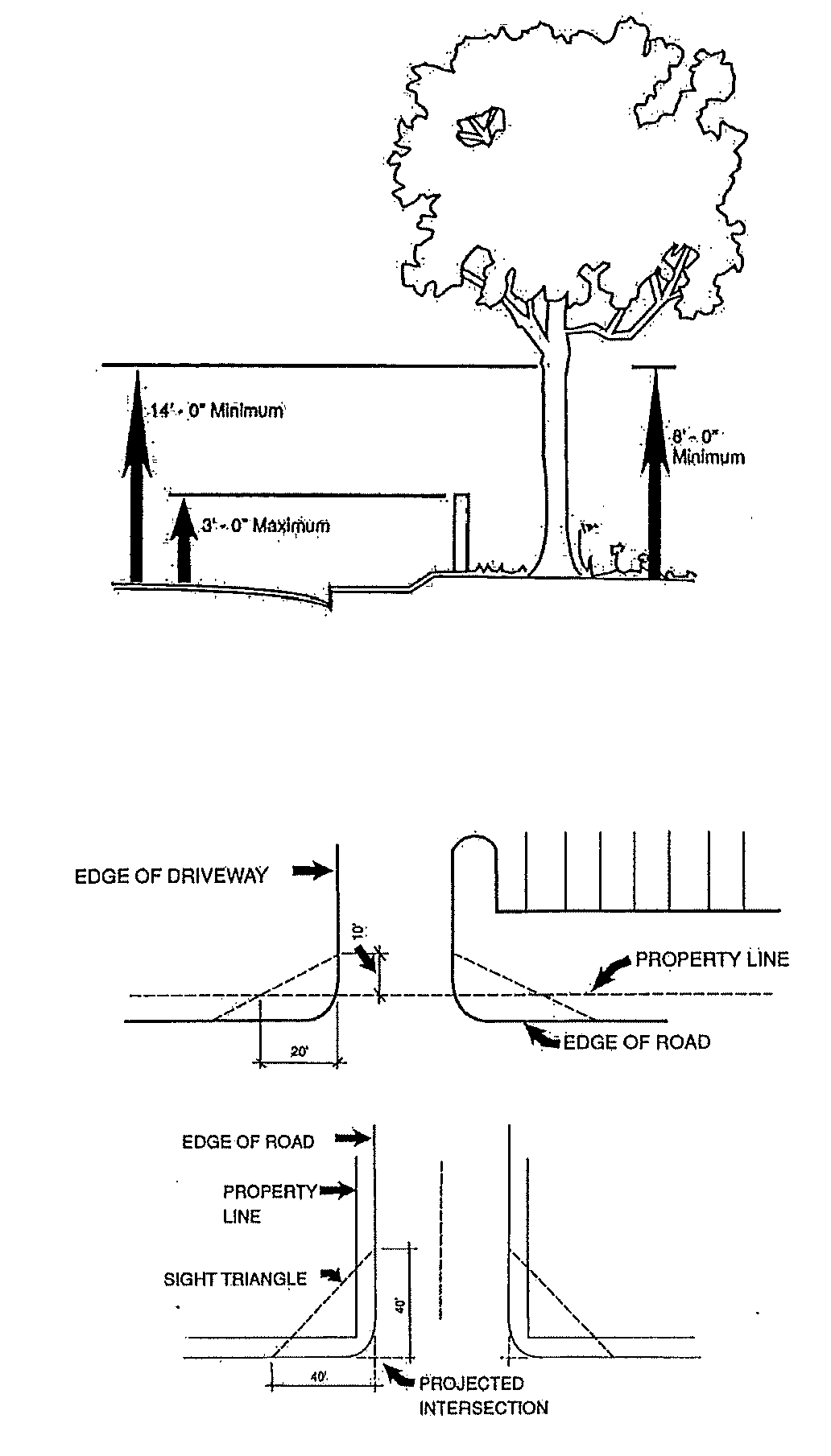
For two (2) public streets or a street and railroad crossing, the area is defined by measuring from the intersection of the edge of the travel lane (excluding parking and sidewalk) a distance of forty (40) feet along each road. See figure 1 of this section.
b.
For a public street and driveway or alley, the area is defined by measuring from the intersection of the edge of travel lane and the corner of the driveway or alley twenty (20) feet along the roadway and ten (10) feet along the driveway or alley. See figure 1 of this section.
FIGURE 1
CLEAR VISION TRIANGLE DRAWINGS
2.
Standards, both at controlled and uncontrolled intersections.
a.
Planting and development standards.
(1)
Any class I or class II trees planted within a clear vision triangle shall be pruned to a minimum height of eight (8) feet above the ground or sidewalk surface and fourteen (14) feet above the adjacent street surface. See figure 1 of this section.
(2)
No evergreen trees shall be planted within any clear vision triangle.
(3)
No class III trees shall be planted within any clear vision triangle.
(4)
The maximum height of any berm or vegetative ground cover at maturity within the clear vision triangle shall be three (3) feet from the lowest adjacent street grade.
(5)
No fences higher than three (3) feet from the lowest adjacent street grade are permitted in the clear vision triangle.
(6)
No signs taller than three (3) feet are permitted in the clear vision triangle, except for street/stop signs approved by the transportation authority.
b.
Other agency standards. In all cases, the transportation authority standards shall apply in addition to City of Meridian standards.
(Ord. 05-1170, 8-30-2005, eff. 9-15-2005; Ord. 08-1372, 7-8-2008, eff. 7-8-2008; Ord. No. 23-2037, § 2, 10-3-2023)
11-3A-4. - Accumulation of junk.
The accumulation of junk on any property is prohibited, except as provided in section 11-4-3-40 of this title.
(Ord. 10-1439, 1-12-2010, eff. 1-18-2010)
11-3A-5. - Multiuse pathways.
Multiuse pathways shall be constructed in accord with the city's comprehensive plan, the Meridian Pathways Master Plan, the Ada County Highway District Master Street Map and Roadways to Bikeways Master Plan.
(Ord. No. 22-2001, § 5, 11-1-2022)
Editor's note— Sec. 5 of Ord. No. 22-2001, adopted November 1, 2022, amended § 11-3A-5 in its entirety to read as herein set out. Former § 11-3A-5 pertained to bikeways and derived from Ord. No. 10-1463, adopted November 3, 2010; and Ord. No. 21-1950, adopted October 10, 2021.
11-3A-6. - Ditches, laterals, canals or drainage courses.
A.
Purpose. The purpose of this section is to limit the tiling and piping of natural waterways, including, but not limited to, ditches, canals, laterals, sloughs and drains where public safety is not a concern as well as improve, protect and incorporate creek corridors (Five Mile, Eight Mile, Nine Mile, Ten Mile, South Slough and Jackson and Evan Drains) as an amenity in all residential, commercial and industrial designs. When piping and fencing is proposed, the following standards shall apply.
B.
Piping.
1.
Natural waterways intersecting, crossing, or lying within the area being developed shall remain as a natural amenity and shall not be piped or otherwise covered. See also subsection (C)(1) of this section.
2.
Irrigation ditches, laterals, canals, sloughs and drains may be left open when used as a water amenity or linear open space, as defined in Section 11-1A-1 of this title. See also subsection (C)(2) of this section.
3.
Except as allowed above, all other irrigation ditches, laterals, sloughs or canals, intersecting, crossing or lying within the area being developed, shall be piped, or otherwise covered. This requirement does not apply to property with only an irrigation easement where the actual drainage facility is located on an adjoining property.
a.
The decision-making body may waive the requirement for covering such ditch, lateral, canal, slough or drain, if it finds that the public purpose requiring such will not be served and public safety can be preserved.
C.
Fencing.
1.
Fencing along all natural waterways shall not prevent access to the waterway. In limited circumstances and in the interest of public safety, larger open water systems may require fencing as determined by the City Council, Director and/or Public Works Director.
2.
Ditches, laterals, canals, sloughs and drains do not require fencing if it can be demonstrated by the applicant to the satisfaction of the Director that said ditch, lateral, canal, sloughs or drain serves as or will be improved as a part of the development, to be a water amenity or linear open space. If designed as a water amenity, construction drawings and relevant calculations prepared by a qualified licensed professional registered in the State of Idaho shall be submitted to both the Director and the authorized representative of the water facility for approval.
3.
Except as allowed above, all other open irrigation ditches, laterals, canals, sloughs and drains shall be fenced with an open vision fence at least six (6) feet in height and having an 11-gauge, two-inch mesh or other construction, equivalent in ability to deter access to said ditch, lateral, canal, slough or drain, which fence shall be securely fastened at its base at all places where any part of said lands or areas being subdivided touches either or both sides of said ditch, lateral, canal, slough or drain.
D.
Improvements. Improvements related to piping, fencing or any encroachment as outlined in subsections (A), (B), and (C) of this section requires written approval from the appropriate irrigation or drainage entity.
E.
Easements. In Residential Districts, irrigation easements wider than ten (10) feet shall be included in a common lot that is a minimum of twenty (20) feet wide and outside of a fenced area, unless otherwise waived by City Council.
F.
Impeding movement of water prohibited. For any irrigation or drainage ditch not within the jurisdiction of an irrigation or drainage district, piping shall not impede the movement of the amount of water crossing the property prior to development or the amount of water delivered to downstream properties.
G.
Natural drainage courses. All natural drainage courses shall be left undisturbed or be improved in a manner that will improve the hydraulics and ease of maintenance of the channel. Relocation of natural swales is acceptable if the hydraulics and ease of maintenance are provided for. The term "natural drainage course" shall not be deemed to apply to minor swales and depressions that are located entirely on the applicant's property and which serve a relatively small area where runoff is infrequent.
(Ord. 19-1833, 7-9-2019; Ord. No. 21-1932, § 3, 6-15-2021)
11-3A-7. - Fences.
A.
Purpose. The purpose of these standards is to regulate fences in order to:
1.
Provide safety and security for private property;
2.
Enhance the visual appearance of the built environment in the city;
3.
Establish an attractive streetscape;
4.
Ensure visual compatibility with public and private spaces; and
5.
Promote street and neighborhood character.
B.
Standards for all districts.
1.
No person shall install a fence or allow a fence to be installed without first obtaining a fence permit, except that a fence installed in conjunction with a building permit for a principal use shall not require a separate fence permit.
2.
All fences shall be measured from the back edge of the sidewalk. In cases where no sidewalk exists, the measurement shall be taken from the property line.
3.
No person shall install, keep, or allow to be installed or kept a fence which includes or incorporates, as any component:
a.
Electric wire.
b.
Barbed wire, except in the C-C, C-G, M-E, I-L, and I-H districts when such barbed wire is shown by the property owner to be necessary for securing the property, and the lowest barbed wire is located a minimum of six (6) feet above grade.
c.
Boxes, sheet metal, tarp, fabric, broken masonry blocks, rotting wood, or damaged, discarded, or unsightly materials.
d.
Any protruding staple, spike, barb, or element that presents a safety or health hazard.
4.
Where screening is required in this title, chain-link fencing with or without slats shall not be used as a screening material.
5.
No person shall install, keep, or allow to be installed or kept on his or her property a fence within three (3) feet of, or that otherwise obstructs access to, any utility box, meter, or other infrastructure.
6.
No person shall install; keep; extend from his or her property; or allow to be installed, kept, or extended from his or her property; a fence or any portion of a fence which encroaches on a sidewalk.
7.
No person shall install; keep; extend from his or her property; or allow to be installed, kept, or extended from his or her property a fence or any portion of a fence which encroaches on the public right-of-way; except under the terms of a valid license agreement from the transportation authority.
8.
The property owner shall keep all fences free from advertising and graffiti.
9.
The property owner shall maintain in good repair all fences delineating private property and a publicly accessible area. A fence shall be deemed not in good repair if it has missing or broken boards or other components, or if it constitutes a public nuisance or safety hazard.
10.
The natural grade of a property shall not be artificially modified to increase fence height, except as allowed in this section and subsection 11-3H-4(D). Fence height must be measured from the existing, unaltered grade at the base of the fence. An exception to this standard is permitted for fences located along designated collector and arterial streets. In such cases, the combined height of any berm and fence shall not exceed eight (8) feet, as measured from the centerline of the adjacent street.
11.
For property abutting a pathway or publicly accessible open space (public or private school or public park), the property owner may install a fence only where such fence complies with one (1) of the following standards:
a.
An open vision or semiprivate fence up to six (6) feet in height.
b.
A closed vision fence four (4) feet in height or a closed vision fence four (4) feet in height with an additional two (2) feet in height of open vision fencing at the top of the fence, or
c.
A closed vision fence up to six (6) feet in height, if fully visible from a public street.
See Figure 1 of this section.
12.
See subsection 11-3A-6(C)(2) of this article for additional fencing requirements along irrigation ditches, laterals, canals, and/or drains.
C.
Additional standards in the C-N, C-C, C-G, M-E, H-E, I-L, and I-H districts.
1.
The maximum fence height shall not exceed eight (8) feet.
2.
All fences adjoining an alley, whether such alley is on the rear or side yard, shall be open vision and be set back a minimum of five (5) feet from the alley (measured from property line).
D.
Additional standards in the R-2, R-4, R-8, R-15, R-40, L-O, O-T, TN-C, and TN-R districts.
1.
The maximum fence height shall not exceed six (6) feet, subject to the provisions set forth in subsections (D)(2) and (D)(3) of this section.
2.
The maximum fence height in the required street yard shall be three (3) feet for a closed vision fence and four (4) feet for an open vision fence. See figure 2 of this section.
3.
On corner properties, one (1) of the following shall apply:
a.
Where the sidewalk is attached to the curb, fences located on the street side yard must be set back a minimum of five (5) feet from the back of the sidewalk.
b.
Where the sidewalk is detached from the curb (i.e., separated by a parkway), the fence must be set back a minimum of two (2) feet from the back of the sidewalk.
4.
Decorative panels and trellises adjacent to fences are permitted, provided the following:
a.
They are not physically connected to or used to extend the height of the fence structure;
b.
They are used for the purpose of supporting vertical landscaping or decorative features that are not opaque;
c.
They do not exceed the maximum height allowed for fences; and
d.
They do not extend more than fifty (50) percent of the required yard.
5.
Where the rear yard of one (1) property adjoins the front yard of another property, the fence along the rear and side yards where they adjoin the adjacent front yard shall be flush or angled at forty-five (45) degrees to provide continuity with the adjoining fence and property line. See figure 2 of this section.
6.
Side yard fences that delineate the boundary of the side yard shall only be allowed in the street yard where the side setback is five (5) feet or greater. For zoning designation with less than a five-foot setback (R-15 and R-40 zones), no side yard fence shall be allowed in the street yard unless it is specifically approved during the subdivision process.
7.
Side yard fences that extend from one (1) building to an adjoining building are allowed where the adjoining houses have use easements on the side yard area. Such fences shall be set back a minimum of two (2) feet behind the enclosed portion of the front of the building adjoining the fence.
8.
Side yard fences that extend from one (1) building to an adjoining building that are greater than three (3) feet in height and constructed of wrought iron or similar material shall provide a gate for emergency access to the side yard.
9.
The property owner shall comply with the following standards for all fences in the side and rear yards:
a.
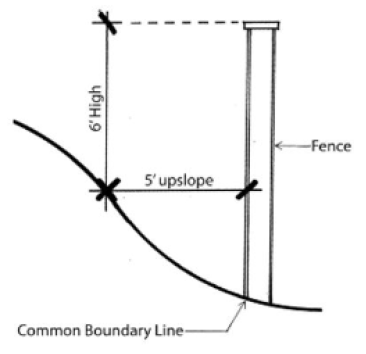
Fences shall not exceed six (6) feet in height in the side and rear setbacks. If there is a grade difference between two (2) sites, such fence must be no higher than six (6) feet above the highest grade within five (5) feet of the common boundary line. See figure 3 of this section.
b.
Only one (1) fence shall be allowed in the side setback, including the fence delineating the boundary of the side yard. Only one (1) fence shall be allowed in the rear setback, including the fence delineating the boundary of the rear yard, except as noted in subsection D(4) of this section.
10.
All fences within the required rear yard of alley accessed properties shall comply with the fencing standards in accord with subsection 11-3A-7(B)(9). Fences shall be set back a minimum of five (5) feet from the alley (measured from property line).
11.
Additional height shall be allowed for arbors, arches and/or other architectural appurtenances that are coterminous with gates and/or other fence openings. Such appurtenances shall not exceed five (5) feet in width and/or eight (8) feet in height.
12.
If an owner or applicant desires to obtain an alternative compliance for fence height restriction and grade changes, the procedure shall be in accord with chapter 5, "administration", of this title.
FIGURE 1
FENCE REGULATIONS
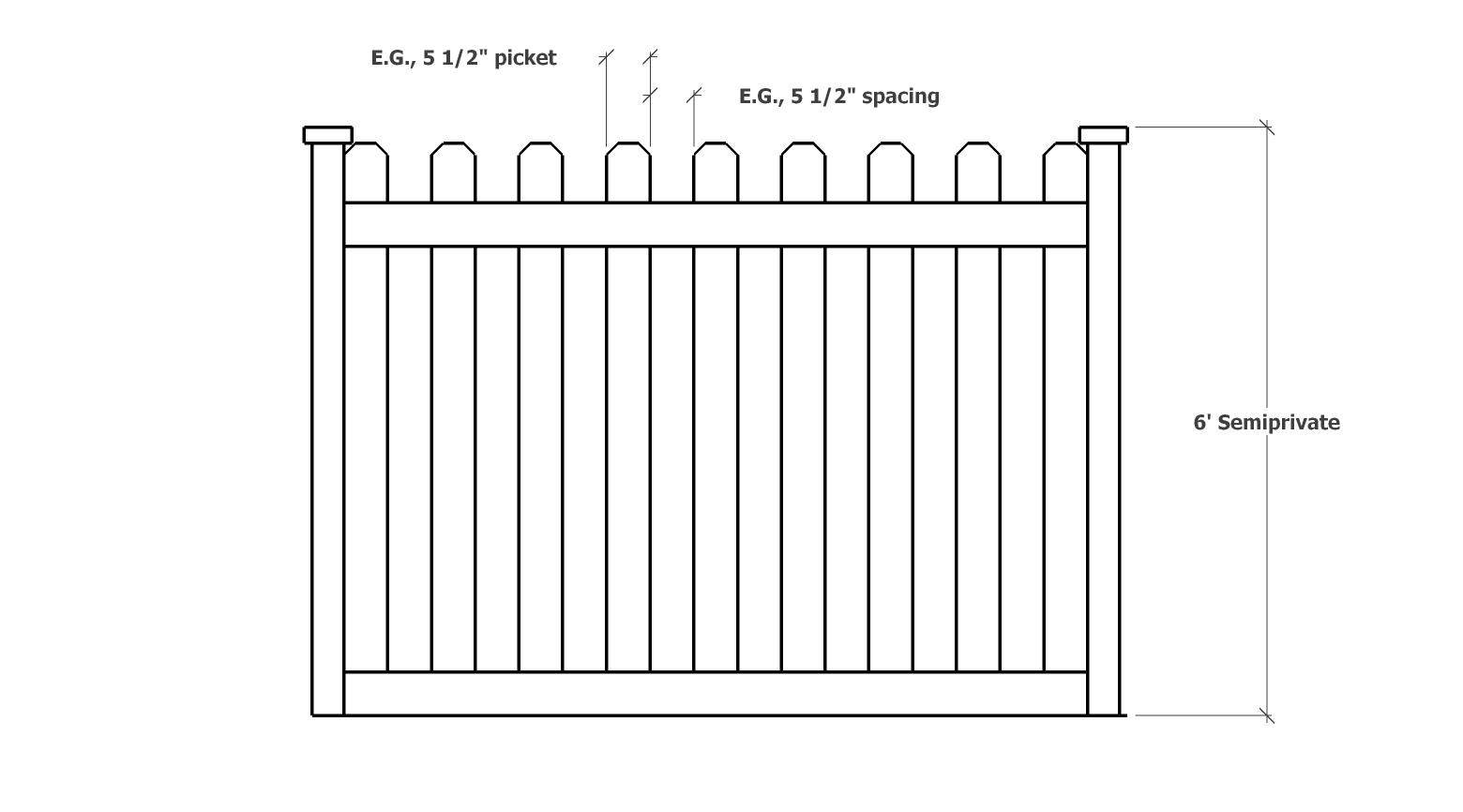
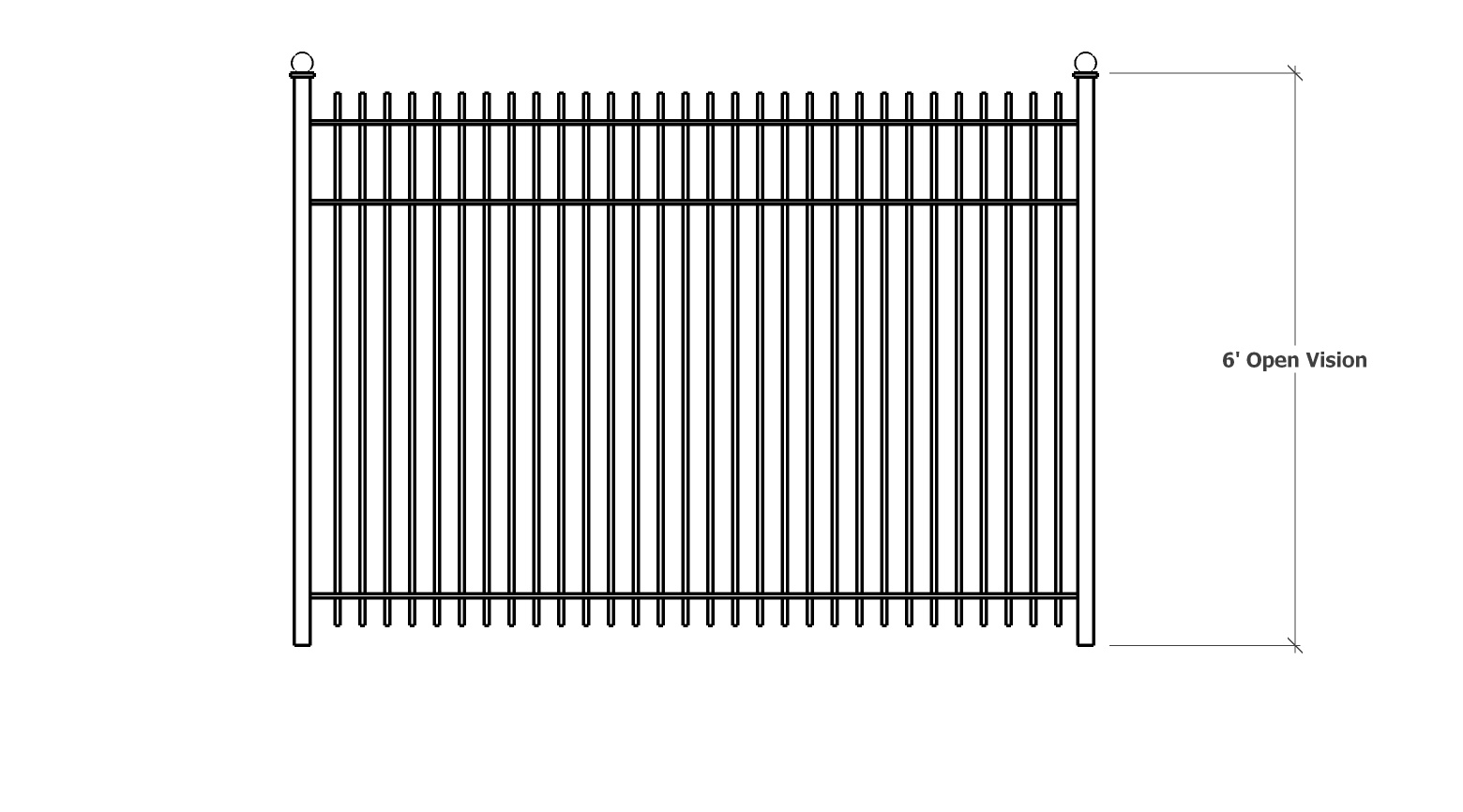
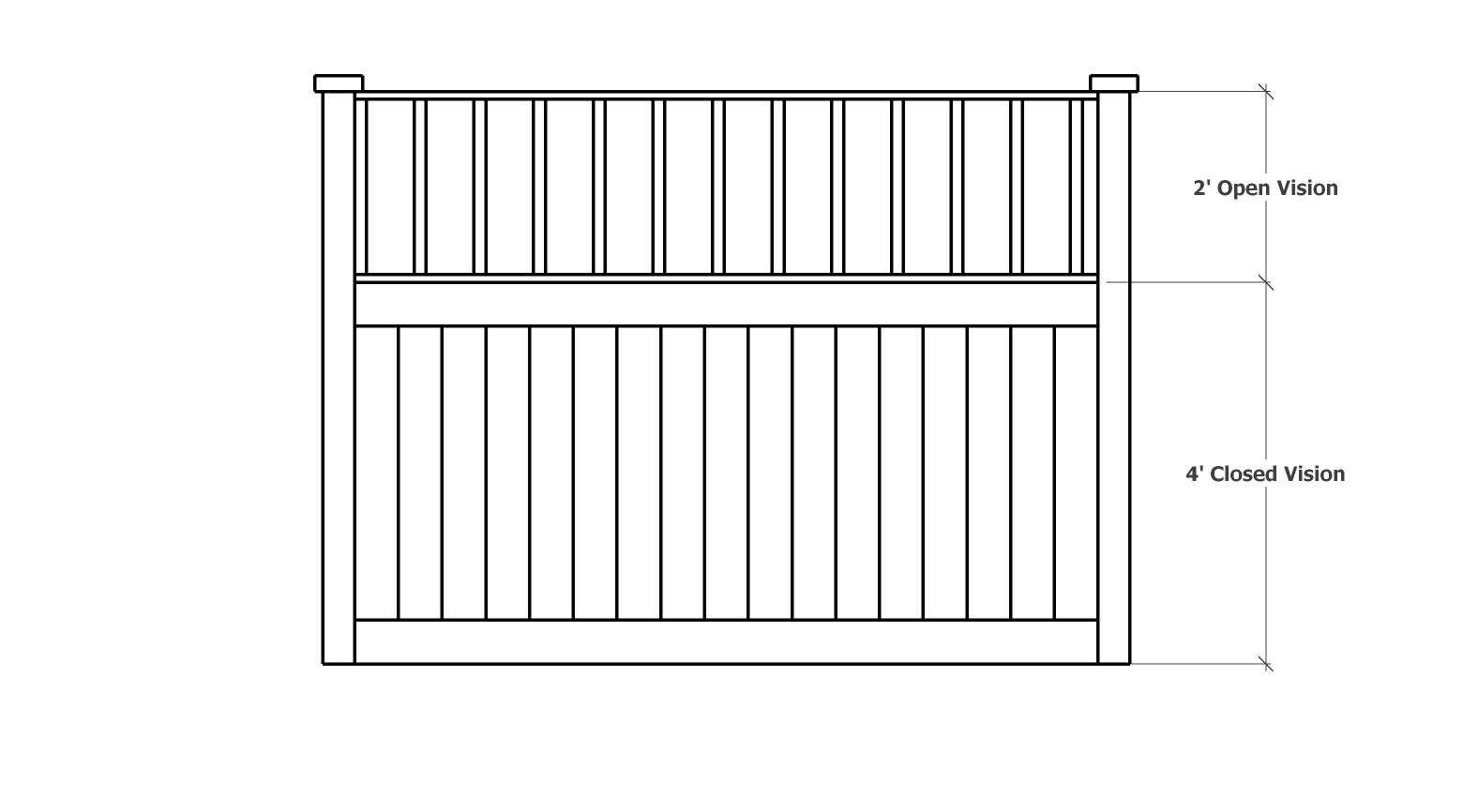
FIGURE 2
FENCE PLACEMENT
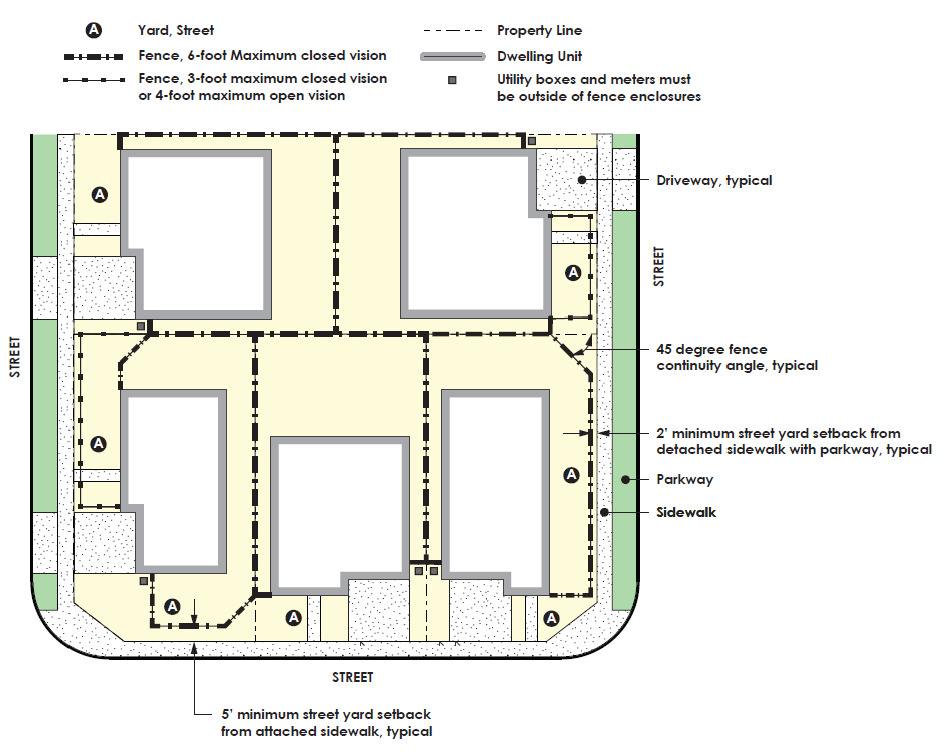
FIGURE 3
FENCE HEIGHT RELATIVE TO GRADE
(Ord. 05-1170, 8-30-2005, eff. 9-15-2005; Ord. 06-1241, 7-5-2006, eff. 7-15-2006; Ord. 10-1463, 11-3-2010, eff. 11-8-2010; Ord. 14-1592, 1-21-2014; Ord. 16-1672, 2-16-2016; Ord. No. 25-2099, § 6, 9-23-2025)
11-3A-8. - Pathways.
A.
Multiuse and micropathways shall be required consistent with the comprehensive plan within new residential and commercial developments as part of the public right-of-way or as separate easements so that an alternate transportation system (which is distinct and separate from the automobiles) can be provided throughout the urban service planning area.
B.
The design and construction of multiuse pathways shall be consistent with the guidelines contained in chapter 3 of the Meridian Pathways Master Plan.
C.
Right-of-way for micropathways in the middle of long blocks may be required where necessary to obtain convenient pedestrian circulation to schools, parks, other residential areas, and/or shopping areas.
D.
Micropathways shall have easements at least fifteen (15) feet in width in accord with article B, "landscaping requirements", of this chapter.
E.
Micropathways shall be less than two hundred fifty (250) feet or two (2) lot depths in length, whichever is less restrictive, and have a walking surface of at least five (5) feet in width.
F.
Landscaping adjacent to pathways shall be installed in accord with article B, "landscaping requirements", of this chapter.
G.
Multiuse pathways along utility easements or connecting regional facilities shall have a hard surface area of at least ten (10) feet unless more is needed for utility access.
(Ord. 13-1555, 5-14-2013)
11-3A-9. - Natural features.
Existing natural features that add value to development and enhance the attractiveness of the community (such as trees, watercourses, historic spots and similar irreplaceable amenities) shall be preserved or mitigated in the design of the development.
(Ord. 05-1170, 8-30-2005, eff. 9-15-2005)
11-3A-10. - Noxious use.
No area or structure in any district shall be used or occupied in any manner creating dangerous, injurious, noxious or hazardous conditions to the surrounding areas.
A.
Fire hazard. Any activity involving the use or storage of flammable or explosive materials shall be protected by adequate firefighting and fire prevention equipment and by such safety devices as are normally used in the handling of any such materials. Such hazards shall be kept removed from adjacent activities to a distance that is compatible with the potential danger involved as specified in the International Fire Code, title 5 of this Code and the National Fire Protection Association publications.
B.
Radioactivity or electrical disturbance. No activity shall emit harmful radioactivity at any point, or electrical disturbance adversely affecting the operation of any equipment at any point other than that of the creator of such disturbance.
C.
Vibration. No vibration shall be permitted that is discernible without instruments on any adjoining property.
D.
Air pollution. Air pollution shall be subject to the requirements and regulations established by the health authority.
E.
Erosion. No erosion shall be permitted that will carry objectionable substances onto neighboring properties.
F.
Water pollution. Water pollution shall be subject to the requirements and regulations established by the health authority.
G.
Hazardous materials. All hazardous material storage must comply with the regulations and standards of the Fire Department.
H.
Noise. Noise shall be subject to the provision of section 6-3-6 of this Code.
I.
Safety. Any development or activity that creates a public safety hazard, as determined by the Police Department, that is potentially harmful to the health, safety, and/or welfare of persons and/or property shall be prohibited.
(Ord. 05-1170, 8-30-2005, eff. 9-15-2005; Ord. 10-1439, 1-12-2010, eff. 1-18-2010)
11-3A-11. - Outdoor lighting.
A.
Types of lighting. The following types of lighting are exempt from the regulations of this section:
1.
Light fixtures that have a maximum output of less than one thousand eight hundred (1,800) lumens unless said fixture is the source of light trespass in violation of subsection (C)(3) of this section or is configured in a manner that impairs the vision of drivers and/or pedestrians in violation of subsection (B)(6 of this section.)
2.
All outdoor lighting produced by the direct combustion of natural gas or other fossil fuels such as kerosene lanterns or gas lamps.
3.
Holiday lighting that is not in violation of this section.
4.
Vehicular lights and all temporary emergency lighting needed for fire protection, police protection, and/or other emergency services.
5.
All hazard warning lights required by federal or state regulatory agencies.
6.
Lighting when used to light a governmental flag in accordance with 4 USC 6(a); and provided, that the fixture used does not create light trespass in violation of this section.
7.
Street lights and historical lights installed and configured to the appropriate specification for the application as determined by the Community Development Director or his/her appointee.
B.
Installation, use or display. The installation, use, or display of any of the following types of lighting and/or illumination shall be prohibited:
1.
Mercury vapor lamp fixture and/or lamp.
2.
Laser source light or any similar high intensity light.
3.
Lighting that changes colors, revolves, or moves, including searchlights shall be prohibited in all districts, except where approved for temporary uses under a valid, current City of Meridian Temporary Use Permit.
4.
Lighting, including strings of lights, on commercial or private tower structures that exceed the district height limit, except as required by regulations of the Federal Aviation Administration (FAA).
5.
Strobing, revolving, or flashing lights.
6.
Light or illumination with such brilliance or so positioned as to impair the vision of drivers and/or pedestrians.
7.
Low pressure sodium lighting.
C.
Standards.
1.
Light fixtures that have a maximum output of one thousand eight hundred (1,,800) lumens or more shall have an opaque top to prevent uplighting; the bulb shall not be visible and shall have a full cutoff shield. See figure 1 of this subsection (C).
2.
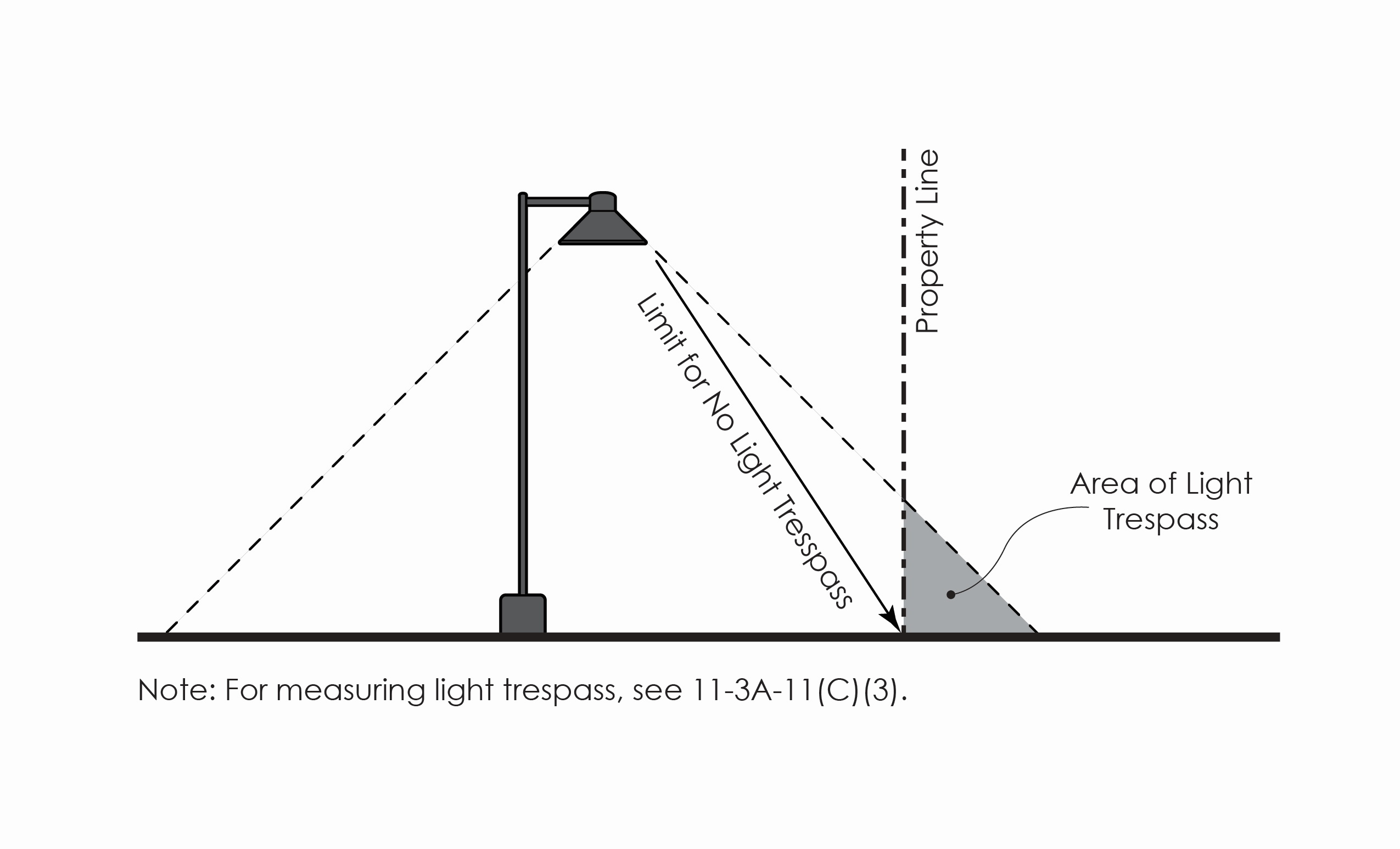
Light fixtures with a maximum output of one thousand eight hundred (1800) lumens or more shall be placed such that the effective zone of light (as documented by the photometric test report) shall not trespass on abutting residential properties. See figure 2 of this subsection (C).
FIGURE 1
EXAMPLES OF FULL CUTOFF SHIELDS
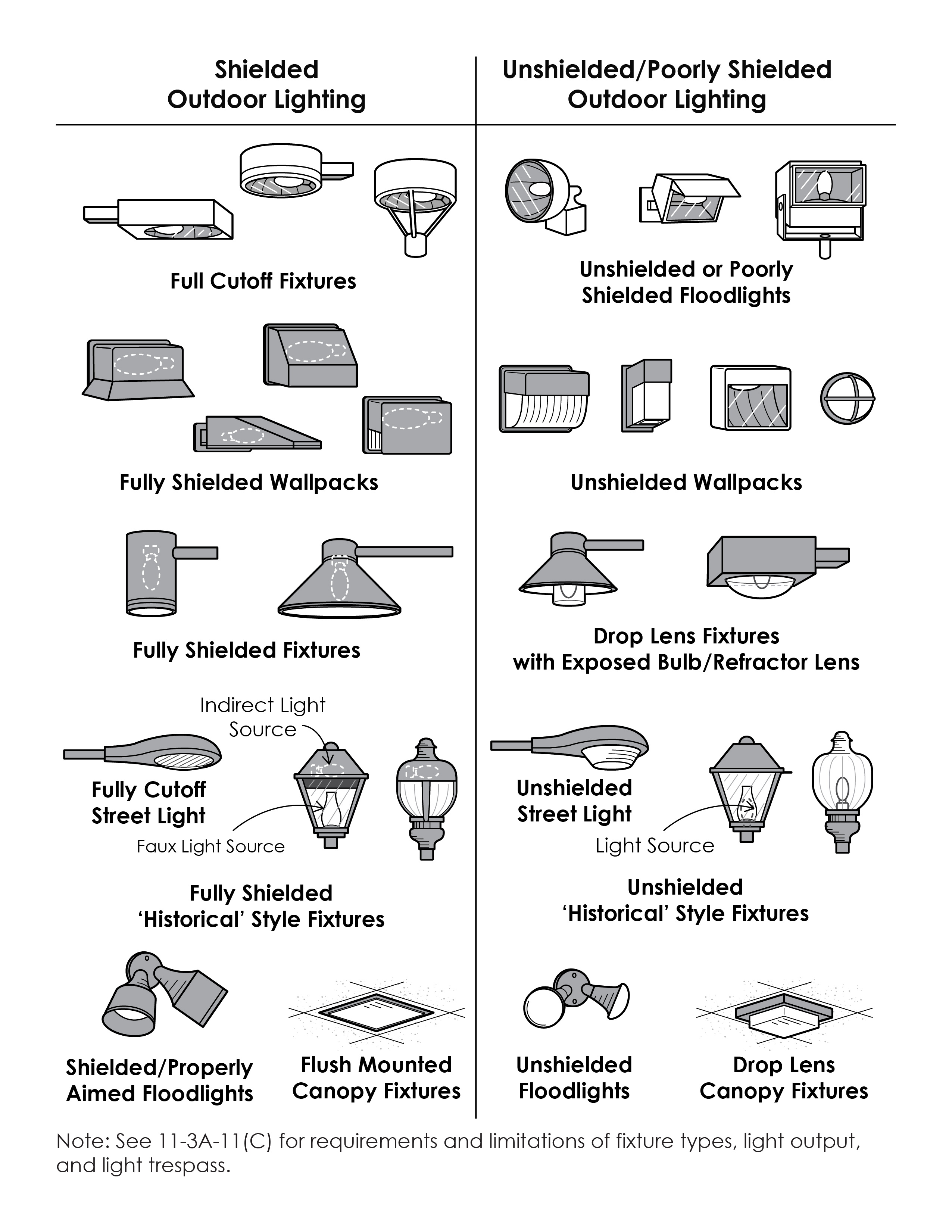
FIGURE 2
LIGHT TRESPASS
3.
All light emitting from any parcel shall not cause the light level along any property line abutting a residential use to exceed 0.1 foot-candle. Light readings shall be measured at a height of sixty (60) inches above grade and in a plane at any angle of inclination. Any light exceeding 0.1 foot-candle, when documented in the above manner, and extending onto an abutting residential use constitutes light trespass.
4.
Floodlight fixtures shall be positioned in such a manner as to prevent direct glare into a street and to prevent light trespass on abutting properties.
a.
Floodlight fixtures shall be set to go on only when triggered by activity on the property (sensor activated) and to go off within five (5) minutes after activation has ceased.
b.
Floodlight fixtures shall be installed so that they do not tilt up more than forty-five (45) degrees down from vertical.
5.
Uplighting shall only be allowed in cases where the fixture and any light it emits are shielded from the sky by a roof overhang or similar structural shield.
6.
In residential districts, the height of a freestanding light fixture on private property shall not exceed six (6) feet. Streetlamps are exempt from this height restriction.
7.
Light fixtures mounted on a wall may extend to the full height of the structure, but no farther.
8.
Electrical feeds to outdoor light fixtures shall be underground, not overhead.
9.
If an owner or applicant desires to obtain an alternative compliance from the provisions of this section, the procedure shall be in accord with chapter 5, "administration", of this title.
(Ord. 19-1833, 7-9-2019)
11-3A-12. - Outdoor service and equipment areas.
A.
Outdoor mechanical equipment (including, but not limited to, heaters and fans) shall not be located within fifty (50) feet of any abutting residential districts. To reduce noise, permanently mounted mechanical equipment shall be enclosed to the maximum extent possible.
B.
Outdoor utility meters, HVAC equipment, trash dumpsters, trash compaction and other service functions shall be incorporated into the overall design of buildings and landscaping so that the visual and acoustic impacts of these functions are fully contained and out of view from adjacent properties and public streets. Safe access and adequate lighting should be provided in these areas.
(Ord. 12-1514, 5-16-2012, eff. 5-21-2012)
11-3A-13. - Outdoor speaker systems.
Any outdoor speaker system associated with the use shall be located a minimum one hundred (100) feet from all residential districts. no outdoor speaker systems shall be allowed within a residential district. These standards may be waived through approval of a conditional use permit.
(Ord. 05-1170, 8-30-2005, eff. 9-15-2005)
11-3A-14. - Outdoor storage as an accessory use.
Accessory outdoor storage shall be allowed for an approved use subject to the following standards:
A.
All outdoor storage of material, equipment, inventory, personal property and/or supplies shall be conducted in an orderly manner. It shall be unlawful to conduct outdoor storage of materials, equipment, inventory, personal property and/or supplies in a manner that:
1.
Creates a public nuisance, visual blight, or acoustic impacts by reason of condition, duration, and/or volume.
2.
Blocks, impedes or overlaps any sidewalk and/or vehicular traffic.
3.
Causes the site to be used as a "vehicle wrecking or junk yard" as herein defined.
B.
For properties in commercial and/or traditional districts, outdoor storage of materials, equipment, inventory, and/or supplies shall be incorporated into the overall design of buildings and site landscaping so that the visual impacts of these functions are fully contained and screened from view of adjacent properties, the railway corridor, and public streets by a solid fence or wall with a minimum height of six (6) feet. Such fence and/or wall shall be constructed of complementary or of similar design and materials of the primary structure.
C.
For properties in residential districts, all materials, equipment, inventory, personal property and/or supplies, shall only be stored in the rear or side yard and shall be screened by a solid fence, six (6) feet in height. No outdoor storage of materials, equipment, inventory, personal property and/or supplies shall be allowed in the required street yard, except as follows. On corner properties, such materials may be stored in the street side yard where such area is screened by a solid fence, six (6) feet in height; see section 11-3A-7 of this article for fencing regulations in street side yards.
D.
For properties in industrial districts, the following standards shall apply:
1.
For properties that are adjacent to nonindustrial properties and/or public streets, outdoor storage of materials, equipment, inventory, and/or supplies shall be incorporated into the overall design of buildings and site landscaping so that the visual impacts of these functions are fully contained and screened from view of adjacent nonindustrial properties and/or public streets by a solid fence and/or wall with a minimum height of six (6) feet. Such fence and/or wall shall be constructed of complementary or of similar design and materials of the primary structure.
2.
For properties that adjoin the railway corridor, in addition to the standards of subsection D1 of this section, outdoor storage of materials, equipment, inventory, and/or supplies shall be screened from the interior edge of the required street buffer a distance of one hundred (100) feet parallel to the railway corridor.
3.
For properties where subsections D1 and/or D2 of this section do not apply, outdoor storage areas do not need to be screened.
(Ord. 09-1420, 6-23-2009, eff. 6-23-2009; Ord. 19-1833, 7-9-2019)
11-3A-15. - Pressurized irrigation systems.
A.
System installation required. In each development, the applicant shall provide underground, pressurized irrigation water. For subdivisions, each and every lot within the subdivision shall have underground pressurized irrigation water in compliance with title 9, chapter 1, "water use and service", of this Code. The pressurized irrigation system shall be constructed and installed at the same time as the domestic water lines, but it shall not necessarily be in the same trenches.
B.
Cross connections. All cross connections between the domestic water lines and the irrigation water lines shall be in accord with the city's adopted standards, specifications and ordinances.
C.
Waiver of requirements. The requirements for pressurized irrigation may be waived upon proof that any particular property does not have water rights in an existing irrigation district. The city's domestic water system shall be the last option for providing irrigation water to a proposed subdivision.
D.
Well development fees. If any property does not have water rights from an existing irrigation district, the applicant shall pay well development fees as determined by the city.
(Ord. 05-1170, 8-30-2005, eff. 9-15-2005)
11-3A-16. - Self-service uses.
Any unattended, self-service uses, including, but not limited to, laundromats, automatic teller machines (ATMs), vehicle washing facilities, fuel sales facilities, and storage facilities, shall comply with the following requirements. The Meridian Police Chief or designee may approve alternative standards where it is determined that a similar or greater level of security is provided.
A.
Entrance or view of the self-service facility shall be open to the public street or to adjoining businesses and shall have low impact security lighting.
B.
Financial transaction areas shall be oriented to and visible from an area that receives a high volume of traffic, such as a collector or arterial street.
C.
Landscape shrubbery shall be limited to no more than three (3) feet in height between entrances and financial transaction areas and the public street.
(Ord. 05-1170, 8-30-2005, eff. 9-15-2005)
11-3A-17. - Sidewalks and parkways.
A.
All sidewalks around buildings and serving public streets shall be a minimum of five (5) feet in width, except if detached sidewalks are provided on local public streets in residential subdivisions, the minimum sidewalk width may be reduced to four (4) feet.
B.
Sidewalks shall be designed to flare around mailboxes, utility boxes and other impediments to pedestrian circulation to maintain a minimum four (4) feet of travel width.
C.
Detached sidewalks or multiuse pathways shall be required along all arterial and collector streets. The Director may waive this requirement to detach the sidewalk where:
1.
There is an existing attached sidewalk or multiuse pathway; and/or
2.
The sidewalk is less than three hundred (300) linear feet in length and between two (2) adjoining properties with attached sidewalks or multiuse pathways.
The Director may waive this requirement for a portion of the street frontage where there is a utility box, mature tree or other impediment that prevents installation of a detached sidewalk or multiuse pathway.
D.
Sidewalks shall be required on both sides of the public street, except for the following:
1.
Where the average width of lots, as measured at the street frontage line or at the building setback line, is over one hundred fifty (150) feet; sidewalks on only one (1) side of the street may be allowed, or
2.
The City Council may modify this standard, upon recommendation from the transportation authority, when strict adherence is not practical.
E.
The minimum width of parkways planted with class II trees shall be eight (8) feet. The width can be measured from the back of curb where there is no likely expansion of the street section within the right-of-way; the parkway width shall exclude the width of the sidewalk. Class II trees are the preferred parkway trees.
1.
Class I and class III trees may be considered for parkway planters during the landscape plan review. The Director shall evaluate such trees for their suitability as parkway planter trees based on ultimate tree canopy, root characteristics, and branching height. The minimum parkway planter for class I and class III trees shall be ten (10) feet.
2.
The planter width for class II trees may be reduced to six (6) feet if there are root barriers that are a minimum of eighteen (18) inches below subgrade adjacent to the sidewalk and a minimum of twenty-four (24) inches below subgrade adjacent to the curb. The root barriers shall extend two (2) inches above grade.
(Ord. 05-1170, 8-30-2005, eff. 9-15-2005; Ord. 10-1463, 11-3-2010, eff. 11-8-2010; Ord. No. 22-2001, § 6, 11-1-2022; Ord. No. 25-2099, § 7, 9-23-2025)
11-3A-18. - Storm drainage.
An adequate storm drainage system shall be required in all developments in accord with the city's adopted standards, specifications and ordinances. Design and construction shall follow Best Management Practice as adopted by the city.
(Ord. 05-1170, 8-30-2005, eff. 9-15-2005)
11-3A-19. - Structure and site design standards.
A.
Purpose.
1.
Encourage site design that provides an interconnected network of walkways, pathways, streets, and/or drive aisles that combined promote pedestrian and vehicular mobility within the development and connect to adjacent developments.
2.
To facilitate the efficient movement of traffic into, out of, and through a site, protect pedestrian and bicycle users, establish an aesthetically consistent street presence and limit the visual impacts of large parking areas on a site.
B.
Minimum standards. The following minimum standards shall apply in addition to the detailed guidelines as set forth in the "City of Meridian Architectural Standards Manual."
1.
Architectural character. Buildings shall be designed in accord with the "City of Meridian Architectural Standards Manual."
2.
Site design.
a.
Extend or improve streets, drive aisles, cross access easements or similar vehicular and pedestrian connections provided from adjacent properties.
b.
For lots with frontage on a public street, a minimum of thirty (30) percent of the buildable frontage of the property shall be occupied by building facades and/or public space. Within mixed use areas, and for large multi-building developments, buildings may be placed away from roadways if a minimum of forty (40) percent of the buildable frontage is occupied by building facades and/or public space.
3.
Parking lots.
a.
For properties greater than two (2) acres in size, no more than fifty (50) percent of the total off street parking area for the site shall be located between building facades and abutting streets. This requirement may be reduced or waived at the determination of the director in industrial districts where there is an operational need to separate a secure outdoor storage yard from the parking area.
b.
For properties two (2) acres or less in size, a maximum of a single drive aisle with parking on one (1) or both sides shall be allowed between the building facades and abutting streets. All other off-street parking areas shall not be located between the building facades and abutting streets.
c.
The design and layout of internal site parking shall avoid long straight unbroken parking aisles, provide crossing drive aisles for internal circulation at approximately one hundred fifty-foot intervals, or provide parking that is perpendicular to the building.
d.
Where on street parking is provided or where vehicle circulation is directed in front of building entries, integrate traffic calming strategies and techniques, such as landscape islands, bulb outs, and/or detailed crosswalks, to increase safety and enhance the development character.
e.
In the traditional neighborhood districts parking shall be primarily located behind or to the side of buildings and public spaces, away from block corners and roadways.
f.
When parking and drive-throughs cannot comply with the standards above, they shall be screened by berms, landscaping, walls, architectural elements, or a combination of these elements to produce an appropriate buffer adjacent to public spaces and roadways.
4.
Pedestrian walkways.
a.
A continuous internal pedestrian walkway that is a minimum of five (5) feet in width shall be provided from the perimeter sidewalk to the main building entrance(s) for nonresidential uses. The walkway width shall be maintained clear of any obstructions, such as vehicles, outdoor sale displays, vending machines, or temporary structures.
b.
The internal pedestrian walkway shall be distinguished from the vehicular driving surfaces through the use of pavers, colored or scored concrete, or bricks.
c.
Unobstructed walkways at least five (5) feet in width shall be provided for any aisle length that is greater than one hundred fifty (150) parking spaces or two hundred (200) feet away from the primary building entrance(s).
d.
The walkways shall have weather protection (including, but not limited to, an awning or arcade) within twenty (20) feet of all customer entrances.
C.
Alternative compliance. If:
1.
The location of existing buildings or structures prevents conformance with the standards of this section, or
2.
Strict adherence to such standards would create inconsistency in the design objectives of the proposed development,
the Director may consider an alternative design proposal through the alternative compliance provisions as set forth in Section 11-5B-5 of this Title. The Director may approve, or recommend approval of, such an alternative compliance proposal when the overall design, as proposed by the applicant, meets or exceeds the intent and the requirements of this section and is not detrimental to public health, safety, and welfare.
(Ord. 16-1717, 1-3-2017; Ord. No. 22-2001, § 7, 11-1-2022)
11-3A-20. - Traveling living quarters.
No motor vehicle or trailer including, but not limited to, travel trailers, fifth wheels, recreational vehicles, mobile tiny houses and/or motor coaches, shall be used as a residence or as living quarters except within an approved recreational vehicle park. No recreational equipment, including, but not limited to, tents, tepees, yurts, and/or huts, shall be used as a residence or as living quarters.
(Ord. 19-1833, 7-9-2019)
11-3A-21. - Utilities.
A.
All utilities for an approved use shall be installed at or below grade in accord with the City's adopted standards, specifications and ordinances.
B.
Street lighting shall be installed in accord with the city's adopted standards, specifications and ordinances.
C.
All development shall be connected to the City of Meridian water and sewer systems, unless otherwise approved by the City Engineer.
1.
All public water supply or sewer systems (serving one (1) or more separate premises or households) shall be constructed in accord with the city's adopted master plans.
2.
All new public water supply or sewer systems shall be an extension of an existing public system.
D.
Fire hydrants and water mains. Adequate fire protection shall be required in accord with the appropriate fire district standards.
(Ord. 05-1170, 8-30-2005, eff. 9-15-2005)
11-3B-1. - Purpose.
A.
The regulations of this article are intended to promote landscaping in the City of Meridian that will improve community livability, preserve the quality of life, and enhance the aesthetic quality, economic viability, and environmental health of the City.
B.
The City of Meridian recognizes that landscaping can be a significant expense to business people and residents. At the same time, high quality landscaping improves the livability of residential neighborhoods, enhances the appearance and customer attraction of commercial areas, increases property values, improves the compatibility of adjacent uses, screens undesirable views, and can reduce air, water and noise pollution.
C.
The intent of these regulations is to achieve a balance between the right of individuals to develop and maintain their property in a manner they prefer and the rights of City residents to live, work, shop, and recreate in pleasant, healthy, sustainable, and attractive surroundings.
D.
The City recognizes that surface irrigation water is not available everywhere, that seasonal availability fluctuates, and that highly treated potable water is expensive and less desirable for landscaping. These regulations are intended to encourage the use of water conserving landscape designs and low water use plant materials and to discourage landscaping that requires high water use for maintenance, such as large expanses of lawn or turf.
E.
These regulations are intended to assist in the implementation of CPTED (crime prevention through environmental design) strategies to reduce the opportunities of fear and incidence of crime and improve the quality of life.
(Ord. No. 21-1950, § 17, 10-10-2021)
11-3B-2. - Applicability.
A landscape plan shall be required for the following:
A.
All development, redevelopment, additions, or site modifications except detached single-family and secondary dwellings.
B.
All common lots in all subdivisions.
C.
All applications for a conditional use permit (CUP), preliminary plat (PP), final plat (FP), combined preliminary and final plat (PFP), short plat (SHP), certificate of zoning compliance (CZC), administrative design review (DES), or planned unit development (PUD).
D.
Applicability of additions to existing structures: Existing development shall be required to conform to this article based upon the following guidelines:
1.
For additions less than twenty-five (25) percent of the existing structure or developed area, no additional landscaping shall be required except for buffers to adjacent residential uses.
2.
For additions that are twenty-five (25) percent to fifty (50) percent of the existing structure or developed area, perimeter and right-of-way landscaping as required by this Article shall be installed.
3.
For additions greater than fifty (50) percent of the existing structure or developed area, all current landscape standards of this Article shall be met.
4.
If the location of existing buildings or other structures prevents conformance with the requirements of this Section, or if its implementation would create nonconformity, the Director shall determine how this Article is to be applied through the alternative compliance process in accord with Chapter 5, "Administration", of this Title.
(Ord. No. 21-1950, § 17, 10-10-2021; Ord. No. 22-2001, § 8, 11-1-2022)
11-3B-3. - Application requirements.
A.
All landscape plans shall comply with the requirements for size, scale, number of copies, and contents as detailed in the application form.
B.
The landscape plan may be on the same site plan used to show parking layout, setback compliance, etc.
C.
The landscape plan shall depict all ground level mechanical equipment areas and include details for vertical screening.
D.
All landscape plans shall be prepared by a landscape architect, landscape designer, or qualified nurseryman.
(Ord. No. 21-1950, § 17, 10-10-2021)
11-3B-4. - Application process.
A.
Preliminary landscape plan review. A preliminary landscape plan review is recommended prior to submission for all developments, but is not required.
B.
Landscape plan review. A landscape plan will be reviewed in accord with the standards and procedures set forth in this article and approved by the department.
C.
Landscape plan modification.
1.
An approved landscape plan shall not be altered without prior approval of the Planning Department.
2.
No significant field changes to the plan are permitted.
3.
Prior written approval of all material changes is required.
4.
All approved changes to the landscape plan shall be documented prior to issuance of a certificate of occupancy.
(Ord. No. 21-1950, § 17, 10-10-2021)
11-3B-5. - Standards and installation.
A.
Approved tree species.
1.
The publication titled "Treasure Valley Tree Selection Guide" is hereby adopted by this reference as the City of Meridian's list of approved and prohibited tree species, except for following Arborists Revised List of trees, with written approval from the City's arborist.
The publication categorizes the trees by size as Class I, Class II, or Class III trees.
●
Acer - Maples
○
campestre - Hedge Maple
○
ginnala - Amur Maple
○
glabrum - Rocky Mountain Maple
○
grandidentatum - Bigtooth Maple - Highland Park, Mesa Glow, Rocky Mountain Glow
○
griseum - Paperbark Maple
○
miyabei - Miyabei Maple Rugged Ridge Maple, State Street Maple
○
negundo - Boxelder 'Sensation'
○
pseudoplatanus - Sycamore Maple
○
saccharum - Sugar Maple
○
truncatum - Shantung Maple
○
truncatum x platanoides (hybrids) Crimson Sunset, Pacific Sunset, Urban Sunset
●
Aesculus - Buckeye/Horsechestnut
○
glabra - Ohio Buckeye
○
flava - Yellow Buckeye
○
hippocastanum - Horsechestnut
●
Alnus - Alders
○
glutinosa - Common Alder
○
cordata - Italian Alder
○
spaethii - Spaeth's Alder
●
Amelanchier - Serviceberry
○
arborea - Downy Serviceberry
○
alnifolia - Saskatoon Serviceberry
○
X grandiflora - Autumn Brilliance Serviceberry
●
Betula - Birch
○
nigra - River Birch
●
Carpinus - Hornbeam
○
betulus - European Hornbeam
○
caroliniana - American Hornbeam
●
Catalpa - Northern Catalpa
○
speciosa - Northern Catalpa
●
Celtis - Hackberry
○
occidentalis - Common Hackberry
○
reticulata - Netleaf Hackberry
●
Cercidiphyllum - Katsura
○
Japonicum
●
Cercis - Redbud
○
canadensis - Eastern Redbud
○
ccidentalis - Western redbud
●
Chionanthus - Fringe Tree
○
retusus - Chinese Fringe Tree
○
virgincus - White Fringe Tree
●
Cladrastis - Yellowwood
○
kentuckea - American Yellowwood
○
lutea - (now synonymous with kentuckea)
●
Cornus - Dogwood
○
florida - Flowering Dogwood
○
kousa - Kousa Dogwood
○
mas - Corneliancherry - 'Saffron Sentinel', 'Golden Glory'
●
Corylus - Filbert
○
americana - American Filbert
○
avellana - European Filbert
○
colurna - Turkish Filbert
●
Cotinus - Smoke Tree
○
coggygria - Common Smoketree
○
obovatus - American Smoketree
●
Crataegus - Hawthorn
○
crusgalli - Cockspur Hawthorn
○
douglasii - Douglas Hawthorn
○
laevigata - English Hawthorn
○
X lavallei - Lavalle Hawthorn
○
phaenopyrum - Washington Hawthorn
○
viridis - Green Hawthorn 'Winter King'
●
Diospyros - Persimmon
○
virginiana - Common Persimmon
●
Fagus - Beech
○
sylvatica - European/Common Beech
●
Fraxinus - Ash
●
Ginkgo
○
Biloba (Magyar, Autumn Gold, Princeton Sentry)
●
Gleditsia - Honeylocust
○
triacanthos var. inermis - Thornless Common Honeylocust
●
Gymnocladus - Kentucky Coffee Tree
○
dioicus - ('Espresso' is a seedless variety)
●
Juglans - Walnut
○
Nigra - Black Walnut
○
regia - Common English Walnut
●
Koelreuteria - Goldenraintree
○
paniculate - Goldenraintree
●
Liquidambar - Sweetgum
○
styraciflua - American Sweetgum
●
Liriodendron tulipifera - Tulip Tree
●
Maackia amurensis - Amur Maackia
●
Maclura pomifera - Osage Orange
●
Magnolia
○
acuminate - Cucumber Magnolia
○
grandifolia - Evergreen Magnolia
○
X soulangiana - Saucer Magnolia
○
stellata - Star Magnolia
●
Malus spp. Flowering Crabapple
●
Metasequoia glyptostroboides - Dawn Redwood
●
Morus alba - White/Common Mulberry
●
Nyssa sylvatica - Black Tupelo
●
Ostrya virginiana - American Hophornbeam/Ironwood
●
Parrotia persica - Persian Parrotia
●
Phellodendron amurense - Amur Corktree
●
Platanus - Sycamore/Planetree
○
x acerifolia - London Planetree
○
occidentalis - American Planetree/Sycamore
●
Populus - Cottonwood/Poplar
○
alba - White/Silver-leaved Poplar
○
angustifolia
○
balsamifera - Balsam Poplar
○
deltoides - Eastern Cottonwood
○
nigra 'italica' - Lombardy Poplar
○
trichocarpa
○
x canadensis - Carolina Poplar
●
Prunus - Plum, Cherry, Chokecherry, Peaches, Almonds, Apricots
○
cerasifera - Cherry Plum (recommended variety = Krauter Vesuvius)
○
padus - Common Birdcherry
○
serotina - Black Cherry
○
serrulate - Flowering Cherry
○
virginiana - Chokecherry (Canada Red, Schubert)
●
Pyrus - Flowering Pear
○
Calleryana
●
Quercus - Oak
○
acutissima - Sawtooth Oak pH sensitive
○
alba - White Oak pH sensitive
○
bicolor - Swamp White Oak
○
imbricaria - Shingle Oak
○
macrocarpa - Bur Oak
○
muehlenbergii - Chinkapin Oak
○
nutallii - Nuttall Oak
○
prinus - Chestnut Oak
○
robur - English Oak
○
rubra - Northern Red Oak
○
shumardii - Shumard Oak
●
Rhus typhina - Staghorn Sumac
●
Robinia pseudoacacia - Black Locust
●
Salix - Willow
●
Sophora japonica - Pagodatree (styphnolobium japonicum)
●
Syringa reticulata - Japanese Tree Lilac 'Ivory Silk'
●
Tilia - Linden
○
americana - American Linden/Basswood
○
cordata - Littleleaf Linden
○
tomentosa - Silver Linden
●
Ulmus - Elm
○
americana - American Elm
○
japonica x wilsoniana 'Morton' Accolade™ Elm
○
japonica x pumila - 'New Horizon' Elm
○
'Morton Glossy'- Triumph™ Elm
○
parvifolia - Chinese Elm Bosque
○
procera - English Elm
○
propinqua - Emerald Sunshine® Elm
○
wilsoniana - 'Prospector' Prospector Elm
●
Zelkova serrata - Zelkova (Village Green, Green Vase, Wireless)
Conifers
●
Abies - Fir
○
Concolor White/Concolor Fir
●
Calocedrus decurrens California Incense Cedar
●
Cedrus True Cedar
○
atlantica
○
deodara
●
Chamaecyparis lawsoniana Lawson's Cypress
●
Cupressus nootkatensis - Alaskan Cedar
●
Juniperus - Juniper
○
Communis - Common Juniper
○
Occidentalis - Western Juniper
○
Osteosperma - Utah Juniper
○
Scopulorum - Rocky Mountain Juniper
●
Picea - Spruce
○
abies - Norway Spruce
○
glauca - White Spruce var. densata Black Hills Spruce
○
pungens Colorado Spruce glauca Colorado Blue Spruce
●
Pinus - Pine
○
Aristata Bristlecone Pine
○
Contorta/latifolia - Lodgepole Pine
○
Densiflora umbraculifera Tanyosho Pine
○
Flexilis Limber Pine 'Vanderwolf's Pyramid'
○
Heldrechii/leucodermis Bosnian Pine
○
Mugo (standard)
○
Nigra Austrian Pine
○
Ponderosa - Ponderosa Pine
○
Strobiformis
○
Strobus
○
Sylvestris - Scotch Pine
●
Pseudotsuga menziesii Douglas Fir
●
Sequoiadendron giganteum Giant Sequoia
●
Taxodium distichum Bald Cypress
●
Thuja plicata Western Red Cedar, occidentalis Arborvitae/White Cedar
2.
In addition to the trees identified above, the trees listed in the Park and Recreation's Water Conserving Tree Species list.
Acer Maples
●
campestre - Hedge Maple
●
ginnala - Amur Maple
●
labrum - Rocky Mountain Maple
●
grndidentatum - Bigtooth Maple
●
griseum - Paperbark Maple
●
miyabei - Miyabei Maple
●
truncatum x platanoides - Shantung Maple Hybrids
Amelanchier Serviceberry
●
x grandiflora 'Autumn Brilliance Serviceberry'
Carpinus Hornbeam
●
betulus - European Hornbeam
●
caroliniana - American Hornbeam
Catalpa
●
speciosa - Northern Catalpa
Celtis Hackberry
●
occidentalis Common Hackberry
Cercis Redbud
●
canadensis - Eastern Redbud
●
occidentalis - Western Redbud
Cladrastis Yellowwood
●
kentuckea/lutea - American Yellowwood
Cornus (Dogwood)
●
mas - Corneliancherry
Cotinus Smoke Tree
●
coggygria - Common Smoketree
●
obovatus - American Smoketree
Crataegus Hawthorn
●
Crusgalli - Cockspur Hawthorn
●
douglasii - Douglas Hawthorn
●
phaenopyrum - Washington Hawthorn
●
viridis - Green Hawthorn 'Winter King'
Gleditsia Honeylocust
●
triacanthos var inermis - Thornless Common Honeylocust
●
'Suncole' - Sunburst Honeylocust prohibited in ROW Street Tree Planting
Gymnocladus
●
dioicus - Kentucky Coffee Tree
Maackia
●
amurensis - Amur Maackia
Maclura
●
pomifera - Osage Orange
Ostrya
●
virginiana - American Hophornbeam/Ironwood
Parrotia
●
persica - Persian Parrotia
Platanus
●
x acerifolia - London Planetree
●
occidentalis - American Planetree/Sycamore
Prunus
●
virginiana - Chokecherry
Pyrus
●
calleryana - Ornamental Flowering Pear
Quercus Oaks
●
imbricaria - Shingle Oak
●
macrocarpa - Bur Oak
●
muehlenbergii - Chinkapin Oak
●
rubra - Northern Red Oak
Saphora japonica AKA Styphnolobium japaonicum Japanese Pagoda Tree
Tilia Linden
●
tomentosa - Silver Linden
Ulmus - Elm Hybrids
Conifers
Calocedrus decurrens - Incense Cedar
Cedrus atlantica 'Glauca' - Blue Atlas Cedar
Chamaecyparis lawsoniana - Lawson's Cypress
Cupressus nootkatensis - Alaskan Cedar
Juniperus
●
communis - Common Juniper
●
occidentalis - Western Juniper
●
osteosperma - Utah Juniper
●
scopulorum - Rocky Mountain Juniper
Picea Spruce
●
abies - Norway Spruce
●
glauca - White Spruce & Black Hills Spruce
●
pungens - Colorado Spruce
Pinus Pines
●
aristate - Bristlecone Pine
●
contorta/latifolia - Lodgepole Pine
●
flexilis - Limber Pine Including 'Vanderwolf's Pyramid'
●
heldrechii/leucodermis
●
nigra - Austrian Pine
●
ponderosa - Ponderosa Pine
●
strobiformis - Southwestern White Pine
●
sylvestris - Scotch Pine
Pseudotsuga menziesii - Douglas Fir
Thuja plicata - Western Red Cedar
B.
Minimum plant sizes. The following are minimum plant sizes for all required landscape areas:
TABLE 11-3B-5-2
MINIMUM PLANT SIZES
C.
Prohibited plant material. The plants listed in Treasure Valley Tree Guide, under trees not permitted for rights of way property planting, and those in the Arborists Revised List, are prohibited from being planted along any street or within any parking lot regulated by this article. The only exception is that conifers (not otherwise prohibited) may be planted in the center of street buffers that have a minimum width of twenty (20) feet as measured from the edge of the sidewalk to the street curb. For public safety purposes, the location of such conifers shall maintain view corridors of nonresidential structures.
D.
Tree species mix. When five (5) or more trees are to be planted to meet the requirements of any portion of this article (including street trees, street buffers, parking lot landscaping and other landscape guidelines), a mix of species shall be provided. The number of species to be planted shall vary according to the overall number of trees required to be planted. See the table below:
TABLE 11-3B-5-3
REQUIRED NUMBER OF TREES AND SPECIES
E.
Plant quality. All plant material installed pursuant to this article shall meet or exceed the minimum federal standards as regulated by ANSI Z60.1, "American Standard For Nursery Stock".
F.
Planting standards. All trees, shrubs, and other plant material shall be planted in appropriate soil medium and using accepted nursery standards including hole size, backfilling, and fertilization,or as detailed by a certified Landscape Architect or qualified arborist.
G.
Staking. Tree staking is not required but may be used in areas with high winds or other situations that make staking desirable. If trees are staked, the stakes shall be removed within twelve (12) months to prevent damage to the tree.
H.
Mulching. Mulch shall be used in all required planting areas. Approved mulches may be organic, such as bark or soil aid, or they may include rock products, such as "permabark" or similar products. Use of mulch, organic or rock, as the only ground cover in required planting areas is prohibited. Pea gravel, drain rock, road base gravel, and similar products shall not be used as mulch. All mulch shall be contained by a curb, concrete mow strip, or other edging material to contain the mulch and prevent it from migrating to adjacent surfaces. If rock mulch is used, a weed barrier fabric shall be used beneath the rock. Impermeable plastic weed barriers are prohibited because they restrict water and oxygen to the plants. Within stormwater facilities, mulch may not float.
I.
Curbing. All planting areas that border driveways, parking lots, and other vehicle use areas shall be protected by curbing, wheel stops, or other approved protective devices. Such devices shall be a minimum of thirty (30) inches from all tree trunks to prevent cars from damaging tree trunks.
J.
Utilities. The following standards apply to the planting of trees near existing utilities and to trenching for new utilities near existing trees:
1.
Overhead utilities. Only class I trees in the recommended plant list may be planted under or within ten (10) lateral feet of any overhead utility wires.
2.
Underground utilities. All trees shall be planted outside of any easement that contains a city water or sewer main, unless written approval is obtained from the city engineer. If any utility easement precludes trees required by this article, the width of the required buffer shall be increased to accommodate the required trees.
3.
Trenching. New underground utilities shall stay outside of the drip line of existing trees if trenched, or be tunneled a minimum of three (3) feet below existing grade within the tree's drip line. The guiding principle is that no root two (2) inches or larger shall be cut. Note: This requirement is for placement of new utilities and does not affect the city's ability to access existing utilities for repair and maintenance.
K.
Erosion control. The landscape installation shall stabilize all soil and slopes.
L.
Berms. Berm slopes shall not exceed three to one (3:1) (horizontal:vertical). Three to one (3:1) maximum slopes are recommended. Grass that requires mowing shall not be used on slopes steeper than three to one (3:1).
M.
Screening. Where screening is required in this article and/or this title, chainlink fencing with or without slats does not qualify as a screening material.
N.
Vegetation coverage. Required landscape areas shall be at least seventy (70) percent covered with vegetation at maturity, with mulch used under and around the plants, or alternatively, meet the standards for Water Conserving Design below.
O.
Water conserving design. To qualify for the exceptions for water conserving designs as set forth in this Chapter, the applicant shall demonstrate the following:
1.
The design includes water conserving trees of this section, use of native or drought resistant shrubs, perennials or ornamental grasses, water conserving plants, boulders, rocks, decorative walls and/or permeable hardscape materials such as pavers and flagstones, and that are visually distinct (size, texture, or color) and clearly visible from the adjacent travel roadway or drive aisle.
2.
The design includes plants that can thrive in climates with approximately ten (10) to twelve (12) inches of annual rainfall.
3.
Lawn and turf areas shall not comprise more than fifty (50) percent of the total landscaped areas and shall consist of water conserving grasses, including, but not limited to, buffalo grass, blue gamma grass, compact fescue, Xerilawn, turf type tall fescue and/or rhyzomotuous tall fescue.
4.
Herbaceous and/or perennial ground cover shall be drought tolerant and able to withstand dry conditions once established. As a guide, refer to the recommended plants in the city of Boise parks and recreation "Water Conservation Guidelines".
5.
Excluding lawn and turf, no area larger than three hundred seventy-five (375) square feet may be covered by a single ground cover material without additional hardscape or design feature of no less than one hundred twenty-five (125) square feet.
6.
The required street landscape buffer widths in Chapter 2 may be reduced up to fifty (50) percent.
7.
Required landscape areas shall be at least forty (40) percent covered with vegetation at maturity.
P.
Safety.
1.
Landscaping shall be designed and installed in such a way as to provide natural surveillance opportunities from public areas and not create hiding places or blind spots.
2.
Shrubs and plant material installed in close proximity to windows and entryways should be limited in size and be of slow growing varieties to prevent overgrowth and concealment of windows and entryways creating opportunities for crime.
(Ord. No. 21-1950, § 17, 10-10-2021; Ord. No. 22-2001, § 9, 11-1-2022)
11-3B-6. - Irrigation standards.
A.
Irrigation required. All landscape areas regulated by this article shall be served with an automatic underground irrigation system. Additional requirements affecting pressurized irrigation systems can be found in Section 9-1-28, "Pressurized Irrigation System", of this Code.
B.
Performance specifications.
1.
Coverage. The irrigation system shall be designed to provide one hundred (100) percent coverage within lawn areas with head-to-head spacing or triangular spacing as appropriate or point to point (drip) at each plant or planting area.
2.
Matched precipitation rates. Sprinkler heads shall have matched precipitation rates within each control valve circuit.
3.
Irrigation hydrozones. Sprinkler heads irrigating lawn or other high water demand areas shall be circuited so that they are on a separate hydrozone from those irrigating trees, shrubs, or other reduced water demand areas.
4.
Overspray. Sprinkler heads shall be installed and adjusted to reduce overspray onto impervious surfaces such as streets, sidewalks, driveways, and parking areas.
C.
Backflow prevention. Provide an appropriate backflow prevention device as required by Title 9, Chapter 3, "Cross Connection Control", of this Code.
D.
Nonpotable water. Use of nonpotable irrigation and/or reuse water is required when determined to be available by the city public works department as set forth in Section 9-1-28, "Pressurized Irrigation System", of this code; reuse water may not be used for stormwater facilities. Water availability during the fall and spring seasons is also required by connecting to city potable water, city reuse water, and/or an on-site well as a secondary source. An exception may be approved for water conserving designs as set forth in subsection 11-3B-5O of this article. In such cases, the requirement for a secondary source may be waived by the director. If city potable water is used, a separate water meter is required.
E.
Subdivision irrigation systems. If a pressurized irrigation pump station is required on the developed property, such station shall be on a lot solely dedicated to that pump station. Said lot shall be owned by the entity that owns and maintains the pressurized irrigation system.
(Ord. No. 21-1950, § 17, 10-10-2021)
11-3B-7. - Landscape buffers along streets.
A.
Purpose. The intent of these requirements is to ensure the long term and consistent maintenance of landscape buffers along streets that improve the visual quality of the streetscape, unify diverse architecture, and carry out the comprehensive plan policies related to promoting attractive street(s) and street beautification.
B.
Applicability. Landscape buffers shall be required along streets in all locations, except for local streets adjacent to residential properties.
C.
Standards. Standards for landscape buffers along streets shall be as follows:
1.
Buffer size. See Chapter 2, "District Regulations", of this title.
a.
Measurement.
(1)
All street buffers with attached sidewalks shall be measured from the back of sidewalk or multiuse pathway. Where ACHD is anticipating future widening of the street, the width of the buffer shall be measured from the ultimate sidewalk or multiuse pathway location as anticipated by ACHD.
(2)
All street buffers with detached sidewalks or multiuse pathways shall be measured from the back of curb. Where ACHD is anticipating future widening of the street, the width of the buffer shall be measured from the ultimate curb location as anticipated by ACHD. Detached sidewalks and multiuse pathways shall have an average minimum separation of greater than four (4) feet to back of curb.
b.
Easements. Where the buffer is encumbered by easements or other restrictions, the buffer area shall include a minimum five-foot wide area for planting shrubs and trees.
c.
Width reduction. In a development where the required street buffer width results in an otherwise unavoidable hardship to the property, a written request for a buffer reduction may be submitted through the alternative compliance process in accord with Chapter 5, "Administration", of this Title. The request shall demonstrate evidence of the unique hardship caused by the required street buffer and propose a specific alternative landscape plan that meets or exceeds the intent of the required buffer. In no case shall the width be reduced to less than ten (10) percent of the depth of the lot, except in the Old Town district. A reduction to the buffer width shall not affect building setbacks; all structures shall be set back from the property line a minimum of the buffer width required in the applicable zoning district.
2.
Buffer location. Landscape buffers along streets shall be located at all subdivision boundaries.
a.
All street landscape buffers shall be on a common lot or on a permanent dedicated buffer easement, maintained by the property owner, homeowner's association or business owners' association.
b.
Except where fences and walls are used as decorative landscape elements or as noise abatement, fences and walls are permitted only on the interior edge of the street buffer.
3.
Buffer landscaping materials.
a.
All required landscape buffers along streets shall be designed and planted with a variety of trees, shrubs, lawn, or other vegetative ground cover. Plant materials in conjunction with site design shall elicit design principles including rhythm, repetition, balance, and focal elements.
b.
The minimum density of one (1) tree per thirty-five (35) linear feet is required. At least thirty-five (35) percent of qualifying trees must provide urban canopy at maturity, and at least twenty-five (25) percent of qualifying trees must be Class 2 selections, unless it can be shown that utility conflicts prohibit installation of Class 2 trees. All calculation results in a fraction of five (5) or greater, round up to an additional tree. All calculation results in a fraction less than five (5), round the number down.
c.
Large shrubs, hedges and conifers should be used sparingly and in clusters that are well integrated with the landscape design. Such plants shall not screen or create a public safety hazard.
d.
Where street trees are within a parkway, they shall be centered within the parkway planter. Where street trees are not within a parkway, they shall be offset a minimum of five (5) feet from the edge of sidewalk.
e.
Lawn and other grasses requiring regular mowing shall comprise no more than sixty-five (65) percent of the vegetated coverage of a landscape buffer. This maximum area excludes landscaped parkway with trees. All other vegetated coverage shall be mulched and treated as planting area for shrubs or other vegetative cover. Areas along required walls and closed vision fences should generally be reserved for planting beds with a minimum of one (1) shrub per seven (7) lineal feet of frontage, as demonstrated in Figure 1.
f.
Entryway corridors. Along all entryway corridors, additional landscape design features shall be provided within landscape buffers. Features may include berms of no less than four to one (4:1) slope to at a three-foot minimum height, decorative landscape walls (no greater than three (3) feet in height), decorative open vision fencing (no greater than four (4) feet in height), or design elements with a similar level of effort (Example: a dry creek design with river rock, boulders, etc.). Detached sidewalks within landscaped buffers are required along entryway corridors, unless curb, gutter and sidewalk already exist.
g.
In conditions with reduced landscape buffers, additional design elements shall be required including reduced turf area, increased mulched planting area and increased plant diversity, and additional vertical design features such as decorative landscape retaining walls (no greater than three (3) feet in height).
4.
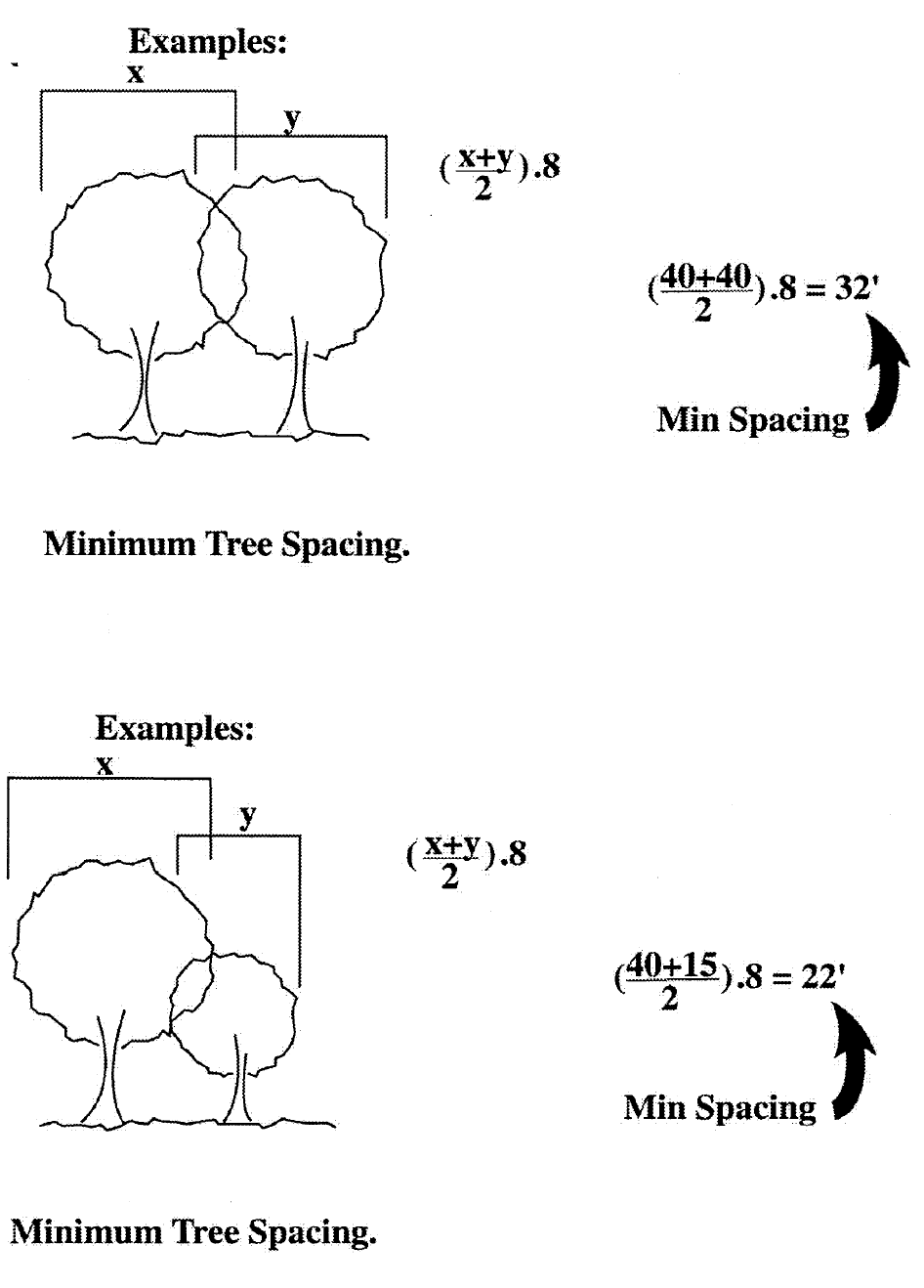
Tree spacing. For design flexibility, trees may be grouped together or spaced evenly as desired. Landscape designs should consider tree placement location, spacing, and clumping to avoid conflicts with wayfinding and business identification signs. However, trees shall be spaced no closer than eighty (80) percent of the average mature width of the trees, as demonstrated in Figure 2.
FIGURE 1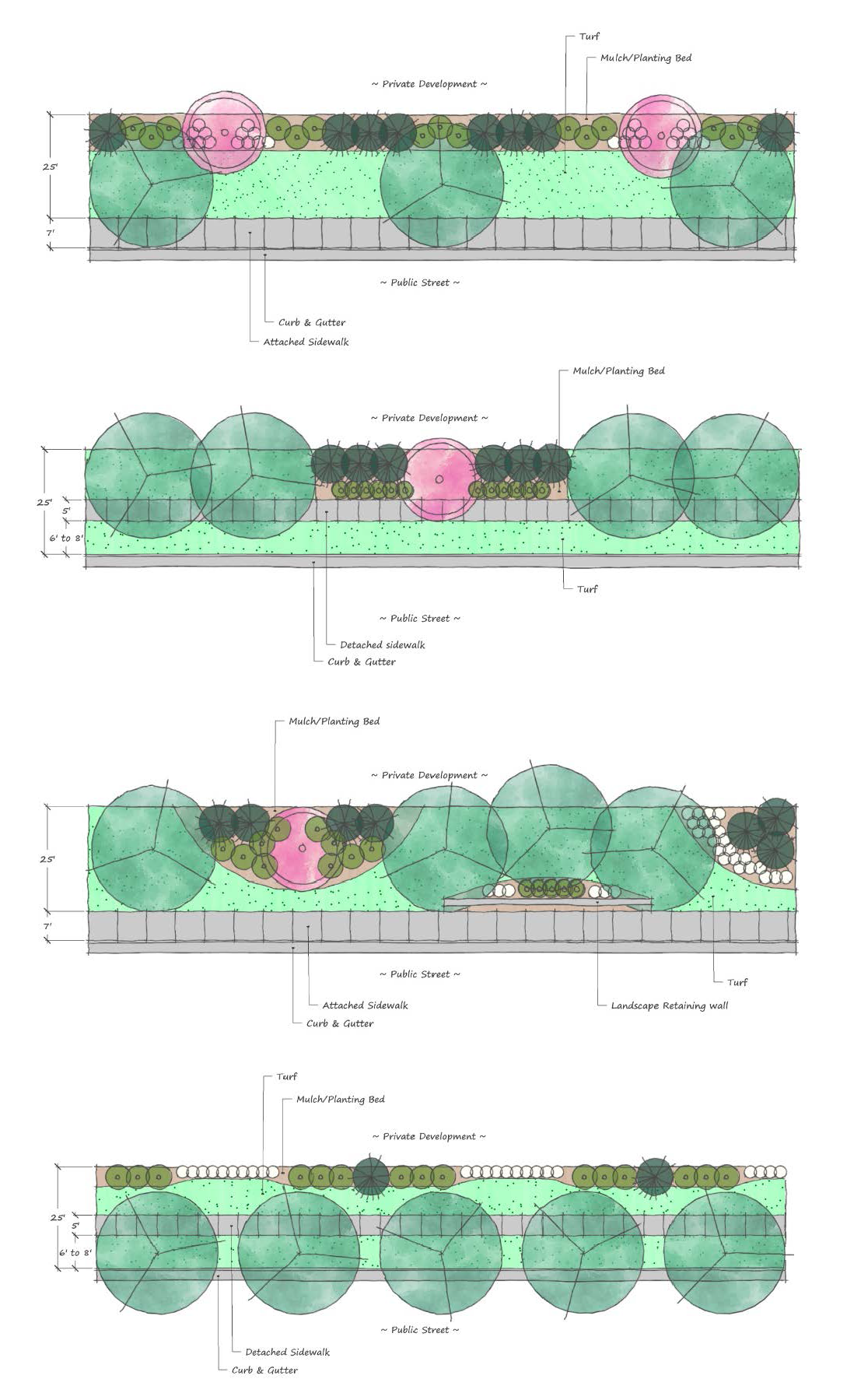
FIGURE 2: TREE SPACING
5.
Landscaping within right-of-way.
a.
If the unimproved street right-of-way is ten (10) feet or greater from the edge of pavement to edge of sidewalk or property line, the developer shall maintain a ten-foot compacted shoulder meeting the construction standards of the transportation authority and landscape the remainder with lawn or other vegetative ground cover.
b.
Landscaping improvements within the right-of-way shall require a license agreement between the property owner and the transportation authority.
6.
Impervious surfaces. Allowed impervious surfaces within the landscape buffer include driveways, outdoor seating, signs and walkways. Vehicle display pads are prohibited in the required buffer.
7.
Berms in street buffers. Berm design is subject to the provisions in accord with subsection 11-3B-5L of this Article.
8.
Stormwater detention. Stormwater swales and other green stormwater facilities may be incorporated into the buffer in accord with Section 11-3B-11 of this Article. Other stormwater detention and retention facilities shall not be permitted in the street buffer, except along I-84.
(Ord. No. 21-1950, §§ 8, 17, 10-10-2021; Ord. No. 22-1968, § 7, 2-8-2022; Ord. No. 22-2001, § 10, 11-1-2022)
11-3B-8. - Parking lot landscaping.
A.
Purpose. The purpose of perimeter and internal parking lot landscaping is to soften and mitigate the visual and heat island effect of a large expanse of asphalt in parking lots, and to improve the safety and comfort of pedestrians.
B.
Applicability. The requirements for perimeter and internal lot landscaping shall apply to all commercial, industrial and multi-family development, with the following exceptions:
1.
Parking spaces adjoining loading areas in the I-L and I-H districts are excluded from the interior landscape requirements.
2.
For parking lot reconstruction, exclusive of sealing, striping, or overlaying, all current landscape standards of this section shall be met, unless approved as set forth in Section 11-1B-4 of this Title.
3.
If the location of existing buildings or other structures prevents conformance with the requirements of this section, or if its implementation would create a nonconformity with parking standards, the Director shall determine how this Article is to be applied through the alternative compliance process.
C.
Standards.
1.
For perimeter landscaping. The following standards apply to the perimeter of parking or other vehicular use areas, including driveways:
a.
Requirement. Provide a five-foot wide minimum landscape buffer adjacent to parking, loading, or other paved vehicular use areas, including driveways, vehicle sales areas, truck parking areas, bus parking areas, and vehicle storage areas, subject to the following exceptions:
(1)
This requirement may be reduced or waived at the determination of the Director where there is a shared driveway and/or recorded cross parking agreement and easement with an adjacent property.
(2)
This requirement may be reduced or waived at the determination of the Director for truck maneuvering areas in industrial, mixed-employment and high-density employment districts.
b.
Landscaping. The perimeter landscape buffer shall be planted with one Class II or Class III tree per thirty-five (35) linear feet and shrubs, lawn, or other vegetative ground cover.
c.
Encroachments. Structures less than one hundred twenty (120) square feet, including, but not limited to, trash enclosures and storage sheds, may encroach into a required landscape buffer, excluding any buffer to adjoining residential uses as set forth in Section 11-3B-9 of this Article.
2.
For internal landscaping. Interior parking lot landscaping shall be required on any parking lot with more than twelve (12) spaces. The following standards apply to internal landscaping:
a.
Planter size. Landscape planters shall contain a minimum of fifty (50) square feet, and the planting area shall not be less than five (5) feet in any dimension, measured inside curbs. The only exception to the five-foot minimum dimension is at the tip of triangular planters located at the end of rows of angled parking.
b.
Parking spaces. No linear grouping of parking spaces shall exceed twelve (12) in a row, without an internal planter island. The planter island shall run the length of the parking space and may be reduced by two (2) feet to allow for improved vehicular maneuvering.
c.
Parking lot layout. Interior landscaping shall, insofar as possible, be used to delineate and guide major traffic movement within the parking area so as to prevent cross space driving. Interior landscape planters shall be spaced as evenly as feasible and at the ends of rows of parking throughout the lot to consistently reduce the visual impact of long rows of parked cars.
d.
Trees required. Each interior planter that serves a single row of parking spaces shall be landscaped with at least one (1) tree and shall be covered with low shrubs, lawn, or other vegetative ground cover. Each interior planter that serves a double row of parking spaces shall have at least two (2) trees and shall be covered with low shrubs, lawn, or other vegetative ground cover. Trees shall be centered within the planters and provide urban canopy. Deciduous urban canopy trees shall be pruned to a minimum height of eight (8) feet above the adjacent parking areas. Evergreen trees and class III trees are prohibited in interior planters.
e.
Design flexibility. In parking areas where the strict application of this subsection C will seriously limit the function and circulation of the lot, up to fifty (50) percent of the required landscaping may be located near the perimeter of the paved area or adjacent to pedestrian corridors to emphasize entrance corridors, pedestrian safety, or special landscape areas within the general parking area. Such required interior landscaping that is relocated shall be in addition to perimeter landscape and right-of-way screening requirements.
(Ord. No. 21-1950, § 17, 10-10-2021)
11-3B-9. - Landscape buffers to adjoining uses.
A.
Purpose. The requirements in this section shall apply to the landscape buffer to residential and/or nonindustrial uses in Section 11-2B-3, Table 11-2B-3 and Section 11-2C-3, Table 11-2C-3 of this Title. The landscape requirements in this section are intended to ensure that incompatible, adjoining land uses are adequately protected and are provided an appropriate amount of land separation to conduct permitted uses without causing adverse impact.
B.
Applicability. The landscape buffer is required in the C-N, C-C, C-G, L-O, M-E, H-E, and I-L districts on any parcel sharing a contiguous lot line with a residential land use. The landscape buffer is required in the I-H district on any property sharing a contiguous lot line with a nonindustrial use.
C.
Standards.
1.
Buffer materials. The materials within the required buffer between incompatible land uses are regulated as follows:
a.
Mix of materials. All buffer areas shall be comprised of, but not limited to, a mix of evergreen and deciduous trees, shrubs, lawn, or other vegetative ground cover. Fences, walls and berms may also be incorporated into the buffer area as set forth in subsection 11-3B-7C2c of this Article.
b.
Barrier effectiveness. The required buffer area shall result in a barrier that allows trees to touch five (5) years of planting. Trees that will not touch until maturity outside of this timeframe must be supplemented with additional materials such as tall columnar evergreen shrubs, or other qualifying materials.
c.
Buffer wall and/or fence. Where existing or proposed adjacent land uses cannot be adequately buffered with plant material(s), the city may require inclusion of a wall, fence, or other type of screen that mitigates noise and/or unsightly uses. If a wall or fence at least six (6) feet tall is provided, the planting requirement may be reduced to a minimum of one (1) tree per thirty-five (35) linear feet, plus shrubs, lawn, or other vegetative ground cover.
d.
Chainlink fencing. Chainlink fencing with or without slats does not qualify as a screening material. Except in the I-L and I-H districts, chainlink or cyclone fencing is prohibited within required buffers between different land uses. Chainlink may be used beyond the required buffer.
2.
Minimum buffer size. The width of the buffer is determined by the district in which the property is located, unless such width is otherwise modified by City Council at a public hearing with notice to surrounding property owners. The tables of dimensional standards for each district in accord with Chapter 2, "District Regulations", of this Title establish the minimum buffer size. A reduction to the buffer width shall not affect building setbacks; all structures shall be set back from the property line a minimum of the buffer width required in the applicable zoning district.
3.
Pedestrian access. Landscape buffers shall facilitate safe pedestrian access from residential development to abutting commercial districts and vice versa.
4.
Relationship to parking lot perimeter requirements. All buffers between different land uses may include any required perimeter parking lot landscape buffers (see subsection 11-3B-8C of this Article) when calculating the minimum width of the buffer.
(Ord. No. 21-1950, § 17, 10-10-2021)
11-3B-10. - Tree preservation.
A.
Purpose. The regulations of this section are intended to preserve existing trees four-inch caliper or greater from destruction during the development process.
B.
Applicability. Tree preservation is required in all districts.
C.
Standards.
1.
Site plans. Site plans shall make all feasible attempts to maintain existing trees four-inc caliper or greater within their design.
2.
Landscape plan. All existing trees greater than four-inch caliper shall be shown on the landscape plan. Indicate whether each tree is to be retained or removed. Include on the plan a description of how existing trees to be retained are to be protected during construction.
3.
Protection during construction. Existing trees that are retained shall be protected from damage to bark, branches, and roots during construction. The City of Meridian parks department arborist shall approve the protection fence(s) prior to construction. Any severely damaged tree shall be replaced in accord with subsection C5 of this Section.
4.
Construction within the drip line of existing trees. Construction, excavation, or fill occurring within the drip line of any existing tree shall be avoided, except to supplement existing trees with new irrigation. Specific requirements for construction within the drip line of existing trees are as follows:
a.
Paving. Whenever possible, impervious paving surfaces shall remain outside of the drip line of existing trees. When it is not possible, impervious surfaces shall be allowed at a distance from the trunk of a retained tree equal to the diameter of the tree trunk plus five (5) feet.
b.
Grade changes. Grade changes greater than six (6) inches are prohibited within the drip line of existing trees.
c.
Compaction. A fence or barrier that encloses the entire area beneath the tree canopy shall be in place prior to construction.
d.
Utilities. New underground utilities to be placed within the drip line of existing trees shall be installed in accord with subsection 11-3B-5J3 of this Article.
5.
Mitigation.
a.
Mitigation shall be required for all existing trees four-inch caliper or greater that are removed from the site with equal replacement of the total calipers lost on site up to an amount of one hundred (100) percent replacement (Example: Two (2) ten-inch caliper trees removed may be mitigated with four 5-inch caliper trees, five (5) four-inch caliper trees, or seven (7) three-inch caliper trees). Deciduous specimen trees four-inch caliper or greater may count double towards total calipers lost, when planted at entryways, within common open space, and when used as focal elements in landscape design.
b.
No mitigation is required in the following:
(1)
Existing prohibited trees within the property boundary of the project;
(2)
Existing dead, dying, or hazardous trees certified prior to removal by the City of Meridian Parks Department Arborist;
(3)
Trees that are required to be removed by another governmental agency having jurisdiction over the project.
6.
Required landscaping. Existing trees that are retained or relocated on site may count toward the required landscaping. Existing trees twelve-inch caliper or greater that are verified healthy by the City Arborist or a certified arborist and located within common open space or as focal elements within the site may count equally towards the mitigation of calipers lost from other removed trees. Mitigation trees are in addition to all other landscaping required by this Article.
7.
Incentives. The director may allow a reduction up to ten (10) percent of the required parking spaces to accommodate existing trees through the alternative compliance process in accord with Chapter 5, "Administration", of this Title. Approval of an alternative compliance application for a reduction in required parking shall be obtained prior to submittal of plans.
(Ord. No. 21-1950, § 17, 10-10-2021)
11-3B-11. - Stormwater integration.
A.
Purpose. The regulations of this section are intended to improve water quality and provide a natural, effective form of flood and water pollution control through the integration of vegetated, well designed stormwater filtration swales and other green stormwater facilities into required landscape areas, where topography and hydrologic features allow.
B.
Applicability. The standards for stormwater integration shall apply to all subdivisions, site improvements and ACHD stormwater facilities. ACHD stormwater policy shall supersede city requirements for stormwater facilities, except that facilities counting toward open space requirements must also meet or exceed city requirements.
C.
Standards.
1.
Stormwater swales incorporated into required landscape areas shall be vegetated with grass or other appropriate plant materials. Such swales shall also be designed to accommodate the required number of trees as per Section 11-3B-7 of this Article if located in a street buffer or other required landscape area.
2.
A rock sump may be incorporated into a vegetated swale to facilitate drainage. The rock sump inlet may not exceed more than five (5) feet in any horizontal dimension.
3.
Gravel, rock, sand, or cobble stormwater facilities are not permitted on the surface of required landscape areas, unless designed as a dry creek bed or other design feature.
4.
Plant materials shall be a species that are able to withstand the anticipated changes in soil wetness and moisture levels.
5.
Organic mulch shall not be used against drainage catch basins because of potential sediment clogging.
6.
Slopes shall be less than or equal to three to one (3:1) (horizontal:vertical) for accessibility and maintenance.
7.
The stormwater facility shall be designed free draining with no standing water within forty-eight (48) hours of the completion of a storm event.
(Ord. No. 21-1950, § 17, 10-10-2021)
11-3B-12. - Pathway landscaping.
A.
Purpose. The purpose of this section is to promote trees and other landscaping along pathways developed within the City. The required landscaping will provide shade and visual interest along the pathways.
B.
Applicability. Wherever pathways are installed and/or required, the landscaping standards within this section shall apply.
C.
Standards.
1.
Planter width. A landscape strip a minimum of five (5) feet wide shall be provided along each side of the pathway. Designs are encouraged in which the width of the landscape strip varies to provide additional width to plant trees farther from the pathway, preventing root damage. The minimum width of the landscape strip shall be two (2) feet to allow for maintenance of the pathway. Alternative compliance as set forth in Section 11-5B-5 of this Title shall not be required to meander the pathway as long as a total width of ten (10) feet of landscaping is maintained along the pathway.
2.
Required plants. The landscape strips shall be planted with a mix of trees, shrubs, lawn, and/or other vegetative ground cover. There shall be a minimum of one (1) tree per one hundred (100) linear feet of pathway. If this calculation results in a fraction of five (5) or greater, round up to an additional tree; if the calculation results in a fraction less than five (5), round the number down.
3.
Improvements. The pathway construction shall be in accordance with the site specific geotechnical report for light duty paving. In the cases where no geotechnical report is available pathways shall be built using two and one-half (2.5) inches of asphaltic concrete over four (4) inches of crushed aggregate base over ten (10) inches of structural subbase over compacted subgrade. Materials and methods shall conform to ISPWC standard specifications.
4.
Tree branching height. Trees along the pathway shall be pruned with a clear branching height of at least eight (8) feet above the path surface.
5.
Shrub height. Shrubs are limited to three (3) feet high or less at mature size to allow for safety provisions and sight distance.
6.
Mulch. The solitary use of mulches, such as bark alone without vegetative ground covers, is prohibited. Mulch under the trees and shrubs is required in accord with subsection 11-3B-5H of this Article.
7.
Prohibited trees. No evergreen trees or class III trees shall be planted within the required landscape strips of less than ten (10) feet because of safety, sight distance, and maintenance concerns.
8.
Fences. See Section 11-3A-7 of this Chapter for pathway fencing standards.
(Ord. No. 21-1950, § 17, 10-10-2021)
11-3B-13. - Landscape maintenance.
A.
Purpose. The regulations of this section are intended to ensure that all required landscaping is maintained in a healthy, growing condition at all times.
B.
Applicability. The requirement for landscape maintenance applies in all districts where landscaping has been required.
C.
Standards.
1.
Responsibility. The property owner is responsible for the maintenance of all landscaping and screening devices required by this Article.
2.
Topping prohibited. Topping any street tree required by this Article is prohibited.
3.
Tree grates. Tree grates shall be widened to accommodate the growing tree trunk and prevent girdling of any trees planted in tree wells within sidewalks or other public right-of-way.
4.
Dead and diseased plant materials. Plant materials that exhibit evidence of insect pests, disease, and/or damage shall be appropriately treated to correct the problem. Dead plant materials shall be replaced.
5.
Inspections. All landscaping required by this subsection may be subject to periodic inspections by city officials to determine compliance or to investigate.
6.
Pruning. The lower branches of trees shall be pruned and maintained at a minimum height of six (6) feet above the ground or walkway surface to afford greater visibility of the area, except as otherwise required herein.
(Ord. No. 21-1950, § 17, 10-10-2021)
11-3B-14. - Installation.
A.
Certificate of completion. A written certificate of completion shall be prepared by the landscape architect, landscape designer or qualified nurseryman responsible for the landscape plan upon completion of the landscape installation. The certificate of completion shall verify that all landscape improvements, including plant materials and sprinkler installation, are planted and installed in substantial compliance with the approved landscape plan and details.
B.
Installation schedule.
1.
All required landscaping, irrigation systems and site features shall be installed according to the approved landscape plan prior to issuance of a final certificate of occupancy.
2.
All pathways conveyed to the City for permanent maintenance, must be inspected and compaction tested prior to issuance of a final certificate of occupancy.
3.
Private site improvements that are above and beyond the requirements placed on the development do not require completion prior to occupancy. (For example: A clubhouse in a residential development need not be completed prior to occupancy of residences in the development.)
4.
For final plats, all landscape buffers along streets, with the exception of local streets, shall be installed prior to signature on the final plat. Street buffers on local streets may be installed at the time of the lot development; installation of such improvements shall not be required at the time of plat approval.
C.
Extension of time for installation.
1.
Nonresidential. The Director, may recommend issuance of a certificate of occupancy for non-residential projects for a specified time period, not to exceed one hundred eighty (180) days when:
a.
Due to inclement weather or other extenuating circumstances, the landscaping or other required site amenities cannot be completed.
b.
The applicant has provided surety to the City for the required improvements consistent with the provisions of Chapter 5, Article C, "Surety Agreements", of this Title.
2.
Residential. The Director, may recommend issuance of a certificate of occupancy for residential dwelling units when:
a.
Due to inclement weather or other extenuating circumstances, the landscaping or other required site amenities cannot be completed.
b.
The applicant has provided surety to the City for the required improvements consistent with the provisions of Chapter 5, Article C, "Surety Agreements", of this Title.
c.
Within ninety (90) days of the first certificate of occupancy being issued, all required landscaping, irrigation systems and site features shall be installed, or additional certificate of occupancies will be withheld.
(Ord. No. 21-1950, §§ 9, 17, 10-10-2021)
11-3C-1. - Purpose.
The purpose of this article is to provide regulations and standards for off street parking and loading facilities with the intent to provide off-street parking areas, minimize traffic hazards and congestion, and mitigate impacts on surrounding properties.
(Ord. 05-1170, 8-30-2005, eff. 9-15-2005)
11-3C-2. - Applicability.
The following standards shall apply to any new construction, alteration, or moving of a structure or any new or more intense use of property. The number of off-street parking spaces, as set forth in this article, shall be provided for all allowed uses in any district. A greater number of spaces may be required in any application involving a conditional use permit.
(Ord. 05-1170, 8-30-2005, eff. 9-15-2005)
11-3C-3. - Process.
An off-street parking and loading plan shall be required as a component of any discretionary permit or applicable building permit. Such plan shall show the following:
A.
The off-street parking and loading plan shall contain the location, size, and type of all proposed off-street parking and loading facilities.
B.
If the proposed development project shall be completed in phases, such phases shall be noted on the plan.
(Ord. 05-1170, 8-30-2005, eff. 9-15-2005)
11-3C-4. - Parking standards for single-family detached, townhouses, secondary, duplex and single-family attached dwellings.
A.
Use and design of parking areas.
1.
Use of parking spaces. Required parking spaces shall be used for vehicle parking only.
2.
Types of vehicles; location of parking.
a.
Street yard. The following vehicles may be parked in the street yard:
(1)
Automobiles and motorcycles displaying license plates assigned to the vehicle with current registration; and
(2)
One (1) other vehicle, which may include a recreational vehicle or trailer displaying license plates assigned to the vehicle with current registration, or one (1) boat, off-highway vehicle, or specialty off-highway vehicle.
Vehicles with a gross vehicle weight rating of sixteen thousand (16,000) pounds or more shall not be parked in the street yard. Vehicles parked in the street yard shall not encroach upon any sidewalk or public right-of-way.
b.
Side yard, unscreened. If no recreational vehicle, personal recreational item, boat, or trailer is parked in the street yard, one (1) of the following vehicles may be parked in a side yard that is not screened by a solid fence: a recreational vehicle, personal recreational item, boat, or trailer.
c.
Rear or side yard. Except as otherwise allowed by this section, the following vehicles shall be parked in the rear or side yard and shall be screened by a solid fence, six (6) feet in height:
(1)
Vehicles other than automobiles and motorcycles;
(2)
Vehicles without current registration; and/or
(3)
Vehicles without license plates assigned to the vehicle.
3.
Corner properties. On corner properties vehicles may be parked in the street side yard where such area is screened by a solid fence, six (4) feet in height; see Section 11-3A-7 of this Chapter for fencing regulations in street yards.
4.
Location of parking spaces relative to structure(s).
a.
Parking spaces for all single-family detached, townhouse, secondary, and duplex dwellings shall be located on the same lot as the use that they are intended to serve.
b.
Parking for single-family attached dwellings shall be located not more than three hundred (300) feet from the structure(s), except as provided by Section 11-3C-7 of this Article.
5.
Drainage of surface water. All parking and loading areas shall provide property drainage of surface water to prevent the drainage of such water onto adjacent properties or walkways.
6.
Type and number of parking spaces. All parking areas shall be designed and constructed to provide the type and number of off-street parking spaces required by section 11-3C-6 of this article.
B.
Improvements. Off-street parking areas in the street yard and driveways into and through a parking area in the street yard shall be improved with a compacted gravel base, not less than four (4) inches thick, surfaced with concrete or asphaltic pavement. No person shall park, or allow to be parked, any vehicle in the required street yard on any surface other than compacted gravel base, not less than four (4) inches thick, surfaced with concrete or asphaltic pavement.
(Ord. 12-1514, 5-16-2012, eff. 5-21-2012; Ord. 19-1833, 7-9-2019; Ord. No. 21-1950, §§ 3, 4, 10-10-2021)
11-3C-5. - Parking standards for all other uses not specified.
A.
Use and design of parking areas.
1.
Type and number of parking spaces. All parking areas shall be designed and constructed to provide the type and number of off-street parking spaces required by Section 11-3C-6 of this Article, and designed as required by this section.
2.
Location of parking spaces relative to structure(s).
a.
Parking spaces for nonresidential uses shall be located not more than five hundred (500) feet from structure(s), except as provided by Section 11-3C-7 of this Article.
b.
For any vertically integrated residential project, not more than ten (10) percent of the required parking shall be located in the front of the structure.
3.
Landscape buffer. Off street parking spaces shall not be located in any landscape buffer as required by Article B, "Landscaping Requirements", of this Chapter.
4.
Parking lot design. Parking lots shall be designed in accord with Section 11-3B-8, "Parking Lot Landscaping", of this Chapter.
5.
Parking stall and driving aisle design. Parking stalls and driving aisles shall be designed in accord with the standards in Table 11-3C-5 of this Section. Figure 1 of this Section shows the parking design dimensions.
6.
Design for standard vehicles. All required parking as determined in Section 11-3C-6 of this Article shall be designed for standard and/or oversized vehicles. Compact stalls are discouraged, but may be used for any parking above the number of required parking spaces.
7.
On-site turnarounds; connections. All parking areas shall provide on-site turnarounds, or connections through to adjacent parking areas or streets, in accord with the Meridian Fire Department Standards for all off street parking spaces and loading facilities.
8.
Moving of cars. The design of off-street parking areas shall not require moving any car to gain access to a required parking space.
9.
ADA requirements. It is the responsibility of the applicant to ensure that the parking lot design and sidewalk and/or access provisions meet all Americans with Disabilities Act (ADA) requirements.
TABLE 11-3C-5
REQUIRED STALL AND DRIVE AISLE DIMENSIONS
Notes:
1
Stalls designed for compact vehicles may be reduced in depth by two (2) feet.
2
The "drive aisle only" standards are for drive aisles that do not have any adjacent parking stalls.
FIGURE 1
PARKING SPACE MEASUREMENTS
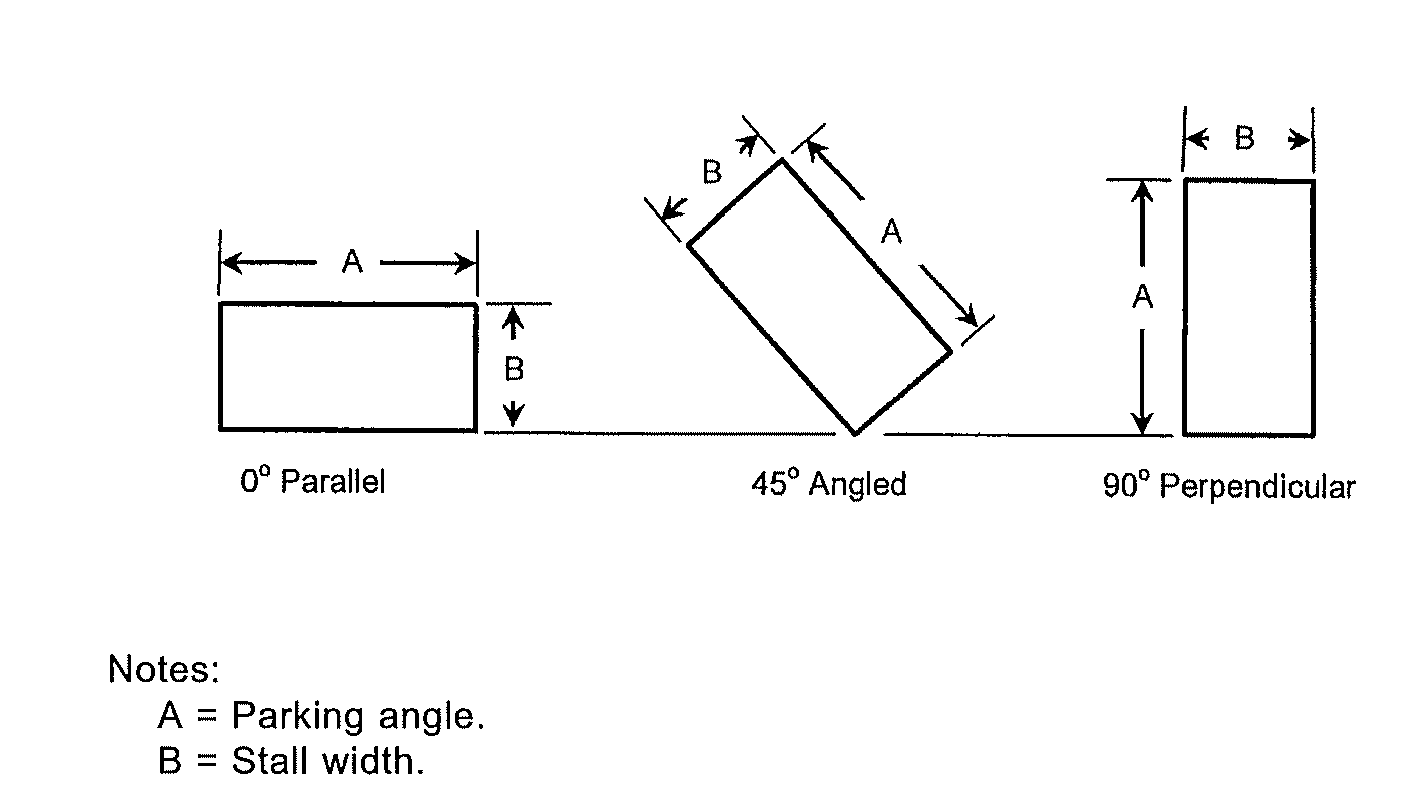
B.
Improvements.
1.
All off street parking areas and driveways into and through a parking area shall be improved with a compacted gravel base, not less than four (4) inches thick, surfaced with asphaltic pavement. Infrequently used parking areas, as determined by the director, may be improved with other dustless materials, including, but not limited to, asphalt, concrete, pavers, bricks, or recycled asphalt (asphalt grindings). In such cases, the Meridian public works department shall review and approve of the dustless material improvement prior to construction.
2.
All parking and loading areas shall provide proper drainage of surface water to prevent the drainage of such water onto adjacent properties or walkways.
3.
Except as otherwise provided in this section, all off street parking areas shall be provided with a substantial wheel restraint to prevent cars from encroaching upon abutting private and public property or overhanging beyond the designated parking stall dimensions. The director may waive this requirement for internal parking spaces not adjoining a property boundary, landscape island, sidewalk, pathway, or any similar development feature. This standard shall not apply to temporary uses.
4.
When a bumper overhangs onto a sidewalk or landscape area, the parking stall dimensions may be reduced two (2) feet in length if two (2) feet is added to the width of the sidewalk or landscaped area planted in ground cover.
5.
Parking spaces and access lanes shall be marked, including handicapped symbols and signs.
6.
All lighting provided to illuminate a parking area shall comply with the lighting standards provided in Article A, "standard regulations in all districts", of this Chapter.
7.
All landscaping improvements shall comply with Article B, "landscaping requirements", of this Chapter.
C.
Bicycle parking facilities. Bicycle parking facilities shall meet the following location and design standards:
1.
Bicycle parking facilities shall be located as close as possible to the building entrance(s) and shall not obstruct pedestrian walkways, public sidewalks, or building entrances.
2.
It is the responsibility of the applicant to ensure that the bicycle parking facilities meet all Americans with Disabilities Act (ADA) requirements.
3.
Bicycle parking facilities shall support the bicycle upright by its frame and allow the owner to lock both the frame and front wheel with one (1) lock.
4.
Bicycle parking facilities abutting a structure, street furniture, landscaping, or other improvements should be installed with a minimum clearance of three (3) feet from other improvements so that parking of bicycles will not cause damage or prevent pedestrian access.
5.
Bicycle parking facilities shall be a minimum of thirty-four (34) inches in height and shall be securely anchored to the ground.
(Ord. 05-1170, 8-30-2005, eff. 9-15-2005; Ord. 06-1241, 7-5-2006, eff. 7-15-2006; Ord. 07-1325, 7-10-2007; Ord. 08-1372, 7-8-2008, eff. 7-8-2008; Ord. 09-1420, 6-23-2009, eff. 6-23-2009; Ord. 10-1463, 11-3-2010, eff. 11-8-2010; Ord. 13-1555, 5-14-2013; Ord. No. 22-2001, § 11, 11-1-2022)
11-3C-6. - Required number of off-street parking spaces.
A.
The minimum number of required off street vehicle parking spaces for residential uses shall be in accord with table 11-3C-6 of this subsection.
TABLE 11-3C-6
REQUIRED PARKING SPACES FOR RESIDENTIAL USE
Notes:
1
The size of the garage required for dwelling units shall be measured by exterior dimensions and shall be at least ten (10) feet by twenty (20) feet for a one-space garage and twenty (20) feet by twenty (20) feet for a two-space garage. The minimum size of a carport that covers a parking stall shall be at least nine (9) feet by seventeen (17) feet. All other required parking shall meet the required stall and drive aisle dimensions in UDC Table 11-3C-5.
2
The parking pad shall be measured from edge of sidewalk or edge of paved travel lane (public street, private street, or alley) where no sidewalk exists. For alley accessed properties the parking pad is not required in front of the garage if the garage is located at the five-foot setback to the rear property line; the required parking pad must be provided along the side of the garage unless equivalent off-street parking, as determined by the Director, is provided in accord with Section 11-3C-5, Table 11-3C-5 of this article.
3
For condominium projects, the required number of parking spaces shall be determined by the Director based on the proposed development. If the proposed development is similar to a single-family development, such standards shall apply. If the proposed development is similar to a multifamily apartment complex, such standards shall apply.
4
The required number of parking spaces for the residential portion of a vertically integrated project shall be in addition to that required for nonresidential uses as listed in subsection B of this section.
5
The required number of parking spaces associated with a nonresidential structure approved as an amenity for a multi-family development (i.e., clubhouse, fitness center, etc.) shall be exempt from the parking standards required for nonresidential uses as listed in subsection B.
B.
The following standards shall apply for off street vehicle parking for nonresidential uses:
1.
In all commercial and residential districts the requirement shall be one (1) space for every five hundred (500) square feet of gross floor area, except for self-service storage facilities which shall only require parking based on the gross floor area of any office space.
2.
In all industrial districts the requirement shall be one (1) space for every two thousand (2,000) square feet of gross floor area, except for self-service storage facilities which shall only require parking based on the gross floor area of the office space.
3.
In all traditional neighborhood districts the requirement shall be one (1) space for every one thousand (1,000) square feet of gross floor area. Lawfully existing structures in traditional neighborhood districts shall not be required to comply with the requirements of this section except when a proposed addition increases the number of off-street parking spaces normally required, then the applicant shall provide additional parking as set forth in this section.
4.
In circumstances where there would appear to be a public safety issue, the director may request additional information from the applicant to determine if there is sufficient parking. When in the determination of the director there is insufficient parking, the applicant shall provide alternatives to off street parking as set forth in Section 11-3C-7 of this article. The determination by the director shall be based on the following criteria:
a.
The specific use(s) proposed and/or on the property;
b.
Uses in the vicinity of the property;
c.
A traffic study, if prepared, forecasting the expected traffic and parking needs expected from the use(s);
d.
The availability of on street, shared, and/or public parking within the vicinity of the use; and/or
e.
The availability of public transit, vanpooling or other alternative transportation to serve the use.
C.
Upon any change of use, the number of vehicle parking spaces to be provided shall be calculated according to the requirements of this article for the new use.
D.
It is the responsibility of the applicant to ensure that the size and number of handicap accessible spaces meets all Americans with Disabilities Act (ADA) requirements.
E.
The required vehicle parking spaces shall be provided and continuously maintained.
F.
No required parking area or space provided, as required by this article, shall later be eliminated, reduced, or converted in any manner unless other equivalent facilities approved by the director are provided.
G.
One (1) bicycle parking space shall be provided for every twenty-five (25) proposed vehicle parking spaces or portion thereof, except for single-family residences, two-family duplexes, and townhouses.
H.
If the calculation of the number of off-street parking spaces results in a fraction, such number shall be rounded up or down to the next whole number. fractions less than one-half (0.5) shall be rounded down to the whole number and fractions which are one-half (0.5) and greater shall be rounded up to the next higher whole number.
(Ord. 05-1170, 8-30-2005, eff. 9-15-2005; Ord. 07-1325, 7-10-2007; Ord. 14-1592, 1-21-2014; Ord. 16-1672, 2-16-2016; Ord. 19-1833, 7-9-2019; Ord. No. 21-1950, § 10, 10-10-2021; Ord. No. 22-2001, § 12, 11-1-2022; Ord. No. 23-2037, § 3, 10-3-2023; Ord. No. 24-2062, § 9, 10-8-2024)
11-3C-7. - Parking standard alternatives.
Alternatives to providing off-street parking as set forth in this section are encouraged in all developments. When required to meet minimum parking standards of Sections 11-3C-5 and 11-3C-6 of this article, alternatives shall include, but not be limited to, shared use facilities, public-private partnerships for facilities such as parking structures or bicycle locker and storage areas, access to transit and availability of other forms of transportation such as car pools and vanpools.
A.
Favorable conditions. Conditions favorable to providing alternatives to off street parking are as follows:
1.
Shared use.
a.
There are convenient pedestrian connections between separate properties;
b.
The properties and/or uses are within one thousand (1,000) feet of each other;
c.
The principal operating hours of the uses are not in substantial conflict with one another; and
d.
Directional signs provide notice of the availability of parking.
2.
Alternative transportation.
a.
There is a transit stop within one-fourth (¼) mile of the use; or
b.
There is an incentive program for carpooling, vanpooling, or transit supported by the employer.
3.
Old town (O-T) district. In addition to the alternatives listed herein, properties within the old town (O-T) district are also eligible for the provisions listed in subsection D of this section.
B.
Shared use agreement.
1.
All parties involved with the shared use parking area shall submit a written agreement to the director, signed by the applicable parties involved. The agreement shall specify the following:
a.
Party or parties responsible for construction; and
b.
Party or parties responsible for maintenance.
2.
The applicant or owner shall record such agreement with the Ada County Recorder prior to issuance of any permits.
3.
The shared use parking agreement may be terminated by the parties only if off street parking is provided in conformance with this article and approved by the director prior to the termination.
C.
Alternative transportation. Where alternative modes of transportation are available, off street parking may be reduced by an equivalent amount to the demand that is met by the alternative transportation mode, as documented in a transportation plan prepared by a registered engineer.
D.
Old town (O-T) district alternatives. To encourage creative parking solutions the following alternatives are also available to properties located in the old town (O-T) district.
1.
Credit. Any addition or new construction on property where a lawful structure exists, the applicant is eligible for an existing structure credit. Off street parking for the existing square footage of a structure shall not be required, provided the applicant apply for a parking credit. Unless otherwise explicitly required by previous city approval, existing off-street parking need not be retained on properties where additions and new construction is proposed. The following must be satisfied to obtain a parking credit:
a.
The existing square footage shall be verified through the Ada County Tax Assessor's records.
b.
For existing structures to be demolished, the square footage of the new structure shall be equal to or greater than the existing structure.
c.
For existing structures to be demolished, construction of a new structure shall commence within eighteen (18) months of demolition permit issuance.
2.
Innovative solutions. The city recognizes that there may be innovative parking proposals that conform to the purpose, intent, and objectives of this article but were not anticipated in the specific regulations. This subsection sets forth a method for compliance in the event an innovative parking solution is proposed. The Director may approve, or recommend approval of, an innovative alternative parking solution in Old Town, when the following are satisfied:
a.
Meridian Development Corporation (MDC) recommendation. The applicant or owner shall obtain a written recommendation on the parking compliance method proposed from the Meridian Development Corporation (MDC) board. Said recommendation from the MDC board shall accompany the submittal of a development application.
b.
Approval. To grant approval, the director shall determine the following:
(1)
The solution proposed mitigates the additional demand created by the new or expanded use;
(2)
The proposal will not negatively impact nearby parking or impair the character of surrounding properties;
(3)
Strict adherence or application of the parking requirements on the subject site are not feasible or desirable in Old Town; and
(4)
The solution is not materially detrimental to public health, safety or welfare.
E.
Alternative off-street parking and loading plan. The Director may approve, or recommend approval of, an alternative off street parking and loading plan, through the alternative compliance process specified in section 11-5B-5 of this title when the overall design, as proposed by the applicant, meets or exceeds the intent and the requirements of this article. Mitigating circumstances might include, but not be limited to, access to an adequate public transit system and/or an unusually low parking demand.
(Ord. 14-1592, 1-21-2014)
11-3C-8. - Off-street loading space requirements.
A.
Off-street loading spaces for commercial and industrial uses shall be provided to prevent delivery vehicles from blocking travel lanes.
B.
Parking and loading areas shall be designed so vehicles shall not back out into the street.
C.
No off-street loading space shall be located closer than fifty (50) feet to an abutting rural or residential district unless wholly enclosed within a sound attenuating structure, such as masonry block. No off-street loading space shall face an abutting residential district.
D.
Any off-street loading space located within fifty (50) feet of a residential district shall not operate between the hours of 10:00 p.m. and 7:00 a.m..
(Ord. 06-1241, 7-5-2006, eff. 7-15-2006)
11-3D-1. - Purpose.
The regulations of this article are intended to:
A.
Require architectural and aesthetic harmony for signs as they relate to building design and surrounding landscaping.
B.
Regulate sign size, height, and quality of signs, which will allow for good visibility for the public and the needs of business while providing for the health and safety of the public by minimizing distractions to motorists and pedestrians.
C.
Regulate signs that will be compatible with the building, site conditions and land uses the signs are intended to identify.
D.
Establish design criteria for signs to promote a well maintained and attractive community, which are compatible with their surroundings, and do not detract from the overall visual quality of the city.
E.
Recognize the need for adequate business identification, advertising, and communication for Meridian residents, businesses, employees and visitors.
F.
Establish and facilitate easy and agreeable communication between people.
G.
Set forth procedures that will facilitate the efficient processing of sign applications.
FIGURE 1
SIGN TYPES
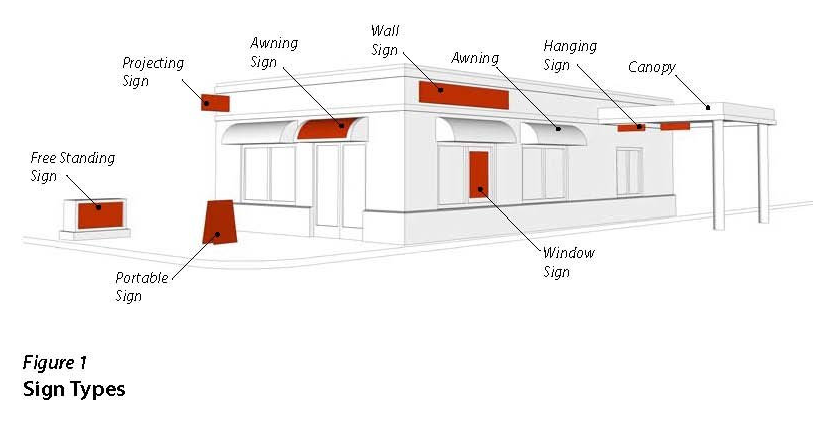
(Ord. 09-1436, 12-15-2009, eff. 1-1-2010)
11-3D-2. - Applicability.
A.
Standards applicable to zoning districts. The sign standards provided in this article are intended to apply to any sign in all zoning districts in the city. Only signs authorized by this article shall be allowed.
B.
Murals and artistic graphics. Murals and artistic graphics, as defined in chapter 1, article A, "definitions", of this title are not regulated by this Code.
C.
Nonconforming signs. Nonconforming signs are subject to the provisions of section 11-1B-6, "nonconforming sign", of this title, in addition to this article. All existing off-premises outdoor advertising signs within the city are nonconforming due to dimensional and/or locational standards.
D.
Change of copy on signs. A permit shall not be required for a change of copy on any sign, nor for the repainting, cleaning or other normal maintenance or repair of a sign or sign structure for which a permit has previously been issued in accord with this code, provided that the sign or sign structure is not altered in any way.
E.
Residential district. For the purposes of this title, the term residential district shall also include the traditional neighborhood residential district.
F.
Exemptions. The provisions of this article shall not apply to the following:
1.
Public hearing notice signs as required by subsection 11-5A-6D of this title.
2.
Conventional flags, emblems, or insignia of any national or political subdivision or corporation.
3.
Governmental signs for the control of traffic or other regulatory purposes, or signs of public service companies indicating danger, that are erected by or on the order of a public officer in the performance of public duty.
4.
Any sign erected by or under the authority of the City of Meridian for direction to places of general interest including, but not limited to, colleges, auditoriums, fairgrounds, hospitals, airports, parks, and playgrounds.
5.
Signs located within the interior of any business that are more than twelve (12) inches away from the window and that are not attached to the window glass.
6.
Memorial signs or tablets, names of buildings and date of erection that are cut into masonry surface or inlaid so as to be part of the building.
7.
Public signs required or specifically authorized for a public purpose by any law, statute or ordinance, that may be of any type, number, area, height above grade, location, illumination or animation as required by the law, statute or ordinance under which the signs are erected.
8.
Historical signs or markers.
9.
"No Trespassing" or "No Dumping" signs that do not exceed one and one-half (1.5) square feet in area per sign and that are located such that they do not exceed one (1) per one hundred (100) feet of the perimeter of the property. Special permission may be obtained from the director for additional signs where hazardous or public nuisance conditions exist.
10.
Signs related to temporary uses regulated by the provisions of title 3, chapter 4 of this code, shall not require a sign permit under the provisions of this title, but shall comply with any and all applicable provisions of title 3, chapter 4 of this Code.
11.
Any sign which is oriented only to the property which it is located and is not visible from the public right-of-way.
(Ord. 09-1436, 12-15-2009, eff. 1-1-2010; Ord. 13-1546, 3-5-2013)
11-3D-3. - Process.
A.
Application required. for projects requiring a sign permit approval, the applicant shall submit a sign permit application. except as otherwise provided in this article, it shall be unlawful for any person to erect, construct, enlarge, move or convert any sign in the city, or cause the same to be done, without a sign permit.
1.
An application and fees, in accord with chapter 5, "administration", of this title, shall be submitted to the director on forms provided by the Planning Department.
2.
The Director shall apply the standards listed in this article to review the sign permit request.
3.
The city's design guidelines shall apply in the evaluation of sign permit applications to ensure that signs meet or exceed the intent of the design guidelines.
4.
No sign permit shall be issued for any property and/or business that has an outstanding notice of violation.
B.
Effect of issuance. No permit for a sign issued hereunder shall be deemed to constitute permission or authorization to maintain an unlawful sign nor shall any permit issued hereunder constitute a defense in an action to abate an unlawful sign.
C.
Maintenance. It shall be the responsibility of the property owner to continually maintain any and all signs on his/her property. The sign, copy, and materials shall be maintained and kept in good condition and repair to guard against decay, unsafe, and poorly maintained signs.
D.
Inspection. The director and/or building official are hereby empowered to enter or inspect, upon notification of the property owner or manager, any building, structure or premises in the city on which or in connection with which a sign is located, for the purpose of inspection of the sign, its structural and electrical connections, and to ensure compliance with the provisions of this code. Such inspections shall be carried out during business hours, unless an emergency exists. The applicant shall attach the permit issued by Planning Department to any approved sign of limited duration in a visible manner and accessible for inspection. Any sign of limited duration that does not have an attached permit shall be in violation of this article.
E.
Signs declared hazardous. The Director and/or building official shall have the authority to order the repair or structural alteration for safety of signs that present a hazard to the public. Upon finding that any sign endangers public safety, the director and/or building official may declare the sign hazardous. The director and/or building official shall send the owner written notice that the sign has been declared hazardous, specifying the reasons why the sign endangers public safety, and order that the sign be repaired or removed by the owner within thirty (30) days. If a sign determined to be hazardous presents an immediate and serious danger to the public, it may be immediately removed by the city without prior notice and the removal costs charged to the owner.
F.
Time limitations on sign permit approval.
1.
Where the sign permit also requires a building permit, the Planning Department approval shall be governed by the building permit. That is to say that as long as the building permit is valid, the Planning Department approval is valid as well. If the building permit is deemed expired, the Planning Department approval of the sign permit expires as well.
2.
Where the sign permit does not require a building permit, the Planning Department approval shall become null and void if erection or construction of the sign on site is not commenced within six (6) months from the date the permit was issued. If work authorized by such permit is suspended or abandoned for six (6) months at any time after the work is commenced the permit shall be null and void.
3.
For any expired sign permit, the applicant shall obtain a new sign permit.
(Ord. 09-1436, 12-15-2009, eff. 1-1-2010)
11-3D-4. - Prohibited signs.
The following types of signs are prohibited in all districts:
A.
Any sign not specifically allowed by this article as determined by the Director.
B.
Any private signs on publicly owned property, including the public right-of-way, except as otherwise specifically permitted, in writing, by the authorized public agency.
C.
Any signs which because of color, wording, design, size, movement, location or illumination resemble or conflict with any traffic control device or with the safe and efficient flow of traffic.
D.
Any sign displaying red, blue or blinking intermittent light likely to be mistaken for a warning or danger signal.
E.
Any signs that emit any sound, odor or visible matter.
F.
Any abandoned nonconforming signs (see Section 11-1B-6 of this title and Section 11-3D-8 of this article).
G.
Any benches with commercially available space for advertising, except that the transportation authority may place such benches at a designated bus stop.
H.
Any sign that includes strobing, revolving or flashing lights.
I.
Any sign using a prohibited light source as set forth in Section 11-3A-11 of this chapter.
J.
Any signs within the clear vision triangle as set forth in Section 11-3A-3, "access to streets", of this chapter.
K.
Any signs advertising illegal activity.
L.
Any signs that block the visibility of any other sign due to their location, size, and/or height within a fifty-foot radius.
M.
Any roof signs.
N.
Any sign within any stream or drainage canal or within a floodway.
O.
Any sign not maintained in a safe condition.
P.
Any sign advertising an establishment that sells a controlled substance or drug paraphernalia, as such terms are defined in I.C. 37.2701.
(Ord. 13-1546, 3-5-2013; Ord. No. 23-2030, § 1, 8-22-2023)
11-3D-5. - Subdivision identification signs.
The following standards shall apply to subdivision identification signs:
A.
General standards for subdivision identification signs. The following standards shall apply to subdivision identification signs in all districts:
1.
Subdivision identification signs may be nonilluminated or may have indirect, internal, or direct illumination. Neon tube illumination is prohibited.
2.
Subdivision identification signs using direct illumination shall target the lighting to the copy area of the sign to prevent trespass lighting and/or light pollution.
3.
Subdivision identification signs located within medians shall be a minimum of twenty (20) feet back from the right-of-way line of the perpendicular street.
4.
Subdivision identification signs shall only identify the subdivision name (or the name under which it is being marketed) or development name (including, but not limited to, a multi-family or commercial development). Such signs shall not identify any business, tenant, or developer names.
5.
No part of a subdivision identification sign, including the footing, shall be located closer than one (1) foot from any street property line and five (5) feet from any rear or interior side property line, unless greater separation is required.
6.
A permit is required for any subdivision identification sign.
B.
Signs in residential districts. In addition to the general standards for subdivision identification signs set forth in this section, the following standards shall apply to subdivision identification signs in residential districts (R-2, R-4, R-8, R-15, R-40, and TN-R):
1.
The maximum allowed background area for subdivision identification signs shall not exceed fifty (50) square feet.
2.
The maximum height of any subdivision identification sign shall not exceed six (6) feet. See subsection 11-1-5B5 of this title for architectural element standards.
3.
A maximum of two (2) subdivision identification signs are allowed at each street entrance to the development or subdivision.
C.
Signs in commercial districts. In addition to the general standards for subdivision identification signs set forth in this section, the following standards shall apply to subdivision identification signs in commercial districts (L-O, C-N, C-C, C-G, M-E, and H-E):
1.
The maximum allowed background area for subdivision identification signs in L-O, C-N, C-C, and M-E districts shall not exceed one hundred (100) square feet.
2.
The maximum allowed background area for subdivision identification signs in C-G and H-E districts shall not exceed two hundred (200) square feet.
3.
The maximum height of any subdivision identification sign shall not exceed the maximum building height of the district.
4.
A maximum of one (1) subdivision identification sign is allowed at each street entrance to the development or subdivision.
D.
Signs in traditional neighborhood districts. In addition to the general standards for subdivision identification signs set forth in this section, the following standards shall apply to subdivision identification signs in traditional neighborhood districts (O-T and TN-C):
1.
The maximum allowed background area for subdivision identification signs shall not exceed eighty (80) square feet.
2.
The maximum height of any subdivision identification sign shall not exceed the maximum building height of the district.
3.
A maximum of one (1) subdivision identification sign is allowed at each street entrance to the development or subdivision.
E.
Signs in industrial districts. In addition to the general standards for subdivision identification signs set forth in this section, the following standards shall apply to subdivision identification signs in industrial districts (I-L and I-H).
1.
The maximum allowed background area for subdivision identification signs shall not exceed one hundred fifty (150) square feet.
2.
The maximum height of any subdivision identification sign shall not exceed the maximum building height of the district.
3.
A maximum of one (1) subdivision identification sign is allowed at each street entrance to the development or subdivision.
(Ord. 09-1436, 12-15-2009, eff. 1-1-2010; Ord. 13-1546, 3-5-2013; Ord. 16-1672, 2-16-2016)
11-3D-6. - Marketing signs.
The following standards shall apply to signs on properties being marketed for lease and/or sale:
A.
General standards for marketing signs. The following standards shall apply to marketing signs in all districts:
1.
All marketing signs shall meet the setback standards in subsection 11-3D-8A3 of this article.
2.
A maximum of three (3) marketing signs are allowed for properties abutting a collector or an arterial street and a maximum of one marketing sign is allowed for all other properties.
3.
Illumination is prohibited for any marketing sign.
4.
A permit is not required for any marketing sign.
B.
Signs in residential districts for three or less dwelling units. In addition to the general standards for marketing signs set forth in this section, the following standards shall apply to marketing signs for three (3) or less dwelling units per property in residential districts (R-2, R-4, R-8, R-15, R-40, and TN-R):
1.
The maximum allowed background area for marketing signs shall not exceed sixteen (16) square feet for common area lots abutting a collector or arterial street and six (6) square feet for all other lots.
2.
The maximum height of any marketing sign shall not exceed six (6) feet.
C.
Signs in residential districts for multi-family developments. In addition to the general standards for marketing signs set forth in this section, the following standards shall apply to marketing signs for multifamily developments and allowed nonresidential uses in residential districts (R-2, R-4, R-8, R-15, R-40, and TN-R):
1.
The maximum allowed background area for marketing signs shall not exceed thirty-two (32) square feet.
2.
The maximum height of any marketing sign shall not exceed ten (10) feet.
D.
Marketing signs for all other districts. In addition to the general standards for marketing signs set forth in this section, the following standards shall apply to marketing signs for all other districts (L-O, C-N, C-C, M-E, C-G, H-E, O-T, TN-C, I-L, and I-H):
1.
The maximum allowed background area for marketing signs shall not exceed thirty-two (32) square feet.
2.
The maximum height of any marketing sign shall not exceed twelve (12) feet.
(Ord. 09-1436, 12-15-2009, eff. 1-1-2010; Ord. 13-1546, 3-5-2013)
11-3D-7. - Construction signs.
The following standards shall apply to signs on properties under construction:
A.
General standards for construction signs by the owner and/or developer.
1.
Any construction sign shall not be erected prior to issuance of a valid building permit. If such building permit lapses or ceases to be valid, any construction sign shall be removed immediately.
2.
Any construction sign shall not be erected more than thirty (30) days prior to commencement of construction.
3.
Any construction sign shall be confined to the site of construction.
4.
Any construction sign shall be removed five (5) days after completion of construction and prior to occupancy.
5.
A maximum of three (3) construction signs are allowed per property.
6.
All construction signs shall meet the setback standards in subsection 11-3D-8A3 of this article.
7.
A permit is not required for any construction sign.
B.
Construction signs in residential districts. In addition to the general standards for construction signs set forth in this section, the following standards shall apply to construction signs in residential districts (R-2, R-4, R-8, R-15, R-40, and TN-R):
1.
The maximum background area for construction signs shall not exceed six (6) square feet.
2.
The maximum height of any construction sign shall not exceed six (6) feet.
C.
Construction signs in all other districts. In addition to the general standards for construction signs set forth in this section, the following standards shall apply to construction signs for all other districts (L-O, C-N, C-C, M-E, C-G, H-E, O-T, TN-C, I-L, and I-H):
1.
The maximum background area for construction signs shall not exceed thirty-two (32) square feet.
2.
The maximum height of any construction sign shall not exceed twelve (12) feet.
(Ord. 09-1436, 12-15-2009, eff. 1-1-2010; Ord. 13-1546, 3-5-2013)
11-3D-8. - Business identification signs.
The following standards shall apply to business identification signs:
A.
General standards for business identification signs. The following standards shall apply to business identification signs in all districts:
1.
Abandoned signs. Except as otherwise provided in this code, any sign and/or sign structure located on property that has been continuously vacant for a period exceeding six (6) months or longer shall be deemed as abandoned.
a.
An abandoned nonconforming sign and/or sign structure is subject to the standards set forth in section 11-1B-6 of this title.
b.
An abandoned conforming sign and/or sign structures may remain.
2.
Sign maintenance and repair. The owner of any sign and/or the owner of real property on which any sign is located shall maintain such signs and/or sign structures in a state of good appearance, security, safety and repair, including, but not limited to, the following:
a.
Any metal pole covers and sign cabinets shall be kept free of rust and rust stains.
b.
Any internally illuminated sign cabinets or sign panels that have been damaged shall remain nonilluminated until repaired.
c.
Any sign that has been damaged to such extent that it may pose a safety hazard shall be repaired or removed immediately.
d.
Any exposed lamps or ballasts shall be prohibited.
3.
Setbacks and location of freestanding signs. In all districts, no part of a freestanding sign, including the footing, shall be located closer than one (1) foot from any street property line and twelve and one-half (12½) feet from any rear or interior side property line, unless greater separation is required.
4.
Signs on a property abutting a residential district. The following standards shall apply to all signs on a property abutting a residential district:
a.
Illuminated freestanding signs shall be allowed in the required street landscape buffer.
b.
Illuminated freestanding signs not in the required street landscape buffer shall be less than eight (8) feet in height or shall be located greater than one hundred (100) feet from any residential district.
c.
Illuminated building signs shall not face a residential district unless located greater than one hundred (100) feet from such residential district.
5.
Building sign design. All awning signs, canopy signs, hanging signs, projecting signs, and/or wall signs for business identification shall meet the following design standards:
a.
The elements comprising the sign, including, but not limited to, areas devoted to copy, background area, supports, lighting fixtures, and any other architectural appurtenances or detailing shall be harmonious in scale and proportion and the design of the sign, including color scheme, shall be compatible with the wall face.
b.
Signs shall be designed and constructed with a material or combination of materials that are durable and contribute to an aesthetic appearance.
c.
No sign and/or sign structures shall diminish the aesthetics or architectural integrity of the structure to which it is attached. For example, cabinets shall not cut across columns or other architectural features.
6.
Freestanding sign design. All freestanding signs for business identification shall meet the following design standard:
a.
The elements comprising a freestanding sign, including, but not limited to, areas devoted to copy, bases, podiums, supports, structures, caps, lighting fixtures, and any other architectural appurtenances or detailing shall be harmonious in scale and proportion to all other elements of the sign and the entire sign as a whole to create a unified and aesthetic appearance.
b.
Freestanding signs shall be designed and constructed with a material or combination of materials that are durable and contribute to an aesthetic appearance.
c.
Architectural appurtenances or other decorative elements that do not contain copy are allowed up to a maximum of fifteen (15) percent of the district's allowable sign height.
d.
Freestanding signs supported by poles that are thirty-five (35) feet or less in height shall have a covering designed to fully enclose the pole(s). Such coverings may include, but not be limited to, stucco, decorative metal, rock, simulated rock, and/or brick. Paint, thin vinyl wraps, or similar materials that do not enclose or modify the structural appearance of the post or the pole shall be prohibited.
e.
Special decorative elements such as sculptured metal, wrought iron or other aesthetically pleasing materials that are incorporated into the support structure design and do not fully enclose the structure may be allowed, when such decorative elements meet or exceed the intent of this subsection.
7.
Street address. All freestanding signs, except as otherwise approved for residential subdivision identification, shall include the street address of the subject property and shall meet the following standards:
a.
The placement of the street address on the sign shall be in addition to any address required to be placed on the structure, unless otherwise authorized by the Meridian fire department.
b.
Numbering shall be a minimum of three and one-half (3½) inches tall and be of a contrasting color. Along arterial streets, numbering shall be a minimum of six (6) inches tall and be of a contrasting color. Additionally, any freestanding sign located on a corner property shall include the street name and address.
c.
Street addresses shall not be included in the calculation for sign background area, except for those portions that are used to identify the business name, e.g., the 123 Main Street Day Care Facility.
d.
Signs that identify multiple structures and/or addresses may provide a range of addresses.
8.
Awning signs. Awning signs, when allowed by this article, shall meet the following standards:
a.
All awning signs shall count as part of the building sign allowance as set forth in subsections (B) through (H) of this section.
b.
Awning signs may be nonilluminated or may have indirect, internal, or direct illumination. Neon tube illumination is prohibited.
c.
Where awning signs use direct illumination, such direct illumination shall be targeted only to the copy area of the sign, and shall conform to elements of traditional neighborhood design.
d.
No awning sign shall extend above the top of the awning structure.
e.
A permit is required for any awning sign.
9.
Banners. Banners and/or signs attached to freestanding structures, e.g., parking light pole(s), when allowed by this article, shall meet the following standards:
a.
The maximum background area for each sign shall not exceed five (5) square feet.
b.
All such signs shall be nonilluminated.
c.
All supporting structures shall meet the setback standards in subsection (A)(3) of this section.
d.
All such sign(s) shall only be approved in conjunction with a freestanding sign permit.
10.
Canopy signs. Canopy signs, when allowed by this article, shall meet the following standards:
a.
All canopy signs shall count as part of the building sign allowance as set forth in subsections B through H of this section.
b.
Any canopy sign shall not extend above the top of the canopy structure.
c.
Canopy signs may be nonilluminated or may have indirect or internal illumination. Direct and neon tube illumination are prohibited.
d.
A permit is required for any canopy sign.
11.
Changeable copy sign proposed as building sign. Changeable copy sign proposed as building signs, when allowed by this article, shall meet the following standards:
a.
All changeable copy building signs shall count as part of the building sign allowance as set forth in subsections B through H of this section.
b.
Changeable copy building signs are allowed for a maximum of thirty (30) percent of the proposed sign background area.
c.
A permit is required for any changeable copy building sign.
12.
Changeable copy sign proposed as freestanding sign. Changeable copy signs proposed as freestanding signs, when allowed by this article, shall meet the following standards:
a.
Changeable copy freestanding signs are allowed for a maximum of thirty (30) percent of the proposed sign background area.
b.
All changeable copy freestanding signs shall meet the setback standards in subsection (A)(3) of this section.
c.
A permit is required for any changeable copy freestanding sign.
13.
Directional signs. Directional signs, when allowed by this article, shall meet the following standards:
a.
Directional signs shall only be allowed where there is automobile movement through a site that has a drive-through establishment.
b.
Directional signs may be nonilluminated or have internal illumination. Direct, indirect, and neon tube illumination are prohibited.
c.
All directional signs shall meet the setback standards in subsection (A)(3) of this section.
d.
The maximum background area of any directional sign shall not exceed four (4) square feet. Any directional sign may be single or double sided.
e.
The text on any directional sign shall not exceed twenty-five (25) percent of the proposed background area.
f.
The maximum height of any directional sign shall not exceed four (4) feet.
g.
A permit is required for any directional sign.
14.
Freestanding signs. Freestanding signs, when allowed by this article, shall meet the following standards:
a.
Freestanding signs may be nonilluminated or may have indirect or internal illumination. Direct illumination is prohibited.
b.
All freestanding signs shall meet the setback standards in subsection (A)(3) of this section.
c.
All freestanding signs shall be set entirely within a landscaped area having at least the same square footage as the background area of the sign. The landscaped area shall include plants, ground cover, and materials that contribute to an aesthetic appearance and maintain clear vision for pedestrians and vehicles. The required landscaping area may be integrated with adjacent landscaping buffers, parking areas, or the vegetation surrounding an adjacent structure. All landscaping shall be maintained as set forth in section 11-3B-13 of this chapter.
d.
A permit is required for any freestanding sign.
e.
No sign permit for a freestanding sign shall be issued for any property and/or business without an existing structure or valid building permit for an allowed use within the applicable district. Freestanding business identification signs are prohibited on vacant property.
f.
Properties within six hundred sixty (660) feet of the Interstate 84 freeway right-of-way and properties adjoining the Interstate 84 interchanges, as depicted on figures 1, 2 and/or 3 of this section are subject to the following standards:
(1)
Such freestanding signs shall be in lieu of, and not in addition to, signs which may be permitted by the district provisions set forth in subsections (B) through (H) of this section.
(2)
Freestanding signs within six hundred sixty (66) fee of the Interstate 84 freeway right-of-way are prohibited in residential districts.
(3)
The maximum background area of any sign shall not exceed one hundred fifty (150) square feet.
(4)
The maximum height of any sign shall not exceed forty (40) feet.
(5)
Properties exceeding seven hundred fifty (750) feet of linear freeway frontage may be allowed an additional height allowance and background area allowance. Such sign shall not exceed fifty (50) feet in height nor shall such sign exceed three hundred (300) square feet of background area. Only one such sign shall be allowed per seven hundred fifty (750) feet of linear freeway frontage.
15.
Hanging signs. Hanging signs, when allowed by this article, shall meet the following standards:
a.
All hanging signs shall count as part of the building sign allowance as set forth in subsections (B) through (H) of this section.
b.
Hanging signs may be nonilluminated or may have indirect, internal, or neon tube illumination. Direct illumination is prohibited.
c.
The length of hanging signs shall not exceed fifty (50) percent of the canopy width.
d.
Any hanging sign under a canopy shall have a minimum vertical clearance of thirteen and one-half (15½) feet from any driving surface.
e.
Any hanging sign under an awning shall have a minimum vertical clearance of eight (8) feet from any sidewalk, walkway, and/or pathway.
f.
Only one (1) hanging sign shall be allowed per business entrance.
g.
A permit is required for any hanging sign.
16.
Portable signs. Portable signs, when allowed by this article, shall meet the following standards:
a.
Any portable sign shall count as part of the overall freestanding sign allowance as set forth in subsections (B) through (H) of this section.
b.
Placement of any portable sign shall meet the following standards:
(1)
The placement of any portable sign shall be limited to the portion of the sidewalk that is located directly in front of the business applying for the sign permit and shall not be placed in front of another business.
(2)
It shall be the responsibility of the property owner to comply with the American Disabilities Act (ADA) standards for pedestrian walkways and clearance for handicap accessible parking stalls.
c.
A maximum of one (1) portable sign is allowed per entrance with no more than one (1) portable sign per street frontage.
d.
The maximum background area of any portable sign shall not exceed eight (8) square feet. Any portable sign may be single or double sided.
e.
Portable signs shall be constructed of stable and durable materials that will hold up under adverse weather conditions.
f.
A permit is required for any portable sign.
17.
Projecting signs. Projecting signs, when allowed by this article, shall meet the following standards:
a.
All projecting signs shall count as part of the building sign allowance as set forth in subsections (B) through (H) of this section.
b.
Projecting signs may be nonilluminated or may have indirect, internal, or neon tube illumination, except illumination shall be prohibited where projecting signs are attached and/or affixed to a second story where residential uses are located within fifty (50) feet of such sign. Direct illumination is prohibited.
c.
The projecting sign shall project no more than four (4) feet from the building.
d.
The projecting sign shall be pinned away from the building at least six (6) inches.
e.
The projecting sign shall have a minimum clearance of eight (8) feet from grade.
f.
The projecting sign shall project from the building at an angle of ninety (90) degrees. Angular projection from the corner of a structure is prohibited.
g.
The projecting sign shall not extend vertically above the lowest of the following: the roofline or eighteen (18) feet.
h.
Only one (1) projecting sign shall be allowed per business.
i.
A permit is required for any projecting sign.
18.
Wall signs. Wall signs, when allowed by this article, shall meet the following standards:
a.
All wall signs shall count as part of the building sign allowance as set forth in subsections (B) through (H) of this section.
b.
Wall signs for a tenant shall be located over the main public entrance for such tenant. Wall signs for a tenant shall be prohibited over the main public entrance of another tenant.
c.
No wall sign shall exceed the height of the wall face.
d.
Wall signs may be nonilluminated or may have indirect, internal, or neon tube illumination. Direct illumination is prohibited.
e.
A permit is required for any wall sign.
19.
Window signs. Window signs, when allowed by this article, shall meet the following standards:
a.
All window signs shall count as part of the building sign allowance as set forth in subsections (B) through (H) of this section.
b.
Window signs shall not exceed more than one (1) square foot per four (4) square feet of window area.
c.
Window signs may be nonilluminated or may have indirect, internal, or neon tube illumination. Direct illumination is prohibited.
d.
A permit is not required for window signs.
B.
Business signs in residential districts. In addition to the general standards for business identification signs set forth in this section, the following standards shall apply to business identification signs for residential districts (R-2, R-4, R-8, R-15, R-40, and TN-R):
1.
In addition to the general standards for business identification signs set forth in this section, the following standards shall apply to business identification signs for residential districts for dwelling and accessory uses (R-2, R-4, R-8, R-15, R-40, and TN-R):
a.
The maximum allowed background area for any residential sign shall not exceed six (6) square feet.
b.
A maximum of one (1) residential sign is allowed per property.
c.
All residential signs shall be nonilluminated.
d.
A permit is not required.
e.
Freestanding and/or building signs shall be allowed. All other signs shall be prohibited.
C.
Business signs for multifamily developments and allowed nonresidential uses. In addition to the general standards for business identification signs set forth in this section, the following standards shall apply to business identification signs for multifamily developments and allowed nonresidential uses (R-2, R-4, R-8, R-15, R-40, and TN-R), excluding accessory uses:
1.
Building signs are allowed and shall meet the following standards:
a.
Allowance. The combined area of all building signs on a single facade shall not exceed ten (10) percent of the area of such facade.
b.
Awning signs. Awning signs are allowed and shall meet the standards set forth in subsection (A)(8) of this section.
c.
Canopy signs. Canopy signs are allowed and shall meet the standards set forth in subsection (A)(10) of this section.
d.
Changeable copy signs. Changeable copy signs proposed as building signs are allowed. In addition to the standards set forth in subsection (A)(11) of this section all changeable copy building signs shall meet the following standards:
(1)
Any changeable copy building sign visible from a public street shall be programmed as follows. All displays, including, but not limited to, graphics, letters, numbers, color and/or brightness shall remain unchanged for a minimum of one (1) hour, except that any text messages that are longer than the display area and do not contain any graphics may scroll in a consistent and predictable manner.
(2)
Only one (1) changeable copy sign proposed as a building sign shall be allowed per facade area.
e.
Hanging signs. Hanging signs are allowed and shall meet the standards set forth in subsection (A)(15) of this section.
f.
Wall signs. Wall signs are allowed and shall meet the standards set forth in subsection (A)(18) of this section.
g.
Window signs. Window signs are allowed and shall meet the standards set forth in subsection (A)(19) of this section.
2.
Banners are prohibited, except as allowed by section 11-3D-9 of this article.
3.
Directional signs are prohibited.
4.
Freestanding signs are allowed. In addition to the standards set forth in subsection (A)(14) of this section, all freestanding signs shall meet the following standards:
a.
The maximum background area of any freestanding sign shall not exceed fifty (50) square feet.
b.
The maximum height of any freestanding sign shall not exceed eight (8) feet.
c.
A maximum of one (1) freestanding sign is allowed per property.
d.
Properties exceeding seven hundred fifty (750) feet of linear street frontage may be allowed an additional sign height and background area allowance. Such signs shall not exceed fifteen (15) feet in overall height and eighty (80) square feet of background area. Only one (1) such sign shall be allowed per seven hundred fifty (750) feet of linear street frontage. Such freestanding signs shall be in lieu of, and not in addition to, signs which may be permitted by the district provisions set forth in this section.
e.
Changeable copy signs proposed as freestanding signs are allowed. In addition to the standards set forth in subsection (A)(12) of this section, all changeable copy freestanding signs shall meet the following standards:
(1)
Any changeable copy freestanding sign visible from a public street shall be programmed as follows. All displays, including, but not limited to, graphics, letters, numbers, color and/or brightness shall remain unchanged for a minimum of fifteen (15) seconds, except that any text messages that are longer than the display area and do not contain any graphics may scroll in a consistent and predictable manner.
(2)
Only one (1) changeable copy sign proposed as a freestanding sign shall be allowed per property.
5.
Portable signs are prohibited.
6.
Projecting signs are prohibited.
7.
All other signs shall be prohibited, except as allowed by section 11-3D-9 of this article.
D.
Business signs for L-O district. In addition to the general standards for business identification signs set forth in this section, the following standards shall apply to business identification signs for the limited office district (L-O):
1.
Building signs are allowed and shall meet the following standards.
a.
Allowance. The combined area of all building signs on a single facade shall not exceed ten (10) percent of the area of such facade.
b.
Awning signs. Awning signs are allowed and shall meet the standards as set forth in subsection (A)(8) of this section.
c.
Canopy signs. Canopy signs are allowed and shall meet the standards set forth in subsection (A)(10) of this section.
d.
Changeable copy signs. Changeable copy signs proposed as building signs are allowed. In addition to the standards set forth in subsection (A)(11) of this section all changeable copy building signs shall meet the following standards:
(1)
Any changeable copy building sign visible from a public street shall be programmed as follows. All displays, including, but not limited to, graphics, letters, numbers, color and/or brightness shall remain unchanged for a minimum of eight (8) seconds, except that any text messages that are longer than the display area and do not contain any graphics may scroll in a consistent and predictable manner.
(2)
Only one (1) changeable copy sign proposed as a building sign shall be allowed per facade area.
e.
Hanging signs. Hanging signs are allowed and shall meet the standards set forth in subsection (A)(15) of this section.
f.
Walls signs. Wall signs are allowed and shall meet the standards set forth in subsection (A)(18) of this section.
g.
Window signs. Window signs are allowed and shall meet the standards set forth in subsection (A)(19) of this section.
2.
Banners are allowed and shall meet the standards set forth in subsection (A)(9) of this section.
3.
Directional signs are allowed and shall meet the standards set forth in subsection (A)(13) of this section.
4.
Freestanding signs are allowed. In addition to the standards set forth in subsection (A)(14) of this section, all freestanding signs shall meet the following standards.
a.
The maximum background area of any freestanding sign shall not exceed fifty (50) square feet.
b.
The maximum height of any freestanding sign shall not exceed eight (8) feet.
c.
A maximum of one freestanding sign is allowed per one hundred fifty (150) feet of linear street frontage per property. Properties with less than one hundred fifty feet (150') of linear street frontage shall be allowed a maximum of one such sign per property.
d.
Properties exceeding seven hundred fifty feet (750') of linear street frontage may be allowed an additional sign height and background area allowance. Such signs shall not exceed fifteen feet (15') in overall height and eighty (80) square feet of background area. Only one such sign shall be allowed per seven hundred fifty feet (750') of linear street frontage. Such freestanding signs shall be in lieu of, and not in addition to, signs which may be permitted by the district provisions set forth in this section.
e.
Changeable copy signs proposed as freestanding signs are allowed. In addition to the standards set forth in subsection A12 of this section, all changeable copy freestanding signs shall meet the following standards:
(1)
Any changeable copy freestanding sign visible from a public street shall be programmed as follows. All displays, including, but not limited to, graphics, letters, numbers, color and/or brightness shall remain unchanged for a minimum of eight (8) seconds, except that any text messages that are longer than the display area and do not contain any graphics may scroll in a consistent and predictable manner.
(2)
Only one (1) changeable copy sign proposed as a freestanding sign shall be allowed per property.
5.
Portable signs are prohibited.
6.
Projecting signs are allowed and shall meet the standards set forth in subsection (A)(17) of this section.
7.
All other signs shall be prohibited, except as allowed by section 11-3D-9 of this article.
E.
Business signs for C-N, C-C, and M-E districts. In addition to the general standards for business identification signs set forth in this section, the following standards shall apply to business identification signs for neighborhood business, community business, and mixed employment districts (C-N, C-C, and M-E):
1.
Building signs are allowed and shall meet the following standards:
a.
Allowance. The combined area of all building signs on a single facade shall not exceed ten (10) percent of the area of such facade.
b.
Awning signs. Awning signs are allowed and shall meet the standards set forth in subsection (A)(18) of this section.
c.
Canopy signs. Canopy signs are allowed and shall meet the standards set forth in subsection (A)(10) of this section.
d.
Changeable copy signs. Changeable copy signs proposed as building signs are allowed. In addition to the standards set forth in subsection (A)(11) of this section, all changeable copy building signs shall meet the following standards:
(1)
Any changeable copy building sign visible from a public street shall be programmed as follows: All displays, including, but not limited to, graphics, letters, numbers, color and/or brightness shall remain unchanged for a minimum of eight (8) seconds, except that any text messages that are longer than the display area and do not contain any graphics may scroll in a consistent and predictable manner.
(2)
Only one (1) changeable copy sign proposed as a building sign shall be allowed per facade area.
e.
Hanging signs. Hanging signs are allowed and shall meet the standards set forth in subsection (A)(15) of this section.
f.
Wall signs. Wall signs are allowed and shall meet the standards set forth in subsection (A)(18) of this section.
g.
Window signs. Window signs are allowed and shall meet the standards set forth in subsection (A)(19) of this section.
2.
Banners are allowed and shall meet the standards set forth in subsection (A)(9) of this section.
3.
Directional signs are allowed and shall meet the standards set forth in subsection (A)(13) of this section.
4.
Freestanding signs are allowed. In addition to the standards set forth in subsection (A)(14) of this section, all freestanding signs shall meet the following standards:
a.
The maximum background area of any freestanding sign shall not exceed seventy (70) square feet.
b.
The maximum height of any freestanding sign shall not exceed fifteen (15) feet.
c.
A maximum of one (1) freestanding sign is allowed per one hundred fifty (150) feet of linear street frontage per property. Properties with less than one hundred fifty (150) feet of linear street frontage shall be allowed a maximum of one (1) such sign per property.
d.
Properties exceeding seven hundred fifty (750) feet of linear street frontage may be allowed an additional sign height and background area allowance. Such signs shall not exceed twenty (20) feet in overall height and one hundred fifty (150) square feet of background area. Only one (1) such sign shall be allowed per seven hundred fifty (750) feet of linear street frontage. Such freestanding signs shall be in lieu of, and not in addition to, signs which may be permitted by the district provisions set forth in this section.
e.
Changeable copy signs proposed as freestanding signs are allowed. In addition to the standards set forth in subsection (A)(12) of this section, all changeable copy freestanding signs shall meet the following standards:
(1)
Any changeable copy freestanding sign visible from a public street shall be programmed as follows. All displays, including, but not limited to, graphics, letters, numbers, color and/or brightness shall remain unchanged for a minimum of eight (8) seconds, except that any text messages that are longer than the display area and do not contain any graphics may scroll in a consistent and predictable manner.
(2)
Only one (1) changeable copy sign proposed as a freestanding sign shall be allowed per property.
5.
Portable signs are prohibited.
6.
Projecting signs are allowed and shall meet the standards set forth in subsection (A)(17) of this section, except for signs on property within the C-C zoning district and that have an Old Town Comprehensive Plan designation.
7.
All other signs shall be prohibited, except as allowed by section 11-3D-9 of this article.
F.
Business signs in the C-G and H-E districts. In addition to the general standards for business identification signs set forth in this section, the following standards shall apply to business identification signs for general retail and service commercial and high density employment districts (C-G and H-E):
1.
Building signs are allowed and shall meet the following standards:
a.
Allowance. The combined area of all building signs on a single facade shall not exceed fifteen (15) percent of the area of such facade. The maximum background area of a single wall sign may not exceed two hundred twenty (220) square feet. The maximum background area of two hundred twenty (220) square feet shall not apply to individual letters and/or pan channel letters.
b.
Awning signs. Awning signs are allowed and shall meet the standards set forth in subsection (A)(8)of this section.
c.
Canopy signs. Canopy signs are allowed and shall meet the standards set forth in subsection (A)(10) of this section.
d.
Changeable copy signs. Changeable copy signs proposed as building signs are allowed. In addition to the standards set forth in subsection (A)(11) of this section all changeable copy building signs shall meet the following standards:
(1)
Any changeable copy building sign visible from a public street shall be programmed as follows: All displays, including, but not limited to, graphics, letters, numbers, color and/or brightness shall remain unchanged for a minimum of eight (8) seconds, except that any text messages that are longer than the display area and do not contain any graphics may scroll in a consistent and predictable manner.
(2)
Only one (1) changeable copy sign proposed as a building sign shall be allowed per facade area.
e.
Hanging signs. Hanging signs are allowed and shall meet the standards set forth in subsection (A)(15) of this section.
f.
Wall signs. Wall signs are allowed and shall meet the standards set forth in subsection (A)(18) of this section.
g.
Window signs. Window signs are allowed and shall meet the standards set forth in subsection (A)(19) of this section.
2.
Banners are allowed and shall meet the standards set forth in subsection (A)(9) of this section.
3.
Directional signs are allowed and shall meet the standards set forth in subsection (A)(13) of this section.
4.
Freestanding signs are allowed. In addition to the standards set forth in subsection (A)(14) of this section, all freestanding signs shall meet the following standards:
a.
The maximum background area of any freestanding sign shall not exceed eighty (80) square feet.
b.
The maximum height of any freestanding sign shall not exceed twenty (20) feet.
c.
A maximum of one (1) freestanding sign is allowed per one hundred fifty (150) feet of linear street frontage per property. Properties with less than one hundred fifty (150) feet of linear street frontage shall be allowed a maximum of one (1) such sign per property.
d.
Properties exceeding seven hundred fifty (750) feet of linear street frontage may be allowed an additional sign height and background area allowance. Such signs shall not exceed thirty-five (35) feet in overall height and two hundred (200) square feet of background area. Only one (1) such sign shall be allowed per seven hundred fifty (750) feet of linear street frontage. Such freestanding signs shall be in lieu of, and not in addition to, signs which may be permitted by the district provisions set forth in this section.
e.
Changeable copy signs proposed as freestanding signs are allowed. In addition to the standards set forth in subsection A12 of this section, all changeable copy freestanding signs shall meet the following standards:
(1)
Any changeable copy freestanding sign visible from a public street shall be programmed as follows. All displays, including, but not limited to, graphics, letters, numbers, color and/or brightness shall remain unchanged for a minimum of eight (8) seconds, except that any text messages that are longer than the display area and do not contain any graphics may scroll in a consistent and predictable manner.
(2)
Only one (1) changeable copy sign proposed as a freestanding sign shall be allowed per property, except properties abutting two (2) arterial streets may be allowed one (1) changeable copy freestanding sign along each arterial street.
5.
Portable signs are prohibited.
6.
Projecting signs are allowed and shall meet the standards set forth in subsection (A)(17) of this section.
7.
All other signs shall be prohibited, except as allowed by section 11-3D-9 of this article.
G.
Business signs in traditional neighborhood districts. In addition to the general standards for business identification signs set forth in this section, the following standards shall apply to business identification signs for traditional neighborhood districts (O-T and TN-C):
1.
Building signs are allowed and shall meet the following standards:
a.
Allowance. The combined area of all building signs on a single facade shall not exceed ten (10) percent of the area of such facade.
b.
Awning signs. Awning signs are allowed and shall meet the standards set forth in subsection (A)(8) of this section.
c.
Canopy signs. Canopy signs are allowed and shall meet the standards set forth in subsection (A)(10) of this section.
d.
Changeable copy signs. Changeable copy signs proposed as building signs are allowed. In addition to the standards set forth in subsection (A)(11) of this section, all changeable copy building signs shall meet the following standards:
(1)
Any changeable copy building sign visible from a public street shall be programmed as follows. All displays, including, but not limited to, graphics, letters, numbers, color and/or brightness shall remain unchanged for a minimum of eight (8) seconds, except that any text messages that are longer than the display area and do not contain any graphics may scroll in a consistent and predictable manner.
(2)
Only one (1) changeable copy sign proposed as a building sign shall be allowed per facade area.
e.
Hanging signs. Hanging signs are allowed and shall meet the standards set forth in subsection (A)(15) of this section.
f.
Projecting signs. Projecting signs are allowed and shall meet the standards set forth in subsection (A)(17) of this section.
g.
Wall signs. Wall signs are allowed and shall meet the standards set forth in subsection (A)(18) of this section.
h.
Window signs. Window signs are allowed and shall meet the standards set forth in subsection (A)(19) of this section.
2.
Banners are allowed and shall meet the standards set forth in subsection (A)(9) of this section.
3.
Directional signs are prohibited.
4.
Freestanding signs are allowed. In addition to the standards set forth in subsection (A)(14) of this section, all freestanding signs shall meet the following standards:
a.
The maximum background area of any freestanding sign shall not exceed fifty (50) square feet.
b.
The maximum height of any freestanding sign shall not exceed eight (8) feet.
c.
A maximum of one (1) freestanding sign is allowed per street frontage.
d.
Changeable copy signs proposed as freestanding signs are allowed. In addition to the standards set forth in subsection (A)(12) of this section, all changeable copy freestanding signs shall meet the following standards.
(1)
Any changeable copy freestanding sign visible from a public street shall be programmed as follows: All displays, including, but not limited to, graphics, letters, numbers, color and/or brightness shall remain unchanged for a minimum of eight (8) seconds, except that any text messages that are longer than the display area and do not contain any graphics may scroll in a consistent and predictable manner.
(2)
Only one(1) changeable copy sign proposed as a freestanding sign shall be allowed per property.
5.
Portable signs are allowed and shall meet the standards set forth in subsection (A)(16) of this section.
6.
All other signs shall be prohibited, except as allowed by section 11-3D-9 of this article.
H.
Business signs for industrial districts. In addition to the general standards for business identification signs set forth in this section, the following standards shall apply to business identification signs for industrial districts (I-L and I-H):
1.
Building signs are allowed and shall meet the following standards:
a.
Allowance. The combined area of all building signs on a single facade shall not exceed ten (10) percent of the area of such facade.
b.
Awning signs. Awning signs are allowed and shall meet the standards set forth in subsection (A)(8) of this section.
c.
Canopy signs. Canopy signs are allowed and shall meet the standards set forth in subsection (A)(10) of this section.
d.
Changeable copy signs. Changeable copy signs proposed as building signs are allowed. In addition to the standards set forth in subsection (A)(11) of this section, all changeable copy building signs shall meet the following standards.
(1)
Any changeable copy building sign visible from a public street shall be programmed as follows. All displays, including, but not limited to, graphics, letters, numbers, color and/or brightness shall remain unchanged for a minimum of eight (8) seconds, except that any text messages that are longer than the display area and do not contain any graphics may scroll in a consistent and predictable manner.
(2)
Only one (1) changeable copy sign proposed as a building sign shall be allowed per facade area.
e.
Hanging signs. Hanging signs are allowed and shall meet the standards set forth in subsection (A)(15) of this section.
f.
Wall signs. Wall signs are allowed and shall meet the standards set forth in subsection (A)(18) of this section.
g.
Window signs. Window signs are allowed and shall meet the standards as set forth in subsection (A)(19) of this section.
2.
Banners are allowed and shall meet the standards set forth in subsection (A)(9) of this section.
3.
Directional signs are allowed and shall meet the standards set forth in subsection (A)(13) of this section.
4.
Freestanding signs are allowed. In addition to the standards set forth in subsection (A)(14) of this section, all freestanding signs shall meet the following standards:
a.
The maximum background area of any freestanding sign shall not exceed seventy (70) square feet; except that for properties with an approved accessory use, the maximum background area of any freestanding sign shall not exceed eighty (80) square feet of background area.
b.
The maximum height of any freestanding sign shall not exceed fifteen (15) feet; except that for properties with an approved accessory use, the maximum height shall not exceed twenty (20) feet in overall height.
c.
A maximum of one (1) freestanding sign is allowed per street frontage.
d.
Properties exceeding seven hundred fifty (750) feet of linear street frontage may be allowed an additional sign height and background area allowance. Such signs shall not exceed twenty-five (25) feet in overall height and one hundred fifty (150) square feet of background area. Only one (1) such sign shall be allowed per seven hundred fifty (750) feet of linear street frontage. Such freestanding signs shall be in lieu of, and not in addition to, signs which may be permitted by the district provisions set forth in this section.
e.
Changeable copy signs proposed as freestanding signs are allowed. In addition to the standards set forth in subsection (A)(12)of this section, all changeable copy freestanding signs shall meet the following standards:
(1)
Any changeable copy freestanding sign visible from a public street shall be programmed as follows. All displays, including, but not limited to, graphics, letters, numbers, color and/or brightness shall remain unchanged for a minimum of eight (8) seconds, except that any text messages that are longer than the display area and do not contain any graphics may scroll in a consistent and predictable manner.
(2)
Only one (1) changeable copy sign proposed as a freestanding sign shall be allowed per property.
f.
Directional signs are allowed and shall meet the standards set forth in subsection (A)(13) of this section.
5.
Portable signs are prohibited.
6.
Projecting signs are allowed and shall meet the standard set forth in subsection (A)(17) of this section.
7.
All other signs shall be prohibited, except as allowed by Section 11-3D-9 of this article.
FIGURE 1: I-84/MERIDIAN ROAD INTERCHANGE
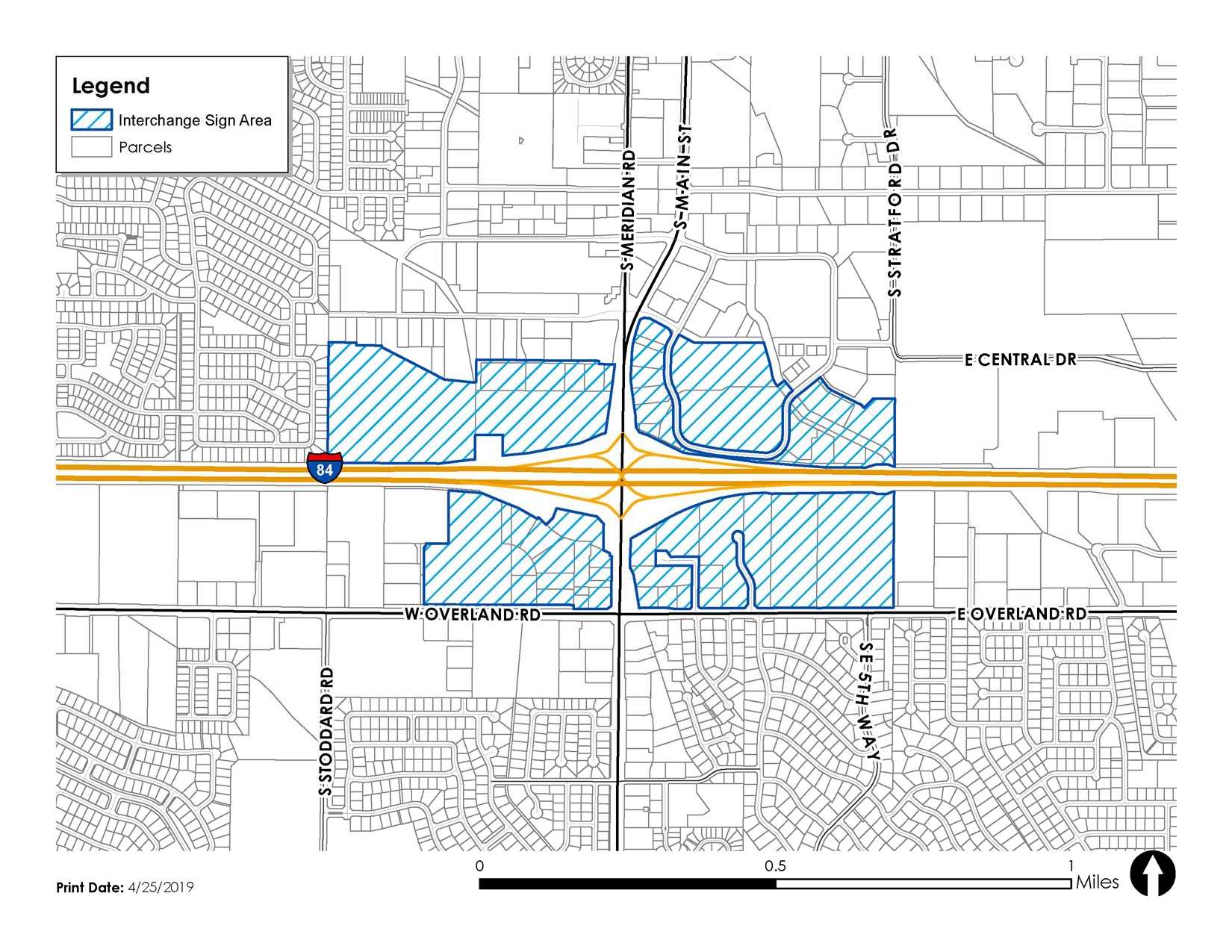
FIGURE 2: I-84/EAGLE ROAD INTERCHANGE
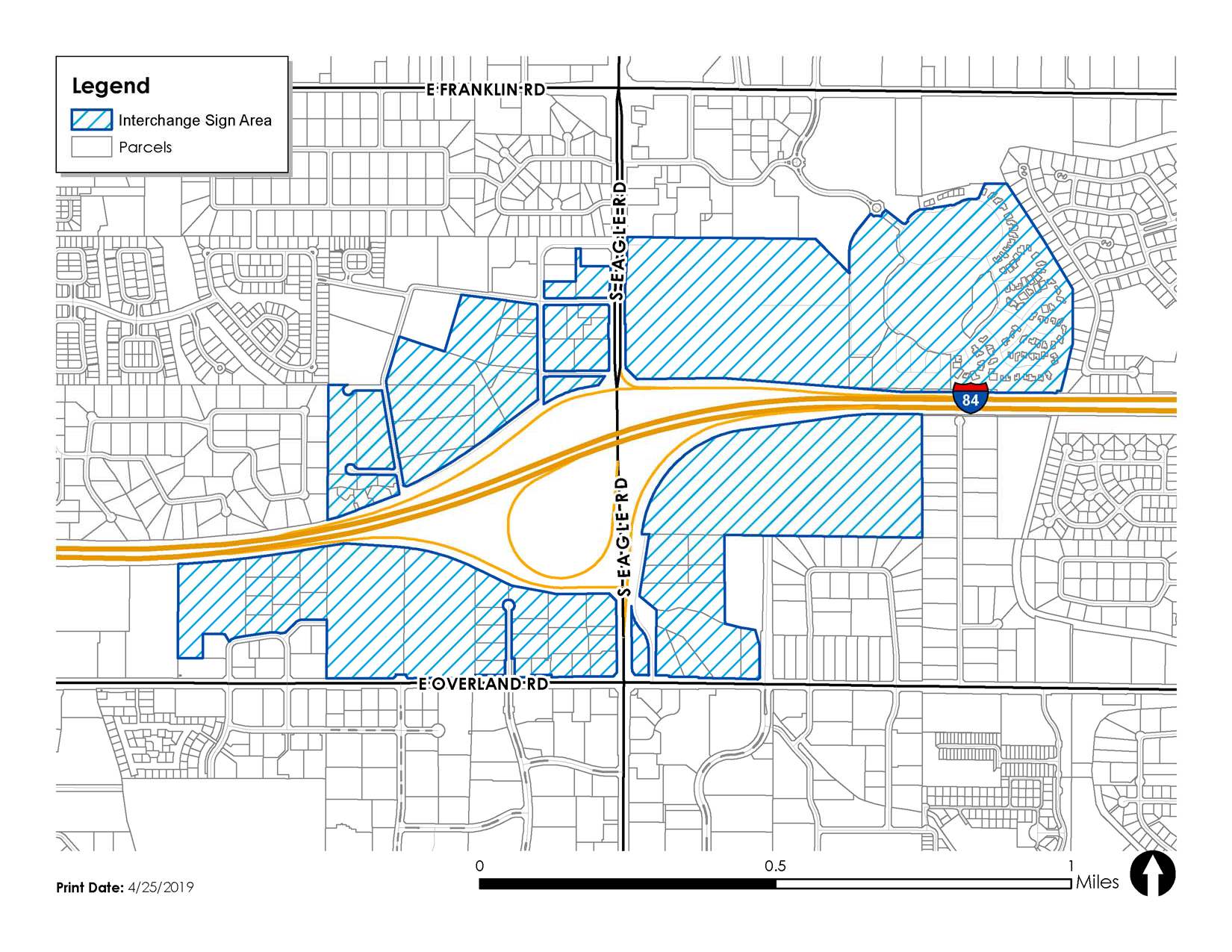
FIGURE 3: I-84/TEN MILE INTERCHANGE
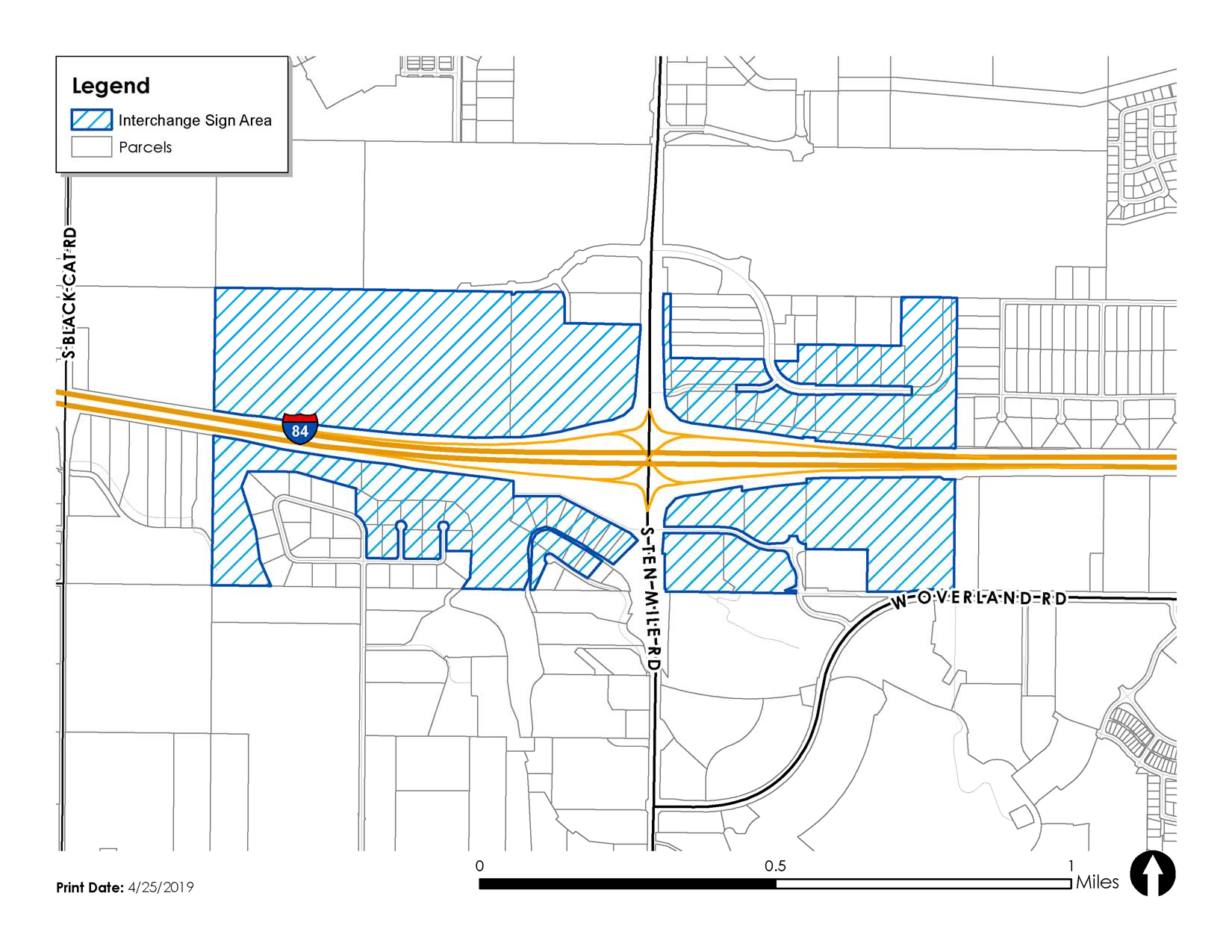
(Ord. 09-1436, 12-15-2009, eff. 1-1-2010; Ord. 12-1514, 5-16-2012, eff. 5-21-2012; Ord. 13-1546, 3-5-2013; Ord. 16-1717, 1-3-2017; Ord. 17-1725, 4-18-2017; Ord. 18-1773, 4-24-2018; Ord. 19-1833, 7-9-2019)
11-3D-9. - Additional allowance for signs of a limited duration.
The following standards shall apply to business identification signs allowed for a limited duration for all allowed nonresidential uses:
A.
Purpose. The purpose of this section is to allow additional business identification signs for a limited duration.
B.
Applicability. This section shall apply to all allowed nonresidential uses in all districts.
C.
Exemptions. The provisions of this section shall not apply to handheld signs. Handheld signs are allowed and do not require a permit.
D.
Process.
1.
The applicant shall obtain a limited duration sign permit through the Planning Department for seven (7), fifteen (15), thirty (30), sixty (60), ninety (90), or one hundred twenty (120) day time periods. It shall be unlawful for any person to erect or display on any property a limited duration sign without a valid and current limited duration sign permit.
2.
In no instance shall a limited duration sign requiring a permit be displayed for more than one hundred twenty (120) days per calendar year per business.
3.
The applicant shall obtain a limited duration sign permit for every new and/or renewed limited duration sign to be displayed.
4.
Removal of any limited duration sign for any period of time shall not extend the expiration date for such limited duration sign permit.
5.
Any person displaying or erecting limited duration signs on any property shall obtain the written consent of the property owner and file that consent with the Planning Department prior to issuance of a permit.
E.
General standards for limited duration signs. The following standards shall apply to all limited duration signs in all districts:
1.
All limited duration signs shall be securely fastened to the ground or to a permanent structure. Signs shall be erected in a manner that does not create a potential hazard of any kind. The attachment line for inflatable signs shall not be within ten (10) feet of the nearest overhead power line.
2.
No limited duration sign shall be located closer than five (5) feet from any street property line and twelve and one-half (12½) feet from any rear or interior side property line.
3.
No limited duration sign shall be illuminated. Illumination is prohibited.
4.
No limited duration sign shall be located within a public right-of-way.
5.
All limited duration signs shall be weatherproofed and kept in a state of good appearance, safety, and repair. Any damaged or potentially hazardous sign shall be repaired or removed immediately.
6.
A maximum of one (1) such sign shall be displayed per business at any one time.
7.
Limited duration signs shall maintain a minimum fifty (50) feet of spacing from any and all other approved freestanding and limited duration signs.
8.
The background area for limited duration banner signs located on an exterior of a building shall not exceed thirty-two (32) square feet per business, except that businesses having over one hundred thousand (100,000) square feet of gross floor area shall be allowed sixty-four (64) square feet for such sign.
9.
The background area for freestanding limited duration signs, shall not exceed twenty (20) square feet.
10.
Balloons and other inflated devices that are limited duration signs shall be no greater than one and one-half (1½) times the maximum building height within the district.
11.
Electrical components shall be prohibited as part of a limited duration sign, except electrical pumps may be allowed for balloons and other inflated devices.
(Ord. 09-1436, 12-15-2009, eff. 1-1-2010; Ord. 12-1514, 5-16-2012, eff. 5-21-2012; Ord. 13-1546, 3-5-2013)
11-3D-10. - Standards for vehicle signs.
The following standards shall apply to vehicle signs used for business identification:
A.
Purpose. The purpose of this section is to allow vehicle signs used for business identification of fleet vehicles.
B.
Applicability. This section shall apply to all vehicle signs used for business identification, except that the provisions of this section shall not apply to interior vehicle signs not exceeding two (2) square feet in overall size.
C.
Process. Vehicle signs that meet the standards set forth in this article are allowed and do not require a permit. Any vehicle signs that do not meet the standards set forth in this article may be considered for approval as a business identification sign or limited duration sign.
D.
Standards for vehicle signs. The following standards shall apply to all vehicle signs used for business identification:
1.
Any vehicle sign shall not project or extend beyond two (2) inches from the original manufactured body proper of the vehicle.
2.
Any vehicle sign shall be magnetic decals, vinyl stickers, vinyl wraps, and/or painted directly to the body of the original vehicle.
3.
The vehicle to which the sign is attached shall be in proper working order and shall bear a current license plate.
4.
The vehicle to which the sign is affixed shall be used in the conduct of the business and shall not be permanently parked on a public street or street right-of-way.
5.
The parking of any idle vehicle or trailer on any property for more than seventy-two (72) hours, any part of which is located within thirty-five (35) feet of a public right-of-way, and which has affixed to it a vehicle sign is prohibited. This prohibition is not intended to apply to a fleet vehicle(s) which leaves the premises during the hours of the business operation.
(Ord. 09-1436, 12-15-2009, eff. 1-1-2010)
11-3E-1. - Purpose.
The regulations of this article are intended to allow for temporary uses as accessory uses to a conditional or principal permitted use on the property.
(Ord. 08-1356, 4-22-2008)
11-3E-2. - Applicability.
The provisions of this article shall apply to any properties that are located in a residential district.
(Ord. 10-1463, 11-3-2010, eff. 11-8-2010; Ord. No. 22-2001, § 13, 11-1-2022)
11-3E-3. - Process and standards.
See title 3, chapter 4 of this Code for all procedures and standards.
(Ord. 10-1463, 11-3-2010, eff. 11-8-2010)
11-3F-1. - Purpose.
The purpose of this article is to support the city's transportation goals by ensuring safe and adequate circulation within commercial, industrial, multi-family and residential developments by establishing a clear emergency vehicle travel lane and for private street name addressing purposes. Private streets serving single-family, duplex and townhouse developments may be permitted at the discretion of the decision-making body in cases where the project qualifies as an infill or planned unit development, where compliance with public safety and access requirements can be demonstrated. The Fire Marshal may require that a private street be designated within an existing or proposed development where necessary to facilitate emergency response and ensure public safety.
(Ord. 10-1463, 11-3-2010, eff. 11-8-2010; Ord. No. 25-2099, § 8, 9-23-2025)
11-3F-2. - Applicability.
The provisions of this article shall apply to any existing or proposed properties that do not have frontage on a public street or where frontage is not required. The provisions of this article shall also apply where the director or Fire Marshal determines that private streets or conversion of drive aisles are necessary for wayfinding or public safety considerations.
(Ord. 05-1170, 8-30-2005, eff. 9-15-2005; Ord. No. 25-2099, § 8, 9-23-2025)
11-3F-3. - Process.
A.
An application and fees, in accord with chapter 5, "administration", of this title, shall be submitted to the director on forms provided by the Planning Department. The application may be reviewed on its own or reviewed as part of a concurrent hearing level application.
B.
Upon review and approval by the director subject to any applicable conditions of approval and the regulations of chapter 5, "administration", of this title, the applicant or owner shall have two (2) years, or as otherwise established as part of a concurrent development application, to complete the following tasks:
1.
Ada County Highway District (ACHD) Compliance:
a.
Obtain approval from the Ada County Street Name Committee for a private street name(s);
b.
Install an approved street name sign that complies with the regulations of the Ada County uniform street name ordinance.
c.
For residential private streets, submit a statement from a registered professional engineer stating that the street complies with the ACHD structural standards and is constructed consistent with the city-approved set of construction plans.
2.
Create a perpetual ingress/egress easement or a single platted lot for the private street to all properties served by such private street; and
3.
The applicant or owner shall provide documentation of a binding contract that establishes the party or parties responsible for the repair and maintenance of the private street, including regulations for the funding thereof.
4.
Upon completion of the items noted above, the director shall issue a letter stating that the private street has been approved. No building permit shall be issued for any structure using a private street for access to a public street until the private street has been approved.
(Ord. 05-1170, 8-30-2005, eff. 9-15-2005) (Ord. 10-1463, 11-3-2010, eff. 11-8-2010; Ord. No. 25-2099, § 8, 9-23-2025)
11-3F-4. - Standards.
A.
Standards for residential private streets. Residential private streets shall only be permitted at the discretion of the decision-making body, subject to the following:
1.
Unique or special circumstances exist with respect to the proposed use, design, location, topography, or other features of the development or its surroundings such that private streets will serve to enhance the overall development.
2.
The design promotes safe and effective movement of bicycles and pedestrian travel to and through the project by providing sidewalks and/or pathways connections to abutting properties at a minimum of two (2) locations.
3.
Adequate guest parking and maneuvering areas are provided for service and emergency vehicles, as determined by the director and Fire Marshal.
4.
The private street provides for a connected transportation system and adjacent property will not be landlocked nor have reduced access, by the site layout.
5.
The use or alignment of a private street does not interfere with the continuity of public streets.
6.
An appropriate mechanism has been established for the repair and maintenance of the private street, including provisions for the funding thereof.
7.
The use of private streets does not prohibit access to existing or planned multi-use pathways, as shown in chapter 3 of the Meridian Pathways Master Plan.
8.
Comply with the ACHD structural standards for streets, as shown on design and construction documents prepared and certified by a registered professional engineer.
B.
Design standards.
1.
Easement. The private street shall be constructed on a perpetual ingress/egress easement or a single platted lot that provides access to all properties served by such private street. In instances where the subject property is being subdivided, the preference is that the private street be a lot within such subdivision.
2.
Connection point. The private street shall connect to a local or collector street. Private street connection to an arterial street is prohibited, unless otherwise allowed by the decision-making body as part of a concurrent hearing level application. Where the point of connection of the private street is to a public street, the private street connection shall be approved by the transportation authority.
3.
Emergency vehicle. The private street shall provide sufficient maneuvering area for emergency vehicles as determined and approved by the Meridian Fire Department.
4.
Gates. Gates or other obstacles (if applicable) may be allowed subject to the following standards:
a.
The proposed development shall be for residential uses.
b.
The proposed development shall have no more than one hundred (100) dwelling units. A greater number of dwelling units may be approved with a planned unit development.
c.
The proposed gate(s) do not prohibit pedestrian and bicycle access to and through the development.
d.
The applicant shall provide access to the gate for emergency vehicles as determined and approved by the Fire Marshal and Public Works Department.
e.
To allow sufficient vehicle stacking and turn-around distance, the gate shall be located a minimum of fifty (50) feet back from the ultimate edge of right-of-way to the connecting public street and include a dedicated paved vehicle turnaround area.
5.
Culs-de-sac. No private street that ends in a cul-de-sac or a dead end shall be longer than five hundred (500) feet.
6.
Common driveways. No common driveways shall be allowed off of a private street unless the street section allows for parking on at least one (1) side of the street or the development has designated adequate guest parking dispersed throughout, as determined by the director.
7.
Street network. The overall street network within the surrounding area shall allow for properties to connect at regular intervals in order to promote connected neighborhoods and traffic flow within the mile section.
C.
Construction standards.
1.
Commercial. For proposed commercial private streets and the conversion of an existing commercial drive aisle to a private street at the direction of the Fire Marshal, the following shall apply:
a.
All drive aisles shall be posted as fire lanes with no parking allowed.
b.
If a curb exists next to the drive aisle, it shall be painted red.
c.
For proposed commercial private streets, sidewalk shall be provided on at least one (1) side of the private street, except when converting an existing drive aisle.
d.
When converting an existing drive aisle, a written statement from a certified engineer must be submitted stating the existing drive aisle can support emergency fire apparatus.
2.
For all other private streets.
a.
Roadway and storm drainage. The private street shall be constructed in accord with the roadway and storm drainage standards of the transportation authority or as approved by the City of Meridian based on plans submitted by a certified engineer.
b.
Street width. The private street shall have a minimum travel lane width of twenty-four (24) feet or twenty-six (26) feet as determined by the Fire Marshal relative to the height and size of the proposed structures that adjoin the private street.
c.
Sidewalks. For private streets serving dwellings, a five-foot wide attached sidewalk or four-foot wide detached sidewalk shall be provided on both sides of the private street. This requirement may be waived modified by the decision-making body if the applicant can demonstrate that an alternative, similar pedestrian path exists.
d.
Fire lanes. All drive aisles shall be posted as fire lanes with no parking allowed. In addition, if a curb exists next to the drive aisle, it shall be painted red, unless parking is allowed on one (1) or both sides.
3.
Alternative compliance. Upon recommendation of the City Engineer and Fire Marshal, the Director may approve, or recommend approval of alternative design or construction standards when the applicant can demonstrate that the proposed overall design meets or exceeds the intent of the required standards of this Article and is not detrimental to the public health, safety, and welfare.
4.
Nonconforming private streets. Existing private streets that are not consistent with the standards as set forth in this section shall be deemed a nonconforming use. Applicants seeking to add additional lots and/or development accessing such private streets shall seek conditional use approval as set forth in subsection 11-1B-4.A.2 of this title or improve the full length of the private street to meet the design and construction standards as set forth in this section.
(Ord. 05-1170, 8-30-2005, eff. 9-15-2005; Ord. 10-1463, 11-3-2010, eff. 11-8-2010; Ord. No. 22-2001, § 14, 11-1-2022; Ord. No. 25-2099, § 8, 9-23-2025)
11-3F-5. - Required findings.
In order to approve a private street, the decision-making body shall find the following:
A.
The design of the private street meets the requirements of this article;
B.
Granting approval of the private street would not cause damage, hazard, or nuisance, or other detriment to persons, property, or uses in the vicinity; and
C.
The use and location of the private street shall not conflict with the Comprehensive Plan and/or the Regional Transportation Plan.
D.
The proposed residential development (if applicable) is a gated community, promotes infill, or is a planned unit development.
(Ord. 05-1170, 8-30-2005, eff. 9-15-2005; Ord. 10-1463, 11-3-2010, eff. 11-8-2010; Ord. No. 25-2099, § 8, 9-23-2025)
11-3G-1. - Purpose.
A.
To implement the goals and policies of the Comprehensive Plan:
1.
Plan for safe, attractive, and well-maintained neighborhoods that have ample open space, and generous amenities that provide varied lifestyle choices.
2.
Require the design and construction of pathways connections, easy pedestrian and bicycle access to parks, safe routes to schools, and the incorporation of usable open space with quality amenities as part of new residential and mixed-use developments.
B.
To provide for common open space and site amenities in Residential Districts and in areas designated as mixed-use in the Comprehensive Plan that improve the livability of residential neighborhoods, buffer the street edge, provide alternatives to driving, and protect natural amenities.
C.
To establish minimum quantity and quality standards for common open space and site amenities, and requirements for the long-term maintenance of these areas.
(Ord. No. 21-1950, § 18, 10-10-2021)
11-3G-2. - Applicability.
The standards for common open space and site amenities shall apply to all new single-family, townhouse, and two-family duplex, developments of five (5) acres or more. Open space and site amenity standards for multi-family developments are provided for in Section 11-4-3-27C and D of this Title.
(Ord. No. 21-1950, § 18, 10-10-2021)
11-3G-3. - Standards for common open space.
A.
Open space minimum requirements. The minimum requirements are based on both the quantity and quality of open space provided.
1.
Minimum open space quantity requirements. The total land area of all common open space that meets the standards as set forth in subsection B of this Section shall provide five (5) percent common open space if the entire development is comprised of buildable lots, a minimum of sixteen thousand (16,000) square feet, not including landscape buffers along arterial or collector roadways; or as shown in Table 11-3G-3.
a.
Table 11-3G-3 Minimum Open Space Requirements
b.
When a project is located in more than one (1) zone, the calculation of the minimum required open space shall be based on the land area in each zone, and the total for each zone shall be combined for the minimum required open space for the entire project.
2.
Minimum open space quality requirements. All open space areas shall meet the following quality standards:
a.
The development plan shall demonstrate that the open space has been integrated into the development as a priority and not for the use of land after all other elements of the development have been designed. Open space areas that has been given priority in the development design have direct:
(1)
Direct pedestrian access;
(2)
High visibility;
(3)
Comply with Crime Prevention Through Environmental Design (CPTED) standards; and
(4)
Support a range of leisure and play activities and uses.
b.
Open space shall be accessible and well connected throughout the development. This quality can be shown with open spaces that are connected by pathways and visually accessible along collector streets; or are a terminal view from a street.
c.
The open space promotes the health and well-being of its residents. Open space shall support active and passive uses for recreation, social gathering and relaxation to serve the development.
B.
Qualified open space.
1.
Active or passive open spaces. Any open space that is active or passive in its intended use, and accessible by all residents of the development, including, but not limited to:
a.
Open grassy area of at least five thousand (5,000) square feet in area;
b.
Community garden(s);
c.
Natural waterways, open ditches, and laterals. Protective buffers a minimum of ten (10) feet in width dedicated for active access along these natural open spaces count toward meeting the open space minimum requirements;
d.
Plaza with a minimum dimension of twenty (20) feet in all directions and including hardscape, seating, lighting in conformance with the standards set forth in section 11-3A-11 and landscaping in conformance with the requirements set forth in Article 11-3B, Landscaping Requirements; or
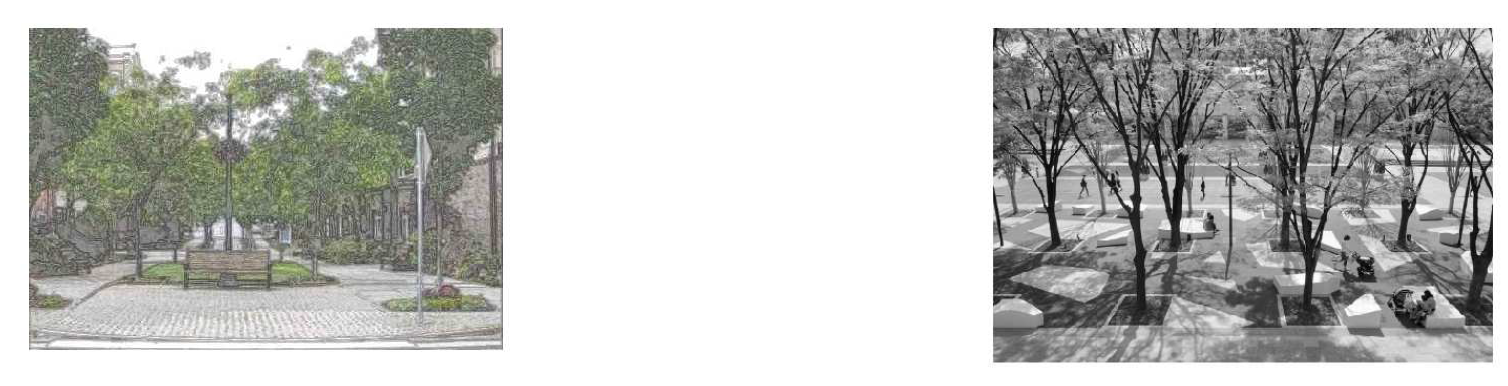
e.
Linear open space area that is at least twenty (20) feet and up to fifty (50) feet in width, has an access at each end, and is improved and landscaped as set forth in Article 11-3B, Landscaping Requirements.
2.
Additions to the land area of a public park or other public open space area.
3.
Buffer: One hundred (100) percent of the landscape buffer along collector streets and fifty (50) percent of the landscape buffer along arterial streets that meet the enhanced buffer requirements that follow may count toward the required common open space.
a.
Enhanced landscaping as set forth in Article 11-3B, Landscaping Requirements;
b.
Multi-use pathways;
c.
Enhanced amenities with social interaction characteristics;
d.
Enhanced context with the surroundings.
4.
Parkways along local residential streets. Parkways along local residential streets that meet all of the following standards may count toward the common open space requirement:
a.
The parkway meets the minimum width standard as set forth in subsection 11-3A-17E of this Chapter.
b.
The parkway is planted with street trees in accord with Section 11-3B-7, "Landscape Buffers Along Streets", of this Chapter.
c.
Except for alley accessed dwelling units, the area for curb cuts to each residential lot or common driveway shall be excluded from the open space calculation. For purposes of this calculation, the curb cut area shall be twenty-six (26) feet by the width of the parkway.
5.
Stormwater detention facilities. Stormwater detention facilities when designed in accord with Section 11-3B-11, "Stormwater Integration".
6.
Open water ponds. Artificial open water ponds and holding areas when developed with at least one (1) site amenity in accord with Table 11-3G-4 of this Section. All ponds with a permanent water level shall meet the following standards:
a.
The pond shall have recirculated water; and
b.
The pond shall be maintained such that it does not become a mosquito breeding ground.
(Ord. No. 21-1950, § 18, 10-10-2021)
11-3G-4. - Standards for site amenities.
A.
Site amenities minimum standards. The minimum site amenity required is based on the point value of the amenity as set forth in subsection B of this section and the size of the development.
1.
For each five (5) acres of gross land area, one (1) point of site amenity is required. If the calculation of the number of required site amenities results in a fraction, such number shall be rounded up or down to the next whole number: fractions less than one-half (0.5) shall be rounded down to the whole number and fractions which are one-half (0.5) and greater shall be rounded up to the next higher whole number.
2.
For projects forty (40) acres or more in size, multiple amenities are required from the separate categories listed in Table 11-3G-4.
B.
Qualified site amenities.
1.
Qualified site amenities shall include features listed in Table 11-3G-4.
2.
Through the alternative compliance provisions as set forth in Section 11-5B-5:
a.
Amenities not listed in Table 11-3G-4 may be considered.
b.
Amenities that are a centerpiece or of benefit to the entire City; that creatively create a sense of uniqueness to the neighborhood; or preserve or represent the historic context of the place may be substituted for required open space as set forth in Section 11-3G-3.
Table 11-3G-4 Site Amenities and Point Value
C.
Quality of life amenity standards.
1.
Clubhouse is an enclosed or semi-enclosed space (including open air or ramadas) for neighborhood events and support facilities for recreation. The points for a clubhouse maybe combined with the points for other amenities that maybe located within the clubhouse including fitness and business centers, sports courts, swimming pools and locker rooms.
2.
Fitness facilities is an enclosed space equipped with commercial grade sports exercise equipment.
3.
Public art is custom designed for the site size, location, and surrounding setting.
4.
Fountain is custom designed for the site size, location, and surrounding setting.
5.
Picnic area includes tables, benches, landscaping, and a structure for shade.
6.
Fitness course with a minimum of six (6) stations permanently installed.
7.
Open space commons of at least twenty thousand (20,000) square feet, which is surrounded on all sides by the front yards of lots. Intervening streets may be located between the open space and lots.
8.
Communication infrastructure with two (2) conduits running side by side to and through the development; each conduit being two (2) inches in diameter.
9.
Dog park with:
a.
Bags for dog waste disposal;
b.
Double entrance gate;
c.
Bench(es); and
d.
Fencing to enclose a minimum of five thousand (5,000) square feet and secured open space for an off-leash dog park.
The open space shall count toward any required open space.
10.
Dog waste station is an installed in the ground fixture with waste disposal bags and trash receptacle.
11.
Neighborhood business center meeting the following standards:
a.
The area devoted to the business center shall not exceed one thousand (1,000) square feet.
b.
The business center shall provide access to high speed internet, fiber optic cable, or communication infrastructure and/or facilities with a minimum capacity equivalent to a thirty-six-strand single mode fiber optic cable.
c.
The business center shall, at a minimum, provide workspaces for three (3) people, a meeting space for six (6) people, and access to printing facilities.
d.
The business center may be leased to a private entity for operation and maintenance, however the property shall be owned by the owners' association.
e.
The business center operator may charge fees for use or membership; however members of the owners' association should be given priority in use of the business center.
12.
Commercial outdoor kitchen is an outdoor or semi-enclosed space that includes commercial grade appliances for food preparation and sink with utility connections.
13.
Outdoor fire ring that meets fire safety standards, is located on a noncombustible surface and includes fixed seating.
D.
Recreation activity area amenity standards.
1.
Swimming pool constructed in ground and meeting all Building Code requirements.
2.
Interactive splash pads, fountains or other water features are permanent, commercially grade constructed with filtration systems.
3.
Tot lot with commercial grade play equipment scaled and designed for the use and safety of younger children. Benches for seating shall be nearby.
4.
Playground on a site with a minimum size of five thousand (5,000) square feet and including benches for seating and multiple commercial grade play structures.
5.
Sports court with markings and including benches for seating. Sports court may include tennis, basketball, pickleball, horseshoes, bocce ball, cornhole, or golf putting
6.
Sports fields for neighborhood scaled sports activities.
E.
Pedestrian or bicycle circulation system amenity standards. The system:
1.
Is not required sidewalks adjacent to public right-of-way;
2.
Connects to existing or planned pedestrian or bicycle routes outside the development, as designated in the Meridian pathways master plan; and
3.
Is designed and constructed in accord with adopted City standards.
F.
Multi-modal amenity standards.
1.
Bicycle storage is a roofed space for the secure storage of a minimum of six (6) bicycles.
2.
Bicycle repair station is a fixed installation with tools and an air pump.
3.
Transit stops, park and ride facilities or other multimodal facilities to encourage alternative automobile transportation.
4.
Sheltered transit stop is covered with a roof and transparent enclosure on three (3) sides.
5.
Park and Ride facility is a paved off-street parking area for a minimum of twenty (20) vehicles located adjacent to a public transit stop.
(Ord. No. 21-1950, § 18, 10-10-2021; Ord. No. 22-2001, § 15, 11-1-2022)
11-3G-5. - General standards for common open space and site amenities.
A.
Location.
1.
Common open space shall be grouped contiguously with open space from adjacent developments whenever feasible.
2.
Common open space and site amenities shall be located in areas of high visibility (i.e., along streets, where doors and windows overlook public areas, etc.) to avoid hidden areas and corners, dark areas, unusable space and reduce the opportunity for crime.
3.
Common open space shall be located in areas that maximize pedestrian and bicycle connectivity within and outside the neighborhood.
4.
Common open space in mixed use developments may be allowed to deviate from the location standards through the alternative compliance process as set forth in Section 11-5B-5.
B.
Improvements and landscaping.
1.
Common open space shall be suitably improved for its intended use, except that natural features such as wetlands, rock outcroppings, natural waterways and riparian areas, open ditches, and laterals may be left unimproved.
2.
Common open space shall comply with the applicable landscaping requirements set forth in Article 11-3B, Landscaping Requirements, of this Title.
3.
At a minimum, common open space areas shall include one (1) deciduous shade tree for every five thousand (5,000) square feet of area and include a variety of trees, shrubs, lawn, or other vegetative ground cover.
C.
Maintenance.
1.
The common open spaces and site amenities shall be located on a common lot or an area with a common maintenance agreement.
2.
Maintenance and operation of the open space and site amenities shall be the responsibility of the property owners' or homeowners' association.
3.
Land dedicated as common open space may be conveyed to the City, where the Parks and Recreation Department agrees to accept conveyance and when the common open space area is in the public interest and complies with one (1) of the following:
a.
Is adjacent to an established or planned City park or school grounds; or
b.
Connects to a regional pathway.
(Ord. No. 21-1950, § 18, 10-10-2021; Ord. No. 22-2001, § 16, 11-1-2022)
11-3H-1. - Purpose.
The regulations of this article are intended to achieve three (3) purposes:
A.
Limit access points to state highways in order to maintain traffic flow and provide better circulation and safety within the community and for the traveling public;
B.
To preserve right-of-way for future highway expansions; and
C.
Design new residential development along state highways to mitigate noise impacts associated with such roadways.
(Ord. 05-1171, 8-30-2005, eff. 9-15-2005)
11-3H-2. - Applicability.
The following standards shall apply to all development along state highways, including, but not limited to, State Highway 69, State Highway 55, State Highway 20-26, and Interstate 84. The following standards shall also apply to development along McDermott Road from Chinden Boulevard to Interstate 84 as the City of Meridian's preferred location for a future highway right-of-way for the State Highway 16 extension. If the Idaho Transportation Department (ITD) determines an alternate location for the State Highway 16 extension, these standards shall apply to the ITD determined location.
(Ord. 05-1171, 8-30-2005, eff. 9-15-2005)
11-3H-3. - Process.
Staff shall review all development applications for compliance with these standards. The City Council may consider and approve modifications to the standards of this article upon specific recommendation of the Idaho Transportation Department or if strict adherence is not feasible, as determined by City Council.
(Ord. 19-1833, 7-9-2019)
11-3H-4. - Standards.
A.
Access to and/or from I-84 and McDermott Road (or future Highway 16 extension). No access shall be allowed except at specific interchange locations as established by the Idaho Transportation Department.
B.
Access to and/or from State Highway 69, State Highway 55, and State Highway 20-26.
1.
Use of existing approaches shall be allowed to continue provided that all of the following conditions are met.
a.
The existing use is lawful and properly permitted effective September 15, 2005.
b.
The nature of the use does not change (for example a residential use to a commercial use).
c.
The intensity of the use does not increase (for example an increase in the number of residential dwelling units or an increase in the square footage of commercial space).
2.
If an applicant proposes a change or increase in intensity of use, the owner shall develop or otherwise acquire access to a street other than the state highway. The use of the existing approach shall cease and the approach shall be abandoned and removed.
a.
No new approaches directly accessing a state highway shall be allowed.
b.
Public street connections to the state highway shall only be allowed at:
(1)
The section line road; and
(2)
The half mile mark between section line roads. These half-mile connecting streets shall be collector roads.
3.
The applicant shall construct a street, generally paralleling the state highway, to provide future connectivity and access to all properties fronting the state highway that lie between the applicant's property and the nearest section line road and/or half mile collector road. The intent is to provide for future connectivity and access to all properties fronting the state highway that lie between the applicant's property and the nearest section line road and/or half mile collector road. The street shall be designed to collect and distribute traffic.
a.
The applicant shall be responsible to construct the segment of the street within the applicant's property. This standard is not intended to require off-site improvements.
b.
The street shall meet the road standards of the Ada County Highway District.
c.
The street shall connect to the section line road at a distance that is no closer than six hundred sixty (660) linear feet (as measured from centerline to centerline) from the intersection with the state highway.
d.
The street shall provide buildable lots between the highway and the collector road. For the purposes of this article, such streets shall be termed "backage roads".
e.
Frontage streets or private streets may be considered by the council at the time of property annexation or through the conditional use process. Frontage streets and private streets shall be limited to areas where there is sufficient access to surrounding properties and a public street is not desirable in that location.
C.
Design and construction standards for state highways.
1.
The applicant shall have an approved permit from the Idaho Transportation Department for construction of any access to the state highway and/or any construction done in the highway right-of-way.
2.
The width of right-of-way reservations shall be as set forth by the ITD.
3.
Along State Highway 55, the applicant shall be responsible for constructing a ten-foot wide multiuse pathway with a public use easement and installing pedestrian lighting and landscaping consistent with the Eagle Road Corridor study. For uniformity in lighting levels and design, lighting along the pathway shall meet the following specifications:
a.
Post and luminaire. Historical type per Meridian city standard specifications, except height shall be fourteen (14) feet.
b.
Spacing. One (1) light pole per ninety-five (95) linear feet of street frontage.
c.
Light source. One hundred fifty (150) watt high pressure sodium, photocell controlled.
d.
Optics. Shielded and Illuminating Engineering Society (IES) type III with full cutoff optics.
e.
Pathway lighting shall not take the place of required safety lighting at adjacent roadway intersections.
f.
Other lighting options may be approved by the director through the alternative compliance procedures set forth in chapter 5, "administration", of this title.
4.
Along Highway 69 and Highway 20-26, the applicant shall be responsible for constructing a ten-foot multiuse pathway with a public use easement.
D.
Noise abatement shall be required for residential and other noise sensitive uses including, but not limited to, education institutions, churches or places of religious worship, libraries and/or hospitals adjoining state highways.
1.
The applicant shall provide traffic noise abatement by constructing a berm or a berm and wall combination approximately parallel to the state highway.
2.
The top of the berm or berm and wall in combination shall be a minimum of ten (10) feet) higher than the elevation at the centerline of the state highway.
3.
If a wall is proposed, the wall shall meet the following standards:
a.
Wall materials shall be impervious concrete or stucco or other appropriate sound attenuating material.
b.
Intermittent breaks in the berm or berm and wall in combination will degrade the function and shall not be allowed.
c.
The applicant shall not construct a monotonous wall. In order to achieve this standard, the applicant may choose one (1) or both of the following variations:
(1)
The color and/or texture of the wall shall be varied every three hundred (300) linear feet. This could include murals or artwork.
(2)
The wall shall be staggered every three hundred (300) linear feet subject to subsection (D)(3)b of this section that prohibits breaks in the wall.
4.
The Director may approve alternative compliance as set forth in chapter 5, "administration", of this title where the applicant has a substitute noise abatement proposal in accord with ITD standards and prepared by a qualified sound engineer.
(Ord. 05-1171, 8-30-2005, eff. 9-15-2005; Ord. 07-1325, 7-10-2007; Ord. 10-1439, 1-12-2010, eff. 1-18-2010; Ord. 11-1482, 4-26-2011, eff. 5-2-2011)

