
Meridian City Zoning Code
CHAPTER 6
- SUBDIVISION REGULATIONS
11-6-1.- Purpose.
The purpose of this chapter shall be to implement a general rule and standards for the subdivision of the land in the Meridian city limits and the area of city impact.
(Ord. 05-1170, 8-30-2005, eff. 9-15-2005)
11-6-2. - Applicability.
A.
All subdivision applications shall be administered in accord with article A, "general provisions", of this chapter.
B.
All subdivision applications shall be processed in accord with article B, "subdivision process", of this chapter.
C.
All subdivisions shall meet the design standards as set forth in article C, "subdivision design and improvement standards", of this chapter. it shall be unlawful and a violation of the Unified Development Code for any person to use, construct, locate, initiate, alter, or maintain any structure, land or real property, or to cause any structure, land, or real property to be used, constructed, located, initiated or maintained, in any manner which violates, omits, or fails to conform to any procedure, design standard, and/or requirement set forth in this chapter.
(Ord. 05-1170, 8-30-2005, eff. 9-15-2005)(Ord. 08-1372, 7-8-2008, eff. 7-8-2008)
11-6A-1. - Purpose.
The purpose of this chapter shall be to implement a general rule for the subdivision of the land in the Meridian City Limits and the area of city impact. This chapter shall be based on the officially adopted comprehensive plan of the city and is enacted in order to promote and protect the public health, safety, comfort, convenience, prosperity, and general welfare and to achieve the following objectives:
A.
To promote the achievement of the proposals of the Meridian Comprehensive Plan;
B.
To advance the city as a self-sufficient employment and economic center;
C.
To encourage excellence and creativity in the design of all future developments and to preserve the natural beauty of Meridian;
D.
To encourage orderly growth and development, to avoid scattered development of land that results in:
1.
Lack of water supply, sewer service, drainage, transportation facilities, or otherwise essential public services; or
2.
Excessive expenditure of public funds for the supply of such services;
E.
To provide for desirable and appropriately located living areas and a variety of dwelling types and densities with adequate provision for sunlight, fresh air, and usable open space;
F.
To provide for the manner and form of making and filing of plats;
G.
To specify the requirements as to the extent and the manner in which:
1.
Roads, streets, and/or driveways shall be created and improved, including vehicular network and block configurations;
2.
Water and sewer and other utility mains, piping connections, or other facilities shall be installed;
3.
Pedestrian pathways consistent with the comprehensive plan are to be located and designed; and
4.
Opportunities for future transit routes and stations are created;
H.
To protect existing surface waters (Five Mile, Nine Mile, and Ten Mile Creeks) throughout the city; and
I.
To specify the administration of the regulations of this chapter by defining the powers and duties of approval authorities.
(Ord. 05-1170, 8-30-2005, eff. 9-15-2005; Ord. 16-1717, 1-3-2017)
11-6A-2. - Applicability.
These regulations shall apply to the subdivision of all land within the legally defined Meridian City Limits and the area of city impact. It shall be unlawful and considered a violation of the Unified Development Code for any person to initiate or cause to be initiated the subdivision of any land or real property in any manner which violates, omits, or fails to conform to any procedure, design or improvement standard, and/or requirement set forth in this chapter.
(Ord. 08-1372, 7-8-2008, eff. 7-8-2008)
11-6A-3. - Authority.
The ordinance codified in this chapter is adopted pursuant to authority granted by Idaho Code §§ 67-6501 et seq., and 50-1301 et seq., and the Idaho constitution article 12, section 2, as amended or subsequently codified. No subdivision plat required by this chapter or the Idaho Code shall be admitted to the public land records of the county, or recorded by the County Recorder, until such subdivision plat has received final approval by the City Council and signature of the City Engineer.
(Ord. 05-1170, 8-30-2005, eff. 9-15-2005)
11-6B-1. - Applicability.
There are four (4) processes that govern the subdivision of land. preliminary plat, final plat, short plat, and combined preliminary and final plat. The process to be followed will depend on the property, the number of lots created and the type of land use proposed and/or allowed on the property. The four (4) processes apply to all requests for the subdivision of property with the following exceptions:
A.
A parcel created by court decree that meets the dimensional standards of the district in effect at the date of decree shall be deemed eligible for development. Any parcel created by court decree that does not meet the dimensional standards of the applicable districts in effect at the date of the court decree shall be recognized as a parcel for transfer of ownership; however, the parcel shall not be eligible for development including any building permits for renovation or repair of an existing structure.
B.
Adjustment of property lines in accord with section 11-6B-8 of this article.
(Ord. 05-1170, 8-30-2005, eff. 9-15-2005)
11-6B-2. - Preliminary plat process.
A.
Preapplication conference. The applicant shall complete a preapplication conference with the director or designee prior to submittal of an application for a preliminary plat. The purpose of this meeting is to discuss early and informally the purpose and effect of this title and the criteria and standards contained herein.
B.
Neighborhood meeting. In accord with chapter 5, "administration", of this title, applicants are required to hold a neighborhood meeting to provide an opportunity for public review of the proposed project prior to the submittal of an application.
C.
Application requirements. An application, map requirements, and fees, in accord with chapter 5, "administration", of this title shall be submitted to the Director. At the discretion of the director or city engineer, appropriate supplementary information may also be required to sufficiently detail the proposed development within any special development area, including, but not limited to, hillside, planned unit development, floodplain, cemetery, manufactured home parks, and/or hazardous or unique areas of development.
D.
Public hearing requirements. All preliminary plat applications shall comply with the public notice and hearing procedures in accord with chapter 5, "administration", of this title.
E.
Decision. In accord with chapter 5, "administration", of this title, a decision on a preliminary plat for a parcel of land is made by the City Council based on the recommendations of the Planning and Zoning Commission.
(Ord. 05-1170, 8-30-2005, eff. 9-15-2005)
11-6B-3. - Final plat process.
A.
Application requirements. After the approval or conditional approval of the preliminary plat, the applicant may cause the total parcel, or any part thereof, to be surveyed and a final plat prepared in accord with the approved preliminary plat. An application and fees, in accord with chapter 5, "administration", of this title, shall be submitted to the director on forms provided by the Planning Department.
B.
Contents of final plat. The final plat shall include and be in compliance with all items required under Idaho Code § 50-1301 et seq. The final plat submittal shall include at least:
1.
A written application for approval of such final plat as stipulated by the commission;
2.
Proof of current ownership of the real property included in the proposed final plat and consent of recorded owners of the plat;
3.
Such other information as the director or city engineer may deem necessary to establish whether or not all proper parties have signed and/or approved said final plat;
4.
A statement of conformance with the approved preliminary plat and meeting all requirements or conditions thereof;
5.
A statement of conformance with all requirements and provisions of this title; and
6.
A statement of conformance with acceptable engineering, architectural and surveying practices and local standards.
C.
Director review.
1.
Acceptance. Upon receipt of the final plat, and compliance with all other requirements as provided for herein, the director shall certify the application as complete and shall affix the date of acceptance.
2.
Substantial compliance.
a.
The director or designee shall review the final plat for substantial compliance with the approved or conditionally approved preliminary plat. The final plat shall be determined in substantial compliance with the preliminary plat, notwithstanding the following changes:
(1)
The number of buildable lots is the same or fewer;
(2)
The amount of common open space is increased;
(3)
The amount of open space is relocated with no reduction in the total amount;
(4)
The number of open space lots has been increased; or
(5)
The transportation authority has required minor changes.
b.
If the number of buildable lots has increased or there has been an overall reduction in the amount of open space, the final plat shall be determined not to be in substantial compliance with the preliminary plat. If the director determines that there is substantial difference in the final plat than that which was approved as a preliminary plat or conditions that have not been met, the Director may require that a new preliminary plat be submitted to the Commission.
D.
Decision. Decision on the final plat is made by the City Council in accord with chapter 5, "administration", of this title. Each final plat approval shall indicate the timing of the construction and completion for all improvements and any required amenities associated with the plat.
E.
Recording of the final plat. Upon approval or approval with conditions by the council and signature of the city engineer, the applicant may submit the final plat to the Ada County recorder for recording. The final plat shall contain the certifications required under Idaho Code § 50-1301 et seq., as well as those required by the City of Meridian.
(Ord. 05-1170, 8-30-2005, eff. 9-15-2005)
11-6B-4. - Combined preliminary and final plat process.
A.
Applicability. A subdivision application may be processed as both a preliminary and final plat if all of the following exist:
1.
The proposed subdivision does not exceed four (4) lots (excluding landscaping lots); or a previous plat was approved on the subject property; and
2.
No new street dedication, excluding widening of an existing street, is required; and
3.
No major special development considerations are involved, such as development in a floodplain or hillside development.
B.
Neighborhood meeting. In accord with chapter 5, "administration", of this title, applicants are required to hold a neighborhood meeting to provide an opportunity for public review of the proposed project prior to the submittal of an application.
C.
Application requirements. An application, and fees, in accord with subsection 11-6B-3A of this article shall be submitted.
D.
Contents of final plat. The final plat shall include all items required in accord with subsection 11-6B-3B of this article.
E.
Decision. In accord with chapter 5, "administration", of this title, a decision on a combined preliminary and final plat for a parcel of land is made by the City Council based on the recommendations of the Planning and Zoning Commission. A decision on a combined preliminary and final plat for platted land is made by the City Council.
(Ord. 05-1170, 8-30-2005, eff. 9-15-2005)
11-6B-5. - Short plat process.
A.
Applicability.
1.
A subdivision application may be processed as a short plat if all of the following exist:
a.
The property is an original parcel of record or a lot in a recorded subdivision;
b.
The property is not the result of a previous short plat of a parcel and/or the property is not the result of an approved parcel division by Ada County Development Services;
c.
The proposed subdivision does not exceed four (4) lots (excluding landscaping lots) on previously platted property or does not exceed two (2) lots (excluding landscaping lots) on a parcel of land;
d.
No new street dedication, excluding widening of an existing street, is involved; and
e.
There are no impacts on the health, safety or general welfare of the city, and the subdivision is in the best interest of the city.
2.
A condominium plat application for property in any district may be processed as a short plat where all buildings are constructed or have received building permits for construction. A condominium plat amendment for interior alterations or modifications shall be exempt from further review.
B.
Preapplication conference. The applicant shall complete a preapplication conference with the director or designee prior to submittal of an application for a short plat. The purpose of this meeting is to discuss early and informally the purpose and effect of this title and the criteria and standards contained herein.
C.
Application requirements. An application, map requirements, and fees, in accord with subsection 11-6B-3A of this article shall be submitted.
D.
Decision. In accord with chapter 5, "Administration", of this title, a decision on a short plat is made by the City Council with recommendation from the Director and/or City Engineer.
(Ord. 05-1170, 8-30-2005, eff. 9-15-2005;. Ord. 07-1325, 7-10-2007; Ord. 08-1372, 7-8-2008, eff. 7-8-2008; Ord. 11-1482, 4-26-2011, eff. 5-2-2011; Ord. 16-1717, 1-3-2017)
11-6B-6. - required findings.
In consideration of a preliminary plat, combined preliminary and final plat, or short plat, the decision-making body shall make the following findings:
A.
The plat is in conformance with the comprehensive plan and is consistent with this Unified Development Code;
B.
Public services are available or can be made available and are adequate to accommodate the proposed development;
C.
The plat is in conformance with scheduled public improvements in accord with the city's capital improvement program;
D.
There is public financial capability of supporting services for the proposed development;
E.
The development will not be detrimental to the public health, safety or general welfare; and
F.
The development preserves significant natural, scenic or historic features.
(Ord. 05-1170, 8-30-2005, eff. 9-15-2005)
11-6B-7. - Term of permits.
A.
Failure to submit final plat. Approval of a preliminary plat, combined preliminary and final plat, or short plat shall become null and void if the applicant fails to obtain the city engineer's signature on the final plat within two (2) years of the approval of the preliminary plat or the combined preliminary and final plat or short plat.
B.
Phased development. In the event that the development of the preliminary plat is made in successive phases in an orderly and reasonable manner, and conforms substantially to the approved preliminary plat, such segments, if signed by the city engineer within successive intervals of two (2) years, may be considered for final approval without resubmission for preliminary plat approval.
C.
Authorize extension. Upon written request and filing by the applicant prior to the termination of the period in accord with subsections (A) and (B) of this section, the director may authorize a single extension of time to obtain the city engineer's signature on the final plat not to exceed two (2) years. Additional time extensions up to two (2) years as determined and approved by the City Council may be granted. With all extensions, the director or City Council may require the preliminary plat, combined preliminary and final plat or short plat to comply with the current provisions of this title.
D.
Failure to meet timetable. If the above timetable is not met and the applicant does not receive a time extension, the property shall be required to go through the platting procedure again.
(Ord. 05-1170, 8-30-2005, eff. 9-15-2005)(Ord. 10-1463, 11-3-2010, eff. 11-8-2010)
11-6B-8. - Property boundary adjustment.
A.
Purpose. The purpose of these regulations is to allow for the adjustment of property lines between existing properties, and to allow for the reduction in the number of buildable lots. A property boundary adjustment does not vacate the platted lot lines or easements of a recorded subdivision.
B.
Applicability. These provisions apply to all existing properties.
C.
Process.
1.
An application and fees, in accord with chapter 5, "administration", of this title, shall be submitted to the director on forms provided by the Planning Department.
2.
Upon tentative approval of the application by the director subject to any applicable conditions of approval and the regulations of chapter 5, "Aaministration", of this title, the applicant or owner shall have one (1) year to complete the following tasks:
a.
Cause the property to be surveyed and a record of survey recorded;
b.
Execute and record the necessary deeds to accomplish the property boundary adjustments as approved;
c.
Obtain new tax parcel numbers from the Ada County Assessor; and
d.
Provide copies of the recorded record of survey, recorded deeds, and the new tax parcel numbers to the Director.
3.
Upon determination by the director that the final property boundary adjustment is in conformance with this article, a letter of approval shall be issued.
D.
Standards.
1.
A property boundary adjustment shall not reduce the property size below the minimum dimensional standards prescribed by this title; or if one (1) or more of the properties is nonconforming as to the minimum dimensional standards prescribed by this title, the property boundary adjustment shall not increase the nonconformity.
2.
A property boundary adjustment shall not increase the original number of properties, and may decrease the original number of properties.
3.
A property boundary adjustment shall not change or move any public streets or publicly dedicated areas in any manner.
4.
Any private or public easement shall be vacated in accord with the requirements of this title.
(Ord. 05-1170, 8-30-2005, eff. 9-15-2005; Ord. 10-1439, 1-12-2010, eff. 1-18-2010)
11-6C-1. - Purpose.
The purpose of this article is to establish minimum design and improvement standards in the subdivision of land to promote the public health, safety, and general welfare of present and future residents, and to provide for coordinated, efficient, and attractive development consistent with the provisions of the Meridian Comprehensive Plan.
(Ord. 05-1170, 8-30-2005, eff. 9-15-2005)
11-6C-2. - Applicability.
A.
All plats submitted in accord with the provisions of this chapter, and all subdivisions, improvements and facilities done, constructed or made in accord with said provisions shall comply with the minimum design standards set forth in this article provided, however, that any higher standards adopted by any transportation or health authority shall otherwise prevail.
B.
It shall be the responsibility and liability of every applicant, and the owner of the land being subdivided, to construct and install every improvement shown on the plat of the subdivision, represented to be included in the subdivision at any presentation before the commission or the City Council, and all improvements required by the ordinances of the city specifically including the requirements of this article, and this responsibility and liability shall be personal to the developer and the owner and shall also run with the land, and this responsibility and liability shall be shown on the plat of the subdivision.
(Ord. 05-1170, 8-30-2005, eff. 9-15-2005)
11-6C-3. - Standards.
A.
Compliance.
1.
Through properties are prohibited except where it is shown that unusual topography or other conditions make it impossible to meet this requirement. Through properties shall be limited to one (1) street access on one (1) frontage, designated by a note on the final plat.
2.
The plat shall comply with all applicable requirements as set forth in chapter 2, "district regulations", of this title.
3.
The plat shall comply with all applicable requirements as set forth in chapter 3, "regulations applying to all districts", of this title.
B.
Streets.
1.
Dedication. Within a proposed subdivision, arterial and collector streets as shown on the comprehensive plan shall be dedicated to the public in all cases; in general, all other streets shall also be dedicated to public use.
2.
Street specifications. The design, location, and widths of all street and street intersections shall comply with the requirements of the transportation authority, unless alternative standards are adopted by the City of Meridian.
3.
Street names. The naming of streets shall comply with title 8, chapter 2, "uniform street name and address number code", of this Code.
4.
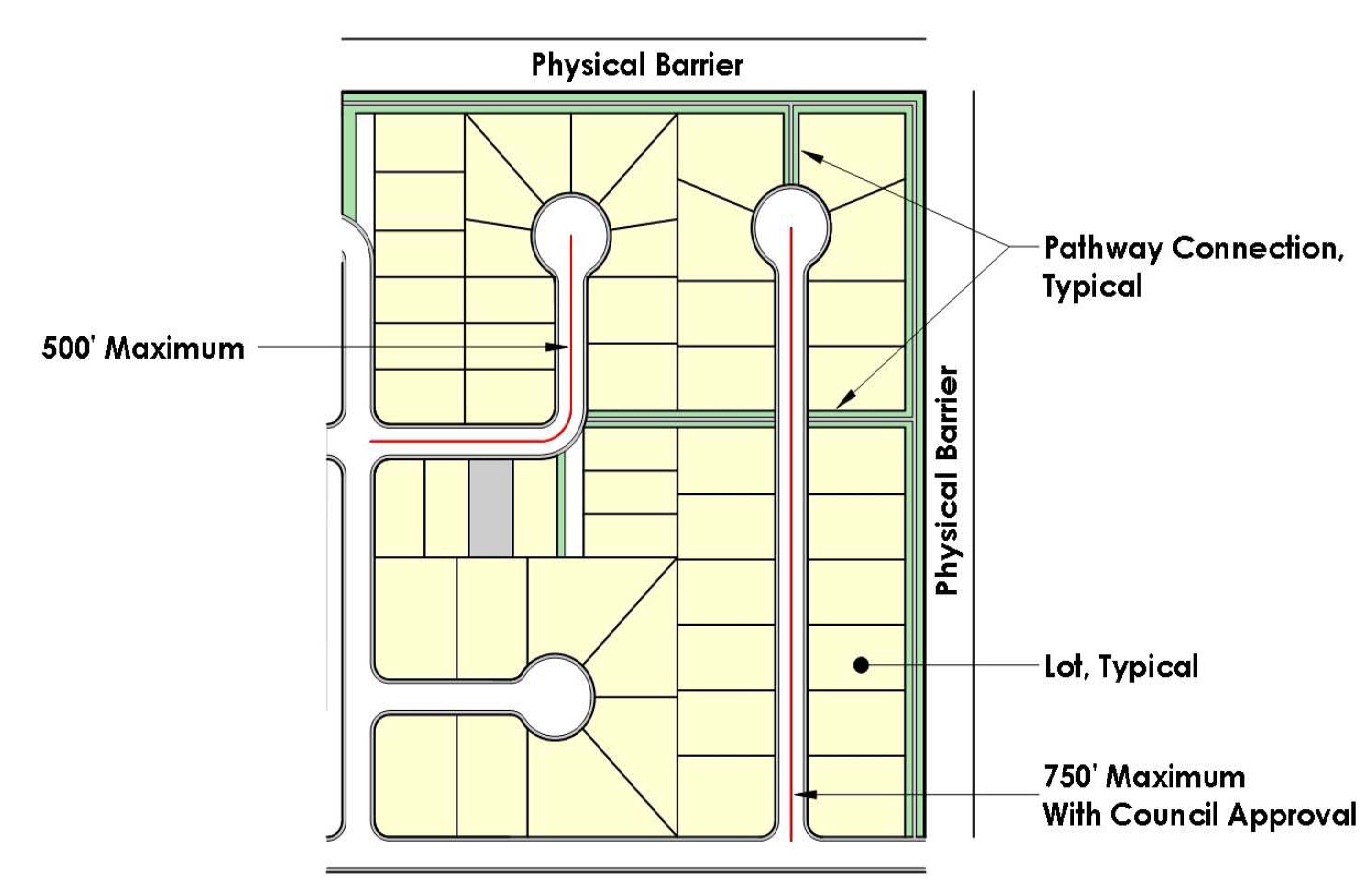
Dead end streets.
a.
No streets or series of streets that ends in a cul-de-sac or a dead end shall be longer than five hundred (500) feet except as allowed in subsection (b) of this section.
b.
The City Council may approve a dead end street up to seven hundred fifty (750) feet in length where an emergency access is proposed; or where there is a physical barrier such as a steep slope, railroad tracks, an arterial roadway, or a large waterway that prevents or makes impractical extension; and where a pedestrian connection is provided from the street to an adjacent existing or planned pedestrian facility.
c.
Cul-de-sac streets may serve a maximum of thirty (30) dwelling units.
d.
The length of a cul-de-sac street shall be measured from the near edge of the right-of-way to the center of the turnaround.
5.
Alleys.
a.
Alleys shall have a minimum of sixteen (16) feet of paving.
b.
All alleys shall serve as fire lanes.
c.
All alleys shall be concrete or asphalt with a concrete ribbon curb.
d.
The entrance to the alley from the public street shall provide a minimum twenty-eight-foot inside and forty-eight-foot outside turning radius. No parking shall be allowed on either side of the street within fifty (50) feet of the alley entrance as measured from the centerline of the alley.
e.
Alleys shall be designed so that the entire length is visible from a public street.
C.
Driveways. All driveway openings in curbs shall comply with the requirements of the transportation authority.
D.
Common Driveways.
1.
Maximum Dwelling Units Served. Common driveways shall serve a maximum of four (4) dwelling units. In no case shall more than three (3) dwelling units be located on one (1) side of the driveway.
2.
Width standards. Common driveways shall be a minimum of twenty (20) feet in width, unless a greater width is required by the City Engineer. All common driveways shall be on a common lot.
3.
Maximum length. Common driveways shall be a maximum of one hundred fifty (150) feet in length or less, unless otherwise approved by the Meridian City Fire Department.
4.
Improvement standards. Common driveways shall be paved with a surface with the capability of supporting fire vehicles and equipment.
5.
Abutting properties. All properties that abut a common driveway shall take access from the driveway; however, if an abutting property has the required minimum street frontage, that property is not required to take access from the common driveway. In this situation, the abutting property's driveway shall be on the opposite side of the shared property line; away from the common driveway. Solid fencing adjacent to common driveways shall be prohibited, unless separated by a minimum five-foot wide landscaped buffer planted with shrubs, lawn or other vegetative groundcover.
6.
Turning radius. Common driveways shall be straight or provide a twenty-eight-foot inside and forty-eight-foot outside turning radius.
7.
Depictions. For any plats using a common driveway, the setbacks, fencing, building envelope, landscaping and orientation of the lots and structures shall be shown on the preliminary plat and/or as an exhibit with the final plat application.
8.
Ingress and egress. Perpetual ingress/egress shall be required either by a recorded easement or as a note on a recorded final plat. The easement or plat note shall include a requirement for maintenance of a paved surface capable of supporting fire vehicles and equipment.
9.
Alternative compliance. The Director may approve or recommend approval of alternative design or construction standards when the applicant can demonstrate that the proposed overall design meets or exceeds the intent of the required standards of this section and shall not be detrimental to the public health, safety, and welfare.
E.
Easements.
1.
Utility easements shall be provided along front lot lines, rear lot lines and side lot lines when deemed necessary by the City Engineer or designee.
2.
Total easement width shall not be less than ten (10) feet, unless specifically approved by City Council at the time of final plat approval or as approved through an easement vacation application.
F.
Block face.
1.
Length in residential districts. In the residential districts, no block face shall be more than seven hundred fifty (750) feet in length without an intersecting street or alley, except as allowed in subsection (F)(3) of this section.
2.
Length in TN-C And TN-R districts. In the TN-C and TN-R districts, no block face shall be more than five hundred (500) feet in length without an intersecting street or alley, except as allowed in subsection (F)(3) of this section.
3.
Exceptions. Although block face lengths are allowed to exceed the maximum length as set forth below, it is anticipated that most blocks will not exceed the requirement.
a.
Where a pedestrian connection is provided, the maximum block face may be extended up to one thousand (1,000) feet in length in residential districts; and up to seven hundred fifty (750) feet in length in the TN-C and TN-R Districts. The pedestrian connection shall provide access from within the subdivision to one (1) or more of the following: a qualified open space as defined in subsection 11-3G-3.B of this title, a street, or a common open space area or public meeting area within an abutting development.
b.
The City Council may approve a block face up to one thousand two hundred (1,200) feet in length where block design is constrained by site conditions such as. an abutting arterial street or highway, a limited access street, railroad tracks, steep slopes in excess of ten (10) percent, an abutting urban project with no adjoining alley or street connections, a public or private education facility or park, a large waterway and/or a large irrigation facility.
c.
Where an applicant proposes block faces that exceed seven hundred fifty (750) feet in a residential district, or five hundred (500) feet in the TN-C and TN-R districts, the applicant shall provide written justification as to why explicit compliance is not feasible or the proposed block layout is equal to or superior to the block face requirements of this section.
d.
A ninety-degree turn in a roadway may constitute a break in the block face, however, overall pedestrian and vehicular connectivity will be considered when evaluating the appropriateness of block lengths greater than seven hundred fifty (750) feet in length. Where an applicant proposes a ninety-degree turn to break up a block face, additional pedestrian and/or roadway connections may be required.
4.
Maximum block face. In no case shall a block face exceed one thousand two hundred (1,200) feet, unless waived by the City Council. Where appropriate and as set forth in section (F)(3) of this section, traffic calming may be required for blocks in excess of one thousand (1,000) feet.
5.
Measuring block face. Block face shall be measured from the near edge of right-of-way to near edge of right-of-way of streets and/or alleys as appropriate.
G.
Reserve strips. Privately held reserve strips controlling access from adjacent lands to public streets shall be prohibited.
H.
Street buffers on local streets. Street buffers on local streets may be installed at the time of the lot development; installation of such improvements shall not be required at the time of plat approval.
I.
Mailbox placement. The applicant shall provide a letter from the United States Postal Service stating that the mailbox location(s) for the development has been approved.
(Ord. 05-1170, 8-30-2005, eff. 9-15-2005; Ord. 07-1325, 7-10-2007; Ord. 13-1555, 5-14-2013; Ord. 14-1592, 1-21-2014; Ord. 16-1717, 1-3-2017; Ord. 18-1773, 4-24-2018; Ord. 20-1870, 1-7-2020; Ord. No. 20-1896, § 5, 9-22-2020; Ord. No. 21-1932, § 5, 6-15-2021; Ord. No. 23-2037, § 16, 10-3-2023)

