
Miami Springs City Zoning Code
ARTICLE I
- IN GENERAL
Sec. 150-001.- Purposes and authority
(A)
The City is divided into zones as are hereinafter more particularly set forth, and as further appear upon the map of the City as adopted by reference by § 150-003(B); and there is adopted and established a comprehensive master zoning plan for the City for the purpose of accomplishing, among other things, the objects outlined in the City Charter and the following purposes all in accordance with a comprehensive master plan zoning plan for the City.
(1)
Lessening congestion in the streets; regulating traffic; securing safety from fire, storm, panic, and other dangers;
(2)
Conserving or providing adequate light and air;
(3)
Establishing, maintaining, or preserving esthetic values;
(4)
Preventing the overcrowding of land;
(5)
Avoiding the undue concentration of population or facilitating the furnishing of operation of facilities for transportation, water, sewage, schools, parks, and other public improvements or conveniences;
(6)
Regulating and restricting the location, height, number of stories, size, cubic contents, construction, and area of buildings and other structures; (including billboards and advertising devices);
(7)
Regulating the percentage and portion of lots and land that may be occupied or built on and the size of yards, courts, or other open spaces, the density of population;
(8)
Regulating the use of buildings, structures, and land for trade, industries, residences, apartment houses, and all or any other purposes;
(9)
Regulating the platting, replatting, resubdividing, and use of unplatted lands for any of the above purposes, in promoting the safety, health, comfort, morals, convenience, peace, prosperity, appearances, or general welfare of the City and its inhabitants;
(10)
Dividing the City into zones of such number, shape, and area, as may be deemed best suited to effectuate the purposes of this section and within such zones regulating and restricting the erection, construction, reconstruction, alteration, repair, destruction, or removal of buildings, land, or structures, including billboards and signs.
(B)
This plan is adopted pursuant to the authority of article 8, § 2B of the State of Florida and the Charter of the City.
(Code 1962, § 25-1; amend. Ord. 599-77, passed 3-28-77)
Sec. 150-002. - Definitions.
(A)
All of the definitions contained in the South Florida Building Code and Southern Standard Building Code are adopted, except where the definitions contained in this section are more restrictive than those contained in these codes, in which case the definitions set forth in this chapter shall prevail.
(B)
General rules of construction. The following general rules of construction shall apply to the regulations of this chapter:
(1)
The word building or structure includes any part thereof, and the word building includes the word structure.
(2)
The word lot includes the words plot or parcel or tract or premises.
(3)
The words used or occupied include the words intended, designed, or arranged to be used or occupied.
(4)
The terms Board of Adjustment, Zoning and Planning Board, and building inspector shall mean such authorities, bodies, or authorized representatives of the City.
(5)
Words and terms not defined herein shall be interpreted in accordance with their normal dictionary meaning and customary usage.
(C)
The following words and phrases shall have the following meanings ascribed to them respectively:
(1)
Accessory building. A subordinate building in a rear yard, detached from the main building, and on the same premises as an existing main building, the use of which is clearly incidental and pertaining to that of the dominant use of the main building or land. An accessory use is one which is incidental to the main use of the premises.
(2)
Accessory structure. Any structure not forming an integral part of the main building but which is customary and pertains to and is incidental to the use of the main building or land.
(3)
Alcoholic beverage. As defined by F.S.A. § 561.01(7).
(4)
Alley. A dedicated way not ordinarily used for general traffic, which affords a secondary means of access for service to property abutting thereon.
(5)
Amusement center. Any business establishment, the primary use of which is to offer use of mechanical amusement devices to the public. A "primary use" shall be defined as the use of more than four mechanical amusement devices at one location without other licensed business activity. A "secondary use" is the use of four or less than four mechanical amusement devices at one location, or more than four mechanical amusement devices with the prior approval of the Board of Adjustment.
(6)
Apartment building. A building which is used as a residence for three or more families living in separate dwelling units, but not to include hotels. See dwelling units.
(7)
Apartment hotel. A building designed for or containing both apartments and individual guest rooms or rental units under resident supervision, and which maintains an inner lobby through which all tenants must pass to again access to apartments, rooms, or units.
(8)
Automatic merchandise vending machine. Any machine or device which upon the insertion of a coin, slug, token, plate, disc, or card, will dispense merchandise of reasonable value, such as gum, candy, snack food items, soft drinks, trinkets, and other articles of a similar nature.
(9)
Automatic or coin-operated service trade machine. Any machine or device other than a "mechanical amusement device", "automatic merchandise vending machine", or "juke box", such as a laundry washing machine or drying machine.
(10)
Awning. A detachable roof-like cover, supported from the walls of a building for protection from sun and weather.
(11)
Bar. Any place devoted to selling or dispensing and drinking alcoholic beverages, or any place where a sign is displayed indicating that alcoholic beverages are obtainable for consumption on the premises.
(12)
Basement. That portion of a building between the floor and ceiling which has at least two feet of its height below the grade of the adjoining ground and the ceiling of which is not more than four feet six inches above grade.
(13)
Boardinghouse. A building, other than an apartment hotel, hotel, motel, or motor lodge, where, for compensation and by prearrangement, lodging, meals, or lodging and meals are provided for definite periods for three or more persons, but not exceeding 12.
(14)
Breezeway. A covered passage, open at each end, which passes through a house (or between two structures), increasing ventilation, and adding an outdoor living effect.
(15)
Buildable width. The width of the lot left to be built upon after the required side yards are provided.
(16)
Building. Any permanent structure attached to the real estate, and having a roof, designed or built for the support, enclosure, shelter, or protection of persons, animals, chattels, or property of any kind.
(17)
Building, height of. The vertical distance from the grade to the highest point of the coping of a flat roof or to the deck line of a mansard roof, or to the mean height level between eaves and ridge for gable, hip, and gambrel roofs.
(18)
Building site. Premises upon which a building is to be located, consisting of a lot or contiguous lots, plus portions of lots, but in no case less than one complete unit of platted land.
(a)
Area. The total horizontal area within the lot lines of the lot.
(b)
Corner. A lot abutting upon two or more streets at their intersection.
(c)
Coverage. The percentage of the total area of a lot that, when viewed directly from above, would be covered by all principal and accessory buildings and structures, or portions thereof; provided that open balconies, awnings, and porte cocheres shall not be included in determining the building area.
(d)
Depth. The mean horizontal distance between the front and rear lot lines.
(e)
Front. The front of a lot shall be construed to be the portion nearest the street. For corner lots, the lot front shall be the narrowest portion abutting the street, unless determined otherwise by the planning and zoning director.
(f)
Frontage. The distance for which the front lot line and the street line are coincident.
(g)
Through (double frontage). Any lot having frontages on two parallel or approximately parallel streets.
(h)
Interior. A lot, other than a corner.
(i)
Key. An interior lot having its side lot lines coincident on one or both sides with the rear lot lines of adjacent lots.
(j)
Line. The boundary line of a lot. On waterfront lots the established bulkhead line or where the bulkhead line has not been established, the mean high-water line shall be construed to be a lot line.
(k)
Width. The horizontal distance between the side lot lines measured at the required front yard line and parallel to the front street line.
(19)
Canopy. An awning or covered shelter consisting of a detachable roof-like cover, supported from the ground, roof or walls of a building, for protection from the sun or weather.
(20)
Carport. A canopy, roof-like structure or shed, open on at least two sides, and attached to the main building for the purpose of providing shelter for one or more motor vehicles.
(21)
Clinic. An establishment where patients are not lodged overnight, but are admitted for examination and treatment by a group of physicians or dentists practicing medicine or dentistry together. The term does not include a place for the treatment of animals.
(22)
Club, private. Buildings and facilities or premises used or operated by an organization or association for some common purpose, such as, but not limited to, a fraternal, social, educational, or recreational purpose, but not including clubs organized primarily for profit, or to render a service which is customarily carried on as a business. These organizations and associations shall be incorporated under the laws of Florida as nonprofit corporations, and the corporations' major purpose shall not be for the purpose of serving alcoholic beverages to their members or others.
(23)
Conditional use. A use, which when specifically listed as such within the use district regulations, may be permitted with certain stipulated conditions that will serve to insure that said use will assimilate properly into its surrounding neighborhood without deleterious effects.
(24)
Contiguous lands. The reference to contiguous lands set forth in Charter Section 2.02 and elsewhere in the Charter and Code of Ordinances, shall mean lands in close proximity; near, neighboring, adjoining, though not necessarily in actual contact or specifically bordering or touching.
(25)
Court. A space, other than a yard, on the same lot as a single building, or an arrangement of related buildings, which space is open, unobstructed, and unoccupied except for such things as trees, shrubs, fountains, statuary, walks, and ways, as provided herein, and it may or may not have street access.
(26)
Dish antenna. An earth station antenna, dish-shaped, intended for the purpose of receiving communication from orbiting satellites and other extraterrestrial sources, a low-noise amplifier (L.N.A.) which is situated at the focal point of the receiving component for the purpose of magnifying and transferring signals, a coaxial cable for the purpose of carrying signals to the interior of a building, or a combination of any of these elements.
(27)
Dish antenna height. The distance measured vertically from the bottom of the base which supports the dish antenna to its highest point when positioned for operation.
(28)
Dish antenna, private noncommercial. A dish antenna erected solely for the use of its owners, and which is not used for commercial purposes or commercial gain. The antenna may not be used for the purpose of obtaining revenue, nor may the owners thereof charge for its use in any manner, notwithstanding its location on commercial or multifamily zoned districts.
(29)
District. Any section or area of the City so identified and delineated on the official district zoning map for which the zoning regulations governing the use of buildings and premises, the height of buildings, the size of yards, and the intensity of use are uniform.
(a)
R district. Any single or multiple-family residential district.
(b)
B district. Any business or commercial district.
(c)
O district. Any professional office district.
(d)
P district. Any district composed of lands dedicated to the use of the public, and lands owned or controlled by a federal, state, county, or municipal body or board for public purpose, and lands devoted to parking purposes.
(30)
Dwelling. Any building or portion thereof, attached to real estate, designed exclusively for use as permanent living quarters.
(31)
Dwelling, single-family. A building designed for or occupied exclusively by one family.
(32)
Dwelling, single-family, detached. A single-family dwelling, on the same lot as another dwelling or dwellings, surrounded by yards or other open spaces. Also see Nonconforming buildings and structures.
(33)
Dwelling, multiple-family. A building designed for or occupied by three or more families.
(34)
Dwelling, two-family (duplex). A building designed for or occupied exclusively by two families.
(35)
Dwelling unit. A room, or group of rooms, occupied or intended to be occupied as separate living quarters by one family and containing independent cooking and sleeping facilities.
(36)
Family. One or more persons, related by blood, marriage, or other such legal relationships, occupying a dwelling, and living as a single housekeeping unit, as distinguished from a group occupying a boardinghouse or hotel, as herein defined.
(37)
Fence. A lineal structure more or less permanent, erected for a purpose, not to include hedges or walls, and controlled by height and materials when constructed on boundary lines.
(38)
Filling station. See service station.
(39)
Floor area. The sum of the gross horizontal areas of the several floors of a building or buildings. Exclusions:
(a)
Accessory water tanks or cooling towers.
(b)
Uncovered steps and exterior balconies.
(c)
Attic space: to be utilized for storage, the location of mechanical, electrical, plumbing, air conditioning, or other building equipment, and for all other usages which support required building services; in no case shall this space be utilized as an area designated for occupancy or living area; whether or not a floor actually has been laid, providing structural headroom of less than seven feet, six inches.
(d)
Terraces, breezeways, screen enclosures, or open porches.
(e)
Floor space used for permitted or required accessory off-street parking spaces, in any building except single-family and two-family dwellings or buildings accessory thereto.
(f)
Elevator equipment room and shaft.
(g)
Mechanical shaft.
(h)
Meter room.
(i)
Emergency staircase, required means of egress.
(40)
Garage, private. An accessory building or a portion of the main building, designed or used for the parking of private passenger vehicles by the occupants of the main building.
(41)
Garage, storage. A building or portion thereof designed or used exclusively for long or short term storage of private automobiles, boats, or other private recreational vehicles, and at which motor fuels and oils are not sold, and motor-driven vehicles are not equipped, repaired, hired, or sold.
(42)
Grade. That certain elevation established by the Dade County engineer's office for any given area in the City, entitled "minimum fill elevations," in effect on the date of this chapter, or as it may be hereafter adopted or amended.
(43)
Guest house. Living quarters within a detached accessory building located on the same lot with the main building, not occupied year-round by temporary guests of the occupants of the premises, the quarters having no kitchen facilities or separate utility meters, and not rented or otherwise used as a separate dwelling.
(44)
Hedge. A lineal growth of vegetation planted or cultivated for a purpose.
(45)
Height of building. The vertical distance from the grade to:
(a)
The highest point of a flat roof.
(b)
The deck line of a mansard roof.
(c)
The average height between eaves and the ridge for gable, hip, and gambrel roofs.
(d)
The average height between high and low points for a shed roof.
(46)
Home/business occupation. Home/business occupation shall mean any business use conducted entirely within a dwelling and carried on by only persons residing in the dwelling unit, which is clearly incidental and secondary to the use of the dwelling for residential purposes and does not change the character thereof and in connection with which there is no display or stock in trade. The home/business occupation shall involve computer, phone and mail use only and shall not involve the use of any accessory building or yard space or activity outside of the main building not normally associated with residential use (See Code of Ordinance § 150-046 for the use regulations established for this use).
(47)
Homes, nursing, convalescent, or extended care.
(a)
Nursing home. A facility providing long-term care of the chronically ill, the physically disabled, and the aged who are unable to care for themselves.
(b)
Convalescent home or extended-care facility. A facility for the care of persons recovering from illness or surgery who do not need the intensive care of the general hospital, but are not yet well enough to go home.
(48)
Hospital. A building or group of buildings, having room facilities for overnight patients, used for providing services for the inpatient medical or surgical care of sick or injured persons, and which may include related facilities, central service facilities, and staff officers; provided that the related facility must be incidental and subordinate to the main use, and must be an integral part of the hospital operations. Hospital-related facilities include nursing homes, convalescent homes, or extended-care facilities.
(49)
Hotel. A building in which lodging or boarding and lodging are provided and offered to the public for compensation, and in which ingress and egress to and from all rooms is made through an inside lobby or office which is supervised by a person in charge at all times. As such, a hotel is open to the public, distinguished from a boarding or lodging house, apartment hotel, or multiple dwelling.
(50)
Juke box. Any music vending machine, contrivance, or device which, upon the insertion of a coin, slug, token, plate, disc, or key into any slot, crevice, or other opening, or by the payment of any price, operates or may be operated for the emission of songs, music, or similar amusement.
(51)
Lot coverage. The area of the lot covered by the ground floor of all principal buildings, plus all areas covered by the roofs of such buildings, as for example, covered porches and terraces.
(52)
Marijuana. Any strain of cannabis or marijuana, in any form, that is authorized by state law to be dispensed or sold in the State of Florida. Also referred to as "medical marijuana."
(53)
Mechanical amusement device. Any machine or device other than an "automatic merchandise vending machine", "automatic or coin-operated service trade machine", or "juke box", which, upon the insertion of a coin, slug, token, plate or disc, may be operated by the public generally for use as a game, entertainment, or amusement, whether or not registering a score; including but not limited to such devices as marble machines, mechanical grab machines, indoor shuffle boards, pinball machines, skill ball, shuffle alleys, mechanical grab machines, electronic game machines, or movie machines.
(54)
Medical marijuana dispensary. A retail establishment, licensed by the Florida Department of Health as a "medical marijuana treatment facility," "medical marijuana treatment center," "dispensing organization," "dispensing organization facility" or similar use, that sells and dispenses medical marijuana.
(55)
Mezzanine. An intermediate floor in any story or room with floor area, not exceeding one-third the total floor area in that room or story in which the mezzanine occurs, and with clear height above or below the mezzanine floor construction, not less than seven feet.
(56)
Motel, motor court, tourist court, or motor lodge. A building in which lodging, or boarding and lodging are provided and offered to the public for compensation. As such, it is open to the public as distinguished from a boarding or lodging house, or a multiple dwelling; same as a hotel, except that the buildings are usually designed to serve tourists traveling by automobile, ingress and egress to rooms need not be through a lobby or office, and parking usually is adjacent to the dwelling unit.
(57)
Nonconforming building or structure. A building or structure which is not in compliance with the zoning requirements of the district classification in which it is located.
(58)
Nonconforming use. The use of a building or portion thereof, or land or portion thereof, which use does not conform with the use requirements of the district in which it is situated.
(59)
Package store. A store that sells alcoholic beverages in sealed containers for consumption off-premises; a liquor store.
(60)
Parking, off-street. Parking spaces entirely on the premises, and not extending into streets, alleys, or other public ways.
(61)
Parking space. An area of not less than ten feet by 22 feet per vehicle, paved with asphalt, concrete, or other material approved by the building department, and striped, exclusive of driveway for ingress and egress. On diagonal parking, the ten-foot width shall be measured at right angles between the parallel lines.
(62)
Pervious area. A surface area that allows, without difficulty, penetration by water.
(63)
Porte-cochere structures. A covered driveway structure attached to the front entrance of a residence under which vehicles, excluding recreational vehicles, may be driven or parked in accordance with the conditions and requirements set forth in the appropriate zoning district category of the City Code of Ordinances.
(64)
Premises. Any lot, plat, parcel, or tract of land which is or may, under this chapter, be occupied or used as the location of a structure.
(65)
Public use floor area.
(a)
In motion picture theatres, public use floor area is defined as the lobby area or areas used for recreational uses other than the auditorium.
(b)
In hotel/motel and apartment complexes, public use floor area is defined as the lobby area, recreational building or areas specifically used for recreational uses within the building.
(c)
In all other use categories, public use floor area is defined as the area devoted to the principal use or activity.
(d)
No open air public use area shall contribute to the calculation of public use floor area.
(66)
Recreational vehicles. Campers, racing cars, trailers, buggies, air boats, boats, boat trailers, airplanes, and any other similar combinations generally classified and used as recreational vehicles.
(67)
Revitalization specialist. A City Consultant, Consulting Firm, or Administrative Staff Employee with expertise in the areas of zoning, planning, architectural design, building construction and renovation, and commercial redevelopment and revitalization, providing assistance and advice to the City on proposed commercial development, renovation and improvement, and redevelopment and revitalization projects in the City.
(68)
Screen. A lineal structure more or less permanent, erected or planted for privacy, esthetics, and limiting view; and which shall be constructed of a growth of vegetation, certified redwood, metal, concrete, or other similar materials, and which shall not exceed six feet in height, and which shall not impede ventilation of the adjacent property.
(69)
Servants' quarters. An accessory residential building designed to be occupied by not more than two employees of the occupant of the main building. The quarters shall not include kitchen or cooking and eating facilities.
(70)
Service station. Any building, structure, or land used for the retail sale of motor vehicle fuels, oils, and accessories, and the servicing or repairing of minor parts and accessories, but not including major repair work, such as motor replacement, body and fender repair, or spray painting, and excluding public garages.
(71)
Sign. Any display of characters, letters, illustrations, or any ornamentation designed as an advertisement or announcement, or to indicate direction or location.
(72)
Single-family residence. A private residence building used or designated to be used as a home or residence in which all living rooms are accessible to each other from within the building, and in which the use and management of all sleeping quarters, all appliances for cooking, ventilating, heating, or lighting are under one control, and which shall be occupied exclusively by one family. There shall be only one front entrance. Doors or other openings constituting more than one front entrance shall be permitted only where the owner can demonstrate a single-family use of the residence. The Board of Adjustment may grant approval for more than one front entrance only upon proof of the owner's intent to use the residence for single-family use and the owner shall execute and record a covenant running with the land restricting the residence's use to that of a single family, provided, however, that such doors or other openings are not exits or entrances to a sleeping room.
Cross reference— Single-family dwelling, § 150-002(C)(31); single-family detached dwelling, § 150-002(C)(32).
(73)
Street. A public thoroughfare which affords the principal means of access to abutting property.
(74)
Structure. Anything constructed or erected, the use of which requires more or less permanent location on the ground, or attached to something having a permanent location on the ground, including but without limiting the generality of the foregoing; advertising signs, billboards, back stops for tennis courts, fences, walls, pergolas, and screen enclosures.
(75)
Structural alterations. Any change in the supporting members of a building, such as bearing walls or partitions, columns, beams, or girders, or any substantial change in the roof or in the exterior walls, excepting the repair or replacement as may be required for the safety of the building.
(76)
Trailer. Any vehicle which is not propelled, and which is designed to be towed by a motorized vehicle.
(77)
Unplatted land. Any land that is not depicted by plat recorded in the Dade County Circuit Court Clerk's Office.
(78)
Variance. A variance is a relaxation of certain regulations contained in this chapter where the variance will not be contrary to the public interest and where, owing to conditions peculiar to the property and not the result of the actions of the applicant, a literal enforcement of this chapter would result in unnecessary and undue hardship.
(79)
Vehicle. A conveyance for persons or material.
(80)
Vehicle, commercial. A vehicle not designated exclusively for the transportation of persons.
(81)
Veterinary clinic. A professional office for the care and medical treatment of small pets consisting of animals, birds, or reptiles of less than 150 pounds operated by a duly licensed doctor of veterinary medicine, the operation of which must be conducted totally within an air-conditioned building which maintains no outside facilities for storage, housing, exercise, or any other purpose. No boarding or storage of any pet is permitted except when necessary to provide medical treatment. No animal waste shall be permitted outside the clinic. Any waste occurring outside the clinic shall be removed and the area cleaned by the owner of the clinic immediately.
(82)
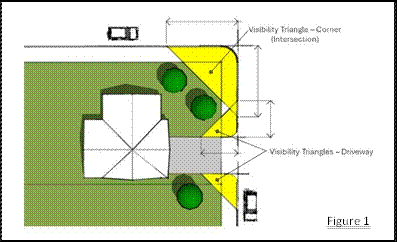
Visibility triangle. Area formed within a property by the intersection of two street lines or of a street line and any driveway line, or the projections thereof and a straight line connecting them at a certain distance from their point of intersection. (Figure 1)
(83)
Wall. Boundary or decorative, solid or semi-open lineal structure, of concrete block, stone, or other material erected for a purpose, and not exceeding four feet in height.
(84)
Yard. Any space between a main building and the adjacent lot lines. In measuring a yard for the purpose of determining the width of a side yard, or the depth of a front yard, or the depth of a rear yard, the minimum horizontal distance between the lot line and the nearest part of the main building shall be used.
(85)
Yard, front. A yard extending across the front of a lot, and being the minimum horizontal distance between the front lot line and the nearest part of the main building. On corner lots, the front yard shall be considered as adjacent to the street upon which the lot has its least dimension. The following shall constitute the only permitted encroachments into the minimum front yard setback areas:
(a)
Eaves, cornices, and roof overhangs; not to exceed 30 inches.
(b)
Uncovered stoops and steps, not to exceed 36 inches.
(c)
Bay windows, uncovered balconies, and similar projecting features, not to exceed 36 inches.
(d)
Window and door awnings and shutters, not to exceed 36 inches.
In no instance shall any projecting feature shall be any closer than 36 inches to a property line or to a fence or wall constructed along the property line.
(86)
Yard, rear. A yard extending across the rear of a lot, and being the required minimum horizontal distance between the rear lot line and the rear of the nearest part of the main building. The rear yard shall be that portion of the lot that is opposite and most distant from the front yard. Despite the definition contained herein, for total rear yard area computation purposes only, the entire open and non-constructed areas behind the rear of the main building and extending to the rear lot line, shall be used for such calculations. The following shall constitute the only permitted encroachments into the minimum rear yard setback areas:
(a)
Eaves and overhangs; not to exceed 30 inches.
(b)
Stoops and steps (covered or uncovered); not to exceed 36 inches.
(c)
Bay windows, balconies (covered or uncovered), and similar projecting features, not to exceed 48 inches.
(d)
Window and door awnings and shutters, not to exceed 36 inches. In no instance shall an awning project closer than 3 feet to a property line.
(87)
Yard, side. A yard between the main building and the side line of a lot, extending from and between the required front yard to the required rear yard, and being the minimum horizontal distance between a side lot line and the side of the nearest part of the main building. It is contemplated that building indentations, niches, or cutout areas may be provided adjacent within the side yards of properties and that such areas may constitute a part of the total side yard area, but shall not be permitted within the minimum side setback area. The following shall constitute the only permitted encroachments into the minimum side setback area:
(a)
Eaves and overhangs; not to exceed 30 inches, nor closer than three feet to any side property line.
(b)
Uncovered stoops and steps; not to exceed 36 inches.
(c)
Bay windows, uncovered balconies, and similar projecting features, not to exceed 30 inches.
(d)
Window and door awnings and shutters, designed and installed per Sec. 150-025, not to exceed 36 inches. In no instance shall an awning project closer than 3 feet to a property line.
(Code 1962, § 25-2; amend. Ord. 599-77, passed 3-28-77; amend. Ord. 677-83, passed 4-25-83; amend. Ord. 697-85, passed 1-14-85; amend. Ord. 704-85, passed 6-24-85; amend. Ord. 728-88, passed 2-8-88; amend. Ord. 730-88, passed 9-26-88 amend. Ord. 755-89, passed 12-11-89; amend. Ord. 894-03, passed 3-10-03; amend. Ord. 906-03, passed 9-22-03; amend. Ord. 908-03, passed 11-10-03; amend. Ord. 936-06, passed 6-12-06; amend. Ord. 938-06, passed 8-28-06; amend. Ord. 944-06, passed 9-11-06; amend. Ord. 1014-2011, passed 4-12-11; amend. Ord. 1044-2012, passed 12-10-12; amend. Ord. 1098-2017, passed 11-13-17; amend. Ord. 1108-2018, passed 9-24-18; amend. Ord. 1109-2018, passed 9-24-18; amend. Ord. 1111-2019, passed 1-14-19; amend. Ord. No. 1141-2024, passed 9-9-24)
Sec. 150-003. - Districts established.
(A)
To achieve the purpose of this chapter and other applicable laws contained in the Code of Ordinances, the City is divided into the following districts:
(B)
District map. The locations of these districts are shown on a map designated as the "official district zoning map of the City of Miami Springs." This district zoning map, together with all notations, dimensions, references, and symbols shown thereon, pertaining the districts, is adopted by reference, and declared to be as much a part of this chapter as if fully described herein. The map shall be available for public inspection in the office of the City Clerk, and any later alterations to this map, adopted by amendment as provided in this chapter shall be similarly dated, filed, and made available for public reference.
(C)
Interpretation of district boundaries.
(1)
Where district boundaries are indicated as approximately following street lines, alley lines, or lot lines, the lines shall be construed to be the boundaries.
(2)
In case any further uncertainty exists, the council shall interpret the intent of the map as to location of boundaries, after having received the recommendations of the Zoning and Planning Board.
(3)
Where any public street or alley is hereafter properly and officially vacated or abandoned, the regulations applicable to each parcel of abutting property shall apply to that portion of the street or alley added thereto by virtue of the vacation or abandonment, until action has been taken to amend the official district zoning map.
(4)
Should any area appear to be not included in any district, or should any area be annexed by the City, that area shall be the highest district nearest thereto excluding the P-1 district (public property district) and the use shall be the use permitted in the most restricted district, so that there will be no doubt that all the area within the limits of the City shall be zoned.
(5)
If a parcel of property is crossed by a zoning district boundary, the district boundary shall be determined:
(a)
By a natural boundary; river, canal, or other quasi-natural boundaries.
(b)
By a dedicated street or alleyway.
(c)
By the most restrictive zoning use of the two designations involved.
(Code 1972, § 25-3; amend. Ord. 363, passed 10-31-66; amend. Ord. 382, passed 7-24-67; amend. Ord. 599-77, passed 3-28-77; amend. Ord. 696-84, passed 9-10-84)
Editor's note— Ordinance 614-77, passed 12-12-77, adopted a new official district zoning map and incorporated this map by reference into this section.
Cross reference— Zoning map changes, see T.S.O. II.
Sec. 150-004. - District uses.
Except as hereinafter provided, it shall be unlawful to erect, construct, or cause to be constructed, any structure, or to use or permit the use of any structure or land which does not comply with the regulations established by this chapter for the district in which the structure is located.
(Code 1962, § 25-4; amend. Ord. 184-J, passed 2-8-54)
Sec. 150-005. - Authorization for endorsement of applications for State of Florida Alcoholic Beverage Licenses.
(A)
Intent. It is the intent of this section to authorize the City Manager or designee of the City to provide the required zoning approval endorsement on applications for the issuance of the State of Florida Alcoholic Beverage Licenses for business establishments in the Commercial Districts of the City.
(B)
Covenant required. Zoning approval endorsement by the City Manager or designee of the City shall be specifically conditioned upon the agreement of each license holder that at least 51 percent of all revenues received by the licensed establishment shall be from the sale of food and food products. The aforesaid agreement shall be memorialized in a "Covenant Running with the Land" which shall be recorded in the public records of Miami-Dade County contemporaneously with the City's endorsement of the application for the Alcoholic Beverage License.
(C)
Covenant exceptions. The execution and recording of a "Covenant Running with the Land" shall not be required from applicants for Alcoholic Beverage Licenses for the following uses:
(1)
Supermarkets or other retail food sale establishments.
(2)
Convenience stores; stand alone or in conjunction with a gas/service station.
(3)
Restaurants operating under an SRX State of Florida Alcoholic Beverage License.
(4)
Package stores; where permitted by District Boundary Regulations.
(5)
Bars; where permitted by District Boundary Regulations.
(6)
Entertainment establishments and private clubs; where permitted by District Boundary Regulations.
(D)
Review and approval process. All applicants seeking zoning approval endorsement by the City shall provide the City Manager's Office with a sworn letter of intent/explanation of the business venture seeking the issuance of a beverage license and the State of Florida Alcoholic Beverage application requiring endorsement. The City Manager or designee of the City shall review the documentation submitted and advise the applicant of the decision of the City within ten business days.
(E)
Elimination of prior restrictions and limitations. The enactment of this section will eliminate all the prior distance restrictions and limitations previously utilized by the City to withhold or condition the City's endorsement of zoning approval application provisions for the issuance of State of Florida Alcoholic Beverage Licenses in the City.
(Code 1962, § 25-5; amend. Ord. 184, passed 2-8-54, amend. Ord. 370, passed 1-23-67; amend. Ord. 592-76, passed 12-13-76; amend. Ord. 620-78, passed 8-28-78; amend. Ord. 1025-2011, passed 8-22-11)
Sec. 150-006. - Airport building restrictions.
Whenever an airport building permit shall be applied for, it shall be necessary before the permit is issued to file with the building superintendent written approval to erect the building from the civil aeronautics administration, federal aviation administration, or the board having jurisdiction over such matters. No structure in the approved zone shall be built within 200 feet of the north right-of-way line of N.W. 36th Street.
(Code 1962, § 25-6; amend. Ord. 599-77, passed 3-28-77)
Sec. 150-007. - Building permits and occupancy permits.
(A)
No structure shall be erected, added to, or altered without a building permit.
(B)
No building permit for the erection, addition, or alteration of a building shall be issued before an application has been made, and the proposed use approved for a certificate of occupancy, as evidenced by affidavit.
(C)
A certificate of occupancy will be issued within two working days after final inspection of the work when completed in accordance with lawful requirements, and it shall state that the new use or occupancy complies with the provisions of this chapter.
(D)
There shall be no change in the use or occupancy of existing buildings, nor shall any new building or addition to a building be occupied, until a certificate of occupancy covering the use has been issued by the building inspector.
(E)
Where, at the effective date of this chapter there are outstanding valid building permits, authorizing the construction of buildings, structures, additions, or alterations, the use of construction of which does not conform to the requirements of this chapter, those permits shall be void unless actual construction work, excluding grading or excavating, is substantially underway on that date.
(F)
Where, at the effective date of this chapter, there are outstanding valid permits, authorizing the use of land or buildings without construction work, and where the use is not permissible under the terms of this chapter, those permits shall be void unless the use is actually in existence on that date.
(Code 1962 § 25-7; amend. Ord. 599-77, passed 3-28-77)
Sec. 150-008. - Designated street frontage required for construction of dwelling.
(A)
Construction of a dwelling, whether single-family, multiple-family, apartment house, court apartment, hotel, motel, or residential building of any kind, shall not be made upon any lot, parcel, or tract of land which does not have frontage upon a dedicated street.
(B)
Street, within the meaning of this section, shall not include any alley, utility easement, or right-of-way not ordinarily used by general traffic, or any other passageway which is primarily for the convenience of the owner of the property abutting thereon, such as a driveway through the middle of a block giving access to the rear or side of property.
(Code 1962, § 25-7.1; amend. Ord. 460, passed 3-23-70; amend. Ord. 599-77, passed 3-28-77)
Sec. 150-009. - Construction materials.
(A)
All buildings shall be of masonry construction, except that open, semi-open, or screened enclosures, including porches, patios, carports, or utility sheds may be constructed of aluminum or some similar fireproof material.
(B)
Additionally, enclosed "Florida Room" or "Sun Room" structures may also be constructed of aluminum or other similar fireproof material, so long as such structures are in compliance with the following conditions; to wit,
(1)
Must be "product approved" by Miami-Dade County.
(2)
Must be attached to a concrete slab and the main structure on the property; not permitted as a free standing accessory structure.
(3)
May only be located in the rear yard area in compliance with all rear and side yard setback requirements for the main structure.
(4)
May not be larger than 400 square feet with a maximum height of 15 feet to the peak of the roof.
(5)
Must include a gabled style roof with a minimum pitch of two and one-half inches in 12 inches unless determined to be impractical by the City Planner due to the location of the attachment to the main structure.
(6)
The solid walls of the building shall not exceed 50 percent of structure.
(7)
Any utilities to be included must comply with all City, County, and State building codes, rules and regulations.
(C)
In all cases of difficulty in the approval of construction materials, the South Florida Building Code and current test reports made by the official material control section of Dade County will be considered as final.
(Code 1962, § 25-8; amend. Ord. 184, passed 2-8-54; amend. Ord. 297, passed 6-22-64; amend. Ord. 529, passed 12-11-72; amend. Ord. 599-77, passed 3-28-77; amend. Ord. 1082-2015, passed 10-26-15)
Sec. 150-010. - Roof materials, requirements and re-roofs.
(A)
All new roofs shall be cement or clay tile, and shall have a minimum pitch of two and one-half inches rise per foot.
(B)
Metal roofs shall also be permitted for all new construction, so long as the following conditions have been met:
1.
The proposed metal roof has received Metro-Dade County product approval.
2.
The method of colorization, proposed color, and the architectural design of the metal roof are compatible, in the judgment of the City's Planning and Building Departments, with the surrounding neighborhood.
(C)
In addition to the other approved materials for new roofs contained in subsections (A) and (B) above, Florida Building Code and Miami-Dade County N.O.A. approved asphalt shingles may be used for the installation of new roofs.
(D)
Truss roofs spanning more than 18 feet shall be fabricated out of conventional two × six lumber, preparatory to receiving tile.
(E)
Flat roofs are also permitted with a continuous masonry parapet with a minimum height of 18 inches, but in all cases taller than any rooftop equipment that may be placed thereon, and may be constructed of any material approved by the Florida Building Code, and shall have a minimum pitch as required by the Florida Building Code.
(F)
Flat roofs without parapet screening shall also be permitted for home additions, attached garages or carports, or detached accessory structures only if the residential structure on the property, or a substantial adjoining or adjacent portion thereof, has an existing flat roof that will continue to be maintained. If permitted, based upon the foregoing criteria, such flat roofs shall have a minimum pitch as required by the Florida Building Code.
(G)
Notwithstanding the foregoing, flat roofs will be permitted on "open patios", without screening, in rear yard areas, which constitute non-living space, so long as the property owner agrees that the patio area will never be enclosed so as to constitute "living space", and will execute a recordable and appropriate "Covenant Running-With-the-Land" to provide notice to future purchasers of the property and further assurances of compliance to the City. In addition, the provisions of this section shall also be applicable to appropriate instances of reverse frontage.
(H)
Re-roofs. Any roof cover that has outlived its bond shall be replaced. The replacement roof shall be constructed of the same roofing materials as was utilized on the roof being replaced. However, nothing contained herein shall prevent the replacement roof from being constructed of cement tile or clay tile. In addition, metal roofs can be utilized as replacement or re-roofs so long as the conditions set forth above for new construction metal roof usage are met. Further, in accordance with the provisions of Subsection (C) above, Florida Building Code and Miami-Dade County N.O.A. approved asphalt shingles may be used for re-roofs.
(I)
If a dispute arises as to whether all conditions have been met, any applicant can file an application in accordance with the procedures set forth in the Code of Ordinances for securing variances from the City to secure a final determination from the Board of Adjustment and City Council.
(Code 1962, § 25-8.1; amend. Ord. 296, passed 5-25-64; amend. Ord. 599-77, passed 3-28-77; amend. Ord. 746-89, passed 2-27-89; amend. Ord. 811-94, passed 5-9-94; amend. Ord. 888-02, passed 11-25-02; amend. Ord. 931-06, passed 1-23-06; amend. Ord. 939-06, passed 8-28-06; amend. Ord. 952-07, passed 2-26-07; amend. Ord. 969-08, passed 8-25-08; amend. Ord. 1002-2010, passed 1-11-11; amend. Ord. 1043-2012, passed 12-10-12; amend. Ord. 1083-2015, passed 12-14-15)
Sec. 150-011. - Utility shed.
(A)
The following provisions shall regulate and govern the installation and location of utility sheds on single-family residential properties in the City.
1.
Utility sheds shall be constructed in the rear yard only, and there shall be no more than one utility shed on each residential homesite property in the City.
2.
The permitted size of utility sheds on residential homesite properties in the City shall be limited to 15 percent of the rear yard area of the property, not to exceed a maximum size of 250 square feet, and shall be installed and anchored in accordance with the applicable rules and regulations of the Florida Building Code.
3.
Notwithstanding the provisions of the foregoing subsection (B), the permitted size of utility sheds shall be further limited by the maximum rear yard area coverage limitation of 15 percent set forth in § 150-041(A)(2).
4.
Utility sheds shall be detached at least ten feet from the main building, and shall conform to setback requirements applicable to the main building, and shall be not less than five feet from the rear lot line.
5.
Minimum electrical and plumbing service may be allowed as approved by the building department. It is the intent of this section that the use of a utility shed be incidental to the family dwelling, and shall not be used for any business purpose or sleeping or living quarters.
(B)
The following provisions shall regulate and govern the maintaining of other types of outdoor storage containers on single-family residential properties in the City other than utility sheds as provided above.
1.
A portable storage module is typically an outdoor storage container that is made of extruded plastic, cannot comply with the installation or wind load requirements of the Florida Building Code for permanent ground installation, is of a non-permanent and portable nature, and are commonly known as "Rubbermaid Sheds" in the community.
2.
Any portable storage module that is a minimum of six feet in height at the center point of the module may be maintained in the rear yard of any single-family residential property of the City, so long as it is not placed within five feet of any property line, is capable of being dismantled within three hours, complies with the size limitations provided in Code § 150-011(A)(2) and (A)(3), and there is no other shed or module located in the rear yard of the property. These module units are required to be dismantled prior to serious storm activity which could cause the units to be broken or picked up by high winds and cause damage to other neighborhood properties.
3.
Any portable storage module that is less than six feet in height at the center point is considered to be an outdoor storage container and is not regulated by the Code of Ordinances.
(Ord. 599-77, passed 3-28-77; amend. Ord. 821-95, passed 4-10-95; amend. Ord. 1018-2011, passed 5-23-11; amend. Ord. 1034-2012, passed 5-14-12; amend. Ord. 1101-2018, passed 2-12-18)
Cross reference— Construction materials, § 150-009.
Sec. 150-012. - First floor elevations.
(A)
For wooden floors, the first floor elevation shall be established so that the bottom of the floor joists are at least 18 inches above grade of building, and the grade at building line shall be a minimum of four inches above the established grade for the crown of the road.
(B)
For poured concrete floors, the first floor elevation shall be established so that the finished elevation is at least 12 inches above the grade of the building, and the grade of the building line shall be a minimum of four inches above the established grade for the crown of the road.
(Code 1962, § 25-9; amend. Ord. 184, passed 2-8-54; amend. Ord. 291, passed 5-25-64; amend. Ord. 599-77, passed 3-28-77)
Sec. 150-013. - Residential plantings, hedges, fences and walls.
(A)
Plantings and hedges.
(1)
Height and locations. Hedges, shrubs, trees and other forms of vegetation may be planted and cultivated on properties located within the residential zoning districts of the City, as follows:
(a)
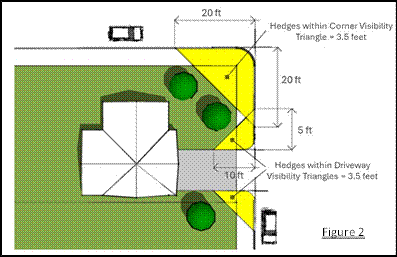
Hedges located in front yards shall be permitted to a maximum height of eight feet, except within any Visibility Triangle.
(b)
Hedges within the visibility triangle shall be maintained at a height not to exceed three and a half feet.
(c)
Trees may be permitted in the visibility triangle provided that foliage is cut away between three and a half and eight (8) feet above the average grade of the road as measured at the centerline of the road.
(d)
Hedges and landscaping shall not be planted in the City right-of-way, unless approved by the Public Works Department.
(e)
Hedges in the side yard that are within the visibility triangle are subject to the height limitations of subsection (A)(1)(b) of this section.
(f)
Decorative gates placed in openings located within side and rear yard hedges may be installed and constructed up to a height of eight feet, so long as Miami-Dade County product approval is provided along with all appropriate and approved wind load engineering data and testing required by the Florida Building Code, Miami-Dade County and the City.
(2)
Maintenance. All hedges, shrubs, trees and other forms of vegetation planted and cultivated on residential properties in the City shall:
(a)
Be maintained in a healthy, manicured and presentable condition, pruned or trimmed neatly and orderly in a manner consistent with standard landscape practices in accordance with the most recent Miami-Dade County Landscape Manual, National Arborist Standards, and/or ANSI A300 standards for the care and maintenance of trees, shrubs, and other woody plants.
(b)
Be maintained by the owner in a like manner on all sides.
(c)
Be maintained so as not to constitute a safety hazard or visual clearance obstruction to pedestrians or vehicular traffic utilizing City sidewalks, swales, alleys, streets or other rights-of-way.
(3)
Enforcement. It shall be the duty and responsibility of the City Code Compliance Department, with the assistance of the City Police Department, when needed, to determine if the safety hazard and visual clearance provisions of this ordinance are being properly maintained.
(4)
Prohibitions.
(a)
The planting and cultivation of new or replacement ficus trees or hedges is prohibited, and existing ficus hedges shall not be permitted to exceed eight feet in height.
(b)
Prohibited and/or controlled plant species listed in the Miami-Dade County Landscape Manual, shall not be planted and shall be removed if existing.
(5)
Visibility triangle measurement. For the purposes of this subsection, visibility triangles shall be measured as follows:
(a)
Driveway intersecting street. A length of five feet along the street right-of-way, measured from the outer edges of the driveway (in any configuration), and a length of ten feet along the driveway, measured from the front property line toward the main building or structure.
(b)
Street intersecting street. A length of 20 feet along the abutting public right-of-way lines, measured from their point of intersection.
(B)
Fences, walls, and gates.
(1)
Vision clearance. No fence or wall shall be installed or constructed in such a manner or location so as to obstruct vision clearance of any pedestrian or vehicular right-of-way. Additionally, no fence or wall over three and one-half feet in height shall be permitted within 20 feet of any corner or street intersection. (Figure 2)
(2)
Front yard installation and construction restrictions. No fence or wall over three and one-half feet in height, above established grade, shall be permitted on the property lines in the front yard areas of any property.
(3)
Interior front yard exclusions. No fence or wall is permitted in the front yard property areas beyond the established front yard property lines.
(4)
Side and rear yard fence and wall heights. Fences and walls installed or constructed along property lines in the side and rear yards of properties shall not exceed a height of six feet.
(5)
Gates. Decorative gates on side and rear yard fences and walls may be installed and constructed up to a height of six feet, so long as Miami-Dade County product approval is provided along with all appropriate and approved wind load engineering data and testing required by the Florida Building Code, Miami-Dade County and the City.
(6)
Maintenance. All fences shall be maintained in good condition, free of cracking, discoloration, peeling and fading, kept free of debris, and maintained structurally sound and in good repair, in an upright and vertical position, not leaning or to otherwise out of plumb. Fence rails and posts shall be structurally sound and shall not be bent, twisted, warped, or otherwise misshaped.
(C)
Prohibitions.
(1)
No barbed wire, electrified, barbed or razor-wire topped fences or walls shall be erected on any property.
(2)
No fence or wall shall encroach upon any drainage, water and sewer, lake access or lake maintenance easement.
(3)
No fence or wall shall impede or impair drainage to or from the adjacent property.
(D)
Permitted fence and wall materials and maximum heights by location.
(1)
Front yard.
(a)
Materials: Wood pickets, decorative aluminum, wrought iron, concrete posts and paling, PVC vinyl, composite material, and similar materials approved by the Planning and Zoning and Building Departments. No chain link wire fences or similar shall be allowed in the front yard.
(b)
Maximum height: Three and a half feet.
(2)
Side and rear yard.
(a)
Materials: Wood pickets, decorative aluminum, wrought iron, concrete posts and paling, PVC vinyl, composite material, galvanized chain link wire, and similar materials approved by the Planning and Zoning and Building Departments. Wire fences shall be two-inch chain link or diamond weave, nonclimbable, or of an approved equal, with a top rail, with the rolled knuckle edge of the wire turned up.
(b)
Maximum height: Six feet.
(c)
Garbage niche: Whenever a fence is installed bordering an alley, the fence shall be designed to include a recessed area of not less than four feet by ten feet for the placement of garbage cans or mobile containers.
(3)
Boundary and decorative walls.
(a)
Materials: Concrete block, stone, and similar materials approved by the Planning and Zoning and Building Departments, in solid or semi-open lineal designs.
(b)
Maximum height: Three and a half feet in the front and six feet in the side and rear.
(c)
Garbage niche: Whenever a fence is installed bordering an alley, the fence shall be designed to include a recessed area of not less than four feet by ten feet for the placement of garbage cans or mobile containers.
(4)
A fence with a finished and unfinished side shall be erected so that the unfinished side and supporting members face inward toward the interior of the property.
(Code 1962, § 25-10; amend. Ord. 184, passed 2-8-54; amend. Ord. 184.5, passed 9-13-54; amend. Ord. 362, passed 10-31-66; amend. Ord. 599-77, passed 3-28-77; amend. Ord. 686-83, passed 12-12-83; amend. Ord. 804-93, passed 8-9-93; amend. Ord. 845-98, passed 3-9-98; amend. Ord. No. 846-98, passed 5-11-98; amend. Ord. 896-03, passed 4-28-03; amend. Ord. 903-03, passed 9-22-03; amend. Ord. 946-06, passed 11-28-06; amend. Ord. 1066-2014, passed 2-24-14; amend. Ord. 1077-2015, passed 3-9-15; amend. Ord. No. 1141-2024, passed 9-9-24)
Sec. 150-014. - Swimming pools.
(A)
Swimming pools are prohibited in the front yard or in the front yard setback of any residential dwelling in the City.
(B)
Residential swimming pools must meet at least one of the requirements relating to pool safety features required by Section 515.27, Florida Statutes, as amended.
(C)
Fences and walls. A fence or wall that is to be utilized as a safety barrier shall be constructed and maintained in accordance with the provisions of § 150-013.
(D)
Permits. Before any work is commenced, permits shall be secured for all swimming pools and for safety barriers. Plans shall contain all details to show compliance with the terms and conditions of these regulations. No swimming pool permit shall be issued unless a permit is simultaneously secured for the erection of the safety barrier. If the premises are already enclosed, as hereinabove provided, a permit for the safety barrier shall not be required, if upon inspection of the premises, the existing barrier complies with the provisions of this section.
(E)
A swimming pool with screen enclosure may be constructed in the rear yard of a single-family dwelling. Screen enclosures shall have a maximum height of 12 feet and the following minimum setbacks:
(F)
Setbacks. Swimming pools shall have minimum setbacks, which shall be measured from the swimming pool's waterline to the property line, as follows:
(G)
Decking surrounding a swimming pool shall have a minimum setback of 2.5 feet from any property line.
(Code 1962, § 25-10.1; amend. Ord. 184.39, passed 9-10-62; amend. Ord. 599-77, passed 3-28-77; amend. Ord. 741-88, passed 11-14-88; amend. Ord. 1137-2024, passed 1-8-24)
Sec. 150-015. - Parking of commercial vehicles in City limits.
(A)
Parking of commercial vehicles in the single family residential zoning districts of the City.
(1)
The following vehicles shall be permitted to park in the single family residential zoning districts of the City as provided herein.
(a)
Approved parking. All cars, trucks, vans, or sport utility vehicles that do not exceed 10,000 pounds of gross vehicle weight, 22 feet in length, and eight feet in height may park in any approved parking location in any single family residential zoning district of the City.
(b)
Approved additions to vehicles. All cars, trucks, vans, or sport utility vehicles approved for parking in Section (a) above may also be permitted to be equipped with the following vehicle additions.
1.
Signage.
2.
Elevated racks, including the carrying of ladders, pipes, lumber, or any other similar items, so long as such equipment is properly and safely secured to the vehicle.
3.
Equipment cabinets and bed coverings, so long as such equipment is properly and safely secured to the vehicle. However, the approval of this equipment shall not be construed to allow the carrying of materials or supplies in the rear or beds of vehicles unless contained within equipment cabinets or covered in a manner which eliminates both the view of, and access to, the materials or supplies.
(c)
Specially customized vehicles. Any specially customized vehicles that exceed the previously established dimensions for approved parking in the Single Family Residential Zoning Districts of the City may be approved for such parking, in the sole and exclusive discretion of the City Code Compliance Department, if a written request is submitted by the vehicle owner for a determination that the subject vehicle contains specially customized features, is clearly "non-commercial" in nature and appearance, and will only be used for social driving purposes. The Code Compliance Department determination may require that any specially customized vehicles be parked in the rear or side yard of any residential property and properly screened from adjacent properties.
(d)
Residential parking variances. Except for the vehicles that are specially prohibited from parking in the single family residential zoning districts of the City set forth in this ordinance, any cars, trucks, vans, or sport utility vehicles that exceed the weight, length, and height limitations for approved residential zoning district parking and are used exclusively for family transportation may apply for a variance to park in such districts. The variance process shall be conducted in the same manner and in conformity with the same standards and requirements that are applicable to the consideration of the granting of variances for alternate rear or side yard approved parking of recreational vehicles in the City.
(e)
Daytime and visitation parking. All commercial vehicles that are providing repair or other services to any single family residential property in the City may park in any approved parking location in the residential zoning districts of the City from 8:00 a.m. to 5:00 p.m. daily. Notwithstanding the foregoing, no violation of this provision will be issued if the code compliance department determines that a reasonable enlargement of the authorized parking periods provided is required in order to complete an ongoing repair project or to perform emergency repair services to a residential homesite. In addition, any residents of the City who regularly operate commercial vehicles as part of their employment may park their commercial vehicles at their single family residences during the aforesaid daily hours. However, such parking shall not be for the purposes of repairing, cleaning, or the stocking of the commercial vehicle.
(2)
The following vehicles shall be prohibited from parking in the single family residential zoning districts of the City:
(a)
The following vehicles are prohibited from parking in the single family residential zoning districts of the City, except for qualified daytime and visitation parking as previously provided in this ordinance, to wit:
1.
Box trucks.
2.
Equipment carriers.
3.
Trailers/tow trucks.
4.
Lunch/food trucks.
5.
Materials/supplies carriers.
6.
Commercial transport vans.
7.
Buses.
8.
Tractor trailers.
9.
Glass/mirror trucks.
10.
Other vehicles clearly designed for commercial use of carriage.
11.
Other vehicles that present health, safety, or welfare hazards to the City.
(b)
Notwithstanding any City policy, provision, custom, or code section to the contrary, none of the specifically identified vehicles in Section (2)(a) above shall be eligible to seek parking approval by variance or any other means.
(B)
Parking of commercial vehicles in the multi-family residential zoning districts of the City.
(1)
The following vehicles shall be permitted to park in appropriately striped parking lots in the multi-family residential zoning districts of the City as provided herein.
(a)
The vehicles identified in Section (A)(1)(a) of this ordinance.
(b)
The vehicles identified in Section (A)(1)(b) of this ordinance.
(c)
The vehicles identified in Section (A)(1)(c) of this ordinance.
(d)
The vehicles identified in Section (A)(1)(e) of this ordinance.
(2)
The provisions contained in Section (A)(1)(d) of this ordinance shall also be applicable to vehicle parking in the multi-family residential zoning districts of the City.
(3)
The following vehicles shall be prohibited from parking in the multi-family zoning districts of the City.
(a)
The vehicles provided in Section (A)(2)(a) of this ordinance.
(b)
Notwithstanding anything contained in Section (B)(1) above, vehicles that require more than one parking space in a single vehicle striped parking lot, despite being otherwise approved for parking in the multi-family zoning districts of the City, are hereby prohibited from parking in such districts.
(C)
Parking of commercial vehicles in the business/commercial, public properties, and church use only zoning districts of the City. For the purposes of this Section, a small commercial vehicle shall be defined as anything up to 10,000 pounds of gross vehicle weight, while a large commercial vehicle shall be defined as any vehicle in excess of the gross vehicle weight of a small commercial vehicle.
(1)
Northwest 36th Street District, Abraham Tract District, and Airport/Golf District. Large and small commercial vehicles shall be allowed, provided that they are parked in appropriately striped parking lots and do not require more than one parking space, unless the property has specially designated and approved parking spaces for them. Said parking shall not be allowed for rental or sale vehicles, unless the property owner or lessee has an appropriate license for vehicle rentals or sales. No parking shall be allowed for any commercial vehicle which could present health, safety or welfare hazards to the City, unless specially approved and contained parking is provided for said vehicles.
(2)
Central business and neighborhood business districts. Small commercial vehicles only shall be allowed, provided that they are parked in appropriately striped parking lots and do not require more than one parking space, unless the property has specially designated and approved parking spaces for them. Said parking shall not be allowed for rental or sale vehicles, unless the property owner or lessee has an appropriate license for vehicle rentals or sales. No parking shall be allowed for any commercial vehicle which could present health, safety or welfare hazards to the City, unless specially approved and contained parking is provided for said vehicles.
(3)
Public properties district. No parking of commercial vehicles shall be allowed on any public property, with the exception of vehicles which are providing repair, delivery or other service to adjacent properties between the hours of 8:00 a.m. and 5:00 p.m. unless otherwise approved in writing by the City Manager or his designee. No parking shall be allowed for any commercial vehicle which could present health, safety or welfare hazards to the City, unless specially approved and contained parking is provided for said vehicles.
(4)
Church use only district. No parking of commercial vehicles shall be allowed on any church properties, except vehicles which are providing repair, delivery or other service to the church, and vehicles used by the church for transportation (buses, vans, etc.) which fall under the definition of small commercial vehicles and are parked in appropriately striped parking lots and do not require more than one parking space, unless the church has specially designated and approved parking spaces for them. No parking shall be allowed for any commercial vehicle which could present health, safety or welfare hazards to the City, unless specially approved and contained parking is provided for said vehicles.
(D)
Notwithstanding the foregoing, the following specific exceptions shall be applicable to the parking of courtesy buses and vans and commercial vehicles in the designated on-site parking areas of the hotels and motels located in the City:
(1)
Courtesy buses and vans owned and operated by any hotel or motel for the enhancement of its business interests may be parked at all times in its designated on-site parking areas.
(2)
Other commercial vehicles may be parked in the designated on-site parking areas of hotels and motels on an overnight basis so long as such vehicles have vacated the parking areas by nine o'clock of the morning following the overnight parking.
(3)
Neither of the parking exceptions provided herein shall permit the parking of hotel and motel courtesy buses and vans and any commercial vehicles outside of the designated on-site hotel and motel parking areas.
(E)
In addition to the foregoing specific execution for hotels and motels, the provisions of this Ordinance shall not be applicable to, or enforceable against, any property or building site located within the Airport, Marine and Highway Business District category of the City's 1998 Comprehensive Land Use Plan that maintains an approved use involving the renting, leasing or hiring of automobiles, limousines, vans. The parking of any other vehicles on any property or building site within the aforesaid district shall be permitted only after securing the approval and authorization of the City Council.
(Code 1962, § 25-10.2; amend. Ord. 360, passed 10-31-66; amend. Ord. 599-77, passed 3-28-77; amend. Ord. 666-82, passed 9-27-82; amend. Ord. 863-2000, passed 3-27-00; amend. Ord. 889-02, passed 11-25-02; amend. Ord. 925-05, passed 5-9-05; amend. Ord. 1071-2014, passed 8-11-14)
Sec. 150-016. - Off-street parking facilities; paving and drainage; lighting; landscaping; and minimum number of off-street parking spaces; off-street parking requirements for single-family residential and duplex zoning districts.
(A)
General provisions. Before a permit is issued for the construction or use of the building, structure, or facility, other than a one- or two-family residence, an off-street parking plan, drawn to scale, shall be submitted to and approved by the building and zoning department and the Zoning and Planning Board. This plan shall accurately designate the number of required spaces and shall show their location, size, access aisles, driveways, sprinklers, or water outlet locations, the location and size of buildings, if any, to be served, and the location, size, and description of all landscape materials, and shall designate by name and location the plant materials to be installed or, if existing, to be used in accordance with the requirements of the City. All off-street parking plans shall be submitted to the Zoning and Planning Board in compliance with § 150-100.
(1)
The building and zoning department and the Zoning and Planning Board are charged with the responsibility of determining whether the off-street parking plan submitted complies with the spirit and intent of all parts of this section. The Zoning and Planning Board will give particular attention to the overall parking function, the landscaping, and the general aesthetics surrounding the development of the site as a whole and make its recommendation to the City Council for final action as provided in § 150-101.
(2)
No plan shall be approved unless it is determined in the review process that the layout of the facilities or lot, incorporating landscaping, will provide a reasonable protection against undesirable effects with respect to contiguous property, and unless it is determined that the landscaping will preserve and promulgate the appearance and character of the surrounding neighborhood through the screening effects and aesthetic qualities afforded by the landscaping.
(3)
In all instances, plans shall clearly and accurately designate, according to City standards, the parking spaces, access aisles, driveways, landscaping, and relationship to the uses or structure that the off-street parking facilities or parking lots are intended to serve.
(4)
Each parking space shall be directly accessible to a street by an aisle or driveway leading to the street. Access aisles and driveways shall comply with the off-street parking standards as prepared and required by the City.
(5)
Each parking space shall be directly accessible without having to drive over or through any other parking space. However, variances from this Section (A)(5) may be considered for off-street parking facilities that maintain a parking attendant on the premises who is available to move parked vehicles.
(6)
No parking space or loading space shall be located in such manner as to block entry or exit to a building, and in this respect a clearance shall be provided adjacent to an entrance or exit door equal to the width of the door or three feet, whichever is greater.
(7)
Off-street parking facilities shall be maintained for as long as the use for which they are provided is continued.
(8)
Off-street parking facilities shall be properly drained so as not to cause any nuisance or damage to adjacent properties, and any lighting of off-street parking facilities shall be designed and arranged to prevent glare or excessive light on adjacent property. All off-street parking facilities shall also be designed for the convenient access and safety of pedestrians and vehicles.
(9)
Each off-street parking space shall be a minimum of nine feet wide by 18 feet in length. All parking spaces and parking aisles shall conform to the dimensions and configuration standards specified by the Miami-Dade County Code.
(10)
Parking spaces for the handicapped shall be dimensioned and provided in accordance with subsection 515.5 of the South Florida Building Code.
(11)
Dimensions shown for parking stalls are minimum.
(12)
Precast concrete wheel stops shall be placed two feet from the end of each stall abutting a sidewalk or building.
(13)
Nothing in this section shall be construed as intending to prevent the common use of driveways as access to parking areas on adjoining sites; provided, however, that the property owner or owners shall submit to the City a restrictive covenant in recordable form reserving unto themselves, their heirs, personal representatives, and assigns the use of such property for those driveway purposes.
(B)
Paving and drainage. Off-street parking facilities shall comply with the paving and drainage standards set forth in the Dade County public works manual and as previously set forth in this section.
(C)
Lighting. All lights shall be deflected, shaded, and focused away from adjacent properties, and lighting shall be accomplished in such a manner as not to be disturbing to passing vehicular traffic and to the users of adjacent properties and as previously set forth in this section.
(1)
Lighting of off-street parking facilities for group E, F, and G occupancies, as defined under the South Florida Building Code, shall be as follows:
(a)
Open parking lots and access thereto shall be provided with a maintained minimum of one-third footcandle of light on the parking surface from dusk until 30 minutes after the termination of business each operating day. A maximum to minimum footcandle level shall not exceed a 12 to one ratio.
(b)
Parking and nonenclosed areas under or within buildings at grade shall be provided with a maintained minimum of one footcandle of light on the parking and walking surfaces from dusk until 30 minutes after the termination of business each operating day. A maximum to minimum footcandle level shall not exceed a 12 to one ratio.
(2)
Lighting of off-street parking facilities for Group H occupancies, as defined under the South Florida Building Code, shall be as follows:
(a)
Open parking lots and access thereto shall be provided with a maintained minimum of one-third footcandle of light on the parking surface from dusk until dawn. A maximum to minimum footcandle level shall not exceed a 12 to one ratio.
(b)
Parking and nonenclosed areas under, over, or within buildings shall be provided with a maintained minimum of one footcandle of light on the walking and parking surfaces from dusk until dawn. A maximum to minimum footcandle level shall not exceed a 12 to one ratio.
(D)
Landscaping. All off-street parking facilities and parking lots exclusive of parking contained within parking garages or buildings, required or provided, shall be properly landscaped as previously provided in this section and in accordance with the following provisions:
(1)
The landscaping as hereinafter required shall include, to the extent necessary to further the intent of this section, lawn, shrubs, hedges, trees, or other acceptable materials, plants or otherwise, which may be used as a visual medium. All landscaping shall be maintained in good condition so as to present, in perpetuity, a healthy, neat, and orderly appearance. The following minimum landscaping standards shall be adhered to in the development of any parking facility or parking lot.
(2)
Prior to the approval by the City Building Department of any building or paving permit that involves providing off-street parking, a plan depicting landscaping in conjunction with off-street parking shall be prepared in accordance with the standards herein provided, and shall be submitted for recommendation to the Zoning and Planning Board and shall receive final approval by the City Council as provided in § 150-101. All proposed landscaping plans shall be submitted to the Zoning and Planning Board in accordance with § 150-100.
(3)
The minimum extent of landscaping required, inclusive of the area devoted to required yard areas, shall be the amount and area resulting from the application of the standards herein provided.
(a)
Planting areas. All planting areas shall be raised or curbed, except as may be approved by the Zoning and Planning Board and the City Council.
(b)
Size of planting areas. All planting areas containing trees shall have a minimum area of 50 square feet, and a minimum width of five feet.
(c)
Self-parking lots and areas or portions thereof. For angular parking, there shall be a minimum of two trees within and up to every 100 linear feet of parking for each parking row; for parallel parking, there shall be a minimum of two trees for the first 100 feet of parking, and one tree for each additional 100 feet. Each tree shall be spaced equidistant from other trees wherever possible.
(4)
Living trees shall be provided in accordance with the landscape standards as provided above. The required trees shall be at least 12 feet in overall height, shall be graded Florida No. 1 or better, as defined by the Florida department of agriculture, division of plant industry in "Grades and Standards for Nursery Plants, Part II, Palms and Trees," and as may be revised. When planted, trees shall have a minimum caliber of two and one-half inches in the trunk, and a clear trunk of at least five feet, and shall be properly braced. The minimum number of trees shall be determined by the application of the landscape standards as stated. All required trees shall be shade trees unless otherwise provided for by the provisions of this section.
(5)
Water availability shall be provided for landscaping maintenance purposes.
(6)
A decorative wall or evergreen hedge shall be provided, unless specifically exempted, immediately adjacent to front, side, and rear lot lines in accordance with these standards. The minimum height of the wall or hedge shall be two and one-half feet, and the maximum height permitted shall be six feet. The shrubs used in the development of a hedge shall be placed not more than two and one-half feet on the center, and the shrubs, where used as a hedge or otherwise, shall be graded Florida No. 1 or better, as defined by the Florida department of agriculture, division of plant and industry, in "Grades and Standards for Nursery Plants, Part I," and as may be revised.
(7)
Interior planting bed areas which are used for the planting of trees, or which are used for landscaping treatment generally, shall be subject to the landscape standards stated in this section, and such areas may, at the discretion of the City Council, be treated with either grass or other types of ground cover or materials used as a visual medium.
(E)
Minimum number of off-street parking spaces. All uses within the City shall be subject to the following requirements for minimum number of off-street parking spaces. Off-street parking space requirements for those uses not specifically enumerated herein, but which are closely related and similar to the uses listed below, shall be determined in accordance with the requirements for listed similar uses. All fractional number of spaces required shall be rounded off to the next highest space number. Any dispute regarding the number of off-street parking spaces required for any use shall be finally determined at an appropriate hearing before and by the City Council.
(1)
Multiple-family residential dwellings and townhouses: Two and one fourth spaces for each dwelling unit.
(2)
Retail and personal service uses: One space for each 300 square feet of gross floor area, with a minimum of three per establishment.
(3)
Medical offices: One space for each 200 square feet of gross floor area, with a minimum of three per establishment.
(4)
Offices (other than medical): One space for each 300 square feet of gross floor area, with a minimum of three per establishment or partitioned floor space intended for a single tenant or owner-occupant.
(5)
Bars and restaurants, meeting and banquet halls, civic and fraternal organization facilities, places of religious observance and similar places of public assembly: One space per 100 square feet gross floor area.
(6)
Hotels and motels; hospitals: One space for each room or suite up to 20, and one space for every two rooms or suites in excess of 20, provided that parking for each accessory use to hotels and motels, such as bars and restaurants, shops, meeting rooms and the like are to be computed separately and added to the total required for rooms and duties.
(7)
Mixed-use buildings: The combined minimum number of off-street parking spaces required for mixed use buildings shall be determined by computing separately and adding together the requirements for the individual uses.
(F)
Exception to minimum number of off-street parking spaces.
(1)
In the currently designated B-1 downtown business area of the City (which is currently designated central business district in the City's comprehensive land use plan and proposed as the "CBD" business district in the latest revision of the City Zoning Code), there shall be no requirement to provide any off-street parking in excess of the off-street parking that is currently in existence in this "built-out" area of the City.
(2)
That it is the specific intent of this section that all existing buildings in this district are grandfathered in for any use currently permitted in the Zoning Code for this district without the need to provide any additional off-street parking despite any change of use that might intensify the use of any building and normally require a corresponding increase in the amount of off-street parking.
(3)
That as a consequence of this exception provision, any existing building in this district may be occupied for any currently permitted use provided in the Zoning Code without the need of securing an off-street parking variance or providing any additional off-street parking due to an increase in any intensity of use.
(4)
That all previously granted "in lieu of" parking variances, and agreements for payment in conjunction therewith, are hereby rescinded and rendered null and void by the passage of this section and all monies paid to the City pursuant to the aforesaid agreements shall be returned to the appropriate remitter upon the passage of this section.
(5)
Nothing contained herein shall be construed to authorize or permit the physical expansion or addition to any existing building in this district over or in any area of established and existing off-street parking.
(6)
That the aforesaid exception provisions shall not be applicable to any of the following:
(a)
When an existing building in this district is demolished and subsequently replaced by the construction of a new building on the property.
(b)
When an existing building in this district is "effectively demolished" by the razing of more than 51 percent of the existing structure and the subsequent reconstruction of that portion of the building previously demolished.
(c)
When any additional area of occupancy and use is physically constructed and added onto, or attached to, any existing building in this district.
(d)
When a new building is constructed on a previously vacant lot or parcel of property.
If any of the foregoing instances occur, all off-street parking requirements and provisions contained in the Code of Ordinances shall remain applicable thereto.
(G)
Off-street parking requirements for single-family residential and duplex zoning districts.
(1)
Minimum number of required off-street parking spaces for single-family homes and duplexes.
(a)
Two off-street parking spaces are required for each single-family home with two bedrooms or less.
(b)
Two off-street parking spaces are required for each dwelling unit in a duplex when the dwelling units therein contain two bedrooms or less.
(c)
Any single-family home or dwelling unit contained in a duplex with three or more bedrooms shall require three off-street parking spaces.
(d)
If the construction of an addition to a single-family home or portion of a duplex increases the number of bedrooms from zero, one or two to three or more, then one additional off-street parking space shall be required.
(2)
Placement. Required off-street parking spaces for single-family residential and duplex zoning districts shall be located entirely on the subject property, and shall not extend into any public right-of-way. Each required off-street parking space shall be directly accessible to a street by an improved driveway leading to the street.
(3)
Configuration. Off-street parking spaces in single-family residential and duplex zoning districts may be in garages, on improved driveways, including circular drives, and may be in tandem for duplex uses. Each off-street parking space for each single-family residential or duplex unit shall be independently and directly accessible to that residence or unit.
(4)
Maximum vehicular and impervious area of front yard. Off-street parking shall be placed and configured on each lot or parcel of land in such a manner that the percentage of total front yard area that is occupied by vehicular use for parking spaces, aisles, driveways and by other impervious surfaces such as walkways, shall not exceed the following, to wit:
(a)
Forty percent for new construction.
(b)
Fifty percent for existing structures with new additions (See § 150-016(F)(1)(d)).
(5)
Minimum nonvehicular and pervious area of front yard. Front yards provided for single-family residential and duplex zoning districts shall contain not less than 60 percent nonvehicular pervious area for new buildings and 50 percent nonvehicular pervious area for existing buildings to which additions are constructed requiring additional parking spaces pursuant to § 150-016(F)(1)(d) above. Such minimum nonvehicular and pervious areas shall be planted in their entirety with grass and approved shrubs, trees and other approved plant materials.
(6)
Notwithstanding any other definition or provision contained within the Code of Ordinances to the contrary, the "total front yard area" for the purposes of the calculations required for subsections (4) and (5) above, shall include all areas of property on the site from the vertical walls of structure forward to the front property line, regardless of whether any such wall is recessed behind the front wall of any part of the structure from which the required front yard setback is measured.
(7)
Properties upon which paver driveways are placed over a sand base, consisting of pavers no larger than eight (8) inches by ten (10) inches, or eighty (80) square inches per paver, shall receive a ten percent credit towards the maximum vehicular and impervious front yard area and the minimum non-vehicular and pervious front yard area calculations performed to determine compliance with subsections (4) and (5) of this section.
(8)
Rock and gravel surfaces in front yard. Rock and gravel surfaces in front yards which are intended for vehicular use shall be counted as vehicular areas. Such surfaces, when used in conjunction with landscaping shall be counted as nonvehicular pervious areas, provided that such nonvehicular rock and gravel surfaces provided in conjunction with landscaping shall not exceed ten percent of the front yard area.
(9)
Off street residential parking driveways shall be constructed of gravel, asphalt, concrete or brick. No vehicle shall be parked on the front yard of any private property which has been previously designated as a landscape or sodded area.
(10)
No new driveways or replacement driveways shall be constructed in the residential zoning districts of the City unless driveway areas located on private property and the driveway approaches constructed over the City swale or public right-of-way are in compliance with the following provisions:
(a)
Each residential building site shall be permitted no more than two driveways in the front or side yards of the site, so long as such driveways comply, or are in conformance with, the restrictions and provisions contained in Code § 150-016(G)(4), (5), (6), (7), (8), and (9).
(b)
In conjunction with the foregoing, each site owner shall be permitted to construct driveway approaches of the same width as the driveways located on the private property site in and over the City swale or right-of-way areas connecting the private property driveways to the adjacent street. The aforesaid driveway approaches located in and over the City swale or right-of-way areas may, in addition to the width permitted, begin to flare and taper out from the swale or right-of-way area that adjoins the sidewalk or private property line for an additional two and one-half feet on each side of the driveway approach as it adjoins the adjacent street.
(c)
A minimum distance of ten feet shall be required between any two driveway approaches constructed and installed in and over the City swale and right-of-way areas.
(d)
All private property driveways and driveway approaches constructed in the residential zoning districts of the City shall only be constructed of asphalt, stamped concrete, broom or plain finished concrete, gravel, bricks or pavers.
(e)
In addition, no driveway approaches may be constructed or installed until the following conditions are met by the private property site owners:
1.
The filing of an appropriate application to secure the required City permit.
2.
The execution of an appropriate "Declaration of Restrictive Covenant" to be recorded in the public records of Miami-Dade County, Florida which specifies that the City will not be responsible to any private property site owner for any damages or restoration costs that may be caused by the City's required excavation of its swale or right-of-way area adjacent to any private driveway.
(f)
The Public Services Department and City Building Department shall have concurrent jurisdiction and inspection responsibilities in regard to the construction and installation of all driveway approaches in and over the City swale and rights-of-way areas.
(Code 1962, § 25-10.3; amend. Ord. 374, passed 5-22-67; amend. Ord. 760-90, passed 3-26-90; amend. Ord. 766-90, passed 9-10-90; amend. Ord. 767-90, passed 9-10-90; amend. Ord. 823-95, passed 4-10-95; amend. Ord. 830-96, passed 2-12-96; amend. Ord. 832-96, passed 4-22-96; amend. Ord. 913-04, passed 6-28-04; amend. Ord. 959-07, passed 8-27-07; amend. Ord. 962-07, passed 11-27-07; amend. Ord. 965-08, passed 2-11-08; amend. Ord. 999-2010, passed 11-8-10; amend. Ord. 1111-2019, passed 1-14-19)
Sec. 150-017. - Recreational vehicles.
(A)
General provisions and definitions.
(1)
As used in this chapter, a recreational vehicle is a noncommercial transportation structure or device, self-propelled or towed, that is used for recreational purposes. Included as recreational vehicles are the following vehicles, but not to the exclusion of other types of recreational vehicles not mentioned in this section: Trailers; trailer coaches; camping trailers; motor homes; pickup (slide-in) campers; chassis mounts; converted vans; chopped vans; mini-motor homes; fifth wheel trailers of recreational vehicle construction, design, and intent; utility trailers; carry-on trailers, with and without a structure mounted thereon; boats; airboats; swamp buggies; unlicensed, uninspected, or expired inspection certificated dune buggies, racing cars, and racing stock cars; aircraft; golf carts; or vehicles converted from their original intended use, and presently designed and used for recreational purposes.
(2)
Trailers, trailer coaches, fifth wheel trailers, and all other vehicles are recreational vehicles when designed or constructed to be towed, or are towable by passenger cars, station wagons, or light pickup or panel trucks, or similar motor vehicles, and are used or intended to be used for recreational purposes. This definition does not include trucks or tractors of any type.
(3)
A camping trailer is a recreational vehicle when the walls and roof are collapsible while the vehicle is being towed, or can be raised or unfolded when the vehicle becomes a temporary living quarters, and is not being moved, and is used or intended for recreational purposes.
(4)
Pickup (slide-in) campers are recreational vehicles when designed to be mounted temporarily or permanently in the beds of light trucks, or in trucks having either single or double rear wheels and with or without an assisting, extra tag axle, and wheels mounted either on the camper chassis or the truck chassis behind the truck's rear wheels, and is used or intended to be used for recreational purposes. These campers can be readily demountable from truck beds. When removed from their respective truck beds, pickup (slide-in) campers are called unmounted campers.
(5)
Chassis mounts, motor homes, and mini-motor homes are recreational vehicles when constructed integrally with a truck or motor-van chassis, and incapable of being separated therefrom, and are used or intended to be used for recreational purposes. The truck or motorvan chassis may have single or double rear wheels.
(6)
Converted and chopped vans are recreational vehicles when created by altering or changing an existing auto van for recreational purposes.
(7)
A carry-on trailer is a recreational vehicle when constructed in such a manner as to place thereon a boat, airboat, swamp buggy, dune buggy, racing cars, racing stock cars, aircraft, golf carts, or vehicles converted for recreational storage or transportation, and which is towable by a passenger car, station wagon, pickup truck, or other mobile recreational vehicle as defined herein.
(8)
A live hedge or screening material is intended to be a visual barrier structure which is maintained in such a manner as to screen the view of a recreational vehicle from adjacent properties and streets. Where a hedge or other growing material is used, the hedge shall attain full permitted height and density within six months after planting, and shall be maintained at all times to screen the view of the recreational vehicle. Any other material used as a screening material shall comply with the applicable provisions of this Code relating to structures.
(9)
Recreational vehicles are intended to be used for camping, sleeping, storage of food and supplies, and aerial and water related activities outside of the city municipal boundaries.
(10)
[Reserved.]
(B)
Parking and storage. Recreational vehicles as previously defined in subsection (A) hereof, shall be parked or stored in any residentially zoned district in accordance with the following provisions:
(1)
Within an enclosed permanent structure meeting all applicable construction codes and City ordinances.
(2)
Recreational vehicles may be parked or stored in the rear yard area of a property, provided that the gross area occupied by the vehicle does not exceed 20 percent of the rear yard upon which no construction exists. Any recreational vehicle may be parked within any distance of the rear lot line, subject to the provisions of subparagraph (5) below. In addition, the recreational vehicle must be properly screened from all adjacent properties and streets.
(3)
Recreational vehicles may also be parked or stored in the side yard setback areas of residential properties, without securing a variance, so long as the following conditions are met;
(a)
No part of the recreational vehicle may extend beyond the front line of the residential structure.
(b)
The front of the recreational vehicle must be screened from public view by a six-foot solid gate.
(c)
The side of the recreational vehicle must be screened from the adjacent neighboring property with a minimum six-foot solid fence, live hedge, or other solid screening material approved by the Building Department.
(4)
No recreational vehicle shall be parked or stored in the front setback area, except converted vans not exceeding 7,000 pounds manufacturers gross weight or pickup trucks (with caps) not exceeding three-fourths-ton capacity, which may be parked within the front setback area, but not closer than three feet from any side property line, or within 30 feet of the corner of intersecting streets.
(5)
No recreational vehicle shall be parked or stored on corner lots of intersecting streets, closer than a 30-foot radius measured from the intersecting point of the front and side property lines of any property adjacent to the point of intersection of converging streets, nor, in any case, beyond the front building line of the structure, nor closer than 15 feet of the entrance of any alley.
(6)
All unmounted pickups (slide-in) campers, truck caps, boats, airboats, swamp buggies as defined herein, racing cars, racing stock cars, aircraft, golf carts, or vehicles converted for recreational use shall comply with divisions (B) (1), (2), (3), and (5).
(7)
No recreational vehicle or unmounted boat, airboat, dune buggy as defined herein, racing car, racing stock car, aircraft, golf cart, or vehicle converted for recreational use, which is in a state of externally visible disrepair, dismantled, unusable for the purpose intended for the design of the vehicle, or in a state of partial construction for more than three months shall be stored or parked in any side or front driveway or yard in a residential zone. It may, however, be stored or parked in the rear of the lot, but not closer than three feet from any property line, provided that the vehicle placement conforms to the gross area standard provided in subsection (B)(2) and the minor repair work shall be accomplished so as not to constitute a nuisance.
(8)
It shall be unlawful to park or store any recreational vehicle on the public right-of-way.
(9)
No more than three recreational vehicles may be parked or stored in the rear yard of any lot in a residentially zoned district. However, the actual number of recreational vehicles permitted to be parked or stored in the rear yard of any such lot shall be specifically restricted and limited by the provisions of subsection (B)(2) hereof.
(a)
In no event shall a landowner's inability to park or store three recreational vehicles in the rear yard entitle such landowner to any special consideration for the granting of a rear or side yard variance to park or store an additional recreational vehicle.
(b)
No variance shall permit the parking or storage of more than one recreational vehicle in the side yard of any lot in a residentially zoned district.
(c)
The number of recreational vehicles parked or stored within an enclosed permanent structure on any lot in a residentially zoned district shall not be restricted so long as the enclosed permanent structure meets all applicable construction codes and City ordinances.
(d)
The parking or storage of recreational vehicles within an enclosed permanent structure on any lot in a residentially zoned district shall not be considered in the administration and interpretation of the provisions contained in this ordinance.
(10)
Parking and storage of a recreational vehicle on any lot shall be limited to the vehicle owned or leased by the occupant-owner or occupant-lessee of the lot. A vehicle owned or leased by a nonresident of Dade County who is a house guest of the occupant-owner or occupant-lessee of the lot may be parked or stored on the lot for a period not to exceed 14 days, provided that guest parking and storage shall be in accordance with all provisions of this section.
(C)
Variances.
(1)
Variances from the terms of this section may be granted in accordance with the standards, requirements and procedures for the granting of variances generally contained in the Code of Ordinances. Any variances granted may include additional requirements for screening and the height thereof, location and placement of the vehicle, any other reasonable conditions, and any other requirements necessary to permit the extension of fire and police protection necessary to provide for the health, safety, and welfare of the citizens.
(2)
The request for a variance shall be made by the applicant as prescribed by the Code. The application for a variance shall be made in writing on forms supplied by the City Building Department and each applicant for variance shall pay the fee set forth in the City's current schedule of fees.
(3)
A variance shall remain in effect as long as the vehicle granted the variance is owned by the same person making the application for parking or storage on the designated property, and as long as the vehicle so parked or stored is maintained in the same condition as when the application for variance was filed.
(D)
Prohibited uses.
(1)
Recreational vehicles shall not be permitted to be used as sleeping or living quarters in the City.
(2)
Recreational vehicles shall not be permitted to be used for any commercial purpose in the City.
(Code 1962, § 25-10.4; amend. Ord. 65B, passed 2-25-52; amend. Ord. 505, passed 2-28-72; amend. Ord. 599-77, passed 3-28-77; amend. Ord. 612-77, passed 12-12-77; amend. Ord. 703-85, passed 5-28-85; amend. Ord. 855-99, 8-9-99; amend. Ord. 862-2000, 3-13-00; amend. Ord. 1007-2011, passed 1-11-11; amend. Ord. 1036-2012, passed 6-11-12; amend. Ord. 1073-2014, passed 9-22-14)
Sec. 150-018. - Plans and surveys.
(A)
Each application for a building permit shall be accompanied by a plan or plat drawn to scale showing actual dimensions of the lot to be built upon, the size, shape, and location of the building to be erected, the size, shape, and location of any existing building on the lot, and such other information as may be necessary to provide for the enforcement of this chapter.
(B)
After pouring the footing and prior to further construction, a plat of the survey, prepared by a registered land surveyor of the state, shall be supplied to the building inspector for all main buildings, indicating the exact location of the building on the lot or building site.
(Code 1962, § 25-11; amend. Ord. 184, passed 2-8-54)
Sec. 150-019. - Subdivisions; plat; approval.
(A)
It shall be unlawful to subdivide any property within the City, or to open, grade, or improve any street therein, or to erect, construct, or cause to be constructed any residence or other structure on any unplatted land, until a plat of the proposed subdivision shall have been approved by the City Council.
(B)
Subdivision shall be defined as a division of a lot, tract, or parcel of land or water into two or more lots, plats, sites, or other subdivisions of land or water for the purpose, whether immediate or future, of sale, rent, lease, building development, anchorage, right-of-way dedication, or other use.
(C)
No building permit, occupational license, license, or permit shall be issued for any improvement, construction, or use of an unplatted lot within the City unless the recording of a plot is not required by state statute, county ordinance, or regulatory rule, or is otherwise waived or excepted by this Code. The owner of developer of any properly platted or waived parcel shall be entitled to only one building permit, occupational license, license, or permit for all initial construction on each single platted lot or parcel of land.
(D)
No plat or replat shall be approved unit the following requirements have been met:
(1)
Tentative plat. A tentative plat to be approved by the Zoning and Planning Board showing all lots, streets, and alleys, if required, together with their dimensions, as well as connecting adjoining streets and the elevation of the land in the subdivision to be expressed in feet above mean sea level (United States coast and geodetic survey datum). The elevations may be shown as contours at one-foot intervals.
(2)
Final plat. The final plat shall show, wherever required, the limits of areas thereof to be filled, together with the elevation of such fills. The elevation of fills, wherever required, shall be as established by the Dade County engineer's office, and as shown on the current official map of the City, on file in the office of the City Clerk, the map being made, by reference, a part of this chapter.
(3)
Agreement; bond. All persons, firms, and corporations submitting plats to the City Council for approval shall accompany the plat with an agreement providing for the paving of streets, the construction of sidewalks and drainage structures, and the installation of adequate water mains, fire hydrants, street lighting, and other improvements as the council deems necessary in the subdivision, which installation shall be in accordance with the specifications as set forth by the City Council. The agreement shall be accompanied by a surety bond in the penal sum of not less than 110 percent of the estimated cost of construction. The agreement shall be approved by City Council and filed with the City Clerk. The condition of this bond shall be such that the principal shall fully and faithfully perform all the terms and conditions of the principal's agreement, and within the time specified therein. The bond shall be released by the City only upon satisfactory completion of the work specified in the agreement as evidenced by written certification by the City engineer, including certification that the elevations of all pavements, sidewalks, and fills comply with the provisions of the chapter. The agreement shall stipulate such time limits as the City Council shall require for the various installations specified therein.
(4)
Alleys. If appropriate to the parcel being platted or replatted, and required by the City Building and Zoning Department or other appropriate administrative staff, a plat or replat shall include properly dedicated alleys in the rear of the lots shown on the plat or replat, which alleys shall not be less than 16 feet in width, and in the alleys there shall be provided returns having 25-foot radii to permit free ingress and egress, where the alleys intersect other alleys, to permit vehicles to pass in and out without encroaching on adjoining property.
(5)
Lot sizes. All building sites and lots in residential districts shall have a minimum width of 75 feet and a minimum depth of 100 feet, and all building sites or lots in commercial or business districts shall have a minimum width of 50 feet and a minimum depth of 100 feet. The purpose and intent of this division is to prevent the reduction in size of lots and tracts, or parcels of land from being redivided to parcels of less than the minimum required herein. It is not intended to prevent lots in existence at the time of passage of this chapter from being increased in size or width even though the increase does not reach the prescribed minimum.
(6)
Compliance. The granting of a plat or replat is specifically conditioned upon the applicant's satisfactory compliance with all appropriate provisions of § 150-020.
(E)
Waiver of plat. All waivers of plat shall meet the requirements of § 150-020.
(Code 1962, § 25-12; amend. Ord. 184, passed 2-8-54; amend. Ord. 184.9, passed 3-28-55; amend. Ord. 599-77, passed 3-28-77; amend. Ord. 750.89, passed 10-23-89)
Sec. 150-020. - Plat, replat, and waiver of plat procedure.
(A)
All plats, replats, or petitions for waiver of plat shall comply with the following requirements:
(1)
The provisions of the Dade County Code of Ordinances chapter 28.
(2)
All applications for platting, replatting, or waiver of platting shall be submitted to the City Manager and the City Building Official on such forms and with such attachments, exhibits, and information as is required by the Code of Ordinances of Dade County, the City of Miami Springs or by the City Manager's administrative order for review and submission to the City Zoning and Planning Board. Prior to submission to the City Zoning and Planning Board for review and recommendation, the City Manager and the building official shall determine if:
(a)
The proposed plat, replat or waiver of plat conflicts in any respect with the City Code of Ordinances or the City comprehensive plan;
(b)
All documents required by law, including a current survey are attached to the application;
(c)
The proposed legal description of each lot, location of property lines, existing or proposed easements, structures, elevations, water and sewer and other utilities and other essential features are correctly set forth;
(d)
The public health, safety, and welfare is served by the proposed design of the lots described in the plat, replat, or waiver of plat;
(e)
Adequate utilities and services are proposed or available;
(f)
There are adequate provisions for the safety and convenience of vehicular and pedestrian travel;
(g)
A waiver of plat application will meet the requirements of this Code;
(h)
Additional improvements for the protection of the environment are necessary;
(i)
The completion or performance bond is adequate to complete required improvements;
(j)
Resurveying by a surveyor retained by the City is required;
(k)
Dedications or reservations are required.
(3)
The application shall be accompanied by:
(a)
A minimum application fee that shall be established by City resolution and paid to the City to defray the initial costs the City will incur in processing each application for plat, replat, waiver of plat, and to investigate all applicant representations prior to final approval, and in addition, an agreement by the applicant to reimburse the City for all engineering, legal, and other technical support costs incurred by the City in the processing of any application. All additional costs shall, within five days after notice, be paid to the City and in all cases, received prior to submission of the plat, replat or waiver of plat to the county. The applicant shall also be responsible to pay all charges or fees that may be assessed by the county.
(b)
A completion or performance bond and agreement as required by §§ 150-019(C)(3), 150-020(A)(2)(i).
(4)
All streets, easements, alleys, rights-of-way, public lands, water and sewer, or other public facilities shall be accompanied by an appropriate opinion of title from a title company or the applicant's attorney.
(5)
A lot, tract, or parcel of land sought to be subdivided by waiver of plat shall be divided into no more than two lots if it is determined by the City Council that waiving of the requirements for platting would not conflict with the purpose and intent of this chapter. In addition, the council shall determine if:
(a)
The subdivision of land heretofore platted is of such unusual size or shape or is surrounded by such development or unusual conditions as may justify the waiving of the requirements for recording a plat. In lieu of recording a plat, conditions may be imposed as may be deemed necessary and appropriate to preserve the public interest, including recording of the waiver of plat agreement and survey.
(b)
In lieu of platting, the City Council may require any dedications, reservations or improvements required in connection with platting under this chapter, including the posting of a surety bond as may be necessary to carry out the intent and purpose of this chapter.
(6)
Following review by the City Zoning and Planning Board, all tentative plats, replats, and waivers of plat shall be submitted to the City Council for approval.
(7)
Upon approval by the City Council, the applicant shall submit the tentative plat, replat, or waiver of plat to the plat division of Metropolitan Dade County for review and approval.
(8)
Upon approval of the tentative plat, replat, or waiver of plat from the plat division of Metropolitan Dade County, the applicant shall prepare and submit the final plat, replat, or waiver of plat to the City for final review and approval by the City Council.
(9)
After securing final approval from the City Council, the applicant shall submit the final plat, replat, or waiver of plat to the plat division of Metropolitan Dade County for final county commission approval.
(10)
Upon securing approval from Metropolitan Dade County, the final plat, replat, or waiver of plat shall be transmitted to the clerk of the county circuit court for recording.
(B)
Notwithstanding anything to the contrary contained herein, the City Council may impose any additional reasonable requirements for the protection of the public health, safety, and welfare as a condition for the approval or granting of any plat, replat or waiver of plat.
(Ord. 750-89, passed 10-23-89)
Sec. 150-021. - Interpretation; conflicts.
In interpreting and applying the provisions of this chapter, they shall be held to be the minimum requirements for the promotion of the public safety, health, convenience, comfort, morals, prosperity, and general welfare. This chapter supersedes and supplants all previous zoning ordinances. It is not intended by this chapter to interfere with or abrogate or annual any other ordinances, rules, regulations, or permits previously adopted or issued, and not in conflict with any of the provisions of this chapter, or which shall be adopted or issued pursuant to law relating to the use of buildings or premises and likewise not in conflict with this chapter; nor is it intended by this chapter to interfere with or abrogate or annual any easements, covenants or other agreements between parties. However, where this chapter imposes a greater restriction upon the use of buildings or premises or upon height of buildings, or requires larger open spaces or larger lot or floor areas than are imposed or required by the ordinances or agreements, the provisions of this chapter shall control.
(Code 1962, § 25-34; amend. Ord. 184, passed 2-8-54)
Sec. 150-022. - Amusement centers; mechanical amusement devices.
(A)
All amusement centers shall be prohibited within the City.
(B)
Mechanical amusement devices shall be allowable as a secondary use subject to the following limitations:
(1)
No more than ten percent of the gross square footage of the public use floor area of a licensed premises shall be utilized for mechanical amusement devices. Each mechanical amusement device is hereby established as utilizing 25 square feet for the purpose of this section.
(2)
No mechanical amusement device shall be placed within one foot of another mechanical amusement device or located in such a manner so as to permit persons operating the device and spectators observing the operation from blocking passageways or aisles or interfering with exits or entrances, in such a manner so as to limit, in any way, the movement of persons through the passageway, aisle, entrance or exit.
(C)
The following restrictions and conditions shall apply to the secondary use of mechanical amusement devices allowed under division (B) above:
(1)
There shall be no sign identifying the availability or location of the mechanical amusement device which is visible from the exterior of the building within which the mechanical amusement device is located.
(2)
The mechanical amusement devices shall not be served by individual or separate doors from those serving the public use area of the facility within which said mechanical amusement devices are located.
(D)
Special permits may be granted additional mechanical amusement devices by the Board of Adjustment after application and hearing provided that the applicant can demonstrate that the additional machine or machines shall not constitute an unsafe area for crowd control, constitute a fire hazard, interfere with the safety of other patrons of the licensee's premises, and comply with divisions (B) (1) and (2) above.
(Ord. 677-83, passed 4-25-83)
Sec. 150-023. - Private noncommercial dish antennas.
(A)
Location. Private noncommercial dish antennas may be permitted in the City provided they meet the following requirements.
(1)
They are located in the rear yard.
(2)
They are placed no closer to any property boundary line than a distance equal to their height as measured from ground level to the top of the antenna dish but in no event closer than five feet to the boundary lines.
(3)
They do not encroach on any of the required side setbacks for the district in which they are located.
(4)
Where rear and side setbacks abut public lands such as golf courses, recreational areas, or schools, antenna dishes may be located in the rear yard within five feet of the side and rear setback line, notwithstanding the height thereof, not including streets, alleys, rights-of-way, or easements.
(5)
In connection with multifamily buildings of four stories or more, or commercial or industrial buildings, roof top installations shall be permitted as long as anchorage of same complies with the requirements of the South Florida Building Code relative to structures.
(B)
Dimensions. The height of private noncommercial dish antennas from ground level shall not exceed 12 feet nor shall their diameter exceed ten feet.
(C)
Screening. Private noncommercial dish antennas shall be screened in a manner that obscures the antenna from the plain view of fronting and adjacent side properties. Where rear yards abut golf courses, such rear yards shall be considered for screening purposes to be front yards. In addition thereto, landscape screening shall be maintained along the rear lot lines in such location, size, and type as to obscure the antenna dish from the view from any opening, window, or porch on the ground level of any abutting structure. Landscape screening shall consist of trees or shrubs of such height and density, placed in such locations and in such proximity to the antenna dish so as to obscure the visibility of the antenna dish as required herein. All landscaping materials shall conform to the City tree ordinance.
(D)
Number allowed.
(1)
Only one private, noncommercial antenna shall be allowed per single-family home, duplex, or townhouse unit. Multifamily buildings, commercial buildings, and industrial buildings of less than three stories shall be allowed one noncommercial antenna.
(2)
Multifamily buildings, commercial buildings, and industrial buildings, so long as they are four stories or more in height, shall be allowed up to three dish antennas.
(E)
Anchorage. Dish antennas shall be anchored securely to the ground or to a building's roof in conformance with requirements of the South Florida Building Code relative to structures.
(F)
Permit. Anyone wishing to erect a private, noncommercial dish antenna must first submit the plans for it together with a lot survey to show the location of the antenna on the lot with the fence and landscape plan, designating the height and type of trees or shrubs. The applicant shall also submit a scale drawing of abutting lots and structures thereon and the location of windows, porches, and openings on the ground level thereof which are screened from view of the proposed antenna location to the building and zoning department for review and approval. Upon approval, the director will cause a permit to be issued after payment of a $50.00 permit fee.
(G)
Maintenance. Once installed, dish antennas and related appurtenances must be maintained in good and operable condition. Surrounding landscaping shall also be maintained as designated on the fence and landscape plan.
(H)
Patio umbrella dish antennas. Private noncommercial antennas that are designed and constructed to resemble standard lawn or patio furniture, consisting of a covered patio umbrella enclosed by a patio table and bench, may be permitted in the City so long as the patio umbrella dish antenna complies with the provisions of this section, except that, to-wit:
(1)
No screening will be required for this type of private noncommercial dish antenna so long as the patio umbrella dish is in compliance with the provisions of division (H), is no larger than seven feet in diameter, and that no portion of the antenna shall be higher than ten feet in height measured from the ground level of the real property upon which it is located.
(2)
The City Building Official may issue a permit for the installation of this type of private noncommercial dish antenna without regard to fencing, landscaping or view of such patio umbrella dish antenna from adjacent properties.
(I)
Small dish antennas. Private noncommercial dish antennas which do not exceed 24 inches in diameter may be permitted in the City upon compliance with the following conditions:
(1)
No dish antenna may be installed in the front yard of any property.
(2)
A dish antenna may be installed in the side yard of any property so long as it is properly screened from view from the front yard of the property.
(3)
A dish antenna may be installed in the rear yard of any property without the need for any screening.
(4)
There shall be no more than one small dish antenna installed on any residential homesite property in the City.
(5)
All dish antenna installations must be properly permitted, inspected and approved by the City Building Department.
(Ord. 697-85, passed 1-14-85; amend. Ord. 787-92, passed 2-24-92; amend. Ord. 820-95, passed 4-10-95; amend. Ord. 824-95, passed 9-11-95)
Sec. 150-024. - Outdoor and decorative lighting.
(A)
Lights for area lighting of outdoor areas, such as landscape areas, parking lots or areas, recreation areas and outside lighting for security purposes shall not be permitted except under the following conditions:
(1)
Detailed plans shall be submitted to the building and zoning department showing the location, height, type of lights, shades, deflectors and beam directions.
(2)
The department may issue a permit for such lighting after a review of the detailed plans. Proposed lighting will be so located, oriented, adjusted and shielded that the lighting will be deflected, shaded and focused away from adjacent property and will not be or become a nuisance or will not create a hazard to adjacent property or to traffic on adjacent streets.
(3)
In addition, outdoor lighting for recreational and off-street area parking purposes, or for any other purpose, shall be designated so that any overspill of lighting onto adjacent properties shall not exceed one-half footcandle (vertical or horizontal) illumination on adjacent properties or structures.
(4)
If existing lighting is deemed a hazard or nuisance, based on abutting property complaint, the objectionable lighting shall be brought into conformance with provisions of division (3) above.
(B)
Decorative lighting shall be permitted to illuminate the outside surfaces of commercial buildings, hotels, motels, apartments, condominiums, and other similar structures in accordance with the following conditions:
(1)
Compliance with subsections (A)(1) and (2) of this section.
(2)
No decorative lighting will be permitted to spill over into any adjacent residential district or onto any adjacent roadway.
(3)
Decorative lighting shall be restricted to the front and rear façades and entryways of buildings.
(4)
Authorized and approved lighting fixtures are to be of metal halide and shall have an adjustable beam with a framing snoot that will direct a narrow beam of light to shine only onto the authorized decorative lighting areas of the building. The fixtures are to be fully shielded (the bulb is placed far enough into the fixture that the source of light is not visible) to prevent glare from being visible by any neighboring residential properties or roadways.
(5)
Up-lighting decorative beams shall terminate at or below the roof cornice or other similar architectural feature, but in no event above the bottom of the structure's roof.
(6)
All decorative lighting beams or patterns are to be restricted to a "narrow wash" beam.
(7)
The plans review and permitting for all decorative lighting shall also include all photometric data that may be required by the City Building Department.
(8)
At the sole discretion of the City Building Department, decorative lighting plans and applications may be transmitted for review and evaluation to the City's engineers.
(9)
All costs associated with the review, evaluation and permitting of decorative lighting plans by the City Building Department and/or the City engineers shall be the responsibility of the applicant.
(Ord. 701-85, passed 3-25-85; amend. Ord. 983-09, passed 9-14-09)
Sec. 150-025. - Awnings and canopies in all zoning districts.
All awnings and canopies placed upon, attached to, or forming any part of any building in any zoning district of the City shall conform to the following conditions and restrictions.
(A)
Approval. No permit for the erection or replacement, in whole or in part, of any awning or canopy shall be issued without the approval of the City Building and Zoning Department. Prior to the issuance of any permit or approval, the building and zoning department may, in its discretion, require the submission of plans, specifications, drawings, designs, diagrams, or any other pertinent information or documentation regarding the erection or placement of the requested awning or canopy.
(B)
Materials for awnings and canopies.
(1)
Awnings or canopies placed upon, attached to, or forming any part of any building in any area zoned for single-family residential or duplex use shall be made of canvas, cloth, or other similar materials, or of fiberglass, aluminum, or other manmade materials.
(2)
Awnings or canopies placed upon, attached to, or forming any part of any building in any area zoned other than single-family residential or duplex shall be made of canvas, cloth, or other similar materials or of fiberglass, plastic, or nonferrous metals, but in no case shall any such awning or canopy be made of wood or wood products or of masonite or similar materials. In all cases, such awnings or canopies shall generally simulate the appearance of canvas awnings, and must not be corrugated or slatted or with holds or other interstices.
(3)
Illuminated awnings or canopies shall not be permitted in any zoning district of the City.
(C)
Slope. No canopy shall be erected which has a minimum slope of less than two inches in 12 inches, or a maximum slope of more than five inches in 12 inches.
(D)
Horizontal area—Residential. No canopy shall be erected which covers a total horizontal area greater than 450 square feet in the residentially zoned districts of the City.
(E)
Horizontal area—Business/commercial. No canopy shall be erected which covers a total horizontal area greater than 750 square feet in the business/commercial districts of the City.
(F)
Clearance over sidewalk. In any district other than a single-family residential or duplex district where an awning or canopy is placed upon, attached to, or forming any part of any building, and such awning or canopy projects over a sidewalk, or similar place where the public is accustomed to walk, the rigid or metal parts for any such awning or canopy shall have a clearance of not less than seven feet-six inches from sidewalk elevations, and any nonrigid valance of any such awning or canopy shall have a clearance of not less than six-and-one-half feet from sidewalk elevation. No awnings or canopies shall be allowed to project over a sidewalk or other public right-of-way in any single-family residential or duplex district of the City.
(G)
Construction.
(1)
All awnings or canopies of cloth, canvas, or other similar materials shall be so constructed as to permit quick removal such as is necessary in cases of impending storms or hurricanes.
(2)
Except for those installations which are stationary in character, awnings or canopies other than those of cloth or canvas or other similar materials shall be so constructed in a manner to easily allow them to convert to storm shutters or storm protection for the building to which they are attached.
(3)
Rigid awnings or canopies which are stationary in character shall be designed to resist the following loads.
(a)
Roofs shall be designed for a live load of not less than 30 pounds per square foot except that roofs occupied as roof gardens or for concentrated loads shall be designated for corresponding occupancies.
(b)
Design shall not be based on the removal or repositioning of parts or the whole during periods of high wind velocity.
(H)
Location of awnings.
(1)
Single-family residential and duplex zoned districts.
(a)
All window and door awnings shall be attached to the building.
(b)
The awnings may be located on the front, side, or rear of said building, and may extend into required setback areas.
(2)
All other zoned areas.
(a)
All window and door awnings shall be attached to the building.
(b)
The awnings may be located on the front, side or rear of the building.
(I)
Maintenance, repair, replacement and/or removal.
(1)
All awnings and canopies shall be maintained in good order and repair. Awnings and canopies which are found, upon inspection, to be in disrepair shall be subject to removal and replacement.
(2)
The City, from time to time, shall require that an inspection be made of all awnings and canopies encroaching upon public rights-of-way, and in all cases where said inspection reveals that such awnings and canopies are in need of repair and replacement, such awnings and canopies shall be declared to be a public nuisance and the Code Enforcement Officer shall so notify the owner of record of the property described by registered or certified mail, as their names and addresses are shown upon the record of the County Property Appraiser. Such notice shall be deemed complete and sufficient when so addressed and deposited in the United States mail with proper postage prepaid. In the event that such notice is returned by postal authorities, the Code Enforcement Officer shall cause a copy of the notice to be served by a Law Enforcement Officer upon the occupant of the property or upon any agent of the owner of record thereof. The notice shall be in substantially the following form.
"NOTICE OF PUBLIC NUISANCE
Name of Owner of Record:
Address of Owner of Record:
According to our records, you are the owner of Lot(s) _______, Block _______, Section _______, Address: _____
An inspection of the above-noted property reveals that the (awning and/or canopy) encroaching upon the public right-of-way is/are in such disrepair as to constitute a public nuisance.
This is to serve as official notice that unless you:
1.
Repair the existing (awning and/or canopy);
2.
Replace the existing (awning and/or canopy);
3.
Remove the existing (awning and/or canopy); within a period of 30 days after mailing the notice, or the serving of notice upon the occupant of the property or any agent of the owner thereof, and/or the condition described in the notice has not been remedied, the Code Enforcement Officer may have such (awning and/or canopy) removed and the cost thereof shall be a lien against the property to the same extent and character as are liens for special assessments or improvements and with the same penalties and the same rights of collection, foreclosure, sale, and forfeiture as obtained in the case of liens for special improvements.
CITY OF MIAMI SPRINGS, FLORIDA
By:
_____
Code Enforcement Officer"
(J)
Manufacturer's identification. All awnings and canopies constructed or erected pursuant to the provisions of this section shall have the manufacturer's identification shown thereon and noted on the permit.
(K)
Encroachment over public right-of-way. Awnings and canopies which encroach over the public right-of-way shall be subject to the following conditions and restrictions:
(1)
The property owner shall provide public liability insurance coverage for the encroachment in the minimum limits required by the City, and naming the City as additional insured under the policy.
(2)
A certificate of required insurance shall be presented to the building official prior to the issuance of any permits for such work.
(3)
Notwithstanding the above, prior to the issuance of any permit for the installation of any awning or canopy encroaching over any public right-of-way under the jurisdiction of the Florida Department of Transportation, the Building Official shall require such evidence as in his opinion is reasonable to show that the plans for such encroachment have been approved by the said Department of Transportation.
(L)
Permit fees. Permit fees for the erection or replacement of any awning or canopy as provided in the foregoing shall be in accordance with the current fee for same, which fee shall be shown as part of the schedule of building permit fees for the City in accordance with provisions of § 151-07.
(M)
Carports and other roofed open structure. Carports and other roofed open structures shall be permitted on single-story structures located in the residential zoning districts of the City in accordance with the following conditions and restrictions.
(1)
The facia board of all carports and other roofed open structures shall be affixed to the facia board of the main structures to which they are attached at the same level.
(2)
All carports and other roofed open structures shall conform to the design, character, height and scale of the main structures to which they are attached.
(3)
Each carport and other roofed open structure located in the front yard area shall be required to provide a full hip roof if the main structure to which it is attached has an existing full hip roof.
(4)
The construction and location of all carports and other roofed open structures shall be in compliance with all other appropriate provisions of this Code.
(N)
Self-supporting and free-standing canopies in the residential districts of the City.
(1)
Self-supporting and free-standing canopies shall be permitted in the single-family residential zoning districts of the City in accordance with the following rules and regulations.
(2)
Portable or temporary self-supporting and free-standing canopies shall not require permanent anchoring to the ground or an approved cement slab and shall be capable of being completely disassembled and stored within a period of three hours.
(a)
Such canopies shall not require permitting prior to placement.
(b)
No such canopies shall be permitted to be located in the front yard area of any single-family residential property.
(c)
Such canopies may not be placed or located closer than five feet from any side or rear property line of any single-family residential property.
(3)
Permanent self-supporting and free-standing canopies shall be required to be anchored to the ground, an approved cement slab, or other permanent support structure authorized and approved by the City Building Department.
(a)
The installation of such canopies shall require proper permitting and inspection by the City Building Department.
(b)
No such canopies shall be permitted to be located in the front yard area of any single-family residential property.
(c)
Such canopies may not be permanently installed within the required side or rear yard setback areas of any single-family residential property.
(Ord. 704-85, passed 6-24-85; amend. Ord. 756-89, passed 12-11-89; amend. Ord. 790-92, passed 5-11-92; amend. Ord. 971-08, passed 10-13-08; amend. Ord. 974-09, passed 2-9-09; amend. Ord. 1033-2012, passed 4-9-12)
Sec. 150-026. - Consistency and concurrency determinations.
(A)
Generally. As provided herein, no development order or permit as defined in F.S. § 163.3164 shall be issued unless it is found that the development is consistent with the comprehensive plan and that the provision of roads, sanitary sewer, solid waste, drainage, potable water, and public recreation will be available at prescribed levels of service concurrent with the impact of the development on those facilities.
(B)
Determining consistency with the comprehensive plan. If a development proposal is found to meet all of the requirements of this Code it shall be presumed to be consistent with the comprehensive plan in all respects except for compliance with the concurrency requirement of the comprehensive plan capital improvements element policy 4.1 and division (A) above. The City Manager, his designee, or any substantially affected person as defined in F.S. § 163.3213 may question the consistency of a development proposal with the comprehensive plan. If a question of consistency is raised, the person or board responsible for issuing the development order or permit shall make a determination of consistency or inconsistency in writing fully recited within the instrument or instruments documenting the development order or development permit.
(C)
Maintaining level of service standards.
(1)
Levels of service must be maintained. No development order or permit may be issued unless the proposed development meets the following requirements designed to insure that roads, sanitary sewers, solid waste disposal, drainage, potable water, and public recreation facilities and services are available at prescribed levels of service concurrent with the impacts of the development.
(2)
Determination of available capacity. For purposes of these regulations the available capacity of a capacity of a facility shall be determined by:
(a)
Adding together:
1.
The total capacity of existing facilities operating at the required level of service; and
2.
The total capacity of new facilities that will come available concurrent with the impact of the development. The capacity of new facilities may be counted only if one or more of the following is shown:
a.
Construction of the new facilities is under way at the time of application;
b.
The new facilities are the subject of a binding executed contract for the construction of the facilities or the provision of services at the time the development permit is issued;
c.
The new facilities have been included in the capital improvement program annual budget of the facility and service provider entities;
d.
The new facilities are guaranteed in an enforceable development agreement. An enforceable development agreement may include, but is not limited to, development agreements pursuant to F.S. § 163.3220, or an agreement or development order pursuant to F.S. chapter 380. Such facilities must be consistent with the capital improvements element of the comprehensive plan and approved by the City Manager or his designee; or
e.
The developer has contributed funds to the facility and service provider entities necessary to provide new facilities consistent with the capital improvements element of the comprehensive plan or the officially adopted plans and programs of the relevant facility and service provider entities. Commitment that the facilities will be built must be evidenced by an appropriate budget amendment and appropriation by the City or other facility and service provider entity.
(b)
Subtracting from that number the sum of:
1.
The demand for the service created by existing development; and
2.
The new demand for the service that will be created concurrent with the impacts of the proposed development by the anticipated completion of other presently approved developments.
(D)
Concurrency review responsibilities. The City Manager may designate a City department or member of professional staff as the agency or official responsible for the conduct of concurrency reviews pursuant to this section. Said department or official may utilize the resources of the county concurrency information center established by County Code Sec. 33G-7 as deemed necessary, and any costs so incurred shall be borne by the applicant. Said department or official may require that any other appropriate City department or official furnish information with respect to existing and future capacities, levels of demand, and levels of service of any public facilities or service delivery systems, regardless of whether the facility or system in question is under the direct operation or control of the department or official to which the request for information is directed, it being the intent of this division that the City departments and officials most knowledgeable about particular facilities and systems make concurrency determinations with respect to such facilities and systems.
(E)
Surplus capacity areas. The City Manager or his designee, in consultation with the county concurrency information center established in County Code Sec. 33G-7 and other applicable agencies and officials, may designate geographic areas of the City where certain services or facilities have sufficient surplus capacity to sustain protected development of specified types for one to five or more years, as applicable to the service. In areas so designated as having surplus capacity, development orders for the specified types of development may be issued without requiring concurrency reviews for the specified services. All such surplus capacity designations shall be reviewed no less frequently than annually.
(F)
Concurrency determination responsibilities of applicant and City.
(1)
Notwithstanding any of the other provisions of this section the burden of showing compliance with the requirements of this section shall be upon the developer. In order to be approvable, applications for development approval shall provide sufficient information showing compliance with these standards. In this regard, all applications for development orders or permits subject to the consistency and concurrency determination provisions of this section shall specify, in graphic, cartographic, narrative, or tabular form, as appropriate, in addition to other requirements, the specific uses to which the land or structures will be put, the numbers of single-family and multifamily residential dwelling units, and the number of square feet of floor area and land area devoted to each nonresidential use. Applications shall also specify phasing of buildout, if applicable, and any service impact mitigation measures proposed by the applicant or to which the applicant agrees.
(2)
The City Manager or his designee may require that the information and representations required by this division be submitted in the form of a site plan or other appropriate format, and set forth in a recordable written instrument running with the land.
(3)
The City Manager or his designee may require that the applicant secure certain information and analysis from the county concurrency information center at his cost, to meet the requirements of this section and division. In those instances where any portion or aspect of the applicant's development is, or will be subject to the county concurrency review pursuant to County Code Sec. 33G, the City Manager or his designee may require that the applicant request from the county that such concurrency review by the county occur at any point in the City review process.
(G)
Development impact and level of service standards.
(1)
Roadways.
(a)
Level of service. Applications for development orders and development permits shall not be approved unless there is a demonstration that sufficient available peak hour roadway capacity will exist to sustain the following levels of service (LOS) concurrent with the impacts of such development.
1.
City roads. As provided in the City comprehensive plan; traffic circulation element; goals, objectives, and policies.
2.
County roads. As provided in the Metro-Dade County Comprehensive Development Master Plan; Traffic Circulation Element; Traffic Circulation Goal, Objectives and Policies.
3.
State roads. As provided in the Metro-Dade County Comprehensive Development Master Plan; Traffic Circulation Element; Traffic Circulation Goal, Objectives and Policies, or the current Florida Department of Transportation Operating Level of Service Standards for the State Highway System, whichever is considered appropriate in each case by the City Manager or his designee.
(b)
Determination of project impact. The impact of proposed development activity on available capacity shall be determined as follows:
1.
The area of impact of the development (a traffic shed) shall be determined. The traffic shed shall be that area where the primary impact of traffic to and from the site occurs, without regard to jurisdictional boundaries and without regard to jurisdiction and responsibility over the impacted roadways in question. If sectors of the county have been designated for determining development impacts and planning capital improvements, such sectors or planning areas may be used. If the application is for a building permit for a single-family or duplex development, the impact shall be presumed to be limited to the collector or arterial serving the local street giving access to the lot, or to the collector or arterial giving direct access to the lot.
2.
The projected level of service for arterials and collectors within the traffic shed shall be calculated based upon estimated trips to be generated by the project, or where applicable, the first phase of the project, and taking into consideration the impact of other approved but not completed developments within the traffic shed. Information on committed development within the traffic shed shall be as provided by the county concurrency information center established by County Code Sec. 33G-7. Trip generation, distribution, and assignment methodologies used in estimating project trips shall be as provided by the county concurrency information center or other appropriate methodologies which shall meet professionally accepted standards pursuant to Rule 9J-5.005 of the Florida Administrative Code.
(2)
Sanitary sewers. Applications for development orders and development permits shall not be approved unless there is a demonstration that sufficient available wastewater collection and regional treatment capacity will exist to collect and treat, to all federal, state, and county standards for effluent discharge, wastewater generated by the development concurrent with the impacts of such development. Wastewater unit generation rates by land use activity category shall be as provided by the county concurrency information center or developed through other appropriate methodologies which shall meet professionally accepted standards pursuant to Rule 9J-5.005 of the Florida Administrative Code.
(3)
Solid waste. Applications for development orders and development permits shall not be approved unless there is a demonstration that sufficient available solid waste collection, treatment, and disposal capacity will exist to process solid waste generated by the development concurrent with the impacts of such development. Solid waste unit generation rates by land use/activity category shall be as provided by the county concurrency information center or developed through appropriate methodologies which shall meet professionally accepted standards pursuant to Rule 9J-5.005 of the Florida Administrative Code.
(4)
Drainage. Applications for development orders and development permits shall not be approved unless there is a demonstration that stormwater drainage systems on- and off-site will exist of sufficient capacity to accommodate the runoff from a storm of 24-hour duration that statistically occurs once in ten years, as provided in policy 2-3 of the City comprehensive plan sanitary sewer, solid waste, drainage, potable water and natural groundwater aquifer recharge element, concurrent with the impacts of such development.
(5)
Potable water applications for development orders and development permits shall not be approved unless there is a demonstration that potable water treatment and distribution capacity will exist sufficient to accommodate the demand to be generated by the development, concurrent with the impacts of such development. Potable water demand generation rates by land use/activity category shall be as provided by the county concurrency information center or developed through appropriate methodologies which shall meet professionally accepted standards pursuant to Rule 9J-5.005 of the Florida Administrative Code. Treatment system capacity, delivery pressure, fire flow, water quality standards, an storage capacity shall be as provided in policy 2A(1.) of the county comprehensive development master plan water, sewer, and solid waste element.
(6)
Public recreation. Applications for residential development orders and development permits shall not be approved unless there is a demonstration that local park and recreation capacity will exist sufficient to accommodate the public recreation needs of the resident population of such development, concurrent with the impacts of such development. Local park capacity shall be determined as set forth in policy 1-3 of the City comprehensive plan recreation and open space element. In calculating and estimating demand, the City Manager or his designee may apply a nonresident utilization factor.
(H)
Geographic and jurisdictional scope concurrency determinations. Nothing with divisions (A) through (G) above shall be interpreted as limiting the geographic or jurisdictional scope of required concurrency determinations with respect to impacted public facilities and service delivery systems. The geographic and jurisdictional scope of concurrency determinations respecting public facilities and services shall be determined in each case by the City Manager or his designee, giving due consideration to the unique attributes of each development proposal, its location, character, timing and magnitude, and the unique circumstances surrounding each.
(I)
Developments of regional impact. The regional impact review requirement of F.S. Chapter 380 for developments of regional impact shall not be construed as superseding the facility and service impact review requirements of this section, it being the legislative intent of this section to address local, as well as county and regional, impacts, as appropriate. Hence these requirements are considered supplemental to those of F.S. Chapter 380 for developments of regional impact.
(J)
Appeal of project impact estimates. The applicant or any substantially effected person may appeal the project impact estimates of the City Manager or his designee as provided in § 150-111(B)(1).
(Ord. 748-89, passed 9-25-89)
Sec. 150-027. - Survey requirements.
(A)
Intent. It is the intent of this section to specify the circumstances, requirements and policies governing the submission of surveys for the issuance of building permits and the consideration of variance requests by the City.
(B)
Applicability to building permits and variances. No building permit may be issued, nor variance application considered, unless and until a recent property survey has been provided to the appropriate city department for review and consideration.
(C)
Recent property survey. Applicants for building permits or variances may satisfy the city requirement for providing a "recent property survey" in any of the following manners:
(1)
Submission of a properly certified property survey of the subject property seeking a building permit or variance that is less than one year old accompanied by a written statement from the property owner that the survey accurately depicts the structures, landscaping, incidental furnishings or equipment and topographical features currently on the subject property.
(2)
If the applicant does not have a "recent property survey" (less than one year old) of the subject property, then the existing property survey may be submitted with an affidavit from an architect, engineer, or other certified design professional, who is acceptable to the City, which certifies and evidences that the existing survey remains an accurate representation of the structures, landscaping, incidental furnishings or topographical features of the subject property. This affidavit shall also be supplemented by an attachment thereto that properly designates dimensions of any additions or modifications to the subject property not contained and designated on the survey submitted.
(3)
If the applicant is unwilling or unable to secure the aforesaid affidavit from an approved design professional, then the existing property survey may be submitted with a request that an appropriately designated City representative or employee conduct an inspection of the subject property to determine that the existing survey remains an accurate representation of the structures, landscaping, incidental furnishings or equipment, and topographical features of the subject property. The City representative or employee shall prepare a report about the present condition of the subject property with an attached diagram or sketch that properly designates dimensions of any additions or modifications to the subject property not contained and designated on the survey being submitted by the applicant.
(a)
The City shall charge a fee of $50.00 for the aforesaid inspection.
(b)
By requesting this inspection service from the City, the applicant is also authorizing the City to conduct a review of the subject property for any code violations that may currently exist.
(c)
The utilization of the aforesaid "inspection service" by the City is not a warranty or guaranty of the issuance of any building permit or the granting of any required variance.
(4)
Notwithstanding anything previously contained herein to the contrary, the City reserves the right to reject the submission of any "recent property survey" or existing survey, in its sole and exclusive judgment, and require any applicant to secure and submit a "new" property survey to the City prior to the issuance of a building permit or the consideration of the granting of any variance.
(D)
Responsibility for additional information. If any required information is omitted from the survey submitted for utilization by any of the aforesaid methods of the compliance with the City's "recent" property survey requirement, it shall remain the obligation and responsibility of the applicant to secure and provide such required additional information to the City staff prior to the issuance of a building permit or the granting of any variance for the subject property.
(E)
Non-applicability. Nothing contained herein shall in any manner limit or restrict the already established requirements for property surveys during and at the conclusion of construction of property improvements provided in this Code, the Florida Building Code, or any other rule, regulation, policy, code, statute, or law of the county or the State of Florida.
(F)
Change of inspection fee. The City reserves the sole and exclusive right to change the amount of the fee charged for the property inspection services previously provided herein at any time deemed to be in the best interests of the City by the approval and adoption of an appropriate City Resolution.
(Ord. 920-05, passed 1-24-05)
Sec. 150-028. - Architectural and design regulations.
(A)
Intent. It is the intent of this section to provide codification for the policies, standards, regulations, and guidelines that will govern future commercial development, renovation, restoration and redevelopment projects in the City.
(B)
Expansion of provisions. This section shall act as an ever expanding data base for new policies, standards, regulations and guidelines that the City Council may desire to enact and codify in the future.
(C)
Architectural and design policies. The following shall constitute the architectural and design policies of the City in regard to commercial development, renovation, restoration and redevelopment projects in the City:
[Intentionally omitted at this time ]
(D)
Architectural and design standards. The following shall constitute the architectural and design standards of the City in regard to commercial development, renovation, restoration, and redevelopment projects in the City:
[Intentionally omitted at this time ]
(E)
Architectural and design regulations. The following shall constitute the architectural and design regulations of the City in regard to commercial development, renovation, restoration and redevelopment projects in the City:
(1)
No hotel or motel shall be permitted to design, construct or utilize individual garage areas that permit direct access to rooms contracted for in the facility, nor garage doors which restrict or eliminate visibility of ingress and egress activities to and from the facility.
[Intentionally omitted at this time ]
(F)
Architectural and design guidelines. The following shall constitute the architectural and design guidelines of the City in regard to commercial development, renovation, restoration and redevelopment projects in the City:
(1)
The design guidelines for downtown facade improvements and for other downtown revitalization projects previously approved by the City Council adoption of Resolution No. 2003-3220 is hereby incorporated and codified herein.
(2)
The color palette for all commercial development, redevelopment, renovation and restoration projects in the City, except for the Northwest 36 th Street District, adopted by Resolution No. 2011-3510, is hereby incorporated and codified herein.
(a)
The painting of commercial building exteriors may utilize as many as three approved palette colors.
(b)
The Building Department is authorized to approve minor "shading" variations in palette colors that may be caused by the use of paint from different manufacturing companies.
(c)
Upon the completion of the exterior painting of any commercial building, the property owner shall provide the City Building Department with written or on-line notification and confirmation thereof.
(3)
The color palette for all commercial development, redevelopment, renovation, and restoration projects in the Northwest 36 th Street District, adopted in Resolution No. 2011-3511, is hereby incorporated and codified herein.
(a)
The painting of commercial building exteriors may utilize as many as three approved palette colors.
(b)
The Building Department is authorized to approve minor "shading" variations in palette colors that may be caused by the use of paint from different manufacturing companies.
(c)
Upon the completion of the exterior painting of any commercial building, the property owner shall provide the City Building Department with written or on-line notification and confirmation thereof.
[Intentionally omitted at this time]
(Ord. 947-06, passed 11-28-06; amend. Ord. 1015-2011, passed 4-25-11; amend. Ord. 1016-2011, passed 4-25-11; amend. Ord. 1021-2011, passed 6-27-11)

