
Miami Springs City Zoning Code
ARTICLE VII
BUSINESS DISTRICT
Sec. 150-070.- CBD central business district.
(A)
Purpose. This purpose of land use is intended to foster a suburban downtown which will: satisfy the frequent retail, personal and professional service needs and desires of persons residing and/or working in Miami Springs and surrounding areas making up its market area and provide a specialty shopping/restaurant/entertainment destination for a large market area. This category may allow a wide range of convenience and comparison shopping facilities, restaurants, theaters and other compatible uses.
(B)
Allowed uses.
Art or photographic studio (commercial).
Bank or other financial institution.
Civic clubs, lodges and fraternal organization facilities.
Conference, meeting facilities or areas of public assemblage.
Dry cleaning and laundry, drop-off/pick-up only.
Food stores.
Government use.
Gymnasium, health club, dance studio or other center where physical activity lessons are conducted.
Laundry.
Medical marijuana dispensary (with a minimum distance of 500 feet from real property that comprises a public or private elementary school, middle school, or secondary school).
Office use, including medical and dental.
Personal services (e.g., barbershops, beauty parlors, physical therapy clinics), with hours of business between 6:00 a.m. and 10:00 p.m.
Pet supply and dog grooming only—Prohibiting the sale of live animals or the boarding, maintaining or keeping of dogs on-premises anytime between 7:00 p.m. and 7:00 a.m.
Pharmacy.
Residential uses on upper floors above retail, office and related uses.
Restaurant (and lounge), cafe, cafeteria.
Retail use.
School, including business, commercial, and arts.
Theater (live) or motion picture house.
Veterinary clinic (which may provide short-term boarding, for medical purposes only, for no more than 48 hours).
Other enterprises or businesses which are similar in character and impact to enterprises or businesses enumerated herein as determined by the City's administration, and which are consistent with the Comprehensive Plan.
(C)
Conditional uses. Conditional use request shall be reviewed by the Planning & Zoning Board and a recommendation transmitted to the City Council for a decision.
Adult day care.
Day care center, nursery school or preschool facility.
Package stores.
Personal services (.e.g., barbershops, beauty parlors, physical therapy clinics), with hours of business between 10:00 p.m. and 6:00 a.m.
Weapons and related products used for sporting and hunting activities. No more than one store allowed in the this district.
(D)
Signs. See § 150-030.
(E)
Parking standards and requirements.
1.
In the Central Business District, there shall be no requirement to provide any off-street parking in excess of the off-street parking that is currently in existence in this "built-out" area of the City.
2.
All existing buildings in the CBD are grandfathered in for any use currently allowed in this district without the need to provide any additional off-street parking despite any change of use that might intensity the use of any building and normally require a corresponding increase in the amount of off-street parking.
3.
That as a consequence of this provision, any existing building in the CBD may be occupied for any currently allowed use as listed under subsection (B) without the need of securing an off-street parking variance or providing any additional off-street parking due to an increase in any intensity of use.
4.
Nothing contained herein shall be construed to authorize or permit the physical expansion or addition to any existing building in the CBD over or in any area of established and existing off-street parking.
5.
That the aforesaid provisions shall not be applicable to any of the following:
(a)
When an existing building in the CBD is demolished and subsequently replaced by the construction of a new building on the property.
(b)
When an existing building in this district is "effectively demolished" by the razing of more than 51 percent of the square footage of the existing structure and the subsequent reconstruction of that portion of the building previously demolished.
(c)
When any additional area of occupancy and use is physically constructed and added onto, or attached to, any existing building in this district.
(d)
When a new building is constructed on a previously vacant lot or parcel of property. If any of the foregoing instances occur, all off-street parking requirements and provisions contained in the Code of Ordinances shall remain applicable thereto.
(e)
All parking for new buildings, whether on vacant properties or properties where the building has been demolished or effectively demolished, shall be located in the rear of the building, screened from view to the maximum extent possible from the street fronting the property.
Cross reference— Off-street parking facilities; paving and drainage; lighting; landscaping; and minimum number of off-street parking spaces; off-street parking requirements for single-family residential and duplex zoning districts, § 150-016.
(F)
Building height limit. The maximum building height shall be no higher than 40 feet and no more than three stories.
(G)
Building site area required.
Commercial or office use only, all floors:
The minimum building site area required shall be a lot or parcel of land 2,500 square feet in area.
Mixed use:
Mixed-use building site area will be determined by FAR as specified under subsection (H).
(H)
Floor area limitations. All buildings within this category shall be limited to a floor area ratio (FAR) of 1.0.
(I)
Square footage requirements.
Commercial or office use only, all floors:
The minimum first floor area of a commercial building in this district shall be 1,500 square feet.
Mixed use:
In addition to the floor area required for the first floor of commercial or office use, the minimum square footage requirement for the upper-floor residential dwellings shall be a minimum of 900 square feet for each residential unit. Also, the following maximum percentage allocation of total residential area to ground floor business area, per development, shall apply:
Residential: 67 percent (i.e., a 2:1 ratio between residential and business, respectively.)
(J)
Front yard. All buildings shall be built to the front property lines and the front of the building shall occupy 100 percent of the property frontage, except that the frontage of the ground floor may be reduced to permit the placement of such features as, without limitation, driveways, utility infrastructure, and colonnades.
Projections beyond the face of the building (such as upper floors or balconies that cantilever beyond the footprint of the lower level) cannot extend beyond the front property line. Awnings or brows may extend beyond the front property line, as otherwise permitted in this Code.
(K)
Side yard required. No side yard is required for a building designed for either commercial or mixed use, except where required for protective screening, as required in subsection (M) below.
Projections beyond the face of the building (such as upper floors that cantilever beyond the footprint of the lower level) cannot extend beyond the side property lines. No projections can extend into the protective screening area, as required in subsection (M) below.
(L)
Rear yard required for a building designed for commercial or mixed use. There shall be a rear yard consisting of an area which is not less than 30 percent of the lot or building site to be improved. In order to provide space for drains and other uses, except in those cases where the lot or building site abuts upon a dedicated alley which has a width of not less than 40 feet, in which case the rear yard may be 20 percent of the lot or building site area.
(M)
Protective screening. Where any lot in this district adjoins a residential district, the property owner shall set aside a five-foot strip of land adjoining the boundary of the residential district as a buffer and used for plantings and masonry walls, to form an effective screen for the protection of the residential area. A six-foot masonry wall shall be constructed within the buffer area along the property line. The buffer area shall also be landscaped with trees, hedges, shrubs, and other plantings, arranged in such a way as to maximize the effectiveness of the plantings as a screen. No structure, except the screen or wall, or utilities or drainage facilities, shall be placed or permitted in the area. No vehicular access shall be permitted over the area, except for the installation or maintenance of screening, utilities, and drainage facilities.
(N)
Landscaping and site plan approval. See § 150-016, referenced therein.
(O)
Off hours security devices. The use of shutters, awnings, gates, panels or sheets or any other device meant to provide off hours premises security is prohibited. Notwithstanding the foregoing, the provisions contained in Code of Ordinance Section 93-13(C) relating to storm protection, shall remain applicable to all district properties.
(Code 1962, § 25-26; amend. Ord. 184, passed 2-8-54; amend. Ord. 381, passed 7-10-67; amend. Ord. 527, passed 11-13-72; amend. Ord. 599-77, passed 3-28-77; amend. Ord. 760-90, passed 3-26-90; amend. Ord. 795-92, passed 8-10-92; amend. Ord. 797-92, passed 11-9-92; amend. Ord. No. 876-01, passed 1-26-01; amend. Ord. 928-05, passed 9-26-05; amend. Ord. 945-06, passed 10-9-06; amend. Ord. 972-08, passed 10-28-08; amend. Ord. 989-10, passed 2-22-10; amend. Ord. 1098-2017, passed 11-13-17; amend. Ord. 1108-2018, passed 9-24-18; amend. Ord. 1113-2019, passed 6-10-19)
Cross reference— Nonmotorized self-propelled wheeled devices prohibited in business districts, § 71-05.
Sec. 150-070.1. - Miami Springs Gateway Overlay District.
(A)
Purpose. The purpose of the Miami Springs Gateway Overlay District ("Gateway District"), located within the Central Business District for the area abutting and/or adjacent to the outgoing/incoming vehicular bridges to/from the City of Hialeah, as identified in the City's Future Land Use Map and herein, is to facilitate placemaking by enhancing neighborhood character and authenticity through participatory design and identifying projects such architecturally significant buildings, entrance features, art in public places, improved landscaping and signage, traffic calming features, and promotion of the City's history. The foregoing will further the goals, objectives, and policies of the Central Business District, which are to foster a suburban downtown that satisfy the business, service, dining, and entertainment needs of the community's residents, as further detailed in the City's Comprehensive Plan and § 150.070 of the City Code.
(B)
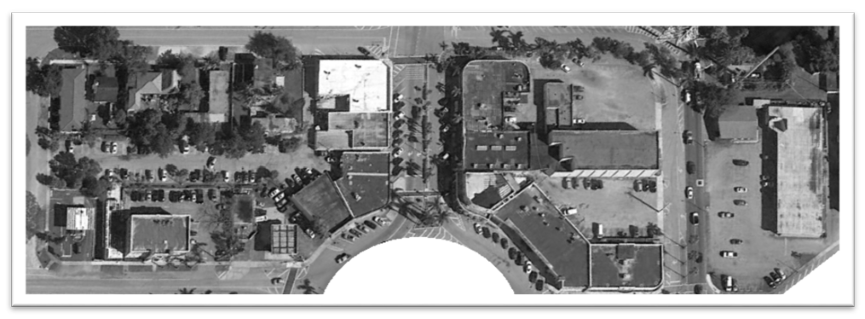
Boundary. As identified in the City's Future Land Use Map, the Gateway District shall be defined as that area bounded by Canal Street, the alley southeast of Hook Square, South Royal Poinciana Boulevard, North Royal Poinciana Boulevard and Nahkoda Drive. More specifically this area includes: Lots 24—26 Block 86; Tract A, Block 85; Tract B, Block 85; Tract C, Block 85; Lot 9, Block 85; Lots 1—2, Block 66; Lot 6, Block 66; Lot 7, Block 66; Lot 8, Block 66 and Track G; Lots 10, 12-14 And Tracks E and F; Lot 16, Block 66; Track D, Block 66; Lots 21—22, Block 66; Lots 31—34, Block 66; Lots 28—30, Block 66; Lot 27, Block 66; Tract C, Block 66; and Lots 21—22, Block 66. For reference, the area is identified below.
(C)
Design Standards. The City desires for new and existing buildings within the Gateway District to become more aesthetically pleasing, have architectural elements that highlight the City's history, facilitate pedestrian activity and walkability, and assist in traffic calming. As opposed to a mandate, the City desires to accomplish these objectives through incentives in development standards that will encourage property owners to improve their respective properties in a manner that results in cohesive building design and features throughout the Gateway District. The standards are as follows:
1.
Building height limitations. In keeping with the applicable requirement of the CBD, the maximum building height shall be no more than 40 feet and no more than three stories. Rooftops may be activated provided that no vertical construction exceeds the height restrictions stated herein.
2.
Setbacks. The setbacks in the CBD shall remain in effect for the Gateway District, except as follows:
a.
All buildings shall be built to the front property line, but the first floor shall be recessed ten feet, so as to facilitate expanded sidewalks or arcade for increased pedestrian activity; and
b.
No rear yard setback is required.
3.
Uses. The uses in the CBD shall remain in effect for the Gateway District, except that hotels shall be prohibited in the Gateway District. Notwithstanding, first floor uses along road rights-of-way shall be limited to:
a.
Restaurant (and lounge), café, cafeteria.
b.
Retail Use.
c.
Medical or Dental Office Use.
For purposes of this Section, a Medical or Dental Office Use shall mean a small-scale office with a maximum floor area of 2,500 square feet providing medical or dental treatment where patients are offered medical services, examinations, and treatments, but are not permitted to occupy the premises overnight. This does not include medical or clinical laboratories, urgent care centers, hospitals, emergency rooms, or other similar medium to large-scale medical office uses, which are specifically prohibited.
d.
Personal Services (e.g., barbershops, beauty parlors, physical therapy clinics), with hours of business between 6:00 a.m. and 10:00 p.m.
e.
Veterinarian Use (which may provide short-term boarding for medical purposes only, for no more than 48 hours), provided that no Veterinarian Use may be located within 0.30 airline miles of the front door of an existing Veterinarian Use within the Gateway District. The distance shall be measured from the front door of the proposed Veterinarian Use to the front door of the existing Veterinarian Use.
The ground floor shall contain occupiable, air-conditioned space for permitted commercial uses with a minimum depth of 40 feet from the building façade for those portions of the building along road rights-of-way, except such features as, without limitation, driveways, utility infrastructure, colonnades and outside dining areas. Direct access to such uses and full storefront windows are encouraged. Upper floors may be commercial, office, residential, or a mix of residential, office, and commercial. The mixed-use ratio found in § 150.070 of the Code shall not apply to the Gateway District.
4.
Architectural design. It is required that all new site development, structures, buildings, remodelings and renovations show proper architectural design concepts and be appropriate to their surroundings. All new construction and remodeling and renovation of existing buildings and structures within the Gateway District shall:
a.
Exhibit elements of the Pueblo/Mission Revival architectural design standard. Examples of these styles will be available through the Office of the City Planner;
b.
Be designed in such a manner as to create, improve, or connect pedestrian amenities in the subject property and surrounding area, giving specific consideration to such things as, without limitation, linkages in/between/among circulation patterns, relationships to architectural and urban design features, relationships to public and private spaces, and accessibility, usability and coordination with adjacent properties;
c.
To the extent possible, install awnings or eyebrows for portions of the project that abut City sidewalks;
d.
Be installed underground all on-site utilities. Large transformers shall be placed on the ground within pad amounts, enclosures or vaults;
e.
Provide adequate landscaping to screen all aboveground facilities.
f.
All satellite dishes, antennas, and or other telecommunications equipment must be appropriately screened such that it is not visible from the street.
g.
Limit any residential elements to upper floors. Residential dwelling units in the upper floors shall be have an average square foot requirement of no less than 900 square feet, with an individual unit minimum requirement of no less than 800 square feet. Efficiencies, studio, and loft apartments are prohibited.
5.
Floor Area Limitations. All buildings within the Gateway District shall be limited to a floor area ratio (F.A.R.) of 1.0, in keeping with the limitation of the CBD, except that properties may be developed/redeveloped up to an F.A.R. of 1.7 through the satisfaction of the creative excellence standards established in this section.
6.
Creative Excellence Standards. For a property to take advantage of a project F.A.R. in excess of 1.0 as referenced in subsection 5 herein, a development or redevelopment project must incorporate a combination of elements from at least three of the Creative Excellence categories provided below, which shall be demonstrated by the property owner at the time of initial site plan review and considered by the City Council at the hearing for site plan approval. Notwithstanding the cumulative value of the Creative Excellence elements, no project may exceed an F.A.R. of 1.7. No single element may be counted towards the satisfaction of more than one standard. The schedule of Creative Excellence elements for projects in the Gateway District are as follows:
(D)
Parking Requirements. The CBD parking requirements as provided in § 150.070(E)(1—3) shall apply to the Gateway District, including, without limitation, the grandfathering of provided parking, if any, for existing buildings and current uses. Additionally, because of the uniqueness of the buildings, configuration of parcels, and road network in the Gateway District, the minimum parking space requirements and design for new construction or alterations to existing structures that expand occupiable space, shall be determined on a case-by-case basis. The City Planner shall have the authority to establish parking requirements for alterations and new construction by counting a combination on-site and on-street parking and other elements identified below. In establishing the required parking, the City Planner shall utilize a parking study prepared by a licensed and qualified individual selected by the City, the actual cost of which shall be reimbursed by the applicant. For any on-street parking space(s) counted towards the satisfaction of a property's requirement, irrespective of whether such spaces are immediately abutting or adjacent to the subject property, or any spaces otherwise waived as a result of one of the factors listed below, a fee shall be paid to the City for each such parking space prior to the issuance of a building permit, in an amount set from time to time by approved resolution of the City Council. The funds shall be used to fund parking and wayfinding improvements in the Gateway District and the CBD. In determining the parking requirements for non-grandfathered properties, the following factors shall be considered by the City Planner and City Council and given their due weight in proportion to their overall effect on the property's parking requirement. No single factor is dispositive.
1.
Availability of on-site parking;
2.
Availability of on-street parking;
3.
Provision of bicycle parking;
4.
Distance to, or inclusion of, bus and trolley stops;
5.
Internal capture of peak traffic trips as a result of mix of uses;
6.
Distance to public parking; and
7.
Walking accessibility of the site.
All on-site parking shall be appropriately landscape to provide visual relief and, to the extent possible, shade.
(E)
Project Review Process. The following formal approval process for the City shall apply to all new construction and redevelopment projects within the Gateway District.
1.
Optional informational and pre-application meeting with City Staff.
2.
Mandatory application preliminary review meeting with City Staff.
3.
Applications for variances, if any, shall be submitted to the City Board of Adjustment for review and consideration in accordance with the procedures set forth in Code §§ 150-110 through 150-113.
4.
The City Zoning and Planning Board will have the responsibility to review all site and development plans and to make recommendations for modification, approval or denial to the City Council in accordance with Code §§ 150-101 and 150-102.
5.
The decisions and recommendations of the City Board of Adjustment and Zoning and Planning Board will be reviewed for final approval by the City Council in accordance with the procedures set forth in Code § 150-113.
6.
The City Council shall authorize the preparation and issuance of a Development Order for each project application that has completed the Development Review Process.
(F)
Site Plan Review. Any development within the Gateway District shall be required to have the site and development plans approved as provided herein before a building permit is issued to insure that development is in accord with the intent of this district. Applications for site and development plan approval shall be submitted to the Planning Office according to the provisions of the Zoning Code and the additional requirements and procedures specified herein.
1.
The application for site and development plan approval shall include but shall not be limited to:
a.
Plans, maps, studies and data which may be necessary to determine whether the particular proposed development meets the intent of the Gateway District, and the specific requirements and standards contained in this subsection;
b.
A survey showing property and ownership lines; existing structures, alleys, easements and utility lines;
c.
A traffic study providing such information as, without limitation, a location map showing the project site in relation to proximate major road systems in and out the City, the anticipated peak morning and evening trips to be generated by the proposed project, the current level of service for roadways and intersections within 500 feet of the project, in and out of the City's jurisdiction, inclusive of the following roads in the City of Hialeah: Okeechobee Road, Palm Avenue, Hialeah Drive, and East 1st Avenue;
d.
General nature of the proposed development, planned uses and activities and the name of the developer;
e.
A site plan showing setbacks, height, floor area ratio, orientation and all existing and proposed site development as required by this ordinance. Landscaping Design may be incorporated into the site plan or submitted as a separate plan.
f.
Dimensioned floor plan(s) and cross sections;
g.
To the extent sought, an explanation of how the project's design and/or amenities are meeting the creative excellence standards and the proposed value attributed to each element;
h.
Exterior colored elevations of each building facade (including, but not limited to, renderings, sketches, and/or perspectives). Elevations must be mounted on 24-inch by 36-inch boards and submitted to the City prior to public meetings;
i.
One set of identical uncolored elevations shall be submitted in paper format. Elevations must include all items affecting the appearance of the building including, but not limited to, site amenities, street furniture, air-conditioning grilles, compressors, mechanical equipment, exterior colors and material designations, exterior lighting, landscaping, and all signs. These drawings shall be referenced to the color and/or material samples submitted with the application and on the mounted drawings. Photographs and other similar documents which provide sufficient information will suffice for small-scale projects where applicable;
j.
Detailed drawings for all signs, (with color and text styles, referenced in the application), except those which cannot be determined because the occupancy of the space is not known, in which case, only the text shall be excluded;
k.
A description of exterior material designations and surface treatments (with attached samples, catalog specs, or colored brochures) including roofs and ground treatments. Sample materials may be submitted as segments, catalog cuts, or photographic records attached to the application. Large, bulky materials whose size or shape will not fit easily with the application file will not be accepted;
l.
Exterior façade color samples complying with the City of Miami Springs approved color palette shall be submitted with the application (including that of signs);
m.
All lighting proposed (i.e. fixture types and locations, materials, lamp design, illumination colors, etc.) shall be included within a site photometric plan and fixture schedule;
n.
Other information as may reasonably be required by the City Staff to provide information needed to process the application;
o.
One, professionally crafted, two-point perspective color rendering of the project and one rendered landscaped site plan for review by City Staff. This shall be completed prior to public meetings. Digital images of the plans and renderings must be submitted in JPG, JPEG, TIF, or TIFF formats, resample at no greater than an 11-inch by 17-inch paper size, with a resolution of 200 dots per inch (dpi), for use in a Microsoft PowerPoint presentation at the City Council meeting;
p.
Points of ingress and egress for vehicular and pedestrian traffic, circulation patterns within the project, including location and design of east/west roadways, where required;
q.
Location, character, and scale of parking and service facilities, including area and number of parking spaces, character of structural parking, if any; location of loading areas and commercial vehicle parking.
r.
Any additional materials and information as may be required by the proper agencies of the City;
s.
Where a proposed development is planned to be constructed in phases, the timing of the first phase shall be indicated. The information concerning the nature of the development, uses, location and floor areas to be developed shall also be supplied. The same information shall be provided for succeeding stages. Initiation of succeeding stages shall be made dependent upon the completion of earlier stages and the supplying of any information that may be required by the proper City agencies;
t.
When a proposed development contains provisions concerning the establishment and continuing operation and maintenance of improvements and facilities for common use by the occupants of the project and the general public, but which are not provided, operated, or maintained at general public expense, the owner shall give assurance in a manner approved by the City Council that such improvements and facilities will be maintained without future expense to the City, and that the development will conform to approved site and development plans; and
u.
Such other requirements as may be prescribed by the Code.
2.
Exemptions. The following applications for development, redevelopment, or building permit will be exempt from the application of this ordinance:
a.
Any building or structure for which final site plan approval has been obtained prior to the enactment of this section;
b.
A project determined by the City Planner to be of a temporary nature such that meeting the intent of the ordinance would not be practical.
c.
The City Administrative Staff shall retain the authority to exempt any proposed development or redevelopment project for this district that is being proposed for any existing structure or structures from the application of any or all of the provisions of Code. This exemption shall not be applicable to development or redevelopment projects in the Gateway District proposed for vacant or "ground up" construction which retains the continuing availability of the City variance process for specific relief from the provision of this code section.
3.
Fees. Each application filed with the City shall be accompanied by the payment of a fee, as set by the City Council, from time to time, to cover the expenses of the City, including but not limited to the various costs incurred by the use of the City's outside technical and legal consultants, in processing and reviewing the application for development. Applicants shall reimburse the City for the actual costs of outside technical and legal consultants that may be incurred in excess of the application fee amount.
(Ord. 1107-2018, passed 6-25-18; amend. Ord. 1111-2019, passed 1-14-19; amend. Ord. 1125-2022, passed 8-22-22; amend. Ord. 1134-2023, passed 10-23-23)
Sec. 150-071. - NBD neighborhood business district.
(A)
Purpose. The purpose of the neighborhood business district (NBD) is to encourage commercial uses that accommodate the frequent retail and personal needs and desires of persons residing and/or working immediately adjacent to residential neighborhoods. It is intended to make conveniently available to residents those goods and services which need to be purchased very frequently during the week.
The following regulations which effectuate this category could allow a wide range of convenience facilities and other compatible uses. In this district, offices, businesses and other commercial uses must be maintained on the ground floor and may occupy all floors of any structure. However, all residential components of any new structure in this district can only be located on floors above the ground floor level.
(B)
Allowed uses and off-street parking requirements.
(1)
Accounting, bookkeeping, law and other professional offices.
Off-street parking spaces required: One space per 300 square feet of gross floor area,
minimum of three spaces.
(2)
Agency (for employment, travel and/or services to be performed elsewhere).
Off-street parking spaces required: One space per 300 square feet, minimum of three.
(3)
Art or photographic studio (commercial).
Off-street parking spaces required: One space per 300 square feet, minimum of three.
(4)
Automobile rental agency, office use only.
Off-street parking spaces required: One space per 300 square feet, minimum of three.
(5)
Bank or other financial institution.
Off-street parking spaces required: One space per 300 square feet, minimum of three.
(6)
Business or commercial school.
Off-street parking spaces required: One space per 100 square feet.
(7)
Catering and delicatessen (including butcher shop) business.
Off-street parking spaces required: One space per 300 square feet, minimum of three.
(8)
Clubs, lodges and fraternal organization facilities.
Off-street parking spaces required: One space per 100 square feet, minimum of three.
(9)
Day care center, nursery school or preschool facility.
Off-street parking spaces required: One space per 300 square feet, minimum of three.
(10)
Dental care and doctor's offices.
Off-street parking spaces required: One per 300 square feet, minimum of three.
(11)
Dog grooming only prohibiting a "pet shop" type business or the boarding, maintaining
or keeping of dogs on-premises anytime between 7:00 p.m. and 7:00 a.m.
Off-street parking spaces required: One space per 300 square feet, minimum of three.
(12)
Dry cleaning, drop-off/pick-up only.
Off-street parking spaces required: One per 300 square feet, minimum of three.
(13)
Gymnasium or health club.
Off-street parking spaces required: One per 100 square feet of exercise machine area.
(14)
Dance studio or other center where "physical activity" lessons are conducted.
Off-street parking spaces required: One per 100 square feet.
(15)
Laundry; self-service or laundromat only when sanitary and safe disposal of wastewater
is provided, and when operated without producing smoke or noxious fumes or odors.
Off-street parking spaces required: One space per 300 square feet, minimum of three.
(16)
Medical marijuana dispensary (with a minimum distance of 500 feet from real property
that comprises a public or private elementary school, middle school, or secondary
school).
Off-street parking spaces required: One space per 300 square feet, minimum of three.
(17)
Mixed-use development of residential uses on upper floors above retail, office and
permitted uses.
Off-street parking spaces required: Determine the parking required for each use separately;
add these together.
(18)
Office supply or support (office supplies, copying, printing shop not to exceed 2,500
square feet).
Off-street parking spaces required: One space per 300 square feet, minimum of three.
(19)
Personal services (i.e., barbershops, beauty parlors, physical therapy clinics, etc.
No physical therapy clinic shall be open for business between the hours of 10:00 p.m.
and 6:00 a.m.).
Off-street parking spaces required: One space per 300 square feet, minimum of three.
(20)
Pharmacy.
Off-street parking spaces required: One space per 300 square feet, minimum of three.
(21)
Post office.
Off-street parking spaces required: One space per 300 square feet, minimum of three.
(22)
Restaurant (and lounge), cafe, cafeteria, club (not to exceed 2,500 square feet).
Off-street parking spaces required: One per 100 square feet.
(23)
Retail use.
Off-street parking spaces required: One space per 300 square feet, minimum of three.
(24)
Small appliance sales and/or service.
Off-street parking spaces required: One space per 300 square feet, minimum of three.
(25)
Stereo/video/electronics rental, sales and/or service.
Off-street parking spaces required: One space per 300 sq. ft., minimum of three.
(26)
Veterinary clinic (which may provide short-term boarding, for medical purposes only,
for no more than 48 hours).
Off-street parking spaces required: One space per 300 square feet, minimum of three.
Other businesses which are similar in character and impact to businesses listed herein, and which are consistent with the comprehensive plan adopted pursuant to Chapter 163, Florida Statutes. A final determination of similarity with listed uses and consistency with the comprehensive plan shall be made by the City Council, following a recommendation by the Zoning and Planning Board.
(C)
Prohibited uses.
Adult bookstore;
Adult-related business;
Arcades, billiard and pool parlors;
Automotive auctions, sales and service facilities;
Bar;
Clinical laboratory;
Funeral home;
Gun range;
Gun shop;
Package store;
Pawn shop;
Large-scale administrative offices, retail/wholesale sales operations and service and professional facilities;
Any large or medium-scale aviation or marine-related repair or service facilities;
Open air, tented, or booth-operated flea markets or any retail/wholesale sales operation not contained within a business building, except as otherwise permitted by F.S. §§ 110-01—110-03;
Any industrial or manufacturing operation or facilities.
(D)
Signs. See § 150-030.
(E)
Building height limit. The maximum building height shall be no higher than 40 ft. and no more than three stories.
(F)
Building site area required.
Commercial or office use only, all floors:
The minimum building site area required shall be a lot or parcel of land 2,500 square feet in area.
Mixed use:
Mixed-use building site area will be determined by FAR as specified under subsection (G).
(G)
Floor area limitations. All buildings within this category shall be limited to a floor area ratio (FAR) of 1.0.
(H)
Square footage requirements.
Commercial or office use only, all floors:
The minimum first floor area of a commercial building in this district shall be 1,500 square feet.
Mixed use:
In addition to the floor area required for the first floor of commercial or office use, the minimum square footage requirement for the upper-floor residential dwellings shall be a minimum of 900 square feet for each residential unit.
Also, the following maximum percentage allocation of total residential area to ground floor business area, per development, shall apply:
Residential: 67 percent (i.e., a two to one ratio between residential and business, respectively).
(I)
Front yard. Front yard required for a building designed for commercial or mixed use. All buildings shall be built to the front property line except as follows:
(1)
A landscaped setback of 15 feet may be permitted for beautification purposes only, at the option of the property owner.
(2)
Projections beyond the face of the building (such as upper floors that cantilevered beyond the footprint of the lower level) cannot extend beyond the front property line.
(J)
Side yard required. No side yard is required for a building designed for any use, except where required for protective screening under subsection (L) below.
Projections beyond the footprint of the building (such as upper floors that cantilever beyond the footprint of the lower level) cannot extend beyond the side property lines.
(K)
Rear yard required for a building designed for commercial or mixed use. There shall be a rear yard consisting of an area which is not less than 30 percent of the lot or building site to be improved. In order to provide space for drains and other uses, except in those cases where the lot or building site abuts upon a dedicated alley which has a width of not less than 40 feet, in which case the rear yard which may be 20 percent of the lot or building site area.
(L)
Protective screening. Where any lot in this district adjoins a residential district, a five-foot strip of land adjoining the boundary of the residential district shall be set aside for planting or walls by the owner of the commercial lot at his expense, to form an effective screen for the protection of the residential area. No structure, except the screen or wall, or utilities or drainage facilities, shall be placed or permitted in the area. No vehicular access shall be permitted over the area, except for the installation or maintenance of screening, utilities, and drainage facilities.
(M)
Landscaping and site plan approval. See § 150-016, referenced therein.
(N)
Exception to minimum number of off-street parking space requirement.
(1)
Notwithstanding the off-street parking requirements contained in subsection (B) hereof, there shall be no requirement to provide any off-street parking in excess of the off-street parking that is currently in existence in this "built-out" area of the City.
(2)
That it is the specific intent of this section that all existing buildings in this district are grandfathered in for any use currently permitted in the Zoning Code for this district without the need to provide any additional off-street parking despite any change of use that might intensify the use of any building and normally require a corresponding increase in the amount of off-street parking.
(3)
That as a consequence of this exception provision, any existing building in this district may be occupied for any currently permitted use provided in the Zoning Code without the need of securing an off-street parking variance or providing any additional off-street parking due to an increase in any intensity of use.
(4)
However, nothing contained herein shall be construed to authorize or permit the physical expansion or addition to any existing building in this district over or in any area of established and existing off-street parking.
(5)
That the aforesaid exception provisions shall not be applicable to any of the following:
(a)
When an existing building in this district is demolished and subsequently replaced by the construction of a new building on the property.
(b)
When an existing building in this district is "effectively demolished" by the razing of more than 51 percent of the existing structure and the subsequent reconstruction of that portion of the building previously demolished.
(c)
When any additional area of occupancy and use is physically constructed and added onto, or attached to, any existing building in this district.
(d)
When a new building is constructed on a previously vacant lot or parcel of property.
If any of the foregoing instances occur, all off-street parking requirements and provisions contained in subsection (B) hereof, shall remain applicable thereto and no variance relief may be sought from the established parking requirements provided therein.
(O)
Off hours security devices. The use of shutters, awnings, gates, panels or sheets or any other device meant to provide off hours premises security is prohibited. Notwithstanding the foregoing, the provisions contained in Code of Ordinance Section 93-13(C) relating to storm protection, shall remain applicable to all district properties.
(Code 1962, § 25-27; amend. Ord. 184, passed 2-8-54; amend. Ord. 303, passed 9-28-64; amend. Ord. 311, passed 1-11-65; amend. Ord. 599-77, passed 3-28-77; amend. Ord. 753-89, passed 11-13-89; amend. Ord. 760-90, passed 3-26-90; amend. Ord. 795-92, passed 8-10-92; amend. Ord. 914-04, passed 8-23-04; amend. Ord. 972-08, passed 10-28-08; Ord. 989-10, § 1, 2-22-10; amend. Ord. 1098-2017, passed 11-13-17)
Sec. 150-072. - B-3 arterial business district.
(A)
Uses permitted.
(1)
Any use permitted in the B-2 central business district.
(2)
The following uses are permitted in the B-3 arterial district or those other uses as shall be in compliance with this section.
(a)
Automobile service station or filling station. No automobile station shall be erected or located within 750 feet of the location of another automobile service station or filling station, or within 1500 feet of a church or school, the distance to be measured in a direct line.
(b)
Car lot for rental of automobile or commercial parking.
(c)
Storage warehouse, excepting storage of chemicals, petroleum products, or any dangerous, explosive, or highly inflammable material.
(d)
Gun and rifle shops.
(e)
Indoor gun and rifle ranges; only after securing the approval and authorization of the City Council at a public hearing at which it is clearly and convincingly established that the proposed range adequately provides for the protection of the health, safety and general welfare of the citizens of the City.
(B)
Prohibited uses.
(1)
Automotive auctions and sales facilities;
(2)
Any large or medium scale aviation or marine related repair or service facilities;
(3)
Open air, tented, or booth operated flea markets or any other retail/wholesale sales operation not contained within a business building, except as otherwise permitted by §§ 110-01—110-03;
(4)
Any industrial or any large or medium scale manufacturing operation or facilities; or
(5)
Any other use that is not compatible with, or is disruptive or offensive to, any adjacent residential, B-1, or B-2 zoning district by reason of proximity to the district, noise generation, offensive operational by-products (such as, odor, dust, smoke, gas, or vibrations), or the creation of any nuisance condition.
(C)
Signs. See Signs, § 150-030.
(D)
Parking standards and requirements. See § 150-016.
(E)
Building height limit. The maximum building height shall be 40 feet or three stories.
(F)
Building site area required. The minimum building site area required shall be a lot or parcel of land 15,000 square feet in area.
(G)
Front yard required for a building designed for commercial use. All buildings shall be built to the front property line, except as follows:
(1)
A setback of 15 feet may be permitted for beautification purposes only.
(2)
Where frontage on the same street has an adjoining or abutting lot restricted to residential use, the front yard requirements of the residential districts shall apply.
(H)
Side yard requirement. No side yard is required for a building designed for commercial use, except where required for protective screening, as hereinafter provided.
(I)
Rear yard requirements. There shall be a rear yard consisting of an area which is not less than 30 percent of the area of the lot or building site to be improved, in order to provide space for drains and other uses, except in those cases where the lot or building site abuts upon a dedicated alley which has a width of not less than 40 feet, in which case the rear yard may be 20 percent of the lot or building site area.
(J)
Floor area requirements. The minimum first floor area of a commercial building in this district shall be 1,500 square feet.
(K)
Protective screening. Where any lot, parcel, or building site in this district adjoins a residential district, a five-foot strip of land adjoining the boundary of the residential district shall be set aside and used for planting or walls by the owner of the commercial lot or parcel at his expense, to form an effective screen for the protection of the residential area. No structure, except the screen or wall, or utilities or drainage facilities, shall be placed or permitted in the area. No vehicular access shall be permitted over the area, except for the installation or maintenance of screening, utilities, and drainage facilities.
(L)
Limitations and special requirements.
(1)
Lighting. Artificial lighting used to illuminate the premises or advertising copy shall be directed away from any adjacent residential area and traffic flow. The lighting shall be extinguished no earlier than one hour after closing.
(2)
Outdoor storage. Outdoor storage of merchandise shall be permitted only when incidental to the commercial use located on the same premises, provided that:
(a)
The storage area shall not be located in any of the required setbacks or yards.
(b)
The stored merchandise shall not protrude above the height of the enclosing walls or buildings.
(M)
Commercial installations for business purposes shall not include mixed use for living quarters.
(Code 1962, § 25-27.1; amend. Ord. 309, passed 1-11-65; amend. Ord. 326, passed 6-28-65; amend. Ord. 599-77, passed 3-28-77; amend. Ord. 758-90, passed 3-12-90; amend. Ord. 760-90, passed 3-26-90; amend. Ord. 771-90; passed 11-15-90; amend. Ord. 795-92, passed 8-10-92)
Cross reference— Nonmotorized self-propelled wheeled devices prohibited in business districts, § 71-05.

