
Midway City Zoning Code
CHAPTER 16
26 LAND USE ADMINISTRATION
16.26.010 Public Notice
Notice of the date, time, and place of all public hearings concerning the adoption or modification of a land use ordinance or zoning map shall be posted in at least three public locations within Midway City and on the City’s official website. In addition, at least ten calendar days before the hearing, the notice shall be mailed to each affected entity (as defined in Utah law).
Amended by Ord. 2026-03 on 2/18/2026
16.26.020 Proposed Planned Unit Developments And Subdivisions
Notice of the date, time, and place of all public hearings concerning a proposed Planned Unit Development or Subdivision, or plat amendment thereto, shall be mailed not less than three calendar days before the hearing to all record owners of property within the proposed Planned Unit Development or Subdivision and all record owners of property within 600 feet of the proposed Planned Unit Development or Subdivision. The applicant shall furnish a draft notice and stamped, addressed envelopes with the correct names and addresses of all record owners to the City no less than five calendar days before the hearing.
16.26.030 Notice To Surrounding Governmental Entities
In proceedings involving rezoning of land that abuts other municipalities, unincorporated areas of the County, or a combination thereof, copies of the notice of public hearing shall be transmitted to the Planning agency of such governmental unit abutting such land. In addition to notice by publication, the City may give notice of the hearing in such other manner as it may deem necessary or desirable.
16.26.040 Notice Regarding Changes To Zoning Ordinance Requirements
- For public hearings to hear proposed changes to General Plan provisions or Land Use requirements for any one or more of the following subjects, the City shall provide notice as required in this Chapter:
- A ten percent or more increase or decrease in the number of square feet or units that may be developed.
- A ten percent or more increase or reduction in the allowable height of a building.
- An increase or reduction in the allowable number of stories.
- A ten percent or more increase or decrease in the setback or open space requirements.
- An increase or reduction in permitted uses.
- Rezoning proceedings that may change the zoning classification of an individual real property owner’s property.
- The City shall provide notice to real property owners pursuant to notification procedures for proceedings governed by this Chapter. Notice shall be sent by first class mail to each real property owner, as shown on the latest County assessment records, whose real property is directly governed by the changes.
(2010-15, Subsection Amended, eff. 6/16/2010)
Amended by Ord. 2026-03 on 2/18/2026
16.26.050 Findings
Within 30 days after the close of a public hearing:
- The Planning Commission shall render its recommendation in writing to the City Council, including the reasons for the recommendation in regard to a Conditional Use Permit or General Plan amendment, Land Use Title, or zone changes, or
- The City Council shall advise the applicant, in writing, of its decision in regard to an appeal or variance, or
- The City Council shall advise the applicant of its decision, in writing, concerning a Conditional Use Permit, Special Use Permit, General Plan amendment, Land Use Title, or zone changes.
16.26.060 Appeal Authority
- The Board of Adjustment shall be the appeal authority to hear and decide requests for variances from the terms of the Land Use Title. An adverse decision by the Board of Adjustment in variance matters may be appealed to district court pursuant to Utah law.
(2010-17, Subsection Amended, eff. 7/7/2010) - The City Council shall be the appeal authority for review of constitutional takings issues.
- Appeal of an administrative order issued by a City administrative law judge shall be made directly to district court within 30 days of the issuance of the order.
- Except as provided in this Section, the City Council shall be the appeal authority of all non-variance land use decisions in which the City Council has not first acted as the land use authority. Only a decision in which a land use authority has applied a land use regulation to a particular land use application, person, or parcel may be appealed to an appeal authority. Appeal of such administrative decisions shall be made in writing to the City Council within 30 days of the administrative decision being issued in writing. The adversely affected party shall be required to present in its written appeal every theory of relief that the adversely affected party can raise in district court. The appellant has the burden of proving that the land use authority erred. The standard of review by the City Council shall be de novo. An adverse decision by the City Council acting as appeal authority may be appealed to district court pursuant to Utah law.
- Appeal shall be made directly to district court of all non-variance land use decisions in which the City Council has acted as the land use authority. In acting as the land use authority, the City Council shall keep a written record of its proceedings in the form of minutes or other records.
- Each appeal authority shall issue a written decision within 30 days after the close of the appeal hearing.
- Each appeal authority shall keep a written record of its appeal proceedings.
Amended by Ord. 2023-05 on 5/24/2023
16.26.070 Amendments
This Midway City Land Use Title and accompanying zoning map may be amended as follows:
- The Planning Commission shall, after providing the proper notice requirements, hold a public hearing on a proposed amendment to the Land Use Title or zoning map. After holding the public hearing and receiving any public comment on the proposed amendment, the Planning Commission shall make a recommendation to the City Council on the proposed amendment.
- The City Council may amend any provision of the Land Use Title or the accompanying zoning map after the Planning Commission has held a public hearing and made a recommendation to the City Council on the proposed amendment; provided, however, that the City Council shall, after providing the proper notice requirements, also hold a public hearing on the proposed amendment before voting on the amendment.
16.26.080 Non-Conforming Buildings And Uses
In view of the fact that no further development or change in use can be undertaken contrary to the provisions of this Code, it is the intent of this Chapter that non-conforming uses shall not be increased nor expanded except where a health or safety official, acting in his official capacity, requires such increase or expansion. Such expansion shall be no greater than that which is required to comply with the minimum requirements as set forth by the health or safety official. Nevertheless, a non-conforming building or structure or use of land may be continued to the same extent and character as that which legally existed on the effective day of the applicable regulations. Repairs may also be made to a non-conforming building or to a building housing a non-conforming use. The property owner bears the burden of establishing that any nonconforming use or nonconforming building or structure lawfully exists.
- Damaged Building may be Restored. A non-conforming building or structure or a building or structure occupied by a non-conforming use which is damaged or destroyed by fire, flood, wind, earthquake, or other calamity or act of nature may be restored, and the occupancy or use of such buildings, structure, or part thereof which legally existed at the time of such restoration is started within a period of one year from the date of destruction and is diligently prosecuted to completion, and provided that such restoration does not increase the floor space devoted to the non-conforming use over that which existed at the time the building became non-conforming.
- Discontinuance or Abandonment. A non-conforming building or structure or portion thereof or a lot occupied by a non-conforming use which is, or hereafter becomes abandoned or is discontinued for a continuous period of 365 days or more shall not thereafter be occupied, except by a use which conforms to the use regulations of the zone in which it is located.
- Change to a Conforming Use. A non-conforming use or building may be changed to a conforming use or building. Any non-conforming use or building which has been changed to a conforming use or building shall not thereafter be changed back to a non-conforming use or building.
- Change to Another Non-Conforming Use Prohibited. A non-conforming use of a building or lot shall not be changed to another non-conforming use whatsoever. Changes in use shall be made only to a conforming use.
- Reclassification of Territory. The provision pertaining to non-conforming uses of land and buildings shall also apply to land and buildings, which hereafter become non-conforming due to an amendment in the Land Use Title.
- Permits Granted Prior to Passage of Amendments to this Chapter. Notwithstanding the issuance of a permit therefore, no building which becomes non-conforming due to an amendment to this Chapter shall be built unless construction has taken place thereon to the extent of at least $500.00, or an amount set by City Council from time to time, in replaceable value by the date on which said amendment becomes effective. Replaceable value shall be construed to mean the expenditure necessary to duplicate the materials and labor at market prices.
- Enlargement of a Nonconforming Residential Building. A residential building that is nonconforming due to height or setback may be enlarged through the building permit process only if the enlargement complies with all applicable zoning requirements, including current height and setback requirements. See figure 1 of this section.
- Enlargement of a Nonconforming Agricultural or Detached Accessory Building. An agricultural or detached accessory building that is nonconforming due to height, side or rear setbacks may be enlarged through the building permit process only if the enlargement complies with all applicable zoning requirements, including current height and setback requirements. See figure 1 of this section.
- A detached accessory building that is nonconforming due to front setbacks may be enlarged through the building permit process, but the addition may only be directly behind the existing structure and my not exceed the width of the existing structure in the area between the front property line and the minimal required front setback. The structure may be enlarged in the area that does comply with setback requirements, and not restricted to the width of the nonconforming structure, only if the enlargement complies with all applicable zoning requirements, including current height and setback requirements. See figure 2 of this section.
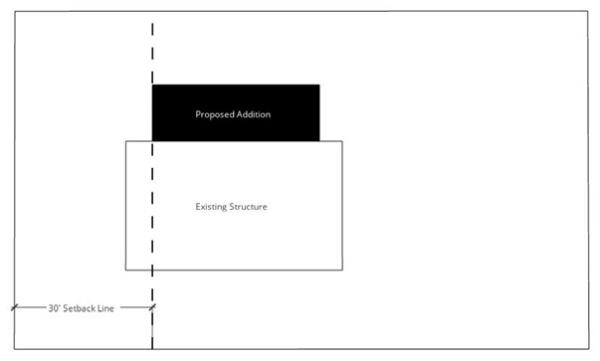
Figure 2.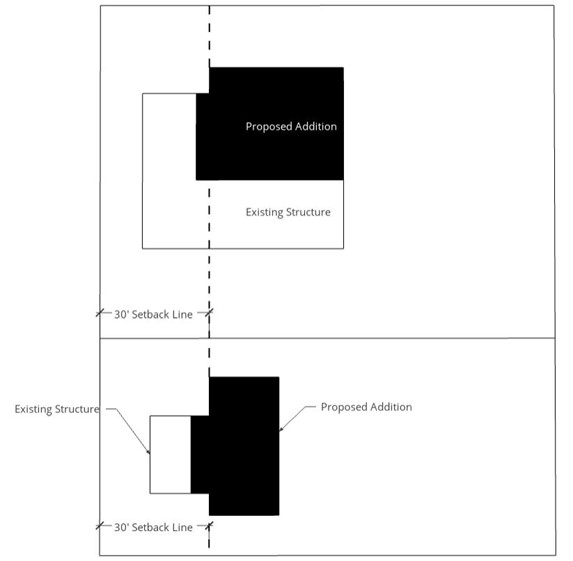
- A detached accessory building that is nonconforming due to front setbacks may be enlarged through the building permit process, but the addition may only be directly behind the existing structure and my not exceed the width of the existing structure in the area between the front property line and the minimal required front setback. The structure may be enlarged in the area that does comply with setback requirements, and not restricted to the width of the nonconforming structure, only if the enlargement complies with all applicable zoning requirements, including current height and setback requirements. See figure 2 of this section.
(2021-13, Section Amended, eff. 8/18/2021)
16.26.090 Non-Conforming Lots Of Record
Notwithstanding any other provision of this Code, a one-family dwelling may be permitted on any lot of record in any zone in which dwellings are permitted, even though such lot fails to meet the area or width requirements for one-family dwellings within the zone, provided that where two or more contiguous lots of record having continuous frontage are owned by the same persons at the time of the passage of the controlling ordinance, the land included in the lots shall be considered to be an undivided parcel and no portion of said parcel shall be used as a dwelling site or sold which does not meet the area and width requirements of the zone in which the lot is located. Yard dimensions and other requirements not involving area or width shall conform to the regulations of the zone in which the lot is located except when granted a variance by the Board of Adjustment.
16.26.100 Annexations
All land annexed shall be classified as shown on the future zoning map and the General Plan.
16.26.110 Amendments To Ordinance And Map (Reserved)
(2015-08, Section Deleted, eff. 6/10/2015)
16.26.120 Conditional Use Approvals And Regulations
The consideration of an application for a conditional use shall be governed by the following standard of Utah Code: (a) A conditional use shall be approved if reasonable conditions are proposed, or can be imposed, to mitigate the reasonably anticipated detrimental effects of the proposed use in accordance with applicable standards. (b) If the reasonably anticipated detrimental effects of a proposed conditional use cannot be mitigated by the proposal or the imposition of reasonable conditions to achieve compliance with applicable standards, the conditional use may be denied. The following approval requirements and regulations shall apply to all conditional use applications. These requirements are in addition to any conditions specifically or requirements specifically listed for a given conditional use. In the case of conflicting requirements, the more restrictive shall apply.
- General Standards for Conditional Use Approval. An applicant for a conditional use approval shall provide within the application information to clearly demonstrate to the City compliance with the following, in addition to any specific requirements of this Section attached to the conditional use applied for:
- General Welfare Standard. The establishment, maintenance or conducting of the use for which a use permit is sought will not, under the particular case, be detrimental to the public welfare or injurious to property or improvements in the neighborhood.
- Nuisance Standard. Any use found to be objectionable or incompatible with the character of the City and its environs due to noise, light, traffic, dust, odors or other undesirable characteristics may be prohibited.
- General Plan Consistency Standard. To obtain a use permit, the applicant must generally show that the contemplated use is compatible with the City’s land use policies in terms of the general plan and zoning ordinances, and that such use would be essential or desirable to the public convenience or welfare, and will not impair the integrity and character of the zoned district or be detrimental to the public health, safety, morals or welfare.
- After receiving an application, the City Planning Administrator shall review and verify that the application is complete and that the applied-for use complies with applicable zoning ordinances. If the application is complete and compliant with applicable zoning ordinances, the City Planning Administrator shall then place the application on the agenda of the next available Planning Commission meeting. Applications that are incomplete or not in compliance with applicable zoning ordinances shall not be placed on an agenda. The Planning Commission shall then recommend the granting or denying of the conditional use permit based on the standards set forth in this Section. The Planning Commission may also recommend conditions to be imposed on the use if the permit is granted. After the Planning Commission makes its recommendation, the City Council shall advertise and hold a public hearing in the same manner specified above. After the public hearing, the City Council shall make a decision whether to grant or deny the proposed conditional use permit. The Council shall record its decision in writing and shall recite the findings upon which the decision is based. The City Council may approve and/or modify a conditional use or special exception permit application in whole or in part, with conditions, only if all of the following findings are made:
- The proposed use is conditionally permitted within the Land Use Title and would not impair the integrity and character of the intended purpose of the subject zoning district and complies with all of the applicable provisions of this Code.
- The proposed use is consistent with the General Plan.
- The approval of the conditional use or special exception permit for the proposed use is in compliance with the requirements of state, federal and Midway City or other local regulations.
- There will be no potential, significant negative effects upon environmental quality and natural resources that could not be properly mitigated and monitored.
- The design, location, size, and operating characteristics of the proposed use are compatible with the existing and future land uses with the general area in which the proposed use is to be located and will not create significant noise, traffic, or other conditions or situations that may be objectionable or detrimental to other permitted uses in the vicinity or adverse to the public interest, health, safety, convenience, or welfare to the City.
- The subject site is physically suitable for the type and density/intensity of the use being proposed.
- There are adequate provisions for public access, including internal and surrounding traffic flow, water, sanitation, and public utilities, and services to ensure that the proposed use would not be detrimental to public health and safety.
- The Planning Commission may recommend, and the City Council may impose, conditions on the requested use which are additional to any conditions which are specifically listed in conjunction with all conditional uses or special exceptions prescribed within this Title. All conditions imposed shall meet the following criteria:
- The condition is within the police powers of Midway City.
- The condition must substantially further a legitimate public purpose.
- The condition must further the same public purpose for which it was imposed.
- The property owner may not be required to carry a disproportionate load in furthering the public purpose.
- Dedications of land and other contributions as conditions of approval must be "reasonably related" to the use of the property for which the conditional use or special exception permit is requested. There must also be a "rough proportionality" between the extent of the condition and the particular demand or impact of the project. In addition, a performance bond cannot be required for the installation of public improvements that are not reasonably related to the property use. The conditions which are imposed on a conditional use permit must be expressly attached to the permit and cannot be implied. For example, if a conditional use permit contains language that restricts a building's height to 25 feet and requires the developer to submit and obtain Planning Commission and City Council approval of a landscaping plan, among other things, the permit itself does not imply a height limitation on trees within the development.
- Public Participation and Notification. The public participation requirements for conditional use permits and special exceptions, as outlined in Title 16, shall be required. Public notice shall be per Utah law and per Title 16 of the Midway City Municipal Code.
- Appeal. The decision of the City Council on the granting or denying of the conditional use permit or special exception shall be the final decision of the City on the matter. Appeal shall be to a court of competent jurisdiction in the manner and within the time prescribed by Utah law.
- Right to Conditional Use. The right to a conditional use shall benefit only the particular land applied for by the applicant and shall not be transferable to other land. A conditional use approval shall remain valid for only one year, i.e., if the approved use has not begun in one year from approval, the approval shall expire and must be applied for again, unless otherwise specified in the approval conditions.
- In the event that complaints concerning a conditional use or special exception are filed with the City, the Zoning Administrator shall investigate problems identified in the complaint to determine if the conditional use is in violation of this Title. If the Zoning Administrator determines the conditional use is in violation of this Title, the Administrator shall pursue the elimination of the violating activity in accordance with pertinent sections of this Title.
Amended by Ord. 2023-06 on 5/24/2023
16.26.130 Vested Rights
- Completed Application. To become vested, an applicant must submit a completed land use application that conforms to the requirements of the City’s zoning map and applicable land use ordinances. Application forms are available at the City Planning Office, and no application will be accepted that does not comply with the application form. Upon review of the application, the City Planner will issue a notice to the applicant indicating the application is complete, or what information is still required to make it complete. An application does not vest until the City Planner accepts it as complete.
- Approval. An applicant is entitled to approval of a land use application when a Completed Application has been accepted by the City Planner, and all fees have been paid, unless:
- The City Council, on the record, finds that a compelling, countervailing public interest would be jeopardized by approving the application; or
- In the manner provided by local ordinance and before the application is submitted and deemed complete, the City has adopted a Notice of Pending Ordinance as set forth in Utah Code Ann. §10-9a-504.
- Notice of Pending Ordinance. No Completed Applications will be processed that are affected by a Notice of Pending Ordinance to amend the City Code, until either a new ordinance is passed, or during the 180 days following the adoption of the Notice of Pending Ordinance, the City does not adopt code that prohibits the approval of the Completed Application as submitted. A Notice of Pending Ordinance is “formally initiated” for purposes of vesting when a specific proposed code text amendment first appears as an item on a publicly released agenda for a planning commission or legislative body or is announced in a public notice.
- Requirement to Pursue Approval with “Reasonable Diligence.” It is not in the City’s best interest to allow applications to languish for years with little activity, while zoning, safety and other standards are being updated and changed. As such, once an application is accepted as complete by the City Planner, the applicant shall pursue approval of the application with “Reasonable Diligence,” which shall require appearing on the agenda and at the meetings of either the Planning Commission or the City Council with required plans, studies, and requested information necessary to obtain preliminary and final approval. Failure to appear before the Planning Commission or the City Council seeking either preliminary or final approval for a consecutive period of 6 months shall be construed as evidence of failure to exercise “Reasonable Diligence” in seeking approval, and the City Planner, at its sole discretion, may refer the application to the City Council for a determination that due to a failure to pursue approval with Reasonable Diligence the application is denied, vesting is lost, and requiring the applicant to start over in the application and approval process. The City Council may consider evidence provided by both the City Planner and the Applicant in determining if approval is being pursued with Reasonable Diligence, with a focus on denying applications that appear to have been filed for the sole purpose of vesting under a less restrictive statute as a sort of place holder, where it can be demonstrated that insufficient effort has been made to move the approval forward.
- The City shall not impose on a holder of an issued land use permit a requirement that is not expressed in the land use permit or in documents on which the land use permit is based, or in the City’s ordinances.
- The City will not withhold issuance of a certificate of occupancy because of an applicant’s failure to comply with a requirement that is not expressed in the land use permit or in documents on which the land use permit is based, or in the City’s ordinances.
- The City is bound by the terms and standards of applicable land use ordinances and shall comply with mandatory provisions of those ordinances.
(2021-03, Section Amended, eff. 4/28/2021)

