
Millersburg City Zoning Code
ARTICLE II
- ZONES AND ZONING REGULATIONS
CHAPTER 2.05.- RESIDENTIAL MEDIUM (RM)[1]
Editor's note— Ord. No. 192-21, § 2, adopted Dec. 14, 2021, renamed Ch. 2.05 to read as set out herein. Formerly, Ch. 2.05 pertained to the Residential Mixed-Use (RM).
CHAPTER 2.09.- LIGHT INDUSTRIAL ZONE (LI)[2]
Editor's note— Ord. No. 192-21, § 3, adopted Dec. 14, 2021, renamed Ch. 2.09 as set out herein. Formerly, Ch. 2.09 pertained the Limited Industrial Zone (LI).
2.01.010 - Zones.
For the purposes of this Code, and the implementation of the Millersburg Comprehensive Plan, the following zoning zones are hereby established:
(Ord. No. 195-22, Exh. A, 7-12-2022)
2.01.020 - Location of Zone Boundaries.
(1)
Boundaries. The boundaries for the zones listed in this Code are indicated on the Zoning Map of the City of Millersburg, which is hereby adopted by this reference and hereinafter referred to as the "Zoning Map" in this Code. The boundaries shall be modified, only in accordance with the Millersburg Comprehensive Plan land use designations and policies, with zoning map amendments, and adopted by ordinance.
(2)
Zoning Map. The official Zoning Map shall be maintained on file in the office of the City Manager as long as this Code remains in effect. Amendments thereto shall be endorsed on the map with the number of the ordinance by which the change was made. Failure to revise the map shall not affect the validity of any zone change.
(3)
Boundary Resolution. The City Council shall resolve any dispute over the exact location of a zone boundary. In interpreting the location of such boundaries on the Millersburg Zoning Map, the City Council shall rely on the Millersburg Comprehensive Plan map and the following guidelines for the location of zone boundaries: property lines; lot lines; center lines of streets, alleys, streams, or railroads; City boundaries; notations on the Millersburg Zoning Map; or other planning criteria determined appropriate by the City Council.
2.02.010 - Interpretations of Uses.
(1)
Types of Uses. Within each zone, uses are classified as "permitted," "special," and "conditional." Further, uses are functionally classified by description of the particular activity, such as "single-family residence."
(2)
Interpretation of Uses.
a.
The City Manager or designee shall interpret any question concerning uses, including determining the most appropriate zone and classification for uses not identified in this Code based on similarity with other uses. All interpretations will be logged and will be considered for inclusion in this Code.
b.
Where a use is not defined in Chapter 1.02, the words of this Development Code describing such use are to be given their ordinarily accepted meaning, except where the context in which they are used otherwise clearly requires an alternative interpretation.
(3)
Prohibited Uses. A use not specifically identified as permitted, special permitted or conditionally permitted within a zone, or, otherwise allowed through interpretation, shall be considered a prohibited use.
2.03.010 - Purpose.
The Residential Low-density Zone is applied in existing residential areas that have developed to urban densities in the City and may be applied to other rural residential properties if municipal water and sewer facilities are provided or approved by the City. It is intended to protect and maintain areas suitable for urban residential development and related public and semi-public uses as the City grows.
2.03.020 - Permitted Uses.
The following uses, when developed under the applicable development standards in the Code, are permitted in the RL zone:
(1)
Single-family dwelling.
(2)
Residential care homes (for five or fewer individuals), licensed by the State of Oregon.
(3)
Day care facility for 12 or fewer children.
(4)
Duplex.
(5)
Public parks and other public or semi-public uses, excluding public or private schools, excluding water and sewage treatment facilities.
(6)
Utility substations or pumping stations, excluding outdoor storage of equipment or material.
(7)
Single Room Occupancy (SRO) rental units, to the extent permitted under State law.
(8)
Ground Mounted Solar Systems.
(Ord. No. 210-24, Exh. A, 1-9-2024; Ord. No. 213-25, Exh. A, 2-11-2025)
2.03.030 - Special Uses.
The following uses, when developed under the special development requirements, are permitted in the RL zone:
(1)
Partitions, subject to the provisions in Chapter 4.02.050.
(2)
Subdivisions subject to the applicable provisions of Chapter 4.02.060.
(3)
Manufactured homes on individual lots, subject to the provisions of Chapter 3.12.030.
(4)
Home occupations, where there are no employees other than family members residing in the residence or no more than one vehicle associated with the home occupation and further subject to the provisions of Chapter 3.13.
(5)
Residential accessory structures, subject to the provisions in Chapter 3.15.
(6)
Residential accessory dwelling, subject to provisions in Chapter 3.16.
(7)
Temporary uses, subject to provisions in Chapter 3.17.
(8)
Bed and breakfast, subject to provisions in Chapter 3.18.
2.03.040 - Conditional Uses.
The following uses require approval of a Conditional Use Permit:
(1)
Houses of worship, and subject to provisions in Chapter 3.19.
(2)
Cemeteries.
(3)
Home Occupations proposed to have employees in addition to family members residing in the residence or more than one vehicle associated with the home occupation, subject to the provisions of Chapter 3.13.
2.03.050 - Density Regulations.
(1)
Single-family and Manufactured Homes - No more than one dwelling per lot or parcel, other than an approved accessory dwelling unit or two units are permitted if they are attached (a duplex).
(2)
Duplex - No more than one duplex structure (two units) per lot or parcel. Both duplex units can be on the same lot/parcel or on different lots/parcels with a zero-lot line design.
(3)
An accessory dwelling unit is permitted on any lot or parcel, even those with a duplex structure, as long as all structures can meet all development regulations.
(Ord. No. 213-25, Exh. A, 2-11-2025)
2.03.060 - Dimensional Standards.
Unless otherwise required by this Code, the following minimum dimensional standards shall be required for all development in the RL zone:
(Ord. No. 192-21, § 1, 12-14-2021)
2.03.070 - Development Standards.
All development in the RL zone shall comply with the following specific standards:
(1)
Off-Street Parking. Parking, driveway, and loading improvements shall comply with provisions in Chapter 3.03.
(2)
Signs. Signs in the RL zone shall conform to the standards contained in Chapter 3.06.
(3)
Yards and Lots. Yards and lots shall conform to provisions contained in Chapter 3.08.
(4)
Residential Design Standards. All single-family homes, duplexes, and manufactured dwellings on individual lots shall conform to the design standards in Chapter 3.12
(5)
Non Residential Development. Parking lots abutting an RU, RL, or RM zone shall provide sight obscuring screening with vegetation and/or fencing to a height of at least forty-two inches above the ground to screen headlight glare into the adjacent residential property.
(Ord. No. 213-25, Exh. A, 2-11-2025)
2.03.080 - Public Services.
In an RL zone, all development and new construction requires connection to all public utilities.
2.04.010 - Purpose.
The Rural Zone is applied in rural residential areas with standards for continued rural development until a transition to urban residential use occurs. When a property is subdivided, the property is automatically rezoned to Residential Low-density (RL).
2.04.020 - Permitted Uses.
The following uses, when developed under the applicable development standards in the Code, are permitted in the RU zone:
(1)
Single-family dwelling.
(2)
Duplex.
(3)
Crop cultivation and the raising of fowl, bees, and domestic farm animals.
(4)
Residential care homes (for five or fewer individuals), licensed by the State of Oregon.
(5)
Day care facility for 12 or fewer children.
(6)
Public parks and other public or semi-public uses, excluding public or private schools, and water and sewage treatment facilities.
(7)
Utility substations or pumping stations, excluding outdoor storage of equipment or material.
(8)
Single Room Occupancy (SRO) rental units, to the extent permitted under State law.
(9)
Ground Mounted Solar Systems.
(Ord. No. 210-24, Exh. A, 1-9-2024; Ord. No. 213-25, Exh. A, 2-11-2025)
2.04.030 - Special Uses.
The following uses, when developed under the special development requirements, are permitted in the RU zone:
(1)
Partitions, subject to the provisions in Chapter 4.02.050.
(2)
Subdivisions, subject to the applicable provisions of Chapter 4.02.060.
(3)
Manufactured homes on individual lots, subject to the provisions of Chapter 3.12.030.
(4)
Home occupations, where there are no employees other than family members residing in the residence or no more than one vehicle associated with the home occupation and further subject to the provisions of Chapter 3.13.
(5)
Residential accessory structures, subject to the provisions in Chapter 3.15.
(6)
Residential accessory dwelling, subject to provisions in Chapter 3.16.
(7)
Temporary uses, subject to provisions in Chapter 3.17.
(8)
Bed and breakfast, subject to provisions in Chapter 3.18.
2.04.040 - Conditional Uses.
The following uses require approval of a Conditional Use Permit:
(1)
Houses of worship, subject to provisions in Chapter 3.19.
(2)
Cemeteries.
(3)
Home occupations proposed to have employees in addition to family members residing in the residence or more than one vehicle associated with the home occupation, subject to the provisions of Chapter 3.13.
2.04.050 - Density Regulations.
(1)
Single-family and Manufactured Homes - No more than one single family home (or manufactured home) is permitted per lot or parcel.
(2)
Duplex - No more than one duplex per lot or parcel. Both duplex units can be on the same lot/parcel or on different lots/parcels with a zero-lot line design.
(3)
An accessory dwelling unit is permitted on any lot or parcel, even those with a duplex structure, as long as all structures can meet all development regulations.
(Ord. No. 213-25, Exh. A, 2-11-2025)
2.04.060 - Dimensional Standards.
Unless otherwise permitted in this Code, the following minimum dimensional standards shall be required for all development in the RU zone:
(Ord. No. 213-25, Exh. A, 2-11-2025)
2.04.070 - Development Standards.
All development in the RU zone shall comply with following specific standards:
(1)
Off-Street Parking. Parking, driveway, and loading improvements shall comply with provisions in Chapter 3.03.
(2)
Signs. Signs in the RU zone shall conform to the standards contained in Chapter 3.06.
(3)
Yards and Lots. Yards and lots shall conform to provisions contained in Chapter 3.08.
(4)
Residential Design Standards. All single-family homes, duplexes, and manufactured dwellings on individual lots shall conform to the design standards in Chapter 3.12.
(5)
Non-Residential Development. Parking lots abutting an RL, RU, or RM zone shall provide sight obscuring screening with vegetation and/or fencing to a height of at least forty-two inches above the ground to screen headlight glare into the adjacent residential property.
(Ord. No. 213-25, Exh. A, 2-11-2025)
2.04.080 - Public Services and Rezoning.
When connection to municipal water and sanitary sewer service is required for a property zoned RU as a condition of approval of an application for division of land into parcels or lots of less than 2.5 acres, the property shall automatically rezone to Residential Low-density. All further development of the property shall be subject to the provisions of the Residential Low-density zone.
2.05.010 - Purpose.
The Residential Medium Zone is located where municipal water and sanitary sewer are available and is designed to allow a mix of residential uses specifically designed to meet the market demand for housing.
(Ord. No. 192-21, § 2, 12-14-2021)
2.05.020 - Permitted Uses.
The following uses, when developed under the applicable development standards in the Code, are permitted in the RM zone:
(1)
Single-family dwelling.
(2)
Duplex.
(3)
Residential care homes licensed by the State of Oregon.
(4)
Day care facility for 12 or fewer children.
(5)
Nursing homes assisted living centers, convalescent homes, housing specifically designed for, and occupied by, individuals 55 years of age and older, and similar facilities, but excluding hospitals.
(6)
Public parks and other public or semi-public uses, excluding water and sewage treatment facilities.
(7)
Utility substations or pumping stations, excluding outdoor storage of equipment or materials.
(8)
Single Room Occupancy (SRO) rental units, to the extent permitted under State law.
(9)
Ground Mounted Solar Systems.
(Ord. No. 210-24, Exh. A, 1-9-2024; Ord. No. 213-25, Exh. A, 2-11-2025)
2.05.030 - Special Uses.
The following uses, when developed under the special development requirements, are permitted in the RM zone:
(1)
Partitions, subject to the provisions in Chapter 4.02.050.
(2)
Subdivisions subject to the applicable provisions of Chapter 4.02.060.
(3)
Manufactured homes on individual lots, subject to the provisions of Chapter 3.12.030.
(4)
Multiple family dwellings, subject to design provisions in Chapter 3.12.040.
(5)
Manufactured home parks, subject to provisions in Chapter 3.11.
(6)
Home occupations, subject to the provisions of Chapter 3.13
(7)
Residential accessory structures, subject to the provisions in Chapter 3.15.
(8)
Residential accessory dwelling, subject to provisions in Chapter 3.16.
(9)
Attached dwellings, subject to provisions in Chapter 3.16.
(10)
Bed and breakfast, subject to provisions in Chapter 3.18.
(11)
Day care facilities exceeding 12 children, subject to site development review provisions in Chapter 5.05.
(12)
Temporary uses, subject to provisions in Chapter 3.17.
2.05.040 - Conditional Uses.
The following uses require approval of a Conditional Use Permit:
(1)
Houses of worship, subject to provisions in Chapter 3.19.
(2)
Public and private schools, pre-schools, kindergartens, elementary, middle, and high schools, but prohibiting business, art, dancing, trade, technical, or similar schools.
(3)
Home occupations proposed to have employees in addition to family members residing in the residence or more than one vehicle associated with the home occupation, subject to the provisions of Chapter 3.13.
(4)
Residential care facilities licensed by the State of Oregon.
2.05.050 - Density Regulations.
The maximum allowable density shall be six dwelling units per gross acre for single-family detached and attached homes, and 16 dwelling units per gross acre for multi-family development. No more than one duplex structure (two units) per lot or parcel. Both duplex units can be on the same lot/parcel or on different lots/parcels with a zero-lot line design. An accessory dwelling unit is permitted on any lot/parcel including those with a duplex, as long as all structures can meet all development regulations.
(Ord. No. 213-25, Exh. A, 2-11-2025)
2.05.060 - Dimensional Standards.
The following shall apply:
(Ord. No. 192-21, § 1, 12-14-2021; Ord. No. 213-25, Exh. A, 2-11-2025)
2.05.070 - Development Standards.
All development in the RM zone shall comply with following specific standards:
(1)
Off-Street Parking. Parking, driveway, and loading improvements shall comply with provisions in Chapter 3.03.
(2)
Signs. Signs in the RM zone shall conform to the standards contained in Chapter 3.06.
(3)
Yards and Lots. Yards and lots shall conform to provisions contained in Chapter 3.08.
(4)
Residential Design Standards.
a.
All single-family homes and manufactured dwellings on individual lots shall conform to the design standards in Chapter 3.12.040.
b.
Multiple Family and Non-Residential Development.
i.
Property abutting an RL, RM, or RU zone shall provide sight obscuring screening with light and vision obscuring fencing or vegetation to a height of at least 42 inches above the ground, but not exceeding six feet unless otherwise allowed.
ii.
Parking lots abutting an RL, RM, or RU zone shall provide sight obscuring screening with vegetation and/or fencing to a height of at least 42 inches above the ground to screen headlight glare into the adjacent residential property.
(5)
Landscaping and Natural Features. A minimum of 15 percent of the total site area shall be landscaped, including all open areas not covered by buildings or pavement. Natural features, such as topography, trees, and native vegetation, existing on a site prior to development, may be incorporated into the site design and count towards landscaping requirements.
(Ord. No. 213-25, Exh. A, 2-11-2025)
2.06.010 - Purpose.
The Mixed-Use Zone is applied to existing mixed residential and commercial areas and is intended to provide areas appropriate for centralized commercial facilities to serve the needs of area residents and employees.
2.06.020 - Permitted Uses.
The following uses, when developed under the applicable development standards in the Code, are permitted in the MU zone:
(1)
Residential care homes and facilities licensed by the State of Oregon.
(2)
Day care facility for 12 or fewer children.
(3)
Nursing homes assisted living centers, convalescent homes, housing specifically designed for, and occupied by, individuals 55 years of age and older, and similar facilities.
(4)
Medical facilities including hospitals and research.
(5)
Retail trade establishments engaged in selling goods or merchandise to the general public for personal or household consumption such as retail groceries, hardware stores, department stores, and sporting goods stores.
(6)
Retail service establishments offering services and entertainment to the general public for personal or household consumption such as eating and drinking establishments, motels and hotels (but excluding recreational vehicle parks and campgrounds), personal instructional facilities (instructional classes), banks, real estate, and financial services.
(7)
Business service establishments engaged in rendering services to other businesses on a fee or contract basis such as building maintenance, employment services, and consulting services.
(8)
Professional offices and clinics for medical, dental, legal, engineering, and other professions.
(9)
Banks, credit unions, investment firms; real estate offices, mortgage companies, title companies, and similar financial-related offices.
(10)
Dwelling units shall be permitted subject to one of the following provisions:
a.
A dwelling unit may be established if it is necessary and clearly accessory and subordinate to a permitted commercial use.
b.
A dwelling unit not accessory and subordinate to a permitted commercial use may be established on the second or upper floors of a permitted commercial use.
(11)
Eating and drinking establishments and located within an office building and without drive-in/drive-through service.
(12)
Public and private utility buildings and structures, including, but not limited to, pumping stations, electric substations, telephone exchanges, and communications antennas or towers, excluding outdoor storage of equipment or materials.
(13)
Publicly owned and operated facilities or structures, including government offices and stations, fire stations, and public use buildings.
(14)
Public parks and other public or semi-public uses, excluding water and sewage treatment facilities.
(15)
Interim farm use, subject to the provisions in Chapter 3.21.040, except crops may be cultivated for commercial sales or use.
(16)
Laundry or dry cleaning.
(17)
Single Room Occupancy (SRO) rental units, to the extent permitted under State law.
(18)
Ground Mounted Solar Systems when ancillary to a primary use, such as over parked cars.
(Ord. No. 210-24, Exh. A, 1-9-2024; Ord. No. 216-25, Att. A, 7-8-2025)
2.06.030 - Special Uses.
The following uses, when developed under the applicable development standards of this Code and special development requirements, are permitted in the MU zone:
(1)
Partitions, subject to the provisions in Chapter 4.02.050.
(2)
Subdivisions, subject to the applicable provisions of Chapter 4.02.060.
(3)
Planned unit developments, subject to applicable provisions in Chapter 3.23.
(4)
Multiple family dwellings, subject to Site Development Review provisions in Chapter 5.05.
(5)
Home occupations, subject to the provisions of Chapter 3.13.
(6)
Bed and breakfast, subject to provisions in Chapter 3.18.
(7)
Day care facilities exceeding 12 children, subject to Site Development Review provisions in Chapter 5.05.
(8)
Temporary uses, subject to provisions in Chapter 3.17.
2.06.040 - Conditional Uses.
The following uses require approval of a Conditional Use Permit:
(1)
Houses of worship, subject to provisions in Chapter 3.19.
(2)
Public and private schools, pre-schools, kindergartens, elementary, middle, and high schools, including business, art, dancing, trade, technical, or similar schools.
(3)
Home occupations proposed to have employees in addition to family members residing in the residence or more than one vehicle associated with the home occupation, subject to the provisions of Chapter 3.13.
2.06.050 - Density Regulations.
The maximum allowable density shall be 32 dwelling units per gross acre for multi-family development.
2.06.060 - Dimensional Standards.
Unless otherwise permitted in this Code, the following minimum dimensional standards shall be required for all development in the MU zone:
2.06.070 - Development Standards.
All development in the MU zone shall comply with following specific standards:
(1)
Off-Street Parking. Parking, driveway, and loading improvements shall comply with provisions in Chapter 3.03.
(2)
Signs. Signs in the MU zone shall conform to the standards contained in Chapter 3.06.
(3)
Yards and Lots. Yards and lots shall conform to provisions contained in Chapter 3.08.
(4)
Site Development Review. All new development and expansion of an existing structure or use in the MU zone shall be subject to the Site Development Review procedures of Chapter 5.05.
(5)
Landscaping. Any required or established front yard shall be landscaped with trees, shrubs, and groundcover, and maintained pursuant to provisions in Chapter 3.09.
(6)
Multiple Family and Non-Residential Development. Parking lots abutting an RL, RU, or RM zone shall provide sight obscuring screening with vegetation and/or fencing to a height of forty-two (42) inches above the ground to screen headlight glare into the adjacent residential property.
(7)
Outdoor Storage and Display. Outdoor storage and display of merchandise, material, or equipment shall be permitted only when such storage is incidental to a permitted use located on the same property and provided that:
a.
The storage area shall be completely enclosed by sight obscuring fences, walls, or buildings or a combination thereof. Said walls or fences shall be not less than six feet in height.
b.
There shall be no outdoor storage of merchandise, materials, equipment, or other goods to a height greater than that of any enclosing fence, wall, or building.
c.
Outdoor display of limited commercial goods may be permitted in front of the building, such as adjacent to the sidewalk, provided that the sidewalk is not obstructed, or the sidewalk is widened to create additional space outside of the normal five-foot walkway.
(8)
Mixing Uses. Residential and commercial uses shall be mixed either on the entire site, within a building or both. No more than 90% of the total of gross floor area of the first four floors of all buildings within a development shall be a single use. In no case shall residential uses exceed 50% of the total floor area of the first four floors of a development.
(Ord. No. 213-25, Exh. A, 2-11-2025)
2.07.010 - Purpose.
The Commercial Office zone is intended to create a highly aesthetic appearance along NE Old Salem Road and to protect any residential neighbors from incompatible uses. This section operates as a form-based code which focuses more on building form than permitting specific uses. As such the uses are very flexible, but the potential impacts and form of the buildings are closely regulated.
(Ord. No. 195-22, Exh. A, 7-12-2022)
2.07.020 - Permitted Uses.
Unless listed in subsections 2.07.040 or 2.07.045, the following uses are permitted in the CO zone subject to the applicable development standards:
(1)
Any permitted uses listed in the General Commercial (GC) zone or Light Industrial (LI) zone, assuming all development standards of these zones are met, as modified by the standards listed below for the CO Zone.
(Ord. No. 195-22, Exh. A, 7-12-2022; Ord. No. 213-25, Exh. A, 2-11-2025)
2.07.030 - Special Uses.
The following uses, when developed under the applicable development standards of this Code and special development requirements, are permitted in the CO zone:
(1)
Partitions, subject to the provisions in Chapter 4.02.050.
(2)
Subdivisions, subject to the applicable provisions of Chapter 4.02.050.
(3)
Temporary uses, subject to provisions in Chapter 3.17.
(4)
Wireless communication facilities, subject to provisions in Chapter 3.27.
(Ord. No. 195-22, Exh. A, 7-12-2022)
2.07.040 - Conditional Uses.
The following uses require approval of a Conditional Use Permit in addition to a Site Development Review:
(1)
Public and private utility buildings and structures, including, but not limited to, electric substations, telephone exchanges, and communications antennas or towers.
(2)
Publicly owned and operated facilities or structures, including government offices and stations, fire stations, public use buildings, and recreation sites excluding water and sewage treatment facilities.
(3)
Live-work units.
(4)
Any conditional uses listed in the GC or LI zones.
(Ord. No. 195-22, Exh. A, 7-12-2022)
2.07.045 - Prohibited Uses.
The following uses are prohibited:
(1)
If located in or adjacent to a residentially zoned property, any use that will create noise, odors, lighting, or other disturbances that may negatively impact neighboring residential uses. Examples include, but are not limited to, drive-through speakers, kennels, and/or amusement centers.
(2)
Uses inconsistent with the purpose statement in Section 2.07.010.
(3)
Retail trade establishments, unless located within 100 feet of residentially zoned property.
(4)
Automobile service stations, including towing service and vehicle washing and polishing facilities and services.
(5)
Automobile, truck, motorcycle, trailer, agricultural equipment, recreational vehicles and boat sales, lease and/or rentals.
(6)
Residential uses except live-work units.
(7)
Houses of worship.
(8)
Any use or activity that, without mitigation, violates the standards specified in subsection 2.07.060.
(Ord. No. 195-22, Exh. A, 7-12-2022)
2.07.050 - Dimensional Standards.
Unless otherwise permitted in this Code, the following minimum dimensional standards shall be required for all development in the CO zone:
(Ord. No. 195-22, Exh. A, 7-12-2022)
2.07.060 - Development and Performance Standards.
All development in the CO zone shall comply with following specific standards:
(1)
Off-Street Parking. Parking, driveway, and loading improvements shall comply with provisions in Chapter 3.03.
(2)
Signs. Signs in the CO zone shall conform to the standards contained in Chapter 3.06.
(3)
Yards and Lots. Yards and lots shall conform to provisions contained in Chapter 3.08.
(4)
Site Development Review. All new development and expansion of an existing structure or use in the Commercial Office zone shall be subject to the Site Development Review procedures of Chapter 5.05.
(5)
Landscaping. Any required or established front yard shall be landscaped with trees, shrubs, and groundcover and maintained pursuant to provisions in Chapter 3.09.
(6)
Plaza. A pedestrian plaza (open to the public) is required.
(7)
Outdoor Uses. Outdoor storage is not permitted except for overnight/temporary storage of sidewalk tables and chairs. All uses and operations, except off-street parking, loading and unloading, and outdoor eating areas, shall be confined, contained, and conducted wholly within completely enclosed buildings, unless outdoor activities have been approved as part of Site Development Review.
(8)
Weather Protection. Weather protection features such as canopies, awnings or arcades shall be provided over at least the full width of all building entrances to a depth of at least three feet. Alternatively, building entrances may be set back a minimum of three feet behind the face of the building.
(9)
Office Building Appearance. All public facing facades must conform with the design standards of Chapter 3.26. No building or structure, viewable from the public right-of-way, shall have an industrial appearance, including but not limited to water towers, loading docks, railroad loading or unloading, all metal siding, cooling facilities, or anything similar.
(10)
Delivery and Loading Areas. Maneuvering and circulation related to delivery and loading is not permitted between the street and the portion of a building that is used to comply with building setback requirements.
(11)
Drive-through Facilities. Drive-through facilities are not permitted when property is adjacent to residential zones.
(12)
Emissions. Emission of odorous gases or other odorous matter in quantities detectable at any time and at any point on any boundary line of the property or site on which the use is located are prohibited.
(13)
Operations. No building customarily used for night operation, such as a bakery, bottling and distribution plant, or other similar use, shall have any opening, other than stationary windows or required fire exits, within 100 feet of any residential district, and any space used for loading or unloading commercial vehicles in connection with such an operation shall not be within 100 feet of any residential district.
(14)
Live-work Units. A live-work unit, defined as a single unit consisting of both a commercial/office and a residential component that is occupied by the same resident, are required to comply with the following standards:
a.
The residential and the commercial space must be occupied by the same tenant, and no portion of the live-work unit may be rented or sold separately;
b.
Units are typically a studio, loft, or one bedroom though there is no bedroom limit;
c.
The site plan shall clearly demarcate commercial and residential areas;
d.
Residential areas are permitted above the commercial component, to the side or in back of the business component (not permitted in front). Internal access between the residential and commercial space is permitted but not required;
e.
The commercial component as designated on the floor plan approved through the conditional use permit/site development review shall remain commercial and cannot be converted to residential use;
f.
The residential component as designated on the floor plan approved through the conditional use permit/site development review shall remain residential and cannot be converted to commercial use;
g.
The commercial component shall be restricted to the unit and shall not be conducted in any residential yard, garage, or any accessory structure as shown on the site plan;
h.
All signage shall comply with Chapter 3.06;
i.
The external access for the commercial component shall have at least one external entrance/exit separate from the living space. The entrance to the business component shall be located on the ground level. Access to the commercial component of each live-work unit shall be clearly separate from the common walkways or entrances to the other residential units within the development, or other residential units in adjacent developments;
j.
The commercial use shall not generate external noise, odor, glare, vibration, or electrical interference detectable to the normal sensory perception by adjacent neighbors;
k.
No explosive, toxic, combustible, or flammable materials in excess of what would be allowed incidental to normal residential use shall be stored or used on the premises.
l.
Prohibited commercial uses in live-work units include the following:
i.
Any use not permitted in the CO zone.
ii.
Veterinary services, including grooming and boarding, and the breeding or care of animals for hire or for sale;
iii.
Businesses that involve the use of prescription drugs;
iv.
Adult-oriented businesses, astrology palmistry, massage, head shops, and similar uses;
v.
Sales, repair, or maintenance of vehicles, including automobiles, boats, motorcycles, aircraft, trucks, or recreational vehicles;
vi.
Trade or private schools larger than 30 students at a time.
(Ord. No. 195-22, Exh. A, 7-12-2022)
2.08.010 - Purpose.
The General Commercial Zone is applied to areas suitable to meet a wide range of commercial activities to serve the community. All uses should be a service-type use, meaning they should be uses like restaurants, offices, and retail. Uses should not be those which see very little customer interaction such as light manufacturing uses.
(Ord. No. 192-21, § 4, 12-14-2021)
2.08.020 - Permitted Uses.
The following uses, when developed under the applicable development standards in the Code, are permitted in the GC zone:
(1)
Retail trade establishments engaged in selling goods or merchandise to the general public for personal or household consumption such as retail groceries, hardware stores, department stores, and sporting goods stores.
(2)
Retail service establishments offering services and entertainment to the general public for personal or household consumption such as eating and drinking establishments, motels and hotels (but excluding recreational vehicle parks and campgrounds), personal instructional facilities (instructional classes), banks, real estate, and financial services.
(3)
Business service establishments engaged in rendering services to other businesses on a fee or contract basis such as building maintenance, employment services, and consulting services.
(4)
Professional offices and clinics for medical, dental, legal, engineering, and other professions.
(5)
Banks, credit unions, investment firms; real estate offices, mortgage companies, title companies, and similar financial-related offices.
(6)
Automobile service station, including towing service and vehicle washing and polishing facilities and services.
(7)
Automobile, truck, motorcycle, trailer, agricultural equipment, recreational vehicle and boat sales, lease, and rentals.
(8)
Vehicle repair and maintenance, including electric motor repair, tire recapping, and similar automotive repair facilities.
(9)
Construction businesses such as floor laying, building equipment, masonry and stone, plumbing, electrical, metal work, or painting.
(10)
Part and accessory sales for automobiles, trucks, motorcycles, trailers, agricultural equipment, recreational vehicles, and boats, which include the installation, repair or modification of such parts and accessories; but specifically prohibiting junk yards, wrecking yards, or auto salvage and restoration yards. Part and accessory sales which do not include the installation, repair, or modification of such items are allowed as a permitted activity.
(11)
Retail tire sales.
(12)
Laundry or dry cleaning.
(13)
Lumber yard and contracting supplies for lumber, stone, masonry, or metal.
(14)
Interim farm use, subject to the provisions in Chapter 3.21.040, except crops may be cultivated for commercial sales or use.
(15)
Utility substations or pumping stations, excluding outdoor storage of equipment or materials.
(16)
Ground Mounted Solar Systems when ancillary to a primary use, such as over parked cars.
(Ord. No. 192-21, § 4, 12-14-2021; Ord. No. 216-25, Att. A, 7-8-2025)
2.08.030 - Special Uses.
The following uses, when developed under the applicable development standards of this Code and special development requirements, are permitted in the GC zone:
(1)
Partitions, subject to the provisions in Chapter 4.02.050.
(2)
Subdivisions, subject to the applicable provisions of Chapter 4.02.060.
(3)
Home occupations within a pre-existing residence, subject to the provisions of Chapter 3.13.
(4)
Temporary uses, subject to provisions in Chapter 3.17.
(5)
Bed and breakfast, subject to provisions in Chapter 3.18 and located within a pre-existing residence.
(6)
House of worship, subject to provisions in Chapter 3.19.
(7)
Wireless communication facilities, subject to provisions in Section 3.27.
(Ord. No. 192-21, § 4, 12-14-2021)
2.08.040 - Conditional Uses.
The following uses require approval of a Conditional Use Permit and are subject to a Site Development Review:
(1)
Dwelling units shall be permitted subject to one of the following provisions:
a.
A dwelling unit may be established if it is necessary and clearly accessory and subordinate to a permitted commercial use.
b.
A dwelling unit not accessory and subordinate to a permitted commercial use may be established on the second or upper floors of a permitted commercial use.
(2)
Public and private utility buildings and structures, including, but not limited to, electric substations, telephone exchanges, and communications antennas or towers.
(3)
Publicly owned and operated facilities or structures, including government offices and stations, fire stations, public use buildings, and recreation sites excluding water and sewage treatment facilities.
(4)
Houses of worship, subject to provisions in Chapter 3.19.
(Ord. No. 192-21, § 4, 12-14-2021)
2.08.050 - Dimensional Standards.
Unless otherwise permitted in this Code, the following minimum dimensional standards shall be required for all development in the GC zone:
2.08.060 - Development Standards.
All development in the GC zone shall comply with following specific standards:
(1)
Off-Street Parking. Parking, driveway, and loading improvements shall comply with provisions in Chapter 3.03.
(2)
Signs. Signs in the GC zone shall conform to the standards contained in Chapter 3.06.
(3)
Yards and Lots. Yards and lots shall conform to provisions contained in Chapter 3.08.
(4)
Site Development Review. All new development and expansion of an existing structure or use in the General Commercial Zone shall be subject to the site development review procedures of Chapter 5.05.
(5)
Landscaping. Any required or established front yard shall be landscaped with trees, shrubs, and groundcover and maintained pursuant to provisions in Chapter 3.09.
(6)
Outdoor Storage, Display, and Dining.
a.
Outdoor storage and display of merchandise, material, or equipment, when not otherwise allowed by a Conditional Use, shall be permitted only when such storage is incidental to a permitted use located on the same property, and provided that:
I.
The storage area shall be completely enclosed by sight obscuring fences, walls, or buildings or a combination thereof. Said walls or fences shall be not less than six feet in height.
II.
Outdoor display of limited commercial goods may be permitted in front of the building, such as adjacent to the sidewalk, provided that the sidewalk is not obstructed, or the sidewalk is widened to create additional space outside of the normal five-foot walkway.
b.
Outdoor dining areas are allowed providing required parking spaces or accessways are not used.
(7)
Residential Screening. Property abutting an RL, RU, or RM zone shall be screened with a sight-obscuring fence not less than six feet in height. This requirement shall not include the front yard.
(8)
Automobile Sales. Use of modular or portable offices is not allowed. Outdoor display areas must be paved.
2.09.010 - Purpose.
The Light Industrial Zone is applied to areas suitable for limited manufacturing and warehousing activities which have minimal emissions or nuisance characteristics potentially detrimental to the public health, safety, or general welfare that would impact adjacent non-industrial areas.
(Ord. No. 192-21, § 3, 12-14-2021)
2.09.020 - Permitted Uses.
The following uses, when developed under the applicable development standards in the Code, are permitted in the LI zone:
(1)
All manufacturing, warehousing, wholesaling, compounding, assembling, processing, storing, researching, or testing uses, including personal storage facilities such as mini-storage warehouses provided all operations except off-street parking and temporary activities shall be conducted entirely within an enclosed building or screened per requirements in Section 2.09.060(6).
(2)
Uses of a nature that are consistent with the purpose statement of the zone. The intent is to permit flexibility in allowing appropriate uses generated by emerging technologies. For example, server farms or call centers would be consistent with provision.
(3)
Public and private utility buildings and structures, including, but not limited to, fire stations, electric substations, telephone exchanges, and communications antennas or towers.
(4)
Utility substations or pumping stations, excluding outdoor storage of equipment or materials.
(5)
Welding, machining, fabrication, blacksmith shop, and similar facilities.
(6)
Construction businesses such as floor laying, building equipment, masonry and stone, plumbing, electrical, metal work, or painting.
(7)
Ground Mounted Solar Systems when ancillary to a primary use, such as over parked cars.
(Ord. No. 216-25, Att. A, 7-8-2025)
2.09.030 - Special Uses.
The following uses, when developed under the applicable development standards of this Code and special development requirements, are permitted in the Light Industrial zone:
(1)
Partitions, subject to the provisions in Chapter 4.02.050.
(2)
Subdivisions, subject to the applicable provisions of Chapter 4.02.060.
(3)
Home occupations within a pre-existing residence, subject to the provisions of Chapter 3.13.
(4)
Temporary uses, subject to provisions in Chapter 3.17.
(5)
Bed and breakfast within a pre-existing residence, subject to provisions in Chapter 3.18.
(6)
Wireless communication facilities, subject to provisions in Section 3.27.
(7)
Interim farm use, subject to the provisions in Chapter 3.21.040, except crops may be cultivated for commercial sales or use.
(Ord. No. 192-21, § 3, 12-14-2021)
2.09.040 - Conditional Uses.
The following uses require approval of a conditional use permit and are subject to Site Development Review:
(1)
Publicly owned and operated facilities or structures, including government offices and stations, public use buildings, and recreation sites excluding water and sewage treatment facilities.
(2)
Agricultural chemical, fertilizer, insecticide storage, and distribution, excluding ammonium nitrate.
(3)
Lumber yard and contracting supplies for lumber, stone, masonry, or metal.
(4)
A caretaker's residence, either free-standing or incorporated into another building, for an established or concurrently being developed industrial use, subject to the provisions of Chapter 3.28.
(5)
Manufacturing, processing, storage of explosives, or EPCRA Section 302 - Extremely Hazardous Substances when located within 300 feet of residentially zoned land.
(6)
Repair and maintenance of vehicles on commercial chassis and commercial equipment, when repairs are conducted inside a structure. The outdoor storage of disassembled or damaged vehicles, in sight of a public right of way, is not permitted unless screened with vegetation or decorative fencing (not including slatted chain link).
(7)
Sales of new and used class 4 through 10 commercial vehicles. The sale of used commercial vehicles alone is not permitted.
(Ord. No. 192-21, §§ 6, 14, 12-14-2021; Ord. No. 195-22, Exh. A, 7-12-2022)
2.09.050 - Dimensional Standards.
Unless otherwise permitted in this Code, the following minimum dimensional standards shall be required for all development in the LI Zone:
2.09.060 - Development Standards.
All development in the LI zone shall comply with the following specific standards:
(1)
Off-Street Parking. Parking, driveway, and loading improvements shall comply with provisions in Chapter 3.03.
(2)
Signs. Signs in the LI zone shall conform to the standards contained in Chapter 3.06.
(3)
Yards and Lots. Yards and lots shall conform to provisions contained in Chapter 3.08.
(4)
Site Development Review. All new development and expansion of an existing structure or use in the Light Industrial Zone shall be subject to the site development review procedures of Chapter 5.05.
(5)
Landscaping. Any required or established yard shall be landscaped with trees, shrubs, and groundcover and maintained pursuant to provisions in Chapter 3.09.
(6)
Residential Screening. Property abutting an RL, RU, or RM zone shall be screened with a sight-obscuring fence not less than six feet in height. This requirement shall not include the front yard.
(Ord. No. 192-21, § 3, 12-14-2021)
2.10.010 - Purpose.
The General Industrial Zone is applied to areas well suited for all types of industrial development that require excellent highway and rail access and are free from conflict with other non-compatible land uses. The GI zone is intended to protect and preserve these areas for industrial development to assist in supporting the area's economy.
2.10.020 - Permitted Uses.
The following uses, when developed under the applicable development standards in the Code, are permitted in the GI zone:
(1)
Manufacturing and Assembly, Secondary Processing
a.
Food processing, including canning, freezing, drying, dairy products, and similar food processing and preserving, beverage bottling facility, including warehousing and distribution, but excluding processes which involve the slaughter of animals.
b.
Textile mill products, including apparel and other finished products made from fabrics and similar materials.
c.
Furniture and fixtures, including retail wood products.
d.
Printing, publishing, and allied industries.
e.
Rubber and miscellaneous plastics.
f.
Leather and leather goods but excluding a tannery.
g.
Cement, glass, clay, and stone products manufacturing.
h.
Production, processing, finishing, fabricating, handling, recycling, storage and use of alkali, alkaline earth, metals and their alloys.
i.
Research and Development facilities.
j.
Electrical and electronic equipment, machinery and supplies but excluding lead-acid batteries.
k.
Measuring, analyzing, and controlling instruments; photographic, medical, and optical goods; watches and clocks.
l.
Recycling centers less than 5,000 square feet.
m.
Freight terminals and rail transfer facilities, including loading docks, storage, warehousing and wholesale distribution, and cold storage.
n.
Other manufacturing, wholesaling, or distributing activities similar to those listed.
(2)
Wholesale trade and distribution facilities, but excluding trade and distribution involving:
a.
Metals and minerals.
b.
Scrap and waste material.
c.
Farm-product raw materials.
d.
Chemicals and allied products.
e.
Petroleum and petroleum products.
(3)
Public and private utility facilities, including fire stations, water and sewage treatment facilities, substations, pumping stations, and similar facilities with outdoor equipment storage permitted.
(4)
Fleet vehicle maintenance and storage.
(5)
Heavy equipment parts and repair, including non-passenger vehicle tires.
(6)
Tractor, farm equipment, heavy construction equipment, and logging equipment, rental, sales, and service.
(7)
Truck dispatch operations.
(8)
Welding, machining, fabrication, blacksmith shop, and similar facilities.
(9)
Uses of a nature that are consistent with the purpose statement of the zone. The intent is to permit flexibility in allowing appropriate uses generated by emerging technologies. For example, server farms or additive manufacturing would be consistent with provision.
(10)
Interim farm use, subject to the provisions in Chapter 3.21.040, except crops may be cultivated for commercial sales or use.
(11)
Construction businesses such as floor laying, building equipment, masonry and stone, plumbing, electrical, metal work, or painting.
(12)
Ground Mounted Solar Systems when ancillary to a primary use, such as over parked cars.
(Ord. No. 216-25, Att. A, 7-8-2025)
2.10.030 - Special Uses.
The following uses, when developed under the applicable development standards of this Code and special development requirements, are permitted in the General Industrial zone:
(1)
Partitions, subject to the provisions in Chapter 4.02.050.
(2)
Subdivisions, subject to the applicable provisions of Chapter 4.02.060.
(3)
Temporary uses, subject to provisions in Chapter 3.17.
(4)
Wireless communication facilities, subject to provisions in Section 3.27.
2.10.040 - Conditional Uses.
The following uses require approval of a Conditional Use Permit:
(1)
Extraction and processing of minerals, rock, or other earth products.
(2)
Recycling centers greater than 5,000 feet of enclosed area, automotive dismantling, wrecking and salvage yard, and refuse transfer facilities.
(3)
Petroleum products storage and distribution, including asphalt plants.
(4)
Manufacturing, processing, storage of explosives, or EPCRA Section 302 - Extremely Hazardous Substances when located within 300 feet of residentially zoned land.
(5)
Feed and seed facilities, grain elevators and storage; including agricultural chemical, fertilizer, insecticide storage and distribution, excluding ammonium nitrate.
(6)
Wholesale and distribution involving these activities.
(7)
A caretaker's residence, either free-standing or incorporated into another building, for an established or concurrently being developed industrial use, subject to the provisions of Chapter 3.28.
(Ord. No. 192-21, §§ 6, 14, 12-14-2021)
2.10.050 - Dimensional Standards.
Unless otherwise permitted in this Code, the following minimum dimensional standards shall be required for all development in the GI zone:
(Ord. No. 210-24, Exh. A, 1-9-2024)
2.10.060 - Development Standards.
All development in the GI zone shall comply with the following specific standards:
(1)
Off-Street Parking. Parking, driveway, and loading improvements shall comply with provisions in Chapter 3.03.
(2)
Signs. Signs in the GI zone shall conform to the standards contained in Chapter 3.06.
(3)
Yards and Lots. Yards and lots shall conform to provisions contained in Chapter 3.08.
(4)
Site Development Review. All new development and expansion of an existing structure or use in the General Industrial Zone shall be subject to the site development review procedures of Chapter 5.05.
(5)
Landscaping. Any required or established yard shall be landscaped with trees, shrubs, and groundcover and maintained pursuant to provisions in Chapter 3.09.
(6)
Residential Screening. Property abutting an RL, RU, or RM zone shall be screened with a sight-obscuring fence not less than six feet in height. This requirement shall not include the front yard.
(Ord. No. 192-21, § 6, 12-14-2021)
2.11.010 - Purpose.
The purpose of the Public Facilities zone is to provide areas appropriate for specific public and semi-public uses and to ensure their compatibility with adjacent uses. It is intended that this zone be applied to individual parcels shown to be an appropriate location for a certain public or semi-public use.
2.11.020 - Permitted Uses.
The following uses are permitted in the PF zone and subject to Site Design Review:
(1)
Educational facilities, including:
a.
Kindergartens;
b.
Elementary, Middle Schools, and High Schools;
c.
Stadiums and Athletic Fields;
d.
Playgrounds; and
e.
Open Space
(2)
Municipal service facilities, including:
a.
Fire and Police stations;
b.
City Hall;
c.
Sewage Treatment Facilities;
d.
Water Treatment Facilities;
e.
Public Works Shops;
f.
Wireless Telecommunication Facilities;
g.
Libraries; and
h.
Parks and Open Space.
(3)
Ground Mounted Solar Systems when ancillary to a primary use, such as over parked cars.
(Ord. No. 216-25, Att. A, 7-8-2025)
2.11.030 - Special Uses.
The following uses, when developed under the special development requirements, are permitted in the PF zone:
(1)
Partitions, subject to the provisions in Chapter 4.02.050.
(2)
Subdivisions, subject to the applicable provisions of Chapter 4.02.060.
(3)
Wireless Communication Facilities, subject to provisions in Section 3.27.
(4)
Temporary uses, subject to provisions in Chapter 3.17.
2.11.040 - Conditional Uses.
The following uses require approval of a Conditional Use Permit:
(1)
Fraternal and civic organizational facilities.
(2)
Hospitals and overnight clinics.
(3)
Semi-public facilities such as houses of worship, cemeteries, monasteries, and convents.
(4)
RV Park in accordance with the provisions of Section 3.24.
(5)
Cemeteries.
2.11.050 - Dimensional Standards.
The following dimensional standards shall be required for all development in the PF zone:
2.11.060 - Development Standards.
All development in the PF Zone shall comply with following specific standards:
(1)
Off-Street parking. Off-street parking shall conform to the standards of Section 3.03.
(2)
Signs. Signs in the Public Facility Zone shall conform to the provisions of Section 3.06.
(3)
Design Review. All new development or expansion of existing structure or use in the shall be subject to the Site Design Review procedures of Section 5.05.
(4)
Landscaping. Landscaping improvements shall be installed and maintained in all yard areas accordance with Section 3.09.
2.12.010 - Purpose.
The purpose of the Floodplain Overlay Zone is to promote public health, safety, and general welfare, and to minimize public and private losses due to flooding in flood hazard areas by provisions designed to:
(1)
Protect human life and health;
(2)
Minimize expenditure of public money for costly flood control projects;
(3)
Minimize the need for rescue and relief efforts associated with flooding and generally undertaken at the expense of the general public;
(4)
Minimize prolonged business interruptions;
(5)
Minimize damage to public facilities and utilities such as water and gas mains; electric, telephone and sewer lines; and streets and bridges located in special flood hazard areas;
(6)
Help maintain a stable tax base by providing for the sound use and development of flood hazard areas so as to minimize blight areas caused by flooding;
(7)
Notify potential buyers that the property is in a special flood hazard area;
(8)
Notify those who occupy special flood hazard areas that they assume responsibility for their actions;
(9)
Participate in and maintain eligibility for flood insurance and disaster relief;
(10)
Implement the floodplain policies in the City of Millersburg Comprehensive Plan;
(11)
Preserve natural and beneficial floodplain functions.
(Ord. No. 216-25, Att. A, 7-8-2025)
2.12.020 - Methods of Reducing Flood Losses.
In order to accomplish its purposes, this Chapter includes methods and provisions for:
(1)
Restricting or prohibiting development which is dangerous to health, safety, and property due to water or erosion hazards, or which result in damaging increases in erosion or in flood heights or velocities;
(2)
Requiring that development vulnerable to floods, including facilities which serve such uses, be protected against flood damage at the time of initial construction;
(3)
Controlling the alteration of natural floodplains, stream channels, and natural protective barriers, which help accommodate or channel flood waters;
(4)
Controlling filling, grading, dredging, and other development which may increase flood damage;
(5)
Preventing or regulating the construction of flood barriers which will unnaturally divert flood waters or may increase flood hazards in other areas.
(6)
Employing a standard of "no net loss" of natural floodplain functions.
(Ord. No. 216-25, Att. A, 7-8-2025)
2.12.030 - Definitions.
Unless specifically defined below, words or phrases used in this ordinance shall be interpreted so as to give them the meaning they have in common usage.
Ancillary Features (Flood). Features of a development that are not directly related to the primary purpose of the development.
Appeal (Flood). A request for a review of the interpretation of any provision of this ordinance or a request for a variance.
Area of shallow flooding (Flood). A designated Zone AO, AH, AR/AO or AR/AH on a community's Flood Insurance Rate Map (FIRM) with a one percent or greater annual chance of flooding to an average depth of one to three feet where a clearly defined channel does not exist, where the path of flooding is unpredictable, and where velocity flow may be evident. Such flooding is characterized by ponding or sheet flow.
Area of special flood hazard (Flood). The land in the floodplain within a community subject to a one percent or greater chance of flooding in any given year. It is shown on the Flood Insurance Rate Map (FIRM) as Zone A, AO, AH, A1-30, AE, A99, AR. "Special flood hazard area" is synonymous in meaning and definition with the phrase "area of special flood hazard."
Base flood (Flood). The flood having a one percent chance of being equaled or exceeded in any given year.
Base flood elevation (BFE) (Flood). The elevation to which floodwater is anticipated to rise during the base flood.
Breakaway wall (Flood). A wall that is not part of the structural support of the building and is intended through its design and construction to collapse under specific lateral loading forces, without causing damage to the elevated portion of the building or supporting foundation system.
Development (Flood). Any human-made change to improved or unimproved real estate, including, but not limited to, buildings or structures, mining, dredging, filling, grading, paving, excavation or drilling operations or storage of equipment or materials.
Fill (Flood). The placement of any material on the land for the purposes of increasing its elevation in relation to that which exists. Fill material includes, but is not limited to, the following: soil, rock, concrete, bricks, wood stumps, wood, glass, garbage, plastics, metal, etc. For purposes of Section 2.12, the placement of fill is considered "development."
Fish Accessible Space (Flood). The volumetric space available to fish to access.
Fish Egressable Space (Flood). The volumetric space available to fish to exit or leave from.
Flood or Flooding (Flood). A general and temporary condition of partial or complete inundation of normally dry land areas from:
The overflow of inland or tidal waters.
The unusual and rapid accumulation or runoff of surface waters from any source.
Mudslides (i.e., mudflows) which are proximately caused by flooding as defined above and are akin to a river of liquid and flowing mud on the surfaces of normally dry land areas, as when earth is carried by a current of water and deposited along the path of the current.
The collapse or subsidence of land along the shore of a lake or other body of water as a result of erosion or undermining caused by waves or currents of water exceeding anticipated cyclical levels or suddenly caused by an unusually high water level in a natural body of water, accompanied by a severe storm, or by an unanticipated force of nature, such as flash flood or an abnormal tidal surge, or by some similarly unusual and unforeseeable event which results in flooding as defined above.
Flood elevation study (Flood). An examination, evaluation and determination of flood hazards and, if appropriate, corresponding water surface elevations, or an examination, evaluation and determination of mudslide (i.e., mudflow) and/or flood-related erosion hazards.
Flood Insurance Rate Map (FIRM) (Flood). The official map of a community, on which the Federal Insurance Administrator has delineated both the special hazard areas and the risk premium zones applicable to the community. A FIRM that has been made available digitally is called a Digital Flood Insurance Rate Map (DFIRM).
Flood Insurance Study (FIS) (Flood). See "Flood elevation study."
Flood proofing (Flood). Any combination of structural and nonstructural additions, changes, or adjustments to structures which reduce or eliminate risk of flood damage to real estate or improved real property, water and sanitary facilities, structures, and their contents.
Floodway(Flood). The channel of a river or other watercourse and the adjacent land areas that must be reserved in order to discharge the base flood without cumulatively increasing the water surface elevation more than a designated height. Also referred to as "Regulatory Floodway."
Flood Storage Capacity (Flood). The volume of floodwater that an area of the floodplain can hold during the 1-percent annual chance flood.
Functionally dependent use (Flood). A use which cannot perform its intended purpose unless it is located or carried out in close proximity to water. The term includes only docking facilities, port facilities that are necessary for the loading and unloading of cargo or passengers, and ship building and ship repair facilities, and does not include long-term storage or related manufacturing facilities.
Green Infrastructure (Flood). Use of natural or human-made hydrologic features to manage water and provide environmental and community benefits. Green infrastructure uses management approaches and technologies that use, enhance, and/or mimic the natural hydrologic cycle processes of infiltration, evapotranspiration, and reuse. At a large scale, it is an interconnected network of green space that conserves natural systems and provides assorted benefits to human populations. At a local scale, it includes a range of measures that use plant or soil systems, permeable pavement, or other permeable surfaces or substrates, stormwater harvest and reuse, or landscaping to store, infiltrate or evapotranspirate stormwater and reduce flows to sewer systems or surface waters. Green infrastructure practices can be used to achieve no net loss of pervious surface function by creating infiltration of stormwater in an amount equal to or greater than the infiltration lost by the placement of new impervious surface.
Habitat Restoration Activities (Flood). Activities with the sole purpose of restoring habitats that have temporary impacts and long-term benefits to habitat. Such projects cannot include ancillary structures such as a storage shed for maintenance equipment, must demonstrate that no rise in the BFE would occur as a result of the project.
Hazard Trees (Flood). Standing dead, dying, diseased, or infested trees or ones with a structural defect that makes it likely to fail in whole or in part and that present a potential hazard to a structure or pose a safety threat from the risk of falling on a road, building, or otherwise creates a risk of damage or injury.
Highest adjacent grade (Flood). The highest natural elevation of the ground surface prior to construction next to the proposed walls of a structure.
Historic structure (Flood). Any structure that is:
Listed individually in the National Register of Historic Places (a listing maintained by the Department of Interior) or preliminarily determined by the Secretary of the Interior as meeting the requirements for individual listing on the National Register;
Certified or preliminarily determined by the Secretary of the Interior as contributing to the historical significance of a registered historic district or a district preliminarily determined by the Secretary to qualify as a registered historic district;
Individually listed on a state inventory of historic places in states with historic preservation programs which have been approved by the Secretary of Interior; or
Individually listed on a local inventory of historic places in communities with historic preservation programs that have been certified either:
By an approved state program as determined by the Secretary of the Interior or
Directly by the Secretary of the Interior in states without approved programs.
Hydraulically Equivalent Elevation (Flood). A location (e.g., a site where no net loss standards are implemented) that is approximately equivalent to another (e.g., the impacted site) relative to the same 100-year water surface elevation contour or base flood elevation. This may be estimated based on a point that is along the same approximate line perpendicular to the direction of flow.
Hydrologically Connected (Flood). The interconnection of groundwater and/or surface water such that they constitute one water supply and use of either results in an impact to both.
Impervious Surface (Flood). A surface that is resistant to infiltration by water and thereby increases the amount and rate of surface water runoff.
Low Impact Development (LID) (Flood). An approach to land development (or redevelopment) that works to manage stormwater as close to its source as possible. It employs principles such as preserving and recreating natural landscape features and minimizing effective imperviousness to create functional and appealing site drainage. Low Impact Development refers to designing and implementing practices that can be employed at the site level to control stormwater and help replicate the predevelopment hydrology of the site. Low impact development helps achieve no net loss of pervious surface by infiltrating stormwater in an amount equal to or greater than the infiltration lost by the placement of new impervious surface. LID is a subset of green infrastructure.
Lowest floor (Flood). The lowest floor of the lowest enclosed area (including basement). An unfinished or flood resistant enclosure, usable solely for parking of vehicles, building access or storage in an area other than a basement area is not considered a building's lowest floor, provided that such enclosure is not built so as to render the structure in violation of the applicable non-elevation design requirements of this ordinance.
Manufactured dwelling (Flood). A structure, transportable in one or more sections, which is built on a permanent chassis and is designed for use with or without a permanent foundation when attached to the required utilities. The term "manufactured dwelling" does not include a "recreational vehicle" and is synonymous with "manufactured home."
Manufactured dwelling park or subdivision (Flood). A parcel (or contiguous parcels) of land divided into two or more manufactured dwelling lots for rent or sale.
Mean Higher-High Water (Flood). The average of the higher-high water height of each tidal day observed over the National Tidal Epoch.
Mean sea level (Flood). For purposes of the National Flood Insurance Program, the National Geodetic Vertical Datum (NGVD) of 1929 or other datum, to which Base Flood Elevations shown on a community's Flood Insurance Rate Map are referenced.
New construction (Flood). For floodplain management purposes, "new construction" means structures for which the "start of construction" commenced on or after the effective date of a floodplain management regulation adopted by the City of Millersburg and includes any subsequent improvements to such structures.
No Net Loss (Flood). A standard where adverse impacts must be avoided or offset through adherence to certain requirements so that there is no net change in the function from the existing condition when a development application is submitted to the State, Tribal, or local jurisdiction. The floodplain functions of floodplain storage, water quality, and vegetation must be maintained.
Off-site (Flood). Mitigation occurring outside of the project area.
On-site (Flood). Mitigation occurring within the project area.
Ordinary High Water Mark (Flood). The line on the shore established by the fluctuations of water and indicated by physical characteristics such as a clear, natural line impressed on the bank; shelving; changes in the character of soil; destruction of terrestrial vegetation; the presence of litter and debris; or other appropriate means that consider the characteristics of the surrounding areas.
Pervious Surface (Flood). A surface that readily allows water to infiltrate or percolate into the ground.
Qualified Professional (Flood). Appropriate subject matter expert that is defined by the community.
Reach (Flood). A section of a stream or river along which similar hydrologic conditions exist, such as discharge, depth, area, and slope. It can also be the length of a stream or river (with varying conditions) between major tributaries or two stream gages, or a length of river for which the characteristics are well described by readings at a single stream gage.
Recreational Vehicle (Flood). A vacation trailer, vehicle, or portable unit, as defined in ORS 801.180, 801.350, and 801.565, which is either self-propelled, towed, or carried by a motor vehicle, which is:
Built on a single chassis;
400 square feet or less when measured at the largest horizontal projection;
Designed primarily not for use as a permanent dwelling but as temporary living quarters for recreational, camping, travel, or seasonal use.
For the purpose of this definition, a recreational vehicle also includes a street legal trailer used for transporting motorized or non-motorized recreational vehicles including, but not limited to, boats, snowmobiles, ATV's, and motorcycles.
A recreational vehicle does not meet the definition for a manufactured home or mobile home.
Riparian (Flood). Of, adjacent to, or living on, the bank of a river, lake, pond, or other water body.
Riparian Buffer Zone (RBZ) (Flood). The outer boundary of the riparian buffer zone is measured from the ordinary high water line of a fresh waterbody (lake; pond; ephemeral, intermittent, or perennial stream) reach to 170 feet horizontally on each side of the stream or 170 feet inland from the MHHW. The riparian buffer zone includes the area between these outer boundaries on each side of the stream, including the stream channel. Where the RBZ is larger than the special flood hazard area, the no net loss standards shall only apply to the area within the special flood hazard area. Where the waterbody is not located within a SFHA, the RBZ does not apply.
Riparian Buffer Zone Fringe (Flood). The area outside of the RBZ and floodway but still within the SFHA.
Silviculture (Flood). The art and science of controlling the establishment, growth, composition, health, and quality of forests and woodlands.
Special flood hazard area (SFHA) (Flood). See "Area of special flood hazard" for this definition.
Start of construction (Flood). Includes substantial improvement and means the date the building permit was issued, provided the actual start of construction, repair, reconstruction, rehabilitation, addition, placement, or other improvement was within 180 days from the date of the permit. The actual start means either the first placement of permanent construction of a structure on a site, such as the pouring of slab or footings, the installation of piles, the construction of columns, or any work beyond the stage of excavation; or the placement of a manufactured dwelling on a foundation. Permanent construction does not include land preparation, such as clearing, grading, and filling; nor does it include the installation of streets and/or walkways; nor does it include excavation for a basement, footings, piers, or foundations or the erection of temporary forms; nor does it include the installation on the property of accessory buildings, such as garages or sheds not occupied as dwelling units or not part of the main structure. For a substantial improvement, the actual start of construction means the first alteration of any wall, ceiling, floor, or other structural part of a building, whether or not that alteration affects the external dimensions of the building.
Structure (Flood). For floodplain management purposes, a walled and roofed building, including a gas or liquid storage tank, that is principally above ground, as well as a manufactured dwelling.
Substantial damage (Flood). Damage of any origin sustained by a structure whereby the cost of restoring the structure to its before damaged condition would equal or exceed 50 percent of the market value of the structure before the damage occurred.
Substantial improvement (Flood). Any reconstruction, rehabilitation, addition, or other improvement of a structure, the cost of which equals or exceeds 50 percent of the market value of the structure before the "start of construction" of the improvement. This term includes structures which have incurred "substantial damage," regardless of the actual repair work performed. The term does not, however, include either:
Any project for improvement of a structure to correct existing violations of state or local health, sanitary, or safety code specifications which have been identified by the local code enforcement official and which are the minimum necessary to assure safe living conditions; or
Any alteration of a "historic structure," provided that the alteration will not preclude the structure's continued designation as a "historic structure."
Undeveloped Space (Flood). The volume of flood capacity and fish-accessible/egressable space from the existing ground to the BFE that is undeveloped. Any form of development including, but not limited to, the addition of fill, structures, concrete structures (vaults or tanks, pilings, levees and dikes, or any other development that reduces food storage volume and fish accessible/egressable space must achieve no net loss.
Variance (Flood). A grant of relief by the City of Millersburg from the terms of a floodplain management regulation.
Violation (Flood). The failure of a structure or other development to be fully compliant with the community's floodplain management regulations. A structure or other development without the elevation certificate, other certifications, or other evidence of compliance required in this ordinance is presumed to be in violation until such time as that documentation is provided.
(Ord. No. 216-25, Att. A, 7-8-2025)
2.12.040 - Application of Special Flood Hazard Areas.
This code shall apply to all special flood hazard areas within the jurisdiction of the City of Millersburg. The degree of flood protection required by this Code is considered reasonable for regulatory purposes and is based on scientific and engineering considerations. Larger floods can and will occur on rare occasions. Flood heights may be increased by manmade or natural causes. This Code does not imply that land outside the areas of special flood hazards or uses permitted within such areas will be free from flooding or flood damages. This Code shall not create liability on the part of the City of Millersburg, any officer or employee thereof, or the Federal Insurance Administration for any flood damages that result from reliance on this Code or any administrative decision lawfully made thereunder.
2.12.050 - Basis for Establishing the Special Flood Hazard Areas.
The special flood hazard areas identified by the Federal Insurance Administration in a scientific and engineering report entitled the "The Flood Insurance Study for the City of Millersburg, Oregon," dated June 15, 1982, including any amendments or revisions, with accompanying Flood Insurance Rate Maps. The Flood Insurance Study and FIRM panels are on file at the Millersburg City Hall, 4222 NE Old Salem Road, Millersburg OR 97321.
(Ord. No. 216-25, Att. A, 7-8-2025)
2.12.060 - Coordination with State of Oregon Specialty Codes.
Pursuant to the requirement established in ORS Chapter 455 that the City of Millersburg administers and enforces the State of Oregon Specialty Codes, the City of Millersburg does hereby acknowledge that the Oregon Specialty Codes contain certain provisions that apply to the design and construction of buildings and structures located in areas of special flood hazard. Therefore, this code is intended to be administered and enforced in conjunction with the Oregon Specialty Codes.
2.12.070 - Compliance and Penalties.
All development within special flood hazard areas is subject to the terms of this ordinance and required to comply with its provisions and all other applicable regulations.
2.12.080 - Abrogation and Severability.
(1)
This ordinance is not intended to repeal, abrogate, or impair any existing easements, covenants, or deed restrictions granted to the City of Millersburg or which the City of Millersburg is a party. However, where this ordinance and another ordinance or such, easement, covenant, or deed restriction conflict or overlap, whichever imposes the more stringent restrictions shall prevail.
(2)
This ordinance and the various parts thereof are hereby declared to be severable. If any section clause, sentence, or phrase of the Ordinance is held to be invalid or unconstitutional by any court of competent jurisdiction, then said holding shall in no way effect the validity of the remaining portions of this Ordinance.
(Ord. No. 216-25, Att. A, 7-8-2025)
2.12.090 - Interpretation.
In the interpretation and application of this ordinance, all provisions shall be:
(1)
Considered as minimum requirements;
(2)
Liberally construed in favor of the governing body; and
(3)
Deemed neither to limit nor repeal any other powers granted under state statutes.
2.12.100 - Warning and Disclaimer of Liability.
(1)
The degree of flood protection required by this ordinance is considered reasonable for regulatory purposes and is based on scientific and engineering considerations. Larger floods can and will occur on rare occasions. Flood heights may be increased by man-made or natural causes. This ordinance does not imply that land outside the areas of special flood hazards or uses permitted within such areas will be free from flooding or flood damages.
(2)
This ordinance shall not create liability on the part of the City of Millersburg, any officer or employee thereof, or the Federal Insurance Administrator for any flood damages that result from reliance on this ordinance or any administrative decision lawfully made hereunder.
2.12.110 - Administration.
(1)
The City Manager is hereby appointed to be the Floodplain Administration to administer, implement, and enforce this ordinance by granting or denying development permits in accordance with its provisions. The Floodplain Administrator may delegate authority to implement these provisions.
(2)
Duties of the floodplain administrator, or their designee, shall include, but not be limited to:
a.
Review all development permits to determine that:
i.
The permit requirements of this ordinance have been satisfied;
ii.
All other required local, state, and federal permits have been obtained and approved.
iii.
Review all development permits to determine if the proposed development is located in a floodway. If located in the floodway assure that the floodway provisions of this ordinance in Section 2.12.240 are met; and
iv.
Review all development permits to determine if the proposed development is located in an area where Base Flood Elevation (BFE) data are available either through the Flood Insurance Study (FIS) or from another authoritative source. If BFE data are not available, then ensure compliance with the provisions of Section 2.12.160; and
v.
Provide to building officials the Base Flood Elevation (BFE) applicable to any building requiring a development permit.
vi.
Review all development permit applications to determine if the proposed development qualifies as a substantial improvement as defined in Section 2.12.030.
vii.
Review all development permits to determine if the proposed development activity is a watercourse alteration. If a watercourse alteration is proposed, ensure compliance with the provisions in Section 2.12.140(1).
viii.
Review all development permits to determine if the proposed development activity includes the placement of fill or excavation.
ix.
Determine whether the proposed development activity complies with the no net loss standards in Section 2.12.290.
b.
Information Maintenance. The following information shall be obtained and maintained and shall be made available for public inspection as needed:
i.
Obtain, record, and maintain the actual elevation (in relation to mean sea level) of the lowest floor (including basements) and all attendant utilities of all new or substantially improved structures where Base Flood Elevation (BFE) data is provided through the Flood Insurance Study (FIS), Flood Insurance Rate Map (FIRM), or obtained in accordance with Section 2.12.110.
ii.
Obtain and record the elevation (in relation to mean sea level) of the natural grade of the building site for a structure prior to the start of construction and the placement of any fill and ensure that the requirements of Section 2.12.110 are adhered to.
iii.
Upon placement of the lowest floor of a structure (including basement) but prior to further vertical construction, obtain documentation, prepared and sealed by a professional licensed surveyor or engineer, certifying the elevation (in relation to mean sea level) of the lowest floor (including basement).
iv.
Where base flood elevation data are utilized, obtain As-built certification of the elevation (in relation to mean sea level) of the lowest floor (including basement) prepared and sealed by a professional licensed surveyor or engineer, prior to the final inspection.
v.
Maintain all Elevation Certificates (EC) submitted to City of Millersburg;
vi.
Obtain, record, and maintain the elevation (in relation to mean sea level) to which the structure and all attendant utilities were floodproofed for all new or substantially improved floodproofed structures where allowed under this ordinance and where Base Flood Elevation (BFE) data is provided through the FIS, FIRM, or obtained in accordance with Section 2.12.110.
vii.
Maintain all floodproofing certificates required under this ordinance;
viii.
Record and maintain all variance actions, including justification for their issuance;
ix.
Obtain and maintain all hydrologic and hydraulic analyses performed as required under Section 2.12.110.
x.
Record and maintain all Substantial Improvement and Substantial Damage calculations and determinations as required under Section 2.12.110.
xi.
Maintain for public inspection all records pertaining to the provisions of this ordinance.
(3)
Community Boundary Alteration. The Floodplain Administrator shall notify the Federal Insurance Administrator in writing whenever the boundaries of the community have been modified by annexation or the community has otherwise assumed authority or no longer has authority to adopt and enforce floodplain management regulations for a particular area, to ensure that all Flood Hazard Boundary Maps (FHBM) and Flood Insurance Rate Maps (FIRM) accurately represent the community's boundaries. Include within such notification a copy of a map of the community suitable for reproduction, clearly delineating the new corporate limits or new area for which the community has assumed or relinquished floodplain management regulatory authority.
(4)
Watercourse Alterations. Notify adjacent communities, the Department of Land Conservation and Development, and other appropriate state and federal agencies, prior to any alteration or relocation of a watercourse, and submit evidence of such notification to the Federal Insurance Administration. This notification shall be provided by the applicant to the Federal Insurance Administration as a Letter of Map Revision (LOMR) along with either:
a.
A proposed maintenance plan to assure the flood carrying capacity within the altered or relocated portion of the watercourse is maintained; or
b.
Certification by a registered professional engineer that the project has been designed to retain its flood carrying capacity without periodic maintenance.
The applicant shall be required to submit a Conditional Letter of Map Revision (CLOMR) when required under Section 2.12.110(5). Ensure compliance with all applicable requirements in Section 2.12.110(5).
(5)
Requirements to Submit New Technical Data. A community's base flood elevations may increase or decrease resulting from physical changes affecting flooding conditions. As soon as practicable, but not later than six months after the date such information becomes available, a community shall notify the Federal Insurance Administrator of the changes by submitting technical or scientific data in accordance with Section 44 of the Code of Federal Regulations (CFR), Sub-Section 65.3. The community may require the applicant to submit such data and review fees required for compliance with this section through the applicable FEMA Letter of Map Change (LOMC) process.
(6)
The Floodplain Administrator shall require a Conditional Letter of Map Revision prior to the issuance of a floodplain development permit for:
a.
Proposed floodway encroachments that increase the base flood elevation; and
b.
Proposed development which increases the base flood elevation by more than one foot in areas where FEMA has provided base flood elevations but no floodway.
(7)
An applicant shall notify FEMA within six months of project completion when an applicant has obtained a Conditional Letter of Map Revision (CLOMR) from FEMA. This notification to FEMA shall be provided as a Letter of Map Revision (LOMR).
(8)
Substantial Improvement and Substantial Damage Assessments and Determinations. Conduct Substantial Improvement (SI) (as defined in Section 2.0) reviews for all structural development proposal applications and maintain a record of SI calculations within permit files in accordance with Section 2.12.110(2)ii. Conduct Substantial Damage (SD) (as defined in Section 2.0) assessments when structures are damaged due to a natural hazard event or other causes. Make SD determinations whenever structures within the special flood hazard area, as established in Section 2.12.040, are damaged to the extent that the cost of restoring the structure to its before damaged condition would equal or exceed 50 percent of the market value of the structure before the damage occurred.
(Ord. No. 216-25, Att. A, 7-8-2025)
2.12.120 - Establishment of a Development Permit.
(1)
Floodplain Development Permit Required. A development permit shall be obtained before construction or development begins, more specifically before building permits are issued within any area horizontally within the special flood hazard area established in Section 2.12.040. The development permit shall be required for all structures, including manufactured dwellings, and for all other development, as defined in Section 2.12.030, including fill and other development activities.
(2)
Application for a Development Permit. Application for a development permit is a Type I process, made on forms furnished by the Floodplain Administrator and may include, but not be limited to, plans in duplicate drawn to scale showing the nature, location, dimensions, and elevations of the area in question; existing or proposed structures, fill, storage of materials, drainage facilities, and the location of the foregoing. Specifically, the following information is required:
a.
In riverine flood zones, the proposed elevation (in relation to mean sea level), of the lowest floor (including basement) and all attendant utilities of all new and substantially improved structures; in accordance with the requirements of Section 2.12.180.
b.
Proposed elevation in relation to mean sea level to which any non-residential structure will be floodproofed.
c.
Certification by a registered professional engineer or architect licensed in the State of Oregon that the floodproofing methods proposed for any non-residential structure meet the floodproofing criteria for non-residential structures in Section 2.12.140.
d.
Description of the extent to which any watercourse will be altered or relocated.
e.
Base Flood Elevation data for subdivision proposals or other development when required per Section 2.12.150.
f.
Substantial improvement calculation for any improvement, addition, reconstruction, renovation, or rehabilitation of an existing structure.
g.
The amount and location of any fill or excavation activities proposed.
(Ord. No. 192-21, § 15, 12-14-2021; Ord. No. 216-25, Att. A, 7-8-2025)
2.12.125 - Floodplain Development Permit Exemptions.
The following development activities are exempt for the requirement for a Floodplain Development Permit in any SFHA:
(1)
Grading, excavation, fill or paving less than 50 cubic yards (cumulative).
(2)
Open barbless wire, pipe, rail, chain link, or wood fences that meet the design guidelines in this Article.
(3)
Agricultural activities, not including structures.
(4)
Short-term storage of equipment or materials that in time of flooding could either be removed from the area, or would not cause harm to property, humans, animals or the environment by becoming buoyant or hazardous.
(5)
Signs, markers, aids, etc., placed by a public agency to serve the public.
(6)
Customary dredging to maintain existing channel capacity consistent with State or Federal laws and permits.
(7)
Replacement of utility facilities that are necessary to serve established and permitted uses, and that are of equal or lesser size and impact.
(8)
Subsurface public utility projects that will not ultimately result in modification to existing topography.
(9)
Transportation facility rehabilitation and maintenance projects that will not result in modifications to existing topography.
(Ord. No. 216-25, Att. A, 7-8-2025)
2.12.130 - Variance Procedure.
(1)
The issuance of a variance is for floodplain management purposes only. Flood insurance premium rates are determined by federal statute according to actuarial risk and will not be modified by the granting of a variance.
(2)
Conditions for Variances.
a.
Generally, variances may be issued for new construction and substantial improvements to be erected on a lot of one-half acre or less in size contiguous to and surrounded by lots with existing structures constructed below the base flood level, in conformance with the provisions of Section 2.12.120(2)c. As the lot size increases beyond one-half acre, the technical justification required for issuing a variance increases.
b.
Variances shall only be issued upon a determination that the variance is the minimum necessary, considering the flood hazard, to afford relief.
c.
Variances shall not be issued within any floodway if any increase in flood levels during the base flood discharge would result.
d.
Variances shall only be issued upon:
I.
A showing of good and sufficient cause;
II.
A determination that failure to grant the variance would result in exceptional hardship to the applicant;
III.
A determination that the granting of a variance will not result in increased flood heights, additional threats to public safety, extraordinary public expense, create nuisances, cause fraud on or victimization of the public, or conflict with existing laws or ordinances.
IV.
Demonstration that the development will result in net loss of the following three proxies for floodplain functions in the SFHA: undeveloped space, pervious space, or trees six inches diameter at breast height (dbh) or greater (see Section 2.12.290 and associated options in Table 1).
e.
Variances may be issued for new construction, substantial improvements, and for other development necessary for the conduct of a functionally dependent use provided that the standards of Section 2.12.140 are met, and the structure or other development is protected by methods that minimize flood damages during the base flood and create no additional threats to public safety.
(3)
Variance Notification. Any applicant to whom a variance is granted shall be given written notice that the issuance of a variance to construct a structure below the Base Flood Elevation will result in increased premium rates for flood insurance and that such construction below the base flood elevation increases risks to life and property. Such notification and a record of all variance actions, including justification for their issuance shall be maintained in accordance with Section 2.12.110(2)ii.
(Ord. No. 195-22, Exh. A, 7-12-2022; Ord. No. 216-25, Att. A, 7-8-2025)
2.12.140 - General Standards.
In all special flood hazard areas, the following standards shall be adhered to:
(1)
Alteration of Water Courses. Require that the flood carrying capacity within the altered or relocated portion of said watercourse is maintained. Require that maintenance is provided within the altered or relocated portion of said watercourse to ensure that the flood carrying capacity is not diminished. Require compliance with Sections 2.12.110(4) and (5).
(2)
Anchoring.
a.
All new construction and substantial improvements shall be anchored to prevent flotation, collapse, or lateral movement of the structure resulting from hydrodynamic and hydrostatic loads, including the effects of buoyancy.
b.
All manufactured dwellings shall be anchored per Section 2.12.210.
(3)
Construction Materials and Methods.
a.
All new construction and substantial improvements shall be constructed with materials and utility equipment resistant to flood damage.
b.
All new construction and substantial improvements shall be constructed using methods and practices that minimize flood damage.
(4)
Utilities and Equipment.
a.
Water Supply, Sanitary Sewer, and On-site Waste Disposal Systems
I.
All new and replacement water supply systems shall be designed to minimize or eliminate infiltration of flood waters into the system.
II.
New and replacement sanitary sewage systems shall be designed to minimize or eliminate infiltration of flood waters into the systems and discharge from the systems into flood waters.
III.
On-site waste disposal systems shall be located to avoid impairment to them or contamination from them during flooding consistent with the Oregon Department of Environmental Quality.
b.
Electrical, Mechanical, Plumbing and Other Equipment. Electrical, heating, ventilating, air-conditioning, plumbing, duct systems, and other equipment and service facilities shall be elevated at or above the base flood level or shall be designed and installed to prevent water from entering or accumulating within the components and to resist hydrostatic and hydrodynamic loads and stresses, including the effects of buoyancy, during conditions of flooding. In addition, electrical, heating, ventilating, air-conditioning, plumbing, duct systems, and other equipment and service facilities, if replaced as part of a substantial improvement shall meet all the requirements of this section.
c.
Tanks
I.
Underground tanks shall be anchored to prevent flotation, collapse and lateral movement under conditions of the base flood.
II.
Above-ground tanks shall be installed at or above the base flood level or shall be anchored to prevent flotation, collapse, and lateral movement under conditions of the base flood.
(5)
No Net Loss. All requirements of Section 2.12.290 are met.
(Ord. No. 216-25, Att. A, 7-8-2025)
2.12.150 - Subdivision Proposals and Other Proposed Developments.
(1)
All new subdivision proposals and other proposed new developments (including proposals for manufactured dwelling parks and subdivisions) greater than 50 lots or five acres, whichever is the lesser, shall include within such proposals, Base Flood Elevation data.
(2)
All new subdivision proposals and other proposed new developments (including proposals for manufactured dwelling parks and subdivisions) shall:
a.
Be consistent with the need to minimize flood damage.
b.
Have public utilities and facilities such as sewer, gas, electrical, and water systems located and constructed to minimize or eliminate flood damage.
c.
Have adequate drainage provided to reduce exposure to flood hazards.
d.
Comply with the no net loss standards in Section 2.12.290.
(Ord. No. 216-25, Att. A, 7-8-2025)
2.12.160 - Use of Other Base Flood Data.
(1)
When Base Flood Elevation data has not been provided in accordance with Section 2.12.040 the local floodplain administrator shall obtain, review, and reasonably utilize any Base Flood Elevation data available from a federal, state, or other source, in order to administer Sections 2.12.110 to 2.12.270. All new subdivision proposals and other proposed new developments (including proposals for manufactured dwelling parks and subdivisions) must meet the requirements of Section 2.12.150.
(2)
Base Flood Elevations shall be determined for development proposals that are five acres or more in size or are 50 lots or more, whichever is lesser in any A zone that does not have an established base flood elevation. Development proposals located within a riverine unnumbered A Zone shall be reasonably safe from flooding; the test of reasonableness includes use of historical data, high water marks, FEMA provided Base Level Engineering data, and photographs of past flooding, etc., where available. Failure to elevate at least two feet above grade in these zones may result in higher insurance rates.
(Ord. No. 216-25, Att. A, 7-8-2025)
2.12.170 - Structures Located in Multiple or Partial Flood Zones.
In coordination with the State of Oregon Specialty Codes:
(1)
When a structure is located in multiple flood zones on the community's Flood Insurance Rate Maps (FIRM) the provisions for the more restrictive flood zone shall apply.
(2)
When a structure is partially located in a special flood hazard area, the entire structure shall meet the requirements for new construction and substantial improvements.
2.12.180 - Specific Standards for Riverine (Including All Non-Coastal) Flood Zones.
These specific standards shall apply to all new construction and substantial improvements in addition to the General Standards contained in Section 2.12.140 of this ordinance.
(1)
Flood Openings. All new construction and substantial improvements with fully enclosed areas below the lowest floor (excluding basements) are subject to the following requirements. Enclosed areas below the Base Flood Elevation, including crawl spaces shall:
a.
Be designed to automatically equalize hydrostatic flood forces on walls by allowing for the entry and exit of floodwaters;
b.
Be used solely for parking, storage, or building access;
c.
Be certified by a registered professional engineer or architect or meet or exceed all of the following minimum criteria:
I.
A minimum of two openings,
II.
The total net area of non-engineered openings shall be not less than one (1) square inch for each square foot of enclosed area, where the enclosed area is measured on the exterior of the enclosure walls,
III.
The bottom of all openings shall be no higher than one foot above grade.
IV.
Openings may be equipped with screens, louvers, valves, or other coverings or devices provided that they shall allow the automatic flow of floodwater into and out of the enclosed areas and shall be accounted for in the determination of the net open area.
V.
All additional higher standards for flood openings in the State of Oregon Residential Specialty Codes Section R322.2.2 shall be complied with when applicable.
(2)
Garages. Attached garages may be constructed with the garage floor slab below the Base Flood Elevation (BFE) in riverine flood zones, if the following requirements are met:
a.
If located within a floodway the proposed garage must comply with the requirements of Section 2.12.240.
b.
The floors are at or above grade on not less than one side;
c.
The garage is used solely for parking, building access, and/or storage;
d.
The garage is constructed with flood openings in compliance with Section 2.12.170(A) to equalize hydrostatic flood forces on exterior walls by allowing for the automatic entry and exit of floodwater.
e.
The portions of the garage constructed below the BFE are constructed with materials resistant to flood damage;
f.
The garage is constructed in compliance with the standards in Section 2.12.230; and
g.
The garage is constructed with electrical, and other service facilities located and installed so as to prevent water from entering or accumulating within the components during conditions of the base flood.
(3)
Detached garages must be constructed in compliance with the standards for accessory structures in Section 2.12.230.
(4)
No Net Loss. All requirements of Section 2.12.290 are met.
(Ord. No. 216-25, Att. A, 7-8-2025)
2.12.190 - For Riverine (Non-Coastal) Special Flood Hazard Areas with Base Flood Elevations.
In addition to the general standards listed in Section 2.12.140 the following specific standards shall apply in Riverine (non-coastal) special flood hazard areas with Base Flood Elevations (BFE): Zones A1-A30, AH, and AE.
(1)
Before Regulatory Floodway. In areas where a regulatory floodway has not been designated, no new construction, substantial improvement, or other development (including fill) shall be permitted within Zones Al-30 and AE on the community's Flood Insurance Rate Map (FIRM), unless it is demonstrated that the cumulative effect of the proposed development, when combined with all other existing and anticipated development, will not increase the water surface elevation of the base flood more than one foot at any point within the community. When determined that structural elevation is not possible and where the placement of fill cannot meet the above standard, impacts to undeveloped space must adhere to the no net loss standards in Section 2.12.290.
(2)
Residential Construction
a.
New construction and substantial improvement of any residential structure shall have the lowest floor, including basement, elevated to one (1) foot above the Base Flood Elevation (BFE).
b.
Enclosed areas below the lowest floor shall comply with the flood opening requirements in Section 2.12.200.
(3)
Non-Residential Construction. New construction and substantial improvement of any commercial, industrial, or other non-residential structure shall:
a.
Have the lowest floor, including basement elevated at or above the Base Flood Elevation (BFE) together with attendant utility and sanitary facilities,
b.
Be floodproofed so that below the base flood level the structure is watertight with walls substantially impermeable to the passage of water;
c.
Have structural components capable of resisting hydrostatic and hydrodynamic loads and effects of buoyancy.
d.
Be certified by a registered professional engineer or architect that the design and methods of construction are in accordance with accepted standards of practice for meeting provisions of this section based on their development and/or review of the structural design, specifications and plans. Such certifications shall be provided to the Floodplain Administrator as set forth Section 2.12.110(2)b.
(4)
Non-residential structures that are elevated, not floodproofed, shall comply with the standards for enclosed areas below the lowest floor in Section 2.12.200.
(5)
Applicants floodproofing non-residential buildings shall be notified that flood insurance premiums will be based on rates that are one foot below the floodproofed level (e.g., a building floodproofed to the base flood level will be rated as one foot below.
(Ord. No. 216-25, Att. A, 7-8-2025)
2.12.200 - Below Grade Crawl Spaces.
Where a structure contains a below grade crawl space, the following shall apply:
(1)
The building must be designed and adequately anchored to resist flotation, collapse, and lateral movement of the structure resulting from hydrodynamic and hydrostatic loads, including the effects of buoyancy. Hydrostatic loads and the effects of buoyancy can usually be addressed through the required flood openings stated in Section 2.12.180(1). Because of hydrodynamic loads, crawlspace construction is not allowed in areas with flood velocities greater than five feet per second unless the design is reviewed by a qualified design professional, such as a registered architect or professional engineer. Other types of foundations are recommended for these areas.
(2)
The crawlspace is an enclosed area below the Base Flood Elevation (BFE) and, as such, must have openings that equalize hydrostatic pressures by allowing the automatic entry and exit of floodwaters. The bottom of each flood vent opening can be no more than one foot above the lowest adjacent exterior grade.
(3)
Portions of the building below the BFE must be constructed with materials resistant to flood damage. This includes not only the foundation walls of the crawlspace used to elevate the building, but also any joists, insulation, or other materials that extend below the BFE. The recommended construction practice is to elevate the bottom of joists and all insulation above BFE.
(4)
Any building utility systems within the crawlspace must be elevated above BFE or designed so that floodwaters cannot enter or accumulate within the system components during flood conditions. Ductwork, in particular, must either be placed above the BFE or sealed from floodwaters.
(5)
The interior grade of a crawlspace below the BFE must not be more than two feet below the lowest adjacent exterior grade.
(6)
The height of the below-grade crawlspace, measured from the interior grade of the crawlspace to the top of the crawlspace foundation wall, must not exceed four feet at any point. The height limitation is the maximum allowable unsupported wall height according to the engineering analyses and building code requirements for flood hazard areas.
(7)
There must be an adequate drainage system that removes floodwaters from the interior area of the crawlspace. The enclosed area should be drained within a reasonable time after a flood event. The type of drainage system will vary because of the site gradient and other drainage characteristics, such as soil types. Possible options include natural drainage through porous, well-drained soils and drainage systems such as perforated pipes, drainage tiles or gravel or crushed stone drainage by gravity or mechanical means.
(8)
The velocity of floodwaters at the site shall not exceed five feet per second for any crawlspace. For velocities in excess of five feet per second, other foundation types should be used.
(Ord. No. 216-25, Att. A, 7-8-2025)
2.12.210 - Manufactured Dwellings.
(1)
New or substantially improved manufactured dwellings supported on solid foundation walls shall be constructed with flood openings that comply with Section 2.12.180(1);
(2)
The bottom of the longitudinal chassis frame beam shall be at or above Base Flood Elevation;
(3)
New or substantially improved manufactured dwellings shall be anchored to prevent flotation, collapse, and lateral movement during the base flood. Anchoring methods may include, but are not limited to, use of over-the-top or frame ties to ground anchors (Reference FEMA's "Manufactured Home Installation in Flood Hazard Areas" guidebook for additional techniques), and;
(4)
Electrical crossover connections shall be a minimum of 12 inches above Base Flood Elevation (BFE).
(Ord. No. 216-25, Att. A, 7-8-2025)
2.12.220 - Recreational Vehicles.
Recreational vehicles placed on sites are required to:
(1)
Be on the site for fewer than 180 consecutive days,
(2)
Be fully licensed and ready for highway use, on its wheels or jacking system, is attached to the site only by quick disconnect type utilities and security devices, and has no permanently attached additions; or
(3)
Meet the requirements of Section 2.12.210, including the anchoring and elevation requirements for manufactured dwellings.
(Ord. No. 216-25, Att. A, 7-8-2025)
2.12.230 - Accessory Structures.
Relief from elevation or floodproofing requirements for residential and non-residential structures in Riverine (Non-Coastal) flood zones may be granted for accessory structures that meet the following requirements:
(1)
Accessory structures located partially or entirely within the floodway must comply with requirements for development within a floodway found in Section 2.12.240.
(2)
Accessory structures must only be used for parking, access, and/or storage and shall not be used for human habitation;
(3)
In compliance with State of Oregon Specialty Codes, accessory structures on properties that are zoned residential are limited to one-story structures less than 200 square feet, or 400 square feet if the property is greater than two acres in area and the proposed accessory structure will be located a minimum of 20 feet from all property lines. Accessory structures on properties that are zoned as non-residential are limited in size to 120 square feet.
(4)
The portions of the accessory structure located below the Base Flood Elevation must be built using flood resistant materials;
(5)
The accessory structure must be adequately anchored to prevent flotation, collapse, and lateral movement of the structure resulting from hydrodynamic and hydrostatic loads, including the effects of buoyancy, during conditions of the base flood.
(6)
The accessory structure must be designed and constructed to equalize hydrostatic flood forces on exterior walls and comply with the requirements for flood openings in Section 2.12.180(1);
(7)
Accessory structures shall be located and constructed to have low damage potential;
(8)
Accessory structures shall not be used to store toxic material, oil, or gasoline, or any priority persistent pollutant identified by the Oregon Department of Environmental Quality unless confined in a tank installed incompliance with Section 2.12.140(4)c.
(9)
Accessory structures shall be constructed with electrical, mechanical, and other service facilities located and installed so as to prevent water from entering or accumulating within the components during conditions of the base flood.
(Ord. No. 216-25, Att. A, 7-8-2025)
2.12.240 - Floodways.
Located within the special flood hazard areas established in Section 2.12.050 are areas designated as floodways. Since the floodway is an extremely hazardous area due to the velocity of the floodwaters which carry debris, potential projectiles, and erosion potential, the following provisions apply:
(1)
Prohibit encroachments, including fill, new construction, substantial improvements, and other development within the adopted regulatory floodway unless:
a.
Certification by a registered professional civil engineer is provided demonstrating through hydrologic and hydraulic analyses performed in accordance with standard engineering practice that the proposed encroachment shall not result in any increase in flood levels within the community during the occurrence of the base flood discharge; or
b.
A community may permit encroachments within the adopted regulatory floodway that would result in an increase in base flood elevations, provided that a Conditional Letter of Map Revision (CLOMR) is applied for and approved by the Federal Insurance Administrator, and the requirements for such revision as established under Volume 44 of the Code of Federal Regulations, section 65.12 are fulfilled as well as all applicable no net loss standards from Section 2.12.290.
(2)
If the requirements of Section 2.12.240(1) are satisfied, all new construction, substantial improvements, and other development shall comply with all other applicable flood hazard reduction provisions of Sections 2.12.140 to 2.12.170.
(Ord. No. 216-25, Att. A, 7-8-2025)
2.12.250 - Standards for Shallow Flooding Areas.
Shallow flooding areas appear on FIRMs as AO zones with depth designations or as AH zones with Base Flood Elevations. For AO zones the base flood depths range from one to three feet above ground where a clearly defined channel does not exist, or where the path of flooding is unpredictable and where velocity flow may be evident. Such flooding is usually characterized as sheet flow. For both AO and AH zones, adequate drainage paths are required around structures on slopes to guide floodwaters around and away from proposed structures.
2.12.260 - Standards for AH Zones.
Development within AH Zones must comply with the standards in Sections 2.12.140, 2.12.180 and 2.12.250.
(Ord. No. 216-25, Att. A, 7-8-2025)
2.12.270 - Standards for AO Zones.
In AO zones, the following provisions apply in addition to the requirements in Sections 2.12.140 and 2.12.250:
(1)
New construction and substantial improvement of residential structures and manufactured dwellings within AO zones shall have the lowest floor, including basement, elevated above the highest grade adjacent to the building, at minimum to or above the depth number specified on the Flood Insurance Rate Maps (FIRM) or at least two feet if no depth number is specified. For manufactured dwellings the lowest floor is considered to be the bottom of the longitudinal chassis frame beam.
(2)
New construction and substantial improvements of non-residential structures within AO zones shall either:
a.
Have the lowest floor (including basement) elevated above the highest adjacent grade of the building site, at minimum to or above the depth number specified on the Flood Insurance Rate Maps (FIRMS) at least two feet if no depth number is specified; or
b.
Together with attendant utility and sanitary facilities, be completely floodproofed to or above the depth number specified on the FIRM or a minimum of two feet above the highest adjacent grade if no depth number is specified, so that any space below that level is watertight with walls substantially impermeable to the passage of water and with structural components having the capability of resisting hydrostatic and hydrodynamic loads and the effects of buoyancy. If this method is used, compliance shall be certified by a registered professional engineer or architect as stated in Section 2.12.190(3)d.
(3)
Recreational vehicles placed on sites within AO Zones on the community's Flood Insurance Rate Maps (FIRM) shall either:
a.
Be on the site for fewer than 180 consecutive days, and
b.
Be fully licensed and ready for highway use, on its wheels or jacking system, is attached to the site only by quick disconnect type utilities and security devices, and has no permanently attached additions; or
c.
Meet the elevation requirements of Section 2.12.190(2)a, and the anchoring and other requirements for manufactured dwellings of Section 2.12.210.
(4)
In AO zones, new and substantially improved accessory structures must comply with the standards in Section 2.12.230.
(5)
In AO zones, enclosed areas beneath elevated structures shall comply with the requirements in Section 2.12.180(1).
(Ord. No. 216-25, Att. A, 7-8-2025)
2.12.280 - Standards for Protection of SFHA Floodplain Functions.
Mitigation may be necessary to ensure no net loss in floodplain functions of water storage, water quality, and vegetation. Proxies for these floodplain functions include undeveloped space, pervious surfaces, and trees to account for a no net loss in respective floodplain functions of floodplain storage, water quality, and vegetation. Mitigation of identified impacts to these proxies must be completed to ensure compliance with no net loss standards included below. No net loss applies to the net change in floodplain functions as compared to existing conditions at the time of proposed development and mitigation must be addressed to the floodplain function that is receiving the detrimental impact. The standards described below apply to all special flood hazard areas as defined in Section 2.0.
(Ord. No. 216-25, Att. A, 7-8-2025)
2.12.290 - No Net Loss Standards.
(1)
No net loss of the proxies as provided in 2.12.290(4) below for the floodplain functions is required for development in the SFHA that would reduce undeveloped space, increase impervious surface, or result in a loss of trees that are six-inches dbh or greater. No net loss can be achieved by first avoiding negative effects to floodplain functions to the degree possible, then minimizing remaining effects, then replacing and/or otherwise compensating for, offsetting, or rectifying the residual adverse effects to the three floodplain functions. Prior to the issuance of any development authorization, the applicant shall:
a.
Demonstrate a legal right by the project proponent to implement the proposed activities to achieve no net loss (e.g., property owner agreement);
b.
If mitigation benefits multiple parcels or is performed at an off-site location, demonstrate that financial assurances are in place for the long-term maintenance and monitoring of all projects to achieve no net loss;
c.
Include a management plan that identifies the responsible site manager, stipulates what activities are allowed on-site, and requires the posting of signage identifying the site as a mitigation area.
(2)
Compliance with no net loss for undeveloped space or impervious surface is preferred to occur prior to the loss of habitat function but, at a minimum, shall occur concurrent with the loss. To offset the impacts of delay in implementing no net loss, a 25 percent increase in the required minimum area is added for each year no net loss implementation is delayed.
(3)
No net loss must be provided within, in order of preference:
a.
the lot or parcel that floodplain functions were removed from;
b.
the same reach of the waterbody where the development is proposed; or
c.
the special flood hazard area within the same hydrologically connected area as the proposed development.
Table 1 presents the no net loss ratios, which increase based on the preferences listed above.
(4)
Floodplain Function Proxies.
a.
Undeveloped Space.
i.
Development proposals post mitigation shall not reduce the fish-accessible and egressable undeveloped space within the special flood hazard area.
ii.
A development proposal with an activity that would impact undeveloped space shall achieve no net loss of fish-accessible and egressable space.
iii.
Lost undeveloped space must be replaced with fish-accessible and egressable compensatory volume based on the ratio in Table 1 and at the same flood level at which the development causes an impact (i.e., plus or minus 1 foot of the hydraulically equivalent elevation).
1.
Hydraulically equivalent sites must be found within either the equivalent 1-foot elevations or the same flood elevation bands as the development proposal. The flood elevation bands are:
a.
Ordinary High Water Mark to 10-year flood event;
b.
10-year to 25-year flood event;
c.
25-year to 50-year flood event;
d.
50-year to 100-year flood event.
2.
Hydrologically connected to the water body that is the flooding source;
3.
Designed so that there is no net increase in velocity; and,
4.
Designed to fill and drain in a manner that minimizes anadromous fish stranding to the greatest extent practicable.
b.
Impervious Surfaces. Impervious surface mitigation shall be performed through any of the following options:
i.
Development shall not result in a net increase in impervious surface area within the SFHA; or
ii.
Shall use low impact development or green infrastructure to infiltrate and treat stormwater produced by the new impervious surface, as documented by a qualified professional; or
iii.
If prior methods are not feasible and documented by a qualified professional, stormwater detention is required to ensure no increase in peak volume or flow and to maximize infiltration and treatment is required to minimize pollutant loading. See section 2.12.300(3) for stormwater detention specifications.
c.
Trees.
i.
Development proposals shall result in no net loss of trees six-inches dbh or greater within the special flood hazard area. This requirement does not apply to silviculture where there is no development.
1.
Trees six-inches dbh or greater that are removed from the RBZ, Floodway, or RBZ fringe must be replaced at the ratios in Table 1.
2.
Replacement trees must be native species that would occur naturally in the Level III ecoregion of the impact area.
(Ord. No. 216-25, Att. A, 7-8-2025)
2.12.300 - No Net Loss Stormwater Management.
Any development proposal that cannot mitigate as specified in 2.12.290(4)b must include the following:
(1)
Water quality (pollution reduction) treatment for post-construction stormwater runoff from any net increase in impervious area; and
(2)
Water quantity treatment (detention facilities) unless the outfall discharges into the ocean.
(3)
Detention facilities must be designed to:
i.
Limit discharge to match the pre-development peak discharge rate (i.e., the discharge rate of the site based on its natural groundcover and grade before any development occurred) for the 10-year, 5-year, 2-year, and 50 percent of the two-year event peak flows.
ii.
Treat stormwater to remove sediment and pollutants from impervious surfaces such that at least 80 percent of the suspended solids are removed from the stormwater prior to discharging to the receiving water body.
iii.
Be designed to not entrap fish and drain to the source of flooding.
iv.
Be certified by a qualified professional.
(4)
Stormwater treatment practices for multi-parcel facilities, including subdivisions, shall have an enforceable operation and maintenance agreement to ensure the system functions as designed. This agreement will include:
i.
Access to stormwater treatment facilities at the site by the City for the purpose of inspection and repair.
ii.
A legally binding document specifying the parties responsible for the proper maintenance of the stormwater treatment facilities. The agreement will be recorded and bind subsequent purchasers and sellers even if they were not party to the original agreement.
iii.
For stormwater controls that include vegetation and/or soil permeability, the operation and maintenance manual must include maintenance of these elements to maintain the functionality of the feature.
iv.
The responsible party for the operation and maintenance of the stormwater facility shall have the operation and maintenance manual on-site and available at all times. Records of the maintenance and repairs shall be retained and made available for inspection by the City for five years.
(Ord. No. 216-25, Att. A, 7-8-2025)
2.12.310 - Activities Exempt from No Net Loss Standards.
The following activities are not subject to the no net loss standards in Section 2.12.290; however, they may not be exempt from floodplain development permit requirements:
(1)
Normal maintenance of structures, such as re-roofing and replacing siding, provided there is no change in the footprint or expansion of the roof of the structure;
(2)
Normal street, sidewalk, and road maintenance, including filling potholes, repaving, and installing signs and traffic signals, that does not alter drainage patterns, use, or culverts so long as the grade is not raised by more than six inches. Exempt activities do not include expansion of paved areas;
(3)
Routine maintenance of landscaping that does not involve grading, excavation, or filling;
(4)
Routine agricultural practices such as tilling, plowing, harvesting, soil amendments, and ditch cleaning that does not alter the ditch configuration provided the spoils are removed from special flood hazard area or tilled into fields as a soil amendment;
(5)
Routine silviculture practices that do not meet the definition of development, including harvesting of trees as long as root balls are left in place and forest road construction or maintenance that does not alter drainage patterns, use, or culverts and so long as the grade is not raised by more than six inches;
(6)
Removal of noxious weeds and hazard trees, and replacement of non-native vegetation with native vegetation;
(7)
Normal maintenance of above ground utilities and facilities, such as replacing power lines and utility poles provided there is no net change in footprint;
(8)
Normal maintenance of a levee or other flood control facility prescribed in the operations and maintenance plan for the levee or flood control facility. Normal maintenance does not include repair from flood damage, expansion of the prism, expansion of the face or toe, or addition of protection on the face or toe with rock armor;
(9)
Habitat restoration activities;
(10)
Areas that do not serve one of the three floodplain functions identified in 2.12.290 and contain no fish habitat;
(11)
Pre-emptive removal of documented susceptible trees to manage the spread of invasive species;
(12)
Projects that are covered under separate consultations under Sections 4(d), 7, or 10 of the Endangered Species Act (ESA).
(Ord. No. 216-25, Att. A, 7-8-2025)
2.12.320 - SFHA Riparian Buffer Zone (RBZ).
(1)
The Riparian Buffer Zone is measured from the ordinary high-water line of a fresh waterbody (lake; pond; ephemeral, intermittent, or perennial stream). The riparian buffer zone includes the area between these outer boundaries on each side of the stream, including the stream channel.
(2)
Habitat restoration activities in the RBZ are considered self-mitigating and are not subject to the no net loss standards described above.
(3)
Functionally dependent uses (like docks) are subject to the no net loss standards for development in the RBZ. Ancillary features that are associated with but do not directly impact the functionally dependent use in the RBZ (including manufacturing support facilities and restrooms) are subject to the beneficial gain standard in addition to no net loss standards (see Section 2.12.330).
(4)
Any other use of the RBZ requires a greater offset to achieve no net loss of floodplain functions, on top of the no net loss standards described above, through the beneficial gain standard (see Section 2.12.330).
Table 1 No Net Loss Standards
Notes:
1.
Mitigation multipliers of 100% result in the required mitigation occurring at the same value described by the ratios above, while multipliers of 200% result in the required mitigation being doubled.
a.
For example, if only 500 ft 2 of the total 1,000 ft 2 of required pervious surface mitigation can be conducted on-site and in the same reach, the remaining 500 ft 2 of required pervious surface mitigation occurring off-site at a different reach would double because of the 200% multiplier.
2.
RBZ impacts must be offset in the RBZ, on-site or off-site.
(Ord. No. 216-25, Att. A, 7-8-2025)
2.12.330 - Beneficial Gain Standard.
An area within the same reach as the project and equivalent to five percent of the total project area within the RBZ shall be planted with native herbaceous and shrub vegetation and designated as open space.
(Ord. No. 216-25, Att. A, 7-8-2025)
2.13.010 - Purpose.
The purpose of the Historical Property Overlay Zone is to:
(1)
Promote the historic, educational, architectural, cultural, economic, and general welfare of the public through the preservation, restoration, and protection of those buildings, structures, sites, zones, and objects of historic interest within the City;
(2)
Foster civic pride in the accomplishments of the past; and
(3)
Carry out the provisions of the Land Conservation and Development Commission Goal 5.
2.13.020 - Conformance Required.
No land shall be used, and no building, site, object, zone, or structure of significance, or part thereof, shall be demolished, moved, or altered, nor shall any new construction take place within a zone or on a landmark site except in conformity with this Code.
2.13.030 - Definitions.
The following definitions shall apply to this Section: otherwise:
Alteration. A change, addition, or modification to the exterior of a building.
Cultural Resource Inventory. Historical buildings or sites identified as significant on the Goal 5 historical resource inventory.
Demolish. To raze, destroy, dismantle, deface, or in any other manner cause partial or total destruction of a landmark or any building within an historic zone.
Historic Zone. A geographically definable area, the boundaries of which have been adopted by the City Council pursuant to provisions in Section 2.13.050.
Landmark. Any site, object, building, or structure designated by the City Council pursuant to provisions in Section 2.13.050.
Major Public Improvement. The expenditure of public funds or the grant of permission by a public body to undertake change in the physical character of property within a zone or on a landmark site, except for the repair or maintenance of existing public improvements.
2.13.040 - Historic Commission.
There is hereby established a Millersburg Historic Commission charged with carrying out the functions of this chapter where identified.
The City Council appoints the Planning Commission as the Millersburg Historic Commission until such time as Council determines the need for an independent Historic Commission. The Commission will meet and operate in accordance with all standards of local and state law. When the Planning Commission is serving as the Historic Commission, it shall meet separately from a Planning Commission meeting with an independent agenda, meeting notice, and minutes. This can occur on the same night as a Planning Commission meeting, preceding or following the Commission meeting.
(Ord. No. 210-24, Exh. A, 1-9-2024)
Editor's note— Ord. No. 210-24, Exh. A, adopted January 9, 2024, amended the title of § 2.13.040 to read as herein set out. The former § 2.13.040 title pertained to Historic Landmark Committee.
2.13.050 - Historic Zone Designation.
(1)
Process. The process for designating a historic zone may be initiated by the Council, the Planning Commission acting as the Historic Commission, or by any interested person who submits an application for designation to the Community Development Director. At the time of application, the City shall provide the property owner and applicant with information regarding the benefits and restrictions of designation. A landmark can be located within a Historic Zone Overlay, however, a landmark alone cannot be designated historical. This section allows the application of a Historic Zone Overlay to a specific property. A significant historic resource is any building or other aspect of a property that contributes to the historic significance of the property for which a Historic Zone Overlay is applied. The process is a Type IV, consistent with the requirements outlined in Chapter 5.10 including all notification requirements therein except a permit shall be approved by the Historic Commission acting as the reviewing body in place of the Planning Commission. The criteria from Chapter 5.10.050 do not apply, the criteria listed in 2.13.050 shall be used instead.
(2)
Information. Unless proposed by the City, the following information shall be required in an application:
a.
The applicant's name and address;
b.
The owner's name and address, if different from the applicant;
c.
A written description of the boundaries of the proposed zone or the location of the proposed zone;
d.
A map illustrating the boundaries of the proposed zone and the location of any significant resource on the property;
e.
A statement explaining the following:
i.
The reason(s) why the proposed zone should be designated;
ii.
The reason(s) why the boundaries of the proposed zone are appropriate for designation;
iii.
The potential impact, if any, the designation of the proposed zone would have on the residents or other property owners in the area.
f.
Any other information deemed necessary by the City.
(3)
Application Review and Decision. The City Recorder shall set the application on the agenda of the Historic Commission which will review the application against applicable criteria in Section 2.13.050(4) and develop a recommendation to the City Council. The Council shall hold a public hearing at which time testimony will be received with the recommendation from the Historic Commission, the applicant, and any citizens wishing to give input.
(4)
Decision Criteria. The Historic Commission and the Council shall consider the following criteria in determining whether to approve a proposed Overlay Zone Designation:
a.
Association with the life or activities of a person, group, organization, or institution that has made a significant contribution to the City, county, state, or nation;
b.
Association with an event that has made a significant contribution to the City, county, state, or nation;
c.
Association with broad patterns of political, economic, or industrial history in the City, county, state, or nation;
d.
Significance as an example of a particular architectural style, building type, and/or convention;
e.
Significance due to quality of composition, detailing, and/or craftsmanship;
f.
Significance as an example of a particular material and/or method of construction;
g.
Significance because the resource retains its original design features, materials, and/or character;
h.
Significance as the only remaining, or one of the few remaining resources of a particular style, building type, design, material, or method of construction;
i.
Significance as a visual landmark;
j.
Significance because existing land-use surrounding the resource contribute to the integrity of the historic period represented;
k.
Significance because the resource contributes to the continuity or historic character of the street, neighborhood, and/or community;
l.
Significance because the property is 50 years old or older in conjunction with other criteria listed above.
(5)
Removal of Designation. The process for removing a historic zone designation may be initiated by the Council, the Historic Commission, or by any interested person who submits to the City Community Development Director an application for removal of the designation. The Council may amend or rescind its designation by following procedures in subsection (1) for designating a Historic Zone Overlay. Criteria for such an action includes:
a.
Except as provided in subsection (a), a local government may only remove a resource from the resource list if the circumstances in paragraphs (i), (ii), or (iii) exist.
i.
The resource has lost the qualities for which it was originally recognized;
ii.
Additional information shows that the resource no longer satisfies the criteria for recognition as a historic resource or did not satisfy the criteria for recognition as a historic resource at time of listing;
iii.
The local building official declares that the resource poses a clear and immediate hazard to public safety and must be demolished to abate the unsafe condition.
b.
The decision must be consistent with ORS 660-023-0200(9). including the adoption of appropriate findings.
(6)
Appeals. Any appeal goes through the Land Use Board of Appeals.
(7)
Refusal. Pursuant to ORS 660-023-0200(6)b a property owner is allowed to refuse a designation of their property any time during the designation process.
(Ord. No. 210-24, Exh. A, 1-9-2024)
Editor's note— Ord. No. 210-24, Exh. A, adopted January 9, 2024, amended the title of § 2.13.050 to read as herein set out. The former § 2.13.050 title pertained to Landmark and Zone Designation.
2.13.060 - Demolition and Moving.
(1)
Historic Commission Approval. No person shall move, demolish, or cause to be demolished a significant resource in an historic zone, unless a Historical Demolition and Moving permit to do so has first been obtained. Application for a Historical Demolition and Moving permit shall be on a form provided by the City.
(2)
Alternative Actions. At the time a demolition or moving application is made the Community Development Director shall review alternatives to demolition or moving with the owner of the structure or resource, including local, state, and federal preservation programs, prior to the Historic Commission review and action.
(3)
Review Process. An application to move, demolish, or cause to be demolished a significant resource in an historic zone shall be processed in accordance with the procedure identified in Chapter 5.05, including all noticing requirements, except a permit shall be approved by the Historic Commission acting as the reviewing body in place of the Planning Commission and the criteria from Chapter 5.05.060 do not apply.
(4)
Decision Criteria. In determining whether the requested demolition or moving is appropriate, the Historic Commission shall consider the following:
a.
Plans, drawings, and photographs submitted by the applicant.
b.
Information presented at the public hearing concerning the proposal.
c.
The purpose of this Code as set forth in this Chapter.
d.
The criteria used in the original designation of the resource.
e.
If within an historic zone, the resource's contribution to the zone and the subsequent integrity of the zone if the resource is demolished or moved.
f.
Whether denial of the request will involve substantial hardship to the applicant.
g.
Whether issuance of the permit would act to the substantial detriment of the public welfare and be contrary to the purpose and scope of this Code.
h.
The economic, social, environmental and energy consequences of demolishing or moving the resource compared to preserving it.
i.
The physical condition of the resource.
(5)
Postponement. The Historic Commission, acting in accordance with the review outlined in subsection (4) may postpone taking final action on a request for issuance of a demolition or moving permit for a period fixed by the Commission as follows:
a.
No more than 60 days following the date of a public hearing. Further postponements may be made for a period not to exceed a total of 120 days from the date of hearing, if the Commission makes the findings specified in item (b) of this Subsection.
b.
Further postponements as stated above may only be made if the Commission finds:
i.
There is a program or project underway that could result in public or private acquisition of any significant resource; and
ii.
There is a reasonable ground for believing the program or project may be successful.
c.
After granting a further postponement, the Community Development Director may issue the permit if the Commission finds:
i.
All programs or projects to save the resource have been unsuccessful;
ii.
The application for demolition or moving has not been withdrawn; and
iii.
The application otherwise complies with City Codes and state law.
(6)
Additional Requirements. During a period of postponement, the Commission may require the property owner to:
a.
List the resource for sale with a real estate agent for a period of not less than 90 days. The real estate agent shall advertise the resource in local and state newspapers of general circulation in the area for a minimum of ten days over a five-week period.
b.
Give public notice by posting the hearing notice on-site in addition to a "For Sale" sign which shall read: HISTORIC BUILDING TO BE MOVED OR DEMOLISHED - FOR SALE. Lettering on the sign shall be at least one foot in height. The sign shall be provided by the City and be posted in a prominent and conspicuous place within ten feet of a public street abutting the premises on which the resource is located. The applicant is responsible for assuring that the sign is posted for a continuous 90-day period in conjunction with a. above.
c.
Prepare and make available any information related to the history and sale of the property to all individuals, organizations, and agencies who inquire.
d.
Assure that the owner has not rejected the highest bona fide offer for sale and removal of the resource.
(7)
Press Notification. Prior to issuance of a demolition permit, the Community Development Director shall issue a press release to local and state newspapers of general circulation in the county. The press release shall include, but not limited to, a description of the significance of the resource, the reasons for the proposed demolition or removal, and possible options for preserving the resource.
(8)
Permit Conditions. As a condition for approval of a demolition permit, the Historic Commission may:
a.
Require photographic documentation, preparation of architectural drawings, and other graphic data or history as it deems necessary to preserve an accurate record of the resource.
b.
Require that specific artifacts, materials, or equipment be protected and saved. The owner may keep all such materials. The applicant shall be provided with a list of persons capable of salvaging the resource.
(9)
Dangerous Building. This Code shall not be construed to make it unlawful for any person, without prior approval of the City, to comply with an order by an authority having jurisdiction to remove or demolish any significant resource determined to be dangerous to life, health, or property.
(10)
Appeals. Any appeal follows the appeal process outlined in Table 5.01.030 and Section 5.22.020.
(Ord. No. 210-24, Exh. A, 1-9-2024)
2.13.070 - Exterior Alteration and New Construction.
(1)
Scope. No person shall alter any significant resource in an historic zone nor shall any new building or structure be constructed in an historic zone unless approval is first obtained under this section. In addition, no major public improvements shall be made on an historic zone unless approved by the Community Development Director or Historic Commission as provided below in subsections 3 and 4.
(2)
Application Process. Application for alteration of a significant resource or new construction in an historic zone shall be made to the Community Development Director. The application shall be on a form provided by the City.
(3)
Approval Requirements. The Community Development Director shall approve the request if:
a.
There is no change in the appearance or material of the resource as it exists; or
b.
The proposed alteration duplicates or restores the affected exterior features and materials as determined from historic photographs, original building plans, or other evidence of original features or materials.
(4)
Historic Commission Action. If a request for alteration does not meet the provisions of Subsection (3) of this Section, the Community Development Director shall forward the application to the Historic Commission which shall process the request consistent with the provisions outlined in Chapter 5.05, except the Historic Commission acting as the reviewing body in place of the Planning Commission. Only criteria outlined in subsection (5) below shall apply. The Commission, after notice and public hearing, shall approve or disapprove issuance of the requested permit. The Commission may attach conditions to the approval which must be adhered to for the approval to remain valid.
(5)
Decision Criteria. The Commission shall consider the following criteria in determining whether to approve an alteration request:
a.
The purpose of this Code.
b.
The use of the resource, the reasonableness of the proposed alteration, and the relationship of these factors to the public interest in the preservation of the resource.
c.
The value and significance of the resource.
d.
The physical condition of the resource.
e.
The effect of requested changes related to the original exterior design, arrangement, proportion, detail, scale, color, texture, and/or materials.
f.
Pertinent aesthetic factors as identified by the Commission.
g.
Economic, social, environmental, and energy consequences of the proposed alteration.
h.
Any design guidelines adopted by the Commission.
(6)
Appeals. Any appeal follows the appeal process outlined in Table 5.01.030 and Section 5.22.020.
(Ord. No. 210-24, Exh. A, 1-9-2024)
2.14.010 - Purpose.
The purpose of the Willamette Greenway Overlay provision is to:
(1)
Protect the natural, scenic, and recreation qualities of lands along the Willamette River.
(2)
Implement the goals and policies of the State of Oregon's Willamette River Greenway Program.
(3)
Implement the goals and policies of the Millersburg Comprehensive Plan.
(4)
Establish standards and requirements for the use of lands within the Willamette River Greenway in the City of Millersburg.
(5)
Provide for the review of any intensification of use, change of use, or development on properties located within the Willamette River Greenway in the City of Millersburg.
2.14.020 - Greenway Management Definitions.
The following definitions shall apply to this WGO zone:
Change of Use. A different use of the land or water than that which existed on December 6, 1975. It includes a change which requires construction, alterations of the land, water, or other areas outside of existing buildings or structures and which substantially alters or affects the land or water. It does not include a change of use of a building or other structure which does not substantially alter or affect the land or water upon which it is situated. Change of use shall not include the completion of a structure for which a valid permit has been issued as of December 6, 1975 and under which permit substantial construction has been undertaken by July 1, 1976. The sale of property is not in itself considered to be change of use. An existing open storage area shall be considered to be the same as a building.
Landscaping, construction of driveways, modifications of existing structures, or the construction or placement of such subsidiary structures or facilities as are usual and necessary to the use of existing improvements shall not be considered a change of use for the purpose of this Section.
Intensification. Any additions which Increase or expand the area or amount of an existing use, or the level of activity. Remodeling of the exterior of a structure not excluded below is an intensification when it will substantially alter the appearance of the structure. Intensification shall not include the completion of a structure for which a valid permit was issued as of December 6, 1975 and under which permit substantial construction has been undertaken by July 1, 1976. Maintenance and repair usual and necessary for the continuance of an existing use is not an intensification of use. Reasonable emergency procedures necessary for the safety or the protection of property are not an intensification of use. Seasonal increases in gravel operations shall not be considered an intensification of use.
Natural Vegetative Fringe. The naturally vegetated area that provides a transition between the water of a river and the most landward edge of this naturally vegetated area.
Ordinary High-Water Line. The level to which waters ordinarily rise, usually represented by the line of permanent vegetation. In areas without vegetation, this line may be determined with nearby permanent vegetation, either upstream or downstream or by the locations of a high bank extending out of the floodplain.
Water-Dependent. A use or activity which can be carried out only on, in, or adjacent to water areas because the use requires access to the water body for water-borne transportation, recreation, energy production, or source of water.
Water-Related. Uses which are not directly dependent upon access to a water body, but which provide goods or services that are directly associated with water-dependent land or waterway use, and which, if not located adjacent to water, would result in a public loss of quality in the goods or services offered.
2.14.030 - Application.
(1)
The provisions of this Section shall apply to all lands within the Willamette River Greenway Boundary of the City of Millersburg as shown on the official City zoning map as may be amended. If needed, interpretation of the exact location of the boundary shall be made by the Planning Commission utilizing aerial photos and other resources.
(2)
The provisions of this Section shall apply to lands within the Willamette River Greenway Boundary of the City of Millersburg in addition to the standards and requirements of the Flood Hazard Standards that may apply to such lands. Nothing in this Section shall be construed to constitute a waiver or suspension of the provisions of a Primary Zoning District or Flood Hazard Standard within the Willamette River Greenway. In the case of any conflict between the provisions of this section and the provisions of any other section of this Code, the more restrictive provisions shall apply.
2.14.040 - Permitted Uses.
All activities, uses of land, and site development requirements set forth in the Primary Zone within the Greenway shall be permitted subject to approval of a Greenway Conditional Use Permit for all proposed development, change of use or intensification of land or water uses, except for the following which need not have a Greenway Conditional Use Permit:
(1)
Customary dredging and channel maintenance conducted under permit from the State of Oregon.
(2)
Seasonal increases in gravel operations as provided under permit from the State of Oregon.
(3)
The placing by a public agency of signs, markers, aids, etc., to serve the public.
(4)
Activities to protect, conserve, enhance, and maintain public recreational, scenic, historical, and natural uses of public lands, except that a substantial increase in the level of development of existing public recreational, scenic, historical, or natural uses on public lands shall require review as provided by this section.
(5)
Emergency erosion control operations. Standard erosion control operations are required to have a Greenway Conditional Use Permit.
(6)
Farm uses.
(7)
Reasonable emergency procedures necessary for the safety or protection of property.
(8)
Maintenance and repair usual and necessary for the continuance of an existing use.
(9)
Landscaping, construction of driveways, repair or maintenance of existing structures, and small additions or equipment added to existing structures, provided that such activities are conducted in conjunction with uses already existing on the same property and that they are accomplished in a manner compatible with the purpose of this section.
(10)
The propagation of timber or the cutting of timber which is done for public safety.
(11)
Water intakes and utilities that are not defined as a change of use or intensifications of use are required to have a Greenway Conditional Use Permit.
2.14.050 - Greenway Conditional Use Permit.
Except as provided in Section 2.14.040, a Greenway Conditional Use Permit shall be obtained before any development, change, or intensification of use commences within the Willamette River Greenway Boundary. Information contained in the application and supplied by the applicant shall include the following in addition to that required by the Flood Hazard Standards of Chapter 2.12 and the Conditional Use provisions of Chapter 5.04.
(1)
The proximity of the activity to the Willamette River at low and high-water level and the location of the top of the terrace bank on the site plan.
(2)
The location of any existing vegetative fringe along the riverbank or other significant vegetation on the site plan.
(3)
Statements, drawings, or photos of the proposed external appearance of proposed activity as viewed from the river.
(4)
Statements demonstrating compliance with the provisions of this Section.
(5)
Any additional information determined by the Planning Commission to be necessary to demonstrate compliance with this Section.
2.14.060 - Use Management Considerations and Criteria.
In reviewing an application for a Greenway Conditional Use Permit, compliance with the following additional considerations and criteria shall be determined:
(1)
Significant fish and wildlife habitats shall be protected.
(2)
Significant natural and scenic areas, viewpoints, and vistas shall be preserved.
(3)
Areas of ecological, scientific, historical, and archaeological significance shall be protected, preserved, restored, or enhanced to the maximum extent possible.
(4)
The quality of the air, water, and land resources in and adjacent to the Greenway shall be maintained to state standards in the development, change of use, or intensification of use of land within the State of Oregon Greenway Management Standard.
(5)
Areas of annual flooding, floodplains, and wetlands shall be preserved in their natural state to the maximum extent possible to protect water retention, overflow, and other natural functions.
(6)
The natural vegetative fringe along the river shall be maintained to the maximum extent that is practical in order to assure scenic quality, protection of wildlife, protection from erosion, and screening of uses from the river.
(7)
The proposed development, change, or intensification of use is compatible with existing uses on the site and the surrounding area.
(8)
Areas considered for development, change, or intensification of use which have erosion potential shall be protected from loss by means which are compatible with the provisions of the Greenway Management Standard.
(9)
Extraction of aggregate deposits shall be conducted in a manner designed to minimize adverse effects on water quality, fish and wildlife, vegetation, bank stabilization, stream flow, visual quality, noise, and safety and to guarantee necessary reclamation.
(10)
Any public recreational use or facility shall not substantially interfere with the established uses on adjoining property.
(11)
Maintenance of public safety and protection of public and private property, especially from vandalism and trespass, shall be provided to the maximum extent practicable.
(12)
A minimum building setback line of 150 feet from the ordinary high-water line of the Willamette River will be maintained to minimize adverse impacts on the scenic qualities of lands along the river except for buildings and structures in conjunction with a water-related or a water-dependent use.
(13)
Public access to and along the river shall be limited to public lands where appropriate. This access shall be located and designated to minimize trespass and other adverse effects on adjoining property.
(14)
The development shall be directed away from the river to the greatest possible extent.
(15)
The development, change, or intensification of use shall provide the maximum possible landscaped area or vegetation between the activity and the river.
2.14.070 - Greenway Review.
(1)
The Planning Commission shall administer and implement this Section by granting or denying a Greenway Conditional Use Permit in accordance with the provisions and procedures of Chapter 5.04.
(2)
The Planning Commission shall review the Greenway Conditional Use Permit application to determine that the requirements of this Code have been met. The Planning Commission may impose conditions, restrictions, or limitations upon a permit in order to accomplish the provisions of this Code.
2.14.080 - Notification.
In addition to the notification requirements of this Code, written notice including the Greenway Conditional Use Permit application will be sent immediately to the Oregon Department Parks and Recreation. Notice to the Department will be sent by certified mail - return receipt requested. The City shall allow ten days from the date of mailing to respond before a decision is made.
2.15.010 - Purpose.
The purpose of the Airport Approach Overlay (AAO) Zone is to apply additional development standards to properties that lie within the air approaches to the Albany Airport. These development requirements are intended to prevent establishment of air space obstructions in air approaches.
The referenced maps with zones and sound level limits are found at the end of this section.
2.15.020 - Regulations and Standards.
Property and development within the AAO Zone shall be subject to the following:
(1)
Application. The AAO development standards may be combined with any Primary Zone when located within the designated air approach areas.
(2)
Height Restrictions. No structure, mast antenna, or wire shall be erected, altered, or maintained; and no tree shall be allowed to grow to a height in excess of the height limit established within each of the following described zones.
a.
Visual Approach Zone. Slopes 20 feet outward for each foot upward beginning at the ends of the primary surface (200 feet from the end of the pavement) and at the same elevation as the primary surface and extending to a horizontal distance of 5,000 feet along the extended runway centerline.
b.
Transitional Zones. Slope seven feet outward for each foot upward beginning at the sides of and at the same elevation as the primary surface and the approach surface and extending to a height of 150 feet above the airport elevation which is 222 feet above mean sea level. In addition to the foregoing, there are established height limits sloping seven feet outward for each foot upward beginning at the sides of and at the same elevation as the approach surface and extending to where they intersect the conical surface.
c.
Horizontal Zone. Established at 150 feet above the airport elevation or at a height of 372 feet above mean sea level.
d.
Conical Zone. Slopes 20 feet outward for each foot upward beginning at the periphery of the horizontal zone and at 150 feet above the airport elevation and extending to a height of 350 feet above the airport elevation.
(3)
Other Interference Prohibited. Notwithstanding any other provisions of this Code, no use may be made of land or water within any zone established by this Code in such a manner as to create electrical interference with navigational signals or radio communication between the airport and aircraft, make it difficult for pilots to distinguish between airport lights and others, result in glare in the eyes of pilots using the airport, impair visibility in the vicinity of the airport, create bird strike hazards, or otherwise in any way endanger or interfere with the landing, takeoff, or maneuvering of aircraft intending to use the airport.
(4)
Noise Construction Standards. Within the designated airport, noise contours which are projected future noise levels and are indicated in the applicable map, the following regulations shall apply:
a.
In the 55 to 60 LDN (Loudness Day Night) area as depicted and defined on the applicable map, a declaration of anticipated noise levels shall be attached to any development permit and recording of such declaration may be required for permit approval on each parcel within such area.
b.
Development of "noise sensitive property" (residentially zoned areas, group quarters used for sleeping, motels, hotels, schools, churches, hospitals, libraries) within the 60 LDN area and above as depicted on the applicable map, shall be subject to the provisions of Site Development Review outlined in Chapter 5.05 and may be required to include additional sound buffering features within the development as a condition of approval.
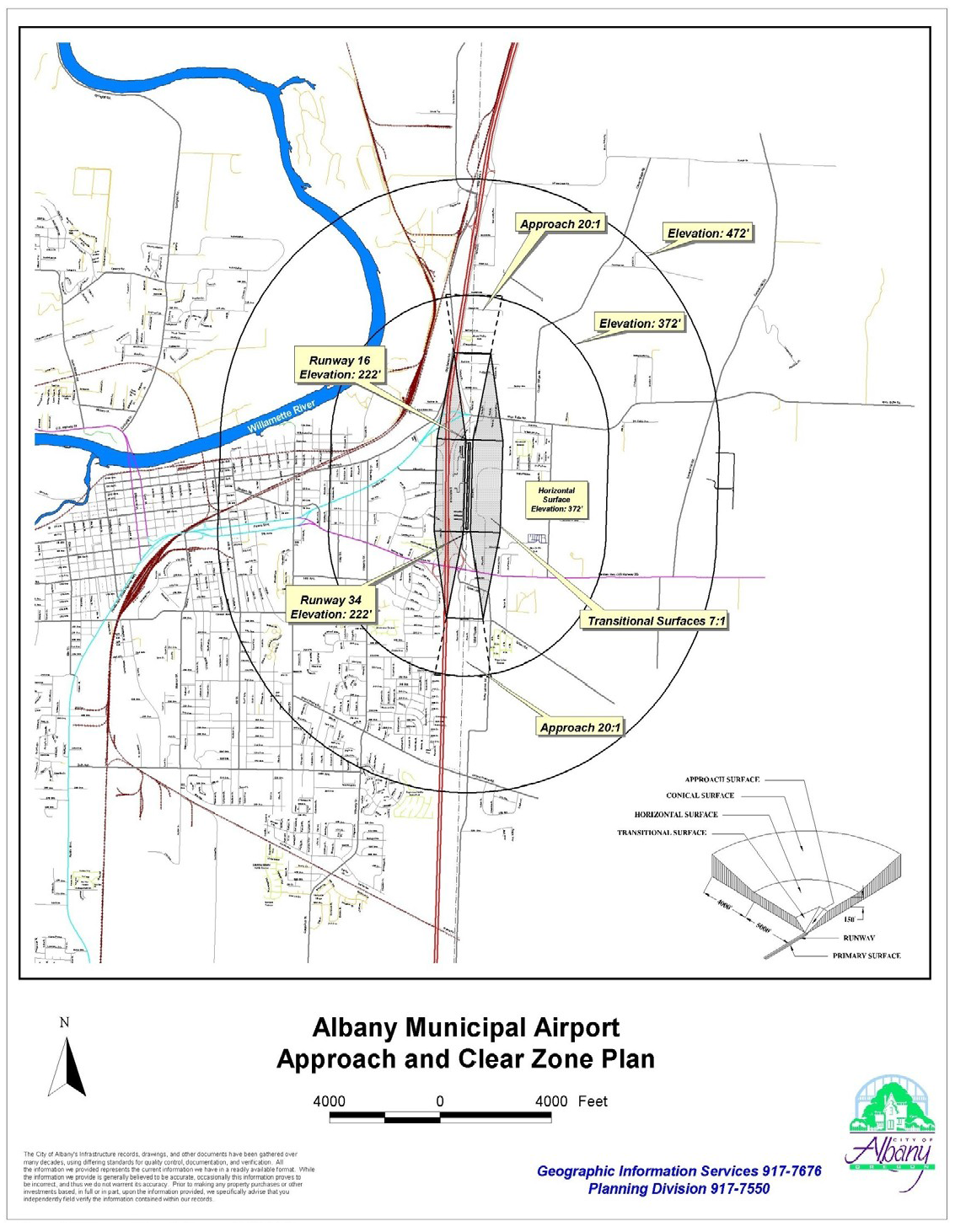
Figure 29 - Airport Approach and Clear Zones
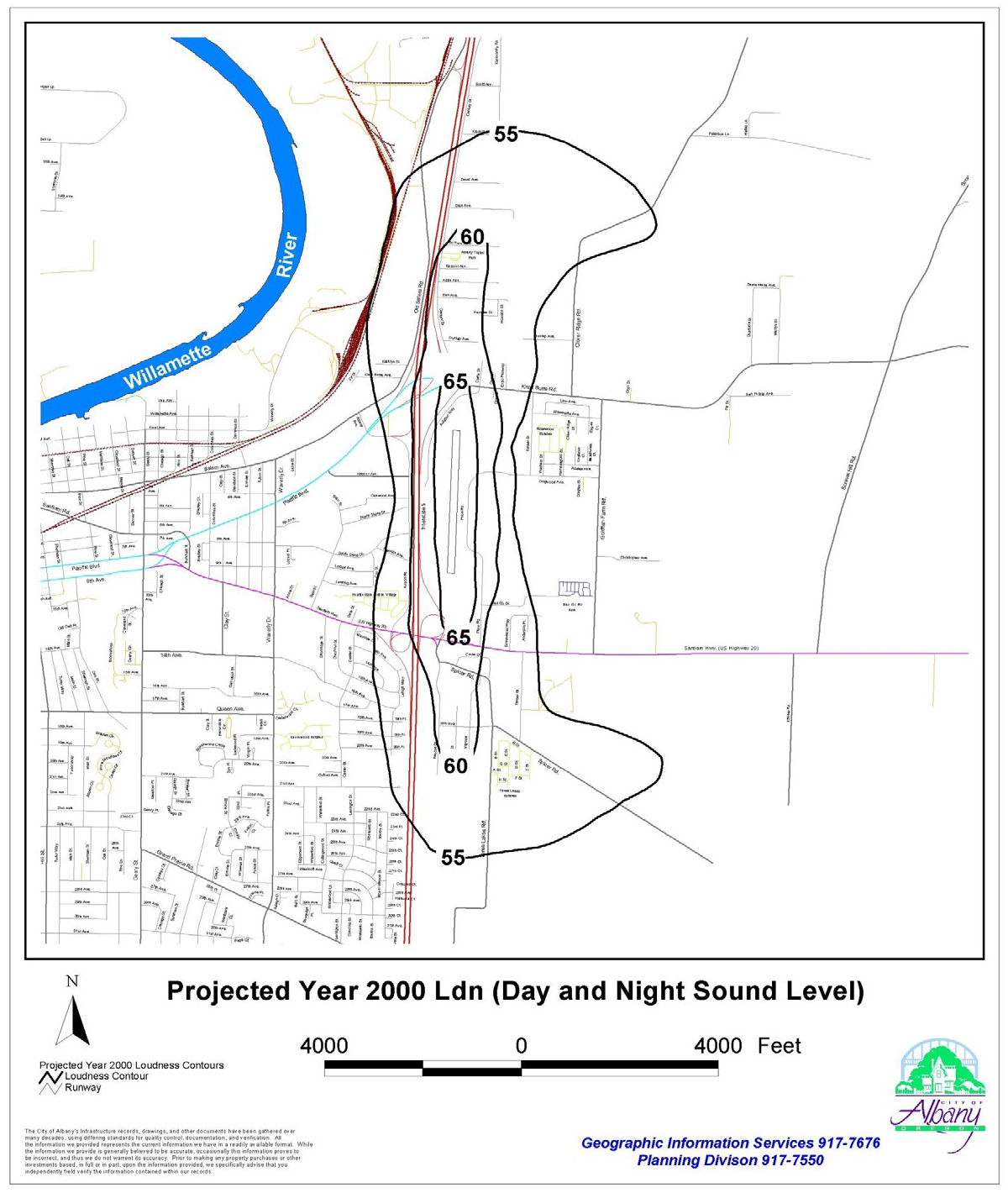
Figure 30 - Airport Sound Levels
2.16.010 - Purpose.
The purpose of the Radon Impacted Area (RI) Standards is to promote the public health, safety, and welfare by preventing migration of radon from the soil to indoor air in amounts that exceed EPA standards and to promote industrial development of such areas consistent with Statewide Planning Goal 9, "Economic Development," and the acknowledged Millersburg Comprehensive Plan.
(Ord. No. 195-22, Exh. A, 7-12-2022)
2.16.020 - Regulations and standards.
(1)
Area Subject to the Radon Impacted Area. The City shall record a notice in the Linn County public records that legally describes the area subject to the Radon Impacted Area, including a map showing the area's boundaries, state that the area is subject to the requirements of the Radon Impacted Area and that the Radon Impacted Area requires radon resistant construction methods and testing. The provisions of Section 7.500 shall apply to all areas described in the recorded notice and map.
(2)
Allowed Methods of Addressing Radium Contamination. An applicant may elect to address radium contamination by one of the two following methods:
a.
Use radon-resistant construction methods in accordance with item (4)(a), below.
b.
Obtain prior EPA approval that the levels of radon in the buildings will be less than the Indoor Air Standard for buildings for which radon controls are not appropriate (such as open-sided sheds and parking structures). Under this method of addressing radium contamination, applicants must demonstrate to EPA's satisfaction through estimates of indoor radon concentration, using methods approved by EPA and parameters which match the particular buildings to be constructed. If this demonstration is made to EPA's satisfaction, the City may approve building permits for the building without requiring radon-resistant construction methods or soils excavation. Any subsequent changes to the building require a new land use permit under Chapter 2.16 to ensure that the change in the building would not change the assumptions used in the initial modeling, or to update the modeling to EPA's satisfaction. All costs associated with obtaining EPA approval for buildings to be constructed other than with radon-resistant construction methods shall be borne solely by the applicant.
(3)
Land Use Permits.
a.
Application and Land Use Permit Approval.
i.
An approved Conditional Use Permit shall be required pursuant to Chapter 5.04 of this Development Code prior to approval of a building permit issued pursuant to Item (4)(a), below.
ii.
In addition to all items required for an application submittal in Chapter 5.04, the applicant shall submit to the City Planner the following additional items with the application:
A.
An election of one of two alternative methods of addressing radium and a written description of how radium will be addressed under the elected method.
iii.
The City Planner shall determine that the application is complete and, if not, shall advise the applicant in writing what information is missing pursuant to Chapter 5.04 and 2.16 of this Development Code.
iv.
The City Planner shall give notice of a complete application pursuant to Chapter 5.04 of this Development Code except that:
A.
The notice shall specify that any party may provide written comments on the application to the City Planner within ten days of the notice's mailing date; and
B.
The notice shall specify which method of addressing radium contamination has been elected by the applicant. The City shall give notice to the EPA. If the applicant changes its election of method addressing radium contamination, the City shall give EPA an amended notice.
v.
The City Planning Commission may approve or deny the application after the written comment period in item (3)(a)iv., above, has ended. The Commission may impose conditions as the Commission determines are appropriate; however, at a minimum, an approval under item (3)(a) for radon-resistant construction methods shall include the following conditions:
A.
No building permit shall be issued pursuant to Section 5.01.010 of this Code unless it complies with item (4)(a), below.
B.
No final certificate of occupancy shall be issued until radon tests satisfactory to the City have been conducted and show that indoor radon levels in all principal and accessory structures are below the Indoor Air Standard. The Indoor Air Standard shall be four pCi/liter or EPA's published target level or promulgated standard in effect at the time for indoor radon for occupational exposure, whichever is stricter. All radon testing shall be conducted in conformance with EPA's published radon testing guidance in effect at the time the tests are conducted. If radon concentrations exceed the Indoor Air Standard in effect at the time, building owners shall be required to put in place additional radon controls and shall conduct additional testing until retesting shows that concentrations are below the standard. Such additional testing, and controls if necessary, shall also be required after major structural changes are made to the building or its HVAC system that could affect the effectiveness of the radon controls. Once testing shows that the radon concentrations meet the Indoor Air Standards, the City/County may issue a final certificate of occupancy for the building.
C.
The condition required in item (3)(a)v.B, above, shall be satisfied within six months of the issuance of a temporary certificate of occupancy. The City Planner may grant reasonable extensions if the applicant makes a written request and demonstrates good cause.
D.
Building owners and lessees shall be required to maintain the radon control system in proper working order. Satisfactory maintenance shall, at a minimum, conform to maintenance requirements set forth in the Large Building Guidance, or updated EPA guidance.
E.
At least once every five years, buildings shall be inspected for slab settling, floor or basement wall cracks and other conditions that may reduce the effectiveness of the radon-resistant construction. If such conditions are found during the inspection, the affected buildings must be tested for radon using EPA-approved sampling methods. Building owners and lessees shall be required to take appropriate actions to reduce radon concentrations if radon levels in buildings exceed the Indoor Air Standard in effect at the time.
F.
All radon testing results shall be submitted to the City. All testing results must identify the building address and ownership and shall include a description of the reason for radon sampling (i.e., for occupancy, results of prior sampling, changes in building or HVAC configuration, etc.). Where results exceed the Indoor Air Standard, the information shall include a description of measures taken to modify the radon system to reduce concentrations and the retest results showing compliance with the standard. Records of radon testing, radon system maintenance, and inspection logs shall be kept on-site or be electronically accessible on-site and must be readily available for inspection by building occupants, and/or representatives of the City, EPA, or DEQ.
G.
Building owners and lessees shall provide notifications to building occupants in writing or electronically that the building they occupy needs radon controls for potential risk reduction. Such notification shall include, at a minimum, a posted notice in a prominent place within the building. Content of the notification to building occupants shall include information on the location of the site records, the radon controls that are in place at the site, and the reasons for the radon controls.
H.
The applicant shall provide access on, over and across the property, and the City of Millersburg, EPA and DEQ shall have the right to enter upon any portion of the property at all reasonable times, for purposes of verifying any data or information submitted to the City, EPA or DEQ or verifying that no action is being taken on the property in violation of the terms of this ordinance. As a condition to approval under this Code, such access will last indefinitely and so long as the land at issue may be described by item (2) above.
vi.
An appeal of the City Planners decision in item (3)(a)v., above, shall be pursuant to Chapter 5 of this Code.
(4)
Building Permit. All building permits approved under a land use approval for radon-resistant construction methods under item (2)(a) must comply with the following:
a.
All principal and accessory structures shall use radon-resistant construction methods consistent with the most current edition of the EPA publication entitled "Radon Prevention in the Design and Construction of Schools and Other Large Buildings" (June, 1993) (EPA625-R-92-016) or the latest adopted edition of the "State of Oregon Structural Specialty Code," whichever the City Manager and Building Official determines, provides greater radon-resistant construction methods. Construction will utilize either: (1) active systems such as active soil depressurization ("ASD") or building pressurization or (2) passive soil depressurization combined with sealing of radon entry routes. ASD consists of a layer of coarse aggregate below the building slab, radon suction pits below the slab, vent pipes, and suction fans. If passive soil depressurization is used, the system consists of the same components as ASD except for the fans, but will include a rough-in for the addition of fans to convert it to ASD if necessary. Sealing of radon entry routes shall be done using the methods described in the EPA guidance or using a gas-impermeable membrane.
b.
No building permit shall be issued unless an approval has been granted pursuant to item (3)(a), above.
c.
The City Planner may issue a temporary certificate of occupancy prior to a final certificate of occupancy.
(5)
Residential Development Prohibited. Residential development shall be prohibited in the Radon Impacted Area.
(Ord. No. 195-22, Exh. A, 7-12-2022)

