
Millersburg City Zoning Code
ARTICLE III
- GENERAL PROVISIONS
3.01.010 - Purpose.
The purpose of this Article is to:
(1)
Carry out the Comprehensive Plan with respect to development standards and policies.
(2)
Ensure that natural features of the landscape, such as landforms, natural drainage-ways, trees, and wooded areas, are preserved as much as possible and protected during construction.
(3)
Promote and maintain healthy environments and minimize development impacts upon surrounding properties and neighborhoods.
3.01.020 - Application of Standards.
(1)
Application. The standards set forth in this Article shall apply to partitions; subdivisions; developments; commercial and industrial projects; single-family dwellings, duplexes, and multi-family dwellings.
(2)
Alternatives to Standards. The application of these standards to a particular development shall be modified as follows:
a.
Development standards which are unique to a particular use, or special use, shall be set forth within the zone or in this Chapter.
b.
Those development standards which are unique to a particular zone shall be set forth in the Chapter governing that zone.
3.01.030 - Application of Public Facility Standards.
Standards for the provision and utilization of public facilities or services available within the City of Millersburg shall apply to all land developments in accordance with the following table of reference. No development permit shall be approved unless the following improvements are provided prior to occupancy or operation, or unless future provision is assured through a bond, deposit, agreement, or similar instrument approved by the City.
Notes:
1.
C-1: Fire Hydrants for Commercial or Industrial Expansions: As required in accordance with the Oregon Fire Code.
2.
C-2: Street Improvements for Single-family Dwellings and Partitions:
a.
New single-family dwellings on an existing parcel less than 2.5 acres in size and fronting an existing street which does not have a full street improvement including sidewalks, as required in the City's most recently adopted engineering standards and Chapter 3.02, shall dedicate the needed right-of-way and shall install the full improvement along a parcel's frontage.
b.
If there is no adjacent improvement, a street frontage fee, in accordance with the City's adopted connection fees, will be required in lieu of constructing the improvement.
c.
If a street extension to serve the residence is necessary, the owner must provide the necessary right-of-way dedication and street improvement to City street standards along the full frontage of the parcel.
d.
A partition creating parcels of 2.5 acres or larger does not require street improvements.
3.
C-3: Septic systems. In the RU zone, well and septic systems are allowed. In the RL and RM zones, connection to public utilities is required.
4.
C-4: Street Improvements for Commercial or Industrial Expansions: The City will require improvement to full City standards when the use meets any of the following criteria:
a.
The use generates an average of 100+ trips per day per 1,000 gross square feet of building as documented in the Trip Generation Manual of the Institute of Transportation Engineers, or another qualified source; or
b.
The use includes daily shipping and delivery trips by vehicles over 20,000 pounds gross vehicle weight.
3.02.010 - Purpose.
(1)
To provide for safe, efficient, convenient multi-modal movement in the City of Millersburg.
(2)
To provide adequate access to all proposed developments in the City of Millersburg.
(3)
To provide adequate area in all public rights-of-way for sidewalks, bikeways, sanitary sewers, storm sewers, water lines, natural gas lines, power lines, and other utilities commonly and appropriately placed in such rights-or-way.
(4)
For purposes of this Chapter:
a.
"Adequate access" means direct routes of travel between destinations; such destinations may include residential neighborhoods, parks, schools, shopping areas, and employment centers.
b.
"Adequate area" means space sufficient to provide all required public services to standards defined in this Code or the City's most current Engineering Standards.
3.02.020 - Scope.
The provisions of this Chapter shall be applicable to:
(1)
The creation, dedication, or construction of all new public or private streets, bikeways, or accessways in all subdivision, partitions, or other developments in the City of Millersburg.
(2)
The extension or widening of existing public or private street rights-of-way, easements, or street improvements including those which may be proposed by an individual or the City, or which may be required by the City in association with other development approvals.
(3)
The construction or modification of any utilities, sidewalks, or bikeways in public rights-of-way or street easements.
3.02.030 - General Provisions.
The following provision shall apply to the dedication, construction, improvement, or other development of all public streets in the City of Millersburg. Unless otherwise modified through provisions in this Chapter, all streets shall be designed in conformance with the specific requirements of the City's Transportation System Plan developed in accordance [with] the most current Engineering Standards.
(1)
Street Layout. The location, width, and grade of streets shall be considered in their relation to existing and planned streets, to topographical conditions, to public convenience and safety, and to the proposed use of the land to be served by the streets.
(2)
Continuation. Development proposals shall provide for the continuation of all streets, bikeways, and accessways within the development and to existing streets, bikeways, and accessways outside the development.
(3)
Alignment. All streets other than local streets or cul-de-sacs, shall be in alignment with existing streets by continuation of the centerlines to the maximum extent feasible. The staggering of street alignments resulting in "T" intersections shall be avoided wherever practical. However, when not practical, the staggering of street alignments resulting in "T" intersections shall meet with the approval of the City Engineer and ensure compliance with accepted traffic safety standards.
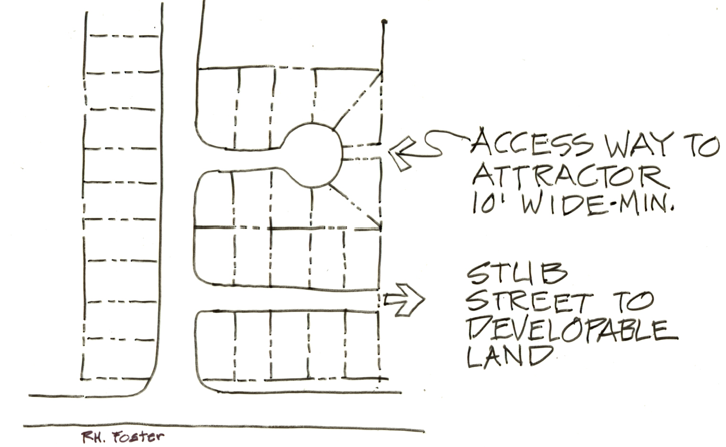
Figure 31 - Accessway and Street Extensions
(4)
Future Street Extensions. When it appears possible to continue a street, bicycle path, and/or pedestrian accessway into a future subdivision, adjacent acreage, or area attractors such as schools and shopping centers, these facilities shall be platted to a boundary of the subdivision or development. Further, the street may be platted without a turnaround unless the Public Works Department or local Fire District finds a turnaround is necessary for reasons of traffic safety.
(5)
Intersection Angles. Streets shall be laid out to intersect at angles as near to right angles as practical, except where topography requires lesser angles. Intersections of less than 60 degrees shall require approval of the City Engineer. All tangent calculations and curb radii shall comply with the City's most current Engineering Standards.
(6)
Existing Streets. Whenever existing public streets adjacent to or within a tract are of inadequate width, additional right-of-way shall be provided at the time of subdivision, partitioning, or development.
(7)
Half-Streets. Half-streets, while generally not acceptable, may be approved where essential to the reasonable development of an area and when the City finds it to be practical to require the dedication of the other half when the adjoining property is developed. Whenever a half-street is adjacent to a tract to be developed, the other half of the street shall be dedicated. Reserve strips and street plugs may be required to preserve the objectives of half-streets. The City Engineer may require additional width beyond the half-street when warranted for safety reasons and accordance with the City's most current Engineering Standards.
(8)
Cul-de-sacs. Cul-de-sacs are not encouraged and allowed only where no other reasonable alternative exists. Where permitted, a cul-de-sac shall have maximum lengths of 800 feet and terminate with a circular turn-around. Cul-de-sacs over 400 feet in length shall provide accessways to provide connectivity to adjacent streets and uses, unless physical constraints preclude a pedestrian/bicycle accessway. The Fire Code may establish additional standards.
(9)
Street Names. Street names and numbers shall conform to the established pattern in the City. The applicant for a partition or subdivision that creates new streets that are not listed in the Transportation System Plan shall propose street names. The City Manager has authority to approve or deny proposed street names.
(10)
Grades and Curves. Grades shall conform with the City's most current Engineering Standards.
(11)
Marginal Access Streets. If a development abuts or contains an existing or proposed arterial street, the City may require marginal access streets, reverse frontage lots with suitable depth, screen planting contained in a non-access reservation along the rear or side property line, or such other treatment as may be necessary for adequate protection of residential properties and to afford separation of through and local traffic.
(12)
Lots Abutting a Partial Street. Development of property abutting an existing public street which does not meet the minimum right-of-way standards, shall include sufficient yard setback equal to the minimum yard requirements of the zoning district, plus, the additional land required to meet the minimum right-of-way width.
(13)
Unimproved Street. Development of property adjacent to an unimproved right-of-way shall require the installation of an improved surface to meet fire code requirements and the payment of connection charges. At the City's option, submittal of a waiver of non-remonstrance to participate in future street improvements may be required in lieu of connection charges.
(14)
Street Cross Section Design Guidelines. Unless modified per Section 3.02.050 the following cross-section design guidelines shall apply:
(Ord. No. 210-24, Exh. A, 1-9-2024)
3.02.040 - Access Standards.
(1)
Single-family Residence and Duplex Access Standards:
a.
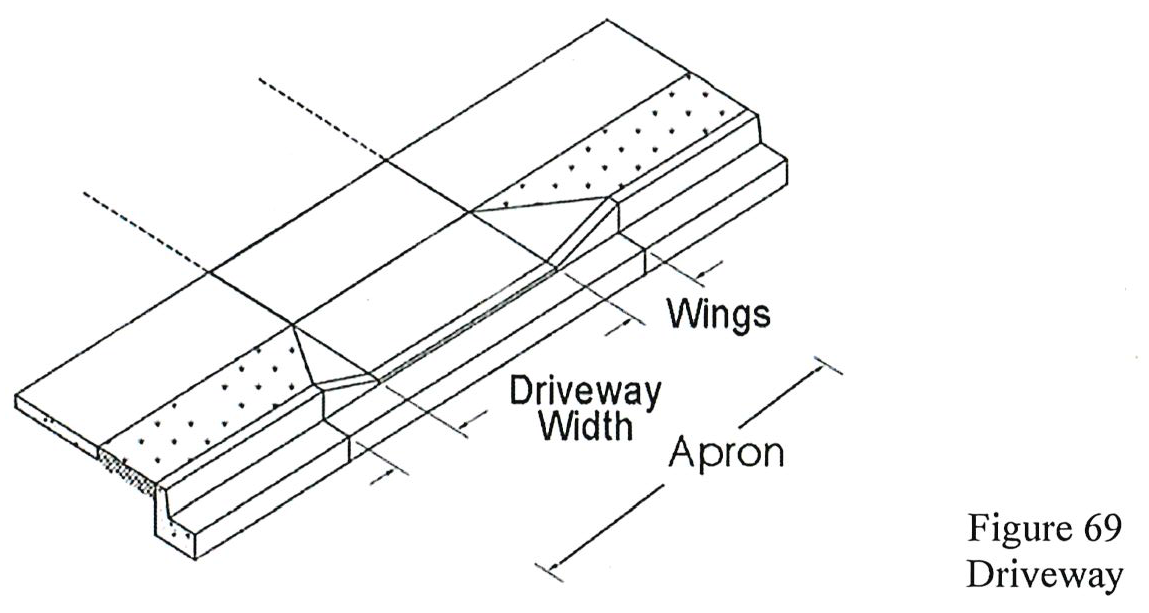
The maximum width of driveway (as measured at the edge of the roadway or curb line, not including wings, or as determined by the City Engineer) is as follows:
i.
Twenty feet for property with less than 50 feet of frontage;
ii.
Twenty-six feet for property between 50 and 79 feet of frontage;
iii.
Thirty feet for property with more than 79 feet of frontage.
iv.
Driveways between 30 feet and 50 feet are allowed if at least 40 feet of street frontage that is not part of the driveway measurement remains.
v.
In no case shall a residential driveway exceed 50 feet in width.
b.
Allowable driveway width may be divided between up to two driveways for property with greater than 79 feet of frontage.
c.
For frontage in excess of 100 feet, each additional 100 feet or fraction thereof shall be considered as separate frontage.
d.
All driveway aprons must be set back at least five feet from the side property line and 20 feet from the tangent of the property lines as they intersect adjacent to a corner lot.
e.
Although physical obstructions, such as utilities, curb ramps, mailboxes, and stormwater facilities, may impact frontage available for driveway construction, they are not excluded from the frontage measurement in determining maximum allowable driveway width.
f.
Driveways shall be limited to off-street parking and the parking and storage of recreational vehicles.
g.
Driveway grades shall not exceed 15%.
(Ord. No. 192-21, § 16, 12-14-2021; Ord. No. 195-22, Exh. A, 7-12-2022)
3.02.050 - Modification of Right-of-Way and Improvement Width.
The City may allow modification to the public street standards of Section 3.102.040 when both of the following criteria are satisfied:
(1)
The modification is necessary to provide design flexibility in instances where:
a.
Unusual topographic conditions require a reduced width or grade separation of improved surfaces; or
b.
Parcel shape or configuration precludes accessing a proposed development with a street which meets the full standards of this Chapter; or
c.
A modification is necessary to preserve trees or other natural features determined by the City to be significant to the aesthetic character of the area.
(2)
Modification of the standards of Section 3.102.040 shall only be approved if the City finds that the specific design proposed provides adequate vehicular access based on anticipated traffic volumes.
3.02.060 - Construction Specifications.
Construction specifications for all public streets shall comply with the criteria of the most recently adopted engineering standards of the City of Millersburg.
3.02.070 - Sidewalks.
Public sidewalk improvements are required for all property development in the City of Millersburg.
(1)
Sidewalks may be deferred:
a.
At the discretion of the City where future road or utility improvements are planned and expected to be completed within ten years.
b.
On property where a new dwelling is being constructed, there are no sidewalks existing on properties on either side, and no elevations or profiles have been established for future street or sidewalk improvements along the adjacent or the subject property's frontage.
c.
The property owner is obligated to provide the sidewalk when requested by the City or is obligated to pay their proportionate share if sidewalks are installed by the City at a later date.
(2)
Sidewalks shall be constructed within the street right-of-way. Sidewalk easements shall only be accepted where the City Engineer determines that full right-of-way acquisition is impractical.
(3)
Sidewalks shall connect to and align with existing sidewalks. Sidewalks may transition to another alignment as part of the approval process.
(4)
Sidewalk width and location, including placement of any landscape strip, shall comply with City of Millersburg Engineering Standards.
(5)
Planter strips and the remaining right-of-way shall be landscaped and maintained as part of the yard of abutting properties. Maintenance of sidewalks and planters shall be the continuing obligation of the abutting property owner.
(6)
Mid-block Sidewalks. The City may require mid-block sidewalks for long blocks or to provide access to schools, parks, shopping centers, public transportation stops, or other community services.
(7)
Internal pedestrian circulation and accessways shall be provided within all commercial, multi-family, and planned unit developments.
3.02.080 - Bikeways.
Bikeways are required along Arterial and Collector streets. Bikeways shall comply with City Engineering Standards. Developments adjoining existing or proposed bikeways shall include provisions for connection and extension of such bikeways through dedication of easements or rights-of-way.
3.02.090 - Private Streets.
Streets and other rights-of-way that are not dedicated for public use shall comply with the following:
(1)
Application. At least three, and no more than sixteen, dwelling units may be served by a private street. Private street standards shall also apply if at least three, and no more than sixteen, dwelling units may be created through a series of separate partitions.
(2)
Construction Standards. Private streets shall be subject to the following construction standards:
a.
Construction Standards. All private streets shall be constructed in conformance with public street cross-section requirements, the City's current Engineering Standards and adopted Standard Construction Specifications (Chapter 3.02).
b.
Public and Private Utilities. Unless otherwise required by the City Engineer, the private street shall include easements for public and private utilities.
c.
Turn-around. Private streets serving more than one ownership shall provide a turn-around if in excess of 150 feet and having only one outlet. Turn-arounds shall comply with the design provisions of the applicable fire district.
d.
Maintenance. Provision for the maintenance of the street shall be provided in the form of a maintenance agreement, homeowners association, or another instrument acceptable to the City. The applicable document shall be recorded against the deed record of each parcel, and if appropriate, placed on the final partitioning plat.
3.02.100 - Private Access Easement.
A private access easement created as the result of an approved land division shall conform to the following.
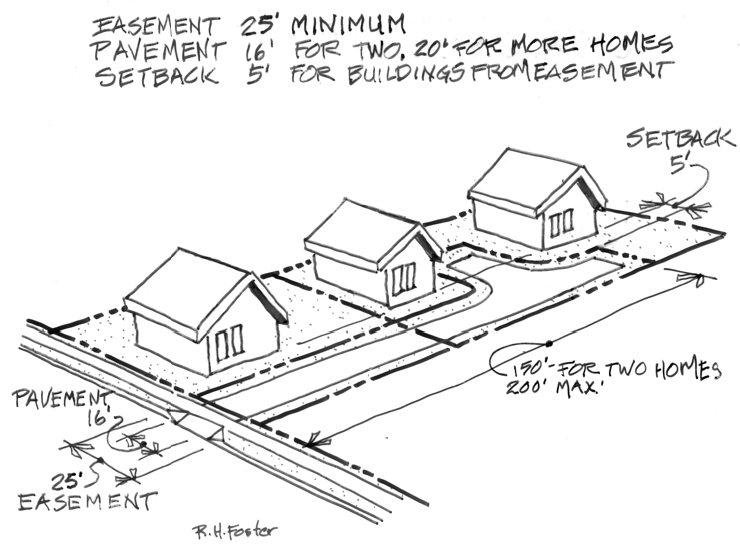
Figure 32 - Private Access Easement
(1)
Width. Private access easement shall only be allowed where the applicable criteria of Chapter 3.08 are satisfied. The access easement shall comply with the following standards or as required by the Oregon Fire Code whichever is more restrictive:
a.
Minimum easement width: 25 feet.
b.
Minimum paved width: For private access of 150' or less and serving one dwelling - 12 feet; serving two dwellings - 16 feet. For private access of more than 150' - 20 feet.
c.
No more than three dwelling units shall have their sole access to the easement. Easements serving more than three homes shall comply with provisions for a private street.
(2)
Surface Improvement. The surface width noted in (1)(b) above shall be improved with either asphalt or concrete for the entire length of the private access easement.
(3)
Maintenance. Provision for the maintenance of a private access driveway shall be provided in the form of a maintenance agreement, homeowners association, or similar instrument acceptable to the City. The applicable document shall be recorded against the deed record of each parcel, and if appropriate, placed on the final partitioning plat.
(4)
Turn-around. A turn-around shall be required for any access easement which is the sole access, and which is either in excess of 150 feet or which serves more than one dwelling. Turn-arounds shall comply with the design provisions of the applicable fire district.
(5)
Fire Lanes. All private access easements shall be designated as fire lanes and signed for "no parking."
(Ord. No. 213-25, Exh. A, 2-11-2025)
3.02.110 - Lots and Parcels Served by Private Streets and Access Easements.
The following shall apply to all lots and parcels that are accessed by either a private street or private access easement:
(1)
Lot and Parcel Size. The easement containing the private street or private access easement shall be excluded from the lot or parcel size calculation.
(2)
Setbacks. The line fronting along a private street or private access easement shall be considered a property line. Setbacks to the garage and home shall be measured from this easement line.
(3)
Lot Depth and Width. Where required by the underlying zone, the lot width shall be measured along the easement boundary and the lot depth shall be measured from the easement boundary to the rear lot line.
3.02.120 - Traffic Impact Analysis.
The purpose of this subsection is to coordinate the review of land use applications with roadway authorities and to implement Section 660-012-0045(2)(e) of the state Transportation Planning Rule, which requires the City to adopt a process to apply conditions to development proposals in order to minimize impacts and protect transportation facilities. The following provisions also establish when a proposal must be reviewed for potential traffic impacts; when a Traffic Impact Analysis must be submitted with a development application in order to determine whether conditions are needed to minimize impacts to and protect transportation facilities; the required contents of a Traffic Impact Analysis; and who is qualified to prepare the analysis.
(1)
When a Traffic Impact Analysis is Required. The City or other road authority with jurisdiction may require a Traffic Impact Analysis (TIA) as part of an application for development, a change in use, or a change in access. A TIA shall be required where a change of use or a development would involve one or more of the following:
a.
A change in zoning or a plan amendment designation;
b.
Operational or safety concerns documented in writing by a road authority;
c.
An increase in site traffic volume generation by 300 Average Daily Trips (ADT) or more;
d.
An increase in peak hour volume of a particular movement to and from a street or highway by 20 percent or more;
e.
An increase in the use of adjacent streets by vehicles exceeding the 20,000-pound gross vehicle weights by ten vehicles or more per day;
f.
Existing or proposed approaches or access connections that do not meet minimum spacing or sight distance requirements or are located where vehicles entering or leaving the property are restricted, or such vehicles are likely to queue or hesitate at an approach or access connection, creating a safety hazard;
g.
A change in internal traffic patterns that may cause safety concerns; or
h.
A TIA required by ODOT pursuant to OAR 734-051.
(2)
Traffic Impact Analysis Preparation.
a.
When required by the City, a professional engineer registered by the State of Oregon, in accordance with the requirements of the road authority, shall prepare the Traffic Impact Analysis.
b.
Pursuant to OAR 660-012-0210 for amendments to the TSP, the Comprehensive Plan, a land use regulation, including zone map changes, except expansions of an urban growth boundary as provided in OAR 660-024-0020(1) or OAR 660-0038-0020(13), the model used in the study must account for changes in vehicle miles traveled per capita that would result from the proposal and any transportation projects proposed as a part of the proposal.
c.
A traffic study produced for substandard access (see 3.02.120.1.f) shall clearly demonstrate that the proposed access will be safe, include any mitigation required to make the proposed access safe, and assure that the level of service for neighboring intersections and access driveways will perform at grade level d or better.
(3)
Findings required. In addition to an analysis of level-of-service, pursuant to OAR 660-012-0210, any traffic study for a case type listed in (2)b, or any code regulations in the Development Code or Municipal Code, shall include an analysis using vehicle miles traveled.
a.
The study shall include an analysis of the proposed increase in vehicle miles traveled per capita.
b.
Any identified impacts shall include a review of possible mitigation.
c.
The Planning Commission or City Council shall consider the impacts on a case-by-case basis. Unmitigable impacts alone need not be a reason for denial of the project, unless the impacts result in an inconsistency with the Land Use criteria for the project. The findings must clarify the identified impacts and any reasons why the project was approved in spite of them.
(Ord. No. 210-24, Exh. A, 1-9-2024)
3.03.010 - Purpose.
The purpose of this Chapter is to provide standards for the parking, maneuvering, loading, and unloading of vehicles for all land uses in the City of Millersburg.
(Ord. No. 210-24, Exh. A, 1-9-2024)
3.03.020 - Scope.
(1)
Application. Except as modified or restricted elsewhere within this Code, the provisions of this Chapter shall apply to the following types of development:
a.
Any new building or structure erected after the effective date of this Code.
b.
The construction or provision of additional floor area, seating capacity, or other expansion of an existing building or structure.
(Ord. No. 210-24, Exh. A, 1-9-2024)
3.03.030 - Location.
Any provided off-street parking and loading areas shall be provided on the same lot with the main building or structure or use except that:
(1)
Yards. Off-street parking areas may be located in a required yard setback for multi-family residential, commercial, and industrial uses with an approved 10-foot landscaped buffer.
(2)
Residential. In residential zones, automobile parking for dwellings and other uses permitted in a residential zone may be located on another lot if such lot is within 200 feet of the lot containing the main building, structure, or use.
(3)
Parking. Driveways may be used for off-street parking for single-family and two-family dwellings. No parking of vehicles, trailers, boats, or recreational vehicles shall be allowed in a front yard except on a driveway.
(4)
Non-Residential. In non-residential zones, parking may be located off the site of the main building, structure or use if it is within 500 feet of such site.
(Ord. No. 210-24, Exh. A, 1-9-2024)
3.03.040 - Joint Use.
Parking area may be used for a loading area during those times when the parking area is not needed or used. Parking areas may be shared between uses where hours of operation or use are staggered such that peak demand periods do not occur simultaneously. Easements shall be used on shared parking areas to allow legal access for all parties involved.
(Ord. No. 210-24, Exh. A, 1-9-2024)
3.03.050 - General Provisions Off-Street Parking and Loading.
(1)
Parking Required. The provision and maintenance of off-street parking and loading space is a continuing obligation of the property owner. Any parking area that is shown on the land use site plan may remain as parking area dedicated to off street vehicle parking. Any changes to the approved vehicle parking would require site plan review for any new use proposed where parking was located on the previously approved site plan.
(2)
Storage Prohibited. Any area shown on the land use approval as dedicated off street parking spaces shall be available for the parking of operable passenger automobiles of residents, customers, patrons, and employees only, and shall not be used for storage of vehicles or materials including the display of vehicles for sale.
(Ord. No. 210-24, Exh. A, 1-9-2024)
3.03.060 - Off-Street Vehicle and Bicycle Parking Requirements.
(1)
Purpose. The purpose and intent of this section is to set forth the standards for the development of off-street parking. There are no minimum or maximum number of parking stalls required for any use within the City, however, property owners must comply with all applicable state and federal accessibility requirements, including but not limited to, the Americans with Disabilities Act (ADA). Parking is still permitted at the property owners' discretion. The City encourages property owners to include adequate parking for each use. It is the property owner's responsibility to determine the correct amount of parking spaces needed for each use, if parking is to be included. When parking is included, all parking development standards of this development code must be met.
(2)
Bicycle Spaces. Bicycle parking development requirements
a.
Space Size. Each bicycle parking space shall be a minimum of six feet long and two feet wide and be accessible by a minimum five-foot aisle.
b.
Location. All bicycle parking shall be within 100 feet of a building entrance(s). Any long-term bicycle parking spaces shall be sheltered from precipitation.
c.
Standards.
i.
All bicycle spaces must include the ability to lock the bike in at least two places or be within a lockable space only available to authorized users for staff bicycle parking areas.
ii.
The area must be well lit.
iii.
Be installed in a manner to allow space for the bicycle to be maneuvered to a position where it may be secured without conflicts from other parked bicycles, walls, or other obstructions.
iv.
Include sufficient space to accommodate large bicycles, including family and cargo bicycles.
d.
Number of Bicycle Spaces.
i.
Every use shall include at least one marked and designated bicycle parking space. All developments should include an adequate number of bicycle parking spaces, at the property owner's discretion.
ii.
Multifamily developments and mixed unit developments with five or more residential units shall provide at least one secure space per dwelling unit. Said unit shall be covered and allow the ability to lock the bike in at least two places or be within a lockable space only available to authorized users.
iii.
Transit Stations and park-and-ride lots shall provide a covered area capable of accommodating at least five bicycles with the ability to lock the bike in at least two places.
(Ord. No. 192-21, § 7, 12-14-2021; Ord. No. 210-24, Exh. A, 1-9-2024)
3.03.070 - Off-Street Loading Requirements.
All Commercial loading areas shall be screened from view of any street right-of-way and shall be designed to not interfere with any passenger vehicle parking areas. This does not apply to patron loading areas.
(Ord. No. 213-25, Exh. A, 2-11-2025)
3.03.080 - Parking, Driveway, and Loading Area Development Requirements.
Where provided, all parking and loading areas shall be developed and maintained as follows:
(1)
Surfacing. All driveways (full length of the driveway), parking, and loading areas, for all uses including single-family residential (except in the RU Zone), shall have a durable hard surface of asphaltic cement, concrete pavers, concrete, or other concrete materials. Surface improvements shall conform to the following:
a.
Paving Improvements. Paving shall comply with adopted Engineering Standards of the City of Millersburg.
b.
Timing. Unless modified by a variance or a site development review, or bonded per City requirements, all driveways and off-street parking and loading areas shall be improved prior to occupancy of the primary structure.
c.
Surfacing Options for Industrial Zone. The City Engineer may allow the use of a graveled parking area in the industrial zones, provided all customer and employee parking areas are paved and provided surface drainage is addressed per Engineering Standards and at least 20-feet of each access driveway connecting with a public street is paved.
(2)
Parking Spaces. Parking spaces shall be a minimum 9-feet wide and 20-feet in length. Up to 20% of the parking area may contain "compact spaces" with dimensions of 8.5-feet in width and 18-feet in length.
(3)
Driveways. The following standards shall apply to all driveways:
a.
Access spacing shall be in compliance with Section 3.02.040 -Access Standards
b.
Internal Driveways for Multi-Family, Commercial, Industrial, and Public Uses.
(4)
Lighting. Any light used to illuminate a parking or loading area shall be arranged to be directed entirely onto the loading or parking area, shall be deflected away from any residential use and shall not cast a glare or reflection onto moving vehicles on public rights-of-way.
(5)
Driveway Required. Groups of more than four parking spaces shall be so located and served by a driveway that their use will require no backing movements or maneuvering within a street right-of-way.
(6)
Traffic Safety. Service drives to off-street parking areas shall be designed and constructed to facilitate the flow of traffic, provide maximum safety of traffic access and egress, and the maximum safety of pedestrians and vehicular traffic on the site.
(7)
Curbing. Parking spaces along the outer boundaries of a parking area shall be contained by a curb or a bumper rail at least 4" high, located a minimum of three feet from the property line, to prevent a motor vehicle from extending over an adjacent property or a street.
(8)
Landscaping.
a.
Parking lots abutting residential zones shall be screened from abutting residential zones by a combination of fences, walls, and landscaping adequate to screen lights, provide privacy and provide separation for the abutting residences.
b.
See Chapter 3.09 for additional landscaping requirements.
(9)
Pedestrian walkways within parking areas. Walkways (also known as internal walkways or pedestrian paths) are designed to ensure that pedestrians can avoid using parking aisles or travel lanes for access to building entrances. The intention is to assure that the building or buildings can easily be accessed by a pedestrian as well as a vehicle. The following are standards for pedestrian walkways:
a.
New parking areas must provide pedestrian walkways between:
i.
building entrances;
ii.
building entrances and the main street sidewalks or pedestrian network;
iii.
existing or planned pedestrian facilities in the adjacent public rights-of-way;
iv.
buildings and parking areas;
v.
building entrances on the same lot or business/shopping center;
vi.
multiple uses on the same lot;
vii.
building entrances and transit stops;
viii.
building entrances and accessible parking spaces;
ix.
between development on adjacent parcels where practical.
b.
Pedestrian access points must be connected to the larger pedestrian network in a manner that provides the earliest point of off-site pedestrian walkway contact, which may, or may not, be adjacent to the vehicular access point.
c.
Exceptions may be approved as part of a Design Review in the following circumstances:
i.
where new development is less than 2,000 square feet of gross floor area, features a landscaped front yard area and parking is located to the side or rear;
ii.
pedestrian connections to industrial uses are not required.
d.
The walkway must minimize conflict between pedestrians and traffic at all points of pedestrian access to on-site parking and building entrances.
e.
Pedestrian Walkway Design Standards:
i.
walkways internal to the site should be at least five (5) feet wide;
ii.
at a minimum, walkways within parking areas must be provided for every three (3) driving aisles or at distance of not more than 150-foot intervals, whichever is less;
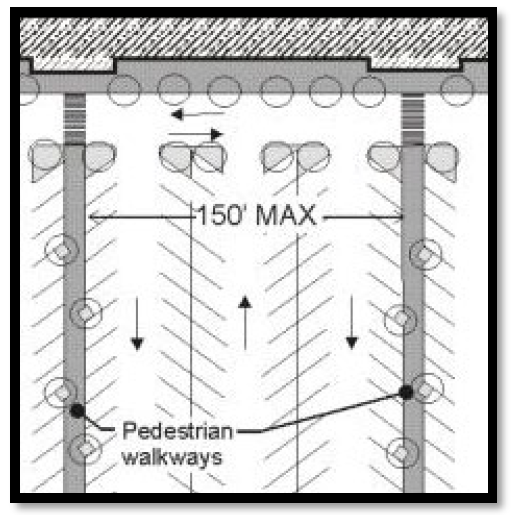
Figure 69
iii.
must be distinguishable from traffic lanes by painted markings, pavement material, texture, or raised in elevation;
iv.
must have adequate lighting for safety and security;
v.
barriers which limit pedestrian uses is not permitted.
(10)
Car and Van Pool Parking. Designated preferential employee parking areas are required for parking lots with more than 50 parking spaces. Preferred parking areas shall provide parking for at least one carpool and at least one vanpool parking space.
(11)
Redevelopment of Parking Areas.
a.
Property owners are permitted to redevelop any portion of existing off-street parking areas for bicycle or transit facilities, including but not limited to bike racks, bus stops, and park and ride stations.
b.
The City may allow the development of underused parking areas for uses permitted in the applicable zone. Underutilized shall mean any portion of the parking area that remains mostly vacant throughout most of the year (excluding special events or peak periods). A study shall accompany any request for site plan review Land Use applications. The study shall demonstrate, to the satisfaction of the City, that the elimination of the existing parking will have no detrimental effects, that cannot be mitigated by the applicant, on the property or sounding properties. This includes, but is not limited to, the possibility that the elimination of parking areas may shift the need for parking onto neighboring properties, or cause any other negative impacts to surrounding properties.
(12)
Electric Vehicle Charging.
a.
New multi-family residential buildings with five or more residential dwelling units and new mixed-use buildings consisting of privately owned commercial space and five or more residential dwelling units shall provide sufficient electrical service capacity, as defined in ORS 455.417, at no less than 40 percent of all vehicle parking spaces on the site containing the residential dwelling units.
b.
Dwelling units in townhouses are not included for purposes of determining the applicability of this regulation.
c.
Any provided electrical infrastructure shall include all ADA parking spaces.
d.
Commercial development electrical vehicle charging requirements are dictated by the Oregon state building code and ORS 455.417.
(Ord. No. 192-21, § 16, 12-14-2021; Ord. No. 210-24, Exh. A, 1-9-2024)
3.04.010 - Purpose.
To provide for the drainage of surface water from all residential, commercial, and industrial development; to minimize erosion; to reduce degradation of water quality due to sediments and pollutants in storm water runoff.
3.04.020 - Scope.
The provisions of this Chapter shall apply to all partitions, subdivisions, multi-family developments, commercial developments, and industrial development; and to the reconstruction or expansion of such developments.
3.04.030 - Plan for Storm Drainage and Erosion Control.
It is the obligation of the property owner to provide proper drainage and protect all runoff and drainage ways from disruption or contamination. On-site and off-site drainage improvements may be required. Property owners shall provide proper drainage and shall not direct drainage across another property except within a continuous drainage way. Paving and catch basin outflows may require detention cells and/or discharge permits. Maintaining proper drainage is a continuing obligation of the property owner.
No construction of any facilities in a development included in Chapter 3.01.030 shall be permitted until a storm drainage and erosion control plan, designed in accordance with the most recently adopted City Engineering Standards, for the project is prepared by an engineer registered in the State of Oregon and is approved by the City. This plan shall contain at a minimum:
(1)
The methods to be used to minimize the amount of runoff, siltation, and pollution created from the development both during and after construction.
(2)
Plans for the construction of storm sewers, open drainage channels, and other facilities which depict line sizes, profiles, construction specifications, and other such information as is necessary for the City to review the adequacy of the storm drainage plans.
(3)
Calculations used by the engineer in sizing storm drainage facilities.
3.04.040 - General Standards.
(1)
Design Standards. All development shall be planned, designed, constructed, and maintained to:
a.
Protect and preserve existing natural drainage channels to the maximum practicable extent;
b.
Protect development from flood hazards;
c.
Provide a system by which water within the development will be controlled without causing damage or harm to the natural environment, or to property or persons within the drainage basin;
d.
Assure that waters drained from the development are substantially free of pollutants, through such construction and drainage techniques as sedimentation ponds, reseeding, phasing of grading, and water quality facilities;
e.
Assure that waters are drained from the development in such a manner that will not cause erosion to any greater extent than would occur in the absence of development;
f.
Avoid placement of surface detention or retention facilities in road rights-of-way.
(2)
Public Easements. In the event a development or any part thereof is traversed by any water course, channel, stream or creek, gulch, or other natural drainage channel, adequate easements for storm drainage purposes shall be provided to the City. This shall not imply maintenance by the City.
(3)
Obstruction of Channel. Channel obstructions are not allowed except as approved for the creation of detention or retention facilities approved under the provisions of this Code and in compliance with City Engineering Standards.
(4)
Conveyance of Flows. All new development within the City shall make provisions for the continuation or appropriate projection of existing storm sewer lines or drainage ways serving surrounding areas. Drainage extensions may be required through the interior of a property to be developed where the City determines that the extension is needed to facilitate upstream flows
(5)
City Inspection. Prior to acceptance of a storm sewer system by the City, the storm sewers shall be flushed and inspected by the City. All costs shall be borne by the developer.
3.04.050 - Grading.
(1)
Grading permits are required for the following activities and shall be subject to the most recently adopted City Engineering Standards.
a.
Grading in excess of 50 cubic yards;
b.
Grading potentially impacting, riparian areas, drainageways, flood hazard areas, or greenways;
c.
Grading that could possibly impact adjacent properties;
d.
Grading proposed over public storm drains, sanitary sewers, or water lines;
e.
Grading requiring tree removal;
f.
Other areas with potential impacts as determined by the City;
g.
Land partitions and subdivisions.
(2)
Building Permit: If the approved grading activity is associated with a building permit, a final grading inspection shall be required prior to issuance of certificate of occupancy.
(3)
NDPES Permit Required. A National Pollutant Discharge Elimination System (NPDES) permit must be obtained from the Department of Environmental Quality (DEQ) for construction activities (including clearing, grading, and excavation) that disturbs one or more acres of land.
3.05.010 - Purpose.
To provide adequate services and facilities appropriate to the scale and type of development.
3.05.020 - Standards.
(1)
Design and Location. The location, design, installation, and maintenance of all utility lines and facilities shall be carried out with minimum feasible disturbances of soil and site.
(2)
Private Utilities. All development which has a need for electricity, gas, and communications services shall install them pursuant to the requirements of the district or company serving the development. Except where otherwise prohibited by the utility district or company, all such facilities shall be underground.
(3)
Water Service Required. All development which has a need for public water shall install the facilities pursuant to the requirements of the City. Installation of such facilities shall be coordinated with the extension of necessary sanitary sewer services and storm drainage facilities.
(4)
Sanitary Sewer Required. All development which has a need for public sanitary sewers shall install the facilities pursuant to the requirements of the City. Installation of such facilities shall be coordinated with the extension of necessary water services and storm drainage facilities.
(5)
Subsurface Sewage Disposal. Installation of sub-surface disposal systems shall only be allowed per City's Municipal Code regulations.
(6)
Streetlights. When required, the installation of streetlights shall be pursuant to the requirements of the City Engineering Standards and the requirements of the utility company serving the development.
(7)
Easements, General. Easements shall be provided along property lines as deemed necessary by the City, special districts, and utility companies. Easements for special purpose uses shall be of a width deemed appropriate by the responsible agency. Such easements shall be designated on the final plat of all subdivisions and partitions.
3.05.030 - Public Facility Improvements.
All public facility improvements shall be designed and constructed in compliance with adopted City of Millersburg Engineering Standards. The City Engineer or designee shall determine compliance with these standards. These standards are considered requirements and may not be altered pursuant to provisions in this Development Code.
3.06.010 - Purpose.
The purpose of this Chapter is to provide equitable rights, reduce conflicts, promote traffic and pedestrian safety, increase the aesthetic value and economic viability of the City, all by classifying and regulating the location, size, type, and number of signs and related matters, in a content-neutral manner.
3.06.020 - Definitions.
For the purposes of this Chapter, the following definitions shall apply:
Alteration or altered: Any change in the size, shape, method of illumination, position, location, construction, or supporting structure of a sign. A change in sign copy or sign face alone shall not be considered an alteration.
Awning: A shelter supported entirely from the exterior wall of a building and composed of non-rigid materials, except for the supporting framework.
Billboard: A large outdoor board for displaying advertisements.
Blade Banner Signs: aka Feather Flag, or Feather Blade signs are signs often of a temporary nature, that consist of fabric attached to a pole. The pole is typically about 6-8 feet in height where the sign mounts in a vertical nature.
Building Frontage: The portion of a building face most closely in alignment with an adjacent right-of-way or fronting a parking lot when so defined, as allowed in this chapter. A gasoline service station may use the overhanging canopy as a substitute for building frontage when computing the allowable sign area. The longest side of the building or canopy shall be used to compute the allowable sign area.
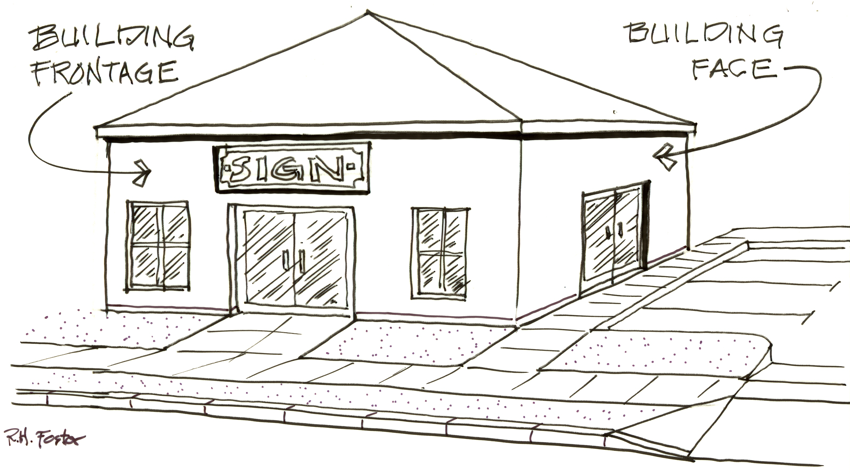
Figure 34 - Building Frontage
Canopy sign: A sign hanging from a canopy or eve, at any angle relative to the adjacent wall.
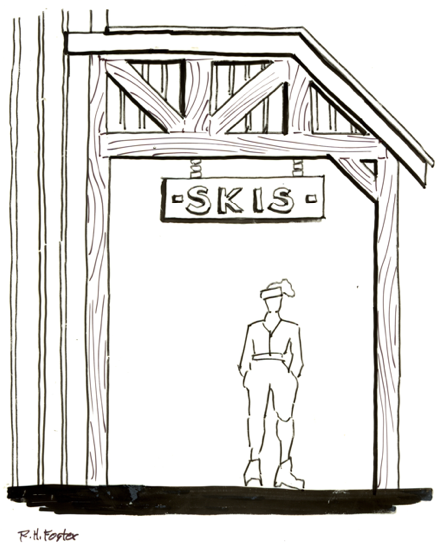
Figure 35 - Sign, Canopy
Digital Display: A display of a sign message that is made up of internally illuminated components that display an electronic image, which may or may not include text and is capable of changing the message periodically. Digital Displays may include but are not limited to television screens, holographic displays, programmable ink, LCD, LED, or plasma displays.
Flashing sign: A sign any part of which pulsates or blinks on and off, except time and temperature signs and message signs allowed by conditional use.
Free-standing sign: A sign supported by one or more uprights, poles, or braces placed in or upon the ground, or a sign supported by any structure primarily for the display and support of the sign.
Height: Height is measured from the grade of the curb line lowest to the base of the sign to the highest point of the sign. In the absence of a curb line, the edge of the street pavement shall be used. In the absence of street pavement, the ground level shall be used to measure the height.
Incidental signs: A sign which is normally incidental to the allowed use of the property but can contain any message or content. Such signs can be used for, but are not limited to, nameplate signs, warning or prohibition signs, and directional signs not otherwise allowed.
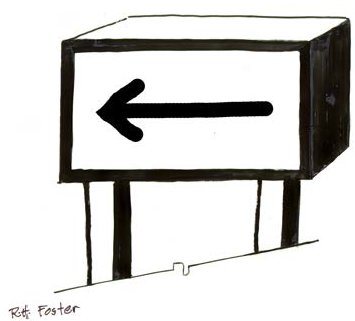
Figure 36 - Sign, Included
Indirect illumination: A source of illumination directed toward such sign so that the beam of light falls upon the exterior surface of the sign.
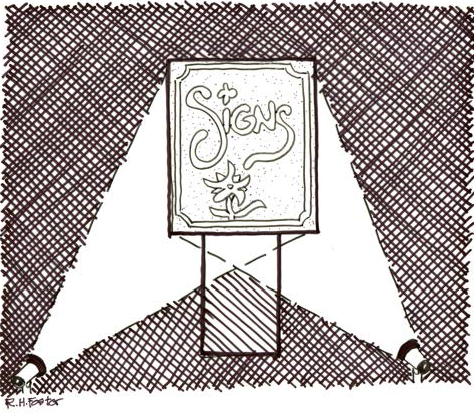
Figure 37 - Sign with Indirect Illumination
Integrated business center: A group of two or more businesses which are planned or designed as a center, and share a common off-street parking area or access, whether or not the businesses, buildings, or land are under common ownership.
Internal illumination. a source of illumination from within a sign.
Message sign: A sign which can change its message electronically including, but not limited to, signs displaying time and temperature.
Multi-faced sign: A sign which has two or more identical sign faces, contained in a single sign structure.
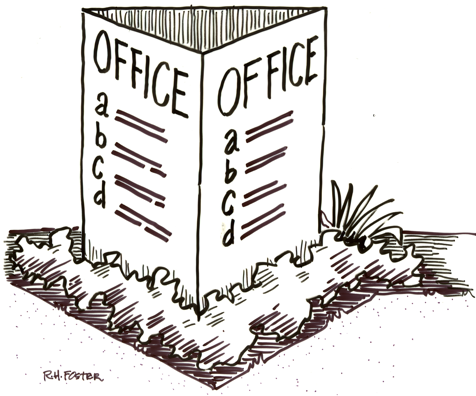
Figure 38 - Sign, Multi-faced
Mural: A covering of the surface area of a wall with paint or other artistic medium, that creates a pictorial or abstract design and usually without advertising or commercial symbolism - such as logos or trademarks - or any representation of a product or business, except to identify the artist.
Nonconforming sign: Any sign which lawfully exists prior to the effective date of this Chapter but, which due to the adopted requirements, no longer complies with the height, area and placement regulations or other provisions of these regulations.
Owner: The owner or lessee of the sign. If the owner or lessee of the sign cannot be determined, then "owner" means owner or purchaser of the land on which the sign is placed.
Portable Sign (Sign): Any sign that is not originally designed to be permanently affixed to a building, structure, or the ground; a sign originally designed, regardless of its current modification, to be moved from place to place. These signs include, but are not limited to, A-frame or sandwich board signs, signs attached to wood or metal frames and designed to be self-supporting and movable, and also including trailer reader boards.

Figure 39 - Sign, Portable - Examples
Projecting signs: A sign projecting from a structure, the face of which is not parallel to the wall on which it is mounted.
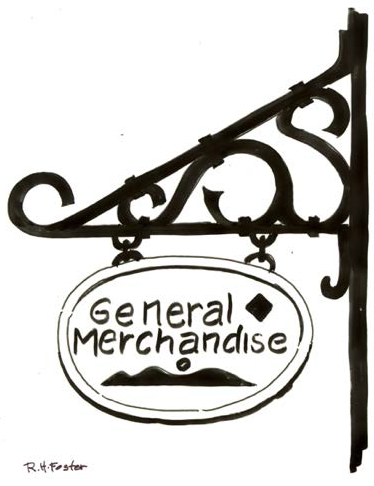
Figure 40 - Projecting Sign
Roof line: Either the eaves of the roof, or the top of the parapet, at the exterior wall. A "mansard roof" is below the top of a parapet and is considered a wall for sign purposes.
Roof sign: A sign or any portion of which is displayed above the highest point of the roof, whether or not such sign also is a wall sign.
Rotating/revolving sign: A sign, all or a portion of which, moves in some manner.
Sign: Any writing, including letter, word, or numeral; pictorial presentation, including illustration or decoration; emblem, symbol or trademark; banner or pennant; or any other device, figure, or similar thing which is a structure or any part thereof, or is attached to, painted on, or in any other manner represented on a building, structure, or device; and is used to announce, direct attention to, or advertise; and is visible from any public right-of-way.
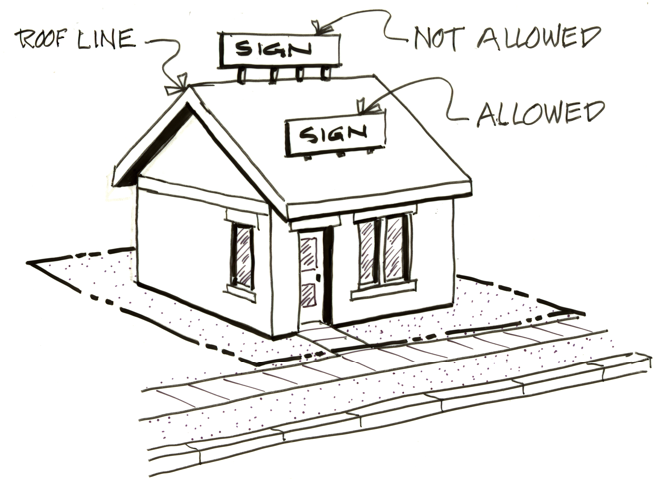
Figure 41 - Sign, Roof and Roof Sign
Sign area: The area of a sign shall be the entire area within any type of perimeter or border which encloses the outer limits of any writing, representation, emblem, figure, or character. If the sign is enclosed in a frame or cabinet, the area is based on the inner dimensions of the frame or cabinet surrounding the sign face. When a sign is on a base material and attached without a frame, such as a wood board or Plexiglas panel, the dimensions of the base material are to be used. The area of a sign having no such perimeter, border, or base material shall be computed by enclosing the entire area within a parallelogram or a triangle of the smallest size sufficient to cover the entire message of the sign and computing the area of the parallelogram or a triangle. For the purpose of computing the number of signs, all writing included within such a border shall be considered one sign, except for multi-faced signs on a single sign structure, which shall be counted as one sign per structure. The area of multi-faced signs shall be calculated by including only one-half the total area of all sign faces.
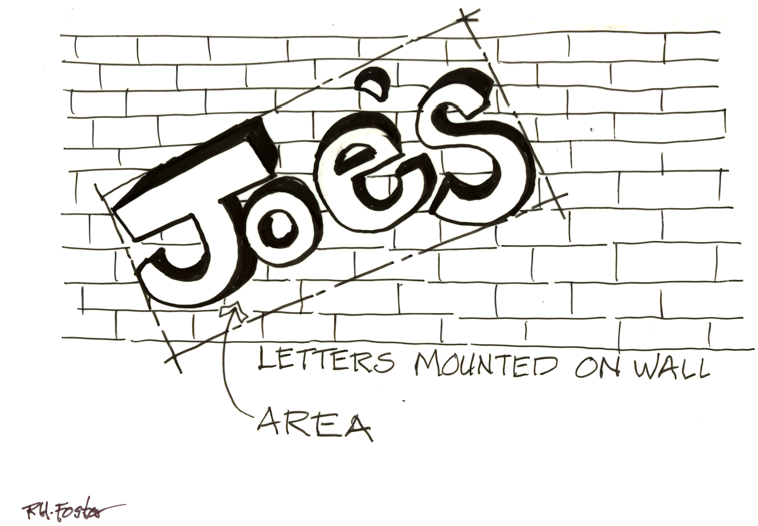
Figure 42 - Sign Area - Not Framed
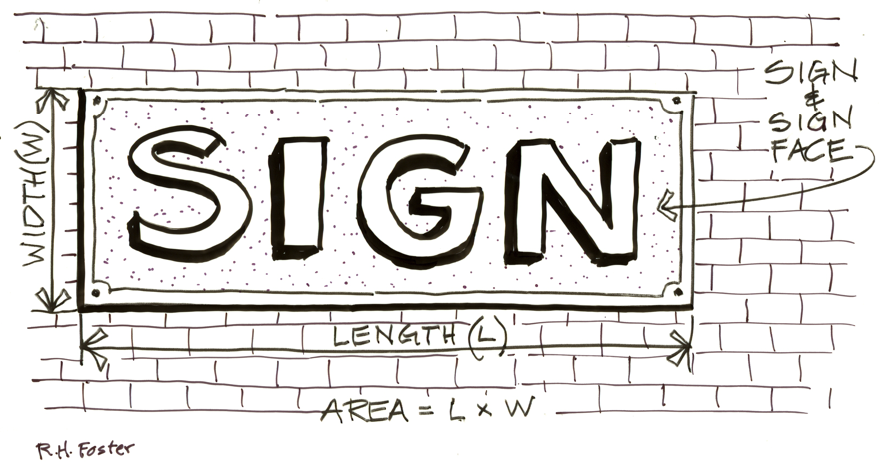
Figure 43 - Sign Area - Framed
Sign face: Surface of a sign containing the message. The sign face shall be measured as set forth in the definition for "Sign Area."
Sign structure: The supports, uprights, braces, framework, and other structural components of the sign.
Temporary business: A business of a temporary nature. ;;p0; Temporary Sign: A sign not permanently affixed to a structure on a property. These signs primarily include, but are not limited to, canvas, cloth, or paper banners or posters hung on a building wall or on a permanent pole such as on a free-standing sign support. Also see Portable Sign (Signs).

Figure 44 - Temporary Sign
Wall sign: A sign attached to, erected against or painted on a wall of a building or structure, with the exposed face of the sign in a plane approximately parallel to the face of said wall.
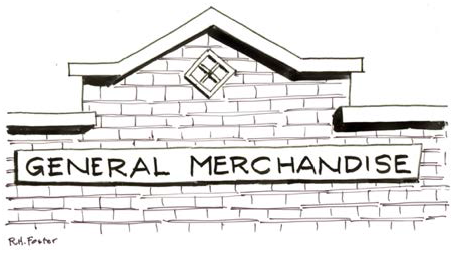
Figure 45 - Wall Sign
(Ord. No. 192-21, §§ 8, 9, 12-14-2021; Ord. No. 195-22, Exh. A, 7-12-2022)
3.06.030 - Review Procedures.
(1)
Permit Required. Unless otherwise authorized by provisions in this Chapter, sign permits shall be required for all residential, commercial, industrial, and public/semi-public uses. No property owner, lessee, or contractor shall construct or alter any sign without first obtaining a valid sign permit.
(2)
Current Signs. Owners of conforming or nonconforming signs existing as of the date of adoption of this Code are not required to obtain a permit.
(3)
Application Requirements. An application for a sign permit shall be made on a form provided by the City. The application shall include, at a minimum, a sketch drawn to scale indicating the proposed sign, identifying existing signs on the premises, the sign's location and graphic design and other information established by the City to process the request.
(4)
Approval. The City shall issue a permit for a sign unless the sign is in violation of the provisions of these or other provisions of the Millersburg Development Code. Sign permits mistakenly issued in violation of these or other provisions of the Development Code are void. The City may revoke a sign permit if it finds there was a material and misleading false statement of fact in the application for the permit.
3.06.040 - General Provisions.
(1)
Conflicting Standards. Signs shall be allowed subject to the provisions of this Chapter, except when these provisions conflict with the specific standards for signs in the subject zone.
(2)
Signs Subject to State Approval. In addition to City sign regulations, all signs visible to the traveling public from State highways are subject to the regulations also permit requirements of the Highway Division of the State of Oregon Department of Transportation. Where the regulations of the State and City differ, the more restrictive regulations shall govern.
(3)
Design, Construction, and Maintenance. All signs shall be designed, constructed, and maintained according to the following standards:
a.
All signs shall comply with the applicable provisions of Building Code in effect at the time of the sign permit application and all other applicable structural, electrical, and other similar regulations. The issuance of a sign permit under these regulations does not relieve the applicant of complying with all other permit requirements.
b.
Except for banners, flags, temporary signs, and window signs conforming in all respects with the requirements of these regulations, all signs shall be constructed of permanent materials and shall be permanently attached to the ground, a building, or other structure by direct attachment to a rigid wall, frame, or structure.
c.
All signs shall be maintained in a good structural condition and readable at all times.
d.
The owner shall be responsible for its erection and maintenance and its compliance with the provisions of these regulations or other laws or Codes regulating signs.
(4)
Holiday Displays. Nothing in these regulations shall prohibit displays between Thanksgiving and January 3rd.
3.06.050 - Nonconforming Signs.
(1)
Alteration of Nonconforming Sign Faces. When a nonconforming sign face is damaged or destroyed by fire, flood, wind, or similar calamity, such sign face may be restored to its original condition within 180-days of such calamity. However, a sign structure or support mechanisms so damaged shall not be replaced except in conformance with the provisions of these regulations.
(2)
Outdoor Advertising Sign Relocation. If development of land between Old Salem Road and I-5 requires relocating an outdoor advertising sign existing on the date of this code adoption, the sign may be relocated on the east side of Old Salem Road within 250 feet of its original location.
(3)
Permits for Properties with Nonconforming Signs. No permits shall be issued for new or altered signs unless all signs of the individual property or business comply with these regulations.
3.06.055 - Maintenance and Repair of Existing Billboards.
(1)
Any billboard lawfully erected prior August of 2022 shall be maintained in accordance with Department of Transportation standards.
(2)
Any lawfully erected billboard damaged by the negligent or malicious action of another party shall be repaired to its original condition or removed.
(3)
Any lawfully erected billboard which deteriorates either through ordinary wear and tear or is damaged by natural forces to the extent that the cost of repair or reconstruction of the billboard exceeds 50% of its fair market value as determined by the Department of Transportation shall be removed by the owner.
(4)
Repair, reconstruction, and maintenance of a billboard shall only include those actions required to restore the billboard to its original structural and mechanical condition. Such actions shall not include increasing the size or height of the billboard, converting the billboard to a multiple message or Tri-vision sign, or adding any attachments to the billboard.
(Ord. No. 195-22, Exh. A, 7-12-2022)
3.06.060 - Signs Generally Permitted.
The following signs and sign work are permitted in all zones. No permit shall be required, and the sign shall not be included when determining compliance with total allowed area:
(1)
Painting, change of sign face or copy, and maintenance of signs legally existing on the effective date of this Code. If structural changes are made, the sign shall conform in all respects with these regulations.
(2)
Signs posted by or under any governmental authority including legal notices, traffic, danger, no trespassing, emergency, and signs related to public services or safety including any signs within the right-of-way.
(3)
Incidental signs that do not exceed six square feet in area.
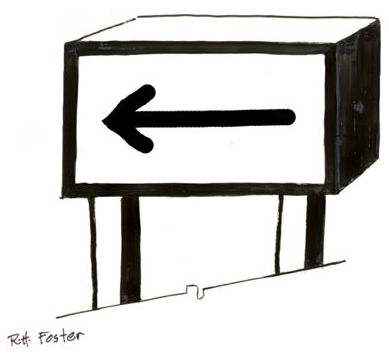
Figure 46 - Sign, Incidental
(4)
Flags on permanent flag poles which are designed to allow raising and lowering of the flags.
(5)
Signs within a building.
(6)
Signs painted or hung on the inside of windows.
(7)
One residential name plate not exceeding three square feet in area.
(8)
Murals for commercial and industrial uses. Otherwise, that portion of the mural considered advertising shall be included in the sign area calculation. The calculation shall be in accordance with provisions in the "sign area" definition.
(Ord. No. 195-22, Exh. A, 7-12-2022)
3.06.070 - Prohibited Signs.
The following signs are prohibited in all zones:
(1)
Balloons or similar types of tethered objects.
(2)
Portable or temporary signs, except where allowed by Section 3.06.130.
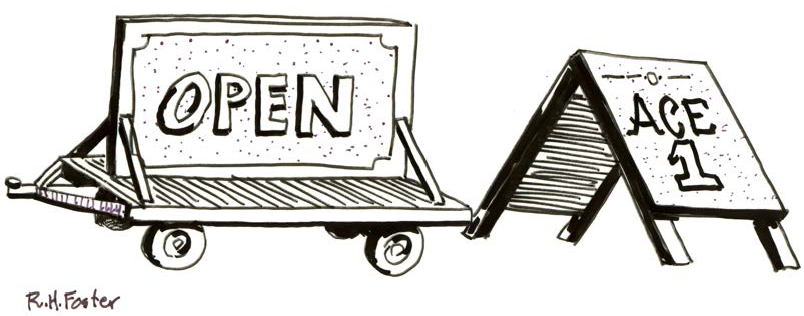
Figure 47 - Signs, Portable
(3)
Roof signs.
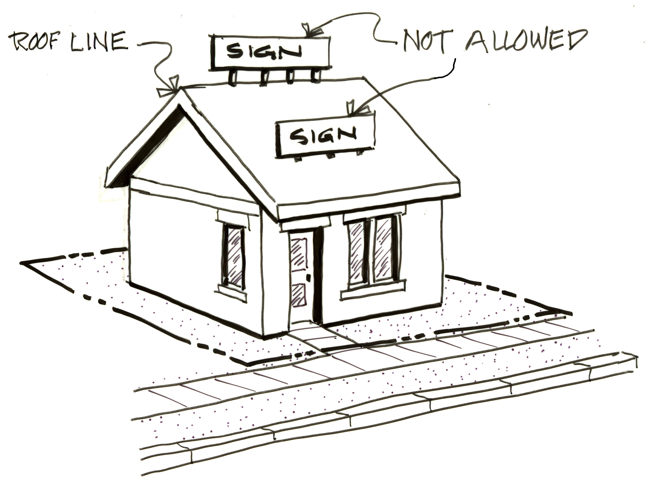
Figure 48 - Signs, Roof
(4)
Signs that emit odor, visible matter, or sound; however, an intercom system for customers remaining in their vehicles, such as used in banks and "drive through" restaurants, shall be allowed.
(5)
Signs that use or employ side guy lines of any type.
(6)
Signs that obstruct any fire escape, required exit, window, or door opening used as a means of egress.
(7)
Signs closer than 36-inches horizontally or vertically from any overhead power line or public utility guy wire.
(8)
The use of a vehicle or trailer parked on a public right-of-way or public property, or on private property so as to be visible from a public right-of-way which has attached thereto or located thereon any sign or advertising device for the basic purpose of providing advertisement of products or directing people to a business or activity. This provision applies where the primary purpose of the vehicle is for advertising purposes and is not intended to prohibit any form of vehicular sign, which is primarily used for business purposes other than advertising.
(9)
Rotating/revolving signs, except by conditional use permit per Section 3.06.120.
(10)
Flashing signs, except by conditional use permit per Section 3.06.120.
(11)
Private signs that project into or over driveways and public rights-of-way, except signs under a canopy that project over a public sidewalk and the bottom of the sign is at least 8-feet above the sidewalk.
(12)
Signs that obstruct a required vision clearance area, obstruct a vehicle driver's view of official traffic control signs, or which present a traffic hazard.
(13)
Signs that interfere with, imitate, or resemble any official traffic control sign, signal or device, emergency lights, or appear to direct traffic.
(14)
Signs attached to any pole, post, utility pole, or placed on its own stake and placed into the ground in the public right-of-way. This does not include traffic control or other City/County/State signs within the right-of-way.
(15)
Message signs, except by conditional use permit per Section 3.06.120.
(16)
Any sign on unimproved property, unless as an incidental sign.
(17)
Signs mounted on fences in accordance with Section 3.07.080.
(18)
Inflatable advertising signs including animal shaped inflatables and air-dancers (aka., wacky flailing arm inflatable tube men) in all non-residential zones.
(19)
Billboards - including digital billboards.
(Ord. No. 192-21, § 8, 12-14-2021; Ord. No. 195-22, Exh. A, 7-12-2022)
3.06.080 - Residential Signs - Single-family and Duplex.
(1)
Area and Number. Only one sign shall be permitted per dwelling unit. The maximum sign area shall be eight square feet.
(2)
Location. The sign may be located on a wall or within any yard area. Signs placed within a yard shall be limited to a maximum height of four feet as measured from the adjacent ground level to the highest point of the sign and shall not interfere with the clear vision area.
(3)
Lighting. The use of interior lighted signs and flashing lights shall be prohibited. No light may be directed onto an adjacent residence.
3.06.090 - Residential Signs - Other Developments.
The following sign regulations shall apply to multi-family developments, manufactured home parks, and subdivisions:
(1)
Area and Number. Any combination of signs not exceeding 32 square feet in area, provided the total sign area on a free-standing sign shall be limited to a maximum of 24 square feet.
(2)
Sign Height. The maximum sign height for a free-standing sign shall be five feet.
(3)
Lighting. Signs shall be illuminated only by indirect lighting. The use of interior lighted signs and flashing lights shall be prohibited.
3.06.100 - Public and Semi-Public Signs.
The following regulations apply to signs for public and semi-public uses:
(1)
Area and Number. Any combination of signs not exceeding 120 square feet in area, provided the total sign area on a free-standing sign shall be limited to a maximum of 80 square feet.
(2)
Sign Height. The maximum sign height for a free-standing sign shall be 12 feet.
(3)
Lighting. Signs shall be illuminated only by indirect lighting. The use of interior lighted signs and flashing lights shall be prohibited.
3.06.110 - Commercial and Industrial Signs.
The following regulations apply to signs for commercial and industrial uses:
(1)
Signs for Businesses not in Integrated Business Centers:
a.
Total Sign Area. One and one-half square feet of total allowed sign area for each lineal foot of building frontage facing the street, up to a maximum total allowed area of 150 square feet. Properties with more than 1,000 lineal feet of street frontage on any single street may have an additional 100 square feet of total sign area.
b.
Type, Number, and Sign Size. Within the total allowed area, one free standing sign per street frontage, and a total of no more than two wall or canopy signs. Regardless of total allowed area, each free-standing sign shall be limited to a maximum of 48 square feet in area. Properties with more the 1,000 lineal feet of street frontage on any single street may have one additional freestanding sign.
c.
Sign Height. The maximum sign height shall be as follows:
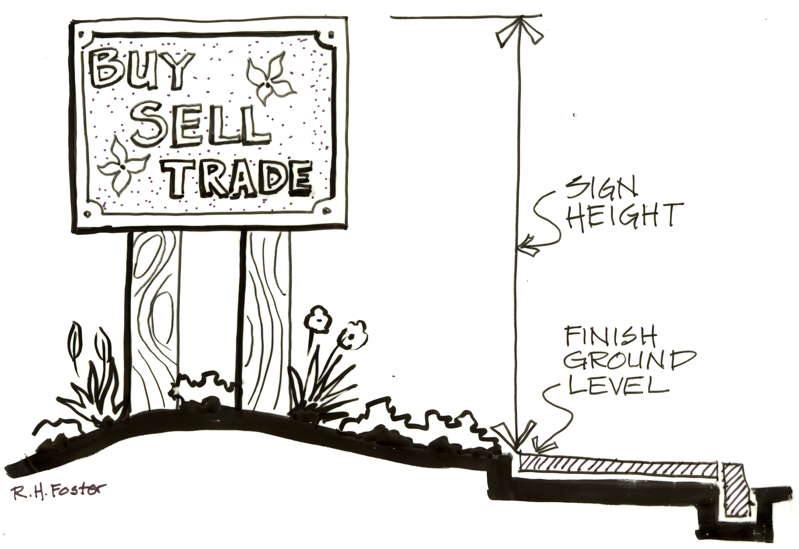
Figure 49 - Sign Height
i.
Wall and canopy signs: Shall not project above the parapet or roof eaves.
ii.
Free-standing signs: Maximum height of 12 feet above finished ground level.
d.
Sign Location. Signs shall be located as follows:
i.
Wall signs: May project up to 1.5 feet from the building.
ii.
Free-standing sign: No limitation except shall not project over street right-of-way and shall comply with requirements for vision clearance areas and special street setbacks.
(2)
Signs for Integrated Business Centers:
a.
Total Sign Area. For wall and canopy signs on individual businesses within an integrated business center, 1.5 square feet of total allowed sign area for each lineal foot of building frontage for the individual business, up to a total maximum of 150 square feet per business. Individual businesses may not assign their unused allowed area to other businesses in the integrated business center. Properties with more than 1,000 lineal feet of street frontage on any single street may have an additional 100 square feet of total sign area.

Figure 50 - Sign, Integrated Business Center - Example
b.
Free-Standing Sign. In addition to this allowed area, for each integrated business center, one free-standing sign per street frontage not exceeding 100 square feet in area. Properties with more than 1,000 lineal feet of street frontage on any single street may have one additional free-standing sign.
c.
Sign Height. The maximum sign height shall be as follows:
i.
Wall and canopy signs: Shall not project above the parapet or roof eaves.
ii.
Free-standing signs: Maximum total height of 12 feet above grade.
d.
Sign Location. Signs shall be located as follows:
i.
Wall signs: May project up to 1.5 feet from the building.
ii.
Free-standing sign: No limitation except shall not project over street right-of-way and shall comply with requirements for vision clearance areas and special street setbacks.
(3)
Additional Signs. Within the limitations of this subsection, the signs below do not require a permit and are not included in calculating allowed area and number of signs:
a.
Directional signs, such as "Exit" or "Entrance," are allowed either as wall or free-standing signs. Such signs shall be limited to four square feet in area and two per driveway. Free-standing directional signs shall be limited to a height of four feet.
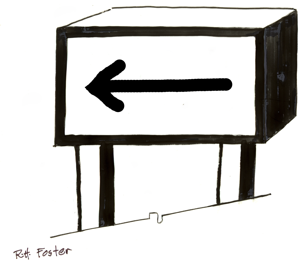
Figure 51 - Sign, Incidental
b.
Order signs describing products and/or order instructions to a customer, such as menu boards on the exterior of a drive-thru restaurant are allowed as follows: One per business limited to 32 square feet in area and a maximum height of eight feet. Any order sign greater than ten square feet in area and/or six feet in height must be screened from adjacent streets by a sight obscuring fence, wall, or hedge.
(4)
Temporary Business Signs. Temporary businesses may display temporary or portable signs, other than trailer mounted reader boards or any sign that includes flashing or rotating lights or moving parts. The cumulative size of all such signs may not exceed 32 square feet. All temporary signs must be placed within ten feet of the structure or vehicle used for the temporary business and may not be placed within any public right-of-way.
(Ord. No. 195-22, Exh. A, 7-12-2022)
3.06.120 - Conditional Use Permits - Signs.
A conditional use approval shall be required for rotating/revolving signs, flashing signs, digital displays, or message signs located in a Commercial, Industrial, or Public Facility zones, or Mixed-Use zone within 100 feet of the Interstate 5 right-of-way. A conditional use to Chapter 3.06 shall be processed according to the conditional use procedures in Chapter 5.04, but shall be subject to the following criteria:
(1)
The proposed sign, when conditioned, will not significantly increase or lead to street level sign clutter, or to signs adversely dominating the visual image of the area.
(2)
The proposed sign, as conditioned, will not adversely impact the surrounding area to a significant degree.
(3)
The proposed sign will not present a traffic or safety hazard.
(4)
If the application is for a flashing and/or message sign, no rotary beacon lights, zip lights, strobe lights, or similar devices shall be allowed. No chaser effect or other flashing effects consisting of external lights, lamps, bulbs, or neon tubes are allowed. Only flashing effects by way of internal illumination are allowed.
(5)
If the application is for a rotating/revolving sign, such sign cannot flash or be illuminated by intermittent light. Rotating/revolving signs shall revolve at a speed no greater than five revolutions per minute.
(6)
The proposed sign will comply with all other regulations, including, but not limited to, height and placement restrictions.
(Ord. No. 195-22, Exh. A, 7-12-2022)
3.06.130 - Reserved.
Editor's note— Ord. No. 213-25, Exh. A, adopted February 11, 2025, repealed § 3.06.130, which pertained to Temporary Signs and derived from Ord. No. 192-21, § 8, adopted December 14, 2021; Ord. No. 195-22, Exh. A, adopted July 12, 2022.
3.06.140 - Digital Signage Standards.
Digital display signs are subject to the following regulations in addition to all other requirements established in this section.
(1)
Brightness: Digital displays are subject to the following brightness limits:
a.
During daylight hours between sunrise and sunset, luminance shall be no greater than five thousand (5,000) nits.
b.
At all other times, luminance shall be no greater than two hundred fifty (250) nits.
c.
Each sign must have a light sensing device that will automatically adjust the brightness of the display as the natural ambient light conditions change to comply with the limits set here within.
(2)
Message Duration: The length of time each message may be displayed on a message center sign, digital display, or Tri-vision board sign is based upon the visibility and speed limit unique to individual signs and adjacent road conditions. The following method should be used to calculate message duration for message center signs, digital displays, or Tri-vision board signs.
a.
Determine the greatest distance from which the sign becomes visible on the road the sign is primarily intended to serve. If a sign is intended to be seen by more than one roadway, the road with the lower posted speed limit shall be used for determining message duration.
b.
Multiply the road's posted speed limit (MPH) by 5,280, and then divide by 3,600 to obtain the speed limit in feet/second.
c.
Divide the visibility distance by the speed limit (feet/second).
d.
Add an additional 10% of this number to the total.
e.
The resulting amount of time is the minimum permitted message duration, except where this value is less than eight seconds in which the minimum message duration shall be no less than eight seconds.
(3)
Sign Type: Digital displays are permitted in the form of freestanding, monument, and wall signs, both on-premises and off-premises, in accordance with the regulations established in Chapter 3.06.
(4)
Height: A digital display shall have the same height limits as for other permitted signs of the same type and location.
(5)
Area: Digital displays may be used for the full permitted sign area.
(6)
Maximum Number Per Property: Where permitted, one digital display sign is permitted per property.
(7)
Message Display:
a.
Any digital display containing animation, streaming video, or text or images which flash, pulsate, move, or scroll is prohibited. Each complete message must fit on one screen.
b.
One message/display may be brighter than another, but each individual message/display must be static in intensity.
c.
The content of a digital display must transition by changing instantly, with no transition graphics (e.g., no fade-out or fade-in).
(8)
Default Design: The sign shall contain a default design which shall freeze the sign message in one position if a malfunction should occur.
(9)
The addition of any digital display to a nonconforming sign is prohibited.
(10)
Public Service Announcements: The owner of every digital sign shall coordinate with the local authorities to display, when appropriate, emergency information important to the traveling public including, but not limited to Amber Alerts or alerts concerning terrorist attacks or natural disasters. Emergency information messages shall remain in the advertising rotation according to the protocols of the agency that issues the information.
(Ord. No. 195-22, Exh. A, 7-12-2022)
3.06.150 - Message Sign Standards.
Message signs are subject to the following regulations, in addition to all other requirements established in this section.
(1)
Sign Type: Message signs are permitted in the form of freestanding, monument, and wall signs, both on-premises and off-premises, in accordance with the regulations established in Chapter 3.06.
(2)
Brightness: Message signs are subject to the following brightness limits:
a.
During daylight hours between sunrise and sunset, luminance shall be no greater than five thousand (5,000) nits.
b.
At all other times, luminance shall be no greater than two hundred fifty (250) nits.
(3)
Each sign must have a light sensing device that will automatically adjust the brightness of the display as the natural ambient light conditions change to comply with the limits set here within.
(4)
Height: A message sign shall have the same height limits as other permitted signs of the same type and location.
(5)
Maximum Number: Where permitted, one message sign is permitted per street frontage, up to a maximum of two message signs per property.
(6)
Message Display:
a.
No message sign may contain text which flashes, pulsates, moves, or scrolls. Each complete message must fit on one screen.
b.
The content of a message sign must transition by changing instantly (e.g., no fade-out or fade-in).
(7)
Default Design: The sign shall contain a default design which shall freeze the sign message in one position if a malfunction should occur.
(8)
The addition of any message sign to a nonconforming sign is prohibited.
(9)
Public Service Announcements: The owner of every message sign shall coordinate with the local authorities to display, when appropriate, emergency information important to the traveling public including, but not limited to Amber Alerts or alerts concerning terrorist attacks or natural disasters. Emergency information messages shall remain in the advertising rotation according to the protocols of the agency that issues the information.
(Ord. No. 195-22, Exh. A, 7-12-2022)
3.06.160 - Variance Signs.
Any allowance for signs not complying with the standards set forth in these regulations shall be by variance. Variances to Chapter 3.06 shall be processed according to the variance procedures in Chapter 5.03 but shall be subject to the following criteria:
(1)
There are unique circumstances of conditions of the lot, building, or traffic pattern such that the existing sign regulations create an undue hardship;
(2)
The requested variance is consistent with the purpose of the Chapter as stated in Section 3.06.010;
(3)
The granting of the variance compensates for those circumstances in a manner equitable with other property owners and is thus not a special privilege to the business. The variance requested shall be the minimum necessary to compensate for those conditions and achieve the purpose of this Chapter;
(4)
The granting of the variance shall not decrease traffic safety nor detrimentally affect any other identified items of public welfare;
(5)
The variance will not result in a special advertising advantage in relation to neighboring businesses or businesses of a similar nature. The desire to match standard sign sizes (for example, franchise store signs) shall not be listed or considered as a reason for a variance; and
(6)
The variance request shall not be the result of a self-imposed condition or hardship, including the existence of corporate or business signage standards which conflict with this Code.
(Ord. No. 192-21, § 8, 12-14-2021; Ord. No. 195-22, Exh. A, 7-12-2022)
Editor's note— Ord. No. 195-22, Exh. A, adopted July, 12, 2022, renumbered previous section 3.06.140 as 3.06.160, as set out herein.
3.07.010 - Placement of Fencing on Public Rights-of-Way or Easements.
Fences may be constructed on public rights-of-way and/or easements subject to certain restrictions. Construction of fences on public rights-of-way or easements requires permission from the appropriate public agency. The City allows placement of fences on public rights-of-way and certain easements, provided that action does not impair the City's ability to address its public functions and the permit holder agrees to remove the fence upon request.
3.07.020 - General Requirements.
(1)
A wall is considered a fence and shall be built consistent with the applicable fencing requirements.
(2)
No fence shall be permitted in the sidewalk area or in a location which may impair the construction of a public sidewalk, pathway, or walkway.
(3)
Fences greater than six feet in height require the owner to secure a building permit as required by the Building Official.
(4)
In the event any fence restricts access to or use of rights-of-way and easements, it shall be the fence owner's responsibility to provide access upon City request or other affected agency or utility provider request.
(5)
A property owner who restricts access to any utility meter or fire hydrant shall provide access through the fence by a gate.
(6)
Fence installation shall not impair the clear vision triangle clearance requirements at street and alley intersections.
(7)
Fence heights shall be measured from undisturbed ground level, top of sidewalk, or street grade (crest or crown of the road), whichever is highest. Height of fences or walls within 20 feet of a street right-of-way shall include the measured height of the fence or wall and any retaining wall, berm, or other structure within the same 20 feet.
3.07.030 - Fencing Requirements for the Residential Zones.
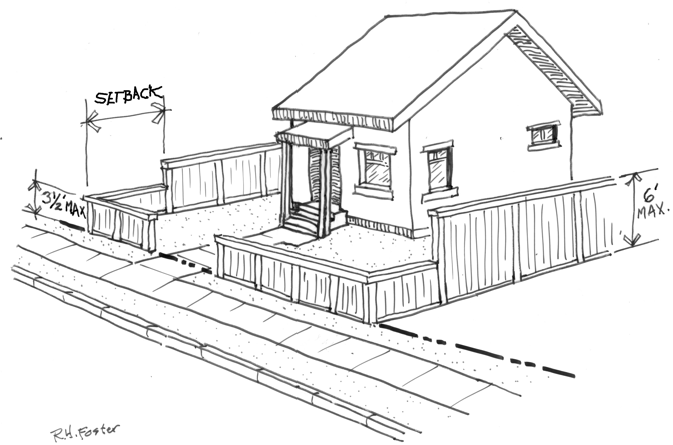
Figure 52 - Fence Locations and Heights
(1)
Height, location: Fences, walls, and hedges may be located in any required yard or along the edge of any yard, subject to the maintenance of any required vision clearance area.
(2)
Fences and walls shall not exceed a height of three and one-half feet within the required front setback of any property line adjacent to the street, except corner properties, which by definition have two front yards, may have a fence no taller than six feet in the front yard adjacent to the street that does not contain the main door entrance when the fence does not extend in front of the building and one of the following conditions is met:
a.
If the adjoining street is improved with sidewalks and a planter strip, the fence may be on or behind the property line.
b.
If the adjoining street is improved with sidewalks but no planter strip, the fence is located a minimum of three feet from the sidewalk and is on or behind the property line.
c.
If the adjoining street is improved with curbs and gutters but no sidewalks, the fence is located ten feet from the face of the curb and is on or behind the property line.
d.
If the adjoining street is unimproved, the fence is no closer than three feet from the property line.
(3)
A fence or wall may not exceed six feet in height. A fence constructed on, as a part of, or adjacent to (within three feet of) a retaining wall shall not exceed a total height of 14 feet.
3.07.040 - Fencing Requirements for Commercial and Industrial Zones.
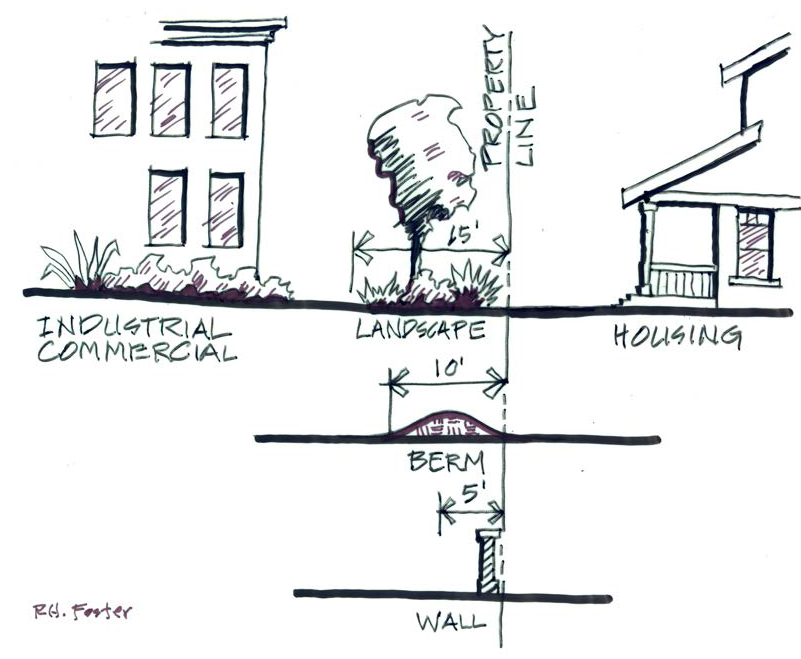
Figure 53 - Fencing Options in Commercial and Industrial Zones
(1)
Industrial or commercial fencing installed adjacent to residential areas must be sight obscuring. Fences that do not exceed six feet in height may be located or maintained on any property line within this zone, except within the clear vision triangle area and along the frontage of presentation streets. Commercial or industrial fencing intended to be placed on Old Salem Road or Conser Road frontage is subject to design review.
(2)
Fences intended for security purposes may be installed to a height of eight feet on any property line within the commercial and industrial zones, except within vision triangle areas and along the frontage of presentation streets. Barbed wire may be used as the top section for security fences, provided the barbed wires are a minimum of 72-inches above grade and do not project over public rights-of-way.
(3)
Fencing placed along Old Salem Road or Conser Road is subject to site plan review.
3.07.050 - Pathway Fencing.
(1)
When residential construction includes a pathway or walkway intended to be constructed adjacent to these pedestrian type features, the applicant shall install, along the full length of the property frontage intersecting or encountering these features, a fence composed of metal, rock, or vinyl material with the supporting wood treated posts placed on an adequate concrete footing. Pathway or walkway type fencing shall be installed in such a fashion as to provide better visibility from adjacent homes or buildings and to assure public safety and avoid a tunneling effect associated with tall fences bordering narrow pathways.
(2)
See-through pathway fencing shall not exceed five feet in height and solid fencing shall not exceed four feet in height the length of the property frontage intersecting or encountering the pathway, walkway, or greenbelt.
3.07.060 - Fences Required for Sight-Obscuring Purposes.
(1)
Sight obscuring fences shall be constructed of an aluminum mesh fencing with slats or other solid non-vision-type fencing of such design and material that will retain its attractiveness with nominal maintenance.
(2)
The following uses are declared to require sight obscuring fences: junkyards, wrecking yards, equipment or vehicle salvage storage yards, auction blocks, lumberyards, sanitary landfills, recycling collection stations and other uses determined to be similar in nature to the aforementioned as determined by the Planning Director or designee.
3.07.070 - Walls and Berms Serving Fencing Purposes.
(1)
Wall materials shall be constructed of impervious concrete or stucco or other appropriate sound attenuating material.
(2)
Wall heights shall be in accordance with zoning height prescriptions.
(3)
Wall[s] shall be offset by a minimum relief distance of three feet every 100 linear feet. Relief shall be by materials, color, structural elements, or off-sets and jogs. If walls are used in combination with a berm, the wall shall be placed behind the berm, and under no circumstances, placed on the berm, except where as designed as a condition of approval. A proposed wall is subject to design review where it will be evaluated for design, color, and texture. The wall and/or wall and berm combination shall be located outside the public rights-of-way, except when required to be placed in the right-of way by the City.
(4)
Walls may require a building permit. Wall installation is also subject to site plan review and appropriate building codes, permits, and inspections.
(5)
Berm heights shall be in accordance with zoning height prescriptions.
(6)
Berms will be fully landscaped.
3.07.080 - Fence Advertising or Signage.
Signs on fences within the right-of-way are not permitted.
(Ord. No. 216-25, Att. A, 7-8-2025)
3.07.090 - Commercial and Multi-Family Trash Enclosures.
All commercial and multi-family uses, including mixed use, shall provide solid waste and recycling storage receptacles which are adequately sized to accommodate all solid waste generated on-site. All solid waste and recycling storage areas and receptacles shall be located out of public view when possible. Solid waste and recycling receptacles for multi- family or commercial uses shall be screened by six (6) foot high sight-obscuring masonry or similar wall. Chain link fencing is prohibited. The enclosure must be lockable, and shall be easily accessible to collection vehicles.
(Ord. No. 213-25, Exh. A, 2-11-2025)
3.08.010 - New Buildings Shall be on a Lot.
Every building erected shall be located on a lot as herein defined.
3.08.020 - Yards Apply Only to One Building.
No required yard or other open space or required driveway provided around or for any building or structure for the purpose of complying with the provisions of this Code shall be considered as providing a yard or open space for any other building. No yard or other required space on an adjoining lot shall be considered as providing a yard or open space on the lot whereon the building is to be erected.
3.08.030 - Front Yard Projections.
The following features, when not more than one story high, may project into the front yard setback area, provided the projection shall come no closer than ten feet from the property line: planter boxes, chimneys and flues, steps, cornices, eaves, gutters, belt courses, leaders, sills, pilasters, lintels, and other ornamental features.
(Ord. No. 195-22, Exh. A, 7-12-2022)
3.08.040 - Side Yard Projections.
(1)
Cornices, eaves, gutters, and fire escapes may project into a required side yard not more than one-third of the width of the required side yard.
(2)
Chimneys, flues, belt courses, leaders, sills, pilasters, lintels, and ornamental features may project not more than 1.5 feet into a required side yard, provided the chimneys and flues shall not exceed six feet in width.
(3)
For details regarding decks, porches, patios, and similar features, see Section 3.08.070.
(Ord. No. 195-22, Exh. A, 7-12-2022)
3.08.050 - Rear Yard Projections.
(1)
Chimneys, flues, belt courses, leaders, sills, pilasters, lintels, gutters, and other ornamental features, may project not more than 1.5 feet into a required rear yard, provided the chimneys and flues shall not exceed six feet in width.
(2)
A fire escape, balcony, outside stairway, or cornice, may project not more than five feet into a required rear yard.
(3)
The following features, when not more than one story high, may project into the rear yard setback area: planter boxes, chimneys and flues, steps, cornices, eaves, gutters, belt courses, leaders, sills, pilasters, lintels, and other ornamental features.
(4)
No permitted projection into a required rear yard shall extend within ten feet of the center line of an alley or within five feet of a rear lot line if no alley exists.
(5)
For details regarding decks, porches, patios, and similar features, see Section 3.08.070.
(Ord. No. 195-22, Exh. A, 7-12-2022)
3.08.060 - Vision Clearance.
A clear vision area shall be maintained where streets and private points of access intersect. The clear vision area shall conform to the following:
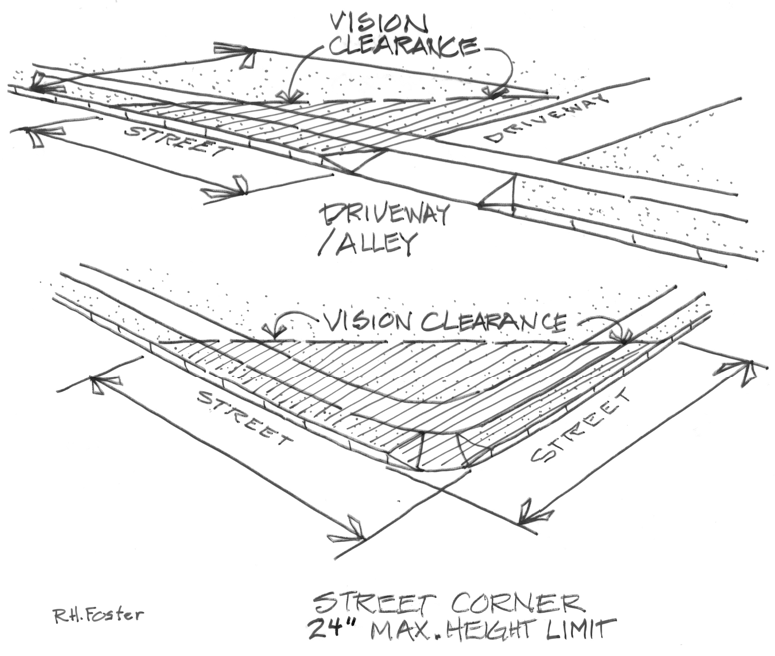
Figure 54 - Vision Clearance Area
(1)
Measurement. A clear vision area at an intersection shall be the triangular area established according to the following procedure:
a.
A line extending a certain number of feet, as identified in the sections (2), (3), (4), and (5) below, from the point of intersection along the curb (or edge of pavement if no curb) of a public street right-of-way;
b.
A line extending a certain number of feet from the intersection along the curb line (or edge of pavement if no curb) of intersecting access; and,
c.
A third line that creates the triangular clear vision area by connecting the ends of the lines described in (a) and (b), above.
(2)
Street-Driveway. The clear vision area for a street-driveway intersection shall be ten feet along the driveway from its intersection with the street curb (or edge of pavement if no curb) and 20 feet along the street curb (or edge of pavement if no curb) at the point of intersection with the driveway.
(3)
Street-Alley. The clear vision area for street-alley intersections shall be ten feet along the alley from its intersection with the street curb (or edge of pavement if no curb) and 20 feet along the street curb (or edge of pavement if no curb) at the point of intersection with the alley.
(4)
Street-Private Access Easement. The clear vision area for street-access easement intersections shall be ten feet along the access easement from its intersection with the street curb (or edge of pavement if no curb) and 20 feet along the street curb (or edge of pavement if no curb) at the point of intersection with the access easement.
(5)
Corner Lots (Street-Street Intersection). The clear visions area for corner lots shall be measured along the curb line (or edge of pavement if no curb) as shown in Table 16 below (unless otherwise determined by the City Engineer).
(6)
Prohibited Development. A clear vision area shall contain no planting, fence, wall, structure, or temporary or permanent obstruction exceeding 24 inches in height, measured from the top of the curb or, where no curb exists, from the established street centerline grade, except that the following may be allowed in the clear vision area:
a.
Trees, provided all branches and foliage are removed to a height of eight feet above grade;
b.
Telephone, power, and cable television poles; and
c.
Telephone switch boxes provided they are less than ten inches wide at the widest dimension.
(Ord. No. 210-24, Exh. A, 1-9-2024)
3.08.070 - Decks, Porches, Patios, and Similar Features.
(1)
Patios. The following standards apply to all patios.
a.
There is no building permit requirement for patios.
b.
There are no setbacks for patios though all patios must comply with maximum lot coverage requirements of the zone.
(2)
Decks. The following standards apply to all decks.
a.
The County may require a building permit for decks.
b.
Decks taller than 12 inches (first or second story) must be setback at least five feet from the side and rear property line, unless they are less than 12 inches from the ground. Decks under 12 inches in height have no side or rear setback requirements.
c.
Decks of any height (first or second story) may project into a required front yard building setback but must be no closer than ten feet from the front property line.
d.
All decks must comply with maximum lot coverage requirements of the zone.
(3)
Porches. The following standards apply to all porches.
a.
The County may require a building permit for porches over 200 square feet.
b.
A porch may not encroach into the side yard setback. A porch has the same side setbacks as the main structure based on the zone.
c.
A porch may encroach into the rear building setback, but in no case shall the porch be closer than five feet from the rear property line.
d.
A porch may encroach into a front building setback but in no case shall a porch be closer than ten feet from the front property line.
e.
All porches must comply with maximum lot coverage requirements of the zone.
(4)
Detached & Attached Patio Cover or Pergola.
a.
The County may require a building permit for patio covers or pergolas over 200 square feet.
b.
A patio cover or pergola may encroach into side, rear, or front yard setbacks. A patio cover or pergola may not be less than five feet from a rear or side property line, and/or ten feet from a front property line, though it should be noted that if the structure is over 200 square feet it is considered an accessory structure, and accessory structures are not permitted in front of dwelling units.
c.
Any patio, or pergola that has a solid roof, must comply with maximum lot coverage requirements of the zone.
(Ord. No. 195-22, Exh. A, 7-12-2022; Ord. No. 213-25, Exh. A, 2-11-2025)
Editor's note— Ord. No. 195-22, Exh. A, adopted July, 12, 2022, set out provisions intended for use as § 3.08.060. Inasmuch as there were already provisions so designated, said section has been codified herein as § 3.08.070 at the discretion of the editor.
3.09.010 - Purpose
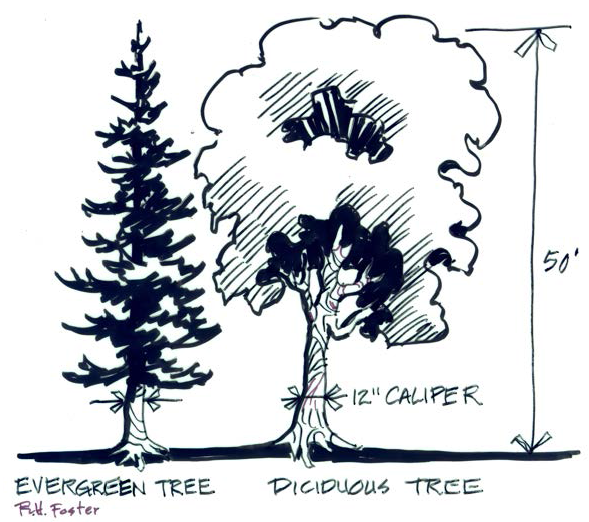
Figure 55 - Tree Types
Natural vegetation, landscaping, street trees, fences, and walls—together, these elements of the natural and built environment contribute to the visual quality, environmental health, and character of the community. Trees provide climate control through shading during summer months and wind screening during winter. Trees and other plants can also buffer pedestrians from traffic. Walls, fences, trees, and other landscape materials also provide vital screening and buffering between land uses. Landscaped areas help to control surface water drainage and can improve water quality, as compared to paved or built surfaces. A well landscaped and maintained yard or property promotes a sense of community wellbeing.
3.09.020 - Applicability.
Whenever landscaping is required in a zone, it shall be installed in accordance with these standards. When the standards of a zone specify locations or amounts of landscaping, those locations or amounts can be used to meet the standards of this section.
3.09.030 - Standards.
(1)
General Requirements. Landscaping requirements by type of use are listed below:
a.
Landscaping Required - Residential other than in the Mixed-Use (MU) Zone. All front setbacks (exclusive of accessways and other permitted intrusions) must be landscaped or have landscaping guaranteed in accordance with this Code before an occupancy permit will be issued or final building permit approved. In all residential zones except Rural (RU), the minimum landscaping acceptable for every 50 lineal feet of street frontage (or portion thereof, deducting the width of the driveway) is:
i.
One tree at least six feet tall when planted.
ii.
Four one-gallon shrubs or accent plants.
iii.
The remaining area treated with attractive ground cover (e.g., lawn, bark, rock, ivy, and evergreen shrubs).
b.
Landscaping Required - Mixed-Use and Non-Residential Zones. All required front and interior setbacks (exclusive of accessways and other permitted intrusions) must be landscaped or have landscaping guaranteed in accordance with this Code before an occupancy permit will be issued. Minimum landscaping acceptable for every 1,000 square feet of required setbacks in all commercial-industrial zones is as follows:
i.
One tree at least six feet tall when planted for every 30 feet of street frontage.
ii.
Five 5-gallon or eight 1-gallon shrubs, trees, or accent plants.
iii.
The remaining area treated with suitable living ground cover, lawn, or decorative treatment of bark, rock, or other attractive ground cover.
iv.
When the yard adjacent to a street of an industrially zoned property is across a right-of-way (excluding Old Salem Road right-of-way) from other industrially or commercially zoned property, only 30% of such setback area must be landscaped.
c.
Alternate Plan - Non-Residential. As part of a Site Design Review application approval, placement of the required setback landscaping in public right-of-way may be approved when the following conditions are met:
i.
The site contains existing development that includes substantial building(s), and is subject to improvement requirements due to a change of use or vacancy; and
ii.
The appropriate government agency grants written permission for use of the right-of-way; and
iii.
The applicant provides written assurance that on-site setback landscaping will be installed within 90 days in the event permission to use the right-of-way is revoked; and
iv.
The Commission finds the required setback landscaping can feasibly be installed on the property without creating other violations of this Code; and
v.
The Commission finds providing the landscaping in the public right-of-way in the interim fulfills the intent this Code established in Section 3.09.010.
(2)
Parking Lot Landscaping. The purpose of landscaping in parking lots is to provide shade, reduce stormwater runoff, and direct traffic. Incorporation of approved vegetated post-construction stormwater quality facilities in landscaped areas is encouraged. Parking lots must be landscaped in accordance with the following minimum standards:
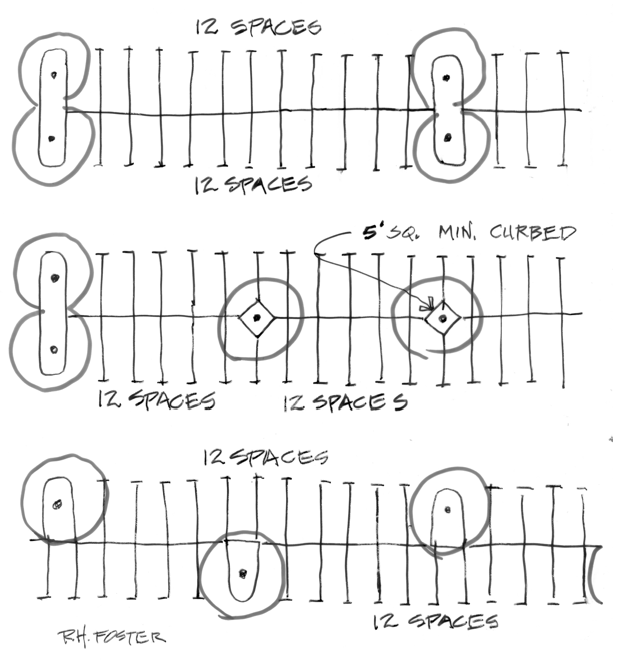
Figure 56 - Parking Lot Landscaping - View 1
a.
Planter Bays. Parking areas shall be divided into bays of not more than 12 parking spaces. At both ends of each parking bay, there shall be curbed planters at least five feet wide, excluding the curb. Gaps in the curb may be allowed for connections to approved post-construction stormwater quality facilities. Each planter shall contain at least one canopy tree at least ten feet high at time of planting and decorative ground cover containing at least two shrubs for every 100 square feet of landscape area. Neither planter bays nor their contents may impede access on required public sidewalks or paths, or handicapped-accessible parking spaces. Every 12 spaces require two bays (one at each end). Any development with five or fewer parking spaces proposed need not provide any planter bays, more than 6-10 spaces require at least one planter bay.
b.
Parking Space Buffers. Parking areas shall be separated from the exterior wall of a structure by pedestrian walkways or loading areas or by a five-foot strip of landscaping materials.
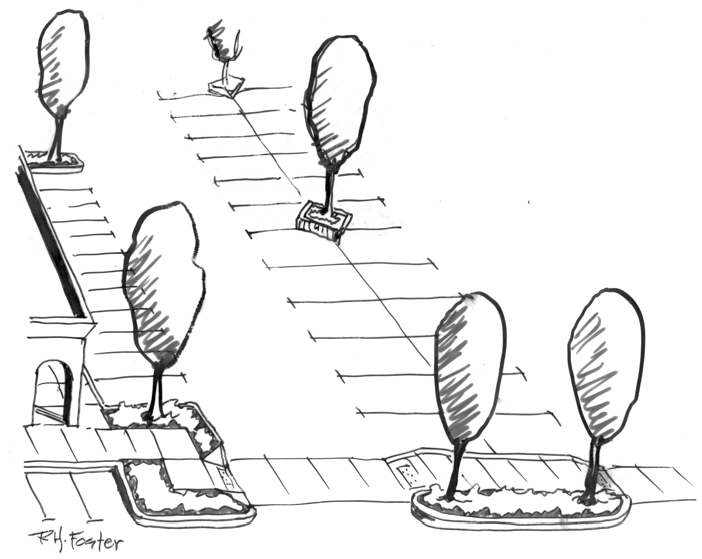
Figure 57 - Parking Lot Landscaping - View 2
c.
Shade Coverage.
i.
All new passenger vehicle parking areas (excluding vehicle sales lots) over 1/2 acre, including all driveways and drive aisles, shall provide tree canopy covering at least 40 percent of the parking lot at maturity but no more than 15 years after planting.
ii.
Trees must be at least ten feet tall at the time of planting and maintained to maximize their root health and chances for survival, including having ample high-quality soil, space for root growth, and reliable irrigation according to the needs of the species.
iii.
Landscape plans shall show the canopy coverage at 15 years maturity as part of any land use submittal.
iv.
A specific Tree Canopy Plan shall be included as part of the Landscape Plans which shall show the canopy coverage at 15 years maturity as part of any land use submittal.
v.
Development of a Tree Canopy Plan, to comply with the requirements of this section, shall be done in coordination with the local electric utility, including pre-design, design, building and maintenance phases.
vi.
As an alternative, the development may provide 30 percent tree canopy coverage over all new parking areas and installation of solar panels with a generation capacity of at least 0.5 kilowatt per new parking space. Panels may be located anywhere on the property, including the roof of a structure.
d.
Landscape Protection. Required landscaped areas adjacent to graveled areas must be protected by large boulders or by another acceptable means of protection.
(3)
Irrigation of Required Landscaping. All required landscaped areas must be provided with an irrigation system unless a licensed landscape architect, landscape construction professional, or certified nurseryman submits written verification that the proposed plants do not require irrigation. Irrigation systems installed in the public right-of-way require an encroachment permit.
(4)
Identification of Existing Trees. In all proposed developments, existing trees over 25 inches in circumference (eight inches in diameter) as measured 4.5 feet above mean ground level from the base of the trunk shall be noted on all development plans, with notations indicating whether they are to be removed or utilized in the development. To obtain the circumference of a tree with multiple trunks, add the individual trunk circumferences, which are greater than six inches in circumference. Clusters of trees in open space and floodplain areas may be noted in approximate locations. No trees 6.5 feet in circumference (approximately 25 inches in diameter) or greater may be removed without a permit per Millersburg Municipal Code Section 7.30.040.
(Ord. No. 210-24, Exh. A, 1-9-2024; Ord. No. 213-25, Exh. A, 2-11-2025)
3.09.040 - Landscape Plans.
(1)
With the exceptions noted below, all development applications involving buildings and parking areas must include landscape plans. The following uses are required to meet the landscaping requirements of this Code but are not required to submit landscape plans:
a.
Single-family dwellings, and duplexes.
b.
Accessory buildings.
c.
Changes internal to an existing structure.
d.
Building additions involving less than 500 square feet.
(2)
Street Tree Species Allowed Within Rights-of-Way. Only trees included in the list of approved City street trees are allowed.
(3)
Trees Requiring Approval. It is unlawful to plant willow, cottonwood, or poplar trees anywhere in the City unless the City Engineer approves the site as one where the tree roots will not be likely to interfere with public sewers.
(4)
Height Requirements in Rights-of-Way. Trees or shrubs growing in the right-of-way or on private property adjacent to a street right-of-way must be trimmed to maintain a minimum canopy height of eight feet above sidewalks or 14 feet above streets or alleys.
(5)
Planting in Roadways Having No Gutter, Curb. No trees, shrubs, or plantings more than 18 inches tall shall be planted in the public right-of-way abutting roadways having no established curb and gutter.
(6)
Completion Guarantees. Final occupancy of a development that required land use approval may be allowed prior to the complete installation of all required landscaping and irrigation only under the following circumstances:
a.
A security guarantee is provided to the City in accordance with this Code.
b.
The required landscaping and irrigation shall be installed within six months of the date the final occupancy permit is issued. If an occupancy permit is not required, the landscaping and irrigation shall be installed within six months of the date of the land use approval.
c.
To verify that the landscaping, and irrigation if required, has been installed per the approved plan, an inspection shall be made prior to any security being returned.
d.
Required post-construction stormwater quality facilities incorporated into the required landscaped areas have been completed (or financially assured) consistent with the requirements of the Municipal Code and applicable post-construction stormwater quality permits.
(Ord. No. 213-25, Exh. A, 2-11-2025)
3.09.050 - Maintenance of Landscaped Areas.
It shall be the continuing obligation of the property owner to maintain required landscaped areas in an attractive manner free of weeds and noxious vegetation. In addition, the minimum amount of required living landscape materials shall be maintained. Private post-construction stormwater quality facilities located in landscaped areas shall be maintained consistent with the terms of any operation and maintenance agreements between the property owner and the City.
3.10.010 - Applicability of Special Use Standards.
Special uses included in Chapter 3.11 to Chapter 3.27 are uses which, due to their effect on surrounding properties, must be developed in accordance with special standards. These special use standards may differ from the development standards established for other uses for property within the same zone. When a dimensional standard for a special use differs from that of the underlying zone, the standard for the special use shall apply.
3.11.010 - Development Standards.
Oregon Revised Statutes (ORS), Chapter 446 and Oregon Administrative Rules (OAR), Chapter 918, and Chapter 10 of the Oregon Manufactured Dwelling and Park Specialty Code (OMDS) specify the standards and regulations for Manufactured Dwelling Parks in the State of Oregon.
(1)
Permitted Housing. Only Class "A" manufactured dwellings are permitted in Manufactured Dwelling Parks adjacent to areas that are predominantly developed with single-family residential dwellings. Class "A" or "B" manufactured dwellings are permitted in all other Manufactured Dwelling Parks. No manufactured dwelling shall be more than ten years in age at time of placement. Prefabricated structures are permitted as well, consistent with ORS 446.003.
(2)
Minimum Site Area. The minimum area for a park shall be one acre.
(3)
Density. Maximum density of the park shall not exceed seven units per gross acre.
(4)
Access. Manufactured Dwelling Park access shall occur from a public Collector or Arterial street.
(5)
Permitted Uses. Manufactured Dwelling Parks may contain manufactured dwellings and accessory structures, community laundry and recreation facilities, and other common buildings for use by park residents only, and one residence other than a manufactured dwelling for the use of a caretaker or a manager responsible for maintaining or operating the park.
(6)
Conditions. Upon granting site plan approval for a manufactured dwelling park, the Planning Commission may require establishment of deed covenants, conditions, and restrictions (CC&Rs) or other conditions including, but not limited to, any of the following where such are deemed necessary for the mitigation of adverse impacts on an adjacent area:
a.
Limit the type of units to be installed.
b.
Additional landscaping or screening on the park boundary.
c.
Increased setbacks from park boundaries.
(7)
Improvement Standards. Park standards shall conform to the Oregon Manufactured Dwelling and Park Specialty Code within the Park boundary and shall conform to City Standards when abutting public streets.
(8)
Streets. Public streets located within the Park and the first 100 feet of private Park streets connecting to a public street shall conform to City standards. Other private streets within the Park shall be no less than 30 feet in paved width in accordance with Table 10-C of the OMDS.
(9)
Perimeter Setbacks. Distance of a manufactured dwelling or accessory structure from an exterior park boundary shall be 20 feet.
(10)
Landscaping. All common areas within a Manufactured Dwelling Park shall be landscaped and maintained by the Park owner in conformance with an approved landscape and irrigation plan submitted as part of the application. This plan shall be drawn to scale. The plan will show the location of existing trees, vegetation proposed to be removed, vegetation proposed to be retained, the location and design of landscaped areas, the varieties and sizes of trees and plant materials to be planted, contour lines indicating any earth sculpting to be used, approved vegetated post-construction stormwater quality facilities within the landscape area, and other pertinent landscape information.
All common areas within a Manufactured Dwelling Park, exclusive of required buffer areas, buildings, and streets, shall be landscaped and maintained in accordance with the following minimum standards per each 1,000 square feet of open area.
a.
One 10-foot tree or two trees at least five feet in height.
b.
Three shrubs or perennials.
c.
The remaining area must be landscaped in an attractive ground cover.
d.
Long expanses of fence or wall along public streets shall be designed to prevent visual monotony through the use of offsets, landscaping, and change in materials. Fencing closer than 15 feet to the public right-of-way shall be subject to the zoning district's restrictions on front yard fencing. Landscaping shall include street trees within a public right-of-way in accordance with adopted street tree regulations of the City.
(11)
Perimeter Property Screening. The entire perimeter of the Manufactured Dwelling Park shall be screened except for driveways and clear vision areas. The following minimum standards shall apply:
a.
One row of evergreen shrubs shall be planted which will grow to form a continuous hedge at least six feet in height and be at least 80% opaque, as seen from a perpendicular line of sight, within two years of planting; or
b.
A minimum of a six-foot high wood fence or masonry wall shall be constructed, measured as provided in Chapter 3.07, providing a uniform sight obscuring screen; or
c.
An earth berm combined with evergreen plantings or wood fence or masonry wall shall be provided which shall form a sight and noise buffer at least six feet in height.
d.
The remaining area treated with attractive, living ground cover (i.e., lawn, ivy, evergreen shrubs, etc.).
(12)
Utilities. All Manufactured Dwelling Parks must provide each lot or space with storm drainage, municipal sanitary sewer, electric, telephone, and municipal water, with easements dedicated where necessary to provide such services. All such utilities shall be located underground. Utilities shall be connected in accordance with state requirements and the manufacturer's specifications.
(Ord. No. 213-25, Exh. A, 2-11-2025)
3.12.010 - Scope.
The provisions of this Chapter are applicable to all site-built, modular/ prefabricated, and manufactured homes sited on individual lots in the City of Millersburg. Manufactured homes sited in approved mobile/manufactured home parks or manufactured home subdivisions are not affected by the provision of this Code.
(Ord. No. 213-25, Exh. A, 2-11-2025)
3.12.020 - General Standards - All Single-family, Prefabricated, Manufactured and Duplex Homes.
All new single-family, duplex, prefabricated, and modular homes constructed or located within the City shall include:
(1)
An access area that shall be paved or concrete, connected to, but outside of the right-of-way, and shall be at least 24 feet square.
(2)
Eaves that project at least 12".
(3)
No garage shall be more than 65% of the façade width.
(4)
Window and door trim is required on the front and all street facing walls of the structure. All trim shall be at least four inches.
(5)
All homes shall have a minimum nominal pitch of three feet in height for each 12 feet in width.
(6)
Any home shall have at least 1,000 square feet of gross floor area.
(7)
The home shall be placed on an excavated and backfilled foundation with no more than 12 inches of enclosing material exposed above grade. Where the building site has a sloped grade, no more than 12 inches of the enclosing material shall be exposed on the uphill side of the home. If the home is placed on a basement, the 12-inch limitation shall not apply. Furthermore, the 12-inch limitation shall not apply if the requirements of the Flood Hazard District mandate that the home be elevated more than 12 inches above grade. The foundation shall meet building code and Flood Hazard Area (if applicable) standards. The base of the home shall be enclosed continuously at the perimeter with either concrete, concrete block, brick, stone, or a combination thereof.
(8)
A home with no garage door on the front of the façade or a home with a front facing garage door up to 50% of the length of the facade shall meet at least four of the following design standards, a home with a garage door more than 50% of the facade must meet at least five of the following design standards:
a.
Dormers, which are projecting structures built out from a sloping roof housing a vertical window.
b.
Gables, which is a roof sloping downward in two parts from a central ridge, so as to form a gable at each end.
c.
Recessed entries (minimum two feet).
d.
Covered porch entry (minimum 48 square feet).
e.
Cupolas.
f.
Wrapped Decorative Pillars or posts.
g.
Bay or bow windows.
h.
Eaves greater than 12" projection.
i.
Off-set on building face or roof (minimum 16").
j.
Windows and doors represent a minimum of 15% of the façade, not including the roof or gables.
k.
Stone, brick or other similar material used on the façade.
l.
Garage doors designed to resemble two smaller garage doors.
m.
A third garage door (or second door of a three-car garage) that is recessed a minimum of two feet.
n.
Decorative roofline elements including roof brackets.
o.
Exterior chimney of brick, stone, composite masonry or similar materials (viable from the façade).
p.
Tower, either square, rectangular, circular or polygonal in form.
q.
Lintel, arch, or similar decorative header casing on windows, the main entry door, portico, garage door(s), or other opening in the wall plane.
r.
Variation in wall cladding, wall-surface pattern, or decorative materials such as shakes, shingles, brick, stone or other similar [material].
(Ord. No. 192-21, § 10, 12-14-2021; Ord. No. 213-25, Exh. A, 2-11-2025)
Editor's note— Ord. No. 213-25, Exh. A, adopted February 11, 2025, amended the title of § 3.12.020 to read as herein set out. The former § 3.12.020 title pertained to General Standards - All Single-family and Duplex Homes.
3.12.030 - Additional Manufactured Home Standards.
Manufactured homes are permitted in all residential zones, in accordance with the following general standards and the design standards set forth in Section 3.12.020. The minimum lot area, setback, and height standards of the subject zone shall also apply to manufactured homes sited on individual lots.
(1)
Size. The manufactured home shall be multi-sectional.
(2)
Performance standards. The exterior thermal envelope must meet the standards specified by State law for single-family dwellings, as defined in ORS 455.010.
(3)
Removal of towing equipment. All towing hitches, wheels, running lights, and other towing related equipment shall be removed within 30 days after installation of the manufactured home.
(4)
Utilities. The manufactured home shall be provided with storm drainage, sanitary sewer, electric, telephone, and potable water utility services with easements dedicated where necessary to provide such services. All such utilities shall be located underground unless waived by the City Building Official where underground service would require an exception to local prevalent conditions. Manufactured homes shall not be occupied purposes unless connected to local water, sewer, and electrical systems.
(5)
Historical sites. No manufactured home shall be located on property containing a historic significant resource or Historic Zoning Overlay, or on a lot or parcel immediately adjacent to property containing a historic landmark.
(6)
Only one manufactured home and one Accessory Dwelling Unit is allowed per lot.
(Ord. No. 210-24, Exh. A, 1-9-2024; Ord. No. 213-25, Exh. A, 2-11-2025)
Editor's note— Ord. No. 213-25, Exh. A, adopted February 11, 2025, amended the title of § 3.12.030 to read as herein set out. The former § 3.12.030 title pertained to General Standards - Manufactured Homes.
3.12.040 - General Standards - Multi-Family Housing.
For multi-family dwellings the site design plan submitted to the Planning Commission for its approval shall demonstrate compliance with the following design criteria:
(1)
Gross housing density shall not exceed 16 dwelling units per acre, except in the Mixed-Use Zone where density shall not exceed 32 dwelling units per acre.
(2)
No single building shall contain more than eight dwelling units except in the Mixed-Use zone.
(3)
All buildings shall have an off-set or jog of at least five feet no more than every 30 feet apart. All rooflines shall be broken by perpendicular features, dormers, or other architectural breaks no more than 30 feet apart. All buildings shall have architectural features breaking up expanses of wall so that no wall is longer than 30 feet without an intervening architectural feature. Features shall include porches, stairways, recessed doors, off-sets in the building façade of at least five feet, and other features found by the Planning Commission to meet this intent.
(4)
A variety of building materials shall be used to break up large lengths of wall and add architectural interest. This shall include different paint colors and different materials such as masonry, rock, flagstone, varying wood styles, or wood features such as columns and trim. T1-11 or similar siding, or vinyl siding are not allowed.
(5)
Impervious surface shall not cover more than 75% of the lot. All non-impervious land shall be permanently landscaped.
(6)
Side and rear yards shall be buffered from adjacent uses by fencing or hedges built, planted, and maintained in accordance with Section 3.09 of this Article.
(7)
The plan shall show the location of all existing and proposed buildings and structures, parking areas, drainage facilities, utility services, access points, lighting, signs, landscaping, and other such data as may have a bearing on the adjacent properties.
(8)
No exposed air conditioning units, including wall mount, window mount, or compressor units will be visible from a street.
(9)
All staircases must be covered with a roof.
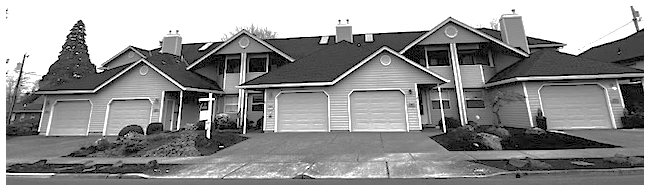
Figure 58 - Example of Compliance with Multi-Family Design Standards
3.13.010 - Standards.
Home occupations are allowed as an accessory use on any property on which there is a residence, without a permit when the following standards are met. Additional staffing or vehicles may be allowed in accordance with Chapter 5.13.
(1)
Staffing.
a.
If no person is employed other than a member of the family residing on the premises, the home occupation is allowed as a permitted use.
b.
If persons other than a member of the family residing on the premises are proposed to be employed, a Conditional Use Permit is required.
c.
Additional individuals may be employed by or associated with the home occupation, so long as they do not report to work, pick up, or deliver at the home occupation site.
d.
The home occupation site shall not be used as a headquarters for the assembly of employees for instruction or other purposes, including dispatch of employees to other locations and picking up paychecks.
(2)
Character. The character and primary use function of the residence and premises shall not be changed by the use of colors, materials design, construction, lighting, landscaping, or lack of landscaping.
(3)
Noise. A home occupation shall not create noise of a type, duration, or intensity that is detectable to normal sensory perception, off the premises of the home occupation.
(4)
Equipment and Process Restrictions. No home occupation conducted within a single-family detached residence or an accessory structure shall create vibration, glare, fumes, odors, or electrical interference detectable to the normal sensory perception, off the property. In the case of electrical interference, nothing shall be used which creates visual or auditory interference in any radio or television off the premises.
(5)
Hazards. No equipment, process, or material shall be used which will change the fire rating or structure separation, fire wall, or ventilation requirements for the structure in which the home occupation is located. No hazardous materials shall be used or stored on the property on which a home occupation located in quantities not typical of those customarily used in conjunction with activities or primary uses allowed in the zoning district.
(6)
Signs. Signing shall be as provided in Chapter 3.06.
(7)
On-Premises Client Contact. Customer and client contact shall be primarily by telephone, mail, or online, and not on the premises of the home occupation, except those home occupations, such as tutoring, counseling, or personal services, which cannot be conducted except by personal contact. Services or sales conducted on the premises shall be by appointment only, and shall not be oriented toward, or attract, off-the-street customer or client traffic.
(8)
Prohibited Businesses. The repair and/or maintenance of automobiles, trucks, recreational vehicles, trailers, motorcycles, farm equipment, boats, and, lawn mowers, and other small engine equipment shall be prohibited.
(9)
Vehicles. Only one motor vehicle and one trailer primarily utilized with the home occupation may be parked on the property or adjacent street.
(10)
Storage and Use of Yard Areas. Storage of tools, equipment, and materials, and display of merchandise and all other activities associated with a home occupation, except as provided above for parking, shall be contained and conducted wholly within covered and enclosed structures and shall not be visible from the exterior of the containing structure(s). Home occupations which involve the care of children by a babysitter, as defined in Section 1.02.020, may use yard areas for playground equipment.
(11)
Day Care. Day care facilities with 12 or fewer children shall not be subject to the provisions in this Section.
3.13.020 - Process.
Home occupations are allowed as an accessory use to any residential use in the City, subject to provisions in Chapter 5.13 Home Occupations proposed to have employees in addition to family members residing in the residence or more than one vehicle associated with the home occupation, subject to the provisions of Chapter 5.13. The standards of this Section shall govern all home occupations.
3.13.030 - Non-Compliance.
Any home occupation which does not comply with the requirement of this Section and the provisions of the underlying zone shall be a violation of this Ordinance and shall be subject to the penalties and remedies of this Code.
3.14.010 - Scope.
The provisions of this Chapter shall apply to the following uses:
(1)
Automobile service stations;
(2)
Automobile, truck, manufactured home, recreation vehicle or trailer sales;
(3)
Boat and marine accessory sales;
(4)
Motorcycle sales;
(5)
Retail tire shop, sales, service and repair;
(6)
Towing service.
3.14.020 - Standards.
In addition to other development standards established elsewhere in this Code, the following standards shall apply to the development of all uses listed in Section 3.14.010:
(1)
Paving Required. All parking areas, loading areas, or areas used for storage of boats, automobiles, manufactured homes, recreational vehicles, trucks, trailers, motorcycles or other vehicles shall be paved with a concrete or asphalt surface. Alternative surfaces can be considered through a conditional use process.
(2)
Screening. The lot shall be screened from adjoining residentially zoned properties in accordance with the provisions of Chapter 3.07.
(3)
Outdoor Display Restrictions. All merchandise and supplies, other than vehicles, mobile homes, trailers, and other vehicles for sale, shall be stored within a building.
(4)
Modular Buildings. May not be used for office, sales, storage, or temporary buildings except the City Manager can approve a temporary use, as found in Section 3.17, which can be used in the case of the loss of a primary building while remodeling, restoration, or replacement work of on-site buildings is taking place.
3.14.030 - Yard Exceptions for Accessory Service Station Structures and Equipment.
In a zone where automobile service stations are permitted, free-standing gasoline pumps and pump islands, identification signs, and lighting standards may occupy a required front or street side yard exclusive of a clear vision zone unless otherwise prohibited by this Code. In any zone, gasoline pumps and pump islands shall not be located so that any part of a vehicle being served shall extend into any public street right-of-way, alley, or private drive used for access or egress to private property. Where an interior yard is not required and a structure is not located at the property line, it shall be set back at least five feet from the property line to accommodate access to the building.
3.14.040 - Process.
The uses listed in this Chapter shall be reviewed for compliance with the standards of this Chapter pursuant to the Site Development Review process set forth in Chapter 5.05.
3.15.010 - Single-family Residences.
Residential accessory structures for attached or detached single-family homes and duplexes, excluding Accessory Dwelling Units as defined in Chapter 3.16, shall comply with all requirements for a principal structure, except where specifically modified by this section. Accessory structures shall not be used for human habitation except as specified in this section. Accessory structures shall comply with the following standards:
(1)
Dimensions and Design Requirements. Residential accessory structures shall be subject to the following requirements:
(2)
Setbacks. Accessory structures shall comply with the following setbacks:
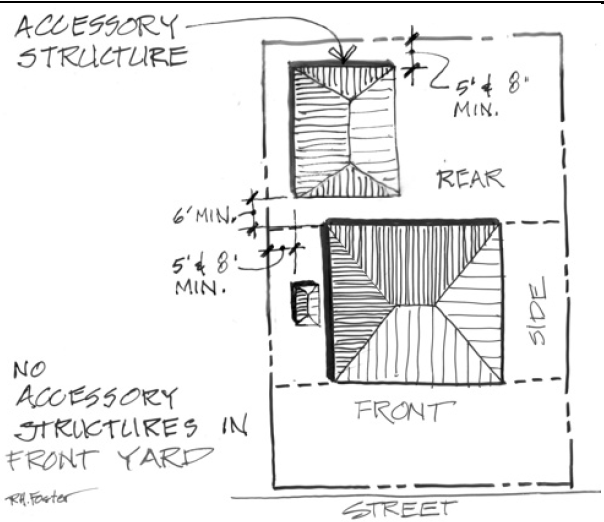
Figure 59 - Accessory Structure placement
a.
Front and/or Street Side Yard: Comply with requirements of underlying zone.
b.
Side Yard: see table.
c.
Rear Yard: see table.
d.
Accessory structures shall be detached from all other buildings by at least six feet unless a variance is approved.
(3)
Multiple Accessory Structures. There shall be no limit to the number of structures, provided the structures in combination comply with the area coverage requirements. When there is more than one accessory structure within a yard, all provisions in this Chapter shall apply and shall be based on the total square footage of all accessory structures within the yard.
(4)
Prohibited Structures. The use of metal shipping containers or semi-truck trailers as an accessory structure shall be prohibited, except as regulated by the Municipal Code section 13.36.25.
(5)
Sales. No sales shall be made from an accessory structure unless it has been approved as a Home Occupation under the conditional use provisions of Article V and the home occupation standards of Article III.
(6)
Standards for RV covers and carports.
a.
Materials. Covers may be made from any building material including metal.
b.
Setbacks. All accessory structure setbacks apply. Setbacks will be taken from the eves of the roofline, not the structure uprights.
c.
The RV cover or carport has no setback requirement from the primary structure (house) and may even be connected to the primary structure.
d.
Colors. The primary color of any metal roofing material must be neutral (earth tones) or be similar to the color, or accent color, of the primary structure.
e.
Height. The maximum height of an RV cover is 20 feet, unless the cover is setback at least 20 feet from any property line, then the height limit from the zone applies.
f.
Walls.
i.
RV covers cannot include a wall of any kind (or solid gate or fence) that covers the front facing side of the structure where the RV enters the space. The three other sides may include walls consistent with the requirements of this section.
ii.
Any wall (not including any primary structure walls if the RV cover structure is attached to a primary structure) must not be within four feet of the finished floor.
iii.
Transparent screens or screening may be used on any portion of the RV cover and is not considered a "wall" for purposes of this section.
(7)
Exceptions.
a.
Farm accessory buildings in the Rural Residential zones on lots over 2.5 acres are exempt from the size requirements.
b.
Accessory structures under 200 square feet do not require a Building Permit.
c.
Boats, trailers, detached campers, recreational vehicles, fifth-wheelers, motorized dwellings, travel trailers, tent trailers, tents, and similar recreational facilities may be stored, but not used for continuous human habitation. Temporary habitation is limited to 30 consecutive days or a total of 60 days in a 12-month period within the City limits. The City Manager may grant an extension upon receiving a written justification in accordance with Section 3.17.
(Ord. No. 210-24, Exh. A, 1-9-2024; Ord. No. 213-25, Exh. A, 2-11-2025; Ord. No. 216-25, Att. A, 7-8-2025)
3.15.020 - Multi-Family Developments.
There shall be no limit to the size, number, or location of accessory structures for multi-family developments, provided the accessory structures shall comply with all setback, height restrictions, and other dimensional and design requirements for the primary structure(s) and lot coverage requirements. All accessory structures shall be of like exterior materials, finish, and color as the primary structure.
3.16.010 - Accessory Dwelling Units.
Where permitted as a special use, an Accessory Dwelling Unit (ADU) shall meet the following use and development standards:
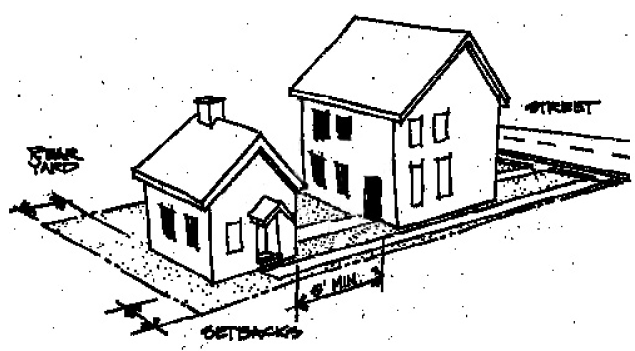
Figure 60 - Detached Accessory Dwelling Unit
(1)
Location. An ADU may be located on any lot with a single-family home or duplex. The ADU shall be located within the side or rear yard and physically separated from the primary residence by a minimum distance of six feet. A covered walkway, which contains no habitable space, may connect the two buildings without violation of the setback requirements. An ADU may also be located internal to the primary structure, including, but not limited to, an attic or a basement.
(2)
Number. Only one ADU shall be permitted per lot or parcel.
(3)
Design. The ADU must have the same roof pitch and material, color, and siding material as the primary residence. As an alternative, an applicant who wishes to use a design that differs from these requirements may apply for a conditional use permit. In the case of an ADU proposed to have material, color, and siding material better in terms of quality than the existing residence, the Planning Director may authorize the material, color, and siding material as part of the Building Permit process.
(4)
Area. The floor area of the ADU shall be no more than 650 square feet and not less than 250 square feet. An additional 100 square feet of floor space may be granted for every 1,000 square feet of lot size over 11,000 square feet, however, in no case shall an accessory dwelling unit exceed 900 square feet.
(5)
Setbacks. Shall be in accordance with Section 3.15.010.
(6)
Height. The maximum height shall be 20 feet for detached ADUs. Attached ADUs shall use the height limit from the underlying zone. Two-story ADUs are not permitted though an ADU can be placed over an accessory structure such as a workshop or a garage, in which case the height limit is that of the underlying zone.
(7)
Lot Coverage. The ADU shall be included in the lot coverage calculation.
(8)
Metal shipping containers. Metal shipping containers converted into dwelling units are not permitted.
(9)
Foundation. All structures shall be placed on a continuous foundation similar to the foundation used for the primary home.
(10)
Parking. No additional off-street parking is required for an ADU.
(11)
Garages:
a.
A garage may be constructed with an ADU but is not required. The garage can be attached or detached to the ADU. The garage does not count toward the square footage of the ADU. The garage is an accessory structure and must comply with all accessory structure standards (see Chapter 3.15) and counts toward the total square footage allowed for accessory structures on a single lot.
b.
No garage required for the primary structure (see Section 3.12.020) is permitted to be converted to habitable space for an ADU or otherwise.
(Ord. No. 210-24, Exh. A, 1-9-2024)
3.16.020 - Attached Dwellings.
Attached dwelling units are single-family homes on individual platted lots that are attached to a similar unit on one or two sides. Where permitted as a special use, attached dwelling units shall meet the following use and development standards:
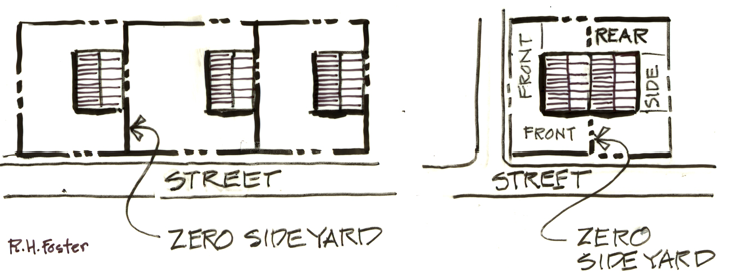
Figure 61 - Zero Side Yard Dwelling Examples
(1)
Permitted Development. Any number of attached dwellings may be built contiguous with one or both sides of a separate platted lot with one dwelling per lot.
(2)
Setbacks.
a.
Zero side yard units shall comply with the setback requirements for the front yard, rear yard, and yard adjacent to a street in the applicable zone.
b.
Interior side yard requirements of the applicable zone shall be met when any part of an exterior wall faces, but is not contiguous to, a side lot line. Otherwise, the interior side yard requirements shall not apply.
(3)
Building Separation. Buildings on adjacent properties, but not attached to each other, shall be separated by a distance of at least ten feet.
3.17.010 - Purpose.
The purpose of these regulations is to provide standards for the establishment of temporary businesses and similar uses within the City of Millersburg.
3.17.020 - Permitted Uses.
Where allowed, the following temporary uses shall be permitted subject to the following limitations and requirements:
(1)
Tree and Fireworks Sales. Christmas tree or fireworks sales are permitted subject to the following:
a.
The sales shall be limited to Commercial or Industrial zones, except that sales may occur on those properties containing public or semi-public uses, such as schools or churches, regardless of the underlying zone.
b.
Unless otherwise excepted by provisions in this Section, the sales activity shall be subject to provisions in Section 3.17.020(3).
c.
Temporary uses located within Residential zones shall not operate beyond 9:00 PM.
(2)
Mobile Food Units. Mobile Food Units of all types are subject to the provisions of Chapter 3.25.
(3)
Non-Food Related Commercial Activities. Amusement and recreational services and retail sales and services are permitted in the Commercial zone, subject to the following:
a.
The business may be operated from a vehicle, temporary structure, or a vacant building.
b.
The activity is located on the same lot for no more than 90 days in any calendar year.
c.
The required parking for the primary uses on the same lot is not reduced below Code requirements.
d.
The use does not block driveways, driveway entrances, or parking aisles.
e.
The activity conforms to all signage requirements in Section 3.06.
f.
The activity conforms to all setback requirements applicable to the lot and zone.
g.
The operator of a temporary use shall obtain all permits required by other agencies including those required for food handling and sales, and the sale of fireworks.
(4)
Temporary Construction Facilities. Mobile offices, temporary power equipment, and temporary structures used by personnel and to store equipment during construction, provided the structures are located on the construction site and not used as dwellings. There is no restriction as to the zoning.
(5)
Yard Sales and Auctions. Yard sales or auctions in any zone, provided there are not more than four sales in a calendar year, with each sale not to exceed three consecutive days. Merchandise and signs shall remain on private property. This Section does not limit the number of times, or duration, that public agencies may conduct sales or auctions regard agency land, equipment, supplies, or other materials.
(6)
Additional Permitted Temporary Uses. The City Council may, by resolution, authorize additional permitted temporary uses during a specific event or festival and set forth reasonable types of uses, appropriate zones for such uses, and any time restrictions the Council finds necessary to protect the health, safety, and welfare of the public.
(7)
RVs as Temporary Habitation. The use of boats, trailers, detached campers, recreational vehicles, fifth-wheelers, motorized dwellings, travel trailers, tent trailers, tents, and similar recreational facilities for temporary habitation is limited to 30 days in a 12-month period within the City limits. No property may have more than one recreational vehicle, fifth-wheel, travel trailer, tent trailer, tent, or any combination thereof, occupied concurrently. Each occupied recreational vehicle accrues one day toward the 30-day limit for each night it is occupied. For example, a trailer occupied for ten days and a tent for four days, results in 14 days of occupation. At the City's sole discretion, the City may grant one 30-day extension upon receiving a written request at least ten days prior to the expiration of the 30-day period. Exceptions shall require written authorization from the City.
3.18.010 - Purpose.
The purpose of this Chapter is to provide development guidelines and operating requirements for a bed and breakfast establishment within the City.
3.18.020 - General Land Use Provisions.
The following general development provisions shall apply:
(1)
Location. The establishment shall be located along, or within 300 feet, of a collector or arterial street.
(2)
Rooms. The bed and breakfast establishment shall be limited to a maximum of two guest rooms in the RL zones and four guest rooms in the RM and commercial zones.
(3)
Room Restrictions. No guest room shall be located within a basement.
(4)
Building Modification. The guest rooms utilized by the establishment shall be part of the primary residential use and not specifically constructed for rental purposes. In no case shall the residential character be modified or altered to accommodate an establishment.
(5)
Parking. In addition to the parking requirements for the residence, one additional parking space shall be required for each guest room. The parking space(s) shall comply with the following improvement provisions:
a.
No parking shall be permitted within the designated front yard setback.
b.
Parking located within the side yard or rear yards shall be screened from adjacent residential zoned property shall be screened. Screening shall be provided by a six-foot sight-obscuring wood or chain-link fence or vegetative hedge.
(6)
Signs. Signs shall be limited to one non-illuminated wall-mounted sign not to exceed eight square feet in area.
3.18.030 - Operation Requirements.
The following shall continually apply to the operation of the establishment:
(1)
Owner/Operator. The establishment shall be maintained and operated solely by the on-premises owner of the residence containing the bed and breakfast.
(2)
Retail Activity. No retail or other sales shall be permitted unless clearly incidental and directly related to the conduct of the establishment (e.g., coffee cups or t-shirts with the business logo).
(3)
Receptions. The establishment shall not be used by the public or paying guests for the hosting of receptions, weddings, private parties, or similar functions.
(4)
Meals. Meals shall be limited to breakfast and snacks and shall be served only to overnight guests. The operator shall be responsible for obtaining necessary food service permits.
(5)
Safety. The improvements, maintenance, and operation of the establishment shall continually comply with applicable building code, fire safety, and health regulations.
3.18.040 - Approval Process.
Establishment of a bed and breakfast operation shall require approval of a Site Development Review per Chapter 5.05; a separate Home Occupation application or permit shall not be required.
3.19.010 - Development Provisions.
Where permitted as a special use, a house of worship shall meet the following use and development standards:
(1)
Setbacks. In, or abutting, every residential zone or use there shall be a 20-foot setback.
(2)
Landscaping. All required yard areas shall be landscaped.
(3)
Street Access. Unless permitted by the City, no more than two vehicle driveways per street frontage shall be permitted.
(4)
Parking. No off-street parking shall be permitted within a required yard area of within ten feet of a residential zone or use.
(5)
Lighting Standard. Shielding from adjacent residential property.
(6)
Screening of Off-street Parking. Where any portion of an off-street parking area is within 15 feet of a lot zoned or used for residential purposes, the perimeter of the parking area facing such residential zone or use shall be screened by a site obscuring fence, wall, or hedge.
(7)
Bus Storage. The storage of buses used to transport members of the congregation is permitted, provided the buses are not parked closer than 20 feet to a property that is lot zoned or used for residential purposes.
3.19.020 - Approval Process.
Establishment of a house of worship shall require approval of a Site Development Review per requirements in Chapter 5.05.
3.20.010 - Standards.
A Residential Care Facility, other than a private residence for more than 12 children or for more than five adults, is a Permitted Use in residential zones and may be allowed in accordance with the Conditional Use provisions of Chapter 5.04 provided there is compliance with the following additional standards:
(1)
The facility is served by the municipal water and sewer systems.
(2)
Access shall be from a designated arterial or collector street.
(3)
Requirements for front, rear, side, and street side yards may be increased to minimize potential impacts to adjacent single-family residences.
(4)
Additional landscaping, privacy fencing, buffers, or other screening devices may be required to screen or protect the facility or adjacent properties.
(5)
Outdoor areas shall be provided in accordance with State standards for each type of use. The outdoor area shall be adequately fenced in order to provide for the safety and privacy of those at the facility.
(6)
The Care Home shall be readily accessible for people with disabilities, and have fire or other emergency access.
(7)
The Care Home shall meet all applicable State licensing requirements. Proof that these requirements are met shall be provided.
3.21.010 - Lots of Record.
(1)
A parcel is a legal lot of record for purposes of this Code when the lot conforms to all zoning requirements, subdivision requirements, and Comprehensive Plan provisions, if any, in effect on the date when a recorded separate deed or contract creating the separate lot or parcel was signed by the parties to the deed or contract.
(2)
Lots in recorded plats may be combined under a single ownership for the purpose of developing the combined property, subject to approval of a property line adjustment.
(3)
The use or development of any legal lot of record shall be subject to the regulations applied to the property when such development or use is commenced, irrespective of the lot width, street frontage, depth, or area, but subject to all other regulations.
3.21.020 - Lots Abutting a Partial Street.
New structures which are proposed to be constructed on lots abutting an existing public street which does not meet the minimum standards of Section 3.02 for right-of-way width shall provide setbacks sufficient to allow for the future widening of the right-of-way. Building permits shall not be issued unless a yard setback equal to the minimum yard requirements of the zoning district plus the required minimum additional right-of-way width is provided.
3.21.030 - Protection of Runoff Capacity of Natural Drainage Channels.
A property owner shall not allow the water carrying capacity of any drainageway within his property to deteriorate and subsequently contribute to flood hazard. The property owner shall remove excess debris from the channel including dead vegetation and sediment. Neither shall any fill or garbage be dumped in any drainageway. Failure to maintain the water carrying capacity of the drainageway shall empower the City to enter the property and take whatever action is necessary to ensure that the carrying capacity of the drainageway is not impaired and then assess the real property and improvements for the cost of the City's actions. Grading permits may be required and are subject to provisions in Chapter 3.04.
3.21.040 - Farm Uses and Livestock.
If permitted as described below, or otherwise permitted as a commercial or industrial activity, the following limitations shall apply:
(1)
Crops, orchards, and gardens. The growing of crops, orchard products, vegetables, or similar food items for personal use shall be permitted.
(2)
Livestock. The breeding, raising, boarding, or selling of horses, cows, bulls, mules, sheep, goats, alpacas, llama, emus, bees, or other similar farm animals, with the exception of swine which are not allowed, for domestic or commercial purposes, shall be allowed in accordance with the limitations below. The following animal use area regulations shall apply on lots of less than five acres:
a.
Cows, horses, sheep, or goats cannot be kept on lots having an area of less than one acre.
b.
The minimum area for such animals (other than their young under the age of six months) on less than five acres shall be as follows:
i.
Horses: One per acre, plus one additional for every additional 15,000 square feet.
ii.
Cows: One per acre, plus one additional for every additional 10,000 square feet.
iii.
Goat or sheep: Five per acre, plus one additional for every additional 2,000 square feet.
c.
The area of a property may be utilized one time only for the computation of the above allowable animal usage.
d.
When there is a residence on the property, 10,000 square feet shall be deducted from the square footage of the property for calculation of allowable animal usage.
e.
Animal runs, stables, barns, and corrals shall not be located closer than 100 feet from property lines.
f.
Animals shall be appropriately contained or housed, and proper sanitation shall be maintained at all times. All animal food (not including hay) shall be stored so as to be rodent proof.
(3)
Fowl and Rabbits. The keeping of fowl or rabbits in all residential zones is permitted by right subject to the following provisions:
a.
The minimum property size is 10,000 square feet.
b.
No person shall keep any rooster or other animals that produce annoying sounds.
c.
Products generated by the housed animals, other than eggs as regulated in Section (4) below, shall not be sold from a residential property.
d.
Each property shall be allowed no more than five animals. Animals cannot be housed within a residence or garage, except that young chickens less than 12 weeks of age may be housed in a garage.
e.
The animals shall be provided with a covered, predator-proof housing that is thoroughly ventilated, of sufficient size to admit free movement of the animals, designed to be easily accessed, cleaned, and maintained by the owners.
f.
The housing shall be at least three-square feet per animal in size and shall conform to the requirements of a non-habitable one-story accessory structure specified in Section 3.15 with the exception that the height of the animal housing shall not exceed an eave height of ten feet.
g.
The housing shall be so constructed or repaired as to prevent mice or other rodents from being harbored underneath, within, or within the walls of the enclosure.
h.
The animals shall be shut into the housing at night, from sunset to sunrise.
i.
During daylight hours the adult animals shall have access to the housing and, weather permitting, shall have access to an outdoor enclosure adequately fenced to contain the animals and to prevent access to the animals by dogs or other predators.
j.
The outdoor, open-air portion of the enclosure shall provide at least ten square feet per animal.
k.
Animals shall be kept in a fenced enclosure at all times. Fencing shall comply with Section 3.07 A. sight-obscuring fence shall be used to visually screen the housing and fenced enclosure from any adjacent property or abutting street.
l.
All portions of the housing and fenced enclosure shall be located in the rear yard and setback as follows:
i.
At least eight feet behind the rear building plane;
ii.
At least ten feet from any side or rear property line; and
iii.
At least 25 feet from any abutting sidewalk or road right-of-way.
n.
A property owner that houses animals shall not cause, permit, or allow a nuisance to others. Any nuisance violation that is not abated upon notification may be cause for removal of all animals.
o.
A property owner's non-compliance with these standards is subject to citation and/or removal of all animals. A property owner who has been ordered by the City to remove all animals on their property may not be allowed to keep livestock or poultry on that property in the future.
p.
It is the continuing responsibility of the owner to properly contain and restrain all animals and to maintain proper sanitation at all times, and further provided that such raising activities are not part of nor conducted in conjunction with any livestock sales yard, slaughter house, or animal by-product business.
q.
The above standards are the minimum. Additional site area or other standards may be required to comply with specific site conditions or Health and Sanitation Standards.
(4)
Other than standard household pets including, but not limited to, dogs, cats, birds, guinea pigs, hamsters, ferrets, and smaller reptiles, any animal not listed in subsection (2) and (3) above is not permitted. No exotic animals are permitted. Swine of any kind are not permitted.
(5)
Stands selling produce or eggs produced on-site are permitted subject to the following standards:
a.
The stand is no more than 200 square feet in size.
b.
The stand may not be located in the right-of-way or block a driveway.
(Ord. No. 210-24, Exh. A, 1-9-2024; Ord. No. 216-25, Att. A, 7-8-2025)
3.21.050 - General Exception to Building Height Limitations.
Projections such as chimneys, spires, domes, elevator shaft housing, towers, aerials, flagpoles, and other similar objects not used for human occupancy may be constructed to a height not to exceed 1.25 times the height limit for the zone.
3.21.060 - Height Exceptions for Public Buildings.
Public or quasi-public buildings, religious buildings, hospitals, and educational institutions when permitted in a zone may be constructed to a height not to exceed 1.75 times the height limit for the zone, provided all the required yards are increased one foot for each two feet of additional building height above the height regulation for the zone.
3.21.070 - Additions to Existing Structures.
When structures exist at the time a zone is adopted which do not comply with an individual yard setback restriction, additions to such structures not conforming to the yard setbacks shall be allowed, provided:
(1)
The setback distance will not be decreased by the addition.
(2)
The addition conforms to all other provisions of the zoning district.
(3)
The addition shall not be greater than 40% of the square footage on the ground level of the existing structure.
3.21.080 - Miscellaneous Exceptions to Setback Requirements.
Setback limitations stipulated elsewhere in this Code may be modified as follows:
(1)
Bus Shelters. Bus shelters which are intended for use by the general public and are under the ownership and/or control of a city, county, state or municipal corporation shall be exempt from setback requirements, provided they do not violate clear-vision provisions in Section 3.08.060.
(2)
Underground Structures. Side and rear yards of underground structures may be reduced to three feet except:
a.
Where the perimeter wall of the structure is above the natural elevation of the adjacent ground, in which case the setback provisions of the zone shall apply.
b.
All openings into the structure, including doors, windows, skylights, plumbing, intake, and exhaust vents, shall meet the minimum setbacks of the zone.
(3)
Public Dedication. Setback restrictions of this Code shall not apply to existing structures where the setback is reduced by a public dedication.
(4)
Special Right-of Way. The placement of buildings and the establishment of yards shall conform the right-of-way widths for existing and proposed street alignments shown on the Millersburg Transportation System Plan as follows:
(5)
Commercial & Industrial Setbacks. In commercial or industrial districts where an interior yard is not required and a structure is not located at the property line, it shall be set back at least five feet from the property line to accommodate access to the building.
(6)
Drainageway Setback Provisions
a.
All fish-bearing streams and all year-round flowing streams shall have a minimum setback of 50 feet from the top of each bank. Additional setbacks may be required for riparian areas, wetlands, and floodplains. Building permit applications and land use applications to the City shall clearly indicate the boundary limits for riparian areas, wetlands, and floodplains. Alteration of these areas, other than for continuation of agricultural use, by grading or placement of structures or impervious surfaces is prohibited unless approved by the City in accordance with the procedures of this Code and State law.
b.
All other intermittent drainageways and watercourses shall have a minimum setback that includes the vegetative fringe, top of bank, or a minimum 15 feet from the center of the drainageway whichever is greater.
3.21.090 - Permitted Uses - All Zones.
The following uses and activities are permitted in all zones:
(1)
Placement and maintenance of underground or above ground wires, cables, pipes, guys, support structures, pump stations, drains, and detention basins within rights-of-way by public agencies and utility companies for telephone, TV cable, or electrical power transmission, or transmission of natural gas, petroleum products, geothermal water, water, wastewater, sewage, and rainwater.
(2)
Railroad tracks and related structures and facilities located within rights-of-way controlled by railroad companies.
(3)
Surfaced travel lanes, curbs, gutters, drainage ditches, sidewalks, transit stops, landscaping, and related structures and facilities located within rights-of-way controlled by a public agency.
(4)
Expansion of public right-of-way and widening or adding improvements within the right-of-way, provided the right-of-way is not expanded to more width than prescribed for the street in the Public Facilities segment of the Comprehensive Plan.
3.21.100 - Nonconforming Uses and Standards.
A legal nonconforming use is a use on a property that is currently in use and has been in use since before the zoning did not permit the use. An example is a house in an industrial zone where residential uses are not permitted. A legal nonconforming standard is when a structure is not meeting a zoning or development standard. An example would be if a home were in a residential zone, but the home was built three feet from the rear property line prior to the establishment of a larger rear zoning setback.
(1)
Continuation. A nonconforming use or standard may be continued although not in conformity with the regulations for the zone in which the use is located.
(2)
Discontinuation. If a nonconforming use is discontinued for a period of more than one year, the use shall not be resumed unless the resumed use conforms with the requirements of the Code.
(3)
Restoration.
a.
Uses. If a nonconforming use is damaged or destroyed by fire, other casualty, or natural disaster, and the repair or replacement of the damaged or destroyed structure or structures is less than 80% of the appraised value, such use may be restored or replaced provided physical restoration or replacement is lawfully commenced within one year of the damage or destruction. The City may administratively grant a one time, one-year extension to this requirement.
b.
Standards. If a structure with a nonconforming standard is damaged or destroyed by fire, other casualty, or natural disaster, it may be restored or replaced with the nonconforming standard provided physical restoration or replacement is lawfully commenced within one year of the damage or destruction. The City may administratively grant up to two one-year extension to this requirement. This provision only applies to structures built after 1976.
(4)
Alteration and Change of Use. Alterations or changes in a nonconforming use may be permitted to reasonably continue the use. Such alterations or changes are subject to the Nonconforming Use provisions in Chapter 5.14. An alteration of a structure with a nonconforming zoning or development standard is permitted as long as it does not exacerbate the nonconformity.
(5)
Exemptions. Nonconforming single-family homes may be modified or expanded in compliance with development requirements of the residential zones without the need to comply with the requirements and procedures in Chapter 5.14.
(Ord. No. 213-25, Exh. A, 2-11-2025; Ord. No. 216-25, Att. A, 7-8-2025)
Editor's note— Ord. No. 213-25, Exh. A, adopted February 11, 2025 amended the title of § 3.21.100 to read as herein set out. The former § 3.21.100 title pertained to Nonconforming Uses.
3.22.010 - Definitions.
Wetland Areas are defined as those areas that are inundated or saturated often enough to support a prevalence of vegetation adapted for life in standing water or saturated soil. Wetlands include swamps, bogs, marshes, and similar areas.
Riparian Areas are those areas adjacent to a water resource that display transitions between terrestrial and aquatic zones. These areas are beneficial to a large number of organisms and provide for flood storage amelioration, erosion control, and bank or slope stabilization. This is the zone where vegetative material is deposited, where significant shading of streams can occur, where humidity is typically higher and temperatures typically cooler. Thermal regulation, erosion control, flood control, water quality, and wildlife habitat are primary functions of riparian areas.
3.22.020 - Development Requirements and Process.
(1)
Regulation. Development within significant wetland or riparian areas is prohibited unless replacement or enhancement mitigation is accepted by the regulatory agencies. The Oregon Division of State Lands (DSL) is the coordinating agency for wetland permits. The US Army Corp of Engineers (Corps) is the federal regulatory agency administering Section 404 of the National Clean Waters Act. There are also other States and federal coordinating agencies including DLCD.
(2)
Applicant Notice. All applications for Use Permits, Subdivisions, or Partitions of land within the City of Millersburg shall provide the City with information on the possible presence of wetlands or riparian areas on the property. The City shall provide written notice to the applicant that there may be a potential need for States and federal permits due to the possible presence of wetlands or riparian areas on the property.
(3)
City Notice. ORS 227.350 specifies that cities shall provide notice of proposed wetlands development to the Division of State Lands. The City shall provide notice to the DSL, the applicant, and the owner of record, within five working days of the acceptance of any complete application for the following activities that are wholly or partially within areas identified as wetlands on the Statewide Wetlands Inventory Map or other sources utilized by the City
a.
Subdivisions;
b.
Building permits for new structures;
c.
Other development permits and approvals that allow physical alteration to the land involving excavation and grading, including permits for removal or fill, or both, or development in floodplains and floodways;
d.
Conditional use permits and variances that involve physical alterations to the land or construction of new structures; and
e.
Planned unit development approvals.
(4)
The provisions of Subsection (3) of this Section do not apply if a permit from the DSL has been issued for the proposed activity.
(5)
Approval of any activity described in Subsection (2) above shall include one of the following notice statements:
a.
Issuance of a permit under ORS 196.600 to 196.905 by the State of Oregon Department of State Lands required for the project before any physical alteration takes place within the wetlands;
b.
Notice from the division that no permit is required;
c.
Notice from the division that no permit is required until specific proposals to remove, fill, or alter the wetlands are submitted.
(6)
If the division fails to respond to any notice provided under Subsection (2) of this section within 30 days of notice, City approval may be issued with written notice to the applicant and the owner of record that the proposed action may require State or federal permits.
(7)
The City may issue conditional local approval for property identified as having wetlands or riparian areas by providing the applicant and the owner of record of the affected property a written notice of the possible presence of wetlands and the potential need for State and federal permits and providing the division with a copy of the notification.
(8)
Notice of activities authorized within an approved wetland conservation plan shall be provided to the division within five days following local approval.
(9)
Failure by the City to provide notice as required in this Section will not invalidate City approval.
(10)
These requirements shall apply to the property in addition to the standards of primary zone when a designated wetland or riparian area has been identified on the property.
3.23.010 - Purpose.
The purpose of Planned Unit Development regulations is to encourage and allow more creative and imaginative design of land developments than is possible under the design standards of underlying zones. Planned Unit Developments are intended to allow substantial flexibility in planning and designing a development. This flexibility often is in the form of relief from compliance with conventional zoning ordinance site and design requirements. This flexibility must result in a development that is better planned, contains more amenities, and ultimately more desirable to live in than one produced in accordance with typical subdivision controls.
While greater density or more lenient siting requirements may be granted, the Planned Unit Development should contain features not normally required of traditional developments. This requires greater scrutiny on the part of the City to assess a proposal. To realize these objectives and enable thorough analysis of a Planned Unit Development, more information is demanded about the proposal than would be required if development were being pursued under conventional subdivision requirements.
3.23.020 - Objectives.
Through proper planning and design, each Planned Unit Development should include features which further, and are in compliance with, the following objectives:
(1)
To design developments that are architecturally and environmentally innovative, and that achieves better utilization of land than is possible through strict application of standard zoning and subdivision controls.
(2)
To encourage land development that, to the greatest extent possible, preserves natural vegetation, respects natural topographic and geologic conditions, and refrains from adversely affecting flooding, soil, drainage, and other natural conditions.
(3)
To combine and coordinate architectural styles, building forms, and structural/visual relationships within an environment that allows mixing of different land uses in an innovative and functionally efficient manner.
(4)
To provide for abundant, accessible, and properly located open and recreation space.
(5)
To ensure that development occurs at proper locations, away from environmentally sensitive areas, and on land physically suited to construction.
(6)
To enable land developments to be completely compatible and congruous with adjacent and nearby land developments.
3.23.030 - Ownership.
The site of the Planned Unit Development must be under single ownership and/or unified control.
3.23.040 - Uses Permitted.
A Planned Unit Development is allowed only in the Mixed-Use Zone. In a Planned Unit Development only the following uses are permitted:
(1)
Residential Uses.
(2)
Recreational facilities including, but not limited to, tennis courts, swimming pools, and playgrounds.
(3)
Open space.
(4)
Schools, libraries, community halls, and houses of worship.
(5)
Offices, buildings, and facilities required for the operation, administration, and maintenance of any Planned Unit Development and for recreation purposes, such as golf courses, recreation rooms, and vehicle storage areas.
(6)
Commercial uses identified as permitted uses in the Mixed-Use Zone provided:
a.
Commercial establishments shall be designed to be an integral part of the general plan of development for the Planned Unit Development and provide facilities related to the needs of the prospective residents.
b.
Commercial establishments and their parking areas shall not occupy more than one acre per 50 dwelling units.
c.
Commercial establishments will be located, designed, and operated to efficiently serve frequent trade and to serve the needs of persons residing in the Planned Unit Developments.
d.
Commercial establishments will not, by reason of their location, construction, or operation, have adverse effects on residential uses within or adjoining the district, or create traffic congestion or hazards to vehicular or pedestrian traffic.
3.23.050 - Development Requirements.
Planned Unit Developments shall comply with the following requirements:
(1)
Relationship to Standards of the Underlying Zoning District. In cases of conflict between standards of the underlying zone and the Planned Unit Development provisions, the Planned Unit Development provisions shall apply.
(2)
Minimum Site Area. If the Planned Unit Development will result in common open space being privately maintained, the Planned Unit Development shall contain sufficient area to provide a minimum of 50 residential units based on the density requirements of this Section.
(3)
Site Adaptation. To the maximum extent possible, the plan and design of the development shall assure that natural or unique features of the land and environment is preserved.
(4)
Residential Density. Permitted density of development in all Planned Unit Developments shall be determined in accordance with the following procedures:
a.
Determine total gross site area (G.S.A.)
b.
Multiply the G.S.A. by .85 to determine the Net Site Area (N.S.A.).
c.
Deduct from the N.S.A. any proposed commercial areas or nonresidential uses to determine Net Developable Site Area (N.D.S.A). Open space areas and hillside areas which will be in open space areas are not required to be deducted.
d.
Determine maximum density of development in accordance by multiplying the NDSA by ten units per acre.
(5)
Lot Area. Except as otherwise required by these provisions, the minimum lot area, width, frontage, and yard requirements otherwise applying to individual buildings in the zone in which a Planned Unit Development is proposed do not apply within a Planned Unit Development.
(6)
Lot Arrangement. All residential buildings shall be located adjacent to an open space area, recreational area, or recreational facility. If direct access to these areas is not provided for each residential building, then a walkway or sidewalk accessing such facilities shall be located no more than 200-feet from any residential building.
(7)
Housing Types. With the exception of manufactured homes, single-family homes, and duplexes, which are not allowed in the Mixed-Use Zone, there are no restrictions as to housing types, provided multiple family units shall be limited to no more than 50% of the units.
(8)
Structure Setback Provisions. Yard setbacks for lots on the perimeter of the project shall be a minimum of 20 feet. Detached structures on individual lots shall maintain a minimum front, side, or rear yard setback of five feet. A minimum yard setback of 25 feet shall be required for any garage structure whose opening faces onto a public street. Otherwise, the minimum setbacks of the underlying zone do not apply.
(9)
Common Open Space. At least 20% of the gross acreage shall be devoted to open space, outdoor recreational areas, or recreational facilities. At least one-half of the designated open space shall contain slopes less than 10%. Open space may include pedestrian access routes, bicycle trails, natural or landscaped buffer areas, recreational facilities and buildings, and similar areas reserved for common use. Streets and on-street parking spaces shall not be considered open space.
If buildings, structures, or other improvements are to be made in the common open space, the developer shall provide a bond or other adequate assurance that the buildings, structures, and improvements will be completed. The City shall release the bond or other assurances when the buildings, structures, and other improvements have been completed according to the development plan.
(10)
Circulation.
a.
Roads and pedestrian and bikeway paths shall be an integrated system designed to provide efficient and safe circulation to all users. Pedestrian/bikeway paths shall be integrated into the open space areas.
b.
Pedestrian/bikeways shall be clearly signed and have adequate crossing facilities where warranted.
(11)
Off-Street Parking. Off-street parking requirements shall be as specified in Chapter 3.03 of this Code. Parking may be provided on each lot or in clustered parking areas. Additional off-street parking for guests and recreational vehicles may be required if warranted by reduced lot sizes and/or traffic volumes.
(12)
Utilities. In addition to other requirements set forth herein, the following shall apply:
a.
All sewer and water provisions shall be approved by the City before construction of such improvements.
b.
All utility services shall be placed underground.
c.
Provisions shall be made for fire prevention, including service water lines, fire hydrant location, and emergency access for fire-fighting equipment.
d.
Provision shall be made for control of site stormwater drainage in accordance with the most recently adopted City Engineering Standards.
(13)
Homeowners Association. A non-profit incorporated homeowners association, or an alternative acceptable to the City, shall be required for improving, operating, and maintaining common facilities, including open space, drives, service and parking areas, and recreation areas. The following shall be observed in the formation of a homeowners association:
a.
A homeowners association shall be set up before approval of the final plat, or any portion thereof.
b.
Membership shall be mandatory for each homeowner and any successive buyer.
c.
The open space restrictions shall be in perpetuity.
d.
The homeowners association shall be responsible for liability insurance, applicable taxes, and the maintenance of recreational and other facilities.
e.
Homeowners shall pay their pro-rated share of the cost or the assessment levied by the association shall become a lien on the property.
f.
The association shall be able to adjust the assessment to meet changes needed.
g.
No change in open space use or dissolution of homeowners association shall occur without a public hearing before the Planning Commission and approval by the City Council.
h.
The property, all lots and owners thereof, the association, and all members thereof, shall be subject to the Oregon Planned Community Act, ORS 94.550.
3.23.060 - Conditions of Approval.
The Planning Commission may impose reasonable conditions upon its approval. Such conditions may include conditions necessary to ensure that public services and facilities are available to serve the proposed development; to protect the natural environment and conserve natural resources; to ensure compatibility with adjacent uses of land; to ensure compliance with the design standards contained within this Section; and, to ensure the Planned Unit Development will be developed as approved by the City.
3.23.070 - Modification of an Approved Planned Unit Development.
A new public hearing shall be required if any one of the following changes is proposed to an approved Planned Unit Development site plan:
(1)
An increase or decrease in the number of dwelling units by more than 5%.
(2)
A decrease in the open space or recreational space by more than 5%.
3.24.010 - Purpose.
Oregon Revised Statutes Chapter 446 and Oregon Administrative Rules Chapter 918, Division 650 specify the standards and regulations for Recreational Vehicle (RV) use in the State of Oregon.
(Ord. No. 192-21, §§ 3, 5, 12-14-2021)
3.24.015 - Standards.
Approved RV parks shall comply with the State of Oregon Standards and the standards of this Section:
(1)
Where Permitted: RV Parks may be permitted in the Public Facilities Zone (PF) zone adjacent to a City Arterial Street in accordance with the Conditional Use procedures of Section 5.04.
(2)
Each RV space shall be not less than 1,000 square feet exclusive of any common park areas.
(3)
Roadways shall be paved and designed to permit easy access to each RV space. Road widths shall meet the requirements for local residential streets. All other design features shall meet fire apparatus access road requirements.
(4)
Each RV space shall be paved and designed to provide runoff of surface water. All unpaved areas shall be landscaped, and the Park shall be screened on all sides by a 6-foot-high sight-obscuring hedge or fence.
(5)
All provided passenger vehicle parking spaces shall be paved.
(6)
Each RV space shall be provided with electrical service, piped potable water, and sewage disposal service. All RVs with service connections staying in the Park shall be connected to these services.
(7)
The Park shall be maintained in a neat appearance at all times. There shall be no outside storage of materials or equipment. Trash receptacles shall be provided at convenient locations and in adequate number and capacity.
(8)
RVs are limited to a stay of no more than six months in any 12-month period.
(9)
The Park shall provide toilets, lavatories, and showers for each sex in ratios specified by the State of Oregon for each recreational vehicle space. The toilets and showers shall afford privacy, and the showers shall be provided with private dressing rooms. Facilities for each sex shall be located in separate buildings, or, if in the same building, shall be separated by a soundproof wall.
(10)
The Park shall provide one utility building or room containing three clothes washing machines, one clothes drying machine, and 50 square feet of space for each 50 recreational vehicle spaces.
(11)
Public building spaces shall be lighted at all times of night and day; shall be ventilated; shall be provided with heating facilities which shall maintain a room temperature no lower than 65° F; shall have a floor of waterproof material; shall have sanitary ceiling, floor, and wall surfaces; and shall be provided with adequate floor drains to permit easy cleaning.
(Ord. No. 192-21, § 5, 12-14-2021; Ord. No. 210-24, Exh. A, 1-9-2024)
3.24.020 - Design and Submission Requirements.
(1)
Professional Design Team: The applicant for proposed for Recreational Vehicle Parks shall certify in writing that the services of a registered architect, landscape architect, or registered engineer licensed by the State of Oregon have been utilized in the design and development of the project.
(2)
Plot Plans Required: The Site Plan Review application for a new or expansion of an existing RV Park shall contain the following information in addition to that required in Section 5.05 for Site Development Reviews:
a.
Name and type of Park, address, owner, design team members, scale, date, and north point of plan.
b.
A vicinity plan showing streets and properties within 500 feet of the development site.
c.
Plot plan of park boundaries and the location, dimensions, and number of RV spaces. Number each space and demonstrate that planned spaces can reasonably accommodate a variety of RV types.
d.
Location and dimensions of existing and proposed structures, together with the usage and approximate location of all entrances, heights, and gross floor areas.
e.
Location and dimensions of roads, accessways, parking, loading facilities, garbage receptacles, and walkways.
f.
Extent, location, arrangement, and proposed improvements of all open space, landscaping, fences, and walls.
g.
Location of lighting fixtures for park spaces and grounds.
h.
Location and area of recreation spaces and buildings in square feet.
i.
Locations where park water, sewer, drainage, and utility systems connect to City systems.
j.
Location of existing and proposed fire and irrigation hydrants.
k.
Enlarged plot plan of a typical RV space, showing location of the stand, patio, storage space, accessory structures, parking, sidewalk, utility connections, and landscaping.
l.
Architectural drawings and sketches demonstrating the planning and character of the proposed development.
m.
A construction time schedule and development phasing plan.
n.
Detailed plans required. Prior to application for a building permit to construct a new Park or to expand an existing Park, the applicant shall submit five copies of the following detailed plans:
i.
A legal survey.
ii.
Plans of new structures.
iii.
Water and sewer systems.
iv.
Utility easements.
v.
Road, sidewalk, and patio construction.
vi.
Drainage system, including existing and proposed finished grades.
vii.
Recreational improvements including swimming pool plans approved by the Oregon State Board of Health.
viii.
Landscaping and irrigation plans.
3.25.010 - Food Vendor Classifications and Vendors.
(1)
All vendors shall meet these requirements and regulations of the City.
a.
The use shall be limited to the preparation and/or sale of food and beverages.
b.
The structure shall retain the ability to be moved and will not involve any structure requiring a building permit except a Food Kiosk or Food Pod.
c.
The use shall not be conducted within public rights-of-way unless a permit is issued by the City for this purpose.
d.
The use shall be conducted on private or public property only with written consent of the property owner.
e.
Business operations for a food stand or a food cart shall only be conducted between 7:00 AM and 7:00 PM except the hours can be extended earlier or later by the City Manager upon a finding the extended hours will not create negative impacts on surrounding properties due to noise, light, traffic, and similar factors.
f.
The use shall conform to all setback standards, vision clearance requirements, and other standards of the zone in which it is located.
g.
The use shall not block driveways, entrances, fire lanes, or parking aisles. Food trucks or trailers may not be placed in a landscaped area required by this Code.
h.
The use may be connected to water and sewer by approved temporary connections only. No discharge will be made into any stormwater system.
i.
Signs associated with the mobile food unit shall be limited to six square feet total surface area of all sign faces. Menu boards are not signs but are limited to six square feet total surface area. All other signs must be approved per the requirements of Section 3.06.
j.
A trash receptacle shall be located within ten feet of the use and shall be emptied and maintained by the operator of the mobile food cart.
k.
The operator of the units shall possess valid county certification of compliance with health and sanitation standards as applicable.
Failure to comply with these standards may result in enforcement action including requiring a cease-and-desist order, which will require the business operation to cease and the stand, cart, or vehicle to be removed from the site.
(2)
The Location and Development Standards are summarized in the following tables:
3.26.010 - Purpose.
The purpose of Commercial Design Standards is to create commercial developments and areas presenting a relatively attractive vista to those passing by or patronizing the commercial businesses, thereby enhancing the ability to attract business investment and the livability of the community.
3.26.020 - Applicability.
The Commercial Design Standards apply to:
(1)
All new construction of commercial and office buildings in all zones, and all new buildings in the Commercial Office (CO) zone;
(2)
All additions to existing commercial or office buildings exceeding 25% of the floor area of the existing building;
(3)
All remodels, resurfacing, or repainting changing the color of existing building facade;
(4)
All paving or expansion of existing parking lots not including resurfacing or repair of existing pavement; and,
(5)
All revisions to existing landscaping when the revision involves more than 25% of the existing landscaped area.
(Ord. No. 195-22, Exh. A, 7-12-2022)
3.26.030 - Commercial Design Standards.
(1)
Exterior walls of buildings shall be constructed using the installation of a combination of architectural features and a variety of building materials.
(2)
Walls that can be viewed from adjacent public streets including Interstate 5 shall be designed with windows totaling a minimum of 10% of the wall area and using architectural features and landscaping (abutting the building) for at least 50% of the wall length.
(3)
Architectural features shall include at least three of the following: recesses, projections, wall insets, arcades, window display areas, balconies, window projections, landscape structures, or other features that complement the design intent of the structure and are approved in the Site Design Review process.
(4)
The predominant building materials shall be either brick, wood, stone, decorative steel paneling, tinted/textured concrete masonry units, glass products, or a combination thereof. Smooth-faced concrete block, or undecorated tilt-up concrete panels, shall not exceed 25% of the material used for walls adjacent to the street or 75% of any other wall. Every street facing wall, or entry wall if not facing a street, shall include at least two different wall materials such as stone wainscoting. No single wall material shall be less than 25% of the façade surface. All roof types are allowed including metal roofs; however, flat roofs shall be surrounded by a vertical extension of the adjacent wall sufficient to screen any rooftop equipment from a reasonable distance, including any adjacent street right-of-way.
(5)
Exterior colors shall be of low reflectance and shall be warm earth tones or as deemed by the Planning Commission to be a color that is compatible with the surrounding development and the purpose section of the zone. The use of high intensity colors such as black, neon, pink, peach, purple, metallic, or fluorescent for the facade and/or roof of the building is prohibited except as approved for building trim.
(6)
Awnings that provide a minimum three feet of shelter from rain are required unless other architectural elements are provided for similar protection, such as an arcade.
(7)
Loading areas shall be located to the side or rear of the building when viewed from the arterial or collector. If a loading area is visible from an arterial or collector, it must be screened with vegetation or a screen made of materials matching the building materials.
(8)
The development shall provide a plaza consistent with the following standards:
a.
The plaza must be at least ten square feet. The area must be for public use or similar activated and usable public space (not just landscaped area), in addition to required sidewalk(s), for every 1,000 square feet of floor space.
b.
The plaza must include at least one of the following: patio-seating area, pedestrian plaza with benches, covered playground area, kiosk area, water feature, clock tower, or other similar focal feature or amenity.
c.
The plaza may be located within a setback or landscape area.
As an alternative the Planning Commission may approve a public art piece to substitute for the plaza. The size of the art shall scale in proportion to the amount of plaza space required.
(9)
As an alternative to the standards listed above, an applicant may apply for a Conditional Use Permit (CUP), satisfying all CUP criterion and the following additional criterion:
a.
The proposed development meets the intent of, or exceeds, the applicable standards;
b.
The proposed design of the structures, including all finishes and architectural features, will blend with the surrounding community.
c.
All portions of the development are accessible by a direct, convenient, attractive, safe, and comfortable system of pedestrian facilities, and the development provides appropriate pedestrian amenities. The design of buildings supports a safe and attractive pedestrian environment.
d.
Building façades are designed to a human-scale, for aesthetic appeal, pedestrian comfort, and compatibility with the design character of the district or neighborhood.
(Ord. No. 195-22, Exh. A, 7-12-2022; Ord. No. 210-24, Exh. A, 1-9-2024; Ord. No. 213-25, Exh. A, 2-11-2025)
3.27.010 - Introduction and Purpose.
(1)
This section provides the standards and regulations for Wireless Communication Facilities (WCFs), including antennas and all the structures associated with the receiving or capturing of incoming and/or transmitting outgoing communications transmitted from, or to be received by, other antennas. Wireless Communications Facilities will often be referred to as "WCFs" and/or "facilities" within this Chapter.
(2)
The provisions of this Chapter do not apply to radio or television reception antennas, satellite, or microwave parabolic antennas not used by wireless communications service providers, to any antenna support structure or antenna lawfully in existence within the City on the effective date of this Chapter, receiving antennas for Direct Broadcast Service (DBS) 39 inches or less in diameter, or commercial radio, or television broadcasting facilities.
(3)
The purposes of this Chapter include the following:
a.
To establish standards that regulate the placement, appearance, and impact of wireless communication facilities (WCFs), while providing residents with the ability to access and adequately utilize the services that these facilities support. Because of the physical characteristics of wireless communication facilities, the impact imposed by these facilities may affect not only the neighboring residents, but the community as a whole. The standards are intended to ensure that the visual and aesthetic impacts of wireless communication facilities are mitigated to the greatest extent possible, especially in or near sensitive areas and environments, including residential areas.
b.
To minimize potential adverse health, safety, public welfare, or visual impacts of WCFs, through careful design, siting, construction, landscaping, and innovative visual compatibility techniques.
c.
To encourage shared use/co-location of WCFs as a primary option rather than construction of additional single use towers.
d.
To encourage utilization of technology and business practices that will either eliminate or reduce the need for construction of new tower facilities.
e.
To protect the health, safety, public welfare, and property of the community, by ensuring that WCFs are sound and carefully designed, constructed, modified, maintained, and removed when no longer used or are determined to be structurally unsound.
f.
To protect the public interest and existing public and private investment in infrastructure for wireless communications services. For example, the introduction of new non-regulated WCFs may not adversely affect (e.g., interfere with signal transmitted by) a previously existing use.
g.
To promote investment in new WCFs and technology that will benefit local end users (consumers) of wireless communications services.
3.27.020 - Technical Definitions and Terminology for Wireless Communications.
Antenna for wireless communications means a specific device used to receive or capture incoming and/or to transmit outgoing communications transmitted from, or to be received by, other antennas. Antennas regulated by this Chapter include omni-directional (or "whip") antennas, directional (or "panel") antennas, parabolic (or "dish") antennas, and any other devices designed for the reception and/or transmission of radiofrequency (RF) signals or other communication technologies, except as otherwise limited in this Chapter.
Attached wireless communications facility means a wireless communications facility that is affixed to an existing structure, other than a wireless communications tower.
Co-Location means a wireless communications facility comprised of a single communications tower or building supporting one or more antennas, dishes, or similar devices owned or used by more than one provider.
Lattice Tower means a support structure constructed of vertical metal struts and cross braces forming a triangular or square structure which often tapers from the foundation to the top.
Monopole means a support structure constructed of a single, self-supporting hollow tube securely anchored to a foundation.
Provider means a company, which may or may not hold a Federal Communications Commission (FCC) license, that is in business to provide wireless communications services.
Visual Compatibility Characteristics means characteristics that minimize the visual impact of a tower or antennas.
Wireless Communications means the transmission, via radio frequency electromagnetic waves, between or among points specified by the user, of information of the user's choosing, without change in the form or content of the information as sent and received.
Wireless Communications Accessory Structure/Equipment means equipment shelters or radio equipment necessary for the operation of wireless communications in addition to the antenna and tower.
Wireless Communications Facility (WCF) means a facility consisting of the equipment and structures involved in receiving and or transmitting communications or radio signals.
Wireless Communications Equipment Shelter means the structure in which the electronic radio equipment, electronic equipment, relay equipment, and other supporting equipment for a wireless communications facility is housed.
Wireless Communications Tower (WCT) Support Facility means a structure intended to support equipment used to transmit and/or receive communications signals including monopoles, guyed and lattice towers, but not excluding any other approved structure.
3.27.030 - Review Procedures: Use Permits and Review Processes.
As noted in the table below, Wireless Communications Facilities are permitted by a variety of use permits and review processes, depending on the type or scope of development activity.
3.27.040 - Siting Requirements.
(1)
WCFs shall be sited in accordance with the following priorities. If the applicant proposes a facility of lower priority, the applicant shall demonstrate that each of the higher priorities has been considered and found to be not feasible.
(2)
Priority #1: Co-location on an existing WCF.
(3)
Priority #2: Use of an attached WCF.
(4)
Priority #3: Siting of a new Wireless Communications Tower (WCT), in a visually obscure location, using design techniques maximizing "Visual Compatibility Characteristics."
(5)
Priority #4: Siting of a new WCT in a visually prominent location (e.g., along arterials and collectors, on hills and ridges), using design techniques maximizing "Visual Compatibility Characteristics."
(6)
Priority #5: Siting of a WCT in a visually prominent location (e.g., along arterials and collectors, on hills and ridges), not employing design techniques maximizing "Visual Compatibility Characteristics."
(7)
Exemptions: Wireless communications facilities for emergency services (police, fire, and emergency management) are exempt from the above requirements if the siting agency can demonstrate the need for an exemption based on public safety and welfare issues. The review authority may also exempt local, state, and federal facilities, as well as facilities owned and operated by federally licensed amateur radio station operators (i.e., "ham" radio operations).
3.27.050 - Standards and Requirements.
(1)
Code Compliance Requirements. All WCFs shall meet all requirements established by the provisions of this Code, other applicable City codes, and other applicable standards.
(2)
State and Federal Requirements. All WCFs shall comply with all applicable federal (e.g., Federal Communication Commission and Federal Aviation Administration) and State standards.
(3)
Height.
a.
A WCF may not exceed the height standards of a zone, except where permitted through the variance process.
b.
Except in the Industrial zones, the maximum permissible height (even through the variance process) is 150 feet for a WCF in any zone.
c.
In the Industrial zones, the maximum permissible height for a WCF is 150 feet which does not require a variance.
d.
The height of a WCF shall be measured as per building code standard procedures from the center of the base of the proposed facility to the topmost portion of the WCF (e.g., the tip of the highest antenna or other transmission or reception device).
e.
Airport Overlay Zones: All lands within the airport overlay zones (e.g., approach surface, transitional zone) shall be subject to additional height restrictions and development standards.
(4)
Co-Location.
a.
New WCFs, if technically feasible, will be designed and constructed for at least three antennas/providers to co-locate on the facility and to allow antennas mounted at varying heights. At a minimum, WCFs up to 120 feet in height shall accommodate at least two facilities/providers.
b.
A facility may be attached to any existing structure as long as the height of that structure is not increased by more than ten feet and so long as it meets all relevant requirements of this Chapter, consistent with applicable building codes.
c.
A free-standing WCF shall be approved only if the applicant demonstrates that it is not feasible to site the facility on an existing structure. The application shall contain documentation that alternative sites within a radius of least 2,000 ft have been considered and are technologically unfeasible or unavailable. The application also must document why co-location is impractical on existing structures for one or more of the following reasons: structural support limitations; safety considerations; lack of available space; failure to meet service coverage area needs; or unreasonable economic constraints.
(5)
Construction.
a.
All facilities must meet the requirements of the Uniform Building Code (UBC), the International Building Code (IBC) and/or the Oregon Structural Specialty Code, and all other relevant and applicable building codes.
b.
Noise-generating equipment shall be sound-buffered by means of baffling, barriers, or other suitable means to reduce the sound level measured at the property line to no more than 30 dBA above the level of ambient background noise when adjacent to residential uses and 45 dBA above the level of ambient background noise in other areas.
c.
It is prohibited to attach any communications facility or portion thereof to a tree.
d.
WCFs shall be set back at least 25% of the tower height from all property lines or shall meet the setbacks of the underlying zone, whichever is greater.
e.
Design: Where possible new facilities will be located in such a manner that they blend in with the background around them, using techniques to ensure visual compatibility characteristics.
i.
All new WCF towers shall be a monopole or lattice tower structure constructed out of metal or other nonflammable material. The height and mass of the structure shall not exceed that which is essential for its intended use and public safety.
ii.
All accessory structures (i.e., vaults, equipment rooms, utilities, and equipment enclosures) shall be concealed, buffered, or screened with mature vegetation and/or sight obscuring fencing, shall be consistent with the underlying zone, or may be placed underground. Underground placement of equipment shelters is encouraged and should be considered in each case.
iii.
WCFs shall be painted in a non-reflective color to match the existing or attached structure and/or to blend into the surrounding environment to the greatest extent possible as seen from abutting uses, roadways or other public ways. Alternative colors or treatments of the external surfaces of any and all components of a WCF may be approved through the conditional use process to minimize the visual impact of the facilities, and such approved alternatives shall become part of the conditions of approval.
(6)
Landscaping/Screening. All ground-level facilities associated with a WCF shall be landscaped and/or screened in accordance with the provisions of Article III of this Code. The facilities must be fully screened before operations can begin.
(7)
Lighting. No lighting shall be permitted on a WCF except as required for security and as required by the Federal Aviation Administration.
(8)
Location.
a.
No communications facility shall be installed on an exposed ridge line unless it blends with the surrounding existing natural and man-made environment in such a manner as to be visually compatible with the environment.
b.
No communication facility shall be installed within 250 feet of a residential zone.
(9)
Signs. Signs shall comply with the requirements set forth in this Code.
(10)
Twenty-Four Hour Emergency Contact Information. As part of the submittal requirements, all owners of WCFs shall provide 24-hour contact information to the City so as to facilitate emergency response. Such information must be kept current and on file with the City, Sheriff's Office, and Fire District.
(11)
Facilities on City-Owned Property. When a proposed WCF would be sited on property owned by the City, the City shall exercise its zoning authority under this Code independently from and without regard to the terms and conditions of any agreement allowing the facility.
3.27.060 - Attached Communications Facilities.
All attached facilities shall be located and designed to appear an integral part of the structure.
(1)
Roof mounted antennas and all building mounted accessory equipment shall be located no closer to the nearest edge of the roof than the height of the antenna or accessory equipment, whichever is greater.
(2)
Wall mounted antennas shall be architecturally integrated into the building.
(3)
Wall mounted antennas shall protrude no more than four feet from the face of the wall.
(4)
Accessory structures for attached facilities, such as equipment shelters, cabinets, or other enclosed structures containing electronic equipment, shall be camouflaged or otherwise constructed using visual compatibility techniques, as defined in this Section to the greatest extent possible.
(5)
All proposals shall demonstrate adequate structural strength to support the additional weight and stress of a proposed antenna attachment in compliance with all applicable building code provisions.
3.27.070 - Abandonment of Facilities.
(1)
When a WCF ceases to operate, the owner or service provider shall provide notice to the City within 30 days. Failure to notify the City within 30 days, may result in removal of such a facility 90 days following the cessation of operations or thereafter.
(2)
An antenna support structure that has not had an antenna or antenna array mounted upon it for a period of 170 successive days, or if the antenna or antenna array mounted thereon are not operated for a period of 170 successive days, shall be considered abandoned, and the owner thereof shall remove such structure and any accompanying equipment enclosure to a depth of four feet below the surface of the ground within 90 days from the date of written notice from the City. During this 90-day period, the owner may apply, and, for good reason, be granted an extension of time on such terms as the City Manager shall determine.
(3)
If such structure and equipment enclosure are not so removed, the City may seek and obtain a court order directing such removal and imposing a lien upon the real property upon which the structure(s) are situated in an amount equal to the City's cost of removal.
(4)
The City may also declare such an abandoned facility a nuisance and pursue enforcement and all available remedies under the appropriate provisions of this Code.
3.27.080 - Application.
(1)
Application Requirements. The applicable submittal requirements for the type of land use review process that is necessitated by the specific proposal submitted, and the requirements of the zone of the subject property, apply to applications for the siting of communications facilities. In addition, the following information is required.
(2)
Development Plan Required. All applications shall be accompanied by a development plan drawn to scale showing the following:
a.
Use or uses.
b.
Location of the proposed facility and relevant dimensions.
c.
Height of the proposed facility.
d.
Setbacks for the proposed facility.
e.
A photo simulation of the proposed WCF for the maximum number of provider antenna arrays.
f.
Dimensions and location of areas to be reserved for vehicular and pedestrian access and circulation.
g.
A landscaping plan that indicates how the facility will be screened from adjoining uses.
h.
A fencing plan that indicates the location, height, and design of any proposed fencing.
i.
A lighting plan that indicates the type and location of any proposed lighting.
j.
A sign plan that indicates the size, location, and design of any proposed signage.
k.
Drawings demonstrating the materials, color, and design of the proposed facility.
l.
A map showing all existing wireless communication facility sites operated by the provider within two miles of the City of Millersburg boundary, or the top of the nearby ridges, whichever is greater, including a description of the facility at each location.
m.
A propagation study indicting proposed facility and the adjacent hand-off sites.
n.
If provider proposes to construct a new facility (tower), the application shall include findings demonstrating it is not legally or technically feasible to co-locate.
(3)
Additional Documentation.
a.
Documentation of the efforts that have been made to co-locate on existing or previously approved towers.
b.
Each provider shall make a good faith effort to contact the owner(s) of all existing or approved towers and shall provide a list of all owners contacted in the area, including the date, form of contact and the result of contact.
c.
Documentation as to why co-locating on an existing or proposed tower or attachment to existing structures within 2000 feet of the proposed site is not feasible.
(4)
Narrative Required. A written statement shall include the following information:
a.
The name and contact information for the applicant/provider;
b.
Twenty-four-hour emergency contact information (during construction and after the WCF becomes operational) to facilitate emergency response;
c.
A description of the character of the proposed facility;
d.
Analysis of how the application meets the review criteria for all applicable application processes;
e.
Applicants/Providers shall provide evidence of legal access to the proposed WCF.
f.
The applicant/provider shall provide evidence that legal access to the facility site will be maintained for the duration of the facility's operation.
g.
Where a proposed WCF is located on a property not owned by the provider, the applicant/provider shall present documentation that the owner of the property has granted an easement or entered into a lease or other authorization for the proposed facility and that vehicular access is provided to the facility.
h.
For new free-standing towers, the applicant/provider shall provide evidence that describes the WCFs structural capacity to carry the antennas of at least three wireless communications providers.
i.
The applicant/provider shall provide evidence of steps the applicant/provider will take to avoid interference with normal radio and television reception in the surrounding area, with other communications service providers' signals, and communications of any public safety agency or organization, per FCC requirements.
j.
The applicant/provider shall demonstrate that the WCF will provide service within the City.
k.
If the applicant/provider proposes a new tower or co-located facility, the applicant/provider shall provide evidence that the facility's height is the lowest height at which the gap in coverage can be filled.
l.
All applications shall include evidence that at least one provider will use the proposed facility to provide wireless communications service to City residents immediately upon construction completion of the facility.
m.
All applications shall include a statement recognizing the grounds for denial of permits and removal of facilities listed below:
i.
Applications shall include a written agreement that Wireless Communications Facilities owned by the applicant/provider, that do not have operating antennas for a period of six months, shall be considered abandoned and shall be removed by the operator within 60 days thereafter.
ii.
Applications shall include a written agreement from the property owner that if the applicant/provider fails to remove an abandoned WCF, the property owner has full legal and fiscal responsibility for the WCF removal.
3.28.010 - Introduction and Purpose.
The purpose of this Chapter is to establish the regulations, standards and circumstances under which a dwelling unit accessory to the main business on a lot may be established for the purpose of providing continuous on-site care for property.
(Ord. No. 192-21, § 14, 12-14-2021)
3.28.020 - General Standards.
Caretaker units may be allowed subject to a Conditional Use Permit in designated zones subject to the following standards:
(1)
Number allowed. Only one caretaker unit per lot shall be allowed.
(2)
Nature of structure. Caretakers units may be detached, attached (to a primary use structure, such as in storage units), or a HUD approved manufactured home. Use of a travel trailer is not permitted. Unless set on a ground level foundation, any manufactured home shall have skirting that in design, color, and texture appears to be an integral part of the adjacent exterior wall of the manufactured home.
(3)
Employment. The caretaker shall be employed principally on the lot for purposes of care and protection of persons, plants, animals, equipment, or other facilities on- site or on contiguous lots under the same ownership. Caretaker housing shall be allowed only where the principal commercial, industrial, or institutional use of the site involves operations, equipment or other resources that require 24-hour oversight.
(4)
Permitted Use. The caretaker unit shall be on a lot or building site with an approved, permitted use and occupied exclusively by a caretaker and his/her family.
(5)
Sewer. All caretakers' units shall be served by public sewer.
(6)
Floor Area. The maximum floor area for a caretaker unit shall be 1,200 square feet.
(7)
Rentals. The caretaker unit shall not be separately rented let, or leased to other than the caretaker whether compensation be direct or indirect.
(8)
Subdivisions. Subsequent subdivisions which divide a separate lot or parcel for a caretaker unit shall not be permitted.
(9)
Deed Restrictions. The applicant shall record a deed restriction as a condition of project approval, stating that the caretaker unit shall not be rented to other than the caretaker.
(10)
Ceasing of Operations - Modular or Portable Unit. Upon termination of the principal use, If the caretaker's unit was portable or a manufactured home, the structure shall be removed from the property within 90 days.
(11)
Ceasing of Operations - Stick Built. Upon termination of the principal use, for any stick-built structure used for the caretaker's unit, the right to use the caretaker's unit as residential shall expire within 45 days. In the event that the caretaker's unit is vacant for a period of more than 45 days, the caretaker's use for that structure shall terminate. Any further use of the structure for caretaker's purposes will require a new action by the Planning Commission.
(Ord. No. 192-21, § 14, 12-14-2021; Ord. No. 210-24, Exh. A, 1-9-2024)
3.29.010 - Introduction and Purpose.
The purpose of this Chapter is to assure that all recycling centers in the City do not detract from the safety or aesthetics of the City.
(Ord. No. 213-25, Exh. A, 2-11-2025)
3.29.020 - General Standards.
The following standards are required for all recycling centers:
(1)
Walls or fencing are required to screen all trash or material containers, collection areas, sorting areas, and delivery areas. Office areas and public parking areas are not required to be screened by fencing or walls.
a.
Walls or fences may be slatted chain link fencing (must be sight obscuring), masonry walls, or similar. Wood or corrugated metal fencing is not permitted.
b.
Walls or fences should prevent unwanted animal or human trespassing.
(2)
All recycling and trash containers, sorting areas, delivery areas, and collection areas, shall be screened from public view. Office areas and public parking areas are not required to be screened.
a.
Screening is required surrounding the entire facility, though landscaping should be more dense along public streets or anywhere where the view from the general public is apparent.
b.
Screening shall be achieved with a variety of methods. These must include either walls or fences, and landscaping.
c.
Landscaping shall include groundcover, hedges and trees.
d.
Screening shall be compatible with the architecture of the surrounding area.
e.
All fencing/walls and landscaping shall also be consistent with section 3.07.040 through 3.07.070.
(3)
Provisions must be made to assure that hazardous substances are not permitted to leach into the soil or run off of the site. These must be approved by the City Engineer and be consistent industry best practices and Chapter 3.04, Storm Drainage.
(Ord. No. 213-25, Exh. A, 2-11-2025)
3.30.010 - Introduction and Purpose.
The purpose of this Chapter is to regulate the development of ground mounted solar systems for residential and commercial purposes. The regulations intend to provide standards to allow smaller systems in residential areas such that they will not be a nuisance to neighbors and in non-residential areas in some limited applications. Residential Zones are intended for the development of housing, not commercial grade solar farms. Large scale systems would discourage the ultimate use of housing in residential zones. Article II prevents the use of ground mounted solar systems in other zones as a primary use where they do not represent the highest and best use of such property inside City limits.
(Ord. No. 213-25, Exh. A, 2-11-2025; Ord. No. 216-25, Att. A, 7-8-2025)
3.30.020 - General Standards.
(1)
The size and scale of all ground mounted solar panels shall not be of a commercial nature.
(2)
Residential ground mounted solar systems shall be placed in a rear or side yard on lots/parcels under 20,000 square feet. Systems in front yards on lots/parcels of this size are not permitted.
(3)
All residential ground mounted solar systems shall be less than eight feet in height, measured to the peak of the tallest panel from the ground.
(4)
Ground mounted solar systems shall not count against lot coverage requirements when area under the panels is pervious.
(5)
Ground mounted solar systems shall be installed so that the panels do not create glare on neighboring properties.
(Ord. No. 213-25, Exh. A, 2-11-2025; Ord. No. 216-25, Att. A, 7-8-2025)

