
Milton City Zoning Code
ARTICLE IX
SIGNAGE REGULATIONS
Sec. 78-09.01.- Purpose.
The purpose of this chapter is to establish standards for the fabrication, erection, and use of signs, and to regulate the location, type, size, and height of signage for all properties within the city. The adoption of this chapter reflects the formal finding of fact by the City of Milton Plan Commission and Common Council that regulation of signage advances the following compelling governmental interests:
•
Elimination of signage that the city has determined to be a cause of unsafe traffic and visibility conditions for pedestrians, bicyclists, drivers, and passengers.
•
Protection of pedestrians, bicyclists, drivers, and passengers from injury caused by the faulty and uncontrolled construction and use of signs within the city.
•
Protection of pedestrians, bicyclists, drivers, and passengers from injury caused by distractions, obstructions, and hazards created by certain signs or by cluttered, distracting, or illegible signage.
•
Promotion of the public welfare, health, and safety of all persons using public thoroughfares and rights-of-way within the city in relation to the signage displayed thereon, or overhanging, or projecting into such public spaces.
•
Preservation of the value of private property by assuring the compatibility of signs with surrounding land uses.
•
Assuring that public benefits derived from expenditures of public funds for the improvement and beautification of public streets and other public structures and spaces are protected from visual blight and unsafe conditions by exercising reasonable controls over character and design of signage.
•
Advancing the aesthetic goals of the city throughout the community and ensuring effectiveness and flexibility in the design, creativity, or use of signage without creating a detriment to the general public.
Furthermore, this chapter leaves ample and adequate alternative channels of communication and is narrowly defined so as to limit regulation to exterior signage and signage designed to be viewed from beyond the boundaries of a site.
Sec. 78-09.03. - Definitions.
(1)
Definition of a sign. In this chapter, the word "sign" means any object, device, display, structure, or part thereof, situated or visible from outdoors, which is used to advertise, identify, display, direct or attract attention to an object, person, institution, organization, business, product, service, event, or location by any means, including words, letters, figures, designs, logos, symbols, fixtures, colors, illumination, or projected images.
For the purposes of this chapter, the following are not signs regulated by this chapter:
(a)
Traffic control devices and similar structures erected by roadway authorities located within a right-of-way to communicate regulatory, directional or similar information to users.
(b)
Decorations that are incidentally and customarily associated with a holiday, community festival or similar event.
(c)
Flags which do not contain a commercial message or commercial logo or branding.
(d)
Art works, including but not limited to wall murals and statues, which do not contain a commercial message or logo or branding.
(e)
Building colors and lighting which do not contain a commercial message or commercial logo or branding.
(f)
Window displays of merchandise, pictures, or models of products or services incorporated in a window display, which are not directly attached to an interior or exterior window surface.
(g)
Vehicles that are licensed, operable, and parked in legal parking spaces.
(h)
Individual signs that are less than one square foot in area. Individual signs shall not be combined in a "mosaic" arrangement to create a resulting larger sign.
(i)
Construction site banners as defined in Wis. Stats., § 66.1102(5)(a).
(2)
Other definitions.
(a)
Advertising. Any writing, painting, display, emblem, drawing, sign, or other device designed, used, or intended for display or any type of publicity for the purpose of making anything known or attracting attention to a place, product, good, service, idea, or statement.
(b)
Building frontage. The width of the building façade that fronts a public street, highway, or interstate.
(c)
Business frontage. The portion of a building frontage occupied by a single tenant space having a public entrance within the building frontage. For businesses located on the interior of a building without frontage, the building elevation providing customer access shall be considered the business frontage.
(d)
Commercial message. Any sign wording, logo, branding, or other representation that, directly or indirectly, names, advertises, or calls attention to a business product, service, idea, or commercial activity. Any sign authorized by this chapter may contain a commercial message.
(e)
Copy. Words, letters, numbers, figures, designs, or other symbolic representations incorporated into a sign.
(f)
Changeable copy. Sign copy that may be changed manually to provide different information such as boards with changeable letters, bulletin boards, and chalkboards.
(g)
Customer entrance. The entrance that the public can use when an establishment is open to the public.
(h)
Electronic message sign. See section 78-09.08.
(i)
Elevation, building. The view of any building or other structure from any one of four sides regardless of the configuration or orientation of a building. No building shall be treated as having more than four building elevations. Each elevation will generally be identified as a north, south, east or west building elevation.
(j)
External illumination. The lighting of an object from a light source located a distance from the object.
(k)
Façade. See "Elevation, building."
(l)
For lease. The period of time in which a property is being offered for lease through a licensed real estate agent or is being offered for lease by the owner.
(m)
Height of sign. The vertical distance from the average ground level at the base of the sign to the top of the highest attached component of the sign. See section 78-09.15(2) for the measurement of sign height.
(n)
Lighting, ambient. Illumination in which the only light that falls onto the sign comes from sources that are available naturally (e.g. sunlight, moonlight) or from artificial lighting sources used for other purposes in the vicinity of the sign (e.g. streetlights, lighting installed for other purposes or sites)
(o)
Lighting, backlit. Illumination that is arranged in such a way that the light is cast from behind the sign to the eyes of the viewer. Often, the lighting element is unshielded but concealed behind individual freestanding letters, creating a silhouette effect.
(p)
Lighting, gooseneck. Illumination resulting from light emitted directly from a shielded light fixture located at the top of the sign and angled downward onto the sign face. The light fixture is attached to a curved neck which is often flexible, allowing the user to position the light source onto the sign face.
(q)
Lighting, internal. Illumination emanating from a lighting element that is located behind the sign face and which is completely enclosed.
1.
Internally illuminated signs shall have a light-colored copy on a dark-colored or opaque background, so that the copy is legible during the day and night. When illuminated, the sign shall appear to have an illuminated copy with a dark or non-illuminated background.
a.
The requirements of subsection (q)1., above, shall not apply to internally illuminated individual characters, letters, or shapes that do not contain copy on the sign face.
2.
Neon lighting is not considered to be internal lighting.
(r)
Lighting, neon. Glass tube lighting in which a gas and phosphors are used in combination to create a colored light. Neon lighting is not considered internal lighting as defined in subsection (q) above.
(s)
Maintain. Maintaining the existing appearance of the sign; replacing the sign face or the supporting structure with identical materials, colors, and messages; changing the message of a changeable copy sign; or changing the face of an off-premises advertising sign (billboard).
(t)
Noncommercial message. Any wording, logo, branding, or other representation that does not, directly or indirectly, name, advertise, or call attention to a business product, service, idea, or commercial activity. Any sign authorized by this chapter may contain a noncommercial message.
(u)
Open house. An on-premise event used to advertise the lease, rent, or sale of a property.
(v)
Plat phase. The subset of lots, rights-of-ways, and outlots located within the perimeter boundary of a final plat that is being developed during a discrete and separate period from other lands in the same final plat.
(w)
Sign area. The entire face of a sign, including the extreme limits of writing, representation, emblem, or other display, together with any material or color forming an integral part of the background of the display but not including any supporting framework. See section 78-09.15(4).
(x)
Sign face. The area or display surface used for the message.
(y)
Site. A site shall include all lots that are contiguous, under unified single ownership and intended to remain under unified single ownership under the jurisdiction of this chapter. A site may also be determined to be a portion of a single lot where more than one building contains separate businesses. for the purposes of this chapter, the site shall be determined by the zoning administrator.
(z)
Temporary sign. A sign or advertisement intended to be displayed for a certain limited period. If a sign display area is permanent, but the message displayed is subject to periodic changes, that sign shall not be considered temporary. A portable sign shall not be considered a temporary sign or used for such a purpose.
(aa)
Three-dimensional signs. Signs that have depth or relief on their surface. Where a sign consists of one or more three-dimensional objects (i.e., balls, cubes, clusters of objects, sculpture or statue-like trademarks), the sign area shall be measured according to its maximum projection upon a vertical plane. See section 78-09.15(4).
(bb)
Windowpane. The area defined by any combination of the window frame and mullions located within said frame.
Sec. 78-09.05. - Definitions related to sign groups, sign categories, and sign types.
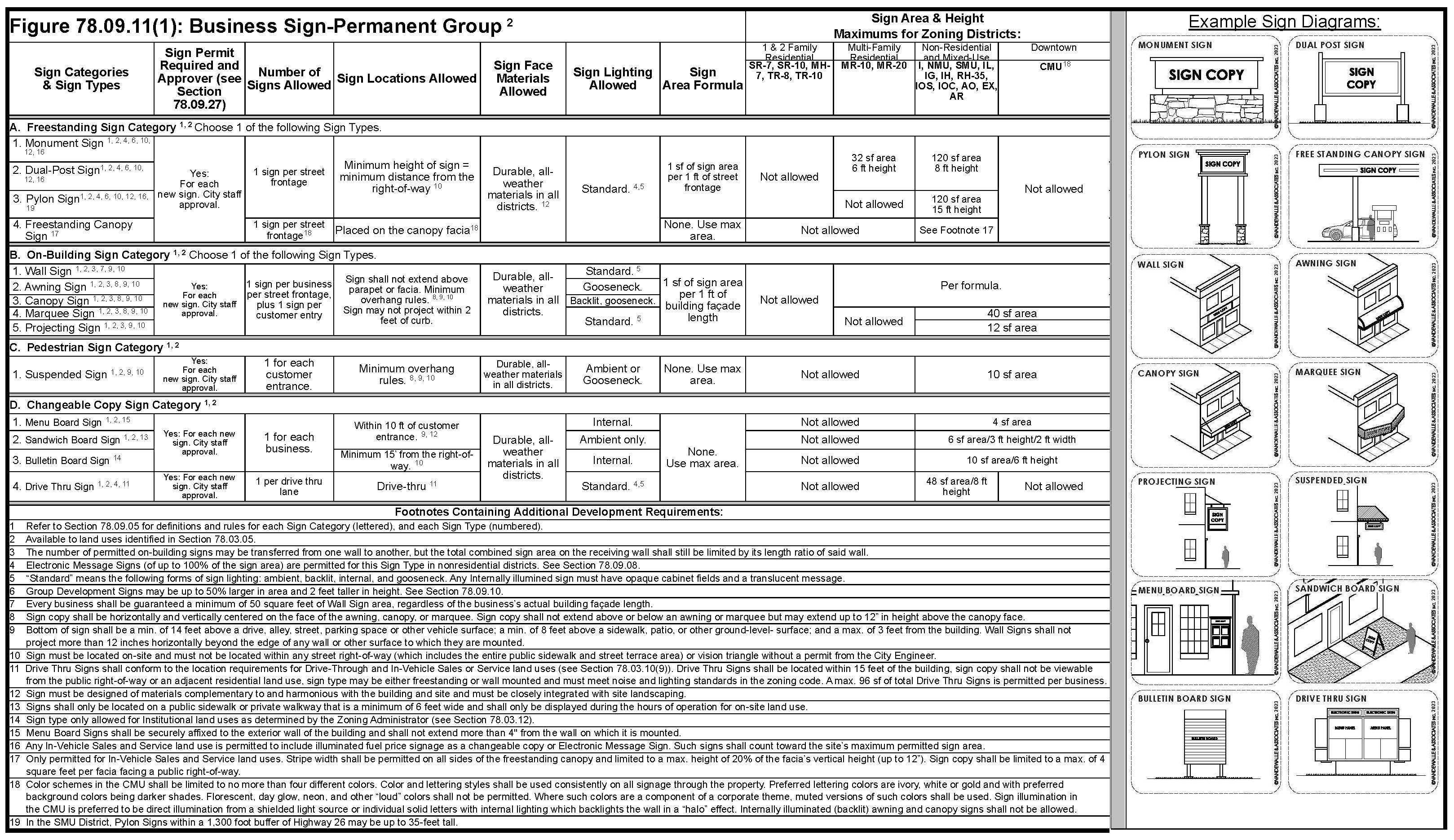
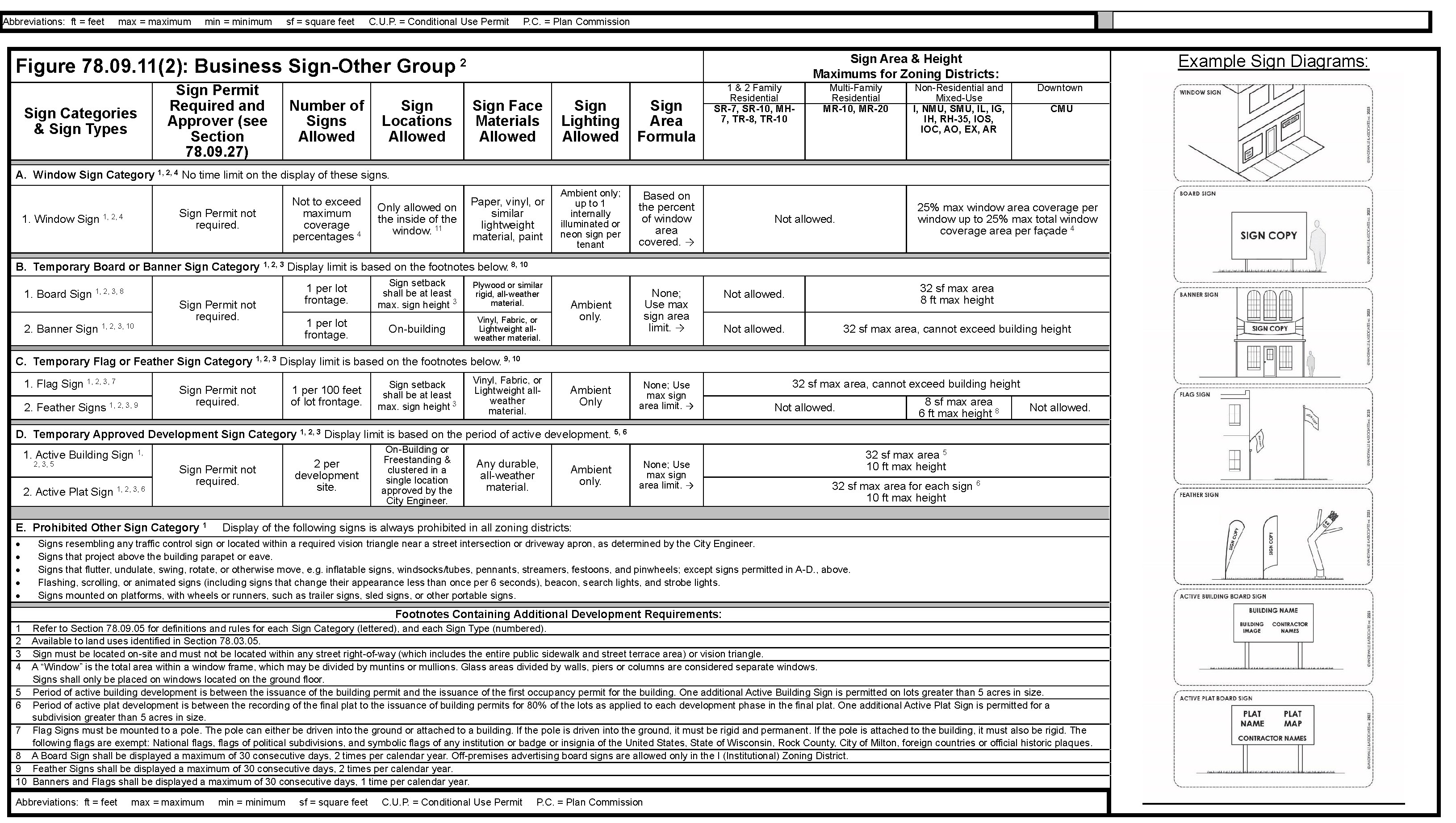
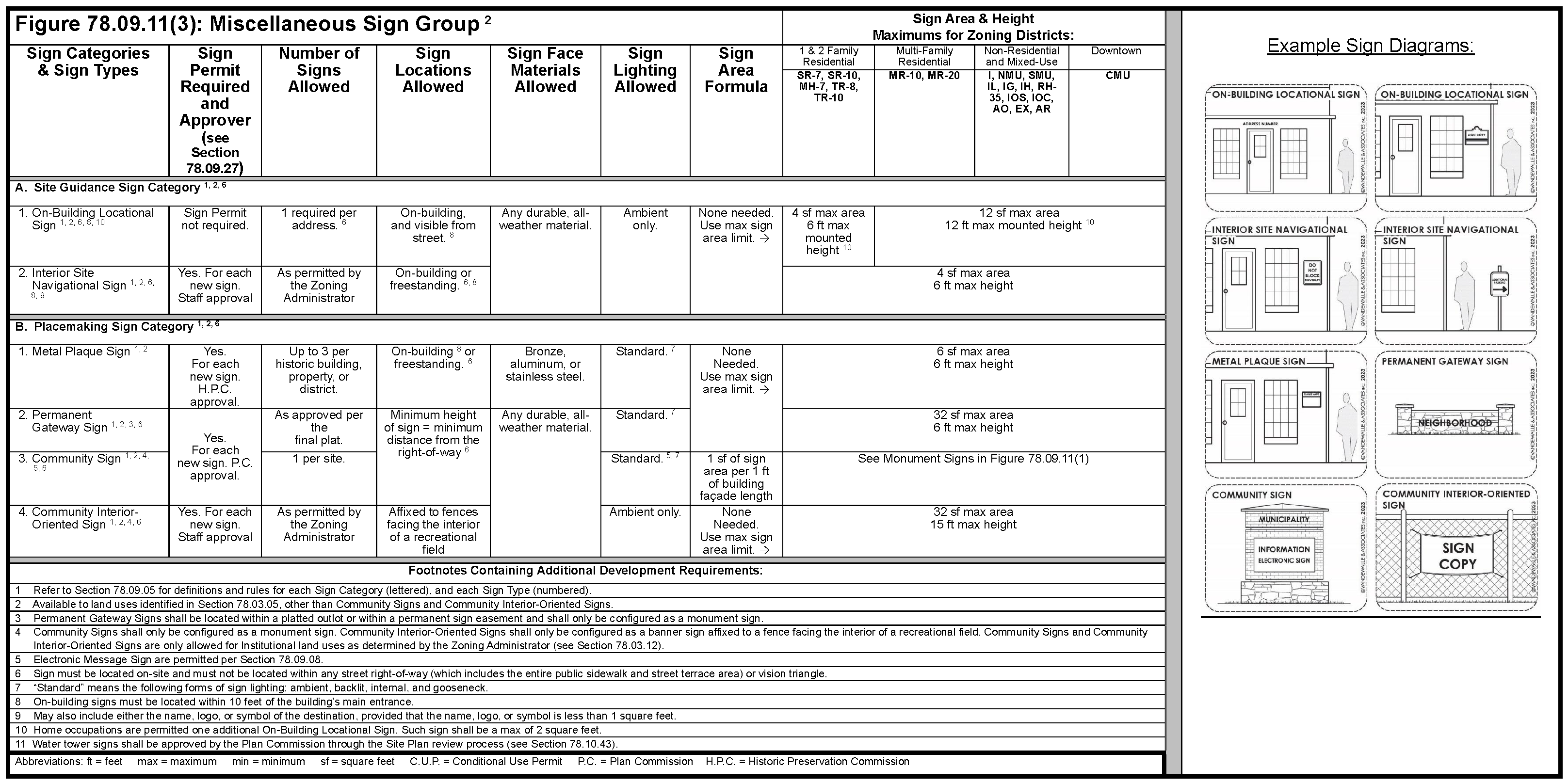
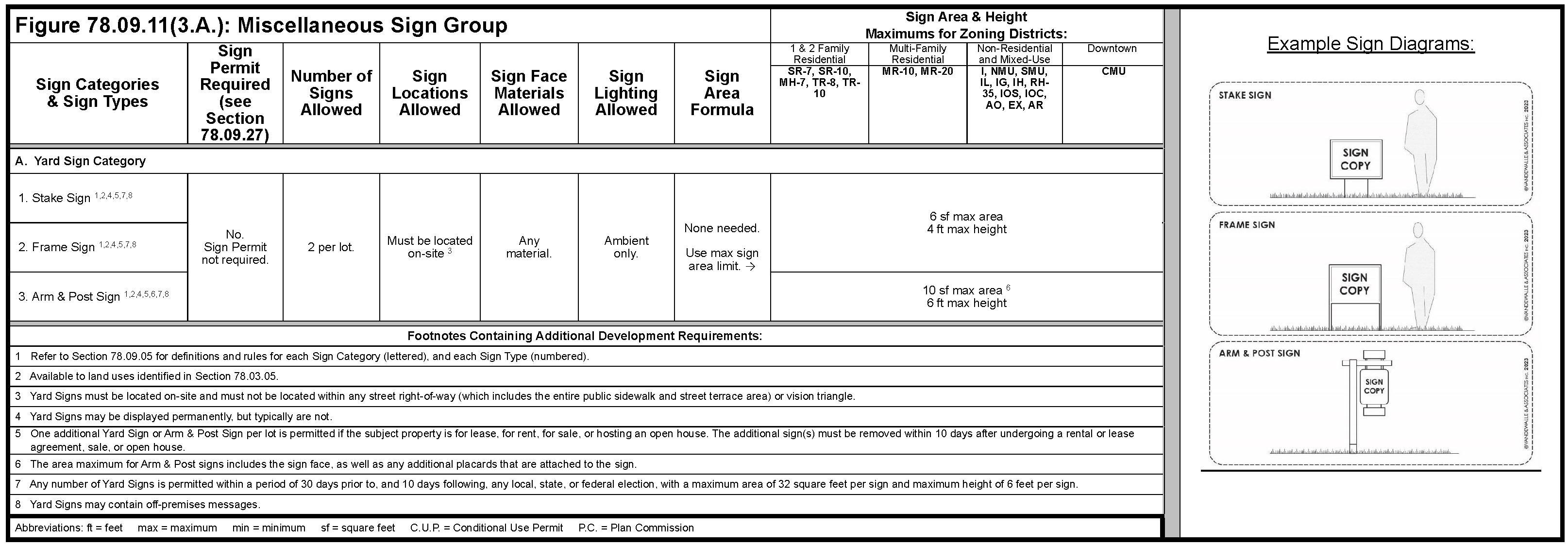
This section provides the definitions related to various sign groups, sign categories, and sign types. Figures 78-09.11(1) through 78-09.11(3.A.) provide the regulations for these signs applicable to each zoning district, including an indication of whether a particular sign type is permitted or prohibited as a new sign. Any sign type not addressed by this chapter shall be considered prohibited.
(1)
Business sign-permanent group. A permanent sign which directs attention to a business, commodity, service, or entertainment conducted, sold, offered, or manufactured upon the site where the sign is located.
"Business sign—Permanent" is a sign group which contains various sign categories and sign types that a business is eligible to use, and which requires a sign permit and in some cases plan commission approval. This sign group includes the following sign categories. Freestanding signs, on-building signs, pedestrian signs, and changeable copy signs. See Figure 78.09.11(1) for additional rules related to zoning districts.
(a)
Freestanding sign category. A sign permanently resting on or supported by a slab, pedestal, post, pylon, or any other form of base located on the ground.
The following freestanding sign types are addressed by this chapter:
1.
Monument sign. A type of freestanding sign in which the bottom edge of the sign face is located within one foot of a ground-mounted pedestal.
2.
Dual post sign. A type of freestanding sign mounted to the sides or ends of two or more posts, with the majority of the sign area located between the outermost posts, with the bottom edge located within an average of three feet of existing grade.
3.
Pylon sign. A type of freestanding sign erected upon one or more pylons or poles, generally of a height that is taller than permitted for a dual post sign.
4.
Freestanding canopy sign. A type of freestanding sign placed directly on the facia of a freestanding canopy associated with an in-vehicle sales and service land use (see article III).
(b)
On-building sign category. A type of sign permanently affixed to a wall of a building, and which is generally oriented and sized for visibility to motorists. The following on-building sign types are addressed by this chapter:
1.
Wall sign. A type of on-building sign that is mounted directly on, and parallel to, a building façade or other vertical building surface. A wall sign also includes a sign located on the interior of a building that is intended to be viewed primarily from beyond the boundaries of the site. Whether an interior sign is considered a wall sign shall be determined by the zoning administrator during the sign permit review process.
2.
Awning sign. A type of on-building sign that is directly affixed via sewing, silk screening, painting, or similar method to a non-rigid removable awning which is mounted to the façade of a building. The definition of an awning can be found in section 78-01.23.
3.
Canopy sign. A type of on-building sign that is directly affixed via bolts, brackets, or similar method to a rigid permanent canopy which is mounted to, or adjacent to, the façade of a building. The definition of a canopy can be found in section 78-01.23.
4.
Marquee sign. A type of on-building sign that is mounted to a permanent roof-like structure that projects out from the exterior wall of a structure and shelters the entrance or entrance approaches to a building.
5.
Projecting sign. A type of on-building sign that is mounted at any angle other than parallel to the wall on which it is mounted, extending from the face of the wall.
(c)
Pedestrian category. A sign attached to the façade of a building and mounted just above sidewalk level, and which is oriented and sized for visibility to nearby pedestrians rather than to motorists.
1.
Suspended sign. A type of pedestrian sign that is mounted to the nearest wall, oriented to pedestrian traffic, and suspended from the underside of a horizontal plane surface, such as a covered porch, arcade, or canopy.
(d)
Changeable copy sign category. A sign typically used to advertise daily specials, daily menu items, or on-site events that change on a frequent basis and which usually includes changeable copy. This type of sign is often associated with restaurants, taverns, retail stores, music venues, and retail stores.
The following changeable copy sign types are addressed by this chapter:
1.
Menu board sign. A type of changeable copy sign mounted flat against a wall containing changeable copy.
2.
Sandwich board sign. A type of freestanding changeable copy sign placed on the ground and constructed in such a manner as to form an "A"-like shape, hinged or not hinged at the top, with each angular face held together at an appropriate distance by a supporting element such as a folding bar, latch, or chain.
3.
Bulletin board sign. A type of freestanding changeable copy sign located on-site containing changeable copy and resting on or supported by a pedestal, post, or other form of base located on the ground.
4.
Drive thru sign. A type of changeable copy sign used only in conjunction with drive-through or drive-in establishments, as further defined in section 78-03.10(9).
(2)
Business sign-other group. A sign which directs attention to a business, commodity, service, or entertainment conducted, sold, offered, or manufactured upon the site where the sign is located.
"Business signs—Other" is a sign group which contains various sign categories and sign types that a business is eligible to use, which do not require a sign permit, and which are typically used to promote temporary activities. This sign group includes the following sign categories. Window signs, temporary board and banner signs, temporary flag or feather signs, and temporary approved development signs. See Figure 78.09.11(2) for additional rules related to zoning districts.
(a)
Window sign category. A type of sign that is either painted onto a window, attached to the inside face of an exterior window, or located inside a building within three feet of a window and intended to be viewed from the exterior of the building. Window signs may face toward the outside, the inside, or both.
(b)
Temporary board and banner sign category. A sign located outside of a building for a defined display time limit. Such signs are often used for the purpose of informing the public of a sale or special offer.
The following temporary board and banner sign types are addressed by this chapter:
1.
Board sign. A type of temporary board and banner sign that is temporarily placed on the ground and is made of rigid material such as plywood or corrugated plastic.
2.
Banner sign. A type of temporary board and banner sign that is made of flexible material such as cloth or vinyl and is supported along one or more sides or at two or more corners by wires, ropes, string, nails, or other removable fastening materials.
(c)
Temporary flag and feather sign category. A sign located outside of a building. Such signs are often used for the purpose of informing the public of a sale or special offer.
1.
Flag sign. A type of temporary flag and feather sign that is located outside of a building. It's made of vinyl, fabric, or other similar lightweight all-weather flexible material which is mounted on a pole.
2.
Feather sign. A type of temporary flag and feather sign consisting of a piece of vertically elongated, flexible material such as cloth or vinyl which is affixed to a single pole driven in the ground. The pole may be rigid or flexible but is not permanent.
(d)
Temporary approved development sign category. A sign which is limited to display only during the active development of a building or plat, but does not include construction site banners defined under Wis. Stats., § 66.1102(5).
The following temporary approved development sign types are addressed by this chapter:
1.
Active building board sign. A type of temporary approved development sign that is made of a rigid material such as plywood or corrugated plastic, which may be displayed only on the site of a building under construction, and only during the time period in which the building permit is valid.
2.
Active plat board sign. A type of temporary approved development sign that is made of a rigid material such as plywood or corrugated plastic, which may be displayed only on the site of a subdivision plat under construction, and only during the time period when less than 80 percent of the lots in the plat phase have been sold.
(3)
Miscellaneous sign group. "Miscellaneous sign group" is a sign group containing various sign categories and sign types that a site or business is eligible or required to use. This group includes the following sign categories. Site guidance signs, placemaking signs, and yard signs. See Figure 78.09.11(3) and 78-09.11(3.A.) for additional rules related to zoning districts.
(a)
Site guidance sign category. A sign category that includes signs that the city finds essential or highly desirable in order to protect the public health, safety, or welfare. Specifically, these signs are used to provide information essential to the following public purposes. to deliver mail; to identify property addresses for the provision of emergency services such as fire or rescue service; to identify the management of rental properties for the provision of emergency services; to provide information about parking limitations or warnings against trespass; and, to provide information about required traffic flow where a safe path to a destination is not evident.
The following site guidance sign types are addressed by this chapter:
1.
On-building locational sign. A type of site guidance sign located on-building that typically indicates addressing information or the name or address of the property owner, tenant, or manager of the property.
2.
Interior site navigational sign. A type of site guidance sign that typically includes a directional arrow or symbol that directs people to a specific destination within a development or site or indicates a warning from the property owner related to conditions on-site or that cites a city, state, or federal law, order, rule, or regulation. Examples may include signs listing parking hours or "No Trespassing," "No Loitering," or "Customer Parking Only" signs. This sign type may also include either the name, logo, or symbol of the destination, provided that the name, logo, or symbol is less than one square foot.
(b)
Placemaking sign category. A sign category that conveys information which the city finds desirable to encourage placemaking, particularly related to officially recognized historic places, officially designated neighborhoods, and conveying information for the general public. Signs in this category are optional and are only permitted through official government action, including designation of historic places, creation of outlots in a plat or certified survey map, and the presence of an institutional land use.
The following placemaking sign types are addressed by this chapter:
1.
Metal plaque sign. A type of placemaking sign is available to officially recognized historic properties, sites, or districts, typically denoting the name of the building onto which it is mounted, its date of erection, or historical information.
2.
Permanent gateway sign. A type of placemaking sign typically indicating the name of a neighborhood, neighborhood association, or subdivision recognized by the city.
3.
Community sign. A type of placemaking sign typically providing information to the community regarding scheduled public events, public activities, and public facilities.
4.
Community interior-oriented sign. A type of placemaking sign typically indicating or recognizing a business or other entity which sponsors or supports a particular sport, team, event, or other activity in which persons are or will be engaged at the location where the sign is displayed.
(a)
Yard sign category. A sign category which is available to all land uses and is intended to accommodate a wide variety of sign purposes (e.g. garage sale signs, for sale signs, political signs, "slow down for kids" signs, on-premises advertising signs, etc.), often needed on a temporary basis. Such signs are freestanding and mounted on one or two stakes or posts and do not have footings. Yard signs are not permitted in any street terrace or other portion of a right-of-way.
The following yard sign types are addressed by this chapter:
1.
Stake sign. A type of yard sign that consists of a sign face erected upon one or more metal wires or wood, metal, or plastic stakes of no more than three inches in width.
2.
Frame sign. A type of yard sign that consists of a frame into which a sign face can be inserted and erected upon two wood, metal, or plastic stakes or ground spikes.
3.
Arm and post sign. A type of yard sign mounted on a post or posts, either with a bracket arm extending outward to support a hanging sign, with the sign attached directly to the side of the post, or with the sign mounted between two posts.
Sec. 78-09.08. - Electronic message signs.
(1)
Electronic message sign. A type of sign that displays words, lines, logos, graphic images, or symbols, which may be changed electronically to provide different information, and which includes computer signs, electronic reader boards, video screens, LCD signs, electronic time and temperature signs, and other signs with electronically controlled changing or moving displays.
(a)
Electronic message signs shall be permitted only with non-residential land uses. No more than one electronic message sign shall be permitted per site.
(b)
In addition to the setback requirements of this chapter, no electronic message sign shall have a message that is visible from any residential zoning district within 150 feet of the sign.
(c)
Electronic message signs may be integrated into the design of the following sign types. Freestanding signs, drive thru signs, or community signs. Electronic message signs shall count toward the site's maximum permitted sign area.
(d)
Messages and non-text images shall not change appearance more than once every ten seconds and transitions between messages shall be via instantaneous change. Use of electronic message signs for images, text, or lighting that change appearance in a manner not permitted above shall be considered animated signs, which are prohibited per section 78-09.30.
(e)
Electronic message signs shall be equipped with photosensitive equipment which automatically adjusts the brightness and contrast of the sign in direct relation to the ambient outdoor illumination.
(f)
Electronic message signs shall comply with the exterior lighting requirements of section 78-06.20.
(g)
Electronic message signs shall be maintained so as to display messages in a complete and legible manner.
Sec. 78-09.10. - Group developments.
(1)
To accommodate increased signage needs for multi-tenant buildings, group developments (defined in section 78-06.02), shall be permitted an increase in total permitted sign area and height.
(a)
Each business shall be eligible for integration into a group development sign. The allocation of sign area for each business shall be determined by the property owner.
(b)
Group development signs shall be configured as a monument sign per section 78-09.05(1)(a)1.
(c)
Group development signs may be increased by up to 50 percent in area and up to two feet in height above the maximum sign area and height established in Figure 78.09.11(1).
(d)
Once a sign permit is granted for a proposed group development sign, all existing freestanding signs on the site shall be brought into conformity with this chapter.
Sec. 78-09.11. - Permitted sign rules.
(1)
Signs shall be allowed on private property in the city in accordance with Figures 78-09.11(1) through 78-09.11(3.A.), which address permitted signage as it relates to permits, quantity, area, location, lighting, and zoning districts. The requirements set forth in Figures 78-09.11(1) through 78-09.11(3.A.) shall be declared to be part of this chapter.
(a)
The rules for signs in the business signs-permanent group are located in Figure 78.09.11(1).
(b)
Additional rules pertaining to the freestanding sign category are located in Figure 78.09.11(1.A.).
(c)
The rules for signs in the business signs-other group are located in Figure 78.09.11(2).
(d)
The rules for signs in the miscellaneous sign group are located in Figure 78.09.11(3) and Figure 78.09.11(3.A.).
(e)
Signage for all uses in the Planned Unit Development Zoning District (See section 78-02.81) shall be permitted per the underlying zoning district and may be granted flexibility through the planned unit development process.
Sec. 78-09.15. - Sign setback, height, measurement, and flexibility.
(1)
Sign setbacks. Signs must be located on-site, outside of the vision triangle, and must not be located within any street right-of-way. Each sign type must be set back in a location consistent with Figure 78.09.11(1), Figure 78.09.11(2), Figure 78.09.11(3), and Figure 78.09.11(3.A.). Any sign to be placed within a public easement requires city approval.
(2)
Sign height.
(a)
The height of a freestanding sign shall be measured from the average ground level adjacent to and at the base of the sign to the top of the highest attached component of the sign, or from the centerline grade of the nearest adjacent public road, if such information is supplied with the permit application and confirmed by the zoning administrator, whichever is higher.
(b)
The average ground level is defined as the average elevation of the ground upon which the sign supports are placed, except when the sign supports rest upon a berm or other area elevated above the surrounding ground. In such cases, the average elevation of the base of such berm or other area shall be considered as the ground level.
(3)
Minimum ground clearance. All on-building and pedestrian signs shall have a minimum clearance of 14 feet above a drive, alley, or street and a minimum of eight feet above a sidewalk, path, trail, or other ground-level surface.
(4)
Measurement of sign area. The measurement of sign area is based on the arrangement of sign copy and sign background:
(a)
In the case of a freestanding sign (including three-dimensional objects), sign area shall include the total sign area(s) that can be viewed from any single vantage point. i.e., for a typical freestanding sign that faces two directions, only the largest sign face visible from any single vantage point shall count toward the total permitted sign area. Sign area shall not include any elements of the sign structure designed solely for support of the sign structure and located below or to the side of the sign message. Examples of parts of a freestanding sign structure which are exempt from the sign area include the sign base and the supporting columns, posts, or poles.
(b)
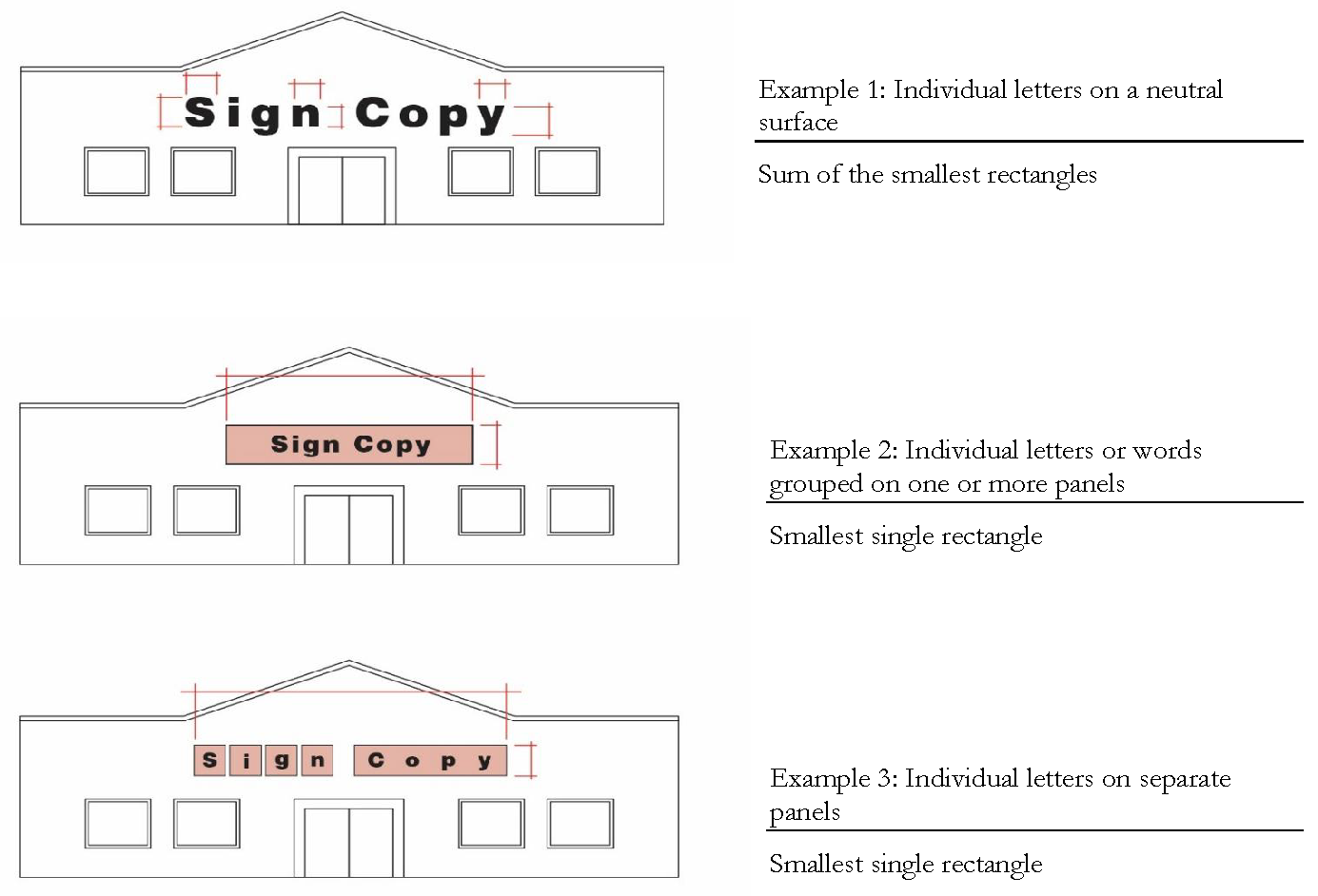
For signs comprised of individual letters and related copy which are attached to a background surface with one or more neutral surface colors, sign area shall be measured as the sum of the smallest rectangle enclosing each letter or related copy. See Example 1 in Figure 78.09.15(2).
(c)
For signs comprised of individual letters and related copy surrounded by one or more sign background colors on individual panels, sign area shall be measured as the smallest single rectangle enclosing the entire sign message and any and all background color areas. See Example 2 in Figure 78.09.15(2).
(d)
Groupings of related smaller signs may be counted as one sign. In such cases, sign area shall be measured as the smallest single rectangle enclosing the individual signs and any and all background color areas. See Example 3 in Figure 78.09.15(2).
(e)
For signs comprised of one or more three-dimensional objects (i.e., balls, cubes, clusters of objects, sculpture or statue-like trademarks), the sign area shall be measured as its maximum projection upon a vertical plane. See Figure 78.09.15(1).
Figure 78.09.15(1). Measurement of a 3D Sign Area
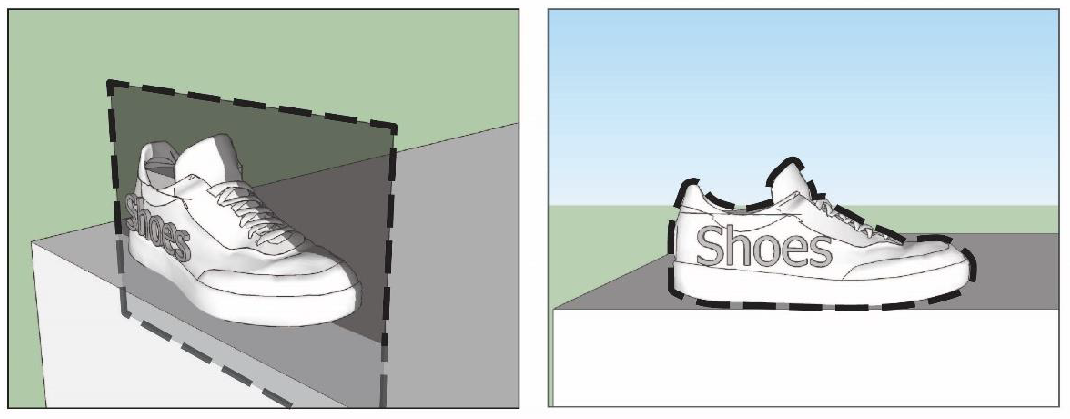
Figure 78.09.15(2). Measurement of Sign Area
Sec. 78-09.27. - Sign approvals and permits—Application, enforcement, and revocation.
(1)
Applicability.
(a)
No gateway sign under section 78-09.05(3)(b)2., or community sign under section 78-09.05(1) (b)3. shall be erected, installed, or constructed without approval from the city plan commission and the granting of a permit from the zoning administrator in accordance with the provisions of this section.
(b)
No freestanding sign listed under section 78-09.05(1)(a), on-building sign listed under section 78-09.05(1)(b), drive thru sign under section 78-09.05(1)(d)4., suspended sign under section 78-09.05(1)(c), menu board sign, sandwich board sign, or bulletin board sign listed under section 78-09.05(1)(d), or interior site navigational sign under section 78-09.05(3)(a)2., shall be erected, installed, constructed, or maintained without the granting of a permit from the zoning administrator in accordance with the provisions of this section.
(c)
No metal plaque sign under section 78-09.05(3)(b)1. shall be erected, installed, constructed, or maintained without the granting of a permit from the historic preservation commission in accordance with the provisions of this section.
(d)
For signs requiring a permit in subsection (a), above, this section shall apply and be construed to require a permit for a change of copy on any sign or for any conversions or changes in the sign structure.
(e)
This section shall not apply to repainting or re-facing with the same sign copy, cleaning, repair, or other normal maintenance of the sign or sign structure.
(f)
No new permit is required for signs which are in place as of the effective date this chapter, and such signs may remain as legal nonconforming signs if they do not comply with every provision of this chapter. Any alteration or relocation of such signs shall conform to the requirements of this chapter. Refer to section 78-09.35 for rules pertaining to nonconforming signs.
(g)
Any sign permit granted hereunder shall not be assigned or transferred to any other sign, including a modified sign face or modified sign structure.
(h)
The owner or tenant may request the granting of one permit for all signs on a site that requires a sign permit.
(2)
Review authority.
(a)
The plan commission shall review all signs per section 78-09.27(1), all signs accompanying changes in land use or a new land use which must receive approval of a zoning permit, and sites which will have more than one sign viewed together as part of a group of signs. This may be required with a zoning permit for change of land use or a sign permit.
(3)
Sign permit application. Each sign permit application shall include:
(a)
The name, address, phone number, and email address of the applicant.
(b)
The name of the business or land use the proposed sign will serve.
(c)
The name, address, phone number, email address, and signature of the property owner.
(d)
The name, address, phone number, and email address of the sign contractor.
(e)
The property's zoning designation.
(f)
The property's current land use or uses for the entire subject property, including all indoor and outdoor areas.
(g)
The approved site plan for the subject property (see section 78-10.43). If a site plan was not previously required or approved, a site plan for the subject property with requirements as determined by the zoning administrator shall be provided. At a minimum, the site plan shall include the following:
1.
Location, type, height, width, and area of the proposed sign.
2.
Location, type, height, width, and area of all existing signs on the property and indication of whether existing sign(s) will remain or be removed/replaced.
3.
All property lines and buildings on the property and within 50 feet of the proposed sign.
4.
All parking areas, driveways, and public roads.
5.
Method of attachment, structural support, method of illumination, and sign materials.
6.
The total area of all signs on the subject property both before and after installation of the proposed sign.
7.
Approximate value of the sign to be installed, including cost of installation.
(h)
Payment of the sign permit fee, as established in the City of Milton Fee Schedule.
(i)
A written statement that all temporary signs will be removed per the time limits of this chapter.
(j)
Any other information that may reasonably be requested by the zoning administrator for the purpose of application evaluation.
(k)
Any existing or proposed sign on property abutting a state highway, united states highway, or interstate highway may also require approval from the Wisconsin Department of Transportation or the Federal Highway Administration.
(4)
Granting and issuance.
(a)
The zoning administrator shall review the application within 14 working days of submittal to ensure it is complete per the requirements of subsection (3), above.
(b)
In cases where no other review or approvals are required under this chapter, the zoning administrator shall review said application for compliance with subsection (5), below, and shall, in writing, either approve or deny said sign permit within 45 working days of the acceptance of the complete application and payment of the required fee. If the permit application is denied, the zoning administrator shall state the reasons therefor. Failure of the zoning administrator to act within this time frame shall not constitute automatic approval of the sign permit.
(c)
When a proposed sign is associated with any development that requires a site plan, a sign permit shall not be granted prior to the approval of a site plan. In such cases, the zoning administrator shall review said application for compliance with subsection (5), below, and shall place the item on the appropriate meeting agenda(s) within 30 working days of the acceptance of the complete application and payment of the required fee. Within 30 working days of recommendation or action by the body with recommending or approval authority, the zoning administrator shall approve or deny said sign permit based on such recommendation or action.
(d)
Sign permit fees are nonrefundable unless applications are withdrawn prior to the commencement of zoning administrator review.
(e)
A granted sign permit shall expire, and shall be null and void, if the sign is not attached or erected within 180 days after the issuance of the sign permit.
(5)
Basis for granting a sign permit. In deciding whether or not to grant a sign permit, the zoning administrator shall determine whether the proposed sign is in compliance with the provisions of this chapter. In such review, the zoning administrator may also consider the following factors:
(a)
Any signage affixed to a building shall be dimensioned and located in such a manner that it fits the building's architectural features and proportions.
(b)
All signs shall be designed to fit the zoning and character of the surrounding area including compatibility with the building characteristics, adjacent uses, and adjacent signs. Special consideration should be made where proposed signage is located on or adjacent to locally identified historic structures or publicly owned recreation and conservancy areas. Signage in the Planned Unit Development Zoning District shall conform to the planned or existing dominant architectural theme of the area. Signage in or abutting residential properties should be designed and located so as not to create a nuisance.
(c)
Signs illuminated by floodlights or spotlights shall be positioned in such a manner that none of the light spills over onto an adjoining property or glares or shines into the eyes of motorists or pedestrians. Light levels must conform to zoning requirements. All signs must conform to the sign illumination standards in section 78-06.20.
(d)
The number of colors and materials of the sign should be kept to a minimum.
(e)
Landscape features shall be incorporated around the base of all permanent freestanding signs. Landscape plantings or other landscape materials shall not be considered as part of the allowable signage.
(f)
Whether the sign is designed, constructed, installed, or maintained in such a manner that it does not endanger public safety or traffic safety and minimizes conflict with vehicular or pedestrian circulation.
(g)
Whether the sign is in compliance with all provisions of the City of Milton Municipal Code and Building Code, including those related to traffic safety, traffic visibility, sign setbacks, and structural integrity.
(6)
Enforcement and revocation of sign permit.
(a)
A sign permit may be revoked if the applicant has failed to comply with the provisions of this chapter or any conditions that may have accompanied the permit at the time of issuance. Revocation requires written notice by either the zoning administrator for chapter 78 violations or the building inspector for building code or other construction code violations.
(b)
In the event that construction, installation, or manufacture of a sign for which a permit has been issued has not commenced within 180 days from the date of the issuance of such permit, said permit shall be null and void and automatically revoked. If work authorized by such permit is suspended or abandoned for a period of 90 days any time after the work is commenced, the original permit shall become null and void. In such cases, a new permit shall be obtained to complete the work and a new permit fee shall be required.
(c)
Any sign subject to a revoked permit shall be removed by the licensee, sign owner, or property owner within 45 days of such revocation.
(7)
Variances. Any sought by a property owner or applicant shall follow the process set forth in section 78-10.51.
(8)
Appeals. Any applicant or sign permit holder affected by a decision of the zoning administrator may petition for a hearing before the board of zoning appeals in the same manner and subject to the same procedures as other appeals of decisions of administrative officers. The filing of such petition automatically stays removal of any sign involved and already legally erected until the board of zoning appeals decides whether to sustain, modify, or withdraw the notice.
(9)
Removal of signs in violation of this chapter.
(a)
If the zoning administrator determines that any sign exists in violation of this chapter, the zoning administrator shall notify the sign permit holder or the owner of the property on which the sign is located. Said notification shall indicate that such violation shall be corrected within 60 days of receipt of said notice on penalty of automatic revocation of any sign permit, and that removal of the sign by the city may occur at the expense of the owner of the property.
(b)
If notification is sent and the violation is not corrected within 60 days, the zoning administrator shall revoke the permit for any sign which is in violation of this chapter. It shall be the duty of the zoning administrator to cause removal of such sign.
(c)
The expense of removing such sign shall be charged to the owner of the property on which the sign is located. If the owner fails to pay such expense within one month of being billed therefore, or has not made arrangement for payment satisfactory to the city attorney, then such expense shall become a lien on the property and shall be placed upon the tax roll in accordance with Wis. Stats. § 66.0627.
(d)
Any sign illegally placed in a public right-of-way shall be subject to immediate removal and confiscation without notice by the zoning administrator.
(10)
Adjustments to approved signs. The following adjustments may be approved administratively by city staff and no additional process is necessary.
(a)
A proposed adjustment that does not alter the size, location, or placement of the approved sign.
(b)
A proposed adjustment that would remove a sign component which is not required under the chapter.
Sec. 78-09.30. - Sign prohibitions and limitations.
The regulations contained in this subsection apply to signs in all zoning districts.
(1)
Prohibited signs.
(a)
Abandoned sign. Any sign remaining in place on a site or a portion of a site (such as a single tenant in a multitenant building) that has been vacant, closed, or otherwise unoccupied for a period of 90 days.
(b)
Animated sign. A sign having lights or illumination which flashes, scrolls, moves, rotates, twinkles, blinks, flickers, varies in intensity of color, or uses intermittent electrical pulsations. Electronic message signs meeting the definition and requirements of section 78-09.08 of this chapter shall not be considered an animated sign.
(c)
Billboard sign. An off-premises advertising sign which is freestanding, constructed of durable materials, and permanently affixed to a structure used to display advertisements and other messages to vehicle travelers for a fee paid to the owner of the structure. New billboards are prohibited in the city, except under the following cap-and-replace policy:
1.
A new billboard may be erected in only non-residential zoning districts within a 1,300-foot buffer of Highway 26, and only upon removal of an existing non-conforming billboard in the city. New billboards may be up to 35 feet tall and 400 square feet in size.
(d)
Beacon sign. Any light with one or more beams directed into the atmosphere or directed at one or more points not on the same site as the light source; also, any light with one or more beams that rotate or move.
(e)
Inflatable sign. A sign capable of being filled with and expanded by air or other gas, including "dancing" inflatable signs where air moves through the sign causing it to move.
(f)
Off-premises advertising sign. A sign which directs attention to a business, commodity, service, or entertainment that is conducted, sold, or offered elsewhere than upon the site where the sign is displayed. Off-premises advertising signs include billboards.
1.
Existing legal off-premises advertising signs made nonconforming by this section shall be permitted to continue as legal, nonconforming signs, subject to the requirements of section 78-09.35.
2.
Any advertising sign not considered an off-premises advertising sign is considered to be an on-premises advertising sign.
(g)
Portable sign. A sign not permanently attached to the ground that is designed to be moved from one location to another. Also, a sign mounted on a frame or chassis designed to be easily relocated, including unlicensed or inoperable vehicles or trailers whose principal commercial use is for signage. Licensed and operable business vehicles, trailers, or other pieces of equipment shall not be considered mobile or portable signs. Sandwich board signs meeting the definition and requirements of section 78-09.05(1)(d)2. of this chapter shall not be considered mobile or portable signs.
(h)
Roof sign. A sign displayed above the eaves or cornice of a building.
(i)
Vehicle sign. A vehicle, trailer, or other piece of equipment which contains any sign or advertising device, which is unlicensed or inoperable, or which is parked on a public right-of-way or in a location that is not an active worksite so as to be seen from a public right-of-way.
1.
Business vehicles legally parked in any of the locations described below shall not be considered vehicle signs.
a.
A business vehicle parked on-site at the place of business in a parking space designated for company vehicle parking or storage on a site plan approved by the city; or
b.
A business vehicle legally parked on-site at the residence of an employee (including driveways and legal off-street parking spaces).
(2)
Sign prohibitions.
(a)
No sign shall be erected at any location where it may, by reason of its position, shape, color or design, interfere with, obstruct the view of, or be confused with any authorized traffic sign, signal or device, nor shall such sign make use of words such as "stop," "look," "danger," or any other word, phrase, symbol, or character in such a manner as to interfere with, mislead, or confuse users of streets or highways.
(b)
No fluttering, undulating, swinging, rotating, or otherwise moving signs such as windsocks, motorized signs, pennants, and streamers shall be permitted. This shall not apply to banners signs, flag signs, or feather signs as defined in section 78-09.11(2) or community interior-oriented signs as defined in section 78-09.11(3)(b).
(c)
No signs shall project above the building parapet or eave, or be mounted on or extend above the roof, if attached to the building.
(d)
No flashing, scrolling, or animated signs shall be permitted. Flashing is defined as changing more than once within a ten-second time interval.
(e)
No signs shall be mounted to an unlicensed trailer or other unlicensed vehicle.
(f)
No beacon signs shall be permitted.
(g)
No off-premises advertising signs shall be permitted except for board sign configurations in the institutional zoning district, temporary yard signs, and new billboards under the cap-and-replace policy under section 78-09.30(1)(c)(1). See specific regulations for board signs, temporary yard signs within Figure 78.09.11(1), Figure 78.09.11(2), Figure 78.09.11(3), and Figure 78.09.11(3.A.).
(h)
No abandoned signs shall be permitted. See section 78-09.30(1)(a).
(i)
No sign shall be located within a required bufferyard or within a permanently protected green space area.
(j)
No illuminated sign shall be permitted unless the illumination of the sign is so designed that the lighting element is not visible from any property within a residential zoning district.
(3)
Sign limitations.
(a)
No sign shall be erected, relocated, or maintained so as to prevent free ingress to or egress from any door, window, or fire escape, and no sign shall be attached to a standpipe or fire escape.
(b)
No sign shall be placed in a manner that would impede vehicular or pedestrian safety, or impede access or visibility. Signs shall meet the visibility requirements of section 78-06.05.
(c)
No private sign shall be attached to or painted on any natural feature (e.g. tree or rock), fence, fire hydrant, public utility pole, public light pole, or traffic regulatory structure, unless otherwise authorized by the city engineer.
(d)
Unless otherwise allowed by this chapter, no sign shall be permitted within or extend into a public right-of-way.
Sec. 78-09.33. - Appearance, construction, and maintenance of signage.
(1)
All signs shall be constructed, mounted, and maintained so as to comply with the appropriate detailed provisions of the building code as adopted by the city relating to the design, structural members and connections. Signs shall also comply with the applicable provisions of the electrical code as adopted by the city.
(2)
The base or support(s) of all ground-mounted signs shall be securely anchored to a concrete base or footing, and shall meet minimum wind load capabilities of 30 pounds per square foot.
(3)
Freestanding signs, permanent gateway signs, and community signs shall:
(a)
Conceal the footings and related supporting structure, including bolts, flanges, and brackets with landscaping using the formula of two landscaping points for every foot of sign's width as measured on the sign face or sign base—whichever is greater.
(b)
Construct the base of the sign from masonry or aluminum products. The tone and texture of the base shall reflect the principal building construction as close as possible. The base of the sign must be equal or larger in width to the face of the sign.
(c)
Follow the color scheme of the principal building and incorporate architectural features (such as sills, piers, reveals, capstones, medallions, etc.) which are part of the architectural makeup of the building shall be incorporated into the sign.
(4)
Signs shall be mounted so that the method of installation is concealed. Signs applied to masonry surfaces shall be mechanically fastened to mortar joints only and not directly into brick or stone. Drilling to provide electrical service shall follow the same rule.
(5)
No sign shall be suspended in a way that will allow the sign to swing due to wind action. Signs shall be anchored to minimize any lateral movement that would cause wear on the sign face or supporting members or connections.
(6)
All permanent signs and their supporting members shall be constructed of standardized, durable, all-weather sign materials.
(7)
Sign materials in the business sign-permanent group (Figure 78.09.11(1)) shall be compatible with the design of the face of the façade where they are placed and shall contribute to the legibility of the sign.
(8)
No combustible materials other than approved plastics shall be used in the construction of electric signs.
(9)
All signage within the jurisdiction of this chapter shall remain in a state of proper maintenance. Proper maintenance shall be the absence of loose materials (including peeling paint, paper or other material), the lack of excessive rust, the lack of excessive vibration or shaking, and the presence of the original structural integrity of the sign, its frame and other supports, its mounting, and all components thereof.
(10)
Every sign requiring either plan commission or zoning administrator approval hereafter erected shall have marked in a conspicuous place thereon the date of erection, the manufacturer's name, the permit number, and the voltage of any electrical apparatus used in connection therewith.
(11)
The repainting, changing of parts, and preventive maintenance of signs which completely conform to the requirements of this chapter, and result in absolutely no change in the appearance of the sign from that originally approved, shall not be deemed alterations requiring a sign permit.
(12)
Any signs which may be, or may hereafter become rotted, unsafe, or in a state which is not properly maintained shall be subject to the provisions of section 78-10.60.
(13)
If any sign is suspended or projects above a public right-of-way, the issuance and continuation of a sign permit shall be conditioned on the sign owner agreeing to hold the city harmless, and obtaining and maintaining in force liability insurance for such a sign in such form and such amount as the city may reasonably from time to time determine, provided that the amount of such liability insurance shall be at least $1,000,000.00 per occurrence per sign.
Sec. 78-09.35. - Nonconforming signs.
(1)
Nonconforming signs. Permanent signs existing as of the effective date of this chapter, which do not conform to the provisions of this chapter but that conformed and met all applicable regulations of the ordinance on the effective date of this chapter, shall be legal nonconforming signs.
(2)
Continuation of a legal nonconforming sign.
(a)
Legal nonconforming signs may be maintained.
(b)
Legal nonconforming signs shall not be altered or moved to a new location without being brought into compliance with the requirements of this chapter. See subsection (3)(a), below, for what would constitute an alteration of a sign.
(c)
When the principal structure located on the site undergoes a change of land use per the lettered land use categories described in article III of the zoning ordinance, all legal nonconforming signs shall be brought into conformance with the provisions of this chapter or shall be removed.
(d)
Whenever there is a change in the sign user (excluding off-premises signs), sign owner, or owner of the property on which the sign is located, the new sign user, sign owner, or new property owner shall forthwith notify the zoning administrator of the change. No new sign permit is required unless there is modification of the sign face or sign structure. The sign will continue to be considered legal nonconforming.
(3)
Alteration of legal nonconforming signs.
(a)
For the purpose of this section, alteration of a sign is considered to be any change to the sign's frame, supporting structure, lighting, material, height, location, or any other alterations as determined by the zoning administrator.
(b)
Altering a sign does not include maintaining the existing appearance of the sign; changing the appearance of the sign face; replacing the sign face or the supporting structure with identical materials, colors, and messages; changing the message of a changeable copy sign; or changing the face of an off-premises advertising sign (as defined in section 78-09.30(1)(h).
(c)
A tenant sign may be replaced to accommodate a new tenant sign without triggering the need to bring the entire project identification sign, or any of its parts, into compliance with the provisions of this chapter.
Sec. 78-09.37. - Removal of sign and sign structures where business is no longer in operation.
(1)
A building, portion of a building, or site shall be determined to be vacated based on the following criteria. vacancy, cessation of some or all utilities, or lapse or termination of occupational license. Vacation of a building, structure or site shall have the following effect:
(a)
Within 90 days, the owner of the property shall take action regarding any sign and sign structures associated with the vacant building, portion of a building, or site located on the property. At the property owner's option, the property owner shall do one of the following. remove all such signs and structures, or replace the face of such signs with a blank sign face. If the property owner is granted an extension under subsection (b) below, the requirement shall not apply during the extension period.
(b)
An extension allowing signs or sign structures associated with vacant buildings, portions of buildings, or sites to remain on the property for an additional six-month time period after the original 90 days have lapsed may be granted under the following conditions:
1.
The property owner shall submit an application with the appropriate fee and allow staff to inspect the signs and sign structures on the vacated building, portion of a building, or site.
2.
Staff shall review the application and sign to determine that the sign will not be a hazard, safety concern, or blight for the duration of the extended time period.
3.
Signs shall be properly blanked out and contain no commercial message.
4.
If the sign has been damaged during the vacated period to the point it becomes a safety hazard or blight on the property, staff may have the structure removed.
5.
After the original six-month extension, one additional six-month extension may be approved by staff for up to one year upon submittal of a new application and fee. Any additional applications for an extension, beyond the first year, shall be approved by the plan commission.
6.
Owners of nonconforming signs may also apply for an extension; however, the nonconforming sign must be brought into compliance with this chapter if any business is reestablished on the subject property.
(2)
Sign structures that have been left without a sign face, or where the permit holder no longer has any interest in the site as owner or tenant, any of which for a continuous period of 90 days, shall be deemed abandoned and shall be removed by the owner of the sign structure or the city shall proceed to remove such sign structure pursuant to the terms of this chapter if the owner has not been granted an extension.
(3)
If the sign or sign structure(s) have not been removed, the city shall send written notification to the property owner of record or last known occupant, via certified mail, return receipt requested, indicating that said property owner or occupant remove the sign or sign structure or apply for and be granted an extension. If the sign or sign structure have not been removed within 90 days after the city sends notice, and an extension has not been granted, the city may have the sign or sign structure removed.
(4)
Any and all costs incurred by the city in the removal of a sign or sign structure pursuant to the provisions of this section, which authorized assessment of the cost, shall constitute a lien against the property upon which the sign or sign structure existed and shall be collected as a special charge under Wis. Stats., § 66.0627.
Sec. 78-09.40. - Violations, penalties, and fees.
(1)
It shall be a violation of this ordinance for any person to maintain any prohibited sign, to perform or order the performance of any act prohibited by this ordinance, or to fail to perform any act which is required by the provisions of this chapter. In the case of any such violation, each day in which such violation exists shall constitute a separate violation.
(2)
Any and all signs, erected, altered, or maintained in violation of this section, or any of the clauses provisions of the same, or in violation of any of the laws or ordinances of the city or the State of Wisconsin, are, and each of them is declared to be a public nuisance and subject to enforcement. Any such signs so erected, altered or maintained contrary to law shall be abated as a common nuisance by the zoning administrator.
(3)
Any person who shall fail to comply with any of the provisions of this chapter shall be subject to a penalty as prescribed by section 78-10.60.
(4)
Fees related to signage shall be subject to those prescribed by section 78-10.61.

